Church Life

Shape up, Sheeple

Contributor

The church needs faithful sheep as much as faithful shepherds.

Sheep making the shape of a church
Christianity Today August 13, 2025
Illustration by Mark Conlan

One recent Sunday, our church service concluded with the song, “Savior, Like a Shepherd Lead Us.” First published by British hymnwriter Dorothy Ann Thrupp in 1836, the hymn is simple and lovely, addressing Jesus directly and asking him to protect his flock: “Keep Thy flock, from sin defend us / Seek us when we go astray.” 

The flock here is the people of God, the church both local and universal. And that makes us, its members, the sheep.

The Bible speaks of Jesus as our good and great shepherd (John 10:1116; Heb. 13:20), but it also speaks of pastors and other church leaders as shepherds serving under him (Acts 20:28; 1 Pet. 5:24). And in recent years, American evangelicalism has paid close attention to these leaders of the flock. Our books and other media are full of advice for those who would like to be good ones and churches dealing with bad ones, intense debates over who is qualified to be a shepherd and how one may become disqualified from this role, and exposés of wolves in shepherds’ clothing.

These conversations are all necessary, to be clear. But what about the sheep? Most of us are not shepherds, and just as it is difficult to be a good shepherd, so it can be difficult to be a good sheep. 

This is a reality that Augustine noted toward the end of his ministry: Just as there are good shepherds and bad ones, so it is with sheep. And the struggles we experience in these two roles are often connected: Some of the worst shepherds are people who never wanted or learned to be good sheep. They always sought the staff.

The image of Jesus as a shepherd lovingly guarding his flock has roots in the Old Testament as well as justifiably widespread use in the church. David’s Psalm 23 is a well-known reflection on this idea—from someone with actual shepherding experience. Jesus repeatedly used sheep and shepherding imagery in his parables (Luke 15:47) and other teachings (John 10:118). 

This language gave rise to a favored scene in early Christian art: Jesus as a tender shepherd carrying a found sheep on his shoulders. In her passion account in the early third century AD, newly converted Perpetua recounts a vision of seeing Jesus in a garden, looking like a simple shepherd. He welcomes her and extends to her a curd of fresh sheep’s milk cheese: 

And I went up, and I saw a very great space of garden, and in the midst a man sitting, white-headed, in shepherd’s clothing, tall milking his sheep; and standing around in white were many thousands. And he raised his head and beheld me and said to me: Welcome, child. And he cried to me, and from the curd he had from the milk he gave me as it were a morsel; and I took it with joined hands and ate it up; and all that stood around said, Amen.

Perpetua was imprisoned and awaiting execution when she recorded this vision, her own retelling of Psalm 23 in a moment of intense fear and persecution. Yet with the Lord as her shepherd, she knows she is safe and thus unafraid, even of martyrdom—a “valley of the shadow of death.”

Her words and more recent uses of the shepherding metaphor, as in “Savior, Like a Shepherd Lead Us,” reiterate that Christ is the one good shepherd of us all, and we are mostly called to be sheep. This is a theological truth but also a mathematical one: Even a large church may only have one senior pastor and maybe a few more elders and shepherding members of the staff. The average Christian is a sheep. 

So what should faithful sheep do? 

Before I answer, I must note that I’m not speaking to churches dealing with significant sin, abuse, or dysfunction. I’m writing for members of churches with faithful, well-intended shepherds who are themselves following the lead of Christ. For them, I’d like to offer three simple exhortations.

First and foremost, commit to your flock. We live in a flighty, inconstant, and noncommittal society, and that attitude has seeped into the church. Membership vows can help, but in practice, even Christians who consider themselves faithful members of a local body may not attend on most Sundays—let alone participate beyond the main service.

Only one in three Americans attend services in person at least once a month, according to Pew Research Center, and just 25 percent attend services at least weekly. Even these numbers may be too high, if respondents are overestimating their own constancy, as some other research has suggested

Whatever the exact figures, and with all due allowances for unusual circumstances and constraints, monthly church attendance is not enough. This is not what it means to be a faithful sheep. Being in a flock means being together, relying on one another, and it is difficult to do this without forging a close connection by worshiping together weekly. 

Indeed, the second characteristic of faithful sheep is that they look out for one another, both spiritually and in more practical terms. They act and even think together. 

Groupthink gets a bad name in our society, and often with good cause. We even have a sheep-themed insult—“sheeple”—for people who don’t think for themselves but simply follow the herd. 

But the kind of thick community life that produces the best version of groupthink is also key to the survival and flourishing of groups. It was a natural mentality for the ancient world, where the ability to work together could mean the difference between life and death. We see this in the description of the early church in Jerusalem: “All the believers were one in heart and mind” (Acts 4:32). 

The premodern view of the self as part of a group no longer comes naturally to us in our hyper-individualistic culture. But the church is one place where we must still remember, as Jesus taught, that we are part of something greater, part of a community bound by supernatural bonds (John 13:34). To be faithful sheep requires us to work with one heart and mind for the good of our local churches and communities.

Last, faithful sheep keep faithful shepherds not only accountable but also well-supported. As members of a flock, it is our responsibility to joyfully serve our church community, care for the building, teach Sunday school, volunteer in the nursery, and organize care teams that minister to the sick and home-bound. The shepherd has a job, but so do the sheep—and I suspect that at least some of our epidemic of pastoral burnout could be resolved by greater involvement of lay Christians in the regular work of the church).

Comparing ourselves to sheep may not be very appealing, even without our culture’s use of the word as an insult. But God chose this metaphor for good reason, and Christ’s followers are still called to be faithful sheep. This is a calling that may be easy to overlook; indeed, we rarely think of it as a calling at all, certainly not the way we think of pastoral calling. Yet it is an essential calling, one necessary to the goodness and flourishing of the flock of Christ.

Nadya Williams is the author of Cultural Christians in the Early Church and Mothers, Children, and the Body Politic: Ancient Christianity and the Recovery of Human Dignity (IVP Academic, 2024).

Theology

A Never-Ending Story with Sacred Cows

The basics of Hindu cosmology and mythology.

Indian cows
Christianity Today August 13, 2025
Illustration by Christianity Today / Source Images: Getty, Pexels

In this series

(This is the third of a series. See earlier ones here and here.)

Christians and Jews tend to ask lots of questions about how life began. Hindus tend not to be similarly concerned. Hinduism proclaims no creation as such because the universe goes through endless cycles of creation and destruction. The base unit to compute the length of a cycle is the mahāyuga, which is 4.3 million earthly years. One cosmic day consists of 1,000 mahāyugas, as does a cosmic night, so each is 4.3 billion earthly years long. Some scientists who like long time spans in which evolution could work have harkened to Hindu chronology.

One Hindu notion is that, at the beginning of each cosmic day, all embodied beings come into existence from an undifferentiated something: A soul is reborn many times during a cosmic day. At cosmic nightfall, souls merge back into the cosmos. A cosmic year includes 12 cosmic months of 30 cosmic days, and the cosmos lasts for 100 of them. At the end of the cosmos, a new one emerges and lasts for another 100 cosmic years. This process goes on without end.

Deities and subdeities also cycle in and out without end, but some customs are common among traditional Hindus—for example, reverence for cow’s milk. They say cows are the “greatest givers on this earth today” and are a “complete ecology, a gentle creature and a symbol of abundance” revered as some revere mothers. That’s one reason Hindus do not kill cows, since they would see that as a kind of matricide.

The myths go further. Kamdhenu, a sacred cow and the mother of all cows, emerged from the ocean’s churning and grants wishes and desires. Some Hindus say cows are sanctifying creatures who represent the highest energy in the universe, so a person who kills a cow or eats beef purportedly rots in some form of hell for as many years as there are hairs on a cow.

People can err in many other ways as well, so many Hindu rituals are ways for humans to protect themselves against superhuman wrath. Many Hindus believe that bathing in the Ganges or one of the other six sacred rivers in India can win them karmic merit. Traditional Hindu rituals also include walking clockwise around shrines so a shrine is always on the walker’s right side, said to be spiritually purer than the left. Some Hindus always use the right hand for eating, making religious offerings, and passing money to others.

Some Hindus believe impure thoughts lead to the formation of evil vapors in the mouth, leaving the mouth and its saliva unclean, so some utter Vishnu’s name three times and then sip water. Leftover food is ritually impure, as is food that another human being has touched or smelled. Some see offerings, pilgrimages, or wearing of a sacred thread as ways to direct spiritual entities and forces of nature.

Faced with wrathful big gods, many Hindus look to minor ones for protection. Rural areas in India commonly have a variety of gramadevatas, village goddesses in charge of fertility, as were Aphrodite and Demeter in ancient Greece. Women wanting to be pregnant may pray to the local superhuman power and promise a gift—perhaps a sari or a chicken—when a child is born. Parents take newborns to the local shrine to receive a blessing.

Villages commonly have small shrines near their boundaries dedicated to spirits of disease and illness. These spirits need to be appeased by prayers and offerings,

such as food or pieces of red cloth. Other spirits that demand propitiation include poison deities, tiger deities, and snake deities. Some spirits are seen as living in old trees or at crossroads. Some deities guard crops.

The lack of a clear human-animal divide also leads to animal deities. Airavat is the six-tusked king of elephants, emerged out of the ocean’s churning. The bird Garuda has the head and wings of an eagle, often on a man’s body, and can carry Vishnu on its back. Garuda receives worship as a remover of obstacles. Serpent-god Sheshnag is the king over Patal, an underworld. During intervals of creation, some Hindus say, Vishnu sleeps on Sheshnag’s coils.

Within its big tent, Hinduism has room for thousands of religious sects and scriptures that have grown and developed in a continuous flow for millennia. The Vedas include more than 10,000 verses. Some Hindus say their Brahmanas (books explaining how rituals should be performed), Aranyakas (mystical texts), and Samhitas (deity-praising mantras) are Shruti texts, messages divinely revealed to early sages and passed by word of mouth from generation to generation. The vast corpus of Hindu lore places great authority in the hands of the gurus: Gu means darkness and ru light, so a guru purportedly gives light that drives away spiritual darkness.

Gurus often suggest a path for spiritual advantage, with the bhakti path the most popular: A devotee chooses a personal deity and prays to it with intense love and devotion, and that deity will offer benefits in return. The karma path emphasizes action, with good things happening to a person who keeps caste regulations, performs religious rites, and offers sacrifices. The gyana path emphasizes knowledge, with those walking it purportedly gaining the understanding that will allow them to move closer to deity.

Books
Review

Dwelling on Heaven Isn’t Escapist

As a new book suggests, keeping eternity in view is a practical way to live faithfully on earth.

A man standing in front of a golden sunset
Christianity Today August 13, 2025
Nir Himi / Unsplash

I’d seen many sunsets before, but never like this.

Sitting high up on a desert dune at White Sands National Park in New Mexico, my wife and I gazed westward into the setting sun and saw the brilliance of color explode before us. The sun’s sinking light turned the white sand into a glistening, sparkling shade of pink. Distant mountains transformed from brown plinths to purple silhouettes. The skies gave up their sheer blue and traded white clouds for yellow, orange, red, and magenta hues. A world I had never seen came to life before me.

I still think about that sunset. I want to return to that day, when almost everything was perfect and my wife and I couldn’t erase the smiles off our faces. It was heaven.

Except—it wasn’t. However perfect that day and that sunset, however brilliant those moments of tranquility and beauty, the joys they brought were fleeting and temporary. We aren’t in heaven; we haven’t arrived at our eternal home. Pastor and author Matthew McCullough offers this welcome reminder in his latest book, Remember Heaven: Meditations on the World to Come for Life in the Meantime. The world we inhabit and the lives we trudge through contain far more difficulties and burdens than occasional blips of beauty and transcendence. When we consider life on earth, our despair can run deep.

However, McCullough helps us see beyond our dreary and toilsome lives. (I’m only echoing what the biblical writer of Ecclesiastes generally affirms about our days “under the sun.”) Through his book, we glimpse the “world to come,” gaining insight on the challenge of living now in light of that glorious future.

Remember Heaven follows a simple pattern. McCullough identifies seven significant human longings and struggles, demonstrates how heaven will perfectly resolve them all, and then derives practical strategies for life today in light of our eternal hope.

Each of the longings McCullough identifies speaks to every human’s core desires and needs. His book devotes one chapter apiece to our dissatisfactions, our inadequacies, our struggles with sin, our anxieties, our suffering, our grief, and our quests for purpose and meaning.

As McCullough points believers to our heavenly future, he shows how it offers answers to each gap and weight. God promises joy for the dissatisfied, righteousness for the inadequate, holiness for the sinner, security for the anxious, relief for the suffering, comfort for the grieving, and purpose for the people of God together. It’s a beautiful life ahead for those who walk the road of faith here and now. 

In the meantime, McCullough argues, we can build a kind of holy practicality into our living. Much of what he recommends in this regard would be compatible with C. S. Lewis’s portrait, in The Great Divorce, of insubstantial souls being “thickened up a bit,” resulting in solid, stable, heaven-ready saints.

McCullough calls us to set our eyes on Christ, fix our hearts on the love of God, endure suffering for a short while, and battle sin with a habit of “looking, loving, likeness,” through which seeing God increases our love for him, which in turn helps us obey him. The Christian life here and now is a matter of sharing our future hope, living in light of our future home, and being renewed in the holiness Christ gives. To borrow the title of Eugene Peterson’s well-known book, it involves “a long obedience in the same direction.”

The book generates a thirst for heaven. McCullough opens the Bible and reveals the God-centered reality of a believer’s eternal destiny, which makes us crave that future. As I noted earlier, who doesn’t struggle with this life in one way or another? Who doesn’t feel deep longings for a better life and greater satisfaction? The rise and fall of the human race all traces back to idolatrous and misplaced desires that replace the rightful longing for the God who created us and is worthy of our worship.

McCullough helps us see the true and better offering that Jesus presents in himself. He invites us to recognize the disappointing outcomes of this world’s promises and to embrace our Savior’s alternatives. Time and again, he helps us see a superior life in eternal glory with Christ, which encourages us to long for that life.

Like salt, Remember Heaven not only generates a thirst for heaven but also preserves us from putting down permanent roots in this world. Not only does the book expose idols, temptations, and other weak substitutes for the gifts of God (and for the gift of God himself). It also continually reminds us that this life will pass away. Whatever shallow, ephemeral pleasures it can offer, we shouldn’t hesitate to trade them for the solid, eternal promises of God in Christ. 

Of course, no book on any subject can comprehensively deal with its subject matter. Especially when it deals with a topic as richly inexhaustible as heaven and eternal life.

As an author, I aspire to address certain topics in totality. But hitting a few key points inevitably means leaving certain things on the cutting-room floor. Such limitations are inherent in the craft of writing, and McCullough’s work is not immune to them. At times, he overlooks (or gives cursory treatment to) some realities of this life and the life to come.

Apart from the book’s last chapter, McCullough’s presentation of heaven takes a highly individualistic shape. The hopes that heaven fulfills, as he outlines them, address individual problems and needs. The joy of heaven is the joy of knowing Jesus perfectly. The righteousness of heaven overcomes personal inadequacies. The holiness of heaven erases the stain of individual sin. The security of heaven relieves the burden of individual anxiety. The comfort of heaven eases the pain of individual suffering. And the eternal love of God in heaven washes away individual grief over the loss of friends and loved ones.

When McCullough gets around to writing about the communal or corporate life of God’s people, he emphasizes the imperative of evangelistic mission. But this downplays several important matters, like the societal effects of sin, the problem of evil, and even the groaning of the natural world, which “waits in eager expectation for the children of God to be revealed” (Rom. 8:19).

Remembering Heaven could have addressed these gaps by leaning more deliberately on the biblical language and vision of an eternal kingdom, a heavenly city, and a just and righteous king who deals with all the nations. The turmoil of our times isn’t merely a matter of personal worries and laments. We ache and groan as we see despots topple institutions, civic injustice and cruelty oppress the helpless, and lies and disinformation plague every facet of our lives.

The ultimate hope of heaven is a kingdom that will not be shaken. It promises an eternity where a truly just and merciful king sets all things right. The healing of the nations is present in God Almighty, who washes away the tears and suffering of his people. What so many ache for today is something more than having their own tears wiped away. We long, as well, to see God establish a comprehensive reign of justice and peace.

In fairness, McCullough writes Remember Heaven with a specific purpose. He wants to show how living in light of God’s eternal promises strengthens us to follow Christ here on earth. Given this emphasis, the book’s personalized focus makes sense. Perhaps, down the road, McCullough might supplement it with a follow-up volume demonstrating how God’s promised kingdom shapes our hopes and expectations for the new heaven and earth.

Spectacular sunsets, like all our best memories, are mere teasers. They offer tantalizing glimpses of an eternal best day, of radiant beauty that lasts forever. They are tastes and shadows of the solid life we’ll one day enjoy in the good and satisfying presence of the Lord. Remember Heaven helps “thicken us up” for that future by reminding us of the eternal glory to come and equipping us now for the life that is.

Jeremy Writebol is the lead campus pastor at Woodside Bible Church in Plymouth, Michigan. His latest book is Make It Your Ambition: Seven Godly Pursuits for the Next Generation.

Culture

We’re Not Afraid of Monsters and Demons Anymore

Labubu, ‘KPop Demon Hunters,’ ‘Demon Slayer’: We humanize these otherworldly creatures because we’re spiritually ambivalent.

Labubu toy looking out behind a couch

Labubu Plush Toy

Christianity Today August 13, 2025
David Kristianto / Unsplash

I grew up watching Hong Kong flicks where jiangshi—creepy vampires or zombies with unkempt hair and pale skin—would stick their arms out stiffly and jump up and down, approaching with murderous intent. I read True Singapore Ghost Stories voraciously; that’s where I learned about pontianaks, vampiric ghosts from Southeast Asian folklore who would often appear alongside the sickly sweet scent of frangipani. These movies and tales freaked me out. The day I caught a Thai horror film in the cinema was also the day I decided never to watch another like it again.

But in recent Asian pop culture trends, these otherworldly creatures aren’t that terrifying anymore. We are mollifying monsters and domesticating demons, humanizing them with empathetic depictions.

Take the furry, big-eyed, mischievously grinning toy Labubu, whose origin story is based on Nordic mythology. Its popularity first surged in Asia; it’s since become one of the most in-demand collectibles around the world, with some attributing its rise in desirability to the “kidulthood” phenomenon.

Others, however, have decried the monster doll as demonic and associated it with Pazuzu, a Mesopotamian entity featured in The Exorcist. Such criticism has hardly dampened sales; the company behind Labubu recently reaped a 10-digit profit.

There’s also Netflix’s runaway hit KPop Demon Hunters. Sassy girl group HUNTR/X uses special powers (and terrific vocals) to protect the world, maintaining the Honmoon—a magical barrier that prevents evil creatures from entering the human world—through song. They meet their match when rival boyband Saja Boys—five stylish demons with colorful, perfectly coiffed hair—debut in a bid to steal their fans and allow the demons to conquer the world.

References to the insidious nature of evil, couched in charisma and glamour, abound in the film. Saja means lion in Korean, but it can also stand for grim reaper. The songwriter behind the Saja Boys’ catchy tune “Your Idol” says the lyrics of the song were inspired by the Christian teaching that worshiping idols is sinful.

But what stands out most in the movie is how demons are portrayed—as creatures with conflicting emotions and a desire to do good. Rumi (voiced by Arden Cho/Ejae Kim), the leader of HUNTR/X, is half-demon and struggles to figure out who she is, eventually deciding to fight for good and becoming the savior of the world. Jinu (Ahn Hyo-seop/Andrew Choi) is a human-turned-demon who ultimately sacrifices himself so that Rumi can defeat demon overlord Gwi-Ma (Lee Byung-hun).

Some might say this inclination toward humanizing demons and monsters isn’t new. Asian mythology and folklore has its fair share of alluring supernatural entities, like the Chinese fox spirit that often appears as a beautiful woman. Studio Ghibli films subvert conventional depictions of devilish beings through characters like quirky fire demon Calcifer in Howl’s Moving Castle.

But such sympathetic portrayals of demons and monsters are becoming more widespread. Besides Rumi and Jinu in KPop Demon Hunters, we root for Nezuko (Akari Kito) in the hit Japanese manga and anime Demon Slayer as she strives to contain her bloodthirsty demonic side. When she unleashes her demon form, it is only in service of protecting her loved ones from the heinous fiends that seek their destruction. We cheer on demon-child Ne Zha (Yanting Lü), the titular character in the top-grossing Chinese animation movie sequel, as he endeavors to overcome his diabolical nature to become a hero rather than a villain.

To be clear, I’m not necessarily arguing against enjoying Labubu, KPop Demon Hunters, or these other pop culture phenomena. But I am intrigued by our modern-day penchant for making monsters and demons safe—or cute or attractive or morally ambiguous—and how this might be creating  a sense of spiritual ambivalence.

Instead of the grotesque, one-dimensional caricatures I watched and read about years ago that were most definitely 100 percent wicked—and therefore deserving of total destruction—the monsters and demons that are capturing our collective consciousness today are relatable and humorous, anthropomorphized or animal-like in their expressions, body language, and actions. (Don’t get me started on Derpy, Jinu’s adorable tiger demon sidekick in KPop Demon Hunters; I’d love that plushie!).

Rumi voiced by Arden Cho with Derpy the tiger in KPop Demon Hunters©2025 Netflix
Rumi voiced by Arden Cho with Derpy, the tiger demon sidekick, in KPop Demon Hunters.

Maybe these portrayals point to humanity’s loss of connection to the transcendent. In the pre-modern era, people lived in an “enchanted” world teeming with good and bad spirits. Now we’re subsumed in an age of “disenchantment,” as the philosopher Charles Taylor argues in A Secular Age. Nothing is wholly bad or wholly good anymore.

That makes sense. If there is no capital-G God around, who defines what is good and what is evil? Humanity is no longer intimately tethered to a divine, external being who is far more powerful and all-knowing than our finite selves can ever be. We emerge with what Taylor calls the “buffered self,” which “offers humans the freedom to create a social world,” as philosopher Dennis O’Brien writes in his review of A Secular Age.

This loss of connection to God as our ultimate good drives humanity toward self-determination. We are in control of our own narratives, tasked with realizing the depth of our selfhood. We don’t need to relate to a god, or God, to determine who we are.

Unconsciously or otherwise, we have placed ourselves at the center of every battle between good and evil. The narrative du jour is how a human, demon, or half-demon can successfully overcome the darkness within by their own strength, as characters like Rumi and Nezuko exhibit. Mastery of the self is the pinnacle of achievement.

There’s a spillover effect in how we are remaking demons and monsters in our own image as flawed beings that are capable of building up and tearing down—capable, even, of saving humanity. These creatures might remain fearsome, but more than that, they are also surprisingly deserving of our compassion and empathy. In this atmosphere, spiritual ambivalence thrives. Everyone does what is right in his or her own eyes; sin is in the eye of the beholder.

But the Bible doesn’t blur the lines between good and evil. It shares accounts of demons wreaking chaos and havoc in peoples’ lives—and a God who has ultimate victory over these forces. Even the demons believe that there is one God and shudder (James 2:19). Further, we are to put on the full armor of God, because our struggle is not against flesh and blood but against “the rulers, against the authorities, against the powers of this dark world and against the spiritual forces of evil in the heavenly realms” (Eph. 6:10–12).

If we aren’t afraid of demons and monsters anymore, what are we most afraid of? I submit that we fear losing our autonomy more than getting attacked by external evil. In a world of buffered selves, we strive to develop main character energy. We envision our lives as upward line graphs, with bigger homes, cars, and paychecks as signs of experiencing God’s favor. To lose control over our individual destiny is undesirable and unthinkable.

“Perhaps nothing poses a greater temptation to self-reliance and self-righteousness than a life free of challenge and filled with markers of success,” Jen Wilkin writes for CT. “Such a life is its own potent form of seduction.”

Maybe our desire for autonomy is the sinister undercurrent beneath this trend toward domesticating demons and mollifying monsters. Maybe the trend reveals more of ourselves than we think—it’s a mirror we can peer into, revealing how far from God we are and how much we tend to indulge in illusions of grandeur and power.

Christians can be more aware of the misconceptions and assumptions that popular culture brings to our notions of God and the self while remaining spiritually sensitive and aware of how Scripture can affirm or challenge them. As my colleague Kate Lucky wrote, “Our job is not to justify our taste in culture but to explain what we see from a vantage point oriented to Christ.”

I doubt that this trend of making demons and monsters like us will relent. We’ll likely see more depictions of autonomy in the media we consume, with nothing truly good to root for or truly evil to condemn. The more we watch for them, the more we’re able to resist narratives of the self as ultimately authoritative. We who believe in our Lord and Savior Jesus Christ can proclaim with absolute certainty and humility, “God is God and I am not.”

Isabel Ong is the East Asia editor for Christianity Today.

News

God’s 21st-Century Smugglers

Open Doors president Ryan Brown talks about how ministry to the persecuted church has changed.

Junta soldier in Myanmar burnt church cross
Christianity Today August 13, 2025
Arun Sankar/AFP via Getty Images

Brother Andrew once famously asked God to close a guard’s eyes so he could slip Bibles illegally over a border. Then he spent decades working to open Christians’s eyes to the reality of persecution in the modern world. 

CT spoke with Open Doors US president Ryan Brown about how the ministry that Brother Andrew started in the depths of the global conflict between Communism and capitalism has changed—and how it has stayed the same.

This interview has been edited for length and clarity.

I grew up with God’s Smuggler, the best-selling book about Brother Andrew, and have that vivid image in my mind of him sneaking Bibles through a Cold War checkpoint in a Volkswagen Beetle. That was the 1950s. What does Bible smuggling look like today?

It’s hard to believe, but there are places on the globe where the realities that Brother Andrew was facing 70 years ago are very similar to the realities that Christians face today, where owning a Bible is strictly prohibited by law or carries dire, dire consequences. Bible distribution still remains a cornerstone of a lot of our work.

These days, digital files can be very, very small and can also live alongside a lot of other digital files. Just the amount of digital information can be an ally, if you will, to keeping it hidden.

But, you know, in many cases, it’s not that different than what Brother Andrew did: a hard copy of a Bible in a suitcase. But there can also be little SD cards that find their ways into suitcases, and devices for listening to Scripture, and things like that.

Are there other ways the ministry of Open Doors has evolved in the last 70 years?

Yeah, the face of persecution continues to evolve, so the response also needs to evolve. Going back to the Cold War, we think of dictatorships surveilling Christians with, you know, guys in trench coats and hats, sitting in cars smoking cigarettes. While that still happens in some places, now you also have digital surveillance. So in China, Christians are worried about tracking mechanisms installed on phones and laptops. 

In Central America, the persecution isn’t coming from paranoid dictators but the gangs. You have warlords, basically, who see that Jesus changes lives and that’s bad for business. The churches recruit young people away from the gangs, and so the gangs attack the churches.

We come alongside persecuted churches and respond to their needs. In relief and development circles, people talk about human-centered design, and, you know, it’s so interesting—that’s kind of what Brother Andrew was doing at the very beginning. When he went to Poland that first time, it was the people there who articulated the need for the Word of God. He was responding to what they told him.

Just within the last month or so, in northern Nigeria, there were about 200 individuals who were brutally killed. For those that were in those communities right now, they’ve experienced deep and profound levels of trauma with some of the things they’ve seen, the things that have happened to their family members and within their community.

They need help working through the trauma and grief—that heavy, heavy work to allow people to allow the Holy Spirit to do some healing. Healing is desperately needed for them to step into the life that Christ has called them to, to be witnesses and carry out the Great Commission right there in some of the darkest places on the planet. 

More Christians face persecution now than 70 years ago. Big picture, what are the major drivers that cause persecution to increase or decrease over time?

Well one thing is just the growth of the church, the number of Christians. Persecution would end tomorrow if the church would just lie down. If the church would cease, church persecution would stop.

Persecution comes in response to a church growing and moving, you know? The Enemy has no desire to oppose that which is languishing or dead.

There’s some element of hope embedded in the growth of persecution, because it’s a response to the growth in the church.

Take a place like Syria. It’s not clear what the future holds for Christians there. We can work and pray that they will be faithful in the face of any persecution. But are there also things we can do to lessen the likelihood of persecution?

I always want to start with “What are the people who are most impacted asking for?” It blows me away, but by and large, the thing that folks are most asking for is not that we pull them out of persecution, not that we lessen the persecution, but that we let them know that we’re standing with them, that we’re praying for them, that they are not forgotten but are part of a global body standing in solidarity with them.

But you’re right. There is another level—a justice aspect—and that can be trickier, but that’s important too. In many places where Christians are persecuted, there are laws on their books protecting religious freedom. At times, we can be part of a collective voice that is helping to hold authorities accountable to the very things that are on their books, the laws they need to be upholding.

In Africa, the churches came together there and asked if we could raise awareness, to leverage voices at the UN and in the European Union and with other state actors, and that was the start of the Arise Africa initiative. We’re in the process of trying to collect a million signatures globally, people saying, “Hey, what’s going on here in Africa is not okay” and “We stand in solidarity with our brothers and sisters in Africa,” to take that petition to the UN in 2026.

How has Open Doors changed administratively in the last 70 years?

I don’t think that there’s anybody who would say that Brother Andrew was a great administrator. He had a heart for these things. And God was working. He’s not bound by our structures or lack thereof.

But since the 1970s and ’80s, there was a lot of work on the organizational structure, and I think that God has utilized that to allow us to scale in ways that would be difficult when it’s just, you know, individuals saying, “Hey, I’m going to do this,” “I’m going to do that.”

I applaud the foresight of those who have gone before us and their intentionality in building an organization that Christ’s Spirit was working through. We want to safeguard all those things that keep us focused as followers of Jesus, being obedient to what he’s called us to do to serve his church, and specifically the portions that are most persecuted because of their faith.

It’s not a one-and-done type thing, you know. We know that the Enemy would love nothing more than to see us driven by our own desires and just slap the name of Jesus on top. Rather than have this ministry be the accumulation of our respective talents and abilities, we want to take all those things, lay them at the feet of Jesus, and see what he may choose to do. 

You have been president of Open Doors for about two years. What’s the biggest challenge facing the ministry going forward?

As I stepped into Open Doors, the reality of what our brothers and sisters had to offer us slapped me across the face. It got my attention in big, big ways. We need to be walking with the persecuted church not just because they need us, which they do, but because we need them.

If we allow ourselves to live in isolation and the isolations of our own comforts, that’s to our own detriment. I pray that in the coming years here in Open Doors that we are able to just to shout this from the rooftops.

Books
Review

Hating Hitler Is Not Enough

The West has long agreed: Hitler is all we aspire not to be. But Alec Ryrie’s new book shows this waning consensus can’t uphold all our public ethics.

Hitler practices his speech making in front of a photographer.
Christianity Today August 12, 2025
Hulton Deutsch / Contributor / Getty

“I have lived most of my life,” writes Alec Ryrie, “in the comforting moral certainties of the age of Hitler.” But that age, Ryrie believes, is drawing to a close—and what are we to do when the moral consensus of anti-Nazism no longer unites the West? Is a new synthesis of values possible, or are we doomed to social and political disintegration?

Moreover, what led us to think the legacy of World War II could be the singular load-bearing structure for our culture’s values? In replacing Jesus Christ with Adolf Hitler as the focal point of our collective moral imagination, we traded a positive vision (what we love) for a negative one (what we oppose). That tradeoff may have worked for a few generations, but with living memory of the Holocaust passing away, the shadow of the Third Reich is withdrawing as well. What will follow it? Will we remember the right lessons of the last century? Or will what comes next be even worse?

These are the questions that animate Ryrie’s new book, The Age of Hitler and How We Will Survive It. Ryrie is an eminent British historian of Protestant Christianity who has written widely about doubt, secularism, and the English Reformation. The Age of Hitler is something of a departure for him. On the one hand, it is brief, punchy, and addressed to a wide audience. On the other, it is somewhat outside his wheelhouse: a piece of contemporary cultural commentary, an intervention in the culture wars common to the US and UK, complete with a proposal for how to move beyond them.

For Ryrie, that analysis is the key that unlocks everything else. And, as I’ll elaborate below, he’s wise to focus his attention there, because once Ryrie turns to advice, the book begins to wobble.

The diagnosis comes in the form of a story. It narrates how English-speaking North Atlantic cultures transitioned with remarkable speed from Christianity as the default setting for public life and moral discourse to—well, something else. Ryrie is under no illusions that the 18th and 19th centuries were a high point for obedience to the Sermon on the Mount. Rather, he has in mind the givens and nonnegotiables of everyday life, the heroes and stories held up as exemplars, the standards against which success or failure is measured. If hypocrisy is the homage that vice pays to virtue, then these cultures were once full to the brim with Christian hypocrisy, not some other kind.

In Ryrie’s telling, the three decades or so that spanned the two world wars had two major effects on the church’s standing in the West. First, our moral credibility crumbled as Christians on all sides readily signed on to nationalist visions of total war. In fact, for some time, many Christians among the Allied nations were far less concerned with the evils of the Nazis, fascism, and antisemitism than they were with the Bolsheviks and Soviet Communism.

Yet once the true depths of Hitler’s evil and the Final Solution came into full view, an important shift occurred. The “world” in World War wasn’t a reference to the global nature of the conflict so much as to what was at stake in its outcome: the world itself. This world was a particular civilization with a universal scope, what came to be called “Judeo-Christian civilization.” American forces turned out to be fighting for something more than Christendom; it was for a pluralist vision that included Jews and Catholics, at least, and maybe more to come.

In 1941, President Franklin Roosevelt identified the principles of that “more” by reference to four freedoms: “freedom of speech and of worship, and freedom from want and fear. America sought these freedoms,” as Ryrie summarizes Roosevelt’s speech, “not only for itself but ‘everywhere in the world.’” 

Here was a truly comprehensive vision. The four freedoms weren’t a matter of race or culture or even a particular policy. They concerned the whole of humanity. All people deserved or possessed them simply because they were human. Thus they were not civil or constitutional or legal rights but human rights. And human rights are neither defined by borders nor granted by governments. They were presented, to borrow the words of Thomas Jefferson, as “self-evident” and “unalienable.” And so, in the wake of Hitler’s defeat, the United Nations was formed in 1945 and the Universal Declaration of Human Rights was promulgated three years later. 

Meanwhile, Hitler became a symbol of pure evil. He encapsulated everything the victorious Allies aspired not to be. His misanthropy, racial vitriol, and lust for domination became the moral counterpoint to universal human rights. The fact that he came so close to triumph yet was soundly defeated by British and American power neatly proved that might doesn’t make right, and that truth and goodness—democracy and human rights—will inevitably win out in the end.

Hitler thus became a fable, a moral just-so story around which an entire constellation of values gathered in orbit. There is one thing everybody in the West has known for the past 75 years: namely, that Adolf Hitler—who stands for Nazi Germany, genocide, dictatorship, antisemitism, and racial supremacy—is evil. 

The “age of Hitler” in Ryrie’s title is not, then, about the 1930s and ’40s. It’s about our own times, the “postwar” period of the 1950s and ’60s down to the present. 

As Ryrie writes, “A century ago the most potent moral figure in Western society was Jesus Christ. Now it is Adolf Hitler.” No longer a cross or crucifix but instead the swastika is the talisman of our time—a talisman of evil, to be sure, yet far more powerful than any other cultural or religious symbol.

At the political level, anti-Nazism became a doctrine that informed both domestic and foreign policy. Pluralism, internationalism, and the long march of human rights were good; religion, nationalism, and particular moral and cultural traditions were suspect. Certainly, any long-standing custom or belief that maintained or inscribed persistent differences, divisions, or hierarchies between groups or kinds of behavior was bound for the chopping block. After all, this was the open society. Proscription was passé.

At the cultural level, the morality tale of World War II became embedded in popular novels and films. From Lord of the Rings to Star Wars to Harry Potter, the Saurons and Emperors and Voldemorts—holding the world in thrall via the Ring or the Force or the Dark Arts—could not be appeased, lest tyranny prevail. They must be defeated at all costs in a cosmic battle between “the children of light and the children of darkness.

At this point you might be wondering: What’s so bad about all this? Wasn’t Hitler the embodiment of evil? Isn’t it goodwe can all agree on that? Aren’t human rights an accomplishment to be celebrated? Aren’t Tolkien and Lucas and Rowling reinforcing messages we want to shape our children’s moral imaginations?

Yes, Ryrie responds, but only up to a point. He’s glad for the postwar legacy of human rights and democratic pluralism. He’s not a reactionary and not exactly a postliberal either. His stated problem isn’t with the Enlightenment per se.

No, Ryrie’s concern is that Hitler cannot bear the weight our society has placed on him. General agreement that Hitler was evil is, simply put, insufficient either for a positive moral vision or for the challenges facing us in the coming days. 

Ryrie offers four reasons to support this claim. First, he objects to “the whole business of using an exemplar of evil to set our moral compass. It means that we now know what we hate, but we do not know what we love. Or rather, the things that we do love—human rights, liberty—are quite deliberately vacant categories: their whole point is that they are undefined spaces in which individuals and communities can find what they love and pursue it.” 

We lack, in short, a sense of “the good.” Just as many refer to “my truth,” they also imply “my good.” Are there no goods in common upon which we can agree?

Second, Ryrie suggests that the lessons learned from World War II are a mixed bag. As a matter of historical fact, most armed conflict is not a world-bestriding war between good and evil and does not—should not—end in unconditional surrender. Most of the time, instead, war is muddled, muddy, and gray. It concludes unsatisfactorily via diplomacy and deal-making. The result is decidedly uncinematic: backroom trades, imperfect treaties, and negotiated settlements in which villains walk away unpunished by divine justice.

Third, Ryrie urges us to step back and face the obvious: World War II was a war. Should any war, however justly fought, be this central for a society’s morals? Is every tyrant a Hitler, every slaughter a Holocaust, every armed conflict a hair’s breadth removed from apocalypse? Perhaps filtering the world through the lens of the Nazis is not a reliable guide for navigating geopolitics. We need other ways of seeing, other stories and points on the compass to show us the way.

Fourth and finally, Ryrie wants readers to understand a fundamental irony, even a contradiction, at the heart of Western anti-Nazi ethics: They are particular, not universal. 

To be sure, they admit no limit on their scope or jurisdiction; they claim a boundless application. That is what makes them so powerful. But it’s also what makes them so dangerous. An infinite moral principle can never be gainsaid. If every evil is Hitlerian and the stakes are always the very survival of human rights, then we can never surrender, never compromise, never retreat. Sam and Frodo must destroy the Ring; Han and Luke must blow up the Death Star. Isn’t that the way the story always ends?

No, not in real life. And here the particularity of Western values in the age of Hitler reveals its special brittleness. Belief in universal human rights is just that: a belief. Or better, a faith. 

Ryrie calls it “the new faith of a secular age.” It is a doctrine so fixed that to question it “is almost to commit a kind of blasphemy.” And yet, he notes, “We all know, if we stop to think about it, that the modern doctrine of human rights is a castle in the air. It is a defiant existential assertion of values … without any firm foundation.” 

In practice, rights are not self-evident—as evidenced by the fact that most human beings for most of their history have lacked any concept of them in the first place. From a Christian perspective, something like human rights can be preserved by grounding them in a doctrine of creation and its Creator. But then, from the postwar political perspective, human rights were meant to replace such a doctrine, offering a secular, pluralistic alternative to it.

Ryrie does not cite the philosopher Alasdair MacIntyre, but his thought hangs over the whole book. In his 1981 work After Virtue, MacIntyre argued that the concept of universal human rights depends upon “a socially established set of rules” that “come into existence at particular historical periods under particular social circumstances. They are in no way universal features of the human condition.” He continued, “In the United Nations declaration on human rights … what has since become the normal UN practice of not giving good reasons for any assertions whatsoever is followed with great rigor.”

Hence MacIntyre’s famous conclusion: “The truth is plain: there are no such rights, and belief in them is one with belief in witches and in unicorns.”

For Ryrie, that’s a bridge too far. While he agrees with MacIntyre that human rights are a “mirage,” he doesn’t want to jettison them just yet. He thinks the development of the concept of universal human rights is a moral achievement worth conserving. What he refuses to affirm, however, is that they are self-evident or culturally nonparticular. Indeed, their international application is a unique achievement of one group of nations in response to one war. That’s about as particular as an idea can get.

Above all, Ryrie argues, human rights are not and never could be adequate on their own. He demonstrates this point with reference to current events. The Allied victory over the Nazis is not a template for responding to climate change, for example. The same goes for the pandemic. Our eagerness for Hitlers to blame and topple may root out some bad actors, but viruses aren’t human agents and the planet’s temperature won’t respond to threats of force.

Or consider arguments about gender. It isn’t hard to see how or why the logic of human rights was rightly extended to women and African Americans in the 1960s and beyond. In recent years, however, fierce disputes between secular feminists regarding transgender surgery and hormone therapies illustrate that human rights are not self-interpreting; one must appeal beyond them to norms and goods that rights themselves do not supply. Suddenly the author of Harry Potter’s triumph over the Dark Lord comes to be portrayed as a dark lord herself.

Ryrie’s aim with the book is to show that not only we have been living in the so-called age of Hitler but also, like it or not, that age is coming to an end. “Instead of a singular event,” he writes, “Nazism now appears simply as an extreme example of a long, continuous history of racial persecution and genocide, a history which has crossed many continents and centuries and is still going on, and which, perhaps, has no prospect of ever coming to an end.”

Because Ryrie thinks the anti-Nazi consensus was never meant to last, he doesn’t see its end as a bad thing. What matters is what comes next. 

So in the final two chapters of the book, Ryrie addresses first secular progressives then conservative traditionalists about what it would mean for either group to forge a new synthesis between the postwar program and ancient religious and moral traditions. In this sense the age of Hitler is not quite at an end; its end has begun, but it remains unclear what will take its place once it is well and truly behind us. Ryrie purports not to care who gets to determine the heir. He is confident, though, not only that someone must but also that someone will—and whoever does will have the power to set the terms of debate going forward.

These chapters are by far the weakest part of the book, full of vague hand-waving and simplifications bordering on caricature. The book’s overall argument is well made, provocative in all the right ways, and utterly persuasive. So it is all the more surprising when Ryrie lapses into a kind of bothsidesism or above-the-fray neutrality. 

Passive sentence constructions betray him time and again (emphases mine): “Questions of racism and racial justice have acquired a new moral urgency”; freedom of speech “has begun to sound like a far-Right code phrase or dog-whistle”; talk of the good “feels not just old-fashioned but almost imperialistic in our current moment.”

Does it? To whom? When, where, and why? This sounds like the zeitgeist, not of society in general but of center-left social media. The resulting atmosphere of everyone knows and of course beclouds what solid advice Ryrie does have to offer in the closing section. Riffing again on MacIntyre, he urges progressives and conservatives alike to tap into the deep roots of particular traditions and to discover the ways they might enrich, rather than replace, the shallow roots of postwar ethics.

Where Ryrie departs from MacIntyre is that he does not locate the problem in political liberalism as such. I could not tell if this was conviction or coyness on Ryrie’s part. Postliberalism is in vogue today, and it would have been helpful to have clarity from Ryrie on whether he thinks that moving beyond the age of Hitler entails moving beyond liberalism too.

At this point, it’s worth mentioning two works that complement The Age of Hitler, in a sense filling out its arguments. One is Democracy and Populism: Fear and Hatred, published in 2005 by John Lukacs—one of the world’s greatest Hitler historians. “Hitler was not a ‘demonic’—that is, at least by inference, an ahuman and ahistorical—phenomenon but a historical figure,” Lukacs contends in another work, despite what our usage of Hitler as a moral absolute might suggest.

The second book is Two Faces of Liberalism, published in 2000 by the English philosopher John Gray. I commend these to readers because each of them anticipated our present moment and offered what I take to be stronger (if somewhat divergent) prognoses and recommendations than Ryrie’s.

Having said that, I think Ryrie is right about many things—about the “age of Hitler,” for starters, and about the need to find our way beyond its limitations. He’s right, furthermore, that tradition and religion are not obstacles but vital resources for this challenge. The question he leaves us with, then, is twofold. One: How should we—whether the “we” of the North Atlantic, of the United States, or of the church—understand liberalism in the transition from the age of Hitler to something else? Is it part of the problem or can it be part of the solution?

And two: What role might Christians have to play in this transition? Ryrie suggests humility, repentance, and even silence. This retreat to the political wilderness would not be for self-preservation, as in Rod Dreher’s Benedict Option,but in contrition for our histories of sin, exclusion, and violence. He judges the recent muscular reassertion of public Christianity on the right to be hollow and self-defeating, citing declining faith and church attendance as the unavoidable consequences.

That’s an empirical claim, and there are some hints in the data that it might be false. Be that as it may, the question is a matter of principle: If Hitler took the place of Jesus in our culture’s moral vision, can we imagine Jesus resuming his place? Was it a good thing for Western society to be hypocritical as measured by Christian rather than other standards? Or should we bid good riddance to an order that pays tribute to the Lord by failing to obey his commands?

Whether or not it is possible to return to a truly religious culture in the West—and it may not be—the issue is whether it is desirable. Having criticized Ryrie for keeping his cards too close to the chest, I’ll show mine: I think the answer is yes. Given the alternatives, it is much to be desired. Beyond the age of Hitler, it is worthy of our hope and of our labors to seek to live in the age of Christ.

Brad East is an associate professor of theology at Abilene Christian University. He is the author of four books, including The Church: A Guide to the People of God and Letters to a Future Saint.

Theology

Hindu Deities Have a Backstory

Vishnu, Shiva, and Shakti feature prominently in India’s ancient epics.

Rama in battle and Vishnu
Christianity Today August 12, 2025
Illustration by Christianity Today / Source Images: Pexels, WikiMedia Commons

In this series

(This is the second in a series. Here’s the previous episode.)

Hindu worship has so many variants that it seems endlessly confusing to many outside the faith. Scholars attempt to classify, but each has a different systemization: Some speak of three traditions, some four, some six, some more.

Maybe the most popular tradition is Vaishnavism, centered on devotion to Vishnu, who takes human form and comes to the rescue of those devoted to him. Hinduism’s two most beloved epics, the Mahabharata and the Ramayana, are the stories of his incarnations as two avatars in particular, Krishna and Rama.

The Mahabharata saga introduces the Kaurava family: 100 sons, 1 daughter, and a deep hatred for the Pandavas, their cousins. At the conclusion of a high-stakes dice game, the Kauravas cheat, claim all the Pandavas’ wealth and land, and drive the Pandavas into the forest. Thirteen years later, the Pandavas try to reclaim their land, and a war begins. 

Krishna, who appears to be the king of a nearby region but is actually an incarnated Vishnu, tries to be a peacemaker but cannot overcome the power of inflamed relations. When war seems inevitable, Krishna gives the two camps a choice—one can have his impressive army, the other his guidance. The Kauravas, believing in man’s strength, choose the army. The Pandavas, who know Krishna’s real identity, choose superhuman wisdom. Krishna becomes the chariot driver of Pandava leader Arjuna.

With the battle about to begin, Arjuna becomes so dismayed at the thought of killing his relatives and friends in the other army that he refuses to fight and throws away his weapons. But Krishna tells Arjuna he is deluded to be laid low by such transient concerns, and instructs him to fight. Arjuna agrees, and the Pandavas overcome the numerical advantage of the Kauravas through Krishna’s advice.

The advice includes breaking an ancient rule in single combat between each army’s designated battler: Don’t use a mace below the waist. Bhima of the Pandavas is losing to brutal Duryodhana of the Kauravas. Krishna gestures: the thighs. Bhima makes the kill shot. Another Pandava victory comes by Arjuna using a woman as a human shield against Kaurava general Bhishma, who has vowed never to fight a woman. Arjuna has time to shoot his arrows. Bhishma dies. So do thousands of others.

What about all those corpses? The poetic conversation between Arjuna and Krishna makes up the Bhagavad Gita (“Song of the Lord”), the most-read part of the Mahabharata. Krishna tells Arjuna, “You grieve over those who should not be grieved for. … Wise men … do not sorrow over the dead or the living”—since souls transmigrate from one body to another and eventually become part of the cosmic whole.

The Ramayana, also well-known, has as its hero Rama (as in the chant ‘Hare Rama, Hare Krishna,’ with hare (pronounced har-EE, two syllables) referring to energy that can be both intellectual and sensual). The story is that Ravana, the tyrannical ruler of Lanka, persecutes righteous Hindus. Vishnu comes to earth as one of his avatars—Rama, son of a northern Indian king. His goal is to show mankind the importance of upholding dharma.

Rama’s charm, humility, and friendliness make him a beloved prince, and he marries Princess Sita, also the child of a king and a superhuman incarnation. Rama’s old human father, Dasharatha, wants Rama to become king, but one of the king’s three wives has saved the king’s life and he has promised to grant her two requests. Her requests turn out to be that her son become king and Rama be banished to the forest. The king’s promises bind him. Rama, upholding dharma, does not complain but heads immediately into exile, with Sita accompanying him. The old king dies of grief, and Rama heads south, where persecution rages.

Rama, Sita, and their friends spend 14 years living ascetically in southern India, during that time fighting and winning several wars with the tyrant Ravana and protecting good Hindus from persecution. Ravana battles back by kidnapping and imprisoning Sita with the goal of having sex with her—but she, hardly eating anything, meditates on a rescue by her husband. Lust-blinded Ravana keeps trying, but Sita becomes a symbol of chastity and devotion.

Rama comes to the rescue and has his small army attack Ravana’s mighty force. After a terrible war, Rama single-handedly defeats the enemy army and kills Ravana, thus ending the suffering of devout Hindus. Like the Mahabharata, the Ramayana shows that the duty of a royal hero is to preserve and develop harmonious social order—dharma.

If that seems hard, don’t worry, Hindus say: Vishnu has a wife, Lakshmi, which literally means “she who leads you to your goals.” She functions as a mediatrix between Vishnu and his devotees, serving as a provider of fertility, wealth, and prosperity. Lakshmi is a favorite among merchants and others engaged in business pursuits. In colloquial Hindi, people often use Laksmi and the word money interchangeably.

The second-most-popular Hindu tradition is Shaivism, worship of Shiva, who has 108 names in all. He is often called “the destroyer,” but some interpreters see this as creative destruction—getting rid of obstacles to spiritual development. Scholars debate the origins of Shaivism: Most consider it an amalgam of ancient cults. Shaivism is also the part of Hinduism that emphasizes what has become its most popular American practice: yoga.  

Like Vishnu, Shiva has a wife, Sati. She marries Shiva against the wishes of her father, who then humiliates her. She burns herself to death to protest and to uphold the honor of her husband. Grief-stricken Shiva carries her corpse around the world and performs a celestial dance of destruction until other deities ask Vishnu to stop it. Vishnu shocks Shiva out of his anger by cutting the corpse into 51 pieces. Sati is then reincarnated as Parvati, Shiva’s second wife.

The third-most-popular Hindu tradition is Shaktism, which holds that feminine energy is ultimate reality and which worships ten superhuman females, including Vishnu’s wife, Lakshmi; Shiva’s second wife, Parvati; Saraswati (patron of learning and inventor of Sanskrit); Tripura Sundari (the most beautiful woman across the three realms of creation, preservation, and destruction); and Kali.

Kali is the most famous. She represents the realities of death and destruction but protects devotees who approach her with the attitude of a child. The most famous Kali legend, the Devi Mahatmyam, shows how the wounding of a demon makes things worse: Every drop of a demon’s blood produces a demon duplicate. Demons fill the landscape until Kali comes, dressed in tiger skin and carrying a sword and a noose. She consumes the clones and dances on the corpses of the dead.

Church Life

The Christian Women Who Helped Build the American West

Reformers like Elizabeth Rous Comstock were not animated by conquest, but earnest—and complicated—charity towards Black migrants.

Elizabeth Rous Comstock and Laura Laura Haviland who helped Black migrants after the Civil War

Right: Elizabeth Rous Comstock and Laura Haviland

Christianity Today August 12, 2025
Illustration by Christianity Today / Source Images: WikiMedia Commons

The American Western, onscreen and on the page, usually goes something like this: a sleepy frontier town, maybe in the plains, maybe tucked between soaring mountains. There’s a train depot, a few horses, a sheriff who keeps the law in a place otherwise pitched as lawless. A villain rides in. A damsel needs rescuing. And through it all, rugged individualism is valorized. Civilization arrives not through institutions but through grit and self-reliance. As Scott Frank’s TV series Godless articulates, the West was not just wild—it was Godless.

Those John Ford films, Clint Eastwood’s brooding and gunslinging characters, or even Kevin Costner’s more recent and commercially flat Horizon, have helped shape our nostalgic mythos of the West. But what those dramas and beloved novels leave out—from Cormac McCarthy to Larry McMurtry—is the radically diverse labor of building the West. The real West included Black homesteaders, women leaders, Mexican and Indigenous communities whose stories have seldom found a place in history books. It was not solely grit or conquest that animated their actions, but complicated, earnest Christian charity. And the challenges they faced—displacement, spiritual responsibility, and the tensions between charity and power—echo today in how many churches respond to a wide range of issues.

The story at the heart of my book, Black Moses: A Saga of Ambition and the Fight for a Black State, takes shape within this world, which was built in part by reformers who sought to remake freedom on their own terms. Elizabeth Rous Comstock, a Quaker and a humanitarian in Kansas, was one of these reformers. On a summer day in 1879, Comstock wrote a letter to John Pierce St. John, the governor of Kansas, conveying a sense of urgency and mission about a humanitarian crisis unfolding before her eyes. Kansas had only recently entered the union as a Free State against the wishes of neighboring Missouri and much of what had been the Confederacy. Thousands of formerly enslaved Black people were pouring into Kansas, searching for a promised land that, in reality, was unprepared to receive them. Comstock, who was born in England, had traveled widely and raised substantial funds for humanitarian causes. But now she was facing something entirely new.

In response to the influx of Black migrants, who would come to be called “Exodusters,” Comstock proposed gathering up “bedding & clothes & what I can in the way of more substantial metallic sympathy”—her evocative phrase for financial support. She was charitable, but her mission surpassed simple charity; it was a deeply rooted theological conviction that God had called her to help fix what society had broken.

Comstock and her close friend, Laura Haviland, represented perhaps the most earnest impulses of American Christianity in the fraught post-Reconstruction period of the late 19th century. Both were active, deeply committed Christians who emphasized practical needs—such as food, shelter, and clothing—as integral to spiritual outreach. Comstock, with her extensive networks among Quakers, saw her work as a continuation of abolitionist efforts.

After the devastating collapse of Reconstruction, she traveled extensively, even venturing to her native England, to raise over $60,000 for humanitarian efforts—an enormous sum which today would equal about $2 million. Her goal, among other things, was to establish the Agricultural and Industrial Institute for Refugees in Kansas, an ambitious project that sought to offer Black migrants not just temporary relief but training, work, and a Christian education.

Comstock explicitly connected her work to the legacy of Abraham Lincoln, declaring that Lincoln had “crowned the labors of abolitionists,” leaving it “to the Christian philanthropists of our age to crown his great work.” Meanwhile, Haviland shared Comstock’s mission but approached it quietly, emphasizing steady, consistent service. Raised as a Methodist, Haviland had spent years before getting to Kansas working along the Underground Railroad to help enslaved people reach freedom. Haviland knew from experience that liberation required not just physical freedom but spiritual and intellectual empowerment. And her quiet, persistent efforts complemented Comstock’s energetic public appeals, forming a powerful, if sometimes overlooked, Christian response to a national crisis.

The two women were spearheading efforts in a time when they themselves had limited rights and privileges. Their engagement was pioneering not only for racial justice but also for the roles women could publicly occupy. Yet the story of Christian engagement—particularly among white Northern Protestants—in the Black migration westward is complex. Comstock and Haviland’s efforts, laudable and sacrificial as they were, occurred amid a Northern Protestant culture that championed abolitionist ideals while still clinging to paternalistic views of Black migrants, often framing them as objects of charity rather than as partners in self‑determination.

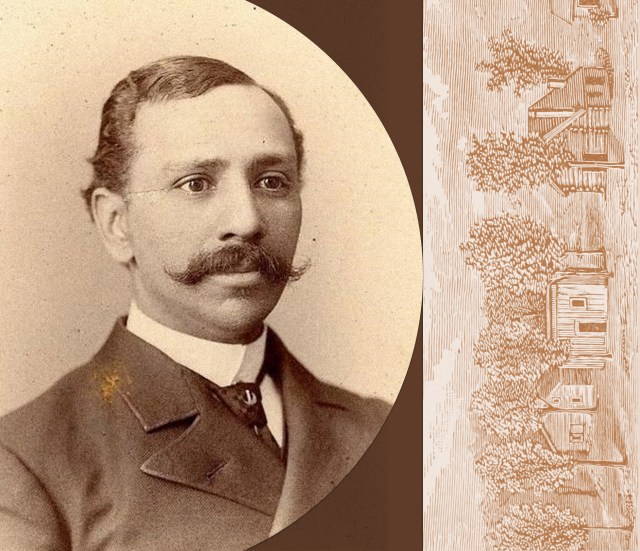
At the same time, another form of religious engagement was taking shape—one forged not in the parlors of benefactors like Comstock and Haviland but in the political imagination of Black leaders seeking sovereignty. Edward P. McCabe, an influential Black leader, advocated passionately for the Black migration westward and saw the church more as an organizing and political vehicle rather than merely a spiritually transformative one. McCabe’s religious convictions are unclear, but we know that he leveraged biblical motifs, like Moses confronting Pharaoh, as a potent political tool for mobilization. He positioned himself as a political Moses and met with President Benjamin Harrison to lobby for the creation of an all-Black state. McCabe and his allies also dispatched thousands of agents across the South to recruit migrants, asserting that Black people deserved self-rule free from white oversight.

Edward P. McCabeIllustration by Christianity Today / Source Images: WikiMedia Commons
Edward P. McCabe

At the time, the Christian faith was functioning both as a balm and as a banner—as a source of comfort and as a call to power. While Comstock and Haviland focused on moral reform through charity, McCabe harnessed the faith as political leverage. Despite their different methods, they all inherited a legacy that began about two decades earlier with the New England Emigrant Aid Company—a coalition of Northern church groups who sent settlers to Kansas not just to populate the plains but to ensure freedom took root in the state while it was still contested soil.

By the 1870s, however, the battle had shifted from merely ensuring Kansas remained free to actively supporting those who came seeking true autonomy and freedom after the catastrophic failure of Reconstruction. Comstock, Haviland, and the Black Exodusters themselves were not only participants in a continued struggle over who would truly be able to claim freedom in America—a battle that outlasted the Civil War—but also pioneers seeking to perfect the promise that the war and Reconstruction had left incomplete.

Gov. St. John eschewed marshaling state resources in response to the mass exodus. Instead, he reframed the crisis as a charitable endeavor, creating the Kansas Freedmen’s Relief Association—a humanitarian effort that eased political pressure for himself but left the Exodusters dependent on the moral economy of Northern benefactors. The organization—which Comstock, Haviland and others worked through—exemplified the promise of Christian charity, as well as the challenges that came along with these efforts. It aimed “to relieve the wants and necessities of destitute freedmen.” But its work also raised uncomfortable questions, some voiced by Black leaders at the time, others articulated more fully by later critics: Were some Christians inadvertently perpetuating the very racial hierarchies they sought to dismantle? Were their actions driven by authentic solidarity or a sense of superiority?

The Black exodus to Kansas was undoubtedly a humanitarian emergency. Immediate aid championed by Comstock and others addressed urgent, basic needs, but it failed to recognize that the migrants had also come to build lives for themselves. The charity of the exodus era, however well-intentioned, often came from a place of superiority, seeing Black migrants as objects of Christian benevolence rather than equals in God’s kingdom. Comstock herself, despite her genuine concern, approached her work from the prevailing mindset of white reformers—expecting Black migrants to shed who they were to, from her view, improve themselves. 

As historian Kim Cary Warren argues in The Quest for Citizenship: African American and Native American Education in Kansas, 1880–1935, reformers like Comstock sought to “make worthy American citizens out of Indians and African Americans.” The salvation critical to their work wasn’t merely from sin to a life redeemed by Christ and lived in service to God. It was tainted by what they saw as ethnic minorities who “had been anchored in thousands of years of slow evolutionary development leading to a hierarchy of races.” Some reformers sought to remove cultural differences and remake Black people, most of whom were already Protestants, in their own image. One reformer, Ednah Cheney, expressed a desire for “controlled religious expressions for the shouting and noisy prayer meetings” that she characterized as the “religion of the Negro.” And generally, when the reformers spoke of race, Warren notes they “heavily emphasized their belief that whites inherently possessed superior capabilities” and, in turn, “allowed racism to emerge from their own benevolent efforts.”

If Comstock’s approach reflected the limits of benevolence, McCabe embodied a different, insurgent vision: one where Black people would no longer be mere recipients of aid but architects of their own political destiny. McCabe, soon after coming to Kansas, would go on to become the state’s auditor, and then leader of a Black migration movement, and then one who would rally thousands behind his Black-state dream. But despite his stature and organizing prowess, the vision faltered against fierce white political resistance, federal unwillingness to grant such sovereignty, and the immense logistical challenge of sustaining a mass migration.

Caleb Gayle is an award-winning journalist and professor at Northeastern University. He is the author of the book Black Moses: A Saga of Ambition and the Fight for a Black State. 

News

Gaza’s Hunger Crisis Is Worsening. On the Ground, Complexities Abound.

Desperation, attacks, and looting lead to a “tough situation,” says Samaritan’s Purse.

Palestinians struggling with severe food shortages amid ongoing Israeli attacks gather to receive limited aid supplies in northwestern Gaza.

Palestinians struggling with severe food shortages amid ongoing Israeli attacks gather to receive limited aid supplies in northwestern Gaza.

Christianity Today August 12, 2025
Anadolu / Contributor / Getty

Hanna Massad keeps in close contact with his former neighbors and church members still living in Gaza. A friend from Gaza Baptist Church told him that “all the people in the churches are feeling dizzy and have started experiencing health issues” from the widespread food shortage. A Muslim friend said it’s difficult to find food to feed his family.

To help Massad’s people, his nonprofit, Christian Mission to Gaza (CMG), distributes between 2,000 and 3,000 hot meals to Gazans each month. Under the umbrella of Gaza Baptist Church, which Massad previously pastored before moving to the US in 2008, CMG works with various kitchens across Gaza, where cooks prepare the meals and individually wrap each portion. 

This allows the CMG staff to safely deliver food to the tent camps around Gaza where displaced families are staying, Massad noted. Using donations gathered abroad, the CMG staff shops around the territory to find the lowest prices for ingredients, an increasingly difficult task. 

In the past, the meals included chicken. Now, meat is difficult to find, and its price has skyrocketed, Massad said, so their meals usually consist of rice and perhaps an added vegetable, such as eggplant. Each meal currently costs between $7 and $10. 

Since the war began, the nonprofit has handed out more than 47,000 hot meals to Christians and the wider Muslim community and helped distribute clean drinking water. Massad hopes their ministry sends “a clear message of love and care during this time of deep suffering.” 

Gaza’s hunger crisis has reached alarming levels, with the Integrated Food Security Phase Classification stating that the worst-case scenario of famine is playing out in Gaza. Right-leaning Israeli writer Haviv Rettig Gur noted that unlike previous false alarms, this time the hunger crisis is real and represents a “dramatic and strategic mistake on the part of Israel.”

The World Health Organization, an agency of the UN, reported that 63 people, including 24 children under the age of five, died of complications due to malnutrition last month. Meanwhile, Israeli prime minister Benjamin Netanyahu claimed there is no starvation in Gaza.

Since the end of Israel’s three-month blockade of Gaza in May, the US-backed and Israeli-supported organization Gaza Humanitarian Foundation (GHF) has taken over much of Gaza’s food distribution amid concerns over Hamas stealing aid. The UN criticizes GHF for endangering Palestinians, as they must cross Israeli military lines to reach GHF’s four sites, and for not providing enough aid. 

International responses have intensified. France, Britain, Canada, and Australia announced plans to formally recognize the state of Palestine. American Republicans who have long supported Israel are criticizing Israel’s war strategy, with Representative Marjorie Taylor Greene labeling Gaza’s hunger crisis an act of “genocide.” US president Donald Trump acknowledged there is “real starvation” in Gaza and that “Israel has a lot of responsibility” for the limited food aid. 

Joshua Youssef, president and CEO of Help the Persecuted, urged Christians to approach the current source of suffering in Gaza with nuance. Getting verified information out of Gaza is difficult, as Israel hasn’t allowed international reporters independent access to the territory since 2023 and Hamas has severely restricted press freedoms since it took over the enclave in 2007.

“This seems like a combination of chaos, war is hell, and both sides trying to control the narrative, with one side really trying to control the narrative,” said Youssef, referring to Hamas and the Palestinian Authority. Help the Persecuted supports Christians in the Middle East, North Africa, and Central Asia.

While Youssef acknowledges the possibility of negligence and poor execution of aid deliveries, he does not believe Israel is intentionally starving Palestinians. The level of scrutiny both inside and outside Israel would not allow for genocide, he said. Israel and GHF are trying to bring in aid, he noted, but face complex realities on the ground and people in Gaza who don’t want to see successful humanitarian campaigns move forward.  

While media reports largely attack GHF, Youssef believes they are ignoring the ways the UN is failing Palestinians. His organization, which includes a network of 20 safe houses, has encountered numerous cases of UN bias against Christian converts from Islam seeking refugee status and other kinds of support. 

“In certain cases, the UN hires locals and sometimes very religious and conservative Muslims to handle day-to-day operations, and this has not been a positive development for certain minorities, including Christians,” Youssef said. 

Ken Isaacs, vice president of programs and government relations for Samaritan’s Purse, said that in a mid-July trip to Gaza, he attended a meeting where he learned that the UN had more than 900 parked trucks, many with rotting food, just inside Gaza. A few days later, he went to see the site and described a scene with hundreds of trucks filling “acres and acres of parking lots” near the border. 

The large amounts of food aid that the UN had sitting outside Gaza.Courtesy of Ken Isaacs
The large amounts of food aid that the UN had sitting outside Gaza.

Israel’s government body for coordinating humanitarian aid posted drone footage of the parked trucks. Isaacs said he believes the negative publicity pressured the UN agencies to begin moving their aid trucks to their destinations. 

Then the UN encountered problems. A combination of “desperate civilians, lawless gangs, clan-affiliated thugs, and merchants of death” looted the trucks, according to Ahmed Fouad Alkhatib, the head of Realign for Palestine. 

The UN has acknowledged that 88 percent of its trucks have not reached their intended destination inside Gaza since deliveries resumed in May after a two-month Israeli blockade, undermining prior claims that “the vast majority of the aid that we get in, gets to civilians.” 

While in Gaza, Isaacs talked to Palestinians who said Hamas had threatened to kill them and their West Bank family members if they worked with GHF. Attacks against GHF personnel in recent months have killed eight Palestinians and injured two Americans. “There’s strong resistance, I believe, to the idea of any entity that would be capable of delivering humanitarian assistance, other than the entity that was preexisting,” he said. 

Isaacs, who has worked in humanitarian aid for more than 35 years, said he didn’t see starvation but witnessed a “thinning he hadn’t seen since Bosnia,” with some people’s clothes hanging off them. Other people looked healthy. 

Although he went to Gaza with a bias against GHF because it “popped up out of nowhere,” he said he was ultimately impressed by the team’s professionalism. 

During the food distribution, he saw desperate people running to the aid sites, but he argued that the process was methodical despite the competitive environment. The young and the strong arrived first, running with big bags and gathering various food items like potatoes, salt, and oil. The next surge brought average Palestinians, many of whom were slower and seemed grateful to receive aid. The last wave of people gathered the remaining boxes and crates to use for fuel. 

Palestinians in Gaza getting food from the GHF site.Courtesy of Ken Isaacs
Palestinians in Gaza getting food from GHF.

GHF claims it has distributed more than 115 million meals in Gaza and has not fired upon those getting aid. The Israel Defense Forces admits to firing warning shots into crowds, resulting in fatalities at security corridors near distribution sites, but it claims the UN’s death toll of more than 1,000 is inflated. 

Massad often hears about the deaths of Gazans approaching aid sites. A neighbor’s relative died from a missile attack on his way to get food for his six children.

On Sunday, a church member at Gaza Baptist messaged Massad about a young believer he is discipling. The new convert went with his 32-year-old cousin to an aid distribution center. Only one man returned home alive. The cousin died from gunshot wounds to the neck.

“In Gaza right now, even the most basic human decision—finding food, checking on a home—can become fatal,” Massad said. 

Isaacs said there’s no good way to deliver aid in a war zone like Gaza. Many of the problems stem from challenges with even distribution. Samaritan’s Purse is partnering with several organizations, including GHF, to distribute its aid. 

On July 26, Samaritan’s Purse sent to Israel its Douglas DC-8 and Boeing 757 cargo planes filled with nearly 50 tons of food, including sachets with fortified peanut butter. A third plane landed this month, and their deliveries into Gaza began on August 6.

“It’s just a tough situation, and at the end of the day, it’s only going to be resolved by getting enough food down on the ground to make food nearly worthless,” Isaacs noted.

GHF hopes to expand from 4 to 16 locations that are run in shifts throughout the day to break down the crowds. Israel has paused its fighting in some parts of Gaza, approved some imported food for sale, and begun airdropping aid. Yet Gazans need much more food, and on Friday, Israel approved plans to capture Gaza City, which will intensify the fight and make aid distribution more difficult.

For Massad, delivering food to the hungry is one way the church can be a witness to its neighbors, as Christians in Gaza can’t be open about their faith. Many Palestinians associate Christianity with the West. 

“While we do have some level of freedom inside the church, outside those walls, Christians must be very careful about what they say, how they say it, and when they say it,” said Massad, who continues to co-lead online worship services for the small number of church members who have remained in Gaza. 

“Through this ministry,” Massad said, “we’re showing that Christians care deeply and that we are present here among the people, reflecting Christ’s love in a practical and compassionate way.”

Correction: An earlier version of this article misstated the number of years Isaacs worked in humanitarian aid.

Is Curiosity the Beginning of Faith?

How an atheist’s questions lead him on a journey toward faith.

Ben Weller
Aya Saito

Earlier this year, Ben Weller, a photographer based in Japan, was assigned to take photographs for Sophia Lee’s story, Growth is Good. Survival is Too. While Ben doesn’t call himself a Christian, the Christianity Today story deeply resonated with him, and the assignment came at a time when he was really beginning to explore his faith.

“The Christianity Today assignment was awesome; I felt very tuned in when doing the photos,” said Ben. “I read Sophia’s story several times, and I felt an emotional connection to the story and people in it.”

The story was about four pastors in Japan and the difficulty of establishing and growing the church in the country. For the assignment, Ben visited three churches and met with one other pastor in Tokyo.

“I really enjoyed it, and to date, it is one of my favorite stories that I’ve worked on,” said Ben. “Part of it was the spiritual aspect of it and how it aligned with what was going on in my life at the time.”

Ben grew up going to a Church of the Brethren with his family in Indiana. He was active in the church and youth group through high school, but around middle school, he became an atheist even while still attending church. When he went off to college, he stopped going to church altogether and was an atheist for about 20 years.

Upon graduation Ben took an English teaching job in Korea and ended up wanting to live there. After a few years of teaching English, Ben was ready for a new challenge so he went to journalism school at Indiana University with the hope of returning to Korea as a journalist. After he took a visual communication course, his professor encouraged him to pursue photojournalism.

“I also realized that photography, in some ways, is easier than writing for me,” said Ben. “I was in journalism school, but writing felt a lot like homework, and photography didn’t feel that way to me, so I shifted gears.”

After graduate school, Ben had some photography internships, and eventually took another teaching job at a University in Korea. He used his free time to launch his freelance photography career. While in Korea, Ben met his wife, who is Japanese, and in 2015, they moved to Japan, where Ben has been doing photography full-time since.

“For me, my photography is mostly about people,” said Ben. “It’s an excuse to talk to people and get nosy about their lives. I can force myself into their personal space to shoot the photos, and it creates interesting dynamics and conversations, which gives me a window into their world. I experienced that quite deeply with the CT story.”

This was the first project that Ben had done with Christianity Today. Working on the Christianity Today story was an important stepping stone in Ben’s faith journey. The pastors he met were all very different, but he connected with each of them in deep, personal ways.

One of the pastors who made a strong impact on Ben was Pastor Lam from the Church of God. Pastor Lam was familiar with the New Atheist writers and had grappled with similar questions as a young man. He had read a lot of the same atheist authors as Ben, so they connected and discussed faith.

“He knew where I was coming from and had had the same questions that had made him doubt Christianity, but then also saw the same flaws in the atheist arguments that I had begun to see,” said Ben.

Originally, another photographer in Tokyo was going to take the assignment, but when he was unable to work on the project, he suggested Ben instead.

“It was very interesting timing that CT reached out to me,” said Ben. “Was it a coincidence? I don’t know, but it certainly came at a pivotal time in my life.”

Ben described himself as an atheist for about 20 years, but even when he wasn’t as focused on it, he just didn’t have faith. Around four years ago, he started to question his own beliefs around the existence of God.

“I wasn’t really questioning my core values, but more how to realize those values in the world and what would be needed to do that,” said Ben. “I started to question my faith, or lack thereof, and I began to take the possibility of the existence of God more seriously.”

Ben was working through these questions when he was contacted to work on Sophia’s story. He was also exploring ways he could connect with a faith community when CT contacted him for the story and put him in touch with multiple pastors and churches.

“I had been thinking about going to church, especially because I had grown up in the church, and even though the belief didn’t stick with me, the community aspect was very important to me,” said Ben. “I am still close with many of those people, and I felt like I had gained something from the experience that helped shape my values. As I am raising my own children, it was something that I wanted.”

One thing Ben realized through my collaboration with Christianity Today was how vast the Christian religion is. After meeting the different pastors, he started to think about what kind of church he would want to attend. For the story, he visited three different churches but wasn’t able to make any of them his church because of the distance from his home.

Ben is taking his faith journey slowly. His family just moved to a new city in Japan, and with all the life change, he hasn’t had a chance to go to church yet. But it is still on his mind every day, and he is still exploring and reading and thinking about Christianity.

“I am obviously no expert on Christianity, but my understanding is that it’s about a personal relationship with God, so at the end of the day, maybe which denomination I choose is less important than what my relationship with God is like,” said Ben.

Ben is also talking with his sons a lot more about his faith. His sons, who are four and nine, have been a large part of his faith journey and are part of the reason he started to question and think about what he believed in the first place. They are at the ages where they are curious and asking questions, and it has made Ben become more curious as well.

“I am glad I can have these conversations with my sons and say, ‘I do believe in God,’” said Ben. “I don’t know many things about God, but I am very curious about God. And I see them thinking about things too, which I think is good.”

Ben also believes that faith in God opens more space for curiosity than atheism does. While Ben feels that he did get something of value out of studying new atheism, he now views the certainty of new atheists as arrogant.

“Atheism is so sure of itself,” said Ben. “It’s very hubristic and shuts down curiosity. I am glad to be done with that, especially with having kids, because you don’t want to display arrogance or hubris in front of your children.”

Right now, Ben is okay with not having all the answers but staying curious in the in-between. Instead, he is focused on listening to God’s voice speaking to him and finding his direct connection with God, and Christianity Today has become part of that journey.

“It’s been a very interesting journey so far, and I am glad that CT has been a part of it,” said Ben. “It has definitely made me appreciative of the work that you do.”

While Ben knew about Christianity Today before being contacted for the story, he hadn’t interacted with it much.

“I knew CT was well respected within the journalism world; it has a good name among journalists and photographers, even if they aren’t Christian,” said Ben. “It is a quality publication.”

Since doing the photoshoot, Ben was given a year subscription to Christianity Today, and now, he reads it regularly. He likes how CT deals with current events and current topics, but through a different lens.

“It has a lot of diverse perspectives in it, which I appreciate,” said Ben. “Not every article feels like it is written from the same standpoint. I am exploring my beliefs around many topics, so I appreciate the diversity of perspectives. And the photography is very good too. It just looks great.”

addApple PodcastsDown ArrowDown ArrowDown Arrowarrow_left_altLeft ArrowLeft ArrowRight ArrowRight ArrowRight Arrowarrow_up_altUp ArrowUp ArrowAvailable at Amazoncaret-downCloseCloseellipseEmailEmailExpandExpandExternalExternalFacebookfacebook-squarefolderGiftGiftGooglegoogleGoogle KeephamburgerInstagraminstagram-squareLinkLinklinkedin-squareListenListenListenChristianity TodayCT Creative Studio Logologo_orgMegaphoneMenuMenupausePinterestPlayPlayPocketPodcastprintremoveRSSRSSSaveSavesaveSearchSearchsearchSpotifyStitcherTelegramTable of ContentsTable of Contentstwitter-squareWhatsAppXYouTubeYouTube