News

Canadian Evangelical Scholar Fired Following University Investigation

A Christian college terminated John G. Stackhouse after an independent report alleged a pattern of inappropriate remarks to students. The professor challenges the findings.

Christianity Today November 27, 2023
Wikimedia Commons / Edits by CT

Canadian evangelical scholar and commentator John G. Stackhouse lost his job as a religious studies professor following a six-month investigation into accusations of inappropriate behavior toward students, spurred by an online campaign.

Students said Stackhouse made sexist remarks and unacceptable jokes in the classroom, according to an independent investigator commissioned by Crandall University, the Baptist college in New Brunswick where Stackhouse had taught since 2015. The investigator also said the professor’s email exchanges with a female student amounted to sexual harassment.

A statement from Stackhouse’s legal counsel to CT said he “categorically disagrees” with the report’s findings and disputes the university’s decision to publish them online, “turning a private matter into a public spectacle.”

The summary of findings, released last Wednesday, also noted unanswered questions about sexual harassment complaints against Stackhouse from before he worked at Crandall. Regent College in Vancouver, where Stackhouse was on faculty for 17 years, declined to comment, citing privacy law; a CBC news program reported Sunday that Regent and Stackhouse agreed to a settlement following a 2014 investigation.

When asked about allegations at other institutions, Stackhouse told the investigator, “I do not see how it’s in my interest to answer that question,” the report said. Stackhouse said there had been no open complaint at the time he left Regent, but the investigator concluded that, whether directly or by omission, he misled Crandall prior to his hiring about the circumstances of his departure.

Stackhouse has been a voice calling for accountability at evangelical institutions and women’s inclusion in leadership, and he was among the earliest critics of the late Ravi Zacharias. He wrote books about ethics, apologetics, evangelicalism, and gender roles, including Finally Feminist: A Pragmatic Christian Understanding of Gender and Partners in Christ: A Conservative Case for Egalitarianism.

Starting last spring, an Instagram account called DoBetterCrandall began anonymously sharing stories of inappropriate jokes, behavior, and treatment from an unnamed Crandall professor. More than 100 students signed an open letter calling for the university to respond.

Crandall launched an investigation in April and announced Stackhouse’s dismissal last Wednesday. University leadership issued a letter expressing “deepest regret to all of its students, and particularly to any student or students who were made to feel threatened, diminished, or victimized.”

“Paramount at Crandall University is the safety and security of its students,” stated former board chair Sheila Cummings, who oversaw the investigation, current chair Douglas Schofield, and university president Bruce Fawcett. “We cannot and will not tolerate behaviour from its administration, faculty, or staff that in any way violates the University’s mission and identity.”

While Stackhouse became the “key subject” of the investigation, the summary of findings mentioned other faculty as well as recommendations for strengthening the university’s policies.

Stackhouse’s attorney Denis Grigoras issued a statement to CT on Monday.

“While Dr. Stackhouse acknowledges and respects the importance of addressing any misconduct allegations thoroughly and fairly, including by way of a workplace investigation that complies with best practices, the manner in which Crandall has chosen to handle this matter is profoundly concerning to him,” the statement read.

Crandall had released a six-page summary of findings from the investigation, which was led by Joël Michaud of the law firm Pink Larkin. In the report, Stackhouse is referred to as “the faculty member,” though he is identified by name in a university press release. Students and former students recounted how the 63-year-old professor would make “gender-based comments, sexist remarks, comments about a person’s looks, dress and appearance.”

According to the report, Stackhouse said Crandall’s president spoke to him about his remarks in class following complaints from a few students prior to the launch of the DoBetterCrandall Instagram account.

Michaud wrote that “jokes (or stories) that might have come across as charming 25 years ago are no longer acceptable”—instead, the investigator considered them sexual harassment and said that Stackhouse’s behavior “bordered on abuse of authority” as defined in the university’s policy. He also said that he believed Stackhouse’s “antics detrimentally affected the learning environment.”

Stackhouse also had a reputation for being brash and abrasive, students said. While that is not uncommon in academia, the investigator stated, “the line is crossed where the behavior rises to the level of harassment or abuse of authority.” Michaud believed that Stackhouse was “deserving of severe disciplinary action.”

The investigator also reviewed around 100 pages of emails with a student that he believed constituted sexual harassment. The student did not engage in the email banter or “otherwise encourage” the inappropriate messages, Michaud wrote.

During the investigation, according to the report, Stackhouse acknowledged that his email exchanges with the student were “inappropriate, unhealthy, unbecoming of a professor.” Stackhouse said he “would not defend it” but argued the banter was “something of an aberration from a long career.”

Stackhouse’s attorney has referred to the findings as a “private investigative report” and plans to “explore legal avenues” in response to their publication since “these matters have caused significant harm to Dr. Stackhouse’s reputation and career.”

“This approach is unnecessary and damaging,” his statement said, “impacting not just Dr. Stackhouse but the very fabric of privacy and due process within private academic institutions.”

On Threads, Baylor University historian Beth Allison Barr commented that she was grateful “that @crandalluniversity did the right thing in public. It is time for us to stop allowing Christian churches and institutions to sweep this behavior under the rug.”

Cummings, the university’s former board chair, quoted Micah 6:8 in a segment with CBC and told the outlet, “I think it’s important that we are open and honest about everything that we do. Would it have been easier to just try to sweep this under the carpet? Perhaps, but it was not what was right and honest.”

Stackhouse regularly comments on evangelical issues in outlets including CBC and Christianity Today. Years before the death of Zacharias and the news of the apologist’s abuse, Stackhouse was a leading voice calling out Zacharias’s inflated credentials. He has also spoken about concerns around transparency and ethics in ministry, including finances.

And Stackhouse has addressed women’s roles in the church and been involved with organizations such as Christians for Biblical Equality. As an apologist, he recognized how the church’s missteps on gender and abuse hurt those within it and its mission, lamenting in a 2022 blog post that “many women and girls suffer unwanted flirting, condescension, sexual harassment, and sexual assault—even in our Christian homes and churches, as too many studies now prove.”

Days before Crandall announced the findings of the investigation, Stackhouse shared pictures on social media from the American Academy of Religion / Society of Biblical Literature annual meetings in San Antonio.

A week before his termination, he published a post on his blog announcing a series on salvation. Before that, he wrote about Psalm 23: “Far from the pastoral sentimentality of too many well-meant Sunday School lessons and funeral sermons, it depicts the life of faith as the Bible actually depicts it: fraught with perils, dark with threats, and terrifying to everyone who does not walk beside the Good Shepherd.”
News

Africa’s Wall Street Quiets Christian Worship

In the commercial capital of Malawi, Pentecostal pastors and churches face fines or removal for making a joyful noise.

Blantyre, Malawi

Blantyre, Malawi

Christianity Today November 27, 2023
wilpunt / iStock / Getty Images

Loud Pentecostal worship is part of the soundtrack of Africa’s major cities. From Johannesburg, South Africa, to Lagos, Nigeria, booming preaching and boisterous worship rings through the alleys, apartments, and street corners.

But in Blantyre—the commercial capital of Malawi—church noise is conspicuously absent.

Though located in one of the poorest nations in Africa and the world, Blantyre’s central business district contains one of the largest concentrations of investment banks, hedge funds, insurance companies, and posh restaurants on the continent.

Banks like National Bank of Malawi tussle for space in the district with foreign behemoths like Standard Bank Group (Africa’s richest by assets) and the domineering skyscraper of the Reserve Bank of Malawi, the country’s equivalent of the Federal Reserve.

“It is a Wall Street of the Southern Africa region. The city is just artificially too clean, too smart, and designed for banks,” said Susan Mani, one of a few highly regulated mobile chefs who serve suited bankers and hedge fund managers rice and chicken during a two-hour lunch window.

“The thinking of the city fathers is, ‘Do you want some noisy, prayerful African church beating drums in the basement when hedge fund investors from Singapore or Dubai are meeting in the boardroom of a bank atop?’”

City officials have made it clear their answer is no. While quieter Anglican and Adventist congregations dot the streets of Blantyre, noisy African-initiated churches are unwanted. They face fines or possible removal from the district for their traditional style of worship.

“It’s costly to be caught leading a church where bass drums, loud prayers, and the noise of thunderous sermons is filtering into the street,” said Dennis Labo, pastor of Zion Christian Church (ZCC Malawi), an African Pentecostal church that has thousands of followers across Malawi and neighboring African countries.

Labo was fined 370,000 kwacha ($220 USD) and told to relocate his 80-person congregation from the avenue that houses the National Bank of Malawi, the wealthiest bank in the country.

“The Blantyre City Council wants to present the city’s [central business district] as the epitome of a well-clean financial district without … noisy churches or fruit vendors,” he said.

Pentecostal churches aren’t the only targets. Gerald Lipikwe, a council member, stressed that any church, business, party, or dwelling that goes over noise thresholds in the central business district can face steep fines, license restrictions, or removal.

Blantyre follows the harsh bureaucracy of Rwanda, which restricts African Pentecostal churches, forcing congregations to hold covert, quiet services mainly on Fridays after business hours.

“We dare to hold informal services when the bankers have left town,” Nisbert, an evangelical African pastor, told CT.

He avoids giving his surname because his church faces potential removal from the Blantyre central business district. It’s on its last warning after holding an all-night prayer gathering that disturbed a corporate meeting at the nearby Malawi Stock Exchange.

The restrictions on African worship also hurts church growth, pastors say. In a country where three-quarters are Christian, evangelical and Pentecostal churches are eager to draw in young Black bankers who can afford to tithe generously.

Blantyre was the colonial capital of Malawi, the headquarters for banks, universities, hospitals, and government offices. In 1975—a decade after the end of British rule—the government of Malawi gradually transferred offices to its current capital Lilongwe, a new city built out of the bushes.

But the banks never left the former capital, said Labo. Even today, a presidential palace remains in Blantyre.

The place where extravagant sugarcane and tobacco profits were banked by British colonial plantation owners still remains the “money city of Malawi,” according to John Tembo, an independent financial historian who’s lived in Blantyre for the past 50 years.

The city’s hostility to noisy congregations—code for “indigenous African churches”—is unfair, Tembo said. Many among the political and banking elite instead attend Anglican and Baptist parishes, which are considered “classy” and “civilized.”

“European/American legacy churches like Adventists and Anglicans have large outlets and hold services,” Tembo said, pointing to a sprawling Adventist hospital along the posh hotel lane of Blantyre’s city center. “The so-called ‘civilized’ European churches in the Blantyre business district have invested in upper-class hospitals, so they are tolerated.”

Pentecostal or evangelical churches are often unregistered and informal, so the city doesn’t draw taxes from them.

The history of churches in Malawi is colorful, varied, and synonymous with the colonial takeover of the territory that was formerly called Nyasaland. When Scottish missionary David Livingstone arrived at Lake Malawi (then Nyasa) in 1859, he established the country’s first missionary church. Anglican missionaries like Edward Steere followed, as did Dutch Reformed missionaries and, later, the Catholic church.

The Anglicans’ dominance helped solidify the colonial takeover of the country in 1891 by the British crown. Africans who converted to the faith largely joined the Anglican church because it built the most schools, hospitals, and colleges in Malawi.

Following closely were the Adventists, Dutch Reformed, and Catholics. Not many independent African churches existed in Malawi when the country overcame colonial rule in 1964 or in the couple decades after. But as the sense of independence and access to education grew in Malawi in the ’80s, the spirit and confidence of establishing African-initiated churches grew too.

A scatter of numerous African-led churches mushroomed in Malawi—Zion Christian, Pentecostal, and evangelical—many of these mixing traditional African ancestral beliefs and Christian ethos. Because of class differences, they hardly ever united or cooperated with believers in legacy European and American churches.

However, the only point of meeting was when congregants from upstart African churches attended Anglican or Catholic primary schools and urgent care clinics. In impoverished post-colonial Malawi, the Western-founded churches still provided education, health care, and relief.

In the early 2000s, a Pentecostal Christian re-awakening began to sweep through Africa. As African economies got hit by World Bank–enforced austerity, dubious African “prophets” like Shepherd Bushiri in Malawi and T. B. Joshua in Nigeria began to dazzle millions of poor African believers with promises of miracles and instant wealth.

Millions of Black Malawians were won over and began leaving legacy colonial churches and older African churches for the charismatic “miracle” prophets. For poor believers in the country, the promise of instant wealth and miraculous breakthrough holds significant appeal.

Mani, the lunch vendor, says the restrictions and stigma around African churches reflects underlying anti-poor attitudes in a country with extreme inequality. Oxfam America says just 10 percent of the population consumes 22 times more resources than the poorest Malawians.

“It’s a dangerous inequality,” said pastor Labo. “Just a few meters out of Blantyre’s central banking district you will find the most chaotic slums where the real citizens, the majority of Blantyre, live and worship loudly.”

Books
Excerpt

The Christian Liberal Arts Tradition Can Appeal to Christians and Non-Christians Alike

Its main rivals seek truth without transcendence, or justice without redemption. And both flatten the meaning of human existence.

Christianity Today November 27, 2023
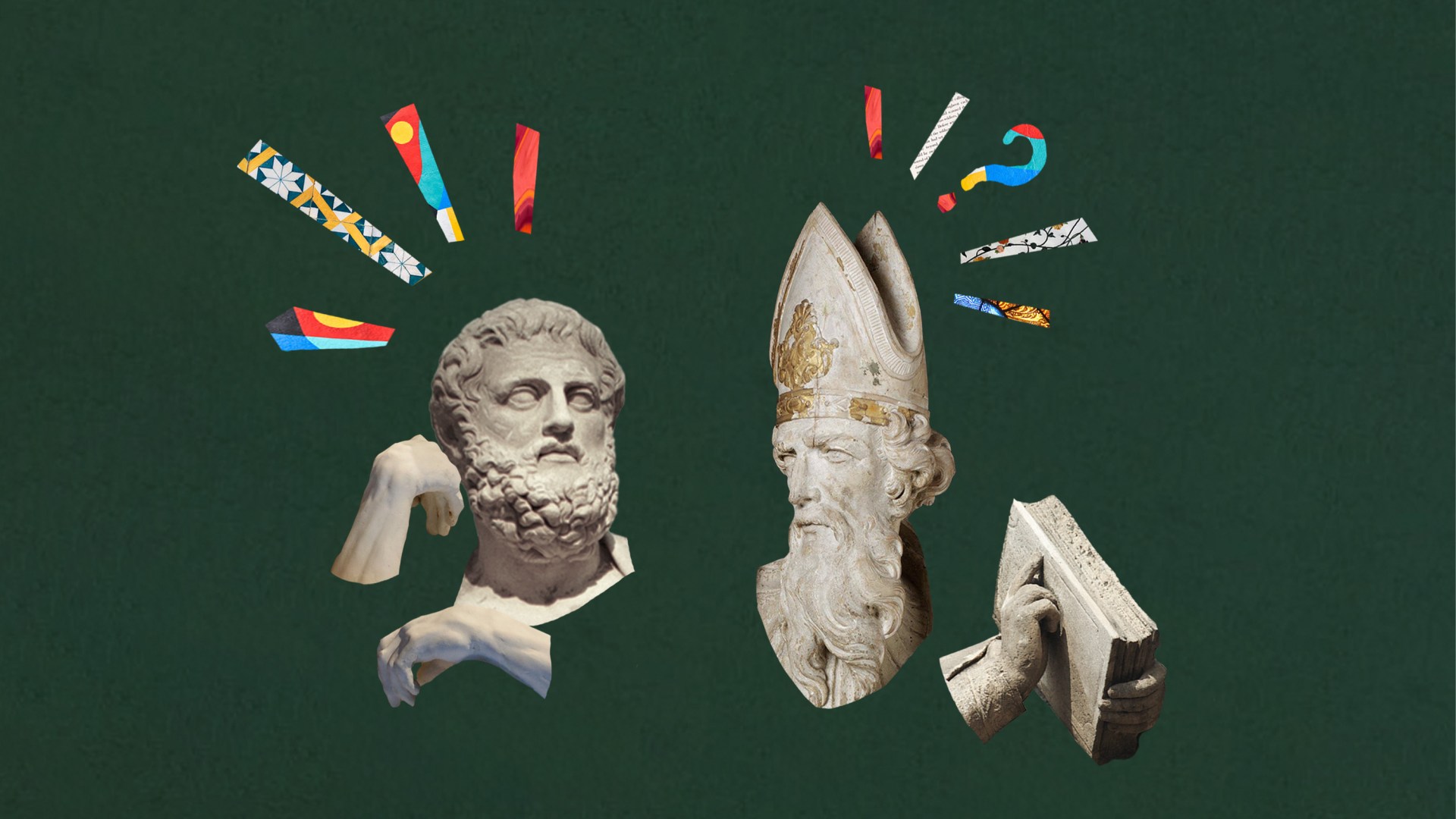
Illustration by Elizabeth Kaye / Source Images: Victoria & Albert Museum, Unsplash, Wikimedia Commons

College and university professors in the liberal arts (humanities, social sciences, and natural sciences) are almost entirely left-leaning, liberal, or progressive, and this is especially true among faculty in the humanities and social sciences. The trend is even more pronounced in certain selective schools.

The Liberating Arts: Why We Need Liberal Arts Education

The Liberating Arts: Why We Need Liberal Arts Education

224 pages

$12.99

Students who attend liberal arts colleges or universities often adopt more liberal or progressive points of view as a result of their education. Th­ere are many great literary depictions of this transformation and the ensuing alienation that often results when such students return home from college. (My favorite is in Flannery O’Connor’s short story “Revelation,” where a young woman in a doctor’s office throws her human development textbook at the unenlightened, uncouth, hometown character Ruby Turpin.)

Is this phenomenon accidentally related to the demography of the professoriate or somehow intrinsically related to the craft and content of the liberal arts themselves and the culture and atmosphere of the campus? ­

The terms “liberal” and “progressive” represent different political traditions in the West, and, when applied to the liberal arts, represent different approaches to education.

“Liberal” liberal arts education represents a modern vision of an Enlightenment-style view of objective truth pursued by rational and empirical methods. The “progressive” model, on the other hand, is often associated with postmodern visions of education, ones suspicious of privileged categories such as knowledge, truth, and understanding. It aims at dismantling systems of illegitimate power, ensuring equal outcomes, and achieving other goals connected to the mission of social justice.

New York University social psychologist Jonathan Haidt argues that these visions of the liberal arts are ultimately incompatible and that universities should choose between the aims of objective truth and social justice. He calls the “liberal” approach “Truth U” and the progressive approach “Social Justice U.” He notes that most major liberal arts institutions in America today have become Social Justice Us by default, owing simply to the makeup of their faculties.

Haidt notes that some religious colleges present themselves as pursuing an entirely different telos, or guiding purpose. As an example, he points to the evangelical Wheaton College, whose mission statement mentions “serv[ing] Jesus Christ and advanc[ing] His Kingdom.” Haidt calls this exceptional case “Jesus U,” but he doesn’t seem to take it seriously, given his commitment to an Enlightenment-style vision of the liberal arts.

Both the liberal and progressive approaches to the liberal arts retain something essential from earlier traditions, but they also deviate significantly from the classical and Christian view of the human person that gave birth to the earliest universities and liberal arts colleges in Europe and America.

Th­e “liberal” liberal arts approach of Truth U retains a fundamental insistence on the connection between intellectual cultivation and citizenship, but it abandons the transcendent framework that understands pursuing truth as an expression of our deepest human telos. Th­e progressive approach of Social Justice U retains an insistence on the connection between liberal learning and neighbor-love, but it abandons the redemptive vision the Christian story brings to critiques of power, care for victims, and confession of sin.

For these reasons, we ought to take Christian liberal arts institutions more seriously than Haidt does. Such a model is a viable alternative to the liberal or progressive adaptations of the liberal arts on offer today. ­This tradition is capacious enough to be appealing to Christians and non-Christians alike and is adaptable to other religious or philosophical approaches. Th­e Christian university of the 21st century ought to present a picture of the human person and the role of intellectual cultivation in human flourishing that transcends the impasse of liberal and progressive approaches to the liberal arts.

Tools of intellectual agility

Th­e ancient Greco-Roman view of the liberal arts was associated with the special status of being a free person (liber) rather than a servant or slave (servus), for whom training in the manual or mechanical (servile) arts was most fitting. Free people needed the intellectual agility and capacity for thought and communication to participate in free, self-governing societies, and the liberal arts equipped them to engage a variety of viewpoints with subtlety and generosity.

Th­e ancient founders of the liberal arts could not have imagined the modern American attempt to extend this vision to include all human beings. ­The slow unfolding of civil rights and the expansion of the liberal arts have worked in tandem in American democracy.

Yet this project is now under attack from many angles: ideological differences threaten to shatter our ideals, values, and shared sense of the past; general education in the liberal arts evaporates in an effort to expedite degree-completion and minimize costs; and career orientation discourages students from majoring in liberal arts disciplines to begin with.

What sort of stories and symbols, what corresponding practices and habits, can revive and restore faith in the liberal arts?

Truth U’s curricula are often simply too spare, too shorn of a transcendent or religious sense of the human person to provide the meaningful context for the pursuit of truth. Truth U models itself after the successful techniques of the sciences and punts on fundamental questions of morality and religion that could guide the overall direction of inquiry.

Truth in a purely objective, universal, or rational sense is too bare a telos for the liberal arts to sustain themselves. Rather, they thrive in narrative webs of meaning—of words and images that come freighted with sense and value and hold capacity for shaping worldviews and affections.

Christians living in late antiquity saw that part of the Christian educator’s task would be migrating the liberal arts tools from their classical Greco-Roman context to a biblical context—with its distinct stories, characters, ideals, values, images, and emotions—in order to create a Christian culture of liberal education.

Augustine of Hippo sensed the conflict between the classical and biblical texts and worked tirelessly to identify the resonance and dissonance among them. He was keen to highlight the common human inheritance of the liberal arts and their inherent dependence on a shared world of meaning. He baptized the narrative world of classical culture and embedded it in an alternative story in pursuit of a different god.

Slowly the old myths and gods were burned away. Centuries later, as the Enlightenment gave birth to a new vision of liberal arts education in modernity, it returned the favor and slowly banished metaphysics and Christian theology from the list of properly scientific disciplines.

­The liberal model of liberal arts education admirably retains the central vision of these arts as the common tools of intellectual agility necessary for an intelligent, free, self-governing society, but it fails to provide a guiding web of shared meaning.

It appears impotent to resist the common and reductive vision of education and of the human person, as defined narrowly by work or material success. It appears unable to sustain moral energy around the liberal notion of scientific “truth” as a sacred value. This leaves the students of Truth U vulnerable to a flattened existence, vacillating between materialistic meaninglessness or relativistic consumption of meaning.

Moral energy

­The progressive model of the liberal arts is statistically the most dominant today. ­The movement of radical 1960s intellectual life into the mainstream of higher education through professional research in the humanities and social sciences is an intriguing and complex historical and sociological tale.

One simple way to understand Social Justice U’s intellectual framework, however, is as an uneasy alliance between the deconstructive criticism of Friedrich Nietzsche and the Marxist insistence on equality.

Social Justice U’s advantage over Truth U is that this uneasy alliance has created a captivating web of meaning in which the tools of the liberal arts can be acquired and tested in social criticism and activism. Th­e critical Nietzschean accomplishment of Social Justice U is deconstructing the idea of objective truth as a coded expression of the will to dominate others, rooted in privilege, exclusion, and elitism.

This deconstructive project is then yoked with a secularized version of the Christian instinct for social justice. The result is an alternative system of moral authority, rooted in a totalizing narrative of unmasking power and defending the victim, that offers powerful resources (both motivational and practical) for those interested in achieving a better world.

­The moral energy of Social Justice U is rooted in its insistence on the inherent connection between intellectual work and social concern—an offshoot of the Christian perspective on the liberal arts that yokes the intellectual and practical goals of education together under the umbrella of the twin commandments of love for God and love for neighbor. The progressive approach thus retains certain Christian impulses, even when it rejects the undergirding redemptive vision Christianity offers.

Learning and love

Only by recovering a broader conception of the human person (and the way education plays a role in forming such a person) can the liberal arts move beyond the impasse between Truth U and Social Justice U. Neither telos—truth or justice—is coherent apart from this broader conception.

The Augustinian Christian tradition (at the root of both the medieval Catholic and early modern Protestant vision of the liberal arts) represents one attempt at situating the liberal arts within a comprehensive understanding of human nature and purpose.

Of course, there are many Christian traditions and other religious traditions (Jewish, Islamic, and Mormon, for example) that propose their own understandings. What they share, however, are forms of inquiry premised on a picture of a human being and an authoritative set of religious texts read in relation to and in tension with the tradition of the liberal arts—in both their ancient origins and modern disciplinary extensions.

The modern secular university’s commitment to quantitative methods and techniques of empirical analysis as the highest form of inquiry makes it impossible to rationally justify any non-empirically verified telos, whether truth or social justice, which makes the choice of one over the other a matter of preference. Th­e Christian university must reconceive its own work of liberal arts education in light of its own understanding of humanity and the unfolding dialogue between its authoritative texts and rival texts, whether these come from the Western liberal arts tradition or some other religious or moral tradition. ­

In this setting, the liberal arts educator has a double role—both preserving a particular religious framework and engaging rival standpoints to see what’s wrong with them and to test one’s own tradition. Th­e Christian university can pursue what Alasdair MacIntyre calls a tradition-shaped form of inquiry, whereby one’s own religious perspective is sharpened by liberal arts education and brought into meaningful dialogue with rival answers to the deepest human questions.

The telos of Jesus U is love. Here the love of learning is tethered to love for God, love for neighbor, and a healthy self-love. Here is a vision of education that eclipses any purely material view of human personality.

Th­e social-science caricature of the human person found in both Truth U and Social Justice U reduces human desire to either bare economic self-interest or raw social power. Neither get to the true depth of human personality. Each appeals to the language of psychology (whether as trauma or happiness) at key moments to get out of the flattened secular horizon and move into the realm of true meaning.

Although the social sciences are supposedly methodologically immune to value judgments, they slide into them through the quantitative language of material well-being. ­This leaves the student hostage to contested visions of selfhood and identity in the digital coliseum and marketplace.

In the Christian vision, self-love is not reducible to economic self-interest or social dominance but recognized as the divine impulse through which one meets the world not as one’s oyster but as one’s neighbor. Th­e ember of self-love fuels an outward-driving process of moral formation.

In the Christian university, then, liberal education is brought toward a transcendent horizon that exceeds any purely secular view of political society. Here, citizenship is twofold: One part is committed to the proximate justice and common interest of our earthly political communities, as framed by a Christian conception of human dignity. The other part of citizenship longs for a deeper, truer form of community found in that “eternal city” foreshadowed throughout Scripture.

Liberal arts education is inherently linked to the formation of new citizens, and thus, Christian education imbues citizens with a shrewd sensitivity to the limits of politics. Christians ought to be fiercely loyal to local forms of community and fiercely global in outlook given the history and mission of the church. Th­is produces a kind of spiritual restlessness that resists the temptations of nationalism and goes on pilgrimage.

What would it look like to build a liberal arts institution oriented toward this telos today? It would require a collaborative multidisciplinary team of faculty to work out a new-yet-old vision of truth, and a corresponding epistemological framework that moves beyond the fragmentation of knowledge found in the modern university.

It would need to order its community’s life around the habits and practices necessary to sustain the marriage of learning and love for God and neighbor. It would need to nurture the character traits—intellectual, moral, and spiritual—most conducive to authentic liberal education. It would need sensitivity to the form and atmosphere of the campus and creativity in engaging the intellectual and moral aims of the community.

Questions about online learning and career preparation might press upon us. But such questions should not distract us from more basic ones. We should be encouraged that educational endeavors in the Christian liberal arts tradition have emerged and succeeded in much less auspicious times than our own.

Joseph Clair is dean of the College of Humanities at George Fox University. This article is adapted from his chapter in The Liberating Arts: Why We Need Liberal Arts Education (Plough Publishing).

News

Flight to Egypt: How Pastor’s Wife in Gaza Church Got Out

Harrowing journey with children and grandparents reunites family with husband, as Palestinian Christians sheltering at Orthodox and Catholic churches grow increasingly desperate.

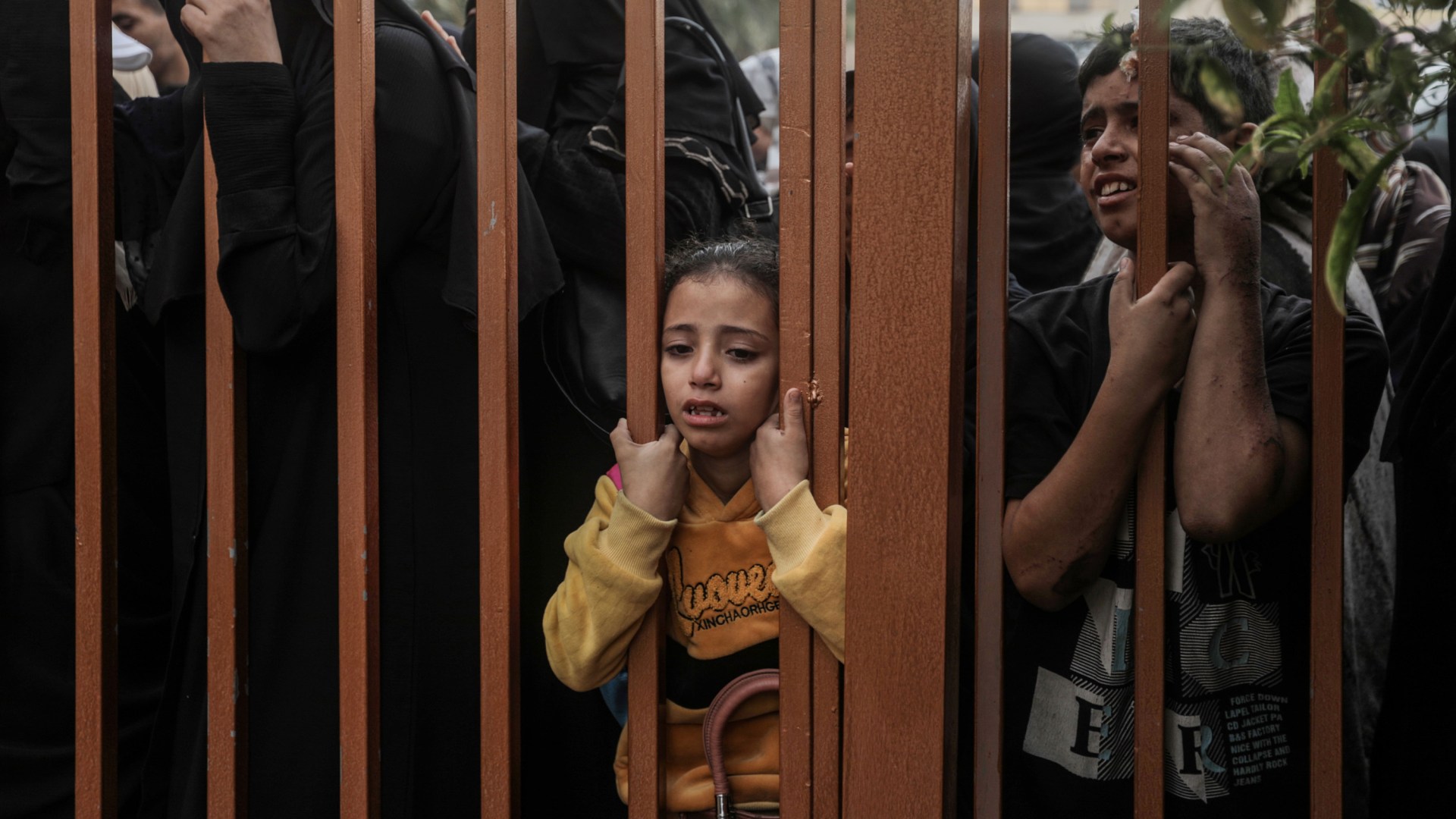
People mourn as they collect the bodies of Palestinians killed in Israeli raids.

People mourn as they collect the bodies of Palestinians killed in Israeli raids.

Christianity Today November 22, 2023
Ahmad Hasaballah / Getty Images

Janet Maher is out of Gaza.

The Palestinian wife of the Egyptian former pastor of Gaza Baptist Church had been sheltering in the Saint Porphyrius Greek Orthodox Church with her three children and 350 others—but not her husband. Two weeks before the October 7 Hamas terrorist attack on Israel, Hanna Maher had traveled temporarily back to Egypt, where he had to remain after the war broke out.

Despite the horrors of suffering 43 days of bombardment by herself, as CT previously reported, the family separation is the reason why Janet and her children are now safely in Egypt, reunited with Hanna. But first they had to undergo a harrowing journey that began with tearful goodbyes to a hallowed community.

“I spent weeks with these people and am broken by the experience,” Janet said. “But everyone pleaded: If you get out, tell the world about our situation.”

The death toll in Gaza exceeds 11,000, including more than 5,000 children, according to statistics released by the ministry of health in the Hamas-run enclave and last updated November 10. But save for the shrapnel and scattered remains of human carcasses flying over the walls of the church compound, little of this was known to the Christians inside.

With no television or internet and only intermittent connection to the cell phone network, Janet and her fellow sheltering Gazans knew only the daily reality of war. Most of the day was spent trying to figure out how to procure food, with the young men tasked with trips outside to the local market.

Most often, the day would begin with bombing—sending the people scurrying away from windows and doors to the center of the room. Three times a week, the priest would lead morning prayers. Frequently, they would gather for impromptu singing, simply to calm their nervous spirits. Some would read the Bible; others cried alone in the pews.

They would clean often. Dust and debris settled after every explosion, while most people suffered some form of illness—coughing, fever, stomachaches—with flies everywhere, flitting about from the corpses in the street.

With no breakfast or dinner, most daily meals consisted of lentil soup with occasional rice or macaroni. Water was seldom clean, though the clergy obtained some by trading available gasoline to the neighboring mosque, which used the fuel to run its well-pumping generator.

“Once, the priest was able to find chocolate,” Janet said. “It was like Christmas.”

But after eating around 4 p.m., the darkness settled. With no electricity, everyone moved to their mattresses for a fitful night of sleep. As 100 other people in the funeral hall of the church tucked in, Janet read Psalm 23 to her children. But she relied on the more militant realities of Psalm 91 to settle her own anxious thoughts.

A thousand may fall at your side, ten thousand at your right hand,” Janet recited. “If you say, ‘The Lord is my refuge,’ and you make the Most High your dwelling, no harm will overtake you, no disaster will come near your tent.”

She has ample personal experience to prove it.

Before moving her family to the shelter, Janet left her apartment in search of food. Finding none at the market, she returned home. Five minutes later, a missile struck the facility, killing her neighbor. Shaken deeply by the tragedy, she also saw the hand of God in her protection.

But others were not so fortunate, even inside the church. At least 20 people died when an Israeli missile, which the Israeli Defense Forces (IDF) said targeted a Hamas command center nearby, struck just outside the church compound. Last week, an elderly man died when he ran out of medicine for his gall bladder, and a young man with a severe fever could not get to a hospital.

Seeking Hamas-held hostages, Israeli forces attacked the nearby al-Shifa Hospital.

That news had prompted Hanna Massad, the Palestinian former pastor of Gaza Baptist Church before Maher, to reach out to two church elders taking shelter in the Holy Family Catholic Church, with whom he maintains near daily contact. Asking about two Christians who were going to al-Shifa three times a week for kidney dialysis, he learned of their relocation south in search of a functioning hospital.

And despite doctors and pharmacists sheltering at the church, an elderly man there passed away.

“Every day is worse than the day before,” Massad reported. “And if you have a serious illness, most likely you will die.”

Life inside is full of worry—but also encouragement. It is slightly better inside the church than outside, he said, and everyone tries to help one another. They have adopted the status of Noah’s ark, Massad continued. Though the waves of violence beat against their vessel, they feel protected by the blood of Jesus.

It is the same analogy Janet employed, but with a different application. Once their ark lands safely, she said, all they will find is death and destruction. Without the morbid conclusion, she had been telling this and other Bible stories to the sheltering children. Job, she communicated, had everything lost later restored by God.

But privately she felt like one of Job’s friends. Maybe the destruction of Gaza, she wondered, is God’s punishment on the Christians for their lack of spiritual devotion. No, sometimes things just happen, she rebuked herself. And when in fear, don’t worry about who to blame.

Now outside, she has had more time to reflect.

“Neither Israel nor Hamas care about us,” Janet said. “Muslims and Christians are not guilty of anything, and the innocent people are dying.”

Israel would say otherwise. Janet’s brother is among several who received phone calls from the IDF, telling them to go south for safety. And she says the message came with a semi-threat: If anyone from Hamas enters the church, it will be bombed.

Unable to sleep anyway, Christians inside Saint Porphyrius set up a nighttime vigil. And once, Muslims from the mosque came to help them beat away several strangers who tried to force their way inside. On other occasions, they fought off attempts at theft, as hungry individuals imagined the Christians might have more food than they did.

Some Muslims continue to shelter inside, as the church shares with neighbors what it can.

The religious fraternity is largely local, however. Janet’s brother told the IDF that Christians have no relatives in the south, and there are no churches to receive them. She noted that southern Muslim women cover their hair, and the men there have little experience dealing with other faiths.

Fanaticism is said to have stronger roots outside the capital, Gaza City.

“They won’t kill us, but they don’t understand us,” Janet said. “It is a different culture, and we don’t know what their reactions will be.”

Gazan Christians roughly number 1,000 people and largely live in the vicinity of the three churches, all in the capital. When Hamas took over the coastal enclave in 2007, that April the community—which then numbered about 7,000—suffered a bomb attack at the Palestinian Bible Society, and in October the manager of its bookstore was murdered. Hamas condemned the incidents and promised investigations, but no one was brought to justice.

By the time Hanna became pastor in 2012, the Christian population had dwindled to about 3,000. A cross-Palestine survey in 2020 found that 60 percent of Christians considering emigration were doing so for economic reasons. But while only 7 percent cited security conditions, 77 percent were worried about the presence of austere Salafi Muslims and 69 percent were worried about armed factions like Hamas.

But 83 percent feared being driven from their homes by Jewish settlers, while 62 percent believed Israel’s goal was to expel Christians from their homeland.

Somehow, none of this has impacted her children—Mathew age 10, Natalia age 9, and Timothy age 5—even during the bombings, as she pulled their mattresses away from the windows.

“No one could sleep, except my kids,” Janet said. “I was astonished by their sense of peace.”

The youngest son would sometimes sense fear in his mother, she said, and take her hand to remind her that God would protect them.

And all the while, his father was making phone calls.

In contact with the Egyptian embassy in the West Bank capital of Ramallah, Hanna also pressed his Presbyterian Synod of the Nile in Egypt to intercede on his family’s behalf. His hope surged as the Rafah border between Gaza and Egypt opened temporarily to allow some to leave, only to collapse again when it shut once more. But the task was complicated, because while his children had Egyptian citizenship, Janet did not.

Last Thursday she received word that all three of her children were on the exit list. The next day she set off to the border with her parents included, as her mother—a cancer patient at the Turkish hospital in Gaza—was promised transfer to Turkey, accompanied by Janet’s father.

Later that day Janet learned her name was also added to the exit list. But how could a single mother get there—in the middle of a war zone—with three young children and elderly parents, one of which was in a wheelchair?

“There were many steps, and it was very difficult,” she said. “And very risky.”

Finding transportation was the first challenge. They had aimed to leave at 9 a.m., but the only ride available was found two hours later: a dilapidated vehicle arranged by a friend. It took them as far as the Salah al-Din highway, the main artery running north to south.

There they found a donkey cart that took them to the Israeli checkpoint.

Passing through on foot with hundreds of others, they ambled for an hour as the wheelchair broke along the way. Two young Gazan men volunteered to carry the still-seated grandmother until they reached an IDF stopping point. Other young men were pulled out from the crowd, and thereafter disappeared. Families were separated in the chaos as military personnel told them to run; elderly people fell and were left behind.

Dead bodies were strewn along both sides of the road.

Janet recalled how at an informal checkpoint, they and all the others were told to kneel in a bombed-out crater, and Janet raised a white cloth above her head. A bulldozer was dumping sand in front of them—presumably to make a security barrier—but the children thought they would be buried alive. Four hours later, they were all permitted to continue south.

Janet said she was fortunate to have cash for a taxi. She paid 500 shekels ($133 USD) for what would usually be a 30-shekel ($8) 20-minute ride to the border, only to find it closed. Fortunately, the driver was willing to drop them off at the Turkish cancer hospital in Khan Yunis, six miles back.

Finding no room at the inn, the family was allowed by the hospital to stay in the waiting room because the grandmother was a patient. After a sleepless night, Janet’s brother called a local Muslim friend to get them another taxi to the Rafah border crossing.

There, they found both good and bad news. Janet’s and the children’s names were posted on the exit list on the wall. Her parents’ names were not. Though their names had been submitted by Turkey, Israel had not yet processed cancer patient transfers, Janet said. And discovering that, somewhere back, her mother had lost her cell phone, she asked her brother to make arrangements for the parents to stay somewhere locally.

There was nothing to do but go on without them.

The Maher family reunited.

On the other side of the border, Hanna waited anxiously, no longer able to contact his family because they’d left Janet’s cell phone with her parents. He had already lingered all day in Rafah on Friday, only to be told by security that, as a pastor, it was not safe to stay overnight. The Sinai Peninsula has historically been a hotbed for underground Salafi Muslim extremist cells.

Hanna went back 30 miles westward to Arish, returning the next morning.

Inside the border crossing there was a mass of humanity, as foreign passport holders submitted their documents. Dozens of embassy personnel waited on the other side, ready to receive them. Janet and the children were the first Egyptians to exit, Hanna said, as the synod had followed her case to conclusion.

“Someone in the office told me: Many people have been calling me about you,” Janet said. “But what about the others, who have no one to help them?”

As they exited, Hanna saw a woman with children within the crowd—but they were so haggard and pale that he did not recognize them as his own until they were about 15 feet away. And then he shouted with joy, with tears and hugs all around.

But there was still work to do. Hanna joined the synod’s government-coordinated outreach to southern Gaza Palestinians exiting through Rafah, and, with Janet, dropped off some blankets to those shivering in a shelter. Their appearance drew surprise, and a hint of distaste.

How can you accept help from an uncovered woman? one asked her friend. Others were shocked yet reluctant to receive aid from Christians, having equated them with the actions of Israel and the United States.

Continuing 90 miles west along the Mediterranean Sea, Janet finally had rest with her family at Hanna’s sister’s house in Ismailia, 30 miles further south along the Suez Canal. And there she cried, thinking about those still sheltering at Saint Porphyrius church.

And now—finally back home in Cairo—she has told their story.

“What about my brother and sister?” Janet asked. “How can they get out?”

At first, the community had great resolve to stay put and wait out the war. Janet said word circulated that the Greek Orthodox bishop told the IDF he would not be the one who empties Gaza of its Christians. Their chapel is named after the fourth-century saint who evangelized the local pagans.

One voice from the Catholic shelter is emblematic.

“We do not accept displacement from our country, our land, and our churches,” stated Diana Tarazi. “I will not leave the church except to the grave.”

But about two weeks ago, as food and fuel began running out, the emotional toll became increasingly hard to bear, Janet said. And as word filtered out to the world at large, some proposed that Israel facilitate Christian movement to the West Bank—where many Gazans have relatives.

“Even if Israel agreed, this would make the Christian community not look good in front of their Muslim neighbors,” Massad said. “But I’m starting to change my mind.”

His own resolve as a Gaza Palestinian wavered after speaking to church elders.

In the West Bank, however, Jack Sara’s has not.

“Christians are part and parcel of the Palestinian people,” said the president of Bethlehem Bible College. “They were never threatened as a community by their own people, and I doubt they want to receive special treatment.”

Doing so would breach trust, community peace, and gospel witness. If Israel really wants to help them, Sara said, let them return to their original homes prior to their 1948 displacement to Gaza, in Israeli cities like Jaffa, Majdal, and Beersheba.

Israeli ministers have asked insteaddenied as government policy—for Arab and Western nations to receive Gaza refugees.

Janet compared the situation to Daniel’s night in the lions’ den: God is protecting them but has not yet removed the lions. She understands the problem if Christians receive special treatment, as well as the problem of a Gaza with no Christianity.

But the people are desperate, she said. Her prayer is that the war would stop, for which she says there are also no easy answers. But she also prayed for her mother to get to Turkey—and there her mother is now, finally processed through the embassy.

And if her prayer for peace fails, she asks God that the Christians can leave.

“If we don’t die by Israeli bombing, we will die from lack of food and medicine,” Janet said. “Christians in Gaza want to get out, wherever they have to go.”

Editor’s note: A selection of CT’s Israel-Hamas war coverage is now available in Arabic, among eight other languages.

News

Christmas Celebrations Canceled in Bethlehem, Jerusalem, and Jordan

Gutted by Gaza, Holy Land Christians exchange holiday cheer for a hallowed Christmas Eve in solidarity with suffering neighbors.

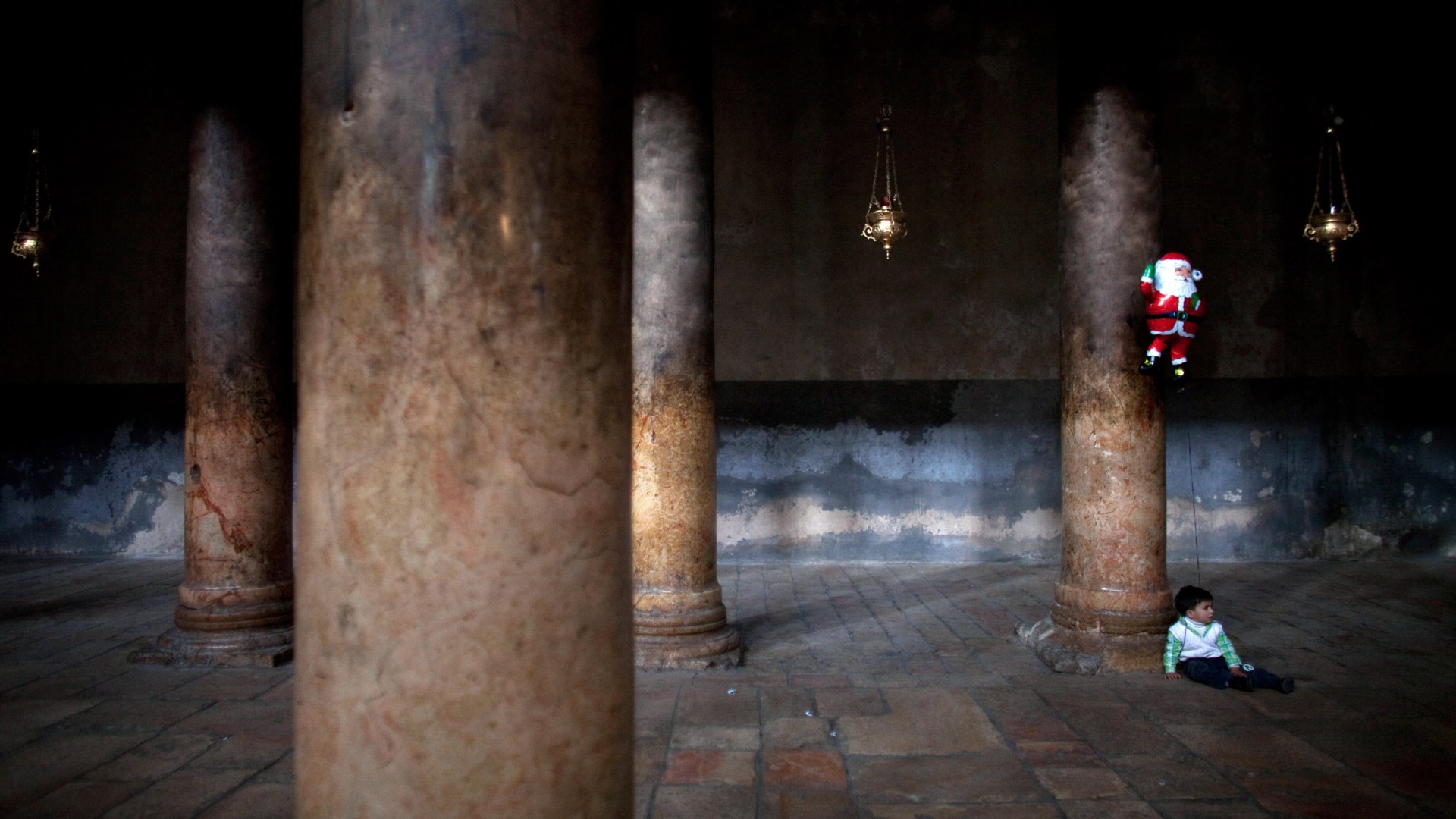
A boy holds a Santa Claus balloon at the Church of the Nativity in Bethlehem, West Bank.

A boy holds a Santa Claus balloon at the Church of the Nativity in Bethlehem, West Bank.

Christianity Today November 22, 2023
Uriel Sinai / Stringer / Getty Images

There will be no Christmas lights in Bethlehem this year.

In solidarity with the suffering in Gaza due to the Israel-Hamas war, last week Christian leaders and municipal authorities in the West Bank city decided to cancel all public festivities. For the first time since modern celebrations began, the birthplace of Jesus will not decorate the Manger Square tree.

It is “not appropriate,” stated local authorities.

But the Bethlehem decision is only the most recent. One week earlier, the Patriarchs and Heads of the Churches in Jerusalem asked Christians in the Holy Land to refrain from “unnecessarily festive” Christmas activities. Catholic churches in Galilee requested the same, as did the Council of Local Evangelical Churches in the Holy Land.

“Due to the thousands killed—and in prayer for peace,” said its president, pastor Munir Kakish, “we will only hold traditional services and devotionals on the meaning of Christmas.”

The initiative, however, came first from Jordan, home to the world’s largest concentration of Palestinian refugees—many of whom have become citizens. On November 2, the Jordan Council of Church Leaders (JCCL) announced the cancellation of Christmas celebrations.

Christmas is a public holiday in the Muslim-majority nation, with many city squares and shopping malls feted with seasonal decorations. But congregations throughout the country will now forgo the traditional festivities of public tree lighting, Christmas markets, scout parades, and distribution of gifts to children.

Religious services in all locations will continue.

“In our homes we can celebrate, but in our hearts we are suffering,” said Ibrahim Dabbour, JCCL general secretary and a Greek Orthodox priest. “How can we decorate a Christmas tree?”

The formal Jordanian Christian declaration reflected respect for the “innocent victims” and denounced the “barbaric acts” of the Israeli military. It recognized the “difficult time” in both Gaza and all Palestine, noting the destruction of homes, schools, hospitals, and places of worship.

It pledged that offerings collected last weekend would be donated to Gaza.

Dabbour, whose parents were refugees from the now-Israeli cities of Ramla and Jaffa in the 1948 war, was born in Amman and serves as the chairman of the Jordan Bible Society. He linked the current war to that original displacement, calling for dialogue rather than further fanaticism-inducing violence.

But beyond solidarity within the depressed national mood, Dabbour said the council, representing 130,000 Christians in the Hashemite kingdom, had another purpose in the declaration.

“Many Muslims do not know the history of Christianity, thinking we are a people of the West,” he said. “But we are the sons of St. Peter, here for 2,000 years. We want to show society that we are one people.”

Jordan’s evangelicals believe they have a further obligation.

“We have a role to speak to our friends in the West,” said David Rihani, president and general superintendent of the Assemblies of God Church of Jordan. “Jesus did not teach us to blindly side with anyone against another.”

He cited a widely shared video of Tennessee-based pastor Greg Locke calling on Israel to turn Gaza into a “parking lot” and to blow up the Dome of the Rock to make room for the Third Temple and usher in the return of Jesus. Local evangelicals, Rihani said, refuse to be associated with such Christian Zionism.

Adherence to the Christmas decision, however, issues from Jordanian culture.

Growing up 10 miles northwest of Amman in the traditional city of Salt, a UNESCO World Heritage site, Rihani recalled that both Muslims and Christians would frequent any neighborhood wedding celebration—no invitations necessary. But if there was a funeral, any previously scheduled wedding would be either postponed or held quietly among the family.

Weddings mid-war are now treated the same.

“The announcement was not even necessary,” said Imad Mayyah, president of the Jordanian Evangelical Council (JEC). “No Jordanian is celebrating anything.”

Founded in 2006 and representing the Assemblies of God, Baptist, Nazarene, Free Evangelical, and Christian and Missionary Alliance denominations, the JEC released its own statement on Tuesday.

“The Christmas holidays, when we remember the birth of our savior Jesus Christ, comes upon us while we are in the midst of a human tragedy that is ravaging our region,” stated the evangelical council. “In obedience to the Holy Word of God and in line with [both Christian and public sentiment, the JEC] has decided to limit the celebrations of Christmas to religious ceremonies and church prayers within our churches.”

The JEC also prayed for the leadership of King Abdullah and the crown prince.

Last week, the king published an op-ed reiterating Jordan’s support for a two-state solution. In late October, he canceled a regional summit in Amman with US president Joe Biden, protesting Israel’s “collective punishment” of Gaza. On November 1, Abdullah withdrew Jordan’s ambassador from Israel, and two weeks later signaled that “all options” were on the table.

Jordan was the second Arab nation to sign a peace treaty with Israel, in 1994.

The Hashemite kingdom has guarded its role as custodian of Jerusalem’s Muslim and Christian religious sites since 1924. It maintained this right even as it relinquished sovereignty over the West Bank in 1988.

But with over 180 Palestinians killed by Israeli forces or Jewish settlers in the West Bank since the war began, the foreign minister stated that any move to drive Palestinians across the Jordan River would be considered a “red line” amounting to a declaration of war.

The Jordanian army has since fortified its positions along the border.

The king has also designated the Jordan Hashemite Charity Organization (JHCO) to facilitate donations to the people of Gaza. Jordan has set up a military-run field hospital in the northern part of the strip, and last week sent its fifth airlift shipment in coordination with Israel and the US. Seven staff, however, were thereafter injured by Israeli shelling, which Jordan called a “heinous crime.”

Its second field hospital has now been established in south Gaza.

The JCCL statement allows each denomination to distribute its offerings to the people of Gaza through its preferred channels. Jordan’s Baptists and Assemblies of God churches are sending funds through the JHCO, while the Greek Orthodox will work directly through its Jerusalem patriarchate and its Saint Porphyrius church, where hundreds of Christians have been taking shelter.

Rihani lauded the Gaza Christians for their longstanding role in humanitarian aid. Dabbour reiterated support for the king, who stands against the fanaticism of both sides. Israel insists on being a Jewish state, he said, while Hamas says that Palestine is for Muslims.

Analysts state that the Islamist group does not have much popularity in Jordan. But as news of the October 7 terrorist atrocities spread, some Jordanians did spontaneously celebrate in the streets, distributing Arab sweets and chanting in demonstrations that followed, “All of Jordan is Hamas.”

It is not so, even among fellow Islamists. Hamas is a branch of the Muslim Brotherhood, whose colleagues in Jordan splintered into two factions in 2015, partially over their regional affiliations in Egypt and Palestine. The now-licensed domestic group is primarily Jordanian in ethnicity, while the other still-active entity consists mostly of Palestinians.

The latter called for arming the Jordanian people, while Hamas’s leader abroad urged Jordan’s tribes to enter the war.

But the suffering of Palestine unites everyone, and massive demonstrations have pressured the palace. Security forces have restricted protestors from sensitive areas such as the Israeli embassy and border, but have otherwise permitted the widespread protests.

Following the royal lead, Queen Rania accused Western leaders of a “glaring double standard.”

“Are we being told that it is wrong to kill … an entire family at gunpoint, but it’s OK to shell them to death?” she asked in comparison to the October 7 attack. “This is a 75-year-old story, a story of overwhelming death and displacement to the Palestinian people.”

But how should those deaths be considered?

The JCCL statement noted the “innocent victims” but also the “pure blood of our martyrs in Gaza and entire Palestine.” Does the latter imply more than just those killed as collateral damage?

“What do you call a family living in Gaza in a house that was inherited from their great grandparents, killed because they are refusing orders to leave?” asked Rihani. “Aren’t they defending their homes, children, and property?”

Bassam Shahatit, vicar general of the Melkite Greek Catholic bishop in Jordan, part of the JCCL, explained that in Arabic Christian theology the term martyr includes those who die for their homeland. The original biblical Greek word conveys the sense of “testimony,” with Stephen in Acts 7 illustrating the primary Christian focus on faith.

But many clergy in Palestine, he said, consider resistance and liberation to be part of the national duty, with those engaged in armed defense as part of the national fabric. Yet as the region’s churches call for peaceful methods to support the homeland, this topic remains sensitive with much division among many Arab people.

“Do they enter heaven?” Shahatit asked of all who have died. “This is a question for God. But though they are not Christians, we still call them martyrs.”

Dabbour also emphasized the Christian meaning of martyr as one who gives up their life for Jesus or the gospel. But given the popular societal use of the word as one who dies unjustly or in defense of the homeland, he cited the broad Muslim definition as “one who dies for the truth.”

In this sense, he said, it applies to many victims in Gaza.

But what is needed now, said Rihani, is condolence—with action. Referencing Romans 12:15—mourn with those who mourn—he said the Christian message always comes with hope.

So when he sits with his children on Christmas Day, tree lit with windows closed, he will tell them the story of a baby in a manger who died on a cross. And he will emphasize that the Resurrection illustrates that Jesus’ suffering brought hope to all who believe in him.

“We hold out this hope to Gaza,” Rihani said. “So that the world will see their suffering and push for a peaceful solution.”

Observing massive pro-Palestinian rallies around the world, he senses global opinion shifting. This, perhaps, creates the opportunity for international powers to push for peace negotiations. And if the king’s message is heard, said Rihani, maybe a two-state solution is coming.

For Jordanian evangelicals, that would be a holiday miracle.

“We hope we can soon go back to celebrating,” Dabbour said. “God willing, the war will stop before Christmas.”

Editor’s note: A selection of CT’s Israel-Hamas war coverage is now available in Arabic, among eight other languages.

News
Wire Story

Metal-Detecting Brits Unearth Medieval Church Artifacts

Archaeologists are using over a million amateur finds to study pilgrimage sites, the Black Death, and the Protestant Reformation.

Christianity Today November 22, 2023
Jacabel / Getty Images

Much has been written about religious life in the medieval era, but thanks to the British fancy for metal detectors, archaeologists are hopeful about gauging just how much more has gone unwritten.

Earlier this month, the University of Reading announced that it has been awarded a million pounds ($1,245,330) by the British Arts and Humanities Research Council to study the role of religion in medieval life, for which the university will employ a unique source of data: the findings of hobby metal detector users that have been logged in the British Museum’s Portable Antiquities Scheme.

The museum’s scheme was founded more than 20 years ago, in part to quell archaeologists’ fears that hobby metal detector users were disturbing the historical record.

“At the time, there was this boom in metal detecting, with lots of archaeological findings being discovered, and not really any mechanism to record them at all,” Michael Lewis, the scheme’s director, told Religion News Service. “So the Portable Antiquities Scheme was set up to provide a mechanism, on a voluntary basis, to record all the other sorts of discoveries that have been found.”

Since then, metal-detecting hobbyists in Britain have had more than a few minutes of fame thanks to a BBC show, Detectorists, that debuted in 2014. Detectorists wasn’t their only time in the limelight; three shows about the hobby specifically in Britain made it onto Detect History’s list of its 10 “Best Metal Detecting TV Shows.”

Though archaeologists once worried that the fad would hamper their work, they are now seeing it as another way to further understand our past.

“The reason that we’re interested in this is that sources of archaeological evidence are increasingly showing us that quite a lot went on in the medieval period that wasn’t recorded in historical documents,” said Roberta Gilchrist, who leads the program at the University of Reading.

“What we know about religion is through the lens of written sources, largely through the church and through the male priesthood,” Gilchrist explained. “We hope we’re going to be able to use archaeological evidence to get more from the people who didn’t leave documents. For example, women, children, or ordinary, everyday men.”

Through the scheme, metal detectors can log their finds with the museum, including the exact coordinates and conditions of where they were found. Some then choose to donate the artifacts; others keep them in private collections.

A flask used by pilgrims for holding holy water. Courtesy of the British Museum’s Portable Antiquities Scheme / RNS
A flask used by pilgrims for holding holy water.

So far it has resulted in a database of more than 1.5 million entries, several hundred thousand of which date to the late medieval period.

“What we’re particularly looking at is material culture that’s associated with medieval pilgrimage,” Gilchrist said, especially pilgrim badges that were produced as souvenirs for Christian shrines at the time, as well as metal ampullae that were used to hold holy water.

“These were really just very cheap objects made of, like, a lead-tin alloy. But there are thousands of these things,” said Gilchrist, “and we can map them because the metal detectors, now, when they find them, they all have GPS on their phones, and they can give you a very accurate indication of where they find these things.”

The patterns they find give clues into practices from centuries ago. A high concentration of badges related to a certain saint found on a historic road may signify a previously unknown pilgrimage route. Ampullae regularly found at the borders of farms and fields suggest that farmers used holy water to bless crops.

“We very seldom find (ampullae) from excavated sites in villages or towns. But we’ve got hundreds of these turning up in plowed fields,” Gilchrist explained. “They’re often intact objects, but the tops have been pried off, or they’ve been bitten off in some cases, and so the sort of theory is that these things are being used in some kind of agricultural ritual.”

Written records exist that tell scholars of large-scale ceremonies in which priests brought crosses and other relics out to village fields, but nothing on an individual level.

The existing record also tends to reflect what was going on in cities. “Most of the finds that are recorded with us are through metal detecting, and the metal detector users, generally speaking, are searching in the countryside on arable sites, and not in cities,” said the British Museum’s Lewis. “In the countryside, people are kind of living in a different way, and those people in the countryside are likely to be less wealthy than those in the cities.”

The project will also examine two major shifts in society and religion in medieval Britain, the Black Death and the Protestant Reformation.

“It will be really interesting to see in a general sense what the impact of these kinds of changes in society had on the material culture,” Lewis said.

“What we’re trying to do here is something that’s quite, quite tricky, actually. What we’re trying [to do] is to understand—through these objects—how people relate it to the divine in many different ways,” he added.

Stories of Hope: Daniel Silliman

CT news editor Daniel Silliman shares a story that gave him hope in the midst of brokenness this year.

At Christianity Today, we tell the stories and ideas of the kingdom of God because when our world seems dark, we need to hear the stories of the light shining in the darkness. We invite you to partner with CT to help shine the light in the darkness. Give now.

See more Stories of Hope: Sophia LeeJohn OnwuchekwaMike CosperRussell Moore.

News

Nikki Haley Courts Iowa Evangelicals Amid Poll Surge

Though Trump remains the frontrunner, poll-watchers say the South Carolina Methodist is having her moment.

Nikki Haley at a campaign event in Pella, Iowa

Nikki Haley at a campaign event in Pella, Iowa

Christianity Today November 21, 2023
Scott Olson / Getty Images

Veteran Iowa GOP activist Marlys Popma has gotten a call from Nikki Haley’s presidential campaign every other week for months.

Popma’s is one of those coveted endorsements among the state’s conservative evangelicals. The 67-year-old served twice as the executive director of the Republican Party of Iowa and twice as president of Iowa Right to Life, and worked for the presidential campaigns of John McCain in 2008 and Ted Cruz in 2016.

But until a few days ago, she wasn’t ready to back a candidate. Then, at a town hall on Friday in Newton, Iowa, Popma stood up and made a surprise endorsement. “I was an undecided voter when I walked in here,” she told the room full of Iowans, who had just heard Haley’s stump speech. “I no longer am an undecided voter.”

Later, she told Christianity Today that “as a Christian, I just really felt the Spirit saying, ‘This is what you need to do, where you need to go.’ So I stood up and said, ‘You’ve got my endorsement.’”

The welcome endorsement came as Haley, the former South Carolina governor and Trump-era US ambassador to the United Nations, is having a moment in the polls and following up strong debate performances with more detail on her pro-life stances.

During the fall, she’s risen nearly ten points in Iowa—bringing her to trail Florida Gov. Ron DeSantis. In New Hampshire, she’s risen 15 points in the polling, from 4 percent in August to 18 percent in November. She’s maintaining second place in her native state of South Carolina. Donors have started to flock to her campaign. Surveys show voters prefer her in a matchup with President Joe Biden.

The momentum comes with a big asterisk. “I’ve got one more fella I’ve gotta catch up to,” Haley told voters at an event in South Carolina earlier this month. “I am determined to do it.”

Former president Donald Trump is still the far and away frontrunner among evangelicals and Republicans. He’s consistently led in the polls, and most signs have pointed to a rematch between Trump and President Joe Biden. His commanding lead has made the rest of the race look like a scramble for second place.

But as the crowded primary field has started to winnow—former vice president Mike Pence and Sen. Tim Scott dropped out over the last month—Haley has hung on, and her campaign is hoping to shake things up, with a list of 70-plus endorsements from Iowa leaders and $10 million worth of advertising in Iowa and New Hampshire over the next few weeks.

“I think there is great potential for movement in Iowa,” Popma said. “And I probably know the caucuses as well as just about anyone in the state … and I think as more people see her and hear her, the better she’s gonna do.”

She’s drawing the attention of voters beyond the early primary states.

“She’s just really good in the debates,” said Dan Darling, director of the Southwestern Baptist Theological Seminary’s Land Center for Cultural Engagement. “She was a good, good governor.”

Another advantage Haley has, Darling said, is projecting a sense of being “the adult in the room” during a time with troubling events on the world stage, particularly since war broke out between Israel and Hamas.

Haley has had to do some convincing around the issues many evangelicals view as paramount. In a one-on-one with the candidate prior to the town hall, Popma voiced concerns about Haley’s position on abortion.

Haley put those concerns to rest. “What I got from her is that if Congress gets her a bill that protects unborn babies at 15 weeks, at 6 weeks, wherever, she’s going to sign,” Popma said.

At that point, it was a more stalwartly conservative stance than Haley had made publicly, but she went on to reiterate it a few hours later at the Family Leader’s Thanksgiving Forum, hosted by the influential Iowa-based Christian group.

When asked about whether she would sign a federal bill banning abortion after six weeks gestation, Haley said she would. “Yes, whatever the people decide,” she added, a nod to her previous answers suggesting she believes movement on abortion is likely to happen at the state level.

In South Carolina, Haley signed a 2016 law banning most abortions past 20 weeks gestation, the most conservative bill state lawmakers could pass at the time. Since then, the state has gone further by outlawing most abortions past six weeks.

In her campaign, she has consistently described herself as pro-life but has come across as more moderate on the issue than some of her rivals.

In the wake of last year’s Supreme Court decision striking down Roe v. Wade, Haley has said Republicans needed to focus on finding consensus on the issue. At the third debate, she said she would sign anything lawmakers could get across the finish line but noted the chances of Republicans getting through a federal ban were unlikely while they only have slim control of one chamber of Congress.

It’s unclear whether Haley’s rhetorical shift to the right on abortion, or her push to become more visible in Iowa and other early voting states, will move the needle when it comes to white evangelical voters, most of whom still favor the former president.

“The evangelicals that are backing Trump aren’t going to be swayed by a particular story or set of convictions from someone like Nikki Haley,” Daniel Bennett, a political science professor at John Brown University, told Christianity Today. “They’re going to be behind Trump.”

Bennett added that Haley’s story of converting as an adult may be “compelling” for “a lot of Christians in this country who came to Christ later in life. … But at the same time, I think there are those who are going to be more skeptical of her because of her non-traditional background.”

Haley is Indian American and was raised Sikh by her parents. As an adult, she converted to Christianity and now attends a well-known Methodist church in South Carolina, Mt. Horeb. The church recently left the United Methodist Church to align with the newly formed Global Methodist Church.

Tim Lubinus, executive director of the Baptist Convention of Iowa, who attended the Family Leader event Friday, said he believed “most evangelical voters would prefer someone else” over Trump and that Haley “has a lot of traction here in Iowa.”

Lubinus said a number of conversations with pastors gave him the impression that many are “interested in her and her campaign” and thought she had a good performance at the candidate forum over the weekend.

He added that others agreed that her rhetoric on abortion could have been stronger: “We should have a position that’s clear and strong, and she was maybe a half step back from that.”

For the first six months after launching her campaign, while her polling remained unimpressively low, there was doubt her moment would come. Political commentators wrote off her campaign. Her rivals questioned her constituency. If a substantial shift is going to happen, now would be the time—the first test for GOP primary candidates is less than two months away, on January 15 at the Iowa caucuses.

“I haven’t heard of like a huge movement toward her among evangelicals, but I’m increasingly hearing a lot of them say, ‘You know, she could win,’ ‘I think we could easily vote for her,’” Darling said.

Popma thinks Haley can surprise people.

“I would not have done what I did If I didn’t think that she had the ability to shoot up in the polls,” she said. “It was what she said, it was the people around me all saying they were undecided, it gave me this vibe like, this whole room could go Haley. And if she could duplicate that city by city as she stomps through here the next month and a half, who knows what could happen?”

Books
Review

Online Content Runs from Good to Bad. The Bigger Danger Is Online Habits.

Despite our best intentions, the default practices of digital life can deform our souls.

Christianity Today November 21, 2023
Illustration by Mallory Rentsch / Source Images: Getty / Unsplash

No one with a good car needs to be justified,” declares Hazel Motes, the protagonist of Flannery O’Connor’s novel Wise Blood. If O’Connor were writing today, perhaps she’d have one of her characters proclaim, “No one with a good smartphone needs to be virtuous.”

Digital Liturgies: Rediscovering Christian Wisdom in an Online Age

Digital Liturgies: Rediscovering Christian Wisdom in an Online Age

Crossway

208 pages

$16.99

Such blanket statements about a particular technology may seem unfounded. After all, you can use your car to drive to church or you can use it, as Motes does, to run over a rival preacher. You can use a smartphone to read the Bible, or you can use it to watch porn. The tool itself is neutral, right?

Wrong, argues Samuel James in his perceptive and pastoral book, Digital Liturgies: Rediscovering Christian Wisdom in an Online Age. The internet and the default practices it encourages can damage our souls despite our best intentions. Online, we reside at the center of a world designed to cater to our every wish.

Perhaps the easiest way to illustrate the dangers of this position is by reference to C. S. Lewis’s observation in The Abolition of Man that “there is something which unites magic and applied science while separating both from the wisdom of earlier ages. For the wise men of old the cardinal problem had been how to conform the soul to reality, and the solution had been knowledge, self-discipline, and virtue. For magic and applied science alike the problem is how to subdue reality to the wishes of men: the solution is a technique.”

The online ecosystem provides an incredible suite of tools to subdue reality—in apparently magical fashion—to our appetites and preferences. To the extent that, as James argues, the digital “cut[s] us off” from reality, it makes wisdom and virtue appear obsolete. James helpfully defines “Christian wisdom” as that which shows us how “to live fully aligned with ultimate reality: practical, ethical, and theological.” But if there’s an app for every problem reality throws at us, we don’t need to endure the difficult path of sanctification, self-discipline, and wisdom.

Novelty, consumption, and isolation

James thus joins a growing chorus of voices that provide a corrective to recent intellectual histories of the modern, expressive self that trace Western modes of individualism or contemporary beliefs about gender to intellectual missteps made in previous centuries. As James remarks, “the epistemological and ethical effects of technology have gone underreported in evangelical spaces.”

It’s not so much that intellectual just-so stories are wrong as that they are incomplete. How have notions about the expressive or buffered self taken hold? Not primarily through the ascendance of particular ideas, but through the powerful technologies that have developed to realize and enact the desires of the so-called “modern” self.

As Lewis points out, these desires are ancient; what’s particularly new is the technologies that make fulfilling them more plausible. Citing one example drawn from today’s headlines, James observes that “all of the … philosophy in the world could not do for contemporary people the most essential thing to bring about the gender revolution: separate the sense of self from the realm of objective reality. The web, however, can.”

Digital Liturgies views the internet as a habitat, a social architecture that invites certain behaviors and modes of engagement. The opening chapters contrast the Christian wisdom tradition with the techniques that are central to digital life. And insofar as the web “is becoming the foundational medium, the superstructure of nearly every other experience,” such techniques carry over into what remains of our offline lives.

In the book’s main section, James considers how various digital practices inculcate the doctrines of expressive individualism. Our online experiences revolve around the self: “to exist in a meaningful way in the online public square, you have to express yourself. You ‘like’ that which interests you. You ‘share’ those things that you enjoy or agree with. The center of gravity in the online world is your profile, in which you are granted a near-godlike ability to craft an identity.”

In what is perhaps the book’s strongest chapter, James argues that the web “is intrinsically pornographically shaped.” By this he doesn’t simply mean that there’s a lot of pornography on the web (which is, unfortunately, all too true), but that the web as a whole privileges novelty, consumption, and isolation. As we grow accustomed to these three features of online interactions, we become primed to see these as desirable aspects of our sexual lives.

As James notes, “The power to find anything you want to see, the access to a never-ending supply of new consumables, and the limitless freedom to make fantasy become reality—these are not just characteristics of online porn but of the online world in general.”

The web specializes in turning “the most intimate or even most elementary stuff of human life into consumable content.” (Who would have guessed that the “reaction video” would become one of the most popular YouTube genres?). We shouldn’t be surprised, then, at the wrecked relationships and endemic loneliness and anxiety that result.

At the end of each chapter outlining a particular, deformative digital liturgy, James offers a theological alternative. To counter the habits of self-expression, for instance, James reminds readers that their identity should be found in Christ. This is good so far as it goes, but these doctrinal truths cannot, on their own, counter the formative power of repeated digital practices.

I don’t want to criticize Digital Liturgies for not being a different book than it is, but it’s strange that James doesn’t seem to take seriously his own analysis of the pernicious effects that digital liturgies have. Even the conclusion offers only a brief account of the need to develop new, healthier habits, and it doesn’t point readers to any of the really excellent work on spiritual practices and Christian formation done in recent years by people such as James K. A. Smith and Tish Harrison Warren.

Part of the problem may be that James doesn’t want to alienate readers by sounding like a member of that much-maligned group—the Luddites. So at the outset, he clarifies that we don’t need to log off the internet; “rather, by identifying how the web shapes us, we can use these technologies more deliberately, more wisely, and more Christianly.” He returns to this theme at the end, reiterating that “this is not a book telling you to delete your accounts and throw away your devices. The key is to understand how digital technology affects us and to engage with it accordingly.”

Unfortunately, this book says very little about what wise engagement might entail. In principle, I agree with James that Christians are not necessarily obliged to log off the internet (though this may well be a calling for some). But given the web’s tendency to consume our time and profoundly shape our lives, most of us need to radically limit our online activities.

Banding together for embodied life

Just as leading car-centric lives affects our sense of self and community, accessing the internet involves real moral risks, ones that many of us won’t be able to avoid entirely in a world where these technologies have become what theologian Ivan Illich terms “radical monopolies.”

But in the same way that New Urbanism and other movements have tried to imagine how we might arrange our lives to be less dependent on cars, so there is a growing movement of people and organizations imagining ways of moving the internet to the margins and ordering our lives around better liturgies.

Christians need to say no to unfettered, frequent engagement online—very few people really need an internet-enabled smartphone—and yes to counter-liturgies that conform our souls to reality by inculcating disciplines and virtues. Recent books such as Andy Crouch’s The Tech-Wise Family, Justin Whitmel Earley’s The Common Rule and Habits of the Household, and Brett McCracken’s The Wisdom Pyramid propose the kinds of habits that can counterbalance the pull of the online.

As these authors remind us, we can’t succeed in this endeavor as isolated individuals; at a minimum, we need families and churches to band together, perhaps through commitments such as the “Postman Pledge,” and prioritize embodied activities and relationships.

To the extent that we are formed by such counter-liturgies, we may be able to use digital tools wisely, but insofar as we are formed by these digital tools and their default liturgies, we will be unlikely to use them deliberately, wisely, or Christianly.

Jeffrey Bilbro is associate professor of English at Grove City College. He is the author of Reading the Times: A Literary and Theological Inquiry into the News.

Culture

Napoleon Uncomplex

Ridley Scott’s “Napoleon” is well-cast, well-made, and without a thought-provoking theory of its subject’s world-changing appeal.

Christianity Today November 21, 2023
Copyright © 2023 Apple Inc. All rights reserved.

After the violent throes of revolution, in a bankrupt French Republic on the brink of collapse, a man captured the hearts of his people and rose to rule. This is the story of Napoleon Bonaparte, the subject of director Ridley Scott’s new movie, Napoleon, in theaters for Thanksgiving.

Napoleon was one of the most fascinating people in history. Unfortunately, for all its big-budget set pieces and stars, Scott’s film is underdeveloped and confused—in its basic historical storytelling, but, more importantly, in what it has to say about its subject and the meaning of his life.

Napoleon begins with the bloody fall of the French monarchy and, with it, the head of its famous queen Marie Antoinette. From there, we meet Napoleon (Joaquin Phoenix), a lowborn but ambitious officer who seizes his chance to rise to power in the chaotic aftermath of the revolution. The movie follows the major beats of his life point by point, from his first military success at Toulon to his final exile on the island of Saint Helena.

Scott pushes through these phases in confusing succession. From Toulon, which is in France, Napoleon is suddenly in Egypt. If you’re a student of 18th- and 19th-century Europe and its constant power struggles, you know Napoleon campaigned through Egypt to weaken France’s rival Great Britain by nipping at their Middle Eastern holdings. But if you don’t already know this context, you simply see Napoleon with the Great Sphinx at Giza—and likely wonder what he’s doing there and why.

Also strangely handled is Napoleon’s conflicted love affair with Josephine, the woman he made Empress of the French, then later abandoned. Their story is the stuff of legend, one of history’s great enigmas: They remained deeply connected after their divorce, and her death devastated him. His name was reportedly among the last words she spoke in life.

But Napoleon’s script tells rather than shows much of this world-historic romance. As Josephine, Vanessa Kirby (formerly Princess Margaret in The Crown) is radiant as usual, but some of the dialogue between her character and Napoleon was so awkward it elicited laughs from the audience in my screening—and not the good kind.

Phoenix plays Napoleon as a cold, silent strongman, at times a brute. He’s an excellent actor in the right role, but this portrayal doesn’t get us any closer to understanding the phenomenon that was Napoleon. Why did his people love him so fervently? Why, for that matter, did Josephine? Napoleon’s Napoleon is wholly without appeal, leaving the film without a theory of his rise to power that viewers could consider applying to powerful figures of our own time.

That central lack is a shame because Napoleon has some strong elements. If a glorious cavalry charge—pennants streaming, hooves thundering, sabers flashing in the sun—is what you like in a historical epic, this movie is for you. Scott gives each war scene special attention, from the placement of artillery to the bitter cold of the Russian invasion. Battle nerds will be pleased. More military-focused excerpts of the film could be useful for high school students of European history.

It’s unclear what went wrong with Napoleon. A good director, a very capable cast, and an epic scale in production come together to make something less than the sum of their parts. Maybe recent strikes in Hollywood hampered the post-production editing, or maybe the participants just didn’t meld.

Whatever the reason, the film has moments that could have been profound. Napoleon’s encounter with the monuments of long-dead, ancient pharaohs could have been a meditation on the fleeting lives of even the most successful of ambitious men. Instead, the moment passes without that depth.

The movie also leaves out any mention of faith. Without prior knowledge, a viewer could almost finish the film never knowing there were priests and churches in the land of Notre Dame. The French Revolution shook the church as much as the monarchy, but in this telling, the church seems to have never existed. Scott does show Napoleon’s grand rebellion of placing the crown on his own head rather than submitting to the church’s placement of the crown, but the movie does not show why that mattered.

Napoleon could speak to us today. He arose in a time of populism, unrest, revolution. He captured a country’s imagination, both feeding and feeding on its self-narrative of greatness. Ultimately, he failed his people—and blamed them for that failure.

Fill in a few context clues from Wikipedia, and Napoleon can provide a serviceable history lesson. But it could have been epic in more than its battles; it could have been an epic tale of a man who almost gained the whole world.

Caveat Spectator

Napoleon has several sex scenes, though they are brief. There are a few moments of gore, as would be expected in a movie about pre-modern European wars. The violence is generally muted, but it adds up to enough for an R rating.

Rebecca Cusey is a lawyer and movie critic in Washington, DC.

Apple PodcastsDown ArrowDown ArrowDown Arrowarrow_left_altLeft ArrowLeft ArrowRight ArrowRight ArrowRight Arrowarrow_up_altUp ArrowUp ArrowAvailable at Amazoncaret-downCloseCloseEmailEmailExpandExpandExternalExternalFacebookfacebook-squareGiftGiftGooglegoogleGoogle KeephamburgerInstagraminstagram-squareLinkLinklinkedin-squareListenListenListenChristianity TodayCT Creative Studio Logologo_orgMegaphoneMenuMenupausePinterestPlayPlayPocketPodcastRSSRSSSaveSaveSaveSearchSearchsearchSpotifyStitcherTelegramTable of ContentsTable of Contentstwitter-squareWhatsAppXYouTubeYouTube