News

Died: Loren Cunningham, Who Launched Millions on Short-Term Missions

YWAM founder saw “waves” of young people carrying the gospel to every nation.

Christianity Today October 9, 2023
Courtesy of Youth With a Mission / edits by Rick Szuecs

Loren Cunningham, the charismatic visionary who launched Youth With a Mission (YWAM) and mobilized millions of young people for short-term trips, died on Friday morning. He was 88.

When he was only 20, Cunningham was praying and saw an image of a map, but the map was moving. Waves were crashing on the shores of every continent, receding, and then crashing again. The picture appeared to him like “a mental movie,” he would later say, and as he looked closer, the waves were young people, “kids my age and even younger,” fulfilling the Great Commission to “go into all the world and preach the gospel to all creation” (Mark 16:15).

The vision became the core idea for YWAM. The organization has called it “a God-initiated, destiny-defining, foundational covenant from God to birth a new missions movement.”

According to Cunningham, it took him a few years to understand what he’d seen. But it ultimately empowered him to “deregulate” missions, sending more people, more quickly, to more places where they could “proclaim the truth of God and display His love.”

YWAM (pronounced WHY-wham) currently operates in more than 2,000 locations in nearly 200 nations. The organization stopped counting how many young people it sent on short-term missions in 2010, when the total number was around 4.5 million.

“What I like about the spirit of YWAM is being willing to charge hell with a squirt gun,” Steve Douglass told CT a few years before he died, when he was president of Campus Crusade for Christ International (now Cru).

Kris Vallotton, a senior leader at the prominent charismatic Bethel Church in Redding, California, said on Friday that YWAM is “probably the greatest missionary organization in the history of the world.” He called Cunningham “one of the greatest heroes of faith in modern history.”

Evangelist Franklin Graham offered a similar assessment.

“What an incredible life this man lived,” the president of Samaritan’s Purse wrote on social media. “Loren allowed God to use him, and he was a force for the Gospel for decades.”

Cunningham was born on June 30, 1935, in Taft, California, but in his first memories, he was in a tent somewhere in Arizona. He, his parents, and his older sister were making adobe bricks by hand to build a small Pentecostal church.

Hearing from God

Tom and Jewell Cunningham were both ordained Assemblies of God ministers and both second-generation Pentecostal evangelists. Jewell learned to preach as a child traveling from brush arbor to brush arbor in Oklahoma, Texas, and Arkansas. When the couple first got married, they lived in their car while preaching on the streets of Tyler, Texas.

The couple taught their three children to sacrifice personal comfort for the sake of the gospel and to listen to God personally. In his later years, Loren Cunningham remembered learning that the leading of the Spirit could be a matter of life or death. Once, his father was preaching on the street in a Southern California town when his mother suddenly said, “We have to go now. God said we have to go now!”

As the family drove away, an earthquake shook the town and a pile of bricks fell on the sidewalk where they had been standing.

“If God has something important to tell you,” Jewell Cunningham said, “he will speak to you directly.”

The young Cunningham first heard God when he was six and later recalled it was a regular, sometimes daily experience by the time he was nine. When he was 13, he received a call to ministry while praying in a brush arbor in Arkansas with several cousins. They prayed for several hours on a Monday night, and Cunningham felt like he’d been touched by God.

“God just broke through and made the call very clear to me,” he later said. “I had no doubt in my mind I was called to preach.”

To celebrate, his mother took him to town and bought him new shoes, quoting Romans 10:15: “How beautiful are the feet of them that preach the gospel” (KJV). Cunningham preached his first sermon at his uncle’s church that Thursday.

He had his first experience with mission work when he was 18, traveling to Mexico over Easter with a group of young men to witness door to door and preach on the street in the predominantly Catholic country. Cunningham ended the trip in the hospital with dysentery, but considered it a success because 20 people had kneeled in the street to profess that Jesus Christ is Lord.

The next year, Cunningham attended Central Bible College, an Assemblies of God school in Springfield, Missouri. He and three other students formed a gospel quartet called The Liberators, and traveled the country singing and preaching. During a trip to the Caribbean in 1956, he had his vision of waves of young people a few days before his 21st birthday.

“God speaks in your language,” he would jokingly tell televangelist Pat Robertson in 2022, “and I was a surfer as a teenager in California and I saw these waves.”

Cunningham initially thought that maybe the vision meant he should be involved in teaching or teacher training. He graduated from Central in 1957 with degrees in Bible and Christian education and went to the University of Southern California for a master’s in education.

The failure of Bible schools

As Cunningham worked on a thesis about Bible schools, however, he became disillusioned. He looked at 72 institutions around the world and found that few, if any, were having a significant impact on world evangelization. The majority of graduates were not even going into ministry—much less becoming the kind of missionaries who could carry the gospel to the ends of the earth.

At the same time, Cunningham started doing youth ministry with the Assemblies of God in Southern California, where his father was now an assistant superintendent with a focus on church planting and missions. But Cunningham became disillusioned with that too.

“The young people were all so bright and eager,” he told Charisma magazine in 1985. “But I had to admit that most of the activities I planned for them were empty. They missed the heart of the young people because they had no challenge. That’s what we all long for, especially in our teens and early 20s. The big challenge.”

Cunningham found he was good at firing up young people and convincing them to do bold things for the gospel, but then there was nothing for them to do. The Assemblies of God said if they wanted to be missionaries, they needed to go to school and get about seven years of education and training.

“By which time,” Cunningham complained, “most would have forgotten their fiery zeal.”

He started experimenting with short-term missions, taking about 100 young Pentecostals to Hawaii over spring break in 1960. There were challenges—many of the young people treated the trip like spring break—but Cunningham became convinced this was the new model for global evangelism. Young people would get fired up and go on short trips, paying their own way or raising their own funds, and telling everyone in the world about Jesus.

That summer, Cunningham took a trip to scout sites where young missionaries might go. He went to Japan, Hong Kong, Thailand, Cambodia, India, Pakistan, Egypt, Lebanon, Jordan, Israel, Turkey, Greece, Scandinavia, and Great Britain. He started making big plans for 1961.

The leadership of the Assemblies of God, however, thought his plans were too big. The denomination offered to put him on salary to launch a youth missions program, but they wanted to start more modestly.

As Cunningham later recalled the conversation, he was told, “You can continue with your vision, Loren, but you’ll be taking out a more manageable number—say 10 or 20 young people a year.”

He protested that his vision was “much, much bigger than 20 people a year and very much larger than any one denomination.” Remembering what his parents taught him about hearing from God personally, Cunningham decided to leave the Assemblies of God and go out on his own. YWAM was officially incorporated in the state of California in February 1961.

In the first few years, however, YWAM did not manage to get 20 young people per year to go on short-term missions—or even 10.

Darlene Cunningham implements the vision

When Cunningham met a young woman named Darlene Scratch in 1962, the struggling missionary organization was sending out about five annually. But Scratch, who had herself dreamed of cross-cultural ministry after her uncle was imprisoned for missionary work in Communist China, saw some ways to implement the YWAM vision practically. Cunningham married her the following year and declared her, ever after, the co-founder.

“There never would have been anything lasting without Darlene,” he said.

In 1964, she arranged a “Summer of Service” in the Bahamas and the Dominican Republic. Nearly 150 young American Christians signed up. When they returned to the US in time for school in the fall, they reported thousands of conversions and some miraculous healings.

YWAM then organized trips to Mexico, Puerto Rico, and the Virgin Islands. And then, in 1966, they had 90 people on 17 teams in the Caribbean and another 25 in five large postal trucks driving through Mexico, Guatemala, Nicaragua, and Honduras. All of the missionaries were young, raised their own funds, and didn’t let training requirements dampen their zeal.

There were, of course, numerous challenges and many basic mistakes in those early years. More than one vehicle got stuck in the mud on an impassable road. One early flyer misspelled Christ, inviting young people to spend their summer representing “Chist.” The YWAMers learned to trust God, pray, and figure it out.

And reports of the challenges actually drew more young people.

“You’re going to sleep on the floors, eat food that’s different, suffer hot and sticky climates, and be surrounded by mosquitoes,” Cunningham told them. “You’re going to come up emotionally drained and spiritually attacked. But it’s part of growing us up in the Lord.”

A laboratory for evangelism

By 1968, YWAM had 30 full-time staff and 1,200 short-term missionaries. The organization decided a little training would be helpful and launched a school in a hotel in Switzerland. The first teachers included Cunningham’s parents, evangelical apologist Francis Schaeffer, mechanical engineer and lay theologian Harry Conn, and the Scottish evangelist Duncan Campbell.

“It is not a Bible school,” Cunningham explained, “but a laboratory for evangelism.”

YWAM launched more schools, ultimately operating University of the Nations in more than 600 locations. One leader said they were the “wave machine” producing the waves of young people that Cunningham had seen in his vision. The schools offer evangelism training but also degrees in sports and fitness, science and technology, education, communication, and art.

Cunningham said he had a revelation about seven classrooms, each corresponding to the seven spheres of society that Christians needed to impact to bring about change.

He went to tell his friend, Cru founder Bill Bright, about this revelation in 1975. But before he could say anything, Bright announced he’d had a revelation and produced a basically identical list of seven spheres. A few weeks later, Cunningham heard Schaeffer make a very similar argument about taking dominion for Christ over these seven different areas: family, religion, education, media, art, economics, and government.

The idea was later popularized by Bethel pastor Bill Johnson and others as the “Seven Mountain Mandate.” It became the theological basis for many American charismatics to embrace Donald Trump.

Cunningham, however, did not get involved in politics. He saw the seven spheres as a framework for evangelism and “Great Commission strategies.”

By the time Cunningham turned 50 in 1985, YWAM was sending out more than 15,000 young people on short-term trips every year. The ministry operated in 1,100 locations in 170 nations. And yet the visionary leader was convinced, as he wrote in his first book, that those young people were “only a fraction of a fraction of what was needed” and that “the laborers were still few, very few.”

He continued to focus on growing, expanding, and innovating.

Accusations of spiritual abuse

YWAM has faced criticism for the way it treated the “waves” of young people. In the 1980s, veteran staff member Gregory Robertson said the ministry was abusive and manipulative. People who disagreed with leadership were told they were rebelling against God or even demon possessed, he claimed.

More recently, former YWAMers have posted videos on social media claiming they were spiritually abused.

“These things happen at every single base,” one woman said. “Their ability to ‘hear God’s voice’ always trumps your own connection to the Holy Spirit.”

YWAM did not formally respond to the accusations, but a leader in the UK said some young leaders probably did act inappropriately.

“That’s going to happen when we’re committed to the call of mobilizing young people into all the world,” the leader said at the time. “They’re going to make some of the mistakes that I made when I was 18 and 19 and 20 years old.”

He also noted that abuse happens in many contexts, and argued YWAM’s track record was better than most.

The ministry’s decentralized model leaves oversight in local hands. Complaints did not go to Cunningham, as he didn’t manage training or on-the-ground operations, but focused on the big picture. His job, as he saw it, was to open the floodgates of potential missionaries.

In 1999, Cunningham traveled to Libya and became the first missionary to go to every nation in the world, as well as 150 islands and territories.

When COVID-19 and then cancer restricted his travel in the last few years of his life, Cunningham started using Zoom to speak with people on every continent. He spoke often of the need for more Bible translations in more languages, and urged people to “live ‘full on’ for Jesus.”

“It’s been a great life,” he said. “I’d say to anyone … have a purpose. Have a call. Make sure that you are doing it for God and His purposes. He is love and you must show His love.”

Cunningham is survived by his wife Darlene and their children Karen and David. A memorial service is planned in Hawaii on November 4.


Theology

Let the Reformed of the Lord Say No to Cessationism

Disbelief in the Spirit’s miraculous work is gaining ground in some Christian circles, but it’s fighting a losing battle.

Christianity Today October 9, 2023
Illustration by Mallory Rentsch / Source Images: Getty / Unsplash

The cessationist debate is back, although in some ways, it’s never left.

Pastor John MacArthur and Grace Community Church recently hosted the Cessationist Conference, timed to coincide with the release of the Cessationist movie—bringing an age-old topic back to the forefront of trending conversations, especially among Reformed believers. These discussions center on a basic question: “Are the miraculous gifts for today?” Cessationists would answer no.

But to me, there are even more fundamental questions at play here—such as why there is fresh interest in this subject today, and why so much effort is being spent on arguing against the continuance of supernatural signs and wonders.

The answer may be as obvious as it is simple. The Pentecostal-charismatic movement continues to rise rapidly around the world, and in the eyes of cessationist leaders like MacArthur, this is a cause for alarm, not celebration. In their view, this global movement is marked by doctrinal deviances and aberrant practices so extreme that some believe the “vast majority” of Pentecostals and charismatics are not Christians at all.

Dale Coulter, professor of historical theology at Pentecostal Theological Seminary, argues that the “the Pentecostalization of American Christianity” is coming of age. But in the opinion of these cessationist leaders, this isn’t a positive trend—dangerous doctrinal weeds are growing rapidly in our backyard, and theological diligence is required.

Having dialogued face to face with some of these leaders for hours, I don’t doubt the sincerity of their Christian faith or their pastoral concerns about perceived spiritual abuses. As a Pentecostal-charismatic leader, I have addressed problems within our movement for more than three decades. In fact, I told The New York Times two years ago that the failed prophecies of Trump’s 2020 reelection amounted to the “greatest deception” I’d seen in my five decades in the Lord.

So I have no desire to minimize error or deny the fact that, with the exponential expansion of the Pentecostal-charismatic movement worldwide—growing from 58 million in 1970 to 656 million in 2021—there has been plenty of strange and even false fire.

But to focus on the aberrant is to miss the greater reality: Over the last 50 years, hundreds of millions of people have come to true and lasting faith in Jesus through the present-day, miraculous ministry of the Holy Spirit.

As a thoughtful rabbi once commented, we should not take the best of our religion and compare it to the worst of someone else’s religion. As I’ve said elsewhere, “The existence of flaky charismatics no more disproves continuationism than the existence of spiritually dead Calvinists disproves Reformed doctrine.”

Historian Conrad Cherry pointed out that, during the First Great Awakening, critics like Charles Chauncy often focused on the chaff, whereas revival leaders like Jonathan Edwards focused on the wheat. Sadly, this is often the same with those who criticize the worldwide Pentecostal-charismatic movement today.

I can testify personally—having spent decades of my life working with this movement worldwide and ministering overseas on more than 160 trips—that there is far more Jesus-glorifying, Word-based wheat than could possibly be counted. Moreover, this harvest has grown and remained strong in the face of great suffering and persecution.

But the best answer to cessationism is found in the Bible itself.

While I respect my cessationist friends, I disagree that there is scriptural support for their stance that the miraculous gifts were uniquely associated with the apostles and existed solely for the establishing of the gospel. In fact, I personally believe this position is rendered indefensible by the explicit testimony of God’s Word.

In my book Authentic Fire, which I wrote in response to MacArthur’s Strange Fire book and conference, I explain that it is precisely because I am sola Scriptura that I am charismatic.

For many years I’ve heard my cessationist colleagues say, “You charismatics rely on experience. We rely on the Word.” But to be candid, I’ve often found the opposite to be true.

I know many who became cessationists because of bad experiences with charismatics or Pentecostal churches, whereas (as you will soon read) I’ve remained a charismatic because of the testimony of God’s Word. When my experience confirms the Word, wonderful. But when my experience (or lack thereof) is contrary to the Word, I don’t reject the Word. I reject the experience.

This is a lesson I have learned the hard way through my own faith journey.

I came to faith in 1971 at the age of 16 in a little Italian Pentecostal church as a heroin-shooting, LSD-using Jewish hippie rock drummer. But 10 years later, while working on my PhD in Near Eastern languages and literatures at New York University, my perspective greatly changed.

I did not want to be Pentecostal anymore. I wanted to be spiritually sophisticated, like the Reformed scholars whose works I was now studying. Speaking in tongues, which used to be a rich part of my spiritual life, was no longer something I wanted to practice.

Bear in mind that this was before I knew of any prominent biblical scholars and theologians who were Pentecostal or charismatic. I’m thinking of people like Gordon Fee, Craig Keener, Ben Witherington, Peter Davids, Jeffrey Niehaus, J. P. Moreland, Wayne Grudem, R. T. Kendall, Sam Storms, and others. In my mind at the time, being Pentecostal or charismatic meant being small-minded and theologically backwards.

As for supernatural healing, I’d heard about past stories and was assured of future ones, but I had seen very little with my own eyes. As for people being “slain in the Spirit” (something I used to see when I prayed for people), I now taught against it, saying it proved nothing and was not found in the Bible. I even bought books like B. B. Warfield’s Counterfeit Miracles and Robert Gromacki’s The Modern Tongues Movement to help persuade myself that the miraculous gifts were not for today. I fully desired to be a cessationist.

In the end, I could not be convinced. The Word was too clear, and cessationist arguments too weak and easily refuted. So I concluded that the supernatural gifts of tongues, prophecy, and healing were still for today, but that what we were seeing in the contemporary charismatic movement was not what Scripture had promised.

Then in 1982, over a period of months, God brought me to repentance for leaving my first love and convicted me of theological and intellectual pride—speaking to me through some friends of mine who were charismatic believers.

To say this rocked my world would be an understatement.

Now, I’m not saying that cessationists are not walking in love and devotion to the Lord—I’m simply sharing my own experience. At that time, I was serving as an elder in training at a largely non-charismatic congregation, which was incredibly active in good works, but lacking in the power of the Spirit. By the end of the year, my life was radically changed—and the Lord even used me as a vessel to pour out his Spirit in our church.

As glorious and wonderful as that season was—as I was once again witnessing the gifts of the Spirit in operation, and more than I’d ever seen before—I now had a big problem. Here I was, with the right theology and accurate exegesis but seeing no one healed, while the people with wrong theology were seeing healings happen. How could I reconcile this?

At that time, I was in the early stages of research for my doctoral dissertation, “Abbreviated Verbal Idioms in the Hebrew Bible: A Comparative Semitic Approach,” but I decided to change my topic to “‘I Am the Lord Your Healer’: A Philological Study of the Root RP’ in the Hebrew Bible and the Ancient Near East.”

I had so many questions that needed answering—exegetical, linguistic, practical, theological, and philosophical—that I wanted to dig into what the Word said about healing from as many angles as I could. Ten years later, Zondervan published my monograph, Israel’s Divine Healer, as part of their series titled Studies in Old Testament Biblical Theology. In it, I expanded my research to include the New Testament, which only further cemented my beliefs about healing for today.

So what do the Scriptures really say about miraculous healing?

First, the Bible indicates that acts of miraculous healing point to the goodness of God and are often an extension of his compassion (e.g., Matt. 14:14).

As Scripture attests, Jesus brought the full revelation of the Father and ushered in the kingdom of God—which included healing of the sick and setting captives free (Luke 4:18–21, John 14:8–11; 3). And, while we pray for the kingdom to come in fullness with the return of Jesus (Matt. 6:10), we recognize that, in a spiritual sense, God’s kingdom continues to grow worldwide.

Jesus taught plainly that whoever believed in him—a universal formula in the Greek and in John’s Gospel (see John 6:35; 7:38; 11:25; 12:44, 46, which apply to all believers)—would do the works he did, and even greater works (John 14:12; the immediate context makes clear he is speaking of his miraculous works).

Moreover, the Bible makes clear that the Spirit’s outpouring, which began in Acts, came with tongues and the promises of prophecy, dreams, and visions—and that it would be for all people and for this entire era of the church in these “last days” (Acts 2:14–21, 39).

Paul directly commands us to earnestly seek the spiritual gifts, especially prophecy, and to not forbid tongues (1 Cor. 12:31; 14:1, 39). He also makes it clear that these gifts would continue until the eschaton (1 Cor. 1:7; 13:8–10). In addition, miraculous healing of the sick, in response to the prayer of faith of local elders, should be the norm in our churches (James 5:13–16).

Of course, each of these concepts could be unpacked in far greater depth, but it is my personal conviction that the Bible itself does not support the cessationist position. That is, I believe it is impossible to make an exegetically robust argument for cessationism using the Bible alone. And for sola Scriptura believers, this should matter.

Much of the witness of church history also attests to the continuation of supernatural signs and wonders.

There is ample evidence of ongoing miracles after the death of the apostles. There are also countless stories of Christian skeptics who changed their minds about miracles—including the early church father Augustine, who said, “What do these miracles attest but the faith which proclaims that Christ rose in the flesh and ascended into heaven with the flesh?”

There is also an overwhelming number of testimonies to the modern-day miraculous work of the Spirit over the centuries, and some have been carefully documented in recent decades.

That said, I ultimately welcome any debate among the body of Christ on how the Holy Spirit is at work today. Let’s all put our best arguments on the table, with respect and grace, for the glory of God and the good of his people.

Michael Brown is the host of the Line of Fire podcast and author of more than 45 books, including Revival or We Die and Why So Many Christians Have Left the Faith.

Inkwell

Are We Safe as the Fire Rages?

On Spiritual Safety & Martyrdom

Inkwell October 9, 2023
Photography by Ricardo Braz

The first real pain comes in the night, a livid fist tightening in my gut. It scatters my dreams and snaps my eyes open, and I know—it’s here, finally, real labor, two weeks late. I sit up and a gush of warm waters corroborates: yes, soon. The contractions build and build, a fearful waxing, until finally they become a single unrelenting thrall. I cry, I whine, I complain, despite waiting for this, my third baby, for a decade: Dear God, not this again. 

The ache becomes something cataclysmic, something beyond thought, beyond reason, beyond bearing. I’m sitting up with my hands braced on my knees, a low bovine dirge sounding from my throat, rank fluid spilling from me with every pulse of my womb. Maybe I could reach down and feel my baby’s head if I had the presence of mind, but I don’t. I’m an animal, a vegetable, a hostage to the pain. In fact, my body is nothing but pain now and will soon explode into a thousand million points of burning white-hot light and fizzle out into ash. A woman has sorrow because her time has come, Jesus said.

You’re at 10, time to push, they cheerfully tell me, as if I didn’t know. Someone asks if I want the lights turned down and I struggle to comprehend the question. I point accusingly at the observing medical resident in the corner standing there placidly and unmoved in his fleece pullover, both of us pulled into this strange, holy, bloody crucible of instant intimacy that is childbirth, and whine “Who IS that guy?!” But I start to push because I must. The only way out is through. I heave, I strain, I grab my knees and scream. I can’t, I won’t, I can’t. But my body betrays me, again. The biological compulsion to get the baby out subsumes me and I heave once more, lurching forward with my entire being, ceding my entire self again to the impossible miracle as I will myself to let it hurt even more because I know—the only way out is through. 

There is a terrible burning beyond description, a furious fire, and then he’s plunked on my chest: my prize, wet and writhing and angry and perfect. And I’m sobbing big howling sobs, sobs so real they almost sound phony when I watch and rewatch the video my friend took. My baby is red and screaming in outrage and he’s beautiful, every inch, every fold, every contortion of his little squished features. “A woman, when she is in labor, has sorrow because her hour has come; but as soon as she has given birth to the child, she no longer remembers the anguish, for joy that a human being has been born into the world.” (John 16:21, NKJV)

But in the dark of the night as my baby boy nurses sweetly, his eyes shut tight in total surrender, total trust, the thought haunts me: I can’t perfectly protect him. I can’t absolutely stave off pain and suffering or even horrible tragedy and disaster. And twined within the joy of a human being born into this world is the inevitability of death. The remembrance brings a sting, a dark bass note of dread in my gut. And despite my professed Christian faith, despite the hymns I obediently sing in church every Sunday, despite my recitation of creeds and my memorization of Scripture alongside my children, death’s somber inevitability looms like a black cloud on the far horizon. This derelict man on the cross, this Savior whose rumored resurrection casts an inescapable, Christ-haunted shadow on all of history, on all of life—I can trust for myself, perhaps. Sometimes. Mostly. But for my children? Here he seems to ask too much of me, too much of my feeble faith, more fallible than Peter’s, burning red-hot for a time and then cursorily abandoned to save face before a bunch of strangers. 

Can I really trust him, this mysterious triune God? The question slides into my consciousness, sibilant, taunting, in whispers threaded with skepticism. The burden of knowing I cannot absolutely protect them rests neither easy nor light on my soul’s mantle, nor can I shrug it away toward a God who seems to drop the ball all too frequently. Paul speaks rhapsodically about a future reckoning which unfurls backward, gilding all it touches, folding all things into a prismatic glory. But what if, I think. What if there is something beyond redemption, some sorrow whose ugliness can’t be undone? Doesn’t God go too far when he has his excitable scribe, his once-murderous apostle emphatically write, “I consider that our present sufferings are not worth comparing with the glory that will be revealed in us” (Rom. 8:18). I file through heinous news stories in my head as I consider whether I should let my young teenage son walk to the local school, whether I should let him and my daughter walk to the store a block away. And now I look at my infant son and alongside unbearable tenderness—indeed perhaps stemming from it—I feel the cold stab of fear. What a terrible thing, this broken world. What a precious and astonishing gift, this child. 

The former trails the latter like a shadow, its dimensions waxing and waning, a skulking hex, covert but tenacious, that can never be outrun. I am inevitable, my 13-year-old son growls, dropping his voice in an imitation of the supervillain Thanos to make a joke about his dirty laundry. But don’t I feel it, too? In the relentless encroachment of the world’s danger, in the nightmares I sometimes have about being trailed by a nebulous evil something that cannot be outrun or hidden from. Can what’s been done, and what is yet to be done, ever be undone? God promises yes: death is swallowed up in victory (1 Cor. 15:54). But sometimes, in the still dark of night, I’m prone to cynicism, prone to side-eye the promise that claims to supersede all else: death has been swallowed up—erased, subsumed, transformed—in victory.  


In Rilla Askew’s novel, Prize for the Fire, a fictionalized account of the life of the Protestant martyr Anne Askew, a like sense of inevitability haunts the pages that hasten Anne toward her end. Rilla Askew writes with such immersive vivacity and vigor that Anne comes utterly alive, a young woman of deep dimension, doubts, peccadilloes, and much early wavering in her faith. At the opening of the story, she’s caught in the tension of her sister Maddie’s sudden illness and death, and a church which tells her that her dear Maddie, so full of the goodness and gentleness and piety that Anne herself can’t seem to summon, may be “in that other place where the priests say we must suffer until we are burned pure enough to enter Heaven, our souls scoured by fire to be made fit for God’s presence.” Anne is also adrift in the oscillating turbulence of Henry VIII’s reign, when the volatile king’s sympathies volleyed unpredictably between the Reformers and the traditional Catholic church.

Anne’s moment of conversion comes stealthily and suddenly as she prays for her brother Thom, who is struck with an illness much in the same manner Maddie was. She murmurs her prayers as she was taught, the words coming mechanically, automatically, but her heart is far from the sibilant, consonant Latin syllables issuing from her mouth. But then, in the silence of the room, in the desolation of her utter helplessness, help comes. “A warmth settles upon her like a mantle, a sense of calmness, peace . . . the peace assures her all will be well, all is love, all is forgiveness, the fires of Hell will not touch her, will not touch her little brother, her sister.”

Her brother recovers, against all odds and almost against Anne’s own conflicted conscience: “I prayed for him. I prayed so hard. And he is better. But I prayed even harder for Maddie. And she died. Why?” She reflects that acceptance is much harder than obedience. 

But something soon shifts in Anne, despite her doubt, despite her desperate questioning: a hunger for God’s very words roots in her like a seed, a heavy ravening need like the appetite of Jeremiah—“When your words came, I ate them” (Jer. 15:16)—or Ezekiel eating the honeyed scroll (Ezek. 3:3). 

Despite her tyrant of a husband, despite the priests who gather in tight clusters to scold her temerity in low voices, she reads the Word of God and commits as much as possible to memory. Henry’s rules for who may read the Bible change again and again in his temperamental vies for power, but again and again Anne treks to the church where the Great Bible is chained to a wooden lectern near the chancel. The frontispiece of the Coverdale translation, blessed by the king himself, is a woodcut illustration of Henry seated on his throne, handing the Verbum Dei—the Word of God made available at last in the common people’s language due to Henry’s towering magnanimity—to his chief minister Thomas Cromwell and Archbishop Thomas Cranmer, with Christ looking beatifically down upon him from the parting clouds. A panoply of scrolls which unfurl from the mouths and hands of gentlefolk and commoners milling below the throne read “Vivat Rex” and “God Save the Kynge.”


When Anne is martyred, it won’t even be by Henry’s hand—not really. By that point he is too bloated and sick and ulcerated and has delegated his authority to wolfish men who skulk around the king’s ailing flesh like vultures. But now, for Anne, God’s Word is not chained, despite the heavy links that fetter it within the village church, nor is it owned by Henry or anyone else. 

Rilla Askew magisterially builds her narrative tension as the cogs of the machine which will bring about Anne’s death click into place. But as Anne moves toward her death, both marching boldly forward and carried along by forces beyond her command—perhaps even beyond human command—a surging, recalcitrant hope twines upward, a rebellious flowering thing pushing hard against the heavy drag of terrible inevitability, growing upward and around it.  

For a week, Anne is savagely racked by Thomas Wriothesley and Richard Rich, her joints dislocated and her tendons and muscles torn in a “brutal intimacy” heretofore unfathomable: the torture of a woman in the Tower of London. In Anne’s own writings, she says that she fainted from pain. Her torturers lowered and revived her only to repeat the process. It is claimed that her cries of torment could be heard from the neighboring gardens. 

“Each day Mistress Anne seems more peaceful,” wonders a baffled Beatrice. “How can she? Where does she get the strength, not merely to withstand, or endure, but to keep the sharpness to her tongue?” As Anne is made a final offer of clemency, Rilla Askew quotes directly from Anne’s own documented words: “I would rather die than break my faith.” And so it goes. The inevitable locks irrevocably into place.  


Does God promise safety? My older children and I recite Psalm 91 together: “He that dwelleth in the secret place of the most High shall abide under the shadow of the Almighty. I will say of the Lord, He is my refuge and my fortress: my God; in him will I trust” (vv. 1–2, KJV). But Satan uses these verses to taunt Jesus in the wilderness, tempting him to apply them so literally and perversely that he would test whether God would still preserve him bodily were Jesus to jump from a cliff. What does God really promise? I want an itemized list, a contract, a meeting of terms on which we can both agree. But God doesn’t provide that. He only provides his Word—prismatic, confounding, multifarious, singing with poetry and steadily beating with prose, both impenetrable and razor-sharp, impossibly heavy with the weight of glory. 

“It is written,” Jesus answers Satan in the wilderness, when Satan tempts him to turn a rock into bread, “Man shall not live on bread alone, but by every word that comes from the mouth of God” (Matt. 4:4). This is our food: the Word of God. The body and blood of Christ. This has to be enough.

Anne Askew endured torture and burning, I scold myself. She subsisted on God’s Word, she relied on God’s promises of ultimate victory, of never forsaking her, of helping her endure until the end. And I can’t seem to endure one day without questioning the will of God, without wondering whether he is really good, without skeptically weighing his promises against seen reality. 

But slowly, surely, steadily, God’s promises take root, often almost against my own will. I piggyback on my children’s capacious ability to memorize as we recite Scripture together. They correct me as I fumble in Isaiah 53: “He was oppressed and afflicted, yet he did not open his mouth; he was led like a lamb to the slaughter, and as a sheep before its shearers is silent, so he did not open his mouth” (v. 7). But my 11-year-old daughter waves me away as I begin to prompt her on a forgotten word: her blue eyes search the ceiling and her skinny legs shift back and forth until the word comes. And it always does. 

The work of the Spirit goes about humbly: underground, unseen. It is less that we tend the garden of faith and more that the Spirit tends it as we read and pray—as it did in Anne Askew, coming to bloom in its time, in his time, the perfect time. It is less a kind of inevitability than it is a promise in itself, delighting in surprise, borne aloft by grace. Maybe God hasn’t dropped the ball after all. Maybe the terrible inevitability of death will truly be eclipsed by the blinding light of glory. Maybe all that has been done and is yet to be done can be undone, or better—can be redeemed. And maybe that is the promise which can finally make me yield my trust: all the evil in the world, in all its seeming inevitability, will be burned away with glorious light. The worst thing is never the last thing, as Frederick Buechner said. Future-echoes of salvation and redemption flitter backward toward the present. Hope, as the apostle Paul said, will never put us to shame.   


“Faith is that weapon strong / which will not fail at need,” Anne Askew wrote in a poem, posthumously dubbed “The Ballad of Anne Askew.” Prize for the Fire chronicles that she has to be carried to the stake, set up in front of St. Bartholomew in London, because she cannot walk—her injuries from the racking far too grievous to allow tendon, bone, muscle, joint to work in concert ever again, as God designed them, as he crafted them in her mother’s womb. Every pock in the road sends seismic waves of agony through her ruined body. In the novel, her friends have purchased a satchel of gunpowder which Beatrice secures at her neck—Anne directs her to make sure the satchel is located at her heart rather than at her bowels, in the hopes death will come more quickly as the flames lick upward and ignite it. While we don’t know for certain that this was the case, Foxe’s Book of Martyrs confirms that a number of Christians burned that day were wearing gunpowder satchels.

But I think that we can be confident that the Holy Spirit, God the Father, and Christ the Son have done their work in Anne, as has God’s Word, his Verbum Dei, supplied by the capricious Henry, whose chosen officials now prepare to burn her alive. Perhaps she recites Scripture to herself as she remembers all the impossible, fantastic promises which fly in the face of seen reality. The comfort of God comes like a mantle, like a veil, like a covering. She knows God has not lost control. He is working all for her good and his glory. And the brilliance of the hope of glory shines before her, surpassing all the suffering, subsuming it.

The masked men hold their torches to the straw. One last chance is given to her and her friends to recant: the offer of pardon is extended. The price is just a few paltry words, but Anne has not come this far to deny her faith in the one who does not forsake her now. She says I can, I will, I can—by faith, through the grace of God. There is a terrible burning beyond description, a furious fire. And then there is glory beyond imagining. 

Ashley Lande’s memoir on leaving psychedelic drugs to follow Jesus Christ will be published by Lexham Press in 2024. Find her work here: ashleylande.com

Church Life

American Christians Should Stand with Israel under Attack

While we pray for peace, we need moral clarity about this war.

A Tel Aviv building damaged by a missile from the Gaza Strip.

A Tel Aviv building damaged by a missile from the Gaza Strip.

Christianity Today October 7, 2023
Amir Levy / Stringer / Getty Images News

Americans awoke this morning to reports of war in the Middle East, as the terrorist group Hamas attacked the state of Israel in unspeakably brutal ways. As our screens fill with imagery of fire raining down from the skies, of families grieving the kidnapping and murder of their loved ones, we know that—just as for our own country in the aftermath of the September 11 attacks—this evil day is just the beginning of what is to come. As we pray for peace at the beginning of this war, American Christians should do so with the moral clarity to recognize Israel’s right and duty to defend itself.

Some might assume that evangelical Protestants automatically support Israel based on eschatological views that cast the modern state of Israel in some role in biblical prophecy. For some, this is indeed the case. Many of us, though, don’t share those beliefs. We believe the promises of God are fulfilled in Christ, not in the 1948 Israeli Declaration of Independence. Many of us are quite willing to call out Israel when we believe it is acting wrongly. We don’t believe the Israeli Knesset is somehow inerrant or infallible.

But even with those disagreements, American Christians should be united in support of Israel as it’s under attack.

Some Christians, to be sure, are pacifists who believe any military action to be wrong. Most Christians throughout church history, however, have held to some form of just war theory, which holds that war is always awful, but—under certain, very limited circumstances—can be morally justified.

Jesus interacted with soldiers (Matt. 8:5–13) and called them, as others, to repent of sin. But he never spoke of military service itself as a sin. The apostle Paul wrote of the role of the state to “bear the sword” against “the wrongdoer” (Rom. 13:1–4). This authority is hardly boundless. Every state is accountable to the justice of God and, if it acts unjustly, is subject to the judgment of God. The very Roman government of which Paul wrote was pictured later in Scripture as a “beast” state to be opposed (Rev. 13:1–18).

When acting justly, though, the state has not only the right but the responsibility to protect itself and the lives of its citizens.

Sometimes, especially in the early moments of any war, we may be uncertain about who is right and who is wrong. There is no such moral confusion here. Hamas—and its state sponsors—attacked innocent people, as they have done repeatedly in the past, this time employing a force and brutality previously unseen.

We should expect any just state to respond with force to an attack like the one Israel has suffered—but here, that impetus is heightened by the unique circumstances that led to the formation of the Jewish state. Many tried to appease a bloodthirsty German Reich even as it carried out the worst genocidal atrocity in the history of the world. After those butchers were defeated, and the state of Israel established, Israel faced constant threats to its very existence, often in terms of the very same antisemitic tropes weaponized by the Nazis about the so-called “Jewish question.”

As Americans, we should stand with Israel under attack because it is a fellow liberal democracy—and a democracy in a region dominated by illiberal, authoritarian regimes. As Christians, we should pay special attention to violence directed toward Israel—just as we would pay special attention to a violent attack on a member of our extended family. After all, we are grafted on to the promise made to Abraham (Rom. 11:17). Our Lord Jesus was and is a Jewish man from Galilee. Rage against the Jewish people is rage against him, and, because we are in him, against us.

No one wanted to wake up to war in what was already a tinderbox of the world order. But war has come, and we should recognize terrorism for what it is. We should also recognize the justice of a forceful response to that terrorism. However we read the prophecy passages of the Bible, and however we disagree on world politics, American Christians ought to stand together with Israel now.

Russell Moore is the editor in chief at Christianity Today and leads its Public Theology Project.

News

To Grow in New England, Southern Baptists Crack ‘Yankee Stoicism’

Overall church membership is up by nearly 10 percent in the region.

SBC churches grew by 25 percent in Maine.

SBC churches grew by 25 percent in Maine.

Christianity Today October 6, 2023
Zachary Edmundson / Unsplash

The Southern Baptist Convention (SBC) is a fixture of the religious landscape in the American South, where grits, Republican politics, and SEC football are king. But the region where you’re most likely to find a growing Southern Baptist church is the land of lobster rolls, progressive politics, and Boston Red Sox baseball: New England.

A new analysis by Lifeway Research found that the area spanning Connecticut to Maine was the only place to see an uptick in SBC church membership over the past five years. But the growth in the Lifeway report was miniscule—a 1 percent increase in a region with fewer than 1 percent of SBC churches—compared to the widespread decline across the denomination.

Southern Baptist membership decreased everywhere else during the same time period, with the biggest drops in the Pacific (down 22%) and West North Central (down 14%) regions.

Still, for pastors in the region with 358 of the SBC’s 47,198 churches, the growth in New England was “an absolute encouragement, an affirmation of what God is doing here,” said Aaron Cavin, Send City missionary for Boston with the North American Mission Board (NAMB)’s Send Network.

Cavin recently shared the data with local church planters at a training session, and “it was a celebration,” he said. “It almost makes us a bit more resolute.”

According to NAMB, Southern Baptists have planted 1,018 churches in the Northeast since 2010, an average of around 44 churches per year. That includes New England along with New York, Philadelphia, and Baltimore.

While the Lifeway statistics measured church growth only among existing congregations that reported membership numbers in 2017 and 2022, hundreds of SBC churches have started in New England since then.

The growth in Southern Baptists among all churches in the region is even more pronounced: New England church membership jumped from 27,668 to 30,265, a 9.4 percent increase. Over the same time period, total SBC church membership decreased 11.9 percent. Baptisms in New England fell by just 1.1 percent, while total SBC baptisms decreased 29.1 percent.

Political polarization and creative outreach by New England churches may be two factors fueling church growth, said Vermont pastor Dan Molind.

The region “is getting more polarized,” said Molind, pastor of Enough Ministries in Barre, Vermont. “There is less middle ground. If you’re a conservative, you’re getting pushed toward the evangelical church. If you’re more liberal, then perhaps you’re falling away from that. As an effort to preserve our values and what we see as truth, more people are becoming aware of and are seeking out the evangelical church.”

“Yankee stoicism” that values going it alone rather than relying on God makes evangelism difficult, Molind said. Plus, a Vermont aversion to visiting people at their homes makes it challenging to invite neighbors to church. That has forced Enough Ministries to reach people through a soup kitchen, food pantry, addiction recovery ministry, and clothes closet.

“We have something that will help their brokenness physically,” he said, “and that opens opportunities for us to help them with their real spiritual need.”

Church growth varied across states. In New England, three states saw total church membership increase over the past five years while three others decreased.

Maine led the way with 25 percent growth among SBC churches. Rhode Island and Vermont followed with 11 and 9 percent increases respectively. New Hampshire churches posted the largest membership decrease in New England at 18 percent. Massachusetts churches decreased by 5 percent and Connecticut congregations by 4 percent, Lifeway Research told CT.

Scott McConnell, executive director of Lifeway Research, cautioned that the sample size in Rhode Island, Maine, and New Hampshire is smaller than it normally would report. “But these do reflect the small size of these state associations, and we wanted to show all states,” he said.

Southern Baptist work in Vermont “has been particularly exciting,” said Terry Dorsett, executive director of the Baptist Churches of New England (BCNE), a regional Baptist convention that cooperates with the SBC. He cited an Association of Religion Data Archives report that Vermont’s evangelical population doubled between 2010 and 2020. “It’s a beautiful example that God is bigger than statistics and sometimes God does things that statistics can’t really explain well.”

Maine’s Southern Baptist growth “has been pretty phenomenal as well,” Dorsett said.

The growth hasn’t come easily, though. New Englanders hold a “strong misconception” that Southern Baptists are racists, Dorsett said. To overcome that stereotype, New England Southern Baptists point to their own ethnic composition: 57 percent of BCNE churches are predominantly non-Anglo. The slate of officers expected to be elected at next month’s BCNE annual meeting is entirely non-Anglo.

Loneliness also is a challenge for New England Southern Baptist pastors—especially in the northernmost regions where SBC churches are few and far between. Cavin thinks an increasingly robust pastor support network in New England may be tied to the growth of church membership.

“In the last seven to ten years, what we’ve seen is a lot more of that familial bond happen and the intentionality we put into caring,” Cavin said, “and making sure that [pastors’] spouses are cared for and families are cared for.”

In the end, New England Baptists say no statistical analysis can fully explain their growth. They point to the power of God and the persistence of churches as the key factors. Cavin experienced both recently when a neighbor to whom he has been witnessing for 14 years committed his life to Christ and was baptized.

“What we’re excited about is the transformation of individual lives,” he said.

David Roach is a freelance reporter for CT and pastor of Shiloh Baptist Church in Saraland, Alabama.

News

Fruitful and Multiplying: 9 Visions for Evangelical Ministry in the Middle East

Inspired by new transnational networks, Arab ministry leaders and international partners reflect on the previous 25 years of service and call for similar spiritual integration.

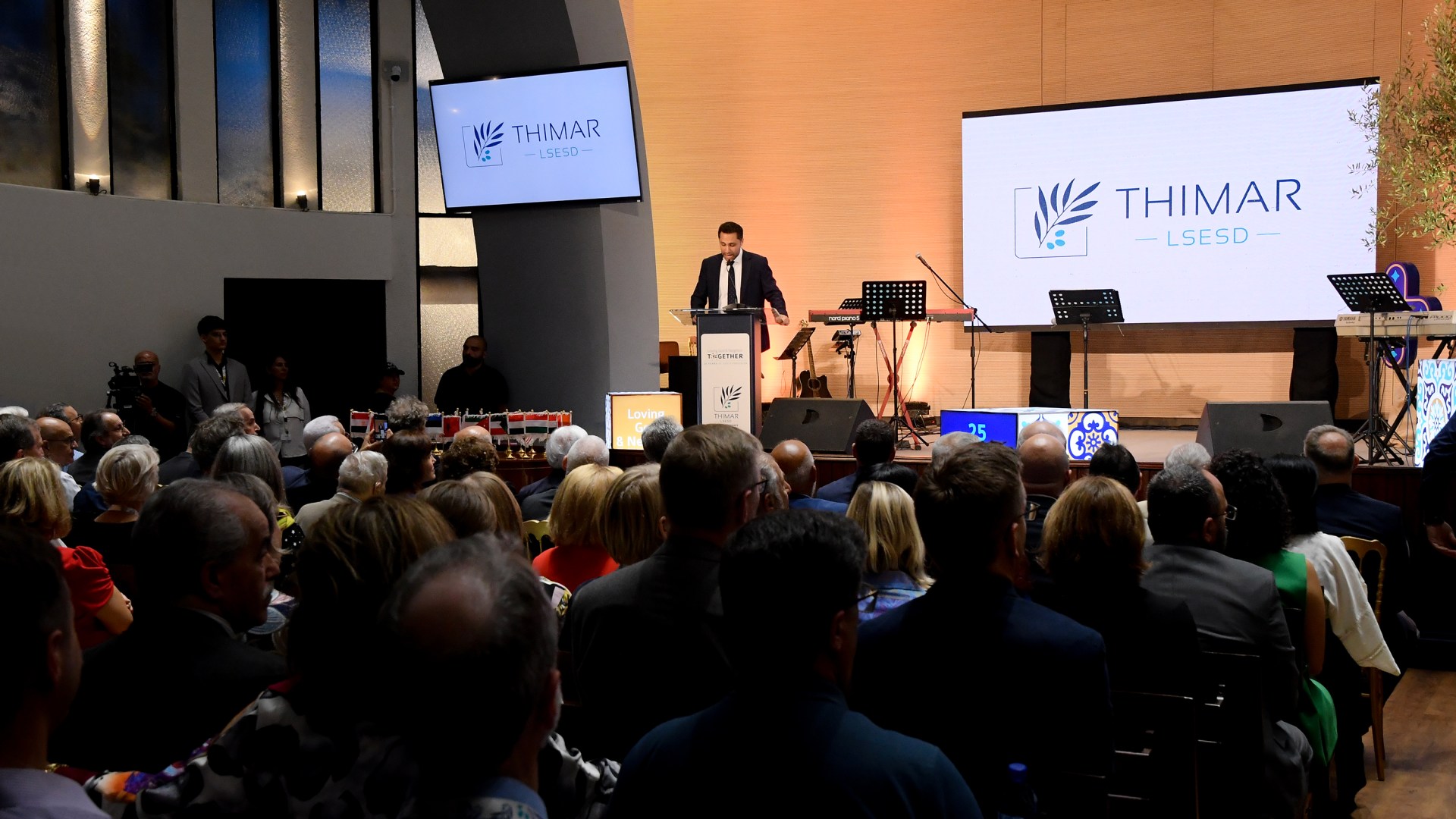
An event held for the 25th anniversary of the major Lebanese ministry, Thimar-LSESD.

An event held for the 25th anniversary of the major Lebanese ministry, Thimar-LSESD.

Christianity Today October 6, 2023
Courtesy of Thimar-LSESD / Edits by CT

Middle East evangelicals must emulate China.

So stated Nabil Costa, chief executive officer of the Lebanese Society for Education and Social Development (LSESD), at his organization’s 25th anniversary celebration, held last week at LSESD’s Beirut Baptist School (BBS).

He was not calling for a change in geopolitical orientation. On the contrary, in attendance were dozens of financial partners primarily from Western nations he would not wish to offend.

But Costa continued, praising India and Saudi Arabia.

“Our vision is to equip churches to bear the thimar of faith,” he said, using the Arabic word for biblical fruit, “in the midst of a changing Arab world.”

BBS was founded by Baptist missionaries in 1955, who yielded their various ministries to local believers in 1998. Honoring their heritage at the gathering entitled “Celebrating Together,” Costa also announced LSESD’s name change to Thimar–LSESD, reflecting the spiritual impact of ministries in education, relief, special needs, community development, and publishing.

But speaking on behalf of the oft-called “Baptist Society,” he invited a wider evangelical collaboration.

“Christians are meant to be catalysts and have a responsibility in building bridges, reconciling communities, and spreading the perfume of Christ,” Costa said of the many regional like-minded evangelical ministries. “We see Lebanon as a hub and a gateway to the Middle East.”

China’s Belt and Road Initiative is a model, he said, as is India with its planned regional “economic corridor” and Saudi Arabia with its developing megacity of NEOM. If these nations recognize the importance of networks and cooperative partnerships—with “different hidden agendas”—Costa said evangelicals can do no less. And Lebanon, despite all its problems, is still a haven of religious freedom.

Some attendees thought the Middle East was headed toward greater regional integration and peace. Others doubted, anticipating renewed emergence of Christian persecution. But many took seriously Costa’s call to turn the conference into a think tank, casting vision for the next 25 years of evangelical service.

“The world around us is changing. We cannot sit still and watch,” he said. “But we are blessed with a ‘spiritual belt’ that forges corridors between continents and countries. Our Lord Jesus Christ has brought us from all over the world, to be one people.”

And to produce “fruit.” CT spoke with seven Arab and two Western attendees, for their vision of Middle East ministry to come.

Rosangela Jarjour, general secretary for the Fellowship of Middle East Evangelical Churches:

Our Lord Jesus commissioned his church with two golden words: preach and teach. While many congregations have communicated the gospel to the world, a neglected aspect of evangelical ministry has been the spiritual formation of disciples. Establishing the kingdom of God demands more than simple conversion.

In fact, when Paul addresses Timothy in his second epistle (2:2), he envisions four generations of impact. And his strategy is clear: hear, witness, entrust, teach. This is the “good fight” necessary, he adds two chapters later (4:7–8), to achieve the crown of righteousness.

In this advice, I address all Protestants in our region—Presbyterian, Baptist, charismatic, and others—for all call themselves “evangelical.” In the next 25 years, in unity together, our ministries must rededicate themselves to the task of discipleship, so that believers old and new will pass on their faith to the next generation of the Middle East church.

Stephanie Haykal, volunteer at Kafr Habou Baptist Church in Lebanon:

While evangelical ministry in the Middle East has been growing and strengthening, sometimes it appears to take on the appearance of a business. And as one from the north of Lebanon, it seems that many of our efforts are concentrated in Beirut and other big cities, while our local needs are neglected.

This is scary to me.

The evidence is witnessed by the many Muslims who do not know what “evangelical” means. But also by the fact that many traditional churches get angry when they hear our name. We have not invested our resources widely enough to overcome this.

In the next 25 years, we must remember our first priority. It is not necessary for people to immediately understand, let alone accept, the gospel. But with hard work and reliance on the Holy Spirit, God will support us in sharing the message of salvation, reconciling man and God.

Farah Bou Kher, project manager for a relief and humanitarian organization in Lebanon:

Thimar–LSESD has modeled positive values by getting involved in the public square and focusing on holistic ministry. Moving forward, it can become even more exemplary by strengthening its demonstration of interfaith dialogue, ecumenical engagement, and the fostering of peace.

The Middle East is affected by all global trends: climate change, artificial intelligence, LGBT rights, abuse of children, science, faith, and atheism. While remaining faithful to Scripture, the church must respond with a spirit of inclusion, to become a safe place to experience God’s love—and not simply his judgment.

Our ministries must not exist in silos but cooperate widely. Leaders can share resources, share power, and meet regularly to strategize together. And while maintaining an openness to everyone, over the next 25 years church leaders should be trained both to preach the gospel and to serve society.

We have in our pews all the professions we need.

Elijah Brown, general secretary of the Baptist World Alliance:

Christians across the Middle East have a powerful request: You have trusted us to develop communities of discipleship. Will you now stand with us in prayer and advocacy?

Refusing to see themselves as victims in the midst of war, displacement, and natural disasters, Baptists and other evangelicals have been quick to serve, regardless of ethnic or religious background. And it is more than service—they are blessing their communities with the welcome, hope, and sacrificial love of Jesus Christ.

Over the next 25 years, let them increasingly become to us a living reminder to frame our identities in the mission of God. And as they do, let us answer their request to increase our prayer and advocacy on their behalf.

Middle East leaders have pioneered some of the most vibrant ministries in our global Baptist movement. Our future will be shaped by theirs.

Imad Shehadeh, president of Jordan Evangelical Theological Seminary:

Nations in the Middle East are moving toward tolerance. This is a development we encourage, even as we would like governments to become even more open and lenient. It remains very difficult—even dangerous—for someone from a non-Christian background to convert to Christianity, for example.

Therefore, as we pray for a spiritual breakthrough, we must also invest more to train our people how to reach their neighbors in creative ways.

For example, it is amazing the impact our public ministry has had. Evangelical hospitals serve all religious backgrounds. Evangelical schools have large numbers of non-Christian students. As they hear the gospel and interact with believers, the truth of the Scriptures stays with many throughout their life.

Imagine if we could create an evangelical university.

But to accomplish these, we need greater theological depth in our churches. We need to teach the biblical basis of unity, and build bridges between our evangelical denominations, celebrating the positives of each. And we need it also as we engage the world. To address homosexuality and transgenderism, we must show the beauty of being created in the image of God. It is not enough to simply say it is wrong, but to explain why.

Furthermore, with the wider Christian community, we must repair the polarization that exists between evangelicals and the historical churches. Some have such enmity toward us, and I don’t know how to address it, even as I understand some of their reasons. But it is a great obstacle to the advance of the gospel.

In the next 25 years, we can contribute to each of these trends.

Martin Accad, director of Action Research Associates:

For the past 25 years, the evangelical church—with Thimar very much in the lead—has addressed well the various needs in Lebanon. It has looked beyond its walls in relief work, special needs, theological education, and leadership development.

Now, evangelicals must become political.

By this, I mean aiming to influence policy at the highest levels through advocacy and lobbying. Rather than dictating morality, it can help create an open society where freedom is paramount. And if done well, it will help the church in the Arab world develop a robust public theology.

Specifically, evangelical leadership should gather to reflect collectively on the contributions of its respective institutions. Then it can identify legislative and national governance issues where the state has failed. And positively, the church should become a mouthpiece for justice, equality, and human rights, as it works to de-sectarianize the political system.

Some evangelicals have done this at the personal level. But in the next 25 years—and not just in Lebanon—the church must participate in building a civil society of equal citizenship for all in the Middle East.

Darin Wood, senior pastor of First Baptist Church in Midland, Texas:

I cannot speak with authenticity about the appropriate strategies for evangelism in the Middle East. But having spent time with pastors from Lebanon and Egypt, I believe these leaders can be trusted to do it. They speak eagerly, passionately, and fearlessly about how to reach their context for Christ.

My hope is simply to take this passion home with me, for my own church.

We discovered their ministry by coming from abroad. But over the next 25 years, the training of indigenous pastors will be inherently more effective than parachuting someone in from the outside. Our role must be to pray, encourage, and help fund them in their efforts.

There are many similarly-minded ministry partners. We can help them connect.

Jalil Alnamri, a Yemeni serving with NEO Leaders in the Arab world:

As God’s servants in the Middle East, we aspire to increased training of local leaders able to shepherd their own church. Too often, foreign mission relationships have made us dependent upon regular support, rather than strengthening the local congregation.

Such funding must include efforts to better our overall economic situation, alongside the relief component that currently characterizes much of our ministry. It is more than the old comparison of “give a man a fish” versus “teach a man to fish.” Neither one of these will truly help us serve our societies.

Over the next 25 years, teach us how to manufacture fishing rods.

Church Life

Should We Welcome Sex Offenders into Our Churches?

One pastor and his staff considered whether their congregation should accept people with a history of abuse.

Christianity Today October 5, 2023
Illustration by Christianity Today / Source Images: Unsplash

On Sunday mornings at New York Chinese Alliance Church, where I pastor, several different ethnic congregations come to listen to God’s Word in their mother tongues. Parents drop off their youngsters for children’s worship and Sunday school. Youth gather for fellowship and Bible study.

Our seasoned ushers always try to welcome every familiar face and newcomer into the house of God with a warm smile. And while their primary goal is to meet and greet each person, our church has also trained them to identify acute needs and flag any potential concerns among the congregation.

We have a congregant with a history of incarceration who often invites other formerly incarcerated men and women to church. And although we are happy for the opportunity to minister to such individuals, we try to be discerning in how to best serve them in the context of the larger community.

One Sunday morning this year, this congregant invited a new visitor who triggered a sense of concern. When the ushers decided to inquire about the newcomer, they discovered that he was a registered sex offender. And while they still welcomed him as a first-time guest, they also wanted to protect our other congregants—and so they decided to inform our pastors and governing board members.

Prayerfully, our church leadership identified a spiritually mature member to accompany the young man for the remainder of the service, and he was able to enjoy fellowship with other members throughout the afternoon.

As a medium-sized Christian and Missionary Alliance Church, we realized we were woefully unprepared—having no explicit policies written to address these kinds of situations. Our governing board had never had to consider how to enable someone seeking God to find him in our fellowship, while still ensuring the safety of young children and adolescents in our congregation.

Over 780,000 sex offenders reside in the United States—a country in which 81 percent of women have experienced sexual abuse, along with 43 percent of men. Sexually abused children know their perpetrators 93 percent of the time. And yet just over 30 percent of sex offenses are reported to authorities.

As a pastor and pediatrician, I feel a personal obligation to safeguard the youth in our church body. In my former practice, strict policies were implemented to protect sick and vulnerable children. At the same time, I sensed a need for our church to minister to this young man. Rather than denying him a place to worship, I felt we should offer him the same chance for redemption as anyone else.

Our governing board discussed details such as whether we should prohibit this man from interacting with children in our congregation. We wondered if we should inform the parents of our kids and youth, or whether that would create more fear than caution. We also wanted to be informed of whatever legal mandates were expected of us so that we could comply with the law of the land.

Our priority was to protect the congregation. But at the same time, we wrestled with how Jesus would respond to this situation—especially knowing how he interacted with tax collectors, prostitutes, and other broken people on the fringes of first-century society. Could we fulfill both goals? And if so, how?

First, it’s important to remember that federal laws require all sex offenders to register their status. Neglecting these laws can result in the prosecution of new crimes.

For instance, in our state of New York, sex offenders are categorized based on their risk of committing another crime and harming the community. Level 1, or low-risk offenders, must register for 20 years unless they have been given a specific designation. Level 2 (medium) or level 3 (high) risk offenders are required to register for life. Special designations include sexual predators, sexually violent offenders, and predicate (repeat) sex offenders.

That said, legislators have struggled for ages to develop appropriate policies for sex offenders. The pendulum swings from rehabilitation to punishment to isolation. Experts debate the merits of rehabilitation versus punishment alone. Each framework has pros and cons, with polarizing views on either side of the issue.

Rehabilitation models place a prudential value on the dignity and wellbeing of every individual, including their relationships, health, work, and other activities. Rehab programs are designed to restore a person’s capacity to function, regain their quality of life, and help them become a contributing member of society.

But punishment models are also rooted in ethical values—in the belief that there’s a firm line between right and wrong, good and bad, and that this distinction defines our behavior and should underpin the boundaries of all our relationships.

Likewise, local churches face the dilemma of where to place appropriate boundaries to ensure their community’s safety while also being willing to partner in the spiritual rehabilitation of broken individuals.

The Bible mandates protecting the vulnerable from harm while also showing mercy to sinners. In Luke 5:32, Jesus says, “I have not come to call the righteous but sinners to repentance.” At the same time, he warns us that “whosoever shall offend one of these little ones that believe in me, it is better for him that a millstone were hanged about his neck, and he were cast into the sea” (Mark 9:42, KJV).

So, unfortunately, there is no easy answer when it comes to how churches should respond to sex offenders who want to attend worship, participate in Bible study, or engage in other ministry gatherings.

That said, most experts agree sex offenders should not be allowed to attend a church if its leaders are not properly trained to ensure the safety of their children. This includes staff being educated on the habits of sex offenders—such as their potential to groom churches and take advantage of their trust—as well as being informed of all relevant state and federal laws.

Some states, like Tennessee, have proposed banning sex offenders from houses of worship unless they obtain permission. Others do not permit them to be onsite at daycare facilities or schools, which often include churches, depending on their structure and level of involvement in para-church activities. In many cases, it is not safe for the former sex offender to be allowed to have any contact with or proximity to children whatsoever—and it may even be illegal for them, depending on their timeline and level of risk.

According to a 2010 CT study, nearly 80 percent of pastors, church leaders, and staff surveyed at the time believed sex offenders should be allowed to worship in church, so long as they are subject to supervision and certain limitations. That said, most aren’t prepared to welcome them into their own churches.

In his 2009 book, pastor Dick Witherow defines sex offenders as “modern-day lepers.” When Florida laws restricted where sex offenders could live in the state, Witherow expanded his existing prison ministry to help sex offenders re-enter society and reintegrate into congregations. After a series of setbacks, he bought a property in Palm Beach County to build Miracle Village (also known as City of Refuge), now the largest community for rehabilitating sex offenders in the nation.

While Witherow’s efforts have been a transformative—if controversial—model, most churches do not have the resources or manpower to support sex offenders while ensuring the safety of the vulnerable. In these cases, larger churches with abundant staff may be better equipped to help, since they are more likely to have the resources to supervise sex offenders on the premises.

What did our church do in this situation? After a time of prayer, church leadership realized the need to develop a policy for future encounters. A committee was formed to understand the complexities of federal and state laws, evaluate our standing procedures, and provide recommendations to the governing board regarding our posture toward sex offenders.

Given specific state laws regarding reporting and parole, our policy first defines the term sex offender. It then outlines specific requirements for sex offenders to attend church ministries, including an initial approval process involving pastors, the governing board, and a written covenant. The policy provides accountability for the sex offender, facilitates communication with church leaders, and allows oversight by the governing board.

Some of the issues we considered revolved around the following questions:

  1. Is our church called to minister to sex offenders?
  2. What child safety protocols are in place, and what revisions are necessary?
  3. How do we obtain accurate and up-to-date information on a sex offender’s status while liaising with relevant (e.g., parole officer) parties?
  4. In what ways can we gauge a sex offender’s heart and sincerity?
  5. How can we provide accountability for all parties involved?
  6. What services can we offer, and which are better received outside the church (such as therapy/counseling, cognitive behavioral therapy, and addiction programs like AA/NA)?
  7. What is the role of a sex offender’s accountability partner, and how can they minister to the individual?
  8. What ministries are a sex offender welcome to participate in?
  9. What congregational expectations should we have of a sex offender’s code of conduct?
  10. What are potential consequences of policy violations, and how will they be enforced?
  11. Are we compliant with state mandates and federal laws?
  12. How and when should we communicate to our congregation when sex offenders are on the premises?
  13. How can we involve the congregation in the process in a way that reflects both the protective and welcoming heart of Christ?

Another key question we considered was whether the person was truly repentant of their sin or whether they have sought to downplay their misdeeds. A genuinely repentant heart is one of the most important criteria in evaluating whether a sex offender is ready to engage in a local church. David models this heart of repentance in Psalm 51 as he confesses his sins in a spirit of brokenness and contrition.

While we were in the process of working through these considerations and developing an official policy, our committee invited the young man to worship with us virtually in our online service, rather than joining us in person, for the time being. He was gracious in his response and honored our wishes. We also assigned a pastoral staff member to reach out and minister to this individual on a regular basis.

One of the most important goals of our policy was to develop an environment of accountability and potential for discipleship. Sexual recidivism rates are 30 percent at 10 years but as high as 52 percent within 25 years. Knowing that statistics are likely underreported, these rates of repeated criminal behavior demonstrate how difficult it is to overcome this particular thorn in the flesh.

By fostering a relationship of accountability with a trusted church member, a sex offender has more communal incentive to avoid sexual temptations and live a sanctified life. Accountability partners are present to listen and support, while speaking the truth with grace, mercy, and love. Ideally, this kind of discipleship relationship encourages a life of prayer, worship, and personal devotion.

We are still in the process of finalizing a sex offender policy that is comprehensive in scope and detailed in prescription—an internal document that can guide our church in similar situations down the road. Above all, we want this policy to ensure the safety of vulnerable congregants while welcoming broken individuals with sinful pasts, like this young man, into our community and the heart of worship.

As a medium-sized church, we are aware of our limitations and know that we may not be able to welcome every sex offender into our community. But at the same time, we do want to be the hands, feet, and voice of Jesus. Scripture tells us it is often through fellowship with the family of God that we can experience the love of Christ. And just like the broken people on the margins in Jesus’ day, sex offenders should not be kept from the chance to commune as members of the body of Christ.

Ultimately, as Christians, we believe Jesus offers each of us the same opportunity for redemption through his blood—and if anyone is in him, “he is a new creation. The old has passed away; behold, the new has come” (2 Cor. 5:17, ESV).

Stephen Ko is senior pastor at New York Chinese Alliance Church and adjunct professor at Alliance Theological Seminary. He is the author of the forthcoming Zondervan book Faith Embodied.

Books
Review

A Virtuous Pagan’s (Accidental) Guide to Building a Healthier Evangelicalism

Fredrik deBoer’s indictment of his fellow progressives is surprisingly relevant to a very different movement.

Christianity Today October 5, 2023
Clay Banks / Unsplash / Edits by CT

When and why I first started reading author and journalist Fredrik deBoer is beyond me. I wouldn’t have run into him in my usual ideological haunts: He’s an atheist; I’m a Christian. He’s—per his own description—a cradle Communist and a thoroughgoing leftist; I’m a political libertarian and temperamental conservative. We overlap on some policy and social critique, and I’ve found him thought-provoking on topics including preserving humanity in our digital age, the “tyranny of affirmation,” AI, and even Christian faith. But the gap between us remains wide.

How Elites Ate the Social Justice Movement

How Elites Ate the Social Justice Movement

Simon & Schuster

256 pages

It’s unsurprising, then, that deBoer’s second book, How Elites Ate the Social Justice Movement, was not written for a reader like me. Still, I found it useful on two levels. One is deBoer’s extension of his longstanding critique of his own political side, which offers insights that right-wing attacks tend to miss. The other is his assessment of what makes for a healthy and effective ideological movement. Though deBoer is interested in honing and advancing the cause of contemporary leftism, his analysis struck me over and over as applicable to a very different movement: American evangelicalism.

The spirit of 2020

The book starts with 2020, which deBoer calls “a remarkable year” marked by “the spirit of possibility” for radical political change, even if it produced fairly few lasting policy shifts. “The term ‘reckoning’ was invoked again and again, and yet we don’t seem to have reckoned with any of our problems in any meaningful way,” deBoer argues. “What happened? This book is an attempt to answer that question.”

To that end, deBoer takes readers through elite dominance of the Black Lives Matter movement; the short-lived, digitally constrained “meme politics” of #MeToo; and an often-scathing examination of contemporary liberals, particularly of the white, well-educated variety given to virtue-signaling online.

He’s concerned with tactical questions too: What do mass protests accomplish? Does rioting produce positive change? Are activists pursuing material progress for the poor and oppressed or merely policing fellow college grads’ language and manners? What are the downsides of domesticating activism via “the nonprofit industrial complex”? And what movement dynamics and messaging—especially around class and identity policies—will build the most powerful version of the progressive Left?

Though his political ideals are as lofty as they come, deBoer is stubbornly practical in this strategic realm. “We have to accept the frustrations and insufficient pace of doing things the old-fashioned way,” he urges. “That will mean, unfortunately, going slowly when justice demands speed, accepting less than what we want when what we want is reasonable and right, working with people we would prefer to avoid, and accepting that being right and doing good are very different things.”

From the concrete to the symbolic

It’s rare for me to prefer the blog version of an author to the book version—most writers do better work with more time and more editing. But here I’ll make an exception. Book deBoer gives glimpses of the angry, sparkling prose he produces at his best online, but the overall effect is that of a man just slightly uncomfortable in a little-worn suit.

Still, the book’s writing is cogent, and deBoer is willing to “call nonsense nonsense” in a way many of his peers on the Left are not. And though not without his ideological and contextual blind spots—for instance, his Brooklyn memories of COVID norms are not what a Texan’s would be, and it’s not evident how much he realizes this—deBoer is admirably clear-eyed about political and social realities, including the failings of his allies. The Left is right, in his view, but that does not mean it is doing good.

The core critique deBoer levels is that the modern Left is no longer a worker’s movement that materially improves the average American’s lot in life. Instead, it is disproportionately steered by college-educated elites who inexorably “drift from the material and the concrete to the immaterial and symbolic.” They are eager to denounce all the Deplorables and their Bad Ideas, eager to display “a benevolent, quietly condescending love for minority identities,” and much less eager to get on with the mundane work of tangible political change.

To put it in different terms he wouldn’t use, deBoer’s charge is that his movement is helmed by people who love to pray “on the street corners to be seen by others” (Matt. 6:5), people who “strain out a gnat but swallow a camel” (Matt. 23:24).

“We have gone from marches on Washington to demand jobs and demonstrations to support striking Black garbage workers to millions of decent white liberals clutching ‘anti-racist’ books on the subway, reading about why they’re wicked and should feel bad, ensuring that their next interaction with a Black coworker will be strained and awkward,” he seethes. “Meanwhile, in cold apartments lined with lead paint, hungry Black children hide from the violence that grips their neighborhoods.”

It makes sense, deBoer grants, that a movement under the sway of the laptop class would be so fixated on language choices, interpersonal relations, and mental hygiene to the neglect of pragmatic action. The elites who ate the social justice movement focus on words because many of them—journalists, professors, and so on—work with words.

And after growing up in a “culture where old Protestant values of self-denial and restraint have been replaced by identitarian values of overt support for ‘the Other,’ today’s progressives embrace a different kind of value-laden signaling. They’re still religious; they’re simply studying a different catechism.” Though deBoer is not the first to make this connection between woke activism and the Protestant tradition, the observation lands differently coming from a Marxist.

Higher purposes

What about those of us still studying the old catechism? As I mentioned, deBoer himself is an atheist—though I do think of him as something of a virtuous pagan, to echo the recognition of the early Christian apologist Justin Martyr that we may find deep, if partial, resonance with ideas from people outside our faith. (That is, incidentally, part of my interest in reviewing more secular books for CT. This review will hopefully be the first of many.)

So, of course, deBoer is not writing for Christians, let alone evangelicals. He is wholly materialist in his focus and has no spiritual ends in view. He describes having outgrown utopian fervor and apocalyptic expectations. And yet his ultimate political goals are so sweeping they take on a religious tone.

Ours is a “fallen world,” deBoer believes, but “a better world, a far better world, is possible,” a “world without poverty; without racism; without sexism; without rule by an autocratic elite; without domination by the wealthy; without environmental devastation; without vast socioeconomic inequality; without hunger or lack of shelter for the poor; without war.”

Without “death or mourning or crying or pain,” I want to add, “for the old order of things has passed away” (Rev. 21:4). Indeed, the concluding chapters’ talk of class solidarity sounds like how Christians talk about unity in the church—a higher purpose bringing us together across demographic divisions (Eph. 2:11–22)—and deBoer ends with what amounts to a call to ordinary faithfulness, albeit in a faithless form.

These similarities make deBoer’s scrutiny of his movement fascinating to transpose to ours. For example, he considers who participates in public discourse on the Left and finds the conversation dominated by “the most well-connected, educated, and rich in cultural capital … people who face the least material depravation.” This creates a gross mismatch between what prominent movement figures talk about and what’s actually needful for the people they ostensibly champion. Is the same mismatch present among evangelicals?

This gap is particularly acute where the white working class is concerned, deBoer contends, and “left-leaning disdain for uneducated white workers and voters results in leftist cultural and communicative practices that seem tailor-made to reject the support of that large bloc.” There’s a diploma divide in religion as much as politics—on church attendance and similar measures, polling shows more educated evangelicals are more religiously engaged. Is that partly because we’re speaking ill of siblings in the faith?

Questions of institutional leadership, structure, and accountability are also in deBoer’s sights. Idealistic activists may eschew a clear hierarchy out of concern over abuse of power. But “perversely,” deBoer warns, “the superficial denial of leadership can make power dynamics in a given group more unhealthy” by leaving the group without a clear path to remove de facto leaders acting against the group’s best interest.

Most churches have a formal leadership structure, but evangelicalism as a movement does not. There’s no evangelical pope. There’s no authority over Christians’ public commentary online, as CT contributor Tish Harrison Warren observed in 2017. What do we do when power in the movement amasses to people who don’t wield it well? How do you oust someone with no official role but enormous practical influence?

On church life, deBoer’s analysis is relevant too. He argues that the #MeToo movement was always limited in its potential “because #MeToo has always been, before and above everything else, a meme.” It generated a rush of online enthusiasm, but “there is no such thing as an online social movement. Political projects that extend no further than a web browser will always be subject to faddishness and burnout.” The internet is useful in many ways, but not every way, and you need real-life, offline commitment and community to sustain tangible change. This is a lesson that politicos are learning the hard way. Will we forget it at church?

Finally, deBoer is adamant that his movement must humble itself (Rom. 12:3), stop showing favoritism (James 2:1), and offer grace (Gal. 5:15). He doesn’t use those words or cite those verses, of course, but it’s the thrust of his critique of a movement culture that blithely claims a monopoly on moral clarity, favors academic language “incomprehensible to ordinary Americans,” and encourages self-censorship by threatening “the wrath of the crowd.” The source of the admonition may be unexpected, but it’s an admonition worth hearing.

Bonnie Kristian is the editorial director of ideas and books at Christianity Today.

News

Pandemic Restrictions Had No Lasting Effect on Churches, Study Finds

Even in states where regulations were severe, most congregations moved on quickly.

A California church marks out acceptable social distances during the pandemic in 2020.

A California church marks out acceptable social distances during the pandemic in 2020.

Christianity Today October 5, 2023
AP Photo/Marcio Jose Sanchez

Jeff Schoch was ready to be done with COVID-19 health safety regulations.

Like most ministers in the US, the pastor of Crossroads Bible Church in San Jose, California, did his best to comply with the many pandemic rules imposed by state and local governments. But as soon as they were lifted, he wanted to put them all behind him. He quickly tore down the state-mandated signs about social distancing, hand washing, and masks.

“I got rid of every visual reminder in the church,” Schoch told CT. “I was anxious, personally, to make that a memory.”

Across the country, Protestant congregations are dealing with the long-term impacts of the pandemic. A new, extensive study by Arbor Research Group and ChurchSalary, a ministry of Christianity Today, found that a lot of pastors are still in crisis. Some furloughed staff members haven’t gone back to work. And even when attendance numbers have rebounded, there are still people missing from many congregations. Christian leaders will likely be grappling with the fallout from COVID-19 for years to come.

But, surprisingly, state-level pandemic restrictions had no measurable, lasting impact on American churches. Even in places like San Jose—where the county government imposed some of the strictest rules in the country, the restrictions changed frequently, and authorities aggressively went after churches they said failed to comply—pastors like Schoch were able to just move on. The data doesn’t show any adverse effects from the government regulations.

Eric Shieh, a research consultant for Arbor Research, said that surprised him.

“You would think that the restrictions made things tougher for churches. They didn’t meet as much, and so you’d be able to see the impact that had a few years later,” he told CT. “There should be something there. But based on the data—and we have a lot of data—that’s not what happened. Actually, there’s no real correlation.”

Shieh looked at the regulations in 50 states and ranked their severity. In 9 states, government restrictions were mild to nonexistent, and ended very quickly. In 23, there was a moderate level of regulation around masks, meeting sizes, and social distancing. In another 18, there were a lot of rules and some harsh punishments.

California, for example, limited the number of people who could attend a service indoors or outdoors, banned all singing and chanting, mandated masks, and required signs telling churchgoers to “wash their hands with soap for at least 20 seconds, use hand sanitizer, and not touch their face.” There were also regulations about cleaning between services—including instructions about which chemicals to use—and washing or throwing away everything that had been touched.

“Places of worship must comply with all Cal/OSHA standards,” the state instructed in July 2020, “and be prepared to adhere to its guidance as well as guidance from the Centers for Disease Control and Prevention (CDC) and the California Department of Public Health (CDPH). Additionally, places of worship must be prepared to alter their operations as those guidelines change.”

Once Shieh ranked the severity of the state rules, he mapped the information that Arbor Research and ChurchSalary collected from their survey of 1,164 pastors from 42 denominations and qualitative interviews with 17 focus groups across the country. Measuring attendance, giving, staff levels, and several other metrics in 2022, he found that after all the regulations had been lifted (and some states, including California, had been reprimanded by the Supreme Court), there was little to no discernible difference between churches where there had been lots of restrictions and those where there had been almost none.

“The health of a church today isn’t dependent on what region it is in,” Shieh said. “It’s really internal factors—the divisions in the church and the church’s resilience.”

That doesn’t mean, however, that the health of individual churches wasn’t severely tested by pandemic rules. When the first lockdown orders were issued in California, Schoch remembered wondering if his nondenominational church would even survive. Most of the members were senior citizens and the church had been struggling for a while.

Oh great, Schoch said to himself, one more challenge. And then he prayed, This could be it, Lord.

Three miles away at Willow Glen Bible Church, the church staff and elders were scrambling to figure out what to do. There was no protocol for getting instructions on rules for meeting. People were hearing stuff on the news, checking different websites, and hearing things from other churches and church staff “like a crazy coconut telegraph of pastor’s texts.”

Family pastor David Mission recalls that the church decided very quickly to do what the county health department said, “for the good of everybody.” But then there was a problem figuring out how to interpret the rules. That was only made more complicated when the pandemic restrictions continued to evolve week to week.

“It’s a hermeneutics problem, but like you get a new book of the Bible every week and it’s different from what you had before,” Mission told CT. “We’re not trained to interpret this stuff. And we had young staff and older staff, elders with different levels of concern and different life experiences. We have some different temperaments, and we’re all trying to make sense of this message from the county health official together. It caused a lot of tension.”

But there was tension, too, in states where the government placed few burdens on religious gatherings and got rid of the restrictions quite quickly.

In Statesboro, Georgia, on the other side of the country, New Covenant Church only closed its office for a few hours. The pastor, David McLendon, sent everybody home, but then when he got home he thought, Who’s going to meet the FedEx guy to sign for all the equipment we just ordered to livestream the service? When he got back to the church, he found several staff members had had the same thought.

They livestreamed the service, but New Covenant had trouble keeping people from showing up, McLendon recalled.

“The band’s there, and the band’s spouses are showing up,” he said, “and then other people watching the livestream can see that there are people present, and some of them started showing up too.”

In May, the governor of Georgia ended the shelter-in-place order, and the charismatic congregation in Statesboro opened back up. McLendon checked with the local chief of police to make sure he’d understood the executive order correctly and then told his congregation, “If you want to come, come, or you can watch at home. … We’re going to keep the livestream, so if you need to stay home, stay home.”

Not everybody was happy with the decision. And some were fine with the decision, but thought there should have been more conversations before it was made. Several elders were mad, McLendon recalled, and one quit. Some previously active members never appeared again, and he wonders if they were offended by the decision to reopen before other churches in the area.

But the congregation has, nonetheless, grown since then. For the most part, they’ve put the brief era of pandemic restrictions behind them.

“Having the Germ-X bottles everywhere is still weird, but we have them,” McLendon said. “I think we clean the church better than we did before. The biggest difference for us is that we eventually developed a really high-quality online service. My worship guy has really worked to make it excellent.”

Back in California, the tensions have eased at Willow Glen Bible Church as well. The church staff actually talks about the creativity, collaboration, and adaptation that was required during the lockdowns with some fondness.

“Someone will say, ‘Maybe it would be nice to meet outside again. That was kind of fun when we did that,’” Mission said. “Then when we get to it, actually planning it, it’s like nope.”

Up the road, Crossroads Bible Church hasn’t died. It’s actually grown. Schoch has seen a number of young adults start coming and is scheduled to officiate a bunch of weddings. There’s new life and new energy, and the nondenominational pastor has mostly been able to put that period of government restrictions out of his mind.

He does hope, though, that going forward, he will remember some of what he learned during COVID-19.

“I became convicted about halfway through the whole crisis that, Oh, it’s not up to me. It’s up to God, if God wants this church to survive,” Schoch said. “We just kept putting one foot in front of another and God showed up.”

Ideas

Blessed Are the Rich, for They Can Afford to Limit Their Kids’ Screen Time

Staff Editor

Too much tech is bad for children. But are we only discipling families ‘entrusted with much’?

Christianity Today October 4, 2023
Illustration by Mallory Rentsch / Source Images: Unsplash / Getty

My husband and I are hardliners when it comes to kids and tech. Granted, our twin eldests are only four, so you might say we haven’t been at it long enough to claim victory here—and fair enough. Even if teenage demands for a smartphone are the tech battle royale of modern parenting, getting through the toddler years without screens is no small skirmish.

I wouldn’t say strictly curtailing screen time for our kids has been easy. I’ve felt the allure of digital entertainment for our children many, many times. When you’ve got two screaming infants on your hands, the prospect of multiple consecutive minutes without crying—bought by a few replays of “Baby Shark” on YouTube—can look awfully like the Promised Land, glittering there across the Jordan.

But avoiding screen time has been comparatively easy for me because our family is fortunate in many ways. My husband and I both work from home, have semi-flexible schedules, and can afford full-time childcare. I can hold out against resorting to a screen to afford me a moment of blessed peace because I have many such moments, like this one—where I’m able to write alone, in my office, in a quiet house.

That’s not the norm for parents of young children, especially for those with more practical constraints than I have: single parenthood, a long commute, a lower income, disability or persistent illness in the family, unreliable or inadequate or unaffordable childcare, less help from nearby family and friends, or less tangible support from local institutions like church and school.

And that reality makes me worry about how we’re communicating the emerging consensus that too much tech use is bad for kids—and particularly how we’re communicating it at church.

On the one hand, it’s a good thing that American society generally—and Christians specifically—are realizing just how negative the excessive smart phone, social media, and other screen use can be on our mental, emotional, and spiritual health.

I’m thankful for the work of people like social psychologist Jonathan Haidt, his colleague Jean Twenge, and Christian authors, including Alan Noble and Andy Crouch, who helped burst our naive optimism about networks like Facebook and our digital attention habits more broadly.

I’m glad it’s increasingly understood that our tech and media habits have formative effects, even competing with Scripture and trusted pastors as discipling influences in our lives. I’m thrilled that it’s ever more conventional wisdom to recommend, as I’ve done at length, putting limits on our tech use and that of our children and building good digital habits so intellectual virtues have room to grow.

But on the other hand, I’ve “been entrusted with much,” so it’s right that “much more will be asked” of me here (Luke 12:48). What about families with less—who can’t get through the toddler years without screens?

I grew up in just such a family. My mom was a single mother, and when I was little, she would sometimes plop me in front of the television so she could exercise. I loved it, of course, plowing through episodes of vintage Looney Toons or enjoying the gentle patter of Mr. Rogers. I don’t do the same thing with my kids when I go running, but that’s because I don’t have to: My husband can hold down the fort. My mom never had that option, because my dad wasn’t there.

Or here’s a more contemporary example from a friend of mine, Austin, who’s a youth ministry worker in Texas.

For several years, Austin told me, his church was recommending Crouch’s rightfully popular book, The Tech-Wise Family: Everyday Steps for Putting Technology in Its Proper Place, to families of teenagers who participated in the youth group.

But for a subset of those families, whom he described as “mostly working-class,” “with a handful of single parents in the mix,” Crouch’s suggestions simply were not viable the way they were for the congregation’s “fairly educated, mostly white-collar families in stable living situations.”

“Many of the solutions in Tech-Wise Family assume a stable nuclear family with some degree of education, disposable income, and access to free or low-cost public attractions,” Austin said in our conversation over email. But outside “some public parks, there’s little to do” in his town “that’s cheap or free,” and “many of the families we were working with had some degree of instability with little disposable income and/or lower education levels.”

Ultimately, the “handful of families who took our recommendation to read the book quickly put it down,” Austin said, “because they realized it wasn’t written for them and their lives.” They couldn’t take much of Crouch’s advice even if they tried.

The first time Austin told me this story, I was mortified to realize how oblivious I’d been to this class element when reading and recommending Tech-Wise Family myself. (Worse, I was oblivious even after reading and agreeing with multiple articles noting that limited screen time has become a “social signifier” for middle- and upper-class parents like me.)

For instance, Crouch has a chapter about arranging your home in a way that’s conducive to good habits, which is wonderful advice—if you have the space. “Move the TV to a less central location” than the living room, he suggests. It’s a great idea, and I’ve done it. It’s possible for me because we live in Pittsburgh, where post-industrial population slump means rambling old houses are quite affordable, so we put the TV in a spare bedroom.

But how many people have a spare bedroom? How many have any “less central location” that could house a TV?

Austin wasn’t so oblivious, though, because of his previous career as a pest control technician, largely in low-income neighborhoods. Around the time he quit that job, he said, he was reading a book about the attention economy, which included a brief aside on how the author, in Austin’s paraphrase, “didn’t want her solutions to take away an iPad from a single mother living in a dingy apartment, when that iPad may be the only valuable thing she has for work, school, and play.”

“As someone who had regularly intruded into the apartments of single mothers and other families whose most valuable possession was their TV, gaming console, smartphone, iPad, or PC,” Austin said, “that comment hit me like a ton of bricks.”

It’s not that the deleterious effects of screen time don’t matter in those circumstances—or that the youth group families who abandoned the Tech-Wise approach don’t need discipleship around tech use, Austin reflected. It’s that the discipleship must account for their circumstances, some of which may be unalterable.

Since we talked, I’ve tried to keep Austin’s youth group families in mind when writing about digital habits and virtues, though I’m not sure how well I’ve done. As Austin observed, “those insights land differently if the advice is asymmetrical”—that is, if it’s coming from someone with the privileged means to fight these battles and going to someone without those same resources. And some asymmetry (or, at least, some lack of accommodation) might be unavoidable when the advice is coming from a journalist like me, writing to people whose faces I cannot see and whose lives I cannot know.

But the same is not true of the local church. Pastors and ministry workers, like Austin, can give advice informed by the specific needs and constraints of the people they know and love. They can disciple not “teens with smartphones” in general, but this teenager with these habits and that home life. They can take care to heed Jesus’s warning, in Matthew 18:6, not to cause “one of these little ones” to stumble.

Bonnie Kristian is the editorial director of ideas and books at Christianity Today.

addApple PodcastsDown ArrowDown ArrowDown Arrowarrow_left_altLeft ArrowLeft ArrowRight ArrowRight ArrowRight Arrowarrow_up_altUp ArrowUp ArrowAvailable at Amazoncaret-downCloseCloseellipseEmailEmailExpandExpandExternalExternalFacebookfacebook-squarefolderGiftGiftGooglegoogleGoogle KeephamburgerInstagraminstagram-squareLinkLinklinkedin-squareListenListenListenChristianity TodayCT Creative Studio Logologo_orgMegaphoneMenuMenupausePinterestPlayPlayPocketPodcastprintremoveRSSRSSSaveSavesaveSearchSearchsearchSpotifyStitcherTelegramTable of ContentsTable of Contentstwitter-squareWhatsAppXYouTubeYouTube