Theology

Politicians, You Keep Saying ‘City on A Hill’

But it doesn’t mean what you think it means.

Republican presidential candidates participate in the first debate of the GOP primary season.

Republican presidential candidates participate in the first debate of the GOP primary season.

Christianity Today August 25, 2023
Win McNamee / Getty

At the first Republican presidential primary debate of the 2024 election, the last biblical reference of the night was also its most significant—and the most often misunderstood.

“In his pitch to get to the Oval Office, President Reagan called America the ‘shining city on a hill,’ a beacon of hope and optimism,” prompted moderator Bret Baier.

“So, in your closing statement tonight, please tell American voters why you are the person who can inspire this nation to a better day,” said Baier’s fellow Fox News host, Martha MacCallum.

Former vice president Mike Pence’s response stuck closest to the theme, evoking the same 1630 speech Reagan quoted, with a reference to Americans’ Puritan forebears. “God is not done with America yet,” Pence said, “and if we will renew our faith in him who has ever guided this nation since we arrived on these wilderness shores, I know the best days for the greatest nation on earth are yet to come.”

City on a hill—this captivating little phrase has a complicated American history, one that often ignores the phrase’s true origin: not among the Puritans, but in Christ’s Sermon on the Mount.

The phrase was used by the governor of the Massachusetts Bay colony, John Winthrop, in his 1630 treatise “A Model of Christian Charity”: “For we must consider that we shall be as a city upon a hill. The eyes of all people are upon us.” Historians are not certain when (or if) Winthrop delivered the speech, but the popular story is that he gave it on the flagship Arbella to his fellow Puritan travelers on their way to Salem, Massachusetts.

Winthrop’s words have been called the “most famous lay sermon in American history” and the “book of Genesis in America’s political Bible,” but his treatise went virtually unnoticed for centuries. There are only a few scattered references to Winthrop’s speech before the middle of the twentieth century. That is, until John F. Kennedy drew on increasing interest in the religious roots of America’s founding—comparing the “hazardous” voyage America was embarking upon in 1961 to the voyage Winthrop took in 1630.

But it was Ronald Reagan who would transform city on a hill into “one of the most familiar lines in the liturgy of the American civil religion.” Reagan used the phrase to lend moral weight and divine sanction to his political project, and few politicians since have been able to resist doing the same. For instance, in the 2016 election, Hilary Clinton encouraged an audience by saying that “we’re still Reagan’s shining city on a hill.”

That said, Americans might be forgiven for forgetting that these were not originally Reagan’s words, but Jesus’.

When Jesus called his followers to be like “a city that is set on a hill” (KJV) in the Sermon on the Mount of Matthew 5, he was (unsurprisingly) not talking about America. But neither was he exhorting his original audience toward pride in their own goodness or optimism about the future (he had just finished telling them how blessed the poor and meek and persecuted are).

Fourth-century theologian John Chrysostom said of this passage, “Jesus says in effect: You are not accountable only for your life but also for that of the entire world.” Rather than rallying his disciples around a vision of their own shining righteousness, Jesus was connecting his ministry to the larger story of the people of God and orienting it toward the redemption of all creation.

Our misuse of city on a hill is representative of a common failure to interpret the Bible for our political lives—when a verse exhorting the people of God to faithfully serve the world gets twisted into a defense of American dominance. Even our genuine efforts to let Scripture inform our political lives can easily become props for whatever political positions we already hold.

Biblical references like those invoked on Wednesday night will certainly not be the last as the election season draws near. The first GOP debate demonstrates what happens when biblical references are shorn of their context and leveraged to lend moral weight to our political projects.

This should remind Christians to interrogate the biblical language and images used in our public square. Scripture is not free-floating language available for any political project or timeless truth that can be wrenched from its context. When we treat it as such, we lose sight of its intended purpose.

Jesus, unlike Reagan, never called America a “shining city on a hill.” Jesus called his followers to live faithful lives that would glorify God. When we mix this up, we import our own ideas of what constitutes a “shining city”—military might, economic prosperity, political power, or secular humanism—back into Jesus’ words. And perhaps more importantly, some end up laying claim to promises not intended for them.

Winthrop not only appropriated Jesus’ words to his followers, but also a promise God made to the people of Israel in Deuteronomy 30:16: “the Lord your God will bless you in the land you are entering to possess.” When we are not careful with how we handle biblical references, we can end up assuming a divine sanction to “possess” what was never ours in the first place.

As we enter another presidential campaign, Christians seeking to engage in the political conversation should approach the biblical references used by politicians and pundits with discernment. There is great power in Scripture—and great peril in misusing it for our own ends.

That is not to say we should take the Bible out of our public lives. Rather, we should repeatedly return to the original context of the text itself, testing our speech against the whole counsel of Scripture.

Kaitlyn Schiess is the author of The Liturgy of Politics: Spiritual Formation for the Sake of Our Neighbor and the newly released The Ballot and the Bible.


Theology

Is HGTV Harming Our Hospitality?

A trendy, perfectly furnished home is not required to be useful for the kingdom.

Christianity Today August 25, 2023
Illustration by Mallory Rentsch / Source Images: WikiMedia Commons / Unsplash

Our first home was my in-laws’ tiny cottage, where we stayed for free. There were unfinished walls, the floors were painted chipboard, and all our furniture was dated and used. When our first guests came by, I remember looking around, my stomach twisting with anxiety. What must they be thinking of us? I wondered if I could ever host company again—at least, not until we moved.

But our next home, a small fixer-upper with shag carpets, was not much better. Meanwhile, it seemed every other house I walked into—whether my peers’, friends’, or family members’—was HGTV worthy. Mine could never compare. Once we moved into a “real home,” I believed, I would be much more hospitable.

Similarly, Trillia Newbell wrote about experiencing this same fear when she moved into an apartment. “Our new home felt like it was too small to truly be welcoming,” she said. HGTV even has an article listing 35 ways to hide the ugly parts of our homes so guests don’t see them.

Apparently, this feeling is more universal than I realized. A recent article from Insider says shows on HGTV might be contributing to this very sense of insecurity—creating a world where people are fearful of being assessed by the aesthetic state of their home:

Homeowners are “seeing everything that’s wrong with their home and imagining when people come into their home [that] they’re also criticizing and scrutinizing and judging” their living spaces, said Annetta Grant, an assistant professor of markets, innovation, and design at Bucknell University.

The article set out to show how homeowners’ philosophies have changed over time.

“Traditionally, people thought of homes as a place of singularization that should be styled to the homeowner’s unique identity,” Kenneth Niemeyer wrote, referring to a study by Annetta Grant and Jay M. Handelman, also a marketing professor. “But homeowners are starting to shift their thinking to consider their home as a marketplace asset rather than a space that is unique to them.”

According to Insider and The Washington Post, homeowners might make design decisions based on what’s trendy—even if they don’t like the choices themselves—out of fear of what others may think of them or what they think future homebuyers may want to see.

But both philosophies rely on the same principle: that our homes belong to us. And as Christians, we are meant to be bound by an entirely different outlook on home and hearth. For us, our places of residence should hold a far greater purpose than simply as proprietary possessions that reflect our identity or marketability.

When we worship together as a family at night, I ask my children what they are thankful for. My oldest sometimes groans and says he doesn’t know, but my husband and I always remind him that everything we have first comes from God. This includes our homes.

Alan Noble’s book You Are Not Your Own demonstrates why expressive individualism makes us not whole and fulfilled but exhausted and disquieted. Noble presses on the tension homeowners feel between the desire to creatively express themselves and the anxious hope that others will admire and affirm their styles. He writes, “We are our own and belong to ourselves, but identity always requires the acknowledgement of other people.”

But just like our lives, our homes are not our own; they belong to God. So, it is up to him to decide how we use our hospitality for his glory, and we should look to his Word for affirmation—not the latest trends on the market.

And yet the fears our culture impresses on us—through home improvement shows and social media influencers—can often distort the true heart of hospitality.

The purpose of hospitality isn’t to showcase our homes or prove our worth. It’s not about our pride, identity, or marketability or what others think about us. It’s about opening our lives and homes wide to demonstrate the love of Christ. It’s about dying to ourselves so others may be served through us—just as Jesus threw open the doors of heaven for his brothers and sisters and ministered to the poor, the ailing, the sick, and the outcast.

In every hospitable home I enter, I catch a glimpse of the unique way God created the family who lives there. I see the fine workmanship of hardwood floors my father-in-law built himself; I see the emerging carpenter in the pastor who built his own table to seat more guests. The way these families embody hospitality and live it out is beautiful—and such beauty has nothing to do with marketable homes or trendy decor.

Truly hospitable homes and families convey transcendental truth and goodness. They speak with candor and compassion to those who walk over their thresholds. They offer food, cheer, and encouragement. This is the real beauty in hospitality—the kind Christ and his apostles call us to imitate. In describing what separates his sheep from the goats, Jesus says the hospitality shown toward “the least of these” holds the same value as if it were extended to himself (Matt. 25:31–40).

As Søren Kierkegaard wrote in Practice in Christianity, “Oh, where heart-room is, there house-room always is to be found. But where was there ever heart-room if not in His heart?”

What kind of hospitality will we show our neighbors? One with great heart-room for them to draw near for warmth and friendship—or one where we hustle and fret so much that we miss the needs quietly laid before us? We must guard ourselves against the temptation to be like Martha, whose household tending took precedence over sitting at the feet of Jesus (Luke 10:38–42).

HGTV may inspire us to create outwardly beautiful spaces, but a welcoming atmosphere cannot be cultivated by aesthetics alone. It must begin with a posture of the heart—which sees our homes as belonging not to us but to God and meant to be used in service of his kingdom.

Ultimately, hospitality is not about fashioning our homes with trendy decor that leaves an impression on our guests but about cultivating an intimate space for the gospel to be on display.

Lara d’Entremont is an editor for Calla Press Publishing, an editor-at-large for Beautiful Christian Life, a staff writer for Gospel-Centered Discipleship, and a regular contributor to Well-Watered Women.

Theology

A Christian Vocabulary for an Exhausted Age

Reclaiming the culture wars requires reclaiming wonder.

Christianity Today August 25, 2023
Illustration by Christianity Today / Source Images: Getty

This piece was adapted from Russell Moore’s newsletter. Subscribe here.

Last week I was talking with a new believer in Christ—one who came from a thoroughly secular background—and she mentioned that some family members were really worried about her. “I can’t believe you’ve become an evangelical Christian,” one of them said. “How can you be for guns?”

Guns?

The family member assumed that her becoming an evangelical Christian meant she had joined a political tribe, complete with gun-culture views of assault weapons. But this new Christian happened to have the same political view on this issue as her family. Of all the things that changed in her conversion, her view on guns wasn’t one of them.

My shoulders slumped when I heard this—and it wasn’t because I agreed or didn’t agree with this family’s views on gun policy. My disappointment was because I had heard some version of this many times before—people who, when hearing about evangelical Christianity, think not of the gospel but of some extreme political identity.

It would be easy to blame that on the media portrayal of evangelical Christians in America (“All they pay attention to is the politics!”) or on this woman’s family members (“How religiously illiterate has America become that all these people see are caricatures?”).

There are ways that the outside world does unthinkingly caricature evangelical Christianity. That’s hardly a new development with secularization—note the many jokes about George Whitefield’s preaching in early American newspapers or the writings of H. L. Mencken, who didn’t mean “Bible Belt” as a compliment.

And yet, who can deny that the primary reason for this view of evangelical Christianity is due not to misunderstanding but to understanding all too well? Who can deny that the outside world defines American Christianity not by Christ and him crucified but by political tribal affiliation because of what we have shown them about ourselves?

Not long ago, I found myself re-reading Walker Percy’s essay, “Notes for a Novel About the End of the World,” on what he believed to be the double crisis facing the American church of his time. I was struck by how resonant his warnings are still.

Let’s start with the second crisis first, because it’s the one with which we’re most aware, what Percy called “the moral failure of Christendom.” Percy argued that despite all the warnings about liberalizing theology, that was not where the primary problem lay.

Percy, of course, rejected all of that too—from Paul Tillich’s “Ground of Being” to “the death of God” on the cover of TIME magazine. But, he noted, most Americans are indifferent to theology and metaphysics. He also wasn’t referencing hypocrisy in personal behavior.

“But in the one place, the place which hurt the most and where charity was most needed, they have not done right,” he wrote. “White Americans have sinned against the Negro from the beginning and continue to do so, initially with cruelty and presently with an indifference which may be even more destructive. And it is the churches which, far from fighting the good fight against man’s native inhumanity to man, have sanctified and perpetuated the indifference.”

Anyone willing can see how this crisis faces the church at the moment. That’s no doubt why the new Christian’s mother doesn’t think first of the existence of God or the historicity of the Resurrection or the idea of heaven and hell when she hears “evangelical Christian,” but instead a monolithic, tribal, political faction. Even when we have what we call theological debates, they are, when you scratch beneath the surface, often really political wars.

Perhaps even more urgent, though, is the other crisis Percy warned about—that of a worn-out vocabulary.

“The old words of grace are worn smooth as poker chips and a certain devaluation has occurred, like a poker chip after it is cashed in,” he wrote. “Even if one talks only of Christendom, leaving the heathens out of it, of Christendom where everybody is a believer, it almost seems that when everybody believes in God, it is as if everybody started the game with one poker chip, which is the same as starting with none.”

We ground our identity in culture wars because it’s much easier than bearing witness. It’s easier to find which of our neighbors are the “bad people” and to fear them than it is to actually speak to their consciences about atonement, grace, reconciliation, and newness of life.

Is it any wonder, then, that the world expects to hear from us not the words of the Bible and the announcement of the kingdom of God, but simply a more extreme version of the political warfare that’s already invaded almost every aspect of our lives?

The way we recover that lost vocabulary is not by finding new words, but by falling in love again with the old ones.

The English literature scholar Michael Edwards, in writing of his own conversion, notes that what convinced him of the truth of the Bible was not proofs or arguments but the strangeness of the text itself—a strangeness that spoke to his intuitions that there might be another way of knowing than merely that of reason and sense perception. “What I needed in order to make a step forward was what I was looking for from the beginning, a different way of knowing, which I was powerless to bring about myself.”

Not long ago, I watched the film A Glitch in the Matrix, about people who believe the world around us is illusory—that perhaps we are in a hologram or even a video game being played by our descendants with avatars of their family tree.

As you might expect, I did not find the arguments persuasive, especially since they are science-fiction versions of the old Gnosticism that the Apostle John warned us about. But the way I could actually understand their viewpoint was to “get inside” of it, to imagine what it would be like to see the world this way, to ask if it made sense of the questions we ask, if it could show us whether the questions are wrong.

I believe the gospel story does indeed speak—which is why a first-century Jewish sect of outcasts turned the world upside down. In telling that story, we invite people to consider a world in which Jesus announces, “The kingdom of God is among you” and “My kingdom is not of this world,” a story in which God rescued Israel from Egypt and raised Jesus of Nazareth from the dead. We can only do that if we ourselves come to the story—to our vocabulary—the way it intends us to do so: with astonishment and awe.

At our event in Houston a couple weeks ago, Beth Moore played “hymnal trivia” with me, reading the first lines from our shared childhood hymnbook, the Baptist Hymnal. I was struck once again by how many of those hymns are about astonishment. “Amazing Grace,” “I Stand Amazed in the Presence,” “And Can It Be.” The same is true, in different ways, in virtually every strand of Christian worship.

When we are bored with that, we turn to ways of knowing that are out of step with the gospel. We reduce everything down to machines or information or—even worse—we reduce our neighbors down to their positions on whatever political controversies our leaders say should differentiate “us” from “them.”

Indeed, I realized while talking with this new fellow Christian how worn my own heart had become to the vocabulary of grace. I was struck by the reaction she received—that summed up American Christianity as a political view on guns—to the point that it took me a moment to be struck by what was really momentous: The woman sitting in front of me had encountered the Person in whom the entire cosmos holds together. Her sins—and mine—are forgiven, and we stand before a reality we cannot see, united to a crucified and resurrected Christ. Jesus loves us.

It was as if I were standing in front of the Grand Canyon, complaining about the lack of adequate cell service to download a YouTube video.

Maybe if more of us were struck by just how strange and astounding these truths are, we would find the world around us startled by them too. This wouldn’t make people like us anymore—that’s not the point. The point is that people should hate us for the right reason.

When we reclaim a vocabulary of wonder, perhaps more of our neighbors will gasp when people become Christians in order to say, “Can any good thing come out of Nazareth?” (John 1:46).

And we will respond with what he taught us to say from the beginning: “Come and see.”

Russell Moore is the editor in chief at Christianity Today and leads its Public Theology Project.

News

The French Are Religious About Summer Vacation. Are They Religious During It?

Some Christian ministries take a break. Others try to reach an increasingly secular population on holiday.

French flags fly over a beach in Nice, France.

French flags fly over a beach in Nice, France.

Christianity Today August 24, 2023
Blondet Eliot / AP Images

The Église Évangelique de Houlgate is situated in the charming and quiet town of Houlgate, two hours from Paris on the Normandy coast. With its red brick exterior from the 1950s, the Protestant church sits in an ideal location—visible at the entrance to the town and overlooking the beach—for a perfect escape from the fast-paced life of Paris.

Houlgate has 1,711 year-round inhabitants, but the summer season can bring nearly 15 times the amount of people to the small city. This complicates shopping, traffic, and lines in the boulangerie, but it also boosts church attendance. Tourists flock to the coast and some pay a Sunday morning visit to the city’s only Protestant church.

Why the sudden rush of vacationers? The simple answer is that summers in France are taken very seriously. Not only is it acceptable to travel in France during July and August, but it is encouraged by the culture. Protestant churches all over France, like the one in Houlgate, have to adapt to this cultural tradition by changing up their usual rhythm in order to keep people coming through their doors.

With 25 paid vacation days available to most employees, businesses are closed for weeks or months in the summer season, and administrative workers send automated emails declaring their absence until la rentrée in September. Not surprisingly, church attendance fluctuates wildly: Some churches go so far as to shut their doors during the summer while others have an entirely different congregation during the season.

“We see [a 50 percent] growth during the summer season, thanks to tourists,” said Cyril Poly, a longtime member at Église Évangelique de Houlgate.

But not all seaside areas attract tourists. Romaric Lacroix, one of four pastors at the Centre Evangélique Protestant (CEP) in Marseille, says that attendance is between 150 to 200 people during most of the year. But that number drops to about 70 people during the summer months.

“So we adapt,” said Lacroix. “[Because of people leaving for vacation,] we have less personnel. We suspend all weekly church activities and we also adapt the church services on Sundays because it’s very hot out!” Shorter services or sermons are one way to beat the heat in older church buildings, often built without air conditioning.

This period of decreased church activity allows pastors to relax before the new season begins while also re-evaluating current church programs and activities, he says.

In France’s capital, however, not much changes. While many Parisians escape city life during the summer, churches remain steady.

“Naturally, there are fewer people in summer, as most are away on vacation,” said Tina Raveloson, a Canadian expat living in Paris, who attends C3NYC Paris. “[But] the program remains the same, with a few additional picnics [among small groups] … Pastors can take vacations whenever they wish. We have a pastoral team, so if the senior pastor is on leave, there’s always someone to bring the message on Sundays.”

French pastors and churches are constantly looking for ways to offer something when needed. And Protestant pastors continue to keep their churches open during the summer, despite low church attendance in certain regions.

Protestant Christians only make up three percent of the French population, which makes evangelizing during the summer an essential part of French ministry. “It is fundamental that we do not close our doors [during the summer],” said Lacroix.

Staying open with regular Sunday services allows the church to reach out to new churchgoers. “You see people coming in [for the first time], so it’s a good time to contact people,” he said.

French journalist David Metreau, former editor in chief of the publication Christianisme Aujourd’hui, echoed this sentiment after experiencing church life outside of Paris and in Drôme, a region in southeastern France. “[Even if] people don’t necessarily leave for vacation, everything is slowed down during the summer season, which is maybe a default,” said Metreau. “Maybe people also need spiritual support during the summer.”

Unlike certain communities like Taizé, an ecumenical monastic community in eastern France, there are many French Protestant organizations that exist only for the summer season. While many écoles bibliques de vacances—vacation Bible schools exist in France, it is much less popular than Christian camping centers known as colonies de vacances chrétiennes. These summer camps welcome families who are on vacation from any part of the country for a week or two of fellowship with other believers.

Originally created at the end of the 19th century in order to get working-class children out of poverty and pollution, summer camps became an integral part of French culture. During the 1950s and 60s, France saw a peak in summer camps with over four million children spending their summer at a colo.

Summer camp popularity has been on the decline in France since the 1990s—barely one million attendees participated in 2017. To cope with the seeming loss of interest, camps are now rebranding, such as through offering shorter stays and special activities to attract younger generations.

Among millennials and Gen Z, newer Christian gatherings are also taking place. This May, more than 6,000 teens gathered a couple hours outside of Lyon for ECHO, an Assemblies of God event.

Festivals are also becoming increasingly popular amongst younger generations. Christ en Scène, a new Christian music festival in the Seine-et-Marne region, is taking advantage of the French summer season to start a music festival with artists like Hillsong Youth France. Starting on August 26, the festival consists of two days filled with concerts, times of prayer, testimonies, workshops, games, and music.

In a country with very little religious expression, these festivals and gatherings allow for young people and families to build new connections and fellowship with other believers.

As France slows down for summer, American tourists flock to Paris to enjoy the sights and sounds of the city. Churches that remain major tourist attractions remain open for visits during the summer season. (One of the world’s most famous churches, the Notre Dame, is scheduled to reopen its doors next year following a devastating fire in 2019.)

But for American associations that work with French churches, summer months can be very challenging, says David Broussard, founder of Impact France, a ministry that connects US philanthropy and missionary projects in France. Consequently, the ministry reorganizes their schedule according to the French vacation schedule, meaning summer projects taper off in June and return in September

“Communication with our partners [in France] is non-existent during August,” said Broussard.

And everybody just adapts.

In Federal Court, a Baptist Judge Weighs the Future of US Immigration

The Texas suit reflects a broader evangelical debate over how many strangers are too many to welcome.

Christianity Today August 24, 2023
Getty Images/Mario Tama

Update (March 11, 2024): On Friday, March 8, a federal judge upheld the Biden administration’s humanitarian parole program for residents of Cuba, Haiti, Nicaragua, and Venezuela. In his decision, Judge Drew B. Tipton said that Texas and other states suing to shut down the program, which allows up to 360,000 people a year to enter the United States with help from financial sponsors, were “unable to demonstrate that they have been injured by the program.” Tipton, who was appointed by President Donald Trump, also noted that immigration from the four countries has significantly decreased since the program’s January 2023 implementation. He said that the states are now spending less on undocumented immigrants than they were before. The decision could be appealed.

Long before he was seated as a federal judge in the southern district of Texas, Drew Tipton starred in a high school musical.

In 1977, when he was just ten, Tipton landed the title role in Angleton High School’s fall play. The show was Oliver!, an adaptation of Charles Dickens’s Oliver Twist. Pulling it off required a community-wide effort in the 10,000-person town of Angleton, Texas. The cast drew not only from the high school, but also from the local middle school and three elementary schools.

During rehearsals, when the young Tipton danced and sang among youth nearly twice his size, he put “forth an unusual effort and shows great confidence,” according to a local newspaper, The Brazosport Facts. To that, Tipton simply added: “It makes me feel excited to be doing the lead role.”

Like his father, the pastor of Angleton’s Second Baptist Church, Tipton enjoyed speaking before a crowd. He would later say, as an adult, that it was part of what led him to the law.

“My parents were consistently convinced that great things lay in store for me,” Tipton told members of the Senate Judiciary Committee during his confirmation hearing in February 2020, by then an attorney at a Houston law firm specializing in employment law and trade secrets litigation.

If this were a Dickens novel, then Tipton’s breakout performance as a child—portraying a destitute boy rescued by a distant wealthy relative—would be almost too good a foreshadowing of the drama before him now. In his fourth year as a district judge, Tipton is considering a case that will decide whether thousands of people can escape desperate circumstances with the help of benevolent friends and family.

Perhaps the most consequential immigration trial of the year happened last week in Tipton’s courtroom in Victoria, Texas—the arguments from which are now sitting with Tipton for review. The case is also, as it happens, the context for a very public confrontation between Texas evangelicals over the future of immigration in the United States.

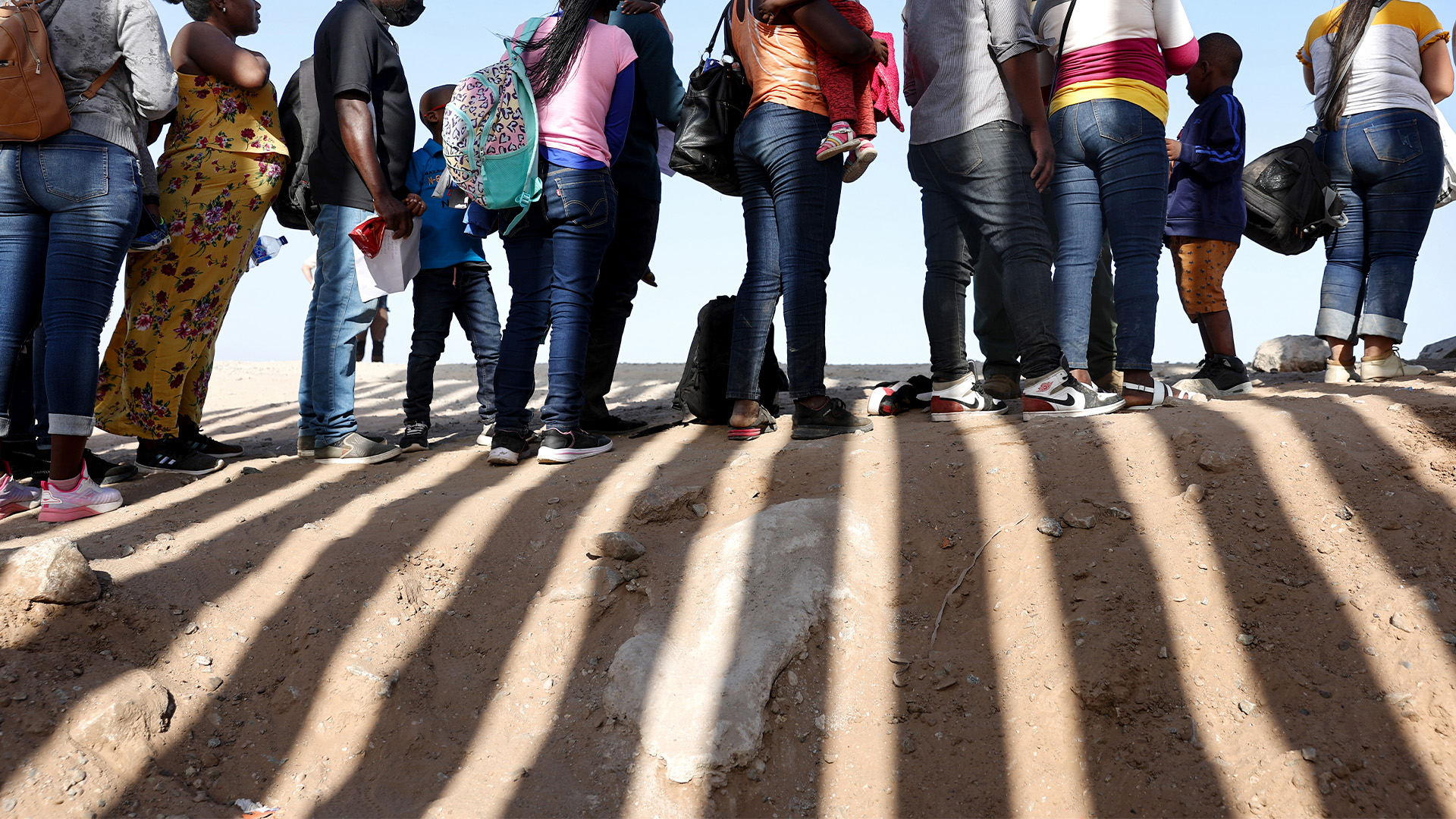
At issue is a program the Biden administration launched in January that permits as many as 30,000 people a month to temporarily enter the country from Cuba, Haiti, Nicaragua, and Venezuela. The rules are simple: Each participant must have a financial sponsor before they can travel, they must be vetted and security screened, and they can apply to work once they arrive.

The initiative is the linchpin of the president’s strategy to de-escalate the chaos at the southern border, where encounters with migrants attempting to cross soared to near-record highs in 2021 and 2022. The program, built on a policy known as humanitarian parole, works like a pressure-relief valve: Certain groups get a safe and systematized way into the country so they do not illegally pour through in large numbers. (Since the program took effect, the Department of Homeland Security says the number of migrants sneaking in from the four targeted nations has dropped by 89 percent.)

But a Texas-led coalition of Republican states is suing to shut the program down. They claim it will swamp them with newcomers dependent on costly public services. They argue that, when Congress gave presidents the power to parole immigrants, it was meant to be used on a small scale—not to unilaterally wave in as many as 360,000 a year.

The Biden administration’s program differs little from similar programs dating back to the 1950s. Both Republican and Democratic presidents have long used humanitarian parole to aid migrants fleeing war and instability. It’s how the United States helped hundreds of thousands of people escape communism in Cold War Europe, and in Cuba, and in Vietnam. It was the tool used to welcome Haitians escaping the aftermath of one of the deadliest earthquakes in history.

Without parole, the United States could not have evacuated roughly 78,000 Afghans during its breakneck withdrawal from their country in 2021, and it could not have opened its arms to more than 125,000 Ukrainians who rushed here after Vladimir Putin’s invasion.

Biden, however, has wielded his parole authority more often and more ambitiously than any president before him. The program for Cubans, Haitians, Nicaraguans, and Venezuelans is unprecedented in its scope. So far, it has brought more than 175,000 people to the country. More than 1.5 million Americans, including churches and other houses of worship, have applied to be sponsors. Demand has overwhelmed US Citizenship and Immigration Services, which resorted to processing half of those applications on a first-come-first-served basis and the other half at random (go ahead, figure the odds).

The scale of it all has riled political opponents: Chief among them is Texas Attorney General Ken Paxton.

“This constitutes yet another episode in which the administration has abused its executive authority,” Paxton said when he filed the lawsuit in January. For our purposes, Paxton is something of a stand-in at this point: Four months after he sued, he was impeached for his own abuses of power and has been suspended while awaiting trial.

But Paxton is the standard-bearer for a subset of immigration-wary evangelicals. He is a member of influential Dallas-area megachurch Prestonwood Baptist and has built his political brand as a man whose Christianity guides his battles. “As believers, we have to stand up and speak out,” he once told worshippers at another Texas church.

And no one has gone to the mattresses against Biden’s immigration policies like Paxton. He has sued the administration more than a dozen times to stop them.

State of Texas, et al. v. US Department of Homeland Security, et al., though, is not just a fight between Paxton’s cadre of red states and the president. Tipton has allowed a group of seven citizens, helped by immigrant rights groups, to join the lawsuit as defendants. They argue that sponsors participating in the program would be harmed if it were nixed. They include a Florida teacher trying to bring Haitian relatives who survived murder and kidnapping attempts, a Jewish woman trying to bring friends from Venezuela with the help of her Massachusetts synagogue, and a Texas evangelical trying to bring a Cuban pastor and theologian being persecuted for his faith.

If the Biden administration loses, experts believe it could plunge the southern border into a greater crisis. It’s “massively important,” David Bier, an immigration analyst at the Cato Institute, has said. “If parole is greatly restricted, the entire edifice on which Biden has reduced illegal crossings crumbles. Illegal migration will spike.”

The stakes rise even higher in the long term. If the case is appealed, and if the administration loses in higher courts, it could jeopardize the very foundation of humanitarian parole programs. It could deprive future presidents of virtually the only tool at their disposal for offering hospitality on American soil when tired, poor, huddled masses need it most.

Is Tipton prepared to unleash all of that? Many observers believe the judge, who was appointed by former president Donald Trump and is viewed as a conservative, will end Biden’s program.

As Americans have become accustomed to flattening men and women on the bench to “Trump judges” or “Obama judges,” it’s easy to forget there are still actual people behind judicial rulings. Tipton did not respond to requests for an interview but, by all appearances, he is a kind man and a proud father. Photos on social media show him taking his children deer hunting and meeting them at Texas A&M football games.

At his Senate confirmation, he thanked his church, Second Baptist of Houston, for “praying and supporting me throughout this process.” He lamented that his father-in-law, who had been his Sunday school teacher as a toddler, had recently passed away. He served for years as a Bible teacher himself and was a leader in his church’s marriage ministry.

Glenn McGovern, a New Orleans attorney who was opposing counsel against Tipton in a 2015 case, told CT that Tipton “was a nice guy.” He recalled that Tipton was the first lawyer he’d ever seen conduct nearly an entire case on an iPad. “He was professional and accessible and open. No bullshit, which is unusual.”

At the trial on Friday, Tipton told attorneys that he had been to Haiti himself and had witnessed severe poverty there—making him one more in a long line of American evangelicals who have a personal connection to the country and who find themselves in a position of outsize influence over its future.

“Does the fact they are living in poverty qualify as an urgent humanitarian need?” he asked. (Lawyers clarified that in Haiti, people are also fleeing unfettered gang violence.)

At the same time, Tipton questioned Texas’s claims that the parole program was causing the state harm, given that data suggest it has actually reduced the number of undocumented migrants arriving in the state from the four countries in question. He said he was reluctant to issue any temporary injunction against the program, given that some states say it has been a boon for employers struggling to fill open positions.

How the judge will make sense of the arguments is anyone’s guess. When Tipton was sworn in on June 26, 2020, Senior Judge John D. Rainey said Tipton—who had once clerked for him—would “bring a sense of compassion to the bench.”

In the end it will come down to this: Compassion for whom?

Among the influential Texans involved in the lawsuit, Paul Zito has drawn the most explicit connection between his faith and Biden’s parole program.

Zito, a 67-year-old venture capitalist who is intervening in the case, is not exactly the caricature of a justice warrior. The tech entrepreneur and real estate investor owns a $6 million home overlooking Austin’s skyline, with the words coram Deo etched in a fireplace mantel. An environmental activist once included him in a group of Austin’s top 10 residential water users.

If you had spent the day with Zito on May 15, 2013, you would have accompanied him to the ranch of his longtime business partner John McHale, who had gathered then-governor Rick Perry and other influencers to eat barbeque and to shoot the laser-guided, high-powered hunting rifles McHale’s company was unveiling.

In 2015, Zito traveled to Cuba on a mission trip with Paul Pennington, a friend who had become known in some circles as “the father of the orphan care movement.” (Pennington, a former salesman, is credited with working alongside the likes of Steven Curtis Chapman and James Dobson to make adoption a leading cause among American evangelicals.)

Zito, who had adopted two children of his own, would return to Cuba twice more. He saw and felt that he was grasping, for the first time, the polychrome diversity of heaven. He cried when Pennington spoke to their small group about how serving orphans reflects the gospel. One of Pennington’s slogans—“the more vulnerable, the more valuable to God”—had lodged itself into Zito’s head.

He shared with Pennington about a change his visits seemed to have wrought in him, of “a humility in the Christian community” he was taken by. “I see my own crass materialism,” Zito wrote his friend in a note. “I have been revitalized in my walk to see God at work in this world. We lose that here in America. We are too affluent. Too comfortable.”

Over the course of his trips, Zito grew close with a Cuban pastor named Abel, whose last name CT is withholding out of security concerns. Abel served as Zito’s interpreter, guide, and, eventually, as the country director for Pennington’s ministry, Hope for Orphans.

Within weeks of Biden’s announcement of the new parole program that would include Cubans, Zito applied to support Abel’s family. “I saw the opportunity to sponsor Abel as a calling from God to help a friend in need,” Zito told CT in a statement. He was concerned about reports that Abel was being harassed because of his faith and threatened with imprisonment, and about Abel’s worsening struggle to make ends meet.

Zito and his wife put their plans to downsize on hold so they could house Abel, his wife, and their two daughters if they were approved to travel to the US. They dreamed about getting them involved at their church and began compiling job openings.

“This program represents Abel’s best chance at reaching safety,” Zito said. “When my state sued to block this program, I knew I needed to defend my right, and the rights of all American citizens, to follow the calling of their faith, when we are guided by God to give shelter to our brothers and sisters fleeing oppression.”

Speculating about how faith steers judicial decision-making is a pastime for both believers and the nonreligious. Supreme Court justice Samuel Alito may have bemoaned the conversation as tired, but it’s only natural.

In her 2017 Senate confirmation hearing as a federal appeals court judge, current Supreme Court justice Amy Coney Barrett famously sat across from Sen. Dianne Feinstein as the Democrat from California fretted that “the dogma lives loudly within you.”

Barrett, a devout Catholic, responded: “We have many judges, both state and federal, across the country, who have sincerely held religious views and still impartially and honestly discharge their obligations as a judge.”

Is Tipton one of those judges? He is far from unique in carrying evangelical convictions to the bench. There are more than 800 federal district and appellate judges established by Article III of the US Constitution. Reliable data about their faith is hard to come by, but a 2017 study of appellate judges, if we want a rough guess, found that almost half were Protestant.

On its face, Texas v. US Department of Homeland Security is not a case about religion. Most of the intervenors did not cite religion as a motivator, and religious freedom is not central to the arguments being made by the plaintiff or by the Biden administration. America’s immigration laws are numbingly complex. People of faith have a harder time connecting the Bible to, say, the finer points of employment visa policies, than to morally charged issues like abortion or capital punishment.

Drew Tipton, federal judge in Texas.Screenshot from the U.S. Senate Committee on the Judiciary video / Edits by CT
Drew Tipton, federal judge in Texas.

That said, opinions about immigration are “an inherently political, personal matter,” says Sarah Flagel, a pastor’s kid like Tipton and an attorney at World Relief, an evangelical organization that focuses heavily on refugee resettlement and immigration law. The perspectives of people like Zito and the other intervenors can sway outcomes, she says. “All of us are influenced by our backgrounds and our beliefs.”

And any belief can influence to a fault. In a 2021 ruling based on some judicial philosophy that was clearly mistaken, Tipton quashed a DHS policy that told federal agents to prioritize certain migrants for arrest and deportation. DHS said its officers had to choose their battles, given limited staff and funding. But in Tipton’s reading of the law, this was illegal.

Ultimately, the Supreme Court overturned Tipton’s ruling in a stinging 8–1 decision, noting that law enforcement has always had discretion to set enforcement priorities—this is why drivers rarely receive tickets for speeding only five miles over the limit—and that the case should never have gone as far as it did.

But judges are, inevitably, going to err in some direction. And if, all things being equal, a judge has to choose between two perfectly valid interpretations of a statute? “As Christians, I think we err on the side of mercy,” Flagel says. “That’s kind of fundamental to our Christian faith.”

As an instrument of mercy, Biden’s parole program is good but not perfect. It offers migrants an alternative to making perilous, hellacious journeys to reach safety, such as trekking through the deadly terrain of Panama’s Darién Gap. But parole programs are only temporary, granting beneficiaries two years in the US. They carry the risk of leaving immigrants in a state of limbo about their future. (If Congress cannot agree on the Afghan Adjustment Act, a stalled bill that would grant Afghan evacuees a path to legal residency in recognition of the war they fought side-by-side with US troops, what can they agree on?)

It’s “certainly better than nothing,” Flagel says. “It doesn’t fix the fact that we need a functional refugee resettlement program.”

It also doesn’t fix the crises driving migration at its source. Brain drain is a major concern for people like Mark Fulton, a missionary who works with a Church of God hospital in Saintard, in central Haiti. More than a third of the 70 staff at his hospital have left the country through the Biden program, including 11 physicians. On calls with other medical centers in the country, he hears reports of departures on a similar scale.

Fulton doesn’t blame his Haitian colleagues for exiting. They all say the same thing: There is no future for them in a nation that has been taken hostage by gangs, that has virtually no government and a failing economy.

“But the people, oh my gosh, what a resource we’re losing,” Fulton says. “I think anyone and everyone who is able is trying to leave.”

Tipton’s ruling is expected this fall. When it comes down, word will fly nearly as soon as the decision is signed. The news will wing on WhatsApp groups up and down the continent. And most likely, before any headline scrolls into view on your phone or across cable network chyrons, at least some of the 50 or 60 people at Zion Community Church will already know.

Pastor Jennifer Joseph says her predominantly Haitian congregation in Yeadon, Pennsylvania, just west of Philadelphia, has applied to sponsor at least 10 people, on top of those that families in her church are sponsoring on their own. Joseph’s mother coordinates the congregation’s prayer ministry, a loop of continuously circulating requests that God would protect their relatives while they wait to win the lottery, that he would give them strength to accept whatever comes.

Especially in Haiti, Biden’s parole announcement was a lifeline in a country with virtually no other lawful way out. The traditional route to visas, the family-reunification program, ground to a halt so long ago that many Haitians would have to wait a lifetime for their papers to clear if they qualified. And Haitians are almost never granted employment visas that would allow them to work seasonal jobs in agriculture or to take other low-paid work.

But still, Joseph says, “this program feels like giving a thousand hungry people a little piece of bread.” Like so many in her community, Joseph can’t help but notice that “countries with people of African descent tend to get treated differently.” After all, no one has sued to stop the president from paroling Ukrainians.

Even if this program escapes Tipton’s courtroom intact and survives appeals, its clock will eventually run out, and most of those who applied for parole will never have their number called. Whenever the door closes, Joseph says, “I’m not looking forward to that. It’s going to be devastating.”

Her mind goes to a single woman in her church whose husband, three children, and sick mother call each day, sometimes twice a day, asking the woman what she is doing to help their case move through the system. Is she calling the immigration offices? Did she miss something? “It just consumes her—from a mental health perspective, she’s up and down, she’s not okay,” Joseph says. “That, unfortunately, is the reality for a lot of people right now.”

At least one person who was paroled has already become a member at Joseph’s church. The man, in his 40s, met some members of the congregation downtown and began taking the bus Sunday mornings to worship with them.

And about eight miles from the church, on Philadelphia’s north side, another newcomer named SoSo Benoit is still looking for a church to call home. The 36-year-old is single and has no children, a fact her mother always said was because the rest of their family had come to depend on her to provide for them.

She was the lab director at Mark Fulton’s hospital.

Benoit arrived through Biden’s program in the middle of June, after a journey that seemed to be dotted with miracles. She had spent her share of nights sleeping at work, when gangs had blocked nearby roads. She lost a relative to a stray bullet in a firefight not far from the hospital. One night, Benoit dreamed she was in the United States and took it as a vision from God. She felt she had to come. “I had no choice,” she says.

She applied for a visa, but then Biden announced the new program and she applied for that. Her family began praying and, just two months later, she was approved to travel. “Lots of crying that day,” Benoit says.

The roads between her home and the international airport in the capital, Port-au-Prince, were cut off by multiple gangs. So to travel a distance of just 29 miles—a routine commute to the office for many Americans—Benoit climbed into a crowded sailboat that pitched for hours through high waves. She was soaked with seawater when she arrived.

In her damp luggage, besides the essentials, she had allowed herself to bring only the Bible she had been given as a girl, with her baby photo tucked inside. As if she were beginning life anew.

When Benoit stepped outside at the Philadelphia International Airport five days later, she looked around and marveled at how every hustling person simply went about their business, and at how everything around her seemed just fine.

“God has done great things for me,” she says.

This story was originally published before the trial and has been updated to reflect the trial proceedings and the decision.

Andy Olsen is senior editor at Christianity Today.

Ideas

Evangelicals’ Theology of the Church Must Be Born Again

Contributor

The ‘Great Dechurching’ is an opportunity for our tradition to rediscover a more enduring ecclesiology.

Christianity Today August 24, 2023
Illustration by Mallory Rentsch / Source Images: Unsplash

Most people who stopped attending evangelical churches in recent years are not “nones” or exvangelicals.

In fact, many still self-identify as born-again Christians with perfectly orthodox Christian beliefs, according to Jim Davis and Michael Graham’s newly released The Great Dechurching. These Christians believe in the Trinity, the atonement, and the reality of Jesus as their personal Savior.

They just don’t go to church.

It might be easy to imagine that the millions of dechurched individuals are an aberration whose evangelical identities are somehow suspect. Surely, they don’t really understand what the Christian faith is all about, we might think.

But what if evangelicalism itself is partly to blame? What if the problem with dechurched evangelicals is not their faulty understanding of faith, but rather evangelical theology’s own lack of emphasis on the church?

Relative to other forms of Christianity, evangelicals have historically maintained a rather low view of the church, compared to their high view of a believer’s individual relationship with God.

While Catholics for centuries insisted on “no salvation outside the church,” evangelicals have traditionally insisted that a person’s salvation has nothing to do with church affiliation or church sacrament. While some Protestants, such as Lutherans and Anglicans, have reserved a role for the sacrament of baptism in salvation, many evangelicals have eschewed this sacramental theology.

American evangelicalism was born in eighteenth-century outdoor revivals, which denounced unconverted ministers and called people to experience the Holy Spirit and the gift of salvation outside of church walls. The Anglican evangelist George Whitefield ministered to thousands in the open air and had little connection to any established denomination.

Whitefield was not alone. Although the evangelists of the First Great Awakening were often ordained ministers (as Whitefield was), their individualistic message of personal salvation transcended and defied denominational boundaries—emphasizing a personal relationship with God that was unmediated by church or creed.

Similarly, in the nineteenth century, revivalist preaching continued to be delivered by itinerant evangelists, some of whom openly scorned the dictates of their denominations or had a tenuous relationship with the established church.

Barton W. Stone, the pastor of Cane Ridge Presbyterian Church—where the Second Great Awakening started—left his Presbyterian denomination after the revival. He struck out on his own, determined to recover New Testament Christianity without the burden of denominational oversight or accepted creed.

Charles Finney, the most famous revivalist of the Second Great Awakening, moved from church to church in a series of pastorates that crossed denominational lines to find a church that would be a good fit for his “new measures” and Arminian theology.

But at least the nineteenth-century revivalists regularly attended a local church, despite their discomfort with denominational constraints. That was not the case with many American evangelical leaders in the twentieth century.

Some realized they could often reach the lost more effectively through parachurch ministries than through the local church.

The most famous of these parachurch ministers was Billy Graham, whose international preaching ministry transcended denominational lines. Graham encouraged his audience to join a local church, but his own membership was at a church in Dallas—nearly a thousand miles from his home in Montreat, North Carolina.

He frequently attended other churches, especially the Presbyterian congregation where his wife, Ruth Bell, was a member, but he rarely visited the one in Dallas where he was a member for 54 years.

“If I belonged to a Baptist church in the neighborhood [in North Carolina], they would continually be asking me to work in church affairs,” Graham explained. “When I’m at home I attend my wife’s Presbyterian church and naturally they don’t ask me to do anything.”

Other evangelical parachurch leaders of that era expressed even less interest in attending and actively serving at a local church.

Pat Robertson, the television broadcaster who founded Regent University and the Christian Coalition, was an ordained Southern Baptist minister. Yet he almost never attended church during the heyday of his career in the 1980s and early 1990s. “It is boring,” he once told a reporter, when asked why he didn’t attend the Baptist congregation where he was a member. “I didn’t enjoy going there.”

Robertson strongly believed in the importance of Christian devotion—he read the Bible for an hour every day and spent lots of time in prayer. But church attendance, in his view, was optional.

Today, some evangelicals are placing a renewed emphasis on the significance of church. Pastors like David Platt and Mark Dever, for instance, insist that every believer is responsible to become an active member in a local church.

Evangelicals are once again reading classic texts on the value of Christian community, like Dietrich Bonhoeffer’s Life Together, and writing new books on the subject, such as Collin Hansen and Jonathan Leeman’s Rediscover Church: Why the Body of Christ Is Essential.

As going to church becomes more countercultural and less convenient in our frenetically-paced world, these messages are more needed than ever. As Bonnie Kristian explains, many believers lack a fundamental commitment to church—a conviction that “routine participation in communal Christian life is the primary location of our worship and discipleship.”

But to get people to return to the pews, evangelicals need to rediscover a compelling theology of church—to establish a uniquely evangelical answer to the question, “Why church?”

The church’s reason for existence cannot be merely evangelism, since parachurch ministries and missionary teams are often more effective at that. It cannot be simply to preach God’s word, since some of the best evangelical preaching has often occurred at unaffiliated revival services and parachurch ministry conferences.

If the church is the bride of Christ—whom Jesus redeemed with his blood—we know it is vital. But why?

An evangelical answer is that the church exists as a local expression of the family of God and it’s Jesus’ plan for training his disciples to love one another and become more like him.

Love can’t be practiced effectively in solitude. We can pray and read the Bible alone. But we can’t practice loving other people if we’re not in relationship with them.

Paul wrote 1 Corinthians 13 to an entire congregation—not to a single Christian individual living in isolation. There were times in Paul’s life when he was isolated from the community of believers and unable to worship with others, like when he was in prison. But even in isolation, he prayed fervently for other disciples and longed to be reunited with them.

One cannot read the first few chapters of 1 Thessalonians without realizing that Paul was a man who intensely longed to be with other believers—to pray with them and to share their joys and sorrows in their walks with the Lord.

As evangelicals have rightly noted, God’s Spirit and gift of salvation are not defined by church walls. But without an embodied community of believers, we’re limited in our ability to learn how to love other followers of Jesus. We’re hindered in our capacity to experience the unity with other Christians that Jesus prayed for just before his crucifixion. And we’re less likely to experience the blessings that come with being part of a local expression of Jesus’ Bride.

Early American evangelicalism may have been a reaction against unconverted ministers and spiritually dead churches, but it should never have become a movement against church itself. And maybe now, amid a “Great Dechurching,” we can rediscover a robust evangelical theology of the church.

Daniel K. Williams is a historian working at Ashland University and the author of The Politics of the Cross: A Christian Alternative to Partisanship.

News

Don’t Waste Your Life: How One Family Stopped Being Trashy Christians

These Tennesseans are finding ways to live without adding to the landfill. But they aren’t finding a lot of “zero waste” company.

Sadie McElrath dresses as a "plastic bag monster" to talk to state legislators about trash.

Sadie McElrath dresses as a "plastic bag monster" to talk to state legislators about trash.

Christianity Today August 24, 2023
Courtesy of Zach and Sadie McElrath

Zach and Sadie McElrath’s six-year-old daughter saw something at a store that caught her eye: a slingshot. But they didn’t buy it for her because it would have ultimately produced landfill waste. Instead, their daughter is figuring out how to make a slingshot with a stick and rubber bands from around the house.

The McElraths, based in Chattanooga, Tennessee, live a “zero waste” life. What they do throw away is compostable, except for the rare cases when they end up with items that have to go to the landfill, such as an Amazon envelope or a bag from frozen berries. They take their trash to the curb once or twice a year, even as a family of five with children ages 9, 6, and 2.

Both parents work—Sadie as a nurse practitioner, and Zach as a software engineer at a start-up. Even with their full life, they find the zero-waste life doable and even freeing, not having to think about buying things like slingshots.

“Other people might not be as extreme as we are,” said Sadie. “But everybody can do something.”

The McElraths have been living this way since 2017, and they haven’t found many other Christians interested in zero waste over the years. They find more zero-waste efforts coming from faith groups like the Unitarian Universalists. But they have been seeing more interest among Christians in their circles in doing things like composting.

This tracks with national data on evangelical attitudes about the environment compared to other faith groups. Evangelicals are the religious group least likely to see climate change as a serious problem, according to a 2022 Pew Research Center survey. And a University of Florida study found a generational divide among evangelicals over that issue (a divide that is even starker among white evangelicals). Younger evangelicals are more concerned about the environment, even though they are more politically conservative than their peers.

But the Pew survey also showed 80 percent of evangelicals say they try to reduce their food waste every day to protect the environment. The majority of evangelicals also said they try to reduce their use of single-use plastics. And 41 percent of evangelicals said their church has recycling bins and is trying to be more energy efficient.

The McElraths aren’t interested in guilting their friends and families into becoming zero waste. They also think zero wasters can be consumer focused (get the newest zero-waste coffee gear!) or perfectionist. Approaching waste with the right understanding—and theology—is important.

“There’s been nothing to teach me in real life more than zero waste that there’s no separation between sacred and secular,” said Sadie. “God cares about the shampoo you use, and whether the company who made it was making a river in a developing country dirty … he doesn’t just care about what you do on Sunday morning, and about what you profess to worship. He cares about your whole life.”

She understands that can be an overwhelming thought—is every item in a household “reflecting the morals and the kingdom of God?”

“That’s why it’s really great to just trust God that he is the one that’s in control … we just have to walk in obedience one step at a time,” she said, which might mean grabbing a reusable bag for the grocery store. “That might be your thing for that day, and that’s okay. Because God can take care of the rest. But there’s no part of our life that God doesn’t care about. The trash and the waste that we consume is something God cares about, that is part of his kingdom.”

Zach added that, because of how interconnected the world is today, Christians can have “more positive impact on communities halfway around the world by the choices we make at home than by going somewhere and doing a—I don't know—short-term missions trip.”

But a key to not being overwhelmed by the cascade of decisions about trash is “to live in the tension of saying, ‘There are problems in the world. I can’t fix them all. In fact, today, I may be making them worse, and I know that, but God still loves me,” he said.

For basic nuts and bolts of understanding trash and zero waste, they found the books Zero Waste Home by Bea Johnson and Garbology by Edward Humes useful. To sharpen their thinking on creation care and the theology behind reducing their trash, they liked Freedom of Simplicity by Richard Foster and Practicing the King’s Economy by Michael Rhodes and Robby Holt.

When the McElraths started living zero waste six years ago, they began by finding zero-waste replacements one at a time for things they were throwing away, like deodorant. When the average person thinks about being environmentally-friendly with trash, they usually think about recycling. But that’s the last thing zero wasters emphasize. The first action is refusing wasteful things coming into your life—“the elimination of stuff,” as Sadie says.

For example, Sadie found a conditioner bar she likes for her hair—“I buy that and I’m good,” she said—so she can ignore ads for new anti-frizz products.

One third of the average American household’s trash is organic waste, so composting is one of the best and easiest things people can do. By contrast, if organic material goes to a landfill, it doesn’t decompose for decades because it’s sealed off from oxygen. Worse, it contributes to climate change through anaerobic breakdown that emits methane, “which is like 20 to 25 times as potent as CO2 as far as a greenhouse emitter,” said Zach.

The McElraths started a blog, and started doing classes on zero-waste living and waste management at local festivals and churches. (They attend New City East Lake in Chattanooga.)

When they get questions at these sessions, people ask about Band-Aids a lot. The McElraths aren’t sure why that tends to be the pressing question on people’s minds, but they’re happy to have an easy answer: Companies make compostable Band-Aids.

Their kids say they like making things. They know the recipe for making their own toothpaste, for example: baking soda, coconut oil, and peppermint oil. For birthdays and Christmas, they ask for secondhand gifts, coupons for going out for ice cream, or just cards. During the holidays, their kids buy jars of jam for their teachers.

When the McElraths had a baby two years ago, they decided to try to buy all the baby supplies they could secondhand. Sadie worked up a spreadsheet of their purchases for the baby’s first year and found that they had saved $3,000, which she documented in detail on their blog.

They get their grocery and household supplies from bulk sections with their own containers from home—sometimes wrapping a loaf of bread in a scarf or putting food in sippy cups from the car if they forgot to bring enough containers. During the pandemic, a new grocery store opened in Chattanooga called Gaining Ground, which was designed to serve a local food desert, but it also stocked items in bulk bins so the McElraths could come stock up. The McElraths and others did a GoFundMe to buy the store a peanut butter grinder so people could refill peanut butter jars.

The McElraths like to imagine how a world with better waste management, and just less stuff, would look.

“In Chattanooga, the air is breathable, and the water is drinkable. But a lot of people don’t live in that world,” Zach said. “The Bible has so much to bring to the discussion … We have a God who cares, we have a God who is powerful. We have a God who listens and knows us, but who still loves us in this journey.”

“He’s given us all gifts to use in his kingdom,” Sadie added.

“And he can do more than we ask or imagine,” said Zach.

A Taiwanese Chip Maker Came to Phoenix. A Chinese Church Saw an Opportunity.

Local Christians are working together to bring the gospel to workers at the semiconductor plant.

U.S. Secret Service agents stand guard as President Joe Biden tours a computer chip plant in Phoenix for Taiwan Semiconductor Manufacturing Company.

U.S. Secret Service agents stand guard as President Joe Biden tours a computer chip plant in Phoenix for Taiwan Semiconductor Manufacturing Company.

Christianity Today August 24, 2023
Patrick Semansky / AP Images

In 2020, Michael Lin learned that the world’s largest contract manufacturer of semiconductor chips was building a massive production hub nine miles north of his church. As the pastor of a Chinese church in Phoenix, he saw the arrival of the Taiwanese multinational as God “dropping a harvest field right at our front door.” He just hoped they would be ready.

Taiwan Semiconductor Manufacturing Company (TSMC) plans to invest $40 billion in Arizona—an investment of such great geopolitical importance that President Joe Biden and Apple CEO Tim Cook attended a ceremony in December marking the company’s expansion and upgrade of its chip production site.

For the US, this meant TSMC’s leading-edge chips, which are needed for military equipment, cars, and Apple’s smartphones and laptops, could be produced in the country rather than in Taiwan, where the threat of a Chinese invasion looms large. Further, TSMC’s arrival promised to create thousands of construction jobs and employ 4,500 workers once the advanced factory, called a “fab,” began production.

For Lin, who is originally from Taipei, his focus was on the 600 families who would be moving to Phoenix from Taiwan to help start operations at the Arizona site. He saw an opportunity for growth and revival at his Northwest Chinese Baptist Church, especially as the Mandarin congregation had been hit by COVID-19 and the divisive 2020 election. Attendance declined from 80 to about 60–70 people, and the average age of the congregants hovered around 60.

Lin and his church started praying for the Taiwanese newcomers in 2021 and talking with fellow pastors in the city about how to work together to reach them. They created a chat group on Line, a messaging app popular in Taiwan, inviting friends and contacts who they knew worked at TSMC and would be moving out to Arizona. Through this communication channel, they shared about the church’s events and offered their help.

Then, as the TSMC families moved into town last year, the church started to hold English classes, sports nights, peer tutoring for their children, and informational sessions to help them adjust to life in the US. Today, 200 people attend their English classes weekly, and church attendance has doubled in both the Mandarin and English congregations. In September, Lin will be baptizing five new Christian converts.

“After that dip [caused by COVID-19], I do think that we are only going through the period of restoration and now we’re on the path of revival,” Lin said. He expects the church to reach about 150 attendees this fall, maxing out the seating. “So it’s becoming a good problem to have.”

Valley Life Church Tramonto, another church near the new fab, is also reaching out with English classes and tutoring, while members of Southern Baptist Convention (SBC) churches in the region have provided support and volunteers. Still, Lin notes that more workers are needed amid a plentiful harvest that is only growing: TSMC plans to build six fabs and has already asked the US government to approve visas for up to 500 additional Taiwanese nationals due to a shortage of specialized workers.

“We are praying that we are going to plant multiple Chinese churches in [God’s] name,” Lin said.

Welcoming a new kind of stranger

Lin and his wife Su-Ting are no strangers to welcoming newcomers. They spent 20 years working in Chinese student ministry at Arizona State University before Lin joined the pastorate. They recall the early 2000s as the “golden age,” when about 2,000 students from mainland China would arrive each summer and the Lins would step in like surrogate parents, caring for them, cooking for them, explaining American culture, and counseling them through breakups. “We were baptizing 20–30 students every semester,” he remembered.

Yet ministry to the recent Taiwanese newcomers is very different, said Lin. Most of the engineers are men in their 30s to 50s and have come with their wives and children. They are highly educated, at the heights of their careers, and accustomed to living high-end lives. They are very concerned about getting a good education for their children, and while most of the engineers can speak English, the wives of the TSMC employees often don’t speak English well. While English is taught in Taiwan’s schools, most don’t have much practice speaking or listening to the language.

They also face cultural differences in their new home, some of which are becoming apparent as American and Taiwanese TSMC employees work together. Taiwanese workers are known to work long hours and unquestioningly follow instructions, unlike Americans who are harder to manage, according to reports.

To meet the needs of these families, Lin decided the church needed to organize a youth group and children’s ministry. The church’s young people opened an after-school tutoring program to help Taiwanese students make friends and learn about American culture from their peers.

Last fall, to help introduce the families to local Christians, Lin coordinated with First Chinese Baptist Church of Phoenix to host a sports night. About 30 Taiwanese families joined to play games both familiar (badminton and basketball) as well as foreign (pickleball) and eat a potluck dinner. A group of women mentioned to the Lins that they wanted to improve their conversational English, so the Lins invited them to their church service the next day to figure out how they could help. Lin admitted that he didn’t expect any of them to show up.

Yet as he preached his sermon on Sunday, he looked up to see eight women standing outside the door waiting for him to finish. The Lins decided to hold an English class in their house, which was close to the apartments where the TSMC workers lived, and asked a couple of women from the English congregation if they could help teach the class the next day. They agreed.

“We didn’t have a massive plan,” Lin said. “We didn’t have all the details, but God just made it happen.”

Within a month, the class of eight women doubled, and soon they were sitting shoulder to shoulder in the cramped living room. After three months, they moved the class to the church. When the Lins announced the new class, 120 people signed up. “We did not prepare [for] this amount of people, so we just scrambled … asking people to help,” he said. Lin reached out to their local SBC chapter, which mobilized members from five churches to help out.

Today there are three classes a week teaching beginner, intermediate, and advanced English to a total of 200 people, mostly wives of TSMC workers. Mixed with conversation practice, the class introduces students to American slang and culture and ends with a Bible verse. In total, they need 30–40 volunteers each day, half of whom are tutors and half of whom are translators. “Our strategy is to cast the net, and we ask as many people to hold the net as possible to catch as much fish as possible,” Lin said.

The work beyond the outreach

But Lin isn’t content with just holding English classes. He wants to see them come to know Christ. So while the classes are a way to build bridges with the Taiwanese families, the church is also putting on evangelistic conferences, including a talk by Burn-Jeng Lin, TSMC’s former head of research and a devout Christian. Lin is also planning monthly community outreach programs that teach about marriage, parenting, and family using biblical principles, as he’s seen the high-pressure work at TSMC putting a strain on marriages.

The church also plans to start small groups for seekers and others at various stages of their spiritual walk.

All this takes manpower that Lin admits his church is lacking. Since many of the regulars in the Mandarin congregation are retirement-aged, it’s difficult to get them to volunteer or minister to these families. Chinese people make up only .5 percent of Phoenix’s population of 1.64 million, and finding more Mandarin-speaking Christians to help is a challenge.

So Lin is mobilizing and supporting the Christians within the TSMC community to reach their coworkers.

One believer who has signed onto Lin’s vision is Karen Wu, whose husband works at TSMC. Wu remembered that when she first moved to Seattle from China as a teen, members of a Taiwanese church opened their arms and helped her settle in America. As her husband is part of this recent relocation, Wu saw many of the TSMC families struggling with the same culture shock she once faced and decided to get involved at Northwest last December.

Wu started to organize informational talks to help TSMC families adjust to their new homes. She found six local doctors to come give talks explaining the US healthcare system. Before Christmas vacation, she invited a deputy sheriff to give a talk about traffic safety and what they should do if they were ever pulled over. She also held sessions explaining the college application process and helping participants better understand women’s mental health.

As they got to know more families through these general interest events, they invited them to the church’s Christmas musical put on by the children in the church. Afterward, about 30 members went caroling at the TSMC apartments.

In January, Wu started a women’s group, half of whom were from the church and half from TSMC, to pray and prepare to serve the newcomers. They divvied up the contacts they received from women who had joined their events and started visiting them in their homes, setting up playdates or coffee meet-ups. In April, they started Alpha courses with six of the women. By the end of the 11-week course, one woman said she wanted to be baptized and another said she now believes in Jesus but needs some time. A third was a lapsed Christian who now regularly attends Sunday service.

“I think it’s wonderful,” Wu said. “I’m a little bit surprised how I got [into this ministry], but when I look back I just think that I listened to God and had faith in him.”

Northwest is about to start two more Alpha classes, but now they need to tackle the question of what’s next. Who will nurture these young believers?

Lin is asking Chinese-language seminaries on the West Coast to send their seminarians to Phoenix for a semester-long internship to help them out. Wu said that whenever she hears of someone graduating from seminary in Taiwan, she asks them to come out to do missions to the Taiwanese people in Phoenix.

The need is also acute in the church’s children’s ministry, as they need a youth pastor and more volunteers to help out. Some of the TSMC families have started to ask if the church would start a Chinese-language school for their children on the weekends, yet Wu doesn’t think the church currently has enough volunteers.

“We pray that we don’t just bring them to church, but that we also have people who can regularly teach them the gospel and help them stay in church,” Wu said. “Outreach is just the beginning; there’s a lot of work after that, [and] we are praying for the solution.”

Becoming essential to the community

Lin first reached out to pastor Brian Bowman of Valley Life Church Tramonto, which is located at the same freeway exit at the TSMC fab, at the end of 2021. Lin wanted to let him know about the massive construction just a few miles from their door and the Taiwanese families who would be moving in. The two churches met in March of 2022, with Lin sharing about the context and the needs of the Taiwanese people. Bowman said that before this wave of newcomers, Valley Life only had one Taiwanese-American congregant.

When they heard that ESL classes would be needed, Joy Longaza, Valley Life’s church planting residency director, knew this was a service they could provide. Two weeks later, they held their first class with two teachers and two students. Today the classes, which are centered around fellowship and community, take place three times a week with class sizes of about 30.

One class over the summer brought students on field trips to Starbucks or restaurants where they would practice ordering food in English. Another class turned into a Bible study after one woman asked for a copy of the Jesus Storybook Bible that the church was passing out to the kids who attended their VBS program. Like Northwest, they also started tutoring classes for the children to help them stay caught up in school.

“One of the things that we prayed is that we would be good neighbors,” Longaza said. “We just prayed that we would be able to share our lives and that Jesus would tell us when we get to share about him.”

Longaza said that three of the women have come to Christ so far, and another seems close. Yet she noted that the language barrier poses an issue as they begin to talk about deeper topics.

To better serve the population, Valley Life has asked a former missionary couple to Taiwan to come serve in Phoenix and plant a Taiwanese church inside their church. The goal is for them to start the church but then to train Taiwanese leaders to pastor it. They also have plans to start a school where the families could come learn English and the children could take music classes.

As their neighborhood makeup changes, Longaza said Valley Life wants to continue to love and serve the people. She remembers a sermon where Bowman asked if their church was essential to its community: “If we were gone, all in one day … would the community even miss us, would they even know?”

“God bringing this company right here in our backyard, they are our community,” Longaza said. “And we know that most of them don’t know Jesus and so our hearts are burdened for that.”

News

White Evangelicals Aren’t Sure About Ramaswamy. But for Indian American Christians, He’s a No-Go.

The former like the young billionaire’s conservative politics. The latter worry about his connections to radical Hinduism.

Republican presidential candidate Vivek Ramaswamy.

Republican presidential candidate Vivek Ramaswamy.

Christianity Today August 23, 2023
Win McNamee / Staff / Getty

At 38 years old, Vivek Ramaswamy stands out among his fellow Republican presidential candidates for his age alone. The self-made billionaire has further set himself apart by saying he would ban social media for children, proposing to raise the voting age to 25, and espousing controversial views on 9/11. But when running in a party with a strong evangelical Christian wing, perhaps his most unique characteristic is his Hindu faith, which Ramaswamy has proudly discussed.

“Am I religious? Yes, I am. I am Hindu. I am not Christian. And we are a nation founded on Judeo-Christian values,” he said in an interview with NewsNation that aired last week. “But here is what I can say with confidence: I share those same values in common. I believe I live by those values more so than many self-proclaimed Christian politicians.”

White evangelical leaders who are considering other GOP candidates than former President Donald Trump are divided on whether a leader whose faith doesn’t stem from Judeo-Christian traditions can effectively lead a nation they believe is rooted in these principles. But in interviews with CT, Indian American Christians expressed apprehension about a leader in the White House who admired Narendra Modi and would further give radical Hinduism a foothold in the United States.

“God is real”

In March, Ramaswamy appeared on CBN where he compared the current state of America to the Israelites wandering in the wilderness. David Brody, who conducted the interview, told The New York Times last month, “The lazy narrative that he’s Hindu so he can’t appeal to evangelicals, I don’t buy it at all.”

Ramaswamy, who grew up in Cincinnati, frequently points out that he is a product of Catholic schools and has credited his political ideology to the influence of a conservative Christian piano teacher.

“I’ve probably read the Bible more closely than many Christians that I know, and I can tell you deeply that we share that same value set. And for a guy who is not running for pastor in chief but commander in chief, that’s really what matters,” he said on NewsNation.

Nevertheless, the first statement under a part of Ramawamy’s campaign website labeled “Truth” declares, “God is real.”

Ramaswamy’s second point, “There are two genders,” nods to the candidate’s strategy to build trust with voters through culture war grievances. Author of Woke, Inc.: Inside Corporate America's Social Justice Scam, Ramaswamy asserted to NewsNation that the real divide in the US on the front of religion is not between those who are members of traditional religions but between them and adherents of what he calls new religions like “wokeism, transgenderism, climatism, COVIDism.”

Further elaborating on his viewpoint, Ramaswamy expressed his unwavering commitment to safeguarding religious freedom.

“I’m an ardent defender of religious liberty,” he recently told the Associated Press. “I will be an even more vocal and unapologetic defender of it precisely because no one is going to accuse me of being a Christian nationalist.”

A more concerning agenda?

But some worry that he may be too close with Hindu nationalists.

A Tamil Brahmin, Ramaswamy grew up speaking Tamil, visiting Hindu temples, and performing Hindu rituals at home. (Tamil Brahmins are a diverse group of Tamil-speaking Hindu Brahmins, situated at the apex of the caste hierarchy, and are often associated with conservative traditions, and cultural and intellectual privilege.) He and his wife, Apoorva Ramaswamy, are raising their two young sons in the faith.

For Indian American Christians, Ramaswamy’s faith practices don’t present a problem. But they’ve worried about his open admiration for Modi, who has been accused of compromising democracy, Hinduizing the country, and ignoring religious violence against minorities.

In the wake of the recent attacks on Christians in Manipur, which have killed more than 100 people, Ramaswamy praised Modi as “an outstanding leader of India.”

“Modi has been building on that experience [of free-market capitalism] in India, lifting people up from poverty,” Ramaswamy said in a July interview. “Regardless of their background, regardless of identity politics, India has prospered economically. GDP growth is up. I think that’s the ultimate metric of a truly successful unifying leader.”

https://twitter.com/VivekGRamaswamy/status/1672001752801968131

Ramaswamy’s presidential candidacy “seems to be a part of a deeper Hindutva agenda,” says Jai Prakash Masih, a leader at Asian Mennonite Community Church, Lombard, Illinois. (Hindutva is an ideology advocating hegemony of Hindus and Hinduism within India.)

And the average American voter’s ignorance about the nuances of Hinduism and Hindutva work to Ramaswamy’s advantage, says Sam Beera, an IT professional from Boston.

“I don’t think the average white conservative Christian knows much about Hinduism or Hindutva, other than yoga, elephants, or Modi. That is a big asset for Ramaswamy,” said Beera. “There is an alarming lack of knowledge on the clear and present danger of Hindutva, which is an ideology modeled on Nazism.”

The political objectives of Hindu nationalists, says Beera, include advocating for Akhand Bharat, a movement that calls for an “unbroken India”—a political unification of Pakistan, Bangladesh, Tibet, Nepal, Bhutan, Sri Lanka, and the Maldives—and endorsing Hindu political candidates globally while simultaneously marginalizing minority groups within India.

“What percentage of US conservative Christians are aware of the above? Hardly a pittance if at all,” said Beera.

Opposition research written reportedly by Ramaswamy’s GOP opponent and Florida governor Ron DeSantis’s campaign tried to conflate his Hindu upbringing and his visits to India as a child with condoning the caste system, seemingly justifying Beera’s concerns.

Currently, nearly five million people of Indian descent live in the US. According to a 2014 Pew report, Hindus constitute just around 51 percent of the diaspora population, compared with 18 percent identifying as Christians. Up until this point, the most visible Indian Christians have been Republicans Bobby Jindal and Nikki Haley (a convert from Sikhism). Both previous governors, Jindal ran for president in 2016, and Haley announced her own bid several months ago.

Many Indians who arrived in America after the Immigration Act of 1965 formed Hindu groups and associations that paved the way for many from these communities to later run for elected office, says Robert William, who grew up in Chennai, India, and previously served as a Republican in elected office in Lancaster County, Pennsylvania. Given the perceived wealth of this community, “one could argue that a conservative Hindu POTUS would not be able to ignore the powerful and growing influence of Hinduism in the US.”

Numerous Hindu Americans, predominantly Democrats, already serve as state and federal legislators, and increasingly their connections to Hindu groups overseas have been questioned. Two of these politicians, Raja Krishnamoorthi and Ro Khanna, came to Ramaswamy’s defense after his faith was targeted by a pastor from Nebraska. Krishnamoorthi has been called out in the past for his association with Hindu nationalist groups.

“Vivek Ramasamy has surprised many people in the past week by slowly moving up in the opinion polls,” said John Prabhudoss, at the Federation of Indian American Christian Organizations of North America. “But what we are concerned about is his association with radical Hindu groups that are aligned with Hindu extremism.”

Ramaswamy has in the past delivered the keynote for fundraisers for political advocacy groups linked to the US chapter of Vishwa Hindu Parishad of America (VHPA or World Hindu Council of America), notes Pieter Friedrich, an American who advocates for persecuted Christians in India. VHPA is the US wing of the VHP (World Council of Hindus), which the CIA classified as a “militant religious organization” in 2018.

“Rather than trying to court Christian voters by appealing to similarities between their faith and Hinduism, perhaps Ramaswamy should instead take up the cause of Indian Christians who are being persecuted by the Modi regime he praises,” said Friedrich.

William, the elected official, is skeptical that Ramaswamy’s voice could do much.

“It would be a fallacy to think that a person such as Vivek Ramaswamy would be able to influence someone like Prime Minister Modi because they are both of the Hindu faith,” he said. “Any such attempts would be labeled by India as interference in India’s internal matters and dismissed. But such a candidate will certainly catch the attention of US groups and trigger them to open their pocketbooks and galvanize them to rally behind such a candidate aspiring for political office in the US.”

Ramaswamy’s rise could further encourage radical Hindu groups to “increase their visibility and influence in the US to counter the influence of the evangelical Christian voters in the US,” said William.

But “Vivek Ramaswamy’s rise in politics will be stopped in its tracks if he attempts to focus on his Hindu religion and beliefs, because the reality is that the office of president in the US still remains out of reach for anyone other than for a mainline Christian candidate.”

News

2024 Sets the Stage for a New Kind of Abortion Debate

Four issues on evangelicals’ minds as the Republican presidential race moves forward.

The Fiserv Forum where the Republican presidential debate will take place on Wednesday, Aug. 23.

The Fiserv Forum where the Republican presidential debate will take place on Wednesday, Aug. 23.

Christianity Today August 23, 2023
AP Photo/Morry Gash

Americans will get their best look yet at the slate of candidates vying for the GOP nomination in 2024 during the first Republican presidential debate and a pre-recorded interview with former president Donald Trump, both airing Wednesday night.

Evangelicals remain a key constituency for the Republican Party and for Trump in particular, who leads in most polls. But the political landscape has changed in significant ways in the four years since the last campaign, so when it comes to the big issues, evangelical voters have some new questions for the Republican field. This is the first presidential election since Roe v. Wade was overturned, since Russia invaded Ukraine, and since Trump’s indictments.

Eight GOP contenders will take the stage for the debate in Milwaukee, among them Florida Gov. Ron DeSantis; former vice president Mike Pence; former UN ambassador Nikki Haley and Sen. Tim Scott, both from South Carolina; and Vivek Ramaswamy, an entrepreneur and newcomer to the political scene. (Trump is skipping the debate in favor of a pre-recorded interview with the erstwhile Fox News host Tucker Carlson.)

Here are four things evangelicals will likely be watching for on Wednesday night:

Abortion

The Supreme Court’s overturning of Roe v. Wade last year was celebrated as a historic victory for the pro-life cause. But the aftermath has shown that both Republicans and the pro-life community were unprepared for what came next.

The issue of abortion is now in the hands of state governments, and the response has varied. Some, like Florida under the leadership of DeSantis, have enacted strict abortion limits, while others have expanded access to the procedure. In several states, abortion has ended on the ballot, leaving the matter to voters.

One consequence for GOP candidates is that voters can now differentiate between their positions on abortion, something that Mark Caleb Smith, who teaches political science at Cedarville University, says was not possible before.

“In the past, Republican candidates could say they were pro-life and pledge to appoint federal judges in line with that pledge. Since virtually everyone would say the same thing, abortion was rarely meaningful as a way to distinguish between Republican candidates. Now, that has changed,” Smith said.

On this issue, the candidates have varied views. Several, such as Pence, Scott, and Haley, support a federal 15-week ban.

Trump, who appointed the justices who helped overturn Roe, and DeSantis, who signed a six-week ban in Florida, seem hesitant to establish a federal rule on abortion.

Doug Burgum, governor of North Dakota, has restricted abortion in his home state but opposes a national ban, while Chris Christie, former governor of New Jersey, will only support it if there’s a “consensus” from the states. Ramaswamy, too, opposes a national ban, but will support a six-week ban at the state level.

According to polling data from Pew Research, in 2022 about 74 percent of white evangelicals believed abortion should be illegal in all, if not most, cases (in 2014, 63 percent of evangelicals in general opposed abortion, according to Pew). On Wednesday, evangelicals will be looking closely at the candidates’ position on this issue.

Donald Trump

The elephant in the room will not be in the room. But while Trump will be absent from the debate, his legal predicaments will loom large. The former president faces four indictments at the federal and state levels. Yet he remains by far the most popular candidate for the Republican presidential nomination.

This leaves the rest of the GOP candidates in a tricky position. DeSantis, Scott, and Haley have avoided criticizing Trump and instead have pointed fingers at Democrats and the prosecutors involved in the cases. Pence has tried to thread the needle between reprimanding his former running mate and letting the justice system’s process play out. He has said, “History will hold Trump accountable,” but has hedged on the question of whether Trump should be charged with crimes.

Asa Hutchinson, the former governor of Arkansas, and Christie are among the most vocal critics of Trump. Hutchinson has said Trump should “respect the office and end his campaign.” Ramaswamy, on the other hand, is perhaps Trump’s most vocal supporter and has called on other candidates to pardon him if elected.

While Trump retains a strong grip on the GOP, his legal troubles have raised questions on his ability to defeat President Joe Biden in a general election.

“While no candidate on the stage this Wednesday can challenge Donald Trump’s popularity within the Republican Party, they can challenge his ability to win next November,” Smith said.

Some evangelicals have suggested that it’s time to move past Trump, but according to polls, a majority seem to think he has done no wrong and is the best candidate to face Biden in the upcoming election.

Michael Wear, president of The Center for Christianity and Public Life and a former faith outreach coordinator for the Obama administration, says both Trump and the Democratic Party think that the outcome of the Republican primary is a “foregone conclusion.” But he reckons this is “just the beginning” and “evangelicals will have a tremendous say in how it turns out.”

“The wonderful thing about our system, though, is that voters actually do get to have their say. I hope evangelicals will watch this debate with an open mind and with the good of their neighbors as their lens,” Wear said.

He challenged viewers to “think about who on that stage would actually serve our nation with dignity and purpose, and advance ideas and policies with the greatest promise of promoting human flourishing, particularly for the poor.”

Ukraine

It has been 18 months since Russia invaded Ukraine. Nearly half a million Ukrainians and Russians have died or been injured in the conflict, according to US officials. In that time, the US has also approved about $113 billion in humanitarian aid and military assistance to Ukraine. Now Ukraine and Russia seem to be in a costly protracted battle, with no clear end in sight.

While Ukraine received overwhelming support from Americans at the beginning of the war, American generosity seems to have cooled off over time. A slight majority of Americans now think the US has sent enough aid to Ukraine.

Evangelicals similarly seem to have mixed feelings. While many have supported continuing aid, some seem to be less enthusiastic. When Pence suggested the US should remain committed to sending aid during a live interview in July, the response from a room full of evangelicals was lukewarm (some even booed).

The candidates will likely face tough questions about their position on the war in Ukraine. Christie, Burgum, Haley, Hutchinson, Pence, and Scott have said they would continue supporting Ukraine, to varying extents. DeSantis (along with Trump) is ambivalent, while Ramaswamy is opposed to it and has even suggested Ukraine should cede territory to Russia to end the war.

The economy

The top issue for Republicans and Republican-leaning independents, according to a Pew Research Center poll from June, is inflation. Inflation has been cooling off after reaching historic highs in recent years due, in part, to the pandemic, but interest rates remain high and may increase further.

While evangelicals are vocal about issues such as abortion and religious freedom, the economy remains a chief concern. According to a survey from Arizona Christian University last year, economic issues—such as inflation and prices of commodities like food and gas—were the top issues listed by respondents.

Here the GOP candidates have been less specific about their positions. Most have pledged to reduce government spending and have suggested tax reforms. Pence is targeting Biden-specific policies, such as student loan forgiveness programs and funding for agencies like Amtrak and the IRS, among other measures.

DeSantis has pledged to crack down on DEI—diversity, equity, and inclusion programs—and Ramaswamy has said he will lift regulations on the production of fossil fuels and nuclear energy to achieve GDP growth.

addApple PodcastsDown ArrowDown ArrowDown Arrowarrow_left_altLeft ArrowLeft ArrowRight ArrowRight ArrowRight Arrowarrow_up_altUp ArrowUp ArrowAvailable at Amazoncaret-downCloseCloseellipseEmailEmailExpandExpandExternalExternalFacebookfacebook-squarefolderGiftGiftGooglegoogleGoogle KeephamburgerInstagraminstagram-squareLinkLinklinkedin-squareListenListenListenChristianity TodayCT Creative Studio Logologo_orgMegaphoneMenuMenupausePinterestPlayPlayPocketPodcastprintremoveRSSRSSSaveSavesaveSearchSearchsearchSpotifyStitcherTelegramTable of ContentsTable of Contentstwitter-squareWhatsAppXYouTubeYouTube