News

Pope Who Changed the Calendar Is Honored with an Asteroid

Gregory XIII joins Martin Luther, Dietrich Bonhoeffer, and many other Christians with an astronomical tribute.

Pope Gregory XIII

Pope Gregory XIII

Wikimedia

The International Astronomical Union has named an asteroid after Pope Gregory XIII, the 16th-century Roman Catholic leader who reformed the Western calendar to bring it into closer alignment with Earth’s orbit of the sun.

About 1.2 million asteroids orbit the sun, most in a belt between Mars and Jupiter. Seen through a telescope, the “minor planets,” as scientists term them, appear as specks of reflected light. The first one was cataloged in 1801 by Giuseppe Piazzi, an Italian priest, and since then, more than 600,000 have been named. Around 60 were named to honor Christian leaders including Thomas Aquinas, Hildegard of Bingen, Martin Luther, Dietrich Bonhoeffer, and C. S. Lewis.

News

Poetry, Photography, and Fleming Rutledge Led One American to Volunteer in Ukraine

A Maine man learns that discerning God’s call can be complicated.

Brad Hendrickson with a lost dog in Bakhmut.

Brad Hendrickson with a lost dog in Bakhmut.

Joel Carillet

Brad Hendrickson had a flat tire, and his jack wasn’t up to the task. Flat tires are frustrating in the best of times. This was not the best.

He was in eastern Ukraine, in the besieged city of Bakhmut, and the flat left him exposed some 500 meters from Russian troops. He started searching nearby blown-out cars, looking for a jack he could use, but the pace and intensity of shelling, which sometimes spit debris on him, forced him and a companion back. He returned a few hours later.

Bakhmut is a city of close calls. For months it has been one of the most active areas of fighting in Ukraine, with incessant shelling and trench warfare reminiscent of the fighting in World War I. Thousands of soldiers have died, and many civilians too. Volunteers have been killed.

Hendrickson is a noncombatant volunteer. Over 3,000 Americans contacted the Ukrainian embassy about volunteering. Hendrickson is one of the ones who followed through.

A burly man with a big beard and a tendency to lace his fingers together while he talks, Hendrickson doesn’t look out of place in Ukraine until he says hello out of the window of his 20-year-old Toyota Land Cruiser. The accent gives him away—American. The 43-year-old used to be a luthier in the Twin Cities before moving to Maine. For a while he drove a UPS truck. He’s been in Ukraine since the early weeks of the war.

He can explain why he’s here. But it’s not simple.

“In a way, that answer is a 40-something-year, sprawling answer,” he told CT.

It has something to do with history. Something to do with poetry and political rhetoric and sobriety. Something to do with a devotional by theologian Fleming Rutledge and thoughts on atonement.

Hendrickson recalls, for example, the prodemocracy protests in Beijing’s Tiananmen Square in 1989. As the authoritarian government responded with force, a journalist photographed an unidentified man standing in the way of a column of tanks.

“He’s holding a takeout bag,” he said. “He’s not Rambo. He’s not some grand militant hero. He’d just had enough of it.”

Then there were the poems.

“There are some particularly powerful pieces of poetry that have gotten past my crusty exterior and had purchase on me,” he said.

One was by Ukrainian-American poet Ilya Kaminsky, called “We Lived Happily During the War.” It is just 12 lines long, but it ends, “we (forgive us) / lived happily during the war.”

Most of Bakhmut's 70,000 residents have fled the fighting. According to the Ukrainian military, several thousand remained, most of them poor, elderly, or disabled.Joel Carillet
Most of Bakhmut’s 70,000 residents have fled the fighting. According to the Ukrainian military, several thousand remained, most of them poor, elderly, or disabled.

Hendrickson said a full account of why he is in Ukraine would also have to include the principled politics of people like the late senator John McCain and the journalist and historian Anne Applebaum. Their words shaped his thinking over the years.

Finally, there was, as he put it, “the whole God, Jesus, Bible thing.”

For the past several years, Hendrickson has been in the habit of reading passages from a book over the phone with his mom and his son. On the fourth day of Russia’s full-scale invasion, February 27, their reading was from Means of Grace, a devotional of writings from Fleming Rutledge’s sermons. It was about the transfigured Christ turning his face toward Jerusalem, where suffering and death waited. Rutledge writes that love must come down, because “love must go where it is most needed in the valley of the shadow of death.”

“Mountaintop experiences of spiritual nourishment and encounter can be wonderful, but you’re not supposed to stay on the mountain,” Hendrickson said. “You then still have to actually go into Jerusalem, even if there are some things waiting for you that you don’t want to run into.”

A week or two after the war began, as the poetry, rhetoric, theology, and news swirled around him, he felt a weight settle on him. The idea came that maybe he should go. But he didn’t want to go for the wrong reasons.

And it’s not like he didn’t have plans. He had just sunk money into a bus, which he intended to convert into a livable space, then enroll in a nursing program. Then he looked at his passport and noticed it had just expired.

“Are the obstacles along the way challenges to overcome?” Hendrickson said. “Or is this like, ‘Dude, you don’t even have a passport’?”

He thought, as he has for years, about the sheep and the goats passage in Matthew 25 and how one plays that out: “I was hungry and you didn’t feed me. I was being shelled and you didn’t evacuate me.”

Hendrickson, who has been sober for 11 years, was also thinking about atonement.

“It’s not a kind of guilt or transactional thing,” he said. “It’s more that ‘You, Brad, have been plucked from the sea of chaos and have gotten the chance to dry off a bit’—no pun intended—‘and are on the deck of the ship. You’ve been saved, but now you’re part of the rescue crew. Suit up. You’re part of this ongoing mission.’”

Hendrickson did some of his processing out loud with Joshua Hill, the rector at St. Alban’s, an Episcopal church in Cape Elizabeth, Maine. The priest told CT he was not used to Episcopalians saying God wanted them to uproot their lives and go abroad. But he listened and became convinced this was from God.

Bakhmut has been the site of the longest and bloodiest battle in the Russian invasion of Ukraine. The Russian military has struggled to take the city since last summer.Joel Carillet
Bakhmut has been the site of the longest and bloodiest battle in the Russian invasion of Ukraine. The Russian military has struggled to take the city since last summer.

“He’s listening to God,” Hill said. “He’s trying to be faithful to what God is doing in the world, plain and simple. There’s nothing complicated about it—and it’s very complicated.”

Hendrickson’s mother had a similar response. Sheryl Campbell, a Presbyterian Church (USA) minister, had just preached on Psalm 27 about trusting God while under siege and surrounded. Christians, she said, need to remember that God will not spare them from all trouble but will faithfully see them through and use them in the process.

“When we walk through that which is deathly, because of the power and victory of God in Jesus Christ, it is the shadow of death and not death itself,” she preached. “God is using us in someone else’s life so that the glory and power and love of God may be made known.”

Campbell’s church in Sun City, Arizona, raised funds for Hendrickson. The people at St. Alban’s also contributed, and Hill offered logistical help.

Hendrickson flew to Germany in late March 2022. He caught another flight to Romania and then was driven across the border into western Ukraine. From there he joined an aid convoy east.

Brad Hendrickson with a lost dog in Bakhmut.Joel Carillet
Brad Hendrickson with a lost dog in Bakhmut.

By early summer, he had found his footing and saw what kind of help he could best provide.

He got a vehicle and started doing what he had done for UPS—making deliveries. He started driving aid in and people out of frontline areas. When asked how many people he’s evacuated, he says dozens and dozens, maybe hundreds—he doesn’t keep a tally.

Artur Spitsyn, deputy head of the emergency services in Bakhmut, told CT that Hendrickson’s presence matters in more than just material terms. His presence “raises the spirits of people in terrible conditions,” Spitsyn said. He added that even the cats and dogs get some love and care when they cross Hendrickson’s path.

As his period of service has stretched into almost a full year, Hendrickson has found the challenges of discernment continue. The flat tire incident was just one of many close calls.

“When do I say, ‘The war will continue on but the war is over for me’?” he said. “This is absolutely not some romanticized, martyr-hero … thing. … I’ve got a bus to get back to.”

He has other ideas, too. He thinks that when he returns to Maine, he might like to be a chaplain.

For at least a while longer, though, he remains on the frontlines of war. And he continues to think about the depth and complexity of his answer to the simple question of why he’s there.

Joel Carillet is a photojournalist based in East Tennessee. He reported this story from Ukraine.

Editor’s note: CT now offers select articles translated into Ukrainian and Russian.

You can also now follow CT on Telegram: @ctmagazine (also available in Chinese and Russian).

News

Steven Curtis Chapman Ranked Alongside George Strait and Madonna

And other news briefs from Christians around the world.

Steven Curtis Chapman performs during the 53rd Annual GMA Dove Awards

Steven Curtis Chapman performs during the 53rd Annual GMA Dove Awards

Getty / Jason Kempin

Contemporary Christian music star Steven Curtis Chapman has joined the ranks of George Strait and Madonna as one of the few musicians who have topped radio charts 50 times. Chapman’s song “Don’t Lose Heart,” written about the struggle to hang on to faith in a time of crisis, was the most-played song on adult contemporary formats of American Christian radio in early March. His first No. 1 song was “His Eyes” in 1988. Chapman has sold 11 million albums.

United States: Mennonites repent of anti-music ‘sins of the fathers’

The children of a Mennonite revivalist apologized for a 1927 ban on musical instruments that forced a neighbor family to get rid of two pianos, destroy an organ, and hide a violin. At the time, the Virginia Mennonite Conference mandated a cappella singing in worship services, since there is no record of musical instruments in New Testament churches. Bishop George R. Brunk and his son revivalist George R. Brunk II also believed using instruments outside of church was a slippery slope to improper worship. The Brunks successfully pushed the conference to enact additional prohibitions. It had an immediate effect on their neighbors, Chester and Myra Lehman, who were forced to choose between their church and their music. Five Brunk siblings apologized 93 years later. They noted in the public letter, “It is often later generations upon whom the responsibility falls to apologize for ‘the sins of the fathers.’”

Jamaica: First woman leads island’s Christians

Elaine McCarthy, elder of the Pentecostal Gospel Temple Family of Churches and chair of the Jamaica Pentecostal Union, is the first woman named to lead the Jamaica Umbrella Groups of Churches. The group represents 96 percent of Christians on the island, including Pentecostals, evangelicals, mainline Protestants, and Seventh-day Adventists.

Poland: Pagan masks may actually have been shovels

A Polish historian has challenged the accepted interpretation of two artifacts thought to be evidence of the persistence of paganism in medieval Europe. During an excavation in the early 1960s, archaeologists found a pine board in an 11th-century garbage dump and a birch board in a 12th-century building. Each was shaped into a triangle with two holes on the wider end. Helena Cehak-Hołubowiczowa, a leading archaeologist and an expert on religious groups associated with prehistoric stone circles, decided the objects were likely masks used in pagan rituals. Contemporary Neopagans promoted the historical claims and developed replicas of the masks for religious use. Upon reevaluation, Kamil Kajkowski, head of the art and history department in a Bytów museum, argued the “masks” were more likely shovels or perhaps seats for wooden rocking horses.

Scotland: Rising political star criticized for social views

Kate Forbes, a candidate to become head of the Scottish government, was sharply attacked for her membership in the Free Church of Scotland and her commitment to the church’s teachings on sexuality. Forbes, long seen as a rising star in the Scottish National Party, did not run on cultural issues but answered journalists’ questions without hedging. Commentators said she destroyed her career, but her poll numbers rose 10 points in February before she narrowly lost the March election. Humza Yousaf, whose Muslim grandparents emigrated in the 1960s, won by about 2,000 votes.

Nigeria: Pilgrimage planes planned

The Nigerian Christian Pilgrim Commission announced a new arrangement for a direct flight from Nigeria to Israel to facilitate Holy Land pilgrimages, starting in 2023. The commission was authorized by the government 16 years ago to start coordinating the logistics of pilgrimages and has announced and delayed plans several times.

Mozambique: Fasting proves fatal for pastor

A 39-year-old evangelical pastor died attempting to fast from food and water for 40 days. Francisco Barajah, founder of Holy Trinity Evangelical Church, was attempting to emulate Jesus’ fast in Luke 4:1–2, before Christ was tempted by Satan to turn stones to bread. Barajah lost significant weight and was not able to walk after 25 days. He was taken to the hospital in Beira, more than 150 miles from his home, but could not be saved.

Iraq: Bells ring again at church desecrated by militants

Three new bells were installed in the tower of a historic Dominican monastery in Mosul, marking the 20th anniversary of the US invasion. The UN cultural heritage agency, UNESCO, has been working to restore Al-Saa’a Church and more than 100 other historic sites in Mosul for the last five years. The church, built by French Catholic missionaries, was bombed by the Islamic State in 2006. The extremists may have used the church as a site for executions during their three-year occupation of the city. The new bells were cast in a foundry in France using traditional techniques, with partial funding from the United Arab Emirates.

China: Pastors detained ahead of president’s power grab

Chinese authorities cracked down on the leaders of unregistered Christian groups ahead of the joint annual sessions of the National People’s Congress and the Chinese People’s Political Consultative Conference. Shouwang Church in Beijing was raided and the pastor was detained for 10 days. A pastor of Jilin Covenant Truth Church in Hefei was detained and warned not to leave the city. At least six leaders of the Early Rain Covenant Church in Chengdu were confined to their homes. During the joint sessions, president Xi Jinping gained increased control over China and secured a third term, setting him up to be the longest-ruling Chinese Communist leader since Mao Zedong died in 1976.

Theology

Eve’s Legacy Is Both Sin and Redemption

The first woman tried to get free of God. But when she aligned herself with God’s purposes, she became the ‘Mother of All the Living.’

Illustration by Karlotta Freier

If we’re lucky enough to grow up with a mom, we learn a lot from her. For good or for ill, we watch the way she manages life and we often follow suit, even without meaning to. So, what can we learn from the Bible’s first mom, Eve, named in Scripture as “the mother of all the living” (Gen. 3:20)? Though our trust in Eve’s guidance is significantly diminished by her decision to disobey God, what can she still teach us about how to live well in God’s world?

Eve appears in four scenes in Genesis: her creation, her sin, her giving birth to and naming Cain and his brother Abel, and her giving birth to and naming Seth. Further in the Bible, she’s described as having been deceived (1 Tim. 2:14), and in John’s vision, a woman much like Eve or Mary gives birth while a dragon waits to devour her baby boy (Rev. 12).

Eve’s story has grown over time so that our wary assessment of her is often based more on tradition than on the Scriptures themselves. Amanda W. Benckhuysen notes in The Gospel According to Eve that “the majority of early interpreters concluded that Eve was an inferior and secondary creation who bore primary responsibility for plunging the world into sin and strife.” For example, Aquinas presented Eve as the greater sinner, who as a woman was “defective and misbegotten.” However, the Bible does not present her as a seductress, a bimbo, or someone who is tragically lost—nor does it portray her as a mother we should disown.

Eve’s life begins with a celebration, her arrival heralded by the Bible’s first man. He is not responsible for making her, but he receives her as himself, proclaiming “bone of my bone and flesh of my flesh,” recognizing they belong together (Gen. 2:23).

In Genesis 2’s slower, narrative account of human origins, God performs a surgical procedure while the man is asleep, removing not just Adam’s rib, but—in a more accurate translation—his very “side.” As the narrator tells it, God splits the human down the middle, providing the material needed to result in a male and a female.

Also, the English word helper does not do justice to how the Hebrew word ezer describes Eve’s role (v. 18). Rather than a servant, God produces an ally corresponding to the man, who can share his tasks of cultivation and care of the garden.

I imagine Adam and Eve’s early days were spent in delightful discovery of God’s generous garden. They picked and ate fruit, cut back trailing vines, pulled weeds, cared for animals, and learned to work the soil. Part of their job description in Genesis 2:15 was to “keep” or “guard” the garden. Their role was active, not passive. Together they shouldered the responsibility, which must have involved problem solving and collaboration.

Together they could enjoy God’s provision and avoid what was off-limits. Except they didn’t. Eve became a tragic figure in short order. We don’t know how much time elapsed between her creation and the humans’ rebellion, but in narrative time, it’s merely a blink.

The story of Eve’s disobedience in Genesis 3 is tantalizing, leaving open many possibilities. Her version of God’s command is more stringent than the original, including a warning to not even touch the tree. First Timothy 2:14 is often taken as an indictment of Eve for her gullibility, but Paul could have intended it the other way around: Eve’s case may show that women ought to be taught carefully, rather than pushed away from gaining knowledge. Had Adam exaggerated when telling her about the command? Or was Eve trying to play it safe by adding restrictions?

The serpent convinced Eve that God’s command could not be trusted—that God was holding out on her by preventing access to what would benefit her, and that deification rather than death would result.

Here’s the problem: The Tree of the Knowledge of Good and Evil represented the pursuit of that knowledge apart from God. Adam and Eve already had access to the one who would teach them good from evil as they walked with him in the garden. Eating from the forbidden tree was an attempt to gain knowledge outside of that relationship—to become their own arbiters of truth.

After the fateful disobedience to his command, God seeks out the humans. He addresses Adam first, likely because Adam is the one to whom he gave the command.

Next, God addresses Eve directly. It’s worth noting that God does not hold Adam accountable for Eve’s sin; she possesses her own dignity as a moral agent. God’s question gives her an opportunity to confess: “The serpent deceived me, and I ate” (Gen. 3:13).

Katharine Bushnell, a medical doctor and Bible scholar who died in 1946, reframes this scene for us. In God’s Word to Women, Bushnell suggests that Eve’s answer to God was better than Adam’s. Adam casts aspersions on God for giving him Eve, referring to her as “the woman you put here with me” (v. 12). It’s easy for us also to point the finger at Eve, blaming her for the human predicament, the path of sin we all have chosen. Eve instead correctly identifies the serpent as the tempter and herself as the one who made the choice.

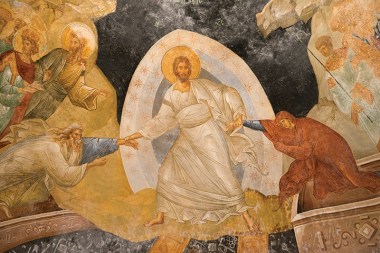
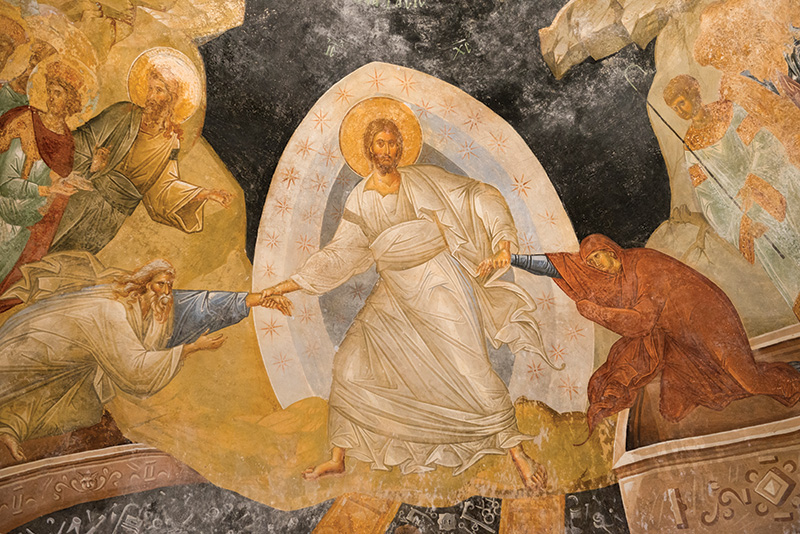
Called the Anastasis, or the Resurrection, this fresco in Chora Church, Istanbul, depicts Christ pulling Eve and Adam out of their tombs. Getty / Joel Carillet
Called the Anastasis, or the Resurrection, this fresco in Chora Church, Istanbul, depicts Christ pulling Eve and Adam out of their tombs.

In response, God curses the serpent, relegating him to the lowliest position. He tells the people, too, that hardships will come of their sin.

Then, we hear a clear note of hope: God promises that the woman will bear a child who will bruise the serpent’s head, even while the serpent strikes the heel of the deliverer (v. 15). Ultimately, the creature through whom evil gained a foothold will be trapped by the underside of a human foot and destroyed.

The enmity that arises between Eve and the serpent is a good sign. With eyes wide open, Eve and her seed are determined to bring creation into submission to the command of God.

Eve clearly and unequivocally made the wrong choice in the garden, with her husband’s full knowledge and participation. She meant to disobey. She thought she had found a more reliable source of wisdom. Though they don’t experience physical death right away, Adam and Eve’s relationships are fractured at every level. They hide from God, blame each other, and lose access to God’s garden of abundance. Eve knew she had been deceived.

For these reasons, Eve is not exactly hailed as a Bible hero. Her reputation as rebellious is well-earned. We’ve been living with the consequences of her transgression ever since Eden. Might we even resent her?

Yet, as with any Bible character, Eve’s moment of failure does not fully define her. Instead, we can find tremendous encouragement in her story. God’s response to her sinful decision opens the pathway for us to enter the kingdom of God. He could have scrapped creation in order to start over. But that’s not what God did.

Instead, God announced a solution to the unraveling of his plans for creation through Eve’s offspring. By the end of the story, rather than the source of evil, God presents Eve as the source of redemption. Her childbearing, fraught as it was, would result in the restoration of all that went wrong in the garden. In this sense, she would be the vehicle of salvation.

All humans—male and female—were made as God’s image and appointed to rule creation on God’s behalf (Gen. 1:26–28). Together we were tasked to “fill the earth and subdue it.” Eve’s failure to subdue the serpent, and Adam’s failure to support her in this essential task, led to their undoing. Realigning herself with God’s purposes puts Eve at odds with God’s enemies. That’s exactly where she should be.

Perhaps God’s declaration of enmity between Eve and the serpent is what inspires Adam to name her Eve (Hebrew Hava), which sounds similar to the word for life. Adam admires her because she will become “the mother of all the living” (3:20), giving life to the generations that follow. She and Adam were also the first of us—our mother and father—in repudiating our tempter and our sin and trusting God’s promise.

God mercifully clothes the humans and sends them away from the garden, preventing access to the Tree of Life. Unending life will come eventually, but first the snake needs to be crushed.

Outside Eden, in Genesis 4:1, we witness Eve’s joy at the birth of her first son. She knows that this birth is the path of fulfillment to God’s announcement in the garden. The New English Translation renders her exclamation as “I have created a man just as the Lord did!”

The Hebrew word for created sounds like Cain—an appropriate wordplay for the first birth in the Bible. It’s a significant moment in the narrative, given God’s declaration that Eve’s offspring would crush the head of the serpent. She rightly recognized that the miracle of childbirth is a miracle of creation. Will this be the son?

He is not. Nor is her second son. Rather than crush temptation, depicted in 4:7 as an animal crouching at Cain’s door, ready to pounce, Cain cooperates with sin by murdering his own brother.

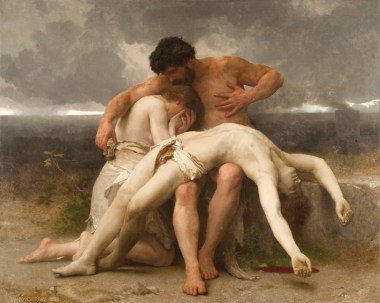
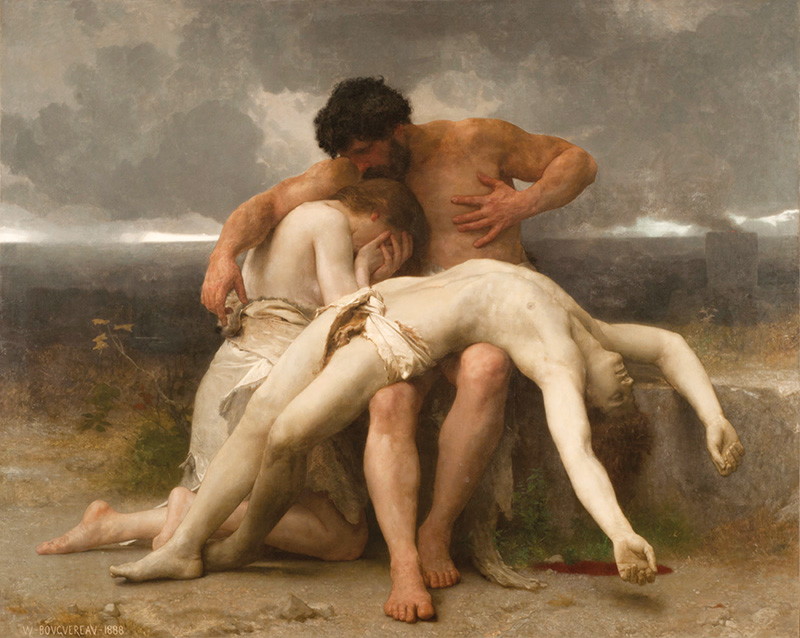
The First Mourning by William-Adolphe Bouguereau (1888)Wikimedia
The First Mourning by William-Adolphe Bouguereau (1888)

The text doesn’t tell us how Eve reacted, or whether she held on to hope in God’s promise in spite of the loss of both of her sons to death and exile. I imagine Eve carried that burden of maternal loss and dashed hopes to her death. Eve bears another son in 4:25, saying that he would replace Abel. Though we don’t hear of any tussle between Seth and the serpent, Seth is listed as Jesus’ direct ancestor in Luke 3:38.

For the rest of the First Testament, we await the descendent of Eve who will crush the serpent. The echoes of God’s promise in the garden reverberate.

For example, we witness this centrality of God’s promise to Eve in the imprecatory psalms. In Cursing with God: The Imprecatory Psalms and the Ethics of Christian Prayer, Trevor Laurence explores how these psalms participate in the wider biblical story by calling upon God to bring an end to wickedness and establish his kingdom.

The disordered world that resulted from Eve and Adam’s joint rebellion could only be restored through the partnership of their offspring with God in subduing those who oppose God’s rule.

Laurence notes that the imprecatory psalms evoke the Eden narrative repeatedly. They often speak of enemies as “snakes” or deceivers whose “heads” need to be crushed and refer to the “seed” of the righteous whose “heels” are being watched by their enemies (Ps. 58:4–6; 56:6). The cumulative effect is a sense that God’s purposes expressed in the Garden of Eden story are still being worked out as God’s people pray for the defeat of those who oppose God’s rule.

It’s worth noting that we’re not just talking about literal snakes here. Only those humans who align themselves with God’s commands are considered to be the “seed of the woman,” while people opposed to his rule are the “seed of the serpent.”

Gospel proclamation, then, issues an invitation to recognize the lordship of Jesus Christ. He is the seed of the woman. He has defeated Satan once and for all and is the seed of Abraham who receives the covenant promises. All those who follow Christ are reckoned as children of God and the seed of Abraham regardless of ethnicity, gender, or social status (Gal. 3:26–29).

John’s apocalyptic vision in Revelation includes a scene in which a pregnant woman travails in labor while a dragon waits to consume her offspring (12:1–17). While the vision includes a pastiche of symbolic imagery that appears in a number of apocalyptic texts, at the root of all of them is God’s announcement to Eve that her seed would crush the serpent’s head. Where else would John have turned to understand this striking scene?

By the time of John’s vision, the woman represents corporate Israel, which brings forth the Messiah under the pain of foreign domination. And the snake has morphed, becoming a seven-headed dragon, a composite of evil empires that oppose God’s rule and God’s people.

John makes sure we do not miss the thematic connection by interpreting the dragon for us as “that ancient serpent called the devil, or Satan, who leads the whole world astray” (v. 9). Though Genesis does not reveal the identity of the serpent, John’s vision interprets the primordial scene in retrospect.

The antagonism between the faithful people of God, awaiting the Messiah’s rule, and the dragon has reached a fever pitch. But Satan does not get the final word. The child is “snatched up to God and to his throne,” where he takes his place as ruler of the nations (v. 5). Satan is bound for a thousand years (20:2–3) and meets his ultimate end in the lake of fire (v. 10).

John’s vision in Revelation reaches its climax with a vivid scene of a restored garden in the New Jerusalem, where humans may again live in the presence of God (22:1–2). God’s intentions for creation are finally and fully realized in John’s glorious vision.

When we return to the beginning, it’s striking that God announces the promise of redemption to Eve, not Adam. The “mother of all the living” is the one through whom the promised seed will come. As Bushnell writes, “The Bible, from its opening chapters, pictures woman as allied with God in the eventual salvation of the world.”

Although Eve was partly responsible for the human rebellion in the garden, her failure alongside her husband was not the final word. Eve is neither a paragon of innocence or a paramour bent on seduction.

Rather, the Bible presents her as both paradigm for the essential participation of women in God’s work of redemption and as a complex person with a tragic story. And she is family—our mother in hope as well as in ancestry. As flawed and human as Eve was, in Bushnell’s words, “God has elevated her to the honorable position of an enemy of Satan and progenitor of the coming Messiah.”

Where does that leave us as Eve’s descendents? How does the command to “Honor your father and mother” (Ex. 20:12) apply to the “mother of all the living” whose choice led to a world of hurt?

Our duty here is not to try to erase the sin she confessed to God. Nor is it necessarily to honor Eve with imitation, although cultivation and motherhood are generally good and many of us are called to one or the other. The best way for all of us, male or female, to honor Eve is to maintain hostility toward anything that sets itself up in opposition to God’s kingdom. We learn from Eve to cultivate a wisdom grounded in what God says is good in his Word. And we celebrate the seed of Eve, our Messiah, Jesus, who crushed the Serpent and who invites us to announce the redemption available to all.

God first presents Eve to Adam as a companion in the task of caring for creation and heeding God’s command. When they leave the garden, she is Adam’s last hope for reversing the curse on creation. The sin of the “mother of all the living” did not erase the possibility of future women’s participation in redemption. Generations later, Mary’s willing submission to God’s invitation to bear the Messiah reverses the effects of Eve’s grave mistake. The one who was bruised for our sake bound Satan and will crush him once and for all.

Carmen Joy Imes is associate professor of Old Testament at Biola University and the author, most recently, of Being God’s Image: Why Creation Still Matters (June 2023).

News

Died: Charles Stanley, In Touch Preacher Who Led with Stubborn Faith

First Baptist Church Atlanta pastor lived by the motto “Obey God and leave all the consequences to him.”

Charles Stanley

Charles Stanley

Christianity Today April 18, 2023
Illustration by Christianity Today / Source Images: Courtesy of In Touch Ministries

Charles Stanley once took a punch to the face for his church. The longtime pastor and oft-praised preacher, who died on Tuesday at age 90, fought hard to lead in his Southern Baptist congregation, earning him a reputation for faithful obstinacy, a commitment to following God’s will, and a life of devout prayer.

He frequently repeated his life motto, which he learned from his grandfather: “Obey God and leave all the consequences to him.” That kind of obedience wouldn’t come without cost, Stanley said, but God rewards stubborn faith.

“Granddad told me, ‘Charles, if God tells you to run your head through a brick wall, you head for the wall,’” he wrote in his 2016 memoir, “‘and when you get there, God will make a hole for it.’”

Stanley was the pastor at First Baptist Church Atlanta for 51 years. He started as associate minister in 1969, when the megachurch had 5,000 members, and remained in the pulpit until 2020, when it had about 15,000 members. He also preached daily on the radio and television through In Touch Ministries, which he founded in 1972, and was widely regarded as one of the best preachers of his generation, along with Charles Swindoll and Billy Graham.

Stanley’s son, Andy, is also a megachurch pastor in Atlanta and a much-praised preacher. They were the only father-son duo to rank on Lifeway Research or George W. Truett Theological Seminary’s lists of most-influential living preachers.

Stanley was a founding member of both the Moral Majority and the Christian Coalition, served as president of the Southern Baptist Convention at a key moment in the struggle between conservatives and moderates, and wrote more than 50 books.

https://twitter.com/InTouchMin/status/1648347574238060544
https://twitter.com/OSHawkins/status/1648358067321315336

The future preacher was born in 1932 in Dry Fork, Virginia, which he would later say was a town so small it wasn’t on the map. His father, also named Charles, died when Stanley was only nine months old.

His mother, Rebecca Hardy Stanley, got a job in a textile mill in the middle of the Great Depression, earning about $9 per week. When she wasn’t working, she took her son to a Pentecostal church and taught him to read the Bible and pray.

“I can still hear her voice calling my name to God and telling him that she wanted me to follow him in whatever he called me to do,” Stanley said.

At age 12, Stanley accepted Jesus as his savior. Two years later, he discerned a call to preach and dedicated himself to ministry.

Rebecca remarried when Stanley was a teenager. Her second husband was alcoholic and abusive. The young Stanley tried to fight his stepfather, once even pulling a knife on the older man. He begged his mother to divorce him, but she remained committed to the union because of her faith.

The experience with violence had an impact on the rest of Stanley’s life, he later recalled.

“I was very, very uneasy unless I was in charge,” he said. “I was very, very combative and very, very competitive. You see, into my ministry, I brought the survival spirit. You do or die. You do whatever is necessary to win. It doesn’t make any difference what it is.”

Stanley attended the University of Richmond on a scholarship his mother prayed for, where he met and married an art student from North Carolina, Anna Margaret Johnson. They were married in 1955.

After graduating from Southwestern Baptist Theological Seminary, Stanley took a Baptist church in his new wife’s home state, preaching at Fruitland Baptist Church and teaching at Fruitland Baptist Bible Institute (now College). He moved to Fairborn, Ohio; Miami, Florida; and Bartow, Florida, before accepting the call to be an associate minister at the prominent Baptist megachurch in midtown Atlanta in 1969.

The senior pastor resigned two years later, and Stanley was asked to take on the responsibility until a replacement could be found. He applied for the position himself, but the search committee voted 5–2 against him.

As the search went on, however, Sunday attendance started to swell, giving started to increase, and growing numbers of church members suggested Stanley should take the pastorate. Several deacons—subtly and then not so subtly—pressured Stanley to step down.

Stanley refused.

“People wanted to get rid of me,” he said. “They couldn’t tell me why. They just said all I preached about was how to get saved, the coming of Jesus, and how to be filled with the Holy Spirit. I just laughed and thought, Well, God, I hope that’s true!

Stanley prompted further conflict when he removed some Sunday school teachers over the objections of the Sunday school superintendent who said the pastor did not have the authority to make that decision.

A deacon decried Stanley’s “naked grab for power,” according to reporting in the Atlanta Constitution, and several leaders said they were “uneasy” about the pastor’s “inordinate passion for political power” and “extravagant confidence in his understanding the will of God.”

In a heated church meeting, one of the church board members let slip a curse word.

Stanley said, “Now you need to watch your language.”

The board member retorted, “No, you need to watch yourself,” and then swung his fist, slugging Stanley in the face.

Andy, 13 at the time, was watching from a front pew. He said his father didn’t flinch when he was hit. He also didn’t retaliate, winning a moral victory and the argument.

“I saw my dad turn the other cheek,” the younger Stanley later wrote, “but he never turned tail and ran.”

When the church membership had a three-hour meeting to decide whether to keep Stanley, the majority voted yes. The church then voted to make Stanley the senior pastor.

He waited a week to announce whether or not he would accept the position. Thirty-six of First Baptist’s 59 deacons resigned.

Stanley brought his same tenacity to the Southern Baptist Convention when he was elected president in 1984. His supporters hoped he would be the one to resolve the fight between the denomination’s conservatives and moderates. His opponents feared the same—with one seminary president even calling for a “holy war” against the conservatives, including Stanley, who insisted on more theological uniformity in the denomination, to the detriment of congregational autonomy.

Conservatives said they were stopping a liberal slide, especially at the seminaries and in the denomination’s public policy organizations. In his first year as president, Stanley supported measures stopping congregations from ordaining women. At the time, there were 13 female pastors in the SBC and more than 220 ordained.

The second year, overcoming opposition to get reelected with 55 percent of the votes, Stanley used his presidential power and skill at parliamentary maneuvers to appoint a slate of conservatives to important Baptist boards.

The greatest fight of Stanley’s ministry, however, was the fight to save his marriage and stay in the pulpit after his divorce.

Anna Stanley filed for divorce in 1993, without explanation and using only the couple’s initials, A. S. and C. S. The news got out anyway and caused an uproar at First Baptist Church. The congregation had never allowed a divorced man to serve in ministry, and Stanley had taught that divorced men were disqualified from ministry.

Stanley announced from the pulpit that the couple was not getting divorced, but was separated and working on their marriage. Anna amended the suit a week later to ask for formal separation instead of divorce and then dropped the case.

She filed again in 1995.

“I am dismayed by my husband’s refusal to accept the critical state of our marriage,” Anna Stanley said in a statement to the Atlanta Constitution. “Instead, he has made repeated announcements from the pulpit that progress was being made towards our reconciliation, when in fact, the very opposite was true. I do not choose to contribute to this charade.”

There were no allegations of infidelity or immoral behavior. Anna said her husband had long made his priorities clear, and she wasn’t one of them.

A number of leaders in the church—which now had regular a weekly attendance of about 13,000—wanted Stanley to step down, at least temporarily. Others pushed him to resign. One of them was Andy Stanley, who was pastoring a rapidly growing satellite campus and seen as First Baptist’s heir apparent.

In later years, the younger Stanley would say he only wanted his father to offer to resign, giving the church a chance to choose to keep their beloved pastor. His father, he said, didn’t hear anything after the word “resign.”

Charles reacted harshly and pronounced his son an enemy. Andy left First Baptist, estranged from his father, and went on to found North Point Community Church, a seeker-sensitive megachurch that would grow to more than 40,000 people.

The elder Stanley described this period as the hardest and loneliest time of his life.

“The first few times I went to the grocery store at nighttime by myself, home by myself, empty house by myself, that was hard. But I thought, Okay God, this is where I am,” Stanley said. “My wife walked away. For a pastor, that’s a disaster. The church is going to fire you because they always think the worst. Well, my church didn’t do that. They said, ‘Well, you’ve been here for us when we needed you. Now we’re going to be here for you.’”

The church voted to keep Stanley, even if the separation continued. When Anna filed for divorce a third time in 2000 and succeeded in ending the marriage, a board member announced that Stanley would continue as senior pastor. The congregation responded to the news with a standing ovation.

While some evangelical leaders condemned Stanley’s decision to continue in ministry as a divorced man, saying he was undermining evangelicals’ moral witness, little actually changed at First Baptist. If anything, Stanley said, his divorce made him a more effective minister.

“It was Romans 8:28. God knew what he was doing,” Stanley said. “People would say, ‘I used to couldn’t watch you. What do you know about loneliness and hurt and pain and suffering and loss. Now I can watch you because now I know you know how I feel.’”

Stanley reconciled with his son through counseling, the two megachurch pastors going to therapy together. The elder Stanley talked about the death of his father, his traumatic relationship with his stepfather, and his need to maintain control. He invited Andy to preach at First Baptist Church in 2007. The younger Stanley’s sermon was on a familiar theme: “The Cost of Following Christ.”

Charles Stanley’s preaching was widely praised in his later years, especially for its simplicity, practicality, and effectiveness. He also frequently spoke of the importance of prayer and his own practice of getting down on his knees daily to talk to God.

“For me, that’s the key,” he told Christianity Today. “It ’s the key to everything. Because what you are doing, you ’re acknowledging God at the moment—you need his help, his insight, his understanding, or his courage, or his faith, whatever it might be.”

When asked what advice he’d give to his grandchildren, if they went into ministry, or what he might put on his tombstone when he died, Stanley returned to the motto about unflinching faith: “Obey God and leave all the consequences to him.”

He is survived by his son, Andy; his daughter, Becky Stanley Brodersen; and six grandchildren. Anna Stanley died in 2014.

News

ERLC President, Covenant Parent Urges Tennessee to Pass Proposed Gun Reform

Southern Baptist leader Brent Leatherwood calls on the state to “restrain evil” through Governor Lee’s plan to keep weapons from those deemed a threat to themselves or others.

Brent Leatherwood

Brent Leatherwood

Christianity Today April 17, 2023
Brandon Porter / Baptist Press

Writing as the president of the Southern Baptist Convention’s Ethics and Religious Liberty Commission (ERLC) and the father of three children who survived the shooting at the Covenant School in Nashville, Brent Leatherwood pleaded with Tennessee’s elected officials to “oppose evil and protect innocent lives” by taking action on gun reform in the state.

In a letter published by The Tennessean, Leatherwood backed a proposal by Gov. Bill Lee to enact extreme risk protection order legislation, allowing authorities to temporarily restrict weapons from people at risk of hurting themselves or others.

Leatherwood urged the lieutenant governor and legislators to overcome partisan divides to move forward, even if it requires extending the legislative session to do so.

“Yes, it is true we live in a world tainted by terrible acts and deeds, but that is never an excuse for inaction,” he wrote.

“While it may not prevent every instance of this sort of violence, it will prevent some, and thereby save innocent lives. That should be more than enough reason to advance this proposal.”

His discussion of the government’s responsibilities to protect its citizens and their essential liberties, including the right to life, echo a thread he shared on Twitter last week in response to statistics that gun deaths among kids in the US grew 50 percent in two years.

https://twitter.com/LeatherwoodERLC/status/1645813475921281024

Leatherwood, who worked as the executive director of the Tennessee GOP prior to his six years at ERLC, said “we all have a responsibility” to address gun violence as a community—including Christians who are called to love their neighbors and “law-abiding gun owners, like me.”

“So as we ‘weep with those who weep,’ it moves many of us to work with officials and help them understand the responsibilities they have. What public policy solutions can be crafted that meet the challenges underlying these stats?” he asked. “How can the state more fully live up to its God-ordained calling to protect innocent life, especially when it is children away from parents or family at a school setting or outside the home more generally?”

After the shooting at a Baptist church in Sutherland Springs, Texas, the Southern Baptist Convention first passed a resolution in 2018 calling on authorities to consider “the societal maladies that lead to escalations in gun violence and mass shootings” and government leaders to “implement preventative measures that would reduce gun violence and mass shootings while operating in accordance with the Second Amendment.”

Gun laws have not historically been a policy priority for the ERLC, which focuses on religious liberty, life issues, marriage, and family. In an ERLC podcast episode following last year’s school shooting in Uvalde, Texas, Leatherwood discussed extreme isolation and online radicalization as factors in previous mass shootings. He also talked about the availability of guns:

Look, let’s admit it: America, we have a unique gun culture. There are a number of instances throughout our history and even today where owning a gun makes complete sense—I own multiple guns in my household—so it’s part of our history, and it’s a part of our culture.

We have to understand though that there are a number of guns out there that are easy to obtain or you can obtain them illegally … [the Uvalde shooter] had access, he was upset, and no one was able to intervene.

During his announcement calling for a stronger order of protection law last week, Gov. Lee said, “It’s going to require coming together, laying down our previously held positions potentially.” Opponents have called the governor’s suggestion a “gun confiscation plan.”

Last year, Southern Baptists reaffirmed the 2018 resolution on gun violence and mass shootings, praying for leaders to “take concrete steps toward solutions that uphold the dignity and value of every human life, especially the most vulnerable among us, and to minimize the threat of gun violence throughout our society.”

The ERLC and the convention are headquartered in Nashville, and Leatherwood said over a fifth of Tennessee’s residents are Southern Baptist. Leatherwood is a deacon The Church at Avenue South in Nashville, a church plant of Brentwood Baptist Church.

https://twitter.com/LeatherwoodERLC/status/1642910215799549955

The week after the March 27 shooting at Covenant, which killed three staff members and three nine-year-old students, Leatherwood wrote that he struggled to find the words to describe the grief. “The trauma from that day & the memories of six friends, classmates, leaders, & servants will be with us for the rest of our lives,” he said.

Leatherwood also spoke up to urge society to resist accepting mass shootings as normal and commit to finding a solution.

In his letter this week, he concluded, “The Covenant School tragedy was the worst school shooting in our state’s history. I am asking that you take steps now to ensure no school in Tennessee ever has to endure our nightmare again.”

News

Lawsuit: Pastor Judah Smith Expects Staff to Leave a ‘Money Trail’

Plenty of churches preach about giving 10 percent. But is it legal to make it a condition of employment?

Churchome’s Judah Smith teaches on trusting God.

Churchome’s Judah Smith teaches on trusting God.

Christianity Today April 17, 2023
YouTube screenshot / Churchome

It started with a car crash in 2020. Rachel Kellogg, a video editor for a megachurch in Seattle, was hit in her Volvo by a driver who failed to yield the right of way. With her car totaled and hefty bills from her ER stay, Kellogg found herself saddled with debt. She didn’t tithe for most of 2021.

Her supervisors noticed. “Im [sic] not sure if you have started giving since our last conversation, but that needs to happen asap,” one wrote to her via Slack, a work messaging app.

Then came a written reprimand from another: “It is my hope that you will take advantage of this opportunity to correct your behavior so that you may succeed in this position.” If her “misconduct” did not change, the note said, she could face termination.

Many churches see a 10 percent tithe as the scriptural standard—and an often-unspoken expectation for church staff. But can it be a condition of employment?

That is the question at the center of a class-action lawsuit Kellogg has filed against her congregation, Churchome, the church led by bespectacled nondenominational pastor Judah Smith. Smith is known for his connections with celebrities including Justin Bieber, Russell Wilson, and Lana Del Ray.

The suit alleges Churchome engaged in “a systemic scheme of wage and hour abuse against their employees” by requiring them to give back to the church a tenth of what they were paid. Under Washington state law employers cannot rebate their employees’ wages.

Beyond the legal questions, Kellogg’s dispute with Churchome reveals another dimension to the longstanding tension around giving in churches. Some pastors can be nervous to preach on tithing or to ask members to make financial commitments, eager to ensure giving is seen as not an obligation but an opportunity.

Among most church staffs, giving is an understood expectation; however, having an unspoken or unofficial policy can make it difficult to talk about how to hold tithers accountable.

“The challenge with the staff case is, it’s just one part of a bigger conversation about ‘How do we discuss generosity?’” said Matt Steen, cofounder of Chemistry Staffing, a ministry staffing agency. “What are the expectations of members of the church? What are the expectations of deacons or elders or board members when it comes to giving? And then what is the expectation on staff? Not only are we struggling to figure out how to communicate it, but we also struggle with how to hold people accountable.”

At Churchome, staff members were told to tithe. “You are not as invested as you think you are [in Churchome] if there’s not a money trail,” Smith remarked to staff at a meeting where he also said tithing was more important than taking Communion, according to the lawsuit.

But the church’s employee handbook is vague on its requirements, noted Lisa Runquist, an attorney and an editorial adviser to CT’s Church Law & Tax.

The handbook says employees should “be involved in and committed to Churchome” but does not specify whether membership and attendance—two factors frequently listed as essential for working at churches—are required for employment, making the tithing mandate an odd outlier.

It also does not specify whether tithing must be directly to Churchome or can be to another organization. Most concerning, says Runquist, is Churchome’s apparent failure to notify Kellogg that tithing would be a requirement for employment during onboarding and orientation.

The lack of written documentation for the tithing requirement, she said, could complicate Churchome’s claim that its employment practices are based on deeply held beliefs.

Churchome did not respond to a request for comment from Christianity Today. But in a statement sent by its lawyer to The Seattle Times, the church argued that, under the First Amendment, churches have the “right to restrict employment to those employees who choose to abide by church teaching.”

“Churchome intends to vigorously defend the rights of all religious institutions to live, teach, and model their faith through their employees,” the statement said.

There is precedent for a religious institution’s ability to require tithing as a condition for employment. In 1987 the Supreme Court ruled that a gym owned by the Church of Jesus Christ of Latter-day Saints‚ commonly known as the Mormon church, could fire employees who did not meet the criteria of church membership, including tithing.

Kellogg’s attorney, Eric Nusser, however, disagrees that this is a case about religious freedom. “The way we apply Washington state law to Ms. Kellogg’s facts is that regardless of whether Churchome is a church … or any other nonprofit [or] for-profit corporation, Washington’s wage rebate act and the consumer protection act still apply,” he said.

Kellogg’s suit alleges that Churchome gained an unfair advantage over competitors by effectively getting a 10 percent discount on labor and that it misled aspiring employees by not disclosing in its hiring practices that tithing is a condition for employment.

If successful, the case could require Churchome to repay twice the amount Kellogg tithed to the church since April of 2020. Nusser estimates up to 100 present or former employees could qualify to join the lawsuit. Kellogg now lives across the country in Greenville, South Carolina, but continues to work for Churchome.

About a month before Kellogg’s March 21 lawsuit, Smith offered a message on trusting God and his wife and copastor Chelsea Smith began teaching a two-part series on giving. She spoke about the importance of tithing while also emphasizing God’s grace.

“If Judah and I are really honest, from a pastoral perspective, we haven’t talked a lot about tithing publicly,” she said. “A lot of it has been really wrestling with this dichotomy of we know we have been supernaturally blessed because we tithe, but we know we don’t have to and we know we don’t do it under a curse.”

There have been recent debates among Christians about how much to give and where—whether to tithe on after-tax or gross income and if it’s okay to split a tithe among ministries. Theologians have been reconsidering whether the 10 percent figure from the Old Testament applies to believers today.

According to Denver Seminary professor Craig Blomberg, the New Testament doesn’t have commandments to tithe.

“Instead, the [New Testament] contains repeated commands to give generously, even sacrificially, which for some people who earn very little, may be obeyed with less than a tithe, and for many, in the prosperous West, probably requires more than a tithe,” Blomberg said by email.

The New Testament also offers no distinction between lay church members and staff: The same expectation for giving is placed on both. What is explicit, says Blomberg, is that tithing should not be compulsory.

“Each of you should give what you have decided in your heart to give,” wrote Paul in his second letter to the church in Corinth (9:7), “not reluctantly or under compulsion, for God loves a cheerful giver.”

Church Life

​​One Night with George Verwer Changed My Life

I had never heard of him, but here he was convincing me to pray for a country I couldn’t even find on a map.

Christianity Today April 15, 2023
Courtesy of Greg Livingstone

It was October 1959.

I was a sophomore at Wheaton College, majoring in history and planning to attend law school after graduation. One Friday night, four friends convinced me to drive with them into Chicago to attend an all-night prayer meeting.

The leader of the prayer gathering was one George Verwer, a 20-year-old student at Moody Bible Institute whom I had never met before. The focus of our evening was to pray for unreached Muslims in Muslim-majority countries. No one in my group of friends had ever thought about Muslims, much less about doing anything on their behalf.

I had become a Christian a couple of years before this meeting, and was deeply in love with Jesus. I knew about missionaries and was even attending the same school as Jim Elliot and Nate Saint, who had died in the South American rainforest while evangelizing to the Huaorani people a few years earlier. But “missions” still felt like something for other believers to embark on. I didn’t even have a desire to leave the US on holiday.

Nevertheless, my friends persuaded me into spending my Friday night in a room that I soon found out was devoid of coffee, alcohol, or food. Instead, the space was full of people who were hovering over maps of the Middle East, the Indian subcontinent, and Southeast Asia, praying for the Lord to send laborers in obedience to his mandate in Matthew 9:36–38.

I walked towards the skinny young man I assumed was George, intending to shake his hand. Instead, he poked his finger into my chest and growled, "What country are you praying for?”

“What’s left?” I said, barely above a whisper.

“YOU’VE GOT LIBYA!” he thundered and sent me to join one of the prayer groups.

I had no idea where Libya was. I guessed it might be an island in the West Indies.

Armed with the knowledge of the nation’s name, my erroneous information about the country’s geography, and nothing else, I began to pray. I got down on the floor and joined a group of guys who were beseeching the Lord of the harvest to send out workers into his harvest field .

Five hours of prayer later, I was devastated. I had walked into the meeting that night feeling comfortable with the idea that I could live for Christ as an attorney. But I became fully convinced that I had been invited by God himself to throw away my goal of being a lawyer and walk the lowly non-status road of a missionary in oblivion. (Remember that I had barely heard of the country I had been praying for.) I felt my Heavenly Father saying these words to me: “I want you on My team.”

Believe it or not, four out of the five Wheaton students who attended that prayer meeting at Moody became missionaries in Iran, Turkey, Afghanistan, Malaysia, and the Arab World for our entire working lives. After spending a night interceding in prayer together, we couldn't think of anything more relevant or more worthy than giving up our small ambitions and following the call that George had awakened us to.

In the years to come, George, through his ministry Operation Mobilisation (OM), would continue to catalyze young people to devote their life to missions in effective, if not unconventional, ways.

How? In 1963, George sent me a note ordering me to charter a plane that would seat 113 passengers from New York to Paris. He commissioned me to fill the plane with students who would be willing to spend their summers visiting villages in Austria, Italy, Spain, France, and Belgium to share copies of the New Testament and books by Billy Graham in the local languages.

I’m sure I don’t need to tell you what happened next.

More than 300 Christian organizations were founded by people who were inspired by George, who died on April 14 at the age of 84, and his ministry efforts through OM. I founded the missions agency Frontiers in 1983, and I’m but one of many whom George inspired to launch ministries among Muslims, Hindus, Sikhs, and Buddhists in parts of the world where Christ is not known by the vast majorities of peoples, from North Africa to Southeast Asia.

Today, Frontiers’ missionaries are birthing house churches with Muslim-background elders in 63 countries.

Thank you, Lord, and thank you, George Verwer!

Greg Livingstone is the founder of Frontiers.

News

Died: George Verwer, Who Asked Christians ‘Are You Ready To Go?’

The founder of Operation Mobilisation moved untold numbers to proclaim God’s love around the globe.

George Verwer, Operation Mobilisation (OM)

George Verwer, Operation Mobilisation (OM)

Christianity Today April 15, 2023
Courtesy of Operation Mobilisation / edits by Rick Szuecs

George Verwer had a question.

When the 18-year-old and his friend finished praying in a dorm room in Maryville, Tennessee, Verwer looked at his college buddy and asked, “Well? Are you ready to go?”

Dale Rhoton was startled. He had only just heard Verwer’s idea that they should sell what they owned and use the money to buy a truck that summer, fill it with Spanish-language editions of the Gospel of John, and drive it to Mexico, where 70 percent of people didn’t have access to Scriptures. They had only just prayed about it.

“George,” he said, “it takes longer than that.”

Verwer didn’t see why it should. The future founder of Operation Mobilisation (OM) saw a spiritual need. They could meet that need. The rest didn’t matter to him.

“His one all-consuming passion in life has been to be a channel, whereby people would become long-term friends of Jesus,” Rhoton later wrote. “His comfort zone is breaking out of his comfort zone. He only really feels secure when he’s risking it all.”

That lifelong “Verwer fervor” for missions moved untold numbers of Christians to cross borders, cultures, and continents to proclaim the good news of God’s love. OM became one of the largest mission organizations of the 20th century, sending out thousands every year on short- and long-term trips. OM currently has 3,300 adult workers from 134 countries working in 147 countries. An estimated 300 other mission agencies were also started as a result of contact with OM or launched by former OMers.

Verwer died Friday at the age of 84.

https://twitter.com/OMusa/status/1647215547115773953

Lindsay Brown, long-time leader the International Fellowship of Evangelical Students, remembered him as an outstanding missionary leader.

“In terms of the sheer range of activities and the agencies and leaders it has spawned, I think OM is unparalleled,” he said. “And I think George is the preeminent North American missionary statesman of the last 60 years. He has had a remarkable ministry.”

https://twitter.com/GavCalver/status/1647229868495495169

Verwer was born July 3, 1938, to Eleanor Caddell Verwer and George Verwer Sr., a Dutch immigrant who worked as an electrician. He was raised in Wyckoff, New Jersey, outside New York City. The family belonged to a Reformed Church in America congregation, but the elder George Verwer rarely attended, and to the younger, church seemed mostly like a social club.

Young Verwer was an athlete and a Boy Scout but spent a lot of time chasing girls and getting into trouble. Most of it was considered “shenanigans” by the standards of the day, but Verwer also started a fire in some woods in Bergen County and, as a young teen, broke into someone’s home and was caught by police.

News of the incident prompted a local Christian woman named Dorothea Clapp to start praying for Verwer, that he would find faith in Jesus. As he later described it, she put him on her “Holy Spirit hit list.”

Clapp also mailed Verwer a Gospel of John. The book did not immediately make an impact, but three years later, he felt compelled to attend a Billy Graham crusade in Madison Square Garden. He and a few friends took the bus 30 miles to hear Graham preach on March 5, 1955. At the invitation to commit his life to Christ, Verwer went forward. He was moved, he said, by the message that God loved him and could use him.

“I found that he could use me, not by crushing my temperament, or showing me up for the wretch I was,” Verwer later wrote, “but rather offering me love and working through the Holy Spirit.”

Back in New Jersey, he immediately went to work telling others about Jesus. He distributed 1,000 copies of John at his high school and organized a gospel crusade. More than 100 people came forward to commit their lives to Christ, according to local newspaper reports at the time, including one Verwer cared about a lot: his own father.

The young Verwer didn’t appreciate it at the time, but it was clear he had a gift for organizing—mobilizing—Christians. He got five high school students to share their testimonies and preach at his evangelistic event. He also got more than 30 teenagers at his mainline Dutch Reformed church to participate in a Bible-reading marathon, despite the skepticism of the pastor who told a reporter he was initially concerned the young people would not read with the proper decorum.

A few years later, at college, Verwer didn’t just sell his stuff and fund a mission trip to Mexico. He convinced two friends, Rhoton and Walter Borchard, to do the same thing.

Verwer, of course, didn’t really know what he was doing, handing out tracts and Scripture and trying to set up a Bible correspondence school in Monterrey. He made, as he later recalled, some “pretty heavy blunders.” He decided he needed more education and transferred to Moody Bible Institute in Chicago. There, when he thought about giving up on missions altogether, he heard evangelical minister Oswald J. Smith speak at chapel. Smith emphasized the importance of being where God wants you to be and dedicating yourself fully to Christ.

Verwer was convicted. He ran down the aisle—“just one, sort of, nut case”—and repented of his lack of love.

“God broke my heart,” he said. “I saw things in my heart were not right, and I knew I had to respond. … I must be willing to take risks for the kingdom.”

Later, when he was urging young people to go abroad for a summer or a few years, he would emphasize his reluctance and God’s persistence to make audiences laugh.

“God saw me,” he would say. “One stubborn Dutchman. And gave me a missionary kick. I’ve been in orbit ever since.”

George Verwer and the OM Logos

Verwer organized a second trip to Mexico in 1958, and when he met and married his wife, Drena Knecht, in 1960, their “honeymoon” was also a missionary trip to Mexico. The newly married couple were so committed to their gospel adventure that Verwer tried to save money for the mission field by bartering their wedding cake for a tank of gas on the drive south. The first gas station attendant declined and gave them their fuel for free. The second agreed to the exchange.

The Verwers spent six months in Mexico and then moved to Spain, which was then controlled by the fascist dictator Francisco Franco, who had kicked out Protestant pastors, banned all public worship activity and announcements, and seized Protestant Bibles. Verwer got into trouble, though, when he took a trip to another totalitarian regime, driving to the Soviet Union with a car full of Bibles to distribute. He was stopped by authorities and ejected from the country.

As Verwer was deported to Austria, praying about what he should do next, he was struck by the thought that he wasn’t a very good missionary but was good at mobilizing others. He watched a bus of European tourists load up for the USSR and had the idea that that’s what he should be doing: sending others.

The next year, the ministry, then called Send the Light, organized around 2,000 short-term mission trips into Communist-controlled countries. They expanded to Muslim countries in 1963 and then started mobilizing missionaries to India.

Peter Dance, one of the young people from England who drove a truck full of gospel literature into Eastern Europe and India, recalled that it was scary and exhilarating.

“I had the feeling of There is no one there to help me anymore except Jesus,” he said. “Before I crossed that border, I had everything I needed; even my mother was there if I needed her. I went to India many times, and through breakdowns and difficulties, the Lord always came through.”

Christianity Today described those first recruits as “countercultural young people who were open to adventure”—“gospel pilgrims” who were “inclusive, evangelistic, and itinerant.”

Twenty five of them wrote a manifesto that Verwer published and distributed to churches, youth groups, and Christian bookstores throughout the US and Europe.

“The Lord Jesus Christ was a revolutionary!” it said. “And we are revolutionaries! … Within the sphere of absolute, literal obedience to his commands lies the power that will evangelize the world.”

Verwer combined the call for total and radical commitment to Christ with the idea of a short-term mission, lowering the expectations of service and making it easier for people to get started. He believed God would use those who were willing—even if they weren’t ready to make years-long commitments, hadn’t attended Bible college, or had messed up their lives. God, after all, redeemed messes. God works not just despite human mistakes but in them and through them.

Always critical of missions “experts” with well-developed theories and methods, Verwer would eventually call his approach “messiology.” Christians should always try to avoid making messes, and some mistakes could be spiritually devastating. But, he said, those who put their faith in Jesus shouldn’t forget that God saves sinners.

“I meet people for whom, humanly speaking, life has not worked out well,” he wrote. “They are not on Plan A or Plan B, but more like Plan M. When I speak with them, I remind them of the big alphabet and urge them to embrace radical grace and press on.”

He argued, too, that there was no one right way to proclaim the gospel. Missions-minded Christians needed to experiment, contextualize, and continually reevaluate what worked.

“Don’t we have 2,000 years of proof that God works in a variety of ways?” he wrote. “Can’t we accept that God works in different ways among different groups of people? The work of God is larger than any fellowship or organization.”

Verwer was sometimes forced to experiment and change OM’s model rapidly. In 1968, when he was forced out of India, OM decided to turn leadership over to Indians and set up Operation Mobilisation India as a distinct organization, which went on to plant thousands of churches.

Other times, Verwer took leaps of faith that didn’t seem necessary at all. In 1970, the missions organization purchased a ship. The official OM history notes that the idea of buying a ship was “outlandish” and no one in the organization had any idea how to make that purchase—much less sail a vessel to ports around the world, where they could give away Christian books and tell people about Jesus.

“Some thought I had lost my marbles!” Verwer later recalled.

But OM purchased a Dutch ship named Umanak, rechristened it Logos, and ultimately sailed it 230,000 nautical miles, to 250 different ports, ministering to 6.5 million people. The ministry added a second ship in 1977.

This “rough and ready” approach to ministry did not always work out. The Logos was shipwrecked in 1988 with $125,000 worth of Christian books. More upsetting to Verwer, multiple OM missionaries were hurt or killed in car accidents around the world. Sometimes they got in trouble with local authorities. And some of Verwer’s ideas were bad.

“I’ve got too many ideas—my creative juices are overflowing,” he told a group of Moody students. “Our vision in Christian ministry gets mingled with ego. … I will tell you I got in some embarrassing situations.”

Verwer also struggled with sin and doubt. He called himself a “natural backslider.” But in the end his love for Jesus and his passion for telling people around the globe about God’s love for them overcame everything else. One of his assistants, who went on to become a Chicago pastor, said Verwer embodied the kind of divine love described in John 3:16.

George Verwer
George Verwer

“I don’t know that there’s anybody who loves the whole world as much as George does—as far as humans are concerned—and has a desire for them to come into relationship with Jesus,” Mark Soderquist said.

Verwer, for his part, thought the most important part of the Christian life was love.

“There is no more biblical teaching than love, and apart from love there is no biblical teaching,” he wrote. “You are not orthodox if you are not humble. You are not ‘Bible-believing’ if you do not love.”

Verwer stepped down as international director of OM in 2003, turning leadership over to Peter Maiden. He continued, however, to speak to groups of young Christians around the world. He would bring out a giant inflatable globe, put on his trademark globe jacket, and ask them, again and again, a version of the question he asked his college friend when he was just 18.

“Well? Are you ready to go?”

“If you spend two years overseas,” Verwer said, “there’s a high chance you’re never going to be the same once you come back. You’ll have seen how God answers prayer and how the Holy Spirit changes lives, and you’ll have caught a glimpse of what God is doing around the world.”

Verwer is survived by his wife, Drena, and their three children, Ben, Daniel, and Christa.

Picturing the New Testament with 499 Line Drawings

Eastern European Bible mission is giving away art for ministry use.

Bible drawing illustrating Romans 16:20

Bible drawing illustrating Romans 16:20

Christianity Today April 14, 2023
Courtesy of Eastern European Mission

When people really hear Scripture, it comes alive in their hearts and their imaginations. They can see Jesus and his disciples trudging the dusty road to Jerusalem, Peter receiving a vision of animals lowered in a sheet, or Paul in prison writing another letter.

Scott Hayes, publishing director for Eastern European Mission (EEM), a ministry committed to giving the Bible away in formerly Soviet-controlled countries, believes Bible pictures can grab people and pull them into the truth of the text. He and graphic artist Fred Apps have produced 499 New Testament drawings—two for every chapter—to illustrate the whole book, from Matthew to Revelation. EEM is giving the images away under a Creative Commons license for anyone to use for ministry. CT asked him about the vision for this New Testament art project.

Why illustrate the New Testament?

At EEM we have this philosophy: “The Bible. We want everyone to get it.” Well, that’s actually a triple-meaning motto. We want them to get a physical copy. We want them to “get it,” to understand it. But them we want them to get “it,” meaning the ultimate indwelling of Christ.

We have meetings once a year where we sit down with all the people who distribute our Bibles—the boots on the field—and do a little bit of planning, a little bit of dreaming. Where do we need to go? What do we need to do? For years—four of five years—the same topic comes up every year. We need something between the teen Bible and the New Testament.

Matthew 7:9-10Courtesy of Eastern European Mission
Matthew 7:9-10

And then I’ve been at meetings with other Bible publishers and they have the same discussion. It’s like, “What do we do for older teens and young adults?”

The idea with the illustrations is that they can go in a Bible and help pull people in, be easier to read, but still you have the complete Bible.

My desire was to provide something that will encourage them to read and slow them down a little bit. I hope the illustrations might help people think more about the New Testament.

I don’t think I’ve seen illustrations like this, not just capturing the narratives but the epistles too, two drawings for every chapter. Had you seen something like this before?

No. But when I was a teenager there were different popular memorization methods, and I took one of them and developed it for the entire New Testament. I had an image for each chapter. You could ask me about any chapter when I was a teenager, I could tell you from the images I remembered what the chapter was about. It was a memory-peg system.

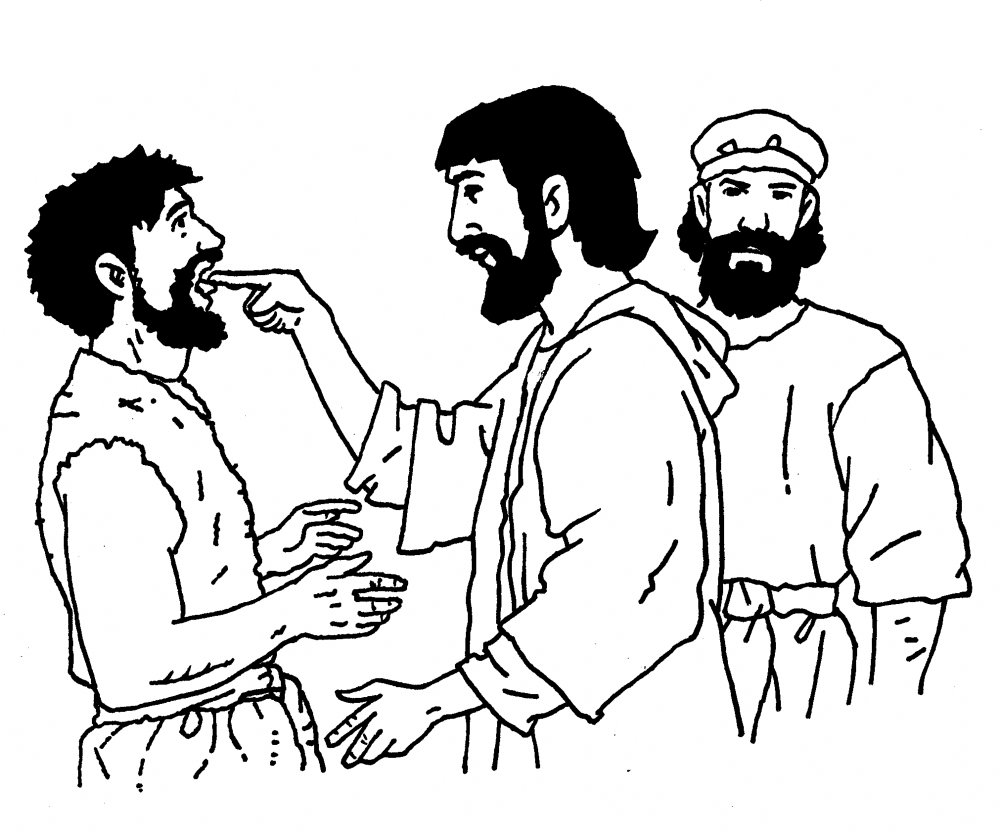
Mark 7:35 Courtesy of Eastern European Mission
Mark 7:35

That’s where it started for me. I’m also a Bible teacher. I’ve been a Bible teacher all my life and it’s a passion, along with helping people get the Bible. I’ve taught through all those passages multiple times, and when I teach I picture images in my head. I have an idea in my head.

One thing I like about images in the New Testament is even a normal reader will remember that illustration on a page. They may not remember what chapter Jesus says to render to Caesar what belongs to Caesar, but they’ll remember an image of a head on a coin. And you can flip through quickly, you find that you find what you’re looking for.

You worked with an artist named Fred Apps, your ideas, his art. How did that process work?

I told him from the beginning I was interested in doing illustrations for every chapter of the New Testament. He’s like, “Wow. Okay.” He’d done things that big, of course. He’s illustrated a lot of Bibles! Fred is a graphic artist, lives in London, and in the later part of his career, he kind of specialized in Bibles. He retired and then didn’t like retirement and went back to work and he’s done a number of big projects for EEM. But in all that work, he’s never done something so comprehensive for the New Testament, like what I had in mind.

1 Corinthians 4:5Courtesy of Eastern European Mission
1 Corinthians 4:5

He said he’d be willing to do it, but he had to have three eye surgeries. I wait a year and a half. Then he said yes, and that was right at the start of COVID-19.

I wrote instructions for each image. I sent him an instruction manual—279 pages. I read through the Bible, and for each chapter, I would come up with an image; try to find some examples surfing the internet, looking on Google Images; and then write a paragraph explaining the idea.

Then he would send me a pencil drawing and I would say, “Wow, look at that.” Or sometimes I’d say it needed something.

How long did all this take?

He puts out work pretty quick. He said, altogether, it was half a year’s work for him.

Are there plans to publish a Bible with these images? Right now they’re all available for download and you’re sharing them with a Creative Commons license, but will we see illustrated New Testaments soon?

It’s just artwork at the moment. We’ll see what they become! This is truly an experiment.

I want them to be used. We used the Creative Commons license, so I’m hoping other people will come with creative ideas that I would never think of. At EEM, our specialty is printing Bibles and New Testaments. But it’s also giving them away—not selling them. So that means anything we produce, we’re always looking to give it away.

If you add all these pictures to a New Testament, it would add about 10 percent to the length. That’s not too bad. They’re line drawings, black and white, so they won’t cost more to print. Just some extra paper.

The earliest we at EEM would put something out is 2024. But I’m also talking to people who put out Bibles in German, French, and other languages; we are maybe going to release very cheap versions to sell on Amazon. There could be an illustration Serbian New Testament soon.

I hope lots of people will find uses for it and it helps more people get the Bible.

Apple PodcastsDown ArrowDown ArrowDown Arrowarrow_left_altLeft ArrowLeft ArrowRight ArrowRight ArrowRight Arrowarrow_up_altUp ArrowUp ArrowAvailable at Amazoncaret-downCloseCloseEmailEmailExpandExpandExternalExternalFacebookfacebook-squareGiftGiftGooglegoogleGoogle KeephamburgerInstagraminstagram-squareLinkLinklinkedin-squareListenListenListenChristianity TodayCT Creative Studio Logologo_orgMegaphoneMenuMenupausePinterestPlayPlayPocketPodcastRSSRSSSaveSaveSaveSearchSearchsearchSpotifyStitcherTelegramTable of ContentsTable of Contentstwitter-squareWhatsAppXYouTubeYouTube