Books
Review

I Write Algorithms for a Living. God Doesn’t Want Me to Quit.

At a moment of career disillusionment, a new book gave me a biblical perspective on the blessings and dangers of big tech.

Christianity Today July 25, 2023
Illustration by Mallory Rentsch / Source Images: Getty / Unsplash

In the last decade, our lives have become increasingly saturated with digital technology. Apps and platforms play outsized roles socially, professionally, casually, and corporately; in work, school, and church. It can be hard to remember how we used to carry on without the technological conveniences of modern life. Even many young adults feel a chasm between the tech norms they grew up with and the world they inhabit today.

God, Technology, and the Christian Life

God, Technology, and the Christian Life

Crossway

320 pages

This shift seems even starker when we try to map our day-to-day digital experiences—instant news, AI chatbots, and the Metaverse—onto those we read about in the Bible. In his latest book, God, Technology, and the Christian Life, Tony Reinke outlines an incisive “theology of technology,” grounded in Scripture, which draws a clear connection between our lived experiences and those of our Old Testament heroes. In so doing, he sets a helpful foundation for a biblically-aligned worldview on modern technology.

I read this book at a timely moment, while dealing with a bout of disillusionment over my career. I’m a data scientist, a career technologist who spends his days writing algorithms that generate numbers and recommendations that populate the screens of millions of smartphones all over the world. My work involves the same techniques that large tech companies have exploited for more pernicious purposes, making them a focal point of cultural controversy.

I certainly appreciate the blessings that modern technology affords, and my tech-development day job brings real satisfaction. Yet I can’t help maintaining a healthy dose of skepticism toward ubiquitous tech use. It’s difficult to overstate the degree to which our daily habits have grown dependent on the platforms of big tech. Given their pervasiveness, it’s jarring to consider how many of them have vaulted to social prominence not through careful deliberation, but because of the revenue-seeking, data-hungry, often myopic actions of capital-heavy corporations. As a Christian, this reality has weighed heavily on my conscience and led to serious introspection over my vocational path.

Some may be surprised to find that such ambivalence is common among workers in tech-heavy fields. Their honest reflections won’t be found in public-facing press releases or Tweet storms, but in the anonymous corners of online forums. Backed by one of America’s most exclusive and lucrative startup accelerators, Hacker News is the cool news curator frequented by founders, developers, and industry-insiders. Between IPO announcements and code-heavy how-tos, the site regularly features nervous posts by seasoned technologists, petitioning for help reconciling their disillusionment with technology, their careers, and their lack of happiness. A quick scroll through the responses confirms that there is no consensus on what the answers are, or even where to begin looking.

New clarity on old priorities

This is the conundrum that Reinke’s book steps into. He gives an end-to-end account of tech’s lifecycle, covering its inception by God, its inaugural biblical stewards, its growth and development in cities, its increasingly idolatrous pretensions, and its final judgment. When it comes to honoring God with our technology, Reinke asserts that contemporary innovations don’t raise new questions so much as call for new clarity on old priorities. It’s through this simple paradigm that he applies the Bible’s ancient wisdom to our modern technological experiences.

Reinke begins his narrative in an unlikely place, with a substance that covers our driveways, streets, and playgrounds: tar. He uses tar (some Bible translations call it “pitch” or “bitumen”) as a common medium to connect the stories of Noah’s ark (Gen. 6) and the Tower of Babel (Gen. 11).

This example points to one of the book’s prevailing themes: Technology can be used either to glorify God or humanity, yet God remains sovereign in either case. Noah faithfully obeyed God’s command to construct the greatest boat of his time, and dutifully waterproofed it with tar. Just a few generations later, the Babelites cleverly paired tar with baked bricks in a bid to build themselves up into heaven. The same technology led to two opposing outcomes, yet neither episode posed any threat to God or strayed outside his control.

This portion of the book calls into question whether we can assign sweeping moral labels to technology itself. Instead, Reinke emphasizes how God is more concerned about the motives we bring to technology and the spiritual consequences of employing it in self-exalting ways. The problem with the Tower of Babel, he writes, citing one Genesis commentary, “is not that it makes God insecure, but that it sets man on a new path of self-confining self-destruction. Man’s increasing ambition and power don’t threaten God; they threaten man himself, because, ‘the more power they are able to concentrate, the more harm they will be able to do to themselves and the world.’”

Reinke’s solution is not that technologists abandon their craft, but instead that tech producers and consumers alike learn to see God in their tech. As he explains, affirming God as the creator of all technology and the teacher of all innovation turns science and engineering into a divine game of question and answer—a sort of spiritualized Marco Polo. We ask God what is possible, and he answers through the material world. Further, these lessons are a gift he gives us to ameliorate the curse of sin on creation. It’s through this lens that Reinke relates the God of Isaiah 28:23–26, who mercifully doles out agricultural instruction, to the world of modern tech.

The book’s greatest contributions lie in the way it develops a vocabulary to reason about new innovations, and in a pithy phrase—the “Gospel of Technology”—used to set the good news of Jesus against the idolatrous tech propositions of our era. Most Christian discourse carries a latent uneasiness with the pervasiveness of technology, but it often fails to clearly articulate what we’re opposed to or why. Reinke gives a name to our unease and makes a strong case for a moderate, tempered, nuanced, faith-filled approach, which stands in stark contrast to the false promises of fulfillment, redemption, and control laid out by the Gospel of Technology.

Careful readers, whether weary of yet another tech book or dizzied by the endless supply of opinions on the topic, will appreciate that Reinke’s book brings needed context to our current state of affairs by taking stock of ideas and events from across human history. Ultimately, he reminds us of the close and profound parallels between our modern tech tensions and the challenges faced by previous generations. “This is the human dilemma,” he writes. “Human innovation is a wonderful gift but a disappointing god. We cannot save ourselves. In the end, our innovations leave hearts unsatisfied, souls lost, and bodies cold in the grave.”

God’s sovereignty over innovation

Christians should walk away from this book assured that however technology may advance during our lifetimes, we ultimately have only God to fear (Matt. 10:28), because, as Reinke puts it, his “sovereignty cradles our technological futures.” We’re reminded that no level of human innovation can satisfy the longings of man’s heart, which transcend the constraints of our time (Ecc. 3:11) and find their ultimate fulfillment in Christ.

Personally, the book left me feeling exhorted to press deeper into my search for God in data science. Reinke’s description of the biblical precedent for understanding God through his creation, and thereby through our craft, has heightened my attention toward God’s place in my work. Further, it has given me a firm footing to evaluate my tech habits and to navigate the ethical quandaries that come with working in the tech industry. Reinke’s insight that new technologies do not (and will not) stop to critique themselves offers fresh motivation to consider and communicates the risks of technology.

Thankfully, the book avoids and denounces the fear-stoking tone that’s typically associated with Christian writing on the topic. Instead, it lays out a compelling argument that both tech optimists and pessimists tend to sell God short. We’re not wrong, Reinke affirms, to have a “low-grade discomfort” with this age of innovation. But as we wait for Christ’s return, we can trust that our sovereign God reigns over even the most unsettling prospects we might face.

Collin Prather is a data scientist for iRobot, a firm based in Bedford, Massachusetts.

Theology

The Two Holy Ghostwriters Behind American Christianity’s Charismatic Turn

Church life was booming in the 1950s. But where was the Spirit?

John and Elizabeth Sherrill

John and Elizabeth Sherrill

Christianity Today July 25, 2023
Illustration by Christianity Today / Photo Credit: John L. Sherrill / Courtesy of Baker Publishing Group

It started with an innocent-enough question: “Have you ever heard of the expression speaking in tongues?”

For the magazine editor who asked it, it was just a story idea. But it turned into a journalistic investigation that changed a reporter’s spiritual life, brought many Christians into a personal relationship with the Holy Spirit, and blew through evangelicalism with a strong charismatic wind. They Speak with Other Tongues, the compelling 1964 account of John Sherrill’s journey from skeptical reporter to ecstatic, tongues-speaking spiritual autobiographer, has had a profound impact.

As I have researched and written my new book, Age of the Spirit, I’ve thought a lot about the kinds of people who brought charismatic renewal to Anglo-world Christianity. There were preachers, teachers, and evangelists; businessmen, hippies, and housewives; professors, faith healers, frauds, and lots of everyday people who just wanted more of whatever God had to give them. The vehicle for many of these people to experience the Spirit was through the “personal witness story,” and the authors of so many of these stories in the 1960s and 1970s were John and his wife, Elizabeth “Tib” Sherrill.

It’s been almost 60 years since they wrote They Speak with Other Tongues, and both authors have now passed—Elizabeth died earlier this year. But for those of us who live in a world where people sometimes pray in a language they do not understand, where God still speaks to individuals, and where the faithful expect to see the Spirit at work in their daily lives, it’s the world the Sherrills built.

The Sherrills’ books provided a “charismatic catechesis,” preparing readers for life as Spirit-filled Christians. Their literature not only endorsed “new” experiences—such as baptism in the Spirit—but also provided a relatable script for others to have the same. As CT news editor Daniel Silliman argued in his book, stories shape and organize modern Christianity. It’s hard to think of a better charismatic example than the authors of They Speak with Other Tongues, The Cross and the Switchblade, God’s Smuggler, and The Hiding Place.

With the magazine editor’s question, the journalist John Sherrill in 1960 embarked on research into a phenomenon which—it was whispered—was gaining ground in American churches. Sherrill chased the story enthusiastically. He visited Pentecostal congregations but, more surprisingly, also found people who had known the experience outside these churches. Sherrill became fixated on understanding tongues.

The decade before the publication of Sherrill’s book was, on the face of it, a wildly successful time for American Christianity. The 1950s was a period of Christian boom: church building projects, marketed revival crusades, high ecumenical ambition, and grand contraction of religious institutions. Some critics, however, asked what had happened to what might be called “enthusiasm”: the mystical experiences, ecstatic encounters with the divine, or the kind of transcendent experiences that marked earlier eras of intense religiosity.

Missing from this thriving, flourishing Christianity seemed all talk about the Holy Spirit. As the Sherrills wrote, the Spirit was, in a sense, a ghost—“an aspect of God, the third member of the Trinity, a concept you acknowledged every Sunday in the Creed; but a ghost just the same, as if He were the featureless remnant of someone who at one time in the Church’s life had been very real indeed, but now was little more than a memory.”

There had been, a little earlier, an explosive Christian movement to revive the spiritual gifts of the early church as recounted in Acts. These people were called Pentecostal, hearkening back to the Day of Pentecost in Acts 2, where Christ’s followers heard the sound of a violent wind, saw fire fall, and began to “speak in other tongues as the Spirit enabled them.”

That movement, however, prompted what historian Grant Wacker described as “a brawl fought without rules, in the mud.” Pentecostals separated from other Christians and built their own institutions.

Meanwhile, evangelicals became increasingly suspicious of any contemporary supernaturalism (even while, in their own minds, they took bold stands against modernist materialism, specifically Christians who rejected biblical accounts of the supernatural). Princeton theologian Benjamin Warfield, for example, wrote Counterfeit Miracles, arguing that the early church received spiritual gifts for “the authentication of the Apostles” but the contemporary church did not. Warfield’s view, known as cessationism, was widely popular.

During the post–World War II church boom, however, some Christians became restless. They were not convinced that Christian life in America—even with very high church attendance and broad cultural respect for ministers like Norman Vincent Peale and Billy Graham—was as vibrant as it seemed. They were seeking something more.

There was growing interest in inner healing, with mainline Protestants drawn to organizations such as Camps Farthest Out and authors such as Agnes Sanford. Small prayer groups, offering a great sense of intimacy and experimentalism, were quietly growing in various Christian communities. Catholics joined Cursillo discipleship groups. And then upwardly mobile Pentecostals started to be more ecumenical and less hostile, inviting everyone they met to groups such as the Full Gospel Business Men’s Fellowship.

It was in this flux of piety that They Speak with Other Tongues became situated. The Sherrills’ book reported the experiences of Christians who had begun to find a new supernatural dimension in their lives. The book discussed, for example, Harald Bredesen, the minister of First Reformed Church, in Mount Vernon, New York, whose “religious life had no vitality to it” before a powerful experience of the Spirit.

It described the experience of Dennis Bennett, an Episcopalian priest whose resignation following a tongues controversy in his parish in Van Nuys, California, caused enough of an uproar to get reported in Time and Newsweek. It also included veterans of encounters with the Spirit, such as the Methodist missionary E. Stanley Jones, who was “filled” while at Asbury College, Wilmore, Kentucky. The Sherrills’ book was written on the cusp of a shift in American Christianity: Charismatic renewal was about to explode.

The Sherrills chased the story enthusiastically. Trying to make sense of glossolalia, they went so far as to make tape recordings of tongue speakers to submit them to language experts for scrutiny. John Sherrill, in particular, became fixated on understanding tongues. He learned from his interviewees that to understand tongues, he should really pursue the experience from which they (often) followed: the “baptism” or “filling” of the Holy Spirit.

Then at a prayer meeting in Atlantic City in December 1960, he decided he wanted to explore this experience of the Spirit “from the inside.” Opening himself to this possibility, Sherrill had an encounter, and something happened: “From deep inside me, deeper than I knew voice could go, came a torrent of joyful sound.”

He became part of the story. The journalistic investigation blurred with spiritual autobiographic. The remarkable account of a spiritual movement became, at the same time, a personal narrative.

The Sherrills were, as a matter of fact, experts at these kinds of personal narratives, testimonies of religious experience, and the transformation wrought by faith. They honed the craft of these stories in their years at Guideposts, the magazine launched by The Power of Positive Thinking author Norman Vincent Peale. As I argue in Age of the Spirit, authors such as the Sherrills didn’t just seek to capture the charismatic renewal with these narratives. At a deeper level, they were the charismatic renewal.

It seemed that the wind of the Spirit blew with these books across the face of American Christianity.

The year before they published They Speak with Other Tongues, the Sherrills related the personal witness story of a Pentecostal minister named David Wilkerson in The Cross and the Switchblade.

The book, cowritten with Wilkerson, was an account of a “one-man mission to the asphalt jungle” of New York City and the birth of Teen Challenge. The city described in the book is a scary place—a city of darkness, a ghetto Gotham.

“The enemy lurked in the social conditions that make up the slums of New York,” the Sherrills wrote.

The book described how Wilkerson—empowered by the Spirit—offered unconditional love to street gangs. When one gang member, Nicky Cruz, threatened to stab and kill Wilkerson, the minister replied, “You could cut me in a thousand pieces and lay them out in the street and every piece would love you.”

The line was destined to be repeated from a thousand pulpits. The book caught the imagination of so many Christians. A generation imagined themselves daring to go to the scene of the worst social problems and relay the love of Jesus. They thought about what it would be like if they too were baptized with that fire from Acts 2, started to speak in tongues, and as a result could fearlessly testify to God’s love.

The book was a bestseller, with millions of copies distributed worldwide. The Cross and the Switchblade owed its success in part to the power of the narrative and the Sherrills’ arresting storytelling. But more than this, it tapped into a changing spiritual mood in the early 1960s. Many Christians were seeking a reanimated, authentic version of the faith. And The Cross and the Switchblade told a story that readers could use as a script to achieve that Spirit-filled transformation.

As one reviewer in England said, if you read the book, you could “breathe the same atmosphere as exists in the New Testament.”

Following the publication of The Cross and the Switchblade and They Speak with Other Tongues, the Sherrills rose a charismatic wave. They wrote God’s Smuggler, the story of the ministry of a Dutch Christian, Anne van der Bijl, or Brother Andrew, who snuck Bibles into Communist countries. It was an adventure story about someone moved to do great things by his faith.

Most who read God’s Smuggler probably did not think of it as a charismatic tale. Unlike Wilkerson, Brother Andrew did not speak in tongues at a hinge point in the plot or dwell much on the “second blessing” of the Spirit accompanied by a gift of supernatural power. But a charismatic message was there nonetheless. Brother Andrew prayed for modern-day miracles. They happened. And readers were told they could do that too, with a little faith.

There’s no big argument in the book about cessationism, whether Christians today live in the same kind of universe that the early Christians did, or if the world is somehow less supernatural. The Sherrills just matter-of-factly described God intervening at a Communist checkpoint—and like that, the evangelical imagination was transformed.

A few years later, the Sherrills came out with perhaps their best book, The Hiding Place. It tells the story of Corrie ten Boom, another Dutch Christian. She and her family defied the Nazis, hiding Jews to help them survive the Holocaust, but then were caught and sent to concentration camps themselves.

The Hiding Place is also not explicitly charismatic, but it presents ten Boom as a woman so transformed by the Spirit working in her that she can love not only her neighbors (Jews) but also her enemies (Nazis). The final challenge she faces in the story is forgiving one of the guards from the prison camp where her sister, Betsie, had died. This was a vision of spiritual life radically more vibrant than the 1950s picture of a big church with full pews.

The Sherrills’ stories dominated Christian reading lists in the 1960s, ’70s, and ’80s, and American evangelicalism was extensively “Pentecostalized.” Even those who didn’t get baptized in the Holy Spirit had their imaginations renewed by the charismatic renewal. The story of that transformation is, in a deep way, a story about imagination. And it’s a story about the impact, as my friend University of Exeter literary scholar David Parry recently put it, of the Holy Ghostwriters of the charismatic movement.

John Maiden is a senior lecturer in religious studies at The Open University and the author of Age of the Spirit: Charismatic Renewal, the Anglo-World and Global Christianity, 1945–1980.

News

Digital Hymnal’s Demise Is Delayed

Lifeway still plans to end online music resource but apologizes for short notice.

Christianity Today July 24, 2023
colincollect / Lightstock

Update (July 24): Lifeway has decided to postpone the discontinuation of lifewayworship.com, the online Baptist church music resource that was once conceived as a digital hymnal without a back cover. The Southern Baptist Convention publisher announced it was shutting the site down last week, but backtracked after an outcry from a lot of surprised worship leaders.

“We are delaying the implementation of this decision until we have time to listen, allow for dialogue, and find out how we can best support churches’ digital worship music needs,” Ben Mandrell, Lifeway CEO, said in a statement. “We are actively considering alternatives to ensure minimal disruption and keep this essential catalog alive.”

Mandrell apologized the publisher “didn’t put the turn signal on soon enough.”

When Lifeway made its initial announcement, it was unclear whether the arrangements and materials available on lifewayworship.com would be fully preserved somewhere. Lifeway Worship director Brian Brown emphasized that music ministers needed to download what they wanted before September 30, raising questions about the fate of the vast catalog of musical resources maintained on the site. Brown told CT he had hoped to migrate all the content to Lifeway’s main website so it would continue to be available, but as he prepared to make the announcement, his team realized that wouldn’t be possible in the next few months.

“Each product has to be recreated individually, and it’s tens of thousands of products,” Brown said. “It’s not something that we are going to be able to accomplish by September 30.”

Lifeway still plans to shutter the online resource, but it will remain online until it can be made available elsewhere. The publisher said it is exploring partnerships with other organizations.

—–

Original post (July 19): Lifeway is closing the book on an online hymnal that was supposed to be the digital future of Baptist music.

The online resource lifewayworship.com, which provides church choirs and worship teams access to more than 3,000 songs as well as instrumental arrangements, sheet music, and chord charts, will shut down at the end of September.

Lifeway, the publishing arm of the Southern Baptist Convention (SBC), announced the decision Tuesday. The publisher said it has decided to “focus its resources on areas where we can faithfully serve more churches in greater breadth and depth.”

When Lifeway launched the site in 2008, it was envisioned as a modern hymnal that would continually grow and expand, making Baptist music widely available. The website struggled to compete against other services, though, that did not have the same denominational limitations.

“The reality is the vast majority of churches have chosen SongSelect and PraiseCharts as their preferred services,” said Brian Brown, current director of Lifeway Worship. “We are prayerfully considering how we might continue to serve leaders.”

The previous director, Mike Harland, said the development of lifewayworship.com began with a conversation about the future of the Baptist Hymnal. Harland and his staff wanted to imagine a new, online future for Baptist church music.

“Our goal was to create a hymnal with no back cover,” he said.

They started with the 674 songs in the Baptist Hymnal, which was also revised in 2008, and started adding to and curating the growing body of music on the site. It grew well beyond the number that could have been included in a physical book.

Churches could submit suggestions for new songs to include in the site’s collection. But the staff also dug into the history of Baptist hymnody for older songs that might deserve a place in the expansive online resource.

“We weren’t trying to be prescriptive, we were trying to be responsive,” Harland said. “We would reach in both directions: we would reach back to songs we might have missed in the original hymnal and then we would be listening very closely to what was happening now.”

But from the beginning, lifewayworship.com was not intended to be a cutting-edge digital resource.

“We were a music company first, we weren’t a computer company,” Harland said. “There were certainly other companies that had more user-friendly platforms, but we aspired for our content to be the very best.”

The emphasis on musical quality over a more advanced interface is one of the things that made lifewayworship.com a beloved resource for many church musicians.

John Strickland, pastor of worship and media at Tabernacle Baptist Church in New Bern, North Carolina, says that the instrumental arrangements for piano, strings, and winds are unmatched by what is available on similar platforms.

“A lot of people don’t have the ability or time to write custom instrumental arrangements,” said Strickland. “Pianists who don’t read chord charts or improvise easily can read these realized piano charts.”

Strickland also said that he has come to rely on lifewayworship.com for parts for individual instruments when he doesn’t have the musical forces for a full orchestra. Until recently, sites like PraiseCharts did not make instrumental parts available à la carte; directors had to purchase full orchestrations, which are more expensive.

“If I had a clarinet and a violin and nothing else, I could buy parts for them,” said Strickland, who noted that small ensembles and solo musicians are common features in worship services for smaller churches, many of which do not have a full-time worship director with the time to compose and write out instrumental arrangements.

Some ministers were dismayed by the news and upset it came so suddenly.

“What a mess,” wrote a music teacher and volunteer music minister from Texas on Facebook. “I am going to have to work even harder to find good arrangements for church.”

Lifewayworship.com has generally been the more affordable option. A full orchestration of Chris Tomlin’s “Holy Forever” is available on PraiseCharts for $52.95. On lifewayworship.com, the full score costs $6.99. PraiseCharts offers packages of à la carte arrangements for instrument groups—saxophones, woodwinds, brass—but not individual instruments. Lifewayworship.com breaks things down: $1.64 for an alto sax part, $1.64 for a cello part.

Lifewayworship.com also allowed lay musicians to purchase music without a paid membership, unlike SongSelect, which best meets the needs of churches and organizational leaders and has memberships that start at $180 per year for copyrighted songs. An individual looking for piano music for a recent popular worship song or two won’t be able to purchase it without a membership.

Despite its reputation as a source of affordable and high-quality arrangements, however, lifewayworship.com lacked some of the in-demand features now provided by SongSelect and PraiseCharts. Integration with programs like Planning Center wasn’t as simple with the site, the interface wasn’t as intuitive, and it didn’t provide charts using the Nashville number system.

Brown at Lifeway Worship told CT that the company hopes to make its lifewayworship.com library available on its website in the future and that the publisher will continue to sell church resources such as hymnals, communion supplies, and sheet music. People who purchased any resources on the site will still be able to download them through the end of September.

Lifeway Worship also plans to partner with the music retailer JW Pepper to make its instrumental arrangements from lifewayworship.com available for purchase. JW Pepper already has received titles from Lifeway’s choral collection and the company can offer on-demand printing services for out-of-stock products.

Lifeway Worship has no plans, however, to continue producing new music or musical arrangements after August 2023. But Brown is quick to point out that discussions about the future of Lifeway Worship are ongoing, and new music hasn’t been ruled out.

Will Bishop, associate professor of church music and worship at Southern Baptist Theological Seminary and author of a recent study on musical practices in the SBC, sees this as the end of an era for the 82-year-old Lifeway Worship, formerly the church music department of the SBC Sunday School Board.

“If a resource is not being used, it’s going to go away,” Bishop said.

Lifewayworship.com may have benefitted from the credibility of being affiliated with the SBC in its early days, Bishop said. But there has been a shift away from denominational musical resources. Lifeway stopped producing choral music in 2021. There hasn’t been a new printed version of the Baptist Hymnal since 2008, and there are no current plans for a new edition. The SBC publisher’s decision to stop creating new arrangements of contemporary worship music is another step away from denominational music production.

According to Bishop, the signs of this coming change have been visible for several years. The trend was already going that direction and the pandemic only accelerated it.

The director who led the development of lifewayworship.com is sanguine, however, about the future. Harland thinks the church music market still wants some version of the ever-evolving digital hymnal he and his staff developed.

“Other companies will step in to fill the void,” he said.

Since he’s left Lifeway, he and his church, First Baptist Church in Jackson, Mississippi, have used lifewayworship.com alongside other tools. He anticipates some challenges as they adjust to the absence of the site he helped create, but he voiced overall optimism.

“The song will go on,” he said. “The church will keep singing.”

News

Where Boomer Faith in God Is Low, Gen Z Belief Is Up

What nearly 20,000 people in 26 countries believe about God, Satan, and the supernatural.

Christianity Today July 24, 2023
Illustration by Abigail Erickson / Source Images: Getty, Unsplash

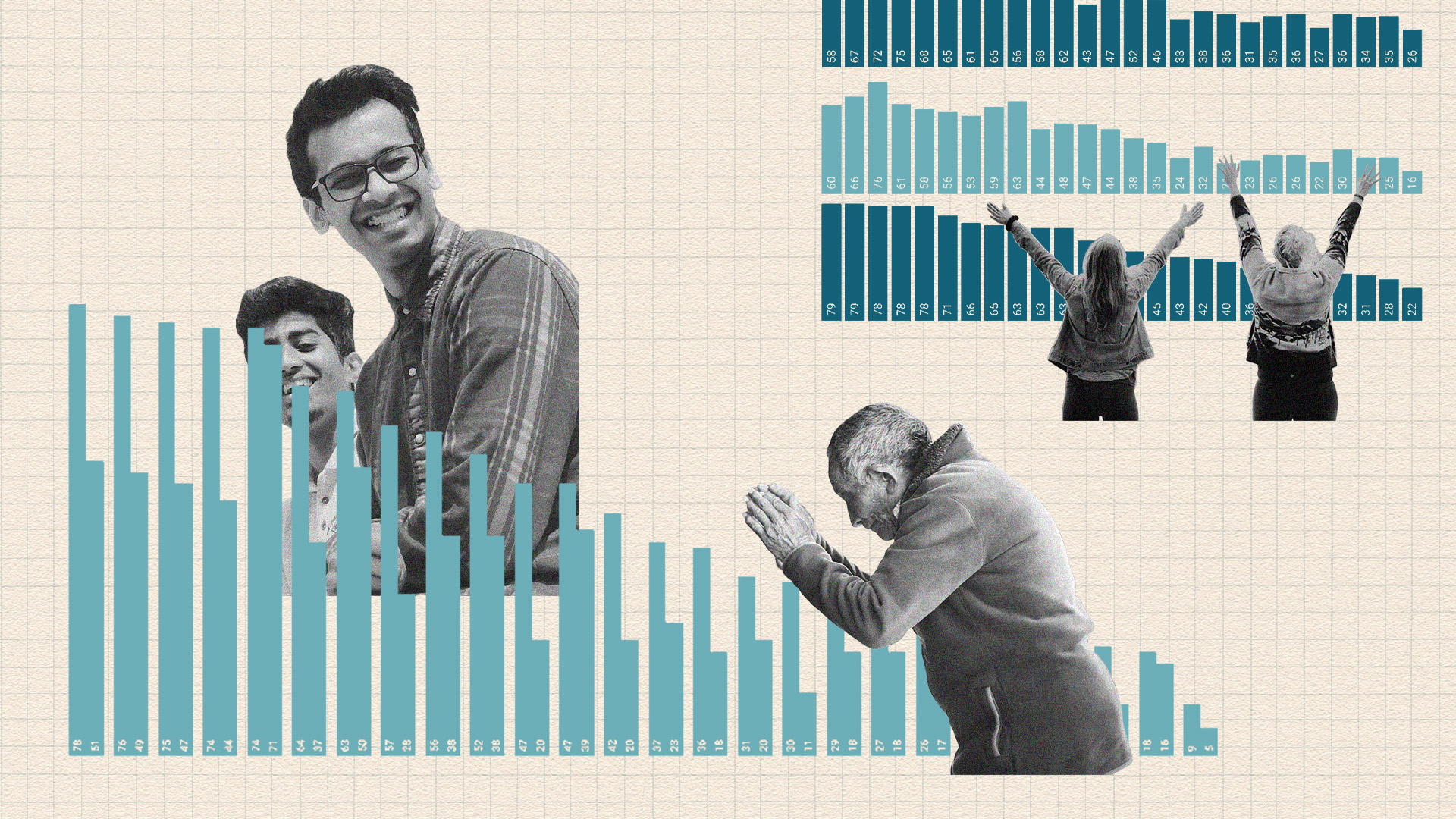
Countries with more baby boomers who say they believe in God as described in “holy scriptures” (including the Bible, the Quran, and the Torah) are less likely to have members of Gen Z who do.

But countries with fewer boomers who hold this belief are more likely to have members of Gen Z who do.

In a recent Ipsos Global Advisor survey of nearly 20,000 adults from across 26 countries, the researchers found that in nine countries where less than one-third of adults believe in God as described in holy scriptures, Generation Z was more likely to hold these convictions than boomers.

In Northern and Western Europe, Gen Z was more likely than the boomer generation to say they believe in heaven, supernatural spirits, hell, and the Devil. In places like South Africa and India, however, boomers were more likely than Gen Z members to believe in these aspects of the spiritual realm.

Boomers were also more likely than younger people to identify as Christian in half of the countries.

This study was conducted via face-to-face and online interviews. However, only Australia, Argentina, Belgium, Canada, France, Germany, Great Britain, Hungary, Italy, Japan, the Netherlands, Poland, South Korea, Spain, Sweden, and the US numbers can be considered representative of their general adult population.

“Samples in Brazil, Chile, Colombia, Mexico, Peru, Singapore, South Africa, Thailand, and Turkey are more urban, more educated, and/or more affluent than the general population,” explains Ipsos. “The survey results for these countries should be viewed as reflecting the views of the more ‘connected’ segment of their population. India’s sample represents a large subset of its urban population—social economic classes A, B and C in metros and tier 1–3 town classes across all four zones.”

Among the countries surveyed, the percentage of Christians as a portion of the population peaked at 76 percent. However, most of the countries had Christian majorities, and more than two-thirds of people in Peru, South Africa, Mexico, Colombia, Poland, Brazil, Italy, and Argentina identified as Christians.

The beliefs and practices of Christians in these countries, however, diverged sharply from one another.

Well over half (64%) of Peruvians surveyed said they pray outside a place of worship once a month or more; however, less than half (37%) said they go to a place of worship that often. And the percentage of people in Peru who believe that religion does more harm than good dropped from 38 percent in 2017 to 32 percent.

Colombia followed a similar pattern, where more people pray outside a place of worship (74%) than attend a place of worship (44%).

The same tendencies could also be seen in Brazil, where 70 percent of the population said they are Christian. Brazilians surveyed expressed strong positive associations with God’s role in their lives. The vast majority said that believing in God or higher forces allows them to overcome crises (90%), gives meaning to their lives (89%), and makes them happier on average (88%). The country’s rate of religious tolerance also increased from 70 percent in 2017 to 81 percent in 2023.

Of the 26 countries surveyed, South Africa expressed the highest levels of tolerance (92%) for other religions. It also had the highest percentage of people (78%) who pray outside a place of worship, although, much like Brazil and Colombia, only about half (51%) actually attend. The country had the most positive associations with God’s role in people’s lives, with more than 80 percent of respondents saying that their belief in God or higher forces helps in overcoming crises (89%), gives meaning to life (93%), and makes them happier (89%).

Religious tolerance in Mexico increased from 66 percent in 2017 to 73 percent in 2023. And the belief that religion does more harm than good dropped from 43 percent in 2017 to 37 percent in 2023. The number of people who said that religion defines them as individuals rose from 31 percent in 2017 to 42 percent in 2023.

While three-quarters of Polish people are Christian (75%), only about half (52%) believe in God as described in holy scripture. And although religious tolerance increased in Poland from 74 percent in 2017 to 80 percent in 2023, other religious metrics dropped in the same time frame.

For instance, there were decreases in the number of people who said they believe in the following categories: that religious practices are an important factor in the moral life of a citizen (62% vs. 48%), that religion does more harm than good (49% vs. 44%), that religion defines a person (54% vs. 45%), and that people with a religious faith are better citizens (36% vs. 26%).

A majority of Italians identify as Christian (68%), yet less than half pray outside a place of worship at least once a month (37%) and even fewer attend a place of worship at least once a month (23%). Similarly, a minority of people in Italy believe that religious faith makes someone a better citizen (34%), that religion defines a person (48%), and that people with a religious faith are happier (47%).

Much like Italians, less than half of Argentinians said they pray outside a place of worship (42%) and less than a quarter go to a place of worship (20%). Although a little over two-thirds of the population said they are Christian (68%), only about half said they believe in God as described in holy scripture (53%).

While Christianity in South Korea has historically been more robust than in other parts of East Asia, among the countries polled, South Korea had the highest percentage of people who claim to have no religion (53%) and the highest percentage of those who said they do not believe in God or any higher power (44%). From 2017 to 2023, South Korea’s religious tolerance also dropped from 65 percent to 53 percent.

Japan exhibited lower levels of religious interest as well. The country repeatedly had a low, if not the lowest, percentage for any religious affiliation across the board—with only 2 percent claiming to be Christian. From 2017 to 2023, Japan became 26 percentage points more likely to believe that religion does more harm than good, increasing to 52 percent.

In Hungary, whose leader, Viktor Orbán, has become a champion of Christian nationalism, Christians make up the majority (58%) of the populace, though 31 percent claim no religion at all. Less than a quarter of the population agreed that religion defines them as individuals (15%) and that people with religious faith are better citizens (16%). Six percent said they lose respect for people when they discover they do not have a religious faith.

Among Hungarians, some of these categories dropped significantly from the 2017 survey, including a decrease from 53 percent that year to 37 percent in 2023 for the number of people who believe religion does more harm than good. There was also a drop from 29 percent in 2017 to 15 percent in 2023 for the number of people who believe that religion defines them as individuals.

Half of the 26 countries surveyed had majorities who believe in heaven. But only 9 of those had majorities that believe in hell, 12 had majorities that believe in supernatural spirits, and 9 had majorities that believe in the Devil.

Of all countries surveyed, Peru had the largest percentage of people (79%) who said they believe in heaven. Majorities also said they believe in hell (60%), although this figure represented a nearly 20 percentage-point drop from those who believe in heaven.

While Brazil (79%), South Africa (78%), and Colombia (78%) also had high percentages of people who believe in heaven, they had lower percentages of people who believe in hell, with 66 percent, 61 percent, and 58 percent respectively.

Forty-four percent of Belgians identify as Christian. But of all countries surveyed, they had lowest number of people who said they believe in heaven (22%), supernatural spirits (26%), hell (16%), and the Devil (18%).

The survey’s most religious non-Christian countries included India, Thailand, and Turkey, with nearly 100 percent of people in India (99%) and Thailand (98%) claiming to be religious.

Despite such a high religious population, only 2 percent of India’s population claim to be Christian. A majority said they believe in heaven (54%), but less than half believe in hell (47%), supernatural spirits (43%), and the Devil (41%).

In the same way, only 4 percent of Thais surveyed said they are Christian. Yet Thailand had high majorities of people who have positive associations with God’s role in their lives—over 80 percent agreed that believing in God or higher forces helps them overcome crises (82%), gives meaning to life (85%), and makes them happier (88%).

Out of the 26 countries surveyed, Thailand had the lowest percentage (27%) of those who believe that religion does more harm than good. People in Thailand said they believe in heaven and hell, equally, at 63 percent, but under half of Thais surveyed said they believe in the Devil (40%).

Although 87 percent of Turks surveyed said they are religious, only 2 percent are Christian. Turkey also had significantly high majorities of people who believe in heaven (78%), supernatural spirits (72%), hell (76%), and the Devil (76%).

From 2017 to 2023, five countries saw declines in the percentages of people who believe their religion defines them as individuals and who believe that religious practices are an important factor in the moral life of their country’s citizens. Hungary, Germany, South Korea, Poland, and the United States were the nations that experienced this.

Overall, most people in all the countries surveyed felt comfortable around others with different religious beliefs. Religious tolerance rose in nine countries from 2017 to 2023, with France seeing the largest increase: 63 percent to 79 percent. Tolerance fell in just four countries, with South Korea having the most significant drop: 65 percent in 2017 to 53 percent in 2023.

News

Extremists Are Destroying Indian Christians’ Homes and Shattering Their Lives

For nearly two decades, mob violence has driven believers from their communities and upended their sense of security.

Delhi Relief Facility

Delhi Relief Facility

Christianity Today July 24, 2023
Photo by Surinder Kaur for Christianity Today

Since the beginning of May, ethnic and religious violence in Manipur, a state in northeast India, has resulted in the deaths of at least 142 people, the destruction of over 300 churches and hundreds of villages, and one of the largest violence-driven internal displacements in recent Indian history. A fact-finding team that visited earlier this month reported that the clashes were “state-sponsored,” and the violence has uprooted more than 65,000 people from their homes and forced them to seek shelter elsewhere.

India records the highest numbers of internal displacements annually, primarily due to natural disasters. But recent communal violence and persecution against religious minorities has wreaked havoc in numerous Indian states, including Gujarat, Madhya Pradesh, and Odisha.

While the government has an official legal framework for helping communities displaced by natural disasters and development projects, it has none for those displaced by violence or manmade conflict. Instead, the level of response has varied widely depending on public sympathy for the victims, media attention, and protests by those affected. Rehabilitation, including the provision of permanent shelter, jobs, and education, remains a significant challenge for the government and the church.

More than two months after the violence began in Manipur, at least 1,000 families are sheltering in Delhi, says L. Kamzamang, a pastor working with internally displaced persons (IDPs) from Manipur.

“Not only are most of the IDPs scattered in various cities and towns in India not wanting to go back to their homes, but young people who are in Manipur are planning to come out of Manipur,” said Kamzamang. “There is nothing to do there. There are no jobs, no source of income. Everything stands still. How will these young people support themselves and their families there?”

A lack of numbers

Regardless of the reason, displacement causes immense and lasting suffering and upheaval for the affected individuals and communities. It can uproot entire populations from places they have called home for up to hundreds of years and destroy livelihoods, social networks, and economic stability.

IDPs and refugees often lose their connection to the land, historical sites, sacred places, and cultural artifacts, all of which hold deep meaning for them. Displacement disrupts the transmission of cultural knowledge, traditions, and languages from one generation to another and can result in the erosion of cultural practices, customs, and beliefs that have been passed down for centuries.

When a community is dispersed and its members are scattered, the collective memory and shared experiences that form the foundation of a cultural identity can be fractured, besides disrupting education, healthcare, and basic services, and exacerbating the vulnerability of those affected. Displaced individuals may also face discrimination, marginalization, and further violence in their search for safety and stability.

India records some of the highest figures for internally displaced persons each year, according to the Internal Displacement Monitoring Centre (IDMC). The country’s large population and socioeconomic vulnerability contributes to the scale of displacement, a situation often provoked by natural disasters.

In the last seven years, an average of over 3 million people per year have been displaced in India. In comparison, fighting in Ukraine has resulted in a total of 1.7 million IDPs between 2014 and 2021.

As for those who have been internally displaced due to violence or conflict, systemic data on those affected is virtually nonexistent due to the absence of a legal framework and the lack of government data. But in 2022 the IDMC recorded 1,000 IDPs primarily resulting from localized incidents of intercommunal (sectarian) violence.

As of late 2022 and prior to the Manipur conflict, approximately 631,000 Indians are still displaced within the country. Many of these communities have been displaced for several decades, including 108,000 people from northeastern India, due to conflicts in northeast states Assam, Mizoram, and Tripura, and 321,000 people from northern states Jammu and Kashmir. Currently, 18 of India’s 28 states are home to IDPs.

A growing terror

Displacement due to religious persecution and conflict in India dates back to the early days of the country. The Partition of India in 1947 changed the political borders that formed India and Pakistan, spurring the killings of more than a million people and causing a massive displacement of at least 20 million. Millions of Muslims migrated from the Indian side to the Pakistan side, while Hindus, Sikhs and others moved towards present day India. Since then, sectarian strife—or communal violence, as it is better known in India—has pushed minorities and underprivileged communities to seek refuge both inside and outside the country.

For years, large-scale religious violence mostly spared Indian Christians, while Muslim minorities were regularly targeted—and continue to be today. Then in the 1990s, those influenced by Hindu extremist ideology, which justifies violence toward religious minorities, began to systematically target Indian Christians.

In 1998 extremists burned down 35 churches between Christmas and New Year’s in the Dang district of Gujarat. Some Christians permanently left the area over this attack, says Jimmy Damore, a Christian leader in Gujarat.

In 2003 and 2004, extremist mobs and leaders associated with Hindu right-wing movements and political parties attacked Christians in the Jhabua and Alirajpur districts of Madhya Pradesh. The government was slow to secure the situation, leaving Christians away from their homes for months.

The worst post-independence violence against Christians in India took place in 2008 in Kandhamal, Odisha, where mobs killed at least 100 people and drove at least 75,000 people from their homes.

Unlike earlier Christian IDPs, a large number of Kandhamal residents did not return—attackers had destroyed their homes. After months in under-resourced and neglected relief camps, many moved to cities where they struggled to find long term, secure employment in other cities in the state.

“Well-settled people with property and homes now had to embrace poverty,” said John Dayal, who led an independent fact-finding team to Kandhamal in January 2008. “Emerging from poverty is not easy; it has to do with long term employment, and not instant charity that may follow violence or a natural disaster. Charity did build some houses [for the victims], but the move out of poverty came for those who could get employment.”

Since the Kandhamal attacks, there have been multiple reports of Christians being threatened, beaten up, socially boycotted, and forced to flee their homes from states like Jharkhand and Madhya Pradesh.

Last year, violence broke out in Chhattisgarh against the tribal Christian community and displaced more than 2,500 people. Fleeing believers left behind animals, crops, and numerous belongings inside their homes, says Akhilesh Edgar, bishop of the Milap Community Episcopal Church and a resident of Chhattisgarh.

“Their homes were looted, animals were stolen, and crops were confiscated,” he said.

Since then, many previously economically stable community members have been forced into “abject poverty,” with little ability to provide for their families beyond seeking out work as daily wage laborers.

“Life for the displaced does not continue to remain the same and is in a way worse than the violence unleashed against them, as they are forced to start from scratch all over again and in a place that is not familiar to them,” said Edgar.

The lack of security and severe loss of property forces victims to make hard choices, says Vijayesh Lal, general secretary of the Evangelical Fellowship of India.

“Most end up in poverty and stare at a future that is uncertain for them and their families. The struggle to survive takes precedence over the struggle for justice,” he said. “There is no time for reflection, for mourning, or even to address the deep-seated mental and emotional trauma that is irreparable.”

The new normal

Generally, India’s state governments, in collaboration with the central government, undertake the rehabilitation of displaced communities through diverse assistance schemes and programs. But because there is no specific law for people displaced due to violence or conflict, there is also no uniformity in the compensation, as Outlook highlighted last year .

Instead, authorities’ responses to victims depend on IDP protests and media coverage of the attacks. Last December, more than 1,500 Christians fled from their homes due to violence in Chhattisgarh. They were forced to spend two days and nights outside in harsh weather conditions in front of a government office in Narayanpur, begging local leaders to provide a safe place for them to shelter. Only after media began highlighting these victims’ plight did the local authorities open an indoor stadium for the IDP community.

However, due to likely pressure from higher-ups and Hindu right-wing groups, within days the government insisted that the Christians return to their villages. Without other housing options, some returned to hostile environments where they continue to face violence, opposition, pressure, social ostracization, and discrimination, and are regularly forced to recant their faith.

On the other hand, according to local leaders, only a fraction of the internally displaced persons in Chhattisgarh have gone back. Others chose to stay in district headquarters or nearby towns where they could periodically check in on their ransacked village homes.

“Everything that I owned has gone, I do not know how we will face tomorrow. We are back in our village, for we could not afford rentals in Narayanpur town, but the villagers have told us that they are waiting for the right opportunity to kick us out of our own home once again,” one visibly disturbed resident, who did not want to give their name for security reasons, told CT.

As Chhattisgarh Christians grapple with this new normal, Edgar remembers that this was not always the case. Religiously-diverse tribal communities have been living together on very good and friendly terms for decades, he points out.

“People in this region have been following the Christian faith for a long time. Some are even third or fourth generation Christians and have lived in peace and harmony for decades with fellow villagers and neighbors. It is only when groups with vested interests and ideology enter the area and mislead the people, only then this violence and atrocities started,” said Edgar. “To initiate peace and to rehabilitate people in their own homes, the government must make sure that the organizations that polarize people are stopped, and that a message of trust and tolerance is spread.”

But for many Christians in Manipur, preventative measures are too late.

Thousands are still living in relief camps or with their relatives or friends in Manipur and in other states. There are reports of armed groups attacking relief camps, raising concerns over the security and safety of those being sheltered there.

Weeks after violence first forced people from their homes, Lal worries about what will happen to this displaced community when the resources run out or another disaster grabs the public’s attention.

“Then Manipur may be forgotten, like Kandhamal has been. But the broken lives of the victims take a long time to mend and heal. The church and NGOs have limited resources and they can only do so much,” said Lal. “The government must compensate the victims whose homes have been lost and lives shattered. Churches must be rebuilt by the government, but will they? Many victims of Kandhamal are still waiting for their just compensation even after nearly 15 years.”

News
Wire Story

Bishop’s Elevation May End Kenyan Methodist Turmoil

Isaiah Deye is elected to replace Joseph Ntombura, who was accused of mishandling church funds.

Isaiah Deye

Isaiah Deye

Christianity Today July 24, 2023
Courtesy of Methodist Church in Kenya

The Methodist Church in Kenya elected a new presiding bishop on July 20, three months after the last one was forced from leadership.

Isaiah Deye, 61, was elected with 76 percent of the vote at the 58th Annual Conference of the Church in Nairobi, raising hopes that recent turmoil and threats of schism will come to an end.

“I am greatly humbled and yet highly honored to be elected as the Presiding Bishop of the Methodist Church in Kenya and accept your decision that I should ascend to the office of the Presiding Bishop,” Deye said in his acceptance speech on Friday. “I pledge to be a leader who will seek to serve rather than to be served, and a role model for all the clergy and laity.”

The bishop has led the church in an acting capacity since April, when Bishop Joseph Ntombura was removed from office due to allegations of mishandling church funds and investments in a hospital, a resort, and a national university.

The allegations had put Ntombura in conflict with other church leaders. Methodist churches across the country had begun to make moves to create their own autonomous conference.

Deye garnered 281 votes, a majority of the 366 ballots cast. The race included three other candidates. His closest rival, Catherine Mutua, garnered 35 votes.

Deye is the second presiding bishop from the country’s coast region, which includes the region’s capital, Mombasa. Most church leaders have come from Meru, a region of Eastern Kenya.

Deye has said he hopes to be an example of Christian love and service in the church and asked for the church to unite behind him. “To succeed, I need your help in my efforts to bring unity in the church. For unity to take root there has to be harmony in the church,” the bishop said.

Earlier this month, Deye welcomed back to the church clergy and members who were ex-communicated or had left the church due to the disagreements with the former presiding bishop.

The British Methodist Church established Methodism in Kenya in 1862. In 1967, four years after the country won its independence from the United Kingdom, the church, too, became independent and known as the Methodist Church of Kenya.

By 2019, the church had eight synods (each headed by a bishop), 205 ministers and 1,000 congregations, with 300,000 registered members amid a broader Methodist community of 800,000. It sponsors 200 schools, a hospital, agricultural training institutes, youth polytechnic and technical schools, special schools for the physically disabled and vocational schools.

The church had remained fairly stable until 2015, when Ntombura, two years into his 10-year term, changed its constitution and established new rules. He has been accused of defrocking more than 100 clergy, selling church property without approval and using other properties as security for loans.

But now, clerics and lay Methodists in Kenya hope the new leader can breathe new life into the church and unite and heal it following the bitter wrangles under Ntombura’s leadership.

“The Methodist Church in Kenya is at the verge of bouncing back,” former Bishop Paul Matumbi Muthuri told Religion News Service. “We came bleeding but the Lord has spoken. Brethren are now reconciled to each other. And moving forward we see a church that is one, embracing and in mission.”

Mischek Kobia Michubu, a steward of the Kawangware Circuit in Nairobi, said he hoped Deye would begin a process of healing and reconciliation and bring members who had left the church in the past decade back to the fold.

“I think he can easily unite the church,” said Michubu. “He has overwhelming support for strongholds. All the way to the grassroots, the church members are extremely happy about this election.”

Theology

How Phylicia Masonheimer Became Every Woman’s Theologian

She went viral blogging about beauty and yoga pants. Now she’s teaching theology.

Christianity Today July 24, 2023
Courtesy of Phylicia Masonheimer

Phylicia Masonheimer is a poster mom of Christian femininity.

Her morning quiet times include a toast and strawberry breakfast alongside her devotional basket before her kids wake. On Instagram, she wears a long bohemian dress as she wipes down the counter of her stylish, Anthropologie-worthy kitchen in northern Michigan, her skin glowing and her fashionable curls falling to the side of her face.

But Masonheimer has no platitudes to offer her 140,000 Instagram followers, no inspirational or aspirational life advice wrapped up in influencer Christianese. Instead, she dives into doctrine and discernment, Bible literacy and theology. She responds to queries about free will, tattoos, menstruation, and moralism.

She’s built a ministry—Every Woman a Theologian—answering the real faith questions weighing on fellow Christians and rejecting the shallow options for teachings directed to women.

“You go to a women’s event, and it’s cupcakes and Esther or Ruth and tea—and that’s it,” she sighed. “Young women are done. They’re not interested. They want something that is relevant to their life, not vague.”

Every Woman a Theologian is not alone in a recent development of online women’s ministries publishing their own Bible studies, Christian-living materials, and products sold directly to consumers, joining popular creators like She Reads Truth/He Reads Truth, Well-Watered Women, and The Daily Grace Co.

Their resources are part of a broader push to bring robust theology to the average churchgoer, to honor curiosity and strengthen spiritual understanding. (Along these lines, the latest book by Bible teacher Jen Wilkin, written with J. T. English, tells readers You Are a Theologian.)

Instagram has become another outlet for leaders like Masonheimer to challenge and teach. But her earnest, biblically faithful embrace of theology stands in contrast to other influencers who may appear in women’s feeds.

Author Leigh Stein examined the “empty religions of Instagram” in a 2021 New York Times article, noting that the “women we’ve chosen as our moral leaders aren’t challenging us to ask the fundamental questions that leaders of faith have been wrestling with for thousands of years: Why are we here? Why do we suffer? What should we believe in beyond the limits of our puny selfhood?”

Among her own followers, Masonheimer has seen the opposite: troves of women who crave deep theology and thoughtful, strong answers to tangible questions like “How can I study the Bible for myself? What does the Bible say about sex? How can I hear God’s voice?”

“Phylicia breaks down ‘pink fluff’ women’s theology that has infiltrated the church and then builds a firm foundation on the true gospel that sets us free,” wrote Gretchen Saffles, founder of Well-Watered Women, in her endorsement for one of Masonheimer’s books.

Masonheimer thinks women might be turning to the internet because of a lack of discipleship in some local church contexts in the United States.

“We fill a void in the local church,” Masonheimer said. “I have learned that people want specifics. They don’t want a vague sermon about sin; they want a sermon breaking down what Corinthians says about sexual sin and pornography. They don’t want a feel-good message about prosperity; deep down they really don’t. They want a message telling them how to trust God in suffering or how to hear God’s voice for real, how to actually walk by the Spirit. When the church doesn’t preach it, they find it somewhere else.”

Her lineup of resources—books, e-books, newsletters, blog posts, podcast episodes, and events—are reaching tens of thousands of women in a way she couldn’t imagine when she began years ago.

Masonheimer was a Christian blogger with a religion degree from Liberty University when she and her husband, Josh, closed on their farmhouse in northern Michigan in 2017. The next day, Josh lost his job.

In desperation, with $500 in the bank, she threw out a crazy idea: “Let’s launch a book about sex, compiling my blog posts, and see what happens.”

Christian Cosmo: The Sex Talk You Never Had e-book sold 800 copies in one week and financially supported their family for two to three months.

During nap times, the young mom continued to type out more e-books on the Bible, theology, and Christian living—focusing on questions her Instagram followers asked her—as Josh worked another project management job.

Masonheimer focused on sexuality and purity culture in her early years because of her own background. At 12 years old, while rummaging through books at a local garage sale, she stumbled upon an erotica novel.

“I looked for [The] Boxcar Children or something like that but found something unexpected,” she recalled. “At first I was interested, and then I felt shame—but I still sought it out more and more.”

She kept the secret from everyone because she felt pressure to present a good-girl image. Yet after a few years of struggling with pornography, she started to grasp for freedom.

“I knew I couldn’t do it. I eventually encountered the Lord through the Holy Spirit through his Word and began asking questions: ‘What is sin? Why does the Bible get to tell me what to do? How does God actually overcome sin? If I repent, how am I forgiven?’”

Her willingness to address sex and purity also garnered her traction in the blogsphere and then Instagram. Her first viral post, “The Day I Wore Yoga Pants,” received 90,000 hits in a single day about a decade ago.

“At the time I truly felt convicted of that issue, even though I parroted things I learned about in purity culture,” she said. “But, actually, I still wore yoga pants [laughs], just with a tunic or something over them.”

This viral post pinned Masonheimer on the map of Instagram influencers. She became known as Yoga Pants Girl.

“So many women, I think, were just [so] desperate to hear another woman talk about it (sex) that they resonated with it, even if they didn’t agree with my view on yoga pants,” she said.

It also strengthened her determination to say what needs said, regardless of people’s responses.

“I got horrible feedback. People said they wished my children would be abused, that they hated me, or they hoped I’d die—all because of yoga pants!” she said.

Studying at Liberty, she encountered more diversity in denominations beyond her nondenominational upbringing, and her time studying Scripture contributed to her freedom from sexual sin.

“We broke down Bible passages in the Gospel of John, and I received answers to the questions about my struggle with my besetting sin of pornography,” she said. “John 14 through 17 stuck out to me the most. If I loved God, I would obey him. If I abided in him, I would bear much fruit and prove to be his disciple.”

Another turning point came through another viral blog post. This time, the target was women’s conferences that lacked an ardor for theology and Bible teaching. “Dear Women’s Ministry, Stop Telling Me I’m Beautiful” ended up being a significant enough topic that she turned it into a book—Stop Calling Me Beautiful—released in 2020 by Harvest House.

It was then that Masonheimer’s ministry grew beyond writing. Her friend, Eric Novak, worked in marketing and suggested she sell products on her webpage.

“I thought about her heart for people to read the Bible for themselves and know what they believe, so I came up with Every Woman a Theologian,” Novak said. “Phy was driving when I mentioned it to her, and she said, ‘Oh my gosh, you’re making me cry!’”

Every Woman a Theologian launched its first shop with a mug and T-shirts. Masonheimer and her executive assistant, Novak’s wife, Hannah, posed as models for the products. They were a hit, so the store kept expanding.

The ministry now publishes theology booklets and children’s books under Verity Press, its printing label. It also sells home products (from posters to potting soil) through their Verity Home brand—a heartbeat of Masonheimer’s passion for home-centered discipleship.

At her annual Verity Conference, hundreds gather for robust teaching at a two-day event in Masonheimer’s hometown of Petoskey, Michigan. Its tagline about “connecting right where you are planted” directs participants to engage in their local bodies.

While there are many female influencers claiming to be Bible teachers, followers and fans say Masonheimer stands out due to her commitment to promoting deep study, providing clear communication, and presenting a variety of views on theology, cultural issues, and church history. (For example, even though she’s clear about her own Arminian view of soteriology, she shares other orthodox perspectives when she answers questions.)

“I’ve appreciated her dedication to seeing average folks have theological literacy,” expressed Sara Mannschreck, a homeschool mom of five. “She doesn’t water things down, honoring theological complexity while making it simple and accessible.”

One benefit of the interactivity and instant response of social media is that Masonheimer is able to answer questions in real time. In 2019, when Bethel Church in Redding, California, held prayer meetings in hopes of resurrecting two-year-old Olive Heiligenthal, women reached out to her on Instagram for help to understand and process their own faith crises in response.

“A lot of people were extremely confused and reached out to me with stories like ‘My daughter died,’ ‘I had a miscarriage,’ ‘I had a stillborn baby,’” she said. “They wanted to know if they should have prayed differently. I tried to talk about it as gently as I could from a theological and biblical standpoint.”

Addressing the #WakeUpOlive situation led to a significant expansion of Every Woman a Theologian and brought traffic to the Verity podcast.

“We are dedicated to showing multiple views and perspectives, being gracious to other denominations and traditions, and staying true to the Word of God,” she said.

Several followers of Every Woman a Theologian shared with CT the reasons why they enjoy the ministry’s Instagram content. They appreciate how Masonheimer encourages her listeners to study and decide what to believe on issues that may allow for varying views and how she shares her day-to-day life.

Recently on launch day for their summer product line, Masonheimer posted a “day in the life” reel. Her family slowly started the morning, several of them sick, including herself. At around 9:15 a.m., toast was served, dishes were washed, and the laundry was booted.

She then filmed herself sitting at her computer typing, wearing makeup and a gauzy white dress, with the caption “Feel like death. Dress as if you don’t.” Viewers saw her cuddling a knee-high blond child, a counter full of natural remedies—zinc and colloidal silver—and moments of her daughter playing with wood blocks outside with the backdrop of a weeping willow and mowed grass.

There’s an intentionality to her life and postings—hoping to stave off jealousy or judgment with regular reminders about setting boundaries and creating margin. Masonheimer has set up a system for productivity (you can sign up for her free email course) and relies on a small team, which includes her husband, who quit his job in 2020 when she was pregnant with their third child.

Josh took over much of the logistics of the small family business, such as managing the barn warehouse and finances. They work in partnership to homeschool, host discipleship relationships through their local church, and cook eggs from the chickens for breakfast.

“Some men in my life asked me if I would be fulfilled not providing for the family with my own career,” he said. “I guess I’m different than a lot of men. I don’t internalize cultural expectations. We each have our own strengths. Why should we ignore our strengths because of expectations?”

The kids had been homeschooling with Josh in the mornings while Phylicia worked on content creation, but she really wanted to homeschool, so they switched up the routine. “I think every season we will need to adjust how the household and work rhythms function best,” she said.

You can sometimes hear Adeline in the background with her siblings during her mom’s “Ask Anything Mondays” reels, where she responds to followers’ questions—ranging from disciplining children to the doctrine of the Trinity.

Accessible, public, free theology seems to be doing well for Every Woman a Theologian. While it’s still easy to find self-help platitudes dressed in Bible verses on Instagram, Masonheimer is part of a cadre of popular women sharing Bible teaching and theology, such as Ruth Chou Simons, Liv Dooley, and Portia Collins, among others.

“I’ve seen firsthand that it’s very hard for women with the gift of teaching to use that gift in a more scholarly way for everyday women, navigate the current climate being in the hot seat, while also wanting to maintain orthodoxy,” said Hannah Novak, Phylicia’s executive assistant. “You’re really battling the fact that hot takes and pithy social media posts are more culturally acceptable from women than sound teaching.”

The challenge with Instagram’s access where “anyone is a theologian” is the danger of unsound doctrine and every wind of teaching (Eph. 4:14) being offered as the Bible-based verified truth—sometimes from professing Christians untethered to theological accountability.

Masonheimer is aware of this risk and asks trusted pastors, ministry leaders, and theological scholars to vet her work. She invites the theological oversight of her local church leadership and employs editorial work from theologically trained editors.

It might be that social media is our culture’s Areopagus, where every kind of philosophy and theology are practiced in the public square—and where women turn for teachers when their tea and feel-good book studies don’t offer robust discipleship in their local churches (or they simply stopped going a while ago).

Yet women—and men—still need to be careful to live as Bereans, examining the Scriptures daily to see if what they hear is true (Acts 17:11). Examining the Scripture is indeed what Masonheimer hopes all women will do. Her dream is that every woman will study the Bible, know what she believes, and communicate it graciously.

News

Died: Stuart Epperson, Who Put Preachers and Political Talk on the Nation’s Radio Waves

The cofounder of Salem Media Group built an “empire of influence” broadcasting religious and political conservatives.

Christianity Today July 21, 2023
Salem Media Group / edits by Rick Szeucs

Stuart Epperson, cofounder of a radio empire that brought Christian preaching and conservative talk to the largest media markets in the United States, died on July 17 at the age of 86.

Epperson went into business with his brother-in-law Edward Atsinger in the 1970s, pioneered a new financial model for radio in the 1980s, and grew their media company to more than 100 radio stations with 11 million listeners.

Today in the largest metro areas in the United States, Salem Media Group broadcasts the sermons of David Jeremiah, Tony Evans, Greg Laurie, Chuck Swindoll, and John MacArthur, as well as the preaching and teaching of the late J. Vernon McGee, the late Charles Stanley, and the late R. C. Sproul. Salem stations also broadcast the conservative and populist political commentary of Hugh Hewitt, Dennis Prager, Charlie Kirk, Sebastian Gorka, and Eric Metaxas. Previous shows featured Oliver North, Bill Bennett, Michael Medved, Alan Keyes, and Dinesh D’Souza.

Salem provides America with a “cultural bedrock of Christian and family-themed content and conservative values,” said Tony Perkins, president of the Family Research Council, which honored Epperson with an award in 2017.

“Very few people in the conservative movement have done more to shape the national conversation than Stu Epperson,” Perkins said.

Newt Gingrich, former Republican speaker of the House and an inveterate partisan fighter, said Epperson’s role in the ideological struggles of the late 20th century could not be underestimated; he did more than anyone to make radio the domain of religious and political conservatives.

“He is very intelligent,” Gingrich said at the Values Voter Summit in 2017. “He understood where the technology was going and he used that technology to help get our message of solid conservatism, of key values, out to millions and millions of people.”

Time magazine noted that reach when it named Epperson one of the 25 most influential evangelicals in 2005.

Epperson, for his part, was humbler about his accomplishments. When he looked back at Salem’s rise, he said he felt like he was there, but “God did it.”

As Epperson explained to a newspaper reporter near the turn of the millennium, he and his brother-in-law just made one decision at a time. They didn’t have a grand plan to build an influential media empire.

“As the doors opened, we felt compelled to walk through them,” he said. “It’s not exactly what we set out to do … but God has always made a way.”

Epperson was born in Southwest Virginia, about seven miles from the North Carolina border, on November 2, 1936. He was the youngest of Harry and Lula Epperson’s six children. His father’s mother, Margaret Epperson, served as midwife.

The family’s home was a shanty, with no electricity and no running water. The Eppersons made ends meet by growing tobacco and doing a whole host of side jobs, including carpentry, dentistry, and mortuary services. When they weren’t working, they were at Unity Presbyterian Church, a small congregation of self-proclaimed fundamentalists who met in a plain wood building made of lumber milled by the Eppersons. The family read the Bible and prayed every day.

Discovering the radio

Stuart Epperson’s lifelong interest in radio began when he was eight years old and his older brother Ralph learned about broadcasting at John Brown University in Arkansas. Home from school, the older brother built a windmill to generate power, wired the house for electricity, hooked up a radio set he’d ordered from the Montgomery Ward catalog, invited the neighbors over, and tuned in to the Grand Ole Opry.

Within a year, Ralph had started his own radio station out of the family home.

“The whole community from the mountain there, Southern Appalachians, would come to our house,” Epperson later recalled. “They would bring their guitars, banjos, and fiddles. They would bring their harmonicas. And they would sing. And preachers would come with big black Bibles and they would preach. … He’d put them all on [the radio].”

Harry, the Epperson patriarch then in his 60s, decided radio was a better way to earn a living than growing tobacco and selling the occasional coffin. He put up the family farm for collateral, got a loan, and used the money to start three Appalachian stations, including one up in Lynchburg, Virginia. One of the breakout stars on that station was a then-unknown Baptist preacher with big ambitions named Jerry Falwell Sr.

Young Stuart learned all about the new family business. When he graduated high school at 16, his mom and dad decided he should go to Bob Jones University in South Carolina. Epperson didn’t like the school. But he liked the broadcast journalism classes and the job he got in Greenville at a radio station.

“He was a good radio man all the way,” his station manager later told a North Carolina newspaper. “Cool headed, had a good voice, was adept with the controls.”

Epperson earned a bachelor’s degree from Bob Jones in 1956 and a master’s in communications in 1959. His last semester, he met a girl he liked. Redheaded Nancy Atsinger was originally from Hawaii, but her family had relocated to Southern California after the bombing of Pearl Harbor. She was just starting school, though, so Epperson went off to Roanoke to start his first radio station.

He launched the station in 1961, when he was only 24. He adopted the format his brother had shown him, playing country music—which was sometimes called hillbilly music at the time—interspersed with local preachers who were happy to get on the air.

He went back to North Carolina, got married to Nancy in 1963, and then bought a station, WXBX, in Winston-Salem. It was not quite a one-man operation, but close. Epperson boasted he had the smallest staff in North Carolina, and the “studio” was actually a shanty he rented from a widowed woman named Erline Tate for $95 per month. For the money, Tate also made biscuits.

Trouble with the government

The shoestring operation ran into trouble with government regulations, though. In 1970, Epperson was fined by the US Labor Department for failing to pay his employees proper overtime. He said it was a mistake. He hadn’t kept business records as well as he should have. Then the Federal Communications Commission fined him the maximum possible amount for failing to keep proper records.

The experience may have confirmed Epperson’s suspicions about the evils of big government. The radio station owner decided to get involved in politics himself after being inspired by president Ronald Reagan. When Reagan ran for reelection in 1984, Epperson decided he would run too. He registered as a congressional candidate for North Carolina’s fifth district.

“I would like to say it was popular demand,” he later joked. “But it wasn’t.”

Epperson had no political experience, no name recognition, little party support, and he was shy. At the same time, he was passionate about his message and had money of his own he could invest. According to newspaper reports at the time, he put about $100,000 into the campaign.

Epperson’s incumbent opponent mostly ignored him, though, and the political newbie spent a lot of the campaign just trying to grab attention. He twice ambushed the 10-term Democrat, showing up at events and challenged him to impromptu debates. He carried a lantern around the district claimed he was looking for his opponent’s accomplishments. He announced his regrets that his opponent couldn’t be with him at an evening event—he had been kidnapped by Washington, DC.

“There are some things in this campaign I would not do under normal circumstances,” Epperson admitted, “but there is a cause involved.”

He lost the election by less than 5,000 votes. He ran again in 1986, but did worse than the first time, falling a bit more than 13,000 ballots short of victory.

When the door to elected office closed, the door to radio opened even wider. The same year he lost his second congressional race, Epperson decided to start Salem Media with his wife’s brother Ed Atsinger. The two purchased several stations together in the mid-1970s, and decided to go bigger in the 1980s. They bought one radio station in Bakersfield, California, and another in Oxnard, California, in 1986.

A new financial model

Oxnard was, as Atsinger later put it, “not the center of the world,” but it did have a signal that reached into Los Angeles. Epperson and Atsinger figured out how to use the signal and developed a new model for Christian radio called “block programming.” Instead of depending on ad sales for revenue, they would sell airtime to preachers who wanted to access the Los Angeles media market and were willing to pay to secure it.

At the time, a lot of small religious stations broadcasted sermons, and preachers frequently got free airtime in large markets. But the preachers found they were at the mercy of every station manager who wanted to shuffle a schedule or change formats, making it difficult to build and grow an audience with a lot of listeners. Some preachers would pay for that. And this would provide Salem with a firmer financial base than its competitors.

The innovation was not just good for business—it fit the new company’s mission.

“We said, ‘Let’s concentrate on the big cities,’” Epperson recalled. “We started Salem—I want you to really understand this, now—we started Salem because we had an opinion. First and foremost, we wanted to build radio stations and buy radio stations because we wanted to present the gospel of the Lord Jesus Christ by the very best communicators of the gospel in the world.”

Within a few years, they had taken out loans to buy a station that broadcast in Boston for $1.8 million and another in New York for about $1 million, and they kept growing. By the mid-1990s, they owned stations in 31 major markets and Salem was earning about $50 million per year.

Many evangelical radio ministries found that they grew as Salem did. Focus on the Family’s daily program hosted by James Dobson, for example, became the most-listened-to religious radio show in partnership with Salem.

“We’ve benefited because we’ve been able to reach their audience,” Focus vice president John Fuller said at the time. “As Salem has grown, we’ve grown with them.”

“We’re in this to save America”

In the mid-1990s, Epperson decided to get back into politics, but this time via the radio. Salem launched its first nonreligious show, featuring commentary on contemporary politics, in 1995. It starred Oliver North, a Marine lieutenant colonel who had gotten in trouble for secretly selling weapons to the Islamic Republic of Iran in order to fund a right-wing rebel group in Nicaragua. During a congressional investigation into who had authorized the scheme, North became a hero to many conservatives who didn’t think the US was doing enough to fight communism around the world.

Conservative talk shows were booming at the time, and The Oliver North Show did well. Salem embraced the talk radio format, started broadcasting a growing number of conservative commentators, and syndicated the programs to other stations as well.

“There is something different about Salem that I think you need to understand,” one senior vice president said recently. “The difference with Salem is, even though we always want to make money—and we do make money—we’re in this to save America.”

Epperson also joined the Council for National Policy, a quasi-secret group of religious right leaders, and started a political action committee. The Salem PAC raised $14 million for Republican candidates in 1996. Twenty years later, it contributed more than $200 million to Republican candidates.

The Salem PAC threw its support behind Donald Trump in 2016, donating the maximum of $5,000 to his presidential campaign. Salem also sent its conservative talk show hosts on tour that year, holding pro-Trump rallies. The company’s avid support for Trump created a rift with some on the Religious Right, notably Salem talk show host Michael Medved, who said the reality TV star was not fit to lead the country. But Salem didn’t waver. The media company was happy to lend its “empire of reach and influence,” as talk show host Hugh Hewitt described it, to a candidate who would disrupt the political status quo.

When Epperson was honored at the Values Voter Summit in 2017, he said he and his brother-in-law didn’t know they’d have great political influence when they started buying radio stations in the 1970s. But over five decades, their true goal had pretty much remained the same.

“We built the platform for the gospel and the Judeo-Christian tradition,” Epperson said. “We ought to have people on the air who can ably present the Judeo-Christian tradition.”

Epperson stepped down from Salem in 2019. He is survived by his wife Nancy and their four children, Kristine Pringle, Stuart Epperson Jr., Karen DeNeui, and Kathryn Fonville. A funeral service will be held in Winston-Salem on July 21, and Epperson will be buried the following day at the church his family built in Ararat, Virginia.

News

Evangelical Colleges Will Continue to Pursue Diversity Without Affirmative Action

A Supreme Court ruling against race-based admissions won’t change much for Christian liberal arts schools.

Warner Pacific University president Brian Johnson takes a selfie with college students.

Warner Pacific University president Brian Johnson takes a selfie with college students.

Christianity Today July 21, 2023
Warner Pacific University

The US Supreme Court ruled against race-based college admissions last month, raising questions about the future of diversity efforts in higher education. But leaders at many evangelical colleges don’t expect the decision to hinder their efforts to promote diversity.

“For most Christian institutions, I don’t think there’s going to be a significant change in our recruiting practices or our admissions policies,” said James Steen, Houston Christian University’s vice president of enrollment management.

Steen, who has worked in Christian higher education admissions for 30 years, said the Supreme Court’s decision impacts institutions that are selecting students from a very large pool of applications.

“For the rest of us who aren’t the elite privates or flagship publics, we’re not turning anybody away, for the most part, who’s admissible,” he said.

Still, leaders of Christian colleges told CT they are taking this moment to clearly communicate the biblical heart behind the diversity efforts at their institutions. Pursuing a diverse student body, they say, is part of a larger mission and a critical way they seek to serve their communities.

At Houston Christian, for example, Steen said it’s important the college reflect the demographics of Houston, Texas—“an extremely diverse city.”

The college’s student demographics track pretty closely with the demographics of Houston itself. About 42 percent of undergraduate students are Hispanic, 24 percent are Black, 19 percent are white, and 9 percent are Asian.

“When you walk around our campus, your tour guide probably isn’t going to be a white student, right? You’re going to see students of all ethnicities and backgrounds,” Steen said. “Our commitment is not only to students, but definitely serving students from diverse backgrounds.”

Affirmative action became common at many American schools in the late 1960s in an effort to correct historic discrimination and provide a college experience enriched with different life experiences and different points of view. Some, however, have long critiqued the practice as discriminatory, since it places a value on race.

Yet it is unclear how many institutions of higher education actually consider race in their admissions process. Harvard University claimed in documents filed with the Supreme Court more than 40 percent of universities—and 60 percent of “selective” schools—use affirmative action.

None of the Christian higher education leaders who spoke with CT have used race-based admissions. The Council for Christian Colleges and Universities (CCCU) statement released after the Supreme Court ruling did not specify whether the decision would affect any evangelical schools. The CCCU noted a variety of views on affirmative action, saying that the decision would be seen as “a tragedy to some and [as] the reversal of a wrong to others.”

According to the CCCU, while the ruling “narrowed the specified tools permissible to attain diverse student bodies,” evangelical higher education will nonetheless “continue to value all students, but in particular, as it relates to this case, students of color from the United States and around the world.”

Lena Crouso, CCCU’s senior advisor and fellow for diversity, said the organization’s mission for Christ-centered higher education “requires the essential work around diversity,” whatever the specific admissions process looks like.

“Certainly our schools are in conversations with each other and within their own admissions teams, senior leaders, and presidents to work within the law and assure that their admissions practices align,” she said, “and at the same time making sure that all students who desire a Christian liberal arts education can find their belonging at our schools.”

CCCU strives to support responsive, not reactive, diversity efforts, Crouso said.

Such efforts include its Commission on Diversity and Inclusion, the Multi-Ethnic Leadership Development Institute, and the CCCU Diversity Conference, held this October at John Brown University. This year’s event will include research and best practices “on strategic campus transformation that will meet the needs of all students,” under the theme “Diversity Still Matters.”

Diversity is important, according to Crouso, because it helps achieve God’s plan for humanity to live in reconciliation with God and each other.

“The continued hope is to resist stereotypical ideas around diverse populations and know that we want the most diversely represented and success-oriented student bodies who seek an education rooted in biblical truth,” she said. “With that comes the work to create persistence and completion strategies for thriving and belonging for all of our students.”

George Fox University, a private Christian university in Newberg, Oregon, has never considered race in its admissions process. But President Robin Baker said the college has a long-standing commitment to diversity, “which simply will continue.”

“We’re a Christian community. So we argue that we’re trying to reflect the kingdom of God as it is,” Baker said. “Our institutions, when they’re primarily Anglo or white, simply don’t do that.”

Such a vision is largely driven by the vision of the kingdom of God shown in the Book of Revelation, Baker said, when the Bible depicts many nations, peoples, and tongues gathered together worshiping God (7:9). The followers of Christ are gathered not in sameness, he said, but in difference.

“Our diversity argument is an argument that the kingdom of God is indeed diverse and powerful,” he said. “And in order for our students to live in a world that is going to be increasingly non-Western, they need to understand and engage and learn to live in difference.”

In addition to serving and connecting already admitted students, George Fox is working to recruit diverse students and faculty. The college aims to improve its recruitment process by partnering with external organizations and removing unconscious barriers in the application process, said Lindsay Knox, George Fox’s vice president for enrollment and marketing.

Other programs seek to recruit specific groups of students, like the college’s Liberation Scholars Program. The program includes a free two-week seminar for Latino students from a local high school, along with help from George Fox faculty during the college admissions process.

“We’re always trying to increase our pool diversity,” Knox said. “Because who our pool is ends up being who our admitted students are – which ends up being who isn’t here.”

Warner Pacific University president Brian Johnson understands this need for increased access to opportunity well.

As a Black boy growing up in public housing in Durham, North Carolina, he never imagined himself as a university president.

“And yet I somehow didn’t follow the script,” said Johnson, who holds a PhD in American literature and has written seven academic books.

He credits such successes first and foremost to God but also to the many people who opened doors for him—including his mother, teachers and professors, and the institutions that welcomed and challenged him as a student.

Today, Johnson similarly strives to prioritize opening doors for all students, regardless of race, socioeconomic status, or background.

“This work is a deep personal calling to me. … In fact, it’s a ministry. I rejoice that God has given me the exact life experiences needed to seek out and expect great things from every single student who walks through our door,” he told CT. “What a privilege it is to gather students of many backgrounds at WPU and give them the opportunity to follow their God-given purpose, based on their God-given gifts of experience and background, and walk with the Lord.”

Warner Pacific University is located in Portland, Oregon, where nearly 75 percent of the city is white. At the college, nearly 7 out of 10 students are nonwhite. The college does not use race-based evaluations in admissions and doesn’t think it needs to. The Supreme Court ruling against that kind of affirmative action won’t change anything.

“We have never reduced our view of students according to what box they help us check,” Johnson said. “Our students—and every student—[are] uniquely and fervently made in the image of God, with all the wondrous facets of his creation.”

News

Pro-Life Dispute Leaves Program for HIV/AIDS Patients in Peril

A negative score from groups accusing PEPFAR of supporting abortion threatens the program’s five-year renewal.

A boy receives an HIV test at a PEPFAR-funded clinic in South Africa.

A boy receives an HIV test at a PEPFAR-funded clinic in South Africa.

Christianity Today July 21, 2023
Gallo Images / Getty

The President’s Emergency Plan for Aids Relief, or PEPFAR, has been a uniquely successful bipartisan effort, saving 25 million lives globally from HIV/AIDS since it was put into place 20 years ago. Congress and the White House have reauthorized it every five years, under different parties. It has been credited with sparing entire countries from demise.

Now it is in danger of succumbing to a political brawl.

The program must be renewed this fall. But domestic pro-life organizations, including Susan B. Anthony Pro-Life America and The Heritage Foundation’s action arm, Heritage Action, have said a vote in favor of PEPFAR’s five-year reauthorization would be a mark against a lawmaker in their scorecards for elected leaders. The Family Research Council told CT it will also score the vote.

The groups argue that the Biden administration is trying to use the program to fund the promotion and provision of abortions. Family Research Council’s vice president for policy and government affairs Travis Weber told CT that PEPFAR was “being used as a massive slush fund for abortion and LGBT advocacy.”

Pro-lifers working to combat HIV/AIDS overseas say that is not the case and have been surprised by the domestic pro-life opposition. Funding or promoting abortion through PEPFAR would be against US law. Abortion is also illegal or highly restricted in most countries with PEPFAR-funded programs, almost all of which are in Africa.

Pro-life organizations regularly score lawmakers’ votes on particular pieces of legislation as a way of assessing commitment to pro-life causes. Deeming a vote for a given measure as negative tends to scotch Republican votes for it.

“A five-year reauthorization to us is beyond the pale,” Ryan Walker, the head of Heritage Action, told CT. PEPFAR grantees are “promoting and helping to support abortions abroad,” Walker said.

Without adequate Republican votes, congressional sources said that an amendment that would have extended PEPFAR’s authorization another five years is now dead in the water. Negotiations are ongoing, but PEPFAR advocates used words in interviews like “pessimistic” and “not optimistic.”

Pro-life critics of PEPFAR say that funding should instead be extended by only one year. But those who have long worked on PEPFAR argue that such a move would result in the program’s death by a thousand cuts, subjecting it to the whims of the annual appropriations process and making it an easy target to trade away for other priorities. Every aspect of PEPFAR would be up for negotiation, they say, year after year.

For decades, PEPFAR’s predictable reauthorization cycle has helped keep certain boundaries in place: controls on where US funds are directed, conscience provisions, and auditing requirements—all of which prevent the program from underwriting abortions. Appropriators could include the existing parameters, but the program would be more exposed to a political process. PEPFAR advocates also say health systems can’t function with a one-year window but need more lead time for building and operating programs.

Launched by President George W. Bush in 2003, PEPFAR aims at delivering antiretroviral (ARV) drugs to people with HIV/AIDS and preventing further transmission. It has resulted in a dramatic increase in life expectancy in Africa. Absent a cure for the disease, people on ARVs generally must remain on the drugs the rest of their lives. The United States currently provides treatment for 20 million people, mostly in Africa, through the program.

PEPFAR has long had pro-life support from Catholics and Protestants, including from African faith-based health providers. But debates about terms like “family planning” and “reproductive health” in language around PEPFAR have always been sticking points.

They appear to be especially sticky now. Some pro-life groups reacted strongly to a recent PEPFAR document that said the program would integrate “sexual reproductive health” into efforts to build up local health systems for HIV/AIDS treatment.

This week, the Biden administration added a footnote in the document to clarify that reproductive health under PEPFAR meant only “HIV prevention, testing, and treatment services,” “education, testing and treatment for sexually transmitted infections,” cancer screening and treatment, and “gender-based violence prevention and care.”

The document states that PEPFAR “does not under any circumstances provide support for abortion services.”

That has not satisfied groups like Heritage or Susan B. Anthony Pro-Life America.

The abortion criticisms are coming from people who don’t have “field experience,” said Doug Fountain, the executive director of Christian Connections for International Health, a group that has supported local organizations fighting HIV/AIDS throughout Africa for decades and does not directly receive PEPFAR funding. Fountain said he has never seen promotion or provision of abortion in PEPFAR-funded projects. “If there was a concern, the faith communities in the implementing countries would have complained.”

“The way we look at it is, which is the more pro-life position: supporting a proven program that saves lives, or impeding it out of unsubstantiated fear?” he told CT. “We actually can see a situation where HIV/AIDS will come under global control in the next decade or so. But we need to keep our eye on the ball and not stop progress based on rumors.”

Republican Rep. Chris Smith has led the charge against PEFPAR’s five-year reauthorization on pro-life grounds, despite being an early PEPFAR supporter and advocate.

About pro-lifers who support the five-year reauthorization, Smith told CT, “There are and always have been some faith-based groups that are very accommodating with abortion.” He said he’s not trying to kill the program: “We are very, very committed to keeping the program going through the appropriations process.”

To earn his support, Smith said the program must have what’s known as the Mexico City Policy, which prohibits US-funded groups from using money from any source to perform or advocate for abortions overseas.

The Mexico City Policy was not in place for PEPFAR for 16 of the program’s 20 years of existence, but Smith supported PEPFAR during those years. He said the issue was an “emergency” at the time and he agreed to “a tourniquet on this horrific problem” despite his qualms. President Donald Trump put Mexico City in place at his request, Smith said.

When president Joe Biden took office, he rescinded the policy. Even without it, other longstanding measures in US law—such as the Helms and Siljander Amendments—already prohibit any funding or advocacy of abortion overseas with US dollars.

The concerns stem from the fact that PEPFAR works through contractors, some of whom perform and advocate for abortions with non-PEPFAR money. PEPFAR has given large grants to Population Services International (PSI), a group that particularly irks pro-life critics. Those grants also happened under Trump; in 2020, PSI received $43 million in PEPFAR funding.

The biggest slice of PEPFAR’s roughly $6 billion annual budget goes to buying antiretroviral drugs and other medical supplies. The contractors’ primary role is to deliver those drugs, often through local health clinics. PEPFAR also funds prevention programs, including funding for both condoms and abstinence education.

Smith said a turning point in his position was when he recently had a two-hour lunch with the head of PEPFAR, John Nkengasong, and asked him what PEPFAR fund recipients were doing with the money in regard to abortion. According to Smith, Nkengasong told him he works at “10,000 feet” and didn’t know what local organizations were doing.

“If you tell me face to face over lunch that you have no idea what they’re doing at the local level, I have a problem with that,” Smith said. The State Department did not respond to a request for an interview, but Nkengasong recently said that “PEPFAR has never, will not ever, use that platform in supporting abortion.”

Smith says PEPFAR gives “a pot of money that empowers the abortion lobby in each and every one of these countries.”

But congressional aides who have worked on the issue for decades say they have access to information about grantees and sub-grantees of PEPFAR. When questionable actions at PEPFAR-funded clinics have been reported, congressional staffers have gone to investigate. The Bush administration designed the program with more oversight and reporting requirements than other global health programs.

“There are ways to ensure that PEPFAR funding isn’t used for abortions in program implementation without jeopardizing re-authorization,” said Perry Jansen, a physician who, with Malawian medical leaders, started a Christian health center in Malawi called Partners in Hope. It now oversees 20 percent of the country’s patients receiving antiretroviral drugs and is one of many faith-based organizations with PEPFAR contracts. Before PEPFAR, 30 percent of pregnant women in Blantyre, Malawi, were testing positive for HIV.

Catholic Relief Services, another major PEPFAR partner working throughout Africa, has objected to PEPFAR funding for condoms, but it has been able to take PEPFAR contracts thanks to the conscience clause written into the law. CRS has also supported PEPFAR reauthorization, though it has not weighed in on the specifics of the current debate.

Walker, of Heritage Action, said his group would support a short-term reauthorization, which “would allow for a potential Republican administration.”

“Post-Dobbs, we are in a different political environment,” Walker said.

Autumn Christensen, Susan B. Anthony Pro-Life America’s vice president of public policy, said her organization has supported PEFPAR for many years, but that pro-life concerns about the program were continually batted to the side.

“At every reauthorization, we have been told to just ‘trust us, don't worry, PEPFAR is not going to do anything bad,’” Christensen said. “And you see the integration with reproductive health increase over the years.”

Asked about her group holding up the five-year reauthorization, she said, “I cannot be responsible for the actions at the Biden administration in their decision to integrate reproductive and sexual health into the PEPFAR program … My job is to ensure that PEPFAR doesn’t become a funnel by which we fund the organizations that overturn pro-life laws in Africa.”

Shepherd Smith, one of the early evangelical advocates for PEPFAR who has worked on HIV/AIDS projects both in the US and abroad since the 1980s, disagrees with this assessment of the program.

“This is a huge, in my opinion, gamble, based on a rumor,” he told CT, referring to the move to a one-year appropriations process. “My level of optimism is very, very low of what the ultimate outcome would be. … It’s gone totally Washington. The truth doesn’t seem to be important now.”

“[PEPFAR] saved a generation,” said Lester Munson, who worked on foreign aid policy in the early 2000s with Republican Sen. Jesse Helms and went on to work at USAID, one agency involved in implementing PEPFAR. “It saved entire nation states from collapsing. It’s difficult to overstate the success of this program.”

During part of his time on Capitol Hill, Munson worked for Rep. Henry Hyde, responsible for the Hyde Amendment, which prohibits federal funding of domestic abortions. Munson is pro-life, and he thinks the protections against abortion in PEPFAR are “sufficient.”

There’s still a chance for the pro-life community to work through the issue, Munson said. PEPFAR’s authorization expires on September 30.

“What you have to do in the legislative process—the two sides talk to each other, work it out, be patient, be forgiving, hold hands sometimes, and not hold hands some other times,” he said. “It always takes longer than you think it will. This worked for 20 years—until now. We have to come together. It’s the only way forward.”

addApple PodcastsDown ArrowDown ArrowDown Arrowarrow_left_altLeft ArrowLeft ArrowRight ArrowRight ArrowRight Arrowarrow_up_altUp ArrowUp ArrowAvailable at Amazoncaret-downCloseCloseellipseEmailEmailExpandExpandExternalExternalFacebookfacebook-squarefolderGiftGiftGooglegoogleGoogle KeephamburgerInstagraminstagram-squareLinkLinklinkedin-squareListenListenListenChristianity TodayCT Creative Studio Logologo_orgMegaphoneMenuMenupausePinterestPlayPlayPocketPodcastprintremoveRSSRSSSaveSavesaveSearchSearchsearchSpotifyStitcherTelegramTable of ContentsTable of Contentstwitter-squareWhatsAppXYouTubeYouTube