


Theology

Is Karma a ‘Relaxing Thought’? For Many Buddhists, It’s Not.

The real-life impact of believing the law of cause and effect.

Christianity Today March 31, 2023
Illustration by Mallory Rentsch / Source Images: WikiMedia Commons / Getty / Unsplash

This is the second article in the Engaging Buddhism series which explores different facets of Buddhism and how Christians can engage with and minister to Buddhists.

What is karma?

Ask Taylor Swift and she’ll tell you, “Karma is my boyfriend / Karma is a god / Karma is the breeze in my hair on the weekend / Karma’s a relaxing thought.” It’s all the good things she gets for keeping “my side of the street clean.”

Justin Timberlake would respond that for his heartless ex, “What goes around, goes around, goes around / Comes all the way back around.”

Even Maria, the nun turned nanny from The Sound of Music, would argue that “somewhere in my youth or childhood / I must have done something good” to deserve the love of Captain Georg von Trapp.

Clearly, the idea of karma is part of the American consciousness. The idea of reaping what you sow is found in everyday life as well as passages in Scripture, such as Proverbs 22:8, “Whoever sows injustice reaps calamity, and the rod they wield in fury will be broken.”

Yet the worldview implications of the Buddhist belief in karma result in something far from a “relaxing thought.” For Theravada Buddhists, for instance, “karma means you get what you deserve, and we all know that we don’t want to get what we deserve,” said Kelly Hilderbrand, a missionary and Buddhism expert at Bangkok Bible Seminary.

In this installment of Engaging Buddhism, we will look at how the same concept of karma shapes two Buddhist worldviews—those of Thai Theravada Buddhists and Taiwanese Humanistic Buddhists—in very different ways. We will also see how Christians can speak into this Buddhist belief by providing deliverance from endless striving, hope in the face of weighty consequences, and true justice in a broken world.

‘Beings are owners of their actions’

The concept of karma originated in Indian philosophy and religion and has been adopted by Hinduism, Buddhism, Sikhism, Jainism, and Taoism. While beliefs about karma differ depending on the religion and context, the word karma is derived from the Sanskrit word karman, which means “act,” and refers to the result of that action. Unlike in Christianity where God dispenses justice, Buddhist scholars see karma as a part of nature, “like the law of physics: What you put into it is what you get out of it,” Hilderbrand said.

In Buddhism, karma is concerned more about a person’s intentions than their actions—our karma is the result of our hearts’ motives. Karma can be reaped in one’s lifetime as well as in a future rebirth. Doing good deeds that adhere to the Eightfold Path leads to good karma, while transgressing those rules leads to bad karma.

According to some Buddhist traditions, the balance of our works determines whether we are reborn in a higher realm as angels or gods, in a lower realm as hungry ghosts, or even in hell. The goal is to move up through different life cycles until one reaches nirvana, which is the end of suffering and the cycle of rebirth.

In the Pali Canon, the Buddhist scriptures, Buddha says that karma is “the way that leads to short life … the way that leads to long life … the way that leads to sickliness … the way that leads to health. … Beings are the owners of their actions, heirs of their actions. … It is actions that distinguish beings as inferior or superior.”

As Buddhism has developed and spread over thousands of years, different schools have formed, with adherents viewing karma differently. Some don’t believe in rebirth but still retain belief in karma in this lifetime. How karma works also differs from country to country, as various cultures integrate their traditional religions with Buddhism.

How karma plays out in Thailand

About 95 percent of Thais practice Theravada Buddhism, the oldest tradition of Buddhism, which hews closely to Buddha’s teaching and emphasizes reaching enlightenment through one’s own efforts.

Hilderbrand, who moved to Bangkok in 1999, found that the idea of karma is enmeshed in everyday life, regardless of how familiar a person is with Buddhist texts. When a car accident, natural disaster, or sickness occurs, people will mutter “karma,” resigned that it was the result of a person’s actions in this life or a past life.

“In a truly Buddhist worldview … if you are born ugly or crippled or poor, it’s because you deserve it,” Hilderbrand said. “And so, there’s not a tendency to help other people, except insomuch as it gets you brownie points or earns you merit for doing so.”

If the news reports that a rich person hit a poor person with his car, it’s accepted that the poor person did something wrong in her past and deserved what happened to her, Hilderbrand said. Unlike in Christianity, there is no concept that people are equal and have special value.

People who are born poor or disabled accept that their role is to live off their karma while doing good to impact their future lives. Some parents won’t permit their child born with a cleft palate to have surgery because it would take away the “karmic duty that the person has to bear through this life and therefore wouldn’t get the merit for the next life,” said Paul De Neui, a former missionary to Thailand and professor of missiology at North Park Theological Seminary.

At the same time, De Neui has found that often people born with physical disabilities are the most joyful people he’s met and are treated with a special kind of reverence despite their difficulties. They recognize their duty based on what has been passed on from a past life.

Thais are very self-aware of who they are and what their limits are, said Hilderbrand, unlike Westerners who have been taught that they can achieve anything. The challenge is that “it’s difficult for them to establish a way of how they can better themselves,” Hilderbrand said. For instance, if individuals aren’t good at math, they just accept that as part of who they are and don’t naturally try to change their situation.

At the same time, monks must be physically perfect—with ten fingers, ten toes, no disabilities, and no birth defects—because it means they have good karma from their past lives. When Hilderbrand’s friend and fellow missionary came to Thailand, the government refused to give him a missionary visa because he was blind; in their worldview, being blind meant he had bad karma and couldn’t be a religious teacher.

To escape their bad karma and make merit, Buddhists perform good deeds like giving money to the temple or helping the poor. Some feel overwhelmed by the constant striving to ensure the good outweighs the bad. Yet there isn’t a concept of sin as Christians would understand it, Hilderbrand said; rather, it’s about balancing the scales.

So as a Christian speaking with Buddhists, Hilderbrand doesn’t start with sin. Instead, he talks about how one’s debt can be paid. “We give them the good news: There was somebody who died to wipe your slate clean, to wipe the karma out … so that you can be reborn again and live with God,” Hilderbrand said. “Whenever I tell that good news to most people, they’re excited; it sounds great.” The larger hurdle missionaries face is how integral Buddhism is to the Thai identity.

A more compassionate Buddhism

The outworking of karma plays out differently in Taiwan, the heart of the Chinese Mahayana Buddhist world. Buddhism, especially a philosophy known as Humanistic Buddhism, has grown unimpeded on the island, unlike in mainland China where the Communist government tried to eradicate all religions during the Cultural Revolution. Buddhists make up about 35 percent of Taiwan’s population.

Humanistic Buddhism emphasizes integrating Buddhist beliefs into everyday life and caring for issues in this world. It’s embodied in the Buddhist Tzu Chi Charity Foundation: Formed in Taiwan in 1966 by a Buddhist nun and 30 housewives saving money to give to needy families, it’s now an international humanitarian aid group working in 100 countries and territories around the world. Tzu Chi volunteers engage in medical aid, environmental protection, and disaster relief—at times showing up to a disaster site before the government.

Mahayana Buddhists believe that bodhisattvas are higher beings that delay nirvana out of compassion to help the suffering. Karma and rebirth are still central tenets, but the doctrine has a different emphasis. While all Buddhists seek to alleviate suffering, Theravada Buddhists seek to accomplish this over cycles of lifetimes and reaching nirvana. Mahayana Buddhists are more concerned about alleviating suffering in the here and now.

Even if karma dictates that individuals did something bad in their past lives and deserve their situations, “what always builds up good karma, regardless, is to help them in their suffering,” said Easten Law of Overseas Ministries Study Center. “If your priority is enlightenment, what’s always good is to be compassionate: It’s good for your karma, and it’s good for their karma.”

In the late 19th century, Chinese Buddhists wanted to reform their religion and move beyond funeral rites, says Lai Pan-chiu, a religious studies professor at the Chinese University of Hong Kong. They saw the work Christians were doing in building hospitals, starting schools, and engaging in social issues and began developing their own. They even started youth fellowships and Sunday schools.

As these reformers transformed Chinese Buddhism “from a religion for funerals to a religion that benefits daily life,” more and more Taiwanese became adherents.

Humanist Buddhists see karma in a social or collective light.

“When you do something, you will affect not only yourself but others,” Lai said.

For instance, when people commit crimes, they face the punishment of prison, yet it also affects their family members, friends, and the larger society. So, it is difficult to seek liberation in isolation: “We are living in a web of causality or karma; we are interdependent.”

As a longtime scholar of Buddhism, a pastor, and a participant in interfaith dialogue, Lai believes that Christians can learn from Buddhists’ compassion toward not only those within their own circles but also all people as well as animals and the environment. He also finds that Buddhists are clear-eyed about the expectations of facing hardships and suffering in their lives in a way that Christians are not.

Yet one thing he’s found in Christianity that is lacking in Chinese Buddhism is a satisfactory answer to the question of justice. “I think the Christian understanding of love and compassion is combined with the work of justice,” Lai said. “Buddhists will advocate that if you have some sort of hatred with others, the way to overcome it is to overcome your desire, overcome your hatred and forgive others.” Hatred causes bad karma, so it is in your best interest to forgive others. Buddhism can provide meditation techniques to overcome anger. However, Lai doesn’t believe that this can achieve real peace, as it doesn’t address the wrongdoing or create a system to prevent future conflicts. “If you don’t have justice, it’s very difficult to have reconciliation,” he said. “And justice … can be an expression of compassion, of love.”

A Christian view of karma

Although passages like Galatians 6:8, “Whoever sows to please their flesh, from the flesh will reap destruction; whoever sows to please the Spirit, from the Spirit will reap eternal life,” can sound like karma, they present a completely different concept. In Buddhism, karma is like a law of nature, a reality that exists without any god setting it in motion or being in control. We deserve all that happens to us.

Yet Christianity teaches that God is the creator and sovereign over all. “God shows mercy and does not punish us as our sins deserve,” Hilderbrand said. Rather, on the cross Jesus died on our behalf in the ultimate act of justice and mercy.

Over and over, the Bible pushes back on the idea that every bad event is caused by a previous action: At times we face the consequences of our actions, but sometimes suffering isn’t deserved or can’t be explained. Hilderbrand points to two examples: the story of Job, where a cosmic debate between God and Satan reveals that Job’s sufferings were not caused by his actions, and Luke 13:2–4, where Jesus explains that the Galileans killed by Pilate and those who died when the tower in Siloam fell did not die because of their sins.

When the disciples asked Jesus in John 9:1, “Who sinned, this man or his parents, that he was born blind?” they were expressing a karmic view of the world. Yet Jesus’ answer reveals a more complex understanding of suffering—one that is in the hands of a loving, caring, and just God, not an impersonal force: “Neither this man nor his parent sinned … but this happened so that that the works of God might be displayed in him” (v. 3).

Hilderbrand saw this play out in his missionary friend in Thai: Although he was blind, he was a great evangelist, and many people in Thailand listened to him because they saw how he had overcome so many obstacles. “For those who belong to God, God can take that suffering and use it for good.”

Church Life

Why My Church Partners With ‘He Gets Us’

As a Black pastor, I appreciate how the diverse campaign helps my congregation reach our neighbors.

Christianity Today March 30, 2023
Illustration by Christianity Today / Source Images: Pexels

If you’re on Twitter, you’re used to seeing hot topics trend for a few days and eventually fade into Twittersphere history. But there’s one recent cultural moment that continues to elicit discussion and opinions from across the board—the He Gets Us commercials about Jesus that aired during the Super Bowl.

The campaign’s 30-second ad called “Be Childlike” and a 60-second ad called “Love Your Enemies” were not preachy or heavy-handed—they simply conveyed the message that Jesus knows what it’s like to be human. And yet these ads have sparked a national conversation and have spurred strong reactions from every point on the political and theological spectrum.

Some people felt the ads were too liberal, or they were upset that the ads did not overtly share the gospel. Others objected to the conservative nonprofit organization behind the commercials and questioned their motives. Still more criticized the campaign’s spending, wondering why these millions of dollars were spent on these commercials rather than going toward helping the poor. However, many have pushed back against these criticisms and pointed out the positives.

All these debates may be worth having—but regardless of these objections, the campaign’s reach is undeniable.

About 189 million people saw the ads, and McQueen Analytics—an independent polling firm conducting research on the campaign—shows that they resonated with a wide range of people. This includes those who are not believers but want to know more about Jesus.

In spring of 2022, nearly a third (32%) of “spiritually open” people strongly agreed that the ads remind us that “Jesus loves us all,” and by spring of 2023 this number rose by 5 percent (37%).

And as for me and the church I pastor in Dallas, He Gets Us is more than just the creator of well-produced commercials that have been the subject of hot takes on social media. In fact, it has created new opportunities for us to share the love of Jesus with our community.

Our church is one of the 20,000 congregations partnering with He Gets Us. As a local church partner, we are put into contact with those in our area who see the ads, visit the website, and express an interest in asking for prayer, more information or a connection “with someone local.”

As a Black-majority congregation, our leaders were initially drawn to partnering with He Gets Us because of its inclusiveness. He Gets Us intentionally works to reach a broad audience. It’s been powerful to be able to connect with people from all backgrounds and races. I’ve seen the campaign’s efforts and heart to reach and honor all people.

By showing up on national television and the phone screens of millions of people, He Gets Us is reaching people online in a nonintrusive way. Their ads are also addressing very real issues that are present in many people’s lives, including anxiety, loneliness, and broken families.

Those skeptical of Christianity likely won’t place their faith in Jesus until they understand how he relates to, understands, and loves them—which is why the campaign aims to raise the respect and relevancy of Jesus by presenting his message of love and forgiveness to everyone.

Perhaps one of the biggest hurdles in connecting with people who are willing to explore their spiritual journeys is that they are often open to Jesus but not to the church. Many are skeptical of Christianity because of how they’ve been treated by the church or because of the hypocrisy of Christians around them or in the public space.

A common obstacle nonbelievers have to Christianity is that they feel judged by Christians or that they don’t fit in with them. Just the other day, one of our pastors told me about his own experience when he returned to church years ago. He walked into the sanctuary wearing jean shorts, a T-shirt, and tennis shoes while everyone else was dressed up. No one welcomed him; he felt like an outsider and immediately regretted walking in the door.

We don’t want arbitrary dress codes, economic situations, ethnicity, or backgrounds to make anyone feel like an outsider in our church. Whether they’re entering the building off the street or reaching out online, He Gets Us has helped us become a more welcoming place to everyone.

More people are open to God and spirituality than we might think. According to a recent Barna poll, 77 percent of US adults believe in God or a higher power, and 74 percent want to grow spiritually. As a pastor, this level of spiritual openness in our country is encouraging news. But with this come challenges we must wrestle with—both as church leaders and as Christians.

Many church leaders may not be ready or well equipped to meet spiritually open people where they are. Our country has dramatically changed these last few years due to the pandemic and the major disruptions it caused to nearly every part of our lives. With such a rapid shift in our culture, it’s likely many of us are missing a deep understanding of what’s really going on in the hearts and minds of spiritually curious people today.

He Gets Us has provided an easy way for churches to connect with people in their communities who are searching for answers. But it has also provided an opportunity for me personally—as I suspect it has for many other church leaders—to consider our church’s models and methods of evangelism. It has prompted our congregation to question whether we are really open to new ways of reaching and connecting with people outside the four walls of our church.

The reality of modern evangelism and outreach is that most people are going online to find answers to their spiritual questions and meet their spiritual needs. There’s a huge digital mission field, but people who are open to faith may never call up their local church or find a pastor to come alongside them as they wrestle with their questions.

Recently we were put in touch with one man who had reached out because he was struggling with a deep family feud. He spoke with someone from our church over the phone and admitted he had made mistakes, and he confessed that he wanted to get his life together. This conversation was nothing fancy or programmed—it was just two people talking on the phone about relationships. But we have stayed in touch with him to continue the conversation.

This campaign allows us to connect with and address an individual’s issues first—and in doing so, the person has an opportunity to see and experience God before she ever steps foot in a church. It breaks down barriers by allowing people to click a button or text with one of our staff members; it’s an easy first step in a faith journey.

In fact, we’re in the process of training and mobilizing our evangelism team to respond to more people through digital outreach efforts, including those we receive through the He Gets Us campaign.

Their Super Bowl commercials have sparked a great deal of debate in the Christian community, and these are conversations worth having. Of course, it will take more than TV ads and billboards to fully share the gospel of Jesus—but God uses all means to draw people to himself (1 Cor. 9:22).

He Gets Us has great potential to play a big role in the local church, and I for one am grateful that they’re helping us connect with, pray for, and serve people whom we might never have encountered otherwise.

So many of our neighbors are spiritually open and seeking answers—and we want to be ready to receive them and connect them to Jesus.

Bryan Carter serves as the pastor of Concord Church in Dallas, Texas. He is the author of Made to Last.

News

Martin Luther King Jr. Looks to God in New Statue

Supporters pray new monument depicting the civil rights leader as a preacher will be part of a bigger revival for peace and unity.

Artists Kathy Fincher and Stan Mullins

Artists Kathy Fincher and Stan Mullins

Christianity Today March 30, 2023
Courtesy of the National Monuments Foundation

On Monday, Kathy Fincher looked into Martin Luther King Jr.’s eyes and knew something wasn’t quite right.

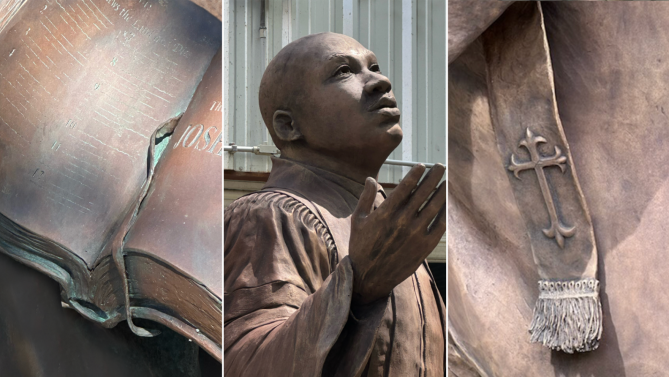
The statue of King that she had been working on for years is said to be the first to portray the civil rights leader and preacher wearing robes and holding a Bible. For Fincher, the design relies on King’s heavenward gaze, on the eyes that “have seen the glory of the coming of the Lord,” as he said in his 1968 “I’ve Been to the Mountaintop” speech.

Days before the statue’s April 1 unveiling in Atlanta, she removed a piece of clay and made some last-minute adjustments during the patina process so his eyes reflected the light.

“My idea was he would be on a mountaintop, with a Moses-type look, and he would be talking to God,” said the Georgia artist, who listened on repeat to the famous speech from the eve of King’s assassination. “I designed it so his hands would be face up, so he’d be catching the light that was given to him, not sideways like he was preaching, and his eyes and head were raised up.”

The eight-foot, two-inch King monument takes its place on Saturday among what will eventually be 18 statues of Georgia peacemakers at the Rodney Cook Sr. Peace Park in the Vine City neighborhood. The Peace Park opened two years ago—a reconstruction of Mims Park, the first integrated park in Atlanta.

In remembrance of the 55th anniversary of King’s death, community leaders, politicians, and clergy will join together for a peace walk and a first view of the statue. The lineup for the event includes Bernice King, daughter of Martin Luther King and CEO of the King Center, as well as Andrew Young, civil rights leader and former Atlanta mayor.

Also speaking and praying on Saturday are philanthropists Clyde Strickland, Dame Didi Wong, and Tim Minard, who partnered with the National Monuments Foundation to commission the statue.

They were intentional about creating a monument to portray King as a man of God. The “I’ve Been to the Mountaintop” statue, by Fincher and fellow Georgia sculptor Stan Mullins, shows King in flowing robes, pulling details from King’s father’s 100-year-old robes that were loaned to the artists by Alveda King. He holds the Bible, curled open in the shape of a dove, turned to the last chapters of Deuteronomy. Fincher modeled the Bible after one that belonged to King’s brother, who was Alveda’s father.

Fincher said when she saw the page at the end of Deuteronomy, it had been stained by the ribbon bookmark, with a red star drawn next to the verse where Moses died having not seen the Promised Land. King stands atop a rock from Stone Mountain, the Confederate monument in Georgia referenced in his “I Have a Dream” speech.

In the past year, the lid on the world’s first officially atheist country has been lifted enough to reveal at once a resilient spirituality and a remarkable ignorance of a Christian heritage that dates from the early church. “We believe in God, but we don’t know what he requires,” said an Albanian woman, whose country lies in the area that was called Illyricum in New Testament times.
Since lifting a 24-year ban on “religious propaganda” last May (the constitutional ban on religion itself remains), remnants of faith have resurfaced in Albania. Though short of the government’s promises to reopen all places of worship—over 2,000 religious buildings were destroyed or confiscated in 1967—at least two Roman Catholic congregations celebrated Mass at Christmas and Easter, notably in pre-Vatican II-style Latin, the only liturgy known to the church’s recognized leader, Fr. Simon Jubani, who had been imprisoned for 23 years.


Promise Of Freedom
The Maryland-size country remains politically unstable following March elections in which Communists lost their monopoly but maintained 60 percent of the seats in Parliament. But for religious believers, a draft constitution, issued last December 31, offers hope. It proposes to replace the state’s nonrecognition of religion with a guarantee of “freedom of religious faith” and the right of Albanian believers to “preach their religion.”
Before the Italian occupation of 1939 and subsequent Communist takeover, Albania’s 1 million people were estimated to be 70 percent Muslim, 20 percent Orthodox, and 10 percent Roman Catholic.
Little is known of the aftermath of an evangelical movement that grew to include about 100 in the late 1930s. But recent visitors tell of at least a handful who still remember American missionaries Edwin and Dorothy Jacques and their predecessors, the Kennedys, who began the work in 1908. (The government invited the Jacqueses back in 1986 to show them that nothing was left of their work.)
About a dozen people who identify themselves as evangelicals are known to gather irregularly now in the city of Korca, where the movement began. The group still sings with the organ supplied by the American missionaries. Though they don’t constitute an organized church, they are known in the town as “the Protestants” and have contact with small gatherings of ethnic Greek evangelicals in the central Albanian towns of Berat and Elbasan.
Christian tourists have begun only in the last year to visit Albanians in their homes. They note that whatever denominational affinity remains is largely cultural. “There is a tremendous spiritual hunger, but also an appalling ignorance,” said a frequent visitor to the country, who asked that his name be withheld for security reasons.
“When we give people a New Testament we have to tell them that the Bible is divided into two parts, and explain what chapters and verses are,” he said. “This is where they are.”


Islamic Heritage
Albania’s Islamic heritage is also resurfacing. Several mosques have been reopened. But many Albanians who call themselves Muslims are questioning their identity. In neighboring Kosovo, the troubled region of Serbia that is home to some two million ethnic Albanians, many Muslims are only now discovering that their ancestors were once Christian, forcibly converted to Islam under the Ottoman Empire that ruled from the fourteenth to the beginning of the twentieth century. This knowledge, which has provoked a new interest in Christianity, is beginning to spread through Albania as well.
Still, Islam clearly has a following in Albania. In January in Tirana, some 15,000 came to the first legal Muslim service in 24 years. Estimates now place Muslims at 30 percent, or about 1 million of Albania’s more than 3 million people. Their forms are diverse, ranging from the majority Sunnis to the home-grown Bektashi sect that incorporates elements of Christian doctrine and practice.
Recent reports have also revealed that the entire Jewish population of Albania secretly emigrated to Israel earlier in the year. About 325 arrived at reception centers in Israel.
Speculation varies widely as to how Albania’s religious mosaic might look in coming years. Some see the potential for Islam to take hold again in a region where Roman Catholic and Orthodox Christians have traditionally clashed. But evangelical Christians who observe Albania from the West are buoyed by the spiritual hunger they see in the thousands of Albanian refugees in Italy and Greece, who, as one missionary said, “want a Bible before food.”
Religious background may have little to do with how Albanians respond to the gospel. The average Albanian is just 26 years of age, born only two years before the government brutally erased religion from public law.

For the statue’s backers, it is not merely another landmark to King; they pray it will be a marker of a revival. The statue represents a bigger movement to recover the spiritual legacy of the civil rights movement and offer it to a new generation living in polarized times.

Strickland and the others involved see the principles King preached and practiced as instrumental in today’s pursuit of peace and justice. They launched World Peace Revival as a global prayer movement drawing from King’s commitment to peace. As Christians, they recognize how King’s teachings apply across religions and borders but also stem from King’s own faith convictions.

Young, whose statue was already erected in the Peace Park, is part of this living legacy. A pastor who worked alongside King and shared his commitment to nonviolence, Young spoke of his reliance on the Spirit during the civil rights movement and has joined the efforts to promote peacemaking in the modern day through scholarships and school curricula.

“A lot of the younger generation aren’t as connected the civil rights movement,” said DePriest Waddy, CEO of the Community Foundation for Northeast Georgia, which has been involved in the World Peace Revival and statue. “We have to keep these stories in the airways.”

Waddy referenced the boldness modeled by King in his famous addresses like the “I’ve Been to the Mountaintop” speech, which concluded:

We’ve got some difficult days ahead. But it really doesn’t matter with me now, because I’ve been to the mountaintop, and I don’t mind. Like anybody, I would like to live a long life. Longevity has its place. But I’m not concerned about that now.

I just want to do God’s will, and he’s allowed me to go up to the mountain. And I’ve looked over, and I’ve seen the Promised Land. I may not get there with you, but I want you to know tonight that we as a people will get to the Promised Land! And so I’m happy tonight. I’m not worried about anything. I’m not fearing any man. Mine eyes have seen the glory of the coming of the Lord!

Matt Daniels helped develop a global civil rights curriculum for educational publisher McGraw Hill through his organization Good of All and is also working on materials to bring King’s teachings into church and Sunday school lessons.

“We have been given in Dr. King’s teachings a repository of truth,” said Daniels. “He believed in the imago Dei, even in those who opposed him.”

He sees teaching peacemaking and racial justice in the digital age as a form of counterprogramming for hateful content that takes off online. “You can’t censor,” said Daniels. “You must go on offense for the good.”

Growing up in Atlanta, artist Fincher said King’s message “rubbed us wrong in that time, but his words were true.” With this statue project, the Southern Baptist has developed a deeper appreciation for King’s biblical witness and joined in the organizer’s prayers for healing and revival. She prayed that the depiction of King would encourage preachers who put on their robes each Sunday—and the faithful in their flocks—to speak with boldness.

Theology

This Palm Sunday, Ponder Donkeys, Not Branches

For his entry into Jerusalem, Jesus picked a symbol of lowliness rather than military might.

Christianity Today March 30, 2023
WikiMedia Commons / Edits by Christianity Today

Christian churches throughout the world will begin our holiest week of the year on what is popularly known as Palm Sunday. It commemorates one of the few events in the life of Jesus recorded in all four gospel stories: his entry into Jerusalem, followed by a raucous and warm welcome and a lot of waving branches. (Only John 12:13 mentions they were palms.) In Israel today, churches still reenact the journey from the Mount of Olives to Jerusalem—the route supposedly taken by Jesus all those centuries ago.

As a kid, even in the nonliturgical world of the Black Baptist tradition, I recall receiving my palm branch and dutifully marching into the sanctuary with a palm in one hand and my unintelligible King James Bible in the other. This year on Palm Sunday, I will be the adult trying to make sure my children don’t use the palms as weapons to tickle and annoy their siblings.

As I study this story in Scripture, I’m struck by the fact that the primary symbol for this day—a palm—was not chosen by Jesus.

John writes, “They took palm branches and went out to meet him” (John 12:13). Why did the crowd choose palm branches? It could simply have been that palms were nearby. But history tells us there might have been a deeper reason: Those plants were symbolically linked to military victories and Messiahship.

A generation before Jesus, when Simon Maccabee drove Israel’s enemies out Jerusalem, people celebrated by waving palm branches:

On the twenty-third day of the second month, in the one hundred seventy-first year, the Jews entered it with praise and palm branches, and with harps and cymbals and stringed instruments, and with hymns and songs, because a great enemy had been crushed and removed from Israel. (1 Mac. 13:51, NRSV)

The Testament of Naphtali, another book written by Jews of that period, also discussed palm branches in the context of messianic expectation. So when Jesus entered Jerusalem, people used them to interpret his identity. He was another Simon Maccabee—a long-hoped-for king who would drive out the Gentiles.

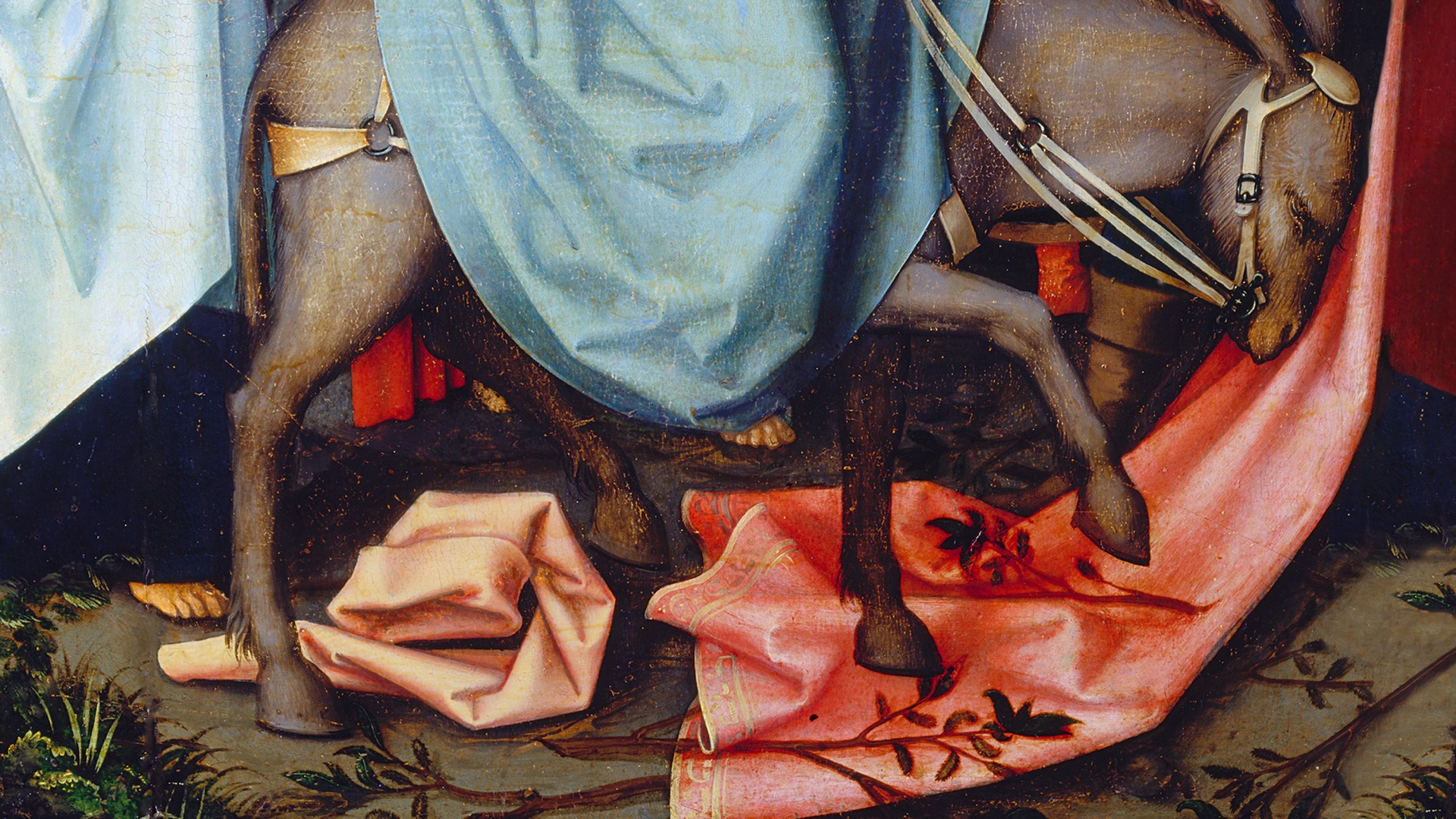
All the Gospels are clear that Jesus chose a symbol, a way for his people to make sense of his kingship. But it was the young donkey, not the palm branch (John 12:14). John rightly sees the donkey as Jesus intended. It was the fulfillment of Zechariah 9:9, which says, “Rejoice greatly, Daughter Zion! Shout, Daughter Jerusalem! See, your king comes to you, righteous and victorious, lowly and riding on a donkey, on a colt, the foal of a donkey.”

Jesus picked a symbol that emphasized humility and lowliness instead of military strength. That fact should inform how we celebrate and remember his entry into Jerusalem. Of course, it would be impractical for every church across the globe to find a donkey to drag into and out of its sanctuary. But we can spend Palm Sunday reflecting on what it means to follow a king who rejected the way of violence.

As we look to the donkey, not the palm, what practices might it inspire? What aspects of American Christian culture might it critique?

I’m not arguing that all public expressions of Christianity need to be passive and nonassertive. In the public square, for example, I notice some Christians “tone policing” others and being uncomfortable with displays of emotion. Their goal is a reserved faith that never speaks plainly about the evils lurking in the hearts of people or society more broadly. Christians can and should use strong words, especially as they relate to structural injustice or personal unrighteousness.

On the flip side, I’ve noticed that some of us have become much too confident in our own discernment. We’re convinced that we are right and our enemies are not just wrong but evil. Surely Jesus hates the things we hate, doesn’t he?

Surely he wants to establish his rule through us right now, one angry tweet and fiery comment at a time. And so we pick up our palm branches and raise our shouts in support of the Jesus we’ve created in our minds, not the crucified Messiah—whose rule is rooted and grounded in love. He has become a rallying cry for our agenda, not his.

As Russell Moore writes, “Jesus is right in saying this sort of hatred and violence never leads where we think it will—to a vanquishing of all of our enemies and to a victory for ‘us,’ whoever ‘us’ is.”

We have forgotten that the world is both the object of God’s affection and a place in rebellion against its creator. Christian faithfulness involves holding these things in tension. We have granted so many exceptions to the love command that it’s almost empty of meaning. We have hoarded God’s grace for ourselves while refusing to offer it to others. All of us are shouting about Jesus but not paying attention to his own words and actions.

To be clear, I am not a killjoy. I have no desire to snatch the palm branches out of the hands of happy children or to end the long tradition of processions and hymns that mark this day. Instead, I hope that during Holy Week celebrations, we can slow down enough to think about the conflicting messages of Palm Sunday.

Jesus’ claim to be the Messiah was not simply about a goal—God’s rule over all things. He and the crowd agreed on that point. His earthly life and ministry were also about the means of accomplishing that goal: namely, sacrificial love. Jesus gave us not only the gift of forgiveness, flowing through his Passion and resurrection, but also a way to follow. That way needs to inform our public and private witness.

Stated differently, I’m worried that, in our desire to defeat enemies, we’re losing Christian virtues—the fruit of the Spirit.

If we strive to establish God’s rule through self-assertion over neighborly care, pragmatism over principle, and malice over love, then whatever else we accomplish, we are no longer following in the way of Jesus. God chose meekness, integrity, and love to gather his people. That is the message of Palm Sunday. For all the shouts of acclamation, Jesus never lost sight of the cross.

This Holy Week, then, let’s follow the one who sits atop the donkey, so that he can remind us again of the way to life eternal.

Esau McCaulley is an associate professor of New Testament at Wheaton College. He is theologian-in-residence at Progressive Baptist Church, a historically Black congregation in Chicago, and author of the forthcoming memoir, How Far to the Promised Land: One Black Family’s Story of Hope and Survival in the American South.

Theology

After Nashville, Moral Numbness Is Our Enemy

Shootings have become normal to the American public. But as Christians, we know better.

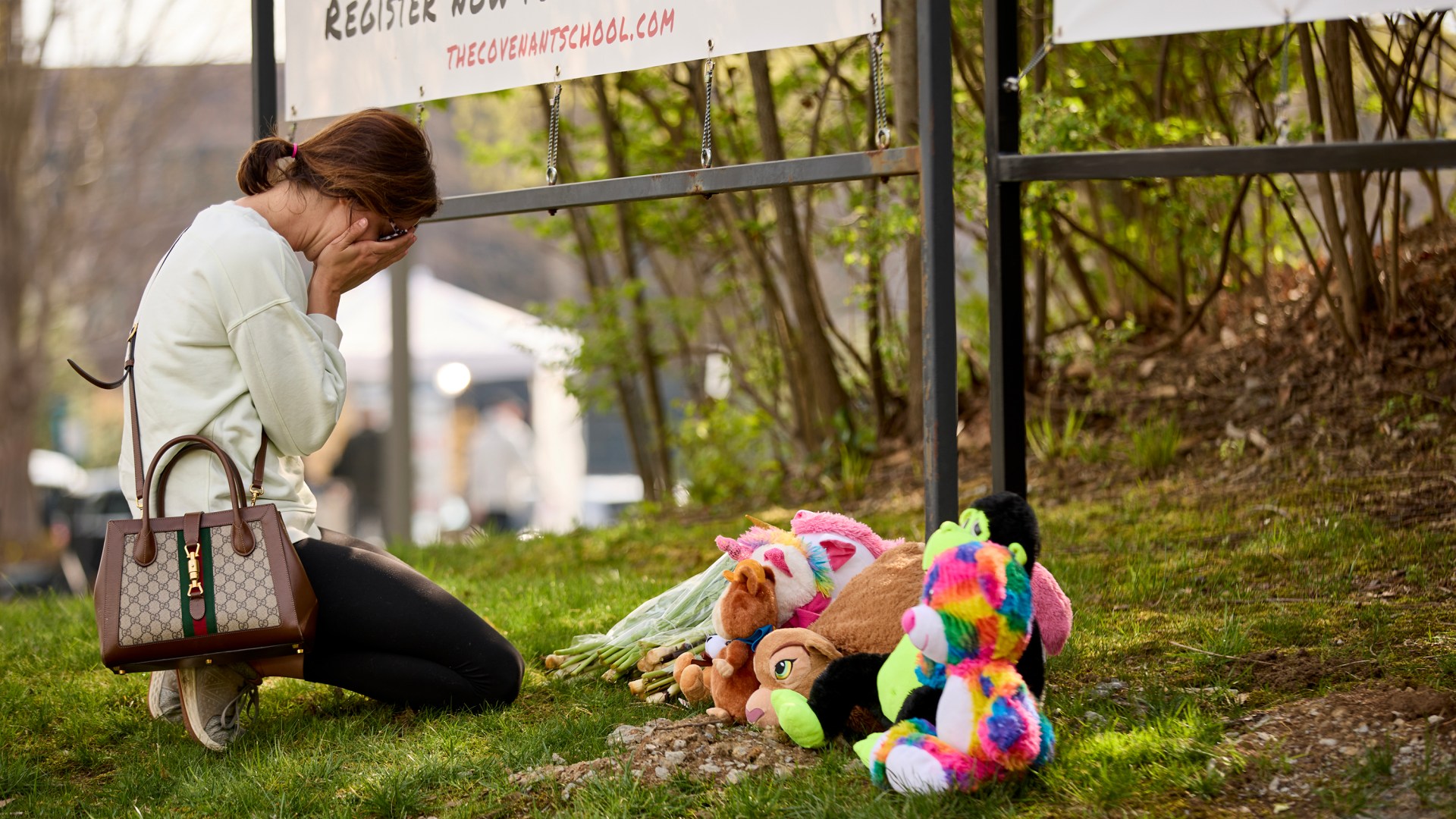
A woman cries as she leaves flowers at the Memorial held at The Covenant School after the shooting in Nashville, Tennessee.

A woman cries as she leaves flowers at the Memorial held at The Covenant School after the shooting in Nashville, Tennessee.

Christianity Today March 29, 2023
The Washington Post / Contributor / Getty

Over the past few days, my city, Nashville, has been grieving and suffering after a terroristic murderer attacked a Christian school and slaughtered six people—including three children.

Whenever a school shooting happens in America, our country is shocked and pays attention for a time. But within a matter of weeks, most people add these events to other names on a list of horrors—Columbine, Parkland, Sandy Hook, Uvalde, and so on. But as others can attest, it’s different when such a tragedy happens in your backyard.

Some of the boys and girls fleeing for their lives were children of dear friends, and almost everyone I know is connected—closely or loosely—with the victims. We all know the church, the school, our neighbors in the Green Hills neighborhood. Things will not be the same here for a very long time.

And yet Americans—especially Christians—should ask just how much we have adjusted ourselves to this kind of horror. How numb to it all have we become?

While I was still in the haze of this awful news, a friend who is an expert in domestic terrorism texted me to warn about people calling for the release of the murderer’s reported “manifesto.” My friend pointed to research showing that publishing these sorts of documents can fuel more incidents like it—as seen by the way that past mass murderers have cited those who came before. I trust this leader that such best practices are right.

Yet I wonder about all the “manifestoes” we have seen. I’m referring not to the deranged screeds of mass murderers but to the hate and rage that have become so commonplace in our society that we barely even notice them anymore. How long can we live like this and pretend we are powerless to change it?

Regardless of our good-faith disagreements on the meaning of the Second Amendment, can we not all agree that something is seriously wrong when a person with this many “red flags” can purchase multiple weapons of that capacity without anyone noticing? And every time these atrocities happen, we reassure ourselves by noting that the person is unstable and out of touch with reality.

But can we seriously believe that such derangement is not influenced by a culture that now seems to be in a permanent state of limbic distress—a society in which hatefulness is so “normal” that the only question seems to be which group of people we should hate?

Many leaders—no matter their ideology or political or religious category—have decided that what “works” in this present moment is to convince people that we are in a constant state of emergency. And the emergency is so great that all the norms, manners, and habits that have kept a country like this together for so long are no longer operative.

After all, persuasion seems to be neither the goal nor even the motive to do something about our present state. Instead, the objective seems to be labeling one’s opponents as not just wrong, not just stupid, not even just evil—but as an existential threat to everything that “people like us” (however that’s defined) hold dear.

Many ideological leaders don’t believe in such rhetoric themselves. They’re just bringing in the crowds, counting the clicks and follows, and cashing the checks. And most regular people don’t act out of this mindset when they meet people in line at the grocery store or welcome new families into their neighborhoods—that is, when they are not disconnected from other people and submerged in an online world of rancor.

But in a culture so thoroughly characterized by this kind of hatred—and even violent imagery and symbols about the “other side”—is it so surprising that some twisted, depraved people actually believe such lies to the degree that their consciences become dulled to even the most basic compassion for other human beings?

Jesus taught that murder doesn’t begin with the act of killing; it begins in a psyche that turns toward hate, rage, and anger (Matt. 5:21–24). This kind of hatred is not “only human,” although it seems so to us in the only broken world we’ve ever known east of Eden. Rather, such hate is animalistic and demonic (John 8:44; Rev. 13:4). In other words, it is not “normal,” and we should never make it so.

Even those who don’t believe in God or accept his revelation should be able to see that Jesus was right in saying this sort of hatred and violence never leads where we think it will—to a vanquishing of all our enemies and to a victory for us, whoever “us” is. Instead, it only fuels more and more violence (Matt. 26:52).

Such hatred can consume a soul, and eventually, the wicked take advantage of every justification they can find to lash out at the innocent—whether they be Jewish synagogue members, gay nightclub attenders, evangelical Christian schoolchildren, or any others.

The baffling senselessness that we feel at a time like this—which lasts a few days for the world and years for those close to it—should not lead us into resignation and cynicism, where we shrug our shoulders in an attitude of “What can you do?”

Instead, it should bring a flash of recognition that this is not the way it’s supposed to be. What we are seeing is a mystery of iniquity so great that it should rattle us—prompting us to put aside our theatrical hatred of one another long enough to ask, “How can we stop this?”

But that will require genuine discussions on public policy, justice, and safety. It will also mean asking ourselves why so many people will forget about Nashville—and the terror faced by those children and teachers—in a matter of days, just as we’ve forgotten all the other towns and cities that have been torn apart by this kind of murder.

The time we live in is not normal, and it is not leading us anywhere we want to go. The first step to stopping these hate-driven crimes is to recognize that fact. It’s right to grieve. It’s right to be angry. It’s right to feel afraid. But it’s never right to assume this is just the way things must be.

Lord, have mercy.

News

Saudi Arabia Embraced Coptic Christmas. Could Its First Church Be Next?

Bishop describes decade-long development of pastoral visits to Egyptian Christians, amid speculation of the kingdom’s steps toward religious freedom.

The crown prince of Saudi Arabia, Mohammad bin Salman, meets Coptic Orthodox Pope Tawadros II in Cairo, Egypt on March 05, 2018.

The crown prince of Saudi Arabia, Mohammad bin Salman, meets Coptic Orthodox Pope Tawadros II in Cairo, Egypt on March 05, 2018.

Christianity Today March 29, 2023
Markas Ishak / The Coptic Orthodox Church Press Office / Anadolu Agency / Getty Images

Saudi Arabia stunned foreign policy observers this month by publicly agreeing to normalize relations with Iran, under Chinese sponsorship. The deal between the neighboring Sunni and Shia archrivals, known for sectarian proxy fights, is expected to ease tensions within Islam.

Meanwhile, the kingdom has recently taken less publicized steps toward another religious normalization: public Christian faith.

In this case, Egypt is the supporting nation.

“Nine years ago, I was told, ‘Pray, but don’t publicize it,’” said Bishop Marcos of Egypt’s Coptic Orthodox Church. “This time, Saudi Arabia is publicizing it themselves.”

On January 7, Marcos headlined a month-long pastoral visit by celebrating the eastern Christmas liturgy amid 3,000 Coptic Christians residing in the kingdom. Facilitated by the Egyptian embassy, additional services in Riyadh, Jeddah, Dammam, Khobar, and Dhahran were “held under the full sponsorship of the Saudi authorities.”

It was the first public Christmas celebration admitted by the Islamic nation, home to the pilgrimage sites of Mecca and Medina. Muslim traditions cite Muhammad as forbidding the existence of two religions in Arabia, though scholars differ as to the geographic scope.

But Marcos’s trip was not the first Christian worship permitted.

He began praying about visits to Saudi Arabia after being sent in 2012 to help solve a dispute between authorities and an Egyptian Christian migrant worker. Marcos estimates there are about 50,000 Copts in the kingdom, among 2.1 million Christians—mostly Filipino Catholics.

None have a church to worship in. Open Doors’ World Watch List ranks Saudi Arabia No. 13 among the 50 countries where it is most difficult to be a Christian today. Visiting Coptic clergy used to meet the faithful in neighboring Bahrain.

But when Marcos returned in 2014, he said he conducted liturgies for about 4,000 believers. Leaks covered by the Qatari news network Al Jazeera resulted in some attention, but the Saudis told him they were not troubled by it. Weeks-long pastoral trips continued annually, and in 2016 Saudi King Salman bin Abdulaziz visited Coptic Pope Tawadros II in Egypt.

It was 2018 that led to further openness. Crown Prince Mohammed bin Salman (known as MBS) visited the Coptic Orthodox cathedral in Cairo in March, taking a famous photo with Tawadros in front of an icon of Jesus, the Good Shepherd. He invited the Coptic pope to visit Saudi Arabia and encouraged continuation of Marcos’s visits.

That December, the first liturgies were officially reported.

Not everyone was pleased. Medhat Klada, spokesman for the European Union of Coptic Organizations, stated it was an attempt to “whitewash” the kingdom’s image after the murder of Jamal Khashoggi. Mina Thabet, a Coptic rights researcher, called the pope’s welcoming remarks “disgraceful.”

However understood, the change is palpable. In 2011, Saudi Arabia arrested 35 Christians for unauthorized worship in Jeddah. In 2014, 12 Ethiopian Christians were arrested in Dammam. But in 2016, MBS curbed the power of the religious police, and in 2018 he welcomed an evangelical delegation led by Joel Rosenberg.

They discussed the potential building of a church.

The idea had been broached as early as 2008 by Catholic officials. Various Saudi figures have stated “definitely … it’s coming” and that it is “on the to-do list” of the authorities. Speculation about its location centers on the diplomatic district in the capital, Riyadh, or on Neom, a $500 million planned megacity in the northwestern desert.

Promotional materials for Neom speak of the mixing of religions under international law.

In 2019, Saudi Arabia opened the area to Christian tourism. Said to be ancient Midian, it is home to an alternate site for Mt. Sinai and a split-rock outcropping resembling the miracle at Horeb, where a strike of Moses’ staff made water flow for the Israelites.

Joel Richardson has now conducted five tours of the area through the Living Passages agency, which has overseen 11 overall.

“The government is slowly allowing more religious freedom,” said the itinerant pastor, noting Marcos’s Christmas liturgy. “The hope is that we will eventually see true religious freedom for any Saudi nationals who have become Christians as well.”

Apostasy from Islam is formally punishable by death.

Cautious about the rapprochement with Iran, Richardson said Saudis have always received him with “exceptional warmth and kindness.” This has been the norm even as his tours have been accompanied with Bible readings and the singing of hymns.

Theological dialogue is welcome—as with Marcos’s Christmas visit with Muhammad Al-Issa, secretary general of the Saudi-sponsored Muslim World League (MWL).

“We discussed the crucifixion and resurrection of Jesus,” said Marcos. “He smiled, unoffended.”

The warmth goes also to the streets. Clothed in his typical black robe with a cross around his neck and another in his hand, Marcos spoke of ordinary Saudi citizens taking photos with him in the street.

And this year, Christmas trees and Santa hats were sold publicly in the mall.

Also in 2019, Saudi Arabia convened 1,200 scholars from 139 countries to sign the Mecca Declaration, a 30-point charter on international religious freedom. Point 21 commits world leaders to avoid discrimination. Point 22 commits governments to protect houses of worship and rights of minorities. Point 29 calls for implementation.

Three years later, that vision appeared to gain steam. Last May, a smaller MWL-hosted interfaith gathering, this time in Riyadh, included the Vatican secretary of state, the Orthodox ecumenical patriarch, the general secretary of the World Evangelical Alliance (WEA), 15 prominent rabbis, and the US ambassador-at-large for international religious freedom.

They recommended all countries ensure free access to places of worship.

“As the world’s largest Islamic NGO, headquartered in the birthplace of Islam in Saudi Arabia,” stated Al-Issa, “we have a special responsibility to do this work.”

Thomas Schirrmacher was impressed.

“I have attended many international dialogue meetings which were pure show and words,” said the WEA head. “This one was not like that.”

Schirrmacher noted that with the US-based National Association of Evangelicals invited also, Al-Issa ensured that about half of all delegates were Protestant believers.

He has positive impressions of the Saudi-Iran agreement, noting that all the region’s wars have been a “nightmare” for Christians. Peace and justice are equally necessary for Middle Eastern Muslims and Jews.

The latter joined an interfaith delegation this week to plant date palms in Medina, returning to a city Jews last inhabited at the dawn of Islam.

Five years ago, the kingdom permitted non-Muslims to enter the site where, in A.D. 622, Muhammad established religious coexistence for the Abrahamic faiths. Jews were expelled from Medina three years later, reportedly for violating the treaty.

Mecca remains closed, while the Gulf opens incrementally. The United Arab Emirates-led Marrakesh Declaration of 2016 aimed to revive worldwide the original “Charter of Medina,” with the Bahrain Declaration a year later specifically invoking a religious “freedom of choice.”

Both nations have normalized relations with Israel in the Abraham Accords; analysts wonder if Saudi Arabia might be next.

Regardless, Schirrmacher anticipates further positive news for the half a million evangelicals in Saudi Arabia.

“They started with the Copts—the largest church in the Middle East,” said Schirrmacher. “But our discussions make us confident that similar moves for Catholics and Protestants might follow.”

Regional dynamics are underway.

Saudi Arabia is now the only Gulf nation without official relations with the Vatican, following the Holy See’s establishment of diplomatic ties with Oman last month. Justin Meyers, executive director of the Reformed Church of America-founded Al-Amana Center in Muscat, called Marcos’s Christmas visit a “beautiful thing.”

The move was also welcomed by Christian leaders in the United Arab Emirates.

“Other countries on the Arabian Peninsula have discovered that openness to Christian churches is a benefit to the country and not a threat to local traditions,” said Eric Zeller, president of the Gulf Theological Seminary, founded in 2016. “Saudi Arabia has the opportunity to catch up here, and if this move is a step in that direction, it is an encouraging one.”

Marcos did not discuss the building of a church with the Saudi authorities. But he credits MBS as a wise leader who studies everything from a “wide angle.” The official Coptic Orthodox Church statement celebrated MBS as representing the younger generation and its openness to global society.

Not everyone does. But rather than focusing on Western critics who see MBS as an autocratic strongman who silences his critics, Marcos highlighted a still-influential regional religious opposition.

“Fanatics in the Muslim world disliked my visit because they view this land as off-limits to churches and Christian services,” he said. “The Saudis, however, have welcomed us.”

Theology

Resisting the Impulse of Self-Optimization

In Lent, we realign our identity in Christ and recover our sense of being loved into existence by our Creator.

Christianity Today March 29, 2023
Illustration by Mallory Rentsch / Source Images: Unsplash

As a Singaporean, I grew up immersed in a national culture defined by stress.

These instincts were arguably more learned than anything else—my Malaysian father and South Korean mother moved to the country from the United States in the 1990s. So much of how I grew up was shaped by the intensity of Singapore’s academic culture, shuttling between exam-heavy course loads, afterschool tutoring, and reams of practice papers to complete.

Different phases of my life would come to mirror this rhythm: spending hectic days in high school between writing long essays and serving in church, balancing responsibilities during military service while leading a small group and trying to keep up with reading, managing the busyness of my undergraduate life and subsequent tenure as a graduate student, and, even now, trying to uphold different commitments to ministry, creative writing, editing, friends, and family amid a full-time job.

The last time I felt thoroughly burnt out was about five years ago, as an undergraduate in England. Between reading and writing essays for class, keeping active in Christian fellowships, participating in theater productions, and rowing by dawn, I found myself gradually compromising my sleep schedule. Seven hours a night got slashed to six or even four and a half. I’m not entirely sure what drove me back then. Perhaps it was a feeling of duty and responsibility I felt I owed the people I had made promises to or a desire to not let any part of my university life slip by. Lurking beneath all this, perhaps, was an impulse toward optimization.

Optimization can be described in two ways, opines writer Jia Tolentino. First, it is a means of achieving profitability by “satisfy[ing] our wants” with “the least effort”—a formulation posited by the economist William Stanley Jevons. Second, it is the process of making something, as Merriam-Webster indicates, “as fully perfect, functional, or effective as possible.”

An excessive devotion to self-optimization perverts our relationships to our time and effort, trading care and an awareness of our physical and mental limitations for an unrelenting drive toward completing tasks. In other words, optimization can make us hold on too tightly to what we should entrust to God.

A national preoccupation

In tracing this instinct toward optimization to its roots, the temptation is to sketch a history of Singaporean survivalism, geopolitical anxiety, and economic competitiveness. The machinations of Singapore Inc. took root after its unceremonious separation from Malaysia in the 1960s. Because it is a small city-state with minimal natural resources, the skills of its people became its biggest competitive advantage, as we have often been told. The transformation of Singapore’s “labor force” and improvement of its “human capital” occurred through the multinational corporations that trained generations of workers and the focused educational policies that advanced our competitive edge. Meritocracy was championed as a sacred ideal; so too were diligence, productivity, and industriousness.

This heady rush toward modernization, technologization, and optimization structured national aspirations in Singapore for a long time. People saw their lives materially transformed as a result of the government’s careful management of the country’s economic development. The flip side, however, has been a perpetually stressed-out population. Upskilling has become the new mantra of the state, with government credits provided for citizens to train and learn new skills. In other words, optimizing the self continues and appears central to Singapore’s psyche.

The aspirations of many in the church in Singapore began to cohere along similar lines, with the notion of blessing becoming correlated with wealth. Church life started to resemble the country’s changes, with discipleship and fellowship traded for easily optimizable and measurable programs and events: talks, dinners, and rallies, where the number of people reached or converted could be tracked in digits.

The compression of time through a nationwide emphasis on self-optimization, as well as the climbing demands of work tasks or school assignments imposed on each person in Singapore, have served only to foster anxieties surrounding comparison and hasten the movement of the months and days.

As Singaporean writer and critic Gwee Li Sui argues, “the social and technical implements of modernity have been improving our daily lives only to raise their pace, giving us more time that is wasted away as quickly. Political and economic interdependence forges trust and understanding among peoples, but it also grows frustration and a sense of insecurity through endless comparison.”

Centering prayer

As an undergraduate, I attended a talk by graphic designer Andrew Khatouli. As he spoke of the challenges he faced working in the creative industry and the pressures of pursuing creative excellence, a statement he made hit me hard: “Your work ethic is only as good as your rest ethic.” The impetus to slow down and give myself time to rest became something that was hard fought. The first step required a renewed commitment to observing the Sabbath. I began to resolve to take the entirety of my Sundays off, replacing frenzied hours doing last-minute reading with walks, podcasts, and time with friends.

The unfettered space of a day suddenly felt ripe with possibility, a passage providing a temporary severance between different streams of work. I took two biblical concepts seriously: shabbat (Hebrew for “sabbath”), of a cessation of work, and nuakh (Hebrew for “rest”), of settling into a space of prayer and praise at church and elsewhere. While we are created uniquely in God’s image, as the narrative of Genesis presents, we remain creatures made from dust. As preacher Christopher Ash argues in Zeal without Burnout, to forgo sleep, the Sabbath, friends, and the inner renewal of the Holy Spirit is to attempt to create for ourselves a kind of parity with God.

A Christian life of sustainable sacrifice, however, is underpinned by a recognition of human limitation. The cultivation of a divine intimacy and a serious inner life requires a space discrete from our perennially active personas. “There is a place in the soul that neither time, nor space, nor no created thing can touch,” wrote 14th-century mystic Meister Eckhart. The intent of prayer is to visit that kind of sanctuary Eckhart describes, says poet and philosopher John O’Donohue.

Aligning to kairos

A preoccupation with efficiency and optimizing the self can serve to lessen an awareness of our humanity. We lose our sense of our being loved into existence by the Creator, of being created in his image, and of needing to be nourished spiritually and emotionally by divine communion.

Sometimes, a kairological irruption can serve to shock us from the tepidity of our busyness and proclivities toward optimization. The New Testament conception of the Greek word kairos describes an appointed time in the purpose of God. Kairos construes a kind of immediacy and is the temporal language Jesus uses when he proclaims in the Gospel of Mark, “The time is fulfilled, and the kingdom of God is at hand” (1:15, ESV).

Kairos moments such as the collapse of the body, the death of a loved one, or a car crash from exhaustion have the potential to shock us out of a hectic stupor. They are the moments that provide blunt reminders of the presence of God—ones that make us acutely aware not only of our mortal limitations but also of the ephemerality of time. They provide a reminder that our calendars do not operate in concert with the mystery of time as God orders it. We are accorded mere glimmers of how God moves in time beyond what we can see and perceive. “I have seen the burden God has laid on the human race. He has made everything beautiful in its time. He has also set eternity in the human heart; yet no one can fathom what God has done from beginning to end,” writes the author of Ecclesiastes (3:10–11).

The love of God has “a different kind of speed from the technological speed to which we are accustomed,” says theologian Kosuke Koyama. “It goes on in the depth of our life, whether we notice or not, at three miles an hour. It is the speed we walk and therefore it is the speed the love of God walks.” When we lose sight of the restorative ethos of the Sabbath, we forget that “the Sabbath was made for man, not man for the Sabbath” (Mark 2:27). We lose the ability to cultivate an interior life, to access the untouchable “place in the soul” that Eckhart describes.

Coming to Lent

In this Lenten season, it may be worthwhile to consider how best to counter the primacy of optimization. Theologian Rowan Williams suggests in his book Being Human that humans are ascribed dignity regardless of “how many boxes are ticked” because we stand “in the middle of a network of relations” to God and to one another. “A theologically informed language of personhood corrects the mechanical language that reduces us to a checklist of attributes,” writes Christopher Benson in his review of Williams’s book.

As a corrective to the pressures of optimization, I have made several commitments to try and cultivate space for interiority and silence this Lent. Silence supports our “growing humanity” and humbles our desire for power and control, argues Williams: “God is God by being God for us, and we are human by being human for God; and all joy and fulfillment opens up once we recognize this.” My first commitment has been to continue in my reading of Scripture each day. The second has been to keep to a schedule of daily devotions published by the Bible Society of Singapore. The third has been to read a poem each day from an anthology on joy.

Learning to space out my schedule, say no to certain commitments or invitations, and carve out pockets for prayer and reading each day will hopefully help to shift the coordinates of my present relationship to time. These habits will hopefully help to dislodge the ways in which self-optimization has lurked in my life as an ideal.

I do not pretend to believe that I have dispensed with the continued stresses of each day or the impulse to address tasks quickly and effectively. However, these practices have helped to provide necessary moments of pause and reflection, not least when recent events have conspired to provide the kairological shocks I needed to turn again to God.

To fall into the slowness of the liturgical calendar, to keep the Sabbath, and to remember the interventions of kairos moments is to facilitate a turn away from optimization and the structures of time that enable it. A life of faith sustains and strengthens but takes an eternity to learn to inhabit.

Jonathan Chan is the author of the poetry collection going home (Landmark, 2022). His poetry and essays have appeared in Ekstasis, The Yale Logos, and the Ethos Institute for Public Christianity.

Theology

Go Ahead. Argue with God Over the Nashville Shooting.

In the face of tragedy, Christ welcomes our confusion and anger.

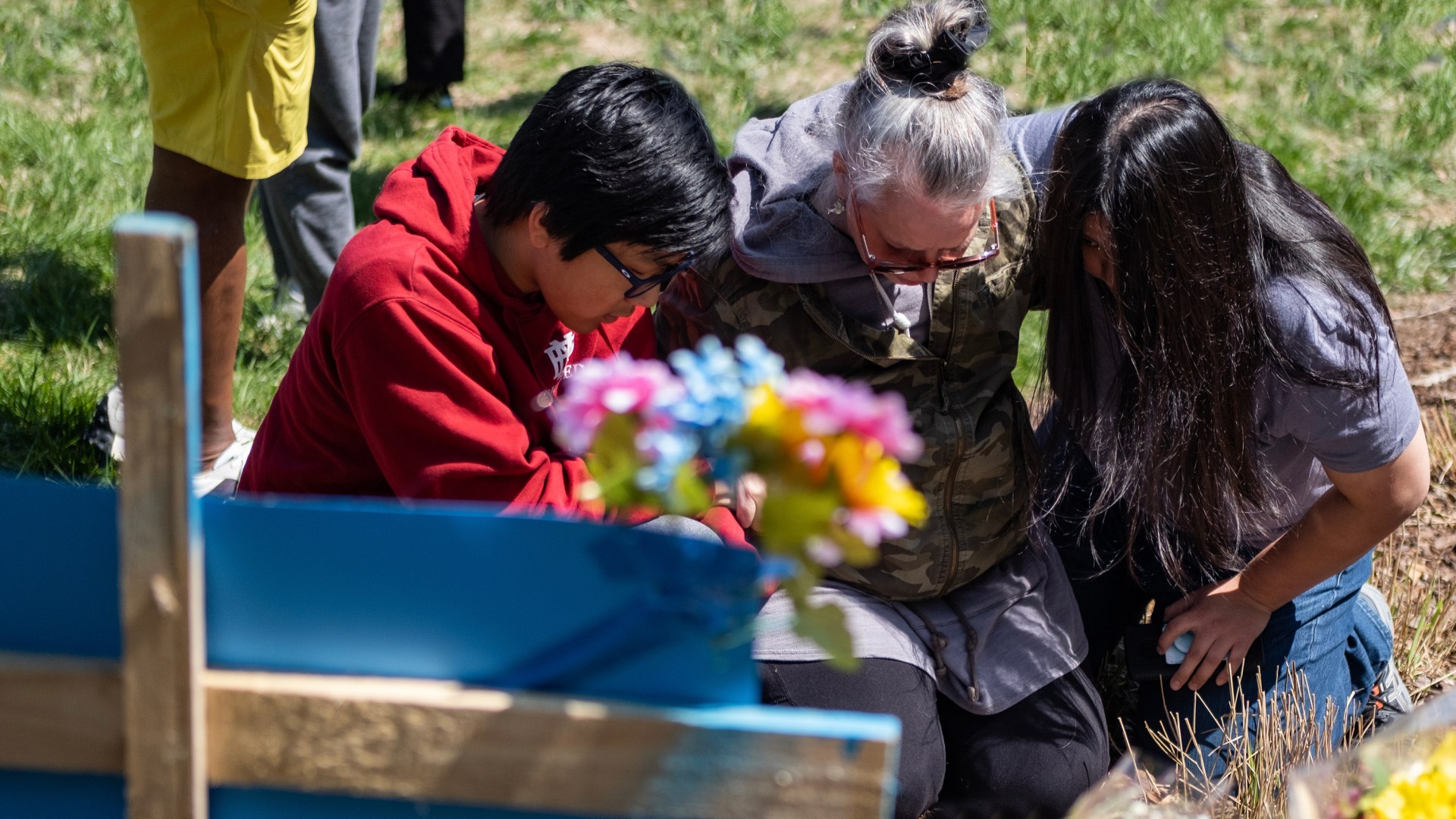
Mourners pray at the entrance of The Covenant School in Nashville, Tennessee.

Mourners pray at the entrance of The Covenant School in Nashville, Tennessee.

Christianity Today March 28, 2023
Seth Herald / Stringer / Getty / Edits by Christianity Today

Just a few days ago, parents were dropping their children off at The Covenant School in Nashville, Tennessee, anticipating a day of love, friendship, and learning for their sons and daughters. No one could fathom what would happen soon after, when a 28-year-old shooter entered the building and opened fire, resulting in the deaths of three nine-year-old kids, three adults on staff, and the assailant.

Part of a pastor’s calling is to enter into life’s disorienting, gut-punching, heart-ripping spaces and offer perspective on questions that cannot be answered. This is especially true in situations where the main question is “Why?”

Why would a good and loving God who is sovereign over every square inch of the universe, who knows the number of hairs on our heads, who said, “Let the little children come to me,” and who promised again and again to be our shield, our protector, and our defender allow for this senseless loss of life?

Why would the same God let faithful, loving, godly educators be gutted from their families and communities? Why would he allow young survivors to experience the trauma of hearing gunfire and then being rushed frantically to safety?

Why would he not foil and fail the shooter’s plans before a single shot was fired? Why would the One who holds even the hearts of kings in his hands not redirect the assailant’s heart as well? Why would God allow for one of his own image-bearers to go to such an inexplicable and horrific place and then follow through with those intentions?

We already know the answer to these questions, which is that we’ll never know the answer to these questions.

Nashville musician and producer Charles Ashworth, also known as Charlie Peacock, shares great wisdom in his song “Now is the Time for Tears.” The lyrics warn us against acting like Job’s friends. They provided foolish and woefully off-the-mark answers to their suffering friend who was, among other things, grieving the loss of all ten of his children. As Charlie sings:

Cry with me, don’t try to fix me, friend. That’s how you’ll comfort me. … Silence the lips of the people with all of the answers. Gently show them that now is the time, now is the time, now is the time for tears.

The “Why?” question cannot be answered from our earthbound perspectives. We know the world is fallen. We know that sin and sorrow wreak havoc on everyone and everything, all the time. We know that none of us is guaranteed another day, and that the current day could be our last. We know the final enemy called death is coming for us all. We know that sickness, sorrow, pain, and death are part of current reality and will one day be destroyed by our resurrected and returning king.

But in spite of what we know—or perhaps because of what we know—the best answer to the “Why?” question is bewilderment, confusion, and anger. There is good reason why the eight human emotions—guilt, shame, loneliness, fear, anger, sadness, hurt, and gladness—include seven for the purpose of expressing grief and protest over how things are not what they’re meant to be. These seven grief-stricken emotions are part of how God equips us to show up fully in a tragic world.

When lives are lost in such a senseless and rupturing way, the protest of Martha feels right. After she buries her brother Lazarus, she says, “Lord, if you had been here, our brother would not have died” (John 11:21).

“Lord, if you had been here.” Do we dare speak this way to our maker? Do we dare confront him for abandoning us in our times of greatest need? Do we dare give voice to the feeling that he did not show up, even when we cried out to him in our fear and despair? Do we dare challenge God for not doing things we know he is supposed to do as one who protects, defends, and upholds the weak?

Some are hesitant to ask Martha’s question. Though honest, raw, and real, it also feels irreverent to challenge our Lord about anything, even our most devastating trauma. In the face of tragedies involving the death of children and their beloved educators, is it right to question God?

He is God, after all. He is to be trusted, esteemed, honored, respected, and feared. But maybe somewhere in Martha’s question there are signs of a next-level reverence and holiness that honors the Lord enough to give him our unfiltered honesty—and even to demand some sort of meaningful response. Martha, like us, is in relationship with him, after all.

After losing his wife to an untimely death by cancer, C.S. Lewis dared to question God in similar Martha-like fashion. He writes in A Grief Observed:

When you are happy … and turn to Him with gratitude and praise, you will be—or so it feels—welcomed with open arms. But go to Him when your need is desperate, when all other help is vain, and what do you find? A door slammed in your face, and a sound of bolting and double bolting on the inside. After that, silence.

Likewise, Nicholas Wolterstorff lamented the death of his son from a rock-climbing accident. He writes in Lament for a Son:

You have allowed rivers of blood to flow, mountains of suffering to pile up, sobs to become humanity’s song—all without lifting a finger that we could see. You have allowed bonds of love beyond number to be painfully snapped. If you have not abandoned us, explain yourself.

If a pastor has anything worthwhile to say in such a time as this, it is that God himself invites, even welcomes, this kind of protest. In fact, the very prayer book that he inspired for us to use as our own prayers—The Psalms—are filled with bold and explicit protests against what feels to us like the inaction of God.

Although God does not provide us with answers concerning our grief, he does provide us with himself. When Martha and Mary questioned Jesus about his delayed response to their brother’s death, we’re told that Jesus wept. Then, right before he shouted “come forth” into Lazarus’ tomb, the text says that Jesus was “deeply moved in spirit” (John 11:33).

But the Greek for this phrase is much more forceful. The literal meaning is that Jesus was furious, like a raging bull with flaring nostrils about to rush and attack its prey. Jesus is not passive. Far from it. He is an angry animal who will someday trample over death and restore all that has been lost. The Bull of Heaven has stampeding feet. The Lion of Judah has death-defying teeth. He has defied death. He will defy death.

And yet, let’s not rush to hope so swiftly, lest we move prematurely out of our grief, hurt, and anger.

In the wake of the horrid loss experienced by our friends at the Covenant School, it is right and good and even Christ-like for disorientation and grief to feel stronger and more formidable than feelings of hope. Our Lord has his own reasons for everything. That includes not showing up for Martha and Mary until four days after their brother’s death; allowing the universe to be deafeningly silent for three full days after his own death; and permitting us to be haunted by the “already but not yet” season we’re stuck in currently as we await his return.

Even as we wait in grief, Scripture whispers hope: As Paul writes, “we grieve … with hope” (1 Thess. 4:13).

It’s a good thing that in times like this, hope doesn’t have to be a feeling. It is more of an inescapable, Resurrection-sealed fact than it is a feeling, to be sure.

One of my favorite reminders of this idea comes from my friend and Nashville singer-songwriter, Sandra McCracken. The lyrics to her song “Fools Gold” offer the best exclamation point for the grief felt in Nashville, Tennessee right now:

The kids are laughing in the other room,
A life more complicated, their smiles are still in bloom
They’re on their own,
Take them by the hand, the best we can
We give them love, we give them love

But if it’s not okay
Then this is not the end
And this is not okay
So I know this is not, this is not the end

This is not okay. Easter is coming, but everything right now feels like Good Friday and Holy Saturday, or as some call it, “The space in between.”

But because things are not okay, we also know it’s not the end.

Scott Sauls is senior pastor of Christ Presbyterian Church in Nashville, Tennessee. This piece was adapted from his recent blog post, “Weeping in Nashville.”

News

European Evangelicals Organize Against Abuse

From curriculum to call lines, churches focus on safety and prevention.

Christianity Today March 28, 2023
Sean Gallup / Getty

When Fabian Beck volunteered to help with the children’s ministry at his small evangelical church on the outskirts of Hanover, Germany, he imagined he’d be singing songs, telling Bible stories, and performing puppet shows.

He had no idea what he could do to protect Sunday school children from the possibility of sexual abuse. As he prepared to join the team, however, he came across resources provided by the Federation of Free Evangelical Churches (FeG) on the subject of violence against children and adolescents in the context of Christian communities like his own.

“Believers have to face the fact that our congregations are not safe just because they are full of Christians,” Beck said. “Safe places for kids don’t come naturally, and too often, we don’t know what we don’t know.”

Andreas Schlüter, the FeG’s federal secretary for the young generation, said the program Beck is using, “Protect and Accompany,” is part a much larger trend among free churches organizing against abuse. Evangelical churches are developing programs to face the reality of sexual abuse and seeking to prevent it from happening in the future.

“I know that in Germany, every free church is actively tackling the issue,” he said. “Free evangelical congregations should be, or become, safe places for children and young people.”

In recent years, child sex abuse cases have been extensively reported across multiple Roman Catholic dioceses in Europe. Spurred by these revelations, Catholics have taken steps in France, Portugal, Germany, and Italy to prevent abuse. Pope Francis, for example, removed the option for pontifical secrecy from cases involving the mistreatment of minors or other vulnerable persons.

Myriam Letzel, coordinator for the French evangelical organization Stop Abus, said that the Catholic church in France’s groundbreaking investigations into clerical abuse (the so-called “Sauvé report”) not only highlighted the systemic nature of sexual violence but also put evangelicals on notice about dynamics in their churches that might also lead to inappropriate and illegal behavior. The conversations around #ChurchToo and revelations of widespread abuse among Southern Baptists in the United States have also led European evangelicals to reckon with the fact their churches are not immune.

“We have to question ourselves on the theological bases which have, in the past, favored inappropriate sexual behavior: a misunderstanding of the relationship between men and women and a distorted relationship to sexuality,” Letzel said.

In September 2022, the National Council of Evangelicals of France (CNEF) started Stop Abus. It is run by a commission of 10 experts in the fields of social work, psychology, medicine, law, and pastoral care. The organization also has a listening service with a team of 35 “listeners” who receive abuse reports. In its first six months, Stop Abus received 15 disclosures that are now being processed.

Letzel said this is just the first step.

“What was happening elsewhere served as a warning: We could not pretend that such things did not exist in evangelical Protestant churches, and above all we did not want to pretend that they did not exist,” she said. “The mission entrusted to us by Christ obliges us: As Christians we have a duty to be exemplary in our conduct and in our way of caring for the most vulnerable.”

One of the church networks belonging to the CNEF, the Réseau-FEF, informed members and partners at the end of March that it would "neither recognize nor support any ministry" by one pastor, who has been accused of abuse by six women, two of whom went to the police. This is a first for French evangelicals. The pastor had a wide influence in French-speaking evangelical circles, especially online.

Other evangelical groups in Europe have launched similar efforts. In Switzerland, under the umbrella of the Swiss Evangelical Alliance, some 60 Christian groups and organizations put standards in place for staff and started crisis intervention teams alongside local church prevention programs. Among these organizations, the Fédération romande d'Eglises évangéliques (FREE) promoted online resources to help prevent abuse, including guidelines for Sunday school teachers.

The German Evangelical Alliance (EAD) has had a so-called “clearing house” for abuse cases in evangelical congregations in Germany for several years now. To equip churches in their association, they turn to groups like the White Cross (Weißes Kreuz), a Protestant organization that advises institutions and individuals on issues related to sex and sexuality. Ute Buth, a gynecologist and sexual counselor who has worked with the White Cross for 15 years, said the organization’s first task is to help churches become more aware of how their environments can provide fertile ground for abuse.

Buth said there are no reliable statistics on the prevalence of abuse among Europe’s evangelicals. But mainline Protestants in Europe, including Germany’s national Protestant church, have similar concerns about sexualized violence in their congregations and created a forum and working groups to address the issue in June 2022.

Some, however, think evangelical Christians may be especially vulnerable—and may even draw sexual predators.

Christian Rommert, a public theologian and former host of the popular Christian television program Wort zum Sonntag (Word on Sunday), told Germany’s largest public-radio broadcaster that free churches’ emphasis on trust and obedience, close physical contact, and conservative sexual morality create an environment where sexual abuse can thrive.

“In the free church context, everyone trusts everyone. No one expects the other to do anything bad,” he said. “The topic of sexuality is still something that is still somewhat taboo in the church context. Because you combine fear with it, you can’t talk about it openly. And unfortunately, there are also churches in which the power gap between man and woman is cultivated. And such power disparities are always uncertainty factors.”

Buth said that evangelical opposition to working with White Cross on issues of sexual abuse has declined, though, as people have become more aware of the widespread problems and turn their attention to prevention. The White Cross does not make accusations against churches but provides training.

“If you don’t have a good strategy on these things, structures allow children or even adults to be abused,” she said. “That’s a heavy price to pay for the Christian faith.”

Buth first guides churches through a risk analysis to help them understand what makes churches vulnerable.

“It’s about the atmosphere,” Buth said. “Do you give preference to one gender? What is the speech you use? Are there sexualized jokes? Is your leadership very hierarchical? That’s where the perpetrators start, taking advantage of the cultures and customs your church has already created.”

At the end of training, Buth said, congregations do a self-analysis before developing a new Schutzkonzept—or “protection concept”—that involves safety guidelines and reporting mechanisms. German laws, passed in 2010, stipulate that every organization that works with children, including churches, must have a protection plan in place.

Having a plan allayed Beck’s fear as he became a children’s minister in Hanover.

“It’s a big relief to have a system in place,” he said. “Now our church is aware of the problem, and we know what to do.”

Theology

It’s Good When Bad Pastors Make Us Mad

I’d rather media and literature portray Christian leaders who stir up anger instead of apathy.

Christianity Today March 28, 2023
Illustration by Mallory Rentsch / Source Images: Lightstock

A couple weeks ago, actor Rainn Wilson tweeted, “I do think there is an anti-Christian bias in Hollywood. As soon as the David character in The Last of Us started reading from the Bible I knew that he was going to be a horrific villain.” He then added rhetorically, “Could there be a Bible-reading preacher on a show who is actually loving and kind?”

Bad clergy make frequent debuts in today’s television shows and movies. I still remember the evil Archbishop Rushman from Primal Fear in the mid-’90s and Eli Sunday, the odd cult evangelist and radio preacher in There Will Be Blood. Then there’s the recent Netflix horror mini-series Midnight Mass portraying Father Paul and his dark miracles that use Communion elements mixed with real blood.

The same goes for literature. Consider Hazel Motes in Flannery O’Connor’s Wise Blood, a preacher of the Church Without Christ—or the drowning baptism in her later novel The Violent Bear It Away. A hundred years ago, there was Sinclair Lewis’s Elmer Gantry, and a thousand years before that, there was Archbishop Ruggieri, a traitor tormented in the ninth circle of hell in Dante’s Inferno.

Whether on the page or on the screen, Christian characters and symbols—from church leaders and Communion elements to Bibles and baptisms—are often charged with negative connotations in such a way that they make for predictable foreshadowing.

Exceptions to these bad pastors certainly exist, like the admirable and introspective Pastor John Ames in Marilynne Robinson’s Pulitzer Prize–winning novel Gilead. Or Father Paul Lantom from the Marvel series Daredevil—who doesn’t just invite the protagonist to confession or hand out shallow platitudes but shares his testimony, gives biblical advice, and even encourages repentance.

But the fact remains that the ratio of good pastors to bad pastors seems to resemble the ratio of good kings to bad kings in ancient Israel—for every Josiah who finds the book of God’s law, there are a dozen more Jehoiakims who torch it.

And since my calling involves being a “Bible-reading preacher,” to use Rainn Wilson’s words, I confess that I would like to read about and watch more pastors who are portrayed in a positive light. The poor representation of my pastoral vocation makes me sad, but I understand why it is so common.

Bad pastors can make books and movies more interesting—like the proverbial train wreck we can’t stop watching. Not only that, but authors and filmmakers are more likely to write about them because of the terrible stain they can leave on society.

But whether this slant toward bad pastors in media and literature reveals a true anti-Christian bias or not, I believe it points to something else significant. When it comes to the bad representation of clergy onscreen and in literature, reactions of anger give me more hope than responses of indifference.

In fact, our cultural fascination with bad shepherds points to a deeper longing for good shepherds—and ultimately, the Good Shepherd. Our societal outrage over #ChurchToo speaks a better word than if our society simply yawned.

I was first introduced to this idea in one of our first church book clubs over a discussion of Graham Greene’s novel, The End of the Affair. The idea came to me not so much from my own reading of the book but from a review by author and pastor Jared C. Wilson. As the title suggests, the novel involves the end of an adulterous affair.

But why the affair ends and what happens after its end are of particular interest.

The woman, Sarah Miles, breaks off her illicit relationship with Maurice Bendrix after she makes a promise to God in a near-death experience. That promise changes her—or more specifically, God begins to change her heart. Sarah realizes that to love Maurice properly and wholly, her love for him can’t look the way it did before. This rejection, along with other acts of God, makes Maurice mad at God.

I don’t want to give everything away, but this is how Wilson ends his review of the book: “The reader walks away, in fact, with the great hope that hatred may have a peculiar advantage over ambivalence in that it is at least a kind of caring, a passion that is simply waiting for the redirection of the transforming gospel.”

Nearly ten years have gone by since we read The End of the Affair and I first read Wilson’s review, yet I think about these words regularly. Anger can be a preparatory work toward something else.

Consider how the apostle Paul’s vehement persecution of the “Way,” as he calls it in Acts 22:4, uniquely prepared him for his later embrace of Christ. Perhaps this is why Paul respects yet laments the same truth about his kinsmen in Romans—the Jewish religious leaders who “are zealous for God, but their zeal is not based on knowledge” (Rom. 10:2).

Even though the outworking of misguided zeal might lead a person far away from the truth, that distance from God may prove to be smaller than the distance created by ambivalence. In the words of Elie Wiesel, “the opposite of love is not hate, it's indifference.”

You can redirect a thirsty person away from broken cisterns that hold no water (Jer. 2:11–19) and toward the living water, but you’ll have a much harder time offering living water to someone who feels no thirst to begin with.

And so, while it might be disappointing when I encounter yet another bad clergy member in a good book or movie, there is one situation that would make me even sadder. What’s worse than characters of faith who stir up anger toward God or the church are Christian characters who inspire no reaction at all.

Benjamin Vrbicek is the lead pastor at Community Evangelical Free Church in Harrisburg, Pennsylvania; the managing editor for Gospel-Centered Discipleship; and the author of several books.

Apple PodcastsDown ArrowDown ArrowDown Arrowarrow_left_altLeft ArrowLeft ArrowRight ArrowRight ArrowRight Arrowarrow_up_altUp ArrowUp ArrowAvailable at Amazoncaret-downCloseCloseEmailEmailExpandExpandExternalExternalFacebookfacebook-squareGiftGiftGooglegoogleGoogle KeephamburgerInstagraminstagram-squareLinkLinklinkedin-squareListenListenListenChristianity TodayCT Creative Studio Logologo_orgMegaphoneMenuMenupausePinterestPlayPlayPocketPodcastRSSRSSSaveSaveSaveSearchSearchsearchSpotifyStitcherTelegramTable of ContentsTable of Contentstwitter-squareWhatsAppXYouTubeYouTube