News

Where Pro-Choice Groups Chose Vandalism

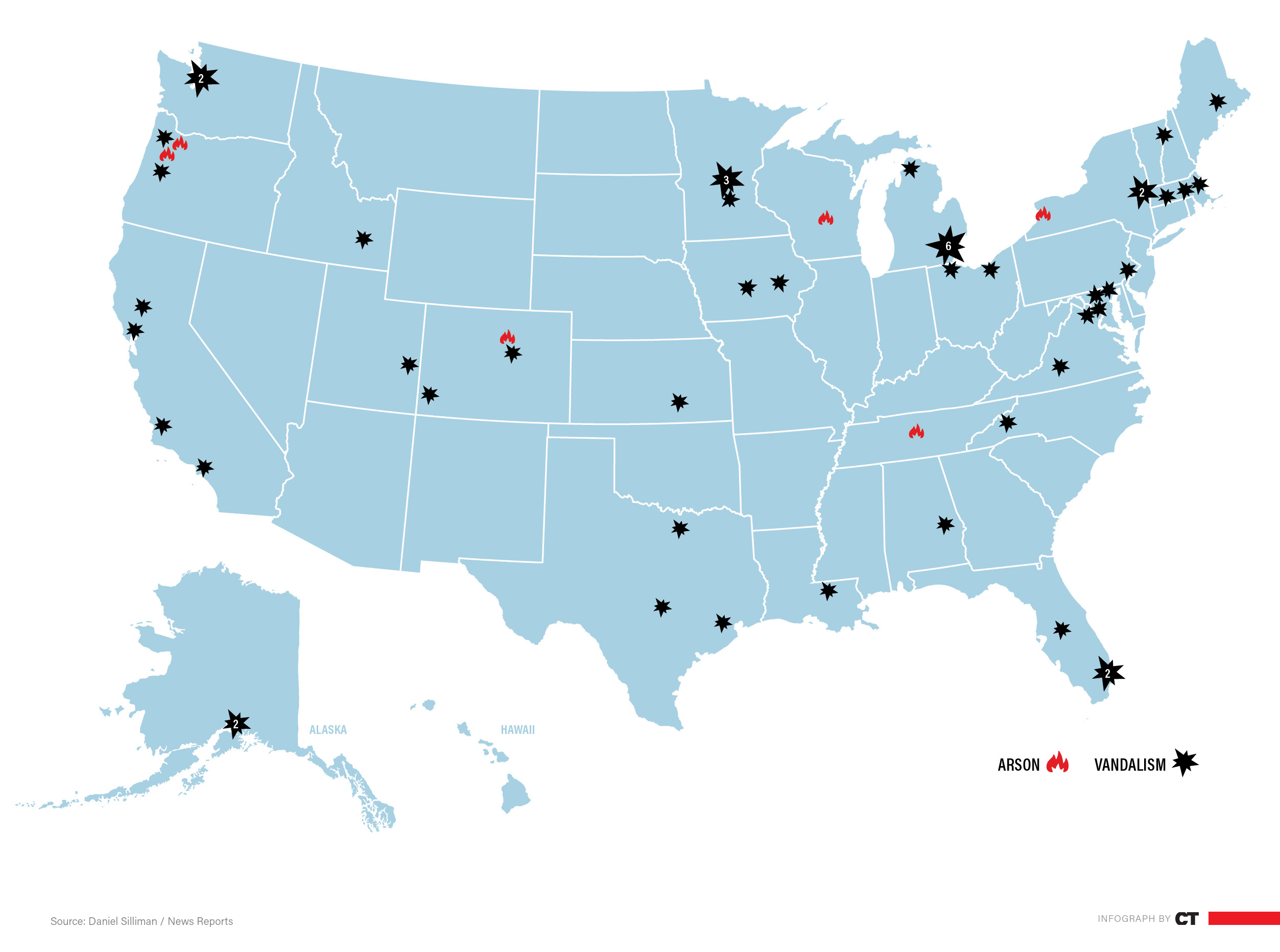
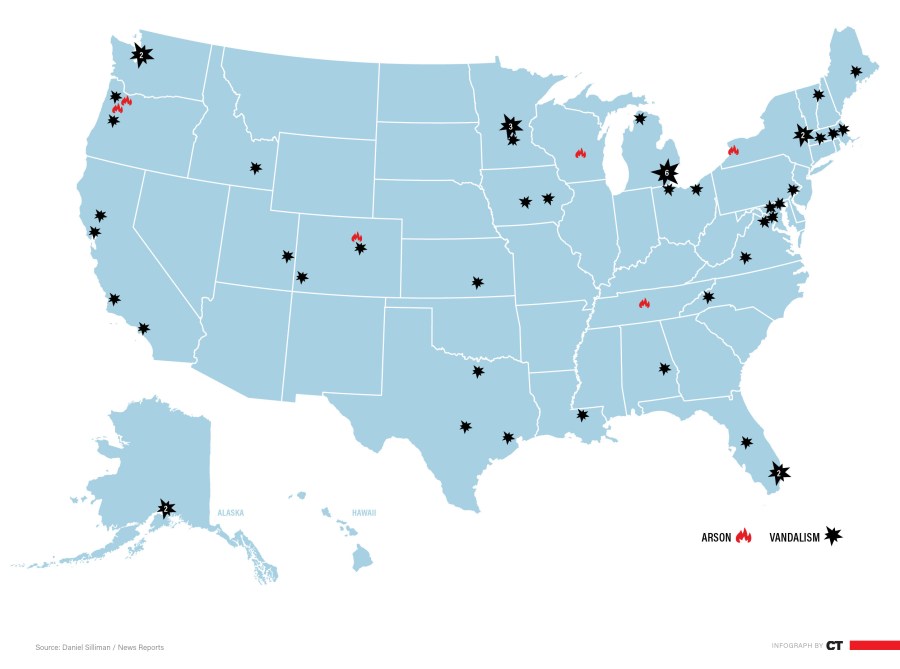
Pregnancy centers were attacked in 24 states in the aftermath of the Supreme Court decision on abortion rights.

Illustration by Christianity Today / Source Images: AP Images

The crisis pregnancy center in Winter Haven, Florida, was hit the night after the US Supreme Court overturned Roe v. Wade. When the sun came up, the scrawled, spray painted messages were visible from one end of the outside wall to the other: YOUR TIME IS UP; WE’RE COMING FOR U; WE ARE EVERYWHERE; JANE WAS HERE.

Similar messages marred pro-life clinics in 24 states. The rash of vandalism started around the May 2022 leak of a Supreme Court draft of the decision in Dobbs v. Jackson Women’s Health Organization, and continued throughout the year and into 2023. More than 50 clinics across the country reported graffiti and broken windows, with damage sometimes in the tens of thousands of dollars. Six clinics were also set on fire.

A leaderless terrorist organization named Jane’s Revenge claimed much of the credit.

“This was only a warning,” the group said in a “first communiqué” sent after a firebombing in Wisconsin. “We will not stop, we will not back down, nor will we hesitate to strike until the inalienable right to manage our own health is returned to us.”

According to Jane’s Revenge, the “extreme tactics” are justified in part by pro-life extremists’ attacks on abortion clinics—which once averaged about 10 bombings and arsons per year.

Four people, all in their 20s, have been arrested for the attack in Winter Haven. Two others have been arrested for attacks in New York and Wisconsin. All face federal charges under a law Bill Clinton signed to protect abortion clinics in 1994.

“Our people have genuine and deeply felt differences on the subject of abortion,” the president said at the time. “But we must all agree that as a nation we must remain committed to the rule of law. It is what keeps us civilized. It is what enables us to live together.”
News

As Methodist Exits Hit 5,800, Some Churches Find Paths Blocked

(UPDATED) The costs and complications of UMC disaffiliation are leaving many congregations stuck.

Illustration by Rick Szuecs / Source images: Envato / CCO

Editor’s note: This article was updated with new information about disaffiliations on June 16.

Carolyn Moore assumed that her Evans, Georgia, church would be one of the congregations disaffiliating from the United Methodist Church (UMC). Across the country, as of June 16, more than 5,800 churches have separated along the lines of the deep fissures in the denomination: LGBT acceptance and Methodist authority structures.

But for a long time, Mosaic UMC looked like it was going to get stuck in the UMC.

Moore, Mosaic’s lead pastor, waited for directions on the process from the North Georgia Annual Conference, the regional UMC body, which had told churches they could send notice of their intent to disaffiliate starting on January 1, 2023. But the conference paused the disaffiliation process before it began.

North Georgia leaders sent an email to pastors in December 2022 saying they had concerns that local churches had relied on “misleading, defamatory, and false statements and materials” to make their decision to leave and join a new Methodist denomination, the Global Methodist Church, calling the discourse “antithetical to the concept of a gracious exit.”

Moore said she made “a hundred phone calls in the weeks after that email, hoping for some conversation partner who might help us make a way through,” but nobody in conference leadership would step up.

To date, about 20 percent of the approximately 30,000 Methodist congregations in the US have disaffiliated under the conditions set out by the Book of Discipline’s Paragraph 2553. But there are hundreds more, like Mosaic, whose members want to leave but can’t.

The decision to pause the process for churches in the North Georgia Annual Conference didn’t just delay the timeline; it meant they could lose any chance to disaffiliate, a formal process that allows churches to keep their property. The denomination’s addition to its Book of Discipline permitting disaffiliation “over issues related to human sexuality” sunsets at the end of 2023. And since one step in the leaving process is the annual conference approving a church’s departure, churches need to hold their disaffiliation votes before the annual conference meets.

Some annual conferences are adding extra meetings to their schedules to process all the disaffiliating churches. Others are less charitable. In March, the North Carolina Conference announced that it was closing Fifth Avenue United Methodist Church of Wilmington ahead of the congregation’s vote to disaffiliate. Conference leadership said in a statement that the decision came after “careful consideration and prayerful discernment.” But church members were blindsided by the announcement that their 170-year-old congregation would cease to exist.

“Fifth Avenue never asked for, agreed to, or wanted the closure, nor were its members ever given a chance to participate in the decision to close the church down,” member Justin Pope said in a statement.

Even when a congregation can work through the process, they can end up in a place of deep ambiguity. Tri-Lakes UMC, in Monument, Colorado, is in this sort of wilderness season.

The congregation voted on whether to disaffiliate from the UMC. Though 56 percent of the congregation elected to leave, the church did not reach the two-thirds threshold needed for the vote to pass.

A small pro-disaffiliation group, about a tenth of those who voted, has left to plant a conservative church in a nearby town. Pastor Bob Kaylor suspects that many of the 175 who voted to disaffiliate will follow. He has encouraged Tri-Lakes members to stick around and see what happens next at the church. But he’s leaving too. In May, after 13 years at Tri-Lakes, he took a position at a church that has voted to disaffiliate.

Each choice presents challenges, he said.

Staying in the UMC is “going to be challenging financially, and in terms of people and resources. I pray for them and hope they are able to sustain and thrive in the vision they have for the future,” Kaylor said. “It will be challenging for those who leave, too. Getting connected to a new church, starting a new church—those are hard. People carry their grief and scars.”

Scott Field sees pro-disaffiliation churches taking any exit route they can find. The Northern Illinois leader of the Wesleyan Covenant Association is working with 14 churches in his region. Only one has been able to complete all the requirements for disafilliation.

The other 13 churches might not make it out, because either the vote will be too close or the costs too high. Paragraph 2553 says separating churches need to pay unfunded pension liabilities. A conference’s boards of trustees may also require disaffiliating congregations pay a third or even half of the value of a church’s assets and property.

When a congregation doesn’t have the votes to disaffiliate, Field said, conservative members might leave and start new congregations. Sometimes the conservative members of several congregations will band together to start a new church.

In other situations, conservatives will join other local congregations. Field calls these the “meandering Methodists,” leaving out the side door.

For the churches in Northern Illinois trying and failing to navigate the disaffiliation process, “stuck” doesn’t convey the deep frustration they feel.

“They feel like the system is rigged against them, their leaders are corrupt, and the conference just wants their money,” Field said.

Left with no other options, churches in North Georgia filed suit against the conference on March 30 as a way to bring conference leadership to the negotiating table.

David Gibbs filed on behalf of 186 churches in North Georgia. He has also represented churches in litigation against the UMC in Florida and North Carolina, though those cases have both been dismissed.

Judge George Wright, in his ruling dismissing the case that 71 Florida churches filed against the Florida Annual Conference, acknowledged that the plaintiffs might have a legitimate case, but under Florida law the civil courts do not have jurisdiction to adjudicate church governance issues.

In his videoconferences with the churches he represents, Gibbs hears frustration and hurt from members who cannot understand why their annual conferences are making the process so difficult.

“They could let these churches leave for nothing if they wanted to,” he said.

Despite the frustration, disaffiliating pastors want to see the UMC pursue vibrant, God-glorifying ministry, even when they will not be part of it.

Stephen Sparks, pastor of Maples Memorial UMC in Olive Branch, Mississippi, feels called to align with the Global Methodist Church. More than half of the members of Maples likewise believed that the church should not be in the UMC, but the movement to disaffiliate failed by about 20 votes.

Some members of Maples voted to stay because they did not see a theological reason to leave; others felt loyal to the denomination they have always called home. And Sparks believes some were put off by the nearly $600,000 disaffiliation price tag calculated by the annual conference.

Like Kaylor in Colorado, Sparks will leave his UMC congregation and find a place to serve in the GMC. But he maintains hope for Maples UMC and the denomination at large.

“This is an opportunity for realignment for both the Global Methodist Church and the United Methodist Church to be who they are called to be and do great ministry,” he said. “There are people on the other side theologically that I dearly love, and we are great friends, and the only thing that will change is I will have to work harder to see them.”

Moore’s frustration with the North Georgia Annual Conference is compounded by her personal relationships with people in leadership, whom she believes to be good people.

“These are followers of Jesus,” she said. “They are not the enemy. We just have this disagreement about the future of the UMC, and it has put us in a place that none of us hoped to be in.”

As the deadline for disaffiliating drew nearer, there was a looming possibility that Mosaic Church will remain where it has been—stuck in a denomination, with no way out.

Finally, a Georgia judge ruled that the UMC cannot just press “pause” on the disaffiliation process. In fact, Cobb County Superior Court Judge J. Stephen Schuster ruled, the North Georgia Conference “has an affirmative duty” to assist any church wishing to exit.

On June 13, Mosaic Church held a congregational vote: 95 percent said they wanted to leave the UMC.

Megan Fowler is a writer in Pennsylvania.

Correction: Paragraph 2553 does not require disaffiliating congregations to pay a set percentange of church assets and property value. A conference’s board of trustees may set those requirements.

News

Belarusian Evangelicals Fear Growing Isolation

Christians there struggle to maintain global connections amid international conflict.

Pastor Vitaly Chichmarev with his family at home.

Pastor Vitaly Chichmarev with his family at home.

Courtesy of Vitaly Chichmarev

Pastor Vitaly Chichmarev doesn’t hesitate to use the word persecution.

“Yes,” he told CT, “the Belarusian church is persecuted.”

Chichmarev, who leads Light of Hope, a Baptist congregation in Minsk, recently spent seven months in prison. He was arrested in front of his teenage daughter in early 2022 for his participation in the massive 2020 protests against the controversial reelection of Belarus’s authoritarian president, Alexander Lukashenko.

He is back serving his congregation in the nation’s capital now. He’s happy to return to church work, be at home with his family, and release an EP of some new music with his rock band AntiVirus. But he hasn’t forgotten the big picture in his country, Belarus. He believes the situation for Christians there is dire.

“We are not able to rent rooms for meetings,” he said. “New churches are not allowed to register. Catholics have had buildings taken away from them. Among the Protestant pastors, some, like me, have been in jail.”

The Norway-based human rights organization Forum 18 agrees. The group has documented a tightening web of restrictions on the free exercise of religion in Belarus. Secret police surveil evangelicals and other religious groups, raid their churches, contrive evictions, and detain religious leaders. Authorities require extensive bureaucratic paperwork to approve church buildings, to allow any meetings outside of church buildings, or to permit foreign visitors, who are frequently denied entry into the country.

These restrictions have grown more serious as Lukashenko has cracked down on every part of civil society that might challenge his control. He has been in power since 1994 and is frequently called a dictator by international observers.

The US government is also “concerned about the constraints on religious freedom in Belarus, as part of the whole-of-society human rights repressions committed by the Lukashenko regime,” according to a spokesperson at the Department of State. US officials, including embassy representative Ruben Harutunian, have met with Belarusian authorities to advocate for more freedom. In particular, the US urged the regime to ease state pressure on clergy for participating in political life in Belarus.

The challenges have deepened because of the international situation. Belarus is sandwiched between Russia, Ukraine, and European Union member states Latvia, Lithuania, and Poland. It has become a close ally of Russia and supports its eastern neighbor in the war with Ukraine. Because of the conflict, Belarusian churches have found themselves cut off from global partners.

This has taken a toll on churches like Chichmarev’s. Light of Hope had around 100 members in 2020. About 45 remain, with more than half of the congregation fleeing to Poland, Georgia, and other countries to avoid military mobilization and escape the ongoing repression.

Article 31 of the Belarusian constitution provides accommodations for church gatherings and the public profession of faith. According to the government, there are 3,563 registered religious institutions in Belarus, representing 174 religious organizations.

Evangelicals, however, account for less than 2 percent of the population. And they are treated as second-class citizens under the law, according to Leonid Mikhovich, president of the Baptist Union in Belarus and rector at Minsk Theological Seminary. Even so, Mikhovich is ambivalent about using the word persecution.

“On the whole, our situation is not the best, but when you compare it to Soviet times or other countries, we don’t have specific persecution,” he said. “We can publish the Bible, hold Bible camps, have theological education, have Christian worship. We have a lot of opportunities.”

Mikhovich is less bothered by the limitations in Belarus than by how isolated Christians there have become. Few opportunities exist to connect with brothers and sisters around the world—or just across the border.

“We used to have a strong relationship with churches in Ukraine. That’s no longer possible,” he said. “We have many connections with ministries in the West, but those are difficult to maintain in light of global politics. We can work with Russians, but the overall situation for cooperation is not good.”

One of the Baptist Union’s partners is the Slavic Gospel Association (SGA), headquartered in Chicago. Founded in 1934 by Belarusian Peter Deyneka, SGA trains pastors and church planters, sponsors missionaries, and provides equipment and resources to local churches, predominantely in the former Soviet Union.

SGA president Michael Johnson said the group currently sponsors 55 pastors and church planters in Belarus on an ongoing basis, in partnership with the Baptist Union there. The conflict between Russia and Ukraine has cost SGA some support from organizations in the US and Europe, but the work continues. Despite international isolation, he said, the Baptist Union seminary is still functioning and turns out new church planters and pastors every year. The SGA has also partnered with orphanages, camp ministries, and evangelistic efforts in the past two years.

“The abhorrent circumstances they find themselves in are difficult, but they’ve been able to adjust,” Johnson said. “For me, I think it’s a privilege just to carry their bags. To support the work they are doing.”

Rauli Lehtonen, secretary for the Pentecostal Commission on Religious Liberty who focuses on Eurasia, cautioned that the longer the isolation lasts, the worse the situation for evangelicals and other Christians in the country will become. It’s getting harder to even know what the situation on the ground is for churches in Belarus.

“The isolation is casting a dark shadow over the flow of information,” he said. “People are afraid of expressing their thoughts about the current situation in the country. … This allows for the authorities to be bolder in their discrimination, because they can suppose that the knowledge of the persecutions will not be known.”

Karina, a 27-year-old Belarusian Christian living in Los Angeles, can feel that shadow in her own life. Karina, who asked CT not to publish her last name for fear of reprisals against family and friends back home, left Belarus to pursue a career in California following the protests in 2020. She’s still in touch with people at her church in Minsk, but there are a lot of things she’s afraid to talk to them about.

“We talk about the weather, what I am doing here in LA, food, or even sports, but never about the war, never about the state of the church,” she said.

Though Karina is glad she can enjoy many freedoms she wouldn’t have in Belarus, she can’t help but feel cut off.

“I have been going to church here in the city, but my spiritual home is in Belarus. Sadly, I have no meaningful contact with it anymore,” she said.

That is in part why Chichmarev has been posting more music online since he returned from prison. He hopes people like Karina hear his lyrics and feel connected to their families, communities, and churches back in Belarus. He hopes, too, that Christians around the world will know what is happening in Belarus and pray for his country.

“Our dream is a free country where people live, love, and sympathize with each other,” he said. “We ask Christians around the world to pray that the situation will change, to pray for the pastors, for their protection, for all believers in our country, and those who left, that they can return home.”

Ken Chitwood is a scholar of global religion who lives and works in Germany.

History

How Archaeology Affirmed the Historic Stature of a Biblical King

Once, the House of David seemed like a folk tale. Now, the rocks testify to its historic significance.

illustration by Tim Peacock

The Bible describes David as a man after God’s heart and a king who reigned for 40 years, firmly establishing the “city of David” and an Israelite kingdom that he passed to his son Solomon (1 Sam. 13:14; 1 Kings 2:10–12).

In archaeologists’ minds, the record is not so clear. Some experts, looking at the evidence from excavations across modern-day Israel, have argued that the Bible greatly exaggerated David’s historical significance. Some have gone so far as to suggest David was a myth, a heroic fiction, and a nationalist folk tale.

“We obviously have in David a figure built substantially of romance, legend and literary elaboration,” wrote British scholar Philip R. Davies. Danish scholar Niels Peter Lemche claimed “it is rather likely” that “the tales about him are as historical as the legends are about King Arthur.”

But after decades of debate, new discoveries are affirming David’s historic stature. The expanded evidentiary record—from monumental inscriptions to the remnants of ancient construction—supports the biblical account.

“We now have a completely different picture than we did 50 years ago,” said Michael Hasel, professor of Near Eastern studies and archaeology at Southern Adventist University, pointing to the mounting pile of archaeological evidence.

The first breakthrough came in 1993 with the discovery of the Tel Dan Stele near the Syrian border. An inscription on a stone slab, written by an Aramean king celebrating a military victory, names the defeated kingdom the “House of David.” The stele dates to about 140 years after David’s death, making David the earliest biblical person named in the archaeological record and, by the standards of the field, an established historical person.

Part of the challenge with establishing extrascriptural evidence for David is that he sits on a historical fault line.

“He’s right on the cusp of where the Bible doesn’t have a lot of external sources to affirm persons and events and the period where we do have sources,” said Kyle Keimer, adjunct professor at Jerusalem University College and coeditor of the textbook The Ancient Israelite World. The Tel Dan Stele, however, firmly placed David on the “sourced” side.

A few years after the discovery, though, a fierce academic fight broke out in Israel over whether David really had an empire. Was the kingdom, the House of David, a real political and military force? Israel Finkelstein, a highly regarded Israeli archaeologist, said No, not really. In a landmark paper, he claimed David was not a significant monarch, but maybe a kind of warrior-chief. The kingdom known as the House of David happened later—and was really only a vassal state of the Omride kingdom in northern Israel.

“Someone for whom the Bible represents the word of God views what I have to say with complete shock,” Finkelstein later told The New Yorker. “The description is of a glorious kingdom, a huge empire, authors in the king’s court, a huge army, military conquests—and then someone like me comes along and says, ‘Wait a minute. They were nothing but hillbillies.’”

It wasn’t just commitment to the Bible that prompted scholarly objections to Finkelstein’s “low chronology” argument, though. His interpretation of evidence—and claims based on lack of evidence—raised a lot of questions. He also seemed to be making broad assumptions about what a 10th-century B.C. empire would look like.

A monument known as the Tel Dan Stele boasts of defeating “the House of David."
A monument known as the Tel Dan Stele boasts of defeating “the House of David.”

Keimer told CT the lack of monumental architecture dating to David’s rule turned out to be a straw man. It is easily knocked down by looking at what the Bible actually said about David’s kingdom, instead of using modern ideas about political power.

“The ancient world has its own cultural milieu,” Keimer said. “Allowing the text to speak for itself puts us in tune with the political and social details we have preserved there.”

In the era, monuments were only one way to express power. Kings also used relational and charismatic authority, showing their strength by getting people to obey them. Patrimonialism—the sort of power that might be exerted today by a mafia boss—doesn’t leave the same record, but that doesn’t mean it’s not powerful or not an empire.

The biblical accounts of King David don’t emphasize his construction projects. They do highlight his relationships, which are why his son Absalom mounted an almost-successful coup—by undermining his relational authority. Absalom didn’t erect a stele; he “stole the hearts of the people” (2 Sam. 15:6).

Keimer suggests that David’s kingdom might have stretched from Dan to Beersheba (24:2), while his influence could have been felt much farther away, even as far as Egypt or the Euphrates River. There would be less archaeological evidence of that kind of power.

Erez Ben-Yosef, a professor at Tel Aviv University, has recently argued that there’s an architectural bias in biblical archaeology. He suggests that many more people than previously realized still lived in tents 3,000 years ago.

“This is a society that is not building large cities,” said Dan Pioske, a theology professor at University of St. Thomas. “We have to watch our assumptions about what capital cities or kingdoms looked like.”

Archaeologists have also found more evidence from this period that Jerusalem was significant, even if it didn’t have the monumental architecture to rival other kingdoms of that era. Pioske points to the Amarna Letters, a series of communications from various Canaanite cities to an Egyptian pharaoh, which describe Jerusalem as a city of some standing.

“If you add up all of the little pieces—which you have to do because Jerusalem is an inhabited city and it’s not easy to do archaeology there—it’s actually a pretty impressive site,” he said. “We have lots of examples from antiquity where a small place has a large influence.”

Archaeologists, however, have also found some monumental architecture near the Temple Mount. The late Eilat Mazar discovered the foundation walls of a large public building, which neatly corresponds with an account of a construction project mentioned in 2 Samuel 5:17. She was able to date it conclusively to the 10th century B.C. Mazar, who died in 2021, told CT she was not religious but was an effective archaeologist because she read the Bible as a historical document.

“This is Jerusalem, which we know best from the Bible,” she said, which “contains within it descriptions of genuine historical reality.”

Outside of Jerusalem, archaeologists have found more evidence that points to the power and influence of the early Israelite kings. Hasel, from Southern Adventist University, excavated a site called Khirbet Qeiyafa with Israeli archaeologists Yosef Garfinkel and Saar Ganor. Qeiyafa overlooks the Valley of Elah, where David confronted Goliath.

The archaeologists discovered massive fortifications in their excavation, with walls built of several hundred thousand tons of stone.

“This wasn’t somebody building a pen for their sheep at night,” Hasel said. “It gives us new data for the debate.”

There’s no evidence that the structure was Canaanite or Philistine, so the best explanation is that it was built by the growing Israelite political power in the Judean hills.

Hasel noted that in earlier years, arguments about David’s empire were typically based on excavations in northern Israel. Now that more sites are being excavated in the foothills between the Judean highlands and the coast, archaeologists are discovering artifacts that Finkelstein said shouldn’t exist.

Hasel believes the results from Qeiyafa and two other sites where his team has worked have solidly reestablished the traditional “high chronology” and established an archaeological record for the significance of David.

And it’s good to have him back.

“If you don’t have David, you don’t have a lot of things,” Hasel said. David is mentioned around 1,000 times in the Bible. He’s credited as the author of 73 psalms. His history is tied with Jerusalem becoming Israel’s capital and the site of the temple. And through the line of David, the Messiah is promised.

“Without David, that is all put into question,” Hasel said. “He is a very significant figure not only for Israel but for the history of Christianity and Judaism. They all draw their identity back to that one person.”

Archaeologists aren’t done, either. They may well find more extrabiblical evidence of David’s reign.

In 2017, the excavation of what appears to be a citadel in Tel Abel Beth Maacah, in northern Israel, turned up a glazed ceramic head, a “faience,” two inches tall that some think could depict King David. More scholars think it’s King Ahab or King Hazael of Aram-Damascus, but there’s no way of knowing.

The ceramic head of a king, left in ruins a century after David’s reign.

“All we can say for sure about the faience head is that it was found in a late-ninth-century context and represented an elite—military commander, governor, king, et cetera,” said Robert Mullins, professor of biblical and religious studies at Azusa Pacific University, who is codirecting the excavation. “I would never rule out David as a possibility since Abel was also a large city at that time … maybe it originated in the 10th century but someone found the broken head on the ground and kept it as a souvenir.”

In 2022, a team of researchers used new technology to read a stele set up in modern-day Jordan by a Moabite king more than 800 years before Christ was born. The stone had been damaged, but these scholars were able to reconstruct the writing with a 3D rendering. It just has 34 lines, but on line 31 they saw the words House of David.

David’s political significance and the accuracy of the scriptural record were affirmed again, in testimony of stone.

Gordon Govier writes about biblical archaeology for Christianity Today, hosts the archaeology radio program The Book & The Spade, and is the editor of Artifax.

Correction: In an earlier version of this article, Niels Peter Lemche was identified as Dutch. He is Danish.

Ideas

Left Behind at the Ballot Box

Staff Editor

Our view of the end times should affect our politics. But how?

Illustration by Rick Szuecs / Source images: CCO / Wikimedia Commons

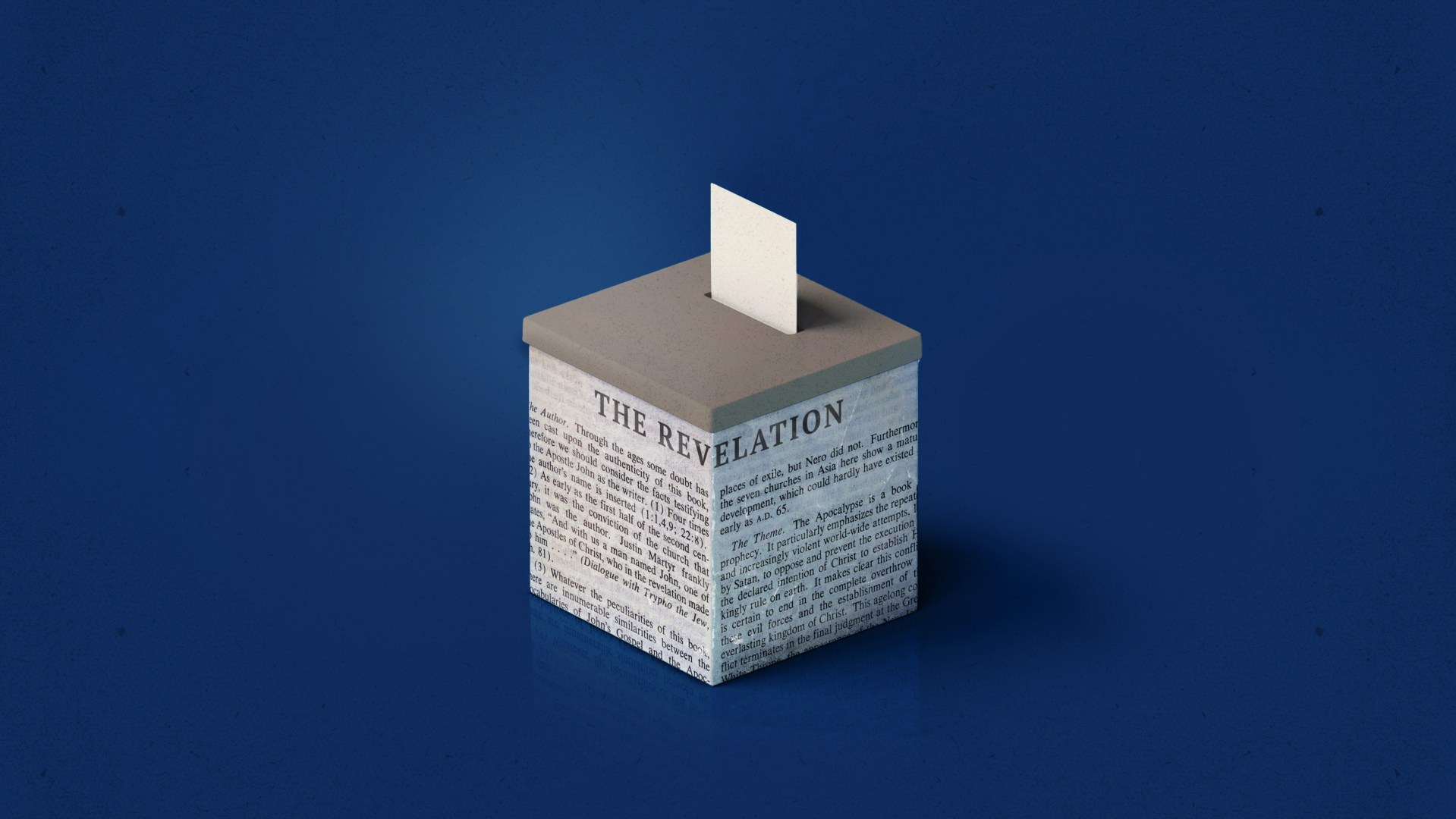
For decades, the dominant evangelical perspective on the end times has been a premillennial, dispensationalist eschatology. As shown in the Left Behind series, this view says the end is nigh and the world—politics included—will grow increasingly wicked and catastrophic until the end comes. Therefore, as Jesus tells his disciples, we should “keep watch, because you do not know on what day your Lord will come” (Matt. 24:42).

Yet for Christian nationalists, rejecting an imminent apocalypse is a logical move. Among the “most important tasks for the Christian Nationalist is overcoming the idea that the world is going to end very soon,” Andrew Torba and Andrew Isker argue in their self-published book, Christian Nationalism.

That might come as a surprise to the average American evangelical, to whom Torba and Isker seem to be writing. But if God is helping evangelicals “take dominion in His name,” it doesn’t make sense for the world to end at any moment, they argue. Accepting an “eschatology of defeat” in which God raptures Christians away from advancing evil discourages effective political organizing. To win, Torba and Isker advise, Christians need a theology with room for victory.

Until the early 1800s, an optimistic, postmillennial eschatology—that believed in a golden age preceding Christ’s return—was the majority American perspective, as historians like Daniel Hummel, author of The Rise and Fall of Dispensationalism, have documented.

After the horrors of the Civil War, however, that positive narrative of history fell out of favor, and Western hopes for historical progress further declined following World War I. Premillennialism’s catastrophic forecast has since become the default in evangelicalism and pop culture. Politics still influence the way Christians think about eschatology—but how?

Samuel Perry, a seminary-trained sociologist and author of The Flag and the Cross, tweeted a hypothesis last fall I found compelling. He suggested right-leaning Christians’ end-times theology will shift because postmillennialism “provides better rationale for Christian nationalist goals” than premillennialism’s pessimism.

But his further research has developed a messier picture, Perry told me recently. Dispensationalism remains the dominant view—including for those he’s classified as Christian nationalists—but “not in the sense that the eschatology is motivating political goals.”

Rather, it is a broader mentality in which Christians feel they are fighting not just political opponents but powerful spiritual enemies who might win temporarily. Premillennialism offers “an eternal cosmic stake” for political battles, Perry said, with an urgency that an optimistic “eschatology of victory” can’t match.

Hummel reported similar observations. Postmillennial voices are increasingly outspoken and organized in the American Christian Right, he told me over email. Yet to the extent that eschatology drives action at the grassroots level, views are mixed and even incoherent, Hummel said. Dispensationalism trickled into our “political-cultural discourse [and] took on a life of its own.”

Now, confusingly, many irreligious Americans have a roughly premillennial expectation for the end of the world. Pop apocalypses, from the Avengers franchise to the more serious climate change fears, unwittingly borrow story fragments and phrases from dispensationalism. Meanwhile, some Christians’ political activity reflects little of the end-times beliefs they claim. Followed to its logical conclusion, for example, dispensationalism should push Christians more toward evangelism and discipleship than political strife.

A nationalist demand for an “eschatology of victory” raises questions we might all consider: How do our politics affect our theology of the end of the world? Are our expectations for the future mostly formed by news and trends? There should and inevitably will be some connection between the two. But our anticipation of Christ’s return must not make us behave less like Christ.

The current of influence should flow from our hope in “the appearing of the glory of our great God and Savior, Jesus Christ” (Titus 2:13) and his kingdom “not of this world” (John 18:36), not the other way around. As Hebrews 13:8 assures us, whenever the world ends, whether our side wins the next election or loses, “Jesus Christ is the same yesterday and today and forever.”
Ideas

In Search of Non-Toxic Male Sexuality

Can we recover a healthy, Christ-honoring vision for masculinity?

illustration by Joseph Rogers

In recent decades, evangelicals have invested a colossal amount of discipleship, activist, and publishing energy toward promoting “sexual purity” and a “biblical” vision for sexuality. Despite this, the pattern of scandal, abuse, and misconduct by men and male leaders makes clear that the purity movement has not solved the problem of unhealthy sexuality in the church. The #ChurchToo movement and related denomination-specific investigations have demonstrated that “sexual purity” is often a mere façade covering up deeper patterns of wickedness.

The crisis of abuse, dysfunction, and sexual violence in the church is downstream from a theologically deficient understanding of what it means to be male. Specifically, we have perpetuated a hypersexual vision of masculinity. These scandals and patterns of dehumanization have infected the church, not despite the purity movement but in many ways because of it.

It’s time to change the way we talk and think about male sexuality. This sub-Christian view of masculinity creates a culture in which men are allowed to wallow in ongoing sexual immaturity. It shouldn’t be surprising when dehumanizing theology leads to dehumanizing—and consequently sinful—behavior.

The church is beginning to grasp how purity culture objectifies women and dehumanizes them. What’s often less appreciated is the way the movement also has dehumanized men. If purity culture dehumanized women by treating them as sexual objects, it dehumanized men by casting them as sexual animals. If it hypersexualized women’s bodies, it hypersexualized men’s minds. Much of our rhetoric and resources adopted the culture’s assumption that men are helplessly and hopelessly hypersexual, a belief perpetuated in TV sitcoms and accepted in “locker-room talk.”

Christians will often critique the broader culture for its preoccupation with sex and sexual fulfillment, but the church is not innocent of fashioning its own sexual idols. While preaching abstinence and celibacy to singles and sexual minorities, some straight male preachers and authors turn around and gratuitously celebrate the glories of (male) sexual satisfaction in heterosexual marriage.

Jesus’ kingdom does not reject the created goodness of sexuality, but it does decenter it.

In a bizarre twist on the prosperity gospel, some Christian teachers have argued that following God’s design for sex is the path to your best sex life. Wives are charged to be more sexually available to their husbands as the solution to their struggles with pornography. Single men are told that God’s “provision” for their out-of-control sexual desires is marriage, reducing a covenant relationship to a permissible sexual outlet. Since sexual satisfaction subtly becomes normalized as the rightful inheritance of godly men, certain forms of male sexual entitlement are all too common.

The crisis of masculinity in the US goes far beyond sex and sexuality (data increasingly reveal drops in educational achievement, increased relational and romantic struggles, and patterns of domestic terrorism), but these topics have emerged as a crux of the conversation in the evangelical church, and for good reason.

We’ve seen girls be subjected to leering looks from men decades older than them. Some excuse marital rape on the grounds of a poor reading of 1 Corinthians 7. Men and boys who desperately want to quit looking at porn have trouble shaking the habit despite their best efforts in accountability and Scripture memory. Sermon clips and controversial books by well-known pastors go viral for all the wrong reasons.

Christians must forcefully resist the insinuation that masculinity and maleness are inherently toxic and dehumanizing. We must move beyond criticism and begin charting a course for positive and life-giving models of masculinity. And we can look to Jesus as our example.

First, we see the goodness of maleness in the Incarnation. Men and women are both created, affirmed, and blessed by God in creation (Gen. 1:26–28), and God’s Son himself came to earth embodied as a human man. And while it is true that Jesus is the model for true humanity, not simply for true masculinity, it is also true that his male embodiment can and should be uniquely instructive for men in how they think about and express their sexuality.

For example, we learn from Jesus that men do not need a sexual outlet to live fulfilled, self-controlled, and godly lives. Attaining to “true” manhood for many Christian boys and young men often implies a certain type of baptized sexual conquest—successfully wooing a wife and fathering children. Jesus did neither. If our script of masculinity has become so sex-centric that it excludes Jesus, perhaps it’s due for a revision.

Jesus also embodies a positive vision for nonsexual relationships with women. As John 4 makes clear, Jesus did not follow the Billy Graham Rule. He honored women with relationship and attention. In the Gospels, Jesus never utters a word about women’s clothing inciting men toward lust. But to men habituated toward overeroticizing women, he said: Cut off your hands and gouge out your eyes (Matt. 5:27–30).

Second, the death and resurrection of Christ inaugurates a new way to be human, and a new way to be human means there’s a new way to be male. The “old man” has died with Christ (Rom. 6:6). In a world given over to sinful flesh, too often, “boys will be boys.” But united with Christ in the Resurrection, boys can become mature, godly, gentle, self-controlled, and loving men.

Whatever “natural” or cultural inclinations we may associate with being male, if they tend toward sin and dehumanization, they have been put to death with Jesus on the cross. Christ’s death and resurrection means that masculinity need not be defined in terms of dominance, physical strength, hypererotic desire, sexual prowess, marriage, or the fathering of biological children.

Jesus’ kingdom does not reject the created goodness of sexuality, but it does decenter it. Living in imitation of Jesus, then, enables us to situate sex under the higher good of the flourishing of others. It frees men from the need to strive after a cultural narrative that focuses on a hypersexualized performance for the attainment of “true” manliness.

There’s a lot of deserved criticism that prevails in our current conversation around Christian masculinity. But what if we allowed ourselves to be captivated by a vision of redeemed masculinity? What if we dreamed of a church and a world where women do not live in fear of men? In Jesus’ kingdom, to paraphrase Micah 4:4, each woman will sit under her own fig tree, and no man will make her afraid.

But redeeming what it means to be male isn’t solely about protecting women from harm. It’s also about men’s joy. Do we really believe that new life in Christ offers men something better than the bodily pleasures of sex have to offer? Do we dare to hope that current and would-be abusers and sex addicts can be transformed by the power of the Spirit that raised Jesus from the dead to be contributing and flourishing members of society? Can we expect broken men to find joy and grow in their capacity to love and serve others—as Jesus did?

The phrase “not all men” can be weaponized to silence abuse survivors and diminish problems and patterns of dehumanizing masculinity. At the same time, it is true that many men in the church already model a better way. Research shows, for example, that churchgoing men are significantly less likely than other men to have viewed porn in the past year. Many men take very seriously allegations of sexual abuse and would not hesitate to hold other men to account for these sins and crimes. Many fathers and male mentors teach boys from a young age to respect and honor others as sexual beings created in the image of God.

These role models already exist in our churches and communities. If we would open our eyes to see their quiet faithfulness, listen to their stories, hear their wisdom, and learn from their love, we may see that the slog of “every man’s battle” is not the only masculine script available to follow.

We can aspire to more for men. Not just to stop lashing out in violence or sinking into compulsive sexual behavior, but to become more truly human as advocates for justice, faithful friends, noble protectors, honorable husbands, and selfless lovers. As we look to Christ, the true man, we can become new men.

Zachary Wagner is editorial director for the Center for Pastor Theologians and the author of Non-Toxic Masculinity: Recovering Healthy Male Sexuality. Speaking Out is Christianity Today’s guest opinion column.

Testimony

I Loved Studying Math. I Needed God to Show Me Why.

At a moment of crisis, my drive to excel seemed increasingly pointless.

Photography by Abigail Erickson for Christianity Today

I grew up in a small South Texas town. As a child of immigrants, I was raised to value education as a ticket to a good life and social acceptance. We were a secular family, but my spiritual awareness grew in encounters with my own inadequacies.

I must have been five when, after I misbehaved, my dad gave me a spanking and I lashed out by biting him on the back. But right away, I felt deep remorse. My parents immediately banished me from the house, and I spent that evening huddled in the family car, crying. I prayed to God for forgiveness. After some time, I went inside and told my dad I was sorry.

I suppose I had the instinct to pray because my parents, though not religious, had enrolled me in a parochial elementary school, which they chose for the quality of the education. This was where I developed an awe for holy spaces, like the cathedral, and for holy figures like Jesus, who hung on a cross there. I often sat in the pew and imagined what he might say to me. But otherwise, I mostly ignored God.

My imagination was redirected as I grew older. I did well in school, especially in mathematics. Math ignited in me a sense of awe and wonder. There was an enchanting order to the universe it could unlock. I grew to appreciate how mathematical truths are real, though they aren’t physical, and how they influence the world, though they exist outside it. These felt like spiritual insights.

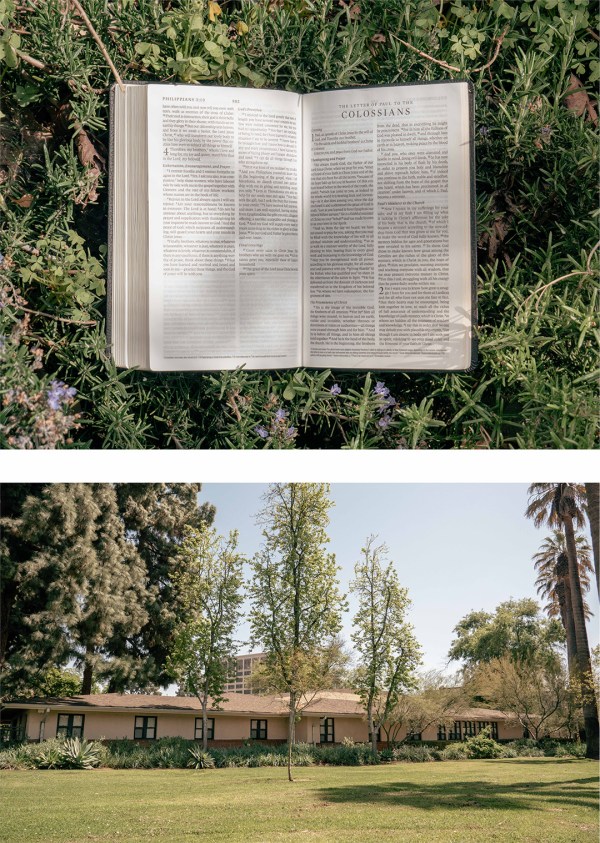
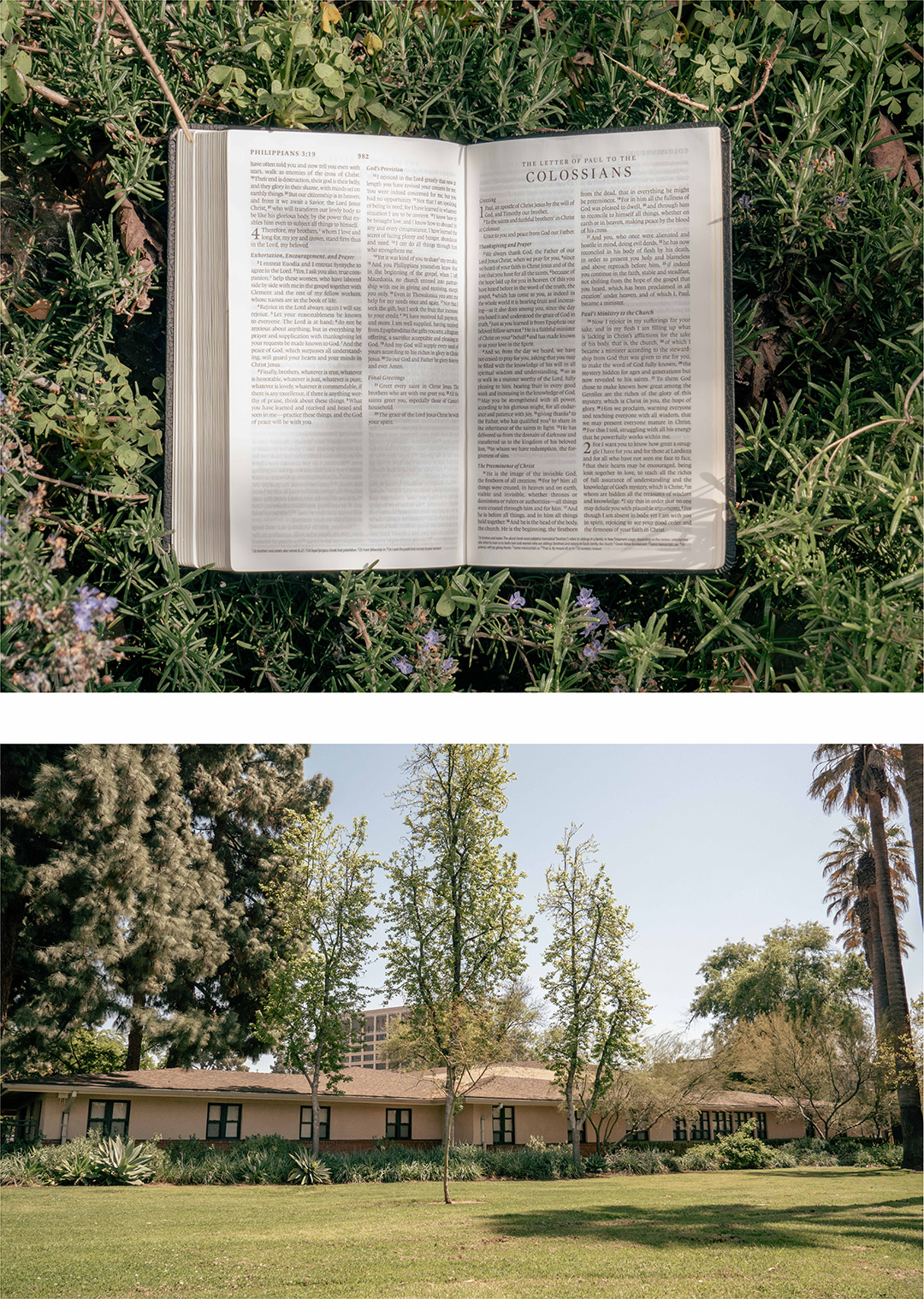
Top: Francis Su’s personal Bible. Bottom: Su’s church in Pasadena, California.Photography by Abigail Erickson for Christianity Today
Top: Francis Su’s personal Bible. Bottom: Su’s church in Pasadena, California.

My joy in learning, however, became ensnared by the temptation of success. Striving relentlessly to excel, I began to frame my identity around being smart rather than learning for its own intrinsic rewards. The quest for achievement drove my every pursuit, from getting good grades to winning math competitions. I was desperate to prove myself worthy of something, to somebody.

I entered college in 1985 amid rising Cold War tensions and fears of nuclear warfare. I would work on math and physics problem sets with my classmate William, who had an encyclopedic scientific knowledge. On his dorm room wall was a frightful map of the United States that he had colored based on his own research. Most large cities were covered by black disks, surrounded by concentric rings of red, orange, and yellow. Only a few uninhabited portions of the West were left unscathed.

“What do the colors represent?” I asked William in awe. “The level of destruction in the event of a nuclear war,” he answered. The gentle manner of his reply threw into sharp relief the violence of his map. The dread I felt over such a calamity only amplified the sense of personal doom I was already wrestling with.

Both my parents had recently been diagnosed with serious illnesses—my dad with colon cancer and my mom with ALS, or Lou Gehrig’s disease. Though my dad’s prognosis was uncertain, my mom’s was sealed—ALS has no known cure. Soon she would be paralyzed, her clear mind trapped in an unresponsive body.

For the first time in my life, I was forced to confront the futility of life crushed against the ugly reality of death. William’s forecast compelled me to grapple with that absurdity on a massive scale. Looking for reassurance, I asked him, “Is there any hope?”

“Not unless you believe in God,” he said, almost under his breath. William was a meek fellow who probably didn’t intend to start this conversation, but he was answering my earnest question as best he could. I was surprised to learn he was a Christian, and I wondered how an intellectual like him could rationalize his religious beliefs. He was the first of several Christians I met in college who were smart but seemed to live according to different metrics of success.

“The soul does not surrender to despair until it has exhausted all illusions,” Victor Hugo, one of my favorite authors, wrote in Les Misérables. That’s how despair overtook me. I began to see the empty promise of achievement. The world could be blown up by thousands of nuclear warheads, or my family could implode from affliction and heartbreak. Making good grades meant nothing in these scenarios. Work and relationships seemed meaningless. Achievement, success, happiness—what was it all for?

My despair grew to a breaking point near the end of my freshman year. One night when I was especially depressed, I wandered around campus for hours, a suffocating heaviness in my spirit. Returning to the dorm, I stepped into the elevator with two other guys who started a conversation with me about Jesus. Normally I might have recoiled, but on this night I was receptive.

We had lunch two days later, and I poured out all the questions I had about God. They presented the Christian faith not as a set of religious beliefs designed to compel morality, but as a relationship with Jesus. That was new to me. They showed me that Jesus was a man of sorrows, acquainted with grief. He suffered, which meant he could understand my family’s suffering.

For the first time, I understood the necessity of grace. We try so hard to make ourselves righteous, to earn our dignity through morality and accomplishment, and yet none of this striving can heal us, because there is no one righteous, not one (Rom. 3:10). That message may have surprised me as a college student who wanted to have it all together morally and intellectually, but it would have resonated with five-year-old me, huddling in a car in shame and grasping the depths of my sin.

The Christian framework suddenly made sense. Jesus offered relief from my aching loneliness and an assurance of more to life than I could see from my limited vantage point. Of course, I knew that if I proceeded down this path, I wasn’t throwing away my mind—I’d need to actually read the Bible and investigate its claims. But I took a leap and decided to commit my life to Jesus.

Later that evening, I told William. Delighted, he revealed that he’d been praying for me all year.

Following Jesus radically shifted where I found meaning and hope, even though my life problems didn’t suddenly go away. Suffering continued to plague my family. And I needed more time to confront my idolatry of performance as a measure of self-worth, especially as I pursued a math doctorate at Harvard. But embracing this spiritual journey set me on the road to understanding why some things in life are so rotten and others so glorious.

I see now why studying beauty matters, even when it has no immediate application. The beauty of reasoning and the order we behold in patterns reflect something divine and so are worth studying for their own sakes, rather than for personal glory.

I see now why suffering has meaning. “The heart of the wise is in the house of mourning” (Ecc. 7:4), because affliction sharpens our senses to see life more richly.

And I see now why relationships have meaning. When I lament the way I hurt my dad, when I savor profound friendships, or when I weep with those who are suffering, I dignify the image of God in another. Realizing this has inspired me to deepen my relationships and made me more attentive to serving the marginalized, whom Jesus identified with and prioritized.

In God, I have found rest from my meaningless striving for significance. The Jesus who hung on the cross in the cathedral now speaks to me in my inmost being, reminding me that God’s love, as the source of my dignity, is enough.

Francis Su is the author of Mathematics for Human Flourishing and a professor of mathematics at Harvey Mudd College. He and his family live in Pasadena, California.

Ideas

The Christian Life Is Wishful Thinking

Columnist

What we want for ourselves becomes what we offer to others.

Illustration by Abigail Erickson / Source Images: Getty, New York Public Library Digital Collections

It was a typical Friday night at the Wilkin house. A spontaneous dinner had collected a growing number of neighbors and friends. As the kitchen swelled with people and chatter, I leaned over to each of my kids and whispered the code they were probably expecting: “FHB.”

Family hold back. Maybe you know this strategy, too. Surveying the food relative to the guests, it became apparent that we needed a nonmiraculous solution for our five loaves and two fishes. My husband prayed over the meal and then, quietly, the Wilkins slipped to the back of the line, serving themselves minimal portions to stretch the food. They knew they wouldn’t go without; it was not a matter of if they would eat but when. Worst case, we’d order a pizza once the guests had gone home.

Nobody wants to be at the end of the line. Given the choice, we want to go first, to get the full portion, to sit in the most comfortable chair. But Christ-followers understand that life is about more than doing what we want. It’s about doing what we wish.

Let me explain.

We can all imagine times when we wanted to be treated better, when we longed for more care, recognition, and grace than we received from others. We may look back and think, I wish my failures would be treated with gentleness. I wish I had received support during a hard season. I wish I had received love instead of rejection. I wish that anniversary had been remembered or that milestone had been acknowledged. I wish I would be made to feel needed, included, significant, treasured.

We are not wrong to hold these wishes. They illustrate the basic human need to be known, loved, and accepted. And what we do with how we feel about our wishes, met and unmet, will shape the course of our lives.

To that end, Jesus invites us to live lives directed by wishful thinking, though not in the way we might anticipate: “So whatever you wish that others would do to you, do also to them, for this is the Law and the Prophets” (Matt. 7:12, ESV).

Put simply, Jesus tells us to do what we wish. Thinking about our own wish list, we then act accordingly toward others.

We give the encouragement we wish we had received, and we show the honor we wish we would be shown. We cherish as we wish to be cherished and serve as we wish to be served. We step to the end of the line. We move to the least comfortable chair. We defer what we wish for ourselves and instead secure it for others.

Family hold back. Every day, in moments great and small, we look for ways to do what we wish others would do for us. But we do not do it alone, and we do not do it without hope. It’s easier to move to the back of the line when you do so with your family. It’s easier to take the smaller portion when you know the lack is only temporary.

The world says, “Do what you wish, without regard for others.” Move to the front of the line. Grab what gain you can. If your wishes don’t match your reality, nurse anger and resentment. Jesus says, “Do what you wish, with regard for others.” And he did. He deferred glory for deprivation, that we might receive the abundance of being reconciled to God. In doing so, he fulfilled what his Father wished, and he invited his followers to practice the wishful thinking that imitates his own.

This world is flat-out starving for kindness and decency. It is ravenous for meaning and purpose, and we are just the family to invite them to the table.

Do you wish people were kinder to you? Be the kindest person you can be. Do you wish your hurts were noticed and your wins were cheered? Be attentive to those around you who are hurting. Do you wish you were encouraged more often? Encourage your neighbor.

Do it together; do it for the joy set before you. Any lack in this life is bearable in light of the bounty to come. Do it as Christ did for you. Do whatever you wish.

Cover Story

Generations After Slavery, Georgia Neighbors Find Freedom and Repair in Christ

In the farming community of Dirt Town Valley, family friends grapple with a difficult truth: One ancestor was enslaved by another.

Photography by Rita Harper for Christianity Today

Friends and neighbors Stacie Marshall and Melvin and Betty Mosley chat over coffee in Marshall’s farmhouse kitchen in Dirt Town Valley, Georgia. Windows frame cattle pastures in every direction as they catch up on family weddings and local farming news. A mass of cheerful daffodils rests on the table between them.

On the surface, this encounter seems like any other between close friends. But a striking history sets their relationship apart—Betty Mosley’s great-great-grandmother was enslaved by Marshall’s great-great-great-grandparents in this community 150 years ago.

Marshall, 43, a mother of three and former campus minister, has been friends with the Mosleys for decades in this largely segregated corner of Northwest Georgia. Her father grew up as best friends with Melvin Mosley, and Melvin was her assistant high school principal.

Stacie Marshall and the Mosleys did not know their shared painful past until it was uncovered in 2021 through a Berry College documentary called Her Name Was Hester. The filming began in 2015 and followed Marshall’s discovery of her family’s history and her attempts to reconcile with the descendants of those they enslaved as she learns to run her family’s 300-acre cattle farm.

In 2017, Marshall was clearing out the family farmhouse when she discovered an 1860 county slave schedule in a boot box. The document, which listed enslaved people as part of the federal census, confirmed what her grandfather had told her years before—that her great-great-great-grandfather had purchased seven people, including a wet nurse named Hester.

“My grandparents are dead, and now all of this belongs to me,” Marshall remembers thinking. She described the strange feeling of shame that came with finding her family’s documents, even though she was generations removed from the slavery.

Marshall first turned to the Mosleys, her spiritual mentors, as she sought to find Hester’s descendants and make amends. Though she knew them well, she approached the meeting with trepidation, concerned the story would bring pain. But she found that the Mosleys welcomed the conversation. “I’m having to unlearn the idea that silence is protective,” Marshall said.

Melvin Mosley, a 69-year-old principal turned pastor, spoke a prayer over Marshall that day that she calls “one of the defining moments of my life.”

“He has known and loved generations of my family,” Marshall said, “and that day, he prayed, ‘Lord, break this generational racism that might exist.’”

Years went by as Marshall and the Mosleys began leading racial reconciliation efforts in their community together. The Berry documentary continued to film their progress, and in 2021 The New York Times profiled their relationship. Two weeks later, a local historian’s genealogical research unlocked a stunning development: Hester’s great-great-granddaughter was Betty Mosley.

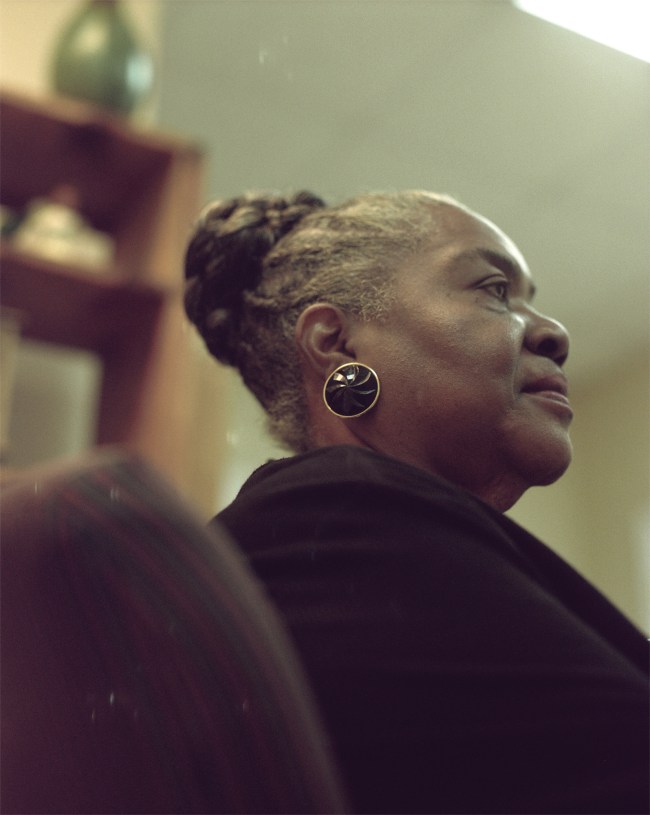
“I just want you to know that this doesn’t change the way I love you.” Betty MosleyPhotography by Rita Harper for Christianity Today
“I just want you to know that this doesn’t change the way I love you.” Betty Mosley

“It was shocking,” said Betty, 67. “How in the world did this happen?” She knew that most of her Black community had roots in slavery and sharecropping. In fact, her mother had been a sharecropper who picked cotton. But she never suspected a connection with Stacie Marshall.

After hearing the news, Betty stayed up all night searching for family records. And then she called Marshall the next day to say, “I just want you to know that this doesn’t change the way I love you.”

Melvin and Betty Mosley have been working toward racial reconciliation for decades in this county of 25,000, most recently through Harmony Baptist Church, an interracial congregation that Melvin has pastored for the past two years. Harmony was founded to be “a worship place for every race.”

But racial reconciliation hasn’t always come easy to the Mosleys.

In his elementary years, Melvin noticed that his Black school got the leftover books from the white school. In college, he was told by one of his professors that he didn’t belong in the largely white setting. And as a young teacher, Melvin had to correct a white student who told him, “My daddy told me I don’t have to do what you say.”

When Betty was in seventh grade in 1967, the year schools were integrated in Chattooga County, a white boy called her a racial epithet on the bus. He walked out with a black eye.

Though she grew up in church, she said her faith in Christ deepened during her early years of marriage as she began to study God’s Word. Her early dreams of a big house, a nice car, and a swimming pool yielded to a deep desire to please God. “It’s like the hymn says,” she said. “You understand it better by and by.”

She and Melvin later participated in Race Relations Sunday, hosted annually by their home church, Oak Hill Missionary Baptist. Each year, the white church Stacie Marshall attended was invited to come worship at Oak Hill while the Mosleys’ Black pastor would preach at the white church, whose columns had been carved by enslaved workers.

Betty is redirecting the grit that silenced a middle-school bully decades ago. Today, she focuses on reaching all races with the love of Jesus Christ. Betty and Melvin often host activities like biscuit-making classes, fish fries, and other community events in their work with Harmony Baptist Church.

“I don’t care if they are white, Black, Mexican, or Asian,” Betty said. “I want them all. That’s the way it’s supposed to be—that’s the way it is in heaven.”

Melvin sees the potential to interrupt generational sin and build a more hopeful future. “In all our families, there are generational things it’s up to us to break,” he said. “And when we break them, they’re broken forever.”

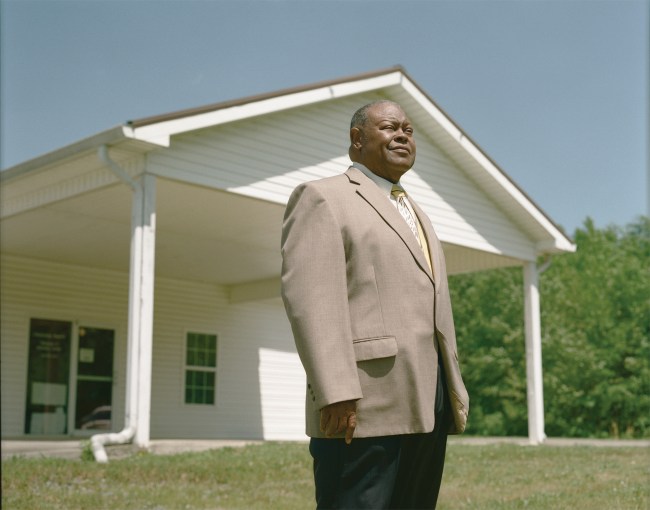
“In all our families,there are generational things it’s up to us to break.” Melvin MosleyPhotography by Rita Harper for Christianity Today

“In all our families,there are generational things it’s up to us to break.” Melvin Mosley

Both Melvin and Betty understand the challenges they face in this work, even as they rely on God as the source of all love. “Love is hard,” Betty said. “People don’t always give it back to you. But it’s what the Lord requires of us.”

Sometimes love means pushing back against racism for the good of the community. Several years ago, a local official allowed a Confederate flag to be flown over the county courthouse. Betty and Melvin visited him and asked him to remove it. Several others protested too, and the flag eventually was taken down.

Through actions like these, the Mosleys are sharing Christ with their community. “Our goal is to make our town a better place to live,” Betty said. “As my relationship with the Lord [has grown], I want to make a difference in the world.”

Marshall continues to experience pushback as she shares her family’s story more widely, through both the Berry College documentary and The New York Times piece that featured her relationship with the Mosleys. Though she and her husband led a campus ministry at the WinShape Foundation at Berry College for 13 years (where he still works), she walks a tightrope with some fellow Christians who regard her with suspicion and a few of the local farmers she bumps into at the Dirttown Deli.

Melvin and Betty Mosley have helped guide her through this, cautioning, “You’re going to see a side of [some people] that you haven’t seen.” Marshall worried for the Mosleys too, but Melvin assured her they have been through worse. “I’ve been wearing this black suit my whole life,” he said with a grin.

But this is not a relationship defined by shared persecution. Instead, it is seen in the easy, warm way the Marshalls and Mosleys relate to one another, the good-natured ribbing, the deep family connections. Melvin performed Marshall’s brother’s wedding on a recent weekend, and her brother called her while the Mosleys and Marshalls were gathered in her snug kitchen. “How are the honeymooners?” Melvin bellowed to the phone across the room.

There have been hard conversations and tears along the way. Early on, trying to make sense of her family’s relationship with the people they enslaved, Marshall shared her family’s narrative about Hester: that she was so close with the Marshall family that she opted to stay with them after the Civil War. But the Mosleys reframed the story for Marshall: As a penniless Black woman, where else could she have gone?

“It’s a gift from the Lord to walk through this relationally, to not ignore it or be in bondage to it,” Marshall said, explaining that authentic repair can only come in relationship. “[The Mosleys and I] keep our own relationship rooted in what our strongest bond is—our Lord and Savior Jesus Christ.”

Betty Mosley sees relationship as the ultimate route to healing racial wounds.

“Relationship is everything,” she said. “You’ve got to have a relationship with Jesus Christ.”

She also seeks to share God’s love and ultimate reconciliation through the way she treats others. “I pray over my home because I want you to feel welcome in my home. I want you to feel comfortable talking to me. I may have an opinion, but I’m going to tell it to you from the perspective of the Lord.”

In an age of pitched debate and hot takes, the Mosleys’ steadfast, loving engagement stands in sharp relief. And it doesn’t come without a cost.

“As white people, we get to choose whenever we have this conversation,” Marshall said.

“I just want to keep sowing good seeds alongside the Mosleys.” Stacie MarshallPhotography by Rita Harper for Christianity Today
“I just want to keep sowing good seeds alongside the Mosleys.” Stacie Marshall

“But the Mosleys never had a choice. It helps me understand what has been required and how they have held this history the way they have.”

One of the Mosleys’ daughters told Marshall, “I just want you to share the wound with us. Because it’s heavy, and we’ve had to carry it for a long time.”

This outlook helps Marshall respond when some paint her as a white savior: “I’m learning to be misunderstood.” That’s a small solidarity in walking alongside her Black neighbors, she said. “It’s okay if people don’t understand my motives.”

As Marshall continues to wrestle with her family’s history, she is considering how to use the additional land she will inherit to further the work of reconciliation in her community. It’s a fraught topic, echoing a larger national debate around reparations.

“It’s something I’m going to be working out the rest of my life,” she said, noting that reparation is about repair at its core. “What does repair look like in community? In relationship?”

One example she offers is her father and Melvin Mosley’s lifelong friendship: “It has been very formative to my faith journey.” The church she grew up in focused heavily on conversion and the Great Commission. “But Daddy and Melvin were centered on ‘God is going to bring who he’s going to bring to himself. And if he uses me, that’s wonderful.’”

“That has been profound for me,” Marshall said. “I am just going to be love, because I am loved.”

She appreciates the way Jesus went about repair during his life on earth, in effect saying, Something of harm has happened here—sin. Let’s repair it, and that can only be done through my death and resurrection.

At its center, repair is about dying to self, she said, citing Galatians 6:2: “Carry each other’s burdens, and in this way you will fulfill the law of Christ.”

“He broke bread and body so we could be reconciled to God,” Marshall said. “He showed how to walk out repair in human relationships.”

And she sees racial reconciliation as a fundamental way to express her Christian faith, referencing Matthew 18:15. “It’s not a chore to do this,” she said. “It feels like all these sermons and Scriptures living inside of me is all for this moment. This is how I can walk out my Christian faith tangibly.”

Her Name Was Hester examines personal and societal repair as they relate to reparations. Black farmer Matthew Raiford says in the film, “Reparations are about more than land or money—it’s a conversation to have. It’s not one size fits all.”

The film’s director, Brian Campbell, an associate professor of anthropology and chair of environmental science and studies at Berry, has seen the impact the film makes on viewers. A Black community organizer who saw the film at a screening in Rome, Georgia, told Campbell that it changed his perception of what reparations might look like.

“The film presents the idea that really spending time with your neighbor of a different background will provide opportunities for connection that you didn’t anticipate,” Campbell said. “Engaging in genuine dialogue and conversation will lay the groundwork to move toward reconciliation.”

Haley Smith, Berry’s director of diversity and inclusion, is creating lesson plans and discussion guides for churches, schools, and community groups. Her Name Was Hester has been screened at film festivals from Arizona to New York over the past year.

Assessing reparations, Melvin Mosley said, “It’s the heart that has to be changed.” He foresees a day when enough hearts are changed that people of color don’t have to be twice as good as others to acquire jobs or secure loans, as he experienced. “Everything we do today affects tomorrow. We’ve got to look forward and pay it forward.”

Betty put it more simply: “Reparations to me is that Stacie don’t teach her kids to be prejudiced.”

To this end, the Mosley and Scoggins (Marshall’s father’s side) families founded Hester’s Heritage Foundation in 2021 to support Black history preservation, education, and farming initiatives. The foundation hosts groups at the farm to preserve enslaved people’s unmarked graves, conduct discussions, and advocate for the prosperity of Black farmers, who currently make up only 1 percent of farmers nationwide.

“I know this land belongs to the Lord,” Marshall said. “I want to use it for the healing of the community.”

One way Hester’s Heritage Foundation is paying it forward is by screening Her Name Was Hester and leading discussions with college students. “They are so committed to seeing a better world,” Marshall said.

At a Hester’s Heritage event at the farm last year, a group of Berry students gathered around to hear stories from 95-year-old Dirt Town Valley resident Clemmie Black, an educator who had taught in Chattooga County schools for decades before they were integrated. Her grandmother had been enslaved and would measure flour and sugar with her hands when baking because she couldn’t read or write.

Over the years, Black not only attained an education but was able to teach and influence generations in this area, sowing small seeds of hope.

Marshall shares the same motivation as she works with the Mosleys to undo the racial dynamics they inherited. “I just want to keep sowing good seeds alongside the Mosleys,” she says in Her Name Was Hester.

Marshall marvels at this improbable story that has affected so many lives over so many years and has led to two friends sharing coffee on a quiet morning. “We could not have written this story,” she said. “It feels miraculous.”

Sitting in Stacie Marshall’s kitchen, Betty Mosley reflects on the changes she has seen within her lifetime in Dirt Town Valley: “Even though my great-great-grandmother was born a slave, I was born free. Jesus said, If the Son sets you free, you are free indeed.”

She rests her elbows on the counter beside the bright daffodils, the first flowers to bloom at the end of winter.

“I am free indeed.”

Melissa Morgan Kelley is a journalist based in Atlanta.

Theology

Is God Pleased by Our Worship?

For Amos, it depends on whether the God we worship demands justice.

illustration by Stephen Procopio

In this Close Reading series, biblical scholars reflect on a passage in their area of expertise that has been formational in their own discipleship and continues to speak to them today.

My mother was Guatemalan, and she went to great lengths to make sure that our family spoke Spanish and celebrated holidays with a Guatemalan flavor. I spent most of my summers as a boy in Guatemala, spending time with family and getting to know that country that is so dear to my heart.

Years later, I found myself back in Guatemala City as a professor at a seminary. It was a time when the 36-year civil war was at its worst. The war had begun when I was a boy, but I had never processed it. I was used to seeing soldiers around and hearing stories, but the fighting was primarily in the mountains. It seemed so far away.

As an Old Testament professor, I taught students from all over Latin America who would be confronting overwhelming poverty, widespread political corruption, and armed conflict; Guatemala was not the only country experiencing civil war. What could the Old Testament offer them? Could I make the Word of God come alive in relevant ways? Clearly, God cared about these things.

Roman Catholic liberation theologians were speaking into this complicated context and offering their own analysis and theological solutions. At the time, Latin American evangelicals were just beginning to venture into discussions of society and politics. Church services largely avoided these topics, as they were thought to be too worldly, but they drove the conversation in the coffee hour. These were the realities of my everyday life.

What would an evangelical approach to these problems—one deeply grounded in Scripture and our tradition—look like? That is what I and others began to ask. Liberation theology often pointed to the Prophets, and as I was already a student of the Old Testament, that is where I turned for answers. I landed on the Book of Amos.

Amos has a lot to say about justice, but it also hits hard at worship. Like other prophetic books, Amos denounces worship disconnected from justice. Why were the Prophets so concerned? More importantly, why did God reject Israel’s worship? I still ponder these questions.

I reside now in the United States, and I continue to wonder what Amos or Isaiah or Micah might say if they were to walk into the churches I attend.

On Sunday mornings I go to an evangelical Anglican church and in the afternoons a nondenominational (and more lively) Latino church. Each feeds my bicultural soul. But I ask myself: Would the Lord be pleased with the rituals, the preaching, the songs? Can the Prophets’ justice concerns be interwoven into the solemnity of the Anglican service or the exuberance of the Latino church? If so, how? What would that mean?

I make no pretense that what is presented here is the last word on the subject. Worship is the focus of renewed interest in the majority culture at both popular and scholarly levels.

Many factors motivate this concern—declining attendance, attempts to attune churches to cultural trends, the desire to recover historic liturgies, and more. Latino and Latina theologians in this country also are reflecting on the nature of worship, as they try to be authentic to Latino culture and responsive to our community’s particular needs.

What would Amos say to all of this?

One verse jumps off the page: Amos 5:24, an iconic text in justice circles, declares, “Let justice roll on like a river, righteousness like a never-failing stream!” Most readers miss that this line is embedded in a section that wrestles with worship.

Amos delivers his message in Israel, the northern kingdom, whose historic sanctuaries were Bethel and Gilgal. Shockingly, early on in Amos 5, the people of God are told not to keep going to either holy site, but to seek God instead (vv. 4–6).

In the ancient world, people went to the sanctuaries to participate in the community’s rituals and seek and encounter their god. Such too would have been the thinking of the Israelites of Amos’s day. So why did God not want them to go to these holy sites? How else—where else—could they worship? Why was God condemning their sanctuaries and worship practices?

The command to not worship at Bethel and Gilgal would have made no sense to Amos’s audience, so the prophet explains what God was looking for.

In the structure of chapter 5, verses 4–6 (about avoiding the sanctuaries) correspond to verses 14–16. This passage defines what it means to seek God.

To seek God is to seek and love the good, to hate evil, and to establish justice at the gates of their towns and cities. The commands to “love” and “hate” tell us that the commitment to justice must be passionate.

The seriousness of the message is clear. Judgment on Israel was inevitable. But if the people would turn to this divine way—and if this found expression in their worship—perhaps God would have mercy on the remnant, those who remained after the coming Day of the Lord.

A somber warning, indeed.

The Lord’s rejection of such religious activities is visceral (vv. 21–23). He begins with “I hate, I despise.” Five more verbs describe God’s rebuff of Israel’s worship.

Some of the power of what God says is lost in English translations. God says he will not smell their assemblies (v. 21; sometimes translated as “accept” or “approve of”); receive their burnt and grain offerings (v. 22); look at the fellowship offerings (v. 22); or listen to their songs, which are just noise to God that they should take away (v. 23).

The dismissal is profound, as it is connected to God’s senses, his very being. The Lord wants nothing to do with Israel’s worship. In the Hebrew, there are seven verbs and seven rejected activities: perfect and total scorn.

It is at this point that 5:24 appears, saying God’s people are to let justice roll on like a river. For justice and righteousness to flow and never dry up meant they were to be constant realities in Israel’s society, and these words are connected to this blistering critique of its worship.

It is not that the Lord does not desire ritual. In fact, God had prescribed these very rituals in the Law! They were integral to his design for Israel’s worship.

The point is not to eliminate ritual; that is the only way that humans can worship. Even so-called nonliturgical churches have routine ceremonies and practices.

Amos leaves no doubt that separating worship and social justice is distasteful to God. Other passages in this prophetic book confirm that truth and reveal the more central issue.

Ironically, in chapter 4, the people are told to go to those same sanctuaries, Bethel and Gilgal … but to sin (4:4)! The prophet mocks their piety, their rituals of thanksgiving and celebration.

Then comes the dagger: “for this is what you love to do” (4:5). Their worship activity ultimately was only about them. They felt good about what they were doing, praising the goodness of the Lord. They did not realize that, in God’s eyes, their worship was sin.

illustration by Stephen Procopio

How could that be? Amos 4:6–11 explains. The Lord had brought hunger, drought, crop failure, war, and destruction. There was nothing to thank God for! These blows were meant to turn them back to God, but they had refused. Five times God declares, “You did not return to me.”

Because of this stubbornness, the Lord announces, “Prepare to meet your God” (v. 12). The people would have responded, But we meet you at Bethel and Gilgal! We meet you there in worship!

However, the prophet makes clear that they celebrate a different god, one they might call Yahweh but one who was nevertheless a deity of their own making. It was a god of blessing and goodness, with no rough edges.

Theirs was worship disconnected from reality and the living God.

Theirs also was a faith compromised by national ideology. The people were convinced that God was on their side and would bring Israel victory against its enemies (5:18–20).

What a foolish miscalculation. The Day of the Lord, the prophet says, would not be the light of triumph; it would be the darkness of judgment from which they could not run or hide.

Amos goes to Bethel, the chief sanctuary and the axis of the national religion. There he confronts Amaziah the high priest (7:10–17). The high priest recognizes that the prophet is a threat to the status quo, to the wedding of crown and faith.

Amaziah reports Amos’s uncomfortable message to King Jeroboam II and demands that Amos go back to his home country of Judah (vv. 10–12). What right did he as a foreigner have to criticize Israel’s government and religion? Did he not know that Bethel was the king’s sanctuary and the temple of the kingdom (v. 13)?

By these words, Amaziah and Israel’s religion stand condemned. The clergy and the temple have been co-opted by the political regime. Amos announces that the priest will die in exile (v. 17) and decrees that Bethel will be destroyed (3:14; 9:1).

Once again, the idol they called Yahweh had reared its ugly head. This god legitimized the government, the ruling elites, and the social structures that were causing widespread oppression. The high priest would not question the king or the way things were; he had no compulsion to defend the weak and decry the wrong.

This was the way the religions of the nations around Israel functioned, but it was not to be so for God’s people. The Lord will not tolerate the worship of a false Yahweh, worship that ignores injustice and sociopolitical compromise and shouts praises in the midst of so much suffering. Worship, social concerns, and political realities are inescapably woven together.

More importantly, what is at stake in worship is the very person of God. The Lord is involved in every dimension of human existence, and the picture of God presented in worship must reflect this. It must present God as he truly is. Worship must bring prayer, confession, lament, and praise to this God and shape a people to reflect this God.

The prophet Amos incorporated hymns into his oracles that exalt the power of the almighty God whose name is Yahweh (4:13; 5:8–9; 9:5–6). Israel needed a renewed vision of him. This is why the holy sites and the religious leadership are special targets for Amos’s message. It was at the sanctuaries that a twisted view of God was offered and adored.

Amos 5:24 now makes more sense. Letting justice roll down means denouncing religious activities unconcerned about injustice, celebratory rituals oblivious to human needs, and a faith sold out to a political ideology. If worship—however well intentioned—gets God wrong, it will produce a misguided people and be judged.

The Book of Amos begins with the Lord roaring from Jerusalem, from the temple on Zion (1:2). In other words, God was not even present in the sanctuaries of Israel! Their self-serving theology and nationalistic ideology had so distorted worship that the people were unaware of God’s absence. When the Lord would come, there would be no joy, only lament over judgment.

The God of Amos (our God) does not accept worship that fails to engage the challenging realities of life and the sins of society. We need to grasp that the demand for justice is central to the very person of God. The God of mercy and righteousness is the one we worship!

Centuries later, Jesus will pick up these very same themes and condemn the religious leadership and those complicit in unacceptable religion in the synagogues and in the Jerusalem temple.

So, what would a prophet say if he walked into our services on Sunday? I am not a leader of worship or a pastor. I am not a musician or a liturgist. I confess that I cannot offer any specific solutions. What I can say is that there is no formula to bring our worship services into line with God’s demands. Worship will vary across time, cultures, denominations, and faith traditions.

The prophetic word could require rethinking the songs we sing, redirecting the messages we preach, even restructuring church services. Perhaps we might rethink the tone of our worship to realign it more closely with God’s demands. Maybe we could instruct those who lead worship in justice themes, readings, and songs. Should we consider other Christian faith traditions that have a history of social justice engagement? There is much in church history, both here and globally, from which to draw and learn.

Worship, at its core, must be formative, designed to mold and nurture a people of justice, who lift up the God of justice and embody what that means in our lives and in society. That is the worship the Prophets clamored for.

M. Daniel Carroll R. (Rodas) is Scripture Press Ministries Professor of Biblical Studies and Pedagogy at Wheaton College. He has written a major commentary on Amos and, recently, The Lion Roars: Recovering the Prophetic Voice for Today.

addApple PodcastsDown ArrowDown ArrowDown Arrowarrow_left_altLeft ArrowLeft ArrowRight ArrowRight ArrowRight Arrowarrow_up_altUp ArrowUp ArrowAvailable at Amazoncaret-downCloseCloseellipseEmailEmailExpandExpandExternalExternalFacebookfacebook-squarefolderGiftGiftGooglegoogleGoogle KeephamburgerInstagraminstagram-squareLinkLinklinkedin-squareListenListenListenChristianity TodayCT Creative Studio Logologo_orgMegaphoneMenuMenupausePinterestPlayPlayPocketPodcastprintremoveRSSRSSSaveSavesaveSearchSearchsearchSpotifyStitcherTelegramTable of ContentsTable of Contentstwitter-squareWhatsAppXYouTubeYouTube