Theology

Loretta Lynn: A Coal Miner’s Daughter in the #MeToo Age

The late country music star modeled what church leaders need: A bold willingness to stand up for women.

Loretta Lynn

Loretta Lynn

Christianity Today October 6, 2022
Terry Wyatt / Stringer / Getty

This past week saw the death of country music legend Loretta Lynn at the age of 90. One need not have been a country music fan (as I am) to find this woman’s life important. Her story is especially significant at a time when, five years into the mainstreamed #MeToo movement, we still face serious questions about the treatment of women in both the church and the world.

When I think of Loretta Lynn, my thoughts don’t go first to her music—although I love it and could recite lyrics all day. I think of the self-described “Honky Tonk Girl” and her meeting with Richard Nixon.

Invited to perform at the White House at the height of the Vietnam War, Lynn took advantage of an audience with first lady Pat Nixon to raise the matter of someone she thought was unjustly imprisoned.

“Pat,” she said, “I’ve been wanting to write a letter to … Richard.”

Of course, one does not refer to the president of the United States by his first name—and especially not in the White House. Lynn chalked up her faux pas to her background as a coal miner’s daughter and the fact that she hadn’t spent a lot of time in places of power. When a television announcer in Chicago asked her why she had referred to the president as “Richard,” she said, “They called Jesus ‘Jesus,’ didn’t they?”

In some ways, that one anecdote sums up much of why Loretta Lynn caught the imagination of so many people. With one sentence, she gently poked at an institution that needed more authenticity. And she did it with a mischievous wink, letting her listeners know that she was not nearly as unsophisticated as she let on and that she knew exactly what she was doing.

Almost every analysis of Lynn’s career focuses on her role as a kind of protofeminist. For instance, her song “Don’t Come Home A Drinkin’ (with Lovin’ on Your Mind)” took on the abusive behavior of men caught in alcoholism and adultery, both of which Lynn had tragically seen up close.

Her song “You Ain’t Woman Enough (To Take My Man)” broke the standard trope of the heartbroken woman watching her man drift away with another. Think of Dolly Parton’s plaintive “Jolene,” in which she almost begs the other woman, “Please don’t take him just because you can.” Loretta, on the other hand, promised “Fist City” to anyone who threatened her or her family.

Her song “One’s on the Way” expresses the burdens of a woman raising children without adequate support or help from the father. She speaks from a very different class perspective than Betty Friedan or other elite feminist figures. The song references prominent women such as Jacqueline Kennedy Onassis and Elizabeth Taylor and calls their jet-setting lifestyles out of touch with working-class women:

The girls in New York City, they all march for women’s lib,
And Better Homes and Gardens shows the modern way to live.
And the pill may change the world tomorrow, but meanwhile, today
Here in Topeka, the flies are a buzzin’
The dog is a barkin’ and the floor needs a-scrubbin’
One needs a spankin’ and one need a huggin’
Lord, one’s on the way

Her class critique cleverly took on both the elite feminist establishment and those who embraced the status-quo idea of domesticity (Better Homes and Gardens). Neither one could understand what it means to be in Topeka, Kansas, hoping “it ain’t twins again.”

Once again, Lynn took on an institution she loved (family) and stripped away as much pretension as she could to ask, Is this really the way things should work?

She took on a task that wasn’t easy in postwar 20th-century America, but it was especially difficult in postwar 20th-century country music America. Lynn claimed that many radio stations refused to air her songs because they were “controversial,” which she defined as “just a four-dollar word for what I’d call honesty.”

In a book describing her life on the road with fellow country legend Patsy Cline, she reflected on bluegrass icon Bill Monroe allegedly pinching her backside while backstage at a show. Lynn took the reader through her thought process: “Was it because I hugged him?” she asked. Did he misinterpret her actions as flirting? “It seemed like it had to be my fault,” she wrote. “Otherwise, how could a respectable man like Bill Monroe do such a thing?”

Then she told the reader that she was too naive to see that he was to blame, not her. “Now I know better,” she wrote. “Bill was a dirty ole man, plain and simple. Being talented didn’t make him trustworthy or a gentleman. I don’t like it, but I know now. You can’t trust somebody just ’cause you wish you could.”

Over the past five years, we have seen revelation after revelation about men using the power of their positions to harm others, especially women and girls. When these revelations are about the church, many default to protecting the institution.

Sometimes they minimize the problem by saying, Look at all the good things the church does! Sometimes they do it with a “whataboutism” that points to abusive figures in the secular world: What about Harvey Weinstein? What about Jeffrey Epstein?

Sometimes the woman-blaming happens when people suggest the conversation itself is a “secular #MeToo movement” and a “liberal Trojan horse” attempting to supplant the sufficiency of Scripture.

But—most disturbing at all—people within the church will often blame the women who endure the harassment or abuse rather than the people who did the harassing and abusing. Women might be expected to reflect on what they might have done to “lead on” the men who abused them. More women than I can count have had their lives wrecked—through defamation and worse—simply for coming forward.

Underneath all this is the same old set of lies—that men cannot control their passions and that women must be responsible for not setting off those passions (or must “just endure” what happens when men don’t restrain themselves).

Many times, the church’s response to the abuse of women can sound just like that of the 1960s-era country music industry: “Well, he’s Bill Monroe; how could someone that talented do something like that?”

Loretta Lynn could see through that, and so should we.

That’s especially true when the way of Christ is strikingly different from the way of the world. The biblical story starts and ends with a mission that includes both men and women as joint heirs with Christ—inheritors together of the mandate to conserve and govern creation, along with the kingdom that is breaking through now in Christ Jesus.

If accountability for this vision will come, it will come through honesty. And honesty—at least in an institution committed to its own self-perpetuation—often comes with controversy.

“Fighting for my freedom made me the Loretta Lynn I am today,” the singer said. “Even though it hurt, I can’t regret that. I won’t.”

That’s the Loretta Lynn the institution of country music needed to be confronted with. The institution of the church, too, need to be reminded that women and girls are not “Honky Tonk Angels” expected to endure what no one should be asked to endure.

Lynn endured more than anyone should have to bear. Her songs tell that story, as does her autobiography. And yet, she is remembered not just because she went from the poverty of a coal miner’s daughter to the celebrity of a Grand Ole Opry legend. She will be remembered for seeing the pain around her and within her and challenging people to stop seeing all that pain as “just the way things are.”

When institutions or people claimed they were too big or too rich or too powerful to do anything other than the status quo, she was willing to say, “Enough.” She saw where the real priorities needed to be and refused to bow before the pretense of power.

In other words, she called Jesus “Jesus.” And that’s woman enough to shake the world.

Russell Moore is the editor-in-chief at Christianity Today.

You Should Be Bored in Church

Q&A with education professor Kevin Gary on the moral problem of the restless mind and why we need to learn to sit with tedium.

Christianity Today October 5, 2022
Illustration by Christianity Today / Source Images: robert.anthony / Lightstock

When Kevin Gary tells people he researches boredom in the classroom, they always respond the same way: “Man, that sounds really interesting.”

He gets the joke. Boredom sounds boring. But as he argues in his new book, Why Boredom Matters, that feeling of restlessness has bothered people for a long time. And how we respond to tedium says something essential about our ideas of what it means to be human and what it means to live a meaningful life.

He argues that if we want people to flourish in the midst of our cacophony of stimulation and distraction—email, Twitter, TikTok—punctuated by the occasional void of “being stuck with your own thoughts,” then we’re going to have to learn to sit with boredom.

Gary spoke with CT about why we need to examine the habits we’ve developed and how we’ve taught children to deal with boredom in the classroom and the church pew.

Is boredom a moral problem? I feel like I get bored a lot and that seems like a moral failing on my part. Is that the right way to think of it?

There’s something significantly moral going on. Boredom poses a moral situation to us that we have to respond to.

Compare it with anger. You have the mood, anger, and we can think of right ways and wrong ways to respond to that. I think it’s similar with boredom. It’s a morally perilous situation, because we have to respond to it and the easiest ways to respond to it don’t lead to human flourishing.

A big part of the moral peril with boredom, though, is it kind of sneaks up on us. It’s not easy to notice. That’s why some ancient writers talk about it as “the noonday devil.” It comes in a way you don’t even notice and don’t even notice how you’ve responded. In that context, it’s a morally serious situation.

What are the options? How do we respond?

The most predominant way we contend with boredom is we just avoid it. We maneuver our way out of it. Our digital devices are perfect for that, giving us the stimulation we need to escape situations we find tedious.

The other really common solution is resignation. Studying education, I’ve been in a lot of K-12 classrooms that I as an adult found to be dreadfully boring. And I was amazed at how docile and compliant most of the students were. They would be, for 30 minutes, tasked with copying a PowerPoint, word for word. Or doing some rote worksheet activity. I was hoping for some revolution. But they resign themselves. They’ve learned to be oriented to the goal of their grade.

Is that a problem?

The problem is when you’ve been conditioned to be extrinsically focused, you lose the ability to attend to things for intrinsic value, to perceive that something could be meaningful on its own.

Kids are constantly taught to do school work for grades. That’s how they gauge their performance but also derive their satisfaction from whatever they’re doing. But for humans to flourish, we have to find value and meaning in the things we do, and not always be thinking about a payoff.

Think of something like playing chess. You play chess because you enjoy it—the aesthetic experience, applying your mind to the complexity of the board. You enjoy it intrinsically, because it’s a fascinating game. That’s not me. I don’t actually enjoy chess. But human flourishing looks like enjoying a game of chess, and we’ve been trained not to, because we need this extrinsic goal.

So maybe I think I can get a chess scholarship and that would make chess worthwhile. But chess can’t be good just because it’s good.

The bored mind is characterized by a lack of attention. It can’t attend to something that’s good. It’s not satisfied by the thing that would actually satisfy it. It’s the restless, roving mind, always on the lookout for stimulation and novelty.

Boredom is not unique to our culture, but I think in our moment it’s been amplified.

My kids, when they were smaller, would say they were bored and it was so tempting, as a parent, to give them an electronic device to distract them. But sometimes I wouldn’t. I’d just let them be bored. And they would hit a wall, and find new possibilities. At the other side of boredom was an explosion of creativity.

Environments that create a bit of discomfort, where you have to contend with the bored state, are really full of possibilities.

Your book focuses on the classroom, but I kept thinking about church. Have you been bored in church?

I’m often bored in church.

But it’s interesting, I’m a Catholic and I don’t find myself getting restless or bored during Scripture readings or the prayers. All the parts are the same, always, and repeated over and over. But that helps me enter into the Sabbath. It’s during the homily that I get this experience of boredom. I just sit there in my head.

Obviously different churches are different. I went to one church service that felt like an Avengers movie experience. They put in a lot of work to make sure it wasn’t boring!

But maybe that’s wrong? Maybe we should be bored in church.

Church services can be part of a boredom-avoidance scheme: “Let’s try to really entertaining with our music!” I do think that does us a disservice, because we’re guiding people to steer clear of boredom rather than engage with it.

It’s an uncomfortable mood state. But learning how to push through that to get to something enjoyable and meaningful is a discipline and, I would say, a virtuous practice.

With a liturgy, there’s nothing going on and then there are epiphanies where all of the sudden, significance breaks through. There’s a lot of tedium between the beginning and the end, but then there are moments of, Oh my gosh, this is joy. But you have to be patient with the bored state.

So what is the right response to boredom? How should I respond?

We can become practitioners of being fully present, which is a way of entering into leisure.

I have to give credit to Josef Pieper, whose work Leisure: the Basis of Culture has been one of my key guides. And he’s drawing from Thomas Aquinas.

What do you mean by leisure?

With leisure, I’m not thinking of vacation or escapism. We want to contrast “vegging out” with contemplative beholding. I would describe it as receptive attention that is able to appreciate what it’s beholding.

Pieper distinguishes different ways of beholding and identifies this kind of beholding as receptive. It’s not passive. There’s a receptivity in it, marked by delight.

We need focal practices to help us do that, develop the habit of attending. Going for a walk. Cooking a meal. Going to church. The liturgy can guide our attention.

In the Christian tradition, the idea of the Sabbath is an idea about how we can behold reality and really appreciate it and enjoy it. I think it’s really quite profound, that we need to take that posture of rest in God’s rest to see the truth of things. That’s not the passivity of a day off, nor is it resignation to boredom. But we also have to give up our avoidance schemes.

When you’re sitting in church and you’ve lost the thread of the homily and you’re bored, what do you do? Or if you don’t want to hold yourself up as the exemplar, what do you want to do?

More often than not, I just sit there in my head and mull around a bit. But I think that’s okay. I think that can be a good practice, to be in your head, thinking about your thoughts. I’ll ponder the Scripture and maybe compose my own sermon, how I would talk about them. That’s a way of attending to the text. But even if I’m not doing that, I think it’s a good thing to practice just sitting.

Apart from church, we no longer have many spaces where we sit with ourselves. I think there’s value in learning how to sit.

Books
Review

No Doctrine of the Trinity Is an Island

As a new introduction emphasizes, the deep mysteries of Father, Son, and Spirit can’t be grasped in isolation.

Christianity Today October 5, 2022
Illustration by Mallory Rentsch / Source Images: Pexels / Unsplash

Historically speaking, theological debates over the Trinity have been a major factor in the denominational breakdown of the church. Moreover, the extent to which these debates have influenced—and continue to influence—our individual conceptions of the Father, Son, and Holy Spirit cannot be overstated.

Trinitarian Dogmatics: Exploring the Grammar of the Christian Doctrine of God

Trinitarian Dogmatics: Exploring the Grammar of the Christian Doctrine of God

Baker Academic

288 pages

$32.00

Take, for instance, the Filioque—the notion that the Spirit proceeds from the Father and the Son, as the Nicene Creed has it. The Filioque has been debated for over 1,400 years, heavily contributing to the church’s 1054 split into the Latin West (Catholicism) and the Greek-Byzantine East (Orthodoxy).

As those who reject the Filioque often argue, if the Spirit proceeds from the Father and the Son, then the Father’s unique role in the Trinity is undermined and the Spirit is made subordinate. Those in favor may retort: If the Spirit proceeds from only the Father, the Son’s divinity and salvific work are threatened. In short, acceptance or rejection of the Filioque affects how we define and distinguish the divine persons—and how we worship them, too.

This is true of the many other Trinitarian issues as well. And so, wrestling with how and why we think what we think about the Father, Son, and Spirit—how they relate, work, and reveal themselves to us—is an essential task. This task requires serious biblical, historical, and theological investigation.

Theologian D. Glenn Butner’s Trinitarian Dogmatics, an introduction to the doctrine of the Trinity, is a roadmap for just that. His approach to the Filioque is like that of the many other Trinitarian topics he tackles—ecumenical, fair, and nuanced. He distinguishes between hills to die on and hills to build bridges to, demonstrating why all of these subjects are ripe for critical conversation and reflection.

Interior to exterior

Unlike many introductions to the Trinity, which are organized according to historical or biblical topics, Butner’s approach is systematic. In other words, he moves from one concept—or “dogmatic locus”—to another, each building on the previous. In so doing, the reader is encouraged to study the book from start to finish. The interdependence of its form befits the truths it seeks to illuminate because, ultimately, no aspect of the Trinity can be grasped in isolation.

For instance, skipping to chapter 7, which covers “Inseparable Operations,” or how the divine persons act in concert, will make no sense without a firm grasp of perichoresis (how each person dwells fully within the others), dealt with in chapter 5. To productively wrestle with the divine persons’ mode of operating, one must first attend to the nature of their interrelation. This kind of reasoning informs the structure of Butner’s book.

Beginning with the doctrine of consubstantiality (which affirms that Father, Son, and Spirit share the same substance), and working through chapters on such themes as divine processions, relations, and operations, Butner’s topical progression culminates with a discussion on how we commune with the Trinity. While the first five chapters deal with God’s inner life, the last three pertain to how he works and reveals himself in the world. The book flows from interior to exterior, blooming out of the folds of God’s inner life and tracing their intersection with the Christian life.

The first five chapters allude to the connections between Trinitarian dogmas and specific matters of worship and spirituality. For example, at the end of the first chapter, “Consubstantiality,” Butner challenges the prevailing method of Sunday worship, which often directs “prayers, hymns, liturgy, and rites” to only one person of the Trinity, a practice he deems “a tacit rejection of the consubstantiality of Father, Son, and Holy Spirit.” When we worship the Father, we ought to acknowledge that we are simultaneously worshiping the Son and Spirit too.

Also, when discussing perichoresis, Butner argues that it “reveals the fundamentally trinitarian shape of salvation.” Because we are not equals with Christ, our union with him is not the same as the Trinity’s inner relation. But the latter still gives shape to the former. In being unified with Christ, Butner writes, “Christians in some sense share in the life of the Trinity,” a fact that underscores the importance of wrestling with the inner life of God.

Dialogue across history

Organizing concepts systematically allows Butner to create dialogue across history. He does not discriminate based on his own affiliations or leanings but converses with theologians spanning eras and traditions, drawing on the best of each to construct comprehensive analyses.

For example, Butner develops a robust understanding of the Trinity’s inseparable operations by dialoguing with church fathers (Tertullian, Gregory of Nyssa), Medieval thinkers (Aquinas, Bonaventure), and contemporary theologians (Catherine LaCugna, Adonis Vidu), to cite just a few examples. By doing so, he substantiates his claim that the work is intended to be “in service of the important goal of Christian unity.”

To this end, Butner strategically incorporates voices from cultural locations different than his own. However, he does not engage in tokenism (as is all too common in academic settings). Rather, he acknowledges that “there is no universal, singular voice of Hispanic women, of African Christians, or of the poor.” And so, he brings in theologians to speak on their varying cultures when relevant and helpful.

This is seen in his treatment of the divine missions of the Son and Spirit. Butner explains the situation Kenyan theologian James Henry Owino Kombo identified in African contexts, where many who first hear of the Trinity assume the Son and Spirit are somehow lesser deities. Kombo’s proposed solution is elevating the language of Son and Spirit in ways that overtly express their singularity with God the Father. Doing so, Butner acknowledges, would provoke a kind of “cultural shock” befitting the magnitude of this mystery.

According to Butner, this kind of cultural shock is needed in wrestling with the divine missions. The missions of the Son and Spirit are not fundamentally lesser than the work of the Father. Instead, writes Butner, the divine missions are “the fullness of the infinite … and simple God” made manifest “in the persons of the Son and Spirit within the finite … world.” This paradox is supposed to be shocking and strange to our time-bound minds.

Butner’s work is richly sourced not only by a plethora and diversity of theologians, but also in its interaction with the Scriptures. He identifies two principles basic to his theological method: the inspiration principle—that Scripture “participates in God’s knowledge by inspiration”; and the canonical principle—that it alone is “fully normative in theology.” Because of the high premium he places on Scripture, Butner draws on the entire canon throughout.

Butner agrees with Karl Barth that God is the revealer of his own revelation, but he argues that this self-revelation didn’t begin with the life of Christ. Rather, it has been happening since the dawn of time, and comprehending its culmination in Christ requires the context of the Old Testament. Because of this presupposition, Butner consistently finds support for Trinitarian doctrine in Old Testament history, poetry, and prophecy.

Sanctifying and strenuous

Butner’s approach is dialectical in two senses: He is constantly dialoguing with opposing views, and he alternates between discussing God’s threeness and his oneness throughout.

Regarding the first sense, Butner is always working through wrong answers to arrive at orthodox ones. This approach is important because, as Carl Trueman notes, “Heresy is usually quite sophisticated, actually has a meaning, and is to be taken very seriously.” To take heresy seriously is to take orthodoxy seriously. The two are in constant conversation, and to comprehend either requires engaging both. Butner does this well.

Regarding the second sense, while other introductions to the Trinity treat the Father, Son, and Spirit in separate chapters, Butner always deals with them together, highlighting either their plurality or unity (or both). He moves, for instance, from discussing consubstantiality (oneness) to processions (threeness), from simplicity (oneness) to persons and relations (threeness)—and so on. Perhaps the greatest challenge in discussing the Trinity is emphasizing God’s threeness and oneness simultaneously. By alternating between the two, Butner addresses this challenge effectively.

One of the most impressive things about this introduction may also prove an obstacle—its relative brevity. This book is compact. While this makes reading it far less intimidating, the sheer density of its contents may overwhelm or befuddle. Butner moves along at a very brisk pace. Giving the contents some breathing room, so to speak, would create space for more robust illustrations of how the Trinity intersects with practical liturgical and spiritual matters. Butner certainly points to these intersections throughout the book, notably in the final chapter, but more sustained attention would be welcome.

Trinitarian Dogmatics is instructive not only for theology but for worship too. Reading it is a sanctifying and strenuous exercise, providing space to wrestle with the deep Trinitarian mysteries and our limitations in comprehending them. Though it is written with the nonspecialist in mind, specialists will find it a useful resource too, as it is by no means nontechnical. This work will prove a gift to the academy and the church, promoting stronger ecumenical dialogue and more reverent worship of our God who is—mysteriously, magnificently—three in one.

Noah R. Karger is an MDiv student at Gordon-Conwell Theological Seminary and research assistant at the Center for the Study of Global Christianity.

News
Wire Story

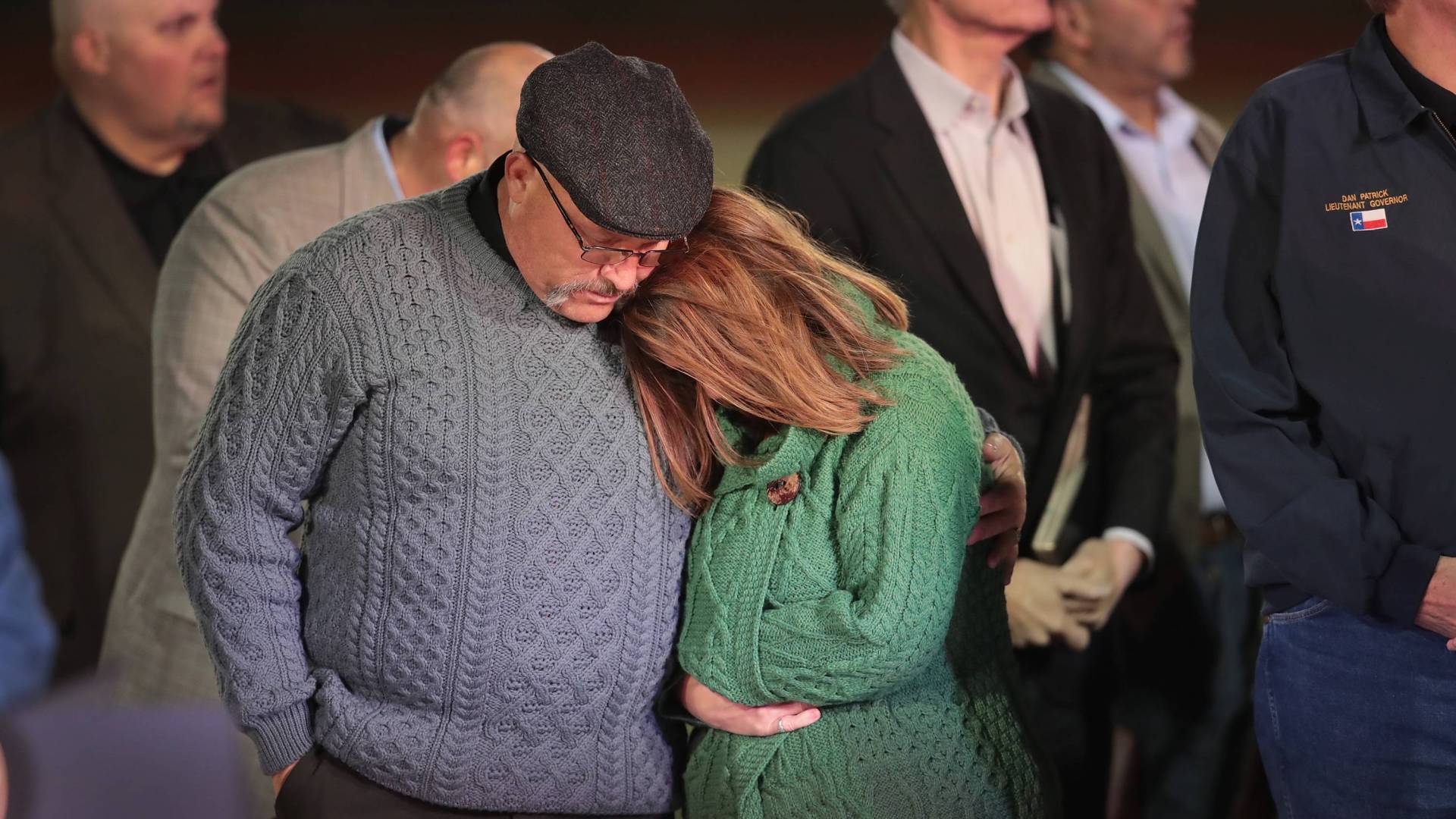
Five Years After Church Shooting, Sutherland Springs Pastor Retires

Now at a new location, the rural Texas church continues on in memory of the 26 members killed, including the pastor’s teenage daughter.

Pastor Frank Pomeroy of Sutherland Springs

Pastor Frank Pomeroy of Sutherland Springs

Christianity Today October 3, 2022
Scott Olson / Getty Images

Frank Pomeroy was hunting in the wet and cold Alaskan bush when the Lord gave him his final sermon as senior pastor of First Baptist Church of Sutherland Springs.

Considering the grizzlies, black bear, wolves, and rain, Pomeroy suspected the message would somehow encompass creation.

“But God kept bringing me back to, this was an opportunity for me to share what’s important for the church to continue on,” Pomeroy told Baptist Press, “and that’s when He … led me to Paul’s letter to Ephesus (Acts 20) and we just went from there.”

The tragedy First Sutherland Springs weathered when a gunman killed 26 worshipers and wounded 22 others on November 5, 2017, is perhaps the memory the church’s name most readily provokes. But First Sutherland Springs has ministered since 1926 in the small community of less than 1,000 people, 20 years under the leadership of Pomeroy.

“What really brings Sutherland Springs together over these 20 years is that there really is a true sense of relationship and family,” he said. “And therefore, we have always been very inclusive of the community, and that the church would be the center of the community, whether it was during a tragedy or in the good times.

“High on the mountain or low in the valley, there’s always been a true sense of family with those in the community. And that’s the thing I think I cherish the most, is that love never fails, as Paul said, and that love will extend to everyone who will come and listen to the Word.

“I think again, if we can be remembered as promoting and making sure everyone knew that that pulpit was never my pulpit, it’s always God’s pulpit,” he said, “and as being God’s pulpit, he’s reaching out to whomsoever that will listen. And the defining thing would be that that church is not the building, it’s the body, and the body should be out including everyone.”

Pomeroy and his wife Sherri have sold their home to their youngest son Korey and daughter-in-law Ashley, downsized their belongings to a camper trailer and are planning a brief road trip before returning to Texas, perhaps for a campground ministry. But he’s not certain of God’s plan.

Their 14-year-old daughter Annabelle was among those killed when Devin Kelley walked in the church and began shooting indiscriminately in what remains the deadliest mass shooting in Texas history. Kelley fled the scene and fatally shot himself.

The church survived the tragedy by choosing victory, Pomeroy said.

“We could have been validated by the world to choose hate and ugliness and play the victim card,” he preached, “or we could choose to say we are not victims, we are victors. We choose to put our faith in something greater than ourselves. … I don’t understand, but I know I can’t go back and change what’s already done, but I choose from this day forward to say, ‘Lord, You are in control.’ And God has taken that, has made Sutherland Springs a lighthouse on a hill.

“We still get letters that say, ‘I was an atheist, but because of the way you guys handled this situation. …’ Why is that happening? Because we chose to lift up Jesus.”

Pomeroy encouraged the church to embrace humility, which goes beyond individual pain.

“Because of my knowledge of You (God),” he said, “I will take what You have given us that tastes so bad, but I will still use it to share the Gospel for Your glory. And that is what God has chosen to honor and bless.”

Pomeroy’s goal was to stay at First Sutherland Springs as long as the Lord willed, he told the congregation of 200 during the farewell sermon September 25 from Acts 20:17-35.

“Whether I’m here physically or not does not change the fact that God does not leave,” he told the congregation. “You are the church. Each one of us individually is the church. We assemble together as First Baptist Sutherland Springs. Therefore, as we being the church, as long as we are getting stronger in the Lord as individuals of the church, together in unison … we will always be stronger as Sutherland Springs.”

The church has demolished the building where the shootings occurred and has preserved an open-air memorial to those killed. Since 2019, the congregation has worshiped in a new facility funded by the North American Mission Board with gifts made through the Southern Baptist Convention and other donations.

First Sutherland Springs bought the former Sweet Spirit Baptist Church building in the nearby town of St. Hedwig and in April, opened a north campus about 15 miles north of the main location.

Despite the congregation’s resolve, the Pomeroys find some days more difficult than others.

“There’s still ups and downs, and I don’t think you ever fully handle the loss of a child,” he said. “But as a family in Sutherland Springs, not just my biological family but the church family, we chose to look to something greater than ourselves for understanding.

“Although I might have done things differently, God has brought so many to Christ through this. God’s using her martyrdom and the others to bring others to his saving grace.”

When people ask Pomeroy what the new sanctuary in Sutherland Springs cost, he doesn’t recite a dollar amount.

“I say it cost 26 lives,” he said. “I look at all 26 lives that were lost, including Annabelle, as the blood that was spilled for that church there in Sutherland Springs.

“The blood on this ground is what built this church, and God’s going to honor that.”

Ideas

‘Two Taels of Bread’ and Other East Asian Heresies

Staff Editor

Misconceptions about Jesus, Scripture, and salvation prevail.

Christianity Today October 3, 2022
Illustration by Christianity Today / Source Images: Aaron Burden / Unsplash

American evangelicals are moving away from orthodox understandings of God and Scripture. This year’s State of Theology survey revealed the top five misconceptions that US evangelicals hold, as follows:

  • Jesus isn’t the only way to God.
  • Jesus was created by God.
  • Jesus is not God.
  • The Holy Spirit is not a personal being.
  • Humans aren’t sinful by nature.

CT polled five Christian leaders in China, Hong Kong, Japan, South Korea, and Taiwan to find out whether these modern heresies are also widespread in their respective regions, how believers can address them, and what heresies may be more common in their contexts.

Aaron Chau (name changed for security reasons), a house church pastor in Hubei, China

Heresies in China are quite different from America. Based on this study, American evangelical heresies are greatly influenced by liberalism. In contrast, Chinese heresies are greatly influenced by fundamentalism and superstition.

Most Chinese Christians will accept the authority of the Bible, but some will accept it to the point that they have turned the Reformation motto sola Scriptura into “Read the Bible alone.” Unlike how American evangelicals do not believe the Bible is literally true, some Chinese Christians are too devoted to the belief that the Bible is indeed so.

American heresies arise because Christians are highly educated. Chinese heresies occur due to a lack of theological education, which is why heresies are more widespread in rural areas than in cities.

The most influential Chinese Christian heresy is the belief that Christ was born in China and his second coming has literally happened. Eastern Lightning is the cult that created this heresy based on their reading of Matthew 24:27. Another popular heresy, “Two taels of bread,” is based on skewed readings of John 6:1–14 and 1 Kings 17:1–16 and maintains that rice or flour in a Christian’s home will not be depleted even if you eat it daily.

Kin Yip Louie, professor of theological studies at the China Graduate School of Theology in Hong Kong

Most Chinese Christians in Hong Kong would nominally agree with the historical creeds but often twist the practical implications of those doctrines.

Hong Kong Christians will readily admit that Scripture is literally the Word of God and that we should obey all the commands in the Bible. Yet when it comes to application, they often ignore the social context of a passage and turn it into a moral teaching or an allegory of our personal relationship with God.

For example, the story of Exodus is read purely as a personal journey into experiencing God’s promises, and its concern for justice and the marginalized is ignored. Or Revelation is read purely as a prediction of end-time events without recognizing its critique of political and economic exploitation.

Thus, individualistic moralism may be the most prevalent form of heresy among Hong Kong Christians. Though most will agree that we are saved by grace alone, they often reduce their understanding of spirituality to inhibiting certain practices, such as smoking or gambling, and committing to other practices, like attending Sunday worship punctually. Practically, it is unclear whether they put their trust in Christ or in their own good behavior.

Asako Hirohashi, director of translation at church planting network City to City in Chiba, Japan

“Jesus isn’t the only way to God” is the most common heresy in Japanese evangelical churches. However, its presence and influence are very subtle.

While most evangelical public confessions of faith agree that salvation comes through Jesus Christ alone, many churchgoers function as if their salvation depends on how much they serve God in obvious ways. Some churches place greater emphasis on the importance of full-time ministry to the extent that all the other occupations are considered “secular” or “unholy” work.

One reason for this susceptibility toward heretical beliefs is that evangelicals are religious minorities in Japan. They have had to adapt their faith to accommodate the surrounding Japanese culture, which places a strong emphasis on living harmoniously with others in society.

Another reason is due to our patriarchal and authoritarian cultural background. Congregations often accept what a church leader teaches from the pulpit without much consideration or questioning.

Meehyun Chung, professor of systematic theology at Yonsei University’s United Graduate School of Theology in Seoul, South Korea

I am cautious about using the term heresies because certain leaders or movements in the development of Christianity, like Czech Reformer Jan Hus and the Waldensians in Italy, were branded as such and experienced unjust judgment.

Korean Christianity has similar phenomena as American evangelicalism. But the most common heresy in Korea is the Gnostic concept of dualism between the body and soul.

Korean shamanism is based on this dualistic perception. Shamans function as a “channel” between the spiritual world and the human world as their souls can enter the spirit realm or their bodies become “hosts” for a spirit or deity. More recent developments, like the field of artificial intelligence (AI), is also influenced by Gnosticism as it discounts the physical body. These Gnostic views impact how the Christian ethos is lived out in Korea, as concrete engagements with society are not a big concern for many Korean believers.

Moreover, the most problematic heresies in Korea are the ones created by religious sects, which often develop a cult following around their founders or leaders.

Tim Wang, a pastor at Chung Hsiao Road Presbyterian Church in Taichung, Taiwan

Although the top five heresies in American evangelicalism most likely apply to numerous Christians in Taiwan, the more prevalent heretical beliefs I have seen during my seven years of ministering inside the Taiwanese church are dualism and the privatization of the Christian faith.

Many Taiwanese Christians emphasize saving souls, sanctification, and the hope of spending eternity in heaven. This one-sided emphasis on the immaterial naturally draws believers to view the body and the material world as unfavorable and something to escape from.

Taiwanese Christians also privatize their faith by generally staying out of politics and rarely speaking up on matters relating to injustice, racism, and other systemic evils in society and culture. They are willing to pray about these problems, but few take action or become personally involved with these issues.

Pastors and leaders not only need to have good theology. They also need to disciple their congregations—a calling many have forsaken. As 2 Timothy 3:16 (CSB) says, “All Scripture is inspired by God and is profitable for teaching, for rebuking, for correcting, for training in righteousness.” Many teach, but few put in the time and effort to rebuke, correct, and train believers in righteousness.

Christian Aid Agencies Have a New Approach to Famine

Relief has changed in time for Africa’s worst food shortage in 80 years.

Illustration by Mike Haddad

Agya Afari in Dodowa, Ghana, turns the corn and cassava dough in a pan perched on a coal pot as his middle child fans the coals. Nearby, his wife, Yaa Manu, grinds pepper, tomato, and onion to make a sauce for supper. The only form of protein, two boiled eggs, is traditionally reserved for the adults in the household.

“This has become a way of life for us lately—banku and boiled eggs with ground pepper,” Afari laments in Twi. “Limited work in this current economy, increasing prices, and a pest invasion on our farm means my family and I have been struggling to make ends meet. One daily meal that satisfies everyone is impossible,” he adds.

This may seem like a timeless story of food insecurity. But Afari’s family is affected by the most widespread global hunger crisis on record. In the past couple of years, the need for food aid has more than doubled, with the World Food Program estimating that today 345 million people are close to starvation. World Vision estimates that one in five Africans suffered from hunger in 2020 and that over the past two years, the situation has only worsened.

In West Africa, 151 million people didn’t have enough food in August of 2022, according to the World Food Program. In East Africa (particularly the Horn of Africa), it estimated, 79 million people needed food. Without strategic help, their suffering will be deepened and prolonged.

But strategic help hasn’t always been the rule. In fact, Christian aid agencies have significantly changed the way they provide food assistance over recent decades to adjust to some difficult lessons.

During the well-publicized Ethiopian famine in the 1980s, relief consisted mainly of the direct delivery of food from donor countries.

“Who we are and what we do as Christian aid agencies has evolved,” says Malvern Chikanya, the country director of Food for the Hungry Uganda. New strategies have emerged in the past 30 years based on the recognition that food insecurity isn’t actually solved with food.

Instead, Christian organizations say, famine is caused by people’s broken relationships and fragile communities. Food helps people survive an emergency, but it takes far more to restore their livelihoods, safety, and health. As a result of this understanding, aid organizations are changing the forms of relief they offer, improving their ability to anticipate food insecurity, and seeking guidance from a theology of development.

Neither famine nor today’s approaches to aid are primarily about a lack of food. There is enough food produced in the world to feed everyone. Famine has to do with food not reaching people at the right time, due to failures in some of the systems they depend on for safety, livelihood, transportation, and so on.

Famine is primarily a political problem. It reveals fragility in governance. Fragile political contexts are usually hungry contexts, with high rates of disease, neonatal and maternal death, and children out of school.

In sub-Saharan Africa, the past few years have brought more hardship than expected, with unusual stressors like drought, locust invasions, the COVID-19 pandemic, and an extreme grain shortage caused by Russia’s invasion of Ukraine.

But one cause of famine dominates: conflict. World Vision regional security director Johan Eldebo says famine is far more often caused by manmade situations, such as armed conflict, than by natural disasters. One way fighting causes famine is by forcing noncombatants to flee. “Conflict uproots people from their homes and farmland, disrupting production and productivity, destroying livelihoods and supply chain systems which play an important role in food production and marketing,” explains Joseph Kamara, regional humanitarian and emergency affairs director for World Vision in East Africa.

In Nigeria, Boko Haram and other armed groups kidnap large groups of people. In 2020, kidnappings skyrocketed to about one event per day. Vehicles transporting food to market are unsafe on the roads, so much normal trade is fraught. Boko Haram’s activities also mean people are afraid to work their fields, knowing they risk being attacked by bandits. With fewer crops produced and brought to market, prices go up. The demand for imports does, too—making food shortages a valuable tool for enriching kidnappers.

Nevertheless, “you can have hunger without conflict,” Kamara says. He pointed to countries, including Malawi, Zambia, and Angola, without widespread conflict that are nevertheless experiencing widespread hunger “due to climate change and the challenges of the pandemic, [which have] made an already tough economy more difficult.”

Just as famine’s causes are complex, so are its consequences. A food crisis is officially classified as a “famine” when more than 30 percent of children in an area are starving and when at least two deaths per 10,000 people are credited to hunger. For many people, news of a food crisis or famine brings to mind deaths directly caused by starvation, especially among babies and children, those already sick, and older adults. But this is only part of the toll famine takes.

Children who do not receive adequate nutrition in their early years face lifelong consequences. The clearest symptom of this chronic malnutrition is stunted growth, but long-term hunger’s invisible symptoms are also quite serious, including impaired cognitive development and compromised immune systems.

Desperate heads of households may make life-altering decisions for their families, such as giving underage girls in marriage with the hope that the bride price will provide their family enough money for necessities.

In one such case, Kamara says, “We asked the parent why, and they said, ‘What would you do, if you were me? You have nothing left and are now seeing your children being wasted. What would you do?’ ” As the medical journal The Lancet pointed out, girls who are married are at much higher risk of dying in childbirth, contracting HIV, and being abused. But for parents who feel their family cannot survive without a bride price, “those are very hard choices,” Kamara says.

Disease follows famine. Most severely malnourished children also have infections. In famine-impacted areas, measles, pneumonia, malaria, tuberculosis, and HIV outbreaks are to be expected.

Famines destroy livelihoods, especially for those who depend heavily on farming or herding. Community is also lost, as hungry people move farther from home in search of food and work, often splitting up families.

Illustration by Mike Haddad

For a hungry individual, free food can be lifesaving. But for a food-insecure community, food is only one of many elements needed to recover.

The relief aid that used to consist mostly of the delivery of food and ingredients is giving way to a focus on long-term food-security measures. Now, Christian aid agencies aim to bolster local food production and economies, whenever possible.

Where markets are functional, distributing cash instead of food enables hungry families to buy what they need and support the local economy. Also, GSMA, a mobile network association, estimates that half of sub-Saharan Africa’s population will be subscribing to mobile services by 2025, so phone-based money transfers are often possible. In areas where cash transfers are not feasible, “we distribute vouchers that can be redeemed for cash, the beneficiary takes the voucher to the vendor, who exchanges it for food items of an agreed-upon value. The vendor brings the voucher to World Vision for redemption,” says Kamara.

These methods have the additional merit of giving dignity to people whose identity as providers has been undermined by a sense of helplessness. They are also designed to build resilience, so communities can quickly handle shocks such as a long-term drought.

The changes in how aid agencies respond to famine are helping, but sometimes they aren’t enough. Food drops are dramatic and often lifesaving, and they still continue.

However, food drops are risky, as well as expensive. Aid agencies have seen significant problems develop when food drops are used as the main solution to hunger. Several international development professionals reported that, in the past, assistance had been delivered in a way that undermined the long-term food security and general development of the very people they were trying to serve. In some cases, these problems disrupted the local economy or disturbed community stability, making another famine more likely.

In Haiti, for example, farmers are still struggling to make a living growing rice because of the massive influx of rice aid from the US following the 2010 earthquake. In Yemen in 2019, repeated instances of violent unrest caused the UN to stop its food aid deliveries until Houthis, a rebel group that controls a significant part of the country, guaranteed they would stop hijacking them.

In many countries, armed groups—including government forces—have diverted food aid from starving people, or taxed or sold food aid, using the aid to further violent conflicts. Corrupt officials skim aid money and send it to their private foreign bank accounts.

These problems are ongoing. In Somalia, for example, militants blocking food-aid groups’ access to villages will likely lead to more hunger and deaths from starvation.

Poor communication and lack of cultural understanding can also lead to trouble when in-kind food aid arrives, failing to effectively help some of the hungriest and most vulnerable people. In one report on Zimbabwe, distribution of food aid resulted in physical fights and community conflict over accusations of fraud, as well as the exclusion of orphans and the families of single mothers (who are locally considered minors).

Many Christian relief and development groups now turn to collaborative solution-seeking with local communities before anything goes wrong.

Chikanya says that building mutual understanding is a priority for Food for the Hungry’s food assistance. “For instance,” he says, “when we enter any community, we start by building relationships and trust with the people we seek to serve at various levels.”

World Vision does this through its community-based targeting and distribution, a process where the affected community makes a list identifying those among them most in need of aid. When the final list is vetted, World Vision transports food to an agreed-upon place at an agreed-upon time.

“The recipients then proceed to a distribution area, where they receive their rations, counterweigh them for accuracy, sign the list to acknowledge receipt, and then exit the distribution area and meet their family members, who accompany them to help carry the food home,” explains Kamara.

There is even a complaints desk. Kamara says creating a continuous feedback loop to hear firsthand from the community is vital to the process. However, they are not the only voices Christian aid groups must listen to.

The US government is the world’s largest food aid donor, sending over 50 percent of global food aid. Some Christian organizations, including World Vision, receive grants through the United States and other governments, often with strings attached. Half of in-kind food aid from the US government, for example, must be shipped on US carriers, which increases costs.

Many Christian aid organizations work in tandem with the World Food Program and the governments of the countries they seek to help. Often, gaining access to people in need and the resources to help them depends on abiding by the rules put forth by local governments and the World Food Program. This is sometimes true even when Christian organizations deliver assistance in some of the most remote parts of the world—places where other aid organizations are often absent.

A significant change in providing food aid is the world’s increasing ability to prevent famine or to nip it in the bud.

The Ethiopian famine of the 1980s caught aid agencies unaware. Kamara says Christian aid groups “did not have the logistical systems we have today to prevent the crisis.”

In contrast, today many organizations have access to ongoing analysis of food security and other contributing factors. This type of analysis has demonstrated the interconnection between fragility and food insecurity. In fact, in 2018, every single country that had a chronic food crisis also had violent conflict.

In 2017, a famine was predicted in Somalia. World Vision and other relief agencies worked proactively to target areas expected to be hardest hit, screening children for malnutrition, providing food and vitamins, and funding health clinics. As anticipated, the conditions were indeed extremely bad, with people dying of starvation and billions of assets, such as livestock, destroyed.

Prevention is a less dramatic yet more effective way to help. Christian and other aid agencies can mitigate the shock of famine by monitoring various hot spots across the globe. Data analysis can often highlight potential problems.

“World Vision’s Fragile Context Program Approach acknowledges this and designs programs in anticipation of what might come next, so that we can respond to a problem before it becomes a crisis,” Eldebo says. “This also helps the safety of aid agencies as well as children and communities in need.”

If he could go back in time and change the assistance Christian relief organizations provided to Ethiopia in 1984, Kamara says, it “would have been to deal with the causes and not just the symptoms” of the famine.

Christian organizations are not the only groups now seeking to deliver food assistance that supports local economies, de-escalates conflicts, and keeps long-term goals in mind. But Christian groups are helping in a distinctive way by also recognizing the spiritual and relational components of famine.

Consensus-building within and among aid groups has led this change, although various sources told CT it was sometimes contentious. In question was the best way—if at all—to differentiate missions and development. Should evangelism and social action always be concurrent? Should they always be separate? What actions wrongly exploit the desperation of people looking for help?

Further, groups wrestled with external expectations, such as those who thought Christians should tie much-needed support to aid recipients’ conversion to Christianity or others who wanted Christian organizations to take the same stance as secular and government organizations on contentious issues such as abortion.

Debates around these issues are not new. A 1982 Lausanne report overseen by John Stott called “Evangelism and Social Responsibility: An Evangelical Commitment” lays out some of the tensions aid groups experience. White papers from the Wheaton ’83 conference and others followed. They built an intellectual and pastoral foundation for today’s famine aid.

In recent years, Christian organizations have adopted statements of development theology. Like a statement of faith, a statement of development theology articulates an organization’s core values based on biblical principles.

Development theology puts the emphasis of relief work on understanding humanity and not just on managing supplies.

While some theories guiding relief efforts pin blame for food insecurity solely on one contributing factor, such as climate change or ethnic conflict, Chikanya explains, “Food for the Hungry regards poverty as a result of broken relationships—between God and man, man and man, man and himself, and man and nature.”

Chikanya says, “This holistic view of poverty underpins how Food for the Hungry designs its programs, focusing on building and restoring relationships at different levels using both biblical principles and evidence from behavioral sciences.”

Development theology accounts for the facts of food insecurity while also emphasizing the need for regeneration. It places community relationships and personhood at the center of famine relief. All people involved in the aid process, whether donors, bureaucrats, aid workers, community leaders, or recipients, are part of God’s good creation.

Today’s food-security problems are unlikely to be resolved quickly or easily.

Ray Hasan, Christian Aid’s head of Asia, Middle East, Latin America, Caribbean and global programs, recently said, “The rocketing price rises for food and fuel that we are currently experiencing are having serious impacts on our work.” Since food is much more expensive, “sometimes we must cut back on certain items like oil, so that we can help more people with the basics.” But in-kind food aid isn’t the only form falling short, Hasan said “Cash distributions are less meaningful than they used to be.”

Disruptions in supply chains, crop losses, unstable weather, and insufficient rains eroded the incomes of almost all households in affected areas of East Africa. But relief in these circumstances isn’t in sight. Based on current data, Kamara says that “weather conditions are not going to improve.” He adds, “Crops are likely to fail again, and that will be catastrophic for our region.”

So in addition to newer efforts, Christian aid agencies have also needed to resort to direct food delivery. For people in emergencies, especially those in sub-Saharan Africa, this food aid has been a lifeline to getting the right nutrition for survival.

This current situation is, in some ways, just the short-term crisis pointing toward larger challenges to come. The Sahara desert is expanding, eroding arable land.

Climate shocks, like the previously rare tropical cyclones that hit Mozambique in 2021 and 2022, are likely to accelerate. Kamara says, “We are experiencing more warmer months than before, and rainfall has significantly reduced, with more drought periods which have become long, intense, and more frequent.”

Conflict, too, seems unlikely to be resolved in a matter of months or even years. Long-term peace-building is now part of the work of preventing famine.

Famine relief begins not when emergencies arise but before, in deliberations and negotiations. The role of local churches and leaders in addressing food crises will likely grow. “Engaging local first responders such as local churches, government authorities, and community-based organizations and developing their capacity will be critical for now and the future of famine prevention,” says Chikanya.

According to Eugene Cho, president and CEO of Bread for the World, Christian food aid plans should “acknowledge that direct relief is important when someone is hungry but bigger-picture issues demand policies that affect development.”

What might seem so simple—giving food to the starving—is as complex as any community. “We need to continue to remain engaged, to remain prayerful, to remain generous, to amplify our voices, to advocate for our sisters and brothers, both in our nation and around the world,” Cho says.

Ama Akuamoah is a strategist based in Accra, Ghana, focusing on communication, program management, African governance, and international development.

Books

5 Books on the History of Christian Parenting in America

Chosen by David P. Setran, author of “Christian Parenting: Wisdom and Perspectives from American History.”

Getty

Growing Up Protestant: Parents, Children, and Mainline Churches Margaret Lamberts Bendroth

Bendroth’s analysis of mainline American Protestants and their families is one of the few historical treatments to focus on the 20th century. Her introduction looks at mid-19th-century Christian child-rearing, but she follows up by examining the rise of parenting experts in the early 20th century, the influence of the world wars, the role of the 1950s, and family-values debates between the 1960s and the 1980s.

The Christian Home in Victorian America, 1840–1900 Colleen McDannell

The best histories of Christian parenting give glimpses into everyday practices. McDannell details not only the most common devotional practices in 19th-century American homes, but also the physical materials—paintings, statues, Bibles, bookmarks, parlor decorations, and architectural touches—that supported what she calls the “rituals of the hearth.”

Help for Distressed Parents Cotton Mather

One cannot fully appreciate the nature of early-American Christian parenting without diving into the writings of Cotton Mather. In Help for Distressed Parents (1695), Mather provides heartfelt comfort and counsel for Christian parents struggling with rebellious children. He assures them that they are not alone, pointing to biblical examples of parents who shared this burden. And he encourages them to pray and fast with “Agony of Soul” for their children’s salvation.

The Mother at Home John S. C. Abbott

Abbott’s classic 1833 text reflects the pervasive 19th-century notion that mothers “have as powerful an influence over the welfare of future generations, as all other earthly causes combined.” Stressing conversion, obedience, and the power of prayer, Abbott’s book encourages mothers to present religion in its “cheerful” aspect, speaking to children about Jesus’ love and the joys of heaven.

The Father’s Book Theodore Dwight

Dwight’s 19th-century book—one of the few written to fathers in this era—contains much on religious teaching, but it also reflects Victorian values in its insistence that parenting is chiefly concerned with forming habits. Christian training, therefore, includes care in fostering regular sleeping hours, healthy diet and exercise, and proper manners. Dwight emphasizes moderation in all things, discouraging overstimulation in eating, games, and reading.

Books

New & Noteworthy Fiction

Chosen by Linda MacKillop, author of “The Forgotten Life of Eva Gordon.”

Lightning Strike

William Kent Krueger (Atria Books)

The prequel to Krueger’s Cork O’Connor mystery series, Lightning Strike introduces 12-year-old Cork as he discovers the body of an acquaintance hanging from a tree. Cork shadows his father, sheriff Liam O’Connor, as Liam investigates whether the hanging was suicide or murder. He witnesses the locals mistreat his Irish father for marrying an Ojibwe woman from the reservation and hears insults directed toward her people, revelations that shatter his innocence. Lightning Strike depicts the elusiveness of justice and truth in a broken world populated by complex people.

The Girl Who Could Breathe Under Water

Erin Bartels (Revell)

In Bartels’s lyrical novel, novelist Kendra Brennan retreats to her family lake cottage after receiving a letter from a disgruntled reader. The letter accuses Kendra of not understanding the backstory of her fictional antagonists, throwing her into serious writer’s block before her second novel’s deadline. Kendra’s efforts to uncover truths from the past raise questions about the complexity of forgiving those who wound us. With its thought-provoking storyline, The Girl Who Could Breathe Under Water addresses the fine line between being the wounded and being the one who wounds.

Everything Sad Is Untrue: (a true story)

Daniel Nayeri (Levine Querido)

In Nayeri’s biographical novel, readers meet a 12-year-old Iranian refugee, Khosrou, who resettles in Oklahoma, going by the name Daniel. Secret police in Iran had threatened his family after his courageous mother converted to Christianity and refused to stop talking about Jesus. Stuck in an inhospitable school environment, Daniel tries connecting with his classmates by weaving together layered stories about Persian history and his own life’s funny and traumatic moments. While Daniel’s storytelling keeps his past alive in his young mind, the novel deftly portrays the loss and searing pain associated with leaving one’s homeland and living as a misunderstood refugee.

Books
Review

Faith and Doubt Aren’t Black and White

Travis Dickinson shows believers how to question their beliefs without discarding them.

Illustration by Rick Szuecs / Source Image: Alexander Grey / Unsplash

Travis Dickinson’s book Wandering Toward God attempts to square a difficult circle: He wants us to know that Christianity is “objective fact” while also desiring to honor the doubt individual Christians may experience.

Wandering Toward God: Finding Faith amid Doubts and Big Questions

Wandering Toward God: Finding Faith amid Doubts and Big Questions

IVP

216 pages

$10.99

Early on in the book, there are three concepts in play: the definition of doubt, the idea of belief, and the reality of faith. Faith, writes Dickinson, “is in the category of trust and action,” while belief is based on facts about which one can be certain. You might believe something you have data for—say, whether a bungee-jumping rope will hold (an example Dickinson uses). To actually jump, however, you need faith that the rope will do as you presumed it would.

Dickinson’s purpose in writing the book, as I understand it, is to explain how the categories of faith and belief relate to doubt in the context of the Christian life. He does this by drawing on the apologist Os Guinness, who writes, “Doubt is not the opposite of faith, unbelief is.” Dickinson takes this to mean that “having doubts, even serious doubts, does not mean you don’t have faith. Faith and doubt are not opposites like black and white.”

Believers might have questions about their beliefs, then, without abdicating their faith. Dickinson, who teaches philosophy and apologetics at Dallas Baptist University, is clearly addressing the book to just such people. Early on, he even confesses to having once been one of them himself. His motivation is showing how believers burdened by doubt might move from a hard-nosed view of certainty toward the goal of trust.

Dickinson does more than seek to destigmatize doubt. Indeed, he considers it a core part of a healthy faith. Dickinson is right about this—doubt really can deepen belief by providing what he calls “an opportunity for greater depth.” Thoughtful individuals might find that their doubts are not all that compelling once they engage in the work of “doubting their doubts,” “investigating them,” and asking questions that lead toward truth.

Dickinson’s example here is getting on an airplane even though we may not be able to explain how the plane functions. Doing so is perfectly reasonable, even where evidence or understanding is lacking. This is because we believe and have faith that the airplane will hold, even if we cannot perfectly understand how it flies. Faith, therefore, doesn’t require having all the answers. If doubt is simply not understanding how something works—the Resurrection, say, or the Virgin Birth—then it need not compete at all with a true faith.

Dickinson says that he wants Christians to have “sufficiently clear reasons” for having faith, but he also wants them to enlarge their understanding of what would constitute sufficiently clear reasons. Some of these reasons may be intellectual, but others might operate under the surface, in ways that are harder to spell out with words. As Dickinson observes:

When Christians are put on the spot to lay out a case for Christianity, they may not articulate it well. But they likely have far more reasons than they realize. All of us came to our Christian beliefs for some reason or other. Again, it may not have been anything academic or too carefully thought out. It may have been that someone shared a powerful testimony about how the gospel changed their life. Or perhaps you have had a powerful experience with God. These are good reasons and could have been what compelled you to believe.

Unfortunately, Dickinson spends most of the rest of the book on reasons that can be articulated: whether the Gospels are reliable, for instance, or what to make of the problem of evil, or how to explain violence in the Old Testament, or whether the Resurrection is believable.

Dickinson’s arguments for belief follow well-trodden paths, and at times they seem like they were written for an earlier generation. (His appeals to C. S. Lewis, for instance, might be persuasive, but mainly to the kinds of readers who are familiar with Lewis already). Quoting the apologist J. P. Moreland, Dickinson writes that faith is “relying on what you have reason to believe is true and trustworthy.” But this rests somewhat uneasily with earlier sections of the book, where he takes pains to demonstrate that the grounds for faith run deeper than what we can rationally explain.

All this is to say that, while I support Dickinson’s goal of destigmatizing doubt and encouraging believers with doubts to still believe, I wouldn’t have put quite as much emphasis on familiar apologetics arguments. In fact, I think we’d be better off if we stopped talking as though Christianity were primarily an intellectual exercise and worked, instead, to better investigate those hard-to-articulate, beneath-the-surface reasons for faith.

For me, Dickinson’s book title brought to mind the great Advent hymn “I Wonder as I Wander,” which is written in the voice of someone questioning how it is that God became a child. “I wonder as I wander out under the sky,” sings the hymn’s chorus, “that Jesus my Savior did come for to die.” It is a nearly perfect response to the question of doubt, grasping at both the spaciousness of the created world and the mystery of how God and humanity meet in the midst of it.

Somehow, this one chorus manages to do what so many books on doubt cannot: It places us in the frame of God’s action in the world and sets our doubts in the context of God’s work in history. The singer wanders, yes, but with a view of God’s beauty foremost at hand. Such a frame makes doubt seem the less interesting question, though wanderers we may be.

Kirsten Sanders is a theologian and writer living in Wenham, Massachusetts. She is the founder of the Kinisi Theology Collective.

Books
Review

If We Can’t Reason Together, How Can We Worship Together?

The knowledge crisis afflicting American society poses even greater dangers for the church.

Chris Gash

“American society has a knowledge crisis,” Bonnie Kristian tells us in the first sentence of her timely new book, Untrustworthy, “and the American church is no exception.” Our chaotic information environment is systematically eroding Americans’ trust in public institutions and in each other. It makes us simultaneously more cynical and more gullible—no simple feat—and so isolated that “we begin to lose touch with reality.”

Untrustworthy: The Knowledge Crisis Breaking Our Brains, Polluting Our Politics, and Corrupting Christian Community

Untrustworthy: The Knowledge Crisis Breaking Our Brains, Polluting Our Politics, and Corrupting Christian Community

Brazos Press

240 pages

$8.40

If the implications for American democracy are grim, Kristian argues, the consequences for American Christianity are darker still. The crisis that plagues us “risks grave damage to our church communities, our public witness, and our individual faith,” she writes. Oh, that we might have ears to hear.

Kristian’s book, subtitled “The Knowledge Crisis Breaking Our Brains, Polluting Our Politics, and Corrupting Christian Community,” begins with a layman’s introduction to epistemology: the philosophical study of the nature of knowledge that asks if we can know things and how we can know them. Few of us waste much time on such questions because they seem so esoteric and impractical. Whatever academic philosophers might theorize, the rest of us intuitively recognize that we can’t function in our daily lives without making two assumptions: first, that it’s possible to gain knowledge about reality that is objectively true for all; and second, that it’s possible to communicate that truth intelligibly to others.

But this is precisely Kristian’s point. When it comes to the public square, these assumptions are under attack, and our public life reels from the assault. A half century ago, most Americans acquired news about the world from two major wire services and three television networks, all of which said pretty much the same thing. Since that time, the sheer quantity of information has exploded. Even more importantly, so have the number and range of information sources. The hard truth is that few are equipped to think critically about this cacophony, with the result that we no longer agree about even the most basic facts. As Kristian puts it, “Our epistemology is a mess—and we don’t even know we have an epistemology.”

Epistemic fog

In the first two thirds of Untrustworthy, Kristian focuses on the mess we’re in and explores how our ignorance of epistemology renders us vulnerable to manipulation, dishonesty, and self-deception. She stresses that our knowledge crisis “is not a single-party phenomenon,” although the Right and the Left generally contribute to the problem in different ways.

From the Right, former President Donald Trump made “fake news” a household phrase, Kellyanne Conway gave us “alternative facts,” and Rudy Giuliani blithely declared that “truth isn’t truth.” Collectively, says Kristian, such phrases “cast an epistemic fog” across the information landscape, encouraging us not only to dismiss what is specious but to discredit even accurate claims reflecting poorly on Us or positively on Them.

Voices from the Left, on the other hand, have insisted that our ability to know reality is inseparable from our racial, ethnic, and sexual identities. While our experiences and social situations undoubtedly influence how we see the world, when taken to an extreme, this view can bring meaningful conversation to a halt. Effectively, it says, You can’t see what I see, so you can’t know what I know or challenge what I believe. Like the Right’s emphasis on “fake news,” the Left’s stress on identity denies that constructive communication across social and political boundaries is even possible.

Most of us have encountered the crisis of knowledge primarily through traditional and social media, and Kristian devotes considerable attention to both. As a longtime journalist (and a frequent CT contributor), Kristian defends traditional media without being defensive. She concedes and laments the liberal bias of most mainstream print and television news outlets, but she stresses that it shows up primarily through emphasis—in other words, through editorial decisions about which stories to highlight and which to soft-pedal or ignore. Responsible news outlets—despite their implicit (and probably inevitable) bias—don’t intentionally disseminate falsehoods.

The same can’t be said for social media, where truly fake news abounds. But more insidious than the outright fabrication that flourishes online is what Nicholas Kristof once called “the Daily Me”—the succession of news items and opinion pieces exquisitely tailored by algorithms to reinforce what we already believe while making us furious at those who think differently. Social media “runs on human emotion,” Kristian reminds us, and its most powerful fuel is “political outrage.” If we live in “the Age of Outrage,” as Ed Stetzer has christened our polarized moment, it owes in large measure to our self-imposed exile from inconvenient facts and challenging perspectives. Withdrawing into echo chambers, we become progressively more ignorant—and more dogmatic in our ignorance.

Kristian examines some of the most egregious examples of this poisonous combination, like the effects of “cancel culture” and the alarming popularity of conspiracy theories. Neither phenomenon is new. Nearly two centuries ago, Alexis de Tocqueville found that the moral authority of popular opinion was often “tyrannical,” erecting such “a formidable barrier around thought” that freedom of opinion “does not exist in America.”

Fascination with conspiracy theories is also a staple of the American past. Federalist statesmen in the late 18th century feared the machinations of a secret society of anti-Christian “Bavarian Illuminati.” Before the Civil War, Republicans warned voters about a “Slave Power conspiracy.” The Populist Party of the 1890s detected a plot for world domination coordinated by Jewish bankers.

In sum, we’ve always canceled social transgressors. We’ve always been drawn to simple answers to complex questions. We’ve always been susceptible to emotional manipulation. What is new is the speed with which vast volumes of information—true and false, balanced and distorted—can be generated with such astonishing ease. This trend only magnifies tendencies to which we are already prone. Gradually remade by the devices that mesmerize us, we become less and less willing to listen, less and less tolerant of dissent, less and less able to engage constructively and charitably with others in pursuit of a common good.

In recent years, writers across the spectrum have noted the detrimental effect of social media on our politics and connected political dysfunction to a larger epistemic crisis. Christian observers like Stetzer and Daniel Darling are among those examining how social media is corrupting Christian witness. What distinguishes Kristian is the sheer comprehensiveness of her examination and, above all, her demonstration that the knowledge crisis may harm the church even more than democracy.

At the heart of Untrustworthy is a clarion call for Christians to awaken to how this crisis is wreaking havoc on our churches and tarnishing our testimony. Kristian grieves over the division of churches; the estrangement of families; and, most poignantly, her pain while watching helplessly as a Christian colleague succumbed to the power of “fearmongering falsehoods.” When we can’t agree on basic facts, conversation becomes futile, intimate connection impossible, and real Christian community unattainable. “If we can’t talk to one another,” Kristian asks plaintively, “how do we worship together?”

Admonishing without scolding, Kristian exhorts us to think Christianly about our information environment. Our tendency to shut ourselves off from those who think differently should bring to mind Paul’s warning about people demanding teachers “to say what their itching ears want to hear” (2 Tim. 4:3). The vitriol we encounter on our favorite cable news outlets and Facebook pages should remind us of James’s lament that the same mouths that praise God too often curse those made in God’s likeness (3:9). When we’re tempted to join in an online shaming, we should ask ourselves how we are putting away “rage and anger, brawling and slander, along with every form of malice” (Eph. 4:31).

Although the technology that undergirds our current information environment is not intrinsically evil, Kristian reminds us of its capacity for unspeakable harm. Using it responsibly requires relentless discernment. As she says of her smartphone, “The thing in my right hand isn’t always a lie, but it is amply capable of transmitting lies, and it is by design manipulative of me, of knowledge, and of reality.” Ignorance of this potential—or worse, indifference to it—is a sure path to cultural conformity and the corruption of Christian witness.

Epistemic virtues

Kristian concludes with a host of practical suggestions designed to help readers evaluate their habits and reform them where necessary. Echoing Christian philosopher Jay Wood’s insight that “God cares about how you think, not just what you think,” she reviews key “epistemic virtues” such as studiousness, intellectual honesty, and a love of truth, offering a “building plan” for nurturing the sorts of habits that will sustain those virtues over time.

The questions she poses are guaranteed to make us uncomfortable. They include: “Are you addicted to your phone? Do you enjoy cable news? Do you like dunking people on Twitter? Can you still hear yourself think? Do you ever have time for introspection? Are you making anyone’s life better” with your online activities?

On the first page of Untrustworthy, Kristian warns that the current knowledge crisis may well be “the most pressing and unprecedented challenge of discipleship in the American church.” Can we rise to the challenge? I confess I have doubts, but this I am sure of: Unplugging our devices and reading this fine work, slowly and prayerfully, would be a great place to start.

Robert Tracy McKenzie is Arthur F. Holmes Chair of Faith and Learning and a professor of history at Wheaton College. He is the author of We the Fallen People: The Founders and the Future of American Democracy.

Apple PodcastsDown ArrowDown ArrowDown Arrowarrow_left_altLeft ArrowLeft ArrowRight ArrowRight ArrowRight Arrowarrow_up_altUp ArrowUp ArrowAvailable at Amazoncaret-downCloseCloseEmailEmailExpandExpandExternalExternalFacebookfacebook-squareGiftGiftGooglegoogleGoogle KeephamburgerInstagraminstagram-squareLinkLinklinkedin-squareListenListenListenChristianity TodayCT Creative Studio Logologo_orgMegaphoneMenuMenupausePinterestPlayPlayPocketPodcastRSSRSSSaveSaveSaveSearchSearchsearchSpotifyStitcherTelegramTable of ContentsTable of Contentstwitter-squareWhatsAppXYouTubeYouTube