Reply All

Responses to our May/June issue.

Edits by Christianity Today / Source Image: Lumina Images / Getty

Our Pulpits Are Full of Empty Preachers

As a retired pastor, I cannot help but reflect on the financially transactional nature of the pastoral “calling.” The question I ask of any active pastor today, whether struggling in frustration or soaring in satisfaction, is “If you won the lottery tomorrow, would you still be an institutional pastor in 12 months’ time?” The answer tells me everything I need to know about the nature of the situation.

Brad Gustafson Charleston, SC

When Doubters Declare the Glory of God

Worship tunes—“corporate” in community and commerce—often feature lyrics of such positivity that they are simplistic and narrow, even to the point of banality. The best Christian art, music included, emanates from and speaks to the soul with nuance, even ambiguity.

Tom Hynes (Facebook)

I question the use of doubters. Secular doesn’t mean nonbeliever. There are many Christians and people of other religions who aren’t in Christian music. In some ways, the mainstream artists who are Christian can reach others who may not listen to Christian or gospel music. Even some of the artists that didn’t always promote a Christian lifestyle will still [mention] God, heaven, and Christian themes. Bob Dylan went through an evangelical Christian period. He returned to his Jewish roots. I wouldn’t label him a “doubter” either.

James Hucke (Facebook)

The Scottish Complementarians Who Teach Women to Preach

For a few weeks, my May/June CT had been sitting out waiting for me. I was intrigued by the [text] on the cover: “Scotland’s Brave Women.” I was amazed to find an eight-page spread about Niddrie Community Church (NCC). My sister’s husband is an elder of this church. They joined NCC about three years before Mez McConnell was hired. For a hundred years, Niddrie had been a dependent mission station of Charlotte Chapel Baptist Church, the big, rich, historic church in the center of Edinburgh—a paternalistic relationship. Mez was just the right person to lead Niddrie as it became an independent church, and he has gone far beyond that in providing leadership with 20schemes. I love visiting NCC whenever I’m over visiting my family. In the 1930s my grandmother moved to Niddrie, about 200 yards from NCC, as new social housing was built. But my mother lived with her grandmother a few miles away. I was born in Edinburgh but lived there only sporadically, as my parents were missionaries. Whenever I would be there with my relatives, I was in a matriarchal world with a distrust of men who were considered unreliable, just as the article described. A big thank you to Kara Bettis for writing such a fine article, and to CT for publishing it.

Bernard Bell Cupertino, CA

They Might Be Giants. (Or Angels. Or Superhuman Devils.)

Another explanation of the Nephilim is that this text represents a long-held folk memory of Neanderthals. It is well established that Neanderthals and humans interbred, and there is fossil evidence in Israel. The text continues, “They were the heroes of old, men of renown.” The scientific probability that Neanderthals were physically stronger than humans would fit well. But what about Numbers 13 reporting that the 12 spies stated, “We saw the Nephilim there” (v. 33)? This reports the spies’ own interpretation of what they saw. Scripture itself is not claiming that the Nephilim were still living at this time.

David Misselbrook London, UK

As for Me and My Household, We’ll Resist Mammon

The Biblical life I experience fits neither the utopia Andy Crouch describes nor the “Mammon” he imagines to be its antithesis, so I have to wonder what the Scriptural support is. Other than the one verse setting an unexplained Mammon against God, Crouch gives us nothing. This appears to be a book excerpt, but nothing here leads me to believe that paying for and taking the time to read the rest of the book would answer my questions. That’s disappointing in a piece that purports to offer us something better than the status quo.

Tom Pittman Grants Pass, OR

I agree that Mammon and technology have put us in the service of things and that we need to do something about it. What it left me wondering is if the household is enough of an answer. Unless we can take back our communities and relearn to depend on our neighbors, there is little hope for change.

Rick Voss Stafford, VA

Secularism Doesn’t Have to Be Bad

Our ecclesiology is taken from contemporary American culture, and it’s resulted in few disciples being made. We’re also trying to be a “Christian nation,” which isn’t the interest of Jesus.

Marcus McClain (Facebook)

Is There a Tiny Puritan Living in Your Head? Tell Him to Get Lost.

I loved this article. Good reminder that God has joy in seeing us joyful. Thank you, CT.

Angelin Higgins (Facebook)

Books
Excerpt

Those God Sends, He First Humbles

Isaiah 6 filled me with world-changing zeal. But I needed to reckon with the whole passage.

Illustration by Abigail Erickson / Source Images: Unsplash

I am of the “Don’t waste your life!” generation, a generation of young people in the church who believed their greatest call was to not settle for mediocrity in their Christian life.

Curious Faith

Curious Faith

Brazos Press

192 pages

$7.55

I will never forget going to a young adult conference in my early 20s where we heard Isaiah 6 preached with such a fervor that even if we were saved already, we got saved again. Passion was the proof of salvation, zeal was the evidence of our faith, “Send me!” was our mantra, and “world changers” was our identity. We all wanted to be used by God, but none of us wanted to fold up the chairs afterward.

By the time I reached my late 20s, I was so worn out from trying so darn hard to be used by God that I felt, literally, used by God. Used up by him, so emptied out by him that I had nothing left to give anyone, including my own self. I beat my fists against my steering wheel, shouting expletives at him on my drive to work at a church. I sobbed on my bedroom floor at night and showed up to serve at our college ministry. I penciled question after question to him in my notebooks and then pretended to have the answers at Bible studies. I was the definition of the whitewashed tombs Jesus spoke about in Matthew 23:27: pretending to be clean on the outside but rotting to death on the inside.

We love the “Here am I. Send me!” part of Isaiah 6 (v. 8). We even love the vision of the throne room, the cherubim and seraphim flying back and forth, eternally singing the praises of the Holy One. Of course we want to serve the Lord God Almighty. Of course we want to be sent out by him. Of course we wouldn’t dare say anything else in the sight of that holiness.

Except Isaiah does. And if we miss what Isaiah says before he answers the Lord’s question, then we miss everything. He stands before glory and becomes undone. “Woe to me! … I am ruined! For I am a man of unclean lips, and I live among a people of unclean lips, and my eyes have seen the King, the Lord Almighty” (v. 5).

When we come to the end of ourselves, we begin to see that a faith built upon our skills, gifts, charisma, or good deeds for God is a house of cards. Otherwise, I just don’t know how we can have the “Send me!” moment. Not really. Not sustainably.

Somewhere along the way, we’re going to come smacking against a wall in our faith where our questions and doubts are insurmountable because the work we do stops seeming so grand or rewarding.

That’s when we see that the glory we were trying to capture was mostly for ourselves. And we discover that serving the Lord is more like carrying a cross than standing on a stage.

Lore Ferguson Wilbert, A Curious Faith, Brazos, a division of Baker Publishing Group, © 2022. Used by permission of the publisher. www.bakerpublishinggroup.com.

Books
Review

There Is No One Fully Optimized, Not Even One

How a “low anthropology” pushes back on perfectionistic assumptions about human nature.

Illustration by Iker Ayestaran

The moment of revelation came over a meal of polenta and chicken. I was in my third year of theological study at a residential college where we all not only ate the same meals but also studied the same subjects, shared the same friends, and lived in the same building.

Low Anthropology: The Unlikely Key to a Gracious View of Others (and Yourself)

It hit me as I sat there, idly contemplating whether I even liked polenta: After three years living the same life as everyone else, I was convinced my peers were all doing it much more successfully than I was.

The opening pages of David Zahl’s Low Anthropology: The Unlikely Key to a Gracious View of Others (and Yourself) instantly transported me back to that moment. Zahl, founder and director of Mockingbird Ministries, readily acknowledges that we all-too-frequently feel that “everyone else is happy and not struggling.” The solution, he contends, lies in readjusting our anthropology.

Before that impressive-sounding word puts off his readers, he quickly explains that anthropology simply means understanding what it is to be human. “Whether we realize it or not,” he writes, “our personal anthropology funds expectations in our relationships, jobs, marriages, and politics. Its bearing on our worldview—and therefore our happiness—cannot be overstated.”

Three pillars

Zahl plots anthropologies on a linear spectrum. Up one end is a “high anthropology,” characterized by optimistic—in fact, perfectionistic—assumptions about human nature. Down the other end is a “low anthropology,” which represents a far more modest—though not hopelessly pessimistic—alternative.

In the first part of his argument, Zahl analyzes what he calls the three pillars of low anthropology. In the second, he investigates the mechanics of why we avoid low anthropology and what fruit it can bear when we embrace it. And in his final part, Zahl explores practical applications of low anthropology in the realms of self, relationship (read: marriage), politics, and religion.

Zahl’s analysis of the three pillars is a compelling read, especially for any sufferers of chronic impostor syndrome (ahem). First, he confronts his readers with their inevitable limitations, arguing that high anthropology’s goal of “full optimization” is nonsensical because humans are “bound by time and biology and history and all sorts of other factors.” In embracing the reality “that we are creatures with limited capacities,” low anthropology provides a strange but welcome liberation.

Second is what Zahl terms “doubleness,” meaning “the complicated nature of human motivation” and “the baffling divergence between what we think we want and what we actually do.” Low anthropology, he argues, meets these internally confounding and often conflicting compulsions with acknowledgment, patience, and compassion—both for ourselves and for others.

Finally, Zahl turns to the pillar that barely needs extrapolation—our self-centeredness. He contends that low anthropology “proceeds from the foundational insight that human beings are egocentric.” As a result, it can equip us to confront and counterbalance our own biases while making patient allowances for those of others.

This first part of Zahl’s book resonated with deep and disquieting discernment. I found myself reflected in his remarks far too often for comfort. The same section also lays the groundwork for some pertinent and constructive considerations. These include the way low anthropology critiques cancel culture by discouraging “pigeonholing [of] the bad actor as an inhuman villain,” pushes against ideological tribalism, and critiques the modern idol of the authentic self by recognizing that, “to the extent it exists at any given moment, [it] may not be our best self.”

In all these ways (and more), Zahl demonstrates that his low anthropological finger is firmly on the pulse of human experience in our Western cultural moment. And yet, this strong resonance with collective human experience led me to question the methodological consistency of the book’s argument. Zahl urges us to adopt low anthropology because it allows us to see “people as they truly are.” And yet our capacity to do that is undoubtedly compromised by the very things he identifies as anthropologically problematic—our inherent limitations, our tendency toward doubleness, and our tragic self-centeredness.

Put another way, if low anthropologists extrapolate “from what they see inside themselves,” on what basis can we really trust their insight?

I found myself hungering, then, for a more objective grounding of low anthropology. Specifically, I was waiting for sustained theological reflection. My margins are filled with hopeful questions: “Is he going to explore how our knowledge is limited and corrupted due to sin making our thinking futile?” “Will he relate ‘doubleness’ with our refusal to submit to God and draw near him?” “Does he frame our selfishness as a work of the flesh rather than merely a regrettable human weakness?”

For sure, Zahl provides glimpses of these things. There are brief moments in which Bible verses (not always in context) are co-opted to sustain a point. We see limited insights offered through the lens of Augustine or other theologians, along with some acknowledgment of how a faith perspective might frame the discussion, and so on. But it isn’t until the final chapter (more on that in a moment) that Zahl engages in any substantial theological or biblical argument.

As a result, most of Low Anthropology reads as broadly sociological rather than specifically Christian. Yes, it has hints of Christian flavor. However, before the final chapter, these moments tend to frame Christianity as one particular way of understanding what it is to be human, and not necessarily the most perceptive or truthful one.

This comes across most clearly in Zahl’s presentation of sin. He first introduces “The S-Word” as the Judeo-Christian way to speak about self-centeredness (as opposed to the more theological picture of self-centeredness as one manifestation of sin). Elsewhere, he writes, “As I see it, sin is a word for describing the predisposition against flourishing that appears to be encoded in human DNA.”

Astute Christian readers will have (at least) two critical reservations about this definition. First, sin is not a hardwired component of our DNA. After all, our DNA is God’s handiwork, and God is not the author of sin. Instead, sin is the horrific condition we have inherited from our fallen forebear, Adam, and have each tragically gone on to embrace for ourselves. Second, sin’s poor implications for human flourishing are secondary to its primary essence: the suppression of the truth of who God is and who we are in relationship to him, each other, and the world.

Zahl’s anemic definition of sin results in underdeveloped proposals for how low anthropology can address it. He acknowledges that “sin cries out for reconciliation and forgiveness,” that “perhaps faith, then, is the ultimate fruit” of low anthropology, and that mercy is required “in the midst of mutually failed expectations.” But for most of the book, readers are left to determine the meaning of these foundational concepts for themselves.

The true gateway to God

But then, finally, comes the last chapter (“Low Anthropology in Religion”) and with it a clear, compelling, and glorious presentation of the gospel. At last, the reader receives meaningful insight into a specifically Christian understanding of forgiveness, hope, mercy, grace, faith, and what it is to be human. Yet regrettably, this chapter proves problematic for two reasons—one functional and the other theological.

Functionally, Zahl’s relation of low anthropology to the gospel simply comes too late. The chapter seems intended as a big reveal—Ta-da! The answer was Jesus all along! However, this last-minute shift is jarring after spending the previous nine chapters reading as many appeals, if not more, to secular sociology than to the Bible or Christian theology. As such, the Christian reader is likely to experience a case of whiplash, while the non-Christian reader must feel like the victim of a bait and switch.

The final chapter is also theologically problematic. While Zahl wonderfully expounds the gospel in its pages, the book’s broader argument doesn’t prepare the ground adequately for revealing Jesus as the ultimate answer. To observe why, consider two quotes, one from the beginning of the book and one from the end.

In his first chapter, Zahl asserts that “any discussion of theology, who or what God is, must begin with an accurate appreciation of who we are—in other words, an accurate anthropology.” That is to say, Zahl argues that we must understand and know ourselves before we can hope to understand and know God. But Scripture tells us that the fear of the Lord is the beginning of wisdom (Ps. 111:10) and that from his mouth comes knowledge and understanding (Prov. 2:6). That is, God’s Word says we can only hope to know ourselves if we first know him. After all, he is the creator of humanity, the author of anthropology.

Zahl’s topsy-turvy starting premise is carried right through to the other bookend. “This is ultimately why a low anthropology carries such unparalleled urgency,” he concludes. “Because it forms the gateway to God, the source of love and life.”

But this conclusion is deeply dissatisfying! Anthropology—whether low or high—is not the gateway to God. Access to the source of love and life does not come through self-understanding. Instead, as Jesus told his disciples, “I am the way and the truth and the life. No one comes to the Father except through me” (John 14:6).

Though Zahl’s account of low anthropology has much to recommend itself, it is not, as he suggests, the unlikely key to a gracious view of ourselves (and others). Such an accolade belongs to Jesus alone. Only the gospel of Jesus Christ carries unparalleled urgency. Because it forms the gateway to God, the source of love and life.

Danielle (Dani) Treweek is an author, a theological researcher, and a deacon within the Anglican Diocese of Sydney, Australia. She is the founding director of Single Minded, which promotes a biblical vision of singleness, marriage, and relationships.

Books
Review

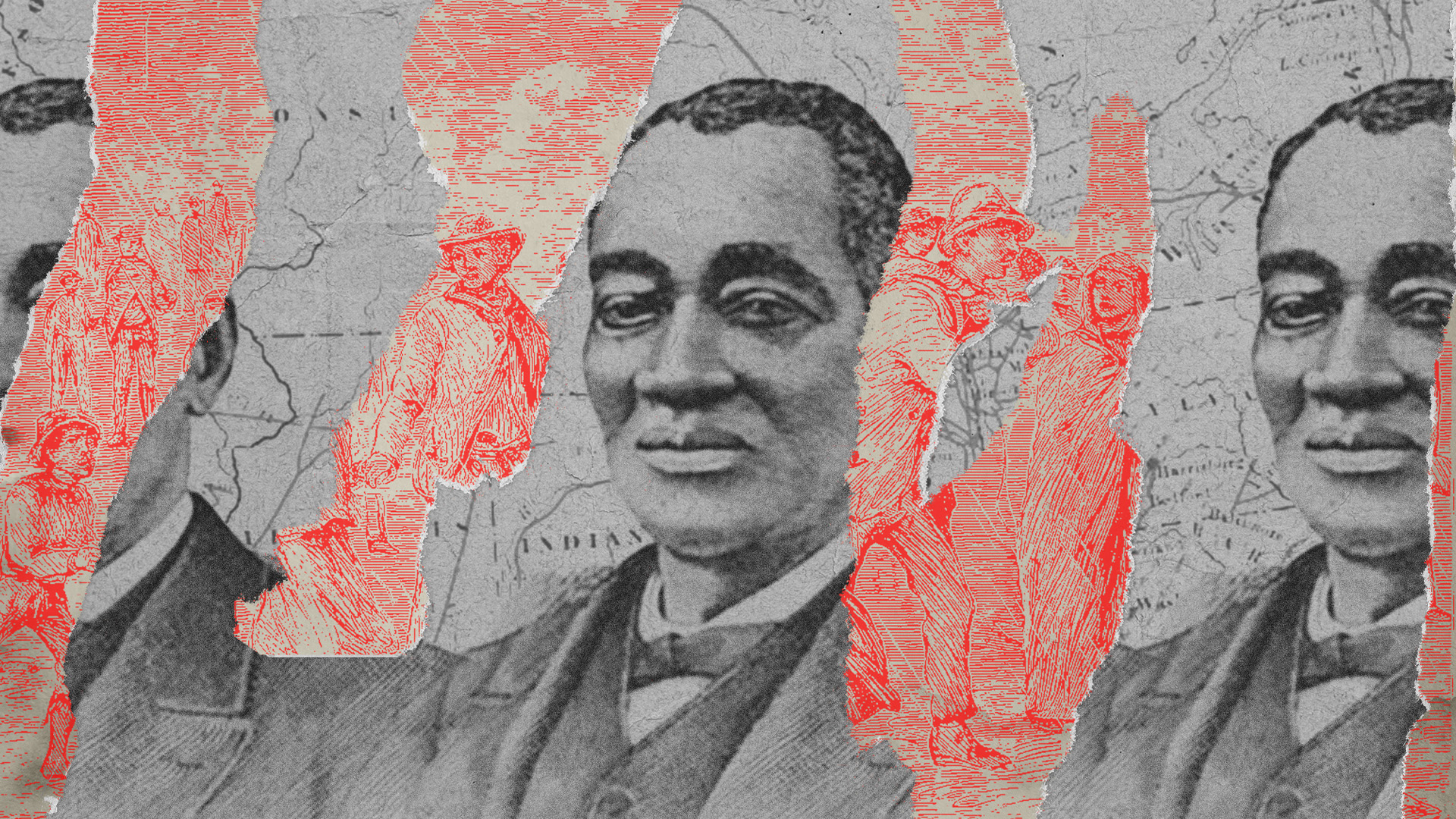
The Unsung Heroes of the Underground Railroad

A new study gives Black evangelicals their due.

Abigail Erickson

On August 21 and 22, 1850, a group of fugitive enslaved people and their white supporters met in Cazenovia, New York. During their meeting, the fugitives read a letter to their brothers and sisters still held in bondage in the South. They encouraged enslaved people to stand strong and to resist their masters’ tyranny as they were able. Moreover, they noted that, were a time of slave insurrection to come, “the great majority of the colored men of the North…will be found by your side.”

The Gospel of Freedom: Black Evangelicals and the Underground Railroad

Their encouragement was tempered, however, with a sober reality check. “The priests and churches of the North, are, with comparatively few exceptions, in league with the priests and the churches of the South,” they stated. For this reason, any Black Southerner attempting to escape enslavement ought to take a cautious approach to white Northerners, even abolitionists, who might present themselves as friends. Instead, fugitives were encouraged to look to their fellow Black brothers and sisters as sources of solidarity and support in their pursuit of liberty.

Some historians have missed the truth presented by the 1850 Cazenovia convention: that free and enslaved Blacks were the most vocal and active advocates for freedom. In many historical accounts of abolition, their role has been forgotten or dismissed by scholars focusing on political approaches to emancipation.

In her book The Gospel of Freedom: Black Evangelicals and the Underground Railroad, Alicestyne Turley re-centers the work of Black evangelicals in the narrative of emancipation, emphasizing the importance of antebellum Kentucky.

Turley, the founding director of the Underground Railroad Research Institute at Georgetown College in Kentucky, focuses on religion as an organizing framework for abolitionist activism, arguing that the Second Great Awakening in the early 19th century set the stage for the abolitionist work of African American Christians in the Western frontier. As new denominations were forming, Turley writes, some evangelical Christians—white and Black—linked ideas of freedom and equality to Christianity and “spread the gospel of human freedom” to new territories.

The presence of these new denominations in Kentucky, a slaveholding state, created conditions for conflict. While white Christians fought over whether their denominations could include both slaveholders and those opposing slavery, Black Christians formed their own institutions to advocate for freedom. New denominations, particularly the African Methodist Episcopal (AME) Church, as well as publications such as Freedom’s Journal, were crucial to developing Black freedom networks that championed not only spiritual freedom but physical freedom as well.

These networks laid the foundation for the Underground Railroad, which developed 12 “streams” of freedom in Kentucky. As these streams flowed northward, they sent new abolitionist leaders to cities like Baltimore and Boston, which became sites of abolitionist agitation among free Blacks.

When the battle over slavery moved from rhetorical to physical violence, northern Black abolitionists from Kentucky formed Black Union regiments that received escaped slaves from the South. They also played key roles in developing the Freedmen’s Bureau and the post-Civil War network of Black colleges and universities. Black evangelicals from Kentucky who had been active in the Underground Railroad extended their freedom work to developing institutions that furthered Black empowerment in the postwar South.

The strength of Turley’s work is her focus on institutional history and her exploration of how racial realities shaped the denominational structures and abolitionist work of Kentucky churches. While many white Christians equivocated on questions of slavery to maintain denominational peace, Black evangelicals forged ahead with freedom-advancing work in their churches and in alliance with Underground Railroad allies, both Black and white. Turley’s narrative is thus an important companion to Ben Wright’s recent book Bonds of Salvation, in which Wright links denominational growth among white Christians to ideas of conversionism that ultimately dissuaded most white Christians from abolitionism.

To be sure, some white Christians in Kentucky and the North promoted the cause of abolition, but they were limited in number and often at odds with their local congregations. The Gospel of Freedom serves as a reminder that institutions have the power both to encourage just action through solidarity and to limit opportunities to pursue just ends.

Turley’s focus on the institutional leadership of key African Americans in the development of pre– and post–Civil War freedom networks limits her book in some ways. Except for the final chapter, there are few accounts of the inner workings of the Underground Railroad. The reader is left wondering about the connections between Black institutions and their leaders and the fraught realities of clandestine operations. How did institutional leaders navigate their public abolitionist efforts while carrying out actions that required secrecy?

Turley also makes incorrect claims about Calvinism, stating that Blacks and women were excluded from the Calvinistic doctrine of election and that members of the broadly evangelical but theologically diverse Clapham Sect held hierarchical beliefs “in true Calvinist fashion.” Her accounts of Methodist, Anglican, Quaker, Shaker, and AME histories are sure-handed, but her grasp of Calvinist theology is sometimes shaky.

Nevertheless, Turley presents a compelling case that the Underground Railroad was “America’s first multicultural, multiracial, inclusive Civil Rights movement.” She reminds us—in the spirit of Frederick Douglass, Harriet Jacobs, Sojourner Truth, W. E. B. Du Bois, and many other chroniclers of slavery and freedom—that Black freedom has always come, first and foremost, through the persistent work and indomitable spirit of Black leaders. She also reminds us that many of these leaders found and developed their love for liberty in the context of their Christian faith. Their example should cause us to ponder the extent to which our Christian institutions, and our engagement in them, compel us toward works of righteousness and justice.

Trisha Posey is professor of history at John Brown University, where she directs the honors scholars program.

Books

Playing the Cultural Long Game

Sniping from the sidelines is easy. Building something better takes patience.

Abigail Erickson

All Christians grapple with how to understand and interact with the culture (or cultures) surrounding them—all of which, post-Fall, are tangled mixtures of good and evil. Dordt University theology professor Justin Ariel Bailey takes up these complex dynamics in his latest book, Interpreting Your World: Five Lenses for Engaging Theology and Culture. Christopher Reese, freelance writer and editor of The Worldview Bulletin, talked with Bailey about the significance of culture, engaging it faithfully, and specific contemporary challenges.

Interpreting Your World: Five Lenses for Engaging Theology and Culture

Interpreting Your World: Five Lenses for Engaging Theology and Culture

Baker Academic

192 pages

$12.02

What is culture, and why is it important for Christians to understand the culture they live in?

Culture is a web of significance in which we are suspended; it is a field of force in which we move. It’s about how we make sense of God’s world. There are multiple dimensions to this, and each needs to be taken seriously. Culture has a power dimension, but it also involves the moral communities we form, how we cope with the anxieties of life, and how we deal with the certainty of death.

Part of what I’m attempting in my book is to look at this question through five distinct lenses: meaning, power, ethics, religion, and aesthetics. I want to show how understanding cultural phenomena requires attention to all five dimensions.

We don’t choose whether to be culturally engaged. We are all cultural creatures, living in cultural settings, making cultural lives for ourselves and our families. Understanding culture is the first step in exercising cultural agency and developing cultural wisdom in light of God’s work in Christ.

How can a deeper understanding of culture contribute to our evangelism and discipleship?

Why don’t people experience the gospel as good news? Answering that question requires careful cultural investigation. I always remind my students that while the four Gospels are united in their testimony to Jesus, each is responsive to the questions and concerns of particular communities. Pentecost is a reminder that God’s message can be translated into our native language and logic.

Communication of any kind requires cultural understanding. The way we communicate the gospel and the way we pursue discipleship are likewise shaped by cultural interests, and the gospel resonates differently depending on the state of the cultural soil. Asking “What would be good news to these people?” is a great way to get at the heart of a culture.

How has evangelical thinking about culture changed in recent decades?

In the academic realm, it has become quite sophisticated. There is a lot of careful thinking, drawing from various disciplines: anthropology, sociology, psychology, critical theory, religious studies, missiology—all in conversation with theology, of course. There has also been greater sensitivity to the fact that culture is not reducible to ideas, and that cultural discipleship has to go beyond simply giving people correct information.

On the popular level, this nuance tends to get flattened—due, in part, to the way we consume information. One problem is our tendency to be satisfied using a single mode of analysis, like power or ethics. Both perspectives are important, but neither is sufficient.

You mention two key aspects of interpreting culture theologically—theology from culture and theology for culture. Can you explain the difference?

Theology from culture is an exercise in careful listening. What operative theology do we find in various cultural artifacts? In other words: What is most real, and what matters most? The questions we ask in this mode are investigative and empathetic; they’re aimed at discovering why a particular cultural phenomenon connects with so many people, including us.

Theology for culture is an exercise in creative action. In light of the gospel, what should we make of a particular cultural reality? The questions in this mode are critical and constructive, as we seek to live out distinctively Christian interpretations of culture’s offerings. We should be able to say how the gospel critiques and completes the world of meaning found in cultural artifacts.

Can you apply both modes of theology to a particular cultural artifact?

Let’s take the smartphone, one of the most consequential inventions of our time. It has changed our access to information, the way we connect with others, and the way we are present in a space. How do we account for this? An adequate analysis would mention the powerful interests that have driven the digital revolution by working to colonize our attention and make our devices difficult to put down. But it would also look at the reasons we have surrendered our agency and attention. What benefits did we believe we were promised—convenience, connection, control? How do these help us cope with or escape from the anxieties of modern life? How has embracing the smartphone shaped our sense of what is most real and what matters most? All this is theology from culture.

Theology for culture asks, how do I live with this cultural artifact, given the story of Scripture? How does the gospel confront our quest for convenience and control, and how does it answer the broken promise of connection with something better? This kind of theology goes beyond the smartphone itself to consider what we do with it in the presence of our children, while we wait in line, or late at night when we can’t sleep. Theology for culture seeks a more vital way of being present and paying attention, for the love of God and the good of our neighbors.

Where do you see evangelicals interacting with culture fruitfully? Where do you see them falling short?

I am encouraged when I see Christians playing the long game, cultivating what Eugene Peterson called “long obedience in the same direction,” rather than being driven by ambition or fear. There’s a maxim that I love: Criticize by creating. Which means that the best critique is building something beautiful.

The temptation in a world gone mad is to stand on the sidelines and point out what’s wrong with everything. The alternative is to criticize by creating. Write a song, a poem, a play. Make a short film. Plant a garden. Host meals that bring new people together. Design something that leans into the best parts of being human. Make something that testifies to the hope we have in Christ.

Much of Western culture is openly hostile to orthodox Christianity. How can believers best engage with those who are antagonistic toward Christians or Christian belief?

At the end of my book, I talk about three postures that correspond to the theological virtues of faith, love, and hope. I call them non-reductive curiosity, non-dismissive discernment, and non-anxious presence.

Non-reductive curiosity is the fruit of faith. It begins with trust that we are secure, not because we have all the answers but because God has promised to be faithful. This allows us to be curious, because our ultimate security is not rooted in our cultural success.

Non-dismissive discernment is the fruit of love. It refuses to dismiss the dignity or avoid the presence of those unlike us, even those who are antagonistic. It seeks to discern where God is at work as our fellow image-bearers wrestle with reality.

Non-anxious presence (a term I’ve borrowed from a rabbi named Edwin Friedman) is the fruit of hope. Because we believe God is present and redeeming creation, we can offer our work with joy, even allowing it to die, fail, or be forgotten. The ultimate meaning of culture-making rests not in our hands, but in the long and loving work of our good Lord.

Theology

Dallas Willard’s 3 Fears About the Spiritual Formation Movement

Could we miss the whole point?

Illustration by Xiao Hua Yang

As a young man, I was privileged to be an eyewitness to the rise of the Christian spiritual formation movement.

It began, in its modern form, in 1978, when Richard Foster wrote what has become the perennially standard text on the spiritual disciplines, Celebration of Discipline. Within a few years of its publication, Christians who had never heard of solitude, silence, or meditation were now practicing these disciplines.

A lot of good was happening, but Richard saw that many Christians were practicing the disciplines in isolation and needed more guidance. So in 1988, he asked Dallas Willard, me, and a few others to join him in forming a spiritual formation ministry called Renovaré (Latin for “to renew”).

Dallas, who served as a philosophy professor at the University of Southern California for 40 years, was one of the most important pioneers in the spiritual formation movement among evangelicals and mainline Protestants. He was close friends with Richard; in fact, Dallas first taught Richard about the spiritual disciplines, which of course were nothing new but were rooted in the ancient church.

In the early days, we experienced a great deal of resistance. Some evangelicals were sure our teachings on spiritual formation were dangerous and the work of the Devil. People would gather outside of our small conferences holding picket signs with messages like “New Age Heresy: Beware.” But the movement was building.

Over their long years of friendship, Richard encouraged Dallas to write about Christian formation, and Dallas eventually penned many influential books, namely The Spirit of the Disciplines; Renovation of the Heart; and his magnum opus, The Divine Conspiracy.

Many others joined in similar efforts. Eugene Peterson’s writings became bestsellers. Books by Catholic contemplatives Thomas Merton and Henri Nouwen were being carried around by Presbyterians and Methodists—and even some Baptists. James Houston provided academic grounding from his base at Regent College. In 1992, Dallas began teaching the most popular course in Fuller Theological Seminary’s doctor of ministry program, called Spirituality and Ministry. It grew so popular, in fact, that Fuller hired me to serve as Dallas’s teaching assistant—which I did for almost a decade.

In 2005, we held a Renovaré International Conference in Denver, and over 2,500 people attended. When I walked into the auditorium, I was overwhelmed. I turned to Richard and said, “Something has changed. We have gone from picketed to popular in less than 20 years.”

It was true. Something had changed. Soon more and more pastors and parishioners were reading books on formation. Other formation ministries were being established. Christian publishers created book series and imprints branded for their formation focus. Colleges and seminaries began offering graduate programs on formation.

I noticed that even pastoral titles began to change; instead of “pastor of Christian education” or even “pastor of discipleship,” there were more and more “pastor of spiritual formation” roles on church staffs.

But privately, I noticed something else during those decades: Dallas was voicing serious concerns about the movement’s future.

Prophetic Fears

Over the years until Dallas passed away in 2013, I had several conversations with him about the rise of the spiritual formation movement. Dallas told me he was glad people were interested in spiritual formation and that it was a sign of a deep hunger and deep need in the church.

But he worried that the focus would be on the practice of the spiritual disciplines themselves rather than on what they were intended to do. Dallas felt this would naturally degenerate into a focus on technique—on the how and not the why of the spiritual exercises.

Dallas also feared that churches would co-opt interest in spiritual formation as a tool for church growth—and that, because it likely would not lead to numerical growth, leaders would then relegate formation to one of many departments in a church rather than viewing it as central to their mission.

Finally, he was concerned that the growing number of formation ministries would compete with each other—rather than cooperate—in order to validate their work and ensure their survival.

I’ve reflected on these concerns for nearly a decade now, and I’ve come to believe that Dallas was prophetic. Today, there is a strong emphasis on practicing the disciplines almost in isolation. Nearly every week I receive a copy of a new book on Christian formation, and almost all of them are about a particular practice, such as slowing down, solitude, fasting from technology, using the Enneagram, gratitude journaling, or creating a rule of life. They give great attention to the how of a certain method while championing its apparent benefits, but they often neglect to help readers truly understand or cultivate the deeper why.

I do frequently see churches struggle to integrate spiritual formation into congregational life. While many churches have a department of formation and discipleship, they tend to focus on isolated programs, events, or groups within their church, rather than viewing spiritual formation as an expected aspect of being a Christian for all people.

And I have seen—and directly experienced—the kind of competitive spirit among formation leaders and organizations that Dallas warned about. Only rarely have I seen the kind of cooperation Dallas felt was necessary.

In one of our last conversations together, I asked Dallas what would be at stake if his fears became reality. His answer: “A lack of transformation into Christlikeness.”

This is the heart of the issue: Christian spiritual formation must truly be about formation—about being formed into the image of Christ (2 Cor. 3:18; Gal. 4:19). In the end, the question isn’t about disciplines or programs or techniques. The question is: Are people becoming more like Christ? And that was Dallas’s deepest concern.

Fear #1: Techniques without transformation

Since Dallas is no longer with us, I recently took a “listening tour” and spoke with several of his closest colleagues and family members about what Dallas might say today regarding where the formation movement has come and where it is going. I spoke with Richard Foster; John Ortberg; Steve Porter; Keith Matthews; Dallas’s wife, Jane Willard; and his daughter, Becky Willard Heatley. The conversations were enlightening and encouraging, but not without a sense of caution and concern.

To understand Dallas’s fears, it’s helpful to understand Dallas’s model of formation, which aimed at what he called putting on “the mind of Christ.” In Dallas’s view, this meant adopting the narratives of Jesus on key issues like the character of God the Father, the nature of human person as an embodied soul, and the reality of the present kingdom of God.

Dallas taught that disciplines such as prayer, solitude, and Scripture memorization are only one part of the formation process. The second part is the work of the Holy Spirit, and the third is learning how to see life’s trials and events in light of God’s presence and power.

One of Dallas’s fears—something he essentially predicted—was that interest in the practice of the disciplines, while essential, would eclipse the other two parts. How did he know this? Because the practice of the disciplines, though challenging, naturally has an immediate sense of payoff. Measuring spiritual growth itself is difficult; knowing whether one has completed a devotional practice is not. If I spend five minutes in prayer or 15 minutes reading a devotional book, I will feel as if I have done something “spiritual.” And these actions may very well lead to a sense of connection with God.

Illustration by Xiao Hua Yang

But they may also be an act of legalism, which was the failure of the Pharisees who fasted, gave alms, and prayed in order “to be seen” (Matt. 6). Legalism is an act of earning—of thinking, for instance, I fasted this week, so I am expecting a blessing from God. And if I believe that God metes out punishment and blessings based on my religious practices, I will quickly turn the disciplines into legalism.

Years ago, a woman in my church felt she had to have a daily “quiet time” (which entailed reading a selection from her daily devotional book) to get God to bless her life. Soon she began to think that if she did a longer quiet time, she would get more blessings. At one point, she was reading seven devotional books during her prayer time. I explained to her that the disciplines only do one of two things: connect us to God or help break the power of sin. When she discovered this, her approach to the disciplines was substantially changed.

Becky Willard Heatley spoke with me about her father’s concern that the disciplines would be “elevated and separated” from the rest of transformation. “He believed this would be dangerous,” she said, because the disciplines then become a form of idolatry—the means become the ends. We become more focused on the disciplines than we are on God, breaking the grip of sin, or the care of our embodied souls.

Steve Porter, a professor at Biola University who edits the Journal of Spiritual Formation and Soul Care and was close with Dallas, believes Dallas’s concern about elevating and separating the disciplines was that it would leave out the historical, scriptural, theological, and anthropological why behind the disciplines.

I’ve experienced this firsthand. I’d been invited to speak at a large evangelical church about spiritual formation. My host was the pastor of spiritual formation, who was excited to show me what she had been doing in this role and to ask for advice on helping her congregation grow spiritually.

She was also eager to show me the result of a yearlong project: an outdoor labyrinth. I was surprised, even a bit shocked. This was an evangelical church, and labyrinths have often been the subject of scrutiny in many evangelical circles. And yet, here it was, large and beautifully landscaped. She told me it was very popular with many people in the church.

I asked a few questions. Why had she felt called to create this labyrinth? She said experiencing a labyrinth had led to a breakthrough in her own faith and she wanted others to experience it. She told me she felt a deep inner peace when she walked the labyrinth.

Had she taught participants about the Christian history of the labyrinth and what it is intended to do? She answered that she’d created a pamphlet that taught participants how to use the labyrinth.

What did she hope would come because of it? She explained that she was trying to show how important spiritual formation is in the local church. She felt that if the labyrinth became popular, it would “validate” her work in the church.

As I consider this example in light of Dallas’s concern, the deeper issue is not about whether a labyrinth is an orthodox practice, or if it cultivates feelings of inner peace, or about how to do it rightly, or about validating a pastor’s formation ministry.

Despite the emphasis in many current books on spiritual disciplines, these practices are not meant for reducing stress, ordering one’s daily routine, understanding one’s personality better, having “spiritual experiences,” or gaining any number of other fringe benefits that do often result from the disciplines. All of these matters are secondary to the goal of becoming more like Christ.

Many of us have allowed the spiritual disciplines to become a form of idolatry, divorced from historical, biblical, theological, and anthropological understanding. Many of us have inadvertently assumed these practices will transform us. But the practices themselves are powerless without God.

We must take care not to let the disciplines eclipse the actual reason for practicing them: to deepen our relationship to God and to create space for God’s grace to work in our lives.

Fear #2: The ABC’s without the D

Another fear Dallas voiced concerned the church. He was a big proponent of the local church and believed one of its primary roles is to create disciples as Christ mandated in the Great Commission (Matt. 28:16–20). The core premise of his book The Great Omission is that many of our churches omit the very heart of the commission: to “make disciples,” which in turn means “teaching them to obey everything that I have commanded you.”

Dallas believed the emphasis in many evangelical churches was on “making Christians,” instead of making disciples. These ideas should be synonymous, but they aren’t. Dallas often remarked that today one can be a Christian (by virtue of a confession of faith) without being—or even intending to be—a disciple. In other words, one can feel confident he or she is a Christian because of an assent to a doctrine (such as “Jesus rose from the dead”) without any intention of doing what Jesus said to do (like “Bless those who curse you,” “Love your enemy,” and so on).

This phenomenon, Dallas believed, was rooted in something deeper: the metrics by which we tend to measure church success. Dallas called these common measures “the ABCs”—attendance, buildings, and cash. For example, if we see a church of 75 people who meet in an old building and have little money to pay for staff or ministries, we may assume they are, as Richard Foster often puts it, “a marginal failure on the ecclesiastical scoreboard.” Conversely, if we see a church that has 5,000 weekly attenders, a campus so large that attendees must be shuttled in golf carts, and money to fund countless ministries, we may assume this church is a massive success.

But Dallas fervently believed church “success” (if you could call it that) should be measured not by the ABCs, but by the D—discipleship. Jesus, Dallas would point out, was not interested making bigger churches but in making “bigger Christians.” In this regard, a church of 75 who are growing in Christlikeness could be far more successful than a church of 5,000 that’s not engaged in making disciples of its members.

In Dallas’s view, spiritual formation should not be relegated to a program or retreat; rather, it is essential to the corporate life of our congregations.

In churches that shortchange discipleship, members who do move into a more mature faith life will often become isolated. This was essentially the finding of a much-discussed 2007 study by Willow Creek Community Church. The megachurch’s emphasis had been on converting seekers into members, and it worked. But when some of those people began experiencing meaningful growth in their spiritual lives, they felt there was no place for them.

Those who hungered for the deeper life found refuge in spiritual formation parachurch ministries: Ruth Haley Barton’s Transforming Center, the Renovaré Institute, the School of Kingdom Living, or the Apprentice Institute. Those kinds of ministries became the default communities for many who could not find meaningful engagement with formation in their local church.

Keith Matthews, a seminary professor at Azusa Pacific University who worked as closely with Dallas as anyone I know, told me, “Dallas foresaw that it would be a challenge to create communities of faith that can support real transformation. He saw how, for most people, it remained just an individual effort. Without communities, continued growth is very difficult.”

From the beginning of our work with Renovaré, we frequently saw people growing in their spiritual lives only to find their own churches unwelcome, even hostile, to their efforts. One couple who went through every ministry Renovaré had to offer and had experienced real personal transformation went to their local church in Texas hoping to share this method of discipleship with others. The senior pastor told them they could lead a small group, but he would not support it otherwise. This lasted for a decade. Then, when the senior pastor himself took part in a spiritual formation program, he came away convinced it was essential. He encouraged the entire church to get involved.

One obstacle to emphasizing church-wide spiritual formation is that it often does not lead to numerical growth. Dallas knew that if a pastor focused on this kind of discipleship in the life of a congregation, it might actually lead to a drop in attendance—what Dallas called “a holy reduction.” Discipleship and formation are slow and difficult—a challenge in a world that prefers the quick and easy.

“It is not fair to say that pastors reject spiritual formation efforts because they don’t directly grow attendance,” John Ortberg told me. “They simply neglect it because they believe it will take them away from the things that would grow their churches in attendance.”

And while many churches may now employ a “pastor of spiritual formation,” many of them have received little training in formation and its historical and theological grounding. At the church that built the labyrinth, for example, I asked the pastor of spiritual formation where she had done her training. She explained that she had no formal training, but that formation was her “passion” and thus the senior pastor appointed her to this role.

My aim is not to criticize this pastor or others for a lack of training. But well-intentioned pastors who do not have a wider theological, historical, and anthropological understanding of formation, as Steve Porter noted, may very well end up embodying Dallas’s first fear: a focus on spiritual disciplines to the exclusion of a more holistic approach to transformation.

In Renovation of the Heart, Dallas wrote, “I rarely ever meet anyone in a leadership position among Christ’s people who is not doing his or her very best to serve Christ in the best way he or she knows how—usually sacrificially, and frequently with much good effect. But we need to understand how we can do better.”

Fear #3: Competition over cooperation

Dallas’s final concern was regarding the many spiritual formation ministries that emerged as the movement grew. On one hand, he was truly glad to see more and more people establishing retreat centers, programs, institutes, and academic and nonacademic training programs. But on the other hand, Dallas was keenly aware of a potential problem: Ministry leaders would view others as competitors, he feared, and would not cooperate with one another.

I have walked through this myself. In 2009, I offered a new program I’d built to become a part of the overall ministry of Renovaré. But Richard and others felt it was time for me to leave the nest, so to speak, and build a separate program. So we established the Apprentice Institute for Christian Spiritual Formation at Friends University later that year.

Almost immediately, I felt that any program we developed and any resources we created were a threat to other formation ministries. I was tempted to view those organizations or their leaders as rivals. I shared my concern with Dallas, and he told me that this was a concern he had about the movement: “The need is so great that, even if we band together, we will have trouble making an impact.”

This phenomenon isn’t new. Competition has been common in the church since the time of the apostles—I am for Paul, I am for Peter, I am for Apollos (1 Cor. 1:12; 3:4). And Dallas knew this was especially true not just within but between churches.

I once invited Dallas to speak to a group of pastors. He offered a complete-the-sentence prompt: “The most important work of a pastor is…” Then he paused and we all leaned in, eager to hear the answer. He continued: “The most important work of a pastor is to pray for the success of the churches in their area.”

This was not what we expected. I thought he’d say something like, “The most important work of a pastor is to memorize and meditate on Scripture,” or “to have a regular Sabbath.”

But Dallas explained that if ministers could genuinely pray for the success of the churches in their areas—churches that might naturally be seen as competitors—then those ministers’ hearts would truly be in sync with the kingdom of God. “After all,” he said, “we are all on the same team.”

A competitive mindset regarding one’s church or one’s spiritual formation ministry may be a very natural human instinct. But if we’re serious about putting on the mind of Christ, it’s clear that a competitive spirit is out of sync with the values of his kingdom. We are on the same team, and transformation into Christlikeness is evidenced by our desire to seek the good of the kingdom first.

My friend James Catford, a longtime leader at Renovaré, uses the analogy of the rescue at Dunkirk in World War II to explain the spirit Dallas was trying to point us toward.

At a pivotal point in the war, thousands of British and Allied troops were stranded in Dunkirk, France, just across the English Channel. As depicted in the popular eponymous movie, the troops were under constant threat from the Luftwaffe, and there were not enough British naval ships to rescue them all. So the government called on every British civilian with a boat to cross the channel and pick up soldiers.

Boats of all shapes and sizes cast off and brought home more than 338,000 British and Allied troops. Some believe that without this united effort, Germany would have won the war.

In the spiritual formation movement, if we are to heed Dallas’s concern, then everyone with a “boat”—a ministry, program, book, retreat center, formation podcast, and so on—needs to band together in this deeply needed work: the making of disciples, of genuinely transformed people. May we be alert to the danger of giving in to a spirit of competition; may we continually and humbly invite Jesus to keep our hearts in sync with the values of the kingdom. We are truly all in this together.

Not long ago, I spent an hour on a Zoom call with the new president of Renovaré, Ted Harro, during which we discussed the work of our two spiritual formation ministries.

“I have only one thing in mind, Jim,” Ted said. “How can we be the best partner with you to help you do the work you are doing?”

I told him I had exactly the same interest in mind. In that moment, I felt as if somewhere in glory, Dallas was rejoicing.

James Bryan Smith is the Dallas Williard Chair of Christian Spiritual Formation at Friends University, executive director of the Apprentice Institute, and author of The Good and Beautiful God.

News

Four Out of Five Victims Don’t Report Sexual Assault. Can Christian Colleges Do Better?

Title IX coordinators look for ways to combat silence and shame.

Source:Getty / Kerkez

Only two Anderson University students have filed reports on sexual violence or harassment so far this year, according to Title IX coordinator Dianne King.

That number might seem encouraging, but King is actually worried about it. Just because someone doesn’t report something doesn’t mean it didn’t happen.

Anderson is a private liberal arts college affiliated with the South Carolina Baptist Convention. The school, like all colleges and universities that receive federal funding, is required to enforce Title IX, a federal civil rights law prohibiting sex-based discrimination. That includes tracking sexual violence and attempting to prevent it.

That’s a challenge for every college and university. And some Christian schools may inadvertently discourage reporting, with policies that prohibit all alcohol, drug use, and sexual activity outside of marriage. That can leave coordinators like King second-guessing their own data.

“There are students who are having sex. We know that, and that there are those who misbehave in a sexual manner, whether it’s sexual harassment, sexual assault, stalking, or interpersonal violence,” King told CT. “We have those things here.”

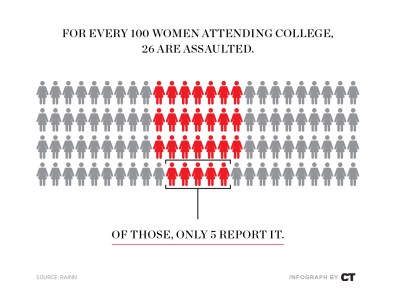
There is some evidence that sexual assault is slightly less likely at religious colleges, though numbers are hard to come by. Overall, more than 26 percent of female undergraduates experience rape or sexual assault, according to statistics from the Rape, Abuse & Incest National Network (RAINN). But the same data shows that only about 1 out of every 5 female students who are assaulted report it to authorities—and the reporting percentage is even lower among the 7 percent of male undergraduates who are raped or assaulted.

Some victims blame themselves for what happened and assume others will too. For many, the immediate negative consequences—from social stigma to punishment for other things that were happening—outweigh the distant possibility of justice.

One way to raise reporting rates, according to the US Department of Education, is to offer amnesty for student handbook violations that occurred alongside the more serious crimes of sexual violence. Anderson has officially written this into its policy. Though the school does not permit students to use drugs or alcohol, it does not punish people if they disclose those violations in the process of reporting sexual violence.

“A sexual assault is much more serious than a party where the drinking gets a little out of hand,” said King, who is also the school’s associate vice president for student development and dean of student success. “We need to be able to investigate the assault above everything else. That’s what Title IX requires, and we’re committed to doing that.”

What Christian colleges like Anderson don’t want to do is create a culture that discourages reporting, even inadvertently. That can add to the traumatic experience and ensure that sexual violence goes unchecked.

Last summer, 12 women sued Liberty University for fostering an unsafe campus environment and mishandling Title IX complaints.

An investigation by ProPublica found the Lynchburg, Virginia, school founded by Jerry Falwell Sr. discouraged and dismissed student reports of sexual assault. Former students told ProPublica that when people reported assault or rape, the school threatened to punish them for violations of “The Liberty Way,” including being alone with a man.

Infograph by Christianity Today / Source: RAINN

Liberty settled the lawsuit in May. The terms of the settlement are protected by non-disclosure agreements. The school announced that it “had already undertaken various initiatives” to better protect women on campus. Liberty also said it would revise its amnesty policy to clarify that people reporting sexual violence should not be punished.

Brigham Young University (BYU), affiliated with the Church of Jesus Christ of Latter-day Saints, saw a 400 percent increase in Title IX reports when it reformed its policies and procedures five years ago. The number of reports at the Provo, Utah, school has steadily increased since then. BYU Title IX coordinator Tiffany Turley told CT that doesn’t signal an increase in incidents but, more likely, an increase in how comfortable students feel reporting.

“In fact, in the past most of our reports came from mandatory campus reporters” such as professors and school nurses, Turley said. “But now the majority of our reports come directly from students themselves, which shows the trust students are gaining in our office.”

A recent campus climate survey presents a complicated picture, however. Nearly 8 out of 10 students said they thought BYU was doing a good job of caring for victims of sexual violence. But among the 538 women and 95 men who said they experienced some form of unwanted sexual contact in the previous 12 months, only 27 percent reported it to an authority. The students were more likely to trust a friend (61%) or roommate (42%) than the Title IX office (3%) or the school’s counseling service (5%).

The Mormon school, like evangelical colleges and universities, continues to focus on raising awareness about what the Title IX office does and look for ways to encourage more people to report.

Turley believes that not punishing the people who report sexual violence has been one critical way of increasing trust. That doesn’t mean that BYU or evangelical schools don’t care about the code of conduct, though. They believe those policies are good for students and can provide some protection.

“I appreciate working at a school that has such a strong, faith-based code of conduct,” Turley said. “While I reiterate that sexual assault/misconduct is never the victim’s fault, I can anecdotally say that we would likely not see at least 75 percent of the reports we do if people followed the Honor Code.”

At least half of sexual assaults among all demographics involve alcohol consumption by one or both parties, according to a recent report from the National Institutes of Health. One study found that a training program targeting excessive drinking among college students resulted in a 47 percent reduction in incidents of rape.

That’s one reason Gardner-Webb University, an evangelical college in Boiling Springs, North Carolina, has a dry campus, prohibiting all alcohol use. It also implemented an amnesty policy last fall to encourage more reporting, interim Title IX coordinator Lesley Villarose told CT. The school revised its Title IX policies and worked with a law firm to create a training program for people who could serve as case investigators and advisers.

In her interim capacity, Villarose launched what she called a “Red Flag Campaign” to give students more information about sexual violence. Villarose saw a similar program have a positive impact at Averett University, in Danville, Virginia. She and her team posted flyers around the school, hosted training sessions, and put information on social media.

“We certainly hit the tip of the iceberg with it, but . . . we got a lot of wonderful feedback from our students,” she said.

The college also started using a smartphone app that sends out emergency notifications and allows people to report sexual violence confidentially. If reports of sexual violence go up, Villarose will consider the work successful.

When people do report, it’s kind of a relief, even as colleges aim to also reduce the number of assaults taking place on their campuses. Title IX coordinators say they’re honored to be able to help people—and they agonize over the students who need help but haven’t found a way to ask for it.

“I don’t think it’s ever enough,” said King at Anderson, “but we do all that we can.”

Hannah McClellan is a reporter in North Carolina.

Americans Forgot How Long Refugee Resettlement Takes

One year into the biggest US refugee wave since the Vietnam War, Christians are trying to buy Afghan immigrants more time.

Portrait: Jay Patel for CT / Background: Getty

Before the United States military left Afghanistan in August 2021 and the Taliban retook power, Farzana was a classical guitarist. There is footage of her in lively performance spaces, strumming in music groups with both men and women.

Afghanistan had thriving pop and traditional music scenes for the past 20 years. Now Afghan musicians are afraid to play music in public after Taliban soldiers have publicly burned instruments and murdered prominent folk singer Fawad Andarabi.

The Taliban takeover shocked Farzana and her siblings, whose last name is being withheld for their family’s safety. They had mostly known life during the American occupation: Yes, there were suicide bombings, but playing an instrument had never felt like a life-threatening pastime.

At Nyack College, a Christian and Missionary Alliance school in New York, music professors learned about Farzana’s plight when a colleague posted on Facebook about the dangers facing Afghan musicians. Nyack spent months making plans to evacuate her. In December, after walking past patrolling Taliban soldiers and traveling to Pakistan, Farzana arrived in the United States and stepped out into the Christmas lights of New York City. In February, her younger siblings, Ali and Mursal, also students, made it out too. Now the Muslim siblings are all enrolled at Nyack, which is covering their tuition, room, and board.

A music professor gave Mursal her coat when she arrived at the airport. Another bought the siblings bedding and dorm items. But they have not had an easy transition in the United States.

They sleep badly because they’re stressed about their future in the US and about their remaining family in Afghanistan. Their older sister, probably the most at risk in their family because she worked with NATO, had not made it out. Farzana left Afghanistan without her guitar. She is in a WhatsApp group where she receives news about other Afghan musicians who are in hiding, including a photo of one who was severely beaten and covered in bruises.

Farzana, who is soft-spoken, wishes she could have fought to defend her country like the Ukrainians she sees on the news. “I prefer the situation of Ukraine than the situation of Afghanistan,” she said. “I am very thankful that I am here. But I hate what is going on there. The situation is much worse than we know.”

One night during their first Ramadan in the US, Farzana and her sister Mursal were talking as they broke fast. Farzana shared that she had nightmares about forced marriage under the Taliban and thought about jihad al nikah, the practice where women are passed around as “wives” to multiple soldiers. What if she had to go back somehow? Would her sister who was left behind be able to keep moving from place to place and stay safe?

Mursal, trying to lighten that thought, joked that she slept badly because Farzana kept waking her up to do schoolwork and reminding her that “a 3.5 GPA is not easy! You will go back to Afghanistan!” Those are the grades they need for their scholarship at Nyack. Their brother, Ali, has struggled to adjust to a culture where men and women outside of family are often together. He misses his family, as well as his beloved cats that he left in Afghanistan.

Like many Afghans arriving in the US from a chaotic evacuation, the siblings don’t know what their future holds. Sometimes Farzana and Mursal walk from the Nyack dorm room they share in Jersey City to the waterfront along the Hudson River and look at the New York skyline. Farzana tells Mursal, “We have no one here, but we are in America.”

Farzana and MursalJay Patel for CT
Farzana and Mursal

The evacuation of Afghans was the largest such operation since the Vietnam War; about 76,000 have settled in US communities in the past 12 months. American Christians across the political spectrum have welcomed Afghans, housed them, and provided a surge in donations to resettlement organizations. That’s notable given 2018 data from the Pew Research Center that showed only 25 percent of white evangelicals said the US had the responsibility to accept refugees into the country, the lowest number of any demographic.

World Relief, an evangelical refugee resettlement agency, saw a 1,500 percent increase in new donors during the Afghan evacuation last year compared to the same period the year before. In recent years, evangelical leaders have pushed for US presidents to raise the refugee resettlement numbers.

For evacuees like Farzana and her siblings, the embrace from Christians has altered the course of their lives. But the American welcome is not what it was for many earlier generations of evacuees.

The vast majority of Afghans who came to the United States over the past year were admitted through a program known as humanitarian parole, a tool America has used for decades to receive people fleeing conflict. It is not a pathway to citizenship and, for Afghans, parole status expires after two years, during which time evacuees may apply for residency or some other means of remaining in the country. The process can be expensive and is far from guaranteed.

Waves of migrants in the middle of the 20th century had more time and space. Tens of thousands of Cubans fleeing the Castro regime in the early 1960s were paroled indefinitely and received hundreds of dollars a month in cash assistance (adjusted for inflation).

After the US evacuation of Saigon in 1975, Congress allowed more than 100,000 Vietnamese evacuees to receive as much as 36 months of financial help—direct payments for housing and food, as well as language learning and job training and placement services.

Afghan evacuees receive similar benefits—but only for eight months, a limit that was imposed on refugee assistance in 1991. (It was recently upped to 12 months for anyone arriving in the US starting in October of last year, timing that excludes most Afghan evacuees.)

In many states, Afghan parolees do qualify for public programs like Medicaid and the Supplemental Nutrition Assistance Program (SNAP). But resettlement experts say refugees need more support—and they need it on an ongoing basis—to start a new life from scratch in a foreign culture while healing from the trauma of fleeing a war zone.

Farzana, Mursal, and Ali are examples of Afghans who are grateful for the embrace they have received thus far but who need longer-term, deeper community support than government assistance can provide.

At Nyack, professors prayed to get the siblings to the US. They pinged contacts at embassies, at the CIA, and in Congress. The college’s new president, Rajan Mathews, who had worked in Afghanistan in the early 2000s building the country’s cellular network, tried to use contacts there and in India.

The goal was to get them out on student visas, said music professor Tammy Lum. “It was very complicated.” She sees it as a miracle that they were able to help the siblings.

With student visas, the siblings are not eligible for the resettlement benefits traditional refugees or humanitarian parolees receive; they rely completely on individuals who are willing to help. Nyack’s professors, many of them immigrants themselves, have tried to be an example of how to survive in the expensive city.

Marta Będkowska-Reilly, a cellist, is the adjunct music professor at Nyack who initially started working a way out for Farzana. An immigrant from Poland, Będkowska-Reilly left a hard upbringing in a country where soldiers and tanks filled the streets and her family subsisted mostly on bread and onions.

She remembers being alone when she came to the United States, and she picked up Farzana at the airport when she arrived.

“It’s good to know one person, a friendly face,” Będkowska-Reilly said. “It’s important to have basic toiletries, but moral support is the most important.”

Lum, who immigrated from Hong Kong, took Farzana from the cellist’s house to the dorms. “It was a very powerful moment in my life,” Lum said. Her church in Hong Kong, which she still has a WhatsApp group with, gave to a GoFundMe for the siblings.

In normal resettlement, refugees are often prioritized through their US ties. With the chaotic Afghanistan withdrawal, many do not have US ties and are starting “right from scratch, moreso from a social sense than a material sense,” said Kat Kelley, senior director of migration and refugee resettlement for Catholic Charities.

But materially, the siblings were also starting over. They arrived with almost nothing because they didn’t want the Taliban to notice large suitcases that might reveal they were leaving for good.

At times, the siblings’ needs test even what the Nyack community is able to provide. Mursal had a toothache and didn’t know how to go to a dentist. Living at the dorms during spring and summer breaks, when the cafeteria was closed, the siblings had to figure out where to get food.

The sisters are the only ones at the school who wear headscarves. Będkowska-Reilly found a mosque for them within walking distance of their dorm, but Farzana went once and never wanted to go again because men and women were separated, and that reminded her of the Taliban.

Farzana studyingJay Patel for CT
Farzana studying

Będkowska-Reilly asked if Farzana would be offended if she gave her a Bible, and Farzana said no. Będkowska-Reilly told her, “You can treat [it] as books of wisdom; you can read and see what God has for you.”

“I try to reach out to her,” Będkowska-Reilly said about Farzana. “She doesn’t want to overwhelm people with her problems and her worries. She’s aware we all have our lives and families and jobs. But I try to reach out to her. It’s great that she has housing, food, but it’s important how she feels inside.”

In March, three weeks after arriving in the United States, Mursal and Ali were sitting in a class in lower Manhattan on the history of world civilizations, learning about the industrial revolution. The class was mostly international students from places like Jamaica, Trinidad, and the Philippines. The professor of this class and the provost of the school, David Turk, said the school is returning to its “missions roots” by accepting students of diverse faiths. The Christian and Missionary Alliance, Nyack’s denomination, started in the 1880s when pastor A. B. Simpson left his Presbyterian church in New York City because it would not accept Italian immigrants.

In 1975, when 135,000 refugees arrived in the US from the Vietnam War, Evelyn and Grady Mangham, Nyack College graduates who were working for the denomination at the time, lobbied relentlessly to convince Alliance churches to assist the refugees. Evelyn Mangham would cold call churches from Nyack hallways to ask if they would take in a refugee family. As World Relief’s Matthew Soerens has documented, Alliance churches sponsored more than 10,000 refugees from Vietnam, Laos, and Cambodia that year.

Then Grady Mangham hatched a plan with World Relief, which at the time was largely focused overseas, to begin doing refugee resettlement work in the US. He led World Relief’s resettlement arm until 1987.

Turk, a longtime professor, remembers Vietnamese refugees coming to Nyack. Now he teaches Afghan refugees.

“I’m glad you’re here, but I’m sad that, once again, because Americans left a country, I have students in class,” he told the siblings.

Outside the window of the classroom, the Staten Island ferry chugged back and forth past the Statue of Liberty. Turk opened the class in prayer, thanking God for the roof over everyone’s heads, for friends, for salvation. Then he launched into a back-and-forth discussion with students about how the Industrial Revolution brought a change from village-based community cultures to money-centered culture. He talked about his wife’s family from Ukraine, who he said left their family to “come to New York and make money.”

Then Turk asked the class: Before the industrial revolution, what was a woman’s life like? Students shared back: They had lots of children, and no education.

“This is probably the greatest change of the industrial age: the role of women,” Turk said to the class. As Turk wrapped up, he mentioned that after spring break, they would discuss the industrialization of warfare.

Afterward, the siblings went to Turk’s office for a meeting, and Mathews, the president of Nyack, dropped by. Mursal mentioned how beautiful Afghanistan is, since Mathews spent time there, and he agreed. Then Mursal said, almost as a reminder to herself, “We can’t go to Afghanistan anymore.”

From the start of the historic Afghanistan evacuation, the US refugee apparatus, hollowed out by the Trump administration, was insufficient for the task.

Nine private resettlement agencies, most of them religious, contract with the State Department to place refugees in new communities, and they tried to quickly ramp up staff. With the surge of Afghan evacuees, the State Department has enlisted more private help with resettlement through a program it calls “sponsor circles,” where other vetted groups agree to commit to help particular families for 90 days.

Samaritan’s Purse, newly approved through the State Department to work as an institutional partner under Church World Service, is asking church sponsors of Afghans to commit to six months to a year. Catholic Charities, one of the nine US resettlement agencies, also wants long-term support for refugees, but it asks sponsors to work for three months and then hand the responsibilities off to someone else.

“You have folks 6, 8, 12 months from now, the honeymoon period is over, and it’s really exhausting to support families, and it’s okay to acknowledge that,” said Kelley at Catholic Charities. “Go in knowing what your capacity is. Whatever your capacity is, good, don’t overdo it. Because you want to sustain your capacity.”

Experts say refugees just need some time to adapt. In a 2009 study, researchers from the Georgetown University Law Center’s Human Rights Institute argued that refugees need at least 18 months of assistance that is more tailored to their needs than simply plugging them into welfare programs. The Biden administration introduced additional per capita payments to resettlement agencies to try to help with the journey to self-sufficiency.

The study compared Vietnamese refugees, who received 36 months of public assistance, with Iraqi refugees, who had less than eight months of resettlement assistance and were struggling with employment. By 2007, the median household income for Vietnamese Americans, most of whom entered as refugees from the Vietnam War, was $54,871, and only 3.2 percent were receiving cash public assistance.

The researchers argued that Iraqis arrived with professional experience and education degrees that were not usable in the United States and simply needed time and language and vocational training to find their feet.

Christian refugee experts say long-term social and emotional support is important, too. The US refugee program aims to have refugees become quickly self-sufficient, but “arguably it’s too quick,” Kelley said.

When government, communities, and resettlement agencies work together on behalf of evacuees, the impact can be dramatic.

Ahmad, whose last name is also being withheld, worked for the US government for years in Afghanistan. When district after district began falling to the Taliban in August 2021, Ahmad realized, given his role, that he needed to get out. As the work of 20 years crumbled, he felt like he was living a nightmare.

“It was a golden era for Afghanistan that will probably never repeat in history,” he said. “What happened was 100 percent preventable. We did not have to go through this.”

The US government arranged for his transportation to the airport on August 27, a few days before the last plane left. His family, including his seven-months-pregnant wife, crowded into a military aircraft with 400 people. The aircraft landed in Germany at Ramstein Air Base, where Ahmad saw thousands of other Afghans.

Ahmad could tell the staff at the US air base weren’t prepared for this situation. The first three nights, he and his family slept on the floor, but then they got cots, and then they got beds. Things gradually improved, although Ahmad worried about his wife giving birth in the camp.

In October, Ahmad and his family finally flew to the United States, staying at a military base in New Jersey while officials processed their paperwork. Ten days after arriving, his wife gave birth to their daughter, the first US citizen in the family. “She was taken care of very well,” he said about his wife.

With paperwork approved on December 17, they were resettled in Savannah, Georgia, a state where 1,700 Afghans have resettled. In May, he had his first Eid in the United States at the Islamic Center in Savannah with hundreds of other Muslims from the area.

“There’s peace of mind here,” Ahmad said. “I couldn’t pray, I couldn’t go to mosque in Afghanistan, in any Eid or any other Friday, because mosques were bombed.”

Inspiritus, a group connected with Lutheran Services in America, helped settle him and his family, but the group was short-staffed, according to Ahmad, with two case workers for more than 100 refugees. The resettlement groups couldn’t do orientation programs for everyone, including Ahmad and his family, because they were overwhelmed.

Despite that, “the people in Savannah jumped in,” he said, and they were “so supportive and so friendly” to Afghans. People in Savannah, including from local churches, brought his family food and groceries, gathered donations, and arranged medical appointments.

The guesthouse where his family was initially staying was far from grocery stores or the downtown area and his family had no car, so he relied on these “new friends” for rides. “They were in contact with us, with me, constantly,” he said.

His new friends helped him find an apartment. Once he got a social security number and a work permit, he got a new job with USAID where he will work remotely on Afghan humanitarian issues. He got a driver’s license, and he bought a car. He has applied for a green card.

Six months into his time in Savannah, he said, locals were still reaching out to check how he is doing. His wife and children were just starting to learn English, and his children were starting school. He recognized that he has avoided some of the stress other Afghans are going through because he has a job and, because he worked for the Americans in Afghanistan, he qualifies for what is called a special immigrant visa.

“It was not hard for me,” he says, partly because he is fluent in English. “Because of the support I received…I feel like I’m home. It was not an easy trip…but it got easier each day with the help and support I received from American friends.”

Farzana and her siblings were having a harder time, especially with loneliness and survivor’s guilt. In April, the siblings were celebrating their first Ramadan away from their parents, and they were doing it at a school where no one else they knew was fasting all day.

One night in April, they collected food on paper plates from the college cafeteria before it closed at 6:30 p.m.—orange sugary drinks, chicken cutlets, plain pasta, and pizza—and saved it for when they could break fast after the sun went down. The cafeteria would be closed by then.

Mursal began eating, and Farzana asked if she had prayed before she ate. Mursal protested that she had prayed quietly. She had been staying awake all night to study—that’s when she had energy after eating—and sleeping during the day.

The siblings have called their family daily since they got to America, even with bad internet connections in Afghanistan. But during the first two weeks of Ramadan, Farzana quit calling her mother because she felt that being apart during Ramadan was only increasing her mother’s anxiety.

Recently the Taliban had been restricting women from leaving home without a mahram, or a male relative. That meant the siblings’ mom, who used to exercise outside every day, could no longer go out. It also made travel more impossible for women.

The siblings talk regularly to their sister who is still in Afghanistan; she moves from place to place to try to avoid the Taliban. Many Afghans who needed evacuation the most, like Farzana’s sister, got left behind. Farzana is not worried about her parents: “I know they will not get killed by the Taliban because they are old and do nothing. But my sister…I am sad.”

Farzana doesn’t know of any others from her group of 300 musicians who got evacuated. She went to counseling recently, after waking up in pain and realizing it was psychological. Her sister said the counseling session didn’t seem to help.

The siblings’ immigration status is not assured: Once they finish their studies, they will need to find another way to remain in the United States. A lawyer is working with them to apply for asylum.

Będkowska-Reilly, the cellist who immigrated to the US, told Farzana that the siblings need to check with each other every day about how they are feeling.

“It’s always overwhelming,” Będkowska-Reilly told Farzana. “Just take little steps, one at a time.”

Emily Belz is news writer at Christianity Today. She is based in New York.

News

Back to Bolsonaro? Evangelicals Hesitate Ahead of October Election

More than a third consider switching support to left-wing challenger.

An evangelical woman kneels in prayer at a megachurch in Brazil.

An evangelical woman kneels in prayer at a megachurch in Brazil.

Source: Associated Press / Edits by Christianity Today

Only God knows how evangelicals will vote in Brazil’s upcoming election. But pollsters predict a remarkable divide: 49 percent of evangelicals indicate a preference for President Jair Bolsonaro in October, and 32 percent say they intend to support the leading left-wing challenger, former president Luiz Inácio Lula da Silva.

Last election, about 70 percent voted for Bolsonaro, the conservative former army captain who pledged himself to “Brazil above everything, God above everyone.”

Caroline Vidigal de Albuquerque, an evangelical who works as an executive secretary in Rio de Janeiro, was one of them. She told CT she liked the way Bolsonaro stood for “Christian thought, contrary to Marxism.” She believed left-wing voices had dominated for too long, and she noticed when the Catholic politician shared the stage with evangelical and Pentecostal leaders during the campaign.

As she prepares to head to the polls again, though, Albuquerque will be looking at the president’s record and comparing it to Lula’s time in office, from 2003 to 2010.

“We can compare the actions with the speeches of the electoral period,” she said. “In this case, as in life, reality must always impose itself.”

Many of Albuquerque’s fellow evangelical voters—who make up about 30 percent of the Brazilian population—may also prioritize different issues this time around. Jorge Henrique Barro, a Presbyterian pastor and theology professor at Faculdade Teológica Sul Americana, says he thinks economic concerns might win out over ideological ones in 2022. Evangelicals tend to be poorer in Brazil and have been hard hit by inflation and unemployment.

Between COVID-19 and the impact of the Russian invasion of Ukraine, inflation exceeded 11 percent in April, the highest rate in two decades. Unemployment is about 9 percent in September, even after the economy recovered slightly from the pandemic.

“Excluded, poor, Black, low-income, and low-education population, exposed to housing and health risks,” Barro said. “The biggest demands of these voters have to do with their basic needs.”

The most important question for them at the polls, Barro said, will likely be “Who is most capable of helping Brazil out of the dramatic situation in which it finds itself?”

Left:President of Brazil Jair Bolsonaro | Right: Former president Luiz Inácio Lula da Silva.Source: Getty / Stringer
Left:President of Brazil Jair Bolsonaro | Right: Former president Luiz Inácio Lula da Silva.

Evangelicals are not monolithic, though. In the national congress, there are 196 deputies and seven senators who belong to the Frente Parlamentar Evangélica (Evangelical Parliamentary Front). They are spread across 19 different political parties. The largest group, 42, are part of Bolsonaro’s right-wing Liberal Party, but that’s not a majority.

While most evangelicals support key pieces of the Liberal Party agenda—defending traditional families, freedom of religion, and the unborn—there are issues where they diverge. Bolsonaro’s government has sought to loosen environmental regulations, for example, while 85 percent of evangelicals in the country say that attacking nature is a “sin against God.”

Some evangelical pastors continue to back Bolsonaro but are clearer, this election, about expressing reservations.

“I don’t wear a T-shirt with his face printed on it,” Jaime Soares, an Assemblies of God pastor in Rio de Janeiro, told the Los Angeles Times. But, he added, “he is the one upholding our values.”

In the last presidential elections, polls showed that only 19 percent of evangelicals took political instructions from the pulpit. But Bolsonaro has clearly attempted to visually connect himself to Christian leaders. He has appeared alongside well-known televangelists and Pentecostals, including Silas Malafaia, Marcos Feliciano, and Edir Macedo, the bishop in the largest prosperity-preaching denomination in the country. The president also participated in the March for Jesus, lending the event significant prestige.

More significantly, in 2021 Bolsonaro delivered on a campaign promise and appointed an evangelical to the Supreme Court. He described the former justice minister, who has a doctorate in the rule of law and a master’s in anticorruption strategies from the University of Salamanca, Spain, as someone who is “terribly evangelical.”

Pentecostal leaders—especially those who preach prosperity—seem to have grown closer to the president in the past four years. Some leaders of the Presbyterian Church of Brazil are also quite close to Bolsanaro, have used their pulpits to urge people to vote for him, and have considered taking disciplinary measures against Christians who support progressive or left-wing candidates.

Other Christians in the country, however, have been sharply critical of how closely some church leaders ally with Bolsonaro. It is good for evangelicals to be involved in politics, they say, but there’s danger in devotion to power.

“This community aspires to political power,” said Peniel Pacheco, an Assemblies of God pastor and theology professor who served previously in congress. “It seeks to enrich itself with the benefits of the state to guarantee economic and fiscal advantages for its denominational strongholds.”

Recently, some evangelicals have been caught up in corruption scandals. In March, newspapers obtained audio of Milton Ribeiro, a Presbyterian pastor and head of the education department, apparently confessing to influence peddling. The Attorney General’s Office launched an investigation.

“The church was too far from power, and now it is too close,” said William Douglas, a federal judge in Rio de Janeiro. “We need to have a political life, but we cannot let the church be captured.”

Some Christians hope the past four years will prompt evangelicals to reflect on their witness and their calling. They are encouraging reevaluation ahead of the coming election.

“I hope and expect that the evangelical church will do its homework, so that it is able to act more efficiently in the public arena, more effectively in disseminating the values of…citizenship,” said Ed René Kivitz, pastor of a Baptist megachurch in São Paulo. “The greatest contribution of the evangelical church to Brazilian democracy is the preservation of the environment and democratic spirit of its communities.”

Whether or not Lula can take advantage of this and attract evangelical voters remains to be seen. Many just don’t think he will uphold their values.

In April, before campaigning began, Lula defended the decriminalization of abortion in Brazil. He said abortion was part of health care. After fierce criticism, the candidate spoke about how he’s personally opposed to abortion.

For the most part, he avoids cultural issues and focuses on the economy.

“I do not think it is impossible for the [Workers’ Party] to open paths to negotiation with evangelicals,” said anthropologist Juliano Spyer, who wrote Povo de Deus: Quem São os Evangélicos e Porque eles Importam?, a book on evangelicals and contemporary Brazil.

But that may not happen until the second round of voting narrows the field from 12 candidates to two.

“Five months is too short a time for this more effective approach,” Spyer said. “The pit is very deep.” The first vote will be held on October 2.

Even if evangelical voters don’t feel a natural, organic connection with Lula and the Workers’ Party, more than a third are considering supporting the former president. During his two terms, he successfully introduced social reforms that lifted 20 million people out of acute poverty while also reducing the national debt. The middle class grew nearly 50 percent during his presidency.

The former president was caught up in an expansive investigation into a corruption scandal, though, and was convicted in 2018 of accepting bribes from an engineering firm that wanted to win a lucrative contract with the state-owned oil company Petrobras. He was sentenced to 12 years in prison, but the conviction was overturned by the Supreme Court on technical grounds, involving jurisdictional and procedural errors.

The substance of the charges and their significance in 2022 divides the the nation, and evangelicals are split too.

Rodrigo Cavalcanti Rabelo, an evangelical who voted for the Workers’ Party in 2018, says he’s tired of Christians embracing “hostile bipolarity.”

He hopes that in this election, evangelicals remember how to talk to each other as brothers, sisters, and citizens.

“The capacity for dialogue is essential,” he said, “to overcome the serious economic and social situation we are experiencing.”

Marcos Simas has a PhD in religious studies. Carlos Fernandes is a reporter in Brazil.

This article has been updated from the print edition to reflect the most recent polling data and unemployment numbers when it was posted online.

Cover Story

There Are Many Mansions in Heaven, but We’d Like Something Sooner

How US homebuyer woes can reorient us toward the eternal.

Jon Krause

I refresh my email compulsively, stealing moments between toddler snacks and sunscreen reapplications, cracking open a LaCroix as I scroll through my inbox. When my real estate agent’s name pops up, my heart skips a beat. Each email from her, or rather from the automated home listing search she set up for us under her name, is bursting with possibility: Would it be brick? Stone? Would there be a butler’s pantry, or a mudroom for catching our family’s wellies and coats and dog leashes and backpacks?

The longer I wait, it seems, the more elaborate my imagined forever home becomes. A big tree fit for a tire swing! A kitchen garden! A soaking tub!

But time and time again, the home in my inbox underwhelms. It is overpriced or ugly or in need of more repairs than financially sensible—or more often than not, all three. When something within our (reluctantly stretching) budget finally catches our eye, we call our agent immediately—only to find the property is already under contract. Sight unseen. All cash.

The real estate world calls this a “seller’s market.” I call it the slow death of my forever-home dreams.

We sold our first home, nestled in a quaint and desirable neighborhood just outside Washington, DC, in the summer of 2020. The offer we accepted for the small craftsman, where we brought home both of our babies, was well above asking price (all contingencies waived). We were flying high.

Armed with the confidence that comes from a great investment and a wad of cash to put toward our next down payment, we traded a walkable coffee shop and innumerable takeout options for a rental home in the country with wide-open green spaces and a farmer’s market down the road. The plan was to stay there just long enough to find a nice plot of land and build a little homestead for our family. Easy as pie.

But we weren’t the only ones embarking upon an urban exodus. US cities were shedding people steadily even before the pandemic, and according to Postal Service data, 15.9 million Americans filed a change-of-address request between February and July of 2020. Many of them were spurred—or enabled—by COVID-19 lockdowns, seeking more breathing room as homes morphed into places where work, school, meals, and rest all unfolded under one roof.

We all know this because housing has been a dominant subject of dinner-table conversation for years. Roughly one in five Americans either changed residences or know someone who did in just the first few months of the pandemic, according to Pew. Seven out of ten people worked from home at some point during the pandemic, putting new pressures on a housing market that had already been tightening for years.

Though median US home prices rose relatively steadily over the past decade, they soared during the pandemic, climbing 30 percent from early 2020 to early 2022. It has felt a bit like the 1630s’ tulipmania, with crazy offers and escalations being made on homes in desirable locations, or any location at all, in a real estate feeding frenzy.

It seems we have collectively awakened to the fact that, yes, our homes really do matter, especially when we’re forced to live in them.

Except, it is harder than it has been in generations to actually find a home.

The internet offers little solace, with headlines like “Now is basically the worst time ever to buy a house,” “Now Is the Worst Time to Take Out a Mortgage, Fannie Mae Poll Finds,” and “Why the Road Is Getting Even Rockier for First-Time Home Buyers.”

Yes, rising interest rates and a small uptick in inventory have cooled the real estate market slightly. But prices continue to climb, and the average US buyer still faces a nightmare scenario as lending gets more expensive and the number of homes available is still extremely limited.

How did we get here?

Housing economics is complex, and our pandemic-shaped visions for our living spaces were certainly not the only thing that broke the US home market. Fuel prices and bottlenecks at lumber mills, construction labor shortages, and growing income inequality have all played a role.

But there may be a larger underlying factor contributing to our real estate woes, one that long predates the pandemic. Birthed through decades of suburban sprawl and reinforced today by HGTV, Pinterest, and Wayfair, it’s exceedingly hard to admit: Could it be that the problem is, well, us?

American expectations of what a home should be and look like and cost are rooted in decades of seemingly boundless growth in the average homebuyer’s appetite for more: more square footage and lawn for those in the suburbs, more cultural amenities and cachet for urban dwellers.

The preference for nicer, bigger, and better-located homes fueled a peculiar kind of unsustainable growth in the US housing market that, ironically, has left us wanting—or worse, stranded.

The current US housing crisis is, in one sense, merely further evidence of the kind of overconsumption that researchers John de Graaf, David Wann, and Thomas H. Naylor wrote about 20 years ago in their classic critique, Affluenza: The All-Consuming Epidemic. Affluenza, they argued, is caused by “the idea that every generation will be materially wealthier than its predecessor and that, somehow, each of us can pursue that single-minded end without damaging the countless other things we hold dear.”

But for Christians, the broken housing market is more than just an opportunity to practice the virtue of contentment—though it is definitely that. With a dream home out of reach for so many, it may well be time for us, followers of the man who had no place to lay his head (Matt. 8:20) and armed with all the promise of eternity, to reimagine what home is truly for.

Americans have, by many measures, the largest homes in the world. And although we love to pick on McMansions, just about all new houses are bigger than they used to be.

Census Bureau data shows that, between 1978 and 2018, the median size of a new home in the US increased by 781 square feet, or 47 percent. Take a drive through almost any neighborhood built soon after World War II, then drive out to most any suburban residential development erected in the 21st century, and this fact is obvious.

Given technological advancements in building materials and a far more globalized supply chain, one might assume that homes are cheaper to build than they were half a century ago, and thus we build larger ones. In reality, adjusted for inflation, the price per square foot of a new single-family home in the United States has remained relatively steady between 1978 and 2020, according to various analyses of Census and other government data.

Yes, there are regional outliers, superheated housing markets in the Northeast or on the West Coast where homes have in fact become less affordable. But on the whole, it’s not so much real estate affordability that has changed in the past several decades but rather what it is we are trying to afford.

Exploring the “why” behind American home size, Atlantic staff writer Joe Pinsker summed up the causes: “Over the course of the 20th century, government policy, the invention of cheaper, mass-produced building materials, marketing by home builders, and a shift in how people regarded their houses—not just as homes, but as financial assets—encouraged ever larger houses.”

There is nothing inherently wrong with owning a large home. But large homes have come at the expense of affordable homes. Despite the fact that wages haven’t kept pace with housing costs, builders have responded to the desire for bigger homes, making smaller, reasonably priced, and first-time homes even harder to come by. This especially hurts low-income and other marginalized groups who, on top of combating predatory lending practices and historic exclusion from mortgage access, now face rising rents and a market with little tolerance for small down payments or less-than-perfect credit scores.

“What [builders] build is a response to the market,” said Matt Bowe, owner of Alair Homes Hunt Country. Alair is a design-build firm in Loudoun County, Virginia, a DC exurb and one of the most rapidly expanding counties in the country.

“If they felt that, en masse, the market valued quality and durability over size and flash,” Bowe said, “then that’s what they would build.”

This means many builders prioritize cheaper fixtures and building materials that are not so much made to last as they are to impress for minimal cost, Bowe said. “Culturally, we’re conditioned to think we deserve more.”

Bowe couldn’t be closer to the truth.

Clément Bellet, an economist at the Erasmus School in the Netherlands, found in a 2019 study that US suburban homeowner satisfaction fell when homeowners compared their house to bigger, newer houses nearby. Bellet wrote: “Homeowners exposed to the construction of large houses in their suburb put a lower price on their home, are more likely to upscale to a larger house, and take up more debt.”

But it’s not just a problem of affluent suburbs. The American dream of larger homes in low-density communities is widespread and deeply entrenched. A University of California, Merced, study found that, when asked to choose between a development of single-family houses and one with higher-density options, most participants preferred the low-density option—regardless of their ethnicity, educational attainment, or political views.

This preference plays itself out at city council meetings across the country. Even when cities put plans in place for modestly higher-density developments, residents often push back and override those plans (for various and sometimes well-intentioned reasons).

In sum, at a time when housing shortages are no longer just a big-city problem, our home-related desires are seriously out of step with the realities of the communities where we live.

Suppose we could free ourselves from this accumulation mindset and develop contentment with less square footage. It would certainly not solve the housing crisis, but it might help us thrive in the dwellings we have to settle for if we never close on our dream home.

But idols can be made out of any type of home. Consider the pandemic remodeling boom and explosive demand in the US swimming pool industry. Locked out of luxuries like travel, we poured our savings into luxurious dwellings; pool companies are still working through yearlong backlogs.

I’ve often asked myself (while simultaneously pulling at my hair as I click through 87 photos of a house I can’t believe I’m considering buying), when we hold the physical home itself in such high esteem, are we still missing the point?

Carly Thornock is a house coach in Utah who helps individuals—mostly moms—learn how to perceive their homes in ways that foster positive family relationships.

Thornock studied marriage and family at Brigham Young University, doing the bulk of her graduate research on houses. In a 2019 study published in the Journal of Environmental Psychology, Thornock and her coauthors explored the correlation between square footage and quality of interactions among family members—things like kindness and warmth and effective decision making.

“I [didn’t] believe that if you have a bigger house, you’re a happier family,” Thornock said. “I have seen enough people and traveled around the world enough to know that there are plenty of very happy, very functional families that have very small, humble homes. So [what was] the mitigating factor?”

Ultimately, the study found that a house’s size was only one factor in how well a family functioned. Just as important was how people were thinking or feeling about their house. It was “completely explained by how people are filtering their house through their brains and emotional experience,” Thornock said.

Jon Krause

This means there are things we can do to change our perception of our home, no matter the size. For instance, according to Thornock, we can consider the stories a home tells about the people who live there and what they’re about. Those stories can be shaped by something as simple as a collection of photographs—no pool or added square footage necessary.

“With family photos, many people respond with a story in their head of ‘I belong. This is me. Here’s my mom and my dad and my siblings. And we are part of a group,’” Thornock said. “What we bring into our space and reinforce to our psyche is what we end up creating for ourselves.”

Though we know that, as Christians, we won’t truly ever be home here on earth, by no means is the desire to create a lasting, beautiful, life-giving space in which to spend our days something to be sacrificed in a guise of ascetic piety. Quite the contrary. Making homes here is godly and good, an occupation specifically blessed in Jeremiah when God commanded his people to “build houses and settle down” and “seek the peace and prosperity of the city to which I have carried you” (29:5–7).

Like money, our homes themselves are morally neutral—it’s what we do with them that matters. Many theologians and Christian thinkers have mused over the inherent human longing to link the eternal to the present by way of our homes.

Wendell Berry wrote in Hannah Coulter, “It is by the place we’ve got, and our love for it and our keeping of it, that this world is joined to heaven.” Similarly, late 19th-century Presbyterian clergyman Charles Henry Parkhurst asserted: “Home interprets heaven. Home is heaven for beginners.”

To those sentiments, however, C. S. Lewis added a timely reminder in The Problem of Pain: “Our Father refreshes us on the journey with some pleasant inns, but will not encourage us to mistake them for home.”

So, how then is the believer to fashion these “pleasant inns”? How do we reconcile our good and right longing for home with the realities of the financial hardships, real estate woes, and exaggerated domestic appetites that we experience here on earth?

Once again, we might refocus on what home is truly for.

The best homes I have stepped foot inside—the ones that feel most like a home—are almost never the biggest, prettiest, cleanest, or most well organized. They are those that seem to envelop you upon crossing the threshold with signs of real, actual life: dishes in the sink and toys strewn on the floor, a stack of interesting, yet-to-be read books on a side table, furniture arranged to foster conversation, tea on the stove, mugs with a story, and a “let me dig around and see what we have in the fridge” attitude that is neither fussy nor sterile. They are infused with an earnest Galatians 6:10, do-good-to-all-people mindset, and it shows.

“Homes are for our growth and connection,” Thornock said. “So this is our connection with God, with ourselves, with our spouses, with our friends, and our communities and extended family.”

Evangelicals of late have been on a campaign to reclaim and reform traditional notions of hospitality. Much has been published in recent years about investing our homes in the ministry of outreach, from The Gospel Comes with a House Key, Rosaria Butterfield’s paean to “radically ordinary hospitality” without crocheted doilies, to Kristin Schell’s turquoise table theory of hospitality without the house.

A common thread is getting comfortable with messiness, along with embracing the sacredness of ordinary home life. “Love is enfleshed in the meals we make, the rooms we fill, the spaces in which we live and breathe and have our being,” writes Sarah Clarkson in The Lifegiving Home.

None of this requires expensive furniture or oodles of square footage. An air of hospitality can be created anywhere, from a humble kitchen sticky from the mess of toddlers to a studio apartment in an urban high rise.

The idea of home as a tool for gathering has influenced Bowe, the Virginia builder. His heart for creating a sense of home has led to his work with Habitat for Humanity as well as Tree of Life, a local ministry that provides housing and other necessities for low-income families. The son of Irish immigrants who have lived in the same small Cape Cod for 60 years, Bowe says his perspective on home design is shaped by his own upbringing.

“I like to design homes that encourage and invite interaction and cooperation and getting along and living, human interactions as opposed to these grand, big spaces that encourage people to go find their own corner and do their own thing,” Bowe said. “If I’m building a custom home for someone, I’m certainly building a custom home for them, but I’m thinking about how this home has to serve families [beyond]. I’d like to hope in 150 years, it was worth restoring.”

There is an Irish blessing that says, “May your home always be too small to hold all your friends.” When our perfectionist, Pinterest tendencies rear their ugly, curated heads, we’d do well to remember it.

What a lot of the hospitality conversation misses, however, is that a house is more than just a tool for outreach. Christian homes also offer protection to those who reside there—physically, emotionally, and spiritually.

This holds true for any of the increasingly diverse American family types: grandparents caring for their grandchildren, foster or adoptive parents, multiple generations living under the roof, and couples with unfulfilled longings to hold a child of their own.

Writer Andy Crouch argues that a household need not even consist of a family at all, but could simply be a community of unrelated persons “who may well take shelter under one roof but also, and more fundamentally, take shelter under one another’s care and concern.”

It is also imperative to acknowledge that, for many, home is tragically something far less than that ideal—a place of neglect, abuse, and loneliness. But we can acknowledge this while affirming that the home at its best is a haven, rejuvenating and equipping its inhabitants to serve others and carry out their calling “out there” in a world marked by turmoil and distress.

In Letters and Papers from Prison, Dietrich Bonhoeffer writes, “[A home] is a kingdom of its own in the midst of the world, a stronghold amid life’s storms and stresses, a refuge, even a sanctuary.”

Bowe, who has made a life of building sanctuaries for other individuals and families, agrees. “I always think of [home] as those four walls that can protect a family. If you think about the home as a vessel for all of the really impactful things—and of course these can be eternal things for families of faith—it’s a really important place. As hard as my hardest day could ever be, I know that when I go home, I can shut all of that out.”

In Isaiah 32:18, we are reminded of God’s heart for our forever home with him, in which “my people will live in peaceful dwelling places, in secure homes, in undisturbed places of rest.”

The biblical ideal of home as a sanctuary ought to motivate Christians to work, as we’re able, toward extending the gift of dwelling places to others. That could take the form of volunteering for a Habitat house build or, as in Bowe’s case, partnering with ministries that address housing insecurity. For some, it may even entail advocating for affordable housing options in our cities or volunteering to serve and seek solutions for America’s growing homeless population.

As we wait for heaven, we ought to—albeit imperfectly—fashion our communities and our earthly homes to function as much like heaven as we can. In his book on eternity, Surprised by Hope, N. T. Wright asserts that “people who believe in the resurrection, in God making a whole new world in which everything will be set right at last, are unstoppably motivated to work for that new world in the present.”

For followers of Christ, central to the making of a whole new world, of course, is the remaking of ourselves. And this is perhaps the paramount use for our homes: They act as the trellis upon which we grow in holiness, the framework for our sanctification. As the primary place where the life of a believer unfolds, where connection happens, where a sense of belonging and identity is cultivated, and where we can, under fertile conditions, grow up into who we were ultimately created to be, our homes present a ripe opportunity to order our daily lives around eternal truths.

Home is not only for something; it is ultimately for God. Therefore, the way we arrange and build the home matters deeply. A thoughtfully crafted home—whether grand or humble—is its own brand of worship.

In The Hidden Art of Homemaking, Edith Schaeffer writes: “For the Christian who is consciously in communication with the Creator, surely his home should reflect something of the artistry, the beauty and order of the One whom he is representing, and in whose image he has been made!”

Yet at a glance, the typical home of an American Christian doesn’t look much different from any other American home. No building or home design trends seem in any significant way to differentiate the home of a Christ follower from the next house on the block, save for the occasional reclaimed-wood, Scripture-emblazoned sign from Hobby Lobby.

Should there be a difference? As Schaeffer points out, shouldn’t the physicality of our homes, our very dwelling places, offer something of a reflection of the one they supposedly center around?

Perhaps the best example of what can happen when Christians think deeply about how the purpose and structure of home can draw us to God comes from the late 18th century.

In 1774, a woman known by her followers as Mother Ann Lee led eight members of a small Quaker sect away from persecution in their native Manchester, England, to America by way of New York Harbor. They settled near Albany and set about building a utopian community, a literal heaven on earth, where members pooled their resources and lived in common houses. They called themselves the United Society of Believers in Christ’s Second Appearing. We know them as the Shakers.

Their worship was eccentric—dancing in vexation over their sin—and their theology was unorthodox—chiefly their conviction that sex was the root of all depravity and, with that, strict chastity requirements. But the Shaker movement slowly grew, and new communities appeared throughout the Northeast and spread to the frontier as far as Kentucky and Indiana. It peaked at around 5,000 members in 1840.

If the Shakers are mostly remembered today for their clean, minimalist furniture and crafts, it’s because they devoted significant energy to developing a design philosophy centered on making room for God and for their own spiritual growth.

In Shaker design, functionality, cleanliness, and order were keys to removing distractions that might lead one’s focus to stray from God. “Go home, and take good care of what you have,” Lee commanded in the Testimonies, a book of her sayings collected after her death (and therefore questioned by some historians). “Provide places for your things, so that you may know where to find them, at any time, by day or by night; and learn to be neat and clean, prudent and saving, and see that nothing is lost.”

In practice, that meant Shakers mastered the use of cupboards and boxes for storage. Their trademark wall pegs were aesthetic second, practical first: a means for hanging chairs and other objects to free up floor space for diverse uses.

Adornment—flashy drawer pulls or woodworking flourishes—was symbolic of the covetousness and materialism of the era’s roaring Industrial Revolution and so was to be avoided. Instead, Shakers believed that beauty derived from God and showed itself in harmony, proportion, quality, locally sourced materials, open spaces, and abundant natural light. (“Light, all light, because that’s what God is,” one Shaker told Commonweal Magazine in 2019.)

Anything that detracted from God was removed, and what was left was a style that has remained almost universally beloved and admired to this day, even as other home interior trends have come and gone (hello and goodbye, avocado-hued appliances).

The Shaker experiment ultimately failed—only a few members of the sect remain today in Sabbathday Lake, Maine. But in their attempt to build heaven, the Shakers created a blueprint for home design that has not only endured for centuries but also transcended religious and geographic boundaries. As Shaker communities shrank in the 20th century, their furniture was purchased and shipped around the country and the world, heavily influencing Danish modern designers and midcentury American tastes. It has been displayed at New York’s Metropolitan Museum of Art and at art exhibits around the world.

Shaker style’s clean simplicity eventually buckled to maximalism as the design pendulum swung back in the other direction. But it has returned to the mainstream today, easily found on the online storefronts of interiors giants like Pottery Barn and Design Within Reach, and influencing design shops like Plain English and deVOL Kitchens.

It’s not surprising that Shaker style is again having quite the moment. Its definitive minimalism can appear as an antidote to so much of what plagues American life, offering liberation from an excess of possessions to manage, clean, and repair and the subsequent financial freedom that comes with owning and caring for fewer things (or fixing fewer poorly made items).

Where we have endless, mindless scrolling, the Shakers had the adage “Hands to work, heart to God.” Where we have an epidemic of loneliness, they had radical communal living supported by their homes and the objects within them. Where we have the ability to place a quick Amazon Prime order for a product that was manufactured half a world away, the Shakers had local, purposeful craftsmanship that lasted generations. Where we have endless piles of clutter, they had spaces and objects marked by functionality, order, and simplistic beauty.

What the Shakers were after was, in their own words, “true gospel simplicity.”

What might Christian homes today look like if we again embarked on a collective deep dive to reimagine how 21st-century living spaces could reflect the gospel and support our growth in holiness? For many of us in this broken and expensive housing market, the best home we’re likely to have for years is the one we’re already in. So what might it look like to “seek the prosperity” of the home in which God has placed us?

The answers are probably as varied as the places we call home. It will look different for the family with the suburban Houston palace than for the single with the claustrophobic Manhattan studio. And the lesson of the Shakers is not necessarily that Christians must embark on a Marie Kondoesque plastic purge, ridding our homes of any possession not hand hewn from locally milled maple.

Rather, the call is to consider to what degree—if any—our homes are present reflections of an eternal reality and the one who makes that reality so. God set eternity in every human heart (Ecc. 3:11), and the Shakers, perhaps more successfully than most, captured the eternal longing for our Creator in the meticulous crafting of every ladder-back chair, cabinet, peg, broom, and basket, each one fashioned with heaven in mind.

The Shaker example suggests it is similarly possible for us, as modern American Christians, to forge an honest, eternal-facing path forward in our consideration of all things home. In a time when it’s uniquely difficult for many to store up real estate treasures on earth, we have an urgent opportunity to convert our real estate into treasures in heaven.

Perhaps historians will someday look back on us and remark how our homes pointed in new ways to universal truths, as critics have said of Shaker design. To quote from Schaeffer’s Art of Homemaking once more, “There should be a practical result of the realization that we have been created in the image of the Creator of Beauty.”

At the time of this writing, our family is still without a permanent home. We are renting and searching and praying and hoping. I’m longing to prop up our beloved family photos somewhere they will stay long enough to collect a quarter inch of dust, to paint a room, to lay an enduring foundation for our family’s own “heaven for beginners.”

And as we watch the world quiver under the weight of war and political discord and injustice, I’m reminded that home isn’t found in the perfect house, but in the people that enter, the reflection of eternity it offers, the shelter it provides, and the growth and connection it creates. No matter the location, no matter the size, no matter the people who dwell there, these things remain.

Even still, I’ll keep looking for a tree fit for a tire swing, some Shaker pegs to catch my kids’ winter coats, and a big ol’ tub to ease the aches and pains of this long, joyfully arduous journey toward our true forever home.

Julie Kilcur is a writer based in Virginia.

Apple PodcastsDown ArrowDown ArrowDown Arrowarrow_left_altLeft ArrowLeft ArrowRight ArrowRight ArrowRight Arrowarrow_up_altUp ArrowUp ArrowAvailable at Amazoncaret-downCloseCloseEmailEmailExpandExpandExternalExternalFacebookfacebook-squareGiftGiftGooglegoogleGoogle KeephamburgerInstagraminstagram-squareLinkLinklinkedin-squareListenListenListenChristianity TodayCT Creative Studio Logologo_orgMegaphoneMenuMenupausePinterestPlayPlayPocketPodcastRSSRSSSaveSaveSaveSearchSearchsearchSpotifyStitcherTelegramTable of ContentsTable of Contentstwitter-squareWhatsAppXYouTubeYouTube