News

Justice Department Investigates Southern Baptist Convention Over Abuse

SBC has commited to cooperating with the federal investigation, which spans multiple entities.

Christianity Today August 12, 2022
Baptist Press

A federal investigation will look into the largest Protestant denomination’s response to abuse, following a bombshell report commissioned and released by the Southern Baptist Commission (SBC) in May.

The SBC Executive Committee confirmed on Friday that the Justice Department “has initiated an investigation into the Southern Baptist Convention, and that the investigation will include multiple SBC entities.”

The general counsel for the Executive Committee (EC)—which oversees day-to-day business for the convention and was the subject of the SBC’s own abuse investigation—said the EC has received a subpoena, but no individuals have been subpoenaed at this point.

The SBC and its entities have committed to cooperating with the investigation.

A statement signed by the presidents of each SBC entity and seminary referred to their involvement as part of their ongoing commitment to transparency and abuse reform.

“While we continue to grieve and lament past mistakes related to sexual abuse, current leaders across the SBC have demonstrated a firm conviction to address those issues of the past and are implementing measures to ensure they are never repeated in the future,” it read.

https://twitter.com/SBCExecComm/status/1558198439128829953

An independent investigation by Guidepost Solutions into the EC, released in May 2022, found that over the past 20 years, its leaders had compiled a secret list of more than 700 abusive pastors, mishandled allegations, and mistreated the victims who asked for help.

The investigation, which cost over $2 million, spanned 330 interviews and five terabytes of documents collected over eight months.

Hours before the EC confirmed the Justice Department inquiry, blogger Ben Cole tweeted that federal investigators had sought the unredacted version of that report and had begun issuing grand jury subpoenas.

The EC general counsel declined to comment further on their discussions with federal investigators as the investigation is ongoing.

It is not clear what potential or suspected crimes they are looking into. The Department of Justice (DOJ) writes on its website, “Child sexual abuse matters are generally handled by local and state authorities, and not by the federal government.”

But the DOJ has looked into church abuse before. It began investigating abusive Catholic priests in Pennsylvania in 2018, following a state grand jury. At the time, the Washington Post wrote that “the decision to launch such a probe, even one limited to a single state, is noteworthy because the federal government has long shied away” from responding to allegations of the church’s coverup.

The abuse issue garnered attention in Southern Baptist circles later. Thanks to the public witness of survivors and reports by media including the Houston Chronicle, it came to the forefront after #MeToo and #ChurchToo took off.

At its June annual meeting, the SBC voted to adopt reforms including launching an official database of credibly accused pastors—a tool they hope will prevent abusers from moving between churches.

The task force responsible for studying how to enact those changes was named on Monday, led by two pastors outspoken in favor abuse reform and transparency: Marshall Blalock of South Carolina and Mike Keahbone of Oklahoma.

This week, new members of the EC also gathered at SBC headquarters in Nashville for training and orientation, after an unprecedented exodus of leaders and trustees took place around the decision to waive attorney-client privilege in the Guidepost investigation.

The 288-page report from Guidepost revealed how much trustees had been kept in the dark around the decisions made by EC staff and lawyers Jim Guenther and Jaime Jordan—a legal team that had represented the entity from 1955 until last year.

Current EC leaders hope for a new era of transparency and mission for the EC. One of its new lawyers, Gene Besen of Bradley Arant Boult Cummings LLP, referenced “changing the direction,” and the EC’s new interim president, McLaurin, talked about “changing the culture.”

Talk of reform and repentance extends across the convention, with state associations launching their own abuse response protocol and seminaries mandating training.

“While so many things in the world are uncertain, we can be certain that we serve a mighty God. Nothing, including this investigation, takes Him by surprise,” the entity presidents said in their statement.

“We take comfort in that and humbly ask you be in prayer in the days and weeks ahead. Specifically, we ask God to grant wisdom and discernment to each person dealing with the investigation.”


News

The Village Church Settles Abuse Complaint

The Southern Baptist congregation led by Acts 29 president Matt Chandler maintained it hadn’t done anything wrong, infuriating the family of the victim.

A worship service at The Village Church.

A worship service at The Village Church.

Christianity Today August 12, 2022
Screengrab / The Village Church on YouTube

The Village Church, a large Southern Baptist church in Texas pastored by Matt Chandler, has announced it reached a settlement with a woman who had reported one of the church’s pastors sexually assaulted her when she was 11 years old.

But the conflict isn’t over. The church statement said, “We maintain and firmly believe that we committed no wrong” and noted that the woman couldn’t positively identify that it was the church employee who abused her.

The woman’s family protested, saying in a statement that the church’s statement was “not fully truthful, transparent, or caring for the traumatized.” The family has left the church over the handling of the case.

“The attempt to communicate care in one sentence followed by language that invalidates and dismisses the merits of the victim’s claims is not the way to express care, compassion, and truth,” the family said. “And then we wonder why so many victims of trauma are leaving the church.”

The settlement comes in the context of Southern Baptist churches wrestling with how to respond to a report documenting extensive abuse in the denomination.

The civil lawsuit against The Village Church was filed under the name Jane Doe, but the mother, Christi Bragg, recounted the details of what happened to her daughter on the record to The New York Times in 2019. The girl reported to her mother the year before that, back in 2012, a pastor at a church summer camp, Matthew Tonne, had touched her in her bed with her undergarments pulled down. The mother immediately filed a police report and reported the incident to the church. The church said it also immediately filed a police report. Tonne maintained his innocence.

The church fired the pastor shortly after the family’s report in 2018, but told the congregation it was over alcohol abuse. The church didn’t share publicly that Tonne, a children’s pastor, had been accused of sexual abuse until prosecutors indicted him over the incident in January 2019.

The family accused the church of negligence in its response, and sought $1 million in a lawsuit. It said the church had not helped the child process her abuse but paid for Tonne’s alcohol abuse treatment.

Chandler, who also leads the Acts 29 network of churches, addressed the case in an interview with Baptist21 in June 2019 after the Times article came out. He insisted that the church had reported immediately and deferred to the family and detectives on everything, including not publicly naming Tonne as an abuse suspect. He said he dealt with the report as a father whose daughter was in a cabin nearby when the alleged abuse took place. But he also mentioned that Tonne, the accused, was “beloved” and had spent time ministering to his daughter.

“The Village Church and the name Matt Chandler in 200 years won’t mean jack squat,” said Chandler. “Yet what you and I can do in this moment of history that can be talked about in 200 years—that you and I would be serious about the protection of the most vulnerable … about not defending our institutions but doing convictional courageous leadership, doing what’s right even if it hurts.”

The church has used MinistrySafe as an outside organization to handle its abuse prevention policies and responses, but the Times reported that the Bragg family learned as the case developed that one of the leaders of MinistrySafe, Kimberlee Norris, was also a lawyer for the church. That meant a lawyer defending the church was also overseeing its accountability measures.

In 2020, Dallas County prosecutors dismissed criminal charges against Tonne, saying, “The complainant cannot and has not positively identified [Tonne] as the person who committed this offense.” Tonne’s record was also expunged.

When prosecutors announced that decision, the victim’s attorney expressed shock, telling Star Local Media in Frisco, Texas, that the woman was “ready to identify The Village Church children’s pastor Matthew Tonne—the same pastor who pleaded his 5th Amendment rights in his deposition given in our lawsuit—as her assailant.”

In its August statement announcing the settlement, the church brought up the prosecutors’ decision to drop charges, quoting prosecutors saying the woman couldn’t positively identify the pastor as the offender.

“Our client’s testimony regarding the assault and who committed it has never wavered,” Boz Tchividjian, one of the attorneys representing the woman, told CT. “It’s tragic that TVC never really seemed to grasp that. We are so grateful to our client for taking the profoundly difficult and brave step forward to bring darkness to light in this egregious matter.”

The church did not immediately respond to a request for comment to the family’s statement.

“We are an imperfect church,” Chandler said in 2019. “But when it comes to reporting as soon as we heard, taking our cues from the detective and the family, I’m not sure what we could have done different.”

Theology

The Gospel According to Dungeons & Dragons

The fantasy role-playing game’s theological dimensions can be spiritually formative.

Christianity Today August 12, 2022
Edits by Mallory Rentsch / Source Images: WikiMedia Commons / Jannis Nobauer / Unsplash

In my four years of teaching theology at Wheaton College, one of my most memorable meetings was with a student wanting to know how best to defend Dungeons & Dragons to skeptical relatives.

Students ask me all kinds of things during my office-hours appointments, but this was a first. I was aware of D&D’s role in the satanic panic of the 1980s, but I assumed most suspicion toward the game had disappeared now that cooler heads and more informed minds had prevailed.

Unfortunately, I was wrong.

Dungeons & Dragons is the oldest commercially available fantasy role-playing game. Now in its fifth edition, D&D has been around since 1974 when Gary Gygax and Dave Arneson published their first set of rules.

Though it’s been played for almost half a century, we’ve witnessed something of a revival in recent years, spurred by the success of Stranger Things, D&D web series like Critical Role, and the constraints of the COVID-19 pandemic. There’s also a whole field of interdisciplinary scholarly research on role-playing games (RPGs) of all kinds.

I started playing D&D a few years ago, motivated largely by a desire to connect with my adolescent son. Eventually, our whole family joined in the fun.

The first lockdown of the pandemic soon turned our family’s occasional dabbling into a weekly commitment. As I’ve written elsewhere, my family has survived the pandemic by both praying together and playing together—D&D has become for us what soccer or tae kwon do might be for others.

I’ve spent most of the past couple years serving as the game’s facilitator or narrator—referred to as a dungeon master—but I have also played in a few short-lived campaigns as one of the player-characters: a human wizard, dwarf cleric, or rogue elf.

Now that more people know our family plays D&D, I regularly receive messages from acquaintances asking whether the game is demonic. I tell them happily the answer is no.

Can playing fantasy role-playing games lead to sub-Christian views and practices? Sure. Can it lead to the suppression of virtue and cultivation of vice? Of course. But so can playing football, Monopoly, golf, electric guitar, or cribbage.

Any game, sport, or hobby can contribute toward becoming a more selfish, immoral, and faithless person—so much depends on the people you play with, the way you play, and your shared goals in playing.

So, what exactly is D&D? It’s a cooperative storytelling game set in fantasy worlds. A dungeon master (DM) creates a fantasy realm—from his or her imagination, prewritten materials, or a combination of the two.

Then, multiple players create player-characters (PCs) who traverse the fantasy world, interacting with its locations, creatures, and peoples (a.k.a., nonplayer characters or NPCs). As they proceed, PCs learn and grow, gaining skills, increasing abilities, and adding magical items and treasure to their holdings.

Together, everyone at the table weaves a unique story (called a campaign) that can take anywhere from four hours to multiple years to tell.

As a pastor-theologian, I have thought a great deal about this game. It’s not the theology inside the fantasy worlds that interests me. Rather, I find the practice of playing D&D—and its theological and ethical dimensions—far more interesting.

I’ve concluded that not only is D&D not demonic, but it is also potentially formative for good in many ways.

Most Christians can appreciate the fantasy aspect of D&D. They know of C. S. Lewis, J. R. R. Tolkien, and Madeleine L’Engle, and they understand that fantasy literature can be a unique vehicle for wonder, virtue, and faith.

Fantasy is inherently eschatological because it assumes from the start that the world as it currently exists is not necessarily the world as it must be. It allows us to explore ultimate questions about what is good, true, and beautiful through an alternate reality.

Like theology, fantasy role-playing involves constructing a world of shared meaning with shared sources. In the case of D&D, it’s a world assembled by the DM and PCs—an imaginary realm not necessarily bound to the real-world status quo. Nothing is taken for granted as frontiers are crossed and cultural norms transgressed.

But depending on your temperament and social location, this can sound like really good news or really bad news! Admittedly, it’s a risky thing to open yourself to another way of being in the world—and that is precisely what D&D requires of you.

The game brings up questions like “What is it like to live as this kind of person within this story with these limits? Why does this person act in this way under these circumstances?” Such questions can undermine assumptions and destabilize frameworks. Still, learning to see the world through the eyes of another is also crucial to the formation of compassion and empathy.

As you play alongside other characters, you become more practiced in skills like communication, boundary setting, problem solving, conflict resolution, and more—all of which I’ve witnessed grow in myself and my own children over the past couple years. And each of these skills is a crucial aspect of learning to be human beings and faithful members of the body of Christ.

Role-playing also requires improvisation, which might be the scariest and most exhilarating part of D&D for me. In any given circumstance, players are forced to ask themselves, What are the options available to me in this story, and what are the potential consequences? What does faithfulness to my character’s story, motivations, and convictions look like in this moment?

Daily Christian living involves such improvisation.

Yes, the Scriptures are the inspired Word of God and “useful for teaching, rebuking, correcting and training in righteousness” (2 Tim. 3:16). And yet, while there are some straightforward commands—the “thou shalts” and “thou shalt nots”—the Bible is not a blueprint or step-by-step manual for contemporary life.

Instead, Christians are guided by the Holy Spirit in improvising their lives as best they can in present circumstances—seeking to do so faithfully in light of Scripture, Christian tradition, and the wisdom of their community.

But like real life, D&D role-playing never happens in a vacuum. The storytelling is cooperative: You are imagining and enacting a new reality with other human beings.

Everyone at the table has a voice, talents, and interests that must be implemented into the narrative in a way that holds true to the characters and the world. All play is overseen by the DM, whose role as creator and ultimate authority often leads players to joke that “the DM is god.”

But to be clear, even a gaming god needs willing followers or else there’s no story and no game. A compelling story requires committed players willing to work together to accomplish its goals.

Because role-playing is cooperative, you may set your mind on one course of action but find your efforts thwarted by the actions of another. And then you must decide, Will I stay committed to these people and this story? Or will I bail and leave the table?

Moreover, like theology, D&D storytelling is inescapably contextual. There’s no getting around the fact that players bring to the table their own biases and weaknesses, and these inevitably influence how the campaign proceeds.

Even in fantasy role-playing, we remain embodied creatures shaped by our embodied experiences in the world. This is what it means to be human.

Finally, something must be said about dice rolling. Despite the fantasy setting, D&D characters and storylines have limits. Sometimes you’re able to leap Indiana Jones–style from a bridge onto a speeding cart; sometimes you break your leg in the fall and watch the cart speed away in a cloud of dust.

The dice, as interpreted by the DM, determine whether attempts will succeed or fail, and one must accept the consequences and respond accordingly. In-game characters never really know why things happen the way they do. If the DM is god, then the dice is fate.

But here’s where an important distinction from Christian faith emerges.

Yes, life can seem arbitrary—our actions succeed and fail sometimes without clear explanation. Our best attempts at faithful improvisation can make a wreck of things. And our fallen world means we are beset by challenges outside our individual control: car wrecks, collapsing bridges, brain cancer, and tsunamis.

But God is not arbitrary. What we may experience as a random roll of the dice is, in fact, under the purview of God’s good and gracious providence. This is what Christians confess even when we do not feel it and cannot rationally make sense of it.

Like any game, D&D has its limits and potential pitfalls—but the same is true of team sports and other hobbies. There’s nothing inherently more virtuous about games that involve inflated balls and potential head injuries.

I hope my former student was eventually able to win over his family. And I hope my fellow Christians will consider giving D&D a try. As one game among many other games, D&D offers Christians much that is good and character building, both as human beings living in the world and as members of Christ’s body.

It also happens to be a lot of fun—something that is too often in short supply these days.

Emily Hunter McGowin is assistant professor of theology at Wheaton College. She is the author of Quivering Families and a forthcoming book on the season of Christmas (InterVarsity Press).

From the Archives: A Christian Education

To ring in the new school year, check out a selection of CT articles about pursuing life-long learning and religious education.

Christianity Today August 11, 2022
Kilito Chan / Getty

Christianity Today’s first editor, Carl F. H. Henry, wrote an article in 1971 titled “The Rationale for the Christian College.” In that article, he stated,

The image that evangelical colleges present to the world must embrace truth, justice, and grace as concerns indispensable to Christian education. We are debtors not simply to the evangelical community but to the whole modern world in which we live. Evangelical schools bear this global duty in respect to truth no less than evangelical missions bear a world-wide task in respect to grace.

As school bells ring in the 2022–2023 school year, check out a selection of CT articles from the archives that give a glimpse into past writers’ thoughts on Christian education.

Click here for more from the CT archives.

Theology

When the South Loosens its Bible Belt

A growing breed of unchurched evangelicals is poised to heighten the culture wars.

Christianity Today August 11, 2022
Illustration by Mallory Rentsch / Source Images: Getty

This piece was adapted from Russell Moore’s newsletter. Subscribe here.

“If heaven ain’t a lot like Dixie, I don’t wanna go,” Hank Williams Jr. sang. “If heaven ain’t a lot like Dixie, I’d just as soon stay home.”

The song was, of course, meant to be more of a praise of the South than a developed eschatology. But after detailing all the things he loved about his home region, Hank Jr. concluded that if these things were missing from eternity, then “just send me to hell or New York City; it would be about the same to me.”

Recent studies show that, increasingly, white Southern evangelicals are deciding that when it comes to the church, if not to heaven, they’d just as soon stay home.

Last week here, I referenced an analysis by historian Daniel K. Williams (no relation to Hank) on studies of a fast-growing trend among white Southern Protestants who seldom or never attend church and yet self-identify as evangelical Christians.

To recap, Williams points to data on how these unchurched evangelicals are not secularizing in the same way as, say, people in Denmark or Germany, or even as folks in Connecticut or Oregon.

Unchurched evangelicals in the South not only keep their politics but also ratchet up to more extreme levels. They maintain the same moral opinions—except on matters that directly affect them (like having premarital sex, smoking marijuana, and getting drunk).

This category of lapsed and non-church-attending evangelicals are now, as Williams points out, the largest religious body in the South. They are also lonelier, more disconnected, angrier, and more suspicious of institutions.

These findings have seismic implications for the church and for the broader culture.

Years ago, I argued that a kind of cultural Christianity was dying out in the Bible Belt—the kind that required you go to church, or at least to be somehow affiliated with one, if you wanted to be a “normal” person. I often recounted how a friend of mine in college, an atheist, suddenly asked me one day to recommend “a Southern Baptist church to join—but one that’s not too, you know, Southern Baptist-y.”

After giving several recommendations, I asked him how he had become a Christian. Waving away my question, my friend said he didn’t believe in “any of that stuff.” But he wanted to run for office one day, and demographically, there were more Southern Baptists than anything else in his potential constituency.

At that time, most people didn’t have such a blatantly transactional view of the church. That’s why it was expected that kids who wandered away from the faith would eventually be back once they “settled down” to marry and start a family.

In many of these places, to be a grown-up and not a rebel or weirdo meant you attended church. Yet increasingly, I once argued, it was less and less necessary for people to go to church for those cultural reasons.

What I didn’t count on was that cultural Christianity would be infected with a delta variant and morph into something else.

The kind of cultural Christianity we now see often keeps everything about the Religious Right except the religion. These people aren’t in Sunday school, but they might post Bible verses on Facebook (or quote them on TikTok).

Cultural Christianity, as we once knew it, is largely being replaced by a kind of blood-and-soil Christianity. The “Christianity” in such settings is the sense of belonging and obligation not to a church but to a particular brand of white political and cultural identity.

For, say, a front-row choir member to become such a disconnected, culturally combative non-churchgoer is akin to the old God-and-country civil religion morphing into the kinds of Christian nationalism we see emerging around the world.

On one hand, the rise of the unchurched white “evangelicals” should provoke a second thought for secular progressives. Those who assume secularization equals “progress” (liberally defined) may think that people who stop going to church will start discussing NPR at mimosa brunches.

Yet in most cases, the reverse is happening. Going without worship and connection does not end the culture wars—it often heightens them. Almost any disconnection from organic community leads people to extremism and anger, no matter their place on the ideological spectrum.

Consider the evolution of the Left—from the days when leadership was wielded mostly by labor unions of plumbers, teamsters, electricians, and so on, and when civil rights leaders were typically pastors or pillars of local congregations.

To use the most trivial example possible, at almost any other time in Southern Bible Belt churches, older deacons and church ladies would give a stern reprimand to whoever used “Let’s Go Brandon” as a synonym for a vulgarity (even if they agreed with the politics).

As Leon Wieseltier once noted, wherever identity is the thinnest, it is often the loudest.

There’s a world of difference between confident and combative Christianity. Confident Christianity constantly reminds us that this life is less important than the next. It demonstrates something of what it means to forgive and serve one another and to be on mission together within a true, visible local body. Combative “Christianity” tries to differentiate us culturally, politically, or racially from those deemed to be the irredeemable enemies.

This is especially true when people combine a sense of identity as an entitled majority (“We are the real America”) with an identity as a besieged minority (“Elites are out to destroy us”). A blood-and-soil mentality is the way of Cain—who resented his brother because he himself was not recognized.

True Christian worship is the way of Abel—who offered his sacrifice to God even though it cost him his life. Some might say, “See, that’s the problem! Abel ended up dead. Cain at least was a fighter.” That makes sense from one point of view. The problem is that this isn’t the perspective of Jesus, the Bible, or the church of the living God (Heb. 11:4).

I must return to another myth that persists in secular progressive enclaves outside the Bible Belt. When many people in these places look at conspiracy theories or political polarization or political violence, they blame the local churches. They assume that the problem lies in pastors whipping their people into a frenzy with dangerous ideas—whether they be vaccine avoidance or much, much darker ideas.

Yet apart from a handful of well-publicized churches led by such personalities, this is rarely the case.

Instead, at least in my experience, churches are usually the sanest outpost of what now goes by American Christianity. At one point, I would have said the problem is not in the pulpit but in the pews. But now I think I would say the problem isn’t primarily in the pews either.

Now, to be sure, this sort of unchurched Christianity affects the church. And my point is not that “the problem is with nominal Christians, not real ones.” My point is that if we really pay attention to what is going on—with the loneliness, disconnection, and fanaticism disguised as “conviction”—we can see that the local church is, in many ways, not the problem but the solution.

This is true not only because churches provide a place of connection that works against loneliness. And it’s not only because churches give a sense of purpose and meaning beyond screaming into the void of cyberspace. It’s not only because churches that train people to evangelize signal that one’s neighbors are a mission field, not a battlefield. All those things are true and important.

But, far more importantly, Jesus told us he would come to us, uniquely, within the context of church fellowship (Matt. 18:20)—in the breaking of bread, in the building each other up with spiritual gifts, in the encouraging one another with psalms, hymns, and spiritual songs.

If the church is what we believe it to be—a body connected to a Head (Eph. 4:15–16; 5:29–30)—then we know that we are shaped, formed, and made holy mostly through a set of rhythms and practices we often don’t even notice is changing us. And the whole body is “supported and held together by its ligaments and sinews” as we grow (Col. 2:19).

That sort of connection is the only way we can find the right kind of individuality and authenticity. Thomas Merton once said, “I cannot make good choices unless I develop a mature and prudent conscience that gives me an accurate account of my motives, my intentions, and my moral acts.”

Without that sort of conscience, Merton argued, our choices will be determined by what is acceptable to the crowd, and “evil” will be defined by what upsets that crowd. The result of an unformed conscience is one that is “merely the delegate of the conscience of another person, or of a group, or of a party, or social class, or of a nation, or of a race.”

When a party-line or blood-and-soil worldview shapes the conscience, Merton contended, true love becomes impossible since one cannot give to others what one does not have. The conscience is meant to be formed together in community—in worship, mission, and the reading and obeying of God’s transforming Word. That’s the opportunity in front of us.

Yes, if all people see of “Christianity” is the anger and loneliness of half-Christians, then they will not see the real Jesus. But the converse is true too. In a time of loneliness, separation, and boredom, we ought to see a craving for what Jesus told us we all need.

Against the backdrop of all the surrounding cultural wreckage, how distinctive it is for those hungering and thirsting for something more to find a church of people—however small, however unnoticed— who know how to pray, gather around a table, and say “Amen” to the Bible together.

Such a body can cry together over their sins and rejoice together over their forgiveness—to see in one another’s lives that there is power, wonder-working power, in the blood of the Lamb.

For those who can’t tell the difference between hell and New York City, maybe this is the moment for a different Way altogether. If heaven’s not a lot like Dixie, maybe heaven is exactly where we want to be.

Russell Moore leads the Public Theology Project at Christianity Today.

Books
Excerpt

Stand By Me. But Don’t Be a Bystander.

Pay attention to the sin of passivity, especially in church leaders dealing with abused women.

Christianity Today August 10, 2022
Illustration by Mallory Rentsch / Source Images: Rob Curran / Unsplash

In a lot of undergraduate psychology programs, a legendary crime case comes up. Kitty Genovese was raped, robbed, and repeatedly stabbed outside her Queens, New York, apartment building in 1964.

The Seed of the Woman

The Seed of the Woman

July 25, 2022

Although the killing was horrific, the case isn’t studied for its gruesomeness. Professors don’t generally focus on Genovese or her murderer but rather on the bystanders and neighbors who, according to reports, heard her screams for help but didn’t act to save her life.

Their supposed indifference is explained by a social theory known as the “bystander effect,” which says a bystander is less likely to assist someone if they’re in a group rather than alone.

In short, the response to one woman’s murder reveals the common evil of people “standing by” out of self-protection and passivity.

Something similar happens in Judges chapter 19. An unnamed victim is identified by her connection to a Levite. This man, commanded to follow God’s Law, should have been her safeguard. But shockingly, he throws her into the hands of her abusers.

The Old Testament is packed with narratives of seemingly obscure women like the Levite’s concubine. Some of these stories are rarely taught and largely unknown. And yet, they are part of the canon of Scripture—divinely inspired words that unfold the grand story of redemption. So what do we miss from the larger portrait when we overlook its dimmer corners?

And how might these dark stories—in this case, the account of a molested woman and her indifferent priest—diagnose our own hearts amid the church abuse crisis of our day?

In the Book of Judges, we find a Levite man bending God’s law by marrying a nameless concubine. The dubious union is further compromised by adultery when the concubine is found in the bed of another (19:1–2). The narrator doesn’t give us details, but this much we know: The Levite appears committed to his unfaithful and now estranged concubine. He rides off to her hometown, Bethlehem, to win her back with kind words (v. 3).

After reconciling with the woman, the two of them prepare to leave Bethlehem for home, but only one old man is willing to house them for the night (v. 16). The problem of shelter seems resolved until a sudden plot twist occurs: Rapists encircle the house. They are in Gibeah of Benjamin, which has become the new Sodom.

The men of Gibeah beat on the door and demand the Levite man for sex. But in accordance with the ancient Near Eastern law of hospitality, the old man stops them (v. 23). He’s willing to risk his own family for the protection of his guests—but only the male guests.

The next scene of the narrative reveals the way vulnerable women often get treated in a morally depraved society. When the old man offers his daughter and the concubine to the mob, the Levite decides to toss his own “wife” outside (vv. 24–25). A violent group comes for him, and he preserves his own skin instead of hers.

The woman in this story is nameless and speechless. We don’t hear a word from her. Like Kitty Genovese, her screams in the night go unheard. The men of Gibeah rape her from night to dawn, and after they leave, she collapses in front of the house.

The Levite finds her unresponsive at the door and then carries her home by donkey to divide her body limb by limb into 12 pieces—one for each tribe in Israel (19:29–30). He uses the body parts of a silent, victimized woman to voice his complaint against Gibeah, and the people respond to his cry, not hers. The nation then wages a civil war against the tribe of Benjamin, which precipitates the abuse of even more women (Judges 21–22).

This tale of an assaulted woman and an unrighteous Levite authenticates the conclusion of Judges: “In those days there was no king in Israel. Everyone did what was right in his own eyes” (Judges 17:6; 21:25).

The entire book chronicles Israel’s spiraling departure from their covenant God. The nation—including its spiritual leaders—forsook its King for idols and became a blind people guided by dead things. In that spirit, the Book of Judges ends with a Levite dismembering the woman he had callously thrust into the hands of rapists.

The American evangelical church today has spiritual leaders who construct careful systems to protect themselves from allegations and lawsuits while leaving members of their denominations, churches, and organizations vulnerable to sexual predators.

These men have shoved sheep into the hands of wolves—instead of acting like the shepherd who laid down his life for his flock (John 10:12–15). Church leaders who govern by the wisdom of their own eyes will depart from the “pure religion” that according to James is marked by care for the vulnerable (James 1:27).

As the church abuse crisis unfolds, sexual abuse survivors and advocates are recommending various forms of prevention and intervention, training and treatment. We have to listen to the wisdom of their suggestions. But we should also remember that structural reforms without godly sorrow will prove hollow.

We need self-examining servant leaders who will repent of their self-preservation, turn to God, and start to shepherd the church Jesus purchased with his own blood (Acts 20:28). Let’s pray for that with hope.

God’s justice seems distant in Judges 19—and it often seems far from our dark world. Yet what darkness can overcome the light of Christ? Even the murder of a Levite’s concubine has its place in God’s big story of redemption.

The narrative screams out for a righteous king. We read it and long for the kind of priest who would come to pursue an adulterous woman at a well—one without voice or standing in her community—and make her a renewed herald of good news:

Now many Samaritans from that town believed in him because of what the woman said when she testified, “He told me everything I ever did.” (John 4:39, CSB)

Jesus’ ministry to women (even immoral ones) was full of compassion. He wasn’t a passive bystander to their needs—and he’s not passive to our prayers either. Even now, he’s making all things new.

Nana Dolce is the author of The Seed of the Woman: 30 Narratives that Point to Jesus, a visiting lecturer at the Reformed Theological Seminary in Washington, DC, and a Charles Simeon Trust instructor.

This piece is adapted from The Seed of the Woman. Published with permission by 10ofthose.

News
Wire Story

Younger Pastors More Likely to Say They Struggle With Mental Illness

Overall, more than half of church leaders have seen members suffer depression, bipolar disorder, or schizophrenia.

Christianity Today August 10, 2022
Scancode Productions / Unsplash

Most pastors have seen mental illness in their pews, while some have seen it in themselves.

A Lifeway Research study explores US Protestant pastors’ experiences with mental illness and how well their churches are equipped to respond to those who need help.

A majority of pastors (54%) say in the churches where they have served on staff, they have known at least one church member who has been diagnosed with a severe mental illness such as clinical depression, bipolar, or schizophrenia.

Most of those pastors had experience with a small number of members: 18 percent say one or two and another 18 percent say three to five. Fewer pastors say they’ve known 6-10 (8%), 11-20 (5%) or more than 20 (6%). Around a third (34%) say none of their church members have been diagnosed with a severe mental illness, while 12 percent don’t know.

“There is a healthy generational shift occurring as younger and middle-aged pastors are much more likely to have encountered people in church with severe mental illness than the oldest pastors,” said Scott McConnell, executive director of Lifeway Research.

“However, it is not clear whether the presence of those with difficult mental illnesses is increasing among church members or if they have simply felt more comfortable sharing their diagnosis with younger pastors.”

Pastors 65 and older (46%) and those with no college degree (52%) are more likely to say they haven’t known any church members with a severe mental illness.

https://datawrapper.dwcdn.net/Ws49r

Twenty-six percent of US Protestant pastors say they have personally struggled with some type of mental illness, including 17 percent who say it was diagnosed and 9 percent who say they experienced it but were never diagnosed. Three-quarters (74%) say they’ve never dealt with a mental illness.

Compared to a 2014 Lifeway Research study, a similar number of pastors today say they have endured mental illness themselves (26% v. 23%). More pastors now, however, say they have been diagnosed (17% v. 12%).

“During the COVID-19 pandemic many Americans have faced challenges to their mental health,” said McConnell. “More pastors today are seeking professional help as evidenced by more having been diagnosed with mental illness. Younger pastors are the most likely to say they have endured mental illness.”

Pastors under 45 (37%) are most likely to say they have struggled with some form of mental illness.

Church help

Churchgoers may not hear about mental illness frequently from the pulpit, but most churches will hear about the subject at least once a year from their pastor.

Six in 10 US Protestant pastors say they speak to their churches about acute or chronic mental illness in sermons or large group messages at least once a year, including 17 percent who bring up the subject about once a year. For more than 2 in 5 pastors, the issue comes up multiple times a year, with 30 percent saying they talk about it several times a year, 9 percent saying about once a month and 4 percent saying several times a month.

Other pastors cover the topic much less frequently, with 26 percent saying they rarely bring it up and 11 percent saying they never talk about it. Another 3 percent aren’t sure.

Pastors are more likely to broach the subject in a large group setting today than 2014, when 49 percent said they rarely or never spoke about it. Eight years ago, 33 percent mentioned the issue several times a year or more compared to 43 percent today.

“While the typical pastor hasn’t experienced mental illness themselves, they are proactively teaching about this need and feel a responsibility to help,” said McConnell. “While preaching on mental illness is the norm and even more pastors feel their church is responsible to help the mentally ill, still 37 percent of pastors rarely or never bring it up from the pulpit.”

Beyond talking about it from the pulpit, 9 in 10 US Protestant pastors (89%) say local churches have a responsibility to provide resources and support for individuals with mental illness and their families. Few pastors (10%) disagree.

When asked about specific types of care their churches provide for those suffering from mental illness or their families, more than 4 in 5 pastors say they offer something. Almost 7 in 10 (68%) say their church maintains a list of experts to whom they can refer people. Two in 5 (40%) have a plan for supporting families of those with mental illness.

Around a quarter say they provide training for encouraging people with mental illness (26%), offer programs like Celebrate Recovery (26%) or offer topical seminars on depression or anxiety (23%). Close to 1 in 5 provide training for leaders to identify symptoms of mental illness (20%), host groups in their community that help those with mental illness (20%) or have a counselor on staff skilled in mental illness (18%). Another 7 percent say they provide another resource.

“In the years between studies, more churches have developed plans for supporting families of those with mental illness. A few more are offering training for leaders to identify symptoms of mental illness and hosting groups such as the National Alliance on Mental Illness,” said McConnell. “The most common and earliest way for a church to care for someone with mental illness is to have a list of mental health experts to refer people to. Yet almost a third of churches don’t have such a list.”

Younger pastors, age 18–44, (9%) are the least likely to say they don’t provide any of the potential resources. Pastors at churches with fewer than 50 in attendance (24%) are the most likely.

As pastors are most likely to say they have a referral list at their church, most say they’re prepared to identify when someone needs to be referred to an expert. Almost 9 in 10 pastors (86%) agree they feel equipped to identify when a person is dealing with acute or chronic mental illness that may require a referral to a medical professional, with 34 percent strongly agreeing. Few (12%) don’t feel equipped, and 1 percent aren’t sure.

The percentage of pastors who feel equipped is up slightly from 2014 when 81 percent said they felt capable of making the identification and referral.

Aaron Earls is a writer for Lifeway Christian Resources. Survey was conducted September 2021, involving a stratified random sample of 1,000 Protestant pastors. The sample provides 95 percent confidence the sampling error does not exceed plus or minus 3.2 percent.

News

Anglican Division over Scripture and Sexuality Heads South

After Lambeth conference steers bishops to agree to disagree on LGBT clergy and marriages, African conservatives chart a new course.

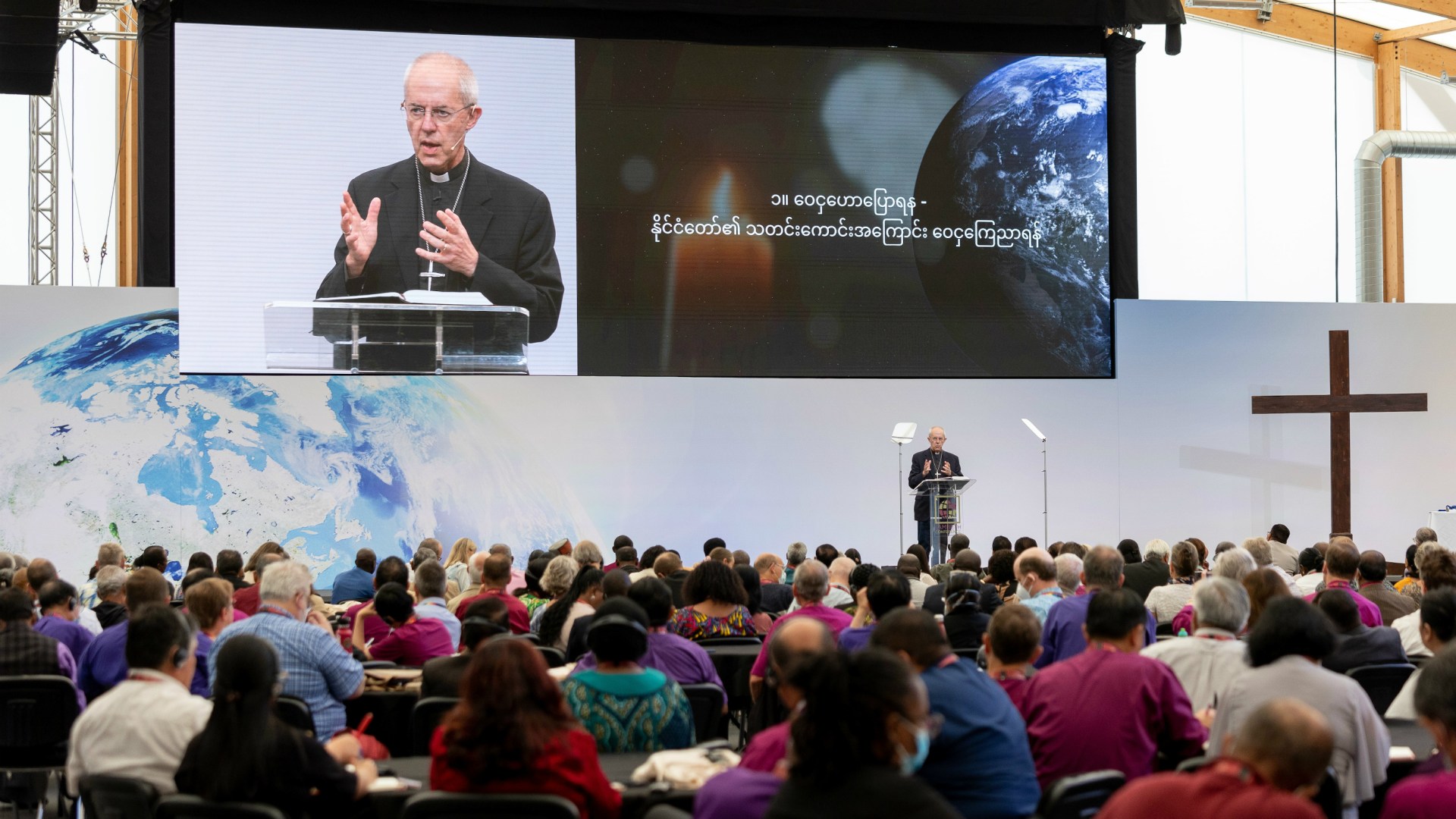
Archbishop of Canterbury Justin Welby delivers a keynote address to the 2022 Lambeth Conference in the United Kingdom.

Archbishop of Canterbury Justin Welby delivers a keynote address to the 2022 Lambeth Conference in the United Kingdom.

Christianity Today August 9, 2022
Neil Turner / The Lambeth Conference

At least 125 Anglican bishops gathered at the Lambeth conference in Canterbury, England, endorsed a decades-old resolution against “homosexual practice” along with a new provision that “renewed steps be taken to ensure all provinces abide by this doctrine in their faith, order, and practice.”

The conservative Global South Fellowship of Anglican Churches (GSFA) launched an effort last week to have Resolution 1.10, adopted at Lambeth 1998, reaffirmed as the official stance of the Anglican Communion after 2022 conference leaders scrapped an initial plan to affirm the resolution among an array of “calls” or statements on pressing issues.

With about 85 million adherents, the Anglican Communion is the third-largest body of Christians worldwide and exists in 165 countries. Some 650 bishops attended Lambeth, which concluded August 8 and was last held in 2008, meaning the GSFA campaign garnered votes from about one-fifth of clergy present.

“I give thanks to God for all the bishops who have reaffirmed Lambeth 1.10–in its entirety–as the official teaching of the Anglican Communion on Marriage and Sexuality,” said Archbishop Justin Badi, primate of South Sudan and GSFA chair. “We have been greatly encouraged by the bishops worldwide at this conference who have expressed their support, in whatever form, for the Communion to be governed by biblical authority.”

Badi has emerged as a leading voice for conservatives and has not minced words in his criticism of liberal theology. To demonstrate their resolve, he and other conservative bishops at Lambeth refused to receive communion at services in the historic 1,400-year-old Canterbury cathedral, where Augustine served as a missionary in the sixth century.

“We cannot break bread with bishops who betray the Bible,” he said in an interview with Church Times, a UK newspaper focused on Anglican affairs. “We cannot just deceive ourselves, saying: ‘Fine, we are together.’ We are not really together. This is hypocrisy.”

GSFA will continue to seek the endorsement of 1.10 from bishops who did not attend this month’s conference. Bishops from Nigeria, Rwanda, and Uganda boycotted because several Anglican provinces, including Canada, Wales, Scotland, and the US, allow priests or bishops to perform same-sex marriages or ordain LGBT clergy. LGBT bishops participated in all aspects of Lambeth.

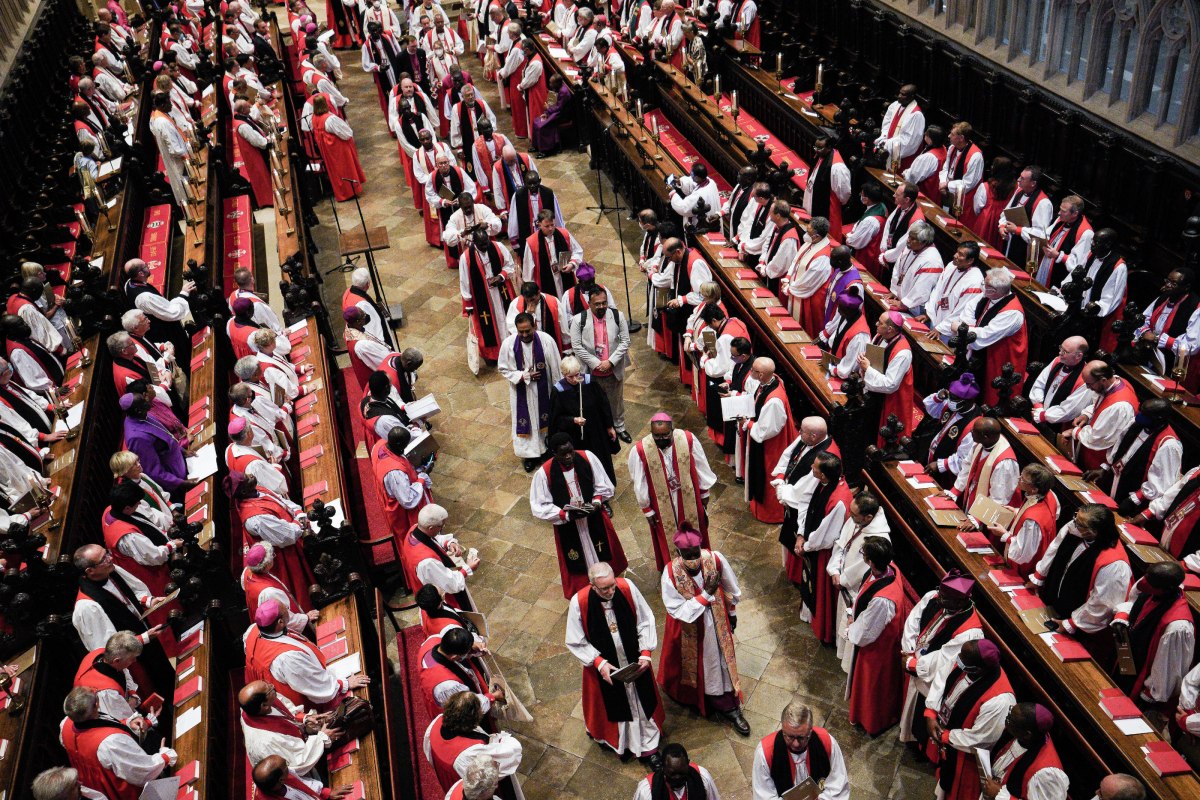
The opening service at Canterbury Cathedral during the 2022 Lambeth Conference in the United Kingdom.

During the conference, Justin Welby, archbishop of Canterbury and the topmost Anglican leader, affirmed biblical teaching that homosexual practice is sinful and that 1.10 remained a valid resolution. But he also told The London Times, “I will not punish churches that conduct gay marriages.” The comments were widely seen as an attempt to mollify his critics on both sides.

For some attendees, the high-wire act successfully “lanced a boil” and enabled clergy to conclude Lambeth agreeing to disagree, reported the Religion Media Centre. Particularly after Welby announced his priority as archbishop of Canterbury was unity. “I neither have, nor do I seek, the authority to discipline or exclude a church of the Anglican Communion,” he said. “I will not do so. I may comment in public on occasions, but that is all."

In his pivotal speech, Welby also asserted that the stance of Western progressives and Global South conservatives was essential to their ministries:

For the large majority of the Anglican Communion the traditional understanding of marriage is something that is understood, accepted and without question, not only by Bishops but their entire Church, and the societies in which they live. For them, to question this teaching is unthinkable, and in many countries would make the church a victim of derision, contempt and even attack. For many churches to change traditional teaching challenges their very existence.

For a minority, we can say almost the same. They have not arrived lightly at their ideas that traditional teaching needs to change. They are not careless about scripture. They do not reject Christ. But they have come to a different view on sexuality after long prayer, deep study and reflection on understandings of human nature. For them, to question this different teaching is unthinkable, and in many countries is making the church a victim of derision, contempt and even attack. For these churches not to change traditional teaching challenges their very existence.

Welby’s reluctance to hold Anglican priests and bishops accountable for ignoring 1.10 has stirred up a hornet’s nest of ongoing criticism from conservative Anglicans. Liberals, meanwhile, criticize the archbishop for being tolerant of homophobia and unjust treatment of the LGBT community within the communion.

Twenty-four years ago, a supermajority of Anglican leaders agreed in resolution 1:10 that “homosexual practice is incompatible with scripture,” intending to ban same-sex marriages and LGBT ordinations. But since then, progressive church leaders have consecrated LGBT priests and bishops and have married same-sex couples in the US and Canada, among several other provinces.

Since assuming office in 2013, Welby’s attempts to mediate the controversy over homosexuality have drawn sharp rebukes and boycotts from conservatives. “To authorize the practice and teaching of same-sex unions as normative and not a violation of divine intentions for humankind,” said Badi, “is to undermine the clarity and authority of holy scripture, which is the bedrock of our common life as a communion.”

GSFA describes itself as a “holy remnant” within the Anglican Communion. Its leaders participated in Lambeth 2022, while leaders of the conservative GAFCON movement boycotted.

A few liberals have spoken with more moderate rhetoric toward conservatives. “We in the Anglican Communion live with a plurality of views on marriage,” stated Michael Curry, presiding bishop of The Episcopal Church in the US. “… [T]here is another view equally to be respected: a view that includes and embraces same-sex couples who seek the blessing of God on their loving relationships, their commitments, and their families.”

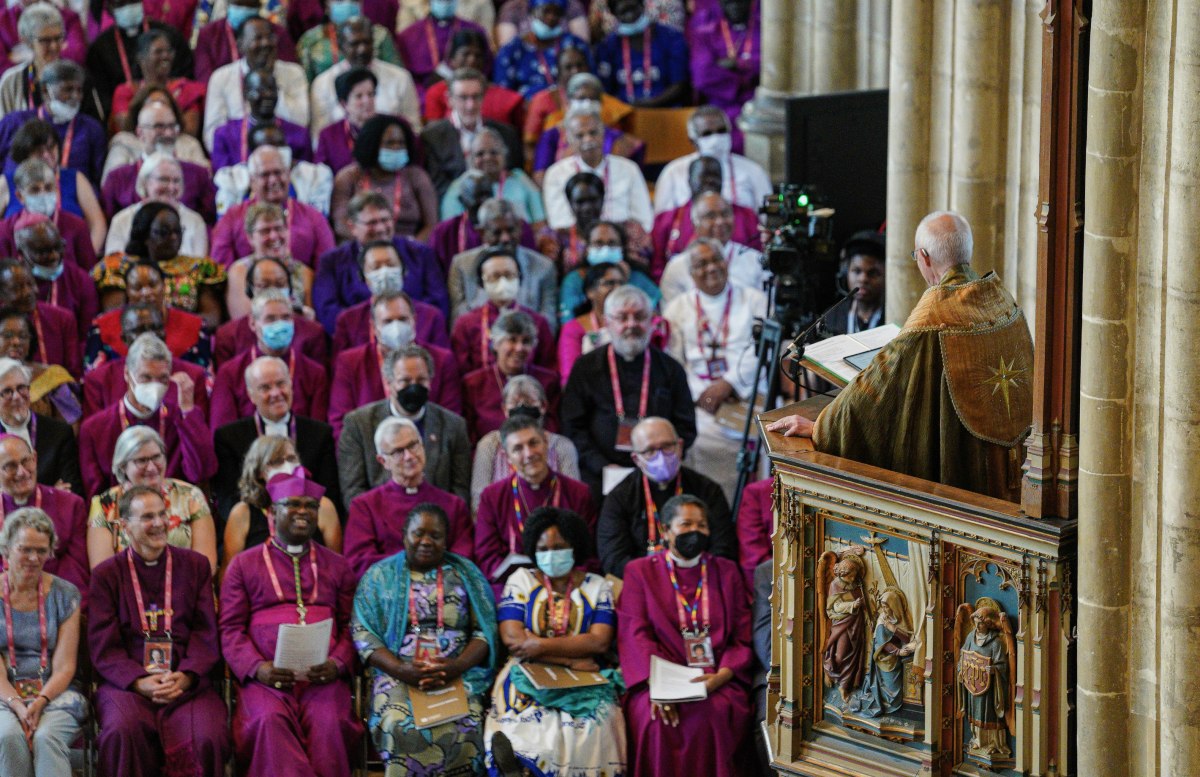
Archbishop of Canterbury Justin Welby gives the closing sermon of the 2022 Lambeth Conference in Canterbury Cathedral in the United Kingdom.

These disagreements over LGBT rights occur amid the demographic decline of Anglican/Episcopal churches in North America and the UK and the rapid rise of traditional churches in the so-called Global South. “There are more Anglicans in church on Sunday morning in Nigeria than in all the British Isles and North America combined,” according to Gerald McDermott, a scholar and author of The Future of Orthodox Anglicanism.

In the UK, the discordance between church and state complicates the Anglican Communion’s stance toward same-sex unions. The British Parliament approved same-sex civil marriages in 2013, and Queen Elizabeth II, the titular head of the Church of England, gave her “royal assent” to the new law.

Yet the Church of England has a policy to not allow priests to conduct such marriage services but supports celibate same-sex couples in civil legal partnerships. Changing Attitude England, a leading LGBT advocacy group, views opposition to same-sex marriage as homophobia.

The clash among Anglicans is unfolding as more nations have legalized same-sex marriages. As of 2022, 32 nations allow them worldwide. But Africa with its population of 1.2 billion, is the one region where homosexuality is often criminalized and same-sex marriage banned. South Africa is the only one of 54 African nations to legally recognize same-sex marriages.

Years ago, at the 1998 Lambeth, African bishops emerged as a key part of the conservative drive to maintain orthodox Anglicanism. Largely due to the growing number of African bishops in attendance, and with the support of then Archbishop of Canterbury George Carey, Anglican leaders voted 526–70 (with 45 abstentions) for resolution 1.10, a supermajority of 82 percent. The resolution text counseled that “pastoral care” be the church’s core means of spiritual care for same-sex couples. There was no provision for punishment of clergy for marrying a same-sex couple.

Conservative Anglicans have created numerous organizations to steer Anglicans toward orthodox teaching.

The Global Anglican Futures group (GAFCON) is event-based and first met in Jerusalem in 2008 with 1,100 delegates from 29 countries. Ten years later, GAFCON convened 1,900 delegates from 53 countries. GSFA has its roots in high-level meetings that began in 1994 and currently has 24 member churches, including the breakaway Anglican Church in North America.

Conservative Anglicans will face another test of their resolve when they meet up in Kigali, Rwanda, in 2023 for the fourth GAFCON gathering. Many believe the future means to “decolonialize” the faith, moving Anglicanism away from its historic center at Canterbury and heterodox Western leaders. Or as Canon Chris Sugden, a leader at the Oxford Centre for Religion in Public Life, summarized their argument: “Africa is now the actual heart of Anglicanism.”

Badi pledged that his Global South colleagues would remain and pursue “repair of the tear” in the communion. “Let those with revisionist theology go or repent,” he told a press conference. “The West had the gospel and took it to us in Africa. We may have to bring it back.”

Additional reporting from David Virtue in Canterbury, UK

History

Chinese Christians Survived Discrimination in Indonesia. Now the Church Is Growing Spiritually.

Q&A with pastor Samuel Fu on the evangelical challenges in the nation of a thousand islands.

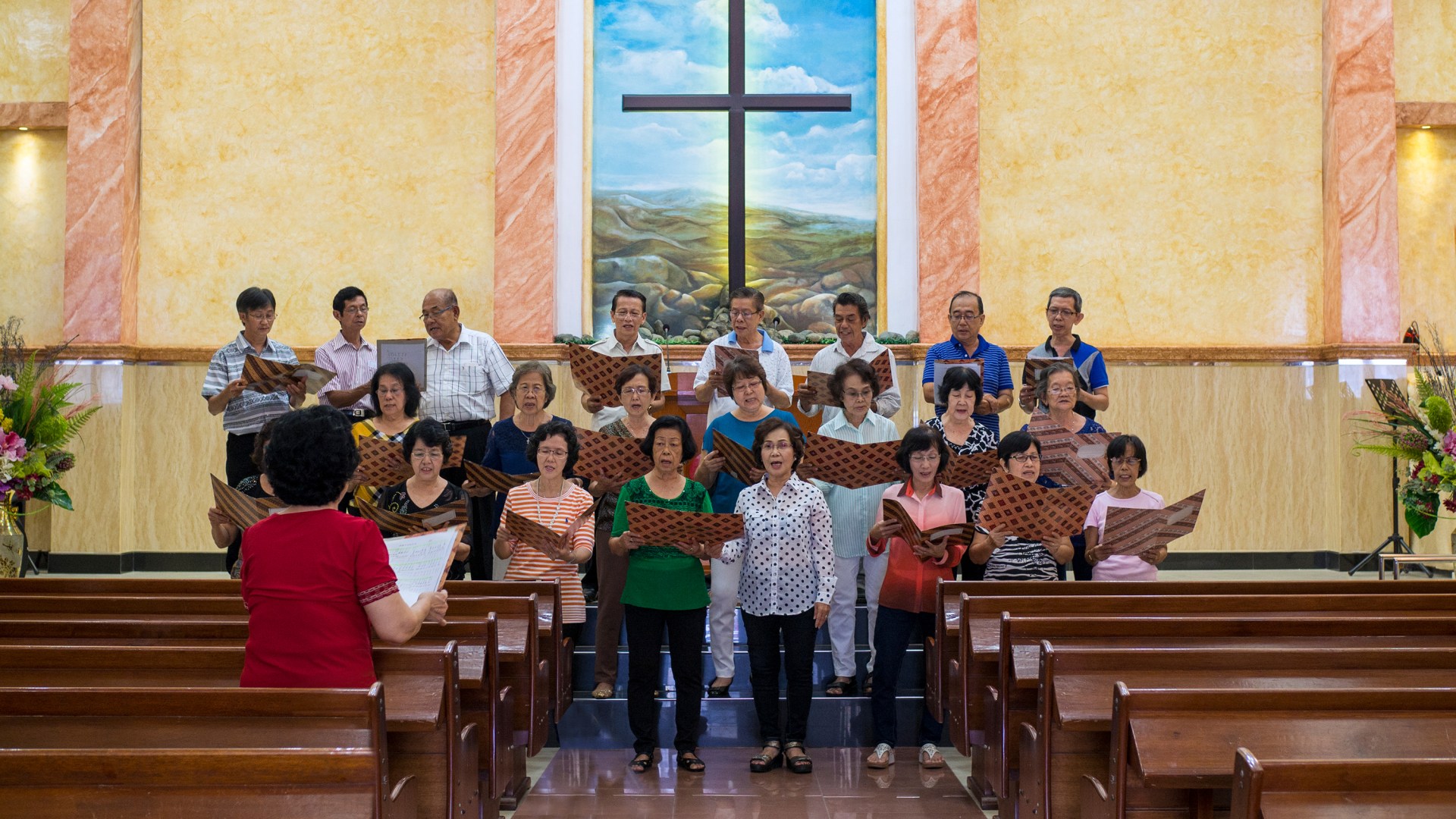
Ethnic Chinese attend church in Banda Aceh, the capital city of Aceh Province in northern Sumatra, Indonesia.

Ethnic Chinese attend church in Banda Aceh, the capital city of Aceh Province in northern Sumatra, Indonesia.

Christianity Today August 9, 2022
Leisa Tyler / Getty

When Christians around the world today think of Indonesia, the first thing that may come to mind is “the country with the largest Muslim population in the world.” However, Indonesia is a culturally and religiously diverse country. Christians are an estimated 10 percent of Indonesia’s population of 210 million, putting Indonesia in the upper third of countries with the largest numbers of Christians.

Today, millions of the Chinese diaspora community live in Indonesia (estimated numbers range from more than 2 million to more than 7 million, depending on the statistical method). There are Chinese churches with different traditions and compositions throughout Indonesia.

Historically, Chinese in Indonesia were discriminated against and marginalized at various times. How did the Chinese church in Indonesia survive and develop in the difficult past? In today’s Indonesia, there are also some unique regulations on religious practices. What impact would that have on Chinese church growth? What evangelical challenges and opportunities do Chinese churches in Indonesia face serving the younger generation in today’s multicultural environment?

The following is part of a transcript of an interview of pastor Samuel Fu of Pontianak Congregation of West Kalimantan Christian Church by David Doong, general secretary of the Chinese Coordination Center for World Evangelism (CCCOWE) in February 2022.

Multiculturalism in the nation of a thousand islands

Doong: If you were to introduce Indonesia to people who didn’t know much about it, what would you say? What is the situation of the Chinese immigrants in Indonesia?

Fu: Indonesia is a country of a thousand islands, or nusantara in Indonesian. It is a country composed of more than 6,000 islands. There are more than 100 ethnic groups in Indonesia. Although Muslims are the majority, Indonesia is a very diverse country. Different places and different ethnic groups have distinctive languages. The unified language of our country is Indonesian, and almost all Indonesians can speak Indonesian, including the Chinese immigrants. Most Chinese today are in the second or third generation, so they are all educated in Indonesian.

The Indonesian government recognizes six religious beliefs: Islam, Catholicism, Christianity, Hinduism, Buddhism, and Confucianism. The state does not allow civilians to have no religious belonging. On the ID card, every civilian must choose one of the beliefs.

In 1965, a coup d'état happened. The government believed that there was a communist influence behind it and considered most of the Chinese to be communists. A lot of Chinese were arrested. Because of the discrimination, many Chinese chose Christianity as their religion on paper during that time. There were a lot of refugees, and the people came out from inland. It turned out to be a good opportunity to share the gospel. Many Chinese believed in Jesus due to political factors.

Christianity and Catholicism in Indonesia have grown rapidly in the past few years. On the one hand, many young people came to faith. On the other hand, Chinese churches in Indonesia are also actively participating in social services, such as running schools and hospitals. Through these community services, the church has opportunities to share the gospel. In recent years new media has also become a practical way to share the gospel. The church in Indonesia is in an ever-growing state.

Doong: The policy that everyone must choose a religion is interesting. If a person converts to Christianity, does he or she need to change the information on the ID card? Or are people not allowed to convert to another religion?

Fu: You will need to go through legal procedures to convert to another religion. If a Muslim converted to Christianity, he would face more pressure from society. He may get excluded, and even face threats and persecutions. However, under state law, a person is allowed to change his beliefs. If you convert from Confucianism and Buddhism to Christianity, it will be relatively simple, and the government will not interfere because it is a personal matter. As for the Chinese church, our main reach-out is to people of Buddhist and Confucian backgrounds. When they believe in Jesus and are baptized in the church, their ID cards will be changed from Buddhism or Confucianism to Christianity. There is no significant difficulty.

The situation of Chinese immigrants and the Chinese Church

Doong: As far as I know, there was a time when children were prohibited from learning Chinese in Indonesia. The second generation of Chinese who grew up in Indonesia, including many middle-aged and younger generations, are very unfamiliar with Chinese and mainly use Indonesian and English. Will these next generations prefer to attend multicultural churches or churches that speak Indonesian and English?

Fu: Chinese Indonesians tend to maintain relationships with other Chinese people while also integrating into society. We live in areas that are populated mostly by Chinese. In some provinces of Indonesia, the Chinese people are educated in Indonesian and stipulated to speak only Indonesian in public places. Yet they have kept speaking a Chinese dialect at home despite the gap with the Chinese language for more than 30 years in the society.

After Suharto stepped down as president in 1998, Indonesia began to open up to the Chinese language. Chinese in some areas have the opportunity to communicate and receive education in Chinese. There are three types of Chinese Indonesian churches: The first is Chinese Indonesian churches that speak Indonesian only while 70 percent or more of the people are ethnically Chinese, and there are many such churches now. The second type is the bilingual churches, in which the older people speak Chinese or their mother tongue dialect, and the younger ones speak Indonesian. My church belongs to this category. In general, this type of church would have Indonesian gatherings with translation and bilingual sermons. The third type is the Chinese-speaking Chinese churches. They worship and serve in Chinese only, but they are relatively rare.

Doong: I have come across many young Indonesians who also speak English. Is it because English is also a primary language besides Indonesian?

Fu: It is easier for people whose first language is Indonesian to learn English. We have been learning English since elementary school. However, the general English ability of Indonesians is rather basic. If they are Indonesians studying abroad, their English would be much better. For local Indonesians who learn English as a third language, their listening ability may be fine, but they would struggle with English speaking.

Doong: Fifty-seven years have passed since 1965. I am curious—how would you see the growth of Chinese churches in Indonesia? What are the good developments? What are some opportunities? Are there any bottlenecks and crises?

Fu: I think three characteristics mark the Chinese churches in Indonesia. First, Chinese churches in Indonesia are generally enthusiastic about sharing the gospel and have planted many inland churches. Second, they are diligent in studying the Bible and pursuing the truth. Third, they are devoted to prayer. These are the ways these churches practice discipleship. I believe as long as we keep up these good traditions, the Chinese churches in Indonesia will continue to prosper and grow healthily.

In addition, our country is relatively open now. With the fast economic growth of mainland China, the Chinese government has invested a lot in Indonesia, which indirectly caused the Indonesian government to see Chinese Indonesians in a better way. The people also realize the importance of the Chinese language, and their interest in learning Chinese has increased. This is particularly a good phenomenon for Chinese churches.

When Suharto came to power and banned the use of Chinese and Chinese-speaking schools, the Chinese church was the only group of people that kept the language amid the 30 years of Chinese-language gap. It is God’s grace and mercy that the Chinese language and culture was preserved through the church.

When the country opened up, the Chinese church was quick to adapt to the change. The second type of Chinese Indonesian church that I just mentioned had stopped worshiping in Chinese before, but now they use Chinese again. Many young people in the church go to China or Taiwan to learn the Chinese language and use Chinese to participate and serve in the church after returning. I am optimistic about the future of the Chinese Indonesian church.

Helping the younger generation

Doong: In terms of shepherding and cultivating young people, the global church is facing more challenges today. Do Chinese churches in Indonesia also encounter such challenges?

Fu: Honestly, yes. For example, some churches are more conservative and traditional in terms of worship, which leads to the loss of the younger generation. Some young people will go to churches that practice their preferred style of worship. Over the past few years, Chinese Indonesian churches have reviewed and reflected on how to react to the trend. Of course, we don’t want superficial improvements such as worship style. The essential question is how to keep these young people in the faith.

We believe that the younger generation seeks to be recognized in the church and wants to have a sense of belonging to the church. They hope they can grow and participate in it. But Chinese churches in Indonesia still tend to be more paternalistic. Deacons and pastors are usually older people. I think we need to listen to the opinions of young people more and give them more opportunities to participate in church service to keep them.

Doong: Conservative or not is relative. What we think to be the conservative style of worship was trendy 50 or 60 years ago. Sometimes I believe that God created us to be way more sophisticated and creative. On the one hand, we do not need to feel that there is one correct way to worship; on the other hand, we do not need to chase trends. Tradition has its beauty, and trendy style has its merit. The task of our generation is to be transformed by the renewal of our mind, to learn from the precious heritage of the 2,000 years of church history, to share the gospel and train disciples in today’s language.

Fu: I agree. What we care about is not the style of worship but the way to implement discipleship and let these young people find an environment where they would feel they are recognized and able to grow and learn. I believe this is our primary responsibility. Just like in my church, we are currently encouraging young people to start small groups. They are very committed, devoted, and active in their group.

A coworker recently did a survey in our church. When asked, “What do you expect the most from the church?” teenagers, young people, and adults in my church have all answered with “the Word of God.” Their expectation for the church is not better music or worship but solid biblical teaching. I believe that we must recognize and respond to the deepest concern of the congregation. What should be the center of our worship and shepherding? We must not rigidly adhere to styles or superficial needs.

David Doong is general secretary of the Chinese Coordination Center for World Evangelism (CCCOWE) and host of the Missional Discipleship podcast in Mandarin.

Translation by Yiting Tsai

News

New York City’s Largest Evangelical Church Plans Billion-Dollar Development

The Brooklyn congregation and its pastor A.R. Bernard hope the Jane Jacobs–inspired urban village will be a model for other cities.

Pastor A.R. Bernard preaches at the Christian Cultural Center in Brooklyn

Pastor A.R. Bernard preaches at the Christian Cultural Center in Brooklyn

Christianity Today August 9, 2022
Courtesy of Christian Cultural Center

A. R. Bernard, pastor of the largest evangelical church in New York City, has been working on a plan for more than 10 years. Now the proposal to build a A. R. Bernard, pastor of the largest evangelical church in New York City, has been working on a plan for more than 10 years. Now the proposal to build a $1.2 billion urban village and revitalize the struggling neighborhood around his church is progressing through the city’s approval process and closer to reality. The Christian Cultural Center (CCC) hopes developers could break ground in Brooklyn next year..2 billion urban village and revitalize the struggling neighborhood around his church is progressing through the city’s approval process and closer to reality. The Christian Cultural Center (CCC) hopes developers could break ground in Brooklyn next year.

“If I’ve got land, and it’s valuable, I’m going to leverage that land to partner in its future, not surrender it. … What can we do to better the quality of life?” Bernard told CT in early August as he paged through the proposals for the urban village. “My theology is summed up in two words: human flourishing. That’s the story from Genesis to Revelation.”

Bernard had just returned from an event with the New York governor in Buffalo and was planning a trip to participate in the coronation of the new Zulu king in South Africa.

But back in his office without any staff or audience around, he was diving into the minutiae of land development, showing slideshows of proposals for different heights of buildings and talking about the design for “porosity” of streets and ULURP, the city ’s land use process.

On 10.5 acres of church land, the proposed village would include thousands of units of affordable housing, a trade school, a supermarket, a performing arts center, 24/7 childcare for night-shift workers, senior living facilities, and other amenities designed to revitalize the East New York neighborhood.

As the founder of the 30,000-member nondenominational church, Bernard is also a kind of unofficial mayor of the city’s evangelical churches. He has served as the head of the Council of Churches of the City of New York and is often the person public officials call when they want an evangelical advisor or representative at significant events. He also works in evangelical organizations outside the city, including serving on the board of Promise Keepers.

“I’m a big Jane Jacobs fan, when it comes to understanding the urban landscape. And community means amenities are within a 1,000-foot walking distance,” Bernard said, referring to the urban planner who is famous for saving lower Manhattan from a highway and for her ideas on smaller-scale urban development focused on street life. “She was a genius. Absolute genius.” He sees this plan as a counter to the influence of the infamous urban planner and Jacobs nemesis Robert Moses, who had a history of dividing communities economically, including in this part of Brooklyn.

“When you have lights, activity, shopkeepers, people, you have eyes on the street,” he said. “So there’s less of a need for strong policing, because you have so many eyes, and so many stakeholders. That’s what community is about.”

The church hopes this village can be a model for other cities and it could be scaled up or down, Bernard thinks. But he added that a church must be large enough, like CCC, to pull such a plan off.

Black churches in other cities like Atlanta have recently undertaken big development projects to build affordable housing. In Buffalo, New York, churches are partnering at a smaller scale in a nonprofit called Buffalo ’s Black Billion to begin revitalizing the East Side.

This massive project in Brooklyn goes against the trend in New York real estate. New York churches, facing overwhelming maintenance or renovation costs of their aging real estate, have been selling to developers. And more recently, the trend among city churches has been to make deals with developers to allow construction of luxury condos on their land if the developer also builds a space for the church. Those deals have sometimes turned sour.

Even when such deals work out, they can exacerbate the housing problem for the less wealthy in the city. New York City neighborhoods are experiencing record rents this summer.

In the CCC’s neighborhood, 33 percent of households are severely rent burdened as of 2019, meaning they spend more than 50 percent of their income on rent. The homeownership rate was also lower than the rest of the city.

The project is about preventing gentrification, but this area of East New York is one of the farthest flung neighborhoods in the city, and a mile from the end of a subway line. For now it is more about revitalizing the area for residents.

Tony Carnes, who has documented the histories and stories of New York houses of worship with his project A Journey Through NYC Religions, said the CCC’s project is “perhaps unprecedented [in] size and scope for one congregation to undertake.”

Other nearby churches have embarked on affordable housing projects. Another big congregation in the city, Allen Cathedral, has a community development corporation that has built affordable housing and senior residences. A group of Brooklyn churches has also donated to construct housing with the help of city funding, an initiative called the Nehemiah Program. The largest provider of affordable housing in Harlem has been Abyssinian Development Corp., which started through a Harlem church. That organization has struggled financially and sold off properties in recent years, with accusations of financial mismanagement.

Most of those projects happened decades ago. For the most part, churches just aren ’t building in New York.

Bernard is hoping to avoid a financial spiral in this project. Before he was a pastor, he worked in banking and served on the city ’s Economic Development Corporation Board during the Bloomberg and de Blasio administrations. He wants a development that attracts enough money to keep the property desirable, and quotes Luke 14:28: “Suppose one of you wants to build a tower. Won’t you first sit down and estimate the cost to see if you have enough money to complete it?”

“We can build affordable housing that can’t sustain quality of life,” he said. “Then it’s a downward trend, which means now we have to turn government funding, and we simply replicate the problems with [public housing].”

CCC purchased a supermarket in the late 1980s for its church, and it soon outgrew the space as membership approached 11,000 in the 1990s. The church bought 6 acres at its current site, and then another 4, and built its current building in the late 1990s. Over the years, Bernard said, he has been approached by developers about the land, and he even refused what he described as a bribe over a proposed affordable housing project he said was not affordable.

“There are too many stories of developers exploiting the communities, and especially churches,” said Bernard, whose church has been in Brooklyn since 1978.

Outside his office and just beyond the church building, school buses pulled in and out of the massive parking lot that will be the grounds for the village. The church rents the space to a transportation company now.

If the project makes it through the labyrinth of city approvals—borough president, land use, city planning, and then city council—the organizers hope to break ground in spring of next year.

Bernard is hopeful that his longevity in the community can help move the project to reality, since local neighborhoods often object to outside developers coming in. The church is in a 50-50 relationship with a developer for the project, according to Bernard.

The plans for the village are born out of specific situations the church has seen in the community.

In the early 2000s, one woman appealed to the church for help after a horrible incident: She had to work a night shift at McDonald ’s and her babysitter canceled. She decided to leave her two children at home overnight, but someone set the home on fire that night. The two children died, and she faced charges for child endangerment. CCC did the children ’s funerals and advocated for her with prosecutors, according to Bernard, and prosecutors eventually dropped the charges. Night-shift workers, Bernard said, need childcare, so they are working on having a 24/7 childcare center in the village.

The trade school plans also are a response to a community that is still dealing with the effects of the 1994 federal crime bill, which is often blamed for mass incarceration. As millions of men come out of prison and try to reenter communities, he said, the trade school can help them establish themselves.

Bernard also sees the next decade as a time of intense social upheaval and said in such moments in history, “always the poor are the most impacted,” so the village can be an oasis.

“Church is a generational service, birth to death,” he said. “How can we make a difference using the land that’s available to us?”

Apple PodcastsDown ArrowDown ArrowDown Arrowarrow_left_altLeft ArrowLeft ArrowRight ArrowRight ArrowRight Arrowarrow_up_altUp ArrowUp ArrowAvailable at Amazoncaret-downCloseCloseEmailEmailExpandExpandExternalExternalFacebookfacebook-squareGiftGiftGooglegoogleGoogle KeephamburgerInstagraminstagram-squareLinkLinklinkedin-squareListenListenListenChristianity TodayCT Creative Studio Logologo_orgMegaphoneMenuMenupausePinterestPlayPlayPocketPodcastRSSRSSSaveSaveSaveSearchSearchsearchSpotifyStitcherTelegramTable of ContentsTable of Contentstwitter-squareWhatsAppXYouTubeYouTube