News

Anglicans Drop Proposal to Reaffirm Traditional Marriage Stance

Organizers of the Lambeth Conference revised a draft statement calling same-sex marriage “not permissible” after pushback.

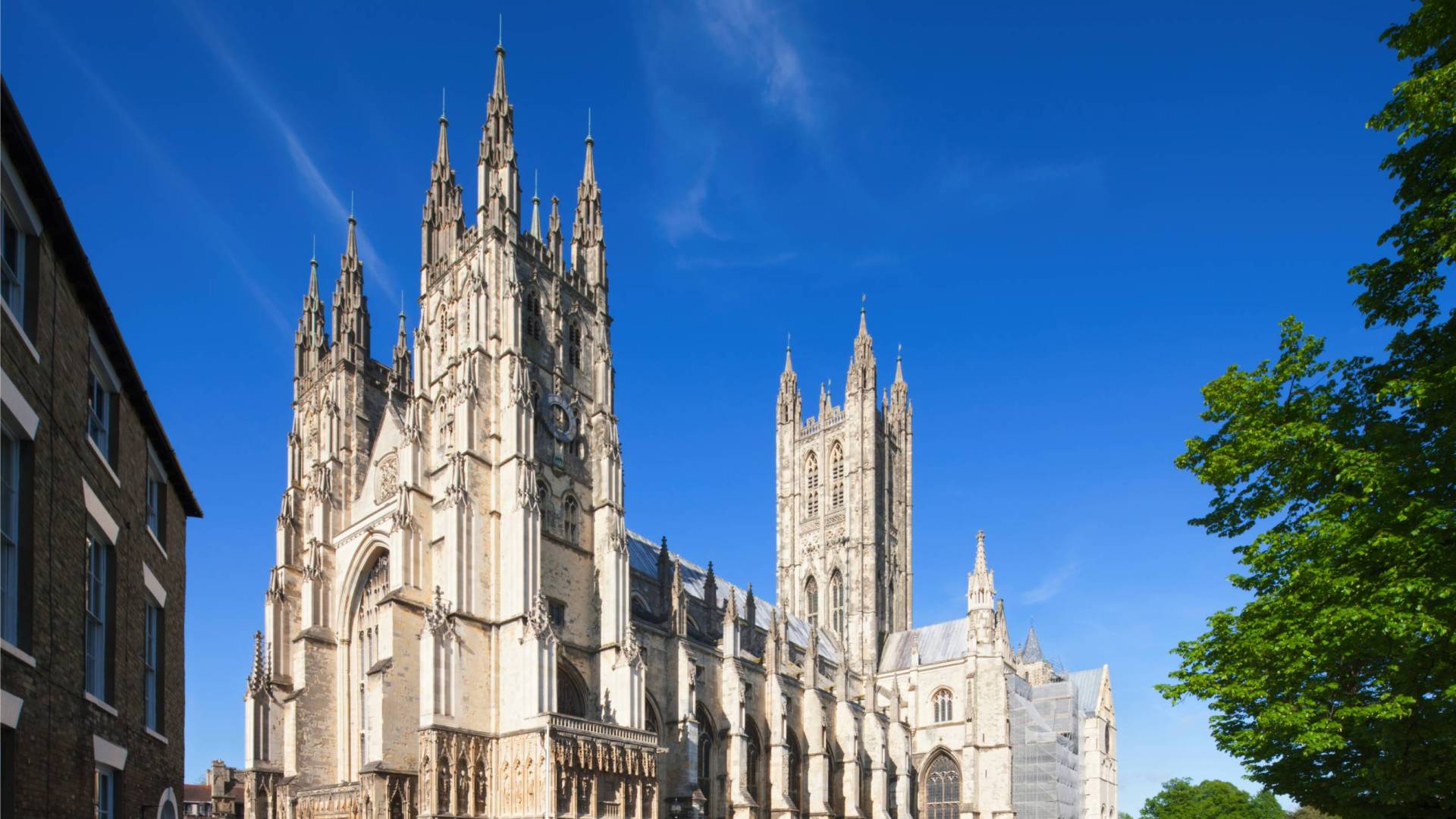
Canterbury Cathedral

Canterbury Cathedral

Christianity Today July 27, 2022
Laurie Noble / Getty Images

To organizers of the Anglican Communion’s Lambeth Conference, the global body has come to a point where it has to agree to disagree on same-sex marriage.

Ahead of the once-a-decade gathering, organizers scrapped a statement that would have reaffirmed the conference’s historic stance against same-sex marriage.

The proposed statement on human dignity—one of many declarations, or “calls,” that will go before the 650 bishops for approval—received pushback from LGBT-affirming leaders in the global body, including Episcopal clergy. The dramatically revised statement now recognizes Anglicans’ “deep disagreement” on LGBT issues instead.

It says that “many Provinces continue to affirm that same gender marriage is not permissible” and “other Provinces have blessed and welcomed same sex union/marriage after careful theological reflection and a process of reception.” It also reiterates how Lambeth’s 1998 resolution advised against legitimizing or blessing same-sex unions.

“We have listened carefully and prayerfully to what bishops and many others have said in response to the draft Calls, especially that on Human Dignity,” said Bishop Tim Thornton, the bishop overseeing the calls subgroup. “Archbishop Justin [Welby] has invited the bishops of the Anglican Communion to come together as a family to listen, pray and discern—sometimes across deeply held differences.”

The Anglican Communion includes an estimated 85 million members spread across 41 provinces, including The Episcopal Church in the United States.

Bishop of Los Angeles John Harvey Taylor was among the critics of the original call, as were clergy in Wales, who voted last year to bless same-sex marriages. The Episcopal Church was suspended from the Anglican Communion in 2016 for three years for sanctioning same-sex marriage.

The Church of England does not perform same-sex marriages, though views in the UK are shifting. Last year, the Methodist Church in England became the country’s largest denomination to allow same-sex marriage. Earlier this year, the Church of Scotland also approved same-sex marriage.

At the conference—which runs July 26 through August 8 in Canterbury, England—bishops will be given the opportunity to vote on each call, saying either it speaks for them, does not speak for them, or requires further discernment.

The full call reads:

Prejudice on the basis of gender or sexuality threatens human dignity. Given Anglican polity, and especially the autonomy of Provinces, there is disagreement and a plurality of views on the relationship between human dignity and human sexuality. Yet, we experience the safeguarding of dignity in deepening dialogue.

It is the mind of the Anglican Communion as a whole that “all baptised, believing and faithful persons, regardless of sexual orientation are full members of the Body of Christ” and to be welcomed, cared for, and treated with respect (I.10, 1998).

Many Provinces continue to affirm that same gender marriage is not permissible. Lambeth Resolution I.10 (1998) states that the “legitimizing or blessing of same sex unions” cannot be advised. Other Provinces have blessed and welcomed same sex union/marriage after careful theological reflection and a process of reception. As Bishops we remain committed to listening and walking together to the maximum possible degree, despite our deep disagreement on these issues.

According to Ian Paul, a member of the Church of England Evangelical Council, the process for drafting the Lambeth calls has complicated an already sensitive and divisive issue. He said the document with the calls came out last-minute and a member of the group drafting them said the wording had been changed without their knowledge.

“There are issues around the content, but I think there are really big issues around the process here,” Paul told Premier News. “If you’re going to deal with something controversial amongst people who have different views, here’s the golden rule: No surprises. Put everything out in the open. Give people plenty of time. I think the real problem here is that everything’s come very, very late … that’s a guarantee to create misunderstanding and I think to create a lack of trust.”

The Lambeth Conference is convened by the Archbishop of Canterbury typically once a decade, but this is the first gathering since 2008 after the 2018 conference was postponed due to tensions over the LGBT issue and the 2020 event couldn’t be held due to COVID-19. It’s also the first to be led by Welby, who succeeded Rowan Williams in 2012.

This year’s event is being boycotted by theologically conservative primates from Nigeria, Uganda, and Rwanda, the Religion News Service reported.

“Nothing has really changed about the issues in contention, which broke the fabric of the communion in the first instance. Rather, things are getting worse as the culprits are becoming more daring and persistent in their errors and rebellion,” Archbishop Henry Ndukuba, Archbishop Stephen Kaziimba, and Archbishop Laurent Mbanda wrote in a letter.
News

Religious Liberty Firm Goes Global with 1,500 International Cases

The Christian legal advocates with Alliance Defending Freedom are now working in over a hundred countries.

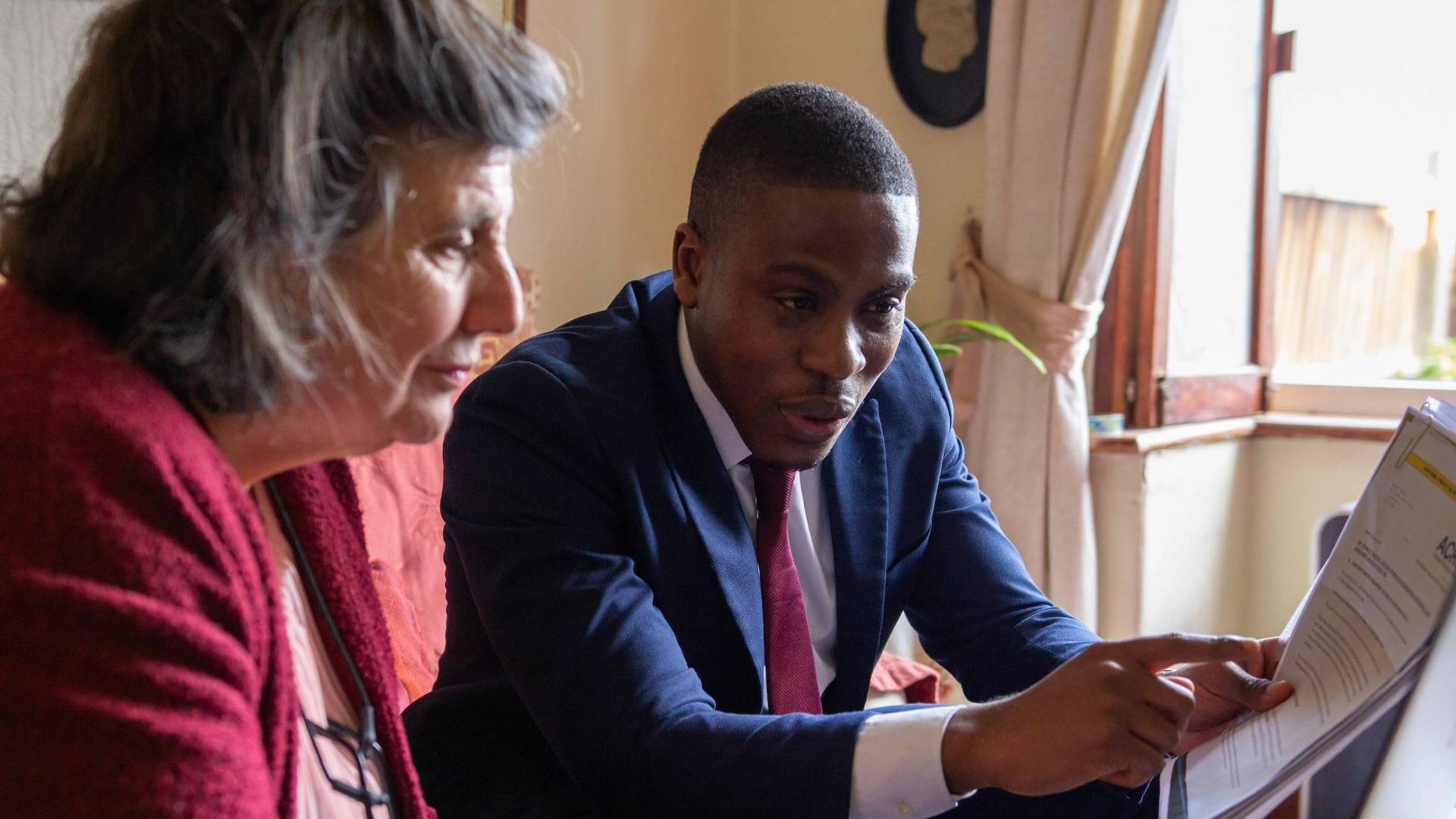
Rosa Lalor with ADF International attorney Jeremiah Igunnubole

Rosa Lalor with ADF International attorney Jeremiah Igunnubole

Christianity Today July 27, 2022
Courtesy of ADFI

Religious liberty won a victory this month in the United Kingdom.

Prosecutors there dropped charges against 76-year-old Rosa Lalor, who was arrested in 2021 for praying silently outside an abortion clinic. A police officer said Lalor, though socially distanced, masked, and outside, was protesting and didn’t have a “reasonable excuse” to be outdoors during COVID-19 restrictions. She was put in a police car and fined for violating public health measures.

But the British grandmother only had her penalty dismissed after a yearlong legal battle in which Lalor was backed by the religious freedom advocacy group Alliance Defending Freedom International (ADFI).

“The right to express faith in a public space, including silent prayer, is a fundamental right protected in both domestic and international law,” said ADF UK legal counsel Jeremiah Igunnubole. “Whether under coronavirus regulations or any other law, it is the duty of police to uphold, rather than erode, the rights and freedoms of women like Rosa.”

Lalor’s case isn’t an isolated incident. Though Alliance Defending Freedom (ADF) has drawn more publicity for bringing religious liberty cases to the US Supreme Court , its international arm has won more than 1,500 cases in 104 countries since 2010.

Following its first decade of work in the US, ADF began receiving requests for help on international violations of religious liberty.

“We simply did not, at that time, have the network and the resources to deal with all these complaints because we were very US-focused in our advocacy,” said Lorcan Price, European legal counsel for ADFI. “There was a sense that something had to be done about that. Particularly the whole issue of the real, physical persecution of Christians around the world catalyzed the whole thing.”

So ADFI launched in 2008. Among its office locations: Vienna, Brussels, Strasbourg, Geneva, Mexico City, and New Delhi. The group focuses on countries that uphold the rule of law (at least to some degree) but leaves religious liberty advocacy in totalitarian regimes like North Korea to other organizations. Its mission is to keep doors open for the gospel by contending for religious liberty in courts worldwide.

Though ADFI’s advocacy across the globe has quietly achieved considerable success in court, it’s harder than in the US to ensure the rulings are actually enforced. Nearly 80 percent of the world’s population lives in regions where religious liberty is highly restricted, according to the US State Department.

Frank Wolf, a religious freedom advocate and former Virginia congressman, applauded ADFI’s work defending religious liberty abroad.

“Sometimes they operate in pretty tough neighborhoods,” said Wolf, a former ADF board member, adding, “I don’t think there are any [organizations] that rival what they do.”

Currently, ADFI has more cases in India and Asia than through any of its other offices. The 50 staff members in South Asia “have an extraordinary workload because of what’s happening in India,” Price said.

In addition to court proceedings, attorneys there spearhead “investigation of violence where the local authorities have refused to do their job and actually to investigate mob violence against Christians.”

Europe has its challenges too. Some ADFI cases reach the European Court of Human Rights, an international court that interprets how the European Convention on Human Rights should be applied in 46 participating nations (45 after Russia’s expulsion becomes final in September). However, no European agency enforces the decisions, and countries like Russia, Ukraine, and Turkey ignore the court’s judgments at times.

Amid that milieu, some have wondered whether court advocacy can advance international religious liberty to any worthwhile degree—especially in nations that don’t respect court decisions.

Sam Brownback, US ambassador at large for international religious freedom during the Trump administration, says it can. Fighting in court for religious liberty is “a good tactic” but “not always a sufficient tactic,” he said. It’s “real tricky terrain to operate within these countries that have laws but don’t often follow their own laws.”

Bringing a complaint in court often can “get attention” for a religious liberty violation, Brownback said. Then political pressure can be brought to bear on the offending nation. A “classic” example was the case in Turkey of American pastor Andrew Brunson.

The North Carolina pastor was released in 2018 from two years of detention in Turkey on terrorism and espionage charges that Brunson denied. Brownback attended one of Brunson’s trials on behalf of the Trump administration and met with Turkish officials. The political pressure to release Brunson included increased tariffs on Turkish aluminum and steel imposed by President Trump.

ADFI continues to support the legal facet of other religious liberty cases. For instance, Päivi Räsänen, a Finnish member of Parliament, was charged with hate speech for criticizing the Finnish Lutheran Church’s participation in LGBT Pride Month. Part of her alleged offense was tweeting a Bible verse. Despite an acquittal this spring, the prosecutor has signaled her intent to appeal. Price is part of the team defending Räsänen.

“We see our function as keeping the door open for the gospel by using any of the means that we can as lawyers to achieve that,” Price said. We are “trying to uphold the rule of law in those countries that are willing to uphold it to protect religious liberty.”

That’s why ADFI helped Christians and Muslims in Uganda end a nationwide ban on public worship last fall. Though COVID-19 measures had been lifted for malls, arcades, and business centers, public worship was prohibited—even if it occurred outdoors. Court cases continue in Uganda to ensure the government cannot reinstitute blanket bans on worship.

Forced conversion in Pakistan, persecution of a house church in Russia, suspension of a midwifery student in the UK for her pro-life views, evangelical persecution in Bulgaria, and criminalization of evangelism in Nepal are among ADFI’s other pending cases.

“There are a lot of passages in the Bible” that reference religious liberty, Wolf said. “Yet all over the world people of faith are being denied the fundamental and inalienable human right to confess and express their faith according to their conscience.” ADFI’s work “is probably more important now than ever before.”

Books
Review

Jesus Frees Men and Women to Ask ‘How Can I Serve?’ Not ‘Who’s in Charge?’

Our view of gender roles and relations should begin with Christ’s pattern of humility.

The Ointment of the Magdalene (Le parfum de Madeleine) by James Tissot, 1886-1894.

The Ointment of the Magdalene (Le parfum de Madeleine) by James Tissot, 1886-1894.

Christianity Today July 27, 2022
Brooklyn Museum / WikiMedia Commons

Jesus’ own disciples frequently missed what he was doing. James and John wanted preeminent posts in his kingdom, advocating for places of power, prestige, and authority. Jesus responded by essentially telling them they were missing the point. His kingdom didn’t operate like the kingdoms of the nations.

Jesus and Gender: Living as Sisters and Brothers in Christ

Jesus and Gender: Living as Sisters and Brothers in Christ

Lexham Press

288 pages

$20.02

For Elyse Fitzpatrick and Eric Schumacher, the intra-evangelical debates around gender and gender roles in the last few decades seem to repeat the mistaken focus of James and John, concentrating on questions of who gets to be in charge and missing the humble and lowly pattern of power exercised by Jesus. In Jesus and Gender: Living as Sisters and Brothers in Christ, Fitzpatrick and Schumacher attempt to move beyond the decades-old framework of complementarian versus egalitarian when it comes to matters of gender and gender roles in marriage, the church, and society.

Avoiding most of the standard terms that characterize much of this debate, they focus on a “Christic” paradigm, arguing that the gospel and the shape of Jesus’ life, death, resurrection, and ascension show that true power manifests itself in service and that true authority validates itself through self-giving humility. The good news of Jesus shapes everything, including how women and men relate to each other.

Joint authority

In the first three chapters, the authors provide the theological foundations for their approach. Jesus should be at the center of our theory and practice of gender and gender roles, and if we fail to catch the way he reframes power and authority, we’re likely to import a worldly definition of those matters into our lives. Forgetting the centrality of Jesus, they point out, has devastating impacts on marriages and families, in the church, and in society as a whole.

Thanks to our lust for power, abuse and constant power struggles characterize those who fail to grasp the way of Jesus. The remedy for this is to fix our eyes on Jesus, our older brother who calls us his brothers and sisters in the body of Christ. Because of Jesus, women have the status of adopted sons in God’s family and men are part of the bride of Christ. These biblical images are not meant to undermine or dismiss gender but to show that men and women are called and united by Jesus into his new family.

In the next four chapters, Fitzpatrick and Schumacher articulate a Christic view of gender, which they summarize this way: “In Christ, believing men and women are to glorify God by cooperating for the advance of the gospel and imitating Christ in voluntary humiliation, reciprocal benevolence, and mutual flourishing.” As God’s image bearers, men and women are given the creation mandate. As siblings in God’s household, women and men are given the Great Commission and called to encourage and equip one another for the callings God has given us. As the summary above highlights, these tasks and callings are something given to men and women together.

The next three chapters outline more specifically how this Christic view of gender shapes marriage, parenting, and the church. In marriage, husbands and wives are called to freely given service and love. In parenting, children should be raised and trained in Christlike discipleship, not in gender roles (most of which come from broader cultural expectations rather than Scripture). And in the church, men and women are called to exercise joint authority that flows not from gender but from the power and authority of Scripture, which is a power of persuasion, not force.

Finally, the book concludes with a chapter featuring a wide array of stories of women and men who are serving their churches and communities in a variety of avenues and callings. These stories helpfully illustrate the authors’ key point that their focus is not about who gets to be in charge but how men and women are called to serve, using their gifts to build up the church and communicate the love of Christ.

A different practice of power

Jesus and Gender has several strengths. It focuses on the gospel and the Incarnation, taking its cues from what Jesus shows us about what it means to be human. Fitzpatrick and Schumacher relentlessly but rightly point us back to Jesus’ life, death, resurrection, and ascension as a template for how we think and live in relation to authority and power.

Thankfully, they avoid a “Jesus versus the Bible” approach that some employ to avoid the whole counsel of Scripture. Rather, they emphasize that Scripture can and should bind our consciences. Yet they also point out that some supposedly “biblical” frameworks for gender go beyond Scripture, importing cultural gender stereotypes into the discussion. They repeatedly call out this mistake—and rightly so, because when people wrongly teach cultural gender stereotypes as biblical, they create disorientation and distrust regarding matters on which Scripture is firm and clear.

A further strength of the book is its concrete examples of real-life ministry, including firsthand testimonies from men and women serving in a variety of ways. These models are a great help, given that some of the authors’ terminology can be quite general. For instance, they speak (as quoted above) of our call as brothers and sisters to walk the path of “voluntary humiliation, reciprocal benevolence, and mutual flourishing.” Those are good words, of course, but they need flesh on them, which is precisely why the embodied examples from varied walks and stages of life are so helpful. The saints who share their stories are clearly sisters and brothers who are not concerned about who’s in charge. Instead, they’re asking, “How can I serve?”

Some readers, however, might be frustrated by the authors’ lack of a firm answer on specific questions of male and female leadership within the church. For Fitzpatrick and Schumacher, however, that is not an accidental oversight but an intentional omission. Instead, they emphasize that questions of ordination and leadership should be decided “in local church contexts where members freely choose to follow Christ as their conscience and the light of Scripture is made known to them.”

In this way, the authors align with those who see questions of gender and leadership as second-tier issues on which churches can agree to disagree. (In my circles, this includes newly formed denominations and networks like the Alliance of Reformed Churches and the Kingdom Network.) This stance is unlikely to satisfy either hard-line complementarians or hard-line egalitarians. But it fits with the authors’ strategy, which prioritizes using our gifts to serve Christ’s body above any preoccupation with power and prestige.

Although the book has many commendable features, one omission seems a bit glaring. With a title like Jesus and Gender, I expected to find some level of engagement not only with unhelpful biblical gender stereotypes that overplay male-female difference but also with our broader culture’s unhelpful attempt to erase gender or reduce it to nothing more than a social construct. This book addresses questions provoked by the intra-evangelical gender debates, which assume the basic categories of male and female, but it doesn’t address questions provoked by contemporary gender theory.

I understand that the book seems targeted mainly at readers coming from more conservative church circles, who are unlikely to deny that God created us male and female. Still, the authors could have done more to address problematic views and practices in the broader culture. Without a well-defined view of gender difference, it can be easy to make the pendulum swing from the inflexible and unbiblical cultural stereotypes of conservatives to the more progressive notion that gender itself is completely malleable and entirely subject to individual choice.

Despite this omission, however, Jesus and Gender remains a helpful resource for moving us beyond the battles of James and John to the way of Jesus. The Christic vision of Fitzpatrick and Schumacher points us to a different practice of power and authority both within and beyond the walls of the church. In a world of antagonisms, the church needs to recover what it means to be a family of women and men joined in voluntary humiliation, focused on reciprocal benevolence, and committed to mutual flourishing. In a power-hungry world, that path of humble service would be a stark testimony to the truth of the One who came to serve.

Branson Parler is director of theological education and professor of theology at The Foundry. He is the author of a forthcoming book, Every Body’s Story: 6 Myths About Sex and the Gospel Truth About Marriage and Singleness.

Did the Best Chess Player in the World Just Give Up?

Magnus Carlsen challenges our understanding of both human greatness and limitation.

Christianity Today July 26, 2022
Illustration by Christian Blaza

Magnus Carlsen, the reigning world chess champion for 11 years, announced last week that he would not defend his champion title next year. That shocked the chess world, even though Carlsen (who is usually referred to simply as Magnus) has been saying for a while that he wouldn’t defend the title unless an up-and-comer like 19-year-old Alireza Firouzja was challenging him.

Fans talk about Magnus as the “greatest of all time,” and some reacting to his news said he couldn’t achieve that status without surpassing Garry Kasparov’s record of six championship titles. (Magnus has five, though the measure of these titles in history has varied a little.)

Magnus decided he doesn’t care, at least at this moment in time. He explained that he enjoys playing tournaments, but not the championship. He has always made it a point to say how important enjoyment of chess is to him. And it is enjoyable to watch Magnus enjoy chess.

“I am not motivated to play another match. I simply feel that I don’t have a lot to gain. I don’t particularly like it, and although I’m sure a match would be interesting for historical reasons and all of that, I don’t have any inclination to play,” he said in announcing his decision.

Some said that showed he was bored or giving up. Some speculated that Magnus would lose his competitive edge without the championship; others, that he was shirking his duties to the game.

“Walking away from what everyone expects, or demands, you do takes courage,” said chess great Kasparov on Twitter about Magnus’s decision.

Peter Heine Nielsen, Magnus’s longtime coach, said on The Chicken Chess Club podcast that Magnus wants “to do different things with his life, which includes chess.”

“The chess world can be unhappy about it, but … this is good for him,” said Nielsen. “He knows that he’s the best player in the world. As long as that is not debatable, I don’t think he needs the title.”

I’ve watched and covered professional chess for some years, and one beautiful thing about it is that it doesn’t function the way other sports do. Though there is seemingly divine brilliance at work in these players, professional chess feels very human.

Like other sports, it offers philosophical lessons on resilience, beauty, and determination. But chess stars usually don’t act like stars. For most players chess doesn’t pay. Some top players live with their parents or in shabby apartments.

Our culture is built on celebrity—but often celebrity that is empty of excellence. In high-level chess, you can’t fake whether you are excellent or not. Fame is built on “directed self-promotion, such that in many cases self-promotion is the person’s actual discipline,” writes Michial Farmer at The Front Porch Republic.

In contrast, Farmer says those pursuing greatness in God’s kingdom should be focused on the good of the thing itself:

To use a frequent example of Plato’s, the telos of a shipbuilder is the ship—a well-built ship by the standards of the practice of shipbuilding. The poet’s telos is the poem; the painter’s is the painting; the intellectual’s is the argument. The Christian worker understands that a well-built object brings glory to the God who gave the gifts that enabled its building, even if the work pays no explicit attention to God. … The audience must be a subordinate consideration, because to build a good ship by its very nature is to help people sail.

Whether Magnus has the chess title or not, he is the best in the game and no one else is close. Just this past weekend, he won another big tournament. Even without the championship, he will likely retain his status as No. 1 in the world by FIDE rating, the official measure of a chess player. The way he has been the best, too, has grown global interest in chess—helping people sail, in Farmer’s words.

Wesley So, an American ranked the world’s No. 6, joked in a recent chess livestream that Magnus being the top player for 11 years has been “depressing” for other players. (So, an outspoken Christian, wrote about his testimony for CT in 2017.)

Alongside this excellence there is a lesson about human limitation.

The chess championship takes months and months of preparation, with players analyzing and discovering new lines of defense and offense that they reveal during the championship. The match is 14 classical games, spread over a few weeks. Games sometimes last six, seven, or eight hours, with no breaks from the clock. It’s exhausting. With chess at that level, most games end in draws—so one slip-up can give your opponent a win and determine the championship. Last year the Russian challenger to Magnus, Nepomniachtchi, blundered and the championship match fell apart. Nepomniachtchi looked miserable.

Vishy Anand, a former world champion, told Chess.com he understood exhaustion from the championship matches: “Because I lost, this problem solved itself. Magnus’s problem is a little bit that he isn’t losing.”

When is giving up laziness, and when is it a proper understanding of our human limitations?

In an interview with Phoenix Seminary, theologian Kelly Kapic, who has a book on finitude called You’re Only Human, said that when he lies down to sleep at night, his main feeling isn’t fatigue but guilt about things he hasn’t accomplished that day. He has “confused finitude and sin,” he said. “I have felt guilty for actually just being a creature. … God never intended us to do everything.” Kapic goes on to explain that God places his value not on productivity but on “love,” yet we function as if God expects our productivity.

We can’t delve deeply into Magnus’s mind, but he says he is motivated to give up this title by his enjoyment of chess, not by the wider world’s expectations. I think it is a good sign that he doesn’t seem to care that the governing chess body as well as his fans want him to play the championship. He has excellence, and he is saying he has had enough championship stress for now.

But for the rest of us, whether chess players, shipbuilders, writers, or teachers, it is a moment to think about how we can love the gifts we have with excellence while embracing our own finitude.

News

With Gen Z, Women Are No Longer More Religious than Men

Younger generations see female nones on the rise.

Christianity Today July 26, 2022
Design Beast / Lightstock

For decades, we’ve thought of women as more religious than men.

Survey results, conventional wisdom, and anecdotal glimpses across our own congregations have shown us how women care more about their faith, though researchers haven’t been able to fully untangle the underlying causes for the gender gap across religious traditions and across the globe.

Now, recent data shows the long-held trend may finally be flipping: In the United States, young women are less likely to identify with religion than young men.

The findings could have a profound impact on the future of the American church.

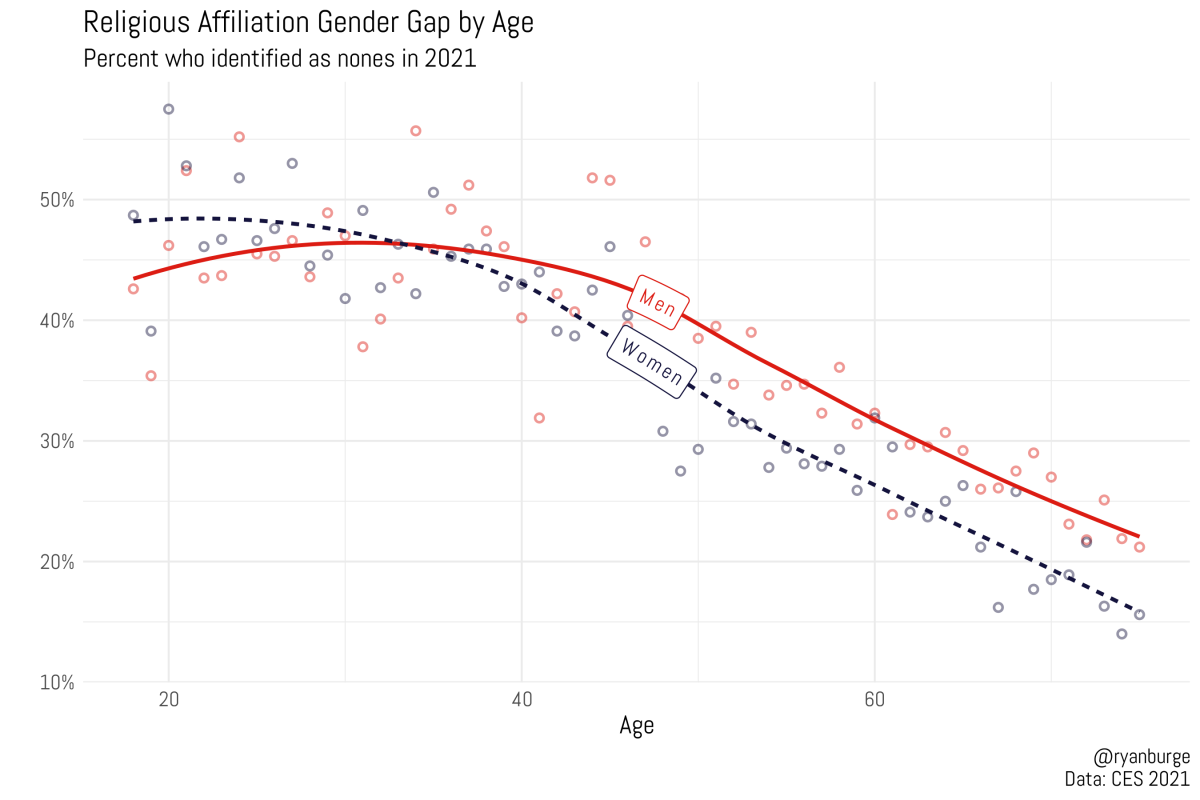
As recently as last year, the religion gender gap has persisted among older Americans. Survey data from October 2021 found that among those born in 1950, about a quarter of men identified as atheist, agnostic, or nothing in particular, compared to just 20 percent of women of the same age. That same five-point gap is evident among those born in 1960 and 1970 as well.

For millennials and Generation Z, it’s a different story. Among those born in 1980, the gap begins to narrow to about two percentage points. By 1990, the gap disappears, and with those born in 2000 or later, women are clearly more likely to be nones than men.

Among 18- to 25-year-olds, 49 percent of women are nones, compared to just 46 percent of men.

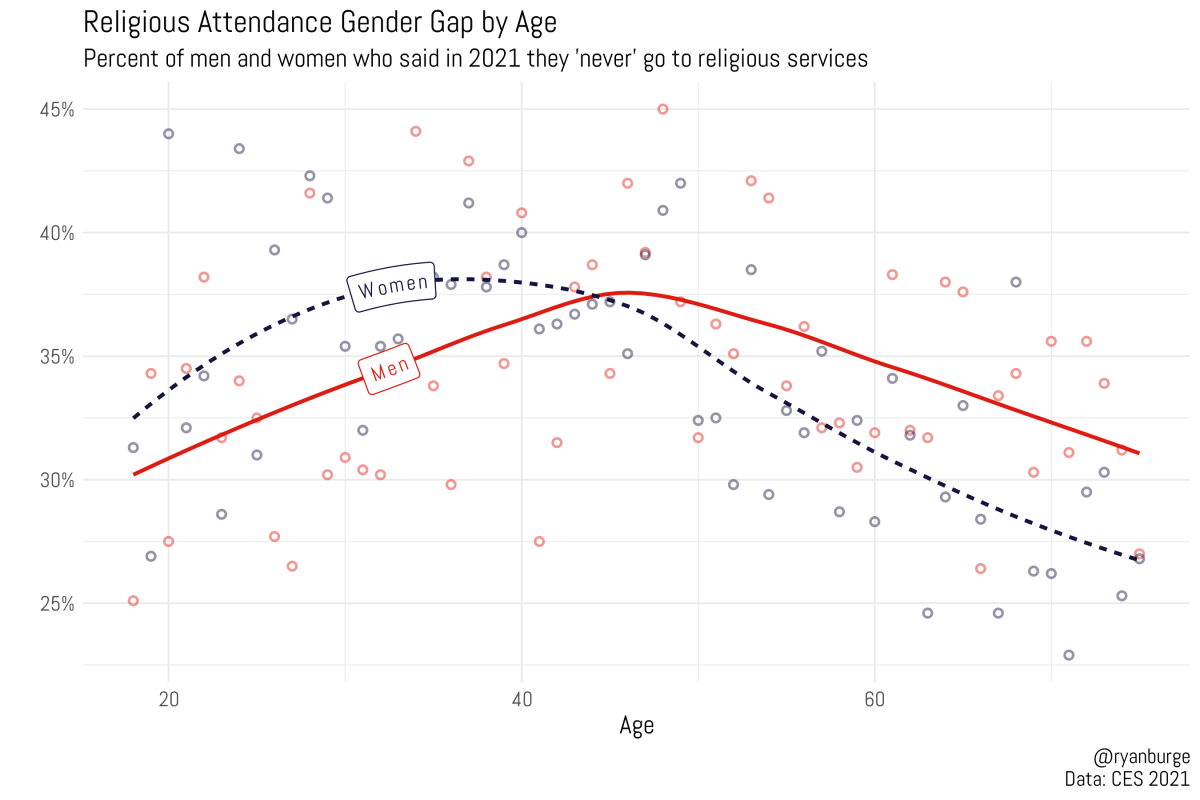
There’s also a gender gap in church attendance. This pattern has been so stark that Pew Research Center found in 2016 that Christian women around the world are on average 7 percentage points more likely than men to attend services; there are no countries where men are significantly more likely than to be religiously affiliated than women.

In the US, older men are more likely to say they never attend church services when compared to women of the same age. Among 60-year-old men, 35 percent report never attending; it’s 31 percent of women.

While the difference between men and women identifying as nones doesn’t disappear until those born in the 1990s (today’s 30-year-olds), we see the gender gap in church attendance has closed for earlier generations as well. For people born as early as 1973 (in their late 40s today), men and women are equally likely to say they never go to church. The youngest adults are less likely to report never attending services compared to those who are between 35 and 45 years old.

What demographic factors may be leading to this emerging gender difference in the religiosity of young men and women?

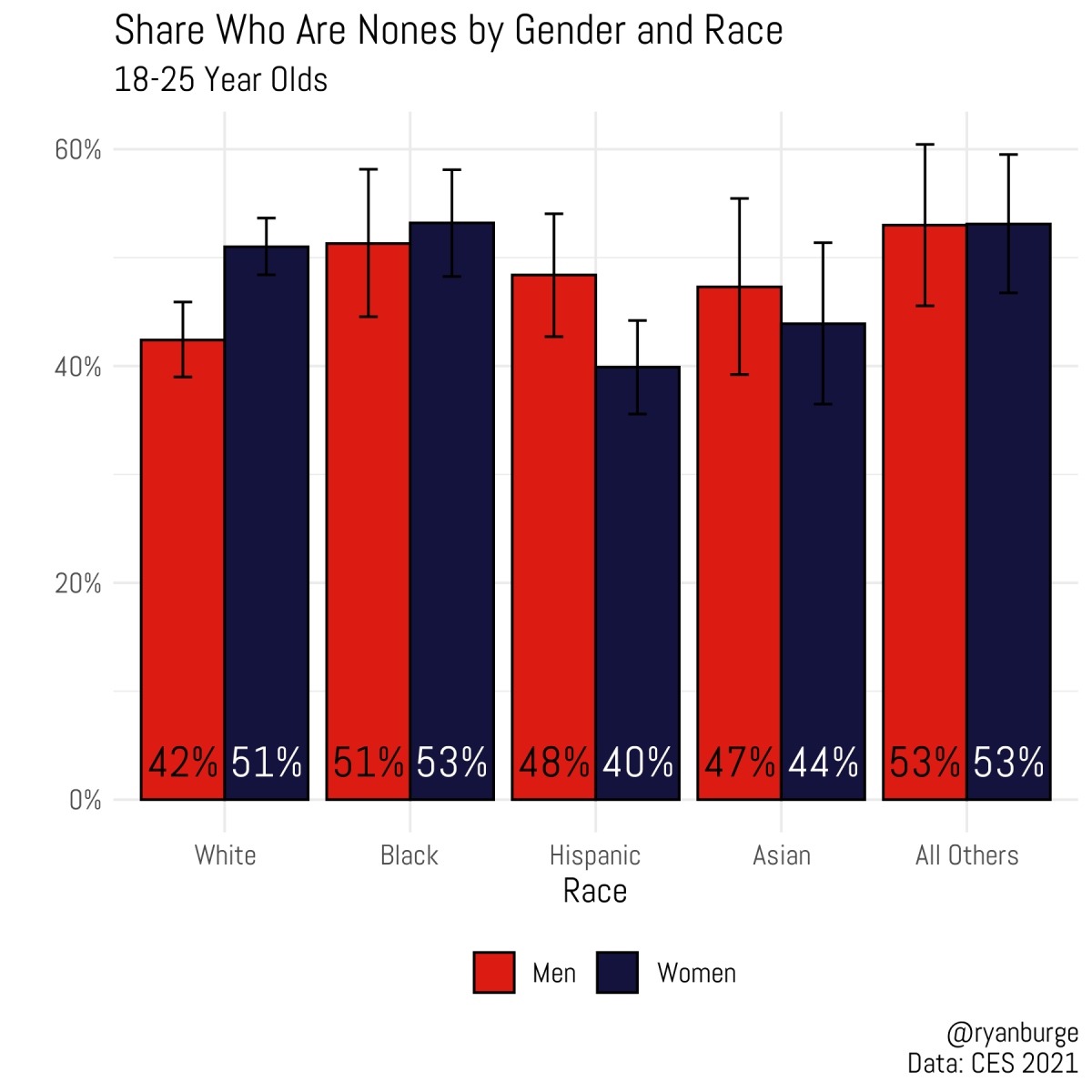
There’s no real difference in the share of male and female nones among Black, Asian, and other racial groups. But among Hispanic young people, men are 8 percentage points more likely to be nones than women.

Among white respondents, women are 9 percentage points more likely to say that they have no religious affiliation compared to white men.The gap among Gen Z white people is a large part of the story since white respondents make up half of 18- to 25-year-olds.

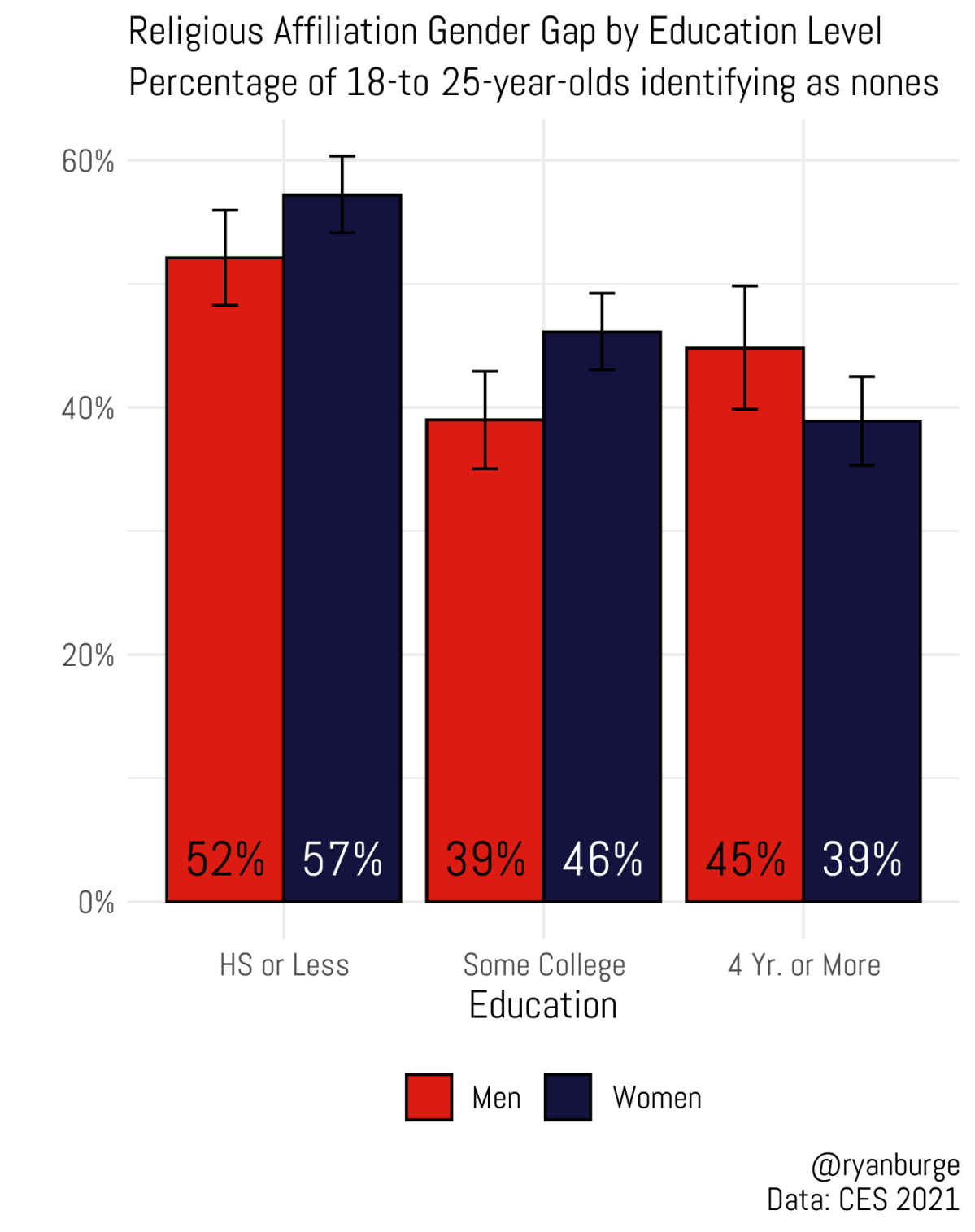
Education may be another significant factor. Among college-educated adults under 25, women are slightly less likely to say they have no religious affiliation compared to men (39% of women versus 45% of men).

However, among those who have not completed a four-year degree but are working toward one, there’s a clear difference. Fifty-seven percent of Gen Z women with high school diplomas are nones, compared to only 52 percent of men. Among those who have taken some college courses but have not completed a bachelor’s degree, there’s a seven-point gap between men and women.

Christians have noticed the longstanding age gap over the years and tried to address it. Men’s ministries focused on male discipleship and bringing husbands and fathers back into the fold, but women continued to outnumber men in evangelical churches by a 10 percentage-point margin.

Some major voices influencing evangelical Christianity had specifically called out young men for their lack of responsibility and religious devotion. Mark Driscoll preached about biblical manhood, Owen Strachan said that “manhood is doing hard things for God’s glory and the good of others,” and Jordan Peterson’s rise to fame is based largely on his insistence on a “gospel of masculinity.”

These voices and other efforts to keep young men in the fold could have affected male church involvement in recent years—but they may have been a factor in deterring women’s attendance too. As one recent CT book review notes:

Evangelical women have long attended church at higher rates than evangelical men. But today that gap is narrowing, not because more men are coming but because more women are leaving. Such women are increasingly likely to “deconstruct” their faith or identify as “nones”—a rising population of the religiously disaffiliated.

As Lyman Stone wrote two years ago, “Making your church manlier won’t make it bigger.” It could be a factor in making it smaller.

The drop in attendance and affiliation by young women leaves the future of the American church in a precarious position. For pastors of older congregations, it’s not uncommon to look out at the people on Sunday and see women outnumber men by factors of two or three. If this trend continues and Gen Z women do not return to church as they move into midlife, it could spell a real crisis for congregations who rely on the leadership and service supplied by that vital part of the church community.

News

Nigerian Christians Protest Muslim-Muslim Ticket as a ‘Declaration of War’

Major political parties try to maximize the northern Muslim vote to rule Africa’s most-populous nation. Will a third-party presidential candidate reap the benefit of Christian frustration?

Election officials began counting ballots on July 16, 2022 after Nigeria's southwest Osun state went to the polls to elect a new governor in a final test for next year's presidential elections.

Election officials began counting ballots on July 16, 2022 after Nigeria's southwest Osun state went to the polls to elect a new governor in a final test for next year's presidential elections.

Christianity Today July 26, 2022
Pius Utomi Ekpei / Contributor / Getty

The field is set for Nigeria’s 2023 presidential election, leaving its Christian citizens in a quandary.

In selecting candidates to replace the current head of state, Muhammadu Buhari, one dominant political party ignored customary protocols ensuring geographic rotation of power, while the other party—in the face of severe warnings—abandoned the customary commitment to religious representation.

Believers may desert them both.

Africa’s most-populous nation is roughly divided between a majority Muslim north and a majority Christian south. An unwritten agreement has rotated the presidency between the two regions. Buhari, a Muslim, hails from Borno State in the northeast.

The first transgression, by geography, happened in May when the opposition Peoples Democratic Party (PDP) nominated Atiku Abubakar from Adamawa State, also in Nigeria’s northeast. A Muslim, he chose as his vice-presidential running mate Ifeanyi Okowa, the Christian governor of Delta State in the south.

One month later, the incumbent All Progressives Congress (APC) nominated Bola Tinubu, the Muslim former governor of Lagos State in the south. But since he hails from a Christian region, fears were raised that his Muslim rival for president might sweep the north—viewed by many as a more reliable voting bloc. Speculation was rampant he would choose a Muslim vice-presidential candidate to compensate.

“We will consider such action as a declaration of war,” warned the Christian Association of Nigeria (CAN), which represents almost all the nation’s Protestants and Catholics. “We … will mobilize politically against any political party that sows the seed of religious conflict.” CAN also opposes any Christian-Christian political ticket as well.

Similar statements were issued by two of CAN’s five blocs: the Pentecostal Fellowship of Nigeria—“Meet us at the polls,” it said—and the Catholic Secretariat of Nigeria.

Opposition extended beyond religion.

The civil society Middle Belt Forum warned the APC against breaking Nigerian unity. And a leaked security report—denied by Buhari—said such a choice would destabilize the nation and risk Christian lives.

Tinubu defied them all.

“I believe this is the man who can help me bring the best governance to all Nigerians,” he said on July 10, defending his selection of the Muslim former governor of Borno, Kashim Shettima. “In this crucial moment, where so much is at stake, we must prioritize leadership, competence, and the ability to work as a team over other considerations.”

The vice president of Nigeria holds no formal power. But Christians were aghast at the affront.

“In a country with 100 million people in each religion, are you saying there is no competent Christian who can be your partner?” asked Samson Ayokunle, the outgoing president of CAN. “If you are picking a Muslim, it means you have an agenda.”

Ayokunle, a Baptist, assured that CAN, which this week will rotate to new leadership, has no preference in terms of political parties. Tinubu governed Lagos well, he said, and Abubakar has never picked a fight with Christians.

However, “CAN said loud and clear that we will teach a lesson to any party with a Muslim-Muslim ticket,” Ayokunle told CT. The only complication? “Christians have not been voting enough.”

It may be about to change.

Denominations across Nigeria have launched voter registration campaigns. Some churches have even barred Christians from Sunday worship until they present their personal voter card, said Joseph Hayab, CAN chairman for Kaduna State in Nigeria’s north.

“Government was instituted by God,” he said. “I would be an irresponsible child to not be involved, as I have to take care of my Father’s property.”

A Baptist, Hayab said the Nigeria Baptist Convention first centered this issue in its 2018 general assembly, seeking to reverse a mentality that originated with foreign missionaries 150 years ago. Back then, Hayab said, Nigerian Christians came to learn that politics was “dirty,” to be left to those less strong in the faith. And over time, Nigerian Muslims took over.

Today Hayab urges believers to join all political parties, in order to change them from within. While critical of the APC decision, he called also for introspection.

“Perhaps it is the Christians in that party that are incompetent,” he said, “in their capacity to mobilize support for their party.”

But if the vice-presidential choice will motivate Christians against the APC, the PDP also faces a religious hurdle. Last May, Abubakar deleted a tweet condemning the mob murder of Deborah Samuel, who was accused of blasphemy against Islam, when he faced Muslim pushback in the north.

One comment claimed the condemnation would cost him one million votes in Sokoto, home to Nigeria’s ancient sultanate, despite the Muslim council condemning the killing. Earlier this month at the International Religious Freedom Summit in Washington, an official representative of the sultan signed a “Declaration for a Peaceful and Secure Nigeria” with Ayokunle.

“People feel they might not be able to vote for someone who cannot stand firm,” the CAN president said of Abubakar. “Others feel that all previous governments have failed, so why vote for anyone?”

The youth wing of CAN vowed to withhold votes from any candidate who does not clearly condemn Samuel’s murder. Tinubu—whose wife is an ordained pastor in the Redeemed Christian Church of God, a prominent Pentecostal denomination—has kept mum.

Gideon Para-Mallam has not.

At the time, the former Jos-based Africa ambassador for the International Fellowship of Evangelical Students called for calm as he joined protests against the killing. He laid blame on the Buhari administration, and his words are even stronger now.

“The party is a disservice to Nigeria and humanity,” said Para-Mallam. “Another APC presidency will usher in full genocide.”

The problems predate Buhari’s eight years in power. Since 1999, Christian advocates blame militants among the Fulani herdsmen, who are predominantly Muslim, for the deaths of over 20,000 mostly Christian farmers and the displacement of hundreds of thousands. Since 2009, Boko Haram, a jihadist terrorist group, has killed 35,000 Muslims and Christians alike.

But in recent years, attacks on churches have escalated: 18 tallied in 2020, and 31 the following year. The first six months of 2022 have witnessed 23. Open Doors ranked Nigeria an ignoble No. 1 in its annual global tally of Christians killed (4,650) or abducted (2,510), as well as Christians’ homes and shops attacked (a symbolic tally of 1,000 each), for faith-based reasons.

Nigeria is ranked No. 7 overall on the World Watch List of the 50 countries where it is hardest to be a Christian. Open Doors USA recently highlighted 10 Nigerian martyrs over the past decade, most within the past few years.

Though there are honorable politicians within the APC, at the national level it is “full of bigotry, a party of deceit,” said Para-Mallam. Bringing the latter somewhat out into the open, one APC official said the factors in choosing a vice-presidential candidate went beyond their competency.

“Politics is all about strategy for winning election,” said Usman Garba, from Kaduna. “In the current situation, it is strategic to pick a Muslim from the North.”

Such an arrangement was last attempted three decades ago—and won. But it was quickly scuttled by a military coup, and democratic governance did not return until 1999.

“I will not and cannot ignore the religious concerns and ethnic sensitivities of our people,” said Tinubu in a 35-point statement. Yet, he argued, “The spirit of 1993 is upon us again in 2023.”

Will it work? Para-Mallam counsels Christians and fair-minded Muslims to cast their ballot for Peter Obi, the presidential nominee of the smaller Labor party—for his competency, not for his faith or ethnicity. From Anambra State in the southeast, the Catholic politician has chosen Muslim former senator Yusuf Baba-Ahmed, from Kaduna, as his running mate.

Some media reports have touted the 60-year-old candidate as popular with the youth—compared to the 75-year-old Abubakar or the 70-year-old Tinubu. Though infrequent at the polls, Nigeria’s younger voters could represent up to 70 percent of the electorate if mobilized.

Obi may have difficulty winning over other demographics, however. Baba-Ahmed was criticized for his comments stating he wants to be known for his qualifications, not as a Muslim or a northerner.

Christian sources validated this perspective to CT; however, they also say it is not yet viable at the national level.

“Ordinarily, there would have been nothing wrong with a Muslim-Muslim or Christian-Christian ticket in a democratic dispensation if … the overriding desire for seeking political office is the fostering of the common good,” stated the Catholic Secretariat. “But one cannot really say so of our country at the moment.”

Last month, dozens were killed in a terrorist attack during Mass.

With seven months until the first round of presidential elections, time remains for voters to gravitate to the outsider Christian contestant, the PDP’s split religious ticket, or the APC’s Muslim-Muslim duo. A runoff will take place unless one candidate tops 50 percent overall, with at least 25 percent of votes in 24 of Nigeria’s 36 states.

“Many people are saying it is not the turn of Muslims to take over from a Muslim,” said Ayokunle. “We have seen eight years of instability; we need fresh water.”

Church Life

Why Taiwan Loves This Canadian Missionary Dentist

George Leslie Mackay arrived in Taiwan 150 years ago and is still beloved there today.

Teeth extraction by Rev. George Leslie Mackay and his assistants in Taiwan.

Teeth extraction by Rev. George Leslie Mackay and his assistants in Taiwan.

Christianity Today July 25, 2022
WikiMedia Commons

This year marks the 150th anniversary of Canadian missionary George Leslie Mackay’s arrival in Taiwan. Perhaps the country’s most beloved 19th-century Westerner, Mackay has been celebrated by Taiwan through children’s books, stamps, statues, paintings, a manga, a puppet production, and an opera. Churches have reenacted his arrival, and several books are being published about the pioneer missionary. (The Taiwan government even has a bio of him on their website.) So what made this foreigner worthy of this level of affection more than 100 years after his death?

In 1872, the Canadian Presbyterian missionary arrived in northern Taiwan (then called Formosa). Over the next 29 years, Mackay planted more than 60 churches throughout northern Taiwan and baptized more than 3,000 people. He started Oxford College, a school he named for his home county, which today has become Aletheia University and Taiwan Graduate School of Theology. Mackay Memorial Hospital, named in his honor, is now a large downtown hospital in Taipei with two branch hospitals.

Beyond these accomplishments, Mackay’s legacy cemented itself through his insistence on identifying with Taiwan and the Taiwanese. Mackay spent more than half of the 57 years of his life on the island. Upon his arrival in Taiwan, he realized how important learning to speak fluent Taiwanese would be for his mission and immediately began learning the language from the local boys herding water buffalo. Unlike most Western missionaries, he married a local woman, Tiun Chang-Mia (Tiuⁿ Chhang-miâ), often known as “Minnie Mackay,” and they had three children. Embracing Taiwan as his adopted homeland, he touched the hearts of many Taiwanese and contributed to the conversion of many to Christianity.

Under the banyan tree

Born in 1844 to Scottish parents in Zorra village, Ontario, Mackay longed to share the gospel overseas from the time he was 10 years old. As a child, he heard stories of the famous China missionary William C. Burns (1815–1868), who “poured a new stream into the current of my religious life,” as Mackay later wrote in his memoir, From Far Formosa. Mackay received a broad liberal arts education, attending school in Toronto and Princeton and visiting Edinburgh. He was part of a rising tide of missionaries sent out on the cusp of the student missionary movement, when thousands of North Americans would go abroad to spread the gospel. While the US church had been sending out missionaries for decades, Mackay became the first sent by the Presbyterian Church in Canada when he arrived on March 9, 1872, to Tamsui, a city in northern Taiwan.

Mackay used his liberal arts background as a way to engage the island’s young men. Soon after he arrived, he began hosting lectures and dialogues outdoors under a large tree. Mackay’s first convert was a young intellectual named Giam Chheng Hoâ. Prior to his conversion, Giam sought out Mackay with his religious questions and then brought back other scholars to engage him in a debate. Intrigued by Christianity, Giam agreed to teach Mackay Chinese in return for Mackay teaching him about Christianity. “Giam and Mackay forged a deep symbiotic relationship grounded upon unfeigned mutual respect and admiration,” wrote religious historian James R. Rohrer. Giam later became the first native pastor in the northern synod of the Presbyterian Church in Taiwan.

Like many missionaries of his age, Mackay embraced the idea of developing a native-led church. (The idea of a “three self” church was already popular in this era in mission theory, but missionaries still struggled to turn over local control.) His vision became reality in Taiwan, where the lack of missionaries enabled local converts to step up and lead their congregations. Mackay saw missions as something that required constant diligence and unending prayer; church planting took serious effort. At times, he and his Taiwanese coworkers walked on foot from early morning until late in the evening to preach the gospel. Mackay seldom slept well at night, “not from weariness; but anxiety about planting a Church,” he wrote in his diary.

In a mission report from 1888, Mackay described the work as “joy and sorrow mingled”:

Before Almighty God I declare that hard work and toil and watching, praying and weeping – sorrowing and rejoicing, made up the interval of sixteen years – sleepless nights, fever attacks without number at the gates of death more times than once. But never discouraged. Give God the glory for blessing poor efforts in His own Cause.

Mackay believed that the goals of his mission should be both to evangelize and to educate, stating: “The ministry that will command the respect of the people and will endure must be intelligent as well as zealous.” Through debate, drama, travel, observation of nature, scientific experiments, and so on, he stretched the minds of his students before inviting them to Bible study and prayer meetings in his home every evening.

In addition to preaching and teaching, providing medical treatment was also an important aspect of Mackay’s mission work. This began with the missionary offering quinine to malaria patients and extracting people’s decayed teeth in the villages he visited in his evangelizing efforts. Often he and his students would sing a hymn to patients, extract their teeth, and then preach the gospel to them. Over the years, Mackay became known for having pulled thousands of teeth.

Rev. George Leslie MackayWikiMedia Commons
Rev. George Leslie Mackay

As Mackay honed his skills working with Western doctors who had come to Taiwan, he even performed surgeries when necessary and in 1880 founded a medical clinic. He often told story about a man, who was blind, and after his sight was restored exclaimed, “God did it; God did it! I can see now. God did it without medicine.” Afterwards he wrote, “there was faith and prayer, but there was work as well,” acknowledging that the intervention had included medicine, hygienic regulations, earnest prayer, and dedicated care. Mackay believed that both the natural and supernatural ways of healing were the work of God:

From the very beginning of our work in Formosa heed was given to the words and example of the Lord, and by means of the healing art a wide door for immediate usefulness was opened. … I found the people suffering from various ailments and diseases, and the power to relieve their pain and heal their diseases won for the mission grateful friends and supporters.

A chaotic time

Mackay came to Taiwan during a turbulent period. Successive waves of migration had brought many newcomers to the island, and in the late 19th century, Taiwan was a site of frequent ethnic clashes among the different groups, including new migrants from China and the aborigines, the first inhabitants of Taiwan. Additionally, as Taiwan was essentially an ungoverned territory at that time, it had become a hideout for pirates and bandits, and the island was rife with criminality and violence.

In 1884, with the beginning of the Sino-French War, a conflict between China and France over present-day Vietnam, France attacked Taiwan. Due to anti-Western sentiment stirred up by the war, locals accused Mackay’s followers of collaborating with enemy foreigners, attacked church leaders, and tore down churches. On Christmas Eve of 1885, Mackay went in the rain to check on the ruined parishes destroyed during the war. As he walked to the site, drenched from head to toe, he reminded himself of his purpose: “All, all for Christ, not for money, nor name.”

Mackay called Taiwan his “homeland” and “last home,” a perspective that his wife, Tiun Chang-Mia, helped shape. The adopted granddaughter of a Taiwanese Christian, she helped Mackay minister to women, as local gender customs made it difficult for him to reach them. Together in 1884 they founded the Tamsui Girls’ School, the first educational institution for girls in Taiwan. Girls who attended the school received free tuition, room and, board; were not required to bind their feet; and were taught how to share the gospel in their communities.

Mackay only returned to Canada twice after he first arrived in Formosa. On the eve of his first furlough, in 1878, he reported, “In two days I expect to be away from dear, dear Northern Formosa where I spent days of tears, toils, trials, troubles, sickness, sorrows. … I have very reluctantly consented to go. I find it hard to leave, much more so than leaving Canada in 1871.”

During his second furlough in 1895, Japan defeated China, an event that led Taiwan to be ceded to Japan. By the middle of the year, Japanese troops occupied Taiwan, instigating military conflicts and turmoil throughout the country. Nevertheless, in October, the family left Canada to return to Taiwan.

In 1901, Mackay learned he had throat cancer. Friends advised him to go to Japan or Hong Kong for medical care, but the missionary refused to leave Taiwan, saying that he had “adopted Formosa” as his home and he did not want to leave it. Mackay’s love for Jesus Christ had led him to Taiwan, his love for Taiwan grew as he served there, and his love for Taiwan deeply transformed him.

Months after he first took sick, Mackay died on June 2, 1901, and was buried in Tamsui, the city in which he first arrived. According to Rohrer, “the cemetery was too small to hold all of the mourners that gathered from around the mission field, including more than three hundred non-Christian dignitaries who came to honor the fallen missionary.”

Before he passed, Mackay captured his love for the country by writing a still widely beloved poem:

How dear is Formosa to my heart!
On that island the best of my years have been spent.
How dear is Formosa to my heart!
A lifetime of joy is centered here.
I love to look up to its lofty peaks, down into its yawning chasms, and away out on its surging seas.
How willing I am to gaze upon these forever!
My heart’s ties to Taiwan cannot be severed!
To that island I devote my life.
My heart's ties to Taiwan cannot be severed!
There I find my joy.
I should like to find a final resting place within sound of its surf, and under the shade of its waving bamboo.

Hong-Hsin Lin is a theologian, recently retired from Taiwan Graduate School of Theology. He holds doctorates from Tübingen and Nottingham. Jonathan Seitz is a PCUSA mission co-worker teaching in Taiwan.

News
Wire Story

At 100, Hymn Society Considers How Worship Evolves

Gathering for the first time since the pandemic, the interdenominational group discussed the importance of global churches finding their own rhythms.

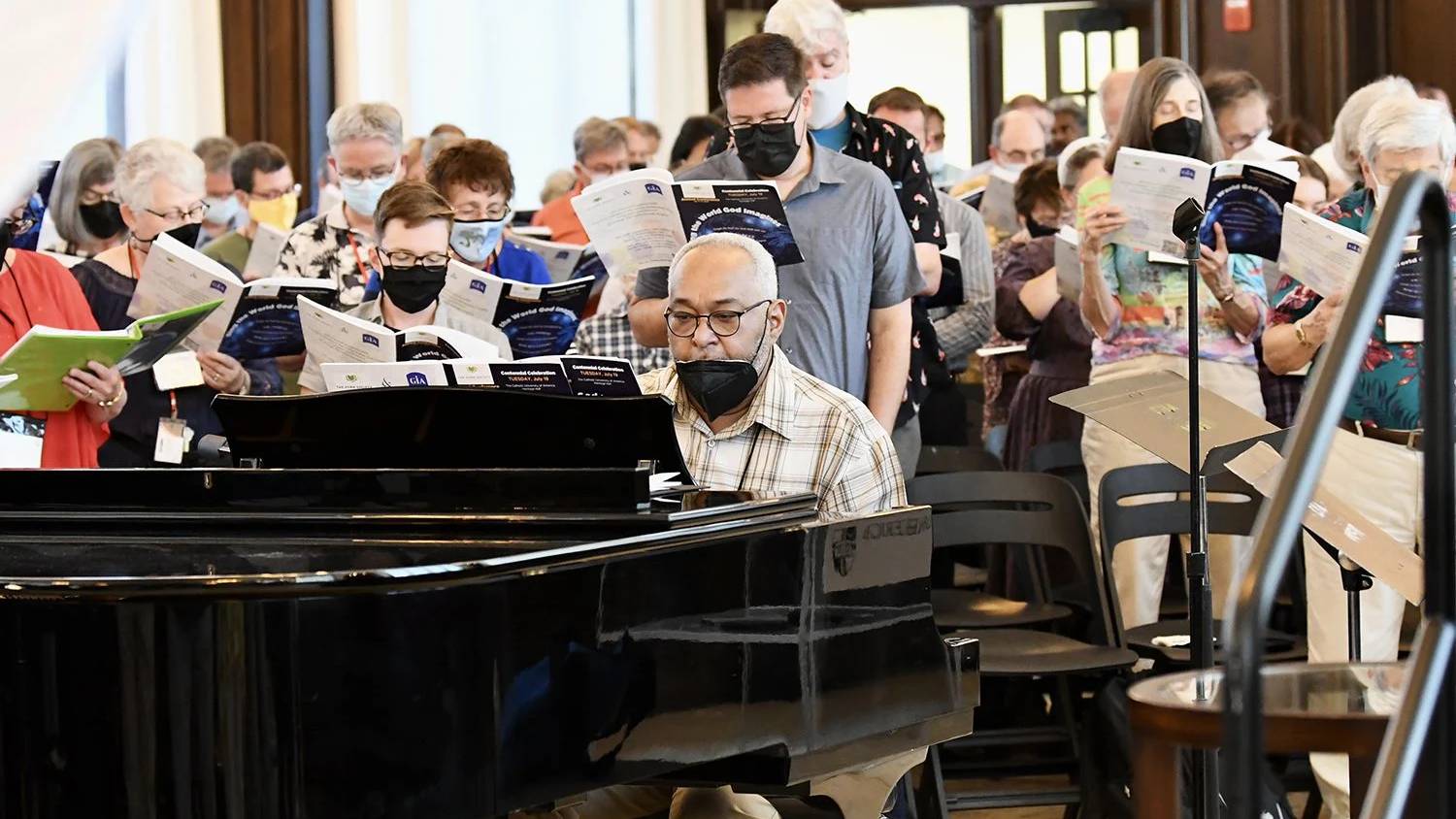
The Hymn Society gathers in Washington, DC

The Hymn Society gathers in Washington, DC

Christianity Today July 25, 2022
Glen Richardson / Courtesy of The Hymn Society / RNS

Rahel Daulay, a Methodist who had traveled from Indonesia, was explaining the proper way to dance while singing a hymn she had brought from Southeast Asia—bending knees slightly “to humble yourself” and turning toward one’s neighbors, palms together at the chest. Then turn forward, lift up the arms and hold the hands upward.

For the 300-some members of the Hymn Society in the US and Canada, who hadn’t met in person for three years, it was a liberation.

“Let us come and worship our creator,” they sang as they swayed and danced at Catholic University’s Edward J. Pryzbyla University Center last week. The organization comprises representatives from more than 50 denominations who speak as many as six languages. Some had traveled as many as 8,000 miles to attend.

Since COVID-19 hit, many of the academics and music practitioners in attendance have not been able to sing out even in their home churches, as congregational singing has been stifled in many houses of worship for fear of spreading the virus.

Though masking was enforced, the pandemic had lifted just enough this year for organizers to go ahead with the 2022 in-person meeting, celebrating the society’s 100th year of existence.

“For the past three years, it’s been so nice to see all of your faces on screen and be together in that way, but there is nothing like seeing your faces out here and being together to sing,” said Executive Director J. Michael McMahon in greeting last Monday.

With the theme “Sing the World God Imagines,” the gathering demonstrated the powerful influence hymns have, not only on faith communities but also on politics and society at large across the globe, as lecture sessions addressed topics such as the ongoing effects of colonialism on the texts and tunes they choose to sing.

Consciousness of hymns’ power has driven a growing diversity in the Christian hymnody, and members and guests meeting this week insisted that the trend continue into the coming century.

“I have had the pleasure of watching this community grow to embrace and to celebrate the way the gospel can be preached and sung and prayed in many tongues and rhythms, calling forth an array of gifts much like the first-century church,” said conference preacher Cynthia A. Wilson, a United Methodist and leader of a new Black church music institute at Garrett-Evangelical Theological Seminary.

“But as we move into this century, friends, I promise we will not get through it without the boldness of protest, the power of prayer, and the potency of God’s song.”

Last week’s opening worship service featured Wilson’s sermon and songs like “Let it Rise,” “God Is Here,” and “Order my Steps.” For much of the rest of the meeting, participants, including several dozen online, took turns leading and learning unfamiliar songs from many lands as well as familiar hymns with new beats and new words.

On Wednesday, Mikako Ehara, head of church music for the Japan Baptist Convention, taught “God’s World,” the song featuring a Japanese folk melody based on a nursery rhyme she compared to “The 12 Days of Christmas”—“where a line is added with each new verse” about creation as told in the Book of Genesis.

“Let’s rejoice all together,” the song began. “Wonderful, wonderful God’s creation.”

In a prerecorded video from Australia, Tanya Riches talked about the musical evolution of Hillsong, whose music ministry has provided a thick songbook for evangelical Christian churches around the globe.

Riches, a senior lecturer at Hillsong’s college in Sydney, noted that Hillsong was once known best for Darlene Zschech’s 1993 “Shout to the Lord.” By 2016, however, Hillsong’s co-founder, Brian Houston, who resigned earlier this year, told conference-goers in the US that the song’s time had passed. “This song’s moment is no longer relevant to the congregation’s work in the Spirit,” Riches explained.

Mikie Roberts, program executive for spiritual life and for faith and order for the World Council of Churches, described in a later plenary how his home country of Antigua and Barbuda had gained independence in 1981 in part through the use of patriotic hymns that reached people through their churches. To reach the most people, the tunes excluded the familiar syncopation of local Calypso music.

“The patriotic and the national songs had to be simple, yet direct, so that they could be promoted in schools, played on the air and sung every day including Sunday,” said Roberts, a Moravian pastor.

An international panel of speakers grappled with the origins of the hymnody in parts of the world where songs brought by Western missionaries are still revered more than other church music, including the songs of local cultures.

“We’re still in the process of decolonizing what we are singing,” said Gerardo Oberman, a leader of Reformed Churches in Argentina and one of the panelists, speaking through a translator. “We are still trying to find our own voice or trying to find our own rhythms. Because there’s a little bit of a disconnect between what we sing in our homes, what we sing on the streets, and what we sing in our churches.”

C. Michael Hawn, an Iowa native who has long advocated for including global music in American congregations’ worship services, said that, despite concerns about Western music’s dominance, some people across the globe made traditionally Western hymns genuinely their own.

“I have developed a little bit more awareness and sympathy for ‘What a Friend We Have in Jesus’ being sung in Yoruba—or not just in the language, but in a style that reflects they’ve Africanized it,” said Hawn, professor emeritus of church music at Southern Methodist University’s Perkins School of Theology.

“And so it’s not a simple transplant; it’s a reconstruction, a certain kind of hybridity.”

Within three years of the Hymn Society’s first meeting in 1922, the Baptist Standard Hymnal and The Book of American Negro Spirituals were published. But by the 1980s and 1990s, Hawn said, there was a greater consciousness of being inclusive, and hymnals began to include more global music. People developed more intentionality about “what sounds take place in a sacred space.”

Accordingly, the conference’s closing festival on Thursday, at National City Christian Church, mixed the church’s organ with the djembe, a West African drum, as well as voices and brass instruments and music by a range of composers.

“And now, as we prepare to go forth, may the spirit of God blow among us to bring forth new songs,” said McMahon as he closed the meeting, “songs of faith, songs of healing, songs of transformation, songs of peace, songs of a world remade.”

Culture

Here I Am to Sound Check

Church tech teams kept worship plugged-in and streaming during the pandemic. But when does the job become too much for volunteers?

Christianity Today July 22, 2022
The Real Findo / Lightstock

The pivot to online services in 2020 put the pressure on church tech and production teams.

“COVID-19 really grabbed churches by the ankles and shook all the change out of their pockets,” said Van Metschke, a ministry and church production veteran who now works for an audiovisual tech design firm in California.

The shift to streaming forced churches to make difficult choices over whether to allocate resources to improve the production level for online worshipers. Even if churches could afford new audiovisual equipment, they had to find people to run it.

“Money isn’t necessarily going to solve the problem,” said Metschke. “Good gear doesn’t fix organizational problems.”

Metschke, cohost of the Green Room Church Tech podcast, has seen a growing number of young people in church technology and production leave their roles over the past two years. Paid tech staff are overwhelmed by the demands of managing volunteers. Volunteers are overutilized, undertrained, and afraid to make a mistake that could derail a carefully orchestrated service.

As in other areas of ministry, tech volunteers want to offer their abilities and interests to serve their congregation. But some churches struggle to delegate duties to volunteers without taking advantage of their enthusiasm. They end up asking them to do what a paid professional should, like troubleshooting when something goes wrong with a computer or camera or wireless microphone, navigating streaming on multiple platforms, or editing video and creating graphics to produce a high-quality recorded service.

Prior to 2020, it was already difficult to recruit, train, and retain enough production and tech volunteers to make services run smoothly. Some tasks are easy to learn for a teachable but inexperienced volunteer, such as manning a camera, running slides, or managing simple lighting cues. Others, like putting together a good mix for a large band and running sound checks, require experience and some musical knowledge.

Large churches may have a technical director on staff, but most have a team of volunteers folded into the worship ministry with varying degrees of training. Even small churches with relatively simple audiovisual systems rely on volunteers to run slides and sound; without them, the pastor has no microphone and the congregation has no lyrics to read.

The pandemic dealt a blow to church volunteer rosters, but while other areas of ministry dialed back during restrictions, church tech was in higher demand. Tech volunteers have increasingly been expected to perform as industry professionals, devoting additional time and mastering equipment to heighten the production quality of weekly services for an online audience.

The volunteers who spend hours at the back of church sanctuaries and auditoriums are often invisible to weekly attendees (especially those watching from home), but they shoulder a huge burden: ensuring that voices are correctly amplified, making the slides and videos appear at the right moment, coordinating complicated light systems.

But if they make a mistake, everyone wonders what’s going on in the sound booth.

“Tech is the one part of ministry that is understood the least,” said Metschke, who has served as the tech director for Saddleback Church and Mariners Church, both megachurches in California.

Earlier this year, several TikTok clips called out the culture of burnout that comes from overreliance on worship volunteers. “Most churches would not be able to run without the exploitation of unpaid volunteers who are under the impression that they are using their gifts to serve the Lord,” one user said.

Church leaders and those currently serving in churches will likely bristle at the suggestion that church volunteers are being exploited. After all, for most churches, reliance on volunteers is a feature of church life, not a bug.

Leaders “cannot do ministry alone,” wrote Danny Franks for Lifeway Research.

Franks, pastor of guest services at The Summit Church in North Carolina argued, “The mission is too great and the time is too short to shoulder all the tasks by ourselves. Let’s ask God to show us the people He’s already working in, invite them to the mission, and see the cultures of our churches and communities change.”

Church leaders tend to see volunteer recruitment as inviting congregants to join in the redemptive work of the church. Vision-casting is an important part of volunteer recruitment; appealing to a sense of mission rather than guilt or obligation is more effective.

But Franks acknowledged, “A healthy volunteer culture seems to be the exception rather than the rule.”

Tech and production are ministry areas in which demands on volunteers are frequently surpassing what is reasonable and fair.

“You need to hire someone if it’s important to you. … You can’t expect volunteers to be as good at tech as professionals,” said Metschke. “You can have standards, but you have to have a lot of grace.”

Chris Darling, worship and arts pastor at Azalea Garden Church in Virginia Beach, Virginia, pays a part-time staff member to handle livestream production, tech volunteer management, and other various production-related tasks for the 300-person congregation.

“Volunteers are volunteers,” said Darling. “They can walk away at any time.”

Despite having difficulty recruiting tech volunteers when he first arrived at the church a year and a half ago, Darling has helped cultivate a strong volunteer community by welcoming students from the church’s youth ministry on the tech and worship teams.

The now-multigenerational ministry still relies heavily on volunteers, but Darling feels that the norms he has in place are helping fight burnout and keep his team feeling appreciated. He tries to schedule each volunteer no more than twice a month, once if possible. He also tries to make sure that jobs are made as simple and straightforward as possible.

Tech “is an area people are intimidated by,” said Darling. Thorough training, flow charts, and clear communication help volunteers feel capable and at ease. It usually takes months of training–usually shadowing another volunteer or staff member as they run slides or a camera, or mix sound for the band–before a new volunteer is confident enough to independently handle a task like running sound for a live service.

He also tries to convey a posture of grace toward volunteers, reassuring them that mistakes and malfunctions are just part of the gig.

“I tell them, ‘99 percent of the time, you’re going to do your job, nothing will go wrong, and no one will say a word to you. People only notice you when something goes wrong.’”

Church tech gurus advise leaders to pay professionals if they are getting into complicated audiovisual systems and seek out team training at conferences. Metschke suggested that small churches without the resources to hire a new staff member should reach out to a larger church and ask if their tech staff would be willing to provide mentorship and training.

Metschke and Darling also noted the importance of managing the expectations of church leadership and the congregation. The rise of church streaming during the pandemic seems to have intensified the tendency toward comparison and competition, driving churches to try to measure their production against that of megachurches with massive tech staff teams.

“Leadership has to understand that people can’t do in their spare time what a professional does full-time,” said Metschke.

If congregants or church leadership are hoping to emulate the Instagrammable production style of a church like Bethel or Elevation, those expectations need to be tempered.

Darling and Metschke both believe that creating authentic community within volunteer teams is of the utmost importance. Volunteers in high-stakes positions need to feel secure in their relationships and position on the team, or the demanding work won’t seem worthwhile.

“[Tech volunteers] need to feel a sense of belonging,” said Darling, noting that in times of prayer for the worship team, it can be easy to let the tech team stay in the back, disconnected from the rest of the group.

“Serve them. Acknowledge their work,” said Metschke. “People want to be part of a community and a caring family.”

Books
Review

Single, Evangelical Women Are Counting the Cost of Staying in Church

A sociologist explores some of the factors driving them away, but her “accrued resentments” get in the way of a fair picture.

Christianity Today July 22, 2022
Illustration by Mallory Rentsch / Source Images: Manik Roy / Pexels

Evangelical women have long attended church at higher rates than evangelical men. But today that gap is narrowing, not because more men are coming but because more women are leaving. Such women are increasingly likely to “deconstruct” their faith or identify as “nones”—a rising population of the religiously disaffiliated.

The Struggle to Stay: Why Single Evangelical Women Are Leaving the Church

The Struggle to Stay: Why Single Evangelical Women Are Leaving the Church

Columbia University Press

304 pages

$24.30

Many grew up in strict or more fundamentalist traditions, where hard questions were discouraged, women were undervalued, and denominational subcultures shaped their resentments in young adulthood. Speaking with a variety of spiritual coaches focused on deconstruction earlier this year, I learned that clients are often ex-Mormons or women hailing from harsh, patriarchal churches where their voices were silenced.

Katie Gaddini is a pastor’s kid who departed evangelicalism years ago, but the fingerprints of her past remain. She began to untangle the reasons behind her own discomfort in the church and the resentment she saw from others while doing research for her new book, The Struggle to Stay: Why Single Evangelical Women Are Leaving the Church.

A kinship and a disconnect

Gaddini is a sociologist at the Social Research Institute, which is part of University College London. To prepare for writing her book, she embedded herself within a close-knit community of single, evangelical women for over four years, marinating in the culture she once knew so well. As a single woman herself, her study centers on what she describes as “irreconcilable” differences between faith and feminism, religious patriarchy, and inequality for women within the church.

These factors and more drive the book’s mission to uncover why so many single, evangelical women are leaving. While the book, beautifully written and arranged, raises valuable questions about purity culture, ideal Christian womanhood, and female leadership within the church, Christian readers will recognize an ever-present anti-evangelical bias. Gaddini isn’t shy about this, admitting she has “accrued years of resentments” against her former faith tradition and often lamenting that she still feels drawn into the comfort of Christian community.

While recounting her research, Gaddini flashes back to pieces of her past. There was the time, for instance, when she received criticism for writing a paper on 1 Timothy 2:12 at her conservative, evangelical college. Or the time she was harassed with legitimately scary death threats for her “feminist” work (later deemed “a joke” by a couple of Christian guys on campus). The final straw was when a Christian man shamed her for supposedly “tempting” him with sexual pressure, even though he had instigated the encounter.

“The incident,” she wrote of her date with this man, “provided just the nudge I needed to march out the door of evangelicalism and close it firmly behind me.”

These negative experiences may feel familiar to some evangelical women, especially those who were groomed to feel responsible for male sexual urges or frequently heard that a woman’s place was in the home. Other examples in the book, like women being overlooked for leadership positions at church or feeling shamed for their singleness, are certainly worthy concerns for Gaddini’s target audience.

Christians may bristle, however, at some of the ways Gaddini characterizes the evangelical women she appears to pity. “Who is the single evangelical woman?” she asks. “Is she brainwashed and victimized, as many believe, or is she free?”

What follows is a brief analysis of Christian feminist history, where Gaddini recounts the work of Christian feminist Christine de Pizan, a medieval writer thought to be the first woman in Europe to make a living through writing. Gaddini describes a painting representative of de Pizan’s legacy: “Pizan lectures men from university about how women are made in God’s image. They listen with rapt attention.”

It’s an apt picture from which to begin the book’s deeper dive into how women find their identities, communities, and purpose within the church—sometimes while feeling invisible or patronized. But Gaddini’s accounts often feel like reading about a religious social club rather than about women leading lives committed to furthering the gospel, which is the point of evangelicalism.

As a once-single evangelical woman myself, I felt both a kinship and a disconnect with the women featured in the book. Those profiled identify as evangelical Christians, but there is little depth to their conversations about God or the foundations of their faith. In fact, by the end of the book, two of the women featured essentially denounce Christianity altogether. This drastic turn serves to bolster Gaddini’s assertion that there is little hope for evangelicalism, but such a conclusion felt contrived, even if her subjects’ changes of heart were sincere.

Gaddini describes evangelicalism as a “demanding religion that requires its followers to go all-in, to commit completely and be transformed,” often treating it as a distinctly cult-like version of Christianity. In this, she doesn’t acknowledge that evangelicalism goes far beyond the privileged, white West, where the book’s central characters reside. A newbie to the subject would think evangelicalism is a dwindling, patriarchal subculture that is quickly dying out. In reality, evangelical Christianity is a global phenomenon that is growing like wildfire in places like Africa and South America.

Women in the book frequently lament how “exhausting” it is to be an evangelical woman fighting for gender equality in the church. They describe Jesus as “a rebel, a dissident and a feminist,” someone who was “all about disrupting hierarchies and modes of oppression.” These co-opted, progressive definitions of Jesus won’t sit well with orthodox readers, who may also find casual references to homosexuality being “fine” a little odd.

After one of the main churches featured in the book continues to disappoint the women with its lack of zeal for gender equality, they seem hopeless about the future of their faith. Some leave church altogether, others strip off their faith, and one begins attending a small church where she can “slip in and out” without being noticed. Are these really the only options? They aren’t, but the book’s prescriptive analysis was obvious from the beginning. Gaddini had a bone to pick with her former faith, and she didn’t hold back.

Her words near the book’s end make this clear: “In white evangelicalism, the price of belonging includes embracing traditional femininity, heterosexuality, marriage, and sexual purity. … It includes invisibility and continual marginalization, made even worse if you are not white, middle class or straight—and if you remain single.”

Desperately needed

To be sure, the evangelical church is hardly without blemish, and The Struggle to Stay is jam-packed with enough data to make you believe in the reality of what Gaddini calls the “dark side of hope.” But Christians do count the cost of following Jesus, and the Bible (not evangelicalism specifically) does call for forms of obedience like sexual purity. By conflating biblical commands with modern oppression of women, Gaddini weakens her case.

It’s true that traditional femininity, skin color, or marital status may be key markers in certain evangelical communities, but these are hardly requirements for membership in healthy churches, as most committed evangelicals would readily attest. It’s worth noting, too, that Gaddini’s call for singlehood to be valued as much as marriage and for a more welcoming embrace toward women in leadership positions in the church is one that I share.

Rather than leaving the local churches to which God calls us as his followers, I hope women will recognize how desperately they’re needed to ensure God’s purpose on earth is fulfilled through his body.

Ericka Andersen is a freelance journalist living in Indianapolis. Her forthcoming book, Reason to Return: Why Women Need the Church and the Church Needs Women, releases early next year.

Apple PodcastsDown ArrowDown ArrowDown Arrowarrow_left_altLeft ArrowLeft ArrowRight ArrowRight ArrowRight Arrowarrow_up_altUp ArrowUp ArrowAvailable at Amazoncaret-downCloseCloseEmailEmailExpandExpandExternalExternalFacebookfacebook-squareGiftGiftGooglegoogleGoogle KeephamburgerInstagraminstagram-squareLinkLinklinkedin-squareListenListenListenChristianity TodayCT Creative Studio Logologo_orgMegaphoneMenuMenupausePinterestPlayPlayPocketPodcastRSSRSSSaveSaveSaveSearchSearchsearchSpotifyStitcherTelegramTable of ContentsTable of Contentstwitter-squareWhatsAppXYouTubeYouTube