Ideas

Where the Unborn Are People

Columnist

Churches are bearing better witness to life beyond its “potential.”

Chris Gash

The thing itself cannot be praised,” Cicero said. “Only its potential.”

He was talking about young children. Such was the view in the empire where Jesus arrived as an infant. “The child,” said Plutarch, “is more like a plant” than a human, or even than an animal.

But Jesus and his followers had a different view of the moral status of children. To follow him, Jesus said, you had to become like a child. Even babies, Christians said, are fully human and fully bear the image of God. As the African bishop Cyprian wrote, “God himself does not make such distinction of person or of age, since he offers himself as a Father to all.” And if that’s God’s view, then “Every sex and age should be held in honor among you.”

The church even extended that honor and protection to the unborn. “Thou shalt not murder a child by abortion nor kill them when born,” says one of the earliest Christian documents, known as the Didache.

Rules like this one created not a precinct of prohibitions but a community of care. Pagans like the Greek physician Galen begrudgingly acknowledged that the Christians’ “contempt of death is patent to us every day. … And in their keen pursuit of justice, [they] have attained a pitch not inferior to that of genuine philosophers.”

Throughout the Roe regime, contemporary Christians have similarly demonstrated their “contempt of death,” their pursuit of justice for the unborn, and their love of children and pregnant women. But as many women and couples can attest, even pro-life Christians can too quickly treat the unborn as merely “potential” human life when a child is lost to miscarriage.

Sometimes this view comes through well-intentioned but hurtful statements, like those starting with “Well, at least…” It comes through pressure to wait until the second trimester to announce a pregnancy. And it is most clear in expectations that miscarriage grief will be brief—and private.

Those inclinations are understandable. “Pregnancy itself, for a good portion, is a very unseen thing,” says Eric Schumacher, an Iowa pastor and the author of the new book Ours: Biblical Comfort for Men Grieving Miscarriage. “Miscarriage grief can be difficult for friends and family who haven’t experienced the child as the mother has.”

But we are made to mourn in community. “Let people rejoice with those who rejoice and weep with those who weep—and sometimes both with the same pregnancy,” Schumacher says. That response requires churches that speak openly and honestly about loss, where memorial services mourning miscarriages are as much of the cultural liturgy as baby showers.

“In the dark months after we lost our baby, the simple message of ‘Your baby is a real human being and you can take all the time you need to grieve’ was healing and powerful,” Tish Harrison Warren wrote in a 2018 CT article. “Not all women who miscarry have an intact body or even remains to care for. … But for those of us who do, the practice of burying our never-born children offers important psychological and emotional comfort to families. It also witnesses to the humanity of those we bury.”

Grieving parents should not be pressured to have such services, but they shouldn’t have to push for them or invent them, either.

The good news is that churches seem to be getting better at treating the death of the unborn as the death of a human life. An increase in Christian books on miscarriage is one indicator, as are books like Schumacher’s that address the death as not just a mother’s sorrow. Similarly, it’s now rare for a preacher not to acknowledge the barren and the grieving on Mother’s Day.

Biblical lament is not as strange as it once was in “happy-clappy” evangelical congregations. Social media has helped, too, says Schumacher: “The barrier of a screen that we complain about can be the right amount of distance for a mom or dad to say, ‘We were pregnant and we miscarried; pray for us.’ ” Openness has led to more openness.

The point is not to become better or more consistent opponents of abortion, any more than the goal of early Christians’ care of children was to refute the emperor or those “genuine philosophers.” But lamenting the death of the unborn innocent and caring for their parents is both a way to love the suffering and to speak truth to the world.

An estimated 10 percent to 20 percent of known pregnancies end in miscarriage. Many people have considered such staggering numbers of deaths as evidence that unborn lives matter less. But Christians do not see vulnerability and fragility as evidence against God’s care; they see it as a special call to show God’s care. A church that can lament miscarriage well is a church that has something to say about all death and how this last enemy will be defeated. A church that has trouble lamenting the death of the unborn innocent and being honest about the fragility of life will have trouble being known as a place that loves the unborn, their parents, life, and its author.

The church has more than mere potential to better bear witness to life. It is the house of the Life himself.

Ted Olsen is executive editor of Christianity Today.

Found on Bushes? No!

Wisdom from CT’s first managing editor, and gifts of its latest ones.

Illustration by Abigail Erickson / Source Images: Getty Images

In the files of Christianity Today’s founding era, the famous “architects of evangelicalism” Billy Graham, Carl Henry, and others debate many familiar issues. Should CT use the words evangelical and inerrancy? Should certain views of the atonement and end times be excluded or promoted?

Amid this sea of correspondence is a brief letter from Marcellus Kik, the Presbyterian pastor who had just signed on as CT’s managing editor. He had strong theological views of his own, but he saw a larger issue ahead.

“The most important problem, to my mind, is the content of the magazine,” he wrote. “Say that we need four major articles for each issue. That means we have to obtain a hundred first-class articles. And they are not found on bushes. With the great object that we have in view it is going to take effort, time and prayer.”

CT managing editors ever since have echoed Kik’s anxiety and risen to the challenge. For the past five years, Andy Olsen has served this position well, raising the standard of what we mean by “first-class articles.” I’ve always admired his eagerness to take risks. A cover story on the spirituality of the South Pole? A deep dive into the effects of a 30-year-old tragedy? A cover profile of an unknown British Bible translator? These articles were not found on bushes, but they’ve born fruit. Fortunately, we’re not losing Andy. He’s moving into a senior editor role where he can pursue more of his own writing and coach others in the long-form storytelling that he excels in and has such a deep passion for.

Readers are already familiar with the work of CT’s incoming print managing editor, Kelli Trujillo. She’s been working with CT and its sister publications for the past 16 years. For the last six, she’s been the lead for projects like our Advent and Easter devotionals and our special issues platforming women writers and pastoral ministry. She spun what were once shoestring-budget affairs into theologically rich treasure, recruiting a diverse choir of luminary and newcomer writers.

Both Andy and Kelli have given much effort and time to CT. But among the staff they’re also known for their prayer. “Ora et labora,” Kelli messaged me recently, citing the Benedictine phrase about prayer and work. Andy comments constantly on the privilege he feels getting to pray openly over coworkers, writers, and articles. There’s more change afoot at CT—more new staff, more new leadership, and more editorial initiatives you’ll be hearing about soon. As we position for transitions here, we’d feel privileged if you would join us in prayer for “the great object that we have in view.” It is not enough for us that we talk about God and his kingdom with you. We need to talk to God with you and for you as you pray for us.

Ted Olsen is executive editor of Christianity Today.

Theology

Negligence Is a Deadly Sin

The Bible is consistent in condemning shortcuts that hurt others. And they’re rife.

Illustration by Abigail Erickson / Source Image: Getty Images

According to US attorney Damian Williams, multiple workers had warned New Jersey builder Finbar O’Neill that the wall he had built was unsafe. But O’Neill ignored their warnings. He might have seen it as a small risk likely to pay off, but his employees were tragically right. O’Neill was charged in August for criminal neglect after those construction shortcuts turned deadly.

In 2017, O’Neill’s company, OneKey, had been building multistructure luxury apartments along the Hudson River in Poughkeepsie. Site plans called for large mounds of dirt to be piled up to compact loose soil before construction began. Instead, the builder had a concrete-block wall erected to hold back a pile on one site while work began on a neighboring plot.

The wall failed under the weight of the dirt, killing one worker, Maximiliano Saban, and injuring another. The charging documents allege that O’Neill compromised safety in order to speed up construction.

Such cases of neglect are commonplace. In May of this year in Senegal, a fire broke out in a hospital neonatal unit. Eleven newborns died. According to the initial statement of Senegal’s Ministry of Health, the fire was likely caused by a preventable electrical short—faulty wiring.

“This country is sick,” tweeted @samba_massaly, one of many Senegalese who took to social media after the hospital fire. “Our hospitals have become places of death. Too much negligence, indifference, and flippancy!”

When we think about injustice, we typically think of deliberate harms like theft, murder, and other criminal acts. But neglectful harms are also forms of injustice.

Historically, the church has understood this. Sins of omission (things we don’t do but should) are just as wrong as sins of commission (things we do but shouldn’t). A biblical vision for justice guards against accidental harms as well as intentional wrongs. It also supports regulations to reduce such accidents.

Many of us face temptation to settle for a not-quite-good, not-quite-safe job, whether because of time pressure, embarrassment that we need help, or the belief that our shoddy work probably won’t hurt anyone. But competence, foresight, and carefulness are not just about safety; they are part of the Christian’s pursuit of holiness.

Intentions matter. Jesus taught his disciples that evil intentions, whether they are acted upon or not, are sinful (Matt. 5:22, 28). But a lack of ill motives does not necessarily indicate innocence. A person may have no malice toward another yet be guilty of accidentally causing them harm.

In fact, biblical Israel had an entire category of law about unintentional sins (Lev. 4:1–5:18).

If anyone sins … though they do not know it, they are guilty and will be held responsible. They are to bring to the priest as a guilt offering a ram. … The priest will make atonement for them for the wrong they have committed unintentionally, and they will be forgiven. (5:17–18)

Our culture’s current distaste for forgiveness makes it hard to ask for it when we didn’t intend harm. But in Israel, sins committed by accident—particularly when there was negligence—incurred guilt, just like those done intentionally. They both required atonement.

With such a high standard of justice, praise God for his grace in the person and work of Jesus! For Christians, the law in every point—including unintentional sins—was satisfied at the Cross. Christians are no longer “under the law” and its judgment (Gal. 5:18).

But the law has much to teach about the nature of justice and Christlike love for our neighbors (Matt. 22:37–40). That includes its lessons on accidental harms.

In modern law, people are culpable for accidents if they were negligent. A further distinction is typically drawn between simple negligence (like failing to fix the fence around your pool) and willful or gross negligence (like leaving a toddler alone near a pool). Biblical law similarly identifies different levels of guilt based on the level of irresponsibility.

Deuteronomy 19:1–13 introduces the principle of negligence by comparing two homicide cases. In one case, a person died from an accident caused by what today would be called simple negligence. In the contrasted case, a person was killed intentionally. Each incident received a different verdict, but both perpetrators were liable to punishment.

The example of deliberate killing begins with a man who “lies in wait, assaults and kills a neighbor” (v. 11). He made plans. He waited for an opportune moment. Then he followed through. It was a straightforward case of murder with intent.

In that law’s verdict, the intentional killer was to be turned over to the avenger immediately. He was guilty of bloodshed and liable to the full punishment of the law. His action, motivated by evil intent, condemned him.

The contrasting example is more complex. In it, one man kills another by a careless accident. A man was chopping wood when the axehead flew off the handle of his axe. Another person standing nearby was struck and killed.

It was an accident, but the axe-wielder was responsible for the care and use of his tool. Any person using a dangerous tool should be aware of its risks (Num. 35:17–18). There’s responsibility that goes with axe use, especially with another person present.

In any case, the verdict places a measure of responsibility on the axe-swinger. The victim’s family would have been justified if they had avenged their relative’s death. However, since it was an accident, the law granted the woodcutter safety in a “city of refuge.” If he ran to the nearest refugee site and stayed there, he was granted asylum.

However, if he left the city of refuge, he lost that safety. The possibility of retribution remained. He was still responsible for the death caused by his carelessness with the axe, even though he bore no ill will toward the person harmed. (See also Num. 35:26–27, 32–33.) Thus Deuteronomy 19:1–13 makes it clear that someone was morally responsible for another’s death in both cases.

Failing to exercise sufficient caution with a dangerous tool is a violation of justice. This realization should challenge Christians to exercise due care in all areas of life.

It would be a mistake to limit the homicide laws of Deuteronomy 19 to cases of homicide; those extreme examples are meant for us to extrapolate to other situations. It is a legal paradigm, not a comprehensive statute. The passage on homicide shows the principle: Accidents from simple negligence generally incur guilt, though less guilt than intentional harms.

This principle teaches us to do our work heartily with all due caution, always mindful of potential risks. Whether chopping wood, wiring an outlet, prescribing medicine, preparing dinner on the stove, driving a tractor-trailer on the highway, or operating a factory machine, handling dangerous equipment responsibly is an aspect of personal holiness.

As we have seen, penalties for simple negligence are less severe than for intentional damages. However, there are accidents that deserve penalties equal to those for deliberate wrongs.

Willful negligence, sometimes called gross negligence, can increase liability to match that of intentional harms.

The most recent edition of Black’s Law Dictionary defines gross negligence as “a conscious, voluntary act or omission in reckless disregard of a legal duty and of the consequences to another party.” It is thoughtful, conscientious neglect as opposed to the thoughtlessness behind simple negligence.

The increased liability for willful neglect is illustrated in a pair of biblical laws about oxen:

If a bull gores a man or woman to death, the bull is to be stoned to death, and its meat must not be eaten. But the owner of the bull will not be held responsible. If, however, the bull has had the habit of goring and the owner has been warned but has not kept it penned up and it kills a man or woman, the bull is to be stoned and its owner also is to be put to death … [or] may redeem his life by the payment of whatever is demanded. (Ex. 21:28–30)

In the first scenario, an ox with no history of aggression attacked and killed someone. It was unexpected and could not reasonably have been anticipated. It was an accident. Nevertheless, that ox’s owner was penalized. The ox was killed, and the owner was not permitted to recover its meat.

That would have been a significant loss to the ox owner. He suffered a real consequence for not adequately restraining his ox. But it was an incident of simple negligence since, even though the ox was large and inherently dangerous, there was no reason to expect the ox would gore someone.

In the second scenario, almost the exact same events occurred. There is no difference between the facts of the two cases—with one exception. In the latter case, the owner knew his ox had a tendency for aggression, and he refused to restrain it.

This knowledge of danger deliberately ignored is what constitutes willful negligence. And that willful negligence made a profound difference in the penalties due.

The second ox owner was punished as though he himself had killed the person. The full penalty for the death was imposed on the owner of the second ox. In God’s system of justice, willful negligence can raise one’s liability for accidental harm to a level equal to one who intends harm.

In an interview about ethics and product design, Steven VanderLeest, coauthor of A Christian Field Guide to Technology for Engineers and Designers, offered a modern instance of gross negligence. “The Ford Pinto,” he said, “was a classic example.”

The gas tank placement of the 1970s compact car, VanderLeest explained, “was known to be dangerous for a rear end collision.” Despite knowing about this danger, Ford made “an intentional decision that it wouldn’t cause enough accidents to change the design, which would be costly.”

Knowing the danger, Ford continued production anyway.

Sadly, fuel leaks and gas fires did happen, even from rear-end collisions at moderate speeds. Over 100 lawsuits were filed against the auto manufacturer. One of the most prominent was Grimshaw v. Ford Motor Co.

During the Grimshaw trial, internal documents from Ford revealed the company’s prior knowledge of the design flaw and its risks. The jury awarded $127.8 million in damages to the plaintiffs in that case. “At that time,” VanderLeest noted, “[it was] the largest civil lawsuit [in American legal history].” Ford began settling other cases out of court and issued a voluntary recall to correct the Pinto’s design flaw.

The Pinto damages were accidental. The car company didn’t intend to cause injuries or deaths. But it didn’t take steps to stop them, either. The problem had been well known beforehand. According to biblical standards of justice, willful negligence calls for penalties similar to those necessary for intentional harms.

Risk mitigation is not simply a matter for personal attention, however. Biblical law models the importance of community regulation to reduce accidents.

VanderLeest explains: “The more powerful the technology, the more society needs to put regulations in place, because the more complex and the more powerful, the more difficult to predict every way it can go wrong.”

Ancient Israel’s technologies were not as powerful as ours, but its laws regulated the technologies they did have to mitigate harm. For example, God gave Israel building codes to practice safe construction designs and methods.

Here is one directive: “When you build a new house, make a parapet around your roof so that you may not bring the guilt of bloodshed on your house if someone falls from the roof” (Deut. 22:8).

The flat roofs of ancient Hebrew houses, as with many buildings in the Middle East today, were used for relaxation and sometimes for sleeping. Since it was known people would congregate on the roof, failing to ensure safety provisions constituted willful negligence. If someone fell and died as a result, the builder could be charged with homicide (“the guilt of bloodshed”).

The concept of neglect and its unholiness appears in Israel’s health regulations as well as its safety regulations. Leviticus 13–14, for example, provided instruction for the purification of persons, houses, and garments infected with diseases called, in Hebrew, tsara’at. In people, tsara’at seems to have referred to various ulcerating skin diseases that are no longer known (they are not what is today called leprosy—Hansen’s disease). In houses and garments, the term indicated a mold or fungal infestation.

According to Leviticus 13–14, Israel had reporting, inspection, and remediation regulations for these conditions. These processes were instituted to stop the spread of tsara’at and to restore ritual purity to those afflicted.

Health was an aspect of the people’s ritual wholeness before God. The primary concern of the tsara’at rules was the people’s readiness to worship.

Stopping the spread of disease seems not to have been the main point, but it was a significant aspect of the nation’s integrity. Ensuring houses were built for safety and that outbreaks did not spread was a social concern that called for systemic protections with community enforcement. They were not merely personal matters.

The Christian’s calling to live justly therefore requires both care to avoid personal negligence and support for suitable community health and safety regulations.

Societies today have widely varying levels of regulation against accidental harms like disease spread. James Knox, an Orthodox Presbyterian missionary doctor, has served in American hospitals where, he says, regulations seemed too burdensome. He has also served in clinics in the developing world where, he said, regulations are frighteningly lax. He currently serves at Akisyon A Yesu (“Compassion of Jesus”) Presbyterian Clinic in Nakaale, Uganda.

Two years ago, Knox was serving at the Joy Health Centre and Hospice in Mbale, Uganda. At that time, he had the unenviable distinction of being the attending doctor for Uganda’s first recorded COVID-19 death.

In an interview with CT, Knox recalled, “Government health officials arrived in protective equipment and instituted strict quarantines immediately. Initially, the government response seemed strong.

“But,” he continued, “within two or three months, government coordination was gone, and our clinic could not even get COVID tests or protective equipment.”

Such feast-or-famine oversight is typical, according to Knox. Cases like this show that the problem of the Pinto can crop up in any setting where real solutions seem too burdensome to implement.

What level of neglect does a government or a corporation consider worth addressing? They sometimes accept fines and lost court cases as the cost of doing business or advancing political power. But God’s people need to consider God’s values, not other rewards and drawbacks of neglect.

Reporting and oversight can be onerous. Still, Israel’s building codes and the Levitical tsara’at protocols show us that God expects communities to establish cooperative policies to reduce harm.

The Bible does not provide a list of regulations appropriate for every time and place, or many details on how they are to be administered. Those kinds of society-by-society decisions are matters for community deliberation. They are deliberations Christians should support and participate in.

Evangelicals are typically well organized to support issues like pro-life legislation and religious freedom. The Bible’s influence should also lead Christians to advocate for systemic protections against unintentional harms, like unsafe buildings and pathogen outbreaks.

Justice in a society is not solely the work of court systems. Nor is it limited to the restraint of deliberate wrongdoing through police or other means. Justice is the duty of each of us before God (Mic. 6:8). And justice includes trying to prevent accidents.

Biblical law offers paradigms, presented in the practices of ancient Israel, that help us think about such aspects of holiness for application today. There is much need for a strong Christian witness in this regard, especially with the increasing power of modern technologies and their potential for accidental damage.

Even in the US, where accidents are rarer than in some other regions of the world, their scope is grievous. The Centers for Disease Control and Prevention (CDC) recently published a study of the “Top Ten Leading Causes of Death in the U.S. for Ages 1–44 from 1981–2020.” The number one cause of death in that age group for four decades was “unintentional injury”—a category that, tragically, has swelled in recent years due to drug overdoses. Nearly 2.5 times more people died from unintentional injuries (more than 2 million) than from the second most common fatality, cancer (868,100).

Of course, risks can never be fully avoided. Theoretically, Israel’s law could have banned oxen from Hebrew farms altogether to keep people safe from being gored. “Where there are no oxen,” Proverbs 14:4 (ESV) states, “the manger is clean.” Also, there are no ox accidents. “But abundant crops come by the strength of the ox.”

God calls humankind to be productive and courageous, stewarding the world and developing communities. Risks are not completely avoidable, nor are they necessarily neglectful. But accidental harms must be studiously minimized. And when risks are known, it would be willfully negligent to ignore them.

We can faithfully extrapolate beyond livestock and OSHA-like regulations. Like the biblical ox owner, a pet owner today must take precautions if a pet is known to be aggressive. Texting while driving is known to be extremely dangerous; it is willful negligence to text and drive.

Knowing oneself to be COVID-19 positive yet failing to protect against spreading the disease is another modern example of willful negligence. To do so would open oneself to greater responsibility—in God’s eyes, if not legally—if others are infected and harmed as a result.

This principle also instructs our approach to sexual abuse in the church. Like the man who knows his ox is prone to aggression, those in leadership who know the proclivities of an abuser are responsible to use that knowledge.

To leave abuse willfully unaddressed or underaddressed is negligence, and people with the authority to prevent further harm aren’t innocent if it happens. Complicity in this case doesn’t mean they collaborated with an abuser; it means that they failed to take responsible action.

Within the biblical vision of justice, willful neglect can be as serious as intentional harm. Giving full attention to all known risks, even when sacrifices are required as a result, is part of the Christian pursuit of holiness.

Michael LeFebvre is a Presbyterian minister, an Old Testament scholar, and a fellow with the Center for Pastor Theologians. He is the author of The Liturgy of Creation: Understanding Calendars in Old Testament Context.

Testimony

Before I Got Saved, I Got Shipped Off and Strung Out

First came Vietnam, then drug addiction. Somehow, God helped me survive.

Photo by Angelo Merendino

I was born in Alabama in 1948, during the time of Jim Crow. My grandfather had been a slave there, and my father a sharecropper.

I grew up during the time of the Great Migration, when millions of Blacks left the American South to settle in the Northern, Midwestern, and Western states. My dad’s cousin found freedom from sharecropping in the steel mills of Youngstown, Ohio.

My father followed soon thereafter, saving enough money to eventually bring our entire seven-member family as well. I don’t remember much about that 1951 journey, but my parents told me about the lean and hard times we faced while living in a one-room apartment.

I don’t know when it began, but my father fell prey to alcoholism. I remember coming home from school and finding him passed out on the front porch of the four-room apartment we eventually inhabited. My mother drank during parties, but her real problem was rage.

When I was a kindergartner, I carried a prized drawing home to show my mom, and as I rushed in the door, I saw her kissing a man who wasn’t my father. In shock and confusion, I ran to my room. When my father arrived, I told him what I saw, and he went verbally ballistic on my mom. Dad left the house and abandoned me to my mother’s previously unseen rage.

As she beat me bloody with an extension cord, she yelled, “Don’t you ever tell on me again!” Afterward, she threw me into a closet, and as I cried, she warned me, “Shut up. If you don’t, I’ll beat you again.”

Fighting to survive

So began many beatings throughout my adolescence. My older brothers bullied me too. I realized my survival depended on my ability to fight.

Oddly, through it all, I loved my mom and knew she loved me. She was a hard-working woman who tried mightily to care for us. I never found out why she carried such anger, and I dealt with it the best I could until, one day, I’d had enough. She sought to strike me for some reason, and I grasped her arm and said, “Enough. You’re not going to hurt me anymore.” From that day we had a mutual respect.

Still, the abuse left its mark. I took my anger out on others, and I gained street cred for my fighting abilities. I started a street gang at age 13, and most of the members got sent to reform school at various times. I figured I was on my way there too.

At 17, with no future in sight, I joined the Army. I longed for someplace to be somebody, and I was eager for a life of peace and order. Boot camp taught me valuable lessons about respect, teamwork, and discipline. I loved it and despised it in equal measure.

A soldier could not deploy to Vietnam before age 18. My original unit was sent mere months before my 18th birthday, and when I reached legal age, I had to join a new unit. I was scared, lonely, and sick with feelings of abandonment. I wondered how I would survive.

Within a week, a guy introduced me to marijuana. That started my long journey with drugs. Because war has a way of maturing a soldier, I went from being a boy to a man in short order. Marijuana eased my worries about making it home, so I smoked every day.

My anger kindled, though, when I saw my Black brothers being abused by the authorities. I heard about the civil rights movement, and I read about the Black man’s history in America. I thought, Here I am, 10,000 miles away, fighting for people of a different ethnic group and taking this racism from my own countrymen. I turned my rage against white commanding officers and even had thoughts of killing one.

After serving about a year in Vietnam, I returned home, and I brought my anger at white people with me. Enflamed with a militant spirit, I vowed to recruit an army and start a revolution.

But a man introduced me to morphine, an easy addition to my marijuana habit, and soon it enslaved me. I had to have it, to the point of choosing to steal it. A group of us got arrested for armed robbery, and I was sentenced to 10–25 years at the Ohio State Reformatory, a prison with 3,000 other men who acted like they were the baddest thing on planet earth. I wondered anew, “How will I survive this?”

I kept to myself as much as possible and asked a seasoned inmate what it would take to get out in one piece. I was determined never to use drugs again, so I joined every available recovery group, hoping to strengthen my resolve. I solidified my reputation for fighting while in prison, but when I started going too far, something always held me back. With mostly good behavior, I was released to go to college on a furlough program.

‘Come as you are’

I started college excited to move forward with my life and set a good example. However, drugs soon found me again through a friend I made in prison. Naively, I thought I could use one more time and then quit. But the habit came back with a vengeance.

Then I met Katika, the woman who would change my life. I hid my addiction as I courted her, and we married. The drugs made me do things I never thought I was capable of, and they ate at my self-esteem. It took about two years of lying, stealing from our bank account, and hiding my paraphernalia before she discovered the truth.

Katika encouraged me to go into rehab and get myself well. I promised I would but never did. She said, “I love you too much to watch you destroy yourself,” and she announced she was leaving me. I didn’t believe her until I came home, after getting fired from a job, and saw her packing.

Our separation devastated me. I remember asking God, “Do you really exist? Make yourself real to me.”

For a time, I continued my heavy use of drugs, and I occasionally stopped to see my wife, but she usually rebuffed me. After six months, I noticed something different about her—peace. She was patient with me and showed genuine concern. After lying about being okay, I asked her what was different about her. She said, “I got saved.” I had no idea what she meant. I only knew I liked seeing her again, and a kinder version at that.

She invited me to church, and I went sporadically. I remember how friendly everyone was, and after about six months, I heard about a man who loved me just as I was.

In June of 1977, as I sat and listened to the preacher say, “Come as you are,” I stopped questioning whether I could ask Jesus to save me. I knew he would. I ran so fast from my seat I knocked some hats off nice ladies in the pews. I will never forget that moment I was set free! Upon my profession of faith in Jesus Christ, God delivered me from my drug addiction on the spot.

After my reconciliation to God, he began the process of reconciliation in my other relationships, starting with my wife. I asked her if we could live together again, and she reluctantly agreed. This year, we will celebrate 48 years of marriage.

During that time, I’ve had the privilege of serving God as a pastor and an evangelist. From childhood abuse and gangs, to Vietnam and drugs, to armed robbery and prison—through it all, he loved and protected me. Isn’t he a wonderful Father?

Marshall Brandon is an elder and visiting pastor at Citizens Akron Church in Akron, Ohio. Lisa Loraine Baker is the author of Someplace to Be Somebody: God’s Story in the Life of Marshall Brandon.

Ideas

Come On, Let Us Adore Him

Columnist

Too many of our prayers rush past praise.

Illustration by Rick Szuecs / Source image: John Benitez / Unsplash

In our family, we celebrate birthdays by sitting down for a meal of the honoree’s choosing. We light candles on a cake—red velvet for Jeff, strawberry for Matt, yellow cake with chocolate frosting for Nana—and we sing with harmony-laden gusto. And as we pass around the sugary slices, the sweetest part of the meal commences: One by one, we tell the honoree what we love about them.

It is our annual act of adoration. We take our time with it, multiplying words, watering the soil of a soul for another year of fruitfulness. Lord willing, we remind them—and ourselves—of what is true and lovely about them and of who knows and believes these things the longest and the deepest.

And in this human-to-human expression of adoration, I have come to think about our adoration toward God in a more expansive way. It has changed the way I think about prayer.

Adoration, the offering of worshipful praise, is widely recognized as a key element of prayer. But arguably, it is the aspect of prayer we are quickest to neglect or rush by.

When we pray, no one needs to remind us to prioritize making our requests known to God. Like kudzu, our requests tend to take over our prayers, with a little thanksgiving and confession fighting for sunlight here and there. But our adoration is often abbreviated to an opening statement like, “Lord, you are holy. We praise your name.” It’s more salutation than adoration, a quick hello before we are off to the real business of asking.

What if we savored adoration the way we savor it at a celebratory meal? What if we paused long enough to let it grow high and long, wide and deep? At a birthday dinner, no one follows up their praise of the honoree with requests or confessions. Adoration holds the full agenda, as it should. So here’s a thought: What if we sometimes prayed prayers that did nothing but adore?

Here are three things I have learned about adoration in prayer:

Adoration is exuberant. It does not have to be coerced or contrived. Adoration knows its object and has made a careful study of its object’s praiseworthy attributes. Adoration delights to meditate on the character of the one it adores, and out of the overflow of its heart adoration speaks. It cannot wait to express itself, and it is not short on adjectives. It is never at a loss for words.

Adoration is humble. It can’t believe it actually gets to converse with the object of its admiration. It focuses all of its attention on its object. It is filled with you’s and empty of me’s, celebrating the character and actions of the one adored. It keeps the adored one the center of attention, refraining from praise that might reflect back on itself.

Adoration is unqualified. It is offered for no other reason than because it is true. It is not flattery. It has no agenda, no angle. It is not selling something or seeking to gain. It has no thought of garnering favor or putting another in its debt. It is given without seeking to receive adoration in return.

Think of the exuberant, humble, unqualified adoration found in the Book of Revelation. Upon beholding God on his throne, all of creation responds not with requests or confessions, but with unmitigated praise:

Then I heard every creature in heaven and on earth and under the earth and on the sea, and all that is in them, saying: “To him who sits on the throne and to the Lamb be praise and honor and glory and power, for ever and ever!” (Rev. 5:13)

It occurs to me that in heaven, confession of sin will no longer be needed. Requests for daily bread will have come to an end. All of eternity will remain for adoration to flow from our lips.

It has been said that if the sole purpose of prayer were adoration, that would be reason enough to pray without ceasing. One day we will gather around a table crowded with those who have loved God the most and the longest. And on our lips will be unmitigated adoration. Why wait until that day? Tell the most praiseworthy of all what you adore about him. And take your time.

Theology

After the Boomers, New Leaders Bring New Life to the Vineyard

The next generation of charismatic pastors doesn’t want authority but collaboration—and communities ready to follow the Spirit.

Kevin Penczak

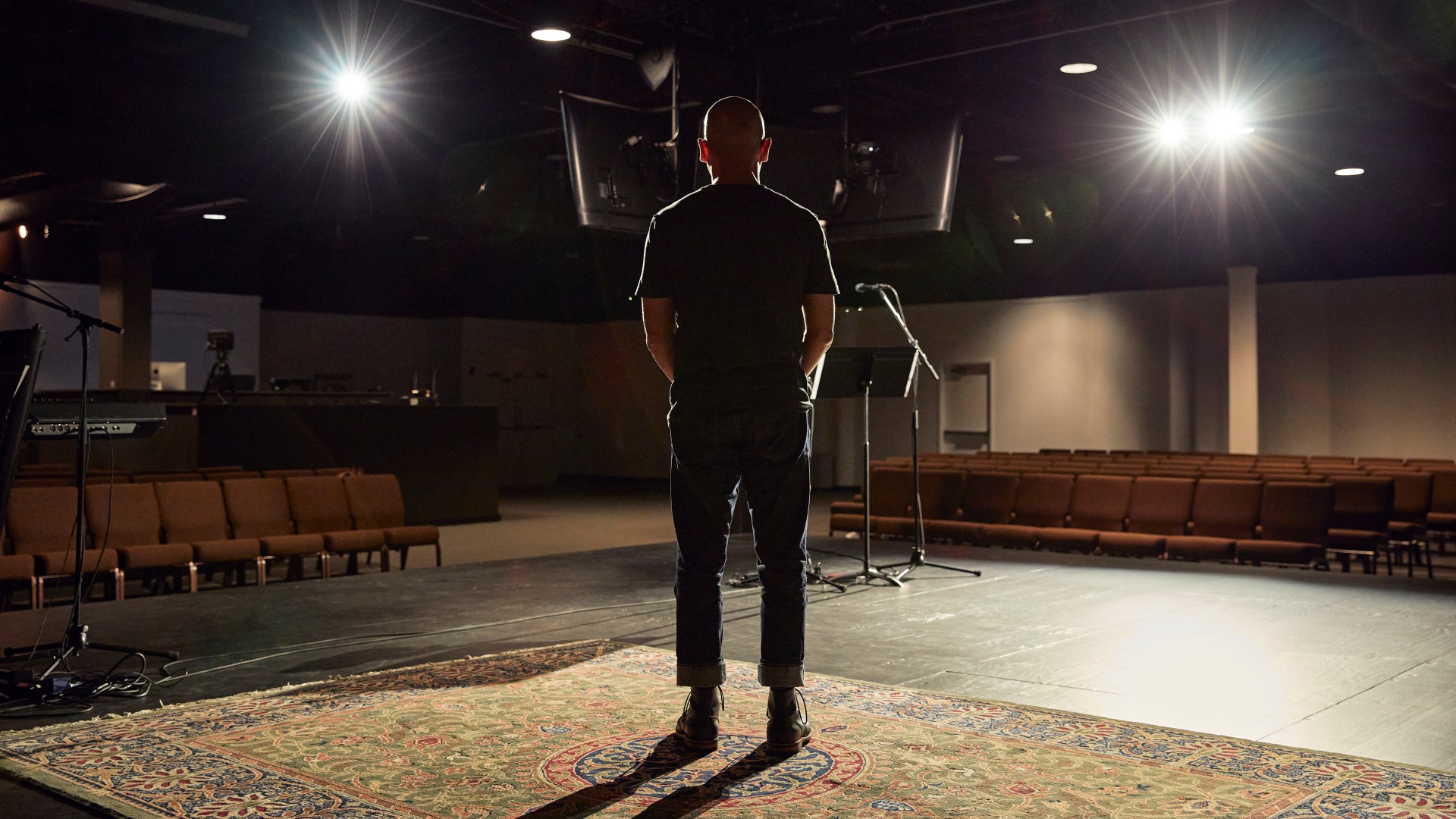
A lot of churches go through a stage of change when they get a new lead pastor. But Ted Kim actually wanted to change the stage.

The new leader of the Vineyard church in Evanston, Illinois, a suburb north of Chicago, wanted to get rid of it, just completely rip out the stage. Instead of the high platform at the front, he would put the stage in the middle of the sanctuary, with the seats arranged in a circle around it, so the congregation could see each other and participate with each other more in worship. The stage would also be lower, just a few inches above the ground, to reduce the elevation of the minister and the iconography of authority and power.

He’d been thinking about this for a long time—how to reorganize church. He thought about it as a kid growing up in the Korean Presbyterian congregation that his immigrant parents loved; as a college student in New York when he first experienced charismatic worship; in Chicago in seminary when he started to be discipled by the Vineyard pastor in Evanston; and when he got called back to lead that church in 2019.

Kim wondered: What would it look like for a church to be organized around the beauty of the Lord? What should church look like for a new movement of the Spirit for a new generation?

So when he had a chance to make changes in Evanston, he had a bold vision for what he could do. It was the kind of bold vision that the Vineyard, a charismatic denomination that started in the mid-1970s in Southern California, has long celebrated. People in the movement tell each other stories about leaders who didn’t wait for approval, call for a study, form a committee, or let themselves be checked by tradition or “how things are done.” They just listened to the Holy Spirit and did stuff.

So what Kim did next was surprising. He did nothing.

Not nothing. He prayed. And then after weeks or maybe months of praying, he started asking people what they thought about the organization of the sanctuary’s space. How did it shape worship? How did it form Christian community and people’s spirituality? He asked people what other forms of worship they’d experienced and what they thought of them. What could worship at Evanston Vineyard look like?

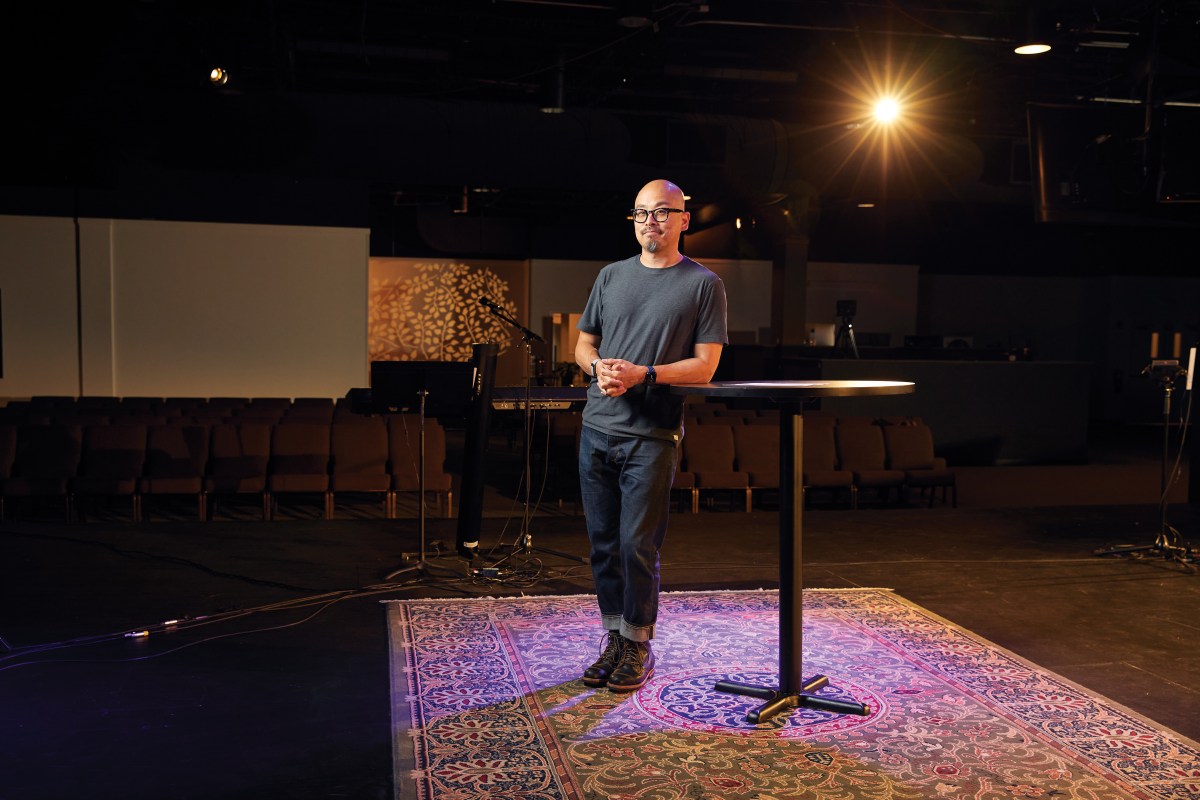
Pastor Ted Kim at Vineyard EvanstonKevin Penczak
Pastor Ted Kim at Vineyard Evanston

A transformation is coming to the Vineyard. More than 10 percent of the denomination’s 545 churches have gone through a leadership transition in the past year, according to official records. And more than a third of its senior ministers are over the age of 60, moving toward retirement. The founding generation is starting to turn things over, one church at a time.

In fact, this shift is happening across American evangelicalism. Baby boomers are stepping down. They were a large generation that exerted a lot of influence over evangelicalism and, more broadly, American approaches to doing church. But now, the institutions they built, the churches they grew, and the ministries they launched are being handed over to Gen Xers and elder millennials.

“It might be good, bad, or weird, but man, it’s happening,” said Jay Pathak, the Vineyard’s national director, himself a Gen Xer who took leadership of the denomination in January 2022.

Generational change happens so slowly it can be hard to see. A megachurch pastor announces the search for a successor, a TV ministry leader steps down, and a prominent Christian passes away, but the bigger picture of how things will be different remains elusive.

In the Vineyard, however, the broader developments have become very visible. Ever since the movement was started in the 1970s and grew rapidly in the ’80s, it has been defined, shaped, and shepherded by the generation that was born after World War II and came of age in the cultural upheavals of the 1960s. Many pastors in the movement planted their own churches and stayed at those churches their entire careers. Now they’re leaving almost all at once.

The new leaders are younger, of course, but they’re also more diverse. More are women and minorities. And they’re thinking about leadership very differently.

They’re more committed to collaboration, more interested in consensus, and more invested in team. They go slow. They do a lot of listening. Compared to their predecessors, they’re less focused on making decisions and being decisive. They think being a good leader means managing anxiety, holding it to create space for the Christian community to discern the leading of the Holy Spirit.

“Boomers were mostly asking, How do I get a wide-open space where I can flex and do my thing?” Pathak said. “Where, the younger a leader is right now, the more they want to be on a team. They want to use their gifts for something larger. … I think it looks like God’s kingdom—mutually submitting for the mission and what God wants to do. I think that’s the thing God is giving us the grace to do.”

It’s impossible to know for sure what this new generation of leadership will mean for the church in Evanston, the Vineyard, or evangelicalism more generally. But as Christians across the country reckon with historical abuses of power and as new pastors take their first steps and make first changes, there are indications the generational shift could bring what Pentecostals have sometimes called “a new rain.”

When Steve Nicholson and some friends started the church in Evanston in 1976, they had a pretty clear vision. They wanted a church they could stand. Mostly that meant guitars in worship and everyone wearing jeans.

“We fulfilled our vision on our first Sunday,” Nicholson said. “We really weren’t thinking further than that.”

They joined up with the Vineyard a few years later, though, and became a congregation that was defined by its willingness to say yes to the Spirit. That meant throwing a service open to prophecy, healing, or the Toronto Blessing and being the kind of church that would start new ministries in a day. The way the church worked, though, saying yes was largely Nicholson’s job, and then the rest of the staff and the congregation would figure out what that looked like in practice.

Once, for example, someone called the church and asked for the time of the Spanish service. They didn’t have one. Then another person called, and another, and another, all in a week, and Nicholson said he thought God was trying to tell them to start a Spanish-language service. So they did. Nicholson can’t recall exactly how they did that, logistically, but he was the one who said yes to launch the new ministry.

Rich Nathan, the founding pastor of Vineyard Columbus, the largest church in the Vineyard movement, operated very similarly. He said all the ministers in his generation wanted to start a new thing and thought it was important that they called the shots.

“There was an entrepreneurial spirit. A little bit of hippie rebellion,” Nathan said. “Nobody looking over your shoulder. Nobody telling you what to do. And for the boomers, it was like, why wouldn’t you want to start something new?”

The approach produced a lot of successes. Churches grew. Churches multiplied. They sprung up in places and communities where no one had previously expected.

But it became clear—to some sooner, some later—that the leadership of charismatic men who could be very decisive also came with costs. Too many leaders loved the power, and though they always talked about their leadership methods in terms of how effective they could be for the kingdom, there were abuses, misuses, and ugly efforts to protect that authority no matter who got hurt.

But even when that approach didn’t turn abusive, it wasn’t good for congregations. Too many Christians were taught to see themselves not as coheirs and full participants in the work of the church but as people who sat in a seat on Sunday. People who put their trust in the vision of leadership.

Jim Herrington, coauthor of The Leader’s Journey and a coach working with many young evangelical pastors, argues that the “command and control” model is a way of managing anxiety. It’s reassuring to have someone clearly in charge.

“It does turn anxiety down, but it doesn’t make good disciples,” Herrington said. “The pastors I work with are returning to the idea that ‘My job is to equip people to ministry. My job is not to do ministry.’ It’s a fairly large shift from ‘I’m the man’ to ‘I’m here to equip you.’ It’s the work of a generation.”

In Evanston, when Nicholson began the process of turning the church over to Kim, he knew the church had a discipleship problem. He was proud of the way the church had grown over the years and proud it had done so much work planting churches. By his count, Evanston Vineyard had 600–700 “granddaughter” churches. But the fruit of the harvest, in his judgment, was mixed.

“My generation had this idea back in the ’70s that if we could make church easy, make being a Christian easy, we could get more people to say yes to Jesus,” Nicholson said. “And it was enormously successful. ‘Come as you are’ was enormously successful. But that wasn’t supposed to mean ‘Stay as you are.’ We didn’t train people. We made it too easy and they became consumers of church. We need to rethink discipleship.”

He told Kim that he didn’t know what the church needed to do to change but it needed to change. Kim’s success couldn’t just be measured by his ability to keep things running as they had been. As they went into the period of transition (and the pandemic), Kim would need to think about something bigger and bolder than “carrying on.”

Pastor Ted of Vineyard Evanston rides to work on his electric scooterKevin Penczak
Pastor Ted of Vineyard Evanston rides to work on his electric scooter

At Vineyard of Hope, outside of Los Angeles in Walnut, California, pastor Kenneth Kwan gave a similar charge to Dennis Liu as they started the process of transitioning church leadership six years ago.

Kwan started the Chinese-language church in 1986. He can still remember how powerful it was to see the Spirit touch Chinese immigrants and how they were overwhelmed by the feeling of God’s love.

“Some people would weep,” Kwan said. “Then they wouldn’t come back to the church. It was too embarrassing. They would cry every time.”

For those who got over their embarrassment, the congregation became a spiritual home—and an oasis of Chinese culture as they adjusted to America, found work, and raised families. Over the years, though, Kwan worried about the congregation’s ability to be a home for the next generation. Many in the second generation see Chinese churches as sites of cultural heritage, he said, important to their parents but not really relevant to their lives in America.

So Kwan told Liu the church would need an English-speaking lead pastor and English-language services. He didn’t know what other changes Liu would need to make, but he charged him with figuring it out.

The changes he did make surprised the congregation. Liu has caused unexpected controversy as he’s tried to reduce his own authority and involve more people (and younger people) in decisions. To some in the church, he’s not being clear and decisive the way a pastor should be.

Kwan, though he admits he was also surprised, has backed Liu. He’s urged the older members of the congregation to trust Liu through their anxiety.

“I thought it was the language that was the primary barrier between the two groups, but I’ve learned it’s not the language only,” Kwan said. “We should be empowering the younger generation. It’s very different for us. It’s a difficult change to swallow.”

Julia Pickerill has faced similar challenges as she and her husband, Eric, have taken over leadership of Vineyard Columbus, replacing Rich Nathan. Their first step was to restructure how decisions were made. They wanted to involve more people, making the teams more inclusive and more diverse but also slower, more deliberative.

Some in the church have grown frustrated at how deliberative they became. The new pastors have been accused of being overly cautious, risk averse, and not bold enough to lead a megachurch in the Vineyard tradition, where leaders just do stuff.

But that’s not how Julia Pickerill sees it. To her, it seems like a discipleship problem.

“I regularly feel like people just want me to tell them what to do,” she said. “We have churches full of people who are keen to be told what to do. I’m much more interested in people doing the work and wrestling with what Christlikeness looks like. What faith, hope, and love would call them to do.”

As a leader, she and Eric also have a deep concern about power. They respect Nathan deeply and hold up his humility as an example they hope to emulate. But the record of failed leaders and abusive leaders, both in the Vineyard and in broader evangelicalism, is also pushing them away from the idea that the lead pastor should be the decider.

“Some of it is very intuitive for my generation,” Pickerill said. “There are things that are suspect for us: too much authority in one space that relies on the character of one person.”

Pastor Julia Pickerill preaching at Vineyard ColumbusSam Fahmi / Courtesy of Vineyard Columbus
Pastor Julia Pickerill preaching at Vineyard Columbus

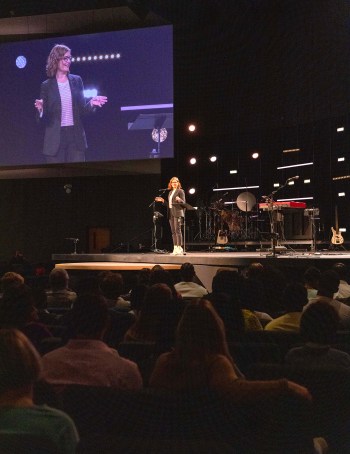
Since the transition, Vineyard Columbus has shifted to a preaching team model, so the congregation is not just hearing from one spiritual leader but a diversity of voices. Decisions are collaborative and involve more consensus.

The Pickerills are also talking about reducing the emphasis on the size of the church and the metrics of growth and developing other ways to measure spiritual health. They want to make spiritual formation a priority.

“If all you care about is engagement, that’s easy. I can get you that,” Julia Pickerill said. “But how does Christian formation work in a world where people are consuming so much content, so much of it that’s counter to Christian ethics, counter to patience, counter to self-control, counter to faith, hope, and love?”

There will, no doubt, be pressure to reassert authority and return to a command and control model of leadership, but the Pickerills believe it will be their job, as leaders, to resist that. They will work to hold the anxiety, sit with it, and help the congregation sit with it. They want to develop ways to disciple the church to follow Christ through anxiety.

As Kim likes to say, “Formation is mission.”

The Vineyard is going to be different than it was. A new generation of leaders is setting the stage for change—and in Evanston, they have changed the stage.

The church decided, after the process of discussing and considering the new pastor’s questions, to hire a construction crew to tear out the old platform. It happened during the pandemic. When in-person worship resumed, the stage was in the round, in the middle of the room, and lower to the ground.

“I thought it was so great,” Kim said. “We really made it a beautiful space, and it was such a strong visual cue that transition was happening, change was happening. And the space says to people, ‘You’re a part of this.’”

Of course, Kim doesn’t want to break with the church’s history completely. Christian faithfulness, he thinks, doesn’t copy the past, but it doesn’t abandon it either. The future of the church should rhyme with what has come before.

In Evanston, he wants the Vineyard to become a fuller version of what it was, a church known for saying yes to the Holy Spirit.

But he hopes it won’t be just him saying yes. He wants that yes to come from an empowered congregation, formed spiritually into people who pray, listen, and are oriented around the beauty of the Lord. He wants more collaboration. More consensus. More of everybody involved. He wants to be part of a growing community of Christ followers who take Jesus as an example of managing anxiety.

He hasn’t announced any more changes or set out a bold plan to enact this vision. But that’s not how Kim or the other ministers in his generation of Vineyard pastors lead. Instead, he’s asking questions.

What would it look like, he asks, to have a healthy team of ministers and church staff who don’t burn out, don’t become abusive, and don’t fall out of love with Jesus?

What would church leadership look like if the Spirit poured out, like in Acts 2, on sons and daughters, young and old, servants and everyone?

What would it look like, Kim wonders, if the people of God flourished?

Daniel Silliman is news editor for Christianity Today.

Cover Story

The Woman Who Gave the World a Thousand Names for God

How a British linguist and a failed Nigerian coup changed everything about Bible translation.

Illustration by Dorothy Leung

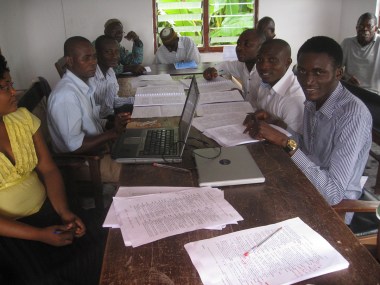
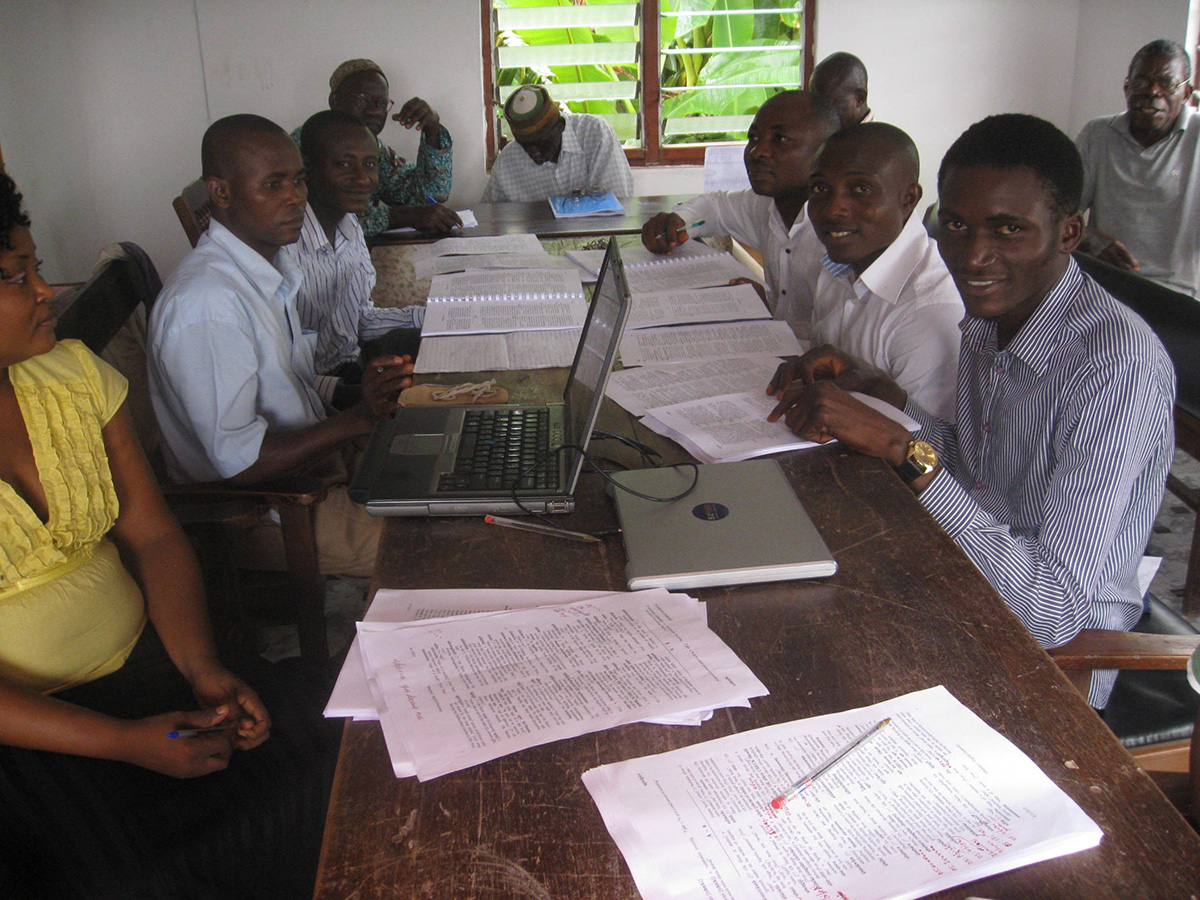
In July of 2007, Bible translators from a dozen Nigerian languages came together in the rural town of Bayara, Nigeria, for a three-week workshop to begin translating the Gospel of Luke. They gathered in a steel-roofed school building with a number of outside consultants—some Nigerian, others American and British.

At the end of Friday, July 27, they had wrapped up their first week of work and made plans to unwind. Multilingual collaboration is taxing, and everyone was eager to eat dinner and watch a movie.

The translators gathered their papers, books, and laptops into bags and slung them over their shoulders. One of them grabbed a USB thumb drive attached to a lanyard, which they used to pass files back and forth and store backups of their work.

They walked half a kilometer through the warm evening air to a guest house where they were staying near the local hospital. The cooler rainy season had just begun, but this day had been neither cool nor rainy.

The group finished eating around 7:30, and Veronica Gambo, the wife of one of the translation consultants, made popcorn. She filled a bowl and was carrying it out to join the others in front of the television when men with automatic rifles burst through a door into the kitchen.

Gambo froze. A man put a gun barrel between her shoulder blades and marched her, still bearing the popcorn, into the living room.

“Get down!” Danjuma Gambo, Veronica’s husband, remembers the men yelling. They fired shots into the walls and ceiling. They forced everybody to the ground, including the translation project’s leader, a silver-haired British woman in her late 60s.

Andy Kellogg, an American working as a Bible translation consultant, was lying on the floor and wondering: Would the men rob them and leave quickly, or do something worse?

“If you’re in a remote place, and it doesn’t seem like help will be coming quickly, you can take your time as a robber,” Kellogg said. “And we were in a remote place.”

Fortunately for the translators, the men were not religious terrorists. The brigands had come for the laptops. They took nine in all—and the translation work stored on the computers’ hard drives—along with personal belongings like passports and credit cards.

When the thieves left, the project leader, Katharine Barnwell, rose from the floor and dusted off her clothing. She checked with each translator to make sure they were okay. Then someone spotted something the thieves had overlooked hanging on a nail in the living room: the lanyard with the USB drive. The sole backup of their translation work.

Barnwell spoke in a matter-of-fact, British way: “Right. Well, we’re not going to let this stop us.”

Having worked in Nigeria most of her career as a linguist with the translation organization SIL, Barnwell had tallied her share of brushes with danger. Six times she was robbed at gunpoint. She’d survived multiple rounds of malaria. She had endured the constant threat of Boko Haram and terrorists who bomb churches.

Barnwell wanted to press forward with the project, and after some discussion, every worker decided to stay and continue the workshop. Within a few minutes, Danjuma Gambo said, the group burst into song, praising God and praying for a way to finish God’s work.

There was one difficulty: We have no computers, Kellogg thought. This is going to be really hard on Monday.

But on Monday, when they returned to work, they found that every laptop had been replaced. It was not the result of emails, funding requests, forms, or petitions to Western missions agencies. The computers were gifts from local Nigerian Christians.

News of the robbery had spread quickly, and “there were some influential people in churches nearby who donated,” Kellogg said. Local churches and benefactors wanted the translations to continue. They believed in the work and were driving it.

With the thumb-drive backup, Barnwell’s team quickly restored their work and picked up where they left off. They went on to finish the Gospel of Luke in each of the 12 Nigerian languages, quickly followed by 12 new translations of the Jesus film, whose script comes almost entirely from Luke. Many of those languages now have full New Testaments, according to Kellogg, and some have moved into translations of the Old Testament.

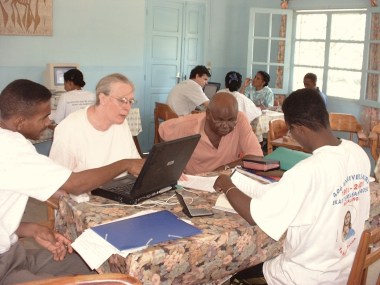
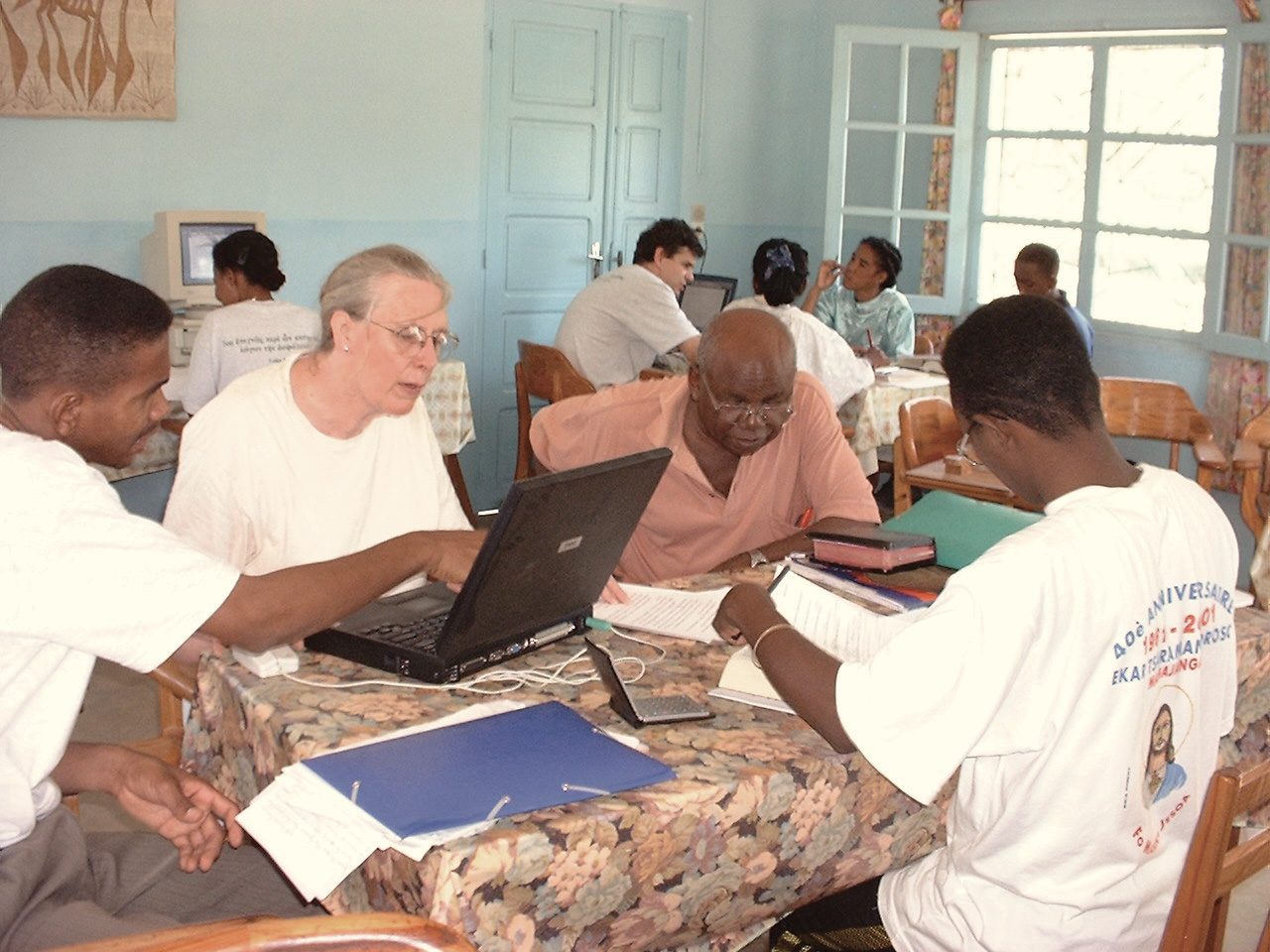
A “discover your language” workshop in Madagascar, where Barnwell worked with translators to  produce the Gospel of Luke in multiple languages, many of which would eventually develop into full New Testaments, 2001Photos Courtesy of Katharine Barnwell
A “discover your language” workshop in Madagascar, where Barnwell worked with translators to produce the Gospel of Luke in multiple languages, many of which would eventually develop into full New Testaments, 2001

The incident in northeast Nigeria is a freeze-frame from the great missiological shift that has been playing out over the past 50 years: the transfer of ownership from Western individuals and institutions to leaders in the Global South. The idea that Americans and Europeans are no longer in the pilot’s seat of the missions enterprise—and are being rapidly replaced by Christians in the majority world—is no longer new. It is taken almost as a given for how the gospel will spread in the 21st century.

Nigerian ownership is what saved the projects born from Barnwell’s workshop—or at least what helped them quickly back to their feet. And it was perhaps poetic: Barnwell, a Westerner, was one of the earliest champions of empowering Nigerians to take over translation work in their country.

In fact, it’s likely that no living person has had a greater influence on the world of Bible translation than Barnwell, who is now 84. But unless you’ve worked in the industry—I was a Bible translator when I first met Barnwell at a Texas conference a decade ago—you’ve probably never heard of her.

Katharine Barnwell was born in London in 1938. Her earliest memories take place underground, hiding from Nazi bombing raids. To escape the dangers of war, Barnwell and her siblings were sent away to live with family in the countryside, much in the way The Lion, the Witch and the Wardrobe opens.

As a child, and still today, Barnwell loved reading. In 1956, she enrolled in the English language and literature program at the University of St Andrews, one of the few British universities at the time with a large concentration of young women.

“I grew up in a churchgoing family, a very genuine churchgoing family. But it was only later,” Barnwell said, “through the ministry of the Christian Union when I got to university, that I came to understand what it really meant to follow the Lord.”

Around the time she was dabbling in linguistics in one of her courses, analyzing and diagramming the English language, Barnwell attended a meeting with George Cowan, then the president of Wycliffe Bible Translators International, who shared about the need for Bible translators.

“That was it for me,” Barnwell said. She began taking training courses with Wycliffe before she even graduated school.

In 1960, Barnwell began studying with the Summer Institute of Linguistics—known today simply as SIL—and was invited to return the following year to teach.

In her teaching, Barnwell focused on semantics. “It’s really the theory of meaning,” she explained. “When you’re translating, you’re not translating the words, you’re translating the meaning. So how do you translate the meaning, and how do you recognize the categories there are in meaning?”

When doing Bible translation, this distinction between language’s form and language’s meaning is not trivial. It’s at the very foundation of the discipline.

Barnwell’s early studies in semantics shaped the rest of her 60-year career. She spent much of those decades training others on the nuances of semantics and, critically, developing ways for people without a graduate-level education to understand it.

Almost inadvertently, she revolutionized the world of Bible translation.

Barnwell at home in Goring-on-Thames, England, where she  uses Zoom to continue work with colleagues in Africa, 2022Photograph by Michael Wharley for Christianity Today.
Barnwell at home in Goring-on-Thames, England, where she uses Zoom to continue work with colleagues in Africa, 2022

Barnwell moved to Nigeria in 1964. Newly independent from Britain and one of the most linguistically diverse countries in the world, Nigeria was a sort of promised land for translation. It has nearly 700 languages, and at the time, most of them did not have a word of Scripture. Many had never even been written down and lacked an orthography—a writing system fitting their sounds.

SIL sent Barnwell to the Mbembe, a people group scattered across villages in Nigeria’s southeast corner. She started from scratch.

“Happily, the people were very keen on me learning the language,” Barnwell said. She remembers a woman befriending her early on and teaching her new concepts. “The next day, she’d ask me again, and if I couldn’t remember, she’d say, ‘I told you that yesterday!’”

Barnwell said she quickly won the hearts of her Nigerian colleagues—referred to at the time as “language helpers”—and made a home there. (Today, she has spent more of her life in Nigeria than in the UK.) The future looked bright.

But in 1967, Nigeria exploded into civil war. What’s known as the Biafran War would claim well over a million lives through conflict and resulting agricultural catastrophe.

As Western missionaries left the country, Barnwell tried to remain. But the fighting drew so near that she and another single female missionary had to drop everything and escape. They fled first on foot, then up the Cross River via canoe to Cameroon, where authorities let them cross the border without documentation. From there the women flew to England and waited for it to be safe to return.

Barnwell made the most of her time in limbo. Equipped with her fluency in the Mbembe language and her field data, she completed her PhD at London University’s School of Oriental and African Studies (SOAS).

In 1970, she returned to Nigeria and to her translation work—only to be uprooted again half a decade later when a political event some 400 miles away set the stage for a reordering of the Bible translation landscape.

On February 13, 1976, Lieutenant Colonel Buka Suka Dimka and a group of his followers attempted a coup d’état in Lagos, then the capital of Nigeria. Though the coup was carried out by Nigerians, it inflamed suspicions about outsiders among Nigeria’s military rulers who thwarted the overthrow.

“Politically,” Barnwell said, “some people felt they didn’t want to promote the minority languages. Division between the different language groups or tribes was a sensitive issue. That was the main reason—there were people in authority who didn’t want to see that [promotion] happen.”

Two weeks after the attempted coup, Nigerian immigration officers met with the Western leaders of SIL and ordered them to appear in Lagos on March 18. When they did, they were given two weeks to wrap up their research and transfer it to a Nigerian university. All SIL linguists were to leave the country.
It was a sudden and astonishing setback that threatened to end translation work in what was arguably Africa’s most important field.

Nigerians and expatriate missionaries hatched a plan to save their work. They quickly assembled a delegation of influential Nigerians—politicians, business leaders, even Festus Segun, the Anglican bishop of Lagos—and pled their case with the government in Lagos: Could the work continue if they transferred full ownership and leadership into Nigerian hands? The government granted the request. Thus began the Nigerian Bible Translation Trust (NBTT), today one of the leading Bible translation organizations in Africa.

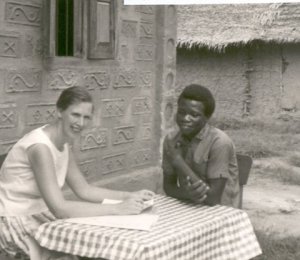
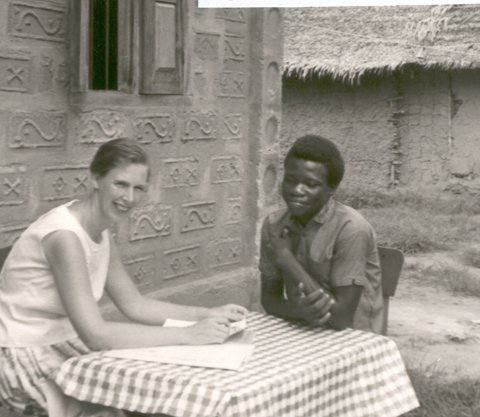
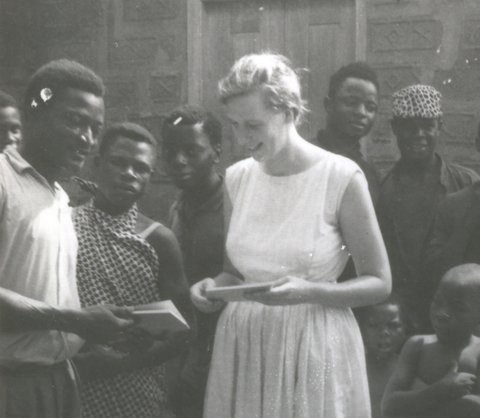
Barnwell in Ovonum, a village in Nigeria’s Mbembe area, with Livinus Enyam, who helped her learn the Mbembe language and begin developing an orthography, 1964Photos Courtesy of Katharine Barnwell
Barnwell in Ovonum, a village in Nigeria’s Mbembe area, with Livinus Enyam, who helped her learn the Mbembe language and begin developing an orthography, 1964

With the agreement, the translation leaders averted disaster. But that was the easy ask. They had a second request: If they were to lose dozens of Western scholars, could they keep a mere four expatriate workers? They might need to stay 20 years to fully train and transfer the leadership of the organization.

This, they knew, would be much harder for the government to stomach.

In the 1970s, translation agencies were dogged by rumors that their missionaries were cooperating with the CIA and other US government agencies to undermine local regimes. Translators in Latin America had come under particular scrutiny; some projects were shut down. The rumors followed them to Nigeria.

The Daily Times of Nigeria reported on May 6, 1976, that “the government felt concerned with the activities of the institute.” The Times tied the closing of SIL to the closing of something else: the “US radio monitoring base at Kaduna,” a facility widely known to be a US intelligence gathering operation.

I asked Danjuma Gambo about these allegations, which were never substantiated. “They were just using that as an excuse,” he said. The development of dictionaries, primary schools, and Bibles is a disruptive force, and for millennia, mother-tongue Scripture has irritated the powerful.

“They knew that the work they were doing—the liberation, the development of the local languages—was making people more aware of their rights,” he said.

Nigerian authorities granted the request to retain some foreigners, but only in part.

Three expats were given temporary visas, but only for a year or two. As the NBTT grew and took on exclusively Nigerian translators, only one expat would be allowed to remain long term.

Guess who they chose.

As the NBTT’s new chief trainer and Western linguist, Barnwell made her home in Jos, a temperate, mid-sized city in central Nigeria where the translation organization was headquartered.

But she had begun preparing for the role years earlier.

In the mid 1970s, Nigeria was the 11th most populous country in the world and growing rapidly (today, it ranks sixth). And in the postcolonial era, the African church was exploding. “Between 1964 and 1984 Christian numbers [in Africa] increased from about 60 million to roughly 240 million,” wrote Lamin Sanneh, the late Yale missiologist of Gambian descent. “The irruption of Christianity in contemporary Africa is without parallel in the history of the church.”

In Nigeria—particularly in the southern half, where the British had established numerous universities—many new believers were well educated, quadrilingual and pentalingual. If Nigeria needed scores of translators to bring the gospel to its hundreds of language groups, it wasn’t hard for Barnwell and some of her contemporaries to imagine where the workforce ought to come from.

For instance, John Bendor-Samuel, a founder of the UK arm of Wycliffe and a mentor of Barnwell’s, had in the early 1960s forged partnerships with universities in Ghana and Nigeria to do translation work, the first such arrangements on the continent.

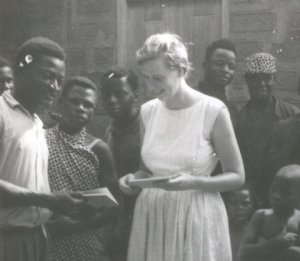
Barnwell showing a booklet written in Mbembe  to speakers reading their language for the first time, 1965Photos Courtesy of Katharine Barnwell
Barnwell showing a booklet written in Mbembe to speakers reading their language for the first time, 1965

In the early 1970s, Barnwell wanted to go further: She wanted to employ Nigerians who were not university-trained linguists, even if it meant teaching them herself.

Unfortunately, there were no tools on the market for that sort of thing. They hadn’t been invented yet.

According to Ernst Wendland, professor of ancient studies at the University of Stellenbosch and one of the world’s leading Bible translation scholars, none of the contemporary published training materials were any good—not for nonlinguists. So Barnwell, several years before taking on her training role with the NBTT, had begun writing her own training curriculum and teaching her first Nigerian translators.

Barnwell leaned on the linguistic theory of influential thinkers like Eugene Nida, Charles Taber, John Beekman, and John Callow. But while they published almost exclusively for the academically fluent, Barnwell translated lofty ideas for people who had never studied linguistics.

For instance, where Nida proposed the hugely influential theory of “dynamic equivalence,” Barnwell coined the term “meaning-based translation”—a simpler and less intimidating door to the same concept.

The training was a clear success. As more and more translation leaders began exploring the idea of training nationals, Barnwell was asked to turn her course into a book. In 1975, she published Bible Translation: An Introductory Course in Translation Principles.

Not everyone in the translation world was smitten with the idea of equipping first-language workers to lead projects. William Cameron Townsend, who founded both Wycliffe and SIL, rejected the notion of having “tribesmen” take charge of translation efforts, believing that Westerners had an obligation to lead the work and not “pass the buck [and] let the nationals do it.”

But in Nigeria, the government was forcing Western hands. And no one was as well positioned as Barnwell was in 1976, when Nigeria purged itself of lettered Western linguists, for the monumental training task that lay ahead of her.

Nearly half a century and four editions later, Barnwell’s book is still the gold-standard manual for training first-language translators (formerly called mother-tongue translators) the world over. I used it in my trainings overseas when I worked as a translation consultant. So has every Bible translation worker I interviewed for this article. (Danjuma Gambo was teaching from Barnwell’s text in Nigeria when he stepped away to speak with me via Zoom.).

Other organizations eventually developed competing materials, according to Wendland, “but none to my knowledge have really succeeded in replacing or in doing something better” than Barnwell’s.

Today, the textbook itself has been translated into more than a dozen languages. It’s given away digitally to pretty much every translator associated with mainstream Bible translation organizations.

“In the old days, you’d have a translation workshop where you’d have someone teaching on semantics, someone on lexicology, some on syntax, some on discourse, and then you’d expect the translators to go out and apply that themselves in their actual work,” Wendland said. But when they opened the Scriptures to begin, they were at a loss. “That’s not the best way to teach translators.”

Instead, Barnwell taught translators to learn by doing. If the old model was deductive, hers was inductive. Barnwell invited first-language speakers to wade into the Bible like swimmers and paddle, becoming skilled in semantics and discourse and other fancy disciplines along the way—without necessarily knowing the names of those fields. In a sense, she discipled her students.

It might seem obvious in light of today’s learning theories, when we just seem to know that you wouldn’t teach swimming on a chalkboard. But at the time, Barnwell’s training was revolutionary, and it multiplied in ways she couldn’t have imagined.

In 1978, Barnwell published the second edition of her book, and shortly after, she began a meteoric rise in the translation world. By 1980 she was overseeing all of SIL’s projects in Africa and spent a dizzying decade crisscrossing the continent, teaching in the UK, and completing the Mbembe New Testament that had been her career’s first love.

Around 1984, Barnwell remembers, is when her book and methods began to see widespread use outside of Africa. As translators trained on her book went on to become consultants and trainers themselves, they spent careers doing the work and raising up new students, who did the same.

Larry Jones, CEO of the translation organization Seed Company, estimated that in Asia, Africa, and Latin America, the translators trained on Barnwell’s materials number in the thousands.

To glimpse the full impact of Barnwell’s methods, you have to look not only at her books, but at film. The Jesus film.

For the first 20 years of its existence, the Jesus Film Project, the ministry that distributes the 1979 movie depicting the life of Christ, did not do its own translation work. Instead, it “relied on the people who worked on a translation to work on the script for us,” said Tom Meiner, the project’s chief operating officer.

When the Jesus film staff wanted to expand into a new language, they would reach out to translation agencies and ask, “Do you have anybody? Are you working on this language? Do you have somebody who could work on the script?” Meiner said.

If they heard back at all, they were normally pointed in the direction of a Western missionary. Often, Meiner said, that missionary had since retired or moved on to another project. Or they were dead.

Chris Deckert, the film’s director of language strategies, said that if they found a willing translator, they would send “an Excel spreadsheet with a little manual that said, ‘Hey, missionary, if you could translate these lines here into these lines here, and try to keep the syllable count as close as possible because this is lip-synched…’”

The process was cumbersome. “We’d send off that packet, and maybe a year, two, or three, sometimes they’d get back to us,” Deckert said. The work that did come back could be unpredictable and low quality.

The group wanted to “move forward on languages that had no Scripture and no Jesus film,” Meiner said. “The largest ones that we could get going.” But that would mean doing original translation work, something they were not equipped to do.

In the late 1990s, Paul Eshleman, the Jesus film’s first executive director, met with leaders from Wycliffe and SIL. He cast the vision for a partnership to create a version of the film for each of the 30 largest remaining languages that did not yet have a word of Scripture. The translation agencies would do what they do best, and so would the Jesus film crew. Eshleman offered to fund the 30 projects, to get them moving quickly.

It was ambitious and experimental, and the big agencies were reluctant to get tangled up in it.

“At that time, no one was willing to let this be in their house. There was no home for this effort,” said Seed Company’s Jones, who was also a former vice president at SIL. “Wycliffe wasn’t sure they were ready to do it. SIL was sure they weren’t ready to do it.”

The leaders suggested a young translation organization that might be a better fit, Meiner remembered. It was called Seed Company.

Back then, Seed Company was a startup, birthed in a converted broom closet. “The skunk works of the Bible translation world,” according to Deckert.

Founded in 1993 by a former Wycliffe president, Seed Company was hungry to prove itself. Its focus was on passing the translation baton to the global church and channeling funding to employ national translators instead of Westerners. It jumped on the Jesus film opportunity.

The plan: Work simultaneously across dozens of languages, employ exclusively non-Western translators, and upend how Bible translation had been done for centuries. What could go wrong?

The risk of embarrassing failure was high. They needed a leader fit for the task.

SIL recommended—who else?—Katharine Barnwell.

By then, Barnwell had moved to SIL’s Dallas headquarters and was serving as the organization’s international translation coordinator, arguably the top technical position in the Bible translation world. She was flying from Pakistan to Peru to Papua New Guinea, advocating for the national translators she was training and checking in on hundreds of projects.

Henry Huang, the former director of global strategies at American Bible Society (ABS), told me that to some, Barnwell’s transition to this newfangled film project looked like a demotion.

Barnwell volunteered for it.

In 2000, Barnwell gave up her desk and moved back to Jos and to the NBTT offices in her adoptive Nigeria. There was no better place to test out the film partnership than in the language-rich, population-dense Nigeria.

Because the Jesus film script comes almost entirely from the Gospel of Luke, the film can be adapted quickly once a translation of Luke is finished. Instead of diving into full New Testaments, the norm for that era, Barnwell planned to assemble translation teams from dozens of languages and start them on Luke. Instead of waiting decades for a completed New Testament before producing a new film script, they would only have to wait months.

But Barnwell had something else she wanted to test in Nigeria.

Though she’d long championed the potential of national translators, she wanted to explore how they could work better. Rather than training one translation team at a time, which was the usual practice, why couldn’t she train multiple teams at once? Could she get them started on six languages at once? Twelve? What about 25?

With that question, according to the University of Stellenbosch’s Wendland, Barnwell became one of the early pioneers of what translators call the “cluster model,” a practice that has arguably done more than any other innovation to accelerate the pace of Bible translation around the world.

In this model, translators from dozens of languages across Nigeria descended on the NBTT offices.

Representatives from different Mbembe dialects continue work on the Mbembe dictionary, 2010Photos Courtesy of Katharine Barnwell
Representatives from different Mbembe dialects continue work on the Mbembe dictionary, 2010

After they learned from Barnwell and other trainers, they learned from each other. By sharing notes and ideas in related languages, dialects, and trade languages, they translated in community. They collaborated on difficult concepts and passages. Solutions flew across related languages.

In only weeks, they developed orthographies for languages that had never been written. In less than three years, they completed the Gospel of Luke in several languages. After that, they could adapt, syllable match, and record and edit the Jesus film in a new language in only a month.

Although a number of translation consultants around the world were beginning to explore the cluster approach in the late 1990s, multiple people I interviewed said Barnwell was the first to systematize it and apply it at such a large scale.

The Jesus film’s translation project helped revolutionize Scripture use, Deckert told me. Some Bible translators labor for 30 years to produce a New Testament that nobody cares to read. But with the local churches driving the process, local believers took pride in the project and then used the film and Luke for evangelism, preaching, and teaching. Many of those Luke partnerships went on to become larger projects: full New Testaments, audio story sets, audio Bibles, and even full Bibles.

Within a decade, “it was working all over the world,” Deckert said. Around 2012, the Jesus Film Project adopted Barnwell’s model across the globe as its standard method.

“We almost tripled the number of Jesus films produced per year,” Deckert said. “It was just crazy.”

They were no longer working in languages with existing Bibles; the growth was happening in languages without a single written word of Scripture, or without any writing system at all. What Barnwell accomplished “is still regarded as nearly miraculous,” said Jones, the Seed Company executive.

Today, the Jesus Film Project has produced 2,005 translated editions. In 2010, they were coming together so quickly under Barnwell’s model that Deckert had to set a new goal: to produce the film in the world’s 865 remaining languages that have over 50,000 native speakers but no Scripture. Even despite the disruptions caused by COVID-19, he says they’re on track to hit that target in the next three years.

The Jesus Film Project says more than 633 million people worldwide have “indicated decisions for Christ following a film showing.” More than half of those—361 million—were counted after the ministry began using Barnwell’s methods, according to its records.

Even with some padding for optimism, that’s a remarkable number. By comparison, nearly three million people are estimated to have become followers of Jesus after listening to Billy Graham’s sermons.

But if you’re the type that’s suspicious of conversion statistics, you could attempt to size Barnwell’s legacy in terms of Bible translations.

Using conservative estimates, the number of languages in the world with full Bibles has more than doubled in the past 25 years, from 308 in 1996 to 717 as of 2021, according to Wycliffe UK. This happened when Barnwell’s trainees and methods were already in full force. Her book was 10 years into its third edition by then, used around the globe.

Since then, the number of New Testaments has exploded, and the number of languages with portions of Scripture (but not yet a complete New Testament or Bible) has increased by 2,000.

According to Wycliffe UK, “there is also active translation or preparatory work going on in 2,617 languages in 161 countries. Wycliffe and its partner organization SIL are involved in about three-quarters of this work.” Not to mention their other partner organizations that use Barnwell’s teaching and are staffed by her trainees.

“I don’t think there’s anyone in SIL, Lutheran Bible Translators, UBS [United Bible Societies], the Seed Company, Pioneer Bible Translators—any of those—who have not been in contact with Katy’s thinking, writing, and teaching,” Lynell Zogbo, an author and retired translation consultant in Africa, said in a 2020 interview.

Even translation projects not directly interacting with her materials still swim in the global currents set by Barnwell’s training, teaching, shepherding, students, methods, and journal articles. Hundreds of millions of new global Christians are taught with Bibles that might not exist without her.

“Her fingerprint is everywhere,” Deckert said.

Has there been a single translator in church history with Barnwell’s sway? We could talk about Jerome and his Latin Vulgate, used by the Roman Catholic Church as its principal translation for over 1,500 years. There was Luther and his German-language Bible. There was England’s King James I, if you credit him for commissioning his KJV—or William Tyndale if you feel like the KJV was mostly cribbed from his work.

But in 200 years, when the beating heart of world Christianity thrums from Nigeria and China, the reach of those Bibles may pale beside the ones Barnwell equipped the Global South to translate.

I asked more than a dozen translation leaders, scholars, and practitioners: Has anyone in modern history had Barnwell’s direct impact on translation?

All reached a similar conclusion: “I can’t think of anyone,” Jones said.

Only two names were consistently mentioned in the same breath as Barnwell’s: Eugene Nida and William Carey.

Nida, the influential theorist, trained translators all over the world and is said to have helped shape translations in more than 200 languages. Like Barnwell, his influence transcended organizational boundaries.

Carey was a polymath—a linguist, a translator, an anthropologist, a publisher, a school founder, a seminary founder, and a translator of full or partial Bibles in 30 or more languages.

I might add Kenneth Pike, the president of SIL from 1942 to 1979, a leading linguistic scholar, and an early pioneer in the field of English as a second language, or ESL. According to SIL, he was nominated 16 times for the Nobel Peace Prize.

Not bad company.

She would die a thousand deaths if you put that in print,” said Teryl Gonzalez, a former student of Barnwell’s and now the strategic quality assurance development consultant at Wycliffe US.

Why not pose the question directly to Barnwell? Is it possible that she is as influential as everyone says?

“Well, it may be true,” Barnwell admitted over Zoom, frowning at the question. “But I don’t want to talk about that.”

Hannah Oyama, a Mbembe teacher, reads from a newly published Mbembe New Testament, 1985Photos Courtesy of Katharine Barnwell
Hannah Oyama, a Mbembe teacher, reads from a newly published Mbembe New Testament, 1985

She never worked alone, she said. All of her accomplishments happened on teams. She said it was simply a privilege to serve in what was so often the right place at the right time—to have been placed at the crossroads of history.

“She is the mother of Bible translation in Africa,” said Olivia Razafinjatoniary, a Malagasy language consultant serving across that continent.

For all of Barnwell’s titles, “Mother” is the one you’ll hear most often among those who know her—or “Mommy Katy.”

It’s not merely courtesy. Especially for the many women who have known Barnwell—who never married and has no children—the title is maternal.

In Razafinjatoniary’s case, Barnwell changed her life.

It was the year 2000, and Razafinjatoniary had just finished graduate studies in translation when she was on a bus in Nairobi, Kenya, and told someone who happened to work in Bible translation, “I really want to give back to the Lord what he gave me.”

Shortly after, Barnwell got in touch from her office in Nigeria about a project launching in Razafinjatoniary’s home country of Madagascar. Did she want to be trained?

“She would fly to Madagascar twice a year to train me,” Razafinjatoniary said. “I would observe her working, observe other consultants working. She was very encouraging, and she really believed in me from day one. That pushed me to where I am now.”

Razafinjatoniary dedicated her second master’s degree to Barnwell.

“My desire from day one was to become like her,” she said. “We have been in touch, even now. She knows all about us. We know all about her. When she’s sick, we know. When she’s well, we know. When she’s traveling, we know.”

For Barnwell, her colleagues are her family. “They were the children God gave her,” Jones said.

Consider, for example, a typical month in Nigeria as painted by Gonzalez from her time working with Barnwell: Eighty translators from 25 different languages might converge upon Jos for one of Barnwell’s “one-book workshops.”

“Every one of those people saw her as a mentor, a mother, a benefactor in some way,” Gonzalez said. Barnwell was almost always wearing a light blue dress, and “every time you turned around, somebody was knocking on her door. Coming to greet. To express their affection.”

Barnwell had a reputation for forgoing creature comforts. She was known to sleep on hard floors when traveling and give colleagues food off her plate. She often put in 12-hour days—running workshops, making tea for visitors at all hours, and checking translated Scripture passages in between.

Her extended Christian family, built through countless such encounters, spans the globe.

Gonzalez told me that, at a recent Bible translation conference she attended, the emcee asked for a show of hands: Who in the auditorium had been personally shepherded, helped, trained, or ministered to by Barnwell?

Hundreds of hands shot up, belonging to translation leaders from every inhabited continent.

Gonzalez was one of them.

She had dreamed of becoming a consultant—training, teaching, checking passages—since she was 15.

Many years and a handful of graduate degrees later, Gonzalez did it: She became a consultant. While she was coming up, the minimum qualifications were “a million years” on the field as a consultant in training and preferably finishing your own New Testament.

“Like an oak, you just grow for 100 years and then you’re an oak tree,” she said.

Gonzalez’s second son, however, was born with serious medical issues that required her and her family to leave a translation project on the other side of the world and return to the States.

In a moment, she went from missionary to a “stay-at-home mom with preschoolers in suburban Seattle. Everything just stopped for a long time.”

But Barnwell was making a place for her.

During her time as SIL’s international translation coordinator in the 1990s, Barnwell had begun reducing the amount of time required in the field to become a consultant—from decades to only a few years. She wanted a new generation of first-language translators to rise through the ranks, and she needed Westerners to train them. As Barnwell saw it, if workers could prove their skills, why hamper them with the burden of fundraising for half a lifetime overseas?

The shift allowed for the formally educated Western Bible professor and the gifted national translator to both become consultants based on consistent quality work in the field.

All the while, the internet and communications technology were maturing. By the time Barnwell was running the Jesus film’s translations in the early 2000s, she felt that, in the age of videoconferencing and affordable laptops, translation consultants should not have to leave the profession to care for aging parents or sick children.

So she began inviting sidelined consultants back to work with her a few weeks at a time.

Before Barnwell, “most of these would go home and serve in administrative roles or recruiting roles or something like that, but she felt like that was such a loss of talent and resources,” said Huang, the former ABS director who had also worked with Seed Company.

It reopened doors for people like Gonzalez, whom Barnwell invited to Nigeria in 2010 to work there with her a few times a year.

Combined, the changes opened doors for workers from the Global South, hundreds of whom have been recognized and promoted in this modernized culture, Jones told me.

Barnwell’s long career training first-language translators and putting project ownership into local hands has born its fruit: Bible translation has become so thoroughly democratized that no one today seriously debates whether nationals should lead the translation process.

Instead, in an unrelenting push to make Bible translation faster and cheaper, new reformers have asked different kinds of questions.

Are trained translation consultants really necessary? Couldn’t thousands of passionate Christians sitting in internet cafes work together online to translate a book of the Bible from a major trade language into their first language?

Translation groups—including Seed Company and Wycliffe Associates—have dabbled with experimental approaches to rapid translation: things like wiki-style community translations; using artificial intelligence, software, and algorithms; or crowdsourcing rather than looking to trained workers or scholarly resources.

In an interview in the Journal of Translation, Barnwell criticized the constant quest for a “quick and dirty solution. … Quick translations without thorough grounding, careful study, and application of sound translation principles are just a waste of time.”

For the most part, the translations these experiments produced have been abysmal. But they have not been fruitless.

“One of the most effective things they were doing was energizing these local communities,” said Brian Kelly, Seed Company’s director of Bible translation exploration. “They’d say, ‘Hey, wow, we could all be a part of this.’”

Tim Jore works with unfoldingWord, an Orlando, Florida, group that helps churches around the world translate Scripture themselves. Jore believes the translation industry should focus less on minting new Bibles as if they were a product and focus more on empowering Christian communities to produce their own Bible translations. Historically, he argues, translation has been the work of the church.

“When a new English translation of the Bible is published,” Jore wrote in a widely shared paper, “the English lingual church does not look to translation consultants to approve it.”

English-speaking church leaders and scholars have the knowledge and the tools they need to approve their own translations. The global church should, too. And it could, Jore argues, if Bible translation organizations shifted their methods away from product-centered thinking and toward equipping the global church to manage its own quality assurance.

This approach is called church-centric Bible translation, and Jore feels it’s the logical conclusion of the changes Barnwell set in motion.

Her work “laid an important foundation for the next major transition in Bible translation that is happening all over the world today: Bible translation done by the church to meet their own theological and discipleship needs,” Jore told me.

When I asked Barnwell for her thoughts on church-centric translation, she was cautiously positive. “The focus on the involvement of churches in the receptor language area is not new and cannot be overemphasized,” she said.

But she also stressed the missionary importance of translation, “to explore what can be done to promote and support translation work in language areas where there are as yet no believers, no church.”

In other words, church-centric translation is great, but who will go to the places with no church? The great test of the church-centric paradigm may not be whether churches can translate Bibles for themselves, but whether they expand their translation efforts into regions where there are no believers—without the assistance of Western missionaries or the prompting of their translation organizations.

“We share the same goals,” Barnwell said, “to see high-quality translated Scriptures available for every language group as soon as possible.”

Barnwell herself has now become a beneficiary of the democratized translation culture she helped to create. It has served her over the past decade as she’s eased back down the ladder, slowly handing her leadership responsibilities over to a constellation of workers in Nigeria, the UK, and the US.

A number of years ago, she moved back to her UK home, Goring-on-Thames, about 50 miles west of London. She’s once again working with the Mbembe, the people she lived among when she first moved to Nigeria to translate the New Testament. Her earliest friends there are long passed, but the next generations of the local church—many of them raised on her New Testament—are collaborating with her on three related Old Testament translations.

Before the COVID-19 pandemic, Barnwell made regular trips to visit. But with her worsening osteoarthritis, she stays put in the UK and works through Zoom. She jokes that she “travels to Nigeria every day.”

To fill whatever spare time that leaves, Barnwell is also sharpening up her Hebrew and training two Nigerian consultants.

There’s debate among her colleagues over how many people it will take to replace her when all is said and done—if she actually retires.

“It hasn’t been without pain for her, but I have seen such a spiritual maturity and humility in her as she has navigated” stepping back, said Jones, the Seed Company executive.

In 2015, around the time Barnwell was relinquishing her leadership roles and passing the baton to national colleagues, the largest Bible translation organizations in the world, together responsible for about 85 percent of Bible translation worldwide, banded together to agree on what they called the “Common Framework.”

It was a kind of industry-wide best practices agreement. In short, it stated that instead of Western translation agencies running the process, the global church in its local manifestations would own, direct, perform, and be the “end users” of Bible translation. Locals would decide which Scriptures to translate, in what medium—audio, written, visual, or sign language—and in what order. Western partners would act in a consulting and helping role.

For those who worked with Barnwell, it might have all sounded like pretty old news. It’s what she’s been doing since the 1970s.

So, will she ever really retire?

“What else would I do?” Barnwell said. “Would I just sit and twiddle my thumbs? I enjoy my work, and I’m glad that I can still do it. And I’m very thankful that the physical problems of old age are not in my head so much as in my legs.”

But say, for argument’s sake, that she did retire. Is there possibly anything more the African continent and the world’s hundreds of remaining Bibleless peoples could ask of her?

Larry Jones remembers a story.

He was crammed into a car with a few too many people riding from Jos to Abuja, Nigeria’s current capital. Barnwell was sardined next to him. At one of the many military checkpoints that lined the highway, a soldier with an automatic rifle on his shoulder halted the car.

He scanned the passengers and began to interrogate the driver. The tone was tense. The soldier bent down and scanned the passengers again, catching someone he seemed to have missed the first time.

“He leaned over, with his head into the window,” gun barrel trailing him into the car, Jones said. When the soldier’s eyes landed on Barnwell, “his demeanor changed almost 180 degrees.”

The soldier flashed a huge smile and said, “Pray for us, Mother.”

Jordan K. Monson is an adjunct professor at the University of Northwestern–St. Paul, a former Bible translator with Seed Company, and the pastor of Capital City Church in St. Paul, Minnesota.

Church Life

Brother Andrew Changed Me. His Approach Can Change India.

Gandhi wanted Christians to live more like Jesus. “God’s smuggler” showed me how.

Brother Andrew

Brother Andrew

Christianity Today September 30, 2022
Open Doors International

“You must change your thinking,” Brother Andrew told me when we first met.

He was responding to my “rockstar” reaction as I finally encountered one of my heroes, at a lunch buffet in South Asia in 2000. Like a super-fan, I had blurted out, “I never thought I would meet you.” His response was swift, on point, and left me pondering.

That was the man: simple, straight-forward, and leaving a large impression. Dressed in a T-shirt and shorts, Brother Andrew listened intently as I recounted my story of how his life had inspired my own journey into Christian ministry.

It was the first of many meetings I was privileged to have with him over the following 15 years. Each committed to my journal and fresh in my memory, even as I process the news that this mighty man of God has gone to be with his maker whom he loved and served, never wavering from the call to “strengthen what remains and is about to die” (Rev. 3:2).

Brother Andrew was called by God as a young man to go into closed countries and to minister to the church where it was oppressed and lacked resources—especially Bibles. I remember hearing from him that anyone could do what he did, because the power of God was the same. He often said that God has called us to go with his gospel, and that all doors are open to the good news of Jesus Christ. He enshrined this in the name of the organization he founded: Open Doors.

What began as a Scripture distribution agency has now transformed into a massive international organization also involved in training, socioeconomic development, research, and advocacy across 60 nations. But its focus continues to be the persecuted Church.

I remember Brother Andrew asking us if there was any region where the gospel is not allowed. “I will tell you how to get there,” he said. “You may not come back, but you will get in. God asked us to go, and did not say ‘Go and come back.’”

When we spoke about the risks he had taken, Brother Andrew responded that it would have been a far greater risk not to do what he did—because that would have meant abandoning the body of Christ behind closed borders. “Every place is dangerous,” he told us. “Every place outside the will of God is dangerous.”

Brother Andrew believed in going because he believed in presence. At the beginning of his ministry in Warsaw, he preached at a local Baptist church. He recounted that the pastor later told him that his being there was worth more than the best sermons. “If being there is the answer,” he said, “then anyone can do what I did.”

May we never lose focus of this: that more than money and other resources, what the persecuted church needs most is presence and solidarity. It is comparatively easier to give money than presence, and both are important; but presence can make the difference between life and death. Today, when persecution is on the rise globally and in India, this is a lesson the church must remember.

Brother Andrew and Vijayesh LalCourtesy of Vijayesh Lal
Brother Andrew and Vijayesh Lal

When Brother Andrew spoke, one was astounded by the radical faith he had. It was infectious. He was not the most talented preacher that I have heard, but he has always been one of the most effective. God used his words to pierce my heart on many occasions. I remember when a member of our group asked him what would he do if he lived his life all over again. He promptly said, “I would be more radical.”

This is what we need in India: not a faith that we are embarrassed of or hide, but a faith that is lived out fully.

After all, this is what Mahatma Gandhi advised E. Stanley Jones when the American Methodist missionary told the Indian independence leader, “I am very anxious to see Christianity naturalized in India, so that it shall be no longer a foreign thing identified with a foreign people and a foreign government, but a part of the national life of India and contributing its power to India’s uplift and redemption. What would you suggest that we do to make that possible?”

Gandhi responded: “I would suggest, first, that all of you Christians, missionaries and all, must begin to live more like Jesus Christ. Second, I would suggest that you must practice your religion without adulterating or toning it down. Third, I would suggest that you must put your emphasis upon love, for love is the center and soul of Christianity. Fourth, I would suggest that you study the non-Christian religions and culture more sympathetically in order to find the good that is in them, so that you might have a more sympathetic approach to the people.”

This was also Brother Andrew’s message: a life fully committed to Jesus and lived for him. He also saw no enemies, just people who needed the love and touch of Christ. “Beware of the enemy image,” he once told us. “Because you can never preach the gospel to your enemy. That is mutually exclusive. He is not your enemy; Christ died for him. How can he be your enemy.”

Brother Andrew often said that he was not “anti-anything” but was “pro-Jesus.” He also had a remarkable acronym for Islam that I greatly appreciated and spoke of his heart: ISLAM—“I sincerely love all Muslims.”

Much to the chagrin of many, Brother Andrew openly said that Osama bin Laden was on his prayer list. It was not a popular opinion, especially in the Western world. But he believed that one man with God is a majority.

If we do not go with the gospel, we will find that they will come to us with guns, Brother Andrew often said. “There is no fighting Jesus and there is no fight for Jesus. There is fellowship in Jesus.”

How I wish that the global church and the church in India catches this vision: that there are no enemies, but that Christ died for everyone—making them worthy of love and grace and a place at the table.

People like Brother Andrew and Mother Teresa see the reflection of Christ in everyone. The testimony of Mother Teresa was so impactful because her service was motivated out of love and compassion and out of a reverence for the image of God in every human. No wonder when she delivered a powerful statement valuing the life of the unborn in the presence of US President Bill Clinton and Vice President Al Gore—who did not share her beliefs on that subject—that Clinton, who spoke immediately after her, began by saying, “It’s hard to argue with a life so well lived!”

People in the world today are looking for what is real, for what is genuine, and they know an authentic life when they see one. Both Mother Teresa and Brother Andrew were the real deal because their convictions arose from love and were based on the lordship of Jesus Christ. The early church out-loved the people around them and that is what drew many to Christ. May we never lose focus of this.

I first learned about Brother Andrew after discovering his book, God’s Smuggler, in my father’s library. I had just come to faith a few weeks prior when God used another book—Peace with God, by Billy Graham—to answer my questions about life and the Christian faith. God’s Smuggler was the second book I read, and I was fascinated by the adventures of this ordinary Dutchman and his faithfulness and obedience to God.

I was a teenager, and I started making plans to go to the Worldwide Evangelization Crusade in Scotland, as Andrew had done, so that I could join him after in his mission to the persecuted Church. I had no idea how to go about it, and counselors including my pastor soon talked me out of it, charging me to first complete my education.

Many years later—still struggling with the question of whether to step into Christian service or not—when I finally surrendered myself to God’s will, I had no idea he would lead me on a path where in a few months I would be sitting across from Brother Andrew as a fellow coworker in ministry to the persecuted body of Christ.

At one of our first one-on-one sessions, I remember asking Brother Andrew about financial insecurity in ministry and how he had faced challenges on that front. It used to be a major worry for me. Here I was, an inexperienced young man starting in ministry, and there he was, a legend, and I am amazed that he took time to not only speak to me and counsel me but also shared his own experience to address my concerns.

He counseled me to trust God for my provision and that God will take care of the ones he calls. But he also narrated his own life experience, when his wife asked him if the needs of the family were not met, what would he do? He had answered, “I would go back to the factory.” But he encouraged me by letting me know that he never had to do so; God had always provided.

As someone who delivered the precious Word of God to the church that needed it the most, Brother Andrew understood the importance of reading and studying the Bible as well as other books that can educate and disciple the believer. “Go through the Word of God and let the Word of God go through you,” he would tell us. He used to say that every Open Doors base should have a modest library where people can read and learn about ministry and topics in general.

Brother Andrew was very well read and informed. That is what perhaps helped him to focus on areas where many were oblivious. From the Iron Curtain to the “bamboo curtain” of China, from the Communist context to the context of the Muslim world, he always sought to carry Jesus and his gospel to people in need. He believed in the ministry being “lean and mean” and was not afraid to explore new frontiers or to have views that were less popular.

As I look back today, I am thankful to God for Brother Andrew and his life. For his simplicity and his matter-of-fact attitude, but most of all for his example in his obedience to Christ that allowed him to impact millions.

When he was once asked what he would like his epitaph to be, Brother Andrew answered, “He did what he couldn’t.”

Vijayesh Lal is general secretary of the Evangelical Fellowship of India.

News

Don’t Leave Migrant Ministry to the Border

Q&A with Sami DiPasquale, head of an El Paso nonprofit, on what the surge of asylum seekers is like on the ground and how the church all over the country can help.

Migrants arriving in El Paso, Texas, attend a worship service at a church shelter.

Migrants arriving in El Paso, Texas, attend a worship service at a church shelter.

Christianity Today September 30, 2022
Mario Tama / Getty Images

Sami DiPasquale runs Abara , a ministry that works on both sides of the border in El Paso, Texas, and Juárez, Mexico. The ministry has served the surge of asylum seekers, a fraction of whom are now being bused and flown to New York; Washington, DC; Chicago; and Martha’s Vineyard in Massachusetts. Some migrants are glad for the free ticket ; others allege they were deceived about their destination. About 11,000 migrants have arrived in New York City since May, with the mayor saying that the city’s shelter system is reaching a “breaking point.” But for ministries at the border, this is business as usual.

Thousands of migrants cross the southwestern border each day, and the surge in crossings has led to a record number of arrests this year. About half of migrants arriving are allowed to stay in the United States and pursue asylum claims. The surges in crossings go up and down. Most of those seeking asylum now are Venezuelans, among the millions fleeing a socialist regime. Christian immigration experts and lawmakers from both parties have said that the border shows a need for more judicial resources to process migrants’ cases.

How should Christians think about the thousands of migrants at the border?

Through media and social media, it gets painted like most people are at one crazy extreme or another on immigration, when I think most people are trying to grapple with what they feel is ethically right and compassionate.

What’s our posture? It’s easy for us in the US, at least for those that have been in a stable environment for a few generations, to be thinking about it as “How does God tell us what we do for people that are arriving?” But in so much of the Bible, especially the Old Testament … The Israelites, they were the people on the move. It wasn’t just about receiving people. All of us have our own migration journeys—God with us on the move and then God with us in stability.

What are your staff and ministry partners in Mexico seeing?

They’ve been very busy ever since “Remain in Mexico” [the Trump administration policy that required asylum seekers to await the outcome of their cases in Mexico] went into effect, and then we layered it with Title 42 [a Trump and Biden administration policy to turn migrants away at the border based on COVID-19 being a public health emergency].

Basically, there’s various layers blocking people from accessing the US border. That did not decrease people leaving Central America—it stopped us seeing that crisis on US soil. It piled up on the southern side of the border into Juárez and other Mexican cities to the north.

It’s very dangerous for migrants there. For me to go across as a US citizen, there’s hardly any danger at all. I am not the target. Those who are most vulnerable are those who have the least resources, who have maybe made a terrible trek and are then getting extorted even more.

Three or four years ago, migrants were almost exclusively those from Central America, and then more came from other parts of Mexico, fleeing similar root causes, a lot of it gang violence. And then we saw more from Haiti, and now more and more from Venezuela.

These shelters in Mexico, almost all of them are evangelical churches that have opened their doors. And it wasn’t because they have this in their mission statement or they have all this extra space. It’s because they saw the need and they felt like this is what Jesus would want them to do. It’s a great sacrifice. People have come in and often stayed in a church sanctuary for months.

What do migrants arriving in the US think about these buses to other cities?

In other parts of Texas, some of the people were put on buses to destinations where they had no interest in going. It seems that there’s motivations other than helping people get to a sponsor family.

But the city of El Paso has been chartering some buses, and at least the stated intention is to facilitate distributing people from temporary shelter at the border to places that are closer to where they want to end up with their sponsor family.

Most people have a sponsor family that they can live with, whether they’re in New York, Chicago, Memphis—every state, practically. They have a destination and someone who’s agreed to host them while they go through the asylum process. That’s not the case necessarily with Venezuelans now. That’s becoming a challenge.

Why do Venezuelans need support in particular?

Most people don’t realize that you’re not allowed to legally work in the US while you’re pursuing your asylum case, at least for six months. So how are you supposed to support yourself? That’s where the sponsor family comes in. But then, if someone doesn’t have a sponsor family—which a lot of Venezuelans don’t—then what are they supposed to do?

Then you might ask, “If we have low unemployment and we have all these jobs that need to be filled, why not make it legal to have temporary work visas?” And I think that’s a very good question.

New York, where I live, is prepared for immigrants coming to the city, but maybe not for thousands showing up at once like happens daily in El Paso. What can churches around the country do if migrants arrive in their communities?

A lot of people that are arriving, probably all they need is one or two days of help. US churches can provide hospitality for up to 48 hours, sometimes even less—a shower or a change of clothes and then food. And then somewhere to sleep overnight. That’s pretty much the time that it takes for someone to get in contact with their sponsor family and get a ticket, whether a bus ticket or a flight for where they need to go. Typically the burden of the transportation is on the sponsor family.

Here, one church within the El Paso Baptist Association had space but not enough volunteers and resources to open their space locally as a hospitality center. Then the whole El Paso Baptist Association for the city [78 churches] took on recruiting volunteers and having a point person and providing donated items, like a travel bag or toiletries. So you have a whole network surrounding this one physical hospitality center.

What’s it been like in El Paso?

The last month was critical because there were too many people within the Border Patrol detention facilities. They were warning, “We’re going to have to release people onto the streets if there’s not enough shelter capacity.” A bunch of people opened up shelters, but there were still releases on the street. Now it’s not happening anymore. Whether it happens again in the future, I’m not sure. At Abara’s guesthouse, we hosted groups of about 15 at three different points.

You have the contacts to get texts about migrants needing shelter. How do churches in the rest of the country get in that phone tree?

Any of the groups involved in refugee resettlement are also working with asylum seekers who are arriving. So wherever a church is, if there’s a World Relief, a Catholic Charities, a Lutheran Immigration and Refugee Service, or Jewish Family Services, look for them.

If churches were interested in helping relieve, for instance, the pressure in El Paso and offer another site, then they could get in touch with Abara. There’s also more openness to creativity right now than any time that I’ve seen. I think ICE [the US Immigration and Customs Enforcement] would be willing potentially to say, “If there’s a church in Indianapolis that would like to receive 30 people, we’ll get them there.” I’m not promising that that could happen. But I think they’re willing to explore. It’s a tangible way for interested churches from around the country to get involved in ways that they haven’t been able to in the past.

So any church could potentially be a host of asylum seekers.

It’s cliché, but every church that hosts feels like they ended up being more blessed by the situation. So many of those who are arriving at our borders have such a deep faith and have had to rely on their faith in ways that the average person in the US hasn’t had to. Almost always when we’re in dialogue, unprompted they’ll say, “I could never have done this if God wasn’t with me on this journey.” And even through the atrocities, murder, sexual assault, brutality, the loss of kids, and all of that, they talk about their faith in God and love for God. God being present with them in the midst of hardship is so clear.

You’ve mentioned root causes of migration. How does the church think about this globally?

There are groups on the ground, in countries all around Latin America, doing incredible work and needing support. There’s a whole network that’s growing of evangelical churches in Colombia who are working with [some of the 2.5 million] Venezuelan refugees there.

A church in New York can support a church in Guatemala that’s doing work in their communities. And maybe they can help two or four or ten families stabilize and be in a situation where they don’t feel like they have to leave.

News

From the Archives: When Disaster Strikes

Five articles about control and God’s providence amidst natural disasters.

Christianity Today September 30, 2022
Nöel Puebla / Pexels

With a hurricane hitting the coast of Florida as well as the aftermath of a hurricane in Puerto Rico, a typhoon in Alaska, and a 6.4 earthquake in Taiwan, September has been a busy month of natural disasters around the world.

It can be overwhelming to think about the inevitability of earthquakes and storms. There is possibly nothing more unsettling than natural disasters to remind us of our smallness compared to nature’s great power.

These five articles remind us to put creation into the perspective of God’s providence. As Douglas Estes’s 2018 article states, “We grieve over the devastation wrought by storms … we do [what] we all can to help storm victims in Christ’s name, yet we still acknowledge even in our grief that ‘his way is in the whirlwind and the storm’ (Nahum 1:3).”

Click here for more from the CT archives.

addApple PodcastsDown ArrowDown ArrowDown Arrowarrow_left_altLeft ArrowLeft ArrowRight ArrowRight ArrowRight Arrowarrow_up_altUp ArrowUp ArrowAvailable at Amazoncaret-downCloseCloseellipseEmailEmailExpandExpandExternalExternalFacebookfacebook-squarefolderGiftGiftGooglegoogleGoogle KeephamburgerInstagraminstagram-squareLinkLinklinkedin-squareListenListenListenChristianity TodayCT Creative Studio Logologo_orgMegaphoneMenuMenupausePinterestPlayPlayPocketPodcastprintremoveRSSRSSSaveSavesaveSearchSearchsearchSpotifyStitcherTelegramTable of ContentsTable of Contentstwitter-squareWhatsAppXYouTubeYouTube