Inkwell

The Silence of Thomas Aquinas

Inkwell September 30, 2022
Photography by Cal Agro

There is a writing desk hunched like an ox
beside the bed they put him in. He asks
to go outside, and carried to the yard
he spends an hour beneath an olive tree
watching a novice build a wall from stones,
the young man’s tonsure still a little pink,
his soft hands chaffing red in cold, dry wind.
He thinks, None other than thyself, my Lord.
And then to prayer, a cup of wine, more prayer,
and rest, of sorts, if not a solid sleep.
In bed he thinks again about that wall,
the silent novice picking up a stone,
putting a stone back down, and doing both
as if preparing for a journey.

Benjamin Myers is a former Poet Laureate of Oklahoma and is the author of three books of poetry, including most recently Black Sunday (Lamar University Press). His poems have appeared in Image, The Yale Review, Rattle, 32 Poems, and many other places. He has written essays for many prominent venues, including First Things, The Gospel Coalition, The American Conservative, and Oklahoma Today. His first book of nonfiction, A Poetics of Orthodoxy, was recently published by Cascade Books. Myers teaches at Oklahoma Baptist University, and lives in Chandler, OK, with his wife and their three children.


Theology

Christian Nationalism Cannot Save the World

Do not fall for secularism disguised as a kind of Great Commission.

Christianity Today September 29, 2022
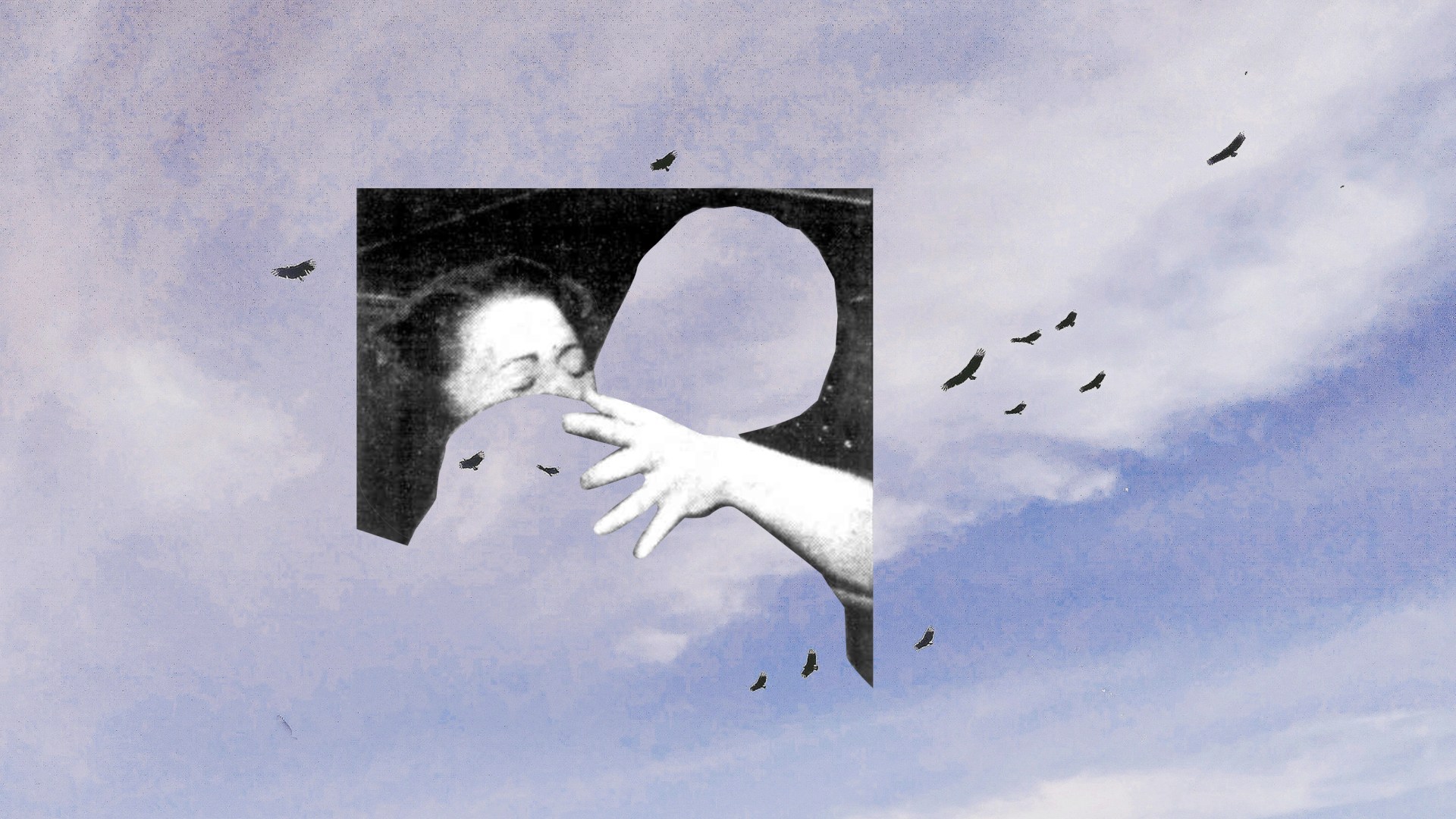
Illustration by Mallory Rentsch / Source Images: WikiMedia Commons

This piece was adapted from Russell Moore’s newsletter. Subscribe here.

Just as some North Americans are explicitly claiming the label of “Christian nationalism,” the ideology is advancing around the world.

The ongoing near merger of the Russian Orthodox Church with Vladimir Putin’s authoritarian government made headlines when the church’s patriarch declared that dying in Ukraine as part of Putin’s invading army “washes away all sins.” At the same time, yet another populist leader employing Christian nationalist rhetoric won an electoral victory in Italy.

With these in mind, perhaps the world’s evangelical Christians should remind ourselves that Christian nationalism can’t—and won’t—save the world.

Analyzing Giorgia Meloni’s win, commentator Damon Linker noted that her Brothers of Italiy party—with roots in the World War II remnants of the fascist strongman Benito Mussolini’s political movement—has significantly moderated its rhetoric in recent years. Some might view that with suspicion given Meloni’s post-election speech in which she blamed “financial speculators” for robbing Italians of their roots and identity—language that throughout history has almost always been equated with Jews.

Regardless of just how illiberal the new Italian government might be, Linker calls attention to the demographics behind this electoral upset, which have implications for the rest of the Western world. The populist movement, as represented by the triumphant party, is cemented with a particular form of religion—namely, “those who declare themselves to be religious but are not practicing.”

For some people, such a category sounds like “those who declare themselves employed but have no income.” And yet, as historian Adam Tooze observes, this group is not just the largest segment but the majority of the Italian population—at 52 percent. They are the people, Linker writes, “who treat religion as a symbol or identity-marker without actually believing in or practicing it.”

Linker warns those who, like him, are on the center-left or center-right that if they cannot win back working-class people, they will continue to lose to populist and nationalist movements. But he also makes the case that no one can win if they cannot appeal to “the nominally religious.”

In terms of political science, Linker is no doubt correct. And even if democracy and global stability were the only things at stake, this would still be a debate worth having. For evangelical Christians, though, much more is at stake—namely, what we mean when we say “Christianity” in the first place.

The term Christian nationalism refers to the use of Christian words, symbols, or rituals as a means to shore up an ethnic or national identity. As with every other ideology, it exists along a spectrum.

On the (so far) less extreme end are people who, like the populist leaders in Italy and France and Germany, claim “Christianity” as a key aspect of their national or ethnic identity—and as a way to distinguish their group from those they define as outsiders (Muslims, “globalists,” etc.). At the more extreme end are people who make explicit theological pronouncements as a prop for ethnic and nationalist authoritarian illiberal aggression—as Russian Orthodox patriarch Kirill did in seeking to quell protests against the war by saying that “sacrifice in the course of carrying out your military duty washes away all sins.”

In terms of the world order, one side of the spectrum clearly does more immediate damage. Kirill’s comments are synonymous with, if not identical to, radical jihadist Muslim clerics telling suicide bombers that upon death they will be greeted by virgins in paradise. That sort of promise might not only motivate desperate people to commit atrocities against the testimony of their own consciences but also give unquestionable authority to those commanding such atrocities. Indeed, in the authoritarian’s view, such an alliance of religious and political authority seems to grant him the “keys of the kingdom,” where whoever is drafted on earth is drafted into heaven.

This dynamic is hardly new. In the Book of Revelation, the political power of the Beast is propped up by the False Prophet, “who had performed the signs on its behalf. With these signs he had deluded those who had received the mark of the beast” (Rev. 19:20). Revelation, after all, came to John amid a Roman Empire where the caesars claimed divine status for themselves.

Such hubris would be bad enough sociologically, but what if the Bible is right about hell? What if the judgment of God comes not just against nations but against individuals? And what if sin is defined as a lack of conformity not to the group or the country but to the holiness of God? What if Jesus was right when he said that “no one can see the kingdom of God unless they are born again” (John 3:3)?

If so, then Kirill’s claim that nationalist militarism can save a person is not just manipulative but blasphemous. It empowers not just national injustice but also personal damnation.

Additionally, the truth of the gospel according to Jesus means that less bloody forms of Christian nationalism are also one birth short of the kingdom of God.

Indeed, the argument of the entire New Testament is that people cannot stand before God on the basis of ethnic, cultural, or even moral solidarity (Luke 3:8–9; Col. 2:16–22). No one stands justified even by the works of the law given by God, much less by the flesh of one’s temporal ethnic or national identity (Gal. 3:15–16). Each person must be joined to Christ by personal repentance and personal faith—not by living in a culture conformed to some external definition of “Christian values.”

Jesus taught us that nothing coming in from the outside can defile a person; rather, it’s what is within a person’s heart defiles him or her (Mark 7:14–23). That’s why he specifically walked away from those who wanted to use his gospel for political liberation (John 6:15) or for material prosperity (vv. 26–27).

Despite their self-perceived opposition to the social gospel of old, Christian nationalists embrace the exact same view of the gospel. For the social-gospel-oriented left wing, Christianity exists to build a social order in step with the upward progress of humanity. For the Christian nationalist right wing, Christianity exists to build a social order in step with national or ethnic identity. The gospel is a means for a forward-looking utopianism in the one case and a backward-looking nostalgia in the other. Christian nationalism is a liberation theology for white people.

And that’s not the gospel of Jesus Christ.

Christian nationalism is a kind of Great Commission in reverse—in which the nations seek to make disciples of themselves, using Jesus’ authority to baptize their national identity in the name of the blood and of the soil and of the political order.

The gospel is a means to no other end than union with the crucified and resurrected Christ who transcends, and stands in judgment over, every group, identity, nationality, and culture.

Christian nationalism might well “work” in the short term by cementing bonds of cultural solidarity according to the flesh.

Yet apart from the shedding of blood, there can be no forgiveness of sins. Apart from the Holy Spirit, there can be no newness of life.

Christian nationalism cannot turn back secularism, because it is just another form of it. In fact, it is an even more virulent form of secularism because it pronounces as “Christian” what cannot stand before the judgment seat of Christ.

Christian nationalism cannot save the world; it cannot even save you.

Russell Moore is the editor-in-chief at Christianity Today.

News
Wire Story

Even in States with Bans, Christian Clinics Continue Post-Abortion Care

Some women who travel out of state for the procedure still rely on local pro-life pregnancy centers for support in the aftermath.

Christianity Today September 29, 2022
Zak Koeske / The State / Tribune News Service via Getty Images)

A young woman, pregnant and scared, entered the Women’s Resource Center in Mobile, Alabama, on a Tuesday. The pro-life clinic confirmed her pregnancy, diagnosed her with a sexually transmitted infection (STI) and scheduled her for an ultrasound.

But by Thursday she was in Atlanta for a chemical abortion. (Abortion is banned in Alabama except when the life or health of the mother is endangered.) By the following Monday, however, she was back in Mobile, bleeding from her abortion and asking the Women’s Resource Center for help. She said an Atlanta abortionist had told her the STI didn’t matter; she just needed to make sure the abortion medication worked.

The situation filled Women’s Resource Center clinic director Deanna Montieth with both anger and compassion: “I just want the absolute best care and for these girls to make an informed decision—their own decision—knowing the long-term consequences.”

Research shows that for women who have abortions with untreated STIs, “the infection can rapidly spread,” Montieth said, “and 30 percent of them can develop pelvic inflammatory disease within a year.”

Montieth’s story isn’t an isolated incident. As abortion restrictions tighten in some conservative states following the US Supreme Court’s overturning of Roe v. Wade, crisis pregnancy centers in those states report an increase of women who went out of state for abortions and were given inadequate post-abortion care. Many of those women are turning to the pro-life movement for medical and emotional support.

“We’ve seen an increase in women coming back with a lot of needs–physical, emotional, and spiritual,” said Anne O’Connor, vice president of legal affairs for the National Institute of Family and Life Advocates (NIFLA), a network that supports crisis pregnancy centers.

Thirteen states have effectively banned abortion since the Supreme Court ruled there is no constitutional right to abortion, according to a New York Times tally. Those bans have prompted some companies to begin paying travel expenses for employees who seek out-of-state abortions. Among those compares are Starbucks, Amazon, Disney, and Facebook’s parent corporation Meta.

California Gov. Gavin Newsom’s reelection campaign purchased billboard space in conservative states this month inviting women to travel to California for abortions. One ad pictures a woman in handcuffs and states, “Texas doesn’t own your body. You do.”

The pro-abortion campaigns may be working. Even before the Supreme Court overturned Roe, women were crossing state lines increasingly for abortion. Nearly 1 in 10 abortions in 2020 were performed on patients who crossed state lines, up 6 percent from 2011, the Guttmacher Institute reported. Data is not yet available for 2022, but clinics in states with permissive abortion laws are claiming an influx of patients, NPR reported.

Pro-lifers are asking whether the situation opens a new ministry need.

NIFLA thinks so. Its national conference in October will include training on post-abortion assessments. The organization also sent a bulletin to member clinics this month stating:

Increased use of pills for abortions and the Supreme Court’s overturning of Roe v. Wade have greatly impacted the ways pregnancy clinics serve pregnant women. Promotion of abortion pills to terminate pregnancies by the US Health and Human Services (HHS) and pro-abortion groups continue to escalate, especially in states which have outlawed most abortions. The health risks to women are increasing as well.

Medical care isn’t the only concern. Post-abortion regret seems to be hitting women sooner than it used to, O’Connor said, noting that, historically, many women grapple with guilt decades after terminating their pregnancies. “Now [post-abortion recovery] programs are finding that women are coming 3-4 weeks after their abortion,” she said. “The regret is hitting them way sooner.”

The lack of post-abortion care for out-of-state patients could play into the hands of abortion advocates. They have argued for decades that outlawing abortion would leave women without adequate medical care. But O’Connor would turn the argument around on them.

“Shame on you,” O’Connor would tell abortion clinics. “You’re performing abortions and not doing any follow-up with women. They’re desperate and trying to find help. What other medical procedure is performed where there’s not some kind of follow-up?”

The lack of follow-up is being confronted at First Care Clinic in Madison, Wisconsin, where abortion is effectively banned and women drive to neighboring Illinois for the procedure. First Care CEO Sara Patterson said her pro-life clinic has seen more post-abortive women with complications in recent weeks.

“They’re being advised, when they contact their abortion provider, to return to the clinic,” Patterson said. “But sometimes that can be difficult” when the abortion was performed miles from home.

Patterson wants churches to know about the lack of follow-up so they can provide resources to show hurting women the love of Christ.

“We’re hearing from patients that the abortion clinics are offering them grants to pay for their abortion and to help them provide travel to get there,” Patterson said. “I think the church needs to rise up and say there will be equal or greater resources for those women who courageously choose life.”

Such resources might have helped a teenager in Mobile who wanted to keep her baby but was taken to North Carolina by her mother for a surgical abortion. The abortionist didn’t test or treat her for an STI, so she found herself back at the Women’s Resource Center in Mobile.

“The general public needs to be aware” of this issue, Montieth said. Congress should consider legislation regulating out-of-state abortions, and churches should “support the organizations that are on the ground” fighting for life–of babies and mothers.

News

The Light Force of God’s Smuggler: Arab Christians Mourn Brother Andrew

Leaders gathered at Middle East evangelical meeting recall his conversations and books that shaped their ministries.

Brother Andrew, founder of Open Doors

Brother Andrew, founder of Open Doors

Christianity Today September 29, 2022
Open Doors International

When “God’s smuggler” came to the Middle East, he went through the front door. Once known for hiding Bibles in the back of his Volkswagen when crossing behind the Iron Curtain, Brother Andrew instead simply handed them to terrorists. Coupled with his devotion to the Palestinian church, the founder of Open Doors shook the Western Christian status quo.

Arab evangelicals loved him for it.

“He had a soft heart for those in pain, the persecuted, and those usually considered on the other side, the enemy,” said Jack Sara, general coordinator for the Middle East and North Africa Evangelical Alliance. “He was willing to step into a difficult place and talk with difficult people, but never compromise the message of the gospel.”

The news of Anne van der Bijl’s death Tuesday at age 94 shook participants during the second general assembly of the World Evangelical Alliance’s (WEA) Arab world region. David Rihani, president of the Jordan Evangelical Council, recalled the words of his father who received the Dutch evangelical frequently.

“This man is an example of a real Christian leader,” the first Jordanian evangelical pastor told his son. “He writes books, he shares knowledge, and he cares about everyone without discrimination.”

Rihani praised Brother Andrew’s ecumenical cooperation. Developing relationships with traditional Catholic and Orthodox leaders in the region, for decades Open Doors has chronicled persecution against all Christian denominations. And as the group’s advocacy across 60 countries grew to include the plight of believers in other religious traditions, the Bible smuggler won respect in the wider human rights community as well.

“He advocated tirelessly for religious freedom, a source of hope to persecuted Christian communities around the world,” tweeted US Ambassador-at-Large Rashad Hussain, a Muslim. “I’m grateful his legacy will live on in the work of @OpenDoors.”

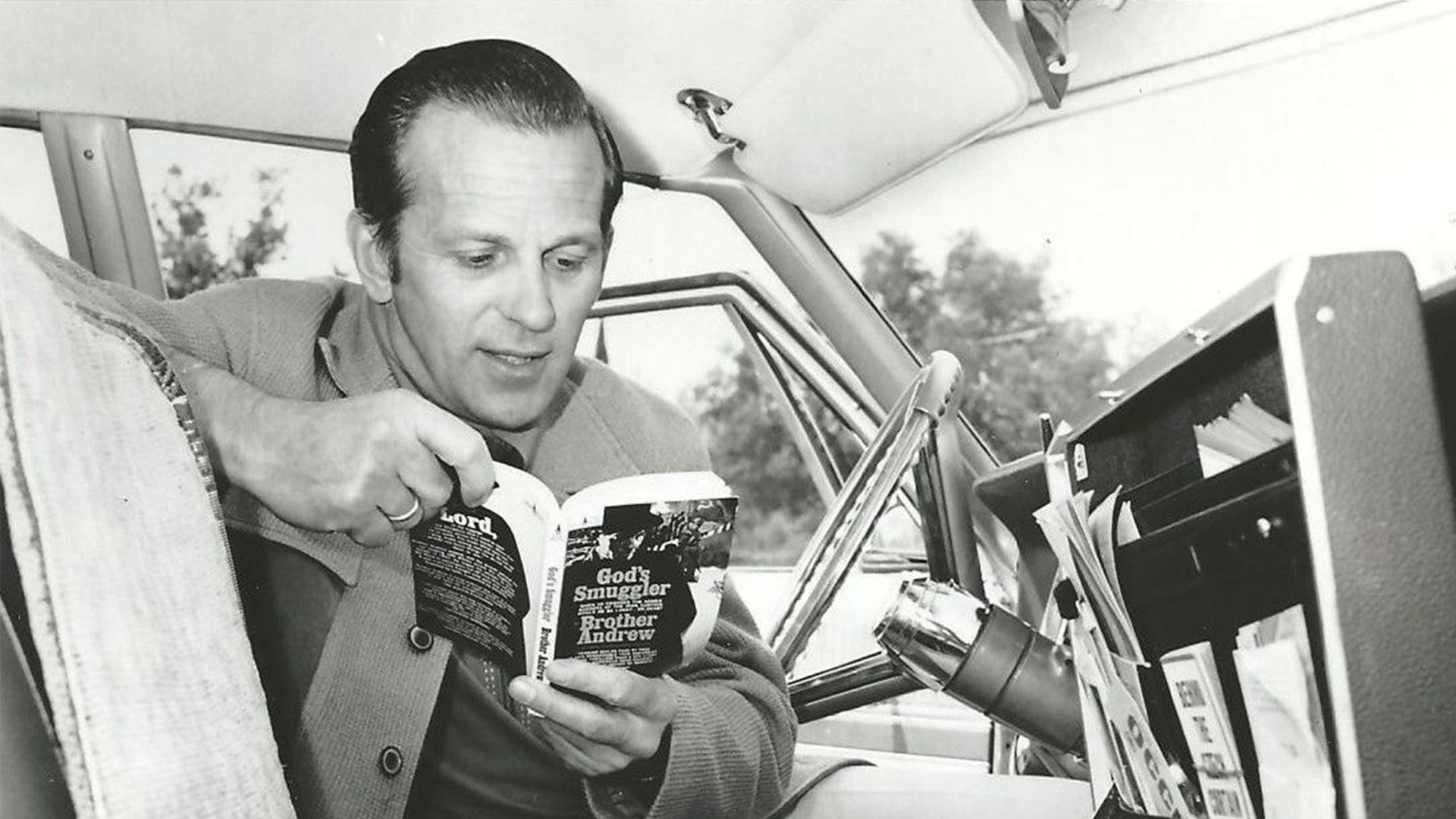
But it was his literature that originally established Brother Andrew’s worldwide fame. God’s Smuggler, written in 1967, sold more than 10 million copies and was translated into 35 languages—including Arabic.

Brother Andrew, co-author of God's Smuggler
Brother Andrew, co-author of God’s Smuggler

Maher Fouad, president of the General Society for Iraqi National Evangelical Churches, was touched most by And God Changed His Mind (1990). Calling Andrew a “blessed saint,” he recalled reading the book in 1991 when he headed the prayer ministry of the National Evangelical Church of Baghdad.

“It redirected me completely,” Maher said. “He knew how to slowly enter the presence of God, and only then find answers to prayer.”

The publication of Light Force in 2004 highlighted to the world Brother Andrew’s increased attention to the Muslim world. Acclaimed to be as captivating as Smuggler, his dependence on prayer was on display in practical concern for the Middle Eastern church.

“My purpose is to encourage and strengthen the local believers to be a Light Force,” he wrote, “an alternative to military might.”

But first he modeled it himself.

In 1992, when 415 militants from Hamas were expelled by Israel to the side of a mountain in southern Lebanon’s Marj al-Zohour, Brother Andrew saw an opportunity to practice Matthew 25. He delivered tents, food, and medicine.

“There are no terrorists—only people who need Jesus,” he later wrote in Light Force. “As long as we see any person—Muslim, Communist, terrorist—as an enemy, then the love of God cannot flow through us to reach him.”

Brother Andrew’s activism rattled many Christians—both local believers and Western supporters. He was frequently critical of US evangelical support for the wars in Afghanistan and Iraq, seeing it as their lack of faith in the power of missions. He advocated for refugees, and prayed for Osama bin Laden—whose killing he called a “murder.”

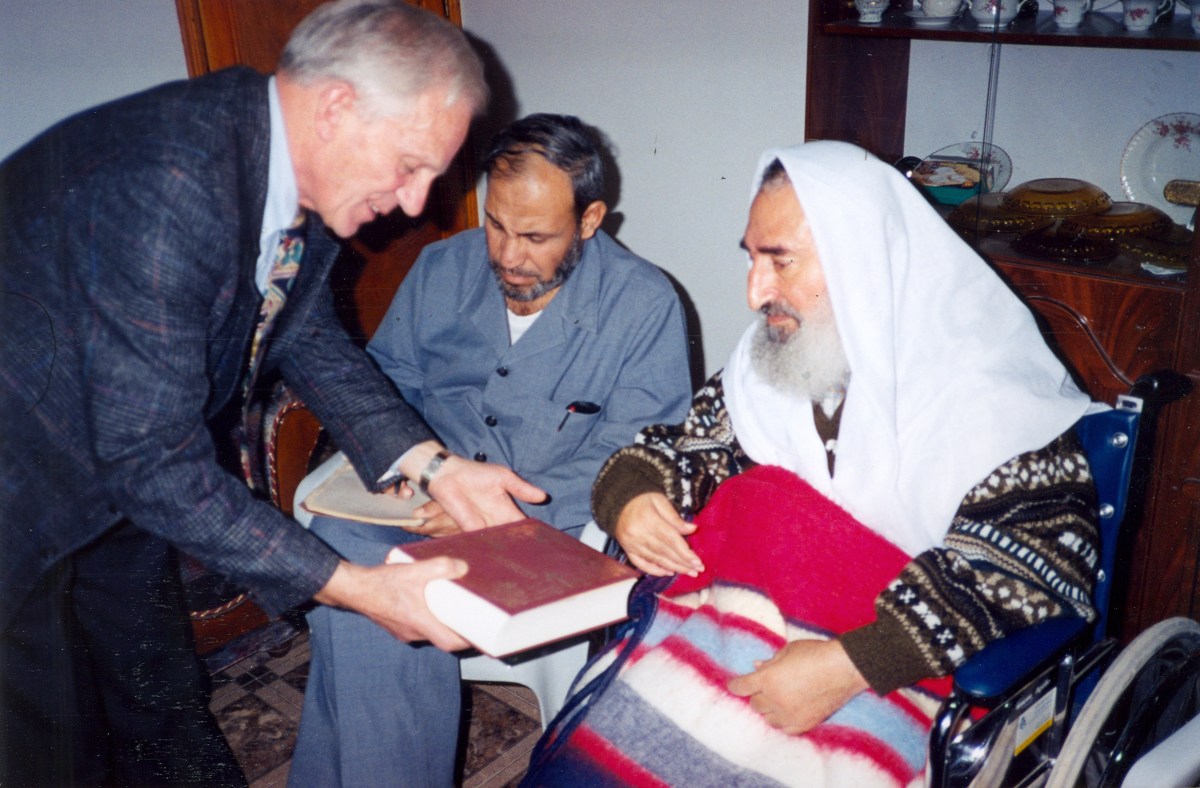
He also condemned the “assassinations” of his “friends” in Gaza. In 2004, the Israeli military killed Sheikh Ahmad Yassin, the founder of Hamas, who seven years earlier had welcomed the Open Doors founder into his home. It was only the gospel of love, Brother Andrew consistently preached, that could answer the stalemate of Middle East conflict.

Brother Andrew and Sheikh Yassin, founder of Hamas

“The best way I can help Israel,” he countered his critics in Light Force, “is by leading her enemies to Jesus Christ.”

And by doing it with local believers. Striving for local Christians to escape their “victim mentality,” he also helped build the people and institutions which could lead others to Christ.

“We thank God for putting such a great person in front of us, and inviting us to imitate him,” said Bassem Fekry, president of the Fellowship of Evangelicals in Egypt. “He is now among the great cloud of witnesses.”

Fekry recalled Brother Andrew telling his Bible smuggling stories to the crowd at Salvation of Souls Church in the dense urban Cairo neighborhood of Shubra. In his early 20s at the time, the Egyptian leader was inspired into a life of service.

“Andrew was always on the hunt for new rebels and radicals willing to go to the darkest places on earth, at the risk of death, to change the world,” wrote David Curry, CEO of Open Doors USA, in tribute this week. “And he was grateful for everyone who joined his cause.”

Sara is one such man. Brother Andrew regularly visited his church in Jerusalem, both when Sara was a young believer in 1992 and later when he led the same congregation. But in between, when the Open Doors founder heard from the pastor that the poor believers had pledged to send Sara to the Philippines for seminary education, he pulled out all the money he had in his pocket—which exactly matched the funding gap.

Sara only discovered this two years later, when he asked where the money came from. Regular gifts continued to develop the ministry of Bethlehem Bible College (BBC)—which carried on the Dutchman’s controversial Palestinian ministry through regular “Christ at the Checkpoint” conferences.

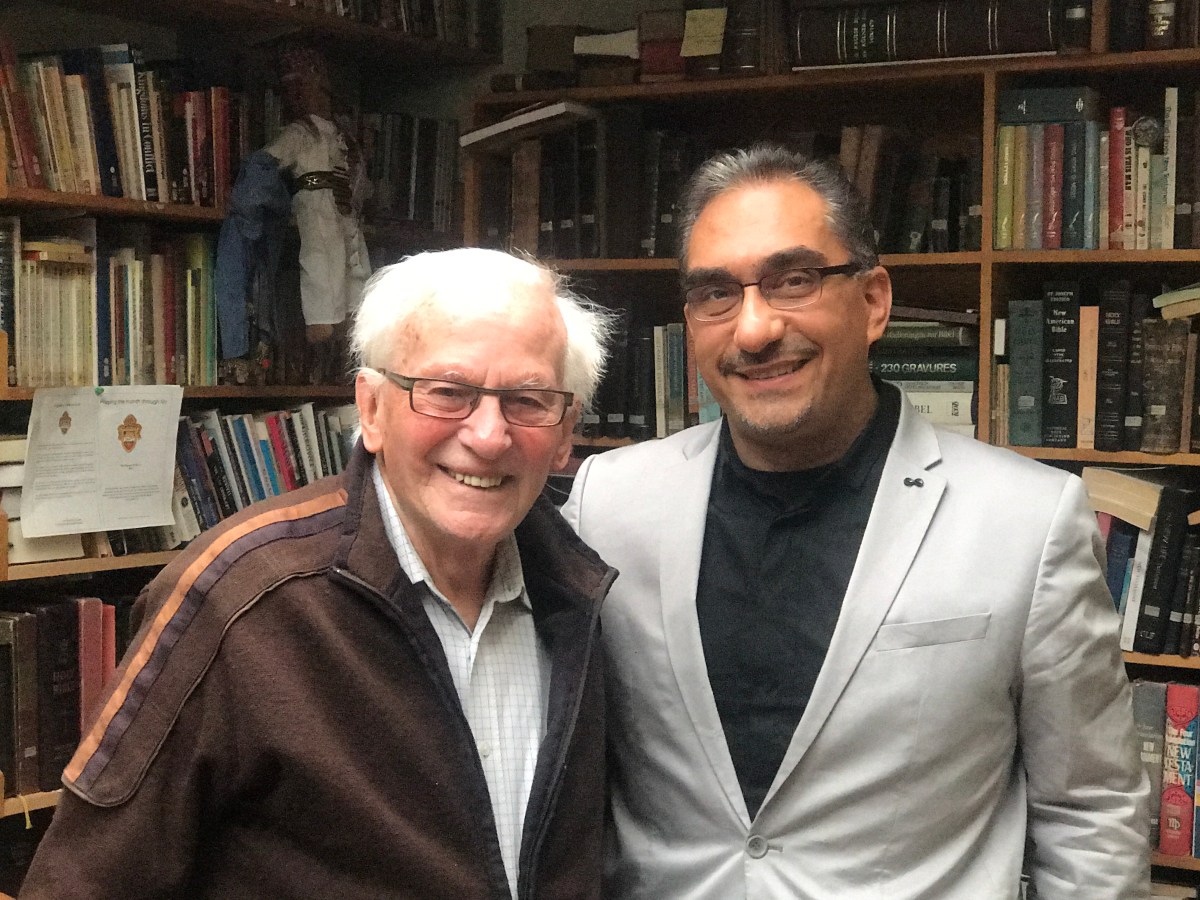
“In every corner of BBC there is a touch of Brother Andrew,” said Sara, now the college’s president. “He cared about the witness of Christians in our community.”

Brother Andrew and Jack Sara, president of Bethlehem Bible College

Another individual is Salim Munayer, founder of the Jerusalem-based Musalaha ministry. Returning from Fuller Seminary in 1985 to be the first local professor hired at BBC, his vision to spark Christ-centered reconciliation between Messianic Jews and Palestinian evangelicals—later expanding to all of Holy Land society—received early funding from Open Doors.

Later, he joined Brother Andrew and BBC founding president Bishara Awad for a tense, backroad taxi ride to Hebron. Under Israeli curfew at the time, Munayer had loaded a boxful of Bibles and Arabic translations of Smuggler into the hired second vehicle. The first, learning of the destination, turned down the fare.

Upon arrival in the West Bank city, a crowd of over 100 Hamas supporters gathered at the sight. The local leader quieted them, saying Brother Andrew had once come to them in their time of need. Distributing the literature and preaching on how the love of God demands love also of the “brother,” Munayer—now a network coordinator for the WEA’s Peace and Reconciliation Network—recalled how the Dutchman spoke clearly about the cross.

“He was one of the few people who could say to the leaders of Hamas: ‘I am a Christian and a follower of Christ, and I help people in distress,’” he said. “He developed a record of trust with them.”

Brother Andrew and Yasser Arafat

Brother Andrew went on to gain Yasser Arafat’s permission to open a Bible bookshop in Gaza, and spoke on Christianity at the coastal enclave’s Islamic University.

Hanna Massad, who served 12 years as pastor of the Gaza Baptist Church, called him a “hero of faith.” It was Brother Andrew’s genuine care that won him the right to speak—far from naïve about local realities.

“If we did not go to them with Christ’s love,” Massad recalled of the evangelist’s conviction, “they would come at us with their weapons.”

But Brother Andrew’s interest was not only in good relations. Secret Believers, published in 2007, was subtitled: What Happens When Muslims Believe in Christ.

To the end of his life, Curry said, Brother Andrew maintained this passion. At the age of 90 he traveled to Pakistan, seeking to meet leaders of the Taliban. The man who before his own conversion once gunned down innocent Muslims in Indonesia while a soldier in the Netherlands’ army was determined to demonstrate love to this generation of extremists.

“Brother Andrew could see what others could not,” said Munayer, “and with a prophetic voice he not only proclaimed the truth, but lived it out, faithfully.”

News

Died: Dan Busby, Accountant Who Set Standards for Ministry Finances

He believed “Christians should set an example of the utmost integrity.”

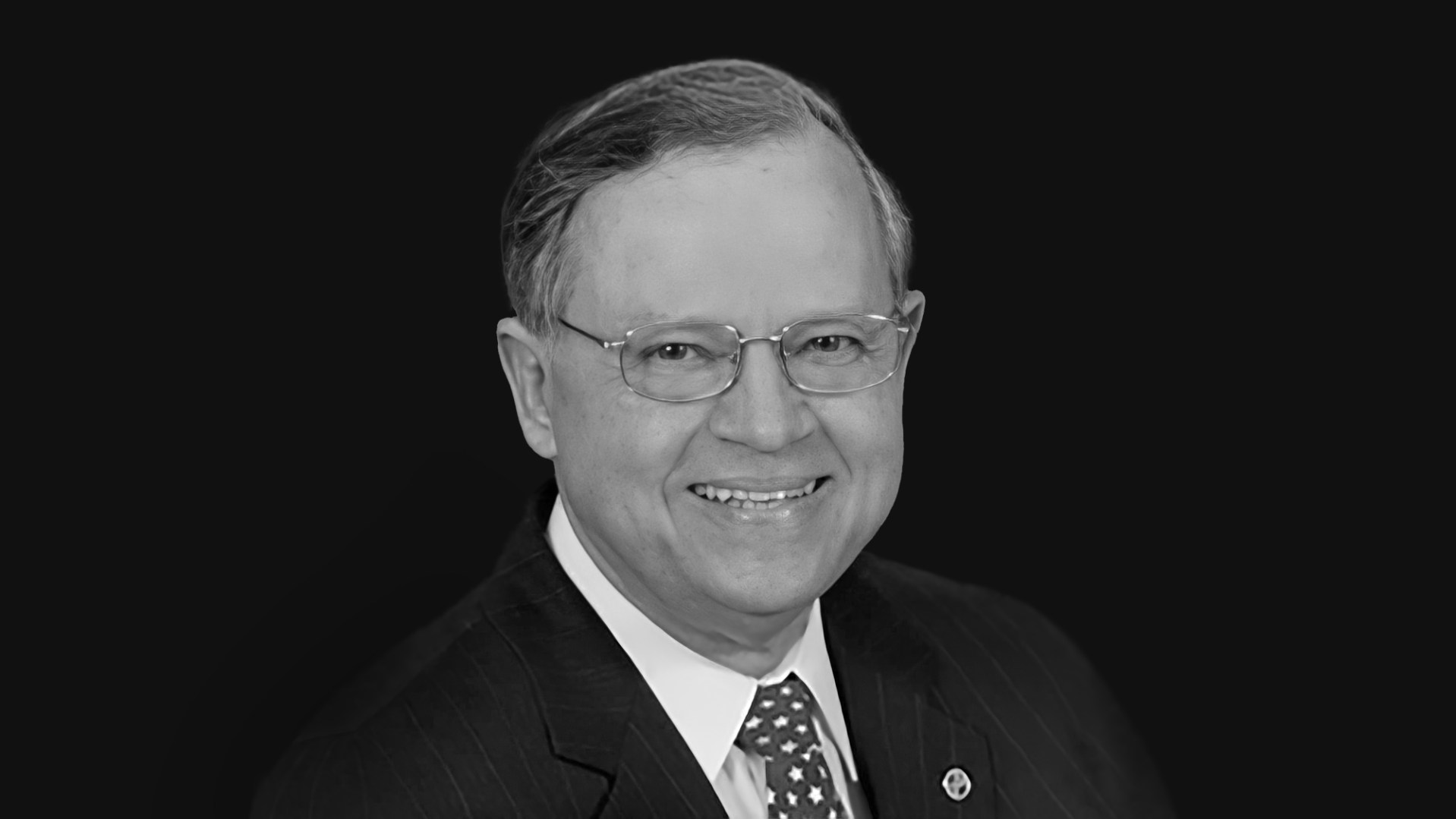
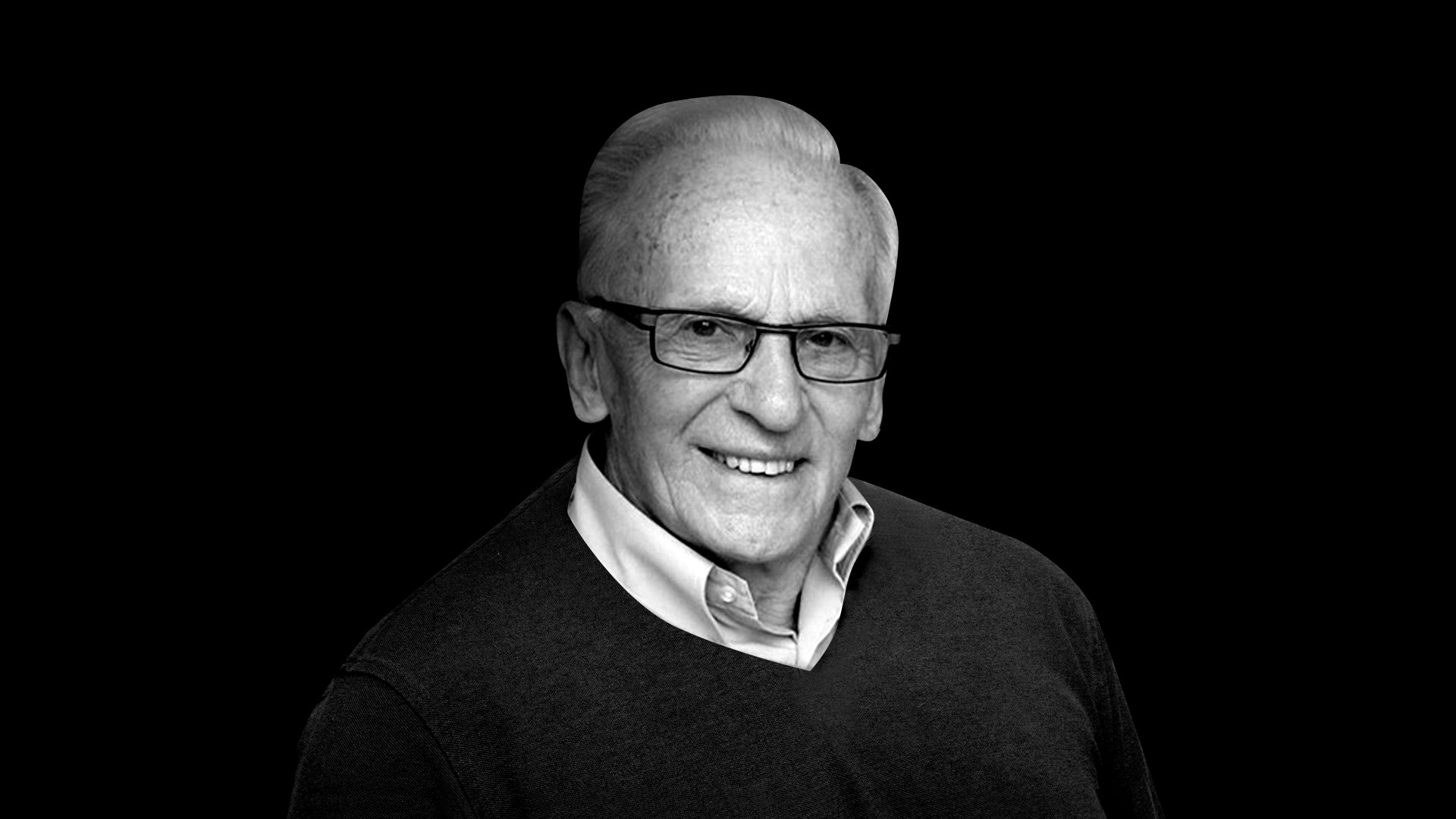
Longtime ECFA leader Dan Busby

Longtime ECFA leader Dan Busby

Christianity Today September 28, 2022
Courtesy photo / Edits by Mallory Rentsch / Christianity Today

Dan Busby fixed his father’s tax returns when he was a junior in college. In the process of correcting some mistakes and figuring out the proper deductions for the Wesleyan pastor and evangelist, he discovered his life’s calling.

“The Lord planted a seed in my heart,” Busby said in a 2018 interview, “that someday I should help fill the void.”

Busby, a certified public accountant who helped professionalize the Evangelical Council for Financial Accountability (ECFA), died Wednesday at age 81.

Busby served as senior vice president of the accreditation agency from 1999 to 2008 and as president from 2008 to 2020. During his presidency, the number of ministries maintaining a membership with the EFCA nearly doubled, reaching a total of more than 2,400, including 50 of the 100 largest churches in the United States.

The NonProfit Times named Busby one of the top 50 nonprofit leaders six times between 2010 and 2015. When his retirement was announced in 2019, ECFA board chair Danny de Armas described him as loved, admired, and respected.

“Dan is an incredible leader who has grown ECFA’s membership and influence,” de Armas said. “Dan’s legacy will linger in the valuable resources he developed that serve ministry leaders and pastors in their efforts to operate above reproach.”

Busby was born to Howard and Bertha Orr Busby in 1941. The family lived in Lamont, Kansas, a farming community of about 30 people, located halfway between Topeka and Wichita. Bertha taught public school, and Howard pastored a small Wesleyan church when he wasn’t traveling the country holding camp meetings.

The young Busby went forward at one of those camp meetings when he was 14. The aisle wasn’t covered in sawdust, but otherwise it was a classic summer tent revival, with enthusiastic crowds, group singing, and sermons about the need to make a decision for Jesus.

“That was in the day when the camp meeting evangelist preached on heaven and hell,” Busby later said. “And when they preached on hell, it was hot enough you could almost feel it.”

He went forward on a Saturday night and committed his life to Christ. He never wavered from that pledge.

Calling balls and strikes

When Busby wasn’t in church or school, he spent his time learning how to be a baseball umpire. He studied with a minor league umpire and liked it so much, he considered doing it for a living.

“Rules are the backbone of baseball,” Busby said. “Without them, the game would quickly turn into chaos. The rules must be so thoroughly understood by an umpire that they are applied instinctively—often in a split second.”

Despite his love for calling balls and strikes, Busby decided an umping career wasn’t practical. He went to nearby Emporia State University to study accounting. He earned a master’s in business administration and then went to work as a controller at the University of Kansas Medical Center.

In 1975, he left the medical center to start his own certified public accounting firm that specialized in handling finances for Christian ministries. By the 1980s, Busby was considered a leading expert on accounting issues related to nonprofit fundraising and spoke frequently to accountants about direct mail.

Busby left the firm to take a position as the chief financial officer at the Wesleyan Church, headquartered in Fishers, Indiana. He wrote The Minister's Tax and Financial Guide and The Church and Nonprofit Tax and Financial Guide, and Zondervan published the first editions of both in 1990. Busby joined the ECFA staff in 1999.

The ECFA was founded after several high-profile financial scandals to encourage self-regulation among evangelical ministries and avoid increased scrutiny from the federal government. Busby, the first certified accountant to lead the organization, sought to further raise standards and professionalize more ministries’ self-regulation. He pushed regular, external audits; emphasized the importance of independent boards; and made it a goal to better educate board members about governance.

Protecting evangelical ministries

At the same time, Busby continued efforts to protect evangelical ministries from government oversight.

He played a key role in convincing Senator Chuck Grassley, an Iowa Republican and the ranking member of the Senate Finance Committee, not to back additional regulations for religious nonprofits in 2011. Grassley was disturbed by reports of the lavish lifestyles of televangelists; Busby argued that these were exceptions and that new tax rules would not stop abuse but would infringe on religious liberty.

After a three-year investigation into six televangelist organizations, the Iowa senator came out with a recommendation for exactly what the ECFA had to offer.

“The challenge is to encourage good governance and best practices,” Grassley said. In another interview he added, “Self-correction can be more effective than government action.”

Busby also spoke about the need to protect Christian ministries from media scrutiny and warned of the growing dangers of internet watchdogs. He was especially frustrated by bloggers, whom he saw as irresponsible and unfair. On one occasion, he said critics of churches and pastors were angering God and getting in the way of God’s work.

According to Busby, Christian ministries had to be careful not to be too transparent, lest they leave themselves open to unrelenting internet attacks. But the real solution to increased scrutiny, he said, is to be above reproach.

“What an opportunity for ministries seeking to fulfill the Great Commission to be models of integrity and accountability during the swirling turbulence!” he wrote. “The issues generally relate to finances, fundraising/stewardship, and governance; all three are found in the core of ECFA’s standards. It is a time to be trustworthy in all these areas.”

In 2019, however, the ECFA itself faced a crisis of trust. Blogger Warren Throckmorton, independent journalist Julie Roys, and World magazine investigative reporter Michael Reneau documented multiple instances where the ECFA overlooked egregious violations of its accreditation standards. It failed to act as an umpire, allowing organizations with disastrous financial mismanagement to continue carrying the ECFA certification until the problem was publicly exposed.

Busby, for his part, remained unconvinced of the need for watchdogs or external regulations. He stepped down from the ECFA presidency in 2020 but continued to promote financial accountability through self-regulation and teach ministry leaders about the importance of proper governance through books such as Lessons from the Church Boardroom and More Lessons from the Church Boardroom, both cowritten with Christian management consultant John W. Pearson.

Pearson and Busby also collaborated on a self-assessment tool for nonprofits, with six items for boards to evaluate their health.

“I believe Scripture makes it clear that Christians should set an example of the utmost integrity, in and out of the marketplace,” Busby said. “It has been a joy to see a significant increase in the groundswell of churches, ministries, and leaders worldwide who are stepping up to embrace accountability.”

In retirement, Busby returned to his love for baseball, writing a book about Babe Ruth and another about Jackie Robinson based on his extensive study of tickets, passes, and memorbilia. Before and After Jackie Robinson was published in August, a month before he died.

Busby is survived by his wife, Claudette, and their two children, Julie and Alan. An online memorial service will be held on October 21.

Conversations with God’s Smuggler

A selection of Brother Andrew’s interviews with Christianity Today.

Christianity Today September 28, 2022
Courtesy of Open Doors

Following the passing of Dutch missionary Anne van der Bijl, we wanted to highlight some of his conversations with Christianity Today over the years.

Van der Bijl, called Brother Andrew, was known for serving areas of the world considered closed to Christian ministry. He started by smuggling Bibles into the Soviet Union, giving him the nickname and title for his book God’s Smuggler. He went on to found the ministry Open Doors, which aids Christians facing persecution.

His work in the mission field focused on going, seeing, and hearing. When CT asked about his hope for Christians facing terrorist violence in the Middle East, he responded:

We are fearful because we stay home and prepare for the worst to come, because we think that’s what they are planning. That may be true, but it’s because of our inactivity. The moment we take the offensive and plan to go there, we lose our fear. That’s very scriptural. I’m not a bit afraid of them. I feel completely at home. I hope to be back there very soon. If I knew I could do something constructive, I’d be there tomorrow.

From the Soviet Union to the Middle East, Brother Andrew put God at the center of what were thought to be closed doors.

Click here for more from the CT archives.

Theology

Blessed Are Those Who Mourn Suicide

Caring for people in pain requires a rich theology of suffering.

Christianity Today September 28, 2022
Illustration by Mallory Rentsch / Source Images: WikiMedia Commons / Pexels

According to the World Health Organization, 703,000 people die by suicide each year.

In 2020, “suicide was the twelfth leading cause of death overall in the United States. … [In addition, suicide] was the second leading cause of death among individuals between the ages of 10–14 and 25–34, … and the fourth leading cause of death among individuals between the ages of 35 and 44.”

Although churches are becoming more sensitive to suicide issues, the topic has at times been limited to concerns over salvation and damnation. If a person takes his or her own life, will that person go to heaven?

We’re not equipped to fully answer that question, of course. Jesus is the only one who has the power of divine judgment. And more importantly, debating someone’s eternal fate misses a larger opportunity. Suicide is the heartbreaking cry of “My Father, why have you forsaken me?” As believers, we have a chance to meet those who feel forsaken and be Christ to them.

Put another way: Our theology of salvation matters. But at least initially, our theology of suffering matters more, in terms of caring for those in our congregations who are thinking about ending their own lives.

As an aspiring sociology scholar, I spent four months of undergrad studying this issue for a research project at the University of Oxford. One of the key questions I wanted to ask was “How should theodicy—or making sense of suffering from a Christian perspective—inform our approach to suicide?”

“When analyzing the preponderance of cases of suicide beyond physician-assisted death, one is faced with the formidable role of mental illness, a factor that Christian theologians have often downplayed,” writes Elizabeth Antus, a pioneer scholar at the intersection of suicide and theology.

In her scholarship, she turns in part to German theologian Johann Baptist Metz, who provides a promising perspective for a theology-and person-centered dialogue on the topic. His theodicy is all about learning to live in solidarity with those who suffer.

“In my view,” writes Metz in A Passion for God: The Mystical-Political Dimensions of Christianity, “there is one authority recognized by all great cultures and religions: the authority of those who suffer. Respecting the suffering of strangers is a precondition for every culture; articulating others’ suffering is the presupposition of all claims to truth. Even those made by theology.”

Metz wants to see people in the church embrace an open posture that allows them to lament and be in community with those dealing with suicide. He views this victim-sensitive theodicy as a liberating practice that allows Christians to ask God their raw, anger-filled questions.

“Even Christian theology, drawing on its doctrine of creation, cannot eliminate the apocalyptic cry, ‘What is God waiting for?’” writes Metz. “Not even Christian theology can allow Job’s question to God, ‘How long yet?’ to fall silent in a soothing answer. Even Christian hope remains accountable to an apocalyptic conscience.”

Antus, who teaches in the theology department at Boston College, argues that Metz offers a “theology more hospitable to suicide victims.”

In Christ, all of us are free to cry out to God and ask why—whether we have haunting thoughts of our own or know someone else who’s been suffering. After all, at the very center of the gospel story is a God who experiences suffering.

“For the Christian, who believes in the crucified and risen Messiah, suffering is always meaningful,” writes Kathryn Greene-McCreight, author of Darkness Is My Only Companion: A Christian Response to Mental Illness. “It is meaningful because of the One in whose suffering we participate, Jesus.”

As we think about suicide in the context of the Christian life, then, we can take comfort knowing that God sympathizes with human anguish.

He calls us to do the same with those around us. As his ambassadors, the worst thing we can do is shy away from tough conversations and perpetuate narratives of shame and guilt. The best thing we can do is learn about suicide, provide resources for those struggling, and lament with them in their pain.

A person-centric theodicy liberates us to hear deep cries of anguish, especially in the context of suicide. The more we humanize this issue in the church, the more we can be like the one who came to suffer among us: Christ himself.

Mia Staub is the content manager at Christianity Today. This piece was adapted from an essay originally published at the Scholarship and Christianity in Oxford website. Published with permission.

Church Life

Do Chinese Worship Songs Sound Too Much Like Pop Hits?

Five praise music songwriters on how they handle criticism, work together, and seek to reach Gen Z through their work.

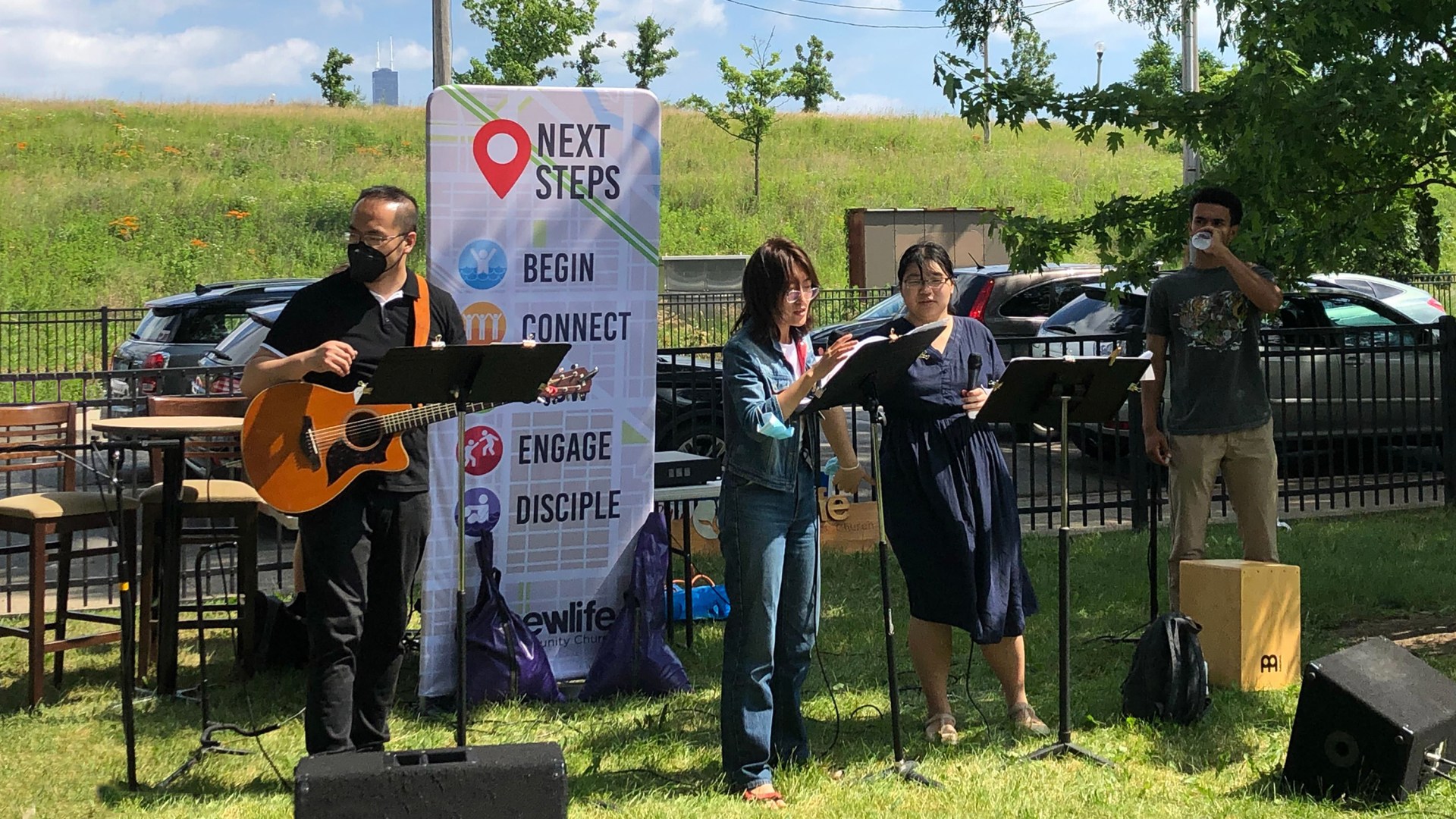
Cui Yu (first from left) and Jane Hao (second from left) leading outdoor Sunday worship of New Life Community Church Bridgeport

Cui Yu (first from left) and Jane Hao (second from left) leading outdoor Sunday worship of New Life Community Church Bridgeport

Christianity Today September 27, 2022
Courtesy of Sean Cheng

When Chinese Christians around the world worship God through music, chances are they’re singing a translated Western hymn or a hit by established worship music creators Stream of Praise (赞美之泉), Heavenly Melody (天韵合唱团), or Clay Music (泥土音乐). Several worship songwriters are interested in adding something that better reflects the tastes of young people.

Jiang Shaolong, Cui Yu, Jane Hao, Chen Ming, and Luan Xin all grew up in China before moving to the United States for college or graduate work and share a passion for Chinese worship songwriting and ministering to the next generation. They are enthusiastic about using their songwriting talents to help deepen the faith of the Chinese students and young professionals they pastor or mentor. With the exception of Chen, who studied music at a conservatory, all of them are self-taught musicians.

Jiang pastors the Chinese-speaking congregation of New Life Community Church Bridgeport, in Chicago, and offers spiritual mentorship to Jing Ji Huo (The Burning Bush), which also includes Hao and Yu, the band’s leader. Chen Ming and Luan Xin are both campus ministers. (Ming works with the diaspora Chinese ministry Ambassadors for Christ.)

These young Chinese praise songwriters—all of whom are in their 30s and 40s, years below the average Chinese church leader—recently spoke with CT about why they felt compelled to write new Chinese worship songs and how they handle commentary that their music is too inspired by pop.

Why did you want to create new Chinese praise songs?

Jiang: I was called by God to serve a Chinese church made up mostly of young Chinese students and young professionals. We worship with songs translated from English as well as songs written by other Chinese songwriting teams, and we’re grateful for the Chinese songs we already have. But I still have the desire to create new songs in our own language.

Just as we often say that prayer is as necessary to Christians as breathing, singing and worshiping are as natural to Christians as eating and drinking tea. I love Chinese food and tea culture, and I have the gift of cooking and making tea. So in my ministry, I cook and make tea for the young Chinese brothers and sisters and seekers in our church. This is a down-to-earth way of ministry that also allows me to use my gifts. The same is true for writing praise music.

Before I became a Christian, I loved playing guitar and tried to make music, and I was interested in Chinese literature. Now when I look back, I feel that God had already prepared me for the calling of hymn writing.

Chen: To be honest, I’m not sure how capable I am of writing Chinese praise music. But I come from a musical background and have had professional training in music. I am equipped with a theological education, and in my understanding, praise music composition is a good exercise and expression of personal worship to God and reflection on faith.

As a campus minister, I also consider it an important ministry for me to use creative writing as a way to encourage brothers and sisters and to help them reflect and practice their faith. So, praise music writing is really a part of my ministry.

What do you feel is the most difficult part in your creative process of praise music writing?

Cui: Finding the balance between serving the church and self-expression. A person who writes Christian songs naturally wants to use the best words and phrases to express their innermost and deepest thoughts and feelings. If they can find an understanding audience, they will be happy. But if not, they are not willing to go against their original intention and express a voice that is not their own, just to suit the aesthetics of those around them.

On the other hand, God has also called us to serve the church. Sometimes our works may be so focused on self-expression that they are difficult for the congregation to understand. We want our works to be comprehensible, to move, encourage, inspire, and comfort people and ultimately help them mature in their faith and get closer to God. If we write praise songs that only serve to express and move ourselves but lose the function of communal worship, they will not have real value.

Chen: I used to be a pop songwriter, so writing music isn’t the hardest part for me. Rather, I find it challenging to create lyrics, which are the main carrier of the message. I have yet to create the kind of lyrics with layers and depth that I idealize.

Can you share an example of your spiritual experience in worship music creation?

Hao: The first praise song I wrote was called “New Life.” Its chorus came to me one day while I was praying. I was deeply struggling that day, feeling greatly disappointed and disgusted with myself. But during the prayer God showed me what I looked like in His eyes—a person who had been renewed by the blood of Jesus, with a life guided by the Holy Spirit.

I just went with what moved me and typed the lyrics down on the computer. The process of writing that song was a devotional experience for me, allowing me to realize in prayer that God had given me a new life so I could live a life that was no longer wrapped up in sin. Even though I still have weaknesses, God sees me as flawless and beautiful in Jesus.

When working with each other, how do you handle the conflicts that come from differences in personal styles or preferences?

Chen: Usually we have some common basic principles for writing praise songs, such as theological rigor and clarity of the gospel message. It’s healthy if we argue over issues involving these principles and keep a serious, rigorous approach to song creation. But we need to be patient and flexible about differences outside of these principles and respect personal style and preferences to the greatest extent possible.

Luan: We are taught that Christians should practice submitting to one another. But in the artistic matter of making music, it is often very difficult to compromise. It is difficult to “submit to one another” when there are many differences of opinion on the style of the arrangement. When that happens, our approach was to revise it over and over again to try to make it as satisfying as possible for teammates with different preferences. I remember one time we wrote 27 versions of one song!

Chinese Christians often criticize modern Chinese worship songs for sounding like pop songs. How do you view tradition and innovation in songwriting?

Cui: I actually encourage us to look at all kinds of Chinese worship songs today with an open and appreciative heart. Even if they sound like pop music, I don’t dismiss them easily. These kinds of songs may be suitable for many young and new Christians. They can be used to encourage young Christians in their spiritual growth in a musical language they can quickly accept. It takes time for them to mature in their musical choices.

A spiritual elder once shared with us that intergenerational ministry is also, in essence, a form of cross-cultural mission. It requires us to minister to the younger generation in a culture and language that is familiar to them. If you force your own generation’s culture and language on them, you will create a cross-cultural barrier for your ministry.

Of course, we can’t just stop with songs. Worship music should be rich in content and form because God’s grace and his works in our lives are rich. We need to allow the art form that is worship songs to express this richness as much as possible. Music is capable of providing an infectiousness that words cannot provide. We should not abandon traditions, yet we need to create Chinese worship music that belongs to our time and also contains profound theological connotations.

Chen: I think we need to look at lyrics and music separately. In terms of lyrics, I personally think that the lyrics of many Chinese worship songs that are currently popular in Chinese churches are indeed rather monotonous and repetitive, as if they were created by using a formula. The theology often lacks rigor and orthodox.

But in terms of tunes, there are actually many historical Western hymns that use the melodies of popular songs of the era. The tunes of those works possess the characteristics of being memorable, easy to learn, and easy to sing. This is a good thing. But the role of lyrics in hymnody is primary, and the creation of lyrics needs to be done with more care, to an extent that it should even be seen as preparing a sermon that needs to be finely crafted word by word.

Luan: Much of modern Chinese worship music is not really like pop songs. The problem is that the music is boring, the tunes are unpleasant, and the musicianship lags behind that of pop songs. Many unbelievers can hum a few lines of “Amazing Grace” or “Joy to the World” because the Christians back then made the hymns popular by achieving a high standard of music. My hope is that Christians today are able to produce worship music of a musical standard that rivals the popular music of their contemporaries.

This requires both innovation and an inheritance of tradition. I myself will experiment with different styles of modern music—I wrote probably the first hard-rock style and the first metal-style Chinese worship songs ever. But the lyrics we write should tell the story of the ancient gospel, just like those classic Western hymns did. That is inheriting the tradition.

Jiang: Inheriting tradition is not the same as copying Western Christian music. Since we are writing lyrics in Chinese, we should also write them with the unique beauty and rhythm of the Chinese language. I have tried to write lyrics in a more elegant style similar to Tang poetry and Song lyrics in ancient Chinese literature. I think that modern Chinese lyrics can be written to be easily understood, but they can also pursue the literary beauty and gracefulness of the traditional Chinese language.

Improving the quality of composing requires greater professionalism. After we had been composing for a while, we were able to see shortcomings in our music. I intentionally became friends with some experienced, professional music producers and asked them for advice. We asked them to help us improve the orchestration and harmonization, record and do some professional treatment for the songs we composed, and also give us some training in music production. Since we are called by God to write worship music, we have to do it professionally and try to make a good product. Not only the lyrics and music should be good, but professionalism is also part of the calling.

News

Died: Brother Andrew, Who Smuggled Bibles into Communist Countries

Founder of Open Doors said he wasn’t an “evangelical stuntman” but a faithful Christian following the leading of the Spirit.

Brother Andrew (Anne van der Bijl), known as "God's smuggler"

Brother Andrew (Anne van der Bijl), known as "God's smuggler"

Christianity Today September 27, 2022
Courtesy of Open Doors / edits by Mallory Rentsch

Editor’s note: Read or share in Portuguese and other languages via the yellow links above.

Anne van der Bijl, a Dutch evangelical known to Christians worldwide as Brother Andrew, the man who smuggled Bibles into closed Communist countries, has died at the age of 94.

Van der Bijl became famous as “God’s smuggler” when the first-person account of his missionary adventures—slipping past border guards with Bibles hidden in his blue Volkswagen Beetle—was published in 1967. God’s Smuggler was written with evangelical journalists John and Elizabeth Sherrill and published under his code name “Brother Andrew.” It sold more than 10 million copies and was translated into 35 languages.

The book inspired numerous other missionary smugglers, provided funding to van der Bilj’s ministry Open Doors, and drew evangelical attention to the plight of believers in countries where Christian belief and practice were illegal. Van der Bijl protested that people missed the point, however, when they held him up as heroic and extraordinary.

“I am not an evangelical stuntman,” he said. “I am just an ordinary guy. What I did, anyone can do.”

No one knows how many Bibles van der Bijl took into Poland, Czechoslovakia, Yugoslavia, East Germany, Bulgaria, and other Soviet-bloc countries in the decade before the success of God’s Smuggler forced him into the role of figurehead and fundraiser for Open Doors. Estimates have ranged into the millions. A Dutch joke popular in the late 1960s said, “What will the Russians find if they arrive first at the moon? Brother Andrew with a load of Bibles.”

Brother Andrew
Brother Andrew

Van der Bijl, for his part, did not keep track and did not think the exact number was important.

“I don't care about statistics,” he said in a 2005 interview. “We don’t count. … But God is the perfect bookkeeper. He knows.”

Van der Bijl was born in the Netherlands in 1928, the son of a poor blacksmith and an invalid mother. He was 12 when the German military invaded the neutral country in World War II, and he spent the occupation, as he recounted to John and Elizabeth Sherrill, hiding in ditches to avoid being pressed into service by Nazi soldiers. When famine hit the Netherlands in 1944, van der Bijl, like so many Dutch people, ate tulip bulbs to survive.

After the war, van der Bijl joined the Dutch army and was sent to Indonesia as part of the colonial force attempting to quash the Indonesian struggle for independence. He was excited about the adventure until the shooting started and he killed people. By his own account, van der Bijl was involved in the massacre of an Indonesian village, indiscriminately killing everyone who lived there.

He was haunted, after, by the sight of a young mother and nursing boy killed by the same bullet. He started wearing a crazy straw hat into the jungle, hoping it would get him killed. Van der Bijl adopted the motto, “Get smart—lose your mind.”

He was shot in the ankle and started reading a Bible his mother had given him during his convalescence. After he returned to the Netherlands, he started compulsively going to church, and in early 1950, he surrendered himself to God.

“There wasn’t much faith in my prayer,” van der Bijl said. “I just said, ‘Lord if you will show me the way, I will follow you. Amen.’”

Van der Bijl committed his life to ministry and went to Scotland to study at the Worldwide Evangelization Crusade’s missionary school in 1953. Speaking to Christianity Today in 2013, he remembered one critical lesson from a Salvation Army officer who was teaching about street evangelism. The older man said most would-be evangelists give up too soon, since the Holy Spirit has only prepared the heart of one person out of 1,000.

“Instantly my heart revolted. I said to myself, ‘What a waste,’” van der Bijl recalled. "Why go and spend your energy on 999 who were not going to respond? God knows it and the devil knows it and he laughs because after the first 1,000 people I give up in despair.”

He determined he would ask God to guide him to the one person who was ready for the gospel. Instead of spending his time calculating and strategizing, he would follow the guidance of the Spirit.

A short time later, he felt God speak to him through Revelation 3:2: “Wake up! Strengthen what remains and is about to die.” Van der Bijl understood he was supposed to go support the church in Communist-controlled countries. In 1955, he took a government-controlled tour of Poland but snuck away from his group to visit underground groups of believers. On a second trip to Czechoslovakia, he saw that churches in Communist countries needed Bibles.

“I promised God that as often as I could lay my hands on a Bible, I would bring it to these children of his behind the wall that men built,” van der Bijl later recalled, “to every … country where God opened the door long enough for me to slip through.”

Brother Andrew in Yugoslavia

In 1957, he made his first smuggling trip across the border of a Communist country, entering Yugoslavia with tracts, Bibles, and portions of Bibles hidden in his blue Volkswagen. As he watched the guards search the cars in front of him, he prayed what he would later call “the Prayer of God’s Smuggler”:

“Lord, in my luggage I have Scripture that I want to take to your children across this border. When you were on Earth, you made blind eyes see. Now, I pray, make seeing eyes blind. Do not let the guards see those things you do not want them to see.”

Van der Bijl followed his early success in Yugoslavia with more trips and eventually even smuggled Bibles into the Soviet Union. He recruited other Christians to help him, and they developed strategies for avoiding the attention of border guards and secret police. Sometimes the smugglers would travel in pairs, disguised as honeymooning couples. Sometimes they would use out-of-the-way border crossings. They would experiment with different ways of hiding Scripture in their small, inconspicuous cars. Always, they would follow the leading of the Spirit, and no one was ever arrested.

Bible smuggling was criticized by a number of Christian organizations, including the Baptist World Alliance, the Southern Baptist Foreign Mission Board, and the American Bible Society. They considered it dangerous—especially for the Christians living in Communist countries—and ineffective. Sensational stories were good for raising money, the critics alleged, but little else.

Cold War historians have debated the impact of Bible smuggling on Communist regimes. Francis D. Raška writes that it was “probably significant,” but “evidence of the exploits is shaky, and prone to exaggeration and personal aggrandizement.” There is at least some evidence that the KGB kept close tabs on van der Bijl’s activity and may have had informants inside his network, according to Raška.

Brother Andrew
Brother Andrew

After the success of God’s Smuggler, van der Bijl left smuggling to other less famous Christians. He shifted his attention to fundraising for Open Doors and ministry opportunities in Muslim countries. When the United States invaded Afghanistan in 2001 and Iraq in 2003, he became an outspoken critic of American evangelicals’ support for the war on terror. Christians, he said, could only put their trust in military intervention if they had given up faith in missions.

When speaking to American audiences in the early 2000s, van der Bijl regularly asked Christians if they had prayed for Osama bin Laden, leader of al-Qaeda. When US forces killed bin Laden in 2011, he expressed sadness.

“I believe everyone is reachable. People are never the enemy—only the devil,” van der Bijl said. “Bin Laden was on my prayer list. I wanted to meet him. I wanted to tell him who is the real boss in the world.”

At the time of his death, the ministry van der Bijl founded was helping Christians in more than 60 countries. Open Doors distributes 300,000 Bibles and 1.5 million Christian books, training materials, and discipleship manuals every year. The group also provides relief, aid, community development, and trauma counseling, while advocating for persecuted Christians around the globe.

When asked if he had any regrets about his life’s work, van der Bijl said, “If I could live my life over again, I would be a lot more radical.”

News

Orphan Forced from Christian Home Highlights Islamic Ban on Adoption

Egypt sees surge in foster care applications, though still insufficient, while Christians denied custody due to sharia law.

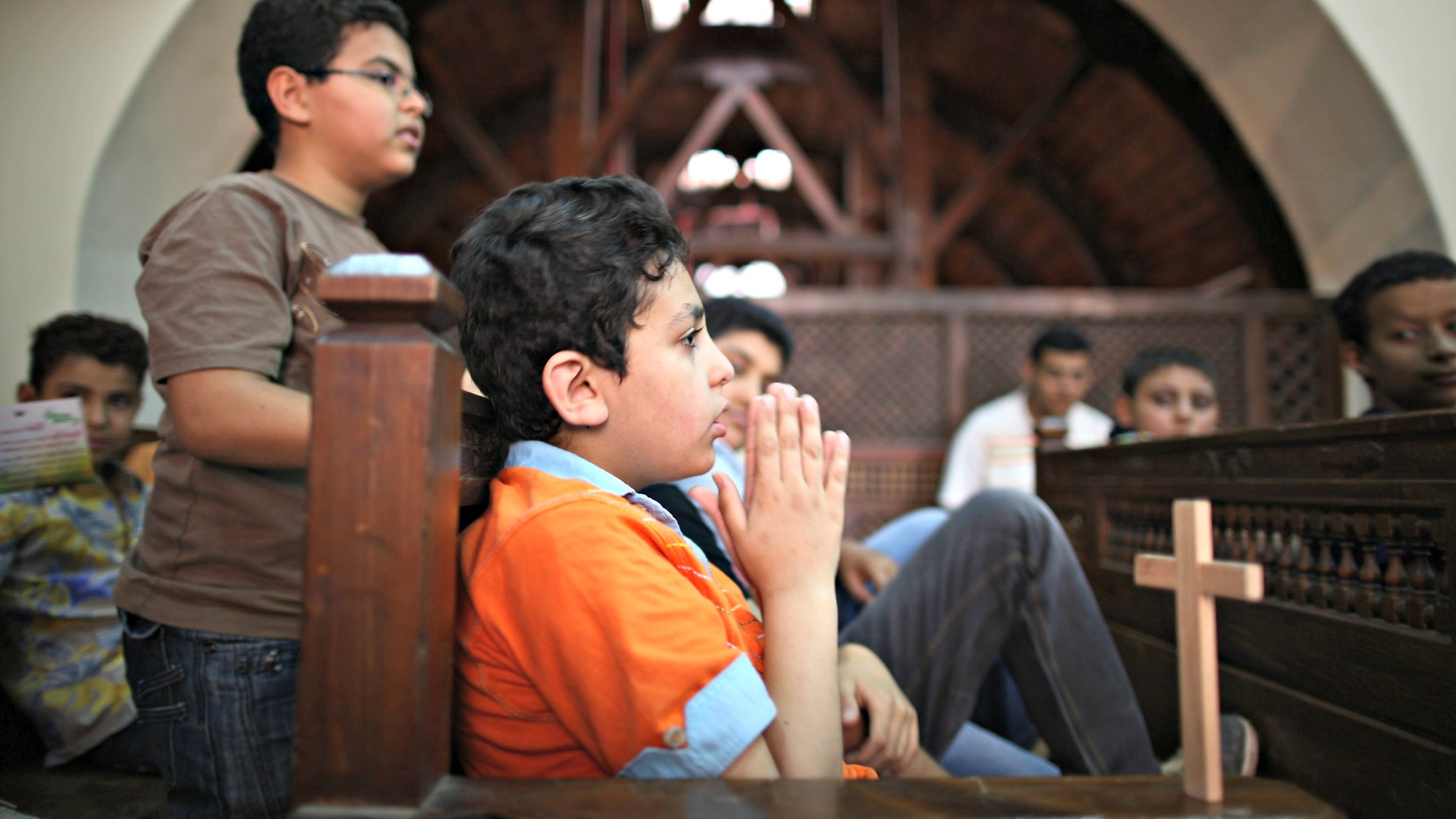
Coptic children attend a religious class at The Hanging Church in Cairo, Egypt.

Coptic children attend a religious class at The Hanging Church in Cairo, Egypt.

Christianity Today September 27, 2022
Peter Macdiarmid / Getty Images

Four years ago, Shenouda was an infant found at the door of a Coptic church. Today, renamed Yusuf, the boy is found in a state-run orphanage. In between lies the care of a priest, the devastation of a Christian family, and a sectarian bureaucracy undergoing partial reform.

Egypt is home to a Dickens-like tragedy.

“Adoption is not legal in Egypt,” said Nermien Riad, executive director of Coptic Orphans. “There is no possibility it will happen as known in the Western world.”

The boy’s family name and location have been kept anonymous as a cautionary measure, as reported by the Coptic publication Watani. Likely left by an unwed mother, the child was found by a Coptic priest who presented him to the couple, infertile for 29 years.

They took him into their home, obtained a birth certificate as if he was their own, and raised him with love and devotion. They gave him a Christian-signifying first name, honoring the prior Coptic Orthodox pope, and per Egyptian naming custom the four-generation quadrilateral was completed with the names of the doting father, grandfather, and great-grandfather.

All was idyllic, until a jealous niece realized the impact on her inheritance.

Egypt’s Islamic-based law, seeking to preserve lineage, prohibits taking another’s child as one’s own. The niece reported the couple to the police, who investigated. The prosecution determined there was no blood relation, but also no ill will.

The father signed a paper stating he found the child “on the street,” likely to shield the priest’s involvement. But though the case was dropped last February, the boy was taken to an orphanage. With no papers to prove his ancestry, he was assumed to be a Muslim—and thus forbidden to live with a Christian family—and given the religiously neutral name Yusuf, the Arabic equivalent of Joseph.

The desperate parents protested: What Muslim would leave their unwanted child at a church? Denied, they were even forbidden from visiting him in the orphanage. Their applications for employment at the facility were turned down.

According to the Ministry of Social Solidarity, Egypt has 11,000 children in institutional care. According to a 2016 study by UNICEF, the United Nations agency for children, the total number of Egyptian children with at least one parent dead is 1.2 million.

Not all of them have a sad ending.

“It turned out better than I could’ve ever hoped for,” said Rasha Mekki, who discovered Egypt’s kafala program in her mid-40s following 20 years of IVF treatments. She visited orphanages over the course of a month, filled out the government paperwork, and came home with Mostafa.

Kafala means “sponsorship” in Arabic, somewhat akin to foster care.

Today, Mekki lives with her husband and not-quite-son in San Francisco where she runs Yalla Kafala, a nonprofit founded in 2020 to promote “adoption” in Egypt. Its goal is an orphan-free Egypt by 2030.

She is less ambitious than the Egyptian government, which set 2025 as its target date to close all orphanages in the nation due to widespread child abuse, neglect, and overcrowding. Reforms in 2020 allowed single, divorced, and unmarried women over the age of 30 to apply for kafala, and lowered the level of education necessary to one spouse holding a high school diploma.

Last year, further reforms allowed a partial name change. After consulting with the Cairo-based al-Azhar, the foremost center of scholarship in the Sunni Muslim world, the Egyptian government permitted sponsoring parents to give the child the father’s name in the second position of the quadrilateral, or the family name in the fourth position—but not both designations.

Combined with a storyline on kafala by the popular “Why Not?” Egyptian miniseries, applications surged to 2,700 in 2021, the highest number ever. Yet still far from the total number in need, as many orphans are seen as the unwanted children of sin and suffer severe social stigma.

Even from those willing to try: One couple, after taking in a child through the kafala system, returned the three-year-old girl after the wife got pregnant.

Another advocate chided orphanages in general, though acknowledging their workers do their best.

“She will be brought up by foster ‘mothers’ who are employed to care for her, who are overworked and underpaid,” said Yasmina El Habbal, a single woman in her mid-40s, posting her experience raising Baby Ghalia on her public Facebook page. “‘Mothers’ who will leave to get married, and be replaced.”

Mekki is working to remind Muslims that caring for orphans—Muhammad was one himself—is a great deed in Islam. And though the formal rules of inheritance exclude the kafala child, sharia law permits any number of “gifts” to be given while the parents are alive. Additionally, their will may specify up to one-third of any inheritance distributed after their death be given to other than their legal heirs.

Breastfeeding a kafala child, furthermore, removes the prohibition on the non-family mixing of sexes, allowing women to keep their heads uncovered after a sponsored boy matures.

Raymond Ibrahim, writing for Coptic Solidarity, was critical. Citing Muslim narratives, he related how the prophet of Islam adopted Zayd, an orphan believed to be the fourth person to accept the faith. But the practice became forbidden when Zayd divorced his wife and Muhammad thereafter married her. Kafala took its place, and precedent was established.

And Christians are among the modern victims.

“The reason Shenouda and his family were targeted is because of their Christian faith,” Ibrahim wrote. “The child—whose background is unknown—was being raised as a Christian, and it is this that has caused the state to act.”

Some critics say the Egyptian government should not have such a right. Article 3 of Egypt’s constitution permits Christians and Jews to govern their own personal status issues—such as marriage, divorce, and inheritance—according to their religious traditions.

“If we subject this matter to the religious concept, adoption is permissible in Christianity, though the opposite in Islam,” said Youssef Talaat, legal advisor for the Protestant Churches of Egypt (PCE). “But the current law does not have articles related to it.”

Talaat represented the PCE alongside the Coptic Orthodox and Catholic churches to present a new unified personal status law before the government. Completed last year, it is expected to be discussed in the upcoming session of parliament, though due to Egypt’s sharia-based prohibition—with kafala as the alternative—adoption (tabenni) is not included within the new text.

Coptic lawyer Naguib Suleiman wants the parliament to amend the proposed family law further, and it is reported some members will lobby to allow adoption for Christians.

Until then, where will orphans go?

“In the absence of a legal framework, civil society organizations have to step in and fill the void,” said Riad. “Our work prevents the Shenouda situation from happening.”

Coptic Orphans, founded in 1988, works in about 800 towns and villages throughout Egypt. Currently serving 9,000 orphans, the organization states it has helped prevent 35,000 children from entering institutionalized care.

A 2017 article in the academic journal Trauma, Violence, and Abuse surveyed 23 studies over 20 years, involving a total of over 13,000 children. Those raised in foster care experienced “consistently better experiences and less problems” than those in orphanages.
As an example, in 2009, American Scientist published research on 136 children in Romania. At 3.5 years, only 18 percent raised institutionally demonstrated secure attachments to their primary caregiver. But 49 percent of those in foster care did so, and 65 percent of those in the general community.

Working in cooperation with church-affiliated orphanages, Coptic Orphans aims to place the vulnerable in the care of relatives. And Riad clarified that most orphans in the Christian network’s care are not fully such: 95 percent of beneficiaries have a mother. But when the father dies, gets imprisoned, or otherwise disappears, the family is often plunged into poverty.

Even in cases where the mother passed away also, the extended family network steps in, buttressed by Coptic Orphans’ financial assistance. It makes kafala unnecessary, and the government does not need to be involved. And in the rare cases when parentage is unknown, the church will quietly place the child with a family.

Spiritual care is also provided. “Typically, it is the priest who places the child within a family,” said Riad. “They know their community, and the necessary provisions, better than any case worker could.”

Riad praised the efforts of the government to expand and promote kafala. But she wonders how Egypt will be able to care for all the children, should plans proceed to close the orphanages.

Yet just as the nation’s Christians once had to skirt the law to build churches until reform occurred, she hopes adoption will become included in the legal revisions. And not just for the rare examples like Shenouda, but for all Coptic children in need of care.

“Families are ‘adopting’ informally already, in the shadows,” Riad said. “If there is legalization for Christians, that would be ideal.”

addApple PodcastsDown ArrowDown ArrowDown Arrowarrow_left_altLeft ArrowLeft ArrowRight ArrowRight ArrowRight Arrowarrow_up_altUp ArrowUp ArrowAvailable at Amazoncaret-downCloseCloseellipseEmailEmailExpandExpandExternalExternalFacebookfacebook-squarefolderGiftGiftGooglegoogleGoogle KeephamburgerInstagraminstagram-squareLinkLinklinkedin-squareListenListenListenChristianity TodayCT Creative Studio Logologo_orgMegaphoneMenuMenupausePinterestPlayPlayPocketPodcastprintremoveRSSRSSSaveSavesaveSearchSearchsearchSpotifyStitcherTelegramTable of ContentsTable of Contentstwitter-squareWhatsAppXYouTubeYouTube