News

Nominate a Book for the 2023 Christianity Today Book Awards

Instructions for publishers.

Christianity Today June 14, 2022
Karolina Grabowska / Pexels

Dear Publisher,

Each year, Christianity Today honors a set of outstanding books encompassing a variety of subjects and genres. The CT Book Awards will be announced in December at christianitytoday.com. They also will be featured prominently in the January/February 2023 issue of CT and promoted in several CT newsletters. (In addition, publishers will have the opportunity to participate in a marketing promotion organized by CT’s marketing team, complete with site banners and paid Facebook promotion.)

Here are this year’s awards categories:

1. Apologetics/Evangelism

2a. Biblical Studies

2b. Bible and Devotional

3a. Children

3b. Young Adults

4. Christian Living/Spiritual Formation

5. The Church/Pastoral Leadership

6. Culture and the Arts

7. Fiction

8. History/Biography

9. Marriage and Family

10. Missions/The Global Church

11. Politics and Public Life

12a. Theology (popular)

12b. Theology (academic)

Nominations:

To be eligible for nomination, a book must be published between November 1, 2021 and October 31, 2022. We are looking for scholarly and popular-level works, and everything in between. A diverse panel of scholars, pastors, and other informed readers will evaluate the books.

Publishers can nominate as many books as they wish, and each nominee can be submitted in multiple categories. There is a $40 entry fee for each title submitted in each category. To enter your nominations, please click on this link and follow the prompts. (Note: You will be directed to upload a PDF of each book you wish to nominate.)

Finalist Books:

If your book is chosen as one of the four finalists in any category, we will contact you and ask that you send a copy of the book directly to the four judges assigned to that category. We will provide mailing addresses for each judge.

Deadline:

The deadline for submitting nominations is Monday, August 1, 2022.

Any questions about any aspect of the process? Email us at bookawards@christianitytoday.com.

Thank you!

Christianity Today editors

News

Saddleback Successor Cleared of Allegations of Overbearing Leadership

Search firm Vanderbloemen reviewed texts, emails, and videos but did not talk to former staffer who made accusations against Andy Wood.

Christianity Today June 13, 2022
Screengrab / Saddleback Church

Leaders at Rick Warren’s Saddleback Church say a preliminary investigation has cleared Warren’s recently announced successor, Andy Wood, of allegations of an authoritarian leadership style that demands unquestioning loyalty.

Rick Warren, author of The Purpose Driven Life and one of the most influential voices in evangelical Christianity, is planning to retire in September. He named San Francisco–area pastor Andy Wood as his successor at Saddleback, a Southern California congregation that draws 25,000 people to worship services. Wood, 40, is currently the lead pastor of Echo Church, a multisite congregation based in San Jose.

After the public announcement, a former Echo Church staffer made comments about issues with Wood’s leadership on social media.

The allegations did not come as a surprise to Saddleback leaders.

According to Saddleback’s statement on Sunday night, Wood had told the church’s elders about the former staffer’s claims during his interview process and offered to show them videos of his meetings with the former staffer. The church asked Vanderbloemen Search Group, which did the initial background check on Wood, to do a follow-up review.

“Our elders have now received a preliminary second report from The Vanderbloemen Search Group, clearing Pastor Wood from all allegations,” the church said in a letter to the congregation on Sunday, which was also sent to Religion New Service (RNS).

The search company was provided video, email, and text records, and interviews that Echo gathered in its review of Wood’s actions. It also conducted one additional interview, according to Saddleback’s letter.

“They tried to reach out to the former staff member and have yet to receive communication back,” the church said.

Saddleback leaders said they sent the letter out because “we felt it was important that you hear the facts on this from us now, rather than in the news or on social media.”

“Please stop a moment and pray right now,” church leaders asked the congregation. “Pray for clarity of the truth and for wisdom.”

Wood, in a statement to RNS, said that Echo “would be happy for any current or former staff members to share their working experience at Echo with Vanderbloemen as a part of their investigation,” adding, “We want to do everything we can to help the truth about these allegations come to light.”

According to the transition plan announced by the church, Wood and his wife, Stacie, will be interviewed by Warren and his wife, Kay, during services at Saddleback June 19. The Woods will step down at Echo Church at the end of June and begin leading Saddleback on September 12.

Scot McKnight, coauthor of A Church Called Tov, which critiques toxic church cultures, said large churches can create celebrity pastors who lead in problematic ways. He does not have firsthand knowledge of problems with Wood’s leadership, but expressed concerns about what he’s heard. “Big churches attract big egos,” he said.

Founded in 2008 as South Bay Church, Echo now has four campuses and draws about 3,000 people to weekly services. The church has grown in part through merging with smaller, struggling congregations to create what’s known as a multisite church.

“Church mergers have become one of the most effective strategies for struggling churches to thrive again, for growing churches to amplify their reach, and for church facilities to be better utilized to advance the Gospel in a region,” according to a section of the Echo Church website.

Wood also runs an annual leadership conference, which last year included Mark Driscoll, the disgraced pastor of Mars Hill Church in Seattle who resigned in 2014 after a series of controversies involving allegations of bullying, plagiarism, and abuse of power. Driscoll now pastors a church in Arizona.

Lance Hough, a former staff member at Echo’s Fremont campus, left the church last year citing an “unhealthy culture” in which, he alleged, Wood demanded unswerving loyalty. Hough had been part of the leadership team at Crossroads Church in Freemont when it merged with Echo.

That merger is billed as a “marriage merger” on Echo’s website, where “two growing churches realign with each other under a unified vision and new leadership.” The merger was supposed to be a partnership, said Hough, but became more of a takeover.

“And as soon as our organization started to functionally merge, they started systematically killing off everything that made our church unique,” Hough said. He note that Crossroads’ pastor remained on staff and disagreed with his critiques.

Hough said Wood was personable and friendly as a leader, but dismissed any questioning of the Echo way of operating out of hand. He worried that Wood may use the goodwill created by Saddleback and Warren to impose his own approach to ministry, which Hough believes is inherently unhealthy.

A graduate of Southwestern Baptist Theological Seminary, Wood planted a congregation known as Breakthrough Church while in seminary before moving to the San Francisco Bay area, according to a 2009 prospectus for Echo. Among the founding values of the church were healthy relationships and character-driven leadership, according to that prospectus.

“We believe that God is glorified in our midst when we make his love complete by showing sacrificial kindness to one another,” the prospectus states. “We believe the gospel calls us to place the goals and interests of others above our own.”

When he announced Wood as his successor, Warren said he looked at about 100 potential candidates. He cited Wood’s experience in church planting as a plus, saying he had “already built a church in a very difficult place” and had the skills to manage a complex megachurch like Saddleback, which holds services in about a dozen locations.

Warren also said that character matters in a new pastor, mentioning the list of traits required for leaders in 1 Timothy 3.

“If you’re going to lead a church, those qualities are non-negotiable,” said Warren in a video introducing Wood. “And if you don’t have those qualities in your life, you’re automatically disqualified from pastoring and leading a church family.”

News

Southern Baptists Prep for Annual Meeting With Heavy Hearts, Cautious Hope

It was a fight to get the landmark abuse investigation to happen. Now, will the denomination be able to overcome divides to enact reforms?

Southern Baptist Convention’s 2021 annual meeting

Southern Baptist Convention’s 2021 annual meeting

Christianity Today June 10, 2022
Mark Humphrey / AP

Pastor Adam Wyatt was driving to a hospital visit in southern Mississippi last month when he began crying angry tears.

“I usually don’t do that,” said Wyatt, who had stayed up late the night before to read through the devastating 288-page report on Southern Baptist Convention (SBC) leaders’ response to abuse.

“It’s been a long year.”

In June 2021, Wyatt was on his way to the previous SBC annual meeting in Nashville when he received a call to become the senior pastor of Corinth Baptist Church. By the time he left the meeting a few days later, he had another new title: Executive Committee (EC) trustee.

A second-generation Southern Baptist pastor with degrees from two SBC seminaries, Wyatt joined the EC—the decision-making body for day-to-day SBC business—just as scrutiny over its leaders’ response to abuse reached its pinnacle.

Wyatt was among the EC members who lobbied for the outside investigation to move forward with the level of transparency and accountability the convention had called for. Their efforts paid off. Guidepost Solutions issued 288 pages on EC leaders’ moves to dismiss survivors and reformers, and the EC released a hidden list of 700 pastors who’d been credibly accused of abuse.

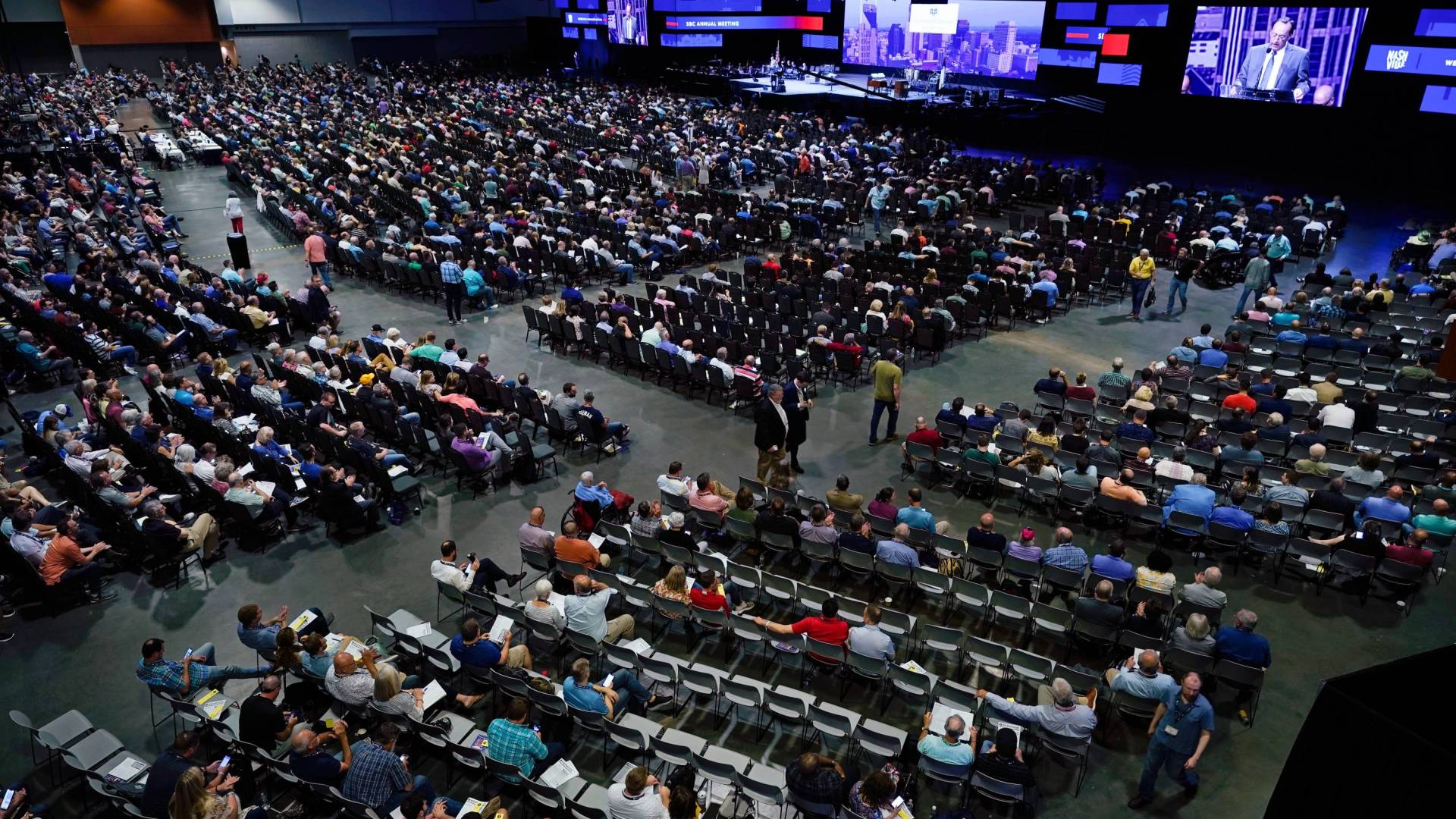
Now, the Mississippi pastor is preparing for the SBC’s 2022 annual meeting, considered the most significant in a generation. Starting Tuesday, more than 8,500 Southern Baptists will meet in Anaheim, California, to decide what comes next: how to establish a process for reporting abuse, better policies for responding, and restitution for those harmed by SBC pastors.

In the wake of the revelations, the proposals once rejected outright by prior EC leaders as impossible due to denominational polity or liability are now top priority.

Yet advocates say it’s hard to celebrate the progress and momentum around addressing abuse when survivors had been requesting such changes for decades. When the uncaring response is something they should have never had to put up with in the first place.

And when any changes still have to be approved and enacted by a convention that has faced division and competing priorities in recent years.

After the convention made an unprecedented move to approve the outside investigation into the EC last year, Wyatt found himself thrust into the fight for transparency and accountability. He became closer with the survivors who had previously been stonewalled by EC leaders.

At the 2021 annual meeting, he met and talked with some of these women. “I had given them my word: ‘I’m going to fight for you as much as I can and try do what’s right,’” Wyatt said.

He remembered that promise months later when he was back in Nashville at Southern Baptist headquarters for his first EC meeting last September. He wasn’t prepared for the protracted debate and wave of resignations that erupted before the EC agreed to turn over confidential materials per the terms of the investigation.

While some in the meeting warned that the move would put the SBC at legal and financial risk, the head of the task force overseeing the investigation—a no-nonsense North Carolina pastor named Bruce Frank—repeatedly reminded the EC that that’s what the convention had asked them to do and that’s what would bring the truth to light.

Wyatt heard survivors seated behind him during the open meeting gasping and sighing while multiple sets of lawyers and the previous EC president, Ronnie Floyd, urged against waiving attorney-client privilege.

Wyatt said he got a glimpse of the uphill battle the survivors had endured. “I remember I asked, ‘Is this kind of how y’all feel? You try to do the right thing … and then you get so tired and frustrated by trying and not getting anywhere that it just grinds you into submission?’”

https://twitter.com/pastor_adam/status/1444047936594354180

The Mississippi pastor spoke up in the meeting and in exasperated, GIF-filled Twitter threads. He was inspired by Jared Wellman—a veteran EC member who went from being a dutiful, quiet trustee to an outspoken voice challenging suspected coverup. Wellman said Augie Boto, the former EC executive implicated in the abuse report, had once told him, “You’re quiet, and I like that about you.”

“I kind of shiver at the comment now,” Wellman told CT. In the wake of the Houston Chronicle’s 2019 investigation into SBC abuse, he said, “I just went rogue, to be honest with you, which is completely outside my character.”

After the conflicts over the investigation in the past year—and the steady opposition survivors have faced for the past 15, at least—it’s hard to imagine the SBC messengers will be on the same page when making decisions in Anaheim.

Southern Baptists may have anticipated some of the divides over the Guidepost report’s findings, but unexpected issues have cropped up too. This month, the firm’s corporate Twitter account posted in support of gay pride. Now, vocal leaders are questioning whether a secular company with an opposing stance on sexuality is well positioned to advise the SBC on sexual abuse and complaining about denominational dollars going to a pro-LGBT contractor.

“Before this past week I was feeling good … now it’s just a whole nother fight we’re having to deal with,” said Wyatt.

The two likely leading candidates for SBC president fall on either side of the divide. Baptist historian and rural Texas pastor Bart Barber said while he is disappointed with Guidepost’s stance on pride, it doesn’t change the “absolute truth” of what its investigation uncovered. He worries about the incident being used to divert the judgment due on the SBC. Barber has spoken regularly about the SBC’s abuse response and was involved in the move in 2018 to oust Paige Patterson from leadership at Southwestern Baptist Theological Seminary over Patterson’s treatment of a rape survivor.

Founders Ministries leader and Florida pastor Tom Ascol, on the other hand, said he felt betrayed and that Guidepost’s recommendations should be redrafted. Ascol’s candidacy is endorsed by the Conservative Baptist Network, and he ran on a platform of #changethedirection, attacking the alleged liberal drift of the SBC, condemning critical race theory and championing the sufficiency of Scripture. He has backed reforms to make the EC more transparent but has criticized “more sweeping recommendations that could broadly transform the polity of the SBC.”

https://twitter.com/tomascol/status/1533946897689354247

The task force appointed to oversee the investigation has a list of recommendations that will go before the convention, but Guidepost, survivors, and the EC each have their own lists too, and messengers will have the opportunity to make suggestions from the floor. SBC’s relief arm, Send Relief, has already designated $4 million in existing funding to back the recommendations, including $1 million in survivor care, meaning the reforms won’t need to pull as much from church giving.

“As important as the investigation is, what happens in Anaheim on recommendations as far as protecting people and caring for people is just, if not more, important,” Frank said.

The pastor of the multisite Biltmore Church in North Carolina, Frank didn’t make it to last year’s annual meeting. His house had flooded, so he and his wife, Lori, had to stay back. But the then-newly elected SBC president, Ed Litton, called afterward to ask Frank to chair a group of pastors, lawyers, and abuse experts to ensure the Guidepost investigation was conducted as requested.

Frank had mostly avoided denominational leadership, he said, but the task force felt like a worthy cause and one that hit close to home—his wife was a survivor of sexual assault—so he agreed. In addition to speaking at the EC meetings about the investigation, Frank met with the task force over several months to hear from survivors, consult with state conventions, work with Guidepost, and develop recommendations for the SBC.

He learned about abuse and abuse responses along the way. “I can say I was not informed,” Frank said. “I was familiar with, I was empathetic toward, but that’s different.”

Frank described his mixture of anger and sadness hearing survivors’ stories—feelings he said the Lord can shape into resolve.

Speaking from his church office in Asheville, the Southern preacher emphasized the importance of the abuse issue for all pastors. He kept repeating that the odds are that they have survivors in their congregations and one day they’ll get a call reporting an instance of abuse. If they aren’t trained to respond appropriately right away, he said, they’ll end up causing further hurt.

While Frank led the task force, he noticed that some in his own congregation outside Asheville began to see him differently. They thanked him for taking on the role. They made small comments in the lobby. “They won’t say it [outright], but they’ll say, ‘I grew up with that,’” he said. “That had never happened before.”

Christa Brown, a survivor whose steady advocacy and repeated rejections by the EC were documented in the Guidepost report, wanted to see swift change after the report but feels like she’s waiting for yet another gut punch with this year’s annual meeting.

Brown, who was abused by her Southern Baptist pastor at age 16, worries that the proposals before the convention are not immediate or robust enough to address the scope of the abuse problem. The task force overseeing the investigation, for example, recommends authorizing another task force to review potential changes and report back next year.

“After release of the Guidepost report, at a time when the task force should have pushed forward with full strength and vigor, instead it pulled its punches and made timid recommendations,” she told CT by email.

She’s disheartened to see the social media chatter among Southern Baptist pastors, including efforts to discredit Guidepost as well as complaints over the multimillion-dollar cost of the potential reforms.

Brown plans follow the news out of Anaheim from home.

“There’s the expectation that this would all come to nothing, or at least a fear that it will, and that’s not an unreasonable fear because that’s what’s happened every other time,” said Todd Benkert, an Indiana pastor and advocate for survivors. Last year, Benkert’s quick-thinking motion at the annual meeting prevented the EC from taking charge of its own investigation.

“I don’t ask survivors to trust me or the SBC or even to hope,” he said. “I just do what’s right and call other people to join me in that. Whatever role I have, I want to use it.”

Survivor Jules Woodson, a single mom and flight attendant, wasn’t in Nashville to see the wave of messengers hold up their ballots to approve the EC investigation last year. She has booked her trip to Anaheim and said she would like to be in the convention hall this year to see another historic moment when the convention will vote on the recommendations for reform, “because these are the things we’ve been pleading for.”

Hope is a very sticky word with survivors,” she said, “but I want to feel some sense of acknowledgement, some sense of action.”

Woodson’s 2019 testimony in The New York Times kicked off the #ChurchToo movement; the pastor who abused her as a teen, Andy Savage, received a standing ovation for confessing to a “sexual incident” after Woodson shared her account online. Last month, Savage—who remains a pastor—was named on the EC’s secret list.

Brown and Woodson are among a group of SBC abuse survivors who released a joint statement recommending immediate action on key recommendations, including an independent commission to receive allegations, a database cataloguing credibly accused pastors, and funding for survivor care.

Over the past year, more Southern Baptists have come to see what SBC abuse survivors have seen all along. The investigation confirmed their accounts, and the aftermath is revealing something else they’ve known from the start: A problem this big necessitates significant change.

Days after his cry in the car, Wyatt said he realized that even with all the important work preparing for the 2022 annual meeting, “we’re not fixing this in Anaheim. This is a long-term culture-shift change.”

Wellman, who has been on the EC for seven years, says “in the least, it’s one of the most important conventions in the history of the convention. It might even be the most important.”

“If anyone’s walking into this excited, something’s wrong with them,” the Tate Springs Baptist pastor said. “It’s time to grieve, it’s a time to do business, and ultimately it’s a time to do business with the Lord.”

The thousands who will gather to pray, listen, debate, and vote in the Anaheim convention hall represent 13.7 million Southern Baptists. They’re the biggest denomination in the country but structured uniquely as a fellowship of independent churches who meet and cooperate for the sake of mission.

“We have to remember that people are the mission. We want to send missionaries to the end of the world, into the earth, absolutely. We want to plant churches. We want to have strong, healthy seminaries,” said Wyatt. “But protecting people is what pastors and shepherds and churches should do. So, whatever it takes for us to protect people better, that is clearly in line with what we’re supposed to do as Southern Baptists.”

Church Life

Churches Are Putting the ‘Hospital’ Back in Hospitality

COVID-era congregations are finding better ways to minister to their grieving parishioners and neighbors.

Christianity Today June 10, 2022
Illustration by Mallory Rentsch / Source Images: Jonathan Ybema / Unsplash

In the early months of the COVID-19 pandemic, Jane Waln waited at home as her husband declined in hospice, restricted from visitors by lockdown.

She’d lovingly nursed Dennis through the years as dementia stole him from her, but new health protocols were undermining her hopes for the end she thought they would be able to face together.

When Jane returned to church after Dennis’s death in the summer of 2020, she found no hands reaching out to hold her in her time of sorrow.

Overwhelmed by a maelstrom of pandemic, social, and political struggles, the congregation that had supported her through her many years of caregiving seemed bewildered about what to do next. She was disappointed by how her journey of grief differed from what she had expected due to her church’s pandemic-oriented hesitation.

Yet while isolated grief and impersonal responses may have been the norm two years ago, many local churches are responding with increased skill to the challenges of pandemic loss.

Many pastors, concerned that experiences like Jane’s would replicate, have mobilized congregational care support—enlisting a growing number of parachurch ministries to come alongside their churches and guide hurting parishioners toward life beyond their struggles.

And so while in-person attendance may have dropped 6 percent over the last two years, local churches are arguably providing better care for their congregations than ever before.

In 2019 when COVID-19 was quietly developing in Asia, I became a widow myself. The sum of my most intimate experience with grief has occurred under the cloud of pandemic concern. Like Jane, I struggled to discern where my grief could fit in a congregation already burdened by so many other sorrows.

And, like many other hurting Christians, I’ve charted a path forward with the assistance of care from the very parachurch ministries that are reinvigorating churches worldwide today.

For decades, congregations offered grief and care ministries as niche programming. But today, many are turning to more holistic care guided by ministries outside their walls—by tapping into the rich resources of parachurch ministries who have trained for years for such a time as this.

As church services pivoted to online worship, Joel Bretscher, program director of Stephen Ministries in St. Louis, and his team got to work. “We told churches, ‘Be on the lookout,’” Bretscher said. “We encouraged their Stephen Ministry to do telecare ministry.”

Founded in 1975 by Christian psychologist Dr. Kenneth C. Haugk, Stephen Ministries operates in more than 13,000 congregations worldwide, offering one-to-one caregiving partnerships to people in need.

It might seem like a big ship to turn around, but Bretscher says Stephen Ministries’ passion for being the “after people”—the caregivers who show up after others have left—drove them to expand their ministry offerings quickly. The organization transitioned their traditional leadership training to Zoom, a move that has allowed them to equip churches more quickly and efficiently.

In addition, the ministry developed new resources to assist pastors and lay leaders with identifying and supporting those in their congregations and communities with needs. “People don’t step forward and ask for care themselves,” Bretscher said.

So Stephen Ministries stressed proactive care, including practical guidance for dividing up a congregation’s phone list to make personal calls to every member. Because of their established ministries within local churches, anywhere from 10 to 40 well-trained members per congregation could be available to receive updated training and make those calls.

I bear personal testimony of the blessing this intentional care brings. After a year in connection with Stephen Ministries resources, I entered training to become a caregiver too.

Associate pastor Jason Davison says his church, Grace Church Seattle, has viewed the pandemic as an opportunity to extend their care even further beyond their congregation’s walls.

While the church’s diaconate addresses congregational needs, Davison sees himself as a “chaplain of the city,” tending to hurting neighbors who may never enter Grace Church’s sanctuary.

As lockdowns extended across the city, Davison saw relationships, marriages in particular, suffer strain. To address this need, his congregation expanded their budget to offer more funding for those in their community seeking counseling services.

A sister church, Trinity Church Seattle, responded by establishing Bell Tower Counseling—a faith-based, nonprofit counseling center—which Davison’s congregation is also supporting.

When Davison saw children struggling relationally in remote schooling, he galvanized their congregation to rally with other churches and organizations to raise $50,000 to tutor area children and those learning on computers.

“We have a long-term farming mentality,” says Davison. This posture will be helpful for congregations seeking to navigate a post-pandemic world, recent statistics indicate.

As Christians, we know we will always have the hurting with us—and today there are more of them than we ever imagined.

Clarissa Moll is an award-winning writer and the author of Beyond the Darkness: A Gentle Guide for Living with Grief and Thriving after Loss. She cohosts Christianity Today’s Surprised by Grief podcast.

Church Life

Why In-Person Church Will Never Go Out of Style

Despite more online church options, Philip Yancey says, embodied gathering will always be relevant.

Christianity Today June 10, 2022
JYountPhoto / Lightstock

An Associated Press poll last year reported that three-quarters of churchgoers in the US plan to resume regular in-person attendance as the pandemic subsides.

The pastors I know are looking out at the empty seats with their fingers crossed, hoping that prediction will eventually come true.

I confess that during the lockdown I rather enjoyed watching church services online while lounging in my bathrobe, sipping coffee, and controlling the pace with a remote. If something failed to hold my interest, I could surf the web in search of better music or a more engaging sermon.

I’m not alone. In the UK, for example, a small percent of the population attends church on average. (The late poet R. S. Thomas, a priest in the Church of Wales, called himself “a vicar of large things in a small parish.”)

Yet a quarter of British adults watched or listened to a religious service during the coronavirus lockdown, and one in 20 said they started praying during the crisis.

As my memoir, Where the Light Fell, recounts, I’ve had a checkered history with the church. As a child, I sat through hellfire-and-brimstone sermons in my Southern fundamentalist congregation—which barred Black congregants from entering and warned against electing a Catholic president (Kennedy).

To recover, I spent a few years away from church before sampling a ’60s-style house church that substituted the Communion elements of bread and wine for Coke and potato chips.

Eventually, I settled into a more traditional church in Chicago that combined a spirit of grace with an emphasis on social justice. Moving to a small town in Colorado, however, limited my options. The church I now attend once attracted a thousand regulars—but after church splits and attrition, it currently averages less than 30.

With so many good reasons to tune in remotely, I ask myself why I have returned to the rented hall we use on Sundays.

The most important reason, of course, is to worship God. The weekly gathering underscores my creaturely status as one in need of a higher moral authority. Great souls like Martin Luther King Jr., Václav Havel, and Simone Weil have reminded us that what we believe about a Creator can largely determine how we treat fellow humans—especially the marginalized—as well as our planet.

Jesus summarized the entire law in two commands: Love God and love your neighbor. I may fulfill the first one in the privacy of my home, but what about the second? “If you want to grow in love, the way to do it is not likely going to be by attending more Bible studies or prayer meetings; it will happen by getting close to people who are not like you,” writes the Canadian pastor Lee Beach.

When I walk into a new church, the more its members resemble me and each other, the more uncomfortable I feel. One Sunday I sat sandwiched between an older man hooked up to a puffing oxygen tank and a breastfeeding baby who grunted loudly and contentedly throughout the sermon.

Church offers a place where infants and grandparents, unemployed and executives, immigrants and blue bloods can all assemble together. Where else can we find that unique mixture? Certainly not online.

Not only that, but healthy congregations look beyond their walls to address the social needs around them. For all its flaws, the church still mobilizes workers to feed and shelter homeless people, adopt foster children, visit prisoners, and resettle refugees.

In in Bowling Alone, Harvard political scientist Robert Putnam noted that “Nearly half of all associational memberships in America are church-related, half of all personal philanthropy is religious in character, and half of all volunteering occurs in a religious context.”

Rather than providing an entertainment venue, the church’s real task is to equip a community to serve others—and that task becomes more challenging for those who no longer meet in person. I’ve noticed that sharp divisions over politics tend to fade in the background when believers join together in acts of service. Indeed, a true community can begin to take shape.

As I worked on my memoir, I came to view church like a family—a dysfunctional cluster of needy people. I think back to members of my childhood church, who showed up each Sunday to hear the pastor threaten them with hell, punishment for sins, and imminent Armageddon. They came in part from fear, but also because, like a family, they needed each other to withstand the assaults of life.

Many of them were members of the working class. They didn’t sit at home evenings fretting over the fine points of theology; they worried about how to pay bills and feed the kids. When a family’s house burned down, or a drunken husband locked his wife out, or a widow couldn’t afford her groceries, they had nowhere to turn but their local church.

Since those childhood days, I have encountered many grace-dispensing churches that serve needs beyond those of their members. Admittedly, the pews are less comfortable than the chairs in my living room, and the quality of the worship service can’t match the slick productions I watched during the pandemic’s lockdown periods.

What they do tend to have, though, is a strong sense of community—something all too rare in our individualistic society.

Philip Yancey is the author of many books including, most recently, the memoir Where the Light Fell.

Culture

Study: Female Songwriters Are Dropping Off the Worship Charts

As big-label collaborations dominate church setlists, fewer Christian women are penning hits than 30 years ago.

Christianity Today June 10, 2022
Illustration by Mallory Rentsch / Source Images: Seth Reese / Unsplash

When songwriter Krissy Nordhoff moved to Nashville in 1996, she had hoped to be guided and supported by the women who had gone before her in the Christian music industry.

Her first musical mentor was a woman—her grandmother, who inspired her to start writing songs when she was five years old. But as she found success in the industry, penning hits including “Your Great Name” and “Famous For (I Believe),” there weren’t many veteran women alongside her.

“I prayed for 15 years for a mentor, for a female, that had learned how to navigate the industry, the ministry, and the family,” Nordhoff said.

Female songwriters are significantly underrepresented in worship music, and over the past 30 years, the number of women writing or cowriting hit worship songs has substantially declined.

According to Christian Copyright Licensing International (CCLI)—which tracks songs licensed to sing in churches—the last time the top worship song in the country was written by a woman was April 1994. By 2018, only 4 percent of the songs on the CCLI Top 25 were written by women.

A recent study in the Journal of Contemporary Ministry tracked the drop-off for Christian women songwriters, concluding that as the industry evolved, they have struggled to break into the spheres that produce the most popular worship music.

While some of the most recognizable worship songs of the past few decades have been written by women—Jennie Riddle’s “Revelation Song,” or Sinach’s “Waymaker,” for example—these hits are anomalies.

Back in April 1994, the song “I Love You Lord” by Laurie Klein held the top spot on the CCLI Top 25. Klein wrote “I Love You Lord” in a difficult moment during a morning devotion outside her trailer in 1978, a story that stands in contrast to many of the current top worship songs, with lyrics crafted for worship and radio play.

“Many popular songs today are written in intentional collaborations as part of a highly competitive industry,” said Anneli Loepp Thiessen, the study’s author and a PhD candidate at the University of Ottawa. “As the contemporary worship music industry has developed, it has become increasingly commercialized, with men subsequently coming to dominate the Top 25 list. Women have not only struggled to hold the No. 1 spot, but any spot on the Top 25.”

Female songwriting has a long history in the faith, dating back of course to Scripture itself. The powerful songs of Miriam, Deborah, and Mary have taught and inspired the church for millennia. Words and music penned by Hildegard of Bingen, Fanny Crosby, Anne Steele, Darlene Zschech, Sinach, and Brooke Ligertwood have ministered to millions of worshipers.

But the current trends in the worship industry have some experts worried about female voices getting edged out.

In her research, Loepp Thiessen explores how celebrity status, commercialization, complementarian theology, and advances in technology factor into women’s participation in songwriting.

“I expected to see an increase in women,” Loepp Thiessen told Christianity Today. “And that’s not what we see. We see a decline of women songwriters, a rise in collaborations, and that women are generally not well-represented in those collaborations.”

Loepp Thiessen’s data show that in 1988, 30 percent of songs in the CCLI Top 25—published twice a year—were written by solo women, and 13 percent of the collaborations had at least one female cowriter. In 2018, 4 percent were written by solo women, and 24 percent of cowritten songs credited a female contributor.

Over 30 years, the list went from having 15 of the 50 songs written by women alone to just 2.

“It’s a little bit sobering,” Loepp Thiessen said.

A 2010 analysis in CT found that female Christian artists were absent from the Billboard top ten for a decade. Since then, cowritten songs have increasingly become the norm with the rise of influential megachurch labels like Hillsong, Bethel Music, and Elevation Worship, which dominate both church and radio playlists. Solo songwriters of either gender have become even rarer.

One might expect that collaboration would open more opportunities for female songwriters, but that hasn’t been the case.

A collaboration-oriented model seems to have intensified the importance of personal connections and the “it’s who you know” ethos of the music industry. The importance of connections is nothing new; Nordhoff was able to get a demo of her song “Your Great Name” to CCM artist Natalie Grant’s manager through her husband, who has also worked in the music industry.

But even stories like hers are becoming rarer, according to Nordhoff. It’s uncommon to see a worship artist take an “outside pitch” anymore; they tend to be writers themselves or work directly with writers they know and trust. An unknown songwriter is unlikely to find a manager, producer, or label representative who will take a demo to an artist.

Furthermore, megachurches like Bethel, Hillsong, and Elevation all have their own labels; there is an efficient system in place for writers and performers (many of whom are both) associated with those organizations to write, record, and promote music.

Elevation Worship, for example, has over two million followers on Instagram. The music it produces can instantly reach a huge following, catching the attention of worship leaders eager to discover new, engaging music.

It’s also possible that the male-centric worship music genre that evolved during the late 1990s and early 2000s helps explain the persistent difficulties women have finding space in the worship music industry. Musicians like Matt Redman, Chris Tomlin, and David Crowder came to fame as worship leader–songwriters, performing rock-influenced music, in the vein of a historically male-dominated genre epitomized by the image of a man with a guitar.

Loepp Thiessen points out that, increasingly, women only show up in the CCLI Top 25 in mixed-gender collaborations, and often as one woman in a group with several other men. No all-female collaborations have made the list since 1988. Rather than opening up space for women to contribute, the collaboration model in the industry seems to be squeezing them out.

Her findings were not surprising to industry veterans like Nordhoff, who has experienced firsthand the ways in which women struggle to be heard or even included as collaborators.

Creative collaboration is vulnerable and emotional. For some, this kind of partnership between men and women is uncomfortable, particularly in ministry settings where close male-female relationships outside of marriage or family are seen as potential liabilities (or strictly off-limits, per the Billy Graham Rule or similar boundaries).

“It’s easier to avoid learning all of those things, I think,” said Nordhoff. “It’s actually harder for [men] to learn how to bring females in and how to navigate that.”

Loepp Thiessen’s research further highlights this dynamic; her analysis shows that of the 11 male-female collaborations that have made it to the CCLI Top 25 since 1988, eight of those were collaborations between husband-and-wife teams.

Even so, Nordhoff has seen and been a part of fruitful, healthy collaborations and hopes to see more.

“I do think it’s possible for us to learn to work together as brothers and sisters,” she said. “It’s imperative to the church of the future.”

It’s worth asking why the CCLI Top 25 is a helpful barometer to use in examining the health and inclusiveness of the worship music industry.

There are, after all, many female songwriters, performers, and worship leaders—Davy Flowers, Maryanne J. George, and Tasha Cobbs Leonard, for example—whose work is respected and recognized. Why should it matter so much that they aren’t producing high-ranking “hits”?

https://open.spotify.com/embed/playlist/3yl2MzwUJAessNx8749Q0y?si=108d24f8bcf04f22

“Because the lists are used to build a global worship repertoire, songs that reach the CCLI list are encountered more often, leading to more frequent singing in churches, a higher reporting of use, and subsequently to repeated occurrence on the Top 100,” Loepp Thiessen wrote. “In other words, the cycle is self-reinforcing.”

When a songwriter’s work reaches the CCLI Top 25 or 100, their words, view of God, experiences, and wisdom are able to reach and minister to more of the church. Reaching the top lists isn’t just about achieving a higher level of fame or influence in the industry. A more diverse group of songwriters contributing to the music of the church will, Lord willing, enrich our worship and deepen our understanding of the divine.

Women like Nordhoff are determined to amplify women’s voices and help broaden the creative community that is producing the most widely. sung worship music in the US. Nordhoff wants to provide resources and a network of support for women coming up in the industry.

To that end, she started Brave Worship, a community for female songwriters through conferences, writing workshops, and meetups. According to its mission, “the voices of mothers and daughters are not only valued but needed. You can hear belonging, healing, freedom, and unity when they sing, and many have said they hear angels.”

Culture

Texas Soul Singer Wrestles with ‘the Old Man’ and Finds God’s Grace in First Album

“Because of the faith we put in Jesus, we get to write a different story.”

Christianity Today June 9, 2022
Courtesy of Micah Edwards

Micah Edwards does not want to become like his father.

At 27, the retro soul singer from Houston has reached the age when many men slip into a resemblance. It just happens. The timbre in their voices, the way they couch a phrase, or how they respond to a situation seems, suddenly, exactly like their fathers’.

And it doesn’t feel like a choice, but the manifestation of inherited traits. The re-expression of psychic wounds. Repeated family patterns, emerging as unshakable identity. Is this who I am?

The King James Bible has a term for the self you recognize and don’t want to be: “the old man,” a colloquial phrase for “father” and a synonym for the sin a Christian has to struggle to put off. Edwards knows the feeling.

He is a father himself now. His baby was born just a few weeks ago. He picks up his son, Benjamin David, while he talks on the phone.

“I just believed this lie from the Enemy, You’re going to be just like him,” Edwards told CT. “But because of the faith we put in Jesus, we get to write a different story. The Lord brought me out of chains, believing I was doomed to repeat what I saw.”

That’s what his album, Jean Leon, is about: the choices Edwards’s father made, what that did to the family, and how, by faith, he will be different from him. The title comes from the combination of his parents’ middle names. Years in the making and long teased online—while his previous single “Moments” racked up seven million streams—the album releases Friday, June 10.

“There was a moment in time I believed,” Edwards sings on the title track, “I could never escape your reality / But that was yesterday, now I don’t feel the same.”

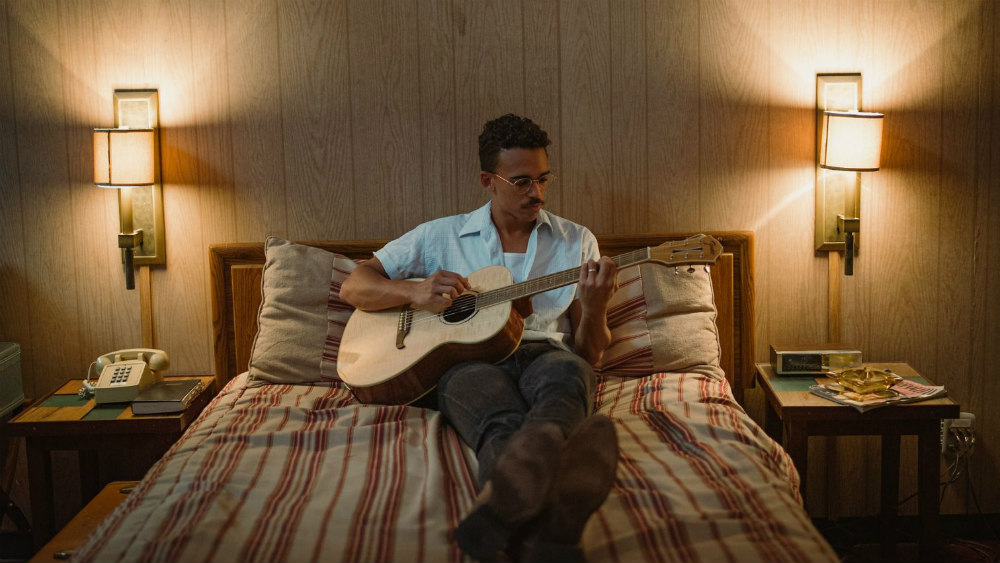
In the music video he made for NPR Music’s 2022 Tiny Desk competition, Edwards sits on a stool in front of a mic in a garage crowded with barbecue sauce, hunting trophies, and a Ms. Pac-Man machine. He taps the heel of his brown cowboy boot as the bass player behind him lays down a thick groove and a horn section swings into action.

“Oh, baby!,” he sings. “Brokenness is all I’ve ever known—ever known. / But I know the good Lord has far more for me / And I’m not gonna take the gravity / That’s weighing you down.”

Edwards’s parents got divorced two years ago, ending a marriage roiled by his father’s infidelity, narcissism, and abuse. The five kids in the family are still reeling, but also relieved. The cycle of their parents’ bad choices has finally been broken. Now they can move forward.

For Edwards, that means not becoming like his father. When he talks about it, he talks about choices and discipline, about gritting his teeth and being a man.

When he sings about it, though, he sings about a life transformed by love. He sounds like no one so much as Augustine, an anxious heart that has found rest.

“I will be a better father than my own,” he says toward the end of the album, “Not ’cause of me but by grace and grace alone.”

Edwards’s lead guitarist, Ryan Stueckemann, says this deeply religious album wasn’t what he expected when he started playing with Edwards, but he’s also not surprised this is where they ended up.

“From the jump I knew Micah just really loves Jesus,” he said. “The first time we practiced he asked if we could pray, so this is like the most Christian non-Christian band there could be.”

Stueckemann works full time as the music minister at a Methodist church. Three other members of the band are in worship ministry as well, not to mention Edwards, who sings on Sundays at the nondenominational Sandbox Church.

They didn’t come together to perform Christian music, though. They started with a shared bond over Great American Songbook standards like Nat King Cole. They moved into ’60s soul music and old-school country covers, which allowed them to start performing at weddings and corporate events around Houston. They called themselves the Honky-Tonk Revivalists.

Those gigs stopped with the pandemic. But when the band could finally get back together to practice, Stueckemann recalls, Edwards had imagined a new sound. He had an idea about how he could bring soul and country together.

“We sounded like the Commodores, and then he was like, ‘I want to add some Cody Johnson,’” Stueckemann said. “‘I said, ‘Dude. I don’t even know how those things go together.’

“And someone in the band said, ‘What does that even mean?’

“And Micah goes, ‘Think about yourself riding a horse.’”

They laugh about it now, but it worked. They had a new sound, “Texas Soul,” which was like a throwback to Sam Cooke, Otis Redding, and the vibe of Motown, embellished with country tones. It shares musical DNA with Leon Bridges and Charley Crockett, but what really holds it together, according to Stueckemann, is Edwards’s voice, which is raspy but also pure and joyful.

“Texas Soul” wasn’t like praise and worship or contemporary Christian music, but it did have a spiritual depth, Stueckemann said. It could carry pain and convey hope—just what they needed for an album telling the story of a broken family, the wreckage of sin, and a man trying to be a new kind of man.

The story is Edwards’s, but it might also be every Christian’s, coming of age.

“My parents are awesome,” Stueckemann said. “But I’ve had heroes fall. You get into your late 20s, and there are just parts of your life that are going to fall apart. Parts you thought were no-doubters.”

Stueckemann grew up playing worship music for Harvest Bible Chapel. The Chicagoland megachurch was plunged into scandal in 2018 when independent journalist Julie Roys reported allegations of misused funds and claims that pastor James MacDonald bullied, belittled, and deceived church staff. MacDonald was fired from the church in 2019.

“There are things I’ve lost in the last five years that I never thought we’d have to deal with,” Stueckemann said. “I hope this album offers a different path to talking about what the Lord does in suffering, in the middle of unplanned disasters.”

Going down a different path than “the old man, which is corrupt according to the deceitful lusts” (Eph. 4:22, KJV) can be hard work, though. It’s not easy to figure out how to break patterns and reject inheritances.

Madeline Edwards, Micah’s older sister, a professional singer going on tour this summer with Chris Stapleton, said it took faith. She’s seen healing happen through her and her brother’s commitment to their respective churches.

“When you go through the kind of s– we did, there’s no way to go back to normal,” she said. “The only things that really helped were therapy and prayer and digging into the Lord. Our church communities really lifted us up—they just lifted us up in prayer.”

It wasn’t like that when the Edwardses were kids, though they were always in church. Church—like music and school and sports—was about performance. About being good enough to hold the attention and win the approval of their father, Madeline says.

It was only later, when she was leading worship in an Acts 29 church plant and he was plugging in in a Reformed University Fellowship campus ministry, that the two eldest Edwards kids understood Christianity could be a response to God’s gift of grace.

For Micah, that story also involves meeting his wife, Chelsea, who showed up at the campus ministry one day and changed everything for him.

“It wasn’t long before love songs / made more sense to me,” he sings in “The Girl from the Valley.”

When Madeline Edward sees Micah with his wife and now his son, she thinks of all the years he spent agonized by the thought he might become like his father. He was so worried about the inevitability of it, but he underestimated what love would do to him.

“When you love someone,” Madeline said, “you don’t have to constantly think, How do I not cheat on this person? You want to give yourself to them. How do I serve this person? You don’t have to work so hard not to do the right thing. It’s like with God, it’s an overflow of love.”

https://open.spotify.com/embed/track/38zNWMi1YRsvaVq3RuZcyV?si=b9ed0464b7e24a2e

The album follows that journey in Edwards’s life as he discovers love, learns to receive grace, starts to offer forgiveness to his parents, keeps fighting with fear, and learns to rely fully on Jesus.

The album ends with an original rendition of “In Christ Alone.”

As Micah Edwards has built a fanbase on social media, the message has resonated.

“Just found your music,” someone wrote in a recent comment on Edwards’s Instagram. “It spoke to my soul like nothing else in the longest time. Gonna be huge, Grammy material and stuff, hope so. … Stay firm in Jesus. He comes first, everything else after him.”

Joe Rodriguez, an elder at Edwards’s church, thinks it connects to people because so many are trying to deal with things from their past and from previous generations. They’re trying to do things differently, take on responsibilities that were shirked by others, and change things for themselves and their children.

Edwards, he said, leans on God.

https://open.spotify.com/embed/album/25Fj6y3HHWEMfxy1PmtTap?si=Guprm9chSa2e2gMPxZTxlQ

“I always tell him he’s like an usher,” Rodriguez said. “Not like Usher the singer. Like an usher in church. He’s using his gifts to bring us to the Spirit. He brings us in, where everyone can have access to God.”

As Edwards waits in his home in Houston, though, and anticipates the release of his album, he can still feel the fear. He can still imagine that he might fall into the patterns he saw modeled for him. He’s guarding himself.

“I know that the Enemy is coming with lies and temptations,” he says. “I know that the Enemy is coming to take it all away, and I know what that looks like. I know what it looks like for a man to choose himself and for those choices to destroy a family.”

But when he looks at his newborn, he feels something else. He thinks, Isn’t it all a gift? The baby. His wife. The music. The chance to learn from the bad past and not just repeat patterns. The opportunity to be a different kind of man.

The grace of it all is overwhelming.

“You caught me in a very thankful space,” he told CT.

Then the new father—who is not the old father—kisses his son. He kisses him and kisses him all over his face, love overflowing.

News

India’s Anticonversion Laws Loophole

The government didn’t have the votes to pass a controversial bill in Karnataka. So it found another way.

Christianity Today June 9, 2022
Abhishek Chinnappa / Stringer / Getty

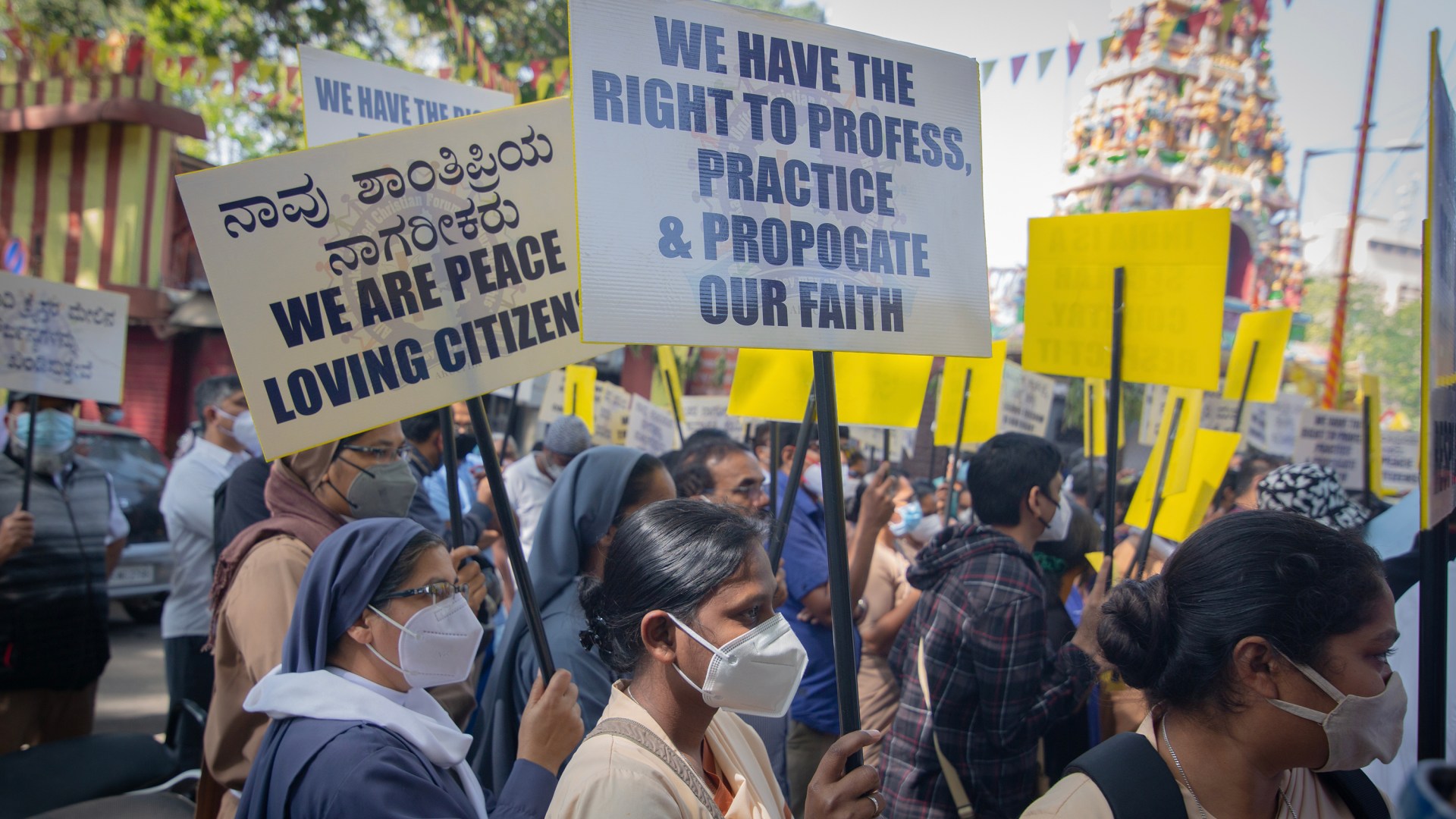
Last month, a delegation of Christian leaders met with Thawar Chand Gehlot, the governor of the southwest Indian state of Karnataka. Their aim: to discourage Gehlot from signing an anticonversion ordinance that they believe will embolden religious radicals to stir unrest.

Despite what Bengaluru archbishop Peter Machado described to CT as a “courteous and welcoming” reception, Gehlot signed the ordinance the following day, May 17, making Karnataka the 13th out of India’s 29 states to pass legislation of this kind.

The ordinance prohibits numerous behaviors including conversion by “force, undue influence, coercion, allurement or by any fraudulent means or by marriage,” and forbids anyone from helping or conspiring on conversions. It allows people beyond the convert—including family members, relatives, or even colleagues—to file complaints.

The ordinance also stipulates a jail term ranging from three to five years and a fine of 25,000 rupees (roughly $320). If the convert is a woman, child, or Dalit, the punishment can increase to up to 10 years in prison.

India’s first anticonversion law passed in the state of Madhya Pradesh in 1967. In recent years, as the Hindu nationalist Bhartiya Janta Party (BJP) has gained power across India, the party has begun to frequently promise these laws on the campaign trail.

But passing this legislation proved challenging in Karnataka, a state known widely by Westerners as the home of Bengaluru (Bangalore), a tech hub for many multinationals. Afraid that the majority party lacked the votes to pass an anticonversion bill, the governor directly promulgated it as an ordinance, or temporary law, that can remain in effect until it is replaced by a law.

“The government attempted to get this bill passed despite strong opposition from the Christian community and the united opposition parties who opposed the bill on the house floor,” said Atul Y. Aghamkar, who leads the National Centre for Urban Transformation at the Evangelical Fellowship of India (EFI). “However, they could not get it through the legislative council because they did not enjoy the majority there.

“So, this bill was processed and passed through a back door ordinance when the assembly and council were not in session,” he told CT. “That itself shows the government’s intent, as they could not face the discussion on the bill in both houses.”

https://datawrapper.dwcdn.net/dq2xI

“A crime tomorrow”

Karnataka Christians have two primary fears. The first is that the described actions banned from accompanying conversions are overly broad and will lead to a crackdown on actions unrelated to conversion.

“It will be a crime tomorrow to do some charity,” said Machado last month:

So, giving free education will also be a big problem. If I have to help a Dalit child, who can’t afford to pay the fees, I’ll have to fill a number of forms. I will have to explain why the child is being helped, and why I am offering free education.

If we are going to explain why we are distributing gifts, tomorrow Santa Claus will be a dangerous character too.

Those who break the law face up to 10 years in prison—the same penalty as convicted rapists. Such a punishment strikes Christian activist John Dayal as egregiously cruel.

“What message are they trying to convey by bringing such a law?” he said.

Second, church leaders say gangs and mobs will use these laws as justification for anti-Christian violence.

“This ordinance is just a simple act on the part of this government to allow the vigilante groups to have the freedom to attack Christians, destroy Christian institutions, and create an atmosphere of fear to subjugate the Christian community,” Aghamkar said. “Karnataka has seen many reported and unreported cases of attacks on Christians in the recent past, and these are bound to increase in the wake of the introduction of this ordinance.”

Christians comprise less than 2 percent of Karnataka’s population of 64 million. Muslims, whom the bill also targets through its prohibition on “unauthorized” interfaith marriages, comprise 13 percent. Hindus comprise 84 percent.

The day after the ordinance went into effect, police arrested an out-of-state pastor and his wife in Kodagu district upon the complaints of right-wing Hindu groups for deliberate and malicious acts, and hinted that the couple may end up being charged under the ordinance.

In 2021, EFI’s Religious Liberty Commission (EFIRLC) documented more than three dozen attacks on Christians in Karnataka in 2021. Most of these attacks were instances of physical violence and disruption of worship services in churches that followed allegations of religious conversions.

The EFIRLC maintains that its documentation is not exhaustive, and the actual tally of attacks may be much more than documented or even reported.

The BJP in Karnataka—the only southern state where the political party has experienced considerable electoral success—came to power in 2008, on the heels of a wave of brutal attacks against Christians locally and across India.

“They are empowering killer gangs, empowering lynch mobs, empowering vigilante groups and lumpens (disrespectful troublemakers) throughout the country to target the next Christian they see,” said Dayal. “To break the next church, vandalize the next school, harass a hospital run by a Christian, chase a nun, disrupt a worship service, and so on.”

Is there still time?

Anticonversion legislation has been discussed and passed even before India’s independence in princely states such as Raigarh, Udaipur, Kota, and Jodhpur. Post-independence, the Constituent Assembly of India discussed the possibility of forbidding conversions by force, fraud, or allurement, but did not introduce any such provision.

After independence, the states of Madhya Pradesh and Odisha passed anticonversion laws in 1967 and 1968, respectively, due to what officials alleged was malpractice by Christian missionaries. By the late 1990s, the BJP and Hindu right-wing groups had ignited a national debate on religious conversion and pressed for nationwide anticonversion legislation. By the early 2000s, several states had passed and enforced such legislation.

The BJP has argued that Hindus face a danger of decimation from increasing Christian conversion rates. Census data and public surveys, however, don’t support such a trend. “Religious conversion is rare in India; to the extent that it is occurring, Hindus gain as many people as they lose,” stated the Pew Research Center in a first-of-its-kind report in 2021.

Currently, 13 states in India have passed anticonversion legislation, though it is only enforced in nine. Tamil Nadu repealed its 2002 law in 2004 in the wake of public pressure, while the governor of Rajasthan refused to sign its 2006 law. Arunachal Pradesh passed its law in 1978 but never drafted rules for it. The same is true in Haryana, which just passed its own law this past March.

Several other states have pursued the ordinance route, including Uttar Pradesh, the largest state in India, in 2020. Officials replaced the ordinance with a law in March 2021.

In Karnataka, some suspect that the government passed the anticonversion measure as an ordinance so the BJP government could boast about it in upcoming regional elections. Attacking religious minorities polarizes the electorate and often sends voters to the BJP.

Right now, Christian groups are exploring their options for striking down the new ordinance.

“The Karnataka anticonversion law, like those in other states, violates Article 25 of the Indian Constitution and threatens the secular fabric of the country,” said an EFIRLC spokesperson. “We must unitedly challenge it in the court of law, if need arise.”

News

Pew: Israelis and Palestinians Find Favor in the Eyes of Americans

Survey shows citizens remain much preferred over their governments, while US polarization continues as youth shift support from Israel to Palestine.

Illustration of the flags of Palestine and Israel

Illustration of the flags of Palestine and Israel

Christianity Today June 9, 2022
Tuomas A. Lehtinen / Getty Images

Americans prefer a less polarized Holy Land. But they themselves are as polarized about it as ever.

A new survey by the Pew Research Center—three years removed from when Donald Trump and Benjamin Netanyahu led the political scene—reveals rising favorability ratings for Israel and Palestine, across nearly every segment of Americans.

Most, however, still prefer Israel.

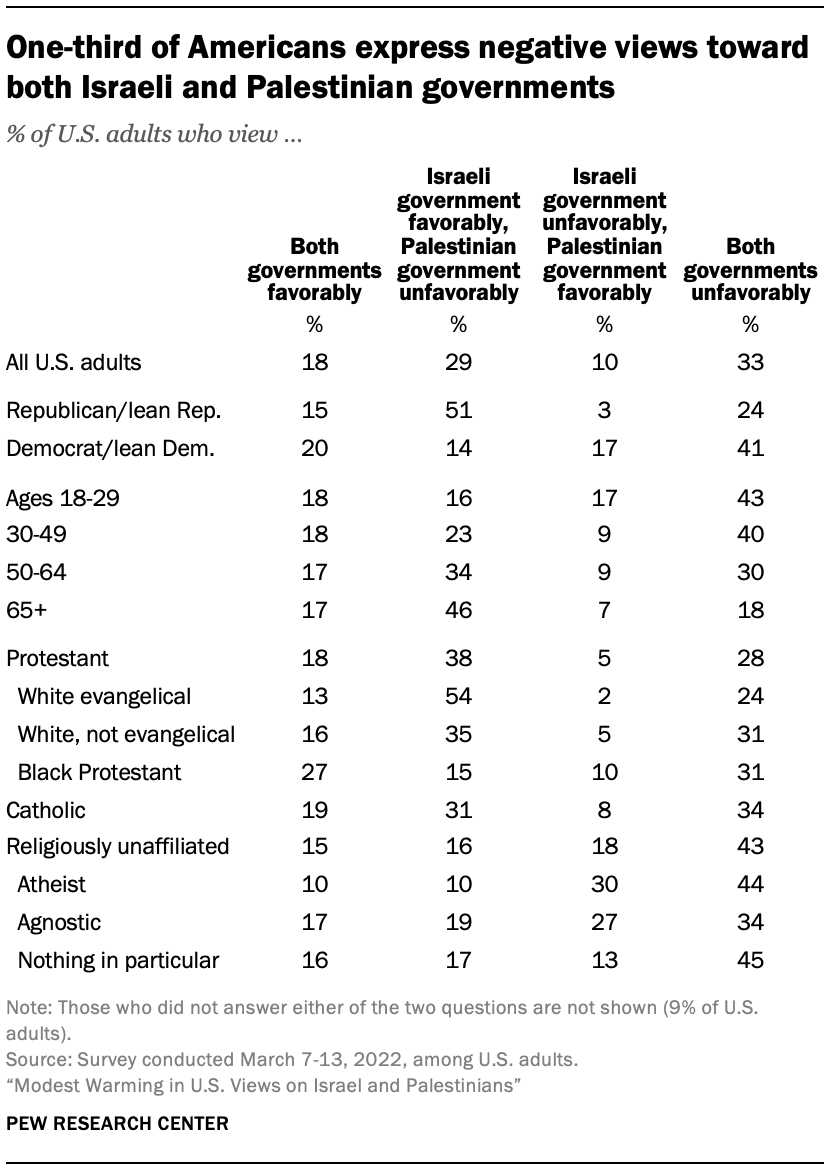
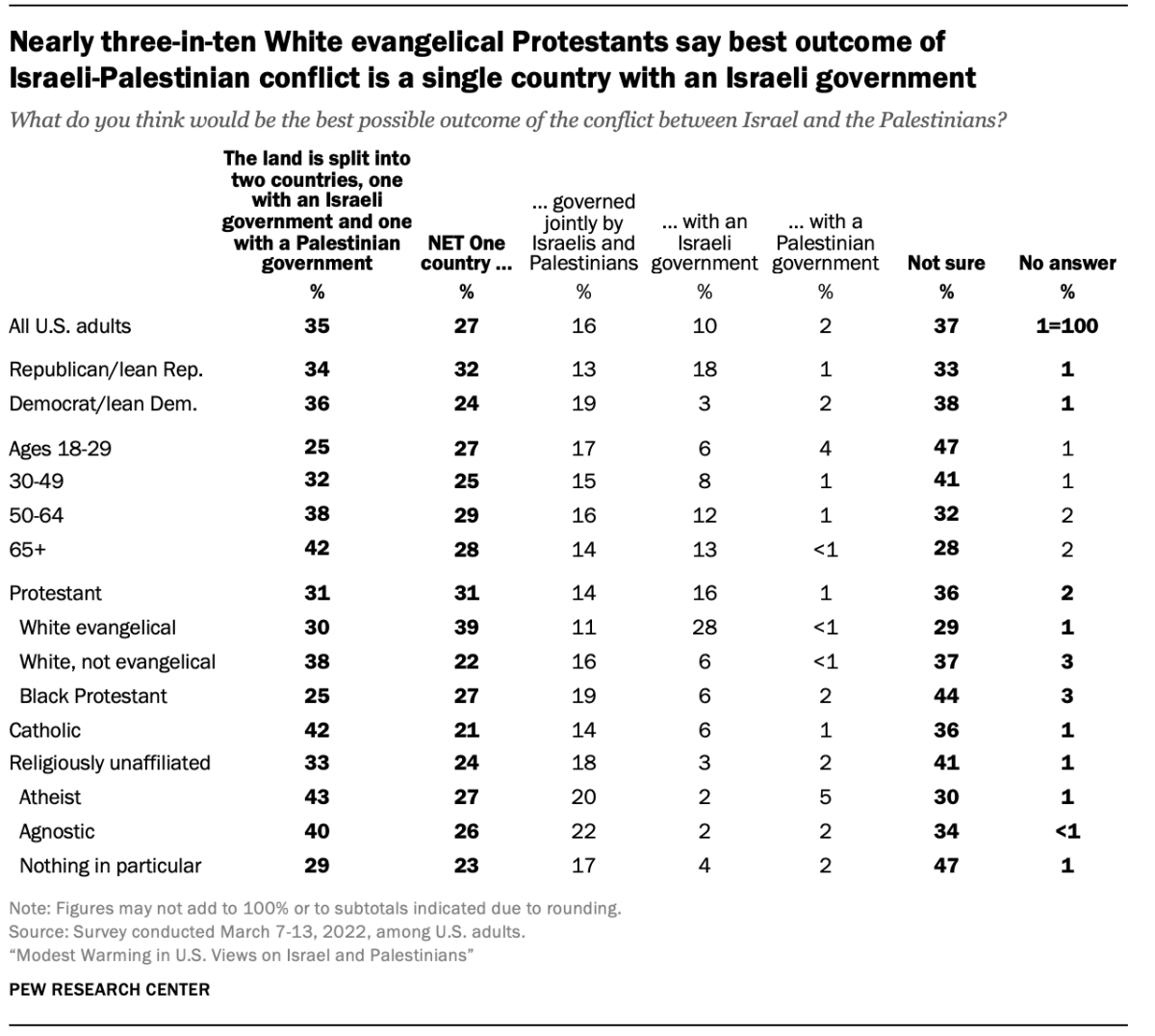
White evangelicals lead the way, with 86 percent viewing the Israeli people favorably and 68 percent viewing Israel’s government favorably, compared to 37 percent favorability for the Palestinian people and 14 percent favorability for their government.

Overall, 1 in 3 white evangelicals view both peoples favorably, but only 1 in 10 favor both governments.

These believers are out of step with the wider US, however.

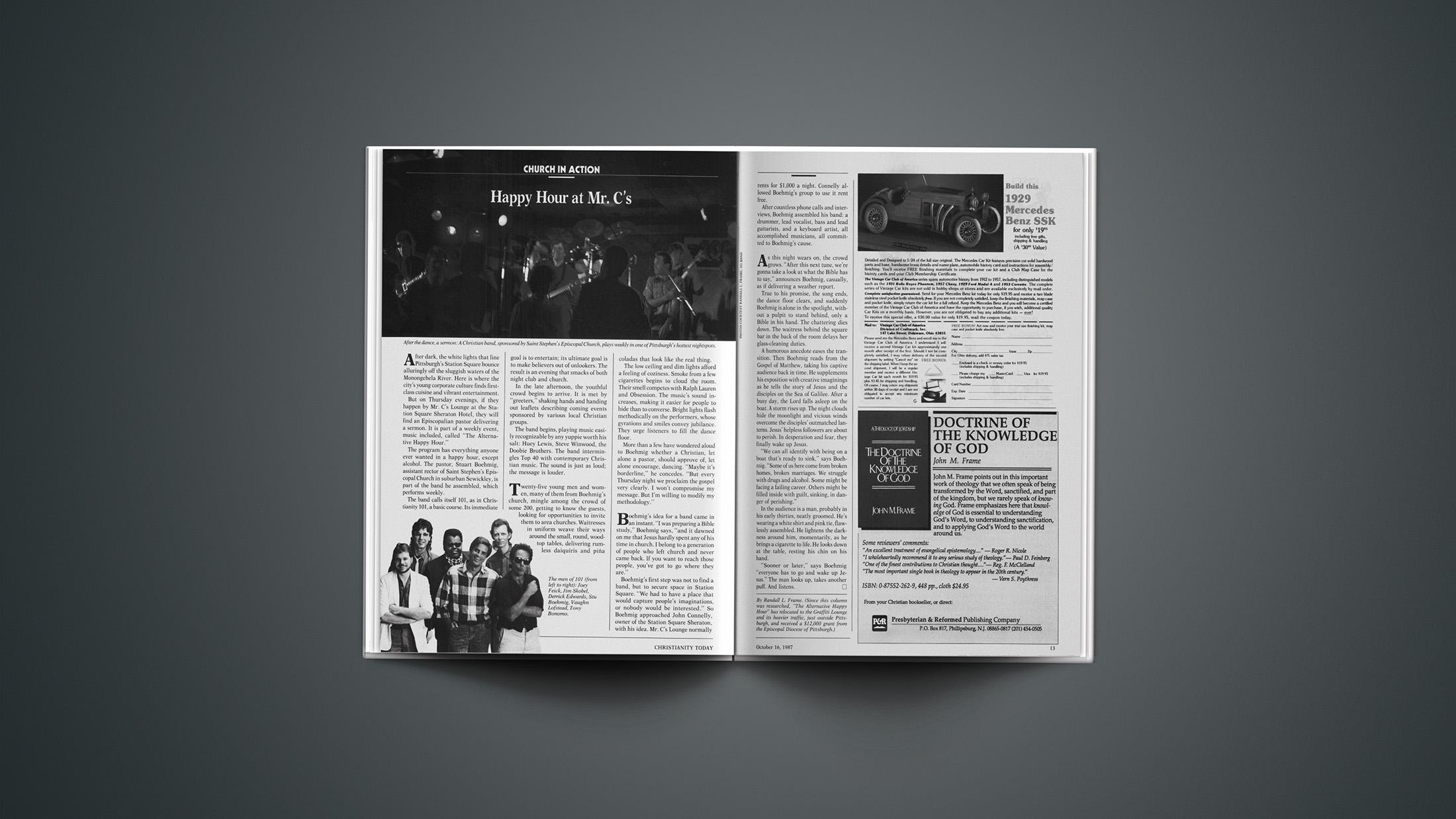
After dark, the white lights that line Pittsburgh’s Station Square bounce alluringly off the sluggish waters of the Monongehela River. Here is where the city’s young corporate culture finds first-class cuisine and vibrant entertainment.
But on Thursday evenings, if they happen by Mr. C’s Lounge at the Station Square Sheraton Hotel, they will find an Episcopalian pastor delivering a sermon. It is part of a weekly event, music included, called “The Alternative Happy Hour.”
The program has everything anyone ever wanted in a happy hour, except alcohol. The pastor, Stuart Boehmig, assistant rector of Saint Stephen’s Episcopal Church in suburban Sewickley, is part of the band he assembled, which performs weekly.
The band calls itself 101, as in Christianity 101, a basic course. Its immediate goal is to entertain; its ultimate goal is to make believers out of onlookers. The result is an evening that smacks of both night club and church.
In the late afternoon, the youthful crowd begins to arrive. It is met by “greeters,” shaking hands and handing out leaflets describing coming events sponsored by various local Christian groups.
The band begins, playing music easily recognizable by any yuppie worth his salt: Huey Lewis, Steve Winwood, the Doobie Brothers. The band intermingles Top 40 with contemporary Christian music. The sound is just as loud; the message is louder.
Twenty-five young men and women, many of them from Boehmig’s church, mingle among the crowd of some 200, getting to know the guests, looking for opportunities to invite them to area churches. Waitresses in uniform weave their ways around the small, round, wood-top tables, delivering rumless daiquiris and piña coladas that look like the real thing.
The low ceiling and dim lights afford a feeling of coziness. Smoke from a few cigarettes begins to cloud the room. Their smell competes with Ralph Lauren and Obsession. The music’s sound increases, making it easier for people to hide than to converse. Bright lights flash methodically on the performers, whose gyrations and smiles convey jubilance. They urge listeners to fill the dance floor.
More than a few have wondered aloud to Boehmig whether a Christian, let alone a pastor, should approve of, let alone encourage, dancing. “Maybe it’s borderline,” he concedes. “But every Thursday night we proclaim the gospel very clearly. I won’t compromise my message. But I’m willing to modify my methodology.”
Boehmig’s idea for a band came in an instant. “I was preparing a Bible study,” Boehmig says, “and it dawned on me that Jesus hardly spent any of his time in church. I belong to a generation of people who left church and never came back. If you want to reach those people, you’ve got to go where they are.”
Boehmig’s first step was not to find a band, but to secure space in Station Square. “We had to have a place that would capture people’s imaginations, or nobody would be interested.” So Boehmig approached John Connelly, owner of the Station Square Sheraton, with his idea. Mr. C’s Lounge normally rents for ,000 a night. Connelly allowed Boehmig’s group to use it rent free.
After countless phone calls and interviews, Boehmig assembled his band: a drummer, lead vocalist, bass and lead guitarists, and a keyboard artist, all accomplished musicians, all committed to Boehmig’s cause.
As this night wears on, the crowd grows. “After this next tune, we’re gonna take a look at what the Bible has to say,” announces Boehmig, casually, as if delivering a weather report.
True to his promise, the song ends, the dance floor clears, and suddenly Boehmig is alone in the spotlight, without a pulpit to stand behind, only a Bible in his hand. The chattering dies down. The waitress behind the square bar in the back of the room delays her glass-cleaning duties.
A humorous anecdote eases the transition. Then Boehmig reads from the Gospel of Matthew, taking his captive audience back in time. He supplements his exposition with creative imaginings as he tells the story of Jesus and the disciples on the Sea of Galilee. After a busy day, the Lord falls asleep on the boat. A storm rises up. The night clouds hide the moonlight and vicious winds overcome the disciples’ outmatched lanterns. Jesus’ helpless followers are about to perish. In desperation and fear, they finally wake up Jesus.
“We can all identify with being on a boat that’s ready to sink,” says Boehmig. “Some of us here come from broken homes, broken marriages. We struggle with drugs and alcohol. Some might be facing a failing career. Others might be filled inside with guilt, sinking, in danger of perishing.”
In the audience is a man, probably in his early thirties, neatly groomed. He’s wearing a white shirt and pink tie, flawlessly assembled. He lightens the darkness around him, momentarily, as he brings a cigarette to life. He looks down at the table, resting his chin on his hand.
“Sooner or later,” says Boehmig “everyone has to go and wake up Jesus.” The man looks up, takes another puff. And listens.

By Randall L. Frame. (Since this column was researched, “The Alternative Happy Hour” has relocated to the Graffiti Lounge and its heavier traffic, just outside Pittsburgh, and received a ,000 grant from the Episcopal Diocese of Pittsburgh.)

Among Americans at large, the Israeli people have a 67 percent favorability rating, up from 64 percent. The Israeli government’s favorability rating increased from 41 to 48 percent. And a narrow majority of Americans now view Palestinians positively (52%, up from 46%), though less so their government (28%, up from 19%). Overall, 2 in 5 Americans view both peoples favorably (42%), but only 1 in 5 favor both governments.

“Americans naturally want to be favorable toward other peoples,” said Mark Tooley, president of the Institute on Religion and Democracy (IRD). “I’m surprised it is not higher.”

Theology may have something to do with the affinity.

In a new question, Pew asked Americans if God gave the land that is now Israel to the Jews. White evangelicals agreed at a rate of 70 percent, while 23 percent were unsure. Overall, 3 in 10 Americans agreed (similar to the response of American Jews in a separate 2020 survey). A significant 41 percent of Americans were unsure, while 17 percent replied they did not believe in God.

Other Christian percentages resemble America. White non-evangelical (often called “mainline”) Protestants (31%), Black Protestants (36%), and Catholics (25%) agreed, all with unsure segments of 50 percent or higher.

IRD aims to champion biblical Christianity in its support for Israel. But even if secular in orientation, Tooley said that many have inherited an unconscious connection with Israel from longstanding American culture. The higher white evangelical rates stem from increased polarization, tying support to their religious identity.

For the average American, politics and age were a better bellwether than denomination. Republican agreement on the role of God (46%) far outpaced Democratic (18%). And while 2 in 5 (38%) of those ages 65 or higher agreed, only 1 in 5 (21%) did so below the age of 30.

Gaps were significant in feelings toward Israel and Palestine as well.

Nearly 4 in 5 Republicans feel favorable toward the Israeli people (78%), compared to 3 in 5 Democrats (60%). Both numbers are slightly higher than in the last survey. And while 2 in 3 Republicans look favorably upon the Israeli government (66%), only 1 in 3 Democrats do similarly (34%), both representing an increase.

The gap reverses when concerning Palestinians, though their favorability increased also. Nearly 2 in 3 Democrats feel favorable toward the Palestinian people (64%, up from 58%). Slightly more than 1 in 3 Republicans agree (37%, up from 32%). The Palestinian government’s ratings are much lower, rising from 27 percent to 37 percent favorability among Democrats and from 11 percent to 18 percent among Republicans.

After dark, the white lights that line Pittsburgh’s Station Square bounce alluringly off the sluggish waters of the Monongehela River. Here is where the city’s young corporate culture finds first-class cuisine and vibrant entertainment.
But on Thursday evenings, if they happen by Mr. C’s Lounge at the Station Square Sheraton Hotel, they will find an Episcopalian pastor delivering a sermon. It is part of a weekly event, music included, called “The Alternative Happy Hour.”
The program has everything anyone ever wanted in a happy hour, except alcohol. The pastor, Stuart Boehmig, assistant rector of Saint Stephen’s Episcopal Church in suburban Sewickley, is part of the band he assembled, which performs weekly.
The band calls itself 101, as in Christianity 101, a basic course. Its immediate goal is to entertain; its ultimate goal is to make believers out of onlookers. The result is an evening that smacks of both night club and church.
In the late afternoon, the youthful crowd begins to arrive. It is met by “greeters,” shaking hands and handing out leaflets describing coming events sponsored by various local Christian groups.
The band begins, playing music easily recognizable by any yuppie worth his salt: Huey Lewis, Steve Winwood, the Doobie Brothers. The band intermingles Top 40 with contemporary Christian music. The sound is just as loud; the message is louder.
Twenty-five young men and women, many of them from Boehmig’s church, mingle among the crowd of some 200, getting to know the guests, looking for opportunities to invite them to area churches. Waitresses in uniform weave their ways around the small, round, wood-top tables, delivering rumless daiquiris and piña coladas that look like the real thing.
The low ceiling and dim lights afford a feeling of coziness. Smoke from a few cigarettes begins to cloud the room. Their smell competes with Ralph Lauren and Obsession. The music’s sound increases, making it easier for people to hide than to converse. Bright lights flash methodically on the performers, whose gyrations and smiles convey jubilance. They urge listeners to fill the dance floor.
More than a few have wondered aloud to Boehmig whether a Christian, let alone a pastor, should approve of, let alone encourage, dancing. “Maybe it’s borderline,” he concedes. “But every Thursday night we proclaim the gospel very clearly. I won’t compromise my message. But I’m willing to modify my methodology.”
Boehmig’s idea for a band came in an instant. “I was preparing a Bible study,” Boehmig says, “and it dawned on me that Jesus hardly spent any of his time in church. I belong to a generation of people who left church and never came back. If you want to reach those people, you’ve got to go where they are.”
Boehmig’s first step was not to find a band, but to secure space in Station Square. “We had to have a place that would capture people’s imaginations, or nobody would be interested.” So Boehmig approached John Connelly, owner of the Station Square Sheraton, with his idea. Mr. C’s Lounge normally rents for ,000 a night. Connelly allowed Boehmig’s group to use it rent free.
After countless phone calls and interviews, Boehmig assembled his band: a drummer, lead vocalist, bass and lead guitarists, and a keyboard artist, all accomplished musicians, all committed to Boehmig’s cause.
As this night wears on, the crowd grows. “After this next tune, we’re gonna take a look at what the Bible has to say,” announces Boehmig, casually, as if delivering a weather report.
True to his promise, the song ends, the dance floor clears, and suddenly Boehmig is alone in the spotlight, without a pulpit to stand behind, only a Bible in his hand. The chattering dies down. The waitress behind the square bar in the back of the room delays her glass-cleaning duties.
A humorous anecdote eases the transition. Then Boehmig reads from the Gospel of Matthew, taking his captive audience back in time. He supplements his exposition with creative imaginings as he tells the story of Jesus and the disciples on the Sea of Galilee. After a busy day, the Lord falls asleep on the boat. A storm rises up. The night clouds hide the moonlight and vicious winds overcome the disciples’ outmatched lanterns. Jesus’ helpless followers are about to perish. In desperation and fear, they finally wake up Jesus.
“We can all identify with being on a boat that’s ready to sink,” says Boehmig. “Some of us here come from broken homes, broken marriages. We struggle with drugs and alcohol. Some might be facing a failing career. Others might be filled inside with guilt, sinking, in danger of perishing.”
In the audience is a man, probably in his early thirties, neatly groomed. He’s wearing a white shirt and pink tie, flawlessly assembled. He lightens the darkness around him, momentarily, as he brings a cigarette to life. He looks down at the table, resting his chin on his hand.
“Sooner or later,” says Boehmig “everyone has to go and wake up Jesus.” The man looks up, takes another puff. And listens.

By Randall L. Frame. (Since this column was researched, “The Alternative Happy Hour” has relocated to the Graffiti Lounge and its heavier traffic, just outside Pittsburgh, and received a ,000 grant from the Episcopal Diocese of Pittsburgh.)

“Leaders in both countries specialized in the rhetoric of division,” said Todd Deatherage, executive director of Telos. “It has cemented a complex foreign policy challenge into a growing list of issues that polarize us on a partisan basis.”

Founder of an evangelical group dedicated to changing the narrative on Israel, he appreciates the rising number of Americans who wish to see both peoples flourishing.

But it is the young, he said, who “take seriously Jesus’ call to be peacemakers.”

Pew found that among Americans ages 30 and below, 61 percent feel favorable toward the Palestinian people while 56 percent feel favorable toward Israelis. This is the only category that did not rise, as three years ago 63 percent felt favorable toward Israelis, compared to 58 percent toward the Palestinians. The Palestinian government is now narrowly preferred also (35% vs. 34%), though both reputations increased (up from 26% vs. 27%) after the changes in leadership.

Older Americans, however, resemble Republicans and white evangelicals concerning Israel, with 78 percent favoring the Jewish state. Only a single-point rise from the Trump-Netanyahu years, their opinion of Israel’s government increased from 57 to 64 percent. Toward the Palestinian people, their rating rose from 43 to 47 percent, while their view of the Palestinian government increased from 19 to 24 percent.

It was the kind of afternoon camp counselors dread. The rain had been falling, heavy and steady, for two days. The leaden clouds hovered near the treetops and seemed to promise that the cold, penetrating downpour would continue for yet another day.
Inside the main lodge an epidemic of cabin fever had broken out. On the first day of rain, there were crafts to work on and a standby ration of wet-weather cartoon films to watch. The second day of rain was passed with group games and a rerun of the cartoons.
But when the rains continued unabated on the third day, the campers were in no mood for cartoons, or crafts, or games. They demanded fresh entertainments.
How relieved and pleased the counselors were when a camp visitor, a high-ranking officer in an elite law-enforcement agency, volunteered his services. He offered to give the campers a demonstration of weapons, police tactics, and some self-defense procedures. The assembled campers seemed spellbound as they learned how the nightstick and Mace are used. They took turns snapping handcuffs on one another. And they listened attentively to the lecture on the dangers of firearms. As a finale, this modern-day Elliott Ness showed the campers how best to deal with muggers and stickup men.
Calling a young camper to the platform, he described a fast self-defense action by which one could evade, disarm, and subdue any would-be stickup man who might poke a pistol into your back. The maneuver, he explained, consisted of a quick step to the left, accompanied by a rapid thrust of the right elbow backward and downward to knock away the assailant’s revolver. The gun, he promised, would be stripped from the gunman’s hand or, at worst, discharge harmlessly into the ground. It all seemed so simple.
With the help of the camper who had now joined him on stage, the lawman proceeded to demonstrate. He armed the camper with a large water pistol. Then assuming the role of the victim, he instructed the camper to approach him from behind and attempt the stickup.
Gun in hand, the would-be robber struck, jabbing the barrel into the victim’s back. The bold hero lunged to his left, swung back his right elbow fiercely—and was shot squarely in the back by the junior gunman. The huge, running, water spot between his shoulder blades was clear evidence of the failure of his supposedly safe maneuver.
Red-faced and fumbling for words, the lawman scolded the junior gunman, “You’re supposed to hold the gun in your right hand!” But the left-handed robber was not impressed. Scrambling for some lesson to leave as he beat his retreat, the lawman said, “Well, be sure to watch out for left-handed stickup men.”
Every now and then that “lesson” comes back to me, because it is a good one. I can, for example, deal successfully with temptations from the usual and expected sources—from the right-hand side. But it is when I become too confident that I get gunned down from the left—any blind side, really—by the sin and failures I least anticipate. To make matters worse, Satan is ambidextrous, always ready to attack from either side. And so the price of moral growth is perpetual vigilance.
Over the past months all of us in positions of Christian leadership have been made more aware that we possess no special immunity from moral and spiritual failure. There is a left-handed stickup man lying in wait for each one of us.
I have learned I can improve my defenses greatly by joining myself to partners ready to warn me about dangers on my blind side and shield me with their prayers. I must be willing to accept their warnings, corrections, and encouragements as I seek to become the person God intends me to be. Paul reminded his Thessalonian friends that he had expressed his love for them by holding them accountable to live lives worthy of the God who called them.
My friends, we—I—need you to help fend off the stickup men by holding me accountable to live a life worthy of the God who has called me.
GEORGE K. BRUSHABER

Gary Burge, professor of New Testament at Calvin Theological Seminary, notes a clear distinction.

“Younger evangelicals see social and political justice as central to their faith,” said the author of Whose Land? Whose Promise? What Christians Are Not Being Told About Israel and the Palestinians. “Older evangelicals do not.”

Burge, like Deatherage, finds hope that this divide—mirrored also in US politics—is narrowing in the overall favor Americans show both peoples. Evidence can be found in the other denominations.

White Protestants and Catholics are similar, with 7 out of 10 feeling favorable toward the Israeli people and 5 out of 10 feeling favorable toward their government.

About half of White Protestants and Catholics feel favorable toward the Palestinian people (47% and 50%, respectively), while only about a quarter feel favorable toward their government (21% and 27%, respectively).

Meanwhile, Black Protestants and the religiously unaffiliated equated the two sides.

A majority of both feel favorable toward the peoples. Among Black Protestants, favor toward Israelis at 58 percent, and favor toward Palestinians is at 53 percent. Among the unaffiliated, favor toward Israelis is at 58 percent and favor toward Palestinians is at 59 percent.

They felt less inclined toward the governments. Black Protestants favored Israel’s at 43 percent and Palestine’s at 38 percent. The unaffiliated rated Israel’s government at 31 percent and Palestine’s at 33 percent.

Tooley attributed the rise in Black support for Israel to the decline of their traditional church and the rise in Pentecostal and nondenominational faith. The latter tend slightly toward Zionism.

Affinity toward the Palestinians comes from two sources, said Mordecai Inbari, professor of philosophy and religion at UNC–Pembroke. The Black Lives Matter narrative is anti-Israeli, said the Jewish scholar. But geopolitics also matters.

“Warmer feelings toward Muslims correlate with sympathy toward Palestinians,” he said, having conducted extensive research on evangelicals and Christian Zionism. “With the end of the wars in the Middle East, these two are increasingly connected.”

Tooley also cited a changing regional dynamic. As Arab nations normalize with Israel, the Holy Land is overshadowed by other conflicts. Americans correspondingly give it less attention, and can warm toward both.

Gerald McDermott believes the warmth is not always justified.

“This can only be from inattention to hard news about the Palestinian governments,” said the author of Israel Matters and editor of The New Christian Zionism. “Hamas and the Palestinian Authority imprison citizens who dare to criticize them.”

McDermott also spoke of incitement against Israelis, and the diversion of funds away from local development in favor of rocket launchers. And his displeasure was particularly directed toward the “specious claims” of activists reflected in a new survey question about the boycott, divestment, and sanctions (BDS) movement.

Launched in 2005, its supporters allege mistreatment of Palestinians in a system of apartheid, and call for an international pressure campaign against the Israeli government. Some of its critics call BDS antisemitic, for denying legitimacy to a Jewish state.

“Muslims have many nations in the Middle East and elsewhere,” said McDermott. “Why are Jews not permitted to have one?”

Overall, few Americans have heard about the BDS movement (no more than 1 in 5 across demographic groups). But atheists are twice as likely to support it (13% vs. 5%), while evangelicals and Republicans are twice as likely to oppose it (11% and 12%, respectively, vs. 6%). While BDS is best known for activity on college campuses, only 17 percent of those under the age of 30 have heard about it; 8 percent support, while 4 percent oppose.

Tooley said BDS has “largely failed.” Ignorance of it, said Inbari, is for the best.

It was the kind of afternoon camp counselors dread. The rain had been falling, heavy and steady, for two days. The leaden clouds hovered near the treetops and seemed to promise that the cold, penetrating downpour would continue for yet another day.
Inside the main lodge an epidemic of cabin fever had broken out. On the first day of rain, there were crafts to work on and a standby ration of wet-weather cartoon films to watch. The second day of rain was passed with group games and a rerun of the cartoons.
But when the rains continued unabated on the third day, the campers were in no mood for cartoons, or crafts, or games. They demanded fresh entertainments.
How relieved and pleased the counselors were when a camp visitor, a high-ranking officer in an elite law-enforcement agency, volunteered his services. He offered to give the campers a demonstration of weapons, police tactics, and some self-defense procedures. The assembled campers seemed spellbound as they learned how the nightstick and Mace are used. They took turns snapping handcuffs on one another. And they listened attentively to the lecture on the dangers of firearms. As a finale, this modern-day Elliott Ness showed the campers how best to deal with muggers and stickup men.
Calling a young camper to the platform, he described a fast self-defense action by which one could evade, disarm, and subdue any would-be stickup man who might poke a pistol into your back. The maneuver, he explained, consisted of a quick step to the left, accompanied by a rapid thrust of the right elbow backward and downward to knock away the assailant’s revolver. The gun, he promised, would be stripped from the gunman’s hand or, at worst, discharge harmlessly into the ground. It all seemed so simple.
With the help of the camper who had now joined him on stage, the lawman proceeded to demonstrate. He armed the camper with a large water pistol. Then assuming the role of the victim, he instructed the camper to approach him from behind and attempt the stickup.
Gun in hand, the would-be robber struck, jabbing the barrel into the victim’s back. The bold hero lunged to his left, swung back his right elbow fiercely—and was shot squarely in the back by the junior gunman. The huge, running, water spot between his shoulder blades was clear evidence of the failure of his supposedly safe maneuver.
Red-faced and fumbling for words, the lawman scolded the junior gunman, “You’re supposed to hold the gun in your right hand!” But the left-handed robber was not impressed. Scrambling for some lesson to leave as he beat his retreat, the lawman said, “Well, be sure to watch out for left-handed stickup men.”
Every now and then that “lesson” comes back to me, because it is a good one. I can, for example, deal successfully with temptations from the usual and expected sources—from the right-hand side. But it is when I become too confident that I get gunned down from the left—any blind side, really—by the sin and failures I least anticipate. To make matters worse, Satan is ambidextrous, always ready to attack from either side. And so the price of moral growth is perpetual vigilance.
Over the past months all of us in positions of Christian leadership have been made more aware that we possess no special immunity from moral and spiritual failure. There is a left-handed stickup man lying in wait for each one of us.
I have learned I can improve my defenses greatly by joining myself to partners ready to warn me about dangers on my blind side and shield me with their prayers. I must be willing to accept their warnings, corrections, and encouragements as I seek to become the person God intends me to be. Paul reminded his Thessalonian friends that he had expressed his love for them by holding them accountable to live lives worthy of the God who called them.
My friends, we—I—need you to help fend off the stickup men by holding me accountable to live a life worthy of the God who has called me.
GEORGE K. BRUSHABER

There are clearer opinions about the best possible outcome for the conflict between Israel and Palestine—but also significant uncertainty. Between a quarter (ages 65 and above, 28%) and a half (ages 30 and under, 47%) of Americans are “not sure” if a one-state or two-state solution would be better.

“Who can blame them?” said Tooley. “It’s very complex.” Inbari thinks most people do not bother to study the issues, as the policy issues are not tied to their religious identity.

If so, this is least true of white evangelicals. This group of respondents was among the most sure, with 4 in 10 favoring a one-state solution (39%), and 3 in 10 believing it should have an Israeli government (28%). While few Americans believe that the one-state should be governed by Palestinians, 2 out of 10 Democrats (19%), Black Protestants (19%), and the unaffiliated (18%) believe it should be governed jointly.

Apart from white evangelicals, Black Protestants, and those under 30, all other segments preferred the traditional US policy of support for a two-state solution. Highest were the 4 in 10 atheists (43%), Catholics (42%), ages 65 and older (42%), agnostics (40%), and white Protestants (38%) who believe each people should govern themselves.

Pew surveyed 10,144 Americans in March. It characterized the findings as a “modest warming” toward both Israel and Palestine.

Deatherage called it a rejection of zero-sum activism. And Inbari, the Tar Heel professor, appreciated that Pew did not make respondents pick between them.

“People can like both sides,” he said. “It is possible to support both UNC and Duke.”

News

Why a Presbyterian Elder Defended Muslims Building a Mosque in Middle Tennessee

Q&A with First Amendment champion Eric Treene on religious freedom, land use, and how the Westminster Confession contributed to his work at the Department of Justice.

Eric Treene testifies at a US Senate Judiciary Committee hearing on religious hate crimes in 2017.

Eric Treene testifies at a US Senate Judiciary Committee hearing on religious hate crimes in 2017.

Christianity Today June 9, 2022
Carolyn Kaster / AP Images

Eric Treene has gone to court to defend Jews, Jehovah’s Witnesses, Muslims, and people from other minority faiths for more than 25 years. If you ask him why, he points to the Bible and the Westminster Confession. Treene, an elder in the Presbyterian Church in America, is motivated by his faith to defend religious freedom—especially the freedom of those he disagrees with.

Treene was a lawyer for Becket and then, for nearly 20 years, special counsel for religious discrimination in the civil rights division of the United States Department of Justice. He developed and oversaw the enforcement program for the Religious Land Use and Institutionalized Persons Act (RLUIPA). Since leaving the federal government, Treene has taught the First Amendment at Reformed Theological Seminary and Catholic University and continues to litigate discrimination cases as a senior partner at Storzer and Associates in Washington, DC. This spring, Treene was honored by the Freedom Forum as a “champion of free expression.”

He spoke to CT about the problem of religious discrimination in America and why it’s so important that Christians advocate for religious freedom.

You’ve spent a lot of your career defending religious land use. Why do government officials in America today oppose religious land use?

Usually it’s because they’re zeroed in on developing commerce. A lot of what you see is the demands of the marketplace steamrolling religion.

One of my early cases, for example, was a church that had very carefully gathered several plots of land at a key intersection, but the town wanted Costco to have that spot. The town tried to use eminent domain to seize the property to build a Costco.

Is it because they hate churches? No. Again and again, what we see is discrimination against places of worship not so much out of animus but because they would rather have a commercial property that’s generating tax revenue.

There’s a very powerful economic engine in our society that often trivializes faith. The Religious Land Use and Institutionalized Persons Act (RLUIPA) is one way churches can push back against that.

One of the most famous land use cases you worked on was a mosque in Murfreesboro, Tennessee.

Yes. Sometimes the issue is animus.

In the first 10 years after 9/11, we saw a significant increase in hate crime. Attacks on the street, vandalism of mosques, and so forth. But starting around 2010, we saw something else: a sharp increase in opposition to the construction of mosques or Muslim schools. I think maybe it happened then because Muslims laid low for several years after 9/11, but their communities were expanding and needed more space, needed to build.

In Murfreesboro, that was a very interesting case.

There was a lot of rhetoric like “Where are these people coming from?” when in fact, they were professors from Middle Tennessee State, local professionals, businessmen, people like that who’d been renting space for their mosque for 20 years. They had put down roots. They bought some land and sought to build.

The town approved it. But it caught the attention of some residents and others in nearby counties who were concerned. That caught national attention, and it got spun so people were saying this was a group that wanted to radicalize Middle Tennessee. There was some crazy stuff. They had plans for a pool, and there was rhetoric like, “Is this pool for underwater demolition training?” Crazy stuff.

And there was vandalism. Someone firebombed a front-end loader.

An elected state judge ruled the mosque had been improperly approved. Because this wasn’t a normal place of worship, it required a different a procedure. We said, “No, you have to treat them like any place of worship; there’s no reason to do anything different here, under RLUIPA.” The federal court sided with us, and county officials were ordered to ignore the state judge.

As a Christian, did you find it hard to explain to Christians why you were defending Muslims’ right to build a mosque?

Sometimes. I do think, as Christians, we should think about why we believe in religious liberty. Is it just to benefit Christians? Is it just because it’s in the Constitution? Or is it something more fundamental?

I think, as Christians, it goes much deeper.

If you go to Scripture, so much of Scripture is “If you believe.” Again and again there’s an emphasis on belief and there’s an idea that authentic faith requires belief. It’s not enough to have the government forcing people. You can’t be saved by living in a righteous kingdom. People have to be free to believe.

I go by the Westminster Confession: “God alone is lord of conscience and has left it free from the doctrines and commandments of men.”

But the problem of Islam in America really challenged even advocates of religious freedom. There were many defenders who, when it came to Muslims, said, “Well I can go this far and no further.”

When did you first get interested in the problem of religious discrimination?

In my second year of law school at Harvard. We had 150 people in my constitutional law class, and we discussed free speech, and my classmates were leaning forward in their seats. Very energized, excited, debating. But when it came to freedom of religion, I felt everyone sitting back.

There was one case we discussed involving Native American rights—it was a case with sacred land and a logging road that would go straight through the land, and the question was, Does the government have to give any reasons for why the road goes there instead of, you know, two miles to the west? The court said no, but Justice William J. Brennan wrote an impassioned dissent. He was a hero in the free speech cases. But when it came to religion, I found myself the lone person in the class defending Brennan.

Many people are willing to go to great lengths to make sure that free speech can flourish but were not willing to require the government to incur any costs to make room for religion. After that, I was very interested.

When the opportunity came, I joined Becket and then, when the George W. Bush administration created a special counsel for religious discrimination in the Department of Justice, that’s the position I applied for and filled for 19 years.

You served under four presidents. Did the job change much from administration to administration?

Not much, no. When the Obama administration came in, for example, I was told to keep working on religious land use cases, and we did just as many evangelical cases as we did in the Bush administration.

It changes on the margin, where you’re putting in friend-of-the-court briefs. But the focus of the work didn’t change.

As you’ve watched religious liberty cases over the years, have you noticed changes? Does the shape of the conflict pretty much remain the same, or has it morphed over the years you’ve been involved?

We’ve really moved away from the idea that religion in the public square should be oil and water. I’m encouraged by that.

But there are still issues. Right now I’m representing a lot of Orthodox Jews. They face a lot of bias. Hate crimes against Jews have always been cause for concern.

With evangelicals, it’s mostly this commercial preference that leads to bias, not hostility. The one exception is where evangelical belief conflicts with deeply held secular beliefs, which is where you get conflict with LGBT equality. I think the issue of finding an understanding on LGBT rights and religious liberty is critical.

People are tolerant of religious views generally, but when they interfere with deeply held secular values, people say, “Enough is enough” and “You cannot have access.”

But religious liberty means you have to create space for people to be in error—which is fully biblical, by the way. Even when somebody is wrong, you need to love them and listen to them and have humility. The law creates that space so people can follow their conscience.

Apple PodcastsDown ArrowDown ArrowDown Arrowarrow_left_altLeft ArrowLeft ArrowRight ArrowRight ArrowRight Arrowarrow_up_altUp ArrowUp ArrowAvailable at Amazoncaret-downCloseCloseEmailEmailExpandExpandExternalExternalFacebookfacebook-squareGiftGiftGooglegoogleGoogle KeephamburgerInstagraminstagram-squareLinkLinklinkedin-squareListenListenListenChristianity TodayCT Creative Studio Logologo_orgMegaphoneMenuMenupausePinterestPlayPlayPocketPodcastRSSRSSSaveSaveSaveSearchSearchsearchSpotifyStitcherTelegramTable of ContentsTable of Contentstwitter-squareWhatsAppXYouTubeYouTube