Our September Issue: Modeling Home

Can Christians show the world better forms of community?

Abigail Erickson

Lexington Rescue Mission is the largest evangelical ministry serving homeless and formerly incarcerated people in Lexington, Kentucky, the city where I live. It’s a growing organization working with a growing population. But at the start of last year, things weren’t looking great.

LRM desperately needed a bigger office space. It needed more room to provide clients with career counseling, training, Bible studies, and prayer. Its outreach center, the building where LRM cooked and served meals six days a week, had caught fire and had been sitting closed for months as it underwent repairs.

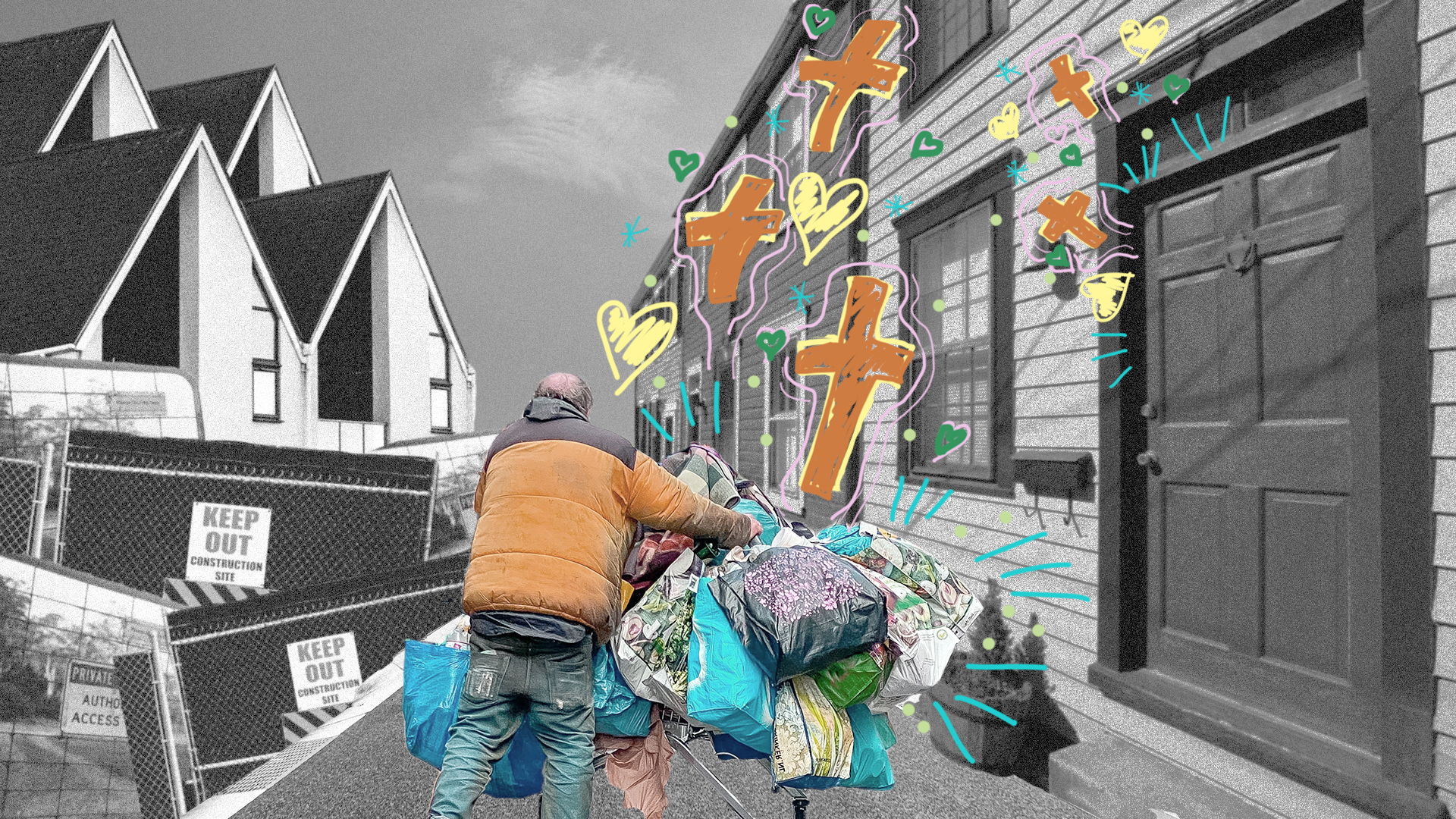
In April of 2021, the mission hoped to relocate its administrative offices, meeting spaces, and food service to a historic office building. But residents in the surrounding neighborhood protested. They didn’t want LRM’s clients coming around, they said at a city hearing. What if they were dangerous? Or sex offenders? The city rejected the mission’s request to move in.

This year has been kinder. Sort of. The ministry purchased a large office building in a different downtown neighborhood, where it needs no special permission to run its outreach programs or expand its services. Nevertheless, neighbors resisted. They called special meetings and voiced concerns about loitering and litter. One resident threatened to move away if LRM moved in.

Laura Carr, the mission’s executive director, reminded them at a forum that, according to Census data, more than a third of their neighborhood lives in poverty. Many of their neighbors were in fact already LRM’s clients. The goal of the mission “is to create a beautiful community,” Carr said. “And part of the beauty of the community is caring for those who are most vulnerable. That’s what a community is ultimately judged on.”

Our cover story argues that Christians have a unique opportunity, in our difficult housing market, to model for the watching world better kinds of community—not only inside our homes, but also out in the towns and cities where we live. The irresistible beauty of the communities Christians build will not be in how well ensconced are the comfortable, but in how welcomed are the little children and the stranger—and maybe even the millennial renter unable to afford a mortgage down payment.

We should of course prize beauty and safety and mirth. Those are gifts from God. But they are not the criteria Jesus used to cull the sheep from the goats (Matt. 25:31–46), and Christians should not settle for a culture that makes them the ultimate aim of the places we call home. As we work to make our dwellings better reflect heaven, may we do the same for our neighborhoods. Litter and loitering and all.

Andy Olsen is print managing editor of Christianity Today. Follow him on Twitter @AndyROlsen.

Books

New & Noteworthy Books

Compiled by Matt Reynolds.

Bioethics for Nurses: A Christian Moral Vision

Alisha N. Mack and Charles C. Camosy (Eerdmans)

Alisha Mack (an evangelical nurse and nursing professor) and Charles Camosy (a Catholic ethicist) believe they’ve written a book that goes doubly against the grain. As they observe, most books on bioethics tend to prioritize doctors over nurses. Plus, they often marginalize Christian moral perspectives. In chapters covering the Christian origins of nursing and bioethics and casting a theological vision for nursing in the contemporary medical field, Mack and Camosy aim at a resource that leaves working (and aspiring) nurses “feeling more grounded and confident in refusing to choose between [their] faith and [their] profession.”

Workers for Your Joy: The Call of Christ on Christian Leaders

David Mathis (Crossway)

When Christian leaders abuse their power and fall into patterns of sin and corruption, they give leadership itself a bad name. In Workers for Your Joy, pastor and Desiring God editor David Mathis lifts up the biblical model, instructing would-be pastors and elders on the moral standards God demands and explaining what churchgoers should expect of their shepherds and overseers. “God made you to be led,” Mathis writes. “He designed your mind and heart and body not to thrive in autonomy but to flourish under the wisdom and provision and care of worthy leaders and, most of all, under Christ himself.”

Wrestling with Job: Defiant Faith in the Face of Suffering

Bill Kynes and Will Kynes (IVP Academic)

More perhaps than any other biblical text, the Book of Job provokes, unsettles, and baffles its readers. In this volume, father-and-son authors Bill (a pastor) and Will (a biblical scholar) Kynes walk through the poetic elements, interpretive puzzles, and spiritual dilemmas that give Job its power and mystery. “The first encouragement we need from Job,” they write, “is the encouragement to persevere in faith to the end. We will be taken down a road of intense suffering—with all of the emotional and spiritual turmoil that creates—to come to a new appreciation of the God who is there all along.”

News

Christian Nonprofit Buys Luxury Yacht

And other news briefs from Christians around the world.

Yacht image courtesy of GBA Ships

The first modern cruise line to focus on Asia has closed down following the financial difficulty brought by COVID-19 and has sold the last of its fleet of luxury yachts to a German Christian organization. Genting Hong Kong’s Star Cruises’ other ships were sold for scrap. But The Taipan, docked in Malaysia, was acquired by GBA Ships (formerly Gute Bücher für Alle), which works in partnership with Operation Mobilisation. GBA Ships visit 15 to 18 port cities per year, providing aid and access to Christian books. Restoration of the 31-year-old, 85.5-meter yacht is expected to take 12 to 18 months. It will be renamed Doulos Hope.

China: Christian man escapes internment

A 43-year-old Christian man who was detained in the Xinjiang internment camps alongside two dozen Muslim Uyghurs has escaped the country and come to the US with his wife and son. Ovalbek Turdakun, an ethnic Kyrgyz who worked as a Kyrgyz-Mandarin translator, became a target of the Chinese government’s brutal assimilation program after he married a Kyrgyzstan native. He was detained for 10 months then suddenly released. The family fled to the US with the help of a research fellow at the Victims of Communism Memorial Foundation, a Canadian surveillance expert, a McKinsey Group analyst, a family of American Christians, and China Aid founder Bob Fu. Human rights lawyers will submit his firsthand account of Chinese government repression to the International Criminal Court.

Australia: Many baptized at cross raising

A record of 130 aboriginal people were baptized by family elders and tribal leaders at a cross-raising ceremony on West Arnhem Land, in the northeast corner of Australia’s Northern Territory. Cross raisings have become significant to First Nations Christians as a time to renew a covenant between the land and God and prepare people for immersion. The practice dates back to the homeland movement of the 1970s, when many indigenous families returned to ancestral lands.

Ghana: Churches plant trees

The Christian humanitarian aid organization Compassion International and 17 churches came together to plant 4,000 trees to combat the effects of climate change. The group hopes to plant 15,000 more acacia, moringa, avocado, and other species of trees in 20 locations across the country. Abraham Satunia, an Assemblies of God leader, said burning fossil fuels has disrupted the environmental order, becoming a threat to human life. The mean annual temperature in Ghana has gone up by one degree Celsius since 1960, according to the World Bank, and now there are about 48 more hot days and 12 more cold days every year. Continued climate change is expected to increase the mean annual temperature one to three degrees by 2060, resulting in a 20 percent decrease in rain and causing cyclical droughts.

Nigeria: Gospel singer’s cause of death disputed

Gospel singer Osinachi Nwachukwu died suddenly at age 42, and her family is disputing the cause of death. Her husband and manager, Peter Nwachukwu, said she suffered secretly from throat cancer. Her four children, however, told police she was the victim of domestic violence. Peter Nwachukwu is now in jail, facing 23 charges of domestic violence and “culpable homicide.” One of Nigeria’s best-known gospel singers, Osinachi Nwachukwu’s hit “Ekwueme” has 77 million views on YouTube.

Norway: Neighbors quarrel over illuminated cross

A 72-year-old man claims an Evangelical Lutheran church’s illuminated cross is a health risk, because it may “tear open old wounds” for people who attended the church’s schools between 1955 and 1990. The Evangelical Lutheran Church Society, a small denomination with about 3,300 members, has apologized for the corporal punishment practiced at its schools but says that has nothing to do with the cross on the Skien church built in 2021.

Italy: Andy Warhol brings Romans to church

An evangelical church in Italy attracted hundreds of visitors by displaying a minor work by the late pop artist Andy Warhol. The church, Chiesa Evangelica Breccia di Roma, offered its space for an art exhibit titled Prints & Multiples as a way to love its neighbors and invite people to notice the active evangelical congregation operating in the heart of Rome. Warhol’s screenprint of flowers—signed on the back with a stamp that says “Fill in your own signature” with a blank line—sold at auction for about $10,000.

Dominican Republic: Pentecostal bishop wants church review of privacy law

The head of the Pentecostal Churches of the Dominican Republic called on the legislature to have experts in his congregation review a proposed bill on the right to privacy, honor, good name, and image. Bishop Reynaldo Franco Aquino said the bill has not had proper public vetting, “which is why a controversy has been unleashed that seems endless.” The proposed legislation, opposed by free-press advocates, would make it easier to sue for libel. It is not clear if it will also apply to social media users and platforms.

United States: Few women lead egalitarian Baptist churches

Ordained women lead only about 7 percent of churches in the Cooperative Baptist Fellowship, which separated from the Southern Baptists in 2002 over the issue of women in ministry. A study presented at the 2022 general assembly showed the total number of women in senior or copastor positions in the denomination’s 1,400 congregations has actually declined since 2015. Women in the study said they faced obstacles including higher standards, lower pay, sexual harassment, inappropriate interview questions, and men getting credit for their work. “After my first sermon,” one Baptist pastor said, “a congregant asked my husband if he wrote my sermon.”

News

Something Old, Something New. Something Borrowed, Something Pew.

Traditional church seating gets a second life at outdoor weddings.

Illustration by Iker Ayestaran

The bride wanted a rustic aesthetic.

The mother of the bride wanted the wedding in a church.

Sean Strelec, who runs VIP Weddings and Events with his wife, Sanya, realized he had the answer. It came to him—like some answers to prayer do—on the internet. There was a Craigslist ad from a Northern California church that was moving. The congregation had to get rid of its 125-year-old pews.

“I ended up buying the entire lot,” Strelec said. “Loaded them up and brought them down to Orange County.”

Strelec moved the pews to an outdoor venue and arranged them in rows for the ceremony, giving the wedding a vintage feel with just a touch of religiousness. Both the bride and her mother were pleased. And Strelec discovered a new service he could offer as part of his wedding venue business.

Today, he and his wife rent pews to seat up to 180 wedding guests.

“For the Avant-garde couple with the family that revels in tradition,” the company website says, “there is no better option for ceremony seating than vintage church pews.”

From California to Colorado, New York to North Carolina, and many points in between, wedding vendors are offering pews for rent.

“Having our authentic church pews creates an elegant foundation that sets the scene for the whole day,” one company promises. “The guests will be pleasantly surprised by the beauty and thoughtfulness that our pews bring to the ceremony.”

Nearly 2.5 million weddings will take place in America in 2022, according to industry estimates. Most will not be held in churches. As recently as 2009, more than 40 percent of weddings were held in churches, but today houses of worship don’t even rank in the top three preferred wedding venues—which are, in order, banquet halls, barns, and the grounds of historic homes.

Almost 7 out of 10 weddings take place outdoors. During the two peaks of wedding season, October and May, the percentage is even higher.

But some of those outdoor ceremonies will have a hint of old-time religion in the seating arrangements. Wedding planners will invoke a sense of solemnity through rented pews.

Although pews evoke a sense of tradition today, the history of pews in churches is rather haphazard. According to Katherine French, a medieval historian at the University of Michigan and author of People of the Parish, pews came into common use in the 1400s.

“We think they came out of a growing importance of sermons and the recognition that people just aren’t going to hang around for a long sermon if they can’t sit down,” she said. “Before the advent of pews, there were benches built into the masonry that would be built around columns and along the walls.”

Right about the same time that pews became common, medieval churches developed another innovation: pew rentals. In market towns and urban centers, people started paying to reserve their seats. Prices in England ranged from fourpence to 80 pence—the cost of about 30 ears of corn up to the cost of a cow.

“Families want status, visibility, and security, and they want to know that they’re going to have their seat in the church,” French said. “Parishes need money.”

By the 17th century, many churches put boxes around special pews, separating the seating space from the rest of the church. A family box could be passed down from generation to generation.

When the practice of pew rentals made its way to America, it became a main source of church funds. Records from one Baptist church show annual rents came out to $407 a few years before the Civil War. In the 1870s, a Baptist church in Westchester County, New York, rented a pew for $5 every quarter, while the German Evangelical Lutheran Church in Charleston, South Carolina, rented pews for $4.

Despite the financial security brought by the practice, some Christians started to critique it. Revivalists and evangelism-minded churches started arguing it prevented people from hearing the gospel.

According to historian Jeanne Halgren Kilde, an emphasis on equality before God and in worship swept through evangelical churches in the 19th century. They embraced what they called “free worship,” allowing white people to sit wherever they liked, regardless of social status. The well-off had to find their seats with everyone else.

Catholics and Protestants who put more emphasis on respectability continued to practice pew rentals into the 1940s. Pew rentals largely vanished in evangelical churches by the end of the 1800s.

Evangelicals still mostly had pews, though, until the 20th century, when a new emphasis on being “seeker sensitive” led many churches to opt for more comfortable seating. Pews—even ones where anyone was free to sit—came to signify tradition and formality, which made them bad for churches attempting to appeal to baby boomers in the 1980s and ’90s.

But the same connotations work perfectly for millennial and Gen Z weddings in the 2020s.

Monique Gonzalez Koyias wanted pews for her outdoor wedding in Colorado in 2021. When she couldn’t find a vendor to provide pews for her marriage ceremony, she bought some from a church closing in Bennett, Colorado. Today, as owner of Now and Forever Vintage Furniture & Church Pew Rentals, she provides pews for ceremonies and events across the state.

“I feel it’s an honor and privilege to provide our church pews for rent,” she said. “It’s keeping a part of history and tradition alive that otherwise would be lost.”

Photos of rustic wedding decor on Pinterest and other social media platforms fuel the demand for pews. The website WeddingWire urges brides to “look for repurposed church pews from vintage event rental companies if you want an eclectic, shabby chic aesthetic.”

As the popularity of outdoor weddings increased because of COVID-19, the demand for church pews went up too. The average cost for a venue in 2022 is about $10,000, so couples planning their weddings are encouraged to evaluate every aspect of the space, including the seating. Pews rent from anywhere between $100 and $300 each, not including delivery and setup fees.

Pews seem to be especially popular in the South. Stephen and Joanne Kramer, who run I Do Pew Rentals in North Georgia, have posted hundreds of photos of their pews at weddings in the South. The pews appear at waterfalls, wineries, mountain overlooks, and historic plantations. Sometimes the seats are in the background, behind kissing couples and celebrating wedding parties, and sometimes the camera focuses directly on the pews.

“They’re the original pews out of an old Kentucky church built in 1890,” one photo caption says. “Imagine the celebrations, events, and stories.”

Back in California, Strelec says that people who rent out pews have to think about their history for more practical reasons, too. They weren’t built to be transportable, and they have to be handled with care.

“The more you move the pews, the more likely they are to be damaged,” he said. “Being that they are historical, we do our best to take care of them.”

He doesn’t mind being a caretaker, though. He thinks of all the weddings he’s made a little better with his pews. The brides and families who were happy. And what would have happened to the church seating if he hadn’t answered that internet ad.

“These little pews that were destined for the landfill have traveled around the world,” he said, “and have been involved in a lot of different things.”

Susan Fletcher is director of history and archives for The Navigators.

News

The Curious Case of Coronavirus Contagion in Church

Pandemic impact was not as predictable as expected, sociological study finds.

Illustration by Mallory Rentsch / Source Images: Pearl / Lightstock

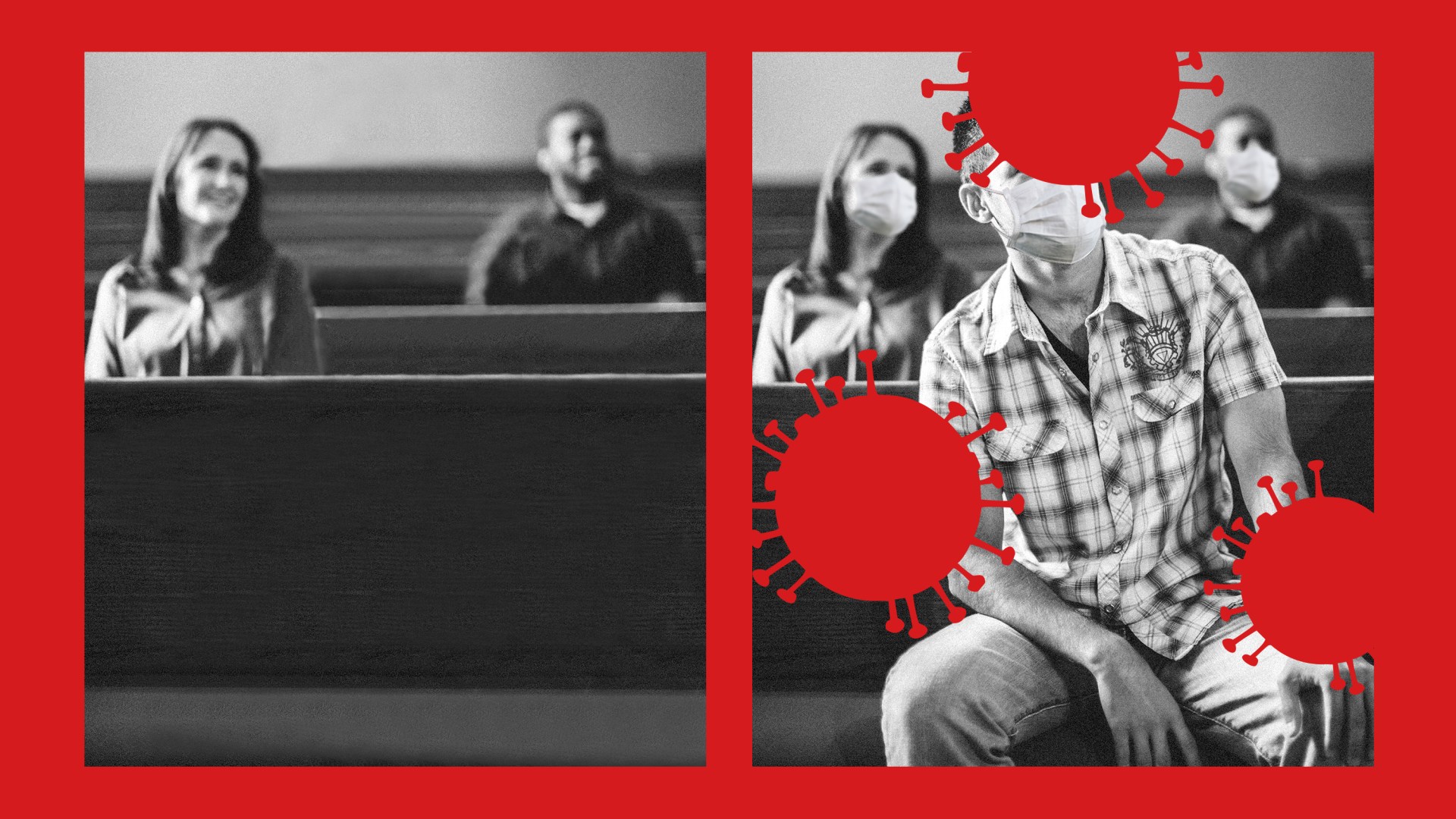
People who went to church during the height of the COVID-19 lockdowns were generally more likely to catch COVID-19. This is fairly straightforward. Yet look a little closer, and the facts get a bit more perplexing.

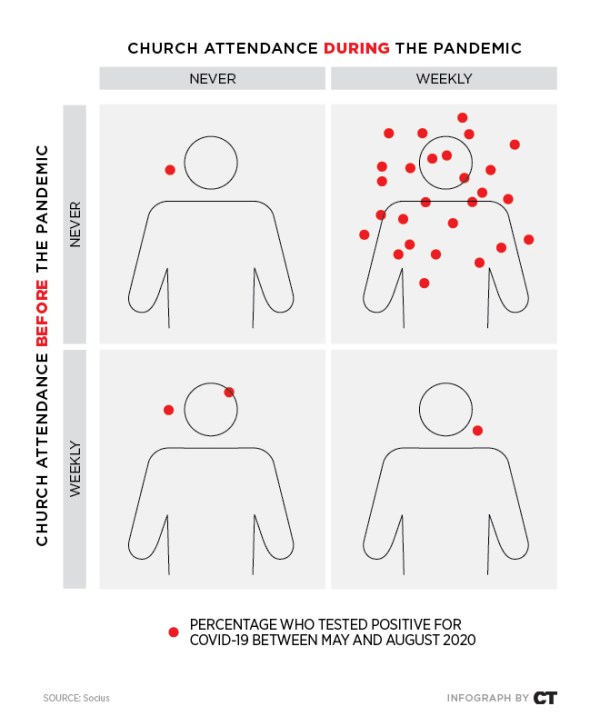
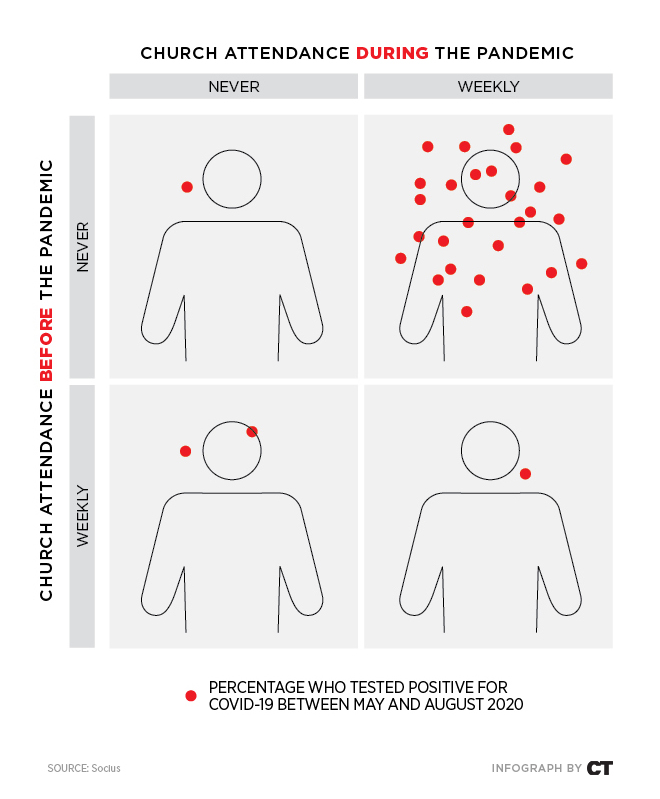
The “association between attending in-person worship during lockdown and later testing positive for COVID-19 was limited primarily to those who were not previously frequent worship attendees,” according to a study published in the American Sociological Association journal Socius.

Sociologists Samuel Perry and Joshua Grubbs looked at a survey of 1,200 people during COVID-19 lockdowns in the spring and summer of 2020. They found that people who attended weekly church before the pandemic and continued attending, sometimes against health department recommendations, did not notably increase their risk of catching the coronavirus. But those who seldom attended before COVID-19 and started going weekly during the lockdowns did increase their chances. About 17 percent caught the coronavirus between the spring and summer of 2020.

The rates were even higher for those who had never attended before and started going weekly: 28 percent. The reasons are not clear. Perry and Grubbs say it doesn’t seem to be connected to age, race, or safety practices such as mask wearing. The only statistical difference was newly increased church attendance.

Ideas

Stopping Abuse Is Sexual Ethics 101

Christian efforts to protect the body often fail to protect women.

Illustration by Iker Ayestaran

As the abuse crisis roils American evangelicalism, church leaders are finally paying attention, if only because the accretion of cases is now impossible to ignore.

Commentators on the Left have eyes on it too. Among the various cries, some progressives are calling out Christian conservatives for policing the issue of sexual orientation and gender identity (SOGI) while simultaneously dismissing abused women in their own midst.

“Youth leaders were fondling us and raping us and shaming us into silence,” said Julie Rodgers at the beginning of the #ChurchToo movement. “Meanwhile, we heard the gays were the greatest threat to the church and society.”

“If the SBC hated abusers as much as they do gay people … we literally wouldn’t be having this conversation today,” tweeted Matthew Manchester in response to the recent Southern Baptist Convention report revealing widespread abuse and coverup. Others have voiced similar concerns about “a perverse double standard.”

Although the Left’s view of sex is misguided, their critique still carries weight. Christians should not complain about the sexualization of culture while simultaneously ignoring the sexualization of women inside the church.

We’re looking at “the largest crisis of institutional religion in the United States,” according to Washington Post columnist Michael Gerson, and that crisis has been caused in part by Christians losing sight of the fundamentals.

While biblical sexual ethics most definitely apply to SOGI—as well as marriage and singleness—they start with the simple act of protecting women and men from exploitation. Everything else follows from that.

Put another way: Abuse prevention is the most basic form of faithfulness to God’s edicts about the body.

Inversely, taking advantage of others for sexual gain is an egregious violation of divine law because it dehumanizes those made in the image of God (Gen. 1:27). Paul issues repeat warnings about the misuse of our own and others’ bodies (Gal. 5:19; 1 Cor. 6:12–20; Rom. 6:12) and the danger of giving in to “even a hint of sexual immorality” or “any kind of impurity” (Eph. 5:3).

These specific injunctions against various forms of abuse are accompanied by broad moral principles as well. One of the most profound comes from Proverbs 9:10. “The fear of the Lord is the beginning of wisdom”—and also the beginning of ethics.

Fearing God means respecting his precepts and dreading his judgment when we don’t follow those precepts. As a church, then, our breach of sexual ethics goes right to the heart of our disposition toward him.

The abusers, enablers, and fixers lurking in our pulpits and pews have no healthy fear. As a result, they take their sins to the closet instead of the altar and lose the ability to discern good from evil. A simple request to help abuse survivors ends up looking like “a satanic scheme to completely distract us from evangelism,” according to a lawyer for the Southern Baptist Executive Committee.

On the flip side, when Christian leaders fear God, they pursue holiness, not self-preservation. They put their confidence in the gospel rather than in their own ministries or denominations. They’re humble enough to name personal sins and systemic evils. And their ethics on sex are consistent across the board: The act of safeguarding women from abuse draws from the same moral well as promoting traditional marriage, encouraging fidelity for couples, and supporting chastity for singles.

Those responses are unified. But again, everything follows from that first safeguarding action. It’s absolutely foundational. Fearing and respecting God requires fearing and respecting those who bear his image—and seeing violations of their bodies as violations of him and his created order. There’s no way to get around that direct corollary.

“I needed someone who could have told me this is what abuse was and this was not the heart of God,” said Naghmeh Panahi in a recent CT profile about her domestic violence case.

As stories like hers proliferate, we should listen to the calls for integrity coming from both inside and outside the church and feel sobered by our failed witness to the world. More importantly, we need to submit to God’s righteous judgment, which calls wicked leaders to account and calls us to account for what we’ve done to sanction or dismiss their behavior.

The good news is that we’re not going it alone. After issuing the Ten Commandments from a mountaintop, Moses tells the Israelites: “The fear of God will be with you to keep you from sinning” (Ex. 20:20).

That promise applies to the American church today—if only we’d listen.

Andrea Palpant Dilley is online managing editor at CT.

Ideas

If God Is Your Father, You Have Seven Mothers

Columnist; Contributor

His care and compassion come from a surprising variety of sources.

Abigail Erickson

We all have seven mothers, according to Scripture. Besides our birth mothers, there are at least six individuals or entities the Bible describes as a “mother” to God’s people: Eve, the earth, the church, pastors, Christ, and God himself. Each example has theological implications.

Scripture describes Eve as “the mother of all the living” (Gen 3:20). In Hebrew, she is havah, the source of breath, the life-giver for humanity. Given that her main achievement at this point is eating the forbidden fruit and passing it to her husband, that is a fairly remarkable statement, but her name is given as a promise of hope. Adam is a dust-man, whose sin brings death. Eve is a life-woman, whose seed will make war on the Serpent and crush its head.

Later on, the Old Testament introduces another mother reference: Job’s statement that he will “return” naked to his mother’s womb (1:21, ESV). As Jonathan Edwards noted three centuries ago, this cannot be his biological mother; it must instead be “the bowels of his mother earth, out of which every man is made.” Today, the idea of Mother Earth sounds pagan to our ears. In many contexts it is. But it has deep biblical roots, and not just in Job. Paul later described creation as a mother in childbirth, laboring to bring forth the new world where our bodies are redeemed and the curse is lifted (Rom. 8:22).

Elsewhere, Paul makes the most explicit maternal connection in Scripture: “The Jerusalem that is above is free, and she is our mother” (Gal. 4:26). This is a famously dense statement. It comes as Paul is exploring multiple layers of connection between Ishmael and Isaac, Hagar and Sarah, Sinai and Zion, flesh and promise, slavery and freedom. At its heart, however, is a simple contrast. If we long to be under the law, we are acting like slaves—like Hagar’s son Ishmael, conceived naturally through the flesh. But we are children of Sarah, like Isaac, conceived supernaturally through God’s promise. Our mother is a freeborn woman—the Jerusalem that is above, the church—which means we are free too. The North African bishop Cyprian of Carthage saw the implications: “He cannot have God for his father who has not the Church as mother.”

That is a corporate image, but there is an individual dimension as well. In the preceding verses, Paul presents himself as a mother to the Galatians: “My dear children, for whom I am again in the pains of childbirth until Christ is formed in you…” (Gal. 4:19). To the Thessalonians he wrote, “Just as a nursing mother cares for her children, so we cared for you” (1 Thess. 2:7–8). As much as Paul characterized himself and his fellow pastors as fathers, protecting and training their children, he also employed maternal imagery like labor, breastfeeding, and nurture. In that sense, our “mothers” are our pastors: those who bring us to birth in the gospel, care for us when we are sick, and feed us when we are hungry.

Viewed from yet another angle, our mother is the Lord Jesus Christ. He says so himself: “Jerusalem, Jerusalem…how often I have longed to gather your children together, as a hen gathers her chicks under her wings, and you were not willing.” (Luke 13:34). Anselm is beautiful on this: “Christ, my mother, you gather your chickens under your wings. … For by your gentleness the badly frightened are comforted, by your sweet smell the despairing are revived, your warmth gives life to the dead, your touch justifies sinners.”

Finally, and most powerfully, our “mother” is God the Father. Few passages in Scripture are more emotionally resonant than Isaiah 49:15–16: “Can a mother forget the baby at her breast and have no compassion on the child she has borne? Though she may forget, I will not forget you! See, I have engraved you on the palms of my hands; your walls are ever before me.” As we know, God is addressed as “Father” throughout the New Testament (including by Jesus), and that is rightly how the church has always referred to him. But no image better expresses God’s compassion for his people than a nursing mother, cradling her newborn and promising lifelong devotion.

May we all honor our father and mothers.

Andrew Wilson is teaching pastor at King’s Church London and the author of God of All Things. Follow him on Twitter @AJWTheology.

Testimony

Police Work Nearly Broke Me

I was a narcotics officer on the brink of suicide when God began his mighty healing work.

Photo by Aaron Wojack

About 12 years ago, I was parked on a dark frontage road in the San Francisco Bay Area. It was about 9 p.m., and I had just finished helping another city’s narcotics team serve search warrants.

I was writing a letter to my wife—a suicide letter. I placed the notepad on the passenger seat and clipped my badge onto it. I cleaned my department-issued undercover car, removing the empty bags of fast food—a cop’s diet. (I didn’t want the responding officers to think I was a pig—no pun intended.) Then I pulled out my gun as I contemplated the most effective way to ensure a quick and painless death.

As a police officer for over 25 years, I had responded to calls that few could imagine, and I had investigated dozens of suicides. How had my life spiraled out of control to the point of wanting to commit one myself?

Suppressed emotions

I grew up in a middle-class family, working for my dad in his auto repair shop. I loved working on cars, but I didn’t want to do it for a living. One night, I went on a police ride-along. I loved it! I knew I had found my calling.

Police protect the thin line between good and evil. They witness the worst that Satan has to offer. The job requires the patience of a pastor, the wisdom of a judge, and the strength and stamina of a professional athlete. One minute, you are driving a patrol car eating donuts; the next, you’re chasing a burglar over fences. Few can endure the emotional stress and physical wear and tear.

I was taught at an early age to suppress my emotions. Looking back, I don’t know how I did it, but I was good at it. Never in a million years did I think that those emotions would surface at some point. Yet after 10 years, PTSD had taken hold. Outwardly I appeared to have it all: marriage to my high-school sweetheart, two beautiful daughters, a great job, and a nice house. But inside I was a mess. My wife could take it no longer, and we divorced.

In 1998, I moved to a state police narcotics unit to work as an undercover agent. Soon after, I was diagnosed with a neurological disease called peripheral neuropathy, which was complicated by a degenerative muscular condition called Charcot-Marie-Tooth disease. I lost all feeling in my feet and hands.

After enduring 30 surgeries in a 10-year period, my feet and hands were deformed. I needed braces to walk normally. Meanwhile, I was plagued with work-related nightmares so horrific I feared going to sleep.

After each surgery, doctors prescribed opioid pain medications. I had no pain, but I used them to take the edge off anxiety attacks (which I hid from my coworkers). At first, I only took a few. Before long, it was dozens a day.

Despite all this, I was promoted to manage a narcotics task force. Yet as my career flourished, my physical and emotional condition was deteriorating. It became difficult to walk and safely handle my handgun.

Why didn’t I tell my supervisors, or just retire? In law enforcement, any sign of weakness is a career killer. Cops must be warriors, fearless and brave. Many officers work in dire pain from injuries because they do not want to appear weak. Some work through extreme emotional distress because they are afraid of being ostracized for seeking help.

In 2010, my daughter was diagnosed with liver tumors. Doctors gave her a 50 percent chance of surviving the surgery she needed. This put me in a downward spiral of depression. I blamed myself because she had my DNA.

Healed for eternity

Feelings of guilt were pressing down on that fateful night when I resolved to end my life. Thankfully, I couldn’t bring myself to do it. Even so, the next few months were a nightmare. Between the loss of strength (I couldn’t even button a button), the guilt over my daughter’s tumors, the ongoing strain of PTSD, and my opioid addiction, I had lost all hope. My second wife begged me to seek professional help, but I was too prideful.

Instead, I made a destructive decision. I knew a private investigator I’d helped in the past by checking license plates or warrant details. (This was against the law, though some officers did it all the time.) On occasion, I even helped him arrange dirty sting operations on behalf of his clients. He knew about my daughter’s illness and my own.

The PI, a former police colleague, needed money for bills, and he knew someone looking to buy drugs. He asked if I could supply drugs seized during narcotics investigations. At first I declined, but he threatened to reveal our illegal collaborations. So I gave in, agreeing to take some drugs being held as evidence, not knowing that federal investigators had already sniffed out the scheme. I was arrested the next day and bailed out a few days later.

This was my darkest hour. But God began his mighty work in my life one evening when the telephone rang. The caller was pastor Jeff Kenney from New Hope International Church in Concord, California. I did not know Pastor Jeff, and I did not believe in God. Even so, he offered his counseling services and invited me to church. I declined.

Then he asked if he could pray for me. Though I didn’t realize it, he was praying the sinner’s prayer. When he finished, he asked if I would accept Jesus as my Lord and Savior. I said yes, but only because I didn’t want to be rude.

After hanging up, I felt better, like a weight had lifted off my shoulders. My wife suggested that God was missing from our lives. She insisted we go to church the next Sunday. We did, and we were greeted warmly. I felt at home there, but I was still on the fence about believing in God.

During one Sunday sermon, Pastor Jeff paused and asked the congregation to pray for my daughter’s healing. Shortly thereafter, we went to get the results from her latest biopsy. The doctor presented two scans: one showing the tumors, and another on which they had disappeared completely. He could not explain the results. It hit me like a ton of bricks. This was no coincidence—God had healed her! I felt a feeling I cannot describe, of warmth, peace, and joy. I finally believed there was a living God!

After pleading guilty to my charges, I was sentenced to 14 years in prison. There, I got a job in the chapel and earned master’s degrees in theology and counseling. One day, the prison chaplain introduced me to Ruben Palomares, an ex-cop from Los Angeles who had been involved in two in-the-line-of-duty shootings. Like me, he had been diagnosed with PTSD before committing crimes. While in jail, Ruben met a pastor who prayed for God to heal him, which inspired him to begin his own healing ministry. He led me through the process that healed him, and together, we counseled many inmates who put their faith in Christ.

As I serve the remainder of my sentence, I’m working as an addiction counselor in a men’s residential facility, where I provide pastoral care. I am a credentialed chaplain in the process of starting a first responder ministry to help the men and women who risk their lives every day and suffer emotional hell.

If God ever offered me a do-over—a chance to go back in time and avoid prison—I would refuse. All the hardship, guilt, and pain changed me from the inside out. God may not heal my body in this life, but I know that I am healed—body and soul—for all eternity.

Norm Wielsch is the author of Christ Centered Healing of Trauma: Healing a Broken Heart.

Echoes of Greatness

Remembering all that God has done and is doing.

Illustration by Rick Szuecs / Source images: Wikimedia Commons

The second chapter of the Book of Judges speaks to the passing of faith down the stream of generations. The Israelites, it says, “served the Lord” for as long as Joshua and his generation lived (v. 7). This generation had grown up hearing of God’s deliverance from Egypt, his covenant on Sinai, and his provision in the wilderness. They had seen for themselves the miracles of Jericho and Gibeon. They had witnessed “all the great things the Lord had done for Israel.”

Afterward, however, “another generation grew up who knew neither the Lord nor what he had done for Israel” (v. 10). They “forsook the Lord” and served other gods and suffered military catastrophes (vv. 12–15). Thus begins the period of the judges.

The passage is distressingly relevant. One survey after another shows increasing numbers of young people leaving the church. Gallup reported this year that belief in God had declined 10 percentage points in about 10 years. According to Barna, the percentage of Americans who qualify as “practicing Christians” (meaning they identify as Christian, prioritize their faith, and have attended church within the past month) has dropped from 50 percent in 2009 to 25 percent in 2020—with church attendance dropping most precipitously among millennials.

The data show a steady decline from generation to generation. Pew reported in 2019 that 84 percent of Americans born before 1945 identify as Christian, compared to 76 percent of boomers, 67 percent of Generation X, and 49 percent of millennials. Millennials merely represent the next step in the downward staircase. Since younger Americans are less likely to have been raised in Christian communities and practices than their forebears, they are less likely to affiliate with the church as adults.

It is, as the saying goes, better to light a candle than to curse the dark. So how can we ensure rising generations see “all [the] great things the Lord has done” (Deut. 11:7)?

This is the motivation behind so much of what we do at CT. Check out the stories in this magazine. Read our first annual Globe Issue, now available in hardcover print. Listen to our podcasts. The bride of Christ needs a storyteller not only to tell her own stories, but to tell her the stories of all God has done and is doing.

We invite you to support us in that work. Subscriptions alone are not enough. Help us lift up the ways in which God is at work all around us not only for our own generations, but also for those to come.

Timothy Dalrymple is president, CEO, and editor in chief of Christianity Today.

Books

Revelation Is Good News for Today, not a Game Plan for the Future

For a clearer picture of this mysterious book, try trading a prediction lens for a missional lens.

Illustration by Jeffrey Kam

For much of my life, I treated the Book of Revelation like foul-tasting medicine. I knew it was probably good for me, but if you gave me the chance, I’d avoid it.

Foretaste of the Future: Reading Revelation in Light of God's Mission

That had a lot to do with the way I was taught to read Revelation. As a teenager, my youth group watched a movie that graphically pictured the horrors of being left behind on earth after true Christians escaped to heaven. It scared me. Later, I explored prophecy books that tried to connect the dots between current events in the Middle East and the Bible’s script for the end times. They confused me. So I gave up trying to understand Revelation. In effect, it became the appendix in the body of my Bible. Generally, I could happily ignore it; but if it caused too much trouble, I could live without it.

Even after training for Christian ministry, I lacked the confidence to preach or teach on Revelation. It was too mystifying, too violent, too weird. Its fantasy-like visions seemed to have little to say to the practical issues of daily Christian living. At most, they warned, “You’d better be ready, because the end could happen at any time!”

I wasn’t alone. Over the years, I’ve heard only small smatterings of preaching on Revelation, except occasionally on the “safer” parts, like Christ’s messages to the churches in chapters 2 and 3. Largely, Revelation’s life-giving message remains on mute for the church.

Correcting our lens

Like someone trying to wear the wrong glasses, I had a lens problem. My default setting involved reading Revelation through a prediction lens. Like many Christians, I viewed the Apocalypse primarily as a book of forecasts about what was going to happen in the future. John’s visions served as a kind of screenplay for end-times events, like the Battle of Armageddon or the rule of the Antichrist on earth. Reading through that lens, I struggled to find Revelation’s good news for God’s people today.

But what if we read Revelation through a different lens? What if, instead of using a prediction lens, we read it through a missional lens? Let me explain. Reading Scripture through a missional lens isn’t fundamentally about locating individual passages that support the cross-cultural mission of the church. Rather, it concerns what God is doing in the world to bring about salvation and healing at every level and how God’s people participate in that sweeping purpose.

Applying this principle to Revelation means that, instead of trying to decipher a game plan for the end times, we need to discover how Revelation bears witness to God’s massive mission to redeem and restore the whole creation—including people—through Christ, the slain and risen Lamb. Revelation shows us the ultimate goal of God’s loving purpose for the world, which is “making everything new” (Rev. 21:5).

But that’s not all. Revelation also seeks to equip and energize God’s people to get caught up in what God is doing to bring about wholeness and redemption in the world. Instead of primarily foretelling the future, Revelation calls us to live as a foretaste of the future here and now. It enables Christian communities to embody God’s loving mission within our various life circumstances, even as we anticipate the time when God finally makes everything new.

As New Testament scholar Michael Gorman puts it, we need to read Revelation “not as a script for the future but as a script for the church.” The rest of this article will try to show that a missional reading of Revelation is more faithful to the form in which it appears, the context it addresses, the message it proclaims, and the hope it promises.

Illustration by Jeffrey Kam

Reimagining the world

Let’s first consider the form in which Revelation comes to us. Like any book of the Bible, we need to ask: “What kind of writing is this?” Although Revelation shares aspects of both biblical prophecy (see Rev. 1:3) and letters (1:4, 9), above all, it belongs to a form of ancient writing known as apocalyptic literature. Far more familiar to John’s first readers than to us, apocalyptic literature runs thick with visions, symbols, and stories. It forces us to use our imaginations, something that many of us in the West, including myself, struggle to do.

Here’s the point: Revelation’s images and symbols are not intended to be read literally. This exposes one of the chief weaknesses of a predictive lens for interpreting Revelation. Those using it might assume, for example, that the infamous “mark of the beast” (Rev. 13:16–17) must refer to some physical implant or sign.

But in Revelation, the beast’s mark on the hand or forehead represents the opposite of God’s seal on the foreheads of his servants (Rev. 7:3; 9:4). Both are signs of ownership, symbolizing our allegiance to God and the Lamb or to Satan and the beast. Rather than a brand visible to the eye, our loyalties and lifestyles show whose name we bear.

Revelation’s poetic visions are less about describing end-times events than calling Christian communities to reimagine their world. John draws from the popular apocalyptic symbols of his time to give Christians a transformed vision of the world they inhabit. This new way of seeing reveals what God is doing in the world (God’s mission) and how we can participate in what God is up to (the church’s mission). Revelation scholar Richard Bauckham wisely explains that John’s visions reveal God’s final purpose for human history so that God’s people, then and now, can reimagine the present from that perspective. In effect, John says, “This is the way things really are, from the vantage point of God’s end-time future and God’s heavenly throne.”

Here’s an example. In chapter 7, John envisions a vast multitude of people from every tribe, tongue, and nation standing before God’s throne, worshiping God day and night (vv. 9–17). That isn’t simply a projection of what it will look like someday, “when we all get to heaven.” It’s a picture that shapes who we are and why we’re here in the present. It calls the church to become a community in which barriers separating nation, tribe, race, and culture dissolve, despite the polarizing forces that surround us. It also hands us a vocation of inviting people of every language and nation to join the choir of worshipers of God and the Lamb, in anticipation of what we will someday be. We live as a sneak preview of God’s future now.

Reading in context

If John invited his readers to see their world differently, then we need to take seriously the context he addressed. In the first place, Revelation came as a word on target for local churches in specific missional settings in Roman Asia Minor. It called them to embody the good news of the slain and risen Lamb where they were.

And where they were wasn’t easy. These Christians lived in a world dominated by a Roman Empire that demanded ultimate allegiance, a world saturated with the civil religion of the emperor cult and the worship of the local gods that gave Caesar legitimacy. Everything from citywide festivals to private birthday parties became opportunities to honor the emperor. The imperial cult functioned like a contract with the populace of Asia Minor: Give Caesar his due, and the gods will grant you peace, security, and prosperity. Failure to conform was considered “unpatriotic” and disloyal. Christians who resisted faced the potential of persecution, ranging from social and economic exclusion to violent death (Rev. 2:10, 13).

But an even greater threat bubbled up from the inside—the temptation to accommodate to the ways of the empire, perhaps to avoid pushback from the culture. Not every church responded to these outside and inside pressures in the same way. Some remained faithful in the face of suffering (Smyrna and Philadelphia), but the majority did not. For example, Christians in Pergamum and Thyatira compromised with the idolatrous practices of the prevailing Roman culture (2:14–15; 20–21). Those in Sardis and Laodicea were guilty of complacency, because of their own pride and prosperity (“I am rich…and do not need a thing”—Rev. 3:17).

Each of these churches, then, must read the rest of Revelation in light of its situation. Some need assurance that God who will defeat all powers that oppose him in the end. But for other, compromising communities, the remainder of Revelation jolts like an electric shock. John warns them to repent and embrace the way of the suffering Lamb—or risk facing “the wrath of the Lamb” (6:16).

The same is true for us. How we hear Revelation depends in part on our spiritual condition and need. Revelation still calls Christian communities across the globe to renounce the ways of worldly empires and faithfully bear witness to God and his loving mission.

John’s in-your-face symbol of Babylon in chapters 17 and 18 offers a prime example of how Revelation speaks a targeted word into its world. John uses this symbol to fix his crosshairs resolutely on Rome. Babylon, like Rome, sits on “seven hills” (17:9), and it fits the profile as “the great city” that rules over the earth (17:18). In chapter 18, John visualizes Rome’s economic exploitation of the empire to satisfy the expensive tastes of the elite. At the very bottom of a list of actual Roman imports, John names “human beings sold as slaves” (v. 13). Rome gets rich by treating human beings as mere commodities. No wonder God calls his people to “come out of [Babylon]” (v. 4)—to leave behind Babylon’s ways of thinking and living.

Babylon, however, is by no means chained to ancient Rome. No less than the affluent and arrogant Laodiceans, we must ask, “Where is Babylon today?” and “What does it mean for us to come out of Babylon?” Where do we bow to the idol of consumerism or participate in systems that exploit the weak to benefit the powerful? These aren’t simply matters of individual ethics; they are also part of our witness to a watching world.

Keeping the right focus

Reading Revelation in light of God’s mission lifts the burden of having to don a prognosticator’s hat and figure out how John’s visions fit into some end-times script. Instead, we can focus on the big themes in Revelation’s story of God’s life-giving purpose for the world. These include the master symbols of Revelation—the heavenly throne and the slaughtered Lamb.

Both symbols find their sharpest focus in the theological heart of the book, chapters 4 and 5. There, God’s throne represents, in New Testament scholar Eugene Boring’s words, the “mission control of the universe.” If God rules every corner of creation, then no other powers, human or spiritual, can sabotage God’s redeeming purpose for all people and the whole world.

How does God accomplish this universal mission? Against all expectations, by a wounded Lamb! The slaughtered Lamb becomes Revelation’s defining symbol and the lens by which we are to understand the entire book, including its visions of judgment. The Lamb unlocks God’s magnificent plan to redeem every tribe and nation precisely because he suffers and dies (Rev. 5:9–10).

This symbol doesn’t tell us simply that God brings restoration to all creation through the crucified Jesus. It also shows us how that happens. God’s mission is lamb-like. God defeats all opposing powers, not by brute force and violence, like Caesar, but by self-giving love (Rev. 12:11). Today, Christians may be tempted to carry out God’s purposes by means of coercion and “othering” others—for example, by “taking our country back for God.” But such pressure techniques remain irreconcilable with a book that makes the center of universal worship a bleeding Lamb.

Where hope lies

Mass school shootings. A planet in crisis. Racially motivated attacks. A deadly pandemic. Floods of refugees from senseless wars. Not surprisingly, many Christians are tempted to feel pessimistic about the future.

Revelation offers genuine hope amid overwhelming circumstances. But that hope lies not in escaping this world and its tribulations by being raptured to heaven, nor simply in the promise of “a home in the sky when we die.” If we read John’s climactic vision of New Jerusalem (Rev. 21–22) in light of God’s mission, we see a future that profoundly shapes the present, extending hope in a fractured world.

John’s picture of the New Jerusalem reveals God’s ultimate purpose for the world—the flourishing of humanity and all creation when God’s presence drenches the whole earth. But the new creation casts its light into the present, calling us to embody the life of New Jerusalem on the very streets of Babylon. What does New Jerusalem hope look like? Here are two examples.

First, New Jerusalem represents a healing community. The mission of the new creation is to bring about “the healing of the nations” (Rev. 22:2). That wholeness touches every wound that sin and evil have inflicted on humanity. But living as a trailer of the future calls us to become communities of hope and healing in and among the world’s nations today. I’ve seen one of my former students help start a network of such communities in his home area in Germany. They bring hope in a multitude of ways to refugees, urban youth, the elderly, the homeless, the unreligious. They recently intervened on behalf of a sex worker named Emanuela, helping her to complete desperately needed forms for health insurance, connecting her to a debt counselor, and giving her something even greater: unconditional love and friendship. In such acts, new creation breaks into the city.

Second, John envisions a restored creation. Revelation pictures New Jerusalem coming down to merge with a transformed earth (Rev. 21:2, 10). The city to come signifies ecological harmony and the flourishing of all creation. If God has a future for the earth, we cannot ignore massive threats to the environment and their harm to the world’s most vulnerable people.

Our response surely includes not only rethinking our lifestyles in view of their effect on God’s earth but also recognizing that advocacy on behalf of creation represents a legitimate missional calling, worthy of our prayer and support. A Rocha International, for example, makes a difference in places like Ghana’s Atewa Forest, where mining, illegal logging, and farm encroachment threaten the area’s huge biodiversity. Simultaneously, the organization helps ensure access to safe drinking water for five million Ghanaians. Revelation invites us to be agents of hope for people and for creation.

We need to unmute Revelation. If we settle for reading it through a prediction lens, we likely will blur this book’s probing, hope-filled message for the church in mission, both then and now. Reading Revelation in light of God’s loving mission helps us hear the book’s call for our time—a call to become contrast communities of worship and witness, living out the pattern of the slaughtered Lamb. A call to forsake our cozy comfort with the consumerism, injustice, and idolatries of Babylon. A call to live as a foretaste of the future, caught up in God’s purpose to make everything new.

Dean Flemming is professor emeritus of New Testament and missions at MidAmerica Nazarene University. He is the author of Foretaste of the Future: Reading Revelation in Light of God’s Mission.

addApple PodcastsDown ArrowDown ArrowDown Arrowarrow_left_altLeft ArrowLeft ArrowRight ArrowRight ArrowRight Arrowarrow_up_altUp ArrowUp ArrowAvailable at Amazoncaret-downCloseCloseellipseEmailEmailExpandExpandExternalExternalFacebookfacebook-squarefolderGiftGiftGooglegoogleGoogle KeephamburgerInstagraminstagram-squareLinkLinklinkedin-squareListenListenListenChristianity TodayCT Creative Studio Logologo_orgMegaphoneMenuMenupausePinterestPlayPlayPocketPodcastprintremoveRSSRSSSaveSavesaveSearchSearchsearchSpotifyStitcherTelegramTable of ContentsTable of Contentstwitter-squareWhatsAppXYouTubeYouTube