News

Ukraine’s Refugee Crisis ‘Woke Up’ Networks of Roma Evangelicals

In Eastern Europe, the faithful rallied to welcome all, but churches have shifted to focus on fellow Roma who face discrimination as they flee.

Slovakian pastor Marek Gombar (center) visits Roma communities across the border in Ukraine.

Slovakian pastor Marek Gombar (center) visits Roma communities across the border in Ukraine.

Christianity Today April 25, 2022
Courtesy of Shane McNary

The first call woke Marek Olah up at midnight—it was his brother, telling him to prepare the church’s community center because he was picking up Ukrainian refugees from the border. Olah began making calls, and people showed up to search for blankets and mattresses before the bus of 60 people arrived.

“I was very surprised and touched,” said Olah, pastor of the Apostolic Church Sabinov, a Roma congregation of around 300 people in eastern Slovakia. “After COVID, we were all a little … well, this situation with Ukraine woke us up.”

Members of his church “have been very hospitable and compassionate, even crying with people. Teenagers are buying food, women are praying with people, one man used his savings to buy jackets for everyone.”

Another Roma Apostolic church in Pavlovce nad Uhom, Slovakia, just 20 kilometers from the Ukrainian border, had been quickly overwhelmed by refugees. Pastor Marek Gombar asked Olah’s church for help. Other churches sent food and clothing.

Eventually, this led to an informal network of 11 Roma and non-Roma churches from Slovakia, Czech Republic, and England coming together to serve the refugees. Together, they purchased a building in a town near Gombar’s church for a storage area, housing, and in the future, another church.

Christianity among the Roma is thriving in places like Slovakia, Hungary, and Romania, all key outposts for refugees fleeing the war in Ukraine. The crisis in the region calls out the fruits of this Christian growth.

“This is a way to show the real, strong love of Jesus,” said Dimitar Angelov, director and founder of the Youth Mission Network, a nonprofit discipling Roma youth in Bulgaria. Immediately when the war broke out, Angelov began looking for ways to help, eventually connecting with a Ukrainian woman in his region who was coordinating humanitarian help.

Roma pastors and their congregations expressed a desire to help all refugees out of a sense of Christian compassion. However, the situation necessitated another motivation, as reports circulated of Roma and other nonwhite refugees facing discrimination at borders and processing centers. Before the war, 50,000 Roma lived in Ukraine, according to official counts, but estimates by intergovernmental and nongovernmental organizations put the total at eight times as many.

“Roma people have many experiences of not being well received,” Olah said. “And this is what happened to some Roma at the border; they were pushed aside and not treated equal as other Ukrainian people. This is why we as the churches stepped in, because we don’t want these families to suffer just because they are Roma.”

Over the centuries, Roma people in Europe have often been marginalized in the political, social, and religious spheres. Despite improved laws and social policies, crises like COVID-19 and war expose the deep-seated social fears and suspicion toward the Roma that are still endemic in Eastern European societies.

Even in Christian circles, Roma Christians are often left out of the narrative.

This reality influenced the way Angelov presented himself to his Ukrainian contact in Bulgaria. He said, “We do this because we are a Christian organization and we do this for the glory of God, and oh, by the way, I am Roma, and I am proud of this. No matter what we hear, bad feedback from your people or my people, we are here and we will help you. And don’t forget, I am Roma.”

Roma refugees move on

Reports of unequal treatment among Roma refugees have emerged from Slovakia, Hungary, Moldova, Czech Republic, and Poland. Moldova is the poorest country in Europe with the most Ukrainian refugees per capita, including Roma refugees.

After rising tensions and complaints, the Moldovan government came to an agreement with Roma community leaders to separate ethnicities, promising quality facilities. However, the Roma refugees, along with Azerbaijanis and Uzbeks, were placed in substandard facilities and currently face steep challenges, according to an early March report issued by the European Roma Rights Centre (ERRC) after visiting three reception centers in Moldova.

Victorina Luca, a Christian Roma lawyer in Moldova, estimated that 70 percent of the Roma refugees have no passport, although some have a birth certificate. Roma have been called the most undocumented group in Ukraine, with discrimination and bureaucratic hurdles keeping them from obtaining official identification. But as refugees, they need this documentation before moving on, which most want to do. According to Luca, no documents means no free transportation to the embassy.

“Most are here with no money. They walk to the city or get on the public bus but are ejected because they can’t pay,” said Luca, founder of the Roma Awareness Foundation and Romano Patrin radio station in Soroca, Moldova.

To register for documents, refugees have to stay in a line every day for two or three weeks, alongside thousands of ethnic Ukrainians. “And then the embassy says, ‘We cannot document you because you never had any documentation.’ So the people are stuck.”

While a couple thousand Roma refugees want to stay in Moldova until the war is over, according to Luca, the majority are trying to make it farther west in Europe, where they have relatives.

Luca converted to Christianity at age 14 through a radio program and was the first in her family to finish school, despite people in her village telling her, “Your mother, grandmother, and great-grandmother never graduated.” She went on to graduate from Central Eastern University in Budapest and New York University and now uses her position to advocate for her fellow Roma people—including the recent influx from Ukraine.

“When you give your life to God, he can take you from a desert and put you on the mountains of his glory,” she said. “God transformed my life into his glorious light to shine over the world.”

Ministry to Roma refugees

In this scenario, when government resources are dwarfed by the immensity of need, churches are playing a key role. Pastor Ionel Cocos and his wife, Anka, who lead five Roma churches in central Romania, suspected societal attitudes would be a factor in how Roma were received. When they heard reports of neglect, they shifted their primary focus to Roma refugees.

Roma churches in Edinet, Moldova, take in refugees.

“When the war started, I was so shocked and cried, I just wanted to do something,” Cocos said. “I spoke in my church; we started to gather offerings and also from international partners.”

A friend connected him with a Roma church in Edineţ, Moldova, where pastor Sibiriak Farfacari and his wife, Tatiana, lead four churches in Roma communities. They had received a large number of Roma refugees, even taking into their own home an extended family with a young girl whose parents were killed while fleeing Mariupol.

Ionel and Anka Cocos now travel to Edineţ every other week to buy supplies for the church.

Roma Christians’ adeptness at moving between cultures and languages is a key gift in this crisis. Gombar—the pastor in Slovakia—is part of the government’s response team, and his ability to speak Romani with refugees is invaluable. As soon as the government heard that his church was serving the refugees, they began funneling most of the Roma to him.

“They called Marek, saying, ‘You need to come get this family,’” said Shane McNary, a Cooperative Baptist Fellowship field personal member who has worked with the Roma for 17 years in Slovakia and the Czech Republic. “Marek kept trying to figure out where they were, and eventually found out that they were sleeping in the woods. There are a lot of these stories, and it is still happening.”

Support for Roma is also sent inside Ukraine. Gypsies and Travellers International Evangelical Fellowship (GATIEF), the mission arm of French Life and Light Fellowship, has delivered five large truckloads of relief supplies for thousands of Roma trapped in various cities.

Giving what you do not have

Distributing goods can present other kinds of challenges within the Roma churches themselves, particularly in poorer contexts. Gombar has long-standing relationships with three Roma churches in Uzhhorod, Ukraine, only 20 kilometers from his church. He drives aid to them from Slovakia so they can distribute it to the refugees in their churches.

Disagreements broke out, however, when it seemed one church received more aid than the others. Others were accused of “feeding their own people” instead of the refugees. One Roma refugee who had fled from more affluent circumstances in eastern Ukraine was shocked to see such abject poverty—and yet those were the communities serving him. Gombar made a pastoral visit to help churches resolve the disagreements and also to warn them about the difficulties of crossing the border and becoming refugees.

“They are doing the best they can in the midst of overwhelming need and poverty,” McNary said after a visit to the communities in Ukraine with Gombar. “They are still willing to help when they barely have enough themselves.”

Gombar reflected that the situation revealed different maturity levels in his congregation.

“Some of the people saw the need, and they came immediately and wanted to help. Some other people came and saw the need, but there is a struggle in them because they have the same needs and they see all the supplies for the refugees,” he said.

“Do I go to the church and help the refugees when I myself am hungry? I am very strict. No, you can’t have anything to eat, not even chocolate, because the chocolate is for the children. If you are here to serve, then serve.”

In Moldova, the Farfacaris also grappled with the lack of resources, trusting God to daily provide for the 250 people who have passed through. One day in early March, they held a prayer meeting at the church to ask God to send help.

That day, Cocos telephoned him from Romania, and a few hours later they were together in a grocery store buying ten carts of supplies for the refugees.

“It is wonderful when God answers your prayers,” Cocos said, “but it feels even better when you are the answer to someone else’s prayer.”

Melody J. Wachsmuth is a writer, researcher, and mission practitioner based in Zagreb, Croatia. Her forthcoming monograph is a study on Roma Pentecostals in Croatia and Serbia.

History

Why We Fight About Football Prayers

The moral authority of high school coaches raises First Amendment questions the Supreme Court will have to consider in “Kennedy v. Bremerton.”

Christian History April 22, 2022
Ian Maule / AP Images

For nearly as long as there have been football coaches, there have been praying football coaches. And praying football coaches have frequently been at the center of the rough-and-tumble, back-and-forth debate over the place of religion in American public education.

Joseph Kennedy, a high school coach from the Seattle area, is the latest to take the field. The Supreme Court is set to hear arguments in Kennedy v. Bremerton School District on Monday. His lawyers will argue that the First Amendment protects his right as an American citizen to bend a knee and say a prayer after high school games.

The opposing counsel will also invoke the First Amendment, arguing that because Kennedy is paid by the public school, his prayers infringe on the rights of players, who shouldn’t be pressured to pray by a government employee.

But why football coaches? Why not praying principals, drama teachers, shop class instructors, or crossing guards? The football coach, it turns out, has a special place in the American struggle over the meaning of the freedom of religion.

We can trace the story back to one of the first men to turn coaching into a full-time profession, Amos Alonzo Stagg. He trained to be a minister before deciding, as he wrote in his autobiography, he “could influence others to Christian ideals more effectively on the field than in the pulpit.” From 1892 to 1932, Stagg built a college football powerhouse at the University of Chicago—and prayer was absolutely part of the program.

In Stagg’s day, American football was just developing as a sport. Key to its appeal and growing acceptance was the idea that it was more than a game, that it offered a space for young men to build character and develop the moral virtue needed to become America’s future leaders.

In this environment, the football coach was not just coming up with a game plan. He was shaping character, instilling morals, and inspiring leaders. For the sport to realize its character-building potential, the coach had to be seen as something more than just a coach. He was imagined as a kind of religious leader.

Even as the hypocrisies of big-time football became increasingly apparent—with coaches hired and fired based solely on wins and losses instead of the character of the young men they produced—the idea that football was a “maker of men” and a force for morality persisted. And prayer served to remind participants of the sanctity and solemn purpose of the sport.

“Prayer is a good thing for any man who wants to live his life to the fullest, and I am sure it helps in the process of making men,” Stagg said.

Stagg was far from alone. Stories circulated in the 1920s about coaches leading teams in locker-room and on-field petitions at Notre Dame, Minnesota, Army, Centre College, Wiley College, and many other schools.

The image of the praying coach really became prominent in American culture after World War II. The Cold War brought on a new wave of religious nationalism aimed at combating the atheistic Communism of the Soviet Union. For many Americans, religious identity and national identity were fused. And the football coach was a prime example of what that combination of Christianity and Americanism was supposed to look like: a strong, tough maker of men, taking a humble knee before God.

In 1953, Michigan State’s Clarence “Biggie” Munn told Guideposts magazine why he led his team in prayer before and after games: He wanted to teach his players “the importance of love of country, faith in its institutions and the religious base on which it all rests.”

Munn was joined by coaches like Bud Wilkinson (Oklahoma), Paul Dietzel (Louisiana State), and Jake Gaither (Florida A&M) in his advocacy for prayer on the college football field. These men found community and a shared sense of purpose through the creation of the Fellowship of Christian Athletes in 1954, an organization that proved to be especially popular among football coaches.

By 1957, prayer in college and high school sports was so common that when the Fellowship of Christian Athletes published a pamphlet on prayer in sports, they described it as “normal procedure.” The question was not if coaches and athletes should pray, but rather how.

Then, in 1962, the Supreme Court stepped in. With Engel v. Vitale, the court declared that a prayer written by New York state school officials for use in the state’s public high schools violated the First Amendment’s prohibition against the establishment of religion. The decision put the brakes on the flurry of religious rituals infusing public life in the 1950s, but it also left many questions unanswered, including the question of prayer by a public-school football coach.

With football a central part of educational life, and prayer a central part of football, the stage was set for conflict.

Football prayers and constitutional challenges

The reverberations from Engel reached American football fields in the 1980s. One of the earliest examples came in Oak Ridge, Tennessee, when the parents of a high school player filed a complaint over the prayers of coach Emory Hale.

The school asked William Leech, Tennessee’s attorney general, to review the complaint and issue an opinion. In a letter to the school, Leech determined that it was indeed unconstitutional for coaches at public high schools to lead their team in prayer.

Although Leech’s opinion was non-binding, it set off a firestorm of controversy. Both Leech and the parent who issued the complaint received threats and harassment, and football coaches reacted with defiance. When Hale brought his team to the Class AAA state championship game a few weeks later, he ignored Leech’s directive, leading his players in prayer both before the game and at midfield following their victory.

“It’s very important to me to yield to authority above me, yet God comes first in my life,” he explained to the Los Angeles Times. “I know I’m kind of going to be in a bind over this.”

The following year, however, the Oak Ridge superintendent sided with Leech, directing his coaches to stop leading team prayers and instead to allow moments of silence, where student-athletes could pray if they desired.

The incident in Tennessee provided a template for additional cases over praying football coaches in the years ahead. In York, Nebraska (1982); Miami, Florida (1984); La Crosse, Wisconsin (1987); and numerous other communities—as well as high-profile college programs like the University of Colorado—a complaint would lead to public outcry and debate.

Defenders of the coach-led prayers often made their case on the grounds of tradition and community consensus, viewing the prayers as an expression of America’s religious identity. If America really was one nation “under God,” they argued, why couldn’t coaches lead a prayer?

Opponents, meanwhile, argued that the prayers favored conservative Christian perspectives. The rights of religious minorities—including students and parents who did not want their children’s faith to be influenced by school officials—needed to be protected.

Faced with the threat of litigation, school authorities generally advised coaches against the practice. “The problem is about 99 percent of the community favors the team prayer,” the school board president told the local newspaper in York, Nebraska, in 1982. “But we have to recognize the rights of the minority.”

Meanwhile, the Supreme Court weighed in on a couple of cases that helped set the boundaries for prayer at football games. In 1989 it let stand a lower-court ruling that said pregame invocations before a public high school’s football games were unconstitutional. The case had originated in Douglas County, Georgia, where prayers were read over a public address system. In 2000, the Supreme Court went further in Santa Fe Independent School District v. Doe, deciding that student-led prayers over the public address system were unconstitutional as well.

From defense to offense

Despite these boundaries and limitations, football coaches at high schools across the country continued to lead their teams in prayer.

One of those coaches was Marcus Borden of East Brunswick High School in New Jersey. In 2005 school officials ordered Borden to stop praying with his team before games. Borden challenged the directive in court, arguing that the district violated his constitutional rights. Although Borden ultimately lost the case—in 2009, the Supreme Court declined to review—his efforts revealed a shift in strategy.

Previous cases had been framed as a matter of protecting the rights of the minority from the rights of the majority, with football coaches standing as representatives of the majority and the state. Borden, however, shifted from defense to offense, claiming that the central issue was his own constitutional right to religious expression.

Borden’s strategy, which Joseph Kennedy has adopted, did not emerge out of the blue. Instead, it was influenced by the efforts of the Christian conservative legal movement.

Legal interest groups in this movement, including Alliance Defending Freedom, Liberty Counsel, and First Liberty Institute (the group behind Kennedy), have spent several decades refining their strategies and expanding their reach in the American legal system. These efforts have been successful, as evidenced by their involvement in some of the most important cases involving religion of the past 30 years.

While these groups file cases on myriad issues aligned with culture war battles, at the heart of the movement’s litigation is religious freedom. Kennedy’s claims certainly fit the bill, and with some creative liberties, his story could become a plot line in the next God’s Not Dead film: a faithful coach wanting to inspire and encourage athletes through on-field prayer, only to be stymied by hostile activists and an unfriendly government.

Recognizing that Kennedy is a sympathetic client for its mission to expand the scope of religious freedom protections in an increasingly post-Christian America, First Liberty has highlighted Kennedy’s story in various media productions, a common tactic aimed at shaping public opinion as well as legal outcomes. In these depictions Kennedy is not just a coach; he is a mentor called to shape the character of young men under his tutelage.

It is also important that Kennedy is a coach in the Pacific Northwest, a place where Christianity’s public influence is far more limited than in the South or the Midwest. It is more believable for a conservative Christian coach near Seattle to argue that his religious liberty needs to be protected than one in Texas.

While the Christian legal movement has steadily become more sophisticated over the past three decades, these developments would mean little if not for a sympathetic Supreme Court. And the justices seem poised to side with Kennedy given how the conservative majority has decided recent cases involving public displays of religion, including a 2019 case—won by First Liberty—permitting a memorial cross to remain on public property.

The key question may be how far the justices go. Kennedy’s prayers occurred after the game had ended, with players voluntarily choosing to join him. And Kennedy was an assistant coach. Will the Supreme Court’s decision also apply to a head coach leading his entire team in prayer before a game, or will it more narrowly apply to Kennedy’s specific context?

As the Supreme Court considers arguments over the praying football coach, faithful Christians may arrive at different conclusions about the wisdom of public prayers like Kennedy’s.

On the one hand, some Christians will see value in praying openly and confidently in secular spaces. Jesus’ exhortation in Matthew 5:15–16 to display one’s lamp “on its stand” may be inspiration to shine the light of Christ in otherwise dark spaces. In this context, Kennedy’s prayer habits are fully in line with the Christian calling to share the Good News with a fallen world.

On the other hand, some Christians will find Kennedy’s approach to public prayer problematic. In Matthew 6:5, Jesus rebukes the practice of prayer for the sake of garnering attention, calling those who do so “hypocrites” who love “to be seen by others.” Jesus calls people instead to pray “in secret.” In this context, Kennedy’s public prayers might be seen as an attention-getting scheme distracting from the point of prayer, which is to seek and petition God.

Should the Supreme Court side with Kennedy, football coaches at public schools will have more legal freedom to pray with their teams, reversing trends since the 1980s that have tended to place limits on the practice. Theoretically, this would apply to coaches of all faiths. But with Christianity’s prominence within the world of football, it is Christian coaches who would benefit the most.

This means that no matter what the court decides, the question of how Christian coaches should faithfully and responsibly steward their position of influence in a pluralistic society will remain a matter of debate.

Paul Putz is a historian who specializes in sports and Christianity, and serves as assistant director of the Faith & Sports Institute at Baylor’s Truett Seminary.

Daniel Bennett is associate professor of political science at John Brown University, where he is assistant director of the Center for Faith and Flourishing.

Theology

Christian Empathy Imagines Neighbors as Ourselves

Stories like the Good Samaritan foster an awareness of others that cures our near-sightedness.

Christianity Today April 22, 2022
Illustration by Mallory Rentsch / Source Images: Uncoveredlens / Cottonbro / Pexels

In recent years, the term empathy has been in vogue. Psychologist Paul Bloom defines empathy as “the process of experiencing the world as others do, or at least as you think they do. To empathize with someone is to put yourself in her shoes, to feel her pain.”

Empathy is distinctly different from sympathy in that sympathy usually positions us above the other, looking down on them and feeling sorry for them. Empathy asks us to feel what they feel, thus subverting the power differential. Textbook empathy as Bloom defines it only goes so far.

Although empathetic identification is a good thing, empathy needs a context and motive for it to help us love our neighbors according to Christ’s terms and, ultimately, his sacrificial example.

The Christian understanding of empathy is connected to Christ’s teaching on the two greatest commandments: “Love the Lord your God with all your heart and with all your soul and with all your strength and with all your mind” and “Love your neighbor as yourself’” (Luke 10:27).

Of course, these two loves are intricately connected, as we cannot possibly love our neighbors in a Christlike way without being connected to Christ, the source of love.

Christian empathy asks us to be both self-sacrificial and intentional as we reach beyond our usual circles and experiences to identify with those who are outcast, misunderstood, abused. We fail to love God when we neglect to see and cherish the imago Dei in other human beings.

But this sort of love and its corresponding empathy are very difficult, and we find ourselves often resorting to stereotypes and dismissing the sacredness of other lives, usually out of the impulse to first serve and protect ourselves.

Christian empathy moves beyond both instinctual emotions and prescriptions for how to be a good person. The incarnation of Christ is the most complete, profound embodiment of empathy in history. Christ “became flesh” to share in our existential experience of being human, including our sufferings, as he lived among us (John 1:14).

There are many scriptural examples of this, but perhaps one of the most moving is Christ’s response after the death of his friend Lazarus in the Gospel of John: “Jesus wept” (John 11:35).

Christ knew that he would raise Lazarus from the dead, so his weeping was not for his friend’s utter end. Instead, he wept with us and for us, lamenting alongside Lazarus’s grieving sisters, feeling their pain as well as the tragic impact the curse of death has on all human beings.

His weeping was the God-man’s act of compassion and empathy, a shared mourning for the unavoidable pain of the fallen human condition. In his crucifixion, Christ’s capacity for empathy was complete.

As he took on human sins and suffered for them, he felt the weight of human grief, despair, and self-inflicted pain. Unlike Christ, we cannot ever fully understand the mind or existential experience of another, yet we are commanded to love them like we would love ourselves.

This is an incredible, superhuman feat, and we need imagination to help bridge the gap between ourselves and the other.

As we grow our imaginations, we need stories that can convict us of our own sins of omission or commission, enabling us to see the beautiful, complex world of our neighbors as we look beyond ourselves. In showing us how to both identify with our neighbors and bridge the gap between them and ourselves, Christ tells a story of an unexpected empath, the Good Samaritan in Luke 10:25–37.

You might remember that this story was told in response to the questions directed at Jesus by an expert in the law. Like the rich young ruler, this man asks Jesus what he must “do to inherit eternal life.” Christ responds with a question, asking the expert in the law what was written in the law.

The expert correctly responds with these words: “‘Love the Lord your God with all your heart and with all your soul and with all your strength and with all your mind’; and, ‘Love your neighbor as yourself.’” Jesus admonishes him to follow these laws in order to live.

But that is not enough for the religious leader; he wants to confound and humiliate Jesus, so he asks him, “And who is my neighbor?”

Christ responds with the story of a man who lies on the side of the road in desperate need of help after being attacked by robbers. Two respected Jewish religious figures, a priest and then a Levite, pass by the wounded man, ignoring his need. Not only do they ignore the man, but they both intentionally “[pass] by on the other side” in order to avoid him. If he is out of sight, he is out of mind.

The next traveler, a Samaritan, sees the injured man and “[takes] pity on him,” not only bandaging his wounds but lifting him up, placing him on his donkey, and taking him to an inn in order to care for him.

He could have just given him money or seen to his wounds and left. Instead, he takes the man in his arms, journeying alongside him, even spending the night at the inn to tend to his needs.

The next day, he pays the innkeeper to care for the robbery victim, also offering to pay him more money if the cost of care is greater than what has been paid. After telling the story, Jesus asks the one questioning him yet another question: “Which of these three do you think was a neighbor to the man who fell into the hands of robbers?” When the law expert answers, “The one who had mercy on him,” Christ commands him to “go and do likewise.”

Christ commands the law expert and anyone listening or reading to be more like the Samaritan by showing compassion and following the way of self-sacrifice rather than the way of self-advancement. It is very important to consider the players in this story: two highly regarded Jewish religious figures and one outsider, a Samaritan.

As civil rights activist Howard Thurman explains in his sermon on this parable, the Samaritan lived “on the other side of the tracks” both literally and figuratively. Not only was he ethnically different from the Jewish man, but his religious beliefs were considered heretical, syncretistic, and in Jewish eyes, disgraceful.

Yet this perceived outcast, this nonbeliever, is the only one in the story who acknowledges the glorious humanity of the injured man. The religious leaders don’t want to get tangled up in his affairs; perhaps they are in a hurry or don’t want to put themselves at risk.

But the Samaritan takes the risk. He slows down, reaches down, and pulls a fellow image bearer up.

From Imagining Our Neighbors as Ourselves: How Art Shapes Empathy by Mary W. McCampbell copyright © 2022 Fortress Press. Reproduced by permission.

News

How Russian Christians View the ‘Special Military Operation’ in Ukraine

Torn between “pro-Putin” and “pro-prayer,” only a minority have spoken out publicly against the invasion. Ukrainian seminary leaders call for repentance.

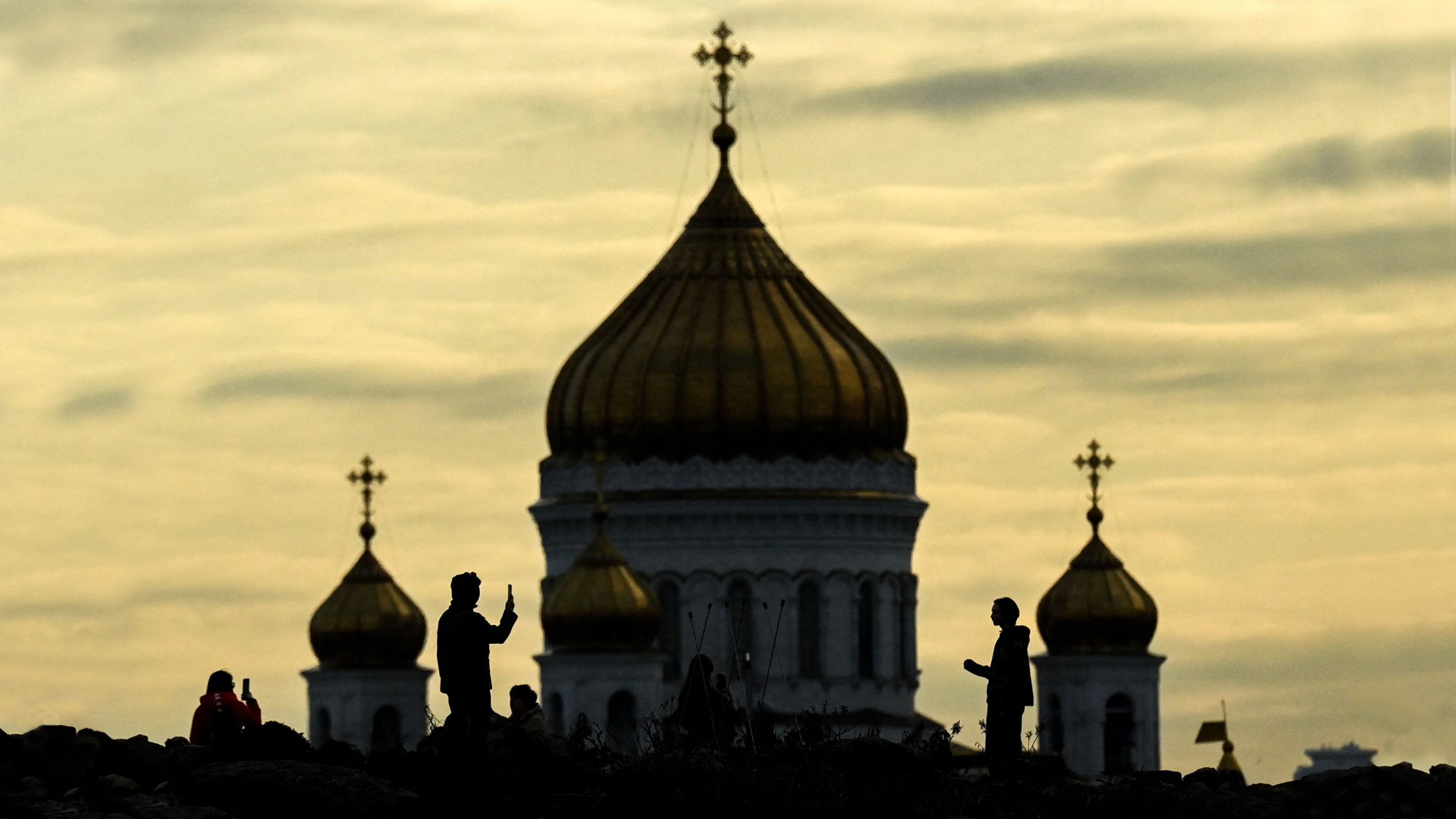
A sunset view from Zaryadye park with Christ the Savior Cathedral in the background in downtown Moscow, Russia, on April 19, 2022.

A sunset view from Zaryadye park with Christ the Savior Cathedral in the background in downtown Moscow, Russia, on April 19, 2022.

Christianity Today April 22, 2022
Kirill Kudryavtsev / Getty

Russian sermons—to the extent legally possible—reflect the national mood.

“Honor the tsar!” preached Alexey Novikov of Land of Freedom Pentecostal church in Moscow two days after the February 24 Russian invasion of Ukraine, quoting from 1 Peter 2:17. While not pro-war, it was certainly pro-Russia. Once a lawfully elected president commits troops, he said, it is a Christian’s duty to support them.

One month later, Mikhail Belyaev of Source of Living Water Baptist church in Voronezh, Russia, asked, “Why are the churches silent?”

Many Ukrainian evangelicals are fuming at their cross-border colleagues for failing to speak out against the war. They also cite the apostle Peter, placing priority on the same verse’s earlier command: “Love the family of believers.”

But Belyaev’s sermon was not pro-Ukraine. His congregation 320 miles south of Moscow provides a different answer.

The churches are not silent, he said. They are preaching the gospel and praying for peace.

“Russians take the Ukrainian complaint seriously,” said Andrey Shirin, associate professor of divinity at the John Leland Center for Theological Studies, a Baptist seminary in Virginia. “But they put God before the nation—and think many Ukrainians put too much stock in their nationality.”

Shirin left Russia 30 years ago and said that, then as now, most believers are wary of politics. And while some pastors have criticized the war, a pro-Ukraine sermon would be hard to find.

Throughout the war, polls have shown strong support for what Russia has legally mandated be called a “special military operation.” Between 65 percent and 89 percent have signaled approval; 71 percent said they feel “pride” and “joy.”

Some analysts have suggested propaganda is at play: Three in 4 Russians rely on television for the news, and 2 in 3 from state-run broadcasts. Only 5 percent have access to a VPN for outside reporting.

Others have suggested falsification: A “list experiment” in which Russians did not have to answer the war question directly resulted in an approval rating of 53 percent.

Specific polls do not exist for evangelicals.

Shirin, noting the difficulty of precision, estimated pro-Russia sentiment like Novikov’s would register only 20 percent. But pro-Ukraine sentiment and a clear antiwar position would fare worse, registering only 10 percent. The “silent majority” of his estimated 70 percent—such as Belyaev—would be characterized as “pro-prayer,” which in their Russian context means abstaining from judgment.

“Being an evangelical makes a huge difference in attitude,” Shirin said. “It makes for a more neutral stance.”

But this does not satisfy Ukrainian evangelicals.

“We strongly condemn the silence, detachment, and open support of the war with Ukraine exhibited by the Russian Christians,” wrote a group of seven Ukrainian seminary leaders in an April open letter drawing nearly 300 signatures. “The suffering of brothers and sisters in Christ requires a public identification with them.”

Among the chief alleged offenders is Sergey Ryakhovsky, head of Russia’s largest Pentecostal union, who spoke at a March 29 parliamentary conference gathering to reject Naziism, which President Vladimir Putin has identified as the ideology of Ukrainian leadership.

“We are together, and we are stronger,” he said of the ecumenical participation. “Today we have a clear Christian mission for our peoples, in Russia and Ukraine.”

Novikov’s church belongs to Ryakhovsky’s denomination.

But the Ukrainian complaint predates the current invasion. In 2014, Russia annexed Crimea and began backing separatist movements in Ukraine’s eastern Donbas region. Since then, Baptist leaders have appeared with Putin at Russia’s national Unity Day and extended birthday greetings to the Russian president.

Others have spoken out clearly—and early.

When Putin announced his divorce in 2013, Victor Shlenkin, a Baptist pastor in St. Petersburg, called out his fellow believers.

“Some Protestant leaders compared Putin to the wise Solomon,” he said. “But have they forgotten how Solomon ended up?”

And since the war, others have invoked the Devil.

“So far, Satan has won twice,” said Evgeny Bakhmutsky, former vice president of the Baptist Union, on February 27. “He helped unleash a war on the territory of Ukraine with the participation of Russian troops, and he sowed discord and enmity even among Christians.”

Alexey Markevich agreed.

“We need to repent for the evil that our country is causing others,” said the Moscow Baptist pastor on March 18. “Which is closer to us: Our faithfulness to brotherhood in Christ, or our submission to godless authorities?”

And Yuri Sipko, after seeing images of the burned Bibles at the Mission Eurasia headquarters in Irpin, Ukraine, had choice words for his fellow countrymen.

“Russian Christians approve such activity,” said the former Baptist Union president. “[But] I saw Christ crying watching this barbarism. I am crying too.”

These are not outliers, said Ponomarev, a Russian Orthodox leader serving with the Faith2Share network of evangelical agencies who asked that his full name not be used for security reasons. But they, and hundreds of others like them who in March signed an open letter led by evangelical pastors opposing the war, are “courageous.”

Surprised by the national polls, he believes most Russian evangelicals agree with the protest letter—the issuance of which he called a “miracle.” The 2016 Yarovaya law, often targeting evangelicals, brought even more caution to a community accustomed to not speaking out.

As pacifists they tend to avoid politics, but they are against war.

As Russians, however, some are pulled along with the tide. Western sanctions have hardened attitudes, while many families—and churches—are divided.

But Ukrainian evangelicals are not helping their own cause, he said. Too much has been demanded of condemnation.

“There is almost a feeling of fatigue,” Ponomarev said of cross-border relations. “After eight years of being told that they are ‘agents of the Kremlin,’ there is not much patience left in the tank.”

Andrey Dirienko may be an example.

Offended when Russia is called an “evil empire,” the Pentecostal bishop from Yaroslavl, 170 miles northeast of Moscow, wished for understanding.

“Sometimes [leaders] have to choose the least of several evils,” he said February 27, calling for prayer that God would give wisdom to Russian politicians. “God has the answer … that peace would come.”

But to Ukrainians, he asked: Don’t try to look for enemies in people.

The Ukrainian seminary leaders’ open letter this month, however, titled “Voices from the Ruins,” takes no comfort in such generic statements. It accuses Russian church leaders of trading compassionate unity with the “crucified” body of Christ for proximity to the political elite.

Dirienko is an authorized representative of Ryakhovsky, who currently serves as one of two evangelical members on the Russian president’s rotating religious council.

“Many of those who say, even loudly, ‘No war,’ support Ukraine’s integration under Russian world influence,” said Taras Dyatlik, Overseas Council regional director for Eastern Europe and Central Asia, who signed the letter. “The Russian Christian worldview must be cleansed from religious imperialism.”

Over 280 Russian Orthodox priests and deacons agree, signing their own open letter.

Just do not overstate their influence.

“Their statement was a disgrace, a media-driven effort to criticize authority,” said Alexander Webster, an American archpriest and retired seminary dean in the Russian Orthodox Church Outside Russia. “Their number pales before the more than 40,000 bishops and other major clergy who are not involved in that small protest movement.”

There is a place for dissent, said Webster, who was offended principally by the letter’s hint of eternal damnation for Patriarch Kirill. During the Cold War, he criticized clerics who cooperated with the KGB. And this war, he said, is condemned as “morally unjustifiable.”

But the few Russian Orthodox figures who have broken with their leadership—some of them once prominent—are “airing our dirty laundry before the world.”

Webster hails instead Metropolitan Onufriy, primate of the Moscow-affiliated Ukrainian Orthodox Church (UOC), who on the first day of the war expressed support for soldiers defending their land and called on Putin to stop the fratricide.

“He is a modern-day prophet, standing up to power,” said Webster. “He does it calmly, and at some risk.”

Which Onufriy faces also from his own government—having criticized former Ukrainian President Petro Poroshenko and the “left-leaning policies” of current President Volodymyr Zelensky. A bill currently before the Ukrainian parliament effectively calls for banning the UOC and nationalizing its properties, which Ryakhovsky, among others, has condemned as an offense against religious freedom.

Webster would have supported a limited military intervention in support of “persecuted ethnic Russians” in the Donbas.

No one has clean hands, he said, tracing Western interference in Ukraine back to the 2014 Maidan protests that drove a pro-Russian president from office and the 2018 campaign for autocephaly, culminating in recognition of the independence of a Kyiv-based Orthodox church by the Ecumenical Patriarchate in Constantinople.

In September 2021, Webster continued, NATO and Ukraine held joint defense exercises. In January this year, NATO rejected Russia’s demand to withhold membership from Ukraine. And one week before the war, Zelensky questioned the diplomatic framework in which Ukraine traded its nuclear weapons for security guarantees, leading Moscow to accuse Kyiv of plans to develop an atomic bomb.

National security, given the threat of NATO expansion, is cited as the primary rationale for the war by 7 out of 10 Russians, while half see a goal of protecting Russian-speaking Ukrainians in the Donbas. Only 2 in 5 believe the primary goal is to change Ukrainian leadership, and only 1 in 10 the subjugation of the nation altogether.

Asked to estimate the various attitudes among Russian Orthodox, Webster questioned polling in Russia in general and criticized its use by Western media for warmongering.

“The whole approach is faulty,” he said, noting the inability to get reliable information. “We don’t believe in governing the church according to popular opinion. We believe that the Holy Spirit and holy tradition guide and inspire the church leaders and faithful believers.”

Roman Lunkin, head of the Center for Religious Studies at the Russian Academy of Science’s Institute of Europe, did his best, however. Approximately half of the Russian people support the military operation, he said, while about 10 percent support Ukraine. He estimates Shirin’s “silent majority” at only 40 percent.

It is the same among rank-and-file evangelical believers.

“It is natural to defend your nation,” he said. “Protestant churches have become national communities, reflecting the mood of the general population.”

Last month, Lunkin, an Orthodox believer, published a chart to outline the positions expressed by major Russian religious figures, from direct support to condemnation. If anything, he said, there is more diversity among the clerics.

A sociologist, Lunkin conducted subsequent interviews among evangelical pastors, many of which were trained by Ukrainians. Support for Russian policy drops to 30 percent, he estimated, equal to the “pro-prayer” position. He puts support for Ukraine at 40 percent, half of which would say so publicly.

But most lack political experience, he said, and keep silent as hostages to public opinion.

This is not dissimilar to the Orthodox clergy.

“The major part stand for peace, and may be not happy with the special operation,” Lunkin said, though they recognize the reasons behind it. “But why would they divide their parishes?”

It is not just evangelicals who stay out of Russian politics.

Sources indicated that though the government continues to suppress opposition, Russia is no longer the Soviet Union. Stating a viewpoint, unless calling for protests, will not necessarily result in fines or jail.

So speak out, said the Ukrainian open letter.

“Seek the power of the Holy Spirit,” urged the seminary leaders, “to make practical steps that would impact public opinion in Russia—about the war against Ukraine, and the country’s top leadership.”

It is easier from the United States.

While Shirin could never imagine something “so horrific” could happen, he can also call freely for the “fratricidal conflict” to end.

“The stance of most Russian Protestants has been shaped by decades of being a persecuted minority,” he said. “Staying out of politics has been their survival strategy.”

Follow CT’s Russia-Ukraine war coverage on Telegram: @ctmagazine (also available in Chinese and Russian).

Select articles are offered in Russian and Ukrainian.

Ruth in the Time of Judges: An Alternative Reality Amid Conflicts

The contrast between the two Old Testament books can help Christians navigate today’s polarization.

Christianity Today April 21, 2022
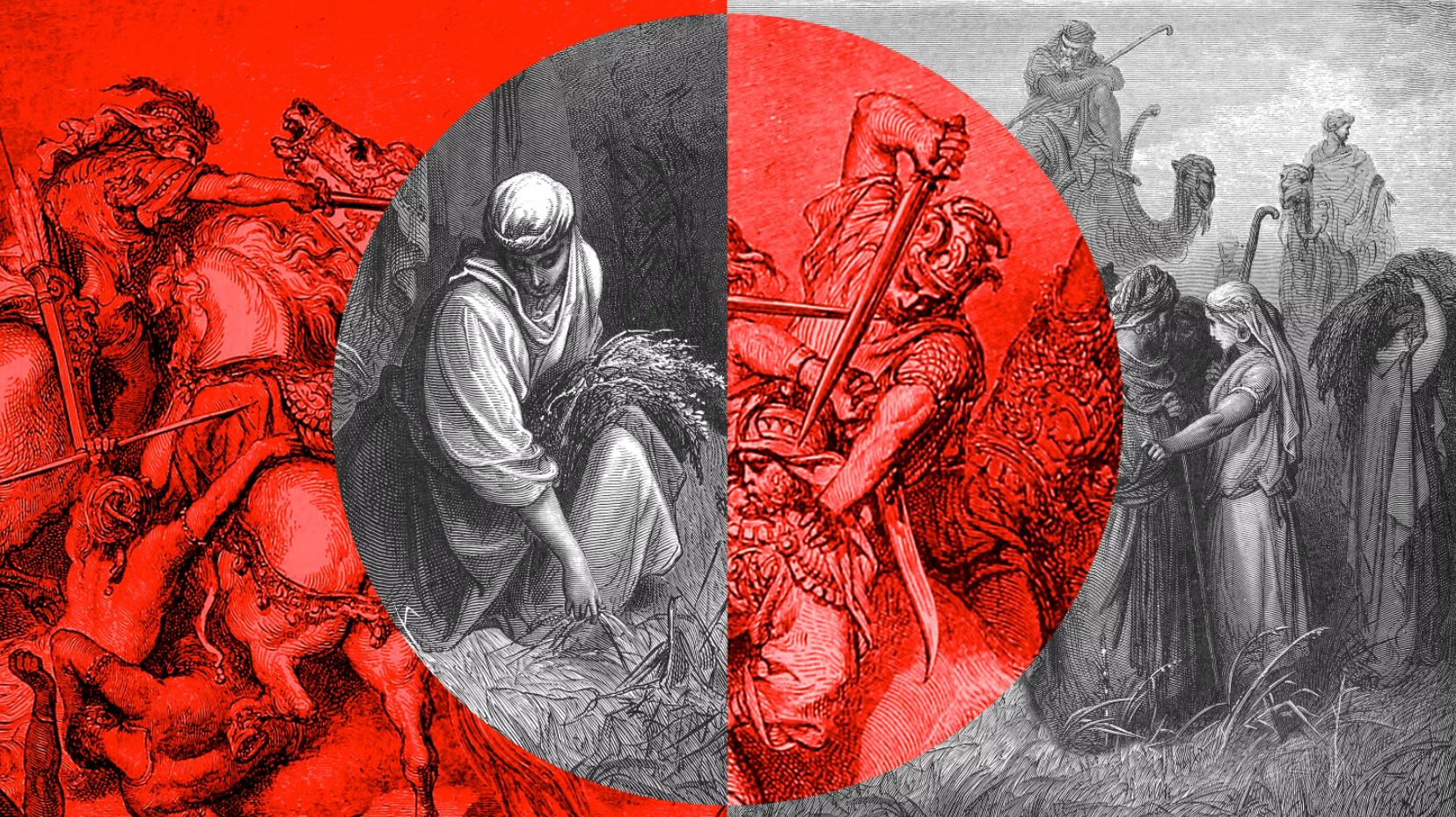
Illustration by Mallory Rentsch / Source Images: WikiMedia Commons

The Korean drama Squid Game was a hit in 2021, reaching over 140 million Netflix viewers worldwide. The series used games familiar to Korean children to describe the social pathology of adults amid the “fair competition” of the modern world. It satirizes a system in which people would do anything in order to survive at the expense of others.

In real life, the current war between Russia and Ukraine is the latest event to expose the ugliness of human conflicts. Each brings division, with supporters and opponents increasingly polarized.

However, do Christians have to choose only between the polarized options of full support or full opposition amid the conflicts of the 21st century? Two Old Testament books suggest not.

Different narratives

The Israelites in the Old Testament were repeatedly subjected to cruelty. They suffered from foreign aggression and were often at war. Gideon’s son, Abimelech, killed 70 brothers in one day in order to become king in Shechem (Judges 9:1–6). A Levite was returning home with his concubine, but she was raped to death by local hooligans. News of the incident spread to the other tribes and led to a war that nearly wiped out the entire tribe of Benjamin (Judges 19–21).

The writer of Judges sums up the situation of that time period with a repeated phrase: “In those days Israel had no king; everyone did as they saw fit” (21:25). When members of society did what was right in their own eyes, everything was based on their own interests, which naturally led to a ruthless generation. The word mercy would not be found in their dictionary.

It was during this period that Ruth, a Moabite woman, arrived in Bethlehem of Judah to begin her life in a foreign land (Ruth 1:22). She was prompted by the prayer of her mother-in-law, Naomi: “May the Lord show you kindness …” (v. 8). Naomi’s prayer of kindness (ḥĕsĕd) for her two daughters-in-law can be understood as loyalty but can also be interpreted as loving-kindness. This prayer motivated Ruth’s journey of grace.

Before Ruth left Moab, she argued with her mother-in-law. Naomi advised her not to come to Judah because there was no mercy from God there, but only his judgment (1:12–13). She thought her daughters-in-law should remain in Moab to seek the Lord’s mercy (vv. 8, 15). Ruth’s answer was the opposite: “Don’t urge me to leave you or to turn back from you. Where you go I will go” (v. 16).

This is a puzzling emigration decision. Given the choice, how could Ruth choose a cruel and unforgiving society (as described in Judges) when a normal person would choose a calm, safe, and economically prosperous country to migrate to? Could she have chosen the wrong place?

The end of the first chapter of Ruth seems to suggest the answer. They arrived in Bethlehem “as the barley harvest was beginning” (v. 22). There was a law for people like Naomi and Ruth in Israelite society: “When you are harvesting in your field and you overlook a sheaf, do not go back to get it. Leave it for the foreigner, the fatherless and the widow, so that the Lord your God may bless you in all the work of your hands” (Deut. 24:19).

This was the Lord’s way of showing mercy to disadvantaged people. But in a generation when “everyone did as they saw fit,” did anyone keep the law? Boaz’s later words to Ruth seem to suggest that the people of Bethlehem did not, and would even harass her (Ruth 2:8–9).

In fact, the question facing Ruth was not only whether the Israelites were willing to obey the law, but also whether they were willing to “break” the law. For while the Deuteronomic law protected the widows who lived in the land, it also prohibited Moabites like Ruth from entering the community of Israel (Deut. 23:3). Unless someone was gracious enough to set aside this prohibition, those who strived to keep the law would be deterred from lending a helping hand.

It seems that this harvest was not only a sign of the Lord’s renewed favor toward Bethlehem (Ruth 1:6), but also a test of the city’s graciousness. Ruth seemed to be aware of the difficulties she would face and the mercy she would need (2:2).

What followed was a series of providential events. Ruth went behind the harvesters to glean; “as it turned out,” she followed them to a certain field of wheat; and “just then,” Boaz, the field owner, arrived from Bethlehem (Ruth 2:3–4). Boaz not only allowed Ruth to gather wheat in his field but also protected her (vv. 8–9). He commanded his servants not to insult her even to let her glean more (vv. 15–16).

The kindness that Ruth had sought was found, and it was more than she thought she could expect (v. 10). When she couldn’t resist asking Boaz why he was so gracious to her, his answer indicated he believed that what had happened was no coincidence but instead a merciful act of the Lord in reward of her faith (v. 12). Naomi came to the same conclusion after hearing Ruth’s account of the events in the field (v. 20).

Sharp social contrasts

In the narrative world of Judges, there are apostate Israelites, idolatrous and lustful judges (Gideon and Samson, respectively), Levite priests of idol shrines, the mob in Gibeah who raped the Levite’s concubine, and the peremptory Benjamites. The land of Israel was a place of foreign invasions and tribal wars arising from internal strife.

In the narrative of Ruth, however, the reader sees a society of kindness and warmth, a Bethlehem where the Lord demonstrated his mercy and grace through Israelites. There is not only Boaz, who is full of kindness to the Moabites, but also the ten elders who bless the marriage of Ruth and Boaz (Ruth 4:11–12).

We see some stark contrasts between the two books. Judges tells of a foreign woman who was abused and died in Gibeah, while Ruth tells of a foreign woman who was not only accepted in Bethlehem but also honored as one of the ancestors of Israel—the equal of Rachel and Leah.

The writer of Judges repeatedly attributes its chaos to the fact that “in those days Israel had no king.” Instead of criticizing this environment, the Book of Ruth deliberately concludes with the genealogy of King David (4:17–22), implying that the king expected during the time of judges was David, who foreshadowed Christ, the King of peace.

The narrative of Ruth offers what Charles Taylor described as an “alternative social reality,” similar to the “alternative consciousness” proclaimed by the Old Testament prophets as described by Walter Bruggemann in The Prophetic Imagination.

The polarized social consciousness

In recent years, there has been a spate of incidents of polarization among Christians, exemplified by debates over public health restrictions during the COVID-19 pandemic. The reasons for these conflicts are not necessarily biblical, but rather polarized views on politics, race relations, gender theory, sexual ethics, Christian nationalism, and other issues.

Among evangelicals, each side defines evangelicalism by its own set of values. As Jim Cymbala, senior pastor of The Brooklyn Tabernacle in New York City, said in a January sermon, Christians in North America now no longer define an evangelical person by whether he or she believes in Jesus, but by whether he or she is Democrat or Republican, pro-vaccination or anti-vaccination, and mask-wearing or not.

“These were my people, but now I don’t know who they are, or maybe I don’t know who I am,” Timothy Dalrymple, CEO and editor in chief of Christianity Today, described his friend as saying last year. In February, he told David Brooks for The New York Times, “One of the most surprising elements is that I’ve realized that the people who I used to stand shoulder to shoulder with on almost every issue, I now realize that we are separated by a yawning chasm of mutual incomprehension. I would never have thought that could have happened so quickly.”

One of the major factors that has brought evangelical relations to this point is the divisive information bubbles formed by polarized mass media and social media. Each side chooses to absorb or disseminate only the data of its own circle. The social reality behind each side’s values becomes the eyes of the beholder, leading to a clear distinction between enemies and friends. Few people believe the other side, and each side speaks its own language. For each circle, the social reality seen by peers is the real reality while the social reality of other circles is suspicious “fake news” or “misinformation.”

It is almost another phenomenon where “everyone did as they saw fit.”

This polarized social reality has no room for objective reality. If both sides are in danger, neither side will be able to detect it due to lack of objective vision. Even more regrettable is the fact that within our own Christian community, there are many rivalries and enemies. Those who seek the truth are at a loss. Many people have created a world of cold and cruel narratives without the mercy and grace of the Lord.

An alternative reality

The Book of Ruth sheds some light—and even offers a model—for Christians dealing with current conflicts of consciousness. Ruth shows that even amid the darkest chaos, there are positive narratives to report in the world that God created. Like the biblical writers, Christians can create a healthier social reality using the positive examples that exist amid conflicts. Such a social reality does not deny the dark side of the present but focuses on the positive stories within society.

For example, in the war between Russia and Ukraine, we can focus on the humanitarian relief efforts of many charities and Christian organizations. As Christians, we should be especially aware of the contributions of congregations and missionaries at this time. Many missionaries chose to stay behind even though they could have been evacuated from the war zone. (The parents of one of my theology students decided to stay in Ukraine to serve and accompany local Christians in distress.)

Another example is CT’s recent report on Shanghai that even amid the difficulties and chaos of the city’s COVID-19 lockdown, local Christians are helping their neighbors and serving their community with charity.

Unfortunately, the daily focus of the polarized media today often ignores the ministry of these Christians, which is rarely heard even within the church. Their stories need to be made more public so that we can create an alternative sense of reality amid the predominantly antagonistic social reality. The Lord is still in power in the midst of chaos, and he is still exercising his mercy among the masses. This is the narrative that people who are confused by the opposing social realities need to hear. We want to show them that in this cold era, human beings can still enjoy the warmth of humanity because of God’s intervention.

In fact, what Jesus Christ brought out in his three and a half years of ministry was a different kind of social reality. He was often caught between pro-Roman and anti-Roman Jews, and his followers included those who took different sides. In the face of such polarization, Jesus chose to proclaim the alternative social reality of the kingdom of heaven: “Repent, for the kingdom of heaven has come near” (Matt. 4:17). A careful reading of the Gospel accounts reveals that both Jesus’ message and his healing ministry were beyond the imagination of the Old Testament prophets, who were not able to imagine an eternal kingdom of love for both enemies and friends like the one Jesus described.

Jesus said that before his return, wars would continue to rage in the world and humans would be divided: “Nation will rise against nation, and kingdom against kingdom” (Matt. 24:7). No matter which side people were on, their political views on war all eventually became a thing of the past The focus of Christians should not be blurred in the face of the tidal wave of wars and struggles. Our narrative should be like that of Jesus—the narrative of an alternative heavenly reality. We should pray as Jesus did that the Father’s “will be done, on earth as it is in heaven” (Matt. 6:10), and help people see an alternative social reality amid a world in turmoil and a generation divided.

Dr. Samuel Goh holds two master’s degrees in theology and a PhD degree. He pastored a church in Singapore for many years and is currently a lecturer of Old Testament at Brisbane Theological Seminary in Australia.

Translation by Sean Cheng

Theology

Fragmentation Is Not What’s Killing Us

False unity resolves division, but real unity involves holding diversity in tension.

Christianity Today April 21, 2022
Illustration by Rick Szuecs / Source Images: Wikimedia Commons / Envato / Dries De Schepper / David Todd McCarthy / Emmanuel / Kate Bezzubets / Mimi Thian / Unsplash

This piece was adapted from Russell Moore’s newsletter. Subscribe here.

I’m quite sure that I’ve never interacted with one article for two weeks in a row here, but few issues are as important as those raised by social psychologist Jonathan Haidt in his Atlantic essay on the Tower of Babel and the fragmentation of American life.

The essay uniquely summarizes the fractures facing virtually every church, denomination, business, think tank, neighborhood association, and family I know. And in almost all those settings, someone will inevitably ask, “How did we become so divided?” followed by “How do we get back to unity?”

Those are important questions, but there are good and bad ways to answer them.

As I mentioned in my conversation with Haidt on the podcast this week, I agree with him largely on where he identifies the problem and with many of his proposed solutions. At the same time, we should pay careful attention to how we interpret the text that holds together his thesis: the Tower of Babel account in Genesis.

The analogy works, even for people who (like Haidt himself) aren’t believers. Technological hubris leads to an inability to communicate—which leads to a society breaking apart into little pieces. That does indeed sound like now. But the lessons we learn will be wrong if we don’t see the primary point of the Babel story:

The problem wasn’t the fragmentation. The problem was the unity.

As I noted here last week, Haidt is right in saying that American culture is facing a loss of social capital, of a shared story, of healthy institutions. That has grave implications for the future of democracy and—more importantly in my view—of the church itself. We can feel as adrift and fractured as those whose languages at Babel were confused.

Yet the fragmentation at Babel was from God.

Genesis tells us that the builders of Babel, seeking to make a name for themselves and to keep from being scattered, constructed a building that could reach to the heavens. Most biblical scholars see this as a kind of ziggurat, a staircase leading to communion with the divine. Because the people’s unity meant that “nothing they plan to do will be impossible for them,” God confused their language so they could not understand one another (Gen. 11:6–7).

That’s a crisis—a painful one—but it was necessary if God was to save the world. What could bring more unity than a metaphysical infrastructure project carried out by people who shared bonds of natural and national affection?

But this unity was in the wrong thing—and was a unity that would lead them to death. In the same way that God exiled Adam and Eve from the Tree of Life so that they would not eat of it and continue in their state of spiritual death forever, God here tore apart the unity of the people … in order to form a unified people.

After all, the scattering of the Babel builders was a prelude to what immediately followed: the call of Abram out of Ur. Oddly enough, God promised Abram exactly what the text said the builders wanted: a great name, a unified family, and a future of blessing. It is through Abraham, the Bible says, that all the nations will be unified and blessed.

But if unity alone were the goal, God could have left them alone. Instead, the pattern was one of order, followed by disorder, followed by a reordering.

In the New Testament, the great undoing of Babel is seen at Pentecost, where people from all over the world were gathered and, when the Spirit was poured out, started to hear the message in their own languages.

Yet this was not a Babel-like unity. This was something quite different. This was God coming down, not humanity building up.

One easy way to gain unity—if that’s the only goal—is simply to find whatever is disrupting such unity and stop talking about it.

Ironically, that’s the very dynamic that Haidt (rightly) identifies as the problem. Most people are, as Haidt demonstrates, more or less “normal,” and mostly exhausted by the sort of troll culture we see on the extremes. That’s true in the church as much as anywhere else.

A small minority of people are able to set the agenda in countless congregations or denominations—as well as within political parties or universities or almost any other institution—by wielding “darts” so ruthlessly that the exhaustion causes the “regular people” to stop discussing certain matters just to keep arguments from breaking out. Sometimes that’s exactly what should happen.

Jesus refused to get caught up in many of the controversies swirling around first-century Galilee and Jerusalem. Paul warned us not to get diverted with “foolish and stupid arguments” (2 Tim. 2:23) and to avoid “foolish controversies and genealogies and arguments and quarrels” (Titus 3:9).

At the same time, the Bible consistently cautions against the very thing many of us define as unity: the sort of risk aversion that calculates what will upset those who are currently most powerful and tries to censor oneself so as not to “set them off.”

After a while, the distinction between seeking unity and evading risk is lost. That seems to relieve tension for the moment, but it doesn’t create unity.

The extremes are specific, while the “normal” people get more and more generic. The extreme minority identifies with tension, while the exhausted majority tries to bypass it. That means the extremes win—not because they are right but because they understand human nature.

Jesus could have told us, “Be kind to strangers,” but instead he gave us the tension of the parable of the Good Samaritan. He could have just said, “God forgives sin,” but he told us the very tension-filled tale of a prodigal son who went to a far country and came home.

We need a shared story, but a story without tension is no story at all. Our story is of a God who brought us out of the land and slavery of Egypt (Ex. 20:2), of a God who “raised Jesus from the dead” (Rom. 8:11, emphasis mine). Our story is so repugnant that the apostle Paul had to keep reiterating that he was not ashamed of it (Rom. 1:16).

Pentecost brought about unity, but it was a unity that kept ratcheting up the tension. That day, Simon Peter preached that the Spirit had been poured out on all flesh. But he soon faced a crisis when Jesus appeared and told him that the Gentiles were joint heirs and that he shouldn’t call unclean what God had pronounced to be clean (Acts 10–11).

As the Spirit moved outward—from Jerusalem to Samaria to the ends of the earth—each stage created a new crisis: What should we do with these controversial outsiders who have received the same Spirit as we (Acts 10:44–48)?

Even that would lead to a series of other crises. When he avoided eating with the Gentiles in Galatia, Peter had to face confrontation from Paul (Gal. 2:11–14). No doubt, Peter’s motive was, in his own mind, “unity.” If Peter had stuck with the custom of separate tables for the in-group and the out-group, there would have been no tension. The people with a (literal) place at the table would never have raised a question, and those harmed wouldn’t have been heard from at all.

Yet Paul recognized that this was not in step with the gospel and withstood Peter to his face. That was fragmentation. Two pillars of the church at odds with each other! But it was the reverberation from Pentecost. God was keeping his promise that “the blessing given to Abraham might come to the Gentiles” too (Gal. 3:14).

Fragmentation is indeed an awful problem. I grapple with the pain of it every day as I think of name after name of those I love who will no longer speak to me—after the earthquake that has been the past five or six years in this country and in whatever the evangelical movement is or was.

The gospel confronts fragmentation. God gathers up all things in Christ—things in heaven and things on earth (Eph. 1:10). But how does he do that? Through the very thing that scattered the unity of the first disciples: the Cross.

Fragmentation is a crisis. God has called us to unity. But the way we get there is not by finding a better technology to start rebuilding the tower the way we did in the first place. Sometimes God fragments what we were doing because it was killing us.

For the kind of unity we need, we must be unified in doing what’s right and pleasing in the sight of God. Sometimes that means a future that looks nothing like the one we planned—seeking unity with people we never thought about.

Finding our way back to Babel won’t get us there.

Russell Moore leads the Public Theology Project at Christianity Today.

Theology

Confessions of a Past Culture Warrior

During my youth, I played the polemicist. Here’s what I learned about true righteousness.

Christianity Today April 21, 2022
Illustration by Christianity Today / Source Images: WikiMedia Commons

If you haven’t heard, the 1990s are back. Hair scrunchies, oversized blazers, earth tones, and chunky-soled shoes. Also, apparently, Disney boycotts and conspiracy theories about liberal pedophile sex cults. I was in middle school and high school during the ’90s and enjoyed my fair share of both fashion blunders and culture wars. As a conservative coming of age during the Clinton presidency, I remember the feeling of constant siege while we fought to save America from the godless Left.

So as debates about critical race theory, “wokism,” and changing sexual mores ramp up again, I’m experiencing a bit of a time warp. I wonder, “Why do we love the culture wars so much? Why can’t we quit them?” To be fair, Western culture was undergoing a radical shift in the ’90s, much as it is today. The former Soviet bloc collapsed, initiating a global realignment. An Oval Office scandal made “oral sex” such a common phrase that even I, sheltered as I was, knew what it meant (after looking it up in the dictionary). It was understandably a time of increased political polarization, especially with the rise of conservative talk radio. Folks like Rush Limbaugh brought a kind of joyful exuberance to the fight—a confidence and swagger that somehow felt true and freeing. He warned against the “feminazis” while selling Snapple and Sleep Number beds. And even when he mocked the president’s daughter—a girl my own age—it felt legitimate in light of her parents’ obvious corruption. So when the GOP recaptured Congress in 1994, it was like hope being restored. When Kenneth Starr led an investigation that eventually resulted in Clinton’s impeachment in 1998, I felt the thrill of justice. There are simply no culture wars like old-school culture wars.

Despite this pedigree, I find myself viewing current political clashes with a mixture of bemusement, frustration, and deep sadness. Because somewhere in the 2000s, after September 11 and before the election of Barack Obama, I grew up. I married, started a family, and entered a life of ministry that included Christian publishing, Bible teaching, and local church work in rural communities. Those spaces brought more pressing concerns, and politics receded into the background. I convinced myself that, like my light-wash, high-waisted jeans, certain things were behind me—passed out of fashion, never to be seen again. But here we are. And while the current clashes express themselves slightly differently, I recognize the basic outline. I also experience a kind of secondary discomfort when I hear talking heads on both the Right and the Left replicate my youthful certainty, self-assuredness, and audacity. Over the years, I’ve tried to understand why I found the culture wars so deeply satisfying, even in middle and high school. I was a fervent Christian, wanted to please God, and was eager for affirmation. I got it in spades when I voiced certain opinions.

When I mocked liberals, the adults around me laughed. When I wrote papers about the deviancy of Hollywood and the music industry, I got high marks in my Christian school. And when I campaigned for conservative political candidates in college, I got extra credit. In retrospect, I understand that my subculture was encouraging me toward combat. But like the fashion mistakes I made in those same years—the mile-high bangs and cropped bob—I know more was going on, too.

When a teenager experiments with fashion, they’re often trying to find themselves, longing to fit in, and dealing with the general angst of moving from childhood to adulthood. So I’m sympathetic to my younger self—both my lack of fashion sense and my political naiveté. But I don’t want to excuse the fact that I was drawn to the culture wars for a reason. James 4 addresses our love of war and pinpoints its roots:

What causes fights and quarrels among you? Don’t they come from your desires that battle within you? You desire but do not have, so you kill. You covet but you cannot get what you want, so you quarrel and fight. You do not have because you do not ask God. (vv. 1–2)

These admonitions feel personal to me. As a young culture warrior, I was getting a hit of righteousness. I needed to know that I was a good person, and waging the culture wars was a great way to convince myself and those watching me. It was a way to convince God, too, I think.

But like any other drug, self-righteousness needs an ever-increasing supply. Every hit demands another. And when you’ve come to love the rush, you very quickly become addicted until the only thing you know how to do is fight. This is where things get tricky for Christians who want to bear public witness. We should be reluctant warriors, only picking up arms when a just conflict calls us to protect others. (Social justice is one example.) It’s one thing to advocate for and defend our principles in the common square; it’s another thing entirely to enjoy the fight. And too many of us love the battle. We delight in the pillaging and destruction of our ideological enemies. We love the war because of the rush of righteousness that accompanies it. So I wonder if the way to break the cycle is to reassess our desires and needs. What if we didn’t need the feeling of superiority that comes from a sharp comment on Twitter? What if we could count on something other than our own works—political or otherwise—to know we are safe and loved? When I think back on the girl I was in the 1990s, I see a young woman eager to please God. But I also see an immature young woman—someone who was too busy trying to please God to understand that he was already pleased with her in Christ. In the subsequent decades, I’ve done more than simply grow up. I’ve sobered up. Somewhere in my early to mid-20s, I encountered an expression of the gospel that located God’s grace and Christ’s righteousness over my own. I’d always known I was a sinner—always known that others were, too. But I didn’t have any meaningful way of dealing with sin or understanding Christ’s work on my behalf. So the best I could do was to show my commitment to God by simply working harder, trying to do what was right, and reforming myself. And if I could reform myself enough to overcome my sin, then other people should be able to as well. When they didn’t, at least to my thinking, I was entirely justified in condemning them and warring against them. By not understanding God’s grace at work in my own life, I couldn’t see it at work in the lives of others or even extend it to them in our debates. I was blind to particular grace, which meant I was blind to common grace as well. As the years have passed, I don’t know that I’ve become less conservative. I still hold policy positions and opinions that make my progressive friends squirm. But one thing has changed for me: I no longer need the fight. And I don’t need the fight because I don’t need to prove anything. Safe in the goodness of God and the righteousness of Christ, I’m free to work for goodness in the world around me. I’m free to love my neighbor as I love myself and struggle for their good, not my own. So as a new set of culture wars rage, take a word of advice from an old veteran: Speak truth and speak love, but don’t think for one minute that holding a certain position or voting a certain way makes God love you any more or any less than he already does. Don’t think for one minute that he loves your neighbor any more or any less than he loves you. Don’t think for one minute that your righteousness originates anywhere except with him.

And having tasted the goodness of God, having experienced his unmerited grace, go into the world and share it with others.

Hannah Anderson is the author of Made for More, All That’s Good, and Humble Roots: How Humility Grounds and Nourishes Your Soul.

Ideas

Hearing Lies About Russia’s War in Ukraine? The Best Defense Is Virtue.

Staff Editor

Our best weapon against information warfare can be found in Scripture.

Christianity Today April 21, 2022
Illustration by Rick Szuecs / Source images: Brando Makes / Stormseeker / Unsplash

Did you know Russia attacked a Ukrainian nuclear power facility, and “a government official said that elevated levels of radiation were detected near the plant”? Did you hear about the Ukrainian soldiers trapped on a tiny island who told off a Russian warship before they died defending their post? Or did you see the video of the “Ghost of Kyiv,” the ace Ukrainian pilot shooting down Russian bombers midair?

You may think you know these stories, but you don’t. And neither do I, because each is half-true at best. Russian forces did attack the power plant, but early reports of a radiation spike, like the CBS tweet I quoted above, were false. The International Atomic Energy Agency had said as much before CBS posted, yet, weeks later, CBS hasn’t deleted its erroneous tweet as of the time of writing this. The warship story isn’t quite true, either: Ukrainians did insult the ship, but they weren’t soldiers, and they aren’t dead. As for the Ghost of Kyiv, that one’s a total whopper. The footage came from a video game.

Beyond the brutality of the physical battlefield, the conflict in Ukraine is an information war. And unlike bombs and tanks thousands of miles away, that battle is all around us. Watching the conflict in real time, we’re all targets for misinformation.

Fact checks help, sure. But sometimes even generally credible news sources like CBS leave up errors, and sometimes even the fact checks are fake. If we want to avoid becoming casualties in the information war, what we need most is not endless debunking of every false tweet, but to build intellectual virtues.

“God enjoins us in Scripture to pursue” these virtues, writes Wheaton College emeritus philosopher W. Jay Wood in Epistemology: Becoming Intellectually Virtuous. The command is not only for professional philosophers: “The Bible is unequivocally clear that Christians are to superintend the life of the mind. ‘Do not be conformed to this world, but be transformed by the renewing of your minds’ (Rom. 12:3). God cares about how you think, not just what you think. … No walk of life is without the need for insight, discretion and love of truth.”

Intellectual virtue concerns “your very character, the kind of person you are and are becoming,” Wood says. “Careful oversight of our intellectual lives is imperative if we are to think well, and thinking well is an indispensable ingredient in living well.”

That was always true, but the sheer volume of information to which we can now expose ourselves daily has made it more pressing. The global theater of information warfare tied to the conflict in Ukraine means our need for intellectual virtue is at present especially acute. Wood wrote more than two decades ago, but his suggestion of three key virtues—studiousness, intellectual honesty, and wisdom—is just as needful now.

Studiousness means seeking truth well, steering between the excesses of vicious curiosity on the one hand and credulousness and oblivion on the other. A studious person values learning the truth, but she’s also attentive to how she learns it (some research methods are unethical), what she does with it (knowledge may be abused), and whether there are other, better things to which she should attend instead (Did you really need to know about that tweet? Will having that knowledge help anything or anyone?).

Studiousness is also a matter of attitude and self-discipline. A studious person “must not be quarrelsome but must be kind to everyone, able to teach, not resentful” (2 Tim. 2:24). They should be intellectually generous, diligent, and aware of their own limitations. “The one who has knowledge uses words with restraint, and whoever has understanding is even-tempered” (Prov. 17:27), so sometimes to be studious requires us to keep silent.

Intellectual honesty concerns how we respond to knowledge while acquiring it. It’s the virtuous mean between intellectual dishonesty and willful naiveté, and it requires us to deal in sincerity and good faith, even when we can’t expect the same from others (Rom. 12:17–21).

The intellectually honest person scrutinizes his own thinking and is scrupulous about admitting when he’s wrong, working to “put off falsehood and speak truthfully to [his] neighbor” (Eph. 4:25). He is on the lookout for motivated reasoning in himself and others, asking whether he believes something merely because he wants it to be true. And someone who is intellectually honest will never dissemble, or “call evil good and good evil” (Isa. 5:20), though that may be the easy or popular course of action.

Last, wisdom is the virtue we need to put knowledge we’ve sought and gained to good use. The wise person’s life will be “marked by deep and abiding meaningfulness, anchored in beliefs and purposes that offer lasting contentment,” Wood says. This person wants knowledge of “ultimate significance—knowledge that explains the most important features of our world, especially as they bear on human happiness.”

This requires circumspection and prudence, a healthy skepticism that doesn’t devolve into cynicism and—particularly in our information age—careful curation of one’s own attention. Wisdom requires rejecting belligerence, pedantry, pride, and rumormongering, all of which are encouraged in much of our traditional and social media.

I can’t end this column with five short steps to becoming intellectually virtuous. Virtues need time, practice, and patience to take root; the most I can offer here is a seed. Nor can I conclude with some foolproof guide to recognizing propaganda online. The scale and nature of this war—where your answer to a question as basic as who’s winning may depend on where you live—mean any concrete recommendations I could give would rapidly become useless. The power of modern, decentralized propaganda is how quickly it can evolve.

But we can log off more often. Touch grass. Pray more than we post. We can remember that the fate of Ukraine doesn’t depend on whether you share another article. As C. S. Lewis wrote in a letter in 1946, that it is not “the duty of any private person to fix his mind on ills which he cannot help,” and “the mere state of being worried is [not] in itself meritorious. … We must, if it so happens, give our lives for others; but even while we’re doing it, I think we’re meant to enjoy Our Lord and, in Him, our friends, our food, our sleep, our jokes, and the birds song and the frosty sunrise.”

Developing intellectual virtues is not a task to which we’re left on our own. Woods reminds us, “We can “hardly do better than to recall the words of James: ‘If any of you lack wisdom, ask God, who gives to all generously and ungrudgingly, and it will be given you’ (Jas 1:5).” In information warfare, as ever, “God is ready to assist us.”

Follow CT’s Russia-Ukraine war coverage on Telegram: @ctmagazine (also available in Chinese and Russian).

Select articles are offered in Russian and Ukrainian.

News

Report: 26 Million Americans Stopped Reading the Bible Regularly During COVID-19

Sharp decline may be connected to drop in church attendance.

Christianity Today April 20, 2022
Dylan Ferreira / Unsplash

When researchers for the American Bible Society’s annual State of the Bible report saw this year’s survey statistics, they found it hard to believe the results. The data said roughly 26 million people had mostly or completely stopped reading the Bible in the last year.

“We reviewed our calculations. We double-checked our math and ran the numbers again … and again,” John Plake, lead researcher for the American Bible Society, wrote in the 2022 report. “What we discovered was startling, disheartening, and disruptive.”

In 2021, about 50 percent of Americans said they read the Bible on their own at least three or four times per year. That percentage had stayed more or less steady since 2011.

But in 2022, it dropped 11 points. Now only 39 percent say they read the Bible multiple times per year or more. It is the steepest, sharpest decline on record.

According to the 12th annual State of the Bible report, it wasn’t just the occasional Scripture readers who didn’t pick up their Bibles as much in 2022 either. More than 13 million of the most engaged Bible readers—measured by frequency, feelings of connection to God, and impact on day-to-day decisions—said they read God’s Word less.

Currently, only 10 percent of Americans report daily Bible reading. Before the pandemic, that number was at about 14 percent.

Plake thinks the dramatic change shows how closely Bible reading—even independent Bible reading—is connected to church attendance. When regular services were interrupted by the pandemic and related health mandates, it impacted not just the corporate bodies of believers but also individuals at home.

“The elephant in the room is COVID-19,” he told CT. “As we’ve been tracking and kind of digging into what really happened around Scripture engagement in 2022, we realized there were some big issues happening in the United States at the time that we were collecting the data.”

The State of the Bible survey collected data in January 2022 as the omicron variant of the coronavirus was surging.

Most churches remained open, with an additional online option. Only about 3 percent were not meeting in person at all, according to Lifeway Research. But the pandemic took a visible toll on church attendance. Pew Research Center found that nearly a third of regular churchgoers have not returned to church buildings. Some choose to participate online, but others have dropped out completely.

And at the same time, there was a sharp decline in Bible reading.

Don Whitney, professor of biblical spirituality at Southern Baptist Theological Seminary and author of Spiritual Disciplines for the Christian Life, thinks there is probably a causal connection. Isolation from other Christians has “lethal” impact on private Bible reading, he said. When people are not in church, they’re not reminded of the blessings of Scripture and its importance for their lives. And they aren’t encouraged by other Christians sharing about their own Bible reading.

Churches are also the main place that people learn how to read the Bible.

“That is clearly the responsibility of the local church,” Whitney said. “The church should teach them.”

It’s a challenging book, and even if people believe, in the abstract, that it would be good to read it, that doesn’t mean they know how to make sense of a particular passage or even where to start.

“They’ve never read one book in their life approaching the length of the Bible, and so since they’ve never done it before, they think they can’t now,” Whitney said. “You might as well say, ‘Flap your arms and fly to the moon.’ I think we have to show them the doability of it.”

Even people who do read the Bible often haven’t read very much of it, according to research by Lifeway. Only one out of every five Americans has read the whole Bible, while one of four has never read more than a few sentences.

“For most people, it’s almost more of a reference book,” said Scott McConnell, executive director of Lifeway Research. “They’re looking up something when they need it or someone else needs it. Or they’re flipping it open and reading wherever they happen to land.”

He also believes that Christian community is critical for Bible reading.

“Jesus Christ invited us to follow him, and that’s a decision we must make individually. But he designed for us to follow him in community with other believers,” he said. “A lot of people [are] missing that reinforcement from others that can take place on a weekly basis.”

But even as Bible reading dropped dramatically in 2022, there is still a lot of continued interest in the Bible, from those who never, rarely, or seldom read it. According to the State of the Bible report, a third of those who never read the Bible say they are very or extremely curious about it.

Many of those, Plake says, will turn to the Scripture in a moment of need.

“What we find is that many people when they come to a difficult spot, they wonder, ‘Does the Bible have something for me? Can it help me through the issue I’m facing?’” he said. “They start curiously looking around and exploring Scripture. That opens up a whole new world of God’s Word to them and relationship with God and God’s people.”

There is evidence this is still happening, even in 2022. The number of people downloading Bible apps is growing, and new apps are entering the market, some with promises to help users develop a daily worship habit. Two Bible podcasts topped Apple’s charts at the start of the year.

And print Bibles still remain a popular option.

“Sales of all of our Bible translations are up this year,” said Melinda Bouma, VP and publisher of Bibles for Zondervan. “We have experienced sales increases across all editions.”

This includes everything from Bibles used for personal study and devotions to gift Bibles, education Bibles, and outreach Bibles. But the Bible market has increasingly developed products specifically for people who don’t read the Bible as much as they’d like to.

“We have learned that ultimately our job is to create Bibles that make it easier to get into God’s Word,” Bouma said. “We believe that offering various options [is] what equips readers to overcome the challenge of making time to read the Bible.”

Christians may find the results of the State of the Bible report discouraging, Plake said. But the decline in Bible reading isn’t inevitable or irreversible. And if it’s connected to church attendance and connection with Christian community, then those who care about connecting people with Scripture can focus their efforts there.

“Everything is not okay. But when it’s not okay, how do we respond? That’s the critical issue for the church,” Plake said.

“I’m confident we’re going to be able to turn the tide on Scripture engagement … but that only happens when we come together and we say we’re going to serve our communities with the hope we find in God’s Word.”

Theology

No, Western Christians Are Not In Exile

But the church will live under occupation until the return of our King.

Christianity Today April 20, 2022
Edits by Christianity Today / Source Image: Matheo / Unsplash

If you attend a mostly white, evangelical church in the 2020s, you have probably been told by your pastor that you are an “exile.” This is not by accident. He or she has been taught to imagine himself, his flock, and the church in our country as exiles from our worldly culture.

At its heart, this modernized exilic framework grieves secular shifts in Western culture and laments the loss of place the Christian church once had in our society. It equates our situation with what the people of Judah experienced and suffered after being exiled from Israel—while living in Babylonian captivity after the destruction of Jerusalem and their temple in 586 B.C.

This comparison largely began in the ’90s, drawing from the work of German-American theologian Walter Brueggemann and those building upon him. In The Church in Exile: Living in Hope After Christendom, Canadian Christian and Missionary Alliance theologian Lee Beach summarizes this exilic mindset as “the experience of knowing that one is an alien, and perhaps even in a hostile environment where the dominant values run counter to one’s own.” Beach contends that Christians should think of themselves as exiles in all times and places.

As evidence of evangelicals’ exilic status today, Beach points out the difference between Canada’s centennial celebration in 1967, which featured a Christian worship service, and Canada’s memorial service after 9/11, which did not. He notes, “If such national gatherings provide insight into the ethos of the nation, then in thirty-four years Canada had moved from a nation in which the church played a major role to one in which it was no longer included at all.”

The problem today with labeling North American evangelicals as exiles is that it becomes a form of cultural appropriation that minimizes the suffering of real exiles—and misrepresents the original Jewish exile. Moreover, it does not reflect the past or present status of the Western church and is therefore not a fitting, factual, or biblical metaphor for modern-day ministry.

In the 2000s, the rate at which mostly white, male, classically trained, evangelical theologians and pastors in the West embraced and preached the exile motif in their churches was outpaced by the rate at which millions of refugees and asylum-seekers faced real exile around the world.

Yet living in what Beach describes as “perhaps even a hostile environment” (emphasis added)—or moving from a “major role” in a nation to no role “at all”—is not what real exiles experience. Refugees drowning in the Mediterranean because their dinghy capsized did not move from a “major role” in society to no role “at all,” but rather from clinging to life to no life at all.

Think of the Uyghur, Syrian, Afghan and soon-to-arrive Ukrainian refugees in our churches and neighborhoods. Are we using rubber rafts to escape our country or throwing our children over barbed wire fences to avoid industrial-scale “re-education”? Are we sending our women and children to the border while the men stay behind to fight off invaders?

I regularly preach to the English ministry of a Toronto-based Mandarin church. Some of its elders were hidden by parents in caves as children to be saved from Communist purges before fleeing to safety here in North America. How does our use of “exile” language strike those living among us who have experienced real exile?

Evangelical advocates of “exile” are at best tone-deaf when they claim the status of exile on account of Christianity “slowly moving from the center of culture to a more peripheral role.” Using exile as a metaphor for ministry today misrepresents what the church in the West is currently experiencing—compared to, for example, the hundreds of thousands of asylum-seekers who are still trapped at the southern border of the United States.

Using exile to describe our cultural situation is a bit like using the word holocaust to refer to anything other than “the Holocaust.” Equating our declining social status, cultural clout, or political power with what real exiles endure does an injustice to their suffering.

Instead, I would argue that the reality—which is found both in the New Testament and in the Western church today—is one of occupation rather than exile. Occupation has many advantages over exile as an organizing metaphor for ministry, but I will enumerate only two.

First, occupation aligns more faithfully with the circumstances of the Western church than the diaspora event from which the Old Testament concept of exile originated.

Things are bad for Christians in the West, but they are not “exile-bad”; they are “occupation-bad.” To be clear, my concern is not that the Western church cannot relate to the exile metaphor, but that we relate too well to it! Many pastors I know preach “exile” to their congregation—and yet this framework overstates our “outsider” status in society.

Our modern, Westernized conception of exile—in which Christians move from a major to a marginal role in society—is not what Judah’s exiles faced in 586 B.C. when they were displaced by Babylon’s war in Israel.

The Jewish people lost their homeland, their liberty, their place of worship, and their way of life. Many lost their lives, their names, their food (Dan. 1:6-8), their political autonomy (2 Kings 16:6), their human dignity (Ps. 137:3-4)—the whole of which does not compare to the past or present situation of the Western church.

The second advantage occupation has over exile is that it is a more biblically sound metaphor for the backdrop of ministry that is found both in the New Testament and today.

Occupation, not exile, is the situation faced by Jesus and the early church both spiritually and politically. It is the theological context for the concept of seeking the heavenly kingdom of God on earth (Rom. 13:4)—as well as the root idea behind the church’s first creed that Jesus is Lord (Rom. 10:9). Salvation itself involves confessing that there exists a higher king than Caesar.

Occupation, not exile, is the backdrop of the nativity story. Herod was appointed “King of the Jews” by Rome—prompting him to order genocide out of fear that a baby born into that title might challenge his rule (Matt. 2). In fact, “King of the Jews” was the very title written on the sign nailed above Jesus to mock him as he hung on the cross (John 19:19).

The events of Holy Week, Pentecost, and the early church era do not make sense outside the political intrigue, social schemes, and religious nuances of occupation—unlike the simplicity of exile.

Occupation, not exile, is the setting for evangelism. The disciples were called to conduct themselves in a way that is above reproach, knowing that the political and religious authorities were looking for any excuse to persecute them (Matt. 10:16); and Satan is seen falling from heaven as the disciples carry out their mission in occupied spiritual territory (Luke 10:18).

Thus occupation, not exile, should be our underlying theological framework for ministry today. God placed the world under our stewardship in the Garden (Gen. 1:28), and it is becoming God’s again through Christ’s reign (Matt. 28:18-20). Meanwhile, Satan, sin, and death remain as occupying powers in this land (Heb. 2:14-17), hostile to believers (1 Pet. 5:8) and to the work of the church (2 Cor. 4:4), and bent on usurping God’s authority on earth (Matt. 4:8-9).

Christians are operating in enemy-occupied territory, and yet we are called to seek the kingdom of God. In doing so, we will continue to encounter resistance from various social forces, political establishments, and religious institutions not under God’s rule.

For example, in Canada, the governing Liberal party was elected in late 2021 on the campaign promise of revoking the charitable status of crisis pregnancy centers and anti-abortion organizations for providing “dishonest counselling to pregnant women.”

As a Canadian, it is harder to find evidence for occupation, let alone exile, when it comes to the American church—where evangelicals have a degree of influence in the sphere of education, politics, and culture that Canadian, British, and European evangelicals could only dream of.

However, I could point not just to the 2015 US Supreme Court’s decision to strike down bans on gay marriage—but also to the fact that it took only 11 years for that to happen once the state of Massachusetts allowed it to show how Christian political influence is waning in the country.

In other words, we are reminded of the reality of occupation whenever the laws and practices of our homeland are at odds with our own biblical standards of living.

But what is our task as Christians today?

Instead of clinging to our modern, Westernized conception of an exiled church, let us embrace a more biblical, less offensive, and evidence-based metaphor of occupation.

Peter’s advice to believers living as “foreigners and exiles” was addressed to a church under occupation. He was not content for them to simply settle down and plant gardens (Jer. 29:4-7) or “sing the songs of Zion” (Ps. 137:3-4) until Cyrus’s liberating decree—much like those waiting on a sweet chariot to carry them home to heaven. Rather we are called to be on mission and “live such good lives among the pagans that … they may see your good deeds and glorify God on the day he visits us” (1 Pet. 2:11-25).

Instead of pining for a return from exile, we are called to bear witness to the return of our King Jesus here and now. Christ is coming back to bring a new heaven and earth with him, which will reoccupy this territory (Rev. 21:1). That means it’s up to Jesus to end the era of occupation—and it’s up to us to live as witnesses to his lordship while making our way in Caesar’s world.

Our job this side of eternity is to preach and live in such a way that those around us will be prepared—not for our escape from earthly exile, but for the return of our once-reviled King.

Jacob Birch is an ordained member of The Alliance Canada with 29 years of pastoral experience across Eastern Canada in both evangelical and mainline churches. He is also a long-term part-time graduate student at Tyndale Seminary in Toronto.

Apple PodcastsDown ArrowDown ArrowDown Arrowarrow_left_altLeft ArrowLeft ArrowRight ArrowRight ArrowRight Arrowarrow_up_altUp ArrowUp ArrowAvailable at Amazoncaret-downCloseCloseEmailEmailExpandExpandExternalExternalFacebookfacebook-squareGiftGiftGooglegoogleGoogle KeephamburgerInstagraminstagram-squareLinkLinklinkedin-squareListenListenListenChristianity TodayCT Creative Studio Logologo_orgMegaphoneMenuMenupausePinterestPlayPlayPocketPodcastRSSRSSSaveSaveSaveSearchSearchsearchSpotifyStitcherTelegramTable of ContentsTable of Contentstwitter-squareWhatsAppXYouTubeYouTube