Theology

What Russian War Criminals Teach Us About Excusing Evil

Blurring the line between good and evil happens in all human hearts.

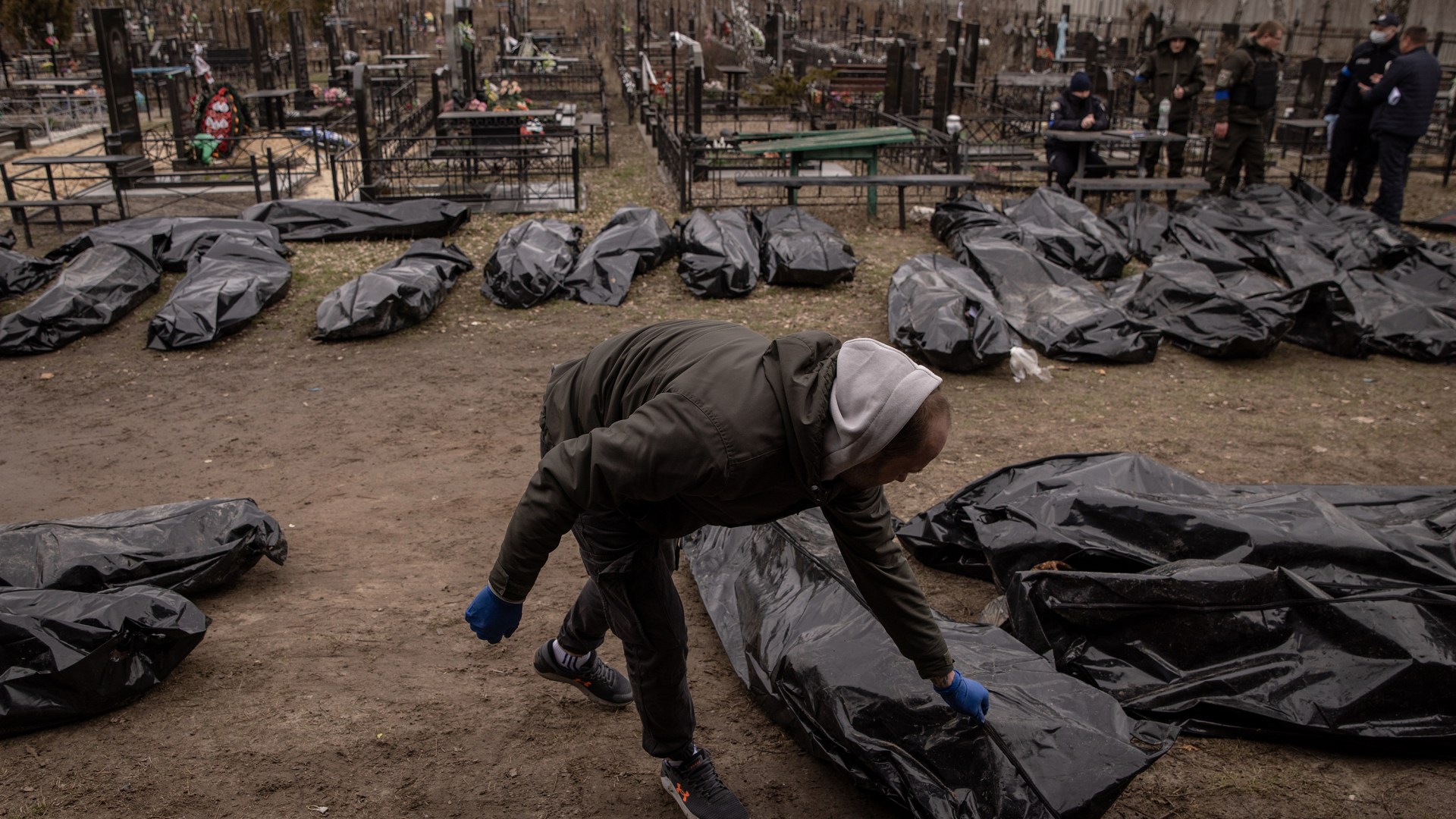
Policemen and forensic personnel catalogue 58 bodies of civilians killed in and around Bucha, Ukraine.

Policemen and forensic personnel catalogue 58 bodies of civilians killed in and around Bucha, Ukraine.

Christianity Today April 7, 2022
Chris McGrath / Getty

This piece was adapted from Russell Moore’s newsletter. Subscribe here.

The Western world said “Never again” after the gas chambers of the Third Reich—and yet here we are.

Russian troops deployed by war criminal Vladimir Putin are committing atrocities across Ukraine, murdering innocent civilians in cold blood as they move from invasion to occupation to attempted genocide. One of the reasons it’s difficult to see the images of these slaughtered innocents is because most people wonder, “What can we do to stop it?”

While the Ukrainians have shown grit and valor beyond what anyone could have predicted, by all accounts there is still a long slog ahead. The war crimes will continue.

Perhaps, somehow, this invasion will be stopped quickly and the Russian war criminals will be brought to justice in a Nuremberg-style trial, as Ukrainian president Volodymyr Zelenskyy has called for.

But if not, these murders and crimes may not be called to an account for a long time—maybe even a lifetime. In fact, that’s what the war criminals are counting on.

The world should watch what these criminals are doing—to call it what it is and hold them to account whenever the time comes. But Christians in particular should watch and recognize something we often want to ignore: how the human heart can justify great evil.

Human beings are capable of horrific depravity. This we know. Humans, however, are not like wild animals or constructed machines. We have consciences that alert us to what sort of people we are becoming. To carry out criminality of this degree, a Russian soldier must somehow learn to silence that conscience—or at least muffle it.

While few, if any, of those reading this are guilty of war crimes, every one of us has grappled with our conscience—and in many cases, we have followed the same path, even when the sins are not as heinous and the stakes not as high.

So how does this happen?

One of the first steps is to emphasize power over morality. An easy way to do this is to characterize the situation as an emergency, requiring a dispensing of the ordinary norms of behavior. Every criminal regime has done this—usually by identifying scapegoats, blaming them for the people’s ills, and framing the situation as an existential threat.

Acting within the bounds of conscience is painted as a luxury, for times that are not as dire as these. This can happen even with situations that appear morally unproblematic. We may rationalize that the mission is too important for us to hold the leader accountable for his or her treatment of people.

In church, such reasoning might say, “How could we waste time on these niceties when people are going to hell without the gospel?” In politics, it might take the form of “These theories about character in office or constitutional norms are nice and all. But get in the real world; we’re about to lose our country.” In wartime, it can be framed as “We can hear about your ethical qualms with torture later; if we don’t act now, terrorists will destroy us.” And so on.

Those carrying out injustices of any kind must lie to evade accountability. But the most dangerous form of lying is not the propaganda people give to others but the lies they tell themselves—to quiet their consciences.

Again, this can happen in matters that fall far short of war crimes. People can wall off certain categories of sin and refuse to view them as such—placing the blame for the sin not on themselves but on those who would label it sin.

For instance, one can define sin merely in social terms: “As long as I don’t seem to be hurting anyone else in any kind of public way, then why is it anyone’s business what I do in my private life?” Or one can do the opposite and define sin as merely personal, acting as though questions of social injustice are of no moral consequence.

This is how some American preachers at the Baptist World Alliance meeting in Berlin just prior to World War II were able to excuse Nazi Germany’s authoritarianism and demonization of Jews. Those were just “social” issues, they reasoned.

On the moral questions these preachers really cared about—the “personal” ones—some of them said the Reich could teach decadent America a thing or two: Adolf Hitler didn’t drink or smoke. Women were dressed modestly, not like back home.

To read the accounts in light of what was to come is chilling. And yet we hear of the same sort of machinations all the time—at times even within our own hearts.

Sometimes an evil is too great to ignore altogether. The conscience must reckon with it, but it does so by projecting that evil onto some other person or group. Rather than grappling with the indictment of one’s own sense of right and wrong, one can short-circuit the blame by locating it elsewhere.

This is how, for instance, Russian war criminals—while carrying out the very same tactics as Nazi storm troopers—can claim that they are fighting to “de-Nazify” Ukraine.

Again, this doesn’t have to happen on the huge moral scale of geopolitical atrocity. You can see this in your own work breakroom or church foyer. For example, you would be surprised at how many of the most strident culture warriors—identifying “compromise” in fellow Christians in the fight against “sexual anarchy”—are addicted to porn.

Our consciences work by pointing our psyches to ultimate accountability. The apostle Paul wrote that the conscience bears witness to the day “when God judges people’s secrets through Christ Jesus” (Rom. 2:16). One cannot bear the weight of that. Either we convince ourselves that such a reckoning will never come, or we find some authority—maybe even a spiritual one—to reassure us that we will never be found out.

The “Butcher of Bucha,” a Russian commanding officer of a unit that massacred civilians in Ukraine was reportedly blessed by a Russian Orthodox priest—just before the grisly mission in which his troops left the bodies of innocent civilians lying in mass graves or in the streets.

The “butcher” allegedly spoke of his mission as a kind of spiritual warfare in which he was fighting on the side of God. And, of course, this is just one example of how the Russian Orthodox Church is not just complicit but celebratory of the crimes of Putin’s regime.

Again, this is also not unusual. Every evil king in the Bible searched out prophets who would tell him that his actions were sanctioned by God. And even in the smallest of transgressions, the first thing we often want to do when carrying out evil is to find some moral authority that will tell us what we are doing is right.

Perhaps the most dangerous step of all, however, is when the conscience gives up altogether and begins to say that this is just the way the world is. It shifts to saying depravity is realistic, while morality is not. We can see this in the smirk behind Putin’s words and in the throat-clearing whataboutism of his Western defenders. This is all rooted in the idea that accountability will never arrive.

And yet it will.

We were born into this century, this moment in history, and we have a responsibility to do everything that we can to stand against the murder and genocide of innocent people. We have a responsibility to call evil what it is.

We also have a responsibility to take warning—to recognize the ways in which we excuse or reassure ourselves in the same way, while not to the same degree, as the most vicious war criminal.

Because for us, as for them, Judgment Day is coming.

Russell Moore leads the Public Theology Project at Christianity Today.

Follow CT’s Russia-Ukraine war coverage on Telegram: @ctmagazine (also available in Chinese and Russian).

Select articles are offered in Russian and Ukrainian.

Church Life

Our Names Become Bridges

How a heritage of naming revealed cultural identity and gospel hope.

Cover Photograph by Eibner Saliba

On April 14, 1521, the Portuguese explorer Ferdinand Magellan and his Spanish companions presided over the first Christian baptism in the Philippines. As Father Pedro de Valderrama performed the rite, 800 tribal inhabitants went down into the churning waters and arose as new Christian converts.

The local chieftain, Rajah Humabon, and his wife, Hara Humamay, were the first to receive new “Christian names.” After the ocean’s womb enveloped them, they were reborn as Carlos and Juana, bearers of Christ’s presence on the island. Their former identities were replaced. The names given by their tribe were rendered obsolete. They became the first of many in the Philippines whose conversion to Christianity would include the act of renaming. 

“But aren’t the names Carlos and Juana just Spanish names?” I asked my father as we discussed this historical event. He chuckled as we drove past enormous cathedrals under the scorching summer heat of Cagayan de Oro City in the Philippines. Parishioners bustled into the church sanctuaries, thirsting for communion with God.

My father replied, “That is very perceptive. They are Spanish names.”

I closed my eyes in confusion. “Then why are they called ‘Christian names’? What makes them Christian if they’re just Spanish?”

My father’s chuckle crumbled into a sigh. “Because they forgot where they were. ‘Spanish’ became synonymous with ‘Christian’ wherever they went. That’s how we got our last name.”

My family inherited our surname, Melo, from our ancestors. It means “one who hailed from Merlo, Portugal.” Ironically, I was neither from Merlo nor did I see myself as Portuguese. I grew up in the small city of Cagayan de Oro on the island of Mindanao where I was called Kagay-anon by my tribe and people group.

I knew where I grew up, and I knew the identity marker my land and culture gave me. But what did not make sense to me was my surname. It pointed to an ancestral origin thousands of miles away from the home I knew in the Philippines. My name claimed me as Portuguese, but my heart longed for my cultural heritage as a Kagay-anon and my sense of place in the city I loved.

I stared out the window of our car, watching Cagayan de Oro blur into the distance, as the music of church bells dissolved into the clang of steel and metal. Lamenting the Philippines’ history and the story of my people, I broke down in tears. The burden of my name weighed heavily upon my heart.

In 2016, my family migrated from Cagayan de Oro to Chicago, Illinois. Our surname traveled with us. Many Americans struggled to pronounce it correctly, asking, “Is it meh-low or mee-luh?” I remember visiting my first Starbucks in the United States where—in classic Starbucks fashion—they misspelled my last name: “Mellow.” It was as if my name had become an alien language. 

I thought I’d find relief among fellow Christians, but instead I encountered ridicule. In youth groups and summer camps, others jokingly rhymed my last name with the word melon. Eventually, the mockery became so unbearable that I removed my last name from my social media accounts. 

I soon decided to go by an entirely different name—one that might be more accessible to my American peers. So I began calling myself Ryan in an effort to be known, accepted, and loved by the people around me—in an effort to belong.

But in the process of renaming myself, I forgot where I came from. In my deep desire to be loved by the communities I sought to be a part of, I forgot who I was. I no longer even wanted to be called Filipino. 

It seemed to me that being Christian in the United States was synonymous with being American—and that Christian unity meant sameness. So I “rebaptized” myself with a new name to fit in. At the time, it felt like a necessary sacrifice that had to be made—a performance that seemed like the right thing to do.

Despite these efforts and all the pain they represent, over time I came to recognize a different divine reality. God became human and bore the name Jesus. He walked on the borders of society, the margins that separated people—rich and poor, sinner and saint, Jew and Gentile, women and men. Suddenly, those lines of separation were blurred as people found themselves eating and laughing around the same table with Jesus at the center. And amid the cultural tensions, in the liminal spaces that divided worlds, Jesus spoke a new way of life into existence. A new community formed around his voice.

As Jesus walked along the edge of the Jordan River and was himself baptized into the deep, he arose and began his ministry that continues today through God’s mission in the church. The proclamation of the gospel continues to stretch into the farthest reaches of the world. This great commission of Jesus says, “Go and make and disciples of all nations, baptizing them” (Matt. 28:19). 

Tragically, my personal experience and family history represents a “cultural baptism” that involved renaming and the erasure of local identity. This is an experience I share with many sisters and brothers of color around the world due to the effects of colonialism. Throughout history, there were times when Christian unity was confused and conflated with the efforts of European nations to expand their empires. Because of this, many people in the world have forgotten their own names—the names that come from their tongue and their tribe.

But what Christ did—and continues to do—is bridge the gaps. His name does not erase our names but instead gives them new meaning. The renaming of Abram to Abraham, for example, pointed toward God’s desire to see all peoples and nations reconciled, saying, “You will be the father of many nations” (Gen. 17:4). And in Christ, this covenant is being fulfilled. 

In Acts 2, we read about the Holy Spirit’s indwelling, which unifies diverse peoples around the name of Jesus. The Pentecost miracle manifested in the speaking of tongues, where Christ bridged the differences between languages. They spoke in their native tongues yet were able to understand one another through the work of the Spirit. Afterward, they migrated to the very edges of the world to proclaim the gospel and embody the promise once given to Abraham: “All nations on earth will be blessed” (Gen. 22:18).

Just like the early church, we’re called to reconcile the nations through the gospel. As Jehu Hanciles writes, “The mission of God starts on the margins.” Indeed, the gospel finds itself in the spaces where worlds collide. And in Christ, our names have become bridges. 

Eryka Rose Raton

Sometimes I wonder what my indigenous name would have been. What if the Iberians had never arrived? What if Raja Humabon and Hara Humamay had never been renamed Carlos and Juana? Who knows what might have been? 

But I know there is no way to reverse the consequences of colonialism. My name remains my name, and it can never be erased. Unlike the disconnect and discomfort I once felt with my name, today I believe the irony of my name is precisely where Christ meets me. My name literally represents a bridge between the Filipino and the Portuguese. Though it signifies the consequences of colonialism, God is redeeming it. For my name reminds me that Christ is on a mission to reconcile the nations away from the pangs of division and into his loving embrace.

I still lament how my name has been a constant reminder of my displacement from the Philippines and colonialism’s legacy. But in Christ, my name has also become something to be celebrated. It symbolizes for me Christ’s restorative work that seeks to reconcile nations by creating new communities where the powerful are humbled and the lowly are exalted. Our names are more than just words. Every name is a story, bringing to life worlds, realities, and ancestors through their utterance. The problem is when we don’t see those stories—when we push them to the peripheries of our imaginations. The problem is when we sacrifice those stories on the altar of convenience and personal comfort.

But God sees our names. He knows the stories they carry. Our Creator became a person to know us, to hear us, and call us by name, saying, “I am the good shepherd. I know my own, and my own know me” (John 10:14, CSB). One day, he will once again descend from the heavens and will return to us the true meaning of our names—to reorient our lands, stories, and cultures around the healing and holy presence of the Messiah. We will be welcomed into God’s kingdom where all peoples and nations belong.

May we prepare ourselves for the coming of our king who bridges the gaps of racial and ethnic divisions. For Christ is calling us to meet each other in the in-between—in the thin spaces where the gospel brings us together, as different as we are, to share meals and commune with Jesus. 

As Christ reminded his early first-century followers in Revelation 2 and 3, he also reminds us today: “Let anyone who has ears to hear listen to what the Spirit says” (CSB). May we learn to listen once again. Indeed, may we learn to seek the glory of Christ’s hope, coming to heal and restore our names to beauty.

Church Life

The Statistic that Nobody Believes

How a former NFL player became an advocate for the most vulnerable.

Cover Photograph by Ali Karimibo

This story contains content that some may find disturbing

I remember the conversation like it was yesterday. Over the dinner table, my wife, Libby, explained to me what seemed incomprehensible: There were more than 40 million people living in slavery around the world, and each year millions of young girls were sold in the sex slave trade. My immediate response to the magnitude and depravity of this information was that there was no way a man would do something like that to a little girl. It just was not possible. How little I knew then of the dark world of human trafficking.

That day 15 years ago was the first step on a journey that radically changed my perspective. To help me begin to get a grasp on the dark realities of human trafficking, Libby encouraged me to read Half the Sky by Nicholas Kristof and Sheryl WuDunn as well as Good News About Injustice by Gary Haugen. These books cut me to my core and spurred me to learn more through reading, watching documentaries, examining Scripture through the lens of the poor, and studying the promises of God in Isaiah 58.

I’d spent ten years of my professional career playing outside linebacker for the Denver Broncos as a member of the legendary “Orange Crush” defense of the late ’70s and early ’80s. In the world of the NFL, accolades and honor are given for popularity, power, and fame. And in that era, locker room conversations about the experiences of racism, exploitation, and oppression seldom took place. We didn’t really know about the scale of violent oppression of the poor and the many forms that oppression takes. So years later, as I was confronted with these devastating realities, I had to determine what I would do with the power given to me to serve the vulnerable.

As I learned more, I became like a sponge, ready to absorb these stories. One that powerfully impacted me was my wife’s own experience of working in an orphanage in a developing country during a college summer. She recalled that, for the first time in her life, she was confronted with the brutal reality of harsh oppression of the poor. Libby witnessed how unjust systems robbed people of their dignity and life. 

Libby’s worldview completely changed through the life of one particular girl named Hazel. Hazel had been brought to the orphanage after having been abandoned at a train station. The orphanage workers were afraid of her because she had cerebral palsy. They thought her condition was contagious or that she had bad karma that might transmit to them. So they kept Hazel in a cold, damp, concrete room all by herself and made her sit on a small pot so she could go to the bathroom without having to be moved. Hazel couldn’t speak, was cross-eyed, and was bent over like an old woman. Once a day, someone would feed Hazel a single spoonful of rice. Though she was 15 years old, Hazel only weighed about 35 pounds. 

Libby began to visit Hazel covertly to feed her, bathe her, and help her try to walk. One day, while Libby was bathing Hazel, she tried to open Hazel’s clenched fist. When she was finally able to open Hazel’s hand, she found a swarm of maggots. In that moment, Libby broke down and cried out, “God, where are you? How can you let Hazel suffer like this?” 

Then Libby recalled the essence of Jesus’ teaching in Matthew 25: When you feed the hungry, you are feeding me. When you visit the sick, you are visiting me. When you do these things for the least of these, you are doing them for me. As the maggots fell from Hazel’s tiny hand, she looked up at Libby with her crossed eyes and frail body and, for the first time, Libby realized she was helping Jesus. 

Libby’s entire understanding of serving God was transformed that day. “I realized how arrogant I had been serving at the orphanage,” she said. “I had thought, ‘Aren’t these children so blessed to be ministered to by me? I have sacrificed my summer to do something good.’ I was shocked how truly far away I was from understanding the meaning of life in Christ.”

After Libby returned to college, the orphanage director put a lock on Hazel’s door. Some friends found a hole in her window and began sneaking food in for her. They asked the local church to help, but were told that Hazel was not “strategic for evangelism.” 

That fall, Hazel succumbed to starvation. News of Hazel’s death plunged Libby into depression, as she wrestled with difficult questions: Where is God in the suffering of the poorest in the world? Why doesn’t he show up? Why did Hazel die so brutally? 

One day, Libby came across a verse in Scripture that resounded deeply. Proverbs 13:23 says, “The fallow ground of the poor would yield much food, / but it is swept away through injustice” (ESV). Libby came to realize that Hazel lived in a country where there was plenty of food for her to eat—and it wasn’t God who kept it from her. It was people in positions of power—people who didn’t care about her or see her worth. Unfortunately, it was also local believers in Jesus who kept food from her, unwilling to help because they didn’t see her as an image-bearer of God who was worthy of life. 

Libby says that day she understood that “if people have the power to sweep away justice, then that means I have the power to give justice to people—and that’s how God shows up, through people. We are the hands and feet of Jesus, and that’s how he works.” 

Possessing a newfound understanding of justice, Libby join the staff of Cru, where she focused on the injustice of human trafficking and helped forge a partnership with International Justice Mission. For 12 years, the ministries collaborated to mobilize students in the fight against human trafficking—and that collaboration still grows today. Libby has since joined the staff of Love Justice International, to help develop their strategy of transit monitoring: intercepting and rescuing people as they are being trafficked before they reach their endpoint of potential exploitation.

My heart was pierced by the stories Libby told me, and the idea of 40 million modern-day slaves loomed large, permeating my daily pursuit of God. How could we do something meaningful and practical to address this great need? I felt led to respond, but our own resources seemed paltry in comparison to the scope of the need. I despaired over our inability to make a dent in this tragic reality. 

Then I came across Isaiah 58:6 and God changed my mind:

“Is not this the kind of fasting 
    I have chosen: 
to loose the chains of injustice 
     and untie the cords of the yoke, 
to set the oppressed free 
     and break every yoke?”

I realized God was calling me to take action—and I needed to trust him to lead me toward the next step he desired me to take. 

Soon after Isaiah 58 changed my perspective, Libby and I were enjoying a summer stroll through a local art show in Beaver Creek, Colorado. Amid dozens of exhibits, we came across an artist who was painting a portrait of a Rwandan woman. We stopped and introduced ourselves. We learned her name was Judy Dickenson; she and her husband, Jeff, a pastor, used their gifts to serve widows in Rwanda. Jeff provided pastoral care by listening to widows’ life stories, and Judy painted portraits of the women to capture those stories visually. 

A light went on in my head. I asked, “What if we created paintings of people who’d been intercepted and rescued from human trafficking as a way to tell their stories in a dignified way?” 

Without hesitation, Judy replied, “I’ll do your first painting.” In that moment, the vision for the Freedom 58 Project was born.

We shared our idea with Love Justice International and several other Christian organizations. Soon we received photos of people who’d been rescued from human trafficking. We began the process of creating, with consent, a painting of each individual. First Judy painted a beautiful portrait of a young girl who’d been rescued from a brothel. I shared her painting with artists around the country, asking if they would like to participate in this project. The response was immediate and enormous.

We received messages from artists all around the world asking to be a part of the project. Several artists told us they’d long desired for their work to make a global impact. We eventually received portraits of rescued individuals on a daily basis from artists as far away as Canada, Ireland, Mexico, and Thailand. Today we work in partnership with three anti-trafficking organizations and have collected more than 230 paintings. These make up our Faces of Freedom art exhibit—a traveling exhibition that raises awareness of human trafficking.

The artists replace injustice with dignity, beauty, and honor. They bring light to the true stories behind the scourge of slavery and violent oppression. The exhibit invites visitors to follow survivors’ real-life journeys from oppression to rescue, restoration, and ultimately freedom. The paintings—which are not sold—give viewers a chance to enter into a victim’s experience, reflect on personal stories of injustice, and be inspired to take action.

One of the featured paintings conveys the story of Claire. Many years ago, she was given the false impression that she was traveling to China for a reputable job. In reality, her traffickers were using her to smuggle drugs into Iran. Claire didn’t make it past the border, where the drugs her traffickers had hidden in her possession were discovered. Claire was promptly arrested and subsequently spent five years in an Iranian prison where she awaited execution.  

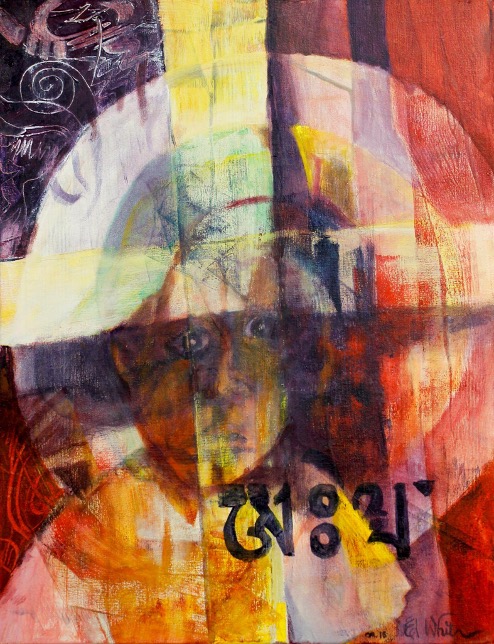
“The Saint” by Johanna Spinx

During her darkest hours, Claire says she trusted in God for her release and “shared the love and truth of Jesus Christ with the other inmates.” Although she was originally sentenced to death by hanging, through a series of strange and miraculous interventions she was released. Her journey eventually led her to Love Justice Uganda, where she works to ensure others are protected from experiencing the horror and injustice that she endured. 

California artist Johanna Spinks created Claire’s portrait in a classic iconographic style. In the image, a halo of gold surrounds Claire’s smiling face, bestowing honor, dignity, and a saintly image to represent Claire’s courage and faith.

In its own unique way, each work of art uplifts those who are closest to God’s heart in their suffering. As visitors proceed through the paintings, confronted by the beauty and tragedy of numerous stories like Claire’s, they are encouraged to consider a series of questions and invited to learn how to join the fight against violent oppression of the poor.

I’ve learned a lot since I first became aware of the shocking and dark reality of modern-day slavery. I’m still learning. If there is one thing God’s taught me on this journey, it’s that God is listening. This is true, even if the silence seems deafening or we are faced with years of waiting. When God decides to act, he does more than we can ask for or imagine.

Theology

Scripture Feeds my French Appetite

How delighting in luxury led one woman to the feast of scripture.

Cover Photograph by Klara Kulikova

Cumin. Cilantro. Cinnamon. Cardamom. Chai. Chile. Colors and smells enthralled my senses as our guests walked in the door, bringing into our French home much more than food to share. We had invited them for a most unusual culinary journey, asking each guest to bring their favorite homemade dish to share over an hours-long sit-down banquet.

The feast arrived sealed within every shape and color of earthenware, cast-iron, glass, and basket; but no container could contain the aromas that boldly wove around us, the first hints of new discoveries yet to be tasted.

The table was set and the fare unveiled: Lebanese tabbouleh, Indian chapati, Greek mezze, Spanish paella, Thai curry, Korean kimchi, Brazilian meat, French duck confit, New-York style cheesecake, and Italian tiramisu. I even baked French croissants for the occasion.

We took our seats around my casual red-and-white checkered tablecloth and white porcelain plates. My husband’s garden-grown flowers added the festive je-ne-sais-quoi, symbolic of the ambiance the next few hours would hold. One by one, each guest presented their offering of love, providing personal stories and favorite memories, inviting us to experience their culture through our five senses. Each tasteful bite was matched only by the extravagant displays and textures, the delightful laughter of easy conversation, and, the indescribable fragrance of this exceptional menu. For a day, our home became a cradle for culinary cultures.

Watching my guests interact with the unusual fare was enlightening. While some kept the bowl of salt-and-pepper potato chips safely nearby, the more daring discovered delightful new experiences for their taste buds. 

Watching my friends dine inspired me to wonder: What flavors have I yet to encounter to enhance my spiritual journey? Do I approach the Bible expecting a burst of deliciously spiced novelty, or do I satisfy myself with the same old bland scriptural potato chips? Do I look to the church universal, across time and space, to enrich my experience of intimacy with my precious Lord, or do I stick to what I already know? 

I am French, which means I am culturally wired to love good food. I am also a former devout atheist, which means my passion for and gratitude to Jesus flavor my every moment. And, because I have lived on three continents in four countries through six professional roles, I have learned to decipher traditions and language to taste the cultural beauty surrounding me. 

Now, as a native French woman living in the United States, I am still living and ministering cross-culturally. This unique global experience has taught me to encounter Scripture through the same lens of language, food, culture, and spice; I have learned to camp at the intersection of culture and Scripture. God challenged me almost 30 years ago, when I was a very convinced atheist, to dare to “taste and see that he is good.” Since then, I have tasted how God is like dark chocolate: both addictive and good for you.

My illuminating experience with Scripture revealed to me that our marvelous Lord is culturally savvy: He took that food-related verse (“taste and see,” Psalm 34:8) to challenge me in a way my heart could understand.

I love the French word for delight: it is the word, délice. In French, we have only that one word for the two English words delight and delicious. The poetic beauty cannot escape you: in French, God is both delightful and delicious. Spiritually speaking, when we aim to make God’s glory our delight, we also aim to savor his goodness. That is why my personal motto is, “God’s glory, our delight.”

We French are famous for our passion for all things hedonistic, and I’ll be the first to admit it: outside of Christ, we have taken things down the wrong path. But allow me to redeem a little something that is precious to my French heart—our definition of luxury. In America, luxury might be defined by the abundance and quality of possessions; in France we like to think of luxury as “a feast of the five senses.” When your five senses are involved in an experience, that moment is luxurious. Think of your first bite of a warm, crisp, buttery croissant: your senses of smell, sight, touch, taste, and even hearing are all involved. That is luxury.

Spiritual luxury is being so immersed in our relationship with God that all five senses are involved. We delight in God with our whole heart, mind, soul, strength, and spirit. We long for him more than the deer pants for water or the child for a mother’s embrace. God told Jeremiah and Ezekiel that his Word is like honey. I would like to suggest it is like a French croissant, too.

The croissant is part of our daily routine in France, and I dare say that no culinary luxury is complete without one. It necessarily accompanies my morning coffee—black, no sugar—while I meet with God before the sun arrives. To me, daily spiritual luxury tastes like French roast.

From my morning coffee onward, I purposefully plan my day to steer clear of insipid sameness and instead, integrate creative change. I apply the same diversity to my spiritual routine, drawing from the spice pantry of the traditional spiritual disciplines to counter the dreaded staleness. Our spiritual spice rack offers such variety that I never should experience tastelessness as I seek to ground my faith: Scripture memorization, prayer, Bible study, journaling, acts of service, fasting, worship, singing, and reading inspiring authors, from the past and from the present both. 

Just like the manifold items at our potluck meal, these spice jars provide different textures and flavors that will enthrall and challenge my mind and heart, inviting me into spiritual luxury and beckoning my five spiritual senses. They teach me to love the Lord my God will all my heart, mind, soul, strength, and spirit.

There is a final element of spiritual luxury that draws me deeper into the throne room in awe and worship every day: in Christ, success is guaranteed. In other words, when I decide to make God’s glory my delight every day, I align myself with God’s will for me, and am therefore poised for a satisfying, fulfilling, delightfully successful life. Just like my potluck guests were bound to succeed in their cooking efforts because they were showcasing their identity, delighting in God is the way to and result of a well-grounded identity in him. That is the spice of life, and the ultimate spiritual luxury.

I cannot adequately convey to you the matchlessness of a fresh French croissant without handing you one to taste. Similarly, we cannot understand what it means to be in awe of God by simply being told, we must experience him. 

As God’s child, I am created to delight in his glory every day—that is the ultimate spiritual luxury and definition of success. It will look different for each one of us, because God is too creative to do things twice the same way. As my teenage daughter likes to remind me, originals are worth more than copies. 

And in that sense, our multicultural potluck dinner provided a taste of eternal spiritual luxury; each contribution was truly one-of-a-kind and together all pointed to a reality greater than each part—greater than the individual spices and flavors could ever have achieved. As we connected around tastes, smells, textures, sights, and laughter, we enjoyed the fellowship that every tongue, tribe and nation will soon experience forever. To delight in God’s glory is the deepest longing of the human heart and the most satisfying banquet we can ever join. So grab a chair and join the feast. You are awaited.

Theology

Faith in the Face of Bullet Fire

What happens when steadfast faith collides with wartime trauma?

Cover Photograph by Jeremy Cowart

This story contains content that some may find disturbing

Deep breaths, Beth.” I repeated the words as I stood above the hospital bed. “Deep breaths.” 

I had met Joseph Ndekezi 12 years earlier when my life had already profoundly changed. Experiences of trauma in my own life, as well as my PhD in Psychology, had led me to participate in trauma healing initiatives in a war zone. Children in the Democratic Republic of the Congo, some as young as six years old, were being ripped away from their families and conscripted into local armies. They suffered horrible abuse, including beatings and rape, and the extraordinary psychological trauma of being forced to kill. As I returned to the United States, I began to imagine what it might look like if these children, who had seen the worst of war, might find peace in themselves and bring peace to their people. 

I had been praying for an African teammate who might share the same vision of redemption for Congo’s war-affected youth when I met Joseph. He was already providing care to rescued child soldiers, many who no longer had homes or could never return to them. He took the children people had cast aside as too broken, too wounded, and demonstrated the love of God. Since he saw them as image bearers of Jesus, they began to view themselves in the same way. 

We dreamt together of what might be. What if children shown the horrors of war might grow up to bring those horrors to an end? What if they might not only heal from their trauma, but transform their pain into purpose, to teach peace and forgiveness?

So, we began building Exile International in Congo. We started with 25 survivors of war, using the creative arts to help them process their experiences. There are now over 2,000 youth in our programs, which include trauma healing, peacebuilding, and leadership development. 

But none of that would have been possible without the wisdom, vision, and love of Papa Joseph, our steadfast one. Papa Joseph, whose body lay in ruins before me. 

Standing over his hospital bed felt like an out-of-body experience, except my stomach twisted and churned. I felt that part of my body perfectly well. 

We were in the intensive care unit at King Faisal Hospital. Every conversation repeated the distressing words, “rebel ambush,” “bullet,” or “paralysis.” Our African team was exhausted, traumatized, and yet somehow full of faith. I felt like a faithless child in their presence, learning from spiritual giants. 

The ambush had taken place a few days before. Joseph, two counselors, and a driver were returning home after providing art-focused trauma care and holistic rehabilitative care to rescued child soldiers and children orphaned by war. The purpose of this visit was to welcome new war-affected children into our sponsorship program. When the program concluded and the group made their way home, the long dirt roads led to a violent roadblock reception.

It happened in the thick of the jungle, between Karumba village and the Congo base. Three rebel militia stepped out of the trees and onto the path of the vehicle. They lifted their AK-47s, and suddenly the air was filled with chaos. Amid the gunfire, the smoke, and the shouting, Joseph was struck five times. The bullets damaged his lung, broke his bones, and paralyzed him from the waist down. 

The militia robbed our team and stole away. It was clear Joseph’s life was in danger and he needed immediate care. As the team members rushed to get him medical attention, the damaged vehicle sputtered and died. They frantically arranged another car, and dealt with another interruption when a tire burst. Finally the team arrived at the nearest hospital, three-and-a-half hours after Joseph had been shot. The following day he had been transferred to the best hospital we could find for spinal cord injuries, in Rwanda, as I flew on a whirlwind of emotions, logistics, and prayer across the Atlantic. 

“My sister… you came.” 

Joseph struggled to speak as I entered the hospital room. He attempted to turn his head toward me but the broken bones in his neck would not allow it. “You came so far so quickly,” he whispered. “I could not have imagined you would come. How are you? You must be tired.” 

So much frailty. So many wires and machines. So much noise. We were in one large room where the patients were arranged about six feet apart around a nurse’s station in the middle. Many of the patients moaned in the midst of their pain and confusion. Some stared at the ceiling, unresponsive. 

Two of the bullets had gone right by his head and struck the back of the vehicle. Joseph had come so close to death. 

Of course, he had known death might come for him. He had known this was a possibility when he followed God’s call to minister to children of war in remote parts of the Congo. This was a war of flesh and blood, armed forces and spiritual forces, and Joseph was like a wounded soldier returning from battle. He told me that would gladly die for the cause. He had always spoken hope and life with every word and deed, and he did so even now. 

Of course, I too had known. I thought I had been prepared for an excruciating call from our team alerting me that one of the youth in a remote and rebel-saturated village had been shot or kidnapped. Perhaps I had even been prepared to hear that we had lost one of our staff members living in the heart of the red zone. But I had not been prepared for this, for the sight of a weak and frail Joseph whispering in pain in a hospital bed. Not for the Papa of so many children, the children who had been with us from the start. How could this be happening to Joseph? In the center of my gut, I knew the answer: the enemy was going for the jugular to force us to give up. But we weren’t giving up. We were digging in.

The following weeks were a blur of research and discussion and organization. In the midst of the heartache and medical uncertainty, the faith of the Exile International staff was like nothing I had ever witnessed. It kept me afloat. Their prayers were infused with hope. Their gratitude was pure. Their hearts reflected Jesus.

I met with the doctors with Christine, Joseph’s wife. They updated us on the extent of Joseph’s severe injuries. They told us he only had a four percent chance of walking again. The numbers felt like a punch in the stomach. 

I dreaded breaking the bad news to the team. They were waiting for me in the hallway. I began to share the prognosis, but before I could explain further, I was interrupted with one word from our program coordinator, Etienne.

“Hapana.” 

The Swahili word word means no. Etienne was saying, “No. Negative. We will not accept this.” 

“This,” she said, “is where God comes in.”

It was one of many moments when our African staff taught me how to be a faith-filled follower of Jesus. I had been raised a preacher’s kid with a passion for life and a deep love for Jesus that was considered odd even in my own community. But my hometown culture could never have taught me the kind of radical faith I have seen in my African brothers and sisters. 

While we overflow with riches and comfort in North America, we live in grave spiritual poverty. Our friends in developing countries often lack what we consider necessities, but they abound in spiritual wealth. They dance in the face of war. They trust when it seems naïve. Their cup runs over with surrendered faith and irrepressible joy.

As Joseph lay in the hospital bed, he shared out of the treasure of his spirit. 

“Can you imagine?” he said. “I might not have lived. But because of the grace of God, I am alive. He did good things for me. What he has done is enough. Even if I never walk again, what he has done is enough. Even if my legs do not work, I will be there to work for God, lead the children, and encourage the youth in Jesus’ name. I have been blessed to work with children in war for 15 years, and I believe God will add 15 more.”

I was undone. For days afterward, as I stared out of the window, I wrestled with the simple power of Joseph’s declaration, “What he did is enough.”

It was a moment of worlds colliding. In the world in which I was raised, was there ever such a thing as “enough?” I felt it in myself, this restlessness, this constant striving for more in my relationships, my work, my body, and my need for approval. 

So I sat with the question, “What if my life became enough?” 

Joseph taught me and my husband so many of the deep things of life. His story didn’t end in that hospital bed. A new chapter was just beginning. 

Joseph went on to receive a year’s worth of rehabilitation in South Africa. From his hospital bed, he was an irresistible force, discipling nurses, doctors, and his fellow patients, and declaring to everyone who listened how God had saved his life. 

He received permission to start a “hospital church” on Sunday mornings, and preached the first sermon reclined in his hospital bed. Papa Joseph became Pastor Joseph. After some of the patients mentored by him were discharged, they began planting churches of their own. 

As if that weren’t enough, we began to see a miracle. In a testament to Joseph’s never-ceasing faith, after months of rehabilitation he began slowly moving his feet. Next, he moved his legs. Then he walked with the support of parallel bars, which led to walking with the help of crutches.

Over a year after his body had been shattered by bullets and the cruelty of war, Joseph began taking a few steps on his own, holding onto nothing but faith. He has also returned to the work he loves, helping survivors of war become servants of peace. Perhaps God will give him another fifteen years.

Children so broken they cannot be redeemed? A man so wounded he cannot be healed?

Hapana. This is where God comes in.

Church Life

What the Darkness Doesn’t Obscure

How life as a traveling astronomer’s daughter revealed universal truths.

Cover Photograph by Daniel Olah

Into the moonless night of the desert outside the Chilean town of San Pedro de Atacama, our party of eight excitedly clambered out of the car. In the daytime, Valle de la Luna (Valley of the Moon) exhibits barren, unearthly scenery and rock formations in a kaleidoscope of pastel colors. But at night, as the car engine clicked off, we were submerged in vast darkness.

The familiar sense of adrenaline filled my 10-year-old body. Looking straight ahead, I could wave my hand in front of my face without a flicker of detection. Closing my eyes or opening them, there was no difference—but keeping them closed made the darkness feel smaller and safer.

In 2004 we were on the cusp of our move from Chile to South Africa. Not only a new home, but a new continent. The fourth one within my first ten years of life. Maybe my insistence on keeping my eyes closed reflected my refusal to accept the fact that we really were leaving. Self-imposed darkness seemed easier to handle than the darkness of the unknown. 

I heard whispers around me—my sister, three years younger, had not gotten out of the car yet. “Where is the flashlight, Daddy? I can’t see anything.” Although slightly panicked, she whispered out of shared reverence for the night. It seemed natural to respect the dark, as if noise would disturb the vastness of it.  

Some keep quiet because we are trained to assume sleepiness in the dark; or the implicit correlation of secrecy with nighttime activities. When we work in the dark, people assume we have something to hide. But many useful things happen in the dark. Newspapers are printed and delivered, streets are cleaned. My father studied the stars.

“Just give your eyes a chance to adjust,” he replied, like I knew he would. Ever since I can remember, turning on a flashlight in nature at night bordered on sacrilege in our family. My mild-tempered, soft-spoken dad, an astronomer, never admonished us directly, but instead guided gently with information.

“It takes hours for your night vision to become fully activated, as the rod cells in your eyes are very shy and will only activate properly once they’re totally sure it is dark. Every time an unnatural light source hits your eyes, your eyes assume it is day and go back to daytime vision. The night vision process must begin again. And that’s just a waste of time, isn’t it? Time where you could be enjoying the view.”

A comforting hand squeezed my shoulder. Did he know my eyes were still closed? “There’s no view,” I sighed, “we are surrounded by darkness.”

But that is not how my father saw it. What he saw was light that had traveled thousands of lifespans to reach us exactly where we were. When he explained this to me, I knew there was no point walking around with my eyes closed, wrapped up in my own unfruitful darkness. So, I held my breath and opened my eyes wide, welcoming in the light. Because that is what eventually all natural darkness reveals—the faintest of light. 

Looking up from the Chilean desert, slowly we watched the other world start to open. My pupils dilated to receive the night sky. Stray dots connected into a constellation, a sword hanging from Orion’s belt. What was a blanket of black suddenly revealed the streak of the Milky Way as it folded within the light of other smaller and further galaxies. 

Christian jargon and everyday speech have taught us to walk in the light and stay away from darkness. We are called to “bring light to the dark places,” to “drive out the darkness of evil with the light of truth.” But it is also true that there is no greater joy than that which comes after suffering, there is no starker truth than that which stands out from the confusion of lies. The beauty of life often comes from contrast. 

When everything around us is too bright, it becomes difficult to see the small lights. A city on a hill is not easy to hide, but how often does a single window in a skyscraper catch our eye? I found out that darkness was a gift because it discloses the light.

In my childhood there were many nights like these. At times we would be looking for a specific cosmic event. At other times we would hunt for satellites. The one who spotted first received the honor of wielding the laser beam, which seemed strong enough to reach all the way to the skies. 

I thought satellites were more fun to spot than shooting stars. They lasted longer, and I could share the joy of my find with others and track one across the whole sky instead of that flash of a shooting star that disappeared before I could put it into words. 

We would lie on the beach in Cape Town, or on a hilltop in Santiago, and my dad would describe, in the vein of Antoine de Saint-Exupéry´s The Little Prince, how we were at the cusp of the planet, on the very edge of a giant mass hurtling through space at 220 km per second. We would lie there in awe, staring out into the expanse of universe spreading out in front of us. We imagined we could feel the speed in our fingertips, entranced with how stable the constant motion seemed.

Those nights impressed on me how small I am in the face of the universe. How far I am from its center. How near I am to its Creator. 

How great our Creator must be to hold it all in his hands. As a child, I believed him to stand upon on a cloud somewhere. Then I imagined a physically massive presence holding the universe in his hands. Eventually I just accepted that he is, in all and through all. 

Those distances between galaxies that are impossible for humans to traverse, he holds together; those black holes that stretch existence into oblivion, he oversees. Through years of research and study, my earthly father understood many of the things that occur in space, but my Creator Father knows the beginning, middle, and end of all things because he is, has been, and always will be.

Vincius Henrique

Perhaps my father sensed my apprehension that night in the Chilean desert. Taking the laser beam, he directed it at the Southern Cross, the constellation of stars that directs us to true south. “You can never be totally lost if you just look up to what the darkness does not obscure.” 

This realization helped me in the next move that followed. Even though Cape Town was a new and foreign city, when we sat on the shore of the Atlantic Ocean watching the sky grow dark, those familiar lights started to reappear. The planets, Jupiter and Venus, reflected the sun. Sirius, the brightest star, hinted at where the Southern Cross would soon appear. I couldn‘t be lost when so much had stayed the same. Not all the light could be blocked out by the darkness of uncertainty.

My father’s passion for the universe intertwined with our everyday lives. We traveled to see eclipses and vacationed with telescopes. We lived at the South African Astronomical Observatory, and waved at the Hubble telescope passing by in space. I lived these things and knew no different. I assumed it was a normal life, and only when I left home did I finally grasp the rarity of my father’s profession, the uniqueness of my own upbringing. 

As an adult, I feel the lasting imprint of my childhood as an astronomer’s daughter. I categorize people in my life as either shooting stars or satellites—those who are a brief, bright presences versus those who patiently plod alongside for longer. 

I now live in Austria, on the opposite hemisphere from where I grew up, but I still orient myself by the stars. And now, when others say that it is too dark to see anything, I look up at the sky and I wait for my eyes to adjust. I do not own a flashlight. 

Instead of the Southern Cross pointing me to true south, the Big Dipper helps me figure out which way is true north, and I sense the Creator more clearly than I ever have. I look up and know that there are constants in life. I look up and know that I am not alone—that behind the universe is a changeless Creator who is higher and greater than all that I see.

Church Life

Our Body Groans for Unity

How a diverse church in Djibouti reveals God’s difficult plans.

Cover Photograph by Samuel Martins

In 2018, my husband and I baptized our 17-year-old son in the Red Sea at a dusty beach off the coast of Djibouti. One hundred meters behind us was the International Airport of Djibouti and the security fences of Camp Lemonnier, the American military base. 

On that humid morning, we gathered together as a church community made up of people from Madagascar, Korea, the United States, Kenya, and the Congo. As the sun rose over the ocean, we shared communion, baptized my son in warm, salty water, and then ate breakfast together. 

I don’t know what stories the Djiboutian airport guards told their families that evening–maybe something about a teenager getting shoved into the water, followed by a lot of singing from a strange, international gathering of people. But I do know the Malagasy couple and the Congolese family in our church have been a part of my son’s life since he was four years old. And I do know the Korean family, new to Djibouti, had tears in their eyes when they thanked me for inviting them. “God is with this church,” they said. 

The story of our community is one of faithfulness and hope. But it’s also one of compromise. My family has lived in Djibouti since 2004, and for most of these years, we have attended l’Eglise Protestante Evangelique de Djibouti, or EPED. Main services are on Sunday evening and predominantly in French. 

Even though French language and culture permeate our church, the transient community includes almost no French members. At potlucks, we feast on Indian, Djiboutian, Ethiopian, and Burundian cuisine and tangle up the Malagasy names of our fellow parishioners, which often include up to 25 letters. 

Our current pastor is from Senegal, the choir director from Madagascar, the administrator from Congo, the drummer from Korea, and the guitarist from Kenya. The parish council includes eight members who hail from five different nations and eight different denominational traditions. We gather in our only common language, native to few. We come out of our weekly work contexts–where our neighbors, teachers, coworkers, and friends are Muslim–and enter the church compound eager to share what unites our small, complicated community: a commitment to Jesus. 

It might be tempting to call our church a little slice of heaven and quote from Revelation 7:9-10: “After this I looked, and there before me was a great multitude that no one could count, from every nation, tribe, people and language, standing before the throne and before the Lamb.” 

Marcus Santos

We are in fact Christians from many tribes, peoples, and languages gathered to worship God, so that picture is true to some extent. But it is also simplistic. Every time we come together, each of us brings with us not only linguistic and cultural differences, but also theological and stylistic preferences. Those clashing perspectives can make it challenging for our church to worship together. 

They can also affect me personally. At the end of a demanding week of cross-cultural life, I might feel exhausted by services in which I strain to understand the sermon, where I may not feel moved by the music, and where fellowship requires effort. But only if I attend church expecting wholly to receive.

“It can take practice to find God in the midst of our differences and not just bemoan the more wearing parts of the adjustment,” writes Mark Labberton, President of Fuller Theological Seminary, in Called: The Crisis and Promise of Following Jesus Today. “We may say we want to be part of a vigorously multiethnic congregation and that we want it to be economically mixed, but this can make church more complicated. It means adjusting our expectations.” 
This insight is situated in a chapter about the church in exile, where Labberton addresses Christian community as a counter-cultural group set against the secular world of American consumerism or, in my case, a surrounding Muslim culture. Christians are welcome in Djibouti, but we are an extreme minority, so the imagery of exile hits close to home. The idea of adjusted expectations also resonates deeply with me. 

The compromises we make at our church have enabled us to experience vibrant Christian life. As a congregation, we consciously choose to set aside personal preferences, honor one another above ourselves, and hold fast to primary theological issues while we “agree to disagree” on secondary ones. To a watching world, we offer a radical testimony of humility, love, and the power of God. 

The world around us is watching. On high holidays like Easter and Christmas, French and Djiboutian soldiers armed with rifles guard the gates of the church compound. The pastor keeps a list of members so he can share openly with the government, should they inquire. My husband has been asked by former university coworkers why he goes to church—meaning they’re well aware that he does. When we enter the church building, local children approach us, beg for food or money, and ask us what we do inside and why. 

We are a city on a hill, not a lamp hidden beneath a bowl. Our good deeds—by grace, may they be good!—shine before others. 

“There is a grande richesse,” says Tshimanga Mukendi Pierre, our church’s administrator, music leader, and the longest-term member of the community. “A spirit of openness and not of judgment.” 

That ecumenism starts inside our church and extends beyond our walls. On special occasions, Catholics and Protestants in the area worship together. For a season, our church didn’t have a pastor, and when a member died, a local Catholic priest performed the funeral. The few Christians here partner for social service activities, like caring for street children, or helping out with education programs for low-income families. There’s also a women’s prayer group that includes Catholics, Protestants, Orthodox, and others.

“You would never see this in Congo,” Mukendi Pierre said, who arrived in 2002 and brought his family from Congo in 2008. “But here, we live with others, and we are enriched by our differences as we put aside our prejudices and judgment.”

Social collaboration is one thing. Dealing with difficult theological differences is quite another. But by God’s grace, we’ve been able to do that too.

The pastor before our current one was a German man unfamiliar with more Pentecostal expressions of faith. One afternoon in 2005, an Ethiopian church gathered on EPED property and performed an exorcism on a young woman. While she screamed and writhed in the yard of our church compound, the pastor, who didn’t know what to do, told Mukendi Pierre to call the police. But by the time that pastor left in 2017, he had hosted monthly prayer gatherings to deal with spiritual possession and attack. 

“I came to Djibouti to teach the Word of God,” he said in his final sermon at our church. “But I am leaving Djibouti having been taught the Word of God by Christians here.”

Mukendi Pierre’s wife, Eliane, emphasizes a similar message. “We must set aside fear of something different so that we can learn and change,” she told me. “It takes courage to ask, ‘What is good for or about this other person?’” 

God has done miraculous things in and through EPED. Members have been healed of cancer. One pastor, paralyzed in half his body from a beach accident, was able to walk again after receiving prayer. A young boy at a church picnic was pulled unconscious from the ocean and saved. Broken marriages have been reconciled, victims of serious car accidents healed without medical intervention, and explosive house fires narrowly averted.

We have also seen pain in the form of death, disease, financial devastation, divorce, and disagreements. With so many of our members living away from blood relatives and support networks, we’re learning to be the family of God for each other in times of both celebration and sorrow.

“We are a small community,” Mukendi Pierre said, “but we have a big vision of God. This is what gives me hope.”

It is hard to gather in a foreign language and reach across theological and cultural differences. Sometimes I step outside during a church service, just to take a few deep breaths and get some distance from others. I’m sure they do the same thing in response to me. But I don’t go to this church for personal fulfillment. I attend because from Christ “the whole body, joined and held together by every supporting ligament, grows and builds itself up in love, as each part does its work” (Eph. 4:16).

That truth holds for all of us around the globe. As we practice dying to self, church becomes a place where we encounter God in the imago Dei of someone we might disagree with. We remain together, because corporately, we can cling to a bigger vision of God than one we could hold to alone. Right there in that space, we’re transformed more and more into God’s likeness, and church becomes a sacred gift.

Church Life

What I Learned Under the Red Lights

How caring for women in the sex trade taught a missionary new truths.

Cover Photograph by Gene Brutty

This story contains content that some may find disturbing

On a blazing hot day in June of 2021, I make my way across the bustling cityscape of Taipei to the Pearl Family Garden Woman’s Center, where I have worked for the past 12 years. Cutting through Bangka Park, I see the homeless scattered across long concrete benches around a grassy patch. They’re wearing masks and sitting apart. A fountain nearby plays music on the hour and displays colorful lights at night.

Located in Wanhua, Taipei City’s red-light district, our ministry reaches out to women in prostitution, the elderly, and others on the margins. Our center is situated a stone’s throw from Longshan Temple, one of the oldest in Taiwan. I can normally smell incense wafting from the altars, but the temple is closed due to the recent lockdown.

Before the virus outbreak in May, the neighborhood thronged with people filling its roadside food stalls, secondhand flea market, and shops selling herbs and traditional foods. One would have to be careful not to step on rubbish, dog waste or the fibrous remains of betel nut, a stimulant favored by working-class men. Throughout 2020, life had continued pretty much as usual, numbering 253 consecutive days with no domestic infections.

Now, the streets are empty. The government announced a batch of cases traced to two tea houses in Wanhua. Thousands of women work there as hostesses, offering their company to mostly middle-aged and elderly men drinking tea or alcohol and singing karaoke. Some of the women are involved in prostitution. Since May, all 172 tea houses and lounges here have been closed. Most of the buildings in the area are old. Some are decrepit. Many elderly and poor are crammed into basements or rooms without proper ventilation.

My destination is a nondescript four-story shophouse formerly occupied by an illegal betting operation. This is home to the Pearl Family Garden Women’s Center, which moved here in 2019 after ten years in a smaller apartment.

As I step into the center, my team leader greets me. This is my first time seeing Tera van Twillert after my three-month furlough in Singapore, and my first day back at work after the mandatory quarantine for travelers. An OMF worker from the Netherlands, Tera is one of the most gracious, patient, and faithful people I know. At 5 feet, 8 inches, she towers over most Taiwanese, but her cheerful smile, gentle demeanor, and twinkling blue-gray eyes make them feel welcome.

Called to missions at the age of 16, Tera has always been drawn to people on the margins. She came to Wanhua 28 years ago and took up residence on this very street. For 14 years, she served in a church for homeless people before starting the Pearl Family Garden ministry.

Pauline, our Taiwanese co-worker, likes to tell this story about Tera. “When I went around the neighborhood with her, one lady said, ‘Ah Jen [Tera’s Chinese name] loves us.’ How many people would say the same thing about a pastor walking around his neighborhood?” I’ve also seen homeless people greet Tera with great enthusiasm and come up to hug her (even though most Taiwanese are not accustomed to such signs of affection).

Tera and I set up tables and lay out instant noodles, rice, and canned food, which our low-income neighbors can prepare even without a kitchen. Tera has called some of our regulars—people who would be struggling since tea shops, KTV hostess lounges, and the sex trade on the streets have been shut down—to get supplies.

Shaoli is the first to arrive. Her mask is askew and reveals her missing teeth. Dyed an unnatural blond, her hair gives her a youthful look that belies her actual age of 62. She’s dressed in shorts and a top that barely covers her belly button. Following government regulations, I take down her name and telephone number for contact tracing. “Can you please adjust your mask and keep your distance? Tell me what you want and I’ll put them in this bag for you.”

Shaoli ignores me and grabs the instant noodles. I feel a frisson of fear and frustration.“Can I use the bathroom?” she asks. Public lavatories in the area have been closed for months.

I let Shaoli use the bathroom. Then Tera chats with her and they pray. When Shaoli leaves, I disinfect the toilet. I wonder if it’s wrong that I’m afraid of the people I came to serve. 

A week goes by. I return to the center and find Tera patiently listening to an old friend. Hwee is speaking with great agitation. Her mask hangs loosely to one side. I say (only) half-jokingly, “Hwee, can you leave now? Let other people come in to get stuff.” With a nervous smile I gesture to her to move on.

Tera does not let fear hold her back from her mission. Last summer she was due to take her furlough in the Netherlands but postponed it. I asked her what led to the change. 

“I realized that being present for people is more important than protecting myself,” she explained. “God called me, first into missions, then to ministry with marginalized people, then to women on the margins, and finally, to this particular street. God called us to be here. He put us here for a purpose, for a season, for the bigger community. Only when you’re on the ground, can you see and feel what people are going through.” 

By opening the center once a week, we are not just meeting physical needs, but also emotional, mental, and spiritual ones. Often, women just want to come in, enjoy the air-conditioning on a hot summer’s day, and talk to another human being. In the past, they would spend most of their waking hours outside, hanging around the park or the neighborhood. But the month-long lockdown changed all that. For people living on their own in cramped living quarters, the struggle with loneliness and boredom is especially acute. One of our friends, Madam Lai, sometimes walks 15 minutes from her home just to sit on our street and watch people go by.

It takes time and patience to have a meaningful conversation. I struggle against my own fear. I want people to come, take what they need, and leave. I can see some of the women crave conversation more than they need supplies, but talking to anyone for more than a few minutes makes me anxious.

At home later, I think back on the day. My anxiety makes it hard for me to be close to people. Ironically, since most ministry activities have ceased in the pandemic, being physically present with the women who come in for supplies or conversation is the only “productive” thing I can do. I too often focus on “getting the job done” and forget that the real job, the real calling, is to make God’s love and grace present to the people he brings before me. 

Crises drive us to yearn for the status quo. However, as the Chinese saying goes, “A crisis is an opportunity for change.” Perhaps when the old ways of ministering are set aside, we can press on and discover new ways to minister the love of Christ others. 

The pandemic has forced us all to confront our mortality. The first time Tera returned to the neighborhood during the outbreak, she met Mr. Ho. An elderly man living on his own, he looked forlorn. He had recently suffered two strokes. While Tera prayed for him, she felt the Holy Spirit prompting her to ask Mr. Ho, “Do you want to accept Jesus as your Lord and Savior?” Without hesitating, he replied with a firm “Yes!”

A heavy heart and an open mind, ready to receive God’s word. All we have to do is sow the seed. The result? An unexpected moment of light. A celebration in heaven.

Week after week, Tera put two stools on the sidewalk and met Mr. Ho outside the center to listen to his story and in response, share God’s story. 

Watching their relationship blossom, I was forced to ask: Do I truly love the people that I serve? I’ve never liked the phrase “serving the poor” but I could never articulate why until I read Father Greg Boyle’s book, Tattoos on the Heart: The Power of Boundless Compassion. It taught me the concept of mutuality, where we view others through a perspective of oneness and kinship. There is no mutuality in “serving the poor,” only a barrier that says “us versus them.”

Mutuality and kinship speak instead of a relationship between equals. There can be no sense of superiority or pity. As Father Boyle says, “Finding and seeing, beyond our sense of being separate, our mutuality with the other is hard won. Bridging the gulf of mutual judgment and replacing it with kinship is tricky indeed.”

I once asked Tera to describe her relationship with the women who come to our center. She said, “They are my friends. You show up for your friends in tough times.”

I think of Hwee, of her agitation and stress when she came to our center to pick up supplies. “It is too hot in my room,” she says. She cannot sleep. She has nowhere to go for meals. After Tera prays with her, Hwee calms down. Then Tera buys her some eggs, milk powder, and bananas. Tera tells me afterward, “What do I know about her struggles? It’s no big deal for me to do something for her.”

Father Boyle says, “Serving others is good. It’s a start. But it’s just the hallway that leads to the Grand Ballroom. Kinship — not serving the other, but being one with the other.”

For many cross-cultural workers, unspoken boundaries or professional distance sometimes separates us from the people we serve. To enjoy mutuality and kinship, we must be willing to “waste time” and not constantly monitor the boundaries of our private time and space.

The moments where we enter others’ worlds, and they enter ours, can be precious. Several years ago, I visited Jinjin on Christmas Eve. For a long time after, I recalled the warmth of the red bean soup we shared at the night market, as we remembered the birth of Jesus together.

Carnation, Tera, and I used to attend church in another part of the city. After services, we would have lunch together and I would venture to try new things. I remember Carnation’s excitement the first time we had naan and curry together. Even now, I can still picture her blissful expression as she sipped an aromatic chai latte.

Incarnational ministry is the only way to truly embody the spirit of Jesus in serving others. It requires that we learn the culture, language, and worldview, and live a lifestyle that reflects our identification with our neighbors.

Jesus is the fulfilment of incarnational ministry. The Word of God had to take on flesh so that we could see the Father through his Son (John 14:9). Christ could have stayed in heaven, enjoying the praises of the angels and the fellowship of the Trinity. Instead, he was born into a humble family. His earthly father was not a king but a craftsman. As a baby, he slept in a manger, not in a gilded crib. As an adult, he was an itinerant preacher who did not know where he would sleep from one day to the next. As he explained, “Foxes have dens and birds have nests, but the Son of Man has no place to lay his head” (Luke 9:58).

Jesus ate with sinners and tax collectors. He visited homes and accepted hospitality. He spent time talking to the Samaritan woman at the well. We often focus on “doing” for the sake of ministry. Building relationships and trust, however, requires “being” with others. It requires us to slow down and communicate, “You are important to me.”

Rather than going home right after work, Tera likes to walk around the block to greet people. For more than a year, she spent an afternoon each week visiting neighbors and shops on the street, making friends and giving out tracts. She might not live in this neighborhood now, but she has become part of the community. One place she visits on her walkabouts is the restaurant next door. Before Tera went home on furlough, Ah Leng, the restaurant owner said to her, “We love you very much.” As Jesus’ ambassadors in this neighborhood, we mediate his love to people through our presence, words and deeds. 

After six months of being shut down, the tea shops and KTV hostess lounges have reopened. This time around I am not paralyzed by fear or excessive caution. With a colleague, I venture into the poorly ventilated establishments to visit ladies at work. 

On Sundays, I gather ladies at the center to watch an online service and share a meal. The ladies tell me that the worst part of lockdown was the rejection they faced from their own families. Madam Lai said, “I wanted to go to my family in central Taiwan for Mid-Autumn Festival, but they were scared and told me not to come.” Hence, being able to gather physically as God’s family was very precious for her.

God is changing lives in the midst of this crisis. Some women have left the sex trade, some have found help through social services. Others have stepped into our center for the first time and heard about Jesus.

Tera’s willingness to take risks and put the needs of others before her own, challenges me to consider the reasons behind my fear. Her calm demeanor is a contrast to my anxiety and impatience. I have a choice. I can allow myself to be paralyzed by fear, or I can ask God for the wisdom and courage to take prayerful risks. 

The more time I spend in this ministry, the more I recognize that Jesus shapes me through mutual relationships as much as he shapes the women I serve. He uses the ladies, my co-workers, and others with different attitudes, views, and circumstances to challenge my fears and biases. I gain new insights and my trust in God grows deeper. 

When our Lord heard that his friend Lazarus was ill, he said, “This sickness will not end in death. No, it is for God’s glory so that God’s Son may be glorified through it” (John 11:4). Do we believe that our Lord Jesus may be glorified through this pandemic, even if this sickness may end in physical—but never spiritual—death for his followers?

May our Lord grant us the grace to overcome fear and anxiety. May love and compassion, not self-preservation, motivate all we do. By our faithful response in this pandemic and beyond, we can bring glory to his name.

Church Life

My Playground a Wasteland

How one girl held to her faith in the middle of a spiritual wasteland.

Cover Photograph by Natalya Letunova

This story contains content that some may find disturbing

For most of his childhood, my father lived right beside Beirut’s green demarcation line in a clumsy, battered two-story landmark with coral walls and green shutters. Though much of it has crumbled, and its walls bear the scars of war, still it stands, hidden among the more sturdy buildings on Mar Maroun Street. 

The playground of the nearby school was a stark reminder of the terror that once infected the area. My dad had told me, “When Ain El Remmaneh was besieged, whoever died was placed in a plastic bag and thrown into the playground of Seid School. That playground was filled with the corpses of those who died without a cause.”

A train compartment positioned sideways in the street blocked the passage from East to West Beirut. Sand-filled shipping containers were stacked on top to prevent snipers from shooting the passersby. People could not walk along the street to carry out their errands. Whenever they needed to go to the store, they hurried from building to building through holes in the walls.

“We couldn’t even open the windows,” my father would tell me. “We would lay out our mattresses in the inner corridor of our house whenever the shelling started. A shell had to penetrate two walls before it reached us. Once, a bomb exploded right above our bedroom, and sometimes as I looked outside, I would see bullets coming towards us and leaving their marks on the exterior walls… We had no electricity, no phone lines, and no water. Moldy bread was a regular meal. The worst part was the arbitrary killing and kidnapping.” 

Dystopian snapshots of Beirut flood my mind whenever my parents share stories of war. Like my parents, many Lebanese had to live long after the war with what Samir Khalaf called “the distinctive residues of collective terror and strife.” That series of proxy wars fought on our land ended with no clear resolution. The massacres and colossal damage were futile.

Where do I begin to recount the woes that befell this country in the past century or so? Shall I start with the 1860 Druze-Christian war that killed thousands? Shall I tell of the Lebanese mass starvation during the Great War, as the 400-year-rule of the Ottoman Empire shuddered and collapsed and the 1920 French mandate brewed underground?

Marten Bjork

In 1946, French troops left Lebanon. In retrospect, we know too well that the jubilation over the arrival of our long-awaited autonomy soon turned to mourning. A series of calamitous events mixed with external interference led to the 1975 Civil War—that piece of history that is left out of our school textbooks because it is too controversial. I was not there to witness the atrocities, but their shadows still follow me and will follow generations to come.

I was born in December 1991. The war had recently ended, and Lebanon was off to a fresh start—or so we would have liked to believe. For the next three decades, the country continued to sink deeper into the pit while rivalries festered. Every time the country tried to stand back on its feet, another blow sent Lebanon to its knees, panting for breath, begging for life.

I hadn’t always clung to my country. Growing up, I never felt I belonged here. I longed to escape to foreign lands. At 14, it seemed that my dream was coming true. A high school in Illinois awarded me a scholarship, and if all went well, I would pursue my college degree in America. My paperwork and plane ticket were ready. The school sent the I-20 form, and my host family was expecting me. But two things happened that year. 

The July 2006 Israel-Hezbollah war broke out. I remember July 12 being uncharacteristically cold and gloomy for a summer day. The Israeli army raided Lebanon, and the Beirut International Airport shut down. If that wasn’t enough to deter my travels, I was denied a visa due to my young age. I remember feeling an inexplicable serenity as I stared at the sea from outside the consulate. 
“I am so proud of you,” my mother said after we had arrived home. “You were so confident.” We both burst out laughing. Then, her laughter turned into tears, and my soldierly restraint dissolved. But in the years to follow, I no longer wished to run away. 

I was born to a Maronite Christian family, but it was at a small evangelical school that I met Christ. Whenever I think of that school, I can almost hear the faint screams of delight from children echoing through the winter playground, and the sound of their shoes squeaking on the slippery floor. I can almost hear the singing during morning chapels and the principal telling us about God’s marvelous love. 

In 2006, war was not the only thing that was ushered into my life. Amid the gnawing fear of airstrikes, a newfound peace glowed within me that summer. I had found Jesus. I meant to follow him even when my loved ones–and society at large–opposed me. As a young girl, that wasn’t always an easy task. 

The past two years have smothered many of the dreams I once had for this country. But I would like to believe that God is not yet done with Lebanon. My eyes have seen his followers’ responses to the recent tragedies. I have seen it in my own workplace. The faithfulness and compassion of the people at the Arab Baptist Theological Seminary (ABTS) have left an irreversible mark on me. 

“I grew up during the Lebanese civil war when the Church was mostly silent and in hiding,” ABTS President, Elie Haddad, shared in an article right after the 2020 Beirut explosion. “If you go to Beirut today, you don’t have to look far to see the hands and feet of Jesus.”

These healing hands and feet moved into action the Saturday after the Beirut explosion, when a taxi arrived on campus with the first traumatized family. The family’s clothes were stained with blood and Betadine. They had nothing but their medicine in a small plastic bag. Elie listened to a woman as her hands trembled and her eyes welled with tears. He comforted her, and he assured her that the people at ABTS would do all they could to help.

“My mother often told the story of how she had fled her home at the start of the Lebanese civil war—a baby boy in her arms and a little girl tagging along,” Elie shared in an interview. Although this encounter brought back recollections of war, in his words, “It reminded me that we are here for a Divine cause. As long as God wants to use us, we must be ready to give our lives away.” 

I cannot resort to false optimism and say that Lebanon will rise up from the dust. I cannot lecture about the need for repentance of lethargy, the need to withstand the pain so that life may spring from death. As high and resonant as it might sound, given our current circumstances, I fear that my words may border on the absurd and dismissive. Sometimes, one cannot help but think that, in our hapless state, something waits around the corner to pounce on Lebanon as soon as it becomes weak enough. When the Lebanese people have nowhere else to go, will they most willingly sell their souls to the first fraudulent voice that promises to save them? Or will they finally give their souls to the One who actually can?

What do people hold on to when everything is laid waste?

In 1922, modernist poet T. S. Eliot published his well-known poem, “The Waste Land.” The poem’s five sections portray life in London in the aftermath of World War I. To portray the fragmentation and sterility of the modern world, the poem uses rhetorical discontinuity and the juxtaposition of allusions to numerous works, including the Bible, Shakespeare, St. Augustine, Baudelaire, and Wagnerian opera. The poem also reflects Eliot’s era in its references to gramophones, motorcars, and typists.

“April is the cruelest month,” the poem opens, for spring reminds people of the stirrings of life that might rouse them from their dormancy. Coming back to life is not without its own pain. The poem ends with the triple repetition of the Sanskrit word “Shantih,” which Eliot translates as “the peace which passeth understanding.”

I find myself clinging to this hope, both for myself and for my country.

China’s Public Schools Are Failing Christian Families

Whether it’s atheism in the classroom or high-pressure academic environments, parents struggle to find a space that best serves their children.

Illustration by Mallory Rentsch / Source Images: Carol Yepes / Getty

In his early teens, Huang Jian began to withdraw into himself. (Huang and others throughout this piece have been given pseudonyms for their own safety.) A once-happy child, the Chinese middle-schooler gradually became silent. Jian’s father, Huang Yuzhou, blamed the behavioral shift on school “trauma,” a high-pressure environment that sapped his will to learn and engage. Uncertain how to help, the family made a drastic decision: They would homeschool their son, an educational choice currently illegal in China.

“Many Christians, by faith, have decided to give their children a Christian education,” said Huang, a house church pastor in northern China. “They do this in order to prevent their children from losing their faith, and to give them a better education that is in line with spiritual growth.”

Chinese Christian parents raising their children to follow Christ in a society that opposes their beliefs must confront the question of how to educate and spiritually nurture the next generation without a blueprint. Chinese state school curriculum teaches that God does not exist and compares religious belief to foolish superstition. Many first-generation Chinese Christians struggle in discerning how to pass their faith to their children, especially as they face increasing religious restrictions.

Huang’s son has now graduated. His wife continues to homeschool their youngest child, who is in early elementary school. Huang himself is currently jailed on charges related to his own religious activities. He and his family were inspired to try homeschooling after they learned more about Christian education and hoped it could help their son through his mental health crisis.

“We were watching a child stuck in despair,” Huang said. “It was not until we went down the road of homeschooling that we were able to see a turnaround.”

Lu Jinxiong sent his teenage daughter to study in the United States after she had her own difficulties with an oppressive social environment at school.

“As Christian parents, we have a great burden for the education of our kids,” the Shanghai professional said. “[The government] forces them to go to state school, and homeschooling is illegal. … This is a very big challenge to many of our brothers and sisters.”

Through a series of what they describe as administrative and financial miracles, Lu and his wife were able to send their daughter abroad. While they are grateful for the opportunity, they do not see themselves as a model for other parents agonizing over how to raise their children in the Lord.

“There is really no one true answer on how to face the question of what to do with our children,” Lu said, “because every family is different. Pray that [Chinese] parents will have wisdom on how to face these issues.”

A struggle to educate their kids

Most Chinese families have only one officially sanctioned educational option: state schools. (International and private schools exist, but these are heavily restricted or inaccessible for most families.) Many Christian parents find it painful to place their children in an ardently atheistic system that belittles a life of faith.

The government has long banned evangelism, and religious instruction for minors under the age of 18 is illegal in China. Still, over the past few decades, many officials have looked the other way as Christians found ways to pass on their faith. Some believers have relied on their churches to continue Sunday school lessons. Others, like Huang, fretted that churches were not able to raise up enough pastoral care to assist in spiritual formation for families.

Beginning roughly around the turn of the millennium, more and more Christians across China began to start small church schools to give their children a Christian education. Other families chose to teach their children at home. Both options had become increasingly popular for house church believers, although the space for church schools has constricted in the past few years.

It is difficult to find official figures on homeschooling in China, but estimates placed the number at around 18,000 (a miniscule fraction of China’s 200 million school-age children) in 2013. Still, over the past few decades, homeschooling has grown in popularity as Chinese Christian families in house church circles have learned more about the option.

Opting out of the Chinese system is not easy: Families who educate outside the system through the upper grades are unable to test into universities within China. They must either send their children to college overseas (which is difficult due to both finances and language) or forgo higher education altogether.

These are harsh choices. While many Chinese families aspire to overseas higher education, it is prohibitively expensive. With no remaining domestic options, these decisions shut young people entirely out of higher education. For Chinese Christians, this is sadly nothing new—during the Cultural Revolution, many Christian families lost out on education completely because of their faith.

Last summer, the government announced new regulations governing education in China, further complicating the situation. Much publicity has surrounded the regulations, many of which are aimed at reducing the pressure put on Chinese families to spend extravagant sums on after-school enrichment classes and tutoring as they seek to give their child all the resources they need for future success. Although the expressed aim is reducing pressure on children, these heavy-handed regulations increase the likelihood local officials will deal harshly with out-of-the-box education—such as church schools—within their purview.

These recent regulations plus a general harshening of religious persecution across the country have all but dismantled the education infrastructure believers so painstakingly built across China. Only a few years ago, Christians involved in the education sector estimated the burgeoning movement had as many as 500 schools across China.

Today, believers say the Christian school movement has nearly been suffocated. Small, church-run schools have increasingly been unable to operate since the government turned its attention toward shutting down these schools in the past several years, and among themseles, Christians discuss their fear that homeschooling may be next.

As the public space for church schools continues to diminish, some have been shut down; others have moved completely online—not due to the pandemic, but because of persecution. (Schools across China closed for several months when the pandemic hit in early 2020, but almost all Chinese schoolchildren attended physical, in-person class beginning in fall 2020. Very recently, Chinese schoolchildren have again faced remote school as China again deals with lockdowns due to the advance of the omicron COVID-19 variant.)

Last spring, officials stormed and shut down a Christian school in Anhui Province, arresting four teachers. Two of those teachers remain in jail today; the others were only recently released. Many families from that school have now sent their children back to state schools, and some report their children have been discriminated against and publicly humiliated by their teachers. Parents from the school have also been harassed by the larger community and local officials. In October, police in Jiangsu Province seized a homeschool curriculum salesman and five others associated with him.

Like church schools, homeschooling is also illegal in China. However, homeschoolers have not yet faced the draconian crackdown that church schools have recently endured, although Christian communities are buzzing with concerns that homeschoolers may be the next to undergo systematic pressure.

In the past year, homeschooling parents across the country have been questioned or even detained for their educational endeavors. Last summer, Zhao Weikai, a homeschooling dad in Taiyuan, Shanxi Province, was arrested on charges related to homeschooling his three children. (Because his case has been publicized elsewhere, Zhao is the only name in this piece which is not a pseudonym.) He remains in jail even now. All this is nothing new in China: The change lies in the scope and reach of recent crackdowns, which appear less isolated and more comprehensive across the country, as opposed to a regional focus on a specific group or network.

One day at a time

Those who follow Jesus ought to expect persecution, says Huang, the pastor currently in prison.

“Of course, we, as house churches, are merely a minority in society. We may encounter persecution and are discriminated against and excluded from mainstream society,” he said. “Since God's people are in this fallen world, and since the Lord Jesus Christ is not accepted by fallen sinners, it is impossible for disciples to be exalted above their master.”

Last summer, a prayer update circulated in a group of house church leaders read: “The educational space in Chinese civil society is shrinking dramatically and is about to be reduced to the point of no return. … Christian education is a part of [this trend and] faces even greater difficulties and dilemmas. Lord, we lack wisdom and do not know how to proceed on the road ahead. Please help us!”

Despite the pressure, many Chinese families refuse to be a part of the public education system. Christians are not the only ones with issues with the education system; many non-Christian families also eschew the state school system because of the intense pressure and the lack of emphasis on creativity and original thought.

“The biggest reason I chose to homeschool is freedom,” said a mother of two who lives in Shanghai. Although she is a Christian, she is homeschooling primarily because of frustration with the rigid structure of state schools.

“I do not like the Chinese public education method,” she said. “It is too formulaic and lacks creativity, and it fills up the children’s entire day. There is no time to read, no time to exercise.”

Her husband’s reasons are more faith-based: He prefers homeschooling because it allows them to develop close relationships with and raise their children in a Christian environment.

This mother said she and her husband have not been questioned about their homeschooling, but they have concerns about the future. Still: “Worrying does not help with anything, so we will take it one day at a time. Sufficient to the day is its own trouble.”

Lu, the Shanghai dad whose daughter left China to study overseas, said he does not know how to help young families struggling with these issues in his own community.

His family’s experience is unrealistic for most, even if finances were not an issue; many teens would flounder if they moved overseas alone. And while overseas education may provide for some children, many of these children might choose to permanently immigrate instead of returning to China to build up the Christian community there.

Lu doesn’t doubt the intentions of other Chinese Christian parents who long for their children to know Christ—but he worries that many families seem to be making an idol of their children’s education.

“We do need to warn ourselves,” Lu said. “You may think you are depending on God, but you are really depending on yourself. You may think you are leading your child down a path where he will be influenced by Christ, but it may be a path of self- righteousness. … Bottom line, look to God. Is your child entrusted to you by the Lord?”

E. F. Gregory is the blog editor for China Partnership, which serves, trains, and resources the Chinese house church.

Apple PodcastsDown ArrowDown ArrowDown Arrowarrow_left_altLeft ArrowLeft ArrowRight ArrowRight ArrowRight Arrowarrow_up_altUp ArrowUp ArrowAvailable at Amazoncaret-downCloseCloseEmailEmailExpandExpandExternalExternalFacebookfacebook-squareGiftGiftGooglegoogleGoogle KeephamburgerInstagraminstagram-squareLinkLinklinkedin-squareListenListenListenChristianity TodayCT Creative Studio Logologo_orgMegaphoneMenuMenupausePinterestPlayPlayPocketPodcastRSSRSSSaveSaveSaveSearchSearchsearchSpotifyStitcherTelegramTable of ContentsTable of Contentstwitter-squareWhatsAppXYouTubeYouTube