Reply All

Responses to our January/February issue.

Source Image: Stefan Coders / Pexels / Edits by Rick Szuecs

The Cosmos Is More Crowded Than You Think

A very important and enjoyable article about heavenly beings I don’t ordinarily think about. What’s so strange is that the illustration associates angels with wings, something the Bible never does! If someone wants wings and Biblical examples, they must consider cherubim or seraphim, not angels.

Jeffrey Wurtz Cupertino, CA

John Stott’s Global God

John Stott taught two classes, Sermon on the Mount and Pastoral Epistles, for one quarter in 1972 at Trinity Evangelical Divinity School in Illinois. I was fortunate to take both. Along with John’s compassion, I sensed his unique God-given authority and mission described in the article. John strove to help build the global church and study birds in joyous combined adventure.

James Hilt Sheboygan, WI

If I Had to Bow to an Idol, It Would Be the Sun

I have pondered such thoughts myself for years, wondering what it would have been like to worship some natural object. I too have found that meditating on the sun shows me God’s nature in a unique way. I appreciated Wilson’s point that the sun gives us an image of God’s “mysterious combination of immense distance and felt presence.” I thank him for putting such a clear reminder of himself in the sky where we can see it every day.

Martha Knutson St. Paul, MN

How White Rule Ended in Missions

I don’t disagree with the article’s content. However, the title seems incongruous with the content of the article. My concern is not only the lack of harmony between title and content but that those who notice the prominently displayed title and do not read the article may well come away with the impression that white rule in global missions has fully ended.

Barney Ford Wake Forest, NC

Evangelicals Have Made The Trinity a Means to an End. It’s Time to Change That.

In “Evangelicals Have Made the Trinity a Means to an End,” Matthew Barrett includes me, along with others, as a culprit. After summarizing what I say about the Trinity and the church, he concludes: “To meet the agenda of the church, the Trinity has been redefined.” It is a serious charge to say that someone is deliberately crafting and using God for their own ends. To make the charge stick, Barrett takes the title of my book After Our Likeness (a quote from Genesis!) as his important “argument.” Barrett also claims that I insist that “there must be a direct correspondence between the type of community we see in the church and the Trinity.” In that book and elsewhere I say the exact opposite. In explaining that I intentionally use God as mere means for my own ends, he has used me as mere means to his ends.

Miroslav Volf New Haven, CT Yale University Divinity School Yale Center for Faith and Culture

Thank you, CT, for Barrett’s article engaging in “The Battle for the Trinity,” the title of a book by the late Donald G. Bloesch, theologian and past CT corresponding editor—who also warned of the “drift” away from the historical understanding of the ontological nature of the Trinity, which in Moltmann’s view has led to a “panentheism” where “God and the world are not identical, but interdependent”! I hope Barrett’s critique of these revisionists will challenge us to consider the negative consequences.

Charlene Swanson Isanti, MN

When we bend to societal or cultural views and manipulate the gospel to satisfy society or present culture viewpoints, or the viewpoints of liberation theology, we are limiting the scope of the gospel and ignoring how the gospel may apply to many others, not just those under oppression.

Dennis Wright Dunnville, Ontario

It’s one thing to draw applications from the Bible regarding current issues and policies. It’s something else altogether when we forget that our interpretation of the Bible may not be as accurate as the Bible itself. I cringe when I hear people citing the Bible to justify things which may reflect more of their ideology than Christ.

David Graf (Facebook)

The Poet Who Prepared the Ground for the Sexual Revolution

A one-sided presentation of the unregenerate male’s self-centered wishful thinking, such promiscuous behavior costing him nothing. Though not aimed at moralizing, it’s to be hoped the article didn’t succeed in only presenting a tantalizing lifestyle to the unwary reader.

Richard Strout Sherbrooke, Quebec

Learning to Love Your Limits

I found myself frustrated reading your interview. The focus of Kapic’s responses was entirely on how our individual theology can help us make better individual choices. However, much of modern life is overwhelming because of circumstances beyond our individual control. I would like a theology that helps me cope within systems designed to drive me bonkers at best and into depression at worst while pointing Christians toward how to support just societal changes that help everyone thrive.

Stephanie Pease Boulder, CO

I Entered Prison a ‘Protestant.’ I Left a Christian.

Thank you for sharing this article. The Gideon Bible has shown up a few times in my journey too.

Guillermo Acosta (Facebook)

Correction: In the March issue article “Hard Labor,” the incorrect location was given for New Horizons Ministries. Its headquarters are in Cañon City, Colorado.

Church Life

Visiting Prisoners in Jesus’ Day

Helping detained people was a shocking calling in the first century.

Illustration by Kumé Pather

Whenever I take my shoes off at the security entrance of the Muskegon Correctional Facility, I feel like I am stepping onto holy ground. In the Michigan prison and its classroom, a true gift exchange happens that seems filled with the presence of God.

Christians involved in prison ministries, advocacy organizations, and prison educational programs—such as the Hope-Western Prison Education Program, which I am part of—trace their work back to Jesus’ teaching in Matthew 25.

Today, it’s not the least bit shocking that someone like me, a professor of ethics and theology, would visit prisoners. I won’t lose my friends or my job over it. I won’t be arrested or assaulted. Instead, it is one of the richest classroom experiences I have ever had.

But for Jesus’ listeners, the risks of visiting incarcerated people were enormous. Anyone who brought a prisoner much-needed food, clothing, medical care, comfort, or hope risked being seen as guilty by association, imprisoned, or even killed.

And yet, early Christians did not focus on their own danger but rather saw what they did as a fitting way to follow in the steps of Jesus, who cared for, suffered for, and liberated others.

“Visiting the prisoner” wasn’t mentioned in Old Testament lists of righteous actions.

The extensive way early Christians visited and cared for those in prison was countercultural. There were not any sort of prison ministries in the Jewish or Roman cultures of that time. “Visiting the prisoner” wasn’t mentioned in Old Testament lists of righteous actions.

And yet, visiting prisoners quickly became a practice the early church was known for. They came to see prison ministry as the fitting response to Jesus’ statement about the blessed ones who would inherit “the kingdom prepared for you since the creation of the world. For … I was in prison and you came to visit me” (Matt. 25:34–36).

Jesus’ words tell us that in visiting the prisoner, one is visiting him, Christ.

But there is a big cultural distance between contemporary US prisons and incarceration in New Testament times. Is what we’re doing now really what Jesus meant?

In many ways, it’s strange that the Bible has so many references to prison, since Israel’s covenant with God never specifies imprisonment as a type of punishment.

Still, kings of Israel and Judah over time began to use incarceration practices common in the region, such as when Asa put Hanani in prison (2 Chron. 16:10). Such practices continued into the time of Christ, as shown by Saul and other Jewish religious authorities arresting and imprisoning Jesus’ disciples (Acts 4:3; 8:3; 9:2).

Neither Roman nor Jewish rulers sought to bring about personal change or rehabilitation in prisoners by keeping them in prison. Nor were the places most people were incarcerated specially designed to be prisons. And so, for those of us living in Western Europe and North America, the many practices and places referred to by Greek and Hebrew words translated as “prison” can be lost to our imaginations.

The Greek root word in Matthew 25:36 is phylake, which more broadly means “in custody” or “in the place of guarding.” The Greek word desmoterion, the typical word for a physical prison structure, is only used four times in the New Testament, describing where John the Baptist (Matt. 11:2), the apostles (Acts 5:21–23), and Paul and Silas (16:26) were held. Greek words referring to being “in chains,” “restrained,” “guarded,” or “in custody” are more common.

So, when we read of someone being “in prison,” it would often be more accurate to think of them simply being in custody, realizing that the passage could be referring to a variety of places.

Letters and other sources make it clear that during the Roman period from the sixth century B.C. until the fifth century A.D., a prisoner might have been kept in a well, cave, converted part of a dwelling, or building made for a prison. Forced labor in mines and quarries was also a common form of incarceration.

While Roman law stated that an authority should not use imprisonment as punishment (prisons were officially for people awaiting trial, sentencing, or punishment), it is clear punishing people by imprisoning them was common.

Diodorus Siculus, a first-century B.C. historian, described a dining-room-sized prison in Alba Fucens, Italy, as dark, deep underground, and very crowded. The men imprisoned there had come to look like animals, he said, and the stench was almost too bad for anyone to approach the door.

An accused person might languish in such a place. Some bribed officials to finally hear their case, or the whim of an official finally brought resolution. There were darker resolutions, too: Jailers threw a rope and a sword to a royal prisoner in the Alba Fucens prison, encouraging him to commit suicide.

As we can see from Paul’s experience, even a relatively well-treated citizen often suffered while in custody.

Authorities often chained and tortured prisoners. The chains themselves were horrible to bear. The historian Plutarch describes “the inflammations surrounding wounds, the savage gnawing of ulcers in the flesh, and tormenting pains” caused by chains and fetters.

As for the mines, people of many kinds—those condemned for crimes, prisoners of war, slaves, and free persons—worked in and around them. The worst jobs involved living in cramped quarters, wearing heavy chains, breathing toxic fumes from heavy metals and torch smoke, and not seeing daylight for months at a time—if prisoners survived for months.

Food in both prisons and in the mines was often barely enough to live on. There are tales of prisoners dying from starvation, eating stuffing from their mattresses, and fasting so that others might eat.

Other punishments were sometimes meted out to convicts too, such as being branded or having their criminal status tattooed on their foreheads.

Such degrading and violent prison conditions weren’t for every person in custody, though. In the early Roman Republic, the population was divided between citizens, who had rights during the judicial process, and noncitizens, who could be badly treated with near impunity.

In Acts 22:22–29, we see the great impact that Paul’s Roman citizenship had on his captors and the way they treated him.

By the end of the second century A.D., the population was further divided between those of high classes, called honestiores, who received tender treatment when arrested, and those of lower classes, called humiliores, who received—as you might expect—humiliating and cruel treatment. A humiliore’s sentence might be horrific, including crucifixion, torture, or hard labor in the mines. Early Christians who were killed in the arena were humiliores.

For the same crime, an honestiore would be sentenced to deportation, or for a capital crime, to a quick death—often by decapitation. Higher-class people might live quite comfortably if their sentence was house arrest at, for example, an island villa.

But as we can see from Paul’s experience, even a relatively well-treated citizen often suffered while in custody (2 Cor. 11:23–27).

Survival in prisons and in the mines often depended on gifts of food, clothing, and money from nonprisoners. Even a simple visit could give a prisoner hope to go on.

Besides the physical dangers and torments, being incarcerated in the Roman world had tremendous social ramifications.

Of these, perhaps it was shame that caused the greatest suffering. The shame of imprisonment went beyond feeling guilty. As New Testament professor Matthew Skinner wrote in the journal Interpretation, Greco-Roman values taught Romans to hold in contempt those who had lost their freedom, since they believed autonomy and mastery were primary virtues.

Imprisonment was so powerfully degrading that some people committed suicide rather than suffer such indignity. Demosthenes said those whose crimes were punished with imprisonment (rather than some other form of amends) could expect to “live in disgrace for the rest of their lives.”

Incarceration also took away some people’s sense of purpose and responsibility, which often led to despair.

Understanding the great shame associated with incarceration and punishment helps us to better understand the extent of what Jesus suffered as he “endured the cross, scorning its shame” (Heb. 12:2).

Family and friends often deserted those in prison because of the shame.

But many others did not scorn the stigma of the Roman penal system. Family and friends often deserted those in prison because of the shame, as well as of a fear of being associated with the prisoner’s crimes.

This fear was well founded, since many Christians who attended the trials of fellow prisoners or visited them in prison were incarcerated or even killed.

For example, two men, Agapius and Dionysius, helped six fellow Christians who were imprisoned. In the process, they drew attention to themselves and were eventually imprisoned and beheaded because of it.

Incarceration was socially isolating both during and after the time in prison, exile, or the mines. One can see this reflected in the immense gratitude Paul expresses in his letters in the New Testament for those who visited him in prison and broke that isolation, such as Onesiphorus, who “often refreshed me and was not ashamed of my chains” (2 Tim. 1:16).

So how did early Christians respond to prisoners? They responded with dramatic and organized care. In doing so, they gained the attention of many within the Roman world. Certainly people visited prisoners, but Christians’ sustained attention, regularity, and generosity to prisoners was something new and distinctly Christian in the Roman world.

Despite the bumpy start of Jesus’ disciples abandoning him at his arrest, Christians visited and helped Paul in many ways during his stints in prisons, starting with the gift of the Philippian church delivered by Epaphroditus (Phil. 2:25; 4:18).

Christians became known by authorities for the extraordinary effort they put into visiting and caring for prisoners.

Not all of this attention was admiration. In The Passing of Peregrinus, the second-century Roman writer Lucian portrayed Christians as gullible and even immoral because they cared for people like Peregrinus Proteus. Lucian believed Peregrinus had committed patricide, adultery, and pederasty, among other sins, and was appalled that the Christians accepted him. (Peregrinus was later estranged from the Christians in Palestine and became a Cynic philosopher.) In Lucian’s satirical account of Peregrinus’s history:

Proteus was apprehended for [his leadership in the church] and thrown into prison, which itself gave him no little reputation as an asset for his future career and the charlatanism and notoriety-seeking that he was enamoured of.

The Christians first tried to get him released; early Christians often cared for prisoners by raising money to try to free them. When that didn’t work for Peregrinus,

every other form of attention was shown him, not in any casual way but with assiduity, and from the very break of day aged widows and orphan children could be seen waiting near the prison, while their [church] officials even slept inside with him after bribing the guards. Then elaborate meals were brought in, and sacred books of theirs were read aloud. …

Lay Christians had such zeal in these practices of care that some Christian leaders instructed their people to tone down their visitation and help. Tertullian, a Christian leader in North Africa, chided Christians for “furnishing cookshops” and feeding Christian prisoners without any regard for the prisoners’ discipline of fasting. In some places, so many were visiting prisons that they aroused suspicion.

As Lucian mentioned, Christians often found it necessary to bribe guards in order to help prisoners. Christians bribed guards so that people might be moved into better conditions, treated better within the prison, or allowed to spend a few hours in a nicer area. They also bribed them so that they could come into the prison to deliver food or money or sleep next to the prisoners for their safety.

Acts of care for prisoners were often costly and risky. The journey between the bishop Cyprian’s Christian church and the mines at Sigus in North Africa would have taken roughly two weeks on foot, yet Cyprian’s church delivered money and letters in person to incarcerated Christians there.

In these many acts of care, early Christians imagined and talked about those in prison in a way that subverted the shame and isolation of imprisonment.

In the Book of Hebrews, the writer outlines what mutual love might look like, saying, “Remember those who are in prison, as though you were in prison with them; those who are being tortured as though you yourselves were being tortured” (Heb. 13:3, NRSV). In other words, don’t turn your back on them, but remember them, identify with them, and imagine yourself as one of them.

The writers of the early church often reimagined the chains of persecuted Christians as jewelry or medals.

Cyprian, in a letter to those incarcerated in the mines, writes that, “To men who are dedicated to God, and attesting their faith with religious courage, such things are ornaments, not chains.”

While applied here to those persecuted as Christians, the early Christians’ way of subverting the system of degradation and shame around chains and incarceration extended beyond Christian martyrs.

For example, Pachomius, an Egyptian, first met Christians while incarcerated in A.D. 312. He became a Christian after local Christians fed and cared for him and other non-Christian prisoners. (Pachomius went on to become a desert father.)

There were great risks and high costs in visiting prisoners—costs many in a similar social situation found unmanageable. But Jesus had taught and preached about visiting prisoners with clarity and force. Christians also knew, as Kavin Rowe writes in Christianity’s Surprise, that “the suffering, naked, and vulnerable human” was “the place to see Christ himself and to serve him.”

Jesus revealed to us the heart of God—and this had involved himself being a prisoner.

In other words, Christians can learn to see those in prison in a different and surprising way because of Jesus. He revealed to us the heart of God—and this had involved himself being a prisoner, being shamed, tortured, and put through the worst category of punishment.

As Christians in the early church were imprisoned or killed for their faith, their suffering became understood as part of their identification with Christ. The apostles in Acts 5:41 set an example of “rejoicing because they had been counted worthy of suffering disgrace for the Name.”

The early church, in response to Jesus’ call to visit the prisoner, looked to those in prison primarily as people: people in need, people loved by God. Therefore, they reached out with compassion, seeking to supply what was needed and what was lacking.

They did so despite risk and great cost. They offered money, food, presence, compassion, letters, and encouragement, and they worked to either free them or better their conditions in whatever way they could.

The early Christians’ care for the prisoner was of a piece with their other practical and organized responses of care to those in need.

Churches went on to develop orphanages, hospitals, and shelters for the poor—systems now often adopted by governments. In doing so, they modeled a lifestyle in stark contrast to the pagan society that surrounded them.

As Alan Kreider argues in his studies of the early church, it was this behavior, “more than their ideas that appealed to the majority of the non-Christians who came to join them.” While mocked and satirized by some, their practices of service and compassion carried “a fragrance that brings life” to others (2 Cor. 2:16, GNT).

The witness of the early church calls us to similar forms of compassionate action within our increasingly post-Christian society.

The first Christians questioned and overturned their society’s ideas of what was shameful and worthy as a result of Christ’s life and work.

The prison system in the US, for example, reveals our culture’s assumptions that a convicted person is not capable or worthy of being in public, that justice is being done via imprisonment, and that innocent people need prisoners to be in prison.

The early church, in following Jesus, who was incarcerated and put to death by the so-called justice systems of that time, learned to question such logic. They gained eyes, hearts, and habits that made distinctions between God’s justice and the justice system of the empire.

While our system doesn’t imprison people for their Christian faith (or any faith), there are Christians in prison for us to visit. But we don’t need that qualification—and I don’t believe Jesus meant for us to only visit Christians or the innocent. I believe he always meant for us to give hope to everyone in prison.

Although we can’t guard prisoners all night so that they aren’t assaulted or starved, we can use our policymaking power to protect them. Although we won’t have to walk for two weeks to visit prisoners, we can drive to remote prisons (and offer to bring loved ones) so that prisoners have company. We can bring the gift of education to prisoners, helping them to gain purpose, responsibility, and the skills needed to serve their communities and stop cycles of poverty.

Visiting the prisoner has always meant more than engaging in compassion. It was a practice that went hand in hand with reevaluating and even subverting the systems of honor, shame, and stigma within a society.

In our situation of mass incarceration, racial injustice associated with our justice system, and the growth of what many call the “prison-industrial complex,” the example of the early church warns us against contentment with the status quo of prisons.

We can see that it results in the loss of meaning and purpose for too many people. It also consumes an immense amount of money and extracts a social cost from our communities.

Such problems are urgent, not only to incarcerated people and their families but also to the church, whose concerns ought to be intertwined with the concerns of those in need.

Jesus was explicit that he, as the Messiah, was the fulfillment of Isaiah’s vision “to free captives from prison and to release from the dungeon those who sit in darkness” (Isa. 42:7).

Those aren’t only metaphors. We, like those in the early church, must remember those in prison as if we were also imprisoned.

I believe our current justice system, like the Roman one, is out of line with the values and ways of the Crucified One. The witness of the early church propels us to both practices of compassion and advocacy for improvement.

David L. Stubbs is professor of ethics and theology at Western Theological Seminary. This essay is part of an ongoing CT series exploring how Christians engage the criminal justice system.

Ideas

What Atonement Theories Tell Us About Our Politics

Staff Editor

They were developed in their historical contexts. What does that mean for today?

Source Images: Getty / arsenisspyros | Wikimedia Commons

The story of Easter, all Christians agree, is the story of our salvation. “By this gospel you are saved,” wrote Paul, “that Christ died for our sins according to the Scriptures, that he was buried, that he was raised on the third day” (1 Cor. 15:2–4). It was for “us and for our salvation,” says the Nicene Creed, that Jesus took on flesh, died, and rose as “Lord and Messiah” (Acts 2:36).

But how did our salvation take place, exactly? The theories of Christ’s atonement tell stories of Easter’s inner workings. And the three most popular models throughout church history—Christus Victor, satisfaction theory, and penal substitution—are also remarkably political. They were shaped by the governmental contexts in which they arose.

I’ve come to love studying atonement theories, because it has clarified and enriched my understanding of God’s character and because learning about those political contexts has shed light on where our society is moving now.

My first exposure to Christus Victor was The Lion, the Witch, and the Wardrobe, but the theory is dominant among early theologians like Origen, Athanasius, and Gregory of Nyssa. They speak of Jesus redeeming us from oppressive powers—sin, death, the Devil—to whom we’d bound ourselves by our own treachery. Christ “disarmed” those powers and triumphed over them on the cross (Col. 2:13–15). God became incarnate, as Irenaeus wrote, that “He might kill sin, deprive death of its power, and vivify man.”

That made sense in the ancient Greco-Roman world, where conquest was familiar and a redemptor could buy the freedom of someone enslaved or taken prisoner of war. But in the 11th century, as Normans brought the feudal system to England, Anselm, bishop of Canterbury, told a new atonement story.

Explicitly drawing on rules of honor and hierarchy of his day, Anselm’s satisfaction theory swaps the roles: God the Father, rather than Satan, demands humanity’s debt be paid before reconciliation can occur. Here, humanity’s sin violates divine honor and requires satisfaction we cannot make, so God becomes human to satisfy our obligation on our behalf.

That change of the Father’s role persisted when penal substitution arose 500 years later alongside the modern legal system. Figures like John Calvin, who studied law before becoming a Reformer, replaced the image of a serf trying to satisfy his lord with a courtroom where God as righteous judge condemns sinners who violate his law. But “Christ interposed, took the punishment upon himself,” and “propitiated God the Father,” Calvin wrote in his Institutes, relying on passages like Isaiah 53:5-6 and Romans 3:25, so that God is no longer “in a manner hostile to us, [with] his arm raised for our destruction.”

I understand why penal substitution became “a distinguishing mark” of evangelicalism, in the phrase of the late J. I. Packer. Some of that adoption is theological—compelling cases for the theory abound—but some of it is cultural. I can easily explain penal substitution because we know how a courtroom works. Penal substitution is immediately intelligible in the world of the Reformation, Renaissance, Enlightenment, and Industrial Revolution.

In many ways, we still live in that world, but in many ways we don’t. I think resurgent interest in Christus Victor, the view that is most convincing to me, is a little-noticed bellwether of this change. A God who crushes evil we’re helpless to defeat and who frees us from striving is good news in a culture preoccupied with institutional corruption.

The new or renewed cultural resonance of an atonement theory doesn’t prove its truth, of course. Theories can attract fans for perverse reasons. Some Christus Victor proponents, for instance, are too eager to dispense with notions of personal sin.

But the cultural response to a theory can tell us something about the longings and needs of our time. It offers insight into our political dramas and reminds us, too, of the different stories that explain Christ’s work on the cross.

Our April Issue: How Place Shapes Church

Congregations can’t entirely be separated from the ground they occupy.

Sources: Google Maps / Los Angeles Public Library

The building at the corner of Hollywood Boulevard and La Brea Avenue has been many things to many people.

To the prominent Christian Science congregation that occupied it for nearly a century, it was an oasis of an eccentric sect that boomed in Hollywood alongside the film industry. Ginger Rogers worshiped there. In the late 1950s, the congregation tore down its original building and replaced it with a larger one.

To a grifter named Charles Sebesta, the church was an opportunity. He took a job there in 2001 as facilities manager, eventually became chairman of the declining congregation, and secretly embezzled more than $11 million from its coffers.

To the city of Los Angeles, the curved Modernist structure became, over time, a piece of architectural history in need of protection. Hollywood had frayed at the edges. But in the early 2000s, it was rebounding as a racially diverse quarter with arts, culture, mass transit, and meteoric real estate prices—the kind of place that threatened historic buildings.

To a New York real estate giant called LeFrak, the church building was an obstacle. The company bought it in 2008, wanting to tear it down and build high-rise apartments that looked out on the Hollywood Hills. The plan was thwarted after Los Angeles designated the church a historic monument.

And to Mosaic, the chic multisite evangelical church led by Erwin McManus, the building was a dream. Mosaic rented the space in 2011 and opened a campus there, growing even as McManus said people told him, “You really can’t do this thing called church in Hollywood.” In 2019, Mosaic launched an ambitious capital campaign to buy the property for around $20 million. People needed to know the church was there to stay, McManus said in a video—that it was “powerful and impossible to ignore.” As long as we’re renting, “we’re living like tourists that are just passing through.”

Mosaic fell short of its fundraising goal and abandoned its effort to buy the building. In announcing the disappointing news, McManus shifted his tone and told the church: “We have never been a building.”

A church is always more than the structure in which it meets, of course. But congregations are always shaped by the places they inhabit, as editor Kara Bettis explores this month. People are, too. All ministry is embodied. The Christian life is continually reworked within shifting physical limits, social networks, cultural contexts, and external demands. It is, somewhat like the church building on the corner of Hollywood and La Brea, ancient and renewed.

Andy Olsen is print managing editor of Christianity Today. Follow him on Twitter @AndyROlsen.

Theology

Christ Conquered Death. He Didn’t Cancel It.

Like a burial garment, life and death are interwoven.

Illustration by Agata Lędźwa

I began a tradition of reading a particular section of The Star of Redemption each year on Yom Kippur, the Day of Atonement. The Star of Redemption, which was penned on postcards on the Balkan front in World War I, is the magnum opus of 20th-century German Jewish philosopher Franz Rosenzweig, who lays out the most comprehensive and complementary construal of Judaism and Christianity that has ever been written.

The year I was married, I read Rosenzweig’s reflections on the meaning of Yom Kippur—a mere two weeks before my wedding—and was struck in an entirely new way. As I entered into the difficult afternoon hours of the Yom Kippur fast, I was powerfully moved by Rosenzweig’s discussion of the white garment, called a kittel (kih’-tuhl), that is traditionally worn by men (and in some Jewish circles, by women as well) on Yom Kippur.

Like everything in Judaism, the significance of this act is layered. A kittel is the traditional Jewish burial garment; wearing it on Yom Kippur represents the Jewish people’s collective guilt before God, which is a main focus of this day. God cannot abide unholiness and impurity, and on Yom Kippur the Jewish people must stare into the face of their own sinfulness and shortcomings. “Forgive us, pardon us, atone for us,” the Yom Kippur liturgy repeatedly pleads. The Day of Atonement is a day of judgment, where each individual Jew (and the Jewish people collectively) must reckon with the weight of their sin before God.

However, wearing a kittel also represents the miracle of God’s forgiveness, another key theme of Yom Kippur. To don a kittel is to visually embody the notion that “though your sins are like scarlet, they shall be as white as snow” (Isa. 1:18). For Rosenzweig, Yom Kippur is thus profoundly a day of both life and death. In place of death as a result of sin, God grants the people lavish forgiveness and the gift of continued life. One is not without the other, and each lends meaning to its opposite.

After poignantly describing the significance of wearing a kittel on Yom Kippur, Rosenzweig references Song of Songs 8:6, where we read that “love is as strong as death.” Rosenzweig continues: “And this is why the individual already once in life wears the full burial dress: under the wedding canopy, after he has received it on his wedding day from the hands of the bride.”

This was what caused my breath to catch in my throat that particular year. I had read it many times before, but never with the same gravity of meaning. Death and new life, sin and forgiveness, repentance and pardon—these key themes surrounding Yom Kippur are also the daily pathways of marriage, a reality I would experience profoundly in the years to come.

Notably, there is one more occasion in the Jewish calendar when a kittel is traditionally worn—during the annual Passover seder, especially by the one leading the seder. On that particular fall day on Yom Kippur, I was left pondering the connection not only between Yom Kippur and one’s wedding day, but also between Yom Kippur and Passover.

Many of these theologically rich connections have been lost as Judaism and Christianity distanced themselves from one another, rending the very threads that once interwove the deeply meaningful rhythms of the liturgical year. But this year, Passover and Easter fall on the same week, a reminder to Christians of the Jewish roots of our faith.

Yom Kippur is instituted in the Torah (Lev. 16, 23:26–32; Num. 29:7–11) and falls on the tenth day of the seventh month of the Hebrew calendar, the month of Tishrei. Tishrei is preceded by Elul, a month focused on the theme of repentance. According to Jewish tradition, a 40-day period of repentance begins in Elul and runs over into Tishrei, corresponding to the 40 days Moses interceded for the people of Israel after the sin of the golden calf.

In Exodus 32, while Moses was atop Mount Sinai receiving the two stone tablets from God, the people grew anxious and impatient and fashioned an idol to worship—an event that stands out as one of Israel’s greatest affronts before God.

Upon descending into the camp and seeing the people dancing around the golden calf, Moses throws down the stone tablets, shattering them at the foot of the mountain. It is an utter low point in Israel’s history, when the depth of their sin and guilt before God seems irreparable.

In an act of sheer unmerited grace, God renews the covenant with his people while Moses fashions a new set of stone tablets, declaring that he is “the Lord, the compassionate and gracious God, slow to anger, abounding in love and faithfulness, maintaining love to thousands, and forgiving wickedness, rebellion and sin” (Ex. 34:6–7). After remaining on the mountain for 40 days and 40 nights, Moses again descends into the camp, face radiant.

According to the rabbis, this event is the birth of Yom Kippur, the day that represents both the height of the people’s sin and iniquity and the depth of God’s unfailing love and unmerited forgiveness. This is the grand story the Jewish people enter into each year, clothed in white and ever in need of divine mercy and grace.

The story of Passover (Pesach in Hebrew) fills the Exodus narrative just before the people’s arrival at Mount Sinai. As part of the Israelites’ divine rescue from the shackles of slavery under Pharaoh, God brings ten plagues upon the Egyptians. Before the tenth plague (the death of firstborn sons) commences, God tells Moses to instruct each Israelite family to slaughter a lamb and use its blood to mark the doorposts and lintels of their homes. The spirit of destruction, tasked with taking the life of every firstborn son, sees the blood on the entrance of the Israelite houses and passes over them, sparing Israel’s firstborn sons.

What is needed is not merely reclaiming the link between Passover and Easter.

According to God’s instruction, Moses decrees that Israel is to observe the Pesach feast each year, and so to this day, Jews faithfully gather for this most sacred meal on the 14th day of the first month, the month of Nisan (Ex. 12). The table is adorned with special elements and foods, all of which play a role in remembering—literally, tasting—the experience of that fateful night and of the ensuing sojourn through the Sinai wilderness. Israel thus forever commemorates that, on the darkest night in the recorded history of Egypt, the flesh and blood of a lamb marked— and saved—the children of Abraham, Isaac, and Jacob.

During the annual Passover seder, the Jewish people reenact and confront once again the pains of slavery, the tears of despair, and even the cries of the Egyptians. But Jews also commemorate the triumph of liberation, the joy of new beginnings, the mystery of God’s power and love, and the hope of someday making a proper home in the Promised Land.

As all four Gospels make clear, Passover serves as the backdrop of Jesus’ entry into Jerusalem, his last supper with his disciples, and ultimately his death and resurrection. Constantine at the Council of Nicaea decreed to decouple Easter from Passover, a decision that set into motion a long process of wiping away the Jewish roots of Holy Week.

In order to press into and rediscover these rich and foundational connections, what is needed is not merely reclaiming the link between Passover and Easter but also incorporating Yom Kippur into our understanding of Holy Week. In Rosenzweig’s thought, as well as in Jewish tradition more generally, a tallit—the iconic Jewish prayer shawl—is symbolic of a kittel. It is also traditionally white, and though generally only worn in the daytime, the one exception to this is the eve of Yom Kippur, when it is worn after the sun has set. In fact, it is traditional to wear it the entire day during Yom Kippur.

Many Jewish men do not own or wear a tallit until after they are married, and it is traditional for the bride to give the groom a tallit (rather than a kittel) on their wedding day. My fiancé Yonah held to this tradition, and before heading back to the States for our wedding, we went to the Ramot Mall outside Jerusalem and picked out a beautiful tallit that I gave him as part of our wedding ceremony.

We ought not therefore to have anything in common with the Jews, for the Savior has shown us another way,” asserted Constantine at the Council of Nicaea. “It was declared to be particularly unworthy for this, the holiest of all festivals, to follow the calculation of the Jews, who had soiled their hands with the most fearful of crimes, and whose minds were blinded.” This moment in the life of the church is known as the Quartodeciman controversy, as the issue at hand was the Jewish celebration of Passover on the 14th (quarta decima in Latin) day of Nisan.

The Quartodecimans were those who favored reckoning Easter in accordance with the Jewish community’s celebration of Passover. This was a remarkable position to hold, as it essentially bound the Christian calendar to the Jewish calendar. Such a linkage became intolerable for the church as it sought to untether itself from Judaism, and the Council of Nicaea solidified this separation.

What was lost in this decision is the intentional connection made abundantly clear in the Gospels. The meaning and significance of Holy Week can only be understood in full if we have Israel’s history in view as we walk through it. The death and resurrection of the Messiah is patterned after the exodus from Egypt, which serves as the founding event of the Jewish people. At this foundational moment in the church’s inception, its grafting into Israel’s enduring covenant with God, Jesus becomes the Passover lamb by whose blood the people of God are spared.

As we’ve seen in other areas, Christian theology often seeks to neatly parse out elements that Jewish theology is quite comfortable leaving in tension. This contrast is likewise highlighted in the eventual distinction between Passover and Easter.

For the church, Good Friday is reserved for death, while Sunday is designated as a celebration of resurrection life. This temporal arrangement of worship can end up bifurcating life and death, thus making the bold (and dualistic) statement that, come Sunday, death is no longer a force we need to reckon with at all. We are told to cling to life and to forget the power of death, because Jesus leaves death behind once and for all in his empty tomb. Effectually, the sting of death can be relegated to those outside the church’s walls. This message is profoundly disorienting and, ultimately, dehumanizing.

As so many of us have experienced, reality is far different from the simple statement that death has been conquered by resurrection. Death, in all its insidious forms, still pervades our daily lives. Even after Jesus’ glorious resurrection, we continue to wrestle with the disquieting dimensions of our humanity: the traumas we relive, the losses we endure, the disappointments we amass, the anxieties we are paralyzed by. And unfortunately, the church can send the subtle message that to be troubled by these very real struggles is to somehow lack adequate faith or to misunderstand the core of the Christian message.

Passover, on the other hand, embraces the complex intertwining of life and death; in fact, it portrays life and death as convergent, interwoven forces. While life is ultimately triumphant in Israel’s narrative, Jewish tradition reminds us that it is impossible to separate the life we experience from our individual and collective memories of death.

At the Passover table, we remember the death of a lamb whose blood spared our lives. We give thanks for the gift of freedom even as the bitter herbs remind us of the lingering bitterness of slavery. We rejoice in leaving Egypt even as we recall that the Promised Land is still not yet our home. And, remarkably, we diminish our joy and remember the suffering of the Egyptians by removing drops of wine, a drink that symbolizes joy, from our glasses.

Judaism’s boldest confrontation with death, however, comes on another day that the Passover story anticipates: Yom Kippur. On Yom Kippur, the Jewish people stand before God in the very throes of death, wearing burial garments yet endowed with the courage to believe that God is present and accessible even from the grave.

As with Passover, there is no life apart from death on Yom Kippur. Even life, it turns out, does not afford us the ability to forget death. The two stand together in impossible paradox, and we walk out the reality of both as we await final redemption.

Passover and Yom Kippur remind us that we cannot neatly separate or chronologically order life and death.

Passover and Yom Kippur remind us that we cannot neatly separate or chronologically order life and death. Alas, for now, we must sit in the tension between the two—and this is precisely the place where we encounter the fullness of God’s love in Christ, our Passover lamb whose blood atones for sin.

Ironically, the interpretive undercurrents that inform Christian worship on Easter can erase the very context that enables us to fully grasp the meaning of Jesus’ death and resurrection. In constructing Judaism as its foil, Christian tradition has all too often obscured the unity and coherence of the biblical narrative, in which God’s covenant with Israel is the necessary context for the work of Jesus and the founding of the church.

From this angle, Calvary begins to look a lot more like Sinai. The torn veil recalls the broken tablets at Sinai, the death of Jesus invokes the sacrifices of Yom Kippur, the mystery of Holy Saturday mirrors Moses’ intercession atop Sinai, and Jesus’ resurrection becomes about a covenant renewed once again—a statement of God’s endless, unfailing love, first to the Jew and then to the Gentile (Rom. 1:16).

Approached from this perspective, the joyous declaration that “Christ is risen!” takes on an entirely new depth of meaning. The Savior of the world is, after all, the long-awaited Messiah of Israel.

This essay is adapted from Finding Messiah by Jennifer M. Rosner. Copyright © 2022 by Jennifer Rosner. Published by InterVarsity Press, Downers Grove, IL. www.ivpress.com. Michael Stone contributed to this essay.

Ideas

Don’t Make the Church Leadership Crisis Worse

We need to renew our spiritual imaginations amid the spiritual-abuse reckoning.

In many ways, it’s an old story. From King David to Ted Haggard, we see leaders rise to power and discover both a sinful sense of entitlement and the opportunity to indulge it. Surrounding them are enablers, fixers, and others willing to just look the other way.

But there is something different about the present moment. What was once hidden in the shadows of corporate suites, movie studios, and pastors’ studies is being exposed on blogs and social media. Survivors of abuse are connecting with one another, telling their stories, and gathering in ways that cannot be ignored.

I spent much of 2020 and 2021 researching and telling the story of Seattle’s Mars Hill Church, where behind the scenes of success lay an abusive culture of manipulation and domineering, all oriented around the feeling that the congregation’s spiritual and numerical growth was bound up in a leader who was too big to fall.

In telling the Mars Hill story, we heard again and again from listeners how these events had eerie parallels in a variety of contexts. Churches and ministries found success when they organized themselves around the talent and vision of a single leader. When conflicts or questions of character emerged, all of the incentives were stacked in the leader’s favor.

As these stories continue to emerge—and we see them emerging from churches of every imaginable shape, size, and theological disposition—a cynicism about leadership and authority is spreading in the church. The benefit of the doubt that many pastors received in the past has eroded.

As a result, pastors and others are beginning to push back, raising concerns about false accusations and due process. Many pastors feel torn between a sense that the church needs this moment of reckoning and an anxiety that opportunists are trying to bring them down. But if we aren’t careful in how we respond, we’ll reinforce the logic that created this crisis of character in the first place.

The church’s leadership crisis isn’t simply happening against a backdrop of innumerable moral failures. It also exists in a complex fog of faith and doubt that the philosopher Charles Taylor has described as disenchantment. As Taylor sees it, modernity has fundamentally transformed the moral and spiritual imagination, introducing a steady undercurrent of doubt.

In part, that’s because we’ve been given a material explanation for almost everything. We don’t blame demons for sickness or angry gods for thunder; we point to germs and high-pressure systems. The feeling of falling in love is cast as an impulse to perpetuate the species.

Hearing these stories results in a default mode where our thoughts about the spiritual, supernatural, or transcendent rise out of us only to immediately bump their heads on a ceiling of uncertainty. Even after we find ourselves drawn to Jesus, we come to him with disenchanted spiritual imaginations. That’s as true for pastors and church leaders as anyone. We’re haunted by doubt, but even more so immersed in it—surrounded by stories and ideas that orient us to a world where it’s straining and uncomfortable to imagine God at work in invisible ways around us, even if we yearn to believe it.

This is what makes the phenomenon of the charismatic pastor so seductive—particularly (though not necessarily) when they achieve celebrity status. They stand before us with an apparent spiritual certainty that we lack or struggle with. Then, through their performance as an inspiring, challenging, or entertaining personality on and off the stage, they can stir our emotions and imaginations in such a way that we experience something transcendent—something that feels an awful lot like an encounter with God.

This kind of post-enchantment transcendence is comforting. It doesn’t just silence our doubts about God; it also silences them about humans. Think, for example, of how a politician who you know is lying to you—or at least making promises they’re utterly incapable of fulfilling—can still give you chills or move you to tears.

I’m not saying that we’re trying to manufacture transcendence to hide our faults. But we are drawn to the transcendent and want people to be drawn to it in us. I’ve seen it in my own efforts as a worship leader, trying to craft transcendent experiences.

I’m reminded of the legend of a missionary who found herself newly deployed, homesick, and discouraged. She sat by a pond one day, listening to a group of women singing as they washed clothes and dishes in the knee-deep water. The song was simple and beautiful, a single phrase repeated over and over, and though she didn’t speak the language yet, it moved her to tears with a sense of God’s presence.

As they packed up to leave, she approached one of the women and asked about the song. “Did the other missionaries teach it to you?”

“Oh yes. It was one of the first they taught us,” she said.

“What do the words mean?”

“It means, ‘If you boil the water, you won’t get dysentery.’”

A disenchanted imagination can shape a church in many ways. In the effort to overcome those conditions of doubt, ministry can quickly turn into an enterprise that seeks to compete in the marketplace.

That’s one reason evangelicals have fetishized the kind of leadership typically seen in Fortune 500 companies. We need masters of techniques—marketing, branding, entertaining, managing—that can “work” on the imagination and emotions in ways that are similar to music and that can be entirely effective in the absence of the Spirit of God.

The side effect, of course, is that this invites the ills of the marketplace into the boardrooms of our churches: demands for loyalty at all costs, the expendability and replaceability of workers, and the PR and image management needed to lionize a founder or CEO.

This isn’t to say that everyone leading in these settings is corrupt, and it certainly isn’t to say that God won’t show up in them. Of course he does. But these tools are incredibly powerful, and there’s a price to pay when they become the central organizing principle of our organizations. Spiritual abuse, narcissism, bullying, and domineering can manifest in almost any church, regardless of polity, denomination, theological perspective, or culture.

It’s my sense that the common thread that ties these churches’ stories together isn’t simply character issues, significant as those may be. But we too often overlook the undercurrent of disenchantment. We keep bad leaders around because in response to our default setting of doubt, we’ve created conditions in which character isn’t a qualification for the job. We want someone who can make us feel something.

We keep bad leaders around because we want someone who can make us feel something.

Which brings me back to pastors who are feeling anxiety about false allegations and the erosion of trust happening at this moment. I’ve seen proposals about policies and procedures, about what organizations like CT should or shouldn’t publish, and admonitions about what church members should or shouldn’t pay attention to. In what I think was the strangest example, a writer who occupies the office of lead pastor in a church with a multimillion-dollar budget, who sells books by the thousands, and who speaks on the main stage at some of the largest conferences in evangelicalism was lamenting the fact that leaders don’t have the platform or opportunity to tell their stories anymore.

Implicit in these solutions is a pragmatic urge to manage and message the crisis away. Many church leaders are retreating from the moment to look for ways to mitigate their own exposure to it, often grasping for management tools and techniques that are in the same drawer as the other tools they’ve used to build their dysfunctional empire. Authority wants to justify itself, often through expressions of power.

“It shall not be so among you,” said Jesus (Mark 10:43, ESV). The outcome of his leadership and authority was crucifixion—God incarnate falsely accused, beaten, and pierced to take away the sins of the world. We worship a God who knows suffering.

This reshapes not only how we talk about our leaders, but how we talk about those shaped and misshaped by them. As survivors in all corners of our culture have told their stories, a new language has emerged for talking about them. Terms like trauma and vulnerability have become helpful bywords—but there’s a difference between the power of naming an experience and the power of redeeming it. Naming it helps us acknowledge, grieve, and integrate it into our understanding of ourselves.

Redeeming it means that we don’t stop at identifying what was lost; we recover it. Psalm 56:8 tells us that God puts our tears in a bottle and keeps a record of our grief. This means that we never suffered alone, and none of our heartbreak has been forgotten. He catches our tears, and at the Cross he weeps with us.

The Cross is where the true Leader, the true Lord, reveals his perfect character. But it also reveals, in history’s most transcendent moment, that Jesus’ focus is not on trying to evoke feelings in others. Nor is it on stoically demonstrating timeless truth. The truest feeling is when Jesus “took up our pain and bore our suffering” (Isa. 53:4).

Thus Christian leadership is about taking on burdens, including risk. Risk of getting blamed when things go wrong. Risk of getting blamed for others’ failure. Risk of getting ousted for doing the right thing when it makes the wrong people uncomfortable. Risk of false accusation.

But we are not Jesus, so pastors also need to be prepared for accusations against them that are true. The problem may not be polity, or that people are spending too much time consuming the wrong material, or that they’ve gathered around unsavory personalities online; the problem might be what we did or left undone. And if we can’t imagine that to be the case, it’s time to remind ourselves of the pain of the Cross.

The Cross means we meet this cultural moment with tears of our own, not to evoke them in others but rather for the sake of others. Tears of lament for the ways that abuse has tarnished the witness of the church and fractured its unity. Tears of shared grief for the victims and survivors of spiritual, physical, and emotional abuse in the church. And tears of repentance for the ways we contributed to this broken landscape.

But we’re not without hope. Whatever else may come from this season of reckoning in the church, if the church responds with faith and repentance, something better and more beautiful can emerge.

After all, if we die with Christ, we will also be raised with him (Rom. 6:8). After the cross comes resurrection.

Mike Cosper is Christianity Today’s director of podcasts.

Ideas

Why We Need the Evangelical Jeremiad

Columnist

Speaking about dangers and errors is no failure of love for one’s own community.

Source Images: Wikimedia Commons

Amid the meltdown within evangelical Christianity, some are warning against the dangers of the jeremiad. A few of these critiques are prompted by books like Kristin Kobes Du Mez’s Jesus and John Wayne, which argues that evangelicalism’s problems are deeper than we think. Usually, though, the jeremiads against jeremiads are directed toward those who are doctrinally fully within the conservative evangelical camp and are warning that something is awfully awry.

It’s confusing to see these anti-jeremiad arguments coming from people who have endorsed jeremiads about the cheap grace of evangelical conversionism contradicting “the gospel according to Jesus” or how evangelical flirtations with relativism and pragmatism would leave “no place for truth.” These older jeremiads were timely and necessary, even if one didn’t agree with every point. But they were certainly jeremiads.

It’s also baffling to be told that speaking about dangers and errors is a failure of love for one’s fellow evangelicals. Years ago I might have expected such a line from the folks who repeat, “Doctrine divides and love unites” and who look for ways to “affirm” everything. But those worried now about jeremiads are not Episcopalians but Puritans—the very ones who have insisted, rightly, that truth matters and who have worked to shore up doctrinal clarity even on issues where evangelicals disagree (such as predestination or women in ministry).

A lack of reckoning can’t ever lead to repentance, back to the signposts pointing the way back home.

Likewise, the people issuing anti-jeremiad jeremiads continue to denounce dangers and errors in the outside culture. They want jeremiads against the abortion culture or sexual anarchy or New Atheism or gender ideology. Oddly, most of those criticized for jeremiads have always been just as clear on those matters as on racial injustice or sexual abuse cover-ups or political captivity. In fact, they’re often clearer on those issues than those who seem to want culture wars (at least culture wars that don’t affect our kinds of churches).

We should not critique evangelicalism (at least not in public), we are told, because to do so would be to curry favor with “the elites.” But what curries favor: Saying to the world that evangelical Christianity is true and beautiful enough that we shouldn’t betray our own stated ideals? Or saying to populist masses (and donors) that we will speak loudly on the issues you agree with us on and remain silent or dismiss as distractions those you don’t?

Of the evangelicals issuing jeremiads, I would be hard-pressed to think of one who has spent any time at all at the “New York cocktail parties” so often imagined. Very many, though, have been cut off by old friends and allies. That’s not because they are too harsh or truthful, but because they direct that honesty to the issues and power centers of which we are not allowed to speak.

Nonetheless, just as those of us who are conservative evangelicals can learn from Jesus and John Wayne and similar critiques, so we can learn from those who warn against jeremiads. The apostle Paul warns against replacing the task of building up with the job of tearing down (2 Cor. 13:10), even as he called us to tear down strongholds raised against the knowledge of God (2 Cor. 10:4–5).

The word jeremiad is, of course, rooted in Jeremiah. The prophet warned that the people of God could not count on the presence of the temple to protect them from God’s judgment on the rot within (Jer. 7). They might tell Jeremiah to shut up (You’re only helping the Babylonians!) or find those who would say, “‘Peace, peace,’ when there is no peace” (6:14; 11:21, ESV throughout). But that lack of reckoning can’t ever lead to repentance, back to the signposts pointing the way back home (31:21).

Still, honesty is not enough. Heartache does not a reformation make. The same voice who refused to call doom “security” or idolatry “faithfulness” also saw a God who has a future for his people, a future that is more “Good News” than the word evangelical could ever fully convey. He pictured a day in which the people of God “shall come together, weeping as they come, and they shall seek the Lord their God” (50:4).

Weeping isn’t forever about heartbreak, though that’s where it must begin. Weeping of grief can turn to the weeping of joy—joy of a hope and a future guaranteed.

And that’s a jeremiad too.

Theology

When the Congregation Leaves Town, Should the Building Follow?

How churches survive “spiritual gentrification.”

Illustration by Sarah Gordon / Source images: Google Earth

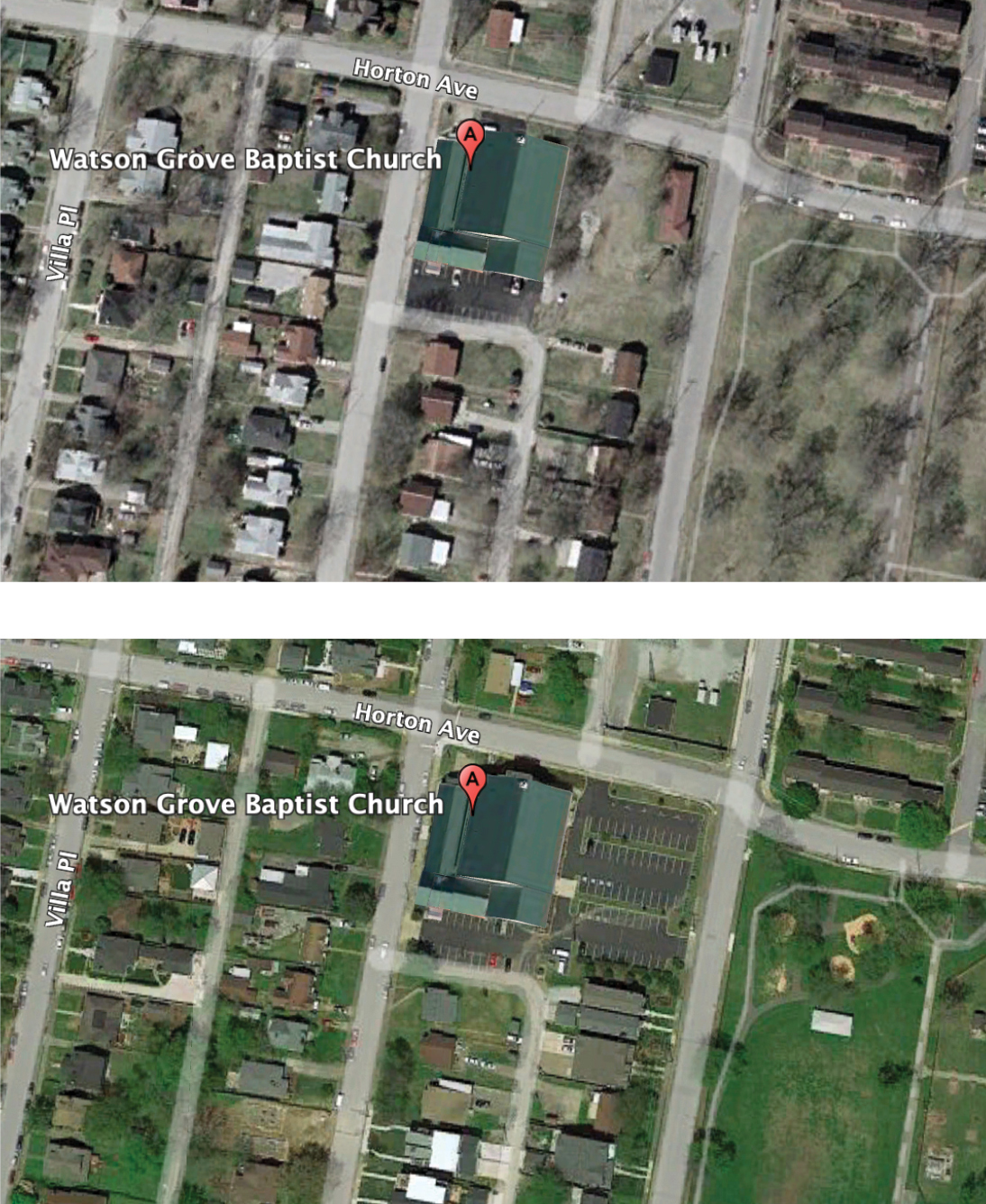
To understand what’s happening at Watson Grove Baptist Church, you have to understand its parking lot.

The modest patch of blacktop near downtown Nashville holds 100 cars. It’s framed by a manicured lawn and colorful shrubs and wraps around a group of connected redbrick buildings that has expanded with the congregation over the years.

Watson Grove sits on the corner of 14th and Horton streets in a place called Edgehill, a rapidly developing neighborhood bordered by Music Row to the north and 12 South, one of Nashville’s trendiest neighborhoods, to the south. Edgehill contains both public housing and a commercial district with a lively nightlife and lifestyle-brand stores like Warby Parker.

The church’s parking lot, in some ways, encapsulates the evolving story of the traditionally working- and middle-class African American community around it. It tells of Edgehill’s increasing urban bustle (the church installed speed bumps in the lot as more drivers were cutting through and endangering children crossing it to board the school bus) and of the neighborhood’s struggles with crime (police cars monitor the neighborhood from the parking lot, which hosted a hearse after a teenage girl from the community was killed in a drive-by shooting).

The blacktop also tells of gentrification, of supply and demand. Like Edgehill itself, where home prices have soared in recent years, there is not enough parking lot to go around.

A historically Black congregation, Watson Grove has grown over the past decade from around 300 people to more than 3,000 over two campuses just before the pandemic halted in-person services. Its modern sanctuary seats 750 people. And it became a multisite church in 2019, when it opened its second location in suburban Franklin, Tennessee.

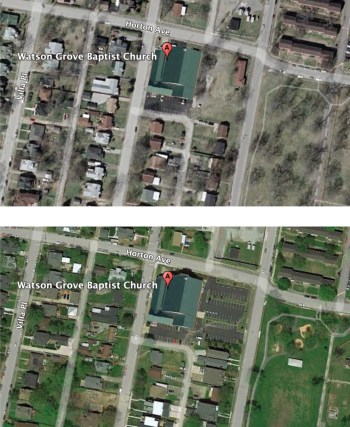
Watson Grove church in 2003 (top) before the expansion of its parking lot (below)Google Earth
Watson Grove church in 2003 (top) before the expansion of its parking lot (below)

But at the Edgehill campus, the influx of new worshipers has not come from surrounding homes and apartments. Most church members have either moved out of Edgehill or have never lived there.

Because there was so little space to put all those commuters’ vehicles, the church increased to four services. Cars spilled out onto the surrounding streets, into the library parking lot around the corner, and into a parking lot offered by a nonprofit a quarter mile away.

“I believe we grew in spite of gentrification” rather than because of it, said John Faison Sr., who pastors the 133-year-old congregation known as “The Grove.”

But some of The Grove’s neighbors, especially new neighbors, haven’t been excited about that growth. They’ve pushed for resident parking permits, which would prevent commuters from parking on the street. So far the church has persuaded the neighborhood association not to go that route.

“We tried to be neighborly,” Faison said. “We shouldn’t be blocking your driveway. However, you shouldn’t be cursing out Black people who are parking in front of your house.”

The Grove’s Nashville campus parking lot served its community during the pandemic with COVID-19 tests in June 2020Courtesy of The Grove
The Grove’s Nashville campus parking lot served its community during the pandemic with COVID-19 tests in June 2020

The Grove’s parking woes are a symptom of a larger phenomenon that might be called “spiritual gentrification.” As neighborhoods change, church communities are often forced to reevaluate their identity, asking hard questions: If the people of a church move elsewhere, should the building and pastors follow? How different can a neighborhood become before it’s no longer the neighborhood a church is called to serve?

In other words, who is a church for?

“It makes a church reexamine its call. Every single church is called to make disciples,” Alvin Sanders, a former church planter and president of the nonprofit World Impact, told The Tennessean in 2017. “It has to decide is it there to reach its community even if its community changes? That’s really the biggest pressure.”

Gentrification, a term invented by British sociologist Ruth Glass, is commonly understood as the process of wealthier—often white—people buying and developing property in urban neighborhoods, displacing lower-income residents who can no longer afford to live in the area.

Thanks to troves of census and real estate data, the trend has been heavily studied in recent years. Unsurprisingly, gentrification is complex. When property values in a neighborhood rise, working-class residents sometimes leave and sometimes do not. They may be forced out by unaffordable rent, or they may reap a windfall by selling a home that is suddenly worth a lot. “Gentrifiers” may be higher-income white residents, or, especially in major cities, they may also be higher-income Black and Latino residents.

Often overlooked in studies, however, is faith. A significant impact of gentrification is secularization, sociologist Orvic Pada argued in Biola’s Justice, Spirituality & Education Journal. “Religious organizations are forced to move out of the area, cease to operate due to rising property values, or reconfigure their identity, methods, and approach to cater to a different demographic group,” he wrote.

Churches that provide social services can help “slow down the effects” of gentrification by preventing lower-income residents from being pushed out, according to David Kresta, a researcher with Duke Divinity School. However, Pada observes, “gentrified” church outreach is often simultaneously targeting the wealthier creative class in changing communities—for instance, running cafés, restaurants, and other forms of social-entrepreneurship-as-ministry.

In the 1950s, The Grove’s Edgehill neighborhood was a popular area for African Americans, including many Black doctors, professors, and business owners, Faison said on the Vanderbloemen Leadership Podcast last year. The church building was built by a local Black-owned construction company. But times changed. There was redlining—where banks withheld loans from homebuyers in low-income areas—and white flight. Interstate 65 cut through the neighborhood. The church watched crime rise and education plummet. Public housing was put in.

In contexts like these, Faison said, the Black church was a place where Black people found affirmation, identity, and were “celebrated in a community that saw your inherent value” during a time of segregation and Jim Crow laws. “You’d show up to Black church and, while you were called racial epithets throughout the week, at church you were Deacon Jones.”

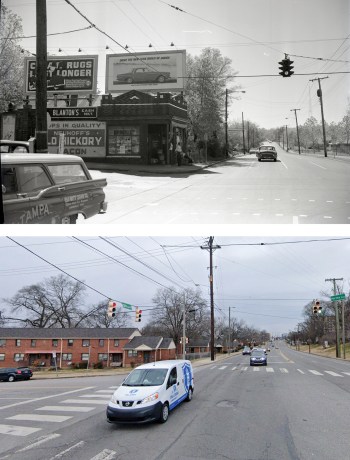
The Edgehill neighborhood in Nashville, just down the street from The Grove in 1961 (top) and today (bottom)Top: Nashville Public Library Metro Archives / Bottom: Google Maps
The Edgehill neighborhood in Nashville, just down the street from The Grove in 1961 (top) and today (bottom)

Gentrification has torn at that sense of cohesion in Edgehill. It “impacts our church in manifold ways,” Faison said. “First of all, many of our members can no longer afford to live in the neighborhood and the area they were living … so they have to leave and go to different places. Well, that now separates them from the center of the Black community: the Black church.”

Pastoring an increasingly commuter church, Faison observed his congregants have a harder time attending in-person Bible studies and students have a harder time making it to youth group.

Churches change when their members move out of a neighborhood or to a city’s outskirts. Some churches die: Countless empty urban church buildings, abandoned for myriad reasons by Catholics and Episcopalians and Methodists and Baptists, have been turned into bars and houses and luxury apartment buildings.

Other congregations decide that, to stay faithful to their call, they must abandon their original neighborhood and follow their members.

When Aaron and Michelle Reyes planted a church in Austin, Texas, in 2014 with a core group of 10, they were passionate about reaching the area where Aaron had grown up and creating a church centered on Black and brown communities. Most of their congregants were Latinos and blue-collar families. The East Austin church slowly became multiethnic as other families joined, and now about half of the more than 200 congregants are Latino, joined by white, Asian, and African American families.

In those early years, however, they quickly realized they had a problem. Marketing themselves as a “new” church was not attracting the people they had intended to reach in the changing neighborhood.

“We realized ‘new’ isn’t going to communicate what we want to express,” Aaron Reyes said. It instead communicated concepts like higher taxes and displacement. It sounded more like the coffee roaster down the road and less like a community. “So we started calling ourselves a ‘young’ church.” They also changed their name, from Church of the Violet Crown, which was being used by a lot of gentrifying businesses, to Hope Community Church.

Still, they noticed more of their folks being pushed out of the neighborhood. It was difficult and expensive for many attendees to get to church via public transportation. “As folks were moving, we just knew we had to leave,” he added. They found a building farther northeast, in Austin’s Windsor Park neighborhood.

But not all churches go. Many choose to stay. Life Change Church in Northeast Portland, Oregon—a neighborhood known to many as “the Hood”—relocated in the 1990s from a small A-frame on a cul-de-sac where it started in the 1960s to an old shopping complex. Now, according to pastor Mark Strong, the building is “dwarfed by several new developments.”

Life Change Church in Portland, Oregon—once a gas station—has seen the effects of gentrification.Courtesy of Life Change Church
Life Change Church in Portland, Oregon—once a gas station—has seen the effects of gentrification.

In his recent book, Who Moved My Neighborhood?: Leading Congregations Through Gentrification and Economic Change, Strong recounts reading an article about the top 10 “hippest” cities in the US and being surprised to find that Portland was No. 1. And the accompanying photo showed his church’s neighborhood. “Wow,” he thought. “What was once the Hood is now a national Hipsterville!”

His congregation realized that neighborhood change was taking place when they found themselves asking questions such as “What happened to this or that business?” and “Where is this family or that family?”

Strong realized that the problem his congregation faced “wasn’t so much these changes were occurring but that our community was not being included in this new neighborhood narrative,” whether from ignorance of how to seek change or from being exhausted trying to do so.

Strong offers seven steps for how he thinks churches should navigate the often-painful shifts of gentrification and remain resilient: Remember the old neighborhood, recognize the neighborhood shifts, realize the moved neighborhood, reconstruct your moved neighborhood, allow yourself rage, reconcile with the idea, and finally, revamp your church in the new neighborhood.

“Sure, it would be nice if God miraculously healed our pain and immediately restored what has been removed,” Strong writes. “However, he chooses to walk us through the valley and not transport us out of it.”

But generally, his call to churches undergoing similar changes is to stay. “Your neighborhood needs your church. And your church has the potential to be the best neighbor that the people in your neighborhood will ever have,” he writes.

Darryl Williamson and his 150-person church have chosen similarly. The lead pastor of Living Faith Bible Fellowship in Tampa, Florida, could only think of one family, in addition to his, that hadn’t moved in the past decade. He prefers the term “spiritual exodus” to describe their experience.

But like The Grove, instead of relocating with its congregation, Living Faith became more of a commuter church and saw its demographics shift with the changing neighborhood.

Life Change Church in Portland, Oregon—once a gas station—has seen the effects of gentrification.Courtesy of Life Change Church
Life Change Church in Portland, Oregon—once a gas station—has seen the effects of gentrification.

Williamson, who is also a board member at The Gospel Coalition, is careful with the language he uses to describe neighborhood gentrification. Many historically African American churches like his are not populated by people originally from the neighborhood, he said.

After talking to other Black pastors who have ministered for four decades and watching wealthy Black families relocate out of the cities, Williamson is not convinced gentrification “is quite being ‘done’ to us.” Even as someone who admits he left his hometown of Nashville, he pushes against an escapist mindset.

Rather, Williamson is passionate that his church be rooted in its geographical location. “I don’t know that we have discipled people to have responsibility for their neighborhood,” he said. “There are multiple Black communities that have experienced gentrification where what was needed was a greater conversation about how to lead and not just to personally aspire.”

While gentrification tends to secularize a neighborhood, it does, of course, often bring in new churches pastored by outsiders. And just as new neighbors can bring new conflicts, so can startup churches.

“If you’ve been in the neighborhood for 20 years trying to care for a congregation, and Planter A comes in and doesn’t greet you or anything and sets up shop down the road, it is an affront and grievous,” said Thabiti Anyabwile, who founded the Crete Collective, a church planting network that focuses on Black and brown neighborhoods.

“Folks that are planting communities that are in transition are often overlooking churches that already exist,” he said. “And, less politely, they are charging that these churches are less faithful to the gospel. Instead of being a revitalizing force, they are displacing in some cases decades-long or century-long presence.”

All of these pastors have grappled with the question of identity—Who are the people in my church? To whom does the local body belong?

In fact, Anyabwile believes the majority of new multiethnic church plants are not actually in the poorest areas of a city. They are “hood adjacent,” as he refers to it. His view is consistent with research on gentrification showing that gentrifiers tend not to move into very Black or very poor neighborhoods unless, say, the neighborhood is right next to a central business district.

On the other hand, researchers like Duke’s David Kresta have found that white churches in nonwhite neighborhoods can signal as a “beacon or an amenity” for new residents and contribute to further gentrification.

Among others, the Acts 29 church planting network has recognized this problem and recently launched a cohort called Church in Hard Places, sending or supporting a diverse group of pastors in poor neighborhoods—both rural and urban.

“The leadership reassessed that church planting was doing really well in upper-middle-class affluent neighborhoods—reaching white people, basically,” said Tyler St. Clair, a network leader and pastor of a church plant in Detroit. “But we had no traction in poor white and poor Black [communities] all around the world.” Their urban track equips city church leaders specifically to deal with gentrification and poverty.

After watching new church planters “parachute” into neighborhoods and draw people from the suburbs rather than their city block, St. Clair coaches new pastors to plant their lives in a community and learn as missionaries, not saviors. “You should receive the compliment ‘I see you everywhere,’ ” he says. “I don’t just sleep here.”

The Grove’s Nashville campus parking lot served its community during the pandemic with a food drive in November 2021Courtesy of The Grove
The Grove’s Nashville campus parking lot served its community during the pandemic with a food drive in November 2021

Faison has observed this tension between his historically Black church and the white church planters that come to his Nashville neighborhood. In the past decade, he says, only one of the 12 churches that were planted near him has survived.

“Their motives will be tested by their willingness to be part of that community,” he said. Instead of connecting with existing neighborhood churches, he thinks, many church plants see them as theologically or ecclesiologically inferior, or as competition. “It’s not even evangelical; it’s economic. It’s seen in how they relate to the community. Their goal is to build a kingdom that’s theirs and like them,” he said.

But Williamson sees the flip side. He sees gentrification as an opportunity for legacy Black and brown churches to “grab the reins” of the multicultural conversation and lead the way, rather than being on the defensive and waiting for majority-white churches to debate the need for racial reconciliation.

He believes Black and brown churches can pursue multiethnicity and attract white brothers and sisters who are allies. “What does that mean for the next generation?” he said. “Who are we in 30 years if there is a mass migration of white brothers and sisters out of white megachurches to Black and brown churches around the city to be led and be discipled and lead and be disciplers?”

He’s not alone. Only one-third of Black Americans think historically Black congregations “should preserve their traditional racial character,” according to a 2021 Pew study. And 61 percent of Black Americans say that historically Black congregations “should become more racially and ethnically diverse,” whether they attend majority-Black churches or not.

And in Portland, while Mark Strong’s church ministers in a gentrifying African American neighborhood, he argues that the “issue of moved neighborhoods is not exclusively a Black neighborhood problem.” All kinds of neighborhoods change, and Jesus is concerned equally about them, writes Strong.

All of these pastors have grappled with the question of identity—Who are the people in my church? To whom does the local body belong?—alongside questions of geography and space. Whether they realize it or not, they have wrestled with a theology of place.

“We don’t want to be a commuter church, we want to be a community church.” John Faison

David Leong, a missiologist at Seattle Pacific University, has been studying this concept for two decades. He says a theology of place starts with a recognition that to be human is to be placed. “Embodiment requires space,” he said in an interview with CT. But it’s not just about the biological reality that we are taking up space and sucking up air. Place demands that we ask, “What does it mean to live in this world?”

Scripture refers to Jesus as being “of Nazareth,” Leong writes in his book Race and Place, signaling that he “came from, and was shaped by, a particular place and the local communities found there” that “defined Jesus’ life and ministry.”

Ultimately, while Leong feels an understanding of place is vital to effective ministry, churches can still flourish even if they’re navigating gentrification imperfectly. “When we look at Jesus’ ministry and, after Pentecost, the ministry of the Holy Spirit, we find that the human boundaries we’ve constructed don’t seem to interfere with God’s work in particular places,” he told CT in 2017.

Aaron Reyes, for one, doesn’t think “theology of place” is the right way to approach the issue of gentrification and understanding church community.

“It’s a theology of people rather than a theology of place,” he said. In the New Testament, he pointed out, churches were described by a group of people rather than an address. The location could be anywhere, in any person’s house (as in Acts 16:40).

Both Leong and Faison say pastors need to figure out their church’s calling. Leong tells churches to be “really intentional” about the decision to stay and commit to a neighborhood even if there is pressure to leave. Those who do stay must be aware of and hospitable toward folks who are being displaced, he said.

“Churches can struggle to turn their direction outward,” Leong said.

Faison also advises pastors, “You have to wrestle with Are you called to this area? Are you called to this space? And for every church it’s a different answer. Maybe I’m called to those people that I serve, but I’m not called to this space.”

For Watson Grove, the answer is clear. Faison says their calling is to be a Black church and not a multicultural one. And yet their calling is not to follow their people out of the city. It’s to minister to their surrounding community.

“We have to adapt to what this community looks like. I cannot be stuck in remembrance only and wanting it to be what it used to be. It just ain’t,” he said. “Our calling is to be a community church. That’s who we’ve been since 1889. We don’t want to be a commuter church, we want to be a community church.”

Kara Bettis is an associate editor at Christianity Today.

Ideas

Don’t Expect Instant Gratification from Your ‘Quiet Time’

Columnist

Fifteen minutes of Bible reading may not turn every day around, but it’ll yield fruit at the right time.

Illustration by Rick Szuecs / Source images: Ales Krivec / Nathan Dumlao / Unsplash

When the first ATM was installed in my hometown in the 1980s, it felt like magic: Insert your card, take out cash.

Since then, we’ve learned to love not having to wait in just about every area of our lives. Products arrive at our doors within a day. Meals in a matter of minutes. Movies, books, and music appear on our devices instantly.

It’s wonderful. And it’s also worth weighing carefully. Rapid delivery teaches us that waiting is an enemy to be eliminated, standing between us and what we desire. With each quicker, more convenient development, we are attenuating our ability to wait.

But being able to wait is distinctly Christian. In fact, it is a mark of Christian maturity. The Bible speaks of waiting on the Lord, of being steadfast, and of bearing the spiritual fruit of patience. While most of us recognize that instant gratification is the habitat we inhabit, few have assessed how “waitlessness” may be forming us spiritually—specifically, how it may be shaping our approach to the Bible.

Around fourth grade, I was taught the spiritual discipline of spending “time in the Word.” Like many, I was encouraged to have a “quiet time,” 15 or 20 minutes in Scripture, preferably in the morning (because, you know, Jesus rose early in the morning). This practice was supposed to calibrate my day, to fill my spiritual tank for whatever the rest of that day might hold.

The underlying message: Have a quiet time, have a good day. Skip a quiet time, good luck. Combine that with an inclination toward instant gratification, and I began to see any quiet time that didn’t yield immediate emotional warmth or peace as essentially a fail.

I grew to approach spending time in the Word primarily as transactional instead of formational. It was a time to get what I wanted, when I wanted it, exactly how I wanted it. And I don’t think I’m alone.

Time in the Word is meant to be not merely informational or inspirational, but relational.

One of the most common frustrations I hear is that, despite daily quiet times, Christians feel God is distant. And judging from the pervasiveness of Bible illiteracy in the church, our daily quiet times may not be yielding the formative effect we hope.

When we think of quiet time as transactional, we treat Scripture as a debit account that offers us meaning or feeling on our timetable. Each day we insert our debit cards and withdraw 15 minutes of inspiration.

Instead, we should take a savings account perspective, where we make faithful deposits, investing ourselves over days and weeks and years without expecting immediate emotional or intellectual yield.

If we stick to a debit account approach, we will studiously avoid the parts of Scripture that take longer to understand, or we will misinterpret them to meet our wrong expectation that they serve our timetable. We will gravitate toward devotional reading over straightforward Bible reading.

By contrast, a savings account mentality understands how to wait. It is steadfast and patient. It knows faithful daily deposits will absolutely yield fruit—in season. At just the right time.

If you have ever walked through the valley of trial, you know what it is like to find years of faithful deposits bearing dividends. A patient, long-term approach is key. The Book of Ezekiel may not fix your day, but it may just sustain you in a lengthy trial if you give it your quiet times. The formational profit of spending time in the Word is more likely to emerge over 15 years than 15 minutes.

Time in the Word is meant to be not merely informational or inspirational, but relational. It trains us to listen to the voice of God in his Word, and it teaches us who he is. It is God inviting us into conversation for the purpose of relationship.

As in any relationship, quality time is essential. But quality time is a function of regularly occurring quantity time. It does not give us what we want when we want it, exactly how we want it. We can’t schedule it or demand it. It happens according to its own timetable and often when we least expect it.

Don’t buy the instant gratification, debit account perspective that you’re owed measurable wins, deep insights, or warm feelings because of your daily quality time with God.

Consider instead that your quiet time is a daily contribution to the savings account of quantity time. Relationships deepen and flourish with patience and steadfastness. In your time in the Word, wait on the Lord.

Black Christian Homeschoolers Are Redefining the Movement

Faithful moms are adapting and developing new curricula as more families of color opt to educate at home.

Photo by Stephanie Eley

Amber O’Neal Johnston likes to say, “In my house, Charlotte Mason has an Afro.”

Johnston is among generations of homeschooling parents inspired by the 19th-century Christian educator. She believes in Mason’s philosophy that children should be treated as full-fledged people and that educators cooperate with God to create a learning environment rich with books, nature, experiences, and ideas.

But as Johnston claimed her Black heritage over the years, things changed. Her once “bone straight” hair is now worn natural. “It’s big. And I love it,” she said during a Zoom interview, showing off a heavy mass of curls behind a white and patterned headband.

Johnston wants her four kids to claim and love their Blackness too—but she noticed how the books on Charlotte Mason reading lists, full of white authors writing about white characters and history, taught a different lesson.

It was her eldest daughter who shifted Johnston’s view when she remarked, “You said we study important things at school. We study only white people.”

Johnston was stunned.

Educating her own kids at home inspired Amber Johnston to create networks and resources for families like hers.Stephanie Eley
Educating her own kids at home inspired Amber Johnston to create networks and resources for families like hers.

Since then, the homeschooling mom has worked to bring Black figures and history into the Charlotte Mason approach. She became a board member for the Charlotte Mason Institute, taking the Victorian woman’s philosophy and infusing a “necessary dose of Blackness into it.”

Five years ago, Johnston started a group in the Atlanta area for homeschooling families of Black children. Her website—HeritageMom.com, named for children being a heritage from the Lord in Psalm 127:3—is now a popular destination for Charlotte Mason families and other homeschoolers seeking resources such as multicultural hymn studies and themed lesson guides on African and African American history.

Homeschooling took off during the pandemic. Between spring and fall 2020, homeschooling rates doubled, from 5 to 11 percent, according to US Census Bureau surveys. The rate grew fastest among Black families, up more than fivefold from 3 percent to 16 percent.

The interest in homeschooling among Black families and other families of color reflects a dissatisfaction with traditional schools that simmered even before COVID-19, according to Cheryl Fields-Smith, a University of Georgia professor who has been studying Black homeschoolers since 2006.

Fields-Smith looked at how religion influenced the homeschooling journeys of African Americans in a study involving two dozen families. She found that fewer parents expressed the idea that “God told me to homeschool” or “This is what Christian families do,” and more believed that their faith empowered them to homeschool once the decision was made.

“There are first-choicers, who know from birth that they are homeschooling, and second-choicers, who have tried one, two, three, or four traditional schools and then decided to homeschool,” Fields-Smith said.

“It becomes a place that’s more viable because of the way school has become.”

Black families, she said, often feel conflicted when leaving the public school system, which the Black community has fought so hard to have equal access to.

Brown v. Board, the Civil Rights Act, the Voting Rights Act, desegregation cases, sit-ins, marches all played a significant role drawing societal attention on inequities in education. Is it every Black person’s responsibility to continue in this struggle, even when many do not believe that equitable education will ever be attainable in public schools?” Fields-Smith cowrote in The Urban Review.

In public and private schools, Black parents continue to worry about unequal treatment, including their kids getting passed over for gifted classes, over-referred to remedial education, and labeled as troublemakers.

For decades, the stereotype of homeschooling was white evangelicals educating in a family setting and teaching biblically shaped lessons from outlets like Abeka and Bob Jones. But much of the recent growth in homeschooling comes from nonreligious families or those whose motivations don’t fit the stereotype.

For many Black Christian families choosing to homeschool today, traditional evangelical curricula can lack the racial diversity and cultural awareness they’d like in their kids’ education. But they still want to integrate their faith. So they’re left in a position like Johnston’s—challenging, adapting, and creating curricula that meets their families’ needs. And as they do so, they’re redefining the homeschool movement itself.

Delina Pryce McPhaull, a Christian, Afro-Latina homeschooling mom in Dallas, also had to think outside of the homeschool boxes as she taught her three children a different perspective on history.

As McPhaull taught her children from a boxed curriculum—which provides all the textbooks, teacher guides, worksheets, and activities—she was also leading a Be the Bridge racial reconciliation group with women from her Bible Study Fellowship.

In the group, McPhaull studied Reconstruction for the first time. She saw more clearly the through-line between those policies, Jim Crow laws, and current racial disparities. It prompted her to see the gaps in her children’s history lessons. At first, she supplemented with other books. Eventually, she wasn’t using the original curriculum at all.

In Christian homeschool curricula, history lessons especially are “riddled with ‘God is on our side’ talk,” McPhaull said. She refused to have her kids sing Americana songs like “Dixie” and “Cotton Needs Pickin’ ” and couldn’t stomach textbook claims that God ordained the US government despite its atrocities against the country’s indigenous peoples.

She took her margin notes and supplemental resources and created Oh Freedom!, a socially conscious homeschool history curriculum centering African American, indigenous, and immigrant perspectives. She also saw prayer and reflection as critical to helping children digest the difficult topics.

“It was important for my kids to understand we were not just studying mess but where God was in the mess,” McPhaull said. “Not in the gross way that justifies, saying, ‘Well this must have been what God planned.’ I wanted them to come out of learning this hard history not with a hard heart … but knowing the ways God worked in those situations for particular people. How they used their faith to carry them forward and build resistance and strength.”

McPhaull always started her own history lessons with her kids by using the ACTS method (Adoration, Confession, Thanksgiving, Supplication). Her original curriculum included time for prayer throughout; the prayer guide is now offered as a supplement to make the material accessible to secular homeschoolers.

In the prayer supplement, McPhaull includes several sets of prompts using the acronym WOKE. One, for example, is: Worship (Remember who God is), Own (Own the ways you’ve fallen short), Kindle (Ask God to ignite desire to care about issues that are important), and Enjoy (Give thanks to God for the things you enjoy).

Oh Freedom! launched in 2019 with a “Woke Homeschooling” Facebook group, which had over 3,000 members. With the increase in pandemic homeschoolers and the racial reckoning set off by George Floyd’s killing in May 2020, the group surged to over 13,000 members, many of whom are white parents hoping to diversify their lessons.

But the growing interest in racially diverse education has also elicited a conservative backlash, with critics using terms like social justice, critical race theory (CRT), and woke to decry such efforts.

“Though I hear from the people who think woke is a four-letter word, I don’t regret using it to name my business,” McPhaull said. “I think it’s actually a great filter. Those who are at a place where they want to start teaching their kids the truth about history won’t be offended by the word woke.”

“The opposite of woke,” she points out, “is asleep.”

In 2019, CT published a cover story on classical Christian homeschoolers moving away from a separationist, homestead mentality toward deeper engagement with society as “salt and light.” The stories of Black homeschoolers show that this kind of engagement has been happening all along.

Before the pandemic, a visitor might have wandered into Castle Rock Community Church in New Orleans and seen a handful of Black children around a cinder-block wall with pictures of a brown-skinned Zeus, Athena, Aphrodite, Apollo, and Poseidon on a large sheet of white paper.

A Black woman wearing red ball-stud earrings prompts, “Zeus would be as strong as an …”

“Ox!” one child yells.

“Oak tree!” another says.

“That doesn’t make no sense, though,” another student interjects.

The class, captured in a teacher training video, is part of Nyansa Classical Community. The classical Christian program features Black and brown images of classical figures and draws on the Black intellectual tradition.

Angel Parham, a sociology professor now at the University of Virginia, founded the program in her early years of doing classical homeschooling with her own children.

Parham saw neighbors in her working-class Black community in New Orleans dissatisfied with their education options and asked, with another homeschooling mom, “What can we do to make this more available?” They started Nyansa, which means “wisdom” in the West African Akan language, as an afterschool program.

When the pandemic shut everything down, Parham translated the material into a 20-week curriculum, adaptable for homeschooling or private schools, featuring a different virtue each week.

A unit on love opens with the story of the Greek goddess Demeter, who lost her daughter Persephone to the underworld god Hades. Jonathan and David’s friendship in 1 Samuel is recounted among the biblical examples of love. African American Lt. John Fox’s story of self-sacrifice in World War II is offered as a modern-day window into the virtue.

Parham describes the Nyansa curriculum as accessible, practical, and liberating. “It’s never been the case that the classical texts are only meant for the white European community,” she said. “It has been the case that the list of texts studied has been quite limited.”

Parham, who grew up Baptist, cites the flourishing of Arabic science in Baghdad in the Middle Ages as an example of non-European engagement with Greek philosophy. She also points out that many African American intellectuals, such as Phillis Wheatley, Frederick Douglass, and Martin Luther King Jr., were classically educated. “They often turned to classical texts and founding American documents to make the argument for their liberation.”

The Nyansa curriculum is now being piloted at several private schools, and Parham expects to make it widely available soon.

“We need to think beyond our own families,” Parham said, dreaming about churches one day offering Nyansa as an after-school program. “There are ways that homeschoolers can enrich the larger conversation on education and reach out beyond themselves.”

In 2016, Johnston started Heritage Homeschoolers with four other families in the Atlanta suburbs. It was her effort to create a homeschooling community where her children and other Black children could see their ethnic heritage mirrored and valued. The group has grown to over 100 families, and a third are new to homeschooling.

Johnston attended public schools; her parents were public-school principals. When her daughters were preschool age, she kept being drawn to the “magical childhood” created by families she knew who homeschooled. Johnston now sees it as God’s way of putting the option before her.

When she began Heritage Homeschoolers, she felt the tension between using the network to promote Black heritage in homeschooling or to promote Black heritage only among Christian families.

“Am I going to require a signed statement of faith like so many groups in my area?” Johnston asked. “If I don’t, I’m not seen as a woman of faith. If I do, I’m effectively cutting off people who fall within the initial vision of the group.”

Fellow “die-hard Jesus lovers” spoke up against requiring Christian commitments, saying they didn’t “want to be part of something that further splinters the Black community” and that allowing a broader range of participants would give them the chance to be “hands, feet, and light.”

So Heritage Homeschoolers is not explicitly Christian, though members still overwhelmingly identify as such. Johnston chose a core team to run hospitality, social media, and other aspects of the group. They are committed believers who pray for each other and the other moms.

Their group meets for camping trips, poetry readings, father-daughter dances, holiday celebrations, book clubs, and more. They don’t pray out loud unless they’re certain all members in attendance are believers, and they don’t proselytize. But the conflict resolution plan in their handbook is taken directly from Matthew 18:15–22. If a member can’t pay dues, they are welcomed without shame or consequence.

“[Our faith] flavors all that we do while still allowing us to embrace families of all or no faith backgrounds,” said Johnston, who recently wrote A Place to Belong: Celebrating Diversity and Kinship in the Home and Beyond.

Homeschooling in Black communities tends to be concentrated among families with higher education levels and income. However, longtime observers are seeing wider demographics, including more working mothers, single mothers, and even grandmothers, start to homeschool—among all ethnicities.

Elle Cole, host of the Cleverly Changing podcast, dedicated a season of the show to the ways parents can make homeschooling work while still bringing in an income. Episodes included “Secrets of a Mom Boss” and “Finance and Entrepreneurship.”

Johnston’s helping families in her community think through creative possibilities. “You have 24 hours a day and seven days a week. Homeschooling doesn’t have to happen between 8 a.m. and 2 p.m.,” she tells them.

As part of a network of homeschooling families in the Atlanta area, Johnston urges parents to adopt a “village mentality” to homeschooling.Stephanie Eley
As part of a network of homeschooling families in the Atlanta area, Johnston urges parents to adopt a “village mentality” to homeschooling.

The pandemic opened up more options with more flexible work schedules for some working parents, but Johnston said, “We’re getting back to a village mentality” to help more families take part.

For example, she supervises a kid in their local group two days a week while his mother works. Those who have the resources to homeschool, she said, can ask, “How can we collectively support families who can’t do it on their own?”

T

oday, many more resources exist for Christian families of color and homeschoolers looking to include diverse perspectives. There are groups like The Melanin Village and Black Family Home Educators and Scholars (cofounded by Fields-Smith) and book lists featuring authors and characters of color. Charlotte Mason for All, a podcast hosted by five women of color, aims to make Mason’s philosophy accessible “to every culture, country, and community.”

But many of the recent innovations come from parents creating resources to fill their particular needs—Black moms like Johnston and McPhaull and Parham—rather than from major homeschooling organizations intentionally looking to improve their offerings.

“I have been very intimately formed by and loved individuals in white conservative evangelical spaces,” said Lainna Callentine, a former ER physician turned homeschool mom and science curriculum author. “When I started calling out some of the loss of cultural awareness in those spaces, saying, ‘This is wounding me. Let’s have a conversation,’ those conversations were never well-received.”

Callentine served for five years as the only Black woman on what was then the otherwise all white, male board of Parental Rights, a group of national homeschooling leaders concerned about government encroachment.

Leaders at the Home School Legal Defense Association (HSLDA), founded by evangelical homeschooling advocate and lawyer Michael Farris, know of these concerns. “We are definitely reaching out. To the extent that we can help their voices be heard and included, we want to do that,” said vice president James Mason, who also leads Parental Rights.

The HSLDA has recently hired Spanish-speaking consultants to connect with the growing Hispanic homeschooling community and started offering workshops geared toward Black, Latino, and other minority groups, said media relations director Sandra Kim. Last year they offered 673 compassion grants, averaging $830 each, to lower-income families who are privately homeschooling.

Susan Seay, a Black mom of seven with 20 years of homeschooling experience, has advocated that state and national conferences include more women and people of color in their speaker lineups but says she has been met with resistance.

“You are sending a message that homeschooling is white, Christian, and exclusive,” said Seay, who hosts a homeschooling podcast called Mentor for Moms. “But at the same time, you’re saying words out of your mouth that it is available to all parents and everybody can do it.”

Callentine said she wanted to be able to connect conservative white homeschooling communities and underserved communities of color, but said she heard fellow leaders label the groups she wanted to include as “Democrats,” “liberals,” and “unreachable.”

The tensions around diversity and race in education have gotten even more divisive among Christian conservatives since then, with recent debates taking off over social justice and CRT. At the 2021 HSLDA conference, one session was titled “Against Critical Theory’s Onslaught: How to Respond to its Manifestation in Critical Race Theory and the Transgender Ideology.”

Callentine, for her part, is baffled. “I scratch my head when I see individuals so consumed with CRT yet not have an interest in their brothers and sisters of color.”

F

or many Black families, a roadblock to homeschooling is confidence. They don’t see people who look like them homeschooling or in the curricula. They’re worried about leaving public education, which is held up in Black communities as a form of uplift.

Once they make the choice, they often feel isolated as the only families of color among white evangelical homechoolers—a factor in why Johnston, McPhaull, and others formed spaces for fellow Black families.

The new curricula and groups might seem like a departure from traditional Christian homeschooling. But their necessity for families of color show that the biblical truth that all people are made in God’s image hasn’t been applied consistently in evangelical homeschooling circles.

As Black families write their stories into homeschooling curricula, they make room not only for themselves, but for everyone.

“I’m hopeful,” Callentine said, “that those coming in will continue to grow in numbers and voice to show the beautiful diversity of God’s kingdom.”

Liuan Huska is a freelance journalist and the author of Hurting Yet Whole.

Apple PodcastsDown ArrowDown ArrowDown Arrowarrow_left_altLeft ArrowLeft ArrowRight ArrowRight ArrowRight Arrowarrow_up_altUp ArrowUp ArrowAvailable at Amazoncaret-downCloseCloseEmailEmailExpandExpandExternalExternalFacebookfacebook-squareGiftGiftGooglegoogleGoogle KeephamburgerInstagraminstagram-squareLinkLinklinkedin-squareListenListenListenChristianity TodayCT Creative Studio Logologo_orgMegaphoneMenuMenupausePinterestPlayPlayPocketPodcastRSSRSSSaveSaveSaveSearchSearchsearchSpotifyStitcherTelegramTable of ContentsTable of Contentstwitter-squareWhatsAppXYouTubeYouTube