News

India’s Anticonversion Laws Loophole

The government didn’t have the votes to pass a controversial bill in Karnataka. So it found another way.

Christianity Today June 9, 2022
Abhishek Chinnappa / Stringer / Getty

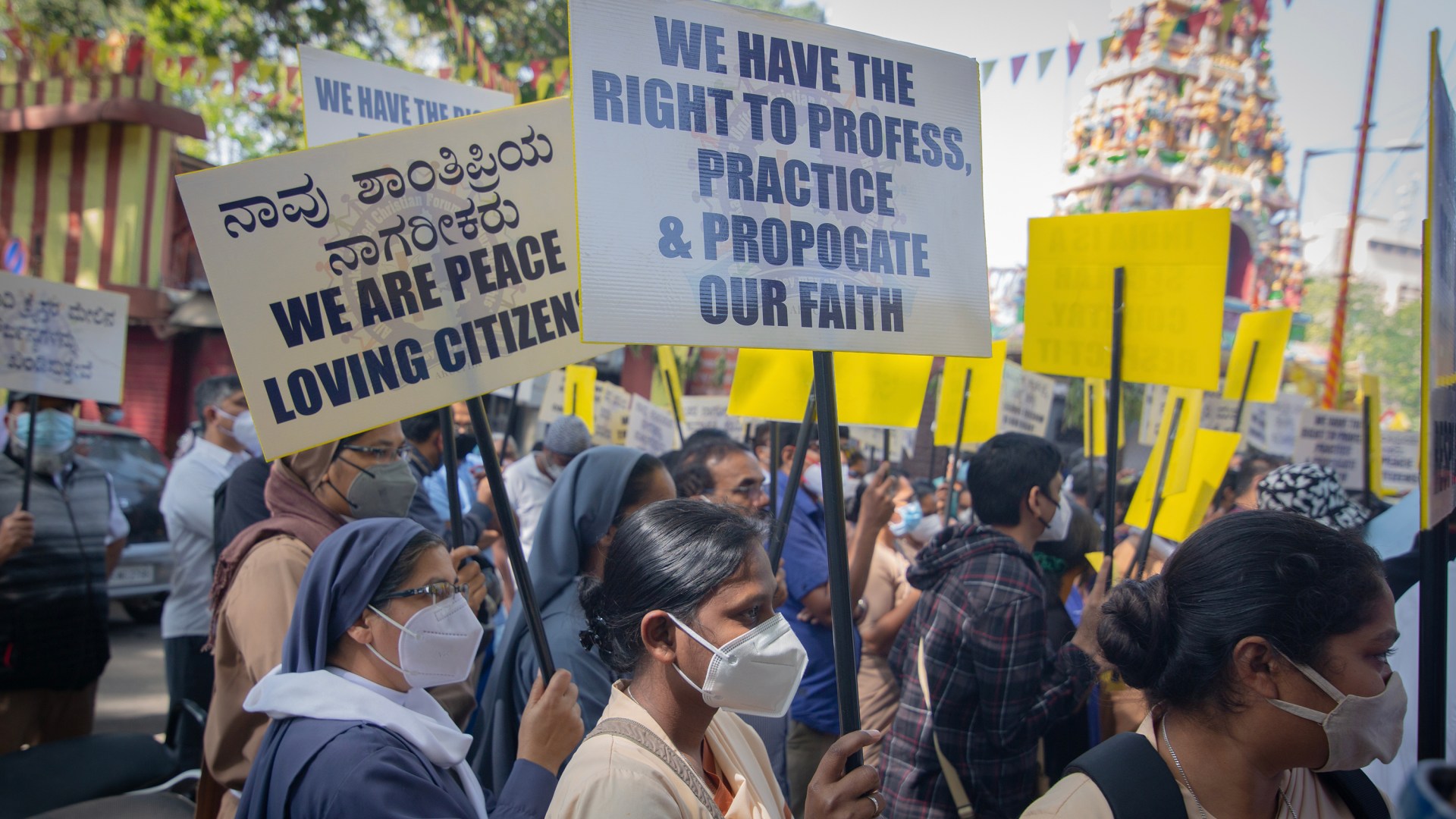
Last month, a delegation of Christian leaders met with Thawar Chand Gehlot, the governor of the southwest Indian state of Karnataka. Their aim: to discourage Gehlot from signing an anticonversion ordinance that they believe will embolden religious radicals to stir unrest.

Despite what Bengaluru archbishop Peter Machado described to CT as a “courteous and welcoming” reception, Gehlot signed the ordinance the following day, May 17, making Karnataka the 13th out of India’s 29 states to pass legislation of this kind.

The ordinance prohibits numerous behaviors including conversion by “force, undue influence, coercion, allurement or by any fraudulent means or by marriage,” and forbids anyone from helping or conspiring on conversions. It allows people beyond the convert—including family members, relatives, or even colleagues—to file complaints.

The ordinance also stipulates a jail term ranging from three to five years and a fine of 25,000 rupees (roughly $320). If the convert is a woman, child, or Dalit, the punishment can increase to up to 10 years in prison.

India’s first anticonversion law passed in the state of Madhya Pradesh in 1967. In recent years, as the Hindu nationalist Bhartiya Janta Party (BJP) has gained power across India, the party has begun to frequently promise these laws on the campaign trail.

But passing this legislation proved challenging in Karnataka, a state known widely by Westerners as the home of Bengaluru (Bangalore), a tech hub for many multinationals. Afraid that the majority party lacked the votes to pass an anticonversion bill, the governor directly promulgated it as an ordinance, or temporary law, that can remain in effect until it is replaced by a law.

“The government attempted to get this bill passed despite strong opposition from the Christian community and the united opposition parties who opposed the bill on the house floor,” said Atul Y. Aghamkar, who leads the National Centre for Urban Transformation at the Evangelical Fellowship of India (EFI). “However, they could not get it through the legislative council because they did not enjoy the majority there.

“So, this bill was processed and passed through a back door ordinance when the assembly and council were not in session,” he told CT. “That itself shows the government’s intent, as they could not face the discussion on the bill in both houses.”

https://datawrapper.dwcdn.net/dq2xI

“A crime tomorrow”

Karnataka Christians have two primary fears. The first is that the described actions banned from accompanying conversions are overly broad and will lead to a crackdown on actions unrelated to conversion.

“It will be a crime tomorrow to do some charity,” said Machado last month:

So, giving free education will also be a big problem. If I have to help a Dalit child, who can’t afford to pay the fees, I’ll have to fill a number of forms. I will have to explain why the child is being helped, and why I am offering free education.

If we are going to explain why we are distributing gifts, tomorrow Santa Claus will be a dangerous character too.

Those who break the law face up to 10 years in prison—the same penalty as convicted rapists. Such a punishment strikes Christian activist John Dayal as egregiously cruel.

“What message are they trying to convey by bringing such a law?” he said.

Second, church leaders say gangs and mobs will use these laws as justification for anti-Christian violence.

“This ordinance is just a simple act on the part of this government to allow the vigilante groups to have the freedom to attack Christians, destroy Christian institutions, and create an atmosphere of fear to subjugate the Christian community,” Aghamkar said. “Karnataka has seen many reported and unreported cases of attacks on Christians in the recent past, and these are bound to increase in the wake of the introduction of this ordinance.”

Christians comprise less than 2 percent of Karnataka’s population of 64 million. Muslims, whom the bill also targets through its prohibition on “unauthorized” interfaith marriages, comprise 13 percent. Hindus comprise 84 percent.
The day after the ordinance went into effect, police arrested an out-of-state pastor and his wife in Kodagu district upon the complaints of right-wing Hindu groups for deliberate and malicious acts, and hinted that the couple may end up being charged under the ordinance.

In 2021, EFI’s Religious Liberty Commission (EFIRLC) documented more than three dozen attacks on Christians in Karnataka in 2021. Most of these attacks were instances of physical violence and disruption of worship services in churches that followed allegations of religious conversions.

The EFIRLC maintains that its documentation is not exhaustive, and the actual tally of attacks may be much more than documented or even reported.

The BJP in Karnataka—the only southern state where the political party has experienced considerable electoral success—came to power in 2008, on the heels of a wave of brutal attacks against Christians locally and across India.

“They are empowering killer gangs, empowering lynch mobs, empowering vigilante groups and lumpens (disrespectful troublemakers) throughout the country to target the next Christian they see,” said Dayal. “To break the next church, vandalize the next school, harass a hospital run by a Christian, chase a nun, disrupt a worship service, and so on.”

Is there still time?

Anticonversion legislation has been discussed and passed even before India’s independence in princely states such as Raigarh, Udaipur, Kota, and Jodhpur. Post-independence, the Constituent Assembly of India discussed the possibility of forbidding conversions by force, fraud, or allurement, but did not introduce any such provision.

After independence, the states of Madhya Pradesh and Odisha passed anticonversion laws in 1967 and 1968, respectively, due to what officials alleged was malpractice by Christian missionaries. By the late 1990s, the BJP and Hindu right-wing groups had ignited a national debate on religious conversion and pressed for nationwide anticonversion legislation. By the early 2000s, several states had passed and enforced such legislation.

The BJP has argued that Hindus face a danger of decimation from increasing Christian conversion rates. Census data and public surveys, however, don’t support such a trend. “Religious conversion is rare in India; to the extent that it is occurring, Hindus gain as many people as they lose,” stated the Pew Research Center in a first-of-its-kind report in 2021.

Currently, 13 states in India have passed anticonversion legislation, though it is only enforced in nine. Tamil Nadu repealed its 2002 law in 2004 in the wake of public pressure, while the governor of Rajasthan refused to sign its 2006 law. Arunachal Pradesh passed its law in 1978 but never drafted rules for it. The same is true in Haryana, which just passed its own law this past March.

Several other states have pursued the ordinance route, including Uttar Pradesh, the largest state in India, in 2020. Officials replaced the ordinance with a law in March 2021.

In Karnataka, some suspect that the government passed the anticonversion measure as an ordinance so the BJP government could boast about it in upcoming regional elections. Attacking religious minorities polarizes the electorate and often sends voters to the BJP.

Right now, Christian groups are exploring their options for striking down the new ordinance.

“The Karnataka anticonversion law, like those in other states, violates Article 25 of the Indian Constitution and threatens the secular fabric of the country,” said an EFIRLC spokesperson. “We must unitedly challenge it in the court of law, if need arise.”

News

Pew: Israelis and Palestinians Find Favor in the Eyes of Americans

Survey shows citizens remain much preferred over their governments, while US polarization continues as youth shift support from Israel to Palestine.

Illustration of the flags of Palestine and Israel

Illustration of the flags of Palestine and Israel

Christianity Today June 9, 2022
Tuomas A. Lehtinen / Getty Images

Americans prefer a less polarized Holy Land. But they themselves are as polarized about it as ever.

A new survey by the Pew Research Center—three years removed from when Donald Trump and Benjamin Netanyahu led the political scene—reveals rising favorability ratings for Israel and Palestine, across nearly every segment of Americans.

Most, however, still prefer Israel.

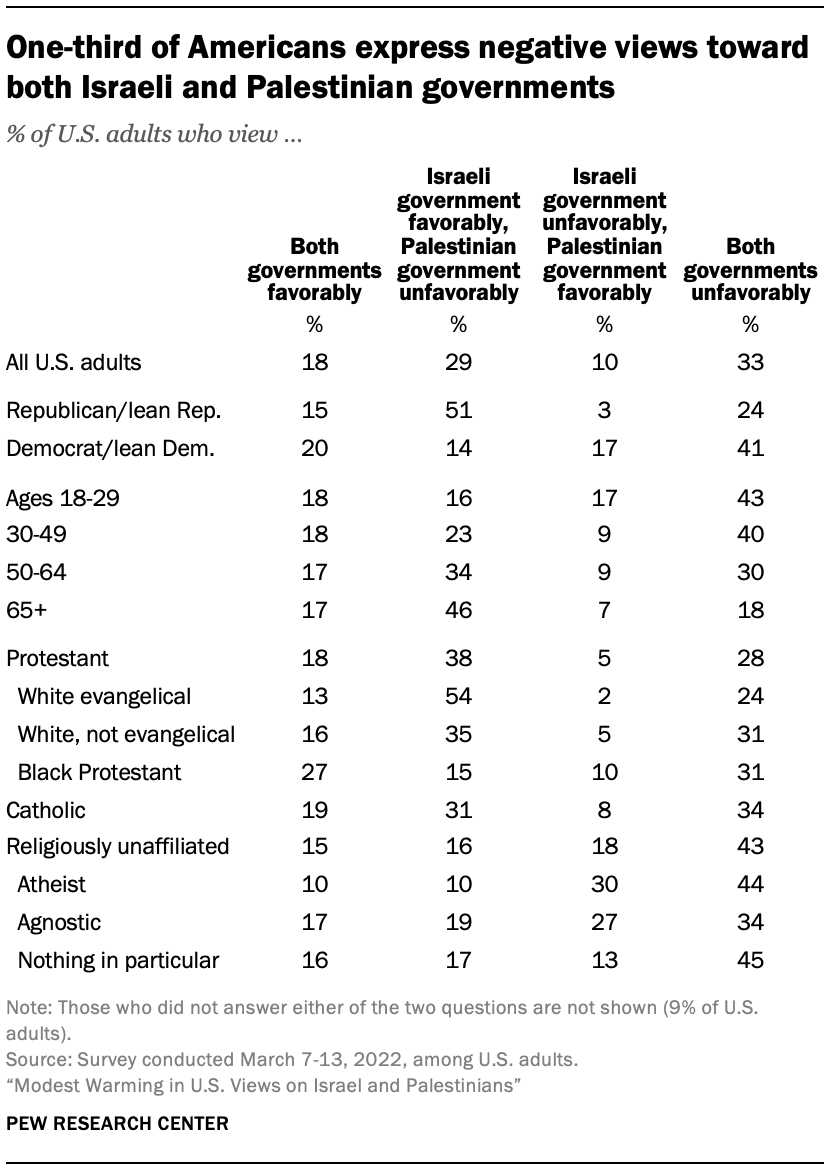
White evangelicals lead the way, with 86 percent viewing the Israeli people favorably and 68 percent viewing Israel’s government favorably, compared to 37 percent favorability for the Palestinian people and 14 percent favorability for their government.

Overall, 1 in 3 white evangelicals view both peoples favorably, but only 1 in 10 favor both governments.

These believers are out of step with the wider US, however.

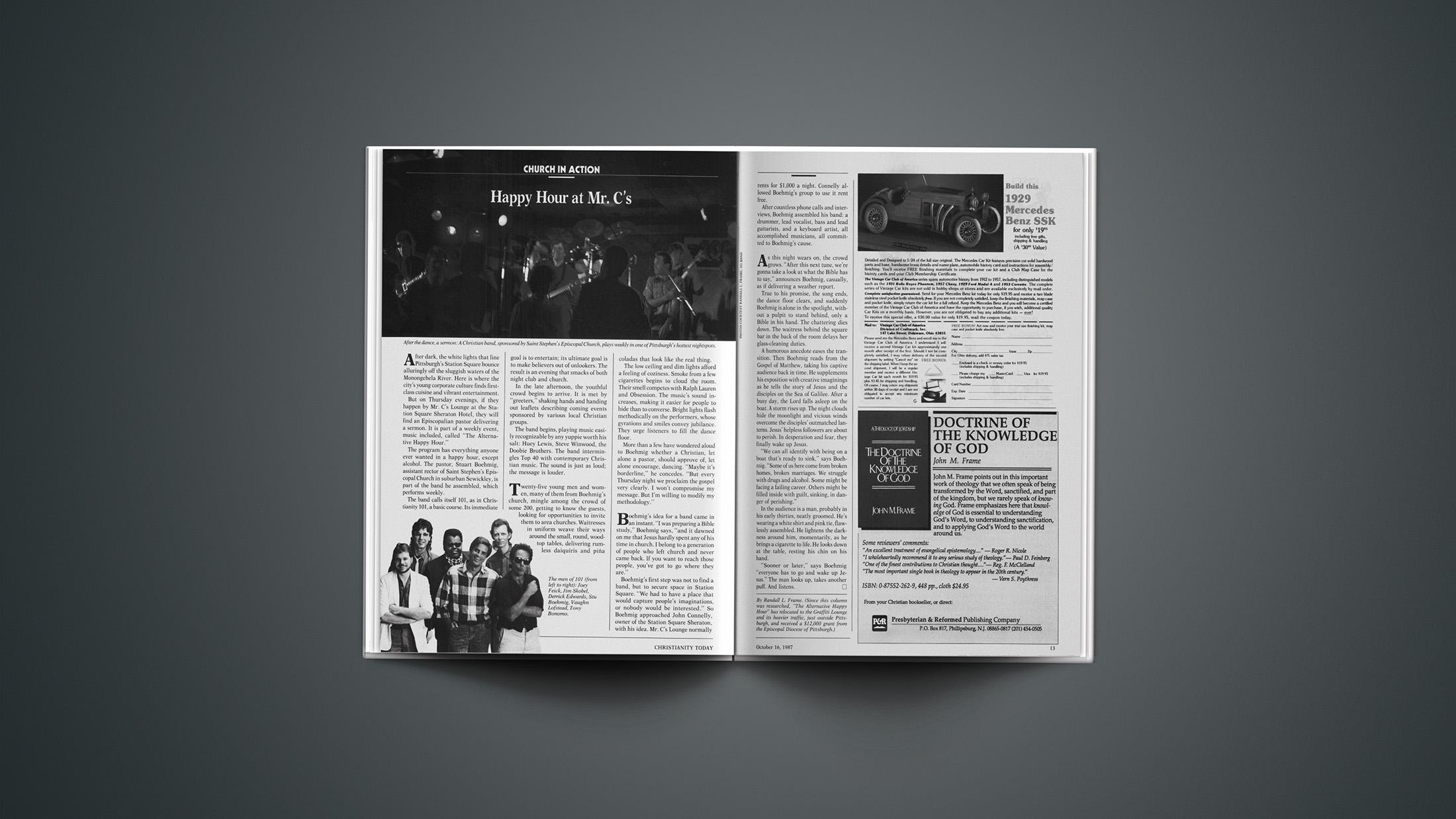
After dark, the white lights that line Pittsburgh’s Station Square bounce alluringly off the sluggish waters of the Monongehela River. Here is where the city’s young corporate culture finds first-class cuisine and vibrant entertainment.
But on Thursday evenings, if they happen by Mr. C’s Lounge at the Station Square Sheraton Hotel, they will find an Episcopalian pastor delivering a sermon. It is part of a weekly event, music included, called “The Alternative Happy Hour.”
The program has everything anyone ever wanted in a happy hour, except alcohol. The pastor, Stuart Boehmig, assistant rector of Saint Stephen’s Episcopal Church in suburban Sewickley, is part of the band he assembled, which performs weekly.
The band calls itself 101, as in Christianity 101, a basic course. Its immediate goal is to entertain; its ultimate goal is to make believers out of onlookers. The result is an evening that smacks of both night club and church.
In the late afternoon, the youthful crowd begins to arrive. It is met by “greeters,” shaking hands and handing out leaflets describing coming events sponsored by various local Christian groups.
The band begins, playing music easily recognizable by any yuppie worth his salt: Huey Lewis, Steve Winwood, the Doobie Brothers. The band intermingles Top 40 with contemporary Christian music. The sound is just as loud; the message is louder.
Twenty-five young men and women, many of them from Boehmig’s church, mingle among the crowd of some 200, getting to know the guests, looking for opportunities to invite them to area churches. Waitresses in uniform weave their ways around the small, round, wood-top tables, delivering rumless daiquiris and piña coladas that look like the real thing.
The low ceiling and dim lights afford a feeling of coziness. Smoke from a few cigarettes begins to cloud the room. Their smell competes with Ralph Lauren and Obsession. The music’s sound increases, making it easier for people to hide than to converse. Bright lights flash methodically on the performers, whose gyrations and smiles convey jubilance. They urge listeners to fill the dance floor.
More than a few have wondered aloud to Boehmig whether a Christian, let alone a pastor, should approve of, let alone encourage, dancing. “Maybe it’s borderline,” he concedes. “But every Thursday night we proclaim the gospel very clearly. I won’t compromise my message. But I’m willing to modify my methodology.”
Boehmig’s idea for a band came in an instant. “I was preparing a Bible study,” Boehmig says, “and it dawned on me that Jesus hardly spent any of his time in church. I belong to a generation of people who left church and never came back. If you want to reach those people, you’ve got to go where they are.”
Boehmig’s first step was not to find a band, but to secure space in Station Square. “We had to have a place that would capture people’s imaginations, or nobody would be interested.” So Boehmig approached John Connelly, owner of the Station Square Sheraton, with his idea. Mr. C’s Lounge normally rents for ,000 a night. Connelly allowed Boehmig’s group to use it rent free.

After countless phone calls and interviews, Boehmig assembled his band: a drummer, lead vocalist, bass and lead guitarists, and a keyboard artist, all accomplished musicians, all committed to Boehmig’s cause.
As this night wears on, the crowd grows. “After this next tune, we’re gonna take a look at what the Bible has to say,” announces Boehmig, casually, as if delivering a weather report.
True to his promise, the song ends, the dance floor clears, and suddenly Boehmig is alone in the spotlight, without a pulpit to stand behind, only a Bible in his hand. The chattering dies down. The waitress behind the square bar in the back of the room delays her glass-cleaning duties.
A humorous anecdote eases the transition. Then Boehmig reads from the Gospel of Matthew, taking his captive audience back in time. He supplements his exposition with creative imaginings as he tells the story of Jesus and the disciples on the Sea of Galilee. After a busy day, the Lord falls asleep on the boat. A storm rises up. The night clouds hide the moonlight and vicious winds overcome the disciples’ outmatched lanterns. Jesus’ helpless followers are about to perish. In desperation and fear, they finally wake up Jesus.
“We can all identify with being on a boat that’s ready to sink,” says Boehmig. “Some of us here come from broken homes, broken marriages. We struggle with drugs and alcohol. Some might be facing a failing career. Others might be filled inside with guilt, sinking, in danger of perishing.”
In the audience is a man, probably in his early thirties, neatly groomed. He’s wearing a white shirt and pink tie, flawlessly assembled. He lightens the darkness around him, momentarily, as he brings a cigarette to life. He looks down at the table, resting his chin on his hand.
“Sooner or later,” says Boehmig “everyone has to go and wake up Jesus.” The man looks up, takes another puff. And listens.

By Randall L. Frame. (Since this column was researched, “The Alternative Happy Hour” has relocated to the Graffiti Lounge and its heavier traffic, just outside Pittsburgh, and received a ,000 grant from the Episcopal Diocese of Pittsburgh.)

Among Americans at large, the Israeli people have a 67 percent favorability rating, up from 64 percent. The Israeli government’s favorability rating increased from 41 to 48 percent. And a narrow majority of Americans now view Palestinians positively (52%, up from 46%), though less so their government (28%, up from 19%). Overall, 2 in 5 Americans view both peoples favorably (42%), but only 1 in 5 favor both governments.

“Americans naturally want to be favorable toward other peoples,” said Mark Tooley, president of the Institute on Religion and Democracy (IRD). “I’m surprised it is not higher.”

Theology may have something to do with the affinity.

In a new question, Pew asked Americans if God gave the land that is now Israel to the Jews. White evangelicals agreed at a rate of 70 percent, while 23 percent were unsure. Overall, 3 in 10 Americans agreed (similar to the response of American Jews in a separate 2020 survey). A significant 41 percent of Americans were unsure, while 17 percent replied they did not believe in God.

Other Christian percentages resemble America. White non-evangelical (often called “mainline”) Protestants (31%), Black Protestants (36%), and Catholics (25%) agreed, all with unsure segments of 50 percent or higher.

IRD aims to champion biblical Christianity in its support for Israel. But even if secular in orientation, Tooley said that many have inherited an unconscious connection with Israel from longstanding American culture. The higher white evangelical rates stem from increased polarization, tying support to their religious identity.

For the average American, politics and age were a better bellwether than denomination. Republican agreement on the role of God (46%) far outpaced Democratic (18%). And while 2 in 5 (38%) of those ages 65 or higher agreed, only 1 in 5 (21%) did so below the age of 30.

Gaps were significant in feelings toward Israel and Palestine as well.

Nearly 4 in 5 Republicans feel favorable toward the Israeli people (78%), compared to 3 in 5 Democrats (60%). Both numbers are slightly higher than in the last survey. And while 2 in 3 Republicans look favorably upon the Israeli government (66%), only 1 in 3 Democrats do similarly (34%), both representing an increase.

The gap reverses when concerning Palestinians, though their favorability increased also. Nearly 2 in 3 Democrats feel favorable toward the Palestinian people (64%, up from 58%). Slightly more than 1 in 3 Republicans agree (37%, up from 32%). The Palestinian government’s ratings are much lower, rising from 27 percent to 37 percent favorability among Democrats and from 11 percent to 18 percent among Republicans.

After dark, the white lights that line Pittsburgh’s Station Square bounce alluringly off the sluggish waters of the Monongehela River. Here is where the city’s young corporate culture finds first-class cuisine and vibrant entertainment.
But on Thursday evenings, if they happen by Mr. C’s Lounge at the Station Square Sheraton Hotel, they will find an Episcopalian pastor delivering a sermon. It is part of a weekly event, music included, called “The Alternative Happy Hour.”
The program has everything anyone ever wanted in a happy hour, except alcohol. The pastor, Stuart Boehmig, assistant rector of Saint Stephen’s Episcopal Church in suburban Sewickley, is part of the band he assembled, which performs weekly.
The band calls itself 101, as in Christianity 101, a basic course. Its immediate goal is to entertain; its ultimate goal is to make believers out of onlookers. The result is an evening that smacks of both night club and church.
In the late afternoon, the youthful crowd begins to arrive. It is met by “greeters,” shaking hands and handing out leaflets describing coming events sponsored by various local Christian groups.
The band begins, playing music easily recognizable by any yuppie worth his salt: Huey Lewis, Steve Winwood, the Doobie Brothers. The band intermingles Top 40 with contemporary Christian music. The sound is just as loud; the message is louder.
Twenty-five young men and women, many of them from Boehmig’s church, mingle among the crowd of some 200, getting to know the guests, looking for opportunities to invite them to area churches. Waitresses in uniform weave their ways around the small, round, wood-top tables, delivering rumless daiquiris and piña coladas that look like the real thing.
The low ceiling and dim lights afford a feeling of coziness. Smoke from a few cigarettes begins to cloud the room. Their smell competes with Ralph Lauren and Obsession. The music’s sound increases, making it easier for people to hide than to converse. Bright lights flash methodically on the performers, whose gyrations and smiles convey jubilance. They urge listeners to fill the dance floor.
More than a few have wondered aloud to Boehmig whether a Christian, let alone a pastor, should approve of, let alone encourage, dancing. “Maybe it’s borderline,” he concedes. “But every Thursday night we proclaim the gospel very clearly. I won’t compromise my message. But I’m willing to modify my methodology.”
Boehmig’s idea for a band came in an instant. “I was preparing a Bible study,” Boehmig says, “and it dawned on me that Jesus hardly spent any of his time in church. I belong to a generation of people who left church and never came back. If you want to reach those people, you’ve got to go where they are.”
Boehmig’s first step was not to find a band, but to secure space in Station Square. “We had to have a place that would capture people’s imaginations, or nobody would be interested.” So Boehmig approached John Connelly, owner of the Station Square Sheraton, with his idea. Mr. C’s Lounge normally rents for ,000 a night. Connelly allowed Boehmig’s group to use it rent free.
After countless phone calls and interviews, Boehmig assembled his band: a drummer, lead vocalist, bass and lead guitarists, and a keyboard artist, all accomplished musicians, all committed to Boehmig’s cause.
As this night wears on, the crowd grows. “After this next tune, we’re gonna take a look at what the Bible has to say,” announces Boehmig, casually, as if delivering a weather report.
True to his promise, the song ends, the dance floor clears, and suddenly Boehmig is alone in the spotlight, without a pulpit to stand behind, only a Bible in his hand. The chattering dies down. The waitress behind the square bar in the back of the room delays her glass-cleaning duties.
A humorous anecdote eases the transition. Then Boehmig reads from the Gospel of Matthew, taking his captive audience back in time. He supplements his exposition with creative imaginings as he tells the story of Jesus and the disciples on the Sea of Galilee. After a busy day, the Lord falls asleep on the boat. A storm rises up. The night clouds hide the moonlight and vicious winds overcome the disciples’ outmatched lanterns. Jesus’ helpless followers are about to perish. In desperation and fear, they finally wake up Jesus.
“We can all identify with being on a boat that’s ready to sink,” says Boehmig. “Some of us here come from broken homes, broken marriages. We struggle with drugs and alcohol. Some might be facing a failing career. Others might be filled inside with guilt, sinking, in danger of perishing.”
In the audience is a man, probably in his early thirties, neatly groomed. He’s wearing a white shirt and pink tie, flawlessly assembled. He lightens the darkness around him, momentarily, as he brings a cigarette to life. He looks down at the table, resting his chin on his hand.
“Sooner or later,” says Boehmig “everyone has to go and wake up Jesus.” The man looks up, takes another puff. And listens.

By Randall L. Frame. (Since this column was researched, “The Alternative Happy Hour” has relocated to the Graffiti Lounge and its heavier traffic, just outside Pittsburgh, and received a ,000 grant from the Episcopal Diocese of Pittsburgh.)

“Leaders in both countries specialized in the rhetoric of division,” said Todd Deatherage, executive director of Telos. “It has cemented a complex foreign policy challenge into a growing list of issues that polarize us on a partisan basis.”

Founder of an evangelical group dedicated to changing the narrative on Israel, he appreciates the rising number of Americans who wish to see both peoples flourishing.

But it is the young, he said, who “take seriously Jesus’ call to be peacemakers.”

Pew found that among Americans ages 30 and below, 61 percent feel favorable toward the Palestinian people while 56 percent feel favorable toward Israelis. This is the only category that did not rise, as three years ago 63 percent felt favorable toward Israelis, compared to 58 percent toward the Palestinians. The Palestinian government is now narrowly preferred also (35% vs. 34%), though both reputations increased (up from 26% vs. 27%) after the changes in leadership.

Older Americans, however, resemble Republicans and white evangelicals concerning Israel, with 78 percent favoring the Jewish state. Only a single-point rise from the Trump-Netanyahu years, their opinion of Israel’s government increased from 57 to 64 percent. Toward the Palestinian people, their rating rose from 43 to 47 percent, while their view of the Palestinian government increased from 19 to 24 percent.

It was the kind of afternoon camp counselors dread. The rain had been falling, heavy and steady, for two days. The leaden clouds hovered near the treetops and seemed to promise that the cold, penetrating downpour would continue for yet another day.
Inside the main lodge an epidemic of cabin fever had broken out. On the first day of rain, there were crafts to work on and a standby ration of wet-weather cartoon films to watch. The second day of rain was passed with group games and a rerun of the cartoons.
But when the rains continued unabated on the third day, the campers were in no mood for cartoons, or crafts, or games. They demanded fresh entertainments.
How relieved and pleased the counselors were when a camp visitor, a high-ranking officer in an elite law-enforcement agency, volunteered his services. He offered to give the campers a demonstration of weapons, police tactics, and some self-defense procedures. The assembled campers seemed spellbound as they learned how the nightstick and Mace are used. They took turns snapping handcuffs on one another. And they listened attentively to the lecture on the dangers of firearms. As a finale, this modern-day Elliott Ness showed the campers how best to deal with muggers and stickup men.
Calling a young camper to the platform, he described a fast self-defense action by which one could evade, disarm, and subdue any would-be stickup man who might poke a pistol into your back. The maneuver, he explained, consisted of a quick step to the left, accompanied by a rapid thrust of the right elbow backward and downward to knock away the assailant’s revolver. The gun, he promised, would be stripped from the gunman’s hand or, at worst, discharge harmlessly into the ground. It all seemed so simple.
With the help of the camper who had now joined him on stage, the lawman proceeded to demonstrate. He armed the camper with a large water pistol. Then assuming the role of the victim, he instructed the camper to approach him from behind and attempt the stickup.
Gun in hand, the would-be robber struck, jabbing the barrel into the victim’s back. The bold hero lunged to his left, swung back his right elbow fiercely—and was shot squarely in the back by the junior gunman. The huge, running, water spot between his shoulder blades was clear evidence of the failure of his supposedly safe maneuver.
Red-faced and fumbling for words, the lawman scolded the junior gunman, “You’re supposed to hold the gun in your right hand!” But the left-handed robber was not impressed. Scrambling for some lesson to leave as he beat his retreat, the lawman said, “Well, be sure to watch out for left-handed stickup men.”
Every now and then that “lesson” comes back to me, because it is a good one. I can, for example, deal successfully with temptations from the usual and expected sources—from the right-hand side. But it is when I become too confident that I get gunned down from the left—any blind side, really—by the sin and failures I least anticipate. To make matters worse, Satan is ambidextrous, always ready to attack from either side. And so the price of moral growth is perpetual vigilance.
Over the past months all of us in positions of Christian leadership have been made more aware that we possess no special immunity from moral and spiritual failure. There is a left-handed stickup man lying in wait for each one of us.
I have learned I can improve my defenses greatly by joining myself to partners ready to warn me about dangers on my blind side and shield me with their prayers. I must be willing to accept their warnings, corrections, and encouragements as I seek to become the person God intends me to be. Paul reminded his Thessalonian friends that he had expressed his love for them by holding them accountable to live lives worthy of the God who called them.
My friends, we—I—need you to help fend off the stickup men by holding me accountable to live a life worthy of the God who has called me.
GEORGE K. BRUSHABER

Gary Burge, professor of New Testament at Calvin Theological Seminary, notes a clear distinction.

“Younger evangelicals see social and political justice as central to their faith,” said the author of Whose Land? Whose Promise? What Christians Are Not Being Told About Israel and the Palestinians. “Older evangelicals do not.”

Burge, like Deatherage, finds hope that this divide—mirrored also in US politics—is narrowing in the overall favor Americans show both peoples. Evidence can be found in the other denominations.

White Protestants and Catholics are similar, with 7 out of 10 feeling favorable toward the Israeli people and 5 out of 10 feeling favorable toward their government.

About half of White Protestants and Catholics feel favorable toward the Palestinian people (47% and 50%, respectively), while only about a quarter feel favorable toward their government (21% and 27%, respectively).

Meanwhile, Black Protestants and the religiously unaffiliated equated the two sides.

A majority of both feel favorable toward the peoples. Among Black Protestants, favor toward Israelis at 58 percent, and favor toward Palestinians is at 53 percent. Among the unaffiliated, favor toward Israelis is at 58 percent and favor toward Palestinians is at 59 percent.

They felt less inclined toward the governments. Black Protestants favored Israel’s at 43 percent and Palestine’s at 38 percent. The unaffiliated rated Israel’s government at 31 percent and Palestine’s at 33 percent.

Tooley attributed the rise in Black support for Israel to the decline of their traditional church and the rise in Pentecostal and nondenominational faith. The latter tend slightly toward Zionism.

Affinity toward the Palestinians comes from two sources, said Mordecai Inbari, professor of philosophy and religion at UNC–Pembroke. The Black Lives Matter narrative is anti-Israeli, said the Jewish scholar. But geopolitics also matters.

“Warmer feelings toward Muslims correlate with sympathy toward Palestinians,” he said, having conducted extensive research on evangelicals and Christian Zionism. “With the end of the wars in the Middle East, these two are increasingly connected.”

Tooley also cited a changing regional dynamic. As Arab nations normalize with Israel, the Holy Land is overshadowed by other conflicts. Americans correspondingly give it less attention, and can warm toward both.

Gerald McDermott believes the warmth is not always justified.

“This can only be from inattention to hard news about the Palestinian governments,” said the author of Israel Matters and editor of The New Christian Zionism. “Hamas and the Palestinian Authority imprison citizens who dare to criticize them.”

McDermott also spoke of incitement against Israelis, and the diversion of funds away from local development in favor of rocket launchers. And his displeasure was particularly directed toward the “specious claims” of activists reflected in a new survey question about the boycott, divestment, and sanctions (BDS) movement.

Launched in 2005, its supporters allege mistreatment of Palestinians in a system of apartheid, and call for an international pressure campaign against the Israeli government. Some of its critics call BDS antisemitic, for denying legitimacy to a Jewish state.

“Muslims have many nations in the Middle East and elsewhere,” said McDermott. “Why are Jews not permitted to have one?”

Overall, few Americans have heard about the BDS movement (no more than 1 in 5 across demographic groups). But atheists are twice as likely to support it (13% vs. 5%), while evangelicals and Republicans are twice as likely to oppose it (11% and 12%, respectively, vs. 6%). While BDS is best known for activity on college campuses, only 17 percent of those under the age of 30 have heard about it; 8 percent support, while 4 percent oppose.

Tooley said BDS has “largely failed.” Ignorance of it, said Inbari, is for the best.

It was the kind of afternoon camp counselors dread. The rain had been falling, heavy and steady, for two days. The leaden clouds hovered near the treetops and seemed to promise that the cold, penetrating downpour would continue for yet another day.
Inside the main lodge an epidemic of cabin fever had broken out. On the first day of rain, there were crafts to work on and a standby ration of wet-weather cartoon films to watch. The second day of rain was passed with group games and a rerun of the cartoons.
But when the rains continued unabated on the third day, the campers were in no mood for cartoons, or crafts, or games. They demanded fresh entertainments.
How relieved and pleased the counselors were when a camp visitor, a high-ranking officer in an elite law-enforcement agency, volunteered his services. He offered to give the campers a demonstration of weapons, police tactics, and some self-defense procedures. The assembled campers seemed spellbound as they learned how the nightstick and Mace are used. They took turns snapping handcuffs on one another. And they listened attentively to the lecture on the dangers of firearms. As a finale, this modern-day Elliott Ness showed the campers how best to deal with muggers and stickup men.
Calling a young camper to the platform, he described a fast self-defense action by which one could evade, disarm, and subdue any would-be stickup man who might poke a pistol into your back. The maneuver, he explained, consisted of a quick step to the left, accompanied by a rapid thrust of the right elbow backward and downward to knock away the assailant’s revolver. The gun, he promised, would be stripped from the gunman’s hand or, at worst, discharge harmlessly into the ground. It all seemed so simple.
With the help of the camper who had now joined him on stage, the lawman proceeded to demonstrate. He armed the camper with a large water pistol. Then assuming the role of the victim, he instructed the camper to approach him from behind and attempt the stickup.
Gun in hand, the would-be robber struck, jabbing the barrel into the victim’s back. The bold hero lunged to his left, swung back his right elbow fiercely—and was shot squarely in the back by the junior gunman. The huge, running, water spot between his shoulder blades was clear evidence of the failure of his supposedly safe maneuver.
Red-faced and fumbling for words, the lawman scolded the junior gunman, “You’re supposed to hold the gun in your right hand!” But the left-handed robber was not impressed. Scrambling for some lesson to leave as he beat his retreat, the lawman said, “Well, be sure to watch out for left-handed stickup men.”
Every now and then that “lesson” comes back to me, because it is a good one. I can, for example, deal successfully with temptations from the usual and expected sources—from the right-hand side. But it is when I become too confident that I get gunned down from the left—any blind side, really—by the sin and failures I least anticipate. To make matters worse, Satan is ambidextrous, always ready to attack from either side. And so the price of moral growth is perpetual vigilance.
Over the past months all of us in positions of Christian leadership have been made more aware that we possess no special immunity from moral and spiritual failure. There is a left-handed stickup man lying in wait for each one of us.
I have learned I can improve my defenses greatly by joining myself to partners ready to warn me about dangers on my blind side and shield me with their prayers. I must be willing to accept their warnings, corrections, and encouragements as I seek to become the person God intends me to be. Paul reminded his Thessalonian friends that he had expressed his love for them by holding them accountable to live lives worthy of the God who called them.
My friends, we—I—need you to help fend off the stickup men by holding me accountable to live a life worthy of the God who has called me.
GEORGE K. BRUSHABER

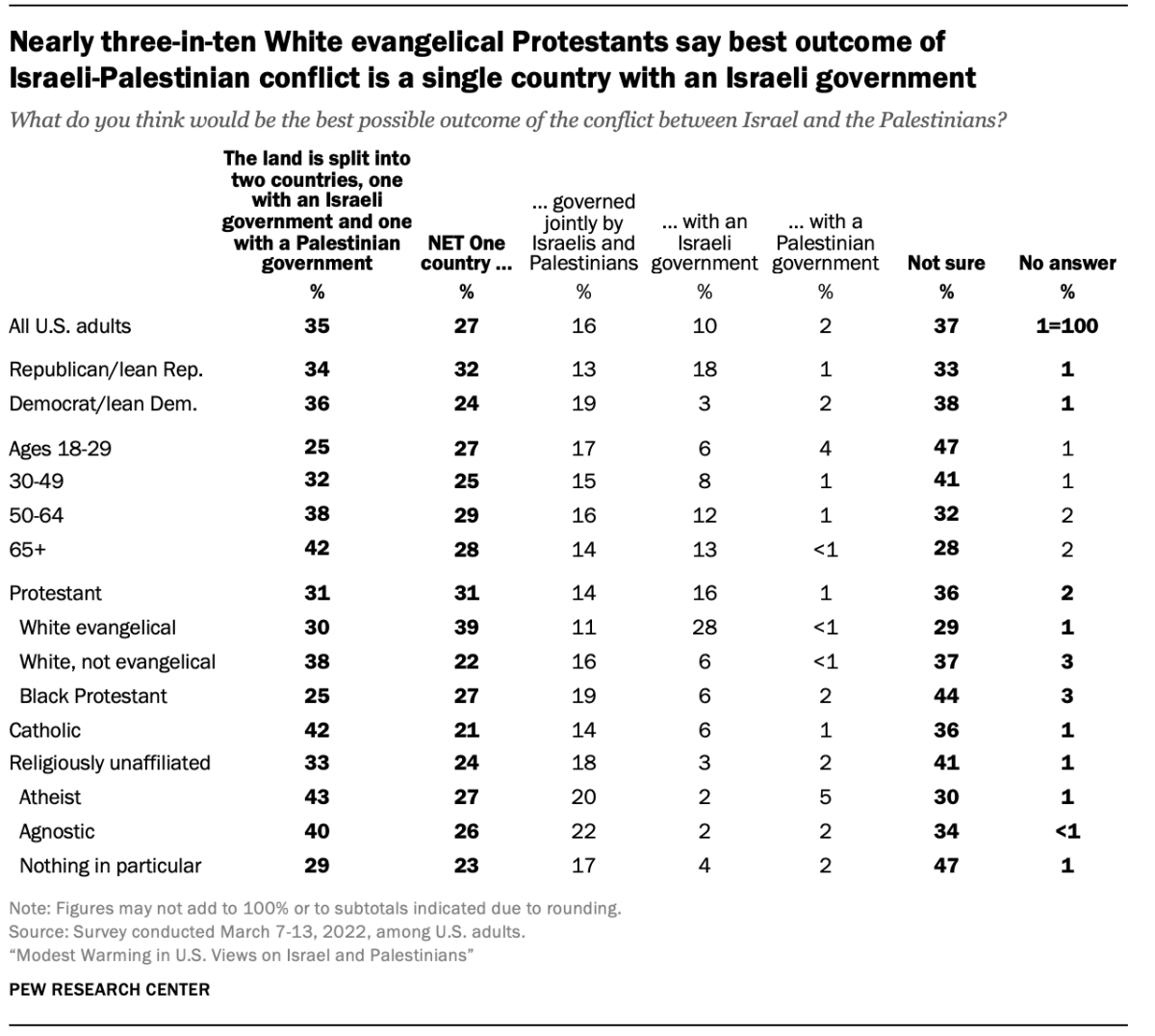
There are clearer opinions about the best possible outcome for the conflict between Israel and Palestine—but also significant uncertainty. Between a quarter (ages 65 and above, 28%) and a half (ages 30 and under, 47%) of Americans are “not sure” if a one-state or two-state solution would be better.

“Who can blame them?” said Tooley. “It’s very complex.” Inbari thinks most people do not bother to study the issues, as the policy issues are not tied to their religious identity.

If so, this is least true of white evangelicals. This group of respondents was among the most sure, with 4 in 10 favoring a one-state solution (39%), and 3 in 10 believing it should have an Israeli government (28%). While few Americans believe that the one-state should be governed by Palestinians, 2 out of 10 Democrats (19%), Black Protestants (19%), and the unaffiliated (18%) believe it should be governed jointly.

Apart from white evangelicals, Black Protestants, and those under 30, all other segments preferred the traditional US policy of support for a two-state solution. Highest were the 4 in 10 atheists (43%), Catholics (42%), ages 65 and older (42%), agnostics (40%), and white Protestants (38%) who believe each people should govern themselves.

Pew surveyed 10,144 Americans in March. It characterized the findings as a “modest warming” toward both Israel and Palestine.

Deatherage called it a rejection of zero-sum activism. And Inbari, the Tar Heel professor, appreciated that Pew did not make respondents pick between them.

“People can like both sides,” he said. “It is possible to support both UNC and Duke.”

News

Why a Presbyterian Elder Defended Muslims Building a Mosque in Middle Tennessee

Q&A with First Amendment champion Eric Treene on religious freedom, land use, and how the Westminster Confession contributed to his work at the Department of Justice.

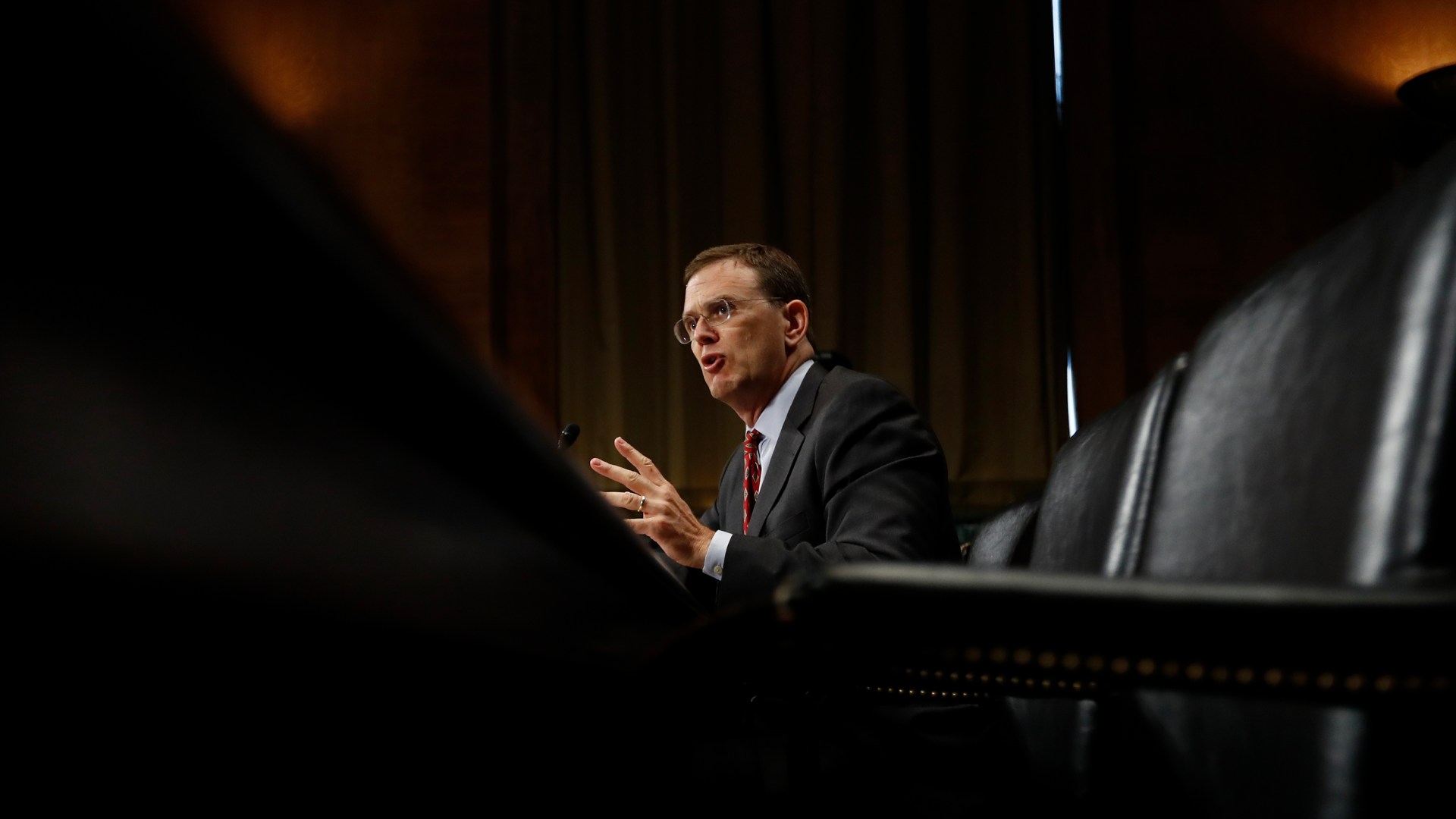
Eric Treene testifies at a US Senate Judiciary Committee hearing on religious hate crimes in 2017.

Eric Treene testifies at a US Senate Judiciary Committee hearing on religious hate crimes in 2017.

Christianity Today June 9, 2022
Carolyn Kaster / AP Images

Eric Treene has gone to court to defend Jews, Jehovah’s Witnesses, Muslims, and people from other minority faiths for more than 25 years. If you ask him why, he points to the Bible and the Westminster Confession. Treene, an elder in the Presbyterian Church in America, is motivated by his faith to defend religious freedom—especially the freedom of those he disagrees with.

Treene was a lawyer for Becket and then, for nearly 20 years, special counsel for religious discrimination in the civil rights division of the United States Department of Justice. He developed and oversaw the enforcement program for the Religious Land Use and Institutionalized Persons Act (RLUIPA). Since leaving the federal government, Treene has taught the First Amendment at Reformed Theological Seminary and Catholic University and continues to litigate discrimination cases as a senior partner at Storzer and Associates in Washington, DC. This spring, Treene was honored by the Freedom Forum as a “champion of free expression.”

He spoke to CT about the problem of religious discrimination in America and why it’s so important that Christians advocate for religious freedom.

You’ve spent a lot of your career defending religious land use. Why do government officials in America today oppose religious land use?

Usually it’s because they’re zeroed in on developing commerce. A lot of what you see is the demands of the marketplace steamrolling religion.

One of my early cases, for example, was a church that had very carefully gathered several plots of land at a key intersection, but the town wanted Costco to have that spot. The town tried to use eminent domain to seize the property to build a Costco.

Is it because they hate churches? No. Again and again, what we see is discrimination against places of worship not so much out of animus but because they would rather have a commercial property that’s generating tax revenue.

There’s a very powerful economic engine in our society that often trivializes faith. The Religious Land Use and Institutionalized Persons Act (RLUIPA) is one way churches can push back against that.

One of the most famous land use cases you worked on was a mosque in Murfreesboro, Tennessee.

Yes. Sometimes the issue is animus.

In the first 10 years after 9/11, we saw a significant increase in hate crime. Attacks on the street, vandalism of mosques, and so forth. But starting around 2010, we saw something else: a sharp increase in opposition to the construction of mosques or Muslim schools. I think maybe it happened then because Muslims laid low for several years after 9/11, but their communities were expanding and needed more space, needed to build.

In Murfreesboro, that was a very interesting case.

There was a lot of rhetoric like “Where are these people coming from?” when in fact, they were professors from Middle Tennessee State, local professionals, businessmen, people like that who’d been renting space for their mosque for 20 years. They had put down roots. They bought some land and sought to build.

The town approved it. But it caught the attention of some residents and others in nearby counties who were concerned. That caught national attention, and it got spun so people were saying this was a group that wanted to radicalize Middle Tennessee. There was some crazy stuff. They had plans for a pool, and there was rhetoric like, “Is this pool for underwater demolition training?” Crazy stuff.

And there was vandalism. Someone firebombed a front-end loader.

An elected state judge ruled the mosque had been improperly approved. Because this wasn’t a normal place of worship, it required a different a procedure. We said, “No, you have to treat them like any place of worship; there’s no reason to do anything different here, under RLUIPA.” The federal court sided with us, and county officials were ordered to ignore the state judge.

As a Christian, did you find it hard to explain to Christians why you were defending Muslims’ right to build a mosque?

Sometimes. I do think, as Christians, we should think about why we believe in religious liberty. Is it just to benefit Christians? Is it just because it’s in the Constitution? Or is it something more fundamental?

I think, as Christians, it goes much deeper.

If you go to Scripture, so much of Scripture is “If you believe.” Again and again there’s an emphasis on belief and there’s an idea that authentic faith requires belief. It’s not enough to have the government forcing people. You can’t be saved by living in a righteous kingdom. People have to be free to believe.

I go by the Westminster Confession: “God alone is lord of conscience and has left it free from the doctrines and commandments of men.”

But the problem of Islam in America really challenged even advocates of religious freedom. There were many defenders who, when it came to Muslims, said, “Well I can go this far and no further.”

When did you first get interested in the problem of religious discrimination?

In my second year of law school at Harvard. We had 150 people in my constitutional law class, and we discussed free speech, and my classmates were leaning forward in their seats. Very energized, excited, debating. But when it came to freedom of religion, I felt everyone sitting back.

There was one case we discussed involving Native American rights—it was a case with sacred land and a logging road that would go straight through the land, and the question was, Does the government have to give any reasons for why the road goes there instead of, you know, two miles to the west? The court said no, but Justice William J. Brennan wrote an impassioned dissent. He was a hero in the free speech cases. But when it came to religion, I found myself the lone person in the class defending Brennan.

Many people are willing to go to great lengths to make sure that free speech can flourish but were not willing to require the government to incur any costs to make room for religion. After that, I was very interested.

When the opportunity came, I joined Becket and then, when the George W. Bush administration created a special counsel for religious discrimination in the Department of Justice, that’s the position I applied for and filled for 19 years.

You served under four presidents. Did the job change much from administration to administration?

Not much, no. When the Obama administration came in, for example, I was told to keep working on religious land use cases, and we did just as many evangelical cases as we did in the Bush administration.

It changes on the margin, where you’re putting in friend-of-the-court briefs. But the focus of the work didn’t change.

As you’ve watched religious liberty cases over the years, have you noticed changes? Does the shape of the conflict pretty much remain the same, or has it morphed over the years you’ve been involved?

We’ve really moved away from the idea that religion in the public square should be oil and water. I’m encouraged by that.

But there are still issues. Right now I’m representing a lot of Orthodox Jews. They face a lot of bias. Hate crimes against Jews have always been cause for concern.

With evangelicals, it’s mostly this commercial preference that leads to bias, not hostility. The one exception is where evangelical belief conflicts with deeply held secular beliefs, which is where you get conflict with LGBT equality. I think the issue of finding an understanding on LGBT rights and religious liberty is critical.

People are tolerant of religious views generally, but when they interfere with deeply held secular values, people say, “Enough is enough” and “You cannot have access.”

But religious liberty means you have to create space for people to be in error—which is fully biblical, by the way. Even when somebody is wrong, you need to love them and listen to them and have humility. The law creates that space so people can follow their conscience.

News
Wire Story

Mexican Megachurch Compares Pastor Jailed for Sex Abuse to the Apostle Paul

UPDATE: The leader of La Luz del Mundo was sentenced to 17 years for sexual offenses against minors he groomed in the congregation.

Christianity Today June 8, 2022
Al Seib / Los Angeles Times via AP

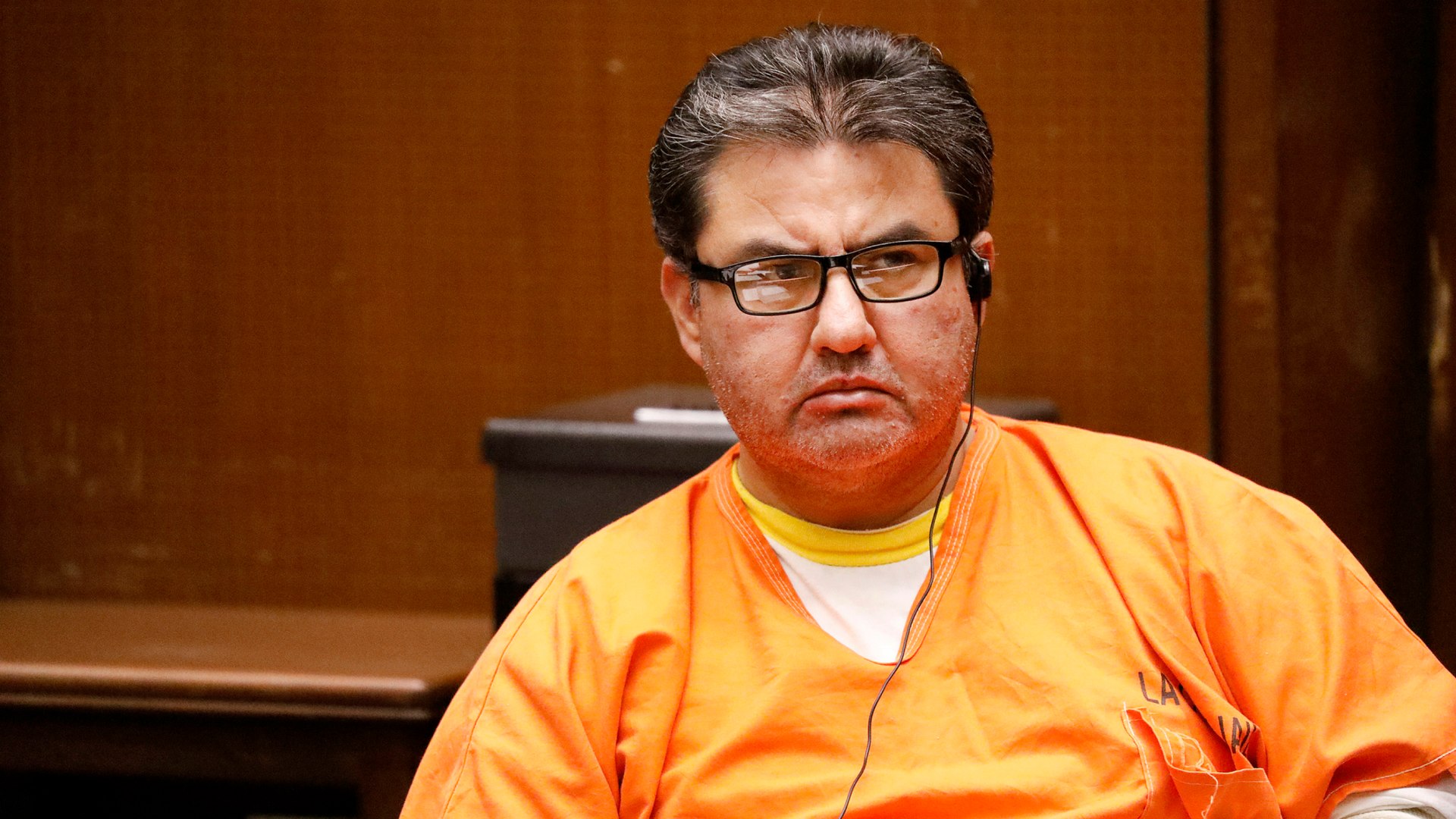
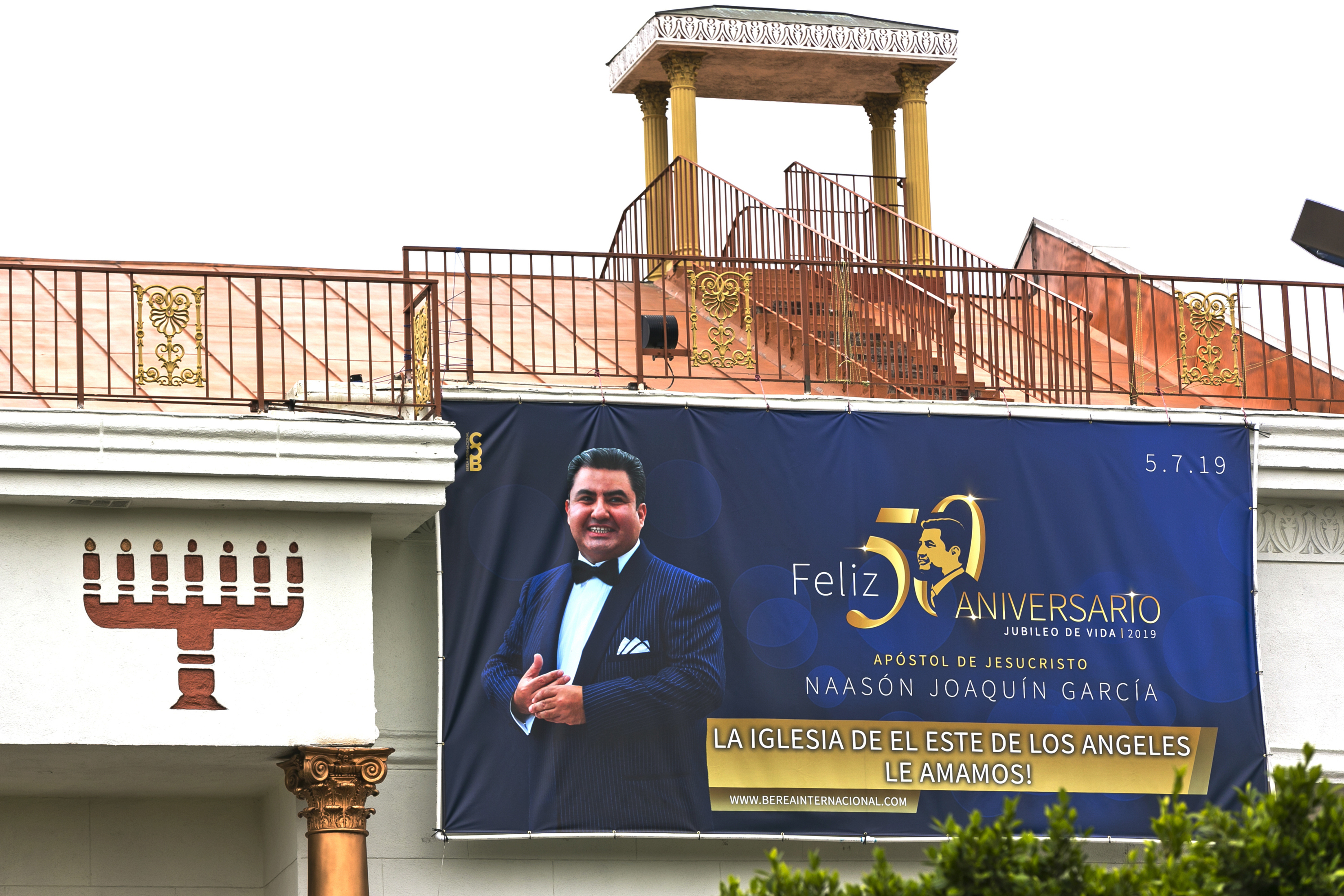
Update (June 8): As a county judge in California deemed pastor Naasón Joaquín García a “sexual predator” and sentenced him to nearly 17 years in prison on Wednesday, members of his congregation in Mexico gathered to pray and stand with their “apostle,” the Los Angeles Times reported.

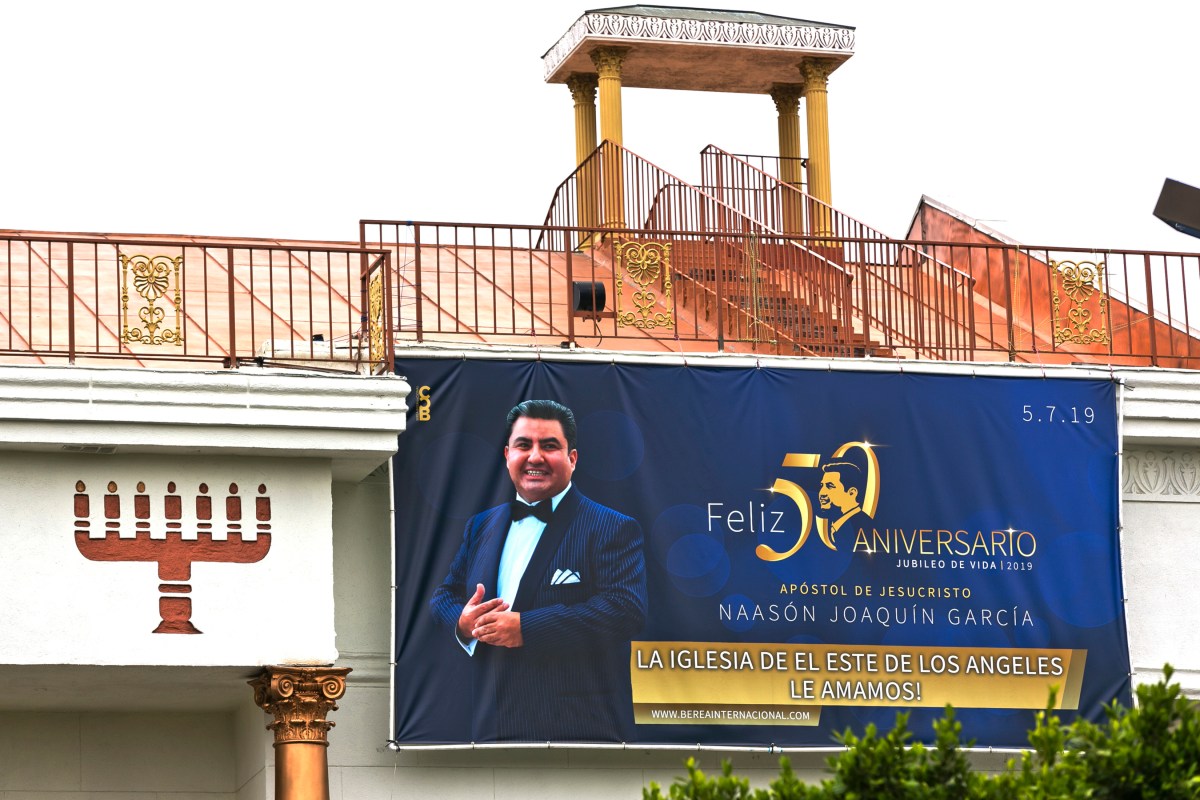
The pastor of the Guadalajara-based megachurch La Luz del Mundo admitted last week to three charges of sexual offenses toward children. His followers believe he entered the plea deal to avoid an unjust trial. They have dismissed the allegations that he groomed underage girls in the congregation for sex abuse.

A statement from La Luz del Mundo, Mexico’s largest evangelical congregation, said García “will continue ministering to the church. This is a path that God has placed in front of him for a reason, as he did for Apostle Paul.”

Three victims anonymously shared statements at García’s sentencing, with one describing how she functioned as a sex slave for the pastor and had been taught not to “refuse his desires.”

According to the Associated Press:

The victims spoke of how their delight at being invited into a secret inner circle with García quickly spun into an out-of-control nightmare of rape and other sexual abuse that they described at times in graphic detail.

They said they were called angels and told they were García’s property and that his wishes were godly commands and they should serve the Lord without question. Bible verses were twisted to make them comply.

But they were also told they would damned if they spoke out—and so would anybody they told.

All were disappointed that prosecutors were unable to take the case to trial so García could face the additional charges, which included rape, trafficking, and producing child abuse material.

García was sentenced to 16 years and 8 months in prison and will be required to register as a sex offender for life.

—————

Update (June 6, 2022): The head of the Mexico-based megachurch La Luz del Mundo admitted to sexually assaulting at least three minor girls who belonged to his congregation.

Naasón Joaquín García pleaded guilty Friday and was convicted following California’s four-year investigation into the pastor and his associates. The guity plea came just days before the case was scheduled to go to trial.

“As the leader of La Luz del Mundo, Naasón Joaquín García used his power to take advantage of children. He relied on those around him to groom congregants for the purposes of sexual assault,” said California Attorney General Rob Bonta. “Today’s conviction can never undo the harm, but it will help protect future generations.”

The pastor ended up convicted of three counts of sex offenses and lewd acts involving minor children. García’s former assistant, Susana Medina Oaxaca, also pleaded guilty and was convicted of assault likely to cause great bodily injury.

Some victims say García’s plea deal allows the self-proclaimed apostle to evade the full weight of his crimes. He pleaded guilty for three counts but had been charged with over a dozen more, including rape, trafficking, and extortion. He now no longer has to stand trial.

“How can they make a deal with a child rapist and human trafficker?” whistleblower Sochil Martin said in the Spanish-language newspaper El País. “Give us peace, not an agreement.”

According to the California Department of Justice, “Over the course of the investigation and prosecution, prosecutors demonstrated that García’s criminal conduct was enabled by the individuals surrounding him and that García used his position of trust and authority as the leader of La Luz del Mundo to sexually abuse children.” – CT editors

——-

July 31, 2020: California has once again charged the leader of a Mexican megachurch with child rape and human trafficking, months after a court dismissed the previous allegations because of prosecution errors.

Naasón Joaquín García, the self-proclaimed apostle of La Luz del Mundo, was charged on Wednesday with three dozen felony counts.

Also charged were Susana Medina Oaxaca and Alondra Ocampo.

Prosecutors contend the three committed sex crimes and also produced child pornography involving five women and girls who were church group members. The crimes took place between 2015 and 2018 in Los Angeles County, authorities said.

García is the spiritual leader of La Luz del Mundo, which is Spanish for “The Light Of The World,” an evangelical congregation based in Guadalajara, Mexico.

García and Ocampo already were being held in custody in Los Angeles County while prosecutors decided whether to refile charges. He was rebooked on $50 million bail and Ocampo was booked on $25 million bail, while Oaxaca remained free on bail, according to the California attorney general’s office.

Messages to their attorneys seeking comment weren’t immediately returned but García has previously denied wrongdoing.

——–

April 9, 2020, from the Associated Press: A California appeals court ordered the dismissal of a criminal case Tuesday against a Mexican megachurch leader on charges of child rape and human trafficking on procedural grounds.

Naasón Joaquín García, the self-proclaimed apostle of La Luz del Mundo, has been in custody since June following his arrest on accusations involving three girls and one woman between 2015 and 2018 in Los Angeles County. Additional allegations of the possession of child pornography in 2019 were later added. He has denied wrongdoing.

While being held without bail in Los Angeles, García has remained the spiritual leader of La Luz del Mundo, which is Spanish for “The Light of The World.” The Guadalajara, Mexico-based church was founded by his grandfather and claims 5 million followers worldwide.

It was not clear when he would be released.

The attorney general’s office said it was reviewing the court’s ruling and did not answer additional questions.

García’s attorney, Alan Jackson, said he and his client are “thrilled” by the decision.

“In their zeal to secure a conviction at any cost, the Attorney General has sought to strip Mr. Garcia of his freedom without due process by locking him up without bail on the basis of unsubstantiated accusations by unnamed accusers and by denying him his day in court,” Jackson said in a statement.

Damian Dovarganes / AP

La Luz del Mundo officials in a statement urged their followers to remain respectful and pray for authorities.

“(W)e are not to point fingers or accuse anyone, we must practice the Christian values that identify us, such as patience, prudence, respect, and love of God,” they said.

The appeals court ruling states that the Los Angeles County Superior Court must dismiss the 29 counts of felony charges that range from human trafficking and production of child pornography to forcible rape of a minor.

The appeals court ruled that because García’s preliminary hearing was not held in a timely manner and he did not waive his right to one, the complaint filed against him must be dismissed.

In June, García was arraigned on 26 counts and waived his right to a speedy preliminary hearing—a common move. The following month, he was arraigned on an amended complaint that included three additional charges of possession of child pornography. That time, he did not waive the time limits for a preliminary hearing.

His hearing was postponed several times—in some instances, because prosecutors had not turned over evidence to the defense—as he remained held without bail, prompting his attorneys to file an appeal.

The appeals court ruled that a preliminary hearing on an amended complaint for an in-custody defendant must be held within 10 days of the second arraignment—unless the defendant waives the 10-day time period or there is “good cause” for the delay.

The appeal only mentioned the dismissal of García’s case and not those of his co-defendants, Susana Medina Oaxaca and Alondra Ocampo. A fourth defendant, Azalea Rangel Melendez, remains at large.

It was not immediately clear if the co-defendants’ cases would also be tossed.

In February, a Southern California woman filed a federal lawsuit against the church and García. In it, she said García, 50, and his father sexually abused her for 18 years starting when she was 12, manipulating Bible passages to convince her the mistreatment actually was a gift from God.

The lawsuit will continue despite the dismissal, the woman’s lawyers said Tuesday in a statement.

The dismissal is the latest in a series of blunders on this high-profile case for the attorney general’s office.

Attorney General Xavier Becerra himself pleaded with additional victims to come forward—a move defense attorneys said could taint a jury pool.

“It would be hard to believe that, based on the information that we’re collecting, that it’s only these four individuals,” Becerra said in June, repeatedly calling García “sick” and “demented.”

Prosecutors Amanda Plisner and Diana Callaghan also said multiple times in court that they expected to file additional charges based on more victims as the case continued to be investigated. But ultimately they only added three counts of possession of child pornography to the original complaint.

Plisner and Callaghan were additionally sanctioned by a Superior Court judge in September, who said they had violated a court order in failing to give defense lawyers evidence. The judge later rescinded the sanctions and overturned $10,000 in fines she had levied.

News
Wire Story

Half of Americans Rule Out Pentecostal Churches

Survey finds nondenominational churches have the least baggage in people’s minds.

Christianity Today June 7, 2022
Wendell and Carolyn / iStock / Getty Images

Most Americans are open to a variety of denominations of Christian churches, including many people of other faiths or no faith at all.

Americans have a wide range of opinions and impressions about Christian denominations, but most won’t rule out a church based on its denomination, according to a new study from Lifeway Research. From a list of nine denominational terms— Assemblies of God, Baptist, Catholic, Lutheran, Methodist, Pentecostal, Presbyterian, Southern Baptist, and nondenominational—more Americans rule out Pentecostal than any other denomination. Just over half of Americans (51%) say a church with Pentecostal in the name is not for them.

But for each of the other denominations in the study, most Americans say a specific religious label in the name of a church is not an automatic deterrent for them. Americans are most open to nondenominational and Baptist churches.

One in three (33%) say a church described as nondenominational is not for them, while 43 percent say the same about a church with Baptist in the name. A 2014 phone survey from Lifeway Research also found Baptist and nondenominational churches among those Americans were most open to and Pentecostal the denominational group they were least open to.

“Church names vary greatly,” said Scott McConnell, executive director of Lifeway Research. “Names including St. Peter, Trinity, Crossroads, and Presbyterian reflect biblical people, theology, modern imagery, or references to the branch of Christianity the church is tied to. Most people have preexisting impressions of denominational groups when they see them in a church name or description.”

https://datawrapper.dwcdn.net/TDGcM

Americans have more favorable than unfavorable impressions of most denominations, whether they would personally attend a church of that denomination or not. More Americans have favorable impressions of Baptist churches (61%) than any other Christian denomination.

But Baptist churches are not alone in giving generally favorable impressions. Most Americans think favorably of every denomination in this study except for Pentecostal (47%) and Assemblies of God (43%) churches. Still, more people have favorable than unfavorable impressions of Pentecostal and Assemblies of God churches.

Understanding different denominations

For each denominational group studied, 11 percent to 32 percent of Americans say they are not familiar enough with that denomination to form an opinion. This response is often more common than unfavorable responses and may indicate many don’t understand denominational differences.

Fewer people have favorable impressions of Assemblies of God churches than any other denomination, but more Americans are unfamiliar with this denomination than any other. Whereas 1 in 10 (11%) Americans say they’re not familiar with Catholic churches, nearly 1 in 3 (32%) are not familiar with Assemblies of God churches, the smallest denomination directly asked about in the study.

The reputation of denominational groups may be tied to what someone knows about that group’s doctrine, but it also can be the sum of people’s impressions of local churches in those groups. — @smcconn

“The reputation of denominational groups may be tied to what someone knows about that group’s doctrine, but it also can be the sum of people’s impressions of local churches in those groups,” McConnell said. “Personal experiences with local churches, word-of-mouth, and whether they see them serving in their communities can lead people to have positive or negative impressions of those groups.”

Protestants tend toward Baptist and nondenominational churches

Most Protestants are open to attending a nondenominational church. Protestants are least likely to assume a church is not for them if the description nondenominational is used for the church (21%). And Protestants are most likely to have favorable impressions of Baptist (76%) and nondenominational (69%) churches.

Infrequent churchgoers are also generally open to nondenominational churches, as well as Presbyterian and Lutheran churches. Christians who attend a worship service less than once a month are least likely to say they assume a church is not for them when they see Presbyterian (36%), Lutheran (37%), or nondenominational (22%) in the name of a church.

Similarly, Christians who attend church infrequently are less familiar with the Protestant religious groups. Almost 4 in 10 Christians who attend less than once a month are not familiar with Assemblies of God (38%), more than a quarter are not sure about Lutheran and nondenominational churches (27%) and a quarter are unfamiliar with Pentecostal (25%), Presbyterian (25%), and Southern Baptist (25%). Christians who attend worship services less than once a month are least likely to say they have unfavorable impressions of Lutheran (15%) and nondenominational (10%) churches.

“Just because someone is a Christian doesn’t mean they’re familiar with the many types of Christian churches,” McConnell said. “If a person who identifies as a Christian is not interested enough to practice the faith by attending church, they likely aren’t interested enough to learn about historical or doctrinal differences between Christian groups.”

What’s in a name?

Denomination identifiers in the names of churches spark different responses among Americans. For non-Christians, three denomination names stand above the rest as deterrents for attending that church: Baptist, Lutheran, and Southern Baptist. People of other religions are most likely to say they assume a church is not for them when the name Baptist (63%), Lutheran (65%), or Southern Baptist (66%) is in the name of a church.

The majority of Catholics indicate most of the Protestant groups are not for them. Only Baptist (49%) and nondenominational churches (44%) are ruled out by less than half of Catholics. Similarly, 58 percent of Protestants assume a Catholic church is not for them.

Those who are religiously unaffiliated are most likely to have unfavorable impressions of Catholic (47%), Pentecostal (41%), and Southern Baptist (40%) churches. Although the religiously unaffiliated think most favorably about Baptist (36%) and nondenominational (36%) churches, the majority don’t think favorably of any denomination.

“The one group of Americans that consistently has more people with unfavorable than favorable views of different religious groups are those who are religiously unaffiliated,” McConnell said. “More of them have negative impressions of every group except for nondenominational churches.”

But faith isn’t the only factor in people’s impressions of churches. In some cases, ethnic, educational, and geographical factors play a role as well. People who live in the South are among those most open to Southern Baptist churches, as they are least likely to say they assume a church is not for them if the name Southern Baptist is in the name of the church (40%). Those in the South are also most likely to have favorable views of Baptist churches (70%).

Young people also often have strong impressions of denominations, most of them negative. Young people (age 18-34) are most likely to have unfavorable impressions of Catholic (39%), Methodist (33%), Presbyterian (33%), and Lutheran (35%) churches. They are also least likely to say they have favorable impressions of Southern Baptist churches (39%).

Hispanics are most likely to have unfavorable impressions of Methodist (38%), Southern Baptist (44%), Lutheran (37%), and Assemblies of God (35%) churches, while African Americans are most likely to have favorable views of Baptist churches (82%).

News

Looking for Independence from Western Funds, African Methodists Turn to Farming

Church agricultural initiative is supporting rice, corn, pigs, and other crops from Liberia to Mozambique.

Christianity Today June 7, 2022
Dan Kitwood/Getty Images

The United Methodist Church (UMC) has approved grants worth $3.5 million to promote agriculture as churches within its African conferences seek to become less dependent on Western funds.

The money is being channeled through the Bishop Yambasu Agricultural Initiative (BYAI)—a project named in honor of John K. Yambasu, a leading figure in the church who died in a traffic accident in Freetown, Sierra Leone, two years ago.

Three million dollars has already been dispersed under BYAI to support projects in a dozen regional church conferences.

“The goal of this whole program is to develop financial self-sustainability in our annual conferences in Africa,” Roland Fernandes, general secretary of Global Ministries and the United Methodist Committee on Relief, told CT.

Launched in 2018, the initiative gained traction two years ago when Fernandes became the Global Ministries chief executive.

Projects supported by the initiative include rice farms and beekeeping in Liberia; fish farms in Ivory Coast; maize, cassava, and livestock in Angola; and pigs and market gardens in Mozambique.

“For me this is one of the flagship programs over the past two years since I’ve been general secretary,” Fernandes said. “That’s why we’re doubling the investment in it now. Africa is a big focus for us as an agency.”

Dependence on Western funds has become an urgent concern for African Methodists as the UMC has moved toward division over LGBT issues. Theologically, the African conferences align with the traditionalists who maintain that homosexual sex is a sin and marriage should only be between a man and a woman. But the traditionalists in the US also want to reduce their churches’ denominational giving, and progressives are likely to remain in control of the denominational structures that have financially supported African churches, making future funding uncertain.

More than 70 percent of the African conferences’ funding comes from the West, said Kepifri Lakoh, an agricultural consultant in Sierra Leone providing technical leadership for the initiative.

“That model is definitely not sustainable. So, it was out of an attempt to solve that problem that this vision was born, and the bishop [Yambasu] thought, Why not use the resources that are in Africa to actually generate revenue to sustain the church?

The initiative is still in its early days. Different conferences are at different stages of the granting process, and agriculture takes time to bear fruit. But already there are promising signs. And it’s not just in the fields.

“We went into this with the objective that the conferences should learn a new approach or mode of engagement with Global Ministries,” Lakoh said. “It used to be that we’d give out grants and after they were finished, they’d come back and ask for more. Now we have cases where we’ve started getting inflows [from crops] in Sierra Leone. Those inflows are plowed back into the business.”

Money obtained from a first cycle of funding in Sierra Leone’s Moyamba and Pujehun districts—ranked among the poorest in the West African country—went toward the purchase of seeds. In the second cycle, earnings from the first rice crop were reinvested to scale up production and pay for seeds, fuel, and wages for a tractor driver.

In the 2021 season, farmers under the initiative grew close to 200 hectares (494 acres) of rice in Sierra Leone. This year they hope to grow 600 hectares (1,400 acres), and the project has now expanded to a third district—Tonkolili.

Ultimately, Global Ministries wants to see farming activities scaled up and commercialized throughout its conferences in West, East, and southern Africa.

Boosting household income and food security is hugely important in sub-Saharan Africa where, according to World Bank figures, 424 million people live on less than $2 per day.

In Sierra Leone, the BYAI’s support for smallholder farmers in communities surrounding church-owned land is a critical part of the strategy.

The conference helps farmers with seeds, tillage, and harvesting. In return the farmers support activities on the church-run farms, helping with planting, weeding, and scaring away birds.

“There is a community objective of increasing household incomes, so when we plow their land, we provide seeds for them and we will help them harvest. All the rice and proceeds from those farms stays 100 percent with the farming groups at the community level,” Lakoh said. “We had to make sure that the design is such that there is a symbiotic relationship between the community and the conference. That way you actually get ownership of the project at the community level and ownership at the conference level.”

Lorraine Charinda, a Zimbabwean missionary and project coordinator, runs day-to-day activities funded by the initiative on church-owned farms in the UMC’s North Katanga annual conference, in the Democratic Republic of Congo.

Charinda, whose professional training is in agribusiness and agricultural economics, said the grant they’ve received is being used to grow seed for food crops, including soya and maize. Maize is a staple in southeastern Haut-Lomami province, where she’s based in the capital, Kamina.

The soya and maize seeds they're growing, she says, are suited to local soil types and the province’s tropical climate. They should provide better yields at a lower cost than expensive imported varieties.

Under the first phase of the project, seed has been produced at one of the church’s 12 farms, which range in size from 250 to 1,000 hectares (600 to 2,400 acres).

Under the second phase, which started June 1, seed is being cleaned, graded, and packaged for sale to surrounding communities.

It will also be distributed to four other church farms to grow crops there. By the end of the project, they plan to grow crops and seed for maize, soya, and rice on all 12 of the conference’s farms, located in four districts.

Surrounding communities will benefit from cheaper inputs for their own crops and employment on the church-run farms.

The missionary said she and colleagues drew inspiration for their work from the story of the feeding of the 5,000. Like the five loaves and two fish, the project has started with something small but is working to expand to something far greater.

"It doesn’t matter who you are, what age you are, what gender you are, but everyone will benefit eventually from it," Charinda told CT.

For Fernandes, the Global Ministries general secretary, sustainability and local ownership of projects in Africa are guiding principles for the initiative that represents a move away from “the colonial approach” to how the church did mission in the past.

“We help them, but the program is owned technically by the local conferences,” he said. “The word we often use is ‘mutuality in mission.’ How do we both learn from each other?”

Books
Review

Should We Judge Thomas Jefferson by His Ideals or His Actions?

A new biography maps out the moral tensions that tormented his mind and tainted his legacy.

Christianity Today June 7, 2022
Illustration by Mallory Rentsch / Source Images: WikiMedia Commons

Thomas Jefferson continues to inspire and divide Americans. Even though he still ranks in the top 10 in C-SPAN’s Presidential Historians Survey, recent years have witnessed Jefferson’s name and image removed from schools, libraries, and the halls of government. Jefferson’s statue at his own University of Virginia served as a rallying point for white supremacists during the summer of 2017. All the while, Daveed Diggs’s flamboyant portrayal of him in the musical Hamilton was winning acclaim on Broadway.

Thomas Jefferson: A Biography of Spirit and Flesh

Thomas Jefferson: A Biography of Spirit and Flesh

Yale University Press

320 pages

Much of this controversy stems from Jefferson’s dual identity as the author of the Declaration of Independence and his status as one of the nation’s most prominent slaveholders. Add to this the unsettling reality that Jefferson fathered at least six children with an enslaved woman, Sally Hemings, and it’s little wonder that many Americans find themselves wondering how such a man could have penned the words “All men are created equal.” With the 250th anniversary of the American Revolution looming, it is difficult to predict if and how Jefferson’s name will be invoked.

For many, Jefferson’s life is nothing but a testimony to his own hypocrisy, while others see Jefferson as a visionary bound to the conditions of his time. The latest book from historian Thomas Kidd, Thomas Jefferson: A Biography of Spirit and Flesh, attempts to shed light on Jefferson’s puzzling philosophy and problematic past.

Dilemmas and dramas

Kidd’s goal is not to write a new life story of Jefferson, but rather to illuminate and grapple with his ethical and moral universe. Because of this, Kidd’s biography is amazingly (and mercifully) succinct, at least compared to the mammoth accounts produced by other historians. Whereas political battles frame most Jefferson biographies, moral tensions and intellectual conflicts dominate Kidd’s telling.

Using a loose chronology of Jefferson’s life and times, Kidd situates readers to the dilemmas and dramas defining his thought at any given time, from Christian orthodoxy to romantic pursuits to slavery. Mapping out the main influencers on Jefferson’s thought—such as John Locke and Algernon Sidney on the Declaration of Independence, Montesquieu on colonization and racial separation, and the trappings of the South’s honor culture—Kidd helps readers understand the makeup of Jefferson’s brain on any given subject.

In short, A Biography of Spirit and Flesh is devoted to following Jefferson’s intellectual and religious development, both in terms of its sources as well as its evolution in different spaces and situations.

Given Kidd’s status as one of today’s most popular and preeminent Christian historians, his take on Jefferson’s religious profile also serves as a vital corrective to the pseudohistory produced by figures like David Barton, who promote an uncomplicated synthesis between Christianity and the American founding. Granted, Kidd’s Jefferson is no secularist champion, and this book rejects the easy pigeonholing of Jefferson as a mere deist. Though he was surely heterodox in rejecting doctrines like the Trinity, he truly saw himself as a follower of Jesus and was devoted to a “naturalistic” vision of Christianity.

Likewise, Kidd pushes back against the idea that the Declaration was intended as a purely secular document and that its references to God were added later by the Continental Congress. As he highlights, “Nature’s God” was already in Jefferson’s draft of the document, a reference to his belief in a creator god. Kidd is at his best when probing Jefferson’s soul searching, illustrating his doubts, and mapping his beliefs.

If one word has haunted (and been hurled at) Jefferson more than any other, it would be hypocrite, a word Kidd is not afraid to employ when appropriate. Naturally, Jefferson’s status as an enslaver with antislavery sentiments is the most perplexing paradox, but as Kidd demonstrates, Jefferson was capable of a multitude of ambiguities and contradictions. For example, despite his antipathy towards many conventional forms of religious devotion, Jefferson maintained that traditional religion had its benefits for society. And notwithstanding his disregard for the Bible’s miracle accounts, Jefferson was deeply conversant with its stories and even attempted to produce his own version of the Gospels, known today as the “Jefferson Bible.”

Another area of hypocrisy was the financial realm, where Jefferson was truly duplicitous. He indulged in lavish wines, a steady supply of new books, and ambitious architecture, all while advocating the virtue of frugality to family and friends. Though he neared financial ruin on several occasions, Jefferson seemed incapable of heeding his own wisdom. Acknowledging this shortcoming, Jefferson confessed to James Monroe that “I had rather be ruined in my fortune than in their esteem.”

But it is precisely this financial recklessness that further entrenched Jefferson into slavery. Although he called slavery a “moral depravity,” his mounting debts and his genteel pride made escaping it improbable. Kidd compares Jefferson’s attitudes on slavery to a “high-wire act,” rightly pointing out that even by the standards of his own time and in the eyes of many of his contemporaries, his views on slavery were often strained and frequently contradictory. George Washington, who bore financial burdens of his own, took at least modest acts against slavery within his own estate. Measured against them, Jefferson’s inaction appears all the more indefensible.

Yet, as Kidd chronicles, Jefferson’s language in the Declaration was used almost instantly to denounce Black bondage by figures like James Otis and Lemuel Haynes, and by various antislavery societies. There is even evidence that Jefferson’s message of liberty may have inspired Gabriel’s Rebellion, a slave uprising planned for Richmond, Virginia, in 1800. Nevertheless, while he could sympathize with enslaved people who sought their freedom by any means necessary, Jefferson viewed the Haitian Revolution with horror, not as a continuation of his own revolution.

Willing spirit, weak flesh

No doubt accusations of hypocrisy will continue to hound Jefferson, and rightly so. After reading Kidd’s biography, another epithet that comes to mind is cowardly. In another display of contradictions and tensions, the revolutionary Jefferson was mindful of his peers and cautious of unknowable outcomes. His spirit may have been willing, but his flesh was abominably weak.

Kidd’s Jefferson isn’t a moral monster, but he’s certainly no saint either. He emerges from this biography not as a confident but flawed statesman, but rather a conflicted, uncertain, and sometimes craven worldling. Many of the issues that tormented Jefferson’s mind were left unresolved, often in part through his own inaction or aversion to conflict. Abraham Lincoln may have declared “all honor to Jefferson,” but in the case of slavery, it would take a civil war, fought by men braver than Jefferson, to settle the matter once and for all.

Compared to the ocean of Jefferson biographies written by figures ranging from Christopher Hitchens to Jon Meacham, Kidd’s volume shies away from treating his subject as an exemplary leader. He admits that his take on Jefferson is more “ambivalent” than most, a position that will likely upset readers eager for iconoclasm or hagiography. After all, as Kidd warns, “The Founders, including Jefferson, were hardly pristine saints. But maybe we’re not either.” Or, as Jefferson remarked to his daughter Martha, referencing Romans 3, “For none of us, no not one, is perfect.”

Daniel N. Gullotta is the Archer Fellow in Residence at the Ashbrook Center at Ashland University, and a PhD candidate at Stanford University specializing in American religious history. He is the host of The Age of Jackson Podcast.

News

Will US List Nigeria Again After Latest Religious Freedom Report?

Secretary Blinken warns Nigeria, Afghanistan, and other nations with unchecked violations, while USCIRF recommends additional countries of particular concern.

Secretary of State Antony Blinken, with Ambassador-at-Large for International Religious Freedom Rashad Hussain, delivers remarks on the 2021 Report on International Religious Freedom at the US Department of State on June 2, 2022.

Secretary of State Antony Blinken, with Ambassador-at-Large for International Religious Freedom Rashad Hussain, delivers remarks on the 2021 Report on International Religious Freedom at the US Department of State on June 2, 2022.

Christianity Today June 6, 2022
Ron Przysucha / US Department of State

Nigeria—and a few other nations—are on alert.

The US Department of State released its 2021 annual report on international religious freedom (IRF) last week, describing conditions in nearly 200 nations. Delivering remarks from the Benjamin Franklin room—where US ambassadors are sworn into service—Secretary of State Antony Blinken presented a litany of well-known offenders.

China, he said, continues its genocide against Uighur Muslims.

Saudi Arabia makes illegal the practice of any faith besides Islam.

Pakistan sentences people to death for blasphemy.

And Eritrea demands renunciation of faith to release the arrested members of religious minorities.

“Respect for religious freedom isn’t only one of the deepest held values and a fundamental right,” Blinken stated. “It’s also, from my perspective, a vital foreign policy priority.”

Last November, these four nations were among the 10 Blinken designated as countries of particular concern (CPC). A separate special watch list (SWL) listed four more: Algeria, Comoros, Cuba, and Nicaragua.

But three days after the IRF report release, a terrorist attack in Nigeria highlighted its omission. Dozens of Christians were gunned down in a Catholic church on Pentecost Sunday. And one month earlier, a Christian college student was murdered by a mob over her alleged blasphemy against Islam.

Back in April, the independent US Commission on International Religious Freedom (USCIRF) released its own list of nonbinding CPC recommendations, reminding Blinken it was “appalled” at the omission of Nigeria.

After listing Africa’s most populous nation as a CPC for the first time in 2020, the State Department removed Nigeria’s stigma entirely in 2021, not even downgrading the nation to SWL status.

Recently appointed USCIRF commissioner David Curry expressed his disappointment.

“The Nigerian government is clearly in violation of international law in that they have grievously allowed the entire northern region of their country to be a no-go zone for Christians,” said the CEO of Open Doors USA, urging President Joe Biden to take action.

“Governments need to know that they won’t have business as usual with the United States as long as they’re perpetrating or allowing the brutal persecution of Christians and other people of faith.”

Nigeria is ranked No. 7 on Open Doors’ annual World Watch List (WWL) of nations where it is hardest to be a Christian.

During the June 2 release, Blinken did call out one of USCIRF’s five CPC recommendations among the above pariahs. In Afghanistan, religious freedom conditions have deteriorated rapidly under the Taliban, he said, while the local ISIS branch increasingly targets religious minorities, especially the Shiite Hazara.

Perhaps conscious of USCIRF’s other CPC recommendations, he cited three more nations where religious freedom is “under threat”:

  • India witnesses rising attacks on houses of worship.
  • Vietnam harasses unregistered religious communities.
  • Nigeria has several state governments where blasphemy laws are used to punish people for expressing their beliefs.

Blinken offered no comments on Syria, USCIRF’s remaining recommendation.

Rashad Hussain, the first Muslim to serve as US ambassador-at-large for international religious freedom, specified “Christians” as those under threat in Nigeria.

He also cited North Korea and Saudi Arabia for abuse, with Nicaragua guilty of oppressing Catholics. Appointed last December, Hussain identified additional religious groups facing persecution: Jews in Europe, Bahá’ís in Iran, and Jehovah’s Witnesses in Russia.

Russia was added as a CPC last year; USCIRF had recommended it since 2017.

Hussain lauded the 2,000-page IRF report as consistent with America’s founding as a nation by individuals fleeing religious persecution. It “gives voice” to those today who are “killed, beaten, threatened, harassed, or jailed” simply for exercising their beliefs according to conscience.

“The United States will continue to stand for those who are oppressed all over the world,” he promised. “Religion can be such a powerful force for good, and it should never be used to harm people.”

Hussain identified three themes in this year’s IRF report. First, too many governments abuse their own people, he said. Second, social intolerance—often fueled by social media—is resulting in increased antisemitism, anti-Muslim hatred, and xenophobia.

Yet third, there are powerful signs of collaboration on religious freedom—between governments, civil society, and religious leaders. He mentioned his own work with the 2016 Marrakesh Declaration, affirming the rights of Christians in Muslim-majority nations and the 2011 Istanbul Process, which rejects the criminalization of blasphemy.

“We have more partners in this effort now than ever before,” Hussain said.

In 1998, the US Congress was the first nation to mandate issuance of an annual religious freedom report, Blinken said. Today he counts 35 government and multilateral organizations dedicated to the same goal.

He also highlighted success stories:

  • Morocco now includes Jewish history in its school curriculum.
  • Taiwan facilitates accountability when day of worship requests are refused.
  • Timor-Leste’s new president pledged to defend religious minority rights.
  • Iraq took strides to welcome Pope Francis in the first ever papal visit to the country, where he conducted Christian and interfaith ceremonies.

Might Nigeria and Afghanistan be lauded next year—or listed as CPCs by year’s end?

“The United States will continue to stand up for religious freedom around the world,” said Blinken. “At its core, our work is about ensuring that all people have the freedom to pursue the spiritual tradition that most adds meaning to their time on Earth.”

Books

To Put on the Armor of God, We Have to Take Off the ‘Armor of Me’

Thérèse of Lisieux teaches us to have childlike faith and stop protecting our vulnerabilities.

Christianity Today June 6, 2022
Illustration by Mallory Rentsch / Source Images: WikiMedia Commons / Jonny Gios / Unsplash

I have a Bible from my youth, one I purchased for myself when I was in middle school. I underlined a number of verses during those formative years of adolescence. Flipping through the pages now, I see a common thread in the passages I singled out. They are predominantly calls to action, the instructional sections that mapped out an identifiable way for me to feel I was doing enough to satisfy God.

One of my greatest recurring anxieties is the possibility that I might in some way not be taking my sin seriously enough. That sounds ultraspiritual, but it is more fear-driven than pious. I review not just my actions but every internal agenda, and I come to the same conclusion as Jeremiah: The heart is a convoluted mess (Jer. 17:9). I scrape my mind for any residue of wrong that might need to be confessed and eradicated, only to discover new twisted layers underneath. Pulling the lid off of my soul felt like staring into a bottomless cauldron of horrors.

It never occurs to me in the midst of all the soul-scrubbing that perhaps part of what God desires for me is freedom from the self-loathing and cruel harshness that tries to pass itself off as making me more like him. The very self-admonishment I equate with holiness is in fact distorting my perception of God.

Pursuing the path of taking “full responsibility” for my sin only pushes me toward despair, because I find that the problem is deeper and more pervasive in me than I can begin to address (“Although I want to do good, evil is right there with me”—Romans 7:21). I am unable to discern my true motivations with certainty. The more I dissect my confessions, the less adequate they seem, pulling me further down the rabbit hole of introspection.

My attempts to fully own my sin end up competing with my ability to accept what Christ did on my behalf. He went to the cross precisely because we are all incapable of taking full responsibility for our own sin.

Martin Luther addressed the fallacy of such thinking: “This attitude springs from a false conception of sin, the conception that sin is a small matter, easily taken care of by good works; that we must present ourselves unto God with a good conscience; that we must feel no sin before we may feel that Christ was given for our sins.”

The alternative to being responsible is not being irresponsible—it is trusting God with the responsibility, the way a child trusts a parent with their care.

In his book exploring OCD and faith, Ian Osborn shares the story of Thérèse of Lisieux. Thérèse was born in the late 19th century. She was about as thoroughly religious as someone can be. She received her education in a Benedictine school, then went on to become a Carmelite nun. Carmelites maintain a very strict lifestyle, praying for long hours every day, enduring very ascetic conditions, and observing complete silence for extended periods. If anybody exemplified diligently working to put on their own armor, it was Thérèse.

Despite her devotion, uncontrollable doubts and fears haunted her. She tried performing severe acts of self-punishment to counter what was happening in her mind, but the effort provided no comfort to her conscience.

Unable to find any method of alleviating her mental distress, Thérèse concluded she needed a fundamentally different approach to God. After much prayer and reflection on Scripture, she developed what she came to call “the Little Way.”

It was a radical departure from the rigid moralism of her time. She focused on all the verses that portray God caring for the small and humble—like Matthew 18:3: “I tell you the truth, unless you change and become like little children, you will never enter the kingdom of heaven.”

Thérèse concluded that God’s primary request of her was to remember her own smallness. Rather than cultivate self-sufficiency, she sought to adopt the attitude of a young child relying on a parent for everything.

Thérèse of LisieuxIllustration by Mallory Rentsch / Source Images: WikiMedia Commons
Thérèse of Lisieux

Initially, the Little Way sounds as if it goes against everything young Christians are taught about healthy discipleship. Scripture admonishes us to “grow up in every way” and to not be “infants, tossed back and forth” (Eph. 4:14–15). Where does maturity come into play if we are staying small?

Thérèse’s point was not to encourage us to stay stuck in some kind of stunted development, but to remain in a state of total dependence. Rather than working hard to move past the need for more grace, we embrace our perpetual reliance on it.

What does staying small look like? Author Pia Mellody identified five essential characteristics that describe the natural state of a child:

Valuable: Every child has inherent worth.

Vulnerable: Children need care and protection.

Imperfect: Learning and making mistakes are part of growing up.

Dependent: Children should not need to fend for themselves.

Immature: Expectations need to be age appropriate.

All these characteristics translate equally well to describe what it looks like to live as God’s children. Do we believe we are of great value to him? Can we acknowledge and accept our vulnerability? Could we allow our imperfection? What about choosing to count on God instead of feverishly attempting to measure up? And are we able to show grace to ourselves, knowing our faith is still developing and we do not yet see what we will become?

It was C. S. Lewis who said, “When I became a man, I put away childish things, including the fear of childishness and the desire to be very grown up.”

Spiritual maturity never means independence. And God does not call us to count on our own self-protection. Instead, he offers us something completely different. Isaiah tells us this:

The Lord looked and was displeased that there was no justice. He saw that there was no one, he was appalled that there was no one to intervene; so his own arm worked salvation for him, and his own righteousness sustained him. He put on righteousness as his breastplate, and the helmet of salvation on his head. (Isa. 59:15–17)

Here, the armor of God is worn by none other than God himself. He puts it on to bring the salvation nobody else could make happen. It is rescue. It is powerful. It is swift and sure. The armor represents God’s action on our behalf.

This way of looking at it changes everything. It means when we take up (or sink into) the armor of God, we are not simply grabbing a resource he has put at our disposal to grow our own righteousness. We are letting God outfit us with what he’s done for us. We are choosing to stay small and rely solely on his efforts for our defense.

I have multiple options I go to regularly when I am in self-preservation mode. I call it the Armor of Me, which includes the Belt of Denial, the Breastplate of Humor, Feet Ready with a Plan of Escape, the Shield of Perfectionism, the Helmet of Avoidance, and the Sword of Blame. My armor has many additional elements God’s doesn’t offer, such as the shoulder pads of delusion, the face mask of people-pleasing, and the shin guards of distraction.

Psychologists would refer to these components as feelings defenses—ways of shielding ourselves from the pain of difficult emotions. And in times of trauma, they prove incredibly valuable. Feelings defenses are a God-given measure of safety and relief when the world is unbearable.

We pick them up when we are very young, and they become so ingrained in our responses that they are almost instinctual. A threat appears, and immediately our defenses are right there to meet it.

But over time, they outstay their usefulness. We begin to live in them permanently. They start to shape our choices regardless of the situation. That’s when they become armor, a second skin we never shed. The humor that served well to break tension during a quarrel now stands in the way when anyone tries to get close. The “happy place” in your mind that got you through a crisis soon occupies all your thoughts and makes real life look even more miserable. The perfectionism that rewarded you with a job well done turns into an unrelenting, daily taskmaster.

If I’m going to wear the armor of God, I first need to remove the Armor of Me. I can’t hold the shield of perfectionism and the shield of faith at the same time. The belt of truth won’t fit if I’m wrapped in denial.

I have been trying to wear both, to supplement God’s armor with a secondary layer of protection. I thought it was helping, and instead it is just in the way. That means unlearning patterns that have become second nature.

To return to the “Little Way” of Thérèse, staying small means there is a moment of trust required as we let go of the defense systems we’ve adopted to feel safe and avoid overwhelming feelings. We hand responsibility for our well-being back to God, our good and loving Father.

Once I became aware of all these defenses I was using, I started after them with a vengeance. Removing the Armor of Me became my all-consuming mission. This quickly took me to a place of self-loathing, because I discovered just how tightly I had wrapped my armor around me and how difficult it was to step out of it. I became highly frustrated and ashamed over my lack of progress. The anxiety over attempting to change intensified. I felt this huge responsibility to fix myself, and I couldn’t do it.

But maybe instead of shutting down, I could invite God to help me ask questions. What was generating my fears? What was sending my very being into so much panic? If I could identify and care for those places, my self-protection mechanisms might begin dissolving on their own. My mind and body would no longer need to be on constant high alert because the perceived threat would no longer feel as threatening.

It all needs time. A friend of mine who struggles with alcoholism once described the journey to recovery as “10 miles in, 10 miles out.” We cannot rush through what is a lifelong process.

And our need for help changing becomes one more opportunity to stay small. We can entrust the work of being transformed to God, letting Jesus replace our backwards, inside-out armor with his garments of praise.

J. D. Peabody is a writer and lead pastor of New Day Church in Federal Way, Washington. This essay is adapted from Perfectly Suited: The Armor of God for the Anxious Mind by J. D. Peabody. © Aspire Press, a division of Tyndale Publishing House (2022).

News

Owo Church Attack Kills Dozens of Nigerian Catholics on Pentecost Sunday

(UPDATED) Terrorists target Mass in Ondo, a normally peaceful southwestern state which recently passed grazing restrictions affecting Fulani herdsmen.

Ondo state governor Rotimi Akeredolu (third from left) points to the bloodstained floor after an attack by gunmen at St. Francis Catholic Church in Owo town, southwest Nigeria on June 5, 2022.

Ondo state governor Rotimi Akeredolu (third from left) points to the bloodstained floor after an attack by gunmen at St. Francis Catholic Church in Owo town, southwest Nigeria on June 5, 2022.

Christianity Today June 5, 2022
AFP

ABUJA, Nigeria – Terrorists launched a gun and bomb attack at the end of a Catholic Mass in southwest Nigeria on Sunday, killing an estimated 70 worshipers according to residents and church leaders.

The terrorists attacked St. Francis Xavier Catholic Church in Owo, Ondo state, at about 9 a.m., church leaders and residents told Morning Star News (MSN) through text messages.

The carnage could have been greater. The church, one of the largest in the area, can hold up to 1,200 people and was full at the time of the attack.

A priest at the church, Andrew Abayomi, told MSN that as the worship service was coming to an end, the terrorists threw explosive devices and shot at worshipers.

“We were in worship Mass when the terrorists attacked us. They shot at the congregation while breaking into the church by throwing improvised explosive devices at the church building,” Abayomi said. “Some of us hid inside the church as they shot randomly at us. This lasted for about 20 minutes before they retreated.”

He said it was difficult to give details about the number killed and injured, as leaders were focusing on transferring the wounded to hospitals. Circulated videos showed bloody images of men, women, and children strewed among the pews.

Among other Owo residents, Loye Owolemi said about 70 worshipers were shot dead and others abducted when terrorists attacked the church service.

The Associated Press reported that one kidnapping victim was the presiding priest. Pope Francis was aware, stated the Vatican, and is praying.

Nigeria, ranked No. 7 on Open Doors’ 2022 World Watch List (WWL), led the world in Christians killed for their faith last year at 4,650 (from October 1, 2020 to September 30, 2021), up from 3,530 the previous reporting period. The West African nation’s 470 attacks on churches trailed only China’s tally.

The Ondo governor, Arakunrin Oluwarotimi Akeredolu, said it was a “black Sunday” in Owo.

“Our hearts are heavy. Our peace and tranquility have been attacked by the enemies of the people,” said Akeredolu in a press statement. “This is a personal loss, an attack on our dear state. … I am shocked to say the least.

“Nevertheless, we shall commit every available resource to hunt down these assailants and make them pay,” said the governor. “We shall never bow to the machinations of heartless elements in our resolve to rid our state of criminals.”

https://twitter.com/RotimiAkeredolu/status/1533542047008833538

While no one immediately took responsibility for the assault, predominantly Muslim Fulani herdsmen were suspected, said Adeyemi Olayemi, a lawmaker in Ondo. Such kidnappings and killings are usually associated with northern Nigeria, but a recent local uptick in otherwise peaceful Ondo prompted the state government to implement restrictions on grazing last August.

The bill also established a framework for the construction of ranches.

“We have enjoyed improved security since herdsmen were driven away from our forests by this administration,” Olayemi reportedly said. “This is a reprisal attack to send a diabolical message to the governor.”

Akeredolu is from Owo.

Muhammadu Buhari, Nigeria’s president, condemned the atrocity.

“No matter what, this country shall never give in to evil and wicked people, and darkness will never overcome light,” Buhari said. “Nigeria will eventually win.”

Anselm Ologunwa, the Ondo state chairman for the Christian Association of Nigeria (CAN), said “nowhere is safe in Nigeria.” He linked the Owo massacre to the April attack on a northward train from Abuja, the national capital, that killed nine and kidnapped dozens. He also cited last month’s abduction of a Methodist prelate.

After its leader was seized in the southeastern state of Abia, the Methodist church paid $240,000 for the release of Samuel Kanu-Uche and two fellow pastors.

And two days before the Catholic church massacre, CAN stated that armed assailants had attacked the residence of Yusuf Ashafa, a Baptist pastor in Kachia in the northern state of Kaduna. The kidnappers are demanding $96,000 to release the pastor’s five children and an elderly man.

The Nigerian Senate recently passed legislation to criminalize ransom payments, with 15 years imprisonment. Buhari has not yet indicated if he will sign it into law.

Open Doors’ WWL ranks Nigeria first on its list of Christians kidnapped, with more than 2,500 tallied last year. And since 2020, UNICEF counts at least 1,500 students abducted in the northern regions.

https://datawrapper.dwcdn.net/F4iqx

“This is raw persecution,” said Israel Akanji, president of the Nigerian Baptist Association, on the Owo killings. “These people are possessed, demonic, and are not working for the good of the country. May God descend and fight [them] from their roots.”

John Hayab, president of Kaduna’s CAN chapter, questioned to CT the paying of ransoms—saying most churches would be unable to do so. And he faulted the government for its rhetorical response without offering concrete action to change the security realities.

Testimony Onifade, senior special assistant to CAN’s president, was livid. Ransom money is better used to arm the community, he told CT. And ordinary believers, he believes, are outraged enough to agree.

“How long shall we wait, watching them kill our people, and then give them our money to buy more guns?” he asked. “Christianity does not mean stupidity.”

Gideon Para-Mallam, head of an eponymous peace foundation, said church leaders must immediately visit the area to provide spiritual and humanitarian support. Uniting in prayer, such early intervention will calm the situation and prevent retaliatory violence.

But ransom payments, he said, are inevitable.

“The government is like the ostrich with its head in the ground, leaving citizens defenseless,” said the former Jos-based Africa ambassador for the International Fellowship of Evangelical Students. “Nigerians have been left to the mercies of kidnappers and terrorists, and it is only an academic exercise to suggest criminalization will make a difference.”

The president of the Catholic Laity Council of Nigeria called similarly for the youth to not take the law into their own hands. But in calling on the authorities to stop national violence, he warned that their failure pushes in the direction of Onifade’s view.

“I want to categorically state here again that as believers in Christ Jesus, we are called to be peace-loving people and to preach it with both words and actions,” said Henry Yunkwap. “But that does not mean we shouldn’t be sensitive to happenings around us and take action when necessary.”

As Christians, they have had enough.

“Any government who cannot provide security for her people,” he continued, “is indirectly telling them to defend themselves, by whatever means they can.”

These “animals in human form,” stated the Catholic press statement, are suspected to be bandits. Yunkwap differentiated them from the religious extremists who killed Deborah Samuel, the college student attacked by a mob for her alleged blasphemy.

Numbering in the millions across Nigeria and the Sahel, the predominantly Muslim Fulani comprise hundreds of clans of many different lineages who do not hold extremist views. But some Fulani do adhere to radical Islamist ideology, the United Kingdom’s All-Party Parliamentary Group for International Freedom or Belief (APPG) noted in a recent report.

“They adopt a comparable strategy to Boko Haram and ISWAP (Islamic State West Africa Province) and demonstrate a clear intent to target Christians and potent symbols of Christian identity,” the APPG report states.

Christian leaders in Nigeria have said they believe herdsmen attacks on Christian communities in Nigeria’s Middle Belt are inspired by their desire to forcefully take over Christians’ lands and impose Islam, as desertification has made it difficult to sustain their herds.

But as the nation struggles now for a just solution, the president of CAN eyed the future eschatological peace.

“What happened today was a carnage and irreparable disaster,” said Samson Ayokunle. “The end of the age has come, and the devil is on the prowl. As the Lord lives and reigns, the devil will not go far—but be disgraced in the end.”

First published at Morning Star News. Additional reporting by Jayson Casper.

addApple PodcastsDown ArrowDown ArrowDown Arrowarrow_left_altLeft ArrowLeft ArrowRight ArrowRight ArrowRight Arrowarrow_up_altUp ArrowUp ArrowAvailable at Amazoncaret-downCloseCloseellipseEmailEmailExpandExpandExternalExternalFacebookfacebook-squarefolderGiftGiftGooglegoogleGoogle KeephamburgerInstagraminstagram-squareLinkLinklinkedin-squareListenListenListenChristianity TodayCT Creative Studio Logologo_orgMegaphoneMenuMenupausePinterestPlayPlayPocketPodcastprintremoveRSSRSSSaveSavesaveSearchSearchsearchSpotifyStitcherTelegramTable of ContentsTable of Contentstwitter-squareWhatsAppXYouTubeYouTube