News
Wire Story

New Novavax Shot Could Appeal to Pro-Life Christian Skeptics

Though Catholic and evangelical leaders have endorsed existing options, this vaccine is the first without links to fetal-derived cell lines.

Christianity Today February 18, 2022
Chip Somodevilla / Getty Images

Could a much-delayed COVID-19 shot finally win over religious vaccine skeptics?

That’s the question swirling around a vaccine made by Novavax, a Maryland biotech firm that submitted its request to the US Food and Drug Administration last month for emergency use authorization of its COVID-19 shot, also known as NVX-CoV2373.

Although more than a year behind competitors such as Moderna and Pfizer/BioNTech, which were both cleared for emergency use in late 2020, Novavax’s two-dose vaccine has already been approved for use in other countries such as the UK, and the company hopes to aid global inoculation efforts.

But Novavax may have another unusual selling point: the potential to woo vaccine skeptics who reject other widely available vaccines because of distant links to abortion they say violate their morals and their faith.

“No human fetal-derived cell lines or tissue, including HEK293 cells, are used in the development, manufacture or production of the Novavax COVID-19 vaccine candidate, NVX-CoV2373,” a Novavax spokesperson told Religion News Service via email.

About 64 percent of the US population has been fully vaccinated against COVID-19 as of February 18, with 28 percent having received an additional booster shot, according to The New York Times.

Public health experts say the unvaccinated population is harboring vaccine hesitancy or outright anti-vaccine sentiment, some of it driven by faith. According to a December 2021 survey by Public Religion Research Institute and the Interfaith Youth Core, 10 percent of Americans say they believe getting a COVID-19 vaccine conflicts with their religious beliefs.

Among their objections is that in developing or testing their vaccines, Moderna, Pfizer-BioNTech, and Johnson & Johnson all used cell lines in various ways that trace their origins to aborted fetuses from the 1970s and 1980s. The most commonly used in medical laboratories are known as HEK293 and PER.C6.

Bishop Joseph Strickland of the Diocese of Tyler, Texas, has defied Catholic Church hierarchy by taking a hardline stance against COVID-19 vaccines because of the controversial cell lines.

“I WILL NOT take an abortion tainted vaccine, I wish other bishops had joined me months ago,” Strickland tweeted in April 2021. But he linked from the tweet to an article from the website Catholic Culture, which promoted Novavax’s shot in a separate December 2020 post as “apparently developed and produced without any involvement of fetal tissues.”

Novavax CEO Stanley Erck has expressed hope his vaccine could win over vaccine skeptics in general. “In the US, the primary market I think in 2022 is going to be to supply a vaccine, our normal two-dose regimen, to a lot of people who have been hesitant to get other vaccines,” Erck told CNN in November.

Some prominent anti-vaccine activists, such as Robert F. Kennedy Jr., have been cautious but notably less hostile toward Novavax because it uses protein-based technology, a more traditional approach than the mRNA-based vaccines created by Moderna and Pfizer. The animal cells employed in its development, Novavax notes, come from moths.

The company claims the shot was up to 90 percent effective in preventing the original strain of COVID-19 and announced in December that it also generates an immune response against the omicron variant.

Abby Johnson, a prominent anti-abortion activist who has repeatedly condemned many COVID-19 vaccines because of their connection to fetal cell lines, celebrated Novavax’s approach.

“It is my understanding that (Novavax) has been used successfully in several countries with a high efficacy rate,” she told RNS in a statement. “It is also my understanding that there are not any ethical concerns regarding Novavax, which is hopeful for pro-lifers who have avoided the vaccine due to those objections.”

Scientists and faith leaders have dismissed criticism of HEK293 and other cell lines, explaining that the cells used today are clones many steps removed from the original tissue and not present in the mRNA-based vaccines themselves.

Both the Vatican and the US Conference of Catholic Bishops have issued statements declaring it morally permissible for Catholics to get Moderna, Pfizer and Johnson & Johnson shots despite use of the cell lines.

Texas pastor Robert Jeffress, onetime adviser to former-President Donald Trump, has similarly derided the cell line argument, pointing out that they are used to develop a host of common medicines.

“Christians who are troubled by the use of a fetal cell line for the testing of the vaccines would also have to abstain from the use of Tylenol, Pepto Bismol, Ibuprofen, and other products that used the same cell line if they are sincere in their objection,” Jeffress told the Associated Press in September.

Yet religious arguments have continued to crop up among those who oppose vaccine mandates. A major protest in Washington, DC, last month began with a musical number that characterized vaccine mandates as “a war on religion.” What’s more, vaccine controversy has spurred fusions of Christian nationalism and anti-vaccine rhetoric.

Novavax’s distance from the cell lines might not be enough for some, however. Asked about the Novavax shot, Sarah Quale, president of the anti-abortion Personhood Alliance Education, pointed to a scientific study of Novavax’s vaccine that referred to the use of HEK-293 cells.

“The Personhood Alliance’s official position on vaccine ethics asserts that the use of aborted fetal cell lines at any point in vaccine creation is morally unacceptable,” Quale said via email. “All currently available SARS-CoV-2 vaccines in the US used aborted fetal cell lines at some point in the design, production, and/or testing processes.”

Pressed about the study, a Novavax spokesperson said the company “did not use HEK-293 cells in the testing of NVX-CoV2373.”

“The reference in the Science paper to HEK293 cells was based on well-established scientific knowledge, did not include our vaccine protein, and is completely independent of Novavax COVID-19 vaccine development,” the spokesperson said in a followup email.

Quale remained skeptical, noting Novavax has “not made information available as to which cells were used in testing.”

Meanwhile, Johnson noted that while any use of the cell lines would change her opinion of the shot, she’s “not seeing any evidence that they were, and Novavax is denying they were used.”

Stacy Trasancos, who recently left her post at the St. Philip Institute of Catechesis and Evangelization and co-leads the anti-abortion group Children of God for Life, both of which are tied to Bishop Strickland, called Novavax’s initial response “confusing,” but did not immediately respond to the company’s clarification.

Whether Novavax’s efforts will be enough to win over Strickland or those who agree with him is an open question.

The marriage of anti-vaccine sentiment and opposition to vaccine mandates has emerged as a political force all its own, and many who oppose vaccines root their views in a variety of conspiracy theories, not just faith. Even if it does convert some of the unvaccinated, it’s unclear if the shift would be significant.

But as the US nears 930,000 deaths attributed to COVID-19, according to the Centers for Disease Control, any increase in vaccinations may make a difference.


News
Wire Story

Survivors Remain Skeptical of Anglican Diocese Investigations

As a suburban Chicago ACNA church moves forward with examining sexual abuse and leaders’ responses, critics worry the process hasn’t been independent.

Christianity Today February 18, 2022
Google Maps

As investigations into sexual abuse and abuse of church power get underway in the Anglican Church in North America’s Upper Midwest Diocese, at least five individuals who say they experienced sexual or spiritual abuse in the diocese say they will not participate in one or both of the investigations due to concerns about transparency.

In an announcement by the 13-year-old denomination on Sunday, survivors of abuse were given information about how to contact two firms, Husch Blackwell and Telios Law Firm, that will conduct parallel investigations into sexual abuse and abuse of ecclesiastical power, respectively. The denomination also furnished a number for ACNA’s confidential support hotline and said that there is a fund to assist sexual abuse survivors.

But the announcement did little to answer accusations from a group called ACNAtoo and others that the investigations do too much to protect the church. It comes weeks after three of eight people appointed to a Provincial Response Team to oversee the sexual abuse investigation resigned, saying the team’s process “never felt survivor-centered.”

Ten people have come forward since 2019 to accuse Mark Rivera, a former lay minister in the Upper Midwest Diocese, of sexual assault and child sexual abuse. Others have said Bishop Stewart Ruch III, who has been on a leave of absence since July, and other church leaders created a toxic culture of submission and control at Church of the Resurrection, the diocesan headquarters.

ACNA, a denomination of about 127,000 people, began as a group of dissenters from the Episcopal Church who disagreed with its stances on same-sex marriage and LGBTQ ordination.

One woman whose young daughter reported being sexually abused by Rivera in 2019 echoed the demands of ACNAtoo, which has asked ACNA to waive attorney-client privilege and disclose the letter of engagement, or contract, between Husch Blackwell and ACNA.

“I have no reason to believe that anything about this investigation is independent,” said Cherin Marie, who asked that her last name not be used, to protect her family’s privacy.

Because of that lack of independence, Cherin Marie said, her daughter won’t participate. “Witnesses are in essence being asked to undergo interviews by the ACNA’s lawyers, who have a fiduciary duty to the ACNA, not the survivors,” she said.

A woman named Holly who is another alleged victim, and who also asked to keep her last name private, has likewise declined to participate in the sexual abuse investigation. “ACNAtoo has been fighting for a safe investigation on my behalf and the ACNA has chosen to completely disregard the wishes and requests of many of Mark’s victims, including mine,” she said.

Amers Goff, who says they experienced ecclesial abuse in the Upper Midwest Diocese, told Religion News Service they were still deciding whether to participate in the investigation into abuse of church power. Goff attended Church of the Resurrection, headquarters of the Upper Midwest Diocese, between 2004 and 2010.

“I haven’t chosen to participate so far because I don’t think my story will be taken seriously,” said Goff, who is nonbinary. Goff said they are concerned about trusting their story with an institution that is not affirming of LGBTQ individuals.

Joanna Rudenborg, who has reported being sexually abused by Rivera, echoed Goff’s concerns about the lack of clarity around what ACNA might consider spiritual abuse.

In Sunday’s announcement, ACNA leadership said, “We will not shield anyone who has committed abuse or engaged in misconduct from the scrutiny of an impartial and objective investigation that seeks the truth. Our great desire is that the Anglican Church in North America will be a safe place for adults and children, the broken-hearted and the vulnerable.”

While some individuals have said church leaders in the Upper Midwest Diocese exposed them to conversion therapy or pressured them to stay in abusive marriages, “the Province’s interpretation may be that these are just differences of theology,” Rudenborg told RNS.

Rudenborg said the recent resignations of three ACNA Provincial Response Team members have only added to her concerns about participating in the investigations.

Autumn Hanna VandeHei, Gina Roes, and Christen Price resigned on January 17 and, in a public letter, said the Provincial Response Team had dismissed their recommendations about being sensitive to survivors in public communications and failed to promptly deliver financial assistance to victims.

They also told RNS that while the Provincial Response Team received correspondence from survivors of abuse and concerned friends and family, “almost none of that correspondence was even mentioned, let alone forwarded, to us.”

Days after the three resigned, the remaining team members issued a response saying “it would not serve the survivors or the investigative process to debate them at this time.” They have not specified what points of disagreement they may have.

The three former team members also told the RNS that they have not seen Husch Blackwell’s contract with ACNA. Price, an attorney whose role on the team was to assist with vetting and choosing an investigative firm, said other members of the team declined to show her the contract prior to her resignation.

The former team members told RNS that ACNA leadership ought to “apologize to the survivors, include the Province within the scope of the investigation, and waive attorney-client privilege.”

Kathleen McChesney, former executive director of the Office of Child Protection for the US Conference of Catholic Bishops, said that ACNA might learn from the Catholic Church’s response to abuse crises. “The most important lesson … is that the ACNA should respond to persons who report abuse with care and concern—and listen to what they have to say,” she said.

Ideas

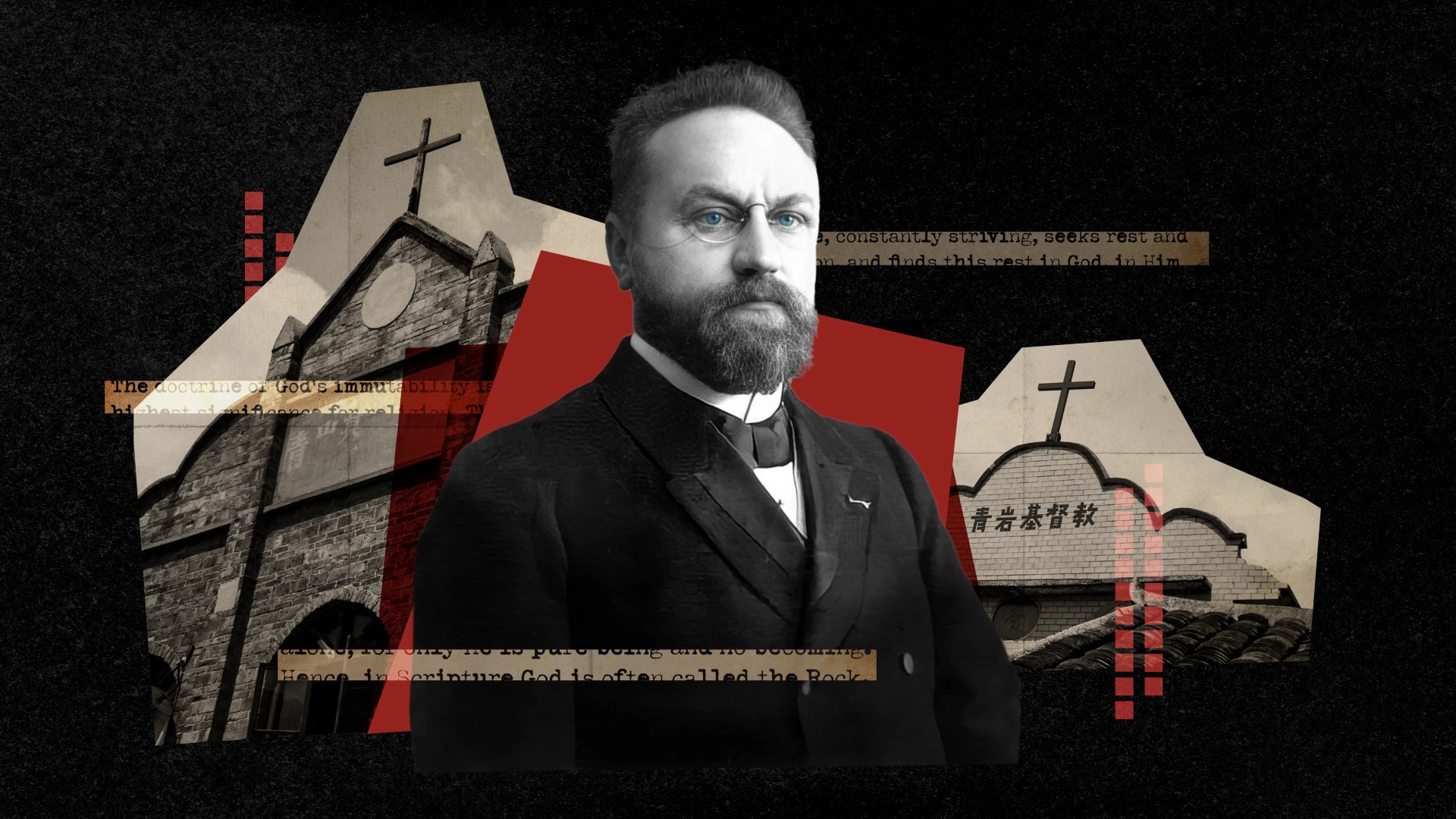
3 Lessons for Chinese Churches from Herman Bavinck

The Dutch theologian’s concern for the catholic, contextual, and public nature of the Christian faith can help congregations overcome sectarianism and stereotypes.

Herman Bavinck and the Chinese Church

Herman Bavinck and the Chinese Church

Christianity Today February 18, 2022
Image: Illustration by Rick Szuecs / Source Images: Wulingyun / Getty / Wikimedia Commons

A hundred years after his death, Herman Bavinck no longer belongs to the Dutch church. The 19th-century theologian has gone global in the 21st.

But does he belong to the Chinese church? He should.

The neo-Calvinist luminary passed away in 1921. For the next eight decades, the study of his theology was largely confined to Dutch communities, both within the Netherlands and its diaspora. But the past two decades have seen a surge of Bavinck studies in English-speaking theological circles.

Many of his works have now been translated into English. Many scholars have written about him, offering now a worldwide selection of secondary sources. Calvin Theological Seminary in Grand Rapids, Michigan, has established an institute, society, and journal to further promote the Bavinck research boom.

Especially thanks to the publication of his four-volume Reformed Dogmatics (2003–2008), Bavinck is no longer a theologian restricted to the Dutch. He has transcended the Netherlands and entered the conversations of the global church.

As a Chinese scholar who studied Bavinck for my dissertation, for me this momentum begs the question: What does a Dutch theologian born in the 19th century have to do with the Chinese church in the 21st century? And how can Chinese Christians better understand and apply his beliefs?

Bavinck is technically no stranger to Chinese churches. A popular digest of his dogmatics, Our Reasonable Faith, was translated into Chinese as early as 1989. However, the Chinese church has only scratched the surface of his theology with a superficial understanding, as it was not until 2014 that a second tome, The Philosophy of Revelation, a series of lectures he gave at Princeton Theological Seminary, was published in mainland China.

Meanwhile, North American theologians and seminaries have dominated the Chinese church’s understanding of his thought. The Bavinck in works by the likes of Cornelius Van Til and Louis Berkhof became the standard portrait in the minds of Chinese Christians. Yet recent studies show that these conventional readings of Bavinck’s thought are incomplete and lack a deeper consideration of his historical background and theological contextualization.

In his latest book, Bavinck: A Critical Biography, James Eglinton draws a vivid portrait. We encounter a Bavinck who, in the tension between modernism and the Reformed tradition, seeks to construct a theological system that is embedded with catholicity based on the doctrine of the Trinity and to portray a vision of a Christian worldview. This portrait is of great significance for Chinese churches today, as well as for the evangelical church in North America, because of Bavinck’s three emphases:

1) The Christian faith is catholic

Since the 1980s, theological education in churches in mainland China has flourished, with Reformed theology at the forefront of this growth. The Reformed evangelical movement led by Stephen Tong has played an important role in this development, as have Chinese translations of works by North American New Calvinists such as Tim Keller and John Piper.

However, this development in many churches in mainland China has gradually bred a pathological theological complex that only holds the Reformed faith as orthodox. Believers and churches with such a complex presuppose that only Reformed theology is the truth, placing it in opposition to other traditions.

For example, many newer urban Reformed churches more often than not cannot get along with older traditional house churches (think pietist networks started by Watchman Nee or Wang Mingdao) in mainland China. Chinese Reformed adherents normally turn down the traditions of these indigenous churches and are instead enthusiastic about importing Reformed confessions and Presbyterian polity from Western countries. Even worse, they sometimes regard one particular Western Reformed theologian (e.g., Van Til) as the yardstick by which they measure the truth of all theological discourse.

This narrow-minded theological stance has often invited much criticism of Chinese Reformed churches and incurred misunderstanding of actual Reformed theology. It has also spread to Chinese churches outside of China.

As a Reformed theologian in the modern age, Bavinck constructed a theological system that was deeply concerned about, as he wrote, “The Catholicity of Christianity and the Church.” For him, this catholicity “is based on the conviction that Christianity is a world religion that should govern all people and sanctify all creatures irrespective of geography, nationality, place, and time.”

His magnum opus, Reformed Dogmatics, is both profound and beautiful—full of meaningful words worthy of savoring. In dealing with many theological issues, he always had an expansive vision and a kingdom mind. Bavinck tirelessly absorbed the best of various theological and philosophical traditions—for example, his appreciation and critical appropriation of German theologian Friedrich Schleiermacher ¹—in the spirit of Christian catholicity, seeking to manifest the goodness of God in every sphere of human life. In addition, he emphasized that the catholic nature of the church transcends the limits of time and space. It possesses all the doctrines that human beings need to know concerning visible and invisible things.

In Bavinck’s view, that is the strength of Reformed theology: It provides a holistic view of life and of the world that helps believers live out this catholic faith. Thus, although he came from the separatist Christian Reformed Churches, Bavinck cooperated painstakingly with Dutch statesman and theologian Abraham Kuyper to promote unity among congregations that broke away from the Netherlands’ state-endorsed church. In 1892, they achieved the union of Kuyper’s Doleantie (“the Sorrowful”) churches with Bavinck’s denomination to form the Netherland’s second-largest Protestant denomination, the Reformed Churches in the Netherlands.

The Chinese church’s neglect of the catholic nature of the Christian faith needs to be addressed urgently in order to correct any pathological complexes and narrow-minded ecclesial positions, such as those held by some Reformed churches in mainland China. Bavinck, who lived in the Netherlands a century ago, gives us golden words in this regard: “Universal, catholic, is the Christian confession in this sense, that it spreads itself over the whole earth, includes all true believers, applies to all people, and has significance for the whole world.²” Any Christian church must not be narcissistic but should participate in fellowship with the global church and practice peaceful coexistence in its own region.

2) The Christian faith is contextual

It is true that Christianity was introduced to China from Western nations. Thus, the stereotype of Christianity as a “foreign religion” has long been prevalent in Chinese society. Yet interestingly, the practice of many Chinese churches seems to be an endorsement of this stereotype.

It is a common phenomenon that the Chinese Christian community often wishes to import the ideas of many Western theological traditions or theologians while neglecting to consider their own situation here and now. In particular, the Reformed boom of the last 40 years in mainland China has witnessed this non-contextualized theological mindset. Many of the emerging Reformed churches have been quick to introduce Reformed confessions and apply them to their churches without sufficient discernment or reflection. This approach often makes a Chinese church look more like a “foreign church” that lacks the power to communicate the Christian faith in the Chinese context.

In “The Future of Calvinism,” Bavinck argues: “Calvinism wishes no cessation of progress and promotes multiformity. It feels the impulse to penetrate ever more deeply into the mysteries of salvation, and in feeling this honors every gift and different calling of the Churches. It does not demand for itself the same development in America and England which it has found in Holland. This only must be insisted upon, that in each country and in every Reformed Church it should develop itself in accordance with its own nature and should not permit itself to be supplanted or corrupted by foreign ideas.”

Beyond Calvinism, Bavinck’s argument can be applied to the church’s articulation and communication of the faith in every region. In other words, while the Chinese church can draw on the rich theological legacies of other nations to promote its own articulation of the Christian faith, it must always preach the gospel in its own cultural context according to the unique gifts God has given to it. In doing so, Chinese communities will realize that the Christian faith is also a religion that belongs to and is oriented toward the Chinese people.

Furthermore, Bavinck’s emphasis on the contextuality of the Christian faith is a particular reminder for the unregistered church in mainland China. Due to their tensions with the government, contemporary house churches are reluctant to contextualize Christianity in order to address Chinese atheism, socialism, New Confucianism, digital authoritarianism, and other local challenges. This is because the government has enacted a policy of “sinicization” of religion, defined as “religion conforming to socialism with Chinese characteristics.”

Many house churches fail to distinguish between this politicized sinicization and a biblical contextualization of the Christian faith. As a result, they often implicitly proclaim an uncontextualized or “acontextual” Christianity. Bavinck’s view of Christian contextuality can remind unregistered congregations that the church that is rooted in the mysteries of salvation is called to contextualize God’s revelation.

3) The Christian faith is public

Bavinck was raised in a separatist church community. While there was no shortage of people in his denomination who proposed to participate in society from their own position of faith, there were still many who were hostile to the modern culture of the time. This tension has long existed in the church, which in every age has needed to think about the public nature of faith and to address the question of Tertullian, “What indeed does Athens have to do with Jerusalem?”

Such a question is especially pertinent amid transition from a Christian to a secular civilization. Because of its position on this transition, the rise of fundamentalism in North America in the first half of the 20th century by and large showed a tendency toward separatism and anti-modernism. Even by the end of the 1950s, separatism became the test of fundamentalism (as established by George Marsden in Reforming Fundamentalism).

Under the influence of this fundamentalism, the North American church was in a state of cumulative incompatibility with public society and culture. Through the writings of Gordon-Conwell Seminary professor Kevin Xiyi Yao, it is clear that in the 1920s and 1930s North American fundamentalism reached China through the Western missionary movement, which gave birth to Chinese churches gradually developing a separatist posture toward their surrounding culture.

Bavinck strongly opposed separatism by churches. In his view, this approach is at variance with the gospel of Christ. He argues: “The Gospel is a joyful tiding, not only for the individual person but also for humanity, for the family, for society, for the state, for art and science, for the entire cosmos, for the whole groaning creation.” In his view, the true gospel is not silent and weak when it faces the world, but delivers a joyful message from God in all areas of society.

It is worth noting that Bavinck also cautions the church to avoid a cultural triumphalism when addressing the public nature of the Christian faith. In his early career, in the article “The Kingdom of God, the Highest Good,” Bavinck pointed out that if someone tries to gradually win the world and have it transformed into the kingdom of God through actions such as evangelistic missions, charity or politics, that person harbors a naïve optimism. In other words, Bavinck believes Christian actions cannot triumph over all evil and, consequently, transform culture into being Christian completely and universally. After all, God’s kingdom cannot be fully realized on earth through human endeavor.

The public nature of the Christian faith, as presented by Bavinck, means it is neither “world-conformity” nor “world-flight” but is “in the world.” The Christian church does not belong to the world, nor can it leave the world; rather, it is in the world spreading the gospel of Christ to every sphere of human life.

The growing body of Bavinck studies reveals that scholars believe the theological system he constructed more than a century ago continues to offer benefit to the church today. Now the challenge is to help congregations—whether Chinese or not—better understand his emphasis on the catholic, contextual, and public nature of the Christian faith so that they can better flourish in their communities.

Simeon Ximian Xu is a post-doctoral research fellow in theology and ethics of artificial intelligence at the University of Edinburgh School of Divinity. His monograph, Theology as the Science of God: Herman Bavinck’s Wetenschappelijke Theology for the Modern World, is forthcoming in the series Forschungen zur Reformierten Theologie (Research in Reformed Theology). He is founding editor of the Chinese-language Studies in Dutch Neo-Calvinism series.

English translation by Sean Cheng

Footnote 1: See Cory Brock’s latest monograph, Orthodox yet Modern: Herman Bavinck’s Use of Friedrich Schleiermacher

Footnote 2: Herman Bavinck, The Sacrifice of Praise: Meditations before and after Admission to the Lords Supper, trans. and eds. Cameron Clausing and Gregory Parker Jr. (Peabody, Massachusetts: Hendrickson, 2019), 51.

How Putin’s Politics Threaten the Church’s Witness

American evangelicals can learn from Russia—by not treating religion as a tool to maintain power.

Christianity Today February 17, 2022
Alexei Nikolsky / AP Images

This piece was adapted from Russell Moore’s newsletter. Subscribe here.

As Vladimir Putin’s Russia threatens the existence of a free Ukraine, it would be easy for American evangelicals to conclude that this is one more distant foreign policy question.

However, Putinism is much more than a geopolitical threat; it’s also a religious threat. And the question for evangelical Christians is whether the way of Vladimir Putin will become the way of the American church.

The threat to Ukraine hangs over far more than just the Ukrainian people. NATO worries about the stability of the European order. The US State Department worries about any remaining Americans, fearing a repeat of the Afghanistan debacle. Germans wonder whether their dependence on Russian natural gas will lead to an energy crisis. And the whole world worries about whether the move will embolden China to invade Taiwan.

Lost in all of this is another world figure contemplating his next move: the pope.

The Ukrainian Orthodox Church’s independence from the Russian Orthodox Church has been a firestorm of controversy since 2018. And in The Pillar, JD Flynn and Ed Condon explain that Ukrainian Catholic and Orthodox leaders are charging the Russian Orthodox Church with complicity in Putin’s military posturing towards the Ukraine and its people.

The question now, the authors note, is whether Pope Francis will meet any time soon with the patriarch of the Russian Orthodox Church—and if so, whether that would signal a tolerance for the potential subjugation of the Ukraine and its national church.

For American evangelicals, there are real questions too—not only about how we will respond to Putin’s use of religion for political purposes, but about whether we will emulate it.

Several years ago, before the tumult of the Trump era, I was seated with other evangelicals on a secular national news program that was broadcast on Easter morning. In one sense that weekend, we were all united—affirming together the most important truth of the cosmos: the bodily resurrection of Jesus from the dead.

But we parted ways on the subject of Vladimir Putin. I saw him then the same way I do now—as an enemy. Yet some of the others defended the authoritarian strongman as a defender of Christian values.

At the time, I thought we just disagreed about a matter of foreign policy. But looking back now I can see that, at least for some evangelicals, there was a larger disagreement we didn’t yet know existed: the question of what “Christian values” are in the first place.

Take the issue of abortion. Not only is the abortion rate in Russia high, but even when pro-government forces articulate something akin to a “pro-life” view, it is usually in terms of curbing demographic decline, rather than protecting vulnerable human lives.

The animating principle is not “Every life is precious” but “Make Russia great again.” This is even more pronounced in the Russian government’s treatment of the children who are filling orphanages and “baby hospitals” around the country.

Without a vibrant adoption culture in the former Soviet Union, many of these children age out of the system and enter into terrifying lives of immediate substance abuse, sexual exploitation, and suicide. But that didn’t stop Putin from doing everything he could to end the adoption of these orphans by Americans and others—all as a salve for the wounded Russian national pride and a geopolitical game of strength.

The situation is even worse when one looks at Putin’s response to the gospel itself. He has carefully cultivated the Russian Orthodox Church—even to the point of approving mosaics of himself, Stalin, and the Crimean invasion to be installed in a Russian Orthodox cathedral dedicated to the military.

Moreover, the Russian regime has relentlessly pursued snuffing out the freedoms of minority religions—especially those of the relatively tiny band of evangelicals and evangelical missionaries from abroad.

Why would Putin—a former KGB official who said that the end of the Soviet Union was an awful disaster—want to partner with a church? Perhaps it is because he believes, along with Karl Marx, that religion can be a useful tool for maintaining political power.

And, indeed, religions are useful when they focus on protecting nationalism and national honor. Religions can turn already-passionate feelings of tribalism and resentment of outsiders into transcendent and unquestionable sentiments. All of that makes perfect Machiavellian sense—unless Jesus is, in fact, raised from the dead.

If only this tendency were limited to the former Soviet Union, we might have the luxury of ignoring it. Pay attention, though, to anyone who looks behind the former Iron Curtain to find the future.

Many religious conservatives—most notably Roman Catholics, but some evangelical Protestants too—have allied themselves with Hungary’s authoritarian strongman, Viktor Orbán. As libertarian commentator Matt Welch notes, the Hungarian prime minister “makes for an odd champion of American-style Christendom.”

“Abortion is uncontroversially legal in Hungary, the people aren’t particularly religious, and Orbán has exercised kleptocratic control over churches that dare to dissent from his policies,” Welch argues. The key reason for the attraction to Eastern European strongmen, Welch concludes, is that they fight the right enemies and “win.”

If this were just a skirmish between those of us who believe in liberal democracy and those who find it expendable, that would be one thing. But the other, larger problem with this authoritarian temptation is the gospel itself.

If the church is simply a cultural vehicle for national stability and pride, then one can hardly expect dictators to do anything other than manipulate it. But if the church is made up, as the Bible says, of “living stones” brought in by regenerated hearts through personal faith in Jesus Christ (1 Pet. 2:4–5), then external conformity to a set of values for civilization falls woefully short of Christianity.

That would be true even in a place that promoted more-or-less Christian values. Yet it’s all the more true when the church is blessing an authoritarian leader, like Putin, who is known by his own people for poisoning his enemies.

In the latter case, the witness of the church itself is at stake—because a religion that dismisses bloodthirsty behavior doesn’t even believe its own teachings on objective morality, much less in a coming judgment seat of Christ. Why would anyone listen to such a religion on how to find peace with God and gain entrance into the life to come?

Evangelical Christians should watch the way of Vladimir Putin—and we should recognize it whenever we are told that we need a Pharaoh or a Barabbas or a Caesar to protect us from our real or perceived enemies.

Whenever that happens, we should remember how to say, in any language; “Nyet.”

Russell Moore leads the Public Theology Project at Christianity Today.

Church Life

Studying Great Evangelicals’ Lives Made Me Less Ambitious

To avoid hurting our marriages and families, we can learn from forerunners in the faith.

Christianity Today February 17, 2022
Illustration by Rick Szuecs / Source images: Yagi Studio / Getty / Wikimedia Commons

Back in 2015, while my wife played with our three children on our neighborhood playground, I stared in dumbfounded disbelief after reading a puzzling tweet by former pastor Tullian Tchividjian: “Welcome to the valley of the shadow of death… thank God grace reigns there.”

I quickly learned that this quote referred to the recently revealed marital indiscretions of both Tchividjian and his wife. This popular icon in the Reformed resurgence movement had, like so many, been found out for disastrous misdeeds that led to the dissolution of their marriage.

When the news broke, I had just accepted an associate pastorate at Calvary Memorial Church in Oak Park and was a couple months shy of beginning doctoral studies in Christian history at Trinity Evangelical Divinity School.

For the next seven years, I went on to study the history of evangelicals. All the while, I kept on the lookout for the same historical pattern, one I didn’t want to ignore in the literature—especially since its repetition and consequences continued to play out in the 21st-century evangelical world I inhabited.

The all-too-common pattern I discovered is this: Great evangelical figures throughout history often had tragic personal and family lives. This trope winked at me repeatedly as I came across it in biographies and historical accounts of evangelical pastors, revivalists, and activists.

Evangelical history happens to provide numerous cautionary tales for what happens when ambition goes unbridled. And while some evangelicals would rather gloss over these tales or conceal them, that would be to our detriment. These warnings can be a service to the future of the evangelical story—and heeding them may prompt us to curb our ambition, set healthy limits and expectations, and attend to the little church in our homes.

Personally, I want to learn from their mistakes by protecting my family and guarding myself against tragedies of my own making.

Recently, while reading W. R. Ward’s Early Evangelicalism, I came across a segment on the life of August Hermann Francke (1663–1727), a figure who stood at the headwaters of evangelical history. Francke was mentored by famous theologian Philipp Jakob Spener and led the way for the second generation of German pietism in the later 17th and early 18th centuries.

His public activism and institutional work circulated through the evangelical press and social network of correspondence, which gained him widespread credibility and regard among early evangelicals. Later evangelicals, like John Wesley, repeated the pattern of Francke’s work ethic and strategy in their own ministries, sadly to the detriment of their personal lives as well.

You see, while Francke engaged himself in marvelous kingdom work, his marriage to Anna Magdalena Francke suffered from the disappointment of unmet needs. By midlife, Anna and August became estranged, and in 1715, their separation became public. Ward also hints that August paid scant attention to their daughter, Sophia, while he fulfilled his theological ambitions.

So while Francke’s public evangelical ministry and activism flourished, the health of his household languished. Surely, something was amiss here, I thought—there must have been a disconnect between Francke’s public ministry and his private interior religion.

Upon reading this historical recountal of Francke from Ward, I tweeted, “As a historian who has read much about the tragic private lives of great evangelical figures in history, I have, as a result, become much less ambitious. No achievement is worth the cost of a healthy family.”

But the Francke story that prompted my tweet was merely the most recent tragedy among a litany of others I had come across in my research.

One figure of this historical movement that has drawn my curiosity is Abraham Kuyper. Much like the Anglican C. S. Lewis, some historians would be reticent to portray Kuyper as a self-conscious early evangelical forerunner. Nonetheless, both figures have heavily influenced the development of the modern evangelical mind, including my own.

Abraham Kuyper (1837–1920) was both precocious and ambitious. He became known for his Protestant work ethic and commitment to a Christian mission to transform all of society. Many evangelical thinkers and their written works have lauded this pivotal figure in ecclesial history—but the majority of them do not tell the full story.

Kuyper is oft remembered by evangelicals for the following quote: “There is not a square inch in the whole domain of our human existence over which Christ, who is sovereign over all, does not cry, ‘Mine!’” And yet the truth is, he struggled in the domain of his personal and family life.

Kuyper suffered from debilitating anxiety and depression, which at times left him bedridden. He learned to cope with the symptoms of being overworked by frequently withdrawing for long periods of solitude in holidays and hikes. As a result, his wife and children hungered for his presence during these long absences while he recovered from the rigors of his missional work.

Unfortunately, Francke and Kuyper are just the tip of the iceberg when it comes to the costs evangelical families have paid for their loved ones’ Reformed Protestant work ethic.

Recently, someone asked me to offer some examples, and I reluctantly gave a few names—some of which I know from my own archival research and others I learned from other historians’ work. The problem with naming names and being fascinated by “who’s done it” is that it can lead to a voyeuristic or unproductive historical fascination rather than to a healthy discussion.

I think what evangelicals actually need is less fascination with the dark sides of our fallen heroes and more appreciation for the quiet, daily faithfulness of pastors, professors, revivalists, and activists who managed to swim against the powerful social and cultural currents of their times that often placed an unrealistic demand on their output and performance.

Evangelical leaders throughout history have carried a heavy weight, and they continue to bear the unrealistic expectations of many institutions, publishing houses, and ministries that dominate the evangelical marketplace. Over time, some of these leaders give in to the temptations that come with notoriety and ultimately forsake their better judgment. And sadly, evangelical organizations also have a history of giving into avarice for the sake of success—and they too willingly eat the expense of their leaders’ private failures and choose to keep them concealed.

When I observe the professional output of some evangelical peers, I pray earnestly for God to protect them and their families. While I’m thrilled for their successes, I recognize and fear the cost that comes with always saying “Yes!” to every opportunity. Far too often, it sets people up for failure, especially if they do not remain accountable to their individual or familial bodies.

For my part, I have become altogether less ambitious as a result of studying evangelical history. As I’ve said, no achievement is worth sacrificing a healthy family life. But this conviction is not only built on my knowledge of the past and present downfalls of evangelical leaders.

My caution toward ambition is also derived from my own lived history. Just as evangelical ambition has slayed the credibility of so many forerunners in the faith, I recall a time not too long ago when it crouched at my own door.

I have been a burned-out pastor who stood at the crossroads, looking down the potential path toward private tragedy. I have experienced the grinding expectation to blog a certain amount, gain a certain number of followers on social media, publish more journal articles, curate the perfect CV, and make myself known to the “right” people. I feel fatigued when I think back to the many temptations I experienced and the various tactics I employed to achieve my ambitions.

Some years ago, I had a personal crisis while attempting to be a full-time pastor and full-time doctoral student. This crisis caused me to reset myself and reorient my ambitions. My wife and I went to couples therapy and to individual therapy for a year. I reprioritized my schedule and set some professional limits on my life. I started looking for ways to reinvest in time with my children, and eventually we relearned how to value sabbath rest together as a family.

I know that people are called to make sacrifices for the cause of Christ. But even the apostle Paul argued that married people, especially those with children, carry a certain worldly weight. This requires them to have a balance—between how much of their lives they lay down for the cause of Christ and how much time and energy they reserve for their families.

That is, we should all seek to weigh our commitment to the Protestant work ethic and the mission of God along with our dedication to building little churches in our homes. And in this area, evangelicals can learn from our forerunners’ failures—by keeping our missional ambitions in their proper place and spurring on our family’s devotion to God through selfless service.

Joey Cochran is the husband of Kendall and the father of Chloe, Asher, Adalie, and Clara. Presently he is guest faculty at Wheaton College and Trinity Evangelical Divinity School and coordinates social media for the Conference on Faith and History.

Books
Review

The Puritans Were Masters of Rhetoric Because Rhetoric Wasn’t the Point

Their most eloquent writing and preaching grew from a practical desire to communicate truth.

Christianity Today February 17, 2022
Illustration by Rick Szuecs / Source images: Wikimedia Commons / SJ Objio / Unsplash

Conversion is central to the Christian faith. From Jesus’ words to Nicodemus in John 3:3 telling him that one must be “born again,” to Saul’s dramatic encounter on the road to Damascus, to the many famous conversion stories that fill the pages of church history, the act of conversion of is essential to Christian life and teaching.

Rhetoric of Conversion in English Puritan Writing from Perkins to Milton, The (New Directions in Religion and Literature)

Yet the understanding of what conversion consists of, the representations of that understanding and the means of persuading people toward it—these are far from static. Indeed, conversion came to have such a renewed emphasis within Christian religious experience during the late 17th and early 18th centuries (first in England, then in America and beyond) that this rekindling gave rise to a movement that would come to be called evangelicalism. This “conversionism” was later identified by church historian David Bebbington as one of the evangelical movement’s four characteristic elements, together known as Bebbington’s quadrilateral.

The roots of the evangelical emphasis on conversion are planted in Puritan soil. Despite the Puritans’ undeserved reputation for dry reason and dour imagination, Puritan thinkers and writers produced vivid, compelling prose (and poetry) steeped in both rich imagination and profound reasoning. The Puritans were, in fact, masters of rhetoric. But theirs was not eloquence for the sake of eloquence, something Paul warns about in 1 Corinthians 1:17 (a caution later echoed by Augustine in On Christian Teaching). There is a fine line between eloquence in service of the gospel and that which, in delighting solely in itself, drowns out the message. This is one the themes expertly teased out in The Rhetoric of Conversion in English Puritan Writing from Perkins to Milton, a new book by David Parry, lecturer in English at Exeter University.

Concealed eloquence

It seems counterintuitive, perhaps, that Christians within the Reformed tradition who hold to the doctrine of predestination would place so much emphasis on persuasive preaching. If salvation is predestined, why even bother to try to persuade anyone? But, as Parry explains, the Calvinistic view of predestination is not the same as “a deterministic fatalism that denies any role whatsoever for human agency.” Rather, the Puritan divines believed, as Parry shows, that “God uses temporal means to accomplish his eternal purposes.” Persuasive preaching and writing are just such temporal means.

It is impossible, of course, to cover nearly anything within Puritan history without addressing the complicated question of how Puritan is defined. Parry sketches out this problem and offers that, for the purposes of his analysis, Puritanism consists of both a movement not only “to protest against perceived external corruption” but also one “focused on the internal spiritual condition of individuals.” In this respect, the persuasive powers of these Puritan preachers and writers were, Parry shows, concerned not only with conversion but with ongoing sanctification, too.

While the Puritans are famous for their “plain style” of preaching and writing, Parry demonstrates that this approach “was not an abandonment of eloquence,” but rather, and more interestingly, “a concealing of eloquence.” Such a rhetorical strategy prioritizes “the transparent communication of truth over the ostentatious display of learning and eloquence.” Thus, the book explores the relationship between rhetoric and what was termed at that time “practical divinity,” meaning pastoral teaching and care that attempts to help ordinary people apply doctrine and theology in their everyday lives, first in being converted, and then in living holy lives. For Puritan divines seeking to so persuade those under their influence and care, that meant using language in ways that would transform a person’s reason, imagination, and will.

Though underappreciated today, this intricate relationship between rhetoric and theology is one about which our Puritan forebears have much to teach us. To examine the persuasive appeal of a range of rhetorical strategies, Parry considers closely the works of a small but representative group of Puritans. The group includes those well-known to most readers—Richard Baxter, John Bunyan, John Milton—as well as the lesser known but equally exemplary preachers Richard Sibbes and William Perkins.

Those passingly familiar with writers like Bunyan and Milton—both of whom despite producing massive bodies of didactic treatises and essays are best known for their imaginative works—might wonder how such a commitment to truth over style applies to them. Parry answers this question insightfully and delightfully.

A further question is not just how, but why, imaginative works of literature can be so theologically, as well as aesthetically, persuasive. Parry explains, “It is also the pastoral impulse to persuade their readers into saving truth that leads some Puritan writers to deploy the somewhat undercover modes of imaginative fiction.” Indeed, it is one of the great ironies of literary history that Puritan writers—in their suspicion of fiction—wrote instead allegories, epics, and spiritual autobiographies that laid the groundwork for the most significant and influential literary genre of the modern era: the novel.

Milton is the least “Puritan” of the Puritans covered in the book, or perhaps the most theologically controversial one. But Parry explains that despite Milton’s evolving and at times heterodox positions, his work operates with “a rhetorical enterprise akin to that of Puritan practical divinity.” In other words, Milton attempts in his writing—and his literary masterpiece Paradise Lost is no exception—to woo his readers “to conversion, assurance of salvation, and godly living.”

In the chapter on Milton, as well as throughout the book, Parry shines in literary and cultural criticism, as well as ethnography, particularly when he describes conversion as the central resolution to Paradise Lost. The last books of this epic retelling of the fall of humankind, Parry shows, “dramatize Adam and Eve’s repentance after their fall in terms that are in significant continuity with Puritan understandings of conversion and regeneration.”

Not surprisingly, it is John Bunyan who best illustrates the way in which language functions to transform all of our human faculties—reason, will, and affection. Or, in the words of Great-heart in Part Two of The Pilgrim’s Progress, to “perswade sinners to Repentance” and “to turn Men, Women and Children, from darkness to light, and from the power of Satan to God.”

Bunyan understood such persuasion, Parry says, to be part of his own vocation as a preacher. Moreover, Bunyan’s use of language throughout his writing reflects the evocative (and foundational) Puritan idea that “it is new language that gives access to the new world of the redeemed.” It is the language employed in the rhetoric of conversion so skillfully wrought by these Puritans that can “reinscribe and reorient the mind, heart, and will of its audience, bringing the ‘divided self’ of the hearer or reader to occupy a new, regenerate identity.” In their sermons and other works, Puritans appealed to both the reason and the imagination of their audience in order to “reshape their cosmic imaginaries,” Parry continues, invoking the ideas of Peter Berger and Charles Taylor to explain the ways in which the “imaginative mode of rhetoric … bypasses the cognitive defenses of readers in order to reinscribe their imaginations from within.”

Rekindling the fires of imagination

I’m particularly interested in this aspect of Parry’s book because of my own current writing project on “the evangelical imagination.” For many, such a phrase immediately invokes images of hobbits and talking fauns and bad Christian movies. But the fact is that “imagination,” and even the “evangelical imagination,” forms a well far, far deeper than what first floats to the surface upon thinking about what imagination is, what it means, and how it is represented. Our collective imaginary (the “well”) is fed from many hidden springs. This is something the Puritans knew profoundly and something Christians today understand too little.

Readers of Christianity Today should take particular interest in the fact that, as Parry says early in the book, the subjects of religious conversion and its representations are experiencing renewed interest from scholars of this historical and literary period. The Rhetoric of Conversion is one such example. Part of a series of books on New Directions in Religion and Literature, featuring prominent scholars in the field from a variety of theoretical and religious perspectives, The Rhetoric of Conversion is comprehensive in its source material (both primary and secondary) and makes its own significant contribution to this period of literary history.

At the same time, the book is readable and engaging to a wider audience. It will benefit a range of general readers interested in literature, church history, and theology. Most importantly, for those who have ears to hear, it will help in the ongoing rekindling of the fires of imagination that have always carried the church.

Karen Swallow Prior is research professor of English and Christianity and culture at Southeastern Baptist Theological Seminary. She is the author of On Reading Well: Finding the Good Life Through Great Books.

Theology

Everybody Loves Bavinck

How a Dutch neo-Calvinist thinker became the latest Christian theologian-du-jour.

Herman Bavinck

Herman Bavinck

Christianity Today February 16, 2022
Illustration by Mallory Rentsch / Source Images: WikiMedia Commons

The mark of a theological giant, some say, is the ability to capture the imagination of readers far removed from their own historical period, cultural context, and, importantly, theological tradition.

In the history of Christianity, the list of figures who enjoy that kind of reach is small—and doesn’t grow in a hurry. Over the last decade or so, however, a new star is rising in the firmament: the Dutch neo-Calvinist theologian Herman Bavinck (1854–1921).

In the Netherlands in his own day, Bavinck was a household name. The finest Dutch theological mind of his generation, Bavinck was also a notable public figure at a time of tremendous social upheaval—leaving his mark on the fields of politics, education, women’s rights, and journalism. Across the country, streets and schools were named after him. Beyond this, Bavinck was notable as a person of international standing. On a trip to the United States in 1908, for example, he was hosted at the White House by Theodore Roosevelt. Such honors say a lot.

Despite this, Bavinck’s legacy at home gradually fell into obscurity in the decades after his death. Overseas, his reputation as a stellar thinker lingered amongst those with Dutch connections but failed to grow beyond that over the course of the 20th century. All of that changed in the early years of the 21st century—thanks to the efforts of John Bolt and John Vriend, whose English translation of Bavinck’s Reformed Dogmatics was released in four parts between 2003 and 2008.

To date, those volumes have sold over 90,000 copies—a staggering output for a work of its nature. And that is to say nothing of the Portuguese or Korean versions, or the Spanish, Russian, and Chinese translations which are currently underway.

But to fast-forward from the release of Bavinck’s Dogmatics in English to his wide present-day popularity and simply say “The rest is history,” would be wrong. To do so would overlook the important question of why this figure became the go-to theologian for so many today—from Beijing to São Paulo, New York to Seoul. How did Herman Bavinck gain such a diverse global audience?

Every day in my own line of work—teaching Reformed theology at the University of Edinburgh—I interact with and hear from people who are wrestling with Bavinck’s work. Very few of those are Dutch or have any prior sense of loyalty to (or longstanding awareness of) the neo-Calvinist tradition. In fact, they are from all over the global church. Why has Bavinck’s work gained a greater degree of crossover traction than so many of his Reformed peers?

The reasons for this are no doubt as complex and diverse as the kinds of people who now read him: Korean Presbyterians will likely have different reasons than Southern Baptist readers, or than the Pentecostal teenager who devours Bavinck’s Wonderful Works of God as devotional material. Others, like the great Swiss theologian Karl Barth, rely on Bavinck as a guide to the history of theology. In light of these various motivations, I would not attempt to offer any kind of reductionistic answer to the question, “Why Bavinck in 2022?”

That said, I have been reading his works for nearly 15 years—alongside people from different parts of the world, and from Christian traditions and settings that vary from the strictly academic to the personal and churchly. In that time, I have observed certain traits in Bavinck’s writing and life that seem to draw a crowd time and time again—and that, crucially, keep those readers coming back. While these may not be the only reasons for Bavinck’s apparent sudden popularity, they are nonetheless significant.

First, Bavinck wrote in a balanced way that stands out for 21st century readers. We are accustomed to theology being done as a poor show of polemics conditioned by the norms of social media—unnuanced and uncharitable, bloated on a diet of low-hanging fruit, captive to its cartoonish portraits of the historical greats, and shot through with bad faith assumptions about those with whom we disagree today.

In that setting, Bavinck’s writings are a breath of fresh air. Erudite and capacious, he offers readers a vista of the breadth and depth of the Christian tradition, often with spectacular clarity. Although his work was (quite intentionally) styled as theology in the Reformed tradition, it was never narrowly sectarian in character. Rather, it was Reformed as an expression of something bigger: the catholic Christian faith, which takes root across cultures and centuries. Bavinck held together the paradox of being resolutely Calvinist, while also publicly affirming that, “Calvinism is not the only truth.”

That kind of balance shows a faith conviction that is both firm and supple, inviting conversation partners even from outside his own camp in a way that rebarbative, sharply polemical theologians simply do not. Its openness invites Christians from other traditions to explore Bavinck’s Reformed perspective.

Bavinck modeled the Christian worldview as an inductive, lifelong pursuit of godly wisdom—one that was open and inquisitive, rather than closed and rigid. In that regard, his approach was different from his famous colleague Abraham Kuyper, for whom the Christian worldview was deductive and inflexible.

Bavinck’s reluctance to fight straw men (and alongside that, his commitment to befriend his ideological opponents in person) is part of the same package. To be sure, he certainly was not a perfect interpreter of every theologian or tradition covered in his Dogmatics. Nonetheless, his strenuous effort to understand and faithfully represent those with whom he disagreed over the course of his life is striking.

Inexperienced readers of his Dogmatics may occasionally find themselves confused to find Bavinck take seemingly contradictory doctrinal stances at various points throughout the work. Yet in reality, those surprised readers are likely encountering Bavinck’s critique of a particular viewpoint—one that he presented at length on its strongest terms before giving his own verdict. Such a trait is subtly but strongly attractive to readers outside his own theological camp because it takes opposing perspectives seriously.

It is easy to dismiss criticism from someone who misrepresents or misunderstands your view, but it is far more difficult when that person has made a serious effort to present your view accurately and charitably. In fact, for those who wish to grow as thinkers, that kind of critique is attractive, not repellent. It wins trust.

Bavinck’s life story also plays an important role in his growing recognition in our contemporary era. We live in the wake of a 20th century bifurcation between fundamentalism and the social gospel. Those who were raised on either side of that debate have been given a strange inheritance: on the right, a gospel that speaks powerfully into the needs of one’s soul but offers little good news for society’s improvement in a fallen world; and on the left, a commitment to addressing social wrongs but in the context of a woefully-thin spiritual framework.

By contrast, Bavinck provides us with a startling reminder that this bifurcation is both a historical novelty and an unnatural distortion of a holistic and historic Christianity.

What did this look like in Bavinck’s own life? Alongside his resolutely orthodox theology, he was a noted critic of racism in America. His South African student Bennie Keet became a prominent anti-apartheid activist. In the Netherlands, Bavinck campaigned publicly against urban poverty (even calling for changes to housing standards and taxation laws to that end), stood against the oppression of poor factory workers (on account of their status as divine-image bearers), and strove for equal education for girls and the right to vote for women.

In our day, Bavinck stands out because of his commitment to the orthodox faith and the social consequences of that faith. In that sense, he goes against the grain of our late 20th century instincts in the same way as the likes of John Stott and Tim Keller. Such figures feel properly out of place on both the left and the right. As a theologian with a sweeping view of historic Christianity, Bavinck reminds us that our generation is out of step with the faith of the ages.

Bavinck was not a perfect man or a flawless theologian (as I tried to portray in Bavinck: A Critical Biography). But in his life and doctrine, he was a profoundly credible Christian—and as such, he is someone to whom so many are still drawn today.

Truth be told, I can think of many great theologians, past and present, whom I would probably rather meet in print rather than in person. That is not so with Bavinck. I will be reading him for some time yet, and suspect I am not the only one.

James Eglinton (@DrJamesEglinton) is Meldrum Senior Lecturer in Reformed Theology at the University of Edinburgh. He is the author of Bavinck: A Critical Biography (Baker, 2020), which won The Gospel Coalition 2020 Book of the Year for History and Biography, and was a finalist for the ECPA Christian Book Award in 2021.

Theology

As a White Pastor, I Submitted to Black Leadership

Here’s how it changed me.

Christianity Today February 16, 2022
Illustration by Mallory Rentsch / Source Images: Glasshouse Images / Arrow / Getty / Mission Media / Lightstock

“What will racial reconciliation in the church in the US look like?”

The questioner was a student at Duke Divinity School around 2005. The scene was a large auditorium-style classroom, and the course was Preaching, a staple of the MDiv program I was in at the time. The professor up front was William “Bill” Turner, a Black Baptist pastor-theologian. He was beloved by the many mainline students who discovered him at Duke almost as much as he was by the Black Baptist ones who came to the school in part because he was there.

In response to the question, Turner looked straight at the student and said, “One thing it will look like is whites being willing to sit under Black preaching. You don’t see that very often.”

His answer, emblazoned on my mind, has been a challenge and goad to my wife and me across the years. The invitation to submission is a convicting one for white Christians like me. I have to ask myself, Would I sit and be taught the Word of God under the authority of a Black pastor?

Of course I would, the answer surges up within me. After all, I’m not a racist.

I suspect this kind of response is one many other white Christians share. But my question isn’t abstract or “in principle.” As Dostoevsky writes in The Brothers Karamazov, love in dreams is easy compared to love in reality.

If I frame the issue much more concretely, then, I have to ask, Would I find myself listening to Black preaching most Sundays for any appreciable stretch of time?

Even after leaving Duke Divinity, my own answer to that question would most often have been no. But several years ago, that changed.

My family and I had recently relocated to Austin and moved into an east-side neighborhood full of historic Black churches. In that space, my wife and I felt the tug of Turner’s words. But we weren’t swift to put ourselves under Black preaching. My wife is Anglican, so we’d resolved first to connect with the local Anglican congregation we’d previously attended when in town for holidays.

Still, we talked a lot about Turner’s witness and the Black churches near us. And then one Sunday morning, after the Spirit moved my wife, she and I along with our three kids attended worship at Simpson United Methodist Church, a Black congregation founded in 1880.

At Simpson, love is not abstract or in principle. Anyone who comes through the front doors will hear the expression “Love you for real!”—a refrain modeled by the pastor, Robert Waddle. When we arrived, they welcomed us and brought us into their midst. We stood and sang. We sat in the love-worn wood pews and listened to a sermon by Waddle, a wise, generous, and larger-than-life man energized to share the gospel.

After our first visit, we started going once a month. I guest preached here and there and met individually with Waddle, and then a few months in, he invited me to come on staff as a part-time pastor.

I had never anticipated the chance to serve a Black congregation. I needed to pray, I told him. I needed to think through my significant misgivings. What business did I, a white man with a lot of privilege in his life, have standing in a place of authority in a Black congregation?

White Christians in America have historically been very happy to preach to Blacks and to exercise all manner of authority over them. No, Turner had said that racial reconciliation involved whites being willing to submit to Black authority. I heard his words echo in my head, I felt the Holy Spirit tugging me forward, and I knew: This was my chance to do exactly that.

While serving under Waddle’s leadership at Simpson, I came to two important convictions. First, I had been ignorant for too long of a community living alongside me in my hometown.

In his book The Christian Imagination: Theology and the Origins of Race, Willie James Jennings tells a story about his childhood encounter with two white missionaries. They came from the white congregation a couple hundred yards down the street, walked into the garden where Jennings was playing, and then introduced themselves to his mother. One of them went on to explain at great length about their church, their programs for children, and the good things they wanted to do for the neighborhood.

“My mother finally interrupted the speech of this would-be neighborhood missionary with the words, ‘I am already a Christian, I believe in Jesus and I attend New Hope Missionary Baptist church, where Rev. J. V. Williams is the pastor,’” writes Jennings.

The author goes on to say, “Experiences like these fueled a question that has grown in hermeneutic force for me: Why did they not know us? They should have known us very well.”

During my time at Simpson, those two lines were inverted: “Why did I not know them? I should have known them very well.” I started to get to know people I should’ve been very familiar with already. After all, I had grown up United Methodist in Austin, and my first pastoral appointment was at a white church on the same street as Simpson (and yet miles away in spirit). One woman at the church was even in my high school class.

In a sense, I was submitting myself not only to a Black pastor but also to an entire community and stream of my own tradition that I had been mostly ignorant of until then. I will always regard it as a great grace to have been able to experience how the same church calendar and the same scriptures feel different to those in the Black Methodist tradition.

For example, and to state something glaringly obvious, the Exodus narrative matters differently—and, I daresay, more—in the American Black church than it does in the white. The late Lutheran theologian Robert Jenson identified God like this: “God is whoever raised Jesus from the dead, having before raised Israel from Egypt.” Jenson grasped how that liberation parallel is absolutely essential to our recognition of the God revealed by the gospel.

The people at Simpson, then, in patiently teaching me to praise, pray, and preach in their midst, showed me a dimension of our salvation in Christ that I doubt I could’ve appreciated otherwise. I’ll forever be grateful to them.

Second, I was able to understand, in a limited but consequential way, our faith’s radical claim that all enmity is finally overcome in Jesus Christ (Eph. 2; Col. 1).

Even if it were possible, it wouldn’t be desirable to forget the wounds and legacy of American racism. But at Simpson, I was given a taste of how Christ’s death and resurrection make a difference in the present. We don’t need to ignore the racism that still shapes our society in order to have hope or in order to gather as a church. We can worship with those from whom we’ve been historically estranged due to sin. We can be a body—and still remember our worst sins—in context of the Lord’s crucifixion and resurrection. And we can do so “until he comes” (1 Cor. 11:26).

In the past, I’d seen this truth in the abstract. I’d believed the testimonies of others. But Simpson invited me to join the chorus: God’s love in Jesus Christ is for real.

Not everyone can do what I was given the chance to do at Simpson. But the takeaways are similar. The task for predominantly white churches today is to humbly start (or keep) getting to know people and congregations we should already know well. For some, that will mean getting to know a Black or other nonwhite congregation nearby. For others, it might involve going to a local Black church regularly and sitting under the preaching.

God’s grace makes church possible. Even now, in this “present evil age” (Gal. 1:4), or what Augustine called “the land of unlikeness,” Christ is risen. His resurrection promises that death has been destroyed and “God may be all in all” (1 Cor. 15:28).

Racial reconciliation is incumbent on us because, in the end, it is assured.

Clifton Stringer is a pastor and theologian in central Texas. Learn more about his writing at cliftonstringer.com.

Theology

Police Stole My Dignity. God Restored It.

A mistaken raid by Chicago cops sent me on a long path toward redemption.

Christianity Today February 15, 2022
Illustration by Mallory Rentsch / Source Images: Getty / Unsplash

February 21, 2019, was a typical cold winter day in Chicago. I got home from work around 6:30 p.m. and felt ready for a break after a long day of doing social work at the hospital. I took the dog out for a short walk, came back home, turned on the TV, and started changing out of my work clothes. Then I heard an excruciating noise—what sounded like a vehicle crashing into my building.

I was standing naked in my living room when police officers with guns, scopes, and lights broke down the door, rushed in, and started yelling at me to put my hands up. All I could think was, Please do not shoot me, please do not kill me.

I spent the next 40 minutes in a state of horror—crying, begging, pleading with them to let me put on my clothes. With tears streaming down my face, I cried out over 40 times: “You have the wrong place.”

As a single woman living alone, I often prayed about safety both inside and outside my home. Asking for protection was a regular part of my prayer time with God. So after the police departed that night, I found myself asking the question people often do after a traumatic experience: Where was God? How could he allow this to happen to me?

I spent the next 13 months in legal battles with the city, all the while struggling with my mental health and questioning my faith. I was going to church every Sunday and serving in my same capacity, but during quiet times, I continued to question God.

When the death of Breonna Taylor made national news, the story shook me to my core because of its similarities with mine. Police officers had raided the home of an innocent Black woman. But in that case, they’d shot and killed her.

As I grieved for Taylor, my prayers shifted from “Why did you allow this to happen to me?” to “Thank you for protecting my life.”

The idea of thanking God for that night was not a new concept to me. The morning after the police raid, I had called my pastor, Charlie Dates, on the phone. He said to me, “Anjanette, take comfort in knowing that God was with you and preserved your life.” I knew what he meant. But it took well over a year before I was able to even think about gratitude to God.

By now, I’m almost three years out from these events. I went through months and years of legal struggles, months and years of fighting against corrupt city policies. I made the tormented decision to release police bodycam footage of that night, which four months later led to a Twitter hashtag, a profile, and a national news story.

Anjanette YoungIllustration by Mallory Rentsch / Source Images: Getty / Courtesy of Anjanette Young
Anjanette Young

After all that, I’m focusing on the healing process. I read my Bible and I pray often. I go to therapy and I go to church. My pastor often tells me I need to find a way to forgive everyone involved. My therapist often tells me I need to get to a place of acceptance. I am far from both and still struggling with anger and hurt. And yet: I have greater clarity about who am I and where I sit in God’s greater story.

A few months ago, a pastor from Louisville, Kentucky, guest preached at our church. At the end of the sermon, he said something that struck me as powerful: “Do you know who you are?”

I’ve reflected often on that question, especially as I think about my experience of being traumatized, humiliated, and ignored by a Chicago Police Department raid team. During my legal battles with the city, I listened to friends describe me as strong and courageous. But all I could see was my pain and weakness. All I could think about were my many nights of silent tears.

I’ve spent a great deal of time with my therapist, unpacking the reasons why I “hide in the shadows of unworthiness,” to use her words. But today, after so much time in therapy and so much time with God, I can say with confidence that I am a 52-year-old African American woman, a descendant of slaves, a follower of Christ, a social worker extraordinaire, a fighter for justice, a mother of one, and a friend and family member to many.

I have been shaped and molded by the red-clay dirt of the Mississippi Delta and by God’s spiritual breath of life, which guides my moral compass. That is who I am.

As I continue to reflect and seek God for healing, I am learning that my calls for help were silenced well before I even came into the world. I was born into an ancestry of slavery. The cries of my people were ignored.

So it’s no wonder that I, Anjanette Young—the person who proudly owns my Southern heritage and my place in the family of God, the little country girl from Mississippi whose grandmother introduced her to Jesus—was used and trusted by the Lord on February 21, 2019, to lead such a tremendous battle against an unjust system.

Therein lies the answer to the question “Why me, God?” Why did I have this experience of being humiliated by the 12 men who stood in front of my naked body? Because my silent tears are a part of a larger plan—one that will have a loud, thunderous outcome.

Who is Anjanette Young? She is a woman of God who has learned to see all of life’s experiences through a spiritual lens, knowing that all things work together for the good of those who love God and are called according to his purpose.

Anjanette Young lives in Chicago and serves at Progressive Baptist Church as the leader of its hospitality ministry. She speaks to social work students about how to fight for justice.

News

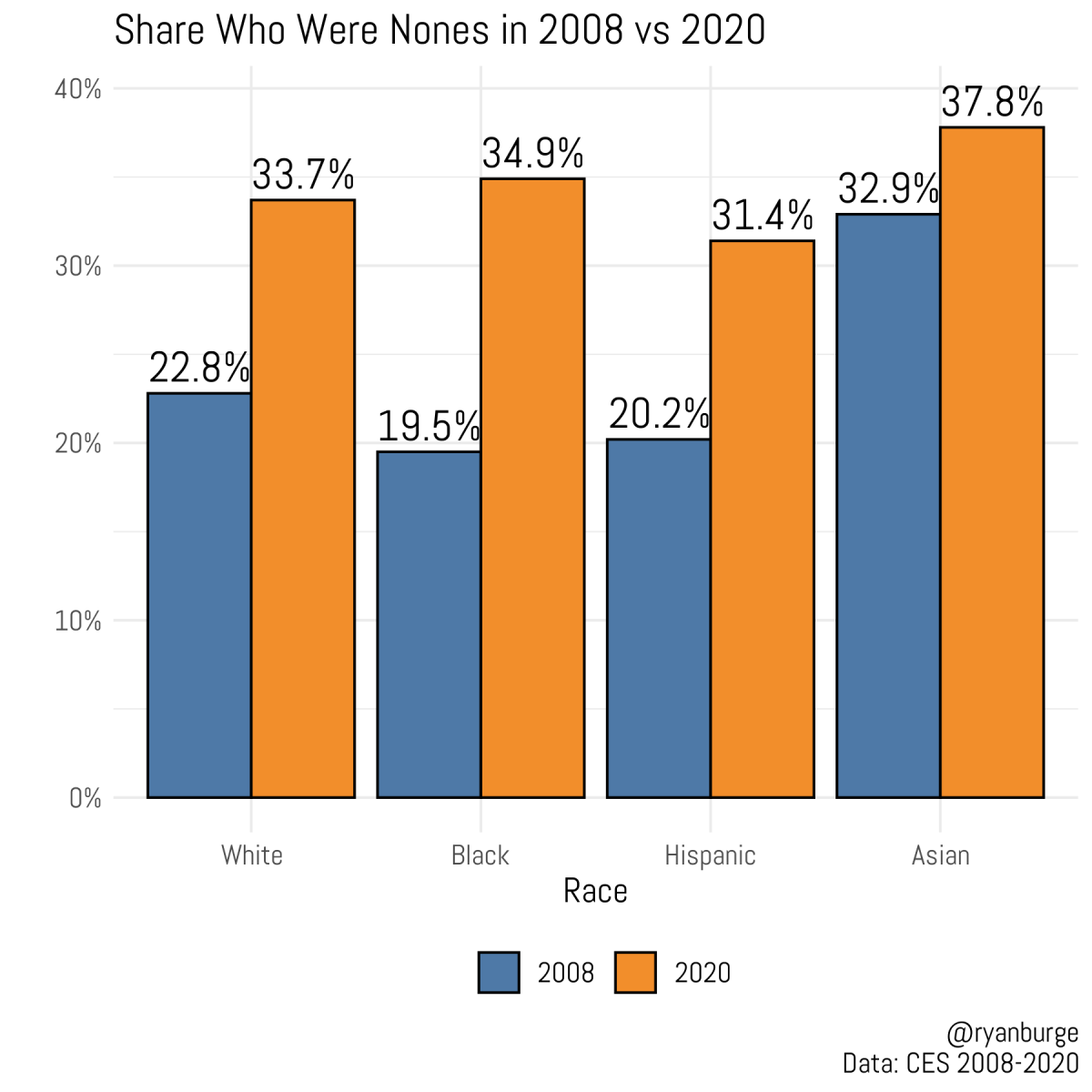
Black Americans See the Biggest Shift Away from Faith

There are more unaffiliated African Americans, but they’re also more likely to return.

Christianity Today February 15, 2022
Taylor Grote / Unsplash

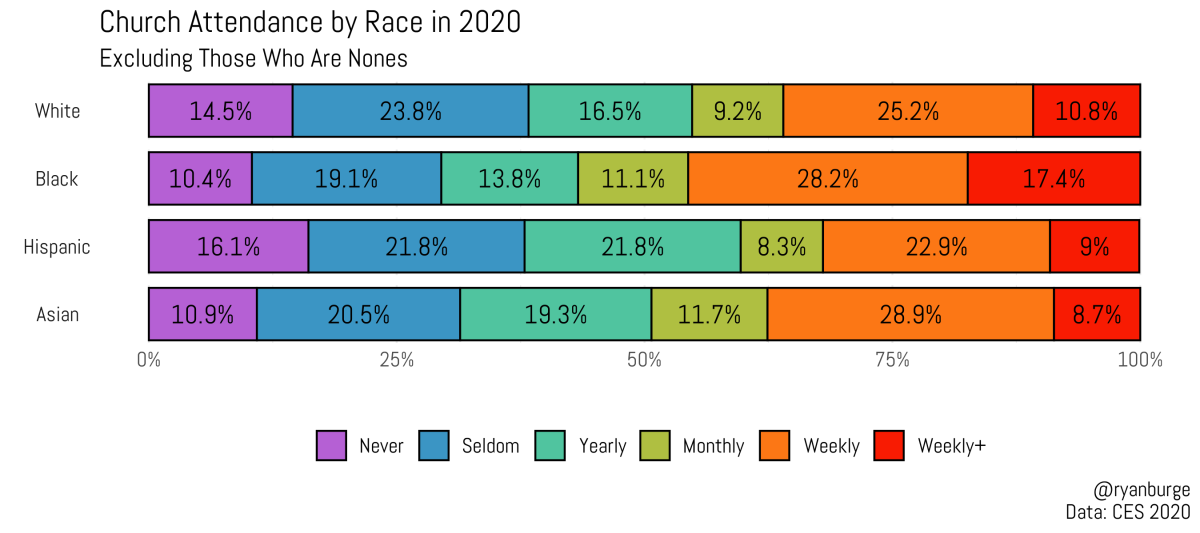
African Americans are among the most devout groups in religion research, often outranking other demographics in areas like religious practice, attendance, and belief.

As a result, some predicted that young Black adults would resist the moves away from faith seen among white millennials.

Even with all the shifts in the faith landscape over the past several years, Black Americans remain more religious than other groups and more likely than the average American to stay in the tradition they were raised in, according to a massive report released by Pew Research Center last year.

But black “nones” are growing. With 3 in 10 adults in the US claiming no religious affiliation on surveys, the rise of the nones has touched every corner of American society.

Over more than a decade, the share of Black Americans who say that they have no religious affiliation has risen more dramatically than whites, Hispanics, or Asians.

But looking beyond that statistic, we see a much more nuanced view of Black religion in the United States.

Once upon a time, Shirley MacLaine was just an actress. But that was before her book, Out on a Limb, which documents for the dubious her spiritled travels into the unseen dimensions of time and space. Now Dancing in the Light shows MacLaine rushing headlong into the darkness, chanting mantras and using crystals for spiritual power.As preposterous as all this may sound, MacLaine’s New Age gospel has millions of adherents—and is anything but new. Rooted in the so-called ancient wisdom (a creative mixing of Eastern mysticism with Western occultism), the New Age movement is simply pantheism with a twentieth-century facelift. However, since the sixties, its influence has affected every major facet of contemporary culture.And that’s why we felt it was time to look critically at the philosophical/theological basis of this confusing—and popular—movement. Applying the critical ink is Canadian author Bob Burrows, editor of publications for the Spiritual Counterfeits Project (SCP). It was Bob’s essay on the New Age in a recent SCP Newsletter that initially caught the attention of CT associate editor David Neff, who called the SCP offices in California and made the assignment.Bob’s response was, well, overwhelming: 35 typed pages. Whittling down such a mass of words is not usually a problem for someone who carries a blue pencil the size of David’s. But alas, he had 35 well-reasoned, well-written pages to edit down to 25. The cuts came hard. But what was spared “Neff’s knife” is a cover story addressing what Burrows calls “man’s major preoccupation throughout history”; namely, his desire to be in control of his universe—his desire to be a god.HAROLD SMITH, Managing Editor

In 2008, 22 percent of all Americans who participated in the Cooperative Election Study indicated that they were atheist, agnostic, or described their religion as “nothing in particular.” Just 12 years later, the share of nones rose to just over 34 percent. When that rise is tracked across different racial groups, different patterns emerge.

For instance, white respondents tracked the national average nearly perfectly, with 23 percent nones in 2008, rising to 34 percent by 2020. Among Hispanic respondents. There was an increase of 11 percentage points, but for Asians—who already had the highest levels of religious unaffiliation—it was much more modest at just about 5 percent.

Among African Americans, the increase in the share of the nones was much larger, more than 15 percentage points. In 2008, African Americans were the least likely to be nones (19.5%), but by 2020 they were more likely to say that they had no religious affiliation than white or Hispanic respondents (34.9%).

But beyond that top-level statistic, the story among African Americans is much more subtle and nuanced. As previously mentioned, three response options are combined to make up the nones: atheists, agnostics, and those who say that they have no religion in particular.

Ever since giving to the needy became chic in Hollywood, we’ve been treated to a billion-dollar bonanza of celebrities, benefit records, and sad-eyed Ethiopian children.It was Band-Aid, the British concert to help starving children, that started the aid bandwagon rolling. Later came Live Aid, a marathon rock concert simulcast from London and Philadelphia.Thereafter, since aid had become so fashionable, came Fashion Aid, a charity evening of haute couture in London, followed by a Hollywood benefit for Mexican earthquake victims. There was Farm Aid to focus on the plight of American farmers; and an AIDS benefit after Rock Hudson’s death could only be thought of as AIDS aid.Three more compassion extravaganzas occurred in May. Hands Across America linked a human chain from Los Angeles to New York to raise 0 million for domestic homelessness and hunger.The Freedom Festival raised money for Vietnam veterans; and then there’s my favorite, Sport Aid, which began with a runner leaving Ethiopia with a torch lighted from a refugee’s campfire. He jogged to several European cities; then this tireless athlete flew to New York, torch in hand (I can’t help wondering about those “no smoking” signs in airplane cabins); there he lighted a flame in Manhattan’s United Nations Plaza, which signaled the start of simultaneous 10-kilometer runs around the world. The plan, said organizer Bob Geldof, mastermind of Live Aid, was to raise money to fight disease and hunger in Africa.While we all agree that helping starving people is a good thing, this sudden aid frenzy does raise some practical questions.First, in an industry where publicity is the ticket to success, one may be excused for wondering if celebrity participation in such well-heralded events is altogether altruistic. The “We Are the World” video, which has sold millions of copies, reminds us less of starving children than of the great humanitarianism of its showcase of rock idols. The goals may be worthy, but such slickly publicized charity can only bring to mind biblical warnings against hiring trumpeters—or camera crews—to record one’s good deeds.We might put aside petty suspicions about motives if only we knew that those in need were being helped. But this raises a second question.The New Republic reports that while USA for Africa, the organization behind Live Aid, appeals for contributions to help the starving, 55 percent of its money is instead waiting to be spent on “recovery and long-term development projects,” something celebrity efforts may be ill-equipped to pull off.Of the million raised by Live Aid and Band Aid, Newsweek says only million has gone to emergency relief. Another .5 million has been spent on trucks and ships to haul supplies; million has been earmarked for projects like bridges in Chad. The rest sits in bank accounts somewhere.Unfortunately, there is an apolitical illusion at work in much of the celebrity aid: the belief that government or establishment relief agencies are unnecessary, and all we need is Bruce Springsteen.But even noncontroversial goals such as feeding the hungry can get bogged down in squabbles over how money and food should be distributed, or stymied at the Marxist-controlled ports of Ethiopia. Let’s not kid ourselves: just because the fans in London or Philadelphia go home satisfied doesn’t meanMy third question concerns the amoral illusion in all this. Consider the highlight of the Live Aid concert, the steamy duet of rock stars Mick Jagger and Tina Turner.Jagger’s 20-year career includes such dubious hits as “Sympathy for the Devil” and “Between the Sheets.” Tina Turner, clad in black leather for the show, claims a number of prior lives, including a stint as the ancient Egyptian queen Hatshepsut. Their erotic tangle was surely as much an appeal to the lust of the crowd as to help for the hungry.There seems to be no sense of the incompatibility of noble ends and ignoble means. “A good tree cannot produce bad fruit, nor can a rotten tree produce good fruit,” Jesus said flatly. There is a connection between charity, in the biblical sense, and virtue. If promoting lust is wrong, then we must ask: Can the good of feeding the hungry be accomplished by evil?Rock promoter Bill Graham says of celebrity aid, “It’s an incredible power, knowing on any given day you can raise a million dollars.” Newsweek observes, “Perhaps that is why Live Aid and Farm Aid were such oddly upbeat exercises in self-congratulation. An industry was celebrating its power. Far from challenging the complacency of an audience, such mega-events reinforce it.… Now, by watching a pop-music telethon and making a donation … fans can enjoy vicariously a sense of moral commitment.”All this leads to the most dangerous illusion of all: the impression that our celebrity idols discovered the hunger crisis, and now, with their prime-time specials, have solved it.Jagger, Turner, and company notwithstanding, feeding the hungry did not begin with Live Aid. Organizations like Catholic Relief Services, World Vision, the Salvation Army, and millions of local churches have long been feeding the hungry—without the razzle-dazzle so recently discovered by the rich and famous. Incentives have not been albums and the chance to see celebrities grind up against one another, but obedience to Christ’s commands.Bob Geldof recently announced that the Band-Aid campaign, its mission accomplished, will close down by December. “It’s like a shooting star,” he enthused.” … [F]or once … absolutely good and absolutely incorruptible came and went and worked.”I wonder. Shooting stars don’t feed hungry multitudes. The real tragedy of celebrity aid would be if the public believes that the need is over when the curtain comes down in Hollywood.For the problem of hunger will still be with us—and so will Christ’s command to feed the hungry.

When the types of nones are calculated for each racial group, a much different picture emerges. While the nones have gained the most ground among African Americans, that does not mean that there are many more Black atheists and agnostics than there were in 2008.

In fact, among Black nones, just 6 percent of them identify as atheist and another 6 percent say that they are agnostic. That means that nearly 9 in 10 Black nones are nothing in particular. That’s much higher than any other racial group.

For instance, just 61 percent of white nones are nothing in particular, 63 percent of Asians, and 73 percent of Hispanics. Clearly, when African Americans leave religion behind, they are very reluctant to embrace the labels of atheist or agnostic.

There’s a chapter in my book about the religious unaffiliated titled “All Nones Are Not Created Equal” about how different those three groups are really based on a number of demographic factors, but one stands out. Among those who said that they were atheists in 2010, just 3 percent identified with a religion in 2014. Among agnostics, it was 6.5 percent who embraced a religious tradition. For nothing in particulars, it was nearly 25 percent.

Thus, the data indicates that Black nones have a stronger faith background and are much more likely to embrace religion in the future than nones of other racial groups.

Despite rise of religious unaffiliation, Black Americans who still identify with a religious tradition are staying faithful. They continue to report much higher levels of church attendance than other races.

For instance, in 2020, nearly 46 percent of religious Black people describe their church attendance as weekly or more than once per week. For white respondents, just 36 percent attended weekly or more. For Hispanics that percentage was 32 percent and for Asians it was 38 percent. On the other end of the spectrum, less than 30 percent of Black respondents said that they attended church less than once per year. That’s nearly 10 points lower than whites in the sample.

While the share of the nones has nearly doubled in the past 12 years among Black Americans, there’s still plenty of evidence in the data that they are more open to religion than other racial groups.

In 2020, just 2 percent of all African Americans said that they were atheists, and another 2 percent were agnostics, compared to 31 percent who said that they had no religion in particular.

As previously mentioned, “nothing in particulars” are 4 to 8 times more likely to come back to religion over time compared to atheists and agnostics. That means that many of them may return to religion over time. And among those who still identify with a religious tradition, Black Americans are more active in their religious communities than any other racial group.

Even in an age of rapid secularization, the Black church still plays a crucial role in the lives of African Americans throughout the US. For Black pastors, the mission field is incredibly ripe, and many are heeding this call.

The North American Mission Board has worked in partnership with the SBC’s National African American Fellowship with the SBC’s National African American Fellowship to plant churches in underserved African American communities across the United States, and the first fruits of those efforts are already beginning to emerge. New efforts by Crete Collective and Dhati Lewis’s forthcoming BLVD are also turning attention to such communities.

Jude 3 Project, an apologetics ministry among Black Christians led by Lisa Fields, has a discussion series called “Why I Don’t Go,” engaging and listening to African Americans who have left the church.

“Classical and traditional apologetics goes a lot to proving the existence of God. When you know the Black context, you realize most Black people believe that a God exists or a higher power exist,” Fields said in a podcast interview last year.

“Black atheism is growing, but it’s still a minority of Black people. So we have to figure out what black people are navigating, what are the challenges, and meet them there.”

Apple PodcastsDown ArrowDown ArrowDown Arrowarrow_left_altLeft ArrowLeft ArrowRight ArrowRight ArrowRight Arrowarrow_up_altUp ArrowUp ArrowAvailable at Amazoncaret-downCloseCloseEmailEmailExpandExpandExternalExternalFacebookfacebook-squareGiftGiftGooglegoogleGoogle KeephamburgerInstagraminstagram-squareLinkLinklinkedin-squareListenListenListenChristianity TodayCT Creative Studio Logologo_orgMegaphoneMenuMenupausePinterestPlayPlayPocketPodcastRSSRSSSaveSaveSaveSearchSearchsearchSpotifyStitcherTelegramTable of ContentsTable of Contentstwitter-squareWhatsAppXYouTubeYouTube