News

‘They Cannot Burn Jesus Out of Me’: Mozambique Pastors Minister to Survivors of Violent Insurgency

Despite the risks in the region, Christians are flocking to camps and targeted villages to provide resources and spiritual care.

The insurgent group Ansar al-Sunna has been terrorizing villages across northern Mozambique for years, killing thousands and displacing more than three-quarters of a million people.

The insurgent group Ansar al-Sunna has been terrorizing villages across northern Mozambique for years, killing thousands and displacing more than three-quarters of a million people.

Christianity Today August 3, 2021
Marco Longari / AFP via Getty Images

Back in April, when armed men began attacking his village in the middle of the night, a pastor of a local church in northern Mozambique woke his family to flee. He took his two older sons and his wife took their two younger sons. In the midst of chaos and confusion, shouting and shooting, they escaped in two different directions.

The pastor and his sons hid in the surrounding bush all night before returning to the village, near the town of Palma, to look for the rest of their family. The next morning, he found their hut caved in and the remains of his four-year-old son, who had been beheaded by the attackers. All he and his sons could do was dig a hole in the ground to bury the young boy’s body and weep together. To this day, his wife and second-youngest son are still missing.

This pastor shared his story with CT through English-speaking ministry partners in Mozambique. He asked that he and his village remain unnamed for security reasons, but his story is not unique as conflict escalates in the northern province of Cabo Delgado.

Countless innocent civilians are fleeing the area where insurgents have been burning entire villages to the ground and brutalizing their inhabitants—including beheading, recruiting, capturing, enslaving, and committing sexual crimes against them. The violence has killed thousands of people and displaced upward of 800,000, a number that is growing rapidly and may soon reach one million, United Nations officials warn.

“The north of Mozambique, especially Cabo Delgado province … is being affected by Islamic insurgents, who at some stage claim to be linked with Islamic State,” said Mauricio Magunhe, faith and development coordinator for World Vision Mozambique.

“For the Christians living in that area, it’s very important to have the word of God so that it can renew their faith and hope in such a time of turbulence. The word of God can be used in efforts for peacebuilding in that area, as well as in the country as a whole,” he said. “If we work together as Mozambican citizens and as leaders from different religions, it is possible to educate our people not to adapt that kind of situations that bring a lot of destruction and pain for our people.”

The atrocities of the past four years hearken to the ’80s and ’90s, a tumultuous period in which a series of sociopolitical conflicts shook the African continent, including the Rwandan genocide and Mozambique’s own 16-year civil war from 1977 to 1992. Over the last two and a half decades, however, Mozambique enjoyed relative peace and stability apart from suffering natural disasters in recent years, such as Cyclone Idai in 2019.

Christians make up more than half the population in the country as a whole but are less prevalent in the northern provinces where the insurgency has gained a foothold. Instead of leaving the area and prioritizing their own safety, many local pastors and national believers are staying in the province to serve among their fellow survivors.

In nearby villages and makeshift camps set up throughout the region, these faith leaders are partnering with a handful of ministries, missionaries, and Christian humanitarian organizations to distribute food, supplies, and farming kits, as well as pray with people, preach the gospel, and hand out thousands of solar-powered audio Bibles to all who ask. And in the midst of an unthinkable crisis, they report that thousands are coming to faith in Christ.

“When we first arrived, our arms were crossed—we were sad and angry,” said another pastor whose family is still missing. He also asked that CT not print his name out of fear of further attacks. “But because we serve, we’re strong. Because we serve, we’re happy. In a time of difficulty or in a time of ease, we will serve the Lord.”

Pastors minister in the Pemba region.

From within these camps and villages, pastor after pastor shared their testimonies. One quoted Psalm 23, saying as he and his family walked past dead bodies on either side of them, they found comfort in the line, “Even though I walked through the valley of the shadow of death, I will fear no evil” (ESV). Yet another pastor, who has lost everything, said, “They can burn our houses, they can burn our food—but they cannot burn Jesus out of me.”

Antonio Matimbe, a native of the country who has worked for World Vision Mozambique for over ten years, recently visited a camp for people displaced by the violence. He said that at first he thought everyone seemed to be doing fine. “But when I started to hear the stories, that’s when I had a real sense of the dimension of the disaster and the situation that people have been through in Cabo Delgado,” he told CT. “It was kind of eye-opening to the real things they have been through, especially when we talk about the children—they have witnessed things that they should not witness as children.”

Matimbe, who manages communications at World Vision Mozambique’s national office, still has vivid memories from the civil war when he lived in a rural village with his grandmother. As a child, he was awakened in the middle of the night, alerted to the approach of military men nearby—and recalls running in the dark to hide and sleep in the bush until morning.

But all of this is nothing, he says, to what the children in Cabo Delgado are facing. Kids as young as four will forever carry the memories of family members, neighbors, and friends killed in front of them, or of the physical or sexual violence they have experienced.

A particular emphasis in World Vision’s effort is to provide counseling in the camps, since the majority of survivors have endured unimaginable trauma. The organization is partnering with the religious council of Mozambique and working with local officials to train and equip camp workers to recognize and respond to trauma-related symptoms.

In these cases, Matimbe says, “Psychological support is as important as providing them with food and water, because these traumas—if they are not well managed, if the children cannot recover from that—we don’t know what kind of adults you can expect.”

Mozambique recently jumped to 45 on the World Watch List of nations with persecuted Christians—after at least 300 believers have been killed for their faith and 100 attacks on local churches, ministry bases and other Christian establishments such as medical missions clinics. These statistics were validated in the latest reporting period and gathered directly by survey teams from multiple sources on the ground.

“This isn’t one or two different attacks—this is a series of attacks, and it’s all around. ISIS is trying to get a foothold in this northern region of Mozambique,” says David Curry of Open Doors USA. “It’s complicated, of course, by all of the different political stuff… but the gist of it is that Christians are really in the danger zone because the Islamic State group there has an ideology which justifies these attacks.”

The insurgency in Mozambique is targeting not only believers but countless innocent civilians of all ages and religions. Despite the population being divided between Muslims and Christians, the country has enjoyed a long history of religious harmony due to the uniquely influential role of its faith leaders in society.

World Vision, an evangelical humanitarian organization that has established a strong presence in Mozambique since 1983, began facilitating interfaith gatherings a year ago to pray for peace and political stability. The latest event was held in person last month at Peace Square in the capital city of Maputo—a couple miles away from World Vision’s national headquarters—and was recorded live and broadcast online.

Among the high-profile figures in attendance at the event were the former president of Mozambique, Joaquim Alberto Chissano, and retired Anglican bishop Dinis Sengulane.

The latter is a well-known national faith figure who made first contact with the Renamo rebel group back in 1989—an act that began peace negotiations and eventually led to the official treaty signed by both parties in 1992, thus ending communism, declaring religious freedom for all, and initiating twenty-some years of peace in the nation. These same leaders also played a role in stemming the return of targeted armed conflict in 2013 by the opposition party, Renamo toward the current party, Frelimo.

Today, the Christian Council of Mozambique—which includes Orthodox, Catholic and Protestant leaders—are once again banding together on a national level to lead the country in a renewed fight for peace and political stability. Beyond holding prayer events throughout the region, many are also serving on the front lines of the conflict to minister among those fleeing and forcibly displaced.

These Christian leaders are partnering with other religious and government officials to set up “peace clubs” in the northern regions to “counter potential radicalisation of youth and promote dialogue and alternative pathways to protest,” according to Alex Vines, who heads up the Africa program at the London-based think tank Chatham House.

“What is unique about the interfaith relationships in Mozambique is we understand that in order for us together to grow as a nation, we need to collaborate with one another,” said World Relief’s Magunhe, who is also an ordained member of the Anglican clergy and the key facilitator behind these national prayer meetings.

“In some regions, like in the north, half of the population are Muslims. If that conflict grows, then that will become a very serious issue for our people… So I believe church leaders have an important role to play in the current situation.”

When I was 14 years old, a student in boarding school, I first heard of Amy Carmichael. The headmistress of the school often quoted her writings and told of her amazing work in India for the rescue of little children in moral danger. No other single individual has had a more powerful influence on my own life and writing than Amy Carmichael. No one else put the missionary call more clearly.

Of the 36 books she wrote, I think it was the little book If that I read first, and found in it the source of an exhortation we heard often in the evening vespers services: Hold your friends to the highest. If is a series of statements about love, given to her sentence by sentence, Amy Carmichael claimed, “almost as if spoken aloud to the inward ear.” Each page holds a single sentence, with the rest of the page blank. Someone has suggested that the blank space is for each of us to write in large letters GUILTY. I was seared by the words.

“If I fear to hold another to the highest because it is so much easier to avoid doing so, then I know nothing of Calvary love.” I was guilty.

“If I can enjoy a joke at the expense of another; if I can in any way slight another in conversation, or even in thought, then I know nothing of Calvary love.” Such jokes, such slights were habitual with me.

“If I make much of anything appointed, magnify it secretly to myself or insidiously to others … then I know nothing of Calvary love.” Every page pointed up my guilt, but every page aroused in me a deep longing to know that love, to be like the one who showed it to us on Calvary, and to follow him.

As a student in college I wrestled with the desperate desire to be married. I had promised the Lord I would go to some foreign land as a missionary, but I hoped I would not be required to go single. By this time I had memorized many of the poems in Toward Jerusalem. One of those that became my prayer then, articulating what my heart wanted to say but could not have found the words for was:

Hold us in quiet through the age-long minute

While Thou art silent and the wind is shrill:

Can the boat sink while Thou, dear Lord, art in it?

Can the heart faint that waiteth on Thy will?

There was a strong and practical everyday sort of faith that ran through all her writings, an immediate appropriation of the promises of God and an exquisite sensitivity that drew me like a magnet. I read everything of hers that I could get my hands on, and soon my diaries were peppered with quotations labeled “AC.”

She was born on December 16, 1867, in Millisle, Northern Ireland, of a Scottish Presbyterian flour miller named David Carmichael and his wife Catherine Jane Felson, a doctor’s daughter. The eldest of seven children, she often led the rest of them in wild escapades, such as the time she suggested they all eat laburnum pods. She had been told that the pods were poisonous, and thought it would be fun to see how long it would take them to die. They were discovered, and a powerful emetic was administered in time to foil their plans for suicide. Once she led her little brothers up through a skylight onto the slate roof. They slid to the lead gutters and were walking gaily around the edge when they looked down to see their horrified parents staring up at them.

She was educated by governesses before she attended a Wesleyan Methodist boarding school in Harrogate, Yorkshire. It was there she saw that there was something more to do than merely “nestle” in the love of God, “something that may be called,” she wrote later, “coming to Him, or opening the door to Him, or giving oneself to Him.… Afterwards, when I began to understand more of what all this meant, I found words which satisfied me. I do not know who wrote them:

Upon a life I did not live,

Upon a death I did not die,

Another’s life, Another’s death,

I stake my whole eternity.”

When she was 17, seeing on the street in Belfast a poor woman in rags, carrying a heavy bundle, she had what amounted almost to a vision of the things that really matter in life. She and her two brothers, moved with pity for the poor soul, helped her along, though they were embarrassed to be seen with her. Amy described it as a horrid moment, for they were “not at all exalted Christians,” but on they plodded through the gray drizzle. Suddenly words came to her, “Gold, silver, precious stones, wood, hay, stubble … the fire shall try every man’s work of what sort it is. If any man’s work abide.…” From that moment, for the rest of her life, it was eternal things that mattered.

She began children’s meetings at home, then moved on to work at the Belfast City Mission, where she taught a boys’ class and founded a group for the encouragement of Bible study and prayer called the Morning Watch. On Sunday mornings she taught a class for “shawlies,” working girls who wore shawls because they could not afford hats.

One brother described her as “a wonderfully sincere, downright, unafraid, and sympathetic sister.” Another said, “She was determined to get down to the root of things.” Her sister’s strongest impression of Amy concerned her enthusiasm. Nothing was impossible.

Her father died when she was 18, and the following year brought with it another moment of illumination. At a convention in Glasgow, when her soul seemed to be in a fog, she heard the words of the closing prayer, “O Lord, we know Thou art able to keep us from falling.” It was as if a light shone for her.

Her work with the shawlies grew so rapidly that a hall was soon needed that would seat 500 people. The story of how that hall was paid for by one lady and how the land to put it on was given by the head of the biggest mill in the city is only the beginning of a lifetime of seeing a heavenly Father’s faithful provision for material needs as well as spiritual. She decided against receiving any money from those who were not utterly one with her aims, accepting it only when it was truly given to God. Amy Carmichael prayed for money and it came. She soon saw Bible classes, girls’ meetings, mothers’ meetings, sewing classes, and gospel meetings being held in the hall, which was called “The Welcome.”

In 1888 all the family’s money was lost, and they moved to England where Amy began another work for factory girls in Manchester.

It was on a snowy evening in January 1892 that a call which she could not escape and dared not resist came clearly: Go ye. A long and spiritually harrowing period followed as she sought to weigh her responsibilities to those who had never heard of Christ against responsibilities to her mother and, most agonizingly, to Robert Wilson, one of the founders of the Keswick convention in England, to whom she had become like a beloved daughter. His wife and only daughter had died and Amy moved into the house. Although the situation was unusual, and not entirely to the liking of Wilson’s two bachelor sons who also lived there, she believed it was God’s place for her for a time. She loved and revered him, calling him “the D.O.M.” (Dear Old Man) and “Fatherie” in letters to her mother. The thought of leaving him was a keen, sharp pain, something she had to lay on the altar, as it were, and trust God to take care of.

She thought of going to Ceylon, but then the knowledge that a million were dying every month without God in China prompted her to offer herself for that land. In July of 1892 she became the first missionary to be supported by the Keswick convention, and went in September to the China Inland Mission headquarters in London. Geraldine Guinness, who later became the daughter-in-law of the mission’s founder, Hudson Taylor, was one of those who encouraged and prayed for her there. She had purchased and packed her outfit when she received word that the doctor refused to pass her for service in China.

It must have been a blow, but did not in the least deter her in her purpose. She knew she had been called, and had no doubt that she would go—somewhere.

She sailed for Japan in 1893 to work under the Rev. Barclay F. Buxton of the Church Missionary Society and plunged into the work with joy, studying the language and adopting Japanese dress almost at once. It was there that she received a letter from her mother, asking whether she loved anybody very much. She gave an evasive answer. This is the only hint to be found anywhere that she might have had a chance to marry and perhaps was forced to choose between a man she loved and the call of God. Of course I am reading a great deal into the few words her biographer uses to cover this question, but because in my own experience it was such a burning one, I often longed to know more. I wished with all my heart that she had not been so everlastingly self-effacing and cautious in keeping herself out of her books.

Within a year, ill health took her to Shanghai, then to Ceylon, and a few months later she returned to England because the D.O.M. had had a stroke. His hopes were raised once more that she would remain with him.

During this time her first book was published, From Sunrise Land, a collection of letters she had written in Japan, illustrated with her own sketches. Again she received a medical rejection, and again she faced the unknown, still sure that the Lord who had called her so clearly would open a way somewhere, somehow. At last she was accepted by the Church of England Zenana Missionary Society at Keswick in July 1895 and arrived in Bangalore, India, in December with dengue fever and a temperature of 105. Some missionaries prophesied that she would not last six months. She lasted 55 years without a furlough.

Nearly a year later she met a missionary named Walker, who suggested that his district, Tinnevelly, was a much better place than Bangalore to learn Tamil, the language the mission had assigned her to learn. Walker offered to be her teacher, and so it was in December 1896 that she reached the place that would be home for the rest of her life.

She was an excellent student. It was not that the language came easily to her. She prayed and trusted God for help, but she did what God could not do for her—she studied. She took comfort from the words of Numbers 22:28, “The Lord opened the mouth of the ass.”

Amy lived with the Walkers in two different towns, where the number of Christians was pitifully small. She gathered together a band of Indian women to itinerate with her, among which was Ponnammal, who was to become an intimate, lifelong friend. They traveled at the rate of two or three miles an hour in a bullock bandy, a two-wheeled springless cart with a mat roof, “bang over stones and slabs of rock, down on one side, up on the other. Once we went smoothly down a bank and into a shallow swollen pool, and the water swished in at the lower end and floated our books out quietly” (Things as They Are, p. 5). They camped near the village at night, visiting in homes or wherever they could find women or children to talk to. Sometimes Walker and some of the men joined them for open-air meetings in the evening.

It was no lark. They found themselves in battle—the Lord’s battle, to be sure, but one in which they were his warriors, up against a stupendous Force comprising principalities, powers, rulers of darkness, potentialities unknown and unimagined. She tried to describe it in a book called Things as They Are, but “How can we describe it?” she wrote. “What we have seen and tried to describe is only an indication of Something undescribed, and is as nothing in comparison with it.” Nevertheless, even the understatement that she did put down on paper was rejected by publishers. It was much too discouraging. People wanted pleasanter stories, happier endings, so the manuscript was put in a drawer for several years until some English friends visited her, saw with their own eyes the truth of things, and begged her to allow them to try again to find a publisher willing to risk it. The book appeared in 1903. Its accuracy was questioned, so when a fourth edition was called for, letters were included from missionaries in India confirming in the strongest terms what she had written.

Amy had a clear eye and a keen ear. She wrote what she saw and heard, not what missionary magazines might have conditioned her to see and hear. One of them, for example, stated that Indian women think English women “fairer and more divine than anything imagined.” But Amy heard them say when they saw her, “What an appalling spectacle! A great white man!” “Why no jewels? What relations? Where are they all? Why have you left them and come here? What does the government give you for coming here?”

“An old lady with fluffy white hair leaned forward and gazed at me with a beautiful, earnest gaze. She did not speak; she just listened and gazed, ‘drinking it all in.’ And then she raised a skeleton claw, grabbed her hair and pointed to mine. ‘Are you a widow too,’ she asked, ‘that you have no oil on yours?’ After a few such experiences that beautiful gaze loses its charm.”

The notion of hungry “souls” eagerly thronging to hear the gospel story is an appealing one and perhaps represents a true picture in some places, but certainly not in South India, or, I found, in South America. I was very thankful for that book. Things as They Are told it to me straight, and thus prepared me for my own missionary work as few other books besides the Bible had done. It told of the great fortresses that are Hindu temples, and of the wickedness practiced there. It told of the utter indifference of most of the people when told of the love of Jesus. It told, too, of the few who wanted to hear.

“Tell me, what is the good of your Way? Will it fill the cavity within me?” one old woman asked, striking herself a resounding smack on the stomach. “Will it stock my paddy-pots or nourish my bulls or cause my palms to bear good juice? If it will not do all these good things, what is the use of it?”

It told of a boy who confessed Christ, an only son, heir to considerable property. He was tied up and flogged but he never wavered. At last he had to choose between his home and Christ. He chose Christ. The whole clan descended on the missionaries’ bungalow, sat on the floor in a circle and pleaded. “A single pulse seemed to beat in the room, so tense was the tension, until he spoke out bravely. ‘I will not go back,’ he said.” Though they promised him everything—houses, lands, a rich wife with many jewels—if only he would not break caste, though they told him how his mother neither ate nor slept but sat with hair undone, wailing the death-wail for her son, he would not go back. Later, Shining of Life (for that was his name) was baptized, and within a few weeks was dead of cholera. As he lay dying they taunted him. “This is your reward for breaking your caste!” “Do not trouble me,” he answered, pointing upward. “This is the way by which I am going to Jesus.”

During those first years, Amy Carmichael learned of the hideous traffic in little girls for temple prostitution. Calling them “the most defenseless of God’s innocent little creatures” she gave herself to save them. She prayed for a way—she had not the least idea how it could be done, but she knew her Master, knew his limitless power, and believed him to show her.

She wrote letters (veiled, always, because the things she saw and heard were unprintable then) asking for prayer. She asked God to give her the words to say which would arouse Christians.

And thus God answered me: “Thou shalt have words,

But at this cost, that thou must first be burnt,

Burnt by red embers from a secret fire,

Scorched by fierce heats and withering winds that sweep

Through all thy being, carrying thee afar

From old delights.…”

In 1900 Amy went with the Walkers to camp in a quiet, out-of-the-way village called Dohnavur, and a year later the first temple child was brought to Amy, a girl of seven named Preena, whose hands had been branded with hot irons when she once attempted to escape. Gradually the child learned that she was to be “married to the god.” She knew enough to detest the prospect and fled to a Christian woman who took her to Amy Carmichael. “When she saw me,” Preena wrote 50 years later, “the first thing she did was to put me on her lap and kiss me. I thought, ‘my mother used to put me on her lap and kiss me—who is this person who kisses me like my mother?’ From that day she became my mother, body and soul.”

And from that time on Amy Carmichael was called Amma (accent on the last syllable), the Tamil word for mother.

She began to uncover the facts of temple life. It was a system that had obtained from the ninth or tenth century. The girls trained for this service were sometimes given by their families, sometimes sold, usually between the ages of five and eight, but often when they were babies. They were certainly not “unwanted” children. They were very much wanted. In order to insure that they did not try to run away, they were shut up in back rooms, carefully watched, and, if they tried to escape, tortured as Preena was. They were trained in music and dancing, and, of course, introduced to the mysteries of the oldest profession in the world.

Amma’s search for the children covered three years, but at last, one by one, they began to be brought to her. Soon it became necessary for her to have a settled place. Dohnavur, which she had thought of only as a campsite, proved to be the perfect answer. Indian women joined her, willing to do the humble, humdrum, relentless work of caring for children, work that they saw as truly spiritual work because it was done first of all for the love of Christ.

By 1906 there were 15 babies, three nurses, and five convert girls training as nurses. There were no doctors or nurses to begin with, of course, not even any wet-nurses to help with the babies, since it was not the custom for village women to nurse a child other than their own. A number of babies died, some because they were frail when they arrived, some due to epidemics, some for lack of human milk. Amma grieved as any mother grieves, for they were her very own children. When one of the loveliest of them, a baby girl named Indraneela, died, Amma wrote.

Dear little hands, outstretched in eager welcome,

Dear little head, that close against me lay—

Father, to Thee I give my Indraneela,

Thou wilt take care of her until That Day.

In 1907 came the first gift of money to build a nursery. It was not long before Amma learned that boys, too, were being used for immoral purposes in the dramatic societies. Prayer began to go up for them, and by 1918 the work expanded to include them.

There were no salaried workers, either Indian or foreign, in the Dohnavur Fellowship. All gave themselves for love of the Lord, and no appeal was ever made for funds. When one sentence in a book she had written might have been construed as an appeal, Amma withdrew the book from circulation. No one was ever authorized to make pleas for money on their behalf. Needs were mentioned only to God, and God supplied them. The work grew until by 1950 or thereabouts the “Family” numbered over 900 people, including children and Indian and European workers. There was a hospital, many nurseries and bungalows for the children and their accals (sisters, as the Indian workers were called), a House of Prayer, classrooms, workrooms, storehouses, hostels, playing fields, fruit and vegetable gardens, farm and pasture lands. It was all “given.” The financial policy has not changed to this day. The Unseen Leader is still in charge, and from him comes all that is needed from day to day, from hammocks in which the tiniest newborns swing, to modern equipment for the hospital. There are doctors, nurses, teachers, builders, engineers, farmers, craftsmen, cooks. There are none who are only preachers. A Hindu had once said to someone in the Dohnavur Fellowship, “We have heard the preaching, but can you show us the life of your Lord Jesus?” Each worker, whatever his practical task, seeks to show that life as he offers his service to his Lord.

The books Nor Scrip, Tables in the Wilderness, Meal in a Barrel, and Windows are records of God’s constant provision for material needs, story after amazing story of his timing, his resources, his chosen instruments. The God who could provide food for a prophet through the instrumentality of ravens and a poor widow was trusted to meet the daily needs of children and those who cared for them, a few rupees here, a few thousand pounds there.

Amma was a woman of great reserve. Loving, unselfish, and outgoing to others, she was acutely aware of the dangers of drawing attention to herself in any way, or of drawing people to herself rather than to Christ. She could easily have become a cult figure, having great gifts of personality, leadership, and the ability to encourage the gifts of others. But she held strictly to Christ as Leader and Lord, and “coveted no place on earth but the dust at the foot of the Cross.” In January 1919, her name appeared on the Royal Birthday Honours List. She wrote to Lord Pentland, “Would it be unpardonably rude to ask to be allowed not to have it?… I have done nothing to make it fitting, and cannot understand it at all. It troubles me to have an experience so different from His Who was despised and rejected—not kindly honoured.” She was persuaded at last that she could not refuse it, but she did not go to Madras for the presentation ceremony.

There are a few pictures of her in the biography, but too few. I would love to have seen many more, but she refused to allow them to be taken, and although there are many pictures of the children and Indian workers in the books she wrote, none are included of herself or of other European workers.

Her biographer, Bishop Frank Houghton, tells us only that she was of medium height with brown eyes and brown hair. When I asked a member of the Fellowship to describe her she smiled. All she could think to say was, “She had wonderful eyes.”

The light that seemed to shine in and through and around this woman was love. When asked what they remembered best about her, many people answered love. There is hardly a page of her books that does not speak of it in some way. Her poems are full of it.

Love through me, Love of God …

O love that faileth not, break forth,

And flood this world of Thine (Toward Jerusalem, p. 11).

Pour through me now: I yield myself to Thee,

Love, blessed Love, do as Thou wilt with me (p. 69).

O the Passion of Thy Loving,

O the Flame of Thy desire!

Melt my heart with Thy great loving,

Set me all aglow, afire (p. 83).

When she thought her time on earth was nearly up, she began to write letters to each one of the Family, which she put into a box to be opened after her death. These letters are steeped in love. One of them speaks of a misunderstanding that had arisen between two members of the Fellowship, and how deeply it had hurt her to hear of it. “Refuse it. Hate it,” she wrote. “It may seem a trifle, but it is of hell.… If this were the last time I could speak to you I should say just these words, ‘Beloved, let us love!’ My children, our comrades in the War of the Lord, I say these words to you again, ‘Beloved, let us love!… We perish if we do not love.”

The kind of love she lived and taught was no mere matter of feelings. It was steel. Though for many years she made it a practice to give each child a good-night kiss, she also believed in canings when canings were called for, but then she would wipe away the tears with her handkerchief. Sometimes she would pray with the child first, that the punishment might help her, and, after she had administered it, she found on at least one occasion that a glass of water effectively silenced the howls.

Again, in the little book If, “If I am afraid to speak the truth, lest I lose affection, or lest the one concerned should say, ‘You do not understand,’ or because I fear to lose my reputation for kindness; if I put my own good name before the other’s highest good, then I know nothing of Calvary love” (p. 24).

Amma was a woman peculiarly sensitive to beauty. The long poems, Pools and The Valley of Vision, contain exquisite descriptions of the loveliness of the world around her, but delve deep into the mystery of its sorrow and suffering,

I saw a scarf of rainbow water-lace,

Blue-green, green-blue, lilac and violet.

Light, water, air, it trailed, a phantom thing,

An iridescence, vanishing as I gazed;

Like wings of dragonflies, a hint gone

Discovery was very near me then.

But no unseemly, no irreverent haste

Perplexes him who stands alone with God

In upland places. Presently I saw …

Father, who speakest to us by the way,

Now from a burning bush, now by a stream.…

Hers was a mystical mind. A true mystic is an utterly practical person, for he sees the Real as no pedant can ever see it, he finds the spiritual in the material (what T.S. Eliot calls “fear in a handful of dust,” or Thomas Howard, “splendor in the ordinary”). She was logical. She was incisive, vigorous, utterly clear. She could write of a “scarf of rainbow water-lace,” or she could use words that stab like a dagger or scorch like fire: “And we talked of the difference between the fleshly love and the spiritual; the two loves stood out in sharp distinction. In such an hour the fire of the love of God is searching. It knows just where to find the clay in us. That clay must be turned to crystal” (Ploughed Under, p. 187).

To a modern American it seems marvelous that a woman with what would seem to us little formal education and with no “degrees” should be able to use the English language so flawlessly, to shape a phrase so finely, and to write (very rapidly—sometimes 12 to 15 hours a day) with such apparent ease and fluidity. There is not a word in any book or poem which Amy Carmichael had not bought by suffering. There is not an empty word, a superfluous word, a glib word. Every word, every line, has work to do.

Words given to her in the heat of battle have spoken strongly to me in the heat of my own experiences. They have been, in fact, the very voice of God to me, alive and powerful and sharp today as they were 30 or 25 or 10 years ago.

There are markings, of course, in my copies of Amy Carmichael’s books. They are my trusted friends. When I was in the throes of decision as to whether, newly widowed, I should take my small daughter and go to live with a remote tribe of Indians, I circled these words:

“His thoughts said, How can I know that it is the time to move?

“His Father said, And it shall be when thou shalt hear a sound of going in the tops of mulberry trees, that then thou shalt go out to battle. Thou shalt certainly hear that sound. [That sentence is underlined.] There will be a quiet sense of sureness and a sense of peace” (His Thoughts Said).

I remember feeling doubtful about that “sound of going” (2 Sam. 5:24) in mulberry trees. There were no such trees in our jungle, and the sign given to me in 1958 that led to my going to those Indians was not in any mulberry trees. But I found the promise fulfilled, “Thou shalt certainly hear that sound.” God made it perfectly plain when the time came. I understood then her confidence, the sense of sureness and peace.

But subsequent decisions have put me in the same sort of quandary, and I have gone back again to the same little book. “But the son still wondered what he should do if he did not hear a Voice directing him, till he came to understand that, as he waited, his Father would work and would so shape the events of common life that they would become indications of His will. He has shown also that they would be in accord with some word of Scripture which would be laid upon his heart.”

That made sense to me. No audible voices have ever told me what to do, but the providential shaping of events and corroborating scriptures given to me at the time have proved again and again the trustworthiness of the Shepherd.

Amma was visiting one day in 1931 in a nearby village where there had been hostility to Christians. She fell into a pit that had been dug “where no pit should be.” The injuries did not heal, and she suffered acute neuritis in her right arm, arthritis in her back, chronic infections, and the cumulative effects of stress for the rest of her life, hardly leaving her room until she died in January 1951 at the age of 83. During those 20 years as an invalid, in nearly constant pain, she wrote 15 books “out of the furnace,” as it were, and the words of 2 Corinthians I show a part of the service God gave her to do:

“He comforts us in all our troubles, so that we in turn may be able to comfort others in any trouble of theirs and to share with them the consolation we ourselves receive from God. As Christ’s cup of suffering overflows, and we suffer with him, so also through Christ our consolation overflows. If distress be our lot, it is the price we pay for your consolation, for your salvation” (2 Cor 1:4–6, NEB).

I am one of the many thousands, surely, for whose consolation and salvation Amy Carmichael paid a heavy price. That she paid it with gladness and a whole heart no one who has read even a page of hers could possibly doubt.

Like the mountaineer whose epitaph she loved to quote, she “died climbing.” Now she is one of the great cloud of witnesses whose course has been finished, and who cheer us on to run the race that is set before us, looking as they did to Jesus, “who for the joy that was set before him, endured the Cross.”

However, experts warn that such efforts may be putting these religious leaders and faith groups in danger. Recent intelligence reports point to a growing security threat for high-profile figures engaged in faith-based ministries and nonprofits as well as foreigners and expats. And there are fears of a rising threat for hostage and ransom situations.

Last September, when two nuns were captured by the extremists, Catholic bishop Luis Fernando Lisboa of the diocese in Pemba, the city center nearest to the conflict, successfully negotiated their release. After Bishop Lisboa became more outspoken about the conflict in the following months, he was suddenly reassigned to Brazil in February—likely for security reasons—after serving in the Pemba region for almost 20 years.

“The risk is escalating. It’s not getting better for NGOs—and the insurgents know it,” said Jasmine Opperman, a private risk analyst who is based in neighboring South Africa and specializes in terrorism in the continent.

The fledgling insurgency launched its first attack on three police stations back in October 2017, and “in the first year, it looked like something small that could be crushed by the government,” said Angelo Pontes, a veteran leader in disaster response for World Vision Mozambique, as well as a native Mozambican. “But that wasn’t the case—because three years on, things have escalated and are probably very far from ending.”

The group appears to be well-funded, with more advanced training and weaponry, and its attack tactics seem to be increasing in both their strategy and sophistication. Their method of killing is primarily by beheading, and there are rumors of far worse forms of mutilation being used.

The groups often announce their presence by calling out the battle cry of Islamic extremism, “Allahu Akbar,” and there are reports of Muslims killed because they could not recite the Quran in Arabic. Starting in 2019, the global Islamic State announced its involvement in the insurrection in their propaganda, explicitly claiming credit for the attack in Palma, which attracted worldwide notice.

According to Vines, however, it is a misconception to say a firm connection exists between the two. In fact, he says it “was a surprise to many international observers, especially those in the diplomatic community,” when the US State Department designated ISIS-Mozambique a Foreign Terrorist Organization back in March.

Because while there is indeed a “small hard core of radicalized individuals, some of them foreign fighters (mostly from Tanzania)” leading the charge, Vines says most regional experts and analysts would agree that “the conflict in Cabo Delgado remains more a rejection of mainstream elite politics than a deeply radicalized religious one.”

Though a number of “churches and missions have also been targeted,” Vines says, the insurgency’s primary focus is on attacking “organs and facilities of the state,” since their chief grievances lie with Frelimo, the political party of the incumbent government. He says that “a core driver was a purist Muslim cult that regarded mainstream Islam as compromised” due to its connections with the government and its affiliation with outsiders and interreligious relationships—especially with Christians, who they call “Crusaders.”

“The anti-government sentiment is linked to religious extremism in Cabo Delgado—they do cross to a certain extent,” says Opperman. But as to the insurgency’s ultimate goal or plans, there is much speculation and very little that is known for certain.

Mozambique, which lies on the southeastern coast of Africa, between Tanzania and South Africa, is currently the eighth poorest country in the continent. The nation’s highest poverty rates are in the rural northern provinces—where the population has yet to reap any economic benefit from the natural resources being mined in their region, which are funnelling instead towards a wealthy elite in government and corporations.

Thus, apart from deploying targeted military strategy to weaken the insurgency’s core, Vines maintains that the violence can be curbed in other ways. He believes that the majority of the uprising’s local supporters, some of whom have been offered a daily sum to join the insurgency and their campaigns, “would peel away if there were alternatives offered”—which, in the long run, would include sustainable solutions for economic development to improve the overall livelihood of the region’s population.

The official name of Mozambique’s insurgency is Ansar al-Sunna, but it’s known locally as al-Shabab, meaning “the youth,” which is their most targeted demographic. In many villages, boys as young as 10 are made to enlist as child soldiers and girls as young as 12 are forced into marriage as child brides—and anyone who does not comply is killed. There are also reports of sexual assault incidents involving women as old as 60.

These bands of militants often arrive in the middle of the night, causing heightened panic in the darkness, and then issue a warning to those they spare that they will come back and kill anyone who tries to return to the village. Those who manage to escape will hide in the outlying bush until daylight, with only the clothes on their backs, until they begin their perilous journey.

Often walking for days with no food or water, survivors will first make their way to the homes of their extended families who live in Pemba and nearby villages. From there, a number of them will make their way to makeshift camps that have been set up throughout the province. Only then do some of them make it to camps for internally displaced people (IDP), which are officially run by the United Nations High Commissioner for Refugees (UNHCR).

Unlike its contemporary equivalents in other parts of Africa—such as al-Shabaab in Somalia, Boko Haram in Nigeria, or the Allied Democratic Forces (ADF) in the eastern Democratic Republic of the Congo—the Ansar al-Sunna insurgency in Mozambique has garnered little media attention since it began.

“Not many people out there know what’s happening in Mozambique,” says Pontes, who has worked in crisis response for years. “On a daily basis, we see the news about issues in some corners of the world, and from time to time I keep asking, ‘Why aren’t they also bringing stories about Mozambique?’ The issue in Cabo Delgado is a serious one—why aren’t they doing something?”

Many Mozambicans do not have access to reliable reporting, and often the news outlets outside the country include more accurate information and updates than those within.

“Internally, the pro-government news outlets do not actually share much about what's happening in Cabo Delgado,” Pontes says. “Most of us actually end up learning a lot about what’s happening there through other news media groups,” as well as through social media posts and updates from analysts and regional experts.

After more than 15 years of field work, Pontes leads the Humanitarian and Emergency Affairs team at World Vision, which is partnering with UNICEF and a handful of other Christian humanitarian organizations to implement basic necessities in local villages and IDP camps—such as clean water, waste management, and safe sanitation. As new families are being resettled by the thousands every day, the number of public-health concerns are further compounded by COVID-19, which continues to ravage the country.

Pontes was on site back in November 2020 when one of the first official camps opened in the neighboring Nampula province. As of May, the Corrane camp has become home to nearly 65,000 people—around 85 percent of whom are women and children, according to World Vision. And although the needs of survivors seeking refuge in the camps have increased exponentially, donor support for World Vision and other nonprofit organizations has steadily decreased.

“Since 2020, it’s been challenging,” Pontes says. “But we keep trying and knocking on the doors.” Their current goal is to raise $5 million to meet the rising demands.

Pontes lived in the city as a child, but he can still remember praying for God to protect his parents when they left home to work in the rural provinces for days at a time. Now 46 and with two young children of his own, Pontes wishes they wouldn’t have to go through the same experience.

“It’s terrible that kids today need to hear about this. And sometimes it’s something so bad happening that everyone is talking about it—and even if you want to protect them, they end up hearing about these things,” he says.

“But my kids are small,” Pontes said, “and I just hope and pray that this will end one day, and they won’t have to hear about it—or they will end up hearing something written in books or the sort, not in news that they have to deal with on a day-to-day basis.”

Another major Christian NGO in northern Mozambique, whose name is withheld for security reasons, has been working closest to the conflict. They are caring for and ministering to the hundreds of thousands of men, women, and children who have yet to reach the safety of camps. Most of them are lodging in Pemba and surrounding villages, often with extended family and friends and many are hosted in homes of believers.

This organization is facilitating widespread, prayer-led trauma counseling—a ministry conducted by national believers who are fluent in four of the region’s primary dialects. And in the past few months, the organization reports that thousands of people are not only coming to faith in Christ but also receiving deep spiritual and emotional healing.

“It is a tremendous privilege to be partnering in Mozambique for such a time as this,” said one of the organization’s founders, whose name is also withheld. “The body of Christ in northern Mozambique is not discouraged. No matter how dark things get, we’re called to shine in the midst of it.

“Love wins, and it always triumphs over hate,” the leader said. “And everybody—absolutely everybody—is saying yes to Jesus.”


News

Nine Years, 782,000 Words Later, South Carolina Woman Completes Handwritten Bible

Caroline Campbell’s project aims to inspire Christians to learn Scripture and see disabilities as a gift to the church.

Christianity Today August 3, 2021
Drew Martin / AP Images

Kenny Campbell was doing some spring cleaning when he found a stack of papers with his daughter Caroline’s handwriting on them. He looked at the pages and realized there was something special about them. It was Scripture, copied word for word by hand.

The Campbells attend Community Bible Church in Beaufort County, South Carolina, and their teenage daughter, who has Down syndrome, was writing down the verses their pastor preached on. Carl Broggi is an expository preacher, going verse by verse; Caroline had recorded those verses in her own hand.

“This is amazing, Caroline, how much you’ve written,” Kenny told her.

On a whim, he said she could do the whole Bible.

“Yeah, okay,” Caroline said.

Those two words kicked off a nine-year project. Starting in January 2012 and finishing in June 2021, Caroline, who is now 28, copied the entire Bible by hand. She started in Genesis and worked her way through Revelation, writing down all 782,815 words from her 1973 New American Standard Bible.

Caroline’s mother, Jennifer, estimates the completed manuscript is more than 10,000 pages. It is compiled in 43 binders.

Once she started, Caroline said, she just didn’t stop. She persisted out of her devotion to the Bible and her desire to encourage others.

“I want to inspire people to learn the Bible,” she told CT.

Kenny and Jennifer say this has been key to their experience of having a daughter with Down syndrome. They have had to learn not to put limits on her. When their daughter was diagnosed, they had deep concerns. But they soon decided to treat her like any other child. And then they learned that she would, on occasion, completely blow them away with the amazing ways she was different.

Bethany McKinney Fox, pastor of Beloved Everybody Church in Los Angeles and author of Disability and the Way of Jesus, said Caroline’s Bible is a good example of the different ways people relate to God.

In many churches today, she said, where most people have the same intellectual and developmental abilities, modes of worship narrow. Having people in the congregation and community with diverse brains and bodies can foster an environment open to a vast diversity of worship.

“It invites you to explore different ways of connecting with God, and I think that that is really helpful,” Fox said. “We’re obviously called to be followers of God with our whole selves. Jesus didn’t say to the fishermen, ‘Here, just read this book and believe these things and you’ll be fine.’ It was ‘Bring your whole life and follow me.’”

Fox’s church, Beloved Everybody, describes itself as “a community of people with and without intellectual, developmental, and other disabilities following Jesus and leading and participating all together.” She encourages all churches to be more open to making people like Caroline full participants of their congregation.

Broggi, the pastor of Community Bible Church, agrees.

“We are so proud of Caroline. She is a great testimony for our church and for the Lord,” he said. “Caroline has been such an inspiration to so many, both in and outside our congregation.”

Caroline serves as a greeter at the church and regularly visits congregants who are in nursing homes. The church held a celebration for her in June, when she finished copying Revelation.

Revelation, as Caroline can tell you from memory, has 22 chapters. As she finished each of the 66 books of the Bible over the years, Caroline would proudly announce the number of chapters in the book. Genesis has 50. Leviticus, 27. The longest and most challenging was Psalms, with 150 chapters, she said. She’s got the number of each memorized.

“My favorite book is Esther,” she said.

Even as the project stretched on—in chapters and years—Caroline never considered quitting. She spent about two hours a day transcribing and continued regardless of where she was on a given day. Sometimes she was at home. Sometimes she was with her parents at a golf course. Day after day, she devoured the words.

“It was amazing to watch her do it,” Kenny said. “It was never boring to hear her say where she was at or what she was doing. It didn’t take encouragement to keep her going.”

Inspired by her devotion to the Scripture, there were times Kenny would try to read through the book of the Bible that Caroline was working on. More often than not, she beat him through it.

Over the years, the Campbells have marveled to see Caroline excel in life. They credit Jennifer’s late mother, Norma, as a huge help to them in the early days. She was a retired teacher and devoted hours to Caroline, teaching her to play the piano, ride a bike, and write.

“She was so instrumental in so many things that Caroline does today,” Kenny said. “It’s a constant reminder of her discipline that she put into Caroline in such a loving way.”

Jennifer said when she sees her daughter, she’s regularly reminded of the fruits of the Spirit. Caroline can tell when people are hurting, and when she knows that someone has lost a loved one, she takes the time to handwrite Psalm 23 and gives it to the person.

A few years ago, she got a job at Zaxby’s, the chicken sandwich chain, and Caroline has been recognized there for her joy.

Hollis Murray, owner of the local franchise, has said he knew Caroline was special in their first meeting, when Caroline came in for a job interview.

“I came out of that meeting saying, ‘This girl is a star,’” Murray said in a video posted to recognize Caroline. “Her personality shines. She’s a true star, and her star radiates. Her attitude makes ours better.”

As happy as the Campbells are to see Caroline succeed at her job or be a great volunteer at church, they’re happiest to see how she embraces her faith. Kenny and Jennifer said they did their best to take a normal approach to teaching Caroline about God and salvation.

“The gospel is pretty straightforward and simple to understand—the death, burial, and resurrection. She came to know that truth,” Kenny said.

“That’s it,” Caroline chimes in.

Since her handwritten Bible has received some attention in the media, Caroline is happy to hear she’s inspired others to love the Scripture as she does. She recently received a letter from a seminary student on the West Coast who told her he is going to start writing out the Bible by hand too.

Kenny and Jennifer also hope it will encourage families and churches to be more open to people with disabilities.

“So many times, people focus on the negative and not the positive,” Kenny said. “They don’t realize God has given them a gift.”

Ideas

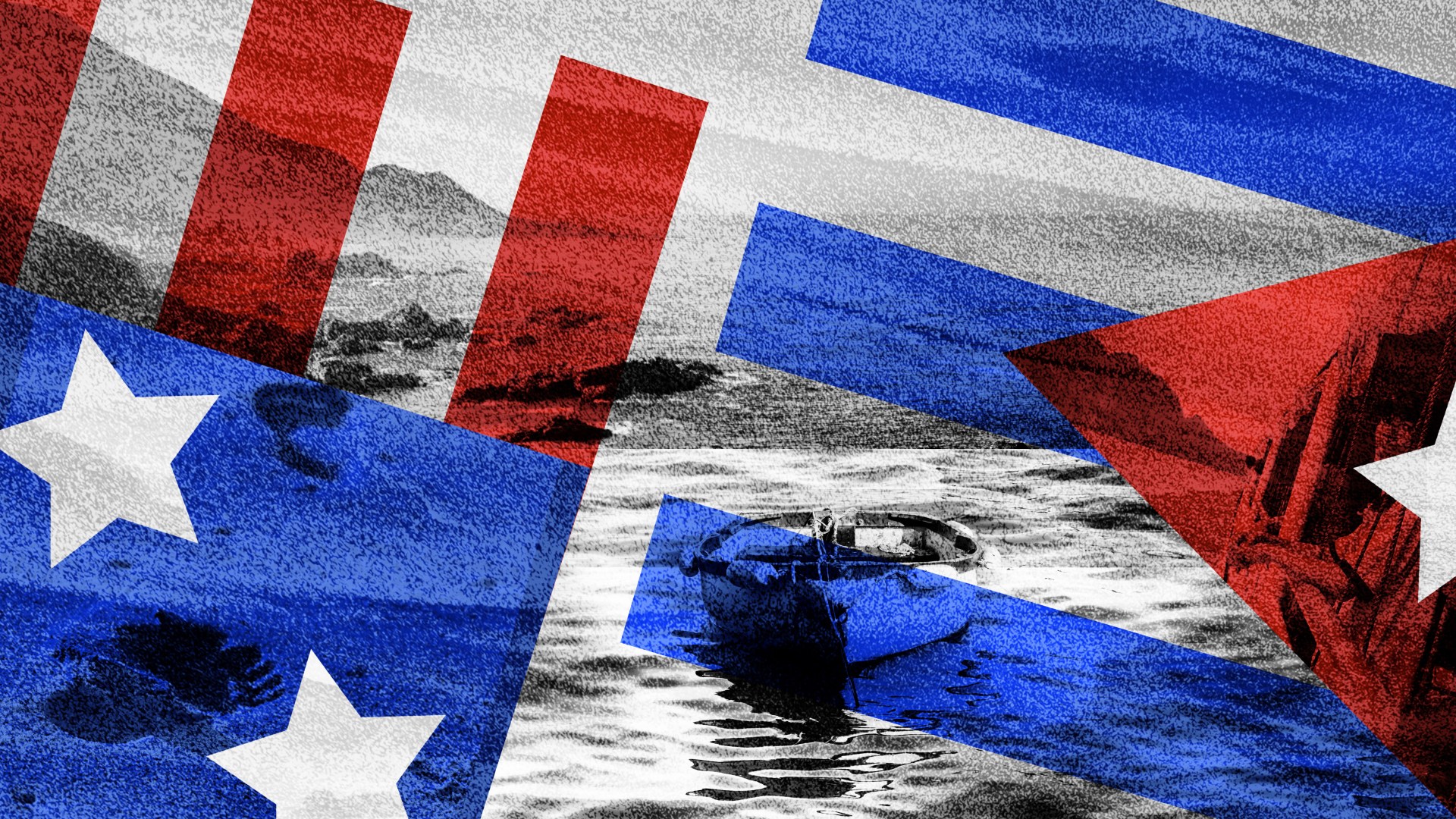
Let Cubans Come to America, by Land or Sea

Staff Editor

The need for asylum seekers’ religious (and other) freedom is as urgent as ever.

Christianity Today August 2, 2021
Illustration by Mallory Rentsch / Source Images: Oliver Cole / Christopher Sardegna / Paul Ekman / Ian Schneider / Unsplash

In mid-July, after thousands of Cubans in multiple cities demonstrated against their government on a scale not seen in the communist nation in decades, US Homeland Security Secretary Alejandro Mayorkas told them not to look to the United States for sanctuary.

“The time is never right to attempt migration by sea,” he said at a press briefing. “To those who risk their lives doing so, this risk is not worth taking. Allow me to be clear: if you take to the Sea, you will not come to the United States.” The Caribbean passage is dangerous, particularly during hurricane season, continued Mayorkas, a Cuban immigrant himself. Any Cubans who attempt it, he reiterated, will risk death for nothing.

This isn’t a new policy. Neither is it a good one. Mayorkas is right about the danger of the trip, and perhaps as a practical matter his advice against attempting it is wise. But as a matter of principle and policy, the United States should stand ready to welcome Cubans who flee here.

The type of safe haven Mayorkas refused Cubans is called asylum. Asylum seekers meet the requirements for refugees but have a different process for admission to the US. A refugee, per the Department of Homeland Security (DHS), is a person who is “unable or unwilling to return to his or her country of nationality because of persecution or a well-founded fear of persecution on account of race, religion, nationality, membership in a particular social group, or political opinion.” Refugees apply for entrance to the United States from outside our borders, then undergo a vetting process that takes around two years.

Asylum seekers are a smaller category of people. An asylee, the Department of Homeland Security (DHS) says, is someone who meets the above definition of a refugee and is either already present in the United States, as were the Olympic athletes who entered with legal visas and then sought asylum, or is at a port of entry, such as an airport or border crossing.

US law says foreign nationals have a right to ask for asylum if they can get here, even if they initially enter our country illegally—like landing on a Florida beach after a boat ride from Cuba. There are a few exceptions to that right. Most are about individual history, but one can be applied more broadly: Asylum requests can be dismissed if the attorney general determines asylum seekers can be sent to a safe third country with that country’s assent. That’s the loophole Mayorkas invoked for Cubans. (He didn’t specify what third countries might be used.)

On paper, asylum may seem uncontroversial. If someone fleeing, say, religious persecution—which continues in Cuba, despite some liberalization since the fall of the Soviet Union—can get to the United States, shouldn’t we let them come in? After all, pursuit of religious liberty is one of the reasons this country exists, and if we can share that blessing with people who can’t obtain it in their home countries, surely we’re living up to the greatest of our national aspirations.

The trouble is that many immigrants who make asylum claims on arrival to the US don’t meet the definition of a refugee. That’s not to say they haven’t experienced severe hardship, but often they’re better characterized as economic migrants than true asylees. They seek asylum not because they honestly believe they’re qualified but because without special professional skills, educational plans, or family connections in the US that could get them a visa, asylum is their only remotely plausible way to immigrate here legally. It’s this misuse of the system that has made asylum a deeply contentious matter.

For those fleeing Cuba, their hardship will always have a political element, which our country should consider. As President Joe Biden said this month, mere days after Mayorkas told Cubans to go away, Cuba has suffered “62 years of repression under a communist regime.” Havana is a totalitarian police state, a dictatorship without regard for the most basic human rights, including religious freedom. Browse CT’s archives on Cuba and you’ll find accounts of the evil institutionalized in this government; of lives transformed by escape from Cuba to the US; of pastors arrested, surveilled, and harassed.

“It’s like a cold war,” one Cuban pastor told CT for a 2009 report. “It’s a psychological bombardment.” In recent protests, police set dogs on a Baptist pastor who recorded their violence on his phone. He and a fellow pastor, also arrested, haven’t been heard from since they were taken into custody. That’s not unusual for this regime. Government “tactics against critics include beatings, public shaming, travel restrictions, short-term detention, fines, online harassment, surveillance, and termination of employment,” Human Rights Watch reports.

This is a distinct situation from that of would-be asylees from most other Latin American and Caribbean countries (with the exception of Venezuela and perhaps Nicaragua, the other Western Hemisphere states to consistently join Cuba near the bottom of international freedom rankings). People coming from Mexico, for example, may be fleeing grave poverty, gang violence, and/or government dysfunction. But they aren’t fleeing an explicitly communist regime that barely pretends to guarantee freedom of worship and freedom of conscience.

Cuba stands out as the most politically oppressed country close to US borders. That combination of proximity and politics should give Cubans special consideration. US politicians, on the right and the left, who condemn the brutal, communist regime in Havana, do seem to give it that consideration. But when Cubans trying to escape brave the journey to the US, where we fashion ourselves an international beacon of liberty, too many of those same politicians turn them away. This is an unseemly doublemindedness that discredits the best principles we claim (Matt. 5:37; James 3:10).

What I’m suggesting here isn’t outlandish. In fact, priority admission for Cuban migrants on exactly these grounds was US policy for roughly half a century. From the 1960s until 1995, any Cuban who got to US territorial waters could pursue permanent residency here. Then, until early 2017, the “wet foot, dry foot” policy said Cubans had to reach US soil to be thus permitted to stay. The Obama administration ended that policy, the Trump White House further hindered Cuban entry, and the Biden administration has responded to Cuba’s present turmoil by sanctioning Cuban officials while also refusing entry to their victims.

Immigration policy is a sprawling mess over which reasonable people can disagree in good faith. I favor looser immigration rules as a matter of individual liberty, but I understand and take seriously many of the objections raised by those who want more restrictions.

I think, though, that Cuba is a relatively simple case, since it is so close and its government so oppressive.

Many Cubans, of course, will want to stay where they are, particularly if these protests prove to be the start of a durable shift in Cuban life. But for any who want to come to the United States in search of freedom, especially the right to worship as they please, the door should be open.

Church Life

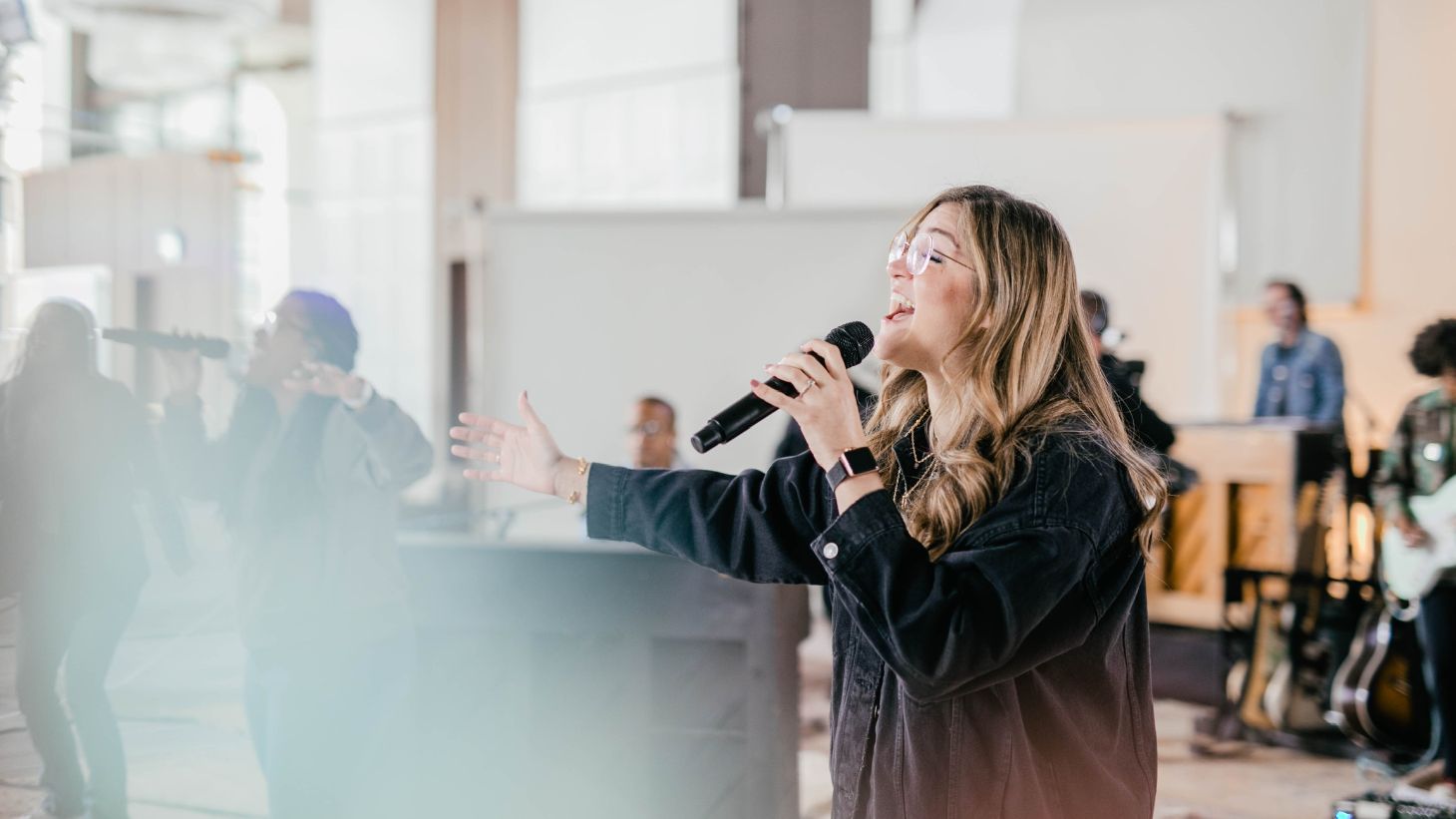
Mexican Worship Leader Layla de la Garza on the Power of ‘Sung Theology’

Despite the lingering stereotypes, the Monterrey-based singer and minister set out to prove contemporary worship services can hold to the authority of Scripture.

Christianity Today August 2, 2021
IF: Gathering / Courtesy of Layla de la Garza

For Layla de la Garza, worship music has been a way to draw nearer to Jesus and the Word.

Having grown up in a conservative traditional church, Layla was transformed by listening to Passion’s worship music as a teenager. Many years later, in 2015, she met CCM musician Christy Nockels, who became her mentor and invited her to participate in IF:Gathering. De la Garza has used her talents in this ministry to serve as a worship and teaching leader, multiplying IF’s reach among the international Spanish-speaking community.

Back in her hometown of Monterrey, a city of more than a million in northeastern Mexico, some still remain suspicious of contemporary worship, with its bright lights and big stages. But at VIDAIN church, where de la Garza and her husband, Diego, serve as part of the pastoral team, they’ve set out to show that high production value does not mean compromising on the truth of the gospel. She’s also the host of Notas con Dios, a podcast where she discusses finding God and hope in everyday life.

CT spoke with Layla about her vision for the church, the role of women in the church in Mexico, and her call to worship, ministry, and the fulfillment of the Great Commission. (This interview was originally conducted in Spanish.)

How would you describe the evangelical church in Mexico to people from other countries?

Latin Americans in general are very passionate. Relationships and building community are very important to us. Our relationships are very warm: We hug each other and create intimacy easily, even with people we have just met. These characteristics of Latin culture are very present in the evangelical church in Mexico.

It is beautiful because I believe we have the potential to be like the first church we see in the Book of Acts. We must see this potential and ask ourselves, How far can our Latin heart lead us to fight for the other, to love the other? How can we channel that passion and that desire to be together and to create community in the church? Because God himself is a community—God the Father, God the Son, and God the Holy Spirit, three in one in perfect community.

How can we take that need for community and convert it, for example, into daring to ask for help from other brothers and sisters? We see our Lord Jesus asking his disciples for help: “My soul is overwhelmed with sorrow to the point of death. Stay here and keep watch with me” (Matt. 26:38). We see that humility and that authenticity in Jesus, and I think it is something that the church in Mexico should look for.

As a woman, did you face difficulties in reaching a leadership position? How is women’s leadership perceived in the evangelical churches in Mexico?

I have been fortunate to be part of churches that value, honor, and uplift women. I have had the opportunity to learn, to ask questions, to teach, to create. When you surround yourself with people who have the same heart that Jesus has for women, you will inevitably experience respect and honor in a very special way. Sadly, this does not happen in many churches, and Mexico is no exception.

There is much room for growth in this area in Latin America. The church needs to see women, and we need to see ourselves, the way God sees us. I wish that as women we would believe and trust in that special and unique design that God created us with and [begin] investing our lives doing and being what we were called to do. I wish there were more men willing to see women the way Jesus sees them.

How did you feel God’s call to the ministry of praise and worship?

I am the youngest of five siblings, and I was born after my family had just gone through a major crisis and an encounter with the Lord that led them to decide to change and really follow Jesus. During my childhood my family was very much in love with Jesus. We prayed together around the bed every night. I also had a great example watching my parents reading and studying the Word together, and I grew up watching my siblings serving Jesus and seeking to really know Him.

My mom would always sing songs to God to me. I remember that I always connected with God through music and used to lock myself in my bedroom to sing to God because I didn’t want anyone to hear me. From the age of six, I was in the children’s choir and sang solos. As I grew older, I discovered the great power of praise and worship. And not only did I grow in my relationship with Jesus through music, but I learned that I can serve others through this ministry where I can declare God’s truths over the lives of the people who listen to me. I know I don’t have the best voice, but by positioning myself under God’s authority, even my weakness can serve his purposes.

How did you transition from the traditional worship style of your childhood church to the kind of worship you lead today?

In the Presbyterian church that I grew up in, I had a group of friends who felt a desire to praise and worship God in a different way. We wanted to be able to raise and clap our hands, to sing to God with a different kind of music, but that was not allowed in that church. There was a big gap between what our hearts desired and what we were able to experience. Eventually, the time came when a group of young people and our worship leader left that church and started another one. It was then that we began to experience on our own what it was like to sing to God freely. We would spend hours and hours praising God. If it was a morning meeting, we would stay up until the afternoon worshiping God. I was 21 at the time, and it was a period that transformed me deeply.

It is important to clarify that I am very grateful to that Presbyterian church, because I had the opportunity to be taught in the Word of God and to sing hymns that were very close to the Word of God. Hymns are sung theology. But I am also grateful for the freedom we have now to experience these intimate moments with God where I can really connect my spirit with his Spirit. It is very difficult to accomplish this when there is no freedom.

I love the idea that hymns are sung theology. Do you think there is a need today for Christian music that is better anchored in Scripture?

I think so. It is very important that we understand basic biblical concepts about who God is and who we are in him. Truths don’t depend on our moods or our feelings. I have heard songs that say “God, please don’t let me go,” when as believers we should know that he never lets us go. Jesus said, “And surely I am with you always, to the very end of the age” (Matt. 28:20). Praise has a unique power. The moment our lips begin to speak aloud or sing, something happens in our spirits. That is why it is important to sing the Word, because it declares the truth and reminds us of the Truth. The Enemy bombards us with lies, and we need to replace those lies with the truth. God’s Word is the truth.

One thing I love about leading worship is being able to stand behind the Cross and minister through the authority God gives us. First Peter 2:9–10 says, “But you are a chosen people, a royal priesthood, a holy nation, God’s special possession, that you may declare the praises of him who called you out of darkness into his wonderful light. Once you were not a people, but now you are the people of God.” So when I lead worship, I like to remember that we are priests of God and that we can sing over the people the truth about God. I position myself in an attitude of service to the people and simply let the Spirit of God do what music can’t do. When we understand our identity as priests of God, we no longer desire to sing anything that is not according to the Scriptures. The only thing we long for is to exalt Jesus.

The church that was formed by the youth group you were talking about—is it the same church where you currently serve?

No. But it was in that process that the Lord began to work in a very special way in my life. I remember the question constantly running through my head: This passion I feel for Jesus—how can I share it with other people? Then I met the man who is now my husband. He invited me to lead worship at a new church, and I loved his vision. He was dreaming of a church for the unchurched, for those who don’t like church: a church for outsiders.

He explained something to me that I hadn’t seen before. Churches naturally gravitate toward doing things for insiders, for those who already know Jesus or are active members of the church. Many times, we forget the people who don’t yet know Jesus. He challenged me not to live with an annual evangelism event but to live our lives taking the gospel to the unbelievers and to form a church with its eyes open to see that one who is coming for the first time. What about the one who is considering for the first time believing in God? What about the one who doesn’t know the Word and is wondering if God really exists or whether he should take his life tonight? My now husband and I started talking about that a lot, putting ourselves in the shoes of people who are not yet part of the church. And when God gave me that vision, I couldn’t turn back.

It can almost seem like our vision is crazy. There are those who go to our church and say, “It’s a crazy church. They probably don’t preach the Word because they have lights; they have screens.” If someone goes to our church for the first time, it may seem very superficial. Now, in churches in the United States, it is more common to have a good audio system, screens, lights, and so on. However, many churches in Mexico still don’t have that. So, the use of the most modern technology can confuse many and lead them to say that we are “watering down the Word of God.”

It is true that in certain circles some have a preconceived idea that a “modern” church that uses lights in the worship service does not have a solid biblical foundation. What would you say about this? What does your church do to balance both sides?

Look, we believe that nothing has to make people uncomfortable when they come to church except the gospel: that we are sinners who need to repent and need a Savior; that this Savior is Jesus, who is God himself and became a man to give his life for us; and that he is alive today. Anything else is peripheral; in everything else that surrounds that foundation of our faith, our goal is to remove as many obstacles as possible for people to come to Christ.

And those obstacles can be small or large. We pay attention to even the smallest details: the way we greet people at the door of the church, the temperature of the air conditioning, the lights. We even understand that in Sunday services we cannot sing for hours, because that is something for mature believers. Someone who doesn’t believe in God can’t be on his feet for a long time singing songs he has never heard before, to a God he possibly doesn’t even believe in yet. We want to get out of our comfort zone so that others can feel comfortable.

Church can be enjoyable, and many people have never had that experience. My dad used to tell me, “It was unimaginable that we could laugh or clap in church! At our church there was a plaque on the altar that said, ‘Let all the earth keep silence before Him.’ So, we didn’t even talk!” Now that my dad is with us, he tells me that he enjoys this freedom very much. So, we think there are definitely things that can add up to create irresistible environments where people can really connect with God. We try to remove as many obstacles as possible so that people can come closer with confidence.

We want to put ourselves in the place of others and offer a church that paves the way for many to come to Jesus. We want to think more about others and not just those at home. Can you imagine how much it is worth it if a soul is being saved?

News

Biden Names First Muslim Religious Freedom Ambassador

(UPDATED) 12 Christian IRF advocates praise Rashad Hussain, Obama’s OIC envoy, for his credentials and credibility. Two USCIRF commissioners and antisemitism envoy also named.

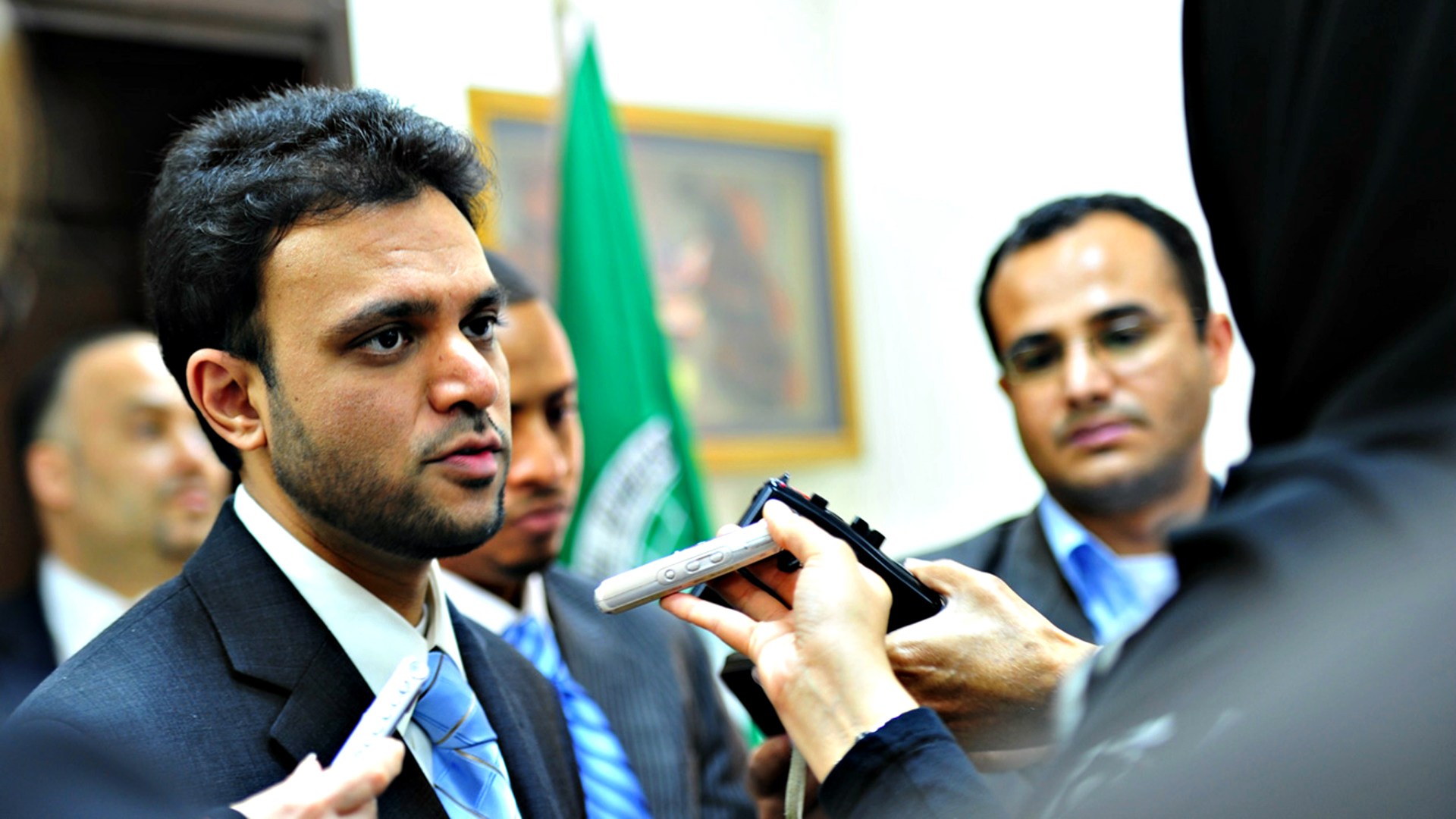
Rashad Hussain briefs the press at OIC headquarters in Jeddah on February 16, 2010.

Rashad Hussain briefs the press at OIC headquarters in Jeddah on February 16, 2010.

Christianity Today July 30, 2021
Amer Hilabi / AFP / Getty Images

The White House announced Friday a slate of nominations and appointments for top religious affairs roles, including the first Muslim American nominated to be the US ambassador-at-large for international religious freedom (IRF).

President Joe Biden will select Rashad Hussain as his nominee for that post, filling a State Department slot vacant since former Kansas governor and US Senator Sam Brownback—who co-chaired a bipartisan IRF summit for 1,200 attendees this month—left at the close of the Trump administration.

Hussain, who would need to be confirmed by the Senate, currently works as director for Partnerships and Global Engagement at the National Security Council. He previously served as White House counsel under President Barack Obama, as well as US special envoy to the Organization of Islamic Cooperation (OIC) and US special envoy for the Center for Strategic Counterterrorism Communications, among other roles.

Knox Thames, who served as the State Department’s special advisor for religious minorities during both the Obama and Trump administrations, told CT that Hussain was “a strong pick.”

“He knows human rights and cares about religious freedom,” said Thames. “I saw firsthand how he raised these issues when he served as [OIC envoy]. I know he’ll be able to hit the ground running from day one to combat religious persecution.”

Judd Birdsall, a senior research fellow at the Berkley Center for Religion, Peace, and World Affairs at Georgetown University who served with Hussain at the State Department from 2009–2011, told CT that the nomination is a “fantastic choice” because Hussain has “impeccable credentials, extensive diplomatic and legal experience, and unique credibility as a Muslim American.”

“I greatly respected his thoughtful, humble, and capacious approach to all things religion and diplomacy, including the promotion of religious freedom,” said Birdsall. “He understands the religious minority experience and is a passionate advocate for all those who suffer on account of their beliefs.”

Also noteworthy is the speed of the nomination, coming at a similar pace to President Donald Trump’s selection of Brownback as IRF ambassador after just six months.

“The most tangible measure of an administration’s commitment to international religious freedom is the quality of its IRF ambassador nominee and the speed with which it makes that nomination,” Birdsall told CT. “Whereas President Bush took 14 months to announce his nominee for the job and Obama took 17, Biden is strongly signaling his commitment to the issue by taking only seven months to announce an outstanding nominee.

“By nominating a Muslim to serve as IRF ambassador, the Biden administration is decisively turning the page on an era in which a perception of anti-Muslim sentiment undermined the nation’s reputation on religious freedom,” he said. “Rashad Hussain will help to restore America’s credibility as a champion of tolerance and inclusion.”

“The task of advancing religious freedom is best done when all faiths work together,” James Chen, vice president of global operations at the Institute for Global Engagement, told CT. “So the Biden administration’s appointment of Mr. Hussain … is encouraging to see.”

Bob Roberts, global senior pastor of Northwood Church and founder of Multi-Faith Neighbors Network, told CT he was “so excited” for Hussain’s nomination.

“He will be incredible. He’s a wise man of character,” said Roberts. “Him being a Muslim is a very positive thing, in that he will be able to walk into sensitive places in the world and be unparalleled in his ability to understand, speak to issues, and challenge right actions.

“We’ve had Christians in that role and a rabbi in David Saperstein,” he said. “A Muslim is a good choice.”

“President Biden’s appointment of a Muslim [IRF ambassador] is a reminder that the US position on religious freedom has always been for people of all faiths and even for those who express no particular faith,” Randel Everett, founder and president of 21Wilberforce, told CT.

Elijah Brown, general secretary and CEO of the Baptist World Alliance, told CT that the nomination is a “strategic development” because Hussain “brings a depth of experience across all three branches of the US government and a wide array of faith-based initiatives including Baptist-Muslim conversations.

“I join with many others in urging Congress to quickly confirm [him] to this ambassadorship,” he said, “as many—especially in light of the ongoing global pandemic—face unprecedented restrictions as they seek to live out their faith convictions.”

Jeremy Barker, the Erbil-based Middle East program director at the Religious Freedom Institute, told CT that Hussain is “a great choice” who has “done serious security and diplomatic policy work which will be vital in advancing religious freedom within an administration that had said it wants to prioritize human rights within its foreign policy.

“He is also a person of faith who takes his own religion seriously and understands that religious persecution strikes at something fundamental to an individual or community,” said Barker.

“International religious freedom has been and should remain an issue with overwhelming bipartisan support. The Senate should move quickly to get Mr. Hussain confirmed and in the job,” he said. “The work is too important to be left undone and the Biden administration is to be commended for putting a qualified nominee forward early in the process.”

“Rashad’s appointment demonstrates not only the importance the Biden administration places on religious freedom,” said Saeed Khan, an expert on American Muslim communities at Wayne State University, “it also shows the importance of the Muslim world to the administration both in terms of combatting Islamophobia and also promoting religious freedom in Muslim majority countries. Rashad’s background will allow him to have a frank discussion with Muslim majority countries about the importance of religious freedom.”

Biden is also expected to nominate Deborah Lipstadt as the next US special envoy to monitor and combat antisemitism. Lipstadt is a professor at Emory University in Atlanta and a prominent Holocaust historian.

She is the author of Antisemitism: Here and Now and is known for successfully defeating a libel suit brought against her by Holocaust denier David Irving.

“We are greatly heartened by the anticipated announcement of Prof. Lipstadt to continue our nation’s fight against antisemitism both here and abroad,” said Mark (Moishe) Bane, president of the Orthodox Union. “She is a leader with great moral courage; her dedicated work, clear voice in fighting Holocaust denial and preserving the memory of the attempted destruction of the Jewish people make her an exemplary choice for this role.”

Lipstadt, who would have the rank of ambassador, also requires Senate confirmation. The anticipated announcement follows a May 24 letter from several leading Jewish organizations calling on President Biden to address the recent rise in antisemitic attacks.

“The presence and efforts of an Ambassador to Monitor and Combat Antisemitism send a powerful signal to governments around the world that the U.S. takes combating antisemitism seriously and calls on them to do the same,” the letter said.

“President Biden is to be congratulated for having moved relatively quickly in nominating people for religious freedom related posts,” Paul Marshall, a veteran IRF scholar and author and the religious freedom chair at the Institute for Studies of Religion at Baylor University, told CT. He noted that Lipstadt is “a skilled veteran” and that Hussein’s envoy roles had “shown both his abilities and his commitment to religious freedom.”

“Having a Muslim in the religious freedom ambassadorship may allay the canard that this is simply a sop to the religious right,” said Marshall, currently a senior fellow at the DC-based Religious Freedom Institute and the Jakarta-based Leimena Institute.

Nadine Maenza, chair of the US Commission on International Religious Freedom (USCIRF), applauded the two nominations.

“We look forward to working closely with [them] to develop new ways for the United States to promote the freedom of religion or belief around the world,” she stated in a press release. “Global religious freedom violations continue to be a pervasive threat to our national security and global stability. [They] play an essential role in US efforts to counter that threat.”

In addition, Biden plans to appoint two new commissioners to USCIRF: Khizr Khan and Rabbi Sharon Kleinbaum.

Khan became famous in 2016 when he and his wife, Ghazala, spoke during the Democratic National Convention as “Gold Star” parents, discussing their son, Humayun, a US Army captain who died in Iraq in 2004.

Khan, a Harvard-educated Muslim immigrant, directly challenged then-candidate Trump’s proposal to ban residents of Muslim-majority countries from entering the United States, accusing the business mogul of having sacrificed “nothing—and no one.”

“Let me ask you, have you even read the United States Constitution? I will gladly lend you my copy,” Khan said as he held aloft a worn booklet containing the text of the document.

Khan, the founder of the Constitution Literacy and National Unity Project, runs his own law practice and has authored three books, including Founding Documents of the United States of America.

Kleinbaum, for her part, already served as a USCIRF commissioner in 2020 and leads the Congregation Beit Simchat Torah in New York City, a community that centers LGBT people. A human rights advocate, she also sits on Mayor de Blasio’s Faith Based Advisory Council and serves on New York City’s Commission on Human Rights. In addition, she is a board member of the New York Jewish Agenda and the New Israel Fund.

“Today’s announcement underscores the President’s commitment to build an Administration that looks like America and reflects people of all faiths,” stated the White House.

David Curry, CEO of Open Doors USA, told CT he was “heartened” by the Biden administration filling the critical IRF roles.

“Rashad Hussain is a well-qualified nomination with a deep understanding of the factors at play in China, India, and elsewhere,” he said. “We look forward to building together the diverse coalition of leadership necessary to counter the rising tide of religious persecution worldwide.”

In a later press release, Open Doors welcome all four selections, stated Hussain’s “expertise could play a major role in addressing some of the most challenging issues facing Christians, especially in the Middle East and West Africa,” and called on Senator Mitch McConnell to “fill the last remaining vacancy [at USCIRF] in a timely manner.”

Former USCIRF commissioner and spokesman for President Trump’s evangelical advisers Johnnie Moore congratulated Hussain and the other appointees and told CT he’ll “look forward to collaborating with each of them in order to advance the freedom of religion and belief around the world.

“There will, as always, be divergent points of view on certain ideas, policies, and strategies, but international religious freedom continues to be—and must remain—almost entirely bipartisan,” he said. “In fact, it must be nonpartisan. I intend on doing my part to keep it so.”

Kori Porter, CEO of CSW USA, told CT she “warmly welcomes” Hussein and his “excellent track record speaking out in support of religious minorities and against laws that violate freedom of religion or belief, including blasphemy laws.

“His nomination is an encouraging sign of the importance that the Biden administration places on religious freedom, which is particularly welcome as the world tackles the pandemic and worsening inequalities and rights violations,” she said. “We hope that Mr. Hussein will build on the excellent work of former ambassadors, particularly Ambassadors Saperstein and Brownback, in raising the profile of this fundamental human right.”

Thomas Schirrmacher, secretary general of the World Evangelical Alliance (WEA), told CT the alliance has had “great experience with Muslim friends filling strategic religious freedom positions,” such as Ahmed Shaheed, the current UN Special Rapporteur on Freedom of Religion or Belief (interviewed by CT here). The WEA is currently “building a strong global alliance with major Muslim actors who fight for religious freedom,” he said, evidenced by a joint statement and book release with Indonesia’s Nahdlatul Ulama (NU) at a DC event adjacent to Brownback’s IRF summit.

“With Rashad, we get one of the most experienced diplomats in dealing with concerned governments, so there is no need for him to warm up,” said Schirrmacher. “He can start to change things tomorrow.”

Jack Jenkins, Kathryn Post, and Joseph Hammond reported for RNS. Additional reporting by Jeremy Weber for CT.

News

Died: H. Eddie Fox, Who Urged Methodists to Share Their Faith

The ministry leader believed declining US churches could be revitalized by hearing Wesleyans “with a different accent.”

Christianity Today July 30, 2021
Courtesy of the Holsten Conference of the UMC / edits by Rick Szuecs

H Eddie Fox, who hoped to renew American Methodism through evangelism and increased connections with global Christianity, died on Wednesday at age 83.

Fox led World Methodist Evangelism for 25 years, teaching, training, and empowering Methodists and Wesleyans to share their faith, and encouraging churches to make evangelism a priority. He pioneered several new initiatives that were popular in United Methodist Church (UMC) congregations, and he helped American churches connect with fellow Wesleyans outside the United States, especially in formerly communist countries after the collapse of the Soviet Union.

From 1989 to 2014, when Fox directed the world evangelism program, Methodists increased around the globe by about 1 million per year, even as the US membership of the UMC declined by about 2 million overall. Fox saw a direct link between the theology of the church and its vitality.

“Wherever the church is faithful to the doctrine, the sound teaching, the Discipline, the way of life—which is the way you order your life—and the spirit, openness to the Holy Spirit, you'll find a church that's dynamic, contagious and alive,” he said when he retired. “And where that is not true, you’ll find a church to be a dead sect, having the form but not the power thereof. That’s been a focus of my ministry. It’s been a call we’ve stood on for many, many years.”

Fox taught more Methodists how to share their faith than any one else in his lifetime, and became, for many, the evangelistic face of Methodism. He also taught at the Billy Graham School of Evangelism at Wheaton College for 15 years.

“He was dynamic and alive with his passion for the gospel, especially evangelism,” said Maxie Dunnam, past president of the World Methodist Council and president emeritus of Asbury Theological Seminary. “There was a sense in which you felt drawn in from the moment you met him.”

Methodists around the world mourned at news of Fox’s death.

“Methodism has lost one of its most prominent encouragers and enablers of evangelism and church growth across the world, and The United Methodist Church in Estonia has lost a dear friend,” said Christian Alsted, a bishop in the Northern Europe and Eurasia Central Conference.

Harold Edward Fox was born in East Tennessee in July 1938. The rural area was known by its creek, rather than nearby town or Pigeon Forge or the county seat of Sevierville, and Fox always told people he was from Waldens Creek.

He was a seventh-generation Methodist. His father, Marshall, and mother, Geneva Perryman Fox, were devout Christians, and the young Eddie could trace his Christian heritage to the 1787, when the American followers of evangelist John Wesley separated from the Church of England and started sending circuit preachers throughout Appalachia.

Fox personally committed his life to Christ at age 9. Then, at a church camp at age 16, he felt a call to ministry. His mother gave him a word of caution.

“You better be sure about that,” she said. “It will be hard any way you do it, but it will be impossible unless God has laid his hand on you.”

Fox was sure, and received a license to preach in 1955 at the age of 17. He went to junior college at Tennessee Wesleyan, then earned a degree from Hiwassee College, where he married Mary Nell Leuty during their senior year. That same year, the future connector of global Methodism saw the ocean for the first time.

When Fox graduated from seminary at the Candler School of Theology at Emory University, he went back to East Tennessee and became a pastor in the Holston Conference. He spent 15 years on the UMC’s Board of Evangelism, and then, in 1989, was asked to lead World Methodist Evangelism.

Like many Methodists at the time, Fox was concerned about the declining membership in the UMC in the US and he wanted to find ways to help churches do more outreach. He became especially passionate about the importance of evangelism, though, when he took a trip to Estonia, which was under the occupation of the Soviet Union.

“I saw people stand for two hours in the worship service,” he said. “I saw people weep just to be taking communion. I wept too.”

He saw a sharp contrast with American Methodists.

“We’ve bought into this idea that religion is a private matter,” Fox told The Tennessean in 1998. “We’re persuasive about most things in our lives—this diet, that movie. But when it comes to faith, we don’t want to interfere, so we don’t ask people to church.”

After the dissolution of the Soviet Union, Fox developed a program connecting American congregations with Methodist churches in former communist countries, starting in Czechoslovakia and Estonia. “Connecting Congregations for Christ” was so popular, it soon expanded to churches in Africa, South and Central America, and Asia. By the time Fox retired, there were 186 connections.

“Churches are going to hear the Word with a different accent,” he said. “Maybe they’ll hear it more clearly.”

At Methodist conferences in the US, Fox started telling a story about a church bell in Varna, Bulgaria. In the 1960s, he said, communist authorities had ordered the local church to remove the bell, so they could no longer summon the area Christians to worship. Three men took it down, but then instead of melting it down for the metal, they buried it in a secret garden.

Forty years later, Fox said, they resurrected the bell, rebuilt the church, and when the building was dedicated by Methodist World Evangelism in September 2002, they rung the bell again.

Fox told American Methodists that they had also buried a bell in their lives and needed to ring it again.

“There are parts of our movement which are in decline, and in denial, who are suffering from ‘truth’ decay,” Fox said. “You have a bell—the name is Jesus—and we are called to be the bell ringers through word, deed, and sign in the world.”

In the 2000s, Fox was briefly embroiled in the UMC controversies over LGBT issues. In 2008 he was on the General Conference committee that recommended the denomination drop the doctrinal statement that “the practice of homosexuality is incompatible with Christian teaching,” and LGBT people should not be allowed in ministry unless they were committed to celibacy. Fox read the minority report, arguing the church should not change its position. The conference rejected the committee’s recommendation.

A few years later, when Fox received a distinguished alumni award from Candler, students opposed to his position on sexual ethics held a protest.

Fox’s main focus, however, was on empowering people to evangelize. He established a faith-sharing initiative, training lay people to talk about Jesus, and wrote the Faith-Sharing New Testament, which now has 850,000 copies in print. He established the Order of the FLAME—Faithful Leaders As Mission Evangelists—for young clergy committed to evangelism, and he took every opportunity he could to empower people who were already actively spreading the gospel.

When Fidel Castro started allowing international religious groups to start connecting with Christians in Cuba, for example, Fox arranged to import more than 400 Chinese bicycles for Methodist pastors.

“I want to give them wheels,” he said, “so they can go faster and do more for the Lord.”

He spoke with an evangelistic passion that the 18th century Appalachian circuit riders who told his ancestors about the gospel would have recognized.

Fox is survived by his wife, Mary, and their three children Gayle, Timothy, and Thomas Fox.

News

This Land Is Your Land, Say More Churches in Canada Than in US

CRC congregations weigh land acknowledgements amid rising awareness of indigenous injustices on both sides of the border.

Christianity Today July 30, 2021
Illustration by Mallory Rentsch / Source Images: WikiMedia Commons / Google Maps

Visitors to a suburban Toronto congregation are greeted in the foyer or from the stage with the following: “The Community Christian Reformed Church of Meadowvale is located on the Treaty lands and traditional Territories of the Mississaugas of the Credit First Nation.”

The statement names the indigenous community that once stewarded the land where the Canadian church stands. But a visitor to one of Meadowvale’s hundreds of fellow American congregations across the border will likely find the practice of such “land acknowledgements” to be wholly unfamiliar.

The discrepancy is part of a larger divergence within the Christian Reformed Church in North America (CRCNA) as the denomination’s 1,000-plus congregations—with one quarter in Canada and three-quarters in the United States—seek to serve amid neighboring cultures and governments moving at very different paces on addressing injustices done to their indigenous peoples.

In Canada, where the native community is known as First Nations, Inuit, and Métis peoples, the abuse that many indigenous students suffered at residential schools was the subject of a national, years-long reckoning through a federally backed Truth and Reconciliation Commission (TRC). In contrast, though many Native Americans in the United States experienced similar trauma, the schools’ aftermath has only recently gained mainstream attention.

“Because of the [TRC] and the things that the government has done, the Canadian church has been encouraged to continue doing the work,” said Viviana Cornejo, the CRCNA’s racial curriculum and instruction specialist. “The United States as a whole is having a hard time dealing with the past. If the country is not able to do that, the CRC is not going to do that either.”

The remains of Canada’s residential schools

In May, dozens of First Nations families had their worst fears confirmed. The remains of 215 students were discovered in unmarked graves on the grounds of a closed residential school in Kamloops, British Columbia. Weeks later, an estimated 600–751 unmarked graves were located at a former school in Marieval, Saskatchewan. And by the end of June, another 182 unmarked graves were found at a former school outside Cranbrook, British Columbia.

The findings provoked intense emotion. More than a dozen Canadian churches were destroyed or damaged by fires. Dozens more were vandalized. Though the attacks appeared connected to the revelation of the graves (given that the Canadian federal government had tapped Christian denominations to run the schools), many of the impacted congregations primarily serve immigrants.

Several cities canceled Canada Day celebrations planned for July 1. People placed teddy bears and shoes at memorials nationwide, creating visual representations of the lost children.

“In an era of reconciliation these precious 215 children should not be a brief emotional blip in the news cycle,” affirmed a statement signed by nine CRCNA leaders, including the denomination’s executive director. “Each one was a precious child and an image bearer of God. As the church—children of the reconciling Christ—tears of sorrow, prayer, and action are critical for the integrity of our reconciliation efforts.”

The statement came with nine suggested action steps, along with a prayer to be read by indigenous and nonindigenous Christians. (Almost two-thirds of Canada’s indigenous population identifies as Christian, according to the 2011 National Household Survey.)

The CRCNA never operated a residential school in Canada. However Roman Catholic, Anglican, Presbyterian, and United churches did. Beginning in the 1980s, hundreds of residential school survivors began to file lawsuits against the Canadian government, ultimately becoming the country’s largest class-action lawsuit. The ensuing settlement agreement, approved in 2006, included payouts to survivors from the denominations and the federal government. Funds from these bodies also paid for the TRC, which ran from 2008 to 2015, allowing survivors to share their stories across the country.

The TRC initiative also culminated in 94 calls to action. The Canadian CRC congregations committed to several, including one that asked faith communities to affirm the United Nations Declaration on the Rights of Indigenous Peoples as a framework for reconciliation. The others called for equity in education for indigenous people and for churches to teach their communities about this history. On the ground, that means Canadian leaders have lobbied on behalf of educational justice issues and have also intentionally educated and resourced CRC congregations on the effects of colonization and residential schools.

“The results of the residential schools created the opportunity for settler acquisition of land and resources in this country,” said Mike Hogeterp, who leads the Centre for Public Dialogue, the denomination’s Canadian public policy arm. “Even though the CRC didn’t run a residential school, we are beneficiaries of the colonial system that the residential schools represented.”

This gesture was far from the denomination’s first touch point with First Nations communities. While the first CRC churches in Canada opened in the early 20th century, the denomination organized and matured in the years following World War II. When many First Nations people began moving off their reservations and into urban areas, the CRCNA starting in the 1980s opened ministry centers in Regina, Winnipeg, and Edmonton.

Community Christian Reformed Church of Meadowvale

Some CRC congregations have initiated relationships on their own. The Toronto Blessing, a charismatic revival that began in 1994, spurred the Meadowvale church to learn the history of its land as part of a “spiritual-mapping exercise” of the city. Several years later, when Meadowvale organized a March for Jesus, the church invited members of the Mississaugas of the Credit First Nation after learning that the tribe had a significant Christian presence on its reserve. (In the early 1800s, Methodist circuit riders spread the gospel to the Mississaugas, a faith which endured.) Church leaders from both Reformed and Wesleyan communities began to pray with each other.

In 2000, Meadowvale organized a conference where members repented for past wrongs toward the Mississaugas. This gesture has deepened into two decades of friendship and partnership. Many church members attended TRC events and organized a community art project to highlight the commission’s findings. A Mississauga chief has now twice invited delegates at CRC events to acknowledge the tribe’s traditional territory. The church erected a sign with the land acknowledgement in 2017.

“By God’s grace, we were able to acknowledge the host peoples of the land before we were acknowledging the land itself,” said Sam Cooper, Meadowvale’s pastor. “For us, it was the relationship that was most important. A land acknowledgement can be a sign of a relationship, but we wanted the substance of that.”

While Meadowvale’s relationship has been somewhat unique among Canadian CRC churches, there is far greater awareness among Canadians of the hardship of indigenous people than when the church first began the work. A 2016 survey found that two-thirds of nonaboriginal Canadians had read or heard about residential schools, compared with only half in 2008.

The Evangelical Fellowship of Canada (EFC) has intentionally sought relationships with the indigenous community since 1994, when it and leaders from World Vision met with more than 30 First Nations and Métis Christians. The following year, the EFC formed an aboriginal task force to strengthen ties and to create relevant educational material for churches.

In the aftermath of the TRC, the EFC announced it was exploring “what it means for us as a broad evangelical community to embrace and enact the principles outlined in the UN Declaration as a framework for reconciliation” and committed to ongoing learning and reconciliation. In 2020, a committee of indigenous and nonindigenous Canadian evangelicals recommended seven specific reconciliation goals, which the EFC accepted.

“It is challenging, often difficult to fathom, especially as a Christian trying to come to terms with what was done in the name of the Christian faith and rationalized within the public square,” wrote EFC president Bruce J. Clemenger in the aftermath of the grave findings. “To come alongside Indigenous sisters and brothers is to listen and ask questions. When we own the shame of what was done in this land to our neighbours and their ancestors, we will be motivated to pray and seek healing for our country.”

In the wake of the TRC, Canadian schools—including private ones—now teach about the history of residential schools. Andrew Beunk, who pastors New Westminster Christian Reformed Church in Burnaby, British Columbia, says his wife serves as a vice principal at a CRC school and that the curriculum additions have been well received.

Though he attended a TRC session and was moved by the stories of survivors, he has felt less comfortable introducing land acknowledgements as part of his church service.

“Since we have no people in the congregation who are part of the indigenous community, we felt in some way that was a bit inauthentic,” said Beunk of the discussion. “Since we don’t have meaningful connections, to just jump on board it felt a little bit disingenuous.”

He also has theological apprehensions.

“As Christians, all the land belongs to God,” he said. “To accent historical and in some cases political differences in a worship service—I have some issue about doing that.”

America’s lack of acknowledgement

Whereas few indigenous leaders hold CRC leadership positions in Canada, Navajo and Zuni pastors can be found in the American Southwest. The denomination’s first missionaries to Native Americans arrived in Arizona in 1896 before pivoting to Gallup, New Mexico, where local CRC congregations today are concentrated. Part of their ministry involved opening a residential school, with a history that often mirrored its Canadian contemporaries.

As Rehoboth Christian School’s website explains:

Although many families were introduced to the Gospel through Rehoboth in its early boarding school days, there were components of the methodology used to present Christ that Rehoboth now laments. Becoming a Christ follower sometimes appeared to be confused with becoming more like a white American. Many aspects of Navajo culture were prohibited, including the speaking of the Navajo language. The boarding school experience for some children resulted in trauma as they lived away from that which was familiar, especially their families.

Still in operation, Rehoboth exists today as a day school. During its centennial in 2003, leaders of the school and of Christian Reformed Home Missions repented for disrespecting the culture and people the institutions had sought to reach. In turn, the head of the Red Mesa classis, the CRC term for a group of neighboring churches, asked forgiveness for his indigenous community’s bitterness toward their Anglo brethren.

In 2012, the CRCNA launched a task force to research the effects of the Doctrine of Discovery on indigenous people in the US and Canada. In 2016, the denomination rejected as heresy this theological framework, which had allowed European Christians to justify taking and ruling over land that was already inhabited by indigenous people. (The Evangelical Covenant Church issued a similar repudiation last month.)

The CRCNA also stated that it recognized “the gospel motivation in response to the Great Commission, as well as the love and grace extended over many years by missionaries sent out by the CRCNA to the Indigenous peoples of Canada and the United States. For this we give God thanks, and honor their dedication.”

The two declarations showcased a tension among US-based CRC congregations. Two New Mexico–based churches serving indigenous communities criticized the task force’s report for selecting “some of the ugliest moments of that past in order to make their accusations against these early missionaries stick.” But others felt that the desire to protect the missionaries came at the expense of telling the stories of those who had suffered as a result of the denomination’s initiatives.

“For my work with the Navajo, the CRC has still not done the right work yet,” said Cornejo, who is based in Michigan. “They need to recognize what they did, recognize how they started, and that they followed the pattern of all the other boarding schools.”

Cornejo’s team has educated various American congregations, often by teaching the Blanket Project, an interactive storytelling tool used on both sides of the border to viscerally illustrate the indigenous experience. After 2016, her team heard from many churches eager to bring it to their communities.

But broad awareness remains a challenge. Far fewer Americans know the full extent of their country’s past and present treatment of Native Americans, and unlike in Canada, land acknowledgements have yet to be normalized. An official apology to Native Americans in 2009 introduced by then Kansas senator Sam Brownback was buried in a defense appropriations bill. (This month, Brownback and Yuchi pastor Negiel Bigpond launched an effort to revive the apology.)

The lack of American awareness could change. In the aftermath of the discovery of the Kamloops graves, US Interior Secretary Deb Haaland announced an investigation into past oversight of Native American boarding schools in order to “uncover the truth about the loss of human life and the lasting consequences” of the institutions, which across the decades forced hundreds of thousands of children from their families and communities.

The resulting report may provide nonindigenous CRC churches the opportunity to engage their congregations around indigenous issues.

Land acknowledgement in the foyer of Community Christian Reformed Church.

“Land acknowledgements are starting points for conversations,” said Shannon Perez, who comes from the Sayisi Dene community and serves as the justice and reconciliation mobilizer for the CRCNA’s Canadian Indigenous Ministry Committee. “Why is it important to understand the land you’re on? The Doctrine of Discovery has engrained on us that indigenous people weren’t on this land before and this land is for the taking. It was free for development without regard for the people that made their life there.

“In doing a land acknowledgement,” she said, “it changes, it disrupts, it challenges that narrative.”

Yet Jose Rayas doesn’t feel like a land acknowledgement would make sense at the Hispanic congregation he leads in El Paso at the Texas border with Mexico.

“It would almost seem like they’re blaming themselves,” said the CRC pastor. “A lot of the mindset that comes out here around the border is ‘Are we really responsible for something that we didn’t do?’

“If you’re talking to people of Hispanic descent,” said Rayas, “they are going to be questioning, ‘What responsibility do I have for something from 500 years ago? I’m still on the land that was taken from my people where my people are living. It doesn’t make sense.’”

Overall, churches who currently don’t have any personal relationships with indigenous peoples shouldn’t be wary of incorporating land acknowledgements, says Carol Bremer-Bennett, who is of Navajo descent and leads World Renew, the CRCNA international relief and development agency.

“Word may get to indigenous people in the area who will hear this is a space that is welcoming,” she said. “They may have visited the church or wanted to connect to it but didn’t see themselves as being an important part or included in the community. You never know where that could go.”

Bremer-Bennett says a land acknowledgement, when “done properly,” recognizes that indigenous peoples remain. “Too often, we’re treated as if we were a people of the past and we no longer … have a significant role in what’s going on today,” she said. “It makes me feel seen.”

The last several months have been hard for many Canadians. In the wake of the discovery of the unmarked graves at former residential schools, dozens of churches have been vandalized or burned to the ground. “These churches represent places of worship for community members as well as gathering spaces for many for various celebrations and times of loss,” the Lower Similkameen Indian Band said in a statement. “It will be felt deeply for those that sought comfort and solace in the Church.”

And yet, Perez considers that even when indigenous people were confronted by news of the graves, their primary response to the injustice was to invite the nonindigenous to grieve alongside them. (As the national chief of the Assembly of First Nations told Canadian media, “To burn things down is not our way. Our way is to build relationships and come together.”)

“In the midst of what could be righteous anger and demand for the extreme because of this injustice, that wasn’t the direction indigenous people took,” said Perez. “From that, we can say that the question of land and restitution is a conversation, but it doesn’t have to be one done in fear. Where do we put our faith? Do we put our faith in the land of wealth, or in the land of God?”

Theology

Simone Biles’s Critics Miss the Bigger Story of Bodily Abuse

Some see the Olympic gymnast as a self-serving athlete. But her withdrawal from competition is a model for how to honor rather than disdain our bodies.

Christianity Today July 29, 2021
Picture Alliance / Contributor / Getty Images

The Olympics always hold surprises, and this first week of competition in Tokyo was no exception. On Tuesday, Simone Biles, captain of the USA Olympic Women’s Gymnastics team and the most decorated American gymnast of all time, withdrew from the team competition after uncharacteristic performances on both the vault and floor.

By Wednesday, Biles had stepped away from the individual all-round competition as well, citing the need to give attention to her mental wellbeing. With an almost guaranteed chance of dominating the games, Biles’s choice models something rare in both competitive sports and broader culture: the humility and courage to say, “Enough is enough.” Although many supported Biles’s decision, others saw her choice as a failure. Conservative media voices like Charlie Kirk, Matt Walsh, and Jenna Ellis deemed her a quitter, equating her focus on “mental health” with a softness or lack of emotional fortitude. They went so far as to accuse her of failing her team and even her country. Others recalled Kerri Strug’s gritty 1996 vault, in which Strug pushed through obvious injury for a second attempt and ultimately led her team to gold.

After all, isn’t the whole point of competitive sports to push the human body to its limits—or past what we believe its limits to be? Even the apostle Paul invokes the metaphor of subjecting the body to rigorous discipline, writing in 1 Corinthians 9 that “everyone who competes in the games goes into strict training. … I strike a blow to my body and make it my slave so that after I have preached to others, I myself will not be disqualified for the prize” (vv. 25–27). Although we are called to discipline our physical (and also spiritual) selves, pushing the human body to its limits doesn’t mean that limits don’t exist. We’re required to have both the wisdom and humility to respect our limitations. But you wouldn’t know this if you were taking your cues from the broader culture of the USA Gymnastics organization (USAG). For decades, the USAG has willfully denied such limits, opting instead to treat athletes as disposable by starving and pushing young bodies to a breaking point, then tossing them aside when they’re of no more use to the team objective.

Indeed, it was within such an abusive culture that Strug achieved her now-famous second vault. It was in this same culture that USAG coaches Bela and Marta Karolyi ran their notorious “ranch”—an official training facility closed in the wake of abuse allegations. It was this same culture that handed off vulnerable, hurting gymnasts to team physician and pedophile Larry Nassar. It was this same culture that covered up Nassar’s abuse, allowing him to continue to assault hundreds of other young gymnasts, including Biles herself.

It’s taken decades, but Biles’s willingness and ability to say no to that culture represents a sea change. As former Olympian and Strug teammate Dominique Moceanu tweeted, “[Biles’s] decision demonstrates that we have a say in our own health—‘a say’ I NEVER felt I had as an Olympian.” In the same Olympic games that garnered Strug a place in history, 14-year-old Moceanu hit her head on the balance beam and fell. Rather than get immediately evaluated by a physician, she continued on in competition. Meanwhile, Strug’s own injury on the vault would end her gymnastics career at the age of 18.

Such stories stand in stark contrast to that of Oksana Chusovitina, the Uzbek gymnast who was celebrated this week for the longevity of her career. Chusovitina finally retired at the age of 46, after competing in an astounding eight Olympics. She began in 1992—five years before Biles was born. And while commentators may chalk her longevity up to her love and commitment to gymnastics, I wonder if the answer is much simpler. Perhaps gymnasts would enjoy longer careers if they weren’t abused to the point where they could no longer compete. That, I would argue, is what Biles’s critics are missing. Soon after her withdrawal, the reality of her story became clearer, and that story is much darker than her detractors suggest. In citing the need to focus on her “mental wellbeing,” Biles mentioned that she was experiencing “a bit of the twisties,” meaning a breakdown in the mind-body connection essential to performing complicated skills. The “twisties,” or aerial disorientation, causes an athlete to lose a sense of her position in the air and can lead to severe injury. It’s also a phenomenon that can be brought on by extreme stress and trauma—the kind Biles herself has endured. “The trouble with the phrase ‘mental health’ is that it’s an abstraction that allows you to sail right straight over what happened to Simone Biles and, in a way, what is still happening to her,” writes Washington Post columnist Sally Jenkins. “To this day, American Olympic officials continue to betray her. They deny that they had a legal duty to protect her and others from rapist-child pornographer Larry Nassar, and they continue to evade accountability in judicial maneuvering. Abuse is a current event for her.” Call it what it is: Simone Biles is an athlete competing under the combined effects of mental, emotional, sexual, and physical trauma. That her mind-body connection chose this moment to misfire should not surprise anyone. But consummate athlete and mature woman that she is, Biles also understands the danger that a disoriented mind poses. Instead of pushing through, she had the courage to reject a culture that would win at any cost and say, “No more.”

What’s damning is how many of us mistook her humility and courage for humiliation, self-serving preservation, or idolatry of personal well-being. None of us can know Biles’ motives. We often don't even understand our own fully. But what we can observe is how she responded to human limitations in a culture that regularly abused them. When we face similar dilemmas—whether in our jobs, ministries, or relationships—we too might have the humility to embrace our own human fragility and the courage to speak truthfully about it. Christ’s incarnation gives us a model for how to honor the very bodies that we so often disdain. Ultimately, it was his willingness to embrace the limits of human flesh—the weakness, the disease, the disorientation—that made our salvation possible. We should not be surprised, then, when embracing our own limits also leads to freedom and life. Paul says in Philippians 4:13, “I can do all this through him who gives me strength.” That line is often invoked to celebrate the triumph of the will, but we might learn to read it in another light. Because in the very next verse, Paul writes this: “Yet it was good of you to share in my troubles.” If humility teaches us to embrace our limits, courage frees us to share them with others. In return, we’re enabled to break cycles of abuse and receive the care we need. On Wednesday night after what critics deemed her biggest failure, Biles tweeted, “The outpouring [of] love [and] support I’ve received has made me realize I’m more than my accomplishments and gymnastics which I never truly believed before.” May we all know the same.

Hannah Anderson is the author of Made for More, All That’s Good, and Humble Roots: How Humility Grounds and Nourishes Your Soul.

News

Bible Museum Must Send One More Artifact Back to Iraq

Update: Judge rules epic of Gilgamesh fragment belongs in Iraq.

Christianity Today July 29, 2021
US Immigration and Customs Enforcement

Update (July 29): Two years after federal officials seized the artifact, a judge ordered Hobby Lobby to officially forfeit a rare clay tablet containing a portion of the epic of Gilgamesh. The tablet will be returned to Iraq.

The Bible Museum, which was founded by Hobby Lobby owner and Bible collector Steve Green, has supported efforts to send the item back to its country of origin.

The ancient Mesopotamian text was purchased from Christie’s auction house in 2014 before being put on display in Washington D.C. in 2017. Hobby Lobby is now suing Christie’s, claiming the reputable auction house provided false information and provenance documents making it seem the tablet could be legally purchased, and was not looted during fighting in Iraq.

Hobby Lobby is also returning about 11,500 other antiquities to the Iraqi and Egyptian governments due to incorrect or incomplete documentation. Green has previously said he made a mistake, when he was building a collection for the Museum of the Bible, by trusting unscrupulous dealers.

—–

Original post (May 21, 2020): Another ancient document is causing controversy for the Museum of the Bible after a federal government prosecutor filed a claim that a six-by-five-inch clay tablet was stolen from Iraq. The US Attorney’s Office of Eastern New York says that Hobby Lobby legally purchased the Gilgamesh Dream Tablet for $1.6 million to loan to the museum, but the papers documenting the artifact’s purchase history were false.

“In this case, a major auction house failed to meet its obligations by minimizing its concerns that the provenance of an important Iraqi artifact was fabricated, and withheld from the buyer information that undermined the provenance’s reliability," said US Attorney Richard Donoghue, who filed a foreiture claim on the Gilgamesh tablet on Monday.

In an official statement to Christianity Today, the Museum of the Bible announced it has cooperated with the investigation and is cooperating with authorities to return the tablet to Iraq. The museum also said Hobby Lobby will sue the British auction house that sold it the tablet. The Museum of the Bible identified the auction house as Christie’s.

The clay tablet is a part of the Gilgamesh epic, which tells the story of a great king who battles with gods and tries to discover the secret to eternal life. It is considered one of the world’s first great works of literature, dating to the Sumerian civilization of Mesopotamia of more than 4,000 years ago. The epic is also famous for including a flood narrative with similarities to the biblical story of Noah’s flood. This tablet has been dated to around 1600 BC and contains the account of a dream, which is interpreted by the hero’s mother. Department of Homeland Security agents seized it from the Bible museum in September. It is now being held in a US Customs and Border Protection facility in Queens, New York.

The importation of cultural property from war-torn Iraq has been restricted, since nine museums were looted in 1991 during the turmoil of the Gulf War. According to the US Attorney, the cuneiform tablet was brought into the US illegally from London in 2003 by an unnamed antiquities dealer. It was then sold to another dealer in 2007 with false documents saying it was purchased legitimately in a box of bronze artifacts in 1981. In 2014, Hobby Lobby purchased the tablet from an auction house and donated it to the Museum of the Bible.

Museum officials started to investigate the provenance of the tablet in 2017, in what the US Attorney calls “due diligence research.” According to the US Attorney’s office, museum officials took questions about the item to the auction house, but auction house officials repeated the antiquities dealer’s account of where it was purchased, withholding the falsified provenance letter and the dealer’s name. The museum notified the Iraqi embassy that it had the Gilgamesh tablet and committed itself to independently researching the provenance of the item.

In April, the Museum of the Bible announced it would return 11,500 other clay seals and fragments of papyrus to the Iraqi and Egyptian governments because they did not have complete documentation and may have been looted.

A year ago, the museum agreed to return 13 Egyptian papyrus fragments that were stolen from the University of Oxford. And in 2017, the federal government fined Hobby Lobby and ordered it to return thousands of cuneiform tablets and other objects that were illegally taken from war-torn Iraq and brought into the US by a United Arab Emirates-based dealer who falsely labeled the shipments as ceramic tiles.

“I trusted the wrong people to guide me, and unwittingly dealt with unscrupulous dealers in those early years,” said Steve Green, the president of Hobby Lobby and founder of the Museum of the Bible, in an official statement in March. “My goal was always to protect, preserve, study, and share cultural property with the world. … If I learn of other items in the collection for which another person or entity has a better claim, I will continue to do the right thing with those items.”

News

New Evidence Points to Old Motive in 1985 Church Murders

A South Georgia prosecutor is considering whether two Baptists were killed because they were Black.

Christianity Today July 29, 2021
Google Maps

For 36 years, the murder of a Baptist deacon and his wife in the vestibule of their small white church off a two-lane highway in southern Georgia has been attributed to robbery, drugs, or revenge.

But now the district attorney in Glynn County, Georgia, is considering filing new charges and naming a new motive: racism. If the prosecutor decides to try to bring the 1985 homicide to trial in 2021, his office will argue that 66-year-old Harold and 63-year-old Thelma Swain were shot to death because they were Black.

According to District Attorney Keith Higgins’s office, the review is “ongoing,” as the prosecutor considers options and available evidence to make the case.

The new evidence, collected and processed by the Georgia Bureau of Investigation (GBI), showed that the man convicted of the double murder in 2003 was innocent. Dennis Perry was released from prison in July 2020 after two decades of incarceration. Last week, the prosecutor dismissed all further charges, exonerating Perry.

The GBI’s evidence points to another suspect: Erik Sparre. The mitochondrial DNA of two hairs found in the hinge of a distinctive pair of glasses left at the scene were matched to Sparre’s mother’s DNA, meaning they came from Sparre or someone in his matrilineal line.

Sparre also told at least two people he committed the crimes and was once recorded on tape bragging about the murders.

“I’m the motherf— who killed two n— in that church, and I’m going to kill you and the whole damn family if I have to do it in church,” he told an ex-wife while her family taped him, according to the extensive investigation of the Atlanta Journal-Constitution.

One of Sparre’s ex-wives said he was a racist. The other said he was a white supremacist. Both say he told them he committed the murders. He lives on two acres in Waynesville, Georgia, about a half hour from the Swain’s Black Baptist church. Harold Swain was known in the area as the unofficial spokesman for the local Black community.

Sparre, however, told the Atlanta reporter he had nothing to do with the church homicides.

“I don’t have any glasses missing,” he said.

In recent years, violence against people gathering to worship has spurred a whole industry of church security and safety consultants. State and federal lawmakers have looked at ways to increase protection for houses of worship, from bills allowing volunteers to carry concealed guns to the Pray Safe Act, currently under consideration by the US Senate.

Historically, Black churches have been the most vulnerable to violence. Nine Black churches were bombed in the 1950s and ’60s during the civil rights movement. More than two dozen were set on fire in the 1990s. In 2015, a white supremacist killed nine Black people at a Bible study in Charleston, South Carolina. In 2018, a white man tried to shoot people in a Black church in Kentucky and went and killed Black people in a grocery store when he found the church’s doors were locked. And in 2019, a white girl plotted to attack a Black church in Gainesville, Georgia.

Black pastors have also been the historic targets of racist violence, especially if they speak up against it.

In 1985, however, when state and local investigators responded to the double murder of two Black people at Rising Daughter Baptist Church off US-17, they initially suspected robbery.

According to the nine women who were at the church that Monday night for a Bible study and mission meeting, a white man with longish hair came to the door and asked to talk to someone. He pointed at Harold Swain, the only man there.

Swain, a retired pulpwood worker who liked to garden, fish, and help people in the community with small home repairs, set down his Bible in the pew. It was open to Ephesians 3: “I pray that you, being rooted and established in love, may have power, together with all the Lord’s holy people, to grasp how wide and long and high and deep is the love of Christ.”

He went to the door, and the white man shot him four times with a .25-caliber gun.

Thelma Swain rushed to her husband, and the man fired one more shot, killing her.

The two Christians died at the front door of their small church, the wife with her hand on the back of her husband’s head.

The detectives said they thought this was likely a robbery, but Harold Swain had $300 in his pocket, and those who knew him said he would have given a stranger money if asked.

“They were good Christian people. If the man who killed them asked for their help, they would have helped him,” Cynthia Clayton, a social worker who adopted the Swains as uncle and aunt, told a local paper at the time.

“They never hurt anybody,” said Lafane Kight, another person who identified herself as a niece. “They were the sweetest persons in the world.”

The first compelling suspect in the case was a drug trafficker named Donnie Barrentine, arrested across the Florida state line. One of his criminal colleagues told investigators that he had claimed to be God, because “God can give and God can take away” and he had taken away the life of two Black people in a church. Investigators found the Swains had adopted a daughter whose mother had married a Jamaican man who was a federal witness in a drug-trafficking case. They wondered if that was the motive for the killing.

Barrentine had alibi, though. He said he was 245 miles away in Marianna, Florida, when the murder happened, and there was nothing else to connect him to the crime.

The second suspect was Sparre. He grew up in the area, and local law enforcement knew him for his drinking, domestic abuse, and the racial epithets he flung at nonwhite officers. One ex-wife gave investigators a recording of Sparre claiming he killed two Black people in a church, and she also told them he had lost a distinctive pair of glasses, welded together from three different pairs.

That sounded like the glasses found in the church. But Sparre was cleared when his boss from Winn-Dixie called investigators and told them Sparre had been clocked in to stock shelves at the grocery store at the time of the murder and several employees would vouch he was there the whole time.

The case went cold after that, and no one was arrested for 15 years. In 2000, a private investigator hired by the sheriff’s office came up with a third suspect: Dennis Perry.

Perry didn’t wear glasses or have a car to get from his home in Jonesboro, outside Atlanta, to Rising Daughter Baptist Church, about 260 miles south. But he did have a grandfather who lived near the church, and the mother of an ex-girlfriend swore he committed the murders. She even said Perry told her he had killed the couple because the deacon had once laughed at him and he wanted revenge.

In an unrecorded interrogation, the private investigator said Perry confessed to being near the scene of the crime and admitted a gun “could have” gone off. Perry said the man was “putting words in my mouth,” and he wasn’t near the church the day of the murder but several days before. A jury decided to believe the investigator and the state prosecutor. They found Perry guilty, and he was sentenced to two life terms.

The case received renewed attention in 2018 when a longform true-crime podcast, Undisclosed, dedicated a 21-hour season to Perry’s conviction, raising questions about the evidence, the investigation, and the prosecution of the case.

Then an Atlanta Journal-Constitution reporter checked the earlier suspect’s alibi and found that Sparre’s boss at the Winn-Dixie had not called investigators to tell them Sparre was at work. The call was faked.

The Georgia Innocence Project identified the possible DNA evidence from the hair on the glasses and convinced Sparre’s mother to volunteer a sample of her own hair in 2020. It matched, and the Glynn County Superior Court overturned Perry’s conviction and set him free.

The newly elected district attorney, who wasn’t involved in Perry’s prosecution 20 years ago, apologized.

“There are times when seeking justice means righting a wrong,” Keith Higgins said. “The new evidence indicates that someone else murdered Harold and Thelma Swain."

The prosecutor’s office now has to decide whether to bring charges against that other suspect after 36 years. Some key witnesses have died in the intervening years, and a lot of evidence has been lost. Campaigning for the office, Higgins promised more accountability and a better record on racial justice.

Meanwhile at Rising Daughter Baptist Church, Black Christians still gather to sing, pray, and remind each other that the Lord is good.

One Sunday not too long ago, the service was started by another Baptist deacon, Michael Rivers, a member of the local longshoreman’s union. On the steps where a white murderer stood in 1985, Rivers sung out, “I’ve got the devil mad right now.”

And again: “I’ve got the devil mad right now.”

He looked at the Christians gathered at the spot where the Swains’ blood was spilled, probably for no other reason than that they were Black.

“We’ve got the devil mad right now,” he said, “because we’re going to have church today.”

Apple PodcastsDown ArrowDown ArrowDown Arrowarrow_left_altLeft ArrowLeft ArrowRight ArrowRight ArrowRight Arrowarrow_up_altUp ArrowUp ArrowAvailable at Amazoncaret-downCloseCloseEmailEmailExpandExpandExternalExternalFacebookfacebook-squareGiftGiftGooglegoogleGoogle KeephamburgerInstagraminstagram-squareLinkLinklinkedin-squareListenListenListenChristianity TodayCT Creative Studio Logologo_orgMegaphoneMenuMenupausePinterestPlayPlayPocketPodcastRSSRSSSaveSaveSaveSearchSearchsearchSpotifyStitcherTelegramTable of ContentsTable of Contentstwitter-squareWhatsAppXYouTubeYouTube