
News

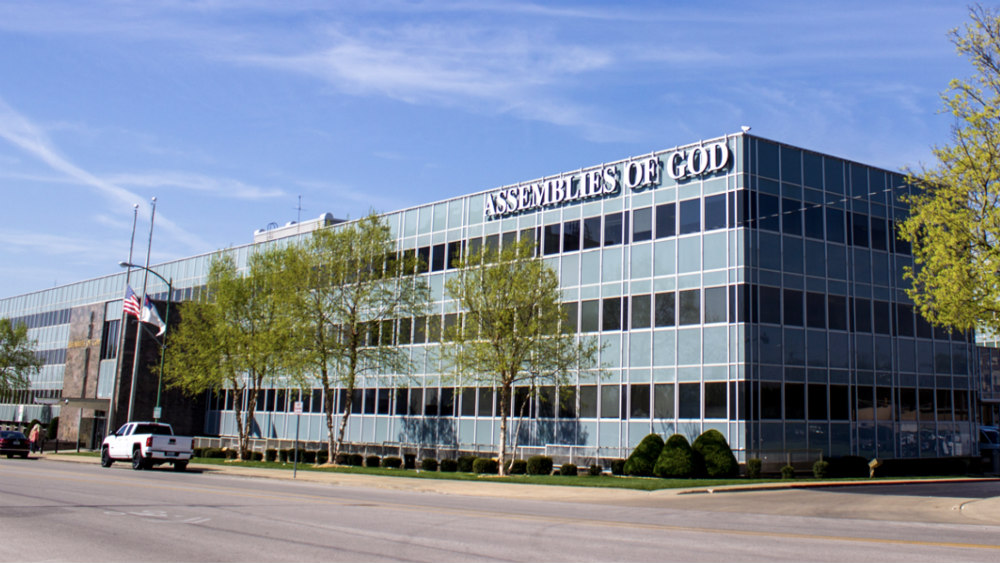
Assemblies of God Avoids Jury Trial in Sexual Abuse Case

Oregon lawsuit sought to hold national organization liable for crimes committed in a Royal Rangers program in the 1980s.

Christianity Today August 27, 2021
Google Maps

The Assemblies of God has settled a sexual abuse lawsuit in Oregon. If it had gone to trial, the suit would have been the first to put the Pentecostal denomination before a jury as a defendant in a sexual abuse case, allowing citizens of Portland to decide whether the Assemblies is legally liable for abuse that happened in the church scouting organization in the 1980s.

The denomination filed more than a dozen motions to get the case dismissed, according to Gilion Dumas, the attorney representing three men suing the denomination. The Assemblies also filed three appeals with the state supreme court.

The motions were rejected and appeals dismissed. When a trial date was set for September 7, the denomination agreed to a settlement.

“The trial court concluded that our legal theories of liability were viable, but they were not tested, ultimately, by a jury,” Dumas told CT. “It was the first time that the national organization was named and successfully kept in a sex abuse case. They tried to get out of it, but the court denied those motions and denied them consistently.”

A previous lawsuit was settled in 1990. Another was settled in 2017. The lawsuits sought damages between $5 million and $42 million, but the settlement amounts are secret. The dollar figures are protected by nondisclosure agreements, Dumas said.

Assemblies of God legal counsel Richard R. Hammar was unavailable to comment, according to church spokesman Mark Forrester. (Hammar is the cofounder and senior editor of CT’s sister publication, Church Law and Tax.) He authored Reducing the Risk in the early 1990s, one of the first abuse prevention programs for churches. Assemblies leadership recommends the 14-point plan to all its congregations.

The plan includes several points that might have prevented abuse in the Royal Rangers in the 1980s, such as a suggestion that adults should not be alone with children. Other suggestions might have stopped abuse before it was repeated, such as the strong recommendation that allegations be reported promptly to police.

The first allegations against a Royal Rangers leader in Albany, Oregon, were not taken seriously. A pastor in the Assemblies of God church near Corvallis was told in 1984 that Royal Rangers Commander Todd Scott Clark might be molesting boys in the program. Clark was not suspended, and police were not notified.

The next year, there were additional reports from multiple children and parents that Clark and a second leader, Ralph Wade Gantt, both in their 20s, were sexually abusing boys during campouts and sleepovers. The boys reported waking up in the middle of the night to find the church leaders touching them.

The church continued to allow campouts and sleepovers, and both Clark and Gantt spent more time alone with individual Royal Rangers, some of them as young as 10.

The Assemblies national leadership in Springfield, Missouri, does not appear to have known about these allegations or had any direct involvement with the Oregon congregation’s Royal Rangers program. Dumas argues, however, that the Assemblies was responsible for establishing safeguards.

“You don’t have to be a genius to recognize that child molesters are going to be drawn where the children are. You just need to set up the proper boundaries and keep a better eye on your volunteers and have better supervision and training,” she said. “If you have the power to tell them how to be a leader, as a national organization, you have the power to tell them what they can’t do and that they have to report inappropriate behavior.”

The Oregon church heard a third set of allegations in 1986 and finally suspended Clark and Gantt. There was an internal investigation and then the men were reinstated. They were allowed continued unsupervised access to the boys.

Parents turned to police, and both men were arrested in July 1987. Clark went to trial and was found guilty. Gantt pled guilty to five counts of sexually abusing children.

Those cases did not include the plaintiffs suing now. According to court filings, the three men did not know they had been abused until later in life. It is not uncommon for abuse victims to believe they were responsible for their abuse. The men—represented in court records only by their initials—were between the ages of 10 and 17 when the abuse occurred.

According to the lawsuit, those abused by Clark and Gantt suffered years of physical and psychological injuries, which manifest in drug and alcohol addictions, depression, shame, anxiety, guilt, intimacy issues, distrust of authority, and a loss of faith.

Dumas said the settlement amount is large enough to make a difference to the victims. She said her firm, which specializes in sexual abuse lawsuits, always recommends some of the money be used for counseling.

“Litigation can only do so much. It’s just a hammer and a box,” Dumas said. “The money doesn’t bring their childhoods back. It certainly doesn’t bring back their innocence. But what happened to them is finally acknowledged, and they did what they could to take control back in their lives.”

News

Fate of Lalibela Rock Churches Raises Concerns Among US Ethiopians

TPLF forces have taken control of one of Christianity’s oldest heritage sites.

Bete Giyorgis (Church of St. George) in Lalibela, Ethiopia

Bete Giyorgis (Church of St. George) in Lalibela, Ethiopia

Christianity Today August 26, 2021
Mulugeta Wolde / Unsplash / Creative Commons

The fate of the ancient rock-hewn churches of northern Ethiopia has become a grave concern for Ethiopian Americans, as a civil war between the government of Prime Minister Abiy Ahmed and Tigray rebels imperil the fate of many religious sites across the country.

For months, Ethiopian troops have fought a rebellion by the Tigray People’s Liberation Front (TPLF), which began after TPLF forces attacked an Ethiopian military installation in early November 2020. Tensions had risen after Ahmed’s government withheld funds for elections held in Tigray province in defiance of federal COVID-19 restrictions on gatherings.

In recent weeks, the TPLF forces have captured the town of Lalibela, in the northern Amhara region, the site of a cluster of some of Christianity’s oldest houses of worship. The Lalibela churches were carved by medieval Ethiopian Christians as an alternative pilgrimage site to Jerusalem, whose geography the complex loosely follows.

“The recent military intrusion of the TPLF into Lalibela threatens the home of the ‘New Bethlehem,’ where 11 rock-hewn churches built in the 12th century are still places of worship today,” said a longtime analyst of the region.

The churches are also a favorite with foreign tourists to Ethiopia. “We call on the TPLF to protect this cultural heritage. We also call on all parties to the conflict to end the violence,” the State Department said in a statement following the seizure of Lalibela on August 5.

The churches were declared a UNESCO World Heritage Site in 1978. Ironically, that designation came during the height of the Ethiopian Civil War, which pitted a number of rebel groups against the Communist dictator Mengistu Haile Mariam.

“My heart is broken for us Ethiopians in America and around the world. Our life is dismantled,” said Kesis Asteraye Tsige, an Ethiopian priest in Kansas City. “Everybody is wounded, sad, and lamenting. We don’t know what will happen to this site now that it is not controlled by the government … If [the TPLF] are Christians, they shouldn’t do this.”

Asteraye Tsige, who leads Debre Sahel Medhanie Alem Ethiopian Orthodox Tewahedo Church, said the fall of Lalibela marks the first time the government of Ethiopia has acknowledged the risk to Ethiopian cultural heritage posed by the rebellion. Tsige said he had heard rumors that some churches were damaged in the fighting.

He urged the government of Ethiopia to ensure the protection of holy sites.

In November, the government of Ethiopia accused the TPLF of destroying an airport in the holy city of Axum, where Ethiopian Orthodox Christians believe the Ark of the Covenant is stored. Also under the control of the TPLF is the Negash Amedin Mosque, the third-oldest in Africa, which was reportedly damaged in December in fighting between Eritrean and TPLF forces.

Ideas

Christian Virtue Strengthens the Social Justice Cause

Contributor

Liberation from injustice starts with obedience to God and his moral order.

Christianity Today August 24, 2021
Illustration by Mallory Rentsch / Source Images: WikiMedia Commons / Phil Desforges / Teemu Paananen / Unsplash

In the early 1980s, Indian guru Bhagwan Shree Rajneesh established a commune called Rajneeshpuram and embarked on a search for utopia in the wilderness of Wasco County, Oregon. (The Netflix documentary Wild Wild Country recounts the story.) The cult sought to create the perfect city by deconstructing the social norms and religious strictures that in their view suppress one’s true self.

Rajneesh taught that free love and dynamic meditation were the key to liberating the individual and reaching “superconsciousness.” The group bought 80,000 acres and indulged all their wildest inclinations in orgy-style meditation sessions. They wanted a perfectly compassionate and just community, where no one’s self-expression would be restricted.

But before long, the brokenness of human nature brought them back to reality. When the commune received political pushback from other residents in the area, they became anything but compassionate. In the name of free love and self-expression, they attempted murder and committed fraud and bioterrorism to get their way. They also abused each other and exploited the homeless. Their attempt to completely rid themselves of all constraints left them defenseless against their own internal evils.

I see this dynamic in the public square today. Contemporary concepts of compassion and justice that ignore human brokenness and individual sin can only lead to the same desolate destination. When those ideas involve pretending men can be pregnant or arguing that the traditional family is a tool of the oppressor, we’re not progressing. We’re descending away from truth. If we want to achieve justice, we first have to understand human nature. And to understand human nature, we have to study the nature of sin.

Here again, a story from the past serves to support the point. As activist Dorothy Day fought for justice, she was surrounded by people with a very similar worldview to those in the Rajneeshpuram commune. The radical peace movement of the 1960s “preached liberation, freedom, and autonomy,” as David Brooks explains in his book The Road to Character. But Day was unimpressed by that message. She preached the opposite: “obedience, servitude, and self-surrender.”

Christian virtues fueled her social action, but she was not some naïve pilgrim of piety. Earlier in life, she had partaken in her comrades’ “open sexuality and lax morality,” as Brooks puts it. Those actions resulted in a broken heart, a broken family, and an abortion. She grew wise enough to understand that there’s nothing empowering about a lack of discipline and structure, which creates only dysfunction.

Day compared the radicals she worked with to adolescents who’d just discovered that their parents weren’t perfect and, in a spirit of disillusionment, rebelled against all their instructions and institutions. She’d say, “All this rebellion makes me long for obedience.” Her colleagues’ irreverent behavior demonstrated an immature and empty defiance that distracted from the work and weakened the movement.

Sadly, that same posture is prevalent in some justice and equality movements today. They rightly see the need to deconstruct oppressive systems but can go only so far as to drop their adherents off in the confusion and chaos of the wilderness.

By contrast, the Bible’s Exodus narrative prescribes liberation as well as obedience. God didn’t free the Hebrews to seek self in the wilderness for eternity. He delivered them for the purpose of worshiping him, and he demanded their obedience in order to prepare them for a much greater destination.

In that same spirit, Dorothy Day knew that when we divorce social justice from a framework of obedience, we do so at our own peril. She knew the wilderness—no matter how liberating it felt—could never be the final destination of any Christian social endeavor.

To be fair, we must acknowledge the injustices and sins that have caused so many to leave the church and rebuke Christian orthodoxy. They’re rebelling against rules, wielded with prejudice and malice, that continue to bludgeon women and racial minorities. They’re responding to structures that cover up abuses of power and morals that are enforced discriminately. They’re rejecting religious institutions that serve white supremacy, support misogyny, and mistreat same-sex-attracted people, all while claiming a biblical basis.

Such harshness and hypocrisy have led to one of the biggest lies of our age: that a person cannot be orthodox—upholding historic Christian doctrine and morals—and also compassionate. Now in the public square, whenever we talk about boundaries and restrictions on individual expression, many of us assume that oppression is going on. Today, orthodoxy is associated with calloused hearts and heavy burdens that serve only old prejudices.

They have rightly responded to a culture that ignores systemic sin. But they’ve done so by ignoring individual sin.

This story has two extremes, of course. As believers, we know that compassion and self-sacrifice are literally the lifeblood of true Christian orthodoxy. When American Christianity doesn’t adhere to the Great Commandment and recognize the image of God in their marginalized neighbors, it falls well short of orthodoxy. In other words, the church isn’t harsh because it follows the Bible too closely. It’s harsh when it doesn’t follow the Bible and the spirit of Jesus closely enough.

On the other hand, a permissive culture is compassionate in the same way that an unserious, lackadaisical instructor is considered cool. They’re momentarily convenient but ultimately harmful, because they’re unable to meet rigorous objectives and promote long-term human flourishing. Their unwillingness to prepare us for the tests and harsh truths of life is a form of neglect. Inevitably, they can’t protect us from the consequences of our sloth and sin. At best, they enable only dysfunction.

We live in a culture that’s losing the ethic and the will to discourage mentalities that lead to sex work, recreational drug use, and family abandonment. We’d rather find ways to excuse them than stand on unpopular principles. But gospel-driven compassion doesn’t conceptually refashion or normalize our brokenness in vain attempts to evade categories of sin. True justice isn’t inclusive of sin, because sin leads to moral disorder, and moral disorder is where injustice thrives.

“I’ve been told that the idea of sin is an old, outworn notion,” said Gardner C. Taylor, civil rights leader and pastor. “It may be. But I know this … that old and ugly word may be outworn, but the consequences are not outworn. I speak of broken families, war, and overdoses. The consequences of sin live on!”

Taylor understood that suffering came from societal injustice and also individual immorality. Our failure to acknowledge one or the other isn’t compassion; it’s neglect. It leaves us and our neighbors unprotected from the deception and cruelty of human brokenness.

By contrast, when we embrace moral order in the context of relationship and love, we can acknowledge that our sexual proclivities and perceived identities aren’t always righteous. We can talk about the complexity of human desire. And we can locate ourselves not in the wilderness of personal fulfillment but in the abundant, boundaried space of God’s purposes.

Justin E. Giboney is an attorney, political strategist, president of the AND Campaign, and coauthor of Compassion (&) Conviction: The AND Campaign’s Guide to Faithful Civic Engagement.

News
Wire Story

Some Christian Leaders Advise Parents on COVID-19 Exemptions

Legal experts suggest churches should be cautious about providing documentation to help people get around mask and vaccine rules.

Christianity Today August 24, 2021
Matthew Hatcher / Getty Images

Some Christian leaders have spoken out alongside the public officials, doctors, and other community figures who are helping people circumvent COVID-19 precautions.

An Oregon school superintendent is telling parents they can get their children out of wearing masks by citing federal disability law. A pastor at a California megachurch is offering religious exemptions for anyone morally conflicted over vaccine requirements. And Louisiana’s attorney general has posted sample letters on his office’s Facebook page for those seeking to get around the governor’s mask rules.

While proponents of these workarounds say they are looking out for children’s health and parents’ rights, others say such stratagems are dishonest and irresponsible and could undermine efforts to beat back the highly contagious delta variant.

Mask and vaccine requirements vary from state to state but often allow exemptions for certain medical conditions or religious or philosophical objections.

Just as health experts question the guidelines for determining whether a child’s condition would merit an exception to mask requirements, some Christian legal experts say it is “troublesome” to require churches provide documentation for a person’s religious exemption.

“A church would want to be cautious regarding who would be providing such support. Would it be coming from the elders as a whole? The pastor? One leader?,” said Erika Cole, a Christian and attorney based in Maryland. “The question of who would have the authority to provide such support is another issue that would have to be considered.”

In Oregon, Superintendent Marc Thielman of the rural Alsea School District told parents they can sidestep the governor’s school mask requirement by applying for an accommodation for their children under federal disabilities law.

“The majority of my parents are skeptical and are no longer believing what they’re told” about COVID-19, said Thielman, whose district in the state’s coastal mountains begins classes Monday. “I’ve got a majority of my parents saying, ‘Are there any options?’”

In a letter to educators this past week, Democratic Gov. Kate Brown said she was shocked that Thielman was undermining her policies by “instructing students to lie” about having a disability.

Brown has mandated masks in schools and vaccinations for all school staff amid a surge in infections that is clobbering Oregon.

In Kansas, the Spring Hill school board is allowing parents to claim a medical or mental health exemption from the county’s requirement that elementary school students mask up. They do not need a medical provider to sign off.

Board member Ali Seeling said the idea is to give parents “the freedom to make health decisions for their own children.”

Louisiana Attorney General Jeff Landry, a Republican who regularly spars with Democratic Gov. John Bel Edwards, posted sample letters that would allow parents to seek a philosophical or religious exemption from Edwards’s mask rule at schools—or from a vaccine requirement, if one is enacted. The letters have been shared by GOP lawmakers and thousands of others.

“Louisiana is not governed by a dictatorship. The question is: ‘Who gets to determine the healthcare choices for you and your child?’ In a free society, the answer is the citizen — not the state,” Landry wrote on Facebook.

Edwards accused the attorney general of creating confusion and defended his policy on face coverings.

“By adopting these measures—and ignoring those that are unwilling to acknowledge the current crisis—we can keep our kids in school this year and keep them safe,” the governor said.

Legal experts suggested that both officials and pastors themselves should be cautious about the parental exemption letters.

“The Louisiana Attorney General’s suggested letters attempt to fill the guidance void regarding religious exemptions to government mandates. Government regulators face the difficult task of discerning when an individual possesses a sincerely held religious belief and should be exempt. As with any readily available form, nonqualified individuals may attempt to use them,” said Frank Sommerville, a Texas-based attorney and CPA who serves as a senior editorial advisor with ChurchLawAndTax.com, a CT sister site.

“But the potential for abuse does not automatically negate actions that preserve constitutional rights. Government officials should approach this topic with caution and err on the side of preserving constitutional rights rather than destroying them.”

Sommerville said pastors should support members “who truly possess a sincerely held belief” but not endorse those who seek to take advantage of the religious exemption without the corresponding beliefs.

In California, the state medical board is investigating a doctor who critics say is handing out dozens of one-sentence mask exemptions for children in an attempt to evade the statewide school mask requirement.

Dr. Michael Huang, who has a practice in the Sacramento suburb of Roseville, declined to answer questions from The Associated Press but told other news outlets that he examines each child and issues exemptions appropriately. The California Medical Association issued a statement condemning “rogue physicians” selling “bogus” exemptions.

In a neighboring suburb, Pastor Greg Fairrington of Rocklin’s Destiny Christian Church has issued at least 3,000 religious exemptions to people with objections to the vaccine, which is becoming mandatory in an increasing number of places in California.

He said in a statement that his church has received thousands of calls from doctors, nurses, teachers, and first responders terrified of losing their jobs because they don’t want to get vaccinated. His office declined to share the exemption letter.

“We are not anti-vaccine,” he said. “At the same time, we believe in the freedom of conscience and freedom of religion. The vaccine poses a morally compromising situation for many people of faith.”

Cole, another ChurchLawAndTax.com advisor, says that some employees seeking religious exemptions from COVID-19 requirements have also been asked to provide documentation from their church, but under Equal Employment Opportunity Commission guidelines, it’s individuals, not their churches, who hold the beliefs used as the basis for refusing vaccination.

“The church, as a whole, may not be against vaccination. In fact, in one case in which a church member requested a supporting letter, the church had held—on its 5-acre property—COVID-19 vaccination clinics for several months,” she said. “To provide a letter of support against the vaccination would be incongruent, if not disingenuous.”

With reporting for CT by Matt Branaugh.

Theology

COVID-19 Killed Our Sense of Personal Progress

Scripture says that might be a good thing.

Christianity Today August 24, 2021
Illustration by Mallory Rentsch / Source Images: CDC / Unsplash / LoveTheWind / Getty Images

“The average human lifespan is absurdly, terrifyingly, insultingly short.” That’s how Oliver Burkeman begins his new book, Four Thousand Weeks: Time Management for Mortals. In it, he confronts readers with the disquieting truth that we have a paltry 4,000 weeks on this earth, and a lot of what we do with them is meaningless, at least by some human standards.

As bleak as it sounds, that is exactly the message we need to hear right now.

Life expectancy in the United States has dropped for the first time since World War II. Thanks in large part to the COVID-19 pandemic, Americans can now expect their 4,000 weeks to be reduced by roughly 78 weeks (or 18 months). The fact that life is hard and death is coming would be unremarkable news in any other time or place. But for those of us in the modern West (and perhaps America, in particular), mortality is a question we’ve found ingenious ways to avoid.

Consider how often we opt for efficiency. For many of us, “making the best use of our time” doesn’t mean living a purposeful life. It means getting as much done as possible. We multitask and hustle and pursue what Burkeman dubs “the fully optimized life.” And truthfully, it works. We accomplish a lot. We get stuff done.

It works, that is, until a global pandemic hits and our ability to plan comes to a screeching halt. It works until we find ourselves in much the same place we were six months ago, feeling mocked by progress. It works until death and grief flood our newsfeeds daily.

Suddenly, absent our ability to plan and predict, we discover that we lack the skills needed to navigate troubling, seemingly meaningless times. We find ourselves emotionally and mentally numbed. As hospitals across the country are once again nearing capacity and students enter a third year of disrupted learning, we’re experiencing disorientation and a lost sense of purpose. But just when we need each other the most, we find ourselves increasingly alone, at odds with friends, neighbors, and family.

“For the last forty years,” writes scholar Alan Jacobs, “I have been interested in our common life in this country, in the ways we live together, and whenever we have experienced pronounced social tension I have had ideas for resolving or at least lessening those tensions. … In our current situation I have no idea what to do. I have no tactical suggestions. None. I am totally and absolutely at a loss.”

Jacobs’ sense of helplessness is shared by many. Whether it’s the pastor struggling to hold a fragmenting church together or parents having to weigh their child’s education against health concerns, a whole lot of us are on the verge of giving up hope. So many of our expectations, plans, and dreams have been dashed over the last 18 months, never to be recovered.

But what if this moment also holds a particular kind of promise? What if the forces disrupting our productivity and sense of control have also opened up an opportunity to engage our lives differently?

“This strange moment in history,” Burkeman writes, “when time feels so unmoored, might in fact provide the ideal opportunity to reconsider our relationship with it.”

Doing so begins with a frank assessment of time. Because long before Burkeman took up the question (and long before we knew COVID-19 existed), the Teacher of Ecclesiastes wrote these words: “Meaningless! … Utterly meaningless! Everything is meaningless” (Ecc. 1:2). And then, with brutal honesty, he wrestled with the existential contradictions that mark the human experience and that many of us are being forced to face this year.

Christians have not been immune to the gospel of productivity and progress. Some of us have been discipled to believe that if we just work hard enough, plan hard enough, and deny hard enough, we can escape suffering and futility. But Scripture (especially Ecclesiastes) reminds us that the gospel of progress and productivity is unequal to the realities of life. We live only 4,000 weeks, the majority of them spent on mundane tasks. We are weak, dependent creatures, desperate for the grace and mercy of God.

In this moment, we feel our dependence acutely, and that feeling is a gift. Because in this moment—this depressing, disturbing, terrible moment—we have a chance to learn the truth about ourselves and the lives we thought we wanted.

“Covid-19 has dealt a collective trauma to the American consciousness,” writes Esau McCaulley. “The full fruit of that trauma remains uncertain. One thing is clear: Our previous normal was not as good as we thought it was.”

In the end, a life of meaning and purpose cannot be found in fulfilling our own dreams and purposes. It’s found in coming under the larger purposes of God. The rest and peace we long for—the rest we think will come after all our work is done in an efficient manner—actually comes by surrendering to him.

“Come to me, all you who are weary and burdened,” Jesus invites, “and I will give you rest. Take my yoke upon you and learn from me, for I am gentle and humble in heart, and you will find rest for your souls” (Matt. 11:28–29).

Here’s how the Teacher puts it in Ecclesiastes 12:13: “Now all has been heard; here is the conclusion of the matter: Fear God and keep his commandments, for this is the duty of all mankind.”

More than being good advice, this is good news. The life God calls us to is not one of more work, greater efficiency, and stellar performance. Rather, he invites us to rest by surrendering to the lives and plans he has for us—lives that at times may feel stalled, failing, and limited.

“Our limits, too, are not strictures holding us back,” writes author Ashley Hales, “but doorways into intimacy with God. It is only as we acknowledge and embrace the goodness of our limits that we can embrace hope.”

These are apocalyptic times, revealing who we are and what we have been trusting. Our plans have been waylaid, our present and future uncertain. We feel the pain of Ecclesiastes all too deeply. We feel our helplessness. We feel the brevity of our 4,000 weeks.

But perhaps in this moment, as we come face to face with our mortality, we can begin to live lives marked less by what we accomplish and more by the God we follow.

Hannah Anderson is the author of Made for More, All That’s Good, and Humble Roots: How Humility Grounds and Nourishes Your Soul.

News

Died: Thomas McKenzie, Defender and Definer of Anglicanism

Pastor and author showed “The Anglican Way” to a growing number of evangelicals.

Christianity Today August 24, 2021
Courtesy of Church of the Redeemer

Thomas McKenzie, a popular Nashville priest and author of The Anglican Way, died on Monday alongside his 22-year-old child Charlie McKenzie.

They were driving from their home in Tennessee to St. John’s College in Santa Fe, New Mexico, where the younger McKenzie was set to start their senior year. The car collided with a tractor trailer near Burns, Tennessee, about 20 minutes west of Nashville, a little before 10 a.m.

It was the first day of Thomas McKenzie’s sabbatical. He planned to take his eldest to college, then take his wife to England to celebrate his 50th birthday, and then travel to France to trek the Camino, a medieval pilgrimage trail. He was going to walk from Saint-Jean-Pied-de-Port in the Pyrenees mountains to the tomb of St. James the Great on the coast of Spain before rejoining his church on All Saints’ Sunday.

“I’m excited about my upcoming travels,” McKenzie wrote on Twitter the day before his death, “but I know I’ll miss my community. I feel sadness and some anxiety as I prepare for this morning’s Eucharists.”

As news of his death spread, Anglicans and a broad swath of evangelicals expressed shock and sadness. Several people recounted how McKenzie had generously reached out to them when they were interested in Anglicanism and offered to guide them in the process.

https://twitter.com/esaumccaulley/status/1429965866985213953
https://twitter.com/wdavidotaylor/status/1429952064940032002
https://twitter.com/ScottCNewman/status/1429973376479612929

McKenzie spent his adult life promoting Anglicanism—as the pastor of a church, as an opponent of liberal Episcopal theology, and finally as someone who articulated the essence of Anglicanism in a way that was attractive to many evangelicals.

“There are people who call themselves ‘Anglican’ who simply aren’t Anglican by any respectable definition of that word,” he wrote in his 2014 book, The Anglican Way. “They remind me of that famous line from the movie The Princess Bride—they keep using the word Anglican, but it doesn’t mean what they think it means.”

According to McKenzie, Anglicanism in America went from a sleepy and mostly self-satisfied community drifting towards liberalism in the mid-20th century to a vibrant, growing, orthodox, and evangelical movement at the start of the 21st. New people were drawn to the tradition for many different reasons, he said, ranging from liturgy to community to the place of emotions in the worship service. What they ultimately found, though, was a stable spiritual footing.

“The Anglican way of faith is, at best, a way of balance,” he said. “We’re only radical about one thing: the redeeming love of God in Christ.”

McKenzie was born to Thomas and Ginger Kelley McKenzie in the Texas Panhandle in 1971. The oldest of four children and the only son, he grew up in the town of Canyon, which had about 8,000 residents and was primarily known for a 47-foot sculpture of a cowboy named Tex Randall. McKenzie’s father was an artist who founded an artist colony before turning his attention to business and interior decorating.

The family was not religious, but McKenzie started attending a campus ministry of the Episcopal Church at the University of Texas at Austin. He had what he later described as a life-changing encounter with Jesus.

After college, McKenzie attended seminary at Trinity Episcopal School for Ministry in Ambridge, Pennsylvania. Trinity was a conservative Episcopal institution founded by charismatics, low church evangelicals, and liturgical traditionalists, joined together in their opposition to what they saw as heretical liberal revisionist theology. When McKenzie was there, the school was run by Peter C. Moore, who sought to defend the tradition by defining “essential Anglicanism.”

McKenzie was first ordained as a deacon in 1998 by Robert Duncan, who at that time was the bishop of the Episcopal Diocese of Pittsburgh, but later became the first archbishop of the Anglican Church in North America (ACNA).

“Of all the men I have known in my life, Bishop Duncan is one of the finest, most loving, most noble,” McKenzie said. “He has not always moved as fast as I would like. He has not always done things the way I wish he would. But he is a man who has earned my respect and love.”

After finishing his masters of divinity and becoming a priest, McKenzie was placed as assistant rector at St. Bartholomew’s Episcopal Church in Nashville. In 2003, he was one of 14 priests in Middle Tennessee who signed a public statement condemning the General Convention’s confirmation of the consecration of an openly gay bishop, Gene Robinson. This was the beginning of the largest split of conservative congregations from the Episcopal Church.

“Certainly, the actions of the General Convention were schismatic and fractured our national denomination,” he told The Tennesseean newspaper. “We’re hoping to be able to respond in a creative and constructive way to their destructive action.”

The next year, McKenzie planted Church of the Redeemer about four miles from St. Bartholomew’s. The new church was part of the Anglican Mission in the Americas (AMiA), which rejected the authority of the Episcopal Church and placed itself under the authority of the more conservative and traditionalist Anglican bishops in Rwanda.

McKenzie was deposed by his Episcopal bishop on the grounds he had “abandoned the Communion.” He, however, rejected the charge.

“When the Episcopal Church speaks of ‘the Communion’ they are not referring to the Anglican Communion,” he said, “or the Communion of the universal Church, or the Communion of Saints, or the Communion of Christ. They are referring to the ‘communion’ of their denominational bureaucracy.”

Church of the Redeemer grew under McKenzie’s leadership, attracting not only disaffected Episcopalians but increasingly Christians with no exposure to Anglicanism. McKenzie found himself frequently explaining the tradition, its theological emphases and spiritual practices, and guiding evangelicals through the process of confirmation into Anglicanism.

twitter.com/thearmchaircom/status/1429977459169153030

This was an occasionally bumpy process—such as one time when a visiting bishop instructed a group of evangelicals preparing for confirmation to kiss his ring—but more often it was exciting. The church saw itself as part of a vibrant renewal movement with a potential to unify much of American Christianity.

McKenzie was particularly thrilled with the formation of ACNA. He thought a US Province could bring together the many groups that had been driven from the Episcopal Church and present a strong example of “the Anglican way,” even if the organization itself was relatively weak.

He attended the consecration of Duncan as the first archbishop of ACNA in 2009 and talked jubilantly about how the service brought together Anglicans he had known in college, seminary, his first youth group, the Episcopal diocese in Middle Tennessee, and from across the country.

“This was an historic event,” McKenzie wrote to his congregation, “and you are part of it. We are weak in many ways, but we have the love of God in Christ and a deep commitment to one another. We have a great future, a future of both suffering and triumph, of Cross and Resurrection.”

Some of that suffering came a few years later when Church of the Redeemer got caught in the middle of divisions between the leaders of AMiA and the Rwandan bishops. McKenzie blamed the Americans for separation from the Africans in blunt terms.

“It’s sinful, it’s ugly, it’s wrong, and it doesn’t bring honor to the name of Christ,” he told The Tennesseean.

Church of the Redeemer left AMiA, placing itself exclusively under ACNA in 2012. It continued to grow, attracting more and more evangelicals with no commitment to an Anglican faction or any background in Anglicanism. Many came from evangelical megachurches, disaffected by what they saw as cults of personality and performance. Others came from conservative churches that felt legalistic. Some were not necessarily committed to an Anglican identity at all, but merely seeking refuge from the quarrels and conflicts in their own denomination.

McKenzie said he knew some people saw the new interest in Anglicanism as a liturgical fad. But he thought it was more than that—and also less.

“The Church only has two things to offer the world: Word and Sacrament,” he said. “These two, together, are how we proclaim the Gospel. The Word is the voice of the Gospel, the Sacraments are the body. The only reason for the Church to exist is to proclaim the Gospel, in word and deed. We’ve been about this work for 2,000 years, and I don’t expect us to stop until Christ’s return.”

McKenzie is survived by his wife Laura and daughter Sophie.

News

1 in 10 Non-Church Members Still Show Up Every Sunday

New research shows that Americans’ religiosity increasingly doesn’t line up with whether they officially belong to a congregation.

Christianity Today August 24, 2021
Church Creative / Lightstock

Earlier this year, Gallup reported that for the first time in the country’s history, fewer than half of Americans were members of a church or house of worship.

The news was covered widely, one of the biggest religious headlines so far this year. It resonated with many and seemed to indicate how dramatically the religious landscape has continued to shift.

Gallup has been asking survey respondents if they are a member of a church, synagogue, or mosque since the mid-1930s. Until 1990, that percentage stayed relatively stable around 70 percent. But from then on, it began to drop precipitously. By 2010, it was 61 percent, and eight years later it was at 50 percent. Then, in 2020, the poll indicated that just 47 percent of Americans were members of a religious body.

While the Gallup finding is certainly significant, the way that the survey firm poses the question doesn’t line up with how many Americans understand and practice their faith in the 21st century. For a growing number of churches, membership has been deemphasized (if not eliminated altogether) as they try to become more relevant to a younger generation that places less emphasis on attachment to institutions.

Along with fellow researchers, I wanted to understand how church membership intersects with other measurements of today’s religious faith and practice. We put a survey in the field that asked the same question that Gallup posed, “Do you happen to be a member of a church, synagogue, or mosque?” But we also asked a number of other questions that tapped into the various dimensions of the religious experience. The results indicate that membership is not a perfect proxy for an individual’s religiosity.

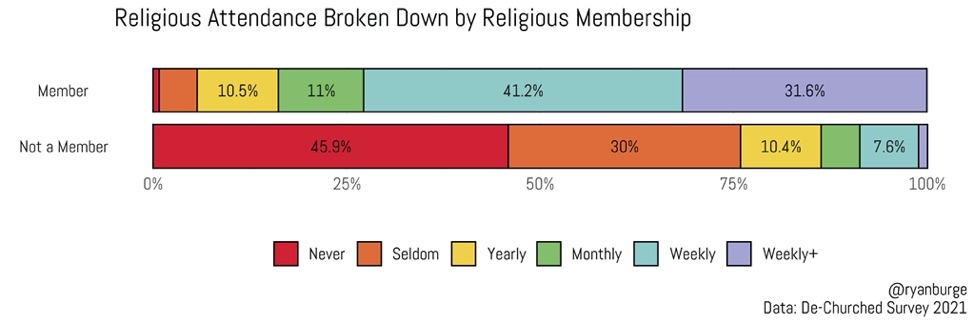
According to our survey of just over 1,000 respondents, about half indicated they were members of a church or house of worship, which is largely in line with the finding from Gallup. But looking at the habits of those who were not members, it became clear that many Americans don’t see it necessary to join a church to attend services regularly.

Nearly a quarter of respondents who were not church members said they attended church at least once a year—these could be people who attend church on special occasions like Christmas, Easter, or baptisms. But about 1 in 10 nonmembers actually go to church every week or more, the level of attendance we might expect among highly committed church members.

https://datawrapper.dwcdn.net/SQSec

From the Gallup survey, it could have been easy to conflate nonmembers with nonbelievers, but our research shows that nonmembers are actually more likely to identify as some kind of Christian than to consider themselves entirely unaffiliated with religion.

When asked about their current religious tradition, 43 percent of people who said that they were not members of any church also said that they were Protestant or Catholic or chose the “other Christian” option. Just 40 percent of nonmembers indicated that they were atheist, agnostic, or nothing in particular. If this data serves as a guide, it’s empirically inappropriate to say that a person who has no church membership is not religious, when in fact 60 percent of nonmembers still say they are affiliated with some faith tradition.

What’s driving the decline in church membership if it’s not merely a move away from religious affiliation? There are several likely culprits, with age being the most evident.

https://datawrapper.dwcdn.net/rhMQ9

Older Americans grew up at a time when church membership was often expected; it was the most common facet of religious life. Thus, it would be fair to assume that older individuals would be more likely to indicate that they are members of a church than younger ones.

Yet the data here indicates that there’s no strong relationship between age and church membership among those who identify as Christians. About 57 percent of adults 35 and younger say that they are members of a church—the same as those of people who are 65 and older.

The only outlier here is people between the ages of 36 and 50—much of Gen X. Over 80 percent of them indicate that they are church members. There’s not an easy explanation for that aberration.

Another potential place to look for differences is in the type of Christian tradition. Nondenominational churches are growing, and many do not place a great deal of emphasis on formal church membership.

Yet when comparing nondenominational Christians, Southern Baptists, and Roman Catholics, 70 percent of adherents to each tradition say that they are church members. In other words, there’s no evidence in our survey that specific types of Christianity lend themselves to a stronger connection to church membership than others. Within all traditions, we see a sizable minority who come, even week after week, without making the move to make their place in the congregation official.

CT has previously covered the “confusion and apathy” around church membership and the challenge for leaders to present biblical, caring, and clear expectations for membership.

“Pastors lament declining ‘enrollment’ and a wave of religious commitment-phobia that was uncommon a generation ago,” wrote minister and author Tracey Bianchi.

“This trend goes beyond the exodus of people abandoning church altogether; it takes place inside many congregations among some of the most faithful attenders. New church plants increasingly choose not to implement membership while established churches consider jettisoning their once stalwart programs.”

As I outline in my book, The Nones: Where They Came From, Who They Are, and Where They Are Going, the United States is more secular today than at any point in its history. But measuring that secularizing process through the lens of religious membership provides only a partial picture of the phenomenon.

It seems likely that the share of church-attending nonmembers will continue to rise as American society moves away from traditional religious institutions. Measuring religion should be done from a variety of angles, including measures of religious behavior, affiliation, and membership.

Ryan P. Burge is an assistant professor of political science at Eastern Illinois University. His research appears on the site Religion in Public, and he tweets at @ryanburge.

News

Haitians Worship at Damaged Churches as Gangs Offer Earthquake Aid

(UPDATED) Death toll passes 2,200 as Samaritan’s Purse field hospital opens in Les Cayes.

Parishioners attend a mass on the grounds next to an earthquake-damaged cathedral in Les Cayes, Haiti, on Sunday, August 22, 2021, eight days after a 7.2 magnitude earthquake hit the area.

Parishioners attend a mass on the grounds next to an earthquake-damaged cathedral in Les Cayes, Haiti, on Sunday, August 22, 2021, eight days after a 7.2 magnitude earthquake hit the area.

Christianity Today August 24, 2021
Matias Delacroix / AP Photo

LES CAYES, Haiti — A gang leader is offering a truce as well as help for communities in southwestern Haiti that were shattered by an earthquake, raising a glimmer of hope for relief operations that have been disrupted by the looting of aid trucks and other disorder.

It remained to be seen whether anything would come from Sunday’s offer by Jimmy Cherizier, alias “Barbecue.” While he is a powerful crime boss, Cherizier is far from the only gang leader in Haiti, and widely spread social media reports of a supposed earlier gang truce have failed to prevent attacks on the expanding relief effort.

The offer came as many Haitians returned to worship services in or outside damaged churches, sometimes for the first time since the magnitude 7.2 quake hit August 14. Haiti’s Civil Protection Agency also raised the list of confirmed dead to 2,207.

Since the disaster, gangs have blocked roads, hijacked aid trucks, and stolen supplies, forcing relief workers to transport supplies by helicopter. In places, desperate crowds have scuffled over bags of food.

In a video posted on Facebook, Cherizier addressed the hardest-hit parts of the Haiti’s southwestern peninsula, saying: “We want to tell them that the G9 Revolutionary Forces and allies, all for one and one for all, sympathize with their pain and sorrows."

"The G9 Revolutionary Forces and allies … will participate in the relief by bringing them help. We invite all compatriots to show solidarity with the victims by trying to share what little there is with them,” he said.

Parishioners attend a mass on the grounds next to an earthquake-damaged cathedral in Les Cayes, Haiti, on Sunday, August 22, 2021, eight days after a 7.2 magnitude earthquake hit the area.

The increase in the death toll was the first since late Wednesday, when the government had reported 2,189 fatalities. The government said Sunday that 344 people were still missing, 12,268 people were injured, and nearly 53,000 houses were destroyed by the quake.

While Pierre Verdieu Badette’s church in Les Cayes still stands, most of his congregants lost nearly everything.

"It is painful as a shepherd to witness your flock lost almost everything and cannot do anything about it,” Badette told CT. “The situation did not prevent us from worshiping our omnipresent God. Yet, the atmosphere was one we have never experienced before. I could see in the eyes and mind of my people there are so many questions that remain unanswered for which I, the pastor, am expected to bring some sort of answers.

A field hospital erected in Les Cayes by the humanitarian group Samaritan’s Purse scheduled four surgeries Sunday, the day after it opened.

Three of the 10 operating rooms that serve the region were not functioning after the earthquake, so the US-based group opened its hospital on the Haiti campus of Central American University. The field hospital adds not only an operating room, but also a lab, pharmacy, and X-ray capabilities.

Even a week after the earthquake, helicopters ferried in four seriously injured patients from remote areas Sunday.

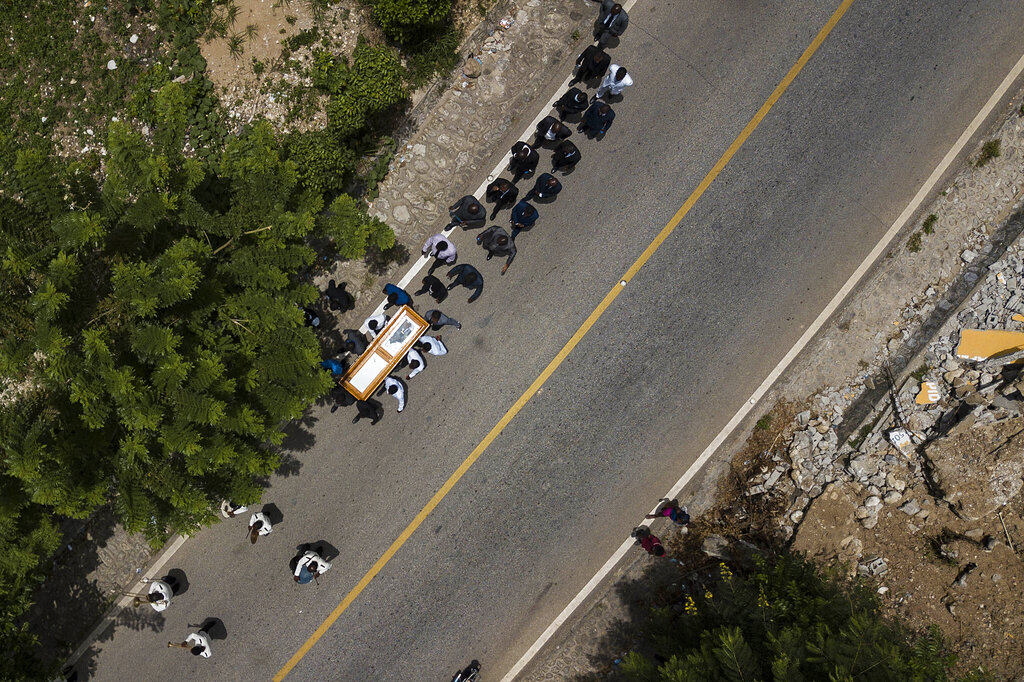
The coffin with the body of Baptist church minister Andre Tessono, who was killed during the 7.2 magnitude earthquake that hit the area 8 days ago, is carried to the cemetery during his funeral in the Picot neighborhood in Les Cayes, Haiti, Sunday, Aug. 22, 2021.

Nurse Ali Herbert was preparing the operating room—a large tent—for a hand surgery Sunday afternoon. A surgery on a broken femur was scheduled for later. The fans to move the sweltering air and the open flaps on the tent to allow ventilation were major differences from a sterile operating theater, but far cleaner than the conditions most patients have been in until they arrive, she said.

“A normal operating room would not have this kind of setup,” Herbert said. “We just have to do what we can and keep it as clean as we can and hopefully the patients do okay.”

Some patients have received some initial treatment, but require more care. Others are being treated for the first time, she said.

People needing help also showed up at the public hospital across town Sunday. Space is at a premium and some are on beds outside the wards. If their injury is less serious they might be sitting on the ground on a square of cardboard.

Rousseau Hussein, a resident working in the emergency room, said the situation had calmed in the past week, but they continue to receive patients injured in the earthquake from outlying areas.

The hospital has been receiving support and at the moment had the supplies it needed to treat the cases he sees in the ER.

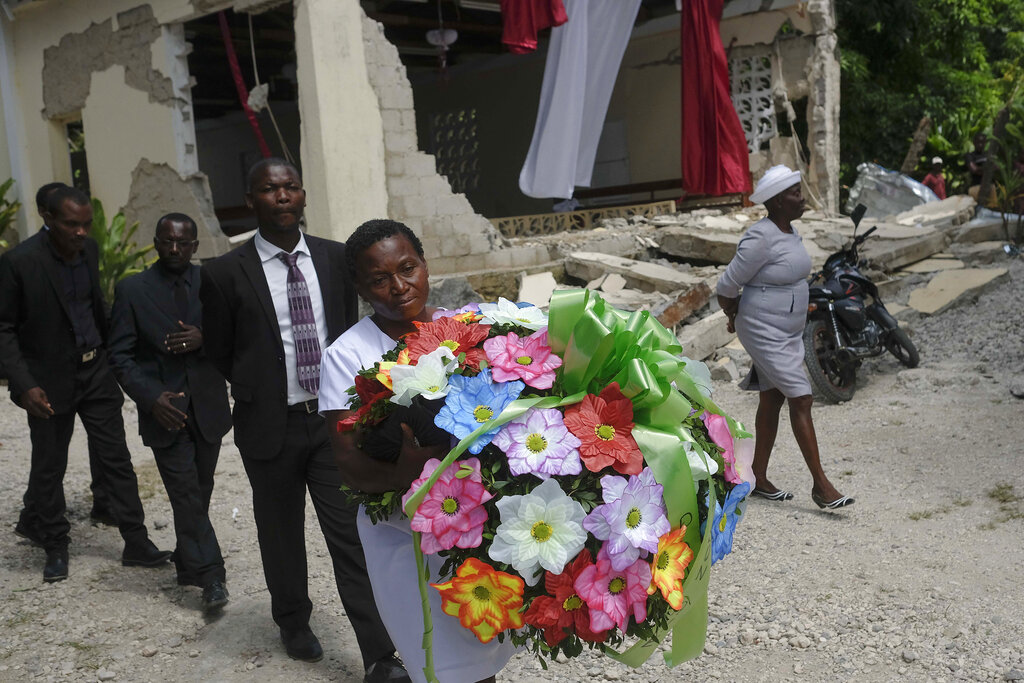
People carry a flower offering next to the earthquake-destroyed church where Baptist church minister Andre Tessono died, during his funeral in the Picot neighborhood in Les Cayes, Haiti, Sunday, Aug. 22, 2021, eight days after a 7.2 magnitude earthquake hit the area.

In Les Cayes, many attended church Sunday to mourn those lost and give thanks for their own survival.

At an evangelical church in the Bergeaud neighborhood, parishioners sang hymns under beams of sunlight streaming through holes in the roof and walls.

Pastor Sevrain Marc Dix Jonas, said Sunday’s service was special because until now his congregation had been unable to meet since the quake.

“Today was a must,” Dix Jonas said, standing below a gaping opening high in his church’s facade. “To thank God. He protected us. We did not die.”

His church was one of the few where congregants could worship inside. At many others, services were held in the street outside collapsed sanctuaries.

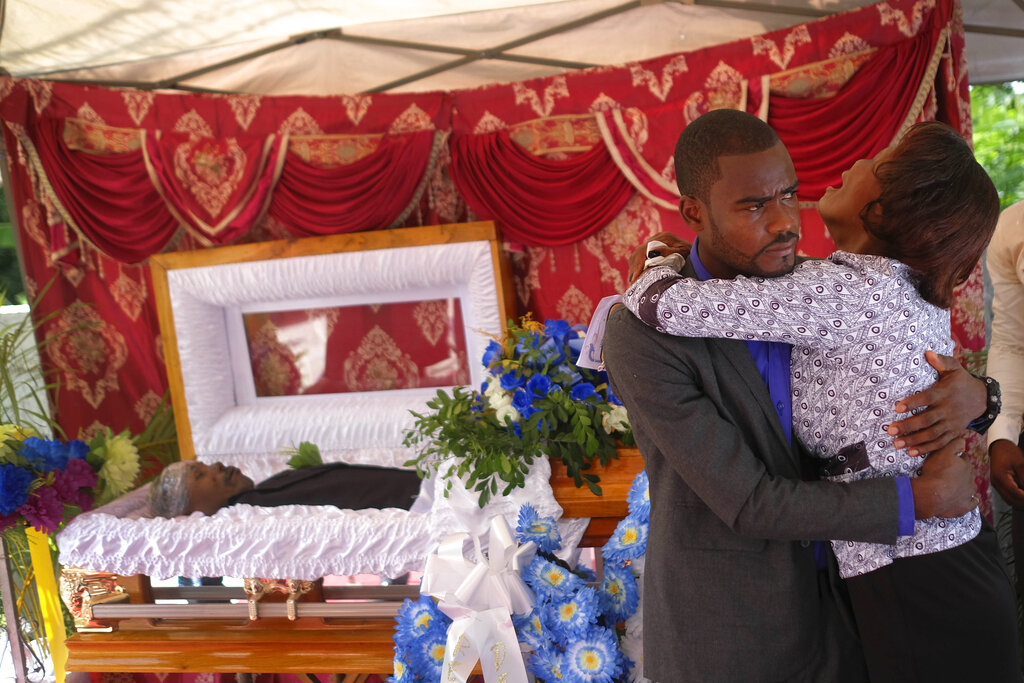
The son and mother of Baptist church minister Andre Tessono, who was killed during the 7.2 magnitude earthquake that hit the area eight days ago, mourn during his funeral in the Picot neighborhood in Les Cayes, Haiti, Sunday, Aug. 22, 2021.

Bernard Fountaine, an assistant pastor at Third MEBSH (Mission Evangélique Baptiste du Sud d’Haïti) Baptist Church in Les Cayes, said there were myriad reasons fewer believers came out to worship on Sunday.

“Some people had not yet entered the worship center for fear of aftershocks. Others did not know if the church was going to meet,” Fountaine told CT. “[Finally,] those whose homes collapsed did not have the clothes to come to church.”

Wilbert Clément’s church in Les Cayes, Eglise Baptiste de Cance, was badly damaged. He preached on Psalm 91 and on the Lord as the invincible shelter during the catastrophe.

“The congregation is totally exhausted and scared,” he told CT.

The devastation struck Lory, a village in the countryside about 80 miles northwest of the quake’s epicenter. Sunday services at L’église par la foi de Lory normally attract about 700 people. This week, only 200 worshipers showed up to church.

“People are scared of the aftershocks and insecurity because they don’t have houses anymore. You can see fear in their eyes,” pastor Lomann Dolce told CT. “They pray for help because they have lost everything. They don’t feel safe anymore. God is their only hope.”

In Camp Perrin, about 30 miles west of the epicenter, the earthquake damaged a number of educational and ministry-related buildings at the Baptist Church of Guichard. On Sunday, church attendees spent time worshiping and praying for their homes and school to be rebuilt and for funding for the free medical clinic that also sits on their property, pastor Eberle Nazaire told CT.

“If we don’t find these these necessary funds, the situation will be very difficult in coming days, as we are now in the middle of the hurricane season,” he said. “We need this money to help rebuild houses and educate children and young people”

Haitian apologist Lesly Jules worries that some may conclude that the earthquake killed people when, in reality, the issue was buildings were not up to code.

“Unfortunately, since the past earthquake, the construction codes have not been enforced by the Haitian government,” Jules told CT last week. “Churches have not emphasized the need to use wisdom when it comes to building. The literal understanding of the parable of the fool who built his house on the sand was not perceived in relation to an earthquake.”

Jules and other Haitian Christian leaders assessed the church’s response to the 2010 and 2021 earthquakes for CT and advised the global church how to pray for Haiti as local believers navigate the aftermath.

“Please pray for the strength of the witness of the Haitian church. The country is in desperate need of a church which will fulfill the role of salt and light,” said Magda Victor, general secretary of the Haitian Bible Society.

In the wake of last month’s presidential assassination, president of Emmaus University of Haiti, Guenson Charlot, and his wife, Claudia Charlot, director of Hand Up Micro Credit, joined CT’s Quick to Listen podcast. Guenson expressed concern that too many outsiders would try to search for a quick fix for Haiti’s systemic problems.

“What I am asking right now of our friends and our fellow evangelical Christians in North America is that we want a little bit of patience,” said Guenson. “Let us work.

“The change we hope for is not going to happen overnight. I know the needs are pressing, but we need to have a strategy for self-sustainability,” he said. “We can't resolve all the problems overnight. But for us to be more effective in what we do, we need to invest in long-term plans.”

Evens Sanon and Marko Alvarez reported for the AP, and Christopher Sherman contributed. Additional reporting by Morgan Lee for CT.

News

Can This Texas Pastor Lay Hands on an Inmate During Execution?

Q&A with SBC minister Dana Moore on the power of prayer in a state death chamber.

Christianity Today August 23, 2021
The Washington Post / Getty Images

John Henry Ramirez is scheduled to die on September 8. The state of Texas will execute him by lethal injection for the 2004 murder of 45-year-old convenience store clerk Pablo Castro. Ramirez was convicted of stabbing Castro 29 times in the process of stealing $1.25 to buy drugs. Now, 17 years later, he will be put to death for his crime.

When that happens, Ramirez would like to have his pastor lay hands on him. He filed suit in federal court last week claiming he has a religious right to have Dana Moore, senior pastor of Second Baptist Church in Corpus Christi, Texas, touch him while he dies.

According to Ramirez’s lawyer, Seth Kretzer, the prison’s current policy allows doctors and guards to touch an inmate during execution, but does not allow spiritual touch. Kretzer argues that this “burdens Mr. Ramirez’s free exercise of his Christian faith at his exact time of death, when most Christians believe they will either ascend to heaven or descend to hell—in other words, when religious instruction and practice is most needed.”

CT reached out to the Southern Baptist pastor to ask about the importance of the laying on of hands, ministering on death row, and what he thinks people should know about Ramirez.

Why is touching someone or laying hands on them important to you as a Baptist pastor?

When I pray with people, I put a hand on them. When I go to the hospital, I hold the person’s hand. It’s what we do. It’s how we do things.

Dana Moore
Dana Moore

Just last week we had a fellowship, and I looked over, and one of the church ladies was praying for another one. And the one standing, she put her hands on the lady who was seated, on her shoulders, and she was praying over her.

I don’t think it’s just Baptists. At churches across denominations, we touch. And it’s not like it’s just a thing in the history books. It’s something we do every day when we pray for each other.

And that’s what John wants me to be able to do. To have me touch him. To have that support. To have that type of blessing.

Is John Henry Ramirez a member of Second Baptist Church?

He came to salvation in prison. I’m thinking it was on death row, through the ministry of two ladies from our church, Jan Trujillo and Joyce Watson. Then John applied for church membership. We took his salvation and basically a letter by proxy, which usually Baptists don’t do, but in this case we did.

I think of him as one of my members who, I guess in the ultimate way, is homebound. He can’t come to church.

We talk just like any church member, except we have to talk through plexiglass and through phones. We talk about everything. We talk about Bible questions, we talk about his life, and he’ll ask me, “What’s going on in the church?” I tell him about the church, and then I want to know about how he’s doing.

What can you tell us about John? What do you want people to know about him?

John is somebody who had been transformed by Jesus Christ. That’s the most important thing.

How did your church start a ministry to death row inmates at the Texas Department of Criminal Justice Allan B. Polunsky Unit in Livingston, Texas? That’s about five hours from the Second Baptist Church in Corpus Christi.

It began with a church member named Les Archer who worked as a volunteer chaplain at the local county jail, and that’s where he met John Ramirez. John’s case proceeded to conviction and he wound up on death row, and Les Archer could not get there, he just could not take the travel, physically.

He enlisted two ladies, sisters, and Jan and Joyce began the ministry. John had the idea of broadening it, of getting more visits for guys who aren’t getting visits on death row. I think this is probably common knowledge, but they’re isolated on death row. They are all isolated all the time.

Now we probably have half a dozen people who go visit the guys, and they go once a month. It’s a ministry to death row, for our church.

What is Second Baptist Church like?

It’s a great church. Over 100-year history. Ministry to all ages. We just try to carry out the Great Commission, and it’s a challenging time to do that, but that’s our goal.

It’s a church where many people from different backgrounds do attend. We have an active Kairos Prison Ministry, and we have a local ministry here called Broken Chains, of individuals looking to get off of different addictions, and frequently those people come to be part of the church.

We’ve got professionals and we’ve got individuals who are struggling, making ends meet and trying to stay clean. We try to help one another follow Jesus and lead others to follow Jesus too.

When you first met the men on death row, what was your impression of them?

John and the other guys I meet there, they’re regular guys. It’s like, wow, how different am I? John’s just a regular guy. Strengths. Weaknesses. And everything else.

He likes to talk. And I do too. It’s hard for me as a preacher sometimes to get a word in, because I’ve got to listen first. He does like to talk.

For a spiritual advisor visit, I’m allowed to speak to one inmate for one hour, and I try to do two in one day if I can. I’m talking to John every month because he has a date [for his execution], and the three other guys rotate, which they’re all supportive of, because they know John has a date.

My No. 1 goal is to be there and to listen to what John has to say to me. I don’t go with an agenda. I go there just to befriend and be a minister as much as any of the guys will allow me to. Then I see where it goes.

How long have you been ministering to John?

I can’t remember exactly when it started, but about five years.

Has meeting with these men changed what you think about the death penalty?

I don’t want to get into that. I don’t want to muddy the waters with the lawsuit. I have opinions, but it’s not about what I think.

If there were other ministers asking about this kind of ministry, weighing whether to reach out to people in prison or death row specifically, what would you tell them?

Just pursue your call. Follow your passion—what God’s leading you to do. There are so many good ministries out there. For us, this was just something God put in front of us. We didn’t seek it out or do it as part of a plan.

When you meet John, you talk through phones through a plexiglass window?

Yes.

So you’ve never touched him, right? You’ve never been able to lay hands on him while you’re praying?

No.

How did you start to talk about the possibility of touching him during the execution?

Since the Supreme Court said I’m now allowed to be in the death chamber, to go with him into the death chamber, we talked about what that would be like and look like.

John said, basically, “Dana, I want you to be able to touch me.”

Touch is spiritually important. There’s something there. Jesus healed by touching. Jesus gathered the children in his arms; that’s touching. James talks about anointing people with oil; that’s going to involve a touch. So I said I wanted to touch him too.

I don’t know the legal process of it, but John initiated it and I filed that affidavit in support of it, in support of the idea of touching him in the death chamber.

What have you learned about pastoral ministry from visiting these men on death row?

It’s allowed me to fulfill part of the Bible. You know in Matthew 25, Jesus says, When I was in prison, you visited me. He’s saying when you go visit that person, it’s like you visit me.

I didn’t think Jesus would look like John Ramirez, but he does. So, gosh, I got to say yes to that.

Books
Excerpt

Christ’s Prayers Can Transform Ours

When we look closely at how Jesus’ prayer life is depicted in Luke, we discover how essential prayer is for us.

Illustration by Cassandra Roberts / Source image: Harry Cunningham / Unsplash

Alongside Jesus’ astonishing miracles and teachings, the Gospels depict something just as compelling: Jesus—who is himself fully God—prayed. In fact, he prayed a lot. Luke, the go-to Gospel for a theology of prayer, includes more descriptions of Jesus’ own prayer habits than any other Gospel. When we look closely at how Jesus’ prayer life is depicted in Luke, we discover how essential prayer is for the life of faith and our participation in God’s kingdom.

Spiritual Practices of Jesus: Learning Simplicity, Humility, and Prayer with Luke's Earliest Readers

Jesus’ Baptism Prayer (Luke 3:21–22)

For Luke, this isn’t just a story about Jesus’ baptism; it is a story about the power of prayer. Jesus’ baptism prayer launches his ministry, initiating his anointing, commissioning, and empowerment for ministry. Luke replaces the phrases about Jesus coming up out of the water in Matthew and Mark with “and was praying” (3:21, NRSV throughout), making the prayer and not the baptism itself the point of focus.

Immediately, we see Jesus’ prayers inviting God to act. God speaks from heaven, anointing Jesus for ministry. Jesus’ prayer initiates the arrival of the Spirit, who descends on Jesus “in bodily form” (3:22), granted for the fulfillment of Jesus’ mission. Luke goes on to describe Jesus as “full of the Holy Spirit” (4:1) and “filled with the power of the Spirit” (4:14). In 4:18, Jesus announces, “The Spirit of the Lord is upon me” and interprets his ministry as a fulfillment of the Scriptures.

Luke draws a vital connection between Jesus’ faithfulness in prayer and the inauguration of and empowerment for his earthly ministry. If we want to be used by God for God’s kingdom work, the preliminary step for us also is to be faithful in prayer.

Jesus’ Withdrawal for Private Prayer (Luke 5:16)

Faithfulness in prayer matters. In 5:16, Luke emphasizes that Jesus habitually withdrew to commune with God alone in prayer. Luke also records many other instances of Jesus’ pattern of solitary prayer.

In Luke 22:39, Jesus goes to the Mount of Olives, “as was his custom,” to pray. He goes off to a deserted place at daybreak (4:42), he prays alone regularly (9:18), and he even spends entire nights in prayer (6:12). Jesus practices what he preaches, illustrating the necessity for prayer through his own dependence on it. Luke pushes us to follow Jesus’ example.

We are people who often need a concrete plan of action if we want to be faithful to our best desires (and the invitations of God). Dallas Willard said in Christianity Today that we must make “plans” for righteousness—setting ourselves up to succeed and not fail with spiritual disciplines in spite of the inertia of our human nature. Jesus seemed to have some specific spots (Mount of Olives) and possibly times (daybreak) for regular prayer. If we still need to develop a habit of faithful prayer, simple things like having a designated spot and time can aid our best intentions.

Jesus Prays Before Choosing His Disciples (Luke 6:12–16)

Prayer aligns us with the will of God. In Luke 6, we see that Jesus’ choice of the disciples was also God’s by taking a glimpse at Jesus’ activity the night before.

Before choosing the disciples, Jesus “spent the night in prayer to God” (v. 12) conforming his will to the will of his Father. The choice to appoint disciples, the number of disciples chosen, and the choice of the particular people all fall within God’s design because Jesus has first sought God’s will in prayer.

The unique expression “in prayer with God” expresses not only Jesus’ supplication but also “his silence, the listening, and the answer of God,” noted theologian Francois Bovan. Jesus’ prayer through the night is not a statement about his asceticism but emphasizes his complete focus on the will of God and the significance of this event. Many Christians today treat prayer as a one-sided activity where we express our desires to God. Not only is the self-oriented approach misdirected, but the manner of prayer is as well. The model we have of prayer here involves an orientation around God’s purposes and extended periods of communal waiting in the presence of God.

Jesus’ Identity Revealed (Luke 9:18; 9:28–36)

Among the Synoptics, Luke alone sets the transfiguration narrative in a context of prayer. So far in the Lukan story, prayer has been regularly linked to important divine revelations. Now again, directly prior to revelation, Jesus ascends a mountain to pray (9:28).

It is important to note that the transfiguration account is connected with Jesus’ revelation of himself to the disciples in Luke 9:18–27. In each story, prayer leads to a further revelation of Jesus’ identity. In Luke 9:18, after Jesus has been at prayer, he asks the disciples who he is. The correlation of Jesus’ prayer with Peter’s response, “the Messiah of God,” shows that understanding of Jesus’ identity comes through God and is granted through prayer.

We see this further illustrated in the Transfiguration, when Jesus’ identity is also revealed through his transformed appearance, by the presence of Moses and Elijah, through the emphasis on the presence of God, and by God’s public affirmation. As a direct result of Jesus’ prayer, the disciples are enabled to see his inner self made transparent to them.

For us today, prayer is a crucial means of deepening our understanding of Jesus—of growing to know him more fully every day.

Jesus’ Prayer in Gethsemane (Luke 22:39-46)

Jesus’ own struggle in prayer in Gethsemane models faithfulness to the divine will. His obedience has roots in Isaiah’s passages about the Suffering Servant, who is obedient to God even in the midst of tremendous suffering and humiliation. Jesus’ submission is even reflected in his posture. He kneels, while the usual posture for prayer in the ancient world was standing while looking up to heaven.

Luke highlights Jesus’ struggle in prayer as the turning point of the entire passion narrative, since it is here that Jesus obtains the strength to embrace his mission and God’s will. After an angel appears to strengthen him, Jesus is described as praying more earnestly “in his anguish” (22:44). The inclusio framing Jesus’ prayer (22:40, 46) indicates that the content of Jesus’ prayer was that he not enter into the temptation to follow his own will instead of God’s will. By highlighting the victorious struggle in prayer, Luke sets up Jesus as an example for the kind of prayer that gives one the courage and fortitude to resolutely insist on God’s will, even in the face of persecution and death.

Teach Us to Pray

Prayer is the driving force behind Jesus’ mission. If prayer fuels the entire work of God in Luke’s gospel, how can we fail to imitate Jesus’ example? For Luke, the focus of prayer is on God’s kingdom. Prayer is less about presenting a list of personal wishes to God and more about coming to understand what God is doing. Prayer has the ability to transform us into people who desire and participate in the work of God’s kingdom. Prayer empowers Jesus for ministry and fortifies him to accomplish God’s purposes. May the same be true of us.

Catherine J. Wright is associate professor of biblical and theological studies at Bethel University. This article is adapted from Spiritual Practices of Jesus: Learning Simplicity, Humility, and Prayer with Luke’s Earliest Readers by Catherine J. Wright. Copyright © 2020 by Catherine J. Wright. Used by permission of InterVarsity Press, Downers Grove, IL. www.ivpress.com.

This article is part of CT’s special issue “Teach Us to Pray: Women’s Perspectives on Deepening our Engagement in Life with God.” You can read the full issue here.

addApple PodcastsDown ArrowDown ArrowDown Arrowarrow_left_altLeft ArrowLeft ArrowRight ArrowRight ArrowRight Arrowarrow_up_altUp ArrowUp ArrowAvailable at Amazoncaret-downCloseCloseellipseEmailEmailExpandExpandExternalExternalFacebookfacebook-squarefolderGiftGiftGooglegoogleGoogle KeephamburgerInstagraminstagram-squareLinkLinklinkedin-squareListenListenListenChristianity TodayCT Creative Studio Logologo_orgMegaphoneMenuMenupausePinterestPlayPlayPocketPodcastprintremoveRSSRSSSaveSavesaveSearchSearchsearchSpotifyStitcherTelegramTable of ContentsTable of Contentstwitter-squareWhatsAppXYouTubeYouTube