Cover Story

What Christian Aid Workers Want You to Know About Afghanistan

US forces are withdrawing after 20 years, but the story of Christian aid work goes far beyond military conflict.

Andrew Quilty

Our September issue went to press before the stunningly rapid fall of Afghanistan’s government. This month’s cover honors the history of faithful, unseen service in Afghanistan on the part of local believers and Christian aid workers. With the Taliban now firmly in control, it’s easy to forget that the church was at work there long before America’s “forever war” began—and will remain at work there, now that the war has ended.

Like so many, Arley Loewen knows exactly where he was when 9/11 happened. He was in Islamabad, Pakistan, working with Afghan refugees as an educator, and he had to evacuate the area for safety.

But as a foreign aid worker, there are also other dates he thinks about, memorializing other deaths. Those who spent time on humanitarian work in Afghanistan in the past 20 years get emotional remembering the Afghan and foreign friends, coworkers, and neighbors who died.

On March 27, 2003, a Red Cross engineer was executed by unknown gunmen.

On June 2, 2004, five Médecins Sans Frontières staff were killed on the road between Khair Khana and Qala-i-Naw.

On January 14, 2008, an attack on the Serena Hotel in Kabul killed six.

On July 24, 2014, two Finnish women with an international ministry were shot and killed.

On October 3, 2015, a US airstrike hit a Médecins Sans Frontières hospital and killed 42.

On November 24, 2019, a roadside bomb killed a California man with the UN Development Program and wounded five others.

There are other dark dates, and Loewen, who currently lives in Manitoba and teaches Bible and Muslim-Christian relations at a small Christian college, regularly checks his phone to see if his friends in Afghanistan are okay.

“We tend to sit in the story of violence, and it’s so real with the Taliban taking one district after another,” Loewen said. “But then the other story of civil society—I love that story.”

According to a recent report from the US Agency for International Development, there are about 140 nongovernment charity organizations, many of them Christian, doing aid work in Afghanistan. There are also another dozen UN organizations. They are providing food, medical care, cash transfers, education, and tools and seeds for farmers. They are encouraging music, art, literature, and sports. In the midst of war and conflict, they have encouraged community and civil society.

They have, perhaps most of all, formed deep connections with the people of Afghanistan.

Transformation brought by the Afghan people

“Aid workers are just there for the people,” said Patrick Krayer, who lived and worked in Kabul with his wife and kids. “We’re just facilitating. … We’re not messiahs. We don’t want to get into the power dynamics that, ‘We’re coming in to save you.’”

Krayer pointed to ophthalmology as one example of how aid workers help. Beginning in the 1960s, a Christian aid organization helped establish an ophthalmology department at Kabul University, training Afghan eye doctors. Then those doctors trained others, and today all the ophthalmology is done by Afghans for each other.

“One hundred percent of all the eye care in the country came out of that department,” he said.

Krayer and others are quick to point out that though they have provided resources and support, the real transformations that have happened in the country have been done by the Afghans themselves.

“We’re just empowering them to do what they want to do to serve their own people,” said Krayer, who now teaches at Dallas International University.

He recalls arriving in Kabul in 2002 and seeing building after building bombed out. By 2012, the city of more than four million was completely rebuilt. There were other kinds of transformations, too. Artists started creating again. Soon, women were competing in athletics and participating in team sports, and by 2008, Afghanistan had its first Olympic medalist. There was an explosion of popular culture. Afghan Star, a singing competition show that brought in hopeful contestants from around the nation, became the most popular show on Afghan television.

Afghans did almost all of the transformational work, Krayer said. But they don’t get the credit, and the story of the violence misses so much about what has happened and what is happening in Afghanistan.

“I was a guest in their country,” he said. “They allowed me into their communities. They allowed me into their homes. They’re very hospitable and gracious. It’s an incredible privilege to be working and living among the people.”

Krayer recalls one time he got a flat tire in a small village about four hours from Kabul. He had already replaced one flat on the trip and didn’t have a spare. A stranger grabbed his tire, jumped into a passing taxi, and went and repaired it.

A street in Kabul near the Loewens’ house when they arrived in 2003 (top) and rebuilt 10 years later (bottom).Photos Courtesy of Arley Loewen
A street in Kabul near the Loewens’ house when they arrived in 2003 (top) and rebuilt 10 years later (bottom).

Aid work will not end with withdrawal

As the US military pulls out of the country, foreign aid workers are preparing for the changing political reality in Afghanistan. President Joe Biden, the third US president to pledge complete withdrawal from what has become known as America’s “forever war,” said security for the region needed to be turned over to Afghanistan forces by the 20th anniversary of the 9/11 attacks. The president expressed confidence that the Afghan soldiers have the “capacity to sustain the government” but also acknowledged the country will deal with ongoing “internal issues.”

Observers say the Taliban is gaining power in many districts and the conflict may turn into a civil war after the US forces depart.

Christian aid workers, who have seen a rise in violence targeting humanitarian groups in the past few years, are concerned about the uncertain future. But they also say they are doing work that did not begin with the US invasion and will not end with US withdrawal. They were doing something different than the military.

“We want people to know that God loves them,” Krayer said. “And love has to be practical and physical.”

Aid provides stability in a country, and for Christian aid workers at least, it is explicitly nonpolitical. During times of transition, that can be even more important. Krayer said that in the Afghan civil war of the 1980s and ’90s, there were many aid workers who stayed in the region.

In the near future, many workers may leave because of security concerns. Others will find ways to stay, said an author and aid worker who, for safety reasons, uses the pseudonym Anna Hampton.

“There is a 100-year modern history of the Christian foreigner in Afghanistan,” Hampton said. “It’ll get small again, but it’ll be there.”

The motive, according to Hampton, is simple: “We love Jesus and we love the Afghan people.”

That doesn’t mean there won’t be dangers. In the past 20 years, aid workers have experienced a lot of risks. They and their families have had to make careful, calculated decisions about what to do and how vulnerable they are willing to be.

Hampton’s family’s home was once broken into by armed men, a close family friend was kidnapped and killed, and they were forced to evacuate the country. Hampton said she still deals with the trauma from the attack on her family. But peril is also an opportunity to live out her faith.

Hampton now writes about the theology of risk and teaches future aid workers how to discern healthy fear and develop mature courage. Many Christians have an idea of courage that looks like a lone man dying on a battlefield, she said, but that’s not a biblical picture.

“Both Jesus and Paul fled risky situations,” she said. “Workers need to see where God is speaking and guiding and leading them either to continue to move into a higher risk situation, or to retreat for a time.” In her book Facing Danger: A Guide Through Risk, Hampton talks about what it meant, as a Christian and a mother in Afghanistan, to try to show her children a picture of how Jesus would respond to people’s needs and also human danger.

Loewen said people asked him and his wife about the risks of bringing their two small daughters to the region, too. And there were risks. But also an incredible richness, raising a family in that culture and seeing his daughters learn to cross cultural lines as if it were normal.

“They treasured their lives in Pakistan and Afghanistan,” he said. “In school, our daughters could relate to Afghan boys and girls as friends.”

Of course, it’s not just aid workers and Christian foreigners who face threats. The conflict has been dangerous for many in Afghanistan, and a small but vibrant group of Afghan Christians pray and worship behind a protective veil of privacy.

According to the Pew Research Center, less than 0.3 percent of the 34 million Afghans belong to a minority religious group, whether Christian, Hindu, Sikh, or Baha’i. But accurate numbers are hard to come by. The population is predominantly Sunni Muslim, and the constitution states that Islam is the state religion. Minorities are allowed to practice their faith, but it’s not considered culturally acceptable in public spaces.

Many Afghans—some for religious reasons, more for political reasons—are currently weighing whether they should leave the country in this time of transition. According to a recent United Nations Refugee Agency report, nearly 1,000 have left per month since April. They will join the millions displaced from their homes in the past 40 years.

Janice Loewen visits with an Afghan friend.Courtesy of Arley Loewen
Janice Loewen visits with an Afghan friend.

The Afghans outside of Afghanistan

Currently, 42,000 Afghans live in Toronto, and thousands more in other North American cities. New York has 18,000 and Los Angeles, 12,000, according to Global Gates estimates.

Negin Ponce was one of those refugees, arriving in New York in the 1990s, where she lived for five years until moving with her parents to California. She was in high school in California when 9/11 happened. Her first concern was for an aunt who worked in the World Trade Center. Only later did she realize that, because she was a Muslim and because she was from Afghanistan, some of those around her would associate her with the perpetrators and not the victims of the violence.

“I wanted to put a blanket over my head, for people not to know where I came from,” she said. “It was caused by radical people and radical extremism, rather than the kind and patient and loving Muslims.”

Later, Ponce became a follower of Christ, after she had a vision of three crosses, found a Bible, and then visited a church. Now, because of her faith and because of her own experiences as a child, she supports Muslim refugees in California and urges her fellow Christians to reach out to their Muslim neighbors.

“It’s a very warm and loving culture that really is about the family unit,” she said. “We love our ethnic foods. And don’t you ever dare go into an Afghan woman’s home who’s a homemaker and say, ‘I’m bringing fast food.’”

Americans can care for the Afghans in their midst by listening to their stories, teaching them English, and meeting practical needs like medical care and employment assistance, said Jamie Coleman, pastor of Nexus Community Church in Dallas. The church meets in the community center of a large apartment complex filled with refugees. He estimated that about 500 families of Afghans live within a two-mile radius of the church.

The church members are forming relationships, getting to know the Afghans as people.

“To have a friend be able to listen to how they’re experiencing life here in contrast to what life is like in Afghanistan? They love to share that,” he said. “In Afghanistan, brothers and sisters and parents live together in big houses, a communal life. Here it’s extremely different, with lots of pressure to pay the bills and work, work, work.”

Afghan women who wear head coverings feel like targets are on their backs when they go out in public in America, Coleman said. Many of the women are illiterate and uneducated, can’t drive, and struggle with isolation and cultural barriers. Americans can provide safe community for them.

“We learn their stories. We drink tea with them,” he said. “It’s very organic and relational. It’s just listening well.”

Coleman brings out some saffron tea that an Afghan refugee friend in Dallas gave him. A nice gift, but more important for its potential.

“There are hundreds of conversations with Afghans in this packet of tea,” Coleman said. “I’ve offered that packet of tea to the Lord.”

According to Loewen, there is a Greek word for this. It’s philoxenos, or “loving the stranger.” That’s how Christians are supposed to treat their neighbors, and it’s also the key, he said, to foreign aid work.

The real story

It’s also how many Afghans welcomed him and other foreign aid workers: with hospitality. As Loewen checks his phone for updates from friends, in this tumultuous time, he’s also planning his next trip back.

He missed last year’s visit due to COVID-19. He doesn’t know when he will be able to go next, either, but he talks about the friends he will visit, the conversations he’ll have, the poetry he’ll enjoy, and the delicious food he will eat.

He recalls accepting an invitation to bring some visitors to an Afghan’s house in 2006. Loewen started worrying about the financial strain a big meal could have on his host.

“I said to him, ‘Please take it easy, don’t overdo it with the food,’” Loewen said. “He brushed me aside as if to say, ‘It’s none of your business’ … and then stated, ‘The stomach is yours; the guests are mine.’ In other words, you can eat as little as you want, but I’m going to enjoy the guests.”

That night they broke bread together, often eating from the same plates, sharing some of the finest meats the visitors had ever eaten, along with Afghan-style ravioli and other delicacies that Loewen, if he thinks about them, can still taste.

There were so many meals like that, had by so many Afghans and so many foreign aid workers. There will be many more, too.

And that’s the story that Christians who work with Afghans in the US and in Afghanistan want to tell—a story of hospitality and friendship.

Rebecca Hopkins is a journalist living in Colorado. She spent 14 years in Indonesia and writes about international nonprofit work.

Ideas

Why Christians Keep Preaching to Themselves

Columnist

Sanctification, while certain, is not sudden.

Justin Paget / Getty / Edits by Rick Szuecs

You’ve probably heard a pastor remark during a particularly pointed exhortation, “I’m preaching to myself.” That line is often used to reassure listeners that, “Yes, what I’m telling you is a hard word, but it’s one first and foremost for me.”

I have always respected this attitude but recently came to appreciate it in a deeper way. Scrolling through Instagram, my eyes fell on a scripted quote overlaid neatly on a soft-focus photo: “You will never turn from a sin you don’t hate.”

It felt like divine timing. The message came not long after I had committed a familiar sin, one of those I had hoped was behind me. A believer for over four decades, I was keenly aware that the Lord’s patience should have run out on me by now on this particular weakness. How was I still battling it?

The answer was spelled out before me: I didn’t hate it yet. Not like I should. Not completely enough to extinguish it once and for all. Like Lot’s wife, I had turned back toward something I should detest, something from which I had been dragged free. With my conviction and confession still fresh, God chose to deliver a miniature sermon to me via Instagram. Using, of all things, my own words.

The sentence was mine, written in my books and taught by my lips for years, properly attributed for all to see. In the strange alternate universe that is social media, I was literally preaching to myself.

It is the great liability of a teaching ministry: knowing you will likely out-teach your own ability to obey, knowing there will be days when you will not practice what you have preached. But it’s also a liability of the Christian life. Paul exhorted his listeners to follow him as he followed Christ while also acknowledging he was still at war with sin.

All who faithfully proclaim the Good News of Christ must do so circumspectly, balancing a healthy fear of hypocrisy and a healthy fear of leaving God’s truth un-uttered. Silence is not an option for the Christ follower. Hypocrites habitually preach what they have no intention to practice, but the average faithful person preaches knowing that even a habitual obedience is not a perfect obedience.

There will be days when our past words exceed our current deeds. Lord, help us. Sanctification, while certain, is not sudden. But we wish it could be.

We love a quick fix. When I was growing up in the ’70s, it was the nose wiggle that could instantly clean a messy house on Bewitched. I loved those camera trick scenes. These days, it’s before-and-after pictures on social media. Swipe to see a closet go from chaos to order. Swipe to see a room go from filthy to spotless. Swipe to see a face go from blemished to flawless. We know that in between the first and second frames, hours of work have been spent, but we care more about how it all turned out than the process of getting it there.

It is the great liability of a teaching ministry: knowing you will likely out-teach your own ability to obey.

If only the Christian life could be like that. Positionally, we go from wretch to redeemed in an instant. But practically, we “work out our salvation” over the course of many years.

Sanctification is not a swipe but a slog. It rarely looks like an immediate ceasing of a particular sin. Instead, we become slower to step into the familiar traps and quicker to confess when we do. Slower to repeat, quicker to repent. This becomes a mantra of hope. Our hatred of sin is learned across a lifetime.

Reading my own words in an Instagram square, I knew this to be true. Yes, I had turned again to an old, familiar sin, but I couldn’t remember the last time it had happened. Across many years, a sin that had been frequent had grown seldom. Thanks be to God! Jesus taught that those who mourn their sin would be comforted. There is renewed grief in our confession of a repeated sin, but there is real comfort in seeing the distance stretch between those confessions.

That widening distance tells me that the grace of God is indeed teaching me to say no to ungodliness and training me to lead a self-controlled, godly life (Titus 2:11–12). I am being transformed. And the God who is accomplishing this transformation is so patient with me. There is indeed a wideness in God’s mercy. Even when—no, especially when—I am preaching to myself.

Ideas

The Church Has Helped to Heal Those It Once Hurt

Columnist

We can imitate those in Acts 6 who responded to the needs of neglected and oppressed women.

Illustration by Jianan Liu

This is a revelatory moment for American Christianity. A continuous stream of stories of abusive ministry leaders and racial injustice is driving many Christians to question their identification with their churches. So are the old stories, showing that the oppression of women and ethnic minorities is more woven into the American Christian story than we were taught or ever wanted to admit. Not every recent assessment of this story is compelling or accurate. But what’s clear is that our reckoning hasn’t reached back far enough.

The oppression of vulnerable women and ethnic minorities isn’t central just to the American church’s story, or even to the Western church’s story, but to the earliest days of the church itself, “when the number of disciples was increasing” (Acts 6:1–7).

There was a lot of good news for Greek-speaking (Hellenist) Jewish Christian widows in those early days. They followed a Messiah who not only rose from the dead and ascended to heaven but who in the temple itself specifically denounced the teachers of the law for “devour[ing] widows’ houses.” (Mark 12:40). They saw the Spirit of the Lord at work healing the sick, delivering the possessed, and redeeming the lost.

But this new Christian community was also neglecting these minority women, overlooking them in the daily distribution of food. The same disciples famous for having “shared everything they had” (Acts 4:32) weren’t sharing with them. The old prejudices continued, with the Hebraic Jewish widows being fed and the Hellenists left hungry. The oppression that Jesus denounced in the temple was happening at the table.

Both the widows and the broader community of God knew that God revealed himself on Sinai as one who “defends the cause of the fatherless and the widow, and loves the foreigner residing among you, giving them food and clothing” (Deut. 10:18). But the community of God was withholding food instead. It also knew the warning from Deuteronomy: “Cursed is anyone who withholds justice from the foreigner, the fatherless or the widow” (27:19).

It’s sobering to realize that the church—at the very moment it was filled with the Spirit and doing so much good—was blind to this systemic neglect. Since its creation, the one, holy, catholic, and apostolic church has also been divided, disobedient, lacking, and wrong.

Since its creation, the one, holy, catholic, and apostolic church has also been divided, disobedient, lacking, and wrong.

But here’s what happened next: When Hellenist Jewish Christians advocated on behalf of their widows, the disciples responded quickly. They stopped what they were doing and called “all the disciples together” to address it. “The whole group” chose seven men “known to be full of the Spirit and wisdom” to fix the problem. And they did.

“So,” Luke concludes, “the word of God spread. The number of disciples in Jerusalem increased rapidly, and a large number of priests became obedient to the faith” (Acts 6:7).

This too is how the church works: It listens to the oppressed. It repents of its oppressing. And by doing so, it proclaims the Word of God, it draws people to Christ, it models repentance and reconciliation to the world, and religious leaders become obedient to the faith instead of trying to protect their power.

This can be our Acts 6 moment. Congregations and denominations are dividing over whether it’s even appropriate to talk about systemic ethnic discrimination, let alone to identify resources to fix it. The stories of preachers and teachers abusing and devouring the houses of the vulnerable tempt us to despair. But knowing the history of the broken, beautiful church gives us hope. So too does identifying local believers “known to be full of the Spirit and wisdom.”

It will take more than seven people to repair widespread abuse and neglect of the vulnerable. But none of us are empowered to act without deep connections to local Christians serving faithfully and sacrificially. Find your seven.

This needn’t be a time we look back on in shame. The church flipped the script. In his study of early Christianity, Rodney Stark notes that the church bucked pagan culture by allowing wealthy Christian widows to keep their husbands’ estates and by financially supporting poor widows so that they did not feel pressure to remarry. A letter in the mid-200s reports that a Roman church of about 30,000 had 46 presbyters (priests) and seven deacons and was caring for “more than 1,500 widows and distressed persons.” The early church became known not as the church that got widows wrong but as the church that gave widows hope and care, regardless of ethnicity. We’ve been here before. Listen to the widows.

Ted Olsen is executive editor of Christianity Today.

Reply All

Responses to our May/June issue.

Envato Elements

Why Defining Gossip Matters in the Church’s Response to Abuse

This article was so refreshing—and insightful. I would add that this prohibition against gossip is also a detriment to healing—either through redemption or divorce—for spousal abuse. It’s the same scenario, but in an even more private/secret arena where only one person and the children know what is really happening.

Melanie Moore Columbus, OH

Although this article seems to be more about whistleblowing than the undermining work of gossip, I would like to add this caution: Without accountability, gossip can be lethal wherever it is allowed to blindly spin its courses. The Christian community must strive for higher standards than the secular world around us.

Steven Minor Sun City, AZ

Diversity Advocates at Evangelical Colleges: ‘In Some Ways, You’re Seen as a Heretic’

“Diversity” should not just be about broadening the student body to reflect the body of Christ. Any institution or organization committed to Jesus Christ must constantly self-reflect on the nature of God and the rightness of systems and structures that have, albeit mostly unintentionally, hindered those created in God’s image.

Chap Clark Newport Beach, CA

Let the Little Children Come to ‘Big Church’

It’s all well and good to let the little children come to big church, as long as big church will become little-people friendly. Heavy theological words given in a 45-minute-long sermon can literally invite fidgeting and boredom—and certain punishment when they get home for “misbehaving.” I have many cringing memories of seeing parents haul young children out of church and smack them soundly for fidgeting. It’s true that “more is caught than taught”—except when it isn’t.

Linda Teuling Mission, TX

Sometimes You Have to Shake the Dust Off Your Feet

It’s about time evangelicals start listening to our Black brothers’ prophetic words and, as our brother Dennis says, let the agitation of prophets clean up our toxic institution which we call the church. Dennis—we hear you, brother! Thanks for your courage to speak up.

Gerry Scott Dearborn, MI

How We Got to the Equality Act

While Matthew Anderson made several points I had not previously considered, I disagree with his statement “Mercy is the highest of all God’s qualities.” The Bible from cover to cover repeatedly reveals that love is God’s highest attribute and therefore the source of his mercy and grace.

Karen Cox Camp Lejeune, NC

Evangelicalism has lost its moral high ground, precisely because it failed to act with mercy or grace toward LGBT people but also toward divorced people, millennials, Democrats, and pregnant women. The point was never to win the political day or to get the power to write laws that circumscribed everyone else’s behavior. The point was to “Live such good lives among the pagans that, though they accuse you of doing wrong, they may see your good deeds and glorify God on the day he visits us” (1 Pet. 2:12).

Susan Gillespie Chatham, NJ

I was surprised that Anderson failed to address the indignities heaped upon the homosexual community by evangelicals at the beginning of the AIDS epidemic. A colleague once shared about his fear of threats that homosexuals would best be herded into concentration camps, a suggested antidote by some to the spread of AIDS.

Becky Anderson Newport, WA

If we truly accept that America is for all the people, we should not fear the rise of the minority parties from insisting on equality. This includes LGBT issues. The church should continue to preach against sin, but to single out a specific sin is disingenuous. Preach love and inclusion and allow the working of the Holy Spirit to change lives.

Steve Eldridge Cupertino, CA

‘Be Clean’: Jesus and the World of Ritual Impurity

Until his passing, I lived across the street from Colin Brown, an iconoclastic polymath who taught systematic theology at Fuller Seminary for 48 years. He told me that, historically, the church had not forgotten the Jewishness of Jesus, but rather they suppressed it! I know that Dr. Brown would have loved Jen Rosner’s insightful article. And so do I.

Stuart Dauermann Altadena, CA

Reading God’s Word like a Poem, Not an Instruction Manual

Scholars and others have been saying this about the Bible for a long time: that it should be enjoyed, in the fullest sense of the word. I read through the Bible about twice a year because I enjoy it. Beginning at Genesis becomes another journey with friends and mentors I am getting to know better. So, happy to see such a book, but shaking my head and sighing as to the reasons for it.

Peter Petite Cornwall-on-Hudson, NY

Michael Lindsay: Our Lives Are Full of ‘Hinge Moments.’ Here’s How We Can Pray and Prepare.

This is so true. But also, so hard to do. Especially when all culture around teaches people to define success and worth based on income only.

Sam Abdalla (Facebook)

Testimony

I Went to Hollywood to Make My Own Music. Now I Make a Joyful Noise to the Lord.

How a celebrity vocal coach changed her tune after encountering the truths of Scripture.

Margo Moritz

From the outside, my life looked great. I was living in a trendy area in Santa Monica, California, and enjoying a fantastic job as one of the top vocal coaches in Los Angeles. With almost a decade of experience at the highest levels of the music industry, I had worked with major-label and top-40 artists, as well as hit TV shows like The Voice and Glee. Clients regularly flew in from around the world.

Though I had moved to LA to pursue a career creating my own music, somewhere along the way that dream got lost. I wasn’t a Christian at the time, but my music always had a strong spiritual bent—and that simply wasn’t popular in LA. I made music and showed it to people throughout the city, but the response always left me cold. I faced so many disappointments trying to find a place for my music that eventually I stopped singing and writing altogether. The death of this dream was the greatest heartbreak of my life, and the five years that followed were the most creatively barren that I had ever experienced.

Praying to see truth

Throughout this dry time, I focused on my soaring coaching career, and I managed to find temporary peace and joy through an LA megachurch for “spiritual but not religious” seekers. The church was transdenominational, which appealed to me. Raised Roman Catholic, I later adopted Eastern beliefs about God and practices like meditation.

After almost 20 years of spiritual seeking, I truly believed I had attained higher levels of consciousness than most people. I believed there were many roads to God, and my thoughts were awash with “love and light” and other positive-thinking mantras. However, when I really looked at my life, I knew something was missing. Despite all my “spiritual knowledge,” I repeatedly ended up in failed relationships and struggled to find true purpose.

Around this time, several members of my family became born-again Christians and started talking about Jesus. I remember one of my brothers calling my spiritual center “satanic.” At the time, I thought he was crazy! The word satanic conjured up images of evil people doing rituals in a basement. What could be so horrible about channeling love and light, attaining higher consciousness, and finding inner healing?

When my brother asked me, “Who do you think Jesus is?” I remember answering, “He was a great spiritual teacher, and one of the most enlightened people who ever lived.” This is what all the “advanced” spiritual books had taught me. My philosophy was all about trying to “live like Jesus lived.” When I explained this to my brother, he said, “How can you live like Jesus when you have no idea who he really is? You’ve never read the one book that would tell you who he is.”

Though I couldn’t refute that point, I remember recoiling at what he was saying, and the conversation did not end well. For a time, we stopped speaking, and spiritual division began tearing my family apart. Upset by the turmoil, my mom suggested I “pray to see truth.”

So I did. I wasn’t sure whom to pray to, since I believed in a universal force of light and love, not a personal God. Even so, I spent a solid year praying and seeking truth, and I began reading the Bible as well.

Scripture confronted me with many ideas my new-age mindset simply couldn’t process, much less accept. I prayed about each challenge, asking God to reveal any beliefs that were leading me to reject what I read. As I did this, God began revealing his truth in ways that radically transformed my mind.

In time, I came to see that my most cherished beliefs had all been focused on myself. Even though they were framed in spiritual ways, they were oriented, ultimately, toward self-realization and self-help. I had been consumed with fulfilling my dreams, attaining my career goals, and creating a life that made me happy. I believed I was a good person, and I surrounded myself with friends who agreed.

But discovering the Bible’s definition of good shattered this confidence. Despite all my years of spiritual seeking, I finally saw that I wasn’t capable of being a good person on my own. And I sensed my need for a Savior.

Meanwhile, God gradually opened my eyes to the reality of evil in the world. For most of my adult life, I had dismissed this reality, preferring the ideas of positive, love-and-light spirituality. I certainly didn’t believe in the Devil, which sounded as ridiculous as believing in the Tooth Fairy! But day by day, God revealed to me the real state of the world—pulling back a veil and showing me depths of darkness I had never fathomed.

I had been seeking God, but the Enemy had diverted my attention to a counterfeit spirituality—one that simply couldn’t comprehend the reality of a fallen world. Even at this point, however, I didn’t trust the God of the Bible. If I had been so deceived for so many years, how could I trust anything now? I was wandering in the wilderness like a sheep without a shepherd.

I began attending a local church in Santa Monica, asking God to reveal himself and praying he would bring me out of the darkness. I attended a course called Alpha for nonbelievers who were curious about Christianity. I asked a ton of questions, and I read multiple books on apologetics. Eventually, I was ready to finally surrender my life to Christ.

Made for Worship

As a new Christian, I prayed that God would show me how to use my musical gifts for the sake of his kingdom. I soon realized I no longer belonged in the secular music industry. The messaging in the lyrics of most pop songs disturbed me, and I was concerned about the destructive impact these songs were having on young people. I wanted out, but I didn’t know what was next.

After only a couple of weeks of praying, I felt God clearly call me to leave LA and move two hours south, to San Diego County. I saw a vision for a Christian music company called Kingdom Sound and began pursuing it, even though I wasn’t sure where it would lead. Leaving everything I knew was incredibly scary, and I hoped God wouldn’t forsake me.

Alone one night in my new home, I felt I had truly reached the end of myself. I cried out to God with a desperation and sadness I had never felt before, asking, “Why did you even make me?” I felt I had completely failed in so many areas of life, including my own music.

That very night, I woke up from a dream at 3 a.m. In the dream I heard an amazing song, and I knew it was for me. I got up, rushed down to the piano, and recorded the chorus for “Refuge.” It was my first worship song. From that day forward, God began to pour out worship songs, and I experienced a complete revival of musical creativity. God had answered my prayer in a radical way—and I knew he was saying, “I made you to worship me.”

Since I put my faith in Christ, God has redeemed everything that was lost in my life. He has freed me from the prison of my selfishness, rescued me from darkness, and brought me into his glorious light. He has given my life new purpose, equipping me to serve his kingdom and glorify his name with music. There is no greater joy.

Kira Fontana is a singer-songwriter and record producer and the founder of Kingdom Sound.

News

Pro-Life Advocates Push Local Resolutions

Tired of failures at the ballot box and in courts, some turn to community declarations.

Illustration by Rick Szuecs / Source Images: Wikimedia Commons / Maria Oswalt / Unsplash

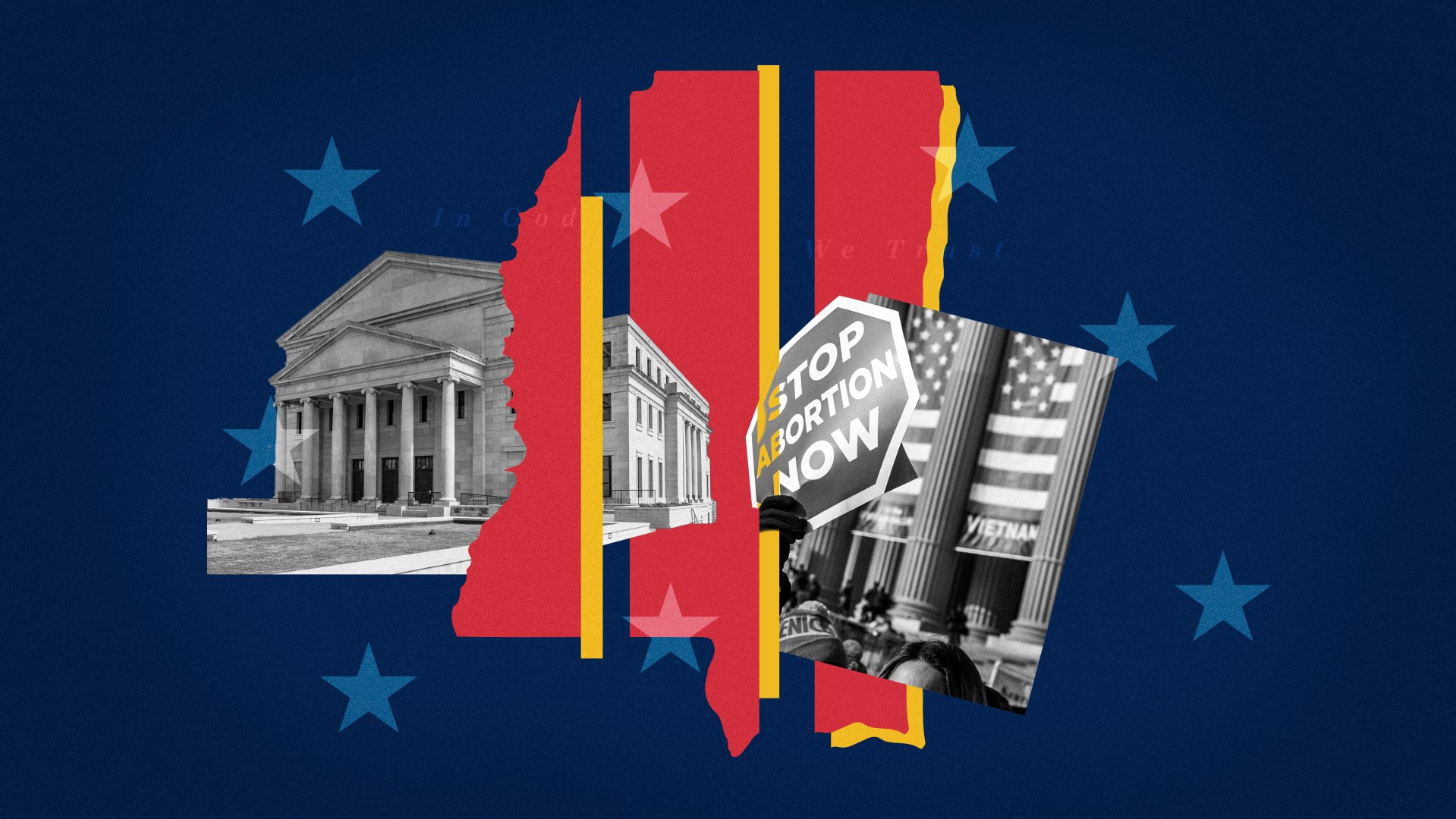
Ryan Sullivan didn’t give much thought to his pro-life position as a Christian beyond voting for pro-life politicians. Then he studied Exodus 21:22–24, where God prescribed the death penalty for any Israelite who assaulted a woman and caused her to miscarry.

“In that Scripture, the life inside the womb is treated with the exact same value as the life outside the womb,” said the pastor of Grace Community Church in Jackson, Mississippi. “Once I started thinking that way, I noticed that so much of the world around me—and even the Christian world around me—almost thinks of this abortion issue as merely a political one.”

The realization led Sullivan to embrace a new pro-life strategy: pushing local governments to declare themselves “safe” for the unborn. Members of Grace played key roles in establishing several safe cities in Mississippi. To date, 11 cities and two counties in Mississippi, North Carolina, and Alabama have done the same.

According to Les Riley, president of the pro-life Personhood Alliance, the Safe Cities and Counties Initiative shifts the strategic focus from federal-level efforts to overturn Roe v. Wade to local arenas.

Since 1973, the pro-life movement has “built huge organizations, raised millions of dollars, elected pro-life politicians and pro-life majorities, and, at the federal, state, and local levels, we’ve had control of the courts,” Riley said, “yet tens of millions of children are dead.”

The Personhood Alliance decided in 2018 it was time for another approach and started pushing for cities and counties to pass resolutions saying they are safe for the unborn. Other grassroots groups, such as Sanctuary Cities for the Unborn, have advocated ordinances outlawing abortion, to provoke lawsuits that send the question of abortion’s legality back to the courts. Resolutions, on the other hand, are not laws. They send a message that local communities, through their elected officials, “recognize and declare the humanity of the preborn child.”

The resolution template provided by the Personhood Alliance “urges the citizens” in a safe city or county “to encourage the humane treatment of all human beings, including the preborn child, as well as to promote and defend the dignity of all human life.”

A more localized movement made sense to Sullivan: “Why is the state of Mississippi waiting around for a Supreme Court decision to change?”

After connecting with Riley, Sullivan scheduled a meeting with the mayor and several aldermen in Pearl, Mississippi, where he lives. He wasn’t sure how they would respond, but they embraced the idea of a resolution. On October 1, 2019, Pearl became the first “safe city” in Mississippi.

The success inspired one member of Sullivan’s congregation. Christy Wright, a 28-year-old accountant from Crystal Springs, Mississippi, went to the mayor of her hometown and told her about the resolution. In April 2020, Crystal Springs declared itself a safe city for the unborn too. “We all don’t have to do the same thing, but we all have to do something,” Wright said. “If you see a need, meet a need.”

According to the Safe Cities and Counties Initiative, this is the second phase of the plan, after passing local resolutions: The pro-life group wants to activate communities.

Gualberto Garcia Jones, legal counsel and former president of Personhood Alliance, said citizens “take ownership” in Phase 2, which involves educating people and working to create communities that value human life inside and outside the womb. Most communities aren’t ready to outlaw abortion, he said.

“We realized even well-meaning, good-intentioned people have a lot of questions about this and they have a lot of concerns,” Jones said. “You really want to convince your community first that the protection of preborn life with equal protection is a true and good principle they want to invest in.”

The Personhood Alliance argues that the 14th Amendment, passed during Reconstruction to guarantee the rights of citizenship to Black Americans, should disallow legal abortions. The amendment says that no state can “deny to any person within its jurisdiction the equal protection of the laws.” The unborn should be protected because they are people.

Jones and others pushed for federal legislation to declare that the unborn have the legal rights of personhood in 2004, with little success. They then worked on ballot initiatives in multiple states, including Colorado and Mississippi, but couldn’t win enough votes to change the state constitutions.

In 2014, he and others in the Personhood Alliance decided to focus on “the most local level possible.”

“We’re not reinventing the wheel. The opposite,” he said. “We’re creating a new roadmap.”

So far, no major pro-life organizations have thrown their support behind this new strategy. There is little appetite for inner-movement quarreling, however, so pro-life groups working on state or federal legislation or potential Supreme Court appointments also haven’t directly criticized resolutions or sanctuary-city ordinances.

But pro-life activists see, at the least, limitations to a local-resolutions approach to ending abortion.

Chelsea Patterson Sobolik, policy director at the Southern Baptist Convention’s Ethics and Religious Liberty Commission, said a “very obvious challenge” is the reality that the Supreme Court legalized abortion across the nation and only some towns in some regions are passing pro-life resolutions.

“It’s not going to be able to happen all over the country,” she said. “So I think that’s why we need all the players at the table, and we need folks in DC working on federal policy. We need state legislatures and folks doing advocacy on a state-based level to ensure that babies are protected all over the country.”

Supporters of the Safe Cities and Counties Initiative say its local focus is important, though, for tackling problems that can’t be dealt with at the state or federal level. For example, Keith Pavlansky, president of Personhood North Carolina and a pastor in Yadkin County, said personhood is fundamentally a “philosophical question” that the local church must be equipped to answer.

“It predates Roe v. Wade,” he said. “The question of when somebody is, or what makes somebody a person, is something that has been asked and answered incorrectly a number of times through human history and, sadly, in the United States of America. We’ve had times like our bout with slavery where the personhood of an entire population was in question based on skin color, which is completely outrageous. It’s not scientific, yet it was the law of the land.”

Sarah Quale, president of Personhood Alliance Education, said she’s passionate about the initiative because it centers pro-life activism in the lives of individual Christians.

“It has to start with us individually, and that means personal repentance,” she said. “We have to focus on being consistent in our own homes, in our marriages, and in our parental responsibilities…that extends to the culture and engaging in relational charity in our own backyard.”

In the past several years, Sullivan has seen that focus shape the culture of Grace Community Church. While several members go to the local abortion clinic every week to pray and ask mothers to consider visiting a local pregnancy clinic, a pharmacist at the church has chosen to only work in places that do not dispense birth control that has the potential to prevent the implantation of a fertilized egg. Others are finding ways to support mothers who’ve decided against abortion, and some are taking care of children.

“It’s just a culture of adopting and fostering children,” Sullivan said. “I praise the Lord for that. I think that’s the Holy Spirit helping people to live out their faith.”

Lanie Anderson is a writer and seminary student in Oxford, Mississippi.

News

Gleanings: September 2021

Chalabala / Envato

Lauren Daigle sets record with fifth No. 1 single

Lauren Daigle became the first female artist to top the Billboard Hot Christian Songs chart five times after performing “Hold On to Me” on the season finale of NBC’s singing competition show The Voice. The single was streamed more than 1.8 million times in the US the following week and purchased about 5,500 times. Daigle’s previous chart-topping songs were “Trust in You” in 2016; “Back to God” in 2017; “You Say,” which stayed in the No. 1 spot for a record 129 weeks starting in July 2018; and “The Christmas Song” in 2019. The second most popular female Christian artist is Carrie Underwood, with three No. 1 songs.

Prayers and support for Israeli prime minister

A diverse group of American evangelicals congratulated Naftali Bennett on becoming the new prime minister of Israel and successfully forming a coalition government, offering reassurance to Israelis concerned about American support after Benjamin Netanyahu’s departure. Some Israelis were distressed after Mike Evans, founder of the Jerusalem-based Friends of Zion Museum, lambasted Bennett for his perceived political betrayal of Netanyahu. Evans boasts a large social media following and is regularly described in Israeli media as the “world’s largest evangelical leader.” The letter promising prayer and support was signed by pastors, Christian professors, and parachurch leaders across the denominational spectrum.

Methodist museum closes

COVID-19 dealt the final blow to the World Methodist Museum in Lake Junaluska, North Carolina, which had been struggling financially and seeing fewer visitors since 2013. The museum was founded in 1956, when Western North Carolina was a popular summer site for the annual meetings of many Protestant denominations. The Methodists built a brick replica of the home where John Wesley was born and collected many Wesley artifacts, including 250 of his letters, his traveling pulpit, and a copy of his death mask. The collection will be sent to a library at Southern Methodist University in Dallas.

Objection to US pride flags

More than a dozen evangelical churches joined together to protest the flying of a rainbow flag at the US Embassy during LGBT Pride month. In a statement, the churches said that while all people are entitled to dignity, they object to American “cultural imperialism” and the use of a the diplomatic mission “to promote a perverse lifestyle that flies in the face of established science, leads to the corruption of children, destruction of family life and the hijacking of femininity itself through the transgender movement.” The statement was also signed by churches and religions nonprofits in nine other Caribbean nations.

First new churches since Castro

The African Methodist Episcopal Church (AME) is reestablishing congregations in Cuba for the first time since Communists came to power in 1959. The Black Methodist denomination first planted a church in Santiago in 1898 but, along with other religious groups, clashed with Fidel Castro’s vision of an atheist nation. Some AME churches continued, but in secret and without any outside contact. Castro started reopening the country to religious activity before he died in 2016, and the trend has continued since. Five pastors and congregations were received into the AME in 2021, under the temporary oversight of the Dominican Republic Annual Conference.

No acknowledgement of prophet’s passing

Evangelical and Pentecostal leaders in Nigeria did not publicly acknowledge the death of T. B. Joshua, the 57-year-old televangelist, faith healer, and charismatic prophet who claimed to correctly predict elections, terrorist attacks, soccer matches, and celebrity deaths. The lack of public condolences was widely seen as a snub in the West African country. Some observers attributed it to envy at the reach of Joshua’s ministry, while others saw it as an attempt to distance Joshua from mainstream evangelicalism in Nigeria. Joshua, who was not allowed to join the Christian Association of Nigeria or the Pentecostal Fellowship of Nigeria, had an international following and brought an estimated 2 million religious tourists to Lagos annually.

Churches pick presidential candidate

Deputy President William Ruto will receive “Holy Spirit coronations” at churches across Kenya, marking him as the Christian candidate of choice to succeed President Uhuru Kenyatta in the 2022 election. The church activism comes after National Assembly Speaker Justin Muturi was coronated by elders at a traditionalist shrine. “They have picked their kingpins from the bushes and we will pick ours from the altar of God,” said one Christian politician backing Ruto. Churches in 15 counties are expected to participate in the drive, which will culminate in a national prayer gathering and the unveiling of a running mate and potential appointees.

Tenth-century church unearthed

Archaeologists in eastern Germany have discovered the forgotten remains of a royal church destroyed during the Protestant Reformation. The church was about 100 feet long, with three aisles, and shaped like a cross. Researchers believe it was built in 968 on the orders of Otto I, who was considered the savior of Christendom after defeating pagan Hungarians in 955 and became the head of the Holy Roman Empire in 962. It was likely torn down in the 1600s during violent religious conflict between Lutherans, Catholics, and Calvinists. In some parts of Germany, as much as half the population was killed by war and plague in that century.

Concerns for Christian minority

The World Evangelical Alliance, the European Evangelical Alliance, Middle East Concern, and the Association of Protestant Churches–Turkey have submitted a report to the United Nations expressing concern about the treatment of Christians. Few congregations are allowed legal license to meet, foreign Christians and their Turkish spouses are regularly deported, public declarations of faith are treated as subversive political statements, and the national intelligence agency surveils worship services. In the COVID-19 pandemic, government officials refused to communicate which lockdown rules applied to churches. There are about 25,000 Protestants in the country meeting in 13 traditional churches and about 150 unlicensed fellowships.

Christian count questioned

A Pakistan Bureau of Statistics report says the portion of Christians in the country has declined, slipping from 1.6 to 1.3 percent, while the total number has grown by about 540,000. Christian leaders, including the moderator bishop of the Protestant Church of Pakistan, are disputing the statistic, claiming Christians have been underreported. Shunila Ruth, a leading Christian politician, says the census takers did not do a good enough job. “How is it possible that of all the other minorities, only the Christian population has shown a decline over the last two decades?” she said. “Have Christian mothers stopped giving birth?”

Theology

God Uses Changing Climates to Change Societies

In the Bible and in history, crises in creation can lead to reformation.

Illustration by Michael Marsicano

In September 2017, Category 5 Hurricane Irma struck Barbuda, forcing residents to evacuate to the neighboring island of Antigua and rendering Barbuda uninhabitable. Only ten days later, another hurricane, Maria, passed just south of Antigua, battering it with wind and rain on its way to also becoming a Category 5 storm.

Antigua and Barbuda’s director of the Department of Environment, Ambassador Diann Black-Layne, told The New York Times that the carbon output of developed nations is a significant cause of the intense storms. But she said the island nation is too small to improve the problem on its own. Instead, she offered a surprising action plan.

Black-Layne told reporter Michael Barbaro, “We pray. We are God-fearing people, and we believe in forgiveness, and we believe in praying. And we believe that God will intercede on our behalf. I’m telling you; prayer is powerful.”

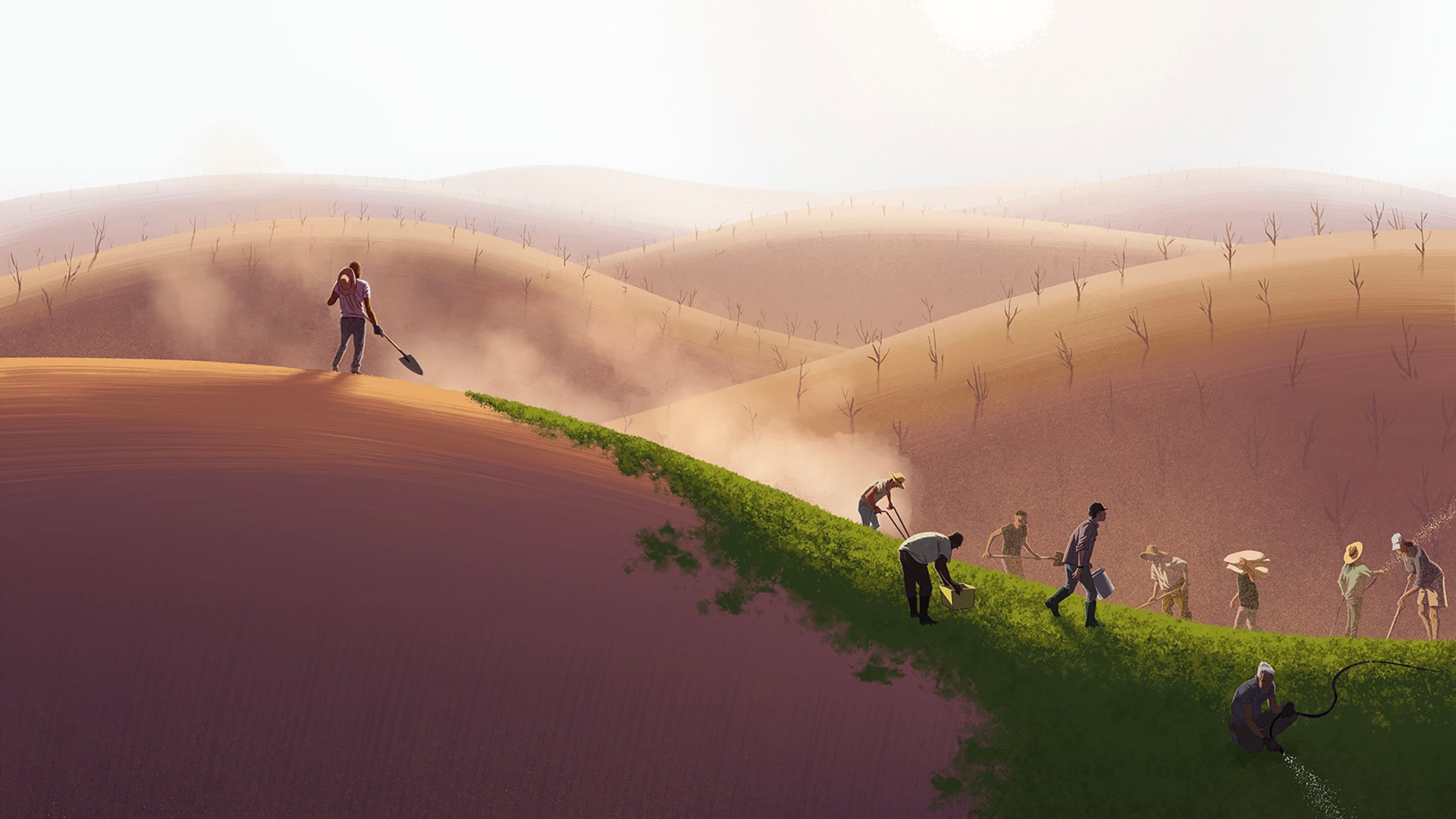
The Lord does promise to hear her cries (Ex. 22:21–24). And if God hears those cries, so should his people. Too many Christians (and non-Christians) think about climate change as primarily a political or an economic issue. But it is also a spiritual issue that requires a biblical approach.

The Bible actually has a lot to say about human-caused climate change. The Old Testament, in particular, chronicles God’s efforts to order a society’s energies to his glory and documents that society’s failure to abide by that order.

Biblical teaching should lead Christians to anticipate human-caused climate change. It should incline them to respect the evidence of today’s climate crisis, even if they come to differing conclusions about how to interpret that evidence. And perhaps most importantly, the Bible teaches shows that climate crises often have a reformational purpose.

Land and law

A life-giving climate comes of God’s goodness. On this, Christians of all climate-change persuasions agree. Some even cite as a prima facie argument that a good God would never allow the climate to go bad. But weather is clearly vulnerable to human activity. This lesson appears as early as the Garden of Eden.

Genesis introduces Eden as a place gifted with a favorable climate (Gen. 2:5–6) and also introduces humankind’s relationship with God as stewards of his world (2:15–19). Human sin causes everything we steward to suffer—including God’s gift of the climate (Gen. 3:17–19; Rom. 8:19–22).

These themes continue in the Exodus narrative. God delivered Israel from Egypt to another land identified right away by its good climate (Deut. 11:9–12). For Canaan’s good weather to continue, however, the people had to follow God’s ways. Deuteronomy says, “So if you faithfully obey the commands I am giving you today—to love the Lord your God and to serve him with all your heart and with all your soul—then I will send rain on your land in its season, both autumn and spring rains, so that you may gather in your grain, new wine and olive oil” (vv. 13–14).

Among the laws God gave Israel, he included land- and climate-management rules to guide their climate stewardship. Christians can still glean wisdom from those laws.

One of the most striking “environmental regulations” in the Old Testament is the Sabbath year land-fallow law (Ex. 23:10–11). Without modern fertilizer, farmers at the time—and many farmers still today—had to replenish soil nutrients by crop rotation or by letting fields go uncultivated for a season. Failing to do so leads to soil depletion, lack of plant growth, loss of moisture retention, and trouble with evaporation and rainfall.

Ancient Israelites were to leave their fields fallow every seventh year. Leviticus warns that ignoring this principle would lead to this hardened soil and loss of rainfall. “But if you will not listen to me and carry out all these commands … I will break down your stubborn pride and make the sky above you like iron and the ground beneath you like bronze. … All the time that it lies desolate, the land will have the rest it did not have during the sabbaths you lived in it” (Lev. 26:14–35).

Yes, the regulation had societal and spiritual functions, carving out a recurring occasion for physical rest and for trust in God’s generous provision. But it also established a relationship between soil depletion and rainfall loss that modern science recognizes. Its presence in Israel’s law indicates an understanding that human activity can directly impact the climate and that God expects his people to moderate their activity accordingly. The fallowing law did not block land use altogether, but it did constrain its economic production to protect the environment.

Biblical Israel lacked the scientific sophistication to explore climate mechanics beyond such basic insights. Even so, Israel was taught to regard the climate as requiring stewardship. Further land and climate guidance was built into Israel’s festival calendar.

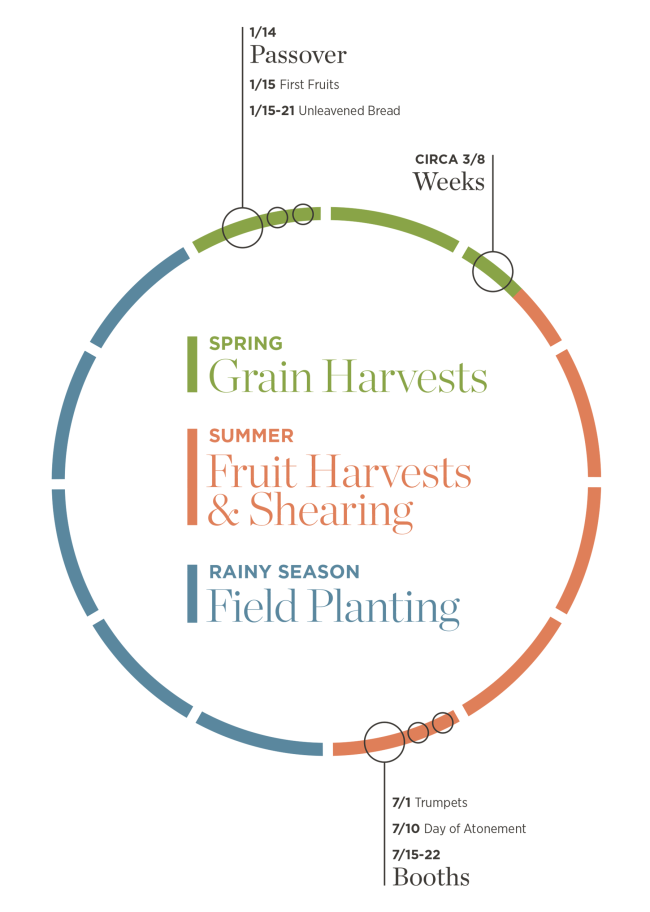
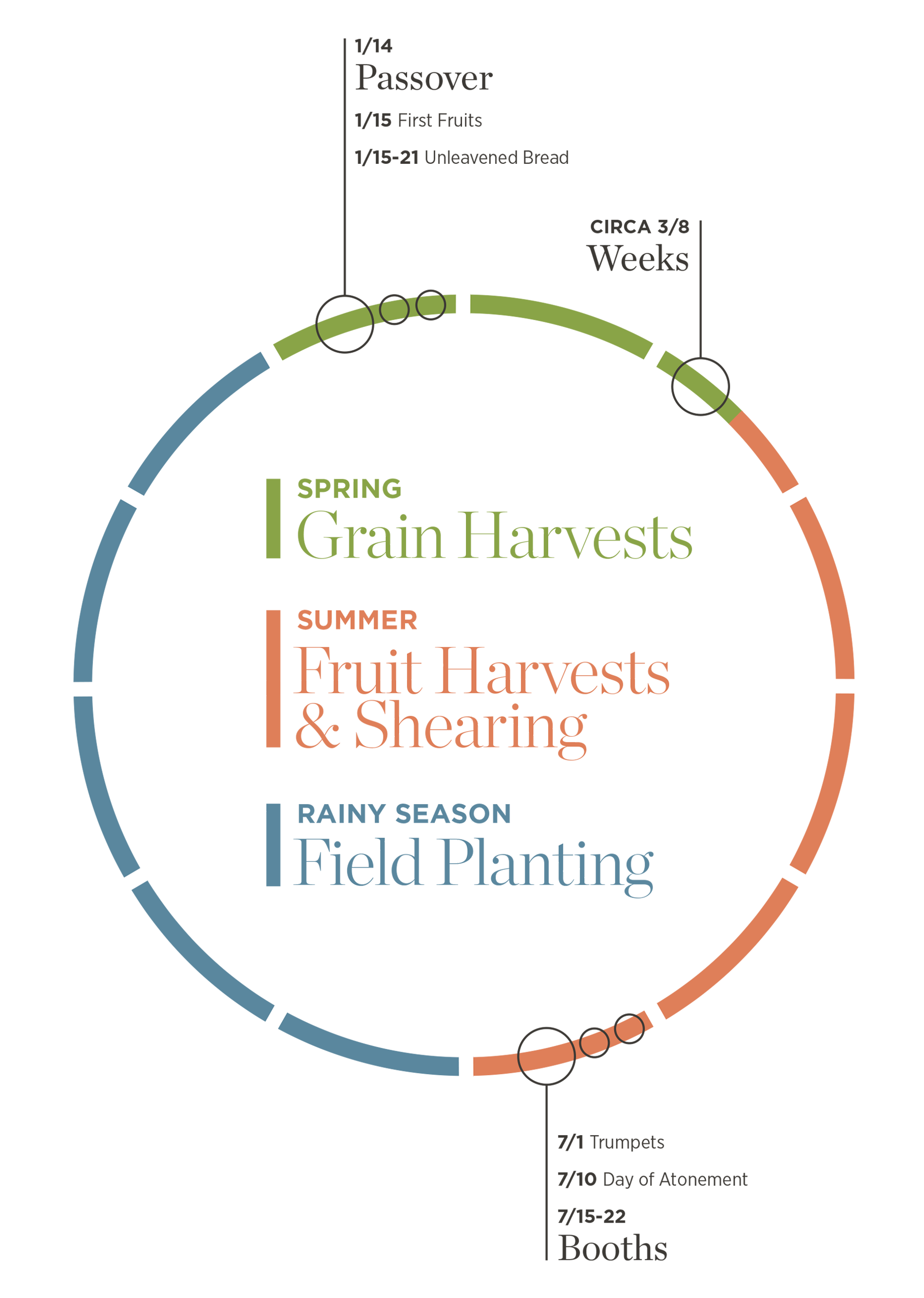
Three pilgrimage feasts formed the backbone of Israel’s calendar, each requiring a national assembly in Jerusalem. Their timing and ceremonies guided Israel’s stewardship of the land in keeping with its seasons.

The first was Passover. It marked the transition from the rainy season to spring, when the barley harvest was ready. The Feast of Weeks occurred seven weeks later, the time when spring gave way to summer and the wheat harvest was ready. The final pilgrimage, the Feast of Booths, marked the end of summer, when summer fruits were ready the next rainy season was at hand.

These festivals taught Israel to labor and worship responsively to the seasons. Israel also learned how to use the wealth their harvests produced. Households brought tithes and other offerings from each seasonal harvest to the assemblies (Deut. 16:1–17). Some of the tithes were eaten during the festivals. But much of this income was placed in storehouses to support ongoing Levitical welfare for the vulnerable (14:28–29).

Through this seasonal calendar, Israel was taught to steward the climate by ensuring the harvested wealth blessed all the land’s inhabitants, including the landless and vulnerable. Israel was told to expect their good climate to continue as long as they observed these laws.

“If you fully obey the Lord your God and carefully follow all his commands I give you today … The Lord will open the heavens, the storehouse of his bounty, to send rain on your land in season and to bless all the work of your hands. … However, if you do not obey the Lord your God … The Lord will strike you with … scorching heat and drought, with blight and mildew, which will plague you until you perish. The sky over your head will be bronze, the ground beneath you iron. The Lord will turn the rain of your country into dust and powder; it will come down from the skies until you are destroyed.” (Deut. 28:1–24)

Those festivals, of course, were specific to the seasons and the crops of Canaan. The New Testament church, which spans the globe from arctic to tropical climates, is not supposed to continue these practices of the old Law. However, Christians are still exhorted to learn from the Law’s wisdom (1 Cor. 10:11; 2 Tim. 3:16). The land- and climate-management laws of the Old Testament can help Christians appreciate the importance of climate stewardship today and the climatic damage caused by failing to steward God’s earth and its produce righteously.

Biblical climate changes

When a land does experience climate damage, God taught Israel to respond by asking why. When the land is “a burning waste of salt and sulfur. All the nations will ask: ‘Why has the Lord done this to this land? Why this fierce, burning anger?’” (Deut. 29:23–24).

Not every climate crisis is a work of judgment. The sufferings of Job included freak weather events (Job 1:16, 19), though he was innocent before God. Yet even Job responded with self-examination. Self-examination is an entirely Christian response to climate change and, when needed, can lead to moral and economic reforms. We see this pattern modeled by the Old Testament prophets.

The most dramatic example is the Flood in Genesis 6–9. God sent the Deluge as a direct response to human sin. Noah took practical steps, like building an ark. He also warned others, calling for repentance (2 Pet. 2:5). After the Flood, Noah received God’s promise:

“As long as the earth endures,
seedtime and harvest,
cold and heat,
summer and winter,
day and night
will never cease.” (Gen. 8:22)

Some Christians have taken that promise to mean God will never allow climate change after Noah. But God chose Moses, who came along many centuries later, to deliver the extensive aforementioned warnings about climate instability. So while God’s promise to Noah sets a limit on climate judgments, it does not justify climate neglect.

Biblical happenings long after Moses only confirm that. In the days of King Ahab, God sent another multiyear drought. But once Elijah led the people in repentance, “the sky grew black with clouds, the wind rose, [and] a heavy rain started falling” (1 Kings 17–18).

The prophet Isaiah tied climate instability to greed and abuse of the poor in his day (Isa. 32:1–20). The prophet Samuel cited unseasonal rains as a warning (1 Sam. 12:17–18). The Psalms point to the good order of the seasons as dependent upon the good order of the community (Pss. 65, 104). And the judgments attending Christ’s promised return also include climatic disasters (Mark 13:8; Rev. 6:8; 8:7; 11:19; 16:17-21).

The moral runs through both Old and New Testaments: A good climate is a gift, yes. But a worsening climate is a prompt to ask where we might be going wrong.

The witness of science

Because, according to Scripture, climate change is an expected instrument of divine humbling, we should be open to the evidence that it is happening now.

According to NASA, global temperatures have risen 2.1 degrees Fahrenheit since 1880. That may not sound like much, but it is enough to melt 428 billion tons of polar ice every year. This contributes to global sea levels rising 3.4 millimeters annually. Changes like these cause more severe storms, droughts, floods, and other natural disasters—events we increasingly see in news headlines and in our own communities.

The Bible does not tell us specifically about today’s climate change or what is causing it. But we do not need that kind of precision from the Bible. Scripture is sufficient in its reports about God’s works with his people of old, preserving those lessons to inform our response to comparable situations today. That includes the Bible’s teachings on the climate.

Once we recognize that climate change is often a means of divine reproof, the tools of science offer two kinds of help in our response.

First, science helps us identify areas of human activity. God, in his providence, is compelling us to give special examination to. Industrial-scale carbon emissions have been identified as the most significant factor contributing to global warming. This finding puts a providential spotlight on modern industrial practices. While secular policymakers focus on ways to reduce greenhouse gas emissions, the church should address matters of pride, greed, creation abuse, and other sins that may be connected to some industrial practices. Science, in conjunction with the convicting power of the Holy Spirit, can help us recognize areas on which to focus spiritual renewal.

Second, scientific evidence for climate change helps awaken unbelievers to the need to amend our ways. Many of those who would resist the call for reforms based on divine accountability will be more inclined to support such reforms when the need is scientifically demonstrable. Christians should not need climate science to motivate our embrace of climate stewardship. But having scientific data strengthens the motivation of unbelievers to pursue better climate stewardship.

Faith and science are not enemies. And climate policy is an area where Christian witness and scientific insight can collaborate productively.

A reforming influence

Today’s conditions are more stark than past climatic shifts, according to data collected by US government agencies. But climate changes have happened before. For instance, in the late Middle Ages, temperatures began to cool. During this period, known as the Little Ice Age, winters grew colder and longer. Responses were varied, but many across Europe turned to Scripture.

In his book Nature’s Mutiny, historian Philipp Blom writes, “Theological interpretations of climatic events were popular and frequently widely disseminated in print. Indeed, weather sermons became a minor literary genre of their own.”

For example, the Reformer John Calvin addressed crop failures amid weather changes in his day in his commentary on Genesis 3:18–19: “By the increasing wickedness of men, the remaining blessing of God is gradually diminished and impaired; and certainly there is danger, unless the world repent, that a great part of men should shortly perish through hunger, and other dreadful miseries. … The inclemency of the air, frost, thunders, unseasonable rains, drought, hail, and whatever is disorderly in the world, are the fruits of sin.” Calvin was not one to mince words.

Weather hymns were another feature of the age, Blom writes. For example, Paul Gerhardt’s 17th-century hymn, “Occasioned by Great and Unseasonable Rain,” says,

The elements o’er all the land
Are stretching out ’gainst us the hand,
And troubles from the sea arise,
And troubles come down from the skies.

One result of the Little Ice Age was a turning to the Lord. In fact, climate change is an often-overlooked component of the Reformation. This example encourages us, today, to likewise acknowledge when climate change is happening and respond with spiritual renewal.

Not all responses to the Little Ice Age were good. Without wisdom, interpreting climatic events as divine reproof can lead to something ugly. The period saw a sharp rise in witch trials. Something like 110,000 witch trials took place across Europe, half of which led to executions.

Such tragedies are a caution against misappropriating the theological implications of climate change. Better is the more sober, biblically centered example of the Reformation.

The present opportunity

One way or another, the changing climate will bring changes to human societies. Whether or not God is reproving specific sins, the increasing storms, droughts, and other consequences will afflict vast segments of humanity. And, as is often the case, the vulnerable will suffer most for the failures of the powerful.

The church is here to promote the work of redemption in such times. Christians risk squandering this opportunity for witness by denying or downplaying climate change.

The United Nations recently declared a “UN Decade on Ecosystem Restoration,” beginning this year. From 2021 to 2030, public and private cooperatives will endeavor to recover 350 million hectares of degraded land and remove up to 26 gigatons of greenhouse gases from the atmosphere.

There’s no reason the church can’t have equally bold visions for renewal in response to climate change. But our labors should aim for social and spiritual reformation alongside ecological renewal. Science can highlight the mechanics of climate change, and politicians can regulate behavior. It is up to the church to touch the conscience and bring a redemptive call to the culture. For in Christ:

The desert and the parched land will be glad;
the wilderness will rejoice and blossom.
Like the crocus, it will burst into bloom;
… they will see the glory of the Lord,
the splendor of our God. (Isa. 35:1–2)

Michael LeFebvre is a Presbyterian minister, an Old Testament scholar, and a fellow with the Center for Pastoral Theologians. He is the author of The Liturgy of Creation: Understanding Calendars in Old Testament Context.

News

Ministering to the 9/11 First Responders Who Never Had to Be Told to ‘Never Forget’

Twenty years after terrorist attack, the spiritual needs of survivors continue.

Illustration by Jianan Liu

The news media and the nation would later call the site of the largest terrorist attacks in United States history by the name “ground zero.” The firefighters and other first responders who rushed to the scene when two 110-floor buildings collapsed into 14.6 acres of mangled steel and concrete would call it “the Pit.”

But when Andrew Columbia, a pastor and retired New York City police officer, arrived that Tuesday morning in September, those names hadn’t yet emerged from the acrid smoke. Twenty years later, Columbia remembers the gray dust and, out of that dust, the faces of the police officers, medics, and firefighters who had seen devastation beyond comprehension.

“They were weeping. No one was really talking. They were in shock. I just walked up and offered prayer. Didn’t even ask,” Columbia said. “No one refused it.”

In the years since then, as anniversaries have come and gone and the wreckage has been transformed into a memorial, Columbia has heard the periodic reminders to “Never Forget.” But the first-responder community and the New York City pastors who minister to them have never needed that slogan. Forgetting has proved impossible.

The trauma of 9/11 has been a daily reality and a spiritual need for many in the past two decades.

This doesn’t mean they always talked about their experience in terms of post-trauma. “Up until that time, post-traumatic stress just wasn’t language that we had,” said John Picarello, pastor of House on the Rock Christian Fellowship, a nondenominational church on Staten Island.

Like many pastors of small congregations in the outer boroughs, Picarello was bivocational in 2001. Or really, trivocational. He pastored the church, served as an active-duty member of the New York City Fire Department (FDNY), and baked bagels to pay the bills. He was working in Brooklyn as a fire chief’s aide on the night of September 10 and was still on duty when the planes hit the twin towers.

In the initial months after 9/11, Picarello’s small church saw attendance at Sunday services and midweek prayer meetings swell. Everyone seemed to be turning to God and the church to make sense of the earth-shattering tragedy. He heard this was happening at the rest of the churches in Staten Island too, and in the other boroughs, and across the country.

But then there was a cooling off. Attendance deflated. A year passed and time moved on, but the memory of the event didn’t disappear, and the stress, anxiety, mental health concerns, and ongoing effects of trauma actually began to be more apparent to local pastors.

“A lot of us feel like we did not capitalize correctly … and take that opportunity to really reach out to families in a way to bring them into the church. And a lot of them came in initially and then left,” said Columbia, who was then an associate pastor at International Christian Center on Staten Island. “And, you know … I don’t think, in the long term, things turned out much different.”

Over the next 14 years, more than 3,700 firefighters would be diagnosed with stress-related mental health conditions that began after the attacks. Columbia and Picarello say they had to learn what that meant. They really weren’t prepared, and there was no church infrastructure in place at that time to address the immediate needs of firefighters, police officers, emergency medical services workers, and their families, so a lot of the first-responder communities turned inward as they grappled with the challenges of day-to-day life after a tragedy.

Even without the looming specter of a massive tragedy, it’s difficult to overstate how isolated many people are in these insular communities. Predominately men, they tend to want to carry the weight of “the job” in solitude. When they do reach out, it’s typically to one of their own: another cop, firefighter, or EMS worker.

Picarello recalls an influx of late-night theological conversations post-9/11, many of them in the quiet of the firehouse kitchen. Fellow firefighters would seek out his spiritual counsel—but away from others’ prying ears, lest spiritual needs threaten their sense of self-sufficiency, strength, and emotional endurance. Picarello says he once smuggled a Bible to a sheepish coworker in a covert operation to get it into someone’s locker.

But it was clear, even at the time, that kitchen conversations weren’t going to be enough. The FDNY’s own Counseling Services Unit—then a small outfit with 11 employees in a single office—responded to the burgeoning mental health crisis by overhauling its entire approach. The unit began to deploy peer counselors directly to emergency service workers experiencing mental health difficulties.

“Without people knocking on the door, letting our members know what’s available, they wouldn’t come in for help,” said Frank Leto, a FDNY veteran and deputy director of the counseling unit. “We can go to firehouses, sit down at kitchen tables, and talk with our members. Our peer program allows us to have eyes and ears in the field, to be a bridge to the clinical services.”

Even as the number of people receiving counseling increased, there were still unmet spiritual needs. Firefighters for Christ, an international organization based out of California, had only established its New York City chapter in 1997. For the past several years, the organization has met monthly in a Queens diner. About 60 active and retired firefighters gather to talk about the challenges of merging Christian faith with the job.

The churches have developed new spaces too. Columbia hosts a first-responder support group at Mount Carmel Baptist Church in Carmel, New York, an outpost for cops and firefighters who live beyond the city limits.

“They need a refuge. They need a place to decompress,” Columbia said. “Personally, I know that, because part of my testimony is exactly that. I didn’t know how to decompress before I found Christ, which led me to have a lot of problems dealing with a lot of anger.”

Recently, first responders seeking support have talked less about PTSD and more about the long-term physical health impacts of 9/11. Not long ago the fire department had to relocate a wall dedicated to the memory of those who had died, because of the additional names of those who succumbed to illnesses related to the inhalation of toxic dust. COVID-19 also disproportionately harmed 9/11 first responders.

Fewer people come to the 9/11 first responders’ funerals now, but Picarello, Columbia and others still minister to those who never had to be reminded to never forget.

“Our little motto is this: We understand the job, and we care. So, you know, we know what you’re going through,” Columbia said.

After 20 years, that basic spiritual need hasn’t changed. As Billy Graham said in an address to the nation on September 14, 2001, “The lesson of this event is not only about the mystery of iniquity and evil, but, second, it’s a lesson about our need for each other.”

Kathryn Watson is a reporter from New York City.

Our September Issue: Hope Beyond the Headlines

In Afghanistan as elsewhere, there is more than meets the media’s eye.

Andrew Quilty

Editor’s note: Our September issue went to press before the stunningly rapid fall of Afghanistan’s government to Taliban forces on August 15, 2021.

Twenty years ago on September 11, I was studying abroad, staring at CNN in the living room of a house in Costa Rica. Never had I felt farther from home. In that watershed moment of modern interconnectedness, I and hundreds of millions of people around the globe watched the second plane strike the World Trade Center in real time.

Heather Mercer was even farther from home that day. She and other aid workers were in a Taliban prison in Kabul, awaiting trial for allegedly proselytizing. Mercer would not hear of the attack for weeks, not until a British journalist was jailed alongside her and filled her in.

After 9/11, media outlets, including CT, called on Westerners to pay more attention to global news and learn about the world. Some of us did. But while technology has closed geographic gaps, it remains enormously difficult to see far-off issues and events for what they really are. Critical context shrinks to deceptively simple outlines, and we mistakenly think we know what we’re looking at. This obviously applies to Westerners observing a complex and distant place like Afghanistan. But it applies also to church outsiders learning about clergy abuse, to Democrats reading Republicans—even to our efforts to understand our own hearts, as the prophet Jeremiah noted (Jer. 17:9).

Media can help, but it very often does not. Headlines, tweets, and TikToks are distillations by necessity. Our news feeds tend to screen out pedestrian details about people like Heather Mercer and Afghan Christians going quietly about their days (unless they are captured by the Taliban).

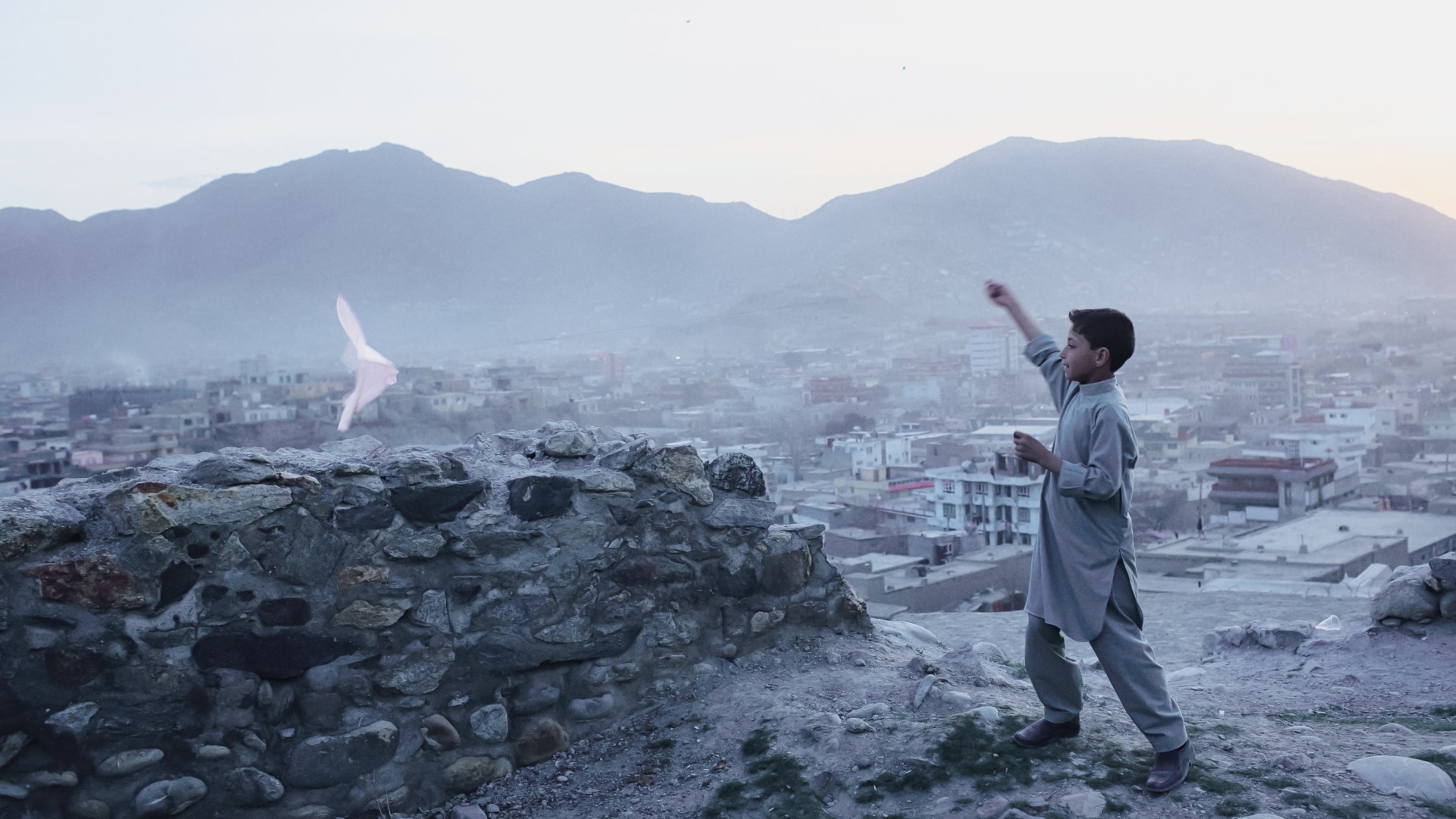
On our cover, we chose to honor the history of faithful, unseen service in Afghanistan because God sees it, even when we don’t. “The Lord does not look at the things people look at,” God reminded Samuel (1 Sam. 16:7). Of course, the divine eye takes in the deeds of generals and presidents and terrorist masterminds. But it also finds potential where we do not, in mustard seeds that can be leveraged against mountains.

We need this reminder. Yes, the old call to pay attention to news still applies. But a greater task for Christians today may be to resist the temptation to view the world by the light of every headline pouring through manmade squares of metal and glass. We have come to expect omniscience, and that has dulled our capacity to hope in anything we cannot see. If there is an encouragement in our Afghanistan coverage this month, perhaps it is this: For every empire that rises and falls around us, there are thousands of servants going about good work over tea and acts of kindness, just out of view. Out of our view, at least.

Andy Olsen is print managing editor of Christianity Today. Follow him on Twitter @AndyROlsen.

addApple PodcastsDown ArrowDown ArrowDown Arrowarrow_left_altLeft ArrowLeft ArrowRight ArrowRight ArrowRight Arrowarrow_up_altUp ArrowUp ArrowAvailable at Amazoncaret-downCloseCloseellipseEmailEmailExpandExpandExternalExternalFacebookfacebook-squarefolderGiftGiftGooglegoogleGoogle KeephamburgerInstagraminstagram-squareLinkLinklinkedin-squareListenListenListenChristianity TodayCT Creative Studio Logologo_orgMegaphoneMenuMenupausePinterestPlayPlayPocketPodcastprintremoveRSSRSSSaveSavesaveSearchSearchsearchSpotifyStitcherTelegramTable of ContentsTable of Contentstwitter-squareWhatsAppXYouTubeYouTube