News

The Coming African American Missions Movement

A surge of interest among young black churchgoers could signal a change for sending agencies, but hurdles remain. 

Christianity Today February 1, 2021
Courtesy of Ron and Star Nelson

Patrice Hunt knows people wonder why she is working at Wycliffe Bible Translators, a black woman surrounded by white people. She’s asked God that question herself.

“Why did you make me black,” she said, praying in the mirror one morning, “if you’re just going to have me around white people?”

It doesn’t always happen this way, but she got an immediate answer. She felt God say, “There are things I need you to learn from them that your community can’t teach you.”

As the senior director of human resources in Wycliffe’s Florida office, Hunt has learned a lot of things. One, she told CT, is that God has equipped her and other African Americans for mission work.

Some experts say that less than 1 percent of American missionaries are black. In many missions organizations, that actually seems like an overestimate. According to a 2020 report, the Southern Baptist Convention’s International Missions Board—the largest sending agency in the world—has 3,700 career missionaries and only 0.35 percent are African Americans.

The reasons are varied. Many African Americans who are called to ministry have prioritized the needs in their own communities, focusing on preaching the gospel or pursing justice locally. Global travel and exposure are a privilege and less accessible to racial minorities. The historic relationship between missions and colonialism is complicated, and missionaries, for many, are associated with the idea of a “white savior,” not a black Christian. Black churches have different traditions of giving, making the most common models of fundraising more difficult for African American Christians. And most missionary institutions and sending agencies are predominantly white and can be uncomfortable spaces for black people.

But young African American Christians are increasingly interested in international mission work, according to a recent Barna survey. Sixty-one percent of black churchgoers between the ages of 18 and 35 say they could become a missionary, depending on their sense of calling, whether or not they would be helpful, and the tasks they’d do on the field. By comparison, less than half of young white Christians who regularly go to church say the same.

“They’re becoming more missions and globally minded,” said Sherry Thomas, an African American missionary who has served for 22 years in African countries, most recently Nigeria. For many years, she said, the only missionaries she met were white, but now there seems to be a generational shift.

It could create an unprecedented opportunity, according to African American missionaries currently at work around the world.

“What has intensified is our voice,” said Ron Nelson, founder of Sowing Seeds of Joy, an organization that mobilizes and trains African Americans for overseas mission work. “Our voice has become more significant. Our voice has become more needed. That’s what has changed.”

‘We can connect like the others don’t’

Nelson notes that many African American Christians remain skeptical of missions. He remembers a black pastor telling him and his wife, Star Nelson, “I love what you’re doing, but missions is not our thing.” In fact, the Barna study shows that about half of young black churchgoers agree with the statement that “Christian mission is tainted by its association with colonialism,” and 40 percent agree with the statement that missions work has been unethical in the past.

But some say that because of the history of colonialism, slavery, and white oppression, black missionaries can be more effective than their white counterparts. Star Nelson said that in Haiti, there were people who were willing to listen to her talk about Jesus because she is black.

“Most people know our African American story,” she said. “So, we can connect like the others don’t. Sometimes we connect in a way that is exactly what they need.”

The past generation of African American missionaries was mobilized with the phrase “blessed to be a blessing”—a call to use their relative wealth, education, and privilege to serve those in under-resourced areas. But today, black missionaries say that one of the important gifts they can bring to the world is an understanding of trauma, suffering, and loss.
“So many of our images of missions [show] the white person of middle-class status taking care of an Indian widow,” said Lily Field, executive director of Ambassadors Fellowship, an African American sending agency, at the recent virtual conference of the National African American Missions Council (NAAMC).

“I don’t relate to being the savior in this picture,” she said. “I relate to the sufferer in this picture.”

That can be a powerful point of connection, Thomas said. She has worked as a trauma healer in Mali prisons and recently started working with pastors in Nigeria to establish a trauma healing center there. Her skin color has been an advantage in the work, both because she personally knows the trauma that racism can bring and because she doesn’t have to deal with the additional distance that white people sometimes can’t overcome.

Diversity consultants assessing institutions

Some sending agencies, recognizing the value of African American missionaries and noticing their own lack of diversity, have started recruiting more black Christians to the mission field. The Southern Baptist missionary organization hired Jason Thomas to specifically engage with African American Baptist churches.

“This first year has been about building relationships and establishing trust in black and minority church-led communities,” he said. “There is no secret that we have had many setbacks this year with the pandemic, racial tension, and the last presidential election. But there has been amazing support from leadership at IMB and colleagues that all want to see a mission force that could make our Savior proud.”

Others, like Wycliffe, have hired outside consultants to assess the diversity, equity, and inclusion of the institutional culture, and examine the structures and systems that have made it harder for black people to thrive in their organizations. The NAAMC has started offering resources, coaching, and diversity training to help. The council’s 2020 conference drew a record number of attendees, both black and white.

Adrian Reeves, director of the council, said he is encouraged by the number of sending agencies that are pursuing diversity training and working to recruit more minorities into missions. But he also thinks it’s important that African American organizations, like the Nelsons’ group Sowing Seeds of Joy, rise up independently.

“It is great to see that African American churches are reaching out to an organization that looks like them and talks like them and is able to present missions,” he said.

Visions of reform

Many in the next generation of African American missionaries will likely seek to reform how missions are done. Whether they join new organizations started by African Americans or fill the ranks of white institutions, there is an interest in changing the status quo and developing new missionary narratives.

Mekdes Haddis, an African missiologist who created the online community Just Missions, said one thing a younger generation of missionaries might rethink is their approach to poverty. Growing up in Ethiopia, she understood poverty to mean a lack of community or exposure to abuse. But Western missionaries often seemed fixated on material goods and couldn’t see the local community resources that addressed physical needs, like the Orthodox Church steps where children were given food or coins.

African American missionaries have the potential to break from “missions as usual,” but first they have to wrestle with seeing themselves as potential missionaries, said Haddis, who is now based in South Carolina.

“A lot of African Americans or people of color don't end up on the mission field,” she said. “It doesn't fit us, you know? It's so white-centric culturally and financially. Like, ‘I can't raise funds to live off of.’”

Funding is seen as a major issue in recruiting more African Americans to missions. There are major differences in generational wealth between black and white Americans. African American pastors say their churches and members just don’t have as much money to give, and many black families see mission work as a luxury they can’t afford.

“Even in the world of missions, we’re trying to play catch-up,” Ron Nelson said.

The Holy Spirit moves

At Wycliffe, Hunt said it can be frustrating how slow change is in coming and how hard it is to build bridges in the midst of division.

“It’s work,” she said. “And it’s movement from everybody. If we would move closer to Christ, we would get closer to each other.”

She often goes walking on the beach to remind herself how big God is. And sometimes she remembers that the Holy Spirit can just move people.

“God literally plucked me out of my community,” she said, “and plopped me in a white community.”

If the next decades see a flourishing African American mission movement, there will be a lot more stories like that.


Ideas

In the GameStop Frenzy, What If We’re All the 1 Percent?

Jesus’ economic justice doesn’t mean beating the rich at their own game.

Christianity Today January 29, 2021
Michael M. Santiago / Getty Images

Everybody loves a David and Goliath story. In recent days, millions of aspiring Davids took on one of society’s least favorite Goliaths: Wall Street.

It all started with a Reddit page called WallStreetBets. Many of the 3 million amateur investors involved in the chat room decided to come together to coordinate the purchase of stocks in a handful of companies. By doing so, they generated a massive increase in the value of those companies’ stock. GameStop’s market value, for instance, went from $2 billion to $24 billion in just a few days. While this created an enormous profit margin for individual investors, it also nearly bankrupted a hedge fund that had bet against GameStop by short selling their shares.

By all accounts, many folks involved celebrated both outcomes. “You stand for everything that I hated during [the financial crisis],” one user wrote in an open letter to the hedge funds. “You are a firm who makes money off of exploiting a company and manipulating markets and media to your advantage.” One evangelical pastor even drew on Jesus’ parable about the rich fool (Luke 12:13–21) who used his profits to build a bigger barn to describe what was happening. “Since 2008, it feels like Wall Street has had an overabundant harvest, financed by public money, and rather than share the billions with the less fortunate, they’ve built bigger and bigger barns for themselves.”

I certainly see what he means, especially when we consider the likely economic realities behind the parable. When the rich man tears down his barns to build bigger ones, he probably isn’t creating an enormous rainy-day savings fund. He’s more likely opening the first-century equivalent of a one-man hedge fund. But focusing on the way the parable puts financial Goliaths in the crosshairs may cause us to miss another group targeted by Jesus’ strange story: us.

While the vast majority of farmers in Jesus’ day would have been engaged in some form of subsistence agriculture, large landowners were increasingly profiting off grain speculation. Those who had enough of an agricultural surplus could afford to keep their grain off the market while prices were low. Then, when grain was scarce and people were hungry, they could sell their surplus at a massive profit. Such speculation wreaked havoc on the local economy while allowing the opportunist to profit both financially and socially from the chaos he helped create.

Against this background, Jesus condemns at least two aspects of the rich man’s greed. Not only does the rich man fail to share from his abundance, but he apparently plans to use the economic power his abundance affords him to gain further riches for himself at the expense of his neighbors.

Jesus’ parable offers a warning to those who made ludicrous profits while creating a crisis that devastated the global economy. It’s hard to imagine that the Jesus who characterized a first-century agro-entrepreneur as a malicious fool would overlook the way bank CEOs claimed multimillion-dollar Wall Street bonuses while Main Street burned. Surely the Jesus who sniffed out the money-loving Pharisees’ hypocrisy (Luke 12:1) would have something to say about modern-day financial market manipulation.

But notice why Jesus tells the parable in the first place. A man from the crowd asks Jesus to help him get a share of his inheritance. While we don’t know anything certain about this man’s economic status, we do know that the vast majority of Jesus’ audience faced brutal poverty, the likes of which hardly any American can imagine. Carol Wilson argues that a quarter of the population of Palestine in Jesus’ day was so destitute they were “slowly starving to death,” while another 30 percent hovered “precariously near the edge of subsistence.” Only an elite 3 percent of the population was secure against economic poverty. It’s likely, then, that the man asking for help with his inheritance faced serious economic hardship. It’s certain that most of Jesus’ audience did.

It is this primarily poor audience that Jesus warns about the need to “guard themselves against all kinds of greed.” Jesus’ anti-greed parable wasn’t only a warning for the super-rich. It was also a warning about the kind of financial insatiability that Jesus believed even the poor could get caught up in.

As best I can tell, the WallStreetBets folks got involved because they wanted to make money quickly. One of the most popular trading platforms, Robinhood, advertised their services as allowing “people like us” to trade “just like the big guys.” So while these investors’ actions put the squeeze on a hedge fund, their market manipulation also sought to create quick, substantial profits for themselves.

Jesus doesn’t tell his flock to beat the rich fool at his own game. He invites them to live an economic life free from greed or fear, storing up treasure in heaven by giving generously to the poor (Luke 12:33).

I’m not sure that’s all necessarily sinful. But when we wield the parable of the rich fool as a weapon against the super-rich, we risk missing the way Jesus offered it as a challenge to folks like us.

The danger here is much bigger than this week’s stock market story. The danger is that in the face of a deeply dysfunctional economic system and corruption by the super-rich, middle-class American Christians forget that in global and historical terms, we are the 1 percent.

Every single investor in GameStop lives a life of unimaginable comfort and wealth compared to the vast majority of those Jesus warned about their greed. Most of us are richer than the fictitious rich fool in terms of life expectancy, health, and luxury items. Economically speaking, compared to the typical first-century Jesus-follower, we are kings and pharaohs living lives of unimaginable security and ease. Yet middle-class Christians consistently read Jesus’ warning about the wealthy as applying to somebody else. We, the richest people who have ever lived, read ourselves in the role of the peasant and find somebody further up the economic ladder to play the part of the fool.

We all do this. We talk about being “poor college students” while attending schools that cost enough to feed entire villages in the global south. Pastors and professors like me regularly remind people “we sure don’t do it for the money,” even though the money gives us some of the highest standards of living experienced in human history.

As that Robinhood advertisement makes clear, we often criticize the large-scale behavior of the “big guys” while imitating it in our own economic practices. For years, Christian economist Bob Goudzwaard has warned about the ways that financial markets have gotten out of hand, with devastating effects on the “real economy” at home and abroad. While I wouldn’t claim that all hedge funds are intrinsically immoral, aspects of our contemporary financial markets, like aspects of the grain market in Jesus’ day, demand prophetic confrontation.

But we shouldn’t confuse fighting for a better seat at the blackjack table with confronting an economy addicted to gambling. That’s especially true when either gambler’s loss can wreak havoc on the lives of others. After all, it’s not just Wall Street financiers who invest in hedge funds; pension funds, like the ones that fund the retirements of school teachers and firefighters, do too. We ignore the ways we are the rich fools at our own moral and spiritual peril and at our neighbors’ expense.

Jesus doesn’t tell his flock to beat the rich fool at his own game. He invites them to live an economic life free from greed or fear, storing up treasure in heaven by giving generously to the poor (Luke 12:33).

Such kingdom investments include charity to the destitute, but, as Brian Fikkert, Robby Holt, and I argue in Practicing the King’s Economy, it also includes orienting the whole of one’s economic life toward love of God and love of neighbor.

If we want to invest in Jesus’ kingdom, I suspect there are better ways than squeezing hedge funds. We could invest in black and brown business with the help of lending platforms like WeFunder and Kiva. We could invest our money and social connections in organizations that help the economically poor build wealth through education or homeownership. We could creatively protest some of the dysfunctions of our economic system while remembering that Jesus’ parable is a warning for us as much as it is for financial professionals.

Michael J. Rhodes is an Old Testament lecturer at Carey Baptist College and co-author of Practicing the King’s Economy: Honoring Jesus in How We Work, Earn, Spend, Save, and Give.

Speaking Out is Christianity Today’s guest opinion column and (unlike an editorial) does not necessarily represent the opinion of the publication.

News

Meet the Republican Congressman Who Says His Faith Led Him to Vote for Impeachment

Adam Kinzinger wants to see a commitment to truth reorient his party and recover the witness of the American church.

Christianity Today January 29, 2021
Tom Williams / CQ Roll Call via AP Images

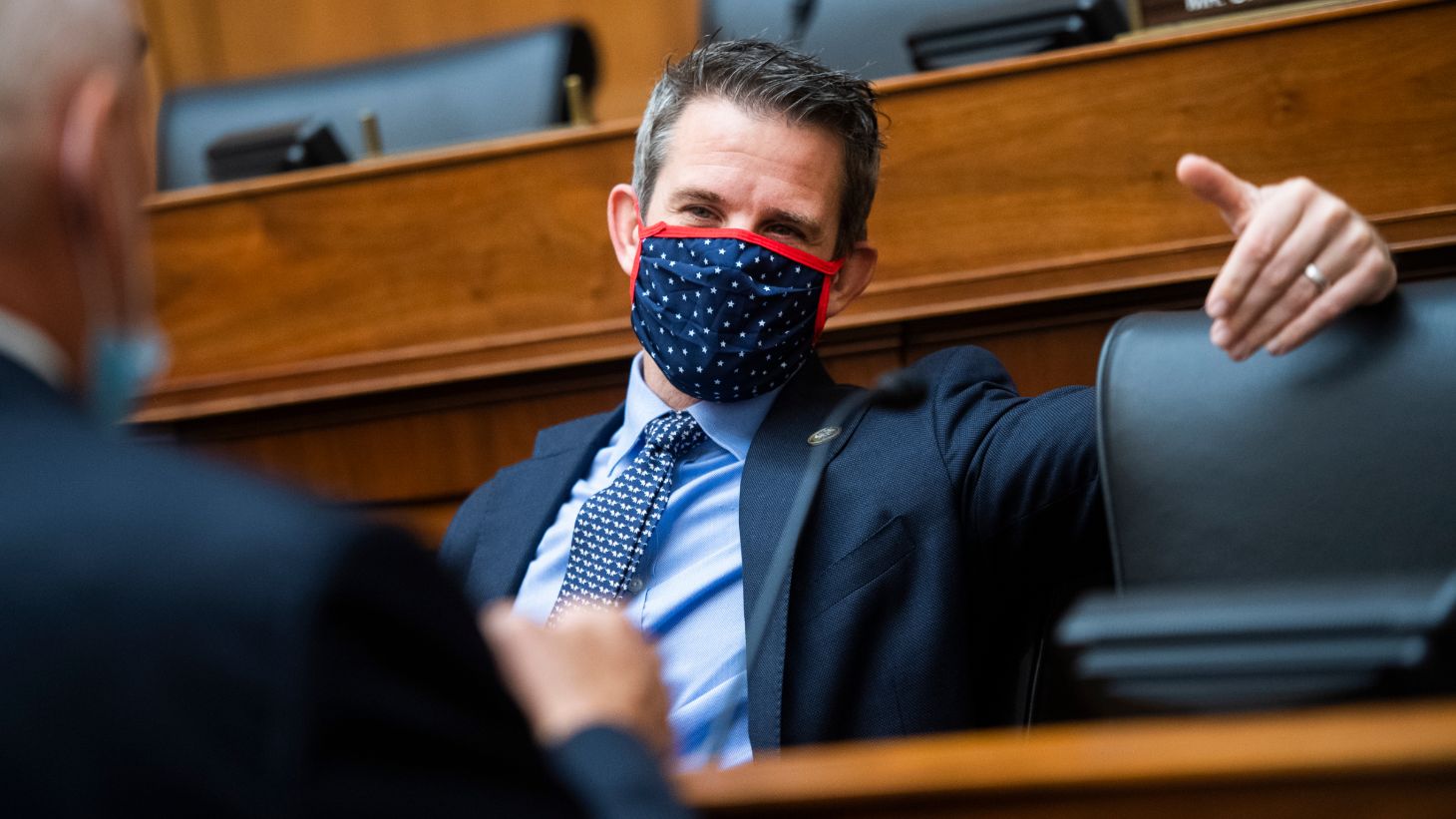
From his office in the Capitol, US Rep. Adam Kinzinger could see a little bit of the crowd on the lawn on January 6. He heard the flash-bangs go off on the steps as rioters made their way inside. And he could feel the spiritual weight of what was unfolding.

“I’m not one of these people that senses evil all the time or anything. It’s probably only happened maybe twice in my life,” the Illinois congressman said. “But I just felt a real darkness over this place, like a real evil.”

Kinzinger, a nondenominational Protestant, doesn’t talk much about his faith in public and is wary of conflating the mission of the church with the work of politics. But he saw serious implications for both in the wake of the Capitol breach and felt convicted to speak out.

“Although I’m not great at citing verse and chapter, I know the Bible speaks quite a bit about conspiracies and about allowing that darkness into your heart, about the importance of truth, the importance of being a light in dark places, of being truth,” he said on a call with CT and other news outlets this week.

“I’m not a Christian leader. I’m not a pastor. But I am a person who shares the faith and who looks at what that’s done to the political system in this country, and I decided to speak out.”

In the days after the attack, Kinzinger called on Christian leaders “to lead the flock back into the truth.” He opposed President Donald Trump for continuing to tout claims that the election had been stolen and was one of ten House Republicans who voted in favor of impeachment.

The backlash was swift, coming from Kinzinger’s district in northern Illinois, where a majority of Republicans disagreed, and from his fellow believers, with many white evangelicals continuing to support Trump even as his false claims encouraged rioters at the Capitol.

Franklin Graham condemned Kinzinger and the other Republicans who voted for impeachment for turning their back on the president despite the good he had done on issues like abortion, foreign affairs, and religious freedom. “It makes you wonder what the thirty pieces of silver were that Speaker Pelosi promised for this betrayal,” the evangelist remarked.

A relative sent the congressman a certified letter accusing him of “doing the Devil’s work.”

Kinzinger said that despite the opposition, the stance was the easiest of his career. Political analysts say it will likely cost him politically, though, and will at minimum isolate him from his party ahead of the impeachment trial set to begin the week of February 8.

At 42, Kinzinger has served in Congress for a decade and has been part of the church all his life; he was raised Baptist and now attends Village Christian Church in Minooka, Illinois. He has a conservative voting record and is outspoken in his stance against abortion, recently urging congressional leaders to preserve the Hyde Amendment, which bars the use of federal funds to pay for abortions.

But unlike most Republicans in Congress, Kinzinger has been openly critical about conspiracies spreading baseless claims that the election was stolen from Trump.

Last year, before Marjorie Taylor Greene controversially became the first open QAnon adherent elected to the US House, he said the conspiracy was a “fabrication” and had “no place in Congress.” Prior to the election being called for Joe Biden, Kinzinger urged people to stop using “debunked misinformation” to claim fraud and refused to challenge state results without solid evidence in court.

Kinzinger said Christians in Congress may, in good faith, take opposite stances, but he also sees them holding a unique responsibility to consider the spiritual implications of their decisions. He’s calling for fellow Republicans to join him to #RestoreOurGOP and had discussed concerns with friends in the party, such as Jaime Herrera Beutler. The Washington Republican, another churchgoing evangelical, joined him in voting for impeachment. “I’m not choosing sides,” she said. “I’m choosing truth."

Other evangelicals in the party, like Cathy McMorris Rodgers of Washington, voted no on impeachment, saying Trump’s words did not constitute an incitement of violence, but still reckoned with the deeper undercurrents of what happened on January 6. She acknowledged a “complete lack of leadership” and a “crisis of contempt in America” and asked Trump supporters like herself to take responsibility for enabling bullying behavior for the sake of favorable policies.

But Kinzinger said it’s not enough for members of Congress to have these kinds of tough conversations. He wants to see the church take the lead.

https://twitter.com/RepKinzinger/status/1349031304680103936

While those who have been convinced of QAnon theories and election fraud may represent a minority in the America church, it’s enough to worry Kinzinger about Christians’ regard for absolute truth and more broadly, their commitment to Christ above all.

A Lifeway Research survey conducted in the fall found half of pastors in the US said they frequently hear members of their congregation sharing conspiracy theories. “I think there are scales on their eyes,” said Kinzinger.

He believes the spread of lies among Christians is part of a much more serious battle than political races, citing Ephesians 6:12’s reminder that “we wrestle not against flesh and blood, but against principalities, against powers, against the rulers of the darkness of this world” (KJV). He said too many Christians have been co-opted into prizing political victories over spiritual ones.

“If you think about the Devil’s ultimate trick for Christianity, really, he doesn’t care what the tax rates are. It doesn’t matter. What he cares about is embarrassing the church, and it feels like it’s been successful,” the congressman said. “But I also think this is an opportunity for the church to have a massive rediscovery of what our mission and our role in this world is.”

During his inauguration, Biden referenced Augustine’s line from City of God about a people being defined by their common loves. What he left out was Augustine’s teaching that love must be rightly ordered, with love of God above all, scholar Han-luen Kantzer Komline noted.

Kinzinger lamented what he saw as Americans’ disordered priorities—how they’ve allowed allegiances to the country, the economy, the president, or their political identities to distract from their primary identity as citizens of heaven.

“We get wrapped up on thinking that every little political victory we do, which has an impact on an election, is actually fighting for God and the truth. I think to an extent some of that is true. The Supreme Court now is very conservative. I like that. I think that is good for Christianity,” he said. “But I think we need to go a level above that … and say, What is our role as Christians? Truthfully, it’s to make disciples, to love the Lord your God, and love your neighbor.”

For Kinzinger, his faith offers an eternal perspective on his day-to-day work as a congressman. While he aims to fight for life, truth, and freedom, he believes following Christ trumps any political outcome. Right now, it means he can “accept his fate” among the minority of GOP lawmakers backing impeachment.

In the long-run, the debates over policies or political alliances are “not really going to matter,” he said this week. “But what does matter is what we did with this time on earth, how we talked about the Lord, how we stood up for truth.”

News

How to Fix the Asian American Female Pastor Dilemma

New “PastoraLab” equips women in ministry who feel torn between their culture’s churches and their calling to lead.

Young Lee Hertig, ISAAC cofounder and executive director.

Young Lee Hertig, ISAAC cofounder and executive director.

Christianity Today January 29, 2021
Image Courtesty of Innovative Space for Asian American Christianity / Edits by Christianity Today

When Janette Ok was growing up in Michigan, her family’s Korean church hired a woman to lead its English-speaking ministries. Seeing pastor Mary Paik administer the sacraments and send her congregation off with a benediction each week offered Ok “tangible evidence that despite what people said, women could and should preach and pastor.”

“It was this image that I really clung to during the drought of exposure to Asian American female preachers that I experienced for years afterwards,” said Ok, now a pastor and New Testament professor at Fuller Theological Seminary. “I did not see another one for years after we moved to California.”

Whether in California—home to the largest Asian American population in the country—or elsewhere in the US, few churchgoers see Asian American women behind the pulpit; less than 5 percent of American churches are led by women of color, according to the 2018 National Congregations Study. And even fewer see Asian American women pastors in predominantly Asian congregations.

Ok is one of the organizers of a new program aiming to change that. She wants to see more women like her lead in Asian American church contexts, especially if they didn’t have a role model like she did growing up.
The PastoraLab for Asian American Women Ministers, a partnership between Innovative Space for Asian American Christianity (ISAAC) and Fuller’s Center for Asian American Theology and Ministry, officially launches in March thanks to a $1 million grant from the Lilly Endowment.

The two-year cohort, designed to support Asian American women who have been called to the pulpit in Asian American spaces, was conceptualized by ISAAC cofounder and executive director Young Lee Hertig.

The project will also conduct research to get a more detailed picture of Asian American church affiliations, since the group spans evangelical, mainline, and historically monoethnic denominations.

In traditions like the Southern Baptist Convention—which many Chinese American churches belong to—or the Presbyterian Church in America—popular among Korean Americans—denominational convictions generally keep women from senior pastor or preaching roles. But there are also sizeable Asian American populations in the United Methodist Church, Presbyterian Church (USA), Evangelical Covenant Church, and the Vineyard, whose stances allow women in all leadership roles.

In churches where women are permitted to preach and pastor, the denomination’s position is “just the beginning,” said Daniel Lee, academic dean of the Center for Asian American Theology and Ministry at Fuller. “It can be quite challenging to receive a call to be on a pastoral team or to be a senior pastor as a woman. This is the hard reality for all women, but for Asian American women, it’s even more challenging, given the Asian cultural heritage of patriarchy, as well as race-gender intersections.”

Lee Hertig, who struggled with the “patriarchal Christianity” in the Presbyterian church in Seoul where she grew up, went on to become ordained in the PC (USA) and has dedicated her ministry to advocating for and mentoring fellow Asian American women.

Back in 1992, Lee Hertig became Fuller’s first female faculty member of color; the school invited her to apply as students began to push for multicultural curriculum in the aftermath of the LA riots.

Over her career as a professor and minister, she often found herself one of the only Asian Americans and the only Asian American woman on staff. Though she was nominated for faculty of the year in her first year, the work was isolating and exhausting. She was stretched thin serving on different committees and meeting with students. At one point, a colleague suggested Lee Hertig work at the "B level" in teaching and focus on publishing.

“I told him, ‘I cannot turn away all these women and women of color students knocking on my door. You have a luxury of delegating to other white male faculty, but I cannot,’” she recalled.

Lee Hertig, who also taught at United Theological Seminary in Ohio, could relate to the female students who came to her feeling “church homeless”—like they could either choose to remain in an Asian church tradition that represented their culture or move to a white church tradition that supported women in pastoral leadership.

“In the context of Asian American churches, especially evangelical churches, women have been discipled their entire lives into faithful service to God and others and yet are rarely given the opportunity to lead, pastor, and preach,” said Ok.

As a result, many Asian American female seminary students pursuing ordained ministry have gone on to serve in predominantly white or multiethnic congregations.

“We felt we had to choose between gender equality or ethnicity,” said Lee Hertig, who has worked for years to dismantle what she believes is a false binary. In 2017, she and three others launched A More Equal Pulpit Project, a program designed bring gender parity to pastoral spaces in Asian American and Hispanic churches.

Beyond the lack of role models, girls growing up in Asian American churches can encounter narrowly gendered calls to pursue “servant leadership,” which might mean exclusively working with children or in a behind-the-scenes role.

“Christ’s life exemplifies service, of course, but when you’re talking to young Asian girls, you also have to empower them to speak up and be visible,” said Ok.

The PastoraLab program puts participants in a setting where they can process their callings, ministry, and personal lives alongside women who have faced some of the same challenges and expectations. The program will launch with three cohorts of 8–10 leaders, all based in Southern California. Together, they will study the biblical hermeneutics behind gender equality and engage in a preaching lab.

Right now, PastoraLab’s core leadership team is predominantly Korean American, but Lee Hertig is working to expand their diversity to reflect the applicant pool, which invites East Asian, Southeast Asian, South Asian, and adoptee and mixed-race Asian American women to take part.

Before they’ve even begun, organizers have already seen a glimpse of the range of backgrounds in the incoming cohorts. One participant is a Korean American woman who pursued a career in ministry after escaping a cult. Another is a Taiwanese American accountant in her 60s who felt the call while incarcerated and now leads a church in a parking lot for the homeless community in Skid Row.

Lee Hertig plans to also have the cohorts learn from the prophetic preaching model set by female black preachers (she cited Bishop McKenzi Vashti as a personal inspiration) and to engage male allies who can help women navigate male-dominated church spaces.

One question has circled both Lee Hertig and Ok’s churches for years: If women are so passionate about the gospel and so invested in theological education, why aren’t there more opportunities for them?

Right now, Ok is watching her own nondenominational, Asian American church—Ekko Church in Orange County—offer more chances for women to preach and pastor. The congregation’s pastoral team currently includes three men and three women. Over the course of Lent they will have three laywomen, known as “ministers in training,” preach sermons for the first time.

“But this didn’t just happen. We made it happen with the Spirit at work among us,” said Ok. “What I mean is that it required (and still requires) us to be intentional, to duke things out, to de-center male authority and voices as dominant, reimagine a more equal pulpit, and disrupt former patterns where women were treated as inferior members.”

Books

Our Attraction to Idols Remains the Same, Even When the Names Change

How false worship today resembles false worship in the Old Testament.

Illustration by Rick Szuecs / Source images: Tuned_In / Getty / Envato Elements

As modern evangelicals, it is tempting to treat idolatry as a relic from the ancient past. Who, after all, bows down before golden calves or worships images of Nebuchadnezzar anymore? In “Here Are Your Gods”: Faithful Discipleship in Idolatrous Times, Bible scholar and Langham Partnership international director Christopher J. H. Wright stresses that idolatry is alive and well, even if it often operates outside our conscious awareness. Freelance writer and editor of The Worldview Bulletin Christopher Reese spoke with Wright about idolatry in the Old Testament and resisting its lure today.

"Here Are Your Gods": Faithful Discipleship in Idolatrous Times

"Here Are Your Gods": Faithful Discipleship in Idolatrous Times

IVP Academic

176 pages

$13.83

How did the authors of Scripture understand pagan gods and idols? Did they believe other deities existed?

In one sense, the answer is clearly no. Compared with Yahweh, the only true and living God, all other so-called gods are actually “not-gods.” That is the clear teaching of Isaiah 40–55 and some psalms. And yet, for all who worshiped them (whether pagans or Israelites themselves), those other “gods” clearly affected the whole world of personal, social, economic, and political life. So yes, they exist—but not as God, only as human constructs to which people attribute power and authority.

You trace all human idolatry back to the events of Genesis 3. Can you elaborate on that connection?

Genesis 3 portrays a moment when human beings choose to distrust God’s goodness, disbelieve his warnings, and disobey his instructions, instead defining for themselves what counts as good and evil. Having dethroned God, they end up submitting to entities, either material or spiritual, within the created order—or else they assert their own moral autonomy.

And it all ends in tears, as Paul makes clear in Romans 1. The personal and societal mess he describes is not so much God’s judgment on our sin as the symptoms of God’s judgment already at work in a world where he gives us over to the idols we have chosen. Paul derives all human sin and disorder from this fundamental wrong turn.

Are the temptations to idolatry faced by God’s people in the Old Testament the same ones Christians encounter today?

Obviously, we give the idols different names. But as you analyze Baal worship in the Old Testament, comparisons aren’t hard to find.

Baal was the god of fertility, of both women and the land itself—the things on which one’s wealth and social significance depended. And Baal worship involved ritualized sexual prostitution to ensure such fertility. Of course, it also produced babies, but you could sacrifice them for added benefit. The sacralizing of sex and the sacrificing of babies led to a civilization so debauched that God “vomited” out its inhabitants (Lev. 18:25). These sins remain very much with us today, even if they tend to take different forms.

Baal was also the god of business deals, the kind a greedy king like Ahab and his Baal-worshiping wife Jezebel could invoke to bypass the land laws that protected Israel’s ordinary farmers. It is hard not to see their land-grabbing example reflected in the idolatry of greed and excessive wealth accumulation today, alongside growing inequality and dispossession of the poor.

The Old Testament exposes idolatries of greed, sex, arrogance, and abuse of political and economic power, and there is much that gets replicated right up to modern times. From the Book of Judges onward, it points out the consequences of idolatry with painful repetition—as if God were saying, “Don’t you get the message yet?”

Are there idols that evangelicals are particularly prone to embracing?

Idolatry often involves the perversion of something good in itself, like family, work, beauty, or sex. There are even many good things about evangelical history and identity that can easily turn nasty. Take, for instance, the individual conscience. Luther was right to champion the individual’s right to stand by his or her own conscientious understanding of Scripture, even against the tradition of the church. But this easily degenerates into the kind of denominational tribalism that has blighted Protestantism or a form of “rugged individualism” that rejects all legitimate authority.

Or consider the authority of the Bible. This was a Reformation watchword, and it must be affirmed. But it easily degenerates into an idolatry of my interpretation of the Bible (or that of my denomination, or my favorite church leader or blogger). The Bible itself can be weaponized for an agenda at odds with its own intended message.

Then there’s the importance of true doctrine. We of course need to defend gospel truth against false teaching. But doctrinal systems can become idolatrous shibboleths or slogans. Even the truth can be used as a shelter for apostate and idolatrous behavior, as when the people of Jerusalem kept proclaiming “the temple of the Lord,” believing this kept them safe in spite of their gross unrighteousness (Jer. 7). It is sadly common for some evangelicals to claim true doctrine while living un-Christlike lives.

You contend that many Western nations will likely face God’s judgment due to histories of violence, increasing poverty, and inequality, and other transgressions. Should we also give the West credit for its positive contributions, like the rule of law, human rights, freedom of conscience, and upward mobility?

We should certainly thank God for everything you mention. But should credit go to “the West,” per se? In one sense, yes, because many of those accomplishments happened during the centuries of the rise and global expansion of European peoples. But the forerunner to that was a steady permeation of the continent by the Christian faith—not always in its purest form—which fueled the development of these positive ideals. The irony is that many Western secularists now stridently critique Christianity on the basis of these very ideals, unaware of how they emerged from a distinctly Christian worldview.

In the end, this double list is hardly surprising. All people are simultaneously God’s image-bearers and fallen sinners. All cultures therefore reflect the same duality. Every major civilization has great achievements that bear witness to the dignity of human creativity, rooted in our Creator God. But they also bear the fingerprints of Satan and human rebellion.

You talk about praying both for political leaders and against them. What principles guide you in deciding which way to pray?

The principle for the first kind of prayer is Paul’s command, in 1 Timothy 2:1–4, to pray for those in authority. Political leaders are human beings, sinners like the rest of us. We long for their salvation as much as anyone else’s (v. 4). And whether or not that happens in God’s providence, we long for them to rule in a way that fosters a stable society in which Christians can live in peace (v. 2).

The principles for the second kind are woven throughout the Psalms and the books of the Prophets. When the prophets saw politically, economically, or religiously powerful people being unjust, corrupt, or excessively violent, they prayed and spoke out in protest. They saw governments passing laws that increased poverty (Isa. 10:1–2). They saw courts stuffed with crooked judges (Amos 5:10, 12). They saw priests and prophets who provided no moral check on wicked rulers (Jer. 6:13–15; Ezek. 22:26–29). They saw the wealthy exploiting and trampling on the poor (Amos 2:6–7; Mic. 3:1–3). And they pleaded with God to restrain such evil, for the sake of his own righteousness.

When it comes to wicked leaders, we pray for their repentance and salvation, but against their policies and practices. The Bible gives us every encouragement to do both.

Theology

What Another Year of Routine Teaches Us about God

As G. K. Chesterton reminds us, the Lord is “strong enough to exult in monotony.”

Christianity Today January 29, 2021
Catherine Falls Commercial / Getty Images

Last year was a year of again. Each day in 2020 dawned and we got to work again, fed and homeschooled our children again, watched COVID-19 numbers rise again, wondered “When will this be over?” again. Despite the arrival of the vaccine and the hope of a new year, we awoke on January 1 to a long wait for the vaccine, half-hearted resolutions, and the new virus strain making its American debut. We are left staring down the winter months of dogged monotony at home. But perhaps these unyielding months of the pandemic have revealed something we have not wanted to address: Our lives are full of monotony and repetition, and they always will be.

Trying to evade a life marked by repetition is misguided—repetition is a fundamental reality of being human, and the pandemic has only heightened our awareness of it. We are creatures of again; we are made for again. So why does repetition feel like a curse instead of a blessing?

The Christian story explains this seeming dissonance. God has made all of creation to exist and flourish in a repetitive pattern (Gen. 1–2). The heavens declare his glory, the sun runs its course with joy (Ps. 19:1–6), the rivers clap their hands, and mountains sing his praises (Ps. 98:8); creation glorifies God through its constancy—including humans, God’s most treasured creatures. Not only do our bodies require daily food and rest; we are also made to find purpose in knowing and glorifying God again and again.

But the Fall has made us bitter and unfeeling, stealing our joy in repetition rather than giving it. We find ourselves looking for a way out, grasping at any hope that promises relief from our tedious lives. We must learn to participate with our faithful and imaginative God to rediscover the delight of repetition for which we are made.

In his book Orthodoxy, G. K. Chesterton chastises adults for our disconnected view of reality, arguing that children understand the heart of God better than adults. Like children who beg for an adult to “do it again!” and see another opportunity for delight, so the Creator delights to knit together another human, grow a new tree, or tirelessly craft a field of daisies. “For grown-up people are not strong enough to exult in monotony,” Chesterton writes. “But perhaps God is strong enough to exult in monotony … for we have sinned and grown old, and our Father is younger than we.”

The Gospels reveal a man who was not bothered by being asked to heal again, teach again, explain who he was again.

My children’s world is completely oriented around the basic truth that I will provide for them, and because they trust me, they inhabit their world with free hearts. The free spirit that children possess is not naivete; it is an accurate trust that grows out of a trustworthy relationship, the same kind of relationship that God invites us into day after day.

Though part of growing up is navigating the brokenness of our world, Jesus exhorts us to retain a childlike heart—a heart that trusts in the provision of the Father (Matt. 6:25–34). He has made us to participate with him, presenting our needs, desiring intimacy, and delighting when he provides again. This is how we retain a childlike heart, a fierce and free spirit that trusts in the Lord and delights in his invitation to trust him again.

Adulthood often strips us of something that we were meant to be—creative beings who see a world of sameness through imaginative eyes. In losing the joy of routine, we diminish our capacity for knowing and reflecting our God, who reveals himself in the small rhythms of daily life. Again is the place of transformation where he chooses to meet with us, grow us, and offer us new mercies every morning (Lam. 3:23). We are made for repetition.

Though the tedium of daily life can feel soul-crushing for most of us, Chesterton argues that God is strong enough to exult in monotony because he delights in sustaining sameness while also creating newness. The whole of Scripture testifies that God delights in providing for his people again. We see it in his covenants, his willingness to remove our transgressions (Ps. 103:12), his prophets who speak difficult words out of love (Jer. 35:15), the manna on the ground each morning (Ex. 16:4). The culmination of our Father’s desire to provide is in Christ.

Jesus spent the majority of his life as a carpenter building tables and chairs, preparing wood, and making measurements. He was familiar with the mundane, and perhaps this is why the Gospels reveal a man who was not bothered by being asked to heal again, teach again, explain who he was again. Rather we encounter an infinitely creative teacher and healer who weaves parables, displays his power through different signs, and heals in ways that are tailored to each individual’s needs.

In Matthew 13, Jesus tells seven different parables, all but one of which begin with the kingdom of heaven is like—a mustard seed, yeast for baking, a hidden treasure. Each illustration teaches the same lesson from a new angle so that listeners might hear and understand. When Jesus heals the blind man in Mark 8, he spits into the man’s eyes, puts his hands on them, and, when the healing is incomplete, repeats the laying on of hands. Our creative God sees each healing as an opportunity for his kingdom to come in a new way.

Jesus participates in the repetition of human life so that he might heal our broken relationship with it. Through his patient and consistent love of sinful people, Jesus models for us how to find joy and freedom in the midst of lives that could be monotonous. He is the bread of life eager to nourish when he feeds the 5,000 (Matt. 14), the 4,000 (Matt. 15), or his friends in the upper room (Matt. 26:26). By his Spirit that indwells us today, we too are empowered to approach our work, families, and circumstances with enlivened imaginations.

Though my husband and I grow weary of our daughters’ cries of again, our Father does not. He is not annoyed when we confess the same sins or pray the same prayers. He knows that we are frustrated with spending day after day pent up inside, worrying about finances and health.

After denying Jesus, Peter is not condemned for his faithlessness; he is restored. Jesus asks him “Do you love me?” three times over (John 21:16–17). Repeat, Peter, who do you love? Jesus wants to hear it again, and so does our Father. Even though we have done it before, he wants us to come to him, to delight in his goodness, to cry out for help, and to have our imaginations set ablaze with the hope of the gospel—again and again.

Anne Kerhoulas lives in Asheville, North Carolina, with her husband and twin daughters and writes at Daily Discipleship.

Church Life

For Churchgoing Families, More Kids Aren’t a Burden

Researchers find big families don’t deter child outcomes, but our theology defines flourishing differently.

Christianity Today January 29, 2021
Bethany Klebes / Lightstock

The more children you have, the less you can give each one, and the worse they do. Right? Parents in pandemic isolation without the usual supports from schools, churches, and extended family will certainly resonate with the idea that their time, energy, and attention are split into ever-smaller slices with each child.

It’s also the tradeoff anthropologists and economists have assumed when studying modern fertility patterns. But when John Shaver came across projections during his graduate studies that Hispanic Catholics and Muslims were on track to surpass white Christian subgroups and Jews, respectively, by the midcentury, he was perplexed.

“It struck me as a puzzle,” said Shaver, who now teaches anthropology and religion at the University of Otago in New Zealand. “These groups may be growing rapidly, but if there’s not something there to mitigate the negative effects of large family size, these could be populations where the children in these groups are not functioning as well.”

But when Shaver investigated himself, he found that when families had support from religious communities, like churches, this negative scenario didn’t always play out.

Shaver and his colleagues recently published a paper exploring the effects of religious support on fertility and child development. They used ten years of data from the Avon Longitudinal Study of Parents and Children, which recruited over 14,000 pregnant women in England in the early 1990s to track ever since—on measures such as children’s lead exposure to number of illnesses to developmental ups and downs. From this data they tested how church attendance and social support affected family size and child development.

Unsurprisingly, they found that religious families had more children. They also found that, on the whole, the more siblings a child had, the shorter the child was and the lower his scores on state standardized achievement tests. This “tradeoff” falls in line with previous studies showing that larger family sizes dilute parental resources and affect child outcomes. But the finding didn’t hold for families with support from religious communities. In fact, Shaver and his colleagues found that religious support sometimes correlated with higher test scores.

These findings, Shaver wrote, suggest that religious communities overcome the tradeoffs between number of children and child success by sharing resources, a practice anthropologists call “alloparenting.” While the term is erudite, it’s something humans have done throughout history. Only in recent decades, as social and family connections have frayed, has it become less common.

The practice of alloparenting dovetails with the mission of the church, said Emily McGowin, a scholar who studies the theology of large families. The fact that our faith could aid reproductive success and human survival by encouraging cooperation fits with her understanding that the gospel is for human flourishing. “If we’re claiming, as we do, that Jesus is alive and teaches us what it means to be human and how to live a fully human life now in the kingdom of God,” said McGowin, a Wheaton College theologian, “then there should be signs of that life now.” However, she added, sometimes that means challenging what human flourishing is.

Measures of child “success,” McGowin noted, are often more about performance than character. Test scores, college attendance, jobs, and salary may be part of the standard American definition of success, she said, but shouldn’t top the list of the church’s concerns. “If there is some sort of socioeconomic tradeoff for larger families, I’m not sure if that should be the first or even the most significant factor in how you determine the number of children to have.”

Cara Wall-Scheffler, an evolutionary biologist at Seattle Pacific University, notes that the whole question of a “tradeoff” is also culturally constrained. Data from Western societies may show such a phenomenon, “but it’s unusual in the world to see the issue in this way. Having more children increases the number of people who can help in a community, regardless of whether it is foraging or agricultural, and these children receive multiple levels of interactions from both adults and peers,” she said.

While we have always depended on those outside our immediate family, as we have become more mobile—uprooting for career opportunities—those ties we used to rely on have weakened. Shaver wonders whether it was social cooperation and cohesion that enabled previous generations to maintain larger family sizes, which also would explain why in recent decades fertility rates have steadily decreased, even among evangelicals. He suspects that in modern societies churches may fill a role that extended family did before—as sources of kinship, connection, and support.

“Church communities have the power to become the alloparenting community so integral to other cultures,” Wall-Scheffler said. “It is a consistent, chosen community with shared beliefs and a shared identity,” one that usually remains steady even if a family moves houses and as children grow out of different clubs and sports communities.

That is the power of religious communities beyond providing practical support—their meaning-making, identity-shaping ability. Shaver’s research found that mothers who received social support from nonreligious contexts, such as a running group or a community center, didn’t experience the same positive effects on child outcomes as mothers who received religious support.

Celeste Jones, a child psychologist at George Fox University, studies how adverse events for parents impact their children’s development downstream. How parents handle stress, Jones argued, may be more of a determining factor in child well-being than the number of children they have. If families can handle the stresses of their larger numbers well—and often religious communities help because they give meaning to hardship—then they can do just as well as families with fewer pressures.

While Christians may see the work of parenting as deeply meaningful (Genesis 1:28, anyone?), our churches don’t always bear this out in practice. Lorena Vidaurre, director of Biola University’s early childhood education program, has served for decades in churches where the paradigm of children’s ministry has been “babysitting” rather than making disciples. She calls for churches to see the work of discipling children as equally important as discipling adults—which might mean bringing children from rooms where they aren’t seen at all during a service into the heart of the congregation.

McGowin studied “Quiverfull” families, evangelical families defined by the practices of male headship, homeschooling, and having as many children as possible. She noted that those large families who were doing well were part of churches with other large families, while those that were more stressed and isolated felt such because they weren’t part of supportive churches.

Wealth also played a role in McGowin’s research. Poorer mothers, she noted, had less joy. They worried more and had more trouble coping than mothers with more resources. Her observations highlight the double standard among conservatives pushing for the renewal of the nuclear family. As columnist David Brooks states, “Affluent conservatives often pat themselves on the back for having stable nuclear families. They preach that everybody else should build stable families too. But then they ignore one of the main reasons their own families are stable: They can afford to purchase the support that extended family used to provide—and that the people they preach at, further down the income scale, cannot.”

If we care about the family, then, our actions must go beyond our own families or even our congregations. This is something that perplexed McGowin as she studied Quiverfull families. “As radical as they thought they were being, I didn’t think they were radical enough,” she said. They were focused on individual households, not pushing the questions about how we value children in the broader world. “Are there ways we do life in the church or neighborhood that would be more welcoming, life-giving to families, regardless of number of children?”

Wall-Scheffler notes that asking how Christians can serve neighborhood families doesn’t mean the church has to provide all the tutoring or childcare. But the church can serve as a point of connection where families can go when they need help. She added, “Churches don’t typically do a great job of understanding what people do outside of the church. What if a church actually has a bunch of educators and sociologists and social workers in their membership? Could they create a team of people who can figure out how to meet the needs of their specific community?”

Vidaurre is one of these support professionals already embedded in the church. She taught for a decade in a parent coaching program in the Los Angeles Unified School District. Parents in the disadvantaged Hispanic community she served were required to attend and resented it at first. But by the end of ten weeks of classes, parents insisted on continuing for a year. “Parents learned from each other,” Vidaurre said. “Their children made academic gains. The parents were empowered to use assets they already had to advocate and lead. It became a support group and a safety net.”

As evangelicals continue to emphasize the importance of family as society’s most basic institution—a value we model in our churches—it’s worth asking how we can influence wider policies that affect families’ ability to thrive, suggests author Katelyn Beaty. “Christian communities are well equipped to protect children and advocate in the public square for their flourishing, including addressing economic forces that deprive children of food, shelter, rest, and education and taking into account extended family separation due to parents’ work,” wrote Beaty, who coauthored a 2018 study for the Center for Public Justice on the need for pro-family workplace policies.

Beaty’s advocacy for paid family leave is one example of how Christians are living out a pro-family theology on all levels, not just at the household. Brooks, who has been deeply influenced by Christian thought, mentions other broad-level strategies in his Atlantic article: child tax credits, expanded parental leave, subsidized early education, and parent coaching programs.

In these pandemic days, our networks have shrunk. We know full well now that we were not made to live in isolated, nuclear family households. But the pause in our communal life may be a chance to rethink the possibilities. What has brought life into our families and communities? What hasn’t? Where do families really need support? If Vidaurre and the parents she coached were able to weave such deep, impactful bonds in one year, in a school-sponsored program, imagine what could happen through our churches.

Liuan Huska is a writer living in the Chicago area. Her new book on chronic illness, Hurting Yet Whole, released in December 2020 with InterVarsity Press.

Books
Review

Life’s Darkest Moments Call for Prayers We’d Never Choose to Pray

When words fail, says Tish Harrison Warren, we can rely on ancient liturgy to supply them.

Christianity Today January 28, 2021
Illustration by Mallory Rentsch / Source Images: Tim Mossholder / Melchior Damu / Zach Guinta / Unsplash / Darren Thompson / EyeEm / Getty Images

The first year of our marriage, I found a full pill case pushed behind some bottles of shampoo under the bathroom sink. They belonged to my husband’s first wife, Danielle, from years earlier, before her fight with cancer ended in death. My husband, Evan, apologized—not because he had done anything wrong but because he could not prevent these reminders of grief from occasionally falling out of closets and drawers. This is where they had lived together. Where she baked, laughed, and lost her hair.

Prayer in the Night: For Those Who Work or Watch or Weep

Prayer in the Night: For Those Who Work or Watch or Weep

IVP Formatio

208 pages

$12.64

Since then we have moved into a house of our own, one with high ceilings, a creaky old staircase, and lots of “character.” From time to time, I post pictures of our home and our joy—usually when Evan is wearing his tan, thrift-store blazer and I have taken the time to put on lipstick. Each time, someone inevitably comments, “You two look so happy,” or “I hope to have a love like that someday.” And we are so happy. This love is a gift, one of the kindest God has ever given me.

But what Instagram and Twitter don’t show is something that author and Anglican priest Tish Harrison Warren expresses in her new book Prayer in the Night: For Those Who Work or Watch or Weep: that “our bright and shining lives, our explosions of joy, good work, and love, are always silhouetted by the shadow of death.”

As she began writing, Warren couldn’t have known how much we would need her book in these pandemic times. Now, almost a year in, a nurse friend of mine tells me about performing last rites for COVID patients who would otherwise die alone. I give “air hugs” to the widows at church instead of holding them close. Christians tear one another apart on social media over pandemic procedures, politics, and everything else under the sun. We are collectively lonely, frustrated, and sad.

And Warren invites us to enter that sadness. “Jesus,” she reminds us, “wept as one with hope, but his hope did not diminish his weeping.” Too often, the church’s approach to suffering feels like being shushed in a movie theater. We feel the pressure to stifle our sobs and move on before ever getting the chance to lament. Warren doesn’t shy away from the presence of pain. She acknowledges it, both personally and theologically, describing theodicy—the belief that human suffering and God’s goodness coexist—as a “scream” and an “ache that cannot be shaken.” We long “for a God who notices our suffering,” she writes, “who cares enough to act, and who will make all things new.”

A Priest Who Couldn’t Pray

We lost our baby this year. The day I was supposed to hear a heartbeat, I found out instead that I was miscarrying. Evan was waiting in the car, due to COVID restrictions, and when he drove to the entrance of the hospital to pick me up, instead of handing him a picture of our growing child, I had to tell him the news. In that moment, I didn’t have any words. I knew God still loved us. We still loved him. But I didn’t know how to pray.

After a series of devastating losses, Warren describes herself as “a priest who couldn’t pray.” “In some wordless place deep within,” she admits, “I had hoped that God would keep bad things from happening to me.” Warren brings up something we are reluctant to admit: that we often condemn the prosperity gospel as unbiblical while secretly holding on to the hope that we will get good things in return for our good behavior. I know God didn’t owe Evan and me a child, but giving us that burst of joy only to deflate it confused me. I had no words. My faith flickered.

When Warren was walking through her own valley of the shadow of death, she reached for ancient liturgy. In a particularly devastating moment, she and her husband turned to a prayer known as Compline, one usually reserved for evening services and nighttime. They recited the prayer together, holding on to the words for dear life. Warren’s book is a meditation on this prayer, but more than a mere celebration of liturgy, it is about “how to continue to walk the way of faith without denying the darkness.” One way we fight for faith in the dark is through prayer.

As a Bible church kid, I didn’t grow up with much liturgy. I learned the Lord’s Prayer and the doxology, but prayer was usually “free form,” as Warren calls it—“unscripted” and “original.” This lent itself to beautiful, intimate prayer times when I was alert and clearheaded, but in moments when I was too terrified to think straight or too grieved for words, it was difficult to create my own prayers. Warren acknowledges free-form prayer as important and needed, but she points to liturgy—the prayers that have been handed down to us—as an essential gift for when we need to “pray beyond what we can know, believe, or drum up in ourselves.”

Warren believes that “prayer often precedes belief.” This flips a cherished spiritual practice on its head. Instead of waiting to pray until we have enough faith, we can borrow the prayers of saints before us, leaning into their words, preaching them to our hearts, and offering them back to God as an act of surrender. When I pray, “Thy will be done,” during the Lord’s Prayer, I do so with open hands. It is such a hard prayer to pray because we know from Jesus’ prayer in Gethsemane that God’s will often involves suffering. To pray those words, I have to physically demonstrate surrender in order to get my heart to follow. “Thy will be done” is a prayer I borrow and pray out of obedience—not because I don’t mean it but because I’d never have the courage to create such a prayer myself.

Warren believes that “prayer actually shapes our inner life. And if we pray the prayers we’ve been given, regardless of how we feel about them or God at the time, we sometimes find, to our surprise, that they teach us how to believe.” This idea reminds me of the debate Christians have about Bible reading. Do we read the Bible only when we desire it, or do we read the Bible as a spiritual discipline? Some have argued that forcing ourselves to read the Bible makes it an obligation, more guided by guilt than love. Others point out that when we don’t desire Scripture is actually when we need it most. They believe reading the Word out of obedience can thaw our hearts and renew our desire to draw near to God.

It is the psalms we have memorized and the prayers we recite at church and scribble into our journals, the books of liturgy spread throughout our homes, that will be there when words fail us. When we wonder if God has failed us. When we know we need to pray but can’t do so on our own. Liturgy can train the muscle memory of our hearts.

Blooming in the Dark

“If we are to discover the things that only bloom in the dark,” Warren says, “we must cooperate with the work that suffering does in us.” Liturgy might make prayer more accessible, but lament is an uncomfortable practice. It requires facing our pain head-on, and as Warren points out, “we will do almost anything to avoid it.” I remember binge-watching the entire Gilmore Girls series during my divorce. It was God’s grace to escape into the fictional town of Stars Hollow for a time, but eventually I had to return to my own life and face what was crumbling. This involved crying out to God through ugly tears, struggling to sleep, and refusing to distract myself from the pain. It was one of the hardest things I’ve ever had to do, but God met me there.

Without sugarcoating suffering, Warren points out that it is in spaces of deep grief that we learn “the depths of the love of God.” Those in the fellowship of the suffering understand that God’s presence in grief is an intimacy like no other. When our faith is flickering from an onslaught of suffering, says theologian Nicholas Wolterstorff in his book Lament for a Son, our only answer is the “sight of God himself scraped and torn. Through our tears we see the tears of God.”

We may never understand the reasons why we suffer, but we do know that God suffers with us. “God did not keep bad things from happening to God himself,” Warren powerfully writes, and “there is no darkness into which he has not descended. He knows the texture and taste of everything I most fear.”

After the year we have had, there isn’t a person I know who doesn’t need this book. We may not have asked for the kind of refining we have collectively endured, but not all spiritual practices are taken up by choice. The most “shaping spiritual practices of our lives,” Warren says, “are things we’d never have chosen.”

Rachel Joy Welcher is an artist, poet, and editor at Fathommagazine. She is the author of Talking Back to Purity Culture: Rediscovering Faithful Christian Sexuality. Follow her on Twitter @racheljwelcher.

News

Pew: How COVID-19 Changed Faith in 14 Countries

According to survey of 14,000 people, the pandemic has strengthened religious belief most in US, Spain, and Italy, while South Korea leads in lost faith.

Christianity Today January 27, 2021
Illustration by Mallory Rentsch / Source Images: Yoshiyoshi Hirokawa / Sittichai Karimpard / EyeEm / Getty Images

“Consider it pure joy, my brothers and sisters, whenever you face trials of many kinds, because you know that the testing of your faith produces perseverance.”

James, the brother of Jesus, didn’t have a global pandemic in mind when he wrote these words in the opening chapter of his biblical epistle to “the 12 tribes scattered among the nations.” But as the coronavirus closed churches worldwide, a global survey of more than 14,000 people has found that few lost faith while many of the most faithful gained.

Today, the Pew Research Center released a study on how COVID-19 affected levels of religious faith this past summer in 14 countries with advanced economies: Australia, Belgium, Canada, Denmark, France, Germany, Italy, Japan, the Netherlands, Spain, South Korea, Sweden, the United Kingdom, and the United States.

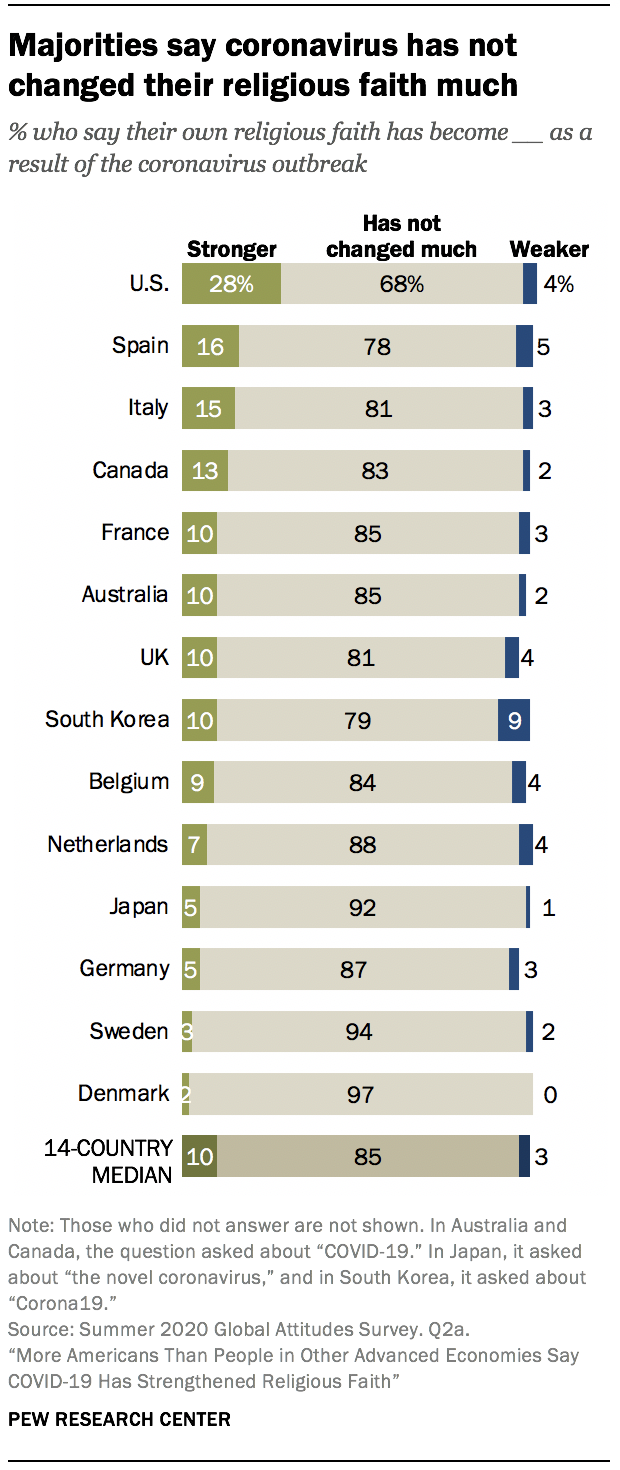
“In 11 of 14 countries surveyed, the share who say their religious faith has strengthened is higher than the share who say it has weakened,” noted Pew researchers. “But generally, people in developed countries don’t see much change in their own religious faith as a result of the pandemic.”

Overall, a median of 4 out of 5 of each country’s citizens said their faith was more or less unchanged.

But leading the pack in strengthened faith: the United States.

And leading the pack in weakened faith: South Korea.

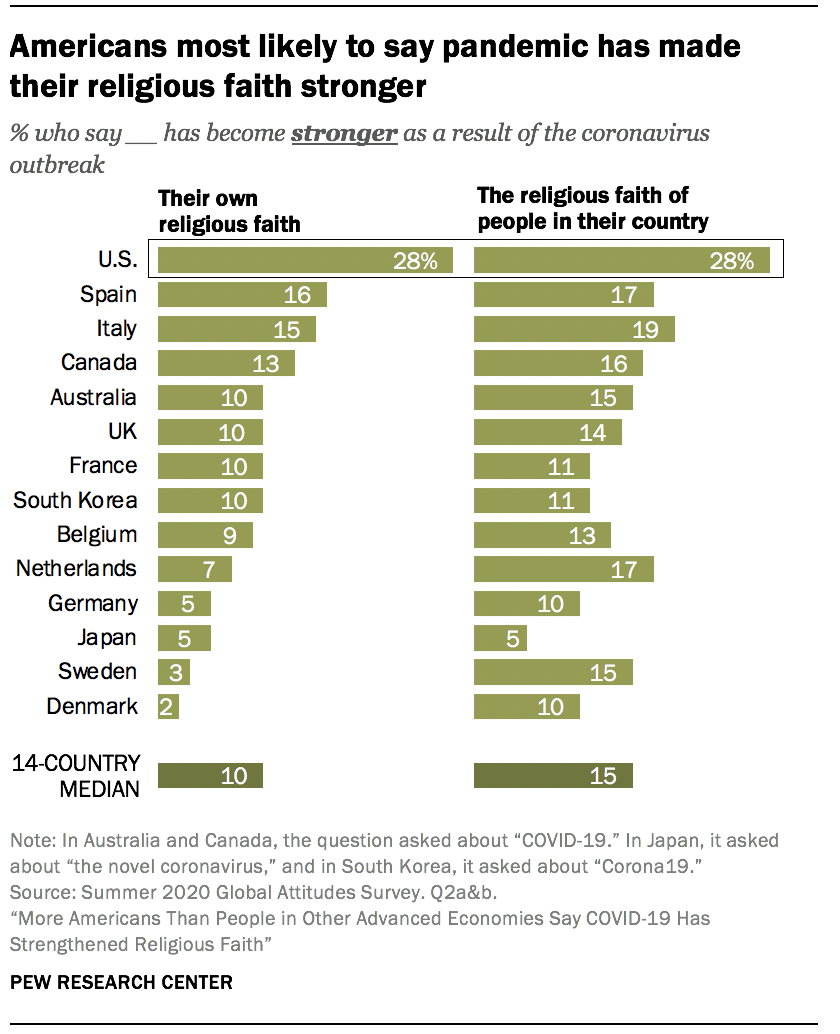
Americans were three times more likely to report their religious faith had become stronger due to the pandemic: 28 percent, vs. a global median of 10 percent. Next came Spaniards (16%) and Italians (15%), whose nations were two of the worst hit during the coronavirus’s deadly outbreak in the spring. About 1 in 10 Canadians, French, Australians, Brits, Koreans, and Belgians said the same.

Meanwhile, Koreans were three times more likely to report their religious faith had become weaker due to the pandemic: 9 percent, vs. a global median of 3 percent. Next came Spaniards (5%), followed by a tie between Americans, Brits, Belgians, and the Dutch (4%).

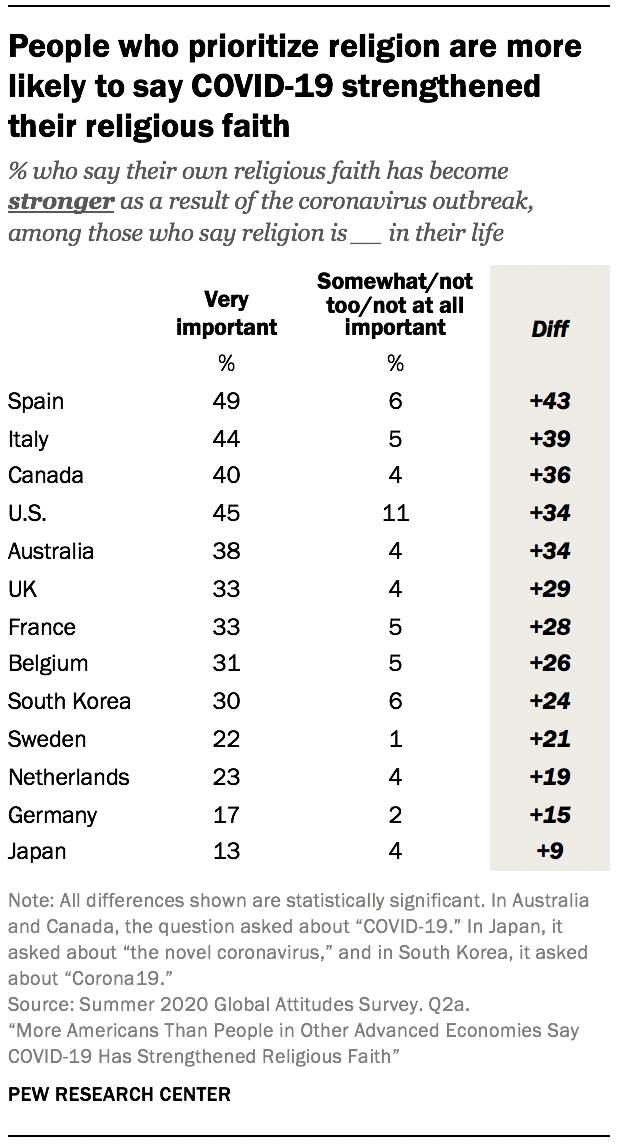
However, among only respondents who said religion was “very important” in their lives, a far larger share reported strengthened faith. This included 49 percent of faithful Spaniards, 45 percent of Americans, 44 percent of Italians, and 40 percent of Canadians. The global median was 33 percent.

Once again, South Korea reported the most lost faith. Among Koreans who said religion was “very important” in their lives, 14 percent said their faith had become weaker—about three times the global median of 5 percent. They were followed by the French (8%), Brits (7%), then a tie between Spaniards, Dutch, and Swedes (5%).

Among respondents who said religion was not important or only somewhat important in their lives, 1 in 10 Americans reported strengthened faith (11%), followed by Spaniards and Koreans (6%).

(The United States remains an outlier on religiosity: 49 percent of Americans told Pew that religion is very important in their lives, vs. 24 percent of Spaniards and 17 percent of Koreans.)

Pew found no significant differences between men and women overall, but “two exceptional cases” were Italy and South Korea. In Italy, 20 percent of women say their faith has strengthened vs. only 10 percent of men. In South Korea, 13 percent of women say their faith has strengthened vs. only 8 percent of men.

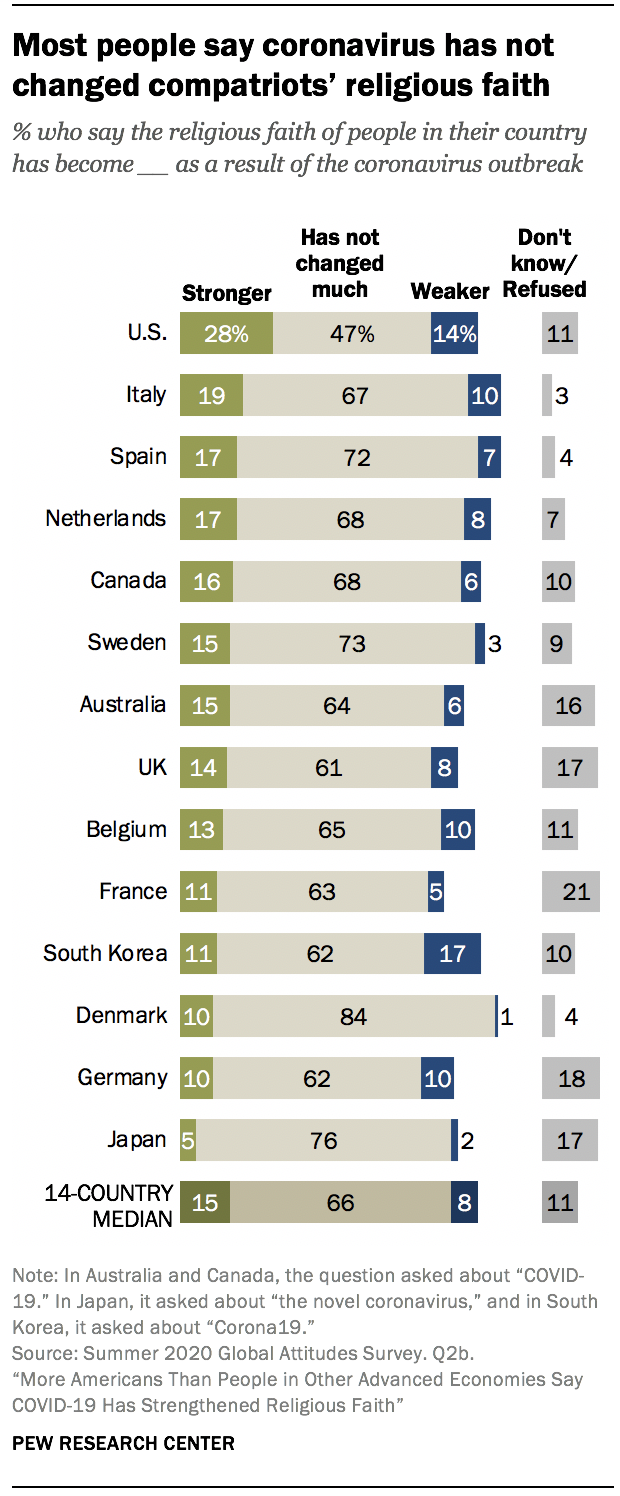
Pew also asked respondents to assess the pandemic’s impact on the faith of their nation as a whole. Once again, Americans led the way with 3 in 10 saying faith in the US had become stronger.

In most countries, people were more likely to say the religious faith of their fellow citizens had become stronger (global median: 15%) than to say the same about their own faith (global median: 10%). Significantly, in the Netherlands only 7 percent of the Dutch say their own faith is stronger, but 17 percent say the faith of other Dutch is stronger. The same significant spread was found among Swedes (3% vs. 15%) and Danes (2% vs. 10%).

Meanwhile, Koreans were most likely to say that religious faith in their nation has weakened (17%), followed by Americans (14%) then by Italians, Belgians, and Germans (10%). Others matched or fell below the global median (8%).

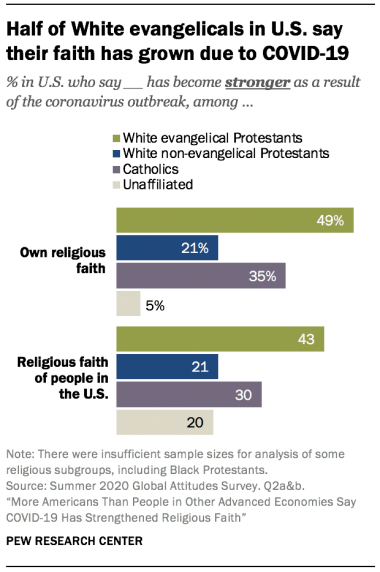
In the US, white evangelicals were the most likely to say their faith had become stronger (49%), followed by Catholics (35%), white non-evangelical Protestants (21%) and the unaffiliated (5%). This was a modest increase from April, when Pew found a strengthened faith reported by 41% of white evangelicals, 27% of Catholics, 19% of white non-evangelical Protestants, and 7% of the unaffiliated.

Pew’s summer survey did not have enough black Protestants to break out, but in the April survey they led all American faith groups, with 54 percent saying their faith had been strengthened.

After being cleared of mail fraud allegations, organizers of the “Religious Inaugural Celebration …” in Washington, D.C., proceeds on course with plans for this month’s interfaith prayer service that coincides with the change in administration.Charges of misleading the public were directed against James “Johnny” Johnson, who planned the gathering in his capacity as an independent, evangelical lay minister. (He serves as vice-president of the Full Gospel Business Men’s Fellowship, and was assistant secretary of the navy under Richard Nixon. Johnson also has close ties with the President-elect, who appointed him director of veteran’s affairs in California in 1967. He was the first black ever named to a state cabinet post.)In October, Johnson’s independent inaugural committee issued more than 40,000 formal invitations, which bore a gold, embossed eagle emblem. The official-looking invitations requested attendance at a “nonsectarian, nonpartisan, nonpolitical” prayer meeting on January 19 and 20 at Washington’s Starplex Armory. After the election, Ronald Reagan’s official inaugural committee complained that the invitations would confuse and mislead recipients by suggesting that purchasers of the tickets would be treated to an appearance by either Reagan or Vice-president-elect George Bush. In fact, neither one had agreed to attend the festivities, though both were invited.As a result, a grand jury investigation was threatened and then dropped when Johnson’s committee agreed to alter substantially their emblem and name (from “Presidential” to “Religious” Inaugural Celebration with Love), and to provide their guests with disclaimers edging away from the promise of a presidential appearance. Johnson expected several thousand participants.A donation of 5 each or 0 per couple was indicated on the invitation, but anyone could register to attend both days’ events for . Those paying full price would receive “VIP treatment,” a spokesman said, including two catered dinners and four souvenir books. Coinciding with official inauguration day events, this interfaith celebration was scheduled to include speakers ranging from the mayor of Washington, D.C., to Bill Bright of Campus Crusade, to Paul Yonggi Cho of the world’s largest local church in Seoul, Korea, and such musical entertainers as Dino and Debbie, Danny Gaither, and the Evangel Temple Choir.“What we are trying to establish is a public witness to the world that we who take our faith seriously and who love our country wish to be able to gather together in a spirit of prayer. We are vitally concerned about the health and welfare of our president and other leaders, and we are concerned for the peace of the world. We only want to unite in prayer in behalf of those ends,” Johnson said.Unlike the well-known inaugural balls, which have been part of the inauguration festivities since the days of James Madison, the religious ceremony was nonpartisan. While most of the event’s organizers are Christians, people of other faiths were invited to participate in the common interest of prayer.Science and ReligionNew-Found Allies In The Sociobiology Debate?All is not well on the sociobiology front (see “Sociobiology: Cloned from the Gene Cult,” p. 16). While evangelical scholars are debating how to meet the inroads of this new academic discipline, they may have found allies among some highly regarded anthropologists.According to a report in The Chronicle of Higher Education (Dec. 15, 1980), sociobiology has not “made it” as an organized body of knowledge. At least that’s the view of Jerome Barkow, a Dalhousie University anthropologist. He organized a symposium as part of the annual meeting of the American Anthropological Association to take a look at sociobiology “as the dust settles.”“Dust” in this case refers to the fierce arguments in academia over whether or not sociobiology is indeed a legitimate field of scholarship. Although it had made its way into some introductory textbooks, sociobiology has been criticized as “an attempt to justify genetically the sexist, racist, and elitist status quo in human society.” Those words were put forward at the anthropologists’ 1976 meeting, but they failed to carry in a resolution of condemnation.Since then the debate has simmered. Barkow admits sociobiology has not led to a resurgence of racism, but neither has it solved some of its fundamental theoretical problems. Among them, according to Barkow, are: the relationship between cultural and biological evolution; how to study such concepts as “inclusive fitness”; and the relationship between sociobiology and ecological and biosocial research.Worldwide Church of GodArmstrong Is Unscathed By Legal Attacks, ExposésLegal battles and controversy don’t seem to cramp the style of Herbert W. Armstrong and his Worldwide Church of God (WCG).California Attorney General George Deukmejian in October dropped the state’s two-year-old investigation of the Worldwide Church—initiated after some former members complained that Armstrong and WCG general counsel Stanley Rader siphoned off up to million in church funds for their personal use. Deukmejian complained that the recently adopted “Petris Bill” too severely stripped him of power to prosecute cases involving alleged financial abuses by religious groups. (He dropped investigations of 11 other religious groups as well.)Through it all, the group retained roughly the same membership of about 68,000 worldwide (50,000 in the U.S.). The court battles apparently did not hurt income, which stayed close to the 1979 figure of million. (The WCG has lost 35,000 nonmember contributors since 1976.)Later in the same month Armstrong and Rader flew to Egypt for a meeting with President Anwar Sadat. There, they presented the first 0,000 of million pledged for Sadat’s planned million trifaith worship center at the base of Mount Sinai. Afterward, they flew to Jerusalem to meet with Israeli Prime Minister Menacham Begin.Armstrong’s estranged son, Garner Ted, asserted in a telephone interview that his father’s global tours are represented to WCG members as evangelistic missions. But to foreign officials, Garner Ted charges, Herbert Armstrong is portrayed by advance man Rader as a wealthy philanthropist who is willing to give away large sums of money in exchange for invitations to address distinguished gatherings on such innocuous topics as “The Seven Laws of Success.” A year ago Armstrong got red-carpet treatment in China after donating 0,000 in books to Chinese libraries. (Garner Ted’s own Church of God International, formed after he was expelled from his father’s church in 1978, now claims 70 congregations and about 3,000 members.)Both Garner Ted and his father owe most of their visibility today to the air waves. Herbert Armstrong’s “World Tomorrow” program is now aired on 58 radio and 52 television stations in the U.S. He has a sur-Garner Ted Armstrong prisingly wide electronic media influence in Canada, where his programs air on 53 radio and 81 television stations. Gamer Ted is carried on 50 U.S. radio stations: his fledgling church has experienced defections by several key leaders, who complain he is too autocratic.Herbert Armstrong’s doctrines are rejected by evangelicals: he denies the existence of the Trinity, the soul, hell, and of the Holy Spirit as a person. A distinctive teaching is British Israelism—that Anglo-Saxons are the true Israel, with Britain being the tribe of Ephraim, and the U.S. the tribe Manasseh.More recently, his lifestyle and reputation have been questioned in two controversial books written by former WCG members. WCG officials Sherwin McMichael and Henry Cornwall secured a court order to halt distribution of one of these: David Robinson’s Herbert Armstrong’s Tangled Web (John Hadden Publishers). It contains damaging charges, such as Armstrong’s alleged shocking sexual behavior.Robinson, however, appealed and the ruling was overturned. A million suit against Robinson by the two men was pending, but the recent firing of McMichael from his Washington, D.C., pastorate may have cooled his zeal to pursue the matter further.JOSEPH M. HOPKINSPersonaliaClyde Kilby will retire in July from his job as curator of the Marion Wade Collection at Wheaton College. During his 15 years as curator, Kilby has built up the most comprehensive collections anywhere of C. S. Lewis, Owen Barfield. Dorothy Sayers, and Charles Williams. Other works in the collection include those of G. K. Chesterton, George MacDonald, and J.R.R. Tolkien. All are British authors. Kilby has lectured at more than 50 colleges, edited or authored 10 books, originated Wheaton College’s annual Writers’ Conference 24 years ago, and has been a book reviewer for the (now defunct) New York Herald Tribune.Kenneth L. Barker, professor of semitics and Old Testament at Dallas Theological Seminary, has been named executive secretary of the committee on Bible translations for the New York International Bible Society, as well as its vice-president of Bible translations. Barker will be directing the preparation of a New International Version study Bible. He replaces Edwin Palmer, who died last September.Although federal money may no longer be used to pay for abortions, state money may, and New York is one of the few states still financing abortions—about 50,000 of them a year. Governor Hugh Carey, a Roman Catholic, announced recently that he will reexamine this position. Carey strongly opposes capital punishment, which is illegal in the state.Unitarians and UniversalistsEvangelicals Are Bruised Bucking Maine’S MainlinersSome pastors lose members because of their preaching. Daryl Witmer in tiny Sangerville, Maine, lost his church building, too.Members of the United Church of Sangerville recently vacated the church building where they have met for 30 years, by order of the Northeast District Unitarian Universalist Association, which owns the building. The district office in Portland had notified the church in 1978 that it allegedly violated a trust deed requiring that Unitarian Universalist preaching be maintained there. Pastor Witmer’s self-described “sound Bible preaching ministry” apparently was in violation. As a solution, the church discussed with the district the option of buying the building at a mutually agreed upon price, a course that appeared likely.In the meantime, however, a small group of United Church members became unhappy with Witmer’s conservative theology. They subsequently broke away to form the incorporated First Universalist Church of Sangerville. The Northeast District UUA accepted the Universalist church into full membership last October, and granted the church’s request for the building. The district notified the United Church that it must vacate within 30 days. Since then, the United Church has met in the town hall.The building shuffle caused some hard feelings in this know-everybody town of about 900 (although the United Church chose not to contest the district’s action). Alice Moulton, newly elected president of the Universalist congregation and one who earlier left Witmer’s church, complained that Witmer overemphasized baptism and public profession of faith. (Witmer affirms believer’s baptism, but denies accusations that he ever made rebaptism a prerequisite for membership.) Moulton said she didn’t so much object to Witmer’s “born-again theology,” but that it was preached so narrowly that members not believing exactly like Witmer felt unwelcome.Moulton noted that the new Universalist church has Baptists, Methodists, Universalists (she wasn’t sure if there are any Unitarians), and even some with views similar to Witmer’s. “This small town has only one Protestant church; we believe it’s essential that everyone be able to go to church,” she said. (There is a Roman Catholic church.)Many evangelicals regard New England as a mission field. With that in mind, Witmer sought the Sangerville pastorate six years ago. To him, the recent building hassle showed again that “it’s a rugged thing to move into an area where theological liberalism is entrenched.” While he lacks formal seminary or Bible college training (he left Eastern Mennonite College after two years in favor of study on his own and at Francis Schaeffer’s L’Abri Fellowship), Witmer, 29, established a growing evangelical ministry.Like a circuit rider, Witmer preaches three Sunday services—at Sangerville, and in the nearby communities of Monson (pop. 700) and Abbot (pop. 400). With Sangerville, these form the so-called Sangerville, Abbot, Monson Larger Parish (called “Sam”). Since Witmer’s arrival, all have grown in membership, although they are small by superchurch standards. The Sangerville church has grown from 35 to 100 and the other two churches are up to about 60 members each.Members attribute the growth to an effective small groups and discipleship ministry. A local high school administrator, Charles House, provides leadership in this area, drawing from his experiences at Park Street Church in Boston while a Gordon College student.The churches have a united youth program, and send a newsletter, “Sam-ogram,” to their communities. The Sangerville church has ideas about evangelistic outreach, but local funeral home owner and United Church member Peter Neal said the feeling has been that it is more important in the early going “to build a core group of solid Christians.”Witmer said the recent events have been “a growing experience” for his congregation, which realizes the church is more than a building. However, he admits it’s tough having to leave a building, especially when it is recognized as the church in town.JOHN MAUSTPublishing‘Crying Wind’ Is Back, But Not As A Biography This TimeThe book Crying Wind is back—this time as a “biographical novel.” Harvest House Publishers is distributing the book with the above cover flap description, which is intended to correct discrepancies that caused Moody Press in 1979 to declare the book out of print, along with its sequel. My Searching Heart (CT, Oct. 19, 1979, p. 40).The books describe the Christian conversion and subsequent experiences of a young Indian girl, Crying Wind, which the author, Linda Davison Stafford, ascribed as happening to her. Problems resulted, however, when Moody Press editors learned that Stafford apparently didn’t do all those things. For instance, they were told she did not grow up on a Kickapoo Indian reservation with her grandmother and has little, if any, Indian blood or background.The editors agreed the books carried a strong Christian message, and would have been fine if only they had been presented as fiction. But they weren’t. And the editors felt constrained to remove the books as outside “the editorial standards of Moody Press.” (Later editions had carried a disclaimer that some names, dates, and places had been changed to “protect the privacy of those involved.”)In an interview, Stafford said the problems resulted from “an unfortunate misunderstanding” between herself and Moody Press and from the publisher’s “changes in staff and policies.” Saying she had changed certain names and events to prevent embarrassment to certain family members and friends, she added that Crying Wind “is still based on my life.”Stafford maintained she does have an Indian heritage—that her mother was raised on a Kickapoo reservation, for instance. She remembers dressing U.S.-style during high school, but only as an attempt “to fit in with the crowd.” Married and the mother of four children, Stafford said today she wears Indian garb even at her Divide, Colorado, home. She believes Harvest House’s decision to publish the book is answered prayer, and that it again will be a boost to the cause of Indian missions.Harvest House believes honesty is maintained by calling Crying Wind a biographical novel. Harvest House publisher Bob Hawkins said in a telephone interview, “Because of the moving story, because of what it [Crying Wind] has done for so many people, we felt we should bring it back.”The Irvine, California, publishing company probably had some business motives, too. In a mailing to booksellers, Hawkins wrote, “When Crying Wind was previously published it was a very, very best seller and sold over 80,000 copies [italics his]. Now you can take advantage of the opportunity to help many hundreds, yes thousands, of people across the nation who have been asking for Crying Wind in bookstores.”Moody Press had returned the book copyrights to Stafford, and Harvest House dealt directly with her. Showing her wide-ranging writing interests, she has finished a forthcoming Indian recipe book, Crying Wind’s Kitchen (Intercom), and mentions plans for a romantic novel. She also wants to write a book shedding light on her earlier credibility problems.The PhilippinesAmbitious Growth Goals Pledged By EvangelicalsThe term “historic” in evangelical circles usually describes such major international gatherings as Berlin, Lausanne, or Pattaya. But 488 evangelical leaders representing 81 denominations and parachurch organizations who recently gathered in a two-city “Congress on Discipling a Nation” in the Philippines felt a sense of history in the making that in some respects transcends the significance of those more widely publicized gatherings.These men and women gathered not just to talk about discipling their nation but to commit themselves to “proclaim the evangel of salvation and to persuade men and women so that there will be at least one church in every barangay [ward] or no less than 50,000 congregations in the Philippines by the year 2000 should the Lord tarry.”As the 284 delegates from Cebu City in the Visayan Islands and the 204 from Baguio City in northern Luzon stood to read in unison the “Church-in-Every-Barangay Covenant,” which includes the above quote, they seemed to sense the immensity of the moment. Never before had the body of Christ of one nation committed itself to the systematic planting of a church within easy access of every citizen of the entire country. For the Philippine church, this means adding about 40,000 congregations to their present 10,000 in just 20 years, providing one church for about every 1,500 residents of the island nation.Such a far-reaching commitment by this major slice of the nation’s evangelical leadership follows a decade of solid achievement. Stirrings of this unified assault began with a handful of delegates to Berlin in 1966 and a group of about 60 to the Asia/South Pacific Congress on Evangelism in 1968. These paved the way for the All Philippines Congress on Evangelism in 1970, at which 350 delegates committed themselves to a goal of 10,000 evangelistic Bible study groups throughout the nation. While still rejoicing at having exceeded this goal in March 1973, leaders began praying and talking about a new target. “In order for every citizen in the nation to have a genuine opportunity to make an intelligent decision about Christ,” they reasoned, “we need to have at least one vibrant evangelical congregation in every barrio.”To accomplish such a monumental task would mean growing from about 5,000 congregations to 42,000 just to have a church in every existing barrio. It was assumed that the number of barrios would increase even while they were multiplying their churches.Undaunted, the 60 Filipino delegates to Lausanne in 1974 wrote into their platform for action their commitment to “Establish a local congregation in every barrio in the country.” Another 75 leading pastors, denominational leaders, and missionaries gathered near Manila later that year for an Evangelism/Church Growth Workshop with Vergil Gerber and Donald McGavran. After making faith projections for their denominations and churches, they affirmed the goal of Lausanne, set the actual number at 50,000, and agreed on the year 2000 as the deadline.Could the diverse members of the body of Christ of an entire nation forget their differences and work together toward such an almost unthinkable goal? Researchers Bob Waymire and James Montgomery of O.C. Ministries (OCM, formerly Overseas Crusades) determined to find out early in 1978. Spot checks with 12 denominations revealed an almost six-fold increase in annual rate of church formation in the four years since the workshop. These denominations had planted exactly 1,300 more new churches in that four-year period than they would have had they continued growing at the rate of the previous decade. Furthermore, they had added over 67,000 more converts to their rolls than they would have.Denominations that threw their weight behind specific programs of action seemed to fare best. The “Target 400” program of the Christian and Missionary Alliance (CMA) was ahead of schedule, increasing from 500 churches to 900. Conservative Baptists and Southern Baptists already had growth programs under way before the 1974 workshop; both were experiencing dramatic growth. Nazarenes and Free Methodists were spurting ahead after setting major growth goals at the workshop. New, indigeneous denominations were, if anything, growing fastest of all.Seeing that excellent—sometimes brilliant—progress was being made, Keith Davis, OCM field director for the Philippines, decided it was time to gather the church together again to share victories, plan new strategies, and get an even broader commitment to the task of saturating the nation with evangelical congregations. The two-part Congress on Discipling a Nation during November was the result.Doubling Every Four YearsIt was to be no haphazard event. With the research complete. Montgomery teamed with McGavran to write a 175-page book, The Discipling of a Nation, which all delegates read before the congress. Montgomery and McGavran also spoke at the congress and were joined by such experienced Philippine hands as Leonard Tuggy of the Conservative Baptists, Leslie Hill of the Southern Baptists, and Met Castillo of the CMA. They demonstrated together that discipling an entire nation by planting a congregation in every small community was not only God’s will, but reasonable and possible. That they were convincing was evidenced by some sentiments in the Baguio segment of the congress that perhaps the goal had been set too low!They had a point. The 12 denominations studied (out of more than 75) alone are already growing at a rate that would take them beyond the 50,000 goal by 2000. Furthermore, CMA leaders at the congress set their sights on 40 percent of the goal as they agreed on a “2, 2, 2” program: they want to grow from a current membership of 60,000 in about 900 churches to a membership of 2 million in 20,000 churches by the year 2000. (The program will not become official until all CMA districts in the Philippines agree to it.) The CMA growth is projected, like that of many of the others, on a continuing annual growth of 15 percent. At this rate, membership and churches double every four years. The rate is not difficult to achieve in the very responsive Philippines, but it gets increasingly difficult to maintain as a denomination gets bulkier each succeeding year.Nonetheless, the nearly 500 leaders at the congress seemed incredibly committed to the task. Hardly any grumbled that the goal was unreachable. Furthermore, the unity displayed by participants from an unprecedented 81 different denominations and organizations was something leaders of the previous generation only dreamed about. That three of the four main Filipino speakers were from Pentecostal backgrounds was barely noted, for example.Such unity is possible partly because no group was asked to drop its own program to cooperate in a joint effort. Unity has come by working toward a common goal rather than by linking organizationally.Possibility ThinkingEven if the goal is reached, of course, the whole nation will not have been discipled. Forty thousand new churches would probably add no more than four or five million to the existing one million evangelicals in the Philippines. This would total only 6 to 8 percent of the anticipated population of 80 million by the end of the century.But Philippine leaders argue that with a church in every barrio, the whole nation, with its many different ethnic groups and homogeneous units, could be discipled, for there would be an evangelical congregation for every 1,200 to 1,500 people. A congregation of 100 committed believers could systematically reach out to the remainder of its community, and this would be possible in every community—however the Matthew 28:19 challenge to make disciples “of all nations” might be defined.When Met Castillo of the CMA first read the full text of The Discipling of a Nation, the accuracy of its thesis suddenly burst upon him. “This is it,” he cried out. “All along we have been seeing the task as merely enlarging our borders. Now that we see the end result is discipling the whole nation, we can throw all our denominational energies into it.”Perhaps a whole new way of thinking and doing mission has begun. If so, the church of the Philippines really is making history.NENE RAMIENTOS

Among all Americans, 24 percent said their faith had been strengthened in April, compared to the 28 percent in the summer.

About a third of Americans believe the pandemic offers a lesson for humanity sent by God (35%), according to a prior Pew survey. A similar share (37%) believe there is a lesson to learn but it was not sent by God.

Pew surveyed 14,276 adults by telephone from June 10 to August 3 in the 14 countries, selected for being advanced economies.

Pew noted that “all of the countries surveyed were under social distancing and/or national lockdown orders due to COVID-19,” however “not all countries have experienced the disease in the same way” and the pandemic “situation has changed substantially since the survey was conducted.”

During the fielding period, Australia, Japan, and the United States had rising numbers of infections, while Italy and some other European countries had started to recover from the large number of cases reported in April and May. Nearly all countries surveyed experienced significant spikes in infections and deaths in the fall and winter.

Pew also found a third of respondents said their family’s relationship had strengthened as a result of the pandemic (global median: 32%). About 4 in 10 Spaniards, Italians, Americans, Brits, and Canadians reported this, as did 3 in 10 Belgians, French, Australians, and Swedes.

Germans led the way among those who said family relationships had weakened (13%), followed by Belgians (11%) and Koreans (10%).

Yong J. Cho, outgoing general secretary of the Korea World Missions Association, told CT he saw “two interpretations” of Pew’s findings among Koreans.

First, it reflects that South Korea is a “strong group-oriented society.” “The whole country has been affected as a group. General media were very critical of the Christian church and her responses to the pandemic,” Cho, a pastor and PhD who this week became the new president of Global Hope, told CT. “During the survey period, there was very strong anti-government demonstrations among the conservative churches. The current government is generally against evangelical or conservative Christianity in Korea. That is one reason why people think that religious faith in Korea has weakened.”

Second, Korean churches place a high value on in-person communal worship. “Christianity and other religions in Korea have emphasized the physical presence as an essential element of worship,” he said. “Because of COVID-19, the very restricted physical gathering of the churches has weakened the passion of faith.”

The findings in Italy were not surprising, said Leonardo de Chirico, vice chairman of the Italian Evangelical Alliance. Though churches were closed for about three months, the majority Roman Catholic Church encouraged both positive thinking and traditional practices such as indulgences and Marian rosaries, including one led by Pope Francis himself on national TV.

“What kind of faith is it? Is it wishful thinking? Is it a self-empowerment mantra? Is it a hope that all will go well and that we will soon go back to normal?” the pastor of Rome’s Breccia di Roma church told CT. “But where is God, where is the gospel?”

Chirico said evangelical churches in Italy also faced the “unprecedented challenge” of living in community, evangelizing, and caring for the elderly and the vulnerable—all at a public health-mandated distance.

“The presence [of churches] on the internet has exploded quantitatively, but it does not mean that we have succeeded to manage it well,” he said. “The long-term consequences are still to be envisaged, let alone tackled. Will real community relationships resume? Will participation and involvement be a feature of future church life? … We walk step by step, but it’s not clear where we are going in terms of the overall gospel dynamic. It is sobering, and it should lead us on our knees to pray.”

This post will be updated.

After being cleared of mail fraud allegations, organizers of the “Religious Inaugural Celebration …” in Washington, D.C., proceeds on course with plans for this month’s interfaith prayer service that coincides with the change in administration.Charges of misleading the public were directed against James “Johnny” Johnson, who planned the gathering in his capacity as an independent, evangelical lay minister. (He serves as vice-president of the Full Gospel Business Men’s Fellowship, and was assistant secretary of the navy under Richard Nixon. Johnson also has close ties with the President-elect, who appointed him director of veteran’s affairs in California in 1967. He was the first black ever named to a state cabinet post.)In October, Johnson’s independent inaugural committee issued more than 40,000 formal invitations, which bore a gold, embossed eagle emblem. The official-looking invitations requested attendance at a “nonsectarian, nonpartisan, nonpolitical” prayer meeting on January 19 and 20 at Washington’s Starplex Armory. After the election, Ronald Reagan’s official inaugural committee complained that the invitations would confuse and mislead recipients by suggesting that purchasers of the tickets would be treated to an appearance by either Reagan or Vice-president-elect George Bush. In fact, neither one had agreed to attend the festivities, though both were invited.As a result, a grand jury investigation was threatened and then dropped when Johnson’s committee agreed to alter substantially their emblem and name (from “Presidential” to “Religious” Inaugural Celebration with Love), and to provide their guests with disclaimers edging away from the promise of a presidential appearance. Johnson expected several thousand participants.A donation of 5 each or 0 per couple was indicated on the invitation, but anyone could register to attend both days’ events for . Those paying full price would receive “VIP treatment,” a spokesman said, including two catered dinners and four souvenir books. Coinciding with official inauguration day events, this interfaith celebration was scheduled to include speakers ranging from the mayor of Washington, D.C., to Bill Bright of Campus Crusade, to Paul Yonggi Cho of the world’s largest local church in Seoul, Korea, and such musical entertainers as Dino and Debbie, Danny Gaither, and the Evangel Temple Choir.“What we are trying to establish is a public witness to the world that we who take our faith seriously and who love our country wish to be able to gather together in a spirit of prayer. We are vitally concerned about the health and welfare of our president and other leaders, and we are concerned for the peace of the world. We only want to unite in prayer in behalf of those ends,” Johnson said.Unlike the well-known inaugural balls, which have been part of the inauguration festivities since the days of James Madison, the religious ceremony was nonpartisan. While most of the event’s organizers are Christians, people of other faiths were invited to participate in the common interest of prayer.Science and ReligionNew-Found Allies In The Sociobiology Debate?All is not well on the sociobiology front (see “Sociobiology: Cloned from the Gene Cult,” p. 16). While evangelical scholars are debating how to meet the inroads of this new academic discipline, they may have found allies among some highly regarded anthropologists.According to a report in The Chronicle of Higher Education (Dec. 15, 1980), sociobiology has not “made it” as an organized body of knowledge. At least that’s the view of Jerome Barkow, a Dalhousie University anthropologist. He organized a symposium as part of the annual meeting of the American Anthropological Association to take a look at sociobiology “as the dust settles.”“Dust” in this case refers to the fierce arguments in academia over whether or not sociobiology is indeed a legitimate field of scholarship. Although it had made its way into some introductory textbooks, sociobiology has been criticized as “an attempt to justify genetically the sexist, racist, and elitist status quo in human society.” Those words were put forward at the anthropologists’ 1976 meeting, but they failed to carry in a resolution of condemnation.Since then the debate has simmered. Barkow admits sociobiology has not led to a resurgence of racism, but neither has it solved some of its fundamental theoretical problems. Among them, according to Barkow, are: the relationship between cultural and biological evolution; how to study such concepts as “inclusive fitness”; and the relationship between sociobiology and ecological and biosocial research.Worldwide Church of GodArmstrong Is Unscathed By Legal Attacks, ExposésLegal battles and controversy don’t seem to cramp the style of Herbert W. Armstrong and his Worldwide Church of God (WCG).California Attorney General George Deukmejian in October dropped the state’s two-year-old investigation of the Worldwide Church—initiated after some former members complained that Armstrong and WCG general counsel Stanley Rader siphoned off up to million in church funds for their personal use. Deukmejian complained that the recently adopted “Petris Bill” too severely stripped him of power to prosecute cases involving alleged financial abuses by religious groups. (He dropped investigations of 11 other religious groups as well.)Through it all, the group retained roughly the same membership of about 68,000 worldwide (50,000 in the U.S.). The court battles apparently did not hurt income, which stayed close to the 1979 figure of million. (The WCG has lost 35,000 nonmember contributors since 1976.)Later in the same month Armstrong and Rader flew to Egypt for a meeting with President Anwar Sadat. There, they presented the first 0,000 of million pledged for Sadat’s planned million trifaith worship center at the base of Mount Sinai. Afterward, they flew to Jerusalem to meet with Israeli Prime Minister Menacham Begin.Armstrong’s estranged son, Garner Ted, asserted in a telephone interview that his father’s global tours are represented to WCG members as evangelistic missions. But to foreign officials, Garner Ted charges, Herbert Armstrong is portrayed by advance man Rader as a wealthy philanthropist who is willing to give away large sums of money in exchange for invitations to address distinguished gatherings on such innocuous topics as “The Seven Laws of Success.” A year ago Armstrong got red-carpet treatment in China after donating 0,000 in books to Chinese libraries. (Garner Ted’s own Church of God International, formed after he was expelled from his father’s church in 1978, now claims 70 congregations and about 3,000 members.)Both Garner Ted and his father owe most of their visibility today to the air waves. Herbert Armstrong’s “World Tomorrow” program is now aired on 58 radio and 52 television stations in the U.S. He has a sur-Garner Ted Armstrong prisingly wide electronic media influence in Canada, where his programs air on 53 radio and 81 television stations. Gamer Ted is carried on 50 U.S. radio stations: his fledgling church has experienced defections by several key leaders, who complain he is too autocratic.Herbert Armstrong’s doctrines are rejected by evangelicals: he denies the existence of the Trinity, the soul, hell, and of the Holy Spirit as a person. A distinctive teaching is British Israelism—that Anglo-Saxons are the true Israel, with Britain being the tribe of Ephraim, and the U.S. the tribe Manasseh.More recently, his lifestyle and reputation have been questioned in two controversial books written by former WCG members. WCG officials Sherwin McMichael and Henry Cornwall secured a court order to halt distribution of one of these: David Robinson’s Herbert Armstrong’s Tangled Web (John Hadden Publishers). It contains damaging charges, such as Armstrong’s alleged shocking sexual behavior.Robinson, however, appealed and the ruling was overturned. A million suit against Robinson by the two men was pending, but the recent firing of McMichael from his Washington, D.C., pastorate may have cooled his zeal to pursue the matter further.JOSEPH M. HOPKINSPersonaliaClyde Kilby will retire in July from his job as curator of the Marion Wade Collection at Wheaton College. During his 15 years as curator, Kilby has built up the most comprehensive collections anywhere of C. S. Lewis, Owen Barfield. Dorothy Sayers, and Charles Williams. Other works in the collection include those of G. K. Chesterton, George MacDonald, and J.R.R. Tolkien. All are British authors. Kilby has lectured at more than 50 colleges, edited or authored 10 books, originated Wheaton College’s annual Writers’ Conference 24 years ago, and has been a book reviewer for the (now defunct) New York Herald Tribune.Kenneth L. Barker, professor of semitics and Old Testament at Dallas Theological Seminary, has been named executive secretary of the committee on Bible translations for the New York International Bible Society, as well as its vice-president of Bible translations. Barker will be directing the preparation of a New International Version study Bible. He replaces Edwin Palmer, who died last September.Although federal money may no longer be used to pay for abortions, state money may, and New York is one of the few states still financing abortions—about 50,000 of them a year. Governor Hugh Carey, a Roman Catholic, announced recently that he will reexamine this position. Carey strongly opposes capital punishment, which is illegal in the state.Unitarians and UniversalistsEvangelicals Are Bruised Bucking Maine’S MainlinersSome pastors lose members because of their preaching. Daryl Witmer in tiny Sangerville, Maine, lost his church building, too.Members of the United Church of Sangerville recently vacated the church building where they have met for 30 years, by order of the Northeast District Unitarian Universalist Association, which owns the building. The district office in Portland had notified the church in 1978 that it allegedly violated a trust deed requiring that Unitarian Universalist preaching be maintained there. Pastor Witmer’s self-described “sound Bible preaching ministry” apparently was in violation. As a solution, the church discussed with the district the option of buying the building at a mutually agreed upon price, a course that appeared likely.In the meantime, however, a small group of United Church members became unhappy with Witmer’s conservative theology. They subsequently broke away to form the incorporated First Universalist Church of Sangerville. The Northeast District UUA accepted the Universalist church into full membership last October, and granted the church’s request for the building. The district notified the United Church that it must vacate within 30 days. Since then, the United Church has met in the town hall.The building shuffle caused some hard feelings in this know-everybody town of about 900 (although the United Church chose not to contest the district’s action). Alice Moulton, newly elected president of the Universalist congregation and one who earlier left Witmer’s church, complained that Witmer overemphasized baptism and public profession of faith. (Witmer affirms believer’s baptism, but denies accusations that he ever made rebaptism a prerequisite for membership.) Moulton said she didn’t so much object to Witmer’s “born-again theology,” but that it was preached so narrowly that members not believing exactly like Witmer felt unwelcome.Moulton noted that the new Universalist church has Baptists, Methodists, Universalists (she wasn’t sure if there are any Unitarians), and even some with views similar to Witmer’s. “This small town has only one Protestant church; we believe it’s essential that everyone be able to go to church,” she said. (There is a Roman Catholic church.)Many evangelicals regard New England as a mission field. With that in mind, Witmer sought the Sangerville pastorate six years ago. To him, the recent building hassle showed again that “it’s a rugged thing to move into an area where theological liberalism is entrenched.” While he lacks formal seminary or Bible college training (he left Eastern Mennonite College after two years in favor of study on his own and at Francis Schaeffer’s L’Abri Fellowship), Witmer, 29, established a growing evangelical ministry.Like a circuit rider, Witmer preaches three Sunday services—at Sangerville, and in the nearby communities of Monson (pop. 700) and Abbot (pop. 400). With Sangerville, these form the so-called Sangerville, Abbot, Monson Larger Parish (called “Sam”). Since Witmer’s arrival, all have grown in membership, although they are small by superchurch standards. The Sangerville church has grown from 35 to 100 and the other two churches are up to about 60 members each.Members attribute the growth to an effective small groups and discipleship ministry. A local high school administrator, Charles House, provides leadership in this area, drawing from his experiences at Park Street Church in Boston while a Gordon College student.The churches have a united youth program, and send a newsletter, “Sam-ogram,” to their communities. The Sangerville church has ideas about evangelistic outreach, but local funeral home owner and United Church member Peter Neal said the feeling has been that it is more important in the early going “to build a core group of solid Christians.”Witmer said the recent events have been “a growing experience” for his congregation, which realizes the church is more than a building. However, he admits it’s tough having to leave a building, especially when it is recognized as the church in town.JOHN MAUSTPublishing‘Crying Wind’ Is Back, But Not As A Biography This TimeThe book Crying Wind is back—this time as a “biographical novel.” Harvest House Publishers is distributing the book with the above cover flap description, which is intended to correct discrepancies that caused Moody Press in 1979 to declare the book out of print, along with its sequel. My Searching Heart (CT, Oct. 19, 1979, p. 40).The books describe the Christian conversion and subsequent experiences of a young Indian girl, Crying Wind, which the author, Linda Davison Stafford, ascribed as happening to her. Problems resulted, however, when Moody Press editors learned that Stafford apparently didn’t do all those things. For instance, they were told she did not grow up on a Kickapoo Indian reservation with her grandmother and has little, if any, Indian blood or background.The editors agreed the books carried a strong Christian message, and would have been fine if only they had been presented as fiction. But they weren’t. And the editors felt constrained to remove the books as outside “the editorial standards of Moody Press.” (Later editions had carried a disclaimer that some names, dates, and places had been changed to “protect the privacy of those involved.”)In an interview, Stafford said the problems resulted from “an unfortunate misunderstanding” between herself and Moody Press and from the publisher’s “changes in staff and policies.” Saying she had changed certain names and events to prevent embarrassment to certain family members and friends, she added that Crying Wind “is still based on my life.”Stafford maintained she does have an Indian heritage—that her mother was raised on a Kickapoo reservation, for instance. She remembers dressing U.S.-style during high school, but only as an attempt “to fit in with the crowd.” Married and the mother of four children, Stafford said today she wears Indian garb even at her Divide, Colorado, home. She believes Harvest House’s decision to publish the book is answered prayer, and that it again will be a boost to the cause of Indian missions.Harvest House believes honesty is maintained by calling Crying Wind a biographical novel. Harvest House publisher Bob Hawkins said in a telephone interview, “Because of the moving story, because of what it [Crying Wind] has done for so many people, we felt we should bring it back.”The Irvine, California, publishing company probably had some business motives, too. In a mailing to booksellers, Hawkins wrote, “When Crying Wind was previously published it was a very, very best seller and sold over 80,000 copies [italics his]. Now you can take advantage of the opportunity to help many hundreds, yes thousands, of people across the nation who have been asking for Crying Wind in bookstores.”Moody Press had returned the book copyrights to Stafford, and Harvest House dealt directly with her. Showing her wide-ranging writing interests, she has finished a forthcoming Indian recipe book, Crying Wind’s Kitchen (Intercom), and mentions plans for a romantic novel. She also wants to write a book shedding light on her earlier credibility problems.The PhilippinesAmbitious Growth Goals Pledged By EvangelicalsThe term “historic” in evangelical circles usually describes such major international gatherings as Berlin, Lausanne, or Pattaya. But 488 evangelical leaders representing 81 denominations and parachurch organizations who recently gathered in a two-city “Congress on Discipling a Nation” in the Philippines felt a sense of history in the making that in some respects transcends the significance of those more widely publicized gatherings.These men and women gathered not just to talk about discipling their nation but to commit themselves to “proclaim the evangel of salvation and to persuade men and women so that there will be at least one church in every barangay [ward] or no less than 50,000 congregations in the Philippines by the year 2000 should the Lord tarry.”As the 284 delegates from Cebu City in the Visayan Islands and the 204 from Baguio City in northern Luzon stood to read in unison the “Church-in-Every-Barangay Covenant,” which includes the above quote, they seemed to sense the immensity of the moment. Never before had the body of Christ of one nation committed itself to the systematic planting of a church within easy access of every citizen of the entire country. For the Philippine church, this means adding about 40,000 congregations to their present 10,000 in just 20 years, providing one church for about every 1,500 residents of the island nation.Such a far-reaching commitment by this major slice of the nation’s evangelical leadership follows a decade of solid achievement. Stirrings of this unified assault began with a handful of delegates to Berlin in 1966 and a group of about 60 to the Asia/South Pacific Congress on Evangelism in 1968. These paved the way for the All Philippines Congress on Evangelism in 1970, at which 350 delegates committed themselves to a goal of 10,000 evangelistic Bible study groups throughout the nation. While still rejoicing at having exceeded this goal in March 1973, leaders began praying and talking about a new target. “In order for every citizen in the nation to have a genuine opportunity to make an intelligent decision about Christ,” they reasoned, “we need to have at least one vibrant evangelical congregation in every barrio.”To accomplish such a monumental task would mean growing from about 5,000 congregations to 42,000 just to have a church in every existing barrio. It was assumed that the number of barrios would increase even while they were multiplying their churches.Undaunted, the 60 Filipino delegates to Lausanne in 1974 wrote into their platform for action their commitment to “Establish a local congregation in every barrio in the country.” Another 75 leading pastors, denominational leaders, and missionaries gathered near Manila later that year for an Evangelism/Church Growth Workshop with Vergil Gerber and Donald McGavran. After making faith projections for their denominations and churches, they affirmed the goal of Lausanne, set the actual number at 50,000, and agreed on the year 2000 as the deadline.Could the diverse members of the body of Christ of an entire nation forget their differences and work together toward such an almost unthinkable goal? Researchers Bob Waymire and James Montgomery of O.C. Ministries (OCM, formerly Overseas Crusades) determined to find out early in 1978. Spot checks with 12 denominations revealed an almost six-fold increase in annual rate of church formation in the four years since the workshop. These denominations had planted exactly 1,300 more new churches in that four-year period than they would have had they continued growing at the rate of the previous decade. Furthermore, they had added over 67,000 more converts to their rolls than they would have.Denominations that threw their weight behind specific programs of action seemed to fare best. The “Target 400” program of the Christian and Missionary Alliance (CMA) was ahead of schedule, increasing from 500 churches to 900. Conservative Baptists and Southern Baptists already had growth programs under way before the 1974 workshop; both were experiencing dramatic growth. Nazarenes and Free Methodists were spurting ahead after setting major growth goals at the workshop. New, indigeneous denominations were, if anything, growing fastest of all.Seeing that excellent—sometimes brilliant—progress was being made, Keith Davis, OCM field director for the Philippines, decided it was time to gather the church together again to share victories, plan new strategies, and get an even broader commitment to the task of saturating the nation with evangelical congregations. The two-part Congress on Discipling a Nation during November was the result.Doubling Every Four YearsIt was to be no haphazard event. With the research complete. Montgomery teamed with McGavran to write a 175-page book, The Discipling of a Nation, which all delegates read before the congress. Montgomery and McGavran also spoke at the congress and were joined by such experienced Philippine hands as Leonard Tuggy of the Conservative Baptists, Leslie Hill of the Southern Baptists, and Met Castillo of the CMA. They demonstrated together that discipling an entire nation by planting a congregation in every small community was not only God’s will, but reasonable and possible. That they were convincing was evidenced by some sentiments in the Baguio segment of the congress that perhaps the goal had been set too low!They had a point. The 12 denominations studied (out of more than 75) alone are already growing at a rate that would take them beyond the 50,000 goal by 2000. Furthermore, CMA leaders at the congress set their sights on 40 percent of the goal as they agreed on a “2, 2, 2” program: they want to grow from a current membership of 60,000 in about 900 churches to a membership of 2 million in 20,000 churches by the year 2000. (The program will not become official until all CMA districts in the Philippines agree to it.) The CMA growth is projected, like that of many of the others, on a continuing annual growth of 15 percent. At this rate, membership and churches double every four years. The rate is not difficult to achieve in the very responsive Philippines, but it gets increasingly difficult to maintain as a denomination gets bulkier each succeeding year.Nonetheless, the nearly 500 leaders at the congress seemed incredibly committed to the task. Hardly any grumbled that the goal was unreachable. Furthermore, the unity displayed by participants from an unprecedented 81 different denominations and organizations was something leaders of the previous generation only dreamed about. That three of the four main Filipino speakers were from Pentecostal backgrounds was barely noted, for example.Such unity is possible partly because no group was asked to drop its own program to cooperate in a joint effort. Unity has come by working toward a common goal rather than by linking organizationally.Possibility ThinkingEven if the goal is reached, of course, the whole nation will not have been discipled. Forty thousand new churches would probably add no more than four or five million to the existing one million evangelicals in the Philippines. This would total only 6 to 8 percent of the anticipated population of 80 million by the end of the century.But Philippine leaders argue that with a church in every barrio, the whole nation, with its many different ethnic groups and homogeneous units, could be discipled, for there would be an evangelical congregation for every 1,200 to 1,500 people. A congregation of 100 committed believers could systematically reach out to the remainder of its community, and this would be possible in every community—however the Matthew 28:19 challenge to make disciples “of all nations” might be defined.When Met Castillo of the CMA first read the full text of The Discipling of a Nation, the accuracy of its thesis suddenly burst upon him. “This is it,” he cried out. “All along we have been seeing the task as merely enlarging our borders. Now that we see the end result is discipling the whole nation, we can throw all our denominational energies into it.”Perhaps a whole new way of thinking and doing mission has begun. If so, the church of the Philippines really is making history.NENE RAMIENTOS
They left stereotypes at the door and got right to the issues.Jews recoiled when in August the president of the Southern Baptists made his now infamous statement about God’s unwillingness to hear prayers of Jews; their tension grew when evangelicals did so well in the November 4 election and prompted some of them to speak of returning to a more “Christian” America.It was in that atmosphere that leaders on both sides sat down together last month in the second National Conference of Evangelical Christians and Jews. Together, they probed the barriers that have made evangelicalism the one wing of Christendom that Jews eye most warily.By all accounts, the three days of meetings at Trinity Evangelical Divinity School in Deerfield, just north of Chicago, were a success. No theological differences were erased; in fact, those obstacles were even more clearly underscored than they were during the first conference in New York five years ago. But what happened this time was that people felt comfortable with each other and so they lost no time in getting to the issues.“For too long everybody’s been an abstraction,” said Rabbi James Rudin, assistant director of the American Jewish Committee in New York. “We’ve always been cardboard people to one another. At this meeting we had good chemistry and we intend to build on it.” Marvin Wilson, a professor at Gordon College, concurred: “We spoke our minds from the word go. We were not on eggshells like we were last time.”Indeed, the theological gloves didn’t stay on long: “Christianity, as the flower and fulfillment of its Old Testament root, is the one and only truth, the solely salvific religion,” Vernon Grounds, president emeritus of Conservative Baptist Seminary in Denver, said in a speech. “Evangelical Christians believe that Christianity is a good thing and everybody would be better off if he or she were a Christian,” declared another participant.The belief of evangelicals that it is their duty to convert others was of most concern to the Jews during the meeting, especially with the rise of Jewish Christian mission societies focusing exclusively on Jews. Rabbi Marc Tanenbaum, national director of the American Jewish Committee, said in an interview that, “These Jewish leaders here, who are so deeply rooted in their faith, don’t see why Christians should try to undermine their conviction, especially when there are 60 million Americans who believe in no God at all.… Before Christians make a judgment about whether Judaism is really inadequate as a form of salvation for the Jews, they’d better know something about Judaism.” The evangelicals learned that Jews do not look lightly on Jewish Christian communities. “Their nonexistence is our desire.” said one of the Jewish participants. “Their existence is a threat to our existence.”The Jewish leaders applauded several evangelical speakers who condemned all evangelistic efforts that are indirect or deceitful. The evangelicals drew distinctions between proper witnessing, done in love and humility, and proselytism, which they objected to, and which they said includes coercion and propaganda techniques unworthy of the gospel.Two evangelical speakers reminded the Jews that their own faith was once strongly evangelistic. As recently as 1978, Rabbi Alexander Schindler, president of the Union of American Hebrew Congregations, called for a new outreach to win unchurched people to Judaism.On other matters, Jewish participants said some things evangelicals do not often hear. Ellis Rivkin, a professor at Hebrew Union College in Cincinnati, said he has come to look upon Christianity as another manifestation of Judaism. It was unrecognized by Jews at the time because they did not look upon Judaism as a developmental religion. Rivkin called the New Testament a “mutation-revelation,” and by linking the gospel with divine revelation, even in a qualified way, Rivkin came far closer to the Christian view than do most Jews.Something else not usually acknowledged by Jews is the existence of original sin, yet Rabbi Norman Frimer, executive director of the Memorial Foundation for Jewish Culture, said that idea may be starting to change in light of the Holocaust. “In the early thirties we thought that man was innately good. Now we face the problem of original sin as a possibility.”Several speakers, Jewish and Christian, addressed the subject of who killed Christ, and all agreed that in no sense can Jews as a people be held accountable. They said the act was accomplished by Roman soldiers at the insistence of a handful of Jewish leaders who were corrupt and cut off from the people at large. The evangelicals went even further; said Grounds: “We evangelicals must attest … that since Jesus died for the sins of the whole world, every human being bears the responsibility of the cross …”Evangelical support for the existence of Israel was strong, not so much for its prophetic significance to Christians, but out of a sense of justice to the Jewish people. Sentiment against anti-Semitism was equally forceful, particularly in the light of the biblical roots common to both faiths. “When anyone attacks Jews or displays any form of anti-Semitism, he must know that he is also attacking evangelicals,” said Kenneth Kantzer, editor of CHRISTIANITY TODAY. The magazine cosponsored the conference with the American Jewish Committee. There were 45 participants, representing most of the branches within Judaism and evangelicalism.During the three days of meetings, dinners, and informal discussions, there was no organized debate over whether God does, in fact, hear the prayers of a Jew. That question was settled symbolically when, at the request of one of the evangelical participants, Rabbi Tanenbaum closed the conference with a prayer.
Church Life

Where Two or More Are Vaccinated: Advice for Churches in 2021

Five science-based suggestions to gather and worship safely as COVID-19 vaccines roll out.

Christianity Today January 27, 2021
Illustration by Rick Szuecs / Source images: Twenty20Photos / Pressmaster / DavidPereiras / Envato / Anete Lusing / Emre Kuzu / Pexels

After 10 months of limited in-person gatherings or online programming, church congregants—like the rest of society—feel pandemic fatigue. We are hopeful that the availability of COVID-19 vaccines will allow our society and churches to return to normal. But a return to normalcy will take time.

Unfortunately, many of our Christian brothers and sisters living in low- and middle-income countries, where I have worked for more than 25 years to stop the spread of infectious diseases, will not receive vaccines until 2022 or later. In countries like the US where the rollout of COVID-19 vaccines began last December, experts predict it will be fall before vaccination coverage reaches 70–90 percent and herd immunity can hopefully be achieved. Only then can society begin to resume more normal activities. The next several months will be a transition period when vaccinated and unvaccinated individuals mingle in our communities, but it is not yet safe to return to normal life.

During this transition period in the US, how should church leaders decide on in-person gatherings for their churches? Because vaccination will proceed at different rates in different communities and vaccination of church congregants will vary even among churches within the same community, there is no single approach to regathering.

In consulting with four churches in my home city of Seattle to plan for this transition, I've seen leaders struggle with the complex issues before them. James Broughton, the senior pastor of a predominantly African American congregation said, “This is such a complicated situation—with so many moving parts. We really need godly wisdom, which includes scientific knowledge, to know what to do.” All those I talked with see the need for open discussions within the church and the value of having a plan before churches are confronted by different pressures to regather.

To navigate this transition period, I will explain how COVID-19 vaccination influences decisions about church gatherings and provide five suggestions that can help churches develop a plan to regather as vaccination coverage increases.

As in my previous CT articles on church gatherings during this pandemic, I have tried to discern God’s call for his church using two guideposts: biblical truths and scientific knowledge, both of which have been given by God.

How COVID-19 vaccination influences church gatherings

Explicitly stated or not, church leaders are balancing three factors when they consider church gathering during this pandemic: the need and desire of congregants to gather, the rate of COVID-19 infection in the community, and the risk of COVID-19 infection and complications among the church’s congregants. I created three figures to describe how these factors of churches gathering influence three vaccination periods:

Figure by Mallory Rentsch / Data Compiled by Daniel Chin

The partial-vaccination period will last until there is herd immunity against COVID-19 and the infection rate declines to a low level. How long this takes is affected by the availability, effectiveness, and uptake of COVID-19 vaccines as well as the contagiousness of new COVID-19 variants. The media will report on these issues in the months ahead, and church plans may need to adjust as new information becomes available. However, here is background on two important issues.

First, scientists are still unsure about whether vaccinated individuals who are not apparently ill from COVID-19 can harbor the virus and spread it to others. Recently approved vaccines can reduce the risk of COVID-19 illness by more than 90 percent, including the virus’s serious complications. But if the virus can spread through the vaccinated, then we must continue to use masking, physical distancing, and other means to protect vaccinated individuals from COVID-19 in the same way we protect unvaccinated individuals. The purpose of this, however, would not be to prevent COVID-19 complications but to limit the spread of the virus.

Second, fast-spreading variants of COVID-19 in different parts of the world appear to be 10–70 percent more transmissible. This is an alarming development because these variants may worsen and prolong the pandemic. Fortunately, most scientists believe current COVID-19 vaccines should remain effective against these variants.

Since the spread of these COVID-19 variants could delay the time to reach herd immunity, the need for our churches to have plans on how and when to gather is greater than ever. If these virus variants become more common in our communities as anticipated, then we need the suggestions below even more to minimize the spread of COVID-19 in our churches. Because COVID-19 and all its variants spread through nasal secretions and respiratory droplets, the ways to contain their transmission remain the same. Therefore, my suggestions remain relevant even with the spread of these variants.

Five suggestions for a gathering plan during the partial-vaccination period

1. Use the level of COVID-19 infection as the primary guide for congregational gatherings.

If in-person gathering resumes during this period, vaccinated and unvaccinated attendees will mix with each other. Because herd immunity has not been achieved, COVID-19 infection rates in our communities will remain high. Given that our church activities facilitate virus spread, there is still a high risk of transmission between the unvaccinated and even between unvaccinated and vaccinated congregants. If scientists determine that vaccinated individuals can still harbor the virus and spread it, then even after a high proportion of people are vaccinated, the risk of spread may remain high as long as the level of COVID-19 infection in the community remains high (see upper figure). Only when the infection rate declines to a lower level will the risk of transmission between congregants also decline and then in-person gatherings can safely resume (see lower figure).

Therefore, this partial-vaccination period is an especially tricky time because the risk of COVID-19 complications for unvaccinated congregants has not decreased, but the desire to gather will likely increase. This will undoubtedly influence a church’s decision to gather. Therefore, the decision on when it is safe for vaccinated and unvaccinated congregants to gather should primarily be based on the level of COVID-19 infection in the community and not on the proportion of congregants vaccinated.

Figure by Mallory Rentsch / Data Compiled by Daniel Chin

2. Consider allowing vaccinated congregants to gather separately.

Although churches may choose to gather only when both vaccinated and unvaccinated congregants can mix safely together, there is an option to gather earlier with just vaccinated congregants. Because vaccinated congregants are protected from serious COVID-19 complications, it is much safer for them to gather indoors even when the infection rate in the community is high. Many of our elderly and more vulnerable church members, who will be vaccinated earlier, may welcome an earlier opportunity to gather before everyone can safely do so. An easy first step would be small groups for vaccinated individuals.

However, church leaders may have reservations about separating their congregants into groups. Laurie Brenner, a pastor of a Seattle neighborhood church deeply engaged in the community, said, “In my medium-size church, there is a real tension. On one hand we do not want to separate people; on the other hand people want to meet as soon as possible.”

But the church leaders I talked with generally believe it is possible to set up gatherings just for those who have been vaccinated. Broughton said, “Pods are already popping up spontaneously that bring people with lower risk for COVID-19 together. These are being self-managed by the members themselves. I can see the same with vaccinated members.” Brenner added, “We need to work to ensure that vaccination does not end up dividing existing groups.”

In general, the idea of a parallel structure for both vaccinated and unvaccinated congregants seems to resonate with these leaders. George Hinman, the senior pastor of the large multigenerational church that I attend, said, “I can accept the idea of having a worship service just for the vaccinated if we also provide another option for people to worship regardless of their vaccination status. We need to give everyone an accessible experience.”

Nevertheless, limiting gatherings to only vaccinated congregants could prove challenging as churches may be reluctant to require a proof of vaccination for entry through their doors. However, the idea isn’t new; the use of health passes could become commonplace in the coming months.

3. Take a step-wise approach to resume specific forms of in-person gathering.

We need a step-wise plan because different church activities have different risks of COVID-19 transmission. Activities that carry a higher risk of airborne COVID-19 transmission should start only when infection rate is low, while those with a lower risk can start at a higher infection rate. Moreover, it is easier to mitigate COVID-19 transmission in some activities compared to others.

The table below provides guidance on in-person activities that can start once the level of COVID-19 infection drops to certain thresholds. It builds on the step-wise plan for church reopening that I wrote in an earlier CT article and provides thresholds of infection for the steps. For those who live in the US, the tricky part is that there is no national standard for high or low levels of infection, though health departments have come up with similar thresholds of infection for their use. I have adapted them for the steps in the table.

One confusing aspect is that COVID-19 case rates are sometimes presented as the total number of cases over 7 or 14 days per 100,000 residents instead of the daily number of cases per 100,000 residents. In the table, I recommend using the daily number as thresholds, so you may have to convert your local health department’s number to use the table or use a global dashboard with this information, such as the one by STAT News. Always keep in mind that insufficient COVID-19 testing may underestimate the true infection rate; therefore, in communities with inadequate testing, be more conservative in starting activities.

As more information becomes available or clearer guidelines emerge, the thresholds in the table may need to be adjusted. Churches may choose slightly higher or lower thresholds for starting activities. With the fast-spreading variants, it is even more important to start activities at each threshold with a smaller number of individuals. Given that infection rates have skyrocketed in the last few months in many areas, it will be a while before infection rates decline to a level that will permit indoor gatherings for unvaccinated congregants.

Table by Mallory Rentsch / Data Compiled by Daniel Chin

4. Encourage congregants to reduce their risk of exposure to COVID-19.

As COVID-19 vaccines are rolled out, many churchgoers are in a lower priority group for vaccination, and some may never be vaccinated either by choice or due to health reasons. Regardless of the reason, it is important for unvaccinated congregants everywhere to be able to gather safely with others in their churches.

Disease control experts have long recognized the importance of behavioral change in helping people reduce their risk of exposure to an infectious agent. Before our church attendees gather, we can ask them to modify their behaviors to reduce their risk of exposure to the COVID-19.

The risk of exposure to the virus is simply sharing the air that other people breathe. Our congregants can lower this risk by reducing their close contact with others (defined as being within six feet of another person for at least 15 minutes) and increasing the use of face masks, physical distancing, and well-ventilated spaces when meeting with others.

When we gather with others in our churches, we can love our brothers and sisters by protecting them from the harm of this virus. “It is fair to ask people to mitigate their risk for the sake of others. I believe it is even fair to ask for vaccination before gathering. But it is important not to exclude people. We need to provide options for all,” said Hinman.

“Our church emphasizes the importance of personal accountability and not just what the church mandates,” said Elton Lee, an elder of a large Chinese American church, who is grateful for members who take responsibility to protect others. “The church can provide guidelines, but it is up to individuals to adhere to them.”

To help our congregants take responsibility, it would be helpful if they knew their risk level. A few apps are designed to help individuals estimate their risk of catching COVID-19 at a gathering. But with COVIDRisk.Link, a tool I recently developed with others, congregants can monitor their own risk of exposure to the virus on a regular basis and reduce their risk, if necessary, before meeting with others. The spread of the new virus variants, which increase the contagiousness of individuals with COVID-19, makes this more important. In addition, the use of this assessment tool can help congregants form social bubbles to meet more safely with those who have a risk of exposure with which they are comfortable.

At every threshold of infection in the above table, gatherings can be safer if we ask congregants to reduce their risk of exposure to the virus, and we encourage those with a lower risk of exposure to participate in activities sooner than those with a higher risk.

5. Encourage your congregants to get vaccinated.

If a significant proportion of people in our communities refuse to be vaccinated, this will prolong the pandemic and its harmful effects on our society. Unfortunately, nearly 40 percent of Americans and a slightly higher percentage in American churches are reluctant to be vaccinated. Broughton explained, “Our people are currently reacting based on fear because of the influence of past experiences like the Tuskegee experiments. They don’t know if they can trust the vaccines.”

Because we know that COVID-19 vaccines can protect people from the harmful effects of this virus and allow us to return to normal church ministries sooner, in my opinion, churches should be promoting COVID-19 vaccination. Not only will vaccinated Christians be protected from serious complications if they get infected, but they will also be able to serve others in need sooner and contribute to ending the pandemic.

It is unfortunate that this pandemic has been so politicized that some church leaders are hesitant to endorse vaccination, but I suggest that we use the Great Commandment as our primary motivation. Although experts are not certain vaccination will prevent the spread of COVID-19, there is a very good chance that vaccines will reduce at least some (if not most) COVID-19 transmission. Therefore, let us love one another by encouraging vaccination, especially those in our churches.

But it may take significant efforts and patience to communicate with our church attendees about the benefits of the vaccines. Broughton emphasized this, “I need to continue to have conversations with the congregation. Where this information is coming from makes a big difference to them. The trust greatly increases when they know it is coming from men and women of faith who are knowledgeable about science.”

More important than words are actions. Church leaders can set an example to their congregations by getting vaccinated themselves. There is a lot of distrust of the government, of science, and of COVID-19 vaccines. The most trusted members of many communities are in our churches. Therefore, church leaders can play an important role in encouraging their congregants to get vaccinated.

With the start of COVID-19 vaccination in our communities, we are beginning the long road back toward normalcy. At the same time, the US is experiencing the most tumultuous and divisive period in its recent history. Hinman said, “As the church, we cannot allow how we handle this pandemic and the issue of vaccination to divide us.” To help our churches move forward in unity, I pray these five science-based suggestions can help our churches to be a beacon of light—embracing faith and science—as we resume gathering and continue serving the world around us.

Daniel Chin is a physician trained in pulmonary and critical care medicine and epidemiology with 25 years of global public health experience. In 2003, he led much of WHO’s support to China to contain the SARS epidemic.

Apple PodcastsDown ArrowDown ArrowDown Arrowarrow_left_altLeft ArrowLeft ArrowRight ArrowRight ArrowRight Arrowarrow_up_altUp ArrowUp ArrowAvailable at Amazoncaret-downCloseCloseEmailEmailExpandExpandExternalExternalFacebookfacebook-squareGiftGiftGooglegoogleGoogle KeephamburgerInstagraminstagram-squareLinkLinklinkedin-squareListenListenListenChristianity TodayCT Creative Studio Logologo_orgMegaphoneMenuMenupausePinterestPlayPlayPocketPodcastRSSRSSSaveSaveSaveSearchSearchsearchSpotifyStitcherTelegramTable of ContentsTable of Contentstwitter-squareWhatsAppXYouTubeYouTube