Testimony

The Woodstock Generation Swallowed Me Up and Spit Me Out

One summer in a hippie commune soured me on the ’60s counterculture. God met me in my disillusionment.

Doug Levy

The year 1968 was a momentous one for me. All around the country, revolution was in the air. I was a freshman architectural student in Boston, with nothing to prevent me from being radicalized.

I grew up in a liberal Congregational church, which my sister and I attended with my mother. During my junior year of high school, my mother—at the behest of my uncle, a Gideons member—came to genuine faith at a Baptist church where the gospel was preached. (My father, a lapsed Catholic, and grandmother would eventually meet Jesus there as well.)

As for me, I remained uninterested in Christianity. And by the time I went off to architectural school, I was falling in with the ’60s counterculture. Educated by my liberal church and public school to believe I could be a good person without embracing the supernatural claims of the Bible, I soon affirmed the moral and spiritual relativism that reflected the counterculture’s blend of Eastern religiosity and American optimism. I believed all religions were heading for the same glorious summit.

I joined the Boston Resistance, a student group promoting nonviolent opposition to the draft and the Vietnam War. I was present during a massive antiwar rally at the Boston Public Garden, where the counterculture icon Abbie Hoffman referred to the John Hancock building as a “hypodermic needle in the sky.” We felt certain our movement was every bit as important as the American Revolution. We were a vanguard poised to change the course of Western civilization.

Shattered illusions

In 1970, I left school to join a commune in Oregon. Nearly every hippie dreamed of taking a pilgrimage to the West Coast. Plus, the mountains of the Pacific Northwest appealed to my outdoorsman side. During my summer there, we hiked, camped, and climbed among the Three Sisters Wilderness of the Cascade Range. We also enjoyed many deep discussions about Eastern religion and the meaning of life.

Ultimately, however, life in the commune was deeply demoralizing. If nothing else, it washed away my naïve confidence in the inherent goodness of humanity. Despite my supposed rejection of mainstream morality, certain residual attitudes about sexual ethics and personal responsibility simply refused to die. One of my fellow hippies even labeled me a “Puritan,” which wasn’t a compliment.

I still believed, for instance, that sex was meant for marriage—or at least for serious relationships. But that norm was flouted everywhere I looked. I believed, too, in an ethic of working hard and paying my own way. But many members of the commune were essentially mooching off their parents, a lifestyle that showed up in their chronic neglect of chores like washing dishes or cleaning the toilet. Even though I smoked pot and indulged in an occasional psychedelic trip, my behavior was fairly tame by commune standards.

The breaking point, for me, came during a weeklong music festival known as Vortex I. Funded jointly by the Portland counterculture and the Oregon government, it was meant to divert attention from an appearance by President Nixon and put a peaceful face on the antiwar movement. But the depths of depravity I witnessed there convinced me I had to get away.

I returned to the Boston area in the fall of 1970 literally singing the blues. I had gone to Oregon in search of peace and love, but now I felt the weight of my ideals collapsing. This was a dark time for many committed counterculture enthusiasts. Janis Joplin, who belted out the blues like no other, and Jimi Hendrix, who mesmerized us with phenomenal guitar work, had both recently died from drug overdoses.

Disillusioned with life in the counterculture, I sank into a period of cynicism. A sense of mankind’s hopelessness closed in like a thick fog. A few forays into Eastern mysticism left me with a yawning emptiness of soul. Only the I Ching (or Yi Jing), an ancient Chinese divination manual, offered any ray of hope. (A friend had warned me that its powers lay beyond the ordinary influence of religious literature.)

The I Ching consists of various “changes,” or oracles, which promise individual guidance based on the supposed order of the cosmos (the Tao). But instead of following along in sequential order, like a Christian reading a daily devotional, I Ching users toss six yarrow sticks (stalks of medicinal herb), with the resulting pattern determining which text they read.

One day I tossed my pennies—the American substitute for yarrow sticks—and an unlikely combination lay before me. Each penny turned up heads—all six of them. Within the I Ching framework, this equated to six horizontal lines on top of each other, a pattern symbolizing the meeting of heaven and earth. The corresponding oracle predicted an encounter with one who would guide me into the future, claiming, “The movement of heaven is full of power.”

A motto in my high school yearbook had promised, “He is the architect of his own future.” I was discovering, however, the far greater power of heaven’s own movements. God was using false religion to draw me toward the truth.

The liberating truth

Several days later, I sat despairingly in my room, realizing my own desperate condition: I was the problem—not the “establishment,” not my hedonistic friends in Oregon. My heart was dark with selfishness. I knew I was living for my own pleasure and satisfaction. I looked at a picture of Jesus I’d received from a friend in the commune. In his mind, Jesus was the quintessential guru.

The picture showed Jesus smiling benignly. But his bleeding heart reminded me of the Crucifixion. Then the realization stole over me: Jesus had died for sinners just like me.

Almost immediately, I grabbed my Bible and turned serendipitously to the book of Jonah, where I read:

But Jonah ran away from the Lord and headed for Tarshish. He went down to Joppa, where he found a ship bound for that port. After paying the fare, he went aboard and sailed for Tarshish to flee from the Lord. Then the Lord sent a great wind on the sea, and such a violent storm arose that the ship threatened to break up. (1:3–4)

This was me: fleeing from a God who graciously let the Woodstock generation swallow me up and spit me back out, all so he could get my attention.

From there, I read the Bible voraciously, quickly latching onto John 8:31–32: “To the Jews who had believed him, Jesus said, ‘If you hold to my teaching, you are really my disciples. Then you will know the truth, and the truth will set you free.’” I wanted to tell everyone the liberating good news of Jesus Christ. So I sought out fellowship with other Christians, including some Harvard students in my Cambridge co-op. And I drove to New Hampshire most Sundays to worship at my mother’s church.

My spiritual and intellectual hunger led me to study with Francis Schaeffer at his L’Abri Fellowship in Switzerland. Here I discovered the rich heritage of Reformed theology, which launched me toward Westminster Theological Seminary and 40 years of ministry in the Orthodox Presbyterian Church.

Sixties revolutionary fervor did nothing but plunge me into despair. Now, thanks to Christ, my hope is built on solid rock, not sinking sand.

Gregory E. Reynolds is pastor emeritus of Amoskeag Presbyterian Church in Manchester, New Hampshire. He is the author of The Word Is Worth a Thousand Pictures: Preaching in the Electronic Age and the editor of Ordained Servant: A Journal for Church Officers.

Ideas

Let the Little Children Come to ‘Big Church’

Columnist

One lesson from COVID-19: Don’t underestimate the model set by worshiping alongside your kids.

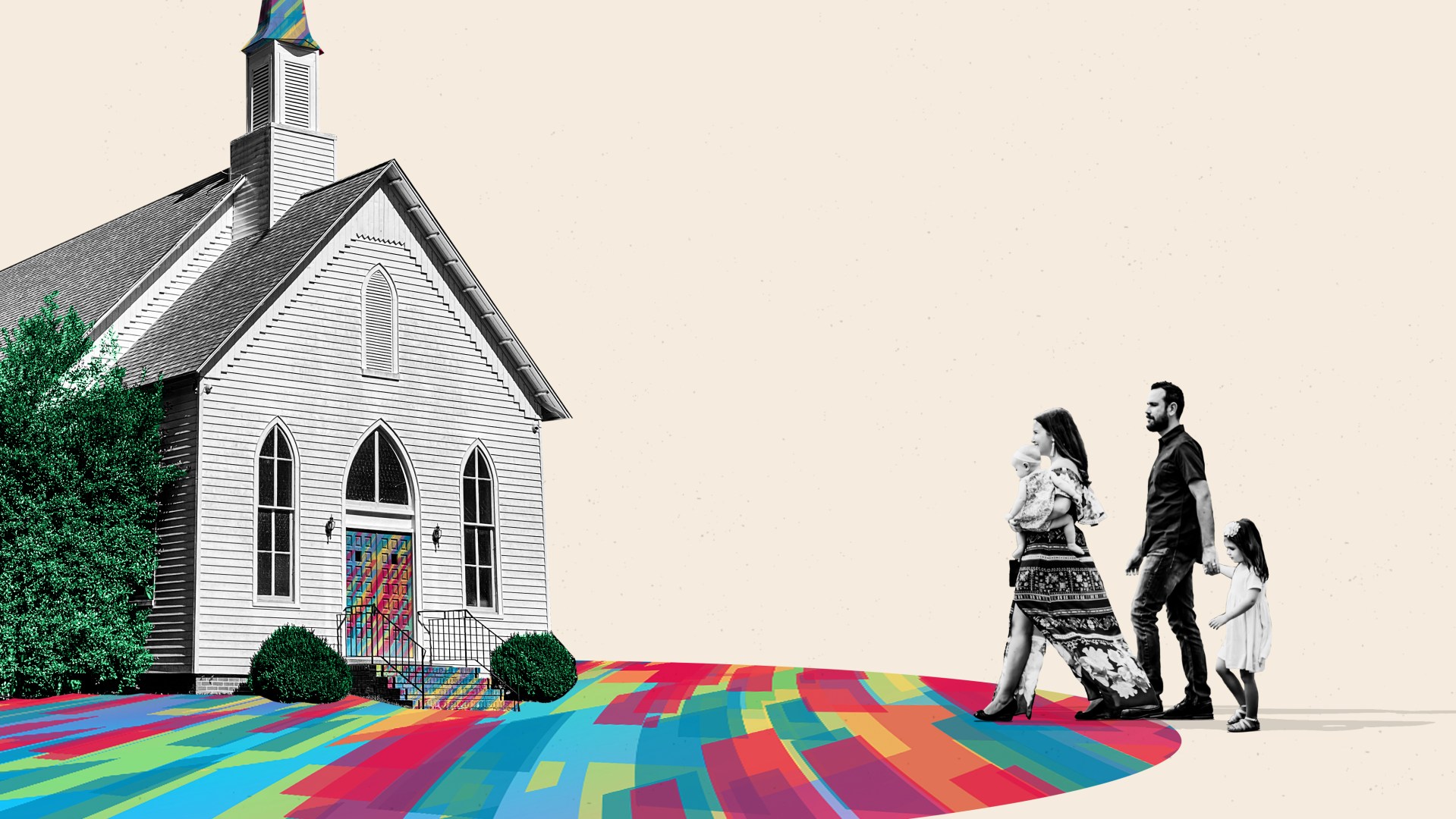
Illustration by Rick Szuecs / Source images: Gene Gallin / Christin Hume / Unsplash

Since last year, COVID-19 has asked all of us to adapt in myriad ways. As we begin to emerge from pandemic precautions, the pull to return to normalcy will be strong. Simultaneously, we will assess what we have learned: What practices do we want to maintain? For young Christian families, one pandemic practice in particular promises a huge discipleship yield.

Like other families, the Wilkins turned to jigsaw puzzles to fill our unexpected hours of togetherness. In March 2020, it wasn’t just toilet paper that ran scarce. There was also a shortage of—of all things—1,000-piece puzzles. With puzzle-hoarding running rampant on Amazon, I finally committed to ordering one from a print-on-demand website. When it arrived, it was indeed a 1,000-piece puzzle … but each piece was about the size of a dime. You know what you need in lockdown? More ways to be short-tempered and frustrated.

That being said, one habit I hope our family will preserve post-pandemic is working on (normal-sized) puzzles together. With regard to the continuous puzzle that is discipling our children, COVID-19 delivered a full-sized, clear picture of a key way to do so, through the unexpected means of Sunday services streamed into our living rooms.

For many young families, the coronavirus lockdown was their first time to worship together consistently through all elements of “big church,” rather than follow a common pattern of kids attending children’s programing while adults attend the weekly gathering.

At my own church, as soon as we began streaming services, kids began asking about baptism and the Lord’s Supper at unprecedented rates. Many had never seen them. In living rooms everywhere, children prayed communal prayers, listened to the Word proclaimed, heard testimonies, and joined their voices in song—with their parents.

Like my tiny jigsaw puzzle, these family worship gatherings were not without frustration. Children may have squirmed, consumed copious snacks, or run circles around the living room, but something priceless was happening: Families were living out the words of Psalm 34:3: “Glorify the Lord with me; let us exalt his name together” (emphasis added).

Observant parents who might have assumed “My child won’t really get anything out of the service” learned this was, in fact, profoundly not true. Because there is no replacement for children watching their parents model worship. Because children have a right to witness and learn from the ordinances of the church. Because children are not the church of tomorrow; they are the church of today.

I’m a big fan of children’s ministry. I think it’s invaluable. I’m paid by my church to think about it in good ways. But let me be clear: While children’s church is a wonderful supplement to big church, it is a terrible substitute.

A child old enough for kindergarten can be welcomed into big church with a little loving guidance from a parent determined to disciple. If it is true that “more is caught than taught,” parents should value modeling worship for their children more than any lesson taught by a children’s church leader.

In one sense, COVID-19 invited the smaller members of the church of today to worship exactly where they belong: with the rest of the church. I seem to recall someone else doing a similar thing, to the confusion of his disciples.

On the other side of the pandemic, I hope never again to find the shelves bare of toilet paper. Or puzzles. Or Extra Toasty Cheez-Its, as long as we’re making a list. But I hope the puzzle pieces that fell into place around shared family worship will be saved and deepened. In returning to normal, I hope we won’t preserve a pre-COVID practice that perhaps wasn’t as great as it seemed.

I hope more families will bring school-aged kids to the gathering that is big church, in addition to sending them to the blessing that is children’s church. For families, the “with me” of worship matters. Let the little children come—even if they wiggle and whisper. They are the missing pieces that complete the picture of the church as God’s family. Let them be formed in the house of the Lord.

Ideas

Back Without a Bang: Returning to Church Won’t Be the Celebration We Once Imagined

Contributor

Instead of a big party, reopenings bring mixed emotions and a call to everyday faithfulness.

Illustration by Dan Bejar

When COVID-19 shutdowns began in 2020, many pastors thought it would mean missing out on a couple of Sundays. Even in those early weeks of the pandemic, we longed to be off our couches and back in our familiar sanctuaries for worship. We imagined hugging everyone, worshiping shoulder to shoulder, walking forward for Communion, and lingering for small talk.

We know how the rest of this story goes. The pandemic extended month after month. By 2021, most Protestant churches in the United States were meeting either at a significantly reduced capacity or not at all.

Thanks to vaccines and falling infection rates, things are changing. This spring and summer, more churches will move from meeting virtually to meeting in person, from outside to inside, from sparse gatherings to fuller ones. God willing, we’ll get to a place where we can meet on Sunday mornings without the risk of spreading the virus that has dominated our lives.

But the odds are that our return won’t look like the crowded reunions we once imagined. When churches reopen, there will still be precautions, and families will come back gradually, depending on their own health concerns and consciences.

We’ll also be faced with our own mixed emotions. When my church started offering small, adapted worship gatherings last year, the first song we sang together was “Joy to the World.” I couldn’t hear anyone else, our voices muffled by masks and distance, but I felt the Spirit among us. I cried immediately. I’ve never felt anything like it. It was triumph and heartache at once.

Returning to the rhythms of worship prompts us to remember the Sundays and holidays we missed. Part of celebrating finally being together is grieving the time we spent apart.

In a body “not made up of one part but of many” (1 Cor. 12:14), we notice those who aren’t around. The empty seats are reminders of the members who haven’t returned, who left the church during the pandemic, or who passed away.

Public health experts disagree on what metrics will tell us the pandemic is over, and there’s definitely no consensus among church leaders—or even within a congregation—on when we’re in the clear. Even so, many of us will be waiting for a signal that this season of our spiritual lives has come to a close, so that a new one can begin.

David Kinnaman, who has researched faith trends around COVID-19 as president of Barna Group, worries that a year of social distancing will lead to emotional distancing.

“There will be ways in which church leaders think they’re making a bigger impact because people showed back up at the building, but people’s hearts and minds won’t be persuaded fully,” he told me, as if he knew that I myself had been zoning out on Sundays. “They’re going to be hanging back, not going to sign up, not going to volunteer, not going to give at the same level.”

Surveys suggest that even devoted people of faith will face lingering spiritual challenges. Online church viewership was spotty among casual and committed Christians alike. Daily Bible reading dropped last year as soon as people stopped connecting with their church communities. More than half of churchgoing Christians said they had not checked in with others from their congregation during the pandemic.

Just as there will likely be no giant celebration marking our open church doors, there may not be a sign beckoning us to return to serving the body. We may feel more weariness than revival. But God can prompt us in our recovery. It will be his hand that leads us, openhearted, back into the communities that we need and that need us.

Jesus himself never had a launch party for any of his ministry efforts. Instead, his invitations came inconveniently and in the midst of everyday activities: “Follow me.”

The formation of Christ’s church on Pentecost in Acts is probably the flashiest demonstration of God’s call—amazing thousands with the “sound like the blowing of a violent wind” and “tongues of fire” resting on his followers (2:2–3).

But in John, the Spirit comes upon the disciples with much less fanfare. Jesus “breathed on them and said, ‘Receive the Holy Spirit’” (20:22). With that, the early disciples were sent to spread God’s Word and build the church.

We now have the task of rebuilding our embodied fellowship after more than a year spent at a distance. When it comes time for us to return, let us not just fill our old seats and go through the motions, but rather minister to, care for, and pray for one another. Let us resume our places in the body knowing that the Spirit of Pentecost is within us, and maybe we’ll one day be close enough to exhale together again.

Kate Shellnutt is senior news editor at Christianity Today.

Reply All

Responses to our March issue.

The Multiethnic Church Movement Hasn’t Lived up to Its Promise

We are a part of a multiethnic network that has 12 sovereign churches using our building. They are immigrant/refugee congregations. Over the past several years, we have seen them form into a body of believers resourcing each other, encouraging each other, and blessing the former “white” church with their presence. Although racism has been displayed, the network’s unity has been the key to being able to challenge existing power structures.

Ray Smith Salt Lake City, UT

Paul’s Letter to a Prejudiced Church

We white Christians often breeze over the problems of bringing Jews and Gentiles together in one church—like all it takes is a little love and tolerance. Is it a matter of creating a “new” culture out of two or three native cultures? I don’t think so. The process has to be a slow, open-minded learning process with an open exchange of cultural ideas leading toward a deeper understanding. Further, I think that because we in the white church have developed attitudes of superiority, the largest changes in perception might well have to come from white people willing to give up some of that privilege in order to learn.

Jack Scott Batavia, IL

Why the Children of Immigrants Are Returning to Their Religious Roots

I went to a majority white church to heal and be fed spiritually at a different level, but I still often feel like I don’t quite fit in. I still praise God with clapping and shouting “Hallelujah,” but it feels lonely, even discouraging, when you’re the only one. I’m always glad when our Indian ministry partner visits, because him being up front encouraging an interactive and responsive worship experience makes me feel less alone.

Yessenia Garcia (Facebook)

The Premature Victory of a Vacant Cross

Deep appreciation for Daniel Harrell’s thoughtful piece on the centrality of the cross of Jesus Christ in this particular Lenten season when the sins of nationalism, American exceptionalism, and white supremacy “cling so closely.” Thank you for such a timely and courageous editorial.

B. Hunter Farrell Pittsburgh, PA

Scriptural Meditation Promises Something Better than Zen

Jen Wilkin’s beautiful description of Christian meditation is a practice I would call prayerful study. I reserve the term Christian meditation for a more inward place, a place that may precede or follow the practice Jen describes. I experienced it at four when the sight of a huge spiderweb weighted with dew, each droplet a prism of the morning sun, stopped my breath and overwhelmed me with my first awareness of his presence. Every morning I sit in that silence.

David Donaldson Golden, CO

Jesus tells us that there are two “great and foremost commandment[s]” (Matt. 22:3, NASB). One is found in Deuteronomy 6:4–7. “Rumination begets illumination,” the wonderful quote from Jen Wilkin, distills the fruit of that command. She obviously has the gift of teaching, and my appreciation.

Paul Smith Sagle, ID

Pray to God for Protection. Then Praise Him for Your Mask.

I figure God gave us experts to aid us along our journey. Doctors, teachers, pastors, and friends.

JoEllen Huneryager Myers (Facebook)

Replanting Can Work. A Church Just Has to Die and Rise Again.

Your piece is an example of everything I love about a good CT article: a detailed picture of how the church is lovely because Jesus loves his church. As a writer, I particularly enjoyed how you weaved phrases from Scripture throughout the piece to really give it the “feel” of church. I could hear Linda and Debbie talking as I read it; they sound like such fun storytellers! It was a really timely reminder of how God remains faithful to us throughout the journey of learning to follow him.

Meagan Gillmore Toronto, Ontario

When Violent Nationalism Backfired for God’s People

The article was weakened by a poorly developed—and in my view, suspect—interpretation of Jesus’ cleansing of the temple. Bird proposes that the object of Jesus’ anger was not the commercialization of temple worship, rather that the temple “had become an emblem of Jewish resistance against Rome.” So why did Jesus’ attack focus on those selling and changing money? Don’t Jesus’ words suggest he is angry about profiteering?

Charles Kankelborg Bozeman, MT

What is missing in this article is an explanation of Luke 22:36–38. Unfortunately, there would be those who crashed into the Capitol defending their actions by Jesus’ words in this passage.

Ron Berg Carbon, Alberta

What the Heavens Declared to a Young Astronomer

The testimonies at the end of each issue are the icing on the cake! Diverse, encouraging, and beautiful to read the ways God brings people to himself.

@MeganHobbit

Ideas

Log Off and Know that I Am God

Contributor

With all our faith talk online, we’re in danger of losing sight of the Lord himself.

Anastasiia Shavshyna / Getty / Edits Rick Szuecs

If an alien life form visited Earth to learn about the American church and only read so-called Christian Twitter, I’m not sure they would have any idea that we believe in something called the Incarnation, or the Resurrection, or the Ascension. They would, however, know a lot about evangelical voting tendencies, the women’s ordination debate, abortion politics, and whatever controversy is currently trending.

Our habitual online discourse often trains us to undervalue the vast mystery of God—with all the wonder and worship it inspires—by immersing ourselves in sociological and theological commentary and debate. These conversations matter, of course. But we are in peril of replacing transcendence with immanence. We miss the deeper things of God for the Christian controversy du jour.

There’s a term for this temptation that I’ve only heard among priests: “altar burn.” It refers to a particular hazard of our trade. Pastors regularly handle sacred things—chalices and consecrated bread, but also the Scriptures and the tender moments of people’s lives.

There is an inherent danger in this frequent exposure. We come to treat sacred things profanely. We regard holy things too cavalierly. Amid the noise of a mundane workweek, we forget the complete miracle we are proclaiming.

Resisting altar burn used to be the special struggle of people who regularly preach, teach, and lead congregations. But now, anyone with a keyboard can speak, teach, or argue about God every day, sunup to sundown.

With this newfound ability, we’re all at risk of collective altar burn. The transcendent and utterly overwhelming triune God becomes flattened to a sociological or theological abstraction. Many of us spend far more time on social media than in gathered worship, and that digital space often hinders true repentance, contemplation, or prayer.

It is harder to approach God as the mysterious creator of the Crab Nebula, sustainer of every minute, and redeemer of the cosmos when we’ve spent hours reading the words of strangers arguing with other strangers about spiritual things.

Taken up daily, these activities yield a type of God-talk burnout where we lose sight of what is most unspeakable and most powerful about our Creator. Robust notions of truth, beauty, and goodness thin in our imaginations.

So what is the solution to altar burn? It requires us to re-engage the sacredness, the weirdness, the astonishing wonder of God. It requires silence, stillness, worship, and repentance. It requires speaking of God less and seeking God more.

But how? Social media is here to stay. Nonetheless, we have to learn to retreat—not away from discussions of faith but into those older, slower forms of spiritual conversation with real people and with long books. We have to take up practices of solitude, fasting, gathered worship, and the sacraments—those embodied habits that resist being subsumed by technology. And we need whole topologies of spiritual terrain in our life that we never discuss online—parts of ourselves that we keep for God and our embodied communities alone.

Above all, we need to be aware of the trivializing tendencies of the media we engage with. There is no neutral medium. Technological habits beget our spiritual formation, which beget our devotion and doxology.

“When the door of the steam baths is continually left open, the heat inside rapidly escapes through it,” wrote fifth-century ascetic Diadochus of Photiki. “Likewise the soul, in its desire to say many things, dissipates its remembrance of God through the door of speech.”

Christians now have an opportunity to keep the “door of speech” constantly open. We dissipate our remembrance of God, even as things of faith are ready at our lips—or rather our keyboards.

Although the application is different, the wisdom of Diadochus still stands. He advised believers to “shun verbosity” for “timely silence,” which is “nothing less than the mother of the wisest thoughts.”

Learning “timely silence” is a countercultural act, especially when there are good things to say and an ever-ready medium demanding that we say them. But if we don’t resist its demands, our talk of God will slowly replace the worship he alone is due.

Ideas

Sometimes You Have to Shake the Dust Off Your Feet

Columnist

Walking out is a way of responding to institutional toxicity.

Renan Lima / Pexels / Edits by Rick Szuecs

One of the most frustrating—but ultimately liberating—experiences during my three decades of pastoral ministry was resigning from a predominately white urban church in a largely African American city. Many of the hundreds of attendees appreciated my ministry as a preacher, teacher, leader, musician, husband, and father. Yet there was an influential minority of suburbanites—swayed by issues related to race and socioeconomics—whose opposition undermined my leadership.

My oldest child, remembering the challenges of being a young African American man in that church, has often said, “Dad, you need to write a book and name names!” My son knows I tried to live out a genuine multiethnic ministry despite its recently critiqued hardships.

I resisted writing a cathartic, “tell-all” book, but in my mentoring of young pastors, I did try, like Paul, to share the gospel as well as my life (1 Thess. 2:8). Resigning as a pastor from that church was a painful leap of faith. I did not have another position lined up. But being unemployed was better than being minimized and demoralized.

A significant recent exodus from the Southern Baptist Convention has included high-profile figures like Beth Moore and Charlie Dates’s Progressive Baptist Church. Jemar Tisby’s story, which he recently shared in an interview detailing his exit from white evangelical spaces, resonated with Christians of color and women who risked bringing their whole selves to Christian organizations that claimed to value diversity, then got pummeled by the realities of life within white supremacist patriarchies.

All departures are hard, yet all have life-giving potential. Those who leave often find eventual invigoration through renewed vision, fresh insights, and recovery of their voice and personhood. The organizations left behind have the potential to learn important lessons too.

Some Christian institutions will defend their reputations by appealing to Scriptures that condemn false teaching (such as Jude v. 4). Their intent is to discredit those who leave. Such condemnation is unhelpful and often inaccurate. People like me who left didn’t do so because we embraced historically heretical ideas. We left because the institution was toxic.

After preaching in a predominately white church, I found out that the leaders who prayed for me shared racist jokes before I arrived. I voiced my concerns to denominational leaders, but they denied any existence of racism and got upset with me for even suggesting the idea. I shook their dust off my feet and moved on (Mark 6:11).

Leaving can be a prophetic act that outs institutional toxicity. Jeremiah famously stood outside Jerusalem’s temple, at its gates, crying out for repentance and reformation (Jer. 7:1–3). He risked telling the truth to get God’s people back on the right track. He indicted a toxic temple system as a cover for injustice: “Has this house, which bears my Name, become a den of robbers to you?” (v. 11).

Pay attention to the wounded faithful who exit. Their words may be the word of the Lord.

Jesus reran Jeremiah as he upended the moneychangers’ tables (Matt. 21:13). Old Testament scholar Walter Brueggemann observes, “The temple and its royal liturgy are exposed as tools of social control, which in a time of crisis will not keep their grand promises. The temple is shown to be not an embodiment of transcendence, but simply an arena for social manipulation.”

Departures don’t happen cavalierly; they come after intense soul-searching and prayer. Institutions must likewise engage in self-examination and confront core values that only devalue. Eloquent statements in white institutions about equity and diversity too often end up tokenizing ethnic minorities. Christian history contains epic moments of reforming dissent. Pay attention to the wounded faithful who exit. Their words may be the word of the Lord.

Perhaps one day I will write that memoir, highlighting my struggle to find an ecclesial home. I’ve learned to trust my own dissenting voice, mustering the courage to rage against institutional injustice. I pray those who confess allegiance to Jesus will muster the courage to listen to the leavers and face up to their own sins. Just as it takes agitation to clean clothes, it takes the agitation of prophets to clean up institutions.

Theology

How We Got to the Equality Act

The LGBT movement was shaped by the animosity of populist evangelical rhetoric and tactics.

Illustration by Rick Szuecs / Source Images: Bettmann / Contributor / Getty / Associated Press

Over the past decade, significant pillars of the evangelical community have wavered in their convictions about marriage and human sexuality. In 2014, World Vision announced it would hire Christians in same-sex relationships—only to reverse course after a backlash threatened donations.

Things have gone differently for Bethany Christian Services, one of the country’s leading adoption providers, which recently disclosed its plan to place children with same-sex couples. While the organization stressed that “discussions about doctrine are important,” the decision effectively severs a Christian doctrine of marriage from the practice of adoption.

Conservative evangelicals have reacted by trying to purify the ranks of the faithful. In 2017, the Nashville Statement, put out by the Council on Biblical Manhood and Womanhood, responded to weakening evangelical adherence to Christian teachings on sexuality. The ill-fated effort did little to build evangelicals’ confidence that their witness on sexual ethics would be simultaneously orthodox and also welcoming toward LGBT individuals.

Nonetheless, there is reason to be seriously concerned about the future of evangelical communities in an increasingly post-Christian America. The Supreme Court’s decisions in Obergefell v. Hodges, which legalized and legitimized same-sex marriage, and Bostock v. Clayton County, which extended nondiscrimination protections to LGBT individuals, have ratified the long reshaping of America’s norms on marriage and sexuality.

They have also raised serious questions about the rights of faith communities. Despite enjoying unprecedented access to the White House during the Trump administration, evangelicals secured few religious liberty wins. For example, the First Amendment Defense Act, championed by conservatives as a robust form of protection, never made it out of committee, despite a united Republican Congress. President Trump himself said it was a “great honor” to be called the most pro-gay president ever, and the First Lady publicly endorsed gay and lesbian equality.

Earlier this year, the Equality Act introduced yet another hurdle for orthodox Christians. The bill—which in February passed the first stage of becoming law—would have wide-ranging implications for Christians. Most notably, it would throttle religious liberty protections for Christians who dissent from the emerging regime of LGBT rights.

The Equality Act is unlikely to pass the Senate. (Its outcome is yet unknown at the time of publication.) But even if it doesn’t, the bill carries symbolic and cultural significance. As an inflection point in the life of our nation, we should be unnerved and also chastened by it. The headwinds against socially conservative positions on marriage and religious liberty are stronger than ever.

Evangelicals should unequivocally oppose bills of this nature (and there will be more). But we should accompany those noes with a good-faith effort to live together as fellow democratic citizens with LGBT individuals. One way to do that is by helping to secure nondiscrimination protections for them that simultaneously offer substantive religious liberty protections.

The headwinds against socially conservative positions on marriage and religious liberty are now stronger than ever.

Congressman Chris Stewart recently re-introduced one such bill: Fairness for All, which attempts to expand LGBT rights while preserving religious exemptions. The legislation is imperfect, but it offers Americans a potential way out of the zero-sum game that conservatives and LGBT activists have been locked in for the past 40 years.

Talk of compromise is perilous, of course. Progressives often express open hostility toward conservative Christians. Evangelical activists have also seen those on the Left engage in a disingenuous “dialogue” that effectively aims at changing the church’s teaching on human sexuality.

Given progressives’ disinterest in accommodating religious believers, we have reason to dismiss efforts like Fairness for All. But we might want to reconsider some of the underlying reasons for our aversion to efforts like it. Though conservatives often decry the “victimhood” logic of identity politics, we have at times practiced our own form of it: While denouncing our progressive oppressors, we maintain a powerful narrative about our own moral purity in the sex and marriage culture wars.

Yet the story is more complicated, especially as we look back to the height of the sexual revolution. By adopting a perfectionist, populist politics that often demeaned and disrespected our LGBT neighbors, we evangelicals helped create the conditions for our social marginalization.

Getting behind this history in order to understand the origins of our particular social moment does not mean compromising fidelity to Scripture on sex and marriage. If anything, this diagnostic work is necessary to understand how Scripture might inform our responsibilities to our LGBT neighbors here and now.

As an evangelical theologian, I affirm without hesitation that marriage is between a man and a woman, that biological sex should inform a person’s “gender identity,” and that surgical or chemical efforts to alter a person’s sex are an illegitimate and unmedical means of responding to social or psychological challenges.

Yet as citizens living in a pluralist society, we cannot draw a straight line from these convictions to political judgments. For evangelicals, that means we should undertake the task of understanding where LGBT hostility comes from and what legitimacy it may or may not have.

Only by coming to terms with our own history of engagement on these issues will we be able to speak confidently again about the politics of sex, instead of allowing fear to inflect our speech. An evangelical witness on these issues must still sound like good news. In that sense, it must be marked by mercy. It is bitterly ironic that, having failed for so many years to practice the preeminent virtue of a democratic society, conservative evangelicals now stand in need of it.

The way toward retrieving it, both for ourselves and for the society in which we live, lies through the tangled path of history that brought us to this juncture.

America’s culture war over sexuality exploded in Miami. In 1977, Anita Bryant campaigned against the city’s recently passed nondiscrimination ordinance. Bryant, a beauty contest winner and a Top-40 singer, was the face of the Florida Citrus Commission.

In the years prior, an increasingly confident gay liberation movement had successfully passed nondiscrimination ordinances across the country. But Bryant’s opposition campaign was successful. While concerns about the ordinance’s lack of religious liberty protections buoyed her effort, Bryant’s rhetoric about the threat gay people ostensibly posed to children was the campaign’s lasting legacy. Her victory quickly became a crusade. She established Save Our Children, an organization aimed at restricting LGBT rights, and promised to do for the country what she had done in Miami.

Bryant’s nationalization of her campaign, though, came with collateral damage. Only months after Bryant’s victory, Christianity Today asked Billy Graham about her. His answer was circumspect. While praising her courage and lauding her for “emphasizing that God loves the homosexual,” Graham also suggested that he would not have said “some things she and her associates said … in the same way.”

Graham added that, while he saw his vocation as focused on preaching the gospel, he “was also fearful that her campaign might galvanize and bring out into the open homosexuality throughout the country, so that homosexuals would end up in a stronger position.”

Graham was proved right. Emboldened by successes in overturning nondiscrimination ordinances across the country, conservatives soon overreached. Those actions further intensified the LGBT movement and motivated its fundraising and organizing.

In 1978, for example, California legislator John Briggs proposed a ballot initiative in that state that would have required schools to fire LGBT teachers. Despite favorable polling at the start of the campaign, the initiative failed by over a million votes, as California residents came to realize how punitive it was.

The measure also galvanized the LGBT community. As Tina Fetner argues in How the Religious Right Shaped Lesbian and Gay Activism, Bryant and Briggs inadvertently reinvigorated what had been an increasingly dormant movement, giving it a more militant and oppositional edge than it had previously. Activists personalized the issue for the first time: Openly gay politician Harvey Milk encouraged people to come out of the closet to their friends and neighbors, reshaping public opinion about the challenges they faced.

The template for the culture wars had been more or less set. Conservatives would make inflammatory appeals to populist, anti-LGBT sentiments, in turn fueling opposition.

These dynamics were solidified when the conflict came to Colorado in 1992. Evangelicals concerned about nondiscrimination ordinances in Denver and Boulder followed the same playbook by pursuing Amendment 2, which was supposed to prevent Colorado cities from enacting nondiscrimination ordinances.

While fighting for the amendment, social conservatives distributed 100,000 pamphlets across the state. Written by psychologist Paul Cameron, they emphasized, among other things, that gay men ingest fecal matter in their sexual practices. The television campaign intentionally presented the most flamboyant, non-bourgeois depictions of gay pride parades—ostensibly to show the “reality” of the LGBT movement, but in effect to generate fear.

When Denver television stations declined to play the ads, organizers denounced media bias. The tactic worked. On the night Bill Clinton was elected, Amendment 2 shocked Colorado residents by passing 53 percent to 47 percent. Some 16 years later, California voters reenacted a nearly identical pattern when—after a tumultuous fight—they simultaneously prohibited gay marriage with Proposition 8 and made Barack Obama president.

However, no moment was so discrediting for evangelicals as Colorado’s Amendment 2—in part because the legacy of its rhetoric swallowed up conservatives’ reasonable arguments. Evangelical populism has long faced this dilemma: Careful arguments don’t move votes, but the extremist rhetoric necessary to win tends toward disrespect and also generates a backlash.

Amendment 2’s success in Colorado typified this problem. For one, the animus that conservatives showed toward LGBT people shaped tech entrepreneur Tim Gill, who in response began to devote his vast fortune to the expansion of LGBT rights. In the years to come, his strategic contributions would make him one of the country’s most influential figures in sexual politics.

Moreover, prominent academics became embroiled in Amendment 2’s subsequent legal dispute, which undermined trust and effectively ended any chances of an elite-level consensus on these questions.

Amendment 2’s drafters insisted that its text required no moral judgment about homosexuality. Yet the case hinged upon the question of whether same-sex sexual activity is reasonable. Legal philosophers Robert George and John Finnis gave one reading of the Western philosophical tradition, while philosopher Martha Nussbaum gave another. The debate ended in acrimony and even included accusations of perjury.

George and Nussbaum would go on to effectively set the terms of the debate. While George continued to make the case for traditional sexual ethics, Nussbaum argued that positions like his were probably rationalizations for animus. Nussbaum would eventually win, both in the courts and the culture. The case went to the Supreme Court as Romer v. Evans, giving gay rights supporters their first victory at the Supreme Court and setting the trajectory for all that would follow.

While most evangelicals sought to treat their neighbors with respect, some of their institutions and leaders failed to expunge the dehumanizing rhetoric as they ought to have done. In 2012, for instance, the Family Research Council (FRC) gave an award to pastor Ron Baity for his efforts on Amendment 1 in North Carolina, which prohibited the state from recognizing gay marriages.

When video was discovered showing Baity had compared gay people to maggots, the FRC argued that he was given the award not for his “misstatements” but for “his example of standing for the truth and for his 42 years of ministry.”

From the outside, it was easy to believe that social conservatives tolerated degrading sentiments toward the LGBT community up until those calloused words became a political liability. But even then, the people responsible—like Cameron or Baity—were often quietly sidelined rather than actively repudiated.

The story that evangelicals are (merely) victims of progressive aggressors not only fails to account for the ways in which the LGBT movement was shaped by populist evangelical rhetoric and tactics. It also forgets that the gay liberation movement was a direct response to the systemic and pervasive exclusion of lesbian and gay individuals from the structures of our public life—including from America itself. Perfectionism in politics breeds radicalism in response.

Again, the current shape of the progressive LGBT community cannot be understood without acknowledging the background against which it was formed. While this context has been almost totally forgotten by both evangelical and progressive activists, it was recounted most recently by none other than conservative Supreme Court Justice Samuel Alito.

In his dissent to the expansion of LGBT protections in Bostock, Alito cited a striking litany of past exclusions. In the 1940s and ’50s, gays and lesbians who worked in government were not given security clearances. They were barred from being teachers in some states and also faced the risk of losing their licenses to be doctors, lawyers, or even beauticians for engaging in same-sex sex acts.

They were even denied entry to the country by the Immigration and Nationality Act of 1952 because they were alleged to have been “afflicted with psychopathic personality.” “To its credit,” Alito concluded, “our society has now come to recognize the injustice of past practices.”

Ironically, though, the pathologization of homosexuality used to justify these mid-century restrictions cleared the ground for both the assertion of “gay pride” on the one side and the failings of the “ex-gay spokesmen” on the other. As historian Heather White has argued, pathologizing homosexuality made it central to a person’s character and identity. That move eclipsed any distinction between the act and the person, or the sin and the sinner, which many evangelicals would later try to retrieve. But it also meant that gay people were forced to choose between the shame of being irremediably disordered and the pride of embracing their identity.

Not surprisingly, many chose the latter. The now-outdated slogan “born this way” inverts the therapeutic pathologization of homosexuality, even while sanctioning it with the authority of nature. Rather than disentangling their opposition to same-sex unions from this therapeutic framework, conservative evangelicals openly embraced it. Focus on the Family and other organizations employed “ex-gay” spokespeople to counteract the emerging narrative that homosexuality was both innate and fixed.

But they failed to recognize that ex-gay individuals who made “liberation from homosexuality” their vocation continued to be defined by it. A series of spectacular hypocrisies followed, undermining the movement’s credibility and further eroding the Religious Right’s political power.

Where should today’s evangelicals go from here? One possibility would be the path we did not take, which was originally hinted at by the first editor of this magazine, Carl F. H. Henry, in October of 1980. In an essay reflecting on the emerging Religious Right, Henry welcomes the “resurgent evangelical interest in politics” but worries that this involvement “may eventually become as politically misguided as was the activism of liberal Christianity earlier in this century.” In Henry’s view, the Religious Right’s “social vision is fragmentary, often lacks substance and strategy, and focuses mainly on a one-issue or single-candidate approach.”

A broader social vision, Henry thought, would help evangelicals avoid being reduced to a special-interest group and ensure they focus on those “concerns that transcend self-interest and coincide with universal human rights and duties.”

Henry suggests that the “primacy of the family as a lifelong monogamous union” is one point of evangelical emphasis. Henry infers from this that “legislation should benefit family structures, not penalize them” and that legislation should “preserve the civil rights of all, including homosexuals, but not approve and advance immoral lifestyles” (emphasis added).

Evangelicals once argued that nondiscrimination protections for LGBT people constitute “special rights.” So we should not overread Henry’s caveat. Yet while he often issued jeremiads about the decadence of secular culture, he was just as likely to argue that evangelicals were complicit in American cultural decay. And his denunciations of sexual degradation rarely—if ever—singled out LGBT people for special attention.

While Henry was emphatic about evangelicals’ need for a “social ethic” and for political action, he argued that “evangelical leadership in this reach for political influence and power” missed the “extent to which American evangelicalism was being swamped by the very culture that it sought to alter.” His relative lack of attention to the question of what we now call LGBT rights is indicative of the breadth of his concern: He saw that the fundamental challenges facing America could not be pinned on one group and that evangelicals themselves were hardly exempt from them.

Retrieving such a stance might help faithful LGBT Christians feel more at home in the church. As we evangelicals fought political battles over sexuality, we heightened the contrasts between the two worlds and in so doing ignored people in our own congregations who wrestle with their sexual desires and gender identity. This approach also intensified anxieties about faithful LGBT people in our midst and often alienated those whom we sought to help. As Tanya Erzen notes in Straight to Jesus, her careful depiction of an ex-gay ministry, participants often distanced themselves from the politics of the ex-gay movement.

While the ground has now shifted beneath evangelicals’ feet, we remain trapped in a heated conflict with a progressive LGBT community that has steadily gained the upper hand. An evangelical politics cannot ignore its own precarious position or be sanguine about the prospect of persuading those who strongly dislike our views. Nor are we permitted to be fatalists about finding common ground.

Evangelicals are people who stress the ongoing and never-ending opportunity for conversion, both for ourselves and for those who oppose us. When we come to Jesus, we confess our sins and live within God’s forgiveness—even if not our adversaries’. The gospel has the power to burst apart the ossified categories that limit our political imaginations. In announcing it, we invite the world to consider that, whatever has happened in the past, we can start anew.

A democratic order cannot survive unless its citizens are willing to accommodate each other. As the evangelical theologian Oliver O’Donovan has written, a “liberal society is marked by a mercy in judgment.” Mercy is the highest of all God’s qualities. It is, as Shakespeare understood, “mightiest in the mightiest,” such that earthly power comes nearest God’s when “mercy seasons justice.”

Mercy is an evangelical virtue. It is grounded ultimately within the free and lavish grace of God, who can forgive debts and sins while suffering no harm or loss. Yet evangelicals’ politics have rarely embodied it. We have often used the law to eradicate vices. We now find ourselves in a position where progressive LGBT activists must decide whether to treat us better than we once treated them by extending recognition through protections that they were once denied.

By adopting a perfectionist, populist politics that often demeaned and disrespected our LGBT neighbors, we evangelicals helped create the conditions for our own social marginalization.

For evangelicals to speak uncompromisingly about the goods of marriage and the integrity of the body, we must face up to our failures to do so in the past. The LGBT community has its own missteps and mistakes to account for. But as any good evangelical knows, denouncing the sins of others does not exonerate one’s own.

Mercy needs reasons, so if social conservatives want to live in a world that accommodates us, we must take responsibility for our own errors. Judgment “begin[s] with God’s household” (1 Pet. 4:17). By honestly recounting our missteps, evangelicals might give progressive LGBT activists a reason to look afresh at our convictions about marriage and the body. We exhibit confidence, not accommodation or weakness, when we forthrightly acknowledge our failures to embody the truths we affirm.

It is of course highly implausible that the progressive LGBT community will respond to such a posture. Trust is only gained over time, and it is special pleading for evangelicals to suddenly discover the goods of pluralism or tolerance. Yet there are still reasons to take that stand and to pursue consensus legislation.

For one, while evangelicals have sometimes over-emphasized the legal approach to transforming society, the law is still a tutor. It shapes a culture, even while representing its mores.

If a community is divided, the law might help foster social peace. The genius of the American constitutional system is that radical factions are moderated when they win representation (rather than being handed judgments by a court). Giving a legislative voice to a consensus effort might relieve the social pressure and hostility that have built up between the two communities.

The progressive LGBT community also has pragmatic reasons to extend mercy, though they may not realize it. For one, they stand on the cusp of repeating the Religious Right’s mistakes by embracing a political perfectionism that would stamp out their opponent. We have already seen glimmers of how a backlash against progressive ideologies might take shape. For instance, J. K. Rowling recently created an international storm by voicing her concerns about transgender ideologies. By contrast, it seems nearly unimaginable that a celebrity of her stature would denounce same-sex unions.

The arguments for gay marriage are easy and appeal to widespread intuitions: “Love is love” is insipid but also disarming. However, the arguments for trans rights run against the grain of widely held intuitions that sex and gender belong together. In that context, aggressive efforts to enshrine these ideologies in law and public policy are more vulnerable to populist revolts.

Additionally, the progressive narrative that history will inevitably culminate in the global triumph of LGBT rights is simply hubris. Pride still goes before a fall, and the international advancement of their movement is by no means inexorable.

Yet we should also pursue consensus legislation because the American experiment is worth preserving. The hostility between social conservatives and the progressive LGBT community for the past 40 years has not yet meaningfully imperiled the stability of our political order. But our society’s reserves of social trust are being depleted. When employment was relatively secure, government seemed to function, and we had meaningful, nonpartisan interactions with our neighbors, our fundamental differences on sexuality could be relatively quarantined. But now, as unrest increases, the stakes go up for reaching a settlement that represents all Americans.

We will face greater challenges in the days to come, and we need to face them together. In her poem “The Hill We Climb,” read at President Joe Biden’s inauguration, Amanda Gorman acknowledged the “force that would shatter our nation rather than share it.”

Yet her stirring call for unity held out hope that division would not be America’s final word.

“If we merge mercy with might,” she said, “and might with right, then love becomes our legacy and change our children’s birthright.” It was a bold endorsement of a virtue long neglected—one in desperate need of retrieval.

Regardless of what happens with the Equality Act and other bills like it, evangelicals still face the more fundamental task of forming communities that bear witness to the goods of marriage and the body in ways that are saturated by faith, hope, and love.

Such a task demands an uncompromising fidelity to Scripture and a deferential humility to the theological inheritance we have received. If, as Carl Henry once thought, we live in the “twilight of a great civilization,” we also live in the unending dawn of Christ’s reign—a dawn that must make our hearts glad, regardless of the threats to our liberties. Only when we embrace the joy of the living God, Jesus Christ, will our commitment to marriage between a man and a woman ring out to the world with a clarity and grace that inclines them to take heed and listen.

Matthew Lee Anderson is an assistant research professor of ethics and theology at Baylor University.

Our May/June Issue: Discerning Good Gossip from Bad

Our sweeping censure of talking behind backs isn’t biblical.

Illustration by Andrea Ucini

In a 1999 interview, Kathleen Norris introduced CT readers to the term “holy gossip,” which she defined as “things I need to know to be a member of the community.” Specifically writing to church communities, the best-selling author celebrated a sort of prying into others’ personal lives that we do in search of ways to offer help and support.

The word gossip, Norris pointed out, is an etymological cousin of godparent. In fact, for centuries, that was its primary meaning in the English language. Even as the term gradually came to refer to certain kinds of information sharing, it was still rooted in ideas of relational intimacy. People within our inner circles are probably more trustworthy stewards of personal details than people without. We tend to make exceptions to this rule—sharing much of ourselves with doctors, lawyers, and counselors, for instance—only when we believe someone’s professional incentives for guarding our secrets compensate for their relational distance from us.

Yet Norris highlighted something important that we have lost in urbanized Western society. There is nothing inherently bad when some parts of our private selves go public. To the contrary, being known is essential to human love and thriving. But our long project to construct autonomous, walled-off lives has left many of us with terribly poor instincts for how to be known. We’re prone to view acquaintances who have special knowledge about us as creepy, even offensive. We swing between bizarre extremes, opting for complete opaqueness in the real world and calculated over-sharing in the online world.

There are still communal cultures—and small towns and sprawling extended families—far less concerned about the lines between what’s my business and what’s everybody’s business. (I have experienced communities abroad where the pastor, noting someone’s Sunday morning absence for the third week in a row, marched the church to the wayward congregant’s front door for a bonus worship service.) But to be healthy, such spaces—and any place where we expect to be more fully known—must assure us that our ordinary human deeds have a half-life, that they will fade into memory over time rather than define us forever. Gossip, then, becomes sinful whenever it robs individuals of this vitally important mercy.

Therein lies the rub today: The pervasive impact of social media has shaken this confidence. As they say, nothing dies on the internet. So in almost every culture, discerning between holy gossip and harmful gossip requires an entirely new conversation. I hope this month’s cover story helps sharpen your discernment, and that in some way it helps our communities recover a measure of the trust they so desperately need.

Andy Olsen is print managing editor of Christianity Today. Follow him on Twitter @AndyROlsen.

News

Gleanings: May 2021

Ashutosh Jaiswal / Pexels

Grave desecration acknowledged

A Georgia county has acknowledged it paved over part of a Black Baptist graveyard during road construction 52 years ago. St. Paul Baptist Church in DeKalb County was pushed out of its historic location by white neighbors in 1930 but maintained a church graveyard. The county built a road over part of it in 1969. DeKalb officials refused to acknowledge the desecration—despite the many letters and protests of a longtime deacon—until it was reported by a local news station. The deacon is asking the county to move 26 bodies, put up a plaque, and construct a fence around the remaining burial grounds.

Muslims can work on churches

The Grand Mufti Shawki Allam issued a fatwa in January allowing Muslim laborers to work on the construction of new churches. The religious ruling overturns previous teaching that building a church violated the Qur’an’s prohibition against helping “sin and rancor.” According to a government council, land has been designated for 10 new churches in Egypt, in addition to the 34 already under construction. The ruling marks a significant step toward Christian toleration in the country. In 2018, the government began allowing churches to be licensed. Since then, 1,800 have registered, including 310 Protestant churches. Another 960 Protestant churches are waiting to be processed.

UN demands reason for church closures

The United Nations Human Rights Council is demanding an explanation for the closures of Protestant churches. More than a dozen churches with the Protestant Church of Algeria have been closed since 2018, and another 49 have been threatened with closure. The association lost its legal status in 2013 after 70 years, and no Protestant church has received a permit in the North African country since 2006. The UN letter demands Algeria explain in detail the reasons for the closures, the process for reopening, and the process for re-registering the association. The World Evangelical Alliance expressed concern about Algeria in February.

Evangelical leader appointed

Thomas Schirrmacher was appointed general secretary of the World Evangelical Alliance starting March 1. Schirrmacher, a moral philosopher, gave an inaugural speech about the definition of evangelical. He said believers from the Brazilian rainforest, where worship services are held in trees, to Malaysia, where churches meet in modern skyscrapers, are not united by culture or politics but by belief in the resurrection of Jesus, empowerment through the Holy Spirit, and the authority of the Bible. Schirrmacher’s top priorities include improving regional relationships and better integration of evangelism and creation care.

Pastor identified in civil war mass grave

Investigators may have located the final resting place of a Protestant pastor executed by fascists during the Spanish Civil War. Atilano Coco, a Reformed Episcopal minister, was the only Protestant leader in the city of Salamanca in 1936, when Francisco Franco took over and the far-right government declared Roman Catholicism the national religion. Coco was accused of “false news propaganda,” arrested, released by the side of a road, and then shot and buried in a mass grave. An estimated 114,000 were killed by Franco’s supporters. Since 2007, the government has been slowly removing Francoist symbols from public spaces, documenting the historic murders, and exhuming and identifying bodies. In that time, Catholicism has declined by 10 percentage points while evangelicalism and “nones” have experienced significant growth.

Putin critic quotes Jesus

Anti-corruption crusader Alexei Navalny praised protestors who turned out to support him after his arrest by quoting Jesus’ statement, “Blessed are those who hunger and thirst for righteousness” (Matt. 5:6). Navalny was poisoned in 2020, probably by Russia’s Federal Security Service, and has been called the man that Vladimir Putin fears most. Navalny said he became a Christian after his son was born, but “I don’t think I could make political capital out of my religious faith—it would just look silly.” Kremlin officials claimed he is “comparing himself to Jesus” and has delusions of grandeur.

New police chief promotes diversity

An evangelical Christian has been named head of the national police for the first time. The appointment of Listyo Sigit Prabowo has been hailed as evidence President Joko Widodo is really committed to religious pluralism in the majority Muslim nation where, only four years ago, a Christian governor was convicted of blasphemy for quoting the Qur’an in a campaign speech. Listyo, a Pentecostal, told parliament he will work to improve the transparency of the police force, promote diversity and respect for minority groups, and curb radicalism.

Christians pay for Jewish immigration

The International Christian Embassy Jerusalem funded the flights of 300 Ethiopians to Israel, helping the government bring more than 2,000 members of the African Jewish diaspora to the country. Aliyah, or Jewish repatriation, is increasingly funded by evangelicals, as Jewish giving declines and a growing number of Christians embrace it as a way to support Israel. According to the Jewish newspaper Forward, donations are even coming from Christian countries with no notable Jewish communities, such as South Korea and Papua New Guinea. The Ethiopia flights cost $1,300 per immigrant.

News

Religious Discrimination Complaints Hit 10-Year Low

Workplace accommodation issues persist for Apostolic Pentecostals, Jehovah’s Witnesses, Muslims, and others.

Mario Gogh / Unsplash

Malinda Babineaux never wears pants. As an Apostolic Pentecostal woman who believes she should always be modest and feminine, she wears a scrub dress or skirt when she goes to work as a prison nurse. It’s unusual, but it has never gotten in the way of her doing her job.

She explained this to her new employers when she was hired by Wellpath LLC to provide health care at an Immigration and Customs Enforcement detention center in downtown San Antonio. Wellpath then rescinded its offer to Babineaux, despite the legal rules about religious accommodation.

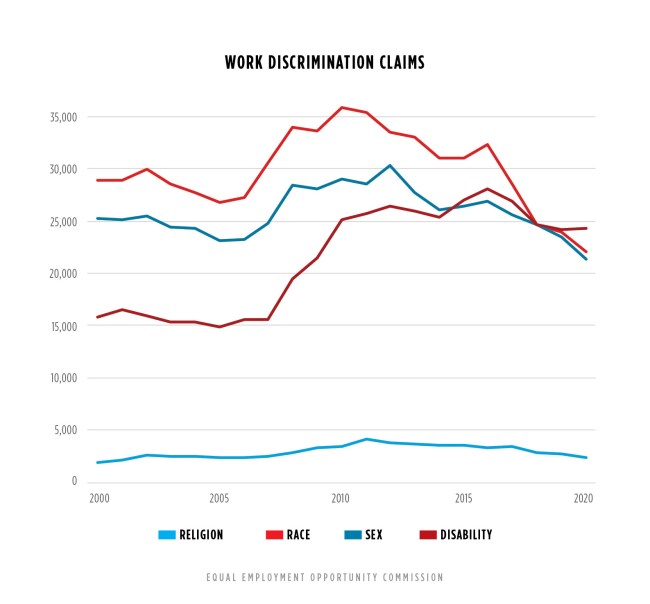
The 46-year-old nurse is one of 2,404 people who filed religious discrimination complaints against employers in 2020, according to recent statistics from the Equal Employment Opportunity Commission (EEOC).

The total number of religious discrimination complaints has declined by about 42 percent since its high-water mark in 2011, with cases decreasing under two commission chairs appointed by Barack Obama and continuing to decline under two chairs appointed by Donald Trump. The money awarded to people who suffered religious discrimination at work has dropped by more than half.

Other forms of discrimination are much more prevalent in the American workplace, according to the EEOC records. The government receives tens of thousands of complaints about discrimination based on race, sex, age, or disability. For those who lose work, though, the protection of the federal agency is critical.

Last year, the EEOC filed lawsuits against the employers of 103 religious people: Jehovah’s Witnesses, Orthodox and Messianic Jews, Muslims, Seventh-day Adventists, and a few Pentecostals, including Babineaux.

addApple PodcastsDown ArrowDown ArrowDown Arrowarrow_left_altLeft ArrowLeft ArrowRight ArrowRight ArrowRight Arrowarrow_up_altUp ArrowUp ArrowAvailable at Amazoncaret-downCloseCloseellipseEmailEmailExpandExpandExternalExternalFacebookfacebook-squarefolderGiftGiftGooglegoogleGoogle KeephamburgerInstagraminstagram-squareLinkLinklinkedin-squareListenListenListenChristianity TodayCT Creative Studio Logologo_orgMegaphoneMenuMenupausePinterestPlayPlayPocketPodcastprintremoveRSSRSSSaveSavesaveSearchSearchsearchSpotifyStitcherTelegramTable of ContentsTable of Contentstwitter-squareWhatsAppXYouTubeYouTube