News

How Seven Soldiers Carried One Bible into 11 Combat Tours

A gift from the Gideons was a good luck charm—and then something more.

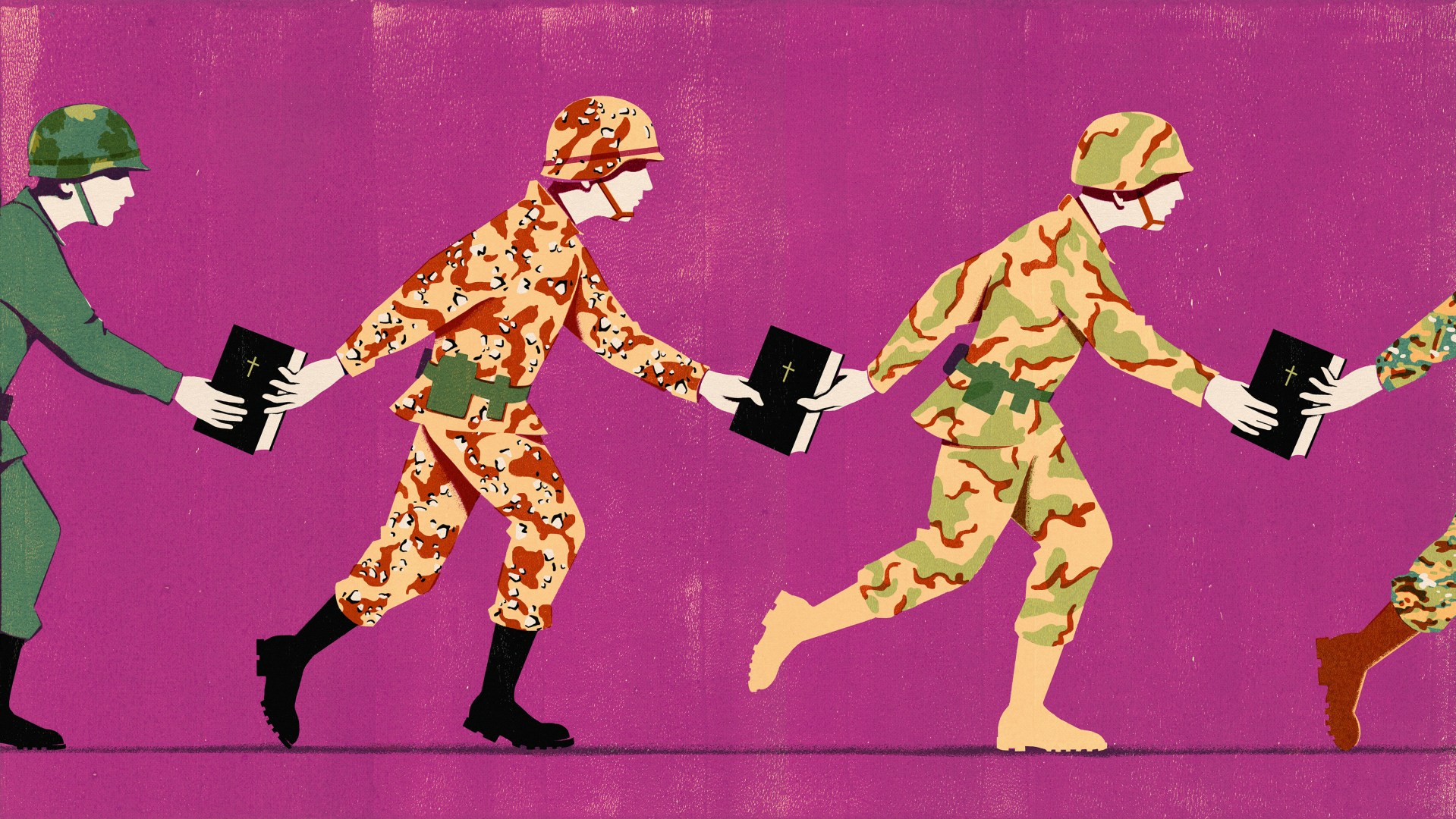
Illustration by Dan Bejar

Jesse Maple first carried the Bible because his mother taught him to respect the Holy Book. Then he saw the Scripture as a kind of good luck charm. But soon enough, Maple saw it as evidence that God loved him and was with him in the jungles of Vietnam.

In all, seven US soldiers have carried that same small book since 1967. By 2019, they had brought it with them through 11 combat tours in five countries. For each of the men, the Bible was a source of comfort, an assurance of protection, and the promise of a fuller relationship with God. They carried the Scripture to keep them safe, but they found a deeper security inside its pages.

Physically, this Bible isn’t much to look at. It’s about five inches long and three inches wide, Maple estimates. It’s the King James Version. It has a black leather cover, now well worn and torn at the edges, with the pages at risk of falling out.

“You wouldn’t believe what that Bible has been through,” Maple said.

He carried it through his tour in Vietnam. He was drafted into the Army at 19, a kid from West Lafayette, Ohio. He told CT he was living a wild and backslidden life at the time. But then a man with Gideons International gave him the Bible. His mother taught him to respect the Scripture, so he stuck it in his pocket and kept it there.

It was still with him during one intense firefight when bullets ripped through the pack on his back. They pierced a can of fruit but left him unharmed. Afterward, Maple was standing there, juice leaking on the ground, when a passing Catholic priest told him, “The Lord was with you today.”

Maple immediately thought of the little Bible in his pocket.

According to religious studies professor Jonathan Ebel, soldiers’ responses to the violence and trauma of war have often been seen as superstitious and irrational. But they are better understood as theology. In the chaos of combat, people turn from material explanations and seek spiritual answers.

“We frequently see soldiers lifting their eyes and minds above the immediate and obvious answers—a well-aimed bullet or shell, a well-timed attack or overzealous commander—and offering deeper, more theological explanations,” writes Ebel, who teaches at the University of Illinois Urbana-Champaign, in Faith in the Fight. “Many soldiers testified that God was the author of individual fates in combat; that it was God who was everywhere at work.”

That may be why American service members are more likely to engage with the Bible when they deploy into combat zones. According to the 2020 State of the Bible study, produced by the American Bible Society and Barna Group, about 3 percent of veterans generally are “Bible centered,” meaning they read Scripture regularly and say it has an influence on their life decisions. But among veterans who saw combat, the figure rises to 10 percent, according to the study.

Paul V. McCullough III, who retired as a lieutenant colonel after more than 20 years in the Army, said that was his experience. Facing death makes you reflect on eternity and think, “I need to figure out what I’m doing with my life,” he said. Today, McCullough is an ordained minister and works with the American Bible Society, developing and promoting material for service members and their families.

“I try to express to them the real importance of that deep personal faith with the God of the universe,” McCullough said. “When people are engaged and rooted in the Word of God, they’re happier and healthier and they feel like they’re fulfilled in their life. … They have a purpose for what they’re doing.”

Maple found that personal faith carrying and reading the Gideons Bible in Vietnam.

“I give God all the credit for bringing me home,” he says. “I had so many close calls.”

When he came back home and learned his brother Bill, also in the Army, was being transferred from his station in Europe to fight in Vietnam, he decided to give him the Bible.

“I wasn’t no good Christian at that time,” Bill said.

While he didn’t have a personal relationship with Jesus, he did feel an immediate connection to that Bible.

“It was just like a security blanket for a baby,” he recalled to CT. “It felt like you had on extra armor.”

Bill didn’t become a true Christian during the war; he accepted Jesus as his personal Savior years later. He says God used the faithful witness of his wife and brother, as well as his experiences in Vietnam, to draw him into a relationship.

Even before his conversion, though, he knew that black King James Bible was special. Before he left Vietnam, he gave it to his close friend Roger Hill, a soldier who also grew up in West Lafayette, like the Maples.

Hill wrapped the Bible in plastic to protect it from the monsoon rains, and he still had it with him when he was severely wounded during his final tour.

“I still pray to God every day and thank him for another day,” Hill said.

Then the Bible went to another West Lafayette native, Cliff McPeak, who fought in the Gulf War, and then to Zac Miller, who joined the Ohio Army National Guard at 17, with his parents’ consent, in 2001. He was deployed to Iraq in 2004.

Before Miller left West Lafayette, Jesse Maple invited him to stop by his house. The elder soldier told Miller the story of the Bible, how he came back from war, and how he thought the Lord had something to do with it.

As a Christian, Miller knew the Bible was more than a good luck charm. But it also felt like it carried something special after all those previous tours of combat.

“I gladly accepted it and took it with me,” he said. When Miller finished his initial tour of duty, the Bible was given to another pair of brothers from his hometown, Zac and Will Allen. They carried it into battle in Iraq and Afghanistan before returning it to Miller for safekeeping in 2019.

Miller, who self-published a book about the seven veterans’ stories and the one Bible they carried through 11 Army combat tours, said that during his interviews, he learned that the men were not all religious in the same way. They weren’t all devout. But they were all strengthened, comforted, and encouraged by that Bible.

“In very trying times, having that Bible with you gave you a little ease that you were not alone and being watched over,” he said.

The Maples, who first carried the book into battle in Vietnam, are now getting older and facing different kinds of “trying times.” Bill can’t read the Bible anymore because he’s gone blind, which he believes is the result of Agent Orange, the defoliating chemical that the US military dropped on the jungle and the soldiers fighting below. He has an electronic device that reads books to him, though, and his favorite is still the Bible.

“I lay in bed when I first wake up in the morning,” he said. “I turn my Bible on, and I listen.”

Adam MacInnis is a reporter in Nova Scotia, Canada.

News

Pastors Take to the Streets to Combat NYC Gun Violence

Responding with their feet, ministers bring ‘the simplest form of the gospel’ to tense situations.

Spencer Platt / Staff / Getty

Shootings more than doubled in New York City last year, and homicides increased 44 percent. But the numbers don’t tell the whole story. Each tragedy is specific, and each impacts a whole community.

There was Davell Gardner Jr., age one, killed while sitting in his stroller at a summer barbecue. Edward James, a church custodian, shot in the back inside of a house of worship. Anthony Robinson, a father, killed holding his daughter’s hand as he helped her cross the street. And many others.

To Louis Straker Jr., pastor of Reflections Church in East Flatbush, Brooklyn, it felt like the city was overcome by violence, a sense that only intensified when protesters filled all five boroughs with the names of Black people killed by police, the city imposed a curfew, and some officers reacted to protesters with force.

In late May, Straker and other clergy in the community were called to the corner of Church Street and Bedford Avenue to try to keep peace. When Straker got there, a police car was on fire, officers were in riot gear, and protesters were throwing garbage.

“That was one of the worst nights,” Straker told CT. “But the presence of God was there, and that made all the difference.”

Storefront ministries and small, deeply rooted urban churches have long been on the frontlines of the spiritual battle against violence in New York City. With the increase in shootings, the stress of the pandemic, and conflict over racism in the streets, Straker and other city pastors knew their work was more necessary than ever. They responded the way they always do: with their feet.

Gilford Monrose, pastor of the historic Mt. Zion Church of God 7th Day, says his team has been responding to community violence for over 10 years. The group efforts are now known as the 67th Precinct Clergy Council Inc., a faith-based community initiative named after the local police district. They call themselves the GodSquad.

The GodSquad facilitates a leadership academy for teenagers, hosts support groups for the mothers of murdered children, and sometimes “deploys” to tense scenes, where they engage people and attempt to de-escalate, bringing a peaceful presence to the street.

The squad also provides meals for people impacted by crime and for others living in the area. They take care of the incidentals in the aftermath of a shooting, making calls to ensure the street gets cleaned up and broken street lamps are replaced. And they spend weekend evenings on high-risk street corners, in the dark between 8 p.m. and 1 a.m., praying, talking to people, and being present. The pastors and their church volunteers call this their way of “occupying” the block.

Police departments started working with groups of ministers in the 1990s, launching Operation Ceasefire in Boston, the Chicago Project for Violence Prevention in Chicago, and similar groups in other major cities. This was partly in response to a spike in violent crime. Since the 1990s, the crime rate has fallen dramatically, according to FBI statistics.

Around 2015, however, gun violence started to increase, and in 2020, homicide rates spiked across the country. Social scientists don’t agree on why, but urban clergy groups like the GodSquad aren’t waiting for an explanation. They’re going out into the streets.

“What we’re doing is the simplest form of the gospel that we can perform. This is a ministry of love, mercy, and justice,” Monrose said. “Good news for some people means that they’re going to have heat in the winter. Good news for some people means that actually their son is not going to spend 20 years in jail because he had a group of people advocating for him when he was actually innocent. Good news for some people means that if we see your daughter or son walking in the street and they’re by themselves and they get attacked or what have you, we’re going to support them, and we are going to protect them, and we’re going to love them.”

According to Monrose, people don’t understand the hidden effects of gun violence. Statistics track the number of people shot, but ministers see the ripple effects in the community.

“We are a traumatized community,” he said. “It’s not just about a person who has been killed. It’s about the people who were taking care of that girl. It’s about the hospital staff, and their family members. You never forget those moments in your life.”

Some of the group’s ministry focuses on serving families after a tragedy. The GodSquad clergy perform funeral services for shooting victims, free of charge, and help connect the family members with resources to pay for the funeral home and the burial, if that’s necessary. The ministers also try to connect with the friends of the deceased, many of whom are themselves at risk.

“As tough as a person might be on the street, when one of their friends dies, they feel the pain,” Straker said. “And they recognize that here are clergy taking the time to see their homie and send him off. Sometimes when we walk into certain neighborhoods that other people may not feel safe walking, when they see our yellow jackets or orange shirts … that say ‘GodSquad,’ they remember us doing the funeral for the friends and family members of their community. It gives us credibility.”

The clergy also partner with the city’s crisis management task force. They receive some money from the city, which designates part of the Mayor’s Office of Criminal Justice budget to fund grassroots organizations.

That can create some complicated dynamics, as they represent the concerns of the community and speak up about police violence and the need for reform. Monrose said the officers know this is not a new issue for the clergy.

“We have been speaking about police reform for years. Not just a year or two years ago—years and years and years of meetings talking about how we think that the police department can be with our communities and our state leaders. We are here to help with that conversation,” Monrose said.

The Brooklyn group is also trying to contribute to the national conversation about violence. They recently started a podcast. In an August episode of Beyond the Headlines with Pastor Gil Monrose, Monrose, Straker, and Charles Galbreath, pastor of Clarendon Road Church in Brooklyn and an associate dean at the Alliance Theological Seminary at Nyack College, talked about the turmoil after a shooting.

“We see individuals allow short-term emotions to cause long-term and lifetime consequences, not only for themselves but also for the families that are impacted,” Galbreath said. “It’s devastating. You see someone’s entire destiny, entire life, cut off, but then also the side effect of the girlfriend or of the child or of the mother or of the grandmother [who] is also deeply impacted by this. This is painful for our community.”

The New York ministers have connected with clergy in Chicago, Boston, Indianapolis, Orlando, and Washington, DC, and formed a national coalition, Clergy for Safe Cities, which they hope will become the heart of the wider conversation about faith-based solutions to urban gun violence. They recently hosted a virtual summit to discuss initiatives and strategy. Sign-ups for pastors planning to attend their upcoming meetings number in the hundreds.

Efforts are already underway to duplicate the Clergy Council’s success in neighboring precincts. But Straker thinks the efforts will have to be adapted to different cultural contexts.

“They can look at what we do and make it applicable to their location,” he said. “No two locations are the same.”

But the basic action will be the same everywhere: pastors responding with their feet, testifying to God’s love with their presence, and serving as a witness for peace when a community is racked by the tragedy of gun violence.

Kathryn Watson is a reporter in New York City.

News

Diversity Advocates at Evangelical Colleges: ‘In Some Ways, You’re Seen as a Heretic’

Racial transformation is hard even when Christian schools are committed to change.

Illustration by Jarred Briggs

Lawrence Burnley was going to resign.

The vice president for diversity and intercultural relations at Whitworth University in Spokane, Washington, had been making progress in his first two years. He started regular meetings with senior leadership to discuss race and gender issues, and he secured approval to bring in a consultant to survey the climate on campus.

But breaking new ground at Whitworth had also resulted in greater discomfort. “You’re the source of this disruption. You’re the one that makes people feel uncomfortable,” Burnley said. “Using Christian terms: In some ways, you’re seen as a heretic.”

About 50 percent of evangelical institutions associated with the Council of Christian Colleges & Universities (CCCU) have a diversity advocate or someone with a title like “chief diversity officer,” according to CCCU spokeswoman Greta Hays.

Most of the positions have been created over the past few years, as race and racism have become pressing issues at many evangelical schools. Diversity officers are seen as a major part of the solution. They bring new perspectives to predominantly white institutions, help with recruiting and retention of more students of color, and offer the schools guidance on articulating and pursuing a Christian vision of diversity.

Yet many diversity officers struggle with discouragement, fatigue, and burnout. They often struggle to get buy-in from colleagues and feel they were hired to make a problem go away, rather than to start the long, difficult work of cultural transformation.

“People hire diversity officers more when things go wrong,” said Rebecca Hernandez, the academic student success and chief diversity officer at George Fox University who has spearheaded diversity initiatives for the CCCU. “But have we made the significant, bottom-line, systemic changes that will help us to become who we said we want to be? I don’t think we’ve done that yet. We’re not quite there yet. In fact, we’re not anywhere near that yet.”

A 2016 study found that across higher education, diversity officers last three years on average. Survey respondents said they didn’t feel respected enough by administrators, lacked resources to meet goals, and didn’t know whether they had the authority to make decisions. They reported being underutilized at some times, overutilized at others, and expected to serve as “first responders” to racial crises.

From Burnley’s experience—first at Messiah University in Pennsylvania and then at Whitworth—it’s hard to change a culture that has developed over generations of serving predominantly white student populations. The problem is not individual leaders. He considers the presidents and administrators he worked for his friends. But it was his job to challenge norms and question long-established ways of doing things, so people thought he was “not being a team player” and “not fully bought into the institutional mission and vision as they understand it,” Burnley said.

After he submitted his resignation at Whitworth, though, Burnley had second thoughts. The school had created the position in the first place. They had hired him to do the job. He decided to take it on good faith that the institution’s leaders saw the need for what he was doing and believed diversity and inclusion are part of the gospel. He stayed another four years before leaving for the University of Dayton.

It is a major investment for a college or university to create a new position, said Shirley Hoogstra, president of the CCCU. Budget equations have to be balanced carefully, weighing different goals and initiatives. Evangelical schools are putting resources into diversity because they believe it is an important part of “creating a campus community that is representative of the true body of Christ, where all faculty, staff, students, and alumni feel seen, heard, respected, and supported,” Hoogstra said.

Even if an institution is invested in change, that doesn’t make it easy. At Seattle Pacific University, every department has to submit a diversity action plan to Sandra Mayo, vice provost for inclusive excellence.

The university communications office, for example, said it wanted to tell the stories of more students of color in promotional materials without tokenizing them. So Mayo helped the office think of questions “that allow them to tell their story,” she said, and helped draft a best practices document with guidelines for university publications.

“There are some people who have bought into it,” Mayo said. But she still finds herself regularly forced to argue that the university’s stated diversity goals are valuable.

One diversity professional at a CCCU school, who asked to remain anonymous for fear of retaliation, said the ground feels like it’s always shifting. Part of the diversity advocate’s job is organizing events to discuss racism, but then the conversation moves to whether racism even exists or if it should be a concern for Christians.

Another part of the job is suggesting new policy, but when the advocate makes an argument about how a potential policy aligns with the school’s biblical values, administrators pivot to considerations of legal liability.

“There has been some ideological movement from some of those folks. Listening and learning, realizing that ‘Hey, our picture of how we do change may be a little bit too small,’” the diversity advocate said. “At the same time, there’s still a good degree of resistance to changes.”

Diversity officers told CT their position is most effective when they have more authority. At some schools, the officers are part of the president’s cabinet or a senior leadership team.

Todd Allen, vice president of diversity affairs at Messiah, is at the cabinet level. He regularly advises administration on curriculum, enrollment strategies, and hiring policies.

Allen is also a faculty member, and his work with students drives his advocacy at the senior level. “I know what it means for a student of color to see another person of color in the room. I also know what it means for white kids to see a person of color at the front of that room. … That representation matters,” Allen said.

That’s how it should be, he added. In the morning, he’s in the classroom and sees firsthand the need for diverse faculty. After class, he runs to a meeting with cabinet members and pushes for policies addressing that need.

“The person who is doing senior diversity leadership has to be empowered and placed in positions of power,” he said. Otherwise, “it’s almost impossible to really effect the kinds of transformative change that our institutions need and that we often say that we want.”

But having more authority doesn’t magically remove all roadblocks, he said. Allen deals with people who question his motives because they consider his position to be political. “They don’t see it as needed, they don’t see its worth, and they don’t see it as biblical,” Allen said.

At some schools, change really started to happen when the diversity advocate had a senior position and was supported by other high-ranking officers who were not white. “I don’t know that diversity officers are going to be a place of change. It’s really when we start hiring presidents and provosts of color,” Hernandez said.

Warner Pacific University president Brian Johnson, who is one of two African American presidents in the CCCU, said he agrees.

“I find that the most significant ways and places to transform the culture when it comes to the diversity of an institution is to make significant hires of African Americans, minorities, and Hispanics in substantive roles,” he said.

Johnson points out that he has a say in every faculty hire, where a diversity officer typically only makes suggestions or recommendations about hiring practices. His goals at Warner Pacific, he said, include hiring racial minorities for jobs that are not focused on diversity.

Joseph Jones, the other African American president in the CCCU, said it’s more effective to make more people responsible for diversity. When he took office at Fresno Pacific University, he made sure diversity resource officer Patty Salinas met with him regularly, and every cabinet member knew that Salinas wasn’t the only one responsible for diversity at Fresno Pacific.

“We usually want a chief diversity officer to be a primary person to actually allay our frustrations, and put our issues of diversity on this one person. I said, ‘Why are we doing that?’” Jones said in an early cabinet meeting. “You are all the chief diversity officers of your areas.”

Salinas said that for just one change, developing a bias incident reporting system, she needed collaboration from the Title IX officer, the vice president of student life, the HR director, university communications, and the provost. After it launched, she needed staff and faculty to join a committee to review reports.

If structural change is slow, however, that doesn’t mean it’s not happening. Burnley said that when he left Messiah in 2009, he had difficulty with the diversity officer position not being part of the president’s cabinet. When Allen took that position in 2017, it was.

“There are things that he did, hits that he took, that I didn’t have to take,” Allen said about Burnley.

The work is still difficult, Burnley said. There are a lot of times when everything feels like a battle and quitting is a reasonable response. But over time, change does happen. Things get better, and you can actually see it.

“This work, you get scarred,” Burnley said. “But it’s the work that we’re called to do.”

Liam Adams is a reporter in Colorado.

Theology

‘Be Clean’: Jesus and the World of Ritual Impurity

These biblical commands rightly remind us about the significance of our bodies.

Illustration by Duncan Robertson

In his best-selling book, The Year of Living Biblically, secular Jew A. J. Jacobs endeavors to follow biblical laws literally for a year. His escapades with mixed fabrics, stoning Sabbath-breakers, handling serpents, and honoring widows are enthralling and often sidesplitting, and they led to a CBS sitcom spinoff.

In one entry, he explains his attempt to avoid the ritual impurity associated with genital discharges while his wife is menstruating (Lev. 15:19–23). Unamused, she makes it a point to sit in every chair in the house before he returns home. Ultimately, he opts for a portable Handy Seat, because really, who can be sure who might have just sat in any particular subway seat or restaurant booth? (Rachel Held Evans completed a similar tongue-in-cheek challenge in her 2012 book, A Year of Biblical Womanhood.)

Part of the reason this story is so humorous is its utter absurdity, especially as seen through our modern Western lens, which unwittingly informs our interpretation of Scripture. We find it awkward or wildly inappropriate to act differently—let alone to ask—if a woman is menstruating, and therefore the notion of a biblical regulation or restriction over a woman’s time of the month seems preposterous.

It is easy to overlook or disregard that, in the Bible, issues of ritual purity matter. Far from being some legalistic and archaic Old Testament oddity, engaging impurity deeply mattered to Jesus as well.

The ritual purity system is a cornerstone of second-temple Jewish life, and Jesus’ actions reveal that he embodies a kind of contagious holiness, which overcomes the sources of impurity that contaminate God’s people. Without understanding how the ritual purity system works, and how Jesus’ actions evidence the inbreaking of God’s holiness into the world, we miss part of the New Testament’s remarkable witness.

In Matthew 9:18–26, for example, we read the account of a synagogue leader whose daughter has died, which is abruptly interrupted by another story about a woman who has been “subject to bleeding” for 12 years. The language of our English translations obscures key aspects of this passage that connect it to a first-century Jewish context. The stories seem to have nothing to do with each other, making the composition of the passage appear odd and haphazard. It is precisely an understanding of the ritual purity system, and Jesus’ disposition toward it, that unlocks the meaning of this curious passage.

New Testament scholar Matthew Thiessen explains in Jesus and the Forces of Death that ancient Israel’s corporate life was structured around two binaries: holy vs. profane or ordinary, and pure vs. impure. The primary loci of holiness are the Sabbath (Ex. 20:8–11), the tabernacle or temple (Ex. 40:34–38), and the people of Israel themselves (Lev. 11:44–45). Because God literally dwells in these entities, they must be guarded and stewarded with particular care.

Scholars loosely divide biblical impurity into ritual and moral. Ritual impurity is unavoidable, natural, communicable, not sinful, and generally dealt with by “washing and waiting” (undergoing ritual bathing and a certain period of isolation from sacred spaces).

Ritual impurity falls into three main categories: skin diseases (tsara’at in Hebrew, lepra in Greek, often mistranslated as “leprosy”), genital discharges, and corpses. As Thiessen explains, each of these in its own way represents the forces of death—powers that work against human life and flourishing. Someone in a state of ritual impurity could not come into contact with God’s holiness, since God flees from impurity (Ezek. 10–11). So, while ritual impurity was not in itself sinful, if the Israelites did not deal with it properly, it could lead one into unholiness and drive away God’s presence.

Moral impurity, by contrast, refers to sinful behavior (idolatry, incest, murder), which results in defilement of the people, the sanctuary, and the land. Moral impurity is avoidable, willful, noncommunicable, incites divine chastisement, requires atonement, and (unabated) leads to exile.

Jesus confronts all three sources of ritual impurity in the Gospels’ unfolding story of his extraordinary ministry. By understanding ritual purity laws, we realize that Matthew 9:18–26 (and its parallel passages, Luke 8:41–56 and Mark 5:22–43) are focused on issues of ritual purity.

What English translations subtly conceal is that the woman’s “bleeding” is an issue of abnormal genital discharge, which has rendered her impure and thus unable to enter the temple courts, and possibly the city of Jerusalem, for the 12-year duration of the bleeding (Lev. 15:25). This is a massive loss for her socially and spiritually, given that the Jerusalem temple was the center of worship and religious life.

There’s a clue in Matthew 9 that indicates Jesus’ seriousness toward Old Testament commandments. In most English translations of Matthew 9, the woman reaches out to Jesus and touches “the edge of his cloak” (v. 20), a strange and outdated translation for modern readers. What the Greek actually says is that she reaches out and touches the kraspedon (tassel) of his garment. In Numbers 15, God commands the Israelites to wear tassels in order to remind his people of their pursuit of holiness, a commandment that is observed by many Jews today.

Notably, when the same Greek word (kraspedon) appears in Matthew 23:5—where Jesus censures the Pharisees for their showiness—English versions translate the word to “tassel.” The contrast in the two chapters veils Jesus’ connection to Jewish practices and distances Jesus from the customs of the Pharisees. In reality, Jesus and the Pharisees both wore tassels. As Thiessen writes, Jesus was indeed “that Jewish.” It is precisely Jesus’ Jewishness that reveals to us what his mission was all about, and in turn, what our commission as his disciples is to look like.

The synagogue leader’s daughter, similarly, represents corpse impurity and thus another force opposing Israel’s life and welfare. Corpses were the most powerful source of ritual impurity in the priestly purity system; while the other two sources were transmitted by touch, even proximity to a dead body would render one ritually impure (Num. 19:14–16). And in a symbolic trilogy, the story of Jesus healing a man with lepra precedes this passage in all three synoptic gospels.

According to the laws of ritual purity, Jesus should have entered into a state of ritual impurity when the bleeding woman touched his garment, and when Jesus touched the dead girl to raise her to life. In reality, the exact opposite happens. Rather than their impurities transferring to him, his contagious holiness transfers to them.

Throughout the Old Testament, there are two overarching strands of Israel’s narrative. On one hand, Israel must carefully guard, preserve, and steward God’s presence in their midst. As God tells Moses and Aaron in Leviticus 15:31: “You must keep the Israelites separate from things that make them unclean, so they will not die in their uncleanness for defiling my dwelling place, which is among them.”

God’s holiness dwelled in the midst of Israel, the Sabbath, and the tabernacle and temple, pointing forward to the ultimate consummation of creation—God’s unrestricted presence and the removal of the barrier between secular and holy. Jewish tradition describes the world to come as “a day that will be entirely Shabbat” (Mishnah Tamid 7:4; Genesis Rabbah 17:5), and Scripture offers an eschatological vision in which God’s holiness ultimately blankets all of space and time (Zech. 14; Rev. 21).

Herein lies the second strand of the narrative: The holiness of God that dwells within Israel will expand outward to the ordinary world beyond. This trajectory is present from the very beginning, originating in God’s call of Abram in Genesis 12:3 (“all peoples on earth will be blessed through you”) and echoed throughout the prophetic literature.

Isaiah imagines a day when “the earth will be filled with the knowledge of the Lord as the waters cover the sea” (Isa. 11:9) and declares that “I will also make you a light for the Gentiles, that my salvation may reach to the ends of the earth” (49:6). Zechariah 14 envisions a day on which the most mundane objects will be just as holy as the temple instruments in Jerusalem.

In the narrative of the Hebrew Scriptures, Israel’s guarded holiness coexists with the vision that one day, God’s presence will flow far beyond these prescribed boundaries and parameters.

The tension between Israel’s divinely commanded separation from the world and Israel’s vocation to bring God’s holiness to the ends of the earth finds its resolution in the life and work of Jesus. In Christ, holiness overpowers the sources of impurity; abundant life overpowers the forces of death.

The kingdom of God breaks in through the holy and healing touch of Christ.

When asked to authenticate his ministry and messiahship in Matthew 11, Jesus points to what can be seen and heard as a result of his work. Echoing Isaiah 61, Jesus declares that “the blind receive sight, the lame walk, those who have leprosy (lepra) are cleansed, the deaf hear, the dead are raised, and the good news is proclaimed to the poor” (Matt. 11:5). The tangible, physical restoration that is spreading outward to the world through Christ confirms his divine identity.

While Western Christians often live out our faith in a way that bifurcates our bodies and our spirits, this division is completely foreign to a Hebraic worldview. Christianity has all too often fallen prey to the philosophical framework of Platonic dualism, where two separate worlds—one physical and temporal, the other invisible and eternal—oppose each other.

This worldview teaches that our bodies belong to the material world and are thus chained to the physical processes of change, decline, and ultimately death. Our souls, however, originate in the unseen spirit world and after death return to it for reward or punishment.

By contrast, Judaism has always held to an embodied spirituality, where people live out their faith through their bodies, not in some kind of war against them. Indeed, faith is what Jews see and hear (and also eat, wear, recite, and declare). Torah teaches Jews how to order their lives, which necessarily means what they do with their bodies.

As Jewish historian of religion Daniel Boyarin explains, Christianity has generally conceived of human beings as embodied souls, while Judaism has conceived of human beings as ensouled bodies. According to the Jewish definition, the body is not an accidental feature of our humanity; rather, our bodies fundamentally constitute what it means to be human.

In this regard, Judaism has much to teach us about embodiment and what it looks like to engage our bodies in worship and discipleship. In fact, it has much to teach us about how to read the New Testament, such as the Lord’s Prayer. For some, the words are so familiar that we can easily bypass the process of actually entering into and meditating upon their meaning.

Take “your kingdom come, your will be done, on earth as it is in heaven” (Matt. 6:10). The text does not say, “Swoop us up to heaven, so that we can be in the place where your will is done.” The imagery is of the downward movement of God’s kingdom, its presence and reality breaking into this world, not of us transcending this physical, material world. This world is where God’s kingdom is coming, and we are commissioned to be ambassadors of that kingdom—here and now, in these bodies.

The gospel of Jesus is about God’s kingdom and its power and presence in and among us. It is about God’s final and definitive no to all of the forces that work against human life and flourishing. For us, it is about living into this kingdom, shaping our lives around it, and pointing others toward it. It is about the outward expansion of holiness that Jesus embodied.

This vision is reflected in Jesus’ charge to his disciples in Matthew 10. What exactly does Jesus send out his first followers to do? “As you go, proclaim this message: ‘The kingdom of heaven has come near.’ Heal the sick, raise the dead, cleanse those who have leprosy [lepra], drive out demons. Freely you have received; freely give” (vv. 7–8). This commission understandably makes many of us uncomfortable. After all, when have we raised someone from the dead?

Even for the large majority of us who aren’t performing resurrections, we, like Jesus, are still called to fight against the tangible forces of death in our culture. What exactly are these forces? They are anything oppressing God’s people and working against the inbreaking of God’s glorious kingdom in our lives and communities.

To be ambassadors of this kingdom means to care deeply about bodies and the forces of death that oppose them. If God is actively working to redeem this world, then the way we understand our mission and service to the kingdom may be vastly more expansive than we have imagined.

Jennifer M. Rosner is affiliate assistant professor of systematic theology at Fuller Theological Seminary and author of Finding Messiah: A Journey Into the Jewishness of the Gospel (IVP, 2022).

Cover Story

Why Defining Gossip Matters in the Church’s Response to Abuse

Have we tamed the tongue too much? Christians work to recover a biblical understanding of harmful hearsay vs. healthy criticism.

Illustration by Andrea Ucini

Heather Fulk can’t remember if she had even heard of Dave Ramsey’s no-gossip policy before her husband, Jon, was fired from the Christian financial guru’s company last May.

But those inside Ramsey Solutions, and the millions who follow his teachings on leadership, know that he has little tolerance for negativity in the ranks. Ramsey defines gossip as “discussing anything negative with someone who can’t help solve the problem.” That means criticism has to go straight to leadership; complaining to fellow employees is “disloyalty.”

People who work at Ramsey may have their gripes—from little things like critiquing the guest speakers at its weekly devos to bigger worries over their place in the company—but they have to be careful not to share with fellow employees who may report them.

“You have a little bit of caution going into new relationships to figure out who’s a safe person,” said a former employee who left this year and asked not to be named for fear of retaliation.

For some, the reticence extends beyond the company. “They feel like that’s gossip too, talking to spouses or talking to friends,” said another.

They know not to do what Heather Fulk did. In the early months of the pandemic last year, she shared on her personal Facebook page her concerns over “Jon’s company” reopening its office. A coworker reported the three-sentence post to Ramsey Solutions, and Fulk’s husband was fired less than a month later.

At the exit interview, Ramsey’s HR director confirmed her social media post was the reason for their decision, according to a recording. Her husband remarked, “We obviously disagree on the definition of gossip.”

After his termination, she received a cease and desist letter, so she kept her update to Facebook friends vague, saying they could message her if they wanted to know why her husband was no longer at Ramsey.

She was still processing her guilt over what happened when a female leader from her church reached out. Fulk assumed she was going to offer support, and the two met on her porch. Instead, the leader challenged her recent post: “It felt like you just wanted to gossip,” she said, according to Fulk.

Christians are right to heed scriptural warnings about gossip, secrets, and lies. Yet the American church has also seen a pattern of leaders referencing such teachings to silence and discredit victims and whistleblowers.

One of the earliest team members at Ravi Zacharias’s ministry to raise concerns internally about its founder’s behavior abroad was penalized for “spreading rumors.” Women who brought accusations of sexual misconduct against Willow Creek Community Church founder Bill Hybels were said to have a campaign to take down the church with “false allegations.”

In the decade since releasing his book Resisting Gossip, pastor Matthew Mitchell has noticed the pattern too. Two years ago, Mitchell wrote in a blog post that he worried controlling leaders would use his work to shoot down critics within their churches.

As the #MeToo and #ChurchToo movements have brought victims’ perspectives to the forefront, Mitchell told CT he’s had more opportunities to consider “how hard it is to speak up and speak out when you’ve been mistreated by someone in authority, and then to have the added pressure of being accused of gossiping.” The instinct to malign those who raise concerns can be a red flag for a culture of abuse.

But the answer, Mitchell and other experts agree, is not for the church to stop preaching and teaching against the dangers of gossip. Instead, it must start with the right understanding of gossip in the first place.

William Vanderbloemen, whose company consults with Christian employers around hiring and workplace culture, says more of his clients are adding no-gossip clauses to their handbooks, particularly as social media gives people a greater reach to broadcast potentially damaging information. To enforce the rules, they have to navigate the subjective borders of what counts as gossip or establish parameters for the term from the start.

“Just calling it a ‘prayer concern’ does not keep it from being gossip, because that’s how it gets masked,” said Vanderbloemen, a former pastor in Houston.

Gossip and Matthew 18

The Bible doesn’t offer us a single definition and uses multiple words to refer to what we call gossip. In the Old Testament, the terms typically refer to a person—a “tale-bearer” or “secret-dealer”—rather than an action, according to Karen Ehman, a Proverbs 31 Ministries speaker and the author of Keep It Shut. The New Testament terms for gossip, she says, refer to babbling empty speech (1 Tim. 6:20) and whispers (2 Cor. 12:20).

“We’ve gotten this concept somewhere of ‘talking behind someone’s back’ is gossip, but maybe it is, maybe it isn’t,” said Ehman, who spent five years studying scriptural guidance on speech to curb her own habit of getting into trouble with words. “If it’s true, and I’m not doing it in a slanderous or malicious way, that isn’t really gossip. That’s just speaking of someone when they’re not in the room.”

For Christians, gossip is not so much a category of speech as a motivation to speak. Sometimes gossip is fueled by our own selfishness and false worship; we want attention and to be seen as the ones in the know. Sometimes it’s an unloving motivation toward others, a desire to misrepresent them or to reveal a secret that would hurt their reputation.

Calling any negative or sensitive information “gossip” misses the point.

“Sometimes we have to tell someone else something bad that we know to be true about someone that’s not there to warn them about that person, because it’s likely that they will be hurt in the same way,” said Mitchell, citing Paul’s line in 2 Timothy 4 about the harm done by Alexander the metalworker. Paul wrote, “You too should be on your guard against him, because he strongly opposed our message” (v. 15).

As part of a move toward better transparency, trust, and accountability, Christian institutions are more carefully considering whether they’ve offered avenues for those who rightly want to speak up to tell the truth, call out sin, and protect others from harm.

In some ways, remote work during COVID-19 forced Christian employers to communicate more clearly and build more trust, according to Al Lopus, CEO of the Best Christian Workplaces Institute.

Christian churches, ministries, and companies want to create a positive workplace culture where employees are expected to demonstrate the fruits of the Spirit, but that doesn’t mean avoiding negativity entirely.

“We encourage our ministry partners to create an environment where people feel free to express their opinions,” said Lopus, adding that open communication also makes organizations more innovative. “There is such a thing as healthy conflict when people disagree around issues and ideas.”

Christians routinely get labeled as “gossipers” for discussing someone else’s sinful behavior without going to them directly per Matthew 18.

“I’ve thought about that gossip accusation a lot,” said Sandra Glahn, who helped a former church care for a string of women coming forward with stories of sexual abuse and harassment on the part of its deacons. “When one factors in the power differential, a more directly applicable guide is the First Epistle to Timothy, where the apostle tells his protégé, ‘Do not entertain an accusation against an elder unless it is brought by two or three witnesses. But those elders who are sinning you are to reprove before everyone, so that the others may take warning’ (1 Tim. 5:19–20).”

Addressing abuse by leaders in church settings should involve other people rather than make a victim meet with their alleged abuser one-on-one.

“The two or three have to have a conversation before confronting. That conversation is not gossip,” Glahn said. “The two or three might also need to consult spiritual counsel. That widens the circle further. That convo also is not gossip.”

Not only are such conversations permissible, but they also represent a form of accountability.

“We’ve seen, particularly in the past several years, powerful people able to harm others—sometimes over the course of many years—and get away with it, in part because the victims were isolated and unaware of each other, in part because the organization protected its leaders from appropriate criticism,” said Stephen Witmer, a Massachusetts pastor who has written about gossip in the church.

Who gets brought into the circle is important. Whether raising up major concerns or just small critiques, Christians should seek out somebody who can do more than hear their venting.

“When we speak to a third party about a problem we perceive in someone, we should consider that third party an involved participant, not a passive recipient, and, accordingly, choose them carefully,” Witmer said. “Perhaps they’ll help us think through what to say when we approach the person. Perhaps they’ll go with us to speak to the person. They shouldn’t simply be the recipient of our venting.”

For victims who have kept their experiences quiet out of fear, who have ruminated and worried and blamed themselves to the point that they’re at the end of their spiritual rope, that small, trusted group of listeners can be a lifeline. It can also reveal evidence of a pattern of abuse, a simultaneously heartbreaking and comforting realization that—despite the isolation they felt in silence—they are not alone.

“When they call it gossip, when they don’t allow for processing and unpacking, there’s no chance for anyone to understand what is happening to them,” said Melissa Hogan, one of more than a dozen former Ramsey Solutions employees and spouses who spoke to CT. “You need that. You need people around you.”

In other words, it’s not just the boss or HR who can steward your concerns well; it’s also the person next to you who can listen or say, “Me too.”

Hogan’s ex-husband, Chris Hogan, was one of the top personalities at Ramsey Solutions, and the company oversaw a “restoration process” when the couple had marital difficulties stemming from his affairs. Dave Ramsey told his staff in 2019 that Melissa Hogan came to him and angrily “accused Chris of doing all sorts of things,” then the company stood by Chris during what Ramsey said was a “nasty divorce.” Chris Hogan left in March over “actions and behavior” that weren’t “in line with Ramsey Solutions’ core values.”

Melissa Hogan says “it’s a whole God thing” that she connected with a circle of women five years ago through the company’s wives club. Around the time of her divorce, Hogan felt like she couldn’t open up to them due to a gag order from Ramsey. Now, they’re her support system—swapping messages on the app Voxer, studying spiritual abuse together, and raising awareness in hopes that others can escape manipulative environments.

Wade Mullen, the author of Something’s Not Right: Decoding the Hidden Tactics of Abuse—and Freeing Yourself from Its Power, describes how abusive and toxic organizations fear the collective action that can arise when someone tells another what happened to them and realizes they aren’t the only one.

“One form of retaliation is when leaders respond to exposure by misrepresenting the truth-teller’s moral and ethical reasons for telling others, casting them as bitter and revengeful persons who are just spreading rumors,” he said. “In some cases, I’ve seen religious leaders attribute disclosures of abuse to satanic efforts to destroy the work of God. They label the disclosures as gossip and then argue the gossip, and by extension the gossiper, is being used by the Devil himself to attack the church or ministry.”

Lopus at Best Christian Workplaces says working in a Christian environment “is the one place where people can bring their whole selves to work.” As a result, employees can develop deeper connections with the people they work with and hold leadership to higher expectations.

Even cases of workplace mismanagement then have spiritual ramifications, spurring people to blame themselves or to begin to resent Christian leaders who they believe don’t represent the heart of Jesus.

‘Speak out of truth and love and justice’

Some Christian resources are angled toward helping pastors protect themselves and their churches from gossip or slander, which Vanderbloemen said is becoming a greater threat in an age of cancel culture and salacious stories gone viral on social media. “Now that everyone’s their own broadcast network … that might be kind of a new wrinkle, since gossips are an old phenomenon,” he said.

While Scripture could direct people to call out leaders’ sin before the church, there was no means of doing so instantly before crowds beyond their own community. (And leaders didn’t have the global reach of today’s popular pastors, authors, and ministry heads.)

“I know there are some really bad case studies of ‘This person didn’t get to speak up because they thought they’d lose their job, and it turns out the guy had been somewhat of a sexual predator for years and years and years.’ I know those stories are out there, so I don’t want to take away from those,” he said. “But I also know that the power of gossip is higher than ever. You can ruin a person’s life with zero truth.”

Vanderbloemen said that over the past five years, non-disparagement clauses, which have typically been part of severance agreements, are expanding to apply to family members as well, as a way to ward off gossiping, speculation, and insults on social media.

He says in most cases, mistakes have been made on both sides and such agreements allow churches to move on without having to hash out the conflict in public. From a legal standpoint, the agreements are meant to protect people on both ends from liability—a former employer won’t come out and criticize the departing staff member for the way things ended if the employee and their family agree to do the same.

But the attention toward churches’ and ministries’ use of non-disparagement clauses and non-disclosure agreements (NDAs) has raised concerns over hiding misconduct. Vanderbloemen clarified that “A good NDA will always include some language that says if something criminal has come up, you have absolutely every right to bring it up,” allowing people to report mismanagement of funds, mistreatment, or sexual harassment.

Churches too have been silenced over non-disparagement policies; it took a new law in Texas, passed in the wake of the Southern Baptist abuse crisis, for churches there to be able to disclose, without liability, to potential employers the reason a former employee or volunteer was asked to leave.

Karen Ehman said, “Giving your honest opinion when you’re asked about somebody for a work reference” is not gossip, but rather helpful information targeted at someone who would need to know.

But what about revealing potentionally damaging information for all of your social media followers, or all of the internet, to see?

Some make the case that leaders who have abused their power are held to a higher standard, and because of their influence should be addressed in public, even if they have repented. Glahn recalls the 1 Timothy teaching to call out sinful elders “before everyone” as a warning.

But our motivations and the postures of our hearts are factors in whether we’ve resorted to gossip in such cases too. Mitchell cautions everyone—victims and onlookers—against seeing the drama in such conflicts, in the quest to take down a leader, as a source of amusement.

“The vulnerable still need to be careful with how they talk about the powerful; it’s no excuse for taking the low road,” he said. “Even the abused need to speak out of truth and love and justice and not a desire for revenge, or desire to grumble, or even entertainment.”

As a Christian focused on gossip, Mitchell does hear from pastors whose churches have been split by gossip. But the reason you want to rid your church of gossip is to make it a healthy place for the flock, he says, not so the pastor doesn’t have to deal with criticism.

“That’s backwards in Christian leadership. The one who is higher is called to do more stooping, and that might mean taking more hits than you want without fighting back, but that’s the joy of Christian leadership,” said Mitchell, who has pastored Lanse Evangelical Free Church in Pennsylvania for the past 23 years.

Pastors are bound to face pushback and whispers in the pews—a year of mask requirements and contentious restrictions on gatherings, if anything, demonstrated that—but they have to decide when to let a comment slide and when to follow up.

“Over my years as a pastor, I have heard gossipy criticisms about myself. I’ve usually heeded the advice of Charles Spurgeon that pastors should have one blind eye and one deaf ear, and should turn that blind eye and deaf ear toward gossips,” said Witmer, lead pastor of Pepperell Christian Fellowship. “I’ve ignored the secondhand reports of anonymous dissatisfaction or asked the one reporting the criticism to direct those folks to have a person-to-person conversation with me.”

For Heather Fulk in Tennessee, the suggestion of a former church leader and friend that she was trying to stir further gossip about Ramsey still stings.

“I was just thinking about how damaging that was,” said Fulk, looking ahead to the anniversary of her husband’s firing. She has come to see herself as a victim of trauma, still reeling from her husband’s sudden firing and the fear of further reprisal as she speaks out.

The Fulks are now at a new congregation, having connected with a small group to watch online worship together during the pandemic. She’s been able to have regular conversations with the pastors and staff about the sensitivities of caring well for victims.

“We’re so engrained to say these spiritual things that are really abusive things,” Fulk said. “It looks pretty because they put a Bible verse on it, but now I’m like, ‘No, I don’t think that’s what that means.’”

Ideas

What Pro-Lifers Can Learn from the Planned Parenthood Apology

Contributor

In the fight against dehumanization, both progressives and conservatives miss the mark.

Christianity Today April 19, 2021
The Washington Post / Contributor / Getty Images

In a recent New York Times op-ed, the current head of Planned Parenthood, Alexis McGill Johnson, lays bare their founder’s involvement with white supremacist groups, eugenics, and the medical exploitation of Puerto Rican women. She calls for a “reckoning” with Margaret Sanger’s sins, admitting that Sanger “devalued and dehumanized people of color” as well as people with disabilities. McGill Johnson then pledges on behalf of Planned Parenthood “to fight the many types of dehumanization we are seeing right now.”

McGill Johnson wants you to know that her claims aren’t just “virtue signaling.” She outlines how Planned Parenthood has invested in anti-racist training and developed “equity and inclusion” standards. She also points out that their senior leadership team is diverse. What she fails to note is that, for all the diversity in their boardroom, each person there shares a key privilege: They were allowed to be born.

It’s easy to decry the hypocrisy of McGill Johnson—and it’s worth doing. The reassurance of racial equity is no real victory for aborted fetuses of color. As Alexander DeSanctis points out in National Review, the Planned Parenthood “reckoning” shows a breathtaking lack of self-awareness. They miss how eugenic assumptions—that some lucky human beings merit more protection than others—are still alive and well in their organization today. However, it’s equally important to point out what’s right about McGill Johnson’s argument. She assumes that dehumanization is wrong and makes clear that systems of white supremacy rob people of not only their rights but of their God-given dignity. In its best moments, progressivism reaffirms that society has a responsibility to correct injustice, pursue fairness, and protect those who are marginalized, weak, excluded, and oppressed. We as a church can clearly affirm these goals as good and even biblical. But we can also call out the fact that pro-choice progressives fail to bring their moral logic to its inevitable conclusion: Human dignity applies equally to women, people of color, those with disabilities, the elderly, and the very young—even those yet to be born. In a recent editorial, CT makes a related argument—that although the anti-abortion campaign and the anti-racism movement are often treated as political adversaries, they in fact “share the same moral nucleus.”

Those of us (like me) who are part of the “whole life” movement—committed to protecting life from conception to natural end—are at times treated by pro-lifers as if we are anti-abortion in name only. Because we complicate the message of anti-abortion groups, some conservatives assume we aren’t sufficiently committed to protecting the unborn. At the same time, progressives often view us as insufficiently committed to feminism or progressivism.

In reality, however, we understand that there is a deep and unavoidable moral link between the various life issues that those on the Left and the Right pry apart. Whole-life advocates understand that once any of us is dehumanized, we all become dehumanized. Once we devalue one group of people, we begin to do the same with others. Dehumanization is a malignancy that spreads. And it’s always fatal. It always ends in death.

Those of us in the pro-life movement would therefore be irresponsible to sneer at McGill Johnson’s inconsistency without examining our own. Among some conservatives, there’s a movement to decry “woke-ism” and so-called “cultural Marxism.” They condemn McGill Johnson’s support of abortion but deem her concerns about unchecked white privilege silly or suspect. But ignoring 400 years of dehumanization of people of color is not simply “anti-woke,” it’s anti-life. Similarly, painting refugees and immigrants as dangerous or unwanted is not simply “pro-American,” it’s anti-life.

Injustice and inequality beget death. For example, the COVID-19 pandemic continues to reveal how problems in American healthcare disproportionately harm people of color, who have higher rates of serious illness and death from the disease. The CDC explains that “racism and discrimination shape these factors that influence health risks; racism, rather than a person's race or ethnicity, is a key driver of these health inequities.”

Additionally, Black men are still disproportionally more likely to be sentenced to death for crimes, particularly if their victims are white. Migrants continue to die while trying to cross the Southern border. And the life expectancy for people of color lags behind white people, a “death gap” that is likely to increase.

These are all life issues. Like abortion, they too point to patterns of dehumanization that lead to death. When we champion the protection of the unborn while ignoring the suffering of other groups, we are guilty of the same moral logic as Planned Parenthood. McGill Johnson feels an apparent moral obligation to reckon with the way her organization has mistreated groups of marginalized people. As Christians, we should applaud her for this. We should honor this impulse and pray she follows it to its natural conclusion by affirming that destruction of life is wrong in all its forms. We should also make this argument often and out loud: According to the very logic of progressivism, the dehumanization of the unborn is wrong. But we as a church—at the very least—need to be as introspective and repentant as Planned Parenthood and seek to embody moral consistency where they have not. We cannot pick and choose which kinds of dehumanization are acceptable. Dehumanization is dehumanization. And dehumanization is always death-dealing. We must combat it in any form.

Until we do, the church cannot be a truly alternative spiritual and political community, nor can we be truly pro-life.

Tish Harrison Warren is a priest in the Anglican Church in North America and the author of Liturgy of the Ordinary and Prayer in the Night (IVP, 2021).

News

ISIS Executes Christian Businessman Kidnapped in Egypt’s Sinai

Family mourn yet celebrate martyrdom of Coptic grandfather who financed the only church in his city, so as to build “a home in heaven.”

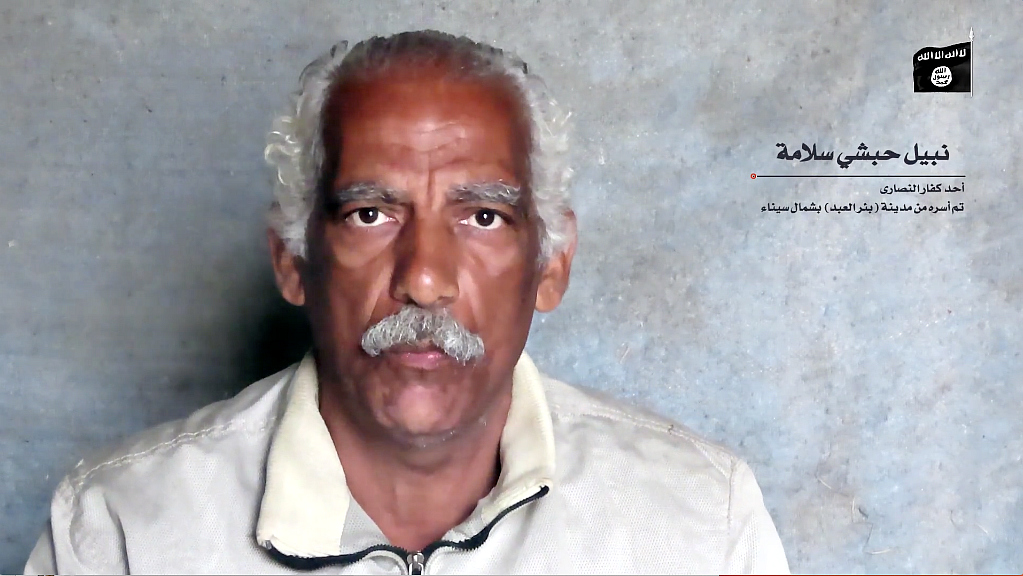
Nabil Habashi Salama, a Coptic Christian kidnapped from Bir al-Abd in North Sinai, speaks before his execution in the propaganda video of an Egyptian ISIS affiliate.

Nabil Habashi Salama, a Coptic Christian kidnapped from Bir al-Abd in North Sinai, speaks before his execution in the propaganda video of an Egyptian ISIS affiliate.

Christianity Today April 19, 2021
Wilayat Sinai / Telegram screenshot by Christianity Today

The Islamic State has claimed another Christian victim.

And Egypt’s Coptic Orthodox Church has won another martyr.

“We are telling our kids that their grandfather is now a saint in the highest places of heaven,” stated Peter Salama of his 62-year-old father, Nabil Habashi Salama, executed by the ISIS affiliate in north Sinai.

“We are so joyful for him.”

The Salamas are known as one of the oldest Coptic families in Bir al-Abd on the Mediterranean coast of the Sinai Peninsula. Nabil was a jeweler, owning also mobile phone and clothing shops in the area.

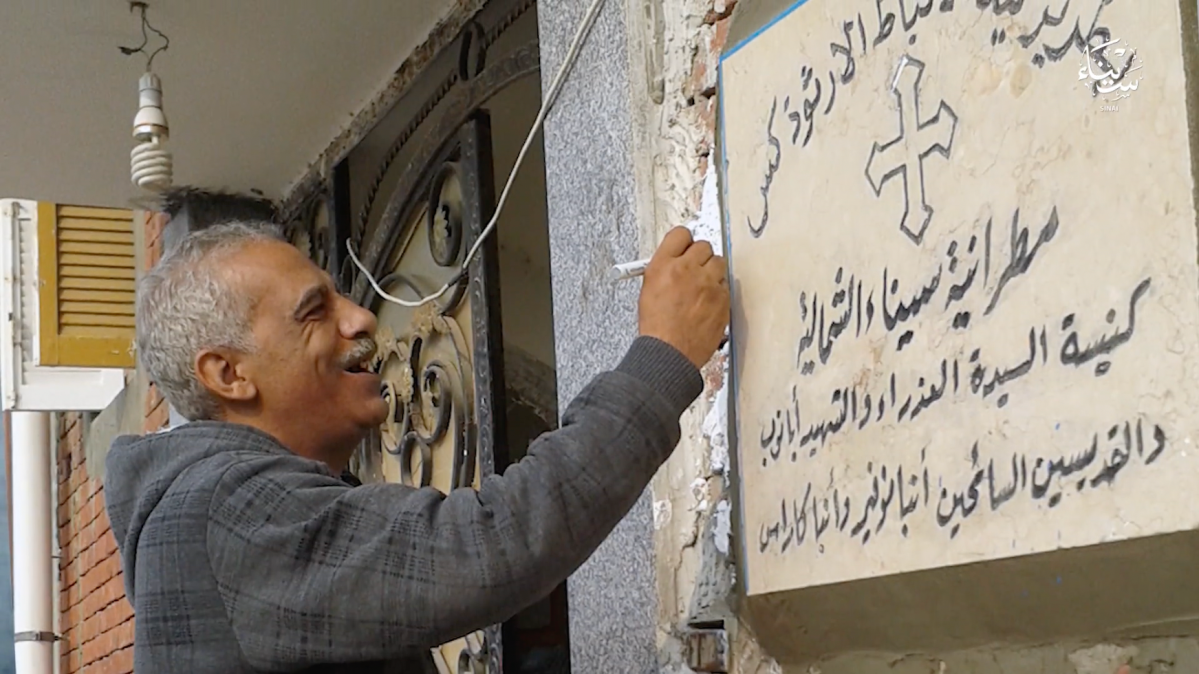
Peter said ISIS targeted his father for his share in building the city’s St. Mary Church.

In a newly released 13-minute propaganda video entitled The Makers of Slaughter (or Epic Battles), a militant quotes the Quran to demand the humiliation of Christians and their willing payment of jizya—a tax to ensure their protection.

Nabil Habashi Salama at his Coptic Orthodox church, The Church of St. Mary, St. Abanoub, and St. Karas, in Bir al-Abd, North Sinai, Egypt.

Nabil was kidnapped five months ago in front of his home. Eyewitnesses said during his resistance he was beaten badly before being thrown into a stolen car. It may be that these were separate kidnappers, because in the video that shows Nabil’s execution, he said he was held captive by ISIS for 3 months and 11 days.

On April 18, he was shot in the back of the head, kneeling.

“As you kill, you will be killed,” states the video, directed to “all the crusaders in the world.”

It addresses all of Egypt’s Christians, warning them to put no faith in the army. And Muslims which support the Egyptian state are called “apostates.” Two other Sinai residents—tribesmen who cooperated with the military—are also executed in the video.

Peter Salama said that in the effort to drive Nabil from his faith, his teeth were broken.

Nabil’s daughter Marina joined in the tribute.

“I will miss you, my father,” she wrote on Facebook. “You made us proud during your life with your virtues, and in your martyrdom with your strong faith.”

The Coptic Orthodox Church issued an official statement, calling Nabil “a faithful son and servant” who “adhered to his religion until death.”

It then reiterated support for the Egyptian army and state. Such acts, it stated, will “only raise our determination … to preserve our precious national unity.”

Earlier this month Egypt announced an additional 82 churches had been legalized, increasing the total to 1,882 since a corrective law was passed in 2016.

Three militants have been killed, with three others being pursued, stated the Ministry of Interior today, which referred to Nabil as a “citizen.”

But the video and execution raise fears of renewed ISIS activity after a relatively long period of quiet. In 2017, the affiliate opened fire on Muslims praying in a Bir al-Abd mosque, killing over 300 in the deadliest terrorist attack in modern Egyptian history.

That same year, they also targeted Christians living in nearby Arish, driving over 100 families from their homes.

Since then, the Egyptian army launched a massive campaign to defeat the local ISIS branch, which has never managed to seize and hold territory. In 2018, state security announced that over 900 militants were killed.

https://datawrapper.dwcdn.net/v8V2a

In 2019, Christian families slowly began to return, though no hard numbers were available at the time of publishing. In 2012, Coptic Orthodox Bishop Cosman stated there were 740 Christian families in his North Sinai diocese. But prior to the exodus, church officials stated the total was down to only 160.

Today, the women wear head coverings so as not to stand out as Christians. After informing authorities of a ransom demand of $318,000 (the Associated Press reports $127,000), Peter said, state security told him and his family to relocate for safety.

“We live in ruins after closing our means of subsistence,” he told the Coptic publication Watani.

Two other Copts, kidnapped in Sinai last year, were recently released after the payment of ransom.

“President Sisi has been personally committed to promoting peaceful co-existence between Christians and Muslims in Egypt, and his government has taken some encouraging steps,” stated Mervyn Thomas, president of Christian Solidarity Worldwide, offering his condolences to the Salama family.

“[But] abductions … highlight that far more must be done to uproot sectarianism, protect vulnerable communities, promote social cohesion, and uphold fundamental human rights for all Egyptians.”

Meanwhile, the president of the Protestant Churches of Egypt echoed the sentiments of the Coptic Orthodox.

“Together with the Egyptian state, we face all challenges and evils with zeal,” Andrea Zaki told CT, “and we always and forever affirm our authentic Egyptian unity.”

Peter Salama, however, focused on eternity.

“Do not think that I am building this church for here,” he recalled his father Nabil saying. “I am building for myself a home in heaven.”

And it was this peace that allowed Nabil to tell his son prior to his execution, while under the duress of his captors:

“All is fine, thank God.”

News

Ashes to Ashes: How St. Vincent Churches Keep Hope After Recent Volcanic Eruption

Water and supplies from ministry partners represent the gospel in action during the biggest disaster on the island in a generation.

Christianity Today April 19, 2021
Orvil Samuel / AP

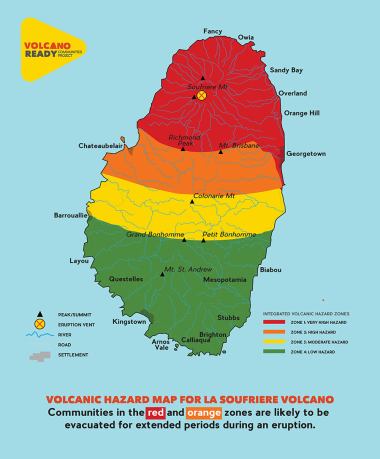
Christians on the Caribbean island of St. Vincent made their way through ash-covered streets and poor air conditions to attend church Sunday for the first time since the eruption of the La Soufrière volcano more than a week before.

Over the past week, ministry leaders worked together to organize resources and care for those displaced by the disaster. Around 20,000 people have evacuated from their homes in the northern areas closest to the explosions, which could continue for weeks.

Many churches remain closed, and several church buildings in the region near the volcano—including a Baptist and a Pentecostal sanctuary—were destroyed when their roofs collapsed under the weight of a foot or two of fallen ash. But in the “green zones” to the south, church leaders were able to spend a couple hours together in worship.

Pastor Kelron Harry gathered with Arnos Vale Church of the Nazarene, a congregation of 190 people. Harry, the district superintendent for the Nazarenes, has spent every day since the eruption messaging fellow denominational and ministry leaders and helping with relief efforts.

They update each other on the safety of their members, receive donations at the ports, and coordinate to get supplies and water to not only the 3,000 people in shelters but to the majority of evacuees who are staying with friends and family. Churches are also preparing and serving meals for the displaced.

Few court cases have aroused more concern among evangelicals—or created more puzzlement—than the recent creation-science case in Little Rock, Arkansas. At stake were basic values to which the fundamentalist-evangelical community is deeply committed. The evangelical will lay down his life in defense of freedom of religion, and for most evangelicals, this includes the right to determine the education of his children. He knows that in many public schools, evolution is taught explicitly as the rational alternative to the biblical teaching about creation held by uneducated fundamentalists!All evangelicals resent this. It is a violation of their constitutional right to the free exercise of their religion. They will make laws to secure their rights, and they will battle them through the courts and beyond. Eventually they will win—if America is to remain a free nation.But evangelicals are equally committed against any infringement of the religious rights of others. For conscience’ sake they support separation of church and state and reject the establishment of any particular religion, including their own.Evangelicals are divided over whether or not to support the Arkansas law. Here you can read how two conservative evangelicals sorted out the issues.—Eds.

This is the first volcanic eruption on St. Vincent in 42 years, and because they don’t know when the eruption will be over, people are afraid and anxious. The island was already struggling because so many people work in restaurants and hotels, which suffered widespread shutdowns due to the coronavirus.

“We are trying to do what’s necessary and bring hope,” said Harry. “We want to do that by sharing the gospel, but we also hope they see it in us as we extend a hand of compassion to them.”

Local church leaders have partnered with local businesses and ministries in nearby islands, such as Is There Not A Cause (ITNAC), a Christian relief org based in Trinidad and Tobago that has sent palates of water along with supplies like toiletries, batteries, lamps, and masks. Nazarene Compassionate Ministries and the Trinidad and Tobago Nazarene district sent supplies through the local port.

Despite the difficulty of seeing their home in crisis because of the volcano, pastors say see God’s grace to them through the body of Christ stepping up to help.

“I’m seeing the goodness of people coming out. Many persons who are searching, who are looking for hope, they’ll see it too,” said Harry. “Despite the volcano, despite the COVID-19 pandemic, God is still at work.”

One of the providential ministry partners has been OM Ships, which conducts Christian outreach through port visits. Its vessel Logos Hope spent three months in St. Vincent’s capital and main port, Kingstown, at the start of the year. It was close enough to return with aid after the eruption.

Last week, the ship pumped 40,000 gallons of desalinated water for citizens whose supply had been contaminated with ash, plus a firetruck made two runs to supply water to a local prison.

“We absolutely saw God’s timing in that our planned visit came at a time of great need for people,” said OM Ships spokeswoman Julie Knox.

People on Logos Hope were able to meet and pray with the people of St. Vincent as they distributed hundreds of clothing items, hygiene packs, gospel leaflets, kids games, and coloring books, as well as frozen food and freshly baked bread. A small team of crewmembers stayed behind to continue to assist while the ship moved on to Curaçao for maintenance.

“Being able to minister to people in need in this way was a great boost to the ship’s volunteers, who have had usual outreach curtailed by the pandemic,” Knox said. The ship will be back in Kingstown next month for a longer stay.

In St. Vincent and the Grenadines, about three-quarters of the population is Protestant, and the disaster stands to have long-term impacts on the churches there. While congregations in hazardous zones were prepared to move online after doing virtual worship during the pandemic, most do not have setups for digital giving.

Also, because many church buildings are erected over the course of years through volunteer work, it won’t be easy to replace the ones that have been destroyed in a matter of days, Harry said.

Kelron Harry receives a shipment of donations from Nazarene Compassionate Ministries and the Trinidad and Tobago Nazarene district.

The recent volcanic activity represents a change in fate for St. Vincent, which has historically been spared the hurricane disasters that have hit fellow islands in the Caribbean. The country’s indigenous name, Hairouna, designates it “the land of the blessed.” Harry worries that Christians have become complacent and need to call out to God.

“The entire nation has been covered in ashes. When I look in the Bible, ashes speak to the mortality of man, and ashes also represent repentance,” said Harry, who preached on those themes at his church on Sunday. “The Lord says to us, ‘Pull your sackcloth. Call on me, and I will save you.’ We all need to take responsibility and repent together.”

He also has reminded his congregation and fellow Nazarenes that their current circumstances do not change the reality of God’s love and care for them.

“I understand that we do live in a broken world, and nature has been affected also,” he said. “We will see volcanos; we will see hurricanes. I also believe God is a God who restores.”

Baptist Press reported on church efforts led by pastor Cecil Richards at Kingstown Baptist Church, about 10 miles south of the volcano.

Richards was a kid when the 1979 eruption took place, the very same week as this one. But many in the island don’t remember another disaster like this.

“We have faced crisis before, but we have come through,” Richards told worshipers last Sunday during a virtual church service. “And in this period with the confluence coming together with so many different things at once, particularly the coronavirus, and the COVID aftermath and the volcano, this is an accentuated crisis for us.”

News

Died: Ole Anthony, Terror to Televangelists

He dug through prosperity preachers’ trash and pushed a radical Christian community to be more like the first-century church.

Christianity Today April 19, 2021
Courtesy of the Trinity Foundation / edits by Rick Szuecs

When it came down to it, Ole Anthony would admit to a lot of the bad things people said about him.

“My own grandiose bull— can get in the way,” he told a reporter in 2004. “I was a schemer and a promoter. That’s just the way my mind works.”

Anthony needed to believe he was special, and he convinced those around him they were part of a spiritual elite. He was at times a huckster. He never stopped being a hustler. He exaggerated and lied about his life to impress people. He dreamed up grand plans to feed his ego and confirm his unmistakable charisma, never letting anything be reined in by humility or other people’s good sense.

But in the process he preached a message of God’s grace to those who wouldn’t have heard it otherwise. He founded a radical community of Christians committed to recreating the first-century church. And he took on the work of exposing televangelists who perverted the name of Christ for financial gain as cheap frauds.

According to the small church he founded in Dallas, Anthony was “more like an Old Testament prophet” than anything else.

“Any conversation with him left you pondering your relationship with God,” said Gary Bucker, an elder at Community on Columbia.

John Rutledge, another elder, said Anthony’s Bible teaching “could cut through a listener’s fog of self-delusion and clarify the need for redemption. It did for me, at least.”

Anthony died on Friday, April 16, at age 82. A long-time pipe smoker, he was diagnosed with lung cancer in 2017 and it spread to his liver and his brain. He stopped teaching his daily 7:30 a.m. Bible study about two years before his death. In some of the final recordings, his pain and struggle are audible.

“There’s nothing left to do and there hasn’t been anything left to do since Pentecost,” Anthony taught in March 2019. “There's nothing left to do. That’s which is perfect has come. Do you see how important that is, that there’s nothing left to do?”

‘You were meant to be a failure’

Anthony was born in Minnesota on October 3, 1938. His family moved to Wickenburg, Arizona, a desert town billed as the “dude ranch capital of the world,” when Anthony was 10. His father left sometime after, and his mother ran a small nursing home.

By his account, Anthony was a wild youth who got into trouble with girls, drugs, and the law. A reporter for the Dallas Observer found, however, that he worked at a Safeway grocery store, belonged to the National Honor Society and his high school’s radio club, and coedited the yearbook. There was no evidence he got in any significant trouble.

At 18, he joined the Air Force and was stationed in South Korea. Anthony became a special weapons maintenance technician. He later inflated that to “surveillance operative and analyst,” telling stories about how he worked as a spy “behind the bamboo curtain” in Communist-controlled parts of Asia and witnessed nuclear tests in the South Pacific, including one memorable explosion that he said “vaporized an entire island.”

Anthony’s commanding officer, Captain William D. Ballard, said that wasn’t quite accurate, telling one reporter, “we were not that kind of field operation.” According to Ballard, Anthony installed seismic monitoring systems to detect secret nuclear weapons tests around the world.

“Ole always pushed the edge,” Ballard told another reporter. “I wouldn’t have guessed that he would become so religious. But, when he gets into something, he gets into it right up to his eyeballs.”

After he got out of the Air Force, Anthony returned to Texas and got involved in Republican politics, working as a consultant for Barry Goldwater’s presidential campaign in 1964 and a regional campaign manager for Texas Senator John Tower in 1966. He ran for state legislature himself in 1968 and lost.

Anthony launched a political PR firm in Dallas in 1971, but then had his life changed by Norman Grubb, a British missionary to the Belgian colony of Congo, who spoke about the meaning of the Cross and dying to self.

“The words that really got to me,” Anthony later said, “were: ‘You were meant to be a failure. That is the only way God can use you. Look around you with honest eyes. Don’t you see that all human effort is futile, empty and vain? All that is necessary for you is: Abandon yourself, pick up your cross and follow Him.’”

He frequently compared the conversation experience to a nuclear blast—“If you understand that God wants complete surrender from you, it’s like an atomic bomb going off in your head”—and made up a story about how he’d seen a bomb test. His friend, journalist John Bloom, who became famous in Texas for writing a satirical column about drive-in movies under the name Joe Bob Briggs, said that Anthony was trying to communicate the “mystical flash of understanding” he experienced.

“It’s impossible to explain how these things happen,” said Bloom, who had his own conversion in 1984.

A community is born

Anthony was changed enough that he abandoned his PR firm and started Trinity Foundation, named after the world’s first nuclear test site in New Mexico. He planned to organize and promote evangelistic events, but failed almost immediately. He tried to buy a TV station, but didn’t succeed. He hosted a radio show that was moderately successful in the region, but then got canceled, possibly for being difficult to work with.

“One by one all of Ole’s projects for God came to nothing,” Bloom wrote. “By the time I met him, the Trinity Foundation appeared to be comatose. In fact, it was just being born.”

In 1974, the Trinity Foundation was reduced to a Bible study. Anthony hoped it would attract the Republican officials and businessmen he had previously worked with, but it actually drew people on the margins of Texas society, with trauma and trouble and a need for the message that Jesus loved the downcast and downtrodden and did all the work that needed to be done on the cross.

“The people who showed up didn’t just bring their Bibles,” Bloom said. “They brought teenage pregnancies, divorces, bad-check charges, warrants, feuds with parents, child-custody battles, drug habits, alcoholism, car wrecks, and more or less constant illness without benefit of medical insurance. All these trauma dramas poured into the Bible study, sending Ole to the passages in which Paul exhorted Christians to embrace their afflictions and glory in their adversity.”

Anthony, going back to those New Testament exhortations, became fixed on the idea that Christians today should be more like the first-century church. He and his followers committed to sharing all that they had with each other and with anyone else in need, following Acts 2:42–47.

They bought housing on one street and called it “the Block,” meeting for daily Bible studies, shared meals, and day-to-day discipleship.

Members agreed to take in homeless people, and Anthony devised a short-lived but much publicized plan to solve the homelessness problem, with every church in the country to take in one or two people in need. Few congregations signed on for the project, though some Dallas churches would send people to the Block with a note they weren’t set up to help but knew that Anthony was.

Anthony was also influenced by a Messianic Jewish leader named Zola Levitt, and the community started celebrating Jewish feasts and fasts, interpreting Rosh Hashanah, Yom Kippur, Purim, Pentecost, the Feast of Ab, and other celebrations as texts about Jesus.

According to the church today, each feast is “like a piece of a jig-saw puzzle in time” and “when the picture is complete, we find ourselves gazing at a portrait of Jesus Christ.”

Accusations of spiritual abuse

In the radicalism and the reinvention of the Block, some people were hurt. According to former members, the community lost any sense of personal boundaries, and Anthony dominated the group with his charisma, masking his will as group consensus and controlling people’s lives. He decided who could get married. He told people where to live. He gave away their belongings and put homeless people in their homes without asking.

Perhaps the most destructive practice was a scapegoating ritual the Block called “the hot seat.” One person—commonly someone who had pushed back against Anthony, former members say—would sit in the center, and the group would assault them with accusations until they broke down.

“It was brutal,” said Powell Holloway, who sat in the hot seat in 1986. “The whole purpose was to die to self, to get in touch with the fact that you were chief of sinners.”

When people finally psychologically crumpled, they would stop resisting the worst accusations against them and embrace self-loathing and shame. Members would frequently confess to the worst sins they could imagine, including pedophilia, voyeurism, bestiality, incest, and prostitution. While some of the confessions were true, more were made up to demonstrate total submission to the group.

Anthony, as the leader, did not sit in the hot seat, former members say.

The current church says the community has grown and evolved since then and no longer practices the hot seat. The church nonetheless acknowledges that Anthony’s vision of “full-contact Christianity” could be confrontational and abrasive.

Investigating televangelists

The small group of intense Christians came to national attention in the early 1990s, when Trinity Foundation started investigating televangelists. One of the members of the community told Anthony that when he fell on hard times, he pledged his last $5,000 to Robert Tilton, host of Success N Life, a prosperity gospel program that was on the air in more than 200 television markets.

“I needed some snake oil, and he had some snake oil to sell,” Harry Guetzlaff would later say. “It made perfect sense at the time. I believed that God was active in my life, and Tilton was saying, ‘Give me a buck and God will give you back a hundred.’”

Anthony and the group were offended by this betrayal of the gospel, and tried to get someone to do something. They contacted National Religious Broadcasters, but got no response. They connected a local prosecutor, but the district attorney was not convinced that Tilton, a cartoonish character who would shadowbox demons on the air, was doing anything illegal. They contacted various media but got no response, until a producer at ABC told them they would need to produce evidence to get any attention and offered a few suggestions for how to find it.

They found what they were looking for in dumpsters behind Tilton’s office, his lawyer’s office, an Oklahoma bank branch, and a computer data management office. Trinity found Tilton was depositing the checks, computerizing the information in the prayer requests, and asking for more money by direct mail. Hundreds of thousands of papers he had promised to read, pray over, and lay hands on were ripped up and dumped in the trash.

“It was literally widows and orphans,” Anthony said. “That’s who supports the televangelists—the weakest, most vulnerable people in the world.”

On November 21, 1991, ABC aired a prime time investigation into Tilton and two other televangelists, using the evidence gathered by the Trinity Foundation. Diane Sawyer interviewed Anthony and shared footage of the trash he and the newly born “garbologists” had collected. Shortly after the program, five agencies announced criminal investigations into Tilton, and his ministry collapsed.

Trinity went on to do more than 300 other investigations into televangelists, including Benny Hinn, Kenneth Copeland, and Paula White. The ministry received support from hundreds of donors across the country, sent church members to be trained and licensed as private investigators, and became the only full-time media ministry watchdog organization.

In 1996, the foundation acquired the evangelical satire magazine The Door and occasionally used it in the war against televangelists as well, such as the time it published a Playboy-style photograph investigators had found of a naked W. V. Grant shortly after he was convicted of failing to pay back taxes.

The church and Trinity Foundation were eventually established as independent operations, though they remained closely connected. The church was named Community on Columbia.

In 2007, when a US Senate committee led by Republican Chuck Grassley started investigating prominent televangelists, with an eye toward tightening tax regulation on multibillion-dollar media ministries, Trinity gave the government 38 reports. The Senate’s final report did not result in any push to change the law.

Anthony was undeterred and spoke out against televangelists when they supported Donald Trump in 2016. He continued to work with journalists interested in exposing prosperity gospel fraud, all while maintaining his daily Bible study and participating in life at Community on Columbia. He took as its motto a Latin phrase attributed to Martin Luther: “Crux sola est nostra theologia,” meaning, “The cross alone is our theology.”

In the end, Anthony’s message to the televangelists, the needy people who showed up at the Block in Dallas, and his own grandiose schemes were one and the same. As he explained it once to Bloom, “A lot of these people are clinging to their miserable little self-images. They don’t understand that it’s about God. It’s about them, but only the part of them that contains God. They still think they’re special.”

Anthony never married. He will be buried by his nieces in St. Peter, Minnesota. A memorial will be held in Dallas on May 1.

Books
Review

In a Post-Christian Culture, There’s No Good Way Around Being the ‘Baddies’

If we have to wear the villain label, we can at least wear it with calmness, confidence, and joy.

Christianity Today April 19, 2021
Illustration by Mallory Rentsch / Source Images: Peter Sjo / Aaron Sebastian / Unsplash

A classic sketch by the British comedy duo Mitchell and Webb sees a pair of Nazi SS officers in the grip of an existential crisis.

Being the Bad Guys: How to Live for Jesus in a World That Says You Shouldn't (How to live confidently for Christ in a post-Christian culture.)

One says to the other: “Have you looked at our caps recently? … They’ve got skulls on them. Have you noticed that our caps have actually got little pictures of skulls on them?”

Realization dawns: “Hans … are we the baddies?”

Contemporary Western culture finds itself curiously split on the question of moral absolutes. On the one hand, in the golden age of prestige TV, we pride ourselves on the moral complexity of our stories: the flawed protagonist, the tortured hero, the sympathetic villain. Using the tools of psychology and sociology, we do our best to understand what has gone wrong for those who do wrong, and we accept (more or less) that we’re all damaged, striving people.

On the other hand, we seem to define more rigidly every day the boundaries of what’s acceptable, in the process cheerfully consigning larger and larger swaths of our fellow citizens to that no man’s land beyond the cultural pale.

Do we or do we not believe in goodies and baddies? How do we treat those we place in that second camp? And what happens when other people place us there?

In his short and very readable book Being the Bad Guys: How to Live for Jesus in a World That Says You Shouldn’t, Australian pastor and blogger Stephen McAlpine sails into the contested waters of Christian cultural engagement with admirable calmness. It’s a delicate moment for discussions of this kind. Christians across the political and ecclesial spectrum probably would agree that the relationship between the church and the wider culture is currently rocky, but they would also disagree, vigorously, about what exactly has gone wrong and what a constructive response looks like.

Good bad guys

For McAlpine, a good place to start is taking seriously accusations that Christians are the “bad guys.” Particularly in the wake of Christian involvement in the Capitol riots of January 6, and with revelation upon revelation of abuse by prominent church leaders, it is right for outside criticism to prompt soul-searching rather than defensiveness. Some hostility arises from our own failings; and humility is always in order for the Christian.

But from McAlpine’s read of an increasingly post-Christian culture, on some fronts there simply isn’t going to be an honorable way around being the baddie: “The fact is that often we are accused of doing wrong not because we are living too little like Jesus but because we are living too much like him.”

Being the Bad Guys takes seriously those flash points where a Christian ethic—especially Christian sexual ethics—comes into conflict with social orthodoxy. But it also suggests that if fear and outrage are the default response to encountering cultural opposition, then we’re doing it wrong:

So this book isn’t about how to stop being the bad guys; it’s about how to be the bad guys. It’s about how to be the best bad guy you can be—to refuse to be surprised, confused, despairing and mad about it, and to find a way to be calm, clear-sighted, confident and even joyful in it.

Being a good bad guy, McAlpine counsels us, is all about having Bible-shaped expectations. If we Christians are astonished and resentful when we experience pushback from the culture, we have forgotten the insistence of the entire New Testament that opposition—even hatred and persecution—are par for the course for followers of Jesus. If we find ourselves on the back foot, feeling besieged or helpless, we have lost sight of who we claim to serve. As McAlpine puts it:

If we are focused on Jesus, then we will not become self-entitled or embittered Christians who play the victim card and get angry when society pushes against us. We will instead be filled with joy. When we don’t join in the cheers when our cultural enemies lose a battle, or when we don’t shout angrily at them when they win a battle, it will only be because Jesus is our hope and joy—and he is our example of what it looks like to entrust yourself to the One who judges justly (1 Pet. 2:23).

Those who have trod this path before us include Daniel, the one for whom God is big and humans are therefore only human-sized, neither to be feared nor despised. Or Haggai, who took God’s people to task for their complacency, their reluctance to poke their heads above the parapet. Or Peter, the reformed culture warrior who went from cutting off the ear of an enemy to exhibiting and counseling joy as the fitting response to unjust suffering. Being the Bad Guys makes it abundantly clear that pressure, and the grace to be cheerful under it, is nothing new or strange for the people of God.

Antipathy and neediness

McAlpine’s proposed way forward has a lot to do with embracing a place “at the cultural margins,” and with forming communities that are “thick and rich” and “don’t get caught up in the increasingly toxic culture war.” Ideally, he observes, churches will offer programs of discipleship more effective and life-giving than the alternative religion of the day, the “individualistic narrative of the authentic self.”

At its best, Being the Bad Guys offers a grace-filled vision of what various “tactics” of Christian cultural engagement are actually for. At the end of the day, for the Christian, the reason to be alarmed at cultural tides pulling away from the shore of Judeo-Christian ethics is not because this leaves the church stranded, but because those ethics further the good of our neighbors. As McAlpine writes:

Our primary concern is—or ought to be—not that our personal lives will become harder, nor that our children will have to grow up in a hostile sexual setting, nor even that we might lose our jobs because of our faith. Rather, it is that the rapid rejection of this binary understanding of the world will both destroy and be used to destroy those who have been made in the image of God. It is a rejection of God himself. Human flourishing is at risk because of this rejection.

McAlpine’s analysis of our culture’s religion of authenticity and self-creation is frequently incisive and helpful, including how Christians too have been drawn into it. However, his decision to keep the spotlight trained throughout on issues around gender identity and sexual ethics won’t sit as well with some readers. He insists that “this book deals with sexuality a lot not because I am obsessed with it (an accusation often levelled at orthodox Christians) but because the culture is.”

Perhaps he’s right to place sexuality at the epicenter of the current clash between kingdom values and the world—I don’t know. But while concern for people wounded or confused by the various waves of the sexual revolution is clear in these pages, so too, at times, is a cynicism or dismissiveness towards those who embrace a progressive narrative around sex and gender, a posture that may well exacerbate this divide. Where such thorny and deeply personal questions are involved, jibes about the “hope of a new world that is all glitter and rainbows,” or how coming out in the public eye “hits the authenticity jackpot,” sit uneasily beside the more compassionate, inviting vision the book holds out.

Are we the baddies? Being the Bad Guys brings into focus not only the antipathy but also the neediness of our world; not only the call to stand firm in the face of opposition but also the call to actively and lovingly serve those around us; not only the rapidly shifting ground of cultural change but also the utterly secure future promised to those whose Lord is Jesus. In other words, it simply unpacks what it might look like, in 21st-century Western culture, to live such good lives that, though our neighbors accuse us of being the bad guys, our words and actions—and the grace to be found in our communities—tell a very different story.

Natasha Moore is a senior research fellow at the Centre for Public Christianity in Sydney.

addApple PodcastsDown ArrowDown ArrowDown Arrowarrow_left_altLeft ArrowLeft ArrowRight ArrowRight ArrowRight Arrowarrow_up_altUp ArrowUp ArrowAvailable at Amazoncaret-downCloseCloseellipseEmailEmailExpandExpandExternalExternalFacebookfacebook-squarefolderGiftGiftGooglegoogleGoogle KeephamburgerInstagraminstagram-squareLinkLinklinkedin-squareListenListenListenChristianity TodayCT Creative Studio Logologo_orgMegaphoneMenuMenupausePinterestPlayPlayPocketPodcastprintremoveRSSRSSSaveSavesaveSearchSearchsearchSpotifyStitcherTelegramTable of ContentsTable of Contentstwitter-squareWhatsAppXYouTubeYouTube