News

Greg Laurie Tests Positive for COVID-19, Warns Against Blaming White House

The pastor and evangelical adviser says he doesn’t know if he was infected at last week’s event.

Christianity Today October 5, 2020
Greg Laurie / Twitter

For months, California megachurch pastor Greg Laurie has spoken out against the instinct to politicize the coronavirus outbreak, preaching to his congregation to overcome outrage with outreach and look for opportunities to serve people who find themselves overwhelmed, scared, and angry.

But now he finds himself registering a positive test during one of the most politically heated moments of the pandemic.

Laurie, 67, shared the news of his infection today in the midst of a string of high-profile COVID-19 cases, including President Donald Trump, First Lady Melania Trump, and presidential staffers.

He cautioned Americans against the impulse to blame the White House.

“Unfortunately, the coronavirus has become very politicized,” he said in remarks to CT. “I wish we could all set aside our partisan ideas and pull together to do everything we can to defeat this virus and bring our nation back.”

After news of Trump’s diagnosis broke, multiple people who attended the president’s Supreme Court nomination ceremony at the White House over a week ago also tested positive. The infected attendees included former New Jersey Governor Chris Christie, who sat in front of Laurie, and Notre Dame University president John Jenkins. Online, some began speculating that the gathering was a “super spreader event.”

“I don’t even know if I personally got the coronavirus at the White House,” he said. “I had tested negative before the event.”

A source familiar with the ceremony told CT the evangelical advisers who gathered to pray inside with the president earlier in the day on September 26—many of them sitting together, unmasked in the Rose Garden crowd—had actually all been tested prior to their participation.

Other than Laurie, no other evangelical leader in attendance has reported a positive test, and several who were there went on to lead in-person services over the weekend rather than quarantine.

A spokesman for Calvary Church told CT that Skip Heitzig, a New Mexico pastor at the event, tested negative prior to the White House gathering and twice since, most recently on Saturday.

Representatives for Franklin Graham and Liberty University acting president Jerry Prevo, who were both in attendance, told the Religion News Service they tested negative afterwards, as did Trump’s top spiritual adviser and pastor Paula White-Cain. Georgia pastor Jentezen Franklin shared on social media that he tested negative as well.

Courtesy of Greg Laurie

At both the Rose Garden ceremony and the prayer march, organized by Graham, Laurie was photographed not wearing a mask. He said he only took off his mask for pictures. One clip he posted last week does show him un-masking to chat with Johnnie Moore, a fellow evangelical adviser, at the march.

Laurie’s church complied with California’s restrictions on worship during the pandemic, only returning to outside gatherings with temperature checks, masks, and social distancing. He spoke up during the spring to challenge pastors who put their congregation at risk, saying, “I know you may see this as an act of great faith, but I think in many ways you’re testing the Lord more than you’re trusting the Lord.”

Laurie posted a video Monday on Twitter, sharing the news and explaining that his symptoms are mild at this point: fatigue, aches, fever, loss of taste, and boredom. He spoke with a mask resting on his leg.

“I have always believed COVID was a pandemic and have tried to encourage people to take it seriously. Clearly, the scientists believe that the virus is contagious enough that it merits a vaccine,” he told CT. “Clearly, if the president can get it, anyone can.”

Another high-profile evangelical leader also contracted COVID-19 recently: John Hagee. Hagee’s son Matt announced at Cornerstone Church on Sunday that the San Antonio preacher, age 80, had also contracted the virus after being “diligent throughout this entire COVID pandemic to monitor his health.”

Though John Hagee, who leads Christians United for Israel, attended a White House event on September 15, he was not depicted at the September 26 gatherings. The younger Hagee said his father’s doctors caught the infection early and asked the congregation for their prayers.

This post has been updated.

Ideas

I Can Pray Heartily for the President and Still Hold Him Accountable

How Trump’s illness has (and hasn’t) changed the way I intercede for leaders.

Christianity Today October 5, 2020
Jacquelyn Martin / AP Images

For the last few days, Americans have been shocked and concerned about the president’s hospitalization due to COVID-19. The reactions have been varied, and many have been decidedly theological. As Kate Shellnutt reported recently for CT, “Several pastors and ministry leaders encouraged Americans that this was a time to pray for the president and the country regardless of their political stances.”

For some leaders, that invitation might come easily. But for others of us, prayerful action comes in the context of a more conflicted view of the current administration. How exactly do we respond to news of the president’s illness?

Seen from one angle, the answer is straight forward. We pray. In my Anglican church, we intercede for our leaders every Sunday with some version of the following:

We pray that you will lead the nations of this world in the way of righteousness; and so guide and direct our leaders, especially the President of the United States, Donald Trump, that your people may enjoy the blessings of freedom and peace. Grant that your leaders may impartially administer justice, uphold integrity and truth, restrain wickedness and vice, and protect true religion and virtue.

At the center of this prayer is the idea that all governments have a solemn responsibility to work on the side of truth, justice, and integrity. They are supposed to inspire virtue and limit the damage of vice. The prayer pertains not only to them as persons but to their powerful influence over the lives of so many.

This year, especially, church leaders have had much to say about the culture and ethos of this country and how it’s shaped by governors, local officials, and especially the president. Christian intercession, then, is not about blind allegiance. It is a recognition that the wellbeing of many often rides on the decisions of a few.

The scope of that influence is precisely why I have prayed for Trump, often daily, throughout the entirety of his presidency. I have disagreed strongly with some of his policies and actions . But when I disagree, I do not pray less; I pray more. As David French writes, “Christians of all political persuasions should humbly (and with full knowledge of our own frailty) seek true repentance from men and women in power. Their transformation benefits us all.”

For me, then, the president’s bout of sickness will add further content to my prayers, but it will not change my fundamental practices.

While Christians should be united in praying for our leaders, our Christian responsibility to the state extends further. The same Bible that calls upon us to pray for our leaders also calls upon them to rule justly.

The Hebrew Scriptures contain an important story about the prophet Daniel and Nebuchadnezzar, the Babylonian king. In this story, Daniel warns Nebuchadnezzar that he will lose his kingdom for a time. But Daniel believes there is still an opportunity, if the king humbles himself and shows concern for the poor:

Therefore, Your Majesty, be pleased to accept my advice: Renounce your sins by doing what is right, and your wickedness by being kind to the oppressed. It may be that then your prosperity will continue. (Dan. 4:27)

Although Daniel and the king had different religious views, the prophet still expected this foreign ruler to care for the oppressed.

Alongside Daniel, leaders of the early church also called out injustice. It follows, then, that all politicians, regardless of their religious views, have the same moral obligations: to care for the oppressed and maintain the kind of order that allows for human flourishing. It also follows that our Christian responsibility as citizens is not only to pray for leaders when they’re sick. It includes standing against injustice and for peace and stability. Those two callings are not in competition.

Furthermore, we believe that all life is sacred—from the president in the hospital to the baby growing in the womb to the person facing police arrest for unjust reasons. In the other words: The same faith that demands we respect the sanctity of black life lost to unjust violence requires us to respect the sanctity of the life of the president, even when we have sharp disagreements.

Of course, some will call the president’s illness a form of divine retribution. But that remains very dangerous territory for the Christian. We cannot always draw a straight line from a particular form of suffering to its cause. Nonetheless, we do believe that suffering often has the ability to teach us something about ourselves, God, and the world. The focus on Trump’s illness gives us a chance to gain further empathy for the hundreds of thousands who have suffered and died from this disease.

Hopefully, the next few weeks will help us recommit to the most basic form of neighborly love—namely, attending to the health of the most vulnerable. We show this love by engaging in the monotonous and often thankless work of vigilance. We heed the advice of medical and scientific experts in order to hinder the spread of the virus. We love in word and in deed. And we pray for those at risk.

We pray especially for those we love and like. But we’re doubly called to pray for our enemies (Matt. 5:44) and those with whom we disagree. That Christlike love forms the very foundation of our faith.

Esau McCaulley is an assistant professor of New Testament at Wheaton College and the author of Reading While Black: African American Biblical Interpretation as an Exercise in Hope.

Speaking Out is Christianity Today’s guest opinion column and (unlike an editorial) does not necessarily represent the opinion of the publication.

News

Christian and Missionary Alliance Opens Second Investigation of Ravi Zacharias

New claims raise concerns that previous allegations were not thoroughly investigated by his denomination.

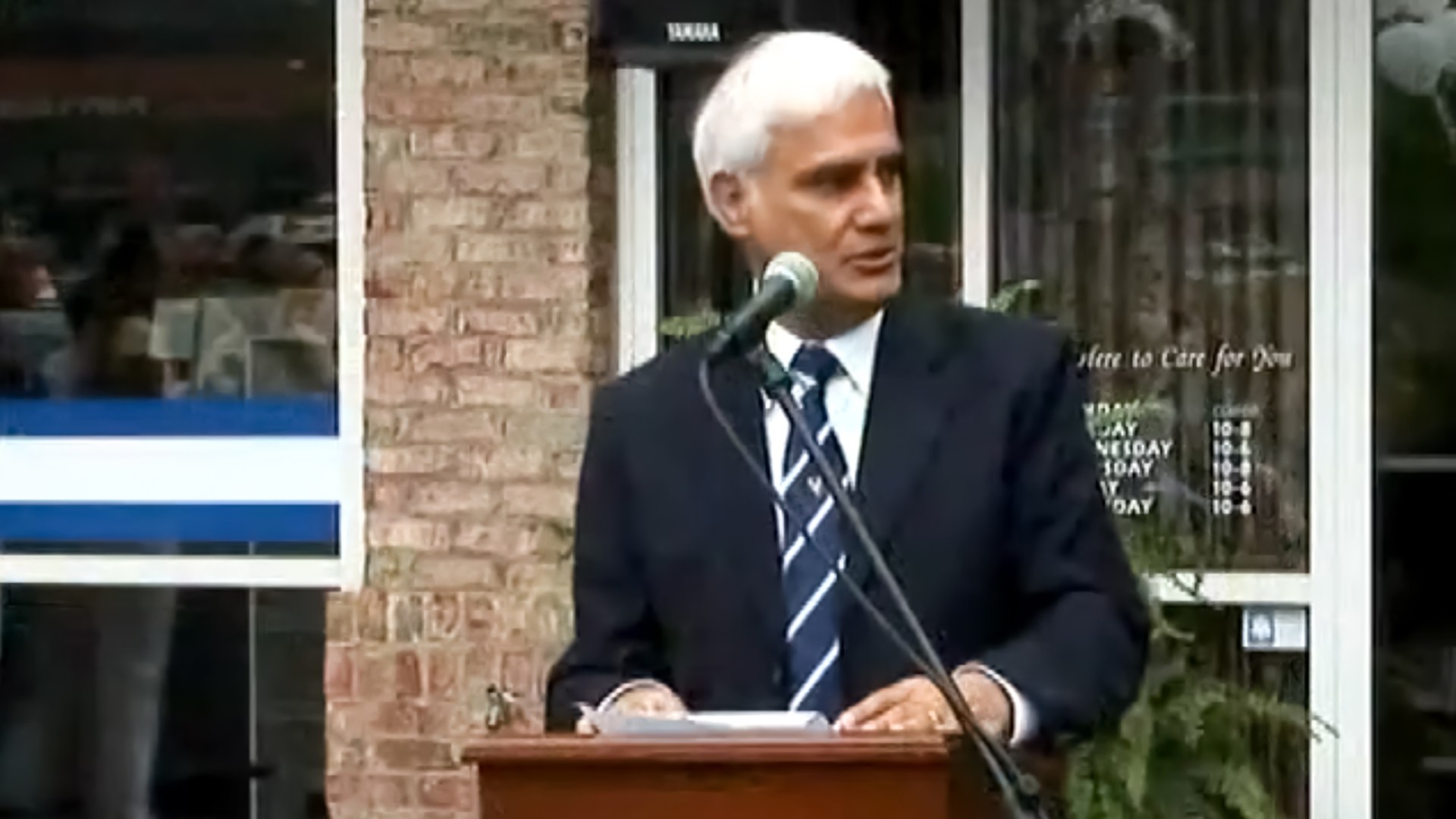
Ravi Zacharias at a spa grand opening in 2009.

Ravi Zacharias at a spa grand opening in 2009.

Christianity Today October 5, 2020
YouTube screenshot

The Christian and Missionary Alliance (CMA) is opening a second investigation into Ravi Zacharias following new claims of sexual misconduct reported by Christianity Today.

The denomination sent a letter to Alliance workers on Friday announcing that the leadership had “determined that we must look into these new allegations, in spite of the fact that Mr. Zacharias passed away earlier this year.”

Zacharias, a prominent apologist and ministry leader, was ordained and licensed by the CMA up until his death in May. The new allegations came from former employees at two Atlanta-area day spas Zacharias co-owned and frequented for massage therapy more than a decade ago.

Three women told CT Zacharias would touch them inappropriately, expose himself, and masturbate during treatments. In a follow-up article, World magazine reported additional allegations that a therapist was fired after complaining that Zacharias asked for “more than a massage.”

Terry Smith, vice president of church ministries for the CMA, said it is unusual to investigate sexual misconduct after the accused has died, but the denomination is “fully accountable” for its licensed ministers—no matter their level of celebrity or international renown.

The CMA holds that people are disqualified from leadership if their behavior causes “imminent harm to others or to the testimony of Christ.” Its formal disciplinary procedure prioritizes restoration, however, which isn’t possible when the offending minister has died.

“Normally when a worker is investigated, they’re alive so they can speak to the accusations against them and can receive whatever punitive steps the discipline committee gives them,” Smith told CT. “Our goal [here] is to discover the truth to the best of our ability to do so.”

The CMA may also revisit previous allegations against Zacharias. It said in the announcement that the new information reported by CT “raised concerns” about the decision not to discipline Zacharias after a prior investigation.

In 2017, Zacharias faced allegations that he solicited sexually explicit photos and engaged in phone sex with a woman in Canada, Lori Anne Thompson, who supported his ministry.

Zacharias admitted he had a correspondence with Thompson but denied everything else, claiming it was part of an extortion plot. Zacharias sued Thompson and her husband, and the couple asked that the case be moved from civil court to Christian mediation. The mediation ended with a settlement and a non-disclosure agreement, which does not allow Thompson to speak about the allegations.

The CMA decided in 2018 not to remove Zacharias’s credentials, “based on the information available at the time,” the denomination stated last week.

At the time, the CMA said it had “completed a thorough inquiry of these accusations, including interviews with those involved and a review of all available documentation and records.” Zacharias’s ministry has used the denomination’s findings to defend him.

However, Thompson said the process was not as robust as indicated. She told CT she spoke to CMA leaders on the phone twice—once while “sobbing uncontrollably on the side of the road in my vehicle”—and then the investigation was over.

Ravi Zacharias International Ministries (RZIM) reiterated as recently as last month that Zacharias “denied any sexually or romantically inappropriate conduct” with Thompson and “stood by that statement until his death.”

RZIM announced on September 24 that it would conduct own investigation into the spa allegations but stated at the same time that “the family and ministry teammates of the late Ravi Zacharias … believe them to be false.” RZIM also suggested that allegations made after someone has died cannot be trusted.

Victims advocates have challenged the CMA to review the case and provide oversight, concerned about the potential conflict of interest when ministries investigate their own leaders.

The three women who shared their stories with CT said they did not think Zacharias would be held accountable by an international, multi-million dollar ministry that bears his name. They didn’t expect money or apologies, but they spoke up because they think there may be other women out there who were hurt by the apologist and they want those women to know they are not alone.

Smith acknowledged concerns that Zacharias, arguably the best known apologist in the world, was treated as a celebrity by the CMA and not like other ministers of the gospel.

“We don’t want anyone to think we show favoritism in any of these cases or situations,” he said. “We’re going to investigate this like we would have done for any other official worker.”

The law firm doing the investigation began its work Friday and has been told to look at anything involving “sexual misconduct,” according to Smith. He declined to name the firm.

Victims advocates say that in addition to investigating allegations, Christian organizations should examine their structures and ministry cultures.

“It’s more than just, ‘Hey, create a protocol.’ It’s also working hard to shift the culture in our churches so that no one is beyond accountability,” said Boz Tchividjian, founder of GRACE and an attorney for victims of sexual abuse with the law firm Landis Graham French, PA.

“Beyond the investigation, an organization needs to be doing what it can to shift the culture,” he said. “Talk about these matters repeatedly, publicly. Talk about how you don’t care who it is, no one in leadership is beyond accountability. And prevent leaders from becoming mega rock stars in the first place.”

With reporting by Kate Shellnutt.

Church Life

When a Christian Admits to Opioid Addiction

I was willing to serve a brother or sister in need. It was much harder to be a friend.

Christianity Today October 5, 2020
Illustration by Rick Szuecs / Source Images: Envato Elements

I knelt in the opening of a car door beside my friend who slumped in the passenger seat. Someone had dropped her off in the church parking lot during Sunday morning service. Fresh skin pops lined her right arm. A bloody needle balanced on her leg.

“I’m sorry. I didn’t know where to go,” she said. “I want to stop using, but …” Her voice trailed off.

I put my hand on her stooped shoulder—the same shoulder I’d supported when I baptized her a few months earlier. I remembered how the church laughed together in joy, trying to figure out how to fully immerse her while protecting the ankle monitor she wore on her leg. The ankle monitor was gone now, but so was the transcendent emotion of her baptism.

“I’m not going to sit here and watch you kill yourself,” I said. “I have to call somebody.”

I closed the car door and walked away. I didn’t make it 10 steps before I turned around and went back to open the door.

“I’ll bet people have been walking away from you your whole life. We’re not going to let you go through this alone.” I left the door open this time as I went inside to call for help.

I heard my friend say, “I knew I would be safe here.”

My friend—who gave me permission to tell this story—wasn’t the first Christian to admit a substance abuse addiction to me. The first time I was far more harmful than helpful—more judgmental than hopeful. Feelings of betrayal and anger, hopelessness and grief came in waves. Confessed lies tore apart shared memories, and I distanced myself.

How is someone supposed to react when a brother or sister in Christ brings an addiction to light? There isn’t a flow chart to follow, and few resources exist, especially in the midst of a pandemic. From my experience, I’ve come to believe the answer is Christian friendship. I mean friendships based in a shared hope of the gospel of Jesus Christ, marked by faithful encouragement and mutual trust.

In my community in rural Appalachia, 65 percent of people say substance abuse is the top issue affecting their quality of life. In our three-year-old church plant, more than half of the congregation has been impacted by substance addiction. As my husband and I have ministered here, we’ve seen people in varying scenarios of substance misuse and every stage of recovery.

Recent reports say that misuse of opioids and overdoses have increased in more than 40 states during the pandemic. This isn’t surprising. Addiction is too often a lonely and isolating condition.

For people of the faith who battle against substance dependence, isolation from the Christian community can exacerbate feelings of despair, shame, and worthlessness. Yet many also avoid connection because they fear condemnation. They worry about being judged if they use again or if, during recovery, they use the legal, proven medications that can help with opioid addiction, like buprenorphine, methadone, and naltrexone. These are frowned on by some faith communities.

The messiness of addiction is too much for many churches to handle. Recovery is not a straight road or an easy fix. I know, for me, it wasn’t hard to recite the 12 steps in solidarity at a Celebrate Recovery meeting. It was harder to interact with people from “those” meetings in other parts of my life. I was willing to serve. I found it much more difficult to share my life.

And yet my understanding of the gospel is that Jesus risked friendship with me (John 6:70–71) when I was untrustworthy (John 2:24) to reveal God’s love and complete God’s plan to reconcile all creation to himself. I am called to follow him.

That calling doesn’t give me an exact strategy when dealing with people in my church and my community struggling with addiction. There’s no foolproof process for Christian friendship, especially when you’re dealing with addiction and a pandemic.

In these times, I have found the term heart posture to be more useful than a strategy. I can orient my heart to prepare for ongoing engagement with others. Circumstances may call for different responses in different situations, but the intention remains the same. This is what I’ve found that helps.

1. Orientation

Only God knows the depth and type of change required of any one of us, but Scripture is clear that regardless of the current condition of any heart, every life has value (Ps. 139:13–14). A person in the throes of addiction is as valuable as the queen of England. It’s normal to value one person more than another. The good news is God doesn’t.

We can ask God to adjust our hearts to allow us to value one another as God does. When we see others whose bodies and lives display the effects of addiction, we don’t have to condemn them or ignore them. We can take our own thoughts captive and make them obedient to Christ, who values each soul.

As God began to reorient my heart posture, I started to see the risk people are taking to even admit any issues with substance abuse. It is an act of bravery and courage that leaves a person completely vulnerable to all my possible responses.

Now, when a friend shares in full honesty of her struggles, my first response is to thank her for trusting me. I admit my own fears and ask to pray with her so we may both seek wisdom and know how to love each other well.

2. Preparation

We will never be able to know or prepare for all the scenarios a friendship could bring, especially in a time when friendships have been strained by social distancing. But there are no exit strategies in real friendship. Christian friendship requires openness.

We prepare our hearts for friendship with each other through the simple and necessary acts of private and shared prayer, Scripture reading, Communion (yes, even by video conference), worship, generosity, and obedience. In this way, God prepares us together for whatever may come.

An authentic community also creates space for conversations about contingencies. People in recovery need to be able to offer insight about the best ways to respond to potential issues if they return to use. We can discuss medical options and legal concerns and agree on a path to walk together (Amos 3:3), with guardrails that can keep everyone safe.

3. Ongoing Engagement

Stigma is an enemy of hope in the eternal life we share together as Christian friends. I’ve had several friends in recovery say sometimes Christians make them feel like projects.

As one friend said, “I feel trapped by the stigma of addiction because it’s all anyone wants to talk to me about. Ask me about my kids, my job, what I want to be in life too. That’s what I want to be about.” It wasn’t that she wanted to hide from her past. She wanted to be seen as a whole person. Recovery programs are great, but people also need to be welcomed in the whole life of a Christian community.

Recovery for one person may look very different from another, and friendship informed by the gospel is the perfect relationship in which to pursue restoration together, as we have all fallen short of the glory of God. That’s the goal of Christian friendship: not harsh condemnation but deep connection, not restriction but mutual strengthening.

It is within the church where we are provided the remedy and freedom to practice repentance, forgiveness, mercy, and grace. We weren’t made to live the Christian life alone but in a community of faith—empathetic yet resolved to spur each other on to whatever good works God has planned. This will mean inconveniencing ourselves, creating safe spaces for responsible engagement, and enduring for and with others. These are some things Jesus knows a lot about.

I have learned through ministering and being ministered to that there is no moral high ground at the foot of the cross. “Getting clean” for any of us begins with Jesus, and he tells us to follow him together. What better place to connect in friendship than in the gospel-shaped community of the church where recovery and restoration are available to everyone? “Strive for full restoration,” Paul wrote to the church in 2 Corinthians 13:11, “encourage one another, be of one mind, live in peace. And the God of love and peace will be with you.”

Naomi DeBord Bivins is a pastor at The Foundation Church in Wilkesboro, North Carolina. She has a master’s from Asbury Theological Seminary and is also a certified recovery coach.

Theology

God’s Word Is Like Manna in the Middle East

Anne Zaki believes being “filled with Scripture” is key to living the faith in Egypt.

Illustration by Sarah Gordon / Photo Courtesy of Anne Zaki

Anne Zaki is assistant professor of preaching and practical theology at the Evangelical Theological Seminary in Cairo. Raised in a Presbyterian home in Cairo, at age 16 she left the Middle East to travel alone to a progressive boarding school on Vancouver Island, Canada. In 2000, she married a Syrian-Canadian pastor, and as a mother of four, she completed her master of divinity degree from Calvin Theological Seminary in 2009. Zaki was always confident she would return to Cairo, and the family relocated there nine months into the chaos of Egypt’s 2011 revolution. CT spoke with Zaki about the transformative power of Scripture in her own life and in the Egyptian church.

How did Scripture shape your early faith?

I grew up in an environment that was saturated with Scripture. My father was a pastor. My grandfather was a pastor. After retirement, my grandfather came to live with us. I would wake up every morning to hymns and Scripture being read out loud. His prayers were incredible, almost as if he was echoing God’s words back to him.

Eight months before going to Canada, I had an experience of personal encounter with Jesus. I knew I was different. Even my family noticed the change.

But in my new school, for the first time I was being exposed to religions other than Christianity and Islam. And it wasn’t just exposure. It was a school that was set up to appreciate and promote diversity. I had my first big spiritual crisis. I had to ask myself: Why do I believe what I believe? Is it just because I grew up in it?

I sort of made a deal with God. I told him, If you really are who I have known you to be, who they told me that you are, then prove it to me through your Word without the influence of anyone else. So for me that meant no church, no youth group—not even Christian music. And during that period of six months, God’s Word was sufficient to reveal himself, to prove himself, to be his witness.

How did you sense God revealing himself to you through his Word? Can you explain further?

Every day, I would read a certain portion of Scripture, meditate on it, and pray it back to God. The things that didn’t make sense I would throw back at him, and we’d have a debate about them. Usually within a few days, I would get the answer to my questions.

God accommodated my young faith beautifully during those six months. Looking back, I believe that my longing to find him was really a gift from him, and my persistence to pursue truth was also his gift. In that time, I developed a hunger and thirst—I really could not get enough of the Word. I soaked myself in Scripture, and the more I got, the more I wanted to share his Word with others.

Each day, I knew that tomorrow there would be something new. God’s Word became the manna that doesn’t stop coming down from heaven. And I knew I didn’t need to hoard it for myself.

What does it look like to share the manna of Scripture?

Within the church, faithful preaching creates a safe place for the Holy Spirit to do this transformation. The pastor prepares the ground on which the manna falls, from which people are nourished and fed. And this manna expands from preacher to audience, and from the audience outward in whatever circles they touch.

Being in an Islamic context, we are not allowed to openly evangelize. Our call is unique: to live out the Word of God and display it in our lives. While it is prohibited to openly share, it is okay to answer questions about the faith.

For women, as Egypt has become more conservative, we are distinguished in our dress by not wearing a head covering. People can tell we are Christians from the cross around our neck or, for Orthodox women, by the tattoo on their wrist. We’re in the spotlight all the time. So sharing the Word is not only in preaching. It is in how we treat the lady who sells vegetables in the market and how we refrain from paying bribes in government offices. Here, it is often not so much proclaiming the Word out loud but living the Word out loud.

When you live under these constraints, how do you go about sharing the Scriptures with others?

When people ask us about our faith or about Jesus or the Bible, we follow Peter’s command to be ready to give an answer. In our evangelism classes, it is not about the Four Spiritual Laws. The best evangelism method we use is to be filled with Scripture, then to live in such a way that makes people ask about your faith, and to have the Scripture pour out of you so naturally, as if it is your daily speech.

Tell me more about what it looks like for you to be filled with Scripture. How are you being informed by and shaped by the Bible on a regular basis?

I need my time with God every day. Sometimes it is just me and Scripture. Sometimes I use devotionals. Sometimes I focus on memorizing passages. Christian music helps me a lot—Western or Arabic music—all genres open up my spirit to receive God’s Word.

I also learn as I teach. Knowing I have to share both deeply and simply makes me study the Word much more seriously, in order to not get it wrong.

I am a better version of myself when I am in the Word daily. I make better decisions, I am more patient with people, and I am less sarcastic and cynical about life in general. On days when I go without that manna, I know I am not a good representative of Christ—not to my neighbors, my family, or myself.

Why is memorizing Scripture important?

Our context requires this spiritual discipline. On a personal level, it is such a comfort that I can recall verses, passages, and whole chapters from my memory and chew on them like the cow chews the cud. It makes God’s presence real to me when I internalize his words.

On a national level, we have gone through many times of persecution. In the 1980s and ’90s, the fundamentalist Islamic movement was so strong in Upper Egypt, people were afraid their churches would be closed and their Bibles taken away. Their response was to create schedules and divide up Scripture passages, so that a local church would memorize the whole Bible between them. As a child when this was happening, I thought, Come on, I don’t really believe this. I couldn’t comprehend or understand that degree of Bible memorization.

But in 2013, when the Muslim Brotherhood controlled Egypt’s presidency, I got to see what I couldn’t believe as a child. I went to villages, and I saw kids from age 8 to adults of age 80 memorizing Scripture and coming together every week to recite their portions.

After living away from Egypt, what led you back—especially during a time of revolution?

It was my love for Egypt and my love for the church. I could not stand the thought that the disintegration suffered in Palestine, Lebanon, Iraq, or North Africa would also happen to the church in Egypt. Christian leaders who were once pillars in the church were leaving, making life decisions out of desperation and fear, not out of an attentiveness to God’s Spirit. I would ask them, “Do you know this is from God?” They said that desperate circumstances demand desperate measures. I understand. But shouldn’t it be different for us who bear the name of Christ?

Egypt will not move forward without a strong church. There’s no chance. If the church is the hope of the world, then the Egyptian church is the hope of Egypt—but not without strong leaders to replace the ones who left. That’s why I was so grateful to be offered my post at the seminary two years after arriving in Egypt. It was completely unexpected because never before had the seminary hired an Egyptian woman professor to join their full-time faculty.

So how did these two loves—for Egypt and for the church—come together for you?

In addition to the seminary, I joined teams of Arabic Christian media, helping bring the Word of God simply and clearly into people’s living rooms. On YouTube, I addressed women’s issues, such as self-confidence and the balance of responsibilities between work and home. And on SAT-7, a Christian satellite TV station, I wrote and presented a daily devotional in a program similar to Good Morning America, where I would plant a Scripture seed that could stay with viewers the rest of the day.

During the time of the revolution, the church was already starting to step outside of its walls, to engage the general culture. It became more courageous in its outreach. Our pulpits began preaching more boldly about our role as salt and light in engaging our local communities. The Bible Society also did an incredible job relating the story of Nehemiah rebuilding the wall to our effort at rebuilding our nation. One of the revolution’s demands was social justice. This is a central theme in the Old Testament, and we had ready applications for the revolutionaries. In Scripture, the Prophets say: I want you to be kind and just to the orphan, to the widow, to the stranger.

In some parts of the Middle East, Christians face persecution. In Egypt, there is discrimination and a lack of equal citizenship. What is the Bible’s message of freedom and justice for the church?

For us, freedom and justice seem like nearly impossible goals. But they are possible, if achieved through forgiveness. We are following in the path of Christ that we see in Scripture. If we pursue freedom and justice directly, as ends in themselves, we may end up being unjust to someone else, or limiting their freedom. But the power of biblical forgiveness says, I will take away from my freedom, and give up some of my rights, so someone else can be free and treated justly. It is this self-sacrifice that empowers forgiveness.

Will it work?

Has the Cross worked? In South Africa after apartheid, freedom and justice came as the fruit of a process of truth, forgiveness, and reconciliation. As minorities in the Middle East, we must follow the same path. Scripture reminds us that grace begets love and love begets forgiveness. And when Christians initiate Christ’s way of relating to “the other,” it transforms lives.

This article is part of “Why Women Love the Bible,” CT’s special issue spotlighting women’s voices on the topic of Scripture engagement. You can download a free pdf of the issue or order print copies for yourself at MoreCT.com/special-issue.

Books
Review

Why We Get Up in the Morning Shouldn’t Differ from Sunday to Monday

Steven Garber envisions lives marked by greater coherence between our deepest commitments and our everyday cares.

Christianity Today October 2, 2020
Illustration by Rick Szuecs / Source images: Westend61 / Bernhard Lang / Getty

In late 2014, I began consulting with the College of Entertainment and the Arts at Lipscomb University in Nashville, Tennessee. The college’s dean was considering adding a commercial music program. He was curious to know how I’d sustained meaningful work, artistry, and commercial success in the music business for over four decades. “If we wanted to replicate a musician like you in a degree program,” he asked, “what would the curriculum look like?”

The Seamless Life: A Tapestry of Love and Learning, Worship and Work

I was curious too. How had I been able to survive, and often thrive, in an industry that favors the young, requires repeated commercial success, and has an attrition rate like no other? In short, if you’re 58 years old (as I was then) and you’ve just had a number one Billboard hit, you have beaten astronomical odds. Could I create a university curriculum that would prepare young musicians to walk a similar path?

Against this backdrop, I set out to aggregate and analyze my musical life, my vocation, from birth to present. It was a privileged exercise. With the help of two real academics, all my discoveries and descriptions were shaped into a four-year bachelor of arts degree. Before I could blink, I’d founded the commercial music program, had become the director of the School of Music, and was teaching in the classroom.

The course closest to my passion was a freshman seminar, Identity and Artistry. Before any music got made, I wanted my students to know two things: that the art of music is rooted in their identity and that the kind of people they become while creating is just as important as the music they create. Identity and artistry, I would say, are meant to be seamlessly integrated.

As part of the course, students would choose a second subject of interest unrelated to music—something like organic farming, cycling, or fashion. Ambitiously, I tried teaching the students to tease out the creative connections between their music and their secondary interests. The artful life, I would tell them, is first and always a way of seeing.

“Holy Coherence”

Steven Garber’s latest book, The Seamless Life: A Tapestry of Love and Learning, Worship and Work, could have been the primary text for my course. Garber is a professor of marketplace theology at Regent College in Vancouver, where he directs a degree program in leadership, theology, and society. For decades, he has sought to understand why Christians, who have Jesus in common, live such puzzlingly different and often contradictory lives. If we all follow Jesus, shouldn’t our values, cares, and commitments have a great deal more in common?

After all, the divisions in Christ’s body can run deeper than nuances of opinion, lifestyle preferences, or doctrinal scuffles. Too often, Christians (especially) are seeing entirely different realities. This phenomenon leads to dramatically different conclusions about the meaning of life and what it means to follow Jesus, caring for the people and planet he loves.

The beating heart behind Garber’s “seamless life” ideal is a truth that bears repeating: Christians aren’t meant to be divided in their mission and motivations. To step into the story of Jesus as active participants, we must part with any notion of a bifurcated life—one divided between Christian cares and commitments on one side and those of everyday life on the other.

Combining tight, artful essays and evocative photography, Garber’s book shares insights on how to steward the one undivided life we’re given. A good life, he writes, “is one marked by the holy coherence between what we believe and how we live, personally and publicly—in our worship as well as our work—where our vision of vocation threads its way through all that we think and say and do.”

Elsewhere, he adds, “For most of my life I have been drawn to the vision of coherence, believing in the deepest possible way that that is the truest truth of the universe. There is an intended seamlessness of human life under the sun—if we have eyes to see, there is congruity, and our task is to make sense of what is there.”

Garber argues that every believer is “implicated by love” in the work of enabling as many people as possible to enjoy a coherent, seamless life. He describes this work, which is fueled by love and carried out through God’s superintending power, as a matter of “repairing the world.” In other words, we’re called to participate in what the writer Wendell Berry calls “the Great Economy,” his resonant image for the kingdom of God. Garber and Berry have many shared points of vision, among them the idea that all economies, personal or national, operate rightly only insofar as they are guided by this greater economy.

If following Christ as a coworker in the new, unfolding reality is our true vocation, then everything and everyone matter. Living a seamless life tells your family, neighbors, and coworkers what you value. For Garber, it answers the question—incrementally, over time—of “why we get up in the morning.”

What I believe about God, people, and place is reflected in how I work and contribute to a common future—imagining and creating by faith in Christ alone, giving all glory to God, and living the whole of life unto him. My work becomes, as Garber puts it, “labor … written into the meaning of life.” This is why a coherence of faith and action is so important.

A Vision for Everyone

But Garber is not content to leave us with aspirational talk. He affirms that living a seamless, coherent life is never easy and always messy. And for some, who are understandably concerned mainly with paying the bills or putting food on the table, the ideal of a seamless life might sound either hopelessly vague or endlessly out of reach. Perhaps the phrase itself carries a whiff of elitism or, even worse, white privilege.

And yet, if living a seamless life is analogous to living a Christian life, then we can’t write it off as something that only a fortunate few can attain. It is a vision every bit as applicable to a Syrian refugee displaced by civil war as it is for someone like me, a musician making a good living in an entertainment capital like Nashville. It is for everyone, everywhere, even when the world seems irreparably broken.

Even so, Garber is quick to acknowledge how our pursuit of a holistic, God-centered purpose never quite comes to fruition. Life is hard and not what we want it to be. The conspiracy against the good takes many shapes, including what the novelist and philosopher Iris Murdoch, in words cited by Garber, called the “fat relentless ego.” As Garber himself writes, “sometimes in a wounded world we make choices we don’t really want to make, and sometimes there seems to be little relationship between what we long to do and what we end up doing.”

The trick, for Garber, is to remember the proximate nature of all the good work we do in the world. I’m reminded that even the best work of every person is marked by sin. The truth about the human condition is that every seamless, coherent life is only an approximation, a signpost, and not the destination itself. We must be content with what the novelist Walker Percy called a “hint of hope” in the new mercies of each day.

Garber asks whether we can make peace with the proximate when it comes to life, love, and justice. Can we know this world and its people and still love them—“glorious ruins” that they are? We must. It is our calling. What Garber calls “holy coherence” is nothing more or less than all things working together for good for those who love God and all that he loves (Rom. 8:28).

And all good progress, aided by God’s holy hand, counts as “something,” writes Garber, “because it is not nothing, even if it is not everything.”

Charlie Peacock is a Grammy Award–winning recording artist, composer, and record producer. He is the cofounder of Art House America, an organization with locations in Nashville, Dallas, and St. Paul. He and his wife, Andi, blog at The Writer & the Husband.

Be Still and Know

To participate in God’s love and healing amid racism, you must slow down and prayerfully ask yourself questions.

Christianity Today October 2, 2020
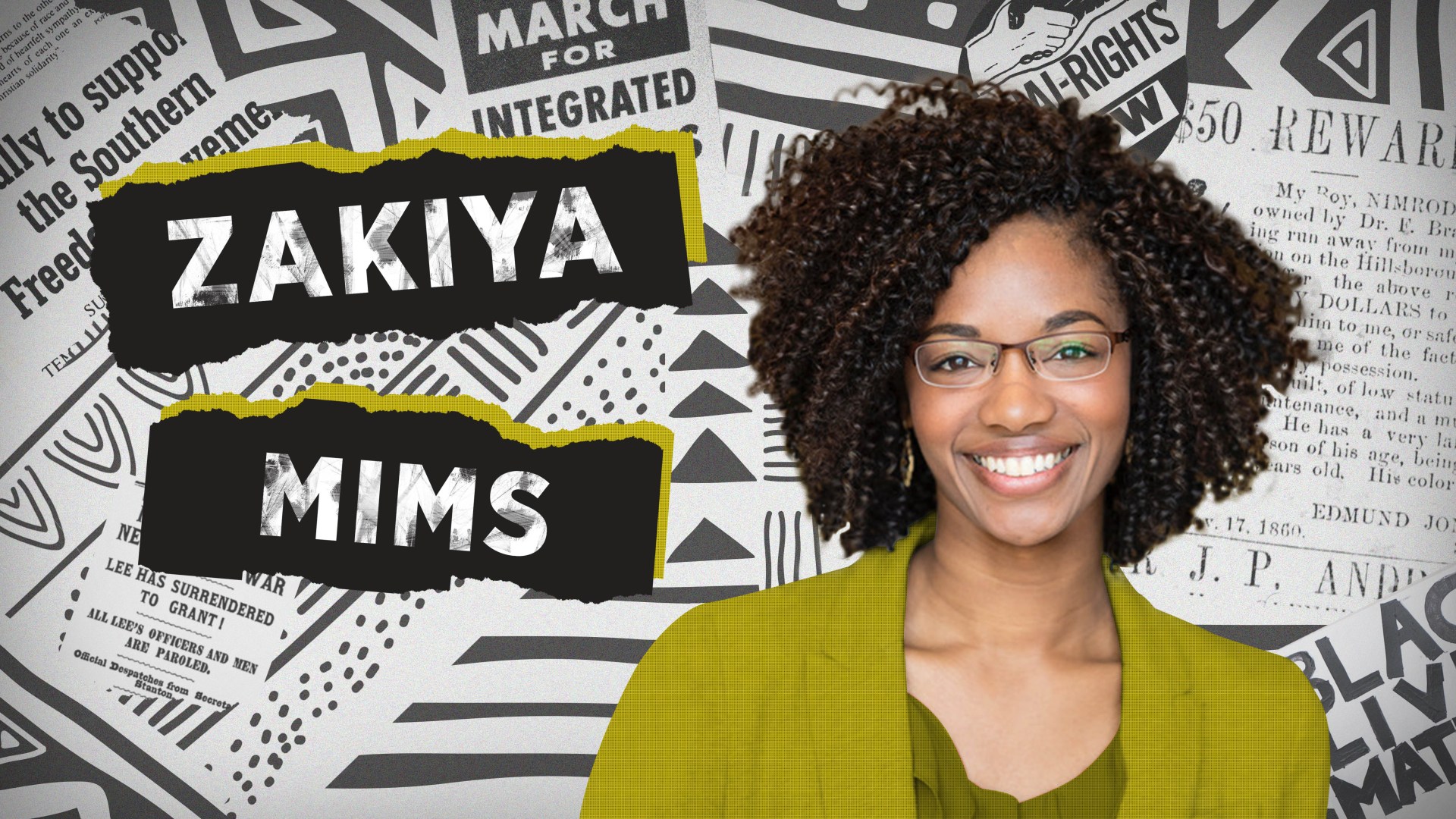
Illustration by Mallory Rentsch / Portrait: Courtesy of Zakiya Mims / Background Images: WikiMedia / Unsplash / New York Public Library

Sometimes, you must slow down to move forward in the right direction. To be agents of Christ’s love and healing amid the darkness of racial division, racial violence, and racial inequity, you must be willing to be still to know.

Are you willing to slow down for self-reflection? Ask Jesus, the Holy Spirit, and Father God to refine what is of the flesh and to deposit what is from heaven. Make the choice to be compelled by Christ’s love. Prayerfully consider (emphasis on prayerfully) these questions:

First, are you engaging with information to better understand how you can contribute to the healing, the well-being, the honor, and restoration of people of color? What is your motivation as it relates to reconciliation and justice? People of color can feel when a white Christian is committed to growth and love as it relates to race and justice, cultural humility, and reconciliation. People of color can feel when a white Christian is committed to her own value system or his own way of living, thinking, and being. We can also feel when white Christians are only in the conversation to defend themselves, be right, analyze, object, and scrutinize. We can feel when it is about you being able to say you did something versus putting your preaching into practice, humbling yourself, pursuing understanding, and choosing to become a Christlike lover of our community.

Second, if your motivation is to be a contributing, life-giving, and restorative participant in racial reconciliation, are you honoring the voices and resource recommendations of those you desire to be reconciled with? There is a difference between honoring the voices and resource recommendations of a small, contrarian subset and honoring the voice and resource recommendations of the majority of the people with whom you seek reconciliation. For example, I am increasingly weary of engaging in race-related discussions with white Christians who make time to take in content from productions like the recently released Larry Elder film Uncle Tom but cannot make time to listen to Henry Louis Gates Jr. or consume historically rich resources like Michael O. Emerson’s Divided by Faith.

Have you considered how the Enemy and your flesh might tempt you to respond defensively rather than humbly and openly?

Third, are you motivated enough to be open to hearing hard things about your own culture, your unconscious participation in the harm of people of color, and your interpretation of Jesus’ words and actions that do not actually align with the Scripture? Have you considered how the Enemy and your flesh might tempt you to respond defensively rather than humbly and openly? Will you arise as you grow?

Fourth, do you apply a double-standard that makes actions from your group acceptable but diminishes and dismisses those behaviors when they come from an ethnic group different than your own? For instance, are you accepting or tolerant when a white political candidate (who claims to follow Christ) designs his gubernatorial commercials with racially coded phrases similar to “I’ll round up all them criminal illegals in my truck” but believe it is divisive and unchristian for believers of color to say, “I’m struggling with how white Christians unravel as soon as you attempt to point out racist patterns in their communications and behavior”? Or do you deem it un-American when a black First Lady says, “I am finally proud of America” but feel camaraderie and a sense of understanding when a white male, political leader says, “Make America Great Again”? Or do you have negative reactions when people groups who have experienced recurring injustices react in organized (primarily peaceful) ways, while every July you celebrate the independence of the United States of America, which was attained through the destruction of property (Boston Tea Party) and bloodshed?

As it relates to race and justice, slow down and apply what you’ve learned. As you do, pursue feedback from people of color. One starter question could be, “What can I do to ensure you feel equipped to challenge or confront me when my communication, actions, or lack of action does not align with the gospel and hinders the work of reconciliation?” Soliciting, receiving, and giving feedback can be hard, but feedback is an irreplaceable component of true reconciliation work. Ready yourself with humility to remember that perfection exists in only one being, the Trinity, and in one polis, New Jerusalem. Every other person and every other nation (including you and yours) should be expected to reflect glorious aspects of God and life-stealing aspects of the Devil. Ready yourself to feel anger, but do not sin. Ready yourself to manage the guilt, shame, joy, and apathy that will undoubtedly arise as you discover the heavenly and hellish ways you have engaged in racism.

Lastly, how do you view Christ’s love and God’s commandment to do justice? Do you believe Jesus commands you to love individuals of other ethnicities and groups of other ethnicities? Do you believe Jesus calls you to sacrificially love other individuals, entire groups of individuals, and yourself? Do you believe Christ’s love requires you to advocate with and for groups that are suffering and disenfranchised? As you slow down, you might find that your convictions about Christlike love are more reflective of your ethnic group’s interpretation of Christ rather than the Scriptures’ description of him. We are all prone to over-elevate our culture’s view of Christ, but this is idolatry. We cannot pledge our allegiance to two masters—our culture and Christ’s kingdom. Every moment, we make conscious and subconscious choices to love one or to hate the other.

You do have a choice. Slow down; make space to make a clear decision. Consider its likely consequences. If your motivation is to love with the “no greater love” Christ describes in John 15:13 (NLT), your only option is to lay down your way of life so you can find Jesus' way and his life. No individual or ethnic group (Christian or non-Christian) can demand Christ’s love from you. The beauty of the gospel is that God gives his love to those who follow his example and those who do not. It is your choice.

If, instead of choosing courage and humility, you choose to disengage and/or perpetuate the paradigms that have helped to maintain the unjust status quo, it is likely that black people, indigenous people, and people of color (BIPOC), as well as conscious white Christians will leave or avoid your church, your ministry, your company, your small group, and more. Our departure or avoidance will be our choice. We can be kind, practice honor, advocate for your well-being, and celebrate your victories whilewe worship and pray at a distance to ensure our discipleship experiences align with the true gospel, not your cultural idolatry. You are not being canceled, coerced, or manipulated. You are receiving an appropriate response based on the choices you make.

So slow down, self-reflect, gather feedback, re-examine, make conscious choices, and stand on them when you are called to give an account by your brothers and sisters in Christ and ultimately by Jesus.

Zakiya Mims is founder and lead consultant at Shepherd & Stone Consulting, which serves marketplace, church, and nonprofit leaders committed to being agents of reconciliation in their local communities.

News

Christians Call for Prayer After Trump Tests Positive for COVID-19

Leaders urge Americans to “put aside partisan politics” and pray in the spirit of 1 Timothy 2.

Christianity Today October 2, 2020
Drew Angerer / Getty Images

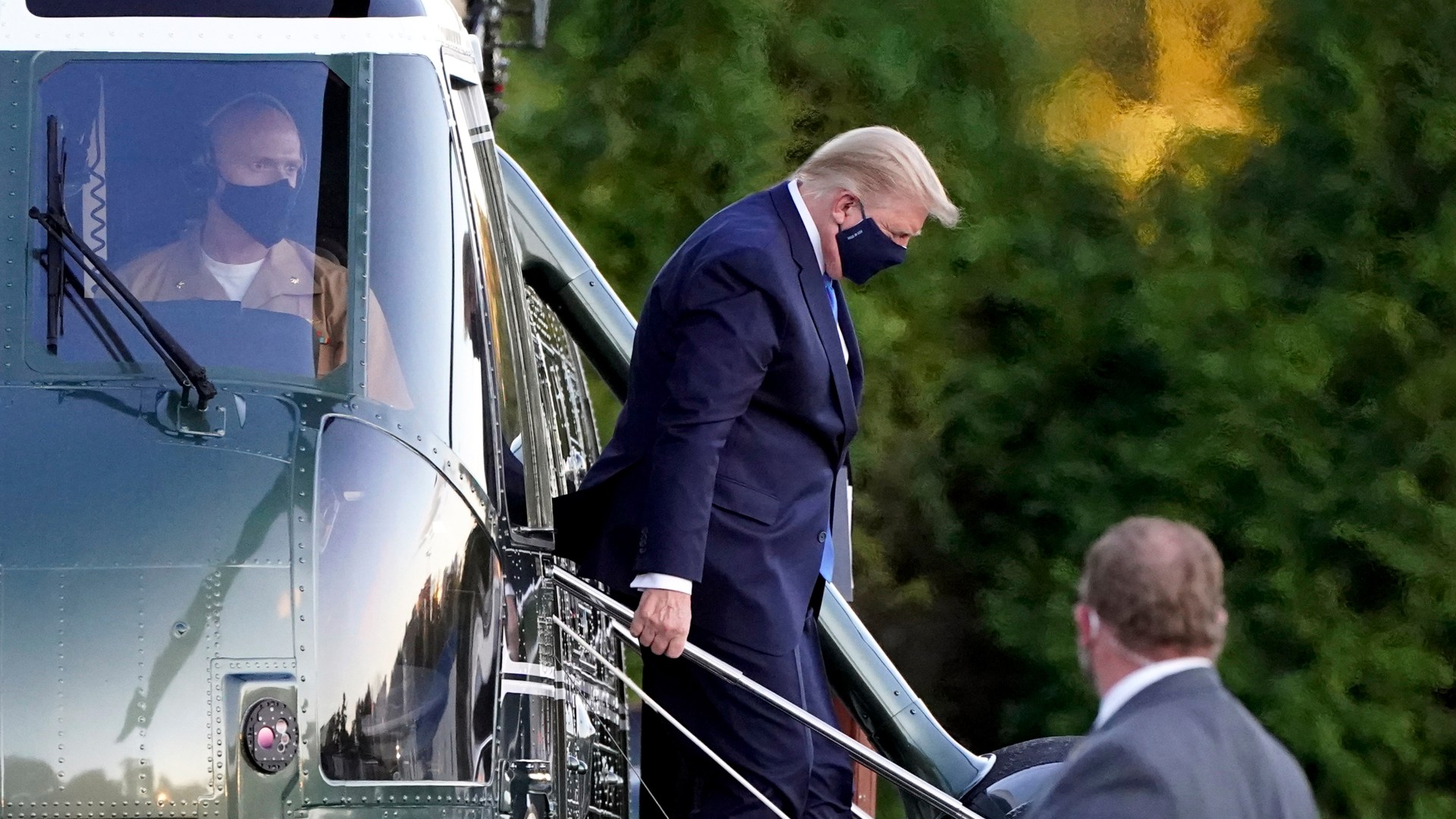
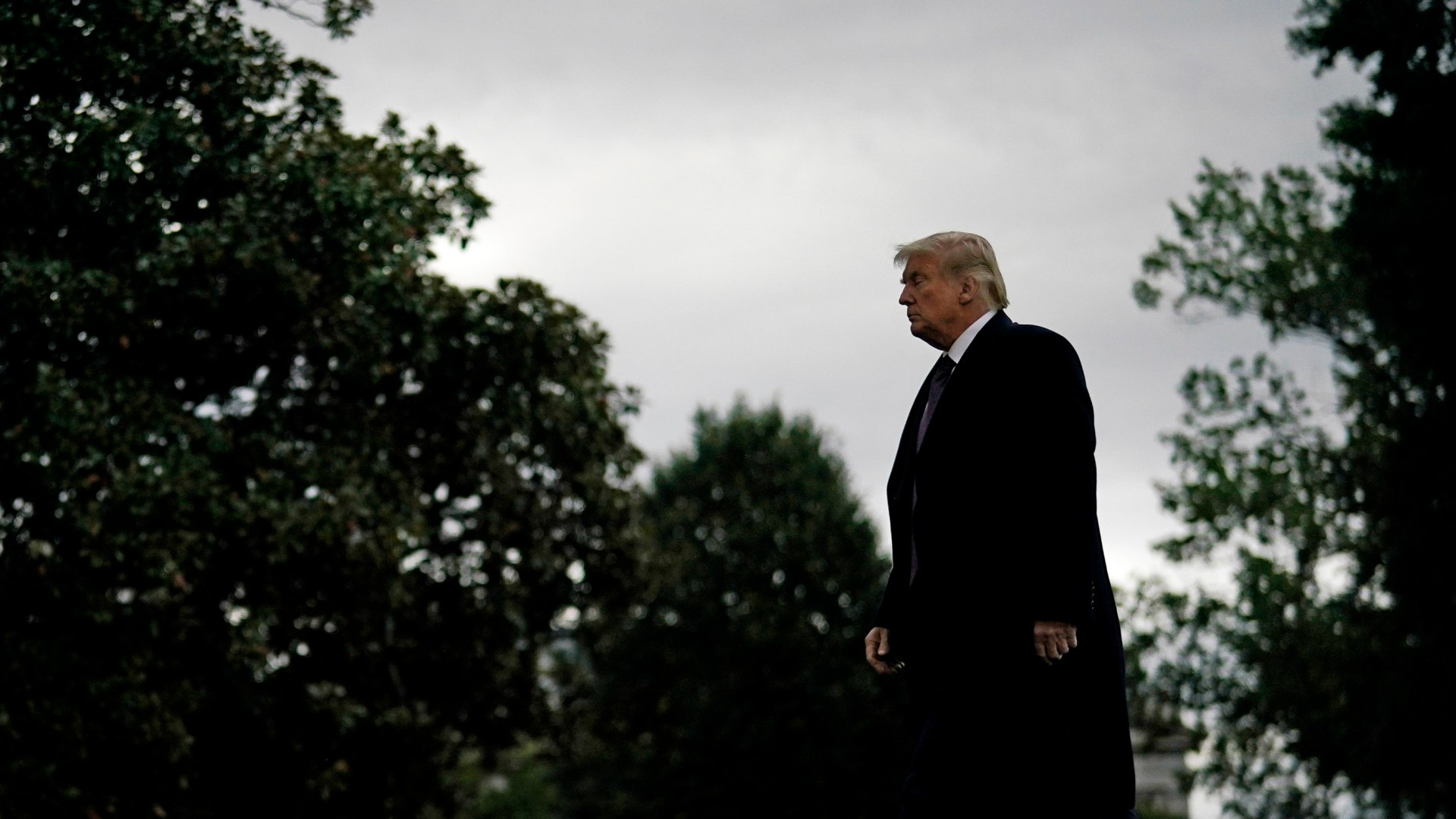
Instructed in Scripture to pray for “all those in authority,” Christians offered their prayers for President Donald Trump after he shared on Twitter late Thursday night that he and First Lady Melania Trump had tested positive for the coronavirus.

Several pastors and ministry leaders encouraged Americans that this was a time to pray for the president and the country regardless of their political stances.

Trump’s coronavirus infection comes a month before the election and following a busy campaign week that included multiple out-of-state events and the first presidential debate.

Twitter petitioners included pastor and evangelist Greg Laurie of Harvest Christian Fellowship in California. Laurie previously prayed with the president in the White House and had spoken up about the need for the church to “respond appropriately” to the threat of the coronavirus.

Eugene Cho, a former Seattle pastor who now leads the Christian advocacy organization Bread for the World, asked Twitter followers to “put aside partisan politics and genuinely lift up the President and FLOTUS in prayer.”

In their messages on Thursday night, some Christian leaders—like Joe Carter of The Gospel Coalition and McLean Bible Church, outside Washington—quoted from 1 Timothy 2:1–4: “I urge, then, first of all, that petitions, prayers, intercession and thanksgiving be made for all people—for kings and all those in authority, that we may live peaceful and quiet lives in all godliness and holiness. This is good, and pleases God our Savior, who wants all people to be saved and to come to a knowledge of the truth.”

The passage has long inspired Christians to pray regularly for the president, regardless of who is in office, and has trended online on landmark dates during Trump’s presidency.

As CT previously reported, searches for 1 Timothy 2:2 reached 10 times the average on the day after the 2016 presidential election, according to the popular Bible site Bible Gateway, and increased again around the inauguration the following January, according to Google Trends. It was the theme for a 2019 day of prayer for Trump organized by Franklin Graham.

Ronnie Floyd, president and CEO of the Southern Baptist Convention Executive Committee and president of the National Day of Prayer task force, told CT last year, “As a pastor of Southern Baptist churches for more than 40 years, I do not recall a time when there wasn’t prayer for our nation, our president, and our elected leaders during our Sunday services, regardless of which party was in power. Why? We are instructed in 1 Timothy 2 to pray for those in authority.”

Many of those who pray regularly for the president pray not only for his leadership and policies but also specifically for his health. At a recent Evangelicals for Trump rally, supporters brought up how they have prayed more urgently for the president’s protection as the election nears.

Another line from Scripture referenced in tweets on Trump’s behalf was 2 Chronicles 7:14: “If my people, who are called by my name, will humble themselves and pray and seek my face and turn from their wicked ways, then I will hear from heaven, and I will forgive their sin and will heal their land.”

Despite the politicization around the coronavirus response, white evangelicals are as worried about the spread of COVID-19 as the rest of the population (70 percent say they remain concerned) and as likely to know someone infected with the disease, according to a Data for Progress survey.

Back in March, CT shared 20 prayers to pray during the pandemic, asking God to heal and help the sick, protect vulnerable populations, and more.

This post has been updated.

News

Interview: To Elect Trump, Evangelicals Could Find Common Cause with Muslims

Surprising points of political commonality found between religious groups in fifth annual American Muslim Poll.

Christianity Today October 1, 2020
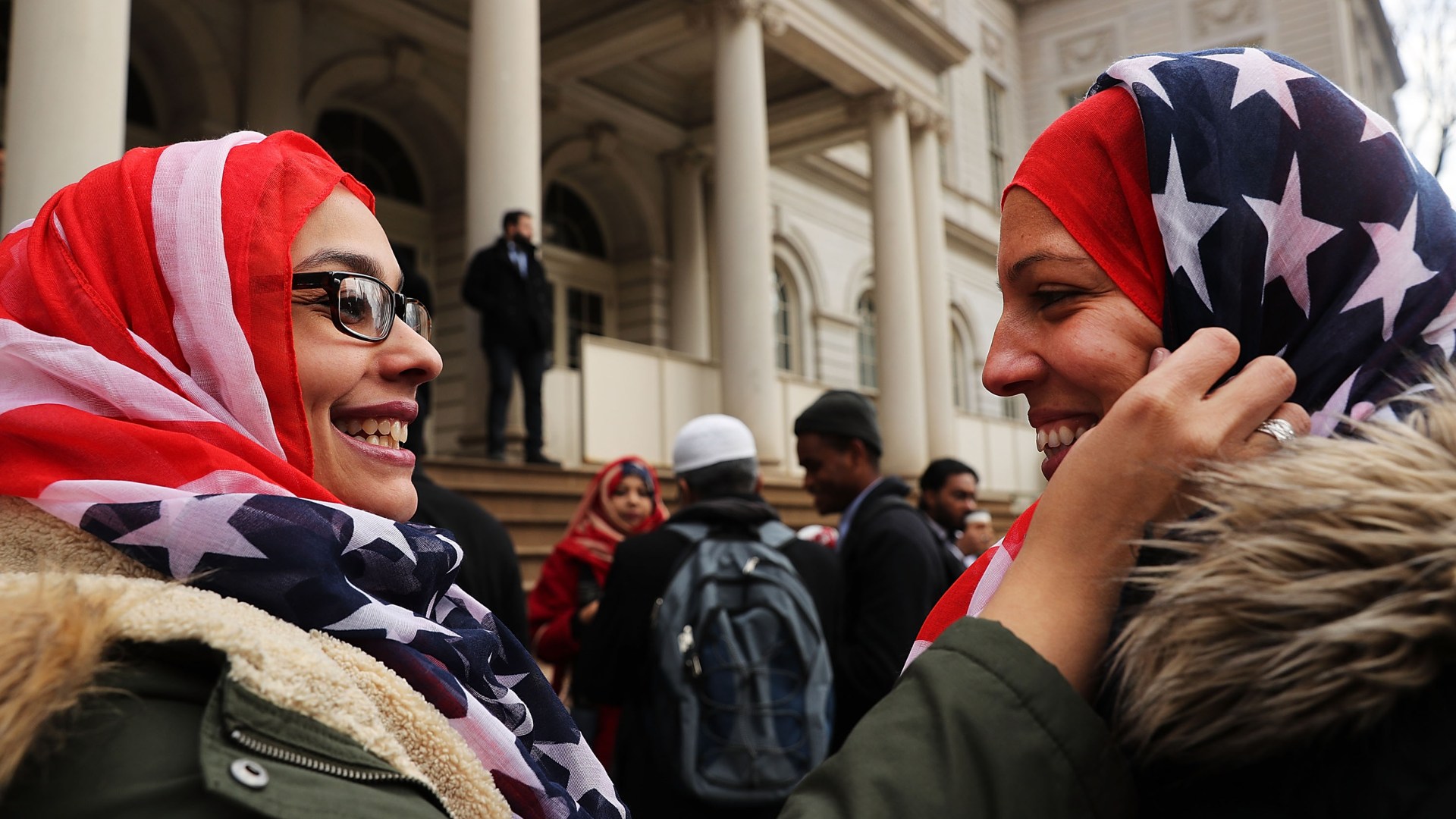
Spencer Platt / Getty Images

In a tightly contested presidential race, might Muslims swing the US election?

Referencing the release of President Donald Trump’s tax returns in Tuesday’s debate, former vice president’s Joe Biden’s “inshallah” [Arabic for “if God wills”] may have been a nod to the strong support he receives from this community.

But according to data from the fifth annual American Muslim Poll, Muslims make up only 1 percent of the American population, only 74 percent are eligible to vote, and only 57 percent are registered.

Why then do they occupy such an outsized space in the mind of many American evangelicals? And what should evangelicals better understand about the American Muslim community and their political preferences?

CT spoke with Dalia Mogahed, director of research at the Institute for Social Policy and Understanding (ISPU), which commissioned the poll. Surveying 2,167 respondents—including more than 800 Muslims, 350 Jews, 200 Catholics, and 200 white evangelicals—ISPU aimed to showcase Muslim perspectives within the context of America’s landscape of faith.

Among the findings is that American Muslims disproportionately practice their politics at the local level. Over 1 in 5 has attended a town hall meeting (22%), compared to white evangelicals and the general public (12% vs. 15%).

And while only 27 percent of the general public reports satisfaction over the direction of the country, both Muslims (37%) and white evangelicals (42%) are more positive.

Are they satisfied with the same things?

CT and Mogahed discussed the social conservatism of many American Muslims, their willingness to build coalitions on pro-life and religious liberty issues, and the surprising numbers concerning their approval rating of President Trump.

The level of support for President Trump has doubled among Muslims, from 13 percent in 2018 and 16 percent in 2019 to 30 percent in 2020. How to you interpret this finding?

We are still trying to understand it ourselves. One thing is that this growth in support came primarily from white Muslims. They are about 20 percent of the community, but approved of Trump’s performance at 50 percent, on par with white Americans overall [48%]. Non-white Muslims were much lower [20–27%], on par with non-whites in the general public [16–24%]. So there is a salience of race in the Muslim community, just as there is in America overall.

The second thing that may have contributed to the uptick is the timing of the poll, which was right at the start of the lockdown, mid-March to mid-April. There may have been a sense of “rallying around the flag” as the president led the country at that time.

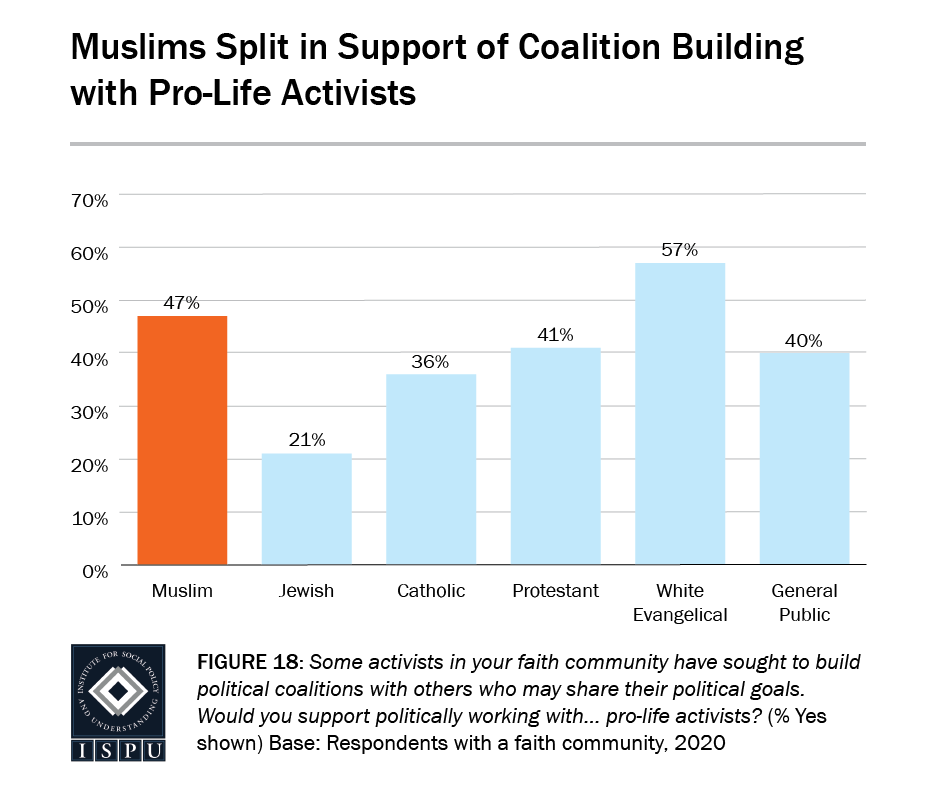
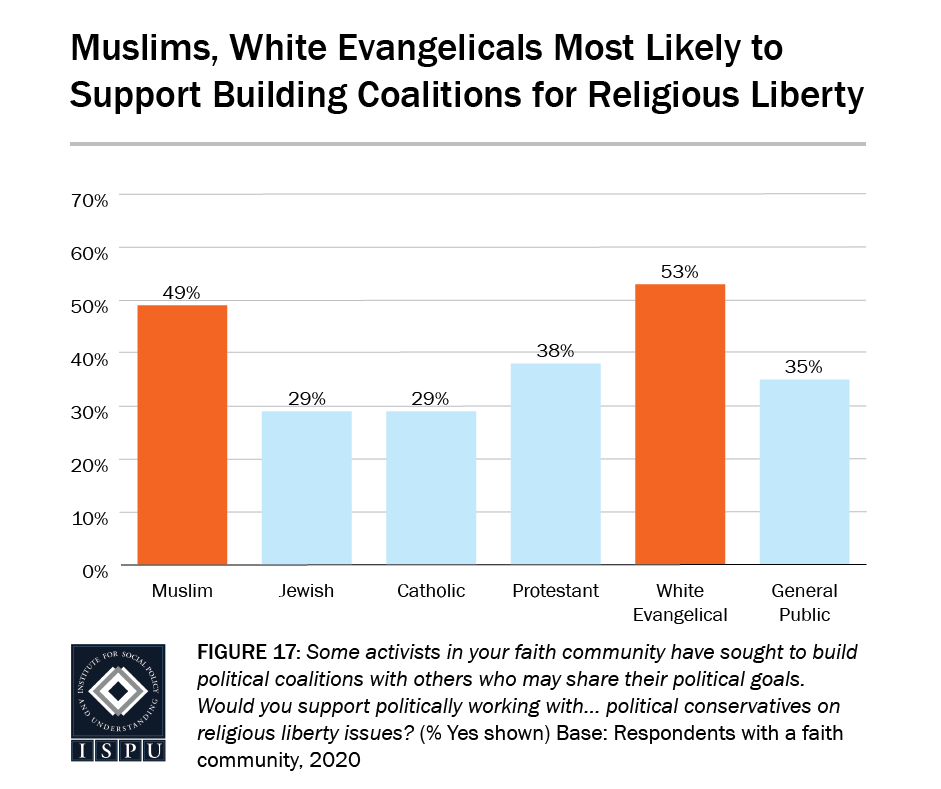
Your poll also examined the attitude of the Muslim community toward building coalitions with religious liberty and pro-life groups. Might some of this increase in support for the president be connected to his stand on these issues?

That also may have contributed. [Among] the variables linked to support for Trump is support for religious liberty, as is choosing the economy as the most important issue facing the government. Interestingly, just like the general public, identifying as white was also a predictor of support for the president; so again, race is a salient factor.

What was most surprising to me is that religiosity—all else being equal—was not a factor. But partisanship was.

So it doesn’t matter how pious Muslims are [71% said their faith was important to their daily life in last year’s survey], or how often they pray [43%]. These have no bearing on their political choices.

Exactly. As is the case of the general public.

Looking closely at the coalition building figures, roughly half of Muslims seem to be pro-life [49%], and roughly half support issues surrounding religious liberty [47%]. But the question is specifically about coalitions. How do you unpack these figures?

The question asked if you are in favor of building political coalitions with activists working on the cause in question. The community is split right in half, but this doesn’t necessarily mean that the other half is not pro-life or doesn’t care about religious liberty.

They may object for other reasons—if the activists have objectionable views about Muslims, or other issues—despite agreeing with them on abortion or religious liberty.

Are American Muslims pro-life? Do they favor restrictions on abortion? Or is abortion an unclear matter in Islamic teaching?

The question is difficult to answer. I’ve never seen data on what Muslims would say. Abortion is not as cut and dry as it may be for many evangelicals.

There is a difference over when the soul is breathed into the fetus’s life. Some say it is present at conception, while other legal scholars say it comes at 120 days of gestation. Some of the latter might say an abortion is allowed for specific reasons up until this 120-day mark.

But despite many Muslims being against an abortion for themselves, a minority would say they are wary of the government regulating it, because it opens the door to regulating other personal matters.

The community is very diverse in its views.

I think this would be a wonderful topic for a dialogue between Muslims and evangelicals. I was surprised the figures for coalition building were not higher for evangelicals in our poll [53% favorable for religious liberty coalitions, and 57% favorable for pro-life ones], as we give everyone the same questions.

The polls suggest Muslims suffer disproportionate religious discrimination [60%, compared to 33% of the general public]. So one might think they would be in favor of building coalitions in defense of religious liberty. Why is it that half of the community [47%] does not?

I would say half of Muslims see the solution to religious discrimination in terms of religious liberty—the first amendment. The other half would see the solution in civil rights laws.

This side is sometimes in conflict with religious liberty activism, which sees coalition building as a threat to their civil rights. If they don’t stick up for other groups who are discriminated against, their own rights won’t be respected.

The other side says no, we should be aligned with religious conservatives who want to give people the right to respect their faith and determine how to run their schools, churches, and mosques.

You really do have both sides in our community, in constant debate.

Is this tension reflected also in the finding that 55 percent of Muslims are not in support of building coalitions with LGBT groups?

Muslim-Americans are on par with Catholics [61%] and the general public [62%] in opposition to these coalitions. Those who approve them [39% of Muslims] may see common cause between Muslim issues and LGBT issues in terms of human rights.

How do Muslims interpret homosexuality within Islam?

This topic is much more cut and dry than abortion, and is not a debate within the body of Islamic jurisprudence in any way. The only sanctioned sexual activity is between a man and a woman in the context of marriage, anything else is considered a sin.

But I do want to clarify that in Islam, simply being a gay, lesbian, or bisexual is not a sin until it is acted upon. Islam draws the line between thoughts and actions, and gives rewards for self-restraint.

The debate is not about homosexual relations, but whether Muslim civil rights and religious liberty is protected by supporting other groups’ freedom to live their life as they choose.

This reminds me of last year’s survey, which polled Muslims on the degree to which they wanted their religious law to influence US legislation.

Some people within the Muslim, Christian [Catholics 28%, Protestants 39%], and certainly within the [white] evangelical community do favor their religious principles to inform law. But Muslims are less likely than evangelicals to favor a role for their faith in law [33% vs. 54%], and are on par with the general public.

The poll shows that American Muslims favor the Democratic candidate [51%] over the Republican candidate [16%]. But if Muslims are socially conservative on so many issues, why do they “lean left?”

Muslims are more socially conservative than the average American—in terms of how they see sexual morality, for instance.

However, there are many things central to the Muslim belief system that resonate with the Democratic party. One is care for the poor. Health care as something people should have access to, even if they can’t afford it. Protection of the environment. These social welfare issues align with Islam as well.

Another issue, frankly, is the alienation of Muslims from the Republican party, especially after 9/11 and the so-called “war on terror,” and their perceived Islamophobia. Perhaps more Muslims would identify as Republican if there wasn’t such a hostile rhetoric against them from important leaders within the party.

At a social level, last year’s poll showed a 33-percent favorable rating toward evangelicals, compared to a 14-percent unfavorable rating. Can you explain this positive opinion toward evangelicals?

Unfortunately, the opposite is not true. Evangelicals are much more likely to have negative opinions of Muslims [44% unfavorable vs. 20% favorable], so the view is not reciprocated.

Why are Muslims neutral to positive? Muslims tend to respect and admire religious devotion, and they tend to see evangelicals as people who take their faith seriously, and live according to its teaching.

As our country tends more and more toward religious non-affiliation and agnosticism or atheism, this is the ideology that Muslims feel threatened by, not Christianity.

While evangelicals are responsible for their own community attitudes, what are Muslims doing, or can do, to overcome these negative perceptions?

Muslims are doing a great deal. I know of several Muslim-evangelical interfaith activities. But the key thing that needs to happen is for evangelical leaders to see Muslims in a more accurate light. I’ve watched evangelical television, and I am horrified by the way they speak about our community—things that are simply not true.

I think a better understanding of our faith would go a long way, as it tends to completely transform the view of Muslims. I’ve seen this firsthand many times.

What have you heard evangelical leaders say in denigration?

I have heard people say that Muslims worship a false god, that their faith is based in demonic teachings. I’ve heard this directly and in person.

This is simply not true. Muslims worship the God of Abraham, the same God Christians and Jews claim to worship. We have a different concept of God—we do not believe in the Trinity—but to accuse Muslims of demonic worship is so baseless and almost laughable.

Satan is portrayed in the Quran as our enemy, as someone who rebelled against God. I encourage everyone to just read the Quran for themselves.

Within the evangelical community, the issue of “same God” is a theological concern, not just a case of popular rhetoric. But if religious differences cannot be set aside so easily, where do you see examples of Muslims and evangelicals working on issues of the common good?

I believe there is an anti-torture campaign these groups are involved in, believing in the dignity of human beings as endowed by their Creator. Poverty is another issue. These are two areas where we can work together, with the younger generation especially concerned about environmental protection.

We started with politics, so we can end with it also. Since many evangelicals are inclined to vote for President Trump, and it is expected to be a tight election, how can they convince Muslims to vote for their candidate of preference?

They would have to reassure Muslims that President Trump wouldn’t seek to harm their community, violate their rights, and sanction discrimination against them. That he would make an effort to lift the “Muslim ban.” I would emphasize the economy and religious liberty, things pro-Trump Muslims already agree with. These would be my talking points.

The poll shows that Muslim support for Republicans has held steady from 2016 to 2020 [at 16%]. But this year, only 51 percent said they prefer a Democrat, which is a significant decline from 67 percent in 2016. And 28 percent of Muslims said they were undecided.

Is there a sense that Muslims are not as solidly in the Democratic camp as they were before?

I think there has been some erosion, especially because of concerns for religious liberty. Whether this will lead them to vote for President Trump, or just stay home, remains to be seen.

Books
Review

The City That Never Stops Worshipping

Though some have likened it to Sodom and Gomorrah, New York City has a long history of religious vibrancy.

Christianity Today October 1, 2020
Michael Orso / Getty

Anarchy! Violence! Destruction! All the talk of how American cities are turning into hellscapes is a good reminder that, truly, “there is nothing new under the sun.”

God in Gotham: The Miracle of Religion in Modern Manhattan

God in Gotham: The Miracle of Religion in Modern Manhattan

Harvard University Press

320 pages

$23.78

This vein of cultural imagination has a history. In fact, it long predates the nation itself. The medieval poet Dante located the deepest, darkest circles of hell entirely inside city gates. Satan was not only “The Emperor of the Universe of Pain.” He was the ruler of “hell’s metropolis.”

A metropolis was hard to find in the United States prior to the Civil War. Cities were small and in most cases run by wealthy white Protestants, who loved urban America before they left it. Their change of heart was driven, first and foremost, by their inability to see an unprecedented influx of European immigrants as anything other than a dire threat to American democracy. In 1885 leading minister Josiah Strong sounded the alarm about “the dangerous classes,” writing, “It goes without saying, that there is a dead-line of ignorance and vice in every republic, and when it is touched by the average citizen, free institutions perish.”

Thirty years later the pugnacious revival preacher Billy Sunday homed in on the nation’s largest city and delivered one of his signature punches. “There is little hope that the Lord ever will be able to save such a hell hole as New York,” Sunday informed the crowd at the Philadelphia Tabernacle in the dead of winter 1915. He heaped on a laundry list of pejorative adjectives for good measure: “rotting, corroding, corrupt, hell-ridden, God-defying, devil-ridden.” The next week The New York Times published a response by a woman worried that Sunday’s comments would only deepen “the belief of the average American citizen that Nineveh, Sodom, and Gomorrah had nothing on little old New York.”

A Religious Outpouring

Such beliefs have, in fact, proven hard to shake. Over the course of the 20th century the image of the godforsaken city never went entirely out of fashion. In the wake of this summer’s urban protests it is, in some circles, back in vogue. As a result, while historian Jon Butler’s latest book, God in Gotham: The Miracle of Religion in Modern Manhattan, focuses on a bygone era (the 1880s–1960s), it could not feel timelier.

Butler offers overwhelming evidence that even New Yorkers could not flee from God’s presence. Most did not try. Instead, some decorated Manhattan’s streets with ornate churches and synagogues, while others turned homes and rented rooms into worship spaces. Attorney Street on the Lower East Side was a noteworthy case in point: “Though only four blocks long, by 1930 it was home to more than fifty Jewish congregations only two of which met in synagogues,” Butler writes. Religious content crowded the city’s newspaper columns and saturated its airwaves too. Nearly everywhere one looked, the Big Apple was shot through with the sacred. “Religion resonated throughout the world’s most populous place,” Butler observes, “sacralizing every kind of space and linking faith to the press of modern life.”

The durability of faith defied the expectations of more than just the city’s sanctimonious detractors. A sprawling scholarly literature on secularization long insisted that modernity spelled certain doom for religion. This theory eventually ran aground on a stubborn fact: In many of even the most urbane places, the predicted disenchantment never came. For Butler, Manhattan is in part a case study underscoring this larger point. “The likes of Max Weber and William James misjudged the resilience of modern religion and mistook what its emerging textures and energies could mean,” he argues.

But it is not merely a case study. A vein of what one might call Manhattan exceptionalism runs through the book. Chicagoans may be inclined to jump out of their seats at Butler’s assertion that the Windy City “approached Manhattan’s complexity but did not achieve it.” But if they can manage to keep reading, they may, by the end, concede that he has a point when he writes that “between the 1920s and the 1960s Manhattan stimulated an outpouring of individual and institutional religious creativity unsurpassed in any other twentieth-century American locale, urban or rural.”

Butler’s evidence includes the contributions of some of the extraordinary Protestant, Catholic, and Jewish leaders who called Manhattan home. A handful grew up there, but many more emigrated from afar. Collectively, their work and witness reverberated not only across but also far beyond the borough. Intellectuals such as Paul Tillich, Reinhold Niebuhr, and Jacques Maritain transformed the way that countless believers understood the meaning of Christianity for the modern world. Activists such as Dorothy Day and ministers such as Adam Clayton Powell and Adam Clayton Powell Jr. sparked momentous, faith-infused movements for economic and racial justice. Meanwhile, Abraham Joshua Heschel’s legacy sprung from both his pen and his feet. On the way to becoming the nation’s best-known rabbi, he published a variety of influential books even while marching alongside civil-rights and antiwar demonstrators.

Faith in Institutions

Butler offers windows into the lives of these luminaries and many more, but he does not rest his case for Manhattan there. As he points out, “These figures seldom worked alone; institutions extended and deepened their messages.” This sentence encapsulates one of God in Gotham’s most unfashionable and yet, at least in the view of this reader, highly persuasive arguments. While acknowledging the prevalent view of institutional history as “unsexy and boring,” Butler counters that this perspective “ignores the real dynamism between common worshipers and religious institutions.” This back-and-forth shaped the life of organizations ranging from Harlem’s Abyssinian Baptist Church to the now-ubiquitous Alcoholics Anonymous. Butler’s commitment to pursuing this institutional angle of vision springs in part from the documentary record, where he finds all kinds of evidence that, in modern Manhattan, religion “was as much institutional and bureaucratic as theological.”

But there is an unmistakable normative dimension to this emphasis too. While New York’s religious institutions had grievous faults—illustrated, for one, by the way that so many white-led churches capitulated to Jim Crow—“they were not merely imperfect,” Butler contends. They were moreover “pliant and soulful.” Not only were they “supple enough to further many worshipers’ aspirations”; they were, in his estimation, “the instruments through which most New Yorkers—most Americans—approached God.” In our moment, so awash in anger with institutions, Butler’s more sanguine evaluation of them will give readers much to ponder.

Readers should find plenty to debate as well. In recovering the vital role of institutions, does Butler overstate the extent to which religious power in Manhattan flowed from the top down? However much Protestant leaders busied themselves “managing their worshipers” and however “rigidly hierarchical” the Catholic church could be, the might of real and prospective pew dwellers remained more formidable than he at points lets on. When they got organized and flexed their muscle in theological, social, and political fights, the clergy—perennially anxious about cash flow and influence—often took heed, however begrudgingly. More sustained attention to the grassroots might have yielded a somewhat different cast of characters too. While Butler underscores the reality that women predominated among the laity, ordained men nevertheless command most of the leading roles in his story.

A Colorful Tour

If there is much here to ponder and debate, there is even more to enjoy. What a pleasure it is to take a tour of Manhattan’s sacred past led by one of the nation’s preeminent religious historians. The experience comes complete with a chance to duck down into the subway, an extended visit to Harlem, and briefer stops in many other neighborhoods. Along the way Butler showcases his ear for the most colorful turns of phrase, including fundamentalist minister John Roach Straton’s proclamation that he hoped his church’s radio broadcast facility “would be so efficient that when I twist the devil’s tail here in New York his squawk will be heard across the continent.” Butler has an eye, too, for the most captivating photographs. One could while away an afternoon just taking in the images included in these pages.

Butler sends the reader out with a conclusion that is far more than a summary of what has gone before. Carrying the story forward in time and outward in space to the New York and New Jersey suburbs, he frames a final provocation, beautifully conveyed in this evocative sentence: “Without the urban encounter, suburban religion would have failed as quietly as seed cast in drought.”

In gesturing toward such connections, Butler offers yet one more reason why contemporary Americans might want to ask hard questions the next time they hear someone declaiming against urban places. The worlds of the city, the suburbs, and beyond are more interdependent than we sometimes think. And an unrelenting pursuit of the divine is common to them all.

Heath W. Carter is an associate professor of American Christianity at Princeton Theological Seminary and the author of Union Made: Working People and the Rise of Social Christianity in Chicago (Oxford University Press).

Apple PodcastsDown ArrowDown ArrowDown Arrowarrow_left_altLeft ArrowLeft ArrowRight ArrowRight ArrowRight Arrowarrow_up_altUp ArrowUp ArrowAvailable at Amazoncaret-downCloseCloseEmailEmailExpandExpandExternalExternalFacebookfacebook-squareGiftGiftGooglegoogleGoogle KeephamburgerInstagraminstagram-squareLinkLinklinkedin-squareListenListenListenChristianity TodayCT Creative Studio Logologo_orgMegaphoneMenuMenupausePinterestPlayPlayPocketPodcastRSSRSSSaveSaveSaveSearchSearchsearchSpotifyStitcherTelegramTable of ContentsTable of Contentstwitter-squareWhatsAppXYouTubeYouTube