Books

My Same-Sex Attraction Has an Answer

But it’s the answer God gives all of us.

Christianity Today March 2, 2020
Source Image: Dulin / Getty Images

When I wrote my first article on being a same-sex-attracted Christian, what surprised me most were the emails I started receiving from straight men. The notes often came from men my parents’ age, the same message nestled again and again into my inbox: “I never expected this to help me.”

Born Again This Way

Born Again This Way

Good Book Co

160 pages

$12.99

People attracted to the opposite sex read about same-sex attraction for many reasons. Sometimes a pastor wants to disciple a young man who experiences same-sex attraction. Sometimes a woman wants to know how to love a sister who identifies as lesbian and has left the church. Still others simply want to think biblically about trends they see in the culture around them. But what they don’t usually expect, it seems, is commentary that helps them in their own fight for the obedience of faith.

My latest book, Born Again This Way: Coming Out, Coming to Faith, and What Comes Next, is meant to help same-sex-attracted Christians thrive in Jesus and also help others come alongside us in our journeys. But Christians who experience same-sex attraction are asking questions that tap into some very universal streams. God has made all of us embodied desirers, and as sinners who fall short of his glory (Rom. 3:23), we have similar challenges spring-loaded into our systems.

First, we all need to test our desires against the same target: Christ.

In the book, I wrestle in public with a very private experience: Many of us who love Jesus cannot shake romantic and sexual desire for those of our same gender. That desire is so potent that it can look and feel like our rightful master, and we wonder if we should bow down and serve.

But doesn’t that same siren call reach for all of us, in some way or another? Whether our desires are targeted at the same sex or the opposite sex, we’re easily controlled by ungodly desire, especially in the sexual realm. That’s why the words “You shall not commit adultery” and “You shall not covet your neighbor’s wife” (Ex. 20:14, 17) both get prime real estate in the Ten Commandments. That’s also why the New Testament warns us against sexual licentiousness (1 Thess. 4:3; Eph. 5:3).

Both the world and the church have various coping mechanisms for the strength and persistence of desire, but rarely are they particularly Christian. We see heaps of shipwrecks all around us, brought down by the twin monsters of repression and indulgence, like the sea creatures Scylla and Charybdis from Greek mythology. We see no other option but to crash into one or both of them.

But God as the first desirer offers us another way. At the very best, our yearnings can be a picture of his yearnings, which pulse with goodness, energy, and even holiness. His desire gives us a compass and sets the course for our desires (yes, even our sexual ones). That means part of Christian discipline is learning to see him as he really is, in his beauty and worth. There is a narrow pathway between indulgence and repression, but it involves carefully testing every desire against God and looking to him for direction over and over.

Second, we’re all called to transparency.

Unlike me, most of my Christian friends who experience same-sex attraction grew up in the church. One of the most unifying themes I hear from them is the ragged fear that tore at their hearts. They were terrified that someone would discover their attractions. They spent years praying for God to take the feelings away and decades policing their mannerisms in order to stay hidden. (Of course, they had good reason. Many Christians and Christian churches have demonized same-sex attraction, and some movements wrongly believe freedom in Christ is only found in becoming straight.)

This same sequestering happens for those who experience attraction to the opposite sex. For example, Christians are often scared to confess their strong desire to look at pornography, even though they know it’s wrong. Others feel harassed by the challenge of keeping their thoughts in check around desirable people of the other sex. I’ve talked to several women who are embarrassed to discuss the strength of their sexual urges, because it feels like good Christians just shouldn’t struggle with that. In each of these scenarios, people build walls of silence to protect themselves. But these walls slowly transfigure into prisons.

In the end, we all need the same exact thing that my friends needed years ago and the same thing that I need now: space to speak about what we really feel. The purpose of transparency is not to glory in our struggle but to find support in our quest for costly obedience. I have to know that my desire for women doesn’t put me beyond the reach of the Holy Spirit and that right in the midst of it, he can bless me. That’s true for each of us. Only when we’re honest about our sexual struggles can we hear this message: The Lord wants more for us. He wants our allegiance. He wants our holiness.

Finally, we’re all invited to the joy of obedience.

Paul begins the fifth chapter of Galatians by saying “It is for freedom that Christ has set us free. Stand firm, then, and do not let yourselves be burdened again by a yoke of slavery” (Gal. 5:1). He argues that trying to achieve salvation by works of the law is in fact slavery. We are children of the free woman (Gal. 4:31), born to be free. But then his word of caution comes: “Only do not use your freedom to indulge in the flesh” (Gal. 5:13). In other words, true freedom only comes through obedience to God’s commands, including the commands about our bodies.

For people like me who experience same-sex attraction, the world begs us to believe that our authentic selves are only found in giving in. It promises hero status if we submit to our attractions. Our desires whisper, like a serpent in a garden, that there is no death in going against God’s Word. This serpentine tongue drawing us toward sin speaks a native language to each one of us and offers each a tailored temptation—maybe a neighbor, an office mate, or a friend’s wife.

But there is good news. Jesus really is more beautiful, more worthy, and more satisfying than anything else. Same-sex-attracted believers, assaulted as we are from right and from left, need to taste and see that the Lord is good. We must experience this never-ending person who delights in us and delights in righteousness.

The same is true for every believer. Obedience was never meant as a bargaining chip to force God into blessing us—it was always meant to be the bountiful and delicious fruit of a life in relationship with our Creator and Savior. He has joy in store for us, which we can only fully find when we pursue the obedience of faith with transparency, honesty, and hope. No matter our temptations, no matter our patterns of desire, we press on to make this joy our own, because Christ Jesus has made us his own.

Rachel Gilson serves on Cru’s leadership team for theological development and culture. Her latest book is Born Again This Way: Coming Out, Coming to Faith, and What Comes Next (The Good Book Company, March 2020). Find more at rachelgilson.com or on Twitter @RachelGilson.

News

Turning Up the Volume: Joyful Noise or Noise Ordinance Violation?

Concerned neighbors and church members sound off about megachurch worship becoming “too loud.”

Christianity Today March 2, 2020
Sebastian Ekman / Lightstock

Nearby businesses and residents initially welcomed Transformation Church when it bought the abandoned Spirit Bank Event Center in Bixby, Oklahoma, last August. But some neighbors have already had enough.

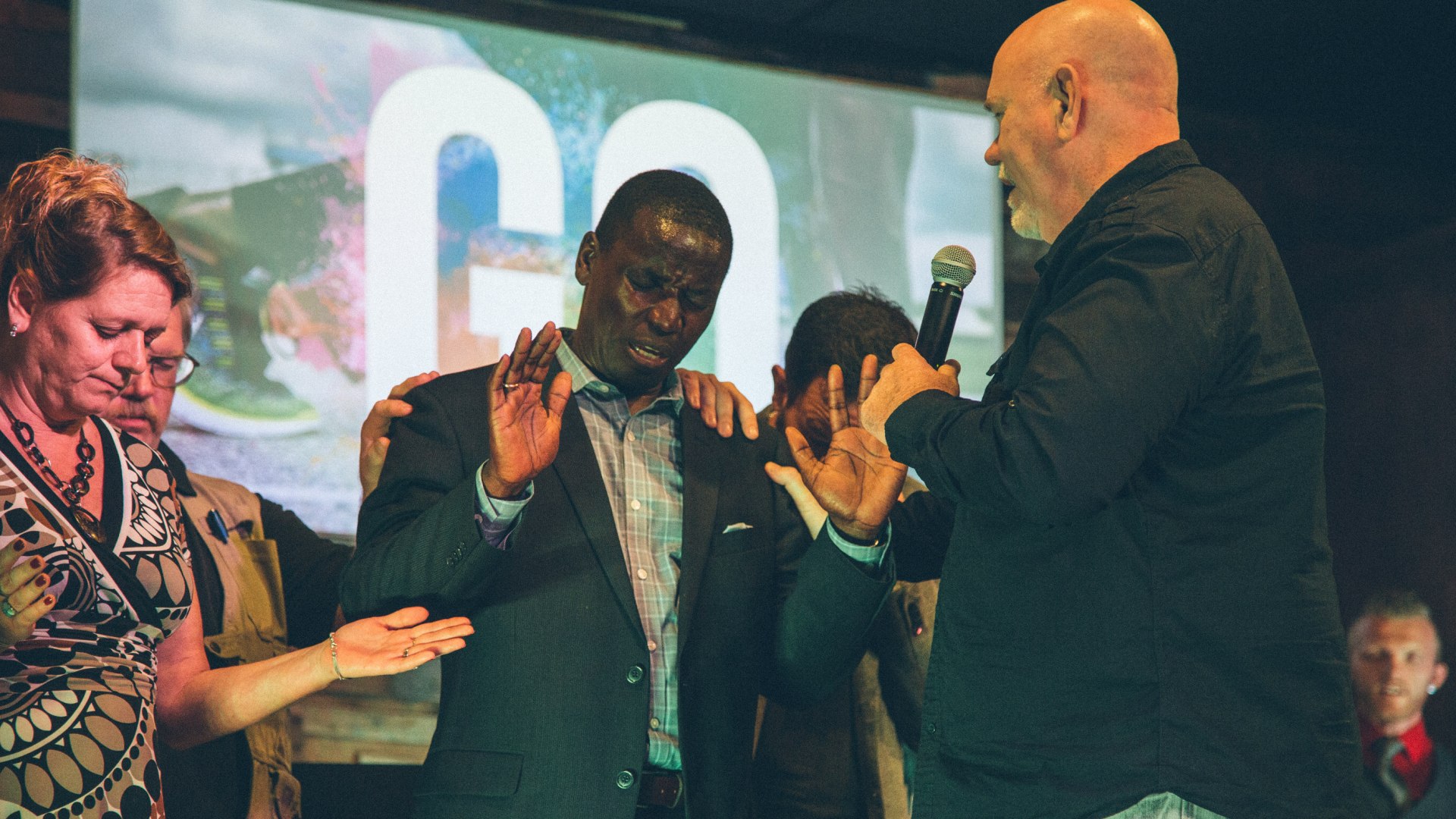
Sound complaints have reached a fever pitch, with those living in a housing development behind the church claiming it’s so loud their coffee mugs shake during worship, according to a recent report by Tulsa ABC affiliate KTUL. The city attorney called on Transformation—which draws 3,500 visitors each week to the Tulsa suburb—to lower the volume or build a wall to block the excessive noise.

Despite exhortations in the Bible to “make a joyful noise to the Lord” and “praise him with loud clashing cymbals” (Ps. 100:1; 150:5, ESV), volume has been a major factor in the so-called worship wars for years, causing discord in communities and within congregations themselves.

News reports indicate more than a dozen US churches faced significant backlash for their noise, such as police warnings or citations, in the past year. Complaints tend to be lodged against megachurches with auditoriums containing sophisticated sound systems for bombastic music sets and high-energy sermons.

Neighbors in the Charlotte, North Carolina, Ballantyne neighborhood have repeatedly complained about noise from Elevation Church continuing as late as 10 p.m. And between December 2018 and November 2019, police in Seminole County, Florida, received 222 complaints against Action Church for noise issues.

Some smaller churches also draw complaints from residents, particularly as the makeup of a neighborhood changes around them. In recent years, the city of Oakland threatened to impose a $500-per-day fine on Mount Pleasant Baptist Church, saying the “excessive noise” from the West Oakland church’s organ, drums, and amplified vocals during weekly choir rehearsals was a nuisance. Pastor Thomas A. Harris III said new neighbors do not understand the culture of the 65-year-old church, which serves the African American community.

In certain municipalities, churches are granted exemptions from noise regulation for ringing bells, which can also be an annoyance. Churches faced with law enforcement threats over their noise have, at times, claimed the penalties violate their freedom of religion and assembly. One Michigan church sued over the issue, with an appeals court ruling in 2013 that the church had a “reasonable fear” of threats of persecution from an officer who said it “should not be playing rock music.” CT has also reported on the rise in noise-pollution regulations in Africa, where national officials threaten to penalize loud congregations.

No, it’s not just you—church music sets are getting louder. The National Institute for Occupational Safety and Health recommends no more than 15 minutes a day of exposure to sounds reaching 100 decibels or higher. Church music experts have recommended volume ranges from around 80-93 decibels for a contemporary worship set. Some churches stay on the high end of that, or above, for part of an immersive worship experience.

Last year, a spokeswoman for Cincinnati-area Crossroads Church told The Wall Street Journal that their worship sets are designed to create a “rock-concert-like atmosphere.” The 20-minute musical set is around 94 to 96 decibels—the equivalent of a food processor or hair dryer—with peaks of 103 to 105 decibels that last two to three seconds. Crossroads spokeswoman Jenn Sperry described the volume level as “safe by a wide margin.”

One of Crossroads’ campuses was the subject of repeated noise complaints from neighbors back in 2015. A police officer in Mason, Ohio, issued a citation to the Crossroads Mason sound engineer who refused to lower the volume during praise team rehearsal. Sperry told CT that the city quickly dropped the charges after determining that the church did not violate the noise ordinance.

According to Phil Mahder, a church media consultant, churches typically take one of two approaches to determining how loud the music should be on Sunday morning. They either create an environment where people can hear each other singing and sing together as a community, or they crank the volume so worshippers cannot hear themselves sing and don’t feel sheepish about whether others can hear them.

Mahder, who has spent over 20 years designing sound systems for churches, said megachurches typically opt for the second approach to music, while more traditional congregations transitioning from an organ or piano to a band often choose the first.

Some churches are responding to concerns over noise levels by providing complimentary ear protection at the welcome tables. Mahder sees this trend catching on, particularly as churches push the volume to concert levels. But the gesture can strike the wrong chord.

“I think that [providing ear plugs] can be offensive to people, telling them, in a sense, that their perception is not legitimate, and this is how we’re going to quiet you down,” Mahder said. “Some churches want to reach concert levels with their volume, and if you’re going to reach concert levels, you’re going to damage people’s hearing, and you have to provide some safety.”

Music levels are not a new issue for churches. Before amplifiers and distortion pedals, churches debated the volume of the pipe organ, says Rebecca Snippe, a program manager for the Calvin Institute of Christian Worship. Beyond personal preference, loud music can be a barrier to some churchgoers.

“For some individuals, loud sounds are difficult or overwhelming to process due to a sensory overload . While some of these individuals have a diagnosed sensory processing disorder, other individuals in our communities simply find loud sounds over an extended period of time to be tiresome and overwhelming,” writes Snippe.

When churches expect worshippers to opt out of noisy worship sets, they can also alienate vulnerable worshippers, particularly those who struggle with sensory-processing difficulties.

Barbara Newman is director of church services for All Belong, an organization helping churches welcome people of all abilities. She notes that individuals living with hearing loss, autism, or dementia struggle with processing loud noises. The impact on listeners can vary.

“Hearing is one of our sensory systems, and it is often experienced differently by some individuals with varied abilities. … But the negative effects can include pain, the desire to leave, interpreting that space as ‘unsafe,’ attempting to block out or tune out the sounds, inability to participate, or an inability to access the gifts that person wants to share with the community,” she said.

While earplugs are a good backup resource, Newman believes churches should start by consulting noise guidelines provided by organizations like the American Speech-Language-Hearing Association and then consider adding precautions for individuals with special needs.

Just as Christians understand that they are stewards of their physical health, they need to steward their auditory health and treat it as a gift from God.

(Editor’s Note: This article has been updated to include comments from Jenn Sperry regarding the citation issued by the Mason Police. An earlier version of the article incorrectly stated that the charges against Crossroads Mason were dropped only after the church agreed to comply with the city’s noise ordinance.)

Theology

Set Free by the Cross, Why Do We Live in Bondage?

The Enemy wants us to doubt the efficacy of God’s grace and the assurance of his mercy.

Ian Kiragu / Unsplash

The United States of America is built upon the ideal of freedom. Though it has not always lived up to the true meaning of its creed, the great struggle in the conscience of America has been the struggle for freedom. On March 23, 1775, Patrick Henry spoke the immortal words in defense of freedom and the American Revolution: “Give me liberty or give me death!” For Henry, it was liberty or death. For Jesus Christ, it was liberty by death. The death and resurrection of Jesus Christ set us free. Yet, as all Americans know, freedom is not free. This is never truer than of the freedom we have in Jesus.

The Good News of the gospel is that Jesus died and rose again so we would be free from sin. Sin is a power that enslaves. From the beginning, the sin of Adam and Eve became the sin of all (Rom. 5:12). Consequently, being born in Adam is being born in bondage to sin. This is much like the great evil of human slavery we see in our history; one of the tragedies of the American slave system was that children born to slaves were slaves as well. But Christ broke the curse of sin in Adam and thus set the children of Adam free (v. 19). No longer slaves to sin, but now slaves to righteousness. No longer bound by the yoke of bondage, but now free in Christ. Nevertheless, that freedom is always under attack.

Following the Emancipation Proclamation and the formal end of slavery in the United States, there came a new kind of slavery, namely the oppression of Jim Crow laws. In some regards, this was more insidious and demeaning than the first. It gave the impression of freedom, yet it systematically and institutionally kept black Americans in bondage. This new slave system was not formal bondage, but it was oppression and bondage nonetheless and, as such, needed to be broken. Similarly, when a person has been set free from the penalty of sin through the cross of Christ, often that person may remain in bondage to the guilt and shame of his or her sin. The Cross sets us free from both slavery to sin and its guilt. This is where the promise and pronouncement of Romans 8:1 is critical to the Christian life. Anyone who is in Christ Jesus is no longer under condemnation for sins committed. In other words, Jesus not only paid the debt but also carried the guilt and shame often associated with it.

Guilt is one of the Devil’s most-utilized weapons against the Christian. Because sin yet remains in our lives and many live with daily struggles to overcome it, the Enemy of our souls often seeks to convince us to doubt the efficacy of God’s grace and the assurance of his mercy. He knows feelings of guilt and shame can be overwhelming and can lead to despair. If the Enemy can get you to despair and to wallow in your failures, he can keep you from living in the freedom Christ secured for you on the cross. And thus, he can bind you in a new kind of slavery—daily living below the dignity of your freedom in Christ and the joy of your salvation.

Yet Christ would have us remember that he put an end to all condemnation for sins past, present, and future. As the Bible asks and answers, “Who will bring any charge against those whom God has chosen? It is God who justifies. Who then is the one who condemns? No one. Christ Jesus who died—more than that, who was raised to life—is at the right hand of God and is also interceding for us” (Rom. 8:33–34).

The Irish hymn writer Charitie Lees Bancroft said it well:

When Satan tempts me to despair
And tells me of the guilt within,
Upward I look, and see him there
Who made an end of all my sin.

The work of Christ sets us free from sin and guilt in the past so we can live free today. This freedom is complete and demands we proclaim it.

Martin Luther King Jr.’s famous “I Have a Dream” speech ends on an emphatic and unforgettable note. He reminds the nation that his dream was for a day when all peoples—regardless of race, gender, color, or creed—would be able to sing together, “Free at last! Free at last! Thank God Almighty, we are free at last!” The apostle Paul used a similar tone when he wrote to the Galatians; he wanted them to hear him loud and clear: Free at last! Free at last! Because of the cross of Christ, we are free at last!

There may not be a more emphatic statement in all the inspired writings of the apostle Paul: “It is for freedom that Christ has set us free. Stand firm, then, and do not let yourselves be burdened again by a yoke of slavery” (Gal. 5:1). If the nature of sin is bondage, the nature of the gospel is liberty. Christ died to free his people from the bondage of slavery to sin (Rom. 8:2). When Paul wrote to the Christians in Galatia to emphasize again the extent of the freedom they had in Christ, the wording he chose drove home the importance of living as freedmen—free from the condemnation of the law, free from the guilt of sin, free to worship and live for our Lord Jesus Christ. Never before have men and women been so free. And never need they be in bondage again.

Consequently, of all the people in the world, Christians should be first and foremost in the cry for freedom. The gospel demands it. Our deliverance from bondage to sin is a theological truth that should bear the practical fruit of freedom from all kinds of human bondage. Human trafficking and slavery are incompatible with the gospel, as is the bondage of physical and emotional abuse. Because we preach the gospel of freedom from sin, we also preach freedom to live free. As Christians, we are free to live and love in Christ. And as ambassadors of Christ (2 Cor. 5:20), we are called to help others do the same.

Therefore, to preach the gospel is to preach men and women free. Though this freedom can primarily be understood in terms of our relationship with God and our freedom from sin and guilt, it also touches our human relationships as we seek freedom for others. For “if the Son sets you free, you will be free indeed” (John 8:36).

Anthony J. Carter is the lead pastor of East Point Church in East Point, Georgia. A graduate of Reformed Theological Seminary Orlando, he is the author of several books including Running from Mercy, Blood Work, and Black and Reformed.

This piece is part of The Cross, CT’s special issue featuring articles and Bible study sessions for Lent, Easter, or any time of year. You can learn more about purchasing bulk print copies of The Cross for your church or small group at OrderCT.com/TheCross. If you are a CT subscriber, you can download a digital copy of The Cross free at MoreCT.com/TheCross.

News

Korean Churches Close for First Time as Coronavirus Cases Hit 3,700

(UPDATED) More than 1 million ask government to ban Shincheonji, an apocalyptic Christian sect linked to half of infections.

Myungsung Church in Seoul was one of many churches across South Korea to close its Sunday worship services due to the coronavirus outbreak.

Myungsung Church in Seoul was one of many churches across South Korea to close its Sunday worship services due to the coronavirus outbreak.

Christianity Today February 28, 2020
Yun Dong-jin / AP Images

[Updated March 1 with latest statistics from Korean health officials]

Although March 1 usually marks one of the most joyous services in South Korea, in celebration of Independence Movement Day, an unprecedented number of churches will be closed Sunday in response to an escalating coronavirus outbreak now second in scale only to China.

“This is the first time that churches are officially postponing services in the 100 years of Protestant history and 200 years of Catholic history [in Korea],” said Won Jae-chun, a professor at Christian Handong Global University in Pohang. “Services and masses have not stopped—even during the Korean War.”

The world’s largest church, Seoul’s Pentecostal Yoido Full Gospel, announced it will broadcast its services behind closed doors to its half a million members. Other megachurches in Seoul with over 50,000 members that are broadcasting services include Sarang, Onnuri, and Myungsung, where one associate pastor has a confirmed case of coronavirus.

Although the Korean government and many denominations have discouraged public worship, as even military drills and political protests—common facets of life in Korea—have been canceled, the decision whether to hold public worship has been left up to each church.

COVID-19 has infected more than 3,700 and caused 18 deaths in Korea [as of March 1] since the first reported case on January 20. Worldwide, almost 88,000 cases and 3,000 deaths have been confirmed across dozens of countries, with the vast majority in China’s Hubei province where the disease originated in the city of Wuhan.

This week, the US State Department issued a warning against non-essential travel to Korea. “Americans [in Korea] that I know are mostly trying to not panic,” said Kurt Esslinger, an American Presbyterian Mission coworker based in Seoul. “There is a lot of anxiety right now among all Koreans.”

More than half of the 500 respondents to a survey of the Ministry Data Institute, supported by the Presbyterian Church of Korea (Tonghap) and many Korean megachurches, stated they did not attend a worship service last Sunday because of coronavirus. About two-thirds of those who did not attend service said they worshiped at home, and more than half of those said they worshiped through their church websites or watched one of several 24-hour Christian channels in Korea.

“The number of churches who are turning to online or family worship are increasing over the last two weeks,” said Choi Kyu-hee at the National Council of Churches in Korea. “For churches that are still holding worship, some are measuring temperatures of worshipers at the entrance and requiring masks and hand disinfectants.”

At the epicenter of Korea’s outbreak, with 2,100 cases confirmed [as of March 1] and the Korean Centers for Disease Control and Prevention predicting hundreds more, has been a religious movement called Shincheonji, whose 88-year-old founder Lee Man-hee claims to be the second coming of Jesus Christ. A Shincheonji congregation in Daegu, 150 miles southeast of Seoul, has been closely linked with the coronavirus’s spread, and the city of Daegu has filed a lawsuit against the sect for falsifying its number of followers in responding to the government.

In one week, more than 1 million people have signed an online petition to President Moon Jae-in’s office calling for Shincheonji to be dissolved. (An official response by the Blue House is required for any petition that gathers more than 200,000 signatures in 30 days.)

Most evangelical Christians in Korea widely shun Shincheonji’s 200,000-plus followers as heretics, and posters prohibiting Shincheonji members from poaching evangelical members are common in Korean churches. “Our members have beloved friends and family who got sucked into the cult [of Shincheonji], and so negative sentiment towards them is nothing new,” said Lee Won-joon, associate pastor at Sarang Church. “But anger certainly has intensified over the last month.”

Onchun Church in Busan, Korea’s second-largest city, announced it was “investigating the possibility of Shincheonji’s infiltrating into our church” after it closed following the first confirmed case of coronavirus among its parishioners on February 21. The church, located 60 miles southeast of Taegu and belonging to the conservative Kosin Presbyterian denomination, held an emergency elders’ meeting and has cooperated with health authorities since then. Nevertheless, COVID-19 cases traced to Onchun have hit 32, about half of all cases in the city of 3.5 million people.

“Church closures have been rare in Korea, because Korean churches have emphasized observing the Sabbath and tithing as marks of faith based on the Westminster Confession of faith,” said church historian Chang Dong-min. “Until a generation ago, commercial activities and entertainment on Sunday were banned.”

In a letter announcing the closure of Onnuri Community Church from February 26 to March 14, senior pastor Lee Jae-hoon acknowledged the seriousness of such a decision:

Historically for the Korean Church, the Holy Sabbath was a very important religious standard, and there were some predecessors of our faith who suffered greatly to keep it. Some even went to great lengths to escape from oppressive regimes, while others were happy to suffer social disadvantages for the sake of keeping the Holy Sabbath. Thus, this decision may be seen by some as spiritual degradation or worldly compromise. It is very painful and sad to be unable to gather for worship on Sunday. It is a sadness that we can all relate to as we see, an elder from a church in Daegu on the news, in tears as he could not worship at church on a Sunday for the first time in his life.

“If the church can help stop the outbreak of this disease faster by temporarily suspending worship gatherings and meetings, I believe that this is God’s will and pleasing to Him,” the Onnuri senior pastor wrote. “In these increasingly challenging times, I hope that [Onnuri members] will take the lead in overcoming this crisis through intercession, encouragement, and prayer; and refraining from the language of accusation and condemnation.”

Meanwhile, some megachurches and denominations have taken initiatives to alleviate coronavirus. Yoido has donated medical supplies worth about $1 million to Daegu. The Presbyterian Church of Korea (Tonghap) donated 110,000 sets of masks, while Sarang sent 10,000 sanitizing kits and 10,000 medical masks to Daegu.

Sarang pastor Lee Won-joon said, “I am praying that, by the time the virus outbreak winds down, Korean Christians would have a deeper appreciation for mutual fellowship, corporate worship, and the eternal hope we share in Christ.”

Additional reporting by Lee Eun-hong

Ideas

Trump’s Praise for Modi on India’s ‘Incredible’ Religious Freedom Doesn’t Match Our Research

The Evangelical Fellowship of India documents 300-plus cases of Christian persecution by Hindu nationalists each year. Muslims have it even worse.

Christianity Today February 28, 2020
Manish Swarup / AP Images

Aside from some mispronunciations that sparked memes, President Donald Trump’s visit to India this week went mostly as scripted. The entire trip was high on optics—a spectacle of bromance between him and Prime Minister Narendra Modi—but delivered little of substance apart from some modest deals on defense, energy, and telecommunications.

However, this was quickly displaced from the headlines by another happening in Delhi while the US president was still in India’s capital.

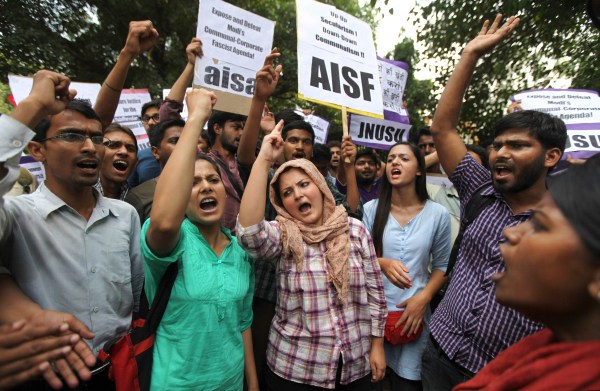
On February 23, the first day of Trump’s visit to the subcontinent, clashes broke out in Delhi after Kapil Mishra, a leader from Modi’s ruling Bharatiya Janata Party (BJP), gave an ultimatum to the megacity’s police, in the presence of a senior police officer, to clear anti-Citizenship Amendment Act (CAA) protesters from the Jaffrabad area of the capital within three days.

The CAA is a controversial act recently passed by the Modi government that links citizenship to religion in India and actively discriminates against Muslims. When combined with the proposed National Register of Citizens (NRC) and an updated National Population Register (NPR), it will likely have an adverse impact on many citizens of India but mainly Muslims, who are the nation’s largest minority. Many could be deprived of citizenship. Social activists and commentators have called on the government to withdraw the legislation.

Hundreds of protests have erupted across the country, with some crowds reaching the hundreds of thousands. The Shaheen Bagh neighborhood in New Delhi is a symbolic epicenter of sorts of these protests, where mainly Muslim women have been leading demonstrations for three months. Jaffrabad, where Mishra gave the ultimatum to the Delhi police, was also a protest site.

Soon after the ultimatum, clashes broke out in Jaffrabad and spread to other areas of northeast Delhi. By the second day, according to commentators, it had transformed from a clash to full-scale anti-Muslim violence that so far has claimed 38 lives, mainly Muslims. It has also resulted in much destruction of property, both public and private, making it the worst violence against a community in Delhi since 1984 when Sikhs were targeted.

Altaf Qadri / AP Images

Hundreds were injured as the centrally administered Delhi police proved ineffective in controlling the violence for the first three days. Many videos circulating on social media appear to show the police, along with various right-wing radicals, complicit in targeting Muslims. It was only after the Delhi High Court intervened and questioned the government’s lack of action that the situation seemed to improve. (The judge who passed the orders questioning the government was transferred within two days.)

By the second day of Trump’s visit, when he arrived in Delhi, more than 13 people had already lost their lives. However, when the American president was briefing the media on his visit and was asked about the sectarian violence in Delhi and religious freedom in general, he surprisingly praised Modi. He said that the Indian prime minister was “incredible” on religious freedom and that Modi wants “the people to have religious freedom and very strongly.” Trump did not comment on the clashes in Delhi; he said he’d heard about it but hadn't discussed it with Modi, and said that it was “up to India.”

Prior to his visit, even though a US official indicated that Trump would be discussing religious freedom with Modi, expectations were rather low. Most, however, did not expect Trump to praise Modi on religious freedom—one of the shakiest parts of the prime minister’s political record. After all, it was the United States that denied Modi, then the chief minister of Gujarat, a diplomatic A-2 visa and also had revoked his B-1/B-2 visa on the grounds of severe violations of religious freedom. Modi remains the only person ever banned from travel to the US under the International Religious Freedom Act (IRFA).

And Modi’s record on religious freedom since becoming the leader of India has not been something to be proud of. His silence when minorities in India have been targeted and lynched by right-wing mobs has been telling. The worst sufferers of the wrath of extreme Hindu nationalists have been India’s Muslims—the targets of cow vigilantes and much hate speech—but Christians have not been far behind. The fundamental freedoms promised by the constitution of India to religious minorities are being constantly eroded, and persecution is a daily reality for many Christians in India.

Radicals affiliated with the Rashtriya Swayamsevak Sangh (RSS) movement and its family of organizations—including Modi’s BJP—have been making concerted efforts to attack Christians both physically and socially. Groups such as Bajrang Dal and the Vishwa Hindu Parishad, which believe in the ideology of Hindutva as promoted by the RSS, have disrupted worship services in churches, beat up pastors and other Christians, engaged in vandalism and destruction of property, and have pressured many Christians to recant their faith and forcibly convert to Hinduism.

The lack of police action, and in too many cases the cooperation of the police with the radicals, has resulted in a culture of impunity, emboldening the oppressors to attack without fear of any consequence. This has resulted in a sense of insecurity felt by many Indian Christians. It does not help that responsible leaders of Modi’s party, including state and union ministers, routinely engage in hate speech against Christians and other minorities. This only bolsters the radicals, who view this as open encouragement to target minorities.

According to the Religious Liberty Commission of the Evangelical Fellowship of India (EFI), which has been documenting incidents of persecution against Christians since 1998, incidents targeting Indian Christians have risen steeply since 2014, when Modi came to power. The commission recorded 147 verified cases of persecution in 2014; 252 cases in 2016; 351 in 2017; and 325 in 2018. The EFI commission will soon release the data for 2019.

Meanwhile, 8 out of 29 states in India have passed “anti-conversion laws,” which are meant to act as a deterrent against religious conversions carried out by force, fraud, or other inducements. The church in India condemns such conversions, for any valid conversion must be an act of free will. However, as plenty of human rights organizations have confirmed, these laws have been misused to create a hostile and violent environment for religious minorities, especially Christians. Extremist groups and the police alike have targeted Christians with the convenient allegation of “conversion by force, fraud, or allurement.” Documented and verified incidents show that Christians and pastors have been frequently arrested or detained on the pretext of investigation. Ministers of the current government, as well as leaders of the BJP, have voiced their support for the introduction of an anti-conversion law on a national scale.

One of the biggest curtailments of religious freedom in India is the denial of affirmative action to Christian and Muslim Dalits. A Constitutional Order of 1950 continues to discriminate against and disempower Dalits belonging to these minority faiths. While Dalit Hindus enjoy benefits such as reserved slots in jobs, education, and political representation, to help them rise up and join the mainstream of Indian society, the same privilege has not been accorded to Dalits from Christian and Muslim backgrounds. This goes against the spirit of the Indian Constitution, which upholds equality and justice. Dalit Christians have been fighting a long drawn-out legal battle to receive the same rights.

Some activists and Christian leaders in the United States had expected Trump to use his distinctive position to speak to Modi about the urgency of ensuring security for religious minorities in India and to take measures to ensure accountability of the perpetrators. But his silence, and in fact endorsement, of Modi’s commitment to religious freedom has let them down.

In the relationship between two countries, religious freedom tends to get lost in the dialogue and becomes subservient to foreign policy rather than guiding it, while economic and other strategic interests take the forefront. But on this trip, even the economic interests appeared to take a backseat to vanity, much less religious freedom. An opportunity has been squandered. We must remember that friends do hold each other accountable—especially when the friend is a country that is a multiethnic, multireligious, and multilingual society of more than a billion people that shares the democratic values and ideals of the United States.

Vijayesh Lal is the general secretary of the Evangelical Fellowship of India, based in Delhi.

Speaking Out is Christianity Today's guest opinion column and (unlike an editorial) does not necessarily represent the opinion of the magazine.

News

Southern Baptists Have Only 13 African American Career Missionaries. What Will It Take to Mobilize More?

The International Mission Board launches new efforts to address historic shortage.

Christianity Today February 28, 2020
Daniel Gregory / Lightstock

Most Ugandans assume Southern Baptist missionary George Smith is one of them. They talk to him and his wife Geraldine, who are African American, like they’re talking to one another, they said.

Anglo missionaries, on the other hand, tend to be “a spectacle,” said Smith. “They draw a crowd.”

Through 20 years of ministry in Africa with the Southern Baptist Convention’s International Mission Board (IMB), blending in with locals has afforded the Smiths distinct ministry advantages—from freedom to call local believers “on the carpet” in sermons, as Smith puts it, to an opportunity to live with Africans as peers.

Back in the United States, IMB leaders also have recognized the strategic advantage of sending black missionaries around the world. They’re making a concerted push to send more African Americans—not only for the sake of missions strategy, but also to align the percentage of black IMB missionaries with the percentage of black church members in the Southern Baptist Convention (SBC), which includes nearly 4,000 predominantly African American churches.

At this point, it’s going to be a stark challenge. Of approximately 3,700 career missionaries serving with IMB at the end of last year, just 13 (0.3%) were African American, according to the IMB’s 2020 ministry report. For the percentage of black missionaries to approach the percentage of black church members in the SBC overall—6 percent, according to Pew Research—nearly half of the 500 new missionary slots the IMB aims to create over the next five years would have to be filled by African Americans.

Observers within and outside the SBC are hopeful, though they wonder if the IMB’s black missionary recruitment effort will include sufficient money and commitment to make a meaningful difference.

“It’s a bit too early to tell” if the IMB is serious about mobilizing African Americans, Smith said.

Last month, the IMB announced the hiring of Jason Thomas as a full-time African American church mobilization strategist. Thomas told Christianity Today he’s aiming for 75 black IMB missionaries by 2025—about six times as many as there are now. He plans to recruit by visiting churches, attending conferences and meetings, partnering with seminaries, and working closely with the SBC’s National African American Fellowship (NAAF).

“All Christians are called to fulfill the Great Commission,” Thomas said. “To do that, we must send missionaries from all ethne,” all races and nations.

Bolstering Thomas’s efforts, the SBC Executive Committee voted this month to add a George Liele Church Planting, Evangelism, and Missions Day to the denomination’s calendar annually, honoring the Revolutionary War-era slave credited as the first overseas missionary from the United States.

“African Americans who have served through IMB have made a tremendous contribution to getting the gospel to the nations, so we want to see more and more African Americans on the mission field,” IMB President Paul Chitwood told CT.

The number of black Southern Baptist missionaries has never been high, but the IMB’s latest push comes amid a mild ebb of African Americans on the field. In 1999, there were 19 black IMB missionaries, 0.4 percent of the total SBC international missionary force. The number increased to 27 (0.6%) in 2013 before falling again to current levels.

NAAF President Marshal Ausberry cited SBC history as a factor in the recent shortage of African American missionaries. Because the denomination was founded in 1845 to retain the right of missionaries to own slaves, racism “seeped into policies,” he said. The era of Jim Crow also inhibited black participation in SBC missions, so black Baptists sometimes engaged in mission work apart from the SBC. Efforts over the past four decades to make the SBC’s racial composition “reflect the kingdom of God” have yet to fully overcome the convention’s history.

More recently, the IMB didn’t immediately replace its staff liaison to black churches after he retired some five years ago. When the agency downsized its missionary force in late 2015 and early 2016 for financial reasons, some claimed the downsizing disproportionately, through unintentionally, affected African Americans. (Black recruitment waned in recent years, the argument went, and few young African American missionaries were being sent to replace their older peers.)

The SBC Executive Committee asked about that issue in 2016, and the IMB responded that its voluntary retirement incentive “did not have a significant impact on the number, balance, and ratio of African Americans” serving on the field.

Among American denominations, the SBC is not alone in its lack of black international missionaries. Just 1 percent of all US missionaries are African American, according to The Front Porch, a website promoting biblical faithfulness in African American Christianity.

Doug Logan, president of Grimké Seminary in Richmond, Virginia, said that aside from “all-stars” like Liele and Lott Cary, a 19th-century missions pioneer in Liberia, there have been few African American international missionaries.

“African American churches post-Emancipation have struggled just to be the church in their own neighborhood and communities in the states amidst racism and segregation, often lacking sufficient funds for day-to-day ministry,” he said. “So global missions would likely take a back seat to ministry and people right in front of them.”

Among Southern Baptists, home missions has seen heavier involvement by ethnic minorities, including African Americans. In 2018, 62 percent of the 624 churches planted by the North American Mission Board (NAMB) were non-Anglo, including 7 percent that were African American, according to NAMB’s 2020 ministry report.

In addition, black Christians historically have been segregated from seminaries, white mission agencies, and some denominations with a focus on world missions.

Despite efforts to organize African American mission work to Africa in the 19th and 20th centuries, the number of black missionaries remained small, according to Process, a blog run by the Organization of American Historians. Between 1820 and 1980, just 600 of the 30,000 American missionaries in Africa were black.

Yet fulfilling the Great Commission requires “every race in the game,” Logan said. Missionaries of color often gain a hearing in countries where Anglo missionaries are inhibited by the “history problem” of white colonialism and racism. A diverse mission force also “shows off this melting-pot gospel” that brings people of every ethnicity into the body of Christ.

For the SBC, there seems to be hope of achieving that goal. Other ethnic groups already have been mobilized beyond the levels of African Americans. Though Asians comprise less than 1 percent of Southern Baptists according to Pew, 222 Asian Americans represent 6 percent of the IMB’s missionary force. Additionally, “God is opening an increasing number of pathways for Hispanic brothers and sisters to take the gospel to Muslim contexts,” the IMB stated in this year’s ministry report.

Ausberry, of NAAF, believes only the “hand of God” could lead the SBC from its racist beginnings to the election Fred Luter as its first black president in 2012. Not only did his election break down a color barrier in the SBC, but he used his platform as president to urge more African Americans to consider the mission field.

Following a mission trip, Luter told fellow African American church leaders, “I regretted, pastors, that I didn’t do this a lot sooner … Don’t let it take you to be elected president of the Southern Baptist Convention to go to the mission field.”

Chitwood, who took the IMB’s helm in 2018, is building on that momentum, said Ausberry, the SBC’s first vice president. “He has fresh eyes and a global perspective. The opportunities look great moving ahead.”

In Uganda, the Smiths are hopeful but realistic. In their 60s and likely within two years of retirement, they know just 11 black missionaries will remain on the field when they depart if no one else is mobilized.

Sending hundreds of black Southern Baptist missionaries “is realistic,” Smith said. “But it’s going to take African Americans being out front with it. It’s going to take money. It’s going to take time.”

David Roach is a writer in Nashville, Tennessee.

News

Pro-Life Democrats Remind Candidates They Exist

Ahead of the South Carolina primary, religious voters’ push for a “diversity of opinions” on abortion gets little reception from presidential hopefuls.

Christianity Today February 28, 2020
Scott Olson / Getty Images

Though South Carolina’s Democrats are more religious and more pro-life than voters in other early primary states, presidential candidates are sticking to the increasingly strident pro-choice positions held by their party.

Democrats for Life of America used the campaign push in the South as a chance to call on candidates to consider the place of pro-life voters in their coalition. The South Carolina Legislature has voted forward a “heartbeat bill,” one of the most restrictive anti-abortion laws in the country, and its Republican Senator Lindsey Graham sponsored the 20-week abortion ban voted on in the US Senate this week.

Evangelical Protestants and black Protestants make up half the population in South Carolina (compared to 30 percent of the overall US population). As Democrats engage in unprecedented levels of outreach to religious voters, many candidates make their way through black churches in the Southern state as they rally support. Kristen Day, executive director of the pro-life Democrats group, spoke at a press conference before Tuesday’s debate, reminding the presidential hopefuls from her party that many of the African American voters they are courting are less supportive of abortion than white Democrats or the party overall.

Exit polls from the 2016 primary show 61 percent of Democratic voters in South Carolina were African American, and Christian faith plays a key role among black voters, Day said.

Speaking in Charleston, South Carolina, Harriet Bradley, an African American minister and state chapter coordinator for Democrats for Life of America, quoted Proverbs 6:16–17, naming “hands that shed innocent blood” among the “things the Lord hates.” She described her deep desire to vote in a way that would please God but also expressed a commitment to being “pro-life for the whole life.”

Abortion policy did not come up during this week’s debate in Charleston. But former Vice President Joe Biden, a moderate Catholic Democrat who is staking his campaign’s future on his performance in Saturday’s primary, brought up abortion when asked about women’s empowerment in poor and overpopulated countries in a town hall in the state on Thursday.

Biden spoke out against the Mexico City Policy, which is a ban on federal funding for abortions overseas that was reinstated by President Trump. Biden said, “I strongly oppose the limitations on the ability for the United States to contribute to organizations in these countries that, in fact, provide women's health alternatives for choice,” prompting applause from the crowd of more than 1,900 people.

Last year, Biden withdrew his support for the Hyde Amendment, which prevents federal funds from going directly to abortion in the US. Until recently, the Hyde provision was seen as the status quo for federal abortion policy. After the Democratic Party officially called for the repeal of Hyde, every major candidate in this year’s Democratic race has echoed that.

Day and other pro-life Democrats represent a minority in the party, but they argue that they could be a strategic part of a coalition to beat President Trump. A Kaiser Family Foundation poll from December 2019 found that 15 percent of Democrats and 41 percent of Independents consider themselves pro-life.

Members of Democrats for Life of America want to see more Democrats favor restrictions on abortion after 20 weeks and return to the “safe, legal, and rare” approach fronted by President Bill Clinton.

Yet the Democratic party’s position on abortion continues to move to the left. In 2018, over 65 percent of Democrats supported a woman’s right to an abortion for any reason, while less than 35 percent of Democrats held the same position in 1977, according to General Social Survey data analyzed by Ryan Burge, political science professor at Eastern Illinois University.

According to Burge, 42 percent of white evangelicals that lean Democrat and nearly 70 percent (69.3) of white evangelicals that identify as Independent support the Hyde Amendment.

Despite calls for welcoming a wider range of views on abortion, Biden, Senator Elizabeth Warren, Senator Bernie Sanders, Tom Steyer, and Mayor Pete Buttigieg stuck with party leadership to support pro-choice positions “litmus test” for Democrats.

When Day asked Buttigieg during a town hall last month if voters like her were welcome in the party, he backed the party’s position and Roe v. Wade.

“What struck me was that I didn’t ask his position on abortion. The question was, ‘Does he want the support of 21 million voters, and would he change the party position to reflect the diversity of opinion on abortion?’” Day told CT.

Though Senator Amy Klobuchar supports repealing Hyde and funding Planned Parenthood, she has voiced support for welcoming pro-life Democrats in the party. On The View, she told Meghan McCain, “There are pro-life Democrats, and they are part of our party, and I think we need to build a big tent. I think we need to bring people in instead of shutting them out.”

Day was pleased to hear such an invitation from Klobuchar, but she still wants to see the party change the language in its platform for such welcoming rhetoric to be meaningful for pro-life Democrats.

How to Build Trust in Science Within the Black Church

Q&A: Minister and scholar Cleve Tinsley says conversations should address history of inequality and include representation from black scientists.

Christianity Today February 28, 2020
Illustration by Mallory Rentsch / Source Images: PeopleImages / Getty Images / Alex Kondratiev / Unsplash

The conservative Christian who sees science as a threat to faith is a common stereotype. Religious studies scholar Cleve Tinsley IV points out, however, that this view lumps conservative black Protestants into the same category as conservative white evangelicals, neglecting how African Americans’ unique history and justice concerns could shape their views of science.

For Tinsley, whose spiritual formation happened within black evangelicalism, the church was his first site of critical inquiry that set him on a path to become a scholar. Since he is also a minister, he recently used his connection to African American churches to engage congregants in a sociological study.

As part of broader nationwide research at the Religion and Public Life Program at Rice University, Tinsley and his colleagues studied three black Protestant congregations—two lower income and one higher income—in Chicago and Houston. Interviewing 50 individuals, they explored how factors like income and education affect views on the relationship between science and faith.

Tinsley and his team wondered whether congregants would mention the history of abuses by the scientific community against African Americans, such as the Tuskegee study from the 1930s-1970s that withheld effective treatment from black men with syphilis or the use of Henrietta Lacks’s “immortal” cells beginning in the 1950s without informed consent.

They found that respondents held a cultural memory of scientific research that reinforced ideas of black inferiority (though they didn’t mention specific events), along with faith concerns that sometimes compounded mistrust of scientists.

Many respondents in the lower-income congregations, and a few in the higher-income congregation, felt that science—or at least scientists—directly opposed their beliefs. Yet others across socioeconomic status understood science and faith as two separate ways of explaining reality. And many saw medical science as compatible with faith, particularly when it has improved lives.

We interviewed Tinsley about these findings, published recently in the Du Bois Review. They are important, he said, because black Protestants’ relationship to (and representation within) the field of science affects their health and overall thriving. They are also a window into the larger black struggle in the United States for identity and meaning.

Why is there such a lack of research around black Protestant views of science, and views of science among minorities in general?

On the one hand, there is an access issue. There are not many black scholars or scholars of color going into Christian communities, because of issues of trust. There’s a long history of mistrust of science and scientifically inquiring folks.

As a supposedly disinterested academic, there’s going to be a lack of trust from these communities to invite people in to “study” them. Obviously, there’s a problem with this in history, whether it’s Henrietta Lacks or Tuskegee. There’s always this reluctance from scholars as to how to establish that trust.

Communities, on the other hand, have this issue with science as well. What we try to engage in this study is: Hey—are black congregants aware of some of this history of science? Also, the study of science and religion is relatively new. My colleague and mentor, Elaine Ecklund, and I saw this project as germane and necessary.

One of the more surprising findings from this study was that respondents, regardless of class, didn’t mention past abuses in medical research, such as the Tuskegee trials. What is going on here?

We were very careful in crafting our interview guide not to have any leading questions. We had generic questions: “What do you think about the interaction between science and religion?” “What are you aware of harmful instances?” We happened to not get very many responses at all mentioning the Tuskegee incident explicitly. However, there was a lot of cultural memory of how science more generically has served these views of black inferiority. But the mention of that specific case didn’t come out.

Some of your respondents, particularly those of lower socioeconomic status, take issue with scientists but not necessarily science. Can you explain this distinction?

By and large the conflict was with the scientist as this atheistic person, all about investigation and against faith perspectives. They weren’t opposed necessarily to scientific approaches or progress as much as they were the type of representation of the scientist as this larger specter of unbelief. For our participants, scientific advances were also the work of God.

The study found these different narratives: Some people saw science and faith as conflicting, while others saw them as independent or collaborative. Do the different narratives correspond to different actions when it comes to health care?

That came out more in another article called “Heaven and Health” around issues of health and how black Christians perceive issues of conflict there. In that study, we found that people really esteem the pastoral authority role in black congregations. As pastors begin to navigate medical science and talk to their congregants about it, people tend to be more open to it. But we also found that doctors didn’t have the last say. God really has the final answer for folks there. Yeah, there’s a real push toward health care, but at the same time, there’s another perspective of heaven. There’s something other than what the doctors may prescribe. Where the conflict may come is in science or doctor’s prognosis versus the faith tradition.

There has been research on African Americans and other people of color distrusting doctors’ recommendations and wanting the most aggressive treatments, because they’ve historically been underserved. What are your thoughts on this?

I take this up in my larger research. There’s issues of inequality and inequity, which relates to wealth and class. Africans Americans feel like they have to work twice as hard to make sure they have adequate health care. There is research on the mortality rates of black mothers. There’s this long history as it relates to black women.

Inequality plays into African Americans’ mistrust when it comes to health care, but does religion also play a role?

Could be. We would need to isolate the ways that faith interacts with this issue of care. We actually found in one of our studies that folks who have more conservative theological views might be averse to more aggressive or advanced medical care. In their minds, there is a supernatural agency at work. They may not need to go there.

There is other research finding that when it actually comes to people at the end of life, those with higher religious support get more aggressive treatment. That seems to contradict your findings.

What that points to is this need for us to always have nuance in our analysis. Just like the content of religious faith and belief itself, there is no one pole. There are those who would say, “Because of my religious faith, it’s not my job to extend my life any further than God has intended.” There’s also those who, because of their religious faith, say, “Well, God would want me to struggle as much as I can, to fight as much as I can.” These different findings account for the variety of perspectives even within these faith traditions.

How is mistrust of scientists or perceived conflict between science and religion affecting health outcomes in black communities?

It requires more wide-scale research and a longer term of sitting with certain congregations. But the statistics are out there. The longevity of black life in this country is down, and that affects our congregations as well.

That was something quite obvious to me in our study. When I visited white mainline churches, the older members of the congregation were much more vital, getting around. But in a lot of our African American congregations, you see much more of those who are sick, on the prayer list. This lack of access can affect long-term health.

What is the relationship between the representation of minority groups in the field of science and their views of science and medical research?

The more representations of a community in these professions, the more access for congregants. For example, one of our high socioeconomic status congregations had regular medical functions, where doctors from their community came in and had seminars, explaining certain things. By and large their views of science were very positive. Because of their access to more representation, they were able to see themselves in this space.

Whereas, in our low socioeconomic status congregations, most of the scientists they knew were non-black folk. There was more suspicion there because of lack of access. Being represented within the scientific community would increase their sense that this community is reliable: “Hey, I see that these are black doctors that I think are really concerned about my own well-being and care. So, I’m more apt to give my trust to these persons as experts than, say, a non-black scientist I don’t know who is representative of a cultural authority that has not served me well in the past.”

How did black Protestant views of science compare to those of white Protestants?

The major difference came to issues of trust with the scientific community. We also found differences in interaction with the scientific community—more existed in white congregations than in black congregations. Overall there was more of a knowledge base around some of the advances in science. You are unable to disentangle that from issues of class.

Would you say that class differences are more significant than racial differences when it comes to Protestant views of science?

The question is not easily answerable. In our findings, yes. But I’m unable to disentangle the two. Whenever you’re measuring or trying to do studies on the basis of ethnicity and race, you almost naturally run into class distinctions. So, it’s hard to find a black evangelical congregation that’s middle or upper class. You can find some. Our study was between two low-income congregations versus a high-socioeconomic-[status] black congregation. And we found some differences as it relates to knowledge there. So class did matter. But also, when we compare high socioeconomic black congregations to high socioeconomic white, Korean, or Latino congregations, we found differences there as well. Definitely, class is a factor. But it’s impossible to disentangle those two.

Can you give any examples of ways that academic or medical institutions have collaborated well with communities that distrust medical research in general?

Sadly to say, I can’t really name any really good examples in my experience. There’s great opportunity. I’ve seen it with white congregations. Dr. Ecklund, who was the principal investigator for this research project, often engages with her congregation around issues in her research and tries to bring in practitioners and science. If we were also to have academics and practitioners who were in scientific fields come do these symposiums and forums at African American churches, that would be great.

An African American church here in Houston regularly had these symposiums with doctors. But there wasn’t an intentional drive to talk about what it means for these two communities to collaborate more, and how could that affect the long-term health of these populations.

So, it’s not just a matter about having health workshops. What’s the additional step beyond providing health care information?

Beyond health care information, there needs to be a kind of social gathering where we’re talking about the implications of scientific and faith ideas and how they can collaborate. That’s what I’m talking about—the deeper imaginative, intellectual, theological work around science and faith collaboration. This involves collaboration between pastors, scientists, and scientific African Americans in the communities. A larger conversation needs to be had to be more generative around issues of trust and suspicion and how we deal with issues of inequity for specific communities. A larger intentional effort that engages not just the practicality but also how these two domains that have tended to be separate can come together and have more robust conversations.

Liuan Huska is a writer living in the Chicago area. Her forthcoming book on chronic illness is publishing with InterVarsity Press.

Church Life

Five Family-Friendly Resources for Lent

What does it mean to teach our children about lament, fasting, and mortality? These books, apps, and flashcards can help.

Christianity Today February 27, 2020
Pixel Creative / Lightstock

It’s one thing to observe Lent solo. It’s another thing to try to practice Lent with a family, especially if your family includes fussy babies, grumpy middle schoolers, or fantastically busy teenagers. For some parents, every day feels like Lent. You’re often laying down your life or giving up things that you love. When Ash Wednesday comes around, what can you give up when you already feel utterly spent?

My wife and I have felt all these things in some fashion with our two children and have been deeply grateful to discover resources that others have created in order to practically help families who wish to follow Jesus on this 40-day pilgrimage. The following five resources, which include books, downloadable apps, and creative devotionals, will offer families a starting point to practice Lent together.

Lenten Survival Guide for Kids: I’m Supposed to Do What?! by Peter Celano (Paraclete Press, 2014).

Written for elementary and middle school-aged children, this playful guide aims to help kids understand why they should care about a terribly big word that adults frequently take awfully seriously: Lent. Without talking down to them, Celano, an editor at Paraclete Press, offers children a chance to learn about such things as “What Lent Is,” “What Lent Definitely Is Not,” “40 Days of Survival Tactics,” and “A Few Prayers and Practices—Only for Kids.”

As Celano explains in this book, Lent is not about “giving up” silly things or about making sad faces to show how difficult life has suddenly become. It’s about learning to love God and to know who Jesus is and what it means to follow him—even as a kid! With Scriptures to memorize and prayers to say, Celano’s book is a wonderful opportunity for young children to embrace the season of Lent for themselves and not because, as many mothers and fathers may have uttered at some point, “I said so.”

Lent in Plain Sight: A Devotion through Ten Objects by Jill J. Duffield (Westminster John Knox, 2020).

In this short but sweet book about the ordinary things that Jesus would have encountered on his way to Jerusalem, author Jill Duffield suggests that God delights to work through the ordinary objects we encounter throughout our lives. Through a series of reflections on Scripture, Duffield explores Jesus’ final days by way of dust, bread, the cross, coins, shoes, oil, coats, towels, thorns, and stones. Each week, running from Ash Wednesday to Easter, Duffield shows us how God’s grace becomes tangible in the mundane things of our lives.

While this book isn’t written specifically for families, it holds great promise for children who wonder, for example, about the ways that dust might become more than something that collects under our beds, and that ash might represent something greater than simply the leftovers of a fireplace—they can function as signs of our mortality and as symbols of the things God uses to reveal his glory in the world. The ideal family for this hand-sized book is probably those with junior high and high school kids, though small children might enjoy looking at and talking about the illustrations, too.

Wild Hope: Stories for Lent from the Vanishing by Gayle Boss (author) and David G. Klein (illustrator) (Paraclete Press, 2020).

If Lent is an invitation to participate in the sufferings of Christ, as Gayle Boss writes in this lovely book, then that invitation extends to all of creation, inasmuch as Christ has died to redeem the whole world. Our journey through Christ’s passion, she argues, ought to give voice not only to our own groanings but also to the groanings of creatures who suffer the “pains of childbirth” together with us (Rom. 8:22). This includes endangered animals such as Chinese Pangolins, Polar Bears, Giant River Otters, Hawksbill Turtles, Ring-tailed Lemurs and Amur Leopards.

The delight in reading about these creatures, and the sadness that comes from realizing that they are endangered, naturally leads to confession as we realize the ways that humans have done a poor job of caring for God’s earth and its inhabitants. The hope that runs straight through the heart of Lent, however, reminds us that God’s new creation life is not just for us but for all the things that he has made. In Boss’s words, “Lent is seeded with resurrection,” and her hope is that these stories might help us to perceive how new life arises from death and ruin, precisely because God in Christ and by his Spirit is at work to renew all of creation.

Beautifully illustrated by the artist David Klein, the book’s stories are sure to engage the imaginations of children of all ages, but especially those who are over 5. The stories are short enough to read out loud and would make for marvelous conversation at the breakfast table or at night for bedtime reading. And since it’s only four stories a week, it leaves plenty of room to miss or skip a day.

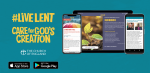
#LiveLent: Care for God's Creation

“#LiveLent: Care for God’s Creation”is the Church of England's Lent Campaign for 2020. With weekly themes shaped around Genesis 1, this Lenten app explores the urgent need for humans to protect the abundance that God has created. It offers 40 short reflections and suggested actions to help individuals, families and church communities to care for God’s creation in practical ways. A wonderful feature of this downloadable app is that you can hear an audio recording of each day’s entry, not just read it, making it thereby possible for a family to listen together to the Scripture of the day, the short reflection, the action to follow, and the final prayer, along with a beautiful selection of music.

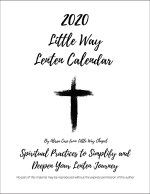
Lenten Family Practices Calendar

This calendar, created by Alissa Case from Chapel of the Little Way, is designed to be cut into squares and stacked on easily accessible locations like the dining table or bedroom nightstand. These squares could also be hung on a string with clothespins and taken down one day at a time as a countdown towards Easter. Ideally discussed in the morning, so as to practice the spiritual exercise throughout the day, this downloadable calendar is equal parts spiritual exercise and deck of cards.

Drawing on Jesus' teachings in Matthew 6:1-18, where he instructs his followers to pray, fast and give to the poor, the calendar follows the three traditional Lenten spiritual practices of praying, fasting, and almsgiving or serving others. The daily activities are wonderfully doable and variable, including such things as “Hold the door open for someone else,” “Throw away someone else’s trash,” “Cook dinner for another family,” “Smile at a stranger,” “Do a chore for someone else,” and “Pray for Christians in another part of the world.” Like #LiveLent , this calendar is immediately available once it’s downloaded.

W. David O. Taylor teaches theology at Fuller Theological Seminary and is the author of the forthcoming book, Open and Unafraid: The Psalms as a Guide to Life (Thomas Nelson: 2020), along with an accompanying set of prayer cards. He tweets @wdavidotaylor and posts Psalm-related resources on Instagram @davidtaylor_theologian.

News

Learning About Other Faiths Doesn’t Lead Evangelical Students to Lose Theirs

Compared to other colleges, students at evangelical institutions end up gaining the most knowledge of world religions.

Christianity Today February 26, 2020
Kentaroo Tryman / Getty Images

One of the negative stereotypes of evangelical colleges is that they keep students in a religious “bubble.” But new survey data shows that these schools are particularly effective at teaching students about other faiths, and that this exposure to outside traditions is actually correlated with a deeper commitment to their own beliefs.

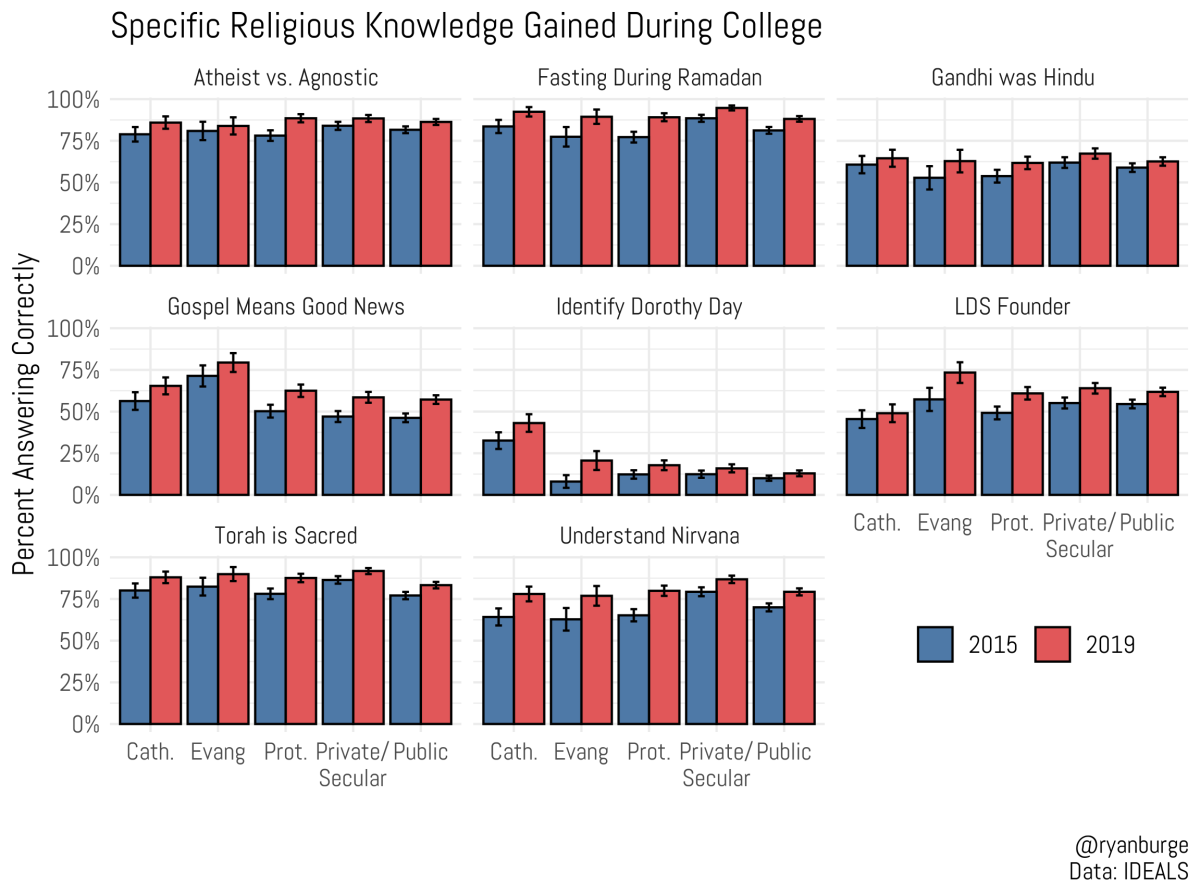
The Interfaith Diversity Experiences and Attitudes Longitudinal Survey (IDEALS)—a panel study that surveys the same students before, during, and at the end of their college career—measures basic knowledge about world religions.

The sample included over 1,300 students from 15 evangelical universities, the majority of which were members of the Council for Christian Colleges and Universities.

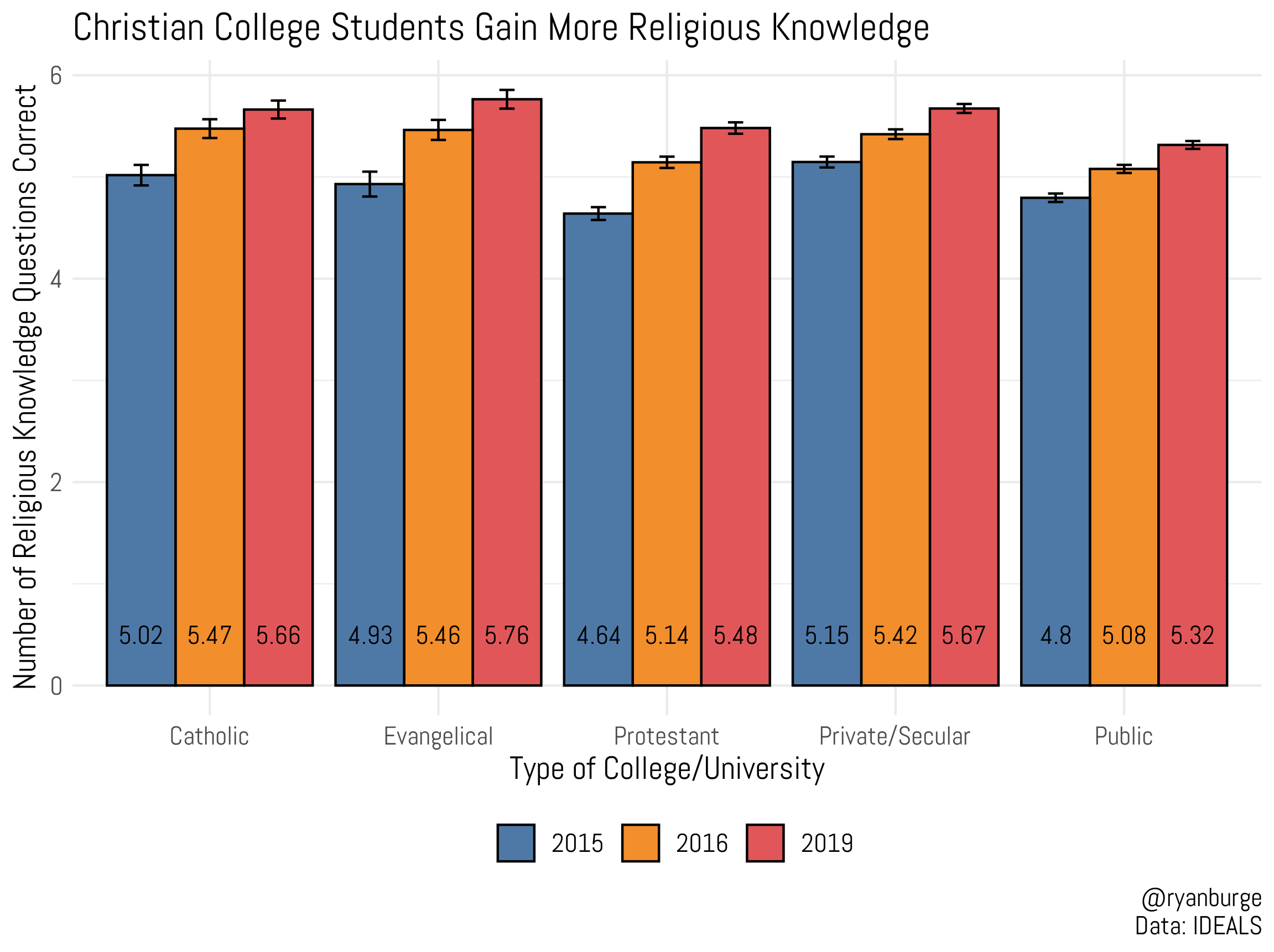
Compared to students who planned to attend Catholic or private secular universities, evangelical students had a lower baseline level of knowledge. The average student attending an evangelical university could answer just 4.9 questions correctly. However, this score was higher than those attending public universities (4.8) and those who attended Protestant schools not classified as evangelical (4.6 questions correct).

All institutions of higher education impart some knowledge of world religions, but there are clear differences between the types of schools. For instance, the average student attending a Catholic college answered 0.64 more questions correctly after four years at college, which is close to the average for the entire sample (0.67).

Those attending evangelical schools—many of which require some sort of religious formation classes in their curricula—saw a larger improvement, answering 0.83 more questions correctly on average by the end of their college career. That gain in religious knowledge is tied for the largest increase among any type of college or university and resulted in the highest average score at the end of the survey period.

Evangelical schools are emphasizing world religions, and students are seeing measurable gains in knowledge.

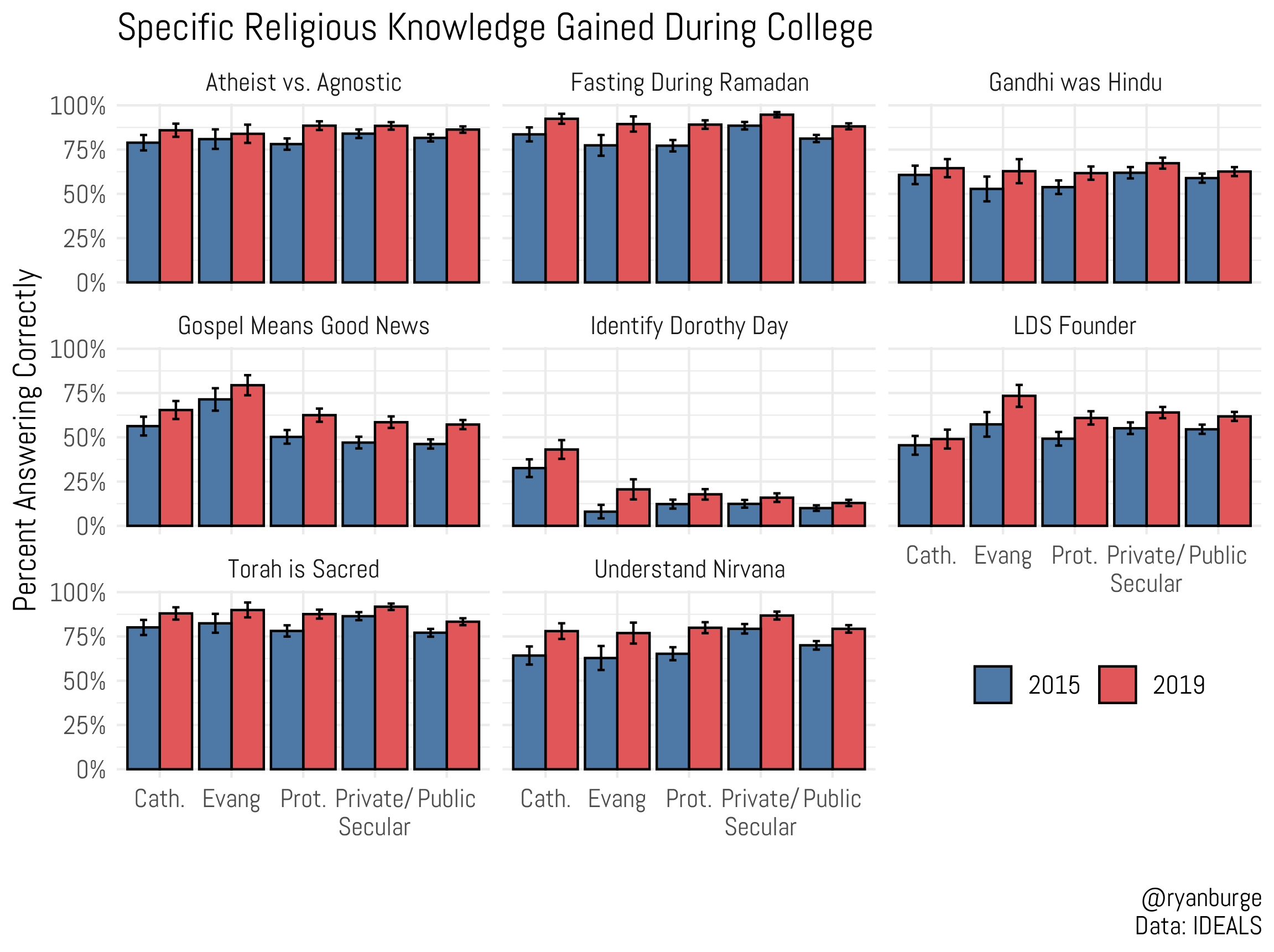
Students at evangelical schools are not just learning Protestant church history and theology. They showed the greatest gains in knowledge of faiths outside of their own.

While 57.3 percent of respondents from evangelical schools knew that Joseph Smith founded the Mormon Church when they began college, that jumped to 73.4 percent four years later. The share of evangelical students who understood the concept of nirvana increased 14.1 percentage points; the number who knew about the Catholic social activist Dorothy Day increased more than 12 points, as did their knowledge of Muslims fasting during Ramadan. (Students at Catholic schools are still more than twice as likely to know Day than those at other colleges—one of the biggest gaps in the survey.) Questions surrounding Judaism and Christianity saw increases as well, but they were much more modest, often in the single digits.

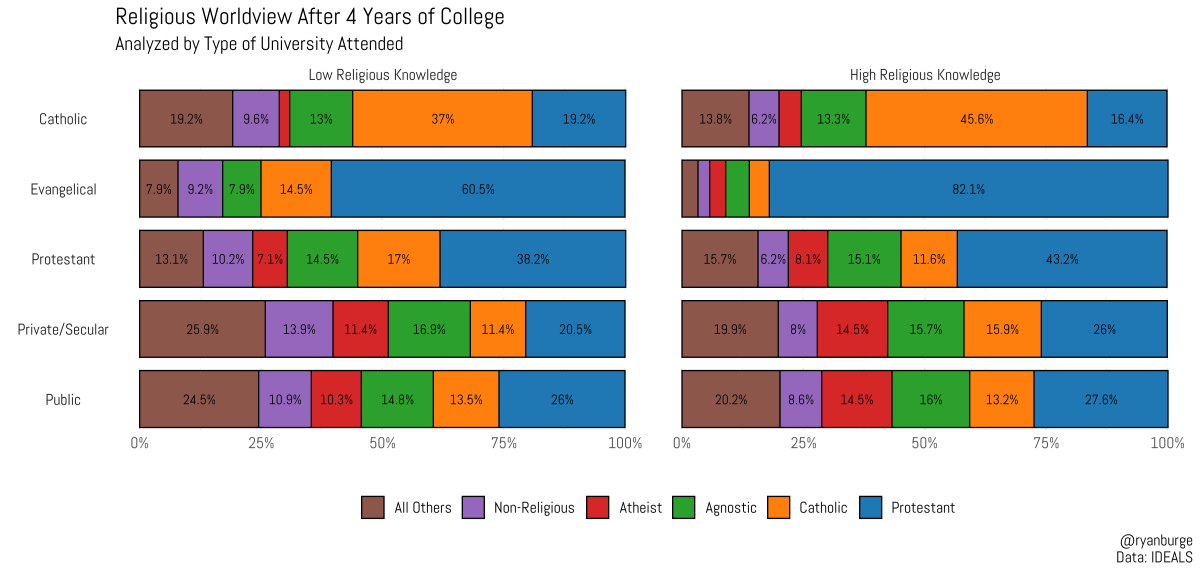
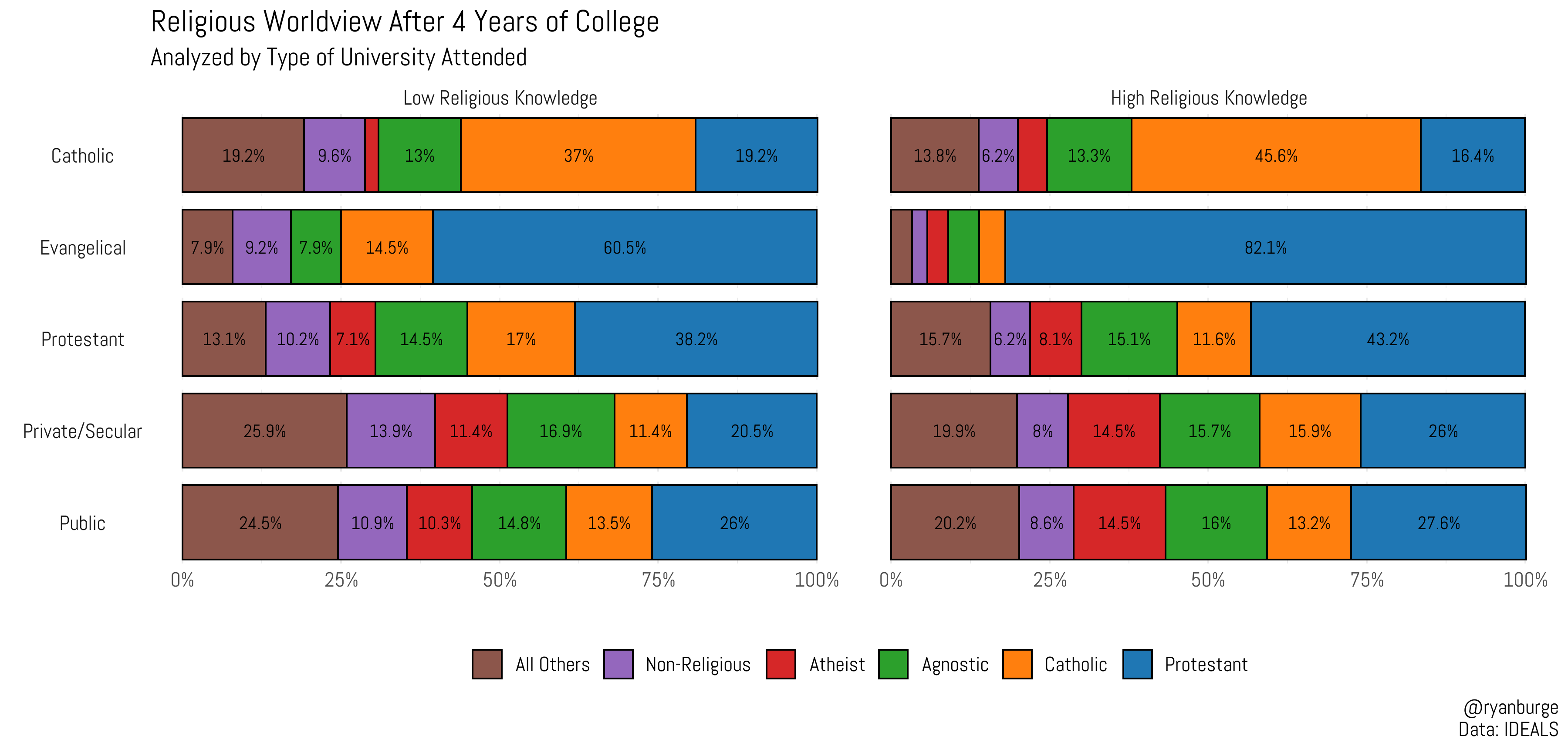
Some administrators and parents of evangelical college students may be concerned that teaching so much about religions outside the evangelical faith tradition may lead some of their students to drift away. This data should allay those fears. When the sample was divided up to compare those with high religious knowledge (answering at least seven of the eight questions correctly) to those with low religious knowledge, it was the former group that remained more devout.

Among those attending evangelical colleges who had a high level of religious knowledge, 82.1 percent still identified as evangelicals as seniors. Among students at evangelical schools who answered six or fewer questions correctly, just 60.5 percent said that they were evangelical.

Just a few weeks ago, a research study from Cardus, a Christian think tank, found that Christian college students were more likely to care about helping other people than about making money than those who attended public universities. The indication is that Christian schools should focus on what makes them distinct: their mission and purpose.

The data from IDEALS seems to provide even more support for the argument that Christian colleges should emphasize what they do best: providing broad knowledge to their students about the world that exists outside the campus community. They are able to expand the religious worldviews of their students while also grounding them in the evangelical faith tradition. As the world becomes increasingly diverse and interconnected, this could be a major selling feature of evangelical higher education.

Ryan P. Burge is an instructor of political science at Eastern Illinois University. His research appears on the site Religion in Public, and he tweets at @ryanburge.

The Interfaith Diversity Experiences and Attitudes Longitudinal Survey (IDEALS) is a national study that is led by Alyssa Rockenbach (North Carolina State University) and Matthew Mayhew (The Ohio State University) in partnership with Interfaith Youth Core, with funding by The Andrew W. Mellon Foundation, the Fetzer Institute, and the Julian Grace Foundation. Burge partnered with IDEALS to share his independent analysis of the data its researchers provided.

Apple PodcastsDown ArrowDown ArrowDown Arrowarrow_left_altLeft ArrowLeft ArrowRight ArrowRight ArrowRight Arrowarrow_up_altUp ArrowUp ArrowAvailable at Amazoncaret-downCloseCloseEmailEmailExpandExpandExternalExternalFacebookfacebook-squareGiftGiftGooglegoogleGoogle KeephamburgerInstagraminstagram-squareLinkLinklinkedin-squareListenListenListenChristianity TodayCT Creative Studio Logologo_orgMegaphoneMenuMenupausePinterestPlayPlayPocketPodcastRSSRSSSaveSaveSaveSearchSearchsearchSpotifyStitcherTelegramTable of ContentsTable of Contentstwitter-squareWhatsAppXYouTubeYouTube