






Middle Management Matters

Yes, character is consequential. That’s why I’ll vote for Trump again.

Christianity Today February 10, 2020
Illustration by Mallory Rentsch / Source Images: Courtesy of Elliot Gaiser / Photo by Patrice Gilbert

In this series

When I watched Donald Trump’s acceptance speech at the 2016 RNC convention, from the balcony of my hometown basketball stadium in Cleveland, Ohio, one line stayed with me: “I would like to thank the evangelical community, because, I will tell you what, the support they have given me—and I’m not sure I totally deserve it—has been so amazing, and has been such a big reason I’m here tonight.”

Our future president was right: Millions of my fellow evangelicals carried Trump through the primaries and voted overwhelmingly to put him in the White House. But like many Christians who live as religious minorities among predominantly secular peers, I felt keen pressure throughout the entire 2016 campaign to denounce Trump.

The 2016 election forced me to think more deeply and more biblically about how Christians should engage the public square. As we approach the 2020 election in the midst of an impeachment that has divided the country and the evangelical community, I’ll lay my cards on the table that Christianity Today has set: I voted for Trump in 2016, and I plan to do so again in 2020.

Here’s how I made my decision.

When I first registered to vote as a born-again 18-year-old in a Rust Belt swing state, I saw my ballot as a banner, an expressive judgment about a candidate and my willingness to associate myself with his or her character and principles. But the 2016 election exposed flaws in my paradigm. If my vote was an expression of approval consistent with my faith, how was I to fully endorse either Hillary Clinton or Donald Trump?

As Christians, we begin with the premise that everyone has sinned and fallen short of the glory of God (Rom. 3:23) and that Jesus died for everyone (1 John 2:2)—even those who run for political office. As sinners, every candidate will let us down. But because Jesus rose again, every candidate is offered salvation by faith through grace (Eph. 2:8–9). Christians can leave that most important endorsement to God.

This good news unveils a truer paradigm for our political engagement. Rather than determining whether a candidate is saved before I vote, I leave that to God and concern myself only with the moral content of his or her policies.

In this paradigm, a vote is not an individual endorsement as much as a practical calculation regarding the likely consequences of an election. We vote for the candidate we believe will do the best job given the alternatives while recognizing the limitations of sinful human nature.

This approach rejects any temptation to political idolatry. The ballot is not a banner. The ballot box is not an altar. The voting booth is not a confessional. A candidate cannot be our messiah.

This does not mean we set aside biblical principles. Politics matters to God because God cares about mitigating the effects of the Fall on a fallen world. Human flourishing and alleviating injustice matter to the God who became man and made the lame walk, the deaf hear, and the blind see. The gospel invites us to participate in politics as part of God’s redemptive work.

Christians may have good-faith differences over practical judgments. Some, like Mark Galli, see incontrovertible evidence that Trump immorally abused his power. Others, like me, conclude that Trump did not abuse his power, and the constitutional failsafe of impeachment has been abused for partisan gain. Yet this disagreement is not over infallible biblical standards, but over fallible judgments for how these standards apply.

I am not suggesting character is not important. When America was founded, presidential political authority was limited, and moral authority was paramount. George Washington was able to govern effectively due to the great stock that his contemporaries put in his integrity.

In our present political moment, character matters even more—the 20th-century growth of the administrative state exponentially increased the number of people who exercise influence over our lives. Personnel is policy. Modern presidents appoint personnel to roughly 8,000 federal executive offices, in addition to myriad military officers and hundreds of life-tenured judges.

As a regulatory lawyer, I see this every day. The larger the federal leviathan grows, the less it matters who the president is. What matters is whom the president picks to decide policies that affect how we live.

The two major political parties represent the pools of potential personnel. When you vote for a president, you’re voting for a set of hands that will reach into respective pools labeled “R” and “D” and draw out names of people to administer—or subvert—justice. The pools are starkly dissimilar.

One party welcomes busloads of pro-lifers of all faiths, ages, races, and sexes, and the other party reflexively sees those MAGA-hat Catholic schoolboys as unforgivable.

One party promotes religious freedom for all faiths. The other party devotes its cultural energies to marginalizing and mocking faith in the public square.

One party led the congressional fight for both the 1964 Civil Rights Act and the 2018 criminal justice reform to reduce mass incarceration. The other party silences civil discussion on college campuses and endorses abortion up to the moment of birth and even on the operating table, and celebrates this moral evil by lighting the One World Trade Center pink.

My 2016 vote for Trump was for all the solid, midlevel appointees I expected he would choose from the Republican pool. People of good character and sound principles and not driven by hopes of a cushy post-government position in big business.

My 2016 vote was against the alternative candidate’s midlevel appointees—some of whom may have been decent civil servants, but many of whom I expected would weaponize the federal government to punish doctors who won’t perform abortions, sue nuns who won’t insure contraceptives, and ruin every business owner with biblical views of sexuality.

Trump was largely an unknown quantity in 2016; he is the first president never to have held prior public office. We now have concrete results on which to inform our judgment in 2020, about him, his government, and its policies.

Not only has Trump not drawn us into a nuclear war, he relegated ISIS and Iran’s murderous General Soleimani to the dustbin of history. Not only has he pursued regulatory reform and created millions of new jobs, his administration heralded the lowest unemployment rate ever recorded for Latinos and African Americans. Combined with sweeping criminal justice reform, Trump’s policies are not just symbolic, but real steps forward in our country’s enduring quest for racial equality. Not only has Trump sought tax relief for families and children, he has been the greatest protector of unborn lives since the atrocity of Roe v. Wade. Meanwhile, Mitch McConnell’s Senate has confirmed 187 qualified, originalist federal judges.

Neither Trump nor the GOP has been perfect models of Christian virtue. But who would have predicted that after three years, the best dirt for removal from office dug up by the president’s dedicated political opposition would be a temporary delay in foreign aid to Ukraine? And who would have predicted that the formerly pro-choice New Yorker, who wasn’t sure he totally deserved evangelical support in 2016, would be the first sitting president to attend the March for Life by 2020?

In this broken world, mad with sin and sane by grace, millions of forgotten men and women of all races and faiths have experienced renewed human flourishing through a most unlikely champion. Those consequences matter.

T. Elliot Gaiser, of Ohio, is a lawyer in Washington, DC.

The Table: On King and Country

A conversation on how our identity as citizens of heaven shapes our obligations as citizens of earthly kingdoms.

Christianity Today February 10, 2020
Illustration by Mallory Rentsch / Source Images: Yoshiyoshi Hirokawa / Htu / Getty Images / Bharath G. S. / Unsplash

In this series

Amid the tempest of the 2020 election season and all the anxiety it provokes, I’m comforted by the familiar image of Jesus asleep at the stern in a boat being swamped by a furious storm (Matt. 8:24–27). His terrified disciples, experienced sailors scared for their lives, could not fathom how their spiritual captain could seem so indifferent to their doom. But Jesus slept not because he was indifferent or resigned to their fate. Quite the opposite. Jesus was unafraid because he knew he possessed a power greater than the storm. Jesus spoke and the waves were calmed. “What kind of man is this?” his disciples asked. “Even the winds and the waves obey him!”

The whirlwind of American politics continues to swirl, and we evangelicals find ourselves caught up in the tempest. How to navigate a storm we cannot control is an immense challenge. In a political culture shot through with compromise and complexity, how do we advance the values we believe in without becoming complicit in values we do not? Being salt and light in the here and now entails engagement for the good of a world God loves, and yet, as Christians united under the lordship of Christ and Christ’s kingdom, our allegiance exceeds our citizenship.

In the wake of Mark Galli’s viral editorial about President Trump, CT called for a conversation around a common table. As we wrote, “It is time for evangelicals to have a serious discussion about how our identity as Christians shapes our activity as citizens. We will invite authors who represent a variety of viewpoints in a thoughtful and charitable manner.”

It’s taken some time to gather all the RSVPs, but over the coming weeks, we’ll publish a series of pieces from a variety of perspectives addressing how evangelicals, guided by the Bible and by sound biblical theology, think about their political obligations in relation to their other obligations. What criteria do we use when deciding whether or not to support a candidate for office? What are appropriate and inappropriate forms of alliances with political parties? What do these principles mean for us in the Trump era and beyond?

The answers we publish are not the opinions of Christianity Today, nor do they necessarily agree with each other. But our disagreement in no way allows for disparagement. How we talk politics as Christians is as important as what we say. You’re invited to read and to ponder and to even be tempted by positions you oppose, if only for the sake of full understanding and genuine love for one another in obedience to Christ. Perhaps we as Christians can model a form of political dialogue that can inspire the culture around us.

I’ve always loved how the Gospels describe Jesus as rebuking the storm, just as he’d rebuked demons and spirits and the Devil in Peter, who’d become bewitched by mortal concerns at the exclusion of the concerns of God (Mark 8:33). Politicians produce immense bluster. Personal and policy passions generate tremendous waves. Anxiety swamps our boat. Perhaps we too can hear the words of Jesus in the midst of the howling wind (Matt. 8:26). “You of little faith,” he remarked with wonder, “why are you so afraid?”

— Daniel Harrell, editor in chief

News

SBC Recalls ‘Year of Waking Up’ Since Abuse Investigation

Attention turns to a committee that could identify offending churches, a new measure put in place following the landmark Houston Chronicle series.

Christianity Today February 10, 2020
Van Payne / Baptist Press

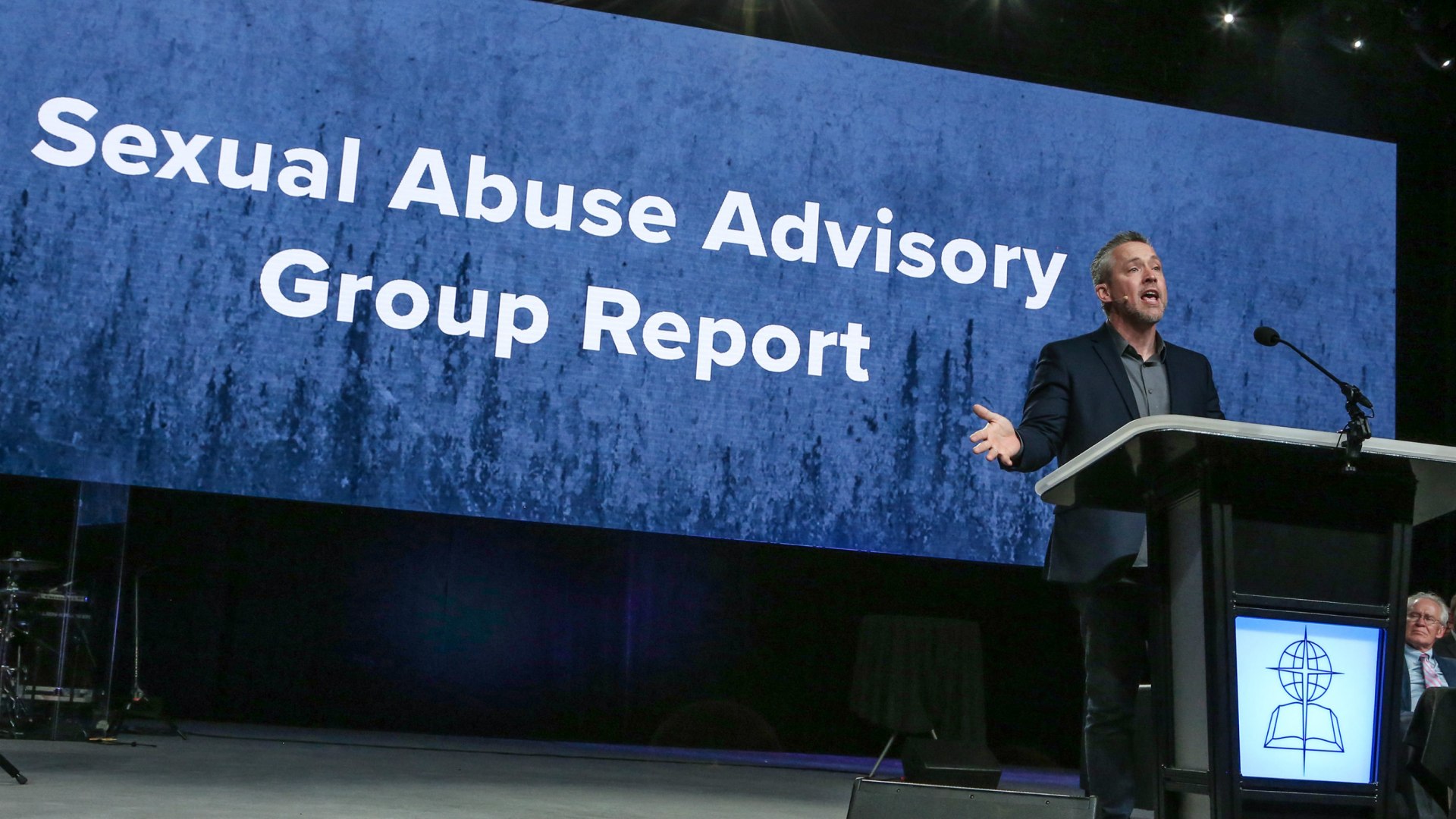
The Southern Baptist Convention (SBC) has experienced unprecedented attention and pressure over its response to sexual abuse in the year following the debut of the Houston Chronicle’s “Abuse of Faith” series, which last February reported hundreds of sexual abuse cases within the nation’s largest Protestant denomination.

“It has been a year of waking up,” SBC president J. D. Greear told Christianity Today. “Advocates and journalists have faithfully filled the role of helping us to see things we can’t unsee.”

Greear said there is a “growing awareness within our denomination that the evangelical church has many areas for growth in how we prevent and care for abuse.”

SBC leaders and victims’ advocates agree there’s a lot more waking up to do. People inside and outside the denomination are waiting to see if measures enacted at last year’s annual meeting—including a newly reconstituted committee to review reports of churches that have mishandled abuse—will be effective. The new credentials committee is slated to meet and share from its findings later this month.

The SBC had addressed sexual abuse previously. The convention’s website had featured a page with “resources for sexual abuse prevention,” and the denominational publication SBC LIFE produced a special report in 2008 on protecting children from sexual abuse. As president, Greear launched a Sexual Abuse Advisory Study in 2018 in conjunction with the Ethics and Religious Liberty Commission (ERLC), and that same year SBC Executive Committee chairman Mike Stone said combating abuse would be an emphasis of his.

But the Chronicle’s reporting spurred a heightened response.

Beginning February 10, 2019, the Chronicle and the San Antonio Express-News released a six-part series that uncovered approximately 380 Southern Baptist church leaders who have been convicted of sexual abuse, credibly accused and successfully sued, or confessed and resigned over abuse during the past 20 years. Those abusers left behind more than 700 victims. The Chronicle continued publishing articles on sexual abuse in the SBC, releasing more than 20 to date in addition to the original series.

ERLC president Russell Moore said Southern Baptists “should thank God for the Houston Chronicle’s reporting because it cast a light on a truth that needed to be revealed.” Stone called the series “a catalyst in moving the conversation forward.”

Yet some victim advocates wonder whether the SBC can sustain its campaign against abuse long enough to make a difference among its nearly 50,000 cooperating churches.

“It takes years to change a culture, usually at least ten years,” said Susan Codone, who was abused by Southern Baptist ministers as a teen. “And the measure of success will be a significant reduction in the cases of sexual abuse in churches along with a much higher number of churches actively enacting policies and caring for the abused.”

Combating abuse was a central focus when the SBC convened last summer in Birmingham, Alabama. In addition to adopting a resolution titled “On The Evil Of Sexual Abuse,” the convention amended its governing documents to strengthen its stand against abuse. SBC messengers in Birmingham also gave the first of two required approvals to amend the SBC constitution to state explicitly that mishandling sexual abuse is grounds for a church to be disfellowshipped from the convention. (The convention already has the power to disfellowship a church for any reason.)

An amendment to the SBC bylaws repurposed the credentials committee to make recommendations when a church’s “friendly cooperation” with the convention is in question. Abuse claims fall within the committee’s assignment. At the time, Southern Baptist Theological Seminary president Al Mohler called it “the most important business to be undertaken by #SBC19.”

And now, the SBC’s focus is turning toward the new credentials committee’s February 18 report to the Executive Committee—the group tasked with acting on behalf of the denomination between annual meetings.

If the credentials committee has considered abuse claims related to any Southern Baptist churches, that information could surface in its upcoming report. Should the credentials committee find a church not in friendly cooperation and recommend that it be disfellowshipped, the Executive Committee could act on behalf of the convention to exclude the church, or it could forward the recommendation to the full SBC, which meets June 9–10 in Orlando, Florida.

These recommendations will be closely followed by advocates who have remained cautious or skeptical of pledges to address the issue and want to see the denomination act in response.

Greear noted that the repurposed credentials committee “gives Southern Baptists something we haven’t had before, a standing committee to consider questions of friendly cooperation among our churches.” Last year, Greear publicly named ten churches he believed may have mishandled abuse; a work group of the Executive Committee said only three claims warranted further inquiry.

At least one of those churches, Cathedral of Faith in Houston, voluntarily withdrew after the Chronicle reported its pastor pleaded guilty to sexually assaulting a teenage girl more than two decades ago. No church has ever been disfellowshipped from the SBC over sexual abuse.

Credentials committee chairman Stacy Bramlett said “the establishment of our committee is part of [the SBC’s] work of increasing awareness, encouraging staff and volunteer training in churches, taking accountability seriously, and rebuilding trust through transparency.”

“At the upcoming Executive Committee meeting, the credentials committee will report further about its purpose, processes, and progress,” she said.

Reports of suspected churches can be submitted through an online portal. The committee does not have the authority to investigate churches, and its review process is confidential unless they recommend a church be disfellowshipped from the SBC.

There was enough pushback from victims’ advocates when the credentials committee released more about its process in December that Codone and fellow SBC victim-turned-advocate Megan Lively wrote for SBC Voices acknowledging the limitations of refusing anonymous submissions but ultimately encouraged people to have patience as the committee figures out its new role.
It could be a major undertaking: A 2019 study by the SBC’s LifeWay Research organization found 44 percent of Protestant churchgoers say they have been victims of sexual misconduct, and 10 percent of that group says the misconduct happened at church.

Codone, who has assisted Greear and the ERLC in the Sexual Abuse Advisory Study, said small and large churches alike have been resistant to adopting the SBC-wide Caring Well Challenge to prevent abuse and care for victims. As of last August, less than 2 percent of SBC churches had begun the challenge.

“Many large churches don’t think they need it because they have policies in place already, and many small churches aren’t fully aware of it or don’t have the people or expertise to implement it,” she said.

Additionally, critics long have chided the SBC for citing local church autonomy as a reason for not doing more to combat sexual abuse. Stone, a member of the credentials committee, said “local church autonomy is fundamentally a theological issue” for Baptists, and there are “different ideas about the best way to handle the unique challenges of sexual abuse in the context of our polity.”

Still, “the national convention has, and has always had, the freedom to determine the parameters for cooperation,” said Stone, himself an abuse survivor.

All six SBC seminaries are implementing abuse prevention and response training into their curricula, Greear said. State conventions and local Baptist associations are offering similar training in conjunction with the Caring Well Challenge.

In the past several years, at least three SBC entities have drawn scrutiny related to sexual abuse. Former SBC President Paige Patterson has been accused of mishandling abuse reports during his presidencies of Southeastern Baptist Theological Seminary and Southwestern Baptist Theological Seminary. The International Mission Board (IMB) said it strengthened its policies related to abuse last year days before the Chronicle published a report highlighting abuse cases involving former IMB missionaries.

The SBC is not alone in facing these obstacles. Greear’s office said a handful of other denominations have called the SBC seeking advice on how they too can strengthen their stands against abuse.

Among other denominations that value local church autonomy, the Mennonite Church USA adopted a 2015 statement confessing failures related to abuse and noting that 21 percent of women and 5.6 percent of men in the denomination reported experiencing sexual abuse. The action was spurred in part by renewed discussion of sexual abuse committed by Mennonite theologian John Howard Yoder. The Mennonite Church USA Delegate Assembly adopted a list of commitments for congregations and church institutions to combat abuse.

Sovereign Grace Churches (SGC), a network of congregations that has faced scrutiny over sexual abuse charges, said it offers every church a safety training program related to abuse, provides free background checks for churches, and requires every pastor to report suspected abuse to law enforcement.

“Additionally, our ordination process requires a criminal background check for men who are ordained as elders in Sovereign Grace Churches, and if an elder’s ordination is terminated for any reason, that information is kept in a central database that our churches have access to,” said SGC executive director Mark Prater. (Last year, amid growing scrutiny, SGC said an outside investigation of its churches would be “inappropriate, impractical, unjust” and “impossible.”)

Codone said she can’t think of any denomination that is managing sexual abuse cases well. Nonetheless, she sees hope for the SBC because “from what I can tell, everyone seems to believe there is a significant abuse problem and that we need to try to fix it.”

The SBC’s sexual abuse study group said it would evaluate the possibility of further responses, such as creating a database of known predators, requiring background checks for SBC appointees, and adding survey questions on abuse incidents to the Annual Church Profile.

“My prayer is that God would give us vigilance moving forward,” Moore said, “that the work done so far would be seen merely as a beginning on the way to caring well for those who have experienced this horror and guarding against wicked predators.”

David Roach is a writer in Nashville, Tennessee.

News

Acts 29 CEO Removed Amid ‘Accusations of Abusive Leadership’

Steve Timmis was acclaimed for his model of close church community. But former members claim that inside The Crowded House, he resorted to bullying and control.

Christianity Today February 7, 2020
Quanah Spence

As CEO of Acts 29, Steve Timmis was an effective and respected leader. During his seven years at the helm, the church planting network rebounded from the fallout around its co-founder Mark Driscoll and expanded from 300 mostly US churches to 800 around the world.

A gray-haired British pastor with sharp Bible teaching and deep passion for mission, Timmis was known for the model of intensive gospel community developed at his 120-person church in the middle of England, The Crowded House. He emphasized “ordinary life with gospel intentionality.”

But while his international reputation grew, some who knew Timmis in his ordinary life—who prayed, fellowshipped, and evangelized with him in living rooms, offices, and pubs—saw a different side.

“People were and are afraid of Steve Timmis,” said Andy Stovell, a former elder who led alongside him for 14 years at The Crowded House in Sheffield.

Fifteen people who served under Timmis described to Christianity Today a pattern of spiritual abuse through bullying and intimidation, overbearing demands in the name of mission and discipline, rejection of critical feedback, and an expectation of unconditional loyalty.

In a letter to elders when he left in 2016, Stovell said, “I am not persuaded by the explanation that this is a case of strong leadership inevitably leading to some feathers being ruffled. People have been bruised by Steve’s style. People have become cowed due to it.”

Two weeks ago, internal reports raised similar concerns about Timmis’s leadership in Acts 29, and the board voted on Monday to remove him as CEO. Acts 29 president Matt Chandler announced the news in a video sent out to the network the following day, saying, “For where we’re headed next, we needed to transition Steve out of this role.”

The organization confirmed the allegations of spiritual abuse in a statement to CT. “A little over two weeks ago, the Board of Acts 29 was made aware of some accusations of abusive leadership against our CEO Steve Timmis,” it read. “The Board launched an investigation of these claims and found evidence that he should be transitioned out of the CEO role immediately. Where there needs to be reconciliation, we are prayerful and committed to seeking it.”

[Update (February 10): Following the Acts 29 decision and the publication of this article, Timmis resigned as elder from The Crowded House on Friday, and the remaining elders are planning to commission an external review. “We have valued his ministry among us and his role in founding the church,” the announcement said. “We also feel the weight of the stories told in the article. … We are willing to hear where we may have failed people.”

Timmis had also previously served as chair of the board of Crosslands, a UK-based training program in partnership with Acts 29 and Oak Hill Theological College. His name has since been removed from its website, and a vacancy listed among its trustees.

Inter-Varsity Press UK will no longer sell Timmis’s titles (including Total Church and Everyday Church, both co-written with Tim Chester), citing “that the style of close church community advocated in these books lacked sufficient safeguards against abusive control” and apologizing for them possibly contributing to “unhealthy and even abusive church cultures.” ]

Under Timmis, Acts 29’s global headquarters was located alongside The Crowded House in Sheffield, which also draws a string of missionaries, interns, and university students. They come expecting—and wanting—to be part of a different type of church, the all-encompassing, always-on-mission culture of The Crowded House’s small groups, called “gospel communities.”

Steve McAlpine, an Australian pastor and church planter, moved to England back in 2006, hoping to learn the model so he could recreate it back home. He ended up contributing case studies for the popular book Timmis and his partner in ministry Tim Chester co-authored on the subject, Total Church.

“Since that time, no expression of church we have done has met the depth of life-on-life, ‘eyeball-to-eyeball’ experiences we had there,” McAlpine wrote on his blog a decade later. “Yet at the same time no expression of church has stung as deeply either.”

With a church that demands such high levels of involvement and buy-in, anything seen as taking away from that mission may be deemed selfish, sinful, and cause for discipline. “It’s gospel gaslighting,” McAlpine said.

He recalled being berated for making travel plans without consulting with Timmis first. He was told he was rejecting discipline and choosing to be “a law unto himself,” a signature Timmis phrase (originating from Romans 2:14) that former members repeated in multiple stories.

Little things that pastors in the average church wouldn’t care about were treated as big things by Timmis, they said.

One couple said they were confronted for missing an impromptu barbeque with their gospel community in order to spend planned family time with their kids. They were accused of not putting the mission of the church first. Several who took interest in ministry opportunities outside the mission for their gospel community—which could shift or change under Timmis’s orders—also received pushback, told not to pursue an outside Bible study or social time or not to volunteer with a local coffee shop or summer camp. Students in the university town were discouraged from returning home to their families over the summer—it was seen as a sign that they weren’t really committed to the life of the church.

From the inside, this kind of heavy shepherding seemed by design, with Timmis seeking to mentor and disciple his flock into a church that operated “24/7” and spanned all areas of life. At the least, Timmis implied these expectations set them apart from other congregations in a good way.

Fellow British pastor Melvin Tinker said while teaching a training program alongside Timmis, students from other evangelical traditions began to complain that Timmis was “dismissive” toward those who brought up other views of church life. Tinker, vicar of St. John’s Newland church in Hull, met with him at the time to address their feedback. Though Tinker had known Timmis for over 30 years and considered him a close friend, Timmis’s response to the meeting ultimately led to the end of their teaching together.

“If Steve is challenged in any way, which he always takes as a threat, then the tables are turned and the challenger is made out to be the one at fault,” said Tinker, who saw the same pushback emerge during the decade his son, Michael, was a member of Timmis’s church. “This is classic manipulation.”

Within The Crowded House, despite their closeness, some were too intimidated to question Timmis’s decisions. Though Timmis previously stepped down as pastor due to his Acts 29 obligations, he remains the church’s leader and senior elder and no successor at The Crowded House had been named. According to its website, the church’s four-person elder team currently includes Timmis, his son-in-law, and two other younger leaders.

“Steve had very clear patterns for dealing with conflict and would not hesitate to bring these conflicts to a crisis point in order to highlight where members were not living up to what he called ‘the high bar of discipleship,’” said Rowan Patterson, a former Crowded House elder who now serves at an Anglican church in Sydney.

“These standards were often based upon secondary and sometimes extrabiblical matters … and you would be called to trust him, his experience, and age,” he said. “If you did not, you would be called a law unto yourself.”

Former member Ben Murphy said he spoke up to disagree with Timmis over what to do about a non-Christian acquaintance who lived in a different area from their gospel community. Murphy and most of his group thought they should continue to build a relationship with her anyway. Timmis told them to refer her to a different church.

In follow-up conversations, the dispute heightened, and Murphy said elders told him that if he stayed he would enter a process of church discipline for his pushback. After he left The Crowded House last year, he texted the woman to follow up and apologize.

They are now part of a small but growing community of Crowded House “refugees.”

“There’s a high turnover of staff, elders, and members at The Crowded House, often leaving having ‘fallen out’ with Steve,” said Michael Tinker, a UK singer who was a part of The Crowded House from 2005 to 2015 and then spent two years at one of its nearby church plants after that. “There is such an emphasis on ‘vision’ that if you have issues with that then you are encouraged to leave.

“On one level that’s understandable—every church has a particular direction it wants to go in, and so it makes sense to find a church where you agree with that,” he said. “However, in reality it means you need to agree with Steve’s mission and vision. And the sense in The Crowded House that it is the right or best way to do mission and be biblically faithful means you are left with the feeling that if you disagree you are somehow disagreeing with the Bible, or somehow falling short of God’s ideal, or not really giving up your life for Christ.”

That perspective also skews members’ views of those who leave—that they didn’t have what it takes or are no longer really committed to mission.

Michael Tinker said some at The Crowded House were led to believe that he and his wife were walking away from their faith. Paul and Sharon Goodwin, who left in 2011, listed the elders’ characterizations of them leading up to their departure: divisive, unpastorable, disobedient, “not loving Jesus enough,” “always been troublemakers.” It was misconstrued enough that the Goodwins wrote a 3,400-word letter to friends describing their real reasons for leaving.

To go from being inside a highly relational, tight community to being considered an “ungospeled” and rebellious outsider can be traumatic. “We at one point thought it was easier to leave the country than the church,” said Murphy, who belonged to The Crowded House for more than 13 years. It felt impossible to avoid his former church community in day-to-day activities like school pickups and neighborhood walks. (His family now has plans to move to Belfast.)

At other churches in Sheffield, former members of The Crowded House might run into each other, and it’s not long before a look, a tearful eye, or a reference to “the Timmis experience” puts them on the same page. For a long time, most didn’t realize how common it was.

“Leaders like Steve Timmis are very adept at making you feel you are the ones in the wrong and that you are isolated problem makers,” wrote Paul Goodwin. “The more ex-[Crowded House] people we met, the more we realized that this pattern of behavior was something many had also gone through and their experiences were very similar to ours, even going back to the very early days of [The Crowded House] before we joined.”

McAlpine, now a pastor in Perth and writer for The Gospel Coalition Australia, was one of the only people sharing a version of his experience at the church publicly, using his blog.

At first, he never heard from the friends he was once so close with in Sheffield. Then, every few months, McAlpine would get a notification that someone whose name he hadn’t heard in a while had liked a picture or commented on his Facebook. He’d reach out, and, sure enough, they had just left The Crowded House. Beyond his former contacts at the church, he has heard from more than 20 former leaders and members about Timmis.

Two former Acts 29 staff members told CT they spoke up about Timmis’s overbearing leadership five years ago, in his first year as executive director.

According to a copy of a 2015 letter sent to Acts 29 president Chandler and obtained by CT, five staff members based in the Dallas area described their new leader as “bullying,” “lacking humility,” “developing a culture of fear,” and “overly controlling beyond the bounds of Acts 29,” with examples spanning 19 pages.

During a meeting Chandler arranged with two board members to discuss the letter, all five were fired and asked to sign non-disclosure agreements as a condition of their severance packages. They were shocked.

“I trusted Matt to do what was right. I had full confidence that our concerns would be heard by him and that we could work towards resolution,” one of the former staff members said.

The letter also described the staff’s issues with Timmis’s new policies for leading the then–heavily American Acts 29 network from the UK—like reviewing every post before it went up on social media and tightening flexible work schedules to require staff notify him whenever they were out. Chandler told CT that, at the time, he saw it as a clash in leadership styles, not as indicators of abuse.

Chandler is the only member of the current Acts 29 board who also was on the board six years ago when the network decided to remove Chandler’s predecessor, Mark Driscoll, from membership—a move that accelerated the downfall of the brash Seattle preacher, known for his quick temper and domineering leadership.

Timmis never had any of the public notoriety that Driscoll did, or the high profile of leading a multisite megachurch just as a new wave of church planting was taking off in the 2000s. But the 62-year-old pastor was a big name in Acts 29 even before he took over, a popular speaker, author, and mentor to a mostly younger, less experienced crowd of eager church planters.

Chandler said he knew Timmis could be a micromanager, and he also saw the benefit of a new leader doing a thorough organizational review when setting out to change the culture. He said it wasn’t until the allegations came forward two weeks ago that he realized that Timmis’s level of control as a leader went beyond micromanaging and into the realm of abuse.

Former members of Timmis’s church claimed that Tim Chester, the pastor of Grace Church Boroughbridge, part of The Crowded House network, knew about criticism against Timmis and defended him. Stovell, the former elder, said Chester asserted that “the flipside of having a strong leader is that feathers get ruffled.” McAlpine said Chester would say that those who accused Timmis of overbearing leadership “don’t understand him enough” and “need to give him grace.”

Chester did not respond to emails sent Wednesday and Thursday requesting comment.

Timmis will be on sabbatical for four months prior to the network naming his replacement at a board meeting in May. He wrote in an email to CT Wednesday that his transition “is not particularly newsworthy” and declined the opportunity to respond to specific allegations raised in this article.

“I am a sinner saved by grace, and so claim neither infallibility nor impeccability,” he wrote. “I am, though, more than ready for anyone to approach me and the church elders here with specific concerns. They can be assured of a careful listening.”

After the news of his departure was announced among the network, the former Acts 29 CEO tweeted, “Those days when you only have the Scriptures to go to for comfort & hope, though hard days, in eternity will prove to have been the best of days,” which generated a string of supportive replies from pastors:

“So deeply encouraged by your leadership.”

“Your godly example and love for people has set a course for my own life.”

“Thanks for your leadership! Brazil will never forget you.”

Even some people with stories of spiritual abuse under Timmis still see the good he has done through his ministry career. Goodwin, who wrote the long letter when he left The Crowded House, said Timmis is “still probably the best preacher I have ever been taught by.”

That makes it even harder for victims to grapple with their experience—they see a clearly gifted minister whose abrasive personality has instead damaged people’s relationship with the church.

“If spiritual abuse is the manipulation of people for whom Christian leaders are responsible, which benefits them to the spiritual detriment of those cared for, involving lack of accountability, this is very much in evidence at [The Crowded House] in general and Steve Timmis in particular,” said Melvin Tinker, the Anglican vicar.

Several who left The Crowded House or Acts 29 said they had to seek counseling as they transitioned to new churches and ministries. Some continue to follow his ministry from the outside and hope for repentance and change, but they don’t see enough accountability in place back at The Crowded House. (One well-known phrase in the organization was “Steve doesn’t do peers,” said Stovell, the former elder.)

In recent years, evangelicals in the United Kingdom have debated the terminology of “spiritual abuse.” The Evangelical Alliance based in London issued a report in 2018 suggesting that the phrase is becoming more common and more broadly used, applying to sexual abuse, child abuse, and emotional and psychological abuse that happen to take place in religious contexts. Researchers in the report, however, categorize spiritual abuse specifically as abusive behavior by a religious leader, in a religious setting, and justified by an appeal to divine authority.

Unlike other types of abuse, there’s no legal definition (and often no criminal activity involved), so it can be hard for people to identify the abuse right away, especially when a leader demonstrates solid teaching and theology. From the inside, spiritual abuse can look like everyday ministry.

“Many conservative evangelicals have assumed implicitly … that being theologically orthodox is a safety check that stops other sub-Christian behaviors and attitudes,” said McAlpine. “Denial of the problem, or shock when it surfaces, simply reveals that we don’t believe our big doctrines (total depravity) as much as we claim to.”

This story has been updated.

News
Wire Story

27 Countries Join International Religious Freedom Alliance

Poland will host the next IRF ministerial in Warsaw this summer.

Secretary of State Mike Pompeo hosts the inaugural dinner of the International Religious Freedom Alliance.

Secretary of State Mike Pompeo hosts the inaugural dinner of the International Religious Freedom Alliance.

Christianity Today February 7, 2020
Jeremy Weber

WASHINGTON (RNS) — The United States has been joined by 26 other countries in a new International Religious Freedom Alliance that seeks to reduce religious persecution across the globe.

“Together, we say that freedom of religion or belief is not a Western ideal, but truly the bedrock of societies,” said Secretary of State Mike Pompeo yesterday at a dinner at the US State Department launching the alliance that will involve senior representatives of each government.

The alliance’s first meeting fell on the eve of the National Prayer Breakfast, which gathers international religious and diplomatic figures once a year to an event chaired by members of Congress and organized by the International Foundation, a Christian organization also known as The Family or The Fellowship.

Poland, one country in the alliance, announced in a joint statement with the State Department that the next Ministerial to Advance Religious Freedom will be held July 14–16 in Warsaw.

“Building on the successes of the 2018 and 2019 ministerials hosted by the United States, the 2020 ministerial will allow countries to share different approaches, debate varying perspectives in the spirit of coherence and complementarity, and address challenges threatening the freedom of religion or belief,” the statement reads.

The two countries said participants at the Warsaw meeting will address “promoting inclusive dialogue to mobilize action and increase awareness regarding the scale of persecution against religion or belief worldwide.”

Besides Poland and the United States, the other founding countries of the International Religious Freedom Alliance are: Albania, Austria, Bosnia and Herzegovina, Brazil, Bulgaria, Colombia, Croatia, Czech Republic, Estonia, Gambia, Georgia, Greece, Hungary, Israel, Kosovo, Latvia, Lithuania, Malta, Netherlands, Senegal, Slovakia, Slovenia, Togo, Ukraine, and the United Kingdom.

The State Department issued a list of principles for the alliance that included a commitment to “the right to hold any faith or belief, or none at all, and the freedom to change faith.” The new organization’s priorities include challenging blasphemy laws and the denial of registration to nonreligious and religious groups and advocating for people who are imprisoned or otherwise persecuted due to their religion or beliefs.

The principles did not cite specific countries, but Pompeo mentioned the targeting of religious minorities in Iraq, Pakistan, Nigeria, and Myanmar.

He singled out “the Chinese Communist Party’s hostility to all faiths,” adding, “We know several of you courageously pushed back against Chinese pressure by agreeing to be part of this alliance, and we thank you for that.”

Pompeo announced plans for the creation of the alliance at the conclusion of the State Department’s second Ministerial to Advance Religious Freedom in July. He and Ambassador-at-Large for International Religious Freedom Sam Brownback have called it a “first-ever” global group to focus on religious freedom.

President Donald Trump also cited the alliance at a September event on religious freedom at the United Nations, where he described it as “an alliance of likeminded nations devoted to confronting religious persecution all around the world.”

Brownback told reporters on a Jan. 29 conference call that there is “a pretty high bar” for countries included in the group. As of that call, he said 17 had committed to the alliance. Ten more joined over the next week.

“We want nations that respect religious freedom in their own country, obviously act that way, and then are willing to push religious freedom in international venues,” he said. “So this is the activist club of countries.”

Culture

‘Parasite’ Is a Dark Comedy. But Is the Joke on Us?

What the Oscar-nominated film teaches us about classism, fear, and dependence on God.

The Kim Family (Woo-sik Choi, Kang-ho Song, Hye-jin Jang, So-dam Park) in Parasite.

The Kim Family (Woo-sik Choi, Kang-ho Song, Hye-jin Jang, So-dam Park) in Parasite.

Christianity Today February 7, 2020
Courtesy of NEON + CJ Entertainment

My husband and I moved to our current city almost five years ago, and I remember experiencing sticker shock. Everything cost more than we imagined. And unfortunately, we moved as a single-income couple and then became a family of three. We were transplants with no real support system, living life at the bottom of our otherwise affluent suburb.

We spent our first three years living in a half-underground condo. Just above my view of our stairs leading up to the courtyard, I could see mansions across the street. I gawked at them, wondering what kind of people lived there and if we’d ever live in a house of our own. Deep down I knew that those houses, and those lives, would always be beyond my reach.

Imagine my surprise when Parasite opened with a family that also lives half-underground. The Kim family—made up of father Ki-Taek, mother Chung-sook, and a grown son and daughter, Ki-woo and Ki-jeong—are on the fringe of South Korean society. They struggle to put food on the table, working temporary, low-paying jobs and living one disaster away from total destitution. The family is not only poor but forgotten, left to slowly work toward upward mobility or die trying.

However, the family’s fortunes quickly improve after Ki-woo takes over his friend’s cushy private tutoring job for the wealthy Park family. In short succession, the whole Kim family is hired without letting on that they’re related to one another—the daughter faking her credentials as an art therapist, the father taking over from a wrongfully implicated chauffeur, and the mother becoming the new housekeeper after they conspire to remove her predecessor.

The Kims are surprisingly competent in each of their roles. They are not people looking for a handout so much as an opportunity. At one point, Mr. Park, the hands-off patriarch, compliments Mr. Kim by telling him that he “doesn’t ever cross the line.” The line being, we presume, the employee speaking to his employer as if they’re equals and not members of very different classes. Through idyllic scenes of contented employees and well-cared for family, we as viewers are lulled into a sense of security.

But one day the Parks leave for a camping trip, and Mrs. Kim invites her family over to live it up in their employers’ massive and well-stocked home. They take shelter from the night’s downpour and muse over what makes the Parks so nice. Mrs. Kim scoffs, “They are nice because they are rich.” It’s as simple as that. Money makes life easier and kinder to live, even for the sake of others. And if they could just have more of it, virtue would follow. But an unexpected visitor puts those theories to the test.

Without revealing spoilers, the Kims quickly realize how fragile their security is and how little it takes to lose it all. They become calloused in their pursuit of social mobility, hardened toward people they find have it even worse than they do. And while Parasite has won critical acclaim worldwide, seeming to strike a chord with audiences for its raw class commentary, the movie’s message is not clear cut. It’s a dark comedy, but by the end you’re not sure if the joke is on you after all. Are the Kims villains or heroes for trying to engineer their own success? And what happens when a steady job and pay still fall far short of what you need?

Perhaps the movie resonates with viewers because many of us feel the squeeze of being in the middle class. There is always something to aspire to and always something to fear losing. In Proverbs 30:8, Agur son of Jakeh writes, “Give me neither poverty nor wealth; feed me with the food I need” (CSB).

The entire proverb is a cry for humility and a reminder of how quickly we forget our dependence on God. When we’re locked in a race for productivity, efficiency, and the false belief that whoever works hardest will gain the most, there is precious little time to reflect on our true place in the world and who actually holds it all together. And just like the Parks and Kims, we see those with less as threats to our security instead of neighbors who need compassion and understanding.

This truth is felt not only on an individual but a systemic level. In an interview with The Atlantic, director Bong Joon-ho remarks, “… the state of [class] polarization applies not only to Korea but anywhere across the world. [South] Korea has achieved a lot of development, and now it’s a fairly wealthy country, but the richer a country gets, the more relative this gap becomes.”

There are several moments when you realize that even if the Kims worked their entire lives, they could never attain the easy wealth of their employers. The “pull yourself up by the bootstraps” mentality is not enough. Saving and frugality are not enough. After the penultimate disaster for the Kims, patriarch Ki-taek remarks:

You know what kind of plan never fails? No plan. No plan at all. You know why? Because life cannot be planned. Look around you … It doesn't matter what will happen next. Even if the country gets destroyed or sold out, nobody cares.

And indeed, the climax of the movie is completely unpredictable and jarring. Much like a world where the more developed a country is, the more tight-fisted it becomes. Where those who live in abundance operate out of a scarcity mindset, seeing their power as non-negotiable and unwilling to lay it down to lift more people up with them.

But this is the world as it is, not as it could be. And, as Parasite warns, it is the world we’ll keep living in until we start to trust God with what we have instead of seeking what we want.

Jennifer Clark has lived in three countries and is a voracious moviegoer. She holds together her family of four and works for an anti-trafficking ministry.

Ideas

Pretending to be a Pentecostal Preacher Is Not a Good Way to Interrogate Suspected Terrorists

A Guantanamo Bay report reminds us our desperation has led to dark places.

Christianity Today February 7, 2020
Illustration by Mallory Rentsch / Source Images: Foxline / South_agency / Amnat Buakaew / EyeEm / Getty Images

Why would a CIA official interrogating a suspected al-Qaeda terrorist impersonate a Pentecostal preacher “laying on hands”? I was perplexed to read a recent Guardian article alleging a Guantanamo Bay interrogator would “put one hand on the forehead of a detainee, raise the other high in the air, and in a deep Southern drawl say things like, ‘Can you feel it, son? Can you feel the Spirit moving down my arm, into your body?’”

I served as US attorney from 2001 to 2006. I served as a US Navy JAG officer and prosecution team leader between 2008 and 2014 at the Office of the Chief Prosecutor, US Military Commissions. I have been to Guantanamo Bay many times, including the detention camps. I have sat face to face with a suspected al-Qaeda member and his attorney. I am also an evangelical Christian and the son of a Southern Baptist minister. I can tell you, this isn’t how you interrogate a suspected terrorist.

Typically, after a crime occurs, an investigator questions the suspect. A skilled interrogator will obtain a confession to a crime. There are many rules regarding permissible types of interrogation, but the most important thing is that the interrogator wants a truthful and voluntary statement that can be used in court.

Prosecutors are ethically bound to introduce only untainted evidence before the court. Trial judges, using the well-established doctrine called “the exclusionary rule,” will bar statements and evidence not provided voluntarily.

I don’t think imitating a revivalist preacher about to “slay someone in the Spirit” would taint evidence. It’s not inhumane. But it is bizarre, and it shows the level of desperation the interrogators must have felt in getting actionable intelligence. That desperation has led to dark places in the recent past.

In 2002, the George W. Bush administration’s Justice Department released a legal memorandum that cleared the way for abusive interrogation techniques—called “enhanced interrogation techniques” or EIT. The memo authorized sleep deprivation, stress positions, slapping a detainee across the face, and waterboarding, which simulates the experience of drowning.

When I learned about the EIT memo, I knew federal courts would not accept evidence obtained through these techniques. I also knew there was tremendous pressure put on law enforcement officials to get convictions of terrorism suspects. The terrorist attacks of 9/11 made America scared and desperate. We were all concerned about another attack and felt duty bound to stop it. I remember James Comey, then deputy attorney general, telling all the US Attorneys to “shake the trees” and stop the next attack.

The Justice Department had actually prosecuted Texas Sheriff James Parker in 1983 for waterboarding criminal suspects. But in the topsy-turvy, Alice in Wonderland world of Guantanamo, contractors had Justice Department clearance to use abusive interrogation techniques. The shining city on the hill lost its light when it came to the treatment of some alleged war-crimes suspects in the years after 9/11.

An experienced federal criminal investigator will tell you they have many authorized techniques when they question suspects. The most effective is what the FBI calls rapport-based interrogation, which means the agent seeks to establish a relationship with the suspect and treats them humanely as required by federal law. That leads to true and voluntary confessions.

My good friend and former FBI agent Ali Soufan interrogated many al-Qaeda suspects and was successful in getting actionable intelligence from them. He treated them all decently and was rewarded with information that could be used in court. Soufan and other federal agents had experience in interrogating suspected terrorists. The CIA contractors shockingly did not have any experience with suspected terrorists or even criminals. Such was the state of our desperation in the immediate years after 9/11. We believed in flimflam artists. So maybe it’s not surprising to hear allegations that one of the interrogators was a fake revivalist too.

Most Americans today don’t have the cultural literacy to know what the terms like “being slain in the Spirit,” “receiving the second baptism,” or being “fire baptized” even mean. Maybe they’ve seen a Benny Hinn video on YouTube. But I doubt an al-Qaeda suspect would have any idea why an interrogator would do the things described in the Guardian article, or what it would mean to say, “Can you feel it, son? Can you feel the Spirit moving down my arm, into your body?”

The agency does not reveal its “sources and methods” of gathering intelligence. It is not legally obligated to provide the complete truth to anyone outside of Congress, an internal review, or federal law enforcement. So I view claims that this tactic “got results” with great suspicion.

This technique was not authorized by the Justice Department and was a highly unorthodox attempt to convince a suspect to confess. The debacle of “enhanced interrogation techniques” resulted in Congress passing the Detainee Treatment Act, which prohibited abusive and ineffective methods. The Justice Department also withdrew the “torture memorandum.” Now, almost 20 years after the execrable memo was released, here are more attempts to justify another bizarre technique.

It appears to me that the “preacher” was extemporizing, or “calling an audible” to use a football term. I don’t believe this to be in violation of Common Article III of the Geneva Conventions—which applies to non-state actors like terrorism suspects and mandates humane treatment—but it is disturbing nonetheless.

American evangelicals should be concerned about this report. For a CIA officer to use a Pentecostal technique to question an alleged war criminal is nonsensical and ineffectual. Beyond that, this weaponized use of revival preacher behavior shows utter disdain of our culture and our practices. Most importantly, we serve a God who made all in his image as written in Genesis 1:27. Christ died for all, even al-Qaeda suspects.

David C. Iglesias is an associate professor of politics and law at Wheaton College and is the director of the Wheaton Center for Faith, Politics and Economics. He retired as a captain in the US Navy JAG Corps and served as the US attorney for the District of New Mexico in the George W. Bush administration.

Speaking Out is Christianity Today’s guest opinion column and (unlike an editorial) does not necessarily represent the opinion of the magazine.

News

Loving Enemies Is Hard at Post-Impeachment Prayer Breakfast

Trump seems skeptical about Jesus’ mandate.

Christianity Today February 6, 2020
Oliver Contreras / Sipa / Bloomberg / Getty Images

Inside the International Ballroom at the Washington Hilton, the mood at the National Prayer Breakfast was half church service, half political rally.

The program began with a spirited rendition of Hank William’s “I Saw the Light,” led by members of the House of Representatives prayer breakfast group, followed by prayers from co-hosts Rep. John Moolenaar, a Republican from Michigan, and Rep. Tom Souzzi, a Democrat from New York.

Their prayers and opening remarks echoed the larger theme of the prayer breakfast this year, which centered on Jesus’s commandment to love your enemies.

The event’s keynote speaker, Harvard University professor and author Arthur Brooks urged those in attendance not to let their disagreements over politics lead to contempt. Brooks recalled speaking to a group of conservative activists and telling them their political opponents were neither evil nor stupid.

That line, he said, did not get much applause.

He went on to talk about being raised by Christian parents in Seattle who had progressive politics. His parents were neither evil nor stupid, he said. And he challenged listeners to remember their loved ones who have different points of view—and to stand up for those who would ridicule them.

Brooks also said Jesus asked his followers to love their enemies—not just tolerate them. Putting that into practice, he admitted, is hard. Brooks asked the crowd, “How many of you love somebody with whom you disagree politically?”

Many people in the audience raised their hands. Trump, sitting quietly a few feet away from Brooks, did not.

When Brooks finished his speech on mending political division by “loving your enemies,” the president, his voice hoarse, approached the podium and opened his remarks by lamenting that he and his family “have been put through a terrible ordeal by some very corrupt and dishonest people.”

He then took thinly veiled shots at Utah Republican Sen. Mitt Romney, who invoked his faith on Wednesday when he announced that he would vote to convict Trump on abuse of power, and House Speaker Nancy Pelosi, a Democrat from California, who has said throughout impeachment proceedings that she was praying for Trump.

“I don’t like people who use faith for justification for doing what they know is wrong, nor do I like people who say ‘I pray for you’ when they know that is not so,” said Trump, who identifies as Presbyterian.

A noticeably frustrated Trump used the bulk of his speech at the multifaith religious gathering to champion his administration’s achievements on religious matters, but also to chide political opponents who challenged him during the recent impeachment process.

While expressing gratitude for people in the room, Trump appeared to go off-script at the end to make a point that sometimes religious Americans “hate” people.

“I’m sorry, I apologize. I’m trying to learn,” he said, appearing to return to the question posed by Brooks. “When they impeach you for nothing, you’re supposed to like them? It’s not easy, folks. I’m doing my best.”

The recent division in the United States over President Trump’s impeachment was on the minds of attendees and organizers alike. Several mentioned the theme of the day was especially timely–and that gathering people together around tables to talk and get to know each other is one way to defuse some of the tensions in the country.

“If we are to heal our divisions—we need to spend time together,” Souzzi said.

His words echoed a larger belief of The Fellowship, the nonprofit that puts on the National Prayer Breakfast. Members of the group described themselves as friends who get together to talk about the teachings of Jesus. While the group positions itself as open to all faiths, the themes of the event are distinctly Christian.

David Myhal of Westerville, Ohio, a first time attender, said he appreciated the day’s theme. He said he was encouraged to see so many people praying together and admitted that loving your enemies is not easy.

“It’s about the hardest thing a person can do,” he said.

Myhal said he also sympathized with the president, saying he had been through a difficult time, so it made sense he was less than enthusiastic about the day's message. Myhal said he appreciated Trump’s honesty.

Speaker of the House Nancy Pelosi led a prayer for those suffering religious persecution around the world, including Muslims, Yazidis, Buddhists, Christians and those from other faiths.

“Let us pray that the names of the persecuted always live on our lips and their courage carried through our actions,” she prayed. “And let us pray that we honor the spark of divinity in them and in all people, including ourselves.”

Toward the end of the breakfast, gospel singer Cici Winans received a standing ovation after a stirring rendition of her song, “Alabaster Box.” She then led the audience—which organizers said was about 4,000 people, including 1,000 foreign guests—in singing a chorus entitled “Alleluia.”

A few thousand people at the National Prayer Breakfast sang along with Cici Winans.

Civil rights legend and Georgia Congressman John Lewis, who is battling cancer, gave the benediction by video, while attendees joined hands and bowed their heads.

He said the country needed peace, “now more than ever before.” Lewis asked God to bring the country together and prayed Americans would treat each other as “brothers and sisters.”

In his prayer, Lewis recalled facing death when he was beaten while crossing Edmund Pettus Bridge in Selma, Alabama on a Civil Rights march.

“I never hated the people who beat me, because I chose the way of peace, the way of love, the way of nonviolence,” Lewis said.

He said he never gave up, because God helped him. And he urged attendees to become one family.

“We must believe in one another,” he said. “We must never give up on our fellow human beings.”

With additional reporting by Jack Jenkins.

Testimony

My Name Was on a Federal Most-Wanted List. Now It’s Written in the Book of Life.

When the authorities caught up with my financial shenanigans, I went on the run. But Christ caught up with me.

Christianity Today February 6, 2020
Hanis / Image Source / Getty Images / Rohro Clark / Unsplash

On September 13, 2013, I sat alone on the bunk in my cell, eating a cold egg sandwich at the federal correctional institution in Ray Brook, New York, a medium-security prison in the High Peaks region of the Adirondack Mountains near Lake Placid. It had been my home for 18 years.

BUSTED: A BANKER’S RUN TO PRISON

BUSTED: A BANKER’S RUN TO PRISON

Bezalel Prison Ministries

238 pages

$15.99

I walked out of the prison reception building feeling almost numb. I was nervous waiting for my daughter Jessica and my sister Donna, who would drive me six hours to a halfway house in Boston. There was a bittersweet reunion in the parking lot, filled with hugging and crying.

I was 69 and had served my time without parole for serious financial crimes, catching the longest sentence ever for a white-collar crime in Massachusetts. Money had become my god.

Living the High Life

Growing up in East Boston, I never realized how poor my family was. My mother needed a job after Dad died of lung cancer when I was nine. She supported us four children working in a candy factory and earning $1.10 an hour.

Following high school, I joined the U.S. Air Force, serving four years and getting married along the way. A budding talent for finance led me to major in business at Holyoke Community College in Holyoke, Massachusetts; and then in accounting at American International College (AIC) in Springfield, Massachusetts. After graduating from AIC, I worked for an insurance company before joining the Polaroid Employees’ Federal Credit Union as controller. That decision spelled the beginning of the end.

In 1980, I helped launch the Digital Equipment Corporation’s Employees’ Federal Credit Union (DCU) as president and CEO. The business prospered, expanding to 20 branches, and I began investing in single-family rental homes and the stock market. Living the high life, I made millions legitimately.

Five years later, I co-founded the now-defunct Barnstable Community Federal Credit Union (BCFCU), which became a piggy bank for myself and several cohorts. I used the business to obtain fraudulent loans, bankrolling massive investments in Cape Cod real estate. For a time, runaway greed can generate excessive returns—in my case, a 9,000-square-foot mansion, a small fleet of luxury vehicles, a plane, and properties worth $20 million. On many occasions I would race my red Ferrari around Cape Cod at over 130 miles an hour. I was out of control. Yet even with all that wealth I was still empty inside, always looking for the next score or hit.

Duping the DCU’s board of directors opened the door to fraud on a grander scale. We hoodwinked everyone until auditors from the National Credit Union Administration (NCUA) finally uncovered our illegal dealings in 1991. This resulted in my indictment and ultimate conviction on numerous charges of conspiracy, bank fraud, and money laundering.

On top of this, I was dealing with a loss like no other. My son Douglas had died in a tragic accident driving the BMW automobile I gave him. He was only 21.

My attorney stalled my sentencing for almost three years so I could set up a sports memorabilia business to provide income for my wife, Mary. But when the time came to appear before the judge, I found myself unable to face the thought of spending years in prison and probably dying there. And so I made a momentous decision: to run away from my sentencing hearing and forfeit the $50,000 bail bond. Four days before the hearing, I kissed Mary goodbye and called my regular limo driver for a drop-off at Logan International Airport in Boston. I taped 13 packets of $100 bills around my body and stuffed $2,000 into my wallet. I cut the probation office electronic bracelet off my ankle in the car.

Weather delays frustrated my escape plans. I flew to Dallas and then paid a bartender $300 in cash to drive me to Houston so I could catch a plane to Nashville, my final destination. Paying everything in cash kept the authorities off my trail.

For the first six weeks, I skipped around to different hotels and motels in the Nashville area. Needing a new identity, I stumbled onto a scheme to buy a phony driver’s license from California under a new name—Richard D. Infante. But my life on the run eventually earned me a place on the U.S. Marshals’ most-wanted-fugitives list.

I burned through most of the cash in a year of partying, gambling, playing the stock market, and traveling around with girlfriends. I pawned my gold Rolex watch, worth $16,000, for $5,000, which I lost at the craps table in a Mississippi casino. When the money stream began drying up, suicide surfaced as the only remaining option. Still seeing a steady girlfriend but living alone in a dreary motel room, I decided I would kill myself by guzzling a bottle of wine, falling asleep, and piping carbon monoxide gas into my sealed SUV. I felt trapped like a roach in a corner.

One evening, I duct-taped plastic tubing from the exhaust pipe and into the rear of the vehicle, aiming at a painless death the next morning.

Yet while surfing TV channels that night, I paused on an evangelist preaching about Jesus on the cross. Placing my hands on the TV set and crying, I asked Jesus to forgive me for all my sins and receive me as his child. It sounds like a cliché, but I felt a great weight lifting from my shoulders.

Ready to Surrender

Since I had never been interested in religion before, I was unfamiliar with Scripture. Wanting to know more, I drove to a Christian bookstore and bought a Bible and Christian teaching tapes. For several months I devoured the Bible while hiding out in a trailer in Tennessee’s hill country. But I could not rouse the willpower to surrender. I even visited my wife and daughter in Boston, poised to turn myself in to the U.S. attorney in the federal court building. It didn’t happen.

Returning to Tennessee, I ditched my girlfriend and moved to Bowling Green, Kentucky—where, out of desperation, I confessed my fugitive status to a Catholic priest. He called four law enforcement agencies before convincing the authorities that I was a felon ready to surrender. An FBI agent arrived hours later at the church and took me into custody.

In November 1995, I entered the federal prison in Ray Brook, handcuffed and escorted by U.S. Marshals. I was 51 years old. I quickly connected with the prison chaplain and told him how I had come to Christ before surrendering. The first day in the chapel felt like being in a sanctuary. The chaplain mentored me and introduced me to discipleship courses that gave a solid foundation for my faith and encouraged me to share it with other inmates.

Soon after arriving, a fellow inmate blessed me with a new leather-bound Bible, donated by a local church with a prison ministry. I immersed myself in the task of studying Scripture, attending every chapel service and memorizing 2,000 verses. In total I completed 39 prison-ministry courses. The prison became a sort of monastery to me. I told various “cellies” (cell-mates) that I was in perfect solitude while cloistered and studying.

My faith strengthened slowly because the Lord needed to get rid of the junk inside me. I still had issues with covetousness from my past and with fully trusting the Lord. Case in point: My wife became very ill, and my daughter needed to sell her home. The thought of claiming some of the potential selling price of $350,000 for a nest egg tempted me. Meanwhile, fellow inmates would badger me to reveal details about getting phony IDs, money laundering, and hiding money in overseas accounts.

After serving 15 years, I was still not ready to go home. I needed more counseling sessions with the chaplain. But whenever I meditated on Isaiah 51:14 (“The cowering prisoners will soon be set free; they will not die in their dungeon, nor will they lack bread”), I felt my spirit lift. God’s Word gave me hope that I would not end up dying behind bars.

Opportunities to Serve

Trying to live the Christian life in prison is a life-and-death adventure. Temptations bombard you. Sex is always an issue. In my case God froze my sexual feelings, and I can only explain it as a miracle. The Holy Spirit empowered me to control my body.

Other inmates and the guards watch you closely, waiting for your fall. Some mock you and avoid being around you. I was even accused of being too happy. While working in the prison kitchen, I saw inmates steal food and utensils. Informing on them would mark you as a rat and leave you vulnerable to violent retribution. But God always sheltered me from harm.

And of course, you miss family. My mother and wife died during my incarceration. I was not allowed to attend Mary’s funeral, even though I was allowed to work outside the prison fence and was not considered a flight risk.

Through it all, I would spend two to three hours studying the Bible each day, supplemented by hours of prison-ministry courses on the weekends. This gave me the strength to grow and never give up. I began teaching courses to inmates and preaching to the prison’s Spanish congregation, with one of my cellies translating.

Leaving prison six years ago opened up a host of possibilities for serving God. Today, at 75, I volunteer with the U.S. Probation and Pretrial Services System, counseling men in federal and state prisons. I’ve given talks about how to survive prison to as many as 100 convicted felons and their families. In 2016, I founded Bezalel Prison Ministries to help ex-offenders readjust to civilian life.

As I reflect back, I can see how a dollar sign sat on the throne of my heart for many years. But Jesus sits on that throne today. I relinquished my life to him. Each day, as I am guided by the Holy Spirit, I am continually reminded it is Christ who rules and not me.

Prison gave me the opportunity to grow in Christ and to finally become the person God wanted me to be. In the future, I hope to minister to as many prisoners as I can, especially white-collar criminals who are so susceptible to attempting suicide. What remains of my life is dedicated to the Lord’s work. I’m at peace now, enjoying the fruits of helping others.

Richard D. Mangone is the author of Busted: A Banker’s Run to Prison (Bezalel Prison Ministries). Peter K. Johnson is a freelance writer living in Saranac Lake, New York.

News

Best of CT: Jesus’ Parables

Highlights from our archives.

Christianity Today February 6, 2020
Kazoka30 / Getty

Jesus often used stories to teach. In fact, he used them so much so that the disciples directly asked him, “Why do you speak to the people in parables?” (Matt. 13:10). CT has featured a wide variety of articles that examine and reflect upon the meaning of Jesus’ compelling and convicting stories. Here are some of our best articles on the parables of Jesus.

Jesus’ Use of Parables

In these articles, Virginia Stem Owens discusses Jesus’ intentional use of surprising teaching techniques, and William Childs Robinson explores how the parables weave together to point listeners and readers to Jesus himself.

The Prodigal Son

The story of the Prodigal Son is one of Jesus’ most well-known parables, and it has been discussed extensively in the pages of CT. It is the third in Jesus’ parable trilogy of lost things: a lost sheep, a lost coin, and a lost son. Here are some of our best offerings on the prodigal: our 1998 cover story about the “pursuing” father, Miroslav Volf’s candid discussion of how the parable relates to forgiveness, and Carolyn Arends’s brief reflection on the older brother.

The Good Samaritan

The Good Samaritan and its accompanying conversation about loving one’s neighbor is central to our understanding of the gospel and Christian virtue. Here, L. Nelson Bell uses the Good Samaritan (as well as the parable of the sheep and the goats) to discuss how faith is evidenced in loving action. In addition, John Piper examines a common misunderstanding of Jesus’ listeners to explore a contemporary misunderstanding of this parable: an overemphasis on self-love.

The Sheep and the Goats

The parable of the sheep and the goats and Jesus’ teaching about treatment of “the least of these” is commonly referenced to discuss biblical justice and compassionate action. In this article, Andy Horvath asserts that many Christians today misunderstand the parable’s focus even as he affirms an emphasis on compassionate action in response to the gospel.

The Parable of the Sower

In the parable of the sower, Jesus uses various types of soil to illustrate the different ways people respond to the word of God. Here, Edith Schaeffer and L. Nelson Bell ruminate upon this parable, drawing out themes of evangelism, surrender, and discipleship.

The Persistent Widow and the Importunate Friend

Jesus told several parables related to prayer. In Luke 11, he described a person repeatedly seeking help from a friend; in Luke 18, he told the story of a determined widow dealing with an unjust judge. Here, Curtis C. Mitchell explores what both parables can teach us about cultivating persistence in prayer.

The Pharisee and the Tax Collector

In another of Jesus’ parables related to prayer, he describes a religious leader who looks down upon a tax collector praying nearby. Edith Schaeffer draws upon this parable (as well as Jesus’ teaching about a log in one’s eye) to reflect on the danger of self-righteousness. In addition, Mark R. McMinn discusses this parable alongside the Prodigal Son to explore the depth of God’s grace.

The Slavery Parable

Jesus’ story about servants (or slaves) in Luke 17:7–10 is one of his lesser-known parables. Here, Alec Hill expounds upon the parable, detailing spiritual lessons he’s gleaned from it about the nature of discipleship and obedience.

‘Consider the Cost’ Parables

Jesus told two stories in Luke 14 that illustrate the importance of considering the cost of discipleship. In this article, Andy Crouch meditates upon how these parables speak to and challenge American Christians.

The King and the Wedding Banquet

While many of Jesus’ parables powerfully depict God’s love, others may leave us scratching our heads. Here, Mark Galli comments upon one of Jesus’ more uncomfortable parables in which a king throws a man out of a banquet, exploring what the parable reveals about the kingdom of God.

The Pearl of Great Price

In response to a question about postmodernism, Allister McGrath draws upon Jesus’ parable of the pearl of great price to offer insights about evangelism. McGrath prompts readers to consider how highly we value the gospel.

The Parable of the Talents

Jesus’ story of servants who are given coins to steward on their master’s behalf is often used to discuss topics like financial stewardship or how people use their abilities for God’s glory. In this article, David L. McKenna connects the parable to a broader discussion of faith and work.

The Unforgiving Servant

Many of Jesus’ parables and word pictures illustrate the challenge of forgiveness. In this piece, Beth Booram examines how Jesus’ parable of an unforgiving servant invites us into a deeper application of Christlike forgiveness.

The Workers in the Vineyard

Jesus’ story about vineyard workers likely strikes us (and his original hearers) as unfair. This reaction was part of Jesus’ point. Caleb Rosado’s 1995 article uses the parable as a framework to discuss a contemporary issue: affirmative action. In addition, Femi B. Adeleye connects the parable to the importance of a Christians embracing global view of God’s work and the church.

Apple PodcastsDown ArrowDown ArrowDown Arrowarrow_left_altLeft ArrowLeft ArrowRight ArrowRight ArrowRight Arrowarrow_up_altUp ArrowUp ArrowAvailable at Amazoncaret-downCloseCloseEmailEmailExpandExpandExternalExternalFacebookfacebook-squareGiftGiftGooglegoogleGoogle KeephamburgerInstagraminstagram-squareLinkLinklinkedin-squareListenListenListenChristianity TodayCT Creative Studio Logologo_orgMegaphoneMenuMenupausePinterestPlayPlayPocketPodcastRSSRSSSaveSaveSaveSearchSearchsearchSpotifyStitcherTelegramTable of ContentsTable of Contentstwitter-squareWhatsAppXYouTubeYouTube