Ideas

No Friend of Tax Collectors

Churches are tax exempt for good reason. Anything else would be disastrous.

Christianity Today January 27, 2020
DonLand / Getty Images

In the cover story of Christianity Today’s January/February issue, Paul Matzko makes a provocative argument that churches’ tax-exempt status comes at a cost, possibly even a detrimental cost, to both churches and the communities in which they are located. The argument is not necessarily new. Though the tax-exempt status for houses of worship has never been a leading political issue, it does make the news every now and then. It extends a “cultural privilege,” as Matzko calls it, that some cite as one more reason to resent religion. Matzko himself suggests the tax exemption leads to churches that live off “government largess” and accept the bribery of a tax benefit while forfeiting their religious freedom and their political voice.

I have a different view. Far from inhibiting religious freedom, tax exemption for houses of worship protects it. And in the highly unlikely event that churches lose their exempt status, the common good would suffer far more than it would benefit.

Safeguarding Religious Freedom

Contrary to Matzko’s portrayal of an across-the-board religious tax exemption as a vestige of European-style establishmentarianism, houses of worship are tax exempt to respect religious freedom and the separation of church and state. What offends American sensibilities about the European tradition is not tax-exemption, but the practice of taxing disfavored denominations, and using those funds to prop up the state and its favored religion.

Consider Isaac Backus, who Matzko invokes as an “evangelical dissenter” against government favors for religious groups. He was that, but hardly because he felt churches should pay taxes. As CT explained in a June article from 2018:

Far from operating from the center of power, Backus lived his adult life and ministry as part of a marginalized religious group in his native New England. Backus and his friends and relatives, including his elderly mother, were jailed (some of them many times) for refusing to pay taxes to support state-approved churches. Backus’s concern wasn’t the amount of the tax, but the state’s authority to collect it. “It’s not the pence but the power that alarms us,” he wrote. The liberty Backus fought to secure wasn’t abstract—he labored to end taxation for religion because he understood that the right to tax implied or presupposed the government’s authority to favor one religious group over the others. …

Paying the taxes, Backus believed, amounted to admitting that the state had a right to collect the taxes. So he fought for legislation to protect the conscience of Baptists. But he concluded that a free conscience demanded civil disobedience, and he proposed a nationwide display of it. Backus organized fellow Baptists to raise funds for posting bail, paying legal fees, recovering seized property, and compensating for lost wages.

Tax-exemption was not Backus’ problem then, and it makes little sense to enlist him—or his principled defense of religious freedom—in an argument to tax churches now.

It’s not just Backus who understood the effect taxation of houses of worship could have to harm some churches while potentially benefiting others. On social media, Matzko defended his essay by suggesting that Christians in financially comfortable churches should welcome religious taxation as it would help weed out churches that just could not cut it. This argument—support taxation so that religious rivals might be forced out of existence—should really inform how we consider the claim that it is tax-exemption which amounts to an undue government intrusion on religious life in America.

Of course, we should also recognize that houses of worship do create tax revenue. Many pay employees who pay income taxes and self-employment taxes. More generally, congregations and their employees obviously contribute to the economy through what they purchase.

And there are specific tax-related policies related to houses of worship that are worthy of real debate, including the clergy housing allowance and whether houses of worship should be required to file a 990—which other nonprofits typically have to file to qualify for tax exemption.

But in general, houses of worship should not be taxed, because doing so would open up new avenues for the government to exert control or influence on houses of worship that would weaken the separation of church and state. It would heighten the debates we already have about religious conscience and the idea of complicity. It is one thing to be a citizen, to pay taxes as a citizen, and to have your tax dollars go toward things that are in violation of your values—nuclear weapons or abortion, for instance. Imagine what our politics would look like if money intended for the things of God was now at the center of our most morally fraught political debates. “Give back to Caesar what is Caesar’s and to God what is God’s,” indeed.

If tax-exempt status is not some government favor that grants special privilege to houses of worship, perhaps it is a government bribe intended to harm and limit their political effectiveness for the benefit of those in power?

Some, including President Trump, argue that the Johnson Amendment, which applies to all nonprofits, allows tax-exemption to be used as a tool of political control. The Johnson Amendment is not a ban on political involvement. It does not bar people who work at nonprofits from political involvement, even in elections. As should be quite evident, the Johnson Amendment does not prevent pastors or churches from teaching on issues like poverty, abortion, the environment, or any other issue of public import. What the Johnson Amendment requires, with some exceptions and nuances that do not need to be described here, is that nonprofits not use their own resources to explicitly endorse a candidate, or lobby for a specific piece of legislation.

If the government intended to use tax-exempt status as a tool of political control, they’re doing a poor job of it. The last time the IRS revoked the tax-exempt status of a church was in 1995 after a church literally ran newspaper advertisements urging people to vote against Bill Clinton in the 1992 presidential election. The court suggested the church could set up a 501(c)(4) for that kind of political activity, just like any other nonprofit.

This argument that the Johnson Amendment silences Christians leads to an obvious question: Who could live through the last three years, the last three decades, and come away with the conclusion that the predominant problem facing the church’s political witness is that churches can’t go far enough in their political engagement? Now I believe and have argued that Christians could think about politics in healthier ways and engage differently, but that has nothing to do with the Johnson Amendment. How can a person watch Robert Jeffress and Rev. William Barber on cable news every week as they talk about 2020 and believe the real issue we must address is a government campaign to silence pastors? Outside of partisan or financial interest, exactly what could drive a person to suggest that a leading challenge to the Christian witness in America is that Sunday mornings in church aren’t more like Sunday mornings on Meet the Press?

Safeguarding the Common Good

Because churches facilitate a great deal of charitable work, taxing them wholesale could endanger a wide swath of the nonprofit sector. How could that be avoided? One option, as floated by Matzko, would be to tax the “worship service” portion of churches but allow them to move the vast majority of their community-facing staff, resources, and presumably even their property costs into separate 501(c)(3) organizations.

Ruminate on the world this would create for just a moment. Politically, whatever antagonism against religion there is now would not go away, but it would have new targets: the hundreds of thousands of newly created nonprofits that were created for the express purpose of limiting tax liability under the new regime. Also, it’s not just tax exemption that can be a political tool; the power to tax comes with a certain amount of coercive power as well. Once churches are taxed, it becomes a matter of public debate how much they are taxed. Different localities could tax houses of worship differently. Candidates will be able to campaign on the promise that they’ll not only lower middle-class taxes, they’ll lower your church’s taxes!

Churches, that would be under new financial pressures as they are now facing taxes avoided by culturally privileged nonprofits (and Amazon!), are now susceptible to political donors, campaigns, and others willing to pay churches to use their pulpit to advocate for particular candidates. Most, let’s hope, would resist. But it wouldn’t matter. Every reading of Scripture, every utterance, from every church pulpit would now be open to renewed and justified speculation that the pastor was responding not to the prompting of the Holy Spirit but the prompting of a donor. If pastors think the pressure they feel to speak out about politics is bad now, wait until they experience the mobilization campaigns to get them to put a Donald Trump or Bernie Sanders poster on the church doors.

Culturally, no one who currently thinks the church is useless would suddenly become pro-church, but our tax and legal systems would declare religious teaching as uniquely lacking public utility in a way that would result in additional taxation and social stigma. Remember, the entire nonprofit edifice would still exist. If you wanted to bring people together every week to learn about sea turtles (no offense to sea turtles intended), you’d be tax exempt. If you wanted to bring people together every week to learn about ultimate reality, the Creator God who made the sea turtles (acknowledgment of the worth and value of sea turtles definitely intended), you better pay up to Uncle Sam. You could be a hate group. Your organization could even be a nonprofit organized around the hatred of churches, and so long as it’s not a church, it could be tax exempt.

Ultimately, taxing houses of worship would not help churches with image problems or send the message that they are committed to the public good. Rather it would ratify the idea that they have nothing to do with the public good at all. It would weaken the best aspects of the wall between church and state, and strengthen the worst.

Religious tax exemptions are not to blame for the view that churches do not promote the common good. Revoking the tax exemption will not persuade the doubters, and government policy should not be used for the express purpose of helping churches change public perception. There are no easy answers to the real cultural challenge that too much of the public does feel negatively about churches, but there are more direct ways to go about addressing it. Churches can decide themselves to do more and invest more in their communities, and Christians can grow in their understanding about the purpose of the local church. If you believe that taxes and government contribute to the common good, you don’t have to support cutting taxes as a leading political priority.

Christians should support the tax exemption for houses of worship, however, because it is critical for religious freedom, and because houses of worship have at least as much claim to be oriented toward the public good as any other category of nonprofit. We do not need our churches to be electoral battlegrounds, and the government does not need a financial cut of what is meant for God, the edification of his people and the good of the communities in which they are located.

Michael Wear is chief strategist for the AND Campaign. He advises Christian organizations and leaders who engage in public issues. Previously, he led faith outreach for President Obama’s re-election campaign and served in the White House Office of Faith-based and Neighborhood Partnerships.

Speaking Out is Christianity Today’s guest opinion column and (unlike an editorial) does not necessarily represent the opinion of the magazine.

Theology

What Does ‘Evangelical’ Mean?

CT discusses key distinctives of evangelical belief, identity, and spirituality.

Christianity Today January 27, 2020
Illustration by Mallory Rentsch / Source Images: Klaus Vedfelt / Westend61 / ivan-96 / traveler1116 / ZU_09 / Getty Images

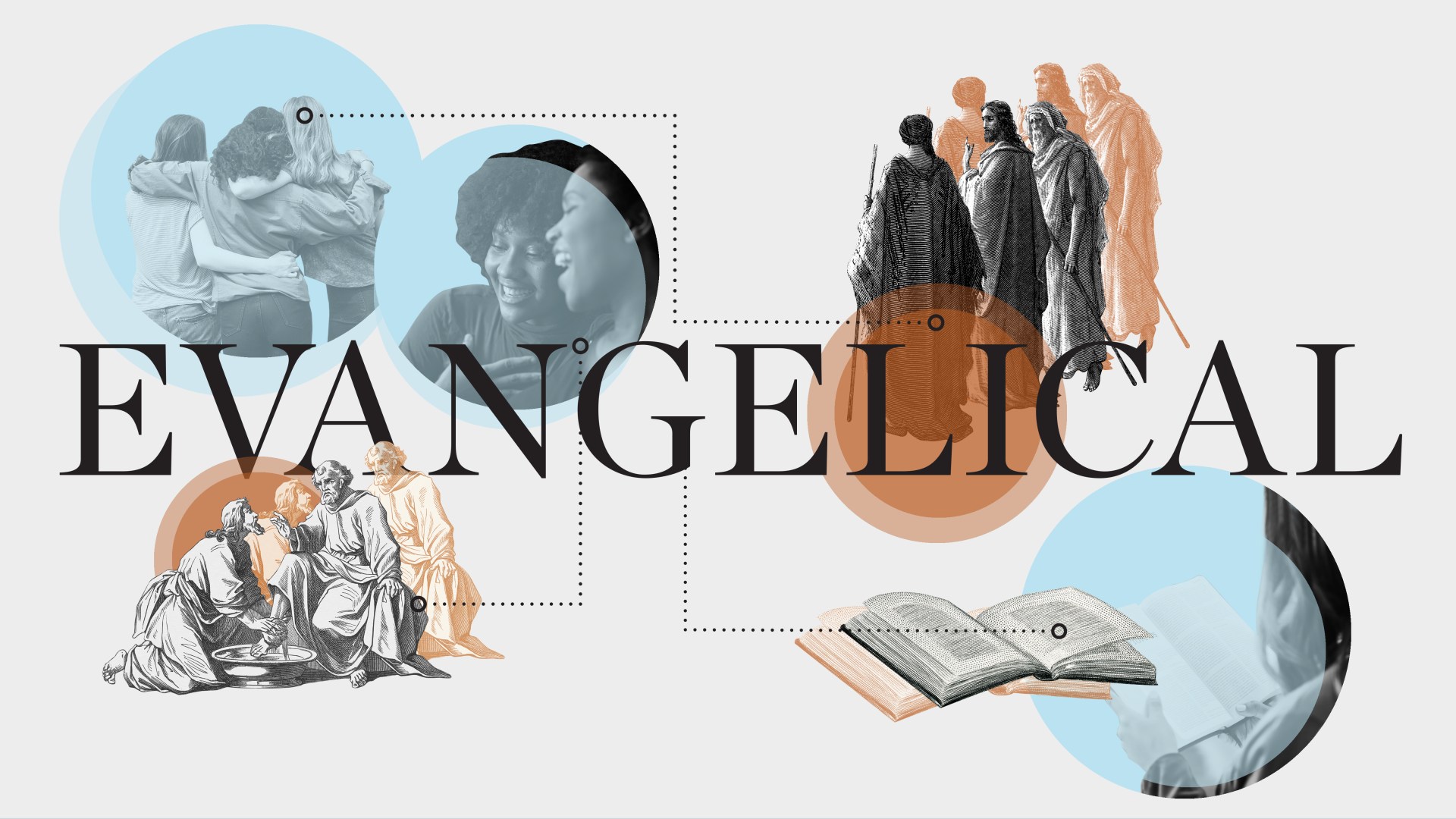
What does it mean to be evangelical? The term, without a doubt, is widely misunderstood and frequently misrepresented. In recent years, the term evangelical has become highly politicized, invoked to describe a voting bloc or as a blanket label for those with conservative or, perhaps, fundamentalist views. Meanwhile, some from within the movement have dropped the label or left evangelicalism entirely, coining the monicker exvangelical.

Since its inception, Christianity Today has been distinctly evangelical, bringing together a broad readership of Christians from across the denominational spectrum who find common ground in their shared faith in Christ, commitment to orthodoxy, and passion for proclaiming the gospel. Throughout the decades, CT has discussed what it means to be evangelical (such as in this 1965 cover story). In recent years, the conversation has continued with renewed vigor. What is really at the heart of evangelical identity? Here’s a sampling of articles from the past few years that dig deeper into what it means to be an evangelical Christian today.

In “Evangelical Distinctives in the 21st Century,” Mark Galli (CT’s recently retired editor in chief) launched a series of articles meant to “articulate what we [at Christianity Today] mean by evangelicalism—and more importantly, why we continue to think that evangelicals are a people whom God still uses mightily to reform his church and touch the world with the grace and hope of the gospel.” (You can read more of Galli’s columns on evangelical distinctives here.)

In “What Is Evangelicalism?” Bruce Hindmarsh, professor of spiritual theology at Regent College, puts forth four central characteristics of authentic evangelicalism: conversionism, crucicentrism, biblicism, and activism.

Some of today’s confusion around the term evangelical stems from how it is applied. Is it a matter of self-identification? Is it based on denominational affiliation? In “Defining Evangelicals in an Election Year,” Leith Anderson and Ed Stetzer make the case that evangelicals ought to be defined by their beliefs. Here Anderson and Stetzer discuss four core beliefs identified by the National Association of Evangelicals and Lifeway Research.

“Is it time to abandon the label evangelical?” Ron Sider asks. In “History Shows Us Why Being Evangelical Matters,” Sider traces evangelicalism’s development from the Reformation through revivalist movements to the present, noting areas of neglect and conflict that have led to some of the negative associations with the word evangelical today. Here, Sider puts forth a view of evangelicalism that embraces “justice while holding to central doctrines of the faith.”

In “Black and Evangelical,” Brandon Washington addresses some of the complicated baggage of evangelicalism, particularly in regard to race and culture. Washington addresses the view “that [evangelicalism] has been shaped by the dominant culture” and that the movement often divorces the gospel from social ethics. Yet Washington believes “preserving my theological identity obliges me to redeem the term and unpack the movement’s baggage.”

In “Why I Almost Left Evangelicalism,” Craig Keener describes his struggle with evangelical identity: “It was evangelical subculture—not evangelical faith—that I was feeling increasingly alienated from.” This sense of alienation coincided with healing that Keener experienced through the welcome and ministry of black Christian friends. “Today, I understand that evangelicalism—a movement that by definition must be centered on the evangel, or ‘gospel’—is a global movement that spans many cultures,” Keener writes.

In “The Unlikely Crackup of Evangelicalism,” Richard Mouw addresses the frustration voiced by some Christian leaders and academics who feel they “can no longer identify with a grassroots evangelicalism that has become regrettably ‘politicized’ these days.” Mouw posits that a forward-thinking strategy that holds on to the best of aspects of evangelicalism’s legacy is of greater importance than whether or not one retains “evangelical” as a label.

In “One Does Not Simply Leave Evangelicalism,” CT responds to the desire of some Christians to distance themselves from the term evangelical. “We get it. We’re frustrated, too,” writes CT’s editorial director Ted Olsen. But here Olsen urges readers, “Don’t stop calling yourself ‘evangelical’ because you’re frustrated with the polls” and cautions them against the “impulse to break with other Christians because you disagree with them.”

A notable distinctive of evangelicalism is our regard for and interaction with Scripture. In “God’s Letter to Us,” Mark Galli expounds upon evangelicals’ engagement with the Bible and their view of it as “absolutely authoritative and trustworthy.”

In “How Evangelical Scholars Treat Scripture,” Old Testament scholars Daniel I. Block and Richard L. Schultz address the same issue—evangelicals’ regard for and interaction with Scripture—from an academic perspective. Here Block and Schultz outline seven “marks of a distinctly evangelical hermeneutic” among biblical scholars.

“When we call ourselves ‘evangelical,’ we can do so with the richness of this broader history behind us. And yet we must clearly define ourselves lest others do it in ways we would not prefer,” writes Anthony L. Blair. In “A Better Way to Be Evangelical,” Blair casts a vision for living gospel-shaped lives that confidently, lovingly, and winsomely confess Christ.

News

London Leads UK in Prayer. But Only 1 in 10 Brits Prayed for Brexit.

Survey finds very few respond to #PrayFor… hashtag campaigns.

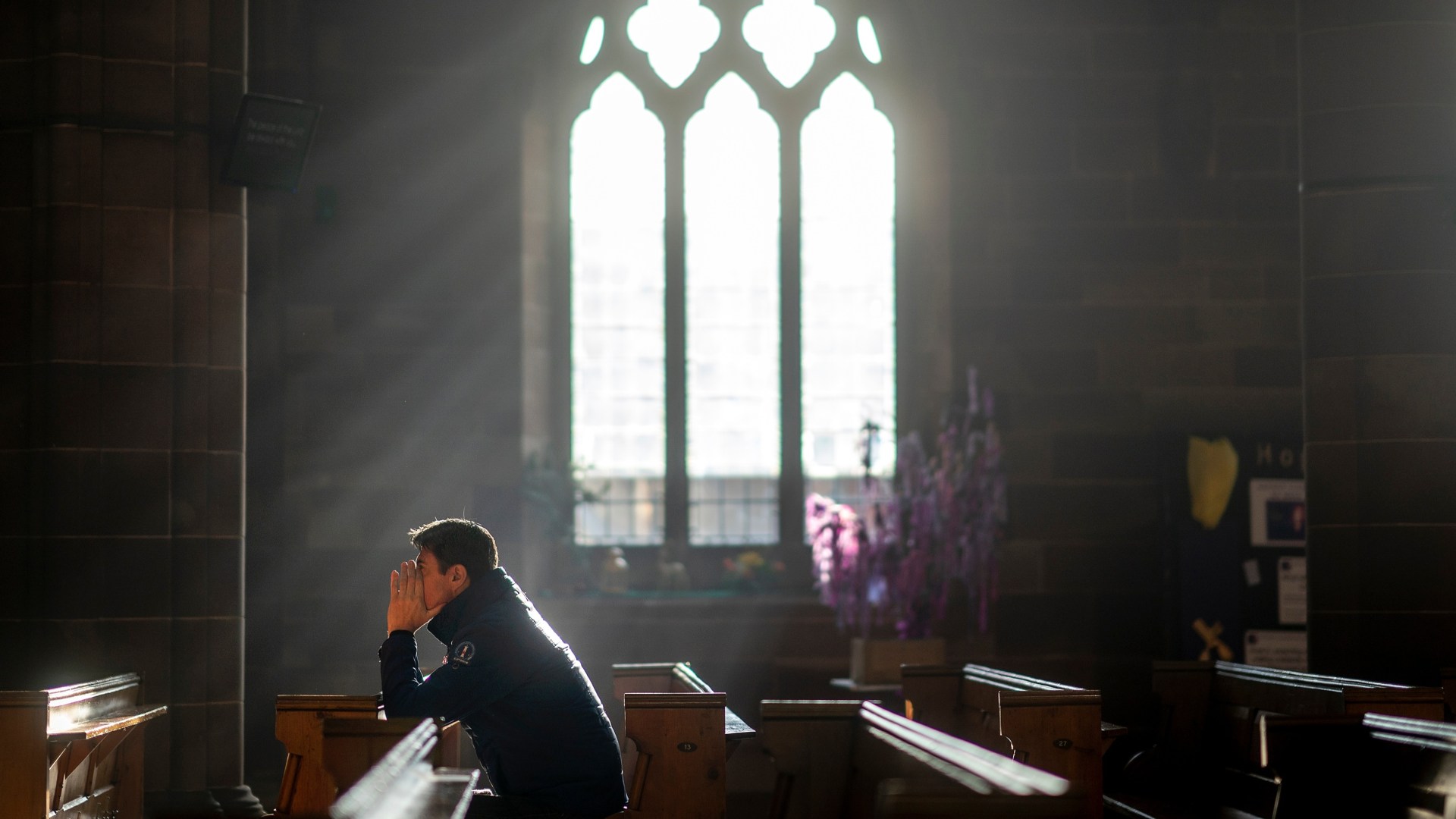
A man prays in a church on Christmas Eve in Birmingham, England.

A man prays in a church on Christmas Eve in Birmingham, England.

Christianity Today January 24, 2020
Christopher Furlong / Getty Images

The Bible repeatedly teaches the value of regular prayer. “Pray continually,” Paul tells the church in Thessalonica. Pray “in every situation,” he advises the church in Philippi. And to the church in Colossi he says, “Devote yourselves to prayer.”

The message is largely lost in Great Britain, however, where nearly 3 in 5 adults (57%) now say they never pray, up from 49 percent in 2017.

According to a new Savanta ComRes survey sponsored by Premier Christian News, 12 percent of British adults say they pray at least once a day. In contrast, a Pew Research Center survey last year found that 49 percent of Americans say they pray every day.

“It’s not particularly surprising to see less and less people are choosing to pray regularly,” said Marcus Jones, head of Premier Christian News. “What is interesting is despite many having big concerns about the future of our country and our world, people aren’t choosing to respond in prayer.”

Global phenomena like secularization, immigration, and technological development are overhauling the church in the UK. CT reported in 2016 that for every Anglican church in London that closed its doors since 2010, more than three Pentecostal churches launched. Likewise, while many British churches are struggling to retain members, churches with strong bases of African and Asian immigrant believers are going strong. This is a key part of why there are now more churches than pubs in the UK.

Premier’s survey found that people of color—or BAME (Black, Asian, and Minority Ethnic) in UK terminology—comprise a larger share of British Christians who regularly attend church (15%) than of Brits who identify as Christian (6%).

As the demography of faith changes, prayer trends are changing too.

For instance, whereas in the United States, urban centers are often thought to be the heart of rising secularism, prayer is more prominent in Great Britain’s cities. And Londoners are significantly more likely to pray regularly than British adults generally (38% vs. 23%).

More than 1 in 5 London residents (21%) pray at least once every day. On average, only 1 in 10 Brits prays that often. In Scotland, only 14 percent of adults say they pray with any regularity.

The uptick of prayer in London may point to growing Pentecostal and immigrant-operated churches there, but is also reflective of the fact that a large share of British Muslims live in the capital.

Muslims are Britain’s most prayerful faith community, with 4 in 5 saying they pray regularly. Hindus are close behind, with three-quarters saying the same. Among all non-Christians, half pray. (Non-Christians now comprise 1 in 4 Brits who pray regularly.)

Rates are weaker for British Christians: only 38 percent say they pray regularly. However, among churchgoing Christians, 72 percent say they pray at least three or four times per week.

Meanwhile, 1 in 3 Brits who identify as Christians say they never pray.

People of color (or BAME) comprise a larger share of British adults who pray regularly (1 in 4) than of all British adults (1 in 10).

While Muslim Brits pray more readily than their Christian countrymen, what causes them to pray varies. For instance, while 80 percent of British Muslims say they pray at least once a day, national and international events were not usually the catalyst.

Premier Christian News, a new website from Premier Christian Communications (which operates a group of Christian media channels), features faith-related news stories made unique because each concludes with a short prayer of response. The prayers operate as prompts—and a tracking mechanism—for prayer in a nation where Christians are less frequently falling on their knees to speak with God.

For instance, at the end of an article reporting that Episcopal Bishop Michael Curry reached out to offer “pastoral care” to Prince Harry and Meghan Markle, the Duke and Duchess of Sussex who recently announced a separation—or #Megxit—from the royal family, is a prayer that thanks God for the royal family and says, “We pray for Harry and Meghan as they make this change. We pray for guidance and wisdom for them both as they take up new things and lay some things down. Amen.”

After a story about the recent execution of Nigerian pastor Lawan Andimi is a prayer that reads, “Please protect your people in states where they are being brutally murdered,” and also prays for Andimi’s family and church, and for his murderers to become believers.

Readers are encouraged to indicate that they are praying along, and they can see the number of others who have clicked a button declaring their prayer participation. (As of Friday evening, 189 indicated they were praying for the royal family and 126 said they were praying for Andimi.)

“We believe prayer changes things,” said Jones. “We are delighted to be able to equip Christians to pray into the issues affecting our country and our world.”

Jones said since the new website launched, thousands had committed to offer prayers for Brexit, the royal family, and the Australian wildfires.

“We believe these prayers will bring about positive change in our world,” said Jones.

Among major world events from the last year, the fires in Australia were prayed for by the most British adults (21%). Slightly fewer (18%) were spurred to prayer after the London Bridge attack. Only 1 in 10 prayed about conflict between the United States and Iran, or about the Sri Lanka Easter bombings, or about Brexit.

While major tragedies and crises often warrant social media #PrayFor campaigns like #PrayForParis and #PrayForBrazil—a nationwide ComRes prayer poll sponsored by Tearfund in 2017 found that among Brits who pray, more than half (55%) are most likely to do so during a crisis—only 1 in 7 Brits told Premier’s pollsters they have ever prayed as a result of such a hashtag.

Roe v. Wade: CT’s Response Over the Decades

Highlights from our archives.

Christianity Today January 23, 2020
Bettmann / Getty

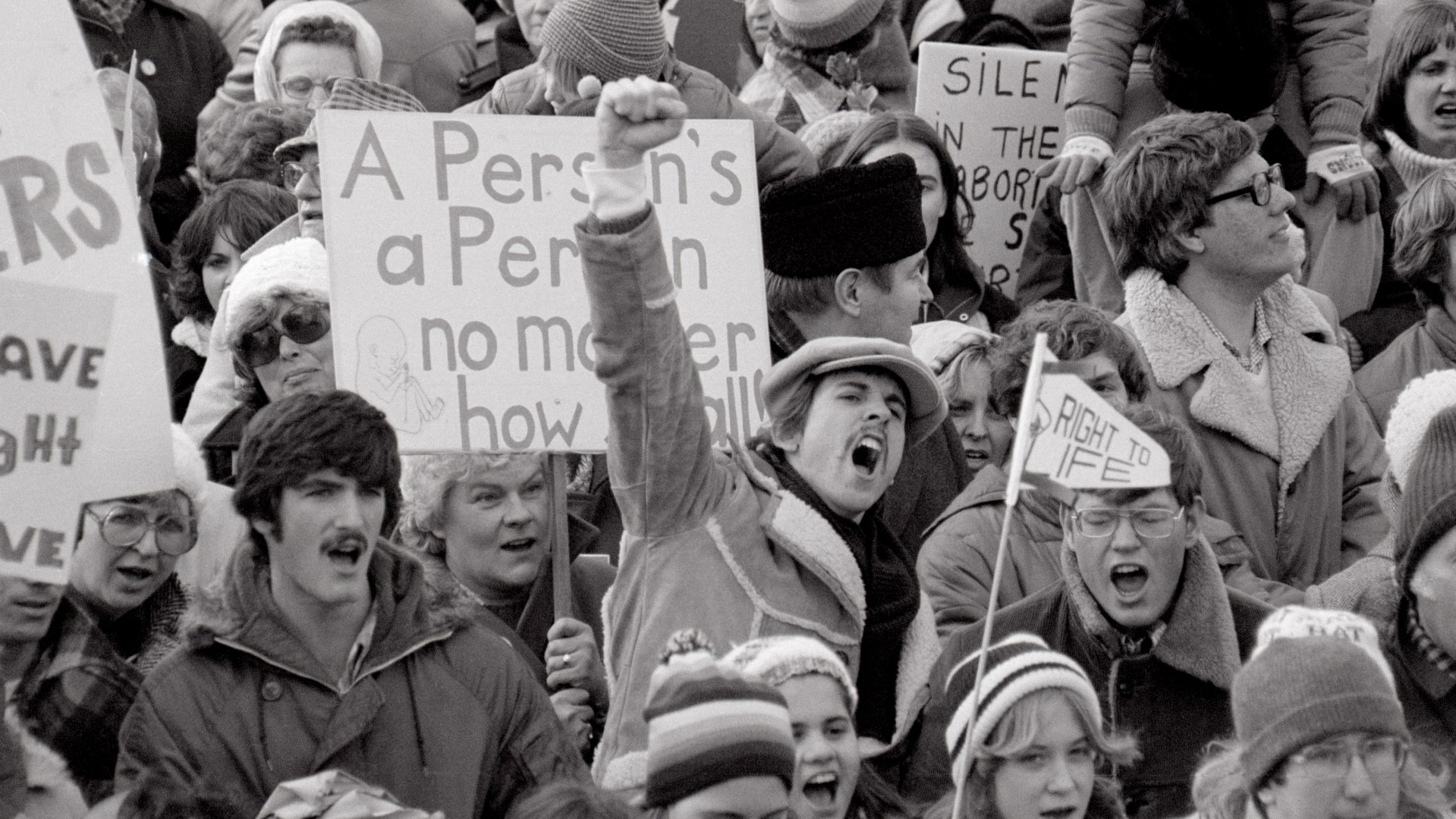
Since the 1973 Roe v. Wade decision legalizing abortion in the United States, Christianity Today has featured many articles arguing for the sanctity of human life and examining how Christians can respond. Here’s a selection of some of our key articles on this topic over the decades.

The Supreme Court decided Roe v. Wade on January 22, 1973. Christianity Today responded with this editorial in February 1973.

Norma McCorvey—known as “Roe” in Roe v. Wade—later came to faith in Christ and changed her views on abortion. This 1998 article details her conversion story.

“Ours is not the first abortion war,” Tim Stafford wrote in this 1989 CT cover story. In “The Abortion Wars: What Most Christians Don’t Know,” Stafford describes historical practices of abortion and infanticide and examines the Christian response.

Christian conviction about the sanctity of life is grounded in Scripture, yet the New Testament does not directly address abortion. In this 1993 article, Michael J. Gorman draws upon Jewish history and ancient texts to demonstrate that a “Jewish antiabortion consensus” was the norm in the first century and that “the earliest Christians shared the antiabortion position of their Jewish forebears.”

This 1999 article examines the prevailing sentiment that abortion is a necessary evil by debunking four myths about the purported need for legalized abortion.

That same year (1999), Frederica Matthewes-Green candidly addressed growing societal acceptance of legal abortion, asserting that while the “debate” may be over, “The pro-life cause is not.”

CT’s 2003 editorial “New Life for Pro-life” assessed changing trends in attitudes toward abortion and declining abortion rates. Whether or not the decline in abortion rates would continue, though, the editorial makes plain: “The pro-life movement is on the right side of history, regardless of cultural trends.”

In 2011, CT responded to what would be one of several undercover video scandals exposing abortion providers participating in unethical behavior and conversations. This article discusses the use of deception by pro-life advocates as well as the Christian response to the undercover video controversy, asserting that “bombshells must not blind us to the routine, everyday scandal of abortion.”

In 2018, Matt Reynolds addressed Roe v. Wade from a different angle. In “Abortion Is Wrong. That’s Not Why Roe v. Wade Is Wrong,” Reynolds asserts, “The wrongness of this decision has precisely nothing to do with the wrongness of abortion. Taking the life of an unborn child is a sin against God and man. Roe, by contrast, is an offense against America’s democratic order.”

In 2019, Andrea Palpant Dilley examined “the intersection of the pro-choice and #MeToo movements.” In “Who Owns a Woman’s Body? Not Who You Think,” Dilley argues that the notion of owning one’s body—a common line of argumentation in abortion debates—“doesn’t, in fact, enable the safety of women or their unborn children and arguably begets more violence against both, not less.”

Theology

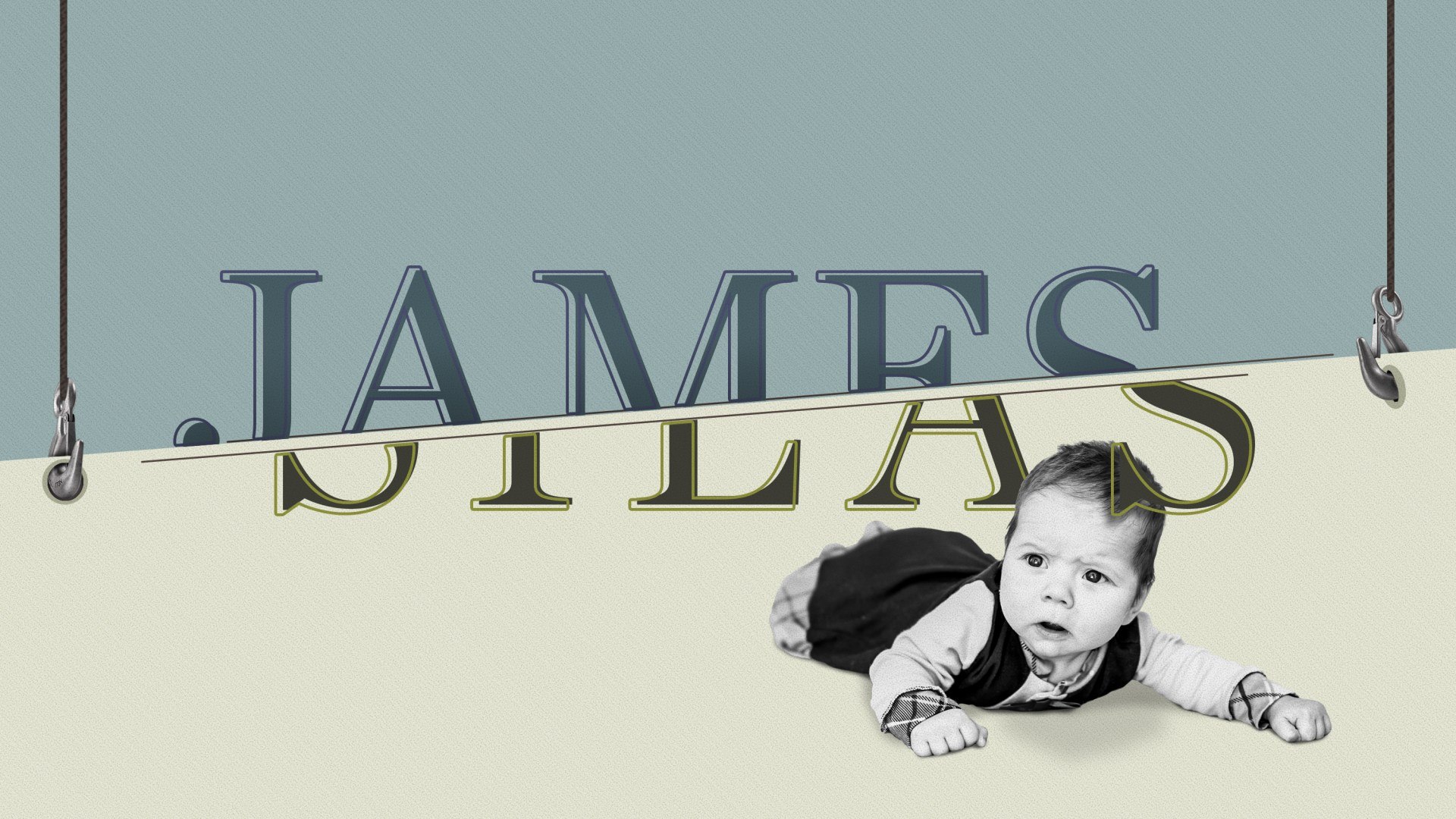
Sorry, James and David: Silas and Obadiah Are Today’s Trending Baby Names.

Weird Bible names are on the rise. What’s behind the trend?

Christianity Today January 23, 2020
Rick Szuecs / Source images: Envato

You probably know someone who’s given their child, and especially their baby boy, an obscure biblical name. Sunday schools are increasingly filled with baby boys named Asher, Silas, Hezekiah, or Ezra. Meanwhile, boy names like John, Michael, David, and James appear to be falling out of favor.

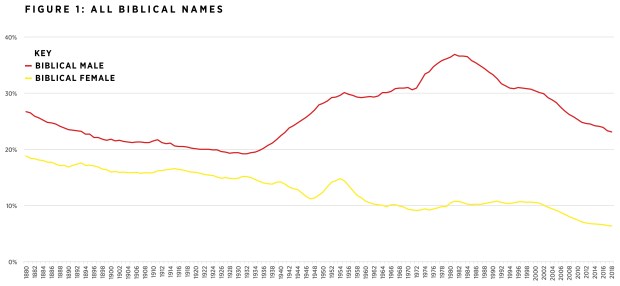
The numbers back up this perception. According to current data from the Social Security Administration, “unusual” biblical names are getting more common for baby boys, with historically “rare” Bible names rising from about 0.5% of boys in the 1950s to a whopping 6.5% of baby boys today. Of all baby boys given uncommon or unconventional names, 17% had uncommon biblical names—the highest share since 1880.

What’s going on? Why are there so many Obadiahs and Eliases underfoot? And how do these name trends reflect religious and cultural patterns in the United States?

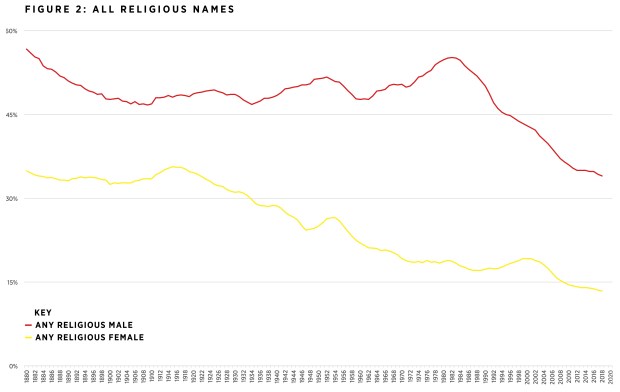
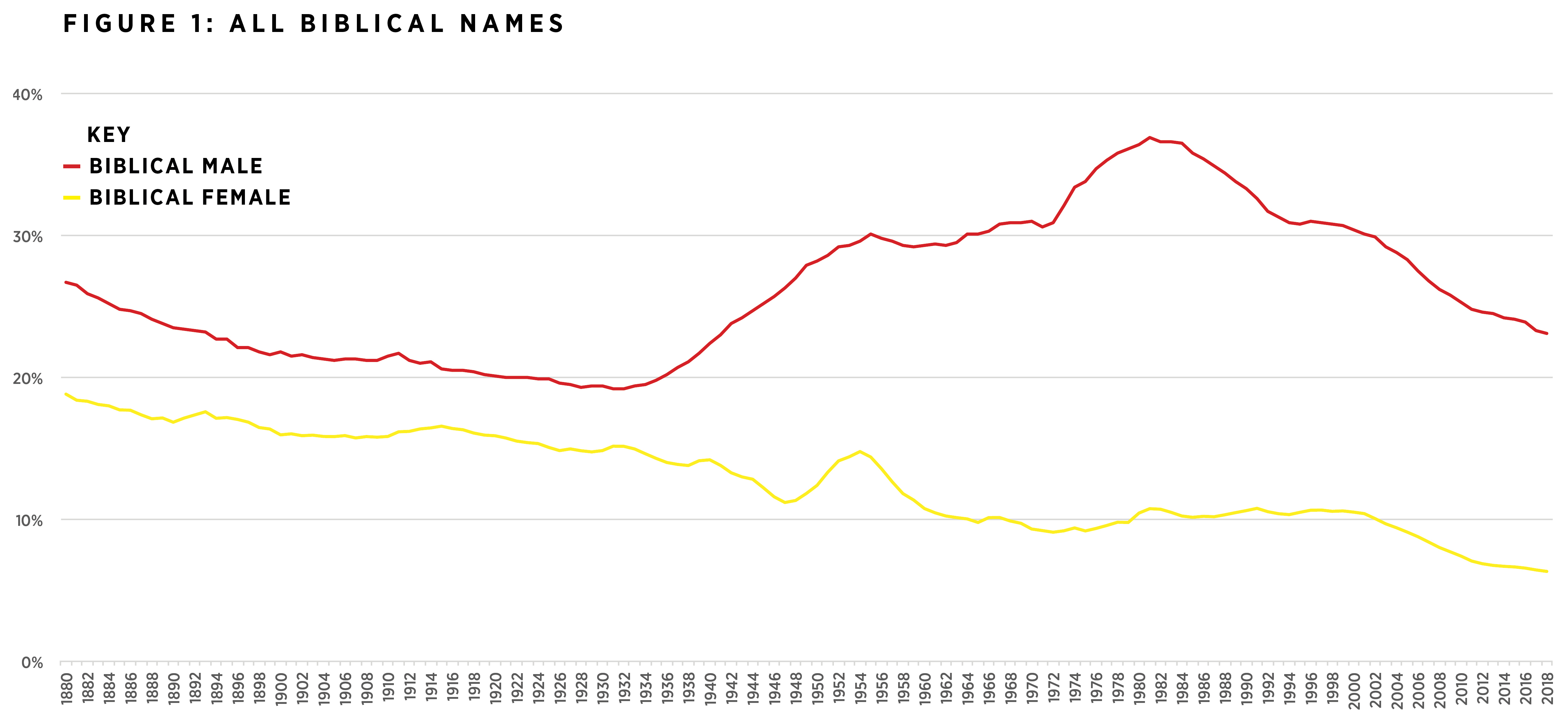
To understand the picture, we have to go back in time and look first at the numbers. Baby boys born in 1982 were more likely to have biblical names than in any other year since 1880, driven by the increased popularity of names like David, Matthew, Joshua, Daniel, and Timothy. While biblical boy names rose steadily in prominence from 20% of baby boys in 1935 to more than 35% in the early 1980s, baby girls saw a different trend. From 1880 until 2018, the share of baby girls with biblical names has fallen steadily from 19% to around 6% today.

The rise in biblical boy names from 1880 to 1980 mostly included the monikers of major characters from the Old or New Testament. In other words, parents gave their kids names that were generically spiritual: They referred to the Bible, but they weren’t too religious sounding. There were more Davids and fewer Levis, more Timothies and fewer Barnabases.

The trend in names is partly explained by corresponding religious trends. Declining anti-Semitism and anti-Catholicism broadened the number of socially acceptable names. And as US religious membership peaked between the 1950s and the 1980s, the cultural ascendancy of mainline and evangelical Protestantism meant that families increasingly wanted boy names that were recognizably biblical but still relatively conventional.

Girl names have a quite different backstory. Because girls are less likely to be named after their parents, baby girls have always had more diverse names and less standardized name spellings (like “Aleczandra,” for instance).

Baby girl monikers are also generally more susceptible to “name bubbles,” meaning that very large numbers of girls have names that were only popular during a particular period. In 1929, for example, one in every 1,750 baby girls was named Judith. By 1940, it was one in every 53. By 1950, Judith’s popularity had fallen by half, and by 1956, by half again. While some boy names show similar fads, it’s considerably less common.

In recent years, baby girls just like baby boys have seen a rise in less common biblical names. Sarah, Rebecca, Rachel, and Mary are down, while Naomi, Eve, Delilah, Hannah, Eden, Leah, and Esther are up. Even names like Hadassah, Azariah, and Amariah are seeing growth, while Elizabeth and Susannah are falling into disuse. Both girls and boys with biblical names are increasingly getting very biblical names.

However, to sort out these trends—and what’s behind them—we have to look at more than just the strictly biblical names. Many “religious” names aren’t biblical: Girls are often given virtue names like Charity, Peace, or Hope, and some parents give their children names that are religious but not directly scriptural, like Benedict.

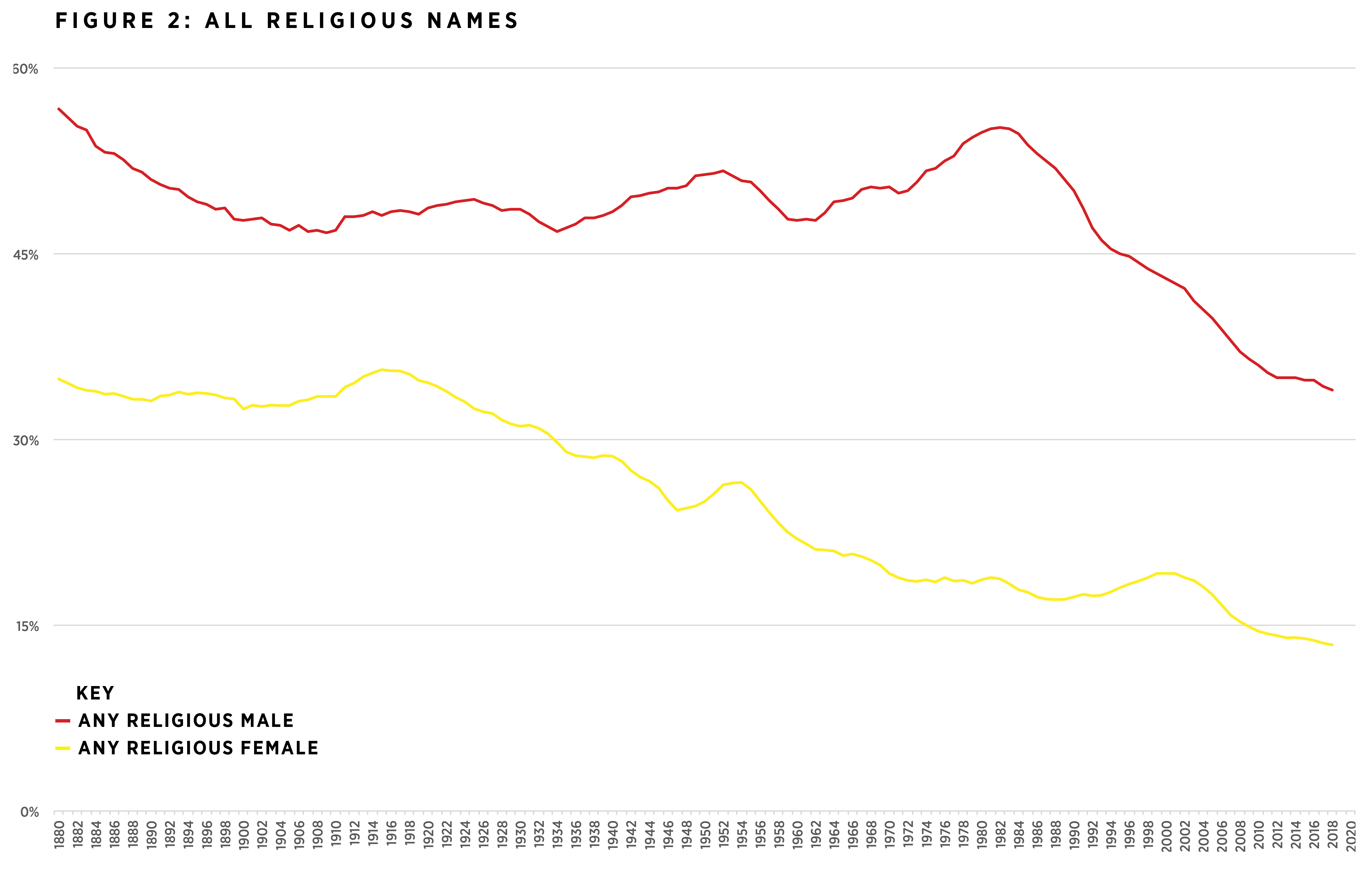
To get at these variables, I added a list of all Roman Catholic Saints, English-language virtue names, names appearing in the Qur’an, and names derived from Hindu gods. Together, they gave me an estimate of all religious names (see Figure 2).

Accounting for these religious-but-not-biblical names smooths out the historic trends. Boy names have approximately stable religious shares from 1880 to 1980, and religious girl names are stable from 1880 to about 1920. But since 1980 for boys and 1920 for girls, religious names of any kind have steadily declined as a share of names.

This pattern reflects a wider trend in American society: the diminished role of religion in peoples’ lives.

Over the last 140 years, Americans have gradually moved away from a society marked by conventionalism and conformism to one of extreme individualism. Since the 1990s, especially, we’ve been living through a significant wave of anti-conventional fervor (although the baby boom period saw a similar explosion in highly individualized names). Baby names increasingly reflect the very specific interests, values, or idiosyncracies of parents, not just family traditions or wider public norms.

This shift tracks the wide turn away from a public culture dominated by religious ideas and toward one where popular consumerism is the driving force. (That this pattern appeared earlier for girls simply reflects the greater willingness of parents to give girls trendy names.) Combined, these two changes—toward more nonconformist baby naming and less religious baby naming—speak to a truly seismic cultural shift. Americans today are less governed by religious ideas, yes, but they’re also less governed by any particular convention.

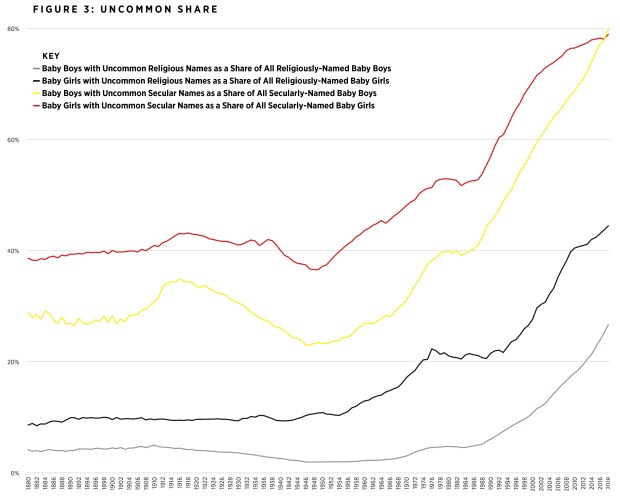
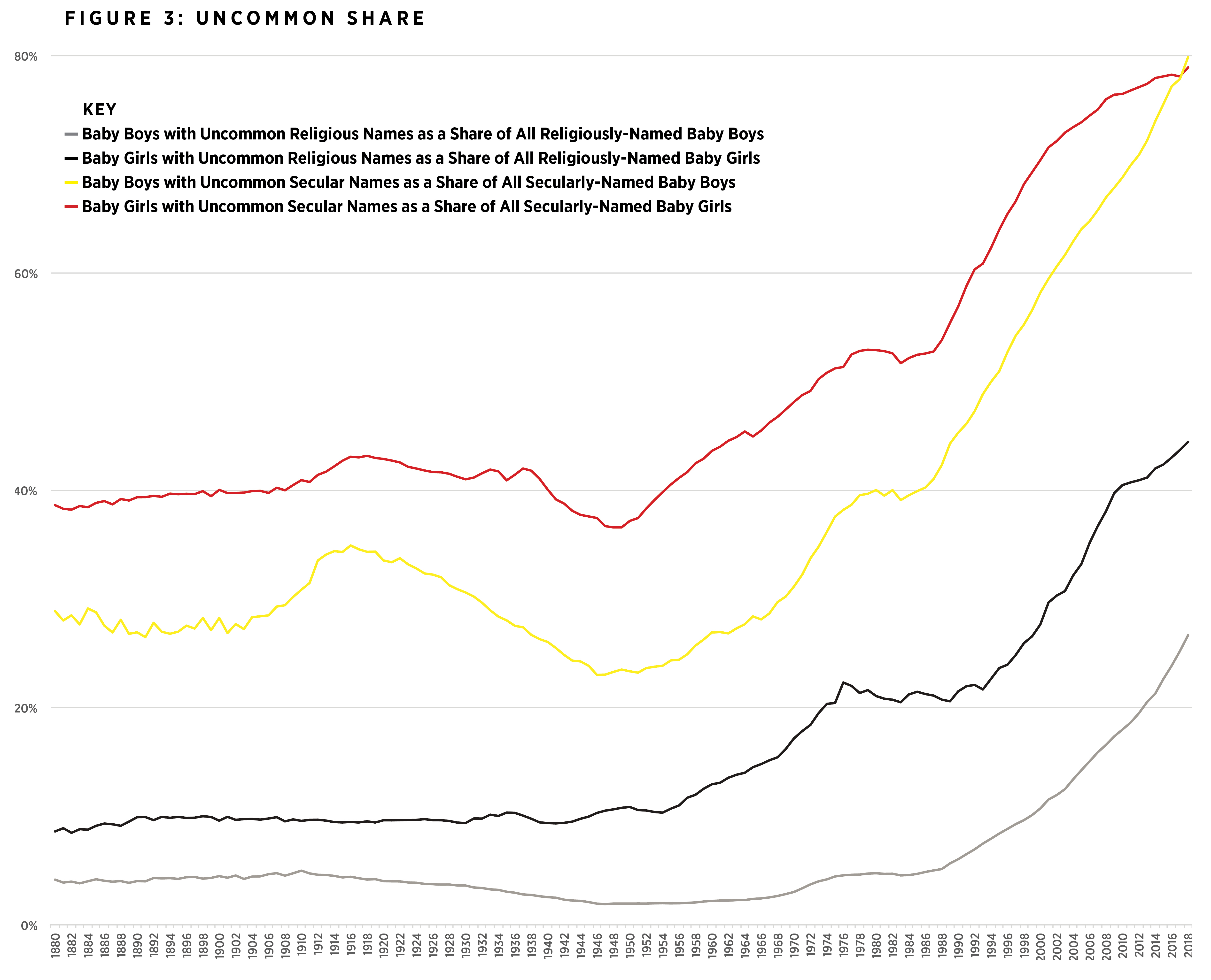
The figure below illustrates these growing nonconformist sensibilities by showing the share of baby boys and girls with religious or secular names that are notably uncommon.

The recent rise in quirky biblical names seems to fit into this larger picture of nonconformism. While kids with nonreligious names are much more likely to have uncommon names, the overall rise in unconventional names has been similar in size and timing across all four groups shown in the graph above. Religious parents are adapting to this new individualist world, giving their kids names that maintain the public claim of faith while also responding to a wider cultural demand for uniqueness and originality.

In other words, parents of faith want their kids to stand out from the crowd just as much as secular parents do.

Looking forward, there’s plenty more space for creativity with highly unique but still highly religious names. Of the 2,606 biblical names I track in my ongoing research, only 811 ever had a year with more than 4 baby boys or girls given that name. We haven’t yet seen kids named Abijam or Paltiel, nor have we seen name fads for Philetus or Berechiah. Even notably faithful biblical figures like Ehud, Elkanah, Habakkuk, Hilkiah, and Jehonadab have been passed over.

So if you thought your Sunday school attendance list included some really deep cuts into the Bible, you weren’t wrong. Because unusual religious names were extremely rare before the 1970s, names like Hezekiah or Jael, Enoch or Salome are easy to spot. You weren’t imagining things: Religious names are getting strange!

This, I think, is actually cause for optimism. Even amidst a sea of cultural individualism that knows no law above the will, families are finding ways to translate the witness of Christian identity for the next generation. At a time when baby names seem to evince a society where parents do what is right in their own eyes, a committed religious minority is doubling down and giving their children names that cannot help but draw attention to the faith in which they were raised.

If we’re lucky, then, maybe we’ll live to see kids named Maher Shalal Hash Baz once again.

Lyman Stone is an adjunct fellow at the American Enterprise Institute, a research fellow at the Institute for Family Studies, and the chief intelligence officer of the consulting company Demographic Intelligence. He and his wife live in Hong Kong and serve as missionaries in the Lutheran Church (Hong Kong Synod).

News

Abortion Regret Isn’t a Myth, Despite New Study

What women may refuse to disclose to researchers at a clinic, they’re confessing in Bible studies decades later.

Christianity Today January 22, 2020
Alex Wong / Getty Images

Pro-life advocates and ministry leaders are challenging the results of a new study that found that most women do not suffer emotionally after an abortion, and that over time, they are less likely to express regret.

Researchers from the University of California at San Francisco (UCSF) followed 667 women across 30 clinics after they received an elective abortion, finding that the majority had either positive feelings or no emotion at all toward their decision both a week later (71%) and five years later (84%), according to a study released last week in the journal Social Science & Medicine.

Corinne Rocca, one of the study’s authors and UCSF professor, said that the study proves that the idea that women will develop negative emotions after an abortion is a “myth” and a “red herring.” Rocca has also participated in multiple research studies and written several articles for the Guttmacher Institute, the research arm of Planned Parenthood.

While pro-choice advocates have used the findings to suggest that the idea of “abortion regret” is merely a scare tactic from pro-lifers, critics say the sample for the survey doesn’t justify the debunking its authors have touted in the media.

Writing for the National Review, researcher Michael J. New noted that women who volunteer to respond to questions following an abortion are more likely to be the ones who feel positively about it, and therefore the findings do not represent the full spectrum of women who have had abortions. New—a professor at the Catholic University of America and a scholar with the pro-life Charlotte Lozier Institute—noted that of all the women asked to participate, less than 40 percent agreed, and roughly 30 percent of the 667 who participated had stopped responding by the end of the five-year study.

Plus, Christians working in post-abortive ministry have seen abortion regret stir up in women long after the five-year span of the research.

“The majority of women we see are usually 15, 20, 30, 40 years removed,” said Carrie Bond, former national training director for Surrendering the Secret. Counselors and staff like Bond are particularly likely to encounter those who have grown to regret their abortions, or to discover that they had been holding back the emotional weight of the decision.

Abby Johnson, the former Planned Parenthood staffer who went on to become a pro-life advocate, shared a similar observation on Twitter: “Here’s real talk. Trauma doesn’t usually present until 10-15 years post-traumatic event. Those women have NO idea how they will feel about their abortions many years later.”

Bond said most women are culturally conditioned to either hide their abortion or celebrate it. “Those are your two choices,” she said. “Be silent, or say ‘It hasn’t affected me!’” Some may not even realize that some of the negative symptoms they experience in the years following their abortion—nightmares, or an eating disorder, for example—may have been triggered by their experience.

Bond also questioned the researchers’ conclusion that the lack of emotion is positive. Far from a good thing, she said that can be actually evidence of trauma. One of the most common symptoms of post-abortion stress she sees in women is emotional numbness. One study conducted in the early nineties by pro-life researchers found that 92 percent of women experience some level of “emotional deadening” up to 10 years after their procedure. (That study surveyed 260 women who had actively sought post-abortion counseling.)

While post-abortive ministries, by their nature, are likely to draw in women who are experiencing regret and seeking a place for healing—their work is not miniscule. As Julie Roys wrote for CT in 2015:

In the past 20 years, abortion recovery groups have multiplied in churches nationwide. Surrendering the Secret has trained about 2,500 leaders in churches and crisis pregnancy centers. Another leading recovery ministry, Rachel’s Vineyard, hosts about 1,000 retreats annually in 48 states and 57 other countries. Yet, these statistics pale in comparison to the number of post-abortive women in the church (not to mention the men who carry regret over their wives’ or girlfriends’ abortions).

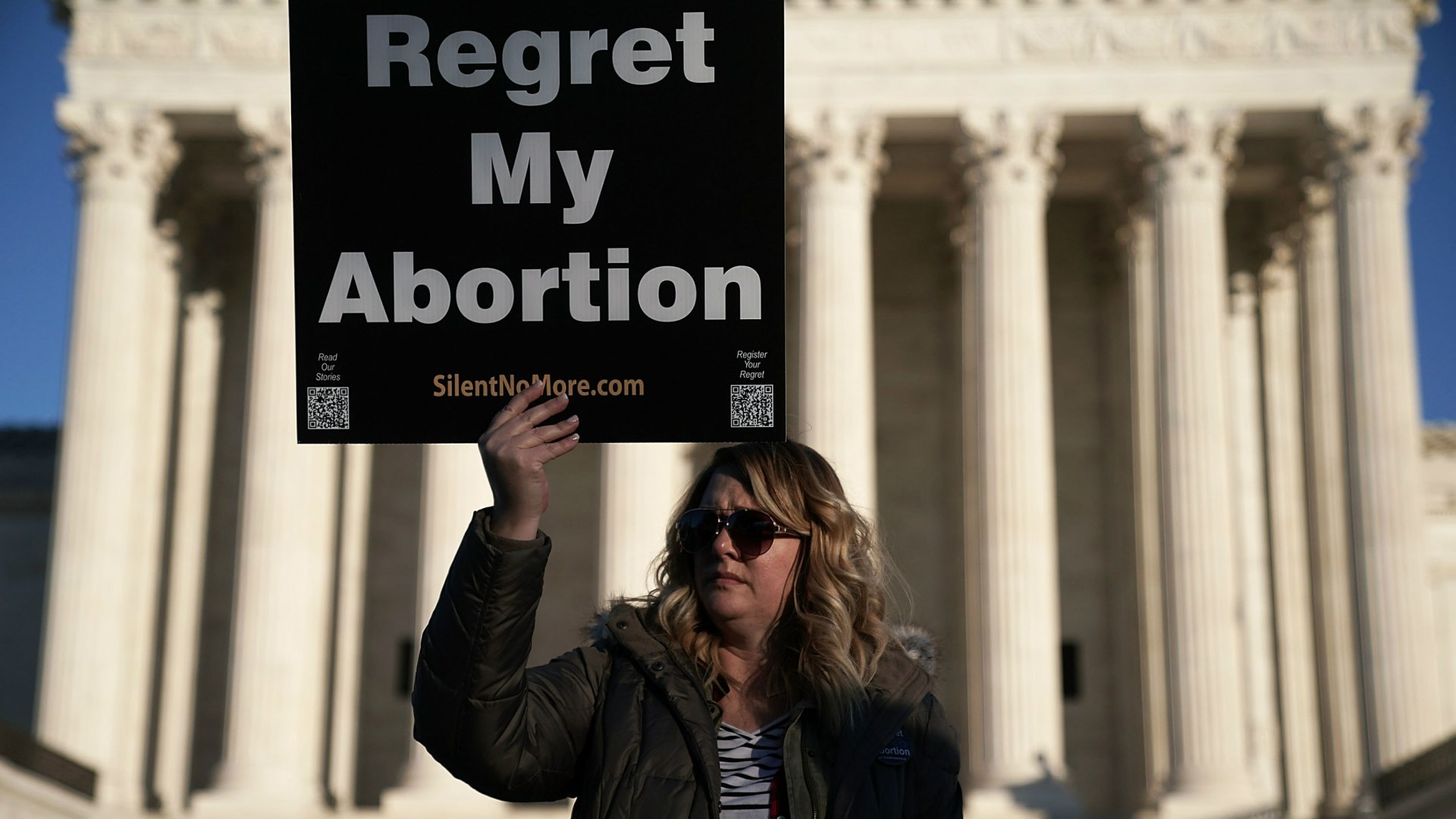
The Silent No More Campaign, a project of Priests for Life and Anglicans for Life, has hosted 6,469 women and men sharing their abortion testimonies. “I Regret My Abortion” is a slogan on its campaign protest signs.

Abortion rates have been falling for the past few years, reaching an “historic low” of 625,000 in 2016, the latest year data from the Centers for Disease Control are available. Statistically, 625,000 abortions means there were 12 abortions for every 1,000 women of child-bearing age in the US that year. That number may be higher, given that reporting abortion numbers to the CDC is voluntary for states. Still, it adds to a staggering total. Researchers from varying ideological backgrounds estimate roughly 60 million abortions have been performed in the United States since the Supreme Court decided Roe v. Wade in January 1973.

In the UCSF study, researchers approached possible participants at abortion clinic sites. But that potentially left out a subset of women: those who obtain medication abortions. In some states, women can get prescriptions for the abortion medication protocol via a video consultation with a doctor or nurse practitioner and never have to step foot into a clinic.

The Guttmacher Institute reports that medication abortions are on the rise, accounting for more than a third of all abortions recorded in 2017. The most commonly-used medication abortion protocol is only prescribed in the first trimester and includes two drugs: the first blocks the embryo from receiving vital progesterone. The second, taken 24 to 48 hours later, induces labor.

The medications are currently regulated by the Food and Drug Administration and in some states must be administered by a licensed doctor or other medical professional, but pro-choice groups are pushing against such regulations.

Chuck Donovan, president of the Charlotte Lozier Institute, worries that medication abortions have the potential to cause more trauma than an in-clinic procedure, as women may feel more responsibility over the abortion when they have to take the medication themselves. He also said a medication abortion presents the possibility that a woman will see her deceased baby after the medication runs its course.

Bond at Surrendering the Secret said she’s counseled many women who had that exact experience. She agrees the trauma from medication abortions may be even more acute than that experienced after a surgical procedure. “You’re not told the truth, and then left alone to suffer through the trauma: intense cramping, hemorrhaging, delivery of baby,” she said

The UCSF study also reported that 95 percent of the women they spoke to said they were confident that abortion was the right decision for them. But Bond said even women who express strong confidence at the time of their decision (or even shortly afterward) are still at great risk for post-abortion stress. Expressed confidence at the abortion clinic may in fact be denial, she said, and that could fade later.

Ideas

Your Church Needs Boomers

How a hyper-focus on “attracting the young” can sideline the aging faithful.

Christianity Today January 22, 2020
aaronwtbritton / Lightstock

We rarely hear it put as bluntly as did the small congregation of Grove United Methodist Church, where some members recently claimed “age discrimination” over a service being cancelled, but there are many churches sending a similar message: “If you are an older adult, we don’t want you here.”

As a part of denominational efforts to reboot the Cottage Grove, Minnesota, church, leaders are asking the 25 or so people who gather each week in the Grove building to leave their building and worship at the nearby sister congregation while a team plants a new church at their campus. According to a St. Paul Pioneer Press report, these mostly older members have been directed to wait 15–18 months after its launch before asking new leadership if they can “migrate back.”

While a single news story can’t fully capture the history of the relationship between the lay-led congregation and the denomination, nor the nuances of recent discussions over revitalization (church leaders clarified their approach in a follow-up by the Washington Post),the situation highlights a phenomenon with which many older adults are all too familiar.

During more than a decade writing about spiritual formation in the second half of life, I’ve heard a painful litany of stories from those who’ve been ignored, marginalized, patronized, or treated as rusting obstacles blocking the path to the holy grail of church growth.

Older member hear the message they’re not valued in a variety of ways: a worship team comprised of members under 40, a range of programming designed for younger attenders, or a lack of pastoral care when they’re in the trenches of long-term illness or caring for aging parents. Those who’ve been burned or burned out by congregational politics tend to fade away from congregational life, and many have told me that no one ever bothered to find out why.

A few years ago, I did an informal survey of nearly 100 pastors and church leaders and heard mixed perspectives on the older members in their congregations. While some expressed gratitude for their wisdom, experience, stability, and ongoing financial support, others were frustrated. They said the older demographic appeared to resist change while decreasing regular involvement in the life of the local church.

Sadly, few leaders brought up how older members faced different challenges as they moved into the second half of their lives. Spiritual practices and church involvement are necessarily impacted by increased caregiving responsibilities, workplace demands, fatigue from church politics, disconnection from programming focused on attracting young families, and loss and grief.

As we hear from studies and think pieces alike, the young are leaving many congregations. But so are Gen Xers and Boomers, who claim they no longer feel welcome at the churches they helped to build in their youth. Barna Research found that the majority of those who “love Jesus but not the church” are actually over 40. Nearly half (44%) of unchurched Christians are Boomers, and another third (35%) come from Gen X.

While it is a good desire to want to draw younger families to a church, the desire is not a healthy one if it doesn’t also include a desire for a diversity of ages and life stages that reflects the reality of what it means to belong to the multi-generational family of God. I fear the relentless focus on youth in our culture—from advertisers to church planters—has warped our vision of the value of age embedded in other cultures around the world and throughout history.

And certainly Scripture presents a counter-cultural message about the beauty and value of age and experience that flies in the face of the lopsided craving to build a church focused on young families. Throughout the Bible, we who love God are commanded to proclaim his salvation from one generation to the next. There is a reason that Mary’s response to the angelic news that she would be bearing a Son who’d save the world included these words: “His mercy extends to those who fear him, from generation to generation” (Luke 1:50). She understood well that the household of faith was designed by God to be intergenerational.

“God’s household is the very definition of the church. We’re not like a household or family. We are one,” wrote pastor Lee Eclov in Feels Like Home: How Rediscovering the Church As Family Changes Everything.

Older members may hear they’re valued members of this family as they’re invited to serve in meaningful ways, honored as mentors and friends, offered programming that speaks to their life stages and maturity level, and welcomed onto multi-age worship teams—and even a few park play dates with younger families. In a culture fractured and divided, a congregation that functions as an intergenerational family is radically and beautifully countercultural.

While I understand that an aging church building with a long-empty nursery may not seem to be the ideal vehicle to pass on the faith from one generation to the next, nor is a congregation without any gray-haired members.

Michelle Van Loon is the author of six books including Becoming Sage: Cultivating Meaning, Purpose, and Spirituality at Midlife (Moody Publishers), which releases April 7.

Speaking Out is Christianity Today’s guest opinion column and (unlike an editorial) does not necessarily represent the opinion of the magazine.
News

Boko Haram Executes Pastor Who Turned Hostage Video into Testimony

(UPDATED) Beheaded Brethren leader taken captive in Nigeria said he was at peace with death because Jesus “is still alive.”

Christianity Today January 21, 2020
Morning Star News

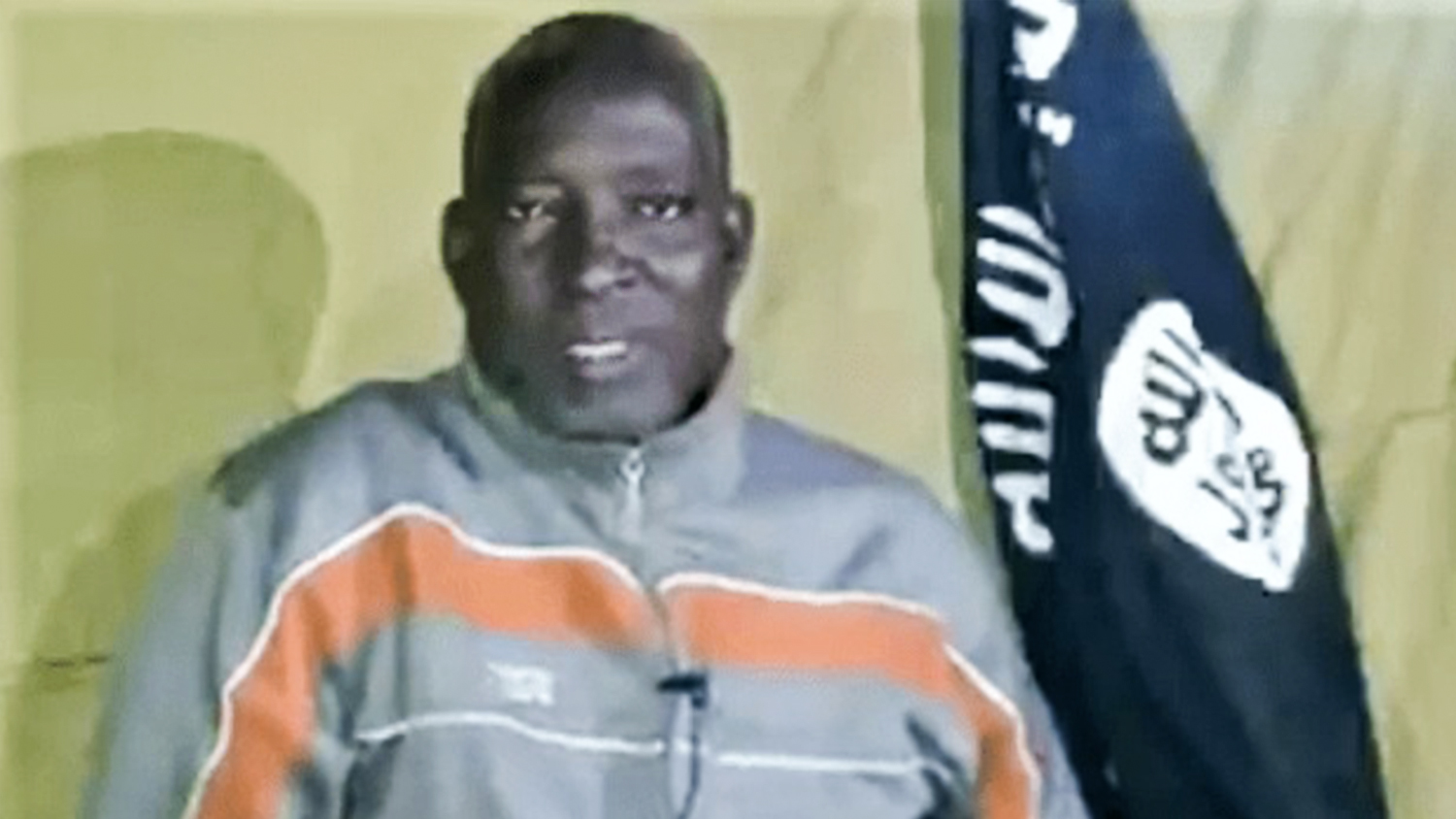
Update (Jan. 21): Boko Haram has beheaded a Brethren church leader in Nigeria, according to the same investigative journalist who shared the pastor’s hostage video which encouraged many with its testimony [see below].

“To break some news items can traumatize. I'm battling with one of such. Reverend [Lawan] Andimi, abducted by #BokoHaram was executed yesterday,” tweeted Ahmad Salkida. “Rev. Andimi was a church leader, a father to his children and the community he served. My condolences go to his family.”

“Reverend Lawan Andimi was beheaded yesterday afternoon, the video of the appalling executions with that of a soldier was obtained at 2:42pm,” wrote Salkida. “I made sure that the family, the authorities and the church were duly informed before the news was put out to the public this morning.”

Andimi’s denomination, the Church of the Brethren in Nigeria (EYN), confirmed the pastor’s death.

“This is horrific and truly a shame,” said Gideon Para-Mallam, the Jos-based Africa ambassador for the International Fellowship of Evangelical Students who spoke with EYN general secretary Daniel Mbaya about Andimi’s fate. “It strikes at the heart of efforts to build some form of religious harmony in Nigeria. But we are undeterred.”

The Christian Association of Nigeria (CAN) declared three days of prayer and fasting, and condemned the “brutal murder” of Andimi as “a shame to the Nigerian government.”

“The Church did everything within her reach to secure the safe release of this pastor gentleman,” stated Kwamkur Samuel Vondip, CAN director for legal and public affairs, “but it was not possible because they didn’t have the military power to do so. The Church views the unabated kidnappings, extortions, and killings of Christians and innocent Nigerians as shameful to the government that each time boasts that it has conquered insurgency.”

CAN called for Nigerian Christians “to be calm” but challenged President Muhammadu Buhari and his national government “to be more proactive about effort to get rid of the continuous siege on Nigeria and end the wanton killings and destructions of lives and property.”

“We cannot loose hope on divine protection and the power of our Lord Jesus Christ to expose those behind the sponsorship of terrorism in Nigeria and to get Nigeria safe from the arms of the criminals,” stated Vondip. “We shall remain constant and not bow to the antics of terrorists and their sponsors. We know that very soon, God will unmask these ungodly and wicked elements amidst us and their collaborators in Jesus’ Name.”

Christian Solidarity Worldwide (CSW) also condemned the murder.

“As Christians, knowing there is life after death, we nevertheless value the gift of this life,” stated chief executive Mervyn Thomas, “and we join in mourning an uncommonly courageous man, who despite knowing death was a very real prospect, maintained a calm and deep faith that will continue to inspire for generations.”

Meanwhile, CSW reported that a recently released hostage confirmed that Leah Sharibu, the teenager whose perseverance has become an inspiration to Nigerian Christians, is still alive.

Nigeria is the second-most violent country for persecuted Christians (Pakistan is No. 1), according to the 2020 World Watch List released last week by Open Doors.

The list ranks Nigeria at No. 12 among the top 50 countries where it’s hardest to be a Christian. According to Open Doors, Nigeria led the world in Christian martyrdoms, with 1,350 confirmed, and in Christian abductions, with 224 confirmed, during the list’s reporting period from November 2018 to October 2019.

“Rev. Andimi died a martyr and therefore no doubt a Christian hero,” said Para-Mallam. “The blood of martyrs is the seed which waters and grows the gospel of peace as good news to a broken and hurting world which Jesus Christ called us to proclaim. Rev. Andimi’s blood will water the spread of the gospel in the North East, Nigeria, and other parts of the world. No doubt about this.”

CT went to Nigeria for a 2018 cover story on how Africa’s largest church, facing a double persecution by Boko Haram and by militant Fulani herdsmen, has no cheeks left to turn.

—–

Previous post (Jan. 13):

A hostage video released last week by Boko Haram did far more than issue another plea for rescue from a Nigerian Christian.

It revealed a modern-day Shadrach.

“By the grace of God, I will be together with my wife, my children, and my colleagues,” said Lawan Andimi, a Church of the Brethren in Nigeria (EYN) pastor in the troubled northeastern state of Adamawa. “[But] if the opportunity has not been granted, maybe it is the will of God.

“Be patient, don’t cry, don’t worry. But thank God for everything.”

It is testimony even to his Islamist captors, said Gideon Para-Mallam, the Jos-based Africa ambassador for the International Fellowship of Evangelical Students.

“This is completely different from most hostage videos,” he told CT. “[Andimi] appeared as one who has already conquered death, saying to his abductors and the rest of us that he is ready to die for his faith in Christ.”

Andimi’s home area of Michika was attacked by armed terrorists the evening of January 2. Local residents fled into nearby bushes and hills.

“Our people had to run helter-skelter when they heard that the terrorists were approaching the town,” Zakariah Nyampa, a member of Nigeria’s parliament representing the Michika area, told Morning Star News, noting that the army killed several attackers.

“We thank God for their lives, but the only civilian casualty is the missing pastor whose whereabouts are still unknown.”

Para-Mallam believes Andimi was deliberately targeted. Well-known in the area, the pastor was also the EYN district leader and the regional representative of the Christian Association of Nigeria (CAN).

“To annihilate the Christian faith, there is no better way than to eliminate its prime movers,” said Para-Mallam. “It is also Boko Haram giving a signal that they are not degraded like the government says, and can still strike.”

Less than a week earlier, 11 Nigerian Christians, seized in neighboring Borno state, were executed by a Boko Haram splinter group now affiliated with ISIS called the Islamic State West Africa Province (ISWAP).

Andimi followed hostage video protocol and appealed to denominational leadership and the Adamawa governor to intervene for his release.

But showing none of the usual signs of desperation, the pastor made clear his hope lies elsewhere.

“I believe that he who made them to act in such a way is still alive, and will make all arrangements,” Andimi said.

“I have never been discouraged, because all conditions that one finds himself is in the hands of God—God who made them to take care of me and to leave [me with] my life.”

Samson Ayokunle, president of CAN, issued a statement four days after Andimi’s abduction, urging the Nigerian government to take the necessary steps to rescue the EYN pastor and all other captives held by Islamist terrorists.

And prior to the ISWAP executions, CAN endorsed the US State Department placing Nigeria on a “Special Watch List” of governments that have engaged in or tolerated severe violations of religious freedom.

“If criminals are invading the Christian communities, killing and abducting unchallenged, what do we call it if it is not persecution?” stated CAN in reference to Andimi, noting the subsequent abduction of an additional 41 Christians from the north-central state of Kaduna.

And the next day, following criticism from the Nigerian government that the Christian umbrella group was politicizing religion, CAN reiterated its position.

“Let the government wake up to its responsibilities and see if we will not stop talking about its failure to protect our members,” CAN stated.

“We are praying for the government on a daily basis, but that does not mean where the government is failing we should keep quiet.”

Nigeria ranked No. 12 on Open Doors’s 2019 World Watch List of the 50 countries where Christians suffer the most persecution.

“This is not just a religious issue, it is social justice,” said Para-Mallam, referring also to the nearly two-year captivity of Leah Sharibu, a teenage girl whose perseverance despite persecution has also inspired many Nigerian Christians.

Last March, the Nigerian government negotiated the freedom of 104 Dapchi school girls, though ISWAP held back Sharibu because she refused to recant her Christianity.

“The government must do more to get her out,” said Para-Mallam, who with Ayokunle is critical that the teenager was left behind.

“We don’t want promises, we want her free.”

Para-Mallam noted also the ongoing ISWAP captivity of Alice Ngaddah, Grace Tuka, and Jennifer Ukumbong.

“Our God who delivered the people of Israel from the Egyptian bondage will surely deliver them,” said Ayokunle in his original statement for CAN. “They will not die in captivity, in Jesus’ name.”

There is hope for Andimi, said Para-Mallam, because Boko Haram has released Christians in the past. However, ISWAP has shown mercy only to Muslim captives.

But until then, the EYN pastor continues his witness.

“Andimi lives in the light of eternity, which is a sign of his courage,” said Para-Mallam.

“From the lion’s den, he said to death: ‘To hell with you, I’m not afraid.’”

Additional reporting by Morning Star News

News

More Non-Evangelicals Are Calling Themselves Born Again

A growing share of mainline Protestants and Catholics have taken on the once-distinctive label over the past three decades.

Christianity Today January 21, 2020
H&N Photography / Lightstock

Just as more Americans are becoming religiously unaffiliated (“nones”), there’s another major shift happening on the other side of the religious spectrum. More people today say they are “born again” than at any point in the past three decades.

It almost seems counterintuitive. While significant portions of the country jettison religion, others are increasingly identifying with a more devout expression of the faith. Across segments of Christianity—not just evangelical Protestants—Americans are heeding the scriptural call that “you must be born again” (John 3:7), even when the label has not historically been part of their faith traditions.

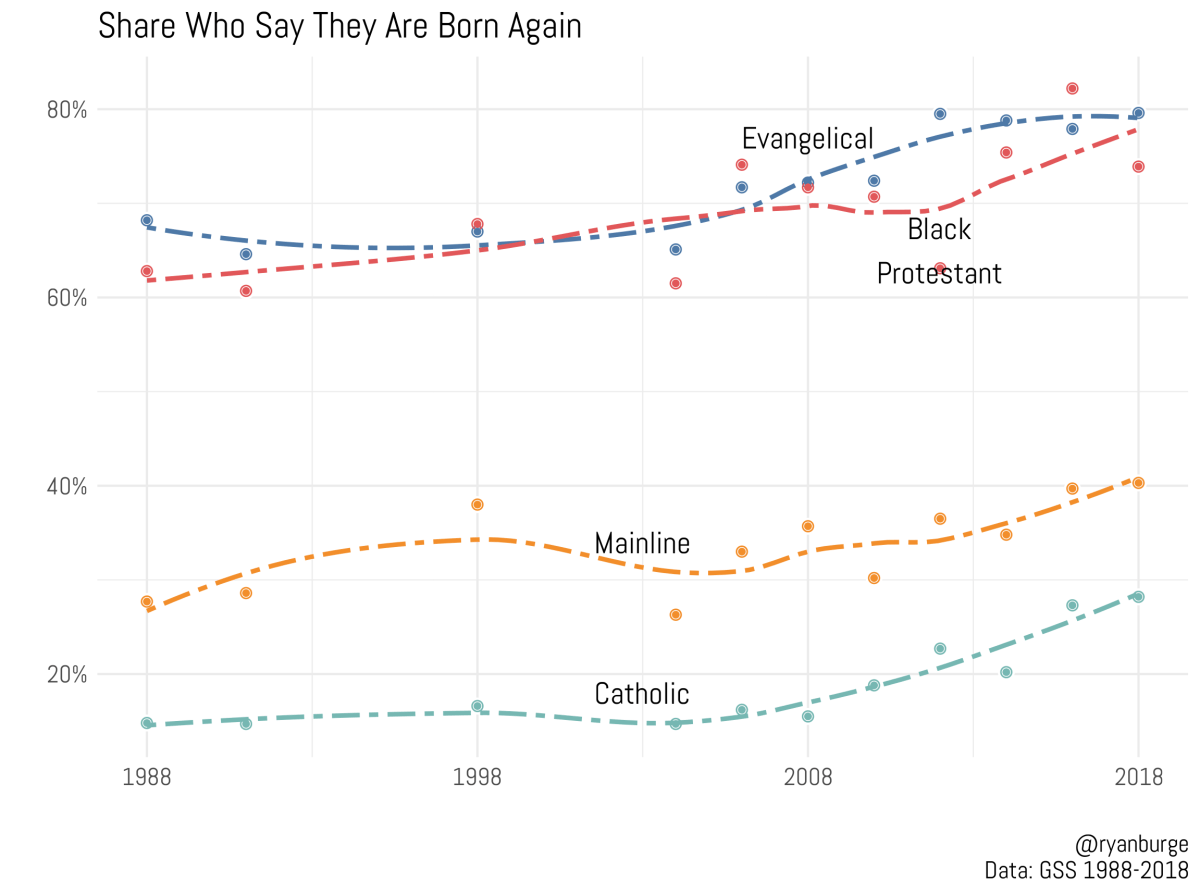
For decades, demographers have measured born-again identity. The General Social Survey (GSS), asks respondents, “Would you say you have been ‘born again’ or have had a ‘born again’ experience—that is, a turning point in your life when you committed yourself to Christ?”

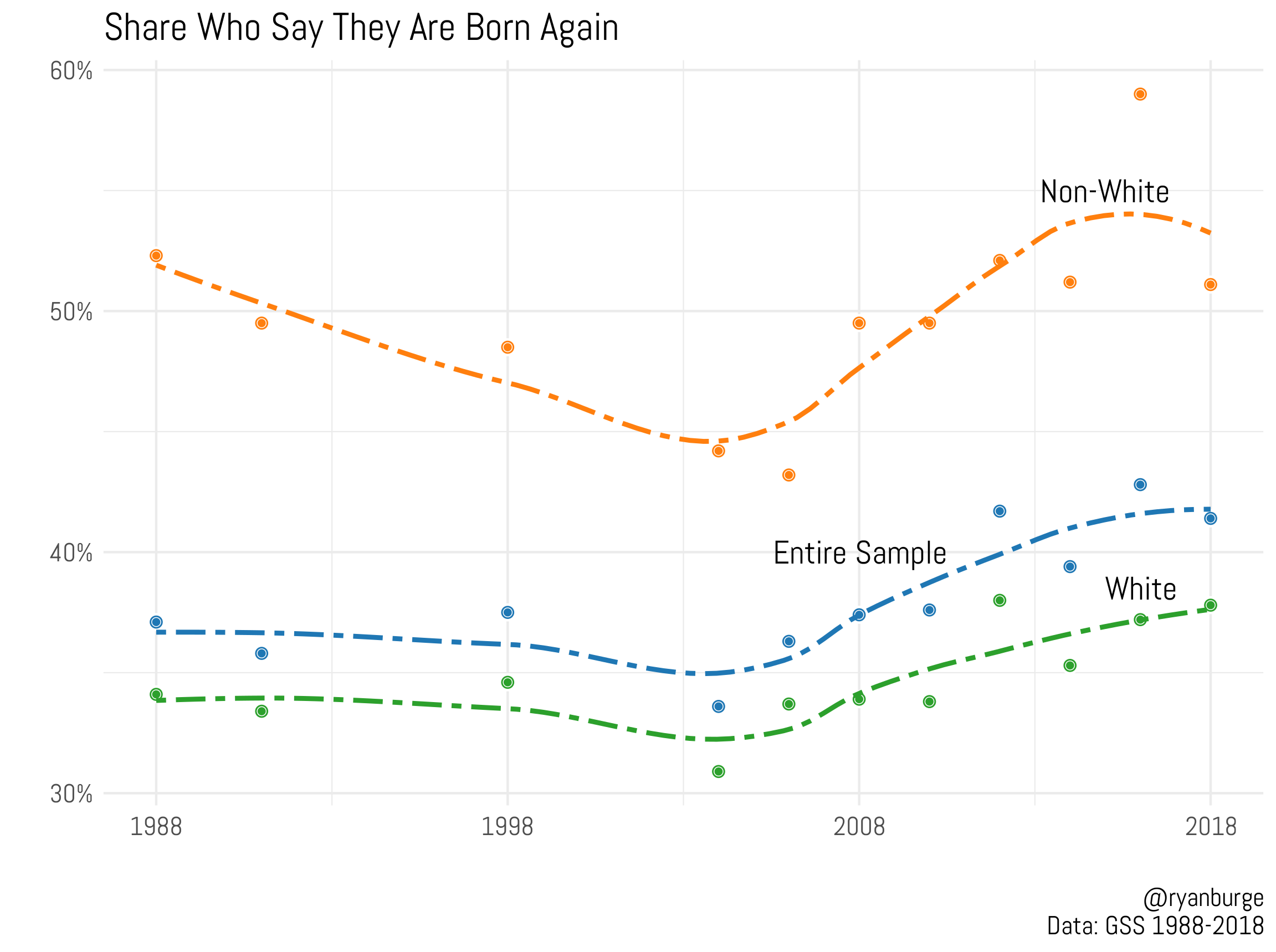
Just over 36 percent of the entire sample said that they were born again in 1988, the first year the question was asked. The question appeared sporadically on the GSS until 2004, when it became a part of every bi-annual survey as the number of affirmative responses began to rise. In the last 14 years, the share of born-again Americans has risen to 41 percent, and much higher (54%) among people of color. Since 2010, at least half of people of color say that they have had a “turning point in their life” when they committed themselves to Christ.

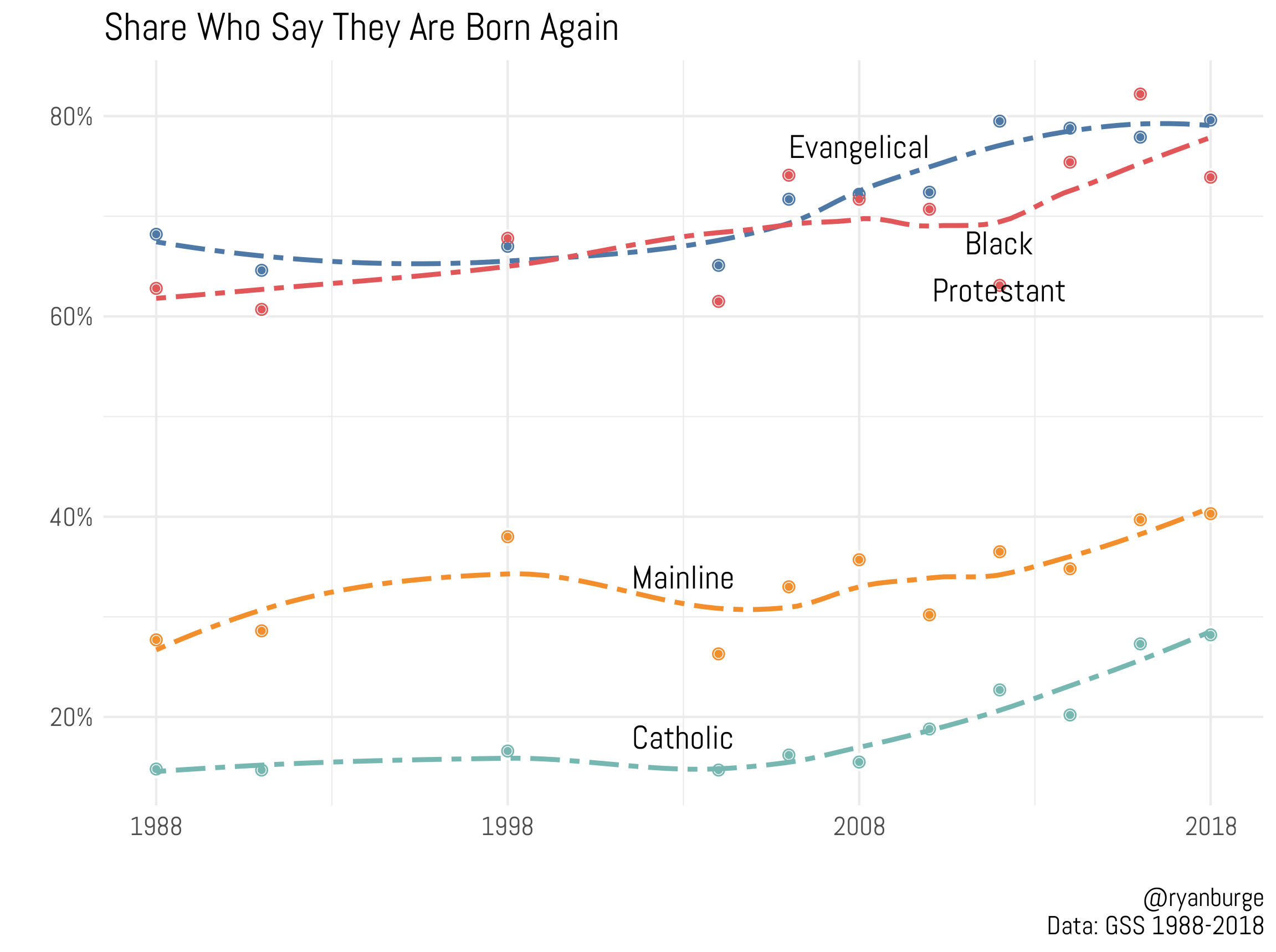
Some might assume the continued rise of born-again Christians reflects the steady portion of evangelical Protestants in America, while mainline Protestants, who are less likely to call themselves born again, have undergone more rapid decline. But actually, across all Christian traditions—even mainline denominations and Catholics—born-again identity is trending up.
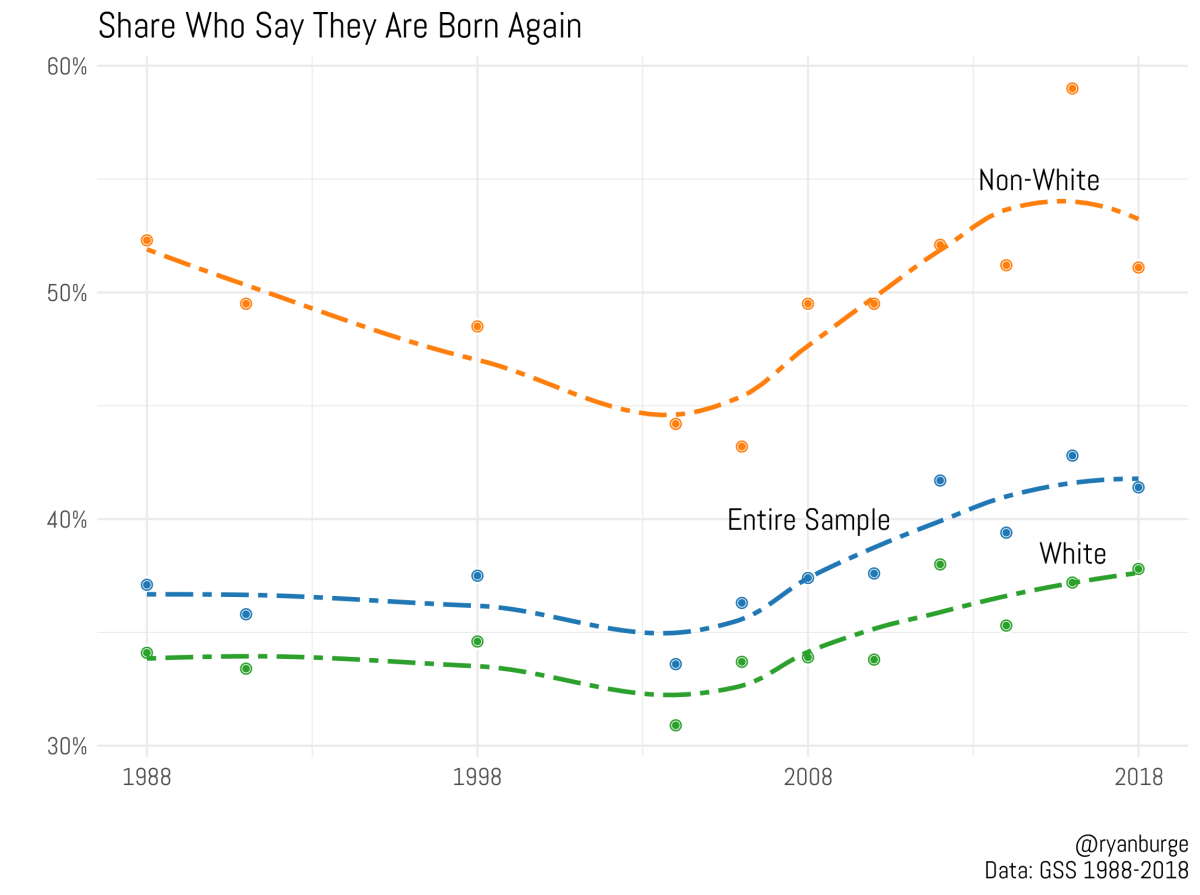
Large shares of black Protestants and evangelicals have consistently considered themselves born again, and they’ve grown even more likely to do so over the past 30 years. While just three in five of black Protestants were born again in 1988 (60%), now it’s 80 percent. The increase for evangelicals was 68 percent to 78 percent during the same time period.

The surprise comes with mainline Protestants, who have gone from 28 percent identifying as born again to 40 percent. And the portion of born-again Catholics has doubled (from 14% to 28%). Those increases are especially striking because neither tradition teaches that a born-again conversion is a necessary component of their faith.

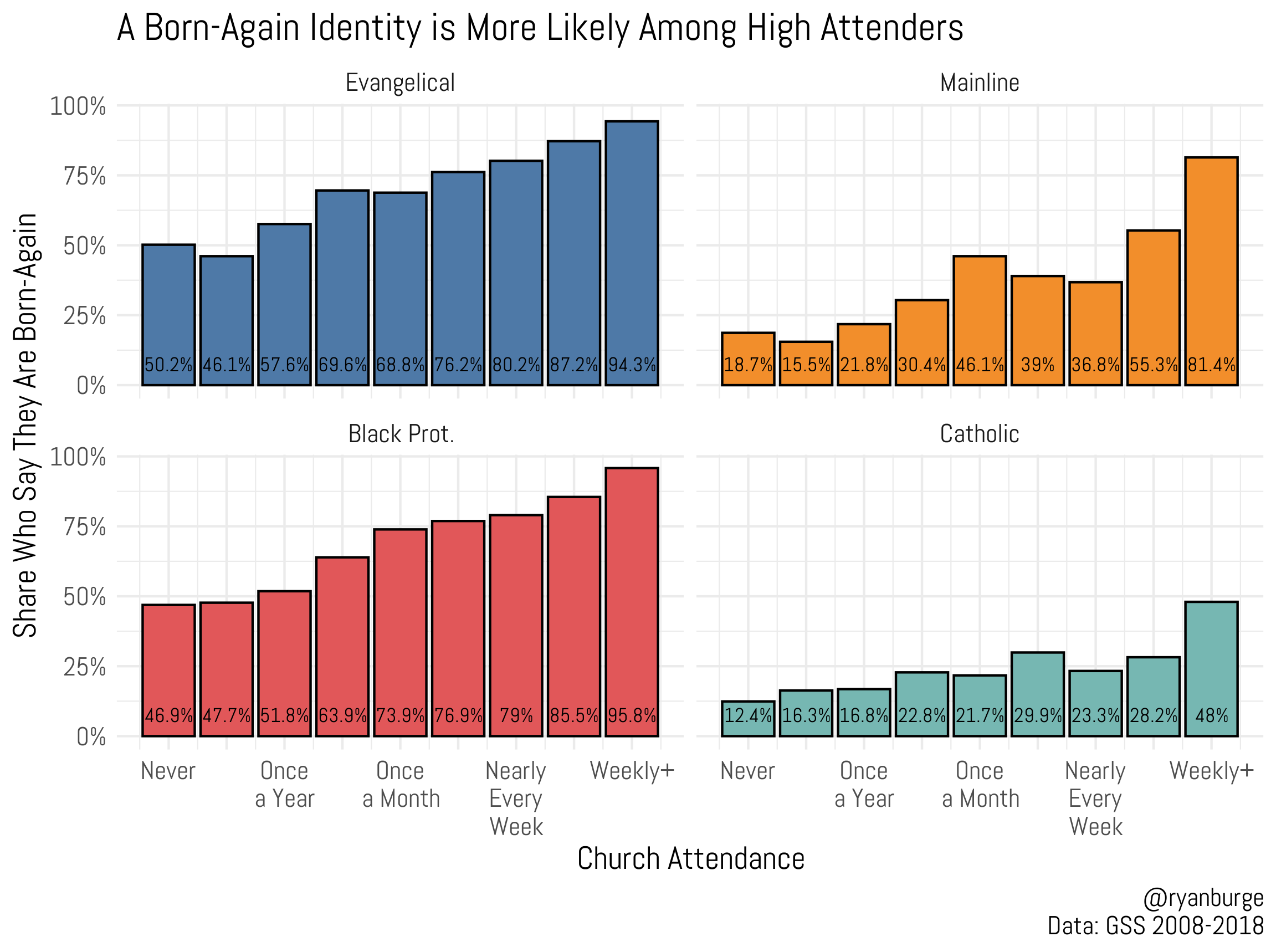
Over the years, being born again may have evolved from being seen as a distinctive for evangelical Protestantism to a way to suggest that they are particularly active in their faith. Across Christian traditions, the more often a person attends church, the more likely they are to say they have had a born-again experience, regardless of their affiliation.

For both evangelicals and black Protestants (on the left of the chart), about half who never or rarely attend indicate that they are born again, but that rises quickly with more frequent church attendance. Approximately 95 percent of evangelicals and black Protestants who attend church multiple times a week say they are born again.
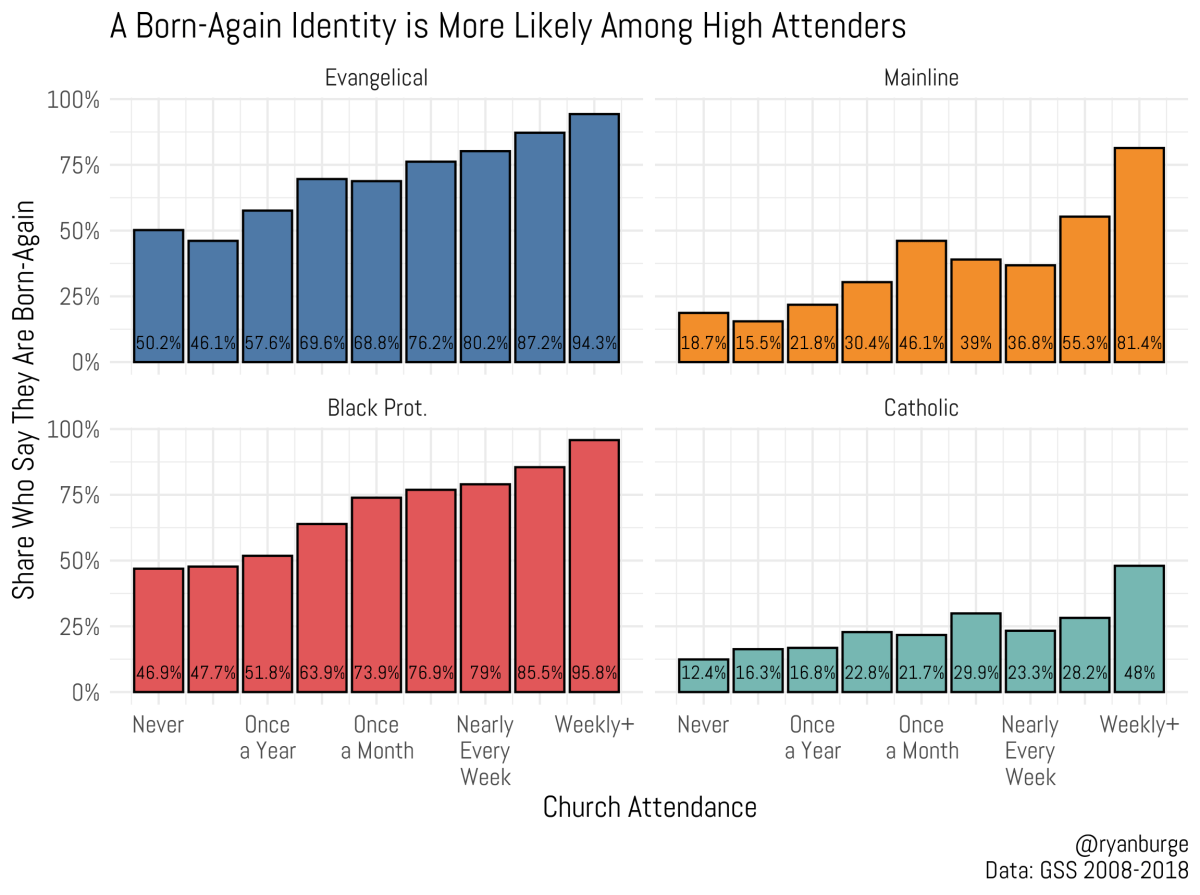
While the total share of mainline Protestants and Catholics who say that they are born again is lower across the spectrum, high attenders are far more likely to express a born-again conversion. Over half of mainline Protestants who attend once a week say that they are born-again, and the data jumps to 81.4 percent among the most active mainliners. Among Catholics, born-again identification is relatively low at almost all attendance levels save for one—nearly half of all Catholics who attend Mass more than once a week say they have had a born-again experience (48%).

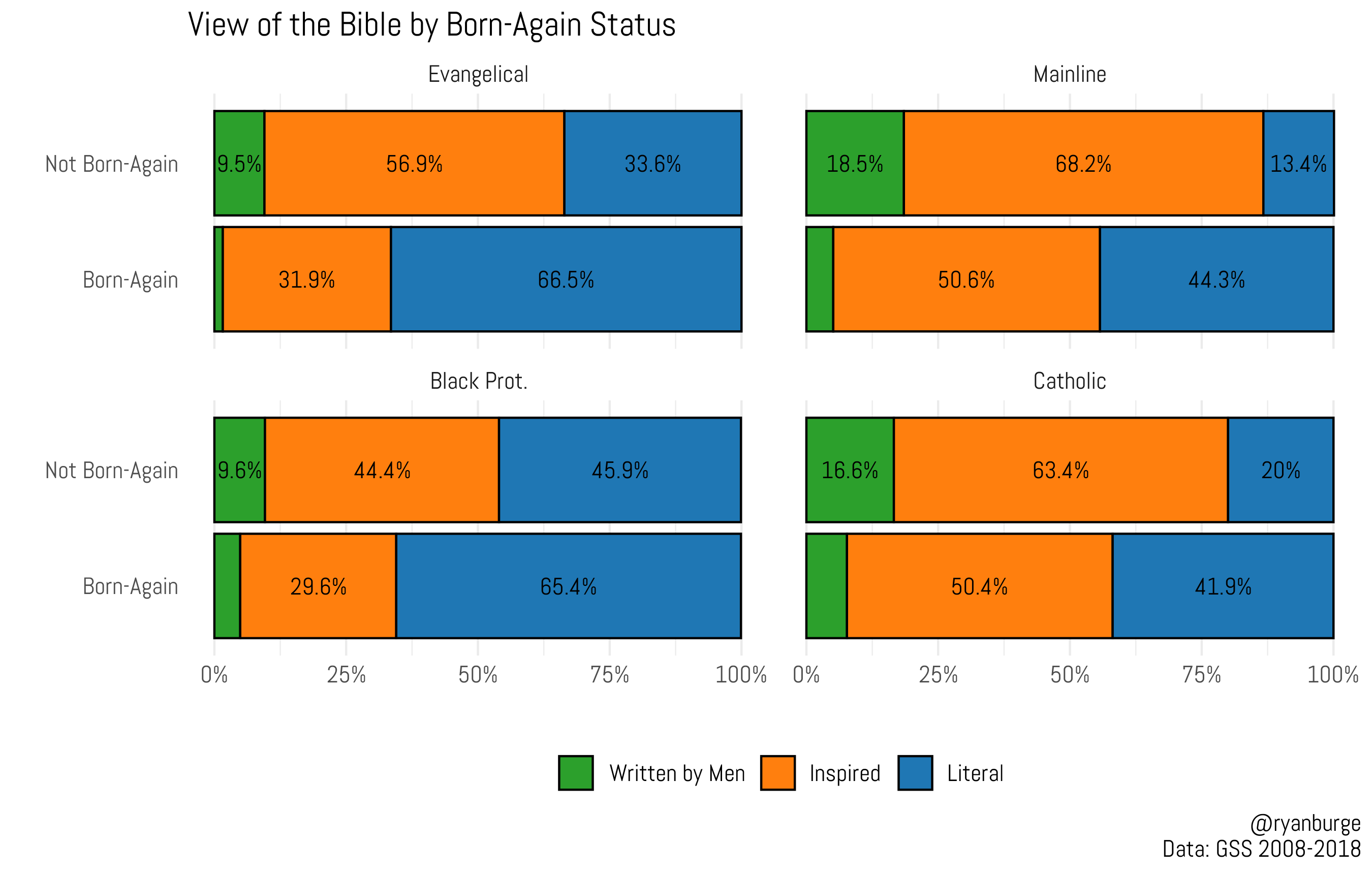
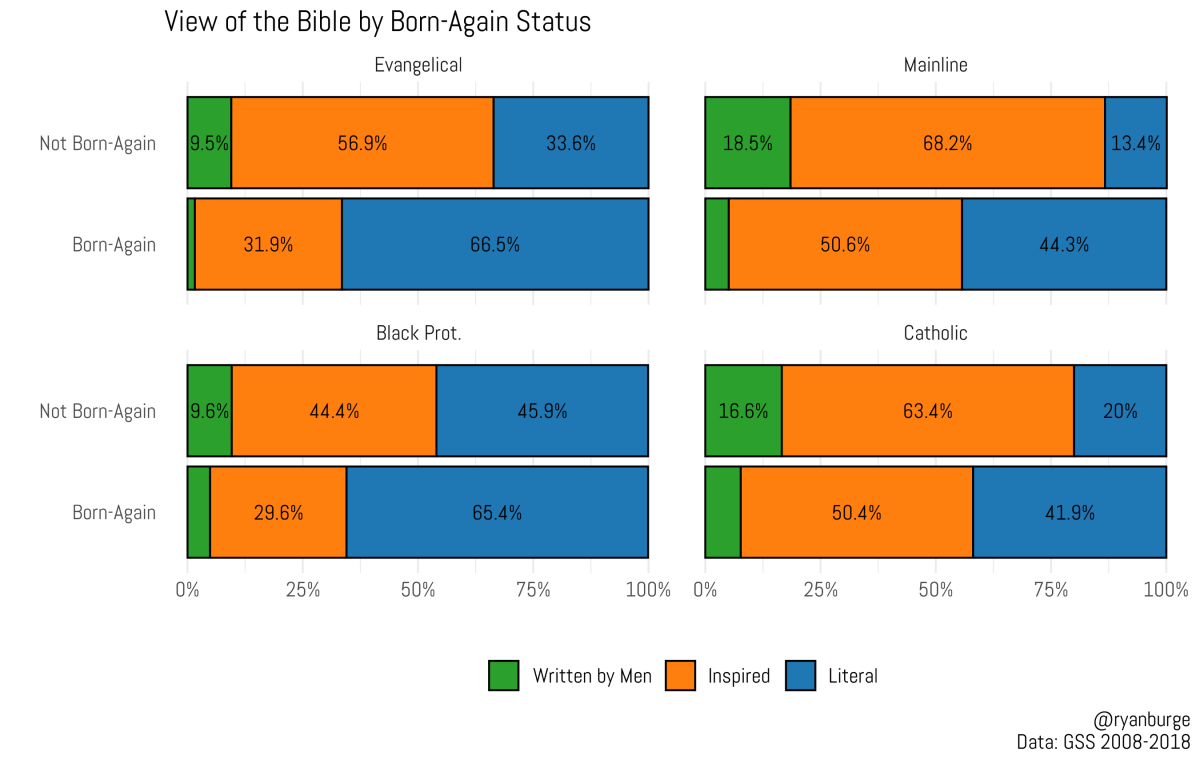
Are born-again mainline Protestants and Catholics more likely to resemble their born-again brothers and sisters in evangelical and black churches when it comes to theological beliefs? Data shows they are much more likely to believe that the Bible is literally true. But there is still a clear divide between the more conservative traditions (black and evangelical Protestants) and the more moderate ones (mainline Protestants and Catholics).

While two thirds of the born-again black and evangelical Protestants believe that the Bible is literally true, the share of born-again Catholics and mainline Protestants who view the Bible the same way falls at under half—41.9 and 44.3 percent respectively. A Catholic who is born-again is twice as likely to believe in a literal Bible than one who does not indicate a born-again experience. For mainline Protestants, the difference is even larger, with a born-again mainline Protestant being three times more likely to believe in a literal Bible.

It would appear that the term “born again” has evolved somewhat among the American public. What used to be seen as a touchstone experience for many evangelicals who went forward at a revival, youth camp, or especially moving Sunday worship service, now seems to mean something more. In essence, the word seems to have been adopted by people of other faith traditions as a way to indicate that they are a devout believer. The data suggests that individuals take the term to mean that faith plays an important role in their life and their religious activity serves more than a social purpose.

Even some Mormons use the born-again label (but the sample size is too small to analyze using GSS data). A couple years ago, the Church of Jesus Christ of Latter-day Saints ran an ad campaign that implied that their belief system was similar to evangelical Christianity. It was met with a harsh rebuke from Albert Mohler.

It will be interesting to see how frequently evangelical leaders will follow Mohler’s lead and engage in boundary maintenance surrounding their faith tradition in the coming years. For years, the born-again experience has showed up in evangelical statements of faith and definitions like the Bebbington quadrilateral. As more Christians begin to identify as born again, evangelicals who once held this distinctive will have to either form more narrow, exclusive definitions or embrace fellow believers who share the experience.

Ryan P. Burge is an assistant professor of political science at Eastern Illinois University. His research appears on the site Religion in Public, and he tweets at @ryanburge.

Ideas

On MLK Day, Be Still and Listen

Hearing each other is a miracle. We need to practice receiving it as such.

Christianity Today January 20, 2020
Associated Press

Years ago I sat alongside a dozen pastors in a sun-baked, mud-caked church in rural northern Mozambique. They’d gathered to test a recent translation of Isaiah in Lomwe, their local dialect. The Isaiah passage was familiar to me, but not the language. Still, as we went around the circle—each pastor reading aloud to hear how the new translation sounded—I picked up enough to pronounce some words. When it came my turn to read, rather than pass, I plunged in and read a few verses myself. The Lomwe pastors heard me speaking their language even though I didn’t fully know what I was saying. They beamed with delight. A white American minister had traveled all the way to their village to understand them without insisting they first understand him.

I can’t help but connect this experience to the first Christian Pentecost. In the wake of Jesus’ ascending to heaven and the Holy Spirit’s descent, Acts 2 reports new-and-improved Aramaic-speaking apostles speaking the gospel in the wide array of languages to the peoples gathered in Jerusalem (2:4). The crowds heard their own native tongues being spoken even though the apostles didn’t know the dialects (2:6). This is why we refer to Pentecost as a miracle of speech. But what if it was just as much a miracle of hearing?

I counted on such miracles most Sundays in my many years as a preacher. After a sermon, a listener would thank me for saying “just what I needed to hear.” When I asked what it was that I said, the person would relay the words they heard—words I knew I never spoke (being the manuscripted preacher I am). This was the Holy Spirit’s doing, I believe, making my words work in ways I hadn’t dreamed they would.

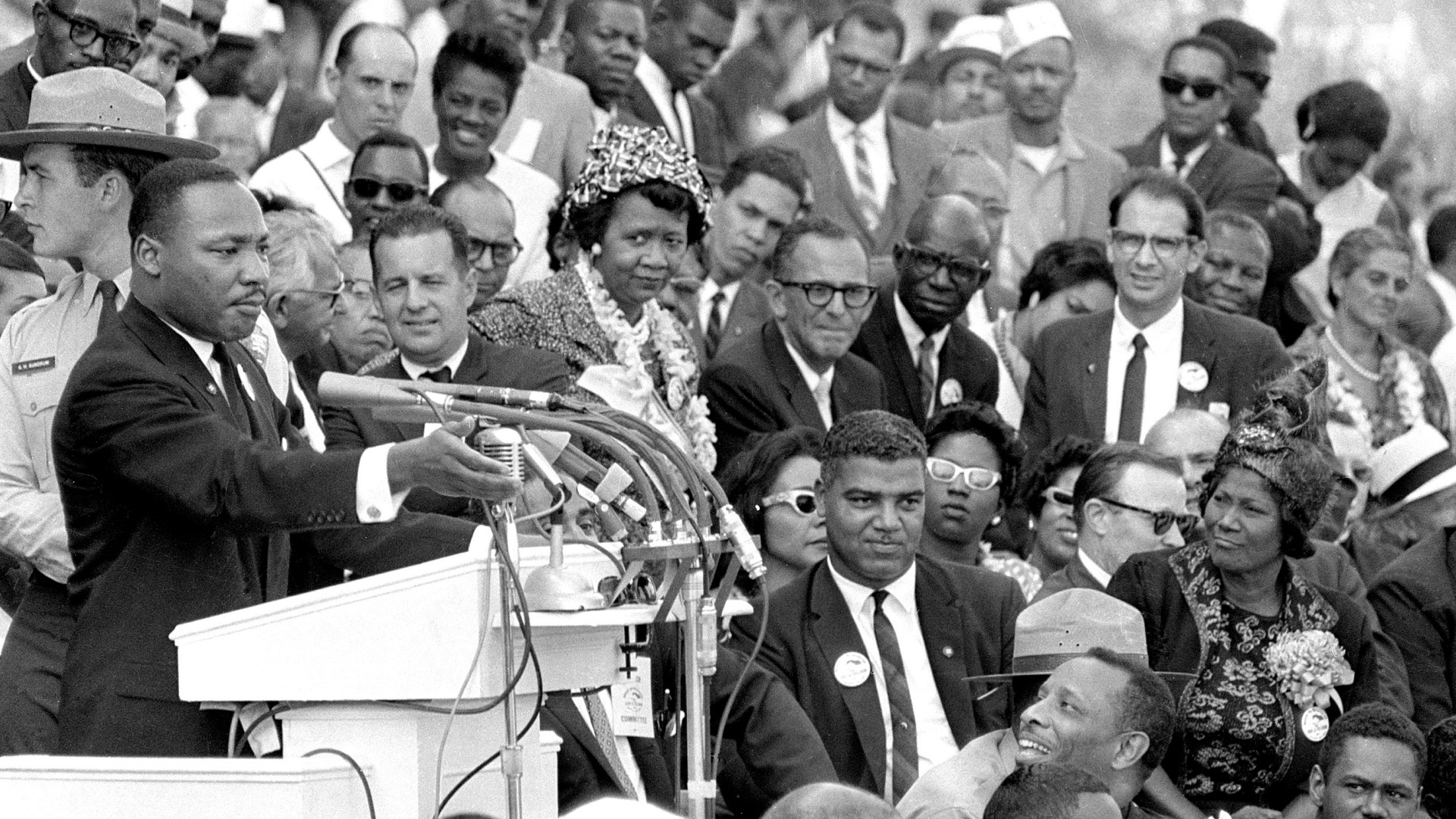
On this day devoted to dreams, specifically Martin Luther King Jr.’s dream of a country no longer divided by race, we need more hearing miracles. It is hard to listen when everything worth anything quickly becomes polarized. Ideas to be discussed give way to identities to be defended. There’s so much anger. Cable news and social media, late night talk shows and websites, arguments around family tables over the holidays, broken friendships and marriages, all of it fueled by fury bordering on the righteous.

Anger can be righteous. Anger concentrates passion, gets attention and conveys information fiercely and faster than any other emotion. We have it on record that Jesus got mad—at hypocritical Pharisees, at temple moneychangers, and at a fruitless fig tree. Old Testament prophets from Moses to Malachi let loose against the Israelites constantly. The psalmists shook an angry fist at God. There’s plenty of injustice and wrong in our world to get mad about. I get angry. So do you. A lot of you will get angry at me. Anger forces us to attend when we’d prefer to avoid. But for anger to achieve any righteous purpose, it has to eventually cease. The Spirit gives ears to hear, but at some point we must shut up and listen.

The arc of the gospel bends toward reconciliation. This is its beauty. We disagree and debate, but we do not divide. The love of God compels us toward oneness in Christ. The miracle of hearing makes room for mercy.

If you know anything about biblical Hebrew, you know it doesn’t contain vowels. You have to hear it spoken to know what it means. A group of rabbis later added dashes and dots to help readers distinguish one consonant word from another. Shift a few dots and the Hebrew word mercy is the word womb, a deliberate connection to connote how mercy links to the ferocious devotion mothers feel for their children, along with the pain such devotion entails. Scripture often compares the passion and pains of childbirth to God’s own love and mercy. (On the other hand, if you rearrange the dots another way, the word mercy becomes the word vulture, proving once again how easy it is for human passions to pervert.)

As Christians, we hang crosses on our walls and around our necks to remind ourselves how mercy is nonnegotiable. Jesus died on a cross for our sins and we didn’t deserve it. Theology labels the cross the passion of Jesus, a righteous anger that’s righteous because it bends toward the reconciliation of all things, a fierce power that taps into long-suffering, motherlike mercy for the cause of new birth.

It takes practice to live under the Cross. On Sundays in many churches, Christians greet one another by “passing the peace” during worship—every introvert’s nightmare. It’s a practice that reaches back centuries because peace and reconciliation take practice. The idea is that if you show up at church mad at your neighbor, you get to leave in peace. Do it enough and you become peacemakers, whom Jesus blesses and calls children of God.

It’s not enough to go through the motions, however. Jesus says it has to come from your heart (Matt. 18:35). Anne Lamott compared faking grace to drinking rat poison and then waiting for the rat to die. Martin Luther King Jr. called it “adding deeper darkness to a night already devoid of stars.”

My wife, Dawn, and I didn’t agree about everything. Most married people don’t. We got angry and argued and fought, but at the same time stayed committed to trying to listen and understand and make up. We always did this in front of our daughter because she needs to realize it’s okay to get angry as long as the energy finds resolution. The same is true for Christians whenever we find ourselves in conflict, whether with our neighbors or enemies. In Christ, we cross whatever divides even if it kills us to do it—which is sometimes what it takes.

As a minister, I would read and experience firsthand what my hometown newspaper labeled “the unchurching of America.” I get it. Who wants to hear you’re not always awesome, but instead a sinner who still needs salvation and who needs to forgive and make peace and not let the sun go down on your anger? Who wants to hear how God loves you and shows you mercy so you can go and do likewise? We’re taught as Christians to know nothing more important than Jesus Christ and him crucified on a cross for our sake (1 Cor. 2:2). But it takes a miracle to hear this. Grace is offensive. To forgive is an outrage. Reconciliation feels like a death sentence and a sure admission of weakness. Mercy hurts like a mother. And yet, “blessed … are those who hear the word of God and obey it” (Luke 11:28).

Daniel Harrell is editor in chief of Christianity Today.

Apple PodcastsDown ArrowDown ArrowDown Arrowarrow_left_altLeft ArrowLeft ArrowRight ArrowRight ArrowRight Arrowarrow_up_altUp ArrowUp ArrowAvailable at Amazoncaret-downCloseCloseEmailEmailExpandExpandExternalExternalFacebookfacebook-squareGiftGiftGooglegoogleGoogle KeephamburgerInstagraminstagram-squareLinkLinklinkedin-squareListenListenListenChristianity TodayCT Creative Studio Logologo_orgMegaphoneMenuMenupausePinterestPlayPlayPocketPodcastRSSRSSSaveSaveSaveSearchSearchsearchSpotifyStitcherTelegramTable of ContentsTable of Contentstwitter-squareWhatsAppXYouTubeYouTube