News

Died: Jack Van Impe, Televangelist Who Saw Signs of End Times

Every week for more than 30 years, he interpreted headlines in light of prophecy.

Christianity Today January 19, 2020
Jack Van Impe Ministries

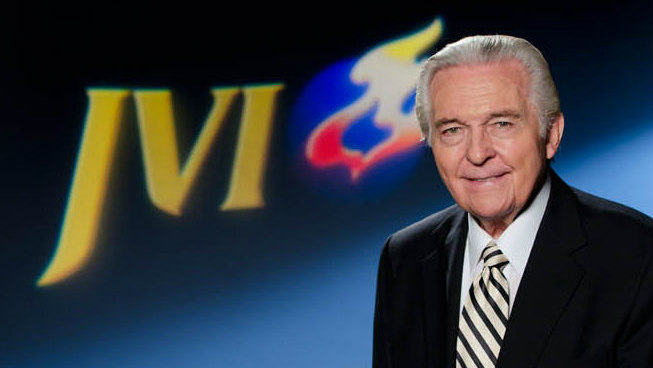
Jack Van Impe, a popular televangelist and one of the world’s most well-known end times preachers, died at the age of 88. His passing was confirmed Saturday by Jack Van Impe Ministries International.

Every week for more than 30 years, Van Impe appeared on TV as the host of his own half-hour show, Van Impe Presents, offering eschatological commentary on current events. Alongside his wife Rexella, Van Impe read the latest headlines and explained how they connected to prophecy about the Antichrist, one-world government, and the rapture of true believers that might happen at any moment.

“We only report the news from the latest papers and magazines,” Van Impe once said, “but we use the Word of God to show you that it means Christ is coming.”

Van Impe reached a global audience from his studio in the suburbs of Detroit. He had memorized tens of thousands of Bible verses, earning himself the nickname “the Walking Bible.” He would recall Scripture on his show as he explained his apocalyptic theology, before ending each episode with a call for viewers to prepare for the end by accepting Christ as their Lord and Savior.

“Few reached a larger audience than evangelist Jack Van Impe,” historian Paul Boyer wrote in his landmark study of prophecy belief in modern America. “Bible quotations studded Van Impe’s apocalyptic predictions, including not only the familiar ones from Revelation, Zechariah, and 2 Peter … but also more obscure selections from Joel, Zephaniah, Malachi, and … Ezekiel.”

Beerhalls to Churches

Van Impe was born in Freeport, Michigan in 1931, the son of two Belgian immigrants. Jack’s father Oscar worked in a Plymouth auto factory by day and as a musician in the Detroit beerhalls by night. Oscar taught young Jack to play the accordion—sometimes, as Jack would later recall in his conversion testimony, with violent and drunken beatings.

Oscar and Marie Louise Van Impe had a conversion experience at an independent Baptist church that embraced the label fundamentalist in 1943. A week later, 12-year-old Jack walked to the front of the church to profess his own faith. The Van Impes stopped going to beerhalls and started performing gospel music in area churches. The young Van Impe soon felt a call to ministry.

He was ordained in an independent Baptist church in 1951, after graduating from Detroit Bible College, and joined Youth For Christ as a musician around the same time as the late Billy Graham. Franklin Graham tweeted his condolences, saying Van Impe’s “life demonstrated the importance of ‘laying up these words of Mine in your heart and in your soul’ (Deuteronomy. 11:18). May we all be inspired to do the same.”

Van Impe married Rexella Shelton, a musically gifted and evangelistically minded Baptist who had spent one year at Bob Jones University, in 1952. The couple set off on their own in 1970, founding Jack Van Impe Crusades Inc. They travelled the country together, performing music and preaching in 130 cities in 10 years.

From the start, Van Impe had an apocalyptic message. Popular early sermons included “The Coming War with Russia” and “Shocking Signs of the End of the Age.” Van Impe also preached about current events, warning people of the dangers of communism, homosexuality, abortion, and errant ministers. The last became a specialty. Van Impe frequently attacked other Christian ministers in his crusades—in general and by name.

“Night after night,” he later recalled, “I did my best preaching if I could be attacking individual names.”

In keeping with their fundamentalist commitments, the Van Impe Crusades initially refused to cooperate with any churches that weren’t also independent Baptist. Then Van Impe decided to exclude Baptist churches he believed had strayed from the fundamentals of the faith. Finally, he excluded fundamentalists who associated with non-fundamentalists.

Break from Super-Separatism

The ministry expanded into radio in the late 1970s, and then television in 1980. After some backlash for criticizing other Christians on TV, though, Van Impe apologized for what he called his “super-separatist” mentality. “I could no longer be a biased, hate-filled, prejudiced man,” Van Impe told a Sunday school convention in Detroit in 1982. “I’m going to love all God’s people even if they have a different denominational tag.”

The television ministry ran into financial trouble and closed in 1984, but relaunched on Trinity Broadcasting Network (TBN) in ’88. The format of the new show was simple. Rexella Van Impe would perform a piece of music, chat with her husband, and then Jack Van Impe would bring up contemporary headlines and explain their prophetic significance. It was a formula they would repeat for the rest of their career.

By the mid-1990s, Jack Van Impe Presents aired weekly in about 25,000 cities in the US and Canada, and in more than 150 other nations around the globe. Viewers were delighted by the relevance of Van Impe’s message and his detailed application of seemingly complicated Scripture. Once, for example, he calculated how much of the earth might be destroyed by nuclear war in fulfillment of Revelation 8:7. His conclusion: exactly 18,963,194 square miles.

In the 1990s, Van Impe said he expected Christ to return between 2001 and 2012. He warned Christians to be on the lookout for the Antichrist and moves to establish a “New World Order,” or one-world government. The phrase “New World Order” was popular with far-right conspiracy theorists, including many in the militia movement. Van Impe was unfazed by the association.

“The Bible teaches that when the Antichrist comes to power, they will form a world government,” he said. “Why am I now out on a limb?”

Van Impe did balk, however, at being called a “doomsday preacher.” Christians could look forward to the rapture, he said, and Christ’s 1,000-year reign on earth before the final conflict at Armageddon. He insisted this was a message of hope.

“Rexella and I are not doomsday people,” he told the Detroit News. “We believe the greatest time is coming.”

Current events, however, looked very dark to Van Impe, and got darker in the 21st century. He increasingly worried about Islam after the terrorist attacks of 2001 and entertained numerous conspiracy theories about President Barack Obama, repeating false claims that Obama was a Muslim and part of a Muslim plot to infiltrate the US.

Conflict with TBN

Van Impe’s concerns led him into conflict with TBN in 2011. He started attacking other Christian ministers for not taking a strong enough stand against Islam—and again attacking them by name. Van Impe said megachurch pastors Rick Warren and Robert Schuller, both of whom had spoken to Muslim groups, were secretly promoting a merger of Christianity and Islam, or Chrislam.

TBN refused to air the episode and Van Impe separated from the network. The Van Impes continued the show on their own, broadcasting Jack Van Impe Presents on TV and the internet. On January 10, the most recent episode available on the ministry website, Rexella Van Impe read headlines about the heightening conflict between the US and Iran.

“You know friends, there’s so much to consider out there,” she said to the camera. “And I am grateful that we have a president who says we are not going to be number two, we are going to stand up to what’s happening.”

Then she turned it over to her husband, asking him if there was going to be a war.

“The Bible says in Ezekiel 38, 39, Gog, Magog, Mesheck, Tubal, and Rosh are going to lead the battle,” Van Impe said. “Who are they? Well Gog is the leader, Mesheck and Tubal is Moscow and Tobolsk, after being interpreted. And all the Orient, Revelation says, is going with them. China, North Korea, all of them … It’s going to be the bloodiest war in the world. The blood will flow to the bridles of the horses for 200 miles.”

Van Impe died eight days after the episode aired, concluding a 68-year career in ministry. Jack Van Impe Ministries has not named the cause of death. Funeral arrangements are being made.
As CT Reported: Martin Luther King Jr.’s Life and Death

Highlights from our archives.

Christianity Today January 18, 2020
Hulton Archive / Stringer / Getty Images

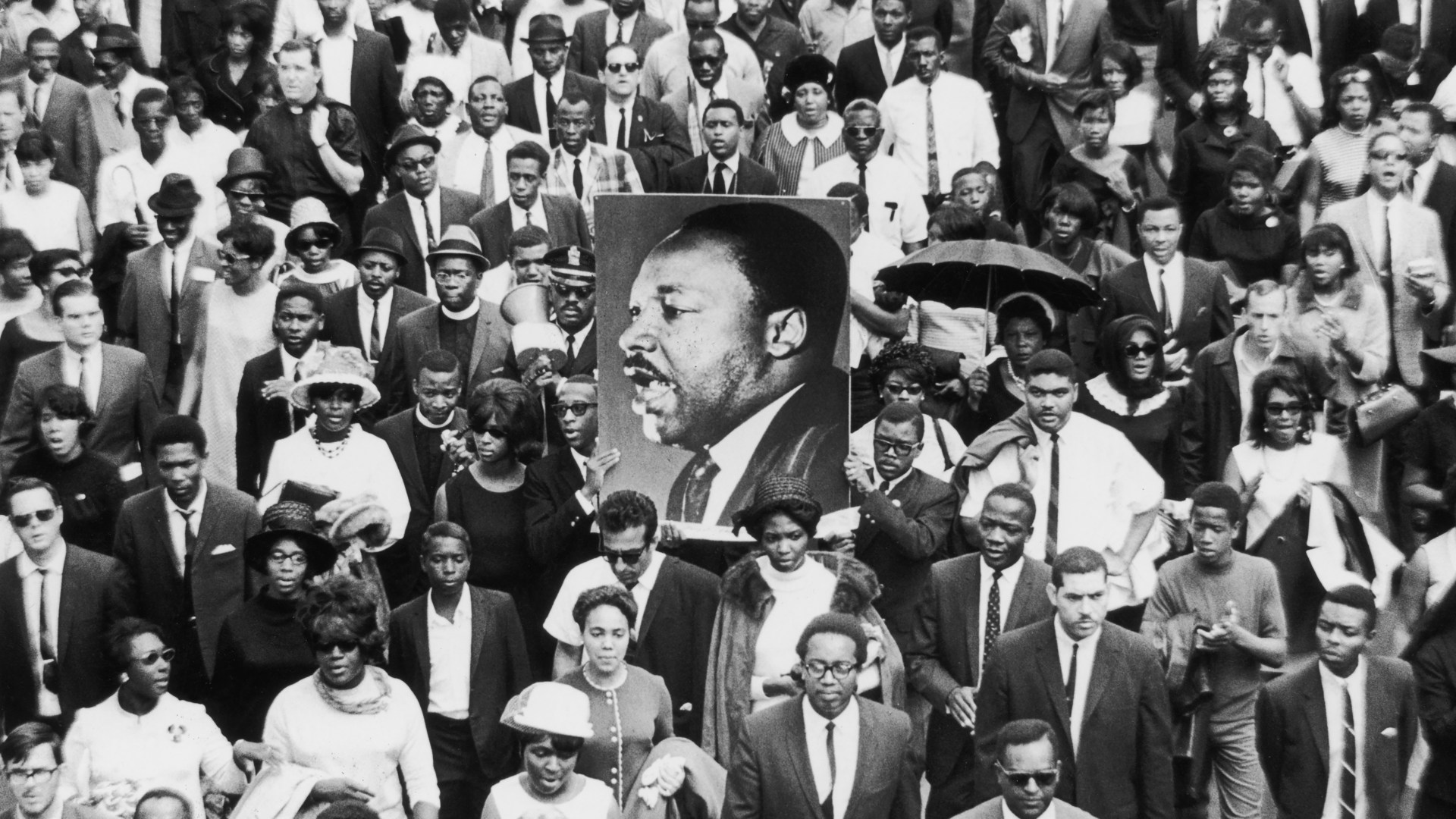
Christianity Today published its first issue in October 1956 and first mentioned Martin Luther King Jr. 14 months later in December 1957. Here’s how the magazine covered the minister and civil rights leader during his lifetime.
Christianity Today first mentioned Martin Luther King Jr. 14 in its coverage of the Triennial General Assembly of the National Council of Churches of Christ.
After a student was expelled from Vanderbilt University Divinity School for organizing a sit-in, Martin Luther King, Jr. said he was especially “disappointed” at the university’s action because it came from “a Christian institution.”

Christianity Today assigned four of us to cover the massive civil rights demonstration in Washington on August 28. Our job was to analyze the religious element of the march. An abundant sprinkling of piety was promised, and organized religion seemed eager to assume a major role in the day’s activities. But did the religious element have a genuine spiritual under-girding, or was it a mere form of godliness with the power thereof implicitly denied?”

In the midst of tension between the FBI and MLK, this editorial concluded, “No stable solution can be found to the vexing social problems of our age apart from a sustained dedication to the whole range of spiritual priorities—truth, righteousness, and love included.”

A look at the Christian leaders who joined in the Selma to Montgomery march

In “Flood Tide In Selma” (scroll down), this editorial opined, “The use of tear gas against unarmed men and women, the attack upon them with clubs, whips, and ropes, the scores of casualties seem like an episode out of Nazi Germany rather than news from an American city.”

In his write-up of the Selma to Montgomery march, the reporter noted, “The extent of evangelical involvement is believed to have been without precedent in the current civil rights movement. Never before have conservative Protestants identified themselves so demonstratively with the Negro struggle for liberty.”

A broad range of responses followed Christianity Today’s coverage of Selma.

Christianity Today responds to an intense April that saw “President Johnson’s withdrawal from the election campaign, his peace overture toward Hanoi, the brutal and outrageous murder of Dr. Martin Luther King, Jr., and the widespread rioting and destruction that swept scores of American cities.”

This is how Christianity Today remembered MLK after he was assassinated on April 4, 1968.

The Best of CT: Reflecting on the Legacy of Martin Luther King Jr.

Highlights from our archives.

Christianity Today January 17, 2020
Hulton Archive / Stringer / Getty Images

Here’s how different writers and leaders have wrestled with Martin Luther King Jr.’s legacy, organized from oldest to most recent.

The son of civil rights leader John Perkins, Spencer Perkins shares about the faith—and racism—that shaped his childhood.

“Today, as in King's era, we are experts at depersonalizing our ideological opponents, viewing them more as oppositional labels than neighbors whom we are commanded to love. In our contemporary clash of values, perhaps the thing we are missing most is the capacity as Christians to dream large and imagine a culture informed by kingdom values of grace, reconciliation, and justice. “

30 years after MLK’s death, Christianity Today’s March 2, 1998 issue examined what had and hadn’t changed with regards to evangelicals and race.

In this review of King Came Preaching: The Pulpit Power of Martin Luther King Jr. Richard Lischer writes, “In his mature years [MLK] wrote no sustained theological reflections on love, justice, suffering, or reconciliation. What he did do was preach sermons.”

MLK got angry. That matters, writes Ed Gilbreath.

After watching Selma in the midst of a season of high-profile police shootings, Hope Ferguson writes, “For many years, African Americans have felt that those events were part of a painful but thankfully receding history. However, recent events have made many of us feel differently. My sister put it this way: ‘We feel stripped of our illusions.’”

Austin Channing Brown writes, “The next time we are being MLK-ed, we could respond by giving context to a random quote thrown our way. We could offer a differing, lesse- known quote in response. We can extrapolate and postulate, for sure. (I’ve certainly done all the above.) But don’t hesitate to also acknowledge the real man, made of flesh and blood, who was murdered at the age of 39 because his leadership represented such a threat to the status quo.”

Marlena Graves writes, “Funny how yesterday's Christian radical can become today's Christian saint.”

“While cross-racial friendships and political alliances can create harmony on the surface, only conversations with and about the Bible can create reconciliation at the heart. They are far riskier and more challenging, but, done well, yield far more meaningful results.”

Danté Stewart writes, “Any radical discipleship that is not undergirded with revolutionary love is an illusion. Revolutionary love for the Christian finds its root and fruit in the revolutionary love of Jesus. King wrote that ‘every time I look at the cross I am reminded of the greatness of God and the redemptive power of Jesus Christ.’”

News

Soccer Champ Baptized by Christian Teammate

Liverpool FC player Roberto Firmino says his biggest title is now the love of Christ.


Christianity Today January 17, 2020
Richard Heathcote / Getty Images

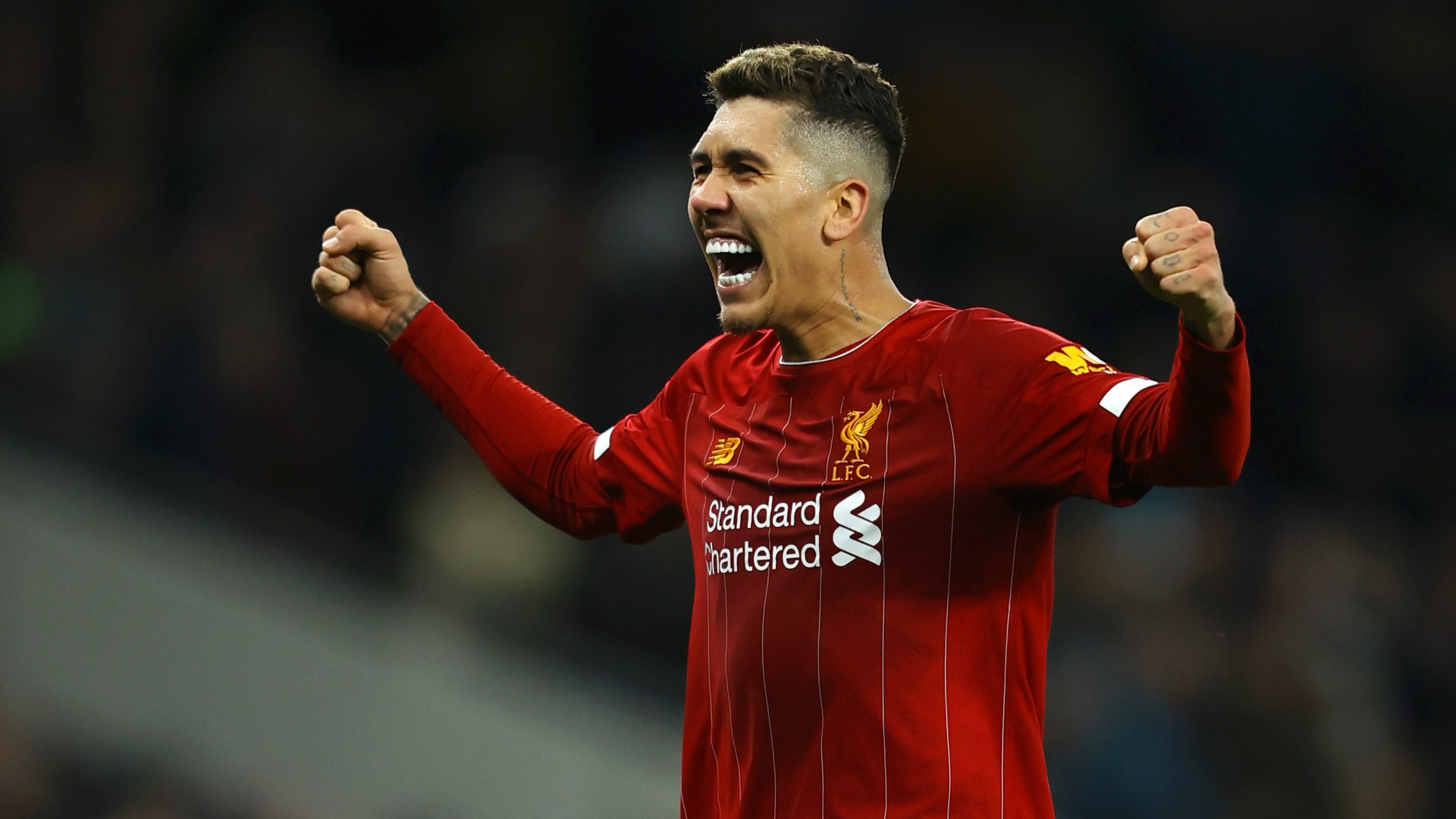
Millions of Christian fans are celebrating popular Brazilian soccer star Roberto Firmino’s latest move off the field: He has committed his life to Christ.

Less than a month after scoring the winning goal at the FIFA Club World Cup, Firmino professed his faith and was baptized in a swimming pool by his Liverpool Football Club teammate Alisson Becker and Brazilian Christian musician Isaias Saad. Firmino shared video of the baptism on his Instagram Thursday, where it was viewed more than 3.2 million times in one day.

“I give you my failures and I will give you my victories as well. My biggest title is your love, Jesus!” Firmino wrote in Portuguese.

The 28-year-old plays striker for Liverpool, England’s Premier League team that won the Union of European Football Champions League title in 2019, as well as the FIFA Club World Cup in 2019.

Becker, who is also from Brazil, was named FIFA’s best goalkeeper last year. His Christian faith is well known. He attributes his success as a goalkeeper to hard work and faith. “You need to be very focused on football,” he said, “and I think faith is important too. If you believe in God, you know you have to do your best on the pitch and put love into everything you do in life.” When he got a chance to play on the Brazilian team in the World Cup, he took to Twitter to write “Realization of a dream!!!” in Portuguese. “Glory to God!”

Becker was encouraged to talk about his faith by Liverpool manager Jürgen Klopp. Klopp, a former German player, had an experience where he decided to put his trust in God after his father’s death in 1998. He talks about his faith regularly in interviews.

“To be a believer, but not to want to talk about it, I do not know how it would work!” he explained. “If anyone asks me about my faith, I give information. Not because I claim to be any sort of missionary, but when I look at me and my life—and I take time for that every day—then I feel I am in sensationally good hands.”

Klopp and Becker spoke about their shared faith in their first meeting. When Liverpool won the Champion League title in 2019, Becker celebrated by stripping down to a white tee shirt with a handdrawn message: a cross, an equals sign, and a heart. “The cross=love.” The logo is associated with Hillsong, which has a location in Liverpool.

Firmino, Becker, and Saad all wore professional versions of the Hillsong, “cross=love” tee shirts for the baptism, as did the 40 or so friends and family who gathered around to watch.

The video is backed by a Portuguese version of Lauren Daigle’s worship song “You Say,” which says “Am I more than just the sum of every high and every low? Remind me once again just who I am because I need to know.” After immersion, Firmino is shown hugging his wife Larissa Pereira while Becker wipes tears from his eyes.

“If anyone is in Christ,” Firmino wrote, quoting 2 Corinthians 5:17, “he is a new creation.”

Pereira shared pictures on her Instagram with the caption “Wait on the Lord and trust. Wait He comes, trust He comes, and makes a miracle.” She added, “I and my family we serve the Lord.”

Firmino is only the most recent Brazilian soccer player on a British team to make a public profession of faith. Willian Borges da Silva, a midfielder for Chelsea, was baptized in the Jordan River in June. Philippe Coutinho, a former Liverpool player, was immersed in a small bathtub in October.

Brazil has seen a recent surge in conversions, with about 31 percent of the population now describing themselves as evangelicals.

News
Wire Story

More Multiracial Churches Led by Black, Hispanic Pastors

But the task of stewarding diverse congregations remains a challenge, emotionally and spiritually.

Christianity Today January 17, 2020
Daniel Gregory / Lightstock

For four hours at a megachurch outside of Dallas, pastors of color shared their personal stories of leading a multiethnic church.

One, a lead pastor of a Southern Baptist congregation in Salt Lake City, recalled the “honest conversations” he had with his 10-member leadership team before it agreed that he would present “both sides” of the controversy over quarterback Colin Kaepernick’s kneeling protests at NFL games.

A founding elder of a fledgling Cincinnati congregation expressed satisfaction with her “phenomenal church,” but said “Lift Every Voice and Sing”—a hymn often called the “black national anthem” that most African American churchgoers learn in childhood—is so rarely featured at her multiethnic church that her younger daughter learned it instead from Beyoncé’s version.

A pastor of a church in Atlanta adapted his multicultural services so that its prayers, food, and sermon illustrations included not only traditions of blacks and whites but those of a member from India, who had noted that his culture had not been acknowledged.

Those leaders, who met at Mosaix Global Network’s Multiethnic Church Conference in November, are part of a decades-long, still burgeoning movement to integrate Christian worship services, aiming to refute the oft-quoted saying by Martin Luther King Jr. that Sunday mornings are the most segregated time of the week in the United States.

In 1998, 6 percent of congregations of all faiths in the US could be described as multiracial; in 2019, according to preliminary findings, 16 percent met that definition. In that time frame, mainline Protestant multiracial congregations rose from 1 percent to 11 percent; their Catholic counterparts rose from 17 percent to 24 percent; and evangelical Protestant multiracial congregations rose from 7 percent to 23 percent.

Michael Emerson, a professor of sociology at the University of Illinois at Chicago and co-author of Divided by Faith: Evangelical Religion and the Problem of Race in America, said recent research seems to indicate that multiethnic congregations are continuing to sprout up at an “impressive” rate. “They’re growing faster than I would have thought,” said Emerson in an interview about his ongoing work with scholars at Baylor and Duke universities.

The rapid growth can sometimes obscure the fact that life in a multiracial church isn’t always easy. Mosaix co-founder Mark DeYmaz said the discussions at the conference, which now brings together more than 1,300 pastors, denominational leaders and researchers every three years, always demonstrate to him the contradictory reality of trying to unite black, white and other church traditions under one roof.

“The way you get comfortable in a healthy multiethnic church is to realize that you go, ‘Man, I’m uncomfortable here,’” he said in an interview in early January.

“We embrace the tension and that’s very different than the normative church, which is trying to make everybody comfortable,” said DeYmaz.

Mark DeYmaz at Mosaix’s Multiethnic Church ConferenceAdelle M. Banks / RNS
Mark DeYmaz at Mosaix’s Multiethnic Church Conference

A white former youth pastor, DeYmaz founded Mosaic Church, a multiethnic, nondenominational congregation in Little Rock, Arkansas, in 2001, after he grew bothered that the only people of color at the church where he had long served were janitors.

He said he determined through biblical study that “the New Testament church was multiethnic.”

In 2004, he joined with like-minded colleagues to start Mosaix Global Network, which draws an array of racially and ethnically diverse mainline, evangelical and nondenominational Protestants.

(At many Catholic parishes, diversity is a given—nearly all of the growth in the US Catholic Church in recent years has been driven by immigration into existing parishes. The question Catholic clergy and communities often face is not whether to establish a multiethnic church, but how to respond to the diverse needs of their parish.)

DeYmaz attributes the growth of multiracial churches in part to some clergy of color no longer wanting to lead homogenous congregations. Instead, they start multiethnic ones.

“More and more, people of color, they’re not going to allow themselves to be siloed,” he said.

Emerson said the preliminary results show that black clergy heading up multiracial churches have increased from 4 percent to 18 percent from 1998 to 2019. The number of Hispanics with their own church has risen from 3 percent to 7 percent in that time, with Asian Americans increasing from 3 percent to 4 percent. Whites leading multiethnic churches, meanwhile, have decreased from 87 percent to 70 percent.

Emerson said the increasing role of African American leaders is “an important trend” and agrees much of it is driven by black pastors starting churches with the goal of them being racially diverse.

Difficult for any clergy person, leading a multiracial church is especially daunting for clergy of color.

Korie Edwards, an Ohio State University associate professor of sociology, calls these pastors “estranged pioneers.” The principal investigator of the Religious Leadership and Diversity Project, Edwards collected information from 121 head clergy of Catholic, mainline Protestant, and conservative Protestant churches of all sizes through in-depth interviews by her team of nine researchers.

She has discovered that pastors of color find they are often valued neither by their home churches predominated by their own racial/ethnic group nor by whites in the multiethnic churches they now lead.

“You’re first dismissed and then you are dissed. You’re not included in white circles as peers or you’re not included in white circles as a leader; you’re not respected as a leader,” Edwards said in a workshop she led at November’s Mosaix conference. “In these interviews, people have talked about depression, they’ve talked about nervous breakdowns, they’ve talked about how difficult and how painful it is.”

Edwards cited one African American pastor of a multiethnic United Methodist church on the West Coast who said he wondered at times if a problem he faced was racism or ignorance. An Asian American pastor who planted a multiracial Southern Baptist church in the Northeast described his trepidation about discussing the killing of Michael Brown, an unarmed young black man, by a white police officer in Ferguson, Missouri.

A recent Faith, Race & Politics conference convened by Johns Hopkins University’s SNF Agora Institute gathered faith, community and thought leaders in Cincinnati to learn from the experience of a local multisite megachurch that is about 82 percent white. Chuck Mingo, the black pastor of one of Crossroads’ 13 campuses, said Edwards describes “people like me.”

“It would be nice to have some weekends where I could just fully express my feeling about what’s going on in the world without having to put it through 80 different filters of how I might communicate that in a way that doesn’t unnecessarily alienate people,” Mingo said, sitting next to Crossroads’ white senior pastor, Brian Tome.

Though Mingo said he sometime senses a lack of trust from some blacks he meets outside Cincinnati who learn of his role, he added that he takes comfort in knowing other “estranged pioneers.”

Edwards, in an interview, said that being part of a multiracial church does not automatically presume an openness to discussions of race, and racist assumptions about sharing power can be and often are still in effect.

“You can have diversity and still have white supremacy,” said Edwards, author of The Elusive Dream: The Power of Race in Interracial Churches. “It’s very hard emotionally and spiritually and so we have to be very honest about what it’s doing to people’s souls, being in environments that say one thing and in reality living out another.”

Leaders and observers of multiracial churches say the congregations go through stages. In tense times, some will have members walk out while others lean in. Disagreements can sprout up about race, politics, or music. Some congregations can’t bridge these divides and close.

But others survive and grow, said Corey J. Hodges, the Salt Lake City pastor who talked at Mosaix about grappling with how to address national racial tensions with his congregation. He said he’s grateful for the variety of perspectives that homogenous congregations never hear.

Though his church life has been “stressful,” he said in an interview, “I’m OK with that because that pain is a part of the growth.”

For others, national discussions about race present opportunities. A former defensive back for the Indianapolis Colts and Carolina Panthers football teams, Derwin Gray now leads Transformation Church in Indian Land, South Carolina, which he said is about 58 percent white and 35 percent African American.

His sermon on the Kaepernick kneeling controversy focused on his own “hurt” that some Christians didn’t think players should kneel at the national anthem. The gesture was an attempt at “protesting injustice so America could live up to her ideal.” Such a sermon about the need to care about others’ concerns “isn’t unusual” at his nondenominational church, said Gray, who is black.

“My point was that as brothers and sisters in Christ, we are to, as Philippians 2:4 says, consider others better than ourselves. So what hurts you should hurt me and what hurts me should hurt you.”

Mosaix conference in November 2019 in Keller, TexasAdelle M. Banks / RNS
Mosaix conference in November 2019 in Keller, Texas

Matthew J. Cressler contributed to this report.

News
Wire Story

Trump Pledges to Protect ‘Right to Pray’ in Public Schools

Updated guidance reaffirms First Amendment protections and provides new pathways for complaints.

Teachers Who Pray founder Marilyn Rhames (far left) joins Secretary of Education Betsy DeVos, President Trump, and fellow school prayer advocates in the White House Thursday.

Teachers Who Pray founder Marilyn Rhames (far left) joins Secretary of Education Betsy DeVos, President Trump, and fellow school prayer advocates in the White House Thursday.

Christianity Today January 16, 2020
Yuri Gripas / Abaca / Sipa USA via AP Images

Days after promising to “safeguard students’ and teachers’ First Amendment rights to pray in our schools” in an evangelical campaign rally, President Donald Trump backed school prayer and proposed new rules for religious organizations receiving federal funding. The announcements correspond with Thursday’s annual White House proclamation for Religious Freedom Day.

This is first updated guidance on school prayer from the Education Department since 2003. The directive orders states to verify that school districts have no policies limiting constitutionally protected prayer and to refer violators to the Education Department. That’s much like the earlier guidance, but the directive goes further in requiring states to provide ways for making complaints against schools.

Students can pray on their own or together during lunch or other free times, for example, and student speakers can pray at assemblies or sports games as long as they weren’t chosen to speak based on their religious perspectives, according to the guidance.

The president hosted more than a dozen students and teachers in the Oval Office for the announcement, including Teachers Who Pray founder Marilyn Rhames, who CT featured in 2018. Her organization gathers teachers for prayer and spiritual formation outside of classroom instruction time.

“There’s a myth out there that what Teachers Who Pray does … is not legal, and it absolutely is,” she said during the presidential gathering. “I’m here to tell teachers we need to pray … We need to do what we have to do for our kids because if we’re not strong, we can’t make them strong.”

Public schools have been barred from leading students in classroom prayer since 1962, when the Supreme Court said it violated a First Amendment clause forbidding the establishment of a government religion. Later decisions extended the ban to school graduation ceremonies and, under certain circumstances, school athletic games.

Yet Americans remain largely in favor of prayer in public schools. According to General Social Survey data analyzed by political scientist Ryan Burge, just 20–35 percent of Christians support a ban against requiring reading the Lord’s Prayer or the Bible in public schools, and the religiously unaffiliated are evenly divided on the question.

Additionally, a 2019 Pew Research Center survey found 41 percent of teens in public schools, including 68 percent of evangelicals, said they view teacher-led prayer in class as appropriate. While most students knew it was unconstitutional, 8 percent of teens said they have had a public school teacher lead a class in prayer.

Matt Sharp, senior counsel with the conservative legal organization Alliance Defending Freedom, told CT in October that public schools “are generally accommodating religious expression,” despite occasional religious freedom conflicts.

Disputes used to center on “whether religious clubs and religious speech can even happen in the schools,” Sharp said, with some schools attempting to prohibit students from founding Bible clubs and handing out Christian literature. Today the law is “well settled” to allow those activities, so legal battles have shifted to “a clash between religious expression and other students’ being offended” by it.

Civil liberties groups say the firewall protects religious minorities and ensures fair treatment of all faiths. But many Christians say courts and schools have pushed too far against the right to free religious expression.

“The White House isn’t saying whether one should pray or to whom or what they should pray to, they are simply making it clear that in the United States students have First Amendment rights,” said Johnnie Moore, an evangelical consultant and one of Trump’s faith advisers, by email. Moore recalled a dispute over a Bible study he held over lunch when he was in high school. “It was totally absurd.”Today, a majority of teens in general (82%) and evangelical teens (64%) say there are no religious support or prayer groups that meet in their school, Pew found.

Additionally, under orders from Trump, nine Cabinet departments on Thursday proposed rules intended to remove “regulatory burdens” on religious organizations participating in federal programs by eliminating a requirement that they refer people to alternative providers upon request.

Melissa Rogers, who served as executive director of the White House Office of Faith-Based and Neighborhood Partnerships under President Barack Obama, expressed concern that the changes threaten the religious liberties of beneficiaries, who may be turned away on the basis of religion without being directed to an alternative. “The religious liberty of social service beneficiaries is as important as the religious liberty of faith-based providers,” she said.

Much of the new proposals follow through on an executive order Trump from 2018 that aims to put religious groups on equal footing when competing for federal grants and other funding.

Theology

Worship God: Start a Hobby

Lately, hobbies have become a metric of personal success. But their core purpose is to help us pause and praise.

Christianity Today January 16, 2020
Illustration by Mallory Rentsch / Agrobacter / Getty Images

If there were ever an “age of hobbies,” this might be it. Changes in technology have made it easy for anyone seeking recreation. You want to know how to knit? There’s a YouTube video for that. You want to branch into acting? For a small fee, you can sit under the great Samuel L. Jackson in a MasterClass. Interested in making soap? There are several Facebook groups ready to teach you about the art of suds.

Although these leisures tease us with rest, we often turn them into burdens. Hobbies have become nothing more than another sphere to master. We run to reach our weight goal, paint and make some side money, or pick up backpacking and start our own YouTube channel in the process. And we love the measurable results: the Fitbit on our arm, the “likes” on our article, or the number of items crossed off our bucket list. They give us the metrics we crave to reap the reward we’re working toward. Progress is our game—even with pleasure—and we ingrain ourselves in the cycle that Nathan Stucky calls “work, reward, repeat.”

However, a recent Vox article suggests that people are starting to rethink this approach to hobbies. Hope Reese writes that “our hustle culture leaves us with no moment unaccounted for, because we feel that even our ‘free’ moments must involve the pursuit of excellence, money, self-improvement, and ‘growth.’” Her solution: “ignore insidious competition culture.”

Writing for the fashion blog Man Repeller, Molly Conway also cautions against the urge to turn hobbies into hustles. “Every time we feel beholden to capitalize on the rare places where our skills and our joy intersect,” she writes, “we underline the idea that financial gain is the ultimate pursuit.” Her solution: “We don’t have to monetize or optimize or organize our joy.”

Both Reese and Conway expose the problems we all feel. And although they offer deeper, less commodified reasons for pursuing hobbies, those reasons still end in a predictable place: with the self.

What’s the alternative? As believers, we have a rich, full, and freeing view of hobbies, and it involves shifting our gaze from ourselves to God.

In his book , Leisure: The Basis for Culture, German philosopher Josef Pieper proposes that leisure is “not of those who grab and grab hold, but of those who leave the reins loose.” That’s a hard definition to embrace. Since the first bite in the garden, human beings have reached for control. Because of our sin, we take the good command to cultivate, we distort it, and then we work as if we hold all things together (Col. 1:17).

That’s precisely why we need Pieper’s definition of hobbies—because it demands humility. By this light, hobbies give us an opportunity to sit in our smallness and let go of the reins a bit. They invite us to recall the words of Genesis: “dust [we] are and to dust [we] will return” (Gen 3:19) and also Ecclesiastes: “What does anyone gain from all their labors at which they toil under the sun?”(Eccles. 1:3).

In other words, we’re challenged to remember our very small place in creation. A photographer may be able to manipulate light with flashes and camera settings, but those who love the craft also know that the best pictures come from bending their will to the light they’re given that day. A good carpenter knows the limits of the board beneath his fingers and plans accordingly as he chooses tools and methods. A cyclist may train and master her body, but when her wheels hit the road, she succumbs to the terrain before her.

This is the first fruit of wisely practiced hobbies—looking outward rather than inward. The second fruit: Hobbies encourage us to look upward in praise and worship.

As followers of Jesus, we believe that God has made himself known to us through Scripture (John 1:18), and we also believe that God has enabled us to use our minds to wonder at these revelations. Hobbies give us a space to do that. They enable us to pause and take part in what the Westminster Catechism calls “the chief end of man”: “to glorify God and enjoy him forever.” Perhaps, then, we don’t need to find every activity useful, as Mark Galli writes in “A Theology of Play,” but instead “learn how to engage in seemingly useless activity.”I’ve learned this lesson in my own hobby of decorating cakes. Sometimes when I grab my frosting tips and parchment bag to craft a dolphin cake for my daughter or a frosted fire truck for my sons, I wonder if I’m squandering my gifts. My mind floods with guilt. Should I be making money at this? Am I wasting valuable time? But a robust theology of leisure lifts those burdens and reminds me that no, I don’t need to be chained to big results, and yes, I can simply wonder at the way icing stacks. God is at play in the world around me, and I get to worship him through something as small as a well-decorated cake.

Of course, there’s nothing wrong with having goals, measuring progress, or even making money from a hobby. Some of us can even use them in ministry. But ultimately, we have to remind ourselves that God doesn’t need our toil or our work. He created us not out of need but out of his good pleasure (Psalm 8:4; Acts 17:25), and he will be the measure of how useful our work and our leisure is, because he produces the fruit in both (John 15:5).

In this age of YouTube tutorials and side hustles, Fitbits and vision boards, wisely-practiced hobbies help us pause and worship. We get to wonder at something bigger than ourselves, and we trust that no matter how small it seems, the fruit will be sweet.

Brianna Lambert is a writer for Gospel-Centered Discipleship. Find more on her blog lookingtotheharvest.com and on Twitter @look_to_harvest.

Books
Review

Should Christians Kill Animals for Sport?

A new book presents a range of arguments on the moral legitimacy of hunting.

Christianity Today January 16, 2020
Illustration by Rick Szuecs / Source image: Unsplash

I am a Christian and an academic. I am also a hunter. At first blush, this might seem peculiar, given that members of first two circles I inhabit aren’t always hospitable toward members of the third.

God, Nimrod, and the World: Exploring Christian Perspectives on Sport Hunting (Sport & Religion)

God, Nimrod, and the World: Exploring Christian Perspectives on Sport Hunting (Sport & Religion)

Mercer University Press

444 pages

$29.56

Two stories—one actual, the other apocryphal—give a sense of the prevailing attitudes toward hunting that I’ve encountered.

The first occurred on a Sunday after Thanksgiving at the church in the small Western Pennsylvania town where I grew up. The new pastor, just arrived from the east coast, gathered the children on the steps at the front of the sanctuary and asked, “Girls and boys, we’re about to enter a special season. Do any of you know what season it is?” Before the pastor could call on anyone, one little boy blurted out, “Deer season! And I get to go to huntin’ camp with my dad and granddad, and when we get a buck…” He then proceeded to describe in graphic detail how he helped to field dress a deer.

The pastor’s mouth gaped open in stunned silence. He had been prepared to counter the expected answer of “Christmas” with an explanation of Advent, but he was unaware that the first Monday after Thanksgiving, the opening day of deer season in Pennsylvania for generations, was a far holier day to many in my community than the beginning of the liturgical year.

The second story is a variant of the proverbial interview at the pearly gates with St. Peter after a person dies. When a group of three new arrivals shows up, Peter announces: “Before you can proceed, I just need to make sure that everything is in order in your files. One of the things we check is your IQ, so I’ll be asking you a question to confirm that your test results are accurate.”

When the first person steps up, Peter says, “I see that you supposedly have an IQ of 160, so here’s your question: Is light a wave or a particle?” After hearing an unquestionably brilliant answer, Peter waves the first person through. When the second person steps up, Peter says, “I see that you supposedly have an IQ of 120, so here’s your question: Is the economy better measured by money supply or GDP?” After hearing a reasonably intelligent answer, Peter waves the second person through. When the third person steps up, Peter says, “I see that you supposedly have an IQ of 80, so here’s your question: Get yer deer yet?”

Ongoing Reservations

For a refreshing change of pace from the pervasive Elmer Fudd stereotypes, one might consult God, Nimrod, and the World: Exploring Christian Perspectives on Sport Hunting, a collection of essays edited by Bracy V. Hill II and John B. White, two scholars affiliated with Baylor University. Hill and White have produced substantial work featuring over 18 contributors that engages readers intellectually and spiritually at the highest levels.

The first half of God, Nimrod, and the World is descriptive, reflecting the reality that despite ongoing reservations from some in the community, Christians have hunted throughout history and continue to hunt today. A chapter on the use of hunting metaphors in the Bible suggests that this practice was familiar to its original authors and readers. Sometimes hunting was referenced positively in reference to God pursuing his goals as patiently and persistently as a hunter pursues game (Jer. 16:16). Other times the point of view was more negative, representing the perspective of the prey (Ps. 35:7–8).

Over the centuries, attitudes toward Nimrod (“a mighty hunter before the Lord,” according to Genesis 10:9) have swung from highly positive to highly negative and then back again, reflecting continued ambivalence among Christians about hunting. My own research of Scottish evangelicals in the first half of the 19th century uncovered similar differences of opinion, including two ministers who shared a commitment to mission and Bible societies disagreeing, one close colleague lamenting the other’s continued pursuits as “fisher and fowler.”

One strength of the descriptive section of God, Nimrod, and the World is how it gives voice to little-known Christian hunters. Despite being a church historian, I had never heard of Naucratius, a brother of Basil the Great and Gregory of Nyssa. He was the first to follow the call of their influential sister, Macrina, to pursue an ascetic life. As the book states, he played “a significant role in the birth of monasticism, and that is because of, not in spite of, his passion for hunting.” Not only did his hunting provide meat for the poor, but the time spent in the wilderness, learning solitude and self-control, also provided depth for Naucratius’s soul. Other chapters relate contemporary family and individual narratives of unsuspected hunting traditions among Christian African-Americans, Hispanics, and women. There is even a chapter of case studies about hunting ministries: Think Young Life for camo-clad adults.

Many of the chapters in the descriptive section include explanations from Christian hunters about why they believe this practice is legitimate for believers. Some common observations are that hunters eat what they kill and follow ethical “fair chase” practices. Other comments reflect on how hunting provides an immediate experience of how life comes from death. Such experiences can bring hunters closer to creation and the Creator, and ultimately into a deeper appreciation of a salvation accomplished through the shedding of blood.

The second section of God, Nimrod, and the World moves from the descriptive to the prescriptive, taking a more explicitly academic tone. Christians have been (and continue to be) involved in hunting, and some may even give reasons for what they do, but in the end, are they ethically and theologically justified? To frame the question even more sharply: How can the followers of Jesus, the Prince of Peace, kill his creatures and eat them essentially for fun, as in the hobby of “sport” hunting? Maybe you could justify subsistence hunting if there were no other way to survive, but haven’t we advanced beyond such primitive practices?

As the admittedly “open-ended” conclusion suggests, Hill and White do not provide a definitive answer. Chapters include a variety of arguments for and against sport hunting as a legitimate activity for faithful Christians. Titles like “Killing What You Love” and “A Damnable Pleasure” attest to the ambivalent attitudes that even proponents of hunting bring to their favored pastime.

The overall message delivered to both sides of the debate is to listen attentively to the other side, think critically, and reflect deeply about your own position. If you hunt, then you need a better rationale than that you grew up hunting or you like the taste of wild game, at least if you also claim to be a Christian. You also need to consider how you go about killing God’s creatures if you are ultimately accountable to the Creator. If you oppose hunting as a Christian, then you need to recognize that others oppose it because they do not think that human beings are any different from animals. Might such arguments have the unintended consequence of blurring the very distinction that forms the basis for rejecting slavery and murder?

Hunting in Heaven?

As a hunter and a Christian academic, I found myself pondering my approach to hunting in ways I had never done before, even beyond the arguments in the book. In considering the proverbial question, “Will there be hunting in heaven?”—or, to be more theologically precise, “in the new heavens and new earth”—the seemingly obvious answer is, “Of course not!” For exegetical support, many would turn to Isaiah 11:6–9 (“The wolf will live with the lamb …. They will neither harm nor destroy on all my holy mountain”). Various chapters in God, Nimrod, and the World refer to this these verses, though without extensive exegetical analysis.

One can make a compelling case that this passage doesn’t have any immediate implications for the animal world, since the predators listed are symbolic of the predatory nations (like Egypt and Assyria) that threatened Israel in Isaiah’s time. Even so, this passage may suggest that hunting is a gracious intermediate institution that fulfills God’s good purposes in a fallen world even though it will not continue in a fully redeemed world. Similar intermediate institutions would include marriage (Matt. 22:30), medicine, or law enforcement.

Regardless of whether you are convinced by my arguments or by those in the book, God, Nimrod, and the World will help hunters, non-hunters, and anti-hunters from the church and from the academy better understand one another. As with any multiauthor work, readers will find some chapters more or less compelling than others, but as a whole, Christians will discover much serious scholarship to enlighten and many faithful examples to inform their reflections about this often controversial and misunderstood topic.

David A. Currie is professor of pastoral theology at Gordon-Conwell Theological Seminary, where he is dean of the doctor of ministry program and the Ockenga Institute. He is the author of The Big Idea of Biblical Worship: The Development and Leadership of Expository Sermons (Hendrickson).

News

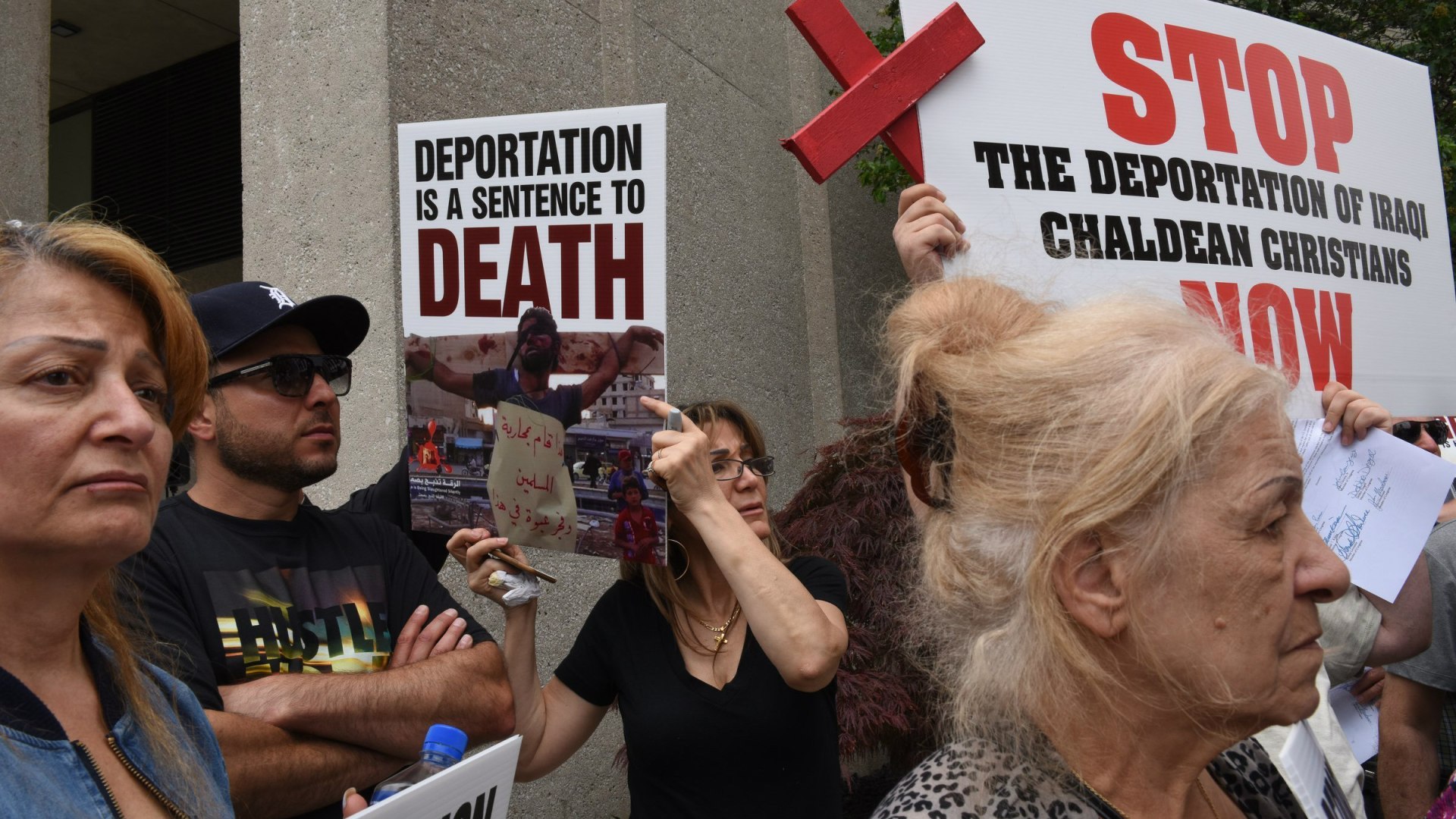
US Court Ruling Renews Iraqi Christians’ Deportation Fears

Lead plaintiff wins permission to stay while others could be redetained as soon as next month.

Hundreds of Chaldeans rally against the ICE raids in 2017.

Hundreds of Chaldeans rally against the ICE raids in 2017.

Christianity Today January 16, 2020
Tanya Moutzalias / The Flint Journal-MLive.com via AP)

In this series

The Iraqi Christian at the center of a class-action suit challenging the detention of fellow Iraqi nationals in the Detroit area was granted a major victory in court Tuesday and will be allowed to stay in the US and become a citizen.

The decision in favor of Sam Hamama comes days after a legal setback for hundreds of others who had been detained by US Immigration and Customs Enforcement (ICE) and released more than a year ago so they could litigate their individual cases.

Last Friday, the Sixth Circuit Court of Appeals rejected the classwide decision freeing the Iraqis from detention, potentially leading to redetainment and a renewed threat of deportation.

“The whole point of the federal litigation was to give people time to fight their individual immigration cases,” Margo Schlanger, one of the lead counsels in thecase, told CT. “Hundreds of people assisted by the class action have done that, and, while some have lost, lots of them have won. For many others, the individual immigration cases are still pending. So Sam’s victory is one of many, we’re happy to say.”

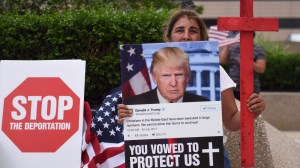
In 2017, more than 1,400 Iraqis living in the United States, most of whom had either overstayed visas or have criminal convictions, were living under “final removal orders” that made them targets for deportation. Hundreds of these Iraqi nationals were rounded up in ICE raids and held in detention facilities meant to house them until they could be deported.

The move was part of a policy shift spurred by the Trump administration’s travel ban, as Iraq agreed to begin accepting deportees in exchange for being removed from the list of banned countries.

But the process faced a major obstacle. America has committed itself to not repatriate anyone into circumstances of likely persecution or torture. Supporters of the detained Iraqis have argued Iraq presents just such dangerous circumstances.

Due to violence and the ongoing persecution of Christians in Iraq (more than 300 of the detained Iraqis are Chaldean Christians), the prospect of deportations was met with enormous pushback. The dilemma—detaining deportees for a country too dangerous to accept them—meant the Iraqis were held in prolonged detention, with no end in sight.

By the end of 2018, as part of the flagship Iraqi deportation case Hamama v. Adducci, district court judge Mark Goldsmith ruled that “the Federal Government cannot indefinitely detain foreign nationals while it seeks to repatriate them, when there is no significant likelihood of repatriation in the reasonably foreseeable future.”

As a result, most of the Iraqis represented in the Hamama case were released and reunited with their families, some of them having spent nearly a year and a half behind bars.

On Friday, the Court of Appeals claimed, “The district court had no jurisdiction to do what it did.”

The release ruling was overturned in a 2–1 decision citing detentions statutes. “Those are the statutes covered by the jurisdictional bar, and the [district] court’s injunction prevented those statutes from operating, whether with respect to mandatory or permissive detentions,” stated the Court of Appeals’ opinion. “What was true the first time around remains true today.”

While the opinion doesn’t make a decision on deportations—that depends on individual immigration cases and the Iraqi government—it does put Iraqis at risk of additional detentions. The ruling could be implemented as soon as February 24.

“We strongly disagree with the court of appeals decision,” said American Civil Liberties Union (ACLU) senior staff attorney Miriam Aukerman. “It was not a mistake that your family was together this past year, and we will do everything in our power to make sure that your family isn’t torn apart all over again in 2020.”

Lawyers representing the Iraqi nationals have a variety of options for responding to the decision, including a rehearing, and individual immigraiton cases continue to move ahead.

These cases are bearing fruit. Hamama, an Iraqi who came to America as a refugee in 1974, recently won his hard-fought victory when he was granted permission to stay in the United States permanently and become an American citizen.

Along with some other at-risk Iraqi nationals, Hamama was eligible for 212(c) relief, available to lawful permanent residents who pleaded guilty to a crime before April 1, 1997.

“In addition to receiving a pardon, qualifying for 212(c), having an array of resources and a strong legal team behind him, it still took Mr. Hamama years to breathe a sigh of relief,” Nathan Kalasho, an advocate who heads a Detroit school focused on Iraqi Christians, told CT. “That is how broken our system is.”

“Many tears were shed in immigration court today in Detroit, but this time they were tears of joy!” stated Mike Steinberg, University of Michigan law professor and former legal director of the ACLU of Michigan.

Aukerman told CT that Hamama’s case provides two chief lessons: the importance of due process, and the problem of indefinite and “incredibly long” periods immigration detainees are held waiting for their cases to be heard.

“You cannot just lock people up and throw away the key. You cannot have prolonged detention divorced from reason,” said Aukerman. “That idea is just anathema to our sense of human decency.”

Even as the potential for new ICE raids looms, some of the Chaldeans are making progress in their cases. But for many aren’t scheduled to appear in court until 2021 or even 2022, and they may be deported before their court dates.

“Everyone at risk of deportation has an individual case, so there are different ways to seek relief, but many have exhausted their options,” said Kalasho.

Several detained Iraqis have already been deported. The most controversial case is that of Jimmy Aldaoud who, at 41, knew no Arabic and had never lived in Iraq (he was born to Iraqi parents in a refugee camp in Greece) but was deported to Baghdad last summer. After two months, he was found dead, allegedly because he could not find access to insulin for his diabetes.

“There’s a lot of anxiety,” said Martin Manna, president of the Chaldean Community Foundation, according to the Los Angeles Times. “Jimmy was sacrificed because of US immigration policy, and that needs to change.”

The new Court of Appeals ruling has ratcheted up that anxiety again.

“Just earlier today I received a call from a panicked sister of a detainee who told me she is ready to give up,” said Kalasho.

The situation is exacerbated by the current tensions in Iraq, now ranked No. 15 on the 2020 World Watch List. After Iranian military leader Qassem Soleimani was killed in Iraq on January 3 at the order of President Trump, shockwaves of violence and anti-American sentiment have rippled.

“Mass demonstrations against corruption and heightened US-Iran aggression has placed Iraq in another untenable situation,” said Kalasho. “Protestors have been met with violence from militia groups, including kidnappings, rapes, and murders. Just last week, two prominent journalists were killed. Even the Baghdad Airport, which would be receiving deportees, has been the target of attacks from multiple sides.”

On the same day as the Court of Appeals decision, the US government issued a call for all Americans to leave Iraq.

News

Many Churchgoers Don’t Know If Their Pastor Is a Republican or Democrat

Still, three-quarters of evangelicals say they agree with their church leaders on politics.

Christianity Today January 15, 2020
Eric Skwarczynski / Lightstock

Churchgoers are most likely to say they don’t know whether their pastor is a Republican or a Democrat—and many preachers believe that’s a good thing.

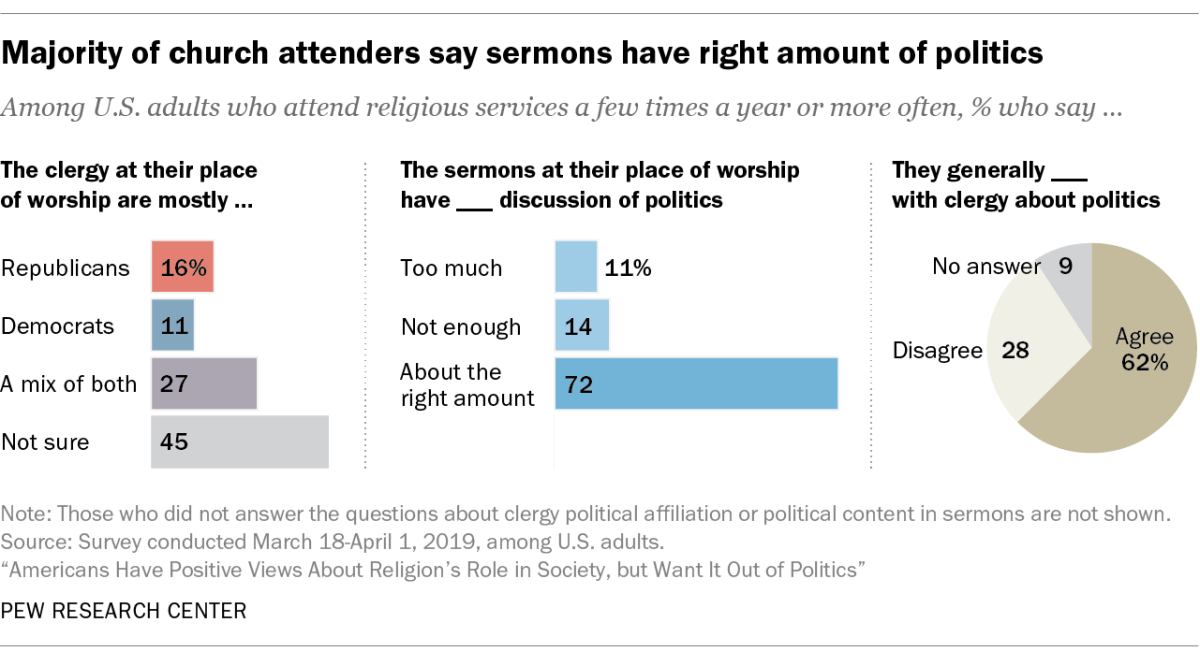
A new survey by the Pew Research Center finds that almost half (45%) of people who attend services at least a few times a year are “unsure” of their clergy’s partisan leanings. Over a quarter (27%) say their clergy are a mix of both parties, while 16 percent say they lean Republican and 11 percent say they lean Democrat.

The job of the pastor is to help churchgoers see that “neither party has a corner on true Christianity, and neither party is working out the values of Christ’s kingdom in its fullness,” said Bill Riedel, pastor of Redemption Hill Church in Washington, D.C.

Riedel told CT he was pleased to see that almost half of churchgoers do not know their pastors’ political leanings, but he would like that percentage to climb even higher. While pastors have a right to their political opinions, Riedel said, pastors should, like the Apostle Paul in Corinth, be willing to set aside their rights for the sake of the gospel.

“To be a Christian doesn’t mean you ascribe to a particular secular partisan ideology,” he said. “I don’t think pastors should be fake about who they are either. It’s an entire grid of how we think about politics that ought to be changed.”

When politics does come up from the pulpit, a majority of those in the pews (62%) say they agree with their leaders. The political overlap is particularly strong among evangelical Protestants, three-quarters of whom (76%) say they agree with their pastor’s political opinions, the survey found.

Some Christians have spoken up for the right for pastors to endorse political candidates, and President Donald Trump often talks about repealing the Johnson Amendment to free churches to take a stand without losing their tax-exempt status.

But overall it’s an unpopular position; Pew found last fall that most Americans (63%) want churches and other houses of worship to stay out of political matters, and more than three out of four (76%) say they should not come out in favor of a political candidate. As CT reported, Protestants in the historically black churches and evangelical Protestants are the only major religious groups that favor church endorsements.

“I deliberately avoid using language that is too precise,” Brandon Washington, preaching pastor at The Embassy Church in Denver, told CT last year. “You’ll never see us endorsing a candidate or anything like that.”

“My decision to not make political statements or not align with a political party from the platform does not keep me from addressing matters that I believe have become politicized,” including abortion and racism, Washington said.

While few Christians heard political endorsements from the pulpit back in 2016 (Pew found that just 1 percent of churchgoers said their pastors spoke favorably about Donald Trump during the campaign, compared with 6 percent who said they spoke favorably of Hillary Clinton), there’s new momentum around political civility this election year.

“Evangelical pastors must recognize that political diversity frequently is present within churches,” said Scott McConnell, executive director of LifeWay Research. “If civility across these differences is not actively fostered, it can hurt the mission of the church. This has already been evident as many young adults point to political differences as a reason they stop attending church.”

Riedel thinks the problem in 2016 was that many pastors believed they could avoid politics and just preach the gospel. “The more heated things got … people were unprepared to think about Christian unity across political spectrum,” said the Redemption Hill pastor, whose congregation includes government staffers from both political parties. “The past two years have shown us that partisan rhetoric falls short. Christianity has a lot to say to both sides of the aisle.”

Apple PodcastsDown ArrowDown ArrowDown Arrowarrow_left_altLeft ArrowLeft ArrowRight ArrowRight ArrowRight Arrowarrow_up_altUp ArrowUp ArrowAvailable at Amazoncaret-downCloseCloseEmailEmailExpandExpandExternalExternalFacebookfacebook-squareGiftGiftGooglegoogleGoogle KeephamburgerInstagraminstagram-squareLinkLinklinkedin-squareListenListenListenChristianity TodayCT Creative Studio Logologo_orgMegaphoneMenuMenupausePinterestPlayPlayPocketPodcastRSSRSSSaveSaveSaveSearchSearchsearchSpotifyStitcherTelegramTable of ContentsTable of Contentstwitter-squareWhatsAppXYouTubeYouTube