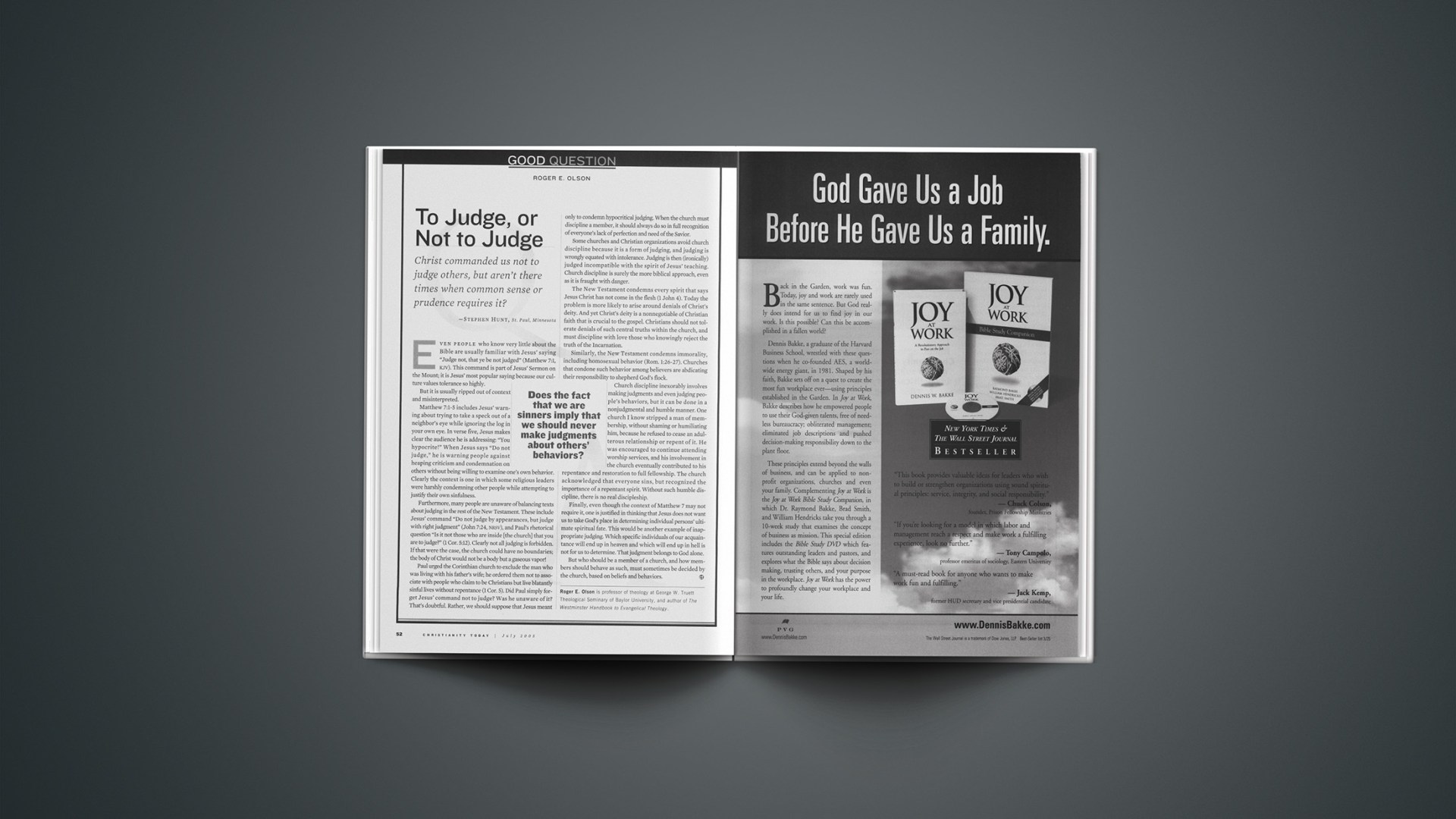
Even people who know very little about the Bible are usually familiar with Jesus’ saying “Judge not, that ye be not judged” (Matthew 7:1, KJV). This command is part of Jesus’ Sermon on the Mount; it is Jesus’ most popular saying because our culture values tolerance so highly.
But it is usually ripped out of context and misinterpreted.
Matthew 7:1-5 includes Jesus’ warning about trying to take a speck out of a neighbor’s eye while ignoring the log in your own eye. In verse five, Jesus makes clear the audience he is addressing: “You hypocrite!” When Jesus says “Do not judge,” he is warning people against heaping criticism and condemnation on others without being willing to examine one’s own behavior. Clearly the context is one in which some religious leaders were harshly condemning other people while attempting to justify their own sinfulness.
Furthermore, many people are unaware of balancing texts about judging in the rest of the New Testament. These include Jesus’ command “Do not judge by appearances, but judge with right judgment” (John 7:24, NRSV), and Paul’s rhetorical question “Is it not those who are inside [the church] that you are to judge?” (1 Cor. 5:12). Clearly not all judging is forbidden. If that were the case, the church could have no boundaries; the body of Christ would not be a body but a gaseous vapor!
Paul urged the Corinthian church to exclude the man who was living with his father’s wife; he ordered them not to associate with people who claim to be Christians but live blatantly sinful lives without repentance (1 Cor. 5). Did Paul simply forget Jesus’ command not to judge? Was he unaware of it? That’s doubtful. Rather, we should suppose that Jesus meant only to condemn hypocritical judging. When the church must discipline a member, it should always do so in full recognition of everyone’s lack of perfection and need of the Savior.
Some churches and Christian organizations avoid church discipline because it is a form of judging, and judging is wrongly equated with intolerance. Judging is then (ironically) judged incompatible with the spirit of Jesus’ teaching. Church discipline is surely the more biblical approach, even as it is fraught with danger.
The New Testament condemns every spirit that says Jesus Christ has not come in the flesh (1 John 4). Today the problem is more likely to arise around denials of Christ’s deity. And yet Christ’s deity is a nonnegotiable of Christian faith that is crucial to the gospel. Christians should not tolerate denials of such central truths within the church, and must discipline with love those who knowingly reject the truth of the Incarnation.
Similarly, the New Testament condemns immorality, including homosexual behavior (Rom. 1:26-27). Churches that condone such behavior among believers are abdicating their responsibility to shepherd God’s flock.
Church discipline inexorably involves making judgments and even judging people’s behaviors, but it can be done in a nonjudgmental and humble manner. One church I know stripped a man of membership, without shaming or humiliating him, because he refused to cease an adulterous relationship or repent of it. He was encouraged to continue attending worship services, and his involvement in the church eventually contributed to his repentance and restoration to full fellowship. The church acknowledged that everyone sins, but recognized the importance of a repentant spirit. Without such humble discipline, there is no real discipleship.
Finally, even though the context of Matthew 7 may not require it, one is justified in thinking that Jesus does not want us to take God’s place in determining individual persons’ ultimate spiritual fate. This would be another example of inappropriate judging. Which specific individuals of our acquaintance will end up in heaven and which will end up in hell is not for us to determine. That judgment belongs to God alone.
But who should be a member of a church, and how members should behave as such, must sometimes be decided by the church, based on beliefs and behaviors.
Roger E. Olson is professor of theology at George W. Truett Theological Seminary of Baylor University, and author of The Westminster Handbook to Evangelical Theology.
Copyright © 2005 Christianity Today. Click for reprint information.
Related Elsewhere:
See Matthew 7:1 in the context of the whole chapter at BibleGateway.com.
Other verses cited are available from this BibleGateway page.
Earlier Good Question columns include:
Where is heaven, and how will we experience it before the final resurrection?
Can I forgive those who have betrayed me if they are not repentant?
Are all sins weighed equally, or is one more important than another?
Why is the church against euthanasia in instances where people are in terrible pain?
What harm is there in achieving a higher state of consciousness through meditation?
Will we be vegetarians in the new heaven and earth as Adam and Eve were before the Fall?
Why doesn’t God cure everyone who prays fervently for healing?
What does Genesis mean by man being made in the image of God?
What’s the difference between Christ’s kingdom and paradise?
How is it that not all prayers for the salvation of others are answered?
If God is in us, shouldn’t it be easier to love one another?
Is there a biblical principle behind the punishment of those who break the law?
Won’t heaven’s joy be spoiled by our awareness of unsaved loved ones in hell?
Where exactly do "Oneness" Pentecostals stand in relation to orthodoxy?
Do a man and a woman become married after having sex or after exchanging vows?
Can We Expect God to Forgive Unbelievers Who 'Don't Know What They're Doing'?