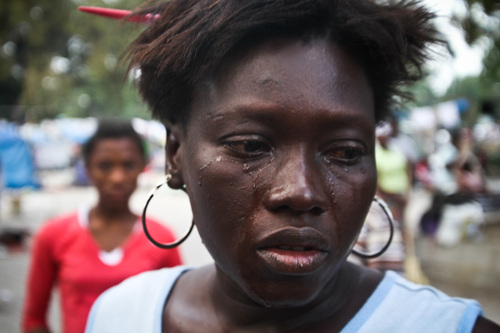
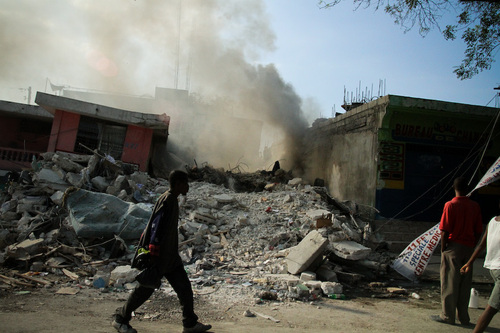
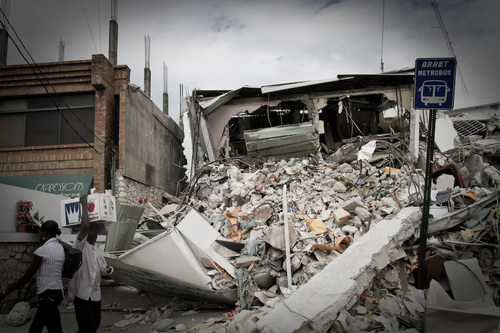
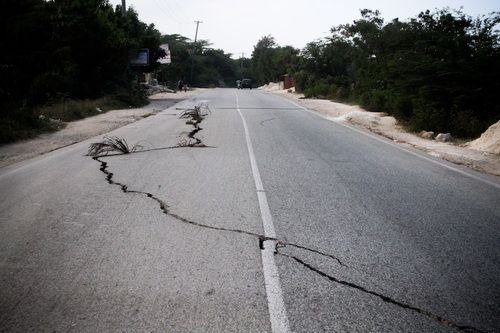
An aftershock shook Haiti this morning near Port-au-Prince as relief groups try to help Haiti recover from the earthquake eight days ago. Yesterday I spoke with Lindsay Branham, global communications coordinator for Food for the Hungry, who is in Port-au-Prince. Today she sent me the following images.
 In the midst of efforts to reconcile with longtime critics, Harvest Bible Chapel fired its founder and senior pastor James MacDonald for “engaging in conduct … contrary and harmful to the best interests of the church.”
Harvest elders announced this morning that they were forced to take “immediate action” on Tuesday to end his 30-year tenure.
“Following a lengthy season of review, reflection, and prayerful discussion, the Elders of Harvest Bible Chapel had determined that Pastor MacDonald should be removed from his role of Senior Pastor. That timeline accelerated, when on Tuesday morning highly inappropriate recorded comments made by Pastor MacDonald were given to media and reported,” they wrote.
“This decision was made with heavy hearts and much time spent in earnest prayer, followed by input from various trusted outside advisors.”
MacDonald took an “indefinite sabbatical” in January, following a tumultuous few months defending Harvest in a defamation lawsuit against its critics and in the aftermath of a World magazine investigation into mismanagement at the church.
The public scrutiny continued with pushback against MacDonald’s decision to preach at a Harvest affiliate in Florida during his sabbatical. Then, a famous friend of his, Chicago shock jock Mancow Muller, spoke out in a local newspaper against the manipulation and ego he observed around MacDonald’s “cult of personality” at Harvest. On his radio show, Muller later aired what sounded like clips of MacDonald making harsh comments toward media who had covered the story.
Now, the church has decided its longtime leader won’t be coming back.
Muller had prematurely announced the pastor’s departure on Friday morning on his show on WLS 890 AM, going on to declare on Twitter, “Conman Boss James Macdonald OUT of Harvest Church!”
The news came less than a week after another update from Julie Roys, a defendant in the lawsuit and the writer responsible for the World investigation, who has continued to release evidence against MacDonald and call for his resignation.
“While I am heartened that the elders finally removed MacDonald, he should have been fired five years ago. That’s when eight former elders sent a letter to the sitting elder board, warning them that MacDonald was disqualified for office,” she said in a response posted Wednesday.
Though MacDonald initially opted to step away from all preaching and leadership roles at the church’s Chicago-area locations, in his January 16 sabbatical announcement he suggested he might still preach at a Harvest congregation in Naples, Florida, which led to another saga.
The leader of that church, John Secrest, was blindsided by the news and asked Harvest elders to reconsider allowing MacDonald to preach there. He ultimately requested that Harvest Naples be released from its relationship with the megachurch. Then, he was fired, according to the Daily Herald, a suburban Chicago newspaper.
Secrest, who founded the church in 2016 and affiliated with Harvest last September, said he didn’t know at the time about the ongoing concerns raised about MacDonald’s leadership and the church’s financial status, which led to Harvest’s lawsuit last year. “The good intentions of our ministry partnership with Harvest Chicago have been overshadowed by these developments,” he said.
Even before the 58-year-old pastor’s sabbatical, MacDonald’s role at Harvest had shifted. At the start of the year, elders stated that his “primary focus has transitioned from building our ministries to securing a healthy succession that sets all our ministries up to flourish in the next generation.”
Two years ago, MacDonald moved away from overseeing the Harvest Bible Fellowship, a global network of churches, which eventually separated from Harvest completely to form the Great Commission Collective (GCC).
The former Harvest Bible Fellowship leaders now at GCC—which contains about 130 churches, more than half of which still have Harvest in their names—share concerns about the church’s leadership and are looking for transparency and repentance from MacDonald.
“In keeping with our past private statements to Harvest’s leadership and to our pastors—The primary issue is not reconciliation or peacemaking, it is repentance,” GCC elders said in a January 17 statement.
“A peacemaking process, while helpful for personal and relational reconciliation, is not the approach to address failed governance, biblical disqualification, and a toxic leadership environment.”
Muller, who has attended Harvest for five years and developed a friendship with MacDonald, wrote in a Daily Herald op-ed that he’d seen the best the church had to offer: MacDonald’s punchy sermons renewed Muller’s faith, brought his family back into Christian community, and taught him the truth of the gospel.
However, he ultimately agreed with the wave of backlash his pastor-friend now faced, condemning how MacDonald’s drama had overshadowed Harvest and threatening a class-action lawsuit yesterday if MacDonald remained its pastor for another week.
“Pray for those of us who donate 10 percent of our income and would like to know where the money really goes. Pray for those outside the faith who will never come to salvation because of how this appears to them,” Muller wrote in his op-ed. “For a great many, it's time for the cult of personality of James MacDonald at Harvest chapter to close and the actual Bible to be opened again.”
Today on his edgy radio show, Muller said while he felt MacDonald’s firing had to happen, he also had “wanted nothing to do with any of it” and now “my part is done.”
“I feel like God was using me in this,” he said. “I hope it doesn’t chase people away from their spiritual quest—away from God.”
“I take no joy in this announcement,” said Muller. “But I hope the healing can begin, and I hope the abuse will stop.”
Roys also lamented the fallout of today’s news.
“Lastly, we need to comfort hurting today,” she wrote. “I know many people who attend Harvest or who have been impacted by MacDonald’s preaching are crushed today. As one person whom MacDonald led to the Lord remarked to me, ‘It’s like finding out your wife is a serial killer.’ The disillusionment, betrayal, and loss can be excruciating. This is a very vulnerable time for a lot of people and I am sure God weeps for every single wounded soul.”
Harvest numbers 13,000 attendees across seven locations, and the church began affiliating with the Southern Baptist Convention in 2015. In addition to leading Harvest, MacDonald acquired a massive evangelical following through his books, Bible studies, and Walk in the Word radio program, with more than a million fans on Facebook.
In announcing MacDonald’s termination, Harvest elders stated they are “committed to fulfilling our fiduciary duty as the leadership of this congregation, knowing that at times the outcome may be misunderstood or emotionally painful. … We sincerely thank you for your prayers, your support, and your patience as we work together to restore a trust in leadership, a humility to surrender to biblical authority, and a firm resolve to move forward as a church family.”
 Courtesy of Harvest Bible Chapel
 Hundreds of thousands of Iranians flooded streets nationwide on Monday, in celebration of the 40th anniversary of the Islamic Revolution.
Not present were dozens of Christians with no freedom of movement.
“For 40 years, the Iranian government has harbored an intolerant view towards Christianity,” said Mansour Borji, advocacy director at Article18, a Christian human rights organization focused on Iran.
“Administrations have changed and the methods have varied, but the objective remains the same: to restrict Christians’ influence on all spheres of Iranian life.”
An in-depth report on violations against Iranian Christians in 2018 was jointly released last month by Open Doors, Middle East Concern, Christian Solidarity Worldwide, and Article18. It was a first-time collaboration for the groups—in order to amplify their voice, Borji said.
The report stated that according to public records, 29 Christians were held in detention in 2018 for terms of 6 months to 10 years (if formally sentenced at all). Eight were released.
The report emphasized that many more detentions of Christians remained undocumented.
Article 18 of the International Covenant on Civil and Political Rights (ICCPR) guarantees the freedom of religion, including the right to adopt a faith of one’s choice and to publicly practice and teach it.
Iran ratified the ICCPR in 1975, prior to the 1979 revolution which ended 2,500 years of monarchy.
But Christians are not the only victims.
The latest annual report of the US Commission on International Religious Freedom (USCIRF) states that in Iran dozens of Sufis—Muslims with mystical practices—have been imprisoned, fined, or flogged; 90 Baha’is—an offshoot of Islam that claims a prophet after Muhammad—are detained for their religious beliefs alone; and 140 Sunni Muslims are similarly held in a nation where 9 in 10 residents are Shia.
Ninety-nine percent of Iranians are Muslim. The Baha’i community numbers over 300,000. Christians are estimated just under the same, divided between the traditional Armenian and Assyrian/Chaldean ethnic churches and newer Protestant/evangelical churches. Zoroastrians number at least 30,000, and Jews number at least 15,000.
Apart from the Baha’is, who are considered heretical by definition, these minority religions are recognized by the government, and are allotted 5 out of 290 seats in the national parliament.
Borji, who converted from Islam in the 1990s and moved to England, said the registered groups make “natural allies” for the government. In exchange for privileges of a second-class nature, authorities can demonstrate their “peaceful coexistence.”
The joint report released by the international religious freedom advocates states that most violations occur against converts from Islam. If arrested, they are pressured to recant; if they don’t, they may be charged with evangelism, illegal house church activity, or endangering national security.
A vaguely defined charge of “enmity against God” is also in Iran’s penal code, joining “insulting the prophet” as a capital crime.
Apostasy is not specifically criminalized, but the constitution specifies that any cases not covered by civil law are tried under Shari‘ah law.
For a decade, converts have been prevented from attending established church services. Some registered church buildings which used to welcome them remain closed. And 2018 ended with a surge in raids against house churches, resulting in the arrest of 114 individuals in one week.
Despite Iran’s 2016 release of a non-binding Charter on Citizens’ Rights guaranteeing nondiscrimination against minority religions, the US State Department has ranked the Islamic Republic as a “country of particular concern” since 1999, designated as a Tier 1 violator of religious freedom.
Open Doors lists Iran as No. 9 among the world’s most dangerous places to be a Christian, and stated the Iranian government views converts as a Western attempt to undermine Islam and the Islamic Republic.
A leader at Qom Seminary, founded in 1922 and the central city for training Shia clerics, once said fighting “evangelical Christianity” was one of its “core issues.” Even prior to the Islamic Revolution, the seminary’s “On the Right Path” institution was devoted to countering the Christian and Baha’i faiths.
And in 2010, speaking from Qom, Iran’s Supreme Leader Ali Khamenei identified the main threats to the nation.
“They [our enemies] … resorted to different things, ranging from promoting debauchery to propagating fake schools of mysticism—fake forms of genuine mysticism—the Baha’i faith and the house-church network,” he said, reported in an analysis by Borji this week of the past four decades.
“These are some of the things that the enemies of Islam are pursuing today … and the goal is to undermine religion in society,” said Khamenei.
This represented a new phase in the treatment of Christians in post-revolution Iran—one that continues today, Borji wrote.
Mohabat News, a service focused on Iranian Christians, described officials warning in 2017 that Christianity was spreading, even in Qom. NPR recently reported that the United Pentecostal Church in Turkey “can’t keep up with the demand,” having opened churches in eight cities for Iranian refugees coming across the border. While some may be insincere and merely seeking to secure asylum, it noted, other refugees fled after raids on their house churches.
“Iran is home to one of the fastest-growing churches in the world,” said Terry Ascott, founder and CEO of SAT-7, a Christian broadcasting network in the Middle East. It began a Farsi-language channel, PARS, in 2006.
“There seems to be a crisis of faith in Iran, perhaps because of the abuse of power by ‘religious’ leaders, the economic problems, and the violent oppression of any dissent.”
Ascott also mentioned the lure of narcotics, as the UN stated Iran faces one of the worst drug crises in the world. The government admits it has failed, as the number of addicts increases eight percent per year.
SAT-7 responds by offering a diverse mix of programs, including Bible teaching, talk shows addressing family life and practical issues, and children’s broadcasts. Ascott states that it is “not at all dangerous” to be a traditional Christian in Iran, as long as they do not try to convert Muslims.
An Armenian Christian has even captained the national soccer team.
SAT-7 reported a 95-percent surge in audience engagement following the 2017 launch of its Farsi-language PARS channel on the Yahsat satellite, reaching a total of 1.7 million Iranians. Yahsat reaches 9.5 million households in the Islamic Republic, with millions more in Afghanistan, Central Asia, and Europe.
Engagements are defined as call-ins to a specific program or phone calls to the SAT-7 offices, located outside of Iran.
“Due to security reasons, I would prefer you to contact me through Telegram rather than by telephone,” said one female viewer in Iran. “I saw the ‘Jesus movie’ before, and now I am more passionate to learn about Christianity. I appreciate all your help and guidance.”
Telegram is a secure messaging app that protects user identity. Iranians used it to download the Bible 60,000 times after SAT-7 opened a chat room in 2015.
Some media reports describe frustration among younger clerics with the dominance of religion in politics, believing it turns people away from Islam. Others suggest Iran’s struggling economy and adventurism in other nation’s affairs are eroding support for the regime.
While the Islamic Revolution led to extreme poverty eradication and slightly better income distribution, many analysts maintain the middle class today is shrinking and state-affiliated institutions control even more of the economy than at the time of the overthrown shah.
Inflation is at 40 percent, the national currency has lost 70 percent of its value in one year, and one-third of university graduates have no job.
American sanctions have hurt, but have also made a useful scapegoat.
“Today, our problems are mostly because of pressure by America and its followers,” President Hassan Rouhani said during revolutionary celebrations. “Instead of condemning America, one should not reprimand the dutiful government or the great Islamic system.”
The Trump administration withdrew from the Obama administration’s 2015 nuclear deal last year, citing Iran’s foreign policy of interference in the Arab world. And Iran actually admits its influence in Baghdad, Damascus, Beirut, and other regional capitals, being in accord with the international purpose of its revolution: aiming to remake the Muslim world and aid the oppressed around the globe.
And this purpose is popular among Iranians, though some protest against it. Tehran had to limit the number of volunteers to fight in Syria. And the anniversary celebrations provided an opportunity for the government to show a softer side.
“The presence of people today on the streets all over Islamic Iran … means that the enemy will never reach its evil objectives,” Rouhani said. “The more we allow different ideas, beliefs and [political] factions, the stronger our system will be.”
But the joint religious freedom report is clear: Only certain beliefs are welcome.
“Christians today are persecuted on a larger scale than ever in the past 40 years,” said Borji.
“The world needs to know this. And the church worldwide is stronger than any global institution to bring about positive change.”
 Hundreds of thousands of Iranians flooded streets nationwide on Monday, in celebration of the 40th anniversary of the Islamic Revolution.
Not present were dozens of Christians with no freedom of movement.
“For 40 years, the Iranian government has harbored an intolerant view towards Christianity,” said Mansour Borji, advocacy director at Article18, a Christian human rights organization focused on Iran.
“Administrations have changed and the methods have varied, but the objective remains the same: to restrict Christians’ influence on all spheres of Iranian life.”
An in-depth report on violations against Iranian Christians in 2018 was jointly released last month by Open Doors, Middle East Concern, Christian Solidarity Worldwide, and Article18. It was a first-time collaboration for the groups—in order to amplify their voice, Borji said.
The report stated that according to public records, 29 Christians were held in detention in 2018 for terms of 6 months to 10 years (if formally sentenced at all). Eight were released.
The report emphasized that many more detentions of Christians remained undocumented.
Article 18 of the International Covenant on Civil and Political Rights (ICCPR) guarantees the freedom of religion, including the right to adopt a faith of one’s choice and to publicly practice and teach it.
Iran ratified the ICCPR in 1975, prior to the 1979 revolution which ended 2,500 years of monarchy.
But Christians are not the only victims.
The latest annual report of the US Commission on International Religious Freedom (USCIRF) states that in Iran dozens of Sufis—Muslims with mystical practices—have been imprisoned, fined, or flogged; 90 Baha’is—an offshoot of Islam that claims a prophet after Muhammad—are detained for their religious beliefs alone; and 140 Sunni Muslims are similarly held in a nation where 9 in 10 residents are Shia.
Ninety-nine percent of Iranians are Muslim. The Baha’i community numbers over 300,000. Christians are estimated just under the same, divided between the traditional Armenian and Assyrian/Chaldean ethnic churches and newer Protestant/evangelical churches. Zoroastrians number at least 30,000, and Jews number at least 15,000.
Apart from the Baha’is, who are considered heretical by definition, these minority religions are recognized by the government, and are allotted 5 out of 290 seats in the national parliament.
Borji, who converted from Islam in the 1990s and moved to England, said the registered groups make “natural allies” for the government. In exchange for privileges of a second-class nature, authorities can demonstrate their “peaceful coexistence.”
The joint report released by the international religious freedom advocates states that most violations occur against converts from Islam. If arrested, they are pressured to recant; if they don’t, they may be charged with evangelism, illegal house church activity, or endangering national security.
A vaguely defined charge of “enmity against God” is also in Iran’s penal code, joining “insulting the prophet” as a capital crime.
Apostasy is not specifically criminalized, but the constitution specifies that any cases not covered by civil law are tried under Shari‘ah law.
For a decade, converts have been prevented from attending established church services. Some registered church buildings which used to welcome them remain closed. And 2018 ended with a surge in raids against house churches, resulting in the arrest of 114 individuals in one week.
Despite Iran’s 2016 release of a non-binding Charter on Citizens’ Rights guaranteeing nondiscrimination against minority religions, the US State Department has ranked the Islamic Republic as a “country of particular concern” since 1999, designated as a Tier 1 violator of religious freedom.
Open Doors lists Iran as No. 9 among the world’s most dangerous places to be a Christian, and stated the Iranian government views converts as a Western attempt to undermine Islam and the Islamic Republic.
A leader at Qom Seminary, founded in 1922 and the central city for training Shia clerics, once said fighting “evangelical Christianity” was one of its “core issues.” Even prior to the Islamic Revolution, the seminary’s “On the Right Path” institution was devoted to countering the Christian and Baha’i faiths.
And in 2010, speaking from Qom, Iran’s Supreme Leader Ali Khamenei identified the main threats to the nation.
“They [our enemies] … resorted to different things, ranging from promoting debauchery to propagating fake schools of mysticism—fake forms of genuine mysticism—the Baha’i faith and the house-church network,” he said, reported in an analysis by Borji this week of the past four decades.
“These are some of the things that the enemies of Islam are pursuing today … and the goal is to undermine religion in society,” said Khamenei.
This represented a new phase in the treatment of Christians in post-revolution Iran—one that continues today, Borji wrote.
Mohabat News, a service focused on Iranian Christians, described officials warning in 2017 that Christianity was spreading, even in Qom. NPR recently reported that the United Pentecostal Church in Turkey “can’t keep up with the demand,” having opened churches in eight cities for Iranian refugees coming across the border. While some may be insincere and merely seeking to secure asylum, it noted, other refugees fled after raids on their house churches.
“Iran is home to one of the fastest-growing churches in the world,” said Terry Ascott, founder and CEO of SAT-7, a Christian broadcasting network in the Middle East. It began a Farsi-language channel, PARS, in 2006.
“There seems to be a crisis of faith in Iran, perhaps because of the abuse of power by ‘religious’ leaders, the economic problems, and the violent oppression of any dissent.”
Ascott also mentioned the lure of narcotics, as the UN stated Iran faces one of the worst drug crises in the world. The government admits it has failed, as the number of addicts increases eight percent per year.
SAT-7 responds by offering a diverse mix of programs, including Bible teaching, talk shows addressing family life and practical issues, and children’s broadcasts. Ascott states that it is “not at all dangerous” to be a traditional Christian in Iran, as long as they do not try to convert Muslims.
An Armenian Christian has even captained the national soccer team.
SAT-7 reported a 95-percent surge in audience engagement following the 2017 launch of its Farsi-language PARS channel on the Yahsat satellite, reaching a total of 1.7 million Iranians. Yahsat reaches 9.5 million households in the Islamic Republic, with millions more in Afghanistan, Central Asia, and Europe.
Engagements are defined as call-ins to a specific program or phone calls to the SAT-7 offices, located outside of Iran.
“Due to security reasons, I would prefer you to contact me through Telegram rather than by telephone,” said one female viewer in Iran. “I saw the ‘Jesus movie’ before, and now I am more passionate to learn about Christianity. I appreciate all your help and guidance.”
Telegram is a secure messaging app that protects user identity. Iranians used it to download the Bible 60,000 times after SAT-7 opened a chat room in 2015.
Some media reports describe frustration among younger clerics with the dominance of religion in politics, believing it turns people away from Islam. Others suggest Iran’s struggling economy and adventurism in other nation’s affairs are eroding support for the regime.
While the Islamic Revolution led to extreme poverty eradication and slightly better income distribution, many analysts maintain the middle class today is shrinking and state-affiliated institutions control even more of the economy than at the time of the overthrown shah.
Inflation is at 40 percent, the national currency has lost 70 percent of its value in one year, and one-third of university graduates have no job.
American sanctions have hurt, but have also made a useful scapegoat.
“Today, our problems are mostly because of pressure by America and its followers,” President Hassan Rouhani said during revolutionary celebrations. “Instead of condemning America, one should not reprimand the dutiful government or the great Islamic system.”
The Trump administration withdrew from the Obama administration’s 2015 nuclear deal last year, citing Iran’s foreign policy of interference in the Arab world. And Iran actually admits its influence in Baghdad, Damascus, Beirut, and other regional capitals, being in accord with the international purpose of its revolution: aiming to remake the Muslim world and aid the oppressed around the globe.
And this purpose is popular among Iranians, though some protest against it. Tehran had to limit the number of volunteers to fight in Syria. And the anniversary celebrations provided an opportunity for the government to show a softer side.
“The presence of people today on the streets all over Islamic Iran … means that the enemy will never reach its evil objectives,” Rouhani said. “The more we allow different ideas, beliefs and [political] factions, the stronger our system will be.”
But the joint religious freedom report is clear: Only certain beliefs are welcome.
“Christians today are persecuted on a larger scale than ever in the past 40 years,” said Borji.
“The world needs to know this. And the church worldwide is stronger than any global institution to bring about positive change.”
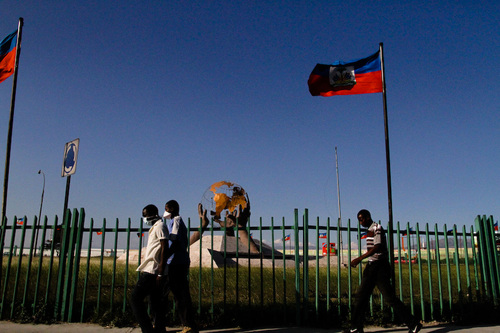 Courtesy of Article 18
 Of the 920 million readers who visited the world’s top Bible website last year, most are literally searching for love more than anything else.
Only 3 of the other 9 fruits of the Spirit joined love among Bible Gateway’s top searches of 2018: peace (No. 2), faith (No. 3), and joy (No. 4). The pattern holds true in Spanish-language searches, though gozo (joy) ranks 12 slots lower [full lists below].
Love has been the most popular topic at Bible Gateway, which celebrated its 25th anniversary last year by reaching more than 14 billion views, ever since the site’s inception in 1993. Such searches perennially spike on Valentine’s Day.
“This may be the time of year that we talk most loudly about love, but [our] usage statistics show us that we long to understand and experience love throughout the year,” stated Andy Rau, Bible Gateway’s then-senior manager for content, in a 2017 post.
In 2014, when the site first offered more detailed stats, CT reported how “the word never fell out of the top 10 searches, and was the top searched word more than 200 days of the year.”
In contrast, searches for lust only came close to love on one day: September 30, 2015.
Overall, searches for heart, pray, and spirit rose the most from 2016 to 2018. All rose in rank by double digits. (CT analyzed the top 2018 verses of Bible Gateway vs. YouVersion in December.)
Among CT’s coverage of Valentine’s Day, last year—on the first VaLENTine’s Day since WWII—CT noted how Twitter suggested chocolate and alcohol would be absent from many dates, while Tish Harrison Warren reflected on God’s message on “Ash Valentine’s Day.”
Bible Gateway’s top 25 topic searches in English for 2018:
love
peace
faith
joy
hope
heart
pray
holy spirit
prayer
spirit
grace
light
fear
children
forgive
heaven
worship
strength
truth
father
the joy of the lord is my strength
sin
trust
rest
salvation
Bible Gateway’s top 25 topic searches in Spanish for 2018:
amor
fe
paz
gracia
corazón
luz
padre
mujer
misericordia
oración
ofrenda
pecado
espíritu
palabra
esperanza
gozo
espíritu santo
amigo
familia
gracias
justicia
hijos
verdad
camino
corazón