Theology

Why We Still Root for Biblical Antiheroes

Contributor

The “hall of faith” in Hebrews 11 doesn’t praise what we think it praises.

Bible figures on pedestals.
Christianity Today March 4, 2025
Illustration by Elizabeth Kaye / Source Images: Getty, Wikimedia Commons

As a kid, I loved Hebrews 11 with its hall of famed Bible heroes who lived by faith. I imagined them among the heavenly crowd of witnesses watching us run the race of faith (12:1). I may not have been popular among my peers, but I knew the real heroes were cheering on my faithfulness.

Things got more complicated as I began seriously studying the Old Testament. I quickly began to realize that most of those listed in Hebrews 11 were not exactly heroic, to put it mildly. Some of them were certifiable schmucks. And even those with a mostly positive spin in the Old Testament were rather hard to imitate.

Abel got credit for bringing a better sacrifice, but we don’t do that anymore. Enoch was whisked away without dying, but we’re never told why he merited special treatment. Noah thanked God for rescuing him from the flood by getting hammered and then cursing his disrespectful son.

Abraham traded his wife for a slave—twice! Sarah laughed at God’s promise and then mistreated her Egyptian slave. Isaac didn’t do much at all and ended his life having been bamboozled by his son. Jacob made a career out of tricking family members. Joseph was arrogant. Moses didn’t seem to understand who he was and failed to comply with the single command God gave Abraham. The Israelites were terrified at the Red Sea instead of trusting Yahweh.

Rahab was a prostitute. Gideon was a coward and idolater. Barak lacked bravery. Samson was driven by lust. Jephthah was essentially a thug who made a rash vow. David coveted his neighbor’s wife and murdered him to get her. Samuel’s sons were out of control.

I see problems with not just one or two but virtually all the “heroes” of faith listed in Hebrews 11. Either they aren’t very exemplary or it’s not feasible to imitate them. If Hebrews 11 was a list of heroes, I would expect to see the Hebrew midwives make the cut, or at least Deborah, Joshua, Caleb, Hannah, Elijah, Josiah, and Daniel. These Old Testament saints are truly worth emulating—yet none of them make the list.

But I recently revisited this chapter with a new question: What if this passage is not about glorifying moral examples or all-star heroes? And what if that kind of approach misses the point of the passage?

Perhaps the people in Hebrews 11 are like those in the long lines at Disneyland waiting to ride roller coasters. Their willingness to wait over an hour for a three-minute ride is not a badge of honor. It simply illustrates that they trust the Imagineers who designed the ride to provide a fun and safe experience. And when people stumble off the ride, wide-eyed and slightly out of breath, we don’t clap them on the back and congratulate them for a tremendous achievement—we ask them what the ride was like. The ride is what’s impressive, not the riders.

In other words, these figures aren’t heroes—they’re beneficiaries of God’s grace by faith.

In my younger years, I envisioned faith as a kind of counterfactual wishful thinking. But faith is not optimism with a religious cloak on. Faith is rooted in God’s own promise. It’s the refusal to cave to the Serpent’s suggestion “Did God really say …?” (Gen. 3:1, emphasis added). How does this play out in the context of Hebrews 11?

Throughout the chapter, the writer alludes directly or indirectly to things God has said. Two threads run through the entire chapter: the promise of God and each person’s trust in that promise over what they could see with their own eyes.

Consider verse 29: “By faith the people passed through the Red Sea as on dry land; but when the Egyptians tried to do so, they were drowned.” With this example, the idea of imitation falls apart completely. First, Exodus tells us that the people were terrified, not trusting (14:10). They railed against Moses and wished they hadn’t left Egypt.

But even if we set aside their less-than-stellar response, if the Israelites ultimately passed through the sea by faith, then shouldn’t the Egyptians be rewarded for following their example? Why do the Egyptians drown when they attempt the same feat? The difference is their relationship to God’s word.

Yahweh had urged the Israelites to cross the sea in response to his promise—that he would set them free from oppression in Egypt. For the Israelites to step onto the sea floor was an act of faith. What seemed dangerous was really God’s means of deliverance.

To the Egyptians, God had made a different demand: “Let my people go!” For them to cross the sea floor in pursuit of the Israelites was a direct violation of God’s command. Their crossing was the opposite of faith; it disregarded and even defied God’s word to them.

It’s worth remembering here that not all those who left Egypt were descendants of Abraham. Exodus 12:38 tells us that “many other people” went with the Israelites. That group undoubtedly included some Egyptians. So what distinguishes the Egyptians who made it across the sea from those who drowned? Their relationship to God’s promise. Only those who crossed by faith made it to the other side.

In other words, the folks in Hebrews 11 are not heroes but ordinary men and women who shared one thing in common: They believed what God said and that what he promised was better than what they could see. The author of Hebrews is not holding up an impossible standard. He’s pointing to regular people who trusted the right voice and acted accordingly.

Now that we understand these are not heroes, let’s take a closer look at one more person from Hebrews 11 to illustrate why he appears in this chapter. Joseph is an interesting case study.

When Joseph was a young man, his brothers sold him into slavery, but by the end of his life, he had risen to the second-highest position in Egypt. He had wealth, prestige, a wife, and sons. But instead of relying on these assets, Joseph rooted his own future in God’s promise to Abraham. In Genesis, God had said to Joseph’s great-grandfather Abraham,

“Know for certain that for four hundred years your descendants will be strangers in a country not their own and that they will be enslaved and mistreated there.But I will punish the nation they serve as slaves, and afterward they will come out with great possessions.” (Gen. 15:13–14)

Joseph believed in this promise—so much so that he was willing to stake his future on it. If his body left Egypt, Joseph would not be worshiped by the Egyptians. Egyptians were obsessed with preparing for the afterlife, and families visited the tombs of their ancestors as a way to venerate them for years to come.

Yet before he died, Joseph told his brothers to carry his bones back to Canaan. His father had given similar instructions, making Joseph promise to bury him in Abraham’s cave. So Joseph followed his father’s example.

Hebrews 11 reads, “By faith Joseph, when his end was near, spoke about the exodus of the Israelites from Egypt and gave instructions concerning the burial of his bones” (Heb. 11:22). The glitter of worldly power did not blind Joseph to his true identity; the accolades of Egypt did not drown out his memory of God’s promise to Abraham.

Instead of throwing his lot in with Pharaoh, Joseph chose to identify as a Hebrew in recognition of Israel’s special relationship with God. Joseph did not anchor his hope in what this world had to offer. He banked everything on the promise of Yahweh, even when it looked self-defeating.

That doesn’t make him an all-around hero. Remember, it’s the ride of faith, not the rider, that should impress us. Joseph simply recognized the roller coaster worth riding and climbed on.

In her commentary on Hebrews, Amy Peeler defines faith as “trust in God, based on divine revelation, that results in tangible expressions of obedience.” What would it look like for us to take seriously the promises Jesus announced before his ascension? And what might our tangible response be to these promises?

Jesus said that his kingdom was not of this world and that he was in the midst of making all things new. He also promised to be with us always and to return soon. If we were to live as if all this is true, we would be not fatalistic but full of hope. We would act not as consumers but as stewards and generous neighbors. We would eschew political loyalty in exchange for principled decision making.

The bottom line in Hebrews 11 is an encouragement to cast our lot with Jesus because he has promised that the best is yet to come. Our greatest temptation as believers is to treat what we can see as ultimate and lose sight of what God has promised. This world is marked by fear and uncertainty, but we know who wins in the end.

I’m relieved to see that faith does not require hero status and is not limited to moral examples. The Lord knows our religious exemplars can drop like flies. But by this matrix, any one of us could be a candidate for inclusion in Hebrews 11. The point is not who we are but who we trust.

Ultimately, Hebrews doesn’t tell us to imitate Abraham, Sarah, Samson, or Jephthah but to stick with Jesus and trust his promise that he will return. And believing that changes everything.

Carmen Joy Imes is associate professor of Old Testament at Biola University and author of Bearing God’s Name, Being God’s Image, and a forthcoming book, Becoming God’s Family: Why the Church Still Matters.

CT’s One Kingdom Update – Spring 2025

CT Partners are inspiring more people to follow Jesus through the One Kingdom Campaign.

One Kingdom Update images from Spring 2025

So much has already been accomplished in the past year. From beautiful storytelling that lifts our eyes to Jesus working in our midst to global reporting that reminds readers of the cost of following Jesus around the world. But there is still much to be done.

The kingdom of God is near, but it remains overlooked, disparaged, and unrealized by so many. 

Would you partner with CT this year to inspire and equip more people to faithfully follow Jesus? Donate

Download the Spring 2025 One Kingdom Update to see what our partners are making possible. Download now.

Ideas

Trump/Zelensky, Louis XVI/Ben Franklin

A parody with a point concerning stalemated wars, past and present.

Zelensky and Trump, seated in front of flags, motion to each other while arguing during a meeting.

US President Donald Trump and Ukrainian President Volodymyr Zelensky in the Oval Office.

Christianity Today March 3, 2025
Jabin Botsford / The Washington Post via Getty Images

The public nature of Friday’s Oval Office argument between Donald Trump and Volodymyr Zelensky may be unprecedented, but this is not the first time the United States has been involved in a war stalemated after three years.

Let’s go back to when France and the new US signed a treaty in 1778. American forces depended on French arms, money, and eventually soldiers. But in 1781 the American Revolution was in trouble. British troops continued to occupy New York City. They had captured 5,000 American soldiers and sailors in Charleston, South Carolina. Some of George Washington’s soldiers mutinied.

Benjamin Franklin returned to Paris and for a time was popular. He wore a fur hat and a brown coat, giving him what the French saw as the look of a “rugged American frontiersman.” But courtiers at the Versailles palace tired of him—and here’s an exclusive look at the transcript of a meeting between King Louis XVI and Franklin:

Louis XVI: “You want me to say really terrible things about George III and then say, ‘Hi, Georgie. How are we doing on the deal?’ I want to get this thing over with.”

Franklin: “The British forces have killed many of us. You think this is just a war in America? London sent troops on your soil before and will do so again. You don’t feel it now, but you will feel it in the future. God bless you.”

Louis XVI: “Don’t tell us what we’re going to feel … because you’re in no position to dictate that. We’re going to feel very good and very strong. And you’re not in a good position. You don’t have the cards right now with us.”

Franklin: “I’m not playing cards. I’m very serious, Your Highness.”

Louis XVI: [shouting] “You’re gambling with the lives of millions. You’re gambling with another Seven Years’ War. What you’re doing is very disrespectful to France. Your people are dying. You’re running low on soldiers. Your commander Washington has only 2 percent support.”

Franklin: “If London conquers us, what if the British come after Normandy next?”

Louis XVI: “What if anything? What if someone sets up a guillotine? Marie Antoinette and I have been through phony witch hunts. It’s disgusting. And why do you wear that fur hat? People say you’re a tough guy. I don’t think you’d be a tough guy without France.”

Franklin: “Our people have suffered—”

Louis XVI: “Either you make a deal or we’re out, and if we’re out, you don’t have the cards. I think we’ve had enough for today. This is going to be great for the gazettes.”

Happily, this dialogue is pretend. France continued to support Washington and contributed mightily to the US victory at Yorktown in October, 1781. That led to a peace treaty preserving American independence.

Now, let’s return to the present and the wide variety of responses from prominent Christians to Friday’s confrontation. Many were astonished. Thabiti Anyabwile: “I’ve never seen a scene like this from the Oval Office.”

Some were cheerleaders. Eric Metaxas: “We have NEVER seen anything close to the leadership we are seeing in Trump and Vance. The video of the Zelensky meeting is simply ASTONISHING. It is a gift from God to the whole world that we have this kind of leadership in our nation. God bless America!”

John Kasich was thoughtful: The “meeting with Volodymyr Zelenskyy was shameful. President Zelenskyy represents a nation whose citizens have sacrificed their lives and shed blood for the freedoms they cherish. He deserves respect, not humiliation.”

Maybe the meeting was a turning point. Sean Feucht rejoiced: “How does it feel to have real leaders at the @WhiteHouse again?” Some Christians in answering that question will think of Bob Dylan, who composed these words exactly 60 years ago: “How does it feel? To be on your own, with no direction home.”

https://twitter.com/seanfeucht/status/1895554974157058505

Many feel the White House is no longer home. Happily, the Bible gives us a direction: Christians have citizenship in heaven. Politically, coming back to Benjamin Franklin, we have his famous answer to a woman who asked what the Constitutional Convention in 1787 had handed the American people: “a republic, if you can keep it.”

Ideas

You Will Have to Reckon with Despair

The question is not if but when and how—and whether you will reckon with Christ.

A cutout image of a woman shielding her face with dark clouds in the background.
Christianity Today March 3, 2025
Illustration by Elizabeth Kaye / Source Images: Pexels

Scott Blakeman loved watching the reactions when he casually told new friends at house parties and barbecues that he had brain cancer. 

He deployed it like a joke, deep into conversation, timed for the most comedic effect. It didn’t matter to him that he was usually the only one who thought the sudden, sputtering shock of it—that transition from light banter to morbid reality—was funny. He even nicknamed his cancer: Boomer the Tumor. (The smaller tumors that formed later were baby Boomers.) 

As he lost some of his vision, tried numerous medications and radiation therapy, got dangerously thin, and had six surgeries in as many years, Scott was often laughing.

His hope wasn’t shallow; he didn’t use jokes to pretend he wasn’t suffering. Theological questions and lament came just as easily to him. He grieved. He saw how broken—how cursed—creation must be for cancer to exist.

But through it all, he joyfully loved God, his wife, his neighbors, and his city. 

He categorically rejected despair.

I don’t know about you, but I can start to slip into despair if I have a cold that lasts a little too long or if I have too many emails to answer in one afternoon. How was my friend Scott able to resist that temptation while he faced a trial unthinkable to his peers?

In The Sickness unto Death, 19th-century Danish philosopher Søren Kierkegaard argues that in this fallen world, everybody begins in a state of despair. Some people might think they aren’t, but they just haven’t been forced to reckon with it yet. (And they will, eventually, have to reckon with it.) The opposite of despair, Kierkegaard argues through a pseudonym representing the Christian ideal—what allows people to reject it, for good, once they’ve recognized it—is faith in God.

Scott had faith that he belonged to Jesus. He had faith that God is good and loves us more than we can know. He had faith that death isn’t the end. And he had faith that one day, Christ will make all things new. Not in some vague, spiritual sense but instead a bodily resurrection of all people, the final defeat of evil, grace poured out to believers, and eternal joy in God’s presence.

Scott’s faith gave him a hope that could last. He lived abundantly and triumphantly while he walked through the valley of the shadow of death. 

In recent years, many young people have found they can’t defy despair like Scott did—and some don’t seem to want to defy it at all. A sense of hopelessness, nihilism, and dread haunts them en masse. I am not referring here to mental illness in general. I’ve had postpartum depression and anxiety, and I know just how powerful hormones and chemical imbalances can be. I’m talking instead about a generation that has weighed existence, has found it wanting, and is increasingly deciding against it. Their despair has been considered and thought through.

For example, it is common for young people to say they’ve decided to never have children. Some point to finances or health conditions. But many others cite fears that the future holds only endless climate catastrophes and wars. They don’t want their kids to have to live through it. Self-imposed annihilation, after all, is its own kind of answer to those problems.

Might it be better for humanity not to exist?

That’s on the extreme end. Plenty of others are just skeptical that conditions could ever improve. 

With this, young people are partly doing what Kierkegaard expects of everyone: They’re recognizing their own despair in a sinful, broken world. But the solution he presents to it—faith in God—isn’t usually where newer generations are landing. Their responses have also sharply differed from those of the many people in the past who didn’t land on faith either but who still tried to forget their despair and make the most of their circumstances. 

Maybe this impenetrable anguish can be blamed on smartphones and social media—we are exposed to more suffering around the world, in real time, than ever before—or simply how difficult their formative years have been amid a global pandemic and extreme political division. But I don’t think those reasons fully explain it. People around the world have seen troubled eras and worse many times over. 

What is different is that many of today’s young people have been brought up on a kind of scientific nihilism—believing humanity is a cosmic accident, existing for nothing in particular and destined for nowhere at all. All that awaits us is the heat death of the universe. Often, they are completely untethered from the theological foundations of Christianity. As a result, many of them have weakened defenses against despair.

Their hopelessness—and their occasional pursuit of some alternative antidote to it than Kierkegaard’s answer of faith in God (a favorite pastime of his intellectual successors)—is showing up in the stories we tell ourselves.

One such story: The 2022 film Everything Everywhere All at Once. At first glance, it’s a zany science-fiction multiverse adventure. But the assumptions it makes and the conflict at its heart reflect the weary, all-encompassing pessimism of a generation.

The dimension-hopping antagonist of the film, when confronted with infinite parallel universes, decides nothing matters. She wreaks havoc as she tries to find a way to erase every version of herself from existence. Her parents (well, their doubles from different worlds) try to stop her, even though they can’t quite verbalize why she’s wrong.

They defeat her nihilism with this message: “Be kind.”

It’s a good rule to fall back on if nothing else makes sense. But very few people, if any, can be kind to everyone, everywhere, all the time. That answer also falls woefully short of truly confronting sin, death, and suffering—the fundamental reasons we are driven to despair.

Still, it deeply resonated with young people for holding a mirror to their own gnawing nihilism and their desperate desire, in spite of it, to be good and do good. Being kind for its own sake might forge a self-made meaning in a perceived void of meaninglessness. Maybe, irreligious young people wonder, kindness is enough reason to carry on, even if nothing really matters. We might have gotten here by accident, and we might be going nowhere, but we can at least try to build a just society—an Eden of our own—while we’re alive.

This mindset is still a form of faith used to overcome despair, but instead of relying on God, it is rooted in ourselves and what we think we can accomplish.

Our own works can never produce a hope that will endure, though. We can try to love others as fiercely and tenderly as Jesus does, but without him, death and despair still knock at the door.

Scripture rejects this ultimately-still-nihilistic worldview with clarity and hope. It tells young people the truth: Life not only matters, but each person is also infinitely valuable, made in God’s own image. Christ loves us so much—even while we were all still sinners—that he entered our world, suffered, died for us, and defeated the grave to rescue us from our sinful rebellion.

Jesus is the true and better answer to the film’s conclusion to be kind: He loves us with a radical, selfless, incomprehensible love—and he calls his followers to love their neighbors and even their enemies the same way.

Some of the most common barriers for modern people to place their faith in God align with two of Kierkegaard’s descriptions of despair: One form of despair, in his telling, comes when a person doesn’t want to be who they are before God. They feel hopeless about a sin they can’t get rid of, an illness they bear, some weakness or frailty that comes with being human in a fallen world. They don’t believe God can change their situation. They can’t imagine he could actually forgive their sins, heal them, or make them a new creation. (In our culture, this doubt is even deeper; it’s hard for us to trust he exists at all.)

Another form of despair comes when, before God, a person essentially wants to be their fallen self instead of being made perfect.

Faith, for Kierkegaard, is instead being “grounded transparently in God” and his will for us.

If we need that kind of faith to really defy despair, are we supposed to hunt for it within ourselves like squirrels in the autumn, trying with all our might to find enough acorns of faith, somewhere, to save us? I do love squirrels, but that isn’t the image presented by the Bible.

“For it is by grace you have been saved, through faith,” the apostle Paul writes in Ephesians, “and this is not from yourselves, it is the gift of God—not by works, so that no one can boast” (2:8–9).

I’ll avoid getting into dense theological arguments about God’s sovereignty and free will here—I don’t fully understand the mysteries of God and wouldn’t want to pretend to. (For his part, Kierkegaard views faith throughout his writings as both a gift from God and an action we have to take.)

I do know this: In the Sermon on the Mount, Jesus promises that his Father gives “good gifts to those who ask him” (Matt. 7:11). Sometimes, all we can do as we pursue him instead of despair is echo the cry of the father who sought his son’s healing from Jesus: “I do believe; help me overcome my unbelief!” (Mark 9:24).

It’s a prayer I’ve had to come back to over and over again. An image in Dane Ortlund’s book Gentle and Lowly has encouraged me in this, reminding me of the relationship between our fragile faith and Christ’s love: We are like toddlers holding an adult’s hand. We can try our best to hold on, but we are weak. Even still, and even if we get distracted, squirm, and have wet, sticky hands (as toddlers somehow always do), God is stronger. He holds on to us.

“I give them eternal life, and they shall never perish,” Jesus says of his followers in the Gospel of John. “No one will snatch them out of my hand” (John 10:28).

My friend Scott died in the summer of 2023 at the age of 34, after battling cancer for seven years. He wanted to live. But his faith in Christ cast out despair.

As he walked to the grave—and to glory—Scott held on to Jesus’ hand, and Jesus held his hand even tighter.

Shortly after his death, hundreds of people packed into the Church of the Resurrection on Capitol Hill to celebrate his life. They sang hymns, mourned, prayed, wept, laughed about his old jokes, and remembered the promise in Revelation 21, that God “will wipe every tear from their eyes. There will be no more death or mourning or crying or pain, for the old order of things has passed away” (v. 4).

Then they did what the church has done all along. They went back into the city, back to their neighborhoods, and kept loving people the way Jesus has called them to—while defying despair and showing others how to do the same—until he returns.

Haley Byrd Wilt is a mom, journalist, occasional science-fiction writer, and former despairer.

A version of this essay was originally published in the Center for Christianity and Public Life’s 2024 Journal of Ideas.

Books
Excerpt

Why Christians Fast During Lent

An excerpt on generosity and solidarity from “Hunger for Righteousness: A Lenten Journey Towards Intimacy with God and Loving our Neighbor.”

A plate full of vegetables and grains making the shape of a quarter.
Christianity Today March 3, 2025
Illustration by Pete Ryan

Christians in the Coptic Orthodox Church prepare for Lent by feasting.

For ten days before the Great Lent begins, we consume the food from which we’ll soon abstain. Barring those with health concerns, food allergies, or eating disorders, as well as those pregnant, nursing, or with other individual food-related concerns, we eat or distribute all the meat, fish, and dairy products in our homes to get ready for the fast ahead. The Arabic word for these days in the Coptic Orthodox Church (الرفاع) literally means “lifting up” or “leave-taking.”

Not every Christian tradition has continued this abstinence from meat, fish, and dairy in its practice of Lent, of course. Nonetheless, it’s important for all of us to recognize the main purpose of this form of abstinence: almsgiving. Historically, those who could afford to eat meat and dairy on a regular basis were supposed to give the cost of that food as alms. Those who fasted further by abstaining from food till a specific hour were to give the cost of the skipped meal or two to the poor as well. 

This connection is deliberate. It serves as a chance to take stock of all the excess that we have acquired and return some of it to those who do not have excess. 

Recently, I sat down and calculated how much my family of five spent on meat and dairy products in January and saw that they constituted about 50 percent of our total food budget for that month, even though they constituted a much lower percentage of our actual food by volume. If I am practicing Lenten almsgiving, I should now be giving a good portion of what I’m not spending on these items to those in need, as what is left is vegetables, fruits, grains, starches, and legumes, which are usually much less expensive than meat and dairy. 

Sometimes, this isn’t always the case; there are some locations in North America, for example, where fresh produce is not always available. Some believers, for health reasons, might need to spend more money on more expensive vegan foods like avocados, nuts, and seeds. If Lent finds us spending the same amount or more on food to observe the fast, there might be other ways to incorporate almsgiving during Lent that are not related to money saved or spent. 

For those who do save money during Lent, the pre-Lent period is a good time to decide where to donate the money saved from avoiding meat and dairy purchases and eating more simply. We can give to local food pantries or soup kitchens, or charities that work on hunger and food insecurity. Or perhaps, if we know someone personally in need, we can drop a grocery gift card in their mailbox or do the grocery shopping for an elderly neighbor. 

Whether or not we fast from meat and dairy, or whether or not we save money from this, knowing that almsgiving is the point means we can still find ways to offer to the physically hungry during the fast. Perhaps we can consider how many times a week or month we eat out, and we choose instead to eat at home and donate the cost of this meal to the hungry, or we deliver such a meal to someone who needs something hot and satisfying. 

Or perhaps we can consider inviting others to our tables during Lent. Hospitality is not just for feasting, and Lent is a beautiful time to make room in our hearts for others as we’ve made room in our pantries. According to Isaiah, this is the fast that God has chosen: 

Is it not to share your bread with the hungry 
And that you bring to your house the poor who are cast out; 
When you see the naked, that you cover him, 
And not hide yourself from your own flesh? (58:7, NKJV)

In choosing to abstain from certain foods for over a month and a half and giving what we would have fed ourselves to others, our almsgiving is less a charity than it is empathy and solidarity. In the words the Lord said to Isaiah, when we fast and give to the hungry and the poor, we are giving to our “own flesh.”

When we experience what it is like to not eat or drink even when we are hungry or thirsty, we get a small taste of what it is like to live with water shortages, chronic hunger, food insecurity, and war. When we experience what it is like to limit the kinds of foods we eat, we get a small taste of what it is like to live with finance or health limitations that severely reduce our choices. 

If we do experience war, chronic hunger, food insecurity, financial limitations, or health issues, Great Lent is for us, too. In first-century Rome, unwanted babies were left out in the elements to die of starvation, cold, or animal predators. Sometimes, they were taken and raised into the slave trade or sexual slavery. 

During this time, the early Christians rescued babies who had been “exposed” and raised them in their communities. According to liturgical scholar Dom Gregory Dix, during worship these children, “who had nothing of their own to bring, always offered the water to be mingled with the wine in the chalice.” These children show us that if all we have to offer is some water, it is an acceptable offering. 

If we do not have the financial means to give, we can consider ways to give of our other resources during Lent. Our time is often more valuable than money. 

We can offer that time to food pantries, helping prepare hot meals or packing lunches. If we know how to assemble flat-packed furniture, we can help elderly neighbors assemble bookshelves. If we know of a harried mother of multiple young children who could use some time to breathe, we can offer to watch her children for a few hours. All of these offerings are precious gifts, a blessing to the body of Christ. 

What we need to cultivate for Great Lent is not only a generosity of resources but also a generosity of spirit, and that is true even if we are the ones in need of alms—if we already know what it means to be truly physically hungry before a fast appears on our calendars. 

Lent is our opportunity to consider what it means to have that hunger and thirst for righteousness, not just for food and drink. And Lent is our opportunity to receive love from our “own flesh,” too, in the words of Isaiah. We might not have food to “lift up” during these weeks of preparation, but we can lift up others in prayer for our brothers and sisters. If we are the recipients of alms, we are also part of the circle of Lenten solidarity.

Phoebe Farag Mikhail is the author of Hunger for Righteousness: A Lenten Journey Towards Intimacy with God and Loving our Neighbor and Putting Joy into Practice. Her writing also appears in PloughFaithfully Magazine, and her blog, Being in Community

Hunger for Righteousness: A Lenten Journey Towards Intimacy with God and Loving our Neighbor by Phoebe Farag Mikhail
Copyright 2025 by Phoebe Farag Mikhail
Used by permission of Paraclete Press.
www.paracletepress.com

Inkwell

The Ripening of Faith

A discomfort with deconstruction

Inkwell March 2, 2025
Still Life with Fruits & Foliage by Abraham Mignon

THE NIGHT BURNS BRIGHT and dark in my memory, a contrast of moods and scenes like a Caravaggio painting. The cathedral; bright, honeyed stone and gold instruments glinting on the altar. The kindness of my friend and his saving of an excellent seat for me as I skidded in, breathless, the sweet furor of bedtime rituals with my four children still an echo in my brain, a slight wildness in my eye. And the music, a many-layered brightness of harmony and word, hued like a crimson sunset to my synesthetic mind as a small choir sang a selection of ancient Orthodox chants and prayers.

I let myself breathe deeply as the music surged forward, let my eyes rove the warm, dappled space of the medieval church that summer night. But the longer I looked, the more darkness I saw. The shadows like dirty flocks of ravens in the high corners, the vivid stained glass windows I loved so well in the daytime obscured by night, the pain at the back of so many prayers I heard chanted, pleas for God to put an end to despair and death. And the darkness of my own weary heart when the concert had ended and I sat outdoors at a nearby pub and confessed to my long-time mentor and friend, a priest, that I found myself almost unable to pray.

A gentle, river-haunted quiet rose around us as my friend contemplated my dilemma. Laughter erupted from the next table. A horn blared from the road. My cider glass was cold in my hand and I held its chill against my face as the discomfort of my confession ebbed away.


I WAS DISTURBED by my incapacity to pray, by a sense of growing inward lethargy, and the attendant grey silence that seemed to meet it from the heavens. My faith, after a diagnosis of mental illness in my teens, was something I’d fought hard to keep. The story of my belief was one of fierce and hard-won exultation, of beauty triumphing over depression and deep fear. I studied theology for four years. I’d written full books in witness to the gracious help I had found in God. But the past years had ushered me into a different season of interior life, presenting me with the challenge of sheer exhaustion. I was unable to perform my faith by prayer or long hours of study and devotion, and in that lack, I felt abruptly uncertain of myself, and of God.

I’ve always been a little haunted by the allusions in Scripture to those who “fall away.” What does it mean to lose sight of the thing you most love, the lodestar to your universe? Falling away… it sounds like just losing your grip in an offhand way, one afternoon when things got a bit busy and life was too stressful. Or maybe it was something that could happen when life asked more than you could give, if say, you lost several people you loved, or bore two babies amidst lockdowns and loneliness, or moved three times, or battled appendicitis and pneumonia and just endured a darn hard spate of years.

Like, say, me. Maybe in the weary end of that you really could just… drift away from prayer, and then from faith, to find yourself lost in a dark ocean, miles from the surety and passion that once anchored your story.


MY DISCOMFORT WAS HEIGHTENED by having watched a number of my friends deconstruct their faith and find themselves unable to put the pieces back together. I understood the deep pain that began their unravelling, the betrayal of others and the confusion that seemed to further shatter their belief into unmendable pieces. But even in the worst days of my illness and doubt, I had somehow never lost my sense of God as potently good and real… until, maybe now? Until this spiritual inertia. I found myself returned in thought to the early days of my faith when I feared an indifferent God. My interior exhaustion left me with the startling fear that a great, uncaring silence would descend when my own voice died and my prayers failed.

I glanced up at my friend when the panic of that thought burned my face. I found him already looking at me, all compassion. He leaned forward and spoke. His suggestions were simple.

“If you can’t pray, just say one prayer: Lord Jesus Christ, Son of God, have mercy on me, a sinner. And find an icon to pray it with, every day,” he said.

So, very weary, a little desperate, and a little more than skeptical, I did. I didn’t know what else to do.


THE ICON I CHOSE was the Eleusa, or the Madonna of Tenderness, an ancient image of Mary cradling Jesus. Their cheeks touch as they lean into each other, mother and child holding hands, a circle of undisturbed affection created by the curve of their bodies and Mary’s capacious arms. But though everything speaks of their almost exclusive intimacy, their gaze is turned outward to the viewer in something I felt at first as challenge, but with each passing day more keenly, as invitation.

I set the icon up in a corner of the paned window by my reading chair. Each morning, I snatched ten minutes to sit down and silently pray. Nothing else. And looked at the icon. I knew the basic theology behind iconography, the idea of the image as a kind of window into the landscape of the divine. So I tried to let the icon look at me as much as I looked at it. There was a strange kind of daring in this exercise for me.

For much of my spiritual life, I had come to my times of devotion tensed for effort: to read, to concentrate, to think rigorously and pray fixedly. I felt I must think the right thoughts and conjure the correct feelings in order to reach God. Now, I did almost nothing. I waited on him to attend to me, feeling a little audacious. It was the strangest thing, sitting there with no exertion but that of gazing at the little Christ, asking for mercy, waiting for I had no idea what. For something to shimmer at the back of the icon and answer me?


THE STRANGE AND STARTLING thing—was that it did. Not, of course, immediately, and not in an actual shimmer, but in a potent sense of a great affection hovering all around me. It was like watching a storm gather on the horizon, only this was a gathering of mercy in my interior skies. I felt my gaze increasingly drawn into the circle of love imaged in the cradling of Mary and her Christ, and knew myself tenderly drawn to share their joy.

It was not something I understood. A reader and writer my whole life, a questioner of doctrines, with two theology degrees under my belt, I found it all a bit ridiculous. Words nor explanation could encompass it. My rational mind groped to untangle this mercy, but my soul simply stood by in welcome. I found myself in the presence of mystery.


AROUND THE SAME TIME, I began to read Annie Dillard’s Pilgrim at Tinker Creek. My first try, twenty years before, had been badly timed. Back then, I’d been raw and grieved by the new diagnosis of my mental illness. I craved very certain answers about God’s will, his mercy, and his might. Dillard’s pilgrim-hearted writing felt like a threat then—too formed by the problems of suffering, too willing to deal in unanswered questions. But now, as my effort eased, my hands opened, and the answers I thought I knew were pushed aside by something benevolent and great, I rediscovered her writing and found it heady and wild. “Our lives are a faint tracing on the surface of mystery” she wrote. These words now sang in concurrence with my growing sense of this benevolent presence who came in response, not to my strength, but my frailty.

I realized one day that the primary shape to my devotion had become that of need. Which brought me to the instant and astonished understanding that much of my faith life had been built on the assumption that the way I prayed or the Scripture I studied could conjure God’s help and presence in my life. I found myself suddenly unsure of what God demands. I used to think he asked so much; holiness of life and a swift performance of righteous deeds and a clear conscience and constant prayer. But in the turbulence of my past difficult years or the season of prayerless angst that followed, I had offered almost no fixity.

My own deconstruction began to gradually take place, but not one of disintegration. What came undone and fell away was not the substance of my faith, but the performance I thought it required and the means by which I thought God could be summoned, predicted, and even in some sense controlled by my language, my discipline, my managed emotion. I was led by my need, not to an abandonment of faith but to its unexpected enlargement. Not a decay, but a ripening. I read a poem by Denise Levertov one day in which she opens by railing at God for the suffering of the world and then, like a child whose strength has been spent in sobs, ends in brief assertions.

I do nothing, I give You
nothing. Yet You hold me

minute by minute
from falling.

I knew exactly how she felt.


IN THE AUTUMN, a few months after the concert, I sat one evening in a different sanctuary, the tiny “lady chapel” of the parish church pastored by my Anglican priest husband. Every few weeks he gets one of the retired priests in the congregation to lead the Wednesday service of Eucharist so he can stay with the children and I can attend. I stumbled in at the last minute, knelt, and joined in the liturgy. As usual, I felt keenly that I brought little to the table. But as the thought came that night, after months of sitting in the presence of love, asking for mercy, I was halted by a sudden insight. I bring nothing to this Table and never have, for it is the Lord’s and he is the giver. And the gift he gives is himself.

How do you get mystery in your hand, how can you taste Love in a broken world? You hold it open before Christ’s table.


I LOVE THE IRISH way of speaking about a person, “Why look, it’s himself.” It reminds me a little of how God describes himself in the Bible as “I am.” That night, as I took the bread of God’s table into my hands, a cheeky voice inside of me said, “Ah look, it’s himself.” Because it was. And this is the mystery. Not that I have taken heaven by the trappings and attainments of my gritted faith or incantational prayers but that Love has put himself in my hand. There he is. A slight heft of tangible mercy, bread for my stomach and health for my soul.

And prayer rose in me like laughter, a mirth of gratitude spilling over into effortless praise.

Love ever ancient, ever new. I never lost it, I needed only to lose the idea that I could summon something already given. I have come to believe that Love is the mystery that arrives within our stories, vast and benevolent, thrusting himself into our hands, our broken hearts, our weary, prayerless minds. My faith will always shift and change, not because he is less true but because his kindness is so much greater than my frail imagining. Love grows. Fear crumbles away. Faith ripens.

And joy gathers, a great brightness upon the horizon of my heart.

Sarah Clarkson writer whose work centers on beauty and grief, story and quiet. She studied theology at Wycliffe Hall in Oxford with a focus on theodicy. Her most recent book is Reclaiming Quiet, written to answer my own questions about what it means to have a quiet mind in a fallen, screen-driven world.

Inkwell

Tongues

Inkwell March 1, 2025
Photography by Diana D.S.

I. In the beginning

Was the Word, and the words we know by heart:
Let-there-be, a blatant answer to the dark
And then Adam, still tasting the first quick air
In his lungs, learning what it means to garden
With a swell behind his teeth, a gaping breath—
Language tumbled out like a kid’s first work of art.
Naming the animals and every lonely star,
Stumbling into poetry at the sight of his girl.
Imago Dei, a tongue to set the earth
In order, and interrogate the dark.

II. Babble, Babel

Broke us, shattered every phrase we had
Before, and bent our tongues toward another plan.
The end of this tower, even unity’s end
Because what sort of stale communion can
Be celebrated now? At least dirty hands
Can be washed, and dirty feet rubbed clean,
But who will tame my tongue? I can’t.
In the lonely, fractured aftermath
My words mark me unclean, another Adam
With the stench of bad fruit lingering on my breath.

III. Pentecost struck

Us suddenly, with a whispering wind
At our ears, and a dark like before creation.
Then one soft word to break the silence open
And a spark of light once again.
Spirit Holy, grant us the gracious gift
To speak in tongues of fire like this
Fire that hovers above our bowed heads.
White-hot coal pressed to the lips
As a new word takes its shape within
Us, a speech sweet as incense.

Ava Pardue is a young poet currently studying at Wheaton College in Illinois. She has a musical collaboration forthcoming with J. D. Frizzell, and her work has been recognized by the Wells Young Poets Contest and Black Fox Literary Magazine, among others. Her poetry focuses on themes of hope and victory over darkness.

Inkwell

urban revival project

Inkwell February 28, 2025
Photography by Josh Hild

and what should we make

of these babylonian towers that
loom with unnatural surety
over streets stamped into the earth and
trees planted in lonesome rows
?
of the crushing on the escalators
and on the trading floors
with silicon idols hovering and
the tetragrammaton of luxury brands flashing
to blot out the stars
?
of corporations and churches and
universities and slums and
sweating train carriages
?
of sewage in rivers and
bitumen hot plates and
pillars of smog that lead
nobody to noplace
?
of locked glass to hold the milk and
honey, for those who can afford it
and the pills of prophetic visions, for
those who cannot
?
of cafés and gastropubs and
dancehalls and protests and
sirens echoing within open mouths
?
who would be lord of this place, a place
metastasized across the face of the earth, a place
that steals and then blends and then
spits you out a changeling
?
only one who loves its constituent parts

here’s the secret: there is no such thing as
corporations or churches or universities or
slums or cafés or gastropubs or
dancehalls or protests

there is only your brother and your sister
a tumult of them, organised
in a thousand crazed geometries
a kaleidoscope of holy images

A. A. Kostas is a writer and poet who has been published most recently in Meanjin, The Clayjar Review, and The Rialto Books Review. He currently resides in Singapore. You can read more of his work on Substack: https://waymarkers.substack.com/ 

Church Life

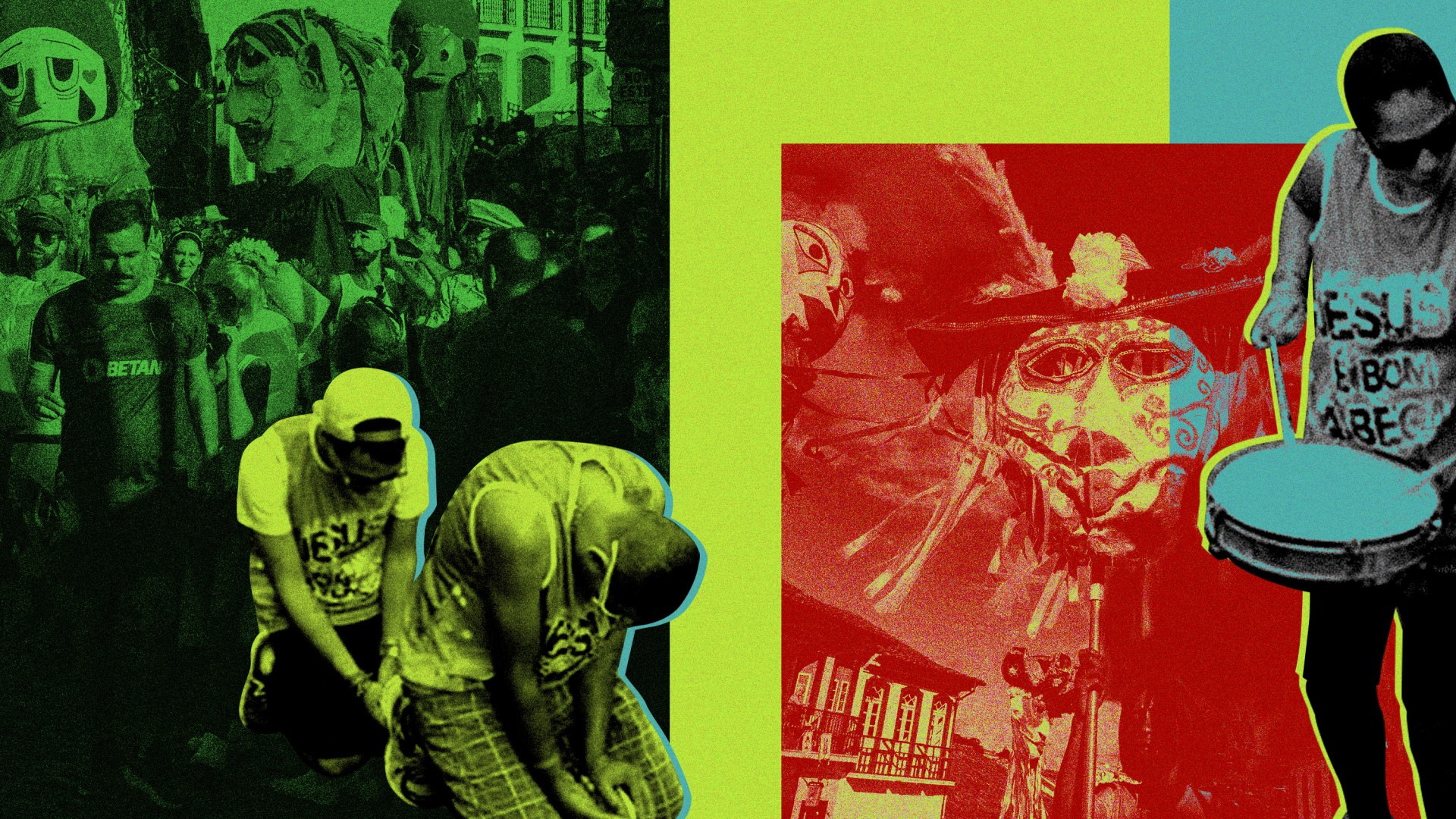
Tio Pedro’s Mission Field Is Carnival

Most evangelicals shun the holiday. But one man sees Brazil’s favorite festival as a key evangelistic opportunity.

Tio Pedro's ministry reaching those attending Carnival in Brazil
Christianity Today February 28, 2025
Illustration by Mallory Rentsch Tlapek / Source Images: Getty, YWAM

“Free spiritual counseling.” 

So says a banner that Pedro Souza hoists from a church during Brazilian Carnival each year in Ouro Preto’s town square. Known for its colonial architecture, the city of 75,000 hosts one of the country’s liveliest celebrations, drawing thousands of Brazilians from around the country.

Tio Pedro, as he’s better known, sees a missions opportunity. Each year, he and hundreds of volunteers from evangelical churches all around the country travel to Ouro Preto to hang out under a tent in the square, offering prayer and counseling to Carnival tourists. 

“Many people enter thinking that they will find someone who reads their palms or tells their future,” said Tio Pedro, who works full-time with YWAM in another city. “Instead, they find Jesus.”

At 63, Tio Pedro has reached out to partiers since 1986, two years after he joined YWAM to run a program to train future missionaries. His ministry is unique; most Brazilian evangelicals flee the city for multiday retreats organized by their churches in the countryside. The further from Carnival, the better.

For centuries, Catholics celebrated Carnival in the weekend preceding Ash Wednesday, attempting to indulge in behaviors the church prohibited during Lent, like eating meat or sweets. (During the Middle Ages, the church also discouraged any kind of physical relations or intimacy.) When Portuguese Catholics brought the festival to South America, it also took on the cultural and musical influence of enslaved Africans and turned into a multiweek extravaganza.

Evangelicals have eschewed the holiday since the earliest days of Pentecostalism in Brazil, uncomfortable with both the rampant drinking and the casual sex and also desiring to distance themselves from the Catholic church. 

Tio Pedro gets why many evangelicals feel uncomfortable with the immorality they see celebrated during Carnival. But he doesn’t get why the church physically retreats each winter. 

“Out on the streets, we can reach people who would never think about getting into a church,” he said.

Nágila Araújo was one of those people. In 1998, the 24-year-old was at the peak of her professional belly-dancing career and was headlining several upcoming shows. Though raised by a Pentecostal mother, Araújo had stopped attending church because she believed its teachings disagreed with her profession.

That year, Araújo traveled with friends to Ouro Preto. On the first day of Carnival, she saw Tio Pedro’s banner. Intrigued by its offer, she walked inside, holding a beer. 

Soon, a young woman came to share the gospel with her. Despite her artistic success, Araújo had been suffering from health problems. When she had confided in her mother and a doctor about them, both encouraged her that turning to Jesus could remove her from a lifestyle where she often drank too much and could heal her body. Hearing the same message preached at Carnival overwhelmed her—and convinced her to accept Christ. 

Araújo returned home the next day and began attending a Foursquare church. Two years later, she began sharing her testimony at churches across the country. Earlier this year, she was ordained as a pastor. 

Araújo is grateful for Tio Pedro and his volunteers’ “bold” strategy.

“It takes courage for someone to go out on the streets and approach drunk college students sitting on the curb or depressed people in the middle of a party,” she said.

Araújo connected with Tio Pedro’s Carnival ministry just four years after it moved to Ouro Preto from where it had begun in Belo Horizonte, a bigger city in Minas Gerais state, about 60 miles north. 

That same year, Tio Pedro began organizing his own bloco de carnaval (an informal group of people, often dressed in costumes, who follow a band playing live music in the streets), naming it Jesus É Bom à Beça (something like “Jesus Is So Good”).

For the past 27 years, he has welcomed hundreds of evangelicals, mostly from Belo Horizonte, who show up with costumes and instruments a couple days before Friday, the first day of Carnival. The other days, the participants serve on prayer, counseling, or street-evangelism teams. But everyone joins the bloco

This year’s bloco theme is Luz do Mundo (“Light of the World”), a message that the Jesus É Bom à Beça marchers will express through two Christian samba-enredos written by Pedro do Borel, a Rio de Janeiro worship artist. 

This year, Jesus É Bom à Beça will sing these two songs on repeat for two hours. But every 100 meters, they will also momentarily stop playing and singing to kneel and pray for the people celebrating Carnival around them. As has done every year with his bloco, Tio Pedro will approach the microphone and read Proverbs 24:11: “Rescue those being led away to death; hold back those staggering toward slaughter.”

“It’s not uncommon, after a moment of prayer, to look up and see people crying, impacted by what we are doing,” Tio Pedro said.

Outside of parade hours (Jesus É Bom à Beça will parade on Sunday and Tuesday this year), the group sets up its headquarters at a Baptist church building in the town square. From there, Tio Pedro dispatches people to minister at the tent, perform short theater productions meant to capture the attention of partygoers, give out water bottles to thirsty people, and strike up evangelistic conversations with those celebrating—at all times of the day. 

In 2000, one volunteer approached Franklin Cruz, one of the Carnival attendees, as he walked back to his hotel, drunk, in the middle of the night. As the smiling woman made her way down a narrow, steep street on one of Ouro Preto’s famous cobblestone hills, Cruz immediately knew he was in for a memorable night. It just turned out to be unforgettable in a different way than he expected. 

When they crossed paths, the woman asked if he was interested in talking to her about Jesus. Cruz listened, intrigued enough that when he returned to his home in Rio, he befriended a Christian who convinced him to find a church. Within a year, he had been baptized. In 2007, he was ordained as a pastor and 10 years later planted a church in the city of Volta Redonda. 

“My life with Christ started because on an ordinary day, someone decided to do an unusual thing: preach the gospel in the streets during Carnival,” he said.

Despite the testimonies that have emerged from Tio Pedro’s ministry, some still see it as merely providing a cover for believers hoping “to satisfy their carnal desires,” as Rafael Cézar, the pastor of Igreja Resgatar in Pindamonhangaba, accused in a 2023 video

“It would be interesting if these Carnival evangelists,” he said, “instead of going to Carnival, went to hospitals, to China, or to North Korea.”

Two years ago, Araújo attended a meeting where a group of church leaders called for an end to Jesus É Bom à Beça bloco. When it was her turn to speak, she shared her own testimony and handed out a copy of her book to each person. 

“We all have sinned and fall short of the glory of God, but righteousness is given through faith in Jesus Christ to all who believe,” Araújo said, recalling the words of Romans 3:22–23. “We must look with mercy on those who are at the party, but many legalistic people think they just deserve to burn in hell.”

Musician Atilano Muradas heard this kind of criticism when he started composing and playing worship songs in Brazilian rhythms. “Some people listened to these songs and took part in Carnival before their conversion, so they link them with sin,” he said. 

Muradas was a leader at an evangelical samba school that paraded from 1997 to 2009 in the city of Curitiba. Ultimately, the initiative ended after losing funding. 

While it lasted, Carnival offered the samba school the chance to sing Christian songs for nearly an hour and set up a tent where partygoers could drop by and interact with evangelical participants.  

Cruz trusts in this divine interaction. Two years after encountering Tio Pedro’s troupe, he returned to the streets in the Carnival, as an evangelist. “The first year, I was afraid,” he said. “I thought I might be tempted to go back.”

These days, Cruz makes a point of going to the last night of Carnival each year, the very night he first encountered the gospel. He looks for openings for conversations that he hopes will help people come to the realization he once did. 

“There are many other Franklins out there waiting to hear a word of hope,” he said. “I want to do for others what was done for me.”


Correction: An earlier version of this article misstated the year Franklin Cruz was ordained a pastor.

addApple PodcastsDown ArrowDown ArrowDown Arrowarrow_left_altLeft ArrowLeft ArrowRight ArrowRight ArrowRight Arrowarrow_up_altUp ArrowUp ArrowAvailable at Amazoncaret-downCloseCloseellipseEmailEmailExpandExpandExternalExternalFacebookfacebook-squarefolderGiftGiftGooglegoogleGoogle KeephamburgerInstagraminstagram-squareLinkLinklinkedin-squareListenListenListenChristianity TodayCT Creative Studio Logologo_orgMegaphoneMenuMenupausePinterestPlayPlayPocketPodcastprintremoveRSSRSSSaveSavesaveSearchSearchsearchSpotifyStitcherTelegramTable of ContentsTable of Contentstwitter-squareWhatsAppXYouTubeYouTube