Church Life

The Things That Are Unseen

Our world on this side of heaven is a lifetime of Holy Saturday.

Meditations on Holy Saturday.
Illustration by Keith Negley

2 Corinthians 4:16–18

In January 2020, I thought I had a heart attack. I was sitting in my office at the seminary where I work, waiting my turn to speak in chapel to a thousand students attending our annual youth conference. I spoke at the event every year. I was prepared. I was not nervous or worried. Iced coffee in hand, I was simply sitting at my desk, watching the previous speaker on the livestream, casually waiting.

Suddenly I felt my chest tighten and my heart begin to race. The only way I have been able to describe what happened next is that it seemed as if my body was “shutting down.” I had the overwhelming feeling that I was about to die.

The next thing I remember thinking is that if I die in my office on a Saturday, nobody would find me for a long time, so I made my way toward the chapel complex where I might be able to get help. I made it as far as a bench in the lobby where I was noticed by one of our security staff, and it was not long before 911 was called, paramedics arrived, and I was being gawked at by hundreds of teenagers who were filing out of the chapel for a break.

I was not rushed to the hospital that day. The paramedics offered, but they determined it wasn’t necessary. After several tests and scans that week in a variety of medical facilities, my doctor diagnosed my episode as a “stress-induced panic attack.”

This diagnosis wasn’t entirely surprising to me. I had been dealing with sporadic episodes of anxiety for years (and still do). But I’d never had an episode that terrifying, that serious. I had not had one that I’d mistaken for a heart attack and felt as though I would die. The other surprising thing about this event was the circumstance of its occurrence. I wasn’t doing anything particularly stressful or taxing. In fact, up until that moment, I felt fairly relaxed. I was just hanging out. Just waiting.

Five years later, I have not had any incidents as serious as that one. But I know full well that I’m carrying around in this aging and increasingly tired body the potential for another all out collapse. There is a dark shadow just lurking right behind me at all times. I have no illusions about my frailty comparing to the kinds of disabilities and diseases with which millions of others suffer on a daily basis. To varying degrees, every person on this broken, cursed earth feels that brokenness, that cursedness in their bones. We all try to medicate against it in different ways. We all try to distract ourselves from the darkness of that shadow. We even try to vanquish it. But try as we might, as far as we might distance ourselves from it, it’s always there. It’s waiting too.

In 2 Corinthians 4:16–18, the apostle Paul, who knows a little something about carrying brokenness around in his body, encourages believers not to lose heart. Outwardly we may be wasting away, but inwardly we are being renewed. How can he say this, knowing that we can’t out wait the shadow of brokenness?

The brokenness will be redeemed. And in fact, the redemption will be so eternally glorious, it will, by contrast, make the brokenness seem like a “light, momentary affliction.”

If you think about it, our world this side of heaven is a lifetime of Holy Saturday. Christ has come, and he will come again.

But in the meantime, we are waiting. For some, the wait will feel short; for others, it may feel like an eternity. But we can take heart in knowing that the wait isn’t forever. And while the shadow of death and brokenness may be waiting for us, it is also waiting for its own end. What we see is just transient.

What we can’t see is eternal. And for those who trust in Jesus, not even death is eternal.

In his cross, Christ has canceled the debt that stood against us, taking the condemnation we were owed upon himself and removing it forever from us. In his resurrection, Christ emerges victorious over death and hell, holding their keys and purchasing the power of eternal life for all who believe in him. This means that the resurrection of Jesus is the shadow lurking behind death itself! He’ll get it before it gets us.

On this Holy Saturday, whatever our ailments, whatever our worries—whatever our circumstances or sins—let us take heart in our waiting. There’s an eternal weight of glory coming. And in the end, we will see with the eyes of immortality that it was worth waiting for.

Jared C. Wilson is assistant professor of pastoral ministry at Midwestern Seminary and pastor for preaching at Liberty Baptist Church in Liberty, Missouri. He is the author of Friendship with the Friend of Sinners and cohost of The Heart of Pastoring Podcast.


Church Life

Swallowed Up in Victory

Paul, poetry, and Easter Sunday.

Celebrations of Easter Sunday.
Illustration by Keith Negley

1 Corinthians 15:53–56

Paul’s great hymn of Easter victory in 1 Corinthians 15 has resounded down the centuries, encouraging every Christian and inspiring some of the greatest poets. Indeed, in this hymn, Paul himself quotes the poetry of the prophets, specifically Isaiah 25:8 where it is written Christ will swallow up death forever. What was still a prophecy for Isaiah had come gloriously true for the apostle who met the risen Christ on the road to Damascus, and it is going to come gloriously true for every Christian. And even now, thanks to Scripture’s witness to the Resurrection, we can taste something of Christ’s victory and exalt in it just as Paul does.

“Death has been swallowed up in victory”! There is a powerful paradox here, a great gospel reversal! For until Easter it was death who did all the swallowing, swallowing up every life, every civilization, swallowing up so many hopes and dreams, breaking so many hearts. But now death itself is swallowed up, and it is life, the resurrection life Jesus shares with us, that swallows death and stands triumphant.

Here is how two of the greatest Christian poets have responded to that victory in Christ. The Scottish priest-poet William Dunbar (1460–1530), writing over 500 years ago, celebrated Christ’s Easter triumph (you can surely hear his joy even through his archaic Scots dialect):

Done is a battle on the dragon black, 
Our champion Christ confoundit has his force;
The yetis [gates] of hell are broken with a crack,
The sign triumphal raisit is of the cross.

Those are the opening lines of his poem, and for Dunbar it is not only death that has been defeated but the devil himself, “that old dragon,” and the gates of hell have been cracked right open!

Every verse of this poems ends with a proclamation of resurrection, and the third verse gets right to the heart of the matter:

He for our saik that sufferit to be slane,
And lyk a lamb in sacrifice was dicht,
Is lyk a lion risen up agane.

The one who allowed himself to be slain for our sake, who was sacrificed as a lamb, now rises like a lion! As a medieval scholar, C. S. Lewis knew and loved this poem, and I sometimes wonder if it gave him an idea for a story!

More than a century later another priest-poet, the Englishman John Donne, took inspiration from this same victory hymn in 1 Corinthians for his great sonnet “Death Be Not Proud.” Just as Paul writes, “O death, where is thy sting?” (1 Cor. 15:55, KJV), so Donne follows Paul’s example in addressing death directly, and, as Paul does, openly taunting death. He turns the tables on death, and instead of living in fear or cowering at the prospect of death, he stands up and mocks him, reminding him that he himself will die when death is swallowed up in victory. The poem opens with a bold rebuke:

Death, be not proud, though some have called thee 
Mighty and dreadful, for thou art not so;
For those whom thou think’st thou dost overthrow
Die not, poor Death, nor yet canst thou kill me.

Donne goes on to compare death to sleep, preparing us for the beautiful image of waking to resurrection, which will come at the end of the poem:

From rest and sleep, which but thy pictures be, 
Much pleasure; then from thee much more must flow,
And soonest our best men with thee do go,
Rest of their bones, and soul’s delivery.

Donne continues by telling death that he is merely a servant, indeed a “slave to fate, chance, kings, and desperate men,” and then comes the triumphant final couplet, two of the most famous lines in English poetry, lines which have given courage and peace in the face of death to so many:

One short sleep past, we wake eternally 
And death shall be no more; Death, thou shalt die.

May we all rest and rise in the good news of Easter, the news that “one short sleep past, we wake eternally.”

Malcolm Guite is a poet, priest, and life fellow of Girton College, Cambridge. His books include Sounding the Seasons: Seventy Sonnets for the Christian Year (Canterbury 2012) and Mariner: A Voyage with Samuel Taylor Coleridge (Hodder 2017).

Church Life

Why Do Doubts Arise?

Easter Monday is a waypoint in our journey to be reacquainted with the Savior who personally knows, sees, and loves us.

Celebrations of Easter Monday.
Illustration by Keith Negley

Luke 24:36–49

How do you imagine Jesus’ attitude and posture are toward you right now? Is he annoyed, bothered that here you are again, not having it all together, asking questions? Is he absent, not even present to address your despair or desire? Maybe you perceive Jesus as apathetic about you. You’re really not high (if at all) on his list of most interesting people or situations to engage. I wonder if you think Jesus is angry with you right now. You know he knows what you’ve done. You both are intimately aware of your sinful heart, and Jesus is furious with you. He’s not having any of it.

So here you are on Easter Monday, and while maybe there is a modicum of joy from yesterday’s celebrations, you are still apprehensive about Jesus’ intentions and interest in you. You can celebrate that, yes, “He is risen!” but that nagging doubt in the back of your heart still creeps forward, making you wonder if that really is a good thing, if it really matters, if Jesus is positively for you.
These kinds of doubts and anxious thoughts are not new to us. Nor are they new to the experience of Easter. Jesus’ own disciples carried troubled hearts, doubt-filled minds, astonished and overwhelmed emotions, and big questions. The resurrection of Jesus from the dead called out the deepest concern: Now what! Everything was on the table. From Judas’s denial, Peter’s betrayal, the other nine’s withdrawal, and only John being faithful, what would Jesus’ posture to them be now?

The words and actions of Jesus in Luke 24:36–49 must inform and override our perhaps skewed perspectives. Instead of absence, Jesus is present. He shows up and draws near to his friends. Instead of anger and volatility toward this mutinous crew, Jesus pronounces peace and reconciliation. He’s not frothing at the bit to bring down the hammer of justice. Instead of being apathetic about their worries and anxieties, Jesus is curious. He asks why they are troubled, and then avails himself to their inquiries by giving tangible evidence of his physical resurrection.

When the moment arises where Jesus could be utterly annoyed by their deficiency of faith, he again inclines himself to answer their lack of understanding. In every turn of thisstory that could prove to be the final repellent of Jesus away from his followers, he instead draws close.

If we are not careful, we can too quickly read through this narrative as if it is a rational or logical apologetic text proving the historicity of the Resurrection. We can miss that this is a relational drama demonstrating the heart of Jesus toward anxious and doubtful people like you and me. We’re given this vignette into Jesus’ relationship with his disciples so that we can be encouraged about his relationship to us today.

Easter Monday might not bring any of the joy or bliss that Easter Sunday did. We’re glad that Lent is over, thankful Jesus is proclaimed alive, but we have our lives to get on with. And there we wonder, How is Jesus going to think of us today?

The events of Good Friday, Holy Saturday, and Resurrection Sunday incline us to embrace Jesus’ victory over the cosmic realms of Satan, sin, and death. They tell us of an ascending king enthroned, establishing, and emerging with his kingdom. They tell us of a sacrificial Savior who died for the sins of the world and was raised to life again “for us and for our salvation” (Nicene Creed). Easter Monday brings us the assurance that Jesus hasn’t overlooked or been indifferent to us. He brings his affection and love right to our very individual and personal needs.

Easter Monday is a place for us to stop and reflect, What is Jesus’ attitude and posture toward me? Today is a waypoint in our journey to be reacquainted with the Savior who personally knows, sees, and loves us. He bears no hostility, indifference, or ignorance of our doubts and needs. He only is inclined in love to our frailty and feebleness. Furthermore, he loves to be the Good Shepherd who knows and cares for his sheep. You can draw really close to him today because he’s already moved close to you!

Jeremy Writebol serves as lead campus pastor at Woodside Bible Church in Plymouth, Michigan, and is executive director of Gospel-Centered Discipleship. He has authored several books including Pastor, Jesus Is Enough. He is married to Stephanie and has two children.

Church Life

Who for the Joy Set Before Him

Our true destination is not a city built by human hands, but a home whose builder and designer is God.

Celebrations of Easter Tuesday.
Illustration by Keith Negley

Hebrews 12:1–2

“Therefore, since we are surrounded by so great a cloud of witnesses, let us also lay aside every weight, and sin which clings so closely, and let us run with endurance the race that is set before us, looking to Jesus, the founder and perfecter of our faith, who for the joy that was set before him endured the cross, despising the shame, and is seated at the right hand of the throne of God” (Heb. 12:1–2, ESV).

Many of us get annoyed when someone constantly asks on a trip, “Are we there yet?” This question not only makes the trip seem to take forever, but it also shows discontentment and failure to evaluate time, place, and space on your own. On the other hand, there’s almost no sweeter sound than hearing the driver say, “We’re here,” or the pilot announcing, “We are on our final descent. We should land at our destination shortly.”

Just as travelers longs to reach their destination, the faithful in ages past yearned for the fulfillment of God’s promises. Hebrews 12:1–2 ends a long encomium on faith that started in Hebrews 11:1. Faith is the virtue that is praised in saints of old. The people of Israel, the faithful witnesses and prophets, looked forward to the Messiah, asking “what person or time the Spirit of Christ in them was indicating when he predicted the sufferings of Christ and the subsequent glories” (1 Pet. 1:10–11, ESV). Their faith rested in the Spirit’s testimony of the coming sufferings and glories of Christ. They rightly wanted to know “Who is he?” and “When is he coming?” It was their version of “Are we there yet?” They walked in faith, looking forward to the coming Messiah.

We look back to our crucified and risen Savior, who left glory to come in the likeness of sinful humanity and for the sins of humanity, to condemn sin in the flesh so that “the righteous requirement of the law might be fulfilled in us, who walk not according to the flesh but according to the Spirit” (Rom. 8:3–4, ESV).

As we look back on the cloud of witnesses, we see men and women who made the choice to obey God even when everyone and everything around them and in them would have encouraged them to go another way, make a different decision. However, Jesus says that his yoke is easy and his burden is light, not because the road we travel or the task we undertake is light, but because the finish line is in our view. We don’t carry the heavy load; Jesus carries it for us. I’m reminded of a line in an old song that my dad used to play on his eight-track player when I was a kid. The line goes, “Heavy load. Heavy load. God’s gonna lighten up my heavy load.”

This song echoes the truth that Jesus took upon himself the weight and shame and guilt of sin as well as the punishment for sin. “He himself bore our sins in his body on the tree, that we might die to sin and live to righteousness” (1 Pet. 2:24, ESV). Jesus found joy in enduring the cross, despite its pain and humiliation, and disregarded its shame to become sin for us. Why? So that through his substitutionary, atoning death, he might declare us righteous before the Father. Having completed the work God sent him to do, Jesus now sits at the right hand of God, always interceding for us. If dying for us brought him such joy, shouldn’t living for him bring us joy?

During Lent, we have a unique opportunity to imitate Jesus. By faith, we imitate his joyful endurance of suffering in anticipation of our future reign with him in glory. The faithful witnesses endured and walked in faith despite their circumstances. They waited in faith because they looked not at their present circumstances, but ahead toward God’s promise of a future homeland, the city that he had prepared for them. They, and believers today, know that our true destination is not a city built by human hands, but a home whose builder and designer is God (Heb. 11:10).

Unlike us, Jesus is not annoyed by our “Are we there yet?” question. Through the Cross, Jesus answers, “I will have you at your final destination shortly.” The journey to our true home is cross-shaped and joy-filled. Through Christ’s example, we learn that the journey to our eternal home is paved with the promise of unshakable joy in the glory that awaits us.

Kristie Anyabwile is a Bible teacher and author of several books, including Delighting in God’s Law: Old Testament Commands and Why They Matter Today. Her husband, Thabiti, is a pastor in Washington, DC, and they have three adult children.

News

Treating the Heart of Transgenderism

One doctor’s quest to see gender dysphoria through Scripture and science.

A doctor with a stethoscope on a heart
Christianity Today February 24, 2025
Illustration by Christianity Today / Source Images: Getty, WikiMedia Commons

Recent headlines trumpet presidential orders banning federal payment for gender transition and freeing female athletes from competition with transgender students. But quieter determinations go on daily in medical offices where young patients request gender transition hormones or other transition treatments.

Christian doctors practice on the frontlines of tensions over gender dysphoria and transition. CT agreed not to use the name of one—call him Dr. J—because he doesn’t want protesters filling his northeastern US waiting room. What’s key: Dr. J resists a busy doctor’s pressure to rush through an appointment. Instead, he begins with mundane but essential questions about the patient’s social and familial history.

He’ll say, “Talk to me about what’s happened. What brought you to this place in life?” When patients express dissatisfaction with their status as men or women, Dr. J doesn’t suggest transitioning. Instead, he asks questions: “Who lives at home? How are your relationships? What do you do for a living? Have you experienced past abuse?”

Dr. J said it’s “about loving patients well, caring for them well, seeing them with God’s eyes.” Good questions help patients open up about their reasons for detaching from their male or female identity. They can form a bridge to help patients move beyond seeing medical transition as the answer to past trauma.

Dr. J. lives out what the Christian Medical & Dental Associations (CMDA) call “winsome advocacy.” CMDA senior vice president Jeff Barrows calls for encouraging “meaningful dialogue” that could lead to changed opinions. Dr. J offers medical and scriptural arguments: He explains to patients requesting gender transition hormones that up to 85 percent of youth experiencing gender dysphoria later move beyond it and also encourages them to consider God’s design for their lives.

The CMDA statement on transgender identification, passed by the association’s leadership—54 approvals, 0 opposed, 0 abstentions—says, “Christian healthcare professionals should not initiate hormonal and surgical interventions that alter natural sex phenotypes. Such interventions contradict one of the basic principles of medical ethics, which is that medical treatment is intended to restore and preserve health, and not to harm.”

The statement says, “CMDA believes that prescribing hormonal treatments to children or adolescents to disrupt normal sexual development for the purpose of attempting gender reassignment is ethically impermissible, whether requested by the child, the adolescent, or the parent.”

Medically, Dr. J said treating gender dysphoria has parallels to treating anorexia nervosa: “Clinically, they’re thin, they’re underweight, but still think they need to lose weight.” Anorexic patients present challenges to their medical teams because the condition has both physical and mental factors. Even when patients become starved enough to need hospitalization for careful refeeding, they may be convinced that more calories are the last thing they need.

Prescribing weight-loss drugs might gain a patient’s short-term gratitude while causing serious harm. Seeing the patient with God’s eyes means addressing the body-image problem behind the nutritional problems. He starts with asking a patient, “Why do you see yourself the way you do?”

Just as he’d say no to an anorexic patient insisting on dieting help, Dr. J says no to prescribing gender transition hormones. But the two situations are different theologically—Genesis 1:27 states that God made mankind male and female—and practically, given cultural pressures. A refusal to go along with gender transition requests could cost Dr. J his job. But Christian doctors have historically placed what both the Bible and medical science say above the requests of a patient.

Historically in family medicine, doctors have not been prescription-dispensing machines. Instead, they ask themselves, “Is this in the best interests of the patient?” Should a doctor dispense expensive new drugs because a television commercial has touted them? What if a patient with a viral cold asks for antibiotics meant to treat bacterial infections? Should a patient at risk for a stomach ulcer take painkillers like ibuprofen, which risk aggravating the ulcer?

Caring for patients well can mean saying no. Ultimately, Dr. J said, his medical practice is not about him. He doesn’t tell patients he’s “not comfortable” dispensing gender transition hormones, because “it isn’t about my comfort. It is about the patient’s needs.” Patients’ rejection of their biological sex can stem from physical, social, and even spiritual needs.

Doctors may have to unmask underlying needs gently. Dr. J said seeing patients with God’s eyes means recognizing and addressing each need with grace.

Here are excerpts from the CMDA statement published (with 88 footnotes to medical articles):

“At the heart of disagreement over transgenderism is a difference in worldviews. If the human body is nothing more than the product of mindless, random, purposeless physical forces, then one may do with it what one wishes, even to demand medical and surgical cooperation in projects to alter, amputate, or reconstruct normal tissue to conform to the patient’s revised psychological sense of identity. If, on the other hand, our bodies are an inseparable aspect of our true selves and are a good gift from God, who has designed the sexes to be wonderfully paired, and who has a purpose for humanity, then respecting the gift of given sexual identity and the ensuing moral obligations to our neighbors is the surest path to human flourishing ….

“CMDA considers ‘sex’ (i.e., male or female) to be an objective biological fact …. CMDA cannot support the recent usage of the term ‘gender’ to emphasize an identity other than one’s biological sex, that is, a subjective sense of self based on feelings or desires leading to identifying somewhere on a fluid continuum of gender identity. CMDA cannot support the prevailing culture’s acceptance of an ideology of unrestrained sexual self-definition that, in celebrating gender fluidity and gender transition efforts, is indifferent to biological reality and opposed to the biblical understanding of human sexuality.

“Further, CMDA is alarmed that some proponents of transgender ideology, through activism and intimidation, are insisting that healthcare professionals cooperate with and affirm their beliefs in gender fluidity, even if the healthcare professionals believe that such cooperation and affirmation would be doing harm to their patients. This violates the most fundamental core value of medicine since Hippocrates, that of caring only for the good and benefit of the patient while abstaining from all unnecessary harm. The evolving scientific and medical facts demonstrate that the mutilation of normal tissue and profound disruption of normal physiology that occur during gender transition procedures are very difficult to justify, as this constitutes deliberate harm ….

“Sex is an objective biological fact that is determined genetically at conception by the allocation of X and Y chromosomes to one’s genome, is observable at birth, is found in every nucleated cell, and is immutable throughout one’s lifetime. Sex is not a social construct arbitrarily assigned at birth and cannot be changed at will. Human beings are sexually dimorphic. Male and female phenotypes are the outworking of sex gene expression, which shapes sex anatomy, determines patterns of sex hormone secretion, and influences sex differences in the development of the central nervous system and other organs …. CMDA recognizes that exceedingly rare congenital abnormalities exist …. Anomalies of human biological sex are conditions rather than identities, something one has rather than who one is. Disorders of sex development … do not constitute a third sex.

“Gender dysphoria, the condition of experiencing discomfort or distress at one’s sex and preferring a different ‘gender’ identity … should not be confused with transient gender-questioning that can occur in early childhood …. In our current social context, there is a prevailing view that removing traditional definitions and boundaries is a requirement for self-actualization. Thus, Christian healthcare professionals find themselves in the position of being at variance with evolving views of gender identity in which patients or their subcultures seek validation by medical professionals of their transgender desires and choices through medical or surgical solutions to gender dysphoria. Although such desires may be approved by society at large, they are contrary to a biblical worldview and to biological reality and thus are disordered ….

“There is a social contagion phenomenon luring young people into the transgender culture. CMDA opposes efforts to compel healthcare professionals to grant medical legitimacy to transgender ideologies. Cooperation with requests for medical or surgical gender reassignment threatens professional integrity by undermining our respect for biological reality, evidence-based medical science, and our commitment to non- maleficence. Promotion of transgender ideology by educational institutions and teachers to children as young as 5 years of age is a danger to the health and safety of minor children ….

“Hormones prescribed to a previously biologically healthy child for the purpose of blocking puberty inhibit normal growth and fertility, cause sexual dysfunction, and may aggravate mental health issues. Continuation of cross-sex hormones, such as estrogen and testosterone, during adolescence and into adulthood, is associated with increased health risks including, but not limited to, high blood pressure, blood clots, stroke, heart attack, infertility, and some types of cancer ….

“Among individuals who identify as transgender, use cross-sex hormones, and undergo attempted gender reassignment surgery, there are well-documented increased incidences of depression, anxiety, suicidal ideation, substance abuse, and risky sexual behaviors in comparison to the general population …. Evidence increasingly demonstrates that there is no reduction in depression, anxiety, suicidal ideation, or actual suicide attempts in patients who do undergo surgical transitioning compared to those who do not. The claim that sex-reassignment surgery leads to a reduction in suicide and severe psychological problems is not scientifically supported.

“Restoring and preserving physical and mental health are goals of medicine, but assisting with or perpetuating psychosocial disorders are not. Accordingly, treatment of anomalous sexual anatomy is restorative. Interventions to alter normal sexual anatomy and physiology to conform to identities arising from gender dysphoria are disruptive to health. Medicine rests on science and should not be held captive to desires or demands that contradict biological reality. Sex reassignment operations are physically harmful because they disregard normal human anatomy and function. Normal anatomy is not a disease; dissatisfaction with natural anatomical and genetic sexual makeup is not a condition that can be successfully remedied medically or surgically.

“CMDA is especially concerned about the increasing phenomenon of parents enabling their gender-questioning children or adolescent minors to receive hormones to inhibit normal adolescent development. Children and adolescents lack the developmental cognitive capacity to assent or request such interventions, which have lifelong physical, psychological, and social consequences. Facilitating hormonal or surgical transitioning interventions for those who have not reached the age of majority is a form of child endangerment and abuse. Highly affirming parents have been shown to not improve the mental health statistics of transgender-identified children.

“Since Christians are to love their neighbors as themselves, they are to love those struggling with gender dysphoria or incongruence of desired gender with biological sex. Love for the person does not condone or facilitate gender transitioning treatments.”

Dr. Charles Horton is a graduate of Baylor College of Medicine and has been in practice for more than 20 years.

News

Border Crackdown Leaves Immigrants Halted or Hiding

First of a two-part look at border life.

The international bridge between Nueva Laredo, Mexico (R) and Laredo, Texas,(L).

The international bridge between Nueva Laredo, Mexico (R) and Laredo, Texas,(L).

Christianity Today February 24, 2025
Thomas Watkins / Getty / Edits by CT

Last year, Elmer—whose last name is withheld because he fears deportation—traveled alone by foot, truck, and bus from Colombia to the Mexico-Texas border. This year, Elmer spends his days in Laredo, Texas, waiting to hear how to proceed with his immigration paperwork.

Last month, President Donald Trump canceled all appointments made through the US Customs and Border Protection app and removed its scheduling feature. Next month, Elmer’s tio, tia, and primos (aunt, uncle, and cousins) in California plan to move to San Antonio, and Elmer wants to join them—but he doesn’t know what to expect.

Nor do thousands of others. Since January 20, immigrants have had to “remain in Mexico” awaiting their visa appointments. Asylum Access estimates 400,000 people with unresolved cases now remain in Mexico. The number of immigrant crossings from January 20 to 26 was 7,287, down from 176,205 in January 2024.

The change is evident in Laredo at the Holding Institute, founded by the Methodist Episcopal Church in 1880. The community center, less than a mile from the border, provides shelter, food, clothing, health services, and counseling to immigrants, regardless of status.

In 2024, more than 75,000 immigrants passed through Holding’s doors, most arriving on buses operated by Immigration and Customs Enforcement (ICE) officers, who brought them from detention centers across Texas and from Florida and Arizona as well. Buses arrived daily, sometimes as many as four per day.

Since Trump’s inauguration on January 20, though, only a few busloads of immigrants and carloads of reporters have come. Few immigrants are getting across the border, and many already in Texas fear arrest by ICE agents.

Before January 20, many families came for weekly food provisions, but three-fourths of them no longer do so. Mike Smith, a Methodist pastor who heads Holding Institute, wonders how the families are faring: “If they needed food last week, they need food this week.”

On a typical day, Elmer sits alone in the courtyard at the Holding Institute. A few other immigrants sit across the large courtyard, some chatting about their plans to join family members in other parts of the US, if they can. The center accommodates over 200 people, and each day last year the courtyard was full. Now, dozens of picnic tables and a playground are empty.

Nevertheless, a security guard still monitors the property, and a cook prepares food. Some staff members organize paperwork that stacked up last year when they struggled to keep up with demand for their services. Others prepare food and clothing for distribution to immigrants throughout Laredo.

Despite policy changes, more than 6,000 people each day cross from Laredo to Nuevo Laredo, Mexico, across the one pedestrian bridge that connects the cities—but crossers have work visas or US passports.

As the sun descends over the Rio Grande, workers leave shifts at Laredo hotels and stores. Hundreds of school children, some with birth or naturalization certificates, are also heading home: They live in Nuevo Laredo but use fake home addresses to go to school in Laredo, pursuing the better education that schools on the Texas side offer.

Pedestrians pay a dollar to cross from Laredo, pass through a scanner that beeps constantly—but stops no one—and exit to the streets of Nuevo Laredo. Crossing back to the US costs 25 cents, but the check at immigration is more involved. Officials scan passports and inquire about reasons for travel and items being carried into the US. People walk seriously and are particularly quiet on each side. 

A busker, though, performs for tips: He sings and plays the guiro, a percussion instrument made from a hollowed-out gourd with a rigid surface. Kids sell candy and cigarettes to passersby.

Before Trump took office, many immigrants seeking asylum would cross this bridge as well, with visa appointments secured through the US Customs and Border Protection app (CPB One). Now, under Trump’s “remain in Mexico” order, few are able to cross. Not only the undocumented are skittish. Smith said local churches he has contacted are afraid they will lose members by helping immigrants, since the issue is so divisive.

Meanwhile, Elmer wonders about his future and relies on the services provided at Holding Institute, which now operates at half budget and in a few months may have to fire staffers. Private donations allow it to serve 100 families locally with food assistance, counseling, and medical services.

Smith struggles to obtain funding from local churches and finds that many “are concerned about immigration but not about the immigrant.” 

Read part two of our border ministry series here.

Theology

How the ESV Changed What Women Want

By altering a single word in Genesis 3:16, the Bible translation amplified a long-standing debate on women’s desire and submission.

A side by side image of a woman hugging her husband and a woman yelling.
Christianity Today February 24, 2025
Illustration by Elizabeth Kaye / Source Images: Pexels

In the 2000 comedy What Women Want, Mel Gibson plays the sexist boss of an advertising firm who suddenly becomes able to hear women’s internal dialogue, allowing him to land a coveted campaign aimed at females. He soon discovers he has spent his entire career misinterpreting what women really want in life. The movie’s reflects a question many have asked (or assumed they already know the answer to). What exactly do women want?

In Genesis 3:16, the Bible uses intriguing and—in the last 50 years—thoroughly debated language about the nature and object of female desire. This dispute prompted the translators of the popular English Standard Version (ESV) Bible, a preferred translation among many conservative denominations, churches, and seminaries, to change their translation of Gen. 3:16 in 2016 and then change it back this month.

But before we discuss the recent changes, let’s back up to when the ESV was first released in 2001. In general uniformity with all the other major translations—including the NIV, NASB, and KJV—the ESV originally rendered Genesis 3:16,

To the woman he said,
“I will surely multiply your pain in childbearing;
     in pain you shall bring forth children.
Your desire shall be for your husband, 
   and he shall rule over you.” (ESV throughout)

Yet controversy arose in 2016 when the ESV translation team changed the second half of the verse to “Your desire shall be contrary to your husband, but he shall rule over you” (emphasis added throughout).

To understand why the ESV made such a change 15 years after its first publication and then changed it back nearly a decade later, it is helpful to step back and understand the various issues at play in this debate.

First, let’s turn to the context of the passage. Genesis 3:16 takes place right after the Enemy tempted Adam and Eve to sin by eating the forbidden fruit in the Garden of Eden. God turned first toward the Serpent and cursed him, warning that someday a person would come—one born of the same biological sex the serpent had targeted with his deception—who would crush his head.

Then God turned to the man and woman and pronounced the consequences of sin for each biological sex. For the man, work would become toilsome. Adam had been tasked with the care of the land before the Fall, but now the very land he was called to steward would work against him in the process.

The woman, too, was issued a warning. Her need to help her husband and care for her future children would continue—but what began as a joint venture with the man to care for creation would become oppressive and hard. Yet the woman would remain in relationship with the man and turn toward him again and again despite the fact that childbirth would be painful and the man would potentially overrule her in the process.

In the long history of the church, Genesis 3:16 was not a particularly controversial passage, at least not at the translation level. It was a pretty straightforward, albeit depressing and fatalistic, commentary on the near-universal male-female dynamic. Pregnancy can be miserable, and childbirth downright deadly. Yet women stay engaged with the opposite sex, often resulting in their oppression and abuse. This is not untrue.

But in the mid-1970s, second-wave feminism gave rise to the modern debate on Genesis 3:16. After women finally had the right to vote as result of first-wave feminism, they fought for more: equal pay in the workforce, access to birth control and abortion, and the Equal Rights Amendment to the Constitution.

It was in this context that Susan Foh published an article in the 1974–75 issue of the Westminster Theological Journal. She argued that the woman’s desire in Genesis 3:16 was against or contrary to her husband—a desire to take control from her husband and to be in opposition to him. Foh’s argument was well received among conservative evangelicals at the time. It placed the advocacy of second-wave feminism in a theological light—claiming it as evidence of women’s fundamentally sinful desire to resist male leadership and oppose men’s authority.

The question is, where did Foh derive her new interpretation of the woman’s desire? The word desire (teshuquah) in Genesis 3:16 is found in only two other places in Scripture—Genesis 4:7 (“Sin is crouching at the door. Its desire is contrary to you, but you must rule over it”) and Song of Solomon 7:10 (“I am my beloved’s, and his desire is for me”). The word is reasonably clear, and most translations, including the ESV, have rendered it as “desire.”

However, Foh reinterpreted the use of the preposition el before the word desire in the two Genesis passages. In Hebrew, el indicates what Bible scholars call terminal direction, so the word is most often translated to, into, toward, or for. Note that no other English translation has translated the word el as “contrary to”, despite the word’s frequent use in the Old Testament.

The Hebrew preposition el consistently communicates the direction something is pointed or headed. You talk to someone. You direct something toward someone. You head for the door. Sometimes, the targeted location ends inside the object of the direction. You walk into a room. These are the words consistently used to translate el throughout all English Bible translations.

Furthermore, this meaning fits the context of Genesis 3:16, as the woman’s desire is directed toward the man. He is the object of this desire, the terminal direction in which she turns, even to her own detriment.

Yet Foh argued that in the case of Genesis 3:16, el indicated that the woman’s desires were against the man—that her desire in itself was a hostile action. Foh further suggested that given the similarities in the syntax between Genesis 3:16 and Genesis 4:7, they should be interpreted with parallel meanings.

That is, she wrote, “The woman has the same sort of desire for her husband that sin has for Cain, a desire to possess or control him.” This is quite the statement!

The ESV’s changes in 2016 reflected Foh’s interpretation of Gen. 3:16, translating el not just as “against” but as “contrary to.” It’s worth noting that in 2016 the ESV had also changed its sister passage, Gen. 4:7, to “its desire is contrary to you” but this year reverted back to its original translation (“its desire is for you”).

Not only did the change “contrary to” make an unprecedented leap away from standard Hebrew translation of this passage; it also seemed to miss the mark of the ESV’s own “essentially literal” translation philosophy.

By moving back this year to the straightforward translation of Gen. 3:16, which has long been accepted with consensus among leading English versions of the Bible, the ESV realigns itself with its stated goal of reproducing “the precise wording of the original text.”

As the ESV’s former general editor, J. I. Packer, often reminded the translation committee, “We respect readers when we pass along to them the job of interpretive work, not going beyond what the linguistic details require and not foreclosing the interpretive options.”

Still, we are left with the question “What do women want?” Here, the larger context of Gen. 3:16 also matters.

Before God ever announced this struggle for the woman as a result of the Fall, he first proclaimed the truth that one was coming, born of a woman, who would crush the Enemy. And though the Serpent first tempted the woman to sin, she would also ultimately be the vessel through which the Savior would be born.

As Carmen Imes has written for CT, the legacy of Eve is both sin and redemption, as generations later, Mary’s willingness to submit to God’s invitation to bear the Messiah began the process that would reverse “the effects of Eve’s grave mistake.”

The Gospels flesh out how the Good News of Jesus interrupted the fallout of sin in women’s lives in various contexts. Women are failed by others, and we women often fail ourselves. But as both sinners and those sinned against, women (along with men) will only find their greatest desires met in the love of Jesus—and, ultimately, in the submission and transformation of their desires to Christ’s.

Wendy Alsup is the author of several books, including Companions in Suffering: Comfort for Times of Loss and Loneliness and Is the Bible Good for Women: Seeking Clarity and Confidence through a Jesus-centered Understanding of Scripture.

News

Two Arab Christian Leaders Differ on Trump’s Gaza Plan

Yet their mission remains the same: bring hope during a time of war.

A man walks past graffiti on the Bethlehem side of the Separation Wall supporting the reconstruction of the Gaza Strip.

Graffiti on the Bethlehem side of the Separation Wall supporting the reconstruction of the Gaza Strip.

Christianity Today February 21, 2025
Anadolu / Contributor / Getty / Edits by CT

In the midst of war, Saleem Shalash and Boutros Youssef’s faith has led them to provide aid to their neighbors.

Shalash, the Arab Israeli pastor of Home of Jesus the King Church in Nazareth, helps distribute packages of clothing and food to more than 150 Muslim, Jewish, and Christian families in the area who have been displaced due to Hezbollah rocket attacks in the north or have lost income due to wars on multiple fronts.

Meanwhile, Youssef coordinates aid for two churches in Gaza and more than 500 families in the West Bank. (Christianity Today agreed not to use his real name or share his exact location due to heightened tensions in the region.)

“I give hope to people that our God is not a God of war but a God of hope who wants to help everybody,” Youssef said. “God loves the Jews as much as he loves the Palestinians.”

Yet the two leaders differ in their beliefs on the root cause of the Palestinian-Israeli conflict and their reactions to US president Donald Trump’s surprise proposal to relocate Gaza’s 2 million residents to neighboring Arab countries and develop the land into the “Riviera of the Middle East.”

After Shalash heard Trump share his proposal during Israeli prime minister Benjamin Netanyahu’s trip to DC earlier this month, he questioned the Arab states’ immediate rejection of the plan: “If you stand with the Palestinians, why don’t you accept them?” He believes Palestinians will leave Gaza voluntarily because of the immense destruction, unstable foundations from the hundreds of miles of tunnels that Hamas built, and decades of hardship.

“How long can people suffer [this cycle of] destroying and building, and destroying and building?” Shalash asked.

Youssef, on the other hand, doubts Gazans would leave on their own accord. He said that Trump’s idea fails to consider the Palestinians’ deep-rooted relationship with the land. Many have farmed the land for years and have generations of history in Gaza.

Even as Israel’s attempts to wipe out Hamas through repeated missile strikes have destroyed about 60 percent of Gaza’s infrastructure and killed more than 46,000 people in the Palestinian territory, according to the Hamas-run Gaza Health Ministry, many of the displaced have returned home since the cease-fire.

“The expression in English? Over our dead bodies,” Youssef said.

Palestinian and Arab leaders—including US allies—rejected Trump’s plan. Prior Palestinian emigration brought decades of instability to neighboring Arab states as Palestinian terrorist groups continued their violent campaigns against Israel, at times turning against their host governments. Apart from Jordan, Arab nations have denied Palestinians full citizenship rights.

In a radio interview, Secretary of State Marco Rubio challenged Arab countries unhappy with the proposal to come up with a “better plan,” noting that it would need to address Hamas’s monopoly on power in Gaza. Representatives of Egypt, Jordan, Saudi Arabia, and Qatar have gathered in Saudi Arabia to discuss how to help fund and oversee the rebuilding of Gaza.

Earlier this week, Netanyahu reiterated his approval of the plan in a meeting with Rubio. Israel’s defense minister announced on Monday the creation of a new government agency designed to oversee the “voluntary” evacuation.

Shalash’s and Youssef’s differing views on Trump’s plan underscore the complex disagreements that divide Arab Christians in the region.

Growing up in a Catholic community in Nazareth, Shalash hated Israel. The schools, community, and media outlets taught him to hate his Jewish neighbors. “I was taught that the Old Testament is a rubbish book,” Shalash said. “It doesn’t belong to us; it belongs to the infidel Jews who crucified my Savior. And I was filled with a lot of hatred.”

Yet in 1994, God changed his heart. A Christian friend who had shared the gospel with him died in a tragic accident, and he began asking questions about death. He also began reading the Bible for the first time and encountered the gospel’s message of hope.

He believes the root cause of the war is Palestinian terrorist groups’ refusal to embrace peace. He also says the source of Palestinian suffering is Hamas, which has used Palestinians as human shields and spent hundreds of millions of dollars building tunnels and waging war instead of providing for its people.

“We need to understand that we have two kinds of hostages in Gaza: the Jewish people … and the Palestinians themselves,” Shalash said.

Meanwhile, Youssef believes Israel is responsible for Gaza’s humanitarian crisis. Israel controls the skies, water, and territories. “Even in the West Bank, [Palestinian Authority president] Mahmoud Abbas can’t leave unless he gets permission,” he noted.

In the West Bank, commutes that previously took one hour are now stretched to four as motorists navigate nearly 800 roadblocks and checkpoints, a hassle Israel claims is necessary amid increased security threats. Youssef is careful where he drives in the West Bank because of the spike in settler violence against Palestinians since the October 7 attacks.

Israel’s refusal to grant Palestinian statehood is a big part of the region’s 77 years of conflict, he said. He believes peace is possible if a strong Palestinian leader takes over and creates a centralized security force to counter Hamas’s grip on power.

The different viewpoints also have a theological component: Some evangelicals look to God’s promises in the Old Testament as evidence for Israel’s biblical right to land that includes the West Bank and Gaza. Youssef believes those promises were conditional and already fulfilled.

“I am concerned about the souls of the people, not of the land,” he said. “God will take care of the land.” He asks American evangelicals not to forget about Palestinians and to pray for the souls of the Jewish people. “If they don’t accept Christ, what use is the land, even if they take it from the river to the sea?”

Shalash, on the other hand, believes God’s Old Testament covenant with Israel still applies today. “I’m not saying Israel is perfect. There’s a lot of things to fix,” Shalash said. “But if God still has a plan for his nation, Israel, who am I to stand against his plan?”

In the meantime, Youssef and Shalash continue their missions, meeting the physical and spiritual needs of their communities during a season of suffering. Despite their political differences, they agree on the church’s mission. “Jesus came for one purpose: to save the lost,” Youssef said.

Shalash acknowledged the challenges of Christian ministry in Israel. Some Orthodox Jews are threatened by the gospel message, and some Arabs view him as a traitor for his political views. But those who visit the church’s aid center tell him they find the atmosphere is refreshing.

“We are fulfilling God’s plan,” said Shalash, “loving the Palestinian people, loving the Israeli people, putting them together, and understanding that we can live together in peace.”

Ideas

My Journey into Black Evangelicalism

Evangelicals loved the Bible. They also loved talking about politics and culture—but something was missing.

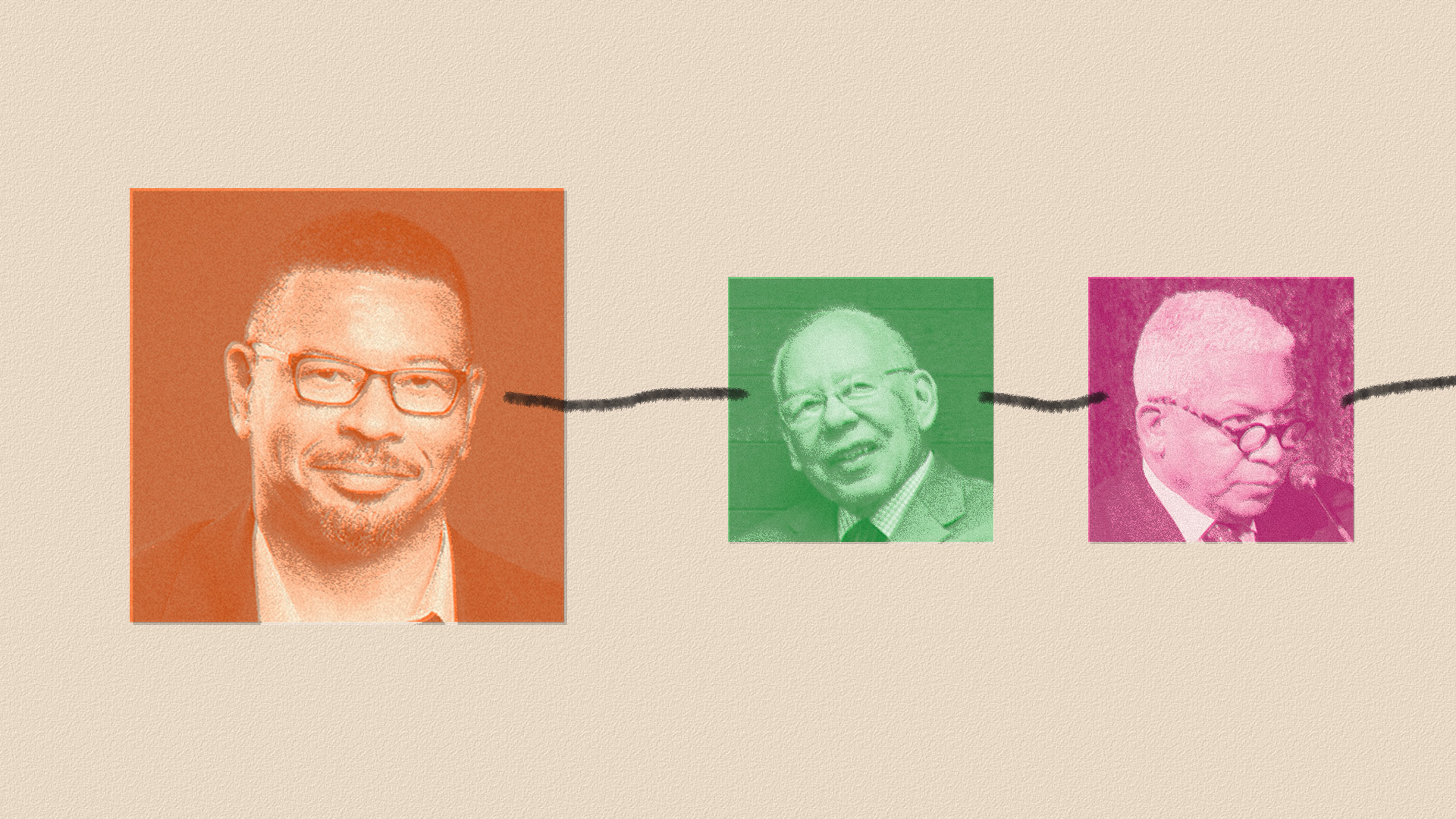
Colored square photos of Vincent Bacote, Eugene Rivers, and William Pannell against a cream background with a line connecting them.
Christianity Today February 21, 2025
Illustration by Abigail Erickson / Source images: Wikipedia, Fuller Seminary, Juicy Ecumenism blog

I grew up in a family that attended a traditional Black Baptist church. From a young age, I was drawn to spiritual matters, and I became a Christian around age 11. When I went to college in the 1980s, I knew I wanted to be involved in a Bible study. In the early weeks of my freshman year, I attended a campus ministry fair and followed a classmate to a table with a sign that said “Navigators.”

Looking back, I recognize this as the moment I not only walked into a world of focused Bible study and a path of discipleship but also unknowingly walked into the world of the evangelical movement. There were no signs declaring, “Welcome to Evangelicalism!,” and I do not recall hearing much about the people called “evangelicals.”

Instead, I slowly began to gain awareness of the ethos of evangelicalism. I began to learn about popular preachers like Charles Stanley and Chuck Swindoll, organizations like Campus Crusade for Christ (now Cru) and Officers’ Christian Fellowship, and theological schools like Dallas Theological Seminary. I saw magazines like Discipleship Journal and Christianity Today in the homes of my Bible study leaders.

It appeared to me at the time that the common thread was a clear commitment to the Bible—both how to understand it better and how to pursue life with the Bible as a central guide. I had great appreciation for both the things I was learning and the fellowship I had with peers and older Christians at the Navigators ministry and the Southern Baptist church I attended.

One of my most life-changing experiences was going to a Navigators summer program in Memphis. It was more racially mixed than what I had experienced on campus, and it led to significant growth—and, though I did not know it at the time, it directed my path toward being a theology professor. The ethnic diversity of the group was more incidental for me; I noticed and appreciated it, but I felt no tension with my experience in evangelical spaces and my racial identity.

After college, I moved to Memphis to live with a Navigator staff member to experience greater spiritual formation and discernment about my vocation. While there, I slowly began to learn much more about the evangelical movement. A lot of this came from listening several hours daily to one prominent Christian radio station, where I heard preachers like Swindoll, John MacArthur, and Stanley, along with programs like Focus on the Family, D. James Kennedy’s Truths that Transform, and radio programs that directly spoke about politics and culture. I began to become more explicitly aware of the evangelical movement and its relationship not only to biblical understanding but also to society.

Living in Memphis, with its history and sociocultural dynamics, it was impossible to avoid questions about race, even as I wanted to be conflict avoidant and neutral. Some of my Navigators peers were much more willing to name issues of race, even within the evangelical world. Eventually, I found myself wondering what was lacking in much of what I was hearing in the many evangelical radio shows. The typical politics and culture topics were the Cold War, rising secular humanism, abortion, and conservative approaches to economics.

I started asking myself, “Why is little to nothing said about race from all these people who say they are clearly committed to the entire Bible?” Racism, if mentioned, was usually defined as actions of prejudice by individuals. I did sometimes hear Tony Evans mention racism on his radio show, but my vexation continued to grow. I began to think that, at least for evangelicals, it would be necessary to prove that questions of race were valid and should be among the social topics that were addressed.

After three years in Memphis, I went to Trinity Evangelical Divinity School north of Chicago. I soon noticed there were fewer than ten Black students from the United States. I was very excited to be there and to dive deeply into the Bible and theology, and I wondered why there weren’t more of us there.

During my second year, I met an African American leader who was occasionally on campus and raised this question with him. He suggested I write an article about it. As I pursued this article, I began to learn about other Black evangelical leaders, interviewing people like Bill Pannell, Elward Ellis, Bill Bentley, and Tony Evans.

In 1993, I was still working on this article when I attended a conference about Black evangelicals held at Geneva College. There, I personally encountered Pannell, Evans, Clarence Hilliard, Eugene Rivers, and numerous others, including Ron Potter. Carl F. H. Henry and Kenneth Kantzer also spoke at the conference.

At that conference, I was confronted by two big realizations: first, that there were Black evangelicals who preceded my experience by decades, and second, that many of them had considerable cynicism about the world of evangelicalism.

I left the conference with a mix of confusion and tension, because my questions about the evangelical movement were fewer than the questions I had heard from the speakers. I processed this by writing a brief essay for my school paper about my experience at the conference.

Looking back, I think it is accurate to say I felt a tension between reality and my hopes for what could be true: the reality of the negative experiences of some of the Black evangelicals at the conference and my hope that a movement (evangelicalism) committed to the complete truth of the Bible would and could name and address the realities of race in America.

I eventually completed and published my research article on minorities in evangelical leadership, “When Will There Be Room in the Inn?,” with Urban Mission in 1994, the same year I graduated from Trinity. In 1995, I began doctoral work, and though I cared about questions of race, I did not want my career to be defined by them. So I tried to focus on other topics—but God had other ideas.

My first publication as a doctoral student focused on race and theology. While I wrote about other topics, in time I understood that I needed to include this as part of my work. But I did not imagine what was ahead.

I began teaching at Wheaton College 25 years ago. When I arrived, I wanted to be known as a theologian, not as a “Black theologian.” Few African Americans taught theology at seminaries in general, and even fewer taught at evangelical institutions. (There are more of us now, but the number remains small.) I did not want to be perceived as a kind of special-interest theologian.

I wanted to avoid being expected to be an evangelical answer to the work of James Cone and other Black liberation theologians; I wanted to be known for much more than this. I also began my career with a commitment to avoid bringing up race because I wanted to avoid being “that person.”

Eventually I came to understand that it was actually very important for me to include questions of race in my own scholarship and teaching, where appropriate. It dawned on me that I was doing a disservice to my students and myself if I actively avoided these topics as part of my writing, speaking, and classroom discussions.

And there was this realization: How many students in all the American Christian colleges, Bible schools, and seminaries were likely to encounter a nonwhite theology professor? As a Wheaton College professor, I also cannot avoid questions about race and the evangelical movement. As I look over my years within the fabric of evangelicalism, I have observed developments both hopeful and distressing.

Strangely, two truths seem to be in great tension. The first is that more white evangelicals are aware of and willing to engage with questions of race and justice. The second is that within the last decade (perhaps longer), others have seemed to have a more pronounced resistance to addressing these matters, some stating that they want a colorblind unity, and still others have regarded discussion of race as part of a Marxist strategy (this is actually not a new accusation).

We are now in a time when many are convinced the evangelical movement is primarily a sociocultural movement that wants to claim allegiance to the Bible and Jesus. Many of us know people who have rejected the label because they do not find it to be truly a movement of “Bible Christians.”

I have seen much to lament, but I also know evangelicalism is a kind of Bible-centric ecumenical movement, which by definition comprises people from many traditions and commitments. When I think of it this way, it is hard for me to readily say it is mostly a political identity.

What does all this mean for Black evangelicals, including those who have rejected the label or never used it even though they, like me, have had significant engagement with evangelicalism?

As a result of these questions, I recently helped produce a documentary, Black + Evangelical, in tandem with my friend Ed Gilbreath and Christianity Today’s Big Tent Initiative. One reason I wanted to tell the story of Black evangelicals is because I wanted others like me to know their experience is not unique and because we can discern paths of faithfulness to God when we learn from others who have come before us and walk beside us. Their stories show us how to name and lament dark experiences while also striving toward lives of faithful discipleship.

It can be easy to look only at exasperating challenges, but we also have the exciting opportunity to see how others have been faithful. We can follow these examples and demonstrate that evangelicals can be truly Good News people.

Vincent Bacote is professor of theology at Wheaton College and director of the school’s Center for Applied Christian Ethics.

Books
Review

ChatGPT Can String Words Together. Only Humans Can Write.

A veteran writing teacher isn’t impressed with the output of generative AI.

Keyboard letter keys on a conveyor belt.
Christianity Today February 21, 2025
Illustration by Elizabeth Kaye / Source Images: Getty, Pexels

Since its release in November 2022, ChatGPT has disrupted a myriad of fields, including education, publishing, market research, advertising, and online advice giving, sometimes with disastrous results.

ChatGPT is just one mainstream example of generative artificial intelligence (AI), a field that includes Google’s Gemini and Microsoft’s Copilot. These programs create new content by hoovering up what has already been posted on the internet—legally and illegally—and spewing it out in a new form without ever thinking about the text.

Naturally, these capacities make generative AI controversial among those who work with words. The technology has occasioned lawsuits in publishing and debates among writers. No matter what position we take, it’s here to stay, as John Warner concedes in his new book More Than Words: How to Think About Writing in the Age of AI. “There is no wishing away AI at this point,” he writes, “meaning it must be grappled with and done so in a way that preserves our humanity.”

Warner approaches this topic from the perspective of a 20-year college writing teacher, weekly book columnist for the Chicago Tribune, and author of guides like Why They Can’t Write and The Writer’s Practice. In More Than Words, he focuses on ChatGPT as it relates to writing and reading. Although his primary audience is writing and English teachers, his insights and speculations also apply to writers, readers, and professors in other disciplines.


Warner starts with this goal: “I hope to convince you that we vastly underappreciate the importance of the act of writing to the work of being human, and that very little writing that has any meaning can be successfully outsourced to syntax-generation technology.”

As a writer and editor, I confess I’ve not spent a lot of time researching generative AI. I know writers who outright dismiss it and writers who embrace it wholeheartedly, as well as writers who fall in between the two extremes. Although people use it to create published materials like blog posts, business newsletters, articles, and even books, the results tend to be flat, with no evidence of thinking and feeling, which Warner insists are part of being human.

I’ve noticed that flatness and have not been impressed. Thus, I was prepared to like More Than Words before I started reading it. I was not disappointed.

In part 1, Warner explains what ChatGPT is and what it does. As an engine of generative AI, it’s an example of a large language model that processes content, specifically text, by mimicking what has been written. It does not write. This, Warner emphasizes, is an important distinction.

Writing … is a fully embodied experience. When we do it, we are thinking and feeling. We are bringing our unique intelligences to the table and attempting to demonstrate them to the world, even when our intelligences don’t seem too intelligent. ChatGPT is the opposite, a literal averaging of intelligence, a featureless landscape of pattern-derived text.

Warner drives home the point that generative AI represents automation, not genuine human intelligence. As such, we need to be discerning in how and when we use it, recognizing that “generative AI has been born in sin and that it is already an ethical, moral, and environmental nightmare.”

For instance, it is trained on copyrighted intellectual property, which it then spews out as “writing.” Like many other writers, I find this process especially disturbing. The results of this training have led to plagiarism lawsuits. Even if the plaintiffs don’t win—and many haven’t—we can’t ignore the ethical issues involved.

Furthermore, Warner writes, the use of generative AI, like all supercomputing, requires enormous amounts of power to run computer servers and of water to keep them cool, thus impacting the environment in negative ways. (This is not an argument I’d encountered before among AI opponents.)

In part 2, Warner elaborates on the distinctions between humans writing and generative AI processing text. As he emphasizes, the two clearly are not the same. Writing is foremost the experience of wrestling with ideas and relating them to specific readers. ChatGPT is merely stringing together words gathered from a variety of sources, without any particular goal or thought process. Besides thinking, Warner declares, writing also involves feeling, which is communicated in our words and hopefully touches readers. Machines have no capacity for any of this.

Although he has plenty of reasons to be wary of generative AI, Warner understands it has value in other areas and uses it himself as a writer. For instance, ChatGPT can produce text summaries and lists much quicker than any person can. It’s “like having an on-demand generator of CliffsNotes for just about anything you can think of.”

This simile is an apt description of what appears at the top of Google searches. In mere seconds, I can get a quick summary in response to the words I put in the search box. But as Warner notes, we should remember that AI-generated text may not be wholly—or even partly—accurate. It’s important to go back to original sources to verify information, but the text does provide starting points for dealing with a topic.

Then, in part 3, Warner explores—and speculates on—how ChatGPT may affect the future for writers, readers, and educators. Thus far, the results of using ChatGPT have been far from stellar—and often just plain wrong. Examples include a “lawyer citing nonexistent cases” in court due to AI research and students using AI shortcuts to write papers for classes.

Warner fears that as generative AI works better in the future, we’ll accept the text it produces instead of engaging with the original works behind the words. And as a result, we’ll lose a piece of what it means to be human to a machine.

Warner’s experience of growing up with Tang, a powdered orange drink that doesn’t taste much like orange juice, resonated with me since Tang was also part of my childhood. After all, it was “the drink of astronauts.” If you only drink Tang—a cheaper, convenient imitation—and never drink real orange juice, you don’t know how superior the juice tastes. Likewise, if all students and readers know is AI-processed text, they’ll never learn why real writing—which reflects the author’s thinking, feeling, and experiences—is vastly superior.

The future of generative AI is unpredictable. In the closing sections of his book, Warner posits “a framework for how to think about this technology going forward.” He builds this framework on three broad categories: resisting, renewing, and exploring.

Here he circles back to examine how writing is related to being human: “I believe we have to orient toward goals that are associated with human flourishing, and make use of artificial intelligence where it is useful in those goals and reject it where it is a hindrance.”

Resistance starts with remembering that artificial intelligence is a misnomer; a more accurate label is artificial automation. Instead of blindly moving forward, wholeheartedly embracing it, we need to take the time necessary for discerning what benefits it holds. Just because it’s new and shiny doesn’t mean we should embrace it without thinking through the implications of using it.


Thankfully, many writers are resisting the consequences and implications of AI in publishing. Last year, for instance, the Authors Guild and The New York Times filed separate lawsuits against OpenAI and Microsoft for copyright infringement.

Not only is generative AI being trained on copyrighted material; it is also being used to steal authors’ names and reputations, which threatens to hurt their sales as readers lose trust in them. Last summer I heard Jane Friedman, a 25-year publishing veteran who reports on the business, talk about this very situation at a writers conference. She discovered AI-produced books with her byline for sale on Amazon and listed in her profile on Goodreads. She’s not the only author compelled to deal with the theft of her content and name. Generative AI makes this piracy quicker.

“Very little, if any, of the early excitement about generative AI has been tied to demonstrable improvement in the quality of products and outcomes,” writes Warner. “In fact, most of the outputs from generative AI models are acknowledged as inherently inferior. The biggest difference is the speed with which they are produced.”

Furthermore, says Warner, we have trouble resisting AI technology because we’re disconnected from knowing what a good life truly is. We are not machines, as some scientists propose, or the products of algorithms that reduce our lives to averages. Thus, we need to renew ourselves as sentient, discerning individuals who have values and are rooted in community with other humans.

Besides resisting the technology and renewing our humanity, Warner strongly believes, we need to explore both the potential and the pitfalls of generative AI, with emphasis on the latter. Doing so, he argues, is a matter of urgent public interest rather than a purely private concern. He advocates public discussion, debate, and regulation, especially in relation to schools since this is his area of expertise.

Warner takes what could be a dry, technical subject and enlivens it with plenty of personal experiences and real AI responses to prompts to illustrate his points. He adds over 14 pages of notes that reveal his research and incorporate opposing viewpoints. This is not an academic treatise or a diatribe against generative AI output, although Warner admits he sometimes wishes it would disappear.

More Than Words is not a book to race through but to chew and digest. It gave me a broader understanding of generative AI and the need for regulation of its increasing encroachment in our lives.

If, like Warner, we value writing as readers or writers or teachers, we won’t settle for AI-produced imitation. Instead, we would do well to heed his warning: “Only humans can read. Only humans can write. Don’t let anyone tell you otherwise.”

Lin Johnson is a freelance editor and writer, the editor-administrator of The Christian Writers Market Guide, and the former owner-director of the Write to Publish Conference.

addApple PodcastsDown ArrowDown ArrowDown Arrowarrow_left_altLeft ArrowLeft ArrowRight ArrowRight ArrowRight Arrowarrow_up_altUp ArrowUp ArrowAvailable at Amazoncaret-downCloseCloseellipseEmailEmailExpandExpandExternalExternalFacebookfacebook-squarefolderGiftGiftGooglegoogleGoogle KeephamburgerInstagraminstagram-squareLinkLinklinkedin-squareListenListenListenChristianity TodayCT Creative Studio Logologo_orgMegaphoneMenuMenupausePinterestPlayPlayPocketPodcastprintremoveRSSRSSSaveSavesaveSearchSearchsearchSpotifyStitcherTelegramTable of ContentsTable of Contentstwitter-squareWhatsAppXYouTubeYouTube