News

Catch and Release: ‘The Fish’ Goes Off the Air

In a major radio deal, one company is giving up on Christian music while another pursues expansion.

Christian radio station studio

Christian radio DJs Kevin Avery and Taylor Scott interview Brian Littrell of the Backstreet Boys in 2006. The Kevin and Taylor Show is going off the air with the end of 'The Fish.'

Christianity Today January 27, 2025
Rick Diamond/WireImage/Getty Images

Janet Jameson loves The Fish. She listens to Atlanta’s 104.7 FM nearly constantly—in her home, in her car, and all day at her office. She even follows her favorite DJs from the station on Facebook, which is how she saw the announcement that The Fish is going away.

“It’s with heavy hearts that we tell you that The Fish is coming to a close on January 31st,” DJ Taylor Scott wrote in a joint Facebook post with her cohost, Kevin Avery. “We are so incredibly honored that we had the privilege of bringing you ‘Good, Clean, Fun’ and doing life with you for 24 years.”

More than 1,000 people responded with tear, heart, and hug emojis. Jameson, who lives in the suburbs northeast of the city, couldn’t help but leave a comment.

“This news breaks my heart!” she wrote.

She isn’t the only faithful listener crushed by the news. North of Atlanta, Jeanne Shannon wrote, “Oh no!!!” and told the DJs, “You all have given so many incredible blessings and encouragement to us all over the years!!” 

Melissa White, in another suburb, commented she’d just had a dream that was asked to pray for one of the DJs, “so I began praying for God to keep his shield of love around her,” and then she woke up and saw the announcement. 

Catherine Black Adams, from a small town near the Georgia-Tennessee border, wrote that she would be praying for the DJs as they embarked on their next chapter. “I’ve been a Fish listener for years with our kids & now our grands,” she said. 

Similar scenes are playing out in Tennessee, Ohio, Arkansas, Texas, Colorado, Oregon, and California, as news spreads that Salem Media Group, the largest Christian radio company in the United States, is selling Christian music stations and retiring its Fish brand. The deal marks the media company’s final exit from contemporary Christian music. 

Salem Media did not respond to request for comment. But Edward Atsinger, Salem’s cofounder and executive chairman, said in a statement that the sale is a “strategic decision” that allows the company to pay off $159.4 million in long-term debt. 

Salem ran into some financial trouble in 2020 and saw its share price drop from a high of about $30 in 2004 to just 80 cents. The company’s investment value was downgraded to “poor quality” and “high risk” by Moody’s, a top credit-ratings agency.

The number of Christian radio listeners actually increased during the COVID-19 pandemic, but the economic impact hit advertisers hard, and many of the ministries that bought blocks of time on Salem stations to air teaching and preaching, including Chuck Swindoll, John MacArthur, Tony Evans, David Jeremiah, the late Charles Stanley, and the late J. Vernon McGee, cut back on their media expenditures too. Salem’s stock value recovered in 2021 but then started slowly sliding downward again. At the end of 2024, shares were selling for about 20 cents each. 

The company decided to get out of Christian music radio and focus on talk, returning to its format roots. Salem started as a Christian talk radio company in the mid-1970s, and its most dedicated listeners are still those who tune in for preaching, teaching, and commentary. Salem has also seen growth with its conservative political shows hosted by Charlie Kirk, Bill O’Reilly, Eric Metaxas, Hugh Hewitt, Larry Elder, and Jay Sekulow. 

Salem differentiates between Christian and conservative talk-show formats but sees them as “highly complementary” since both focus on “conservative views and family values.” Currently, Salem has more than 100 radio stations and broadcasts in the top 25 media markets. Its syndicated programs are distributed to roughly 2,700 affiliates. 

“Listeners develop, learn and grow in their faith as they gain answers to questions relating to daily life, from raising children to improving marriages,” the company says. “Christian Teaching and Talk is our core, foundational format.”

Salem’s shift doesn’t spell the end of Christian music on former Fish stations, though. Seven of Salem’s music stations were acquired by Educational Media Foundation (EMF), the parent company of K-Love and Air1. EMF will begin operating the stations on February 1.

David Pierce, EMF’s chief media officer, told CT that conversations about programming and personnel are ongoing and that some familiar voices may end up staying. 

“Our goal is to keep Christian music on these stations,” he said. “We’re thankful to be able to promise that.”

Between 2019 and 2021, EMF was the fastest-growing radio company in the US, purchasing 39 additional stations. But this recent acquisition will expand its coverage of major markets, putting K-Love and Air1 on the radio in places like Dallas, Cleveland, and Los Angeles. EMF currently reaches about 18 million listeners every week and controls more than 1,000 broadcast signals across all 50 states.  

Christian radio ranks fourth in the US for overall station count. The rise of streaming brought massive shifts to the music industry, but Christian radio has remained important to older listeners, who trust DJs to curate their music. Christian radio is also finding new listeners among younger adults, tired of trusting algorithms and open to other ways of discovering new music.

K-Love, which plays mostly pop- and rock-style contemporary Christian music, caters to an older audience, while Air1 attracts a younger demographic with more contemporary worship music. 

The shift from Salem’s Fish format to K-Love or Air1 will bring noticeable changes to the hourly mix of music and advertising. Salem’s commercial format required stations to devote time to marketing. EMF, by contrast, is a nonprofit. Pierce told CT the noncommercial funding model of both networks enables them to dedicate a greater proportion of their airtime to music than traditional commercial stations can.

K-Love and Air1 also have strong relationships with labels and artists in the Christian music industry, cultivated through high-profile concert series and its annual K-Love Fan Awards. Through the success of its radio brands, EMF has established itself as a powerful music-industry gatekeeper. 

The company has achieved this, in part, by cultivating dedicated listeners. 

“Radio is a trusted medium,” Channah Hanberg, who serves on the Christian Music Broadcasters board of directors, told CT. “DJs can create a personal connection, and Christian music layers on a spiritual connection.” 

While many of the radio programs people listen to are national, the stations also connect listeners to their local communities in ways that streaming services do not. Hanberg, who is also vice president of media for Crista Media in Seattle, said radio stations remain sustainable and competitive because they have the potential to connect people to their cities and regions. 

“You can turn to a local station and be encouraged, and you get information about your local community and events,” Hanberg said. “Christian radio is about more than music; it’s a ministry.”

The Fish’s listeners in Atlanta, praying that their DJs get new jobs on the radio soon, would certainly agree.

A Letter from the President

Mother Teresa, Billy Graham, and a global God.

I often tell how an encounter with the witness of Mother Teresa forever changed my life. It happened in my middle teenage years, as I was growing up in California’s Central Valley, that I found a documentary that followed her from India to locations around the world. The story of this faithful nun from Albania, caring for the poorest of the poor in Calcutta, found its way through the work of faithful storytellers all the way to California, where it exploded my small view of what it might mean to follow Jesus. 

That’s our hope for this Globe Issue. That we will allow God, in the extraordinary work he does through ordinary people, to challenge, inspire, and transform us. That we will allow him to explode our sometimes-small sense of what he might call us to. 

John Stott once said, “We must be global Christians with a global vision because our God is a global God.” And when Billy Graham laid out the vision for Christianity Today in 1955, a year before we launched, he dreamt that we might one day “have at least one hundred reporters throughout the entire world carrying all the religious news possible.” 

Stott and Graham understood how important it is for the Western Church—particularly the American Church—to learn from and be inspired by the non-Western Church. These two giants in the faith continue to inspire what we do today, and, in many ways, inspire what you hold in your hands right now.

The Globe Issue is brought to you by generous partners of The One Kingdom Campaign, the first comprehensive campaign in Christianity Today’s history. 

One of the campaign’s three initiatives, The Global Initiative, is elevating the stories and ideas of the global Church. It enables CT to dramatically expand our coverage to better represent what God is doing in every corner of the planet. In fact, you may have already noticed CT’s growing global team of editors, reporters, and translators. Our prayer with this Globe Issue is that your vision for the kingdom of God on Earth increases. And that your heart expands for the sisters and brothers you meet here.  

We invite you to learn more about The One Kingdom Campaign at OneKingdom.ChristianityToday.com. If you would find joy in partnering with us, we would be honored to partner with you. 

Dr. Timothy Dalrymple is the president and CEO of Christianity Today.

News

Moscow Continues Targeting Christians in Russian-Occupied Territories

As Trump pushes for a Ukraine deal, local church leaders fear for their congregations.

Worshippers leave Sunday service at Sukovska Baptist church in Ukraine.

Worshippers leave Sunday service at Sukovska Baptist church in Ukraine.

Christianity Today January 24, 2025
Scott Olson / Getty

President Donald Trump repeatedly claimed on the campaign trail that he could end the Ukraine war within 24 hours of taking office. He failed to deliver but on Wednesday issued on social media an ultimatum to Russian president Vladimir Putin: End the war or risk “Taxes, Tariffs, and Sanctions.”

Trump’s tough stance against the Kremlin doesn’t mean Ukraine is off the hook. The president’s administration hasn’t revealed which concessions it will request from Kyiv, and Putin will undoubtedly negotiate for sovereignty over territory he has occupied and illegally annexed. 

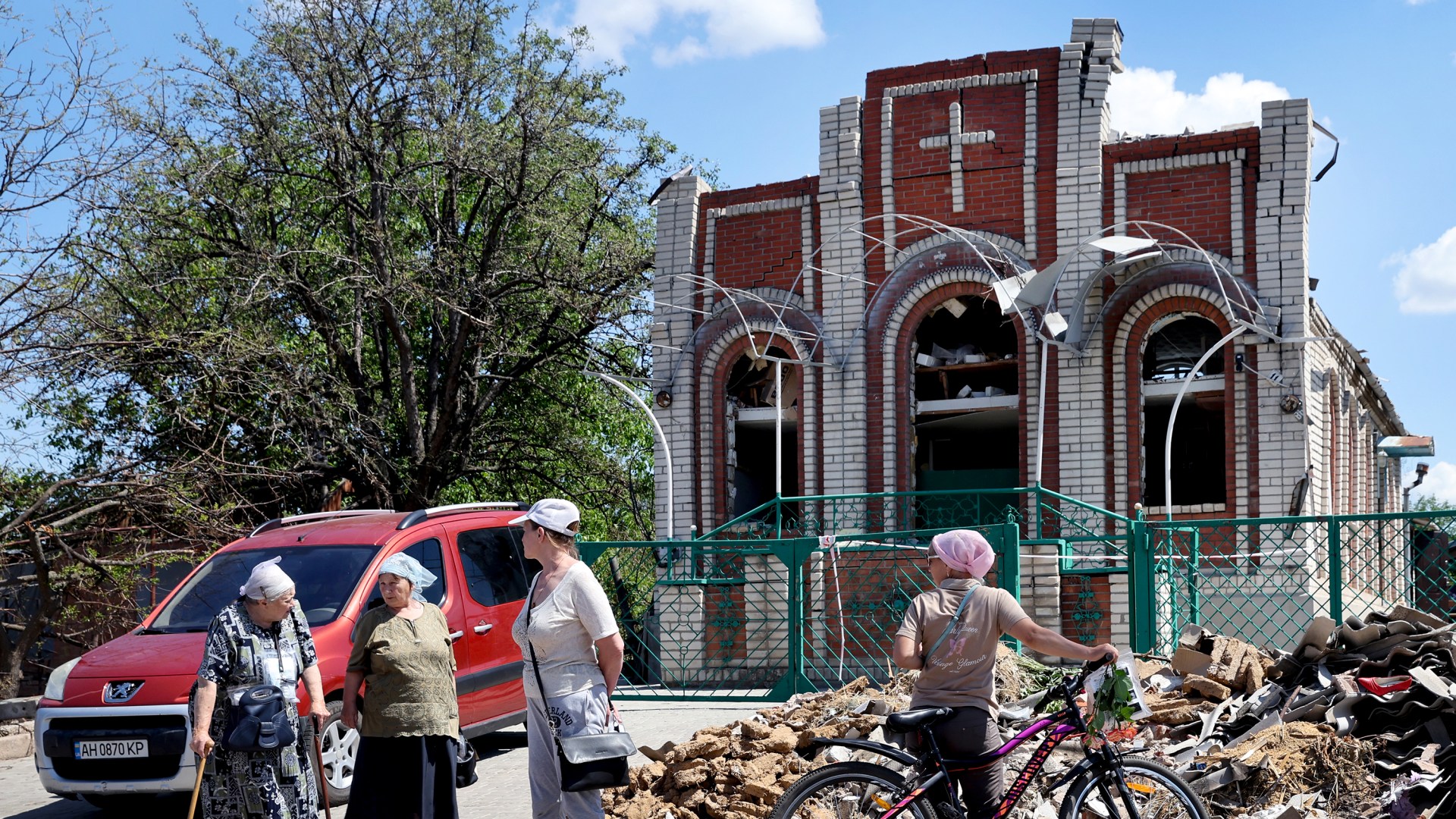
Conceding Ukrainian land to Russia comes with a host of geopolitical downsides, but a lesser-known consequence affects churches: Moscow targets non-Orthodox Christians.

Across Russian-occupied Ukraine, Kremlin troops have shuttered places of worship since the first invasion began in 2014. Religious persecution only increased after the full-scale invasion in February 2022—proof that Putin’s conquest contains a religious component, say local Protestant leaders. 

Pastor Mykhailo Brytsyn was aware of the Kremlin’s tactics yet still taken by surprise when Russian soldiers flooded Melitopol, a Ukrainian city of 150,000, in March 2022. They arrested several of his friends—local clergy from non–Russian Orthodox congregations—and closed their churches. Six months later, troops stormed the sanctuary of his own congregation, Grace Church, during morning worship.

“We could not imagine that armed soldiers with their faces covered with masks, in helmets and with shields, would storm the church right during the service,” Brytsyn told CT.

The soldiers fingerprinted and photographed congregants and copied their identification documents. Then they searched the church, interrogated Brytsyn, and escorted him home to hunt for “extremist literature” proving ties to the West. Their search was in vain. Still, the Russian commander gave Brytsyn two days to leave town. 

Brytsyn lives temporarily in Ukraine’s Rivne region and continues to pastor his church, now scattered throughout 16 countries. He also partners with Mission Eurasia to document atrocities committed against Christian communities in Russian-occupied territory. 

In Melitopol alone, Russian forces closed all churches unaffiliated with the Moscow Patriarchate, including Greek Catholic, Roman Catholic, and Orthodox churches from the Ukrainian Patriarchate. In the broader region of Zaporizhzhia, only 15 Protestant churches remain open, compared to several hundred prior to the invasion. 

This pattern has been repeated throughout Russian-occupied Ukraine. Many Christians are concerned about the consequences of a US-brokered deal that includes land concessions.

“One of our churches is in Kherson. It’s unclear whether a brokered deal would include that city or not,” Jon Eide, country director for Mission to the World, said earlier this week. The church leaders would not feel safe under Russian occupation and would likely relocate, he added. 

Ukrainian Christians face another hurdle: Kremlin propaganda claiming Kyiv persecutes Orthodox Christians has seeped into conservative circles in the West, undermining Western support for Ukraine. Brytsyn visited the United States and Europe seven times during the past two years and identified Russian narratives in the questions people asked during his presentations.

In October, Ukraine’s Ministry of Defense banned churches linked to Moscow, citing propaganda dissemination. Russia’s patriarch Kirill supports the war in Ukraine, and Putin has framed his conquest as a “holy war,” orchestrated to protect Christians from immoral Western influence. The Ukrainian Orthodox Church announced its separation from the Moscow Patriarchate, but the decision hasn’t been formalized

The restrictions placed on Kremlin-affiliated churches do not mean Ukraine is broadly targeting an entire community, Brytsyn explained. The Orthodox Church of Ukraine, a member of the recently canonized Kyiv Patriarchate, operates freely.

Moscow, on the other hand, makes no room for Protestants and non–Russian Orthodox churches. According to some reports, nearly 40 Ukrainian clergy members have died in targeted attacks since 2022. 

“There can be no freedom where Putin’s troops have arrived,” Brytsyn said. “I lived in the Soviet Union for 25 years, and I know the oppression that believers were subjected to there. Now the Russians’ practice is even worse.” 

News

Gen Z Pro-Lifers March Together

Usually a minority among their pro-choice peers, thousands of Christian students find solidarity at the annual March for Life in Washington. 

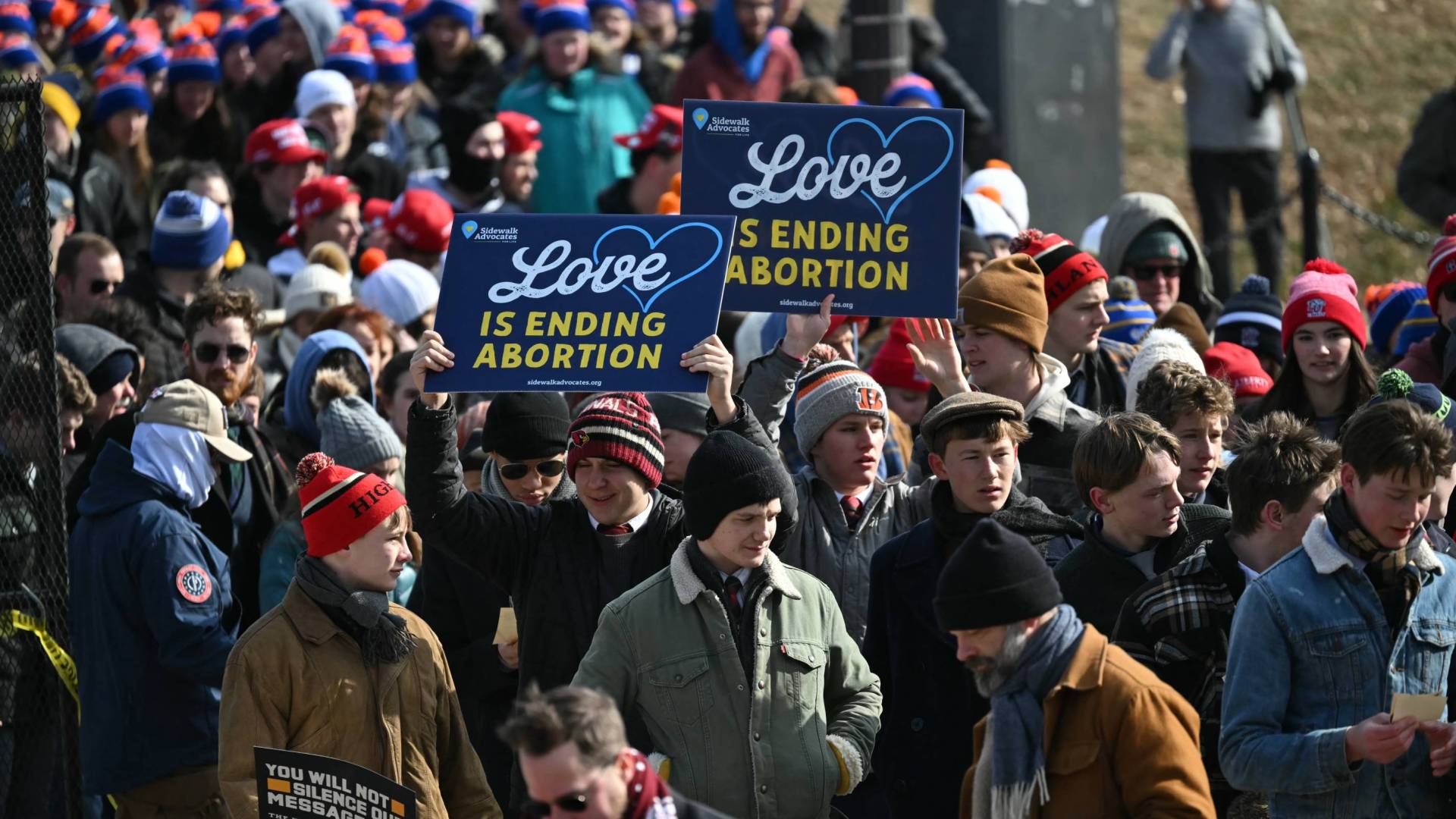
Young marchers hold a sign that says, "Love is ending abortion."

March for Life on the National Mall

Christianity Today January 24, 2025
Andrew Caballero-Reynolds / AFP via Getty Images

Dozens of students from Colorado Christian University wore navy “Pro-Life U” T-shirts and carried signs saying “Life Is Precious” and “Let Their Hearts Beat” during the March for Life in Washington on Friday.

Sophomore Stephanie Heil, 18, decided her sign would read, “Be a Voice for the Voiceless.”

“I wanted to carry that in honor of my biological sibling lost to abortion,” said Heil, who is adopted and a former foster child. She became involved in the pro-life cause after learning her birth mother had gotten an abortion.  

The march is the country’s largest pro-life rally—organizers expected up to 150,000 people—and the third annual event held since Roe v. Wade was overturned by the Supreme Court in 2022. The speaker lineup included Vice President JD Vance, Florida governor Ron DeSantis, and Lila Rose, founder and president of the pro-life advocacy group Live Action. 

Three dozen Colorado Christian students woke up before dawn Thursday to take a bus from campus to the Denver airport to fly to DC for the march. As young pro-life activists, they know they are an anomaly among fellow Gen Z adults. That’s why they say it’s so special to be in a setting with thousands of fellow young people who share their convictions around abortion.

“It’s very encouraging to be around people who agree with the same things as you and who will spur you on and help you in the way you think and help you in understanding,” said Jasmine Obrecht, a 21-year-old senior and copresident of the pro-life club on campus.

Fellow Christian colleges, secular schools, and Students for Life chapters sent thousands to DC for the event. This year’s lineup also included a student speaker, Hannah Lape, who leads the Voice for Life chapter at Wheaton College, which sent around 75 students to the march.

“I’ve been pro-life my whole life and loved the Lord my whole life,” Lape told Students for Life. After interning with Susan B. Anthony Pro-Life America, “I knew that fighting for the moral rights of preborn children in policy was a true calling for me.”  

Three-quarters of Americans under 30 believe abortion should be legal in all or most cases. Even among evangelicals, young people are shifting pro-choice; self-identified white evangelicals under 35 are twice as likely to support abortion as a choice (38%) than those over 65 (16%).

“I feel like it’s a trigger word in our generation,” Heil said. “If you say you’re pro-life, you’re immediately a woman hater.” 

Most of the group was young women, but one of the male students, Noah Hakalmazian, a 19-year-old from Colorado Springs, said that he had grown up advocating for pro-life causes. He and his family would stand outside Planned Parenthood clinics and plead with people to change their minds. 

“I think there is a really bad pretense right now about how men shouldn’t have a say in any of this kind of stuff because it’s women’s bodies that we’re talking about,” he said. “Regardless of gender, regardless of what you may believe, I think that human lives are the ultimate cost that is being paid right now. And I don’t think there is any more important topic than saving human lives.” 

Fellow students were hopeful about pro-life policies, including defunding Planned Parenthood and enacting a federal abortion ban, though Trump has previously said he would veto such a ban if he was elected. On Thursday, Trump pardoned nearly two dozen activists who had previously been convicted for blocking abortion clinic entrances. He has called himself the “most pro-life president.”

Students said it was hard to discuss their pro-life views with peers who aren’t Christian.

“I want to be that person who goes out and speaks my convictions so someone else can stand up and speak theirs,” said Obrecht. She said bringing up her position on abortion can end the conversation, but she has learned to listen to people’s stories and try to empathize before making arguments.

She wants to continue to advocate and speak out around abortion so that others can do the same.

“I like to march for the voiceless, as well as for people my age to gain confidence in speaking up about this issue,” Obrecht said. “One day people will wonder why we had such a blind spot to this issue.”

Culture

‘Between Borders’ Calls to Christians

In its story of an Armenian refugee family, a new film emphasizes the church’s role in caring for the displaced.

The Petrosyan family arriving in Volgograd, Russia, in the film, Between Borders.

The Petrosyan family arriving in Volgograd, Russia, in the film, Between Borders.

Christianity Today January 24, 2025
Between Borders

Four-year-old Olga Petrosyan and her grandmother huddled in the apartment as the mob of men pounded on the door. “Where are the Petrosyans?” the men shouted. When Olga began crying, her grandmother placed a hand over her mouth to stifle the sound.

Eventually, after a friendly neighbor said no one was home, the men disappeared. The year was 1988, on the eve of an ethnic and territorial conflict between Azerbaijani and ethnic Armenians that still persists today. The Petrosyans had already faced growing hostility from Azerbaijanis, but the threat of death had never arrived on their doorstep before.

Their home had become uninhabitable. With a couple suitcases and a guitar, the family of four boarded a train out of Azerbaijan. Three years later, their apartment would be torched as the country erupted in war.

The Petrosyan family’s journey—from Azerbaijan to Russia and eventually to the United States—is dramatized in the new film Between Borders, premiering January 26. Starring The Chosen’s Elizabeth Tabish as Violetta, the fierce mother of Olga and Julia, the film depicts the family’s struggle to belong as they encounter persecution in Azerbaijan and later in Russia. The film is a tribute to the plight and perseverance of displaced peoples, as well as an urgent reminder of the role of the church as a haven for those who have lost their homes.

“I think there is a common experience for all refugees that home is everywhere and home is nowhere,” Olga Petrosyan, who is now working for a church in Kentucky, said in an interview with Christianity Today. “You will blend in to make it safe for you anywhere you go. But you will also never feel belonging.”

The film opens in Baku, Azerbaijan, where the Petrosyans experience signs of impending unrest. Ivan Petrosyan (played by Patrick Sabongui), who works as a rocket scientist, notices that the window of a local Armenian bakery has been shattered, and Violetta and the girls encounter a mob calling for death to Armenians.

The Petrosyans leave before the worst of the violence—the ensuing pogroms in Baku will result in dozens of Armenians being killed—but the onset of war between Armenia and Azerbaijan over the Nagorno-Karabakh territory will make returning impossible.

In the city of Volgograd, Russia, the Petrosyans try to build a home in a shoe-box apartment with peeling walls and a broken heater. The gloomy conditions are enlivened by a visit from an American missionary named Dwayne, a Christian from a local Nazarene church plant, who brings boxes full of supplies. It’s the Petrosyans’ first encounter with Christianity, and soon they begin attending church. (The congregation in Volgograd was founded by Lonnie Norris, an American missionary who moved to Russia to plant churches. He is the executive producer of the film; his son Isaac is a writer and producer.)

Violetta, a former Communist party member, said in an interview with Christianity Today that at first she attended church to learn English. But her interest in grammar and syntax soon evolved into appreciation for the Good News that she belonged in the family of God.

Her daughter Olga remembered visiting the church in a cold, dark building that used to be a Soviet government office. When she entered, she immediately felt warmth radiating from the congregation. These Russian Christians were different from the Russians in their neighborhood, who treated them with disdain for being foreigners.

“All these people rushed to greet us, and for the first time I felt like they really cared about who I was as a person,” Olga said. “As a 9-year-old, I was trying to figure out, Why are they so happy? Why do they love me? Why is there so much joy in this place?

Awed by the church’s generous acts of service, the Petrosyans eventually became Christians. In Between Borders, Ivan is the last to convert, reluctant to join a faith he sees as foreign and frivolous. But when the pastor offers him a job as the church’s maintenance man, he begins to overhear sermons about the Prodigal Son as he tightens hinges and fixes floors. Soon he too accepts the gospel.

The city of Volgograd never fully welcomes the Petrosyans, who regularly experience racist barbs, physical intimidation, and religious persecution; eventually, with the help of an American congregation of the Church of the Nazarene in West Virginia, they seek asylum in the United States. The film doesn’t delve into the specifics of the church’s aid, but Lonnie Norris said in an interview that the church helped the family find jobs and a lawyer for their asylum case.

Between Borders culminates in a climactic courtroom scene, in which the judge overseeing the Petrosyans’ asylum case declares that America should be a “nation of freedom, enlightenment, and compassion, a democracy that gives hope to those who have lost all hope, a land of refuge.” It’s a political manifesto that has extra resonance given the context surrounding the film’s release date. Between Borders premieres less than a week after the swearing in of President Donald Trump, who has promised to crack down on both legal and illegal immigration—including reinstating a policy from his first term that had asylum seekers “remain in Mexico” while their cases were being heard and suspending a refugee resettlement program.

“We’re not trying to make a political statement, but we do understand that it will be in some ways,” said writer and producer Isaac Norris.

The film doesn’t have the time or space to uncover the United States’ complicated relationship with asylum seekers, as more Americans want immigration levels reduced. The Petrosyans may have ultimately won their asylum case, but the film elides the stories of many others who have been turned away.

Perhaps America will always be fickle in its concern for the world’s huddled masses. But Between Borders suggests the church should be unwavering in its commitment to care for the sojourner. What is most striking about the final scene isn’t the pronouncement from a judge about the ideal of America; it is the presence in the courtroom of dozens of people from the Petrosyans’ church, who have come to show their love and support for the beleaguered family.

As Christians, we are each caught between borders, situated as we are between the present principality of darkness and the future coming of the risen King. We are sojourners and exiles, strangers in a foreign country (1 Pet. 2:11). Like Abraham, we look forward to a future home, “a city with foundations, whose architect and builder is God” (Heb. 11:10).  

As people journeying to our heavenly home, Between Borders suggests that Christians should take the lead in serving refugees. Our care should be sacrificial and countercultural, so radical in nature that the only possible explanation is that we have been with Jesus (Acts 4:13). Is it possible that the very mark of our set-apart-ness might be the way we generously and joyfully open our hearts and homes to those who are displaced? Could this deepen our understanding of Jesus, who sojourned here on our behalf?

At one point, Ivan is astounded and confused by the church’s generosity toward his family. He asks the pastor in Volgograd why the church members are being so kind to the Petrosyans.

“Jesus was a refugee too,” the pastor replies.

Christopher Kuo is a freelance journalist based in Ireland. His work has been published in The New York Times, The Los Angeles Times, Duke Magazine, and elsewhere. 

Ideas

Theirs Is the Kingdom of Heaven

Many Christians around the world see persecution as a blessing. Westerners can learn from them.

A chain with the crown of thorns as the middle link on a golden background
Christianity Today January 24, 2025
Illustration by Mallory Rentsch Tlapek

“Is persecution coming to the West?”

This is a question I hear often in my leadership role with Open Doors US, a ministry with nearly 70 years of experience serving and supporting persecuted Christians around the world.

In response to cultures in the West that can seem increasingly indifferent or even antagonistic to the Christian faith, some followers of Christ here have shrunk back in fear from the broader culture and sought isolation. Others have come out swinging in anger and declared war against the culture at large.

The Bible clearly states that anyone following Jesus will be met with some level of opposition (Matt. 24:9; 2 Tim. 3:12). But when thinking about persecution, most of us tend to gravitate toward the idea of physical violence, such as martyrdom, assault, or the burning of a church building.

While those things certainly qualify as persecution, in the Beatitudes, Jesus also says those are blessed who endure insults or are the targets of those who “falsely say all kinds of evil against you because of me” (Matt. 5:11).

As we look at the words of Jesus in Matthew 5, I wonder if the question about the likelihood of persecution is the wrong question to ask. Instead, what if we asked simply, “Do we treat persecution as a blessing?” And it’s here that our persecuted brothers and sisters have a lot to teach us.

Regardless of whether the response is expressed in fear or hostility, the root of both responses seems to be the same underlying assumption—persecution is inherently bad and should be avoided.

Yet in his Sermon on the Mount, Jesus challenges this notion, saying, “Blessed are those who are persecuted” (Matt. 5:10, emphasis added).

While I’m not saying we should pray for persecution, Jesus presents it as if it were a gift. As Christians, we certainly believe the words of Jesus are true, but still this idea that persecution is a gift seems counterintuitive and incredibly far removed from our felt experience in the West.

Perhaps we think persecution is one of those gifts we cannot fully appreciate now. When thought of in this way, we accept the words of Jesus as he tells his followers to “rejoice and be glad, because great is your reward in heaven” (v. 12). This notion of delayed gratification resonates with us. We can understand the idea of enduring discomfort now for a future benefit.

This is a principle we live out nearly every day in a variety of ways. Today, we accept reduced spending power so we can save for retirement. We experience the pain and discomfort of exercise now for the prospects of better long-term health. In Genesis, Joseph recognized God’s hand decades later on his brother’s evil deeds: “You intended to harm me, but God intended it for good to accomplish what is now being done, the saving of many lives” (Gen. 50:20).

In this context, it’s not a stretch for us to understand the idea that persecution experienced now can result in a future reward in heaven.

Yet while Jesus does speak of rewards in heaven, his words aren’t just about future blessings. “Blessed are those who are persecuted,” he says. He does not say, “Blessed will be the persecuted, someday.” Is it truly possible that persecution can be a blessing here and now?

Persecution manifests differently across the globe. In places like North Korea, Christians can be arrested for even having a Bible. In other places, believers are shunned or excluded by their communities. In still other contexts, Christians may be denied access to the education or employment needed to provide for their families.

I recently had a conversation with Ibrahim, a Christian brother from Sudan. When he converted from Islam, he was thrown out of his home. After sharing his faith with other Muslims, he was arrested and tortured and later chased from his home country. He calls that part of his life “dark times,” as he was contained in a dark prison cell so tiny he could barely turn around. And he endured that experience not once but multiple times because of his decision to follow Jesus and share his gospel.

When I asked Ibrahim about Jesus’ words in Matthew 5, his perspective was striking. For him, the blessing of persecution wasn’t relegated to the distant future. Rather, it seemed the blessing was something he had already experienced and continues to experience. “I went into prison as a kitten,” he told me, “but I came out as a lion.”

In his darkest moments in prison, Ibrahim said he was forced to recognize that he was poor in spirit (a group Christ also refers to as “blessed”), but in his poverty the riches of Christ were poured out upon him. In that dark prison cell, the light of Christ burned bright, transforming his suffering into a profound declaration of faith in Jesus—both to those around him and to himself.

In the same way Abraham’s willingness to sacrifice Isaac, his beloved son of promise, had shown that he valued obedience to God above everything else, my brother Ibrahim demonstrated that he treasured Christ above all else as he clung to him in prison. For Ibrahim, the persecution he experienced is a gift he treasures, not a socks-for-Christmas type of gift he didn’t really want. It is a gift he holds on to. It is a gift he is truly thankful for receiving. It is a gift that has changed his life. 

Despite the challenges each step of the way, Ibrahim continues to minister to the people of Sudan. After being forced from Sudan, he moved to Egypt, where he continued to serve and encourage other displaced Sudanese. Before long, he was given two days’ notice to leave Egypt as well.

He is now in Kenya, focused on equipping Sudanese believers who travel to Kenya for training and then return to Sudan to minister. He is planning to move back to Sudan in the coming years and looks forward to the day when, in addition to equipping other Sudanese believers, he is able to participate in the frontline evangelism of his fellow Sudanese countrymen.

While persecution may certainly look different in the West than it does in Sudan, I pray that our responses to persecution would look the same as that of our Sudanese brother. Rather than responding with our gut reactions of fear or anger, will we respond to rejection, pressure, discrimination, or other mistreatment with a posture of thanksgiving for what God is doing through the suffering? Will we rejoice, as the apostle Peter encouraged us to do, as we “participate in the sufferings of Christ”? (1 Pet. 4:13).

I pray that rather than giving way to fear or anger, we’d invite the riches of Christ to fill in where we fall short. I pray that even though we may go into persecution as kittens, we’d emerge as lions. It’s more than any of us can do on our own. But Ibrahim’s testimony has shown that through the power of the Holy Spirit who lives in each of us, it’s something God can do in us and for us.

Ryan Brown serves as president and CEO of Open Doors US, one of twenty-five national Open Doors International bases located around the world.

Culture

After 30 Years, Skillet Rocks On

The veteran band reached alienated youth group teens of the ’90s. Now the kids of their first fans are listening too.

Skillet performing at Winter Jam

Skillet performing at Winter Jam

Christianity Today January 23, 2025
Photography by Kurt Kryszak

Meghan Simmons remembered Skillet’s music blasting through the old speakers on her church’s bus as it shuttled her and her youth group friends to concerts and camps in the mid-1990s. She recalled that the band—hard rock influenced by grunge, nu metal, and arena pop rock, with songs like “Locked in a Cage” and “Dive Over In”—scratched the itch of relatively tame teenage disenchantment.

“I wasn’t a particularly rebellious teenager, but that harder sound sort of gave me something to hook my rebellion onto,” Simmons said. “That was my edgy music.” When she saw Skillet at Winter Jam—a yearly Christian music tour that regularly ranks among the top-grossing tours in the US—it was “by far the hardest concert” she had ever attended. She watched the band play “with my high school boyfriend [now husband]. He bought me a smoothie.”

Long-time fans of Skillet know what to expect when they show up to a concert: pyrotechnics, bone-rattling amplification, and a theatrical performance of a range of selections from their expansive catalog, including intense, raucous anthems and inspirational ballads. After nearly 30 years in the industry, the band remains one of the most successful Christian music groups working today. In 2024, Skillet was the fourth most-streamed Christian artist according to Luminate, behind only Elevation Worship, Lauren Daigle, and Hillsong Worship.

And its success isn’t confined to Christian circles. According to the band’s public relations firm, the majority of Skillet’s radio airplay for the past decade has been on mainstream rock stations. They have 8.2 million monthly listeners on Spotify. Organizations like the WWE, ESPN, and the NFL have purchased sync rights for their songs. The band has toured with acts like Nickelback, Seether, Papa Roach, and Korn.

Unlike most of their industry counterparts that emerged on the contemporary Christian music (CCM) scene of the ’90s (think DC Talk and Jars of Clay), Skillet has continued to do the near impossible: attract new young fans. Today, their core audience demographic is men aged 18–24.

This kind of longevity and reach is rare, especially in Christian music, where catalogs have historically had little value (though that’s changed somewhat in recent years) and few artists have managed to establish their songs as classics. In Skillet’s case, long-term success seems to flow from periodic reinvention and marketing savvy. They stay busy, touring almost constantly. On the heels of their first Middle East tour last fall, the four-member ensemble, which includes John Cooper and his wife Korey Cooper, Jen Ledger, and Seth Morrison, is headlining Winter Jam once again. A fresh group of fans will rock out to their heavy sound—maybe even over smoothies.

Edginess, musical and rhetorical, has long been part of Skillet’s brand. Increasingly, it seems, that edginess is expressing itself through politics. Frontman John Cooper’s activism on stage, online, and on his podcast—related to gender, politics, and wokeness—has attracted listeners who share his conservative views. (The podcast’s most recent episode is in part a critical response to a recent article by Christianity Today’s editor in chief Russell Moore.)

Cooper seems to understand that the teens and young adults (especially men) of today are experiencing a different kind of alienation than he did—one marked by a feeling of collective powerlessness and political disenfranchisement. But the underlying rage, loneliness, and pain? Those are themes Skillet has always addressed.

“I have a perpetual love for teenagers,” he told CT. “We have to talk about nihilism and anger. I want them to know it’s okay to feel this way, but I also want them to know that there is hope.”

In Skillet’s early days, Cooper sported piecey bleached-blond hair (a striking contrast to his current dark hair and long beard) and a punk-inspired wardrobe (lots of black, cutoff tank tops, and baggy pants), in keeping with the band’s creative debt to ’90s acts like Nirvana. Cooper said the angst and disillusionment associated with figures like Kurt Cobain is part of Skillet’s story, too. Grunge and hard rock resonated with isolated teens like Cooper himself, who lost his mother to cancer when he was 15 years old.

“I started fighting with my dad. I was angry, and I was lonely,” Cooper said. “I would fantasize about hurting people. Nothing extreme, but I’d think, This person is hurting me. How can I hurt them?

During that dark season, Cooper said, Jesus rescued him, and music was there for him. “It was like, ‘No one I know understands me, but Metallica does, Stryper does, Trent Reznor does,’” he said.

Skillet’s first album, Skillet (1996), paid homage to Nirvana’s 1991 album Nevermind; the title track, “I Can,” borrows structurally and sonically from “Smells Like Teen Spirit.” That grunge sound attracted Skillet’s early fans, mostly Christian teens and young adults looking for music that satisfied their desire for something cool and their parents’ search for “safe” content.

Skillet came out in the heyday of CCM’s bid to offer a Christian alternative to suit any musical taste: If you like NSYNC, try Plus One. If you like Alanis Morissette, try Rebecca St. James. These were artists for Christians who wanted a taste of what it would be like to be plugged into mainstream music subcultures—including their fandoms, concertgoing, and merch—but without sexual content, drug references, or explicit language.

Skillet took a slightly different approach. Josh Balogh, a writer for the Christian music forum Jesus Freak Hideout, said that though the band was always positioned as a Christian alternative to grunge, it also didn’t shy away from the dark content that defined the genre: “They were diving into mental health, suicidal ideation, really heavy themes.” Though their young Christian listeners might not have been allowed to listen to secular rock, they still resonated with the aesthetics of disillusionment and despair.

Andrew Czaplicki discovered Skillet in 1998 as a preteen at Creation Festival, a Christian music festival held in Pennsylvania from 1979 to 2023 that his parents made part of a family vacation. At the alternative “fringe” stage, he saw the band perform songs from their second album, Hey You, I Love Your Soul. Other Christian hitmakers like Audio Adrenaline played, too. But Czaplicki was an instant Skillet fan.

“I was an angsty kid, but my family had only ever listened to contemporary Christian music and country,” he said. “I felt like the world had just opened up to us, with all this new music we could listen to.” When Czaplicki was a lonely adolescent—his father was an active-duty service member, and his family moved every two years or so—listening to Skillet gave hard emotions a safe place to land.

Years later, during a family crisis, Czaplicki turned to the band’s music again. In 2018, he and his family were visiting grandparents over the Thanksgiving holiday. One morning, Czaplicki’s 18-month-old didn’t wake up. The unexpected death of their child left Czaplicki and his wife reeling. In the aftermath, Skillet’s music was like an old friend.

“There were days when their music got me through the day. Don’t get me wrong—God got me through it, but the music was the soundtrack,” said Czaplicki.

Skillet provided a place for his loneliness and sadness in adolescence. In adulthood, the raw, emotional, anthemic songs from the band’s 2016 album, Unleashed, resonated with him in the midst of mourning.

Now, Czaplicki and his 10-year-old son listen to Skillet together.

“I gave him an old iPod and loaded it up with Skillet songs so he can listen on the bus. He’s got the T-shirts. We go to concerts. It’s something we share now.”

Skillet’s appeal to the angry and angsty has continued to win it new fans and keep older fans coming back. The band has always adapted quickly to style changes in the industry, noted Balogh. And while Cooper insisted that Skillet doesn’t “chase trends,” he did acknowledge that they are always open to new sounds. Over the years, they’ve been influenced by Linkin Park, Breaking Benjamin, Imagine Dragons, Eminem, and Twenty-One Pilots.

They’re also open to cultural and political shifts. Veteran fans of Skillet have always seen the group as self-consciously countercultural. In the ’90s, their angst mirrored the grunge scene. Today, it mirrors the more online, “anti-woke” segment of American conservatism, which some young people see as the new counterculture.

Over the past decade, Cooper has become a vocal critic of the “deconstruction Christian movement.” In 2023, he self-published a book titled Wimpy, Weak, and Woke: How Truth Can Save America from Utopian Destruction. On his podcast, he calls out the “leftward drift of Christian elites.” The music video for the song “All That Matters” from the 2024 album Revolution features footage of him wearing a black cowboy hat. He sings, “These three things I’d die for: / my faith, my family, my freedom.” Cooper said listeners responded positively.

“All these fans are saying, ‘I’m just glad someone is saying it’s okay to love America,’” he said.

This anti-woke aesthetic seems to have particular appeal for young men. According to the music stats platform Chartmetric, Skillet’s audience is currently about 55 percent male (unusual in the Christian market), and nearly 45 percent of listeners are between the ages of 18 and 24. (By contrast, Elevation Worship, Lauren Daigle, and Hillsong Worship all have listenerships that are roughly 60 percent female or higher and primarily in the 25–34 age range.)

Skillet seems to be attracting young people, said Cooper, because they are looking for “truth tellers”: “I would guess that a lot of the same people who listen to Joe Rogan and Bill Maher are also drawn to us. Skillet is extremely nonjudgmental.”

Cooper also said he still understands alienated youth, even though what it means to be alienated has changed since the ’90s. Skillet’s music and message is resonating. He thinks that’s confirmation the band is doing something right.

And what about all those non-Christian fans? To some degree, the lyrics of some of Skillet’s most popular songs (like “Monster,” used during the 2009 WrestleMania 25th Anniversary broadcast) are vague enough that listeners can “create their own meaning,” Balogh said. A generically uplifting faith message permeates the music—but it wouldn’t necessarily register as Christian to a casual listener.

As the next generation of rock enthusiasts discovers Skillet, they may realize over time that the band’s discography includes lots of songs with explicit references to Jesus and the Cross. They may not know what to make of them. Cooper said he welcomes those listeners regardless.

“I meet fans all the time who say something like, ‘I don’t get the Jesus stuff, but your music makes me feel better.’”

Kelsey Kramer McGinnis is the Worship Music Correspondent for Christianity Today.

Books
Review

The Blood, Sweat, and Tears of Black Missionaries

Older histories have highlighted the hurdles they faced. Newer works show them taking the driver’s seat.

A teardrop shape with a photograph of black missionaries baptizing converts inside it.
Christianity Today January 23, 2025
Illustration by Elizabeth Kaye / Source Images: Wikimedia Commons

The African American pastor and emancipated slave George Liele (1750–1828) began his missionary career some ten years before William Carey, the great English missionary to India, set sail for Calcutta (Kolkata) in 1793. Liele formed the Ethiopian Baptist Church in Jamaica in 1783, intentionally using Ethiopian in the church’s name because he rightly believed that Christianity was the religion of Africans long before it became the dominant religion of Europeans. Liele’s effective missionary labors gave rise to a Baptist movement in Jamaica that would animate a slave revolt in 1831 and inspire the Slavery Abolition Act of 1833.

About a half century before Liele founded the Ethiopian Baptist Church, an Afro-Caribbean woman and former slave named Rebecca Freundlich Protten (1718–1780) began her own long career as a missionary. Her labors predated those of Ann Judson, the celebrated American missionary, by more than 75 years. Protten led revival movements in West Africa and the West Indies and helped spread Christianity throughout the Atlantic world. By some accounts, she is considered the matriarch of modern Christian missions. (Her life is the subject of a book, Rebecca’s Revival, published by Harvard University Press.)

The work of Black missionaries like Liele and Protten has not been completely ignored in the history of Christianity. Important studies like Black Americans and the Missionary Movement in Africa and Black Americans and the Evangelization of Africa, 1877–1900,both published in the early 1980s, have stood the test of time. These pathbreaking works are essential reading, even if some of their arguments are built on older ideas from the 1960s and 1970s.

But new studies are now emerging. The work of Black missionaries is now being “written back into the story,” to cite one recent CT headline, and misguided stereotypes of Christianity as a white man’s religion are being successfully challenged.

A generation ago, the great historian of missions Andrew Walls encouraged fellow scholars to “enlarge the story” of Christianity. One of the things he had in mind was placing greater focus on the contributions of African Americans. Emerging research in the history of missions is gradually adjusting our understanding of how Christianity actually spread throughout the world in the modern period.

For example, we now know that the gospel message was transmitted to Africa and the African diaspora largely through the efforts of other Africans. Mounting evidence drawn from mission archives also shows that the success of Anglo-European mission societies, founded in the 19th century, owed largely to African translators, evangelists, missionaries, pastors, teachers, and other workers. Available statistics show that as early as 1910, African workers already outnumbered white missionaries by a ratio of about five to one.

In addition, Black converts in Africa and the Atlantic world, including former slaves, not only accepted the Christian message but also shaped its meaning in remarkable ways. As the late missions scholar Lamin Sanneh put it in Whose Religion Is Christianity? The Gospel Beyond the West, “Christianity helped Africans to become renewed Africans, not remade Europeans.”

One of the more interesting features of emerging work on Black missionaries in the Atlantic world is the necessary emphasis placed on agency, to use the term favored by historians. Stories that recall the blood, sweat, and tears of Black missionaries offer a welcome departure from what is sometimes called “done-to” history—narratives that focus primarily on the enslavement and mistreatment of Black people. As a result, we’re learning more about their own efforts to spread the gospel as opposed to what others have done to them.

Kent Michael Shaw I’s book Missiology Reimagined: The Missions Theology of the Nineteenth-Century African American Missionary is a recent example of this new trend. Shaw, a pastor and professor, sifts through sermons, letters, diaries, and journals written during the 1800s, bringing to light the history of African American missionaries during this period.

In particular, Shaw’s work examines the lives and ministries of noteworthy African American missionaries who set sail for Jamaica, Haiti, Liberia, Sierra Leone, Hawaii, and the Democratic Republic of the Congo. These figures include George Liele, Lott Carey, James W. C. Pennington, Amanda Berry Smith, Betsey Stockton, Alexander Crummell, James Theodore Holly, Daniel Coker, and William Henry Sheppard. As his book’s title suggests, Shaw also shows how their contributions shaped African American reflection on the work of missions.

In Shaw’s narrative, slavery and racism serve as the backdrop for his focus on the ministries of African American missionaries. He shows that the majority of enslaved African Americans heard the gospel not from their white masters but through the witness of other African slaves. This finding is consistent what we know about the spread of Christianity through indigenous agency. Shaw argues that African American slaves were so stirred by the Exodus narrative, the message of God’s love for the oppressed, and the story of Christ suffering to “set them free” that some were compelled to devote their lives to missionary service. Moreover, these missionaries were motivated to proclaim the Good News to other Africans because they believed the gospel would transform their lives.

African Americans who wanted to serve as missionaries in the 19th century faced significant challenges. Many, of course, had to win their own freedom before pursuing the missionary calling. Those who did had limited access to theological education, a problem worsened by the discriminatory practices of American colleges and seminaries.

Some prepared for overseas ministry by studying under the tutelage of ordained ministers. Others attended Black colleges like the Ashmun Institute (now Lincoln University) or Tuscaloosa Institute (now Stillman College), schools founded in the 19th century to train African American ministers. A few were admitted to institutions of higher learning like Princeton, Yale, Oxford, and Cambridge, usually with the help of determined white advocates.

Uncertain access to financial resources created another hurdle. Established mission societies and denominations tended to freeze out African American aspirants. A few white mission societies accepted Black applicants, often due to the mistaken belief that they would be less susceptible to tropical illnesses abroad.

But most African Americans were flatly rejected on racial grounds. This compelled them to strike out independently, either by providing their own finances or by receiving assistance from Black congregations. As the century wore on, more African American missionaries relied on predominantly Black denominations like the African Methodist Episcopal Church, the African Methodist Episcopal Zion Church, and the National Baptist Convention.

Shaw draws from 19th-century primary sources to show that African Americans were engaged in missiological reflection. They thought about a range of subjects like colonialism, slavery, racism, education, cultural contextualization, the Holy Spirit, and even dancing and shouting in worship services.

The book helpfully illuminates African American understandings of the doctrine of salvation, which affirmed conventional evangelical perspectives but also transcended them. The African American missionaries in Shaw’s study believed in the doctrine of substitutionary atonement, which views Christ as bearing punishment upon the cross for the sins of humanity. This was the way most 19th-century Western evangelicals understood the meaning of Christ’s death. At the same time, and with equal fervor, they adhered to the Christus Victor atonement theory, which taught that Christ’s death also overcame evil by liberating mankind from sin, sickness, and death. This was the view many early church theologians had espoused, and it resonated with African Americans due to the history of oppression they endured.

Readers will be impressed by Shaw’s research as well as his familiarity with the history of African American missionaries. But the book does have certain flaws. There are a few grammatical stumbles and some unevenness in its overall flow. And at times, Shaw’s work comes close to celebrating its subjects uncritically.

But these imperfections do not detract from Shaw’s important contributions. His book helps point the way toward research avenues that further “enlarge the story” of Christianity. For starters, the archives of Black denominations need more exploration. And the history of white mission agencies, whose complicity with discrimination continued well into the 20th century, deserves honest evaluation. Evangelical mission agencies are trying to recruit Black missionaries, but the legacy of segregation lingers.

We also need more work on global missions in the 20th century, especially in this new era of world Christianity. Today, nearly half of the world’s foreign missionaries are Africans, Asians, and Latin Americans. We would shirk our duty as historians to abandon the study of Christian missions just as it is becoming less white and Eurocentric! 

Readers interested in the growing diversity of the Christian story will find it useful to consider Shaw’s work alongside another recently published volume, The Palgrave Handbook of Christianity in Africa from Apostolic Times to the Present. Though focused mainly on African Christianity, it features several articles on the work of Black missionaries. Noteworthy contributions come from historians like Brian Stanley (who examines the important role of Black missionaries in Africa), David Killingray (who shows how emancipated slaves served the missionary movement), and Kimberly Hill (who considers how the concept of “Ethiopianism” spurred Black efforts at evangelization).

Studies like these offer a richer and fuller picture of the diversity of Christianity. Africans and African Americans embraced the gospel, transformed it in significant ways, and then made remarkable contributions to the growth of Christianity. Even today, we are only now beginning to appreciate the contours of this story. As Killingray notes, even the “evangelization of Africa” was “in the hands of Africans” and “often out of sight of European missions.”

Historians are now bringing these stories into the open, casting new light on the prophetic remarks of King David in Psalm 68:31–32. In the words of the King James Version, “Ethiopia shall soon stretch out her hands unto God” and sing the praises of the Lord.

F. Lionel Young III is a senior research associate at the Cambridge Centre for Christianity Worldwide. He is the author of World Christianity and the Unfinished Task: A Very Short Introduction.

addApple PodcastsDown ArrowDown ArrowDown Arrowarrow_left_altLeft ArrowLeft ArrowRight ArrowRight ArrowRight Arrowarrow_up_altUp ArrowUp ArrowAvailable at Amazoncaret-downCloseCloseellipseEmailEmailExpandExpandExternalExternalFacebookfacebook-squarefolderGiftGiftGooglegoogleGoogle KeephamburgerInstagraminstagram-squareLinkLinklinkedin-squareListenListenListenChristianity TodayCT Creative Studio Logologo_orgMegaphoneMenuMenupausePinterestPlayPlayPocketPodcastprintremoveRSSRSSSaveSavesaveSearchSearchsearchSpotifyStitcherTelegramTable of ContentsTable of Contentstwitter-squareWhatsAppXYouTubeYouTube