Ideas

Bible Figures Never Say ‘I’m Sorry’

Columnist; Contributor

If they don’t “apologize” in the modern sense, it’s only because Scripture has a richer vocabulary of repentance.

Illustration by Abigail Erickson / Source Images: Getty

We need a theology of apology.

Apologizing sounds straightforward, at least in theory. You do something wrong (sin); you feel bad about it (regret); you admit it and accept responsibility (confession); you say sorry to the person or people you have wronged, including God (repentance); and you take appropriate steps to make things right (restitution).

Many apologies take exactly this form. But often they are more complicated. It is possible to apologize without admitting fault or feeling regret. It is possible to feel sorry for things not our fault, like when we learn that a friend has cancer. It is possible to apologize with no intention of making restitution.

And it is possible—as well as increasingly common—for institutions to apologize for things of which only some members are guilty. Matters get harder when it comes to the sins of our ancestors. Should we apologize for things that happened before we were born? Confess them? Repent of them? Make restitution for them?

When we turn to the Scriptures for help, we discover something surprising: Nobody in the Bible ever really “apologizes” or “says sorry” for something. The Greek word apologia denotes an answer or legal defense—hence our word apologetics—but it carries no hint of feeling bad about something or repenting for it.

Sorry, a more flexible word in English, does crop up on occasion; translators might use it to describe the pity Pharaoh’s daughter felt for Moses (Ex. 2:6) or the sadness Herod felt about cutting off John the Baptist’s head (Matt. 14:9, ESV). But these are expressions of pity or sorrow, not apology or repentance.

It might sound, then, like the Bible offers few resources for crafting a theology of apology. In many ways, however, the opposite is true. Instead of using somewhat vague words like sorry and apologize, the New Testament distinguishes between three different but overlapping responses to our sin—and this can help us unbundle what is happening when individuals or institutions “apologize.”

The first word, lupeō, means feeling grief, sorrow, or pain. This is an appropriate response to sin, and it is often the first step, as when the Corinthians are “grieved” into repentance (2 Cor. 7:9, ESV). It does not necessarily imply an acceptance of blame, though. Herod feels bad about beheading John, but he does it anyway. It is not the disciples’ fault that Jesus will be crucified, but they are “filled with grief” nonetheless (Matt. 17:23).

This is quite distinct from homologeō or exomologeō, which both refer to confessing, admitting, or acknowledging something. People “confessed” their wickedness at the preaching of John the Baptist and Paul (Matt. 3:6; Acts 19:18). John reassures his readers, “If we confess our sins, [God] is faithful and just and will forgive us our sins and purify us from all unrighteousness” (1 John 1:9). This is clearly different from grief or regret. It involves owning our failure, taking responsibility for it, and asking for forgiveness.

Then there is the wonderfully rich word metanoeō, which conveys a pattern of repenting, turning around, and changing your mind and life accordingly. It is easy to feel grief or regret over our mistakes. Plenty of us are even happy to admit and confess them, especially the culturally acceptable ones. But Christ calls us to something more: a U-turn, a total reversal of direction and allegiance, a death to self and a new life in him, with all the transformation of behavior that comes with it.

If this turning does not produce good fruit, then it is not real repentance (Matt. 3:8; 7:16–20). But if it changes our lives—even to the point of making restitution to all those we have wronged—then salvation has come to our house today (Luke 19:8–10).

Grief, confession, and repentance are distinct entities. Yet when we see the reality and horror of our sin and the grace of the God who offers forgiveness, we find ourselves practicing all three.

Following the example of Nehemiah, we grieve and mourn (Neh. 1:4). Then we confess and admit (vv. 6–7). Then we return and obey (vv. 8–9). Depending on the context, we may identify with the sins of our ancestors to the extent that we share in them ourselves. And we end by appealing to God’s mercy, trusting that he who has called and redeemed us will hear our prayer (vv. 10–11).

Andrew Wilson is teaching pastor at King’s Church London and the author of Remaking the World.

A photo of Jennifer Nizza on a couch with a book in her hand
Testimony

I Cried Out to the Name Demons Fear Most

How Jesus rescued a New Age psychic from spiritual darkness.

Photography by Rodrigo Cid for Christianity Today

I grew up on Long Island, New York, as part of an Italian and culturally Catholic family. Christmas for me was mainly about Santa Claus, antipasto, and pretty lights on houses. I had no faith in Jesus Christ whatsoever, and attending church wasn’t usually on the agenda.

Even at a very young age, I was aware of the spiritual realm. At home, there was lots of conversation about ghosts—how they would play with the lights and knock things off the shelves. My sister told me about the time her pals got together and used an Ouija board, assuming it was an innocent game. The girls asked the board who among them would die first, and they got an answer. Not long after, the girl in question died of suicide.

I was only 12 when I started receiving what felt like psychic attacks. I had two dreams that included predictions about events that ended up happening. These premonitions were nothing profound, but they were certainly very creepy.

The door to demons was thrown wide open when, at age 13, I had my first experience with tarot cards: a private 15-minute session with an (allegedly) expert reader and her cardboard cards, full of weird pictures. The reading left me intrigued. I didn’t understand how a perfect stranger could know so much about me. I began seeking out more readings and eventually getting my own tarot cards.

My sister and I started performing tarot readings for each other. It was so addictive, like eating potato chips. Throughout my teens, I delved into other divination tools like numerology charts, astrology charts, angel cards, and runes.

But the further I went down that road, the more it seemed demons were surrounding me. At the time, I wouldn’t have known to call them demons, but I experienced so many moments of fear. I felt them touching me, and I could see them manifesting as shadowy figures, animals, and what looked like human beings.

One day, I was sitting at my kitchen table with my head resting down on my arms. I looked up, and standing in the entrance to my bedroom was a demon masquerading as a man, tall and lean. He stood there briefly, giving a dauntingly cold stare, and then he was gone. Another day I was thrown off a chair while sitting in my family’s computer room. My dad was in the next room, and he heard the thump.

At this point, I was getting and giving tarot readings on a regular basis. Often, when I encountered people, I would just receive information about them (from nowhere in particular) and then ask to share it. They were amazed at what I knew, and I was amazed at my “power.”

In my early 20s, I had my first apparent communication with a dead person. In a dream one night, a young man with blond hair let me know that he died in a car accident. At the time, I was a single mother, and my daughter’s dad would visit her twice a week. Somehow, I knew that the man from the dream was connected with my ex’s new girlfriend in some way.

When I told my ex about this dream, he was equally perplexed and decided to mention it to his girlfriend. A week later, he told me that she understood the dream perfectly; she knew the young man and could verify all the details I had given. He then asked if I knew the young man’s name, and we were both floored when I stated it right away.

After this, I went to visit a psychic medium. She told me that I too was a medium and that my gifts came from God for the purpose of helping people connect with departed loved ones. I left the office with a business card of a divination group leader, and I called as soon as I arrived home. The group exposed me to guided meditations and false tools of protection against darkness, like burning white sage and imagining white light around myself.

Meanwhile, my own tarot readings were gaining popularity. I gave them at local coffee shops or at home in the basement. I also started doing group readings at other people’s homes, either collectively or through a series of private 15-minute sessions.

Often, while driving home from psychic readings, I would see familiar spirits in my rearview mirror and on the highway. One night, while doing an individual reading, I had an alarming experience. I started “channeling” for information about the woman before me, and the demon I channeled was pretending to be her uncle who had shot her and her brother when they were kids. I felt sick, and this woman looked at me with daggers in her eyes, as if I were the uncle myself.

Eventually, I started my own divination group. I taught a variety of New Age techniques like chakra balancing, tarot reading, psychic mediumship, meditation, smudging, and past-life automatic writings. I had my students make vision boards to visualize what they were manifesting.

I loved the thought of helping clients attain the desires of their heart and communicate with their loved ones. But I lived in constant fear of bad spirits and what they would do to me. In my mid-30s, at a moment of especially intense fear, I suddenly cried out the name of Jesus Christ. Not my spirit guide or a deceased person or an angel—Jesus!

I didn’t know why this name came to my lips. But almost immediately, to use biblical language, I felt a peace that surpasses all understanding (Phil. 4:7). This began my journey to full Christian faith. I didn’t know I was a sinner in need of a Savior. And I had no idea what the gospel was. But I knew I didn’t want to be a psychic anymore.

Rodrigo Cid

I stopped giving psychic medium readings for a while but then started again. Things really changed ten months after the moment I cried out to Jesus, when I invited a good friend over for dinner. We had met years prior in a divination group and grown close. But I hadn’t seen her in a while, and I was shocked when she started talking about Jesus and a church she was attending. She invited me to come, but I politely declined.

Four weeks later, on a Sunday morning, I woke up with a strong desire to go to that church. So I went, curious to know what a Bible-based church was actually like.

I was singing along with the worship music when the lyrics Jesus saved me flashed on the screen, instantly transporting me back to the moment I had cried out to Jesus Christ. I started crying with joy, because I knew in my heart that he saved me.

When I got home, the Holy Spirit immediately called my attention to the Word of God. I needed to know what the Bible said about my profession.

I didn’t have a Bible on hand, so I asked Google, “What does the Bible say about psychic mediums?” And I was shocked to find verses answering this question throughout God’s Word—verses like Deuteronomy 18:9–13, which condemn anyone who “practices divination or sorcery, interprets omens, engages in witchcraft, or casts spells, or … consults the dead.” Since Jesus had saved me, I would have to pick up my cross and follow him, even at the cost of quitting my job.

In the ten years since, Jesus has changed my heart and my life as only he can. I am no longer caught in the hamster wheel of New Age techniques, endlessly seeking peace, joy, and fulfillment without finding them.

Today, I continue to share the gospel whenever I can, in part by devoting myself to exposing the demonic darkness I served for many years and warning others against following the same path. Through God’s grace, those years are not wasted, and I can use my cautionary tale to serve him and his kingdom.

Jennifer Nizza is a speaker and Christian content creator living on Long Island, New York. She is the author of From Psychic to Saved.

News

Pakistani Christians Accused of Blasphemy Found Not Guilty

And other brief news from believers around the world.

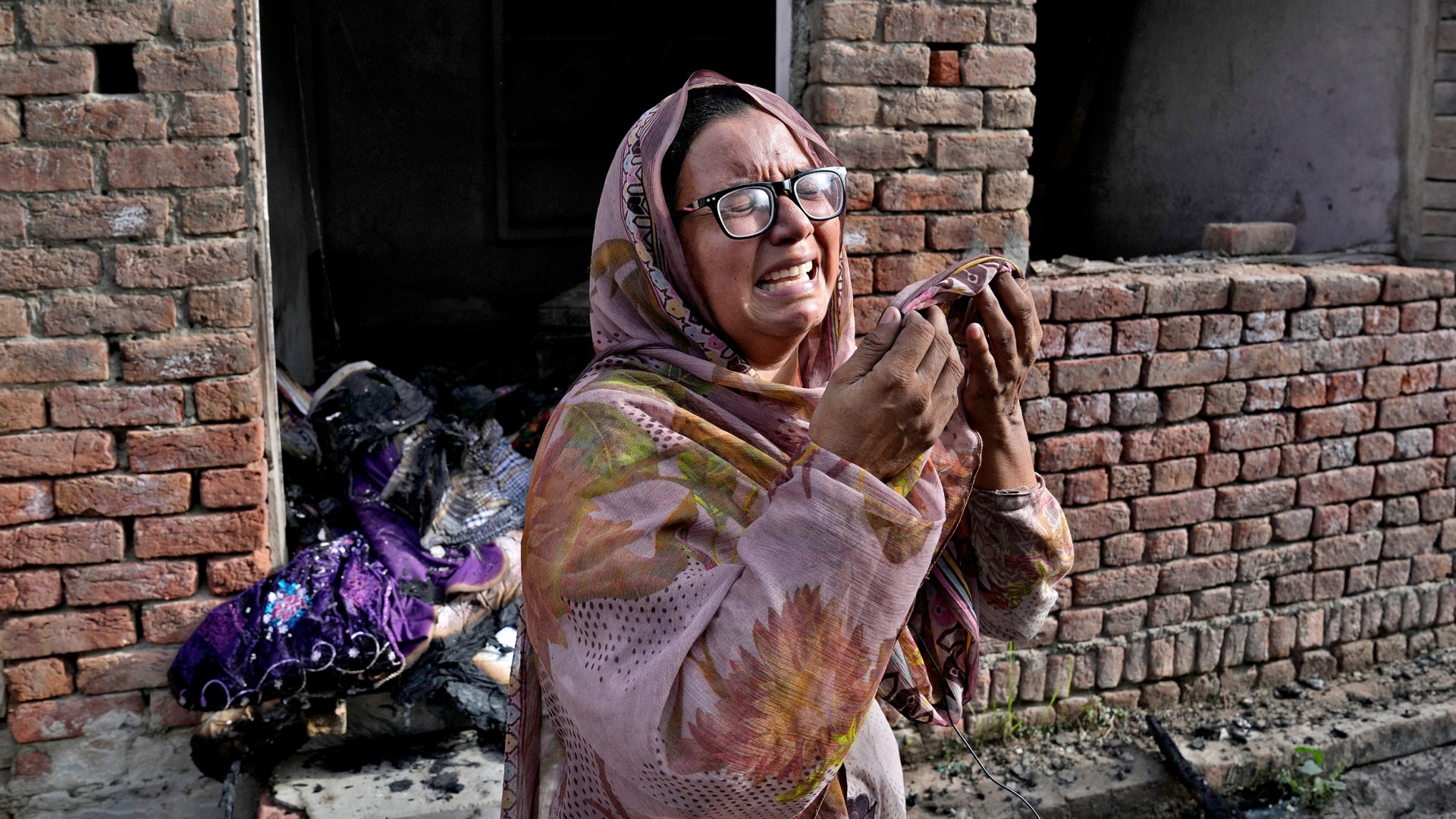
A Christian woman weeps after looking at her home vandalized by an angry Muslim mob in Pakistan.

A Christian woman weeps after looking at her home vandalized by an angry Muslim mob in Pakistan.

K.M. Chaudary / AP Images

Two Christian brothers have been acquitted of charges of blasphemy. Umar and Umair Saleem, known as “Rocky” and “Raja,” respectively, were accused by other Christians of defiling the Quran and making derogatory remarks about Muhammad, “deliberate and malicious acts intended to outrage religious feelings.” The accusations were announced over mosque loudspeakers and sparked anger in the northeastern town of Jaranwala. Mobs attacked dozens of Christian homes and about 20 churches. A police investigation, however, found nothing to substantiate the charges, and the two were released in March 2024. The brothers’ lawyer said they were framed by fellow believers because of “personal enmity.” The Saleems do not believe it is safe to go home.

India: Jonah translated into sign language

The Book of Jonah has been translated into sign language in Nagaland, a state in India with a distinct sign language and more than 100,000 hearing-impaired people. “We are sowing a seed for the Deaf community,” Bible Society of India director W. Along Jamir said, “and this reminds us of God’s faithfulness.”

Korea: Pastor abused teenage defectors

An evangelical pastor once hailed as a hero for helping people escape North Korea has been sentenced to five years in prison for sexually abusing teenagers. Chun Ki-won, 67, claims to have helped more than 1,000 defectors get out of the authoritarian state, with the goal of sharing the gospel, sending converts back, and seeing God’s grace “sweep over the starving, exhausted land of North Korea.” Chun’s work was praised by the BBC, CNN, The New York Times, and National Geographic. According to a South Korean court, however, there was “irrefutable” evidence that Chun harmed five students at a boarding school.

Armenia: Baptist going to prison for rejecting military

A criminal court rejected the appeal of a 20-year-old Baptist man sentenced to prison for refusing military service. Davit Nazaretyan says his faith prohibits him from fighting because Jesus taught his followers to “love one another, even our enemies, and not kill people.” However, an Armenian Orthodox bishop testified the young man’s religious beliefs “would not be restricted by military service,” and the court chose to believe him. Nazaretyan faces two years in prison.

Iran: Christians arrested more in summer

More than 160 Christians were arrested in Iran in 2023. According to a report from four groups defending freedom of religion and helping persecuted Christians, the arrests increased dramatically in summer months, when authorities were worried about public protests.

Kenya: Evangelical Alliance supports Israeli olive oil

The Evangelical Alliance of Kenya is protesting a grocery store chain’s decision to stop stocking olive oil imported from Israel. A letter from the evangelical group said Carrefour’s decision not to stock olive oil interferes with the religious rights of shoppers and needlessly politicizes grocery shopping. Some younger Kenyans have been boycotting Israeli businesses and products, arguing the Jewish state is committing war crimes in Gaza. The evangelical group has called for a ceasefire in the Israel-Hamas conflict but nonetheless opposes corporate pressure on Israeli businesses.

Nigeria: Catholics warned of Pentecostal “invasion”

An ordained scholar told a council of bishops that the Catholic church should worry less about blessings of same-sex couples and more about Pentecostal growth in Nigeria. Anthony Akinwale, a professor in Lagos, told the church leaders that “our Catholic space has been invaded.”

Northern Ireland: Study finds many evangelicals

Twenty-one percent of people identify as practicing evangelical Christians in Northern Ireland, according to a new sociological survey, including nearly half of all Protestants and more than one-third of Catholics. Thirty-five percent of those ages 18 to 24 identify with the term.

Argentina: Soup kitchens get government funding

The new libertarian government is partnering with the Christian Alliance of Evangelical Churches of Argentina to fund 723 soup kitchens that feed an estimated 36,000 people, giving Christians 177 million Argentine pesos (roughly $200,000 USD) to purchase food. President Javier Milei, who describes himself as an anarcho-capitalist, was elected in December 2023. He passed monetary reforms that devalued the peso by more than 50 percent and cut spending on subsidies and welfare programs, including funds for soup kitchens, before directing some money to church groups. Hugo Márquez, a pastor with the evangelical alliance, said the partnership does not signal “political agreement,” despite the “lying fantasy of the progressive groups.”

United States: Landmark tower restored

An Independent Christian Church in Columbus, Indiana, has completed a $3.2 million renovation of its iconic 166-foot tower. The 1942 Stone-Campbell church is considered a landmark of Modernist architecture and is one of the first constructed in the style in the US. Architect Eliel Saarinen, whose work inspired many skyscrapers built in Chicago, believed the popular Gothic- and Georgian-style churches of his time were indulgent and overly theatrical and couldn’t address contemporary spiritual needs.

Starting last year, construction workers stabilized the top of the tower, repaired miles of cracks, fixed water damage, installed a powerful new ventilation system, put up a limestone lintel, replaced thousands of spalled bricks, and restored the church clock.

Remembering the Christian Past, by Robert L. Wilken (Eerdmans, 180 pp.; , paper). Reviewed by Christopher Hall, who teaches biblical and theological studies at Eastern College.Robert Wilken, professor of the history of Christianity at the University of Virginia, possesses a well-developed memory, and he clearly desires to lengthen that of his readers. Wilken has spent many fruitful years exploring the world of the early church. His books include an analysis of Saint John Chrysostom’s response to Judaism in the fourth century (John Chrysostom and the Jews), an insightful study of how the Roman world understood the early Christians (The Christians as the Romans Saw Them), and more recently a treatise on the central place of Palestine in Christian history and reflection (The Land Called Holy). In Remembering the Christian Past, Wilken gathers together a series of essays, many previously published in journals including Pro Ecclesia, First Things, and the Journal of Early Christian Studies.Throughout these essays, one clear theme surfaces repeatedly. Many modern Christians find themselves rootless and drifting in a barren secular and ecclesiastical landscape, largely because they have forgotten their past. Indeed, the modern mind, Wilken argues, has lost any “sense of obligation to the past.” Instead, modern thinkers, including a number of modern theologians, have purposely limited their reliance upon past ideas and traditions, viewing autonomous reflection as the heart of rationality. One discovers truth only by purposefully separating oneself from the object of knowledge. For the modern Christian, this autonomous stance has spawned an unrelenting suspicion of tradition.David Tracy, for example, contends that while the “traditional Christian theologian … preached and practiced a morality of belief in and obedience to the tradition and a fundamental loyalty to the church-community’s beliefs,” modern theologians must commit themselves to the methodology of the natural and social sciences, what Tracy identifies as the “ethical model of the autonomous inquirer.”The result is a tendency to produce theology in a context (the university) and with a stance (Tracy’s autonomous inquiry) that ironically and unnecessarily divorces the theologian from the very religious community in which theological exploration and reflection finds its roots. Wilken observes that while “Christian faith has always been a critical and rational enterprise, and at its best has welcomed the wisdom of the world into the household of faith,” the wisest Christian thinkers also recognized they were “bearers of tradition,” a tradition founded on Scripture, subjected to critical examination, tested in the lives of “countless men and women,” defended against critics, and “elaborated in myriad social and cultural settings.”Hence Wilken’s bafflement over “why one should assume, as Tracy apparently does, that reason is to be found only outside of tradition, and that genuine rationality requires ‘autonomy.’ This premise seems to invite a willful amnesia, a self-imposed affliction that would rob our lives of depth and direction.”The short memory of modern theology too often creates insularity rather than insight. Do other fields of intellectual endeavor so peremptorily dismiss the contributions of the past? Most assume that “immersion in tradition is the presupposition for excellence and originality.” Take, Wilken urges, the example of the jazz musician. “How often we are admonished not to let the old traditions be forgotten. Why? Surely not for historical or archaeological reasons, but because musicians, like painters and writers and sculptors, know in their fingertips or vocal cords or ears that imitation is the way to excellence and originality.”Human reason refuses to function within a vacuum. Rather, as Wilken puts it, it is “bound within rather than outside of things; it is not an abstract quality that exists independently in the human mind.” If so, it is inherently and immensely reasonable to “allow one’s hands to be guided by a master, and foolish to go it alone, as though one could learn to play the violin or sculpt a statue by studying a set of instructions.”The same can be said for the intellectual life and theological work. If, as Wilken argues, the “way we learn to think is by reading good thinkers and letting their thoughts form our thoughts,” best to submit oneself to learning from those writers who have demonstrated their trustworthiness over time, those who have been tested by the years and found reliable interpreters of God’s redeeming act in Christ. For those committed to either an Enlightenment or a postmodern perspective, such a suggestion must seem hopelessly naive. Within these camps, authority, particularly from the past, reeks of the quest for power and the will to dominate.Wilken, though, reminds us with Augustine that “authority” can designate trustworthiness rather than power, a trust established “through teaching with truthfulness,” residing “in a person who by actions as well as words invites trust and confidence. … The student’s trust is won not simply by words but also by actions, by the kind of person the teacher is—in short, by character.”Bracing words, these. If Wilken is right, his perspective offers a radical alternative to the exaggerated epistemological and theological individualism prevalent today. Christians, he insists, will find their identity only by recalling an unimagined world, a world that pursued truth with the mind in the heart—a community that insisted that how and what one thinks, who one is, and how one lives is a whole inseparable from the early story of the church.Copyright © 1996 Christianity Today. Click for reprint information.
News

If You’re a Christian, You Should Probably Thank Your Mom

A majority of American Protestants were raised by devout mothers, a study finds.

Shaun Menary / Lightstock / Edits by CT

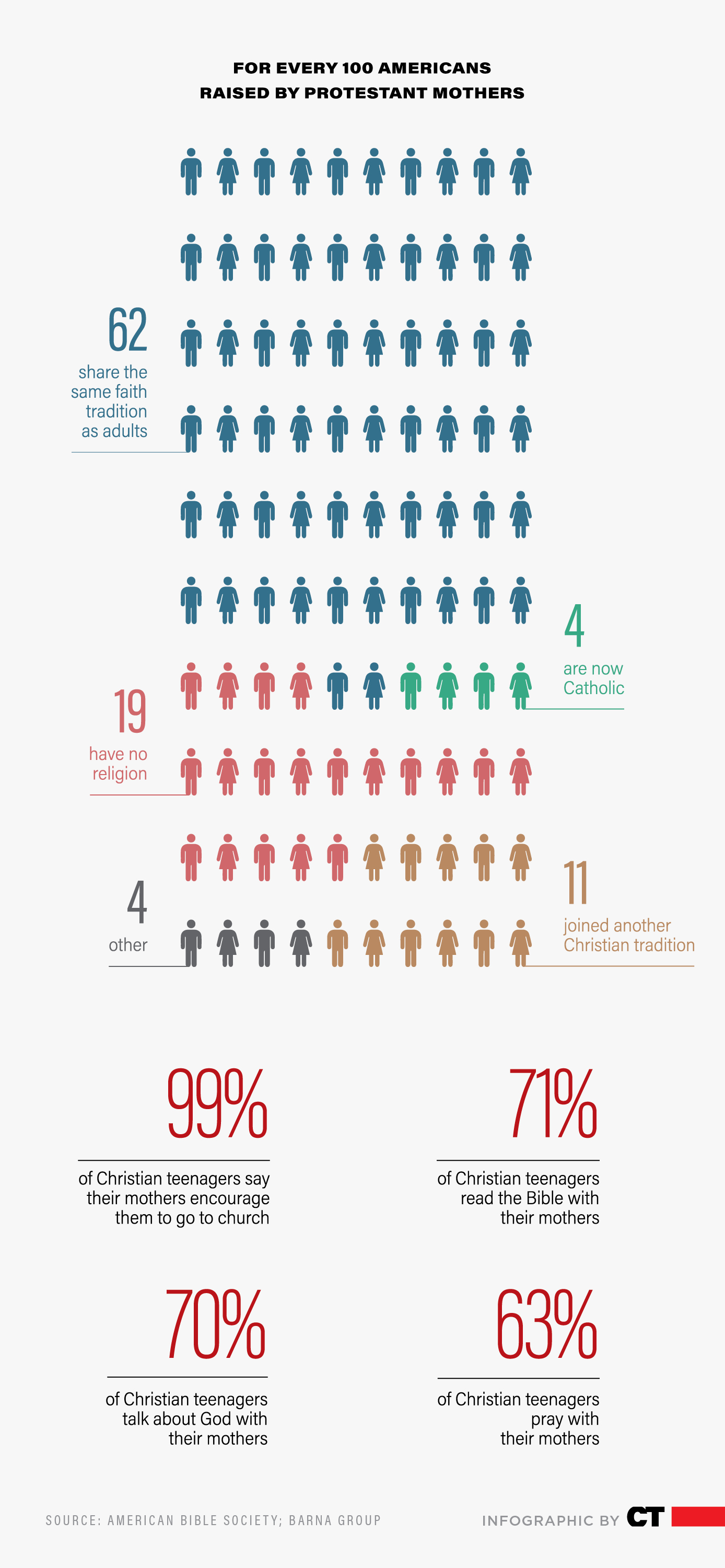
The vast majority of American Christians were raised in the faith—and most can point to the influence of their moms.

In a 2023 study, the American Bible Society found that a majority of believers remain in the same religious tradition as their mothers. This agrees with a large body of mainstream social science research dating back to the 1970s that says the active faith of mothers is a strong predictor of religious transmission.

Some of this may be attributed to the natural bond children have with their mothers. But there is also research that shows that moms take a more active role in faith formation in America.

A 2019 Barna Group survey found that Christian teenagers who say their faith is very important to them are 20 points more likely to talk to their moms about religion than their dads. More than 70 percent of Christian teenagers read the Bible, 70 percent talk about God, and 63 percent pray with their moms.

News

Creating Christian College Presidents for the Future

A first cohort of scholars consider whether God is calling them to executive leadership.

Ted Song talks to evangelical academics and administrators at a CCCU conference.

Ted Song talks to evangelical academics and administrators at a CCCU conference.

Courtesy of CCCU

Ted Song wears many hats.

He is the chief innovation and intercultural engagement officer at John Brown University and the head of the engineering department at the evangelical school in Northwest Arkansas. He’s a dad to three daughters, an elder and college minister at his church, and a student earning a law degree to learn more about the rules and regulations governing higher education.

Song also has his eye on another potential hat.

Last year, he joined the first cohort of presidential fellows at the Council for Christian Colleges and Universities (CCCU), exploring a call to lead an evangelical school.

“If presidency is God’s calling, great,” Song said. “If God wants to use a person as a president of a Christian college, great. But that can also happen in the classroom or on an athletic field. I want to remind myself and also remind my students that we always need to go back to our mission.”

Song is one of three evangelical academics who have joined the CCCU’s yearlong program to prepare for the possibility of becoming a Christian college president. The other two members of the inaugural group are Keith Hall, vice president for student belonging at Azusa Pacific University, and Sarah Visser, executive vice president for student experience and strategy at Calvin University.

“Each one of these fellows is outstanding,” said Shirley Hoogstra, president of the CCCU. “There’s always turnover in senior leadership, and we want to make sure that we are equipping groups of people to be available for those positions … to be ready in the event that a call comes from God to move into the next level of leadership.”

The presidential training program launched in January. The first cohort will receive mentoring from current college presidents, shadow them as they guide evangelical institutions, and attend CCCU board of directors meetings.

Cultivating the next generation of leaders has always been an issue, but it has grown more urgent in recent years. The average term of a college president is shrinking. Today, across higher education, college presidents hold office for an average of just under six years. That’s down from eight and a half years in 2006, according to a survey of 1,000 college presidents. Sixty percent of presidents planning to step down said they were not actively preparing successors.

The same trends can be seen in Christian higher ed. Thirty years used to be considered a long presidency at an evangelical school. Today, many consider it notable if a president serves more than a decade. Thirty-six of the roughly 150 CCCU schools have had a president leave office since 2020.

So Christian colleges are challenged more frequently to find new leaders. And finding them is more challenging.

There is “an inadequate leadership pipeline,” Andrew Barton, Azusa Pacific’s VP for university advancement, wrote for CCCU’s magazine in 2018. “The uncomfortable reality … is that it is a sector largely unprepared.”

The disruptions troubling higher education generally have made it extra difficult to lead. Barton mentioned “unpredictable student enrollment,” “rapidly rising costs,” “reduced budgets,” and the “social, cultural, and legislative shifts” that have created additional pressures for evangelical school leadership.

Less obvious factors also constrict the potential pipeline, he noted. Fewer faculty hired to teach means fewer people who might consider going into administration, and the turnover rate for mid-career academics has increased, shrinking the pool of candidates further.

“These limitations not only have financial costs, but also intangible and arguably more significant costs in terms of momentum of mission, organizational effectiveness, and direction,” Barton wrote. “In serving alongside a long-serving president who is transitioning out of the chief executive role, I am seeing the significant direct and indirect financial, cultural, and missional costs of leadership transition firsthand.”

At Azusa Pacific, Jon R. Wallace stepped down in 2019 after nearly two decades as president. The three leaders before him served for 10, 13, and 36 years, respectively. The leader after served only two. The current president, Adam J. Morris, took the job in 2022.

The CCCU presidential fellows program is one attempt to cultivate more leaders. The group also runs a number of leadership development institutes. Song said that attending one of those was a first step toward discerning a call.

“We all know that our lives are very limited, so I want to use mine well for God’s kingdom,” he said. “All I know is that I’m called to serve, and I will do my best to serve students through Christian higher education.”

This has been a process. Song started his career at the University of Texas at Austin after graduating there with a master’s degree in electrical and computer science. He taught first-year engineering students and mentored underrepresented minority engineering students in the college’s pre-graduate school internship program.

Gradually, he began to think more about the need to integrate faith and learning. He considered teaching at an evangelical school. When he looked on the CCCU’s website to see if anyone was hiring an engineering professor, there was only one opening: John Brown.

He applied and got it.

“He was a wonderful mentor to students, a wonderful teacher,” said John Brown president Charles Pollard.

The Christian school quickly realized Song had a lot of leadership potential. He was appointed chair of the engineering department and then chair of the computer science and cybersecurity departments. Then the school’s innovation officer stepped down, and Song was tapped for that role as well. And he became John Brown’s intercultural engagement officer.

Pollard says he has no trouble imagining Song in his role, and it was a no-brainer to recommend the professor for the CCCU fellowship.

“He establishes relationships really well and connects people,” Pollard said. “He likes to make positive change and see growth, and has a deep compassion for students who might feel a little bit on the outside.”

Students agree. They say Song has a natural ability to pull people in.

“We like to say that he asks people to do stuff in a way that’s kind of like telling them,” Zipporah Jones, a junior, said. “You’re just like, ‘Okay, I guess I’m doing that.’”

Jones met Song when they shared a table at a college diversity banquet her freshman year. Afterward, Song asked her to join the Multicultural Organization of Students Active in Christ. Later, he asked her to be an officer. This year, she’s president of the student group.

Jones said she’s learned a lot from Song—everything from time management to the joy of karaoke. More than anything, though, Jones said Song has taught her the importance of perseverance and faithfulness.

“There have been lots of times when I have gotten discouraged or gotten tired and not wanted to keep doing diversity work,” she said. “To be able to go and talk to him about it, and him always asking how he can pray for us and how he can support us—it’s been something that has really carried me through some times when I was kind of over it.”

Song’s friends, colleagues, and current and former students don’t know whether he will pursue a role as a Christian college president someday. But the thought that he might is encouraging. He represents the kind of leadership they hope for.

“His faith is deep and his capacity is large,” said Karen Longman, a senior fellow at the CCCU and one of Song’s mentors. “He’s very good at building bridges and dreaming about the future of Christian higher education.”

Hannah Vinueza McClellan is a reporter in North Carolina.

Readers Send Mixed Messages about the Israel-Hamas War

Responses to our March issue.

Photography by Abigail Erickson

Mike Cosper, director of CT Media, reported our March cover story from Jerusalem and Kfar Aza, an Israeli kibbutz that was ravaged by Hamas on October 7, 2023. He explored the political tension between Jews and Palestinians and looked at the origins and growth of anti-Israel and antisemitic ideologies.

Readers were deeply divided about Cosper’s approach to the topic. Some on Instagram thanked Cosper for the “moral clarity” of his “brave, excellent article,” while others were upset that Israel’s past and recent actions against Palestinians were not covered in similar detail or similarly condemned.

Brett Hammond of Louisville, Kentucky, emailed us to say, “I left the article with the belief that Cosper minimized the complicated web of violence and terror that has been present in the Middle East for centuries, much of which Christians have played a direct role in prioritizing.”

But W. H. Dogterom, a professor at Vanguard University in Mission Viejo, California, said the piece “brought matters surrounding this heart-breaking conflict into sharp focus with its emphasis on the ideologies at work—and brought much needed clarity to my misunderstandings.”

In conjunction with his article, Cosper and CT Media are releasing Promised Land, a limited series podcast digging deeper into the history and effects of the Israel-Hamas war.

Alexandra Mellen Conversations editor

The Evil Ideas Behind October 7

As the grandson of a Jewish victim of the Holocaust (Auschwitz) and the son of a Holocaust survivor (Kindertransport), fear gripped my heart when I first heard the reports coming in from Israel that morning. The barbarity of the attack was horrifying, and I realized that much of the world would promptly turn things around and blame Israel. What I wasn’t expecting was fellow Christians and pastors pointing the blame at Israel. Since October 7, Canada has seen the worst cases of overt antisemitism since we turned back ships of Jewish refugees during World War II. Thank you for your commitment to present the truth, even when it is unpopular and difficult to do so.

Daniel J. Winter Toronto, Ontario

While the description of Hamas and its Islamist and nationalist ideology is most accurate and his condemnation of the Hamas killing spree on October 7 is most appropriate, Cosper’s article fails to address the Israeli treatment of Palestinians in the occupied West Bank following the 1967 war and the Israeli settler colonization of the West Bank. Israel definitely has a right to exist. Palestine has a right to exist as well. To spend as much time on the keffiyeh worn by baby Jesus in Bethlehem in a world where European and American Christians have Northern Europeanized Jesus for centuries and where African Americans have worked with a Black Jesus also left me pretty cold. The far left in liberal academia is giving Hamas an almost free pass. Unfortunately, too much of the far right, including parts of American evangelicalism, are giving the Israeli approach to Gaza a similar free pass.

Case Hoogendoorn Chicago, IL

Hackers Try to Take AI to Church

I have trouble imagining how spending more time in the soulless digital world, shepherded by an artificial intelligence, is going to bring me closer to our transcendent Creator. On the other hand, I was pleased to read that the majority of Christians surveyed don’t trust AI to be their spiritual guide. I’m not saying technology has no place in the church. But fellowship and spiritual development are primarily human-to-human endeavors. Let’s be careful about outsourcing them to technology, AI or otherwise.

Jeff Yarnell Beaverton, OR

Political Homelessness Is a Good Start

God brought to my mind 1 Corinthians 15:33: “Do not be misled: ‘Bad company corrupts good character.’” Welcoming bad company into our lives does change our good traits for the worse.

John Osterholm Clovis, NM

Should the Bible Sound Like the Language in the Streets?

The author seems to think that “literal” translations do not reflect or inject the personal beliefs of their translators as opposed to what the paraphrases do. This is absolutely untrue. Every translator is forced by the nature of language and culture to make multitudes of interpretive decisions. The concept of “paraphrase” is an outmoded and inexact one and reflects earlier resistance to new translations that might compete with an old standard. In fact, at times, choosing more “literal” versions may actually introduce greater misunderstanding or lack of accuracy in a reader.

Jenny Giezendanner, Bible translation consultant Southeast Asia

The Bible Was Written to Be Heard and Spoken to Be Read

The missing discussion is how poorly the Bible is often read in church services. I am a drama and speech major, and in my church I became a teacher to those who read Scripture aloud in the services. We talked about slowing down so the audience would have time to receive the words and the different genres that are in the Bible, most of which are read differently from each other. Our readers became able to dramatize the words and thus enhance the understanding of what is being read.

Jenelle Mitchell Kelowna, British Columbia

Behind the Scenes

When writing an article, you often learn much more than shows up in print. Pages of interviews get condensed into a few quotes, and the extra research and notes could likely fill a book. That was the case with my piece “Bad Word,” as I researched controversial Bible translations that try to make God’s Word accessible.

Here are two random facts that didn’t make it: Bertram Gayle, a translator for the Jamaican New Testament, is the first Anglican priest in Jamaica with dreadlocks. He told the Jamaica Gleaner that he grew his locks to connect with his identity, as his father was Rastafarian. And Faith Linton, a board member of the Bible Society of the West Indies who first suggested translating the Bible into Jamaican, is the aunt of the well-known author Malcolm Gladwell. It’s trivia in the most literal sense of the word, but it makes my job always interesting.

Angela Lu Fulton Southeast Asia editor

Ideas

The Struggle to Hold It Together When a Church Falls Apart

How do we carry on when there’s more confusion and hurt than clarity and healing?

Illustration by Keith Negley

I felt a growing knot of dread and distrust in my belly.

Beside me, my friend, our church’s associate pastor, spoke low into her cellphone as our taxi whizzed past Seoul’s Han River. Swift waters flowed between green manicured banks. On the other end of the line, I overheard an angry voice describing the latest allegations of sin by our head pastor.

As I eavesdropped, I didn’t know about the cascade of upheaval that would lie ahead: We were a few months away from a violent church split, a formal investigation into bullying allegations, and a precious young woman’s death.

My story of church hurt has clues but not necessarily answers. I’m not sure I’ve learned whatever I was supposed to. Grief plants deep roots and bears strange fruit. This is a story for the ordinary people in other churches where investigations are unfolding—people who are wondering what really happened, whom to believe, and how to proceed with love.

The most prominent stories of spiritual abuse center around leaders of big ministries, so we might assume that it’s those environments that foster unhealthy power dynamics. But my gathering was small, sometimes just 40 people on a Sunday or up to 100 during busy weeks.

We were a motley crew of mostly expatriates. For three years we shared meals, held each other’s babies, mourned each other’s losses, and worshiped joyfully together.

How did we fall apart so fast?

In a church this close, conflict divides families down the middle. In our case, there was no embezzlement, affair, or heresy; there were allegations that our head pastor was abusing his power—and was seizing more.

Two factions formed. People believed either the associate pastor or the head pastor. I had dear friends in both groups. When you trust people saying opposite things, it feels at once emotionally impossible and morally imperative to pick a side. I wondered, Whose story should I believe? What if I make the wrong choice?

Lying awake scrolling text threads or replaying conversations in my head, I worried whether I’d said the right thing. I felt enormous pressure to walk perfectly through a broken situation.

At the same time, I gained a strange comfort from knowing that God was not surprised by our kinds of brokenness. The New Testament shows religious leaders gunning for power, such as Pharisees aligning with the Roman government, Jesus’ disciples jockeying for position, and early church leaders being warned of domineering over their flocks in the Epistles.

God’s image of leadership, however, does not look like the oppressor’s whip or the boss’s prime parking spot. It looks like the shepherd feeding his flock (1 Pet. 5:2). It looks like Jesus wrapping a servant’s towel around his waist as he kneels to wash his followers’ feet (John 13:4–5). So why do abuses of authority keep happening in ministry?

Some evidence suggests that leadership draws narcissists, and by putting priests and pastors on pedestals, we can value, in the words of professor and therapist Chuck DeGroat, “external competencies over Christian character.”

Leaders need brothers and sisters around them with the integrity and relational credit to say, “Love you, buddy. Now cut it out,” instead of being yes men. Pastoral bullying occurs within systems designed not only to protect unhealthy leadership but also to promote it.

Our head pastor wasn’t a celebrity or even a leader with swagger. He came in early to clean toilets. But he could speak without thinking. He could act impulsively. He was generous, but he could also make unilateral decisions. Our associate pastor was equally complex. She could be warm with me while badmouthing others. She affirmed people’s gifts. She could be a fierce advocate. In my view, she could also be manipulative.

Lots of things can be true at once.

Our church had also recently grown, ironically, from an influx of members from a nearby church decimated by spiritual abuse. Historically, organizations are most vulnerable to conflict in times of change. As we grew, our organizational systems didn’t keep up. Volunteers saw their ministries replaced by paid staff. People felt displaced and devalued, with no formal mechanism to field complaints.

Things came to a head. Our associate pastor, our intern, and about half my friends were no longer speaking with our head pastor. They accused him of misogyny, lying, bullying, and even abandoning the faith. They said it was exactly like Mars Hill. The gloves were off.

Our parent church sent in an investigatory committee, which was hardly viewed as a neutral third party. Other classic mistakes were made: We heard the usual exhortations to submit to authority and to stop gossiping.

All this took place during the COVID-19 pandemic, and the isolation that came with it exacerbated the situation. In 2020, South Korea’s regulations forbade social gatherings or eating together. Misunderstandings that might have been cleared up over a bowl of bibimbap instead festered for months.

Long-stewing silence turned into open letters, reply-all emails, and vicious accusations: The associate pastor was campaigning for power; the intern was playing the victim; the head pastor was a sexist tyrant.

Open battle now raged around us. Friends left the church every week. Some switched to a new one. Many, though, left organized Christianity altogether, thoroughly disillusioned.

Helpless, I asked God what I could do. My sense of responsibility was sometimes invigorating but sometimes overwhelming. With an earnest desire to be useful, I forgot at times that God— not me—held our body, that the Spirit loves the bride infinitely more than I and fights for her more powerfully than I could.

I searched the Scriptures for wisdom. Paul’s letter to the house churches of Rome served as a foundational text for me. In Romans 12, two factions are glaring at each other over a chasm of differences. The believers had fractured over status, ethnicity, religious habits, and biblical interpretation. Without sacrificing doctrine, Paul entreats them, exhorts them, and invites them—using every way he knows how—to return to siblinghood.

Illustration by Keith Negley

I asked God to give me Paul’s same affectionate tone and unflinching honesty in every interaction.

I felt like I couldn’t process things with my pastors or church friends. Everyone I was close to was involved in either the investigation or its fallout. It felt like my leaders were in triage mode, zeroed in on only the people most central to the conflict. I turned to existing books, articles, and podcasts around religious bullying, but all seemed to assume the worst, written in stark black and white. Nothing reflected the gray I found myself navigating.

Desperate for clarity, I was relieved to find an affordable Zoom therapist—someone I could finally talk to without a filter. Music helped too. I often led our church through singing “Prophesy Your Promise”:

When I only see in part
I will prophesy your promise …
’Cause you finish what you start
I will trust you in the process.

What a comfort to sing out to a God who is good “in the middle of my mess.”

After interviewing everyone involved and reading through hundreds of emails, the investigation committee found our head pastor not guilty of spiritual abuse.

But, they told the church, he had acted immaturely and had failed to show a shepherd’s heart. He had demonstrated negligence in handling the intern’s contract, allowing bad feelings to linger without resolution. They mandated therapy for him, set up an elder board, and provided paid time off for him and those bringing charges.

The schism remained. Our intern, children’s pastor, and eventually associate pastor resigned. Other folks trickled out—some to protest injustice, some just weary of the whole ordeal. Those of us who stayed felt called to rebuild something healthier, determined to see some sort of redemption. Things seemed to be settling.

Then came the phone call.

“Jeannie,” said my best friend from church, pausing to control her ragged breath. “Our intern has been killed.” Late the night before, our estranged friend and former intern was walking across a street when a drunk driver ran the red light and hit her. Our sister was gone.

The woman was so young, only beginning ministry; she was deeply beloved, yet as a foreigner deeply alone in a country not her own. She had hotly debated policies, prayed earnestly for discernment, fought passionately for what she felt was owed, and at last left the community she’d loved.

And now she was gone. It seems unfathomable to me that this was how her earthly story ended.

I wish I could say our community united around our grief. But if you have been plunged into communal tragedy, you know how disparately each member experiences it. Our friend’s death did not draw us together. It was our final shattering. The church fully split, with a violence that still astounds me.

Change dawns slowly. Before moving back to America, I saw some glimmers of hope. Our head pastor, chastened, confessed and apologized from the pulpit: “I made this church’s success my identity, and I’m sorry.”

The nascent elder board (which my husband was on) formed a constitution with provisions for firing a pastor. My husband and I preached on Romans 12 the Sunday we said goodbye. After months of silence, a friend and I shared a face-to-face coffee and the first tearful hints of reconciliation.

I never saw a full resurrection. The baggage feels like a permanent part of my church story now. I’m hyper-attentive to posturing, signs of staff resentment, leaders on pedestals, and communication that feels slick or insincere.

Trust is going to take time. Tentatively settled into a new Christian community here in America, I can sense myself holding people at arm’s length. For the first time since I was a teenager, I’m not leading worship or a small group.

For now, showing up is hard enough.

I still wonder if I walked well. Was I supposed to pick one side of the river or the other? Or was floundering around between them the only way?

As Beth Moore says in her memoir, “All my knotted-up life I’ve longed for the sanity and simplicity of knowing who’s good and who’s bad … God has remained aloof on this uncomplicated request.” I’m a mixed bag myself, a little bit victim, a little bit villain, though I trust the Holy Spirit is working on the ratio.

There were no evil oppressors or flawless victims in our story. We need to stop demanding that there be. There must be a better way to foster a culture of harmony and righteousness.

Authors Scot McKnight and Laura Barringer describe how to develop “circles of tov,” or goodness, by establishing norms of service, grace, courage, and truth in whatever spheres we influence. For most of us, this is the way forward through a season of church investigation or hurt.

Instead of closing ranks or annihilating anyone involved, we lament. We pray. Earnestly seeking the Spirit, the Scriptures, and wise counsel, we recognize we’re also going to make mistakes. We deal gently with one another, even under duress.

With an eye for common red flags and the tender affection of siblings, we ask leaders hard questions. We invite experts in. We remain in the waters of ambiguity longer than is comfortable.

Any church investigation is a call to repentance, both personal and institutional. When it comes, may God grant us servant leaders, systems of accountability, and habits of humility. May we stumble forward toward justice and genuine peace.

Jeannie Whitlock is a writer based in the Chicago suburbs.

Theology

Charisma and Its Companions

Church movements need magnetic leaders. But the best leaders need more than charm.

Illustration by Tim McDonagh

Emad is an exception in many ways. He grew up in a massive slum but rose to be the branch manager of a bank in a capital city. Most people in his area are Muslim and animist, but Emad’s devout Christian mother instilled in him a passion to reach the lost for Christ. This was at odds with the local church he pastored, where he found the believers to be uninterested in evangelism.

After a few years of pastoral “failure,” Emad (a pseudonym) found himself dejectedly prayer-walking a dusty side street. There, he felt the Holy Spirit direct him to a shaman. This sorcerer had recently dreamed of a man coming to tell him about the “living God.” He excitedly introduced Emad to his social network, and soon people started coming to Christ.

In the ten years since, close to 7,000 churches have emerged that can be traced to the encounter between Emad and the sorcerer. The movement has spread among five different people groups in three countries.

As researchers of church planting, we wanted to understand people who, like Emad, have multiplied disciples of Jesus in places where there were few if any known Christians. These people are what we call “pioneer leaders.” We also wanted to understand an exceptional group that included Emad—about 1,500 pioneer leaders in the world whose disciples have made disciples who then have made disciples, resulting in at least 100 new churches. These are what we call “movement catalysts.”

Emad and the others in our study agreed to participate only if their responses were anonymous and their full names weren’t published, a standard practice in research. In addition, many of these pioneer leaders work in regions that are unsafe for evangelists.

Elements of movement catalysts’ personalities stick together in our research to partially explain what happens when there is a burst of new believers in a place where there previously were none. Our research identified 21 qualities that characterize most movement catalysts and set them apart from their peers who haven’t started such a discipleship movement.

This in no way detracts from the primary agency of the Holy Spirit through the power of the gospel. No particular mix of personal traits and qualities can cause a movement. But since God has chosen to work through the men and women he calls, the qualities they exhibit and nurture are part of his work in the world. We are responsible for nurturing those qualities in them.

While the causes of a movement cannot be reduced to a formula, empirical evidence suggests that wherever there is a movement resulting in many new Christians and many new churches, there is also a pioneer missionary with a set of certain notable traits.

Two of the top three frequently observed traits were extensive prayer for the salvation of people in the community and a focus on disciple making.

The third was charisma.

For millennia, people have considered charisma to be central to leadership. More recently, research on “transformational leadership” has found charisma to be one of the rare qualities that seems to be a global value in leaders. An entire school of thought is devoted to what management scholar Robert House coined as “charismatic leadership” in 1977.

But what exactly is charisma? We found that, in movement catalysts, charisma is a combination of confidence, selfless acts, and the ability to influence others through personality (rather than just through status or title). People feel honored to be associated with such leaders.

We should not be surprised that movement catalysts exhibit charisma. By our definition, they are on the cutting edge of large-scale personal and social transformations through the gospel.

However, more than a few of us have had negative experiences with very charismatic leaders.

This brings up the question How does charisma remain a good thing, rather than just a source of power to an individual? In our research, we considered charisma not as a standalone gift but as something complemented and shaped (or not) by other qualities. We found that these guardrails for charisma had to do with both people’s inner lives and their interpersonal skills.

S

piritual disciplines are normally invisible to others. Yet they act powerfully to influence our public side.

One way movement catalysts ground their charisma is through the private discipline of “listening to God.” They live in a posture of dependence on God that causes them to regularly take time to wait on his guidance for their lives and ministries. This habit serves as a potent spiritual antidote to the egotism that can infect a charismatic leader.

Another tempering quality that marked the pioneer leaders in our study was a strong tendency toward conscientiousness, one of the “Big Five” personality traits that have been validated in psychology research. These people’s sense of responsibility is a fairly stable part of their character. Conscientiousness keeps charismatic leaders from acting too impulsively and from prioritizing their own whims.

We found movement catalysts to be people who are markedly self-disciplined, who strive for achievement beyond others’ expectations, and who control and direct their own impulses.

While everyone in authority needs good impulse control—which is part of being conscientious—it is perhaps even more important for charismatic leaders. Leaders with charisma can often operate beyond organizational or hierarchical constraints. Thus they need self-control all the more.

The way movement catalysts center others is the second guardrail keeping charisma from going awry.

In our study, movement catalysts seemed to have an unusually deep level of love for others. In general, these leaders are unwilling to use people for selfish reasons. But beyond this, movement catalysts take a real interest in the lives and welfare of others, and they express it in ways those people can feel.

Another stable Big Five trait, agreeableness, also shapes the charisma of movement catalysts. Our research found that they are more concerned than the average church planter about social harmony, make generally pleasant companions, and are willing to compromise when interacting with others. Agreeableness restrains charismatic leaders from dominating others.

And finally, we see the tempering value of a commitment to empower others, a characteristic slightly more pronounced in movement catalysts than charisma itself.

Leaders who lack a commitment to empowerment tend to collect power themselves, drawing in responsibility like a magnet. But the movement catalysts in our research were very intentional about operating in the opposite spirit, freely relinquishing control. They handed responsibilities off to others, even risking failure.

One highly charismatic leader in our study shows how deliberate this can be:

Whenever a crisis came up, I disciplined myself to go to the leaders our team was training and say, “You guys need to go away and pray about this, to pray until you get an answer. And when God tells you what to do, then come and tell me.” Of course, I was always worried they would come up with something weird. But you know what, they always got it right. They would pray until they heard from the Holy Spirit, who would always give them something amazing that was biblical and a good cultural fit.

Of course, there are different kinds of leaders for different situations. The profile of an effective movement catalyst may not describe an effective leader for a moribund church in a society steeped in a Christian tradition. An uncharismatic person can still lead a church toward fruitfulness.

Nevertheless, our research shows that exceptionally fruitful leaders usually have charismatic personalities. It also demonstrates that charisma alone is not enough.

But when it is most effective—when charismatic leaders have qualities that regulate their inner lives and have developed love for people, an agreeable personality, and a focus on empowering others—such a personality can be a force for the gospel to take hold in new believers, new churches, and new leaders.

Emanuel Prinz serves as a leader, development consultant, and church movement researcher. He is the author of Movement Catalysts and blogs at Catalytic Leadership.

Gene Daniels and his family were church planters in Central Asia for 12 years. He researches ministry in the Muslim world and is writing under a pseudonym due to security concerns.

News

Exploited South African Miners Turn to Churches for Help

Pastors help widows take on delayed pensions and negotiate peace amid violent labor disputes.

Illustration by Marco Lawrence

Like other widows of South African mine workers, Jane Anele was doubly wronged by the industry. The 58-year-old lost her husband to coal mining a decade ago, and his employer never paid the family his dues.

“My husband died of lung disease from digging coal for 20 years, and his pension has never been paid because the coal mine went defunct,” she said. “We are too poor to hire lawyers who charged us 90,000 South African rand ($4,500 USD) to pursue those who owe us. We are not that educated to start with, let alone dig for historical pensions claims and fill complex forms.”

Her last hope was to turn to the church.

In a country where lawyers, corporate human resources departments, and police are viewed with suspicion, Christian leaders are stepping in to advocate for South Africa’s discarded Black mine laborers and their families.

“We stand with Black miners and their descendants for a lifetime. I have attracted a lot of enemies and been vilified in government and mining industry circles over my stance,” said prophet Paseka Mboro, a controversial charismatic Pentecostal minister. “These gold and platinum mine corps are listed on the stock exchanges, and some of their ex-laborers sometimes can’t afford [pain relievers] in old age.”

South Africa’s mines took off in the late 1800s when imperialist mining magnate Cecil Rhodes and the Oppenheimer family struck gold and discovered diamond riches. For over a century, the country built its famous gold, platinum, and coal mine wealth on the sweat of migrant Black laborers.

Now, as the industry continues its slow decline, workers are suffering, aging in poverty, and dying from conditions contracted in the mines. And the job is getting more dangerous and less stable.

Tapiwa Nhachi, a former social scientist with the regional Centre for Natural Resources, said getting justice for migrant workers is a nightmare. Some were brought from neighboring African countries in the 1960s to work without IDs and have since passed on.

“I worked for Optimum Coal Mine for five years, got injured from a rock fall underground, was laid off with two months’ salary, and disability benefits haven’t been paid to date,” 60-year-old Wandile Mashaba told CT. “The mine has since gone into bankruptcy, changed hands, and my file is missing.”

Thousands of shortchanged Black mine workers in South Africa, considered one of the most financially unequal countries in the world, can’t afford claims lawyers and rely on Christian advocates like Mboro to help.

Their willingness to confront the big mining corporations draws from biblical calls for justice and Scripture’s divine condemnations of “those who defraud laborers of their wages, who oppress the widows and the fatherless, and deprive the foreigners among you of justice” (Mal. 3:5).

“The pastors have been super helpful,” said Nolwazi Makhulu. “It’s through their constant, brave engagement with mine owners that my late husband’s R400,000 [$20,000 USD] disability and pension dues were finally settled from a trust fund though the diamond mine has long gone defunct.”

The Wall Street Journal reported that the $24 billion mining sector in South Africa “is waning under the pressure of violent crime, growing costs and regulatory uncertainty, as well as tapped-out mines.” The newspaper cited falling employment numbers and production, and an increase in violent labor disputes and deaths.

For example, in October and December last year, disgruntled mine workers took hundreds of fellow miners hostage kilometers under the earth as a way of forcing concessions from big-corporation mine owners.

“In the wake of the decline, violent tactics and injustice remain,” said Thula Maseko, a National Union of Mineworkers branch coordinator.

When police and corporate mine owners fear or refuse to negotiate in hostage situations, it’s once again churches that step in. Drawing from decades of trust, Christian leaders serve as peace negotiators to stop potential bloodshed, Maseko said.

Large mining companies, corporate lawyers, courts, and compromised trade unions are hardly trusted by thousands of Black mine laborers in South Africa, says Tito Dingane, an activist pastor in the Zion Christian Church, a large African-initiated denomination with one million members across South Africa.

“It’s only through our intervention and negotiations as the Zion Christian Church that recently three widows of mine workers were paid modest compensation for their deaths,” he said. “[Mining officials] had dismissed their claim, saying their husbands were bogus miners.”

For decades, churches have sued mine owners on behalf of workers with lung disease. Last year, the Catholic church vowed a class-action lawsuit against BHP, the giant Australian copper miner, on behalf of “17 current and former mine workers, who came to the Catholic Church for help after contracting incurable coal workers’ pneumoconiosis,” an industry news article reported.

“The bishops are our … last hope,” said Fazela Ntoto, a former gold miner. His hard-fought pension claim was fleeced by trust lawyers taking advantage of his illiteracy, Ntoto said. His pastors took up his cause, however, and worked to successfully recover what he was owed.

Father Stan Muyebe, director of the Justice and Peace Commission of the Southern African Catholic Bishops’ Conference, said the church is called to join in the “cries for justice” and offer help.

“The church in South Africa has been challenged to become a Samaritan church,” he said, “hearing the cries of the sick ex-miners and seeing the suffering face of Christ in and through the one who once said to us, I was sick and you visited me.”

Nyasha Bhobo is a freelance journalist in Zimbabwe who covers stories across southern Africa.

News

How to Pray with ADHD

Christians with neurodivergence are exploring other options for devotions and Bible study.

Illustration by Christianity Today / Source Images: Getty, Wikimedia Commons

Emily Hubbard recalls a trend in women’s discipleship that urged women to rest in Jesus and “stop trying to do it all.” The problem was, Hubbard wasn’t trying to do it all. She just wanted to remember to run the dishwasher.

“All discipleship was for type A people, but I was a type Z person,” she said.

Hubbard is a mother of four, a school board member, and an adjunct professor. Laziness isn’t her problem; attention-deficit/hyperactivity disorder (ADHD) is.

More than eight million US adults are affected by ADHD. Because the disorder impairs executive function—the self-control needed to work toward a goal—building habits for spiritual growth can be far more challenging for the ADHD brain than for someone who is neurotypical.

Lifeway Research found that nearly two-thirds of Protestant churchgoers intentionally spend time alone with God at least daily. Cru lists Bible reading, Bible study, Scripture memorization, and prayer as the top four spiritual disciplines that Christians should develop.

ADHD makes these kinds of repetitive tasks hard to maintain. Christians with ADHD may struggle to focus and get distracted when they sit down for an extended time of Bible reading and prayer. It can seem impossible for them to grow spiritually when the church around them views daily “quiet time” as a marker of discipline.

“For years, all I could do was go to church on Sundays and pray for my children at night, and that was my best,” Hubbard said. “Good thing Jesus died for my best.”

Like Paul’s thorn in the flesh (2 Cor. 12), Hubbard says, she finds her ADHD is an abiding reminder that her performance doesn’t earn God’s approval. Her church, New City South in St. Louis, observes the church calendar, and Hubbard sees grace in its cycles. It might be hard to focus during one particular prayer time, Sunday service, or church season, she says, but there will be next time.

Before the pandemic, Hubbard regularly visited Assumption Abbey in Ava, Missouri, for silent spiritual retreats. Hearing the monks pray as they have prayed for centuries reminded her that she’s part of a faith that is bigger than her.

More Christians, including Christian leaders, are speaking out about how their ADHD affects their faith lives.

José Bourget, the chaplain at Andrews University in Michigan, mentioned his ADHD in a sermon for the first time last year.

“A neurodivergent way of relating to the world is not really addressed from the pulpit,” he said.

It wasn’t until the pandemic that Bourget realized his forgetfulness and distraction might be more than personality quirks. He once missed a flight because he forgot his driver’s license. He justified the mistake by saying God didn’t want him to take the trip. While he still thinks God can work through his distractions, he now thinks it’s important to acknowledge the ADHD.

Since his diagnosis, Bourget—now in his 40s—is working to unlearn years of guilt and shame for what he believed were personal failings.

He repeats simple truths like “Christ accepts me.” He declares that the ADHD brain is not a broken brain and speaks of God’s love and acceptance for those with ADHD. He’s preaching to himself as much as to anyone else.

“It sounds oversaid and overdone,” he said, “but feeling like I never fit and never belong, acceptance is very critical.”

Bourget has also given himself “permission not to conform” to set practices of Scripture reading and silent prayer. Instead, he sets up some basic structures—time each morning to spend with the Lord—but exercises freedom within that. Sometimes he spends more time in prayer; other times it’s contemplation or watching a video of a sermon.

Bourget notices students at Andrews struggling with these issues. He makes a point of letting them know he is available. When students express guilt that their brains don’t seem to work like everyone else’s, Bourget helps them find practices that work for them.

Trying to be quiet, still, and focused for extended periods is hard for people with ADHD—whether it’s to study for class or to offer prayers to God.

Alex R. Hey, an ADHD coach, addresses the sense of shame and failure that can come from this inability to hold attention in silence. He reframes these limitations for himself and his clients with lines like “I get to pray differently.”

It helps to remember that this is how God made him. “Personally, I feel that it humbles me,” he said.

Like other types of neurodivergence, ADHD manifests on a spectrum. While some may describe their struggles as humbling, others find ADHD debilitating. Jeff Davis, now a lay leader at Stonebriar Community Church outside Dallas, said he struggled to find and hold a job due to his poor executive function. He spent almost two years homeless before getting help.

In addition to using counseling and medication, people with ADHD can develop coping strategies.

To engage Scripture, Hey often uses lectio divina—a monastic practice with a formula for reading, meditating, praying, and contemplating. It keeps his mind connected to the text.

Because the ADHD brain is prone to hyperfocus, people may fixate on one thing to the neglect of everything else. Once, as Hey meditated on the passage where a woman anoints Jesus’ feet, he couldn’t get past the image of the woman kissing Jesus’ feet (Luke 7:37–38).

“I don’t like feet, so all I could think about was how gross feet are,” he said. But as he thought deeper about what was going on in the passage, he realized the only part of Jesus the sinful woman felt worthy of touching was his dirty feet. He then imagined Jesus reaching for her hand and lifting her up.

“When we don’t feel worthy and don’t feel loved, Jesus reaches down and lifts us up,” Hey said.

Other ancient Christian prayers and traditional liturgies can resonate with the ADHD brain. Michael Agapito, a graduate student at Northern Seminary, finds quiet time daunting but uses lectio divina, The Book of Common Prayer, and the Jesus Prayer: “Jesus Christ, Son of God, have mercy on me, a sinner.”

“There’s a huge reservoir of church tradition that we’re also rightful heirs of, but we’ve never really tapped into that in modern evangelicalism,” said Agapito, who was diagnosed in college.

While he developed habits managing symptoms, he’s struggled to let go of perfectionism and see his ADHD as ordained by God. He described his mind as a pinball machine bouncing between ideas and not slowing down.

“As a Christian and someone in ministry, I understand that God deemed it fit to give me this condition in his providence, wisdom, and sovereignty,” he said. “Growing up, I kind of looked at it as a curse, but I’m also looking at some of it as a gift.”

As Agapito considers becoming a pastor, he wants his future congregation to be taught spiritual disciplines with intentionality and to welcome all those who struggle to keep up with the habits—neurodivergent or not. “The average Christian struggles with them a lot too.”

Megan Fowler is a CT contributing writer who lives in Pennsylvania.

addApple PodcastsDown ArrowDown ArrowDown Arrowarrow_left_altLeft ArrowLeft ArrowRight ArrowRight ArrowRight Arrowarrow_up_altUp ArrowUp ArrowAvailable at Amazoncaret-downCloseCloseellipseEmailEmailExpandExpandExternalExternalFacebookfacebook-squarefolderGiftGiftGooglegoogleGoogle KeephamburgerInstagraminstagram-squareLinkLinklinkedin-squareListenListenListenChristianity TodayCT Creative Studio Logologo_orgMegaphoneMenuMenupausePinterestPlayPlayPocketPodcastprintremoveRSSRSSSaveSavesaveSearchSearchsearchSpotifyStitcherTelegramTable of ContentsTable of Contentstwitter-squareWhatsAppXYouTubeYouTube