Theology

Ukraine’s Top 10 Bible Verses

Leaders reflect on what YouVersion’s list of the most-shared Scriptures in their nation includes—and misses.

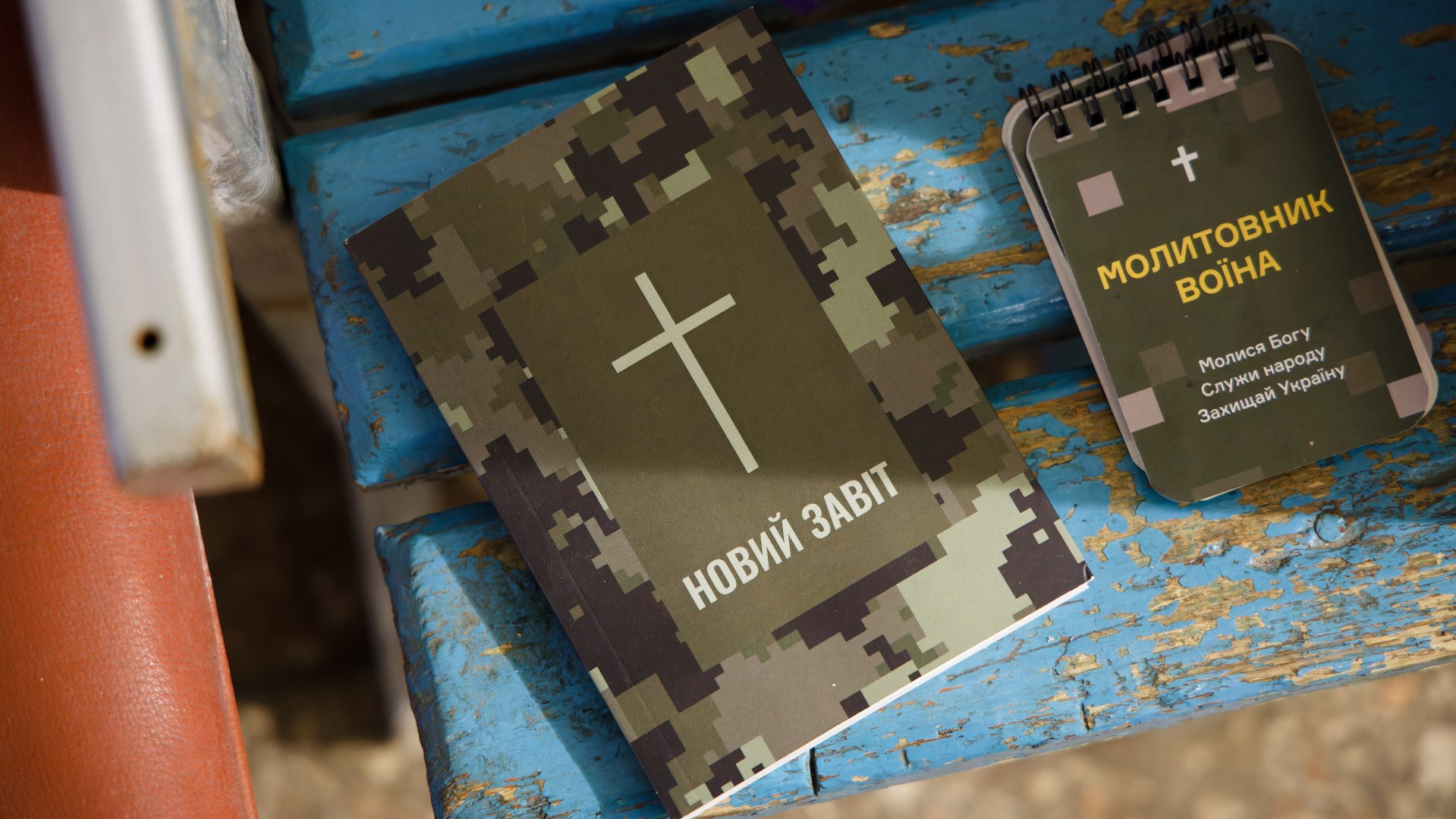
A New Testament and warrior's prayer book lie on the table at a stabilization point on October 20, 2023 in Donetsk Oblast, Ukraine.

A New Testament and warrior's prayer book lie on the table at a stabilization point on October 20, 2023 in Donetsk Oblast, Ukraine.

Christianity Today December 22, 2023
Dmytro Larin / Global Images Ukraine / Getty Images

Perennial favorite John 3:16 may have nothing to do with the war against Russia.

Isaiah 41:10 speaks more clearly to times of conflict—though it boasts a leading position in many other nations as well.

But missing from the top 10 list in Ukraine—and no other nation highlighted by YouVersion—is Jeremiah 29:11: “‘For I know the plans I have for you,’ declares the Lord, ‘plans to prosper you and not to harm you, plans to give you hope and a future.’”

Evangelical leaders shared their reflections on why millions of citizens in the Orthodox majority country may have found inspiration in the top 10 verses, not others, and suggest personal favorites that shed light on life in a war-torn nation:

https://datawrapper.dwcdn.net/Czsdb

Igor Bandura, vice president of the Baptist Union of Ukraine:

The results released by YouVersion are informative, inspiring, and challenging. My heart cries out in unison with all of them, as they reflect God’s love as the source of life within our deep search for meaning under the pressure of war. It is no wonder that John 3:16 ranks first, giving comfort against the power of darkness in the midst of loss, suffering, and simple exhaustion.

The Bible remains our most powerful source of encouragement, wisdom, and strength.

Perhaps Jeremiah 29:11 is left out because while God plans not to harm us, Russia does—and the imaginable near-term consequences keep Ukrainians from contemplating an unimaginable future. Certainly, this is a challenge for faith. But mine has been strengthened through a different unlisted inspiring verse in Zechariah 9:12: “Return to your fortress, you prisoners of hope; even now I announce that I will restore twice as much to you.”

There are two possible interpretations. First, that despite being prisoners of our overwhelming circumstances, there is still hope available to us. And second, that God’s hope has made us prisoners, and that we cannot live any other way. Both are true—and we await the “double” that God has promised.

Maxym Oliferovski, a Mennonite Brethren pastor and project leader for Multiply Ukraine, Zaporizhzhia:

That these 10 Bible verses have been shared the most in Ukraine does not surprise me at all. The first five focus on love, protection, and strength, communicating God’s care for us during the many hardships caused by the invasion. Most meaningful to me has been 1 Peter 5:7, “Cast all your anxiety on him because he cares for you,” because I tend to live in the future. But in the uncertainty of war, even short-term plans become impossible. God then reminds me I must rest in him, greatly decreasing my worry and stress.

The second five verses, taken together, strike me as a prayer for faith, holiness, and bravery. It is so easy to lose focus and get depressed. Certainly, we need healing, which comes through his Word. But we also realize that beyond the physical war in Ukraine there is a spiritual war waged against us—and these verses show us how to fight.

Guard your heart, says Proverbs. Seek first his righteousness, says Matthew. These verses help us care for our mental health, and then to discern the multiple opinions and outright lies that abound in both wars. Commitment to the truth of God’s kingdom is the plumb line to test our everyday actions.

If I were to add one verse to the list it would be the promise of Revelation 21:4: “He will wipe every tear from their eyes.” We pray for victory in Ukraine, and we anticipate the day all our mourning will come to an end.

Valentin Siniy, president of Tavriski Christian Institute, Kherson:

I see three themes in this list of verses. The first is God’s comforting presence in 1 Peter, Romans, Philippians, and especially Isaiah 40:10: “I will uphold you with my righteous right hand.”

Another set provides the remedy against the fear and weakness brought upon us by Russian aggression. Be strong and courageous, we read in Joshua. Timothy contrasts God’s love with timidity. And in Philippians we are reminded that God will give us the strength we need.

But the third group calls us to the church’s role in a broken world. We are to express God’s love (John 3:16), seek his kingdom (Matt. 6:33), and, in the process, guard our hearts (Prov. 4:23)—and by extension the hearts of those around us as well. Our perspective on the world has shifted, and as the church inquires about the theology of mission, it is no longer the dualism of church and state—it now crucially includes society as well.

Curiously absent are verses on evil, anger, and grief. One that I hear frequently quoted is Psalm 109:8–9: “May his days be few; may another take his place of leadership. May his children be fatherless and his wife a widow.” Applied to Judas in the New Testament, imprecatory passages like these have been an outlet for our emotions as we call for God’s justice.

Sergey Rakhuba, president of Mission Eurasia:

As Ukraine undergoes a brutal war imposed by Russia, we continue to fight for our freedom, independence, and even our very existence as a nation. A third of our population has been displaced with thousands of people killed, and especially for the innocent children caught in this chaos, this winter is a difficult season filled not with Christmas carols but the sad tones of resilience and struggle.

In this context, Jeremiah 29:11 may not be shared widely online where YouVersion can monitor its citation, but I can assure you that it is preached in churches and lived out in tangible service to millions of people who see it in action.

First given to the Jewish people during their time of exile and trial, I first received it 18 years ago when battling a severe illness and the possibility of life in a wheelchair. I was thick in a fog of despair, but its words dispelled my spiritual disorientation and filled me with divine certainty that God still had a plan for my life. The verse imprinted forever on my heart and has since been my beacon of hope. It is often through pain and deprivation that God shapes our faith.

But when tucking their children to bed in shelters with a night sky torn apart by the screech of ballistic missiles, telling a parent to believe that these are God's plans for their good seems almost incomprehensible. A theologian may be able to provide clear exegesis, but for the weary Ukrainian pastor—tirelessly caring for the endless needs of his war-torn community—it is not unreasonable to find doubt, difficulty of interpretation, or even the online neglect of this Scripture.

For me, the verse encourages us to believe in God’s providence, that there is a divine purpose even when the future of Ukraine seems uncertain. But it is also a powerful source of hope in overcoming adversity. Whether on the battlefield or in homes deprived by the chaos of war, it inspires resilience as we rely on God that better days are ahead, as determined by him.

These difficult days are not the end of our story.

Finally, the verse motivates us to long for and dream about an unknown future. God has plans for our lives, but we have a role in realizing them. It spurs on our efforts toward victory, but also to prepare for the healing, restoration, and recovery necessary after the war ends. Jeremiah envisions our prospering, and we are praying—and believing—that it will come soon.
Editor’s note: CT’s regional analyses of the YouVersion top Bible verses of 2023 include Africa, Brazil, the Philippines, Singapore, and Ukraine.

CT offers select articles translated into Ukrainian and Russian. You can also join the 10,500 readers who follow CT on Telegram: @ctmagazine (also available in Russian and Chinese).

Culture

‘Humanity Laid Bare’: A ‘Freud’s Last Session’ Q&A

Actor Matthew Goode and director Matthew Brown talk about adapting a stage play, understanding C.S. Lewis, and disagreeing well.

Matthew Goode as C. S. Lewis in the film, Freud's Last Session.

Matthew Goode as C. S. Lewis in the film, Freud's Last Session.

Christianity Today December 22, 2023
© 2023 Sony Pictures Digital Productions Inc. All rights reserved

In the new film Freud’s Last Session, based on the play by Mark St. Germain, C. S. Lewis visits Sigmund Freud at the advent of World War II. The resulting debate and friendship are fictional, but many of their arguments and elements of their life stories are taken from the men’s own writings.

CT interviewed director and cowriter Matthew Brown and actor Matthew Goode, who plays Lewis. Mild spoilers ahead. Freud’s Last Session premieres in New York and Los Angeles on December 22 and is expected to release nationally in early 2024. See CT’s review here.

This conversation has been edited and condensed.

What do you think about the premise of Freud and Lewis having a discussion together? Is this how the two men would have interacted had they met?

Matthew Goode: I know that some people will feel like it should have been more heated and shouty, but one thing I’m proud about is that the film didn’t become that. It’s nuanced, and complicated, and less about point-scoring.

And it’s about a man who’s at the end of his life, who was pretty angry about the pain that he’s had to endure. He’s lined C. S. Lewis up like a bullseye, and he’s a human dart flying at it. And that was Lewis’s job, to parry these barbs that are sent his way.

We all know that Jesus existed; that’s irrefutable. But neither man can prove or disprove whether he was the Son of God. It’s actually what unites them. And that’s the beauty of faith. So I think that’s exactly how it would’ve gone. I think they’d have had a really great friendship.

How did you work to portray this matchup of minds as balanced, without feeling like it was decided one way or the other?

Matthew Brown: If you come into it not having an agenda, that’s a good place to start. I wanted to keep myself as the filmmaker out of it completely. It’s not We have to keep score; that’s not how life is. It has a human part of the story that is just as important as the intellectual debate. So I really felt like leaving it to the audience to decide what they thought.

The weird thing is, everybody thinks the other side won when they see it. My Christian friends think that Freud was more convincing, and vice versa, the psychiatric community thinks that Lewis won. It’s fascinating.

What do you hope audiences take from this portrayal of two men with opposing viewpoints being able to talk through disagreements without vilifying each other?

Brown: The reason I made this film was the timeliness of it and the need for discussion and conversation. And I hoped if I could keep out of it, that would allow audiences to have a conversation themselves. If they want to discuss who won or other aspects of the film, that’s great, but hopefully they wouldn’t be afraid to have conversation.

Today everyone is afraid to speak, and the loudest voice in the room tends to win, and it’s ridiculous because there’s more in common than not between these two people as human beings. That’s what I love: At the end of this film, I feel like neither of them want to leave.

What helped you understand the character of Lewis? Did embodying him change any of your own views?

Goode: I was aware only of the Chronicles of Narnia as a child growing up, so he was a wonderful man to research. (The elephant in the room is the fact that Tony had played Lewis in Shadowlands, which shows him later on in his life.)

There wasn’t anything I found that changed my opinion on the man or on any faith. I still don’t know where I fall when it comes to my belief system. But what I did love is he’s having his faith tested. And it was an exercise in biting his lip and being respectful toward someone who is clearly dying and is his elder. What you have is humanity laid bare. Change happens from conversations at your own kitchen table, so hopefully people will go home and talk about it.

I love the very humanizing moments they have that aren’t during talk or debate but while helping each other through pain and suffering.

Brown: By the end of this film, you have Lewis putting his hand into Freud’s mouth to assist him as he’s choking on a prosthetic. That’s very, very human. They’re helping one another and they’re caring about one another, and they can laugh at jokes. One of my favorite moments is Lewis tying Freud’s apron as Freud is in the pantry. They might disagree, but they’re still people, and they can like each other.

What was it like working with Mark St. Germain, the playwright, on this screenplay? What did you bring to it to make it feel more cinematic?

Brown: This whole thing took place over about six years. I worked with Mark in the beginning just as a director; he was screenwriting and I was giving him notes. At a certain point, I took over more as a writer/director.

The challenge was finding ways to keep the story moving forward on the human side, whether through the flashbacks or the fantasy sequences, and making sure you stay engaged with the conversation in the room. It doesn’t really work if you do it all one way or the other way. It has to be a balance, which is funny because you have these two people with these different ideas and that’s also a balance.

Goode: It’s a balance of what the moviegoing audience will accept as well, because the last thing it needs is to become just two people for two hours having an argument. That’s not going to be fascinating to watch. So it needed movement. And also you get to show that they have more in common—with their overbearing fathers and their childhoods—than not.

Brown: Yeah. When Lewis is talking about the war, if you don’t actually see the war and you don’t see the PTSD, it won’t have the same weight. So it was important to have those elements.

Goode: I liked that you separated those two things. You didn’t go from the PTSD into a flashback. It was nice to have 45 minutes between, because it makes you come full circle. It has more of an effect, I think—certainly when I watched it.

Brown: I hope people will come to a cinema for a film like this. Audiences right now are not given a lot of films that trust them to think and make up their own minds and engage intellectually.

Goode: Actors aren’t given a lot of those scripts, either.

What was behind your decision to bring Anna Freud in as a major character, when she was only mentioned in the play?

Brown: I wanted this to be a story about two therapy sessions going on simultaneously as much as a philosophical debate.

When you look at C. S. Lewis, his great issue is his PTSD, and there might’ve been some unconscious replacing of—certainly Freud would suggest—his mother with Janie Moore, the mother of his friend who was in the trenches with him.

Then on the other side of the coin you have Freud, who’s nearing the last days of his life, who is tormented by the loss of his daughter Sophie, who was the apple of his eye. He has this very conflicted relationship with his other daughter, who’s trying to follow in his footsteps and was incredibly successful as a child psychiatrist. To me, to understand Freud at this time in his life was to understand Anna Freud. So we had to bring her forward.

What would you say to Christian viewers, who perhaps know more about Lewis than Freud or bring in preconceived notions about the two men?

Brown: I showed the film to my brother-in-law, and I was nervous because he was well-read on Lewis and is a pastor at a church. He said he felt like I had been fair about and true to Lewis as much as I was to Freud. What he loved about it was it allows Christians to have their faith challenged. That’s a very important part of being a Christian. And I’m hoping that could be said for the other side too. We all should be unafraid to be challenged in our beliefs, because it helps us grow and evolve. So I hope Christians can see Lewis through Matthew’s beautiful performance, be challenged, and consider that.

Alexandra Mellen is senior copy editor at Christianity Today.

Church Life

They Changed Their Minds about Slavery and Left a Bible Record

Two businessmen’s unusual conversion in 1700s South Carolina led them to liberate the people they put in bondage.

Christianity Today December 22, 2023
Illustration by Mallory Rentsch / Source Images: WikiMedia Commons / South Carolina State Museum

At first glance, William Turpin and his business partner, Thomas Wadsworth, appeared to be like most other prestigious and powerful white men in late 18th-century South Carolina. They were successful Charleston merchants, had business interests across the state, got involved in state politics, and enslaved numerous human beings. Nothing about them seemed out of the ordinary.

But, quietly, these two men changed their minds about slavery. They became committed abolitionists and worked to free dozens of enslaved people across South Carolina. When most wealthy, white Carolinians were increasingly committed to slavery and defending it as a Christian institution, Turpin and Wadsworth were compelled by their convictions to break the shackles they had placed on dozens of men and women.

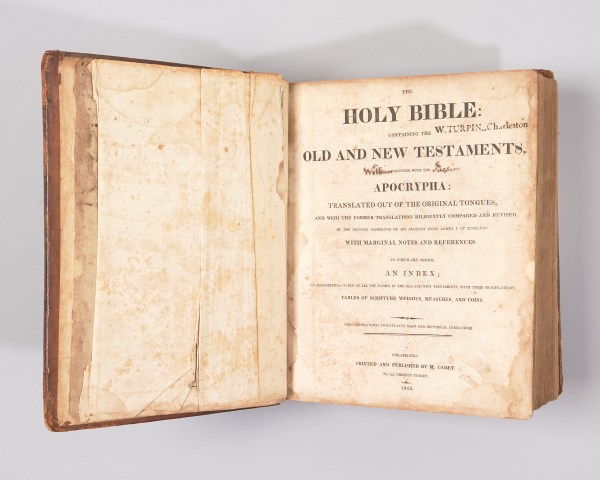
In an era when the Bible was edited so that enslaved people wouldn’t get the idea that God cared about their freedom, Turpin left a secret record of emancipation in a copy of the Scriptures, which is now in the South Carolina State Museum.

Perhaps it’s not surprising that this story of faith and freedom is mostly unknown. The two men were, after all, working not to attract attention.

Neither had deep roots in Charleston or close familial ties to its storied white “planter” dynasties. Turpin’s family was originally from Rhode Island, and Wadsworth was a native of Massachusetts who moved to South Carolina only shortly after the American Revolution. Both had public careers and served in the South Carolina Legislature, but their political profiles were not particularly high. Neither of them appeared to give any of their legislative colleagues the sense that they were developing strong, countercultural opinions on one of the most explosive issues of the day.

Wadsworth served in the South Carolina House of Representatives from 1791 to 1797. He represented Laurens District, near Greenville.

Turpin was a state senator representing the parish that comprised the city of Charleston in 1809. Before that, Turpin had served in various public offices, most notably as a commissioner for the East Bay Lottery. This was the same East Bay Lottery that an enslaved man named Telemaque won in 1799. After buying his own freedom, Telemaque changed his name to Denmark Vesey.

The two men were business partners. Their business interests led them to acquire land across South Carolina’s upcountry at what turned out to be just the right time for financial success. In the 1780s, they received several land grants for thousands of acres in both the Ninety-Six and Orangeburg districts. When the cotton gin was invented a few years later, short-staple cotton—which grew well in South Carolina’s upcountry—became a very profitable commodity. Cotton was cultivated with enslaved labor, so the cotton boom also drove up the price of enslaved people.

And Turpin and Wadsworth were invested in that market as well.

This is, so far, a fairly typical story: politically connected and commercially savvy white men making money off a change in the market and ongoing exploitation of labor.

But something else was happening too. Beneath the surface, away from public view, these men were developing different ideas. Wadsworth called it “notions of humanity.”

The first evidence of something different about these men came in 1799, when Wadsworth died of malaria. In his will, he freed nearly two dozen people.

Individual emancipations, or “manumissions,” were not uncommon at the time. These were seen as benevolent final acts, which in no way threatened the regime of slavery or prefigured a general emancipation. In South Carolina, however, the number of people that Wadsworth freed at once was unheard of. In that historical moment, it appeared less like the common cultural practice of deathbed generosity and more like an act of liberation.

The former state legislator also left each family enough property so that they could support themselves in freedom. He left them each 50 acres, livestock, and equipment.

The freed people were scattered across four large districts in South Carolina’s upcountry—Abbeville, Newberry, Union, and Laurens. With the families spread across the upcountry, the scope of Wadsworth’s emancipations appears to have gone unnoticed.

The dying man knew, however, that the people he freed would not fare well in a region where fear and hostility toward free people of color were increasing. So, as part of his last wishes, Wadsworth entrusted them to the protection of his friend, Turpin, and the Bush River Quakers in Newberry District.

Quakers were some of the nation’s first organized abolitionists. A large number of them believed that slavery ran counter to the laws of God. Wadsworth trusted they would look after the freed people as friends, protecting them from anyone who might seek to re-enslave them, and hoped they would treat the Black families as fellow children of God.

This might not be enough to consider Wadsworth and Turpin abolitionists, opponents of slavery itself, but Turpin’s papers show that this one-time enslaver had also spent his money emancipating people. He called them each by name and gave them property. Altogether, Turpin was personally involved in emancipating nearly 60 people.

When he left the South in 1824, he also started to speak out against slavery. Speaking from experience, he began to publicly condemn the “peculiar institution” that had become a way of life in a large portion of the United States and earned many people a lot of money, including Turpin himself.

He wrote former president Thomas Jefferson, urging him to take up the cause of abolition. It was not enough, Turpin told Jefferson, to advocate for freedom on paper. It was “required by God himself” to set the captives free.

Turpin wrote James Madison, too, hoping the founding father who played such a pivotal role in drafting the Bill of Rights would see the importance of ending slavery.

“I have lived more than half a hundred year in a Slave State,” he wrote Madison in one letter, “have ownd [sic] Plantations & Slaves, [and] am well acquainted with the treatment and Disposition of Slaves and of the Laws of all the Southern States. I was so much Convinced of the Evil of Slavery, that we gave 50 [odd] their Freedom.”

This Bible, which dates back to 1815, was once owned by owned by William Turpin, a white South Carolina merchant and enslaver turned abolitionist.Courtesy of the South Carolina State Museum
This Bible, which dates back to 1815, was once owned by owned by William Turpin, a white South Carolina merchant and enslaver turned abolitionist.
One of the first pages in the Bible with a handwritten list of names of enslaved people Turpin freed between 1807 and 1826.Courtesy of the South Carolina State Museum
One of the first pages in the Bible with a handwritten list of names of enslaved people Turpin freed between 1807 and 1826.

Turpin told Madison that for years, he thought he and Wadsworth were perhaps the only white men concerned with “the cause of the oppressed Affricans.” Then, with a reference to his faith, he prophesied a warning to those who continued to support such oppression that things were about to change.

“Now God has rais’d up 40 millions of consiensious people throughout the world to advocate their cause,” Turpin wrote, “& is dailey adding more to their number.”

Turpin lived long enough to see the abolitionist movement organize in 1830. In 1835, those abolitionists mailed more than 100,000 antislavery tracts to slaveholders, outraging the city leaders where Turpin had once served as a legislator and prompting an attack on the federal mail. It was one of the tremors indicating the earthquake to come.

Turpin’s letters to Madison indicate that he may have already had a sense of what was coming. He believed, after all, that the Almighty was just and that slavery was a horrific sin.

Turpin may have had other motivations besides his faith for converting to the cause of abolitionism. But his Christianity clearly helped compel his personal obedience to what he eventually saw as a righteous cause and also pushed him to acts of contrition.

“I could not Rest,” he wrote, “until I had paid them Wages for the time we held them as Slaves.”

When he died in 1835, Turpin left behind an estate plan that remembered the families that Wadsworth had freed so many years before. He bequeathed them $8,000—not as a gift, according to his will, but “proper renumeration for their time as slaves to Wadsworth and Turpin.”

Turpin also gave his wealth to well-known abolitionists, including William Lloyd Garrison, Benjamin Lundy, and Arthur Tappan, and to abolitionist organizations such as the New York Society for Promoting the Manumission of Slaves and the Genius of Universal Emancipation newspaper.

His obituary described him as an abolitionist and a Quaker.

This past summer, the South Carolina State Museum acquired Turpin’s personal Bible. Within its pages lies the clearest testament to ties between his faith and his conversion to the cause of abolitionism. In the front of the large Bible published in 1815, where religious families of that era often recorded their births, baptisms, marriages, and deaths, Turpin recorded by hand the names and details of those he and Wadsworth freed.

The list gives careful attention to each, treating them with respect.

“Will aged 47 years,” one entry says, “a first Rate man set free 14th April 1814.”

The next reads, “Lund aged 35 years a first Rate Carpenter set free 12 May 1820.”

On the next line is “Jenny 25 sister to Lund …,” followed by more who were set free that day: Leah, Tony, Juda, Abram, Boston, Cesar, Hector, another Leah, and her three sons.

Lists, of course, were common tools for enslavers. They used ledgers like this and the latest techniques of bookkeeping to track the value of the humans they owned and the profits their suffering created. In contrast, Turpin’s ledger recognized their freedom and their eternal worth as children of God.

It also served as proof that these men and women had been set free. Turpin directed that his heirs keep his Bible in South Carolina, knowing the ledger it contained was evidence that he had emancipated these individuals. Legal and social conditions grew more hostile for Black people as the Civil War approached. At least one, Boston, was kidnapped by slave traders in 1825 and re-enslaved. What ultimately happened to him remains unknown.

Indeed, we know too little about the people that Turpin and Wadsworth freed—their lives, their faith, and their stories. There is also much we still do not know about Turpin, Wadsworth, and the abolitionism they kept secret for so long. Turpin’s Bible, however, gives the South Carolina State Museum a place to start. Work is underway to learn more about these enslaved people and their enslavers who changed their minds. And there are plans to reunite descendants from both groups, to physically bring them together with the record in Turpin’s Bible and commemorate this monument to a faith that set captives free.

David Dangerfield is a professor of history at the University of South Carolina Salkehatchie.

Ramon Jackson is curator of African American culture and history at the South Carolina State Museum.

Theology

Out of Darkness, Light

The light of the world came to confront our sin

Phil Schorr

“Arise, shine, for your light has come,
and the glory of the Lord rises upon you.
See, darkness covers the earth
and thick darkness is over the peoples,
but the Lord rises upon you
and his glory appears over you.
Nations will come to your light,
and kings to the brightness of your dawn.”

— Isaiah 60:1-3

At some point in our childhoods, many of us developed an aversion to the dark. I remember lying in my bed as a young boy with the LA Dodgers game playing softly on the radio, my eyes frantically searching the dark closet trying to discern what the moving shadows were and what dangers they posed. Growing up, we often conjure monsters and nightmares to explain our fear—but most of the time, it’s the darkness itself that leaves us deeply unsettled. The experience of darkness as a disorienting reality, full of the unknown, seems to be imprinted deeply on each of our souls. In Genesis 1, God separated light from darkness. This was a purposeful, creative act that was, in God’s view, good. Yet after Adam and Eve’s rebellious decision and the entry of sin into the world, darkness took on a new meaning. It wasn’t just “out there.” The darkness was in us and pushing close against us. In Jewish writings such as the Babylonian Talmud, darkness is a metaphor for unsettling disorientation, a dread coming over a person. It also means evil and sin that leave a person struggling for direction, identity, and an understanding of what’s in store. Similarly, Isaiah 9 uses the compound word tzalmavet—“deep darkness”—to describe the shadow of dark death residing in every human heart.

Isaiah 60:1–3 subtly echoes the familiar story in Genesis 1. Once again there is contrast and separation, light and darkness. But in Isaiah’s telling, the enveloping darkness will dissipate—not when the Lord, the author of creation, commands it but rather when he arrives in his fullness. Isaiah is prophesying Advent—the coming of the King—who himself is light to all who are in darkness.

This Advent season, Isaiah’s words are an invitation to remember the first Advent. How absolutely undramatic, yet how sublime as the Light of the World humbly came as a baby to confront the darkness of sin in all of us. Isaiah’s words are a celebration: “Arise, shine, for your light has come” (v. 1). Light illumines our hearts to understand not only the depth of our sin but also the completed saving work of Jesus for us.

Isaiah’s bright words remind us of our calling. We can’t greedily hoard this light as we await his second Advent. The light is meant to brilliantly emit out of us so that the nations and our neighbors across the street might see Jesus clearly as the Light of the World (John 8:12). When the gospel of Jesus shines in us more deeply, it can only reflect back out of us through the light of worship and the sharing of the Good News.

Reflection Questions:


1. How does the concept of darkness in both Genesis and Isaiah symbolize more than just the absence of physical light but also the presence of sin and disorientation in our lives?

2. How can we embrace the message of Isaiah's prophecy during the Advent season and actively reflect the light of Jesus through worship and sharing the Good News with others?

Jon Nitta is the pastor of spiritual formation, discipleship and small groups at Calvary Church in Valparaiso, IN.

This article is part of The Eternal King Arrives, a 4-week devotional to help individuals, small groups, and families journey through the 2023 Advent season . Learn more about this special issue that can be used Advent, or any time of year at http://orderct.com/advent.

Books

The Book I’d Love to Write

Eight writers daydream about passion projects they will (realistically) never pursue.

Illustration by Joseph Rogers

Writers, in one sense, can write whatever they please. They can follow their creativity and curiosity wherever it carries them. They can ponder mysteries, investigate unknowns, and build narrative worlds, with possibilities as limitless as an empty page.

Real life, of course, imposes limits. Adult responsibilities pile up—kids to raise, bills to pay, chores to complete. Age, illness, and misfortune slow the mind and the pen.

And that’s before factoring in the dynamics of book publishing, which often funnel writers into familiar grooves rather than unleashing them to chase unpredictable muses. Some authors become experts in one thing, diminishing their bandwidth for writing about other things. Some gain a following among fans of one genre, who expect more of the same. And don’t forget the nontrifling matter of the reading public, who has to possess some appetite for what the world’s wordsmiths might wish to serve up.

Therefore, in the spirit of honoring dreams deferred though not forgotten—and also because we couldn’t help being a little nosy—CT asked eight authors, all with several books to their name, to outline writing projects that, for one reason or another, they’re unlikely to commit to print.

Matt Reynolds, senior books editor

Philip Yancey

The Parkinson’s Perspective: An Uncertain Journey Through My Stages of Unhealth

When I wrote a memoir, Where the Light Fell, I chose an “emerging person” style. As much as possible, I wanted to reflect my perspectives and sensibilities during the time periods I was writing about. Readers encounter me as a timid, fearful kid who related more to dogs than to people. Then a smarty-pants in elementary school vying for the teachers’ attention. Then a do-gooder in a fundamentalist church learning how to act “spiritual.” Then a morose, sassy teenager beginning to question adults. Then a cynical college student trusting no authority source. Then, finally, comes the unexpected collision with grace that changes everything.

Just over a year after the memoir was published, I received a diagnosis of Parkinson’s disease. At this point my symptoms are mild and mostly controlled by medication and exercise. I’ve heard plenty of stories, though: “My uncle was bedridden for 12 years.” “My mother had dementia so bad she didn’t recognize her own kids.”

I would like to write about the stages of unhealth that await me. Parkinson’s is a one-way degenerative disease: As neurons die, you get worse, never better. It could be helpful, to caregivers especially, to read the private perspective of someone going through those stages. As a writer, I would find that a creative challenge. I’ll probably never get to fulfill the task, however. I can describe the early stages, but if cognitive decline takes over, how will I present my inner life in a coherent way?

Philip Yancey has served as a CT editor at large. His books include The Jesus I Never Knew and What’s So Amazing About Grace?

Leslie Leyland Fields

From Hair to Glory: Theologies and Stories of Tresses Lost, Distressed, Dyed, and Freed

I could sit on my hair until I was 27. Strangers would shout after me as I passed, “Never cut your hair!” Then, at nearly 28, and much to my husband’s dismay, I hacked it off to within an inch of its life and kept it short for more than two decades. This year, I made another radical cut: I tossed the box of dye and went solidly silver, leading to new comments from strangers: “You look like Rita Moreno!” (a movie star who’s my mother’s age). Most women and men I know have their own hair journeys, through hippie days, chemo, mullets, alopecia, Brylcreem, and perms.

There’s theology here. Our strands twine through our lives, inspiring vanity, humility, thoughts of mortality, and more. God says the very hairs of our head are numbered, and he calls women’s hair their “glory” (Luke 12:7; 1 Cor. 11:15). Paul admonishes us to “take captive every thought to make it obedient to Christ” (2 Cor. 10:5). Surely that includes thoughts about hair.

For 20 years I’ve wanted to write a book collecting and reflecting these thoughts. But I won’t. Every writing project extracts two to five years of my life, and I parse out the books I want to write from the books I need to write using the measure of Frederick Buechner’s oft-quoted words: “The place God calls you to is the place where your deep gladness and the world’s deep hunger meet.”

I cannot turn away from so much hunger. I write to forge a path for myself and others from fasting to feasting, from silence to speaking, from slavery to freedom. For me, hair doesn’t quite make the cut. But I cheer on any who would take a long look at locks and coifs.

Leslie Leyland Fields lives in Alaska, where she works in commercial salmon fishing with her family. Her books include Forgiving Our Fathers and Mothers and the forthcoming Nearing a Far God.

Jen Pollock Michel

Violette: A Life

I’ve heard from fiction writers that stories can begin with the smallest seed of an idea: a final sentence, an opening scene, a complex character. The novel I’d love to write—if I had time and capacity—would be based on my great-aunt, Pauline Geneva Carpenter. (I’d change her name to Violette for the project, Pauline not having exactly the ring I’d intend.)

Pauline was born in 1910 on a farm in rural Tennessee. She moved to Akron, Ohio, to work at the Goodyear plant and eventually married a man to whom she was unhappily wedded for many years. They never had children together, and when she was in her late 80s, I learned why: Pauline had had an abortion in her late teens, scarring her physically and emotionally. I never knew the circumstances of that pregnancy, only that my great-aunt Pauline stood as a spiritual giant in the family lineage. She taught me to drink coffee at her small Formica kitchen table; she also taught me to pray there. As a child, I can remember the stacks of small notepads that accumulated on that table where she kept a record of her constant conversation with God. Although this wouldn’t be a novel for Christian readers alone, faith would be an unavoidable theme.

Pauline Carpenter lived a full and flourishing life, yet there was obviously hardship and unhappiness and regret. I think about the parts of her story she chose to share with me and the historical backdrop for those stories: the Jim Crow South, the Great Migration, the Great Depression, World War II, the ’50s, the sexual revolution, the Equal Rights Amendment, the Moral Majority. I think the research for this kind of project would be absorbing—and perhaps along the way, my own curiosities about this woman I knew and loved and admired might be satisfied.

Jen Pollock Michel is a writer and speaker living in Cincinnati. Her books include Teach Us to Want and Surprised by Paradox.

Andrew Wilson

Between David and Odysseus: What We Learn by Reading the Works of Homer Alongside the Books of Samuel

A few years ago, I found myself reading the two major works of Homer, the Iliad and the Odyssey, at the same time as I was going through 1 and 2 Samuel in my devotions. The parallels were astonishing to me. They still are.

Here we have two epic tales of heroes, battles, gods, and kingdoms. Both are told in two parts, with both set in the Eastern Mediterranean around the 11th century B.C., as the Bronze Age world collapses and new powers rise at the start of the Iron Age. Both are replete with deities fighting, cities falling, champions representing their nations in battle, jealousy, violence, bizarre disguises, poetic justice, brotherly love, trash talk, tussles over dead bodies, witches, mediums, rivalries for honor and women, shadowy spirits conversing with the living, foolish kings, treacherous advisers, vengeance, big guys with swords and spears being killed by little guys with projectiles. And both feature a wily and brave hero trying to make his way home against the odds.

More importantly, these two stories are utterly foundational to the modern West. Whether or not we have read the Iliad or the Odyssey, or even the Books of Samuel, we are children of both. Intellectually, morally, mythologically, and spiritually, we are all caught between David and Odysseus, between Jew and Greek.

Illustration by Joseph Rogers

Yet it’s the contrasts I find really fascinating, not least because of how our cultural values are much closer to David’s than Odysseus’ (again, whether we are Christians or not). How do these stories portray honor, sacrifice, and glory? Or friendship? Or women? Or justice, heroism, or the afterlife? What can we learn from the differences between Agamemnon and Saul, or Penelope and Abigail? Or the bonds between Achilles and Patroclus as compared to David and Jonathan? Why is our world so much closer in values to the Davidic than the Homeric vision (such that many of us want Hector to prevail and the Trojans to win)? Most importantly, what can we learn from the differences between the Olympians—Zeus, Hera, Ares, Athena, and company—and the God of Israel? I could imagine a chapter on the divine use of thunder alone.

Sadly, for now at least, I cannot imagine finding the time to write this (even if I could find an audience, which I also doubt!). Still, it is nice to dream. I can imagine the epigraphs already:

“Tell me about a complicated man.

Muse, tell me how he wandered and was lost.”

—Homer, Odyssey, 1:1–2

“Who is this uncircumcised Philistine that he should defy the armies of the living God?”

—1 Samuel 17:26

Andrew Wilson is a CT columnist and the teaching pastor at King’s Church London. His books include Remaking the World and God of All Things.

Joni Eareckson Tada

The Perfect 10: Springboard Diving Techniques from a (Somewhat) Reformed Daredevil

As I packed up for college orientation in the summer of 1967, I had a goal. I hoped to make the diving team at school that fall. I was good at aquatic sports and performed rather well on the one-meter springboard. I saw myself climbing the ladder to the three-meter board and impressing collegiate judges with my variety of straight, pike, and free dives.

Of course, I never made the team. I never even made it to that college. And as far as diving goes, my last one was a doozy—I was attempting an inward pike dive off a wood platform floating ten or so yards away from the beach. Who in the world is crazy enough to do an inward pike into shallow water? A daredevil like me, that’s who.

Although that reckless dive ended my aquatics career—plus my life as an able-bodied person—I still know a lot about springboard techniques. Whenever I am around a pool and have the chance, I love to coach kids on diving. Yes, I think I could even compile my knowledge into a small book.

In the interest of full disclosure, however, there was the time a mother caught me teaching her little boy how to approach the springboard. She glanced at my wheelchair, gave me a wry look, and asked in a slightly disapproving tone, “Aren’t you Joni, the one who broke her neck … diving?” I’d been caught. She gave me a stiff smile and tugged her child in a different direction.

I think I’ll shelve my idea for a book. I’ll leave it to divers who are less of a daredevil than me.

Joni Eareckson Tada founded the Joni and Friends International Disability Center. Her books include The Practice of the Presence of Jesus and A Place of Healing.

Nijay Gupta

Incarnation Now: A Jesus Novel

I love fiction, but I am not a fiction writer. With a little more gifting and training in this area, I’d love to consider what the story of Christianity would look like if Jesus came to earth in the here and now, rather than 2,000 years ago. This literary exercise would require a lot of imagination and creativity, but it could help us understand just how revolutionary the Incarnation really is. Because we have inherited a sentimentalized Christmas story with lowing cattle and a little drummer boy, many of us ponder the birth of Christ with storybook nostalgia. But this would have been a really crazy concept for a Galilean commoner like Mary to wrap her head around.

And when Jesus launched his ministry, he used every means at his disposal to spread the word about the gospel. In today’s context, I can think of several questions that would be thrilling to consider. For instance, what languages would Jesus speak? Would he stay in the Middle East or travel around the world? Would he post on TikTok or write a Substack? Would he denounce Elon Musk or Vladimir Putin? Would skeptics insist his YouTube channel of miracles was “all CGI”? A book like this could be dramatic or funny, but it could help us contemplate the full meaning of “God with us.”

Nijay Gupta is professor of New Testament at Northern Seminary. His books include Paul and the Language of Faith and the forthcoming Strange Religion.

Fleming Rutledge

Torture, Degradation, and Hope: The Cross as a Guide to Christian Witness in Troubled Times

Twenty-plus years ago, when I first began to write my most ambitious book, I planned three major sections. The first would address the central importance of the brutal execution of Christ in Christian faith and the problems it presents. The second would examine some of the major themes and images that the writers of the New Testament found in the First Testament and the new interpretive themes that appear in the apostolic age. The third section, which I envisioned as the most important, would be a series of reflections and illustrations showing how the death of the Son of God in a public display of human cruelty in the distant past could become the central guide for Christian witness in our terribly troubled present times.

The first two sections were published as The Crucifixion: Understanding the Death of Jesus Christ in 2016. It is more than 600 pages. Alas, the hoped-for third section does not exist in any publishable form. I have a substantial number of files on my computer which were originally destined for it, but none are anywhere near complete. I ran out of steam, it appears.

I am sad about this. I had hoped to show—by illustration—how powerful the church can be when it takes up its calling to be a community of resistance to fear, inhumanity, hatred, and violence. We need this gift of the Spirit now more than ever, as we see the Holy Land violated by murderous enmity and our own churches riven by identity politics run amok. May God grant us leaders to help us become, in the spirit of Abraham Lincoln’s second inaugural address, a people of transfigured repentance, subversive courage, and conquering faith.

Fleming Rutledge is a writer and an Episcopal priest. Besides The Crucifixion, her books include The Bible and The New York Times, a sermon collection.

Marvin Olasky

Who Programmed the Computer? The Weakness of Simulation Theory and the Logical Alternative

Our existence on a Goldilocks planet in a Goldilocks universe is so statistically improbable that many scientists believe in the multiverse. In other words, so many universes exist that it’s not surprising to find one planet in one of them that’s just right for human life. Other scientists don’t want to make such a leap of faith. They see this world as the result of intelligent design. That, however, suggests God, so atheists seeking an alternative are following Oxford philosopher Nick Bostrom, who got the debate rolling two decades ago with an article arguing that we “are almost certainly living in a computer simulation.” Neil deGrasse Tyson gave the theory credibility by saying it was a 50-50 possibility, and Richard Dawkins has taken it seriously. Elon Musk semipopularized it in 2016 by saying he thought it true.

That raises the question: Who or what is the simulator? Some say our distant descendants with incredibly high-powered computers. One of the theory’s basic weaknesses is that, as Bostrom acknowledges, it assumes “substrate independence,” the concept that silicon-based processors in a computer will become conscious and comparable to the neural networks of human brains. Simulation theory has many other weaknesses, and those who understand the problems of both the simulation and multiverse hypotheses should head to the logical alternative: God.

I’d like to dive into this, but I’m 73 and haven’t taken a science course since high school, so I have neither the credentials nor the time to pursue this. With the book-writing time I have left, I’m staying with what I know: history and poverty fighting. If a younger person is interested, I have a list of a dozen people worth interviewing.

Marvin Olasky is a Discovery Institute senior fellow and former editor in chief of World magazine. His books include The Tragedy of American Compassion and Reforming Journalism.

Books

New & Noteworthy 2024

Seven books we’re looking forward to in the new year.

Mortal Goods: Reimagining Christian Political Duty

Ephraim Radner (Baker Academic)

Untangling Critical Race Theory: What Christians Need to Know and Why It Matters

Ed Uszynski (InterVarsity Press)

Fully Alive: Tending to the Soul in Turbulent Times

Elizabeth Oldfield (Brazos Press)

Break, Blow, Burn, and Make: A Writer’s Thoughts on Creation

E. Lily Yu (Worthy Books)

The Blurred Cross: A Writer’s Difficult Journey with God

Richard Bauckham (Baker Academic)

Does the Bible Affirm Same-Sex Relationships?: Examining 10 Claims about Scripture and Sexuality

Rebecca Mclaughlin (The Good Book Company)

The Pastor as Apologist: Restoring Apologetics to the Local Church

Dayton Hartman and Michael McEwen (B&H)

Books
Review

American Christianity Is a Flourishing Forest

Just as biodiversity produces new trees, cultural diversity produces new expressions of an ancient faith.

Illustration by Zhigang Zhang

Histories of American Christianity look very different now than they did 50 years ago. “Church history,” as it was then called, used to focus on individual leaders (mainly “great men”), major events in denominations, and developments in theology. Its historians were typically trained in seminaries and divinity schools.

Turning Points in American Church History: How Pivotal Events Shaped a Nation and a Faith

In the 1960s, historians began writing “the new social history,” which emphasized the lives of ordinary people in their social settings. This produced a new generation of scholars, largely trained at secular universities, who studied American Christianity as a social and cultural phenomenon.

Turning Points in American Church History, Elesha J. Coffman’s well-informed and highly readable new book, is a prime example of the insight and energy generated by this new approach. The title is a bit misleading, suggesting a work of “church history” revolving around “pivotal events.” Coffman instead takes us down a path pioneered by Andrew Walls, the great historian of missions.

Walls taught two crucial lessons. First, Christianity became a global religion via transmission from one culture to another. Second, the transmission always involved not merely translation into a new language but also incarnation into a new culture. As Christianity has moved from one culture to another, it has developed new theologies, adopted new practices, addressed new problems, and struggled with new limitations. As Coffman puts it, “Everywhere the gospel traveled, it was embodied and spoken anew.”

The idea that pure or true or “mere” Christianity exists apart from culture is helpful only in theory. On the ground, every form of Christianity has two parents contributing to its DNA—“the faith which was once delivered unto the saints” and the culture in which it takes up residence (Jude 1:3, KJV).

In this sense, the term Christianity is like the term forest. Forests thrive in tropical and subarctic climates, at high elevations and low, and in some of the driest and wettest climates found on earth. Trees introduced into a new environment are limited by that environment, which then reshapes them. As a result, each region’s forest is unique.

Likewise, the wide variety of Christianities on our planet results from the wide variety of cultures into which the faith has been planted. This brings us to the argument of Coffman’s book: “American Christianity is distinctively American because it has an American history.” But this raises a question: Which American history? The poet Walt Whitman put his finger on the problem. America, he wrote, “is not merely a nation, but a teeming nation of nations.” Add Whitman’s insight to Walls’s, and it follows that a nation composed of many nations, with a culture composed of many cultures, will have many Christianities.

Coffman’s book skillfully applies these insights. She uses notable events in church history less as turning points and more as windows, each opening a view onto the history of new and different Christianities that Americans have created. Each American Christianity was formed by distinctive American circumstances. All have made lasting contributions to what it means to be American and Christian alike.

The book’s 13 chapters use noteworthy historic events as “launch points” for discussions that range far forward in time. To consider a few highlights:

  • Two chapters—one opening with the defeat of the Spanish Armada in 1588 and another opening with King Philip’s War in 1675—highlight Native American Christianities through the 20th century.
  • Roman Catholics—North America’s first Christians—are central to Coffman’s chapters on the Spanish Armada and the appointment of the first American bishop in 1789. The latter takes Catholic developments up through the 19th century.
  • Anglo-American Protestant Christianities naturally get the most attention, with chapters on the banishment of Roger Williams from Massachusetts in 1635, George Whitefield sparking the First Great Awakening in 1740, the founding of the American Bible Society in 1816, the 1844 Methodist Church split over slavery, the 1886 launch of the Student Volunteer Movement for Foreign Missions, the 1925 Scopes trial over teaching evolution in Tennessee public schools, and the 1980 election victory of Ronald Reagan.
  • African American Christianities get sustained attention in chapters organized around the founding of the first Black church in 1773 and the 1963 bombing of the Sixteenth Street Baptist Church that tore apart the bodies of four little girls in Birmingham.
  • The most wide-ranging chapter considers the 1906 Azusa Street Revival and charts the spread of Pentecostal and charismatic Christianities among white, Black, and Latino Christians, Protestant and Catholic, throughout the world.

In each chapter, Coffman shows us cross-cultural encounters creating new forms of Christianity. The Spanish-Pueblo encounter generated a distinctive new Pueblo Christianity. The French-Huron encounter produced a new Huron Christianity. Likewise with the Puritan–Native American encounter.

And, of course, that encounter also changed Puritan Christianity. As the Puritans labored to convince themselves they were superior to the Native Americans, their original desire to be free of English restrictions hardened into a theological conviction that God had chosen them to bring Christian civilization to the rest of the world.

One of American history’s greatest puzzles is why African Americans would so widely adopt their enslavers’ religion. As Coffman shows, the cross-cultural encounter between Southern planters and those they enslaved generated changes in Southern Christianity and new forms of Black Christianity. Like the Puritans, the defenders of slavery developed a Christianity that justified dehumanizing their nearest neighbors. Paradoxically, Native Americans and African Americans developed Christianities that reinforced their human dignity. Native American Christianities did this by emphasizing ties to their ancestors; Black Christianities by emphasizing the Exodus story and its themes of liberation from oppression.

Encounters between Catholicism and the American culture also catalyzed different modes of being Christian. European Catholicism was priest- and parish-based and hierarchical in authority. But colonial-era Catholics, lacking priests and churches, developed a home-based, lay-led form of Catholicism that experimented with democratic authority. The 19th century witnessed massive European immigration to America, and the internal diversity of the Catholic immigrants generated various ethnic forms of Catholicism with their own priests, parishes, and devotional practices.

Evangelical movements have also generated a multitude of new Christianities. Whitefield’s revivals split old Protestant denominations and created new ones with distinctive theologies. The Azusa Street Revival—which originally had Black and white people in both leadership and participation—spawned a vast array of new denominations, first in America and then around the globe.

In the 1950s, Pentecostalism spawned the charismatic movement, giving rise to new denominations and new forms of Christianity within Protestant and Catholic settings. At the same time, new forms of Pentecostal Christianity from Norway to Nigeria to Nicaragua began migrating back to the US, creating even more ways of being Christian and American.

Of course, the fact that Christianity is always incarnated into a culture can cut in both positive and negative directions. All cultures have elements in harmony with God’s desires, and these can be harnessed to speak God’s larger truth within those cultures. At the same time, all cultures have elements out of harmony with God’s desires, and these can pervert Christian words and ideas in support of sub-Christian actions.

Both Williams and his Puritan antagonists arrived in New England with a commitment, arising from persecution in England, to something they called “religious freedom.” Williams saw this as freedom of the individual conscience, as defended by the apostle Paul (1 Cor. 10). The Puritans understood it as the liberty to create a godly society in which godly norms—as they understood them—would be enforced by a coercive government.

Williams, banished from Massachusetts, founded Rhode Island Colony as a haven where a nominally secular civic government would protect individual freedom of religion. American Catholics, having had to defend their own freedom against Protestant harassment well into the 20th century, eventually persuaded the worldwide Roman Catholic Church to embrace freedom of conscience and separation of church and state.

Meanwhile, the Puritan dream of a government-regulated godly society lives on in American Christianity, as Coffman’s subsequent chapters show. It is center stage in the attempt to outlaw teaching evolution in the 1920s; again in white Southern churches’ defense of segregation in the 1960s; and yet again starting in the 1980s, when many white evangelicals and some white Catholics set about using the Republican Party as a vehicle for realizing their vision of a Christian nation.

But America is a nation of nations, home to an unruly pileup of Christianities. Coffman astutely notes that this produces creative tensions that may well explain American religious vitality. A few years ago, sociologists Roger Finke and Rodney Stark demonstrated that American church adherence rose steadily between 1775 and 1980, reaching levels far exceeding those in other Western nations. But Coffman concludes her book with the fact that since 1980, the number of Americans unaffiliated with any religion has soared from 7 to 30 percent.

She appropriately refrains from speculating about the future, but for some readers, her book may raise a deeply ironic possibility: A white, conservative version of a Christian nation might become a nation of fewer Christianities and fewer Christians.

Michael Hamilton is emeritus professor of history at Seattle Pacific University and vice president at Issachar Fund.

Books

Sharia Law Makes a Solid Case for Christ

In new book, Jordanian pastor and academic says that if Muslims treat evidence for the Bible and Quran consistently, the gospel eyewitnesses authenticate Jesus’ crucifixion and resurrection.

Hagia Sophia, a mosque in Istanbul, Turkey.

Hagia Sophia, a mosque in Istanbul, Turkey.

Christianity Today December 22, 2023
VladyslavDanilin / Getty

For 1,400 years, Christians have wrestled with how to defend their faith to Muslims. While Islam accepts Jesus as a prophet, it denies his divinity. And as for his sacrifice for sin on the cross, the Quran denies the crucifixion and by extension the resurrection, claiming instead that God took him directly to heaven.

Christian responses have often been polemical, seeking to invalidate the message and morality of Muhammad. They have also been apologetic, sometimes employing legal arguments that Muslims view as manmade and changeable—thus lacking authority to adjudicate matters of eternal significance.

Baptist pastor Suheil Madanat seeks instead to ground the authenticity of the gospel account within Islam itself. In Evidence for the Crucifixion and Resurrection of Jesus Christ Examined through Islamic Law, the former president of the Jordan Baptist Convention (2016–2022) consults expert sharia compendiums and relevant scholarly works to learn sharia’s criteria for validating relevant evidence—including eyewitness testimony, confession, expert opinion, and circumstantial evidence—and examines the New Testament accounts against it.

Endorsed by scholars at Southwestern Baptist Theological Seminary, Southern Baptist Theological Seminary, Fuller Theological Seminary, and Jordan Evangelical Theological Seminary in Amman, the book is a new resource for Muslim apologetics and comparative religion. CT interviewed Madanat about liberal source criticism, the divergence in resurrection accounts, and his ultimate hope for Muslims who read his book.

How does traditional Islam look at the Bible?

In principle, they accept both the Old and New Testaments as the word of God, but they believe that they have been largely corrupted. Though they accept that some accounts read today still have some truth, they do not accept the Bible as authentic. This is especially the case for the parts that contradict Islam—mainly the divinity, crucifixion, and resurrection of Jesus.

How do Arab Christians tend to address these objections?

Most of what I read in Arabic is a polemical approach rather than apologetic. They are more concerned about attacking the ethics of Muhammad and the teaching of the Quran rather than defending the Scripture. I have not seen much done to vindicate the authenticity of the Bible, though some is done in academic circles.

But I must add that Muslim scholars do not provide solid testable evidence that can be argued against. They say the Bible is corrupt, but what is the alternative? The Quran speaks about preserving the divine text, but where then is the authentic text? How did God allow this? When did the corruption happen exactly? To be sure, they do tell a story of the alleged corruption, but it contradicts plain historical facts.

They do not give objective answers to these questions, inviting the polemical reply.

Is this why you wanted to defend the Bible through an Islamic framework?

My task here is not to defend the whole Bible but the reliability of the accounts of crucifixion and resurrection, the backbone of our Christian faith. The libraries of the West are full of conservative responses to liberal source criticism and other critiques, but they do not mean much to most Muslims. Since the Quran says that the Bible is corrupt, they ask: Why should we care about an intra-Christian dispute?

But when I say I want to examine evidence for Chistian claims through the filters of divine Islamic law—it immediately catches their attention.

What is your method?

Islamic law has established strict criteria to examine eyewitness testimonies, but those who experienced the crucifixion and resurrection of Christ are long deceased. Their evidence exists only in documentary form—the Gospels. These must be first authenticated, so they can be equivalent to live eyewitness accounts, and then examined.

The problem is that Islamic law, unlike the Anglo-American common law, has no criteria for authenticating ancient documents. Nonetheless, the primary divine sources of Islamic law, the Quran and Sunna [recorded traditions about Muhammad’s words and deeds], are themselves ancient documents. What standards do Islamic scholars use in their literature to defend their authenticity?

I reviewed this literature, and it makes a convincing case in the face of Western liberal criticism. I am convinced the Quran is largely authentic, written by Muhammad, with only minor variants. This critique, however, is similar to that levelled against the Bible and often quoted by Muslim scholars in their anti-Christian claims. I then simply ask Muslims to be consistent—and fair.

How do you proceed?

Step one uses the existing apologetic material to establish that the New Testament accounts were written by eyewitnesses. I examine the ancient manuscripts’ textual purity, as well as the dating of the gospel records and their internal evidence that includes the incidental details of personal names, dates, and geographical places.

When Jesus fed the multitude, for example, it says they sat on lush grass. But paying attention to the chronology of Jewish feasts, it lines up beautifully with the only season in which the fields are green even today, both in Palestine and Jordan.

Once the gospels are proven to be authentic records, the next step is to pass the Christian evidence through the filters of the Islamic law and see how it responds. Here I remind Muslims that since they believe that sharia is immutable, sent by God, they must trust it.

This is how I started my research in the first place, and, amazingly, Christian evidence passed the test of Islamic law par excellence.

What are these filters?

One is the required number and gender of eyewitnesses. Credibility usually depends on two males, with female testimony worth half of that as a man, as a well-known tradition in Islam says that women are deficient.

The biblical testimonies were written by eyewitness men: Matthew, John, and Peter as direct eyewitnesses of the crucifixion and resurrection. Paul also saw the risen Christ, and his confession—along with that of James—satisfies the criteria of Islamic law. But we also have indirect witnesses, which Islam accepts in the case of a death that has been established within the community. Mark, Luke, and several non-Christian ancient writers fit this category, with Luke further established as an expert witness.

Each witness must also satisfy several strict criteria, both at the time of witnessing the event and at the time of giving the testimony. All these have been applied to each biblical witness, and they all passed. Among these, for example, is the criterion that there should be no hint of personal benefit. And we know that the disciples died as martyrs for their faith; they had nothing to gain through deception.

Another criterion is that a non-Muslim cannot give witness against a Muslim. But the Quran calls Jesus’ disciples—Hawariyyun in Arabic—righteous men who therefore count as Muslims. Eyewitnesses furthermore must be able to reason clearly—which the written accounts establish—and cannot be blind, deaf, or dumb. They must also be free men, not slaves, and have reliable memory.

Are there objections about the divergent details in the gospel accounts?

That is another criterion, that witness accounts be consistent. But Islamic law presents many cases demonstrating that if there is a possible scenario to account for apparent differences, it must be accepted. Christians have long created harmonies of the gospel and, except for minor details, the main events of crucifixion, burial, and resurrection pass the test.

Yet the Quran says Jesus was not crucified, only that it appeared to them as such.

This claim does not make sense. This is the prevailing viewpoint in 99 percent of the Muslim world. But we must remember that Muhammad never saw the New Testament to examine the account himself; it was not translated into Arabic until the second Islamic century.

The principle they draw upon is that God would not allow his distinguished prophet to suffer such humiliation, and so God substituted Jesus with someone else. But when? If directly before the crucifixion, then it was Jesus who still underwent the humiliation of his unfair trial and public scourging. If it was before or during the trial, then certainly the unfortunate person in Jesus’ place would have cried out and given evidence during the trial that he was not Jesus.

What do you expect will happen if open-minded Muslims read your book?

If it simply raises doubts about the allegation that Jesus was not crucified, this would be enough. But once a person starts thinking about questions to their received faith, they may begin to doubt the whole story. Why does the Quran deny an account, they might wonder, that the divine Islamic law establishes through credible testimony?

This might prompt readers seeking the truth to search for additional evidence. My ultimate hope is that they come to believe.

Books

The Echoes of Genesis in Darwin

Evolutionary science has surprising roots in a Hebrew view of reality.

Charles Darwin

Charles Darwin

Illustration by Rick Szuecs / Source images: Wikimedia Commons

The Bible differs from Darwinian thought in fundamental respects. But the early authors of Scripture and the architects of evolutionary science shared a similar challenge: Both were looking to make sense of environments characterized by aggression, violence, and fierce competition for scarce resources. Biblical scholar Dru Johnson, director of the Center for Hebraic Thought, spells out this and other surprising parallels in his book What Hath Darwin to Do with Scripture? Comparing the Conceptual Worlds of the Bible and Evolution. Matthew Nelson Hill, author of Embracing Evolution: How Understanding Science Can Strengthen Your Christian Life, spoke with Johnson about reconciling biblical and scientific accounts of reality.

What Hath Darwin to Do with Scripture?: Comparing Conceptual Worlds of the Bible and Evolution

What is the “elevator pitch” you would give to summarize your book?

The biblical authors have a particular conceptual model that governs how they think about reality. What Darwin would later call natural selection is something they actually talk about quite vigorously in the early chapters of Genesis, even if not explicitly in those terms. My goal in the book is putting this biblical model into conversation with the Darwinian model of evolutionary science, to see where the underlying worldviews compare and contrast. My contention is that these worldviews are more complementary than we sometimes might suppose.

How do you work to maintain a high view of Scripture as you put it into conversation with Darwinian science?

This is the highest view of Scripture you could have, because it makes a serious effort to evaluate the motives and philosophical notions of its writers. And yet this often causes discomfort among those who say they have a high view of Scripture, because we’re not always used to entering the intellectual world of the authors themselves.

We often think of science as inherently secular in its perspectives and assumptions. But when you study it alongside the conceptual world of the Hebrew Bible, you can see how it represents one of the greatest expressions of that conceptual world. I’ve spent lots of time in the Hebrew text, and I believe that if you could time-warp writers of that era into the present and catch them up on our knowledge of things like solar systems and galaxies, they would find that it all makes sense.

Early in the book, you argue that science is telling a story and also that Scripture is not “merely” a story. Can you elaborate?

Anytime you read a scientific explanation, it almost always comes packaged in a larger narrative. Especially at the quantum level, many scientific facts are almost inexplicable without a narrative framework to help us make sense of them.

When you read evolutionary accounts of how humans emerged from various hominid ancestors, you realize that every worldview has an origin story, which is supposed to tell us where morality comes from and explain the reality we see today. Scripture, in this light, isn’t doing anything weird by giving an origin story meant to provide a foundation for morality and ethics and explain the development of things like families, nations, and political systems.

Lots of people come to the early chapters of Genesis with one question: Did all this really happen? I do think the ancient Hebrews would have read these stories as accounts of things that really happened. But in another sense, the Bible resists this kind of framing, because it’s trying to offer something beyond a functional explanation for how the world came into being.

In one section of the book, you deal heavily with sexual reproduction, a topic that both evolution and Scripture care deeply about. How are we to talk about this topic in productive ways?

If you’re prudish about sex, then buckle up, because the biblical writers are not, especially when it comes to the necessity of continuing family lines. You could point to the account of Lot’s two daughters, who got their father drunk to have sex with him and produce offspring. Or you could point to Abraham, who prostitutes his wife as a means of saving his life and preserving the possibility of the family God had promised.

Why is all this included? I think part of the answer is that these stories convey something of the sobriety that the biblical authors brought to the brokenness and fragility of humanity and its need for redemption.

Death, as you show, is part and parcel of nature. Yet Scripture depicts death as a great enemy to be defeated. How can we reconcile these two perspectives?

The biblical authors are very attuned to the fact that death happens and that it’s horrible. They are aware of how it shapes the world around them, but they are also aware that this isn’t the way it’s supposed to be.

In the book, I use the language of the “Gloria Patri”—“as it was in the beginning, is now, and ever shall be”—to outline this reality. The hymn itself, of course, testifies that God is the same yesterday, today, and forever. But the language hints at the way that things are different after the Fall, that God’s original design has been broken because of sin. So we can imagine a world where nature is crafted toward a good end, without the necessity of death.

If, as you contend, real science—research and exploration governed by the scientific method—began about 500 years ago, how can the Bible be seen as telling us anything about science?

There is a recurring question in the history of science that essentially asks, “Why did science start?” Because clearly there are great intellectual pursuits taking place in China, Mesopotamia, Egypt, Greece, Rome, and other major empires. There’s no shortage of very smart people doing very smart things. So why does science develop in the West with people who have essentially appropriated a Hebrew view of reality?

One good answer begins like this: There is just no good version of science grounded in the assumption that none of what we observe around us is really real. You can’t say that all the real stuff is in the heavens or being animated by spirits behind the trees, to mention just a few broad generalizations of certain religious or philosophical schools of thought. You can’t say that our senses are fundamentally deceiving us.

The Hebrew Bible takes a very different position: that what we observe around us is real, knowable, and regulated, even if it leaves room for divine interruption. The gift of the Hebrews is a scheme for discerning the workings of natural reality and letting that reality correct us, which is an aspect of science that I wish theology would pick up more often.

What is your greatest hope for readers of this book?

It has nothing to do with evolution or Darwinism. My biggest goal is getting people to think seriously about the intellectual world of the biblical authors and of biblical literature itself. I hope readers will see how those authors are addressing more issues than we might notice on the surface.

To take one example: You don’t see the modern institution of policing in the Bible. From that you might conclude that the Bible doesn’t say much about police work. It actually has a lot to say, but you need to know how to listen. Overall, I want readers to take the leap from Bible literacy, where you know what’s in the Bible, to Bible fluency, where you can extend its way of thinking into all kinds of practical areas.

Meeting People Where They’re Migrating

Responses to our November issue.

Abigail Erickson

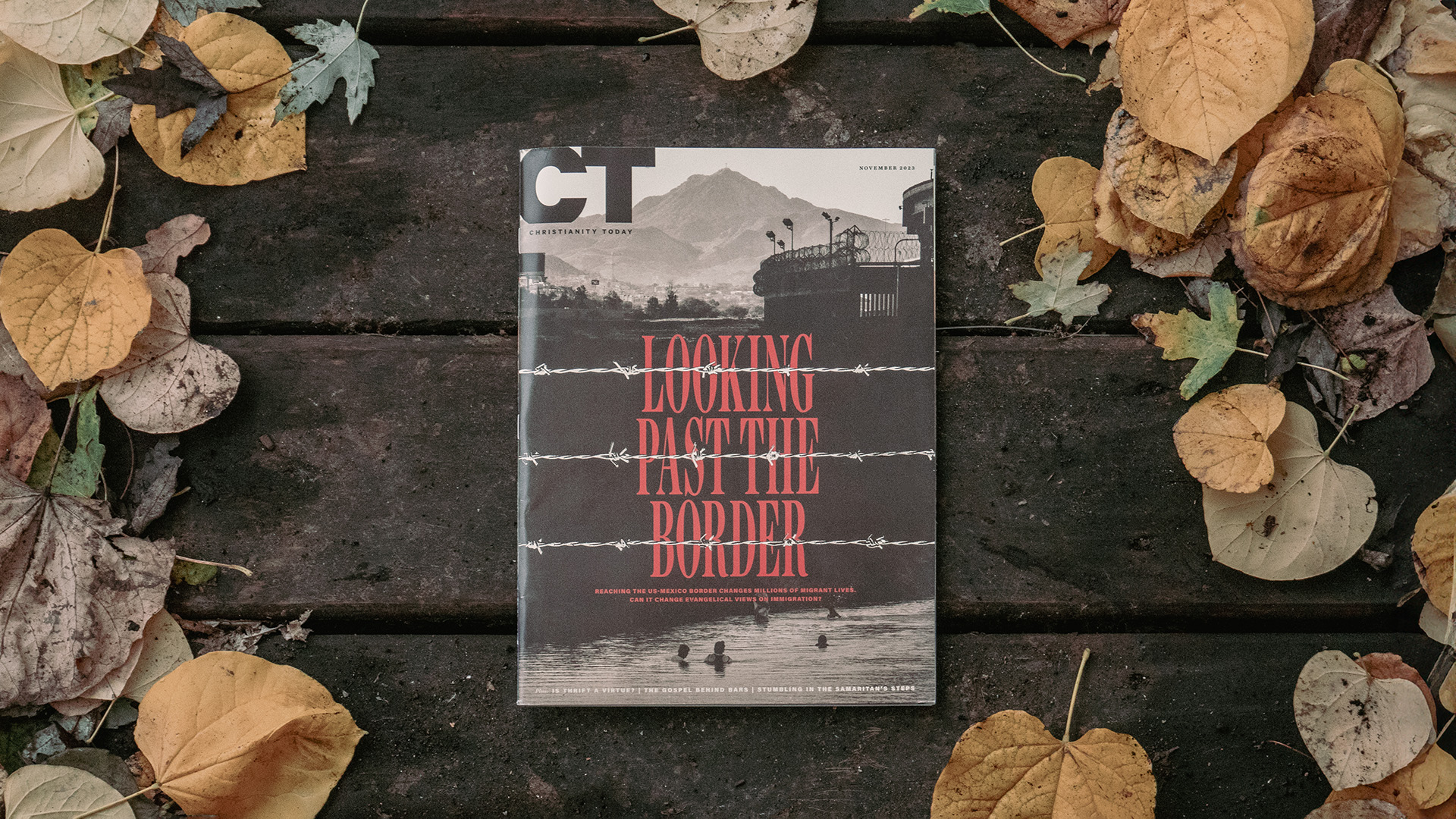
In addition to talking to churches in Colombia about their outreach to migrants for our October issue, global staff writer Sophia Lee visited El Paso, Texas, and Ciudad Juárez, Mexico, to learn how one man wants to teach Americans the history of their southern border for our November cover story, “The Crossing.”

Readers resonated with the topic and the location. Several people reflected on their time in El Paso spent learning about its unique culture and beauty. T. D. Proffitt of Santa Ana, California, offered further reading suggestions (The Mexican Border Cities by Daniel D. Arreola and James R. Curtis, and his own Tijuana: The History of a Mexican Metropolis).

People were also still talking about Lee’s Colombia story, “The Landless.” Aaron Lincoln of Gloucester, England, said he likes to read CT stories like this one with an online map at hand to make “an otherwise distant place or foreign people instantly more local.” And Cheryl Berto of Delta, British Columbia, declared, “If the blessing of God is a life of ease and prosperity, then we have missed the plot. This article is an excellent help for us in getting back on track with what kingdom living means.”

Alexandra Mellen Conversations editor

Trump-Era Controversies Had a Measurable Effect on Church Attendance

Not surprising given that in a lot of American churches, Dems weren’t made to feel welcome after Trump’s election.

@johnegibson (X/Twitter)

You may want to look up the definition of “correlation is not causation” before asserting something like this. Blaming Trump is easy. The church looking at itself as the source of millennial decline is probably harder.

@ClaytonArnall (X/Twitter)

The Black Church Models a Different Conversation About ‘Gender Roles’

I was really excited to hear more about what is being modeled differently, but this article was nothing about that. It was all about complementarian versus egalitarian without the terms.

@nad_mills (Instagram)

Thank you @ct_mag for continually highlighting the whole Body. More, please!

@drnaimalett (Instagram)

Our Divided Age Needs More Talk of Enemies

I believe we need far greater clarity on what it means to be a Christian—what it means to be in covenant with God through Jesus Christ, driven by a worshiping heart to a relationship of believing loyalty and intimate communication. Then we will see clearly what the counterfeit is.

Doug Michalak (Facebook)

Blessed Are the Thrifty?

Susan Mettes’s article arrived two days before my scheduled financial review. I read it twice, underlining points that reflected my beliefs about the gospel’s truths regarding wealth and reconsidering beliefs I have held for decades. While I too have no one-fits-all answers, Mettes clarified so many points regarding generosity, thrift, and simple living. When I go for my appointment, I will be prepared with a clearer head considering the spiritual meaning of these financial issues and decisions needed.

Lloyd Kaufman, Des Moines, IA

I Stumbled in the Steps of the Good Samaritan

When you serve those in need, you don’t become Christ to them; they become Christ to you.

Ben Kucenski (Facebook)

Jesus did not call the Samaritan “good.” In fact the word good is not used in the parable, which is about what it means to be a neighbor.

@gdavidritchie (X/Twitter)

There was no “good Samaritan” in Jesus’ day—at least not to his hearers. To that crowd, the only “good” Samaritan was a dead Samaritan. The point of the story is not that he did the right thing, but that the wrong person did the right thing. In our Western evangelical culture, when we are good, we see ourselves as the good Samaritan, and this blinds us to the goodness of God in “the other.”

Bob Gadd Maple Ridge, British Columbia

Behind the Scenes

While I was working on “The Crossing,” some American Christians told me about their disappointment with their fellow citizens’ attitude toward migrants. People in other countries seem more welcoming, they said.

A couple weeks later, I flew to Colombia. In Medellín, I met an Uber driver who asked what a Korean American woman was doing alone in Colombia. I told him I was reporting on the migration crisis, and his face soured. “These migrants,” he complained, “are uncivilized. They’ve come to contaminate our beautiful city.” When I later told him I grew up with Chinese people, his expression twisted again.

The instinct to fear and distrust the stranger is human nature, in El Paso or Medellín. This complicates the work of peacemaking at the US-Mexico border and the ministry of a church at the Venezuela-Colombia border. Yet in these places I also witnessed the purest form of human nature—the image of God.

I too tend to get cynical about people—that seems to come with being a journalist. But my work at CT has been healing my cynicism as I report on God’s people doing kingdom work—shining the glory of what’s both here and yet to come.

Sophia Lee global staff writer

Apple PodcastsDown ArrowDown ArrowDown Arrowarrow_left_altLeft ArrowLeft ArrowRight ArrowRight ArrowRight Arrowarrow_up_altUp ArrowUp ArrowAvailable at Amazoncaret-downCloseCloseEmailEmailExpandExpandExternalExternalFacebookfacebook-squareGiftGiftGooglegoogleGoogle KeephamburgerInstagraminstagram-squareLinkLinklinkedin-squareListenListenListenChristianity TodayCT Creative Studio Logologo_orgMegaphoneMenuMenupausePinterestPlayPlayPocketPodcastRSSRSSSaveSaveSaveSearchSearchsearchSpotifyStitcherTelegramTable of ContentsTable of Contentstwitter-squareWhatsAppXYouTubeYouTube