Books
Review

Gender Difference Is Real, but Too Complex to Spell Out All the Specifics

A theologian articulates an Augustinian alternative to the reigning perspectives on nature and culture.

Christianity Today February 23, 2024
Illustration by Mallory Rentsch Tlapek / Source Images: WikiMedia Commons

When asked to define time, Augustine remarked that he knew what it was until someone asked him to define it. One could say the same of the term gender in contemporary debate. Although there is no lack of debate about gender, rarely is the term clearly defined.

Gender as Love: A Theological Account of Human Identity, Embodied Desire, and Our Social Worlds

In his book Gender as Love: A Theological Account of Human Identity, Embodied Desire, and Our Social Worlds, theologian Fellipe do Vale aims to bring greater clarity to the concept of gender. In doing so, he refuses the binary framing that casts it as a matter of either pure biology or pure social construction. Instead, he draws on an Augustinian theology of love to argue that gender refers to a “bundle” of human loves and social goods that shape how we manifest our male and female bodies.

Further, do Vale clarifies that affirming the basic reality of gender does not entail affirming an exhaustive and fully cohesive understanding of it, in part because our knowledge is shaped by our narrative context. That is, our place in the story of creation, fall, redemption, and consummation affects both the lived reality of gender and our capacity to know the fullness of what it signifies.

Between the essentialists and the constructivists

Do Vale’s critique and constructive proposal unfolds in three sections. In the first, he draws on the late theologian John Webster, arguing for a “theologically theological anthropology” that comprehends gender within biblical and theological sources rather than merely building on or reacting to the existing claims of philosophy and sociology. Having laid this foundation, he engages the dominant view of gender today—namely, that we construct it according to personal desires and social conventions rather than inheriting it as a fixed reality rooted in biology.

As do Vale argues, this “constructivist” argument fails for two reasons. First, this position ends up dissolving any meaningful reference to men or women as such. If the meaning of woman and man varies from culture to culture, then we lose any ability to speak or act (politically or ethically) with reference to these categories. Second, if this position is correct, we cannot meaningfully evaluate any particular cultural practice related to gender. Without some kind of ontological anchor, judgments of better or worse, just or unjust, lack any solid footing. The gender-skeptical position of the constructivists thus leads to problematic ethical conclusions.

In the second section, do Vale presents his constructive proposal on gender. Against the constructivists, he argues that gender is an essence, though not merely of a biological nature. He contends that, taken together, the complexity of gender, the effects of the Fall on sinful minds, and the ethical effects of injustice preclude anyone from enjoying full and direct access to the essence of gender. Given the effects of sin, he argues, any theology of gender must cultivate justice in the here and now, as we await a perfected understanding of gender in the world to come.

Drawing on Augustine, do Vale presents a theology of human love in which “human identity is a bundle of many loves, and included in that bundle are the complex social identities that we bear, like gender.” This lays the groundwork for his central claim that gender is love—or, more specifically, to invoke his technical language, that gender is the love of certain goods, including social goods, by which the sexed body is socially manifested.

This complex reality is neither merely biological (per some essentialists) nor strictly cultural (per constructivists). Rather, gender is one way inherently cultural beings make sense of the givenness of the world, including the maleness and femaleness of bodies.

In the book’s third and final section, do Vale delves further into the complex relationship between gender and the biblical storyline. In the context of creation, he acknowledges the pain and suffering of intersex individuals and others born with sexual irregularities. But he cautions against the theological moves made by thinkers like Susannah Cornwall and Megan DeFranza who, he contends, suggest a kind of Gnostic redemption from the categories of creation, not from sin and its effects.

In his section on the Fall, do Vale explores sexual assault as a signal instance of warped gender expression, noting that it warps the oppressor even as it transgresses the dignity and value of the victim. Finally, he articulates a vision of redemption and consummation that, rather than erasing who we are as male and female, restructures our disordered loves and purges false distinctions of superiority and inferiority attached to gender. Seen in this light, the church’s central task is not to present an exhaustive theory of gender but to model patience and grace as we await the consummation of all things, gender included.

Clarity and confusion

Gender as Lovehas a number of strengths. Do Vale rightly resists the simplistic binary of nature and culture that stands beneath the social constructionist view of gender. And he charitably but clearly points out the metaphysical and ethical deficiencies that prevent this view from speaking or acting coherently.

Furthermore, do Vale helpfully distinguishes between ontology and epistemology, clarifying that both reality and our knowledge of it are affected by our position within the biblical story. This gives us confidence in the enduring, transcultural reality of gender while encouraging humility in our efforts to define and understand it within particular cultures.

Yet do Vale’s work, while helpful in some respects, does have shortfalls. On the one hand, I appreciate his emphasis on a kind of pragmatic realism about gender norms. He is correct, I believe, that the church’s most pressing need is not to identify some timeless set of gender norms but rather to engage discerningly with the gender expressions that exist within our particular cultures.

All cultures have identified certain social goods in gendered ways, some of which are more defensible than others. Our first task is to describe these social goods accurately, determining what they mean for the culture in question—and how they are gendered (as in Paul’s reference to women wearing veils in 1 Corinthians 11). Without first laying this descriptive foundation, we cannot engage in any kind of moral or theological reflection. Within each cultural context, though, we must press on to ask: How should we, as Christian women and men in this culture, love these goods in relation to our male and female bodies?

And this is where I’m unsure whether do Vale’s proposal brings greater clarity to the confusions around gender today. He does affirm the biological distinctions between men and women, and he is insightful in describing how individuals come to a sense of gender identity. But even here some ambiguity creeps in.

Do Vale agrees, at the outset of the book, that the differences between male and female are differences in kind rather than degree, in that there are certain properties that define one as male or female exclusively. Later on, however, he is unwilling to specify any of these properties, which seems to imply that gender is something that transcends them. If we can’t state any definitive properties of being male or female, how can we hope to even approximate them this side of heaven?

How does one make prescriptive judgments about being properly masculine or feminine? Do Vale speaks of rightly ordered gendered goods as being used for the flourishing of humanity. And he speaks of disordered gendered loves as being unjust, harmful, and oriented toward dominating others. But this definition supplies no concrete criteria for determining what is just or unjust, or what counts as flourishing rather than harm. In today’s cultural context, justice language (“oppression,” “harm,” “unjust”) can rival gender language in its occasional lack of conceptual clarity. Thus, do Vale’s combination of gender and justice language raises as many questions as it answers.

In a similar vein, it’s unclear how do Vale’s ideas can help us sort through complex questions of transgender identities or gender roles. For example, does an individual’s love of certain gendered goods entail belonging to that gender? If, for instance, a man (a person with a male sexed body) loves the goods associated with femininity in contemporary American culture, is that person’s gender identity female even though his sexed body is male? From a purely descriptive angle, do Vale’s answer would appear to be yes.

To be clear, I am not at all sure do Vale actually wants to draw this conclusion. I recognize that his book is a highly technical treatment of gender and theology, but its value could have been enhanced by more clearly spelling out the practical implications and judgments entailed in certain contested areas.

On the whole, though, do Vale’s work is a helpful and engaging resource for those who want to take a deep dive into contemporary gender theory and theological engagement with it. He should be commended for affirming a clear theological grounding for gender, offering a helpful Augustinian framework for relating gender to human loves, and reminding us to view passing gender controversies—important as they are—in the light of God’s ongoing work of redemption.

Branson Parler is director of theological education and professor of theology at The Foundry. He is the author of Every Body’s Story: 6 Myths About Sex and the Gospel Truth About Marriage and Singleness.

Theology

Picture Jesus: Is He Shiny?

Christ’s resplendence in the Transfiguration says more than we think.

The Transfiguration painted by Alexander Ivanov

The Transfiguration painted by Alexander Ivanov

Christianity Today February 23, 2024
WikiMedia Commons / Edits by CT

Jesus Christ is arguably the most famous man who ever lived. His image is everywhere. But what did the God-Man from Nazareth actually look like?

We often imagine a particular “look” based on artistic renderings we’ve seen, but many of these designs are influenced by the artist’s culture. And while we may be able to assume certain visual traits based on the time and culture in which Jesus lived, there is little explicit evidence for these assumptions. In fact, the Bible tells us very little about Jesus’ appearance at all.

Other than Isaiah’s remark that he “had no beauty or majesty” (Is. 53:2), the Scriptures never tell us how tall Jesus was, what kind of hair he had, his body type, the color of his eyes, what sort of clothes he wore, or even the color of his skin.

It’s somewhat unexpected for the Bible not to comment on Jesus’ physicality, since back then a person’s physical looks often corresponded to their character traits. Ancient authors might note aspects of their main character’s appearance to highlight or foreshadow something about them.

For example, the Old Testament tells us King Saul was “as handsome a young man as could be found anywhere in Israel, and he was a head taller than anyone else” (1 Sam. 9:2) and King David was “glowing with health and had a fine appearance and handsome features” (1 Sam. 16:12). Each of these descriptions signaled their heroic and kingly appeal to the people of Israel.

The New Testament narrative only focuses on Jesus’ appearance in the Transfiguration (see parallel accounts in Matt. 17:1–8; Mark 9:2–8; Luke 9:28–36; 2 Pet. 1:16–20). And although there is much we could say about the ultimate significance of the Transfiguration, let’s look at it from a more philosophical perspective—and especially in its unique emphasis on Jesus’ face and clothes.

In Matthew’s account, the author notes that his face “shone” (17:2), while Luke says its appearance had “changed” (9:29). Before this, only a handful of texts even mention Jesus’ face. We know Jesus sets his face toward Jerusalem (Luke 9:51–53), that he fell “with his face to the ground” in Gethsemane (Matt. 26:39), and that people spit on his face and blindfolded him while he was on trial (Matt. 26:67; Mark 14:65). There are also texts about Jesus not showing “partiality,” which more literally refers to showing his face to people (Matt. 22:16; Mark 12:14; Luke 20:21).

Even though the Transfiguration texts don’t describe what Jesus’ face looks like, their emphasis on it is important. In ancient times as now, our face is one of the most relational parts of us—seeing someone’s face often involves having a personal encounter with them. It’s also seen as an intimate aspect of God when it comes to his unique appearances to humans in Scripture.

The Old Testament describes moments where God interacts with certain people “face to face.” The first time we see this phrase is after Jacob wrestles God, when the narrator says Jacob named the place Peniel, the Hebrew word for “face of God.” “I saw God face to face,” says Jacob. “And yet my life has been spared” (Gen. 32:30). God also reveals his face and speaks to Moses “face to face, as one speaks to a friend” (Ex. 33:11)—which was a rare and significant honor.

The phrase “face to face” shouldn’t be understood literally, since Moses’ request to see God’s face is denied (Ex. 33:18–20), but it’s an idiom for divine encounter that communicates relational closeness. In a similar way, the Transfiguration’s emphasis on Jesus’ face implies it is a divine encounter. And while we might not know exactly what Jesus’ face looked like, we come to learn this isn’t the most important thing to know about Jesus.

Another unique feature of the Transfiguration accounts is their mention of Jesus’ clothes. Matthew affirms they “became as white as light” (17:2) and Mark asserts they became “dazzling white, whiter than anyone in the world could bleach them” (Mark 9:3). Similarly, Luke says his clothes became “as bright as a flash of lightning” (Luke 9:29).

Our clothes are formed to fit and attach to our bodies and so they are, in some sense, an extension of our personal presence. Our clothes also both reveal and conceal us—they reveal something about our figure but also hide other aspects. And ultimately, clothes are created things and thus representative of creation. Humankind first sought to clothe themselves with fig leaves (Gen. 3:7) but God was their true tailor, making them “garments of skin” (Gen. 3:21).

The Gospel writers don’t tell us any specific details about Jesus’ transfigured clothes, other than that they shone. But this single detail says a lot—about Jesus and ultimately about us. The fact that Jesus was wearing clothing in his encounter with the Father and that they were shining along with his face makes a powerful statement: Everything that is united to Christ, even his ordinary clothes, is transformed by him. Whoever and whatever Jesus touches will eventually shine with light. Those of us who are united to Christ will one day be glorified as Jesus was glorified (1 Cor. 15:40–44).

Jesus’ clothes both cover and reveal him. They shine so brightly that we can’t see them in detail, but they also give us a preview—not only of his glory but also of our future glory and the glory of the coming kingdom. The Book of Revelation tells us those who persevere to the end will also be dressed in white clothes (Rev. 3:5). God invites his people to receive white clothes from him, and those in the heavens are described as being dressed in white robes (4:4; 7:9–14).

In other words, the emphasis on clothes in the Transfiguration narratives acts as a preview to the ultimate transformation of God’s people and their home. And although we might not know any other tangible details about what kind of clothing Jesus wore, the Gospel authors seemed to be writing with a more important reality in mind.

The Transfiguration is the only place in Scripture that includes a description of Jesus’ physical form—and even then, his form is mostly obscured by a blinding radiance. Yet the brightness of this scene is intentional. The Scriptures affirm throughout that humans cannot see God. Just as God told Moses that no man can see his face and live (Ex. 33:20), we are told that “no one has ever seen God” (1 John 4:12) and that God is “invisible” (1 Tim. 1:17; Heb. 11:27).

Paul further clarifies that God “dwells in unapproachable light, whom no one has ever seen or can see” (1 Tim. 6:16). And so, the light described in the Transfiguration narratives serve as two functions at once—it is both blinding and revealing. The light is blinding because no one can see God and live. Yet it simultaneously reveals that Jesus is the mediator between God and humankind and that it is only in and through him that we can see the true glory of God (John 1:14, 18).

Maybe this is why we don’t get a more detailed description of Jesus’ physical appearance. For other figures in the ancient world, it was appropriate. But for Jesus, who is “the image of the invisible God” (Col. 1:15), it is more suitable for the biblical authors to depict him in resplendent light. Yet it is also fitting for them to single out his face and clothes as the primary focal points of light, for he is also fully a man.

Ultimately, the Transfiguration accounts simply offer us another way to affirm what we have always said about Jesus: that he is truly God and truly man, possessing two natures in one person. It reminds us that we must respect both the transcendence and the immanence of Jesus. He is both near to us and far from us—he is both like us and unlike us. And one day, those who trust in him shall become just like him, for we will finally see him as he truly is (1 John 3:2).

Patrick Schreiner teaches New Testament at Midwestern Baptist Theological Seminary in Kansas City, Missouri. He is the author of numerous books, including The Transfiguration of Christ.

Theology

The True Master of the Elements

Netflix’s live-action Avatar: The Last Airbender speaks to a longing C.S. Lewis described—and can remind us of our promises in Christ.

Gordon Cormier as Aang in Avatar: The Last Airbender on Netflix.

Gordon Cormier as Aang in Avatar: The Last Airbender on Netflix.

Christianity Today February 23, 2024
Robert Falconer/Netflix © 2023

He can part water, command fire and wind, and move mountains. He’s not a super-Christian—he’s Avatar Aang, master of the four elements and protagonist of the Netflix’s live-action version of Avatar: The Last Airbender (ATLA), which began streaming Thursday.

Watching a live-action remake of a beloved animation is fraught with trepidation. In a poor adaptation, humor is either awkwardly forced or axed completely; costumes and casting choices can take on a cosplay veneer; and condensed, mashed, or added storylines suggest a fan-inspired medley put on by a high school drama club. The new ATLA, while a marked improvement from the 2010 travesty, sadly slips into these foibles more often than not.

I hate to render that verdict, because I wanted so badly to love this show. And that longing is part of a greater desire to see imagined worlds in the “real world”—to be, as C.S. Lewis famously wrote, “united with the beauty we see, to pass into it, to receive it into ourselves, to bathe in it, to become part of it,” to “get in.” Merely looking at a rendering of beautiful stories, the mythologies with which “we have peopled air and earth and water with gods and goddesses and nymphs and elves”—or, in this case, benders and Avatars—isn’t enough.

As Lewis recognized, at its heart, this longing is rooted in Scripture (Rev. 22:1–5). And it’s why, even with repeated disappointments (I’m looking at you, Dragonball Z, Beauty and the Beast, and Ginny Weasley), I’ll still watch live-action adaptations every time.

I first followed the story of Aang and his friends nearly two decades ago, when Avatar first aired as an animated series on Nickelodeon. At the time, I had never seen anything like it: a fantasy world clearly made in America but shaped by Asian (and Native) cultures, mirroring my own experiences as a Korean American. The first-rate writing tackled complex themes with hilarity and depth, and characters like Zuko became some of my all-time favorites.

When all three seasons released on Netflix in 2020, ATLA experienced something of a revival, claiming the title of the most-viewed show on the streaming platform. Critical acclaim deemed it close “in spirit and complexity to The Lord of the Rings trilogy,” “both a comfort watch and a means of catharsis.” Rotten Tomatoes rated it 100 percent fresh. I knew ATLA had made it as a cultural fixture when I came across a large, climbable replica of Appa the sky bison at a shopping mall in New Jersey.

This new version largely follows season 1 of the original. In a world where some people can “bend,” or telekinetically control, either water, earth, fire, or air, 12-year-old airbender Aang (Gordon Cormier) is the Avatar, the only one who can bend all four elements and who is therefore responsible for keeping the peace between the four other groups (or “nations”) of benders. But just when he is needed most, as the famous intro scene recounts, Aang vanishes, preserved in ice.

A century later, he resurfaces to a world dominated by the Fire Nation, who have completely wiped out the Air Nation and are at war with the Earth and Water Nations. Along with waterbender Katara (Kiawentiio Tarbell) and her brother, Sokka (Ian Ousley), Aang embarks on a journey to stop the Fire Nation and its ruler, Fire Lord Ozai (Daniel Dae Kim), and to restore harmony.

This retelling is marred by hit-or-miss CGI, a few questionable casting choices, amateur acting moments, and some poor writing. Yet despite these shortcomings, it gets some things right. Aiming for an older audience, the episodes lean into difficult concepts that are dealt with more obliquely in the animated version. The production team’s careful attention to cultural accuracy—from large-scale renderings like the Southern Air Temple and the city of Omashu to the smallest details of tea sets, funeral scenes, and on-screen signage—is commendable. And the episode with Koh (George Takei) in the spirit realm succeeded in being truly frightening, at least for my kids.

Those successful elements bring to life a modern myth that, like all compelling stories, resonates with reality. Of course, Lewis’s reflection on our love of such myths comes with a caveat: As Christians, we must engage culture with discernment, even when we’re watching “safe” shows made with kids in mind.

Because of its Asian influences, ATLA is something of a Buddhist fantasy, which is apparent in story elements from reincarnations and enlightenment of the Avatar to the air temple monks and an overall theme of balance in the universe. But, just as Lewis wrote of Western, pagan-inspired mythologies, Eastern stories can fund thoughtful Christian reflection or appreciation.

In Avatar, an obvious point of reflection is Aang’s possession of powers over the elements that appear in Scripture as miraculous demonstrations of God’s presence or authority. We’re told that when we follow Jesus, a spring of living water will well up from our souls (John 4:14). With faith as small as a mustard seed, we can tell a mountain to move (Matt. 17:20). God’s Spirit stirs through us like wind and breath, unloosing our tongues and bringing dead bones to life, however metaphorically (Acts 2:2, Ezek. 37:9). We are sons and daughters of a God who is the all-consuming fire—and to know him is to have a fire shut up in our bones (Heb. 12:29, Jer. 20:9).

When we read Scripture passages like these, it isn’t enough for us to appreciate them at a literary or intellectual level, or even to see them alive in our imaginations. We are made to live the reality that Scripture speaks of, to experience life in Christ for ourselves. Faith, in the end, always seeks the live-action version.

It’s fitting that this latest adaptation of ATLA was released during Lent. Like that of the Avatar’s four nations, our time is marked by division, war, and power-hungry rulers. It’s here in the darkness of the Lenten season, both literally and figuratively, that we can most anticipate Holy Week—Maundy Thursday and that first Communion—wherein this Lewisian desire to “get in” is most beautifully embodied.

At that Last Supper, Jesus says yes to our longing. He invites his disciples to not just watch him from the sidelines but to become one with him—to take, eat, and drink of his very self, to know him as the promised Savior, to be united with him completely in his life, death, and resurrection (Matt. 26:26–28, John 17:23). Here I am, he says: the real pillar of fire and cloud, the breath of life, the cornerstone, the fountain of life. Follow me.

That invitation still stands. Jesus, the true master of the elements—both earthly and sacramental—fulfills the biblical prophecies and narratives and embodies them once and for all, enfolding us into his story: the ultimate reality. Thank God it’s unimaginably better than the new Avatar.

Sara Kyoungah White is a copy editor at Christianity Today.

Church Life

Can ‘Dirty Money’ Do the Lord’s Work? Indonesian Christians Weigh In

How churches and ministries in Indonesia navigate accepting—and refunding—donations from corruption and other sources that conflict with biblical ethics.

Christianity Today February 22, 2024
Illustration by Elizabeth Kaye / Source Images: Getty / Lightstock / Pexels

Indonesia’s Catholic community learned last year that thousands of dollars donated by a public official were proceeds from a multimillion-dollar telecom bribery case.

Johnny Gerard Plate, a cabinet minister before he was sentenced to a 15-year prison term, had a history of donating to his religious community in Indonesia’s Christian-majority East Nusa Tenggara province.

The court’s decision stated that a portion of these graft funds had been allocated to church institutions, including the Kupang archdiocese, Widya Mandira Catholic University, and the Timor Evangelical Christian Church, a Protestant group in Kupang. Following Plate’s conviction, Catholic authorities pledged to return these donations, emphasizing their commitment to ethical financial practices.

This is not the first time Christian officials involved in corruption cases have donated illegal funds to religious organizations. In 2017, former sea transport director general Antonius Tonny Budiono was found guilty of accepting bribes. During the trial, he stated to the judges that he used the funds for orphan care and for renovating a damaged church and school. In response to this case, Indonesia’s Corruption Eradication Commission (KPK) challenged religious institutions, including churches, to conduct financial audits to promote transparency.

In a country where the corruption situation has seemingly deteriorated in recent years, CT asked Indonesian church and ministry leaders: “Should a Christian organization ever accept a donation gained from an unethical source?” Answers are arranged from firmly “No” to more nuanced stances:

Jimmy Kawilarang, director of Torchbearers Indonesia, West Java:

Churches and ministries should reject all activities that do not reflect the glory of God, including unethical ways of seeking and accepting donations that do not align with the teachings of the Bible. God’s Word condemns money obtained through deception, cheating, corruption, theft, or usury.

When an individual or organization intends to make a significant donation to the church, it is respectful and, for the sake of transparency and accountability, necessary to ask for an explanation of the origin of the donated money. The church can set guidelines to identify donation sources and request more details when donations exceed a certain amount.

To balance financial needs and moral integrity, churches and ministries should make financial reports public, involve the church council or board of trustees when making financial decisions, and build a strong internal supervision system to ensure accountability and openness to external oversight or independent audits.

Fostering a culture of transparency, accountability, and good governance in the financial context of the church or ministry is also the primary responsibility of Christian leaders. The apostle Paul speaks about the criteria for selecting someone to be a leader or servant of God (1 Tim. 3:1–10). A culture of transparency and accountability can only occur when church and ministry leaders have personal integrity and where their words and actions are consistent, motivating others to follow suit.

T. Christian Sulistio, lecturer at Southeast Asia Bible Seminary (SAAT), Malang, East Java:

The church has limitations when tracing the origin of funds or knowing all the motivations of Christians who give offerings. To prevent Christians from giving offerings or donations from work that does not align with God’s will, the church can communicate that offerings first and foremost are presenting oneself first to the Lord (2 Cor. 8:5), meaning our entire lives are living offerings, holy and pleasing to God (Rom. 12:1).

Offerings originating from money obtained unethically contradict the nature and will of God and are abominations to God. Deuteronomy 23:18 says, “You must not bring the earnings of a female prostitute or of a male prostitute into the house of the Lord your God to pay any vow, because the Lord your God detests them both.” In The Book of Deuteronomy, Peter C. Craigie writes that “money that had been acquired by sinful means could not be a part of God’s gift, and therefore could not be used in paying a vow to him.”

In another passage, Matthew 23:23 says, “Woe to you, teachers of the law and Pharisees, you hypocrites! You give a tenth of your spices—mint, dill and cumin. But you have neglected the more important matters of the law—justice, mercy and faithfulness. You should have practiced the latter, without neglecting the former.” We see that offerings to our Lord must also be based on the lives of Christians with these attributes.

Wahyu Pramudya, pastor at Indonesian Christian Church (GKI) Ngagel, Surabaya, East Java:

I had an interesting experience regarding these “problematic” offerings. Once, when I was guest preaching, someone handed me a check after a sermon. It was not a common occurrence, so I checked the name on the check via Google. I was surprised to find that the name was on the list of the popular Panama Papers at that time.

I contacted the local church minister to inquire about his involvement in the Panama Papers. But I did not receive a response regarding this matter from the minister of the church where I preached. I decided to cash the check and give it to one of my acquaintances (who was a church minister) who needed funds for his child’s school tuition fee.

I explained the origin of the money, and he was willing to accept it. He felt that this money might not necessarily come from unethical business. Personally, I felt uncomfortable accepting it because I couldn’t communicate with the giver of the check to clarify the source of the funds they were offering for my ministry.

In our church, congregation members and attendees can access financial reports, where the reports are examined by public accountants to ensure that the income and expenditures are reasonable and accountable. This is possible because our church adheres to a collective leadership system and is not held by only one pastor.

At times, such as when someone pays in cash, it can be challenging for us to know the identity of the donor and what their occupation is. Even knowing this information about our members comes at their own discretion.

If proven in court, [I feel] the church is obliged to return unlawfully obtained offerings. However, the number of cases that go to court is very minimal. And what about offerings clearly originating from businesses that pose health problems, such as smoking? This business is legal and one of the largest taxpayers in Indonesia. In general, the church will reject sponsorships (from this type of donor), which take the form of printed advertisements in bulletins, but still accept offerings that do not require the donor to be listed in print.

In my opinion, what pastors or churches should not do is to exploit the congregation’s guilt by demanding offerings as “redemption” from lifestyles that are displeasing to God, as if through these donations, the forgiveness and redemption of God can be “bought.” This behavior has occurred in the history of the church and has been one of the triggers for the church’s reformation. Pastors and churches must teach that offerings are expressions of gratitude, with a broken heart thanking God’s mercy amidst one’s own sinfulness, and not as a substitute for ongoing, unending sin.

Ryadi Pramana, founder of the EFOD, a ministry that serves and equips pastors in rural areas, Jakarta:

Our organization’s principle in accepting donations is knowing the background of the donor and whether the donor is a Christian with the heart of a servant or just a nominal Christian. A Christian with the heart of a servant will give wholeheartedly without any hidden motives.

When it comes to an organization’s financial needs, the more ambitious the desired outcome, the greater the need for funds, and this often causes us to become short-sighted. An organization that has over faith [an excessive belief that its ambitious wants will be met] does not first ask God whether it is what he desires or what one desires. If we follow our own will, the result will be accepting donations indiscriminately.

There are several things we do if we doubt the origin of a donation. Firstly, we advise the donor to directly give their money to those in need so that we are relieved from worrying about the origin of the funds. Secondly, we avoid using donations to purchase assets. This is because people tend to remember the money they have donated, so they feel very entitled in the journey of the church/foundation. This is contradictory to the principle of giving, where we consciously release what we have to others and the money no longer belongs to us.

Many churches and Christian foundations are destroyed because they do not have good financial management. In our ministry, our organization uses financial software that facilitates God’s servants in preparing good and proper financial reports according to accounting standards. If the system and the steward are good, then the result is very good.

Daniel Andy Hoffmann Sinaga, pastor at Batak Christian Protestant Church (HKBP) Medan Sudirman, North Sumatra:

Because this is an election year in Indonesia, many churches are receiving funds from legislative candidates in this year’s elections. It may be difficult for the church to know whether these funds are personal donations or campaign funds from their supporting party. However, church leaders should inquire further about the source of large donations, communicating with the individual in a friendly manner and private setting.

To validate the source of donations, Christian leaders should communicate their offering ethics in written form or verbal communication during worship. They don’t have to necessarily write these from scratch. Instead, they can use existing banking system procedures, like asking people to write a statement on the deposit form about where their money comes from, including from one’s salary, savings, investments, inheritance, and so on. These guidelines should come from biblical convictions but also be combined with legal principles regulating the source of funds, such as anticorruption and anti-money-laundering laws.

That said, the church cannot automatically prohibit itself from accepting money from a source of funds regardless of whether it was obtained ethically or not. The story of the sinful woman who anointed Jesus’ feet with expensive oil (Luke 7:36–50) is an apt illustration. Much to the disdain of the Pharisees, a woman who is a prostitute pours expensive oil on Jesus and washes his feet with her tears and hair. Jesus’ response is remarkable; he forgives her sins—not because of the expensive oil she uses but because her heart was moved toward God and he accepts the woman’s service and offering.

Similarly, the church that accepts funds that come from unethical means does not necessarily have to be rejected. I have visited churches located in the midst of red-light districts, and on Sundays, many prostitutes come to worship and give their offerings. So are we becoming like the Pharisees who are reluctant with the offering of the sinful woman? Again, the Lord sees the heart and love far more than the giving and offerings.

Theology

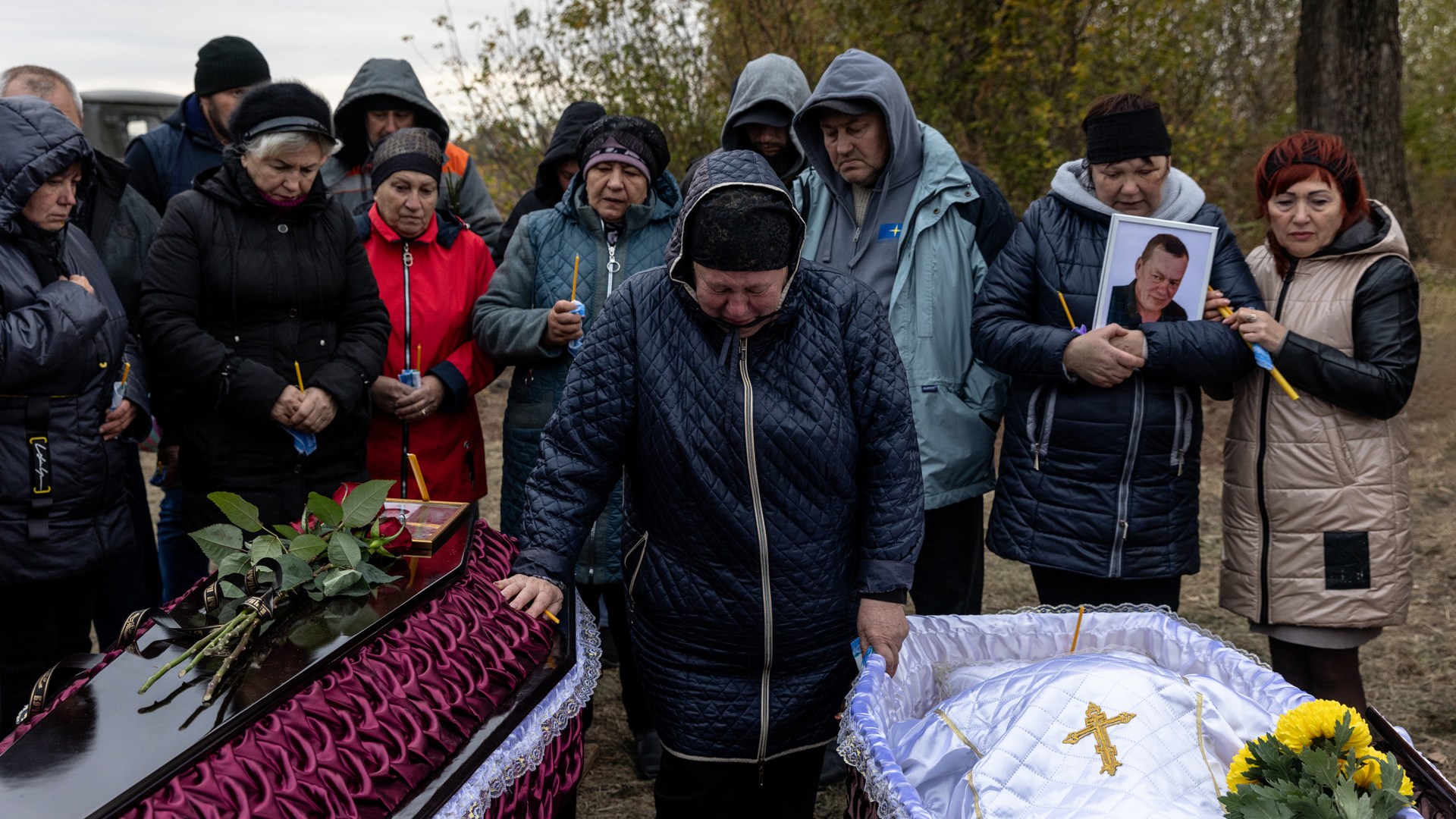
‘Continue to Remember’ the Suffering in Ukraine

Christians should be known for uplifting the afflicted before a distracted world.

Christianity Today February 22, 2024
Diego Fedele / Getty

By now, two years after the initial conflict, many Americans have largely forgotten about Ukraine. As often happens after a global crisis, we eventually become too distracted, irritated, or entertained by other news and media. Of course, there have been other more recent international conflicts as well, which also deserve our attention and prayers.

In early 2022, Ukraine began receiving widespread global attention during Russia’s invasion, but much of the initial aid has since diminished. Not only has general financial, material, and moral support been greatly reduced, but in some circles, Ukraine has become a political pawn for some—especially with the US presidential elections fast approaching.

When the conflict in eastern Ukraine began a decade ago in 2014, the global community knew Russia was likely preparing for more aggressive actions. But nothing could have prepared me for the morning of February 24, 2022, when I was shaken to my core as images of explosions and armored vehicles began filling the news and internet.

I’m a pastor in Lynchburg, Virginia, but I was born in Ukraine and have many friends and relatives who still live there. As the initial shock wore off and I was able to communicate with my loved ones, something was awakened in me. By the second month of Russia’s invasion, when millions of people were struggling to leave Ukraine, I traveled there to encourage and serve those affected by the conflict.

I have visited Ukraine four times over the past two years—and have witnessed firsthand the ongoing devastation of war. In my most recent trips, it has been disheartening to meet with fellow brothers and sisters who have felt neglected or forgotten by the global church.

Today, with our short attention spans and so many ongoing global crises, it is difficult to center our hearts on individual stories of devastation. Yet I believe it is vital for us as believers to consistently remember the suffering of our siblings in Christ—and to cultivate this remembrance as a habitual practice in our busy and distracted lives.

Whenever I think about Ukraine, I can’t get the words of Hebrews 13:3 out of my mind. The author implores followers of Jesus Christ to “continue to remember those in prison as if you were together with them in prison, and those who are mistreated as if you yourselves were suffering” (emphasis mine).

As citizens of God’s kingdom, we are called to pay special attention to the needs of the most vulnerable among us (Prov. 31:8–9, 1 John 3:17–18, James 1:27). We are connected within one body, the body of Christ (1 Cor. 12:12), and our local churches are micro-expressions of a global church designed to function in unity. Just as we would never ignore a part of our own body if it were suffering, Christ’s body—the church—functions in a similar way. As Paul says, “If one part suffers, every part suffers with it” (v. 26). Neglecting or forgetting a member that is suffering can cause harm to the whole body.

We are called to share in the burdens of others by allowing ourselves to press into their pain. Doing so reflects the character of Jesus, who entered time and space to join us in our mortal afflictions. Scripture assures us that our Savior is “a man of suffering, and familiar with pain” (Is. 53:3) who knew both sorrow and grief (Matt. 26:38, Heb. 5:7). And because of this, he knows how to help those who are suffering (Heb. 2:18). The more we share our heartfelt prayers, presence, and resources with the suffering, the more we behave like Jesus.

More than that, continuing to remember the suffering of others prepares us for our own potential suffering. Nobody wants to suffer, but we are guaranteed to go through it at one point in our lives—for Scripture promises that “in this world you will have trouble” (John 16:33). No person, community, or nation is immune from conflict and tragedy. Fellow Christians in places like Ukraine can teach us about resilience and courage—and the power of the gospel amid calamity and heartbreak. We need them as much as they need us!

Lastly, and equally importantly, we can use our voices and share our resources. We tend to be great ambassadors for the things we love, and we instinctively want to share them with others. I often can’t wait to tell people about a new restaurant or movie I enjoyed. If we really love our suffering brothers and sisters, why wouldn’t we tell others about their plight?

This includes amplifying the voices and stories of those who are in need as well as gathering and sharing our resources—including partnering with organizations on the ground to provide life-sustaining necessities like food, water, and medical supplies. God can use the different resources we have in our lives, as well as our spheres of influence, to meet specific felt needs. For instance, I started The Renewal Initiative to connect people and resources with vulnerable individuals worldwide, and this spring we are partnering with a group of mental health professionals to provide encouragement and support for relief workers in Ukraine.

One of the ways we fulfill the “law of Christ” is by carrying the burdens of others (Gal. 6:2), but we can’t share this burden alone—nor were we meant to. No one individual could meet all the needs of those who were suffering. No one organization has all the resources that are necessary to care for those who are in need. But as individuals and organizations come together, the burden gets lighter, and many needs can be met. To be sustainable, we need others to help us bear the burden of continuing to remember those who are suffering.

But perhaps our most powerful weapon is to carry this burden before the Lord in prayer. Never underestimate the power of prayer or how the Holy Spirit can use our specific prayers to bless and encourage those in need. Not everyone is able to go and serve in Ukraine, but all of us can make room in our spiritual rhythms to pray for our brothers and sisters there and in other vulnerable communities around the world.

I wish you could see the look on people’s faces in Ukraine when I tell them that my friends in the West are praying for them. Their response is usually, Thank you! Please tell everyone thank you for praying for us, and please don’t stop.

On one of my first trips back to Ukraine, I met a pastor who stayed to serve his church during Russia’s initial invasion—even after more than 60 percent of his congregation had left the area. Hundreds of refugees showed up from other parts of Ukraine requiring special care. And yet one of the things he said, which will always stick with me, is that he did not feel alone in his efforts because of the sustained prayers of saints around the world.

On the second anniversary of Russia’s full-scale invasion, let’s continue to remember our brothers and sisters in Ukraine. This act of obedience will both bless them and enrich our spiritual walks. For as we draw close to the suffering of others, our hearts can expand to better reflect God’s love for the world at large. Jesus is still at work amid the suffering of men, women, and children in Ukraine, and we can partner in that labor by continuing to remember them.

Andrew Moroz is a Ukrainian American pastor and founder of The Renewal Initiative.

Editor’s note: CT offers select articles translated into Ukrainian and Russian.

You can also join the 10,700 readers who follow CT on Telegram: @ctmagazine (also available in Russian and Chinese).

News

Alabama Rules that Frozen Embryos Are Children

The first-of-its kind decision affirms life at its earliest stages but complicates the future of IVF.

Christianity Today February 22, 2024
BSIP / Universal Images Group via Getty Images

Last week, Alabama extended protections beyond the unborn in the womb to the unborn outside it, becoming the first state to rule that frozen embryos are children under the law.

The decision has elicited praise from some evangelicals who, believing life begins at conception, want to see these “snowflake babies” treated as people rather than as commodities.

It’s also complicated the future of in vitro fertilization (IVF) across the state, upsetting parents and prospective parents who have turned to the procedure. At least one hospital system has halted IVF treatments for now.

After Roe v. Wade was overturned, parts of the pro-life movement evoked the 14th Amendment, which bars depriving “any person of life, liberty, or property,” and rallied around fetal personhood laws to ban abortion and grant human rights at conception.

The move to protect embryos was anticipated by both anti-abortion and reproductive rights activists. It follows a pattern of pro-life policies in the Southern state: Alabama’s constitution protects “the rights of the unborn child,” and the state’s abortion ban went into effect after Dobbs v. Jackson Women’s Health Organization in 2022.

In a case brought by the parents of several embryos destroyed at a fertility clinic, the Alabama Supreme Court affirmed on Friday that unborn children fall under its Wrongful Death of a Minor Act, regardless of “developmental stage, physical location, or any other ancillary characteristics,” that is, even if they are stored in a freezer and have not yet been implanted.

An estimated 1.5 million embryos are on ice in the US, and fertility treatments like IVF are becoming more common. Last year, 42 percent of Americans—and 44 percent of white evangelicals—said they or someone they knew had sought fertility assistance, up from 33 percent in 2018, according to the Pew Research Center.

The ruling doesn’t ban IVF, but since the procedure often results in leftover embryos that are kept indefinitely on ice or destroyed, fertility clinics aren’t sure what the implications will be for them and their storage.

“Why is it that all of the fertility doctors in red states were freaking out after Dobbs?” Katy Faust, founder of the nonprofit Them Before Us, previously told CT. “It’s because they [may not be able] to do business there if they can’t destroy human life.”

The issue of excess embryos from IVF and the ethics of the process itself have become a bigger part of the pro-life conversation among evangelicals, including advocacy for embryo adoption.

Justice Jay Mitchell—who attends the Church of the Highlands, a multisite megachurch—wrote the majority opinion in the embryo ruling. He focused on the understanding of the word child and didn’t mention God.

“Here, the text of the Wrongful Death of a Minor Act is sweeping and unqualified. It applies to all children, born and unborn, without limitation,” the ruling said.

“It is not the role of this Court to craft a new limitation based on our own view of what is or is not wise public policy. That is especially true where, as here, the People of this State have adopted a Constitutional amendment directly aimed at stopping courts from excluding ‘unborn life’ from legal protection.”

A concurring opinion from Chief Justice Tom Parker, though, relies on a biblical understanding of personhood and references Genesis, the apostle Paul, Thomas Aquinas, St. Augustine, and John Calvin. Parker—a member of Frazer Church, a Free Methodist congregation in Montgomery—concluded:

The theologically based view of the sanctity of life adopted by the People of Alabama encompasses the following: (1) God made every person in His image; (2) each person therefore has a value that far exceeds the ability of human beings to calculate; and (3) human life cannot be wrongfully destroyed without incurring the wrath of a holy God, who views the destruction of His image as an affront to Himself.

Andrew Walker, ethics and public theology professor at The Southern Baptist Theological Seminary, called the ruling “a stunning development full of moral significance.”

Republican presidential candidate Nikki Haley, who got pregnant with her son through intrauterine insemination (IUI), has referenced her fertility struggles on the campaign trail and agreed that embryos “are babies” on NBC News on Wednesday.

“One thing is to save sperm or to save eggs, but when you talk about an embryo, you are talking about—to me, that’s a life,” said Haley, whose IUI didn’t require the creation of embryos outside the body.

Haley, a Methodist who describes herself as pro-life, has emphasized the need for consensus on the federal level when it comes to abortion and sees more opportunities on the state level.

“When you see more women who are having trouble getting pregnant, and you see more women doing artificial and in vitro, those are conversations that we need to have,” she said. “But it’s also conversations where we need to have women and doctors involved in the conversation to say, ‘How do we want to handle this going forward?’”

Even before the Alabama decision, Dobbs had made it harder for IVF couples to donate embryos they opted not to implant to researchers. The Washington Post reported that Stanford University’s RENEW Biobank went from accepting embryos from 49 states to just 7—the rest require extra review in case donors violate their home state’s laws.

Catholics have historically carried more theological concerns around assisted reproduction than Protestants, though more in the pro-life movement are paying attention to the issue. Evangelical parents who desire children but struggle with infertility may opt to do IVF but limit the number of embryos created so that each can be implanted.

Despite some reservations, theologian Wayne Grudem wrote in 2019 for The Gospel Coalition that “if IVF is used by a married couple, and if care is taken to prevent the intentional destruction of embryos, then it is a morally good action that pleases God because it violates no scriptural guidelines, achieves the moral good of overcoming infertility, and brings the blessing of children to yet another family.”

Jennifer Lahl, president of The Center for Bioethics and Culture Network, has raised concerns for years about assisted reproduction. After Alabama’s decision, she pointed to Germany’s ban on freezing embryos, which has been in place since 1990.

“IVF is still legal, and the sky has not fallen,” she said. “You just can’t make a lot and freeze them, you must implant them.”

Ideas

Like-Minded, Not Like Me

Contributor

Birds of a feather might flock together, but Christians must flock to Christ.

Christianity Today February 22, 2024
Illustration by Mallory Rentsch Tlapek / Source Images: Unsplash

Cleanliness is next to godliness.

Forgive and forget.

Growing up in my conservative, mostly evangelical, rural Texas town, I went looking for accepted truisms in the Bible—only to discover they’d never been there at all. Gradually, I came to realize life could be more complicated than those sayings allowed, and yet I’m still surprised every now and again when I find myself clinging to some pithy proverb with the spiritual ardor that ought to be reserved for chapter and verse.

This too shall pass.
God works in mysterious ways.

I walked the aisle of my Baptist church when I was nine years old, accepted Jesus Christ as my Lord and Savior, and never looked back. I was active in Girls in Action, Bible Bowl, and my best friend’s charismatic church youth group. I attended Baylor, a Christian university. Everywhere I turned, I saw people who looked like me, talked like me, thought like me, and worshiped like me.

You are the company that you keep.

Birds of a feather flock together.

I assumed that kind of flocking was biblical in the prescriptive sense. Didn’t the Bible exhort us not to forsake the gathering of the saints (Heb. 10:25), placing a high value on “doing life with” like-minded people? Living in such a homogeneous world seemed like the natural order of things. I couldn’t yet see the shadow side—how easily we slip into idolizing our own reflections, mistaking the familiar for the proper and the customary for the righteous.

Today my thinking is more complicated. Now that my eldest is a teenager, I see the benefit of encouraging her to flock with friends who share our values or faith. There are no guarantees in parenting, but the company children keep, especially at such a crucial age, indelibly shapes who they become. Yet in her large public middle school, I already see the underbelly of the flock. The very normal, human impulse to be with like-minded friends also tends to mean self-sorting along social, racial, class, and cultural lines. Of course there are exceptions, but self-segregation is the operative norm in American schools.

That childish tendency becomes a more serious problem if we do not “put the ways of childhood behind” us in adulthood (1 Cor. 13:11)—if we default to superficial homogeneity instead of reconciliation in Christ (Eph. 2:11–22) or, worse, mistake sinful self-sorting for God’s will.

The temptation to that error is strong. At every turn are signs of polarization: red versus blue, urban versus rural, secular versus religious, us versus them. Algorithms serve up the news we want to hear, virtually assuring us of our own rightness. Everything becomes political, and the lines between us have cracked into chasms, so much so that “most Democrats and Republicans live in levels of partisan segregation that exceed what scholars of racial segregation consider highly segregated.” Even men and women are drifting further apart. At every scale—from our nation to our neighborhoods to our churches to our homes—we are self-sorting.

Birds of a feather flock together is often true in practice. We may find it comforting too, an assurance that nothing’s wrong with the lives we’ve built alongside like-minded friends. But as Christians, such flocking should prick the conscience. On what ground is our commonality rooted?

A few weeks ago, my pastor caught me off guard, exposing one of those places where I thought the Bible said something it does not. We so easily misread Philippians 2, he said, where Paul enjoins Christians to be “like-minded, having the same love” as Christ (v. 2) and “have the same mindset as Christ Jesus” (v. 5).

When most of us think about the word like-minded, my pastor continued, we think of finding people who are of a like mind with us. But that’s not what Paul wrote. He called us to conform our minds to be like that of Christ.

The former centers our lives and relationships on ourselves, our preconceived notions, and our personal biases. The latter centers us on Jesus. The former is an updated idolatry—not the golden cow but our own visage hoisted on the altar. The latter is our “true and proper worship” (Rom. 12:1).

Make no mistake: Building a community around ourselves is not the call of our Savior. Christianity is a monotheistic religion, but we were never supposed to be a monolithic community. As Allen Hilton points out in A House United, the early church cut across class, ethnic, and religious lines: In Romans 16, “Paul has painted a strange and wonderful family portrait, with aristocrats and artisans, shopkeepers and slaves, men and women, Greeks and barbarians, worshiping together.”

In this way, Christians were unique in the Roman Empire. The early church drew people from diverse groups to gather in each other’s homes, awestruck at what God was doing among them as they devoted themselves to the apostles’ teaching and to each other (Acts 2:42–47). It is far too common to find Christians who have lost that distinction today. Our congregations become flocks of like-minded people in the worst sense: We are united less by a common love than by a common enemy.

We might want to blame that dysfunction on political or religious leaders or on society in the abstract. But as Michael Wear writes in The Spirit of Our Politics, the mood of the age is a reflection of our own hearts: “Many of our most profound political problems reflect how our political institutions process and respond to the habits of the heart that are held, fundamentally, at the level of the individual.”

We may be convinced our hands are unsullied by dirty politicking, but how often in our ordinary lives do we choose hostility over hospitality or contempt over curiosity? Feeling right(eous) and powerful is deliciously intoxicating, as I know from experience. It’s ripe fruit from the wrong tree, and we’ve feasted until we are sick.

If there’s one thing Americans agree on as we look toward the 2024 election, it’s a shared feeling of dread. Few Americans want a rematch between president Joe Biden and former president Donald Trump, but this dread isn’t only about the unpleasant political theater that will last for months. It’s also about deeper anxieties: How do we keep already-fragile relationships from becoming political fodder? How do we resist the pull to make everything political? Are we bequeathing our children the makings of a civil war?

As followers of Jesus, we have an answer for this—if only we could remember it. Re-member: The word means “to call to mind,” but it also means “to put back together;” it is an antonym of dismember. The church must live out both meanings of the word.

We need to call to mind the eternal God in whom we live and move and have our being (Acts 17:28), seeking to be more like-minded with him every day. And we need to acknowledge how much we—as individual American Christians—have contributed to the dismembering of our society, succumbing to the temptations Jesus faced in the wilderness as we pursue our desire to be relevant, spectacular, and powerful regardless of the cost.

As we repent for our part in the breaking, we must take up our part in the repairing, using “the old rubble of past lives to build anew … [becoming] known as those who can fix anything, restore old ruins, rebuild and renovate, make the community livable again” (Isa. 58:12, MSG).

Trying to change a nation’s trajectory may feel as futile as trying to redirect an asteroid. But we can certainly course-correct our own lives. When we are like-minded with Christ, we will take on the nature of a servant. We will humble ourselves. We won’t be motivated by selfish ambition or vain conceit. We will look to the interests of others, seeking the “peace and prosperity” of the cities to which we very well may feel exiled (Phil. 2; Jer. 29:7).

Our Lord who “rejoices to see the work begin” (Zech. 4:10, NLT) doesn’t despise our small beginnings. Nor should we. The season of Lent is upon us, and in a world that sometimes feels like it’s turning to ashes in our hands, maybe it is time we repent.

Carrie McKean is a West Texas–based writer whose work has appeared in The New York Times, The Atlantic, and Texas Monthly Magazine. Find her at carriemckean.com.

Theology

God Says My Afro Hair Is Very Good

An excerpt on identity, hope, and glory from My Divine Natural Hair: Inspiration and Tips to Love and Care for Your Crown.

Christianity Today February 22, 2024
Huha Inc / Unsplash

In Chad, the women say God left a gift in the mountains to make their hair grow. If the flowering plant that produces the seeds, which these women have been blending into a silky powder and applying to their hair with oils for a millennium, is a gift from God, it would only be one of the innumerable ways the Creator’s abundant grace is revealed through Black women’s crowns of glory, given by the God who numbers the very hairs on our heads (Luke 12:7).

My own hair story is braided with the story of my faith. Like a crown is to a queen, a regal mane is to a lion, or leaves are to a tree, hair is a visually powerful symbol of identity.

Thousands of years ago, Nazirites—men and women who showed their dedication to God by letting their hair grow—also believed that hair was inseparable from the identity of a person. The Hebrew root word for Nazirite translates to “an unpruned vine.” Similarly, cutting the hair, or “pruning the vine,” for a Black person can be the same as being cut off from the symbol of one’s identity.

The most famous Nazirite was Samson. Unlike other men and women who took the vow to become Nazirites for a period of time, Samson was a Nazirite “from the womb” (Judges 13:5), his entire life dedicated to God. As he grew up and into the purpose God had placed on his life, performing superhuman feats throughout the land, Samson wore his unshorn hair in seven long, thick braids (16:19). He was stronger than any other foe because no razor had ever touched his head—until his lover, Delilah, betrayed him. After she had his braids chopped off, Samson awoke to find himself shaved, weakened, and surrounded by his enemies. They gouged out his eyes and enslaved him in their prison (v. 21).

It would seem like Samson’s purpose, like his hair, was lost. “But,” the Bible tells us, “the hair on his head began to grow again” (v. 22). Samson eventually vanquished many of his enemies, reclaiming the glorious purpose God had for him all along.

Majority-white society has long said that Afro-textured hair and hairstyles are not standard, unprofessional, messy, and unnatural. It demands that Black people straighten, change, or cut off our natural hair. The result of this pressure is the weakening of our self-esteem. But we have a secret. Like Samson, the strength of our identity is ultimately not in our hair but in our close relationship with the God who created us and our natural hair. God said we are fearfully and wonderfully made (Ps. 139:14). God said our hair is very good (Gen. 1:31).

My own hair story has been complicated—and my identity in God ultimately strengthened—by a diagnosis of central centrifugal cicatricial alopecia (CCCA). This is a form of hair loss that is commonly experienced by Black women. While previously believed to be solely attributable to the tight hairstyles and harsh chemicals we use on our hair at early ages, current research suggests that CCCA can be linked to multiple factors, including genetics. CCCA destroys hair follicles, and this leads to inflammation, scarring (cicatricial), and permanent hair loss, more often than not starting in the central part of the scalp, or the crown.

At first, I was confident I could reverse the CCCA. But when I got my first salaried job, my mindset shifted from healing the damage to my hair and scalp to covering it up. My hair’s condition worsened, and I became discouraged. Eventually, I spent all my time with my head covered by wigs and scarves. When I looked in the mirror, I didn’t see God’s good creation. I saw balding and brokenness.

But where I was disheartened, my mom and my sister, Sylvia, were helpful and patient. Where I had hopelessness, they had faith.

What made me ashamed made them proud. Instead of covering my scalp’s damage and alopecia with added hair and wigs, I was covered—in the biblical sense—by their love, as they encouraged and coached me to honor my hair care regimens. I was covered by Mom’s hair prayers over me. I was covered by my sister’s affirmations of the beauty of my natural hair.

Because of the words they spoke over me, words God has promised for me, I could trade the broken crown of my physical head for a spiritual crown of beauty and self-confidence, believing that my identity begins with how my God, the one who knows the number of coils on my head, sees me. What God put inside of me to reflect glory—my creativity, my spirit—matters more than what is (or isn’t) on my head when I look at my reflection.

My natural hair journey has been both a spiritual and physical journey toward grace, and it’s a journey I’m still making. Mom and Sylvia walked alongside me when I was healing. They are beside me now, helping me remember that the one who created us crowned us first. Shining atop our heads is a divine diadem with all the lightness of air, the radiance of honor, and the weight of glory. Along with the fractals in snowflakes and the curved petals of flowers, our coils are very good.

Melissa Burlock is a researcher, writer, and the coauthor of My Divine Natural Hair (Broadleaf Books, March 2024). Her musings on Black literature and culture have been featured in outlets like Salon.com. She is an alumna of Winston-Salem State University and resides in Indianapolis, Indiana.

An adapted excerpt from My Divine Natural Hair: Inspiration and Tips to Love and Care for Your Crown by Shelia, Sylvia, and Melissa Burlock © 2024 Broadleaf Books. Reproduced by permission.

Theology

What a Murdered Russian Dissident Can Teach Us About Moral Courage

Alexei Navalny was willing to stand alone—knowing he’d never be alone in the bigger story.

Alexei Navalny stands near law enforcement agents in a hallway of a business center, which houses the office of his Anti-Corruption Foundation, in Moscow.

Alexei Navalny stands near law enforcement agents in a hallway of a business center, which houses the office of his Anti-Corruption Foundation, in Moscow.

Christianity Today February 21, 2024
Dimitar Dilkoff / Contributor / Getty

This piece was adapted from Russell Moore’s newsletter. Subscribe here.

Russian president Vladimir Putin murdered another Christian this week. It was just another day in Putin’s supposed project of protecting “the Christian West” from godlessness. After all, they tell me, one can’t create a Christian nationalist empire without killing some people.

Before the world forgets the corpse of Alexei Navalny in the subzero environs of an Arctic penal colony, we ought to look at him—especially those of us who follow Jesus Christ—to see what moral courage actually is.

Navalny was perhaps the most-recognized anti-Putin dissident in the world, and he is now one of many Putin enemies to end up “suddenly dead.” He survived poisoning in 2020, recuperated in Europe, and ultimately went back to his homeland despite knowing what he would face. Speaking of his dissent and his willingness to bear its consequences, Navalny repeatedly referenced his profession of Christian faith. My Christianity Today colleague Emily Belz discovered a 2021 trial transcript at Meduza, in which Navalny explains, in strikingly biblical terms, what it means to suffer for one’s beliefs.

“The fact is that I am a Christian, which usually sets me up as an example for constant ridicule in the Anti-Corruption Foundation, because mostly our people are atheists, and I was once quite a militant atheist myself,” Navalny said (as rendered by Google Translate). “But now I am a believer, and that helps me a lot in my activities because everything becomes much, much easier.”

“There are fewer dilemmas in my life, because there is a book in which, in general, it is more or less clearly written what action to take in every situation,” he explained. “It’s not always easy to follow this book, of course, but I am actually trying.”

Specifically, Navalny said, he was motivated by the words of Jesus: “Blessed are those who hunger and thirst for righteousness, for they will be satisfied” (Matt. 5:6, NASB).

“I’ve always thought that this particular commandment is more or less an instruction to activity,” Navalny said. “And so, while certainly not really enjoying the place where I am, I have no regrets about coming back or about what I’m doing. It’s fine, because I did the right thing.”

“On the contrary, I feel a real kind of satisfaction,” he said. “Because at some difficult moment I did as required by the instructions and did not betray the commandment.”

These words may seem a bit too easy. After all, an unbeliever might respond, most of the people in the pro-democracy, anti-tyranny movement of which Navalny was a part did not, in fact, believe “the instructions” of Scripture. And Putin himself is backed by key leaders of the Russian Orthodox Church, where some are as willing as any court prophets ever were to baptize his murder in the language of Christian virtue and Christian civilization. (Though there are examples of faithful dissidence too.)

But that response would miss Navalny’s point. He was not saying that Christians are courageous while unbelievers are not. There is ample evidence to the contrary—in Russia and other places too—to put such notions to flight.

Navalny recognized, though, that the allure of moral cowardice when standing in courage means standing alone. A conscience can always reassure itself that being quiet right now is the right thing. Navalny recognized the terror in the thought of being left outside a field of belonging—being branded as a traitor by fellow countrymen and a heretic by fellow churchmen.

To resist the pull of that mob requires a different motive than a better-than-even chance of political “success.” Navalny recognized that one must, as the evangelical missionary Jim Elliot once put it, embrace “strangerhood.”

“For a modern person this whole commandment—‘blessed,’ ‘thirsty,’ ‘hungry for righteousness,’ ‘for they shall be satisfied’—it sounds, of course, very pompous,” Navalny said. “Sounds a little strange, to be honest.”

“Well, people who say such things are supposed, frankly speaking, to look crazy,” he recognized. “Crazy, strange people, sitting there with disheveled hair in their cell and trying to cheer themselves up with something, although they are lonely, they are loners, because no one needs them.”

“And this is the most important thing that our government and the entire system are trying to tell such people: You are alone,” he continued. “You are a loner. First, it is important to intimidate, and then, prove that you are alone.”

In this, Navalny not only identified his own motives for conscientious strangeness—he also contradicted the very nature of the Putinist conception of Christianity. To be “Christian,” in such a regime, is to be a Russian (or whatever the local blood-and-soil equivalent is). To be “Christian” is to be a “regular” person—unwilling to step out of line, to expose one’s conscience to any thought that might bring hardship.

After Navalny’s killing, The Free Press published letters between Navalny and the famed former Soviet dissident Natan Sharansky, who served time in the same Artic penal colony during some of the most dangerous years of the Communist regime. Biblical passages are quoted throughout, including Navalny joking about “where else to spend Holy Week” than in the prison complex the older man called his “alma mater.”

This was the root, I believe, of Navalny’s moral courage, his willingness to stand alone, his willingness to die. It’s not just that he knew Bible verses; the pro-Putin patriarch of the Russian Orthodox Church no doubt knows more. It’s the way he seemed to know Scripture. He seemed to recognize not just the bare “instructions” from Jesus about hungering and thirsting for righteousness, about being blessed in persecution, but also the story behind and around them. He knew these words seem strange. He knew they sound crazy.

In the introduction to his collection of poems on joy, the poet Christian Wiman notes that early audiences of the New Testament message, offended by the strangeness of what they heard, “might very well have made their way home past rows of crucified corpses designed specially to eradicate all cause for any insurrectionist hope or joy.” The strangeness was the point. No one can actually hear what Jesus is saying when he calls the forgotten, the persecuted, the poor, and the reviled “blessed” unless we feel why his own family thought he was insane (Mark 3:21).

This is probably why Navalny recognized so clearly the Putin regime’s methods of making dissenters feel strange and crazy and alone: Navalny had seen it before, in a Roman Empire that did the same thing with crosses.

Those of moral courage of all faiths and no faith have all kinds of motivations for their convictions. But—whatever the motivation—one cannot maintain moral courage if one is unwilling to be sent away from whatever one calls “my home,” from whomever one calls “my people.” That’s the joyful irony: One never stands alone when one is part of a bigger story, when one belongs to a bigger body.

The cloud of witnesses includes Elijah and Jeremiah, Peter and Paul, Maximus and Bonhoeffer, and countless others who died seemingly abandoned, who seemed crazy in their day (Heb. 12:1). It’s people like this—not from the “German Christian” Reich bishops or the Putin-cheering Orthodox patriarchate—from whom the next generation of our faith is born.

The very point of “hungering” and “thirsting” is that one is prompted to see that something’s missing—that the satisfactions on offer aren’t enough. The very appetite for such things is a sign that what one is hungering for, thirsting for, is really out there.

A person can see that, sometimes, even from a gulag. That’s strange. That’s crazy. But that’s what at least one Person I know would call “blessed.”

Russell Moore is the editor in chief at Christianity Today and leads its Public Theology Project.

News

Report: Iran Arrested 166 Christians in 2023, Targeting Bible Distributors

Four watchdog groups unite to urge UK parliament to hold Tehran accountable for “faceless victims” of Islamic reeducation and other religious freedom violations.

Rajaei Shahr Prison in Karaj, Iran

Rajaei Shahr Prison in Karaj, Iran

Christianity Today February 21, 2024
Courtesy of Article18

Religious reeducation did not work on Esmaeil Narimanpour.

First arrested by the Iranian government in 2021, he and seven other converts to Christianity were cleared by the state prosecutor, who stated that their change of religion was not a crime under Iranian law. The following year, he was ordered with several others to attend ten sessions with Muslim clerics to “guide” him back to Islam.

Last December, Narimanpour was arrested again, this time on Christmas Eve.

The case is one of several highlighted by “Faceless Victims: Rights Violations Against Christians in Iran,” the 2024 annual report released jointly by advocacy organizations Article18, Open Doors, Middle East Concern, and CSW and presented at the British Parliament.

“This is a great example of agencies working together,” stated Mervyn Thomas, founding president of CSW (formerly Christian Solidarity Worldwide), at the event. “Iran claims to ensure freedom of religion or belief for all; but that is nonsense, as this report shows.”

Not yet convicted, Narimanpour is one of 166 Christians arrested and 103 detained by Iran during the 2023 reporting period. Another 22 have been sentenced, and 21 imprisoned.

While sentencings decreased by 8 from 2022, this year witnessed an additional 32 arrests and 41 detainments. Article18 has tracked incidents in Iran since 2015, when arrests were at a peak of 193. Detainments have fluctuated yearly between 26 in 2018 and this year’s high, while sentencings ranged between 12 in 2015 and a high of 57 in 2020.

The British parliament gathering included testimony from former prisoner Farhad Sabokrooh. Arrested with his wife in 2011, the couple served one year in prison and had their previously registered church closed down after 25 years. Accused of being a spy for Israel and the United States, he told the gathering that he was forced into a false confession, sentenced without his lawyer present, and once released was threatened with death if he did not leave Iran within one month.

“My plea to you is to hold the regime accountable,” Sabokrooh stated. He later noted, “They somehow feel Christians are orphans and have no one to protect them. We have to reverse that.”

The 36-page sixth report was released on February 19 to coincide with the 45th anniversary of the murder of Arastoo Sayyah, the first Christian killed for his faith in the Islamic Republic of Iran—eight days after the revolution began. It notes that while the constitution formally guarantees the rights of Christians to “perform their religious rites and ceremonies,” in practice this refers only to the ethnic Armenian and Assyrian communities, which are prevented from conducting services in Farsi (Persian) or otherwise promoting their faith.

Their population of 50,000–80,000 is dwarfed by the report’s estimation of as many as 800,000 Iranian Christians overall. And while Iran lacks a law against apostasy, the report lists the six criminal code provisions frequently used to charge Christians with religious blasphemy or propaganda against the Islamic Republic.

This only makes it “hurt even more,” the report quotes Nazila Ghanea, the United Nations special rapporteur on freedom of religion or belief, as saying at last year’s presentation at the UK parliament.

“Your [real] crime is that you are Christian,” stated Ghanea. “Your crime is that you gather with other Christians in house churches, and your crime is that you converted.”

This year the event was hosted by Fiona Bruce, the UK prime minister’s special envoy for freedom of religion or belief (FoRB).

“All of us here are dedicated to protecting FoRB around the world,” she said, “and particularly for Christians.”

Once arrested, they are further abused by the Iranian government.

Iran signed the International Covenant on Civil and Political Rights (ICCPR) in 1975. The report cited violations against 11 of its articles and a total of 19 subpoints. Shahnaz Jizan—wife of Sabokrooh—was detained without charges. Anooshavan Avedian was denied a hearing in person. Touraj Shirani was kept in a tiny cell with dirty blankets. Ali Kazemian was tortured.

“In all those years my biggest fear was always for my husband and kids,” Jizan stated. “If they left home, I didn't know if they would come back.”

Shahnaz Jizan (left) and Touraj Shirani (right)

Each of these individuals is pictured in the report. But in the “vast majority” of cases, Christians choose not to publicize their stories in hope of receiving a better legal outcome. These faceless victims, per the report title, are represented in the collective.

But the Christian organizations sponsoring the report believe advocacy can be effective. A death sentence in 2010 was not carried out due to international pressure. Furthermore, a judge is quoted as saying that the only reason the civil code lacks an apostasy provision is concern for Iran’s global standing.

“Iran does care about image and wants to play in the public arena,” stated Mansour Borji, research and advocacy director for Article18, advocating sanctions against offending judges. “They don’t want the negative publicity.”

Several Christians were pardoned in 2023, though the report notes that most were already near their maximum term of imprisonment. And on the same day that one Iranian-Armenian pastor was set free, another was arrested as a warning to recognized Christian communities that they must not preach to Muslims.

Other trends indicate that, as with the similarly violated Bahai community, arrests of Christians tend to come in waves, with increased surveillance of suspected converts and those released from detention. Bible distribution is also a particularly sensitive activity, as one-third of those arrested had multiple copies of Scripture in their possession.

The report also includes a timeline of rights violations in 2023. In addition to personal accounts of arrest, detainment, pardon, and release, it describes the March designation of sale of a historic Assemblies of God church building, founded by Haik Hovsepian, who was martyred in 1994.

The pattern is familiar, stated the report. Churches are forced to close, later are quietly confiscated, and then appropriated by the Iranian state. May marked the 10th anniversary of the forced closure of the Central Assemblies of God Church in Tehran, which was then the largest Farsi-speaking congregation in Iran.

Only four such fellowships remain viable—to those who can prove their Christian faith predates the Islamic revolution of 1979. No further membership is permitted, but these have been closed since COVID-19.

Nima Rezaei (left) and Parham Mohammadpour (right)

Member of parliament Jim Shannon, part of the All-Party Parliamentary Group for FoRB, responded in tears to the “hard reading” of details in the report.

“As a Christian I will say the most important thing is prayer,” he stated at the gathering. “And I pray fervently for our brothers and sisters in Iran, including those who I will never meet.”

But the report also issued several recommendations to Iran. They included:

  • Amend Article 13 of Iran’s constitution to extend civil rights to convert communities, consistent with ICCPR Article 18.
  • Drop charges and free individuals imprisoned for their faith, in line with Iran’s Supreme Court decision that deemed church activity lawful.
  • Reopen closed churches, return confiscated properties, and clarify where Farsi-speaking Christians can worship in their mother tongue.

The report exhorts the international community to hold Iran accountable for its violations and to recognize the “well-founded fear of experiencing persecution” when considering refugee testimony and asylum requests. Turkey is highlighted as a hosting nation where Iranian Christian converts are at risk of being forcibly returned back to Iran.

Until then, the religious reeducation attempts continue.

Hamed Ashouri was required to attend the course with a family member after refusing an offer to act as a government informant. Nima Rezaei had his session filmed as the cleric grilled him for incriminating information. Two anonymous individuals were threatened with seven-year sentences during the classes. And Parham Mohammadpour, like others, was forced to sign a pledge that he would not evangelize.

But not before he gave his testimony: “Even if you cut me into pieces, I won’t abandon my faith in Jesus Christ.”

Editor’s note: You can now follow CT on Telegram, along with the 10,700 readers (3/4 outside North America) who have made CT the largest Christian media on the secure platform.

addApple PodcastsDown ArrowDown ArrowDown Arrowarrow_left_altLeft ArrowLeft ArrowRight ArrowRight ArrowRight Arrowarrow_up_altUp ArrowUp ArrowAvailable at Amazoncaret-downCloseCloseellipseEmailEmailExpandExpandExternalExternalFacebookfacebook-squarefolderGiftGiftGooglegoogleGoogle KeephamburgerInstagraminstagram-squareLinkLinklinkedin-squareListenListenListenChristianity TodayCT Creative Studio Logologo_orgMegaphoneMenuMenupausePinterestPlayPlayPocketPodcastprintremoveRSSRSSSaveSavesaveSearchSearchsearchSpotifyStitcherTelegramTable of ContentsTable of Contentstwitter-squareWhatsAppXYouTubeYouTube