News

White Evangelicals Aren’t Sure About Ramaswamy. But for Indian American Christians, He’s a No-Go.

The former like the young billionaire’s conservative politics. The latter worry about his connections to radical Hinduism.

Republican presidential candidate Vivek Ramaswamy.

Republican presidential candidate Vivek Ramaswamy.

Christianity Today August 23, 2023
Win McNamee / Staff / Getty

At 38 years old, Vivek Ramaswamy stands out among his fellow Republican presidential candidates for his age alone. The self-made billionaire has further set himself apart by saying he would ban social media for children, proposing to raise the voting age to 25, and espousing controversial views on 9/11. But when running in a party with a strong evangelical Christian wing, perhaps his most unique characteristic is his Hindu faith, which Ramaswamy has proudly discussed.

“Am I religious? Yes, I am. I am Hindu. I am not Christian. And we are a nation founded on Judeo-Christian values,” he said in an interview with NewsNation that aired last week. “But here is what I can say with confidence: I share those same values in common. I believe I live by those values more so than many self-proclaimed Christian politicians.”

White evangelical leaders who are considering other GOP candidates than former President Donald Trump are divided on whether a leader whose faith doesn’t stem from Judeo-Christian traditions can effectively lead a nation they believe is rooted in these principles. But in interviews with CT, Indian American Christians expressed apprehension about a leader in the White House who admired Narendra Modi and would further give radical Hinduism a foothold in the United States.

“God is real”

In March, Ramaswamy appeared on CBN where he compared the current state of America to the Israelites wandering in the wilderness. David Brody, who conducted the interview, told The New York Times last month, “The lazy narrative that he’s Hindu so he can’t appeal to evangelicals, I don’t buy it at all.”

Ramaswamy, who grew up in Cincinnati, frequently points out that he is a product of Catholic schools and has credited his political ideology to the influence of a conservative Christian piano teacher.

“I’ve probably read the Bible more closely than many Christians that I know, and I can tell you deeply that we share that same value set. And for a guy who is not running for pastor in chief but commander in chief, that’s really what matters,” he said on NewsNation.

Nevertheless, the first statement under a part of Ramawamy’s campaign website labeled “Truth” declares, “God is real.”

Ramaswamy’s second point, “There are two genders,” nods to the candidate’s strategy to build trust with voters through culture war grievances. Author of Woke, Inc.: Inside Corporate America's Social Justice Scam, Ramaswamy asserted to NewsNation that the real divide in the US on the front of religion is not between those who are members of traditional religions but between them and adherents of what he calls new religions like “wokeism, transgenderism, climatism, COVIDism.”

Further elaborating on his viewpoint, Ramaswamy expressed his unwavering commitment to safeguarding religious freedom.

“I’m an ardent defender of religious liberty,” he recently told the Associated Press. “I will be an even more vocal and unapologetic defender of it precisely because no one is going to accuse me of being a Christian nationalist.”

A more concerning agenda?

But some worry that he may be too close with Hindu nationalists.

A Tamil Brahmin, Ramaswamy grew up speaking Tamil, visiting Hindu temples, and performing Hindu rituals at home. (Tamil Brahmins are a diverse group of Tamil-speaking Hindu Brahmins, situated at the apex of the caste hierarchy, and are often associated with conservative traditions, and cultural and intellectual privilege.) He and his wife, Apoorva Ramaswamy, are raising their two young sons in the faith.

For Indian American Christians, Ramaswamy’s faith practices don’t present a problem. But they’ve worried about his open admiration for Modi, who has been accused of compromising democracy, Hinduizing the country, and ignoring religious violence against minorities.

In the wake of the recent attacks on Christians in Manipur, which have killed more than 100 people, Ramaswamy praised Modi as “an outstanding leader of India.”

“Modi has been building on that experience [of free-market capitalism] in India, lifting people up from poverty,” Ramaswamy said in a July interview. “Regardless of their background, regardless of identity politics, India has prospered economically. GDP growth is up. I think that’s the ultimate metric of a truly successful unifying leader.”

https://twitter.com/VivekGRamaswamy/status/1672001752801968131

Ramaswamy’s presidential candidacy “seems to be a part of a deeper Hindutva agenda,” says Jai Prakash Masih, a leader at Asian Mennonite Community Church, Lombard, Illinois. (Hindutva is an ideology advocating hegemony of Hindus and Hinduism within India.)

And the average American voter’s ignorance about the nuances of Hinduism and Hindutva work to Ramaswamy’s advantage, says Sam Beera, an IT professional from Boston.

“I don’t think the average white conservative Christian knows much about Hinduism or Hindutva, other than yoga, elephants, or Modi. That is a big asset for Ramaswamy,” said Beera. “There is an alarming lack of knowledge on the clear and present danger of Hindutva, which is an ideology modeled on Nazism.”

The political objectives of Hindu nationalists, says Beera, include advocating for Akhand Bharat, a movement that calls for an “unbroken India”—a political unification of Pakistan, Bangladesh, Tibet, Nepal, Bhutan, Sri Lanka, and the Maldives—and endorsing Hindu political candidates globally while simultaneously marginalizing minority groups within India.

“What percentage of US conservative Christians are aware of the above? Hardly a pittance if at all,” said Beera.

Opposition research written reportedly by Ramaswamy’s GOP opponent and Florida governor Ron DeSantis’s campaign tried to conflate his Hindu upbringing and his visits to India as a child with condoning the caste system, seemingly justifying Beera’s concerns.

Currently, nearly five million people of Indian descent live in the US. According to a 2014 Pew report, Hindus constitute just around 51 percent of the diaspora population, compared with 18 percent identifying as Christians. Up until this point, the most visible Indian Christians have been Republicans Bobby Jindal and Nikki Haley (a convert from Sikhism). Both previous governors, Jindal ran for president in 2016, and Haley announced her own bid several months ago.

Many Indians who arrived in America after the Immigration Act of 1965 formed Hindu groups and associations that paved the way for many from these communities to later run for elected office, says Robert William, who grew up in Chennai, India, and previously served as a Republican in elected office in Lancaster County, Pennsylvania. Given the perceived wealth of this community, “one could argue that a conservative Hindu POTUS would not be able to ignore the powerful and growing influence of Hinduism in the US.”

Numerous Hindu Americans, predominantly Democrats, already serve as state and federal legislators, and increasingly their connections to Hindu groups overseas have been questioned. Two of these politicians, Raja Krishnamoorthi and Ro Khanna, came to Ramaswamy’s defense after his faith was targeted by a pastor from Nebraska. Krishnamoorthi has been called out in the past for his association with Hindu nationalist groups.

“Vivek Ramasamy has surprised many people in the past week by slowly moving up in the opinion polls,” said John Prabhudoss, at the Federation of Indian American Christian Organizations of North America. “But what we are concerned about is his association with radical Hindu groups that are aligned with Hindu extremism.”

Ramaswamy has in the past delivered the keynote for fundraisers for political advocacy groups linked to the US chapter of Vishwa Hindu Parishad of America (VHPA or World Hindu Council of America), notes Pieter Friedrich, an American who advocates for persecuted Christians in India. VHPA is the US wing of the VHP (World Council of Hindus), which the CIA classified as a “militant religious organization” in 2018.

“Rather than trying to court Christian voters by appealing to similarities between their faith and Hinduism, perhaps Ramaswamy should instead take up the cause of Indian Christians who are being persecuted by the Modi regime he praises,” said Friedrich.

William, the elected official, is skeptical that Ramaswamy’s voice could do much.

“It would be a fallacy to think that a person such as Vivek Ramaswamy would be able to influence someone like Prime Minister Modi because they are both of the Hindu faith,” he said. “Any such attempts would be labeled by India as interference in India’s internal matters and dismissed. But such a candidate will certainly catch the attention of US groups and trigger them to open their pocketbooks and galvanize them to rally behind such a candidate aspiring for political office in the US.”

Ramaswamy’s rise could further encourage radical Hindu groups to “increase their visibility and influence in the US to counter the influence of the evangelical Christian voters in the US,” said William.

But “Vivek Ramaswamy’s rise in politics will be stopped in its tracks if he attempts to focus on his Hindu religion and beliefs, because the reality is that the office of president in the US still remains out of reach for anyone other than for a mainline Christian candidate.”


News

2024 Sets the Stage for a New Kind of Abortion Debate

Four issues on evangelicals’ minds as the Republican presidential race moves forward.

The Fiserv Forum where the Republican presidential debate will take place on Wednesday, Aug. 23.

The Fiserv Forum where the Republican presidential debate will take place on Wednesday, Aug. 23.

Christianity Today August 23, 2023
AP Photo/Morry Gash

Americans will get their best look yet at the slate of candidates vying for the GOP nomination in 2024 during the first Republican presidential debate and a pre-recorded interview with former president Donald Trump, both airing Wednesday night.

Evangelicals remain a key constituency for the Republican Party and for Trump in particular, who leads in most polls. But the political landscape has changed in significant ways in the four years since the last campaign, so when it comes to the big issues, evangelical voters have some new questions for the Republican field. This is the first presidential election since Roe v. Wade was overturned, since Russia invaded Ukraine, and since Trump’s indictments.

Eight GOP contenders will take the stage for the debate in Milwaukee, among them Florida Gov. Ron DeSantis; former vice president Mike Pence; former UN ambassador Nikki Haley and Sen. Tim Scott, both from South Carolina; and Vivek Ramaswamy, an entrepreneur and newcomer to the political scene. (Trump is skipping the debate in favor of a pre-recorded interview with the erstwhile Fox News host Tucker Carlson.)

Here are four things evangelicals will likely be watching for on Wednesday night:

Abortion

The Supreme Court’s overturning of Roe v. Wade last year was celebrated as a historic victory for the pro-life cause. But the aftermath has shown that both Republicans and the pro-life community were unprepared for what came next.

The issue of abortion is now in the hands of state governments, and the response has varied. Some, like Florida under the leadership of DeSantis, have enacted strict abortion limits, while others have expanded access to the procedure. In several states, abortion has ended on the ballot, leaving the matter to voters.

One consequence for GOP candidates is that voters can now differentiate between their positions on abortion, something that Mark Caleb Smith, who teaches political science at Cedarville University, says was not possible before.

“In the past, Republican candidates could say they were pro-life and pledge to appoint federal judges in line with that pledge. Since virtually everyone would say the same thing, abortion was rarely meaningful as a way to distinguish between Republican candidates. Now, that has changed,” Smith said.

On this issue, the candidates have varied views. Several, such as Pence, Scott, and Haley, support a federal 15-week ban.

Trump, who appointed the justices who helped overturn Roe, and DeSantis, who signed a six-week ban in Florida, seem hesitant to establish a federal rule on abortion.

Doug Burgum, governor of North Dakota, has restricted abortion in his home state but opposes a national ban, while Chris Christie, former governor of New Jersey, will only support it if there’s a “consensus” from the states. Ramaswamy, too, opposes a national ban, but will support a six-week ban at the state level.

According to polling data from Pew Research, in 2022 about 74 percent of white evangelicals believed abortion should be illegal in all, if not most, cases (in 2014, 63 percent of evangelicals in general opposed abortion, according to Pew). On Wednesday, evangelicals will be looking closely at the candidates’ position on this issue.

Donald Trump

The elephant in the room will not be in the room. But while Trump will be absent from the debate, his legal predicaments will loom large. The former president faces four indictments at the federal and state levels. Yet he remains by far the most popular candidate for the Republican presidential nomination.

This leaves the rest of the GOP candidates in a tricky position. DeSantis, Scott, and Haley have avoided criticizing Trump and instead have pointed fingers at Democrats and the prosecutors involved in the cases. Pence has tried to thread the needle between reprimanding his former running mate and letting the justice system’s process play out. He has said, “History will hold Trump accountable,” but has hedged on the question of whether Trump should be charged with crimes.

Asa Hutchinson, the former governor of Arkansas, and Christie are among the most vocal critics of Trump. Hutchinson has said Trump should “respect the office and end his campaign.” Ramaswamy, on the other hand, is perhaps Trump’s most vocal supporter and has called on other candidates to pardon him if elected.

While Trump retains a strong grip on the GOP, his legal troubles have raised questions on his ability to defeat President Joe Biden in a general election.

“While no candidate on the stage this Wednesday can challenge Donald Trump’s popularity within the Republican Party, they can challenge his ability to win next November,” Smith said.

Some evangelicals have suggested that it’s time to move past Trump, but according to polls, a majority seem to think he has done no wrong and is the best candidate to face Biden in the upcoming election.

Michael Wear, president of The Center for Christianity and Public Life and a former faith outreach coordinator for the Obama administration, says both Trump and the Democratic Party think that the outcome of the Republican primary is a “foregone conclusion.” But he reckons this is “just the beginning” and “evangelicals will have a tremendous say in how it turns out.”

“The wonderful thing about our system, though, is that voters actually do get to have their say. I hope evangelicals will watch this debate with an open mind and with the good of their neighbors as their lens,” Wear said.

He challenged viewers to “think about who on that stage would actually serve our nation with dignity and purpose, and advance ideas and policies with the greatest promise of promoting human flourishing, particularly for the poor.”

Ukraine

It has been 18 months since Russia invaded Ukraine. Nearly half a million Ukrainians and Russians have died or been injured in the conflict, according to US officials. In that time, the US has also approved about $113 billion in humanitarian aid and military assistance to Ukraine. Now Ukraine and Russia seem to be in a costly protracted battle, with no clear end in sight.

While Ukraine received overwhelming support from Americans at the beginning of the war, American generosity seems to have cooled off over time. A slight majority of Americans now think the US has sent enough aid to Ukraine.

Evangelicals similarly seem to have mixed feelings. While many have supported continuing aid, some seem to be less enthusiastic. When Pence suggested the US should remain committed to sending aid during a live interview in July, the response from a room full of evangelicals was lukewarm (some even booed).

The candidates will likely face tough questions about their position on the war in Ukraine. Christie, Burgum, Haley, Hutchinson, Pence, and Scott have said they would continue supporting Ukraine, to varying extents. DeSantis (along with Trump) is ambivalent, while Ramaswamy is opposed to it and has even suggested Ukraine should cede territory to Russia to end the war.

The economy

The top issue for Republicans and Republican-leaning independents, according to a Pew Research Center poll from June, is inflation. Inflation has been cooling off after reaching historic highs in recent years due, in part, to the pandemic, but interest rates remain high and may increase further.

While evangelicals are vocal about issues such as abortion and religious freedom, the economy remains a chief concern. According to a survey from Arizona Christian University last year, economic issues—such as inflation and prices of commodities like food and gas—were the top issues listed by respondents.

Here the GOP candidates have been less specific about their positions. Most have pledged to reduce government spending and have suggested tax reforms. Pence is targeting Biden-specific policies, such as student loan forgiveness programs and funding for agencies like Amtrak and the IRS, among other measures.

DeSantis has pledged to crack down on DEI—diversity, equity, and inclusion programs—and Ramaswamy has said he will lift regulations on the production of fossil fuels and nuclear energy to achieve GDP growth.

News

After 26 Churches Burned, Pakistan Christians Brace for More Blasphemy Accusations

Quran desecration in Sweden and TLP politics blamed for mob violence that displaced dozens of Christian families in Jaranwala.

Men stand amid debris outside the torched Saint John Church in Jaranwala on the outskirts of Faisalabad on August 17, 2023, a day after an attack by Muslim men following spread allegations that Christians had desecrated the Quran.

Men stand amid debris outside the torched Saint John Church in Jaranwala on the outskirts of Faisalabad on August 17, 2023, a day after an attack by Muslim men following spread allegations that Christians had desecrated the Quran.

Christianity Today August 23, 2023
Aamir Qureshi / AFP / Getty Images

Sister Mumtaz’s church was full on a Monday.

Her congregation gathered August 14 to celebrate Pakistan’s 76th independence day by singing national songs and praying for prosperity for the Muslim-majority country. It had been a trying summer, with Pakistani churches like hers condemning the recent Quran burnings in Sweden, hoping to secure their safety by maintaining communal peace.

Yet two days later, she was startled to see an angry mob advancing toward her church wielding sticks, hammers, and iron rods.

A chilling roar echoed through the streets of Chak 120 of Jaranwala, a remote town of Faisalabad, the South Asian nation’s third-largest city, on August 16. While most of the men had already gone to their work on that hot, humid Wednesday morning, Mumtaz, along with other Christian women and children fled to nearby sugarcane fields.

“Gasping for breath, we ran about a mile in the fields and stayed there until two in the morning without food, shelter, or water,” she said. “Whenever the mob’s noises grew close, mothers stuffed cloth into their babies’ mouths to muffle their cries, fearing the attackers would discover and harm us.”

Christians in Pakistan, comprising less than 2 percent of the population or about 3 million people, have long lived under a shadow of fear. Across the country, most of them live in sheer poverty, consigned to menial roles such as sanitation, agricultural labor, and other low-wage jobs.

Pakistani Christians are often faced with derogatory reminders: accusations that their faith is misguided, their Bible is tainted and obsolete, and Jesus was merely a prophet who did not die on the cross. Thus, the use of the cross as a Christian symbol is viewed as a misrepresentation. Additionally, church music, deemed haram or forbidden to most Pakistanis, is often mockingly likened to dancing in a pub.

While such prejudices have been constant in her life, Mumtaz was particularly concerned if the attack was a reprisal following the Quran burning in Sweden. Since this incident in June, several instances of communal tension had taken place—especially in Sargodha, a district about 200 kilometers from Lahore—and each time, cases were lodged against Christians under Pakistan’s blasphemy laws.

Christians are mostly located in Punjab province, and in the past few years the hardline Tehreek-e-Labaik Pakistan (TLP) has emerged as one of the main political parties, in the aftermath of Asia Bibi’s blasphemy acquittal and the execution of policeman Mumtaz Qadri, who assassinated Salman Taseer, then governor of Punjab, who had supported her release in 2010.

With elections on the horizon in just three months, the TLP, known for its aggressive activism and instilling fear in many within the Muslim community, has ramped up its activities. Their impassioned political and grassroots campaigns, particularly in response to the recent Quran burning incident in Sweden, amplified the sense of urgency and tension in the region.

Always seen in white local attire with dopattas over their heads, Mumtaz and her assistant Saika refer to themselves as “sisters,” though they have no ties to Catholicism. Their nondenominational evangelical church, Sat Sangat Duwaiya Church (True Fellowship Prayer Church), became a beacon of hope for 55 families who eked out modest livings.

The two believers had, through determination, acquired a patch of land in this remote village in northeastern Pakistan. They had built walls and half of the church was roofed, though no plastering or painting had begun yet.

“From toiling in fields to sweeping roads and cleaning public toilets, we are doing all sorts of menial labor while united in our Christian faith,” said Mumtaz. Her church was adorned with musical instruments, and even a sound system. “Despite being poor, every item was funded penny by penny by this tight-knit community. In a mere three days, we were to complete the roofing.”

Instead, they found their church burned and its walls torn down after tensions surged in Jaranwala when torn pages of the Quran surfaced in the town center. Mosque loudspeakers broadcasted urgent announcements, leading groups from nearby villages within a 50-kilometer radius to quickly gather. Christians from these villages, speaking to CT under the condition of anonymity, identified the TLP as a major force behind the mass mobilization, which saw hundreds, if not thousands, traveling towards the epicenter of the unrest. From motorcyclists to passengers in buses, trucks, and lorries, a vast array of transportation means was utilized as they all converged on the city with a shared purpose.

Mobs rampaged through various villages, including Chak 61, Chak 126, Chak 238, Chak 20, Chak 120, Chak 22, and Chak 19. Their primary targets were churches, though in some cases, they also attacked Christian homes. In Chak 238, the mob first ransacked a Presbyterian church and then Alice High School about 100 meters away. Before setting fire to any furniture in the school, the mob first looted it of all valuables. Notably, this school, operated by Christians, offers education to 200 students from both the Christian and Muslim communities.

Remarkably, these groups, though arising from various locations, displayed a striking unanimity in their actions. As they advanced toward the town, they methodically sought out and targeted churches in every village they passed, no matter how small or densely located. These sanctuaries were first raided for valuables. After the plunder, they desecrated crosses, burned Bibles, destroyed musical instruments, and wrecked furniture. Roofs and walls bore the brunt of their fury. In some instances, they employed cranes to pull down church barriers.

Rakhal Bibi, wife of pastor Ashraf Masih, leader of the Khushkhabri (Good News) Church affiliated with the Pentecostal denomination in Chak 61, was at home when the attackers descended upon her residence. Displaying incredible bravery, she prevented them from entering through the gate. Undeterred, they sought access through a window and attempted to ignite a fire.

In a bold move, she threatened to self-immolate alongside the Bibles if they continued with their destructive intentions.

“I also cautioned them that, if they pursued setting the fire, I would ensure one of them would be trapped with me,” she told CT. This daunting declaration deterred the assailants, sparing the church from flames.

In the Yahawa Yari (Jehovah Jireh) Church located in Chak 61, a young man named Shaan Masih, just 21 years old, displayed immense courage. As flames engulfed the church, he quickly doused a bedsheet with water, wrapped it around himself, and dashed into the inferno. Through his brave act, he managed to rescue at least 20 Bibles that hadn’t yet been consumed by the fire.

The Amazing Grace Church, located in Chak 126, stood in humble simplicity, marked by only a boundary and sheltered under a tent. A cross had not yet been erected. However, this did not deter the attackers. They demolished the church’s boundary wall, seized its iron gate, and took the tent. “We had plans to construct a school and a more permanent structure for the church,” pastor Ashraf Masih informed CT. “But the local residents seemed uncomfortable with our religious services. Even though they never openly voiced their objections, this incident reveals their underlying sentiments.”

Recounting the harrowing events of that fateful day, Rahat Abbas, a member of the Presbyterian Church in Chak 61, shared that only women were present when the hostile mob descended upon them. “They forcibly removed the cross, tied it to a motorcycle, and dragged it mercilessly through the streets before discarding it into an open sewer,” he told CT, his voice thick with emotion. “The scene was so brutal and chaotic that young Christian girls, struck with terror, ran from their homes in a desperate bid for safety. As they fled, some men on motorcycles followed, revving their bikes and performing lewd and indecent acts, further heightening their fear and trauma.”

In a parallel distressing incident at the Salvation Army Church in Chak 61, the mob didn’t just resort to brute force; they came prepared with a crane. They used it to demolish the church wall, then proceeded to set the sacred space ablaze. Asghar Masih, a 61-year-old man whose home is adjacent to the church, attempted to intervene and halt their actions. However, his efforts were met with violence, as the mobsters lashed out and beat him. “To add insult to injury, after breaking the cross from the church, they dragged it through the open drains, ensuring it was defiled with fecal sludge,” he told CT.

“After the onslaught on the church, they turned their rage toward our homes,” recalled the somber resident. “As they advanced, our men, women, and children fled in desperation to the nearby fields. Their threatening chants echoed behind us: ‘Chuhras (a derogatory term for Christians), we won’t spare a single one of you.’”

“Our women, clutching their infants as young as two days old, sought refuge in the sugarcane fields, spending an agonizing night there.”

Masih paused, reflecting on the bitter irony of their situation. “It’s heart-wrenching to think that we, who clean up their filth as sanitation workers, are subjected to such cruelty and humiliation at their hands.”

According to a TV journalist, Iqrar-ul-Hassan, at around 5 a.m. pages from the Quran had been discovered with handwritten messages insulting Islam, its prophet, and its followers. The note purportedly came from Raja Amir, a 23-year-old sanitation worker, likely illiterate, and his brother, Rocky Masih.

The author asserted fearlessness, providing Raja’s phone number, national identity card number, and the names of both his father and grandfather. It included photos of him and his father. Hassan reports that when Raja came to know this, he was seen arriving at the scene and tried to snatch these papers. Later reports say that he, along with his family members, fled from the scene.

By 9 a.m., the majority of Christians from the Christian Colony and the adjacent Isanagri (Jesus Neighborhood) had evacuated their homes in fear. From the Jamia Masjid Mehtab, a mosque of significant importance located near the Christian Colony, an announcement was made. According to the First Information Report (FIR) filed at the City Jaranwala Police Station, the call to action declared:

A Christian from Christian Town has desecrated the Holy Quran. All clerics and Muslims are to assemble in front of the Jamia Masjid Mehtab. While you’re preoccupied with your breakfasts, shame on your commitment to Islam. It’s as if you should die (for such negligence). The roads should have already been blocked. If law enforcement doesn’t take action, we must protest.

According to the FIR, a mob of 500 to 600 individuals, armed with petrol bottles, rods, and sticks, was led by Asif Ullah Shah Bukhari, a leader of the TLP. This mob congregated in front of the mosque before launching its assault on the nearby colony and the Catholic church situated within it.

A Catholic priest, Khalid Mukhtar, told CT that as soon as he came to know about the incident, he arrived at Christian Colony and negotiated with religious leaders of various Muslims sects. But all discussions failed.

“I was in Christian Colony when I got wind of the mobs attacking the parish house in Nasrat Colony, which is just five kilometers away.” The sheer pressure and anxiety of the situation caused his blood pressure to spike dramatically, leading to blood pooling in his eye. Though he was still recuperating, he rushed to the church, even while it was ablaze.

The mob’s fury toward Christian symbols was palpable. After plundering, vandalizing, and igniting the Presbyterian Church, the Full Gospel Assemblies Church, Bibles, and homes in Isanagri, their rampage did not stop. They crossed over to the opposite side of the main road, targeting the Christian graveyard. There, they shattered the crosses marking the entrance and even desecrated the crosses atop the graves.

During the turmoil, the police presence was notably absent, especially in the villages. In the few areas where they were on site, they often stood by passively. Some officers even pleaded with the attackers, urging them not to usurp law and order, while simultaneously assuring the mob that they shared their outrage and would ensure the culprits faced justice. With the police’s inability to contain the protesters, the situation escalated to the point where the Rangers, a paramilitary force, had to be summoned. They arrived late into the night. By that point, the police department had managed to apprehend the suspects. With the situation finally under control, the mob began to disperse.

Across Pakistan, many raised questions regarding the perceived negligence of the police during the attacks. However, Usman Anwar, the Punjab inspector general of the police, maintains a different stance. He firmly believes that the police performed their duties effectively. He emphasized that resorting to gunfire was not an option, as it could have potentially escalated tensions and violence throughout Punjab.

Chief justice designate Qazi Faiz Isa visited Christian Colony and the burned houses where he was told that, despite such a huge catastrophe, only one senior police officer had been deployed. He ordered other police officers to be deployed to conduct an investigation.

Currently, Pakistan operates under a caretaker setup which possesses limited powers. The caretaker prime minister, Anwaar ul Haq Kakar, expressed his deep distress on Twitter over the images from the attack, vowing stern action. Concurrently, the caretaker chief minister, Mohsin Naqvi, pledged the restoration of the churches and compensation within a short span of “three to four days” and two million rupees ($6,700) for each family. (This compensation is apart from that of churches.)

Yet these promises seem to be diluted at the local administrative level. Their version of “restoration” appears to be merely a cosmetic attempt to erase evidence of the violence, as crews have been dispatched throughout Jaranwala to whitewash and paint over signs of the attacks. This minimal effort, though, focuses predominantly on the primary churches in the city, overlooking the many other churches that suffered extensive damage.

“These renovation workers come equipped with a few hundred rupees’ worth of whitewash. Wherever they spot burn marks, they just paint over them, erasing the evidence,” said Shaan Masih from Chak 61. “The very individuals from our neighborhood—those involved in the attacks—walk around freely. They mock us as they pass by, ominously hinting that things won’t remain peaceful and that they’ll ‘teach us a lesson’ in due time.”

While hundreds of Muslims participated in the attacks and arson against Christian properties, there were pockets of resistance where neighboring Muslims rose to the defense of their Christian counterparts. In Chak Pathan, for instance, the entire Muslim population of the village united to repel the attacking mob, ultimately forcing them to retreat. Similarly, in the Christian colony, houses on one street were spared thanks to intervention from Shiite Muslims. Naseer Ahmad told CT that they blocked the entrance to the street. “In this struggle, many of us were beaten by the mob but we did not let them enter.”

They misdirected the attackers by claiming the homes belonged to Muslims, even placing verses indicative of Islamic ownership to further convince the assailants. These acts of solidarity demonstrate that amid the chaos and hostility, there were still instances of unity and shared humanity.

Over 100 suspects have been detained in connection with the recent attacks, but historically, perpetrators in such cases have often evaded punishment. There is a troubling pattern of impunity for such heinous acts.

For instance, in the 2009 Gojra incident, more than 100 houses and seven churches were set ablaze, resulting in the deaths of six Christians trapped in the inferno. Yet, despite the severity of the incident, no one was held accountable.

In another incident in 2013, the police took the role of the complainant after 112 houses were torched in Joseph Colony, Lahore. However, all the accused were eventually released due to a lack of evidence.

Now, with the police once again acting as the complainant in the current FIR case, there is widespread skepticism regarding the prospects for justice, especially given the increasing popularity of the TLP in the wake of Governor Taseer’s assassination and the subsequent lionization of his killer, Qadri.

Shoaib Suddle, the former inspector general appointed by the Supreme Court of Pakistan as a commissioner to oversee the implementation of its June 2014 judgment on the rights of religious minorities, expressed his concerns in an interview with CT. He revealed that just two weeks before this tragic event, he had warned all inspector generals of police about the escalating tensions between Muslims in India and Pakistan. Moreover, he had pointed out the recent Quran burning incident in Sweden as an indication of inflamed sentiments.

“Sadly, it seems my warning went unnoticed,” said Suddle.

He further speculated on the root causes, suggesting that it might have been an intelligence oversight, or the situation escalated too rapidly for intelligence agencies to react promptly. Suddle firmly believes that an unbiased and thorough inquiry is essential to prevent such calamities in the future. Moreover, he emphasized the pressing need for fostering interfaith harmony, building mutual respect and understanding for various religious beliefs, and ensuring that the fundamental rights outlined in the Constitution are genuinely upheld and respected.

Under mounting pressure from the TLP, the Pakistani government in June was compelled to concede to a 17-point agenda, which notably included the prosecution of blasphemy suspects under anti-terrorism charges. The repercussions of this capitulation became apparent quickly, with a sharp uptick in cases following the Quran burning in Sweden.

After the distressing episode in Jaranwala, anxieties have only intensified as conditions deteriorate rather than improve. In a single month, Sargodha district alone witnessed the registration of three such cases, with police forces trying to prevent Muslims from instigating communal violence. Soon after Jaranwala, another case surfaced in Sargodha, followed by one in Sahiwal, situated approximately 155 kilometers from Lahore and roughly 120 kilometers from Jaranwala.

In recent incident in Faisalabad, a Muslim resident left a water-drenched Quran on the dividing wall between his and a Christian family’s home. While the Christian family promptly informed the police, who secured the Quran, the Muslim household claimed that the religious book was placed there because it had become wet. This seemingly trivial act, however, was enough to put the Christian family in jeopardy.

A Christian leader, Aamir Bashir of Voice of Minorities Pakistan, based in Multan, conveyed his concerns to CT. Highlighting the forthcoming elections, he observed, “The rising influence and mobilization of TLP is geared toward capturing more votes. We had anticipated this, and regrettably, foresee no immediate end to our tribulations.”

Ideas

America’s Church Authority Crisis Didn’t Start with Trump

Staff Editor

A recent poll suggests evangelical voters trust the former president more than religious leaders. But this problem isn’t new.

Donald Trump attending a worship service at a church in Las Vegas.

Donald Trump attending a worship service at a church in Las Vegas.

Christianity Today August 22, 2023
Chip Somodevilla / Staff / Getty

The four-bar graph of the CBS/YouGov poll results, which made the rounds on social media this week, was undoubtedly crafted to go viral, and go viral it did.

The chart showed that Republican primary voters who plan to back former president Donald Trump in 2024 find him to be the most trustworthy—ahead of conservative media figures, religious leaders, and even their own families and friends. Fully seven in ten said they feel that what Trump tells them is true, but only four in ten felt religious leaders merit the same trust.

https://twitter.com/kabir_here/status/1693261670657761489

Zoom in on white evangelicals who support Trump, and the numbers are even more dramatic. These figures weren’t included in the main CBS report, but Kabir Khanna, deputy director of elections and data analytics at CBS, posted them on his own account.

https://twitter.com/kabir_here/status/1693280882172236196

Here, the percent who trust religious leaders moved up a bit, to 50 percent. But the percent trusting Trump moved up by a larger margin to 81 percent, the same number as the widely cited (if not wholly accurate) count of white evangelical votes for Trump in 2016.

This is not great poll data, as I’ll explain in a moment. And as journalist Josh Barro observed, there’s “a bit of drawing the bullseyes around the gunshots here—the finding is that people who trust Trump trust Trump.” But there is some substance in this graph. It’s another chapter in the story of an American crisis of church authority, and that’s a tale which predates Donald Trump and will require our attention long after he leaves the political scene.

There are several problems with the data, and if you miss these details, it’s easy to overstate what this survey revealed. One problem is the phrasing: Who, exactly, is a “religious leader”?

Is it your pastor? The pope? A local rabbi or imam? A social media influencer with vaguely spiritual vibes? The survey doesn’t say, which leaves it to respondents to decide and answer accordingly. You can see the issue: Trump is a single person with a huge record of public statements, but “religious leaders” contains multitudes. If I were asked this question, I have no idea how I’d reply.

Two other problems worth mentioning are sample size and the definition of a “white evangelical.” We don’t know how many 2024 Trump voters or white evangelicals were polled, because those demographic breakdowns aren’t included in the main survey report. We do know, however, that the samples were fairly small, because the margin of error in the viral graphic is bigger (7.2 percent—very high for a national poll) than the survey’s overall margin of error (a more typical 3 percent). The margin for white evangelicals is probably around 7 percent too.

We also don’t know who counted as a “white evangelical” here. Often that’s measured via self-identification, but as CT’s Kate Shellnutt has reported, drawing on data from Pew Research Center, the term “evangelical” increasingly functions as a political label rather than a religious one. This means some Americans—including self-proclaimed evangelicals—who say they trust Trump more than religious leaders may have no meaningful relationships with religious leaders at all. They may not have a pastor to trust.

Yet even if they do, discounting pastoral authority is nothing new. And even allowing for a high margin of error, the gap between trust in Trump and trust in religious leaders is large enough that I think this survey gives us a glimpse of something real, if only through a glass, darkly.

The fact remains that there’s a crisis of authority in the American church which did not begin with Trump and would not be fixed by his absence. As I’ve shared at CT before, I’ve repeatedly heard from pastors who feel they are losing the ability to speak into their congregants’ lives—that they’re in competition with the increasingly pervasive influence of social media, political pundits, and cable news.

These anecdotes aren’t outliers. As dechurching continues apace, nearly half a century of Gallup polling shows that Americans’ rating of the “honesty and ethical standards of clergy” has been in long decline. Church authorities, as CT has reported, are rated “below multiple medical professions, teachers, and police.”

Of course, there are good reasons trust in clergy has largely declined, and distrust of the whole profession doesn’t always entail distrust of one’s own pastor. Scandals of abuse, corruption, and authoritarian behavior figure prominently in instances where trust in church leaders is lost. Sometimes we’re right to question or outright reject authority that is wrongly claimed or unjustly used. Sometimes distrust is earned and deserved.

Yet, with all due qualifications, sometimes it isn’t. Sometimes authority is not misused but disregarded for illegitimate reasons.

Sometimes, even when our leaders “have a clear conscience and desire to live honorably in every way,” we fail to have “confidence in [them] and submit to their authority.” Sometimes they rightly “keep watch over [us] as those who must give an account,” but we do not make their work “a joy” (Heb. 13:17–18). Sometimes our pastors tell us we need to repent or adopt a new spiritual discipline or reconsider our theology, and our answers amount to a shrug.

At times, God gives church leaders authority for building us up (2 Cor. 10:8), but we build with straw (1 Cor. 3:12). Or maybe we don’t feel much like building at all. Perhaps we “listen to the word but [do] not do what it says,” “like someone who looks at his face in a mirror and, after looking at himself, goes away and immediately forgets what he looks like” (James 1:23–24).

I’ve done this myself, many times—nodded along to the sermon only to forget it, shamefully, by lunch time. Equally, in my own teaching roles at church, I’ve been frustrated to realize fellow congregants are doing the same thing to me, enthusing about how much they appreciate my insights and seeming to adopt precisely none of them. I suspect every pastor and lay leader has experienced the same.

Some of this is just the nature of the church, a community of people struggling to conform to the image of Jesus (Rom. 8:29). But some of it is our apathy and unwillingness to submit to legitimate authority when its dictates don’t align with our own desires. Some of it is our (perhaps subconscious) resistance to the New Testament’s consistent command that when a pastor—who knows us, loves us, and is calling us “to live in the grace of Christ” (Gal. 1:6, 4:11–20)—gives us instruction, we are to heed it.

I don’t know how to change that, frankly. I don’t know, in a culture as doggedly individualistic as ours, if this trajectory can be changed. But I do know it’s a much larger and more durable matter than the level of public trust in Donald Trump.

Bonnie Kristian is the editorial director of ideas and books at Christianity Today.

News

Christian Standard Bible Finds Its Place in ‘Crowded’ Evangelical Market

The six-year-old CSB translation has recently climbed to the No. 2 spot on monthly bestseller list.

Christian Standard Bible (CSB)

Christian Standard Bible (CSB)

Christianity Today August 22, 2023
Courtesy of Lifeway Christian Resources

One of the newest major Bible translations on the market may be securing its place among the most popular.

The Christian Standard Bible (CSB) was the second most-sold Bible translation for three out of the past four months, according to data compiled by the Evangelical Christian Publishers Association (ECPA), coming in behind the New International Version (NIV) and ahead of the English Standard Version (ESV).

The CSB came out in 2017, published by Lifeway’s B&H Publishing Group as a revision of the Holman Christian Standard Bible (HCSB). It was designed to offer a happy medium between readability and biblical accuracy, a translation philosophy referred to as “optimal equivalence.”

“The CSB has that undefinable sense of buzz,” said Mark Ward, senior editor at Logos’s Word by Word blogand a popular Bible YouTuber. “The consensus seems to be that it managed to nail the balance of English readability and word-for-word accuracy that American Christians are looking for.”

With more churches switching to the CSB—in some cases, buying Bibles in bulk for their pews—and the release of popular editions such as a Tony Evans Study Bible and an award-winning kids Bible, it’s among the fastest-growing translations, climbing from fifth or sixth place on the monthly bestseller lists in prior years to second in May, June, and August of 2023.

It reached 10 percent of the market share within the first five years, and now has reached around 13 percent, said Andy McLean, publisher for Bibles and reference at B&H, which is affiliated with the Southern Baptist Convention.

“We’re seeing more churches adopt it, more individuals use it for personal Bible study,” said McLean. “They might come through the door because they’re a big fan of Tony Evans … and they see a Tony Evans Bible study Bible in CSB. That’s their introduction and, lo and behold, they come to enjoy it.”

While the ESV remains closely associated with the Reformed movement, the CSB is often perceived as more broadly evangelical and has extended beyond Southern Baptist circles. On a Facebook fan page where CSB enthusiasts share pictures and reviews of their favorite editions, an informal poll last month found that 70 percent belonged to other denominations, including Anglican, Presbyterian, Pentecostal, and Foursquare.

The climb in sales for the CSB is “an interesting and even surprising development especially because it shows that new translations can still break into a very crowded market,” said Peter Gurry, director of the Text & Canon Institute at Phoenix Seminary. He said among scholars, the CSB has been most popular among Southern Baptists and some Presbyterians, and that it’s often ESV readers he sees making the switch.

“It is slightly more gender inclusive than translations like the ESV and NASB without being perceived as too far in that direction like NIV or CEB sometimes are,” he said, referencing the New American Standard Bible (NASB) and Common English Bible (CEB). “It’s marked as hitting the sweet spot between word-for-word and thought-for-thought.”

Critics of the ESV cite inconsistencies in gendered language, where male terms are used in many places to refer to generic people or mixed groups. The CSB regularly broadens masculine language to “gender-accurate” terms when the original context did not exclude females, such as in letters from Paul that would have been read to the whole congregation (“brothers and sisters”).

The CSB was last updated in 2020 and maintains a committee of ten Bible scholars to oversee needed changes.

Last week, Reformed Theological Seminary (RTS) professor Benjamin Gladd posted a screenshot on X (formerly Twitter) showing the CSB’s No. 2 ranking on August’s ECPA bestseller list. He included a mind-blown emoji.

“When I first came to RTS Jackson, everyone read from the ESV. Now, though, it’s common for a handful of my students to read from the CSB,” said Gladd, who teaches New Testament and typically uses NIV or CSB translations.

“I moved away from using the NASB in my lectures on account of its stilted prose,” he said. “I needed a translation that was more fluid when read aloud.”

Within the past year, City Church in the Cleveland area decided to switch from the ESV to a more accessible translation. Church leaders weighed either the CSB or NIV as options, both considered to be at an easier reading level than the ESV. They ultimately chose the NIV in part because it is so common.

“In the classroom and in church, I’m often asked what is the best translation, and I’m thoroughly convicted that the best translation is the one you read,” said Paul Morrison, the church’s theologian in residence and a professor at Emmaus Theological Seminary. “One of the reasons we settled on the NIV over the CSB was actually its prevalence. You can find it not just at any Bible store or bookstore, but also any big-box store—Target, Walmart—so it’s fascinating to see the CSB [also] jump in those ways.”

Multiple churches that have adopted the CSB as their preferred translation expressed wanting to have a more readable version for younger Christians. The ESV prioritizes a commitment to word-for-word translation (“formal equivalence”), and the CSB balances that a bit more with familiar wording and flow for contemporary readers. To compare, James 1:2 in each translation reads:

  • Consider it pure joy, my brothers and sisters, whenever you face trials of many kinds. (NIV)
  • Count it all joy, my brothers, when you meet trials of various kinds. (ESV)
  • Consider it a great joy, my brothers and sisters, whenever you experience various trials. (CSB)

“Even with the give and take that you have between these wooden word-for-word translations—closer to the NASB—versus those that are moving phrase for phrase or idea for idea—NLT or The Message and some of these more common ones—they’re each achieving a very distinct purpose,” Morrison said, referencing the New Living Translation (NLT).

Surveys have shown that the King James Version is still Americans’ go-to Bible, and sales rankings, based on reports from retailers, don’t necessarily reflect what translations remain the most-read. But they can indicate where evangelicals are going when they need a new Bible for themselves or their churches.

“I’m grateful to observe that Bible-reading Christians really do just want to understand God’s word, that they retain some basic faith in evangelical institutions, and that they are gravitating toward the best work our evangelical scholars and our evangelical publishers can produce,” said Ward, about the current ECPA rankings.

The Bible blogger and vlogger also believes that a current “Bible design renaissance” is prompting more Bible sales.

As a newer translation, CSB Bibles tend to match the aesthetic preferences and styles of contemporary readers—such as colorful illustrations in the She Reads Truth Bible and dozens of options with verse-by-verse or single-column layouts. Last year, a CSB note-taking Bible won a cover design award for the stained glass illustrations on its cover.

“We really do believe we have a beautiful message in the gospel and we need to create beautiful mediums to house that message,” said McLean. “We do think very strategically about not just the cover, but the interior typeface, margin space for notetaking, the way the layout is designed. Every little detail has to go through this scrutiny.”

Correction: The ESV reversed its 2016 decision to make its text permanent and has allowed for “ongoing periodic updating of the text to reflect the realities of biblical scholarship.”

News

Apologetics TV Ministry Loses Financial Accreditation Over Fundraising

‘The John Ankerberg Show’ kept 80 percent of money raised for audio Bibles.

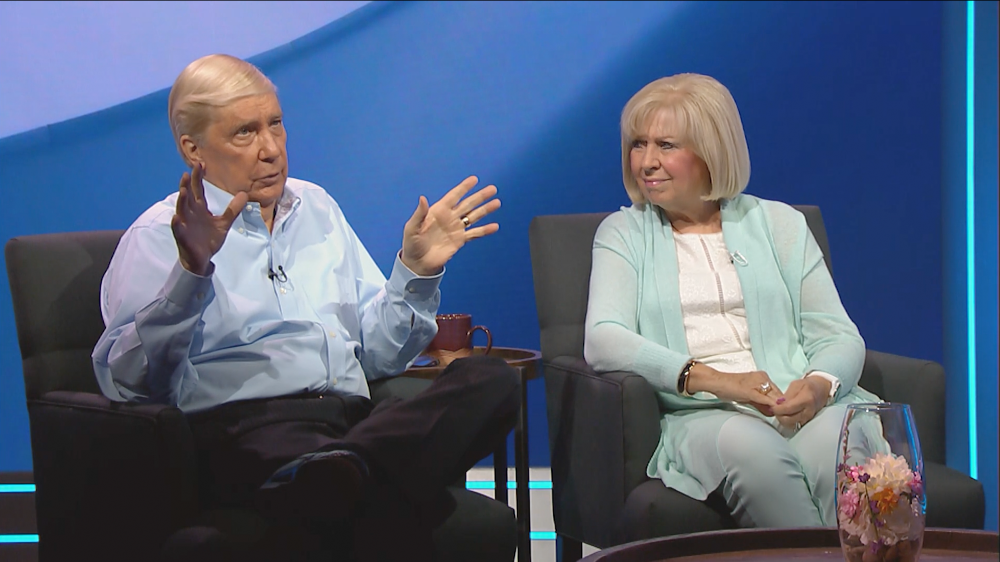
John and Darlene Ankerberg on Christian television.

John and Darlene Ankerberg on Christian television.

Christianity Today August 21, 2023
Screengrab / The John Ankerberg Show YouTube

A television ministry with the most-watched Christian apologetics program has been ejected from the Evangelical Council for Financial Accountability (ECFA) for insufficient oversight and dishonest fundraising.

The Ankerberg Theological Research Institute, which produces The John Ankerberg Show, failed to meet three ECFA standards, according to an ECFA investigation. The apologetics ministry reportedly did not have an independent board, did not have adequate internal controls, and did not truthfully represent the intended use of the funds it raised.

“In securing charitable gifts, all representations of fact … must be current, complete, and accurate,” the ECFA standards say.

According to MinistryWatch, The John Ankerberg Show raised about $20 million for audio Bibles but kept 80 percent. John and Darlene Ankerberg said the money went to producing and distributing the TV program, which cost about $2 million in 2022, according to tax records. No mention of this was made during the on-air fundraising appeals.

The Ankerbergs insist they were not dishonest, though.

“Being 100 percent donor-supported, we invest 80 percent into our ministry,” CEO Darlene Ankerberg told CT. “We have made it clear to all donors that their support is for our overall mission. We believe donors support our mission of spreading the Word of God.”

A former director of donor relations reported the apologetics ministry to the ECFA and MinistryWatch. Andrew Jaeger, who worked for the Ankerberg organization from 2019 to 2022, said he found that donors had no idea how their money was being used and that a “full disclosure” of the TV ministry’s financials would “most certainly be met with disapproval, if not contempt.”

Jaeger claims the ministry is guilty of “blatant tax fraud and tax evasion.”

He told The Chattanooga Times Free Press the Ankerberg show was misleading well-meaning Christians, many of whom were older adults. In one fundraising segment, John Ankerberg asked viewers to give $500 for one audio Bible device, which they were told would bring 90 people to Christ. Viewers were not told that Faith Comes By Hearing, the ministry partner that produced the devices, only asked $75 per device. There was no information given about the intended use of the other $425. The audio Bible fundraiser was, in fact, the TV ministry’s largest revenue stream, according to Jaeger.

“This was a huge cash cow,” he told the Chattanooga newspaper.

Darlene Ankerberg told CT that Jaeger was with the organization “for less than three years and had a limited knowledge of overall operations.”

Publicly available tax records do not show how much the Ankerbergs raised for audio Bibles. But they do show the ministry brought in a total of $8.5 million in 2022, almost all of it in donations. The John Ankerberg Show spent a little more than $2 million on television production and another $1.9 million on salaries, including John Ankerberg’s $258,000 annual compensation and Darlene Ankerberg’s $89,500. A little more than $1.3 million was given to “missionary outreach,” according to the form filed with the IRS.

The ministry ended the year putting more than $600,000 in the bank.

The John Ankerberg Show has not always been so profitable. In 2003, the apologetics program raised about $1 million, but spent $170,000 more than it received. By 2013, however, the Ankerbergs had increased incoming donations by nearly 300 percent. Tax records show the ministry ended that year with a $1.2 million surplus.

That was the year the show started asking for donations for audio Bibles. After 2013, according to a ministry history, The John Ankerberg Show raised enough money that it was able to purchase additional property in Chattanooga and expand into a remodeled “Global Communication Center” without incurring any debt.

“We invest in the capacity to extend our ministry outreach. Our outreaches include The John Ankerberg Show and our partnerships with other ministries, one of which is Faith Comes By Hearing,” Darlene Ankerberg told CT. “Our top priority is to be good stewards with the resources that have been entrusted to our ministry.”

The ministry will nonetheless take “several clarifying steps” in response to the ECFA findings, Darlene Ankerberg said. New people will be added to the board, which currently includes three family members. New financial controls will be put in place. And the statement given to donors about the use of funds will be updated.

“There is value in evaluating operations. We are doing so,” Darlene Ankerberg said. “We will continue to be transparent about how donations are used to present and spread the gospel around the world.”

The Ankerberg Theological Research Institute is also suing Jaeger, claiming breach of contract, illegal possession of confidential property, and tortious interference with business relations. According to court records, the suit was filed after the ministry learned Jaeger had contacted MinistryWatch and told donors they should stop giving to The John Ankerberg Show and ask for their money back.

The Ankerbergs are no strangers to televangelism scandals. In the late 1980s, John Ankerberg played a key role in removing Jim Bakker from ministry. He met with Assemblies of God leaders and relayed information about as-yet unexposed sexual scandals, in addition to the allegations against Bakker that were then attracting national attention. Ankerberg, a Southern Baptist, said he’d learned about the additional allegations from “concerned individuals” at the National Religious Broadcasters meeting in Washington, DC. Bakker’s ministerial credentials were subsequently revoked.

For the most part, however, the Ankerbergs have operated “under the radar,” as The Chattanooga Times Free Press reported in 2015. Since its founding, the apologetics-oriented programming has grown to an estimated potential audience of 4.5 billion viewers. The John Ankerberg Show also produces a podcast that is downloaded 24,000 times per month.

In 2023, John Ankerberg was elected to the board of the National Religious Broadcasters. The ministry’s membership in the ECFA was terminated the following month.

Michael Martin, president and CEO of the ECFA, would not comment on the investigation into the finances of The John Ankerberg Show. He said, however, that ejecting a ministry from membership is “a sign of the importance that ECFA really does place on the integrity and the value of the seal.”

He said that problems with fundraising can “many times … be traced to a breakdown in responsible governance” and remain hidden for years, despite regular audits.

“It would be a recommendation of ours that all ministries consider having a whistleblower policy in place,” Martin told CT. “That is a healthy part of accountability.”

Church Life

Stay the Course: How to Keep Your Faith in College

A Bible professor’s advice for staying close to Christ on campus.

Christianity Today August 21, 2023
Illustration by Mallory Rentsch / Source Images: Getty

Higher education has a hard road ahead. Christian colleges, in particular, are in crisis over lower enrollments, the financial constraints that come with fewer students, and larger ideological conflicts that reflect our increasingly fractured society. Data indicates that young people are the demographic most likely to leave organized religion behind.

Arguably now more than ever, college is a coming-of-age time when many young adults figure out who they are and what they believe.

For Christian students, going to college means figuring out how to “keep faith” and deepen it. This retention depends in part on learning how to flourish in mind, heart, body, and soul; how to love God above all things and your neighbor as yourself; and how to do college right, not by avoiding mistakes (which isn’t possible) but by making wise decisions early to avoid the more common and ruinous obstacles.

Drawing on my experience as a theology professor at a Christian university, here are the habits and choices I’ve seen work well, along with a few to resist.

1. Go to church—but not online.

The first and most important thing to do is find a local church, place membership there, and attend worship every Sunday you’re in town. Try the college ministry, go on the retreats, join a Bible study. These are non-negotiables for being a believer in college. If you’re at a Christian school, you might be tempted to let campus activities be a substitute for church. Don’t—they’re not. Nothing can replace the people of God, the word of God, the Lord’s Supper, or worship in the Spirit with fellow disciples.

If you’re not at a Christian school, you might feel tempted to sleep in on Sundays or let the busyness of intramurals, classes, roommates, and concerts distract you from what matters most. You’re already a Christian, though. You know what matters most. Go to church.

What kind, you ask? I’m not going to answer that question. But I will say: Unless you need it for health or accessibility reasons, streaming worship shouldn’t be on the table. It’s not the same. Find a local body—read: body—of believers who pray, listen to the Scriptures, proclaim the good news, celebrate communion, and serve the community. Christian worship is Word and sacrament—each is essential. Word and sacrament doesn’t mean “word and worship band,” or as I like to call it, “CCM and TED Talks.” If you want your faith to survive college, you need the sacraments. And you need fellow believers.

2. Delete social media—for real.

I teach a class on the topic of Christian discipleship and digital technology. None of my students protest when I say they—we—are addicted to screens. None of them denies wishing they could cut in half (or more) the amount of time they spend daily on their smartphones (typically 4 to 8 hours; one student averaged 12 per day). But all of them suppose it’s impossible.

During the course of the semester, I invite them to delete any and all nonessential apps from their phones for a one-month period. No more YouTube, Instagram, or TikTok. They imagine their lives will come to a screeching halt. But here’s what they discover instead: Not only do they not need it, they don’t even miss it.

I invite you to do the same. If it’s too difficult to delete completely, limit your daily usage to 1–2 hours. Turn it off on Sundays, especially. If you meet someone, swap numbers or email addresses. Your spiritual and mental health will skyrocket as everyone else’s plummets. Do it. You’ll thank me later.

3. Build a library—starting now.

My first rule as a professor is never to assign a book I don’t love—a bad book, a boring book, or a poorly-written book—but not every professor lives or can live by this rule. And not all books are life changing.

However, some, or even many, of the texts you encounter will be worth your time. If they’re worth your attention now, they’ll be worth revisiting later. Don’t view them as obstacles on the way to a diploma. View them as the point—the reason you’re in college in the first place.

If you’ve gotten rid of social media (or at least most of it), you can sit still with a book in your lap for more than five minutes at a time. If the book means something to you, if it speaks to you or sparks something in you, or even if it seems to mean something to others you respect—keep it. Money permitting, don’t rent it. Buy it. Store it away. Come out of college with a small but growing library. Let these years plant a seed that sprouts over a lifetime—a yearning to keep reading about the world around you and God’s work in it.

4. Make friends—with the dead (and others).

There’s an old Latin phrase: nemo nisi per amicitiam cognoscitur. Roughly rendered, it means “no one knows anything except by friendship” (or love). C. S. Lewis suggested there are four loves. I like to think there are four friendships, and they’re perhaps more widely available on a college campus than anywhere else.

First, there’s friendship with the dead—authors who are no longer with us but whose books live on. Stanley Hauerwas once remarked that what makes Lewis so perennially popular is his capacity for friendship with readers: “He makes himself available to his readers as a trusted friend in Christ.”

Find others like him who do the same. Befriend the dead.

Next, there’s friendship with the living. I’ll say more about that in the next tip below.

After that comes friendship with elders, a relationship we often call mentoring. Find a professor, pastor, or boss—someone older whom you respect, ideally (but not necessarily) a fellow believer. Knock on their door. Interrupt their schedule. Ask them questions. Get yourself invited to coffee or even to their home. It may not feel like friendship now, but once you graduate, it might develop in that direction.

After graduation, my former students have trouble calling me “Brad” instead of “Professor East.” But eventually it sticks. Some of them stay in touch with me for years. It’s wonderful.

Finally, consider friendship with Christ. Mere hours before his arrest, Jesus is with his disciples in the Upper Room. The last time he speaks to them before the cross, he says, “You are my friends” (John 15:14). He extends relationship to the men about to abandon and betray him. God in the flesh befriends us in Jesus. He sees us not only as followers but as friends.

The life of faith is nothing other than maintaining lifelong friendship with Christ. Let your time in college be about that, and you’ll do all right.

5. Throw parties—just not that kind.

College is a festive time. The question isn’t whether to celebrate, but how.

You’re a Christian, so you know the obvious things to avoid: Don’t get drunk. Don’t sleep around. Don’t break the law. Ignore the old line about sowing wild oats. Even apart from sin, they suck the life right out of you. They’re not “fun while it lasts.” They sow little more than regret and shame. Christ is able and eager to cover all of it, but that’s after the fact. Before the fact, choose the good life.

This is where friendship with the living comes in.

Wherever you and your friends live—a dorm, an apartment, a rental property—make it a space of welcome for friends, strangers, newcomers, and outsiders. Watch ballgames and coronations and series finales. Surprise roommates on their birthdays. Get dressed up. Throw a party for a saint’s feast day. If you don’t have a penny to spare, then dine out on ramen. If someone has extra cash, put it to use. Not everything has to be saved. Sometimes extravagance is called for.

6. Eat well—and get some sleep.

This one’s simple. Nothing, and I do mean nothing, would improve my students’ lives more than getting enough sleep. And by “enough” I don’t mean six hours, although many of them live on three or four per night. I mean a full eight or more.

Imagine going weeks and weeks without water. That’s what chronic sleeplessness does to your body. So get some sleep. (And not with a smartphone nearby. Nothing could be worse for you.)

More broadly, care for the body God gave you by eating well and exercising. Even better: When you eat, cook your own food; and when you exercise, do it outdoors. As Paul writes, “You are not your own; you were bought with a price. Therefore honor God with your bodies” (1 Cor. 6:19–20).

7. Say thank you—to everyone.

Too often, college marks the time when students realize how backward and embarrassing their home is, whether home means a town, a church, or a family. This awakening is not a mark of maturity or growth. It’s teenage rebellion by other means. Resist it at all costs.

Instead, let college be the beginning of a life of gratitude. Write physical thank you notes. Shoot a parent a text. Send a coach an email. Don’t imagine that you’re better than where you came from—even if you had a hard upbringing. Find someone to thank God for, then thank that person yourself.

Someone wiped your snot and changed your diapers. Someone got you where you are. Now is the time to realize that you’re not and never will be self-made, because nobody is. Like everyone else, you belong to God, and he made you who you are through the sweat and tears of countless others, usually nameless. Those you do know deserve your thanks.

You’ll learn new things in college. Your learning will change you; it’s supposed to. But whatever you learn is meant to build up others, not puff up yourself. Let gratitude absorb whatever vanity threatens. Giving thanks in all things will cover a multitude of sins.

If in four years you emerge humbled, prayerful, and grateful, then, regardless of your diploma, your time will have been a success. You’ll have shown—or rather, God will have shown through you—that keeping faith in college isn’t an oxymoron. It’s what Christ calls you to. And he will always give you what you need to do his will.

Brad East is an associate professor of theology at Abilene Christian University.

News
Wire Story

Take Me Out to the Faith Night

More than half of MLB teams offer an annual post-game program with worship and testimony from Christian players.

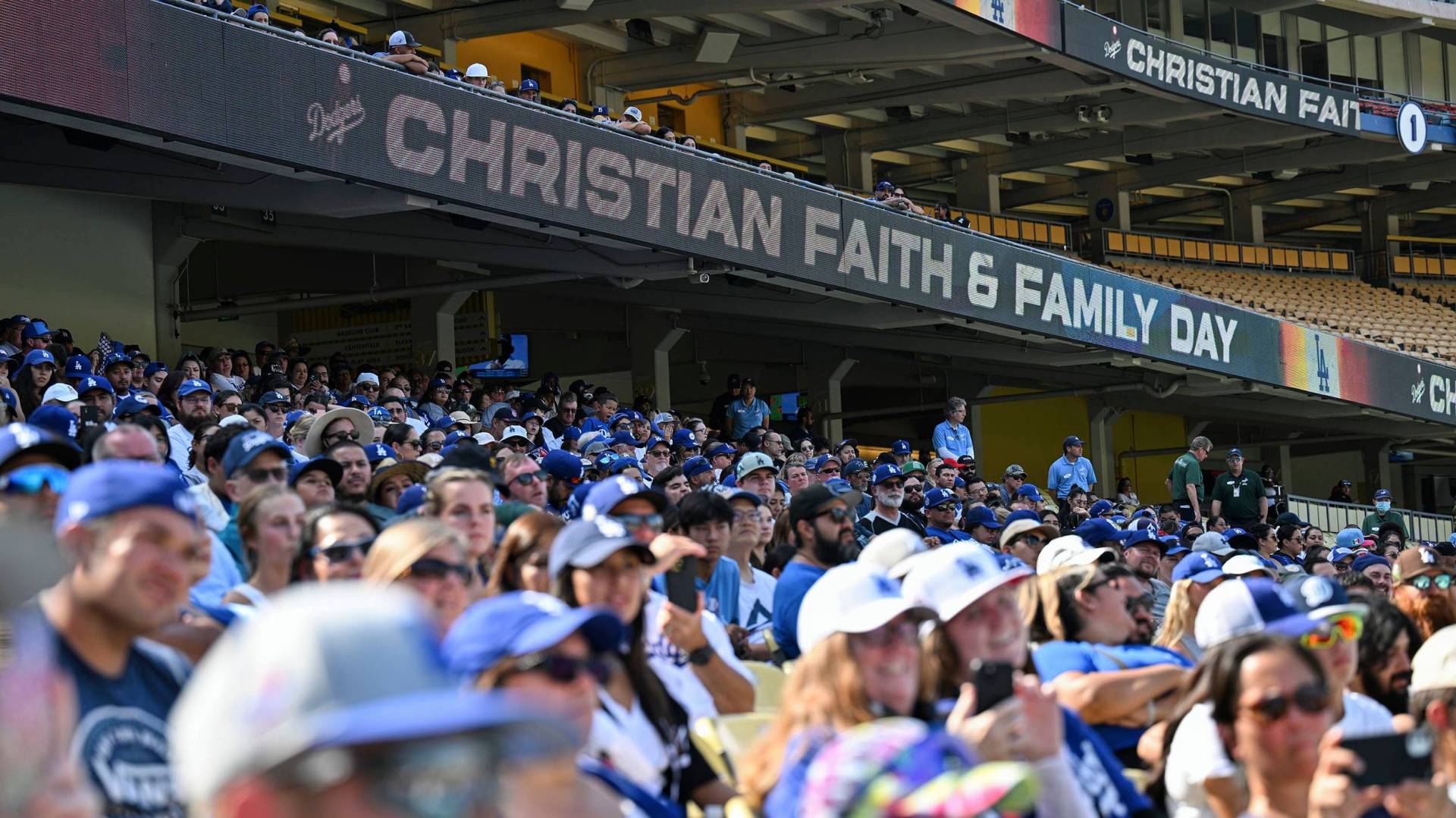
The Los Angeles Dodgers held Christian Faith and Family Day in July.

The Los Angeles Dodgers held Christian Faith and Family Day in July.

Christianity Today August 21, 2023
Kate Foultz / Los Angeles Dodgers

At 8:15 p.m. on a recent Saturday, Texas Rangers catcher Mitch Garver swung and missed at an 86-mph slider from San Diego Padres closer Josh Hader.

Garver’s strikeout secured a 4-0 victory for the home team in front of 42,677 fans at Petco Park. Three minutes later, an electric guitarist and keyboardist from The Rock Church—an evangelical megachurch in San Diego—stirred on the Gallagher Square stage behind center field.

The church’s pastor, Miles McPherson, sported a pinstriped Padres jersey as he grabbed a microphone.

“What’s up? What’s up? Y’all ready to worship the Lord?” said McPherson, a 1980s-era San Diego Chargers football player who developed a cocaine habit before dedicating his life to Jesus Christ during his NFL days.

About 3,000 men, women and children—almost all clad in Padres hats and attire—bought special tickets for the team’s annual Faith and Family Night.

On a 74-degree evening, in the shadow of statues honoring Padres greats Tony Gwynn and Trevor Hoffman, attendees listened to praise music, heard testimonials from Padres and Rangers players and lifted their hands toward heaven in prayer.

“It’s very nice to be able to celebrate our faith in public without criticism,” said one of the fans, Nicole Soto, who is not related to Padres star Juan Soto.

Roughly 19 hours later—and 125 miles to the north—a similar scene played out at Dodger Stadium in Los Angeles. Except that the Dodgers lost their Sunday afternoon home game, 9-0, to the Cincinnati Reds before a disappointed crowd of 45,936.

Still, thousands of fans stuck around for a special postgame program on Christian Faith and Family Day, highlighted by a performance by contemporary Christian music artist Jeremy Camp.

Despite losing, 10-time All-Star pitcher Clayton Kershaw, manager Dave Roberts, and other Los Angeles players took seats atop the team’s third-base dugout as sweat dripped from spectators’ faces on a sunny, 85-degree day.

“We like the Dodgers, but we also wanted to support the fact that they’re promoting Christianity,” said Cindy Carcedo, whose family of five came to the game, “because I feel like our faith is so strong, but to hear it coming from the players and knowing that we’re all in this together, it just makes it so much stronger.”

“It’s really nice to see them talking about Christ and God in public, just spreading the word,” agreed Sergio Carcedo, Cindy’s husband. “Nowadays, I believe a lot of people that are Christian try to hide it. … So this is a very good thing.”

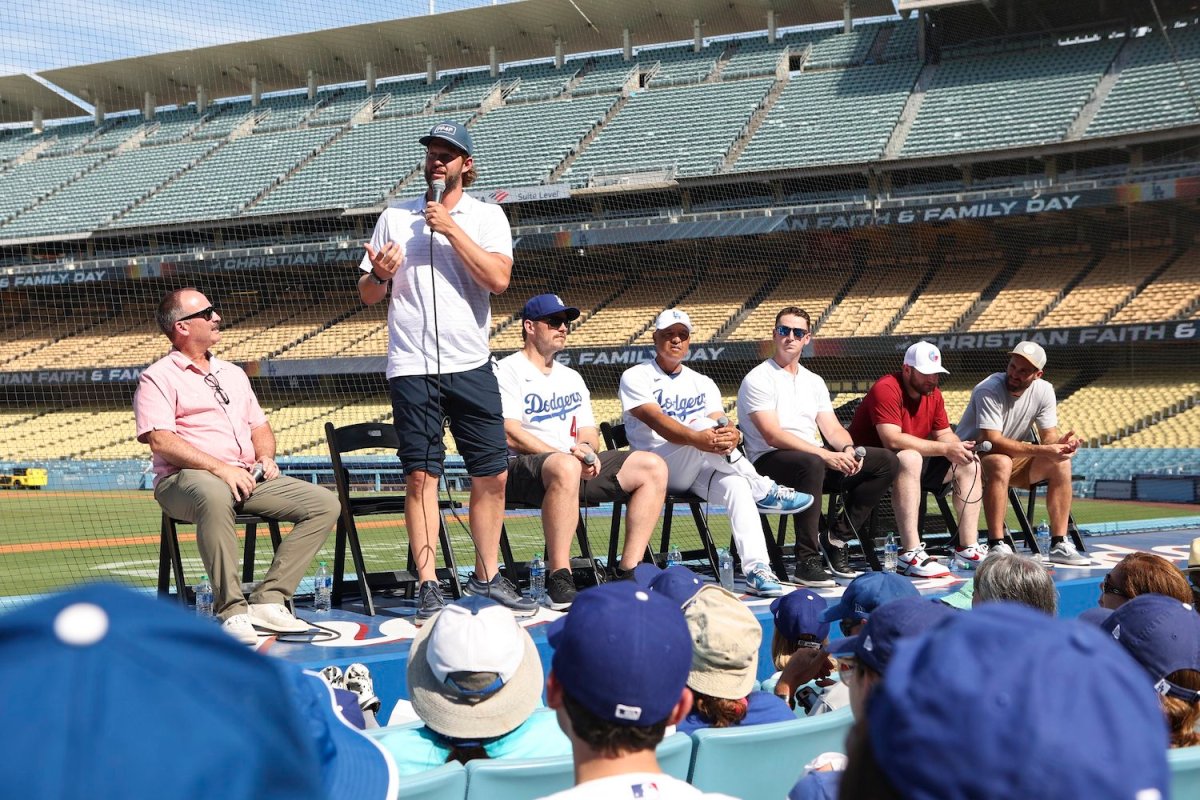
The Dodgers’ Faith and Family Day program included remarks from chaplain and Biola University professor Brandon Cash, pitcher Clayton Kershaw (standing), actor Chris Pratt, manager Dave Roberts, pitcher Evan Phillips, third baseman Max Muncy, and shortstop Chris Taylor.Jon SooHoo / Los Angeles Dodgers
The Dodgers’ Faith and Family Day program included remarks from chaplain and Biola University professor Brandon Cash, pitcher Clayton Kershaw (standing), actor Chris Pratt, manager Dave Roberts, pitcher Evan Phillips, third baseman Max Muncy, and shortstop Chris Taylor.

A marketing strategy

At least 18 of MLB’s 30 franchises—60 percent—will host faith nights during the 2023 season, research by ReligionUnplugged.com found. A handful of other teams have done so in recent years.

The Colorado Rockies (Aug. 20), Arizona Diamondbacks (Aug. 25), Seattle Mariners (Aug. 26), and Washington Nationals (Sept. 2) are among those with recent or upcoming faith-and-family promotions.

“He Gets Us,” a media campaign touting Jesus, is sponsoring the Rockies faith event as well as others by the Atlanta Braves, Chicago White Sox, Miami Marlins, and St. Louis Cardinals. In addition, He Gets Us is advertising at Rangers and Los Angeles Angels games.

“He Gets Us’ goal is to reintroduce people to the Jesus of the Bible and his confounding love and forgiveness,” campaign spokesperson Jordan Carson said in a statement. “The best way to do that is to meet people where they are. That is why you see our ads at a variety of events, including sporting events.”

In past seasons, other teams have organized Catholic Nights (Boston Red Sox) and Muslim Heritage Nights (Oakland Athletics).

From Star Wars nights to NASCAR days, MLB franchises rely on themed events to boost ticket sales. That strategy encompasses faith nights, which typically gain little attention outside the target audience. Organizers generally focus sales pitches directly at church groups and Christian radio listeners.

The Dodgers event attracted wider notice after controversy earlier this season over the team honoring the Sisters of Perpetual Indulgence—a group that satirizes sacred Catholic rituals—during its Pride Night game. (Twenty-nine MLB teams—all but the Rangers—sponsor Pride nights.)

The furor over the drag nuns prompted Kershaw, a future Hall of Famer, to urge the team to speed up its announcement of Christian Faith and Family Day, the pitcher told the Los Angeles Times. The Dodgers promoted the Christian event, the first since the COVID-19 pandemic, on the team’s main social media channels.

But some fans accused the team of playing favorites by not scheduling a Jewish Community Day, as it has in the past. For example, the Padres did offer a Jewish Community Day this season.

History of faith nights

Baseball’s marketing to people of faith stretches back many years, even if the contemporary faith nights—typically involving evangelical Christian worship and testimonials by stars such as Houston Astros second baseman Jose Altuve—developed more recently.

In reviewing the history of religion and baseball, Paul Putz, assistant director of Baylor University’s Faith & Sports Institute, discovered that teams such as the Baltimore Orioles organized what ticket stubs called “Inter-Faith Night” in the 1950s.

https://twitter.com/p_emory/status/1686920890028552192

Before a 1958 Inter-Faith Night game between the Detroit Tigers and Washington Senators at Griffith Stadium in the nation’s capital, a newspaper columnist wrote that the “whole purpose … is to remind human beings that they belong to the brotherhood of man.”

“This was the height of the Cold War, and there’s the fear of communism, and there’s this belief that America needs to have some religious identity,” Putz said, recalling that Inter-Faith Night promoted pluralism among Protestant, Catholic, and Jewish believers.

Later, baseball teams—particularly in the minor leagues—implemented “all-faith days” where anyone presenting a church bulletin got a discounted ticket, the scholar said.

Faith nights incorporating Christian music and player testimonials originated in 1991, when a St. Louis Cardinals fan named Judy Boen organized the first Christian Family Day at the old Busch Stadium.

Although a foundation begun by Boen, now 81, no longer sponsors the event, it has continued for three decades.

“It was my mom’s idea,” said Christe Boen Mirikitani, Judy’s 50-year-old daughter. “She loves Jesus with all her heart, and she loves Cardinals baseball—that’s a close second. I had been babysitting for a bunch of different baseball players, and my mom knew that a lot of them had a faith in Christ.”

But persuading players to share their faith publicly was a challenge in the beginning.

“That was a big step for some of those guys,” Mirikitani recalled. “But then it kind of paved the way for the rest of the players in the years to come. People felt comfortable in doing that.”

Albert Pujols, an 11-time All-Star who retired in 2022, is a Boen family friend. Pujols paid special tribute to Judy at last year’s Cardinals faith day.

“I just want to thank you for being here today,” he told her as the crowd cheered.

‘Fans of purple cupcakes’

Brent High didn’t know about the Cardinals faith day when he pitched a similar idea to the Atlanta Braves in 2005.

High, who had helped the minor league Nashville Sounds improve attendance with promotions such as handing out bobblehead Moses figures and camouflage Bibles, simply saw an opportunity for the Braves to boost ticket sales in an area with lots of churches.

On a Thursday afternoon in July 2006, the Braves hosted their first faith day—with attendance up 15 percent from normal—and star pitcher John Smoltz made national headlines by preaching on the same field where his team lost earlier in the day.

Nearly two decades later, High said his Third Coast Sports Foundation, a nonprofit ministry, has partnered with more than 60 professional sports teams—including 11 MLB franchises—on faith-based events.

“Interestingly enough, I have always been a big proponent that if you are a group of any kind, and you want to do something at the ballpark, you should have the freedom and ability to do that,” High said. “If you can come and cut a deal with a team and convince them that you can put 10,000, 12,000 or 15,000 people in the seats—say, you’re going to have a night for people who are fans of purple cupcakes—you ought to have the ability to do that.”

But in High’s view, there’s a smart way—and a reckless way—to do ballpark faith nights. He’s not a proponent of what he refers to as “ambush evangelism.”

“When you start interfering with the normal baseball fan experience—they just came to watch a game—that’s where I think you can get sideways,” High said. “And if you’re not careful, you can kill the opportunity because enough people will complain. And the team will just kill it off.”

Praying, but not for baseball

Back in San Diego, the players who gave Faith and Family Night testimonials included Padres center fielder Trent Grisham, a two-time Gold Glove Award winner, and Rangers first baseman Nathaniel Lowe, a 2022 Silver Slugger Award recipient.

Geoff Horn, the Padres team chaplain, asked Grisham, Lowe, and other players and coaches to talk about their relationships with Jesus.

“I feel like following Jesus gives you a different perspective, right?” said Lowe, who went 0 for 4 with two strikeouts in that night’s game, “because it gives you a different lens to look through, OK?

“So on a day like today when you guys smoked us,” he added to laughter from the Padres fans, “there are guys in the clubhouse that are putting their hands on you, saying, ‘All right, man, you’ll hit it next time.’ And with the perspective that God gives us, we can pay attention to things like that.”

Grisham said he finds peace in the Lord through his morning Scripture readings.

“I mean, you have to get in the word,” he said of the Bible, “and you have to stay in the word.”

The fans applauded in agreement.

As the night ended, McPherson invited the crowd to extend its arms toward the players and coaches. He described the gesture as a symbolic “laying on of hands.”

“We’re not praying that they play baseball better, especially that guy,” the pastor joked, referring to Lowe. “We’re going to pray that they follow Jesus better. Amen?”

“Amen!” the fans responded.

Dodgers’ blue heaven

At Dodger Stadium the next afternoon, Kershaw thanked the crowd—a sea of blue-and-white jerseys and T-shirts—that stayed for the postgame program.

The All-Star pitcher, who has a 208-91 career win-loss record with a 2.48 ERA, emphasized that he and teammates are baseball players, not pastors.

“We’re not great at talking about Jesus in a public way,” Kershaw told the fans, each of whom received a custom white hat with the Dodgers logo, a gold cross and “John 3:16” inscribed on the side. “But what we do want to mention is that we are baseball players that love Jesus, and we wanted to share a little bit about …”

The crowd’s cheers drowned out the rest of what he said.

The Dodgers manager joined Kershaw in welcoming the fans. Win or lose, Roberts said he finds his anchor in Jesus.

“I hold him dear to my heart, and in everything I do, I want to represent Jesus,” Roberts said. “I’m not perfect. I’m far from perfect. But I will tell you that I really don’t believe I could … pour into players and do my job if I didn’t have Jesus Christ.”

Jesus provides a solid foundation, even on days when the team loses, said third baseman Max Muncy, who went 0-for-4 with a strikeout in that afternoon’s game.

“Today is a perfect example,” Muncy said. “We kind of got our doors blown off today, and yet we still have thousands of people out here. And we have teammates out here sharing the word and sharing our testimonies.”

Before a final few songs by Camp, Kershaw led the crowd in a prayer.

“Jesus, thank you so much for this day,” Kershaw said from the top of the dugout. “What an opportunity to get to be here and glorify you and talk about you and how much you mean in our lives. Help us every single day to follow you as best as we can.

“And thank you for this day,” he continued. “It is truly a special day to be at Dodger Stadium with this many people talking about you, worshipping you, and just being so grateful for you in our lives. We love you. And it’s in Jesus’ name. Amen.”

This article was originally published on Religion Unplugged.

Bobby Ross Jr. is a columnist for ReligionUnplugged.com and editor in chief of The Christian Chronicle.

Ideas

What a Twitter Spat Reveals about Public Religion in America

Staff Editor

A Republican lawmaker called a Christian tweet “bigoted.” Democratic Rep. Ilhan Omar came to religious liberty’s defense.

Democratic Representative Ilhan Omar

Democratic Representative Ilhan Omar

Christianity Today August 18, 2023
Illustration by Christianity Today / Source Images: Getty

It started with a post on X (formerly Twitter)—an expression of Christianity with the brevity the site’s format demands: “There’s no hope for any of us outside of having faith in Jesus Christ alone.” The poster in question was Lizzie Marbach, whose X bio describes her as a Republican political activist who lives in Ohio.

Marbach’s post easily could have gone unnoticed outside her own following. But then a member of Congress decided to share it—and not just to share it but to dunk on it, hard, to an audience nearly ten times the size of Marbach’s own.

“This is one of the most bigoted tweets I have ever seen,” the congressman wrote. “Delete it, Lizzie. Religious freedom in the United States applies to every religion. You have gone too far.”

As angry replies accumulated under both posts, another, better-known member of Congress came to Marbach’s defense.

“No! Stating the core beliefs or principles of your faith isn’t bigoted,” the congresswoman tweeted, rebuking her colleague. It’s “religious freedom and no one should be scolded for that. It’s also wrong to speak about religious freedom while simultaneously harassing people who freely express their beliefs.”

If you’re already imagining these latter two characters, my guess is you’re imagining incorrectly—just as I probably would if I didn’t know the details here. The representative who dunked on Marbach is a fellow Ohio Republican, Rep. Max Miller. He’s a Marine veteran who served as a special assistant to former President Donald Trump—and he told 50,000 people that Marbach was a bigot for believing Jesus is the only hope of the world.

And the lawmaker who rebuked him and defended Marbach? That was Rep. Ilhan Omar, the Minnesota Democrat widely known for her membership in the House’s progressive “Squad.”

The unexpected casting of this little internet drama caught my eye and got me thinking (again, as this is a topic I find endlessly fascinating) about the strange place religion takes in American public life today. Recent decades’ rapid decline of Christian religiosity in the US—by which I mean not only sincere faith and practice but also basic cultural familiarity with the stories and habits of the church—is the context that made this episode possible.

It’s a context I always keep in mind, as both a Christian and a journalist, whenever I write for mainstream audiences. I can’t assume the public understands what I’m talking about when I speak of Jesus, church life, or the core tenets and demands of Christianity. (A few years ago, my mother met someone who’d lived her whole life in the United States, surrounded by churches, and yet was under the impression that Jesus was burned at the stake.)

But it’s also a context I think every American Christian would do well to mull over from time to time. Without a foundational understanding of religion’s changing place in our country, we’ll be ill-equipped to talk about faith with our neighbors of other religions or none at all—and we’ll be unprepared for responses like Miller’s dunk.

The dunk itself was revealing, as was the subsequent apology in which Miller said he’d “conveyed a message [he] did not intend” without specifying which part of his first tweet was misleading and what message he’d actually like to convey.

I don’t think Miller, who describes himself on X as a “proud Jew,” has any animus toward Christians or people of faith more generally. His reaction, I suspect, was to the exclusivity of Marbach’s claim and the exacting demand it implies for all who read it. If there’s “no hope” apart from faith in Christ, the clear suggestion is that each of us should have faith in Christ—and that’s no small proposal.

Or, at least, it shouldn’t be. And that expectation is precisely the aspect of faith which is ever more incomprehensible in much of American society. Rapid, large-scale dechurching is but a visible symptom of our nation’s deeper shift toward the secularism philosopher Charles Taylor famously described in his landmark work, A Secular Age. This isn’t secularism in the sense of opposition to religion but in the sense that faith is a real choice we must make, just one option of many, and not a universal norm or obligation.

That shift in our thinking—which I find in my own mind, even though I’ve made my choice—has pushed religion out of a special category concerned with ultimate questions of who we are, how we should live together, and what God wants of us. Instead, religion is often bumped down to a lower level among hobbies and sports: nice and engrossing but nonessential, something to do in your leisure time when you’re not at work or dealing with basic necessities like food and sleep and childcare.

This reframe was perfectly encapsulated by a 2020 comment to The Washington Post from a Harvard epidemiologist, Ranu S. Dhillon, which I’ve shared at CT before.

“Protesting against systemic injustice that is contributing directly to this pandemic is essential,” Dhillon said. “The right to live, the right to breathe, the right to walk down the street without police coming at you for no reason … that’s different than me wanting to go to my place of worship on the weekend, me wanting to take my kid on a roller coaster, me wanting to go to brunch with my friends.”

I understand the distinction Dhillon was drawing between fundamental rights to life and liberty and more frivolous activities. It’s a good distinction to make, especially in an emergency. Dhillon simply drew the line in the wrong place: Worship isn’t like brunch. It’s more like breathing.

Or, at least, that’s the Christian perspective and, I expect, the perspective of anyone serious about the practice of any faith. But this is an increasingly uncommon perspective. The demands, assumptions, and language of religion are growing stranger by the year through sheer loss of familiarity—to the point, it seems, that a Republican member of Congress briefly thought a single-sentence expression of Christian belief in public amounted to a bigoted violation of others’ religious rights.

And maybe the fact that Omar was the one to push back on Miller’s dunk shouldn’t surprise us after all. She habitually wears a hijab as a sign of her Muslim faith. It’s a decision which probably has her regularly thinking about the uncertain new place of religion in American public life, too.

News
Wire Story

Southern Baptist EC President Resigns Over Falsified Résumé

Willie McLaurin is the third Executive Committee head in a row to step down amid controversy.

Willie McLaurin

Willie McLaurin

Christianity Today August 17, 2023
Adam Covington / Baptist Press

Willie McLaurin, the acting president of the Southern Baptist Convention’s Executive Committee, resigned suddenly on Thursday after admitting he had falsified his résumé.

“While considering McLaurin as a candidate for Floyd’s permanent replacement, the SBC Executive Committee’s Presidential Search Team discovered disqualifying information during their process of vetting and due diligence,” said Philip Robertson, chairman of the SBC Executive Committee, in a statement. “McLaurin’s education credentials that he presented in his résumé are false.”

The statement quoted from McLaurin’s resignation letter, saying he admitted falsifying his résumé.

“In a recent résumé that I submitted, it included schools that I did not attend or complete the course of study,” McLaurin reportedly said in resigning.

According to Baptist Press, an official SBC publication, McLaurin claimed that he had degrees from North Carolina Central University, Duke University Divinity School, and Hood Theological Seminary on his résumé. When presidential search committee members attempted to confirm those degrees, they learned he did not hold those degrees.

McLaurin had been interim president and CEO of the Executive Committee since February 2022 and had worked for the Executive Committee since 2020. The committee oversees the business of the nation’s largest Protestant denomination between the SBC’s annual meetings.

McLaurin had been in the running for the permanent role as Executive Committee president after the committee rejected a different candidate. If he had been named to that post, McLaurin would have been the first Black leader to head a major Southern Baptist entity.

His departure marks another leadership challenge for the Executive Committee. McLaurin became interim president after Ronnie Floyd, the previous president, resigned in October 2021 after months of controversy over the SBC’s sex abuse crisis. Floyd’s predecessor, Frank Page, resigned in 2018 due to misconduct.

The Southern Baptist Convention has seen a series of leaders resign in recent years, often in controversy.

Among them: former SBC president Paige Patterson, who was fired for mishandling the investigation of a sexual assault at a seminary he led; David Platt, former president of the SBC’s International Mission Board, who resigned after a troubled tenure that included the loss of nearly 1,000 missionaries due to budget cuts; Russell Moore, former president of the SBC’s Ethics and Religious Liberty Commission, a critic of former president Donald Trump who had forced unwelcome discussions in the SBC on sexual abuse; and Adam Greenway, who resigned last fall from Southwestern Baptist Theological Seminary after concerns about the school’s finances.

“To the Southern Baptists who have placed their confidence in me and have encouraged me to pursue the role of President & CEO of the SBC Executive Committee, including pastors, state partners, entity servants, colleagues, and SBC African American friends, I offer my deepest apologies,” McLaurin said in his resignation letter, according to Baptist Press. “Please forgive me for the harm or hurt that this has caused.”

Robertson asked for prayer in dealing with the fallout from McLaurin’s departure.

“In a commitment to transparency we will be issuing further updates related to next steps to the presidential search team and SBC Executive Committee’s staff leadership in the near future,” Robertson said.

This is a breaking story and will be updated.

Apple PodcastsDown ArrowDown ArrowDown Arrowarrow_left_altLeft ArrowLeft ArrowRight ArrowRight ArrowRight Arrowarrow_up_altUp ArrowUp ArrowAvailable at Amazoncaret-downCloseCloseEmailEmailExpandExpandExternalExternalFacebookfacebook-squareGiftGiftGooglegoogleGoogle KeephamburgerInstagraminstagram-squareLinkLinklinkedin-squareListenListenListenChristianity TodayCT Creative Studio Logologo_orgMegaphoneMenuMenupausePinterestPlayPlayPocketPodcastRSSRSSSaveSaveSaveSearchSearchsearchSpotifyStitcherTelegramTable of ContentsTable of Contentstwitter-squareWhatsAppXYouTubeYouTube