Ideas

Our Civic Leaders Are Not Above the Law

Contributor

Trump’s arrest is another reminder that presidents don’t have political immunity in a democracy

Christianity Today April 21, 2023

In the past couple weeks since Trump’s arrest, I’ve seen some reactions from his conservative supporters along these lines: “If they can go after Trump, they can also go after you”—which is the whole point of the rule of law.

Donald Trump was indicted on 34 counts of falsifying business records. He and his defenders claim the indictment is a “witch hunt” and is evidence that the justice system has become politicized.

Politicized justice is a real problem. In many countries, the courts are not independent and there are few checks and balances protecting their integrity. In such cases, courts become little more than rubber stamps for executive rule or, on the other end of the spectrum, for the tyranny of the majority.

Judicial independence is a cornerstone of the rule of law for a free society. Without it, newly empowered parties have a habit of prosecuting, imprisoning, and even executing former presidents and prime ministers on flimsy charges as political revenge. Officeholders will seek to stay in power by any means necessary to escape prosecution. Political life deteriorates into a soap opera of charismatic criminals rotating between prison and the presidency.

But that should not lead us to make the opposite mistake and grant all former presidents and officeholders immunity from any legal prosecution. Officeholders are human, like the rest of us, and just as prone to sin, corruption, and criminality. As Christians, we should know this better than anyone.

In fact, it is precisely because of their access to power and wealth that officeholders are likely to face even greater temptation and have more opportunity to commit crime. Unless we think they are somehow immune to such temptation, we should assume that some of our public officials are going to give in.

And they have often given in. Four recent governors of Illinois served time in prison for corruption—a small sample of at least 28 governors convicted of various crimes in American history. Hundreds—yes, hundreds—of senators and representatives have been accused of misconduct, and dozens have been convicted of criminal acts.

Presidents and their appointees are not immune. In the Ulysses Grant administration, the interior secretary, attorney general, secretary of the navy, and secretary of war—among many, many others—were all widely reported to have been corrupt. Over 100 lower officials in the Treasury Department were convicted of bribery in a massive conspiracy to help people avoid whiskey taxes. And that was only one of several scandals that plagued the Grant presidency.

In the Warren Harding administration, the interior secretary (again) was convicted of accepting a bribe to give an investor control of oil reserves in Wyoming. It was one of the biggest and most blatant corruption scandals in American history.

And, of course, president Richard Nixon obstructed justice and abused power in the Watergate scandal, crimes for which he would have been impeached and prosecuted had he not resigned and been pardoned.

Charles Colson, former chief counsel for Nixon, was also arrested for the part he played in the scandal. He later told a federal judge he had been “an arrogant, self-assured man in the ruthless exercise of power,” before coming to faith as an evangelical Christian. He learned how easy it is to rationalize illegal behavior when you’re in a position of power—and that even when civic leaders act with the best of intentions, “your means are as important as your ends.”

By contrast, Nixon still tried to justify his behavior after he left office: “When the president does it, that means it is not illegal.” In his view, presidents are, by definition, incapable of committing a crime when they claim their action is in defense of national security.

Nixon’s claim calls to mind Louis XIV, the absolutist king of France in the 17th century, who claimed “L’Etat, c’est moi,” or “I am the state”—a claim so famously villainous that George Lucas put a version of it into the mouth of soon-to-be Emperor Palpatine in Star Wars. Nixon, Louis, and Palpatine believed that the king was the law, such that whatever the king did was legal by virtue of the king being the one who did it.

At the same time as Louis, but across the English Channel, Scottish jurist and Presbyterian pastor Samuel Rutherford wrote a book with the title Lex Rex­ (“Law is King”), which countered the “divine right of kings” and became the bedrock for constitutionalism, the rule of law, and self-government.

Holding public officials accountable when they give in to the temptation to sin is essential. If we do not, we’ve sent a clear message that presidents and their appointees are above the law. Future presidents and presidential candidates will take note and act with impunity. That is why democracies around the world have indicted, prosecuted, and imprisoned heads of government for corruption.

That is why we have checks and balances, judicial independence, and, above all, the rule of law. Holding former presidents to the same standard as the rest of us is an important test of self-government.

I do not know if Trump is guilty of the crimes for which he was indicted last week—and neither do you. A grand jury of Manhattan citizens judged there was sufficient evidence to try the case in court, and Trump is entitled to due process before we rush to judge him in the court of public opinion. And as Christians, we should all hope for the truth to be revealed, for the truth always sets free (John 8:32).

The point is that investigating, indicting, and prosecuting a former president is not, on its face, proof of politicized justice. In fact, a willingness to hold former officeholders accountable is vital to sustaining our democracy.

It is reasonable to ask if the prosecution of Donald Trump is politically motivated. We can’t know for sure, but we can note that Trump is also under investigation in three other cases: for allegedly violating the Presidential Records Act by taking and storing classified records that belonged to the National Archives; for allegedly interfering in Georgia’s 2020 presidential election; and for his role in the events of January 6, 2021.

It is also relevant that the Trump Organization was convicted of criminal tax fraud and falsifying business records in December. And there is a growing list of Trump’s advisors, colleagues, and appointees charged or convicted of various crimes, including his personal lawyer and several top campaign officials.

Trump’s defenders may look at this list as proof that he is a victim of politicized justice. But the very breadth and diversity of legal challenges that Trump faces by several juries in different jurisdictions led by multiple prosecutors suggests that there is no overarching conspiracy.

The United States ranks 26th in the world for upholding in the rule of law and judicial independence, according to the World Justice Project, making it among the best. America’s justice system is so diffuse it would be extremely difficult to organize a conspiracy among the many different juries, prosecutors, and judges involved in all the legal cases against Trump and his associates.

The only common factor in these cases is Trump himself.

Paul D. Miller is a professor of the practice of international affairs at Georgetown University, a research fellow with the Ethics and Religious Liberty Commission, and a veteran of the war in Afghanistan. His most recent book is The Religion of American Greatness: What’s Wrong with Christian Nationalism.


Theology

‘Suzume’ Opens a Door to the Spiritual Discipline of Delight

To journey out of nostalgia and amnesia, we need to pay attention to God’s presence in our present.

Suzume Iwato

Suzume Iwato

Christianity Today April 21, 2023
Courtesy of Crunchyroll

There’s something irresistible about viewing an empty, abandoned building on the big screen. The camera often pans slowly from left to right or zooms in menacingly while we watch with bated breath, unable to tear our eyes away as a sense of impending doom grows.

I felt this visual tension viscerally while watching Suzume no Tojimari (literally “Suzume’s Locking Up”), the fourth-highest-grossing anime film of all time, even before its North American release on April 14. Written and directed by Japanese auteur Makoto Shinkai (of the award-winning 2016 film Your Name), Suzume is a coming-of-age movie where deserted places like a hot spring, an amusement park, and a school become breeding grounds for end-of-the-world-type … stuff (spoilers ahead).

In some ways, the apocalypse has already arrived for the film’s protagonist, 17-year-old high-schooler Suzume (voiced by Nichole Sakura in English). She lost her mother in the 2011 Tōhoku earthquake and tsunami, which killed 20,000 people and activated the Fukushima nuclear reactor meltdown.

On her way to school one day, she encounters Souta (Josh Keaton), a traveler on a mission who is mysteriously turned into a three-legged chair. The duo traipse across Japan locking otherworldly doors popping up in various abandoned places in a bid to prevent a ghastly wormlike creature from wreaking destruction.

Reviewers have praised Suzume as a unique story of hope amid grief and loss. While I agree with their assessment, what enthralls me most about the film is in how it probes Japan’s collective experience of nostalgia and amnesia—a desire for what once was and could have been, alongside a creeping erosion of treasured memories tied to people and place.

Our faith may oscillate between a spiritual nostalgia and a spiritual amnesia as well. But God calls us out of these unfruitful, desolate places in the Christian journey as we travel onward and upward. How? By recovering the spiritual discipline of delight.

Wistful longing

Suzume is replete with breathtaking animated effects, from the way sunlight glints off ripples in a bright blue sea to how the characters’ hair ruffles gently in the wind. The empty, abandoned places in the film are not bereft of such lovingly detailed treatment either. Tangible mementos of a once-vibrant place remain, whether in the form of broken vending machines or a creaky, dilapidated Ferris wheel.

These scenes come tinged with a nostalgic atmosphere that longs for the glory of what once was. As Souta puts it, “Deserted places have lost their anchor.” Souta tells Suzume that she needs to “listen to the past [and] hear their voices” to lock the doors successfully. In doing so, Suzume hears a rushing cacophony of voices from people who once lived, worked, and played in these now-bleak locations.

There is a poignancy to how the film depicts these abandoned spaces and how the means of bringing order out of chaos is to “hear” the past and remember all who once called them home. It strikes me, too, that I find myself lingering comfortably in such nostalgic ruminations of my faith.

As a Christian for over two decades now, I regularly reminisce about times I had experienced God or saw God’s promises come to pass, like in the three-hour-long worship nights at youth camp or the Christmas musical I wrote and directed with church friends in the span of six weeks. I think back to other Asbury revival–like moments in my faith and wonder when, or if, I will experience the divine sweetness of God’s presence again.

This is not to say that nostalgia is bad. Nostalgia is only and essentially human, writes my colleague Kate Lucky: “In a world that rushes us forward to the impending deadline, the growth goal, or the five-year plan, a moment of bittersweet recognition reminds us of what we’ve already had.”

Nevertheless, God calls us out of overindulging in spiritual nostalgia as it all too often descends into a sour bitterness that dismisses his promises and his presence in our lives in the present. In Scripture, we see God telling Israel—and us—not to fear because he has redeemed them, called them by name, and considers them his (Isa. 43:1). This beautiful, weighty assurance that we belong to God and are known and loved by him may be evident when we look back at God’s sovereign providence, but it can also be woven into the minutiae of our present lives.

Rather than retreating into the past, God calls us to be present to him in the day-to-day, growing ever more spiritually awake and aware as his precious, beloved children. “Forget the former things; do not dwell on the past. See, I am doing a new thing! Now it springs up; do you not perceive it?” (Isa. 43:18–19).

Forget me not

This bittersweet yearning for the past isn’t the only theme that the film explores in its artful weaving together of fantasy and history. The other key narrative thread unfolds through the exploration of Suzume’s experience of amnesia.

Suzume has recurring dreams of her four-year-old self crying and searching for her mother in the aftermath of the 2011 earthquake. In these dreams, young Suzume roams a grassy field under a starry night sky. Later, she realizes that these dreams are actually her forays into the Ever After: the world beyond the mystical doors that she and Souta have been locking up. Although the Ever After is regarded as a place where souls go to rest and the living cannot enter, Suzume once again ventures in when she visits the ruins of her old home and finds (no surprise) a door to this ethereal, liminal space.

In one emotional scene, present-day Suzume meets the younger version of herself in the Ever After. “The night might seem endless … but the light will come once again,” says the older Suzume to her younger, grief-stricken self. “Who am I? You could say I’m your tomorrow.”

The circularity of this moment is heart-wrenching, and it reveals how alienating the experience of amnesia is. In forgetting moments as priceless as those of her mother crafting and giving her the three-legged chair, Suzume has also forgotten who she is. The dialogue between older and younger Suzume becomes a powerful turning point in the film as it ushers in healing and hope for the future.

Suzume’s gradual remembering—of herself, her mother, and her past—as well as her renewed appreciation of her present existence provides some insights for how we approach the Christian life as well. Spiritual amnesia arises when we forget what God has done in our lives and how he has shaped us into who we are today. I have a hunch I’m not alone in struggling to answer questions like “Who has had the biggest impact on your life as a Christian?” Remembering and recounting people who have been our mothers and fathers in the faith aren’t merely fun icebreaker activities. Doing so recognizes that God has been holding all our tomorrows in his hand and will continue to do so.

Still, it’s easy to make our faith painfully routine and forget God in the process. “When it comes to God, I too forget the familiar all over again,” writes the self-professed “spiritual amnesiac” Philip Yancey for CT. “For example, wrenched from my normal routine on a trip somewhere, it will suddenly occur to me that, except for a cursory blessing before meals, I have not given God a single thought all day. Forget the essence of the universe and the central focus of my life? Yes, I do.”

Habits like setting an hourly alarm to pause and reflect jostle Yancey out of his spiritual amnesia. For me, journaling and counseling have been productive avenues to remember and recount God’s faithfulness and presence, particularly in seasons of despair and distress.

Yet, Suzume reminds me that developing another spiritual practice—that of delight—is essential in our ongoing oscillation between spiritual amnesia and nostalgia.

The discipline of delight

Suzume may be an animated film, but its portrayal of the world’s beauty and the goodness inherent in almost every character is so masterful that I cannot help but marvel and, yes, delight in it.

After being immersed in a dark movie theater for two hours, I emerged into a sunlit afternoon. The world post-Suzume seemed more substantial. Where I would typically plunge into an e-book or scroll through my social media feeds after walking out of a film, I chose instead to notice the sights and sounds around me. The colors of the sky appeared brighter. I felt the breeze on my skin and heard the chirps of the birds. My soul felt quiet within me, like the film’s troublemaking cat, Daijin (Lena Josephine Marano), nestling himself quietly in the back seat of an open convertible. A sense of hope and peace enveloped me, and I felt grounded and settled (instead of impatient and frustrated) as I waited for the bus to arrive.

I worry that we have neglected to delight in God in our incessant toggling between spiritual nostalgia and amnesia. Nostalgia hinders us from being present to God in this very moment, whereas amnesia may lead to a willful forgetting of God and a constant striving for bigger and better spiritual experiences instead of what Dallas Willard calls a “transformation into Christlikeness.”

These rhythms can be interrupted by cultivating delight as a spiritual discipline, in which we pay closer attention to all that is around and within us and form a deeper, joy-filled awareness of God’s presence.

As Tish Harrison Warren writes, “The more I have tried to seek God—the more I reach for truth, beauty and mystery that I know exceeds my grasp—the more bright, vivid and vital the things of earth become.”

The spiritual practice of delight does not produce any discernible outcomes, which makes it even more valuable and necessary since our faith ought not be held hostage by achievements and goals. Spiritual delight involves cultivating a holy kind of listening, which creates space for hospitality toward God and others, according to spiritual director Margaret Guenther. Spiritual delight invites us to ponder all that is true, noble, right, pure, lovely, and admirable (Phil. 4:8) rather than wallow in fear or be consumed by distraction.

Suzume is not a Christian film. In fact, much of its mythology is based on Shintoistic ideas of how divine gods and humanity relate to one another. But Suzume has led me to experience delight again, even if it seems inconceivable in a world constantly bombarded by terrible, deadly news. The spiritual discipline of delight requires us to live open-heartedly in the present, deepening our relationship with Jesus without leaving one foot stuck in the past and the other in an imagined, ideal future.

“Life is a fleeting, fragile thing, but we fight and hope to live one moment more,” says Souta in a pivotal scene. His words echo that of the author of Ecclesiastes: “For who knows what is good for a person in life, during the few and meaningless days they pass through like a shadow? Who can tell them what will happen under the sun after they are gone?” (Ecc. 6:12).

Delighting in God opens a doorway that leads us out of bitter regret and blissful forgetfulness. This door is always and already open, and God invites us all to enter amid the ordinariness of our present realities. Won’t you step in?

News

Died: Ron Hamilton, Better Known as Patch the Pirate

When cancer took his left eye, he saw a God-given opportunity for children’s ministry.

Christianity Today April 21, 2023
Courtesy of Majesty Music / edits by Rick Szuecs

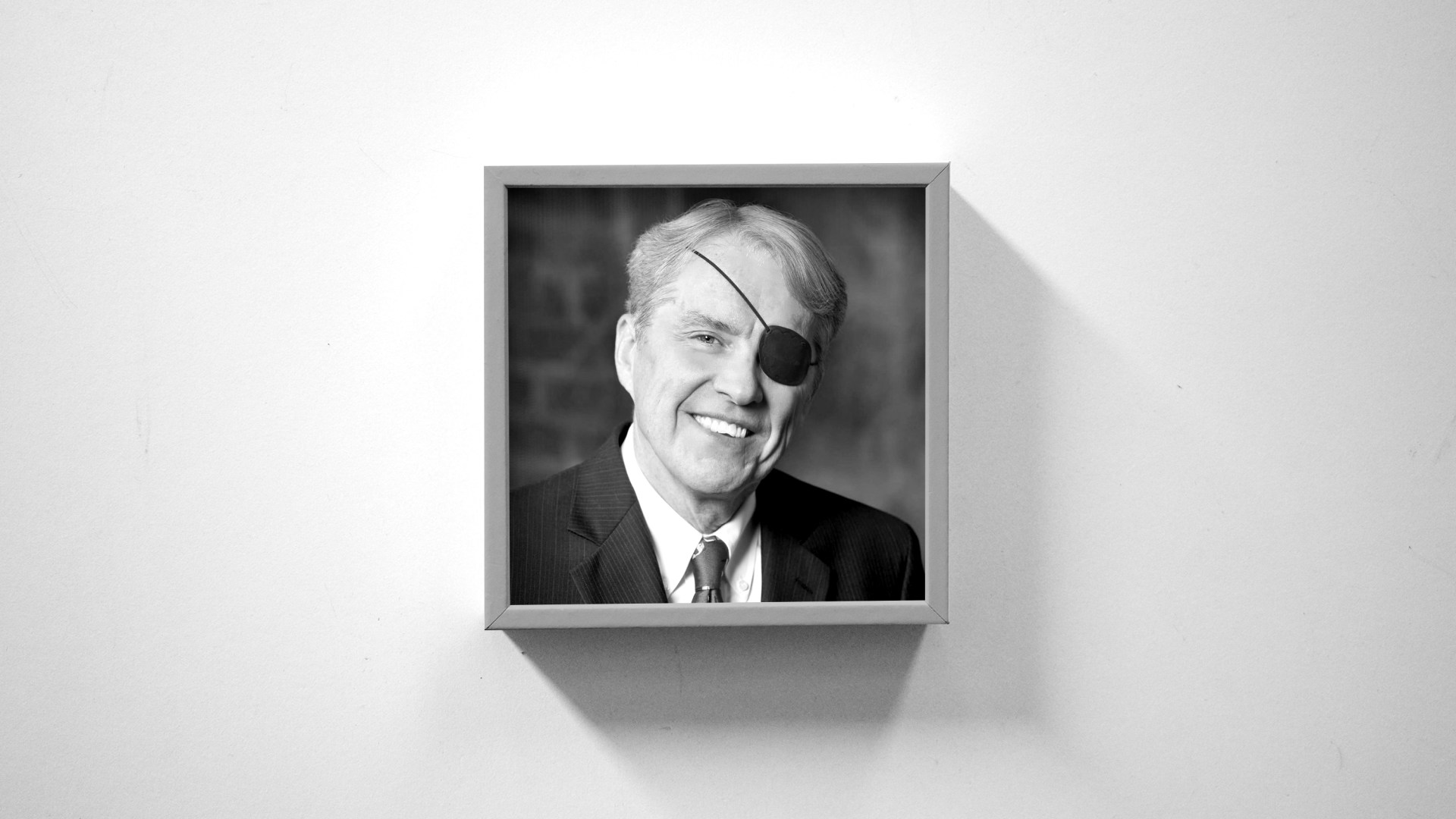
Ron Hamilton wrote hundreds of hymns and worship songs, including “Rejoice in the Lord,” “Here Am I, Lord,” and “I Saw Jesus in You.” He was also a composer and published 20 Christmas cantatas.

But he is known most for his sillier work: 41 kids albums, written by and starring him as the one-eyed “Patch the Pirate.” Alongside his wife as “Sissy the Seagull” and their kids playing assorted sea creatures and crew, he went on adventures and sang lessons about life, the Bible, and God.

“Not a lot of Christian pirates around,” Hamilton told a church in 2014. “I’m about the only one. It’s a lot of fun.”

Hamilton lost his left eye to cancer when he was 26. He started wearing an eye patch, and as he recounted many times over the years, children began to recognize him as a pirate, pointing him out to their parents, asking if they could be pirates too, and greeting him in his home church with a hearty “Ahoy!”

The Hamiltons put out the first Patch the Pirate album in 1981, a second in 1982, and released them annually after that. More than two million copies have been sold, and the songs are broadcast on more than 450 radio stations, making Patch the Pirate one of the largest children’s outreach programs on the radio.

In 2018, as dementia was rapidly shrinking his world, Hamilton’s wife, Shelly Garlock Hamilton, tried to encourage him by reminding him of that success. “Do you realize how many people you have blessed with your music, Ron?” she said.

Hamilton replied: “I’d like to think God did it.”

He died on Wednesday, surrounded by family, at the age of 72.

Tributes and remembrances poured in on social media. One young woman in Minnesota called Hamilton her “cassette-tape dad.”

“I remember time and time again, being curled up around the radio listening to the stories with such anticipation and singing along with the songs we learned to love so much,” she wrote. “Patch, you were a rock to a wondering and searching soul.”

A man in Oklahoma recalled a similar experience.

“I remember sitting on the couch as a young child, listening to all the adventures, over and over again, with my imagination running wide open!” he wrote. “I cherish those memories oh so much, and wouldn’t trade them for the world. Ron, thank you for the work you so willingly did for the Lord.”

https://twitter.com/pastorhuston/status/1648910477085360128
https://twitter.com/TheWanderLyz/status/1648867250924052480

Hamilton was born in South Bend, Indiana, on November 9, 1950. His father, Melvin, was an electrician. His mother, Leota Marie, was a homemaker with a passion for music and a commitment that her three children would be musically trained. She hired a piano teacher to teach them trio arrangements and personally directed them singing gospel in three-part harmony whenever they were in the car.

The family belonged to an Independent Fundamentalist Baptist church, and Hamilton kneeled beside his bed as a child to confess that God sent his only Son to die on the cross for his sins. He accepted Jesus into his heart and trusted him for salvation.

“Salvation and a personal relationship with Jesus Christ are the means by which one can live a life in heaven forever,” his family wrote in the death notice posted by a Greenville, South Carolina, funeral home. “This is the gospel in full, the gospel to which Ron dedicated his life.”

Hamilton was also an adventurer as a young man and spent one summer of his teenage years riding his bicycle across the United States. He spent another cycling around the Great Lakes.

At 18, he went to Bob Jones University to study music. He auditioned for the vesper choir, led by renowned fundamentalist Baptist composer Frank Garlock, and was accepted. That same year, Hamilton spied Garlock’s daughter Shelly running across campus in her cheerleading uniform and was smitten. She saw him in her dad’s choir and felt the same.

The two dated for six years and got married in 1975. Hamilton went to work writing music for his father-in-law’s new production company, Majesty Music. At the same time he completed a master’s degree at Bob Jones, writing a trilogy of songs about the Cross: “It Is Finished,” “Come to the Cross,” and “The Blood of Jesus.”

In 1978, Hamilton had trouble seeing out of his left eye. He was sent to doctors in Atlanta who told him they could see a spot. It could be cancer, but they would have to operate to know for sure.

“It was kind of suspenseful,” Hamilton said.

They were, in fact, really concerned. There was a chance, according to the doctors, that the cancer was inoperable.

“We didn’t know if it had gone to his brain,” Shelly Hamilton said. “If it had gone to his brain, the doctors couldn’t have done anything for him.”

The couple went to Atlanta for an operation and were relieved to learn the cancer had not spread beyond his eye. However, the doctors couldn’t save his eye and had to remove it. They gave him an eye patch, sparking the reaction that inspired a new line of children’s music and Hamilton’s greatest ministry.

“Many people would see the loss of my eye and the need for wearing a patch as a great trial,” Hamilton said. “But I see it as one of the greatest blessings of my life. It reminds me that God teaches us the greatest lessons in the deepest valleys.”

In 1981, Majesty Music put out Sing Along with Patch the Pirate. It had 16 disconnected songs about Jonah, David, Daniel, and Jesus, as well as “I Love America,” and one about how “nobody likes a person who will grumble and complain.”

The follow-up album was written to tell a story, sending Patch the Pirate on an adventure full of opportunities to spread the gospel.

“It’s yo, heave ho, a’sailing we go,” Hamilton sang on one track, “telling the story of Jesus.”

After that, Patch the Pirate went on a new adventure with new music, every year. Sometimes the crew retold a biblical story, as with 1996’s Giant Killer. But more often they sailed on simple adventures, encountering situations they could learn from, new friends to tell about Jesus, and reminders to praise God.

“We’re making car rides more enjoyable, more bearable,” Shelly Hamilton said. “But when you’re actually teaching them someone loves them and there’s a Savior, it’s really making a difference.”

Majesty Music also established Patch the Pirate clubs for churches. By the mid-1990s, there were more than 900 clubs across the United States, attended by about 16,000 kids. Hamilton remained connected to Bob Jones throughout his life and was well regarded by Independent Fundamentalist Baptists. His music reached far beyond that network, though, and was widely used by evangelicals across denominations.

Hamilton continued to write adult music as well. Most of his songs were big, majestic pieces, best sung by choir and a full congregation backed by a church orchestra.

https://open.spotify.com/embed/track/3zWOTg9Qy14jkmb8ulJVcK?si=601d3a7591194cdf
https://open.spotify.com/embed/track/3f2EUE4EwykTu0Fd9Ij5bx?si=cf14ae2bce324aba
https://open.spotify.com/embed/track/2AV9JUxx3CeAAKS0HBUAGY?si=c6234032bc95405a

Hamilton’s most beloved hymn was perhaps “Rejoice in the Lord,” a song about trusting God:

Now I can see testing comes from above;

God strengthens His children and purges in love.

My Father knows best, and I trust in His care;

Through purging more fruit I will bear.

In 2013, the Hamiltons suffered the tragedy of the death of their eldest son by suicide. Jonathan, 34, had long struggled with clinical depression and schizophrenia.

“Losing our son has been the hardest thing we’ve had to deal with,” Shelly Hamilton said. “But we know he’s well and he’s with God, so that’s a comfort that we’ll see him again in heaven.”

Two years later, Hamilton was diagnosed with frontotemporal dementia, which impacts the part of the brain that controls language and behavior. His ministry ended in 2017 after wrote his last song for children. It was about the silliness of selfishness, called “It’s All About Me.”

Majesty Music was turned over to a third generation of the family and is now run by Megan Hamilton Morgan—known on some Patch the Pirate albums as “Princess Pirate”—and her husband, Adam, who is also a state representative in South Carolina. Megan and Adam Morgan have written the most recent Patch the Pirate albums, Mystery Island and A Whale of a Tale, a pirate-themed retelling of the Jonah story.

Majesty Music has also made Patch the Pirate more available, releasing a smartphone app, Patch Plus, with all 42 years of Patch the Pirate music included.

In July 2022, Hamilton, his wife, and his daughter Alyssa moved to Navarre, Florida, to live with Shelly’s sister Gina and brother-in-law David Greene, so they could all care for and support Hamilton in his final days, allowing him to live at home.

One of his final conversations was with his friend Tom Williams, an evangelist, who prayed a nautical prayer for the that man so many knew as Patch the Pirate.

“Dear Lord,” Williams said, “this old ship is about ready to dock.”

Hamilton is survived by his wife, Shelly, and their children Tara, Alyssa, Megan, and Jason. A funeral is being planned at Bob Jones University.

News

Conservative Anglicans Reject Church of England and Archbishop of Canterbury

(UPDATED) Gafcon gathering in Rwanda pledges to create alternative authority structures, while Global South fellowship stays separate.

Conservative Anglicans from 53 nations attended the Gafcon conference in Kigali, Rwanda, this week.

Conservative Anglicans from 53 nations attended the Gafcon conference in Kigali, Rwanda, this week.

Christianity Today April 21, 2023
Courtesy of Gafcon

Update (April 21): Conservative primates gathered in Kigali today withdrew their recognition of Archbishop of Canterbury, Justin Welby, as the “first among equals.”

The chair of St Augustine is now empty, as far as leaders representing an estimated 85 percent of the Anglican Communion are concerned.

The primates gathered at the fourth Gafcon conference stated:

We have no confidence that the Archbishop of Canterbury nor the other Instruments of Communion led by him (the Lambeth Conference, the Anglican Consultative Council, and the Primates’ Meetings) are able to provide a godly way forward that will be acceptable to those who are committed to the truthfulness, clarity, sufficiency, and authority of Scripture. The Instruments of Communion have failed to maintain true communion based on the Word of God and shared faith in Christ…

Successive Archbishops of Canterbury have failed to guard the faith by inviting bishops to Lambeth who have embraced or promoted practices contrary to Scripture. This failure of church discipline has been compounded by the current Archbishop of Canterbury who has himself welcomed the provision of liturgical resources to bless these practices contrary to Scripture. This renders his leadership role in the Anglican Communion entirely indefensible.

Their Kigali Commitment calls for repentance by progressives within the Anglican Communion. “Despite 25 years of persistent warnings by most Anglican Primates, repeated departures from the authority of God’s Word have torn the fabric of the Communion,” stated the primates. “These warnings were blatantly and deliberately disregarded and now without repentance this tear cannot be mended.”

Gafcon will provide support for evangelicals in and out of the Church of England.

“In view of the current crisis, we reiterate our support for those who are unable to remain in the Church of England because of the failure of its leadership. We rejoice in the growth of the ANiE [Anglican Network in Europe] and other Gafcon-aligned networks,” stated the primates. “We also continue to stand with and pray for those faithful Anglicans who remain within the Church of England. We support their efforts to uphold biblical orthodoxy and to resist breaches of [Lambeth 1998] Resolution I.10.”

The primates echoed the provisions of the 1998 resolution, noting that LGBT people should be treated with dignity.

“We affirm that every person is loved by God and we are determined to love as God loves. As Resolution I.10 affirms, we oppose the vilification or demeaning of any person including those who do not follow God’s ways, since all human beings are created in God’s image,” stated the primates. “We are thankful to God for all those who seek to live a life of faithfulness to God’s Word in the face of all forms of sexual temptation.”

The statement endorses the continued existence of two conservative movements in Anglicanism, but recognises a need to have a single conservative point of identity—in essence, a reordered communion.

“The leadership of both groups affirmed and celebrated their complementary roles in the Anglican Communion…,” stated the primates. “The goal is that orthodox Anglicans worldwide will have a clear identity, a global ‘spiritual home’ of which they can be proud, and a strong leadership structure that gives them stability and direction as Global Anglicans.

“We therefore commit to pray that God will guide this process of resetting, and that Gafcon and GSFA will keep in step with the Spirit.”

Editor’s note: Lambeth Palace, the Archbishop of Canterbury’s London seat, issued the following response:

We note that the GAFCON IV communiqué makes many of the same points that have previously been made about the structures of the Anglican Communion. As the Archbishop of Canterbury has previously said, those structures are always able to change with the times — and have done so in the past. The Archbishop said at the recent Anglican Consultative Council meeting in Ghana (ACC-18) that no changes to the formal structures of the Anglican Communion can be made unless they are agreed upon by the Instruments of Communion.

“At the ACC-18 meeting — which was attended by Primates, bishops, clergy, and laity from 39 of the 42 Anglican provinces — there was widespread support for working together patiently and constructively to review the Instruments of Communion, so that our differences and disagreements can be held together in unity and fellowship. Archbishop Justin Welby has welcomed this decision — just as he also welcomed last year’s decision by the Church of England’s General Synod to give the Anglican Communion a greater voice on the body that nominates future Archbishops of Canterbury.

“The Archbishop continues to be in regular contact with his fellow Primates and looks forward to discussing this and many other matters with them over the coming period. Meanwhile the Archbishop continues to pray especially for Anglicans who face poverty, conflict, famine, discrimination, and persecution around the world, and Anglican churches who live and minister in these contexts. Continuing to walk together as Anglicans is not just the best way to share Christ’s love with a world in great need: it is also how the world will know that Jesus Christ is sent from the Father who calls us to love one another, even as we disagree.”

Initial report (April 19), entitled “To Whom Shall We Go: Conservative Anglicans Discuss Divorce from Church of England”:

A “revived, renewed, and reordered” Anglican Communion will be the core message delivered tomorrow to 1,300 conservative Anglicans from 53 countries meeting this week in Kigali, Rwanda to discuss “to whom shall we go?”

The final statement of the fourth Global Anglican Futures Conference (Gafcon) will outline an extremely critical response by the conservative majority of the Anglican Communion to the recent moves by Church of England bishops to adopt prayers to bless same-sex marriages.

Gafcon is the network that welcomed the Anglican Church in North America (ACNA) into the Anglican family, if not the official Anglican Communion, in 2008.

“We owe our existence to Gafcon,” said ACNA archbishop Foley Beach. “The first Gafcon called for the formation of a new province in North America.”

Chair of the Gafcon primates council, Beach called for the liberal provinces of the Anglican Communion to repent. He added, “Unless the Archbishop of Canterbury repents, we cannot regard him as the first among equals.”

Then pointing out that “sexual sins are not the only sins in the Bible,” Beach called for Gafcon churches to be repenting churches also.

Archbishop Stephen Samuel Kaziimba Mugalu, leader of the eight-million-strong Church of Uganda, also called archbishop of Canterbury Justin Welby to repent.

“I am disappointed because, in Uganda, the message of the gospel came from the Church of England in 1877,” he told The Pastor’s Heart, a livestream podcast produced by Sydney Anglicans. “The first missions came, and we had polygamy as a normal way of marriage, and every man had three, four, five women. And they ceased having [that number of] wives because of the gospel. And now, we hear a message that a man can have another man’s wife or same-sex marriage is also marriage.

“We get disappointed that those who brought the gospel to us are turning away from what they brought to us,” said Kaziimba. “So we call upon Archbishop Justin to repent, and they should reverse their decision, which is destroying the Anglican Communion.”

Bishop Keith Sinclair from England finished his morning plenary speech in tears. He detailed the Church of England’s habit of making contradictory statements.

“Rather than face this fundamental disagreement and the implications for fellowship, mission, discipline, and so on,” he said, “the differences are simply described as if both are possible in some hope that we can keep together in an institution that has got some shared history but no common mind.”

This was a speech from a man holding on to the hope that evangelicals could maintain a place in the Church of England. Nevertheless, Sinclair expressed sadness that “the church which God used to bring the gospel to so many parts of the world because of her faith in that scriptural revelation now seems to have succumbed to the very cultural captivity it appealed to so many to renounce.”

He did express the caveat that the official process in England is still ongoing. “Formally it remains to be seen how the [English] bishops will respond to what has been said globally and in England.”

In 2000, as the American evangelical breakaway from The Episcopal Church (TEC) began, archbishops from the national churches of Rwanda and Southeast Asia sprang into action, offering to be temporary bishops for American and Canadian dissidents. Today, the provinces feature in the two major wings of the conservative movement in the Anglican Communion.

Rwanda is hosting this week’s Gafcon. Many Gafcon members have a history of boycotting Anglican Communion meetings in Kigali, and the group has taken a militant stance against the liberal movement in the communion.

Attending the Gafcon gathering is retired Singapore bishop Rennis Ponniah, general secretary of the Global South Fellowship of Anglican Churches (GSFA). Until now, the GSFA has maintained relationships with liberal provinces such as the US and Canada, serving alongside them on communion bodies.

But in Kigali, there are signals this will change. Some insiders say the GSFA, rocked by the Church of England’s shifting stance, is now much less inclined to walk alongside the liberal provinces.

There is already significant overlap between the two groups.

“The Bible stands at the heart of the faith that all Anglican Churches have inherited from the Church of England,” said Benjamin Kwashi, general secretary of Gafcon. “That the Church of England has now decided to depart from the Bible’s teaching is troubling for many Anglicans.

“Some have accused Gafcon of creating division in the Anglican Church, but I must disagree. There have been deep disagreements over the authority of the Bible among members of the Anglican Communion for quite some time,” said Kwashi, a Church of Nigeria archbishop based in Jos. “We do not seek division, but rather we want to move with the mission of God in the world. The gospel of our Lord Jesus calls us to guard the unchanging, transforming Gospel of Jesus Christ and to proclaim Him to the world.”

The newest breakaway movement in the Gafcon movement, Australia’s Diocese of the Southern Cross, received a new congregation as delegates traveled to Kigali.

Faith Church on the Sunshine Coast is pastored by Hedley Fihaki, who led the Assembly of Confessing Congregations, an evangelical movement in the Uniting Church in Australia that will cease operations this weekend. His is only the first ex–Uniting Church congregation expected to become Anglican.

“It was eight months ago that we decided we could no longer follow the archbishop and the decisions of the Diocese [of Southern Queensland] for the blessing of same-sex marriage,” said Peter Palmer, the first minister to join the self-described “Anglican lifeboat.” Even as he founded the first church of the new diocese, he hoped his would be the only one—in other words, that his diocese would repent and he could rejoin it. However, his region now has four Southern Cross churches.

The delegates from the UK are the most diverse, ranging from church planters who have left the Church of England to those who believe that its process has only just begun and that strong resistance could make a space for evangelicals to remain. In many ways, the process that occurred in the US is being repeated in the UK.

Gafcon has provided the beginnings of an “Anglican lifeboat” in the fledgling Anglican Network in Europe (ANiE), led by Andy Lines, a missionary bishop to Europe from ACNA. Also in attendance at Gafcon is the new bishop of Ebbsfleet, Rob Munro, a “flying bishop” in the Church of England serving complementarian churches. They have differing opinions about the strength of the pushback against the British bishops’ proposed prayers for same-sex blessings.

But the message of the Kigali gathering will be to say even louder than before that the Church of England is not at the center of the Anglican Communion.

A second central theme of the conference is the desire for the two conservative movements to merge or walk more closely together. In a dramatic moment during a session seeking input into the eventual conference statement, a delegate from Uganda suggested that Gafcon and GSFA should “speak one language.”

The room, full of clergy and lay delegates, erupted in loud applause and cheers.

After a break, a suggested summary list was on the big screens around the Kigali Conference Center. But, unfortunately, the Gafcon-GSFA issue was not on it.

But then the chair, Tasmania’s Bishop Richard Condie, assured delegates that he would undertake the message to the primates and ensure it would be heard.

In effect, there are parallel meetings in the mix at Kigali. There are public gatherings of Bible study, worship, and drafting a conference statement, and a myriad of smaller ones. This includes GSFA and Gafcon primates meeting together.

“As most of you know, some of—actually most of—the Global South primates are also Gafcon primates, but we did have a meeting with the leaders of both groups…,” Beach told a press conference. “So we’ll be gathering together later this week. And we’ll just see where that goes.”

Due to the Church of England developments, the GSFA and Gafcon have drawn together in tone. The GSFA has concentrated on building up the ecclesial links between provinces as a remnant within the Anglican Communion, while Gafcon has been more inclined to boycott communion structures and seek to replace them. The distance between these approaches has shrunk as GSFA wishes to distance itself more decisively from liberal provinces like TEC, Canada, and now the Church of England.

To elect a single leader for the combined conservative forces in the Anglican communion–one possible move–means ironing out differences, such as the chair of GSFA rotating annually and Gafcon selecting a chair for a five-year term. Having a new “first among equals” would mean the Archbishop of Canterbury would have a rival. And the expected strong language in the final conference statement would mean that one of these leaders will be respected and the other will be ignored in the wider Anglican world.

A unique feature of both movements is the unity between majority world evangelicals and the Anglosphere. Confessing movements in denominations that have seen progressive-conservative splits could learn from the Anglican example. For example, unlike the United Methodists, it is clear that African and Asian churches are leaders in the conservative movement. And unlike the Presbyterians, the majority world is in the majority.

“Gafcon and Global South are two institutions that overlap in what they do,” GSFA chair Justin Badi Arama, archbishop of South Sudan, told The Pastor’s Heart. “In the future, it is my hope and prayer that the two might become one.”

Church Life

Nashville Shooting Intensifies Attention Around Christian School Safety

Administrators are seeking ways to “be alert and sober minded,” adding specialized training, personnel, and physical upgrades.

Christianity Today April 21, 2023
iStock / Getty Images Plus

Last month’s shooting at The Covenant School was not only the deadliest in Nashville—it was also the most high-profile attack on a church school in the US. The incident has shaken views of Christian schools as safe havens against violence and led administrators across the country to revisit their own security measures.

“There’s been a sense of, ‘Those problems don't seem to happen in our types of schools,’ and (the Nashville shooting) shattered that,” Sean Corcoran, who leads Brainerd Baptist School in Chattanooga, Tennessee, told Reuters.

He said the recent shooting exposed how deadly incidents can happen even when leaders "did everything right”—The Covenant School had security cameras, locking double doors, alarms, and procedures in place from a training the year before.

Safety is among the top reasons parents choose private education, but how schools protect students—staff trainings, building features, and procedures—is up to its leaders.

Several church security experts told CT they see an uptick in interest following mass shootings. The Nashville shooting in particular has been a wakeup call for parents who send their children to Christian schools and church academies.

Indiana mom Brooke Wine chose Heritage Christian School for her daughter because they have numerous security guards on campus, including at an entry point for vehicles.

“Without the proper ID or badging system, you get stopped and checked,” Wine told CT. “I personally felt much safer with my child going to a place with increased protection, in comparison to many other schools we looked into.”

At the Dade Christian and Masters Academy in Miami, armed security guards are posted around the building and cameras keep watch over the property. The school is in the process of moving playgrounds to less visible areas and is hiring more guards that have undergone active shooter training.

Private schools aren’t subject to the same safety requirements as public schools. In Tennessee, a new law signed days after the shooting allows private schools to contract with law enforcement to hire school resource officers, like public schools do, but they aren’t required to have them.

Better-funded schools have bigger budgets for pricier staff and security measures. Bulletproof glass windows and doors—which have gotten recent attention after the attacker at Covenant shot through locked glass doors to get inside—can cost tens of thousands of dollars. A few schools have also experimented with portable“safe rooms,” which run $60,000 apiece.

Some states offer grants to nonprivate schools for security. Last year, the federal government increased funding by $150 million to help faith communities with security costs, but that only goes so far given the number of churches and schools across the nation.

Since 2019, 80 percent of teachers in private Christian schools say they’ve seen enrollment increase, according to a national study on “Christian School Growth & Sustainability.” School closures and changes during the pandemic, as well as an increase in school choice laws in some states, have pushed Christian parents in this direction. Still, the report shows that 7 out of 10 challenges these schools face relate to finances and fundraising.

As interest increases with each attack and threat—religiously motivated hate crimes are up, as are reports of targeted incidents against churches—more church security organizations have emerged to meet the need. These experts consult, train, and advise churches and schools around how to approach safety and security.

Security consultant Brink Fidler of Defend Systems worked with The Covenant School in 2022 and said the training helped save lives last month. Its other clients include fellow Christian schools, preschools, churches, and family shelters in Nashville.

A dean of a local Catholic school that worked with Defense Systems said that staff “don’t think it’s going to happen to them, especially when you’re in these private school settings that have these beautiful campuses.” But security training can help administrators see their own areas of vulnerability.

Church schools have particularly ways they are susceptible to violence, said Charles Chadwick, the founder of Gatekeepers Security Services, which offers private security officer training for churches.

“You have church functions going on, so the chances that somebody not associated with the school is going to be on campus or walking through the area is real high,” Chadwick said.

After spending several years as the director of security for a Texas megachurch, Chadwick told CT he “felt a calling” to help other churches get equipped. Gatekeepers now has about 500 officers in nearly 100 churches and private Christian schools in Texas.

Sheepdog Church Security founder Kris Moloney, a former military and police officer, launched a safety team at his own church in 2009, and then local churches began contacting him for training. His expertise grew into a company that has trained over 4,700 students in schools from all 50 states. Sheepdog classes include “Active Shooter Response,” “Deescalating Disruptive Persons” and “Use of Force Laws,” among others. While Moloney focuses more on churches, his training is used by schools as well.

The Association of Christian Schools International requires its 2,200 member schools in the US to meet certain accreditation protocols around safety, including implementing “a comprehensive written security and crisis management plan” with “appropriate training for all staff and students” and ensuring “facilities are secure and suitable for the size of the school.”

Year after year, church security expert Carl Chinn is encouraged by a “growing recognition” among churches and schools of the need for more intentional, precrime planning.

“We are seeing more training based on the mental and spiritual mindset of a responsible defender,” said Chinn, whose Faith Based Security Network has tracked over a decade of violent incidents on church properties. “We recognize that the primary role of a responsible defender in a faith-based organization—be it a church, school, charity or other—is to understand that we are first and foremost ambassadors of Christ.”

Dwayne Harris started Full Armor Church in 2017 after he recognized a lack of practical safety training programs specific to houses of worship; his focuses on spiritual and physical preparation.

Harris, an ordained bishop in the Church of God (Cleveland, Tennessee), said there are “unique challenges and dynamics” to most ministry models, and Full Armor focuses on site-wide training. “Safety is not about having a few people doing everything right, but everyone doing something right,” Harris told CT.

Harris said he receives regular requests from both schools and churches for training in safety drills, structural planning and implementation of a comprehensive organized safety program. Most leaders understand, he said, that safety leads to growth.

Churches and Christian schools may be slower to adopt high-security measures because they feel the protection of God over them, but Harris said that is no excuse. “I believe God can protect me, and yet I still put on my seatbelt and lock my doors at night,” he said. “Wisdom and faith are powerful tools when combined.”

Beyond physical security measures, Christian schools are also looking at ways to prevent violence.

Research associates from the Center for the Study and Prevention Violence at the University of Colorado wrote that while limiting access to firearms is important, there are many other, viable strategies to combat risks as well.

“There are often many opportunities to intervene with the perpetrator before the tragedy,” according to researchers at Center for the Study and Prevention Violence at the University of Colorado, suggesting that staff and students be trained in how to recognize concerning behaviors nearly always present in violent attackers.

The researchers also suggested anonymous tip lines, which have been shown to stop potential attacks, and regular screenings for behavior threat assessment.

Schools are also offering more resources for students seeking mental health support.

“As stated 2,000 years ago, we must ‘Be alert and of sober mind,’” said Chinn, quoting 1 Peter 5:8. “Your enemy the devil prowls around like a roaring lion looking for someone to devour.”

“There really is evil and it is wrong and orchestrated by Satan himself who is our enemy,” Chinn said.

Books

We Are Not Our Worldview

As Christians, we often define ourselves by ideology, but Jesus calls us to a deeper sense of identity.

Christianity Today April 20, 2023
Ihor Malytskyi / Unsplash

This piece was adapted from Russell Moore’s newsletter. Subscribe here.

Sometimes a perfectly good word loses its meaning so much that it ought to be set aside, at least temporarily. Calling someone a “fundamentalist” in 1923—when the word designated Christians who believed in the supernatural—is a very different thing than in 2023, when it conveys sectarian militancy.

Several years ago, I realized another good word had lost its meaning: “worldview.”

“Everyone has a worldview,” the saying went. It was and is true, of course, that the grid through which we see reality shapes who we are. But over the years, I’ve grown weary of hearing the word “worldview” invoked as a list of current culture war controversies with the “correct” Christian view attached.

I’ve also become increasingly convinced that “worldview” talk assumed something I don’t find to be true or biblical: which is the belief that people adopt cognitive axioms and apply them to their lives. Anyone who’s dealt with real people knows that the reverse is found to be true far more often. I have seen countless people with “biblical worldviews” reverse course in an instant when they’re caught in an extramarital affair.

Tim Keller’s foreword to a new translation of J.H. Bavinck’s Personality and Worldview (Crossway) analyzes many of my reluctances. Some of you yawn at even the mention of a long-dead Dutch Reformed theologian, but the book is worth its price if for nothing else than the Keller foreword and the introduction written by its translator and editor, James Eglinton. Both point out the crucial difference between a “world-vision” and a “worldview.”

One thing they argue is that while everyone has a “world-vision,” very few people have a worldview.

Eglinton defines a “world-vision” as “a set of intuitions about the world formed in individuals by their family and home environment, their teachers and education, and the broad culture in which they live” combined with “the idiosyncrasies of an individual persons’ temperament.” That unique combination allows someone to have a “workable frame of reference with which to live from day to day.”

In other words, we don’t just see the world in terms of propositions we affirm and deny or based solely on our social and cultural setting—but based on our personality as well.

That’s one reason many people love to find out their enneagram number or their Myers-Briggs type—or even just to take one of those “Which Marvel character are you?” quizzes somewhere online.

Those things can give, if nothing else, a metaphor to describe why my wife and I react so differently when we hear that a friend is in the hospital after surviving a car accident.

If you could see the thought balloons over her head, you would see something along the lines of “We need to get people together to provide meals for their family and find out how to get their kids to school.”

Whereas my word balloon would say, “Life is short and fragile. Death is coming for us all…” before trailing off into Psalm 104, some Walker Percy quotes, and the lyrics to Jimmy Buffett’s “He Went to Paris.”

She and I would score close to the same on everything in a “worldview survey” on our principles or values. We grew up just a few miles down the beach from each other. We can summarize those different ways of reacting with “I’m an Enneagram Four and she’s a Two.” Even then we realize that human beings are mysteries and none of us can be fully “explained” as a “worldview” or as a “personality,” even to ourselves.

In Bavinck’s framing, while everybody needs a “world-vision”—those basic assumptions and grids to make it through life—very few people have developed what he would call a “worldview,” which is a more mapped-out intentional sense of life’s meaning.

Many people live their entire lives without ever really questioning their basic assumptions, or those of their tribe. Yet some people—often during a crisis—will ask themselves the question, “But what does this all mean?”

Frederick Buechner once said there is one still moment in any church service when the preacher opens the Bible to read—and at least some individuals in the congregation are hoping to hear the answer to a single question: “Is it true?”

It’s one thing to think the Bible gives us good principles to manage our lives, gain spiritual experiences, argue our “values” disputes; or help us to be a better spouse, parent, or citizen.

It’s quite another to ask, “What does it mean if it’s really true that everything, visible and invisible, is held together by the Word of his power?” and “What does it mean for me if there really is a God in whom I live and move and have my being?” and “What will change about my life if it’s true that Jesus loves me, this I know, for the Bible tells me so?”

Unlike the way the word “worldview” is used in most popular Christian contexts, a worldview is not a definitive set of abstractions that one agrees to and then just applies to various truth questions. It’s about, among other things, coming to realize what story is true and what story we are living. As for the Christian story, the plotline is not resolved in the short term.

When the disciples are exasperated with Jesus on the seashore, after he went from feeding the multitudes to talking about eating his skin and drinking his blood, they didn’t get from Jesus an early copy of the Book of Acts, much less a discourse on various views on Christ’s presence in the Eucharist. Simon didn’t have a first draft of 1 and 2 Peter written out in his head. Jesus just said, “Do you want to go away as well?”

Peter’s answer is more important than a million “worldview manuals” neatly dividing us up into our categories. He just said, “Lord, to whom shall we go? You have the words of eternal life, and we have believed, and have come to know that you are the Holy One of God” (Jn. 6:68-69).

In many ways, Peter could not see the way he was going, much less enough to have a comprehensive theory of the world around him. He just knew that this person was the Way. He knew that—however faultily he tried to explain it—he would follow this voice into whatever unpredictable future it called him. Wherever this Jesus went is where he wanted to be.

Did he live consistently and coherently with that? No. Every other page in the Gospels features Peter spectacularly misunderstanding something Jesus is doing—usually by saying dumb things that Jesus corrects. At the fireside after Jesus’ arrest, Peter’s “worldview” seemed to be, “I never knew him.”

But Jesus kept pursuing him. Jesus followed Peter after the crucifixion and resurrection to where Peter first found Jesus: while he was fishing in Galilee. And even after their emotional reconciliation, Peter starts asking stupid questions that Jesus refuses to answer. Yet Jesus’ last recorded words to Peter were the same as his first: “Follow Me.”

Your atheist neighbor is more than their worldview. Whatever arguments you have in the coffee shop, he is complex and often lives inconsistently with the abstractions he holds—just like you. Maybe he can tell you fifteen reasons why belief in God is as silly as believing in a Flying Spaghetti Monster.

Even so, underneath that “worldview” might well be someone who’s scared, lonely, and ashamed. And maybe he will also find himself asking, “What if it’s true?” in those moments when his worldview doesn’t seem to “work”—he looks at his newborn baby or he stands in front of the Grand Canyon or he hears Psalm 23. And maybe sometimes, underneath all his rational arguing, he’s even hoping it is.

You, too, are more than your worldview. Of course, philosophical arguments have a significant place in the history of the church and the pursuit of faith. But the “renewing of your mind” the Bible calls you to isn’t primarily about learning points of debate, but first reminding yourself of the mercies of God. And through that, you offer yourself—over and over again—as a “living sacrifice, holy and acceptable to God” (Rom. 12:1). This endeavor involves all of you—your affections, your intuitions, and your longings—not only your reason.

That’s why most of us on our deathbeds will not turn to axioms and arguments but to the hymns we learned to sing, the stories we came to know to be true, and the people who bore these words witness to a light shining in the darkness, a word who became flesh—even in their own flawed, fragmented ways.

Maybe we won’t even be able to see with our physical eyes at that point. But we will still know the Way we want to go—which is wherever he is. That isn’t a worldview that can settle all the questions and win all the arguments, but it’s enough for one earthly life, and for the life that comes after that.

Russell Moore is the editor in chief at Christianity Today and leads its Public Theology Project.

Books

Evangelical End Times Thinking Has a Baby-and-Bathwater Issue

We shouldn’t toss out Christ’s second coming with bizarre theories of how it will unfold.

Christianity Today April 20, 2023
Illustration by Mallory Rentsch / Source Images: WikiMedia Commons / Getty

In recent decades, many Christians have taken pains to emphasize that faith in Christ is more than a mere “ticket” to eternal life. This has led to a renewed focus on the significance of faith in the here and now. At the same time, however, it can also cause us to downplay New Testament references to a hope grounded in a future event—Jesus’ second coming.

Bright Hope for Tomorrow: How Anticipating Jesus’ Return Gives Strength for Today

Chris Davis, pastor of Groveton Baptist Church in Alexandria, Virginia, was among those who avoid the topic of the Second Coming, out of embarrassment at the wild speculations and contentious debates that eschatology sometimes inspires. But in a season when hope was running thin, he returned to the theme and discovered afresh how it focuses our hopes and desires upon Jesus. This journey of rediscovery culminated in a new book, Bright Hope for Tomorrow: How Anticipating Jesus’ Return Gives Strength for Today.

J. Todd Billings, author of The End of the Christian Life and professor of theology at Western Theological Seminary in Holland, Michigan, spoke with Davis about his book.

Your book opens with a story. You had been a pastor for 10 years and experienced various health and family struggles. You and your wife were aching for a looming two-month Sabbatical. As you write, “Our daily goal was simply to make it to that day when the Sabbatical would set everything right.”

What happened when your sabbatical came? And what’s the significance of our tendency to look forward to some moment when everything, presumably, will be set right?

What happened was we took ourselves on sabbatical with us. Which meant that very little changed over those two months. I wish I knew why humans expect things to get better. I’d like to think that it is an ingrained sense that God is at work to make things new in the world. Yet just like we have extracted the person of Jesus from a Christian anthropology in our culture, I think, broadly, we have extracted Jesus from our hope.

Martin Luther King Jr. famously said that “the arc of the moral universe is long, but it bends towards justice,” and he could say that as a Christian minister. But we now display that quote at his memorial here in Washington, DC, without any reference to Jesus. I think as human beings, for whatever philosophical reason, we have hope that things will get better without any real logic behind it.

Many Christians today are suspicious of hope set in the future. They’ve heard preachers contrast a faith concerned with the here and now and a faith concerned with the coming age. From that perspective, a future hope can seem irrelevant. So what does it look like for Christians to move beyond just saying they believe in Christ’s return with a shrug?

When it comes to Jesus’ return, we have a “don’t throw out the baby with the bathwater” issue. And that’s understandable. Eschatology is on the short list of areas where the church veers most egregiously into the bizarre. It becomes a circus, and also a sideshow, where we have made the set-dressing of the Second Coming more important than the main character, who is Jesus.

I’ve been guilty myself at times of throwing the baby out with the bathwater, and I appreciate why others feel the need to do the same. We don’t want to associate ourselves with the more bizarre understandings of the end times. My invitation in this book is to refocus on the person of Christ and to find a link between the already of his presence with us, by the Spirit, and the not yet of his return. I think it’s very possible to live in both aspects of the kingdom.

We should remember C. S. Lewis’s brilliant words, from Mere Christianity, that “the Christians who did most for the present world were just those who thought most of the next.”

Another barrier I see to Christians thinking about and hoping in Christ’s return is that the coming day of the Lord makes them really scared. How can we move from that place of fear toward a posture of hope?

At the risk of slipping into the “Jesus is my boyfriend” trope that many of us grew up with in youth group, I think the metaphor of an engagement that leads to a marriage is both biblical and helpful. It reminds us that the beginnings of a covenant relationship now will give way to a consummation that is far beyond what we can imagine in terms of joy, intimacy, belonging, and flourishing.

My wife and I lived 1,000 miles apart when we were engaged, and the difference between talking on the phone and actually being together is almost “not worth comparing,” to use Paul’s language in Romans [8:18]. So if we use today’s intimate communion with Christ by the Spirit as a baseline, and realize that being with Christ in person will be incalculably more glorious, then I think we can look forward to his return with deep and abiding hope.

You discuss four biblical images for Christ when he returns: the bridegroom, the warrior king, the judge, and the resurrected one. Which portrait did you find most surprising as you researched and wrote the book?

By far, it was the image of Jesus as the Judge. This was the chapter where I felt like, It’s time to take our lumps. It’s time to address the really challenging aspects of Jesus’ return.

But when you explore Paul’s anticipation of Jesus’ return as judge, you don’t find him dreading it. Instead, he welcomes it! We see this in his letters to the Corinthian church. The Corinthians had an adolescent, uninformed critique of their spiritual father, Paul. And it crushed him.

Yet Paul grounded his entire sense of approval in ministry on the moment when Jesus would judge him. In the context of being harshly criticized by his spiritual children, Paul eagerly anticipated the moment when Jesus would shine a light on all his motives and actions, and “then each will receive their praise from God,” as he says in 1 Corinthians 4:5.

That shocked me! And in the context of ministerial difficulty, that deeply encouraged me.

You frequently remind readers that when it comes to hope in Christ’s return, it’s “by the Spirit we taste this hope now.” In what ways do we need a renewed theology of the Spirit to embody hope for Christ’s return?

Many of us grew up with the language of Jesus living in our hearts. But this can cause us to forget that Jesus is in heaven and that the means by which Jesus does dwell in our hearts is through the Spirit. The Holy Spirit is indispensable to hope. Because it is by the Spirit that we taste the presence of Christ with us now, as the down payment, the first fruits, the guarantee of our final inheritance, which is being in the presence of Jesus at his return.

I say in the book that the explicit hope to which we look is inexpressible, glorious joy in our face-to-face communion with Jesus at his return. The Holy Spirit is the means by which we obtain tastes of that joy now.

One section of the book explores some ways we can cultivate hope for Christ’s return, as a church, through various rhythms and practices. These include gathering, fasting, and resting. Which of these do you think evangelicals, especially, need to recover today?

My guess is that, among these, the practices evangelicals do the least are fasting and Sabbath rest. For me, personally, when I practice Sabbath rest, I have to remind myself that I am resting to anticipate, at Jesus’ return, the redemption of work, the consummation of God’s rule, and our eternal delight in his presence.

At the same time, the New Testament is explicit in teaching that our rhythms of gathering are meant to have an eschatological flavor. In Hebrews 10:25, the church is described as “not neglecting to meet together, as is the habit of some, but encouraging one another, and all the more as you see the Day”—that’s a capital D, for the Day of the Lord—“drawing near” (ESV). Just as we likely neglect fasting and Sabbath rest, we also neglect the aspect of gathering weekly on Sundays that includes pointing one another to our hope in Jesus’ return.

So, my desire would be that we recover disciplines that we have left by the wayside. Moreover, I want us to recover the intent of our gathering together, which is in part to remind one another, like Caleb, that if the Lord delights in us, he will deliver us (Num. 14:8).

Church Life

Charles Stanley Was Everyone’s Pastor and Mine

One of the most beloved broadcast preachers was also a dear friend and spiritual father to my family.

Dr. Charles Stanley

Dr. Charles Stanley

Christianity Today April 19, 2023
WikiMedia Commons

Charles F. Stanley had the unflinching zeal of Billy Sunday and the neighborly compassion of Mister Rogers.

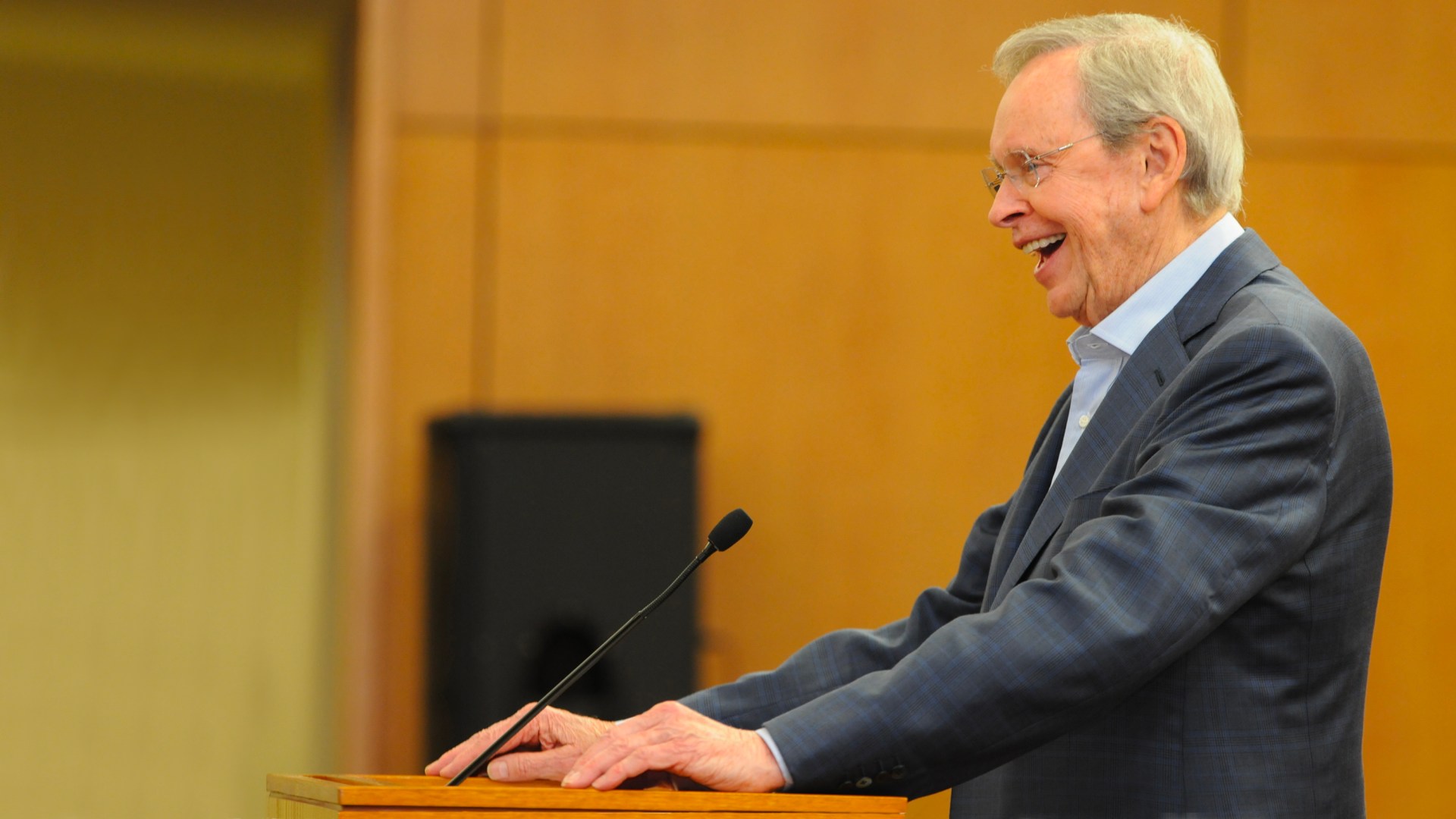
A shy, small-town boy from Dry Fork, Virginia became one of the most prolific broadcast preachers around the world. He also became a friend to my family.

Stanley pastored First Baptist Church of Atlanta for over 50 years and founded the global broadcasting organization In Touch Ministries. On Tuesday at the age of 90, he entered Heaven—a place he often described as his final and permanent home.

His ministry spanned 65 years, growing from humble origins to a worldwide reach. He authored more than 70 books and his sermons have been heard in over 127 languages internationally through radio, shortwave, television, and solar-powered audio devices.

Stanley’s appeal to diverse audiences was reflected not only in his global footprint, but also—perhaps most so—in the diversity of his local congregation at First Baptist Atlanta. This thriving church community incorporates members from over 100 nations who experience a wide range of socio-economic realities.

My family was one of those immigrant families who found a home at his church, which means Stanley’s influence played an integral role in shaping our trajectory. I came to know him as a spiritual grandfather of sorts: he discipled my dad in the 1970s, led my mom to faith in Christ in 1980, and personally encouraged me at critical points in my own journey for over three decades.

Stanley grew up in poverty during the Great Depression. His dad died when he was nine months old, and his mother worked at a textile mill to support them making $9.10 a week. At the age of 13 in 1945, Stanley became a newspaper delivery boy, working Mondays and Thursdays to earn a weekly wage of $4.

“It was a long route, and I had a lot of papers,” he reflected at his 80th birthday gathering. “I was often scared walking alone in the dark, but that’s when I learned to talk to God before the sun rose.”

In his mid-teens, Stanley borrowed $125 from the bank to buy a daily paper route where he could earn $16-$20 a week. “The first thing I did was make sure I tithe,” he said. He delivered newspapers in his town of Danville, Virginia, until heading to college.

“Your confidence and faith in God was not passive,” Andy Stanley told his dad in a 2020 interview discussing his upbringing. “Your work ethic has always been extraordinary; you work as hard as you can possibly work, and then you trust God to honor that.”

“I’m still a paper boy delivering news,” Charles Stanley remarked with a chuckle. “Good news.”

Stanley’s stated vision for the church he led over five decades was “to touch the world with the Word of God, motivated by a passion for God and compassion for people.” And that he did.

His preaching emphasized that salvation is available for anyone who believes. He focused on the fact that every individual must make a personal commitment to follow Christ as their only Savior and Lord.

That message gripped my mom’s heart when she walked down the aisle on a Wednesday night at First Baptist Atlanta in 1980. She left her Hindu belief system and stepped into a relationship with Jesus. “Dr. Stanley’s sermons emphasized that the scope of the gospel is universal, but also highlighted the exclusivity of Jesus as the Way, the Truth, and the Life,” she recounts.

Stanley’s Pentecostal upbringing sometimes showed through in his worship preferences, and he referenced the Holy Spirit in almost every sermon and book.

I think one of the many enduring aspects of his legacy is the compelling way he combined theology and life application. He always anchored himself in Scripture, while reminding his listeners that intimacy with God was the highest priority and that it would determine the impact of our lives. The “30 Life Principles” that guided Stanley were woven throughout his sermons, writing, and public interactions as he exhorted others to grow in knowledge, service, and love of God.

Stanley personally encouraged me in various seasons of my life. I still remember how he gave me my first “grown up” Bible when I was a spunky six-year-old in first grade (“Now you be sure to read this,” he admonished), how he came and spoke to my high school youth group (“Never sacrifice your future for the pleasure of a moment,” he cautioned a room full of rambunctious teenagers), and how he prayed with me during some of my most challenging days in college and beyond (he loved to quote Joshua 1:9). Each of these encounters left an indelible mark on my heart and mind.

Some knew Stanley as an evangelical stalwart, a founding member of the Moral Majority, or president of the Southern Baptist Convention during a pivotal juncture for the denomination. As a leader in the SBC’s conservative resurgence in the 1980s, he led the movement to affirm the inerrancy of the Bible and restore its focus on uncompromising evangelism and the faithful proclamation of the gospel message.

He preached to presidents and dignitaries, never backing down when it came to defending the truth of Scripture. And he was a pastor to little ones, often kneeling down to look children in the eye and tell them about God’s love. His bus tours garnered massive and diverse book-signing lines in cities big and small—demonstrating his unique ability to connect authentically with individuals from many different backgrounds.

Although he had well-defined political views, he largely stayed out of the partisan fray to avoid being distracted from his goal of taking the gospel to every place, people, and culture.

Stanley was America’s longest-serving pastor with a continuous weekly broadcast program which has aired since 1980.

His steady, resonant voice was unmistakable. It combined bold conviction with heartfelt empathy—at once speaking as a concerned parent committed to orthodoxy and as a tenderhearted friend who cared for the individual.

Stanley was able to translate deep theological truths into practical life principles. His insights were engaging enough for seminarians and scholars and yet simple enough for children to understand.

His preaching wasn’t heard only in church sanctuaries and Christian media, but also in airports and sports bars, and even in the world’s most isolated and dangerous places—from war zones in the Middle East to the streets of Asia’s most impoverished slums.

“I would hear his voice all the time, especially in the red-light district in New Delhi,” a social worker involved with anti-trafficking efforts in India told me this week, describing how she’d often walk past a row of brothels in a back alley and hear the voice of Charles Stanley preaching.

“Many of the women who were trafficked were not even allowed to have cell phones, but the madams would allow them to have the Messengers from In Touch Ministries for entertainment. It’s probably the only sermons and Bible teaching many of those women ever heard.”

The Messenger is a solar-powered device pre-loaded with an audio Bible and Stanley’s sermons in over a hundred different languages. It is through this medium that Stanley’s words have reached thousands of unlikely places across the globe.

Since 2007, these devices have been distributed to hundreds of thousands of people who have limited access to electricity and internet—including in remote villages and rural churches. Some eager recipients use his messages to learn English, while aspiring pastors leverage them to plant and lead house churches.

Stanley may have been a preacher of old-time religion, but he was always excited to adopt new technologies to reach more people around the world.

The last time I saw Stanley was the week of his 90th birthday last September. After an outdoor gathering with In Touch Ministries staff, I went up to his office with him and a few others. He cut a small chocolate cake and reminisced about his milestone birthday celebrations through the decades. His voice was frail, yet his spirit was strong.

Dr. Charles Stanley and Ruth Malhotra on their last visit together.Courtesy of Ruth Malhotra
Dr. Charles Stanley and Ruth Malhotra on their last visit together.

I shared with him that I’d soon be speaking at a business leaders’ conference and planned on referencing his teaching on true success. “You taught me that ‘genuine success is the continuing achievement of becoming the person God wants you to be and accomplishing the goals he has helped you set,’” I said, quoting from one of his past sermons verbatim.

“Say it again,” he responded, visibly choking up. “Those are your words,” I reminded him, obliging his request.

“Ruthie, if you say it just like that, they’ll remember it,” he told me with tears in his eyes. “Dr. Stanley, you said it just like that when I was a little girl, and I still remember it,” I replied.

Millions of people remember Stanley’s words because he said it “just like that,” pointing us to the truth and goodness of the gospel message with clarity and grace—and with a humble confidence that reflected the Savior he served faithfully.

Alongside the words of wisdom he’s spoken from the pulpit, I’ll treasure the moments of banter we shared through the years.

An avid photographer, Stanley traveled far and wide capturing the beauty and majesty of God’s creation. His stunning images adorn the walls of First Baptist Atlanta, In Touch Ministries, and homes around the world—including my own.

He once gave me an impromptu lesson on how to get just the right shot.

“It’s all about the light,” he told me with a twinkle in his eye. “Remember that when you take those pictures.”

I love you, Dr. Stanley. Thanks for being my pastor. You were a familiar face on television for many, and a real neighbor to me. I know you’re taking pictures on the streets of gold in the eternal city where it truly is all about the Light.

Ruth Malhotra is passionate about helping Christians communicate truth with clarity and grace. She manages strategic partnerships for Ronald Blue Trust and is a member of First Baptist Church Atlanta.

News

Chicago Settles $205K Case to Allow Evangelism in Millennium Park

After security stopped Wheaton College students from sharing their faith, a federal lawsuit forced the city to change its speech rules.

Anish Cooper's "Cloud Gate," also known as the "Bean," was a flashpoint in the debate about Wheaton students' park evangelism.

Anish Cooper's "Cloud Gate," also known as the "Bean," was a flashpoint in the debate about Wheaton students' park evangelism.

Christianity Today April 19, 2023
Scott Olson / Getty Images

The city of Chicago has settled with four Wheaton College students who were prohibited from evangelizing in the city’s Millennium Park in 2018. The case pushed the city to change park regulations to allow evangelizing and other public speech.

The city council approved a $205,000 settlement on Wednesday, which includes $5,000 each for the students as well as attorneys’ fees for the five-year litigation.

“I’m thankful that the gospel is going to be preached in Millennium Park again,” Caeden Hood, one of the Wheaton students, told CT. Hood has graduated from Wheaton and is now studying at Knox Theological Seminary in Fort Lauderdale, Florida. “We’re willing to work with the authorities. … That’s fine. We just don’t want the proclamation of the gospel to be hindered.”

A group of Wheaton students would go to Chicago every Friday, into the subways or on street corners, and start conversations, pass out tracts, or do street preaching. Sometimes they would go to Millennium Park, one of the most popular parks in the city with the famous “Bean” sculpture.

City rules prohibited “the making of speeches” and passing out of literature in most of the 24-acre park. In 2018, park security had asked Wheaton students passing out tracts to stop, which they did, but then in subsequent interactions security also stopped them from evangelizing. Four students—Hood, Matt Swart, Jeremy Chong, and Gabriel Emerson—consulted with a Wheaton professor who reached out to a Christian law firm, Mauck & Baker.

Attorney John Mauck had previously handled religious land use cases, especially for Black storefront churches in Chicago that were being zoned out of their spaces. He became one of the architects of the Religious Land Use and Institutionalized Persons Act of 2000, a federal law that prohibits using land use law to infringe on religious exercise. The Wheaton students didn’t have any money to pay a lawyer with an expertise in constitutional law, but the firm took the case on its own dime.

The firm filed a federal lawsuit in 2019 alleging infringements on the students’ free speech and free exercise of religion. Other individuals who had their own confrontations with park security over collecting signatures for ballot referendums in the park joined the suit as intervenors.

Arguments played out over years and with pandemic delays.

In a 2019 evidentiary hearing in the case, Scott Stewart, executive director of the Millennium Park Foundation, testified that the park was different from other public parks because it was designed as a series of artistic “rooms”—an argument that the park was not a “public forum” where the First Amendment would apply.

In the hearing, Stewart conceded that someone might pass out the novel Moby Dick but not religious literature in the park, and another park official, Ann Hickey, said that the prohibited speech in the park depended on the “intent.”

Based on that testimony, federal judge John Robert Blakey in 2020 ruled that the park was enforcing “vague provisions in a discriminatory manner” and issued a preliminary injunction.

Blakey wrote that the park was clearly a public forum protected by the First Amendment: “It is free, open to the public, and serves as a public thoroughfare.”

“Indeed, if a ‘curated design’ were enough to transform the nature of the forum, any park with a statue could lose its First Amendment protections,” he wrote. “The law precludes this absurd result.”

In 2020 the city put out new park rules, but the court said those rules may still “fall short of constitutional requirements.” The rules now clarify that they do not “restrict First Amendment activity on the sidewalks throughout the park.”

Mauck told CT that the students had an earlier opportunity to settle, but one condition of the settlement was no evangelism in the vicinity of the Bean. The students refused since the Bean is such an important gathering place.

The compromise they agreed to with the city was that evangelizing near the Bean was allowed, but not handing out literature. And in areas where literature handouts are allowed, people can offer literature once but not again.

“We live in the real world. We have to compromise. But I don’t feel Scripture authorizes us to give away other people’s rights to hear the gospel,” Mauck said.

Street preaching is culturally uncomfortable in the US but not in many other parts of the world, say those who do evangelism.

Public evangelism “causes us to recoil in a way that it would never have done five, 10, 20 years ago,” said R. York Moore in a 2019 interview with CT about the students’ case. At the time, Moore was the national evangelist for InterVarsity Christian Fellowship USA.

“As the social perception and policy restrictions continue to push proclamation out of view, Christians will eventually have no choice but to pay a higher price for the proclamation—either as lawbreakers or subversives,” Moore said.

Hood, one of the Wheaton students, said he had “fooled around” his freshman year at Wheaton but decided to “pursue God whole-heartedly” his sophomore year and joined the evangelism team. He started reading the Bible more often.

“I started to see the way the Bible talks about the Word of God,” he said. “Jesus says, What you’ve heard from me, proclaim from the housetops. Jeremiah talks about hearing from God, and he can’t hold it in anymore. He said it’s like a fire in his bones. … Stuff like that gave me a sense of confidence.” He had never preached out in public like that before, and it was “a little uncomfortable … I tend to struggle with attention.” But he grew more comfortable over time.

The case brought public attention to the students, too. Mauck had warned the students, as he does with most clients, that the city might drag the case out for years as a legal strategy, and asked if they would “hang in there” as plaintiffs.

“Usually they don’t understand how that can wear on them and cause anxiety,” Mauck said. “In this case it helps that we have four [Christian] brothers who know each other and can encourage each other.”

The case did drag out for years, but the four stuck with it. Two of the others are in seminary at Mid-America Reformed Seminary, according to Hood. Hood still evangelizes in Florida where he is in seminary, and says the others have been evangelizing where they live now.

“That’s all that matters to me at the end of the day,” he said.

Books
Excerpt

Save the Planet. Read Nature Fiction.

As an ecologist, I believe that works of literature draw us closer to God and deeper into creation care.

Christianity Today April 19, 2023
Illustration by Karlotta Freier

In my senior year of college, I studied ecology in Costa Rica and Ecuador. For two weeks, I lived with other students on a small boat in the Galápagos Islands. On one of our excursions, the captain told us there were whales in the area, and I went up to the deck just in time to see a humpback swimming straight at the side of our boat.

The Wonders of Creation: Learning Stewardship from Narnia and Middle-Earth (Hansen Series)

The Wonders of Creation: Learning Stewardship from Narnia and Middle-Earth (Hansen Series)

IVP Academic

144 pages

$13.24

At what seemed to be the very last second, the whale turned on its side and looked up at me. Staring into the eye of that whale was one of the most wondrous moments of my life. In that moment, I experienced awe and joy. I was deeply curious about the whale and felt compelled to act—to learn, to change, and even to protect.

That encounter lasted only a minute, if that, but it had a profound effect on me. In the years since then, I’ve had similar experiences while camping or hiking or wandering beyond a trail. Not everyone experiences creation in this way, nor is everyone physically able to hike through natural landscapes. Still others simply don’t have access.

Nevertheless, I believe everyone can pursue wonder by spending time in fictional landscapes.

On this topic, the works of C. S. Lewis have been significant to me. I remember the first time I “heard” Aslan’s song in The Magician’s Nephew:

In the darkness something was happening at last. A voice had begun to sing. … The voice was suddenly joined by other voices; … the blackness overhead, all at once, was blazing with stars. … The Lion was pacing to and fro about that empty land and singing his new song. … And as he walked and sang the valley grew green with grass. It spread out from the Lion like a pool. It ran up the sides of the little hills like a wave. In a few minutes it was creeping up the lower slopes of the distant mountains, making that young world every moment softer.

As I read, I was transported back to beautiful landscapes I had experienced in my life. I mentally revisited places where I had experienced deep joy—places that have left me with many more questions than answers.

Lani Shiota, a social psychologist who studies emotion, describes “wonder as that moment when our minds are trying to stretch, to take in and comprehend whatever it is that’s before us.” Through Aslan’s song, Lewis invites us into this space of wonder. We’re encouraged to comprehend the beauty of what we are seeing and hearing.

In the Narnia creation story, we see moles, frogs, elephants, and even a lamppost emerge. As we contemplate the cacophony of these beginnings, something stirs in us. Lewis writes:

The Lion was singing still. But now the song had once more changed. It was more like what we should call a tune, but it was also far wilder. It made you want to run and jump and climb. It made you want to shout.

If we understand wonder as virtue, as suggested by Hope College professor Steven Bouma-Prediger, “we exhibit the virtue when we have the cultivated capability to stand in grateful amazement at what God has made and is remaking.” I believe this gratitude for the wonder and beauty of nature should lead us to act through stewardship of creation.

In his essay “Wonder and the Critical Encounter,” philosopher H. Martyn Evans agrees that awe should move us to action. He suggests that wonder is a “transfiguring encounter” that results in an “altered, compellingly intensified attention to something that we immediately acknowledge as somehow important.”

Can a reader’s experience of fictional landscapes shape her interaction with actual landscapes? I believe so. I am moved to action when I hear Aslan’s song. When I am in Narnia, I respond to Aslan’s request “to be”: “Narnia, Narnia, Narnia, awake,” he says. “Love. Think. Speak. Be walking trees. Be talking beasts. Be divine waters.”

Awe is the first step to developing the virtue of ecological wonder, which enables our response to the call to be stewards of creation.

Experiencing wonder has important theological implications as well. If we believe, as Paul writes in Romans, that “God’s invisible qualities—his eternal power and divine nature—have been clearly seen, being understood from what has been made, so that people are without excuse” (1:20), then spending time in creation helps us understand more about our Creator and develops in us the virtues of wonder and gratitude.

These virtues require that we look very closely at the world around us. I often refer to the practice of deliberate attention to nature as “reading landscapes,” and in many of my courses I try to help my students develop this discipline. I typically ask them to spend time observing the details of a place through what they see, hear, smell, and feel.

In practicing this discipline, I want them to learn that when we slow our lives and take time to engage in a close reading of creation, we’re then able to turn our focus and wonder toward the Creator. In this way, exercising deep attention to nature is similar to interpreting religious texts because it facilitates a relationship between us and God, the Author and Creator.

Awe begins this transformative work. As we pay close attention to nature, we’re more likely to notice the amazing aspects of God’s creation. And as we develop the virtue of ecological wonder, we begin to practice the divine call to stewardship.

This essay was adapted from The Wonders of Creation by Kristen Page. Copyright (c) 2022 by The Marion E. Wade Center. Used by permission of InterVarsity Press.

Apple PodcastsDown ArrowDown ArrowDown Arrowarrow_left_altLeft ArrowLeft ArrowRight ArrowRight ArrowRight Arrowarrow_up_altUp ArrowUp ArrowAvailable at Amazoncaret-downCloseCloseEmailEmailExpandExpandExternalExternalFacebookfacebook-squareGiftGiftGooglegoogleGoogle KeephamburgerInstagraminstagram-squareLinkLinklinkedin-squareListenListenListenChristianity TodayCT Creative Studio Logologo_orgMegaphoneMenuMenupausePinterestPlayPlayPocketPodcastRSSRSSSaveSaveSaveSearchSearchsearchSpotifyStitcherTelegramTable of ContentsTable of Contentstwitter-squareWhatsAppXYouTubeYouTube