Culture

Christian Boomers Like Me Want Change Too

Some of us are working to change the unhealthy evangelical church culture we helped create.

Christianity Today January 4, 2023
BenMc / Lightstock / Edits by CT

In the last couple of decades, American Christian boomers (myself included) have been given an advance peek at the kind of obituary the church and the world has already begun to write about us.

Countless think pieces, podcasts, and online conversations have issued well-founded concerns and questions about the failures, flaws, and foolishness of evangelical church culture. These critiques are a magnifying mirror for baby boomers, since most of them speak directly to church cultures we helped create and support.

Not all these critiques are made in good faith—whether they’re from political scientists, sociologists, op-ed writers, exvangelicals, or from the generations born before and after us—but a surprising majority of them are.

For example, CT’s Rise and Fall of Mars Hill podcast details the leadership failure and organizational implosion of the church franchise led by Mark Driscoll. And while Driscoll himself was a Gen X pastor, Mars Hill was nourished in the soil cultivated by boomer megachurch leader culture.

Beyond the cavalcade of prodigal leaders exposed with predictable regularity for their abuses of power, boomer Evangelicalism has often been characterized in the broader culture by who and what we oppose, instead of whom we claim to serve.

As a result, our kids and grandkids are vacating the churches we built and inhabited with the goal of passing on our faith to the next generation. But they’re not the only ones leaving.

In my own writing over the past decade about spiritual formation in midlife and beyond, I’ve heard from hundreds of people my age who have been wounded by the very faith systems our generation created. Some boomers were chased away, while others quietly drifted out the door. In a CT piece earlier this year, “The Church Is Losing Its Gray Heads,” Adam MacInnis offered a snapshot of many boomers who’ve exited the church building, even though “just under half of Christians over 40 who stop attending church feel they’re still practicing their faith.” Like some members of the younger generations, many boomers still love Jesus, but not the local churches they once attended.

The late Phyllis Tickle famously observed that the church engages in a kind of spiritual rummage sale that every 500 years or so—and in these times of “rearrangement and upheaval,” the “institutionalized church throws off things that are restricting its growth,” which allows a “more vital form of Christianity” to arise in the aftermath.

And so, in a generation characterized by an abundance of hubris, our repentance will require the opposite of us if we are to do the necessary work of reflection and repair. As we ponder the first draft of our generation’s obituary, we should consider what must be tossed—and what is worth investing our final years to pass on to our own spiritual heirs.

Michael Metzger of the Clapham Institute summed it up well: “To date, our legacy as Baby Boomers is indulgence, narcissism, and moralism. If we are to emerge as wise elders, our view of faith, fame and forever ought to migrate from Boomer biases to a more biblical Christianity.”

Part of this reflection means recognizing the legacy-worthy gifts boomers have brought to the church. Sure, those who come after us will continue to assess the value of those gifts—deciding what to put in the rummage-sale pile of history—but it helps to recognize that our bequest contains some things that might be worth holding on to.

For one, Boomers played an outsized role in encouraging greater authenticity in the church.

We learned from our culture in the 1960s to let it all hang out. As that messaging filtered through the church in subsequent decades, it became more acceptable to share our struggles and questions in Christian community.

The church can still be characterized, sometimes cartoonishly, as a performance-oriented place, full of plastic smiles and unwritten rules. But that stereotype is far less true now than when I first found my way into evangelical circles in the 1970s.

The unwritten rule of the churches I attended back then was that it was only acceptable to talk about your struggles if they happened before you were a Christian. SNL star Dana Carvey’s Church Lady character may have exaggerated church life for comic effect during the 1980s, but too many congregations back then seemed to encourage a religious facade.

While such “church ladies” still exist, their voices are not in the majority for what is considered acceptable in many church circles today.

Secondly, boomers have helped lead the movement toward both destigmatization and education of mental health issues in many evangelical streams.

Boomer megachurch pastor Rick Warren and his wife, Kay, lost their son to suicide nearly a decade ago and have used the loss to launch a broader conversation about mental illness in the church. Writers like Amy Simpson and Carlene Hill Byron are challenging congregations toward understanding and meaningful care for those suffering with mental illness. The National Alliance for Mental Illness has a new division focusing on faith communities.

And the voices naming and addressing trauma—including church-related spiritual wounding—have multiplied as well. Authors like Diane Langberg and Peter Scazzero, as well as training programs (like this and this) for church leaders are now available to help church leaders approach ministry with a fuller understanding of trauma.

There’s still much work to be done in how the church embraces mental health issues, but it has certainly come a long way over the past few decades.

Third, many boomers have joined, and in some cases are leading, the effort to create safe communities for those who have experienced church abuse.

Christian social media can be a cesspool of conspiracy theory, bullying, and wacky theological hot takes. But it has also been an essential connection point for survivors of abusive leaders or toxic congregations.

In The Four Loves, C. S. Lewis said that “the typical expression of opening Friendship would be something like, ‘What? You too? I thought I was the only one.’” Social media has created powerful fellowship as survivors discover they aren’t the only ones—and this has brought them together to drag into the light what has festered in the dark corners of the church.

Some of those whistleblowers, like Christa Brown, have been boomers, calling out the sins of their leaders. And as such individuals courageously share their stories in public to seek justice, they pave the way for other victims to tell their own stories.

Finally, many boomers are exhibiting a growing distaste for evangelical leader culture.

Perhaps the boom bubble in churches built around the pastor-as-CEO or spiritual Ted Talk gurus hasn’t quite burst, but it seems to be deflating—and few seem interested in reviving it.

While mostly anecdotal, I hear regularly from boomers who have been burned or are burned out from their nondenominational megachurches. Many are seeking simpler, more organic forms of gathering with other believers for worship and fellowship—or they’re finding their way into churches with formal liturgy and denominational structures.

In both of those seemingly divergent cases, they’re leaving aside org-chart-driven church busywork that fractured their souls and are in search of greater meaning and wholeness. In fact, these are the spiritual tasks that I feel should characterize the latter years of our lives.

More than a few boomers today are quietly seeking to dismantle the broken religious systems we helped build—as we recognize how fruitless many of them have become. Perhaps this will be our most powerful legacy of all.

And while we boomers of faith won’t be around to see how things unfold in the larger movement, we can spend the time we have left rewriting our own obituary.

This rewriting begins with the kind of unflinching humility prescribed in James 4:7–10—wherein we humbly submit ourselves to God and trust that he will uphold us. Only this heart posture will allow us to own our specific sins while recognizing the impact our generation’s proclivities have had on those who come after us.

For example, I spent a couple of years on staff at a church with an abusive leader. And although I tried to effect change while on the inside of the organization, the truth was that I benefitted in some ways during those years from my access to power. Meanwhile, many members in the congregation were wounded by the church’s toxic culture.

To adopt the kind of repentance James describes in his epistle, I have had some hard but cleansing conversations with those wounded by this leader—and by my apparent complicity. Now, when I hear the countless stories of spiritual abuse, I can listen without feeling the need to justify my earlier choices. Instead of responding defensively, I can grieve and lament with them.

But this grief carries gospel hope. God has been at work in every age, and he is at work here and now. We can’t overwrite the past, but we can amend the present for the sake of those to whom we’re passing the torch of faith. And while we may not be able to change the spiritual heritage of an entire generation, we can try to flip the script on the legacy of our own lives.

Michelle Van Loon is the author of seven books, including Becoming Sage: Cultivating Meaning, Purpose, and Spirituality in Midlife.
News

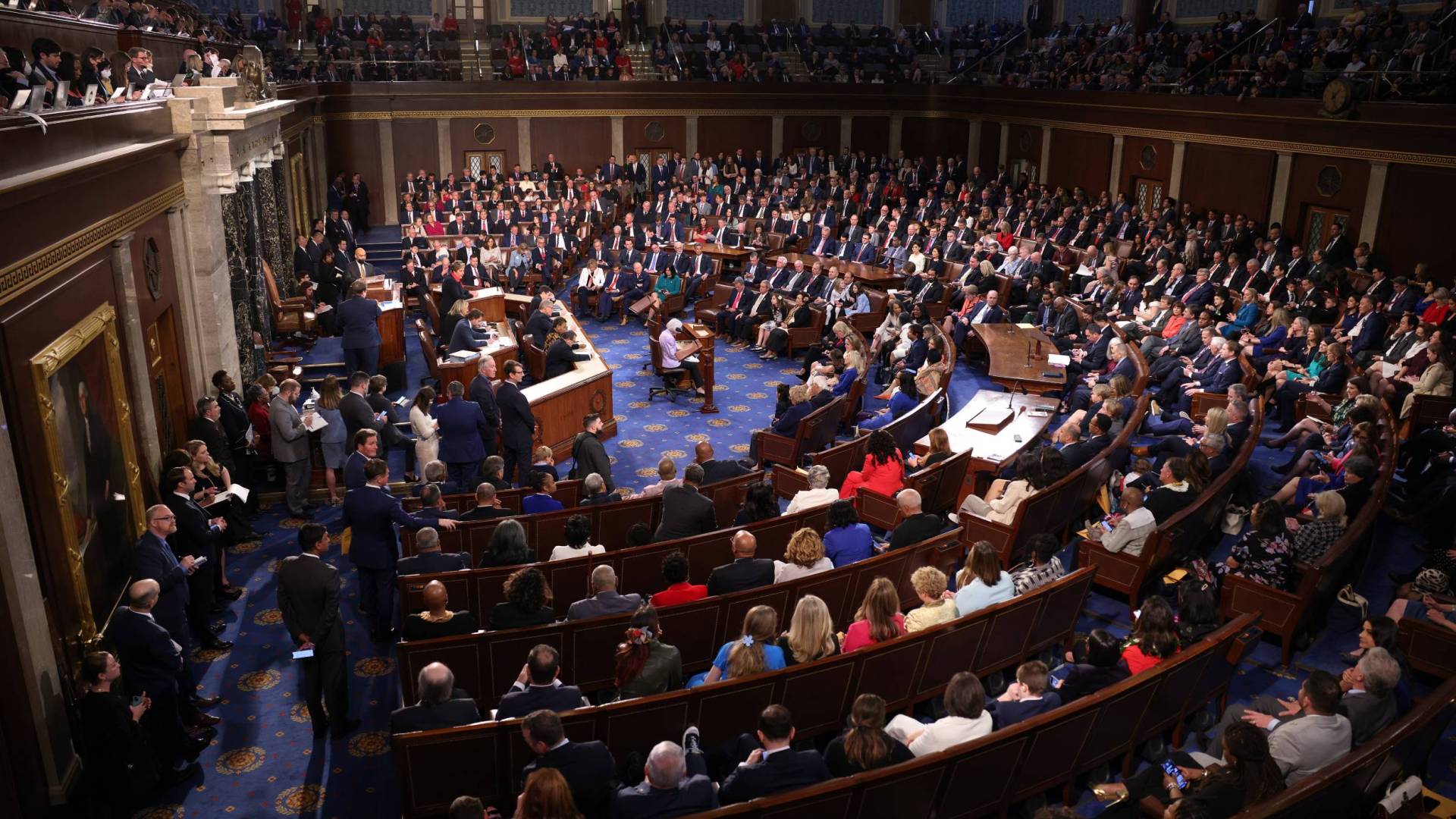
Congress Remains Far More Christian than the Country

Denominational identity is dropping among lawmakers, but few are “nones.”

Christianity Today January 3, 2023
Win McNamee / Getty Images

For the first time in the history of Pew Research Center’s Faith on the Hill report, you’re more likely to find a Baptist inside the halls of Congress than outside it.

As major denominations continue to decline, there’s a widening gap between Americans’ religious affiliations and those of their representatives.

In the 118th Congress, 88 percent of legislators identify as Christians, compared to 62 percent of US adults. Just one of Congress’s 534 members is unaffiliated (0.2%), compared to 29 percent of the country.

In 2023, the number of Baptists in Congress—the most popular denominational identity—held relatively steady at 13 percent, while Baptist affiliation declined nationally, down to 11 percent from 15 percent two years before.

There are currently 57 Baptists in the House and another 10 in the Senate, including Southern Baptists Ted Cruz, Mitch McConnell, Lindsey Graham, and James Lankford. Other Baptists, such as Raphael Warnock, come from predominantly African American Baptist denominations like the Progressive National Baptist Convention.

Going back to 2008, the percentage of Americans who identified as Baptist had always exceeded Baptist representation on the Hill. For years, mainline traditions were overrepresented in the House and Senate, and members of Congress had been less likely than the US overall to identify with affiliations like Pentecostal and nondenominational.

Recently, though, more Christian lawmakers are picking generic labels rather than identifying with a particular denomination. In the 118th Congress, representatives were nearly twice as likely to call themselves “unspecified/other” Protestants (20%) or nondenominational (2.8%) than the most popular denomination (Baptist, with 12.5%).

The trend is even stronger with newcomers to Congress. Among the 52 freshman legislators who are Protestant, half are “unspecified” or nondenominational Protestants, many of them evangelical.

Eli Crane, an incoming congressman from Arizona who falls in that category, has shared his testimony in a series on Pray.com and referenced a formative period under the leadership of Miles MacPherson at The Rock Church, an evangelical congregation in San Diego.

Another new unspecified Protestant in Congress, Missouri Rep. Mark Alford, who attends Evangel Church in Kansas City, posted Proverbs 3:5-6 ahead of Monday’s swearing-in.

“Give me discernment and wisdom and courage in the decisions I make here in Washington and give me compassion and understanding for … our constituents back home,” he prayed.

While unspecified Protestants gained 11 seats in Congress and nondenominational Protestants added three, denominational groups either kept the same numbers—like Baptists and Lutherans—or declined—like Methodists, Presbyterians, and Episcopalians.

Those three mainline groups each have fewer members in this Congress than they did the session before, with Methodists losing four members and going down to 31; Presbyterians losing one member and going down to 25; and Episcopalians losing four and going down to 22. There are also ten fewer Catholic lawmakers this session.

While the religious makeup of Congress is beginning to reflect the decline of denominations and the rise of nondenominational evangelicalism, it’s missing the other major component of America’s shifting religious landscape: the “nones.”

Rep. Kyrsten Sinema of Arizona remains the only member of Congress who is religiously unaffiliated, a category that now comprises nearly a third (29%) of US adults and is the country’s fastest-growing faith affiliation. Another 15 Democrats and one Republican did not specify a religious affiliation.

Some smaller Christian traditions got a boost from newly elected leaders. There’s one more Orthodox Christian, Rep. Mary Peltola, a member of the Russian Orthodox Church who’s a Democrat from Alaska, bringing the Orthodox total to eight.

Just two members of Congress identify as Reformed, and both are from Michigan. Freshman lawmaker and Democrat Hillary Scholten (whose 2020 campaign CT covered) attends LaGrave Avenue Christian Reformed Church, while Republican incumbent Bill Huizenga is a Calvin University alumnus.

One new member, Florida Republican Rep. Anna Paulina Luna, identifies as a Christian and says she was “raised as Messianic Jew.” She is the only Messianic Jew in Congress.

News

Armenian Christians Endure Christmas Blockade in Artsakh

Closure of corridor to Nagorno-Karabakh by Azerbaijani activists stretches into third week.

A protester wearing the Armenian national flag stands in front of Russian peacekeepers blocking the road outside Stepanakert, capital of Nagorno-Karabakh, on December 24, 2022.

A protester wearing the Armenian national flag stands in front of Russian peacekeepers blocking the road outside Stepanakert, capital of Nagorno-Karabakh, on December 24, 2022.

Christianity Today January 3, 2023
Photo by Davit Ghahramanyan / AFP / Getty Images

There are no oranges in Artsakh for Christmas.

Celebrated on January 6 according to the local Orthodox calendar, holiday festivities will be curtailed this year in the disputed Caucasus enclave of Nagorno-Karabakh. Demonstrations by reported environmental activists from Azerbaijan have closed the one road connecting the mountainous territory to Armenia, and Russian peacekeeping forces have failed to intervene.

Over 100,000 Armenians depend on daily imports of 400 tons of food and medicine to the enclave they call Artsakh. With the blockade of the Lachin corridor now in its third week, local officials are warning of a humanitarian disaster as they implement price controls and ration remaining goods.

But the Christmas tree is lit in the central square of the capital, Stepanakert.

“People will carry on with the traditions as best they can,” said Aren Deyirmenjian, country representative for the Armenian Missionary Association of America (AMAA). “But we will reflect the love of a God who stays by your side, even when all goes wrong.”

During a 44-day war with 6,500 casualties in 2020, Azerbaijan recaptured three-quarters of its internationally recognized sovereign territory, before Russia engineered a ceasefire. The indigenous Armenian inhabitants controlled the enclave for the previous 30 years, claiming the right of self-determination in an unrecognized 1991 independence referendum.

Following its defeat two years ago, Armenia pursued peace treaties with neighboring Azerbaijan and Turkey, which had backed their Turkic Azeri kin with decisive drone technology. But these were interrupted by further clashes in which Azerbaijan seized more territory in Nagorno-Karabakh and even along Armenia’s border.

And beginning December 12, Azerbaijani activists set up camp to protest alleged illegal gold and copper mining, exported through Lachin back to Armenia. Terms of the armistice left Russian peacekeepers in charge of the road, with no Azerbaijani oversight.

“We can stay here for months,” stated one demonstrator.

Local residents have reported shortages, with no fruit in Artsakh’s markets—part of the traditional Christmas Eve feast alongside fish, rice pilaf, and raisins. More critically, hospital patients lack essential medicines, with only a handful allowed transfer to facilities in Armenia proper. Gas supplies were cut for three days in the winter cold. And about 1,000 residents were stranded in the border town of Goris—including 18 members of a children’s choir that had performed in Armenia’s capital, Yerevan.

Azerbaijan has denied it is imposing a blockade. Officials have said that anyone will be allowed travel through the Lachin corridor upon prior permission and submission to local inspection. If none pass through, they blame the Russians and Armenians.

In a guest editorial, South African evangelist Michael Cassidy calls for prayer and wisdom during this historic opportunity.Recent events here in South Africa have left us (and you, no doubt) gasping. History has again landed in our laps with the quantum leaps of courage taken by President F. W. De Klerk and the momentous advent to center stage of the Nelson Mandela mystique. Our nation has done an overnight course change, the rules of the political book have been rewritten, and the shape of the future has been irrevocably changed. A curious amalgam of heady hope, high-wire political adventure, and mega-uncertainty has settled upon the very soul of South Africa. Never in the history of our land has such weighty responsibility devolved upon the shoulders of two such different men of destiny: the white President of Today and the black Prisoner of Yesterday. It is the stuff of which epics are born.Indeed, it is the Mandela Moment, and in many ways a matchless moment. Yet it is also one fraught with political peril. If the church—especially the church of South Africa—does not live out Christian principles and pray them in to protect the process, then danger looms. Christians must pray with intense and earnest intercession that Jesus will have his way with us. Without such prayer, great and positive forward movements such as the one we are caught up in now can be derailed by the demonic powers.This is not an indulgence in medieval fantasies or fairy tales. Rather, it is a call for us to take seriously the biblical view that our fight is not against “flesh and blood” but “principalities and powers, the world rulers of this present darkness” (Eph. 6:12). So let prayer from the church of Jesus Christ in South Africa and worldwide be the first order of the day. We don’t want anything to go wrong.Our prayers need to focus on four areas. First, we must seek supernatural wisdom (see James 1:5ff.) for Mr. Mandela and his colleagues and for President De Klerk and his. There is nothing the Evil One would like more than to interfere with their efforts to bring healing, justice, and a new day to our land. Likewise, we must pray for physical, mental, and spiritual protection for both leaders and their advisers. The release of Mr. Mandela brings hope, but it also brings great risk.Let us also ask God to pour the spirit of magnanimity upon South Africa. This is really the “Calvary spirit,” for the Cross requires self-giving and unselfishness from whites. It requires whites genuinely and deeply to repent for the iniquities and inequities of apartheid. The Cross also requires the supernatural spirit of forgiveness from blacks for all that has been inflicted upon them. An African proverb says: “He who forgives ends the quarrel.” Martin Luther King, Jr., put it this way: “We must develop and maintain the capacity to forgive.… Forgiveness is not just an occasional act: it is a permanent attitude.”Finally, we must pray that in South Africa we may all be controlled by Christian principles. These would include dependence on God, love for enemy, humility, prayerfulness, mutual care, equality of dignity and opportunity, economic and structural justice (which is love built into laws, organizations, and institutions) along with national repentance (required from whites), national forgiveness (required from blacks), and reconciliation for and between all.We in South Africa ask Christians in the United States to pray fervently for us along these lines. And as you do, may the Lord bring his own gentle and probing scrutiny into your hearts to challenge you about whether Christian principles and prayerfulness are controlling your own nation as well.By Michael Cassidy, founder of African Enterprise.Members of mainline churches have gotten used to their denominational conventions pronouncing on the righteousness of social and political causes with which they may or may not agree. The distance between the pew and the convention is legendary. Many have learned to shrug it off, putting more faith in the common sense of local congregations than the machinations of national structures.Members of the American Bar Association (ABA), however, were not so sanguine earlier this year when the ABA House of Delegates adopted (by a vote of 238 to 106) a resolution opposing any legislation that tried to interfere with any woman’s access to an abortion. The resolution effectively gives the ABA the authority to file friend-of-the-court (amicus curiae) briefs in key cases regarding abortion (CT News, March 19, 1990, p. 49). So much for professionalism.ABA treasurer Joseph Nolan said he had heard from hundreds of lawyers who said they would resign if the resolution passed. And after the resolution passed (following two and one-half hours of bitter debate and parliamentary wrangling), Nolan himself resigned. ABA president Stanley Chauvin opposed the resolution, saying, “By no stretch of the imagination does this resolution come within the mission of the American Bar Association’s Constitution.” And president-elect John Curtin said he could not “in good conscience” sign any amicus brief supporting abortion rights and called the measure a “fundamental departure from the historic position [of the ABA] in protecting the rights of all.”Lawyers For Abortion?Are Nolan and Chauvin overreacting? We think not. Resolutions such as this one give the unknowing public the impression that the law profession is entirely on the side of unrestricted abortion. That, of course, is hardly the case. A similar misapprehension was created some years ago when the American Psychiatric Association removed homosexuality from its Diagnostic and Statistical Manual. The action was carefully orchestrated by pressure groups, and many in the helping professions are still smarting from that nonrepresentative action.So how did the ABA’s House of Delegates pass something that much of both its leadership and its membership opposed? How could it pass a controversial resolution that had nothing to do with its basic purposes of maintaining high standards for the practice of law? The answer is that the resolution’s backers were well networked and had the affair thoroughly orchestrated well before the membership at large got wind of the attempt.According to respected constitutional-law attorney William Bentley Ball, “So many conventions are badly attended. There is an inert mass of doctors, lawyers, and other professionals around the country, but zealous activists plan the policy of their organizations.”The solution, says Ball, is neither to retreat nor to resign. Since a relatively small percentage of ABA membership attends the national convention, a well-organized effort on the part of any special-interest group can wreak havoc when it’s time to vote. The ABA has 365,000 member lawyers, and a convention open to its full membership is scheduled for August in Chicago. The resolution is bound to be reconsidered there. We urge all those members who were upset and disgruntled over the handling of the resolution to register for that convention and, if necessary, to show their strength.All of us who belong to professional and learned societies—indeed, even those of us who belong to churches that are given to making pronouncements on controversial political and social issues—need to stay involved. And, occasionally, we need to raise a ruckus when our professional or organizational influence is manipulated by pressure groups and the public is given false impressions about important issues.By David Neff.For some time now, “good works” have been thoroughly devalued as the currency used to buy us the heavenly good life—thanks mostly to the work of the apostle Paul and Martin Luther. But the city of Miami has come to our rescue, giving “market” value once again to acts that until recently were at the mercy of altruistic whims. Because of jurisdictional concerns, however, all rewards are this-worldly.The brain child of law professor Edgar Cahn, who teaches at the District of Columbia School of Law, the “service-credit” system is based on classic market-capitalism principles. For every hour of volunteer work, a person gets a credit. That credit can then be redeemed.Service credit seems to be working. According to a report in Newsweek, Miami has the largest system in operation—700 volunteers who perform 8,000 hours of service work a month—but similar systems are already in place in Washington, Boston, San Francisco, and in a few smaller cities in the Midwest. The pragmatic value is undeniable. Many social services report increased effectiveness—as much as 800 percent in one instance.In a time when we are experiencing the rapid disintegration of families, neighborhoods, and other connective communities, this may be just what we need. If the Matthew injunction to “Love your neighbor as you love yourself,” or “Do unto others as you would have them do unto you” won’t work, why not “Love your neighbor for yourself”?But a funny thing happened in Miami: Only 1.1 percent of the credits earned have been “cashed,” a rate that is positively counterproductive. Heaven forbid that people get the impression good works are good in themselves. The basis for the whole system would crumble. And we wouldn’t want that, would we?By Michael G. Maudlin.

So far, only the International Committee of the Red Cross (ICRC) has gained access to Nagorno-Karabakh. Deyirmenjian said the Armenian social affairs ministry contacted the AMAA to participate in the ICRC’s 10-ton aid delivery, adding 220 pounds of infant formula to the first effort and 1,100 pounds of rice alongside two tons of sugar in the second.

Upon the aid’s arrival, the AMAA center in Stepanakert, located near the only Armenian Evangelical church in the enclave, coordinated distribution in the neighborhood, which included the congregation’s 125 members.

So far, local morale is high.

“Our office manager told me, ‘We are happy we are on this side of the blockade,’” Deyirmenjian said. “It gave me chills.”

Garegin Hambardzumyan concurs. A priest in the Armenian Apostolic church, he heads the Oriental Orthodox denomination’s Department for the Preservation of Cultural and Spiritual Values of Artsakh. Generations of Armenians have lived in the rugged, mountainous land for a thousand years, he said. They will not be scared away easily.

The Divine Liturgy for the January 5 Christmas Eve mass will be the traditional candlelight service, after which the faithful will carry the symbolic light of Christ back to their homes. Many will exchange gifts, and the church has distributed chocolate and Bibles to the 3,000 children who live in Nagorno-Karabakh.

“The family is the best place to feel the warmth of Jesus’ love,” said Hambardzumyan. “Continuing their life as if it were normal is a sign of dedication to their homeland.”

Last week, Armenia lodged a protest with the United Nations’ International Court of Justice, demanding the blockade be lifted. UNICEF, the UN institution for children, issued a warning. Pope Francis has expressed concern, and human rights organizations have called for unfettered access.

But some anticipate worse—a sinister continuation of history.

“The process of the Armenian Genocide has been ongoing since the Ottoman massacres of the late nineteenth century,” stated John Eibner, president of Christian Solidarity International (CSI). “Now, by placing Nagorno-Karabakh under blockade, the dictatorship of Azerbaijan is clearly telegraphing its intent to carry out another phase of the Genocide.”

Cosignatories to the statement include In Defense of Christians, International Christian Concern, and the Union of the Armenian Evangelical Churches in Eurasia. Prior to the blockade, Genocide Watch had already identified four of its ten stages of genocide at play.

An anonymous Christian leader in Azerbaijan pushes back against the charge. Withholding his name due to the sensitivity of commenting on political issues, he said the local discourse emphasizes the government’s intention to treat the Armenians of Nagorno-Karabakh as citizens, living peaceably in a multicultural nation. If they fight, they will be driven out, he warned. But there is no fear of genocide.

At the same time, he concurred with skeptical analysis about the protesters.

“We don’t care about ecology as such; this is not Sweden and Greta Thunberg,” said the source, who has authored a series of books exploring the spiritual consequences of historic geopolitics. “It is ridiculous; it cannot happen without direct order of the government.”

Peoples of the East are indirect, he said, dressing their pressure campaign in the guise of environmentalism to resonate with Western concerns. He believes the goal is to push Armenia to finalize a peace deal while Russia is distracted by its war in Ukraine. Azerbaijan wants to make clear it holds the upper hand.

Additionally, if the blockade sets up a checkpoint system into Nagorno-Karabakh, it will aid Azerbaijan’s national security. The government issued reports that allege Iranian security services have entered the enclave.

Azerbaijan, though a Shiite Muslim–majority nation, is allied with Israel and is a key supplier of natural gas to Western nations. Tensions with Iran have increased recently as both sides conduct military drills on the border.

Others posit a different rationale.

“Azerbaijan cannot take this step without the agreement of Russia—it is a combined action,” said Vazgen Zohrabyan, pastor of Abovyan City Church, northeast of Yerevan. “Moscow is ready to sacrifice the people of Nagorno-Karabakh for its economic interests.”

Also a political analyst with a master’s degree from Yerevan State University, he believes the Ukraine war has pushed Russia to side with Azerbaijan over interpretation of a clause in the armistice agreement. While the Lachin corridor was left under Russian peacekeeper supervision, the agreement’s final point called for the opening of all transportation routes, specifically mentioning the link between Azerbaijan and its Nakhchivan enclave.

A 20-mile railway once linked the oil-rich nation with its noncontiguous territory to the west, stretching along Armenia’s border with Iran. Azerbaijan calls it the Zangazur corridor (Armenians call it the Meghri highway) and wants an access arrangement similar to Lachin’s status now, with no customs control. The armistice says that Russian border police will oversee security.

For Azerbaijan, this will create a direct link with Turkey—bordering Nakhchivan—and the rest of Turkic Central Asia to the east. For Russia, this will provide a path to export its own natural resources through Azerbaijan to Turkey and eventually Europe, evading sanctions and the Western boycott, said Zohrabyan.

But as a pastor, his chief concern is humanitarian.

Abovyan City Church currently supports 30 families in Nagorno-Karabakh, a continuation of its emergency relief to hundreds during the war. And it recently partnered with a local businessman to open a bakery in Stepanakert, with 10 percent of its bread supply dedicated to the needy. Zohrabyan was due to attend the grand opening with the chief adviser to the enclave’s president—until the blockade halted traffic. The bakery remains closed, unable to find the necessary flour.

Holding the unpopular opinion that Armenia must forge peace with its enemy, he blames both sides for maintaining an atmosphere of distrust. But while the comparison between corridors is “logical,” he said, it is not “diplomatically legitimate.”

Lachin is the status quo and must remain open. Other routes are to be negotiated.

Until then, like many, he fears Azerbaijan is using its superior position to impose a checkpoint. He does not readily raise alarm but is concerned.

“When Lachin opens, it will be one way—out,” said Zohrabyan. “It smells like another genocide, to make life as hard as they can so that the Armenians will leave.”

In his New Year’s speech, Azerbaijan’s president Ilham Aliyev stated the Zangazur corridor would be opened “whether Armenia wants it or not.” But his rhetoric has gone further. He has highlighted the surrounding region as Azeris’ ancestral land—to which they will definitely “return.” He even described Yerevan as a “political and strategic goal” that Azeris “must gradually approach.”

Some view this language as positioning for negotiation. But others see a wider territorial ambition. Last month, Aliyev called the ethnic Azeris of Iran “our people” and said he would “protect [their] secular lifestyle.” And of the Zangazur corridor, his ambassador to Turkey stated it would connect the “torn Turkic world.”

Armenia is in between.

But within the current crisis, so are a few scattered villages. Armenia closed its border to prevent confrontations with Azerbaijani activists, isolating ethnic Armenian hamlets in the process. Inside Nagorno-Karabakh but on the other side of the blockade, they are suffering also.

In a “testimony to God’s work,” the AMAA was able to reach them. A female staff member in Yerevan loaded her car with flour, oil, and other necessities and went in faith.

Along the way, she received a telephone call from the office of the prime minister. She did not know the female staffer or how her number was obtained but politely thanked her for the offer of help.

Upon reaching the border, she needed it. Blocked by authorities, a quick phone call back to the official allowed her to pass. The beleaguered villagers received a “testimony to God’s love” amid geopolitical tension.

“Azerbaijan says it wants to live in peace,” said Deyirmenjian. “But starving a people gives little evidence you want to live together.”

News
Wire Story

The State of Quiet Time: Who’s Most Likely to Practice Daily Devotions

Survey finds that two-thirds of churchgoers set aside time with God at least every day, but practices vary.

Christianity Today January 3, 2023
Priscilla Du Preez / Unsplash

Most Protestant churchgoers spend time alone with God at least daily, but there’s a range in what they do in that time and what resources they use.

According to a study by Lifeway Research, nearly 2 in 3 Protestant churchgoers intentionally spend time alone with God at least daily, with 44 percent saying daily and 21 percent saying more than once a day.

Meanwhile, 17 percent of churchgoers say they are alone with God several times a week, and 7 percent say once a week. Others admit to being alone with God a few times a month (5%), once a month (2%), less than once a month (3%) or never (1%).

This time looks different for different churchgoers, but they are more likely to talk to God through prayer than to listen to him through his Word.

Churchgoers most often pray in their own words (83%), thank God (80%), praise God (62%) or confess sins (49%). Fewer than 2 in 5 read from the Bible or a devotional (39%). Fewer repeat a set prayer (20%), consider God’s characteristics (18%) or something else (1%).

But if churchgoers were to read something during their time alone with God, most would read from a physical Bible (63%). Others would read the Bible in a different format such as a Bible that includes additional commentary or devotional thoughts (25%) or Scripture from an app (20%).

Fewer than 1 in 3 say they would read from a devotional book that prints some Scripture (32%), and even fewer say they would read from a devotional book that doesn’t print Scripture (8%). Still, others say they would read a devotional from an app (7%) or read something else (3%).

Quiet time frequency

When it comes to spending time alone with God, women (48%) are more likely than men (38%) to say this is a daily habit for them. Those in the South (49%) are also among the most likely to say they spend time alone with God on a daily basis.

One in 4 Baptists (25%) say they have alone time with God more than once a day. And those with evangelical beliefs (30%) are more likely than those without evangelical beliefs (15%) to say the same.

https://datawrapper.dwcdn.net/Al9n0

Church attendance is also an indicator of quiet time frequency. Those attending worship services at least four times a month (26%) are more likely than those who attend one to three times a month (13%) to say they spend time alone with God more than once a day.

“We see a pattern in Scripture of followers of God withdrawing to spend time alone with him. Jesus Christ himself also did this,” said Scott McConnell, executive director of Lifeway Research. “Most Protestant churchgoers continue this relational interaction with God and use a variety of resources as they do.”

Preferences on prayer

When spending time alone with God, some prefer to pray in their own words, while others would rather repeat a set prayer. Younger churchgoers—ages 18-34 (31%) and 35-49 (26%)—are more likely than those 50-64 (16%) and over 65 (11%) to say they repeat a set prayer during their alone time with God. And those ages 50-64 (85%) and over 65 (89%) are more likely than those 18-34 (77%) and 35-49 (77%) to say they pray in their own words.

“There are many reasons to pray a set prayer. Whether someone is praying the model prayer Jesus gave or repeating the same request to God each day, these can be meaningful,” McConnell said. “At the same time, Scripture also records Psalms and prayers within its narrative accounts that show how personal and forthright we can be when talking to God in our own words.”

Females (86%) are more likely than males (79%) to pray in their own words. And those in the South (86%) are more likely to pray in their own words than those in the Northeast (77%).

Evangelical beliefs and the frequency of church attendance are also factors in how a person prefers to pray. Those who attend worship services at least four times a month are more likely than those who attend less frequently to pray in their own words (85 percent v. 79%). But those who attend a worship service one to three times a month are more likely than those who attend more frequently to repeat a set prayer (24 percent v. 16%).

Those with evangelical beliefs are more likely than those without such beliefs to pray in their own words (92 percent v. 76%), while those without evangelical beliefs are more likely than those who hold those beliefs to repeat a set prayer (22% versus 16%).

Preferences on practice

What it means to spend time alone with God varies from person to person. But there are some indicators of which practices are most important to different demographics of people.

While females are more likely than males to say they praise God (66% versus 57%) or read from the Bible or a devotional (42% versus 36%), men are more likely than women to say they consider God’s characteristics (21% versus 16%) when spending time alone with him.

Older churchgoers—those 50-64 (45%) and older than 65 (42%)—are more likely than those 18-34 (32%) and 35-49 (34%) to say they read from the Bible or a devotional when spending time alone with God. And those over the age of 65 are the least likely to say they consider God’s characteristics (10%).

Evangelical beliefs and church attendance frequencies are also indicators of a person’s preferences in spending time alone with God. Those who attend worship services the most (four or more times a month) are more likely than those who attend one to three times a month to praise God (67% versus 53%), confess sins (55% versus 38%) or read from a Bible or devotional (46 percent v. 28%).

And those who hold evangelical beliefs are more likely than those who do not hold evangelical beliefs to thank God (87% versus 74%), praise God (76% versus 51%), confess sin (64% versus 38%) or read from the Bible or a devotional (52% versus 29%). But those without evangelical beliefs are more likely than those with evangelical beliefs to consider God’s characteristics (20% versus 15%).

“An earlier discipleship study from Lifeway Research showed that praising and thanking God is one of the top five predictors of high spiritual maturity,” McConnell said. “This is a widespread practice among churchgoers when they are alone with God.”

Preferences on resources

Several factors play into what a churchgoer wants to read when spending time alone with God. The youngest adult churchgoers (ages 18-34) are the most likely to read Scripture from an app (40%) and the least likely to read from a devotional book that prints some Scripture (21%). And females are more likely than males to say they would prefer to read a devotional from an app (9% versus 4%).

“Today’s Christians have more resources than ever to aid them in spending time with God and his Word,” McConnell said. “As new resources are created, they can encourage someone who, without that innovation, wouldn’t have spent time with God. But there is also a strong relationship between spending time alone with God’s Word and worshiping frequently with others who may encourage you in your walk with God.”

Those with evangelical beliefs are more likely than those without evangelical beliefs to say they would read from a Bible (78% versus 52%) if they were reading something in their time alone with God. And those without evangelical beliefs are more likely than those with evangelical beliefs to say they would read from a devotional book that doesn’t print Scripture (11% versus 3%) or Scripture from an app (22% versus 17%).

While those who attend a worship service at least four times a month are more likely than those who attend one to three times a month to say they would read the Bible in their quiet time (70% versus 52%), those who attend one to three times a month are more likely than those who attend more often to say they would read a devotional from an app (9% versus 5%).

Books
Excerpt

The Image of God in ‘Invisible Man’

Ralph Ellison’s novel depicts the quest for personal dignity in a society determined to deny it.

Illustration by Chidy Wayne

“I am a man.” On February 12, 1968, over two hundred Black sanitation workers in Memphis, Tennessee, bore this revolutionary message written on signs and embodied in their protest against the work conditions that had led to the death of two fellow workers. The strike drew the support of Martin Luther King Jr., who would give the last days of his life to this cause. “You are here,” King proclaimed to those on strike, “to demand that Memphis will see the poor.” One of the sanitation workers described the motive and message years later: “We felt we would have to let the city know that because we were sanitation workers, we were human beings.”

Reading Black Books

Reading Black Books

Brazos Press

208 pages

$12.84

Christianity is no stranger to the importance of “I am” statements. God’s self-disclosure declared him to be I am (Ex. 3:14). Through seven “I am” statements, John’s gospel explains who Jesus is, the eternal Word made flesh. There is, then, both theological origin and depth to the “I am a man” declaration of those workers. The declaration is a demand to be recognized and seen as fully human and made in God’s image.

The image of God is like a doctrinal diamond, refracting multiple truths about humanity. Yet much standard Protestant theological reflection does not account for the doctrinal elephant in the room: What does it mean to live as an image bearer when other image bearers try to limit your existence?

Read through a theological lens, the classics of Black literature, like Ralph Ellison’s Invisible Man, can point us toward a rich and profound answer. Ellison’s attention to the embodied experience of invisibility pushes us into a deeper recognition that the imago Dei is a visceral doctrine concerned with blood and bones, dignity and freedom, bodies and sight.

Widely lauded as one of the finest 20th-century novels, Invisible Man is an expansive, landmark text, tracing the painful absurdity of Black life in the Jim Crow South and the thinly veiled racism of the urbane North. Ellison’s novel is comedic and tragic, gritty and surreal, mythic and symbolic, layered and accessible. At its center is Ellison’s nameless protagonist and his quest to find dignity in an American society devout in its denial of his humanity.

The novel opens with the protagonist, Invisible, mulling over his life’s journey with an arresting, metaphorical “I am” declaration: “I am an invisible man.” Readers quickly find that Invisible is not seen as a full human complete with autonomy and dignity. He is viewed only as a living pawn to be acted upon or moved in service to any agenda but his own.

What is the source of Invisible’s invisibility? As we quickly learn, it results not from any defect of his own but from the moral faults of those who behold him: “My invisibility … occurs because of a peculiar disposition of the eyes of those with whom I come in contact. A matter of the construction of their inner eyes, those eyes with which they look through their physical eyes upon reality.” This sort of diagnosis draws us toward the notion of sin—a malfunction of the spirit, a malady that burrows deeper than rational, surface externals.

The novel’s early battle royal scene is an appalling example of invisibility and its visceral, bodily consequences. As the high school valedictorian of his Southern school, Invisible is invited to deliver a speech on Black humility to an audience of the town’s most important white leaders. Upon arrival, Invisible is not called to the podium but forced by the white organizers to partake in the entertainment that precedes his speech.

What follows is a traumatizing, degrading debacle: Ten Black students are led into a smoky ballroom under the drunken gaze of “the most important men of the town … bankers, lawyers, judges, doctors, fire chiefs, teachers, merchants” and placed before a “magnificent blonde [woman]—stark naked” before being blindfolded, set in a makeshift boxing ring, and commanded to blindly beat each other battle royal style while the white townsmen hoot, holler, and hurl racial epithets. Bruised and beaten, Invisible is thankful to close the night with his speech, swallowing his own blood and saliva to expound on the need for Blacks to be humble and socially responsible. He’s rewarded with a briefcase and a scholarship to a Negro college.

The battle royal, in the novel’s view, is society in miniature: Representatives of every slice of society gaze upon Invisible as a means to an end, a human prop for fetishized entertainment and a muzzled voice for proclaiming that the absence of equality is due to the absence of Black responsibility. Even his rhetoric is confined to the talking points of a segregated society. The crowd hardly listens to a word of his speech “until, no doubt distracted by having to gulp down my own blood,” he blurts out the phrase “social equality.” Upon which “the laughter hung smokelike in the sudden stillness,” and “sounds of displeasure filled the room.”

In this moment, blood functions in pivotal ways that illumine the dignity and physicality of the imago Dei. Blood, of course, is charged with theological significance. In Scripture, blood makes expiation for sin (Lev. 17:11) and “the life of every creature is its blood” (Lev. 17:14). Life, both temporal and eternal, is a matter of blood.

To even utter words that hold Black people responsible for the problem of white racism—the message that appeases the white crowd—Invisible must swallow his own blood, the very substance of life within him. To champion social responsibility as the path to human dignity is to deny one’s God-given humanity as an image bearer. Dignity is not earned; it is given by the very hand and heart of God. This is the reality Invisible must swallow and deny in order to proclaim responsibility as the way out of invisibility.

At the same moment, his blood cries out like Abel’s, though not from the ground but from within his own body. Invisible, “distracted by having to gulp down” his own blood, calls unintentionally for social equality. It is blood, the source of life and salvation, that causes a divine slip of the tongue: Image bearers are made for dignity and freedom.

Visibility and dignity are at the crux of much of African American history. When early Black church leaders like Richard Allen and Absalom Jones simply wanted to pray in the front of their church undisturbed, they sought to be seen in body and soul. When Sojourner Truth raised her voice to speak for the rights of Black women, declaring, “Ain’t I a woman?” she effectively issued a rhetorical demand to be seen.

Invisible’s realization of his invisibility is a traumatic awakening that builds like a cursed crescendo. For most of the novel, we watch as he lives with pharisaical adherence to the laws of respectability politics and ideals of personal responsibility, only to be boomeranged back and forth between false hope and dehumanizing embarrassment, finding himself used and discarded by each figurehead and institution he encounters.

Living invisible—as one whose dignity is given by God but denied by humanity—produces profound internal tension. Invisible’s existence is marked by a “painful, contradictory voice … within me,” a pulsating “guilt and puzzlement” as he feels the pull of revenge toward an unjust society and his “obsession with my identity” in the form of questions like “Who was I, how had I come to be?”

The story line of the novel advances as Invisible experiences the whiplash of his invisibility and responds with new strategies—from personal responsibility to career prospects to political activism—for asserting his personhood. In particular, education, via the scholarship to a Negro college won at the battle royal, becomes Invisible’s messianic hope. But he soon suffers a crisis after chauffeuring the school’s white trustee, Mr. Norton, on a voyeuristic ride to observe the troubling lives of nearby rural Black folks, leaving the trustee deeply traumatized.

The Negro college president, Dr. Bledsoe, castigates Invisible for not knowing that he should have kept him on the campus. After rebuking Invisible (“instead of uplifting the race, you’ve torn it down”), Dr. Bledsoe expels him from the college and sends him into exile: He is to journey to New York City to work and earn tuition for the following year.

Dr. Bledsoe sends Invisible away with seven sealed letters addressed to “several friends of the school” who are meant to assist Invisible upon his arrival. Encouraged that the letters “were addressed to some of the most important men in the whole country,” Invisible enters his northern exile with a burgeoning sense of dignity, though this confidence is tempered, for the letters are seen by no one:

I caught myself wishing for someone to show the letters to, someone who could give me a proper reflection of my importance. Finally, I went to the mirror and gave myself an admiring smile as I spread the letters upon the dresser like a hand of high trump cards.

Understood theologically, Invisible’s desire for “a proper reflection of my importance” is the longing to be seen by others in such a manner that confirms the image of God in him and ratifies his inherent dignity. Unable to find this in a Jim Crow world, Invisible labors to give himself what he has not received from others. But with no one to properly see and affirm his dignity, Invisible’s turn toward the mirror falls flat, a demonstration that the image of God in us is most seen and celebrated in community, not in isolation.

The scene is tragic, for the letters in which he hopes are but a flimsy substitute for what he is himself: one made in God’s image. There is dignity in our merits, work, and education. But not the sort of foundational dignity that can bear the weight of defining us in a world often out to degrade us or to deify us. To know deep in one’s bones that one is made and loved by God is to be filled with reservoirs of resolve to image God in freedom and righteousness, no matter the world’s gaze.

Invisible arrives at his epiphany as a grassroots activist in Harlem for a multiethnic movement called “the Brotherhood.” At this stage in the story, he is a dynamic speaker under the marching orders of Brother Jack, a white man, and the movement’s mission to shape “a better world for all people.”

Here, too, Ellison’s protagonist is confronted with the ugly truth of his invisibility. In the eyes of this movement, he is less a person than a commodity. After Invisible leads an unauthorized protest, Brother Jack berates him, at which point Ellison shows us the root cause of invisibility from Invisible’s view:

Suddenly something seemed to erupt out of [Jack’s] face. You’re seeing things, I thought, hearing it strike sharply against the table and roll as his arm shot out and snatched an object the size of a large marble and dropped it, plop! into his glass. … And there on the bottom lay an eye. A glass eye.

Ellison’s protagonist thinks he’s been seen in his humanity—after all, he’s been a leader, speaker, and influencer in the movement—but the symbolism of the glass eye demonstrates otherwise. Those who possess a glass eye have, in the novel’s terms, a “polished and humane facade” of moral sight that hides a “harsh red rawness.”

Soon, Invisible experiences a deeper revelation: “I looked around a corner of my mind and saw Jack, Norton, and Emerson merge into one single white figure. … Now I recognized my invisibility.” Each branch of society embodied by these figures—and society as a whole—possesses a glass eye, a defect that renders Black life invisible.

Invisible’s conversion moment—his awakening—is visceral and visionary. He sees things on two planes: the physical—an eye erupting from an angry white face—and the spiritual—his mind prompting a transformative vision. Both revelations affirm that the invisibility of Black people is not the result of a fault in our being or doing. The fault of invisibility resides in the gaze of persons and institutions that blend into “one single white figure.”

Though we are not sinless, we are not at fault for the invisibility imposed upon us. Like all persons, we bear God’s image. Like all humanity, we share an existence and a nature that is at once broken and beautiful. Like all people, we possess in our very selves a humanity that is worthy of affirmation, that demands an embodied freedom, and that needs Christ’s redeeming grace.

No matter how we understand ourselves, we must reckon with how others see us—and they must reckon with how we see them. Theologically, this means the test of our commitment to the imago Dei is not what we believe about the doctrine of the image of God but how we view, treat, and relate to our fellow image bearers—particularly those most prone to be rendered invisible. Our doctrine is not tested by its rational precision but by its lived application.

While attuned to the particulars of the Black experience, Invisible Man also ponders whether the dynamics of invisibility are part of the universal truth of human experience. This manifests in the novel’s structure and bookends. It opens with the declaration “I am an invisible man” and ends with a question: “Who knows but that, on the lower frequencies, I speak for you?”

The first word of the novel, then, is like a preached word, an indicative truth: I am an invisible man. And the last word, like the conclusion of a well-crafted sermon, drives the audience toward self-reflection: Does this narrative, in any way, speak for you? In this manner, the novel’s framing—epilogue and prologue, opening salvo and final word—invites us to consider our shared human association, how we see each other and live together.

Anytime we see and relate to others as a means to an end, engaging them purely on the level of personal gain, our seeing is theologically skewed. When we view children as a drain and nuisance, coworkers as footstools to our advancement, significant others as receptacles for our frustrations and dispensers of our happiness, we walk in the tragic tradition of fallen humanity, seeing God’s visible image bearers not through the true lens of their dignity but selectively, as commodities. We render them invisible.

What, then, is the way forward? If our sight is off, causing us to sin against God and his image bearers, our eyes—that is, our moral and social imagination—must be removed, replaced, redeemed. If our eyes cause us to sin, we must tear them out, Christ declared (Matt. 5:29; 18:9).

Our sight needs redemption, which requires both repentance and a Redeemer who draws us back to the purpose for which we were made. Christ—the image of God—must be the center of our vision, as the image of true humanity and the redeemer of broken humanity. He is the one who seeks the invisible, comforts the outcast, and dissolves the hostilities between those who have seen each other through the lens of hatred, exploitation, and invisibility. It is Christ, the image of the invisible God, who mends and heals broken image bearers—body, soul, eyes, and all—so that we might grow to behold one another rightly as we image our Creator under the Spirit’s powerful, loving sway.

Claude Atcho is pastor of Church of the Resurrection in Charlottesville. Adapted from Reading Black Books: How African American Literature Can Make Our Faith More Whole and Just by Claude Atcho (Brazos Press, a division of Baker Publishing Group, ©2022). Used by permission.

Books
Excerpt

Go Ahead, Waste Your Time Reading

You won’t remember most of it, but that was never the point.

Illustration by Chidy Wayne

About five years ago I was having coffee with a local pastor, and we were discussing literature and my passion for reading. I was telling him about how vital I believe reading to be for us as ministers.

Pastor's BookShelf: Why Reading Matters for Ministry

Pastor's BookShelf: Why Reading Matters for Ministry

Wm. B. Eerdmans

182 pages

$11.83

After hearing me out, my pastor friend sighed and said, “You know, I envy your ability to read like that. I really do. For me, the main reason I don’t read is because, whenever I do read, I don’t remember any of it.”

“You mean fiction or nonfiction?” I asked him.

“I mean all of it,” he said. “It doesn’t matter whether it’s a story or a book of statistics. I spend all that time reading and then, three days later, I don’t remember a bit of it.” He paused and then added, “So, truth be told, it just seems like a bad use of time to me.”

I sat forward and said, “But that’s the point I’m trying to make. Remembering what we’ve read is not the most important thing about reading; instead, just doing the reading is what matters. Taking the time is the whole point!”

Then I added, “I completely share your frustration—I’m only saying that uploading information to our brains is not the main reason for reading.”

I then pulled out a book from my briefcase, one I had stayed up into the wee hours of the morning grappling with and marking up. “You see this?” I asked him, putting Mircea Eliade’s classic The Sacred and the Profane on the table between us. “I have now dedicated at least 15 hours to this book … and I can barely tell you any of what I have read. Now, don’t get me wrong, there are certain ideas that stay with me. But the vast majority of it? Gone.”

To step away from this story for a moment, it’s worth highlighting something incredibly important: Outside of the handful of genetic-lottery winners—that is, the small number of folks born with photographic memories—the best of readers only retain a small fraction of what they read. Which means that, for people like me who read at least 30 hours a week, we retain—at best—only a few hours’ worth of what we have read.

My pastor friend was naming a real frustration we all experience when it comes to reading. He was highlighting the fact that, given the statistical realities we face and the many demands on our time, devoting hours to reading can feel like poor time management.

Yet it only feels this way if we think the purpose of reading is gaining information. And unfortunately, that is what most people seem to think. The majority—pastors included—assume that the brain is like a computer, and that the process of reading is like the process of uploading data onto a hard drive.

Here, one sees the act of reading as instrumental and transactional in nature, its purpose being to store up information that is easily retrievable and repeatable. And if 30 hours’ worth of reading does not yield 30 hours’ worth of instantly downloadable and disseminatable information, well—couldn’t that time have been better spent otherwise? Why bother if we can’t remember any of it?

As we were speaking, I noticed my friend’s iPhone sitting on the table by his elbow. Pointing to it, I said, “Think about it this way. Do you ever use filters to edit your photos?”

He shrugged. “Sometimes, I guess.”

“Well,” I said, “think about the original picture you take—that is, think about the image on your camera before you’ve applied any filters to it. Got that?” He nodded. “Okay, now think about your first iPhone and how it came with just a few filter options. Remember that?” He nodded. “That was pretty cool, right? Suddenly, average joes like you and me could pretend like we were professional photographers.”

He nodded. Then, grabbing his phone and holding it up, he said, “Now I feel like I have a hundred filters on this thing.”

“Exactly,” I said. “It used to be that you had the image, and that was that—no other lens to see it through. But now, suddenly, you have all these filters to look through. It’s the same image no matter which filter you’re looking through—but on account of all these different filters, you are now able to see it in an increasingly rich way.”

“So what’s your point?” he asked. “What does this have to do with reading?” I smiled. “The point is this: The primary purpose of reading is not to be able to consciously recall what we have read; it’s to constantly keep refining the lens through which we see reality. Even though we don’t remember 90 percent of what we have read, it still gets inside of us—in ways we’re unaware of and at depths we don’t know we have. It still enriches our filter—even when we don’t realize it is happening.”

“Maybe so,” he responded, “but that still doesn’t explain how it helps me become a better pastor.”

I nodded. “And that’s the hardest and most crucial part of the case I am making. I have to somehow demonstrate that all the reading we don’t remember is still somehow part of—and still somehow informs—the person we bring to the pulpit and to the hospital bed.”

Then, motioning to the copy of The Sacred and the Profane still sitting on the table, he grinned and said, “Tell you what: Call me whenever you find out how that one has enriched your filter.”

Not long after that, this pastor moved to the Midwest and, a few years later, I moved to another state. And the truth is, I have had so many conversations like this one that I’d forgotten all about it.

But then, years later, I preached a sermon on Exodus 3, the story of Moses and the burning bush. In that sermon I talked about how even though I have never seen a literal burning bush, I have had “burning bush” moments: experiences when God’s presence has been clear and palpable to me.

“In fact,” I went on, “all day, every day, bushes are aflame around us.” It wasn’t to my mind a particularly literary or sophisticated sermon. In fact, if there were any evidence of my reading in it, I would have pointed toward my use of the poet Elizabeth Barrett Browning’s line “Earth’s crammed with heaven, / And every common bush afire with God: / But only he who sees, takes off his shoes.”

But that afternoon I received an email from a church member, a recently retired English professor, saying this: “You did a good job of helping us see the burning bush as a manifestation of a sacred event. The sermon brought back memories of my master’s thesis on ‘Mythological Allusions in John Donne’s Secular Poetry,’ written about a hundred years ago (actually in 1965). Mircea Eliade’s work was an important influence on my thinking then, especially his The Sacred and the Profane, which I heard echoes of in your sermon.”

Here it was: my reading showing up in my ministry in ways of which I had been utterly unaware. I’m sorry to say that I did not pick up the phone and call my old pastor friend as I’d promised; however, I did take off my shoes as I closed the email.

Austin Carty is the pastor of Boulevard Baptist Church in Anderson, South Carolina. Adapted from The Pastor’s Bookshelf: Why Reading Matters for Ministry by Austin Carty (Eerdmans: 2022). Reprinted by permission of the publisher.

Books

5 Theology Books from the Global Church

Chosen by Geethanjali Tupps, CT Global books editor.

Filippo Peisino / Pexels

Reading the Gospel of John through Palestinian Eyes

Yohanna Katanacho

Palestinian theologian Yohanna Katanacho describes Jesus as “shaped by first-century Judaism” but also as one who “redefined” much of what it meant to be Jewish. Katanacho’s commentary on John unpacks the implications of Jesus inhabiting this identity when it comes to understanding the Israeli-Palestinian crisis and the salvation of the world.

African Hermeneutics

Elizabeth Mburu

Kenyan New Testament scholar Elizabeth Mburu encourages African Christians and those ministering in an African context to explore Hebrew poetic parallelism and Paul’s letters through symbols rooted in her culture. She imagines four legs of a stool as the foundations for biblical interpretation: a text’s parallels to the African context, its theological context, its literary context, and its historical and cultural context.

The Wayfarer : Perspectives on Forced Migration and Transformational Community Development

Barnabé Anzuruni Msabah

A refugee himself, Barnabé Anzuruni Msabah believes that forced migration is a central theme of Scripture. He’s interested in how it has tested and refined people’s faith and how Jesus models for his followers how to care for the marginalized. His descriptions of the current struggles of refugees from the Democratic Republic of Congo, Rwanda, and Burundi remind readers of the urgency of his message.

Enabling Hearts: A Primer for Disability-Inclusive Churches

Edited by Leow Wen Pin

Singaporean Christian disability activist Leow Wen Pin edits this anthology of essays that challenge churches to consider whether their physical spaces, legal policies, and language from the pulpit truly welcome people with disabilities. The book also calls on church leaders to address their own ignorance; for example, one writer recounts a situation in which a priest wrongly assumed an individual with cerebral palsy was drunk.

The Plot of Salvation : Divine Presence, Human Vocation, and Cosmic Redemption

Bernardo Cho

Bernardo Cho, a second-generation Korean Brazilian scholar, wants believers to know that God’s plan for salvation exists to redeem all of creation and that the God of the Old and New Testaments is one. Translated from Portuguese, his work presents a cohesive theology of salvation throughout Scripture and rebuts theological falsehoods that circulate among his country’s Christians (and likely beyond).

Books

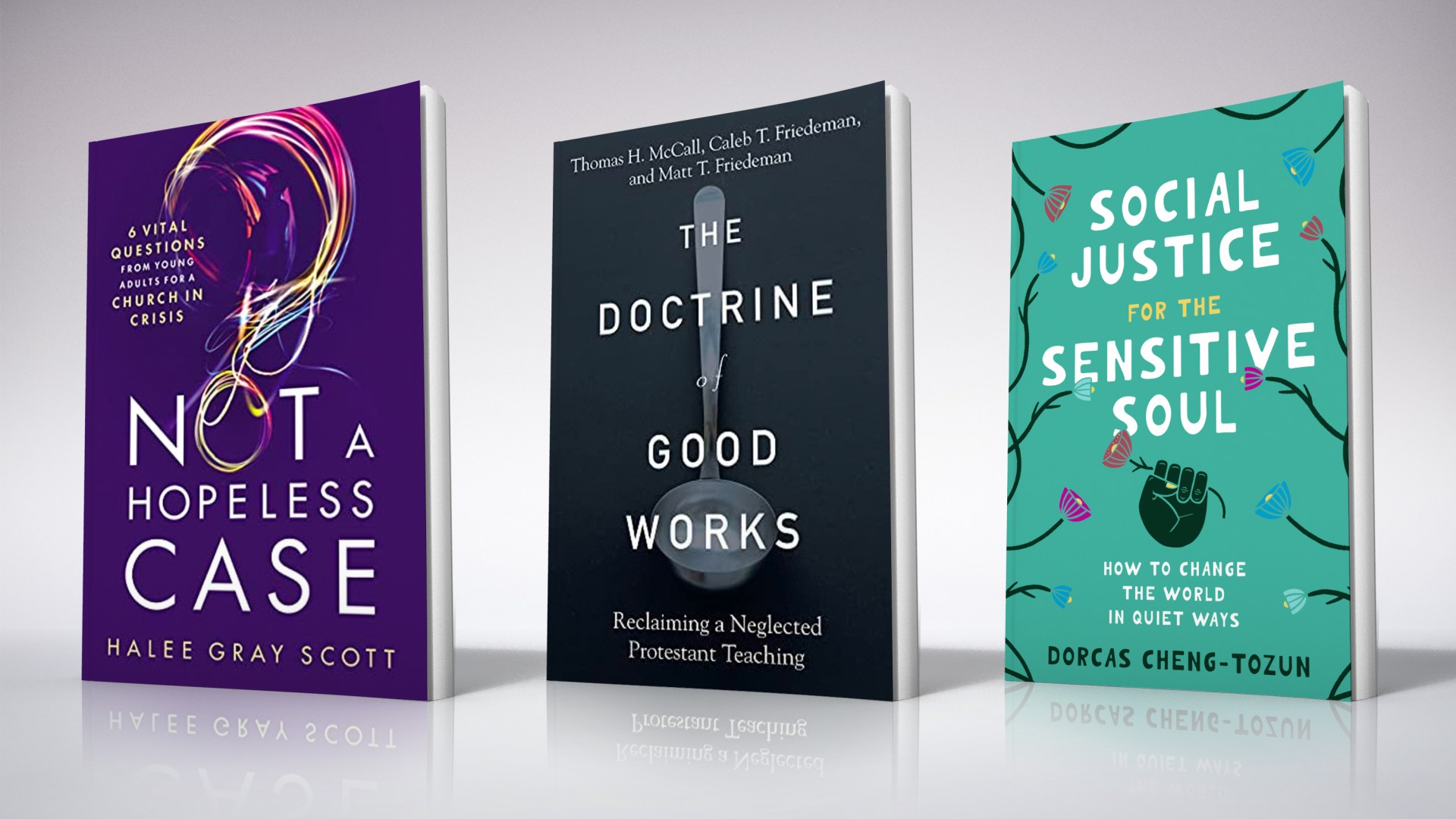
New & Noteworthy 2023

Seven books we’re looking forward to this year.

The Evangelical Imagination: How Stories, Images, and Metaphors Created a Culture in Crisis

Karen Swallow Prior (Brazos Press)

Social Justice for the Sensitive Soul: How to Change the World in Quiet Ways

Dorcas Cheng-Tozun (Broadleaf Books)

Why Evangelical Theology Needs the Global Church

Stephen T. Pardue (Baker Academic)

A Burning House: Redeeming American Evangelicalism by Examining its History, Mission, and Message

Brandon Washington (Zondervan)

Not a Hopeless Case: 6 Vital Questions from Young Adults for a Church in Crisis

Halee Gray Scott (Zondervan)

The Doctrine of Good Works: Reclaiming a Neglected Protestant Teaching

Thomas H. McCall, Caleb T. Friedeman, and Matt T. Friedeman (Baker Academic)

Elisabeth Elliot: A Life

Lucy S. R. Austen (Crossway)

Books
Review

Naming Names in the Abortion Debate

As a new “street-level” history demonstrates, you can’t tell the bigger story without telling a series of smaller, more personal stories.

Illustration by Alex Nabaum

The first time that abortion became real for me was not while reading a moral philosophy textbook or reviewing a Supreme Court decision. Rather, it followed from a discussion with a college friend who, as I learned, had visited an abortion clinic.

The Story of Abortion in America: A Street-Level History, 1652–2022

The Story of Abortion in America: A Street-Level History, 1652–2022

Crossway

512 pages

$22.77

All of a sudden, abortion was no longer just a theoretical reality. Instead, it was a part of the story of someone I knew well—someone who sat across from me in class. The experience shifted my perception of abortion as something affecting people “out there” while leaving my own social circles untouched. As I walked away from that conversation, wondering if I had handled it sensitively, I realized that my understanding of abortion existed almost purely in the realm of ideas, policy, and theory—not flesh-and-blood people.

In the lead-up to the Supreme Court decision in Dobbs v. Jackson Women’s Health Organization, which overturned Roe v. Wade, there was no shortage of stories about individual women. Stories of women shouting their abortions. Stories of women who chose life. Stories of clergy decrying abortion as a moral evil or praising it as something holy and sacred. And yet, we’re tempted to dissolve these individual stories into the larger abortion story, forgetting the individuals themselves.

In all our discussions of public policy and our abstract reflections on human dignity, we can often forget the real people involved in this system of death: doctors and nurses who perform the procedures and provide medication; women who seek out clinics willingly or because they feel trapped or coerced; men who may be present or absent; and children at their most vulnerable stage of life.

A new book from Marvin Olasky and Leah Savas endeavors to fill this gap, foregrounding the stories of those affected by abortion, both as an institution and a practice. Their book—The Story of Abortion in America: A Street-Level History, 1652–2022—effectively employs an on-the-ground perspective that so often goes missing.

Frontline experiences

Olasky and Savas approach this subject as pro-lifers but also as journalists, with Olasky having served as World magazine’s longtime editor and Savas currently working as a World reporter. In good journalistic fashion, they provide a window into frontline experiences across the abortion landscape, delving into the lives of defenders and opponents, providers and victims, and the women and children who bear the deepest scars.

The book surveys a surprisingly broad historical canvas, correcting our habit of viewing the abortion debate as something that only erupted in earnest during the latter part of the 20th century. As the authors note, for instance, it’s likely that the first recorded abortion in America occurred in 1629.

Readers will be unsurprised by the conclusions that Olasky and Savas draw. Fundamentally, this is a volume dedicated to revealing abortion’s pernicious and dehumanizing effects on our culture. The authors’ sweeping history, while not an ethics text, is forthright in depicting abortion as an assault on the dignity of human beings.

Yet the power of their street-level, story-based approach lies in how it cuts through our own grand narratives about abortion. Contrary to those who loudly proclaim that abortion brings freedom and empowerment, history shows that individuals have often exploited it to further control the bodies of women and prey upon them. Many of the book’s early chapters abound with stories of women who were lied to and seduced by men with promises of marriage only to be abandoned after their pregnancies came to light. Abortion became one piece in a larger structure that allowed men to use these women as they wished.

Take, for instance, the example of Dorcas Howard, a 17th-century servant thought to have obtained the first recorded abortion in American history. According to court records the book cites, Howard told her master that she was sick and could not work. Rather than responding with care for his servant, the master suspected she was pregnant, which prompted him to threaten her with violence. Upon hearing her confess the pregnancy (and disclose the name of the father), he sent her to bed and called some women to help her.

As the authors make clear, we don’t know exactly what happened in Howard’s room, but the next morning there was a child on the floor, who another woman testified had been stillborn with a bruise on the head. Howard’s master had seen a potential loss on his investment, and he’d acted quickly to prevent it. His economic interest outweighed any concern for the mother or child.

Profit considerations also proved irresistible to those providing abortions. Consider Ann Lohman, a 19th-century woman who took the pen name Madame Restell because the French were considered the most knowledgeable about intimate matters. Taking up residence in New York City, she and her husband began advertising abortion pills and medications in their newspaper. She managed to skirt the laws of the time by speaking in euphemisms about regulating women’s menstruation or preventing menstrual blockages, coded terms for pregnancy.

The business proved quite lucrative. Madame Restell’s advertisements were a boon for the newspaper and for the couple. Her office was filled with young, desperate women, and because she was apparently capable of performing the procedure without killing patients—at least the adult patients—her popularity grew. Because of well-placed bribes, she was unlikely to face prosecution, though eventually she was tried and convicted after police found a woman willing to testify about a mistake she made that caused a woman to die. However, Restell’s short prison stay only opened the door for others to try claiming her business, and it didn’t prevent her from continuing her practice once she was released.

The stories of Dorcas Howard and Madame Restell highlight trends in abortion policy that continue to this day. In particular, they illustrate how economic interest and legislation are always intertwined. But they also pose a warning to those who would hang all their hopes on the power of law to prevent abortions.

In 1716, New York became the first state to pass an abortion restriction when the city council forbade midwives to aid or administer an abortion. By 1829, New York City had passed a law banning abortion by any means—surgical or medicinal—and imposing fines on violators. And yet, Madame Restell was allowed to operate her business with little interference because of lax enforcement. Olasky and Savas do not discount the value of legislation, and the later chapters are filled with examples of its powerful effects, but their stories do caution pro-life advocates to address issues fueling the demand for abortion, and not only its supply.

Cries of conscience

Olasky and Savas have no appetite for harshly condemning women in a culture that has held up bodily autonomy as a supreme right while often placing them at the mercy of unjust systems. Clearly, they believe that abortion has two victims: mother and child. This was straightforwardly true in the early centuries of American history, when both mother and child were likely to die from the procedure. But it is no less true in contemporary times, when abortion poses less risk (at least physically) for the mother.

With certain exceptions, the women profiled in this book aren’t seeking abortion purely of their own volition: They are trapped by circumstance, coerced by family and lovers, or deceived by those who stand to gain from the procedure. Even those who remain supportive of abortion rights describe a sense of longing and mourning for their lost children. One woman who believes she made the right choice in having an abortion also describes seeing “a very little ghost that only appears when I’m seeing something beautiful, like the full moon on the ocean.” Others describe the “whispers” they hear on the wind from children they never had.

Such testimonies reveal an ugly truth often overlooked in pro-choice advocacy: We intuitively know the procedure is wrong. Each of us recognizes on the level of conscience that something violent and horrible occurs at an abortion. Whether or not abortion is permitted by law, common sense rails against our attempts to describe the procedure in sanitized and morally neutral language.

Olasky and Savas profile one doctor who experienced this tension when he shifted from performing early-term abortions to doing a procedure known as a D&C (dilation and curettage). He had been comfortable with abortion in the abstract, but when faced with a procedure that required using medical knowledge to determine the best way to “disarticulate” a child’s body—break it apart at the joints—everything within him rebelled. His conscience would not allow him to look at an arm with a hand and five fingers as mere tissues and cells fit for the medical waste bin. The law’s approval could not overcome his God-given knowledge that this was a person possessing God-given dignity and worth.

Thinking back on that moment in my life when abortion became not just a concept but a person with a face and name, I’m reminded that so often we have to do as that doctor did, stepping outside familiar conversations on abortion to get a clearer picture of its brutalities. Olasky and Savas paint a disturbing picture of a culture that prioritizes so many things—economic prosperity, individual freedom, sexual liberty, personal reputations—over the life of a child. They confront us with the disastrous and deadly effects of abortion on every individual it touches: mother, child, father, doctor, legislator, and neighbor. But they remind us also that our collective conscience, though seared, is capable of recognizing error and striving for a culture that affirms the dignity of all people, born and unborn.

Alex Ward is lead researcher for the Ethics & Religious Liberty Commission of the Southern Baptist Convention. He is pursuing a PhD in history at the University of Mississippi.

Books

The Relatable Zeal of Puritan Women

They were extremely into religion without being extreme.

Illustration by Abigail Erickson / Source Images: Getty Images

Having grown up in a non-Christian home, Jenny-Lyn de Klerk didn’t discover theology until college. At first, she struggled to understand theological concepts, but everything started making sense after she encountered the Puritan writer John Owen. Her subsequent research on Puritan spirituality helped pave the way for a new book—5 Puritan Women: Portraits of Faith and Love. Author Catherine Parks, an editor with Moody Publishers, spoke with de Klerk about what believers today can learn from these women.

5 Puritan Women: Portraits of Faith and Love

5 Puritan Women: Portraits of Faith and Love

Crossway

160 pages

$14.77

When people learned you were writing a book about Puritan women, what were some of their reactions?

Most fell into two categories: Either people had no idea who I was talking about, or they expressed negative stereotypes about the Puritans. At least on a popular level, people still view the Puritans as fun-killers—and Puritan women as extremely patriarchal. I’m hoping my book can move readers past such stereotypes by helping them get to know a range of real individuals.

Some suggest that the poet Anne Bradstreet departed from Puritan ideals because she wrote about things like intimate love with her husband. How would you respond?

There are all sorts of crazy interpretations of Bradstreet out there. To understand her place within the Puritan movement, we need to start with an accurate definition of Puritanism and then see who fits.

Puritans, for starters, wanted to bring further reform to the Church of England. Though some ministers sought change from within while others felt compelled to leave, they all wanted to go further in replacing certain vestiges of Roman Catholicism with biblical worship practices. And secondly, they emphasized a personal communion with God—a genuine, vibrant relationship with him—that led to a life of holiness.

If we use these two points as a litmus test, we can generally figure out who was a Puritan and who wasn’t. And by this accounting, Bradstreet easily fits.

You write about the Earl of Berkeley, who asked a Puritan woman named Mary Rich to send him her rules for holy living. What do you make of the fact that a Puritan woman was being asked for spiritual guidance by a male friend?

This question highlights one main way we misinterpret Puritan women. On one hand, there is a superprogressive, often non-Christian perspective that these women were trapped in the confines of their religion, and if they had just pushed a little harder, they might have broken free and become their fully actualized selves. But on the flip side, there’s also a highly conservative, often Christian perspective that just takes every preconceived notion about “good Christian women” and projects them onto Puritan women, thinking, “They must be exactly like I imagine them, or even more so.”

With Mary Rich and the Earl of Berkeley, seeing one thing happen in one person’s life doesn’t justify drawing big conclusions about all Puritan men or women. But it is fair to say that because Rich was a highly religious person who valued modesty, decorum, and respect, it was not out of line for her to receive this request and then respond in a full and honest manner. And stories like these do remind us to constantly ask whether some attitude or value in our church is truly biblical or just cultural.

While debates about gender are important and needed, they can also become a bit overwhelming and negative. This is why I wrote in my introduction that one benefit we get from reading about women in church history is celebrating Christian women while taking a breather from all the contentiousness. I wanted to signal that this book is a fun, safe space—whatever your beliefs on gender roles or your own experiences in the church, let’s look at these amazing women and the amazing things God used them to do.

You write, “I have seen again and again how God providentially uses whatever I’m currently reading to teach me a specific lesson or give me a specific comfort I desperately need at that exact moment.” How did you experience that as you wrote this book?

One specific story I deeply resonated with was Anne Bradstreet’s experience of doubt. As I studied her life, I happened to be in a bad place with my faith, on account of some painful experiences in the church. I hadn’t lost faith, but I was really questioning whether I still believed in God’s existence.

Then I ended up reading a letter from Bradstreet to her children where she talks about experiencing a crisis of faith. She writes, Satan has troubled me many times concerning the existence of God and the veracity of the Scriptures, and she describes how she would address one doubt only to find another standing in her path. That part was extremely powerful for me. I literally started crying in the library stacks.

My assumption, at this point, had been that my doubts meant I was either a weak Christian or not Christian at all. And that was a disturbing thought, because I had already started a PhD in church history and I was married to a pastor, so I couldn’t just deconvert quietly. Reading Bradstreet really helped me, because even though she was sorting through similar doubts, she was clearly a godly person. Her doubts spoke to the strength of her faith rather than any weakness in it.

The Puritan women you profile were “zealous” in their spiritual practices, you say, but were neither “extreme nor legalistic.” How do you see that distinction play out in their lives?

Something that immediately struck me was that these women were very into Christianity. They talked about God all the time, they read the Bible all the time, and they were very invested in church. That’s what I mean by “zealous”—they were just unashamedly religious.

But I was surprised, given their zeal, that I did not see many aspects of their lives that felt too intense or immoderate. They weren’t the mean rule makers people often expect them to be. So they were very into religion, but not in this bombastic way that feels totally unrelatable to someone in the 21st century.

Are there any other lessons you hope people learn from these women?

As someone who comes from an atheist family, I hope some readers will see how it’s possible to be wholeheartedly devoted to God while still maintaining genuine friendships with people who believe differently. We often think of the Puritans as wanting to escape and condemn society, but that wasn’t what I came across in their stories.

To take one example from the book: Lucy Hutchinson wrote a theological treatise for her daughter encouraging her to stick close to the church, mostly by holding to its beliefs, but also by loving it. In one of my favorite sections, she goes on this little excursus about how Christians are not grateful enough to God because they don’t love other people enough, and if they loved people more—including other Christians who they maybe think are weird or have some wrong beliefs and including those outside the church—they would be more grateful to God.

Of course, love interacts with other theological ideas like justice, so loving others doesn’t mean ignoring sin in your life or someone else’s life. But for the Puritans, there is this baseline belief that if you want to call yourself a Christian, you really need to have a loving attitude and do loving things for the people in your life, regardless of whether they’re just like you.

Apple PodcastsDown ArrowDown ArrowDown Arrowarrow_left_altLeft ArrowLeft ArrowRight ArrowRight ArrowRight Arrowarrow_up_altUp ArrowUp ArrowAvailable at Amazoncaret-downCloseCloseEmailEmailExpandExpandExternalExternalFacebookfacebook-squareGiftGiftGooglegoogleGoogle KeephamburgerInstagraminstagram-squareLinkLinklinkedin-squareListenListenListenChristianity TodayCT Creative Studio Logologo_orgMegaphoneMenuMenupausePinterestPlayPlayPocketPodcastRSSRSSSaveSaveSaveSearchSearchsearchSpotifyStitcherTelegramTable of ContentsTable of Contentstwitter-squareWhatsAppXYouTubeYouTube