5 Books About Contemporary Christian Martyrs

Chosen by Jerry Pattengale, coauthor of “The New Book of Christian Martyrs: The Heroes of Our Faith from the First Century to the 21st Century.”

Asim Alnamat / Pexels

Saving My Assassin: A Memoir

Virginia Prodan

Imagine a five-foot-tall woman capable of challenging the entire Communist Romanian dictatorship, and you have a picture of Virginia Prodan, an author, speaker, and international human rights attorney. In the opening scene of her captivating memoir, she has an assassin’s gun to her head, and the postscript brings her amazing story full circle with an account of this assassin coming to Christ. The book, packed with firsthand accounts of religious oppression under Nicolae Ceaușescu’s horrific regime, details how Prodan exposed a secret that helped topple his government—but not before the deaths of thousands of Christians.

The Martyr’s Oath: Living for the Jesus They’re Willing to Die For

Johnnie Moore

Moore, an author, human-rights activist, and president of the Congress of Christian Leaders, received a Medal of Valor award from the Simon Wiesenthal Center in 2017 for his efforts to rescue thousands of persecuted Christians from Iraq and Lebanon, which included chartering and funding planes. The Martyr’s Oath, inspired by a pledge that he heard recited at a graduation ceremony for theology students in India, draws on interviews with the family members of martyrs from countries across the world. Each of the book’s 15 chapters highlights one of the oath’s statements and describes how persecuted believers are living them out in the face of incredible hostility.

When Faith Is Forbidden: 40 Days on the Frontlines with Persecuted Christians

Todd Nettleton

Nettleton is the longtime “voice” of the Voice of the Martyrs (VOM) and host of its radio program. In this book, he recounts some of his journeys to meet with persecuted Christians around the world, journeys that have taken him to over 20 countries. Many of Nettleton’s stories will linger in your mind as testaments to the cost of carrying the Cross—stories like that of Pastor Abraham in Sudan with his little red Bible, the only one available to his congregation until VOM arrived with boxes more. Four days after that joyful encounter, jihadists shot him in the head and kidnapped several others.

Against the Tide: The Unforgettable Story of Watchman Nee

Angus Kinnear

Few modern martyrs have left behind as monumental a legacy as the 20th-century Chinese evangelist Watchman Nee, whose books sold in the millions and whose Little Flock movement helped plant untold numbers of house churches. This biography comes from Angus Kinnear, a friend and missionary doctor who also translated some of Nee’s key works, including The Normal Christian Life, into English. It gives us a peek into Nee’s contemplative pietism, his opposition to denominational divisions, his fortitude among haters of Christ, and his long journey through persecution unto death.

Early Christian Martyr Stories: An Evangelical Introduction with New Translations

Bryan M. Litfin

Shifting from contemporary Christian martyrs to contemporary Christians writing about martyrs, we come to this lively little volume from Bryan Litfin, a longtime Moody Bible Institute theology professor now teaching at Liberty University’s divinity school (as well as an occasional writer of historical fiction). In Early Christian Martyr Stories, he corrects various misrepresentations that crop up in other accounts, such as overstatements on the scope of persecution or problematic depictions of Romans and Christians alike. A highlight is Litfin’s riveting chapter on the noblewoman Perpetua and her servant Felicitas, who were put to death for their faith in third-century Carthage despite the former being a new mother and the latter being pregnant.


Books

New & Noteworthy Fiction

Chosen by Cathy McCrumb, science fiction writer and author of the Children of the Consortium series.

Dream of Kings

Sharon Hinck (Enclave Publishing)

Betrayed and sold into slavery, dream-teller Jolan finds herself in a foreign land surrounded by complicated adversaries and dangerous allies. How could being stolen away from all she has known and loved be part of the Provider’s plans? And yet, the Provider’s gift of dream-telling grants Jolan knowledge that can save her enemies from impending disaster. Inspired by the story of Joseph, Dream of Kings delves into themes of forgiveness, grief, healing, courage, and renewed faith. Hinck deftly weaves imaginative fantasy imbued with truth, grace, and hope.

’Til I Want No More

Robin W. Pearson (Tyndale)

With her wedding drawing closer, Maxine’s secrets are eating her whole, and even though she’s surrounded by people who love her, she isn’t at peace. As she wrestles with past decisions, Maxine comes face to face with questions of authenticity and truthfulness. But embracing grace (and being embraced by grace) requires taking the path of honesty, which isn’t the easiest choice. ’Til I Want No More shines with complex relationships, tricky family dynamics, and well-drawn characters, making Pearson’s second novel a heartfelt addition to the world of Southern women’s fiction.

Nightfall in the Garden of Deep Time

Tracy Higley (Stonewater Books)

Bookstore owner Kelsey Willoughby has set aside her dream of writing novels to grapple with the pressing demands of bills, an encroaching development project, and her adoptive mother’s failing health. When she stumbles into a magical garden in an abandoned lot, she starts uncovering the mystery of who she is as a writer and a person. But to find answers she must journey deeper, learning to forgive and accept her past. Higley’s lyrical exploration of creativity breathes encouragement for musicians, artists, crafters, and storytellers alike.

Books
Review

Shift Your Bible Reading into a New Gear

Jonathan Pennington has written the rare study aid that equips without oversimplifying or overwhelming.

Illustration by Rick Szuecs / Source Images: Tetra Images / Getty / Nathan Dumlao / Unsplash

My introductory class in seminary ended with me making a lifelong pledge.

Come and See: The Journey of Knowing God through Scripture

Come and See: The Journey of Knowing God through Scripture

Crossway

168 pages

Our professor had told a story about sitting on a plane next to a young woman years before. He had engaged her in conversation with the intent to share the gospel, only to find out that she already professed to be a Christian. However, she sheepishly confided that she didn’t know how to study her Bible. He proceeded to walk her through the basics of Bible study and watched as her eyes filled with tears of joy.

The professor then asked what church this woman attended. Shock seized him when she named a church pastored by one of his former students. Upon the plane’s landing, he rushed to the nearest pay phone (this was before the cellphone era) and called his former student to rebuke him for not training his congregants in how to study the Bible. I distinctly remember his finger pointed at our class and hearing him say, “Don’t let me ever bump into one of your congregants and find out that they don’t know how to study the Bible!” Inspired—but also a little afraid—I left the classroom vowing never to receive such a phone call.

I believe there is nothing more important for the Christian life than reading the Scriptures. As a pastor, I’m constantly on the lookout for helpful resources to aid believers in their Bible reading and study. Many books on the topic lack thoroughness and could be summarized adequately in a pamphlet. Others tend to lean in the opposite direction and overcomplicate the study of Scripture, making it cumbersome and intimidating. Books that equip without overwhelming are not easy to find.

Jonathan Pennington, professor of New Testament interpretation at Southern Baptist Theological Seminary, meets this high standard in Come and See: The Journey of Knowing God Through Scripture. Concise, creative, and refreshingly multifaceted, his book is exactly the kind of introductory resource I want to put into congregants’ hands.

Come and See encourages Christians to study their Bibles through three modes of reading, which Pennington labels as “informational,” “theological,” and “transformational.” He creatively pictures Bible study as a road trip with three distinct drivers. Each driver articulates how to study the Bible through each respective mode. The first, Ingrid, provides the framework for understanding what Scripture is saying on a basic level. The second, Tom, describes how we can read it to discover core truths about God and his work of redemption. And the third, Taylor, emphasizes how studying God’s Word changes the orientation of our hearts and the way we live.

As Pennington rightly stresses throughout the book, combining these three modes of reading “provides a robust and meaningful path for knowing God through the study of the Bible.” Too often, Bible study never moves past the basic facts, gets stuck in discussing the finer points of theology, or races ahead to application without getting a grasp of the passage itself. Pennington’s multifaceted approach ensures that the reader of Scripture studies to know, to believe, and to live what the Scriptures teach.

The book devotes one chapter apiece to each of these modes of reading. Each chapter contains three main points that cover the basics of reading informationally, theologically, and transformationally, along with two “side trips.” In these main sections, Pennington tackles such important topics as biblical genres, historical context, common exegetical mistakes, Scripture’s relationship to the church’s historic creeds, and the essential role of the Holy Spirit in illuminating what we read.

Each main-point treatment ends with a “Take a Turn at the Wheel” application. These brief sections are carefully thought through, and they provide helpful personal studies and questions. They would provide wonderful exercises for a small group reading this introductory book together. In fact, these exercises are so well done that I find myself wishing Pennington had provided more of them for the reader.

It is commendable how much Pennington packs into this quick read. He manages to tease out important distinctions between biblical and systematic theology while introducing readers to such weighty concepts as the “analogy of Scripture,” “reception history,” the “rule of faith,” and more.

Though I’m thankful Pennington doesn’t remain at a surface level, there are times when some of the discussions and concepts seem unnecessary for an introductory book on Biblical study. This is a small criticism, and Pennington, to his credit, takes care to explain even the trickiest ideas with clarity. Yet, I’m not sure the ordinary churchgoer looking for Bible study techniques needs a primer, say, on the Bible’s “bounded pluriformity” or the monastic practice of lectio divina. Likewise, some of the “side trips” could feel more like unnecessary diversions for average readers.

The Christian life is lived upon the foundation of the Word and in the light of the Word. We want to be people who know it, meditate upon it, live it out, and worship the God it reveals. My seminary professor was rightly upset to hear that one of his former students had not trained a congregant to study the Scriptures. We all need this equipping because we all need the Scriptures.

Come and See will prove helpful to any Christian looking to grow as a reader and studier of the Bible, or to any pastor or leader charged with facilitating that growth. My professor would have rejoiced at Pennington’s thorough and creative way of teaching others to enjoy and feast upon the treasure that is the Word of God.

Jason Helopolous is senior pastor of University Reformed Church in East Lansing, Michigan. He is the author of The Promise: The Amazing Story of Our Long-Awaited Savior and A Neglected Grace: Family Worship in the Christian Home.

Books

Shame Has Many Causes—and One Remedy

How to find freedom from cycles of navel-gazing and self-loathing.

Illustration by Abigail Erickson / Source Images: Unsplash

Jasmine L. Holmes is not a licensed counselor or psychologist. But she is a Christian woman who actively struggles with shame. In her newest book, Never Cast Out: How the Gospel Puts an End to the Story of Shame, she shares candid accounts of dealing with shame spirals and turning to the Bible for hope. Author Abbey Wedgeworth spoke with Holmes about discerning the causes of shame and responding in spiritually profitable ways.

Never Cast Out: How the Gospel Puts an End to the Story of Shame

Never Cast Out: How the Gospel Puts an End to the Story of Shame

B&H Books

224 pages

How would you define shame, and what makes it such an important topic?

My earliest memory is a memory of shame. I must have been two and a half years old. My mom told me “no” to something I had asked for. She said it gently, with a tone of No, we’re not going to do that right now. But I felt so terrible and wrong. And I remember thinking I shouldn’t have asked in the first place.

I had no idea, at that moment, that for the rest of my life I would experience that feeling in numerous ways. So when I talk about shame, I’m talking about that negative feeling, that feeling associated with being wrong, being bad, being not enough. It’s that feeling of wanting to hide.

Shame affects so many people, in ways big and small. And for this book, I wanted to be careful to admit that my experiences of shame are small compared to what, say, abuse victims and survivors endure day to day. So I’m talking, if you will, about my little shame that follows me around every day, and I’m not trying to make light of the big shame others suffer.

Why is it so important to attend to even our “little” experiences of shame?

If we fail to recognize them, they compound—they grow. As a mom, for instance, you might have a moment, like I did this morning, of looking around and thinking, Oh, my house is so dirty. And I had to decide not to wallow. Otherwise, I might start thinking, My house is dirty; therefore I’m a terrible mom, because I shouldn’t be working. If I were staying home with my kids full time …

And on and on it goes down this rabbit hole, this shame spiral. It takes my eyes off Jesus, off the Cross, and it puts me into this navel-gazing space where all I hear is this loud, intrusive voice saying, “You are bad.” Shame distracts us from kingdom work, and it also distracts us from biblical rest, which means resting in Christ. Shame, by contrast, keeps us on a hamster wheel.

You define three typical responses to shame as “false gospels.” What are they, and why don’t they work?

The three false gospels are “Shake it off,” “Work it off,” and “Pass it off.” The “shake it off” attitude says that shame is always bad, and that I should just do what I want at all times. But of course we wouldn’t want to live in a society where no one is capable of shame.

“Work it off” means allowing shame to jerk us around. For instance, when I thought my house looked dirty, I could have said, “Well, I’d better get up and clean it. I need to do this the right way, or my kids will end up in therapy.” We obey the urgings of shame because we feel like there’s always a guillotine dangling over our heads. But we’re only quieting the voice of shame rather than dealing with the heart of the matter.

The instinct to “pass it off” was part of how I grew up in a hyperconservative background, where the attitude was, Yes, we do bad things, but at least we’re better than the world. We can always think of someone whose house is dirtier—or fill in the blank. We pull others lower to make ourselves feel better.

The problem with all of these approaches, however, is that shame is telling us something. It’s giving us a message. Maybe shame is telling us that we’ve done something wrong—or maybe not. Maybe it’s telling us to turn to Christ or to have a conversation with a mentor or friend. But whatever the message, ignoring shame is like ignoring a stomachache and letting the underlying illness get worse and worse.

What value does shame have in the Christian life or in the process of sanctification?

Shame offers different opportunities. One is for repentance. If we’ve sinned and feel guilty, then shame points us toward the Cross, where we can confess our sins in the knowledge that Jesus has atoned for them. It leads us to say, “God, I have done this bad thing. And instead of running and hiding like Adam and Eve, I will run toward you and admit I messed up. And I will bask in your grace at the end of that.”

A second opportunity is for reorienting our hopes toward Jesus. The shame I feel over a dirty house, for instance, might reveal that I’ve made my house into an idol—something I lean on for the justification and righteousness only Jesus can provide.

You write, “Sometimes the accuser uses our sin to fuel his accusations. Sometimes, though, he just uses our humanness.” How do these forms of shame—and their remedies—differ?

We are so good at attaching moral weight to questions Scripture doesn’t answer authoritatively, like when we get married or when to have kids or how many kids to have. These questions have moral dimensions, of course, but how we answer them doesn’t determine our standing before God.

You can say the same about my dirty house. It could tell me lots of things. Perhaps I’m taking on too much—or I’m being lazy. Or maybe I’m just tired. Or maybe it’s time to have a conversation with my husband about helping out. There could be sin involved, or just ordinary human limitations. In either case, the remedy is running to Jesus. Because sometimes we need forgiveness, but sometimes we just need security because we’re weak and frail and groaning, like all of creation, for the return of Christ.

You were nervous about writing this book because, as you write, it might “open the floodgates for shame to come roaring into my life.” How has it affected your own struggle with shame?

It was weird to write about shame during a shame-filled season of life. As I was writing this book, I was in the depths of despair, first because I was pregnant and then because of postpartum depression and the balancing act of raising three kids. Shame was knocking on my door every day.

My editor was such a rock throughout the process. She would say, “You’re writing a book about shame, and the Enemy is constantly taunting, just reminding you of your insecurity. And we need to turn to Jesus with that.” I joked with her that this is my last book of this nature—I don’t need this spiritual growth again!

What is your greatest hope for people who read this book?

To see them set free, so they can cast their cares on Jesus because they know he cares for them, and they know he is ready and willing to forgive them.

It’s worth repeating that not everyone deals with shame in the same way. For me, as someone diagnosed with depression, shame is something chronic, a rut I get stuck in. But anyone who gets stuck in that navel-gazing, self-loathing cycle can turn to Jesus and be free.

News

Speaking for Evangelicals at the UN, Gaetan Roy Seeks to Serve

The new representative starts each conversation with an unusual question.

Illustration by Isabel Seliger

Gaetan Roy goes to the United Nations building in Geneva with an unusual question: “How can I serve you?”

Roy is not a waiter or a salesperson but the new representative from the World Evangelical Alliance (WEA) to the UN. Ever since he first got involved in politics, this is the question he’s led with. Back in 2015, when he went to the German parliament to lobby on behalf of evangelical organizations, he couldn’t get the words of Mark 10:45 out of his mind: I have come to serve, not to be served.

So Roy asked the first politician he met on his first day, “How can I serve you?” He’s continued asking it ever since.

“I thought this was really simple, but I felt God was unrelenting in this regard,” Roy told CT. “If Jesus came to serve and not to be served, then I will do the same by asking diplomats and politicians we engage with how we can serve them.”

With this question, Roy has become one of the primary evangelical voices at the world’s largest intergovernmental organization, speaking on behalf of 600 million believers in more than 120 countries. He takes over from Michael Mutzner, who helped establish the WEA’s office at the UN in 2012, and joins Wissam al-Saliby, director of the WEA’s Geneva office. Al-Saliby focuses on public statements about human rights violations while Roy works behind the scenes, brokering deals and developing official proposals for the UN representatives to consider.

Whether he’s promoting peace in Nigeria or working with the Coalition for Minority Rights in India, Roy said he hopes service will lead the way as he represents evangelical concerns and advances the cause of religious freedom for all.

If Roy’s approach to high-level negotiations and political diplomacy seems unorthodox, so was his pathway to such a high-profile position.

He was born in Quebec and speaks French and English fluently, along with excellent German and knowledge of both Spanish and Mandarin Chinese. He grew up in a Roman Catholic family and then was born again at age 22 while serving as a ski instructor in Eastern Canada.

He earned a degree in computer science, got a pilot’s license, and then went into business for himself doing exploratory research in the aerospace industry. He worked on navigational systems to help pilots fly in zero-visibility conditions. The company was a success, and Roy found himself consulting with NASA and Canada’s Civil Aviation Directorate.

But while his company was taking flight, Roy felt a higher calling. He moved to Germany in 1991 to complete a one-year training with Youth With a Mission (YWAM), with the hope of serving in international missions.

“And I did, but not like I expected,” Roy said.

He ended up at an independent evangelical church and mission center in Altensteig, in Germany’s Black Forest, working as director of administration.

Roy grew in the job and became the church’s mission director, doing philanthropic and project management on five continents. Then, after more than a decade, his work as a strategist and networker launched him into politics. He went to the Bundestag, the German parliament, as a spokesman for Christian groups working on youth, family, education, human rights, humanitarian aid, and religious freedom issues. He remembers realizing that groups like the Association of Evangelical Missions and network-m, an alliance of 79 faith-based nonprofits, were doing amazing work, but no one was telling their stories to the political leaders in Berlin, Strasbourg, or Geneva.

Evangelicals, meanwhile, would complain about those leaders. But they weren’t reaching out to them.

“We used to complain about politics, but I told them, ‘Why are we complaining? We are the problem if we are not involved,’” Roy said. “Pietism told us politics is dirty, and we’ve stayed away from it. But I believed it was changeable. If you bring good policy, it gets acted upon.”

And so, Roy found himself volunteering for a new job—representing these organizations to the German government. And he found that his humble approach and unexpected question were pretty effective.

“My job was not to go and preach in parliament. I was not smart or rhetorically strong enough to get politicians to do what I wanted,” he said. “I just asked how I could serve, and they ended up talking to me about the issues they are having and how we can pursue solutions together.”

In 2019, for example, he helped shape the “Digital Pact for Schools.” In its original form, the five-billion-euro ($5.3 billion) federal digitization plan only gave money to public schools. Roy worked with legislators to include private religious schools across Germany. When it was passed, about 600 million euros ($637 million) was given to private religious schools so they could acquire digital equipment, set up or expand online learning platforms, and provide training for teachers

Wolfgang Stock, secretary general of the German Association of Evangelical Schools and Kindergartens, said this was a major win. And it wasn’t easy to accomplish, either. Legislators couldn’t just add a clause or two to the legislation to mention private schools.

“It took a constitutional amendment and the involvement of two federal ministries to ensure that all schools—be it public, private, or free schools—get treated equitably,” he said.

Evangelicals, a distinct minority in Germany, do not often get that kind of consideration in legislation. Without someone like Roy as their voice, they wouldn’t be heard.

“We are too small,” Stock said, “and have too little resources to do anything like what he does.”

He is convinced Roy is effective because of his peculiarly evangelical approach to lobbying.

“Lobbyists … usually approach parliamentarians or civil servants with demands,” Stock said. “Mr. Roy, on the other hand, brings suggestions and asks every interlocutor: ‘How can we serve you?’ With this attitude, he is unique.”

Thomas Schirrmacher, head of the WEA, said sending Roy to the UN was a natural transition and Roy is going to do important work. He is eager to see him advocate on behalf of evangelicals around the world.

“Evangelical alliances around the world will benefit,” he said. “I am happy to have such a master of diplomacy representing WEA.”

Most evangelicals, of course, have never heard of the man who will represent them at the UN. But he will take up the causes of people like Dorcas Adeyemo, a Baptist in Ibadan, the capital of Nigeria’s Oyo State. She has been impacted by the ongoing violence in the northeastern part of the country that has left thousands dead and millions displaced. Adeyemo told CT she is glad to hear a man like Roy is representing her at such a high level.

“There is so much violence,” she said. “Millions of Nigerians are dying or being displaced because of the conflict. I pray that people like honorable Mr. Roy can do something on our behalf.”

He’s trying. In November, al-Saliby attended a consultation with religious leaders from the region, including the head of the Nigerian Evangelical Alliance, to discuss possible initiatives to promote peace and religious tolerance in Nigeria.

Roy, meanwhile, continued to go around meeting representatives at the UN, asking each his standard question: “How can I serve you?”

Ken Chitwood is a scholar of global religion who lives and works in Germany.

News

Degree by Digital Degree, Christian Colleges Go Online

Evangelical schools are growing, but there are questions about the costs.

Illustration by Christianity Today

Hugo Paredes is the first in his family to go to college. But he doesn’t physically go to the college.

Point University, the evangelical school in Georgia he attends, is about 100 miles from the Rockmart Chick-fil-A where he works as director of operations. But the 32-year-old hops online between busy shifts serving chicken sandwiches, navigating management issues, and scheduling employees for the week to come.

Paredes is one of the 1,200 online students enrolled at Point, taking advantage of his franchise owner’s subscription to the college, which enables employees to take online classes for free as a benefit of their job. He expects to complete his bachelor’s degree in business in two more years.

“They’ve helped me change my life,” Paredes said. “I wish I could be a full-time student, but just the opportunity to be in the program is a blessing.”

Across the country, evangelical colleges and universities like Point have been creatively and aggressively expanding online education. College presidents and administrators believe this is one of the best strategies to overcome enrollment challenges facing higher education and, at the same time, increase the availability of Christian education and widen their schools’ impact. Critics, on the other hand, say online degrees undercut quality and worry these programs diminish the value of a Christian liberal arts education.

Many schools shifted more online during the pandemic. But it wasn’t entirely new terrain. A substantial number of schools affiliated with the Council for Christian Colleges & Universities (CCCU) have offered online education for more than a decade. Back in 2013, roughly 13 percent of all students at CCCU schools were exclusively enrolled online. By 2018, nearly 1 out of 5 CCCU students were attending online. Data from 2022 and 2023 are not yet available, but it’s possible that up to a third of students at evangelical colleges are not physically at their schools.

Christian schools reporting substantial enrollment growth frequently credit the expansion of online options. Abilene Christian University, affiliated with the Churches of Christ, has seen five consecutive years of enrollment growth, and now 32 percent of the school’s nearly 6,000 students are online. Thirty percent of the 1,700 students at Northwestern College, a Dutch Reformed school in Iowa, are online. At Indiana Wesleyan University, an early adopter of online education, three times more students are logging on to class remotely than are visiting the Indiana school’s 11 in-person locations.

Colorado Christian University has achieved record enrollment growth for 13 years in a row. The nondenominational school currently has about 2,000 students on campus and 8,000 online.

“With the interest in online learning and the flexibility of it—for adult learners especially—there’s not a growth limit,” said Colorado Christian chancellor Donald Sweeting.

Maintaining enrollment numbers plays a large part in keeping colleges financially solvent. Most colleges saw large enrollment declines during the peak of the pandemic, but many saw decreases before that too. Sixty-five percent of CCCU-affiliated schools saw traditional undergraduate enrollment drop between 2014 and 2018, and higher-education experts predict many schools will fall off a “demographic cliff” in 2025 and beyond, as the pool of potential college students shrinks because of declining birthrates.

“Finding growth through undergraduate enrollment is very challenging,” said Brandon Huisman, vice president for enrollment and marketing at Dordt University and vice chair of the CCCU’s commission on innovative enrollment strategies. “We’ve had steady growth … and a lot of that is thanks to online.”

For some Christian college faculty, however, the shift online seems like it comes at the cost of other commitments.

“The motivation behind the growth seems to be almost entirely economic,” Chris Gaumer, a former English professor at Liberty University, told The New York Times. Liberty now has more than 115,000 online students, compared to 15,800 on campus, prompting questions about recruiting tactics.

John Hawthorne, a retired sociology professor and Christian university administrator, said evangelical schools have historically emphasized personal and spiritual formation. The move to online models can make that aspect of education more challenging.

“Online, almost by definition, pushes you further down that transactional line,” he said. “And I think that runs counter to the whole Christian formation conversation.”

A number of schools have also outsourced parts of their online programs to ed tech companies. For example, more than 50 evangelical colleges have contracted with Acadeum, a for-profit online learning platform. Others, including Liberty, use third-party marketing and recruitment that sometimes downplays any religious distinctives.

“That gets you two steps removed from your core mission as a Christian college,” Hawthorne said. “One step removed because you’re online, a second step removed because you’re no longer marketing and recruiting.”

Colleges acknowledge the challenges of staying on mission. But administrators also say going online is a way to offer affordable Christian education to more people, reaching those who could never enroll in a residential program.

“We’re called as Christians to help people where they are,” said Nanci Carter, online registrar at Lipscomb University. “The online piece allows us to provide that bridge. It just extends our mission and lets us reach more people and change more lives with education.”

Many online programs also cater to adults—nontraditional students seeking a bachelor’s degree at a later time in life or people pursuing graduate degrees. Northwestern College’s online programs, for example, are almost entirely for master’s degrees. Most of Dordt’s online students are also completing graduate-level education.

And the programs still integrate faith and learning. The faculty and advisers are almost always Christian, and courses frequently require some theological reflection. Online students may also participate in spiritual life through virtual chapels, emailed prayer requests, and one-on-one interactions.

“Online education is a method and an option that allows the Christian universities … to fulfill their mission to a broader group of students,” said Joe Bakker, Dordt’s director of online education, who is writing a dissertation about online programs.

Research shows the vast majority of academic leaders believe online education is a part of their school’s future, Bakker said. And faculty who have participated in web-based education tend to be supportive. But the shift online for such faculty can be difficult.

“Most of us have been in institutions where we pretty much only focused on the residential, traditional student, so to move into a segment of the market that’s different can cause us to have some anxiety,” said Phil Schubert, president of Abilene Christian University. “The more we’ve been willing to do that, the more we see that it can be done really well.”

That doesn’t mean, however, that there are no reasons to be cautious. Schubert said Christian schools especially must ensure that growth doesn’t come at the cost of students’ spiritual formation—online or in person.

“We’ve got to ensure that our ability to deliver a quality, Christian-values-infused experience remains strong,” he said, “and sometimes growth can threaten that.”

At Colorado Christian, Donald Sweeting says that evangelical institutions like his need to hold on to “the great tradition of Christian higher education” as they continue to grow and expand online options.

“Christian schools have a robust sense of purpose that takes us beyond revenues and operational details,” Sweeting said. “It’s really easy to get consumed with the operational side of university, for sure. … But as a Christian college president, the purpose of the university is much grander than that.”

Hannah McClellan is a reporter in North Carolina.

News

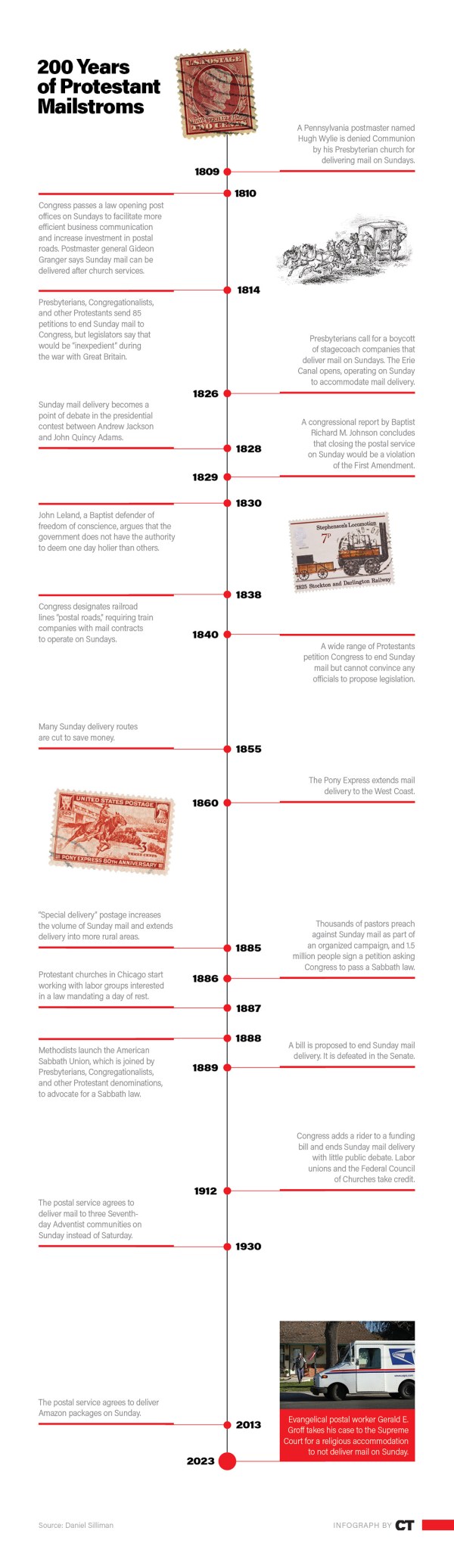
A Brief History of American Christians Fighting Sunday Mail

Gerald E. Groff is taking the postal service to the US Supreme Court. Behind him is a long line of sabbatarians.

Getty / Justin Sullivan

The United States Supreme Court will hear oral arguments on April 18 over whether a Christian postal worker has a religious right not to deliver mail on Sundays. Though most evangelicals did not object when the US Postal Service started delivering Amazon packages on the first day of the week, there is a long history of Christian opposition to Sunday mail.

Theology

Is It Time to Quit ‘Quiet Time’?

Effective biblical engagement must be about more than one’s personal experience with Scripture.

Unsplash / Aaron Burden / Riccardo Mion

The disconnect crystalized 12 years ago when I (Dru) started teaching an introductory Old Testament class to freshmen. Every semester, devout Christian students would report to me that they read their Bibles every day. They could even recite key verses from memory. They were fluent in Christian theological clichés. Yet despite their constant engagement with the Bible, they were shocked by what we found in Genesis—such as there being some things God appears not to know (Gen. 11:5; 18:21; 22:12)—not to mention Judges.

I began to realize that their poor grasp of Scripture wasn’t necessarily due to a lack of reading, although that’s also a large problem in the US. From 2021 to 2022, Bible engagement—scored on frequency of use, spiritual impact, and moral importance in day-to-day life—fell 21 percent among American adult Bible users. It was the American Bible Society’s largest recorded one-year drop in its annual State of the Bible study. And almost 1 in 5 churchgoers said they never read the Bible.

But for my students, many of whom read the Bible daily and have chosen to attend a Christian college, their poor grasp on and application of Scripture seems to be due to the way they engage with it. It is a way many American Christians have been reading the Bible for decades: through “daily devotions” or “quiet time.”

The way daily quiet time is typically practiced today is unlikely to yield the fluency required to understand and apply biblical teaching. Only when devotional time is situated within a matrix of Scripture study habits can it regain its power to transform our thinking and our communities.

How could my students be reading the Bible so much yet have so little understanding of the Torah, pay almost no attention to its focus on the new heavens and new earth, and be confused over concepts like salvation and evil? CT previously discussed the Lifeway Research statistics that reveal this trend of Bible illiteracy among the wider population. Their daily devotion to Scripture seemed to distance them from understanding key parts of it.

“As a whole,” Ed Stetzer wrote in 2017, “Americans, including many Christians, hold unbiblical views on hell, sin, salvation, Jesus, humanity, and the Bible itself.” Like many American Christians, my students didn’t seem to understand details required to grasp the whole sweep of Scripture.

When I pastored a church in the early 2000s, these theological concepts were considered basic matters that my 80-year-old parishioners (some with only high school diplomas!) seemed to understand deeply and apply to their lives and ministries. Like my students, these Christians from the Greatest Generation also practiced short devotional readings every day.

However, thanks to various forms of study over time, they often understood the context of the passage they were meditating on—what came before and after it. They might have read one small passage every day, but they did so to integrate it into their wider understanding of Scripture gleaned from more robust engagement outside of daily reading.

But my students who do not practice more robust forms of traditional Bible engagement—such as inductive Bible study, yearly Bible reading plans, the lectionary, or lectio divina—have few tools to help situate a daily meditation on a verse such as “What, then, shall we say in response to these things? If God is for us, who can be against us?” (Rom. 8:31). Such microdosing of Scripture without a grasp of the whole can easily distort our interpretations. Time-tested traditions of long-form Scripture engagement expose us to and familiarize us with the contents of Scripture.

Only when devotional time is situated within a matrix of Scripture study habits can it regain its power to transform our thinking and our communities.

When my freshmen described their daily quiet times, I began to understand some of the disconnect. They lacked extended communal readings of Scripture where it was safe to interrogate the text and puzzle over its meaning.

For them, Scripture reading was an individual’s responsibility with a necessary outcome: God showing the reader something from the passage that is immediately relevant to his or her life. Many were playing Bible roulette every morning, letting the Scriptures open to any page and asking God to show them what they should learn from the verses. Some of them would read just one verse a day. Others read a passage, or maybe a chapter.

Even when this practice superficially resembles their grandmother’s or great-grandfather’s daily habit, its effects can be entirely different. Most of my students, even the ones who had some sort of church or institutional Bible training, were caught off-guard by basic questions that I was asking about the Bible in their hands. Without context and more understanding, their thin study of Scripture only compounded their ignorance and misunderstanding over time.

This phenomenon of reading without understanding is becoming more widely apparent. The Center for Hebraic Thought, the organization Celina and I lead, hosted a conference on Bible literacy in October 2021, gathering leaders specializing in Bible engagement and education. Nearly two dozen organizations were represented, including American Bible Society, The Gospel Coalition, Council for Christian Colleges & Universities, and Museum of the Bible, as well as seminary faculty, You-Tubers, software designers, and Bible curriculum experts.

When I told them stories about my devout students who misunderstood the Torah and the Gospels, everyone agreed they had seen this same phenomenon in their own spheres and were equally concerned by the apparent inefficacy of many Christians’ devotional reading habits.

My students were not Bible literate. They didn’t really know the stories, characters, ideas, and themes in the Bible, much less how the literature itself fits together and argues for a particular view of the world. And as Christians, we must aim beyond basic literacy. We hope to know and practice the thinking and instruction of Scripture fluently, extending its wisdom into all the areas of life that it doesn’t directly address.

For example, someone who is Bible literate will know that ancient Israel’s justice system as described in the Torah did not involve incarceration or police. But someone who is Bible fluent will know that this fact doesn’t automatically mean that we must eradicate all jails and police forces. Instead, the Bible-fluent person will be able to discern the underlying principles in the Torah—the deep structural themes and guidance that would inform and shape our thinking about crime, policing, and incarceration today.

Literacy focuses on knowing the vocabulary and grammar of Scripture—what is in the Bible and how the literature works. Fluency is the ability to think alongside the repeated teaching of Scripture and extend its thinking and practices into modern situations—where all the variables may be different from those in the ancient context but the principles are the same.

If mere literacy were the goal, people would just need to know most of what the Bible contains. But basic knowledge of “Bible facts” is insufficient. Scripture itself demands that God’s people meditate on and practice its instructions as a community to become wise (Deut 4:10, 30:9–10). God told Israel that his instruction through Moses was so all of Israel—men, women, foreigners, natives, young, and old—would become “a wise and understanding people” (Deut. 4:6). Jesus claims that practicing his instruction will do the same (Matt 7:24) but merely knowing the texts will not (Luke 18:18–30).

If we cannot fluently apply biblical principles, extending the thinking of Scripture into matters of cryptocurrency, police and prison reform, sexual and gender identity, and everything else the biblical authors did not directly address, then we are not the wise and discerning people God desires us to be.

Unsplash / Aaron Owens / Roberto Nickson

For many Christians, particularly evangelicals, the morning quiet time is “perhaps the most basic of all spiritual disciplines,” writes David Parker in a 1991 issue of Evangelical Quarterly. “Daily devotions” are so fundamental to many evangelicals’ concept of a relationship with God that they can’t imagine faithful Christianity without it. But its current iteration—at least in the US today—is only about 150 years old.

Many evangelicals make the case for daily devotions by citing Matthew 6:6: “Go into your room, close the door and pray to your Father, who is unseen.” But this passage doesn’t account for the particular form quiet time generally takes.

Today’s quiet time typically involves bringing a Bible into a private place, “doing so first thing in the morning, not using prescribed written forms of prayer, [but] sitting quietly, and expecting God to speak to you with concrete guidance for the day,” writes Greg Johnson, lead pastor of Memorial Presbyterian Church in St. Louis, in his dissertation From Morning Watch to Quiet Time.

Johnson traces the modern practice of quiet time to the 1870s, when American evangelicals merged two previously separate Puritan devotional practices: private prayer and private Bible study. This fusion of prayer and Bible study morphed into “morning watch,” which emphasized intercessory prayer. From there it became “quiet time,” which deemphasized intercessory prayer in favor of quiet listening or meditation. This new emphasis on individuals receiving daily insights from God transformed the nature of the Bible engagement taught to generations of American Christians.

Daily devotions have been characteristically solitary and have not usually involved rigorous study of Scripture. Instead, readers often focus on one chapter or even a few verses per session, from which they may expect to receive God’s guidance for their personal life in that moment. Daily devotions typically include a period of prayerful “listening” for God’s voice, which is believed to manifest either in the verses read that session or via direct communication to the mind of the listener.

Though this listening may be expectant, it is essentially passive. It’s often guided by a tacit belief that God’s Word speaks and transforms through sudden insights directed at individual readers, rather than through sustained study and active questioning in community.

This private daily ritual benefited greatly from the publication of the Scofield Reference Bible in 1909, an accessible and widely sold individual study Bible on the market. The Scofield Bible reflected and promoted the spread of dispensationalism among American Protestants. Dispensationalism had animating power, Greg Johnson told us in an interview, because it gave people a framework for reading the Old Testament and implied that readers were reengaging with major biblical ideas that Protestants had overlooked.

The use of the Scofield Bible in the dispensationalist movement encouraged an individualistic approach to Bible study. Or at least it inflated readers’ reliance on their own independent interpretation of Scripture. Mark Noll notes in America’s Book: The Rise and Decline of a Bible Civilization, 1794–1911, “As they deepened their belief in the ability of plain people to grasp the Bible’s plain meaning,” the Bible-only populism of the dispensationalist movement actually upheld “an elite corps of teachers guiding others step by step in reading the Bible ‘on their own.’”

In other words, the sense of independent study was propped up by the commentary alongside the biblical text. Ironically, “Scofield’s bible guided readers by proclaiming their freedom from guidance,” Noll writes.

In contrast to sermons and group Bible study, daily devotions became exercises in inward, individual formation, sharing tendencies with the secular modernism of the era. Quiet-time advocates began identifying the main benefit of daily devotions as “a transformed self rather than a transformed world,” Johnson writes in his dissertation.

While personal character formation is essential, in isolation it aligns better with modernist tendencies than with the biblical focus on character formation through habits, rituals, and guidance from the community. This inward focus can also cast the formation of justice in communities and systems—a primary concern of the biblical authors—as adhering to individualistic ethical principles.

Some quiet-time practitioners began treating the Bible more as a meditation tool than as the authoritative teaching of God and his people. During quiet time, contemplation would progress to confession and biblical meditation, which would culminate in the recording of any divine guidance received that day. The reading, as Johnson observes, might be just a short Bible passage or a devotional commentary—not an extended study of Scripture as a unified body of literature.

Today, daily quiet time often doesn’t involve Scripture at all. As CT has noted elsewhere, 2023 Lifeway Research revealed that although 65 percent of Protestant churchgoers spend time alone with God daily, only 39 percent read the Bible during that time. If this statistic means that Christians are trading hurried and fragmented devotional reading for holistic group Bible study, then perhaps so much the better. But the drop in overall Bible engagement in the ABS study suggests that more Christians simply aren’t reading it.

Unsplash / Kelly Sikkema / Zane Lee

By the late 20th century, daily quiet time had become a fixture of orthodoxy in some sectors of Christianity. Christy Gates, the national director for Scripture engagement for InterVarsity Christian Fellowship, claims that the practice of “DQT” (daily quiet time) in campus ministries eventually became the low watermark for one’s spiritual life. Asking about someone’s “walk with God” came to mean “Are you doing your daily quiet time?”

Gates emphasized that even when ministries teach the practice of group Bible study alongside DQT, as InterVarsity does, group study will typically drop off while DQT persists. Why? She thinks DQT is related to our religious individualism that desires for God to reason with us directly. In the past, daily worship featured a family or community asking God for provision, but today it primarily consists of individuals asking God to talk to them. The danger is clear: Listening for God’s insights from Scripture and in prayer without communal accountability can produce a tenuous understanding of Christianity.

Christians who emphasize DQT as a necessary spiritual practice will typically point to Jesus’ times of isolated prayer as a model for this ritual: “Very early in the morning … Jesus got up, left the house and went off to a solitary place, where he prayed” (Mark 1:35). Of course, when found by his frustrated disciples, Jesus then explains why he left the village: “Let us go somewhere else—to the nearby villages—so I can preach there also. That is why I have come” (v. 38, emphasis added). Luke also points to Jesus’ habit: “But Jesus often withdrew to lonely places and prayed” (Luke 5:16). Jesus was, as usual, either finding respite from the demanding masses or moving on to the next place, for “that is why I have come.”

It’s reasonable to see Jesus’ private prayer as a ritual that we should emulate. At the very least, it appears to be a wise practice that emerges from Scripture, even if quiet prayer time and Bible reading isn’t ever commanded of the Hebrews or of Jesus’ earliest followers.

But contemporary experts on Bible engagement agree that daily quiet time, which we have come to couple with daily Bible reading, can distort our understanding of Scripture. The parachurch ministry leaders we interviewed had already identified daily quiet time and devotional reading as one’s sole form of Scripture consumption to be potentially problematic in their communities of ministry.

The Bible professors, seminary administrators, and pastors, as well as those at the American Bible Society, Our Daily Bread, Cru, and InterVarsity, all told us they want to foster daily Bible engagement. But they also aim to reshape this engagement for people like my freshmen, the ones microdosing on the Bible every day but not understanding what they are reading.

There is no universal measurement for Bible literacy. Neither is there consensus about what degree of knowledge constitutes literacy. The ABS measures what it calls “Bible engagement” (“engagement” meaning frequency of use, impact, and centrality in morality) in its State of the Bible studies. But someone could rate high on “engagement” while not actually knowing that much about the Scripture’s own theology or basic assumptions of the biblical authors. Further, the anecdotal evidence suggests that Bible literacy has been on an increasingly steep decline.

If Bible literacy is declining, even for those who read devotionally every day, then what is the way forward? Most of the parachurch ministries we talked to reported that they have been considering methods that provide a wider perspective of Scripture. These include ancient Scripture reading rituals that many evangelical churches have rarely practiced (such as lectio divina, the Daily Office from The Book of Common Prayer, and so on). But the practice most mentioned by ministry leaders was the public, or communal, reading of Scripture.

In some ways, this form of Bible engagement is the opposite of quiet time. Rather than reading, communities listen to long stretches of Scripture together—sometimes 30 minutes to an hour long—either using audio Bibles or having people read aloud. Bible professors have long noted that the natural habitat of Scripture is in the ears of gathered Christians, not the eyes of individuals. The effects of long-form Scripture engagement on Bible literacy are all anecdotal at this point.

From Moses to Josiah to Nehemiah, communal Bible reading was normal at key points of Israel’s history. Public reading of Scripture occurs at Sinai (Ex. 19:7), during Josiah’s reforms (2 Kings 23:1–2), and for all the returnees to Judah in Ezra’s day (Neh. 8), among other instances. And the synagogue practice of reading the Torah and Prophets every Sabbath (Luke 4:16–17; Acts 13:14–15) emerged around the third century prior to Jesus.

All of these public readings included explanation and communal response. As Brian Wright argues in his book Communal Reading in the Time of Jesus, the public reading of literature that swept the Roman empire also included Christians and their sacred texts. For the early church, that would have included not only listening together, but also questioning and reasoning together about what was heard.

So when Justin Martyr (A.D. 155) reports that early Christians gathered on Sundays to read the Scriptures “as long as time permitted,” we are to imagine that those communal readings did not merely end with an amen in unison. These early Jewish-Gentile Christian communities likely wrestled through what they had heard in order to understand it as a community.

Long-form engagement with Scripture is nothing new for the church. The Jewish Jesus sect of the first century was raised on weekly and lengthy Torah and Haftarah (Prophets) readings alongside the singing of Psalms. From the medieval lectionary of the Roman Catholic church, also used by the Protestant Reformers, to Robert Murray M’Cheyne’s 19th-century annual whole-Bible reading plan, broad and regular exposure to Scripture was one crucial component of widespread and low-level Bible literacy in the history of the church.

One could imagine how odd our daily devotions would look not only to ancient Israelites but also to ancient Christian and Jewish communities. What would they make of a devout follower who reads a few sentences of Scripture alone daily and then asks God to reveal something for me and for today? This ritual appears even more bizarre when the reader doesn’t have a holistic grasp of the Bible’s narratives, themes, theology, and more.

If many American evangelicals cannot imagine a thriving spiritual life without this daily devotional-style Bible reading, then they likely cannot imagine the spiritual life of most Jews and Christians throughout history—and of many Christian communities in the world today—who lacked easy access to a personal Bible. We must rethink our image of devotion and our ways of reading Scripture, and reacquaint ourselves with the essential behaviors that have always characterized God’s people.

We may need to shift the devotional center of gravity away from solitary practices and toward communal ones.

Maybe we should follow the example set by the early church that Justin Martyr described, reading the Bible at length together and discussing the difficult questions it raises, rather than passively listening or uncritically relying on theological commentary. We can welcome loving, humble disagreement for the sake of mutual improved understanding. We should train ourselves to let our discomforts and confusions about this ancient text bubble to the surface so we can push past the quick and easy answers that often sweep our biggest questions under the rug.

And it’s precisely these questions and felt needs that guide us toward a better grasp of the continuity between the Old and New Testaments, the consistent character of God, and the relevance of Scripture for every area of life, and not narrowly “for speaking into my life today.”

If today’s common rituals of Bible engagement are not working, then we must disrupt them in favor of deep learning practices. These new habits could consist of communal listening, deep diving, repeated reading of whole books of the Bible, or some other strategy. But the assumption that daily devotions alone will yield scriptural literacy and fluency no longer appears tenable, because it never was.

The goal is not to ditch quiet time. We have been given easy access to the whole of God’s instruction, and times of solitary prayer and reflection are part of a well-rounded Christian life. But we may need to shift the devotional center of gravity away from solitary practices and toward communal ones.

We hope to see Christian families and churches recreate a culture of vigorous communal Scripture engagement that would cause quiet times to overflow into the practices that produce just and peaceful communities.

Dru Johnson is a professor of biblical and theological studies at The King’s College in New York City. He and Celina Durgin direct and edit The Biblical Mind, published by the Center for Hebraic Thought.

Cover Story

Why Does Creation Groan?

Scripture and science suggest that animal suffering fits into a divine artistic story.

Changyu Zou

My Labrador retriever Buffy had a big heart. Our veterinarian, Beth, told us that Buffy had the largest, slowest “athlete’s heart” of any dog she had seen in 20 years of practice.

Buffy inherited her athletic heart from her grandmother, a dog that won numerous national field trial championships. In field trials, dogs must be eager, fast, and acutely alert to hand signals. They must also be able to keep going at full speed when most dogs begin to flag. That was Buffy. I never trained her for field trials, but we did retrieving drills almost every day with a bright orange “dummy.” Unlike Blue, her sister from another litter, Buffy never showed even the slightest sign that she was ready to stop retrieving. She just kept going.

The day before Buffy died at the age of 16, she was lying half awake on the living room floor and needed to go outside. Out of habit, I picked up the dummy. I was surprised when she abruptly perked up, struggled to her feet, shook once, and looked up at me expectantly. I could not believe that Buffy still wanted to retrieve.

Outside on the front lawn, I tossed the dummy a short distance. Buffy ambled after it, picked it up, and brought it back. Her eyes and ears said, Throw it again! So I did. She brought the dummy back, but this time she dropped it and, with a heavy breath, lay down. Buffy finally stopped retrieving.

Despite Buffy’s suffering in her old age, she lived a long and full life compared to many dogs. From the time they are born, dogs face dangers that can cut their lives short. They must be vaccinated for rabies and are besieged by hordes of micropredators, such as ticks, fleas, biting flies, mosquitoes—and the horrifying heartworm.

When a mosquito takes blood from an infected animal, it swallows microscopic larvae, which then grow in its digestive tract until finally breaking out into the mouthparts. When the mosquito feeds again, larvae are left embedded in the host’s skin, growing until they move into the bloodstream and are transported to the lungs and heart.

Growing up to seven inches long and tangled together in a squirming, spaghetti-like mass, the worms feast on the dog’s organs. By the time symptoms manifest—entomologist Wayne J. Crans lists “loss of body weight, dropsy, chronic cough, shortness of breath, muscular weakness, disturbances of vision, chronic heart failure”—death is all but certain.

Modern science tells us that heartworm is just one source of animal suffering in nature among scores of others. Together, they confront Christians with a disquieting question: How could such horrific suffering exist within the good creation of the omnipotent, omniscient, and morally perfect Christian God? How to answer this question has become the center of intense controversy among leading Christian and non-Christian thinkers of our time.

I

t was not always so. Premodern Christian theologians did not find this question hard to answer. Most major Christian thinkers taught that the causes in nature that harm human and nonhuman beings did not exist until the first human beings sinned against God. Predation, disease, deadly parasites (like heartworm), and violent terrestrial events were viewed as products of the Fall (Gen. 2–3). But revolutionary new developments in the natural sciences have made it difficult to accept that traditional answer.

More unsettling still, awareness of animal suffering has made it hard for many people to believe that the Christian God exists at all. In Nature Red in Tooth and Claw, Michael Murray explains that animal suffering has been a key lever of atheism since the 19th century. Research indicates that two of the three top reasons for the growth of atheism today involve evil and suffering. Only in recent years has the subject of animal suffering been broached by Christian scholars and apologists.

It seems that our heartworm poses deadly danger not only to dogs. It endangers the heart of the Christian faith itself. How do leading Christian thinkers respond, if not with an appeal to the Fall?

In the premodern past, Christian theologians and philosophers generally doubted that animals had the mental capacity to suffer in a subjectively conscious, morally significant sense. In modern times, some notable Christian apologists such as C. S. Lewis and William Lane Craig have adopted this view of animal minds in order to downplay the problem that animal pain poses to faith. For if animals are not aware of their pain, then there is no problem of animal suffering to solve.

There are some philosophical and scientific reasons for at least considering that the appearance of animal suffering is illusory. However, critics contend that the evidence offered for such skepticism cannot override the strength of those appearances. Further still, emerging branches of animal science strongly support the common-sense belief that animal suffering is all too real. In 2009, a committee of 13 scholars representing the prestigious National Academies concluded in their 180-page publication Recognition and Alleviation of Pain in Laboratory Animals that “Current scientific evidence strongly suggests that mammals, including rodents … are able to experience pain.”

Their findings are being accepted by all sorts of agencies to regulate the ethical and lawful treatment of animals and are revolutionizing the ethics of animal care and use in Western societies. This changed perspective stands in the way of continuing common practices in factory farming or laboratory experimentation, for instance, that discount the moral importance of inflicting pain on animals as a means to human goods.

But for the Christian, the question remains: What justifying moral reason could God possibly have for authorizing the animal suffering so very widespread in nature—“red in tooth and claw,” as Alfred, Lord Tennyson first put it? And, according to a good many Christian and secular contemporary thinkers, a second scientific development makes giving a credible answer all but impossible.

In the 18th and 19th centuries, pioneering geologists made an unexpected discovery that still causes consternation among Christians. The unveiling of an unfathomably long epochal, prehuman history of animals calls the chronology of creation in Genesis into question. More importantly, though, it seems to subvert the traditional explanation that savagery among animals originated as a consequence of the Fall.

According to ancient rocks and fossils, predation and other sources of animal pain reach back seamlessly throughout the entire prehuman history of species as they gradually evolved. Recent studies of amber from the Cretaceous period (150–70 million years ago) provide perfectly preserved specimens of biting flies, ticks, mosquitoes, a host of parasitic worms (ancestors of the heartworm), microbial diseases, and viruses that preyed upon the dinosaurs, afflicting them with horrific physical harm that possibly hastened their demise.

The additional discovery that successive cataclysmic mass extinctions of entire biomes of species have occurred periodically on Earth further complicates Christian explanation for animal pain. It seems that 99 percent of all species that ever existed are now gone, most without so much as a genetic trace left in the genomes of species existing now. On the surface, this sequence of catastrophes, followed by evolutionary restarts, does not exactly evoke a sense of divine providential design.

A third development in science makes it still harder to discern the Divine in both the history of animals and the conditions of their existence in nature now. In 1859, Charles Darwin published his bombshell hypothesis of natural selection in On the Origin of Species. The core idea is that when animals acquire new traits that enable them to adapt to their environments, those traits are passed on to offspring. Accordingly, then, during hundreds of millions of years, the law of natural selection guided the creation of all species.

It is this relatively random, uneconomical, and inherently brutal means of creation that causes intense animal suffering. The lawlike “hand” of natural selection literally inscribes animal suffering by design into the conditions of existence for animals. Since Darwin’s time, philosophers and theologians have debated whether the God of the Bible could have employed such an inherently inefficient and brutal means of creation.

How are we to respond? Many Christians agree with their atheistic counterparts that Christianity and Darwinism cannot both be true and therefore reject evolution (though studies show that the majority of Christians are increasingly accepting varying levels of theistic evolution). Christians who do accept evolutionary science must somehow reconcile its account of animal suffering with belief in God.

The majority of Christian thinkers who affirm Darwinism defend what I refer to as “only-way” explanations. The core proposal is that theistic evolution was the only way for God—even an omnipotent God—to create a sufficiently valuable world. Animal suffering is justified morally, then, because it will inevitably exist as the byproduct of any very valuable world that God could create. The “only-way” thesis invites predictable skepticism. Could an omnipotent and omniscient God really be powerless to create a valuable world without also causing a vast vista of suffering and death?

The strongest argument in this viewpoint is that theistic evolution provides the only way to produce certain valuable goods that counteract and outweigh evolutionary evils. There are goods that likely would not be possible in a non-evolutionary universe created quickly by divine command: cosmic autonomy and deep beauty, authentic human personhood, genuine moral freedom, discovery of truth through inquiry, and the possibility of real personal growth and maturation (soul-making), in part through suffering.

These great evolutionary goods should reduce atheistic arguments, at least to an extent. Nevertheless, critics of the approach (including me) still doubt that God was incapable of producing comparable goods without also giving natural selection freedom to cause so much harm to innocent creatures. Was the violent extinction of the dinosaurs really necessary? Are creatures like the heartworm really inevitable in all possible valuable worlds?

As we grapple with the problem of animal suffering, it is worth considering a second approach that does not require seeing God as limited in this “only-way” fashion. Supporters of this approach appeal to the aesthetic concepts, properties, and values of great art.

What if we were to picture God as a cosmic artist acting according to artistic norms rather than as a person in executive authority acting along ethical lines? This shift to an aesthetic picture changes our understanding of the moral position that we imagine God is in when deciding to allow evils.

A key tenet of ethics is that a morally good person in a position of executive authority and power must always minimize evil so far as possible. One allows it only when absolutely necessary, such as when it is the only way to realize particular goods or to prevent particularly bad evils.

In contrast, we view artists as rightfully free to maximize goodness (beauty) even when doing so requires including evil (ugliness). Artists are justified in allowing the evil (ugliness) if they successfully integrate it into a beautiful whole that could not be as beautiful as it is without the evil. Roderick Chisholm, a prominent analytical philosopher, referred to this common artistic technique as the defeat of evil.

The importance of this shift away from a narrowly ethical picture to this sort of aesthetic analogy is immense, for it removes the need for an “only-way” explanation of animal suffering. It opens the possibility that God was not coerced by circumstances into causing animal suffering but instead employed divine artistic discretion in deciding to do so. To be justified in doing so, God would need to have the sure aim of defeating the evil, in Chisholm’s sense.

Some Christian thinkers maintain that God already has defeated evolutionary evil by means of morally valuable beauty. They often follow Alfred North Whitehead (1861–1947), who proposed that the clashing conflicts in the natural realm create “deep beauty” that could not exist without them. A natural realm consisting only of harmony, balance, symmetry, and perfect order as a whole could produce only prettiness or loveliness, forms of beauty without depth.

Others cite the “fierce beauty” created by suffering and violence in nature. Still others cite the valuable “sad beauty” of transience and death inscribed into nature’s design. These writers commonly appeal to Aristotle, who praised tragedy as a literary genre for its power to elicit virtuous emotions such as compassion, indignation at injustice, and desire to live a just moral life.

These valuable aesthetic goods do partly defeat Darwinian evil. They make evolutionary creation considerably more plausible for Christians than previously supposed. Unfortunately, though, these great cosmic, moral, and aesthetic goods do little if anything for the countless victims of evolution’s evils. Are those billions of valuable creatures little more than instrumental means to ends enjoyed by a few remaining species (under 1 percent), including, especially, human beings? I concur with others who find it unlikely that God attaches so little inherent worth to those animals. Can Christians somehow forge a more acceptable aesthetic explanation?

Numerous biblical writings support the analogy of God as artist with the creation as a work of cosmic art. Less obviously, though, God’s connected acts of redemption in Scripture also take shape in an aesthetically important fashion—what we might call God’s “messianic art.” Hans Urs von Balthasar wrote volumes on the distinctive form of beauty—the glory—generated by God’s redemptive actions, especially in the Crucifixion, which defiantly “embraces the most abysmal ugliness of sin and hell … into that divine art for which there is no human analogue.”

There is, however, a partial human analogue. This messianic art fits to an extent with the genre of tragedy, for it incorporates tragic evils and horrors that seem to extinguish all meaning for the lives of victims. In Christ’s suffering, writes Balthasar, ordinary tragic sensibility is “inflamed by the most sublime of beauties—a beauty crowned with thorns and crucified.” In this messianic genre, unlike in its Greek and Shakespearean counterparts, tragic evils do not have the last word on the victims, for in the end God defeats them.

Two biblical sources can help to resolve apparent conflict between the Christian story of redemption and the story of species. First, the apostle Paul’s famous discourse on divine election in Romans 9–11 is unexpectedly useful. Interpreters rarely notice that the discussion on election follows immediately after Paul’s imagery of the whole creation “groaning” in labor pains, longing to be rescued from evil (8:18–23). Surely violent predation, disorder, and death among animals are part of the picture Paul has in mind.

Since Darwin’s time, philosophers and theologians have debated whether the God of the Bible could have employed such an inherently inefficient and brutal means of creation.

But in the discourse on divine election, Paul addresses an accusation that fellow Jewish opponents lodged against the Christian gospel. The heart of the objection apparently was that this gospel of a crucified “Christ,” or Messiah, had the absurd implication that God had made it impossible for Jews to recognize and embrace the Christ when he finally came. In this way God would have done something utterly self-defeating and unjust toward God’s very own people.

Surprisingly, Paul does not deny that God “hardened” Israel in this way. Instead, he emphatically concedes that God had done so (9:18). What Paul does deny—and this draws a very delicate distinction—is that in causing this evil, God was culpable of doing something morally wrong. How not?

To justify God’s action morally, Paul adopts an aesthetic explanation. He presents God first as an artisan, a potter, fashioning an unusual vessel (9:21–23), and then as an arborist, who is pruning and grafting together a tree that will be greater in glory than any tree has ever been (11:11–24).

Paul implies that this strange messianic artistry reaches all the way back to God’s seemingly arbitrary election of Jacob and rejection of his older brother, Esau (9:6–13). The morally enigmatic style, then, according to Paul, is nothing new.

Paul explains further, however, that Israel’s “hardening” is temporary. After the Gentiles have been grafted onto the “tree” that God is cultivating, God will restore the original “root,” the Jews. Paul concludes this very long discourse with this rousing resolution: “God has imprisoned everyone in disobedience so he could have mercy on everyone” (11:32, NLT). In that way, to paraphrase Chisholm, the evils of divine election are gloriously defeated for all concerned.

This is a stunning statement. It seems that Paul envisioned the entire history of creation and redemption as a work of art, in which God has deliberately included evils in order to defeat them by means of mercy that unifies and vindicates the finished messianic whole.

Further, it is a short step back to Paul’s earlier vision of the whole creation “groaning” in great pain, not hopelessly, but in the forward-looking way of a woman giving birth (Rom. 8:22). In this vision of the future for nature—and for animals—the evil is not just ended or outweighed by the outcome but is defeated in universal, cosmic fashion. In both outcomes together—redemption of the human and nonhuman realms—the great goodness of the outcome could not be as good, true, and beautiful as it is going to be without defeat of the apparent evils involved in its creation.

Before relating this point more directly to Christianity and Darwinism, let us consider a second canonical source of support for this distinctly Jewish and Christian aesthetic approach to evils.

As philosopher Holmes Rolston III has pointed out, the history of species is “cruciform,” or reminiscent of Christ’s passion. Also, as with Christ, the suffering of animals is tragic, but in an evolutionary perspective, no animal suffering is wholly pointless. The lives of animals are, in an evolutionary sense, purposefully sacrificial. Rolston draws a comparison to the Lamb of God, noting that in the course of evolutionary development, animals essentially suffer and die in order that others might live. Rolston maintains that this sacrificial achievement alone justifies the evolutionary suffering involved.

I believe the evil of evolutionary animal suffering is partly defeated by the evolutionary good that the sacrifices of animals created, but not wholly so. It is not only Jesus’ death that justifies God allowing Christ to suffer for our sake. If Jesus had died for our sins but his corpse was simply discarded and left to decompose—even if his death saved the whole human race—the victory over evil would be hollow, morally incomplete at best.

For Christians believe that God has defeated the evil of Jesus’ suffering and death in full through the resurrection and transformation of Jesus himself, who is forever known and praised as “the Lamb slain from the foundation of the world” (Rev. 13:8, KJV). Evil is thereby defeated for the victim himself and radiates to everyone and everything. Might Jesus’ suffering in some way stand also for the untold multitudes slain by evolutionary means for the sake of the human and nonhuman world?

In both Paul’s discourse on divine election and the passion story of Christ, we encounter an aesthetic picture of redemption that bears a remarkable resemblance to the evolutionary narrative of species. In both, we encounter enigmatic evils that seem to belie randomness, which obscures the presence of alleged divine design. If we look upon these stories as quasi-tragic, cruciform works of art, however, rather than as ordinary executive moral projects, then—arguably—the presence of the Divine is disclosed.

If we may accept the strangely circuitous Christian story, with all its seemingly pointless twists and turns, as messianic art that God will integrate ingeniously in the end, then maybe we can accept the suffering inherent in evolutionary creation in the same way, in reasonable hope and faith.

Along with the supporting arguments offered by authors of “only-way” and aesthetic explanations, then, the Christian story of creation and redemption itself provides good grounds for seeing the suffering by animals as compatible with belief in the Christian God. Perhaps our biblical stories should even lead us to expect that the Christian God would create species by such seemingly random and brutal evolutionary means. For the comparably enigmatic Christian story leads us to trust that God’s sure aim is to ultimately defeat evils for human and nonhuman beings in the renewed creation.

Paul’s exclamation that the whole creation is groaning as it awaits liberation from bondage to suffering and death all but implies this ending of the story. This hopeful picture of the future for animals resonates with Isaiah’s vision of the messianic realm in which animals flourish in freedom from the violence and pain of predation:

“The wolf will live with the lamb, the leopard will lie down with the goat, the calf and the lion and the yearling together.” (Isa. 11:6; see also 65:25)

Hope for the inclusion of animals in the messianic heaven, then, fits naturally into the larger Christian story of creation and redemption.

Changyu Zou

The day after Buffy quit retrieving, she had a seizure that took away the use of her legs. Our vet, Beth, drove to our home so that Buffy could die there, lying on the grass, rather than at the clinic. After administering the lethal injection and waiting for the end, Beth looked up, astonished. “Her heart is still beating,” she said.

It took three full doses to stop Buffy’s big heart. When it finally stopped, Beth said what I was thinking: “Go find Blue, Buffy.” I hope and believe that she did.

Perhaps she and Blue and innumerable other animals are flourishing on the “holy mountain” that Isaiah envisioned (11:6–9). How God might defeat evil for animals by means of the goods in store for them in that messianic realm must be a topic for another time. Meanwhile, Christians can rightly hope that God will somehow do so, by means of his ingenious messianic art.

John R. Schneider is professor emeritus of theology at Calvin University and the author of several books, including Animal Suffering and the Darwinian Problem of Evil.

Ideas

These States Are Devouring Widows’ Houses

Staff Editor

A recent Supreme Court case reveals the injustice of property-tax debt forfeiture.

Illustration by Abigail Erickson / Source Images: Getty

Sometimes it feels hard to find comparable biblical language for present-day political problems. But Scripture speaks directly to one current US Supreme Court case—Tyler v. Hennepin County, for which oral arguments are scheduled to begin in late April. To put it bluntly: The state of Minnesota “devour[s] widows’ houses” (Luke 20:47). Its handling of property tax debt is defrauding “laborers of their wages” and oppressing “the widows and the fatherless” (Mal. 3:5).

The case’s plaintiff is Geraldine Tyler, a 94-year-old widow and resident of Minneapolis. In 2010, she moved out of her one-bedroom condo because she felt unsafe in her neighborhood after a shooting. She couldn’t afford both the rent on her new apartment and the condo’s property taxes and left $2,300 in taxes unpaid.

Hennepin County, in cooperation with the state of Minnesota, added around $13,000 in penalties and fees, giving her a $15,000 bill she could not afford to pay. She forfeited her condo, but when the state sold it for $40,000, Minnesota didn’t just take the $15,000 it said Tyler owed. It kept the full sale price and left her with nothing.

Minnesota isn’t unusual as a state that permits this kind of taking, as Reason magazine (where I am a contributor) has reported. About a dozen states have similar laws. Some are even crueler than the Minnesota rule.

In Nebraska, for example, “People who fall behind on their property taxes are bought out, without their knowledge, by private investors,” Reason’s Billy Binion explains. They receive no correspondence until three years later, at which point they have just 90 days to pay their back taxes, 14 percent interest, and all associated fees—or lose everything to the investors.

And Tyler’s case isn’t an anomaly. People who fall behind on their property taxes are often experiencing some extenuating circumstance, like sudden job loss or severe illness. They’re frequently elderly, as it’s easier to rack up tax debt unaware if a resident owns a home outright and has no mortgage servicer automatically collecting property taxes.

The District of Columbia had to pay about $1 million in 2017, for instance, to settle a class-action suit brought by residents who lost their homes over what were often quite small tax debts.

In one particularly egregious case, the city sold the home of 76-year-old Bennie Coleman to a private investor over a $134 debt. The investor in turn sold the house for $71,000 and evicted Coleman, a widower with dementia who had nowhere else to live. He spent months living on the front porch, The Washington Post reported, believing he’d accidentally locked himself out and asking emergency responders to help him get back inside.

Tax forfeiture, though ethically fraught, is standard practice. What isn’t standard is what Minnesota, Nebraska, and other states are doing—nor are the ethics complicated. It’s merciless and unjust for the government to take vulnerable people’s life savings in the form of their home equity to service a much smaller debt.

Tyler’s case should be an easy decision for the Supreme Court on constitutional grounds. The Constitution’s Takings Clause in the Fifth Amendment “would be a dead letter if a state could simply exclude from its definition of property any interest that the state wished to take,” wrote judge Raymond Kethledge of the Sixth Circuit Court of Appeals in his decision on a similar case in Michigan in 2022.

Michigan lost, and Minnesota should lose too. Tyler’s contention is not that she and others in her position should be excused from paying their debts—though maybe there’s a biblical case to be made for that as well (Deut. 24:6, 17).

She’s not asking for partiality or special treatment (Deut. 1:17), only to not be exploited because she is poor (Prov. 22:22). Denying justice to the poor is deplorable, and it’s particularly unbecoming of the justice system.

The best-case conclusion for Geraldine Tyler’s ordeal is that it ends this practice altogether. But failing that, the local church can imitate God in being “a defender of widows” (Ps. 68:5) and consider targeted debt relief in their neighborhoods, as some churches do with medical debt.

We can’t expect to eliminate poverty or injustice before “God’s new world of justice and joy” is fully realized, as N. T. Wright has written, but “we are called to bring forth real and effective signs” of that renewal now. We can cover debts to forestall these ordeals before they begin.

addApple PodcastsDown ArrowDown ArrowDown Arrowarrow_left_altLeft ArrowLeft ArrowRight ArrowRight ArrowRight Arrowarrow_up_altUp ArrowUp ArrowAvailable at Amazoncaret-downCloseCloseellipseEmailEmailExpandExpandExternalExternalFacebookfacebook-squarefolderGiftGiftGooglegoogleGoogle KeephamburgerInstagraminstagram-squareLinkLinklinkedin-squareListenListenListenChristianity TodayCT Creative Studio Logologo_orgMegaphoneMenuMenupausePinterestPlayPlayPocketPodcastprintremoveRSSRSSSaveSavesaveSearchSearchsearchSpotifyStitcherTelegramTable of ContentsTable of Contentstwitter-squareWhatsAppXYouTubeYouTube