News

Lawsuit: Pastor Judah Smith Expects Staff to Leave a ‘Money Trail’

Plenty of churches preach about giving 10 percent. But is it legal to make it a condition of employment?

Churchome’s Judah Smith teaches on trusting God.

Churchome’s Judah Smith teaches on trusting God.

Christianity Today April 17, 2023
YouTube screenshot / Churchome

It started with a car crash in 2020. Rachel Kellogg, a video editor for a megachurch in Seattle, was hit in her Volvo by a driver who failed to yield the right of way. With her car totaled and hefty bills from her ER stay, Kellogg found herself saddled with debt. She didn’t tithe for most of 2021.

Her supervisors noticed. “Im [sic] not sure if you have started giving since our last conversation, but that needs to happen asap,” one wrote to her via Slack, a work messaging app.

Then came a written reprimand from another: “It is my hope that you will take advantage of this opportunity to correct your behavior so that you may succeed in this position.” If her “misconduct” did not change, the note said, she could face termination.

Many churches see a 10 percent tithe as the scriptural standard—and an often-unspoken expectation for church staff. But can it be a condition of employment?

That is the question at the center of a class-action lawsuit Kellogg has filed against her congregation, Churchome, the church led by bespectacled nondenominational pastor Judah Smith. Smith is known for his connections with celebrities including Justin Bieber, Russell Wilson, and Lana Del Ray.

The suit alleges Churchome engaged in “a systemic scheme of wage and hour abuse against their employees” by requiring them to give back to the church a tenth of what they were paid. Under Washington state law employers cannot rebate their employees’ wages.

Beyond the legal questions, Kellogg’s dispute with Churchome reveals another dimension to the longstanding tension around giving in churches. Some pastors can be nervous to preach on tithing or to ask members to make financial commitments, eager to ensure giving is seen as not an obligation but an opportunity.

Among most church staffs, giving is an understood expectation; however, having an unspoken or unofficial policy can make it difficult to talk about how to hold tithers accountable.

“The challenge with the staff case is, it’s just one part of a bigger conversation about ‘How do we discuss generosity?’” said Matt Steen, cofounder of Chemistry Staffing, a ministry staffing agency. “What are the expectations of members of the church? What are the expectations of deacons or elders or board members when it comes to giving? And then what is the expectation on staff? Not only are we struggling to figure out how to communicate it, but we also struggle with how to hold people accountable.”

At Churchome, staff members were told to tithe. “You are not as invested as you think you are [in Churchome] if there’s not a money trail,” Smith remarked to staff at a meeting where he also said tithing was more important than taking Communion, according to the lawsuit.

But the church’s employee handbook is vague on its requirements, noted Lisa Runquist, an attorney and an editorial adviser to CT’s Church Law & Tax.

The handbook says employees should “be involved in and committed to Churchome” but does not specify whether membership and attendance—two factors frequently listed as essential for working at churches—are required for employment, making the tithing mandate an odd outlier.

It also does not specify whether tithing must be directly to Churchome or can be to another organization. Most concerning, says Runquist, is Churchome’s apparent failure to notify Kellogg that tithing would be a requirement for employment during onboarding and orientation.

The lack of written documentation for the tithing requirement, she said, could complicate Churchome’s claim that its employment practices are based on deeply held beliefs.

Churchome did not respond to a request for comment from Christianity Today. But in a statement sent by its lawyer to The Seattle Times, the church argued that, under the First Amendment, churches have the “right to restrict employment to those employees who choose to abide by church teaching.”

“Churchome intends to vigorously defend the rights of all religious institutions to live, teach, and model their faith through their employees,” the statement said.

There is precedent for a religious institution’s ability to require tithing as a condition for employment. In 1987 the Supreme Court ruled that a gym owned by the Church of Jesus Christ of Latter-day Saints‚ commonly known as the Mormon church, could fire employees who did not meet the criteria of church membership, including tithing.

Kellogg’s attorney, Eric Nusser, however, disagrees that this is a case about religious freedom. “The way we apply Washington state law to Ms. Kellogg’s facts is that regardless of whether Churchome is a church … or any other nonprofit [or] for-profit corporation, Washington’s wage rebate act and the consumer protection act still apply,” he said.

Kellogg’s suit alleges that Churchome gained an unfair advantage over competitors by effectively getting a 10 percent discount on labor and that it misled aspiring employees by not disclosing in its hiring practices that tithing is a condition for employment.

If successful, the case could require Churchome to repay twice the amount Kellogg tithed to the church since April of 2020. Nusser estimates up to 100 present or former employees could qualify to join the lawsuit. Kellogg now lives across the country in Greenville, South Carolina, but continues to work for Churchome.

About a month before Kellogg’s March 21 lawsuit, Smith offered a message on trusting God and his wife and copastor Chelsea Smith began teaching a two-part series on giving. She spoke about the importance of tithing while also emphasizing God’s grace.

“If Judah and I are really honest, from a pastoral perspective, we haven’t talked a lot about tithing publicly,” she said. “A lot of it has been really wrestling with this dichotomy of we know we have been supernaturally blessed because we tithe, but we know we don’t have to and we know we don’t do it under a curse.”

There have been recent debates among Christians about how much to give and where—whether to tithe on after-tax or gross income and if it’s okay to split a tithe among ministries. Theologians have been reconsidering whether the 10 percent figure from the Old Testament applies to believers today.

According to Denver Seminary professor Craig Blomberg, the New Testament doesn’t have commandments to tithe.

“Instead, the [New Testament] contains repeated commands to give generously, even sacrificially, which for some people who earn very little, may be obeyed with less than a tithe, and for many, in the prosperous West, probably requires more than a tithe,” Blomberg said by email.

The New Testament also offers no distinction between lay church members and staff: The same expectation for giving is placed on both. What is explicit, says Blomberg, is that tithing should not be compulsory.

“Each of you should give what you have decided in your heart to give,” wrote Paul in his second letter to the church in Corinth (9:7), “not reluctantly or under compulsion, for God loves a cheerful giver.”

Church Life

​​One Night with George Verwer Changed My Life

I had never heard of him, but here he was convincing me to pray for a country I couldn’t even find on a map.

Christianity Today April 15, 2023
Courtesy of Greg Livingstone

It was October 1959.

I was a sophomore at Wheaton College, majoring in history and planning to attend law school after graduation. One Friday night, four friends convinced me to drive with them into Chicago to attend an all-night prayer meeting.

The leader of the prayer gathering was one George Verwer, a 20-year-old student at Moody Bible Institute whom I had never met before. The focus of our evening was to pray for unreached Muslims in Muslim-majority countries. No one in my group of friends had ever thought about Muslims, much less about doing anything on their behalf.

I had become a Christian a couple of years before this meeting, and was deeply in love with Jesus. I knew about missionaries and was even attending the same school as Jim Elliot and Nate Saint, who had died in the South American rainforest while evangelizing to the Huaorani people a few years earlier. But “missions” still felt like something for other believers to embark on. I didn’t even have a desire to leave the US on holiday.

Nevertheless, my friends persuaded me into spending my Friday night in a room that I soon found out was devoid of coffee, alcohol, or food. Instead, the space was full of people who were hovering over maps of the Middle East, the Indian subcontinent, and Southeast Asia, praying for the Lord to send laborers in obedience to his mandate in Matthew 9:36–38.

I walked towards the skinny young man I assumed was George, intending to shake his hand. Instead, he poked his finger into my chest and growled, "What country are you praying for?”

“What’s left?” I said, barely above a whisper.

“YOU’VE GOT LIBYA!” he thundered and sent me to join one of the prayer groups.

I had no idea where Libya was. I guessed it might be an island in the West Indies.

Armed with the knowledge of the nation’s name, my erroneous information about the country’s geography, and nothing else, I began to pray. I got down on the floor and joined a group of guys who were beseeching the Lord of the harvest to send out workers into his harvest field .

Five hours of prayer later, I was devastated. I had walked into the meeting that night feeling comfortable with the idea that I could live for Christ as an attorney. But I became fully convinced that I had been invited by God himself to throw away my goal of being a lawyer and walk the lowly non-status road of a missionary in oblivion. (Remember that I had barely heard of the country I had been praying for.) I felt my Heavenly Father saying these words to me: “I want you on My team.”

Believe it or not, four out of the five Wheaton students who attended that prayer meeting at Moody became missionaries in Iran, Turkey, Afghanistan, Malaysia, and the Arab World for our entire working lives. After spending a night interceding in prayer together, we couldn't think of anything more relevant or more worthy than giving up our small ambitions and following the call that George had awakened us to.

In the years to come, George, through his ministry Operation Mobilisation (OM), would continue to catalyze young people to devote their life to missions in effective, if not unconventional, ways.

How? In 1963, George sent me a note ordering me to charter a plane that would seat 113 passengers from New York to Paris. He commissioned me to fill the plane with students who would be willing to spend their summers visiting villages in Austria, Italy, Spain, France, and Belgium to share copies of the New Testament and books by Billy Graham in the local languages.

I’m sure I don’t need to tell you what happened next.

More than 300 Christian organizations were founded by people who were inspired by George, who died on April 14 at the age of 84, and his ministry efforts through OM. I founded the missions agency Frontiers in 1983, and I’m but one of many whom George inspired to launch ministries among Muslims, Hindus, Sikhs, and Buddhists in parts of the world where Christ is not known by the vast majorities of peoples, from North Africa to Southeast Asia.

Today, Frontiers’ missionaries are birthing house churches with Muslim-background elders in 63 countries.

Thank you, Lord, and thank you, George Verwer!

Greg Livingstone is the founder of Frontiers.

News

Died: George Verwer, Who Asked Christians ‘Are You Ready To Go?’

The founder of Operation Mobilisation moved untold numbers to proclaim God’s love around the globe.

George Verwer, Operation Mobilisation (OM)

George Verwer, Operation Mobilisation (OM)

Christianity Today April 15, 2023
Courtesy of Operation Mobilisation / edits by Rick Szuecs

George Verwer had a question.

When the 18-year-old and his friend finished praying in a dorm room in Maryville, Tennessee, Verwer looked at his college buddy and asked, “Well? Are you ready to go?”

Dale Rhoton was startled. He had only just heard Verwer’s idea that they should sell what they owned and use the money to buy a truck that summer, fill it with Spanish-language editions of the Gospel of John, and drive it to Mexico, where 70 percent of people didn’t have access to Scriptures. They had only just prayed about it.

“George,” he said, “it takes longer than that.”

Verwer didn’t see why it should. The future founder of Operation Mobilisation (OM) saw a spiritual need. They could meet that need. The rest didn’t matter to him.

“His one all-consuming passion in life has been to be a channel, whereby people would become long-term friends of Jesus,” Rhoton later wrote. “His comfort zone is breaking out of his comfort zone. He only really feels secure when he’s risking it all.”

That lifelong “Verwer fervor” for missions moved untold numbers of Christians to cross borders, cultures, and continents to proclaim the good news of God’s love. OM became one of the largest mission organizations of the 20th century, sending out thousands every year on short- and long-term trips. OM currently has 3,300 adult workers from 134 countries working in 147 countries. An estimated 300 other mission agencies were also started as a result of contact with OM or launched by former OMers.

Verwer died Friday at the age of 84.

https://twitter.com/OMusa/status/1647215547115773953

Lindsay Brown, long-time leader the International Fellowship of Evangelical Students, remembered him as an outstanding missionary leader.

“In terms of the sheer range of activities and the agencies and leaders it has spawned, I think OM is unparalleled,” he said. “And I think George is the preeminent North American missionary statesman of the last 60 years. He has had a remarkable ministry.”

https://twitter.com/GavCalver/status/1647229868495495169

Verwer was born July 3, 1938, to Eleanor Caddell Verwer and George Verwer Sr., a Dutch immigrant who worked as an electrician. He was raised in Wyckoff, New Jersey, outside New York City. The family belonged to a Reformed Church in America congregation, but the elder George Verwer rarely attended, and to the younger, church seemed mostly like a social club.

Young Verwer was an athlete and a Boy Scout but spent a lot of time chasing girls and getting into trouble. Most of it was considered “shenanigans” by the standards of the day, but Verwer also started a fire in some woods in Bergen County and, as a young teen, broke into someone’s home and was caught by police.

News of the incident prompted a local Christian woman named Dorothea Clapp to start praying for Verwer, that he would find faith in Jesus. As he later described it, she put him on her “Holy Spirit hit list.”

Clapp also mailed Verwer a Gospel of John. The book did not immediately make an impact, but three years later, he felt compelled to attend a Billy Graham crusade in Madison Square Garden. He and a few friends took the bus 30 miles to hear Graham preach on March 5, 1955. At the invitation to commit his life to Christ, Verwer went forward. He was moved, he said, by the message that God loved him and could use him.

“I found that he could use me, not by crushing my temperament, or showing me up for the wretch I was,” Verwer later wrote, “but rather offering me love and working through the Holy Spirit.”

Back in New Jersey, he immediately went to work telling others about Jesus. He distributed 1,000 copies of John at his high school and organized a gospel crusade. More than 100 people came forward to commit their lives to Christ, according to local newspaper reports at the time, including one Verwer cared about a lot: his own father.

The young Verwer didn’t appreciate it at the time, but it was clear he had a gift for organizing—mobilizing—Christians. He got five high school students to share their testimonies and preach at his evangelistic event. He also got more than 30 teenagers at his mainline Dutch Reformed church to participate in a Bible-reading marathon, despite the skepticism of the pastor who told a reporter he was initially concerned the young people would not read with the proper decorum.

A few years later, at college, Verwer didn’t just sell his stuff and fund a mission trip to Mexico. He convinced two friends, Rhoton and Walter Borchard, to do the same thing.

Verwer, of course, didn’t really know what he was doing, handing out tracts and Scripture and trying to set up a Bible correspondence school in Monterrey. He made, as he later recalled, some “pretty heavy blunders.” He decided he needed more education and transferred to Moody Bible Institute in Chicago. There, when he thought about giving up on missions altogether, he heard evangelical minister Oswald J. Smith speak at chapel. Smith emphasized the importance of being where God wants you to be and dedicating yourself fully to Christ.

Verwer was convicted. He ran down the aisle—“just one, sort of, nut case”—and repented of his lack of love.

“God broke my heart,” he said. “I saw things in my heart were not right, and I knew I had to respond. … I must be willing to take risks for the kingdom.”

Later, when he was urging young people to go abroad for a summer or a few years, he would emphasize his reluctance and God’s persistence to make audiences laugh.

“God saw me,” he would say. “One stubborn Dutchman. And gave me a missionary kick. I’ve been in orbit ever since.”

George Verwer and the OM Logos

Verwer organized a second trip to Mexico in 1958, and when he met and married his wife, Drena Knecht, in 1960, their “honeymoon” was also a missionary trip to Mexico. The newly married couple were so committed to their gospel adventure that Verwer tried to save money for the mission field by bartering their wedding cake for a tank of gas on the drive south. The first gas station attendant declined and gave them their fuel for free. The second agreed to the exchange.

The Verwers spent six months in Mexico and then moved to Spain, which was then controlled by the fascist dictator Francisco Franco, who had kicked out Protestant pastors, banned all public worship activity and announcements, and seized Protestant Bibles. Verwer got into trouble, though, when he took a trip to another totalitarian regime, driving to the Soviet Union with a car full of Bibles to distribute. He was stopped by authorities and ejected from the country.

As Verwer was deported to Austria, praying about what he should do next, he was struck by the thought that he wasn’t a very good missionary but was good at mobilizing others. He watched a bus of European tourists load up for the USSR and had the idea that that’s what he should be doing: sending others.

The next year, the ministry, then called Send the Light, organized around 2,000 short-term mission trips into Communist-controlled countries. They expanded to Muslim countries in 1963 and then started mobilizing missionaries to India.

Peter Dance, one of the young people from England who drove a truck full of gospel literature into Eastern Europe and India, recalled that it was scary and exhilarating.

“I had the feeling of There is no one there to help me anymore except Jesus,” he said. “Before I crossed that border, I had everything I needed; even my mother was there if I needed her. I went to India many times, and through breakdowns and difficulties, the Lord always came through.”

Christianity Today described those first recruits as “countercultural young people who were open to adventure”—“gospel pilgrims” who were “inclusive, evangelistic, and itinerant.”

Twenty five of them wrote a manifesto that Verwer published and distributed to churches, youth groups, and Christian bookstores throughout the US and Europe.

“The Lord Jesus Christ was a revolutionary!” it said. “And we are revolutionaries! … Within the sphere of absolute, literal obedience to his commands lies the power that will evangelize the world.”

Verwer combined the call for total and radical commitment to Christ with the idea of a short-term mission, lowering the expectations of service and making it easier for people to get started. He believed God would use those who were willing—even if they weren’t ready to make years-long commitments, hadn’t attended Bible college, or had messed up their lives. God, after all, redeemed messes. God works not just despite human mistakes but in them and through them.

Always critical of missions “experts” with well-developed theories and methods, Verwer would eventually call his approach “messiology.” Christians should always try to avoid making messes, and some mistakes could be spiritually devastating. But, he said, those who put their faith in Jesus shouldn’t forget that God saves sinners.

“I meet people for whom, humanly speaking, life has not worked out well,” he wrote. “They are not on Plan A or Plan B, but more like Plan M. When I speak with them, I remind them of the big alphabet and urge them to embrace radical grace and press on.”

He argued, too, that there was no one right way to proclaim the gospel. Missions-minded Christians needed to experiment, contextualize, and continually reevaluate what worked.

“Don’t we have 2,000 years of proof that God works in a variety of ways?” he wrote. “Can’t we accept that God works in different ways among different groups of people? The work of God is larger than any fellowship or organization.”

Verwer was sometimes forced to experiment and change OM’s model rapidly. In 1968, when he was forced out of India, OM decided to turn leadership over to Indians and set up Operation Mobilisation India as a distinct organization, which went on to plant thousands of churches.

Other times, Verwer took leaps of faith that didn’t seem necessary at all. In 1970, the missions organization purchased a ship. The official OM history notes that the idea of buying a ship was “outlandish” and no one in the organization had any idea how to make that purchase—much less sail a vessel to ports around the world, where they could give away Christian books and tell people about Jesus.

“Some thought I had lost my marbles!” Verwer later recalled.

But OM purchased a Dutch ship named Umanak, rechristened it Logos, and ultimately sailed it 230,000 nautical miles, to 250 different ports, ministering to 6.5 million people. The ministry added a second ship in 1977.

This “rough and ready” approach to ministry did not always work out. The Logos was shipwrecked in 1988 with $125,000 worth of Christian books. More upsetting to Verwer, multiple OM missionaries were hurt or killed in car accidents around the world. Sometimes they got in trouble with local authorities. And some of Verwer’s ideas were bad.

“I’ve got too many ideas—my creative juices are overflowing,” he told a group of Moody students. “Our vision in Christian ministry gets mingled with ego. … I will tell you I got in some embarrassing situations.”

Verwer also struggled with sin and doubt. He called himself a “natural backslider.” But in the end his love for Jesus and his passion for telling people around the globe about God’s love for them overcame everything else. One of his assistants, who went on to become a Chicago pastor, said Verwer embodied the kind of divine love described in John 3:16.

George Verwer
George Verwer

“I don’t know that there’s anybody who loves the whole world as much as George does—as far as humans are concerned—and has a desire for them to come into relationship with Jesus,” Mark Soderquist said.

Verwer, for his part, thought the most important part of the Christian life was love.

“There is no more biblical teaching than love, and apart from love there is no biblical teaching,” he wrote. “You are not orthodox if you are not humble. You are not ‘Bible-believing’ if you do not love.”

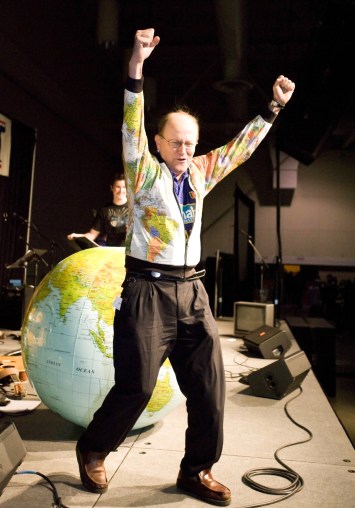
Verwer stepped down as international director of OM in 2003, turning leadership over to Peter Maiden. He continued, however, to speak to groups of young Christians around the world. He would bring out a giant inflatable globe, put on his trademark globe jacket, and ask them, again and again, a version of the question he asked his college friend when he was just 18.

“Well? Are you ready to go?”

“If you spend two years overseas,” Verwer said, “there’s a high chance you’re never going to be the same once you come back. You’ll have seen how God answers prayer and how the Holy Spirit changes lives, and you’ll have caught a glimpse of what God is doing around the world.”

Verwer is survived by his wife, Drena, and their three children, Ben, Daniel, and Christa.

Picturing the New Testament with 499 Line Drawings

Eastern European Bible mission is giving away art for ministry use.

Bible drawing illustrating Romans 16:20

Bible drawing illustrating Romans 16:20

Christianity Today April 14, 2023
Courtesy of Eastern European Mission

When people really hear Scripture, it comes alive in their hearts and their imaginations. They can see Jesus and his disciples trudging the dusty road to Jerusalem, Peter receiving a vision of animals lowered in a sheet, or Paul in prison writing another letter.

Scott Hayes, publishing director for Eastern European Mission (EEM), a ministry committed to giving the Bible away in formerly Soviet-controlled countries, believes Bible pictures can grab people and pull them into the truth of the text. He and graphic artist Fred Apps have produced 499 New Testament drawings—two for every chapter—to illustrate the whole book, from Matthew to Revelation. EEM is giving the images away under a Creative Commons license for anyone to use for ministry. CT asked him about the vision for this New Testament art project.

Why illustrate the New Testament?

At EEM we have this philosophy: “The Bible. We want everyone to get it.” Well, that’s actually a triple-meaning motto. We want them to get a physical copy. We want them to “get it,” to understand it. But them we want them to get “it,” meaning the ultimate indwelling of Christ.

We have meetings once a year where we sit down with all the people who distribute our Bibles—the boots on the field—and do a little bit of planning, a little bit of dreaming. Where do we need to go? What do we need to do? For years—four of five years—the same topic comes up every year. We need something between the teen Bible and the New Testament.

Matthew 7:9-10Courtesy of Eastern European Mission
Matthew 7:9-10

And then I’ve been at meetings with other Bible publishers and they have the same discussion. It’s like, “What do we do for older teens and young adults?”

The idea with the illustrations is that they can go in a Bible and help pull people in, be easier to read, but still you have the complete Bible.

My desire was to provide something that will encourage them to read and slow them down a little bit. I hope the illustrations might help people think more about the New Testament.

I don’t think I’ve seen illustrations like this, not just capturing the narratives but the epistles too, two drawings for every chapter. Had you seen something like this before?

No. But when I was a teenager there were different popular memorization methods, and I took one of them and developed it for the entire New Testament. I had an image for each chapter. You could ask me about any chapter when I was a teenager, I could tell you from the images I remembered what the chapter was about. It was a memory-peg system.

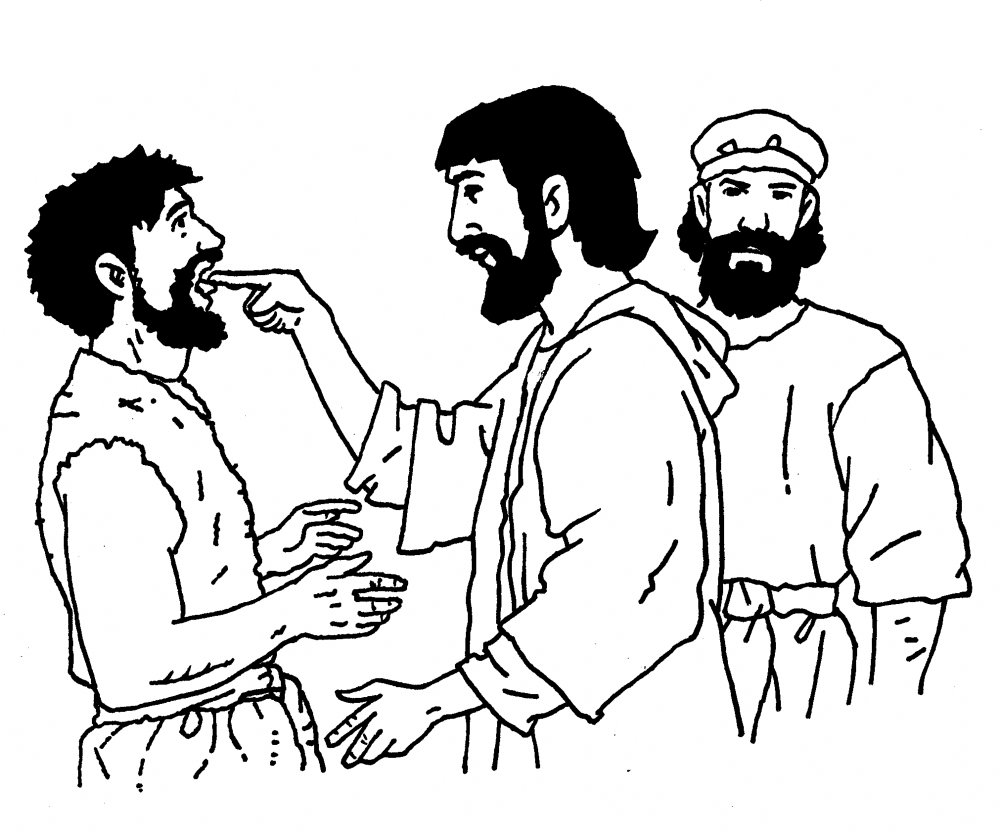
Mark 7:35 Courtesy of Eastern European Mission
Mark 7:35

That’s where it started for me. I’m also a Bible teacher. I’ve been a Bible teacher all my life and it’s a passion, along with helping people get the Bible. I’ve taught through all those passages multiple times, and when I teach I picture images in my head. I have an idea in my head.

One thing I like about images in the New Testament is even a normal reader will remember that illustration on a page. They may not remember what chapter Jesus says to render to Caesar what belongs to Caesar, but they’ll remember an image of a head on a coin. And you can flip through quickly, you find that you find what you’re looking for.

You worked with an artist named Fred Apps, your ideas, his art. How did that process work?

I told him from the beginning I was interested in doing illustrations for every chapter of the New Testament. He’s like, “Wow. Okay.” He’d done things that big, of course. He’s illustrated a lot of Bibles! Fred is a graphic artist, lives in London, and in the later part of his career, he kind of specialized in Bibles. He retired and then didn’t like retirement and went back to work and he’s done a number of big projects for EEM. But in all that work, he’s never done something so comprehensive for the New Testament, like what I had in mind.

1 Corinthians 4:5Courtesy of Eastern European Mission
1 Corinthians 4:5

He said he’d be willing to do it, but he had to have three eye surgeries. I wait a year and a half. Then he said yes, and that was right at the start of COVID-19.

I wrote instructions for each image. I sent him an instruction manual—279 pages. I read through the Bible, and for each chapter, I would come up with an image; try to find some examples surfing the internet, looking on Google Images; and then write a paragraph explaining the idea.

Then he would send me a pencil drawing and I would say, “Wow, look at that.” Or sometimes I’d say it needed something.

How long did all this take?

He puts out work pretty quick. He said, altogether, it was half a year’s work for him.

Are there plans to publish a Bible with these images? Right now they’re all available for download and you’re sharing them with a Creative Commons license, but will we see illustrated New Testaments soon?

It’s just artwork at the moment. We’ll see what they become! This is truly an experiment.

I want them to be used. We used the Creative Commons license, so I’m hoping other people will come with creative ideas that I would never think of. At EEM, our specialty is printing Bibles and New Testaments. But it’s also giving them away—not selling them. So that means anything we produce, we’re always looking to give it away.

If you add all these pictures to a New Testament, it would add about 10 percent to the length. That’s not too bad. They’re line drawings, black and white, so they won’t cost more to print. Just some extra paper.

The earliest we at EEM would put something out is 2024. But I’m also talking to people who put out Bibles in German, French, and other languages; we are maybe going to release very cheap versions to sell on Amazon. There could be an illustration Serbian New Testament soon.

I hope lots of people will find uses for it and it helps more people get the Bible.

Church Life

MLK’s Epistle to the White Church Still Preaches

On the 60th anniversary of Martin Luther King Jr.’s Letter from a Birmingham Jail, Christians are reminded of how much further we must go.

Christianity Today April 14, 2023
Illustration by Mallory Rentsch / Source Images: WikiMedia Commons

On Good Friday in 1963, eight white Alabama clergymen published an open letter in Birmingham calling for the Black community to cease their civil rights demonstrations.

These church leaders—from Methodist, Episcopal, Presbyterian, Baptist, Catholic, and Jewish traditions—advised that “when rights are consistently denied, a cause should be pressed in the courts and in negotiations among local leaders, and not in the streets.”

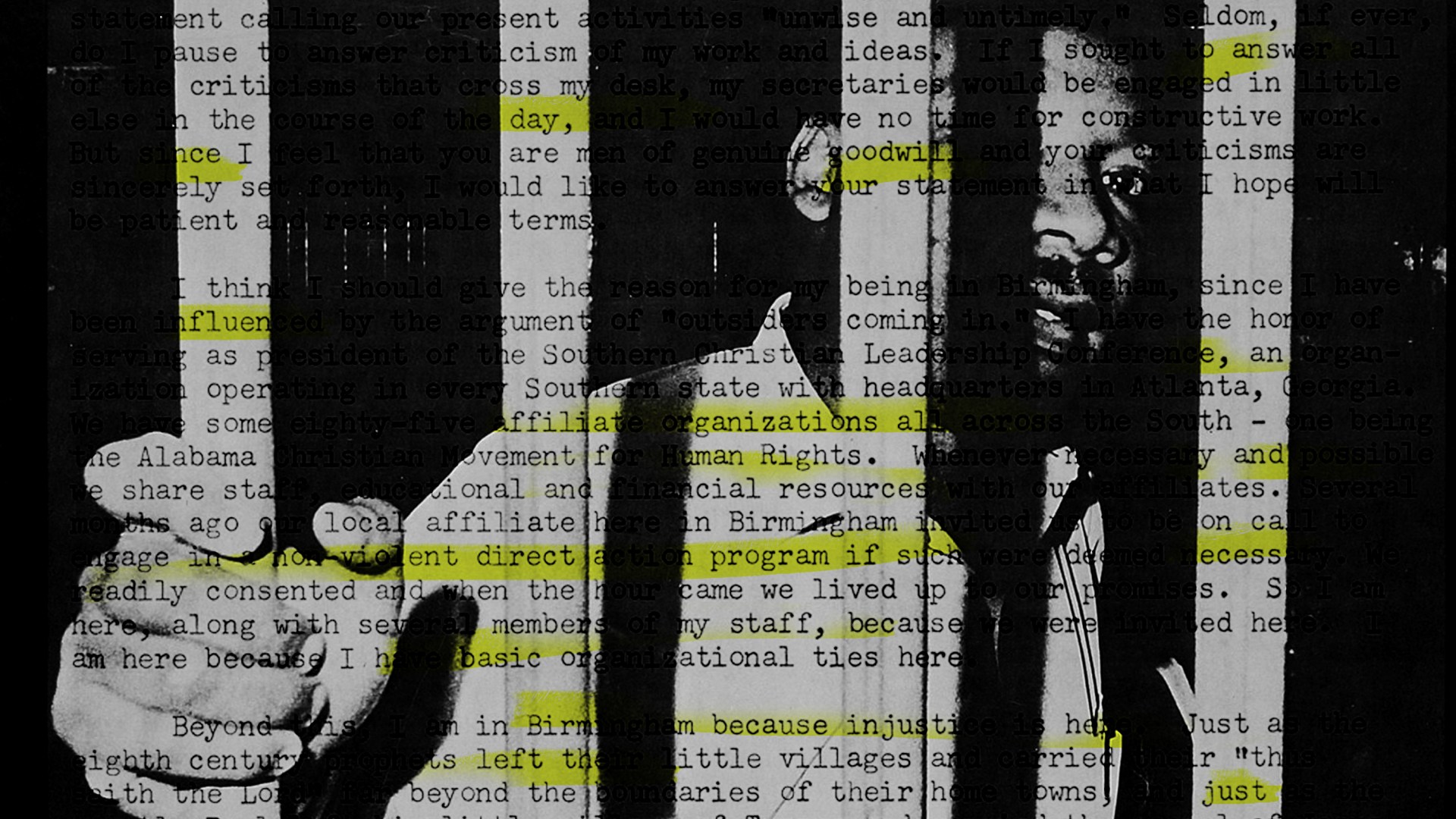
In response, Rev. Dr. Martin Luther King Jr. penned a timely message—beginning on the margins of newspapers and then on smuggled-in scraps of paper—not knowing the profound impact it would have for generations to come. His “Letter from Birmingham Jail” is said to be the most important document of the civil rights era, compared by some to Jefferson’s Declaration of Independence for its impactful call for social change.

Although the “separate but equal” segregation law had been struck down a decade earlier through the landmark case of Brown v. Board of Education, some cities and states were resistant.

In Birmingham, one of the most segregated cities in America, notorious local safety commissioner Eugene “Bull” Connor and other white segregationists got a state judge to pass a temporary injunction banning all pro-integration activity. And after leading a peaceful march, King and other protesters were arrested.

From his cell, King made a compelling argument for the importance of peaceful, public protest in the pursuit of justice. He explained the four steps of nonviolent activism: collecting facts to determine whether injustice exists, negotiating with local officials to work toward just resolution, practicing restraint when actions are taken against you, and raising awareness to drive more effective negotiation.

King began his letter by expressing his solidarity with the Black community in Birmingham, which had gone through all of these steps only to be met with countless broken promises: “For years now I have heard the word ‘Wait!’ … This ‘Wait’ has almost always meant ‘Never.’ … ‘Justice too long delayed is justice denied.’”

He expressed his frustration and disappointment with two particular groups of people that often intersected: the white moderate and the white church.

Accusing the white moderate of caring more about “a negative peace which is the absence of tension” than “a positive peace which is the presence of justice,” King further explained that “shallow understanding from people of good will is more frustrating than absolute misunderstanding from people of ill will. Lukewarm acceptance is much more bewildering than outright rejection.”

King also shared his “deep disappointment” at the complicity and complacency of the white church—a discontent that was possible only because of his deep love for the church, as a third-generation pastor raised in its pews. He contrasted believers in the early church—who were eager to transform immoral practices in their society—with the contemporary Christian church, which had become an “arch-supporter of the status quo” with its “silent and often vocal sanction of things as they are.”

He then posed a question that is still being asked today: “Is organized religion too inextricably bound to the status quo to save our nation and the world?”

Many pastors and members of white churches today use quotations from King in their sermons, writing, and social media posts. But if we are going to change power structures that perpetuate racial injustice, we must move from memorializing toward modeling King’s message and call to action.

As Esau McCaulley wrote in his piece for Martin Luther King Jr. Day last year, “If remembering King means anything, it involves a sanctified dissatisfaction with the status quo.”

In a 2021 Pew Research poll, over a year after the George Floyd protests, 65 percent of Black Americans reported that the renewed awareness of racial inequity did not have an impact on the lives of their community—compared to 2020, when 56 percent expected policy changes would improve Black people’s lives.

One problem is that some white communities, both Christian and non-Christian, are worried about their own marginalization and blind to the marginalization of others. Another issue is the ongoing lack of awareness of the ways racial and economic systems perpetuate injustice in communities of color.

When confronted, some will blame partisan politics for ineffective change. Political divisions have always caused people to hold fast to one side or another, even at the expense of violating the humanity of others. But silently staying somewhere in the middle and watching, hoping, or grieving is not a sufficient response for Christians. Instead, we must ensure justice in the courts so that all people are treated fairly.

As King wrote in his letter, “injustice anywhere is a threat to justice everywhere.”

Injustice does not just happen, and it does not repair itself. If we want history to tell a different story of the white church, we must join the men and women working to repair the unjust systems in our country—especially those individuals who belong to the body of Christ.

During this Easter season, pastors from the Black church tradition are marching at state capitols, much like King did 60 years ago. They are working to ensure that all voices are heard; that books are not banned; that their history is not erased; that their right to vote is protected; that financial barriers to homeownership are removed; and that competitive wages, education, skills, and capital for wealth creation are available to all.

The Black community is not the only group in our country that faces injustice.

For instance, pastors from Latino evangelical churches in Florida are mobilizing to protect their own communities and churches from unjust policy proposals that would criminalize providing car rides and opening their homes to undocumented immigrants. Such a law would make it a felony to extend hospitality, whether one is aware of the person’s immigration status or not.

The fight for civil rights is not the story of the past; it remains very much alive today. Throughout history, it has never been just one issue at one time, in one location, affording one solution, march, mobilizing effort, or request. It has always been a series of necessary actions, spanning decades.

In all such matters, the white church needs to care enough to listen, learn from, and work toward a more proximate justice. In joining this effort, we better understand the prophet Amos, who bore witness and opposed the extreme injustices of his day when he cried, “Let justice roll on like a river, righteousness like a never-failing stream!” (5:24).

At the end of his letter, King reorients his personal disillusionment by recalling the “church within the church, … the true ekklesia and the hope of the world.” Regardless of its size, this group is composed of those who benefit from the status quo working alongside those who are impacted by injustice and unrighteousness. Their witness is what King calls “the spiritual salt that has preserved the true meaning of the gospel.”

The work of change has always been done by a remnant. And together, we can carve a “tunnel of hope through the dark mountain of disappointment” by picking up the mantles left by those who have gone before and working for justice today.

Michelle Ferrigno Warren is the president of Virago Strategies and helped found Open Door Ministries. She is the author of Join the Resistance: Step Into the Good Work of Kingdom Justice (IVP, 2022) and The Power of Proximity: Moving Beyond Awareness to Action (IVP, 2017).

Theology

The Evangelical Temptation to Prove Ourselves

Christians must deny the urge to posture, which comes from a place of insecurity.

Christianity Today April 13, 2023
Illustration by Mallory Rentsch / Source Images: Getty

This piece was adapted from Russell Moore’s newsletter. Subscribe here.

For a long time, I have feared that my fellow American evangelical Christians were yielding to the third temptation of Christ: to sacrifice integrity for the conquest of power. Yet over the past year, I’ve started wondering whether we’re falling for an entirely different temptation—the one we least understand and were least taught to withstand.

The Gospels tell us that right after Jesus’ baptism in the Jordan, the Spirit directed him into the wilderness where the Devil set before him three temptations (Matt. 4:1–11; Luke 4:1–13). One temptation was to turn stones into bread—to satisfy his own appetites at the Devil’s direction.

This was, of course, the primal temptation of humanity (Gen. 3:1–3). This one is easy enough for us to understand because all of us grapple with our appetites—some for food, some for sex, some for drink—in ways that can make those appetites ultimate.

Another of the temptations was that the Devil would give Jesus “all the kingdoms of the world and their splendor” (Matt. 4:8) if he would just become a momentary Satanist. (Spoiler alert: Jesus passed up this offer.)

Again, most of us can understand this one because almost everyone is tempted at some point to trade principles for power. For a few, that power is a position in the White House, but for many of us, it is the ability to get the last word at the family dining room tables in our homes or to get the best seats at the conference tables at our jobs.

That temptation is still at work and transcends almost every tribal boundary. Forms of Christianized Marxism often yield to this temptation by replacing a gospel of repentance and faith with merely subduing oppressive social structures. Christian nationalism does the same thing—replacing a faith of new birth with blood-and-soil cultural Christianity.

Even so, I’ve come to believe that the greatest temptation we face right now may be the one that seems the farthest from us.

It’s the second temptation in Matthew’s account and the last in Luke’s. The Devil took Jesus to Jerusalem “and had him stand on the highest point of the temple. ‘If you are the Son of God,’ he said, ‘throw yourself down from here’” (Luke 4:9). Satan even had a Scripture verse to go with this temptation—a passage from Psalm 91: “He will command his angels concerning you to guard you carefully; they will lift you up in their hands, so that you will not strike your foot against a stone” (Luke 4:10–11; Ps. 91:11–12).

Some of you reading this have indeed resisted the temptation to throw yourselves from high places. Many others of you have never faced even the thought of that. Yet in either case, you likely were never tempted to do so for the reason Jesus was—to force a visible sign that he was, in fact, “the Son of God.”

As he always did, Jesus recognized what was going on, of course. And in response, he cited a portion Deuteronomy 6:16, which reads in full, “Do not put the Lord your God to the test as you did at Massah.” What is this verse referring to?

The place was called “Massah and Meribah,” the Bible tells us, “because the Israelites quarreled and because they tested the Lord saying, ‘Is the Lord among us or not?’” (Ex. 17:7).

The people of Israel—the very ones God had delivered out of Egypt with parted waters and a pillar of fire—started fighting in a drought because they wondered whether God was really who he said he was: a God who went before and behind them. They asked Moses, “Why did you bring us up out of Egypt to make us and our children and livestock die with thirst?” (v. 3). They lost confidence, and they wanted a sign.

In Jesus’ day, the temple was more than just a tall building. It was the place in which God had promised to dwell. For the Anointed One to essentially ask “Is God among us or not?” at the temple would be quite a question indeed.

Had Jesus thrown himself from the temple, angels—maybe even twelve legions of them—would likely have rescued him. It would have tangibly verified to Jesus, in his humanity, what God told him at the waters of the Jordan: “You are my Son, whom I love; with you I am well pleased” (Luke 3:22).

Even more than that, the crowds below would have seen this happening. It would have publicly vindicated Jesus to the very people of the city where he would later be crucified. No one would have dared suggest that he was demon-possessed, a lunatic, a closet insurrectionist, or a covert collaborator with Rome. He would have proved himself to be the Anointed One of God.

Jesus would have forced a sign. And Jesus called that a sin.

In 2010, political scientist James Davison Hunter identified that the “distinguishing characteristic” of current political psychology is what Friedrich Nietzsche called “ressentiment.” Although it includes resentment, Hunter wrote, it goes beyond that to involve “a combination of anger, envy, hate, rage, and revenge as the motive of political action.”

The years since Hunter penned this have proven him right. Much of what passes for “political action” or even just “cultural engagement” is really about a sense of injury—more specifically a sense of humiliation: “You think you’re better than me, and I’ll prove you wrong.”

We want to be vindicated—in public. We don’t just want to win; we want to “own” whoever has mistreated or made fun of us. We want to be respected, to be affirmed, if for nothing else than to boost our numbers and our political power.

Most of the rest of the world can see this for what it is: a lack of confidence. We want to be proven right because we don’t remember who we are or why we’re here.

We’ve all heard of the proverbial rock star who snaps at a restaurant server or club bouncer, saying angrily, “Don’t you know who I am?” The rage behind that question often stems from the rock star’s fear that the answer is “No, who are you?”

Referring to the incidents at Massah and Meribah, God said through the psalmist that the Israelites “put me to the proof, though they had seen my work” (Ps. 95:9, ESV). They forgot who they were.

Jesus did not. He believed that he was exactly who his Father said he was: the beloved Son of God. So he did not need to clamor for immediate satisfaction of his appetites; his Father had fed with manna before and would do it again. He did not need to grasp for immediate power over the nations; he would receive this not instead of humiliation but through it (Phil. 2:5–11).

When we forget the story the Bible tells us—the one it includes us in—we start seeing our audience as whatever mob or strongman will protect or respect us. When we forget about the judgment seat of Christ, we want a judgment seat now. We want to be proven right, now.

God would prove Jesus’ anointing not by vindication but by resurrection (Rom. 1:3–4). But even then, Jesus did not need to prove himself.

As New Testament scholar Richard Hays points out, the risen Christ “did not appear in the Temple and chastise his opponents; he did not appear to Pilate or in Rome to Caesar.” The Resurrection appearances were not a “how do you like me now?” tour to those who didn’t believe or respect him. Instead, he appeared to his followers—to the women at the tomb, to the men on the boats, to the gathered little flock on the mountain.

Even when faltering Thomas demanded to see the wounds of crucifixion and Jesus graciously accommodated him, the little band that would turn the world upside down left the room not to prove themselves right but to bear witness to something real—to Someone alive. Their words were not “Is God among us or not?” but “My Lord and my God!” (John 20:28).

What if we did the same? What if we were a church so confident in our own identity in Christ that, at long last, we had nothing to prove but something to give—life and rest, joy and peace?

Russell Moore is the editor in chief at Christianity Today and leads its Public Theology Project.

Theology

Water, Water Everywhere: How Christians View Thailand’s Water Festival

During Songkran, Christians find parallels in honoring their elders but point to the living water.

Christianity Today April 13, 2023
Illustration by Mallory Rentsch / Source Images: Getty

This is the third article in the Engaging Buddhism series, which explores different facets of Buddhism and how Christians can engage with and minister to Buddhists.

For the first time since the pandemic began, the massive water fights of Songkran have returned to Thailand’s streets. Taking place during the hottest week of the year, children and adults spray each other with colorful plastic water guns. People stand in the back of truck beds and use buckets to fling water and ice at neighboring trucks. Motorcycle drivers squint to see through the deluge—which often comes at them from multiple directions—while their passengers soak as many people as can as they pass.

Water—and lots of it—replaces fireworks in Songkran, Thailand’s new year celebration, held April 13–15. The holiday is also celebrated in Cambodia, Laos, Myanmar, Sri Lanka, and several other regions that follow the Buddhist calendar. According to Buddhist tradition, water symbolizes ritual cleansing, righting last year’s wrongs, and welcoming the clean slate of a new year.

Beyond the raucous water fights on the streets, Thai Buddhists visit temples during Songkran to pour water over statues of Buddha and the hands of monks. This symbolic act is believed to atone for sins, bring purification, and make merit (gain good karma by performing good deeds). Worshipers also bring food for monks to make merit.

Spending time with family is also integral to Songkran. During the holiday, Thais travel across the nation to visit their family and strengthen familial bonds as they move toward the new year. They also pay respect to their elders and seek their blessing by pouring water over their hands. People exchange floral garlands made of jasmine, roses, and white champaca (flowers similar to magnolias).

Thai Christians differ from their countrypeople in their participation of Songkran because of the holiday’s Buddhist roots and because of the drinking and partying that have become associated with it. Yet Thai pastors see Songkran as an opportunity to show the wider Thai society that Christians also honor their elders, even if they don’t participate in certain Buddhist rituals.

“We show respect to family—our father, mother, or elders—which is a beautiful picture, and it is something that honors God,” said Chukiat Chaiboonsiri, the pastor of Creation Church Chiang Mai.

CT spoke to three Christians in Chiang Mai province in northern Thailand—Chaiboonsiri; Goi Manasakulpong, pastor of Creator Church in Hang Dong District; and Dream Waiwang, a former missionary—about how they view the holiday and the gospel opportunities they see during the celebration.

Thailand’s giant water fight

Songkran originated from a Hindu festival in India welcoming a new harvest season. Derived from the Sanskrit word sankranti, which refers to the movement of the sun from one position to another in the zodiac, it marks the new year according to the solar calendar. From 1888 to 1940, Songkran was Thailand’s official new year before it was moved to January 1.

The traditional custom of pouring water on Buddha, monks, and elders later extended to splashing friends and family with buckets of water to keep cool and as a sign of respect. While len nam, or playing and throwing water, has been a component of the holiday for generations, the rise of tourism and social media has brought Thailand’s water festivities into the international spotlight in recent years. Tourists from around the world throng to the country to join in the celebrations.

Chaiboonsiri, 48, believes Christians should not venture into the busy areas during Songkran for both their physical and their spiritual safety. Motorcycle and car accidents spike during Songkran due to drunk driving, speeding, and reckless driving. The revelry can also lead to temptations for Christians, as many people get drunk and start fights.

He said Christians should not go where “we are spiritually enticed and our life is threatened.”

On the other hand, 35-year-old Waiwang, who has ministered with missionaries in northern Thailand since she was in college, does not see an issue with celebrating and playing in water fights, as long as caution is exercised. “For me, I don't drink, so I think they will see how I’m different from them,” she said, adding that it can lead to gospel conversations.

Manasakulpong, also 35, agreed, noting that Christians can take part in traditions that do not compromise their faith such as the water fights and honoring elders. He sees joining in as a way for Christians to remain present in the community and a witness to nonbelievers.

“Water fights are a separate action from a religious ceremony, so we can participate,” he said. Yet he notes that Christians should behave in an “appropriate and polite” way and refrain from violence.

Manasakulpong draws the line at pouring water over statues of Buddha or seeking the blessing of monks, noting that Christians should only worship and revere the one true God. He’s found that many Thai Christians attend festivals without knowing the significance or history of the holiday. So he urges church leaders to study the origins of Thai holidays to help congregants understand what they should and shouldn’t take part in when celebrating.

Showing respect to elders

Some Thais lament that the water fights have taken center stage in the holiday, pushing other traditions into the background. In the past, water splashing was not nearly as intense as it is now; typically smaller buckets of water were used and water guns weren’t as common.

“When we study the history, we will see that the Songkran festival is a beautiful tradition,” Manasakulpong said. He points to the quality time spent with family and the chance for the older generation to bless and impart wisdom to the younger generation. Families ask for forgiveness from one another and right the wrongs of the previous year.

Christians also embrace these concepts. Both pastors noted that it’s important for Christians to demonstrate to Thai society that honoring elders and Christianity are not mutually exclusive. That’s because in Thailand, Christianity is seen as countercultural. Those who convert to Christianity are viewed as abandoning the faith of their parents and the community around them. By no longer partaking in the customs and rituals tied to Buddhist beliefs, older family members may feel that they are rejecting them and their own Thai identity.

For instance, after a loved one dies, family members traditionally pour holy water over the body, make merit on behalf of the dead by giving money to the temple, and buy refreshments and gifts for monks who chant over the body. A Thai Christian refraining from participating in parts of the funeral can be viewed as dishonoring their elders.

Songkran can be an ideal opportunity to show that Christians also hold elders in high esteem. At Manasakulpong’s church, his staff and church members buy gift baskets containing items such as toiletries, soap, shampoo, fruit, and snacks to give to older church members during Songkran.

Over at Chaiboonsiri’s church, the older men and women sit in a row at rectangular tables at the front of the church. Younger members walk down the line to ask for a blessing and pour water from bowls over the hands of the elders to symbolize respect and honor. This activity can help bridge the gap between Thai culture and Christianity, Chaiboonsiri said.

“The Bible gives us the command to respect elders and show God's love for them,” he said. “Therefore, it is something that Thai Christians should do to the best of our abilities.”

Manasakulpong noted that Christians and Buddhists differ in their motivation to honor their elders. When Buddhists participate in temple activities or pour water over an elder’s hands, they are seeking to make merit and cancel out their bad karma so they can move up in their next life. For Thai Christians, the gifts, honor, and respect aren’t given out of a works-based theology.

“Christians do not make merit in order to be saved, because salvation is a gift from God,” Manasakulpong said. “But we should do good deeds and show love to others because doing so is an honor to God.”

Sharing the living water

Since so much of the new year holiday is spent with family, Chaiboonsiri encourages Thai Christians to deepen their relationships with their family and be a Christlike witness. Waiwang also believes the family time is an important opportunity to love them as Christ loves the church. She said young people should take the time to visit older family members to ask for forgiveness.

“If we did something wrong or disrespectful to them, it is the time to show them that we are sorry for the things we did,” Waiwang said.

As water sloshes over the streets of Chiang Mai, Chaiboonsiri speaks to his congregants and nonbelieving Thais about living water. This Sunday, he plans to preach from John 4, where Jesus tells the Samaritan woman at the well that if she drinks from the water he offers, she will never thirst again.

Thai Buddhists go to the temple every year to purify themselves—it’s never-ending and never enough, he said. Just like poet Samuel Taylor Coleridge’s famous line, “Water, water, everywhere, nor any drop to drink,” water is indeed everywhere in Songkran yet there never seems to be enough drops to spare for the sins that so easily entangle.

Buddhists cannot know if they’ve made enough merit to cancel out their sin. And if they fall ill or are unable to go to the temple, how can they atone for their sin? Life is too short to account for all the wrongdoing a person commits, and repeated “trips to the well” won’t quench the thirst for atonement, Chaiboonsiri said.

Here, Chaiboonsiri finds an opportunity to share the Good News: “If you receive Jesus, it’s forever—eternal life. Jesus is the water of life; you’re not thirsty again and again and again.”

After 18 Years on Christianity Today’s Board, Darryl King Says He’s a ‘Lifelong Friend’ of the Ministry

The hall-of-fame hurdler turned business leader turned pastor on what his years of service meant to him.

After 18 Years on Christianity Today’s Board, Darryl King Says He’s a ‘Lifelong Friend’ of the Ministry
Photo courtesy of Darryl King

Once upon a time, Darryl King won races, pretty much all the time. A gifted hurdler, King became the first African American track and field athlete inducted into Rice University’s hall of fame.

After graduation, King brought his work ethic and confidence of his past athletic—and academic—achievements to the business world. But whereas his drive and focus had led to uncomplicated success in athletics, he soon realized the cost of his professional achievements on his family.

Within a decade of marriage, King said he realized “I had shot out there in the world, and right away things were going great, but then suddenly nothing’s really going great because I was losing my wife and family.

“I knew that what I was pursuing was really empty.”

In her frustration with her marriage, King’s wife had become close to a couple who led her to Christ. When King noticed the change in her, he realized he wanted the same for himself. The same couple—who to this day are among their closest friends—helped him in the earliest days of his Christian walk.

More than 40 years later, King says these friends would never have imagined then the type of impact and opportunities he and his wife have had.

“And isn’t that the way the Lord works?”

Part of those surprising accomplishments have been King’s work at Christianity Today, where he recently completed 18 years of service on the board of directors.

King joined the board in 2004, while he was still working in the technology industry, and he was looking forward to bringing his knowledge of that sector to a print magazine organization.

“It was exciting because, over time, I realized CT was open to what was really happening in the world,” he said. “The articles and topics became more interesting to me.”

After several years on the board, King’s own career began to shift. He went to seminary and became a pastor and Christian counselor.

“The last ten years of my time at CT, I went from a tech executive into full-time pastoral ministry, and that really had a lot to do with people I engaged with at CT,” he said.

King’s relationships with board members also helped him when he became the lead discipleship pastor at an all-white congregation in the South.

“The ability to share my experience had some influence on several of the board members,” he said. “I would hope that they would say that was part of the unique experience that I brought to the board.”

It’s been encouraging for King that this shift hasn’t just occurred at the board level.

“I don’t know that some of the topics that CT covers recently would have been handled when I first started on the board,” King said. “To see CT’s broader inclusiveness, the conversations about different faiths, the cultural sensitivities—I’ve seen those increase since I started in 2004, and that’s really encouraging to me.”

One highlight for him was traveling in 2019 with 20 CT staffers to Alabama on a civil rights trip, where the trip made visits to Equal Justice Initiative’s National Memorial for Peace and Justice and The Legacy Museum, which honors those murdered in lynchings, and the 16th Street Baptist Church where a bombing by white supremacists killed four little girls. The group also visited a remote and rural part of the state where a woman shared her and her family’s experiences of living in a home that lacked access to clean water and basic utilities.

“I think about the lady that has since passed away and the time I was able to spend with her,” King said. “It makes me wonder how our time with her and on that trip changed who we are as an organization.

“When I think of CT, I think of the Book of Matthew talking about the least and the last—and this trip gave our staff a fuller perspective on what Jesus was teaching. At times, the trip was heart wrenching. But it was reality. It made me think of how CT can bring more of these important stories to those around the world.”

Now officially retired, King is attending a multiethnic church and has lately become a big fan of cruises. (He recently got back from one that made stops in Haiti, the Dominican Republic, Aruba, and Curacao.)

He also has a new project—an app that he’s working on with a business partner (whose last name is also King) called Familyworks.app. It is a tool that helps families and organizations pursue whole-health wellness. He’s also consulting in sales and marketing and loves all the learning along the way.

As he reflects on his time on the board, King sees that his calm and steady demeanor helped the group work through difficult seasons. When he became involved in pastoral ministry, his role became more of a shepherding one. He also fostered close relationships with his colleagues—as sounding boards for each other and sharers of wisdom into each other’s lives.

“When CT leads with Christ in view, then what CT pursues will always be relevant to the world it serves,” King said. “That’s what I’ve always pushed for while on the board.”

“I am a lifelong friend of CT.”

Morgan Lee is CT Global managing editor.

Books
Excerpt

Making Haste Slowly in Our Walk With God

In these hurried times, Christians are called to a steady journey of faith.

Christianity Today April 12, 2023
Illustration by Mallory Rentsch / Source Images: Getty / Unsplash

I have met with but one or two persons in the course of my life who understood the art of Walking, that is, of taking walks— who had a genius, so to speak, for sauntering. —Henry David Thoreau, “Walking

The restless, distracted energy of our technological age has risen to a fever pitch. With each advancement, we are bound closer together into a collective fragmentation without intimacy.

The loneliness and relational divides that flow back to the beginning of recorded history are being amplified rather than silenced. We engage in everything from religious practices, mindfulness, yoga, and exercise to television, sex, food, drink, and drugs. We do all this to escape.

As Don DeLillo wrote in his brilliant and funny novel White Noise, “That’s why people take vacations. Not to relax or find excitement or see new places. To escape the death that exists in routine things.”

The forsaken God has entered into and dealt with this cosmic loneliness, yet often followers of the crucified King are just as lonely as the rest. What is missing?

There is a classical adage that might prove helpful: festina lente, which means to “make haste slowly.” A crab and butterfly first symbolized this saying. Its meaning lies in the paradox that existence is not meant to be static or careless but defined by conscientious and careful movement.

As one who leans into life with a relatively free-spirited disposition, when I look at the crab-and-butterfly image, I find myself uneasy at the way the butterfly seems held back by the crab’s clamp on her wings. But that tendency has led me to make many grievous errors throughout my 48 years of life. The crab is a necessary reminder that our movement must be anchored in thoughtfulness.

Walking is a beautiful metaphor used throughout Scripture to symbolize both movement and intimacy. It is a lovely reminder that the goal of the Christian life is not arriving at a destination but knowing God. This is the very heart of what it means to be a disciple.

Walking can be sustained for much greater distances than running because it is motion essentially without strife. It is progress that is truly conscientious of its surroundings. Our walk is not a lonely journey, isolated in pursuit of self-actualization.

For Christians, our place in this world is discovered in walking with God toward others. We are free in Christ, but we are not free from him or one another. We cannot embody the individualistic worldview that says, “I am best when I’m alone.” Sadly, it is often Christian leaders who follow this path.

Solitude must never be separation. We cannot and must not escape the world or the people in it. False holiness drains of all meaning out of Christ’s forsakenness. It fights against the very One who tore down the walls of separation by building new ones.

As we walk with Jesus, who is our beginning, our end, and our way through the in-between, let us be careful to think of our progress not as a hero’s journey but as relational, intimate, and (due to our mixture) often clumsy. In other words, to walk with God is defined by progress that is most clearly seen by others and often barely perceptible to us.

If you are like me, you may find yourself thinking, I am not good company. What can I possibly have to offer Jesus? The answer, my friend, is simple: yourself. Christ doesn’t choose to use sinners because they’re strong, wise, or gifted—strength is a positive impediment—but because he’s gracious and he seems to enjoy using the weak things of this world to confound, and even reach, the wise.

The butterfly has been used in the history of the church to symbolize resurrection, metamorphosis, and transformation by the Spirit’s activity in our lives. But what of the crab? While I can find no use of the crab as a symbol in church history, I will say this: As the crab in the original festina lente emblem symbolized a grounding or foundation for healthy movement, so the cross of Christ must be the center and grounding of our lives.

If Jesus is the way and there is only one way to go, then there are a thousand ways to lose the way, fall from it, or even run from it—consider Abraham, Elijah, Jonah, and Peter. We will lose the way. But that is why Jesus came, why it is good news that the gospel is down-to-earth, and why it’s not good to travel alone.

The Cross is our center, our equilibrium, and our compass. It is a constant reminder that if you’ve dug yourself into a hole, Jesus’ love goes deeper still; if you’ve lost your way, he will leave the others to find you again and again; if you have fallen, that’s the whole reason he came; and if you have run away, the Cross can lead you home.

Jesus was forsaken so that you could be found. He is with you, so arise and return to your Father. He loves you and longs to embrace you. We belong, and the Cross and our forsaken King are the proof.

So festina lente. Let us make haste.

Slowly.

Adapted from Stumbling Toward Eternity. Copyright © 2023 by Josh White. Published by Multnomah, an imprint of Penguin Random House LLC. All rights reserved. No part of this excerpt may be reproduced or reprinted without permission in writing from the publisher.

News
Wire Story

How Bethel and Hillsong Took Over Our Worship Sets

“If you have ever felt like most worship music sounds the same, it may be because the worship music … is written by just a handful of songwriters.”

Hillsong United on tour in 2022

Hillsong United on tour in 2022

Christianity Today April 12, 2023
Alberto E. Tamargo / Sipa USA via AP Images

On Easter Sunday, the worship band at Bethel Community Church in Redding, California, opened the service with “This Is Amazing Grace,” a 2012 hit that has remained one of the most popular worship songs of the past decade.

Chances are thousands of other churches around the country also sang that song—or one very similar to it.

A new study found that Bethel and a handful of other megachurches have cornered the market on worship music in recent years, churning out hit after hit and dominating the worship charts.

The study looked at 38 songs that made the Top 25 lists for CCLI and PraiseCharts—which track what songs are played in churches—and found that almost all had originated from one of four megachurches.

All the songs in the study—which ranged from “Our God” and “God Is Able” to “The Blessing”— debuted on those charts between 2010 and 2020.

Of the songs in the study, 36 had ties to a group of four churches: Bethel; Hillsong; Passion City Church in Atlanta; and Elevation in North Carolina.

“If you have ever felt like most worship music sounds the same,” the study’s authors wrote, “it may be because the worship music you are most likely to hear in many churches is written by just a handful of songwriters from a handful of churches.”

The research team, made up of two worship leaders and three academics who study worship music, made some initial findings public Tuesday. More details from the study will likely be released in the coming weeks.

Elias Dummer, a worship leader and recording artist, said he and his colleagues have been watching changes in worship music over the past decade. They wanted to know how worship songs become popular among churches, he said. They also wanted to know how the business of producing and marketing songs is shaping the worship life of local churches.

Dummer said many worship leaders believe the best songs become the most popular in churches. They also believe those songs become popular because they work—people respond to them during worship services and want to sing them over and over. But that’s not exactly true. Dummer and his colleagues found many of the more recent hits songs were released as singles on Spotify and other streaming services, which helps fuel their popularity.

“There are actual mechanisms by which songs become the most significant,” he said. “It’s not just whatever songs the Holy Spirit blesses that make it to the top of the charts.”

For their study, researchers compared popular worship songs written before 2010 with those written from 2010 to 2020. Those earlier songs were often associated with individual worship leaders such as Chris Tomlin and Matt Redman, rather than with churches, and came from a variety of sources.

But beginning in 2010, the most popular new songs began to come from megachurch worship bands—and the most popular worship artists began affiliating with those churches.

Of the 38 songs in the study, 22 were initially released by the four megachurches, with another eight songs released by artists affiliated with those churches. Six more were either collaborations between artists from those churches or cover songs performed by those churches.

Shannan Baker, a postdoctoral fellow at Baylor University, said the megachurch worship teams in the study also popularized songs from other artists, such as “Way Maker,” a song written by Sinach, a well-known Nigerian musician, as well as “Great Are You Lord” and “Tremble.”

“These bigger churches, even if they weren’t involved in making the songs, platformed them,” she said.

Adam Perez, assistant professor of worship studies at Belmont University in Nashville, said the four most influential megachurches all come from the charismatic tradition of Protestant churches. All of them, he said, have a spirituality that believes God becomes present in a “meaningful and powerful way” when the congregation sings a particular style of worship song.

Those songs become one of the primary ways of connecting with God—rather than prayer or sacraments or other rituals. Because of their market success, these churches have changed the spiritual practices and sometimes even the theology of congregations from many traditions.

“The industry itself becomes this invisible hand,” he said. “We don’t name the theology of praise and worship—we just assume it. And we use this kind of song repertoire to reinforce it.”

The study did not look specifically at the lyrics of the most popular songs. Baker did say she’s looking at those lyrics for a different project and found a few trends. For example, she said, few of the most popular songs talk about the cross or salvation.

“A lot of it is, what is God doing for me now? And what has God promised to do for me in the future?” she said.

Baker said that in the past, artists or publishers would put out a songbook or recordings of new worship songs, and then churches would pick out the songs in those collections that best fit their context. Now, she and other researchers wonder if these megachurches are driving which songs are used in worship.

The study is based on data about popular worship songs obtained by Mike Tapper, a religion professor at Southern Wesleyan University. Tapper and his colleague Marc Jolicoeur, a worship pastor from New Brunswick, Canada, worked on a previous study about how quickly hit worship songs appear and then disappear.

Jolicoeur said any concerns about the theology of the four megachurches, or the recent troubles at Hillsong, which has had several pastors resign in scandal, don’t seem to affect the demand for their music.

The popularity of megachurch worship songs doesn’t surprise Leah Payne, professor of American religious history at Portland Seminary in Oregon. Payne, who studies the Christian music business, said it likely reflects broader worship patterns. While most churches in the United States are small, most Christians worship at large churches. The 2020 Faith Communities Today survey found that about 70 percent of worshippers attend the top 10 percent of churches.

“The fact that the worship music of megachurches has a bigger share of the worship market corresponds to the practice of worshippers,” said Payne.

Payne doubts that scandals at churches such as Hillsong will affect the popularity of their music—because people have a relationship with the songs, not with church leaders.

Payne said worship bands at the most popular megachurches have a knack for creating great pop songs. And they know how to connect with mass audiences—both in person and through streaming services.

“They can go toe-to-toe with some of the biggest acts in music,” she said.

https://datawrapper.dwcdn.net/1Qhry
addApple PodcastsDown ArrowDown ArrowDown Arrowarrow_left_altLeft ArrowLeft ArrowRight ArrowRight ArrowRight Arrowarrow_up_altUp ArrowUp ArrowAvailable at Amazoncaret-downCloseCloseellipseEmailEmailExpandExpandExternalExternalFacebookfacebook-squarefolderGiftGiftGooglegoogleGoogle KeephamburgerInstagraminstagram-squareLinkLinklinkedin-squareListenListenListenChristianity TodayCT Creative Studio Logologo_orgMegaphoneMenuMenupausePinterestPlayPlayPocketPodcastprintremoveRSSRSSSaveSavesaveSearchSearchsearchSpotifyStitcherTelegramTable of ContentsTable of Contentstwitter-squareWhatsAppXYouTubeYouTube