Books
Review

Tim Keller and Beth Moore, On and Off the Stage

Both leaders have huge followings. But how well do we really know them?

Illustration by Isabel Seliger

It is an awesome burden which the biographer takes up,” writes Elisabeth Elliot in her 1968 biography of missionary R. Kenneth Strachan. Any such project is “a judgment—upon the subject most obviously, upon the biographer himself, and upon any who were associated with the subject.” To read such a work is at some level to become involved in the judgment. The reader is invited to grapple with the questions raised by the subject’s life.

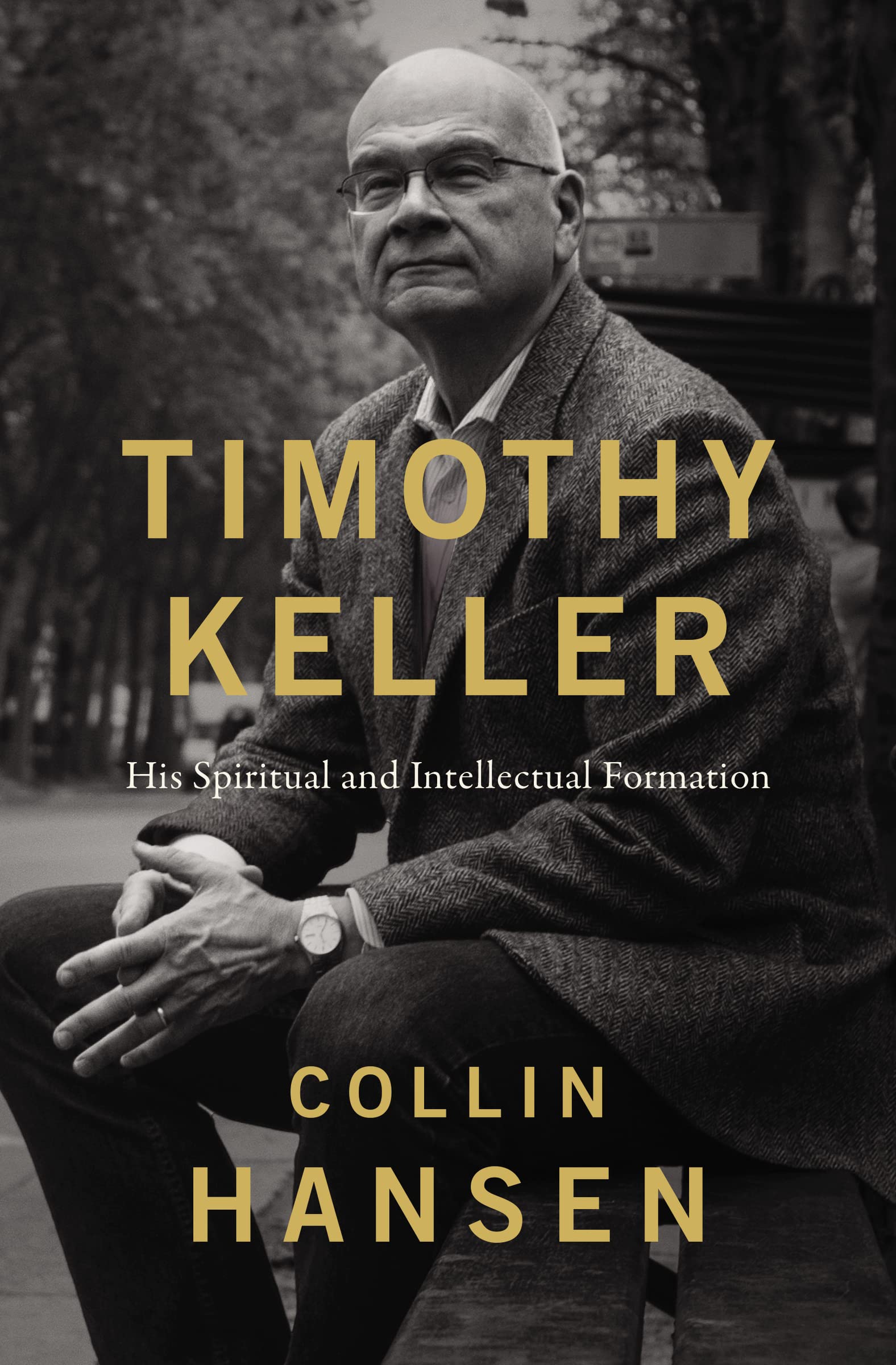
Timothy Keller: His Spiritual and Intellectual Formation

Timothy Keller: His Spiritual and Intellectual Formation

HarperCollins Children's Books

320 pages

And yet, we are endlessly fascinated with biographies, not to mention autobiographies, memoirs, interviews, published diaries, collected letters—everything falling under the umbrella of “life-writing.” In reading them, we hope, perhaps, to glimpse the inner workings of the human heart and mind, to tease some meaning out of what Elliot calls the “careless—apparently, at times, haphazard” events of a human life. Perhaps the light shed by these other lives can help us more clearly see the shapes of our own.

Two recent releases offer this opportunity. The first, Timothy Keller: His Spiritual and Intellectual Formation, is a biography of the author and retired pastor, now in his 70s and undergoing treatment for pancreatic cancer. A teacher since 1975, Keller became nationally known after 9/11 for his role in the growth of New York City’s Redeemer Presbyterian Church.

Author Collin Hansen, editor in chief of The Gospel Coalition, lightly sketches what could be called the personal side of his subject’s life. Keller’s mother was involved and demanding; his father, emotionally absent. Keller left for college disenchanted with the gracelessness he saw in the churches of his youth. Despite majoring in religion in order to look for alternatives to Christianity, he made a commitment to Christ—and apparently to the pastorate, though Hansen devotes only one ambiguous sentence to the subject—by the end of his sophomore year.

Hansen briefly addresses what he sees as Keller’s weaknesses, characterizing him as a poor manager who tends toward overcommitment and people pleasing. Keller’s strengths are more readily apparent, including his ability to connect with people and to present theology in a way many have found compelling. These things helped make his teaching effective—and paved the way for a demanding title-a-year contract with Penguin Books.

Ironically, this broadening of Keller’s audience disrupted his primary work in the local church, as people from outside New York City started coming to hear him preach and get signed copies of his books. Further disruption came with the 2016 election, as he increasingly found many of his ideas a target for Christians across the political spectrum.

Keller’s ideas are Hansen’s primary focus, and he traces their development carefully. Neo-Calvinism, penal substitutionary atonement, amillennialism, complementarianism, broad politics, social justice, worship, evangelism—these are some of the themes Keller is known for, and Hansen shows both the individual and institutional influences behind them. (He names John Calvin, Jonathan Edwards, John Stott, J. I. Packer, R. C. Sproul, C. S. Lewis, Elliot, InterVarsity Christian Fellowship, InterVarsity’s Urbana missions conference, L’Abri, and many more.) For Hansen, this wealth of sources is key to Keller’s success. We “honor Keller better by reading his library than by quoting him,” he writes.

The second offering in this genre comes from Beth Moore, founder of Living Proof Ministries. Moore has taught audiences for almost 40 years, published half a dozen books and more than 20 Bible studies, and amassed over a million Twitter followers. Now, at 65, she has released a memoir, All My Knotted-Up Life.

Moore is a good storyteller with an engaging voice. With a few well-chosen vignettes, she shows the inner dynamics of her family of origin: her father’s unfaithfulness and abuse, her mother’s depression and suicidal tendencies, and the children’s attempts to cope. Moore married her college sweetheart at age 21, and they each brought grief and trauma into the marriage. They had two daughters who “deserved stability” that “we didn’t have … to give” but who hung the moon and the stars for their parents.

Running through the narrative is the thread of the Southern Baptist church where Moore was a fixture growing up. In college she volunteered at the denomination’s sixth-grade girls’ summer camp, where she had a spiritual experience that her pastor and the camp supervisor both took seriously as “a call to vocational Christian service.” As a young mother, Moore was asked to lead a church aerobics class, then to speak at women’s retreats, then to teach Sunday school, then to provide original Bible study material to her classes. The major Baptist press Lifeway asked to publish that Bible study, then others, then to run events that Moore would headline.

In preparing to teach, Moore found an abiding love for the Bible. Studying it became “the hunt for Christ himself.” She learned from sources including Marge Caldwell, Buddy Walters, John Bisagno, Abraham Joshua Heschel, William Tyndale, Lewis, Stott, Packer, and many she doesn’t name.

She studied New Testament Greek, then Hebrew, working her way through one multi-volume commentary after another. As she describes it, “I’d spend my entire adult life looking for someone I’d already found. Looking for something else about him. For what his face looked like in this light or that.”

Moore’s audience grew with her reach, from women to mixed groups, from fellow Baptists to a slew of denominations, from live events to the wide world opened by the internet. And the greater the visibility, the greater the criticism she faced. Despite this, she’s chosen to open more of her life to public view: “Some couple, some family, some reader we’d never otherwise reach might need to hear our story,” she writes. “We can no more fix another individual’s similar challenges than we can fix our own, but we can help another feel less alone.”

These books and their subjects arequite different in many ways. Hansen’s voice is more formal; Moore’s more familiar. Keller has done his work largely in connection with a local church body; Moore has worked with many churches and denominations. Keller found a ready-made organizational structure to formalize his vocation and support his work; Moore formed her own organization because for her there was no such framework available.

So it’s striking that, in other ways, Keller and Moore have followed such similar trajectories. Both have seen massive audience growth, Keller from a church of fewer than 100 people to one of 5,000, Moore from a class of 12 to regular arena crowds of 10,000. Keller has sold over 7.5 million books; Moore, 17.5 million Bible studies. Moore’s YouTube channel has 65,000 subscribers; Keller’s, more than twice that. Moore is often described as belonging to the parachurch side of the Christian world and Keller to the institutional church, but these numbers suggest Keller’s influence is now primarily in the parachurch world as well.

And both Keller and Moore have found that as their reach grew, it caused problems for their work. As Moore says, “With visibility comes scrutiny.” Both saw this scrutiny intensify in the political ferment around the 2016 presidential election. Both found themselves broadly criticized for ideas they had taught for years.

Here we see one opportunity these books offer to enter into the process of judgment. Keller and Moore have told a lot of people the good news about Jesus. But there are clear downsides to the scope of their influence. Both are burdened by the pressures of heightened attention, hurt by harsh criticism, and lonely because their packed schedules limit relationships. These constraints shape their marriages, their parenting, their theology, and their souls in ways it’s impossible to quantify.

It’s even harder to know the effect on the rest of us of consuming a steady diet of teaching from people we don’t really know. Scripture paints a picture of teaching and learning as a shared life, not simply the communication of information. Paul tells the Thessalonians, “We were delighted to share with you not only the gospel of God but our lives as well” (1 Thess. 2:8). Keller and Moore give every indication that they’re doing their best in the system we live in, but with an audience of millions, there’s no way they can share their lives with most of the people they shepherd. And there’s no way most of us can know what kind of people they are across the quiet moments of their lives.

Books like these can serve as a partial antidote, offering the perspective of a handful of people who have been able to know Keller and Moore in daily life. These windows into life offstage suggest patterns of growth and repentance.

But Scripture also emphasizes that the point of Christian teaching is what we do with it. James reminds us that if we habitually listen to teaching without putting it into practice, we’re like amnesiacs, not even knowing who we are (1:23–24). Paul says, “The goal of our instruction is love” (1 Tim. 1:5, NASB). For most of us, it’s easier to hold the right beliefs on paper than to turn the other cheek, and in this kind of distance learning, there’s no accountability, no way for the shepherds to know how the sheep live their daily lives either.

So the truth of Elisabeth Elliot’s observation comes home. Not only do these works provide a necessary view of Keller’s and Moore’s faithfulness and failure, they invite us to look at the shape of our own lives. What do we value? Why do we gravitate toward teachers with whom we can’t have relationships? Are we looking for those of whom we can say, as Timothy could of Paul, that we “know all about [their] teaching … way of life … purpose, faith, patience, love, endurance, persecutions, sufferings” (2 Tim. 3:10–11)? Are we living in such a way that people around us can say the same?

Lucy S. R. Austen is the author of the forthcoming biography Elisabeth Elliot: A Life.

Testimony

I Was the Mole in a Family of Mallets

How God rescued me from a life of getting whacked.

Ryan Contreras

You’re probably familiar with the popular arcade game called Whac-A-Mole, where mechanical moles randomly pop out of their holes while you try whacking them with a mallet before they retreat. I grew up in a “reverse Whac-A-Mole” world, feeling like the only mole in a family of mallets.

All the men in my family had significant issues. When I was 12, my dad left our family for a married woman with three kids. While some divorced fathers become “Disneyland dads”—showering their kids with gifts and fun events to make up for their physical absence—mine didn’t. He withheld both financial and emotional support, and he rejected or mocked conventional displays of affection, even to the point of withholding birthday or Christmas gifts.

He was also verbally abusive. According to my mom, as he was exiting our family, he only came home to eat, sleep, and berate my brother and me. He especially relished picking on me, nicknaming me “Idiot Child” (as well as something worse that is crude and unprintable). In Matthew 7:9, Jesus asks, “Which of you, if your son asks for bread, will give him a stone?” Well, I have someone I can nominate.

But my dad wasn’t the only disaster in our family. His father was a sullen man who apparently had a mean streak. I’m told that when my dad was about five years old, the two of them were having a conversation about electricity. My grandfather handed my dad a paper clip and told him to stick it into an electrical outlet to see what would happen. Such displays of malice may help explain why my dad ended up such a mess.

When my grandfather was in his 60s, he decided he had cancer, so one day he jumped in front of a speeding train at a railroad crossing about a mile from our home. His was not our family’s sole suicide. My brother, who was a year older than me, suffered from schizophrenia and manic depression. After spending most of the last 20 years of his life in and out of mental hospitals, he hanged himself. We’d never had any kind of brotherly relationship, and I always felt like he treated me with contempt.

My mother’s side didn’t escape dysfunction either. Her father had an emotional breakdown and spent several months in a hospital for indigents. And then there were the uncles and cousins. These included an alcoholic, a hoarder and hermit, one who traveled to Thailand to participate in the sex-trafficking world there, and another who cheated on his wife and allegedly maintained low-level ties to organized crime. There wasn’t a healthy man anywhere in sight.

Bottom line: I seldom felt accepted by my family and had to be on guard around most of them. This dynamic was one of the dominant factors of my upbringing; the other was my educational aptitude. I was always the “smart kid,” the proverbial teacher’s pet and curve-buster. I racked up dozens of academic awards, honors, and scholarships. This did nothing to endear me to my peers, which made my high school years very lonely.

Religion played almost no role in my family. And no one I respected intellectually seemed to have much use for the Bible, which led me to dismiss it as a quaint book filled with fairy tales and fables. But despite my façade of intellectual bluster, deep down I knew that something was wrong in my life, which led me to dabble in occult practices like astrology, séances, and white magic.

During my sophomore year of college, I stumbled into a campus Christian meeting and heard the gospel for one of the first times. As the presenter spoke, the Holy Spirit burned two realizations into my heart: that this “new thing” that I didn’t even recognize as Christianity was 100 percent true, and that I would be a part of it. That night, even though I knew almost nothing about the theology of salvation, I brushed aside my intellectual skepticism and eagerly made a commitment to Jesus.

A few days later, as I was returning to the dorm after class, I saw that my roommate Ken had posted a nasty note about me on our door. Although Ken and I had only been roommates for a few months, his hypochondria and ultra-neatness had already bugged me to the point that I’d been publicly ridiculing him around other guys on our floor.

Furious, I ripped his note from the door and stomped off to take a shower, the rising steam mirroring the steam coming out of my ears. As I considered how to get even, a strange thought popped into my mind. I realized that I was the one responsible for starting this whole public spat. Ken had finally gotten sick of my verbal grenades and was only responding in kind. All these years later, I recognize I was merely replicating the pattern of harsh criticism I had learned from my family.

As I turned the shower off, something amazing happened. I don’t know if it was truly a vision or just a vivid thought. I imagined I was in my mother’s attic rummaging for something. Suddenly, I spotted a partially hidden door behind a metal wardrobe. In my mind, I pushed the wardrobe aside and opened the door to discover a previously unknown room.

My next thought was Wow! That Christian speaker had said that if we start a relationship with Jesus, he will show us new things about ourselves. I bet this is an example. Making the connection between discovering this new room and discovering that I, not my roommate, was the instigator in our conflict, I walked away from the shower surprisingly upbeat. No longer was my mind filled with thoughts of revenge. Instead, I decided I needed to learn more about Christianity.

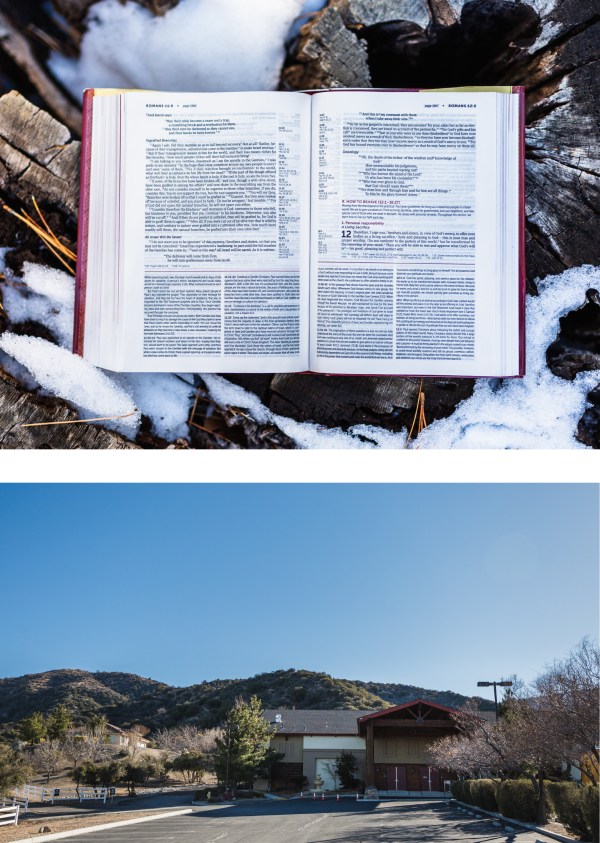
Top: Glenn’s personal Bible. Bottom: Glenn’s church in Wrightwood, California.Ryan Contreras
Top: Glenn’s personal Bible. Bottom: Glenn’s church in Wrightwood, California.

Over the next few months, I became increasingly involved with a couple of campus Christian groups. I was impressed by how “together” the members seemed and by the quality of their relationships. I also began applying my intellectual curiosity to questions surrounding the Bible’s reliability. I discovered far more support for the intellectual integrity of the Christian faith than I had ever supposed.

Unfortunately, not everyone celebrated my ability to ask a million questions. Rather than feeling inspired to keep seeking answers to my legitimate curiosities, I remember feeling tolerated at best. Recently, I reconnected with one of the first guys who discipled me. Recalling our weekly meetings, he said, “Sometimes I thought you had a question mark for a brain.”

Despite this lack of encouragement, I eventually found an outlet for my curiosity by writing a book called That’s a Great Question: What to Say When Your Faith Is Challenged, exactly the sort of resource I would have craved in my early Christian days.

Years ago I visited a counselor, hoping to piece together the complexities of my background. After hearing parts of my story week after week, he commented, “There is no explanation for you. In my professional opinion, someone with your background should be unemployable, divorced three times, abusive, an alcoholic, or some other kind of addict. The fact that you’re none of these things is a testimony to God’s incredible grace.”

A wonderful advantage of my toxic background is how it allows me to relate to other people’s struggles. In recent years, I’ve established one-on-one mentoring relationships with about two dozen younger men. These are informal meal meetings with no agenda. I just try to understand their circumstances, communicate that I’m on their side, and point them to practical insights rooted in Scripture and tempered by real-life experience. Essentially, I’m offering these men something I never had. It’s just one way God continually uses what could have been a curse on my life to bring blessing to others.

Glenn E. Pearson spent 19 years as executive vice president of the Georgia Hospital Association. He and his wife currently live outside Los Angeles. More information about Glenn is available on his website.

Ideas

Knowing the Future Doesn’t Cure Anxiety

Columnist

Our true comfort comes in trusting in the one who holds tomorrow.

Illustration by Rick Szuecs / Source Images: Steven Puetzer / Getty / Envato

It’s one of the most quoted verses of the Bible: “Do not be anxious about anything, but in every situation, by prayer and petition, with thanksgiving, present your requests to God.”

Echoing the words of Jesus to leave tomorrow’s worries for tomorrow, Philippians 4:6 points us to an antidote for anxiety: prayer.

A current situation causes anxiety. We cannot see the way ahead. We bow our heads to petition for help. What could be simpler?

But our requests reveal much about our understanding of ourselves, of anxiety in general, and of God. Our prayers in anxious moments can actually lead to greater anxiety unless we pay close attention to the kinds of petitions Paul has in view when he gives his exhortation.

We are, indeed, anxious about what the future holds, wondering about what to do when difficulties arise in our friendships, our finances, and our families. If we could just know a bit more about what is coming next, surely we could lay to rest our anxieties and take a proactive stance. And certainly, we could relax and trust God!

We make our requests known to God: “Lord, please show me what to do next. Make tomorrow clear.”

We reason that if we just had the benefit of clear divine direction, we would absolutely follow it. But the story of Moses at the burning bush warns us otherwise. Moses is given instruction from the mouth of God himself to go to Egypt and deliver his people. The result? Anxiety in the extreme. An unwillingness to follow. A crisis of identity. Clear words from the Lord yielded neither confidence nor peace for Moses.

It is one thing to tell God that we are anxious about the future. It is another to ask him to reveal the future to us.

We reason that if God would show us a sure sign, we would have peace. But the story of Gideon warns us otherwise. His requests for God to prove he will do what he has already promised dishonor the one he petitions. By laying out a fleece, he puts the Lord his God to the test. Miraculous signs performed at his demand yield neither resolve nor action in Gideon.

We reason that if we knew what tomorrow would bring, we would use that information wisely to make good choices. But the story of Peter’s denial warns us otherwise. Jesus tells him explicitly how anxiety will cause him to sin in his immediate future. He does not alter his course. Peter’s knowledge of the future serves not to correct him but to condemn him. Foreknowledge yielded neither repentance nor humility in Peter.

It is one thing to tell God that we are anxious about the future. It is another to ask him to reveal the future to us. The first is a confession; the second is a petition. Both confession and petition are facets of prayer, but while our confessions of anxiety or sin are always godly, not all of our anxious petitions are.

In the case of asking God for knowledge of the future, we should be circumspect. That knowledge belongs to the secret things of God (Deut. 29:29). Those who seek to use prayer as a crystal ball forget their calling to walk by faith and not by sight, and they forget the benediction of Christ: “Blessed are those who have not seen and yet have believed” (John 20:29).

Has God at various times revealed clear, specific direction to his servants? Yes. The Bible preserves these accounts for us. But it does not offer them as normative. Nor, as we have seen, do those revelations necessarily yield the peace we would expect them to.

Remember, Hebrews 11 does not say that Abel, Enoch, Abraham, Isaac, Jacob, and the rest of its great host walked forward with perfect clarity and confidence; they walked by faith. No doubt, their anxieties were many and their line of sight was obscured. But their God was faithful. Their God is faithful.

So, what requests should the anxious present to God? That he increase our faith (Luke 17:5), that he teach us to trust (Ps. 71), that he grant us wisdom (James 1:5), that he help us take our anxious thoughts captive (2 Cor. 10:5), that he sustain us today with the daily bread of his presence (Matt. 6:11), that he remind us of his past faithfulness to us and to all generations (Ps. 119:90).

These requests are answered with “the peace of God, which transcends all understanding” (Phil. 4:7). Not the precarious peace of knowing what the future holds, but the perfect peace of resting in the one who does.

News

New Program Offers Accreditation for Child Safety Standards

An 80-point checklist provides churches with opportunities for accountability, awareness, and conversation.

Illustration by Abigail Erickson / Source Images: Getty

The goal is simple: Make churches safe for children.

Figuring out how is harder.

A new ministry based in Jacksonville has developed a tool it believes will set safeguarding standards, incentivize implementation, and establish a system of accountability. The Evangelical Council for Abuse Prevention (ECAP) has launched an accreditation program—the first of its kind.

Evangelical churches and ministries that work with children can receive accreditation if they demonstrate compliance with five safety standards using an 80-point checklist that includes everything from basic background screening for nursery workers to a written policy on the proper response to abuse allegations. To maintain accreditation, churches and ministries will have to complete an annual review.

“Accreditation really is a form of accountability,” said ECAP executive director Jeff Dalrymple (no relation to Christianity Today president and CEO Timothy Dalrymple). “I think the missing piece in the child protection field is really a management problem—people not just having the knowledge but actually going and doing it.”

Dalrymple started working on child safety while working at Southern Baptist Theological Seminary. He developed policies for the Kentucky school’s summer camps and student daycare programs in 2012. Seven years later, the Houston Chronicle published its investigative series reporting more than 700 people had been abused by Southern Baptist pastors, youth ministers, and Sunday school teachers while denomination leaders closed their ears to victims. Like many, Dalrymple wrestled with how to stop abuse.

“Who’s going upstream to focus on prevention so that, so help us God, there are no more abuse victims?” he asked.

He decided he needed to do something, and, joined by Christian law experts Sally Wagenmaker and Theresa Sidebotham, founded ECAP in 2019.

The organization, which is not connected to any denomination, accredited its first church in January 2023. About two dozen more are in the process of demonstrating compliance with the safety standards, according to ECAP editor Briggham Winkler. ECAP hopes to have several hundred ministries pursuing accreditation by the end of the year.

Warren Cole Smith, president of Ministry Watch, said accreditation is a good way to set standards. “It becomes the straight stick you can hold down next to an organization to see whether it’s crooked,” he said. “But there are limitations to accreditation as a safeguard.”

Since accreditation is optional, ministries may choose to ignore it or even withdraw from a program without any stigma. The Evangelical Council for Financial Accountability (ECFA) started offering accreditation in 1979, and Smith keeps a close eye on ministries that drop off the ECFA’s membership list, for example. But it is rarely clear if someone just decided accreditation wasn’t worth the cost or if the ministry was removed for failing to adhere to the standards.

Accreditation may also create a “false sense of security,” Smith said. Organizations bearing ECFA’s “seal of integrity” haven’t all been immune from financial scandal, after all.

Godly Response to Abuse in the Christian Environment (GRACE) had looked at starting an accreditation program but decided not to, according to executive director Pete Singer. The group was concerned the approach would encourage churches to focus too much on checklists and liability.

“There isn’t a way to certify or accredit the heart,” Singer said. “We strongly, strongly, strongly believe the key to creating a church that provides genuine, true safety—and in so doing reflects the heart of God—isn’t about a checklist or a list of requirements, but it’s about the heart.”

However, the process of accreditation and the mandated annual renewal may push congregations to make discussions about abuse a daily reality in the life of the church. That’s what has happened at the first ECAP-accredited congregation, Providence Church in Frisco, Texas, according to children’s pastor Jeremy Herron. The 80-point checklist revealed some weaknesses, but more importantly, it allowed people space to talk.

“People with abuse in their past, part of their story, told us about their experiences,” Herron said. “You hear the statistics that one in every four has been abused, but you don’t see them. When you do, it’s so impactful.”

Providence has become known, Herron said, “as a place that takes safety for kids seriously.”

Accreditation doesn’t fix everything, of course, but it brings more light to the issue of child safety, according to Herron, and more light is good.

“This is an area we’ve been too happy to leave in the dark,” he said. “And we see all throughout Scripture, the light will come into the darkness and shine.”

Daniel Silliman is Christianity Today’s news editor.

Church Life

Bhutanese Nepali Refugees Turn Their Trials into Zeal for Evangelism

Thousands found Jesus while displaced, which prepared them to plant churches and settle in a new land.

(Left) Getty / Omar Havana

Dilli Lumjel remembers the date and time he heard from God and gave his life to Jesus: May 4, 2011, at 1:33 a.m.

Earlier that day, he had performed a Hindu funeral service for his father-in-law in the Beldangi 1 refugee camp in eastern Nepal, where he lived with more than 12,000 other refugees. Both of Lumjel’s parents-in-law had recently converted to Christianity.

As was the custom, Lumjel spent the night at his wife’s uncle’s house. That night he had a vision: His mother-in-law approached him and shared the gospel, stating, “If you enter this house, you have to believe in Jesus.” Then he saw a flash of lightning from heaven and heard a voice saying, “What you are hearing is true; you have to believe.” In the dream, he knelt down crying and committed his life to Jesus.

When he woke up, his face was wet with tears. Lumjel called a local pastor and told him he had had a dream and was now a Christian. The news shocked his family of devout Hindus. “Everybody—my relatives, my wife, sisters—they all woke up asking, ‘What happened to Dilli? Is he mental? He says he’s a Christian!’” Lumjel said.

The next day, the pastor explained the gospel to Lumjel and his wife. The two committed their lives to Jesus. A day later, Lumjel began attending a monthlong Bible school in the refugee camp. After only two weeks of classes, church leaders sent Lumjel out to preach the gospel to other refugees. Several months later, he became a church deacon, then an elder.

One year later, Lumjel arrived in Columbus, Ohio, as part of a massive resettlement of about 96,000 Lhotshampa (ethnic Nepalis expelled from their home of Bhutan) to the United States from 2008 to 2020. There he joined Yusuf Kadariya in pastoring a group of about 35 Bhutanese Nepali families who met each Sunday at a local Baptist church. As more Bhutanese Nepali refugees settled in Columbus and the group brought more people to Christ, the church continued to grow.

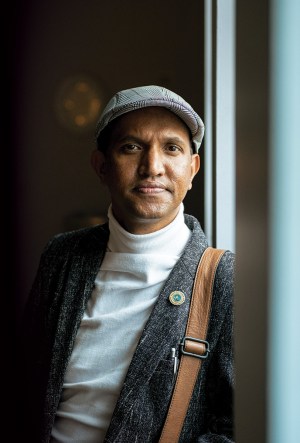
Dilli LumjelEli Hiller for Christianity Today
Dilli Lumjel

Today, Lumjel is a full-time pastor at Emmanuel Fellowship Church in Columbus. On a wintry Sunday morning in December, about 200 people streamed into the sanctuary, greeting one another with a slight bow and “Jai Masih,” meaning “Victory to Christ.”

Onstage, the youthful music team sang an upbeat Nepali worship song accompanied by guitar, trumpet, Nepali madal drum, and shofar. Congregants, some in colorful dresses and headscarves, were on their feet, waving their hands to the beat and praying aloud. Lumjel preached a sermon about Jesus’ unconditional love for his people.

Lumjel is one of the thousands of Bhutanese Nepali refugees who found faith in Christ while living in refugee camps in Nepal. The conversions of the Lhotshampa, most of whom were Hindu, Buddhist, or animist, would have been unfathomable had Bhutan’s government not expelled them from the country in the 1990s. Yet in the refugee camps, many Lhotshampa found a new life and an eternal home amid their displacement and wandering.

The faith that grew from the fertile soil of suffering helped them navigate a new world as they resettled in the United States. Despite challenges, these refugees planted nearly 300 churches and brought with them a zeal for evangelism that has revitalized existing US churches. According to the US Department of State, about 10,500 Bhutanese Nepali refugees identified as Christian when they settled in the country.

Pastor Bhadra Rai, who compiles data on the group through the Bhutanese Nepalese Churches of America network of congregations, estimates that 60 percent of the Bhutanese Nepali Christians in the US today were converted in the camps, meaning there could now be upwards of 17,500 Bhutanese Nepali Christians in the US.

“God opened the door for the refugees,” Lumjel said. “We were mostly saved there in the camps, and when we came here, others were saved here. … We really like to gospel the people.”

Lumjel grew up in the remote village then called Gopini in the Tsirang district of southern Bhutan, where his family had lived for decades. His grandfather was born in Nepal but moved to Bhutan as the Buddhist kingdom recruited Nepali workers to build roads and farm arable land in the south.

But nine-year-old Lumjel was suddenly uprooted from his idyllic home in 1991 when his father announced, “Let’s go; if we stay here, they will kill us.” Only later did Lumjel understand what had happened. In the 1980s, the Buddhist Bhutanese government became concerned about the growing Hindu Lhotshampa population.

To preserve national harmony, in 1989 the king began a policy that forced Lhotshampa to adopt Bhutanese dress and language and closed Hindu religious schools. Meanwhile, a census was taken, and anyone who could not provide proof of residency prior to 1958 was deemed an illegal immigrant.

Lhotshampa who protested this discrimination were arrested, tortured, and killed. Violence broke out between the ethnic Nepalis and the Bhutanese. Many Lhotshampa say the government forced them to sign documents claiming they voluntarily left the country. In total, about 120,000 Lhotshampa fled the country, with 20,000 settling in India and Nepal and the rest in seven refugee camps in Nepal set up by the UN refugee office in 1991.

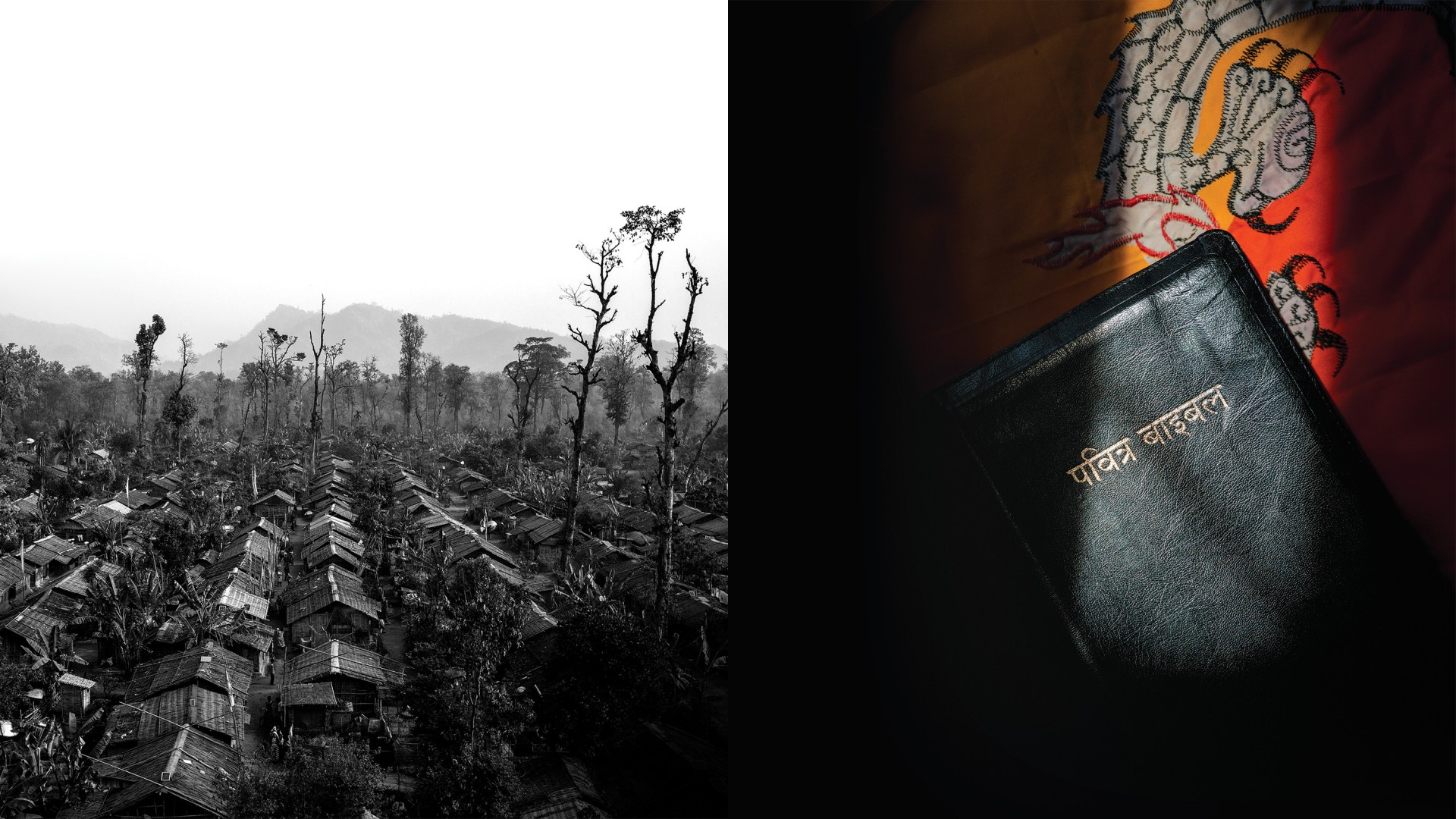
Lumjel remembers walking all night through the jungle with his family and taking a long, bumpy truck ride across northeastern India to the refugee camps in eastern Nepal. In the camps, the huts were made from bamboo with plastic coverings to keep out the rain. Paper was pasted onto the walls as insulation from the cold. Families lacked privacy, Rai recalls, as neighbors could hear when couples fought.

Poor sanitation and malnutrition led to the spread of diseases like cholera, and the high density of bamboo homes meant fires spread quickly. These temporary camps became home for the Lhotshampa for the next 20 years as Bhutan refused to repatriate them.

Christianity came to the camps through a small number of Lhotshampa families who had converted while living in Bhutan. They heard the gospel from believers from southern India who taught in schools in Bhutan, said John Monger, one of the early converts who started fellowships, churches, and a Bible school for fellow refugees. Churches in India and Nepal also helped provide guidance and mentorship to the churches in the camps.

Monger was 17 and living in Bhutan when a younger boy told him that Jesus was the true God. Curious, he joined the boy in a secretive Sunday gathering in the jungle with several other Christian families. There he felt the presence of God envelop him, and he accepted Christ.

His conversion brought not only anger from his Buddhist family but also harassment and beatings from the local government. After multiple arrests, he was given the ultimatum of denying his faith or leaving the country. In 1993, he journeyed to the border of India—where he was almost killed by a gang of robbers—before jumping on a truck and joining refugees headed to Nepal.

In the camp, he began sharing the love of Jesus to everyone he met. Through prayer and proclaiming the name of Jesus, Monger told me, he saw the sick healed, the demon-possessed delivered, the depressed and suicidal find hope, and the barren give birth. “The power of God was actively moving, the move of God was so powerful even political leaders or the government couldn’t stop it,” Monger said. “It is just like the Book of Acts.”

He gathered people in his hut and would sing about how every knee shall bow and every tongue confess that Jesus Christ is Lord. “These things were very powerful. When I sing that, people would really kneel and confess Jesus,” Monger remembered. “This is how the gospel was started in the refugee camp: There was no missionary, no denomination, just the simple power of God, the love of God, and the presence of God.”

That was what Bhadra Rai experienced after his family arrived in one of the camps in 1993. Due to the crowded, unsanitary conditions, his younger sister became deathly ill. The camp’s doctor said there was no hope left for her, so Rai’s family turned to the Hindu priest for help, and then to a Buddhist monk. Nothing helped.

Then a young man told Rai’s father that Jesus could save his daughter’s life. Unwilling to leave the gods of his forefathers, Rai’s father refused, but the young man was persistent. “See, your god doesn’t save. If you believe in Jesus, he is the way and can save your daughter,” Rai recalls him saying.

Bhadra RaiHannah Yoon for Christianity Today
Bhadra Rai

At last, Rai’s father relented and the man brought a group of Christians to start praying in their home. Miraculously, his sister’s condition started to improve, and the whole family decided to follow Christ.

“It’s not our will, it’s God’s—everything is God’s grace,” Rai said. “A lot of people accepted Christ. It’s not how they accept it here [in the United States], but in the refugee camps there was a lot of [suffering]. … If she wasn’t sick, my family would never get this type of opportunity. Due to my sister’s sickness, we accepted Christ.”

He contrasted the conversions in the camps with how Bhutanese Nepalis in America may come to faith in Christ, where they have access to the Bible and can search for information about Jesus on the internet. Back then, Rai explained, Christians would simply say, “‘If you come to Jesus Christ, you will be healed.’ And we accepted.”

Yet his family’s conversion upset his Hindu uncles and neighbors. For this reason, even as a child, Rai was not allowed in his relatives’ homes. Despite the persecution, Rai and his family kept the faith. His father became the pastor of a church in the camp, and Rai later became the pastor of a church in the United States.

All of the relatives who persecuted them eventually came to profess faith in Christ, including one uncle who is now a pastor in the Netherlands. Lumjel and many of the other Bhutanese Nepali Christians I spoke to told similar stories of seeing their entire extended family coming to Christ.

Rai noted that many people in the camps were drawn to Christianity after seeing miraculous healings from illnesses, both physical and mental. Christians were protected from the poison of deadly snakes and drownings while crossing a river between two camps, according to Monger. Some Hindus were drawn in by the equality they found in Christianity, where there were no castes or discrimination.

Several Bhutanese Nepali Christians said they came to believe in Christ in the camps because of the love they found at church—a love that was missing in their home lives. Joseph Gurung, now a church leader in Des Moines, Iowa, was raised by a single mother in the camp and was desperate for a father’s love. His hut was near a church, and he started attending Sunday school to receive free candy and play sports. Eventually he accepted Christ after finding the love he had been missing.

Urmi Baraily, who was also raised by a single mom in the camp, faced additional challenges. Her family arrived at the camp in 1997 after the UN had stopped officially accepting refugees, so they had to live with relatives and beg for food. Her mother, who dealt with mental illness, couldn’t work or take care of Baraily, leaving the young girl lonely and rejected.

Her aunt introduced her to a nearby church, where she started to attend Sunday school. At age 11 she heard her pastor speak about receiving the true love of God, a love that she had long craved. “I felt pure love and joy,” Baraily recalled. “I knew that was God even though I don’t see him—he lives inside me.”

In 2006, word arrived that the United States and other Western nations would resettle the refugees. Rai remembers that at the time, his parents were afraid to start over in a foreign country, but he wanted to go. So he and his sister applied to come to the United States, and in September 2008 they arrived in Houston. “For a week I was so sad,” Rai remembers. “I didn’t know how to speak English, didn’t know where to find anything. I missed my family.”

Urmi BarailyEli Hiller for Christianity Today
Urmi Baraily

An American missionary introduced him to an Asian American church involved in international ministry. The next week, the missionary found another Bhutanese refugee family and brought them to the church. Even though that family was not Christian, they attended the service and connected with Rai.

As more people from the camps—including Christians—began to resettle in the United States, Rai started a Nepali-language Sunday school at the church, which eventually branched off into its own church called Canaan Bhutanese Church. Even Bhutanese Nepali refugees from Hindu and Buddhist backgrounds would show up at the church seeking donations and support, and Rai would use the opportunity to share the gospel with them.

Gurung was 18 years old when his family resettled in Akron, Ohio, in 2014. He had been born in the camp and had never left the area, much less flown in an airplane.

“It was like an illusion,” he said. “The way we thought about America was a big city. When I got [to Akron] in January 2014, all I saw was snow. There were no tall buildings.” He remembers everything was new to him: the food, the people, the intricate systems and bureaucracy. Yet more than a thousand of Bhutanese Nepali refugees had arrived in the city before him, starting several Nepali grocery stores.

Most of the refugees worked long hours at warehouses, farms, or other low-paying jobs because they couldn’t speak English and didn’t have much education. Gurung’s first job was picking corn, for which he was paid $60 for each filled container. Yet even then, he had a vision to plant a daughter church of Ray of Hope International, the church he’d attended in the camps.

Manoj Shrestha, pastor of Nepal Baptist Church of Baltimore, noted that the difficulties Bhutanese Nepali refugees faced led to a more committed and devout faith than other Nepali immigrants. “Many lost everything they had,” Shrestha said. “And in that hardship when they heard the gospel, it was very good news for them, so they believed. … I think God was preparing them there so when they moved, everywhere they move, there’s a church. They have a zeal to share the gospel, they want to plant churches, they want to become missionaries.”

When Shrestha first came to the United States from Kathmandu in 2000 to pursue a master of theology degree at Princeton Theological Seminary, there were no Nepali churches in the country and only a few believers among the Nepali diaspora. After his program ended, he returned to Nepal to head a Bible college.

In 2008, Shrestha returned to Princeton to pursue a PhD in homiletics, which coincided with the initial influx of Bhutanese Nepali refugees into America. He was surprised to find a large number of Christians in the refugee community who were starting new churches in the cities where they settled.

Many of these Bhutanese Nepali pastors had little to no theological training and only a very basic understanding of the faith. So Shrestha, working with the Bhutanese Nepalese Churches of America, started holding trainings and seminars about everything from how to preach a sermon to surveys of the Old and New Testaments. In recent years, since the pandemic, he’s been able to expand the reach of his Bible teaching for Bhutanese Nepali pastors through daily Zoom classes.

What the Bhutanese Nepali Christians lacked in knowledge, they made up for in passion. To plant a church, Gurung and another Bhutanese Nepali friend, Sital Ghimire, would walk a couple hours each day to preach the gospel and hand out gospel tracts on the streets. When several young people came to faith, he would take them under his wing and disciple them. He also gathered Bhutanese Nepali believers in the city to minister to the homeless, providing them with necessities, praying with them, and handing out tracts.

After a year, about four new families had come to Christ and were baptized. A local church near Akron, Chapel Hill Church, let Ray of Hope International meet in their church building for free. With the help of Gurung’s Christian mentors from the camps, their numbers grew and the ministry of Ray of Hope spread. Today, the church has 23 church plants in the United States and 200 churches around the world.

Monger relocated his church from the camp to Austin, Texas, where he resettled in 2009. International Restoration Church now serves not only Bhutanese Nepali refugees, but also other refugees from Africa and Southeast Asia, as well as Nepali international students. Currently, two students are staying in Monger’s home. The church bought a piece of land on which they plan to build a permanent home and are praying for God to provide the funding.

Monger said he never changed the church’s mission even after coming to the United States. “Our doctrine is [to be] full of divine love,” he said. “Only Jesus can bring restoration.”

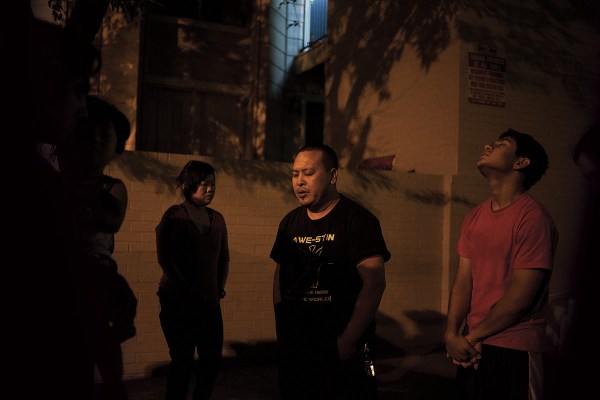
John Monger (center) praying with a familyMary Kang
John Monger (center) praying with a family

Baraily’s experience and conversion in the refugee camp encouraged her to become a missionary, traveling to Africa, Europe, and around the United States to tell people about Jesus. When Baraily came to America in 2012, she was resettled in Atlanta, where she attended high school. She sensed God calling her into ministry and, after graduation, she moved to Columbus, where she worked for a few years to support her family before attending Valor Christian College.

She has returned to Nepal to do mission work and has also ministered to refugees in the Abaco islands in the Bahamas. Her own experience growing up in a refugee camp helps her relate to those in similar situations: She knows firsthand the lack that they face, yet she also remembers the joy she felt as a child when visitors came to the camps bearing small gifts like chocolate or pencils and playing games with her.

“That’s my story,” she said. “God touched my heart on my first missions trip and I’m like, ‘Yes, I want to be a missionary.’”

Several years ago, Lumjel also had a chance to return to Nepal for the first time. It was the fulfillment of a vision he’d seen the night of his dramatic conversion. In a dream, he saw himself evangelizing at a traffic circle in Damak, a city in eastern Nepal. At the time he woke up confused, only to have the same vision again after he fell back asleep.

But then, in 2018, he stood in that exact location with a local Nepali church, passing out calendars with Bible verses printed on them in order to share the gospel. Since then, Lumjel has been back to Nepal two more times.

Most Bhutanese Nepali churches don’t have the funds to pay their pastors or buy their own buildings; their congregants typically make just enough money to get by. So churches often borrow or rent meeting spaces in American church buildings. At times, sharing space has led to conflicts between them and the host churches, including over noise levels, miscommunication, exceeding time limits, or wear and tear on the building.

Yet sharing buildings has also led to myriad blessings. When Rai’s Canaan Bhutanese Church relocated to Harrisburg, Pennsylvania, in 2020, he began praying for a place for his church to meet. Meanwhile, Lynn Shertzer, head pastor at Slate Hill Mennonite Church, said a Bhutanese Nepali student in his leadership training program approached him and shared that his friend was interested in using the church facilities.

At first Shertzer was resistant: It was the middle of the COVID-19 pandemic and it didn’t seem like the right time to add another group to their church. But then he felt God ask him, “Why not?” So he met with Rai, heard the church’s story, and after discussing it with church leadership, decided to let them meet in the church free of charge. “The church building is not ours, but our Lord’s,” he said. “What better way to use the facility?”

Since then, Canaan Bhutanese Church has been a great blessing to Slate Hill, Shertzer said. It’s brought a new vitality to the host congregation, as they saw Canaan grow from 18 to 46 families. As Shertzer’s congregation watched the Bhutanese Nepali believers meeting the needs of their community, building friendships, and evangelizing, Shertzer said his congregation began to say, “We should do this ourselves.”

Church members are also now more aware of the Bhutanese Nepalis living in their community and better understand how to relate to their neighbors.

Three or four times a year, Slate Hill Mennonite Church and Canaan Bhutanese Church hold joint services along with a Laotian church that also meets in Slate Hill’s building. As believers of different backgrounds break bread and worship together, Shertzer said, it has helped his church see that “the kingdom of God is bigger than just white people.” At Slate Hill’s Christmas Eve service, the three congregations gathered to perform dances and sing songs in different languages. Bible passages were shown on the screen in Nepali, Laotian, and English.

Christy Staats, who helped train Akron churches in cross-cultural ministry, said that while working with the Bhutanese Nepali community, she’s seen a boldness for evangelism that she’s rarely experienced in the US church.

“There is a tendency for Americans to jump into refugee work thinking we are the hero, and we need to curb that,” Staats said. “What’s really deep in my conviction is the leadership and capability that the Bhutanese Nepali refugees display. I need to learn from them.”

Joseph GurungKathryn Gamble for Christianity Today
Joseph Gurung

She remembers one time Gurung (then around 19 years old) and Ghimire asked if her church would let them hold a Bhutanese Nepali youth conference. The church agreed, and she was impressed to see them quickly organize the conference with speakers, worship bands, and food. As they passed word of the event through the nationwide network of Bhutanese Nepali Christians, about 400 young people from as far away as Maine and Minnesota drove to Akron to attend.

“We brought revival within American Christian groups,” Gurung said. While he sees American churches with large buildings but only a handful of older people worshiping, “our church is growing every time. We are reaching out within our community, and we are making a difference within American Christians.”

He attributes some of this to the different way that they do ministry: Rather than relying on large church budgets to create programs and events, Bhutanese Nepali churches turn to simpler methods. Gurung still goes out walking around the neighborhood to share the gospel. He prints tracts in English and Nepali and hands them out to whomever he meets. He’s even shared the gospel with refugees from the Congo, Iraq, and Pakistan.

Over in Columbus, about 30 Bhutanese Nepali churches joined Lumjel at Emmanuel Fellowship Church over last Labor Day weekend to evangelize in the city. The group spread out to places where Nepalis congregate, including Saraga International Grocery, Nepali stores, and apartment buildings. They knocked on the doors of acquaintances as well as strangers, both Nepali and not.

“What God gives us, we gospel,” Lumjel said. In his car, he keeps a stack of tracts that he gives out as the opportunity arises.

When asked why he thinks so many Bhutanese Nepali refugees accepted Christ, Lumjel responded: “God always loves weak people.

“As a refugee, we didn’t have any hope, we didn’t have any good things, we didn’t have anything. But God opens the door for us and he brings us here to the US. … [Now] we all have our citizenship in heaven.”

Angela Lu Fulton is CT’s Southeast Asia editor.

Our April Issue: What God Gives Us

May Easter spur us to action.

Getty / Omar Havana / Edits by Christianity Today

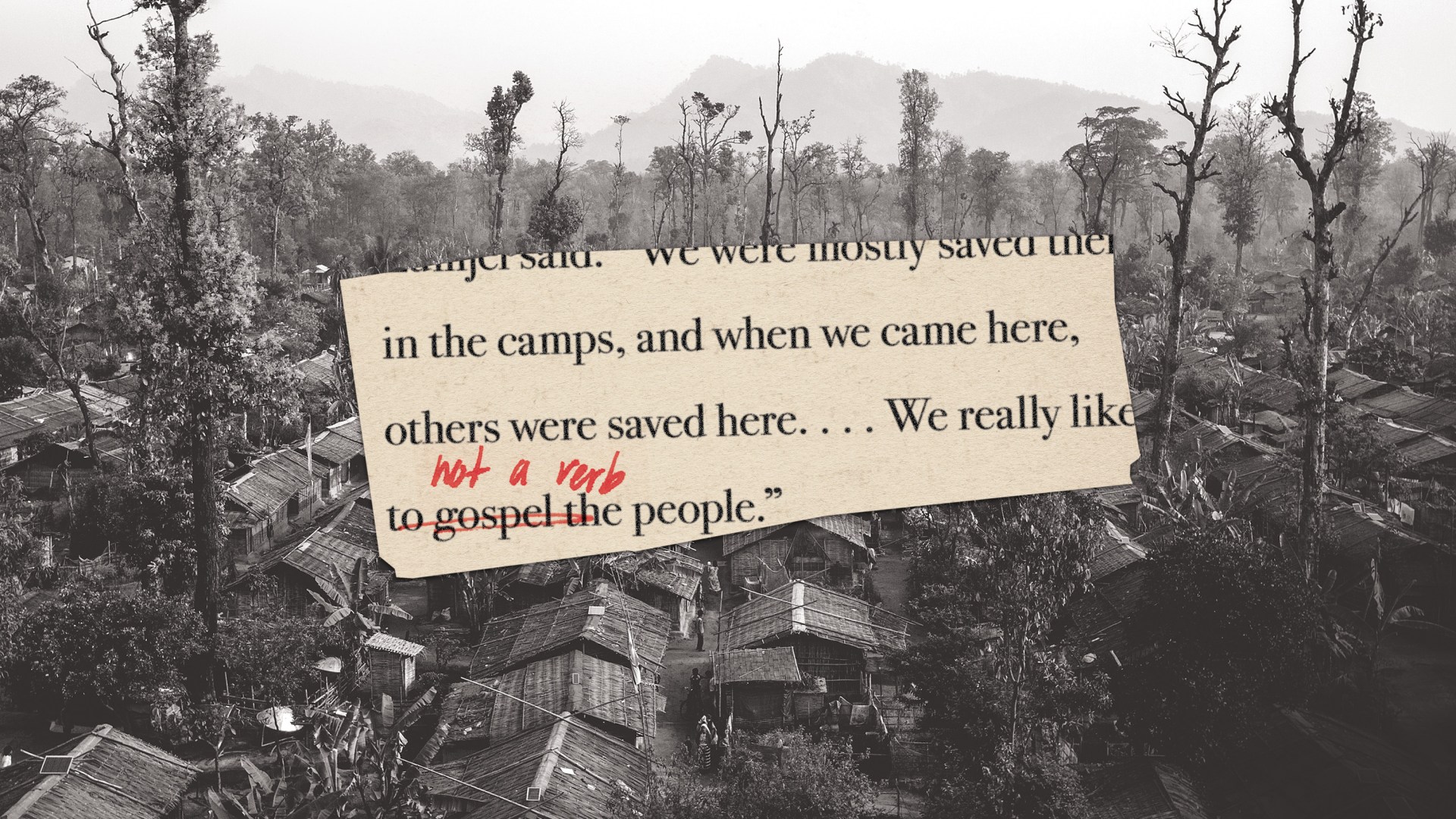
We really like to gospel the people,” Dilli Lumjel told CT’s Angela Lu Fulton while she interviewed him for “Bhutanese Nepali Refugees Turn Their Trials into Zeal for Evangelism.”

Gospel is not a verb,” I scrawled in the margin alongside my other editorial notes during my initial read through an early draft.

I later learned that Lumjel used gospel as a verb repeatedly in their conversations. He used it “so much,” Fulton told me, “that I started to do it too!” What may be technically incorrect—due to differences in translation for a non-native English speaker—is also theologically profound.

“What God gives us, we gospel,” Lumjel said of his Bhutanese Nepali Christian community. This is the very model we see over and over again in Scripture.

When Jesus was nearby, John the Baptist pointed others toward him: “Look, the Lamb of God!” (John 1:36). When Jesus spoke to a Samaritan woman and confirmed he was the Messiah, she “went back to the town and said to the people, ‘Come, see a man who told me everything I ever did. Could this be the Messiah?’” (4:28–29).

As Jesus suffered on the cross, a criminal crucified near him spoke out in defense of Jesus, turning to him in faith (Luke 23:40–43). When Jesus died, the centurion standing guard with other soldiers “exclaimed, ‘Surely he was the Son of God!’” (Matt. 27:54).

And after Mary Magdalene encountered the risen Christ that first Easter morning, she “went to the disciples with the news: ‘I have seen the Lord!’” (John 20:18).

From the disciples who embraced the Great Commission to Paul on his missionary journeys to Lydia who led her family to faith, Scripture depicts people naturally and instinctively sharing the Good News. We see the gospel in action as action.

Several articles in our April issue integrate core gospel themes. New Testament scholar Jarvis J. Williams reflects on the life-changing truth of John 3:16. Jasmine L. Holmes discusses Christ’s victory over guilt and shame in our lives. John R. Schneider unpacks how Christians can view suffering—in particular animal suffering—in light of God’s redemptive story. And Fulton details how the gospel brought new life in a refugee camp, as well as how Bhutanese Nepali believers bring their zeal for Christ to the American communities they now call home.

As we celebrate Easter, may we be people who not only receive the Good News but give it generously, naturally, effusively. May we be a gospel-ing people.

Kelli B. Trujillo is print managing editor of Christianity Today.

Ideas

Like Joseph, Our Hope Is Greater Than a Box of Bones

Columnist

We must envision a kingdom that outlasts us.

Illustration by Christianity Today / Source Images: WikiMedia Commons / Getty

We all know the first words of Genesis: “In the beginning, God created the heavens and the earth.” Far fewer of us can recall the last words of Genesis: “They embalmed him, and he was put in a coffin in Egypt” (50:26, ESV throughout). The first sentence is cosmic in scope; the last, anticlimactic at best. But what if the future of the church has as much to do with the bone box as with the Big Bang?

Today, many Christians refer to Joseph as a model. Some focus on Joseph’s victimhood, trafficked into slavery by his own brothers. Others point to his struggle against temptation, fleeing from the unwanted advances of Potiphar’s wife. Still others focus on his rise to leadership in Egypt, demonstrating how influence can be exerted with integrity. But perhaps the most crucial example we can take from Joseph is not from his life but from his skeleton.

Genesis ends with Joseph’s brothers seeking his forgiveness—a plea that can be viewed as manipulative and self-serving. Nonetheless, Joseph extends mercy, and through him, the line of Israel is delivered from famine.

What’s striking, though, is not what Joseph gives to his brothers but rather what he asks of them: “I am about to die, but God will visit you and bring you up out of this land to the land that he swore to Abraham, to Isaac, and to Jacob. … And you shall carry up my bones from here” (Gen. 50:24–25).

When the Book of Hebrews speaks of Joseph in its description of faith, the only thing it mentions is the bones: “By faith Joseph, at the end of his life, made mention of the exodus of the Israelites and gave directions concerning his bones” (11:22). Why?

This odd request reveals Joseph’s vulnerability. Even with all the technological mastery and political power of Egypt, Joseph knew no pyramid could protect him from death. He also knew he had to rely on his brothers to carry him—the same brothers he once couldn’t trust with his living flesh or even his favorite coat. Yet Joseph knew who he really was—not a prince of Egypt but an heir of Abraham. No matter his fame or wealth, he was a stranger in Egypt. Alongside his vulnerability is hope. Like his ancestors, Joseph could see the promise from afar.

In perhaps the most pivotal moment of the Old Testament, the Exodus, Scripture pauses in its description of the pursuing Egyptian army and the mysterious pillar of fire to tell us, “Moses took the bones of Joseph with him” (Ex. 13:19), just as Joseph had made his brothers swear. And after all the water parting, wilderness wandering, commandment receiving, and Canaanite fighting, the Book of Joshua ends with: “As for the bones of Joseph, which the people of Israel brought up from Egypt, they buried them at Shechem, in the piece of land that Jacob bought” (24:32). Joseph could see not only that the future was bigger than him but also that he belonged there.

The Gospels tell us that Jesus was placed in a borrowed tomb owned by a religious leader named Joseph (Mark 15:43–46). Jesus didn’t have to rely on his brothers to carry him into the land of promise. Instead, after his resurrection, he tells the women, “Go and tell my brothers to go to Galilee, and there they will see me” (Matt. 28:10). All of Jesus’ bones were accounted for, and not one was even broken (John 19:36).

Whether in a local church or in a national movement, how much of the conflict, anger, and despair is really about our fear of mortality or irrelevance? Maybe one reason it’s so hard to hand over the faith to a new generation is that we lack the faith to entrust ourselves to others to carry us, to envision a kingdom bigger than us but to which we too belong. For an Easter people, such should not be.

Maybe the hopefulness we need is to realize that each one of us is headed for the grave—but not for long. We will not carry the kingdom to glory. We will be carried by hands we cannot see. That’s not an anticlimax. That’s a new creation. Even for the most forgotten box of bones, when God says, Let there be life! there is life. Jesus can count all his bones. He can count ours too.

Russell Moore is editor in chief of CT.

News

‘The Evangelical Soul Is Not for Sale’ in Venezuela

And other news briefs from Christians around the world.

President of Venezuela Nicolas Maduro

President of Venezuela Nicolas Maduro

Getty / Carolina Cabral

President Nicolás Maduro is rewarding evangelical churches that support him with government funds for building renovations. The Evangelical Council of Venezuela, a member of the World Evangelical Alliance, issued a statement critiquing the quid pro quo and distancing itself from the group that has closely allied with Maduro, the Christian Evangelical Movement of Venezuela. “We are opposed to worship activities being put at the service of the visibility of public officials or representatives,” the council said. “The evangelical soul is not for sale. It has already been bought with an infinite price.”

Brazil: Evangelicals connected to insurrection

Four evangelical pastors were among the 1,800 people detained by police during the riot in Brazil’s capital on January 8. Protesters claimed without evidence that the narrow electoral defeat of president Jair Bolsonaro was a fraud and demanded the military oust the newly elected Luiz Inácio Lula da Silva. Videos on social media showed some rioters praying, singing hymns, and shouting, “Brazil belongs to Lord Jesus!” According to one poll, 64 percent of Brazilian evangelicals support a military coup.

United States: Church solar panels subsidized

The federal government is giving a 30 percent tax credit to nonprofits that install solar energy systems between 2023 and 2032, including churches and Christian ministries. Tax credits have underwritten the expansion of clean energy in the US since 2006, and today more than 3.5 percent of all single-family homes and 1.5 of commercial buildings have solar power systems. The Inflation Reduction Act extends and expands the incentive to nontaxpaying organizations.

Nigeria: Pastor charged with kidnapping himself twice

A pastor from the Evangelical Church Winning All was arrested on charges that he faked his own kidnapping—twice. Albarka Bitrus Sukuya of Jenta Apata, Jos, allegedly collected a ransom of 400,000 naira (about $900) from his congregation in mid-November 2022 but raised suspicion when he staged a second kidnapping with a second ransom note 15 days later. When questioned by police, Sukuya confessed and also admitted to setting a fellow pastor’s cars on fire. Church members said the revelation made them distrust ministers but increased their confidence in the power of prayer. When they received the first ransom note, they prayed the kidnappers’ secrets would be revealed.

Kenya: Arguments arise over women’s clothes

Christian leaders in Kenya are debating church dress codes after a Catholic church south of Nairobi put up a banner showing pictures of prohibited clothing, including jeans with holes in them, shorts, skirts above the knee, transparent fabrics, and high heels. Methodists and Churches of Christ say they have instituted similar rules, with one minister claiming the intervention was necessary because women in miniskirts sit inappropriately in the front pew. A prominent imam has attributed Christian immodesty to Western influences. “We do not feel comfortable with the Western culture,” he said. “Nakedness … is the steppingstone to abominations and evils.”

Sweden: Rent hike threatens bookstore

The only Protestant bookstore in Stockholm is facing closure after four decades in the capital city. Proklama (Proclaim) opened in the 1970s and was run by young evangelicals who had returned to Sweden from overseas missions and were frustrated by their lack of access to Christian literature. The landlord is raising the rent by 21,000 kroner (about $2,000) per month.

Netherlands: Parliament leader steps down

A prominent evangelical is resigning from leadership of the Christian Union party and stepping down from parliament after 10 years, saying, “I have given what I had to give.” Gert-Jan Segers was a missionary and an evangelical radio journalist before running for office as a representative of the party carrying on the legacy of Dutch Reformed leader Abraham Kuyper. Segers fought for increased support for the elderly and better care for women leaving prostitution.

Ukraine: Pentecostal accused of supporting Russian terror

Ukraine has sanctioned a Russian Pentecostal leader for “support for terror and genocidal policy” under a “guise of spirituality.” Sergey Ryakhovsky, bishop of the Russian Association of Christians of the Evangelical Faith (Pentecostal), had close connections with Ukrainian churches before the war but provoked ire when he repeated Vladimir Putin’s justifications for the invasion and told Christians they should avoid all comment on the conflict.

Turkey: Earthquake destroys Antioch

The oldest part of the city of Antakya, where followers of Jesus were first called “Christians” (Acts 11:26), was completely destroyed by a pair of massive earthquakes. More than 6,000 buildings collapsed across Turkey and an unknown number were damaged in Syria. By the end of the first two weeks of search-and-rescue missions, the death toll had risen above 47,000. The region sits at the juncture of three tectonic plates and few buildings can withstand magnitude 7.8 and 7.5 earthquakes. “I lost my friends,” a hotel owner told The New York Times. “I lost the buildings where I ate and drank with my friends. I lost all my memories.”

Israel: Christian community grows

The Christian population of Israel has increased to around 182,000 people, according to a census report from the government statistics bureau. Christians make up 1.9 percent of citizens. Nearly 13,000 live in Jerusalem, but the largest Christian communities are in Nazareth (21,100) and Haifa (16,700). More than three-quarters of the Christians are Arab. The largest denomination is the Byzantine Rite Greek Catholic Church, but there are an estimated 20,000 Messianic Jews, 7,000 Anglicans, and 900 Baptists. Few, however, are converts. All but 1 precent of Christians in Israel were raised in Christian households.

Mongolia: First two elders ordained

The United Methodist Church appointed its first two local elders in Mongolia 20 years after Koreans first sent missionaries to the country. Bishop Jeremiah Park laid hands on women named Munkhnaran and Urjinkhand, ordaining them to ministry. Munkhnaran first heard about Jesus at a medical mission where doctors told her they could not cure her chronic disease. Today she says, “I thank God for my poor health because it makes me rely on God’s power completely.” Urjinkhand, a church janitor, was called to ministry in two dreams where she was followed by a sheep that kept saying baa baa. Only 2 percent of Mongolia is Christian, but Korean missionaries hope increasing urbanization may create more opportunities to share the gospel.

Theology

John 3:16: So Loved, So Familiar

We need fresh eyes for our faith’s basic teachings, no matter how long we’ve studied the Bible.

Jared Boggess

In this Close Reading series, biblical scholars reflect on a passage in their area of expertise that has been formational in their own discipleship and continues to speak to them today.

One warm April night, my high school baseball team was celebrating a big win. Then one of our coaches gathered us together. In a serious tone, he told us that Merri Kathryn Prater, a good friend and classmate, had passed away a few days after her tragic road accident. My teammates and I immediately erupted with loud cries of lament. One classmate in the stands told a few of us that the sudden sound of our grief was like an explosion of shotguns as it echoed around the mountains surrounding our Eastern Kentucky baseball field.

When we calmed down, many of my teammates and I headed to Merri Kathryn’s church. There, her pastor, Mike Caudill (known to his parishioners as Brother Mike), and members of the church were gathering to help local teenagers process the news of her death.

I remember sitting down in a pew in the pristine sanctuary of Hindman First Baptist Church with my teammates. One of them, a Christian like Merri Kathryn, turned the pages of a pew Bible to John 3:16, and he slowly began to read the verse to me.

“Jarvis, this is what life is all about,” he said. That was the first time I remember hearing John 3:16. At that moment, while stricken with grief and shock, I had no clue what the verse would mean to me throughout my life. My teammate’s exposition both shook me and left me silent.

In subsequent days, I considered the reality of my own mortality and my need to give my life to Jesus Christ in light of Merri Kathryn’s faith, her death, and the truth of John 3:16. Members of Merri Kathryn’s church had already told me about the gospel several times during my visits to see her at the hospital.

A few weeks later, on a phone call on April 22, 1996, Brother Mike led me to the Lord. I was 17. Brother Mike baptized me, and I became a member of Merri Kathryn’s church. I was the first African American to join this church in its history.

This fellowship deeply loved me—even more than some people in my own family. They taught me much about love of God, love of neighbor, the gospel, and what I now call redemptive kingdom diversity. I was not the only one at my high school to become a Christian that year. Merri Kathryn’s death led to dozens of professions of faith in my county of a few thousand. For several months, new believers kept asking to be baptized.

The content of John 3:16 was fresh and baffling to me first when I was a nonbeliever, and it still was in different ways when I was a new believer in Christ. During the revival in Hindman, I preached and shared my testimony, still in wonder at the verse. But perhaps there are many of us who forget the power, the truth, and the implications of verses like John 3:16 as we grow older in the faith.

Familiar verses can seem like the ABCs of the Christian faith—things to move beyond in order to drink from deeper wells. But if we have this attitude, we may forget key elements of the Christian gospel and miss the deeper, varied truths that are right there.

After my conversion, I began sharing my faith and the truth of John 3:16 with close family and friends. I often spoke about becoming a Christian to my uncle who raised me. One night he looked at me with a straight face and said, “Jarvis, I know John 3:16.” Then he quoted it to me verbatim. “That is exactly right!” I told him. “That’s why you need to give your life to Jesus now, because ‘God so loved the world that he gave his one and only Son, that whoever believes in him shall not perish but have eternal life.’”

He knew the verse. He had it memorized. But he had never truly believed it.

Months passed, and I began to sense a call to ministry. With my church’s encouragement, I preached first at their annual youth Sunday service, and several young people made professions of faith. Seeing God at work, my church decided to continue the services. My sermons were bad, to be honest. I didn’t have any theological training; I just knew Jesus had saved me, and I wanted other people to be saved.

After attending often, hearing me preach, seeing people respond, and knowing how my life had changed at home, my uncle gave his life to Jesus during the invitation one night. Brother Mike baptized him, and he became the second African American member in our church’s history. Soon, many other close family members and friends likewise gave their lives to Jesus because they heard and believed the message of God’s love for the world in John 3:16.

I know now John 3:16 is one of the most famous verses in the entire Bible. It’s often used in evangelism, as it was in my own experience and when I explain Christ’s call to others. Because of its familiarity and straightforward message, Christians may sometimes lose sight of the verse’s power. It is neither a cliché nor simply ABCs beyond which mature Christians should move. Instead, John 3:16 has the words of life.

Nicodemus, a Jewish leader and a Pharisee, was like many Christians raised in the church today. The first-century Jewish historian Josephus, also a Pharisee, tells us the Pharisees knew the Scriptures and traditional explanations very well. He described the Pharisees as “those who are esteemed most skillful in the exact explication of their laws.” So Nicodemus would have engaged in sophisticated, detail-oriented study of Scripture.

When he comes to talk with Jesus in John 3, Nicodemus opens the conversation by saying he knows Jesus is a teacher from God (John 3:2). But Jesus then surprises Nicodemus by telling him that his approval of Jesus as a good rabbi is not enough. He cannot enter the kingdom of God just by affirming that Jesus came as a teacher from God. Jesus says Nicodemus must be born again. Nicodemus is confused because he thinks Jesus is speaking of physical birth instead of spiritual birth. So, Jesus uses language from Ezekiel 36:25–27, which would have been familiar, to remind him of the things of which the prophet spoke.

Jesus continues with the story of the plague of fiery serpents from Numbers 21, when God spared those of his people who looked at the bronze serpent Moses lifted up. Jesus says that God will likewise lift up his Son (on the cross), so that everyone who looks in faith to him will receive eternal life. And then he gives Nicodemus the truth of John 3:16.

We are too seldom like Nicodemus—surprised at Jesus’ message—and too often like Nicodemus—so familiar with a particular Scripture that we don’t carefully reflect upon it, missing the opportunity to be transformed afresh by God’s Word.

I’ve grown a great deal as a scholar and a Christian, in my understanding of both John 3:16 and the Gospel of John. I know now what I didn’t know then. John 3:16 is a key piece of Jesus’ gospel message to Nicodemus. But it isn’t solely for evangelism. As I gradually came to understand, the verse contains a cosmic promise, a personal challenge, and also a comfort for mature believers.

Jared Boggess

There are also questions: Am I a part of the world God loves? Are you? John uses the term world in multiple ways in his gospel (including in 1:10 and 3:19). In John 3:16, he uses the term world to refer to languages, tribes, peoples, and nations.

For example, in John 12:19, after Jesus triumphantly enters Jerusalem, the Pharisees become anxious about Jesus’ large following. They complain about Jesus to one another, saying: “Look, the world has gone after him” (ESV). This could be taken as hyperbole. But the context suggests otherwise. Immediately after this complaint, John records the Pharisees’ concern about Greeks who want to speak with Jesus (12:20–21). The Pharisees worry that Jesus’ following includes people from other parts of the “world.” At least some of their concern seems to be that Jesus is welcoming people who belong to other ethnic groups, because they are worried about the expanding impact of his ministry. In other words, “the world” in John 3:16 refers to both Jews and Gentiles.

The world God loves does include you and me. Every ethnic group is included.

Being part of this beloved world hasn’t brought constant comfort, though. It is sometimes hard to feel sacrificially loved when life is so hard and when others cause so much hurt.

For me, grief has come in many forms. My wife and I lost two babies, in 2013 and 2020. And in 2018, my beloved auntie who raised me died an excruciating death. Most of the pain other people directly caused me in my 26 years of following Jesus has come from those who profess to love John 3:16. (To be clear, the love I’ve experienced from my brothers and sisters in Christ has been immense, and non-Christians have also caused me great adversity.)

As I think of all the racial turmoil our country and the world have seen since 1996, the power of my teammate’s words way back then continues to stir me. He was my teammate and a human being. But the world had racialized him as white (he was an Anglo American), and the world had racialized me as Black (I am African American with a multiethnic heritage). As he was reading the verse to me, God was demonstrating to us the powerful truth of the verse in our interaction with each other.

His reading of John 3:16 to me that night meant so much more than I first realized—more than a call to believe. I now cherish the deeper, enlarged understanding of what this verse teaches us as followers of Christ about redemptive kingdom diversity—God’s vision to redeem in Christ people from every tongue, tribe, and nation; to transform them by the power of the Spirit to love God and one another; and to make them a kingdom of priests (1 Pet. 2:9; Ex. 19:6).

John 3:16 sustains me now. It reminds me God’s love is rooted in his own sacrificial action in Jesus. The truth of John 3:16 is important when we feel unloved and unwelcomed. We may feel that way before we know Jesus. But the verse is also an important truth to encourage us in the middle of our walk with Jesus and when we come to the end of our lives.

John 3:16 does mean what I understood at first. To those who don’t yet know the gospel, this passage effectively summarizes the message of salvation that spoke to me so powerfully in my adolescence.

For my auntie, it was the beginning and end of her walk with Christ—in a six-week span. While in the ICU near the end of her life, my auntie believed the truth of John 3:16 and professed her faith. She will have eternal life. I preached on the verse and my auntie’s salvation at her funeral.

This may seem too simple, but it is not. One of the many beautiful things about John 3:16 is that it shows that Jesus saves a person the very moment he or she believes.

The day is coming when my old teammate and I will see Merri Kathryn and my auntie and join with them and with all the saints throughout the ages. On the great day when Jesus returns, we will together worship him, the Jewish Messiah and the risen King, with every tongue, tribe, people, and nation in the heavenly city, because God loved the world so much he sent his Son.

Jarvis J. Williams is associate professor of New Testament interpretation at the Southern Baptist Theological Seminary and a pastor at Sojourn Church Midtown in Louisville, Kentucky. His books include Redemptive Kingdom Diversity and The Spirit, Ethics, and Eternal Life.

From Librarians, With Love

Responses to our January/February issue.

Illustration by Christianity Today / Source Images: Unsplash

In our cover story “Libraries Aren’t Safe, But They Are Good,” Emily Belz reported on the Christian public librarians working for the good of their neighborhoods, sometimes amid controversy. These women and men navigate book bans and negotiate disagreements, but they also teach kids science, help patrons with forms, serve meals, and create space for dialogue and discovery.

“As a librarian, I feel seen!” said one Instagram commenter. “It is nice to know I’m not alone!” wrote another, who said she “often feels out of place within the larger profession.” Still another got “teary-eyed” while reading.

This expression of gratitude from Carrie Sturgill of Exton, Pennsylvania, was representative of many messages we got:

Thank you for this article! It was an answer to my many prayers for more support as a Christian public librarian. I have worked in public libraries for over 15 years, and it continues to get harder to navigate the pressures from my secular profession while trying to maintain my personal biblical values. It is very isolating, but I also feel passionately that God has placed me in libraries for a reason, to play the role of intermediary between two opposing sociopolitical factions. It was encouraging to read about others like me, just trying to serve their communities well, doing the best we can to glorify God in libraries, rather than just avoiding them or shutting them down.

Veteran librarian Libby Bergstrom of Amman, Jordan, shared how she’s using her training to glorify God overseas:

Now I’m working with IDEAS, an organization that sends Christian professionals to bring contagious hope to overlooked and forgotten communities. In my mind, what better place to do that than in libraries? I’m thrilled to be able to mentor and train librarians here in the Middle East.

We also heard from readers who value libraries for their inclusion of diverse people, topics, and perspectives. The Comic Book Legal Defense Fund retweeted the story, calling it

a thoughtful reflection on evangelical librarians who promote pluralism, not … restrictions. It’s tempting to see current controversies as secular versus religious, left versus right, etc. The reality is more complex. There are many across faith and political communities who see protecting diverse expression as consistent with belief.

—Kate Lucky is CT’s senior audience engagement editor

Christian Fiction Queen Says Goodbye to Hallmark, Hello to Karen Kingsbury Productions

My wife enjoyed a hearty laugh at this, wondering where myths [about my family] originate. Dianna (correct spelling) is a wonderfully supportive wife and mother, and our three sons adore her, but she has never played a role in the business sides of our careers. Dallas and I formed Jenkins Entertainment when the movie company he was working for passed on a script he liked, and he suggested we make the picture instead. That resulted in Hometown Legend (2002) and started him on his filmmaking journey. And yes, some of his productions have served as vehicles for my stories.

Jerry B. Jenkins

Why Are There So Many Angry Theologians?

I do look forward to the day when those with a strong discernment bent communicate with a tender tone, with more heart.

@KeylightLiz (Twitter)

God Is the Good Samaritan

God as the Good Samaritan is an ancient idea. In a prayer, Jerome referred to himself as “the man that was caught of thieves, wounded, and left for half dead, as he was going towards Jericho.” He continued, “Thou kind-hearted Samaritan, take me up.”

Evelyn Bence Arlington, VA

A Poet for ‘Bruised Evangelicals’

I was very encouraged when this issue found me. I had just encountered Christians who were condemning a prominent pastor for having a large library and felt out of place as a Christian who is intrinsically drawn to beauty and art, particularly when it involves words, as I want to go into writing and editing as a career. I find CT very helpful in alerting me to relevant books and figures such as Malcolm Guite. His mode of being is not commonly found today, particularly in Christian circles where conformity seems to be the norm. It was freeing seeing someone live as he lives, having a passion for what others may not see as valuable.

Isabella Wu Missouri City, TX

I enjoyed reading this article, and it reminded me that my Christian family is a diverse family. Thank you for writing and publishing it.

Collin Boothe Conroe, TX

Now there’s a man with whom I’d very much like to enjoy a cigar and a glass of whiskey.

David Bumgardner (Facebook)

In Christian Publishing, ‘Platform’ Is Being Weighed and Found Wanting

Yes, yes, a thousand times yes! As a writer of Christian fiction, I resonated with the feelings of frustration expressed in this article. Most writers are introverts, paralyzed by the mere mention of marketing ourselves. After all, we spend most of our time in a room alone with imaginary people. Neither of my first two publishers did much in the way of promotion, so I felt somewhat adrift as I muddled along asking people to buy my books. I had all the platforms, but the reach was simply insufficient. It’s enough to make one put down their pen forever. Except then my head would explode.

Cat FitzGerald Chapin, SC

addApple PodcastsDown ArrowDown ArrowDown Arrowarrow_left_altLeft ArrowLeft ArrowRight ArrowRight ArrowRight Arrowarrow_up_altUp ArrowUp ArrowAvailable at Amazoncaret-downCloseCloseellipseEmailEmailExpandExpandExternalExternalFacebookfacebook-squarefolderGiftGiftGooglegoogleGoogle KeephamburgerInstagraminstagram-squareLinkLinklinkedin-squareListenListenListenChristianity TodayCT Creative Studio Logologo_orgMegaphoneMenuMenupausePinterestPlayPlayPocketPodcastprintremoveRSSRSSSaveSavesaveSearchSearchsearchSpotifyStitcherTelegramTable of ContentsTable of Contentstwitter-squareWhatsAppXYouTubeYouTube