Church Life

Does Bolsonaro Believe in His Own Campaign Slogan?

Question 1 of Christianity Today’s roundtable on the Brazil 2022 election.

Christianity Today September 21, 2022
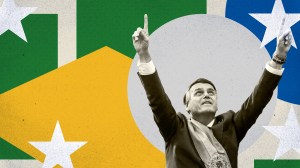
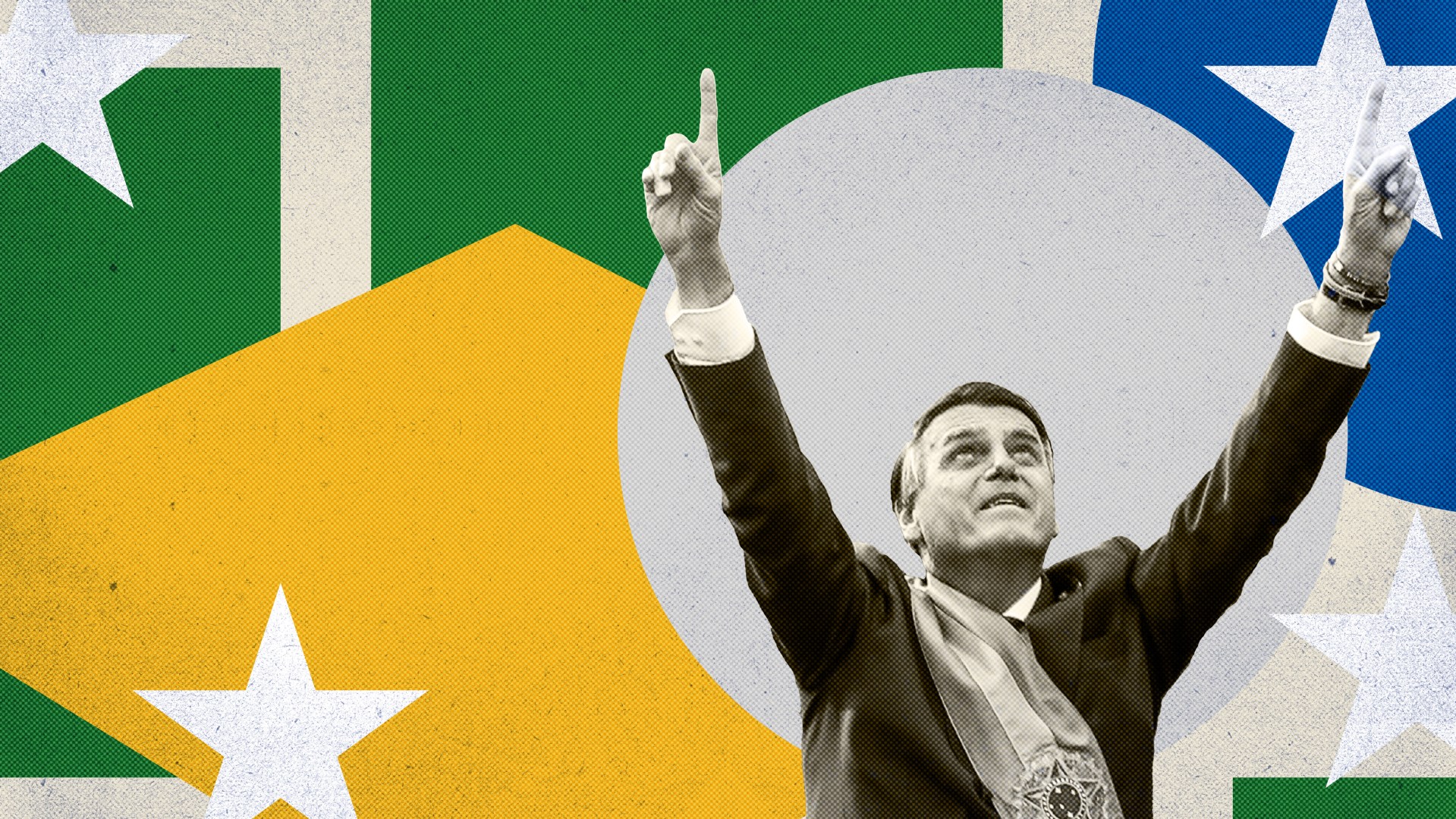
Illustration by Rick Szuecs / Source Image: Antonio Cruz / Agencia Brasil

Incumbent president Jair Bolsonaro’s campaign slogan is “Brazil above everything, God above everyone.” Do you see this as something he really believes in?

Guilherme de Carvalho: In my judgment and based on my conversations with people with access to the president, I believe he really believes in that slogan. He is not faking this—at least, not consciously. The issue is that he has no understanding of God and what such a slogan would actually imply for the nation. His reason for choosing this slogan is evident: to communicate with the practicing Catholic and evangelical populations whose values are ignored by our cultural elites.

Sadly, Bolsonaro has a distorted understanding of God and the gospel, and this causes him to take God’s name in vain, associating it with his personal project. But this is not new; we live in a country that practices a widespread and distorted cultural Christianity. The average Brazilian talks about God all the time, despite not knowing what he is talking about.

The Left also tries, at times, to use the name of God, but it is not very convincing, as everyone sees that it is a farce. In the case of Bolsonaro, it is more difficult to show the mistake, precisely because he believes what he says.

Iza Vicente: Although it is impossible to know the deepest beliefs of a person, including Bolsonaro, I understand that the slogan adopted by Bolsonarism is born not from a genuine conviction of the sovereignty and magnitude of God but as a marketing lure to capture the feeling of faith present in most Brazilians. It is also an authoritative and theocratic signal, because by emphasizing the “God [who is] above everyone” as an imperative of strength, Bolsonaro forgets the God who was also among us, being the servant of all.

Ziel Machado: Whoever turns God into a political canvasser is running a serious risk of taking God’s name in vain.

During the pandemic, Bolsonaro mocked people for dying of COVID-19 and struggling to breathe. To me, these actions did not demonstrate a knowledge of or a relationship with the biblical God.

It is possible that Bolsonaro believes what he says, but comparing what he says with his acts of mercy—which don’t exist—amounts to taking God’s name in vain and portrays an unbiblical image of God. And a politician whose policies have repeatedly shown a lack of empathy for the pain of the people is not referring to the loving and compassionate God of Scripture.

Go back to the lead article.

Jacira Monteiro: This slogan is political propaganda, not a belief Bolsonaro holds. Evangelicals are targets of conquest by politicians, as they comprise a considerable portion of the national vote. Under the presumption of being a Christian (although his Christianity is certainly not the same as that of the Bible or Jesus Christ), Bolsonaro won over evangelical Christians, manipulating them with his “Christian” slogan.

However, God himself said that we must “give back to Caesar what is Caesar’s, and to God what is God’s” (Matt. 22:21). The separation of state and church is a biblical principle. The Christian who seeks political power and manipulates Christians for that purpose has not understood the teachings of Jesus and is in sin.

Regarding the second part of the slogan, it is obvious that we, as Brazilians, must love Brazil and fight for the common good. But blind patriotism is not a Christian thing, for the Bible says our homeland is in heaven (1 Pet. 2:11; Phil. 3:20), not here on earth. Brazil must not be above all but must serve all. As Christians we are called to serve, not dominate, and a “Christian” president should know that.

Ricardo Barbosa: Generally, the slogan of a political campaign or a government works as a form of publicity, an affirmation of values and expectations. Bolsonaro’s slogan is this. I imagine he chose to affirm values such as faith, religion, homeland, or patriotism. But I have no way of answering the question of whether or not he believes in this slogan. It is a question that only he can answer.

Read our guests’ bio in the lead article.

Church Life

How Can Christians Hold Politicians Accountable on Corruption?

Question 6 of Christianity Today’s roundtable on the Brazil 2022 election.

Christianity Today September 21, 2022
Illustration by Rick Szuecs / Source Image: Pearl / Lightstock

The last leftist government was deposed by an impeachment process based on allegations of corruption. Recently, the minister of education in the Bolsonaro government was arrested on the same type of charge. How can Christians hold politicians accountable on corruption?

Guilherme De Carvalho: Holding politicians accountable is the duty of Christians, without a doubt. But given the systemic problems in our country, it is clear that verbal demands against corruption by Christians are insufficient and “prophesying” on Twitter is useless. It is necessary to support candidates who introduce effective anti-corruption bills in the legislature.

A practical path would be to create an evangelical political oversight team that would hold politicians accountable on corruption and other issues. But something like that would need an anchor in Christian political theology, something few people have today. Many of the politicized believers are ideological copies of a secular militancy.

Iza Vicente: To demand transparent and ethical political practices, it is necessary that the support or vote of the evangelical is not based on unconditional devotion, idolatry, or on the idea that the elected candidate is inerrant, infallible, and “sent from God” to represent the evangelicals. However, demanding best practices in the fight against corruption and accountability, through a due legal process, is the duty and right of every citizen, and we evangelicals have to take a more active role in this regard.

Ziel Machado: Our public witness must be supported by a life of commitment to holiness.

I’m saddened by the instances of corruption in which Christians have been involved, although I also believe in forgiveness, reconciliation, and restoration. More than regret, however, situations like these should make us ask, “How can we, as a church, prevent things like this from happening?”

Perhaps we should ask God to raise up, in the midst of the evangelical community, professional politicians who are prepared to act with integrity in the public square, who know the responsibility they have to their fellow Brazilians, and who are accountable for their political practice to the church. We know of only some isolated experiences of Christians in politics who make a practice of being accountable to their constituents.

The principle to be followed is outlined in 2 Corinthians 8: 21, where Paul writes that he is “taking pains to do what is right, not only in the eyes of the Lord but also in the eyes of man.” Integrity is an important value that the Christian cannot give up.

Go back to the lead article.

Jacira Monteiro: Christians, like all other citizens, must demand that the corrupt be removed from their positions and held accountable—either through impeachment or even imprisonment, depending on the seriousness of the act. As the Word of God says, “when the sentence for a crime is not quickly carried out, people’s hearts are filled with schemes to do wrong” (Ecc. 8:11). If there is no punishment for the wicked, there is an incentive, a free pass, for that sin to be repeated. It doesn’t help shalom; it doesn’t help society flourish.

Barbosa: I will disregard the initial comment and answer only the question “How can Christians hold politicians accountable?

There are laws and institutions to fight and prevent corruption. If they don’t work properly (and unfortunately they often haven’t), we should look for an institutional means to improve the system. This mainly involves choosing our representatives in the National Congress and in state and municipal chambers. They are the ones who can legislate in favor of changes in the judicial system.

In addition to demanding that politicians be held accountable, we must do our own homework. We must practice transparency in our churches. We need to be responsible citizens in our work and with the use of public resources. Corruption is present in the actions and decisions of all spheres of society.

Read our guests’ bio in the lead article.

Church Life

When It Comes to Politics, What Mistakes Should Evangelicals Avoid Making?

Question 5 of Christianity Today’s roundtable on the Brazil 2022 election.

Christianity Today September 21, 2022
Illustration by Rick Szuecs / Source Image: Marcello Casal Jr / Agencia Brasil

When it comes to politics, what mistakes should evangelicals avoid making?

Guilherme De Carvalho: First, putting the interests of the denomination or the evangelical community above the common good. Christianity is precisely the faith that leads us to self-forgetfulness—that is, to an attitude of not thinking only about yourself and your personal interests.

Second, we need to avoid letting ourselves be fooled by the “apocalyptic packing” where, when faced with a threatened future, the believer “converts” to the agenda of a candidate of the Left or the Right. The candidate can then manipulate this believer through rhetoric such as “Otherwise the PT will come back!” or “Otherwise fascism wins!” When Christians give up building and developing a positive political agenda based on Christian principles of social doctrine and uncritically embrace the agenda of a savior warlord, they betray their faith.

Iza Vicente: One of the biggest mistakes is putting all your hope in authoritarian political agendas and endorsing figures who weaken the public witness of the church. Another is politicizing faith and sacralizing politics. This means instrumentalizing the faith for merely political ends, as well as thinking that the only way the church can contribute to the common good is through the dominion and control of the spaces of power and that there are envoys anointed for this messianic and heroic task. We should revisit these assumptions.

Ziel Machado: We cannot confuse numbers with representative capacity. Evangelicals have grown to a significant size, and the number of evangelical votes is quite significant. However, is the magnitude of evangelicals proportional to our ability to contribute as citizens? No, it is not.

The church trains people to evangelize and sing in the choir but not how to responsibly engage in politics. We need to train ourselves to have an adequate participation in civil society. Our calling is to be a blessing to all.

Go back to the lead article.

Jacira Monteiro: The mistake of exchanging our biblical values for political power. Evangelicals must especially avoid making indiscriminate use of the Word of God, through weak or distorted exegesis and hermeneutics, to support policies, especially those that go against the Word of God itself.

Ricardo Barbosa: Creating a religious state and making the church a political arm of any party or candidate are the biggest mistakes evangelicals can make. Although many try to justify the creation of a religious state, we do not find anything in the Bible that justifies this. As citizens and Christians, we can and should participate in public life and contribute to a more just society, but not create a religious government or allow the church to be used for political/ideological purposes. That doesn’t mean we can’t have religious politicians. Yes, we can, but let them be servants of the nation and promoters of the common good.

Read our guests’ bio in the lead article.

Church Life

Should Freedom of Speech Be an Important Issue for Evangelicals?

Question 8 of Christianity Today’s roundtable on the Brazil 2022 election.

Christianity Today September 21, 2022
Illustration by Rick Szuecs / Source Image: Bob Thomas / Getty

Should freedom of speech be an important issue for evangelicals?

Guilherme De Carvalho: Freedom of speech is an absolute priority. It is necessary for the free preaching of the gospel. But the fact is that freedom of speech is under threat, not only because of abuse, mainly by right-wing extremists, but also by militant opposition from authoritarian left-wing movements interested in censoring criticism.

The church’s greatest contribution to the common good is the gospel, and fundamental civil liberties are necessary for the free spread of the Word of God. There are, of course, people who consider it selfish to make these freedoms a political priority. But they forget that, historically, social rights have only developed in the West on the basis of fundamental freedoms. In light of history and logic, our priority should be to first protect individual rights before moving on to protecting social rights.

Iza Vicente: Freedom of speech should indeed be an important issue for evangelicals. We need to defend it, but we also need to understand that this freedom has limits. Balancing freedom and discourses is challenging for everyone, including evangelicals.

Ziel Machado: Freedom of speech is an important value for any democratic society, and therefore, it is important for evangelicals and nonevangelicals.

Democracy is always unstable, always subject to risk. It demands participation, but conscious participation. To support this system of government, evangelicals need to educate themselves for democratic life.

Go back to the lead article.

Jacira Monteiro: Freedom of speech is indeed important for Christians. Those who care about the well-being of their neighbors should be concerned about the fact that everyone can express themselves freely.

However, every Christian knows that freedom of speech must be used responsibly and with love for others. Any freedom of speech that is used irresponsibly generates sin. Because we live in society, everything we do spills over onto others. Therefore, we must always be open to dialogue, not demonizing others who think differently from us, and make room for plurality to flourish. Responsible freedom of speech is important for Christians.

Ricardo Barbosa: Freedom of speech is an important issue for everyone, not just for evangelicals. We don’t need to agree with everything or everyone, but it is important that everyone has the space to express their thoughts, ideas, and values without, however, wanting to impose them. Freedom of speech combined with prioritizing the common good and good arguments are the best raw materials for building a mature society.

The problem is that there are many ways to limit this kind of freedom. Public authorities can put restrictions on speech, but so can we through contempt, intolerance, and the inability to recognize the simple fact that we are different. We need to preserve values such as respect, tolerance, and diversity.

Read our guests’ bio in the lead article.

Theology

How Should the Church Respond to Political Polarization?

Question 10 of Christianity Today’s roundtable on the Brazil 2022 election.

Christianity Today September 21, 2022
Illustration by Rick Szuecs / Source Image: Marcos Martinez Sanchez / Getty

We’re currently living through a moment of significant political polarization. How should the church respond?

Guilherme De Carvalho: With or without polarization, the church’s task is always the same: to give apostolic witness to the gospel and its implications for the world. Evangelical churches need to rediscover Christian social doctrine and the witness of the gospel. This is the only true cure for our fractured world.

Iza Vicente: In times of polarization and political violence, the church must be a pacifying entity, spreading peace and cultivating cordial relations, in a communion that goes beyond political differences. How can we be salt and light if we are only reproducing the political violence that society is already experiencing? What difference will we make in this polarized world?

Ziel Machado: We must first pray and discern. We’re not only dealing with political forces but spiritual forces as well. Thus, it is important to discern evil disguised as good. Just because something is quoting the Bible doesn’t make it biblical. The devil tempted Jesus using Scripture, and he continues to use Scripture to tempt us to this day, except the church has the Word and the Spirit of God that enable us to discern beyond appearances. In moments of intense polarization, this insight helps us understand a lot.

Christians also need to look at the cross of Christ. Our theology of the Cross helps us to flee the false gods of our time and embrace the power of the Cross—power that surrenders and serves. Thus, God’s people should never be divided over ideological issues or compromise their unity won on the cross by Christ. Even if we don’t always agree, this shouldn’t mean division in the church.

When politics foments division among Christians, it is none other than Satan using Scripture and religious sayings to divide the church. Therefore, the church needs to recover discernment. This starts with asking both that God forgives us and that, in his infinite mercy, he allows us to hear the voice of the Good Shepherd again.

Go back to the lead article.

Jacira Monteiro: Jesus said, “Blessed are the peacemakers, for they will be called children of God” (Matt. 5:9). The church should be talking about politics to point out solutions on how to be agents of peace in a polarized world.

As the world increasingly displays the works of the flesh through strife, enmity, dissension, and political idolatry (Gal. 5:19–21), the church must further demonstrate the fruits of the Spirit—namely, love, peace, gentleness, and self-control (vv. 22–23). The church must be an agent of love and reconciliation in the midst of such an aggressive, polarized, and extremist world.

Ricardo Barbosa: Let’s persevere in prayer and instruct God’s people to recognize that it is Jesus Christ, the Lord, who governs all things and is the only one to whom we owe, above everything and everyone, obedience. Whenever some other power—be it governments, powers, ideologies—tries to take over our lives, we deny the rule of the only Sovereign in history.

Read our guests’ bio in the lead article.

Church Life

Should the Environment Be an Important Issue for Christians?

Question 7 of Christianity Today’s roundtable on the Brazil 2022 election.

Christianity Today September 21, 2022
Illustration by Rick Szuecs / Source Image: Mauro Lima / Unsplash

As our weather grows more extreme and deadly, should the environment be an important political issue for Christians in the upcoming presidential race?

Guilherme De Carvalho: Environmental issues should figure among the priority agendas of contemporary Christianity, alongside the anti-abortion agenda, the fight against corruption, fundamental civil liberties, and employment. For me, it’s one of the tiebreakers.

Iza Vicente: Topics such as climate change, disaster prevention, forest preservation, alternative energy, and climate justice must be fundamental in the environmental debate. Considering our role in caring for creation, environmental degradation violates the life we are called to care for and deepens the precariousness of humanity’s existence.

Ziel Machado: The Bible does not begin with Genesis 3 but with Genesis 1. God has put us in charge of creation; we have a creation mandate. The truth is that there is a fragile theology of creation in the evangelical world. We cannot forget that the salvific mandate did not cancel out the cultural mandate. We still have the responsibility to take care of creation, to watch over it as stewards of that creation.

The environmental agenda is a priority for any serious government project that is concerned with issues of the future, of the next generations. A government proposal that disregards the environment is not the proposal of a public servant but of someone who is concerned only with getting elected. Without concern for the environment, what future can we expect for the nation?

Go back to the lead article.

Jacira Monteiro: Of course environmental issues should be an important issue for Christians when choosing a candidate! The cultural mandate (Gen. 1:28) stipulates harmonious care for your creation. As I write in O Estigma da Cor (The Stigma of Color), “every government and management that is not concerned with sustainability, with the environment, is going against what the Lord has instructed in his Word of diligent care for created nature.”

We are living through an environmental crisis, and as agents of the Lord, we are called to care for his creation. Thus, we need to encourage public servants to share this concern.

Ricardo Barbosa: Yes, this is one of the important issues. The environment, however, is equally as important as the other issues. We as Christians need to better develop our theology of creation and understand our role in relation to the cultural mandate. But the environment has become a complex, ideological agenda with confusing narratives that often deify nature and demonize human beings. This is a problem.

We also need to seek reliable information and data consistent with reality in order not to be swallowed by the inconsistent narratives of groups of environmental activists.

Read our guests’ bio in the lead article.

Church Life

Beyond Bolsonaro and Lula: How Brazil’s Evangelicals Should Vote

Five Christian leaders weigh the factors they hope are guiding the church as it prepares for the October presidential election.

Christianity Today September 21, 2022
Illustration by Rick Szuecs / Source Image: Nadine Marfurt / Unsplash

Since the start of Brazil’s 2022 presidential election, national and international electoral news has focused on the role that faith will play in next month’s race—and for good reason: Religious concerns have dominated the talking points of both Jair Bolsonaro’s and Luiz Inácio (“Lula”) da Silva’s campaigns. Whether it’s discussing COVID-19 church closures or the spiritual fight between good and evil, the candidates have seemingly preferred to prioritize these issues at the expense of others such as unemployment, inflation, climate change, or foreign policy.

According to political analysts, the candidates are betting, especially Bolsonaro, that the most-responsive electorate are evangelicals — which in Brazil means "protestants" and encompasses both classic evangelical and Pentecostal denominations as well as neo-Pentecostals. The data backs him up. Nearly half of evangelicals (48%) say they’ll vote for Bolsonaro, compared to only a quarter (26%) for Lula, according to a late-August poll from the Inteligência em Pesquisa e Consultoria (IPEC). A Datafolha poll from mid-September shows similar numbers: 49 percent of evangelicals say they’ll vote for Bolsonaro compared to 32 percent for Lula. Evangelicals make up about 25–30 percent of the country’s total electorate.

While the evangelical universe in Brazil is multifaceted, evangelical pastors hold significant sway over their congregations. Roughly speaking, it is possible to say that a group of pastors who have no problem offering political opinions from the pulpit have strongly influenced a significant portion of evangelical voters. The media has picked up on this as well, to the point of modifying the catch phrase voto de cabresto (“voting by halter”), where leaders guide people’s political decisions, to voto de rebanho (“voting as a herd”)—a play on the Portuguese meaning of pastor as “shepherd.”

Given this environment, Christianity Today interviewed five Christian leaders from Brazil about the church’s witness in this election year, seeking to highlight voices that promote dialogue and listen thoughtfully to other believers’ perspectives. We hope their biblically informed perspectives on these important issues help guide citizens of Brazil and the kingdom of God.

Guilherme de Carvalho President of the Brazilian Association of Christians in Science (ABC2). Follow him @guilhermevrc.

Iza Vicente Lawyer, human rights specialist, city council member of Macaé in Rio de Janiero. Follow her @IzaVicent.

Ziel Machado Vice chancellor of Servos de Cristo Theological Seminary, pastor of the Free Methodist Church in São Paulo, and theologian at the London Institute for Contemporary Christianity. Follow him @ZielMachado.

Jacira Monteiro Author of The Stigma of Color and graduate student in biblical theology and New Testament exegetics. Follow her @jacirapvm.

Ricardo Barbosa Pastor of the Presbyterian Church of Planalto, author of Janelas para a vida (Windows for Life) and O Caminho do Coração (The Path of the Heart), and coordinator of the Christian Studies Center in Brasília

Marisa Lopes is editorial director of Christianity Today em português.

Igor Sabino has a PhD in political science from the Federal University of Pernambuco (PFPE) and works with the Philos Project Brazil.

News

Black Church to National Park Service: Give Us Stones of Remembrance

Black denominational leaders have formally asked for a national monument to the 1908 Springfield race riot, and a new national survey reveals more public lands Black clergy want memorialized.

Ruins of a Black neighborhood after the 1908 violence in Springfield, Ill.

Ruins of a Black neighborhood after the 1908 violence in Springfield, Ill.

Christianity Today September 21, 2022
Courtesy of Lincoln Library

In Lower Manhattan, people in suits pass by a green space with a modest stone monument on their way to the city’s big courthouses. They rarely stop to notice the African Burial Ground National Monument, marking the historic site where more than 15,000 Africans were buried when the city banned slave burials in church cemeteries.

The burial ground was discovered during a construction project in 1991 and was declared a National Historic Landmark in 1993. Yet it took more than a decade of political pushing and preservation work before the National Park Service (NPS) opened the site as a national monument.

Now Black church leaders are pressing the federal agency to develop more memorials like this one. They want to mark Black history on public land, and they have specific spots in mind like the site of the 2015 church massacre in Charleston, South Carolina.

This month, leaders of some of the largest Black Protestant denominations and several state Baptist conventions made formal overtures to the park service to memorialize a site connected with the 1908 Springfield race riots in Illinois. The NPS—which oversees historical markers and memorials on public land, such as the Martin Luther King Jr. Memorial in Washington, DC—currently has no sites documenting lynchings or mass killings of African Americans.

Separately, in a new survey from the National Religious Partnership for the Environment (NRPE), 700 Black church leaders listed their suggestions for possible memorial sites, noting that they felt their past input on public lands had been “politely ignored.”

Among the most popular responses were sites honoring Black leaders such as Malcolm X, Rosa Parks, Jackie Robinson, and Frederick Douglass as well as designations for historically Black colleges and universities, many of which grew out of local churches’ theological training programs.

The number one site church leaders thought should be preserved to showcase atrocities against the Black community was Charleston’s Emanuel African Methodist Episcopal (AME) Church, where a white supremacist killed nine African Americans meeting for a Bible study in 2015. They also mentioned documenting the 1906 Atlanta race riot, the 1873 Colfax massacre, and the 1923 Rosewood massacre.

“We didn’t provide them a checklist. … To have something repeatedly named, to me that's a big deal,” said Cassandra Carmichael, the executive director of NRPE. “Now we’re going to dig into some of these places to find out what could we tell, what could we advocate for to be protected.”

Other Sites Pastors Named for Memorials: – The 5,000 Rosenwald schools in the South, of which 500 remain; – The last-known slave ship to arrive in the United States, the Clotilda, which is currently underwater in Mobile, Alabama, after being discovered in 2019; – Lake Lanier, a man-made lake in Georgia that flooded a Black town that had first been forced out by lynchings and violence.

Creating a new area under the National Park Service requires an NPS study and approval by Congress or the president. The park service is in the process of studying more African American landmarks to recommend and has been looking at a site to memorialize the Springfield race riots for the past five years, according to Tokey Boswell, an NPS associate regional director.

The proposed Springfield site, a few blocks from the Lincoln Home National Historic Site, would mark the remains of five homes destroyed during the violence.

The 1908 brutality in Springfield stemmed from an accusation that a Black man assaulted a white woman, spurring white residents of Springfield to mob violence. They burned Black homes to the ground and lynched Black men, and 2,000 Black residents fled the city for good.

“Through our faith, we envision an exceptional future,” wrote the head of the Baptist General State Convention of Illinois, Mark A. McConnell, in his letter to NPS. The convention was founded in 1902, at a church a few blocks from the proposed site of the monument. “We know that we can attain redemption as a nation for the racial injustices committed if we, as a nation, confess and acknowledge the true course of events and the impacts that they had.”

Denominational leaders who wrote the NPS about a national monument at Springfield represented millions of churchgoers, including the presiding bishop of the Church of God in Christ, the bishop of the African Methodist Episcopal Zion Church, the college of bishops for the Christian Methodist Episcopal Church, the president of the Progressive National Baptist Convention, and the president of the National Black Presbyterian Caucus, among others.

Almost all the letters noted not just the atrocity of the riot but also its role in the formation of the NAACP.

“It is history that includes raw racism but also exemplifies Black agency,” wrote Melvin Owens, the president of the Alabama State Missionary Baptist Convention.

All the letters were addressed to the NPS’s Boswell, who said it was “a very impressive showing from the Black clergy.” The NPS will finish its study next year, and it can give a positive or negative report on the site. Then it’s up to Congress or the president to order a monument. Illinois lawmakers have introduced measures in the US House and Senate to create one in Springfield. Every site is unique, Boswell added: “Sometimes Congress will make it a unit the very next year, … sometimes in 10 years.”

Memorializing such history is healing for the Black community, the clergy said, and it can correct national misconceptions.

New York, for example, often lives in denial of its slaveholding history, but places like the African Burial Ground bring attention to that past. Before the American Revolution, New York had the largest slave population outside the South. Slaves built roads like Wall Street and Broadway as well as the city wall.

Slavery existed in this northern state well after the Revolution too. On Staten Island, Black historians have pushed for decades for a little marker to denote a Black church cemetery where the last slave born in the borough is buried—a man named Benjamin Prine, who died in 1900. The cemetery has since been paved over and is now home to a parking lot for a bank, a 7-Eleven, and a paint store.

Richard Dickenson, a Black historian in the 1990s, managed to get the bank to display a small plaque about the cemetery, but the plaque was later taken down. Now a different bank has moved in, and Dickenson has since died. Another Black historian who specializes in Staten Island, Debbie-Ann Paige, has taken up the cause for the cemetery.

Filmmaker and genealogist Heather Quinlan found the living descendants of Benjamin Prine. They lived a mile away from the cemetery on Staten Island but didn’t know that it existed, that they had an enslaved ancestor buried there, or that there had even been slavery in New York, Quinlan said.

“We were supposed to be … We took in the huddled masses!” said Quinlan. “[Slavery] was [used by] the barbarians down south. And if we did it, it wasn’t that bad.”

The NPS can’t do anything on private land, though it has consulted with locals about how they could memorialize the church cemetery. Quinlan and others have discussed what the city could do on the sidewalk beside the strip mall, such as plant a tree or install a plaque, in honor of those buried in the cemetery.

Now the family, historians, and Quinlan can celebrate a little: On October 3 the street that runs alongside the strip mall over the cemetery will be co-named Benjamin Prine Way. Quinlan said it would be the first street in New York named for a formerly enslaved native New Yorker. Nearby is Van Pelt Avenue, which bears the same name as Prine’s owner, pastor Peter Van Pelt.

Quinlan has been working on a documentary about the cemetery and is trying to uncover more records about the AME church there. Researchers know of 50 graves specifically in the church cemetery under the pavement, but “there could be up to a thousand,” said Quinlan.

The survey of Black pastors frequently mentioned Black cemeteries as potential locations for memorials. Like the New York sites, many were destroyed or paved over for development.

“It would give us some sense of solace to know that the larger culture is concerned about hearing our story and has the courage to be able to listen,” said Gregory Williams of Holsey Temple CME Church in Atlanta.

Ideas

Should Christians Vote?

Staff Editor

Four questions to ask about biblical political engagement.

Christianity Today September 21, 2022
Edits by Christianity Today / Source Images: Winslow Productions / Getty

When Tennesseans go to vote this Election Day, they’ll be asked whether they want to amend an unusual section of their state constitution: a ban on ministers of religion seeking a seat in the state legislature. The clause, whose curious history has been reported by CT, hasn’t been enforced since the 1970s, when the Supreme Court ruled it an unacceptable constraint on religious rights. It’s still on the books, but pastors in Tennessee already can and do run for state house.

This amendment hits the question of Christian political engagement squarely on the nose. It’s a well-worn topic—evangelicals’ voting records, partisan alignment, policy positions, generational trends, and denominational differences are amply documented in the media.

Meanwhile, Christians are busily preaching sermons and writing books to call one another to faithful political engagement. The message varies widely depending on who’s doing the preaching or writing: One man’s faithfulness is another’s capitulation to a godless culture of death.

But while we talk endlessly about faith and politics, I suspect few of us have an explicit and practical theory of political engagement. That is, we have a general inclination or sense of obligation to participate in politics in a way that involves our faith, but exactly what does that entail? I’d suggest there are four questions we should be asking here, two of which tend to get short shrift.

1. What does Scripture say about X?

This question is straightforward and the one we’re most used to asking (illustrated by a recent CT piece: “Is Student Loan Forgiveness Biblical?”). Of course, Scripture doesn’t speak directly to most modern policy questions, so the answers aren’t always clear-cut. That doesn’t mean we should stop asking this question—far from it.

But it does mean we could often use more humility in our answers, especially when we’re speaking of policies involving institutions or technologies that simply did not exist in the biblical era. That a policy may be compatible with Scripture does not make it a biblical mandate. Answering this question well should entail diligently studying the biblical record, ideally in conversation with Christians of varying perspectives (whether in real life or by reading books) to ensure we do more than return to familiar and unchallenging texts.

2. Are my speech and manner Christlike?

This too is an old question but newly controversial. It ought to go without saying that the Beatitudes (Matt. 5:3–12) still apply in politics—that we’re called to be meek, merciful peacemakers even while we vote, campaign, and tweet.

Yet one of the pernicious effects of the last half decade was the normalization of shamelessness, mockery, and belligerence as desirable political traits among candidates and pundits Christians support.

We might not be ginning up animosity toward other people ourselves, but as commentator David French has argued, “a person doesn’t necessarily wash his hands of sin by delegating that sin to another person. Or, to put things more plainly, one doesn't comply with the command to ‘love your enemies’ by hiring someone to hate them for you.”

Beyond checking our own behavior in political engagement, Christians should consider if we’ve outsourced our political hatred to the public figures we support. Are we pretending our hands are clean while backing politicians and pundits who lie, bully, and fight dirty on our behalf?

3. Is my political enthusiasm the result—or cause—of distorted love, fear, anger, or worship?

This third question is one I see asked more and more, thanks to renewed attention, in books like James K. A. Smith’s You Are What You Love and Kaitlyn Schiess’ The Liturgy of Politics, to Augustine’s contention that our lives are oriented by our affections.

We gravitate toward what we love, and we’re similarly shaped by our habits of worship, fear, and anger. Distortions of our affections and reactions—worshiping or fearing the wrong things—will leave us distorted people. And politics, perhaps second only to advertising, is designed to activate and claim these orienting affections, with distorting effects. That distortion is easy to see in our political opponents, but we’re less inclined to notice the same or worse distortion in ourselves (Matt. 7:3–6).

A simple and reliable test: If we ever find ourselves arguing that politics is a special case—a unique situation in which Christians can exchange gentleness for cunning, confidence in God’s care for anxiety over the future, or “excellent or praiseworthy” things for whatever it takes to win (Luke 12:27–28; Phil. 4:4–9)—then our political enthusiasm may be the result or cause of a distorted heart orientation.

4. What are the limits of Christian political action?

Al Mohler, president of Southern Baptist Theological Seminary, was recently criticized for his claim that Christians are “unfaithful” if they “do not vote, or they vote wrongly,” which was widely interpreted to equate faithfulness with voting a straight Republican ticket. It’s worthwhile to consider more foundational questions than partisan alignment.

Should Christians vote? Must we? Should we campaign or lobby? Are we unfaithful if we don’t sign every petition whose demands we support? May we seek public office? Does it depend on the office or the other candidates running? May we serve in the military or police force or as prison guards? Are all roles in government and politics permissible for Christians or only some, or none? Should limits be different for clergy and other leaders in the church?

Christians have handled these questions in many different ways, and I don’t expect every Christian to land where I do: not at a total eschewal of political engagement but with a deep Anabaptist skepticism of Christians’ wielding the sword of the state.

But I think it’s fair to say those more specific questions about the practical limits of Christian political engagement deserve to be seriously raised and carefully answered. We won’t have a mature theory of faithful political engagement if we plunge into politics without so much as considering the challenge posed by traditions like Anabaptism or after quickly dismissing it as quietism or naiveté.

Perhaps we have “the right to do anything” in politics and governance, “but not everything is beneficial” (1 Cor. 6:12). Or perhaps, just as in other spheres, there are roles and activities here that in definition or in current practice conflict with following Christ. After all, two of the three temptations in the wilderness asked Jesus to seize or display power (Luke 4:5–12), a revealing move on the Devil’s part.

If we’re going to engage in politics, we must start by asking these questions.

News

Amid Myanmar’s Civil War, Unity Emerges

Christians, Buddhists, and Muslims—all from different ethnic backgrounds—are coming together to resist the violent military junta.

Members of the Mandalay People's Defense forces take part in training at their camp.

Members of the Mandalay People's Defense forces take part in training at their camp.

Christianity Today September 20, 2022
David Mmr / SOPA Images / AP Images

For the first time since anyone can remember, members of Myanmar’s majority Bamar people are seeking long-term solidarity with the country’s ethnic minorities. Since a coup in February 2021 stunned the world, the military, known as the Tatmadaw, has violently cracked down on both the Bamar and ethnic minority citizens protesting its takeover. Its tactics have included burning down entire villages and firing heavy artillery against its own people. So far, more than 2,000 people have been killed in its countrywide civil war with the poorly armed People’s Defense Force (PDF).

Christian NGO Free Burma Rangers (FBR), which has trained 6,000 ethnic minorities as first responders in the past two decades, has observed this growing unity up close. Increasingly, young Bamar people from cities like Yangon and Mandalay have left their college studies and careers to help the growing popular resistance. Some have gone to the jungles to learn from ethnic armed groups how to fight the Tatmadaw. Others have joined FBR trainings, where trainees alternate between intense physical training and learning how to dress a gun wound or navigate dense jungle terrain.

Even as Myanmar faces its worst fighting in its 70 years as a free nation, many point to the unprecedented unity across ethnic and religious divides. While the country’s Buddhist nationalist leaders previously declared that Myanmar belonged solely to the Buddhist Bamar, now people of all backgrounds have banded together against the common enemy of the military junta.

“This has never happened in Burma, never in my 29 years here,” said Dave Eubank of FBR. “What you have is hope.”

“You are not authentic Burmese”

Religion and ethnicity have long been intertwined with politics in Myanmar, also known as Burma: The country comprises approximately 130 ethnic groups with the largest being the Bamar, who make up 68 percent of the population. The Bamar also make up most of the country’s elite, including the Tatmadaw, and have long clashed with other ethnic groups seeking greater autonomy.

Most Bamar practice a mix of Theravada Buddhism and indigenous Burmese folk religion. Buddhism is the state religion, and almost 90 percent of the population are practicing Buddhists. Christianity, which is mainly practiced by Kachin, Chin, Karenni, and Karen ethnic groups, makes up about 6 percent of the population, and Islam, practiced by the Rohingya, makes up 4 percent.

During the time of British colonial rule (1824–1948), Buddhist nationalism sprang up as the British suppressed Buddhist practices and promoted secular education. This anti-Western movement led to the creation of the Burma Independence Army, which the Tatmadaw view as their predecessor, in December 1941. The country gained its independence in 1948.

Post-independence, Buddhist nationalism was marked by an anti-ethnic minority and anti-non-Buddhist movement, according to David Moe, a Chin scholar at Yale University who wrote his dissertation on Buddhist nationalism. Former prime minister U Nu’s slogan encapsulated this idea: only the Bamar race, only the Burmese language, and only the Buddhist religion. This underlying thinking led not only to discrimination against those outside the Bamar Buddhist group but also to the world’s longest civil war.

“They feel that this nation belongs to Buddhist people only,” Moe said. “And they also say that in this Buddhist nation, if you are not a Buddhist, you are not authentic Burmese.”

In 2010, the military junta introduced some freedoms, released democracy leader Aung San Suu Kyi from house arrest, and allowed the people to elect some of its leaders. But the Buddhist nationalism ideas remained. Suu Kyi became widely reviled by the West as she defended the atrocities committed by the Tatmadaw against the mostly Muslim Rohingya minorities.

Last year’s coup appears to have shaken this persistent fault line, as the Tatmadaw violently cracked down on Bamar protesters angered by the takeover. Soldiers shot peaceful supporters of the Civil Disobedience Movement on the streets and threw movement leaders in prison, where torture is common. The Tatmadaw also sentenced Suu Kyi to 20 years in prison, including three years of hard labor, for election fraud and a myriad of other charges.

Facing the brutality of the military firsthand, many Bamar apologized to ethnic minorities for turning a blind eye to their plight. Bamar students, civil workers, and teachers in the cities trekked into the jungles to learn how to shoot a gun or assemble a homemade grenade from ethnic armed groups such as the Karen National Liberation Army. Returning home, they used what they learned to create their own PDFs and defend their communities.

Fighting has increased in both ethnic areas like Moe’s hometown of Mindat in Chin State and Bamar-majority areas like Sagaing Region. In Mindat, residents were the first to pick up knives and hunting rifles to create a local militia to fight against the military. The fighting intensified, and in May 2021, the military imposed martial law on the city, destroying homes and attacking the resistance with heavy weapons. Thousands of residents, including Moe’s family and friends, fled the city to villages and internally displaced people (IDP) camps in the jungles.

Sagaing Region has also seen some of the most intense fighting between the military and local PDFs. Villagers reported the Tatmadaw have indiscriminately attacked communities, killed civilians, burned homes, and forced thousands to flee. In total, more than 1 million people in the country are internally displaced.

The government-in-exile, called the National Unity Government (NUG), is drafting a federal constitution that would allow seats at the table for different ethnic groups, which has never been done before in Myanmar. Susana Hla Hla Soe, a NUG cabinet member, apologized that she did not “raise a voice for our brothers and sisters from the ethnic areas, including Rohingya brothers and sisters.”

Still, Moe notes that the change of heart is mostly among the young people of Myanmar, especially Generation Z. While he believes this unity can remain if and when the common enemy of the Tatmadaw is defeated, he notes that in this new government, the Bamar will still remain the majority group.

“I am optimistic, but on the other hand, I need to be very speculative,” he said.

“Because of love”

As the Tatmadaw’s attacks have spread and increased in intensity, it has led to an increased need for FBR’s services providing medical care to resistance forces and food to IDPs. The military has increased the number of airstrikes in Kachin State and expanded them into Karen State (also known as Kayin) and Karenni State (also known as Kayah), said Eubank.

FBR’s deputy director, a 54-year-old Karenni man known as Monkey, said that after the coup, many Bamar people contacted FBR, mistakenly thinking they could learn how to fight or even assassinate the Tatmadaw. Yet Monkey would tell them that’s not FBR’s mission.

“We help get people out of the fire zone,” he said. “We just help people because of love.”

Some leave disappointed, but others join the training. In contrast to the ethnic-minority trainees, many of the Bamar from the cities show up in jeans and have no experience with living in the jungle.

But what they have lacked in physical fitness, says Eubank, they make up for in their ability to quickly navigate with a GPS or suture a wound. Unlike ethnic people, most of whom have only an eighth grade education, many Bamar trainees have at least some college education or worked civil jobs before the coup.

Monkey noted that typically during the beginning of the training, there are tensions between the ethnic and Bamar trainees as they don’t seem to trust each other. But over time they realize they are part of the same team. Going on dangerous missions to provide aid for ethnic groups fighting the Tatmadaw especially draws the different groups together, Monkey said, as they realize they need to lean on each other to survive.

As a Christian, Monkey noted that while FBR stands with the people, “we are not against the enemy. We pray for them before and after the missions. … We pray every day for the Burma army to see the truth.”

FBR has seen some soldiers defect and repent of their actions. Monkey found that as the trainees pray for their enemy together as a group, the Buddhists join in praying as well.

“Without God, we cannot do it,” said Monkey.

One ranger’s story: Saw Ree Doh

Hearing the whine of a military aircraft overhead, Karenni resistance fighters and members of FBR scrambled into ditches and culverts on the side of a road in the village of Thar Yat in Karenni State on February 24. A bomb exploded 40 yards away in a cloud of smoke and debris, as the sound of gunfire continued to punctuate the air.

As the smoke cleared, Dave Eubank saw a limp body on a driveway ahead of him. Running over, he was surprised to find Saw Ree Doh, a young Karenni ranger he had worked closely with, in a pool of blood. Shrapnel had sliced through his neck, killing him instantaneously.

Eubank and the other rangers tried dragging Ree Doh’s body to where they had hidden their vehicle, but planes kept attacking the group, forcing them to duck for cover. Eubank then radioed members back at the base to pick the body up while he and the other rangers stayed hidden among some trees until the planes left and they could return to base. He feared that if they left his body, the soldiers would mutilate it to send a message to others.

Members of FBR placed Ree Doh’s body on a homemade bamboo table covered with a tarp and lit candles around him, softly praying and singing hymns. The next morning, they carried the body in a coffin to a burial ground a mile away, lowered it into the ground, and marked the grave with a cross. Ree Doh’s sister, who was living in an IDP in the jungle, came out of hiding to attend the funeral.

Eubank said they typically lose one to three rangers a year from illness or gunfire. But in the past year they have lost ten rangers, four from illness and six from attacks by the Tatmadaw.

“All of us carry more sadness,” Eubank said. “I could cry at any moment, all the time.”

Eubank’s daughter, Sahale, remembers Ree Doh as fearless: He was the first to rappel off a bridge during FBR training or sing and dance for children stuck in IDP camps. Unlike many of his fellow trainees, he was direct and not afraid to correct the instructors when he thought they were wrong. Sahale remembers one time they were building a raft to float down the river when several Karen children started following them into the water. Ree Doh scooped them up, placed them on the raft, and took them up and down the river.

Such willingness to help others was what brought him to that village in Karenni State last February. Karenni resistance forces were trying to hold off the Tatmadaw and buy time for residents to evacuate. Initially, Ree Doh had stayed at the base, but when he heard the group was under heavy fire, he jumped on a motorbike to the frontlines to help. It was while he was running toward the rangers that the bomb killed him.

“It showed me how compassionate he was,” Sahale said, noting that Karen and Karenni don’t speak the same language and can be prejudiced toward each other. “He took time to show them a little bit of happiness and joy.”

Les Lofquist is not feeling too well. In the visitor’s center of the Mormon Temple Square, he stares at a projector screen lowered a few seconds before by an automatic timer. The Mormons’ latest public relations film has begun. Les shifts in his royal-blue padded seat, color coordinated with the slate-gray carpet. From linear-drive magnetic circuit woofers comes the soft voice of a man with extremely straight, white teeth. He is talking about the purpose of life.The film, Les is forced to admit, is slick. It is spit-shined and glowing: the perfect husband, holding the perfect wife’s hand, while their perfect child holds a perfect rose while floating in a rowboat on a perfect lake on a perfect morning.That explains some of his queasiness. But there is a more disturbing fact. Lofquist has been reminded, once again, that the odds are stacked against his ministry.Les Lofquist, as is his custom on Sundays, is preaching. His church is a converted day-care center. More precisely, when the cardboard sign is hung on Saturday night, the Love-N-Care preschool day-care center becomes the Roy Bible Church. There’s not much to it, really. A “He Lives” poster covers some smiley-faced snowmen; sheer drapes behind the portable pine pulpit shut down the Disney Parade—Goofy and Mickey and Donald—into a sufficiently reverent white; a wooden cross hangs on one wall; and a hundred or so standard-issue, dirt-brown folding chairs are spaced across the carpet.On this particular Sunday, Lofquist is preaching to about 70 people. “How many times have you been nervous about your puny little effort for Jesus?” he asks. From a far wall, Freddy the clown, green hair and red ribbons, smiles unimpressed.With glasses on his baby face, Lofquist looks innocent or quizzical. He has precise, thinning blond hair, and a frame that whispers of an athletic past. He appears to be a man who tilts toward safe. He and his wife, Miriam, have four beautiful children.But, on closer inspection, there is something unsettling, offbeat. Maybe a look in the eyes, the way a strand or two of hair doesn’t behave, a catch in the smile hinting at a hidden capacity for surprise and boldness.Raised in the sixties, the son of an independent Minneapolis businessman, Lofquist grew up with the uneasy and strange combination of popularity and conscience. He was the captain of his basketball team and got high grades.But, for some inexplicable reason, he began to tilt at windmills. Glory (and Lofquist has always, in some sense, striven for it) became equated with the magnitude of the odds. In high school, swept along by the sixties movement, he gave up basketball to take a shot at world hunger.He organized two marches to raise money. Although he raised a good deal, he lost a good deal: “After the last march, I sat down in a telephone booth we had rented and cried great, heaving sighs. I guess I finally realized that I didn’t have resources to buck those kinds of odds. What was my one teeny voice crying in the wilderness?”For the next few months, Lofquist drifted toward despair. Then he found Jesus. That revived his sense of hope. And his sense of daring.Outside of Roy, Utah, there is a twirling tomato. “That’s the only thing I knew about Roy,” Lofquist says. “It was a sign for Sacco’s fruit stand on the highway. I said I would never go to Roy.”Utah, for that matter, didn’t initially send chills up and down his spine. But, says Lofquist, “in college, all I knew was that I wanted to go to the mission field. And I knew that I wanted that mission field to be a hard one.”While attending college, Les married. Miriam is the daughter of a missionary to Mormons in Utah. Les spent two summers in Utah and was exposed to the “overwhelming need.” (He also learned that Miriam’s father, during the first few years of his ministry, had to pump gas to feed his family.)During college and seminary at Grace Schools in Winona Lake, Indiana, Lofquist continued to achieve. He was, in every sense, a man with a future. Popular, bright, handsome—an almost sure bet one day to have pencils that read The Fastest-growing Church in Lincoln County and, Possibly, the Surrounding World.But his penchant for the long shot got the best of him. Through a combination of events, he became pastor of a church in Roy, Utah. The rising star went to the place with the twirling tomato. He had spent eight-and-a-half years training to be a pastor. At the time, there were eight people in the church.Lofquist estimates there are about 1.7 million Mormons in Utah, which amounts to about 80 percent of the state’s population. The Mormons have nearly absolute control in matters dealing with legislation and the press.Appeal and authority are two key factors in the Mormon empire, Lofquist says. The Mormons are good at creating images to attract potential converts. “Mormonism,” Lofquist says, “is an all-American religion. They play off positive values—family, patriotism, the work ethic.”The authority operates on fear of ex-communication. According to Mormon doctrine, families married in the temple are together for eternity. A spouse who leaves the church, then, is separating a family for all eternity. And leaving the church in Utah means social ostracism, loss of prestige and social community, and possibly loss of job.Christianity that relies on the Bible as its sole authority is practically nonexistent. Lofquist estimates that in the Salt Lake City area, there are probably 15 good churches. In his area—about 40 miles south of Salt Lake—there are two fundamental churches with a combined membership of about 300. The area has a population of about 250,000.Behind the pulpit of the Love-N-Care preschool day-care center—make that the Roy Bible Church—Les Lofquist, bathed in Da-Glo yellow, is apologizing again. He admits he often feels like a comical voice in the wilderness: with Donald and Mickey and Goofy and the green-haired clown—another fool in a fool’s parade. “I don’t get overwhelmed so much as I get embarrassed,” Lofquist says. “I mean, we have such a great God and our people are such great people—and what do we have to show for it? A converted day-care center.”It doesn’t bother him so much, except when he picks up a Christian magazine, and some pastor is explaining the proper staff-to-laypeople ratio.“There are standards that have been set up in the Christian community as to what success is,” Lofquist says. “A lot of that is based on numbers. You can’t measure success in Utah by numbers.”He continues to talk, then there is a pause. It breaks the mood. Without question, there is something unexpected hidden behind the man’s smile.By Rob Wilkins, a writer living in Winona Lake, Indiana.

addApple PodcastsDown ArrowDown ArrowDown Arrowarrow_left_altLeft ArrowLeft ArrowRight ArrowRight ArrowRight Arrowarrow_up_altUp ArrowUp ArrowAvailable at Amazoncaret-downCloseCloseellipseEmailEmailExpandExpandExternalExternalFacebookfacebook-squarefolderGiftGiftGooglegoogleGoogle KeephamburgerInstagraminstagram-squareLinkLinklinkedin-squareListenListenListenChristianity TodayCT Creative Studio Logologo_orgMegaphoneMenuMenupausePinterestPlayPlayPocketPodcastprintremoveRSSRSSSaveSavesaveSearchSearchsearchSpotifyStitcherTelegramTable of ContentsTable of Contentstwitter-squareWhatsAppXYouTubeYouTube