News

Drug Addiction Was Bad in America. The Pandemic Made it Worse.

Recovery ministries try to help as people give up and give in.

Sources: Getty / CandyRetriever / ShutterWorx

For 50 years, Toby Nigh had what he describes as the perfect life. He had a good job, a happy family, and if you had asked him, he would have told you that he was really lucky.

“Everything always seemed to work out for me,” the Kirksville, Missouri, man said.

Then his perfect life fell to pieces in 2018.

One day at work he picked up a 30-pound machine and blew out the L4-L5 disc in his back. A surgery led to an infection, which required another surgery, and then another. He was left weak and in pain.

He battled ongoing infections for a year and a half, and in the midst of it all, he lost the job he’d had all his life. The pain, trauma, and anger were too much to bear. He found relief in methamphetamines.

“I wanted to bury the pain—the physical pain, the mental pain,” he told CT. “I made a very bad decision.”

Things got worse for Nigh in 2020 when the COVID-19 pandemic reached America. He had a high risk of getting the virus, and getting it bad, because of his history of infections and the long-term effects of the treatment.

“So when the pandemic hit, I’m thinking, If I get it, I die,” Nigh said. “I went in my basement, and I closed myself in, and my addiction became bigger and stronger.”

According to stats from the Centers for Disease Control and Prevention, Nigh wasn’t the only one who responded that way.

Within a few months of the start of the pandemic, more than 40,000 Americans self-reported new or increased substance abuse. It seems people turned to drugs as a way of coping.

That number is probably low. By the year’s end, the country saw a record 91,799 drug overdose deaths, up from 70,630 in 2019. In 2021, more than 100,000 died from an overdose.

Christian recovery ministries have adjusted, and some have seen some success moving support groups online.

“It took some time for people to get used to the logistics of videoconferencing and Zoom, but eventually people started to catch on to the point that in the last 12 months, we’ve actually had ministries out in the field launch exclusively online,” said Greg Keylon, president of Living Free, a nonprofit organization providing training and support group resources to churches. “They have no bricks and mortar.”

While it’s not the same as being face to face, Keylon said that sometimes people have been more open online.

“Many times the group members and group participants open up faster in an online group … because of the anonymity of being behind a screen,” he said.

But those ministering to people struggling with addiction say that despite those new opportunities to gather, many people have really suffered. Gary Blackard, president and CEO of Adult and Teen Challenge, a Christian drug and alcohol recovery program, has seen the pandemic’s impacts firsthand.

“One of the worst things you can do with someone who is struggling with addiction is isolating them,” he said. “To put someone in isolation who is struggling that way certainly exacerbates the addiction and the struggles.”

There are additional reasons not to get help. “People are afraid to get treatment or go into a residential program for recovery,” Blackard said, “because of the fear of COVID.”

Across the country, other Christians who work with people struggling with addiction have seen the same thing. Jeff Arp, a regional field rep for Living Free, sees it in drug courts in Missouri. Addiction encourages isolation, and isolation exacerbates addiction.

“What we’ve seen happen,” Arp said, “is isolation has really hit them full force, because when they’re using, they love to be left alone.”

In Kentucky, where Tunya Adams runs a Living Free program in Harrison County, a lot of people responded to the pandemic by “giving up and giving in,” she said.

She believes that some of the social programs, including the stimulus checks sent out by President Donald Trump in 2020 and President Joe Biden in 2021, unfortunately made it easier to relapse.

“It gave them access to money they never had before,” she said.

Sometimes, though, when things are really bad, and then they get worse, people hit what recovery programs call “rock bottom.” And in that moment, they realize they need help. They realize they can’t do it on their own. They turn to God.

That’s what happened to Nigh. A year after he locked himself in his basement in fear of COVID-19, he felt the full weight of his addiction.

Full of anger and despair, he battled thoughts of suicide. He continued to abuse methamphetamines and made more bad decisions.

In June 2021, police were called to his home with reports that he had fired a gun at someone in the house and at a car driving away. Officers found Nigh in the backyard with a handgun nearby. There were more guns inside. They arrested him and charged him with six gun- and drug-related crimes.

Two months later, sitting with 24 people in a court-mandated rehab program, he heard a frustrated instructor tell the group the odds were against them. Most of them wouldn’t get clean and stay clean. Most would never be free from their addictions. They would likely never get better. Of the 24 of them, the instructor said, maybe one would.

Nigh knew if there were only going to be one, he wanted to be that one.

Today, he says, by God’s grace, he is. He served time in prison. He got off drugs. He developed a deeper relationship with God in a faith-centered recovery house. He always believed, he said, but it wasn’t personal before.

“I was living in fear, anger, and hate. I now live in faith, love, and peace,” Nigh said. “There’s just no question the change that has come upon me. I give all glory to God.”

Nigh now hopes his story of recovery can be a blessing to others. While human-centered recovery programs will fail, he believes Christ is the answer for lasting help. “God doesn’t fix with a Band-Aid,” Nigh said. “He totally heals you. I’m totally healed. I don’t have cravings. I’m that one.”

Christian recovery ministries hope that in this moment of crisis, they can help people like Nigh. They hope that more evangelical churches across the country will look for ways to minister to people struggling with addiction.

Clayton Arp, vice president of the Living Free Community, urges Christians to run to where people are hurting.

“Get engaged with the greatest pain in your community,” he said. “There are a lot of churches that hardly acknowledge that there is this addiction crisis going on. … Just imagine if every church in America would do something.”

An easy place for churches to start is to send one staff member or volunteer to train to be a recovery coach, experts say. That will empower someone in the congregation to better help people both inside and outside the church struggling with addiction. It lays a foundation for future ministry, such as small-group recovery programs.

Addiction ministries aren’t easy, though.

“Because addicts often have well-deserved reputations, sometimes it keeps the church from being involved,” Arp said. “But one of the things I would say is that the church really needs to step up and allow God to use them and take some risks.”

When churches can be there for people in need, in that moment when they ask for help, lives can be transformed.

That’s what happened to Danielle Collins. The Cynthiana, Kentucky, woman battled addiction for 20 years. She used everything from marijuana and mushrooms to crack and heroin, made bad choices, and ended up in drug court. There, she was introduced to recovery ministry at Living Free.

She left the program and relapsed, but then came back again.

“I realized I couldn’t do it on my own,” Collins said.

The program gave her support and helped her focus on her relationship with God. It made a difference.

​​“There was hope that God was going to sustain me,” she said. “He calls us to be happy, to be peaceful, and to not want for anything.”

Without her faith and the help of a recovery program, Collins doesn’t know how she would have made it through the pandemic. Stress and isolation could have driven her deeper into addiction, but she was able stay clean.

“I feel like I’m a walking miracle,” she said. “There’s no way on my terms I would be where I’m at today.”

Adam MacInnis is a reporter in Canada.

News

Stained Glass Needs Saving

The oldest church windows in the Midwest and West are about to start falling apart.

Illustration by Simone Noronha

When Justin Dunn preaches about Jesus feeding the 5,000, he points to the stained glass window on the southwest side of University Baptist Church in Shawnee, Oklahoma.

There, the gospel story is illuminated alongside the stories in the other windows in the 67-year-old sanctuary, which show Christ’s birth, miracles, crucifixion, and resurrection.

“As a pastor, you’re always looking for a good illustration,” Dunn said. “The windows are perfect for that because they’re right there and get people to look up, and then they’re going to come back next week and see the same window again.”

Stained glass windows became common in American evangelical churches in the West and Midwest in the 1870s. With the prosperity and growth following the Civil War, church architects increasingly turned to Romanesque and Gothic Revival styles, according to David Bains, professor of biblical and religious studies at Samford University, and that included gorgeous windows. The stained glass created an aesthetically rich interior and blocked out the bustling city streets outside.

Early evangelical stained glass often featured simple symbols, like a Bible or a cross, but technological advancements in the manufacture of opalescent glass in the 1880s and ’90s allowed for more elaborate biblical scenes.

“You get big, very legible teaching images of Jesus that you can look at and think about during church services and that ministers can appeal to in their sermons,” Bains said. Evangelicals “copied popular illustrations by German artists that were then being reproduced in Bibles and Sunday school literature” and enthusiastically funded the work of artists including Louis Comfort Tiffany and John La Farge.

Today, however, this fragile religious art is in danger. Everything made between the 1870s and 1920s has reached an age when it needs restoration, which can cost around $2,000 per square foot. The lead between the pieces of cut glass that holds the panes in place may be getting dangerously weak.

“After 100 years or so, the lead in a stained glass window oxidizes,” said Martin Faith, founder and president of Scottish Stained Glass. “Very often, it can’t hold the weight of the glass anymore. Although the glass portion of stained glass can last forever, the leading won’t. And depending on the kind of environmental conditions that you’ve got, whether it’s really hot, or if you get big temperature swings between night and daytime, those elements cause the deterioration of stained glass.”

Faith knows how meaningful stained glass windows can be. He and his wife, Gillian, married under the luminous windows of Glasgow Cathedral.

He grew up in Glasgow, where the Glasgow School of Art has a renowned stained glass program. The Scottish city was full of glass art, decorating churches and 19th-century homes.

“And not just one piece of stained glass,” Faith said. “It would be every single window.”

In his first career, Faith manufactured modern windows and started collecting stained glass, especially when windows were in danger of being destroyed. When he moved to the US in 1991 for Gillian’s work, he started selling his Glaswegian glass to American collectors.

That led him into conservation work. Today, located in Denver, he’s on a mission to preserve the American church windows that have illuminated congregations for 100 to 150 years.

While he personally is not convinced that something only 100 years old counts as “historic”—“We have pubs in Glasgow that are older than Colorado,” he said—Faith and his team are eager to protect a congregation’s past.

In 2021, the company did the preservation work for the Vernon African Methodist Episcopal (AME) Church in Oklahoma, just in time to commemorate the 100th anniversary of the Tulsa Race Massacre.

When a white mob destroyed the neighborhood in a riot in 1921, terrified residents took shelter in the historic Black church. In 24 hours, around 800 people were injured, 300 killed, and 35 blocks completely destroyed. On North Greenwood Avenue, the AME basement was the only structure that survived.

The church rebuilt, though, and in 1925, the AME memorialized donors’ names in fine stained glass. The church members loved the windows, but time was not kind to them. Extreme Oklahoma weather, vibrations from the nearby interstate, and the occasional rock had left the windows in a sorry state when the professionals showed up.

“There were probably 500 broken panes in the church at the time when we started to get involved in it,” Faith said. The artisans were able to identify the original glass manufacturer, though, and were delighted to find the company was still in operation in Indiana. Kokomo Opalescent Glass was able to consult its archives and make identical panes.

After Scottish Stained Glass restored the 1925 windows, conservator Maria Sheets designed a brand-new window to display Vernon AME’s proud 120-year legacy. Sheets, who grew up in Oklahoma but didn’t learn about the massacre in school, dug deep into the history, reading every book she could find about the event and consulting all the archival material available at the church.

She looked at yearbooks and painted the portraits of members who survived the massacre, former pastors, and Jesus—presenting a picture of the church’s faith that will remind future generations of their history and help visitors understand.

“The legacy window allows people to see the history of Vernon without anybody else to give them a tour,” said Robert Turner, the pastor who championed the restoration project and helped the church get grants from the National Trust for Historic Preservation’s African American Cultural Heritage Action Fund and major donations from family foundations.

While the history of other churches with aging stained glass might not be as dramatic as Vernon AME’s, the windows still represent a legacy of faith.

At First Presbyterian Church in Brazil, Indiana, a church member noticed that the leading was starting to fail, and the congregation had to ask itself some questions about what to do next.

According to pastor Gary Scroggins, there’s a need for a physical assessment of the health of the windows. But maybe more importantly, a church needs to think about its past, the meaning of its physical space, and what the church owes to the future.

“How does your building speak to such things as stability, beauty, and tradition?” Scroggins asked. “How is restoration a commitment to the future? What has been given to your generation by those who came before?”

First Presbyterian partnered with Indiana Landmarks, a program that has helped preserve dozens of aging sanctuaries, for the historical assessment and funding of the restoration.

Most evangelicals in churches with stained glass, of course, don’t know how much the windows cost, when they went up, or whether they need serious investment for their preservation. What they do know is how those windows make them feel.

In Oklahoma City, Bob Searl remembers that when he was pastor of University Baptist Church, back in Shawnee, he would sometimes go into the sanctuary on a stormy day, look up at those images, and pray.

“The Scriptures talk about the beauty of God,” the pastor said. “And I think a sanctuary can reflect something of that beauty through its windows. It immerses us in the story and surrounds us with those names and images. It can fire up our imaginations.”

Susan Fletcher is director of history and archives for The Navigators.

News

Opposing Porn Isn’t as Lonely as It Once Was for UK Evangelicals

New efforts to protect children win secular allies.

Sources: Getty / IMAGINESTOCK / Alvaro Medina Jurado / Vasil Dimitrov

Ask Ian Henderson what he does for a living, and he has to decide whether to respond with the quick version—that he runs a charity—or the potentially awkward version—that he works in pornography education and recovery.

“Sometimes it’ll really open a conversation,” said Henderson, the CEO of Visible Ministries and the Naked Truth Project, which helps over 10,000 people a year in the United Kingdom through training, support groups, and counseling.

Facing a porn epidemic can feel like being dropped into the valley of dry bones in Ezekiel 37, Henderson said, up close with filth and pain while God shows him “how bad things have gotten.” As pornography has proliferated online, however, more of his fellow Brits are open to talking about its dark side too.

For ministries such as Naked Truth and Christian advocacy groups such as CARE (Christian Action Research and Education), opposing pornography is no longer the lonely position it was for British evangelicals back in the 1970s and 1980s, when they were maligned as prudish killjoys.

Now, websites face legal challenges for hosting abusive content; research is revealing more about how porn affects the mind; and parents of faith and no faith share concerns about kids’ early exposure to sexual material online.

“For a while, there’s been a clear divide of [pornography] being unacceptable in Christian circles and socially acceptable if you’re not a Christian,” said Hannah Lodge, an administrator at Naked Truth. “I think that gap is closing.”

When pastor Ioannis Dekas learned that his teenage son had searched for porn on a school device last year, “It was a wake-up call,” he said. “I had preached on addiction to pornography and how to find your identity in Christ. What I hadn’t preached on is what you do as a parent.”

Dekas, the campus pastor of Doxa Deo Church in London, went on to launch a legal challenge against the government for failing to implement a provision requiring commercial porn sites to ensure users are over 18.

“How could I teach my church about the transformation of our city and, when the opportunity leveled in front of me, walk away from that?” he said.

Following ongoing lobbying efforts by CARE and Dekas’s case rallying further parental support, the government in February committed to requiring age verification in a new set of online safety rules.

In the UK, at least half of kids between ages 11 and 13 and two-thirds of those 14 and 15 have accessed porn, according to research by the British Board of Film Classification, responsible for the national rating system. Even accidental exposure can have a lasting effect on kids, making them feel scared, curious, or ashamed over what they saw.

Christian advocates see the verification requirements as a significant first step toward protecting children, putting an extra barrier between them and the explicit images and clips just a tap away. It’s up to companies to decide how to verify users’ ages, and it may be years before the requirement goes into effect.

British evangelicals speaking up about porn see it as a sexual sin issue and a justice issue, with implications for how society cares for the vulnerable.

“For me it’s both/and. It’s how porn destroys individual lives and harms others,” said Ross Hendry, CEO of CARE, the origins of which date back to a grassroots evangelical movement against pornography 50 years ago. “I think the Bible is remarkably good at addressing that balance; it cares equally about the people of God and individuals.”

It’s been an interesting moment for evangelicals in the public square. With the topic of age verification, they have had a chance to uphold a traditional Christian position on sexuality and marriage while falling in line with the cultural conscience on the issue.

“There is widespread public concern. Regardless of what you believe for adults, very few people think it’s a healthy way for young people to learn about sex,” said Simon Calvert, deputy director for public affairs at The Christian Institute in England, which also supported the new measure.

Besides lobbying efforts and regulation, the British church has a unique role to play as more people reckon with the damage done by online porn.

Like in a lot of places, it’s still taboo to speak up in the church about struggling with masturbation and pornography. Even when people do confess they have a problem, there’s only so much most pastors can do. And there are real concerns about getting it wrong.

“I didn’t realize how much potential harm the church has had around this issue,” Henderson said.

One woman recounted how, as soon as her church learned about her husband’s addiction, instead of addressing her pain and sense of betrayal, people made suggestions about the way she dressed or asked about her sexual availability to him. The couple eventually found a path to recovery and healing through Naked Truth.

“These were people who’ve experienced the same range of emotions—rage, anger, hurt,” said the woman, who asked to remain unnamed for her husband’s privacy. “Having people who can validate your feelings when people in your church cannot is really invaluable.”

Naked Truth puts on an event every two years—the P-Word Conference—and conducts training to equip churches to help individuals as well as partners and parents affected by porn.

Currently, around 2,000 people participate in weekly support groups offered online, and the team hears more stories like the woman’s—some of the staff themselves have found freedom from porn use, come to faith in Christ, and want to help others do the same.

But the scope of the problem is growing. Surveys found that a fifth of the United Kingdom reported using porn more often during lockdowns, with a bump in traffic to Pornhub, the most popular porn site in the UK, and the user-generated subscription platform OnlyFans, which is based in London.

With the proliferation of pornography online, it’s become more violent and abusive, and more harmful to both the people involved and—advocates worry—younger viewers.

Calls to abuse hotlines were also up. More teens are engaging in behaviors like choking in early sexual experiences. The high-profile murder case of Sarah Everard in England last year raised questions over the link between her killer’s penchant for “brutal sexual pornography,” as described in court, and his violent sexual crime.

Hendry took leadership of CARE last year after working in children’s charities in the UK, where he saw porn use affect children vulnerable to trafficking, neglect, and abuse.

“The reality and darkness of the world is too brutal for most people to comprehend,” Hendry said. “It’s my faith that gets me through. If I didn’t have a framework for understanding sin in this world and Christ’s return and redemption, I’d be crushed.”

In Henderson’s comparison to the valley of the dry bones in Ezekiel, he thinks about how God involves his prophet in the process. The Lord brings him to the valley and asks him to prophesy that the bones come to life. When he does so, the bones come together and form bodies around him. But it’s not until God breathes into them that they are alive.

“The ministry has grown and continues to grow, and it’s like every day God’s asking, ‘Can these bones live?’ ” he said. “We need the breath of God. If we just do therapy or education, we can help, but only Jesus can heal.”

Kate Shellnutt is senior news editor for Christianity Today.

Theology

As for Me and My Household, We’ll Resist Mammon

Money promises autonomous abundance. But we need someplace where we cannot hide.

Illustration by Michael Hirshon

Several friends helped my wife, Catherine, and me move into our first apartment, down and then up two steep and narrow sets of stairs. Three items seemed almost impossible to get up those stairs: a fragile old chest of drawers my wife had inherited from her grandmother, a queen-sized box spring, and an unfathomably heavy sofa bed.

We christened them the Ordeal of Delicacy, the Ordeal of Dimension, and the Ordeal of Strength. Twenty years later we remember those ordeals; the friends who cheerfully endured them with us, sweating and swearing on a hot June day; and the sense of relief when we managed to overcome each one.

A few years later, it was time to move again when my wife took the job she has held ever since. This time, the college that hired her covered the moving costs.

The professional movers went through the same ordeals on our behalf that our friends had gone through a few years before—sweating and likely swearing as well—but I certainly cannot remember their names, or even a hint of their faces. They were paid, fairly, to do a fair job. And once the job was done, they were gone.

This is the power of money: It allows us to get things done, often by means of other people, without the entanglements of friendship.

The more time we spend in the world that money makes, the more we become conformed to its image.

To this day, I owe my friends something for the move early in our marriage—at the very least, my thanks and my affection. Indeed, I already owed them something before the move. To be a friend is to be intertwined with someone else in a loose but permanent way.

But our relationship, such as it was, with the professional movers was different. It began and ended with a modern form of magic—a transaction that, without the slightest actual effort on our part, transported all our possessions from Boston to Philadelphia and set them down, unharmed, in our new home. The moment the movers placed the last box in our living room and departed, our dependence on them was at an end.

The experience was relationally weightless, imposing no burden and leaving no trace. It illuminates the most distinctive thing that money allows us—as well as its most seductive promise: abundance without dependence.

Money has contributed, genuinely, to human flourishing. It has facilitated the extraordinary exchange of value unlocked by the industrial and computational revolutions. A good job well done and fairly paid—as I believe was the case for the men who helped in our move—contributes to human dignity and the common good.

But money has not helped us to thrive as persons in the ways that matter most. It operates in a sphere where heart-soul-mind-strength complexes designed for love are simply not relevant. It is designed for a world where we do not need love, or even relationship, to get what we want. The more time we spend in the world that money makes, the more we become conformed to its image.

Illustration by Michael Hirshon

There is a name for this global system, the system that powers and is powered by the technological magic we all wield to some extent on a daily basis. It is an ancient name, and I have come to believe it is best understood as a proper name—that is, not just a generic noun but a name for someone.

The name is Mammon.

We encounter this name in one of Jesus’ most stark and unsettling pronouncements, rendered this way by the King James Version: “Ye cannot serve God and mammon” (Matt. 6:24). In speaking about the danger of earthly treasure in the Sermon on the Mount, Jesus describes Mammon as a rival to God, an alternative lord.

Mammon is an Aramaic word, and the apostles who preserved Jesus’ teachings generally translated them from Aramaic into the Greek their readers knew best. They could easily have done so with Mammon, using words for money or even wealth that have little negative connotation. Instead, they left this Aramaic word untranslated, suggesting that it had particular significance.

By the first centuries of the Christian church, teachers and bishops had concluded that in using the name Mammon, Jesus had in mind not just a concept but a demonic power. Money, for Jesus, was not a neutral tool but something that could master a person every bit as completely as the true God. Mammon is not simply money but the anti-God impetus that finds its power in money.

And the more we understand the distorting power of Mammon in the human story, the more it does seem to take on a will of its own. What Technology Wants, the title of the 2010 book by Kevin Kelly, seems like a slightly exaggerated rhetorical flourish—but a book called What Mammon Wants would have an enormous and terrifying plausibility.

For Mammon does want something very much indeed, because Mammon is ultimately not at all just a thing, or even a system, but a will at work in history. And what it wants, above all, is to separate power from relationship, abundance from dependence, and being from personhood.

This is why technology, adopted with such enthusiasm for its potential for human flourishing, so often seems to go strangely off the rails. As the Christian theologian Craig Gay perceptively observes in his book Modern Technology and the Human Future, technology does not exist primarily—and never existed primarily—to serve us or support “ordinary embodied human existence.”

Rather, Gay argues, it has always been developed to serve first and foremost the generation of economic profit—whether or not it also contributes to real, personal flourishing. This is a subtle but important point. In many cases, technology does truly bring good into our lives. Hospitals use automated infusion pumps to administer precise doses of medicine according to a rigorous schedule, relieving human beings of a task that even the most dedicated nurses would find hard to perform consistently. When such benefit for human beings aligns with economic profit, technology “wants” it.

But technology also “wants” things that do not confer net benefit on any human beings other than the owners of technology companies. The insurance company that pays for infusion pumps can also gather medical data, divorced from both human context and human responsibility, in order to make more profitable decisions about what conditions—and perhaps eventually what individuals—it refuses to insure.

While these impulses are reined in to some extent by regulation, there is no doubt that, left to their own devices, the companies that deploy technology “want” this outcome too.

Sometimes the results are mixed. Human beings may well benefit, for example, by having access to unlimited amounts of recorded music from all over the world and from the whole history of recorded music. Sure enough, technology is glad to provide that—at an economic profit to the owners of streaming services, although not in a way that sustains more than a handful of actual working human musicians.

But human beings also benefit enormously from making music, which requires deep communal instruction, personal attention, and years of practice and preparation. This, alas, is a kind of benefit technology cannot readily provide—at least not profitably—so technology does not particularly “want” to help.

So we end up with the world we have, where more music is consumed than ever and less music is created—especially by ordinary people in economically sustainable ways—than ever.

What technology wants is really what Mammon wants: a world of context-free, responsibility-free, dependence-free power measured out in fungible, storable units of value. And, ultimately, what Mammon wants is to turn a world made for and stewarded by people into a world made of and reduced to things.

Thus, the reason for Jesus’ stark statement about God and Mammon becomes clear. We cannot serve the true God and Mammon, ultimately, because their aims are precisely opposed to each other.

God wishes to put all things into the service of people and ultimately to bring forth the flourishing of creation through the flourishing of people. Mammon wants to put all people into the service of things and ultimately to bring about the exploitation of all of creation.

Illustration by Michael Hirshon

What kind of place do we require to thrive as people?

If you and I are heart-soul-mind-strength complexes designed for love, we need a place where we can exercise our fundamental capacities—a place where we can channel our emotions and longings, be known in our unique depth of self, contribute to understanding and interpreting the world, and apply our bodies’ strength and agility to worthwhile work in all three planes of physical reality.

Above all, we need a place where we can invest ourselves deeply in others, come to care about their flourishing, and give ourselves away in mutual service and sacrifice in ways that secure our own identities instead of erasing them.

The name for this kind of place, I have come to believe, is the household.

This old, slightly musty word is the best option we have in English for something that was central to life in the ancient world and is still central to life in many cultures today. A household is a community of persons who may well take shelter under one roof but also, and more fundamentally, take shelter under one another’s care and concern. They provide for one another, and they depend on one another. They mingle their assets and their liabilities, their gifts and their vulnerabilities, in such a way that it is hard to tell where one member’s end and another member’s begin.

The household is the fundamental community of persons. Built on more than an isolated pair but encompassing few enough people that all can be deeply and truly and persistently noticed and seen, the household is perfectly sized for the recognition we all were looking for the moment we were born.

We need a place where we can invest ourselves deeply in others, care about their flourishing, and give ourselves away in mutual service and sacrifice.

How do you know if you’re part of a household?

You are part of a household if there is someone who knows where you are physically today and who has at least some sense of how it feels to be where you are. You are part of a household if there is someone who moves more quietly when they know you are asleep. You are part of a household if someone would check on you if you did not awaken. You are part of a household if people know things about you that you do not know about yourself, including things that, if you did know, you would seek to hide.

You are part of a household if others are close enough to see you and know you as well as, or better than, you know yourself.

You are part of a household if you experience the conflict that is the inevitable companion of closeness—if someone else makes such demands of you that you sometimes fantasize about driving them out of your life. You are part of a household if you sometimes dream of running away, perhaps to a far country, so that you will not be so terribly well known.

You are part of a household if your return from a long journey prompts a spontaneous celebration. You are part of a household if, when you avoid a party because of your anger, pride, guilt, or shame, someone notices and comes outside to plead with you to come in.

This is the one thing we need more than any other: a community of recognition. While we must always insist that every human being matters whether or not they are seen or treated as one by others, we also know that no human being can flourish as a person unless they are seen and treated as one. And for that, the household is the first and best place. We need a place where we cannot hide. We need a place where we cannot get lost.

So much of the tragedy of the modern world comes down to this: Most of us do not have such a place.

Perhaps we once did, for a time. Maybe there was a home down the street, belonging to extended family or friends, whose back door was always open to us when we were a child; tastes of life under one roof that came with military service or short-term mission work; a year or two with roommates who did more together than just split the household bills. But because these arrangements are not expected to last, they readily dissolve.

Many of us have friends, but friendships that are not bound together by household life tend to remain thin and fragile in our mobile world—all the more so after the peak bonding years of late adolescence.

Many of us have families, but family is fragile too, and its most crucial stage—the raising of children from infancy to young adulthood—is temporary by design. A married couple with one or two children at home is the implicit cultural norm, but today it describes only a minority of the households identified by the United States census. And such a small family is barely large enough to really form the kind of community of personhood for which we are made, even before the children are grown and gone.

If you are looking for a single proximate cause of the loneliness that is epidemic in our world, it is the dearth of households.

Nothing can truly erase the fact that most of us live long stretches of our lives without the community of recognition we most need. And it should go without saying that merely having roommates—or a spouse or parents or children—is no guarantee at all, in Mammon’s realm, that we will be members of real communities of recognition, that there will be anyone who really knows us.

Illustration by Michael Hirshon

If we want to follow a different way, we need to begin by building households.

If you live with others, are there times in every day when you are together, building the fabric of a life in which you are seen and known? Are you engaged in activities together that engage your heart, soul, mind, and strength? Are you creating and not just consuming—in the kitchen, in the living room, in the garage, in the yard, or on the porch? Are there parts of your daily life where different members of the household contribute in ways that merge your individual gifts and needs?

Or are you, even if technically family, more like mere roommates, with each one cooking, cleaning, and caring for themselves? Are there ways you can provide for one another rather than assuming that each person will provide for themselves?

In some homes, the obvious answer to all these questions will already be yes—but in others, these questions can prompt significant redesigning of the patterns of daily life, from who does the dishes (and who does whose dishes, and how many people do the dishes) to whether the whole household sits down for dinner or goes outside for a daily walk.

The privacy we cherish is in constant danger of curdling into isolation.

And then, who needs to be included in these household practices—who needs to be invited further in? Do others have the key to your house and an open invitation to use it? Could family members who live at a comfortable distance be invited to a more uncomfortable but also more recognition-friendly proximity?

The coronavirus lockdowns, with their restrictions on school and childcare, led many families to create “pods” or “umbrellas” that covered a handful of parent and child units. How could those kinds of mutual relationships continue even when the lockdowns are past?

Even to raise these questions, at least for me and my house, is to raise a whole set of doubts and fears. Whom do I really trust enough to invite this close to my own life, my spouse, my children? How will I keep the privacy and untroubled autonomy that I have come to prize?

What risks will I be adding to my life if I invite people in closer than arm’s length, if I become dependent on others rather than exchanging payment for services that leave me formally unentangled?

But the truth is that only by pressing through and beyond these questions will we ever grow to have people we can trust outside our tightest inner circle.

The privacy we cherish is in constant danger of curdling into isolation. Even a few adverse events in our marriage or personal health, let alone the march of years and aging, could tip our current independence into terminal loneliness.

To build these kinds of households requires the very opposite of a quick fix. It is work that is patient, humble, and slow. And these households produce the very opposite of Mammon, with its fraudulent promise of abundance without dependence.

They create, through mutual dependence, the kind of abundance that cannot be counted or carted away—that does not rust and cannot be stolen.

Andy Crouch is partner for theology and culture at Praxis. This article is adapted from The Life We’re Looking For: Reclaiming Relationship in a Technological World. Copyright © 2022 by Convergent Books.

News

Hungarian Evangelicals Thank God for Viktor Orbán Victory

Despite some misgivings, most supported him as a conservative Christian who would stand up for their values.

Viktor Orbán waves to supporters as Hungarian election results come in.

Viktor Orbán waves to supporters as Hungarian election results come in.

Christianity Today April 18, 2022
Janos Kummer/Getty Images

Szófia Boros voted for Victor Orbán. The young evangelical mother of two has her misgivings about the man who has been accused of undermining democracy—curtailing press freedom, undercutting the independent judiciary, and changing election rules to give an advantage to his political party, Fidesz.

But in the end, it was pretty simple to support him for reelection on April 3.

“Evangelical Christians support the majority of Orbán’s policies and positions, even if we don’t really admire the way he goes about his politics,” she said. “I voted for him because he is a conservative Christian standing up against a liberal Europe.”

Evangelicals aren’t a big or politically organized voting bloc in Hungary. Only a few evangelical groups are established enough to achieve recognition from the national government, including the Baptist Union, the Hungarian Methodist Church, the Hungarian Pentecostal Church, the Church of the Nazarene, and the charismatic Faith Church, whose pastor endorsed Orbán during a Sunday service.

About half the people in the country consider themselves Catholic, a quarter has no religious affiliation, and 16 percent—including Orbán—identify with the Reformed Church in Hungary, which is part of the mainline World Council of Churches and affiliated with the Presbyterian Church (USA).

Eighty percent of the country identifies as Christian, but only about 15 percent of Hungarians attend church on a weekly basis.

But a lot of Hungarians, it turns out, feel like Boros. They wanted a conservative Christian prime minister committed to defending what they see as a Christian culture and its Christian values.

“The Fidesz campaign was built on a few very clear, concise and targeted messages,” Hungarian pastor and Calvary Chapel church planter Attila Nyári told Evangelical Focus. “They were focusing on identifying the enemies—the EU, George Soros, the UN and Muslim migrants—for the Hungarian people and then positioning Orbán as the saviour and protector of the nation.”

Nyári told CT that most evangelicals in Hungary thanked God for Orbán’s victory. The Calvary Chapel pastor and Lausanne Movement chief of staff said he was personally saddened by the outcome but he thinks he’s in the minority.

Fidesz got about 53 percent of the vote and secured a two-thirds majority in parliament. Orbán won reelection for the fourth time and has four more years in office.

The few weeks before the election were dominated by debates about the Russia-Ukraine conflict and whether Hungary should get involved. But the longer arc of the campaign focused on economic support for families and protecting Hungary from liberalism, multiculturalism, and LGBT ideology.

Orbán’s administration froze the price of fuel and some basic food products and instituted new welfare benefits for families with children, retired people, and people under 25. The prime minister’s party also put a referendum on the ballot asking people if they wanted to protect children from education about sexual orientation or media content that portrays or promotes gender reassignment. The referendum failed to meet the threshold requirement of 50 percent, but may have succeeded in mobilizing some voters.

Orbán has styled his political program as a defense of “Christian liberty.” He argues that Hungary has historically been a Christian island in a sea of foreign threats, such as Soviet Communism and German Nazism. Today, he says, it must be defended against Islam, immigrants, globalism, and liberalism.

According to Carolyn Gallaher, professor in the School of International Service at American University, Orbán connects to voters through his identification as a Christian and legitimizes his political views by saying they are synonymous with Christianity. His invocations of faith are less about specific issues than powerful symbolism.

The prime minister was once an atheist. But on the way to power, Orbán reconnected with his Calvinist roots and underwent a religious transformation in the 1990s, even remarrying his wife in a church and having his children baptized. His Christian identity has become key to his political ego and his vision for Hungary.

He talks about the nation’s Christianness as he argues for instituting restrictive immigration policies, aiding persecuted Christians in Africa and the Middle East, and amending the constitution to define marriage as solely a relationship between a man and a woman.

“Orban does not shy away from fighting the culture war,” wrote Rod Dreher, the American Orthodox author of The Benedict Option and Live Not by Lies.

Dreher traveled to Hungary for the election and cheered for Orbán’s victory.

“I have been saying for the past year that US conservatives should come to Hungary to learn from Orban and Fidesz,” he wrote for the American Conservative. “Orban is not a small-government Anglo-Saxon conservative. He believes in using the power of the state to strengthen families, the basis of any health society. But the most important thing US conservatives can learn is how to use political power to fight the culture war.”

The Conservative Political Action Conference—seen as a bellwether for American conservatives—will hold its next meeting in Hungary in May. Orbán is scheduled as the keynote speaker.

Even as he wins acclaim from conservatives internationally, though, some evangelicals at home have turned against Orbán. The Christian opposition has been dismayed by what they see as his abuses of power, his politicization of Christianity, and a coarse nastiness. Orbán has used dehumanizing language for migrants and refugees, calling desperate people fleeing Syria “invaders” and “poison."

One of his fiercest critics is Gábor Iványi, a Methodist minister who runs one of Budapest’s homeless shelters and was once Orbán’s pastor. Iványi has been locked in a years-long conflict with the prime minister, accusing him of betraying the democratic ideals he once held and misusing the idea of Christian liberty to grasp power.

Iványi’s religious organization, the Hungarian Evangelical Fellowship, was raided by federal agents in February. Critics of the Orbán government say it was politically motivated.

Iványi is not the only prominent Hungarian Christian who criticizes the prime minister on religious grounds. Orbán’s leading opponent in the election was Péter Márki-Zay, a Catholic who regularly spoke of Orbán’s many sins.

Márki-Zay represented an impossibly broad coalition of political groups, who were only really united by their opposition to Orbán. But he nonetheless returned to religious themes when he made his argument. He said Fidesz embraced the “love of power” instead of “the power of love” and a true Christian could not vote for Orbán.

The Catholic politician was barred from national television, however, and was only able to give that speech to a small group of supporters.

Some evangelicals who don’t support Orbán, such as Nyári, are especially dismayed at how this last election has made politics seem so important.

Nyári told CT he is happy to have a mix of political views in his church and thinks it’s healthy for evangelicals to have a diversity of views. He’s disheartened, though, by how divisive the last election has been, pointing to tensions that have emerged in his own community. He senses deep wounds on both sides.

“I see the validity of the vocation and the work politicians do, but Christians need to remember that they are not the ultimate authority,” Nyári said. “If we place too much emphasis on the importance of politics, we might be overconfident or might become hopeless if the other side wins. Neither is a genuine faith response.”

Evangelicals are just a small fraction of Hungarian voters, according to the pastor. But they wrestle with a real temptation to put too much faith in politics.

“Personal relationships in our everyday lives, serving, and prayer have way more power to shape a country’s future than its politics,” he said.

Theology

The Cross Contradicts Our Culture Wars

The victory of Christ was won by crucifixion, not societal conquest.

Christianity Today April 14, 2022
Illustration by Mallory Rentsch / Source Images: WikiMedia Commons / NSA Digital Archive / Getty

This piece was adapted from Russell Moore’s newsletter. Subscribe here.

Moral psychologist Jonathan Haidt wrote this week in The Atlantic that we are all now living on the other side of the Tower of Babel.

Haidt, an atheist, doesn’t mean that literally, of course. The metaphor points to America’s fracturing into culturally tribal factions, which Haidt argues reached its tipping point in 2009, when Facebook pioneered the “Like” button and Twitter added a retweet function.

Although culture wars have always existed, these technological developments encourage triviality, mob mentalities, and the potential for everyday outrage like never before.

For Haidt, this descent into Babel means not a new culture war, but a different kind of culture war—where the target is not people on the other side so much as those on one’s own side who express any sympathy for the other side’s viewpoints (or even their humanity).

Political, cultural, or religious extremists whose goal is to produce viral content target “dissenters or nuanced thinkers on their own team,” making sure that democratic institutions based on compromise and consensus “grind to a halt.”

At the same time, Haidt contends, this sort of outrage-fueled, enhanced virality explains why our institutions are “stupider en masse” because “social media instilled in their members a chronic fear of getting darted.” This leaves the discourse controlled by a tiny minority of extremist trolls—all looking for “traitors,” “Karens,” or “heretics” to root out.

Haidt’s metaphor might be even more on point than he realizes. Babel, after all, was not just a technological achievement leading to fragmentation and confusion. It was rooted in two driving forces—which are also behind the outrage culture we are presently submerged in.

One of these is the desire for personal glory and fame: “Come, let us build ourselves a city, with a tower that reaches to the heavens, so that we may make a name for ourselves,” the Babel builders said (Gen. 11:4).

On any given day, we can see this dynamic at work in people who think the only way to build their personal “brand” is to attack someone they deem more significant—or to say something outrageous enough to draw out mobs of supporters and dissenters.

The other driving force is the desire for self-protection. The tower was necessary, the builders said, because “otherwise we will be scattered over the face of the whole earth” (v. 4). The technology was needed to forestall an existential threat.

So, what should a Christian posture be in this post-Babel world?

James Davison Hunter warned over a decade ago that much of American evangelical “culture war” engagement was based in a heightened sense of “ressentiment.” He said this went beyond resentment to include a combination of anger, envy, hate, rage, and revenge—in which a sense of injury and anxiety become key to the group’s identity.

Often, this sort of anxiety-fueled rage and revenge is bound up not with the fear of specific policy outcome but with a more primal fear more akin to middle school: the fear of humiliation. It feels like a kind of death—the kind that leaves one exposed and ridiculed by the outside world.

In Hunter’s view, a ressentiment posture is heightened when the group holds a sense of entitlement—to greater respect, to greater power, to a place of majority status. This posture, he warned, is a political psychology that expresses itself with “the condemnation and denigration of enemies in the effort to subjugate and dominate those who are culpable.”

It was no coincidence that Jerry Falwell Sr. named his political movement the Moral Majority. Hearkening back to Richard Nixon’s “silent majority,” the idea was that most Americans wanted the same values as conservative evangelicals but were stymied by coastal liberal elites who were able to rule over the wishes of most people.

Often, the most contentious aspects of American life center on the question “Who is trying to take America away from us?”—whether that be immigrant caravans overwhelming the border, the concept of American elites developing a global pandemic to control the population with vaccines, or the rhetoric of Satan-worshiping pedophile rings at the highest levels of government.

In her book High Conflict, Amanda Ripley writes that humiliation happens whenever our brains have conducted “a rapid-fire evaluation of events and fit it into our understanding of the world.” But that’s not enough. She argues, “To be brought low, we have to first see ourselves as belonging up high.”

To illustrate this, Ripley points to her once-ever golf outing, in which she missed the ball over and over again. She laughed at herself, she said, but didn’t feel humiliated because “being good at golf is not part of [her] identity.” However, if world-renowned golfer Tiger Woods performed the same way, he would feel humiliated, especially if his misses were caught on camera before a wide television audience.

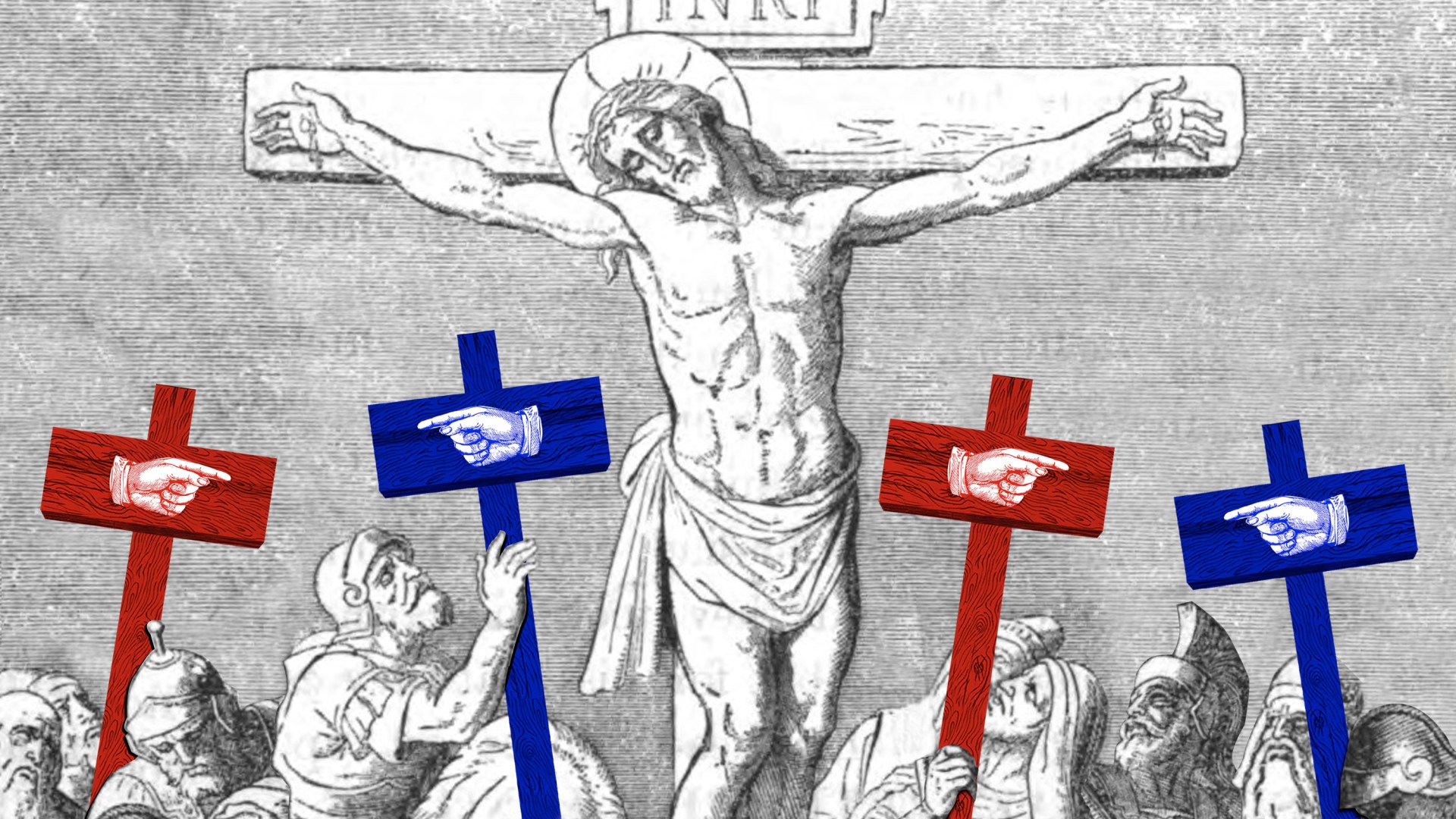
Yet the Cross is quite different. As Fleming Rutledge notes in her magisterial work The Crucifixion, there is no method the Roman Empire could have chosen to signify greater humiliation and domination than to crucify those who stood against its rule.

A cross not only ended a life but did so in the most ridiculing way possible—by magnifying Caesar’s domination over the one gasping for air on a stake. With Roman soldiers standing around and crowds screaming in rage and laughter, Good Friday looked like the triumph of Babel, right down to the signs in multiple languages over the head of the crucified King.

And yet Jesus spoke of this downward trajectory as the way in which he would be “lifted up” and would “draw all people to himself” (John 12:32). This stands in contrast not only to those who sought to magnify their own name, such as Caesar who wanted no rivals to his reign, but also to those who sought their own self-protection, like the disciples who fled in fear.

Only the crucified Christ—the sin-bearing Lamb of God—vindicated by the resurrecting power of his Father, could pour out the Spirit in a way that could reverse Babel at Pentecost.

But the Resurrection and Ascension were not an undoing of the Crucifixion. They were, instead, a continuation of what Jesus pronounced to be a triumph through defeat, a power through weakness. As New Testament scholar Richard Hays once noted, after his resurrection Jesus did not appear to Pilate or to Caesar or to Herod. To do so would have been to vindicate himself—to win an argument rather than to save the world.

Instead, as Luke puts it, Jesus “presented himself alive” (Acts 1:3, ESV) to those he had chosen as witnesses. That’s because Jesus’ kingdom would advance not through resentment and grievance but through those who would bear witness to him with sincerity and truth, even to the loss of their own lives. Conquering like that—through “the blood of the Lamb and by the word of their testimony” (Rev. 12:11)—is what winning looks like, especially when one sees who the Enemy actually is.

Experts tell us to expect the next few years to be worse than the previous ones. Those who seek to make a name for themselves by exploiting fear and outrage will continue to get better at it. And they will not lack an audience of those who believe the only thing standing between them and annihilation is the requisite amount of theatrical anger.

Culture wars and outrage cycles might fuel ratings and clicks and fundraising appeals, but they cannot reconcile sinners to a holy God. They cannot reunite a fragmented people. They cannot even make us less afraid in the long run.

Good Friday should remind us that, as Christians, adding more outrage and anger to a culture already exhausted by its own is not how God defines his wisdom and power. Babel building can’t help us—only cross carrying can.

Russell Moore leads the Public Theology Project at Christianity Today.

Books
Excerpt

‘Christ’ Is Not Another Way to Say ‘Jesus’

The resurrection message draws power from God’s kingship. But we often miss it.

Christianity Today April 14, 2022
Illustration by Christianity Today / Source Images: spxChrome / William Whitehurst / Getty

In gospel presentations today, Christ is often reduced to a mere name, personal identifier, or alternative way of referring to Jesus. “In Christ alone,” and the like, is the language we find in our songs and theology textbooks. To most Christians, Christ is equivalent to Jesus.

Christ is a title. But to treat Jesus and Christ as equivalent terms is a huge mistake.

On the one hand, it is true to say, “Jesus saves” and “Christ saves.” Likewise, one could truly say, “Matt teaches” and “the professor teaches” because that accurately reflects my job title. But Matt does not mean the same thing as professor. Christ is comparable to His Majesty if we’re describing an English king. It is a special title designed to bring renown. Christ is the title for the universally significant Davidic king.

Failure to treat the Christ as a title is one of the reasons why kingship has been missing from the gospel.

Forgiveness without kingship? Our haste to get what we so badly need causes us to misunderstand how forgiveness is available. What is foremost in our minds when we consider the gospel is a transaction at the cross: Jesus is Savior, Redeemer, atoning sacrifice, and Lamb of God. Perhaps he has some vague authority too as Lord.

We fail to see that forgiveness flows not just through a person, but through a person in his official capacity as king—crucified, raised, and reigning. While serving as king at God’s right hand, he is also the high priest and the sacrificial offering that covers our sins. As will become clear, Jesus’ forgiving power cannot be separated from his royal authority as head of a new creation.

Although the foundational summary of the gospel in Scripture is “Jesus is the Christ,” the most famous is 1 Corinthians 15:3–5. “The gospel” (vv. 1–2) Paul received and passed along faithfully to the Corinthians is:

That the Christ died for our sins in accordance with the Scriptures, and that he was buried, and that he has been raised on the third day in accordance with the Scriptures, and that he appeared to Cephas [Peter], then to the Twelve. (vv. 3–5, author’s translation)

Notice that forgiveness flows through kingship. Paul says nothing here about “Jesus.” Instead, he speaks about the Christ’s death for our sins. By mentioning the Christ rather than Jesus, Paul stresses that kingship is the vessel through which forgiveness flows.

Second, the King helps a whole bunch of people. Just as we short-circuit kingship in our haste to find personal forgiveness, we can easily miss how the King’s actions are group-oriented.

Paul says nothing about how you, I, or any other individual becomes right with God in this gospel summary. Rather, the king died for “our” sins. It’s about what the Messiah has done for his entire people. Don’t misunderstand. Benefits, like forgiveness of sins, that attend Jesus’ kingship can be yours personally. But they are group-first benefits. Forgiveness belongs to individuals—you and me—only when we become part of the King’s people.

Third, resurrection is gospel too. The Christ was raised on the third day. The validity of the King’s death and resurrection was made doubly certain by God. For his death and resurrection were attested not only by Scripture (anticipated in the Old Testament) but also by historical occurrences.

As part of the gospel, the Christ’s death was confirmed by his burial and his resurrection by post-resurrection appearances to witnesses. The gospel includes the king’s death for our sins, burial, resurrection on the third day, and appearances as historical events.

In the two following passages, Paul offers gospel summaries. What are some emphases?

The gospel of God, which he promised beforehand through his prophets in the holy Scriptures. This gospel concerns his Son, who came into being by means of the seed of David as it pertains to the flesh, who was appointed Son-of-God-in-Power as it pertains to the Spirit of Holiness by means of the resurrection from among the dead ones, Jesus the Christ our Lord. (Rom. 1:2–4, AT)

Remember Jesus the Christ, raised from among the dead ones, of the seed of David, according to my gospel. (2 Tim. 2:8, AT)

Both gospel summaries focus on Jesus as the royal Christ (or Messiah), his Davidic lineage, and his resurrection.

Concerning resurrection, there is something curious in both passages. They emphasize the king’s resurrection not from his personal state of death (although he was personally dead), but from among those who were also dead. In the original Greek, the phrase ek nekrōn (“from among the dead ones”) indicates that the dead King was with other dead people.

Here’s the point: If God raised him, he will raise others who are like him, too. The King’s resurrection from the dead is the first fruit, but a full harvest of additional resurrections will happen for all the King’s people (1 Cor. 15:20–22). King Jesus’ resurrection is good news because it anticipates the resurrection of all those united to him through his death.

Let me offer a few more words about Romans 1:2–4 as a gospel summary. Paul takes a cosmic perspective. The Son took on human flesh, fulfilling God’s promises to David. But God had a grander scheme.

After the Son’s death, his resurrection triggered his elevation to a new ruling office. The Son became the Son-of-God-in-Power. He has always been the divine King. But the Son has not always been a human king. Now he is the divine and human King, ruling creation powerfully.

Since Jesus’ reign in power pertains to the Spirit of holiness, his kingship is especially operative wherever the Holy Spirit is present. The Son’s incarnation and enthronement are gospel.

Matthew Bates is associate professor of theology at Quincy University. This essay was excerpted from his latest book, The Gospel Precisely. Published with permission from Renew.

Some Celebrated Jesus’ Resurrection. Others Started a Conspiracy Theory.

Since Easter morning, forces have tried to obscure the most basic truth of the gospel.

Christianity Today April 13, 2022
Illustration by Mallory Rentsch / Source Images: WikiMedia Commons / Morrison1977 / Getty

In the middle of scenes of Jesus’ resurrection, the Gospel of Matthew recounts the birth of one of the oldest conspiracy theories.

On Easter morning, while the women are on their way to announce the resurrection of Jesus to the disciples, Matthew 28:11–15 highlights another movement: Some tomb guards report the weekend’s events to the chief priests. These men, in turn, then consult with the elders and decide together to conceal what has happened. At no point do they investigate what happened to Jesus’ body. They know from the start that what they might discover will not please them.

Instead, they invent what would today be called a conspiracy theory, with the “alternative facts” that support it: The disciples came to steal Jesus’ corpse. Never mind that those who had fled in fear after the arrest of their master would have needed to come at night to face a guard of several armed men. Never mind that they would have needed to loosen the seals on the tomb, roll away a massive stone, and remove the body of Jesus—all without waking anyone who could raise the alarm.

This version of the facts is absurd. Not only in and of itself, but because the disciples would later risk their lives to proclaim that Jesus had risen. If they had known it was a lie, where would they have found the courage to face the authorities threatening them? Why preach a knowingly falsified gospel? The audacity of the apostles, their courage, their zeal, their perseverance, and the whole expansion of Christianity is inexplicable without the Resurrection.

But all this, the elders do not yet know. So they try their luck and make a deal with the soldiers. The proposed lie is not without danger for them—the guards obviously weren’t supposed to fall asleep—but there is money involved, and the Jewish leaders assure them of their protection.

The elders deny the truth and drag others into their denial. They prefer to stay in their way of thinking than to know the Way, the Truth, and the Life.

Thus, this version of the story, the text says, has spread among the Jews to this present day—the first century of our current era. But it is also our reality today, where theories to eschew the truth of the resurrection of Jesus continue to be propagated.

But it is probably not because of their credibility that these explanations persist. In fact, the explanation of the guards is so implausible that the apostle Matthew takes the liberty of mentioning it in his gospel, knowing full well that anyone who wanted could go and check this account.

When you want to drown out a truth, your lies or half-truths don’t have to be believable or well-founded. It is enough that your version suits what your listeners want to hear or avoids confronting them with a reality that disturbs them.

An ominous light

One might be surprised at the response of the Jewish leaders. The one announced to be the Messiah had just come back to life. An extraordinary miracle! A staggering truth! But instead of euphoria, they react with anger.

There is a certain irony in the text: After warning Pontius Pilate on Saturday that the disciples might steal the body, the chief priests and Pharisees themselves demand a seal be placed on the stone and that guards watch the tomb (Matt. 27:62–66). These precautions that they are responsible for end up confronting them with evidence they do not want to see.

Perhaps their doubt might be justified without these measures. But now they face an unsettling conclusion regarding Jesus’ body—and yet are refusing to entertain anything that might challenge their worldview.

What this attitude reveals about human hearts is terrifying, but perhaps not so surprising. Twenty-five years ago, German theologian Wolfhart Pannenberg told the magazine Prism:

The evidence for Jesus’ resurrection is so strong that nobody would question it except for two things: First, it is a very unusual event. And second, if you believe it happened, you have to change the way you live.

All of this is deeply disturbing. Imagine the discomfort of the leaders who passed as religious in front of everyone but rejected the one who now turned out to be the Messiah. Accepting this new reality would irredeemably upset their position and influence. Accepting this as true would mark the end of the life they have built for themselves. Believing in Jesus would be their death.

So they try to have it another way. The elders deny the truth and drag others into their denial. They prefer to stay in their way of thinking than to know the Way, the Truth, and the Life.

We humans often prefer the darkness that does not disturb us to the light that could set us free. The apostle John tells us:

Light has come into the world, but people loved darkness instead of light because their deeds were evil. Everyone who does evil hates the light, and will not come into the light for fear that their deeds will be exposed. But whoever lives by the truth comes into the light, so that it may be seen plainly that what they have done has been done in the sight of God. (John 3:19–21)

Even as we may judge the religious leaders, we also ought to be able to see ourselves in them. Our actions are motivated by fears of losing relationships, status, livelihoods, communities, dignity, and control. When these feel threatened, we become incentivized to find a different, more comforting narrative that allows us to maintain our status quo. The issue, then, is not so much the search for facts as the protection of a self-justifying narrative.

In order not to see the fragility or the deceptive nature of what we have clung to, we sometimes try at all costs to hold together the pieces of a puzzle that is falling apart. No one wants to see their world collapse.

Christians vulnerable to misinformation?

Matthew’s account also offers a reason why Christians might be inclined to embrace conspiracy theories: Since Easter morning, certain forces at work in the world have attempted to obscure the most basic truth of the gospel. From the beginning, the world has been developing an alternate history in which Christ is not resurrected.

Consequently, our Christian identity has accustomed us to the idea that the truth is something not everyone will accept or follow. We become habituated to a disconnect between what we accept as the truth and what the world at large accepts as such.

For Christians, then, there may be a smaller step than for others to embrace alternative explanations on different topics. Also, for some decades now we have been living in a period of the decline of Christendom in the West, a time in which Christian culture has been increasingly pushed to the margins. Many Christians find themselves at odds with the prevailing discourse on gender, creation, or pluralism in public education or the media, often feeling these institutions are leading us astray. In these circumstances, it may be tempting to be less careful about, for instance, supposed facts supporting the idea that all Western elites are corrupt or praising the greatness of some leader presented as the protector of “Christian values.”

It can be flattering to believe we know something that others do not. However, the knowledge we have received from Jesus Christ is grace from God. It does not come from any moral or intellectual superiority that we have over our fellow humans, nor does it entitle us to believe that we know better in all things.

Further, we must not assume that our knowledge of the Bible inherently keeps us safe from deception. As the attitude of many religious leaders at the time of Jesus shows, knowledge of the Scriptures does not guarantee the acceptance of the truth.

We are told that few people will accept God’s truth. But while these words may encourage us in our faith journey when facing opposition, they can also be applied out of context to a range of beliefs that have little to do with any claims about Christ.

Taking the first step

How then can we walk with fellow Christians who we believe have lied to themselves? We are all convinced that some people live in illusion, and some people think the same of us. One thing we all share is that we live in a world where the truth is not always easy to access. And we have all, at some point, been lied to. Today, the Russian government’s propaganda impresses with its cynicism. But throughout history, even some of the most respected governments, institutions, and leaders have lied to cover their actions.

The world is complex. In Matthew’s account, the elders and guards aren’t on equal playing fields. Some know the truth fully and have a responsibility to it. The others, while willing to lie for money, are less scripturally literate and likely don’t have the same knowledge of the issues. And what about those in Jerusalem trying to make up their own mind according to the various things they’ve heard?

If we want to continue to understand each other, we also need a way to recover from our mistakes when we come to acknowledge the truth. We need cultural scripts that allow us to confess our errors, change our paths, and receive grace.

It is not up to us to change the other. However, we can model a world where our belief in the resurrection of Christ offers us the confidence to consider not only what reinforces our points of view or our status, but also what nuances them, or even challenges them.

Perhaps even those who cling to conspiracy theories may one day become the boldest defenders of truth.

The first followers of Jesus who received the news of the Resurrection continued to have their reality shaken. As Jews, they too had their worldview and status challenged by the integration of non-Jews into the people of God. Peter, for instance, needed to hear the same message three times in a row (Acts 10:9–16). The way is not always easy, but in their footsteps, we continue to learn how, in Jesus, we are no longer prisoners of the fear of death (Heb. 2:15).

It may seem difficult to hope that people trapped in the lies they have fabricated or promoted will come to light. The blindness of the priests denying the Resurrection is striking. How could they have walked away from the lies they had spread? If Matthew knew of this conspiracy between the leaders of the people, one has to imagine that one of the guards—not the religious leaders—tipped him off to the story.

A few years after this episode in Matthew’s gospel, a very religious Jew and fierce persecutor of the church saw his life transformed by an encounter with the risen Christ. In giving up his religious status, his privileges, and his old worldview, the apostle Paul faced many “deaths” in Christ, but he witnessed unto the end the power of the Resurrection.

In God’s hands, there is still hope that those who lead the world astray will change. Perhaps even those who cling to conspiracy theories may one day become the boldest defenders of truth.

As for us, let’s live out our Resurrection convictions in such a way that others see our lives as evidence of what lies beyond death.

Léo Lehmann is publications director for the Network of Evangelical Missiology for French-speaking Europe (REMEEF) as well as CT’s French language coordinator. He lives in Brussels, Belgium.

This article was originally a sermon Lehmann preached on April 4, 2021. It was also adapted into an article for Le Lien Fraternel.

News

Churches in Shanghai Are Stepping Up During the Latest Lockdowns

Pastors, leaders, and members pray and volunteer in the city’s communities amid a surge of COVID-19.

Community volunteers deliver vegetables to be distributed to residents in a compound during a Covid-19 lockdown in Shanghai on April 12, 2022.

Community volunteers deliver vegetables to be distributed to residents in a compound during a Covid-19 lockdown in Shanghai on April 12, 2022.

Christianity Today April 13, 2022
Liu Jin / Getty

It had been a week since the beginning of the lockdown. The day after he joined the neighborhood volunteer team, pastor Xue of GB Church received a white one-piece protective suit, a pair of shoe covers, a pair of gloves, and a face mask. (Xue and others throughout this piece have been given pseudonyms for their own safety. So have the church names.)

After 8:30 p.m. that day, he was responsible for collecting the garbage placed in the doorways of 72 homes on the 16th to 27th floors of the building. It took him about an hour to move nearly 150 kilograms of trash. The following day, the 150 bottles of alcohol and thousands of masks he ordered through online group purchase rapidly met the demand, and the community volunteers quickly became acquainted with him.

When they saw him at a community meeting, the local aunties and uncles immediately switched from Shanghainese to Mandarin with a strong Shanghai accent in their chatting to ensure unhindered communication. Xue’s newly added WeChat friends are all neighbors in the community. Neighbors are no longer an abstract concept or a group of people in the administrative or geographic sense, but people of all types, with their own temperaments.

In another area of the city, morning prayer meetings at the CL Church had seen a significant increase in attendance since the lockdown. While the city’s early risers were busy ordering groceries on their mobile apps, more than 20 Christians and seekers began online worship.

“With 15 minutes of Bible sharing and 15 minutes of prayer every morning, we encourage people to pray first after they wake up and before they do anything else. As Martin Luther said, if you wait till you finish everything else and then pray, you are actually giving up on prayer,” said pastor Han of CL Church.

Planted only a couple of years ago, this church had not anticipated the online ministry to last for two years. But now not only had the number of participants increased, but also many non-Christians had joined them. The seekers appreciated the sincerity of the church even more because they had heard Christians share honestly about their anxiety and insecurity during the lockdown.

Since March, the omicron variant has rapidly spread across Shanghai, a city of more than 25 million people. At first, city officials tried to contain the spread of the virus and reduce the disruption of normal life by sealing off individual buildings and residential areas. But by March 27, the government issued a notice to sequentially lock down Pudong (the half of the city east of the Pujiang River) and Puxi (the half west of the river) for at least four days. The earlier strategy of fine-tuned containment was abandoned. All public transportation and most businesses were shut down, and almost everyone was ordered to stay home and quarantine.

By April 7, the number of infections in Shanghai was in the tens of thousands per day, and for most neighborhoods, lifting quarantine was out of reach. But the consequences of the lockdown have been devastating. Hemodialysis patients have been unable to receive treatments. Families with new COVID-19 infections have had to follow a “no mix of positive and negative” quarantine policy that has separated children from their parents.

The shortage of medical supplies caused by the disorderly management of mobile cabin hospitals has caused widespread anxiety in Shanghai, a city that prides itself on order and stability. Everyone knows the city is sick, but there seems to be no cure. Everyone wants to be helped by people they know, but some give up on life in solitude. One non-Christian who found a church pastor in the midst of the lockdown said, “There is no solution for everyone anyway, but I know the church would pray for me, pray with me, and stay with me.”

What can Christ’s church do amid such turbulence and facing so many needs? Pastors and church leaders emphasize the importance of prayer, devotions, spiritual growth, and actions of charity.

Prayer up close and personal

“When the epidemic began in 2020, our church meetings moved online, with offline small group access to ensure that brothers and sisters still had face-to-face fellowship,” Xue told CT. “Once the situation improved, we resumed offline physical meetings. At that time, none of our members’ residential areas was locked down, and everyone was still free to travel. But this time, 100 percent of our members were sealed off in their own homes, and for the first time, we were confronted with the epidemic up close and personal, when we had just looked on and made comments about the epidemic in other cities of China.”

Xue said that three of his members’ families have been infected with the virus, and although the church could not give direct help, they asked church members to pray together for the infected. Members have spontaneously followed up with those who were sick and sent them prayer Scriptures. Elders and care deacons mostly asked members how they were doing and prayed for them.

CL Church especially encouraged members to pray not only with believers but also with nonbelievers. Rather than just sending a “Praying for you” message, they stop what they are doing, make the phone call, and pray with those in need or write down specific prayers.

For members or visitors who don’t know how to pray, Han encourages them to pray according to the Bible. “Spend half an hour each day, away from cellphone or computer screens and internet messages, and use Scripture as a guide to think about God’s attributes, not our needs,” he said. “It’s like when we read in the morning devotional that Jesus said, ‘Who is my mother, and who are my brothers? … Whoever does the will of my Father in heaven is my brother and sister and mother’ (Matt. 12:48–50).

“When our refrigerator at home is full, our spiritual condition is not necessarily better, but when our spiritual condition is better, we will not have inner anxiety when we see the refrigerator empty. God speaks to us every day through the Scriptures, and we need to think and respond to him in prayer.”

Xue’s church started an online Bible reading program two weeks ago. For one hour, brothers and sisters read the Gospels aloud in segments via web conference, allowing God’s Word to be a strength to one another. Soon after, church members initiated another Bible reading by theme. After each person took a turn reading a passage, they shared intercession matters of their own or of others related to that theme and used the passage to pray for themselves and others.

The sister who initiated the activity wrote in her invitation letter, “When I am overwhelmed, entangled in the reality of difficulties and sins, and my mind cannot focus on a chapter of Scripture so I cannot pray, I pick up the Bible and open my mouth to read it aloud, and often my heart is opened by God’s word as I read, and my tightly closed mouth begins to pray and cry out to the Lord. I hope that God’s Word can help us in different ways.”

‘Love your neighbor’ is no longer just a phrase

GB Church offered a course on “Love Your Neighbor” right before this round of outbreak. In its introduction, it stated that loving our neighbor means loving all people, including those we want to avoid, those we despise, or even those we find suspicious. It is not our responsibility to judge who is worthy of love, but to be good neighbors who meet the needs of others.

The epidemic has made a big difference in Shanghai neighborhoods. The online group purchase of vegetables and food must be community-based, and the length of lockdown time is based on community infections. The professionals with their workplace skills transformed into online group buyers for their communities. Disinfection, rapid COVID-19 tests, and distribution of goods all rely on volunteer groups formed by neighbors.

“As Christians, we should show others that we are actively helping our communities,” Han said. “We need to help our neighbors create good order in the community. We can share the food we have, pray for our neighbors, and pray with them, telling them that we are Christians. If our neighbors test positive, we don’t turn our back on them. We can send them encouraging messages or videos and find out what they actually need.”

Elder Jiang, who is a pilot, has spent the past three years either flying or in isolation. The city’s sequestration allowed him to finally spend time at home with his wife and young son. But when the community called for volunteers, he didn’t hesitate to sign up and spent his days in protective clothing organizing COVID-19 tests and distributing supplies.

A few days later, while he and his wife were infected, his three-year-old son’s antigen test came back negative. This meant, following Shanghai’s quarantine policy, that the couple had to be separated from their child. But Jiang did not regret his choice. He just wished that his family could stay together during the quarantine.

Sister Tang has been delivering food regularly to the secluded brothers and sisters since the lockdown. She bought overpriced food, cooked it carefully, and gave it to sisters who were pregnant or single. When asked why she goes to such lengths, she smiles and says, “Their parents are away, and at this special time, I want them to taste double the love because our heavenly Father loves us this way too.”

Back in her own community, she volunteered at the risk of being verbally abused and infected, taking on dispensing and purchasing medication for those in need throughout the whole residential block. After days of running around, her voice became hoarse, and she made phone calls late into the night every day to ask stores for supplies for the community.

Xue said, “The benefits we seek for our community in this life cannot be saved for eternity, but it is worth doing. For when we love our neighbors, we show them what God is. We manifest God’s love. And when we not only love our neighbors but commit ourselves to our communities, we testify to God’s principles and manifest his wisdom.”

Seeing the fruits of growth in the midst of an epidemic

Since the lockdown, the offering of the CL Church has unexpectedly surpassed the previous few months, with large amounts of giving going to help those in need—not necessarily church members or Christians, but anyone actually in need. The leadership team plans to use a portion of this to help the poor—including those who are unemployed or elderly—by subsidizing their rent or giving financial assistance. Another portion is given to affected missionaries, ministries, or preachers.

In addition, Han believes that opening oneself up and sharing one’s weaknesses in front of others, both believers and unbelievers, is also a way for the Christian community to witness. In the midst of the pandemic, members of his church, who used to hold each other at arm’s length and were predominately elite white-collar workers, shared for the first time their anxieties about the epidemic, their worries about the lack of supplies at home, and their problems in child-rearing and marriage. Because of their authenticity, non-Christians no longer turned away from Christians, but can come before God as sinners with real needs and call on God’s love.

“We may be going through the biggest crisis in the two years since we planted the church, but this particular experience has also shown us that what was planted before the epidemic is now blossoming,” Han said.

“As we enter the last week of Easter, I am especially reminded that the hope of the resurrection determines our state at this moment. The more we believe in the resurrection, the lighter we look at the hardships of this moment,” Han added. He has spent more time with his coworkers in the church over the past few weeks, praying with them and making sure they are spiritually healthy.

It is the hope in these Shanghai Christians’ hearts that when the virus no longer resides in this city, the church will be a better companion of people and builder of community, bringing people closer to each other and people’s hearts closer to God.

Eva Chou is a Christian journalist and writer in Shanghai. She has served the local church with her husband for many years. The couple has one son.

Translation by Sean Cheng

News

Churches Still Depend on Clergy Housing Allowance

Despite recent legal cases and reports of greedy abuses, experts say the longstanding benefit remains safe.

Christianity Today April 13, 2022
Prix

With the federal tax filing deadline looming, a Virginia court case may have some ministers wondering whether their ministerial housing allowance is secure.

The case isn’t about the housing allowance. But to some, including Supreme Court Justice Neil Gorsuch, it suggests courts may be willing to meddle increasingly in clergy affairs, including housing.

At issue was denial of a property tax exemption for a church parsonage in Fredericksburg, Virginia. New Life in Christ Church sought the tax exemption for a church-owned home inhabited by two youth ministers, married couple Josh and Anacari Storms. The city denied the exemption because it claimed the church’s denomination, the Presbyterian Church in America (PCA), does not allow women to be considered ministers.

New Life in Christ said the city misunderstood its doctrine. Ordination and certain duties, like preaching, are limited to men in the PCA, according to the church, but the denomination’s governing documents permit congregations latitude in hiring nonordained persons like the Stormses for various ministry jobs. Yet a trial court sided with Fredericksburg, as did the Virginia Supreme Court.

The US Supreme Court declined to hear the church’s appeal in January. Now the church must continue paying the annual property tax bill of $4,589.15. The Supreme Court’s action provoked a dissent from Gorsuch.

“The City continues to insist that a church’s religious rules are ‘subject to verification’ by government officials,” Gorsuch wrote. “I would grant the [church’s] petition and summarily reverse. The First Amendment does not permit bureaucrats or judges to ‘subject’ religious beliefs ‘to verification.’”

Is the case a harbinger of increased willingness to scrutinize ministerial housing in court? Pastors across America hope not. While fewer churches own traditional parsonages, the majority take advantage of the federal clergy housing allowance and say it benefits both their families and their churches.

“I absolutely depend on” the housing allowance, said Micaiah Irmler, pastor of Southridge Church in San Jose, California. “I would not be able to do ministry in the Bay Area without it. The median home price is $1.7 million, and then with property taxes everything is higher. [The allowance] really saves me.”

The federal housing allowance has been on the books more than 60 years. According to the IRS, the provision allows ministers to exclude from their “gross income for income tax purposes” an “amount officially designated (in advance of payment) as a housing allowance.”

The amount must be used to provide or rent a home and cannot exceed the fair market rental value of the home. Pastors living in a parsonage may exclude the fair rental value of the residence from their taxable income for income taxes. Pastors still pay self-employment taxes on their full compensation, including housing.

That can amount to significant savings. In 2022, let’s say a person with a taxable income of $50,000 pays $5,589 in federal income taxes. But if that person is a minister with a housing allowance of $15,000 (a $1,000 mortgage payment plus $3,000 to cover utilities and home repairs), they will pay only $3,789 in federal income taxes—a savings of $1,800.

Through the housing allowance, American pastors save $800 million a year, CT has reported, with 81 percent of full-time senior pastors taking advantage of the benefit.

The tax break is not an unfair advantage for ministers, but a way to treat ministers the same as other workers required to live near their jobs or use their homes for business, says religious liberty law firm Becket.

“This applies to hundreds of thousands of workers in a variety of professions, including our military and diplomatic corps, prison wardens, state governors, certain health care professionals and educators, fishermen, and more,” according to a September 2021 episode of Becket’s Stream of Conscience podcast. “Their housing allowance is tax-free because it’s part of their job.”

Other benefits from an employer that help workers do their jobs—like travel expenses and office equipment—also are tax free. The assumption for ministers is that their homes are used for ministry, or at least that they are required to live near their congregations.

That long-standing tax policy faced a hiccup in 2017 when a federal district judged ruled the ministerial housing allowance unconstitutional. But the ruling was overturned a year later by the Seventh US Circuit Court of Appeals in Chicago.

The allowance remains safe for now, said Justin Butterfield, deputy general counsel at First Liberty Institute, the firm that represented New Life in Christ Church in Virginia. While the Fredericksburg case was a setback for one church’s ministerial housing situation, it does not represent a larger erosion of ministerial tax breaks.

“This [case] really doesn’t have any bearing on housing allowances or tax exemptions,” Butterfield said. The US “has a long history of recognizing ministerial housing allowances.”

Pastors say that’s great news. Southridge Church in San Jose needs to offer a housing allowance to draw staff, Irmler said. With an in-person attendance of 135, Southridge can’t afford to pay the area’s median salary of $131,000. It relies on tax-free housing to make living in the community possible for its ministers.

“A large church sometimes can offer a really good salary package,” Irmler said. “But when you’re a medium to small church and you’re hiring staff,” you risk bringing on staff at a pay rate “below poverty.” The allowance is a “lifeline.”

The housing allowance is needed in rural America too, said Noel Gandy, pastor of Christ Point Baptist Church in Shenandoah, Iowa—population 5,000. He saves $3,000 per year through the housing allowance and wouldn’t be able to give his church as much time if the allowance went away. (He works as a real estate agent on the side.)

“Clearly, it makes a difference,” Gandy said. “Three grand a year—for some that’s not much. For my family it is.”

Smaller churches in the community could be particularly affected if the housing allowance were abolished and they had to increase the pastor’s salary to offset higher housing costs, Gandy said.

Abuse of ministerial tax breaks is one common argument against them, though. Televangelist Kenneth Copeland, for instance, saves $150,000 annually on property taxes alone at his $7 million mansion outside Fort Worth, Texas, according to a Houston Chronicle investigation published in December.

His church, Eagle Mountain International Church, also owns more than $19 million in tax-free aircraft. Copeland says God told him to build the house—which qualifies as a parsonage for tax purposes.

“You may think that house is too big,” he said at a 2015 conference. “You may think it’s too grand. I don’t care what you think. I heard from heaven.”

Copeland is not alone in receiving extravagant tax breaks. Dozens of US ministers live in tax-free residences worth over $1 million, according to the Chronicle. They benefit from state and local ministerial tax breaks in addition to the federal clergy housing allowance. Such abuses drew investigation by the US Senate Finance Committee a decade ago. Yet the tax breaks stand.

Still, the narrative of greedy preachers “taking advantage of the tax law” is “just plain wrong,” said Chris Butler, pastor of Chicago Embassy Church, a defendant in the 2018 case in which the federal housing allowance was upheld on appeal. “It is not the reality for the vast, vast majority of people.”

The government could create safeguards against ministerial swindling without discarding the baby along with the housing allowance bathwater, Becket attorney Luke Goodrich said on the firm’s podcast. “You could cap it at a certain amount. You could make it impossible to claim it over a certain income.”

Churches like Chicago Embassy need the housing allowance. It comprises Butler’s entire salary and allows him to live close enough to his parishioners to respond to emergencies in a hurry, he said. Without the housing allowance, he would have to look far away to find affordable housing.

But even if the housing allowance is struck down someday, Irmler said, God will take care of his ministers.

“Maybe that’s what we need to weed out hirelings from ministry,” he said. “We need shepherds.”

David Roach is a freelance reporter for CT and pastor of Shiloh Baptist Church in Saraland, Alabama.

Apple PodcastsDown ArrowDown ArrowDown Arrowarrow_left_altLeft ArrowLeft ArrowRight ArrowRight ArrowRight Arrowarrow_up_altUp ArrowUp ArrowAvailable at Amazoncaret-downCloseCloseEmailEmailExpandExpandExternalExternalFacebookfacebook-squareGiftGiftGooglegoogleGoogle KeephamburgerInstagraminstagram-squareLinkLinklinkedin-squareListenListenListenChristianity TodayCT Creative Studio Logologo_orgMegaphoneMenuMenupausePinterestPlayPlayPocketPodcastRSSRSSSaveSaveSaveSearchSearchsearchSpotifyStitcherTelegramTable of ContentsTable of Contentstwitter-squareWhatsAppXYouTubeYouTube