Theology

The Most Dangerous Form of Deconstruction

What if some evangelicals are so burned out on church that they don’t even know it?

Christianity Today February 9, 2022
Illustration by Mallory Rentsch / Source Images: Boris Zhitkov / Getty / Pascal Meier / Unsplash / Shaun Menary / Lightstock

This piece was adapted from Russell Moore’s newsletter. Subscribe here.

With all this talk of deconstruction these days, one problem is that very few people mean precisely the same thing when they use that word.

For some people, deconstructing means losing their faith altogether—becoming atheists, agnostics, or spiritual-but-not-religious nones. For others, deconstructing means still believing in Jesus but struggling with how religious institutions have failed.

And there are also many for whom deconstructing means maintaining an ongoing commitment to orthodox Christianity, as well as a robust commitment to the church—but without the cultural-political baggage associated with the label “evangelicalism.”

On one level, these divergent meanings may suggest that the term deconstruction doesn’t signify any one thing specifically—not without a great deal of qualification, that is. This is true, come to think of it, of the word evangelical these days as well.

But that doesn’t mean that deconstruction is a lesser phenomenon than we think. As a matter of fact, I think the case could be made that all of American evangelical Christianity is deconstructing—at least in some sense of the word.

It’s just that I believe there’s more than one way to deconstruct.

At one level, we can see deconstruction happening in terms of institutions. Someone asked me a few weeks ago what percentage of churches or ministries I thought were divided by the same political and cultural tumults ripping through almost every other facet of American life. I answered, “All of them. One hundred percent.”

I don’t mean that every church is in conflict; many aren’t. But even the churches and ministries that are not descending into warfare are aware of the conflict, and many are vigilant—wondering if one word said, or an event scheduled, might set it off.

Beyond that, at the level of individuals and leaders, we are perhaps not aware that the most dangerous forms of deconstruction are not the people we know who are doubting, scandalized, or traumatized by what they’ve seen in the church. There’s a different form of deconstruction that that could actually destroy us.

I always thought of “burnout” as a rather banal way of communicating exhaustion from overwork. “Make sure you take a vacation,” one might say. “You don’t want to burn out.”

In his new book, The End of Burnout, though, Jonathan Malesic argues that burnout is something else entirely. It is instead “the experience of being pulled between expectations and reality at work.” To illustrate his point, he uses the metaphor of walking on stilts.

Walking on stilts, he writes, is the experience of holding both one’s ideals and the reality of one’s job together. When the two stilts are aligned, one can keep them together and move forward. That doesn’t mean it’s easy, but it’s possible for one to walk. However, when the stilts are misaligned—that is, when the ideal and the reality are radically different—people find different ways to cope, which can lead to a kind of burnout.

Some, he argues, might cling to their ideals while the reality swings away from them. In his case, the metaphor has clear limits—because his point is that we place too high of expectations on our work and careers, expecting them to give us meaning and purpose in life, which they cannot deliver.

In the case of the church, however, we have not expected too much, but too little. The church is meant to shape our character and, if not to grant meaning to our life, then to at least to point us toward the meaning—through worship, mission, and teaching.

Yet some have seen behind the veil to a kind of Christianity that does not even aspire to holiness, love, gentleness, Christlikeness, renewal of mind, bearing of burdens—the kind of church found in the New Testament. These people are often led to the point of exhaustion at the incongruity of it all, perhaps questioning if they were lied to all along.

For some, Malesic contends, the stilt walking falters when they ignore the reality and hold on to their ideals anyway. This is the sort of coping mechanism we see in those who wave away the current crisis in the church by saying, “Well, think of all the good things happening” or “Most people aren’t like that” or “The church was never meant to be made up of perfect people.”

Those things are easy to believe, because there’s a sense in which they are all true. But often, in times like these, what they really mean is “Don’t talk about these matters in public; we can handle them on our own in private, but we don’t want to give Jesus a bad reputation.” The problem is, Jesus never asked his church to protect his reputation, especially by covering up when something wrong or dangerous is done in his name.

But what’s more is that, as Malesic points out in the workplace, the “If we don’t talk about it, it will go away” mentality cannot hold. If our moral ideals are strong but we reassure ourselves with a false version of reality, we will end up seeing through our own delusions—and others certainly will.

And when that happens, it results in a different kind of burnout—frustration. That is, we begin to despair that anything ever can or will eventually be done to fix things.

The most dangerous form of deconstruction, however, is what we see happening in the lives of people who would never see themselves deconstructing. Many of them seem to believe what they’ve always believed, and they still belong to or lead the same institutions they always have.

In fact, they are often the ones heatedly denouncing those who are deconstructing—or the ones still left wondering how and why so much awful fruit could emerge from systems and institutions they presumed to be godly, trusted, and “confessional.”

For some of these people, there’s an entirely different kind of deconstruction or type of burnout.

Malesic argues that this form of burnout happens when their ideals and reality are so divergent that—having to choose one of the stilts on which to cling—they abandon the ideals to settle for the reality as it is.

At first, they can find all sorts of reasons why their former ideals are too unrealistic, even if these reasons are completely incongruent with what they once stood for. People who expect the church to live up to what Jesus demanded of it are said to be “currying favor with elites” or “not realistic about how the world works” or “not seeing what’s at stake if we don’t circle the wagons around ‘the base.’”

In following this strategy, people begin to depersonalize those around them. This leads to cynicism. Once the institution is all that’s left—or “the movement” or “the cause” or the “theology” or, even worse, their own position and platform—they have ultimately torn down their individual character, which is needed to protect and build those institutions.

Even worse, they have deadened the personal conscience needed to hear the call to repent. One can be a hack easily enough in the marketplace or in the political arena. But playing to whatever “the base” wants or expects from the church of Jesus Christ year after year does something far worse—and not just to the institution or the lives of those harmed, but to the very souls of those who play the game.

Once they have whittled down their moral principles to only those that are useful in maintaining their own place of belonging—they have essentially deconstructed themselves.

As we watch evangelicalism in the United States deconstructing in various ways, I wonder if what we should do is not avoid burnout but rather seek the right kind. After all, God’s most miraculous work seems to come at the point of our greatest frustration, helplessness, and even despair.

The prophet Elijah was not crazy to believe that he had encountered a hopeless situation. In his time, the people of God were captive to idols, and to vicious, predatory, narcissistic leadership. But Elijah had to get to the point where he could hear God saying to him, What are you doing here, Elijah?

John the Baptist was not being unreasonable when he sent his disciples to ask Jesus, “Are you the one who is to come, or shall we look for another?” (Luke 7:20) And when the disciples on the road to Emmaus said to their traveling companion, the recently crucified Jesus, “We had hoped that he was the one to redeem Israel” (24:21)—Jesus revealed to them that their hopes has been met in ways they couldn’t have imagined until that very moment.

The question is not whether we will deconstruct, but what we will deconstruct.

Will it be the wood, hay, and stubble that is destined to burn up and burn out? Or will it be our own souls? Sometimes the people we think are “deconstructing” are just grieving and asking God where he is at a moment like this. That has happened before.

By contrast, sometimes the people who appear most confident and certain—who are scanning the boundaries for heretics—are those who have given up belief in the new birth, in the renewal of the mind, and in the judgment seat of Christ. For them, all that’s left is an orthodoxy grounded not in a living Christ, but in a curated brand.

And that may be the saddest deconstruction of all.

Russell Moore leads the Public Theology Project at Christianity Today.

News

Bible Gateway Removes The Passion Translation

Popular among charismatics, the “heart-level” Bible version was criticized as a paraphrase posing as translation.

The Passion Translation (TPT) lead translator Brian Simmons, in a promotional video for the 2020 New Testament edition

The Passion Translation (TPT) lead translator Brian Simmons, in a promotional video for the 2020 New Testament edition

Christianity Today February 9, 2022
BroadStreet Publishing / YouTube

A Bible version designed to “recapture the emotion of God’s Word” was removed from Bible Gateway last week. The Passion Translation (TPT) is listed as “no longer available” among the site’s 90 English-language Bible offerings.

First released as a New Testament in 2017, The Passion Translation includes additions that do not appear in the source manuscripts, phrases meant to draw out God’s “tone” and “heart” in each passage.

Translator Brian Simmons—a former missionary linguist and pastor who now leads Passion and Fire Ministries—sees his work in Bible translation as part of a divine calling on his life to bring a word, the Word, to the nations. His translation has been endorsed by a range of apostolic charismatic Christians, including The Call’s Lou Engle, Bethel’s Bill Johnson, and Hillsong’s Bobbie Houston.

TPT’s publisher, BroadStreet Publishing Group, confirmed that Bible Gateway “made the disappointing decision to discontinue their license for The Passion Translation” as of January 2022.

“While no explanation was given, BroadStreet Publishing accepts that Bible Gateway has the right to make decisions as they see fit with the platforms they manage,” BroadStreet said in a statement.

Bible Gateway’s parent company, HarperCollins Christian Publishing, told CT, “We periodically review our content, making changes as necessary, to align with our business goals.” The company declined to offer further details about its reason for the decision. TPT remains available on YouVersion and Logos Bible Software.

Screenshots from Simmons’s social media showed he initially responded to The Passion Translation’s removal from Bible Gateway by saying, “Cancel culture is alive in the church world” and asking followers to request the site restore the version. That February 2 post no longer appears on his Facebook page.

https://twitter.com/BrianWSimmons/status/1491102365491302411

Simmons argues TPT’s additions and context “expand the essential meaning of the original language by highlighting the essence of God’s original message.”

“With The Passion Translation, we have a high goal to being accurate to the text, but accuracy involves the heart behind it,” Simmons said in an interview last month. “We’re trying to discover, communicate, and release God’s heart through the words we choose.”

Translation versus paraphrase

Simmons and his publisher describe TPT as a translation instead of a paraphrase because Simmons and his partners worked to develop the text from Greek, Hebrew, and Aramaic manuscripts rather than taking an existing English translation and putting it into his own words.

Simmons has repeatedly defended the translation label, saying that all Bible translations involve some paraphrase. He puts TPT in the same category as thought-for-thought translations like the New International Version (NIV).

But Bible scholars, including those who translated the NIV, use a more rigorous standard. A new version must closely adhere to the wording, syntax, and structure of its source. Critics of TPT say it doesn’t meet those standards and functions as a paraphrase while presenting itself as a translation. If TPT’s removal from Bible Gateway was related to the concerns over its translation claims, “I think that’s a good thing,” said Andrew Wilson, a Reformed charismatic who pastors at King’s Church London and a columnist for CT. “There are just too many additions to the text that have no basis in the original—which is fine (sort of) if it’s self-consciously a paraphrase, but not if people think it’s a translation.”

Wilson first raised concerns in a 2016 blog post about TPT and continues to get asked about the version from fellow charismatics. He wrote that he doesn’t recommend it, objects to the publisher’s advice to use it from the pulpit, and urges leaders to clarify that it’s not a translation.

Certain passages in TPT are twice as long as in other translations such as the NIV. The Lord’s Prayer in Luke 11, for example, is printed in red as Jesus’ words and reads:

Our heavenly Father, may the glory of your name be the center on which our life turns. May your Holy Spirit come upon us and cleanse us. Manifest your kingdom on earth. And give us our needed bread for the coming day. Forgive our sins as we ourselves release forgiveness to those who have wronged us. And rescue us every time we face tribulations.

A 2018 review in The Gospel Coalition journal Themelios critiqued Simmons’s translation process, specifically his overuse of “double translation,” bringing in multiple meanings of a word even if it wasn’t clear that wordplay was intended. It was written by a scholar on the NIV Committee on Bible Translation, who worried that Simmons’s own theology and favorite themes were driving his word choice.

Mike Winger, a Calvary Chapel–trained pastor who teaches through his online ministry Bible Thinker, has drawn in over one million YouTube views with a series examining The Passion Translation.

“Bible Gateway removing TPT after reviewing the work in more detail is a signal to everyone that the work may have issues,” he said. “When you add that to the growing number of scholars, pastors, and laymen who are raising the red flag about TPT, you have a loud and simple message: ‘TPT has enough issues that it is best to avoid it.’”

Translations and tribalism

Winger recruited evangelical scholars including Darrell Bock, Nijay Gupta, Douglas Moo, and Craig Blomberg to critique specific TPT passages. Gupta repeated some of his reservations to CT, saying, if TPT were to appear on a site alongside established translations “it should have a warning label: ‘One of these is not like the other.’ … non-academics should know that TPT does not have the backing of accredited seminaries and linguistic organizations experienced in translation work.”

Winger has called out Simmons for bringing in “large amounts of material that really have no presence in the Greek or Hebrew … and the words he’s adding are particular words that are part of a hyper-charismatic, signs and wonders movement, words that are about imparting and triggering and unleashing and releasing.”

Mark Ward, editor of Bible Study Magazine, fears a trend of subsets of the church creating Bible translations of and for their own. In his book, Authorized: The Use and Misuse of the King James Bible, he urges against letting translations become tribal boundary markers.

“As Paul said of himself and Peter and Apollos, ‘All are yours.’ I hate seeing the Bible caught in Christian tugs of war,” he told CT. “The reason Luther and Tyndale translated alone is that nooses stood ready nearby. That’s no longer our problem. I think the best way to promote each other’s trust in our good Bible translations is to use—and expect—multi-denominational, committee-based works.”

There is a long history of single-author Bible translations, with Robert Alter, N. T. Wright, and D. B. Hart releasing recent versions. The number of Bible resources is growing, and they’re becoming more accessible to the average reader through digital platforms like Bible Gateway, YouVersion, and Logos.

Peter Gurry, New Testament professor at Phoenix Seminary, said it’s not surprising that any new Bible project would want to position itself as both trustworthy and better than what’s available already.

For Christians cracking open or tapping over to new translations, he suggests they consider the audience of a new resource, look for consistency within its own principles, and see how it lines up with the versions they know already.

“For readers who don’t know the original languages (which is, of course, most of them) … you can start to form a judgment of a new translation by comparing it with those other translations that have gained a trusted readership over the years,” he said. “In the case of evangelicals, this means something like KJV, NIV, ESV, NASB.”

Christians who care about reading reliable and accurate biblical texts have been wary and sometimes critical of paraphrases. Even The Message—among the top 10 best-selling Bible versions in the world—has gotten dinged over the years by pastors and scholars alike for what it adds, misses, or rewords.

But its author, Eugene Peterson, was clear that he was putting the Bible into his voice—describing the project as a paraphrase, not a translation. He even said he felt “uneasy” about its use in worship and personally still preferred the originals in his devotions. (The Message, along with paraphrases such as the J. B. Phillips New Testament and The Living Bible, are available on Bible Gateway.)

Passion and power in the text

“Once you know God’s word through a standard translation, I love how paraphrases can yank you out of your Bible-reading rut and provide fresh insight into Scripture. Single-author translations likewise,” said Ward. “The one thing I have liked the most about TPT were those moments when I felt like I got to read a familiar phrase again for the first time, because Simmons just put it a little differently.”

For dedicated TPT readers, the new phrasing and the emotive power of the text are major draws.

https://twitter.com/migrjo/status/1490382910142271490

On Instagram, Jenn Johnson, known for her Bethel music hits like “Goodness of God,” regularly posts pictures of her daily reading from The Passion Translation, with whole passages underlined and phrases like “I spoke in faith” and “no wonder we never give up” (2 Corinthians 4) circled in pen.

Bill Johnson at Bethel Church still uses the New American Standard Bible (NASB) in most of his writing and preaching due to familiarity, he said in a clip from last year titled, “Is The Passion Translation Heresy?” He uses TPT for devotional reading, as he did with paraphrases before it. He believes they are particularly helpful for new believers, too, and Bethel sells a branded TPT in its bookstore.

“For inspiration, I love The Passion Translation,” the Bethel founder said. “Every time he (Simmons) deviates from what would be a traditional approach to a verse, he explains it so powerfully that even if you don’t agree with him, you at least understand where he’s coming from.”

Simmons is deliberate about making TPT passionate and readable. In a promotional video, he calls it “a dynamic new version of the Bible that is easy to read, unlocking the mystery of God’s heart, the passions he has for you, deep emotions that will evoke an overwhelming response of love as he unfolds the Scriptures before your very eyes.”

He describes how he has “uncovered” what he sees as “the love language of God that has been missing from many translations.”

“God’s love language is not hidden, or missing,” Wilson wrote as part of his critique from 2015. “It is in plain sight in the many excellent translations we have available.”

https://www.instagram.com/p/CYeSX3VrrcL/

TPT translation continues

While serving as missionaries in the 1980s, Simmons and his wife helped develop a new Bible translation for an unreached people group in Central America. After returning to the US, planting a church, and leading their Bible-teaching ministry, he began to work on The Passion Translation using the skills he honed on the mission field.

The Passion Translation contrasts this approach—where translations are done by necessity by individuals or small teams, whose main goal is to transfer the essential meaning of the text—with traditional translation work, which involves a broader committee of experts.

Simmons is used to facing questions about his credentials. During a recent interview with Life Today Live, he said, “I get asked that a lot. People say, ‘Do you feel qualified?’ I say, ‘Who in the world is?’ … My qualifications are that I was told to do this from the Lord. Whatever he tells you to do, he will meet the need you have to finish it.”

While Simmons serves as lead translator, TPT lists seven scholars who oversee and review his work. They are currently working on the remaining books of the Old Testament and moving forward with plans to release a full Bible edition around 2027.

https://twitter.com/tptbible/status/1483892275209977864

“An exhaustive and thorough review and update of the entire Bible will be undertaken ahead of its release in the next 5-6 years,” BroadStreet said in a statement. “The review of the text by our team of theologians and industry professionals will continue to address feedback, as has been our approach to-date.”

“We believe The Passion Translation will become one of the most widely read and beloved translations in the market for years to come,” the publisher said. “We hope this translation will help bring the Bible to life for this generation and through it, people will encounter Jesus and his love for them in new and exciting ways.”

Neither Bible Gateway nor YouVersion offered figures on its popularity; five years into publication, TPT does not currently rank among the top 25 best-selling Bibles in print.

Theology

The Early Christian Case for Reparations

Some ancient thinkers argued from Scripture that descendants of slaves deserve recompense.

Christianity Today February 9, 2022
Edits by Christianity Today / Source Images: WikiMedia Commons / Katie Harp / Unsplash

Reparations to Black Americans for centuries of slavery and oppression have been discussed for a long time. But ever since journalist and author Ta-Nehisi Coates wrote “The Case for Reparations” in The Atlantic in 2014, the conversation has taken on a new urgency. Just this month a House committee voted to create a commission to consider reparations.

However, debates over compensating a group of people for past injuries or abuses date back to at least the early centuries of the common era. As a professor of theology who teaches about Jewish and Christian antiquity, I have studied how the logic of reparations has roots in the Hebrew Bible and in early Christian biblical interpretation.

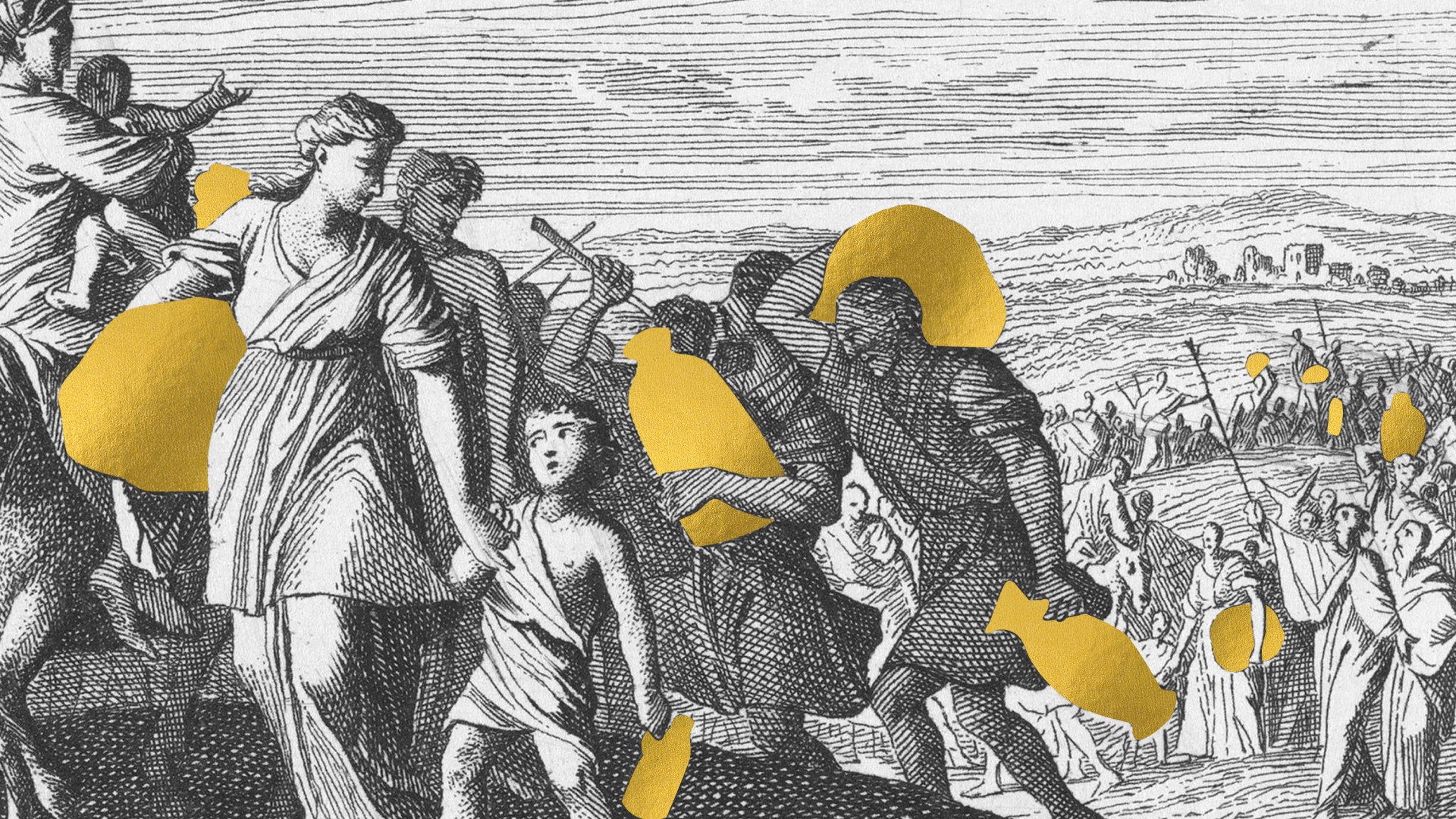
The classic text for thinking about reparations is the story of the Israelites’ flight from Egypt, recounted in detail in the Book of Exodus, the second book of the Old Testament.

The Israelites had been enslaved by the Egyptians and subjected to forced labor for hundreds of years. As the story goes, through divine intervention and the leadership of the prophet Moses, the people were set free and allowed to depart Egypt.

As God announces the plan in advance to Moses, he assures him:

“I will bring this people into such favor with the Egyptians that, when you go, you will not go empty-handed; each woman shall ask her neighbor and any woman living in the neighbor’s house for jewelry of silver and of gold, and clothing, and you shall put them on your sons and on your daughters; and so you shall plunder the Egyptians.” (Ex. 3:21–22, NRSV throughout)

When the Israelites ask as commanded, the Egyptians surprisingly comply. “And so,” the text laconically summarizes, “they plundered the Egyptians” (Ex. 12:36).

The story seems to have been a source of embarrassment to Jews and Christians in antiquity and even in more recent times.

Whether deceit was involved has been a matter of scholarly discussion, but at least one ancient historian used the account to paint the Jews of his day in a dim light. Around the turn of the millennium, Pompeius Trogus wrote that Moses led the Israelites in “carrying off by stealth the sacred utensils of the Egyptians.”

Perhaps in light of similar accusations, some Jews and, subsequently, Christians interpreted the text as a story about symbolic and not literal plunder.

The Jewish Alexandrian philosopher Philo, an older contemporary of Jesus in the first century, interpreted the event literally and justified the Israelites’ actions.

“For what resemblance is there between forfeiture of money and deprivation of liberty,” he wrote, “for which men of sense are willing to sacrifice not only their substance but their life?”

In other words, the Israelites were in the right to take material goods from the Egyptians since the Egyptians had deprived them of the far greater good of freedom.

But in another treatise, Philo gave an allegorical interpretation in which the Egyptians’ wealth represented pagan philosophy.

He felt that ideas that might originate in “pagan” philosophy could be put to good use—or “plundered”—for Jewish purposes. By way of comparison, one might imagine a contemporary preacher using, say, insights from psychoanalysis to elucidate the meaning of a biblical passage.

Two centuries later, the Christian scholar Origen of Alexandria used a similar argument to make the case that “pagan” philosophy should be studied by Christians as the “adjunct to Christianity”—to prepare for and supplement true Christian teaching.

He justifies this taking of intellectual property by using the example of the Israelites making off with the Egyptians’ possessions. He understood the biblical text’s account of the plundering of the Egyptians to be a symbolic authorization for Christians to take the intellectual property of the surrounding pagan culture.

Subsequent Christians theologians, from St. Augustine in the late fourth century onward through the medieval period, took up this line of interpretation.

But Philo’s literal understanding of the passage—that the Israelites took property from the Egyptians as a form of just repayment for their enslavement—also found followers among the early Christians.

In the second century A.D., a debate raged in the Christian church as to whether the Jewish scriptures should be authoritative for Christians. Marcion, a charismatic leader from the Black Sea region, contended that the Hebrew Bible attested an inferior god and so should be discarded. He and his followers urged that it contained morally reprehensible stories and held up the plundering of the Egyptians as an example.

The theologians Irenaeus of Lyons and Tertullian of North Africa, who argued for what ultimately became the form of Christian belief backed by political authorities, however, disagreed.

Irenaeus replied to the Marcionite argument in his treatise “Against Heresies,” which contains a remarkable display of the logic of reparations.

He writes that the Egyptians held the Israelites in “abject slavery” while at the same time contemplating their “utter annihilation.” Meanwhile, the Israelites built them “fenced cities” and made them even more wealthy.

“In what way, then,” Irenaeus asks, “did the Israelites act unjustly, if out of many things they took a few?”

His argument is straightforward: The Israelites deserved to be repaid for their forced labor. They contributed to the wealth of the Egyptians, and so had a right to a share of it.

Some 25 years later, Tertullian wrote a systematic refutation of Marcion’s position, entitled “Against Marcion.” In it, he repeated some of Irenaeus’ arguments, including his case for reparations.

Tertullian imagines a court in his own day hearing the claims of “the Hebrews.” He argues that no amount of gold and silver could repay the Israelites for their hardship.

“[They were] free men reduced to slavery,” he writes. “If their legal representatives were to display in court no more than their shoulders scarred with the abusive outrage of whippings, [any judge] would have agreed that the Hebrews must receive in recompense not just a few dishes and flagons … but the whole of those rich men’s property.”

Particularly notable is the fact that Tertullian makes the case for reparations to be paid to the descendants of the Israelites who had been forcibly enslaved centuries earlier. Although the force of the passage is driven by a debate about scriptural interpretation, its logic strikingly anticipates the case for reparations in the US today.

David Lincicum is an associate professor of theology at the University of Notre Dame.

This article is republished from The Conversation under a Creative Commons license. Read the original piece here.

Theology

Don’t Diss the Early-Marrieds

Recent research suggests that young couples are doing fine, despite the stereotypes.

Christianity Today February 9, 2022
Leah Hetteberg / Unsplash

Most single American adults aspire to be married. But for many now, marriage is supposed to be a capstone achievement rather than a cornerstone of young adult life. The “capstone model” says you are supposed to have all your ducks in a row—education, some professional success, and a clear adult identity—before you marry.

The median age at first marriage has increased over the past 50 years in the United States—from 23 in 1970 to about 30 in 2021 for men, and from 21 in 1970 to 28 in 2021 for women—with no sign of this upward trend leveling off.

Indeed, a recent national survey of millennials (ages 18–33) found the vast majority of respondents agree that marrying later means both people will be more mature, more likely to have achieved important personal goals, and more likely to have personal finances in order. Moreover, these young adults believe that later marriages will be more stable and of higher quality. That is the widely accepted cultural narrative.

Do later unions consistently provide better prospects for marital success than earlier ones? We often hear about the advantages of capstone marriage, but there has been little empirical investigation of those supposed benefits.

In a new State of Our Unions: 2022 report published by the National Marriage Project, the Wheatley Institution, and the School of Family Life at Brigham Young University, Alan Hawkins’s team of researchers reports on an empirical investigation of potential differences and similarities between two groups: early-marrieds (ages 20–24), who are more aligned with a “cornerstone marriage” model, and later-marrieds (25-plus), who are more aligned with a capstone marriage model. The study analyzes a wide range of marital outcomes.

(It’s important to note that our operational definition of cornerstone marriage is for those who tied the knot in their early 20s, not in their teens, when relationships are still at higher risk.)

To do so, we employed three recent data sets with large, nationally representative US samples and a rich set of marital outcomes. Overall, our analyses found few reasons to favor capstone marriage over cornerstone marriage. For most comparisons, we saw no statistically significant differences between early-marrieds and later-marrieds. When contrasts surfaced, they were almost always small in magnitude—and they tended to favor early-marrieds.

To be sure, we found weak (mostly nonsignificant) evidence that capstone marriages are more stable than cornerstone marriages. In other words, waiting to marry was linked to slightly more marital stability. However, there is new research that complicates that story. Lyman Stone and Brad Wilcox found that marriages formed around age 30 are the most stable for those who cohabit first, whereas marriages formed between 22 and 30 are the most stable for those who do not live together prior to marrying.

https://datawrapper.dwcdn.net/OizQc

But when it comes to marital quality, the story is more positive for cornerstone marriages, especially for men. We saw evidence that, on average, early-marrieds enjoy slightly higher marital quality than later-marrieds, as measured by such outcomes as relationship satisfaction and sexual satisfaction. (These findings controlled for religiosity, education, and length of marriage.) This is especially the case for husbands, as the figure above indicates.

We found only two large differences: Not surprisingly, early-marrieds felt like adults (at age 21 versus 23) and felt ready to marry (at age 21 versus 25) at significantly younger ages than later marrieds. Other research also indicates that religious young adults are more likely to tie the knot in their 20s than their more secular peers.

https://datawrapper.dwcdn.net/0l0KC

These findings run counter to the cultural narrative that early-marrieds will struggle in their relationships. At least today, those marrying in their early 20s appear a little more likely to enjoy wedded bliss than those marrying later.

Moreover, religious differences don’t explain away these findings. It was not faith per se but something else that seemed to account for these differences.

One of those explanations comes from what scholars call “selectivity” factors. Certain types of couples are more likely to select into younger marriages, and their distinctive values, relationship experiences, and traits likely figure into these patterns. This is especially true today, since those who marry in their early 20s do so because they want to, not because they have to or because a strong cultural script pushes them in that direction.

They may be unusually dedicated to marriage—or to one another. And later-marrying couples may have some significant challenges to surmount, such as the difficulty of forging a “we” identity after living for “me” for much of their early adulthood, or the fact that capstone marriages can seem unobtainable to less-advantaged couples these days.

Early-marrieds swim against a social current that too often questions the wisdom of their choices. But getting hitched doesn’t have to be a crowning capstone that signals successful young adult achievement—a status that too many will find difficult to attain. Instead, marriage can be the solid foundation on which to frame together the walls, windows, and rooms of a meaningful family life.

For that reason, our broader culture and even the church could stand to be more supportive of 21st-century cornerstone couples.

Alan Hawkins is a professor of family life at Brigham Young University. Brad Wilcox is nonresident senior fellow at the American Enterprise Institute and director of the National Marriage Project at the University of Virginia. Jason Carroll is associate director of the Wheatley Institution and a professor of family life at Brigham Young University.

News

In Ukraine, Mission Work Goes on During Russia Standoff

While some foreign missionaries have left for neighboring countries, many are standing alongside national church leaders to minister amid uncertainty.

Christianity Today February 9, 2022
Chris McGrath / Getty Images

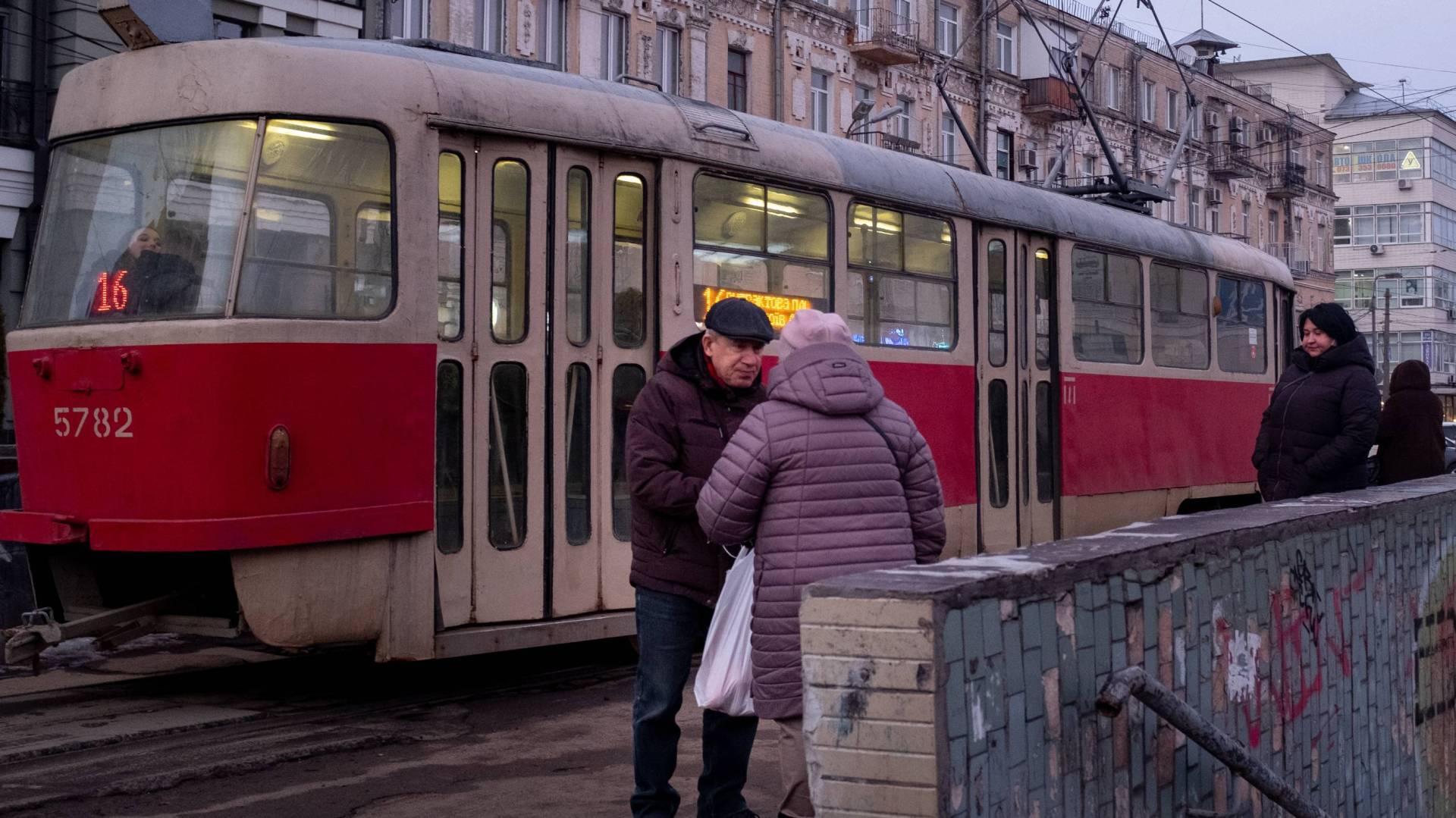
Missionaries serving in Ukraine have sent out urgent prayer requests and asked the Lord for his protection and wisdom as they consider what’s ahead for them and their ministries as the threat of invasion looms.

Some missionaries have already left to wait out the situation in neighboring nations or even back in the US, while others remain even as the Russian military presence continues to build near the border.

Ukraine’s president Volodymyr Zelensky has urged citizens to remain calm, as invasion isn’t certain. However, the escalating crisis is impacting ministry at a time when evangelicals say a new generation of Ukrainian church leaders is gaining momentum.

At Kyiv Theological Seminary, American Rick Perhai—who has served in the country more than two decades—is taking his cues from his students.

“They want to be here to study, and that gives me great hope,” said Perhai, the school’s director of higher education development and a missionary with SEND International.

“Even in the midst of this kind of uncertainty, this kind of ominous threats, they’re trying to keep their focus on Jesus. That encourages me to keep my focus on Jesus. They really are a living cloud of witnesses.”

The current tensions and pressures are being exerted on a Protestant church that has grown substantially in the past few decades. The choice for missionaries to stay or go is complicated for both the missionaries themselves and for the organizations that send them.

SEND International has been sending missionaries to Ukraine since the 1990s. As of the beginning of February, most of its missionaries were still in the country. The organization trains missionaries to handle crisis situations and has a security team to evaluate risks and make plans for evacuation based on access to food, water, power, transportation, or communication.

“As leaders, some of us are not in those local areas, so it’s important to us to listen to our missionaries on the ground and what the Holy Spirit is telling them, then discerning that with the information that we get from government sources and others who are assessing the situation,” said CEO Michelle Atwell, who previously served in Kyiv herself.

In cases of disagreement, SEND will also bring the missionaries’ sending churches into the conversation, but in the end, the final decision about evacuation will rest with SEND’s director of corporate security and international director. However, decisions only reach this point after much evaluation and prayer.

ABWE International operates similarly to SEND, with a security director and crisis management teams. Most of ABWE’s missionaries to Ukraine have relocated to neighboring countries, but some remain. Alex Kocman, a communications officer for ABWE, said the decision to stay or go can depend on a number of factors, including if the missionaries have family and children with them.

Joshua Tokar, director of English language services at Ukraine Evangelical Theological Seminary, has relocated to a neighboring country with his family for the time being. He’s able to continue teaching virtually.

“It’s not a decision that’s taken lightly,” said Tokar, who has been in the country for eight years. “We have built long-term relationships [in Ukraine], and our goal is to stay as long as is reasonably possible.”

Ukraine’s current conflict extends back to when Russia annexed Crimea in 2014, but the countries have a history of tension. Under the USSR, Christians faced brutal persecution, recalls Ruslan Khmyz, president of Kyiv Theological Seminary.

“I know what it means to be persecuted,” Khmyz said. “When freedom came to Ukraine, many things completely changed. The number of churches started to grow very fast. Many new Christians dedicated themselves to Jesus, and they wanted to grow, to serve, and to proclaim the gospel.”

Khmyz described how the Communist regime tried to destroy Christian theology. Since Ukraine gained its independence in 1991, nationals, missionaries, and foreign ministry organizations have established seminaries and discipleship programs to help believers and develop church leaders.

“Ukraine is the main missionary-sending country for Eastern Europe and Central Asia,” said Tokar. “The church is very strong. As far as Europe is concerned, the Ukrainian church is perhaps the strongest and is doing the most for education, training, and sending out workers.”

Many ministry organizations working in Ukraine have shifted their approach to instead come alongside Ukrainian believers as they develop their own ministries and send their own missionaries.

“It’s not from the West to the rest. It’s from all peoples to all peoples,” said Perhai said. “That’s the only way that the Great Commission is going to be completed.”

In addition to being mission-minded, Ukrainian churches already have experience ministering to refugees from the conflict in the eastern Donbas region. With the threat of invasion, churches in western Ukraine say they are willing to take in Christians from churches in eastern Ukraine who may have to flee.

Khmyz said his church is encouraging its members to have enough food and water on hand to support their families for a few days and to share with others in a crisis. Doctors have also provided first aid training for church members. However, the greatest hope of Ukrainians is that these measures won’t be necessary. Khmyz’s church has also held packed prayer meetings. He said there’s a sense that many are searching for real hope.

“It’s not enough to say, ‘Everything will be okay.’ We need to give people the real hope of Jesus,” Khmyz said. “The task of the church in unforeseen circumstances and chaos is to stand strong in the Lord and act according to God’s will. Christians must be salt and light in all circumstances, even in times of war.”

Even as missionaries and nationals alike deal with these tensions, minister to people, and prepare for a possible crisis, everyday life goes on. For many, there is nothing to do but wait and see.

“The president of Ukraine was basically telling his people to be calm and keep living life. We sense that’s how our partners there are trying to live, and we also sense that they’re not going to just roll over and wait for the Russians to come,” Steve Eckert, president and executive director of READ Ministries, which advocates for the needs of the church in Ukraine and channels support to missionaries and seminaries in the country. “They’re continuing to work, and we will continue to work with them on initiatives for the future.”

At this time, Christians in Ukraine are asking for prayer that their country will be able to continue to live in freedom and peace. They also ask those who know someone serving in Ukraine to reach out, offer encouragement, and perhaps connect over video. Leaders see the current attention toward the church in the Ukraine as a chance to spread the word about the mission advancements being made amid such tense circumstances.

“Prayer is necessary because we feel unity with other Christians. It gives us the power to live and the power to serve. It gives unity in Jesus. We understand that we are very weak, but God is strong,” Khmyz said. “We hope that God by his mercy and his grace will protect our country.”

Theology

When You Feel Small, Look to the Cosmos and the Cross

In times of doubt, I return to a Hubble telescope view of God.

Background: Hubble Extreme Deep Field

Background: Hubble Extreme Deep Field

Christianity Today February 8, 2022
Illustration by Mallory Rentsch / Source Images: WikiMedia Commons

Where I live in the Rocky Mountains, you can see several thousand stars with the naked eye on a clear night. All of them belong to the Milky Way galaxy, which contains more than 100 billion stars, including an average-sized one that our planet Earth orbits around—the Sun.

Our galaxy has plenty of room: 26 trillion miles separate the Sun from the star nearest to it. And traveling at the speed of light, it would take you 25,000 years to reach the center of the Milky Way from our home planet, which lies out in the galaxy’s margins.

Until a century ago, astronomers believed the universe consisted of our galaxy alone. Then, in the 1920’s, Edwin Hubble proved that one apparent cloud of dust and gas in the night sky, named Andromeda, was actually a separate galaxy. Now there were two. When NASA launched a large telescope into space for a clearer view, they appropriately named it after Hubble.

In 1995, a scientist proposed pointing the Hubble Space Telescope at one dark spot, the size of a grain of sand, to see what lay beyond the darkness. For ten days, the telescope orbited Earth and took long-exposure images of that spot. The result, which has been called “the most important image ever taken,” would astonish everyone. It turns out that tiny spot alone contained almost 3,000 galaxies!

In later years, Hubble revisited the same spot with more refined equipment, identifying many more galaxies with each improvement. Astronomers mapped the Deep Field, the Ultra Deep Field, the eXtreme Deep Field, and the Frontiers Field. Reaching the limits of visible light—and perhaps running out of titles for Hubble’s exploits—they recently turned the task over to a new, stronger telescope. The James Webb Space Telescope, which launched last Christmas Day, will be able to detect even more galaxies using infrared cameras.

Scientists now believe that if you had unlimited vision, you could hold a sewing needle at arm’s length toward the night sky and see 10,000 galaxies in the eye of the needle. Move it an inch to the left and you’d find 10,000 more. Same to the right, or no matter where else you moved it. There are approximately a trillion galaxies out there, each encompassing an average of 100 to 200 billion stars.

In the years since, our home—this pale blue dot called Earth—has not stopped shrinking in comparative stature. Now it is found to be a mid-sized planet orbiting a mid-rank star in one galaxy out of a trillion.

How should we adapt to this humbling new reality?

Back when people assumed the universe comprised a few thousand stars, a psalmist marveled in prayer,

When I consider your heavens,
the work of your fingers,
the moon and the stars,
which you have set in place,
what is mankind that you are mindful of them,
human beings that you care for them? (Ps. 8:3–4)

The question has expanded exponentially since David’s day. I try to wrap my mind around what I call “the Hubble telescope view of God.” How could the one who spun off a trillion galaxies possibly care about what happens on our infinitesimal planet?

Then I turn to the Book of Job, where a poor, beleaguered Job flips the psalmist’s question on its head:

What is mankind that you make so much of them,
that you give them so much attention,
that you examine them every morning
and test them every moment?
Will you never look away from me,
or let me alone even for an instant? (7:17–19)

Job gets a direct answer from God, who speaks to him out of a whirlwind. Job had saved up a long list of questions—but it is God who begins the interrogation, not Job. “Brace yourself like a man,” God begins. “I will question you, and you shall answer me” (38:3).

Reading this, the longest speech by God in the Bible, I can hear God saying , Let’s compare résumés, you and me, and I’ll go first. Frederick Buechner sums up what follows: “God doesn’t explain. He explodes. He asks Job who he thinks he is anyway. He says that to try to explain the kind of things Job wants explained would be like trying to explain Einstein to a little-neck clam.” God does not need Job’s or anyone else’s advice on how to run the universe.

Brushing aside 35 chapters’ worth of debates on the problem of pain, God plunges instead into a dazzling poem on the many wonders of the natural world. God points out, one by one, the works of creation that give the greatest satisfaction.

In effect, God asks Job, Would you like to run the universe for a while? Go ahead, try designing an ostrich, or a mountain goat, or even a snowflake. God even references astronomy: “Can you bind the chains of the Pleiades? Can you loosen Orion’s belt? Can you bring forth the constellations in their seasons?” (38:31–32).

Job got a closeup lesson on how puny we humans are compared to the God of the universe, and it silenced all his doubts and complaints. I’ve never experienced anything like the travails Job endured, but whenever I have my own doubts, I try to remember that perspective—the Hubble telescope view of God. In the words of a Broadway musical echoing God’s speech to Job, “Your Arms Too Short to Box with God.”

In my less self-absorbed moments, however, I turn to a very different passage from the Bible.

In his letter to the Philippians, the apostle Paul quotes what many believe to be a hymn from the early church. In a stately, lyrical paragraph, Paul marvels that Jesus gave up all the glory of heaven to take on the form of a man—and not just a man, but a servant—one who voluntarily subjected himself to an ignominious death on a cross. (Phil 2:6-7)

I pause and wonder at the mystery of Incarnation. In an act of humility beyond comprehension, the God of a trillion galaxies chose to “con-descend”—to descend to be with—the benighted humans on this one rebellious planet, out of billions in the universe. I falter at analogies, but it is akin to a human becoming an ant, perhaps, or an amoeba, or even a bacterium.

Yet according to Paul, that act of condescension proved to be a rescue mission that led to the healing of something broken in the universe. As the passage goes:

Therefore God exalted him to the highest place
and gave him the name that is above every name,
that at the name of Jesus every knee should bow,
in heaven and on earth and under the earth,
and every tongue acknowledge that Jesus Christ is Lord,
to the glory of God the Father. (vv. 9–11)

We hear the roar of God at the end of the Book of Job, a voice that evokes awe and wonder more than intimacy and love. Yet Philippians 2 gives a different slant on the Hubble telescope view of God. A God beyond the limits of space and time has a boundless capacity of love for his creations, no matter how small or rebellious they might be.

As it happens, that message is best expressed not from a whirlwind, or burning bush, or smoking mountain—but rather person to person, through Jesus and his followers.

Philip Yancey is the author of many books including, most recently, the memoir Where the Light Fell.

News

Boycott China’s Winter Olympics? Many American Christians Agree

Pew survey finds majority of evangelicals and Catholics support US diplomatic boycott. Religious freedom advocates want ordinary believers to abstain also.

China Winter Olympics 2022 opening ceremony

China Winter Olympics 2022 opening ceremony

Christianity Today February 8, 2022
Matthias Hangst / Staff / Getty Images

The 2022 Winter Olympics in China have started off with comparatively poor TV ratings in the US, including a record low for the Opening Ceremony.

While an audience of 16 million is no small figure for NBC, the previous low was 20.1 million for the opening of the 1988 games in Canada.

Such news will likely please religious freedom advocacy groups, such as Open Doors USA, which have called for Christians to follow the US government’s lead—as Canada, the UK, and Australia have done—and to boycott Beijing’s Olympics in response to reported human rights violations against Uyghurs, Christians, and other religious and ethnic minorities in China.

Among Americans who have heard about the Biden administration’s diplomatic boycott of the 2022 Olympics, approximately two-thirds agree with it, according to the Pew Research Center.

This includes at least 6 in 10 white evangelicals, white mainline Protestants, black Protestants, Catholics, and religiously unaffilated Americans who know about the boycott. White evangelicals are the most likely to strongly approve (34%), while white mainliners are the most likely to approve overall (68%). But overall, the US religious groups hold similar stances, with no statistically significant differences.

The Pew survey, conducted last month from January 10 to 17, also found that roughly half of Americans have heard “nothing at all” about the US diplomatic boycott. Of this group, 26 percent approved and 21 percent disapproved. American Christians were similarly split, with pluralities stating they were “not sure” about the boycott.

https://datawrapper.dwcdn.net/jFhgH

Pew also asked Americans whether they saw China as primarily a partner, a competitor, or an enemy of the United States. Half labeled China as a competitor, while one-third labeled it as an enemy.

Among American Christians, 56 percent of white evangelicals labeled China as an enemy, making it the only religious demographic to have a majority choose that option. By comparison, 46 percent of white mainliners, 27 percent of Black Protestants, and 37 percent of Catholics also labeled China as an enemy.

https://datawrapper.dwcdn.net/1ZSA7

In January 2021, the US State Department declared that China’s mass detention and forced labor and reeducation of Uyghur Muslims in the northwest region of Xinjiang qualified as genocide. The decision was applauded by the US Commission on International Religious Freedom. In June 2021, the Southern Baptist Convention became the first American denomination to officially condemn the Uyghur genocide.

Last month, the Southern Baptist Ethics and Religious Liberty Commission (ERLC) sent a letter to NBC Universal urging “accurate coverage during the Beijing Olympics of the Chinese Communist Party’s gross and ongoing human rights violations, particularly the genocide of the Uyghur people.”

CSW signed a January 28 letter along with 240 NGOs—including ChinaAid, the Family Research Council, and the Religious Freedom Institute—supporting a diplomatic boycott and urging athletes and sponsors to call out the human rights abuses documented since China was awarded the 2022 Games in 2015.

Open Doors ranks China at No. 17 on its 2022 World Watch List of the 50 countries where it is hardest to be a Christian. Its researchers tallied 3,000 attacks or forced closures of churches and other Christian buildings in China, representing 3 in 5 of such recorded incidents worldwide last year.

In a December op-ed for The Hill, Open Doors USA president and CEO David Curry and former US international religious freedom ambassador Sam Brownback wrote:

In the United States … most people of faith appear to be woefully ignorant of the plight of their fellow believers in China. The persecution of Chinese Christians is rarely if ever mentioned on Sunday mornings in American megachurches. Raising awareness has been a long, slow struggle for the handful of organizations dedicated to the effort of exposing religious persecution in China and elsewhere.

President Biden’s diplomatic boycott is a chance for Americans to act. Martin Luther King Jr. once famously said, “In the end, we will remember not the words of our enemies, but the silence of our friends.” It’s time for American Christians to break their silence and stand up for their persecuted brothers and sisters in China.

Specifically, American Christians and others need to look at the more than 80 major brands with links to the forced labor of Uyghur Muslims. Some are also major sponsors of the 2022 Winter Olympics, including Panasonic and Samsung. China Aid, a Christian group led by former house church pastor Bob Fu, has already called for a boycott of Olympic advertisers until China “announces a date they will close Uyghur concentration camps and releases a list of religious prisoners.”

Meanwhile, The Voice of the Martyrs (VOM) has urged supporters to commit to a “prayer boycott” of China’s Olympics.

“The Olympics are always filled with wonderful pageantry and inspiring athletic accomplishments. But let’s not forget what the host government doesn’t want us to see: imprisoned pastors, destroyed church buildings, and a complete lack of religious freedom,” said spokesperson Todd Nettleton in a press release. “I hope every Christian will use each event and every Olympic update as a reminder to pray for our persecuted family members in China as the Scriptures instruct us to do.”

To date, VOM tallies more than 20,300 prayer commitments from 136 countries.

Last week, the ERLC assessed how Christians should approach boycotts, drawing from just war theory, and offered this example:

1) We can refuse to watch the Olympics on NBC since ​​viewership increases their advertising revenues. We can also refuse to buy any products made by slaves—which might include Olympic souvenirs—since this is the best way for me to apply proximate justice.

2) However, we may decide we will not refuse to buy products merely because they are made in China since an individual boycott is almost assuredly going to be ineffective, and the most likely outcome would be that the only people hurt would not be the Chinese government but the poorest of Chinese workers (some of whom are our brothers and sisters in Christ).

3) We can use what power we have to take other steps that are most likely to affect the Chinese government and minimize the harm to innocent Chinese people. For example, we can use social media to raise awareness about Chinese atrocities and the treatment of the Uyghurs while the Olympics is ongoing.

While it’s still early in the Games, several vocal Christian athletes have found success.

Over the weekend, Paul Schommer helped the US finish seventh in the biathlon mixed relay, the nation’s best-ever performance. On Monday, American figure skater Alexa Knierim, alongside her pairs partner Brandon Frazier and their teammates, won a silver medal in team figure skating. Meanwhile, American bobsledder Elana Meyers Taylor tested positive for COVID-19 after arriving in China but now hopes to medal next week after leaving quarantine following two negative test results.

This post will be updated.

News

Black Baptists Discover Lost Cemetery in Virginia

African American church graveyards are disappearing. Can they be saved before it’s too late?

Christianity Today February 8, 2022
Matthew S. Gunby / AP Images

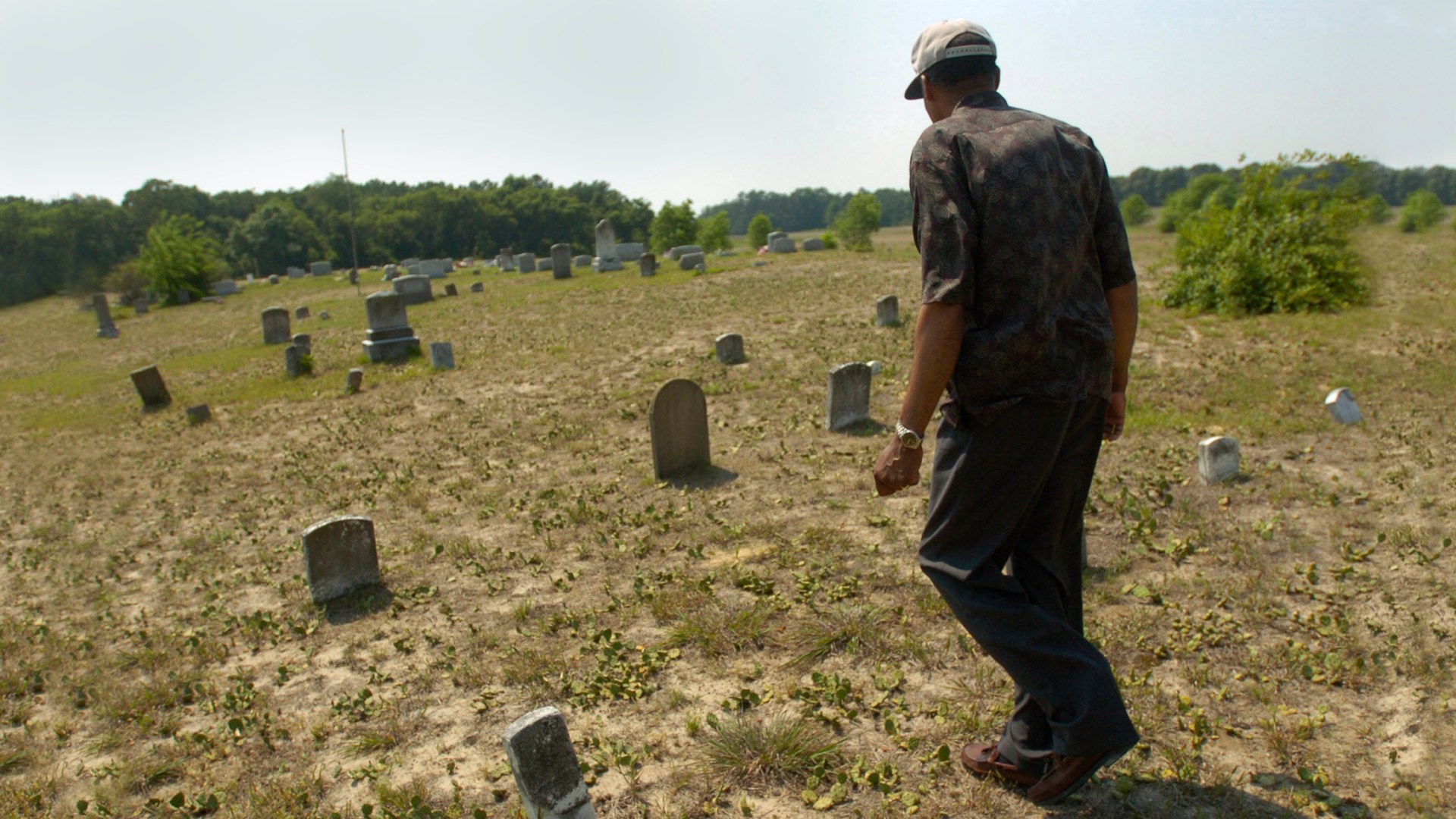
They needed a John Deere Gator to reach the perimeter. Then, in the forested area behind a power plant in Williamsburg, Virginia, Colette Roots and her small expedition had to jump over ditches full of rainwater, where they could see tadpoles and mosquito eggs. They went in.

The plot of land belonged to a Black congregation in the 1940s. The historic church, Oak Grove Baptist, is still active. Roots grew up in the congregation, and as a child, she helped her mother maintain the graves at the church’s main cemetery—a much larger plot roughly a mile from this one, with about 150 graves.

The church lost access to this smaller graveyard decades ago, thanks in part to a massive land seizure by the federal government. By the summer of 2021, most everyone who knew the exact whereabouts of the Christians buried back here had died themselves.

Hidden away like this, in the trees and brush, the graves remind Roots of the Sunday school song about hiding your light under a bushel. When she saw them that day, she had the same reaction: No.

There were a dozen markers, some lying flat and others standing upright. The inscriptions showed that most of the deceased were children, and at least three were related to Roots by marriage. For a moment she was overcome with grief.

The dead needed to be taken care of. They belonged with the other deceased saints at the main burial grounds.

Everyone at Oak Grove agreed with her. But this left them with a conundrum. With an aging congregation, just a fraction of its former size, Oak Grove Baptist has struggled just to pay its utility bills. Relocating a cemetery is not in its budget.

The congregation’s dilemma is not unusual for Black churches. Recently, 26 potential graves were identified beneath a paved road near a Baptist church cemetery in Georgia. In the Tampa area, multiple Black cemeteries have been discovered since 2019, including one beneath a high school and another below an Air Force base.

Across the country, hundreds or thousands of Black cemeteries are in severe enough disrepair that they could be erased altogether. History is being lost. A record of the spiritual heritage of the men and women who persevered by faith through incredible hardship is disappearing. It’s not clear that anything can be done in time to save them.

The dispossession of Oak Grove

Dispossession has been a theme in the history of Oak Grove Baptist.

The church has its origins in Magruder, a cluster of smaller neighborhoods that no longer exists. Brian Palmer, a veteran journalist who has family ties to the area, and his wife, journalist Erin Hollaway Palmer, have done extensive research on the neighborhood’s history. Brian Palmer says that before the Civil War, the area consisted mostly of large plantations but also included small tracts of land owned by free Black families.

During and after Reconstruction, freed people who had lived on the plantations stayed in the region, and more Black families settled there and bought land. In the Jim Crow era, Magruder was a place where African Americans could retain some degree of economic independence. Many made their living by farming and oystering.

Oak Grove Baptist was founded by former parishioners of First Baptist Church, Williamsburg’s original Black house of worship, which had been established before the American revolution. The Magruder residents couldn’t walk the three miles downtown every week for services. They began holding services independently around 1887.

A half century later, Magruder was destroyed by the federal government. When the US entered World War II, in 1941, the military rapidly built training camps for its new recruits. One of the locations it zeroed in on was the Virginia Peninsula, where it planned to build the Navy post that became Camp Peary (which is now a CIA training facility known as “The Farm”).

Magruder was appealing, the Associated Press reported at the time, because of “the wild nature of the country. Officials “thought the “rough terrain of hills, fields, woods, dense brush, swamp and beach” would be ideal for training activities. Government officials also cited Magruder’s railroad access, its water supply, and its flat ground among its assets. Property owners, both Black and white, fought the land seizures but couldn’t stop them.

In the end, several hundred families were displaced by Camp Peary. The residents scattered in all directions, with some exiles settling locally and others leaving the state. Oak Grove Baptist was forced to vacate its building on East Rochambeau Drive, leaving behind a large cemetery.

The church trustees took the matter to court, demanding a higher payment for the church property. According to documents Palmer obtained, they ultimately received $1,150 (the equivalent of $10,700 now). While this lawsuit was going on, Roots says, they bought a new plot of land for burials. This was when the little cemetery with the children’s graves was established.

The church leaders erected a new building on Waller Mill Road, in the neighborhood known as Cooketown. Then that land was seized for a highway and a new water plant and the congregation was forced to relocate again.

Roots was born in 1959. Despite the disruptions, the church thrived while she was growing up. At its peak, Roots estimates, the church had 300–400 people attending regularly. The children of the generation that had been displaced from Magruder were becoming teachers and doctors and lawyers. Many of them lived in other parts of the county, but they still came back to Oak Grove, and many weekends they had cookouts in the area.

Four times each year, Roots and her mother went to the main cemetery to pay respects and help with maintenance.

In 1981, Roots married her high school sweetheart, whose grandparents had also lived in Magruder. Her husband enlisted in the Army, and the young couple left for Fort Bragg, in North Carolina, where they lived for a dozen years. As the ’80s gave way to the ’90s, she watched Oak Grove’s congregation start to dwindle. Elderly parishioners were dying, and younger families were moving farther away. The church cycled through a number of pastors who were only in Williamsburg temporarily and didn’t have strong ties.

As Sunday attendance went down, so did the condition of the main cemetery. Trees toppled, headstones started cracking, and some of the graves sank due to erosion.

Roots and her husband moved back to Williamsburg in 1994, after spending time in Alaska and Tennessee. At first Roots was reluctant to take on much responsibility at Oak Grove Baptist. She worked as a shop steward at the College of William & Mary, leading the union of housekeepers and other wage workers. But after her mother’s death, she felt compelled to get Oak Grove’s main cemetery fixed up.

Colonial Williamsburg, the foundation that runs a living history museum downtown, offered to help. It paid for a new fence and parking lot and used radar technology to check for unmarked graves. Roots described it to the Virginia Gazette as a “miracle.”

Small cemetery rediscovered

Amid this restoration project, one of Roots’s cousins reminded her that Oak Grove had another cemetery as well. “She said, ‘Don’t know where it’s at, but there’s one out there,’” Roots recalls. Over the years, as property around the second cemetery had been sold and developed, the congregation had lost its access route. Then in 2021, Roots received a call from a municipal worker who knew about the restoration work she’d been doing. He said a logger had felled some trees in the old Magruder area, and a set of gravestones was now visible in the woods.

Since the day of the expedition, the congregation has made big strides in repairing and restoring the church building in the last year. But the cemetery project has been more difficult. Much of the surrounding land, where the grandparents and great-grandparents of church members once lived, is now being developed into an upscale subdivision. Moving the graves is a priority. But a local funeral home estimates it will cost around $3,300 per grave (or nearly $40,000 altogether), and the community is still searching for a source of funding. Let Freedom Ring, a foundation associated with First Baptist (Oak Grove’s old parent church), has also been looking for a solution, and Monty Mason, a state senator representing Williamsburg, has offered to help.

From Roots’s perspective, the most just outcome would be for the federal government to pay a substantial portion of the cost. After all, the US military created the problem in the first place, when it broke up Magruder and seized the church’s main cemetery.

There is a bill pending in the legislature, the African American Burial Grounds Network Study Act, that would take up this call. Senator Sherrod Brown (D-Ohio) introduced the bill in 2019, and in December 2020, it was passed unanimously by the US Senate. (A companion bill was introduced in the House by Representatives Donald McEachin, D-Va., and Alma Adams, D-N.C., also in 2019.)

If the legislation passes, the National Park Service will be tasked with putting together a database of every historic Black cemetery in the country, or at least as many as can be identified. The Park Service would then establish grants for local organizations—likely including churches, preservation groups, and other nonprofits—to help them research and restore these sites.

Brown’s office says about $3 million would be allocated to create the network, but other funding sources would be needed for restoration work, which is expensive—often running to tens of thousands of dollars at even a small cemetery.

In the case of Oak Grove, it’s easy to picture how a program like this could help. If it were already in place, perhaps the little cemetery near the power plant would have been identified earlier. And the community wouldn’t have to scrounge for funds to move the graves.

‘Another and another and another and another’

On a national scale, the project’s potential impact would be enormous. Since there’s no comprehensive database of these cemeteries right now, there’s no way to estimate how many are in danger. Hannah Rosen, a historian at the College of William & Mary, who has done extensive research on Black burial grounds, thinks the figure has to be over 1,000 and is likely much higher.

“I don’t think there’s a Southern community that doesn’t have multiple struggling Black burial grounds—and the North is probably full of them too,” Rosen said. “Everywhere you turn, there’s another and another and another and another.”

On one level, the significance of these sites is obvious: Like all cemeteries, they hold the remains of the deceased, so it’s natural to think of them as a kind of sacred ground. Connie Harshaw, the director of the Let Freedom Ring Foundation, who has been working closely with Roots, argues that cemeteries have a particular importance in Black church culture, where respect for ancestors is paramount.

“We stand on their shoulders, and we pay homage as often as we can,” Harshaw said. “We know that if not for them, we could not be where we are now.”

There is another way to think about their significance, too. Monuments from African American history are relatively scarce. In the Jim Crow era, Southern cities rarely put up statues of Black leaders. At the same time, rural Black communities were often forced to use cheap materials to build houses, schools, and churches, because these were all they could afford—and as a result, many of those buildings have not withstood the elements.

To some extent, cemeteries have been an exception to this trend. By their nature, they’re more durable than wood-frame buildings. In some cases, they are the only sites left of abandoned Black towns. In this way, they’re testaments to the history of American racism, as Rosen points out. But they can also be taken as symbols of the resiliency of communities like Oak Grove Baptist.

This is the part that resonates most for Roots. The hymn “This Little Light of Mine” has become her anthem as she works to preserve the church’s landmarks.

“No matter where this church has been—displaced, relocated, relocated, displaced again—and still struggling—the light is gonna shine,” she said. “It represents what Oak Grove stands for; it represents the gospel. That song represents everything. And it’s telling us history will be told.”

Theology

As Korea Moves to Deport ‘Mayflower’ Church, Chinese Christians Debate Dodging the Cross

Mainland believers sympathize with congregation’s concerns but disagree theologically over decision to flee China for Jeju Island.

Christianity Today February 8, 2022
Illustration by Rick Szuecs / Source images: Kevin Frayer / Stringer / Getty / Envato

In late 2019 and early 2020, 60 Chinese Christians left their homes in the southern Chinese city of Shenzhen, seeking religious asylum on Jeju Island, a popular tourist spot in South Korea.

The group of 28 adults and 32 children hailed from Shenzhen Holy Reformed Church (SHRC), following the lead of their pastor Pan Yongguang who went to Korea before them. At the end of January, the Gwangju High Court denied the church’s final asylum appeal. They now face imminent deportation to China unless another country grants them refuge.

Pan’s church began considering emigration after the 2018 persecution of Early Rain Covenant Church in Chengdu, whose head pastor, Wang Yi, knew Pan. Wang was arrested in December of that year and sentenced the following year to nine years in prison. Wang, Pan, and several of Pan’s church elders were represented among the more than 400 house church congregations whose leaders signed a statement criticizing the tightening religious regulations that went into effect in 2018.

After Wang’s arrest, Pan believed that house churches could no longer exist openly in Chinese society. “The church had to leave, unless we scattered or renounced our faith,” he later said.

In mid-October 2019, SHRC held a congregational meeting and voted to move to Jeju. If the church (at that time a group of about 120) remained in Shenzhen, they believed they had only two options: to disperse or to “bend the knee” to the government-sanctioned Chinese Three-Self church.

Additionally, many church members’ children had been attending the congregation’s school, which authorities later shut down. Concerned that their children would be taught material that violated their faith, SHRC parents believed they must move.

Around that time, Pan left his home on what he believed was an exploratory trip to scout out Jeju—he only brought two sets of clothes. But he never returned. Within a few months, his family and a significant portion of his congregation joined him.

But only after the church arrived and applied for asylum did they begin to understand South Korea’s highly restricted asylum policy, Pan said. (In a letter to his church near the beginning of the process, Pan told congregants that an attorney had advised him their planned actions were “perfectly legal.”) A former doctor, he and his church members have worked menial jobs since leaving China, and none speak Korean.

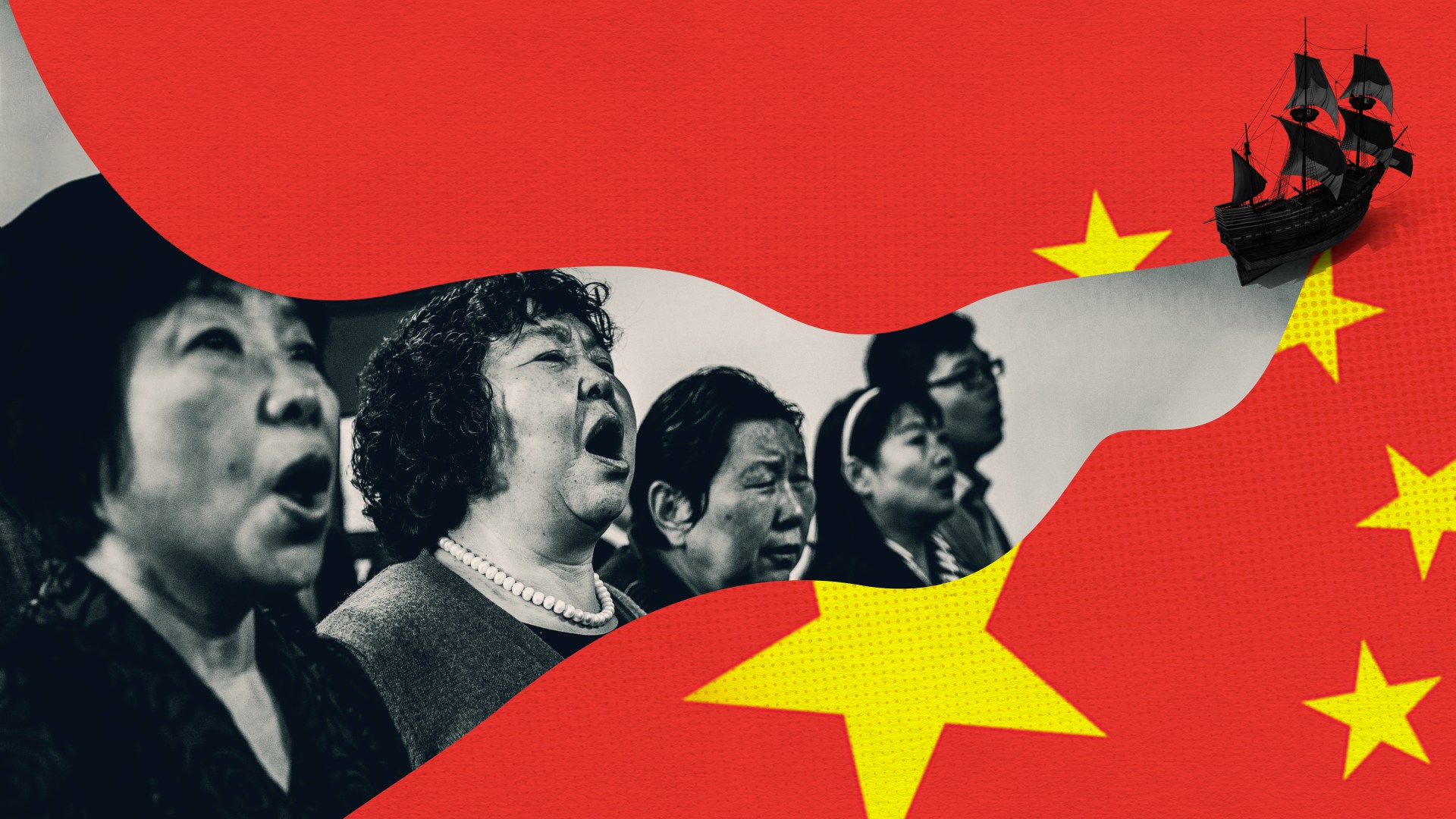
SHRC is now known by some as the “Mayflower Church,” a name coined by Pan’s friends after the pastor noted the similarities between the religious-liberty inspired migrations of the Pilgrims and the SHRC congregation.

“Even the children were familiar with the history of the Mayflower,” Pan said, noting that his church spent the year before leaving China studying Pilgrim leader William Bradford’s firsthand account of the Pilgrim experience, Of Plymouth Plantation. “Our faith is the same as the Mayflower’s; our experience is also similar to theirs.”

A divergent decision

Since new laws governing religious affairs in China went into effect in 2018, life for Christians has grown increasingly difficult. Churches like SHRC that continue to refuse to register with local governing authorities and come under government oversight have found it difficult to meet openly and operate as they once did. This situation is particularly acute for members of urban Reformed house churches whose leaders openly signed the joint declaration.

However, the SHRC’s response to persecution has raised questions among other house churches in China that have remained and continue to endure the new difficult reality that comes with being an unregistered church in today’s China. While many are sympathetic to the congregation’s desire for freedom to worship, others are critical of their corporate decision to flee.

The persecution Pan chronicles is not unusual, but is in many ways a typical experience for Chinese believers in the unregistered church. Many other Chinese house churches share the same experiences, yet others have not responded by corporate fleeing. The incident has sparked discussions among house church leaders regarding what God’s call to his church is, and over the role of pastoral leadership in politically sensitive situations involving not just one household, but an entire flock.

One house church pastor said, “I’m not willing to judge them for their response, seeing as their motives and underlying situation isn’t clear to everyone. Only they know their motives. In a situation like this, it is best not to pass judgment. Take, for example, the Mayflower. They left, and we don’t pass judgment on them.” (Interestingly, the pastor who instinctively made the Mayflower comparison was not aware that some now refer to SHRC as “Mayflower Church.”)

Another house church pastor shared why he returned to China to lead a house church after studying overseas, forgoing his security abroad: “I cannot say the current situation is my personal choice. I am inclined to see it as the circumstance God has prepared and put me in. Growing [up] in the traditional house church in China, ever since the first day of my conversion, persecution is not a strange concept for me.”

As this pastor packed his things to return home, he meditated on the words of Dietrich Bonhoeffer, the German theologian who explained his return to Nazi Germany as a decision to share in the trials of the age with his people. He also mentioned the sacrifices of missionaries such as Wiliam Borden, who died in order to share the gospel with the Chinese.

Although he and his family could, like Bonhoeffer, have avoided the turmoil of pastoring in China, he said: “As a called minister of the gospel, it would be hard for me to preach the hope of a heavenly kingdom to my brothers and sisters in China, while [I] had a plan of retreat. … The shepherd should be with his flock and stay in the field … I will stay, to be faithful.”

Stay or go?

Historically, there are examples of emigration and asylum-seeking for those under the threat of religious persecution in China. However, those cases concerned individuals and families. To our knowledge, an entire church seeking asylum in another country is highly uncommon, if not unprecedented, for China.

House churches tend to identify with those forefathers who stayed and endured persecution such as Watchman Nee and Wang Ming-Dao, both of whom were imprisoned for refusing to join a church under government oversight. Nee in particular had an opportunity to avoid persecution in Hong Kong but chose to return to Shanghai. Thus, the standard historical position of these churches has been to stay and endure.

Because of this historical legacy, many churches view endurance under persecution as an appropriate application of a “theology of the cross.” If SHRC’s reasons for fleeing are historically grounded in the English Puritans who fled on the Mayflower, they may be viewed by other Chinese churches as turning their backs on the historical legacy of the Chinese house church.

Within the larger Chinese diaspora community, there is also a history of many who have fraudulently claimed “persecution” in order to grant credence to their cases.

Pan anticipated that his actions would spark controversy but believed his pastoral responsibility was to keep his congregation together. To members who remain in China, he wrote to his church: “I also knew that if I did [leave], I would surely be criticized by other churches and would have to bear this bad reputation for the rest of my life.”

Unintended consequences

The church around the world has wrestled with whether to remain or flee when confronted with persecution. In the Middle East, Christian communities have been decimated in recent decades as believers faced stark choices between tortured endurance or fleeing and starting a new life elsewhere.

Scripture offers examples of followers of God both remaining and fleeing persecution, and God using both decisions to further his purposes. In the Old Testament, the Lord keeps Obadiah in Ahab’s court while sending Elijah into Gentile territory to escape persecution (1 Kings 18:1–16). In the New Testament, Stephen’s stoning in Jerusalem leads to a mass exodus of Christians out of Jerusalem into other lands (Acts 8:1). What each biblical example shares, whether remaining and enduring or fleeing, is that the decision was made under the guidance of the Lord and never under cowardice.

The story continues in modern times, where the faithfulness of Chinese Christians following the 1949 Communist takeover planted the seeds for the robust faith of many believers today. On the other hand, those who left mainland China after Mao came to power developed many of the resources that helped strengthen young house churches in recent decades.

While critics of Pan and SHRC may have valid points, in the end, it is difficult for someone outside of the congregation to determine SHRC’s motives for leaving for Jeju Island.

Christof Sauer, a missiologist who has written extensively on persecution, tackled this issue for the African Missiological journal Missionalia. In his article titled “To Flee or Not to Flee,” Sauer concludes that people should not flee in situations where “obedience to God’s commandments and Christ’s commission and love for others would be jeopardized.” Only Pan and those seeking asylum in Korea know whether their motives avoid these pitfalls and whether their position is Spirit-guided.

However, the issue goes both ways. Often forgotten in the legacy of Watchman Nee and Wang Ming-Dao, who were marked by boldness and following Christ’s cross, is that each initially capitulated and under pressure cooperated in some way with the government church before later recanting and facing the ensuing suffering that came. The desire to attach oneself to a historical legacy can be fraught with dangers if detached from a Spirit-led, biblical framework for making decisions about responding to persecution.

One danger for churches who emigrate is that of forming a closed community in their new location. Sauer warns of the threat of a “ghetto mentality and a lifestyle that is marked by a high degree of legalism and insulation.” This is certainly more of a threat for groups who emigrate together, like SHRC. Biblically, the scattering of Christians from Jerusalem led to the planting of churches through “Judea, Samaria, and to the end of the earth” (Acts 1:8). Pan should be aware of this threat and seek to lead his people to “seek the welfare of the city” in which they seek to stay (Jer. 29:7, ESV).

What’s next?

Following the denial of SHRC’s final appeal, the group now must leave South Korea within a few weeks. Prior to the final ruling, Pan said his church “very much hoped” another country outside of Korea would grant them asylum, but that he was unsure of the technicalities of the process. Although it is not certain the community will return to China, it is not legal for them to remain in Korea beyond mid-February.

If SHRC is forced to return to China, they will likely face severe persecution. Back in Shenzhen, some members of SHRC who were unable to join the church in Korea have already faced interrogation and even been placed under surveillance or house arrest.

If he repatriates to China, Pan himself will face serious charges: subversion of state power, colluding with foreign forces, and human trafficking. Pan’s friend Wang Yi was sentenced on the charge of subversion of state power, a catchall charge that is often used against political activists. The trafficking charge is due to Pan’s leadership of his church as they crossed national borders to seek refuge overseas. Life will likely also be difficult for the other members of his church, who in all likelihood would also face interrogation, surveillance, harassment, and, in some cases, imprisonment.

These larger warnings and considerations are not limited to SHRC or the Chinese house church world. The Pew Research Center has found that Christianity remains the most persecuted religion in the world, and this persecution has continued to increase in the past decade. Churches from China to Iran, from Ethiopia to India, will face many of the same types of struggles as Pan and SHRC and will have critical decisions to make as to how to respond.

For many, the opportunity to flee may arise. It is critical to pay attention to those like SHRC who have chosen to flee and to learn and assess the response of one’s own church. At the same time, any decision must be made with Spirit-guided motives that are steeped in Scripture more than in history, whether that be the history of a 21st-century Chinese house church or the English Puritans.

Jarred Jung is a professor of theology in Asia and is a fellow for the Center for House Church Theology. He spent a number of years in China serving in various ministry roles.

E. F. Gregory is the blog editor for China Partnership, which strives to tell the modern-day story of the Chinese house church.

News
Wire Story

Fewer White Evangelicals Want a Pathway to Citizenship for the Undocumented

Meanwhile, support for immigrants is up among Black Protestants.

Christianity Today February 7, 2022
John Moore / Getty Images

Back in 2013, creating a pathway to citizenship for millions of undocumented immigrants in the US was the rare issue that virtually all major American religious groups could agree on. The cause was so unifying that conservative evangelicals joined liberal leaders from other faiths that year to muster an unsuccessful but vibrant faith-based campaign to push Congress to pass immigration reform.

But according to a new poll from the Public Religion Research Institute, that united religious front on the issue may be a thing of the past.

In a survey released on Thursday, PRRI found that, while overall support for a pathway to citizenship has remained virtually unchanged between 2013 and 2021 (63% to 62%), some faith groups have undergone notable shifts.

Support among white Catholics dropped from 62 percent to 54 percent, for example, and those who claim a non-Christian religion dipped from 68 percent to 55 percent.

The most notable shift occurred among white evangelicals: In 2013, most of them (56%) backed a pathway to citizenship in 2013, but now only 47 percent say they support it today.

That makes white evangelicals the only religious group without a majority who support a pathway to citizenship, a difference that widens when limited to those who attend religious services weekly or more (58% to 45%).

https://datawrapper.dwcdn.net/1jReX

But while small downward shifts also occurred among white mainline Protestants (61% to 59%) and Hispanic Catholics (74% to 70%), some faith communities trended in the opposite direction.

Black Protestants are now the most supportive religious group regarding a pathway to citizenship, rising from 70 percent in 2013 to 75 percent in 2021. Support among religiously unaffiliated Americans also increased to 69 percent from 64 percent.

Meanwhile, several major groups are now more likely to describe immigration as a “critical issue.” In 2013, it was a minority position among white evangelicals (38%), white Catholics (36%) and white mainline Protestants (32%). But last year, majorities of all three said they see the issue as critical, with white Catholics topping the list (57%).

Religiously unaffiliated groups barely changed how they gauge the importance of the issue in that same period, rising only two percentage points to 32 percent.

Among white evangelicals who do view immigration as a critical issue, only 34 percent expressed support for allowing undocumented immigrants to become citizens provided they meet certain requirements.

They were more receptive (41%) to allowing immigrants brought illegally to the US as children to gain legal status, a policy known as Deferred Action for Childhood Arrivals, or DACA.

Former President Donald Trump’s rhetoric and hardline policies regarding immigrants were widely decried by religious liberals but often embraced by evangelical Protestants, who were some of his most stalwart supporters.

Trump’s attempt to “wind down” DACA, for instance, was condemned by myriad faith groups in 2017 but drew praise from some of his evangelical advisers.

In some ways, white evangelicals have remained the same, such as whether those surveyed agreed that “the growing number of newcomers from other countries strengthens American society.”

White evangelicals remain the group least likely to say yes, barely shifting from 38 percent to 35 percent from 2011 to 2021.

The religiously unaffiliated, meanwhile, saw a marked shift and are now the group most likely to say immigrants strengthen society: Support shot up from 65 percent to 74 percent.

An even more dramatic change took place among Black Protestants: While only 48 percent agreed in 2011, 69 percent do now.

Apple PodcastsDown ArrowDown ArrowDown Arrowarrow_left_altLeft ArrowLeft ArrowRight ArrowRight ArrowRight Arrowarrow_up_altUp ArrowUp ArrowAvailable at Amazoncaret-downCloseCloseEmailEmailExpandExpandExternalExternalFacebookfacebook-squareGiftGiftGooglegoogleGoogle KeephamburgerInstagraminstagram-squareLinkLinklinkedin-squareListenListenListenChristianity TodayCT Creative Studio Logologo_orgMegaphoneMenuMenupausePinterestPlayPlayPocketPodcastRSSRSSSaveSaveSaveSearchSearchsearchSpotifyStitcherTelegramTable of ContentsTable of Contentstwitter-squareWhatsAppXYouTubeYouTube