Culture

Why LuLaRoe Belongs in the Faith and Work Conversation

Multilevel marketing isn’t a hobby. And its workers need discipleship.

Christianity Today September 24, 2021
Courtesy of Amazon Studios / Edits by Mallory Rentsch

When LuLaRoe leggings showed up in my small community a few years ago, a farmer in our church dubbed them “tight britches.” Colorful and comfortable, the style quickly became de rigueur for women and girls in our area. But the trend took off for a much simpler reason too: network marketing. Sometimes known as direct or multilevel marketing, network marketing leverages established social circles to sell directly to consumers through local representatives. Companies like LuLaRoe do particularly well in communities that have thick relational networks, which is likely why they flourish in churches, homeschooling co-ops, and mommy groups. But despite its growing presence (and generating over billion annually), network marketing rarely shows up in evangelical theologies of faith and work. We might address the toll it takes on relationships, how it affects women’s formation, or whether it makes good financial sense, but few of our conversations take multilevel marketing sales seriously as work. And if we don’t, we won’t take the motives, questions, and dilemmas of those involved in this work seriously either. This was especially clear to me as I viewed the recent Amazon documentary LuLaRich, which chronicles the woes of the aforementioned apparel company. Following a meteoric rise, LuLaRoe became the object of a spate of lawsuits, claiming damages for everything from poorly crafted merchandise to an incentive program that looked a lot like a pyramid scheme. Independent representatives were left with mounting debt, and some even found their relationships and marriages—the very things that had propelled them into the work in the first place—collapsing. While watching the docuseries, all I could think was, Why are we not talking more openly about this? Why is network marketing not a larger part of our conversations about vocation and calling?

Ironically, our silence in this regard does not mean that network marketing companies aren’t talking about their industry from a faith and work angle. Many have strong religious underpinnings and use the language of God and faith as freely as that of uplines and incentive checks. To press the point even further, network marketing actively recruits women who have eschewed the modern marketplace for a traditional role at home. LuLaRoe cofounder Mark Stidham puts it this way in the LuLaRich documentary:

If you want to create incredible wealth, identify an underutilized resource. And you know what? There is an underutilized resource of stay-at-home moms, and they have chosen to be a mother. And if you make that choice, you pay a price career-wise in our country right now. We have a lot of people of faith who have been attracted to this business.

In this respect, network marketing falls into the gap created by the idea of “separate spheres,” which suggests that human society has public and private faces. These spheres roughly equate to the traditional marketplace and the home. (And while men and women inhabit both, gender traditionalists believe that functionally, men’s primary place of influence, labor, and power is in the marketplace while women focus on the domestic realm.) The result is an overly simplified vision of human flourishing that pits “work” and “home” against each other and sends many a modern worker in search of the elusive work-life balance. Enter network marketing that promises to bridge the gap, empowering families (and women in particular) to regain a measure of agency and accomplishment. As pioneer network marketing company Amway promised in its early advertising, “We offer freedom. We offer rewards. We offer recognition, and we offer hope.” But here’s the irony: Network marketing often relies on separate spheres itself. While the established marketplace rarely defers to workers’ private lives, network marketing recruits those who’ve stepped out of the public sphere for this very reason. It uses private relationships to sell the goods of companies who operate very much by traditional dynamics. “Here we’ve got this army of women who are smart, passionate, beautiful, funny, educated, and want to do things,” Stidham continues in his LuLaRich interview. “And we want to give them … ‘Here, express all of that. Take your creativity, your passion, your excitement for life, and here’s a place that is pure meritocracy. Show up and do it.’” In the end, the allure of network marketing is found in a point of pain—not the products or the strategy itself. And its draw would decrease dramatically if the established marketplace better aligned itself with the needs of workers. This is why we must include it in the faith and work conversation. Women and men often enter network marketing looking for solutions to the dysfunction they encounter in traditional work environments. But if our conversations continue to center on the traditional marketplace, defining work as whatever happens there, we can easily overlook these workers and their legitimate concerns. In this sense, the network marketing conversation offers us access to a larger one about the relationship between home and work and our public and private lives—a conversation we cannot expect either the traditional or alternative marketplace to prioritize. But it’s more than this. While we continue to talk about c-suites, tech startups, and even the factory floor, women will continue to funnel through an industry that , statistically speaking, offers little if any profit for their labors. They’ll continue to believe that they can have “full-time pay for part-time work.” And those who might be called to other vocations will continue to think that selling leggings, handbags, and kitchenware is their best hope for a flourishing, productive life. Thankfully, the Scripture offers us a richer vision for our vocation as humans: Our work has both private and public faces, as does our family life. Rather than work happening in a particular realm (the public sphere) and the family in another (private sphere), the two depend on each other in inextricable ways. “Be fruitful and increase in number,” God tells the woman and man he’s created in his own image. “Fill the earth and subdue it” (Gen. 1:28). And with this, threads of public and private engagement, of family and dominion, intertwine. Men’s work cannot be separate from women’s work, nor can the work of building families be uncoupled from the call to rule over the earth. Pull one thread and you’ll unravel the whole. This integrated vision of family and work is too often missing from our theologies of work, but we can change this by addressing the tensions that make network marketing attractive to so many. But that entails a broadened definition of work to include companies such as LuLaRoe. We can offer workers and families a vision for an integrated life, not simply a balanced one. We can empower them to believe that they can resist demanding work environments of all kinds, and that does not make them bad workers. Rather, it might just make them better mothers, friends, and neighbors. Women’s vocational dilemmas are worthy of our attention. We cannot cede them to companies who, at best, have mixed motives for developing them. In the end, Stidham is right: Women who have stepped out of the marketplace are an underdeveloped resource. They represent a world of talent, education, and possibility. And it’s past time we helped them find it.

Hannah Anderson is the author of Made for More, All That’s Good, and Humble Roots: How Humility Grounds and Nourishes Your Soul.

News

Most Kenyan Churches Ban Politicians from Pulpits, Except for Methodists

Evangelicals join Anglicans, Catholics, and Presbyterians in restricting campaigning during worship services.

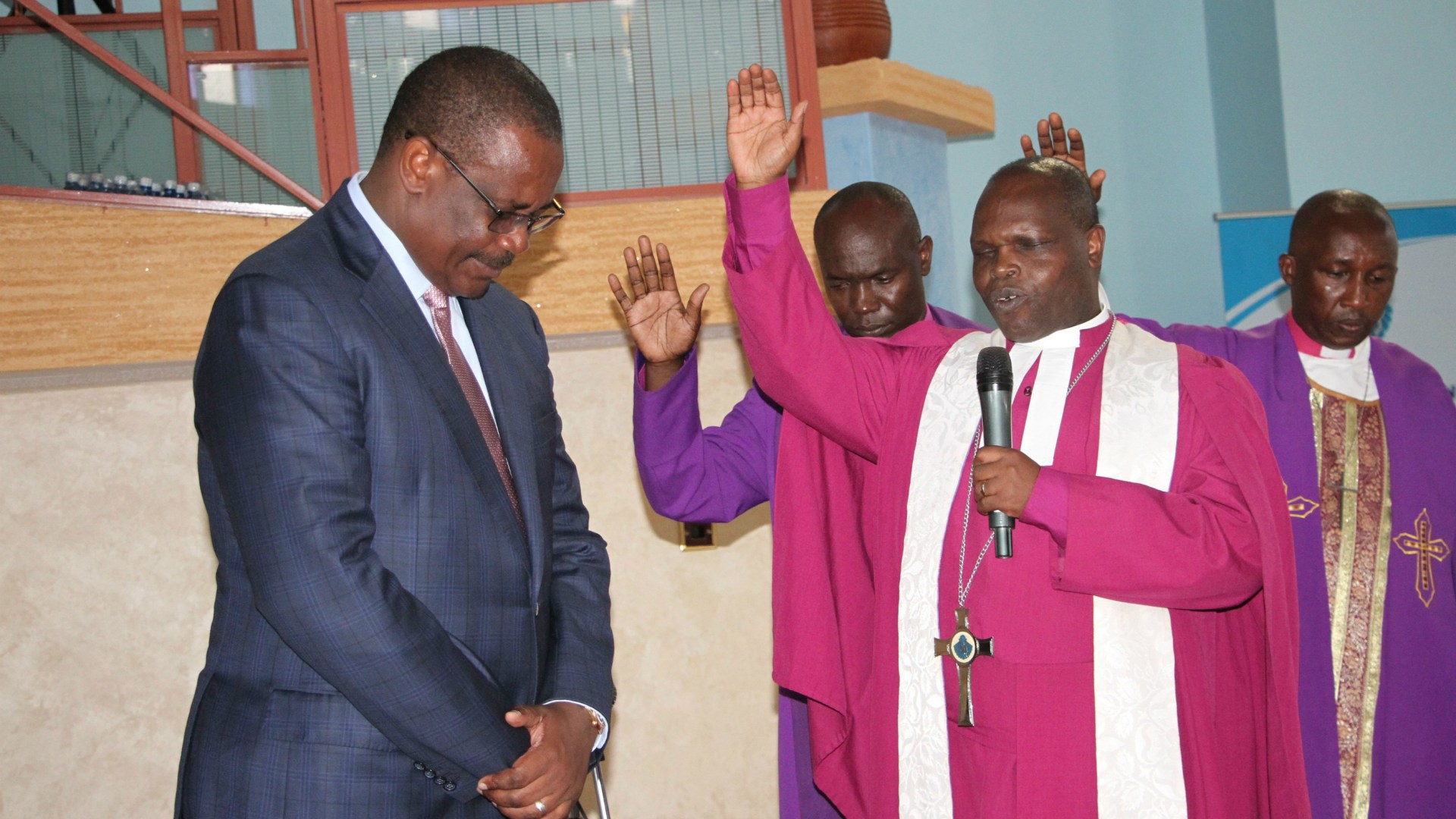
Holding a microphone, Joseph Ntombura, presiding bishop of the Methodist Church in Kenya, prays over former Nairobi Governor Evans Kidero (left) in November 2015.

Holding a microphone, Joseph Ntombura, presiding bishop of the Methodist Church in Kenya, prays over former Nairobi Governor Evans Kidero (left) in November 2015.

Christianity Today September 24, 2021
Fredrick Nzwili / RNS

Some churches in Kenya have barred politicians from addressing their congregations, saying campaigning during services disrespects the sanctity of worship.

The national Anglican, Presbyterian, Roman Catholic, and evangelical churches have all issued bans, as many politicians have begun early stumping for next year’s general elections and as COVID-19 public health measures have restricted how and where campaigning can take place.

The Methodists, however, are keeping the church doors open for all.

Joseph Ntombura, presiding bishop of the Methodist Church in Kenya, has said his church is not dissenting from the effort, but is taking a different approach. The bishop said shutting the doors to politicians would mean discriminating against some of its members.

“The church is for all people,” Ntombura told RNS in a telephone interview. “Human beings are political, so there is nothing wrong with inviting the politicians in church.”

According to the bishop, congregations need to hear the views of politicians on issues of national interest, such as the sharing of resources. In the past, Ntombura said, the church has invited other experts to speak to congregations on important matters, and politicians are no different.

“Some of the politicians are our pastors,” said Ntombura.

Kenya is about 85 percent Christian. About 33 percent of that group are from historic Protestant denominations and about 21 percent are Catholic. The rest belong to evangelical, Pentecostal, and African denominations. Muslims make up 11 percent of the population.

In issuing the bans on politicking in church, denominations have said they feared that church services would become campaign rallies and that candidates would use language bordering on hate speech in an attempt to win votes or sway the views of congregants. In the past, some politicians have hijacked church services in order to sell their agendas or to criticize their opponents. Some have even appeared in churches with huge sums of money as offerings or as funds for church projects.

The no-politicking effort, started by the Presbyterian Church of East Africa in July, gained momentum this month when Archbishop Jackson Ole Sapit, the Anglican primate of Kenya, announced his church’s ban.

“Everyone is welcome in the churches, but we have the pews and the pulpit,” said Ole Sapit on September 12, during the ordination of Kenya’s first Anglican woman bishop. "The pulpit is for the clergy and the pews for everyone who comes to worship."

On September 15, the Roman Catholic bishops said their places of worship and liturgy were sacred and were not political arenas. They urged politicians to attend Mass just like any other worshipers.

On September 17, the Evangelical Alliance of Kenya (EAK) announced a similar ban, citing “many instances” of church leaders neglecting their “duty to ensure that the freedoms of all worshipers are protected without infringement by visiting politicians.”

“Politicians should not be allowed to exploit and abuse their privilege as leaders by violating the place of worship through politicking in church,” said EAK chairman David Oginde and secretary general Nelson Makanda in a press release. “This is a dishonor to God, defiles the sanctity of worship, and violates the rights of other worshipers.”

“Any address by such leaders should only be limited to greetings and not politicking in church. Different church traditions have different ways of acknowledging visitors; such tradition should be kept as long as it honors the sanctity of worship,” stated the EAK leaders. “Offerings and gifts given by visiting politicians should be treated as any other offering in obedience of the scripture that the left hand should not know what the right has given (Matt 6:3).”

Analysts say the churches are seeking to reclaim their position as “honest arbitrators” in a country where elections often generate violent conflicts.

The most deadly came in December 2007 and January 2008, when two months of ethnic fighting left at least 1,000 people dead and more than 600,000 displaced from their homes. Among them, 30 people, mainly ethnic Kikuyu from Kenya’s largest tribe, were burned alive in an Assemblies of God church in Kiambaa Village in Eldoret.

Henry Njagi, program and information manager at the National Council of Churches of Kenya, said resistance to church guidelines on political speech risks a repeat of the events of 2008.

“When things went wrong, they turned around and accused the church of being silent and abandoning Kenyans,” said Njagi. “So right now is a call on political actors, aspirants, and other stakeholders to listen to the church … and stop toxic politicking.”

Though the politicians have not been as present at mosques, Muslim leaders say they are supporting the ban.

“I support the Christian leaders. Such a ban is long overdue,” said Sheikh Hassan Ole Naado, national chairman of the Supreme Council of Kenya Muslims.

He added that Muslims were not facing the issue at the moment.

“When you go to a place of worship, you know what you are supposed to do. They are taking advantage of people who are gathered for worship. It should not happen in the first place,” said Ole Naado.

On Thursday, Ole Sapit also banned Anglican churches from conducting harambee (a Swahili word meaning “all pull together”) community fundraisers during worship services, according to Capital News.

Additional reporting by Jeremy Weber

News

Sodom Destroyed by Meteor, Scientists Say. Biblical Archaeologists Not Convinced.

Naturalistic explanation for biblical miracle doesn’t resolve questions of chronology at Tall el-Hammam excavation in Jordan.

A comparison of how a cosmic fireball similar to a 1908 Siberia one would have covered the Dead Sea area.

A comparison of how a cosmic fireball similar to a 1908 Siberia one would have covered the Dead Sea area.

Christianity Today September 24, 2021
CC-BY-4.0 | Bunch, T.E., LeCompte, M.A., Adedeji, A.V. et al. A Tunguska sized airburst destroyed Tall el-Hammam a Middle Bronze Age city in the Jordan Valley near the Dead Sea. Sci Rep 11, 18632 (2021). https://doi.org/10.1038/s41598-021-97778-3

A fireball exploded over the northern shore of the Dead Sea around 1650 BC, according to the findings of a multidiscipline team of 21 scientists. The explosion laid waste to the entire lower Jordan River Valley, sowing Dead Sea saltiness that ruined agriculture for several hundred years.

The huge 100-acre city located at what is today called Tall el-Hammam east of the Jordan River was destroyed, along with a dozen other smaller cities and multiple small villages. They were abandoned and uninhabited for hundreds of years.

The highly technical report—published this week in Scientific Reports, an online peer-reviewed journal, and already accessed more than 100,000 times—noted in conclusion the similarity to the biblical account of the destruction of Sodom and Gomorrah: “There are no known ancient writings or books of the Bible, other than Genesis, that describe what could be construed as the destruction of a city by an airburst/impact event.”

However, amid the wave of headlines, the unofficial peer reviews on social media from a number of archaeologists with varying degrees of familiarity with the Tall el-Hammam excavation were highly skeptical. As Christianity Today reported seven years ago, few archaeologists outside of those working on the excavation team believe that Tall el-Hammam is Sodom.

“In my opinion, this is an example of evidence being marshaled to support the identification of the site as Sodom, as opposed to letting the site speak for itself and then—if the evidence supports it—put forth a proposal of it as Sodom," archaeologist Robert Mullins told CT. Chair of the Department of Biblical Studies at Azusa Pacific University, he currently codirects the excavation at Abel Beth Maacah, a site in northern Israel. He is also listed on the Tall el-Hammam excavation website as a ceramic consultant.

Mullins, along with other evangelical archaeologists and Bible scholars, cite chronology as a major issue with the Sodom identification. The Bible’s internal chronology places Abraham and the events in his life, including the destruction of Sodom and Gomorrah, three to four centuries earlier. At 1650 BC, the Israelites were in Egypt, with the Exodus still 200 years in the future.

Pottery is a key tool for archaeological dating. Mullins, reviewing Tall el-Hammam pottery, saw a lot of 16th-century BC pieces, which seems to indicate the city was destroyed after the date of the airburst fireball described in the article.

Archaeologists Steve Ortiz, director of Lipscomb University’s Lanier Center of Archaeology, agreed that while Tall el-Hammam is an important site, its destruction date is too late to fit the Sodom scenario. He dismissed the fireball hoopla to CT. “[Their] destruction does not look any different than any other destruction,” he said. “We have Assyrian and Egyptian destructions at Gezer that looks just as dramatic.”

Israeli archaeologist Aren Maeir of Bar Ilan University noted a lack of citations to other studies of the archaeology of destruction and thought the destruction the report described was not that unusual. “I see some things that remind me of phenomena that we have in the Iron Age IIA (1000–925 BC) destruction at Tell es-Safi/Gath (e.g. vitrified or “melted” bricks, ultra-high temperatures, and other things)—a destruction that is most likely caused by the conquest and destruction of the site by Hazael of Aram,” he said. Hazael’s attack on Gath is reported in 2 Kings 12:17.

The archaeological disagreement over Sodom centers not only on the chronology but also on the location. Sodom is conventionally located more to the south end of the Dead Sea.

Steven Collins, the codirector of the Tall el-Hammam excavation, often quotes Genesis 13, where Abraham and Lot camped between Bethel and Ai and looked down on Sodom, which seems to favor its location north of the Dead Sea. But Mullins said Collins dismisses Genesis 18:16. “Abraham is at Mamre looking down at Sodom; one cannot see Hammam from the Hebron area,” he observed.

Whether it’s a fireball that destroys a city, a mighty wind that holds back the waves of the Red Sea, an ark that landed on a mountain after a global flood, or celestial events that herald a royal baby’s birth, there’s a tendency to look for naturalistic explanations for biblical miracles—as if that would prove the Bible to skeptics.

The scientists who wrote this report on the Jordan River Valley fireball state, “An eyewitness description of this 3600-year-old catastrophic event may have been passed down as an oral tradition that eventually became the written biblical account about the destruction of Sodom.”

If the Bible is just a collection of oral traditions that were puzzled together centuries later, perhaps the fireball would fit. But a century and a half of increasingly detailed archaeological investigation shows time and again that the historical framework of the biblical story holds up back to the time of Abraham.

“There is no question that this is an amazing site,” Mullins concluded. All of the archaeologists would agree with that. “But they are going to have to put forth more evidence that it’s Sodom.”

Gordon Govier is host of The Book and The Spade podcast and editor of ARTIFAX magazine.

News

How the Umbrella Movement Spurred Hong Kong’s Digital Witness

Faced with political division and government oversight, the church began to develop richer and wider-reaching online public theology.

Christianity Today September 23, 2021
Chris McGrath / Getty Images

This month marks the seventh anniversary of the Umbrella Movement and the second anniversary of the Hong Kong government’s official withdrawal of its controversial extradition bill.

For many Hong Kongese, these are bittersweet memories. On the one hand, the series of pro-democratic movements since 2014 show the Hong Kongese’s urge for a better society that goes beyond the capitalistic ethos of the city; on the other, those movements became a Pandora’s box of civil unrest. Two years ago, 2 million people protested against the extradition law in June, and the implementation of the national security law the year after led to mass arrests and a crackdown on democratic parties.

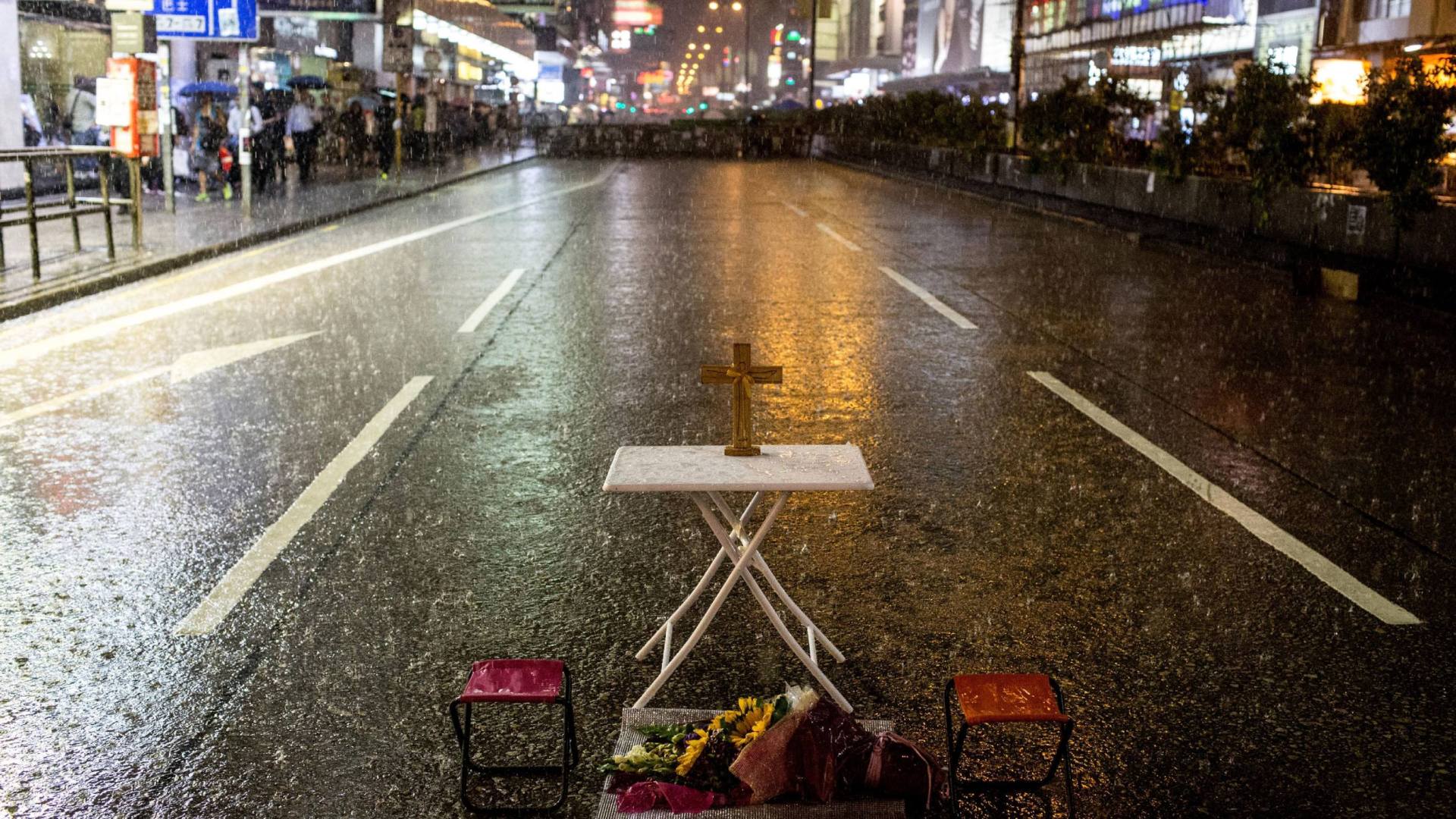
Hong Kong Christians famously took to the streets in prayer and in song as part of the demonstrations. But what international audiences may have not seen is how the political developments in Hong Kong launched the church into the digital public sphere too. Facing tighter religious freedoms, Christian leaders have grown their presence online and on social media.

Even as the Hong Kong diaspora has scattered across the globe, leaders have taken to the digital space as a platform to show solidarity to the persecuted and to instruct followers to persevere through difficult times. The digital public theology they’ve developed over the past seven years has grown into a witness for the global church.

Writing on the Mid-Autumn Festival, the day Hong Kong families tend to reunite (tuan yuan) to see the full moon (yue yuan, a play on words for “reunion”), I think of the persistent prayers for our brothers and sisters are suffering on the other side of the world and our compassion for those who cannot see their families due to exile or imprisonment.

The Umbrella Movement (2014–2019)

In the mid-2010s, protestors in Hong Kong relied on online platforms such as Facebook, Firechat, and Golden Forum to communicate their strategies, which required immediate response during the movement; half of those involved in demonstrations were under 25.

The move inspired a shift among pastors and Christian leaders as well, as they intentionally began to develop a digital public theology for the first time. They addressed what was happening around them from a Christian perspective.

Many reflected on the meaning of the separation of church and state, which is stressed in most evangelical denominations in Hong Kong. Because of the wide access online, their teachings extended to reach those who wouldn’t usually read Christian articles in traditional media.

Like the chasm during the 2016 US election, factions formed online during and after the movement, with Christians on both sides. The pro-democratic activists became the “yellow team” because of their frequent use of a yellow umbrella as a symbol—umbrellas being a tool for self-defense when protestors were attacked by tear gas. The “blue team” was composed of those who supported police, who wore blue uniforms and tried to suppress “violence” through tear gas.

Both sides frequently received memes and news in their WhatsApp chat groups, but the yellow team tended to be digital natives who generated content on the pro-Umbrella Movement Facebook groups.

The Umbrella Movement had an immediate effect in churches. Many protestors struggled to stay at congregations that maintained silence in an effort to uphold the separation of church and state. This inspired the establishment of parachurches, such as Umbrella City Cyberchurch (UCC), which launched in 2014, and Flow Church, which began in 2018.

The advantage of establishing these parachurches is that they provide flexibility for pastoral leaders to work alongside other local churches without being bound by existing denominations with fixed political ideologies.

“The Umbrella City Cyberchurch intends to construct, reflect, and practise a ‘Umbrella Theology,’” UCC writes on its Facebook page. “The UCC aims to improve and deepen the Umbrella Revolution as a valued revolution, to reconstruct Hong Kong’s core values.”

These parachurches tend to be more tech savvy and are active on social media, providing live-streamed services for young Christians who question the role of churches in the movement.

The Umbrella Movement also raised the issue of decentralization, criticizing authority figures who dominated the direction of the movement. While this is true for political ideologies, it is arguable whether Christian communities embrace the concept of decentralization wholeheartedly.

Digital theologian Heidi Campbell has highlighted the importance of charisma among pastoral figures online; those who emerged as key opinion leaders after the movement were usually pastors or theologians that already held some sort of authority among their communities.

I do not perceive digital media and especially dynamics among Christian groups as a total decentralization, but the shift of public theology online was observable. For example, the lead pastor of Flow Church, John Chan, continues to use his personal Facebook page, theologia autumnitas rosea est (theology is pink autumn), as well as Flow Church’s Facebook page to narrate his struggle to be a pastoral leader after the Umbrella Movement.

His reflections online resonated with church leavers who could not express their political views freely in physical churches, where politics became a taboo subject. In some ways, the shift helped create a platform for protestors to reflect on a theology that engages with public issues after the movement.

The Anti-Extradition Law Protests (2019–2020)

June 2019 became the kairos for Christian leaders to speak out, due to the proposal of extradition laws in Hong Kong that would have imposed China’s laws on the city and affected religious freedoms. Outdoor prayer meetings were promoted on social media, which attracted both Christians and non-Christians.

Since religious assembly was exempted as legal gatherings under Hong Kong laws, protestors joined Christians to perform “Sing Hallelujah to the Lord” near the Hong Kong government complex as an act of resistance. The public presence of Christians was amplified at the protest site, as well as through livestreams on Facebook.

Moreover, digital media has become a platform for Christian groups to express their public theology, not only because of the frequent usage of social media during the social movements but also because of the restrictions on in-person activities due to COVID-19 since January 2020.

For example, the Hong Kong Pastors Network, comprising pastoral leaders of different denominations, issued the statement “Hong Kong 2020 Gospel Declaration” online to challenge authoritarianism in May 2020, which highlighted the importance of justice as well as the proclamation of gospel. The statement can be compared to the 1934 Barmen Declaration from German pastors against Nazis ideology.

“In the face of a totalitarian regime that distorts facts, controls the media, and buries the Truth, the Church courageously rejects all falsehood, and points out what the regime has done wrong,” read one point.

Protestants become more vocal about Christian engagement with the social movements. Sun Fuk Channel (“Bitterly Blessed” Channel), an online Christian show, invited Protestant leaders from different denominations to discuss the Hong Kong protests. Mission Citizens, a campaign consisting of pastoral leaders, laypersons, and academics, also initiated a series of prayer movements and online talks to bridge the gap between the blue and yellow teams.

While the Umbrella Movement had already caught media attention globally, the campaigns in the following years focused much more on international attention, with several crowdfunding advertisements placed in major newspapers. Originally these were created by protestors who wished to raise concerns to those who support democracy all around the world.

But as the protests proceeded, Christians also followed this kind of digital outreach to raise prayer support for both the Hong Kong diaspora and, through translated prayers, for Christians who speak other languages. This led to a more global outlook of Hong Kong public theology, where the Hong Kong diaspora also helped to advance the Hong Kong protests and construct the pro-democratic discourses.

Post-National Security Law (2020–Present)

Democratic campaigns in Hong Kong quieted after the national security law began being enforced last July. Participants feared getting arrested. Activists had moved overseas due to political persecution.

However, because of the emphasis on international attention, the social movements about Hong Kong have become more transnational, such as the continuous campaign of democracy in Hong Kong by Nathan Law, the youngest elected lawmaker in Hong Kong history and an asylum seeker in the United Kingdom.

Several Protestant leaders, after moving overseas, continue to build on the existing theological dialogue to nurture Christians online. For these leaders, such as Rev. Roy Chan of England Good Neighbour Church and Rev. Yeung Kin-keung (d. September 15, 2021) of Hong Kong Christian Church in Edinburgh, it is more about “telling the truth of the gospel” than about highlighting the superiority of their identity as yellow team Christians.

Rather than saying that the protests are over, I think of the way they have scattered Hong Kongese all around the world. In my current city, Edinburgh, I see that half of the protestors who join the in-person rallies about the situation in Hong Kong are Protestants or at least associated with the Chinese churches here.

While English media tends to report the development of pro-democratic activists, it should be stressed that the blue team is also quite active. Vancouver-based Christian philosopher Leung Yin-shing is a popular guest speaker among Chinese media in the diaspora such as the Media Evangelism, despite his comments that protestors were too violent when they fought back against the triads during the 721 mob attack in July 2019.

On YouTube, at least half of the results covering the protests in Chinese condemn the participants as rioters or cockroaches. Whether or not one perceives those videos against the protests as propaganda, the digital sphere is not as pro-democratic as one may think.

As Christians, we are blessed with free will granted by God, as well as the freedom of speech online. We may also discern how we can use them sensibly to be the witness of God. While I am not a huge fan of the phrase “silence is golden,” which has damaged Hong Kong churches since the Umbrella Movement, we may ponder whether our online speech is useful for building others up (Eph. 4:29).

We may also wonder whether sharing particular news stories online is beneficial for our followers, especially since some of those can be fake news or with false condemnation. This will be a continuous lesson for Hong Kong Christians, as well as my friends in the UK or the US where the digital space is further dichotomized due to political differences.

The Post-1984 Life of Hong Kong Christians

Indeed, Hong Kong Christians will face further persecution, which is already built up by the attack of Ta Kung Po, the state-owned newspaper in Hong Kong. For many, life in the present is much worse than 1984 Hong Kong, the year Margaret Thatcher and Deng Xiaoping signed the Sino-British Declaration to confirm Hong Kong’s return to China in 1997—for the latter faced only imaginary fear, but the former’s fear is immediate.

Following the cross removal of Zhejiang churches in the mid-2010s, Hong Kong Christians often wonder when they will be the next, especially as Xia Baolong, a figure who is instrumental in the removal campaign in Zhejiang, has been Director of the Hong Kong and Macau Affairs Office since February 2020.

The pursuit of peace in Christians’ hearts, as well as the work produced by this mentality, will differentiate their witness from people with other beliefs. In the Hong Kong protests, the phrase “fear, then you will lose your whole life” (qie, ni jiu shu cheng shi), from a 2013 movie Unbeatable, is often quoted to express the urgency of protesting for Hong Kong’s future.

I find this phrase to be rather Christian: If fear dominates your life, it seems to contradict the belief that God provides guidance and peace. Living up to this motto will not be easy, but it will become essential as events develop in Hong Kong.

When traditional media in Hong Kong fails to provide comprehensive views on certain news, the shift to digital media will become more evident in the coming months and will be accelerated due to the mass migration of Hong Kongese to other parts of the world.

Online engagement by Christians will become more significant to further develop a digital public theology for Hong Kong, whether it is for evangelism or for providing a space for those who are traumatized by the social events in Hong Kong.

To be the channel of peace, while continuously speaking the truth, will be the foremost responsibility for all Christians in the digital space. I welcome brothers and sisters all over the world to pray for Hong Kong Christians for their witness online and offline.

Calida Chu is a Hong Kongese theologian and Teaching Fellow at the School of Divinity, University of Edinburgh. She can be found on Twitter at @calidachu.

News

Josh McDowell Steps Back from Ministry After Race Remarks

“I made comments about race, the Black family, and minorities that were wrong and hurt many people.”

Christianity Today September 23, 2021
Set Free Global Summit / Religion News Service

Best-selling Christian author and speaker Josh McDowell is stepping back from ministry following comments he made at a recent meeting of the American Association of Christian Counselors.

On Saturday, he had denounced the idea of systemic racism at the national gathering, saying Black Americans and other minorities were not raised to value hard work or education.

The talk, entitled “The Five Greatest Global Epidemics,” identified a series of threats McDowell claims face the Christian church. The first, he said, was critical race theory, an academic field of study on the nature of systemic racism. Known by the acronym CRT, critical race theory has become controversial among Christian conservatives and political conservatives alike.

McDowell told Christian counselors that CRT “negates all the biblical teaching” about racism—because it focuses on systems rather than the sins of the human heart and said today’s definition of “social justice” is not biblical.

“There’s no comparison to what is known today as social justice with what the Bible speaks of as justice,” he said. “With CRT they speak structurally. The Bible speaks individually. Make sure you get that. That’s a big difference.”

He went on to say not all Americans have equal opportunities to succeed.

“They don’t, folks,” he said in his speech. “I do not believe Blacks, African Americans, and many other minorities have equal opportunity. Why? Most of them grew up in families where there is not a big emphasis on education, security—you can do anything you want. You can change the world. If you work hard, you will make it. So many African Americans don’t have those privileges like I was brought up with.”

He added that the Bible only focuses on individual sin, not structural sin.

McDowell’s comments were first noted on social media by Christian college professor Aaron New. After New drew attention to those comments, a recording of McDowell’s speech was removed from the AACC website, where all the speeches and presentations at the conference are offered for sale.

Religion News Service obtained a copy of the recording and verified McDowell’s remarks.

After being contacted by Religion News Service, McDowell issued a statement on social media apologizing for his remarks, saying they do not reflect his own beliefs. He said his comment about minority families “does not reflect reality.”

“Racism has kept equality from being achieved in our nation,” he said.

McDowell’s ministry is affiliated with Cru, a national campus ministry founded by the late Bill Bright, a legendary figure among evangelicals. Cru, formerly known as Campus Crusade for Christ, has faced criticism by some long-term staff because of its recent focus on issues of race and diversity. A group of staff has accused Cru of “embracing a secular system of ideas that divides humans into victims and oppressors.”

https://twitter.com/josh_mcdowell/status/1440780011590483970

On Wednesday, McDowell, 82, announced that he was stepping back from ministry and speaking engagements in the aftermath of his comments at the conference to enter a “season of listening.”

“At a recent conference, I made comments about race, the Black family, and minorities that were wrong and hurt many people,” he said. “It breaks my heart to know what deep pain I have caused.”

Fierce debates over critical race theory and social justice have become commonplace among American evangelicals in recent years. The presidents of the Southern Baptist Convention’s seminaries have denounced CRT as incompatible with the denomination’s statement of faith—a claim that led a number of high-profile Black pastors to leave the denomination—and the debate over CRT was a key topic at the SBC’s 2021 annual meeting.

A nonprofit founded by former Trump official and Wheaton College graduate Russ Vought has published a handbook labeling CRT as unAmerican and outlining steps for barring its use in local schools.

Theology

Don’t Wait for Hope. Work for It.

Even during a pandemic, we have a duty to anticipate God’s goodness.

Christianity Today September 22, 2021
Nataliia Chubakova / Getty Images

The first thing to go was the trip she’d earned to Boston. Then it was her summer internship at the local theater company, followed by the business course she wanted to take for college credit. Eighteen months of disappointments finally spilled over last week as my 17-year-old and I were discussing a potential graduation trip. “Mom,” she interrupted, her voice quavering ever so slightly, “I can’t talk about this. I can’t handle getting excited. It just hurts too much when things get canceled.” My daughter’s comments reminded me of the pandemic’s collateral damage: the ability to dream, plan, and hope for the future.

As Christians, we believe hope is an important part of our shared faith as well as our personal walk. But Scripture suggests something more radical: Hope is not the privilege of the naturally optimistic; it is the responsibility of all who believe. Hope is the means by which we align not simply our plans but also ourselves with God. It is how we move toward the future he is preparing for us in order to join him there.

Perhaps the most-often quoted (and most misunderstood) passage about looking to the future with hope is Jeremiah 29:11, “‘For I know the plans I have for you,’ declares the LORD, ‘plans to prosper you and not to harm you, plans to give you hope and a future.’” Christians often interpret this as a blanket promise that “good things are right around the corner.” If we just keep a positive mental outlook, we can know that God has #blessings in store. But contextually, this promise is given to the Jews recently exiled to Babylon. The faithful remnant had heeded Jeremiah’s warnings to submit to the coming judgment, and now in Babylon, they receive a letter from him telling them to settle down there. In the wake of uncertainty and loss, they’re asked to make long-term commitments like marrying, building houses, and planting gardens. Imagine how hard it would be to build a house when each stone reminds you of the ones you’ve lost. How difficult to put seeds in the ground, knowing the time they take to mature and knowing that you might still be in Babylon when they do. How difficult to create marriages and families, to bring new life into the world when your loved ones have just been taken from it.

God’s promise is no refrigerator magnet. It’s a call to the hard work of hope. This labor of expectation, as we might call it, carries us forward in multiple ways.

At the very least, it teaches us to trust a Person and not our plans. As James puts it, we have to say, “If it is the Lord’s will, we will live and do this or that” (4:15). It means leaning into the truth that “humans plan their course, but the LORD establishes their steps” (Prov. 16:9). But trusting God with the future does not mean denying our present difficulties or ceasing to plan for the future ourselves. Just as we must avoid shallow positivity, we must also avoid fatalism, especially when clothed in spiritual language. During a recent press conference, for example, Mississippi governor Tate Reeves suggested that Southerners were less scared of COVID-19 because they believed in heaven. “When you believe in eternal life—when you believe that living on this earth is but a blip on the screen,” he said, “then you don't have to be so scared of things.” While our hope in God is an eternal hope, it does not bypass our present life as a “blip on the screen.” It is as relevant to our current experiences as it is to the future, precisely because our earthly lives hold their own expectations and promise: growing old to see grandchildren, completing a passion project, or establishing a legacy for those who come after you. Hope does the hard work of wanting these things, even as we entrust them to God. Here is something even more astounding. Ecclesiastes chapter 11 suggests that surrendering to God’s plans actually leads to more planning, more expectation, and a widening sense of possibility in this present life. Rather than leaving you helpless, putting your trust in God gives you what you need to keep working and hoping. “Whoever watches the wind will not plant; whoever looks at the clouds will not reap,” writes the Preacher. “[But] as you do not know the path of the wind, or how the body is formed in a mother’s womb, so you cannot understand the work of God, the Maker of all things” (Ecc. 11:4–5). Those who are waiting for “just the right time”—when everything is perfect and there’s no threat of loss—will never plan or plant anything. But the fact that we don’t know what the future holds also means we don’t know which good things God is planning. So, the Preacher concludes, “sow your seed in the morning, and at evening let your hands not be idle, for you do not know which will succeed, whether this or that, or whether both will do equally well” (v. 6).

It’s precisely because we don’t know God’s specific plans that we must get busy imagining a hundred different ways that he could possibly be at work. Because while some (even many) of our plans are bound to fail, God’s won’t. And with that in mind, we can step out in hope and expectation. As Andy Crouch recently notes, “The antidote for so many of our anxieties … is paradoxically to enter a more spacious landscape of risk, where anxiety will be lower because our trust, our obedience, and ultimately our maturity are higher.” By ceding control of the future to God, we guarantee that we will have a future. It may not be the one we anticipate or even the one we would choose, but we’re emboldened knowing that his plans cannot be thwarted. That’s the surprising nature of Christian hope. It is a hope that passes through suffering and loss because it knows that God establishes our steps. It is the same hope that Jesus displayed when “for the joy set before him he endured the cross, scorning its shame, and sat down at the right hand of the throne of God” (Heb. 12:2).

Ultimately, the Jewish exiles could make long-term commitments like marrying, building homes, and planting gardens not because they’d given up hope of returning to Israel but because they put their hope in God. They trusted that, one day, he would fulfill his promises to them when and how he saw fit. And in the meantime, they could move forward with the lives he’d given them. They could plan with expectation because they trusted that God plans with expectation. So too, “people who believe in the resurrection, in God making a whole new world in which everything will be set right at last,” says N. T. Wright in Surprised by Hope, “are unstoppably motivated to work for that new world in the present.” This doesn’t lessen the grief of scuttled plans or missed opportunities. It means our trust in God grows. As it does, and as he proves himself faithful, our ability to hope will emerge once again. By entrusting the future to him, we find our vistas of possibility expanded and our dreams renewed. We find ourselves able to return to the work he’s given us, believing that those who “sow with tears will reap with songs of joy” (Ps. 126:5).

Hannah Anderson is the author of Made for More, All That’s Good, and Humble Roots: How Humility Grounds and Nourishes Your Soul.

News
Wire Story

Missionaries Want to Carry the Gospel to the Ends of the Earth. Not COVID-19.

Southern Baptists become first to require vaccines as agencies navigate health requirements and travel restrictions.

Christianity Today September 22, 2021
Maura Griesse / Lightstock

COVID-19 vaccine refusal rates may be high among white evangelical Christians, but the International Mission Board—which deploys thousands of missionaries—is not hesitant about the shot.

The global agency of the Southern Baptist Convention, the largest evangelical Protestant denomination in the US, announced this month it is requiring vaccinations for missionaries they’re sending into the field amid the pandemic.

The IMB may be the first US missionary agency known to have such a mandate, according to leaders in the field, as other faith groups approach the issue in a variety of ways including limiting where people can serve and making considerations for uneven global access to the vaccines.

“This is a very common-sense decision,” said Ed Stetzer, a Southern Baptist who is dean of mission, ministry and leadership at Wheaton College. “Mission-sending agencies from the United States have the real opportunity to be vaccinated, and they’re going to places around the world that don’t.”

The IMB policy applies to both current and future missionaries as well as some staff members. Among the reasons it cited for the measure are health concerns and the fact that increasing numbers of countries are implementing their own vaccine requirements—some field personnel have reported needing to show proof to board airplanes and subways or enter restaurants and malls.

In a statement announcing the policy, IMB leaders acknowledged that it could be a deal-breaker for some people considering missionary work or currently serving with the organization.

Allen Nelson IV, a pastor who leads a Southern Baptist congregation in Arkansas, said he is not against vaccines but is completely opposed to mandates for missionaries.

“This is something that must be left up to a person’s own conscience, research and discussions with a doctor, as well as their particular ministry context,” Nelson told The Associated Press.

Among religious groups that have stopped short of issuing vaccine mandates is The Church of Jesus Christ of Latter-day Saints, widely known as the Mormon church, which is giving unvaccinated missionaries assignments in their home countries.

The United Methodist Church, for its part, strongly encourages missionaries to get vaccinated but does not require it. That is partly because availability is not consistent around the world, according to Judy Chung, executive director of missionary services for the denomination’s Global Ministries.

“We have discussed how to promote vaccination without making a mandatory requirement,” Chung said, “because some may not have access to that yet.”

The denomination currently has about 240 full-time missionaries serving in 70 countries, and the most recently deployed cohort of about 40 has a vaccination rate around 80 percent.

“We want to make sure that our missionary population are safe so that they can focus on the mission work that has been assigned to them,” Chung said. “We want to make sure that we are not causing harm as we engage in mission.”

A key question for US-based mission groups is whether they will fall under the Biden administration’s recently announced rule that companies with more than 100 employees must require workers be vaccinated for the coronavirus or undergo weekly testing.

If they do, Ted Esler, the president of Missio Nexus, an association that includes hundreds of missionary agencies in the US and Canada, said about 30 percent of those agencies could be affected. He thinks they would comply with the federal mandate but said the issue is not currently stirring much discussion.

Ultimately, he noted, organizations’ internal rules may be rendered moot by vaccine entry requirements that many countries have instituted for visitors.

“Whether you have a policy or not,” Esler said, “if you’re going to serve cross-culturally in another country, you’re going to be faced with the government regulation.”

A June survey by the Public Religion Research Institute showed COVID-19 vaccine hesitancy decreasing and acceptance growing, but refusal rates holding steady. It also found significant variance of opinion between people from different faith traditions.

White evangelical Protestants had the highest vaccine refusal rate at 24 percent and among the lowest acceptance rates at 56 percent. By comparison, acceptance rates stood at 56 percent for Hispanic Protestants, 65 percent for Latter-day Saints, 66 percent for Black Protestants, 69 percent for other Protestants of color, and 74 percent for white mainline Protestants.

The IMB has had vaccine requirements for other diseases in place since the 1980s, and it says some have chosen to skip international service because of it.

Esler, who served as a missionary in Bosnia in the 1990s with the Pioneers organization, said he had to be inoculated against diseases like diphtheria, polio, tetanus and typhoid before he could go.

Esler wasn’t eager to get a COVID-19 vaccine and is hesitant to advise others to roll up their sleeves. But he got vaccinated because he is continuing to travel.

“From my perspective, this is an issue more because of the fact that it’s COVID-related than it is vaccine-related,” Esler said.

“It’s unfortunate that the COVID vaccine here is controversial and rejected by some,” he added, “when in other places it would be coveted and highly sought-after and they cannot get it.”

News

SBC Executive Committee Balks at Directive to Open Up to Abuse Investigation

Leaders are still debating whether to hand over privileged materials as survivors and the majority of their own denomination have requested.

Christianity Today September 21, 2021
Brandon Porter / Baptist Press

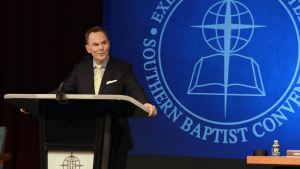
Months after the Southern Baptist Convention voted for a third-party investigation into how its Executive Committee responded to abuse allegations, leaders failed to adopt the convention’s terms for the process, deferring to ongoing negotiations between leaders and a sexual abuse task force.

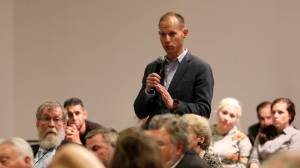
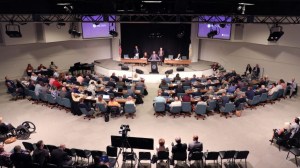
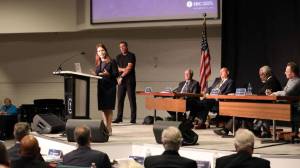
The two-day proceedings in Nashville highlighted growing turmoil in the nation’s largest Protestant body and disappointed victims who had held out hope the convention would adopt a thorough outside review to address its missteps.

Still up for debate is whether the Executive Committee (EC) will comply with the convention’s directive to waive attorney-client privilege to allow investigators to obtain relevant documents from EC members and staff.

The majority of the EC voted against doing so, with several citing the “fiduciary duty” to protect the entity and the denomination as a whole.

“We grieve yesterday’s vote by the Executive Committee, who in unprecedented fashion prohibited the will of the messengers for an open and transparent investigation,” a dozen EC members—including Jared Wellman, an outspoken advocate for victims, and Rolland Slade, the EC chairman—said in a statement. “It is our opinion that the failed vote only justifies the need for an open investigation.”

After consulting with additional legal counsel who reportedly advised against waiving privilege, the EC voted to take another week to negotiate on access to privileged information. However, the group also agreed to fully fund the upcoming investigation up to $1.6 million.

“Not a win, but a step,” tweeted Florida pastor and EC member Dean Inserra, who was among the minority of EC leaders who spoke up to waive privilege. “I promise we tried.”

Southern Baptist Convention (SBC) president Ed Litton said Tuesday’s outcome “fell far short of the mandate expressed by the messengers.”

At their annual meeting in June, Southern Baptists approved forming a task force to oversee a third-party investigation of the EC’s abuse response. According to the motion, the investigation should follow “accepted best standards and practices,” including waiving privilege and releasing a public report of the findings; these specifications were seen as good-faith efforts to ensure the credibility of the process.

“If it’s not done in a way that the survivors have requested, then survivors won’t trust the results,” said Hannah-Kate Williams, who filed a lawsuit in August against the EC and other SBC entities and leaders for failing to investigate abuse allegations.

She attended the Nashville meeting along with several other survivors, wearing T-shirts with a quote from theologian Russell Moore: “Let’s Not Do Stupid Stuff.”

The move to investigate the EC came after leaked letters showed top SBC leaders—including Moore, who was then president of the Ethics and Religious Liberty Commission (ERLC), and J. D. Greear, then president of the SBC—detailing deep concern about mishandled abuse claims. Their correspondence documented ongoing concerns and gave support to the narratives victims had shared for years about their frustrations with reporting their abuse and official inaction when credible allegations against churches had been brought forward.

As EC member and Texas pastor Jared Wellman pointed out during Tuesday’s discussion, it has been a tumultuous few years for the EC, a prominent body of leaders that enacts SBC business outside the annual meetings. Former EC president Frank Page resigned in 2018 over a “morally inappropriate relationship”; longtime general counsel Augie Boto was barred from employment with any SBC entity as part of a settlement issued in February; and the EC-run Baptist Press mischaracterized the abuse of Jennifer Lyell, then a leader at Lifeway, by presenting it as an affair.

Ahead of the annual meeting, the EC initially opted to launch its own third-party investigation, but the convention voted to transfer oversight of that investigation to a task force appointed by its new president. The task force hired the same firm to oversee the review as the EC planned to—Guidepost Solutions—but emphasized that the EC can’t be the one to determine what information comes to light.

On Monday and Tuesday, the Executive Committee heard from task force chair Bruce Frank, a North Carolina pastor, and Julie Myers Wood, CEO of Guidepost. Both emphasized that the waiver of privilege was necessary to meet the terms of the convention’s motion and to signal that the investigation was trustworthy.

Ronnie Floyd, president and CEO of the EC, reiterated the group’s stance against “all forms of sex abuse, mishandling of abuse, mistreatment of victims and any intimidation of abuse survivors.” During the meeting, he encouraged members to work with the task force and Guidepost “in every way possible, but within our fiduciary responsibilities as assigned by the messengers.”

Those opposed to waiving privilege worried that the move would open up the EC and its members to litigation and possibly “bankrupt” the SBC. Joe Knott, an attorney and former EC secretary, spoke up to defend the EC’s responsibility for keeping SBC entities solvent. He favored moving forward and addressing attorney-client privilege “at the end.”

“If someone is hiding something, we want it out,” said Knott. “But there’s a way to do it without destroying our convention.” A member of the Conservative Baptist Network, he suggested the investigation would “vindicate” current EC president Ronnie Floyd.

The officers of the EC initially proposed a motion that factored in “fiduciary obligations” and wouldn’t require them to hand over privileged information. They said they believe there is “a workable path to achieve a full and fair investigation that does not sacrifice its responsibilities or jeopardize the future work of the Southern Baptist Convention.”

Many Southern Baptist pastors who saw waiving privilege as the right thing to do lamented how the deliberations seemed to downplay the importance of care for victims and transparency. Bruce Frank, the chair of the task force, repeatedly reminded the room of the significance and urgency of their decision.

Marshall Blalock, a South Carolina pastor and vice chair of the task force, said he was “deeply saddened by the spirit of the way this process has gone,” adding, “My heart also goes out to the many survivors of sexual abuse who had hoped this would pass without controversy.”

Survivor Tiffany Thigpen said the meeting was “excruciating to sit through.”

“They were not properly prepared for such a vote,” said Thigpen, who first reported her abuse to SBC leaders 30 years ago. “There were so many questions that should have been handled long before this meeting.”

The failure to waive attorney-client privilege was also seen as a blow to Baptist polity.

“Please understand the implications of this. They have just opened up the SBC to MASSIVE liability,” said Liz Evan, an attorney serving on the task force, writing for SBC Voices. “In every lawsuit against the SBC thus far, the SBC has been able to argue that we are a bottom-up organization, and therefore the SBC itself has no authority over or liability for what happens at the local church level. That ended today.”

The delay in decision on the attorney-client privilege element still leaves the possibility that the EC and the task force will arrive at a stalemate. Guidepost Solutions has until mid-May to look into how hundreds of staff and EC members addressed abuse over 20-plus years. Its report will go to the task force and then before the convention in June 2022.

Guidepost has experience with ministry investigations, as well as corporate cases, and is seen as committed to “trauma-informed care.” However, the firm has also garnered some criticism for its handling of a culture review of Ravi Zacharias International Ministries and an investigation into allegations of mishandling abuse by pastor Bryan Loritts.

Ever since the #ChurchToo movement began with testimonies from survivors like Jules Woodson and the reporting on hundreds of SBC abuse cases by the Houston Chronicle, the “watching world” has been paying attention to how the prominent denomination will address pastoral abuse and coverup in its ranks.

As a survivor, Williams said her primary reason for showing up in Nashville this week was “for the EC to know that we’re still here. … We’re still their family. We’re not going anywhere no matter how much they try to distance us from themselves—and we’re showing up in Anaheim,” where the SBC annual meeting is scheduled to be held next year.

Last week, the ERLC followed up on another meeting motion to conduct an audit and assessment around the extent of sexual abuse in the SBC. Without opposition, its leaders agreed to commission the audit and allocated an initial quarter-million dollars to the project.

Culture

Don’t Judge a Pentecostal Woman Based on Her Lashes

What pop culture gets wrong about charismatic women, and what “The Eyes of Tammy Faye” gets right.

Andrew Garfield as Jim Bakker and Jessica Chastain as Tammy Faye Bakker in the film "The Eyes of Tammy Faye."

Andrew Garfield as Jim Bakker and Jessica Chastain as Tammy Faye Bakker in the film "The Eyes of Tammy Faye."

Christianity Today September 21, 2021
Photo Courtesy of Searchlight Pictures. © 2021 20th Century Studios All Rights Reserved

In 1998, just over a decade after the scandal that landed Tammy Faye Bakker’s husband, Jim, in prison and crashed the couple’s ministry empire, Tammy Faye was a guest on Roseanne Barr’s daytime show. Roseanne’s opening line of questions quickly turned obnoxious, even cruel: “I want to know what in the heck is the makeup a metaphor for? What does it really mean? Because you know it’s really extreme.”

Tammy Faye, obviously stung, tried to deflect the insult. Roseanne persisted: “No, your makeup is extreme. It’s very extreme. … What does it mean to you? … Are you protecting yourself? You’re putting so much stuff on your face; you’re, like, hiding.”

Michael Showalter’s The Eyes of Tammy Faye (Searchlight, 2021), a film based on Fenton Bailey’s and Randy Barbato’s 2000 documentary of the same name, is no less interested in what her “look” meant and means. Jessica Chastain’s performance, however, affords Tammy Faye a dignity Roseanne’s interview did not. Hopefully, this difference signals a long-needed shift in how Pentecostals—and Pentecostal women, in particular—are represented in mass media and popular culture.

Broadly speaking, Pentecostals found Tammy Faye’s look especially troubling and dismissed her as a “cruisematic” clown, while evangelicals feared her willingness to engage with gay people and her sympathy for those dying with AIDS. The culture at large, insofar as it noticed her at all, laughed her off as a tongue-talking, Bible-thumping pseudocelebrity.

When I was young (I’m the same age as Jay, Tammy Faye’s son), reared by my parents and grandparents in an old-fashioned, blue-collar Pentecostal church in rural Oklahoma, the Bakkers had just reached the height of their influence. I remember preachers, male and female, routinely parodying Jim’s “health and wealth, name-it-and-claim-it” message.

But women, especially “rich and famous” women, received the brunt of the condemnation, especially, as I recall, Tammy Faye, Amy Grant, and Jan Crouch (who in the early ’70s cofounded the Trinity Broadcast Network with her husband, Paul, and the Bakkers). These women, among others, were reviled as “Jezebels,” the name given to that type of woman thought to lure men away from the truth by carnal wiles, leading the church—and, more importantly, the nation—into ruin.

Of course, as the Roseanne interview indicates, Tammy Faye was held up for scorn by the wider culture as well. But while she only seemed otherworldly to them, she epitomized “worldliness” for our religious community. In our circles, women and girls, no matter their ages, were not allowed to wear makeup, jewelry, or attention-grabbing outfits, and it would be hard even to suggest the intensity of our disdain for those who did.

Tammy Faye’s appearance struck us as proof that no sane person would ever want to be “worldly.” She seemed to us the face of everything wrong with everyone who rejected our way of life. “Without holiness,” the preachers shouted, “no man”—and certainly no woman—“shall see the Lord.” We knew not only what they meant but whom.

In the film’s telling of her story, it seems obvious that Tammy Faye’s look set the stage for white Pentecostals to begin to break free of their legalistic dress codes and that her vision began to make it possible for evangelicals to risk seeing gays and lesbians differently—more caringly, more compassionately.

She was, to be sure, “camp incarnate.” Much of what she said and did was not merely odd or showy but outright foolish, or even wrong, as she herself often acknowledged. But somehow, against all odds, she never entirely lost touch with her personhood, her humanity. And to its credit, the film tries to honor this about her, this childlike openness to the truth.

The Eyes of Tammy Faye, with all its faults and shortcomings, promises to change the way Tammy Faye is remembered. But the way that the characters around her are so relatively undeveloped is consistent with the ways Pentecostals as a group continue to be perceived and portrayed in mass media and pop culture.

The first season of HBO’s recent Perry Mason, for example, stars Tatiana Maslany as Sister Alice McKeegan, founder of the fictional Radiant Assembly of God and an unmistakable interpretation of the real-life Sister Aimee Semple McPherson, the phenomenal turn-of-the-century evangelist, faith healer, and founder of the Foursquare Church. In Maslany’s performance, Sister McKeegan, much like Chastain’s Tammy Faye, is shown to be deeply enigmatic and troubled, sexy and theatrical, but never reduced to burlesque or parody. Her fellow Pentecostals, however, including McKeegan’s tightfisted and highhanded mother, are not afforded the same respect.

Something similar happens in Them That Follow (Amasia, 2019), which tells the story of Mara Childs, a snake handler’s daughter in an Appalachian Pentecostal church who at last is forced by her own compassion to abandon her family, if not also her faith. Some Pentecostal communities can be toxic, as my own story proves. But the courage shown by Chastain’s Tammy Faye, Maslany’s Sister Alice, and Alice Englert’s Mara Childs surely had something to do with the spirituality and theology that shaped them. Why do the storytellers fail to make that plain?

Before she died, Tammy Faye said she hoped to be remembered for her look and for her walk with God. Showalter’s film reminds us that she should be remembered not so much for her blush and lipstick as for her character, not for her eyeliner and eyelashes but for how she saw the world.

Regrettably, the film not only fails to fully realize its supporting cast but also seems reluctant to acknowledge that her character and her vision were in some real sense Pentecostal, shaped in her experience of the Spirit and led by her love for Jesus. In the film, the more sympathetic she becomes, the more she distances herself from the church. In fact, however, something more like the opposite was true.

Near the end of the interview that had started so awkwardly, Roseanne makes a request: “You are an ordained minister. A lot of people don’t know that about you, and always think of you as the wife behind the minister. But you yourself are a minister. So, we want to hear you preach, and we want you to go over to the organ and sing for us.”

Tammy Faye does exactly that, happily belting out a rendition of “(Give Me That) Old Time Religion.” The crowd immediately joins her, smiling and clapping. Roseanne, surprisingly, does too, with an accompanying tambourine. All together they sing, faces beaming: “Makes me love everybody, makes me love everybody, makes me love everybody, and it’s good enough for me.”

Nothing could be more Pentecostal or stand as a clearer witness against the biases so many still hold against Pentecostals. That lyric, sung in that way, sung with the woman who had belittled her, not only captures Tammy Faye’s spirit perfectly but also bears glad witness to the Spirit that blows where he wills, whose thoughts are not our thoughts and whose ways are not our ways.

Chris E. W. Green is a professor of public theology at Southeastern University and director for the St. Anthony Institute of Theology and Philosophy. His most recent book is All Things Beautiful: An Aesthetic Christology.

Making Christianity Today Accessible to the Global Church

Behind the scenes of CT’s non-English translations ministry.

Making Christianity Today Accessible to the Global Church
Photo Courtesy of Giselle Seidel

Christianity Today’s commitment to serving the global church drove the ministry to make its content accessible in over 12 languages. With the help of incredible volunteer translators around the globe, CT has over 820 unique translations into languages such as Spanish, Chinese, and more since 2020.

As part of CT’s effort to make COVID-related news coverage accessible to a global audience, a team of Spanish translators was formed during the pandemic last year. Since then, the translation team has published over 160 articles into Spanish. The Spanish translation of 20 Prayers to Pray During This Pandemic has been CT’s most-read article in 2021 with over 800,000 readers, even outranking the original English version. The translation efforts have garnered an overwhelming support and response from the readers.

However, the remarkable task of translating over 160 articles into Spanish was only possible with the dedication of a committed team of translators and editors. The team’s lead translator and editor, Giselle Seidel, is originally from Mexico City and currently lives in Charlotte, North Carolina with her husband. Giselle recently shared how the Spanish translation projects came to be, what goes on behind the scenes of translating each article, and the impact that these articles have made on the Spanish-speaking audience.

How did you first get involved in translating CT’s articles into Spanish?

In 2019, the Lord prompted me to pray for a way to use my gifts and serve his Kingdom. A year later, I came across CT’s testimony section, which featured Sy Garte’s story about his conversion from atheism. It was such an inspiring story that I translated it into Spanish to share it with my family in Mexico.

As a longtime CT reader, I always regretted that the articles I loved and treasured were not accessible to all of my Spanish-speaking friends and family back home. I had already been doing translation work and volunteering with other ministries, so I decided to reach out to CT by writing an email to the first contact I could find on the website. It wasn’t long until I received a response from Jeremy Weber, CT’s Global Director, who told me that my email came at the perfect time as they were looking to ramp up their efforts to translate their COVID-related news coverage. I am still awestruck and humbled at the way God orchestrated everything to where I could be a part of this amazing ministry.

It became clear to me at that moment that this was God answering my prayers. I knew God could use my skills to translate more CT articles into Spanish and allow more people to have access to the ministry’s inspirational content.

How many translators are part of the Spanish team?

Currently, there are three of us that are officially involved in CT’s Spanish translation team. Sofía Castillo, who lives in Argentina, does a fantastic job as a translator, social media manager, project coordinator, and editor-in-training. Noa Alarcón from Spain is also a talented and experienced translator. Then there’s myself. I serve as the lead translator, coordinator, and editor. In addition, we have Daniel Arroyo, a volunteer from Texas who manages Instagram and hosts Facebook Live events. There are also a dozen other floating volunteers based out of Peru, Ecuador, Colombia, Mexico, and various cities across the US.

How much time and effort goes into translating and publishing an article into Spanish?

Providing readers with the highest quality translation is our team’s top priority. We start off by reading a lot of different CT articles to find content that is most relevant to our Spanish-speaking audience. The length and time put into each article can vary, but the average process takes four to five hours of focused translation, followed by three hours of research and editing, and then another hour or two of uploading, coordinating web design, and editing once the article is online. In 2021, we were able to consistently publish 10 to 12 articles per month.

How does the team decide which articles should be translated?

Typically, each translator sends me a list of articles that were especially meaningful to them. From there, we decide which articles to translate based on their relevancy and how impactful the story will be for our Spanish audience. Translating news articles is often prioritized, but survey responses from our readers indicated that many people are looking for theological content, so we try our best to strike a balance between the two.

What is something that has been particularly challenging when it comes to translating articles for CT?

The most challenging part of this job is making sure that the language is universal for all of our Spanish-speaking readers. The Spanish language is spoken by almost 600 million people in over 20 different countries across the world. There are such vast differences in the language that, for example, a Spanish speaker from one region of Spain would have trouble conversing with a Chilean speaker. This reality makes it challenging to ensure that our translations and writings can be easily understood by everyone.

Which translated article(s) left the biggest impact on you?

There are so many of them! But one that made an especially big impact on me was the interview with Luis Palau called “To Keep Dreaming”, which was originally published in 2014. This is because evangelism has always been very close to my heart since I became a believer as a teenager.

In general, each article we translate speaks to me in a different way and I learn something new from translation every day. The beauty of my job as a translator and editor is that I’m not simply reading CT’s articles anymore. I need to chew on each phrase of the article I am translating so that the same message can be conveyed in a different language to readers from various cultures. This allows me to appreciate the richness of the article so much more. I feel extremely blessed to do this work.

What kind of impact do you think the translated articles are making?

I believe that our work makes an impact on two distinct audiences. On one side, the articles are largely read by people that are already believers, so translating CT’s biblically-grounded articles ultimately serves the Spanish-speaking church. It helps believers grow in their faith and equip them with an informed biblical perspective about the events that are happening around the world.

On the other hand, certain translated articles get discovered by non-believers searching for answers online. For example, our team couldn’t believe that CT’s most read article in 2021 was our translation of 20 Prayers to Pray During This Pandemic. Many people stumbled across this article as they were searching online for prayers during the pandemic. Our readers probably came from all different walks of life and who knows how many people heard the truth of the gospel for the very first time!

What’s ahead for you and the team as you transition out of this role as lead translator?

I started serving at the Billy Graham Evangelistic Association in their recently launched Hispanic Initiative and with my new responsibilities our team’s organization has changed. However, my relationship with CT has always been versatile, so I still plan to help for as long as I am needed. Sofia Castillo has been learning the ins-and-outs of the editorial work I have been doing and I have no doubt that she will do a fantastic job. Sofia joined our team at the perfect time. Her work and passion for the Lord will continue to drive our Spanish translation efforts.

What’s something God has taught you through translation work?

I have learned that, when we want to serve God and do his work, we can ask for anything in his name and He will provide (John 14:12-14). No matter where we are in life or how unlikely it may seem, God can use us for his glory. God used my gifts to influence people when it didn’t seem possible to me. This served as a reminder to me that nothing is impossible for Him.

Grace Brannon is senior marketing associate at Christianity Today.

addApple PodcastsDown ArrowDown ArrowDown Arrowarrow_left_altLeft ArrowLeft ArrowRight ArrowRight ArrowRight Arrowarrow_up_altUp ArrowUp ArrowAvailable at Amazoncaret-downCloseCloseellipseEmailEmailExpandExpandExternalExternalFacebookfacebook-squarefolderGiftGiftGooglegoogleGoogle KeephamburgerInstagraminstagram-squareLinkLinklinkedin-squareListenListenListenChristianity TodayCT Creative Studio Logologo_orgMegaphoneMenuMenupausePinterestPlayPlayPocketPodcastprintremoveRSSRSSSaveSavesaveSearchSearchsearchSpotifyStitcherTelegramTable of ContentsTable of Contentstwitter-squareWhatsAppXYouTubeYouTube